EP1207646A1 - Data transmission apparatus and data transmission method - Google Patents
Data transmission apparatus and data transmission method Download PDFInfo
- Publication number
- EP1207646A1 EP1207646A1 EP01941210A EP01941210A EP1207646A1 EP 1207646 A1 EP1207646 A1 EP 1207646A1 EP 01941210 A EP01941210 A EP 01941210A EP 01941210 A EP01941210 A EP 01941210A EP 1207646 A1 EP1207646 A1 EP 1207646A1
- Authority
- EP
- European Patent Office
- Prior art keywords
- transmission
- transmission power
- data
- parity bits
- section
- Prior art date
- Legal status (The legal status is an assumption and is not a legal conclusion. Google has not performed a legal analysis and makes no representation as to the accuracy of the status listed.)
- Withdrawn
Links
Images


Classifications
-
- H—ELECTRICITY
- H04—ELECTRIC COMMUNICATION TECHNIQUE
- H04W—WIRELESS COMMUNICATION NETWORKS
- H04W52/00—Power management, e.g. Transmission Power Control [TPC] or power classes
- H04W52/04—Transmission power control [TPC]
- H04W52/18—TPC being performed according to specific parameters
- H04W52/26—TPC being performed according to specific parameters using transmission rate or quality of service QoS [Quality of Service]
- H04W52/265—TPC being performed according to specific parameters using transmission rate or quality of service QoS [Quality of Service] taking into account the quality of service QoS
-
- H—ELECTRICITY
- H04—ELECTRIC COMMUNICATION TECHNIQUE
- H04L—TRANSMISSION OF DIGITAL INFORMATION, e.g. TELEGRAPHIC COMMUNICATION
- H04L1/00—Arrangements for detecting or preventing errors in the information received
- H04L1/12—Arrangements for detecting or preventing errors in the information received by using return channel
- H04L1/16—Arrangements for detecting or preventing errors in the information received by using return channel in which the return channel carries supervisory signals, e.g. repetition request signals
- H04L1/18—Automatic repetition systems, e.g. Van Duuren systems
- H04L1/1812—Hybrid protocols; Hybrid automatic repeat request [HARQ]
- H04L1/1819—Hybrid protocols; Hybrid automatic repeat request [HARQ] with retransmission of additional or different redundancy
-
- H—ELECTRICITY
- H04—ELECTRIC COMMUNICATION TECHNIQUE
- H04W—WIRELESS COMMUNICATION NETWORKS
- H04W52/00—Power management, e.g. Transmission Power Control [TPC] or power classes
- H04W52/04—Transmission power control [TPC]
- H04W52/18—TPC being performed according to specific parameters
- H04W52/20—TPC being performed according to specific parameters using error rate
-
- H—ELECTRICITY
- H04—ELECTRIC COMMUNICATION TECHNIQUE
- H04W—WIRELESS COMMUNICATION NETWORKS
- H04W52/00—Power management, e.g. Transmission Power Control [TPC] or power classes
- H04W52/04—Transmission power control [TPC]
- H04W52/54—Signalisation aspects of the TPC commands, e.g. frame structure
-
- H—ELECTRICITY
- H04—ELECTRIC COMMUNICATION TECHNIQUE
- H04L—TRANSMISSION OF DIGITAL INFORMATION, e.g. TELEGRAPHIC COMMUNICATION
- H04L1/00—Arrangements for detecting or preventing errors in the information received
- H04L1/0001—Systems modifying transmission characteristics according to link quality, e.g. power backoff
Definitions
- the present invention relates to a data transmitting apparatus and a data transmitting method suitable for use in a communication terminal apparatus and a base station apparatus of a mobile communication system.
- an error correcting method in data transmission for example, there is a method called a type II hybrid ARQ method (Shuichi Sasaoka: Mobile Communications, page 240, Ohmsha,Ltd).
- a type II hybrid ARQ method Sudchi Sasaoka: Mobile Communications, page 240, Ohmsha,Ltd.
- FEC Forward Error Correction
- This object can be achieved by controlling transmission power at the time of retransmitting data after transmitting the data.
- FIG. 1 is a block diagram showing each of a base station apparatus and a communication terminal apparatus according to Embodiment 1 of the present invention.
- a base station apparatus 100A comprises a buffer 101 for temporarily storing transmission data, a transmission frame generating section 102 for generating a transmission frame, a modulating section 103 for modulating the transmission frame generated by the transmission frame generating section 102 so as to generate a modulated signal, a radio transmission section 104 for amplifying the modulated signal generated by the modulating section 103 up to power with a predetermined level so as to output the resultant, a duplexer 105 for assigning an antenna 106 to a transmission system or reception system, antenna 106, a radio reception section 107 for receiving a radio signal captured by the antenna 106 so as to output a modulated signal, a demodulating section 108 for demodulating the demodulated signal received by the radio reception section 107, a separating section 109 for separating reception data, and a transmission request signal that is called an ACK(Acknowledgement) signal or a retransmission request signal that is called a NACK (Negative Acknowledgment)
- the radio transmission section 104 corresponds to transmitting means. Moreover, the transmission power deciding section 111 and transmission power controller 112 configure transmission power controlling means.
- a communication terminal apparatus 100B comprises an antenna 113, a duplexer 114 for assigning the antenna 113 to a transmission system or a reception system, a radio reception section 115 for receiving a radio signal captured by the antenna 113 so as to output a modulated signal, a demodulating section 116 for demodulating data from the modulated signal output from the radio reception section 115, a data storing section 117 for storing data demodulated by the demodulating section 116, an error detecting section 118 for detecting data stored by the data storing section 117 and an error of data error corrected by an error correcting section 122, transmission frame generating section 119 for generating a transmission frame from transmission data, and an ACK signal or NACK signal, a modulating section 120 for modulating the transmission frame generated by the transmission frame generating section 119 so as to generate a modulated signal, a radio transmission section 121 for amplifying the modulated signal from the modulating section 120 up to power with a predetermined level so as to output the result
- the transmission data is not subjected to error correcting coding, and a transmission frame is generated only using the transmission data in transmission frame generating section 102.
- the generated transmission frame is modulated by the modulating section 103, the resultant is amplified up to power with a predetermined level by the radio transmission section 104, and the radio signal is transmitted from the antenna 106 via the duplexer 105.
- a radio signal captured by the antenna 113 is received by the radio reception section 115 via the duplexer 114 so as to output a modulated signal.
- the modulated signal output from the radio reception section 115 is demodulated by the demodulating section 116 and the resultant is stored in the data storing section 117.
- Data stored in the data storing section 117 is subjected to error detection by the error detecting section 118.
- a NACK signal is input to the transmission frame generating section 119 from the error detecting section 118.
- the transmission frame generating section 119 generates a transmission frame from the input NACK signal and transmission data.
- the transmission frame generated by the transmission frame generating section 119 is modulated by the modulating section 120, the resultant is amplified up to power with a predetermined level by the radio transmission section 121, and the radio signal is transmitted from the antenna 113 via the duplexer 114.
- a radio signal captured by the antenna 106 is received by the radio reception section 107 via the duplexer 105, and a modulated signal is output from the section 107.
- Themodulated signal output from the radio reception section 107 is demodulated by the demodulating section 108.
- Demodulated data is input to the separating section 109 to be separated into received data and NACK signal, and received data is output directly and NACK signal is input to the buffer 101.
- the NACK signal is input to the buffer 101
- the transmission data stored in the buffer 101 is input to the parity bit generating section 110.
- a parity bit of error correcting code for error correction is generated from the transmission data by the parity bit generating section110, and the resultant is input to the transmission frame generating section 102.
- the number of information bits for the transmission data and that of parity bits are input to the transmission power deciding section 111 so as to decide transmission power at the parity bit retransmitting time from these numbers of bits.
- the number of information bits for transmission data is set to "1000”
- the number of parity bits is set to "10”
- transmission data is sent with power P.
- Power per information bit results in P/1000.
- the power is decided to P/100 so that power per bit is the same in the parity bit and transmission data.
- a ratio of the power of transmission data to the power of parity bit is made the same as a ratio of the number of information bits to the number of parity bits (namely, transmission power per bit is made the same as each other).
- Transmission power information decided by the transmission power deciding section 111 is input to the transmission power controller 112.
- the transmission power controller 112 controls transmission power of the radio transmission section 104 based on input transmission power information. While, the parity bits generated by the parity bit generating section 110 are input to the transmission frame generating section 102 so as to generate a transmission frame. The generated transmission frame is modulated by the modulating section 103 and the resultant is input to the radio transmission section 104. The modulated signal input to the radio transmission section 104 is transmitted with transmission power controlled by the transmission power controller 112 from the antenna 106 via the duplexer 105.
- the communication terminal apparatus 100B when the parity bits retransmitted from the base station apparatus 100A are received, data stored in the data storing section 117 and the parity bits are input to the error correcting section 122 and error correction is provided thereto. Data subjected to error correction is input to the error detecting section 118 and error detection is provided thereto. A series of operations is repeated until no error is detected by the error detecting section 118, and when no error is detected, data subjected to error correction is output as received data, while the content of data storing section 117 is reset. Then, an ACK signal for requesting next data transmission is input to the transmission frame generating section 119 from the error detecting section 118 so as to generate a transmission frame together with data transmission.
- the base station apparatus 100A when the ACK signal is received, it is input to the buffer 101 and the content of the buffer is reset. Resultantly, transmission of next data is started.
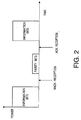
- FIG.2 illustrates a difference in power between information bits and parity bits
- transmission power for parity bits is decided and the parity bits are transmitted with the decided power. Additionally, in this case, it is assumed that the number of parity bits is smaller than that of information bits.
- next information bits are transmitted with the same power as that of the previous information bits (or power decided by transmission power control).
- transmission power of parity bits is set to be lower than that of data transmission, so that interference with other users caused by transmission of parity bits can be restrained to a low level.
- the base station apparatus 100A and communication terminal apparatus 100B may be reversed each other.
- 100A and 100B may be used as the communication terminal apparatus and base station apparatus, respectively.
- FIG. 3 is a block diagram showing each of a base station apparatus and a communication terminal apparatus according to Embodiment 2 of the present invention.
- parts identical to those in FIG. 1 are assigned the same codes as in FIG. 1 and their detailed explanations are omitted.
- Embodiment 1 decides the power ratio between transmission data and parity bits, as a transmission power deciding method at the time of retransmitting the parity bits of FEC, based on the ratio between the number of information bits of transmission data and that of parity bits
- Embodiment 2 decides it based on reception quality information in addition to the ratio between the number of information bits of transmission data and that of parity bits.
- a modulated signal received by the radio reception section 115 is demodulated by the demodulating section 116 and reception quality is measured by a reception quality measuring section (reception quality measuring means) 301.
- Data demodulated by the demodulating section 116 is stored in the data storing section 117.
- reception quality information measured by the reception quality measuring section 301 is input to the transmission frame generating section 119, and a transmission frame is generated together with an ACK signal or NACK signal and transmission data.
- a modulated signal received by the radio reception section 107 is demodulated by the demodulating section 108.
- Data demodulated by the demodulating section 108 is separated into received data, and an ACK signal or NACK signal and reception quality information.
- the received data separated is output directly, and ACK signal or NACK signal is input to the buffer 101, and reception quality information is input to the transmission power deciding section 111.
- the transmission power deciding section 111 decides transmission power using the reception quality information. For example, even if transmission power is decided in the same way as that of the aforementioned Embodiment 1, power higher than decided transmission power is set when reception quality is poor from reception quality information, and power smaller than decided transmission power is set when reception quality is good. It is thereby possible to decrease a probability that errors will occur in parity bits when reception quality is poor, and to reduce interference with other users by lowering power when reception quality is good.
- the base station apparatus 100A and communication terminal apparatus 100C may be reversed each other.
- 100A and 100C may be used as the communication terminal apparatus and base station apparatus, respectively.
- the transmission power is controlled so that the transmission power per bit is the same in transmitting transmission data and parity bits.
- transmission power of parity bits may be increased or decreased as compared with the ratio between the number of information bits of transmission data and that of parity bits. In this case, if transmission power of parity bits per bit is high, error correction ability increases but interference with other users becomes greater. Conversely, if transmission power of parity bits per bit is low, interference with other users becomes smaller but error correction ability decreases.
- transmission power may be increased with respect to data whose delay in retransmission is not permitted, and decreased with respect to data whose delay in retransmission is permitted. Transmission power may be appropriately changed with consideration given to these points.
- the first transmission is limited to information bits subjected to no error correction and retransmission is limited to the parity bits.
- interference with other users can be restrained to a minimum at the time of retransmitting transmission data to make it possible to implement good communications.
- the present invention is suitable for use in a communication terminal apparatus and a base station apparatus of a mobile communication system.
Landscapes
- Engineering & Computer Science (AREA)
- Computer Networks & Wireless Communication (AREA)
- Signal Processing (AREA)
- Quality & Reliability (AREA)
- Mobile Radio Communication Systems (AREA)
- Detection And Prevention Of Errors In Transmission (AREA)
- Communication Control (AREA)
- Transmitters (AREA)
Abstract
A parity bit generating section 110 generates parity
bits of FEC for error correction from transmission data.
A transmission power deciding section 111 decides
transmission power at the time of retransmitting the
parity bits from the number of information bits of
transmission data and the number of parity bits. A
transmission power controller 112 controls transmission
power based on information decided by the transmission
power deciding section 111 and outputs the resultant to
a radio transmission section 104.
Description
- The present invention relates to a data transmitting apparatus and a data transmitting method suitable for use in a communication terminal apparatus and a base station apparatus of a mobile communication system.
- As an error correcting method in data transmission, for example, there is a method called a type II hybrid ARQ method (Shuichi Sasaoka: Mobile Communications, page 240, Ohmsha,Ltd). In this error correcting method, only information bits are first transmitted, and then when it is necessary to perform retransmission with respect to the transmission (namely, when a receiving side cannot demodulate the information bits correctly), only parity bits (redundant bits) of FEC (Forward Error Correction) for error correction are retransmitted. The receiving side performs error correction using information bits previously received and the parity bits that have just received.
- In the conventional data transmitting method, however, the transmission of information bits and the retransmission of parity bits are performed with the same power, causing a problem in which interference, which is equivalent to or more than interference caused at the time of transmitting information bits, will be given to other users at the time of retransmitting the parity bits. In particular, since the number of parity bits is generally smaller than that of information bits, transmission power per parity bit becomes higher than transmission power per information bit when transmission of information bits and that of parity bits are performed with the same power. This results in that the parity bits are retransmitted with transmission power more than necessary, thereby causing the aforementioned problem.
- As a more specific explanation, for example, if information bits are transmitted with power P where the number of information bits is 1000 and that of parity bits is 10, power per bit becomes P/1000. Also, if the retransmission of parity bits is performed with the same power P, power per bit becomes P/10, resulting in an increase of transmission power as compared with information bits. In this way, in a case where transmission is performed with the same power P, power per bit of parity bits becomes higher than that of information bits, increasing in a possibility that interference, which is equivalent to or more than interference caused at the time of transmitting information bits, will be given to other users at the time of retransmitting the parity bits. Additionally, this problem occurs not only in the type II hybrid ARQ method but also in all methods in which the same power is used at the transmission data transmitting and retransmitting time.
- It is an object of the present invention to provide a data transmitting apparatus and a data transmitting method that are capable of restraining interference with other users to a minimum at the time of retransmitting transmission data.
- This object can be achieved by controlling transmission power at the time of retransmitting data after transmitting the data.
-
- FIG. 1 is a block diagram showing each of a base station apparatus and a communication terminal apparatus according to Embodiment 1 of the present invention;
- FIG. 2 is a view explaining data transmission in the base station apparatus according to Embodiment 1 of the present invention; and
- FIG. 3 is a block diagram showing each of a base station apparatus and a communication terminal apparatus according to Embodiment 2 of the present invention.
-
- The following will specifically explain the best mode for carrying out the invention with reference to the drawings accompanying herewith.
- FIG. 1 is a block diagram showing each of a base station apparatus and a communication terminal apparatus according to Embodiment 1 of the present invention.
- In FIG. 1, a base station apparatus 100A comprises a
buffer 101 for temporarily storing transmission data, a transmissionframe generating section 102 for generating a transmission frame, a modulatingsection 103 for modulating the transmission frame generated by the transmissionframe generating section 102 so as to generate a modulated signal, aradio transmission section 104 for amplifying the modulated signal generated by the modulatingsection 103 up to power with a predetermined level so as to output the resultant, aduplexer 105 for assigning anantenna 106 to a transmission system or reception system,antenna 106, aradio reception section 107 for receiving a radio signal captured by theantenna 106 so as to output a modulated signal, a demodulatingsection 108 for demodulating the demodulated signal received by theradio reception section 107, a separatingsection 109 for separating reception data, and a transmission request signal that is called an ACK(Acknowledgement) signal or a retransmission request signal that is called a NACK (Negative Acknowledgment) signal from the signal demodulated by thedemodulating section 108, a paritybit generating section 110 for generating parity bits (redundant bits) of an error correcting code (FEC: Forward Error Correction) for error correction from transmission data, a transmissionpower deciding section 111 for deciding transmission power at a parity bit retransmitting time from the number of information bits of transmission data and that of parity bits, and atransmission power controller 112 for controlling theradio transmission section 104 so as to obtain transmission power decided by the transmissionpower deciding section 111. - Additionally, the
radio transmission section 104 corresponds to transmitting means. Moreover, the transmissionpower deciding section 111 andtransmission power controller 112 configure transmission power controlling means. - On the other hand, a
communication terminal apparatus 100B comprises anantenna 113, aduplexer 114 for assigning theantenna 113 to a transmission system or a reception system, aradio reception section 115 for receiving a radio signal captured by theantenna 113 so as to output a modulated signal, a demodulatingsection 116 for demodulating data from the modulated signal output from theradio reception section 115, adata storing section 117 for storing data demodulated by the demodulatingsection 116, anerror detecting section 118 for detecting data stored by thedata storing section 117 and an error of data error corrected by anerror correcting section 122, transmissionframe generating section 119 for generating a transmission frame from transmission data, and an ACK signal or NACK signal, a modulatingsection 120 for modulating the transmission frame generated by the transmissionframe generating section 119 so as to generate a modulated signal, aradio transmission section 121 for amplifying the modulated signal from the modulatingsection 120 up to power with a predetermined level so as to output the resultant, and theerror correcting section 122 for correcting an error of data stored by thedata storing section 117. - In the base station apparatus 100A, after input transmission data is stored in
buffer 101, the transmission data is not subjected to error correcting coding, and a transmission frame is generated only using the transmission data in transmissionframe generating section 102. - The generated transmission frame is modulated by the modulating
section 103, the resultant is amplified up to power with a predetermined level by theradio transmission section 104, and the radio signal is transmitted from theantenna 106 via theduplexer 105. - In the
communication terminal apparatus 100B, a radio signal captured by theantenna 113 is received by theradio reception section 115 via theduplexer 114 so as to output a modulated signal. The modulated signal output from theradio reception section 115 is demodulated by the demodulatingsection 116 and the resultant is stored in thedata storing section 117. Data stored in thedata storing section 117 is subjected to error detection by theerror detecting section 118. In a case where there is an error in the data stored in thedata storing section 117, a NACK signal is input to the transmissionframe generating section 119 from theerror detecting section 118. The transmissionframe generating section 119 generates a transmission frame from the input NACK signal and transmission data. The transmission frame generated by the transmissionframe generating section 119 is modulated by the modulatingsection 120, the resultant is amplified up to power with a predetermined level by theradio transmission section 121, and the radio signal is transmitted from theantenna 113 via theduplexer 114. - In the base station apparatus 100A, a radio signal captured by the
antenna 106 is received by theradio reception section 107 via theduplexer 105, and a modulated signal is output from thesection 107. Themodulated signal output from theradio reception section 107 is demodulated by the demodulatingsection 108. Demodulated data is input to the separatingsection 109 to be separated into received data and NACK signal, and received data is output directly and NACK signal is input to thebuffer 101. When the NACK signal is input to thebuffer 101, the transmission data stored in thebuffer 101 is input to the paritybit generating section 110. Then, a parity bit of error correcting code for error correction is generated from the transmission data by the parity bit generating section110, and the resultant is input to the transmissionframe generating section 102. - Moreover, the number of information bits for the transmission data and that of parity bits are input to the transmission
power deciding section 111 so as to decide transmission power at the parity bit retransmitting time from these numbers of bits. For example, it is assumed that the number of information bits for transmission data is set to "1000", the number of parity bits is set to "10", and transmission data is sent with power P. Power per information bit results in P/1000. In retranslating the parity bit, the power is decided to P/100 so that power per bit is the same in the parity bit and transmission data. Thus, a ratio of the power of transmission data to the power of parity bit is made the same as a ratio of the number of information bits to the number of parity bits (namely, transmission power per bit is made the same as each other). - Transmission power information decided by the transmission
power deciding section 111 is input to thetransmission power controller 112. Thetransmission power controller 112 controls transmission power of theradio transmission section 104 based on input transmission power information. While, the parity bits generated by the paritybit generating section 110 are input to the transmissionframe generating section 102 so as to generate a transmission frame. The generated transmission frame is modulated by the modulatingsection 103 and the resultant is input to theradio transmission section 104. The modulated signal input to theradio transmission section 104 is transmitted with transmission power controlled by thetransmission power controller 112 from theantenna 106 via theduplexer 105. - In the
communication terminal apparatus 100B, when the parity bits retransmitted from the base station apparatus 100A are received, data stored in thedata storing section 117 and the parity bits are input to theerror correcting section 122 and error correction is provided thereto. Data subjected to error correction is input to theerror detecting section 118 and error detection is provided thereto. A series of operations is repeated until no error is detected by theerror detecting section 118, and when no error is detected, data subjected to error correction is output as received data, while the content ofdata storing section 117 is reset. Then, an ACK signal for requesting next data transmission is input to the transmissionframe generating section 119 from theerror detecting section 118 so as to generate a transmission frame together with data transmission. - In the base station apparatus 100A, when the ACK signal is received, it is input to the
buffer 101 and the content of the buffer is reset. Resultantly, transmission of next data is started. - FIG.2 illustrates a difference in power between information bits and parity bits
- When a NACK signal is received after transmitting information bits, transmission power for parity bits is decided and the parity bits are transmitted with the decided power. Additionally, in this case, it is assumed that the number of parity bits is smaller than that of information bits. When an ACK signal is received after transmitting the parity bits, next information bits are transmitted with the same power as that of the previous information bits (or power decided by transmission power control).
- Thus, according to this embodiment, in a case where a need for retransmitting transmission data arises and only parity bits of error correcting code for error correction are transmitted, transmission power of parity bits is set to be lower than that of data transmission, so that interference with other users caused by transmission of parity bits can be restrained to a low level.
- Additionally, in this embodiment, the base station apparatus 100A and
communication terminal apparatus 100B may be reversed each other. In other words, 100A and 100B may be used as the communication terminal apparatus and base station apparatus, respectively. - FIG. 3 is a block diagram showing each of a base station apparatus and a communication terminal apparatus according to Embodiment 2 of the present invention. In this figure, parts identical to those in FIG. 1 are assigned the same codes as in FIG. 1 and their detailed explanations are omitted.
- Though the aforementioned Embodiment 1 decides the power ratio between transmission data and parity bits, as a transmission power deciding method at the time of retransmitting the parity bits of FEC, based on the ratio between the number of information bits of transmission data and that of parity bits, Embodiment 2 decides it based on reception quality information in addition to the ratio between the number of information bits of transmission data and that of parity bits.
- In a
communication terminal apparatus 100C, a modulated signal received by theradio reception section 115 is demodulated by thedemodulating section 116 and reception quality is measured by a reception quality measuring section (reception quality measuring means) 301. Data demodulated by thedemodulating section 116 is stored in thedata storing section 117. Meanwhile, reception quality information measured by the receptionquality measuring section 301 is input to the transmissionframe generating section 119, and a transmission frame is generated together with an ACK signal or NACK signal and transmission data. - On the other hand, in the base station apparatus 100A, a modulated signal received by the
radio reception section 107 is demodulated by thedemodulating section 108. Data demodulated by thedemodulating section 108 is separated into received data, and an ACK signal or NACK signal and reception quality information. The received data separated is output directly, and ACK signal or NACK signal is input to thebuffer 101, and reception quality information is input to the transmissionpower deciding section 111. - The transmission
power deciding section 111 decides transmission power using the reception quality information. For example, even if transmission power is decided in the same way as that of the aforementioned Embodiment 1, power higher than decided transmission power is set when reception quality is poor from reception quality information, and power smaller than decided transmission power is set when reception quality is good. It is thereby possible to decrease a probability that errors will occur in parity bits when reception quality is poor, and to reduce interference with other users by lowering power when reception quality is good. - Additionally, in this embodiment, the base station apparatus 100A and
communication terminal apparatus 100C may be reversed each other. In other words, 100A and 100C may be used as the communication terminal apparatus and base station apparatus, respectively. - Moreover, in the aforementioned Embodiments 1 and 2, the transmission power is controlled so that the transmission power per bit is the same in transmitting transmission data and parity bits. However, it is not necessary to make the transmission power per bit the same always. For example, transmission power of parity bits may be increased or decreased as compared with the ratio between the number of information bits of transmission data and that of parity bits. In this case, if transmission power of parity bits per bit is high, error correction ability increases but interference with other users becomes greater. Conversely, if transmission power of parity bits per bit is low, interference with other users becomes smaller but error correction ability decreases.
- Further, transmission power may be increased with respect to data whose delay in retransmission is not permitted, and decreased with respect to data whose delay in retransmission is permitted. Transmission power may be appropriately changed with consideration given to these points.
- Furthermore, in the aforementioned Embodiments 1 and 2 both ACK and NACK signals are sent back. However, it is not necessary to send back the NACK signal always. For example, when such a system is used that data is retransmitted unless ACK signal comes within a predetermined time after transmitting data, it is not unnecessary to send back the NACK signal.
- Still furthermore, in the aforementioned Embodiments 1 and 2, the first transmission is limited to information bits subjected to no error correction and retransmission is limited to the parity bits. However, it may be possible to transmit information bits and parity bits in the first transmission and/or in the retransmission.
- As explained above, according to the present invention, interference with other users can be restrained to a minimum at the time of retransmitting transmission data to make it possible to implement good communications.
- This application is based on the Japanese Patent Application No. 2000-190229 filed on June 23, 2000, entire content of which is expressly incorporated by reference herein.
- The present invention is suitable for use in a communication terminal apparatus and a base station apparatus of a mobile communication system.
Claims (9)
- A data transmitting apparatus comprising:transmitting means for amplifying a modulated signal obtained by modulating transmission data up to power with a predetermined level so as to transmit the amplified signal; andtransmission power controlling means for controlling transmission power at the time of retransmitting said transmission data.
- The data transmitting apparatus according to claim 1, wherein said transmission power controlling means decides transmission power of parity bits based on a ratio of the number of information bits to the number of parity bits when said parity bits for error correction are transmitted at a transmission data retransmitting time.
- The data transmitting apparatus according to claim 1, wherein said transmission power controlling means decides transmission power of parity bits such that a ratio of the transmission power of information bits and the power of parity bits and a ratio of the number of information bits to the number of parity bits become the same value when said parity bits for error correction are transmitted at a transmission data retransmitting time.
- The data transmitting apparatus according to claim 2 or 3, wherein said transmission power controlling means uses reception quality information sent from a receiver's apparatus in connection with the modulated signal transmitted from a side of data transmitting apparatus at the time of deciding transmission power of parity bits.
- The data transmitting apparatus according to claim 4, wherein said transmission power controlling means decides transmission power of parity bits according to reception quality information, increases said transmission power when reception quality is poor, and decreases said transmission power when reception quality is good.
- The data transmitting apparatus according to any one of claims 1 to 5, further comprising reception quality measuring means for measuring reception quality of the modulated signal received, and said transmitting means transmits reception quality information indicating the reception quality measured by said reception quality measuring means.
- A base station apparatus comprising the data transmitting apparatus according to any one of claims 1 to 6.
- A communication terminal apparatus comprising the data transmitting apparatus according to any one of claims 1 to 6.
- A data transmitting method that controls transmission power at the time of retransmitting transmission data after transmitting said transmission data.
Applications Claiming Priority (3)
| Application Number | Priority Date | Filing Date | Title |
|---|---|---|---|
| JP2000190229A JP2002009692A (en) | 2000-06-23 | 2000-06-23 | Data transmission device and data transmission method |
| JP2000190229 | 2000-06-23 | ||
| PCT/JP2001/005397 WO2001099328A1 (en) | 2000-06-23 | 2001-06-25 | Data transmission apparatus and data transmission method |
Publications (1)
| Publication Number | Publication Date |
|---|---|
| EP1207646A1 true EP1207646A1 (en) | 2002-05-22 |
Family
ID=18689732
Family Applications (1)
| Application Number | Title | Priority Date | Filing Date |
|---|---|---|---|
| EP01941210A Withdrawn EP1207646A1 (en) | 2000-06-23 | 2001-06-25 | Data transmission apparatus and data transmission method |
Country Status (7)
| Country | Link |
|---|---|
| US (1) | US6931077B2 (en) |
| EP (1) | EP1207646A1 (en) |
| JP (1) | JP2002009692A (en) |
| KR (1) | KR20020020971A (en) |
| CN (1) | CN1173514C (en) |
| AU (1) | AU7460701A (en) |
| WO (1) | WO2001099328A1 (en) |
Cited By (3)
| Publication number | Priority date | Publication date | Assignee | Title |
|---|---|---|---|---|
| EP1583272A1 (en) * | 2004-04-01 | 2005-10-05 | Matsushita Electric Industrial Co., Ltd. | Interference limitation for uplink retransmissions |
| WO2006010957A2 (en) | 2004-07-30 | 2006-02-02 | Andrew Richardson | Signal transmission method from a local network node |
| US8290527B2 (en) | 2004-07-30 | 2012-10-16 | Airvana, Corp. | Power control in a local network node (LNN) |
Families Citing this family (43)
| Publication number | Priority date | Publication date | Assignee | Title |
|---|---|---|---|---|
| US6977967B1 (en) | 1995-03-31 | 2005-12-20 | Qualcomm Incorporated | Method and apparatus for performing fast power control in a mobile communication system |
| TW347616B (en) | 1995-03-31 | 1998-12-11 | Qualcomm Inc | Method and apparatus for performing fast power control in a mobile communication system a method and apparatus for controlling transmission power in a mobile communication system is disclosed. |
| JP2003534718A (en) * | 2000-05-25 | 2003-11-18 | ソマ ネットワークス インコーポレイテッド | Quality-dependent data communication channel |
| US8199696B2 (en) | 2001-03-29 | 2012-06-12 | Qualcomm Incorporated | Method and apparatus for power control in a wireless communication system |
| US7986672B2 (en) * | 2002-02-25 | 2011-07-26 | Qualcomm Incorporated | Method and apparatus for channel quality feedback in a wireless communication |
| JP4226481B2 (en) * | 2002-04-19 | 2009-02-18 | トムソン ライセンシング | Synchronous loss recovery digital communication system using forward erasure correction |
| US6898193B2 (en) * | 2002-06-20 | 2005-05-24 | Qualcomm, Incorporated | Adaptive gain adjustment control |
| JP2004112597A (en) * | 2002-09-20 | 2004-04-08 | Matsushita Electric Ind Co Ltd | Base station apparatus and packet quality estimation method |
| JP3679089B2 (en) * | 2002-11-20 | 2005-08-03 | 松下電器産業株式会社 | Base station apparatus and retransmission packet transmission power control method |
| US7155249B2 (en) * | 2003-01-10 | 2006-12-26 | Qualcomm Incorporated | Modified power control for hybrid ARQ on the reverse link |
| JP4224337B2 (en) * | 2003-04-04 | 2009-02-12 | パナソニック株式会社 | Radio transmission apparatus and radio transmission method |
| JP2007526724A (en) * | 2004-03-04 | 2007-09-13 | クゥアルコム・インコーポレイテッド | Early truncation of low data rate traffic in wireless networks |
| CN101283537A (en) * | 2005-10-11 | 2008-10-08 | 松下电器产业株式会社 | Sending device and sending method |
| EP1791285A1 (en) * | 2005-11-29 | 2007-05-30 | Alcatel Lucent | Hybrid ARQ apparatus and corresponding method, wherein the FEC redundancy is adapted based on the number of retransmissions of a packet |
| US8194760B2 (en) * | 2006-06-01 | 2012-06-05 | Ntt Docomo, Inc. | Method and apparatus for distributed space-time coding in wireless radio networks |
| US20080089333A1 (en) * | 2006-10-17 | 2008-04-17 | Kozat Ulas C | Information delivery over time-varying network topologies |
| US7899028B2 (en) * | 2006-10-27 | 2011-03-01 | Samsung Electronics Co., Ltd. | Method and system for synchronizing data transmissions in IP-based networks |
| US8027407B2 (en) * | 2006-11-06 | 2011-09-27 | Ntt Docomo, Inc. | Method and apparatus for asynchronous space-time coded transmission from multiple base stations over wireless radio networks |
| US8059732B2 (en) * | 2006-11-28 | 2011-11-15 | Ntt Docomo, Inc. | Method and apparatus for wideband transmission from multiple non-collocated base stations over wireless radio networks |
| JP2008167141A (en) * | 2006-12-28 | 2008-07-17 | Nec Corp | Data transmission method and apparatus, and communication system using the same |
| US8861356B2 (en) * | 2007-03-13 | 2014-10-14 | Ntt Docomo, Inc. | Method and apparatus for prioritized information delivery with network coding over time-varying network topologies |
| US8064548B2 (en) * | 2007-05-18 | 2011-11-22 | Ntt Docomo, Inc. | Adaptive MaxLogMAP-type receiver structures |
| US20090285323A1 (en) * | 2008-05-15 | 2009-11-19 | Sundberg Carl-Erik W | Adaptive soft output m-algorithm receiver structures |
| US20080304590A1 (en) * | 2007-06-06 | 2008-12-11 | Sundberg Carl-Erik W | Method and apparatus for transmission from multiple non-collocated base stations over wireless radio networks |
| US8301954B2 (en) * | 2007-07-04 | 2012-10-30 | Telefonaktiebolaget L M Ericsson (Publ) | Method and arrangement in a communication network system |
| US20090075686A1 (en) * | 2007-09-19 | 2009-03-19 | Gomadam Krishna S | Method and apparatus for wideband transmission based on multi-user mimo and two-way training |
| US8325840B2 (en) * | 2008-02-25 | 2012-12-04 | Ntt Docomo, Inc. | Tree position adaptive soft output M-algorithm receiver structures |
| US8279954B2 (en) * | 2008-03-06 | 2012-10-02 | Ntt Docomo, Inc. | Adaptive forward-backward soft output M-algorithm receiver structures |
| US8565329B2 (en) * | 2008-06-03 | 2013-10-22 | Ntt Docomo, Inc. | Soft output M-algorithm receiver structures with generalized survivor selection criteria for MIMO systems |
| US8229443B2 (en) * | 2008-08-13 | 2012-07-24 | Ntt Docomo, Inc. | Method of combined user and coordination pattern scheduling over varying antenna and base-station coordination patterns in a multi-cell environment |
| US8451951B2 (en) * | 2008-08-15 | 2013-05-28 | Ntt Docomo, Inc. | Channel classification and rate adaptation for SU-MIMO systems |
| US8705484B2 (en) * | 2008-08-15 | 2014-04-22 | Ntt Docomo, Inc. | Method for varying transmit power patterns in a multi-cell environment |
| US8542640B2 (en) * | 2008-08-28 | 2013-09-24 | Ntt Docomo, Inc. | Inter-cell approach to operating wireless beam-forming and user selection/scheduling in multi-cell environments based on limited signaling between patterns of subsets of cells |
| US8855221B2 (en) * | 2008-09-15 | 2014-10-07 | Ntt Docomo, Inc. | Method and apparatus for iterative receiver structures for OFDM/MIMO systems with bit interleaved coded modulation |
| US9048977B2 (en) | 2009-05-05 | 2015-06-02 | Ntt Docomo, Inc. | Receiver terminal driven joint encoder and decoder mode adaptation for SU-MIMO systems |
| US8514961B2 (en) | 2010-02-04 | 2013-08-20 | Ntt Docomo, Inc. | Method and apparatus for distributed space-time coding in wireless radio networks |
| US9578074B2 (en) * | 2013-11-11 | 2017-02-21 | Amazon Technologies, Inc. | Adaptive content transmission |
| US9641592B2 (en) | 2013-11-11 | 2017-05-02 | Amazon Technologies, Inc. | Location of actor resources |
| US9374552B2 (en) | 2013-11-11 | 2016-06-21 | Amazon Technologies, Inc. | Streaming game server video recorder |
| US9582904B2 (en) | 2013-11-11 | 2017-02-28 | Amazon Technologies, Inc. | Image composition based on remote object data |
| US9604139B2 (en) | 2013-11-11 | 2017-03-28 | Amazon Technologies, Inc. | Service for generating graphics object data |
| US9805479B2 (en) | 2013-11-11 | 2017-10-31 | Amazon Technologies, Inc. | Session idle optimization for streaming server |
| US9634942B2 (en) | 2013-11-11 | 2017-04-25 | Amazon Technologies, Inc. | Adaptive scene complexity based on service quality |
Family Cites Families (11)
| Publication number | Priority date | Publication date | Assignee | Title |
|---|---|---|---|---|
| JP3101834B2 (en) * | 1991-12-03 | 2000-10-23 | 日本電気エンジニアリング株式会社 | Wireless transmission power control method |
| US5841768A (en) * | 1996-06-27 | 1998-11-24 | Interdigital Technology Corporation | Method of controlling initial power ramp-up in CDMA systems by using short codes |
| JP3385299B2 (en) * | 1996-05-20 | 2003-03-10 | 三菱電機株式会社 | Spread spectrum communication equipment |
| JP3202658B2 (en) | 1997-06-20 | 2001-08-27 | 日本電気株式会社 | Variable rate CDMA transmission power control method |
| US6138260A (en) | 1997-09-04 | 2000-10-24 | Conexant Systems, Inc. | Retransmission packet capture system within a wireless multiservice communications environment with turbo decoding |
| US6101168A (en) * | 1997-11-13 | 2000-08-08 | Qualcomm Inc. | Method and apparatus for time efficient retransmission using symbol accumulation |
| JP3577253B2 (en) * | 2000-01-31 | 2004-10-13 | シャープ株式会社 | Wireless communication apparatus, transmission power control method thereof, and wireless communication system using the same |
| JP3686836B2 (en) * | 2000-03-13 | 2005-08-24 | シャープ株式会社 | Method for automatically controlling transmission power value of wireless communication device and storage medium storing the same |
| SG109450A1 (en) * | 2000-04-06 | 2005-03-30 | Ntt Docomo Inc | Multicast signal transmission power control method and base station using the same |
| CN100456660C (en) * | 2000-11-17 | 2009-01-28 | Lg电子株式会社 | Blind Link Adaptation Method Using Acknowledgment in Automatic Repeat Request System |
| JP2003008553A (en) * | 2001-06-22 | 2003-01-10 | Mitsubishi Electric Corp | Transmitter, receiver, transceiver and communication system |
-
2000
- 2000-06-23 JP JP2000190229A patent/JP2002009692A/en active Pending
-
2001
- 2001-06-25 KR KR1020027002248A patent/KR20020020971A/en not_active Abandoned
- 2001-06-25 EP EP01941210A patent/EP1207646A1/en not_active Withdrawn
- 2001-06-25 WO PCT/JP2001/005397 patent/WO2001099328A1/en not_active Ceased
- 2001-06-25 AU AU74607/01A patent/AU7460701A/en not_active Abandoned
- 2001-06-25 CN CNB018015085A patent/CN1173514C/en not_active Expired - Fee Related
- 2001-06-25 US US10/069,005 patent/US6931077B2/en not_active Expired - Fee Related
Non-Patent Citations (1)
| Title |
|---|
| See references of WO0199328A1 * |
Cited By (7)
| Publication number | Priority date | Publication date | Assignee | Title |
|---|---|---|---|---|
| EP1583272A1 (en) * | 2004-04-01 | 2005-10-05 | Matsushita Electric Industrial Co., Ltd. | Interference limitation for uplink retransmissions |
| WO2005099161A1 (en) * | 2004-04-01 | 2005-10-20 | Matsushita Electric Industrial Co.,Ltd. | Interference limitation for uplink retransmissions |
| WO2006010957A2 (en) | 2004-07-30 | 2006-02-02 | Andrew Richardson | Signal transmission method from a local network node |
| WO2006010957A3 (en) * | 2004-07-30 | 2006-04-27 | Andrew Richardson | Signal transmission method from a local network node |
| US8290527B2 (en) | 2004-07-30 | 2012-10-16 | Airvana, Corp. | Power control in a local network node (LNN) |
| US8311570B2 (en) | 2004-07-30 | 2012-11-13 | Airvana Llc | Method and system of setting transmitter power levels |
| US8503342B2 (en) | 2004-07-30 | 2013-08-06 | Airvana Llc | Signal transmission method from a local network node |
Also Published As
| Publication number | Publication date |
|---|---|
| KR20020020971A (en) | 2002-03-16 |
| AU7460701A (en) | 2002-01-02 |
| CN1173514C (en) | 2004-10-27 |
| US20020114404A1 (en) | 2002-08-22 |
| CN1381118A (en) | 2002-11-20 |
| WO2001099328A1 (en) | 2001-12-27 |
| US6931077B2 (en) | 2005-08-16 |
| JP2002009692A (en) | 2002-01-11 |
Similar Documents
| Publication | Publication Date | Title |
|---|---|---|
| US6931077B2 (en) | Data transmitting apparatus and data transmitting method | |
| US7236740B2 (en) | Data retransmission apparatus and method in a mobile communication system employing HARQ technique | |
| EP3890426B1 (en) | Adaptive transmission method, device and system for satellite communication | |
| KR100850989B1 (en) | A method for controlling power for response signals ACK or NACK in an ARQ system | |
| EP2151942B1 (en) | Packet data transmitting method and mobile communication system using the same | |
| US6425105B1 (en) | Bidirectional ARQ apparatus and method | |
| US9363621B2 (en) | System and method adopting a reliable stop-and-wait hybrid automatic repeat request protocol | |
| EP1271833A1 (en) | ARQ system with transmission priority and receiver quality feedback | |
| EP1519508B1 (en) | Receiver apparatus and communication method | |
| KR100387543B1 (en) | Communication terminal, base station, and method of radio communication | |
| JP2002026747A (en) | Wireless communication terminal device and transmission power control method | |
| KR100703107B1 (en) | Automatic data retransmission method in wireless communication system | |
| EP1777855A1 (en) | Classifying-synthesizing transmission method of multi-user feedback information at base station | |
| WO2014093547A1 (en) | Method and apparatus for a modified harq procedure after a receiver outage event | |
| JP2000224226A (en) | Error control method and device, transmission and reception control device | |
| CN112889235B (en) | HARQ-ACK codebook transmitting method, HARQ-ACK codebook receiving method and HARQ-ACK codebook receiving device | |
| JP2005515699A (en) | Method and apparatus for transmission and reception data | |
| US8000333B2 (en) | Method, system and station for communicating data packets using ARQ | |
| CN1914824B (en) | Transmission power control device and method in wireless communication system | |
| JPH0969828A (en) | Radio equipment for data transmission | |
| JP2003174435A (en) | Automatic retransmission request data transmission method and apparatus | |
| KR101208545B1 (en) | method of transmitting response signals for transmitted signals in communication system | |
| KR100964674B1 (en) | Receiving status checking channel power control method and packet transmission control method | |
| KR100519332B1 (en) | A Method for Transmitting Packet Data Using Radio Link Protocol | |
| CN101855857A (en) | Method and apparatus for automatic retransmission in wireless communication network |
Legal Events
| Date | Code | Title | Description |
|---|---|---|---|
| PUAI | Public reference made under article 153(3) epc to a published international application that has entered the european phase |
Free format text: ORIGINAL CODE: 0009012 |
|
| AX | Request for extension of the european patent |
Free format text: AL;LT;LV;MK;RO;SI |
|
| 17P | Request for examination filed |
Effective date: 20020322 |
|
| RBV | Designated contracting states (corrected) |
Designated state(s): DE FR GB |
|
| STAA | Information on the status of an ep patent application or granted ep patent |
Free format text: STATUS: THE APPLICATION HAS BEEN WITHDRAWN |
|
| 18W | Application withdrawn |
Effective date: 20071015 |