EP1207632A1 - Procédé d'adressage dans un réseau d'accès ou d'infrastructure satellites pouvant servir de support à des transferts de données en mode non-connecté - Google Patents
Procédé d'adressage dans un réseau d'accès ou d'infrastructure satellites pouvant servir de support à des transferts de données en mode non-connecté Download PDFInfo
- Publication number
- EP1207632A1 EP1207632A1 EP01402849A EP01402849A EP1207632A1 EP 1207632 A1 EP1207632 A1 EP 1207632A1 EP 01402849 A EP01402849 A EP 01402849A EP 01402849 A EP01402849 A EP 01402849A EP 1207632 A1 EP1207632 A1 EP 1207632A1
- Authority
- EP
- European Patent Office
- Prior art keywords
- label
- satellite
- terminal
- server
- station
- Prior art date
- Legal status (The legal status is an assumption and is not a legal conclusion. Google has not performed a legal analysis and makes no representation as to the accuracy of the status listed.)
- Granted
Links
- 238000000034 method Methods 0.000 title claims abstract description 49
- 238000012546 transfer Methods 0.000 title claims description 4
- 238000005457 optimization Methods 0.000 claims description 30
- 238000004891 communication Methods 0.000 claims description 10
- 230000004044 response Effects 0.000 claims description 8
- 230000005540 biological transmission Effects 0.000 claims description 7
- 101000864786 Homo sapiens Secreted frizzled-related protein 2 Proteins 0.000 claims 1
- 102100030054 Secreted frizzled-related protein 2 Human genes 0.000 claims 1
- 101150045440 ISP1 gene Proteins 0.000 description 13
- 101100353471 Mus musculus Prss28 gene Proteins 0.000 description 13
- 101100509103 Schizosaccharomyces pombe (strain 972 / ATCC 24843) ish1 gene Proteins 0.000 description 13
- 101000610620 Homo sapiens Putative serine protease 29 Proteins 0.000 description 7
- 102100040345 Putative serine protease 29 Human genes 0.000 description 7
- 102100038776 ADP-ribosylation factor-related protein 1 Human genes 0.000 description 6
- 238000010586 diagram Methods 0.000 description 6
- 230000008901 benefit Effects 0.000 description 5
- 238000013475 authorization Methods 0.000 description 3
- 238000007726 management method Methods 0.000 description 3
- 230000011664 signaling Effects 0.000 description 3
- 235000008694 Humulus lupulus Nutrition 0.000 description 2
- 240000008042 Zea mays Species 0.000 description 2
- 101710101449 Alpha-centractin Proteins 0.000 description 1
- 230000006978 adaptation Effects 0.000 description 1
- 238000012550 audit Methods 0.000 description 1
- 238000011161 development Methods 0.000 description 1
- 238000009792 diffusion process Methods 0.000 description 1
- 230000002349 favourable effect Effects 0.000 description 1
- 230000010354 integration Effects 0.000 description 1
- 238000002372 labelling Methods 0.000 description 1
- 230000001483 mobilizing effect Effects 0.000 description 1
- 238000004540 process dynamic Methods 0.000 description 1
- 238000012545 processing Methods 0.000 description 1
- 230000002250 progressing effect Effects 0.000 description 1
- 230000003068 static effect Effects 0.000 description 1
- 230000009897 systematic effect Effects 0.000 description 1
- 238000012384 transportation and delivery Methods 0.000 description 1
Images




Classifications
-
- H—ELECTRICITY
- H04—ELECTRIC COMMUNICATION TECHNIQUE
- H04B—TRANSMISSION
- H04B7/00—Radio transmission systems, i.e. using radiation field
- H04B7/14—Relay systems
- H04B7/15—Active relay systems
- H04B7/185—Space-based or airborne stations; Stations for satellite systems
- H04B7/18578—Satellite systems for providing broadband data service to individual earth stations
- H04B7/18582—Arrangements for data linking, i.e. for data framing, for error recovery, for multiple access
Definitions
- the present invention relates to an addressing method in a network access or satellite infrastructure, a process for determining and optimizing dynamic of an address label, a satellite telecommunications system implementing these methods and the components of such a system.
- IP Internet protocol
- a telecommunications system by satellite offers broadcasting services, i.e. data transmission in one way, from a sender to a set of recipients, and communication in circuit mode, i.e. from a given point to another point given by means of a virtual "wire” or “circuit” temporarily established between the two points for communication between them.
- Satellite networks offering possibilities of transactions according to the Internet protocol must be able seamlessly integrate into terrestrial networks, so that users can reach any Internet address on the global network, both on broadcast and than receiving data, regardless of the path taken by data packets to ensure transmission, and thus benefit from all Internet services already available on terrestrial networks.
- One of the aims of the present invention is to propose an addressing method which allows, in a satellite telecommunications system, to send data either to a single recipient or to a group of recipients, without that it is not necessary to establish a connection.
- Another object of the present invention is to allow the easy creation of multicast groups and subnets in a system of telecommunication by satellites, without duplication of packets depending on the number of recipients concerned by a sending of data.
- the present invention also aims to minimize the radio resources usually necessary for signaling data packets used for establish a connection between the transmitter and the receiver by allowing the system satellite to operate in unconnected mode.
- the invention also aims to make the integration of a system of transparency transparent. Satellite telecommunications in a terrestrial telecommunications network.
- the invention firstly relates to a method for addressing data packets in a satellite access network or infrastructure serving to support subnets, such as logical subnets IP, virtual private networks or multicast groups, grouping different terminal stations, in which each data packet is associated with an addressing header and in which each terminal station in the network is attached to a satellite terminal or to a connection station which is in the coverage area of a given spot of a given satellite, characterized in that the address header of each data packet also contains a "label" field containing an identifier characteristic of a sub virtual network to which said terminal station belongs and the spot in which the satellite terminal or the connection station to which said terminal station is attached is located.
- subnets such as logical subnets IP, virtual private networks or multicast groups
- this method is based on a mode not connected between the transmitting satellite terminal, or the connection station transmitter and the receiving satellite terminal or the receiving connection station.
- the terminal stations connected to satellite terminals or connection stations are constituted by user terminals, routers, data or service servers and including address resolution servers.
- user terminals, routers, data servers or of services communicate with the satellite (s) of the telecommunications via satellite terminals or radio stations connection.
- a terminal station and a satellite terminal or a terminal and a connection station may not constitute only one and the same equipment while being gathered in the same case.
- a user terminal and a satellite terminal can form a single portable device.
- the solution proposed by the invention allows, in a system of telecommunications by satellite, to address groups of users by through labels, so by taking advantage of one of the major advantages of satellites, namely their ability to broadcast data for many users by mobilizing neither more energy nor more resources than for a single user.
- the data packets passing through a satellite are directly directed by the satellite or its management center in the spot covering the satellite terminal to which the recipient of the data packets is connected.
- the invention also relates to a method for determining and dynamic optimization of a label from the address of a target terminal station, recipient of a data packet.
- IP address resolution protocol Internet protocol
- ARP Request Internet protocol
- IP address resolution protocol Internet protocol
- Each terminal station sees this packet of request type data but only the target terminal station is recognized by its protocol address and sends a similar type of data packet to the sender "ARP Response", in which he filled in a field provided for his own address hardware.
- the transmitter can thus recover the hardware address of the target terminal station and then send it data packets.
- the invention starts from this known method of address resolution to provide a dynamic process for determining labels, with a view to implementing the data packet addressing method defined above in a communication system satellite communications.
- the method for determining and optimizing labels is characterized in that it consists in installing a centralized server for determining labels (hereinafter referred to as "label server”) at each Internet access server. using the satellite network, to communicate the label corresponding to this label server to each satellite terminal or each network connection station at the time of registration, with the Internet access server, of a user whose user terminal is connected to this satellite terminal or to this connection station, and to have transmitted by the satellite terminal (or by the connection station) to which (to which) is connected the user terminal of a user wishing to send data to a terminal station target connected to another satellite terminal or to another connection station, bound for the label server of its access server and using the corresponding label to the label server, a “Label request” type data packet containing the IP address of the target terminal station, to be transmitted by the label server, bound for the satellite terminal or the transmitting connection station and using the label corresponding to said transmitter, a data packet of the "Label response" type containing the label of the subnetwork to which the target
- the data packet of "Label response" type provided by the label server is established according to the hardware location of the target terminal station.
- the invention also proposes a routing optimization process.
- This process is characterized by the fact that during an interrogation of the server of labels, by submission of a "Label request" data packet corresponding to a target terminal extension address, if the label server finds a label from a router as a response to the request, said label server addresses said router a "Label Optimization" type data packet containing the address of the target terminal extension as the recipient address and any connection belonging to the satellite network which is requested by its router to forward this "Label Optimization" type data packet to another router returns to the label server an indication that the label of router to use for this target terminal station is the label of the router to which this connection station forwards the "Label optimization" data packet.
- the label server can indicate the label of a router closer to the recipient.
- the optimization packet progressing from router to router and through successive connection stations, the label server is returned to updated to each new intermediate router and ends up indicating the label of the router closest to the recipient in the satellite network. Data packets sent under this label then reach the recipient in a single hop in the satellite network.
- the data packet of type "Label optimization” has a limited lifespan outside the network satellites, in order to eliminate themselves spontaneously as soon as its transmission from a station of connection to another is considered as no longer able to give rise to a routing optimization.
- the labels according to the invention it is possible to address a group of terminals and / or gateways, not only as part of a connection within a virtual subnet, but also in the context of multicast delivery.
- the data packets are containers which may contain, inter alia, IP packets, i.e. responding standards for data transfer over Internet-type networks.
- the method according to the invention is particularly effective because, in addition to the advantages already mentioned, it allows optimize the satellite access protocol, as will be explained later.
- each terminal station of the satellite network is seen as belonging to a virtual subnet.
- This virtual subnet may not be constituted only by said terminal station, as may be the case for a particular gateway such as a connection station, a router, a server labels or an address resolution server, or be made up of a group of terminal stations, such as groups of user terminals, gathered in a virtual private network or in a multicast group.
- the terminal station sending the data packet is connected to a terminal satellite or to a connection station registered in the satellite network and is itself registered with an Internet access server, it has all the information required to determine the identifier constituting the label from IP address (i.e. defined according to Internet protocol) of the terminal recipient of the data packet.
- IP address i.e. defined according to Internet protocol
- the satellite terminal of the transmitting terminal station if it is not registered in the satellite network or if the satellite terminal or the connection is registered in the network but the terminal is not still registered with the access server, it must first carry out its request authorization from an Internet access server, and for this purpose it must respect a signaling procedure which notably includes the use of this end of a predefined label to send a data packet to the Internet access server.
- the identifier constituting the label is predefined by the signaling procedure.
- the label added to the header of any package of data is used, on the one hand, by the satellite (s) in order to transmit the packets data to the spots corresponding to said label, on the other hand by the terminals satellites and / or connection stations in order to filter the packets which are sent to them intended.
- the invention also relates to a satellite terminal of a satellite telecommunications system implementing the method described above.
- This terminal is characterized in that it has one table per access server to which user terminals linked to the satellite terminal are attached, relating the addresses of target user terminals to the labels associated with them, in that '' it listens to the reception labels of the subnets to which the user terminals attached to it belong.
- the satellite terminal memorizes the transmission label of the connection station to which it is attached, label by which it can transmit packets of data broadcast to said station connection.
- a terminal station and the satellite terminal to which it is connected constitute only one and same equipment by being gathered in the same case.
- the terminal station is a user terminal which, together with the satellite terminal, constitutes only one and same equipment.
- Another subject of the invention is an access server of a satellite telecommunications system implementing the method described above, characterized in that it is attached to a label server capable of providing a label of addressing according to a target terminal extension address of a data packet.
- the invention also relates to a satellite of a satellite telecommunications system implementing the method described above, characterized in that it has a table putting labels allocated to subnets in relation to the spots of its satellite system, and of a means for transmitting a data packet attached to a given label only in that or those of its spots linked to said label.
- said table can be contained by the satellite, or be in a network control center.
- the invention also relates to a connection station of a telecommunications system implementing the routing optimization method described above, characterized in that it comprises means for recognizing a data packet of type " Label optimization "from a label server and passing through said connection station to a target terminal station via a router connected to the connection station, and to send an indication to the label server that the label to be taken in account for this target terminal station is the one to which said connection station forwards the "Label optimization" type data packet.
- the invention finally relates to a satellite telecommunications system for implementing the method described above, characterized in that it comprises at least one satellite terminal, at least one access server, at least one satellite such as described above.
- the telecommunications system also includes at least one connection station as described above.
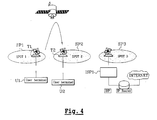
- the network of the example described is limited to one satellite, comprising two spots SP1 and SP2.
- Satellite terminals T1 to T6 allow one or more terminals of users to connect to the satellite network, through one of its spots. So the satellite terminal T1 connects the two user terminals U1 and U2 to the satellite by its first SP1 spot.
- Each satellite terminal has its own ARP resolution table address, which is updated as data is sent and received performed by the satellite terminal, as is known in the ARP protocol.
- the ARP table of each satellite terminal also contains a label field, which is updated under the same conditions as the fields hardware addresses of the table.
- labels L1, L2 and L3 are associated with the virtual networks SR 1, SR 2 and the spots SP1, SP2 according to a table whose representation is given below.
- connection terminal informs, in the address header of each data packet, a label field with the value corresponding to that other user.
- user U2 belongs to the virtual network SR 1 and is connected to the satellite network via the satellite terminal T1 located in spot SP1. Consequently, the packets intended for it will contain the value L1 as label.
- the satellite terminal T1 connected to the user terminal U1 When the satellite terminal T1 connected to the user terminal U1 is powered up, the satellite terminal must first make itself known to the satellite network.
- the satellite terminal T1 includes a memory containing the labels which allow it to communicate with the G1 connection station used for manage the satellite communications system.
- the Label_Broadcast_G1 listening label is placed in the header of any data broadcast transmitted by the connection station. This label corresponds to all subnets virtual and to all satellite spots. It is present in the list of labels authorized from all satellite terminals, so that all users can receive data in broadcast mode from the connection station G1.
- the sending label Label_G1 is not stored in the T1 satellite terminal but is broadcast in broadcast mode by the connection station G1 and is recovered by the satellite terminal when it is powered up thanks to the label Label_Broadcast_NCC reception.
- the T1 satellite terminal For its registration in the satellite network, the T1 satellite terminal sends a registration request to the G1 connection station using the label Label_G1 (step E1 in Figure 2).
- connection station G1 responds in broadcast mode to the satellite terminal, to using the Label_Broadcast_G1 label (step E2 in Figure 2).
- the user can register with his access server.
- the user terminal U1 provides the satellite terminal T1 with the number corresponding to the ISP1 access server.
- the satellite terminal T1 interrogates the connection station (step E3 in the figure 2) and retrieves the labels allowing to communicate with the ISP1 access server located in spot SP3 (step E4 in Figure 2), namely the label Label_ taste_ISP1 which allows it to receive data packets from the server of access ISP1 and the label Label_aria_ISP1 which allows the addressing of data to access server.
- the user can then register with the ISP1 access server.
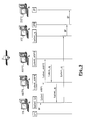
- the registration request is sent to the access server with the label Label_aria_ISP1 (step E1 of figure 3).
- the access server performs the authorization checks provided for by the user's subscription to the access provider that manages the server ISP1 access and returns (step E2 in Figure 3), if the checks are favorable, a registration authorization accompanied by a label not yet known to the user terminal: the Label_S-ARP label which will allow the user to send direct requests to the centralized address resolution server (not shown) attached to the ISP1 access server.
- the access server can dynamically provide listening labels (Label_ec_ISP1) and send (Label_ev_ISP1) to the access server and to the networks satellites, listening labels which are optimized according to their location.
- the user is then registered in the network and has the means to send and receive data packets using the labels according to the invention.
- the satellite terminal T1 For sending data from the user terminal U1 to the user terminal U2, the satellite terminal T1 receives data packets from the user terminal U1, each with a header containing the protocol address of the user terminal U2.
- the satellite terminal adds the Label_n label field corresponding to user terminal U2 (i.e. reflecting the fact that this terminal U2 belongs to a virtual subnet and is connected to a terminal satellite T2 located in spot SP2) and transmits the data packet to the satellite.
- the data packets are recognized as with the Label_n label and are directly directed to the SP2 spot.
- the determination process must be implemented dynamic of the label of a recipient U2 of data transmitted by a transmitter U1.
- FIG. 5 represents the first user terminal U1, the label server S-ARP1 attached to the access server ISP1 and the second user terminal U2.
- the satellite terminal T1 connected to the user terminal U1 performs an address resolution request not in broadcast mode, which would clog network traffic, but with the centralized resolution server of S-ARP1 addresses using the Label_S-ARP1 label.
- the centralized address resolution server S-ARP1 determines dynamically, in step E1, the label Label_n corresponding to the user terminal U2 and provides this Label_n label in response to the T1 satellite terminal.
- the package of data is processed and sent by the T1 satellite terminal as before described.
- the satellite terminal T1 For the reception of data by the user terminal U1, the satellite terminal T1 has a list of authorized labels serving as a reception filter. Only the data packets whose header contains a label appearing on this list are processed through the satellite terminal.
- the actual processing consists in extracting the address of the user terminal addressee and send them the data packets.
- the recipient U2 is accessible directly via the satellite network.
- the centralized address resolution server S-ARP1 (also designated label server) knows the protocol address of the user terminal U2 and responds to the label request sent by the terminal U1 by indicating the label Label_n corresponding to terminal U2.
- the terminal U1 can therefore transmit to the terminal U2 with the label Label_n.
- the destination terminal U2 is accessible via the satellite network but is registered with another ISP2 access server than the ISP1 access server of the sending terminal U1.
- the label request sent by U1 to the S-ARP1 label server triggers a query from the S-ARP 2 label server attached to the ISP2 access server.
- This interrogation obeys a predefined protocol between the label servers S-ARP1 and S-ARP2.
- the ARP1 label server knows that the address of the terminal U2 is used on the ISP2 access server
- an address plan is established, in a static form or in a dynamic form.
- the plan dynamic addressing can be obtained by systematic interrogation of all access servers having signed an agreement with the ISP1 access server, or dynamic exchange of information between access servers.
- the S-ARP2 label server returns the label to the S-ARP1 label server Label_n corresponding to the U2 terminal.
- the label server S-ARP1 returns to the satellite terminal of U1 terminal the Label_n label and the satellite terminal sends the packet (s) data using the label thus obtained.
- the destination terminal U2 is not directly accessible via the satellite network and addressing the recipient requires the passage by a router R1 to an ISP2 access server with which the terminal recipient U2 is registered.
- the label server S-ARP1 responds by providing the Label_p label corresponding to the R1 router attached to the ISP1 access server.
- the transmitter then sends the data to the U2 terminal using the label Label_p.
- the recipient U2 is not accessible via the network satellites and addressing the recipient requires a passage through an R2 router attached to another ISP2 access server than that of the transmitter and with which U2 is saved.
- the label request sent to the server S-ARP1 leads, on the part of this last, a routing to know the address of router R2 to which forward the data packet.
- the S-ARP1 server sends a label request to the S-ARP2 label server of the ISP2 access server.
- the S-ARP2 server returns the corresponding Label_q label to the S-ARP1 server to router R2 of the ISP2 access server on which the user terminal is registered U2.
- the S-ARP1 server in turn responds to the request from the satellite terminal connected to the user terminal U1 by providing the label Label_q.
- the user terminal U1 can therefore send data to the router R2 by using the Label_q label.
- the purpose of this optimization is to join in a single hop, in the network satellite, the last router before leaving the routing outside the satellite network.
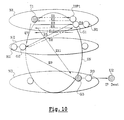
- the three networks N1, N2, N3 are different in the sense that they have different connection stations and different access servers. However, it are based on the same infrastructure of SN satellites.
- the terminal U1 issues a label request to the S-ARP1 label server attached to its server access (step E1).
- the server of labels S-ARP1 assigns router R1 as recipient and returns to the terminal U1 the label Label_R1 corresponding to the router R1 (step E2).
- the terminal U1 then begins to send data packets to the U2 terminal using the Label_R1 label (step E3).
- the S-ARP1 label server sends to router R1 a "Label Optimization" type data packet intended for the terminal U2 (step E4).
- Router R1 determines that this optimization packet, destined for the terminal U2, must be transmitted to the second network N2. For this purpose, the router R1 returns the optimization packet to the connection station G1 to the connection station G2 connection.
- Connection station G1 detects the optimization packet it needs transmit to G2 (step E5) and reacts by notifying the label server S-ARP1 that, to send data to the terminal U2, the label should be used Label_G2 of the G2 connection station.
- the label server S-ARP1 thus notified, sends the terminal U1 a information to update its S-ARP address resolution table including the label field (step E6).
- Terminal T1 therefore starts sending data packets using the label Label_G2, so that data arrives in one hop from the terminal T1 at the connection station G2 by bypassing the passage through the router R1 (step E7).
- connection station G2 having received the optimization packet, it determines that the address of terminal U2 is not an address accessible by the second network and forwards it to its router R2.
- the latter determines that the packet must be addressed to the third network N3 and therefore returns the optimization packet to the G2 connection station for transmission to the third network.
- the G2 connection station detects the optimization packet and alerts the S-ARP1 label server than to address the U2 terminal, it is preferable to use the Label_G3 label corresponding to the G3 connection station of the third network (step E8).
- the optimization packet is transmitted to the station G3 (step E9)
- the label server S-ARP1 sends terminal information to terminal T1 day of its S-ARP table (step E10), and the terminal starts sending packets of data at the terminal U2 using the label Label_G3 (step E11).
- the data therefore arrives in a single hop at the G3 connection station from terminal T1.
- Router R3 sends the optimization packet to the terrestrial network where it will be destroyed by the simple fact that the protocol stacks do not take it into account.
- this self-destruction is carried out by counting a re-routing counter which is reset to value 2 each time you pass through a connection station and which prevents the packet from being sent if the counter is zero.
- the invention allows optimal use of satellite networks, being able to adapt to circuit mode communications while pulling take advantage of the possibilities offered by satellite networks for broadcasts multicast or in virtual private networks.
- connection stations specifically linked functionalities to the satellite system are separated from those which are the same as in a network earthly.
- the management of labels is more reduced than that of terminals, much more numerous than labels.
- updating the table of labels in a satellite is only made at the time of allocation and the revocation of labels by the connection station. So it is in particular no need to provide an update of this table when connecting a user.
Landscapes
- Engineering & Computer Science (AREA)
- Physics & Mathematics (AREA)
- Astronomy & Astrophysics (AREA)
- Aviation & Aerospace Engineering (AREA)
- General Physics & Mathematics (AREA)
- Computer Networks & Wireless Communication (AREA)
- Signal Processing (AREA)
- Radio Relay Systems (AREA)
- Data Exchanges In Wide-Area Networks (AREA)
- Mobile Radio Communication Systems (AREA)
Abstract
Description
- est accessible par le réseau satellites et est enregistrée chez le même serveur d'accès Internet que celui de l'émetteur,
- est accessible par le réseau satellites mais est enregistrée chez un autre serveur d'accès Internet que celui de l'émetteur,
- est inaccessible par le réseau satellite et requiert un passage par un routeur du même serveur d'accès Internet que celui de l'émetteur,
- est inaccessible par le réseau satellite et requiert un passage par un routeur d'un autre serveur d'accès Internet que celui de l'émetteur.
- un terminal satellite ou une station de connexion se situe dans la zone de couverture d'un spot donné d'un satellite donné et
- un poste terminal, c'est-à-dire un terminal utilisateur, un routeur, un serveur de données ou de services, connecté à un terminal satellite appartient à un sous-réseau virtuel donné.
- Un ou plusieurs labels sont affectés à un sous-réseau virtuel donné.
- Mais un label n'est dédié qu'à un seul sous-réseau virtuel donné.
- Pour chaque label, le satellite connaít les différents spots qui lui sont associés.
- Chaque terminal satellite connaít les labels qui lui sont autorisés.
- A chaque adresse IP (définie selon le protocole Internet) est associé le label de son sous-réseau virtuel.
- un label de réception de données, qui sera utilisé par les autres postes terminaux du réseau pour envoyer des paquets de données à l'utilisateur,
- un label d'envoi de données au serveur d'accès Internet,
- un label d'accès au serveur de résolution d'adresses du serveur d'accès Internet, afin de récupérer les labels correspondants aux adresses IP avec lesquelles l'utilisateur veut se connecter.
- la figure 1 est une représentation schématique d'une partie d'un réseau satellites,
- la figure 2 est une vue en perspective d'un terminal satellite, d'un satellite et d'une station de connexion,
- la figure 3 est une vue en perspective d'un terminal satellite, d'un satellite et d'un serveur d'accès Internet,
- la figure 4 est une vue en perspective de deux terminaux satellites reliés à deux terminaux utilisateurs, d'un satellite et d'un serveur d'accès Internet,
- la figure 5 est un schéma synoptique montrant les échanges de paquets de données entre un terminal utilisateur émetteur de données, un serveur de labels d'un serveur d'accès et un terminal utilisateur destinataire des données,
- la figure 6 est un schéma analogue à celui de la figure 5 dans lequel le terminal utilisateur destinataire des données partage le même serveur d'accès que l'émetteur,
- la figure 7 est un schéma synoptique montrant les échanges de paquets de données entre un terminal utilisateur émetteur de données, un premier serveur de labels d'un premier serveur d'accès, un second serveur de labels d'un second serveur d'accès, et un terminal utilisateur destinataire des données,
- la figure 8 est un schéma synoptique montrant les échanges de paquets de données entre un terminal utilisateur émetteur de données, un serveur de labels d'un premier serveur d'accès, un routeur et un serveur d'accès Internet relié au destinataire des données,
- la figure 9 est un schéma synoptique montrant les échanges de paquets de données entre un terminal utilisateur émetteur de données, un premier serveur de labels d'un premier serveur d'accès, un second serveur de labels d'un second serveur d'accès, un routeur et un serveur d'accès Internet relié au destinataire des données et
- la figure 10 est un schéma global d'un réseau satellites couvrant plusieurs serveurs d'accès et s'intégrant au réseau terrestre.
| Réseau virtuel | Label | Spots |
| SR 1 | L1 | SP1 |
| SR 1 | L2 | SP2 |
| SR 2 | L3 | SP1, SP2 |
- un label d'écoute Label_Broadcast_G1 qui permet audit terminal satellite de récupérer des données diffusées en mode diffusion par la station de connexion G1,
- un label d'envoi Label_G1 qui lui permet d'envoyer des données à la station de connexion G1.
- enregistrement du terminal satellite dans le réseau,
- enregistrement d'un terminal utilisateur relié au terminal satellite auprès d'un serveur d'accès,
- connexion d'un utilisateur à un serveur,
- adhésion d'un utilisateur à un groupe multidestinataire ou à un réseau privé virtuel.
- un terminal satellite T1 émetteur de données (pour le compte d'un terminal utilisateur non représenté), appartenant à un premier réseau N1 appuyé sur une station de connexion G1, un serveur d'accès ISP1 et son serveur de labels S-ARP1 (non représenté) et un routeur R1,
- un deuxième réseau N2 appuyé sur une station de connexion G2 et un routeur R2 qui lui est attaché,
- un troisième réseau N3 appuyé sur une station de connexion G3 et un routeur R3 qui lui est attaché, et
- un terminal U2 destinataire des données émises par U1.
Claims (19)
- Procédé d'adressage de paquets de données dans un réseau d'accès ou d'infrastructure satellites servant de support à des sous-réseaux (SR 1, SR 2) tels que des sous réseaux logiques IP, des réseaux privés ou des groupes multidestinataires, regroupant différents postes terminaux (U1-U8) du réseau, dans lequel chaque paquet de données est associé à une entête d'adressage et dans lequel chaque poste terminal (U1-U8) du réseau est rattaché à un terminal satellite (T1-T6) ou à une station de connexion (G1-G2) qui se trouve dans la zone de couverture d'un spot (SP1, SP2) déterminé d'un satellite déterminé, caractérisé en ce que l'entête d'adressage de chaque paquet de données contient en outre un champ "label" (L1,L2,L3) contenant un identifiant caractéristique d'un sous-réseau (SR 1, SR 2) auquel appartient ledit poste terminal (U1-U8) et du spot (SP1, SP2) dans lequel se trouve le terminal satellite ou la station de connexion auquel ledit poste terminal (U1-U8) est rattaché.
- Procédé selon la revendication 1, caractérisé en ce que l'envoi des paquets de données s'effectue sans connexion entre le terminal satellite émetteur (T1-T6) ou la station de connexion émettrice (G1-G2) et le terminal satellite récepteur (T1-T6) ou la station de connexion réceptrice (G1-G2).
- Procédé selon l'une quelconque des revendications 1 et 2, caractérisé en ce que les postes terminaux du réseau reliés aux terminaux satellites (T1-T6) ou aux stations de connexion (G1, G2) sont constitués par des terminaux utilisateurs (U1-U8), des routeurs (R1, R2), des serveurs de données ou de services et notamment des serveurs de résolution d'adresses (S-ARP1, S-ARP2).
- Procédé de détermination et d'optimisation de labels pour mise en oeuvre du procédé selon l'une quelconque des revendications 1 à 3, caractérisé en ce qu'il consiste à installer un serveur centralisé de détermination de labels (S-ARP1, S-ARP2) (désigné par la suite "serveur de labels") chez chaque serveur d'accès Internet utilisant le réseau satellite, à communiquer le label (Label_SARP1) correspondant à ce serveur de labels à chaque terminal satellite (T1-T6) ou à chaque station de connexion (G1, G2) du réseau au moment de l'enregistrement, auprès du serveur d'accès Internet, d'un utilisateur dont le terminal utilisateur (U1-U8) est relié à ce terminal satellite (T1-T6) ou à cette station de connexion (G1, G2), et à faire émettre par le terminal satellite (T1-T6), ou par la station de connexion (G1, G2), auquel (à laquelle) est relié le terminal utilisateur (U1) d'un utilisateur désirant envoyer des données vers un poste terminal cible (U2) reliée à un autre terminal satellite (T2) ou à une autre station de connexion à destination du serveur de labels (S-ARP1) de son serveur d'accès et en utilisant le label (Label_SARP1) correspondant au serveur de labels, un paquet de données de type "Requête de label" contenant l'adresse IP de la cible (U2), à faire émettre par le serveur de labels (SARP1), à destination du terminal satellite ou de la station de connexion émetteur (U1) et en utilisant le label (L1) correspondant audit émetteur, un paquet de données de type "Réponse de label" contenant le label (Label_n) du sous-réseau auquel appartient le poste terminal cible (U2).
- Procédé selon la revendication 4, caractérisé en ce que le paquet de données de type "Réponse de label" fourni par le serveur de labels (S-ARP1) contient un label qui est établi en fonction de la localisation matérielle du terminal auquel est relié le poste terminal cible (U2).
- Procédé selon l'une quelconque des revendications 4 et 5, caractérisé par le fait que lors d'une interrogation du serveur de labels (S-ARP1), par soumission d'un paquet de données de type "Requête de label" correspondant à une adresse de poste terminal cible (U2), si le serveur de labels trouve un label d'un routeur (R1, R2) comme réponse à la requête, ledit serveur de labels adresse audit routeur un paquet de données de type "Optimisation de label" contenant l'adresse du poste terminal cible (U2) comme adresse destinataire et toute station de connexion (G1, G2) appartenant au réseau satellites qui est sollicitée par son routeur pour faire suivre ce paquet de données de type "Optimisation de label" à un autre routeur renvoie au serveur de labels (S-ARP1) une indication selon laquelle le label de routeur (Label_R1, Label_R2) à retenir pour cette cible est le label du routeur vers lequel cette station de connexion fait suivre le paquet de données "Optimisation de label".
- Procédé selon la revendication 6, caractérisé en ce que le paquet de données de type "Optimisation de label" a une durée de vie limitée en dehors du réseau satellites, afin de s'éliminer spontanément dès lors que sa transmission d'une station de connexion à une autre est considérée comme ne pouvant plus donner lieu à une optimisation du routage.
- Procédé selon l'une quelconque des revendications 1 à 7, caractérisé en ce que les paquets de données sont des contenants pouvant contenir, entre autres, des paquets IP, c'est-à-dire répondant aux normes de transfert de données en mode non connecté sur des réseaux de type Internet.
- Terminal satellite d'un système de télécommunication par satellites mettant en oeuvre le procédé selon l'une quelconque des revendications 1 à 8, caractérisé en ce qu'il dispose d'une table par serveur d'accès auquel sont rattachés des terminaux utilisateurs (U1-U8) reliés au terminal satellite (T1-T6), mettant en relation des adresses de terminaux utilisateurs cibles et les labels (L1,L2,L3) qui leurs sont associés et en ce qu'il écoute les labels (L1,L2,L3) de réception des sous-réseaux dont font partie les terminaux utilisateurs qui lui sont rattachés.
- Terminal satellite selon la revendication 9, caractérisé en ce qu'il mémorise le label d'émission de la station de connexion auquel il est rattaché, label grâce auquel il peut émettre des paquets de données diffusées vers ladite station de connexion.
- Terminal satellite selon l'une quelconque des revendications 9 et 10, caractérisé en ce qu'un poste terminal (U1-U8) et ledit terminal satellite (T1-T6) ne constituent qu'un seul et même équipement en étant réunis dans un même boítier.
- Terminal satellite selon la revendication 11, caractérisé en ce que le poste terminal est un terminal utilisateur (U1-U8) qui, avec ledit terminal satellite (T1-T6), ne constitue qu'un seul et même équipement.
- Serveur d'accès d'un système de télécommunication par satellites mettant en oeuvre le procédé selon l'une quelconque des revendications 1 à 8, caractérisé en ce qu'il est attaché à un serveur de labels apte à fournir un label d'adressage en fonction d'une adresse de poste terminal cible d'un paquet de données.
- Satellite d'un système de télécommunication par satellites mettant en oeuvre le procédé selon l'une quelconque des revendications 1 à 8, caractérisé en ce qu'il dispose d'une table mettant des labels attribués à des sous-réseaux en relation avec les spots de son système satellite, et d'un moyen pour émettre un paquet de données attaché à un label donné uniquement dans celui ou ceux de ses spots reliés audit label.
- Satellite selon la revendications 14, caractérisé en ce qu'il contient ladite table.
- Satellite selon la revendication 14, caractérisé en ce que la table est contenue par un centre de contrôle réseau.
- Station de connexion d'un système de télécommunication mettant en oeuvre le procédé selon l'une quelconque des revendications 6 et 7, caractérisée en ce qu'elle comporte un moyen pour reconnaítre un paquet de données de type "Optimisation de label" provenant d'un serveur de labels et traversant ladite station de connexion à destination d'une cible via un routeur relié à la station de connexion, et pour adresser au serveur de labels une indication selon laquelle le label à prendre en compte pour cette cible est celui vers lequel ladite station de connexion fait suivre le paquet de données de type "Optimisation de label".
- Système de télécommunications par satellites pour mettre en oeuvre le procédé selon l'une quelconque des revendications 1 à 8, caractérisé en ce qu'il comprend au moins un terminal satellite selon l'une quelconque des revendications 9 à 12, au moins un serveur d'accès selon la revendication 13 et au moins un satellite selon l'une quelconque des revendications 14 à 16.
- Système de télécommunications par satellites selon la revendication 18 pour mettre en oeuvre le procédé selon l'une quelconque des revendications 6 et 7, caractérisé en ce qu'il comprend au moins une station de connexion selon la revendication 17.
Applications Claiming Priority (2)
| Application Number | Priority Date | Filing Date | Title |
|---|---|---|---|
| FR0014941A FR2817057B1 (fr) | 2000-11-20 | 2000-11-20 | Procede d'adressage dans un reseau d'acces ou d'infrastructure satellites |
| FR0014941 | 2000-11-20 |
Publications (2)
| Publication Number | Publication Date |
|---|---|
| EP1207632A1 true EP1207632A1 (fr) | 2002-05-22 |
| EP1207632B1 EP1207632B1 (fr) | 2007-02-21 |
Family
ID=8856656
Family Applications (1)
| Application Number | Title | Priority Date | Filing Date |
|---|---|---|---|
| EP01402849A Expired - Lifetime EP1207632B1 (fr) | 2000-11-20 | 2001-11-05 | Procédé d'adressage dans un réseau d'accès ou d'infrastructure satellites pouvant servir de support à des transferts de données en mode non-connecté |
Country Status (5)
| Country | Link |
|---|---|
| US (1) | US7266095B2 (fr) |
| EP (1) | EP1207632B1 (fr) |
| AT (1) | ATE354889T1 (fr) |
| DE (1) | DE60126725T2 (fr) |
| FR (1) | FR2817057B1 (fr) |
Cited By (1)
| Publication number | Priority date | Publication date | Assignee | Title |
|---|---|---|---|---|
| EP1473852A1 (fr) * | 2003-04-30 | 2004-11-03 | Alcatel | Dispositif de traitement d'entêtes de paquets de données au sein d'un réseau de communications par satellite |
Families Citing this family (14)
| Publication number | Priority date | Publication date | Assignee | Title |
|---|---|---|---|---|
| US7039052B2 (en) * | 2001-09-19 | 2006-05-02 | International Business Machines Corporation | Selective routing of multi-recipient communications |
| US7379758B2 (en) * | 2002-07-23 | 2008-05-27 | Qualcomm Incorporated | Satellite communication system constituted with primary and back-up multi-beam satellites |
| US8358971B2 (en) | 2002-07-23 | 2013-01-22 | Qualcomm Incorporated | Satellite-based programmable allocation of bandwidth for forward and return links |
| US20040174872A1 (en) * | 2003-03-03 | 2004-09-09 | Nokia Corporation | Apparatus and method for performing an address resolution protocol function |
| US20050152300A1 (en) * | 2003-12-18 | 2005-07-14 | Idirect Incorporated | Virtual router system, method and apparatus |
| JP4613094B2 (ja) * | 2005-05-13 | 2011-01-12 | パナソニック株式会社 | 通信端末及び通信方法 |
| FR2977423A1 (fr) * | 2011-06-30 | 2013-01-04 | Thales Sa | Systeme de telecommunication comprenant un routeur ip central compose d'un satellite et d'un routeur sol |
| US9654206B1 (en) | 2013-04-04 | 2017-05-16 | Lockheed Martin Corporation | Hub enabled single hop transport forward access |
| US10069845B2 (en) * | 2016-11-29 | 2018-09-04 | Verizon Patent And Licensing Inc. | System and methods for secure short message service encryption and provisioning |
| EP3704811B1 (fr) * | 2018-01-30 | 2021-08-11 | British Telecommunications public limited company | Système de télécommunication par satellite |
| CN112968835B (zh) * | 2021-02-25 | 2021-11-09 | 中国电子科技集团公司第五十四研究所 | 一种适用于天基网络的单播标签路由设计方法 |
| CN113824639B (zh) * | 2021-09-06 | 2023-02-28 | 天地信息网络研究院(安徽)有限公司 | 一种复杂度在终端的卫星网络标签交换方法 |
| CN113872672B (zh) * | 2021-09-27 | 2023-12-29 | 中国电子科技集团公司第五十四研究所 | 用于低轨卫星网络宽带用户业务互通的星地标签路由方法 |
| CN114301519B (zh) * | 2021-12-31 | 2023-03-24 | 浙江时空道宇科技有限公司 | 数据传输方法、装置、设备及存储介质 |
Citations (3)
| Publication number | Priority date | Publication date | Assignee | Title |
|---|---|---|---|---|
| WO1997020413A1 (fr) * | 1995-11-30 | 1997-06-05 | Oy Nokia Ab | Systeme de commutation par paquets dans lequel une transmission par telephone et par satellite est utilisee |
| WO1998016046A1 (fr) * | 1996-10-09 | 1998-04-16 | Microsoft Corporation | Appareil et procede permettant d'envoyer des donnees ip sur un reseau a satellite |
| WO1999009707A1 (fr) * | 1997-08-18 | 1999-02-25 | Mci Communications Corporation | Diffusion selective d'informations par satellite |
Family Cites Families (5)
| Publication number | Priority date | Publication date | Assignee | Title |
|---|---|---|---|---|
| US5652795A (en) * | 1994-11-14 | 1997-07-29 | Hughes Electronics | Method and apparatus for an adapter card providing conditional access in a communication system |
| US6625135B1 (en) * | 1998-05-11 | 2003-09-23 | Cargenie Mellon University | Method and apparatus for incorporating environmental information for mobile communications |
| US6310893B1 (en) * | 1998-06-17 | 2001-10-30 | Genuity Inc. | Method and system for connectionless communication in a cell relay satellite network |
| US6570859B1 (en) * | 1999-12-21 | 2003-05-27 | Nortel Networks Limited | Satellite communication system and satellite for such a system |
| AU7170301A (en) * | 2000-06-29 | 2002-01-14 | Cachestream Corp | Virtual multicasting |
-
2000
- 2000-11-20 FR FR0014941A patent/FR2817057B1/fr not_active Expired - Fee Related
-
2001
- 2001-11-05 DE DE60126725T patent/DE60126725T2/de not_active Expired - Lifetime
- 2001-11-05 EP EP01402849A patent/EP1207632B1/fr not_active Expired - Lifetime
- 2001-11-05 AT AT01402849T patent/ATE354889T1/de not_active IP Right Cessation
- 2001-11-19 US US09/988,290 patent/US7266095B2/en not_active Expired - Lifetime
Patent Citations (3)
| Publication number | Priority date | Publication date | Assignee | Title |
|---|---|---|---|---|
| WO1997020413A1 (fr) * | 1995-11-30 | 1997-06-05 | Oy Nokia Ab | Systeme de commutation par paquets dans lequel une transmission par telephone et par satellite est utilisee |
| WO1998016046A1 (fr) * | 1996-10-09 | 1998-04-16 | Microsoft Corporation | Appareil et procede permettant d'envoyer des donnees ip sur un reseau a satellite |
| WO1999009707A1 (fr) * | 1997-08-18 | 1999-02-25 | Mci Communications Corporation | Diffusion selective d'informations par satellite |
Cited By (2)
| Publication number | Priority date | Publication date | Assignee | Title |
|---|---|---|---|---|
| EP1473852A1 (fr) * | 2003-04-30 | 2004-11-03 | Alcatel | Dispositif de traitement d'entêtes de paquets de données au sein d'un réseau de communications par satellite |
| FR2854522A1 (fr) * | 2003-04-30 | 2004-11-05 | Cit Alcatel | Dispositif de traitement d'entetes de paquets de donnees, pour la commutation de niveau deux via un bus logique au sein d'un reseau de communications par satellite. |
Also Published As
| Publication number | Publication date |
|---|---|
| FR2817057A1 (fr) | 2002-05-24 |
| DE60126725T2 (de) | 2007-10-25 |
| DE60126725D1 (de) | 2007-04-05 |
| EP1207632B1 (fr) | 2007-02-21 |
| ATE354889T1 (de) | 2007-03-15 |
| US20020089943A1 (en) | 2002-07-11 |
| FR2817057B1 (fr) | 2003-02-07 |
| US7266095B2 (en) | 2007-09-04 |
Similar Documents
| Publication | Publication Date | Title |
|---|---|---|
| EP1207632B1 (fr) | Procédé d'adressage dans un réseau d'accès ou d'infrastructure satellites pouvant servir de support à des transferts de données en mode non-connecté | |
| EP1797695B1 (fr) | Procédé de mise à jour d'une table de correspondance entre une adresse et un numéro d'identification | |
| FR2978003A1 (fr) | Procede de routage d'un flux en mode non-stockage | |
| WO2008077928A1 (fr) | Procede de reservation et d'allocation dynamique de creneaux temporels dans un reseau avec garantie de service | |
| WO2017194861A1 (fr) | Procédé d'accès à un contenu hébergé sur un serveur selectionné en fonction de la localisation du terminal utilisateur | |
| EP3987752A1 (fr) | Procede et dispositif d'obtention d'une adresse ip | |
| EP4132177B1 (fr) | Procédé d'acheminement de données d'une session initialisée entre un terminal et un serveur | |
| EP1473852A1 (fr) | Dispositif de traitement d'entêtes de paquets de données au sein d'un réseau de communications par satellite | |
| EP1654830B1 (fr) | Procede de diffusion d'information multicast etendue, systeme et produit logiciel correspondant | |
| EP3900306B1 (fr) | Procédé de détermination d'une chaîne de délégation associée à une résolution d'un nom de domaine dans un réseau de communication | |
| US20020146012A1 (en) | Modular policy decision point for processing resource reservation requests within a data network | |
| EP1595362A1 (fr) | Procede pour l'interconnexion de reseaux prives virtuels en mode non connecte | |
| EP1472837B1 (fr) | Procede de transport de flux multimedia. | |
| EP3900305A1 (fr) | Procédé d'acquisition d'une chaîne de délégation relative à la résolution d'un identifiant de nom de domaine dans un réseau de communication | |
| WO2025125235A1 (fr) | Procédé de détermination d'un ensemble de flux multicast auxquels un terminal récepteur est habilité à accéder | |
| EP1458212B1 (fr) | Systeme d'interconnexion de plusieurs operateurs à un même reseau d'accès | |
| WO2025061515A1 (fr) | Procédés, dispositifs et système de contrôle d'une communication dans un réseau | |
| EP1555836A1 (fr) | Systémé de routage de trafic de messages multimédia (MMS) inter-operateurs | |
| FR3115644A1 (fr) | Procédé et dispositif d’aiguillage d’une donnée applicative | |
| FR3115645A1 (fr) | Procédé et dispositif de médiation d’un ensemble d’applications | |
| FR2848048A1 (fr) | Dispositif de conversion de champs d'entetes de trames, pour un reseau de communications | |
| WO2013011214A1 (fr) | Procede de resolution d'identifiants d'abonnes | |
| WO2011023881A1 (fr) | Technique pour evaluer une collaboration entre des noeuds d'un reseau de communication | |
| EP0949783A1 (fr) | Procédé d'acheminement de paquets dans un réseau de communication | |
| FR2878104A1 (fr) | Systeme de transmission de flux multidiffusion |
Legal Events
| Date | Code | Title | Description |
|---|---|---|---|
| PUAI | Public reference made under article 153(3) epc to a published international application that has entered the european phase |
Free format text: ORIGINAL CODE: 0009012 |
|
| AX | Request for extension of the european patent |
Free format text: AL;LT;LV;MK;RO;SI |
|
| 17P | Request for examination filed |
Effective date: 20021122 |
|
| AKX | Designation fees paid |
Designated state(s): AT BE CH CY DE DK ES FI FR GB GR IE IT LI LU MC NL PT SE TR |
|
| GRAP | Despatch of communication of intention to grant a patent |
Free format text: ORIGINAL CODE: EPIDOSNIGR1 |
|
| GRAS | Grant fee paid |
Free format text: ORIGINAL CODE: EPIDOSNIGR3 |
|
| GRAA | (expected) grant |
Free format text: ORIGINAL CODE: 0009210 |
|
| AK | Designated contracting states |
Kind code of ref document: B1 Designated state(s): AT BE CH CY DE DK ES FI FR GB GR IE IT LI LU MC NL PT SE TR |
|
| PG25 | Lapsed in a contracting state [announced via postgrant information from national office to epo] |
Ref country code: DK Free format text: LAPSE BECAUSE OF FAILURE TO SUBMIT A TRANSLATION OF THE DESCRIPTION OR TO PAY THE FEE WITHIN THE PRESCRIBED TIME-LIMIT Effective date: 20070221 Ref country code: IE Free format text: LAPSE BECAUSE OF FAILURE TO SUBMIT A TRANSLATION OF THE DESCRIPTION OR TO PAY THE FEE WITHIN THE PRESCRIBED TIME-LIMIT Effective date: 20070221 Ref country code: NL Free format text: LAPSE BECAUSE OF FAILURE TO SUBMIT A TRANSLATION OF THE DESCRIPTION OR TO PAY THE FEE WITHIN THE PRESCRIBED TIME-LIMIT Effective date: 20070221 Ref country code: AT Free format text: LAPSE BECAUSE OF FAILURE TO SUBMIT A TRANSLATION OF THE DESCRIPTION OR TO PAY THE FEE WITHIN THE PRESCRIBED TIME-LIMIT Effective date: 20070221 Ref country code: FI Free format text: LAPSE BECAUSE OF FAILURE TO SUBMIT A TRANSLATION OF THE DESCRIPTION OR TO PAY THE FEE WITHIN THE PRESCRIBED TIME-LIMIT Effective date: 20070221 |
|
| REG | Reference to a national code |
Ref country code: GB Ref legal event code: FG4D Free format text: NOT ENGLISH |
|
| REG | Reference to a national code |
Ref country code: CH Ref legal event code: EP |
|
| RAP2 | Party data changed (patent owner data changed or rights of a patent transferred) |
Owner name: ALCATEL LUCENT |
|
| REF | Corresponds to: |
Ref document number: 60126725 Country of ref document: DE Date of ref document: 20070405 Kind code of ref document: P |
|
| REG | Reference to a national code |
Ref country code: IE Ref legal event code: FG4D Free format text: LANGUAGE OF EP DOCUMENT: FRENCH |
|
| PG25 | Lapsed in a contracting state [announced via postgrant information from national office to epo] |
Ref country code: SE Free format text: LAPSE BECAUSE OF FAILURE TO SUBMIT A TRANSLATION OF THE DESCRIPTION OR TO PAY THE FEE WITHIN THE PRESCRIBED TIME-LIMIT Effective date: 20070521 |
|
| NLT2 | Nl: modifications (of names), taken from the european patent patent bulletin |
Owner name: ALCATEL LUCENT Effective date: 20070404 |
|
| PG25 | Lapsed in a contracting state [announced via postgrant information from national office to epo] |
Ref country code: ES Free format text: LAPSE BECAUSE OF FAILURE TO SUBMIT A TRANSLATION OF THE DESCRIPTION OR TO PAY THE FEE WITHIN THE PRESCRIBED TIME-LIMIT Effective date: 20070601 |
|
| GBT | Gb: translation of ep patent filed (gb section 77(6)(a)/1977) |
Effective date: 20070525 |
|
| PG25 | Lapsed in a contracting state [announced via postgrant information from national office to epo] |
Ref country code: PT Free format text: LAPSE BECAUSE OF FAILURE TO SUBMIT A TRANSLATION OF THE DESCRIPTION OR TO PAY THE FEE WITHIN THE PRESCRIBED TIME-LIMIT Effective date: 20070723 |
|
| NLV1 | Nl: lapsed or annulled due to failure to fulfill the requirements of art. 29p and 29m of the patents act | ||
| REG | Reference to a national code |
Ref country code: FR Ref legal event code: CD |
|
| REG | Reference to a national code |
Ref country code: IE Ref legal event code: FD4D |
|
| PLBE | No opposition filed within time limit |
Free format text: ORIGINAL CODE: 0009261 |
|
| STAA | Information on the status of an ep patent application or granted ep patent |
Free format text: STATUS: NO OPPOSITION FILED WITHIN TIME LIMIT |
|
| 26N | No opposition filed |
Effective date: 20071122 |
|
| PG25 | Lapsed in a contracting state [announced via postgrant information from national office to epo] |
Ref country code: GR Free format text: LAPSE BECAUSE OF FAILURE TO SUBMIT A TRANSLATION OF THE DESCRIPTION OR TO PAY THE FEE WITHIN THE PRESCRIBED TIME-LIMIT Effective date: 20070522 |
|
| BERE | Be: lapsed |
Owner name: ALCATEL Effective date: 20071130 |
|
| PG25 | Lapsed in a contracting state [announced via postgrant information from national office to epo] |
Ref country code: MC Free format text: LAPSE BECAUSE OF NON-PAYMENT OF DUE FEES Effective date: 20071130 |
|
| PG25 | Lapsed in a contracting state [announced via postgrant information from national office to epo] |
Ref country code: LI Free format text: LAPSE BECAUSE OF NON-PAYMENT OF DUE FEES Effective date: 20071130 Ref country code: CH Free format text: LAPSE BECAUSE OF NON-PAYMENT OF DUE FEES Effective date: 20071130 |
|
| REG | Reference to a national code |
Ref country code: CH Ref legal event code: PL |
|
| PG25 | Lapsed in a contracting state [announced via postgrant information from national office to epo] |
Ref country code: BE Free format text: LAPSE BECAUSE OF NON-PAYMENT OF DUE FEES Effective date: 20071130 |
|
| PG25 | Lapsed in a contracting state [announced via postgrant information from national office to epo] |
Ref country code: CY Free format text: LAPSE BECAUSE OF FAILURE TO SUBMIT A TRANSLATION OF THE DESCRIPTION OR TO PAY THE FEE WITHIN THE PRESCRIBED TIME-LIMIT Effective date: 20070221 |
|
| PG25 | Lapsed in a contracting state [announced via postgrant information from national office to epo] |
Ref country code: LU Free format text: LAPSE BECAUSE OF NON-PAYMENT OF DUE FEES Effective date: 20071105 |
|
| PG25 | Lapsed in a contracting state [announced via postgrant information from national office to epo] |
Ref country code: TR Free format text: LAPSE BECAUSE OF FAILURE TO SUBMIT A TRANSLATION OF THE DESCRIPTION OR TO PAY THE FEE WITHIN THE PRESCRIBED TIME-LIMIT Effective date: 20070221 |
|
| PGFP | Annual fee paid to national office [announced via postgrant information from national office to epo] |
Ref country code: IT Payment date: 20101123 Year of fee payment: 10 |
|
| PG25 | Lapsed in a contracting state [announced via postgrant information from national office to epo] |
Ref country code: IT Free format text: LAPSE BECAUSE OF NON-PAYMENT OF DUE FEES Effective date: 20111105 |
|
| REG | Reference to a national code |
Ref country code: FR Ref legal event code: GC Effective date: 20140717 |
|
| PGFP | Annual fee paid to national office [announced via postgrant information from national office to epo] |
Ref country code: FR Payment date: 20141119 Year of fee payment: 14 Ref country code: GB Payment date: 20141119 Year of fee payment: 14 Ref country code: DE Payment date: 20141119 Year of fee payment: 14 |
|
| REG | Reference to a national code |
Ref country code: FR Ref legal event code: CA Effective date: 20150521 |
|
| REG | Reference to a national code |
Ref country code: FR Ref legal event code: CA Effective date: 20150521 |
|
| REG | Reference to a national code |
Ref country code: DE Ref legal event code: R119 Ref document number: 60126725 Country of ref document: DE |
|
| GBPC | Gb: european patent ceased through non-payment of renewal fee |
Effective date: 20151105 |
|
| REG | Reference to a national code |
Ref country code: FR Ref legal event code: ST Effective date: 20160729 |
|
| PG25 | Lapsed in a contracting state [announced via postgrant information from national office to epo] |
Ref country code: DE Free format text: LAPSE BECAUSE OF NON-PAYMENT OF DUE FEES Effective date: 20160601 Ref country code: GB Free format text: LAPSE BECAUSE OF NON-PAYMENT OF DUE FEES Effective date: 20151105 |
|
| PG25 | Lapsed in a contracting state [announced via postgrant information from national office to epo] |
Ref country code: FR Free format text: LAPSE BECAUSE OF NON-PAYMENT OF DUE FEES Effective date: 20151130 |