EP1207517A1 - Method for recognizing speech - Google Patents
Method for recognizing speech Download PDFInfo
- Publication number
- EP1207517A1 EP1207517A1 EP00125014A EP00125014A EP1207517A1 EP 1207517 A1 EP1207517 A1 EP 1207517A1 EP 00125014 A EP00125014 A EP 00125014A EP 00125014 A EP00125014 A EP 00125014A EP 1207517 A1 EP1207517 A1 EP 1207517A1
- Authority
- EP
- European Patent Office
- Prior art keywords
- utterance
- key
- keywords
- phrases
- confidence measure
- Prior art date
- Legal status (The legal status is an assumption and is not a legal conclusion. Google has not performed a legal analysis and makes no representation as to the accuracy of the status listed.)
- Granted
Links
- 238000000034 method Methods 0.000 title claims description 46
- 238000012950 reanalysis Methods 0.000 claims abstract description 7
- 238000004458 analytical method Methods 0.000 claims description 9
- 230000008569 process Effects 0.000 claims description 8
- 238000012545 processing Methods 0.000 description 6
- 230000008901 benefit Effects 0.000 description 3
- 238000000605 extraction Methods 0.000 description 2
- 238000013459 approach Methods 0.000 description 1
- 230000001419 dependent effect Effects 0.000 description 1
- 238000010586 diagram Methods 0.000 description 1
- 238000011156 evaluation Methods 0.000 description 1
- 239000000945 filler Substances 0.000 description 1
- 230000037361 pathway Effects 0.000 description 1
- 230000004044 response Effects 0.000 description 1
- 238000010561 standard procedure Methods 0.000 description 1
Images
Classifications
-
- G—PHYSICS
- G10—MUSICAL INSTRUMENTS; ACOUSTICS
- G10L—SPEECH ANALYSIS TECHNIQUES OR SPEECH SYNTHESIS; SPEECH RECOGNITION; SPEECH OR VOICE PROCESSING TECHNIQUES; SPEECH OR AUDIO CODING OR DECODING
- G10L15/00—Speech recognition
- G10L15/02—Feature extraction for speech recognition; Selection of recognition unit
-
- G—PHYSICS
- G10—MUSICAL INSTRUMENTS; ACOUSTICS
- G10L—SPEECH ANALYSIS TECHNIQUES OR SPEECH SYNTHESIS; SPEECH RECOGNITION; SPEECH OR VOICE PROCESSING TECHNIQUES; SPEECH OR AUDIO CODING OR DECODING
- G10L15/00—Speech recognition
- G10L15/08—Speech classification or search
-
- G—PHYSICS
- G10—MUSICAL INSTRUMENTS; ACOUSTICS
- G10L—SPEECH ANALYSIS TECHNIQUES OR SPEECH SYNTHESIS; SPEECH RECOGNITION; SPEECH OR VOICE PROCESSING TECHNIQUES; SPEECH OR AUDIO CODING OR DECODING
- G10L15/00—Speech recognition
- G10L15/08—Speech classification or search
- G10L2015/085—Methods for reducing search complexity, pruning
-
- G—PHYSICS
- G10—MUSICAL INSTRUMENTS; ACOUSTICS
- G10L—SPEECH ANALYSIS TECHNIQUES OR SPEECH SYNTHESIS; SPEECH RECOGNITION; SPEECH OR VOICE PROCESSING TECHNIQUES; SPEECH OR AUDIO CODING OR DECODING
- G10L15/00—Speech recognition
- G10L15/08—Speech classification or search
- G10L2015/088—Word spotting
Definitions
- the present invention relates to a method for recognizing speech according to claim 1, and in particular to a method for recognizing speech using confidence measures in a process of large vocabulary continuous speech recognition (LVCSR).
- LVCSR large vocabulary continuous speech recognition
- a major drawback of prior art methods for recognizing speech is that the total computational burden is distributed over the entire received utterance to ensure a detailed and thorough analysis. Therefore, many methods cannot be implemented in small systems or devices, for example in hand-held appliances or the like, as these small systems possess a performance rate which is not sufficient to recognize continuous speech and estimate the reliability of the recognized phrases when the entire received utterance has to be thoroughly analyzed.
- the object is achieved by a method for recognizing speech with the characterizing features of claim 1.
- Preferred embodiments of the inventive method for recognizing speech are within the scope of the dependent claims.
- a received utterance is subjected to a recognizing process in its entirety. Further, an only rough estimation is made on whether or not said received and recognized utterance is accepted or rejected in its entirety. Additionally, in the case of accepting said utterance it is thoroughly reanalyzed to extract its meaning and/or intention. Additionally, based on the reanalysis and its result key-phrases and/or keywords are extracted from the utterance essentially being representative for its meaning.
- a rejection signal is generated.
- a reprompting signal and/or an invitation to repeat or restart the last utterance is generated and/or output as said rejection signal.
- a rough or simple confidence measure for the entire utterance is determined. This is of particular advantage in contrast to prior art methods for recognizing speech as these prior art methods generally calculate confidence measures which are based on each single word or subword unit within said utterance. Therefore, for the entire utterance prior art methods have to calculate and determine a relative large number of single word confidence measures.
- prior art methods for recognizing speech have then afterwards to perform an overall estimation to find a confidence for the whole utterance with respect to the set of single word confidence measures.
- the inventive method calculates in the initial phase of recognition a confidence measure for the whole utterance in its entirety and in a simple and rough manner. Only if on the basis of said whole utterance confidence measure an acceptance of the utterance and the recognized phrases thereof is suggested, further processing is initiated.
- a detailed and/or robust confidence measure for each single key-phrase/keyword is determined for said thorough estimation of accepting/rejecting said key-phrases and/or keywords.
- the above described detailed and/or robust confidence measure for the derived key-phrases/keywords of the received and recognized utterance is only derived if within said step of deriving said key-phrase/keyword an indication and/or demand therefor is generated or does occur.
- Confidence measures try to judge on how reliable an automatic speech recognition process is performed with respect to a given word or utterance.
- the confidence measure proposed in connection with the present invention is particularly designed for dialogue systems which have to deal with continuous speech input and which have to perform distinct actions based on data extracted and gathered from the input and recognized speech.
- the inventive method for recognizing speech combines various sources of information to judge if an input and recognized utterance and/or the particular selected words are recognized correctly.
- a simple, rough and very general confidence measure is computed and generated for the whole, i. e. entire utterance. If the recognized utterance is classified as being accepted the method turns to a further step of processing. Depending on the requirements of the method particularly implemented in a system a more detailed confidence judgement for the words or subword units which are of special importance can be generated on demand. These words or subword units of special importance are called key-phrases or keywords.
- the further processing steps, i. e. the reanalysis of the utterance may explicitly ask for the calculation of the reliability of the key-phrases and/or keywords in the sense of a detailed and more robust confidence measure focussing on the corresponding single key-phrases or keywords.
- an isolated word more complicated and more robust confidence measure is applied to the isolated words or short phrases of special interest, i. e. it is applied to the key-phrases or keywords of the utterance, in particular on demand of following speech recognition subsystems for entirely specifying the utterance.
- the purpose of the first processing step of computing a rather simple confidence measure for the utterance is to aid the finding of the general structure of the utterance. If this classification is done with high enough confidence, subsequent steps of proceeding can further process the received and recognized utterance. In these further processing steps the sentence or utterance is further analyzed so as to identify the important keywords of the sentence or utterance. On demand for these keywords a second more detailed and thorough confidence measure can be computed. Furtheron, additional and more sophisticated features that need a high amount of computational effort can be used in the second run to compute a confidence measure. Thereby, the expensive computational pathway is reduced and focussed to those locations of the utterance where it is really needed in the context of the application. This reduces the overall computational load and makes confidence estimation feasible in small appliances.
- the speech recognizer outputs alternative word hypotheses arranged in a graph in order to cope with uncertainties and ambiguities.
- the subsequent linguistic processor searches for the optimal path according to linguistic knowledge and to acoustic scores previously computed in the speech recognizer.
- the confidence measure calculating module may demand the confidence measure calculating module to score certain keywords. That means, at each following step a confidence measure can be queried. Which words are the keywords depends on the current stage of syntactic and semantic analysis within the underlying syntactic/semantic analysis.
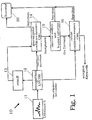
- Figure 1 describes by means of a schematical block diagram an embodiment of the inventive method for recognizing speech.
- step 11 continuous speech input is received as an utterance U and preprocessed.
- step 12 a large vocabulary continuous speech recognizing process LVCSR is performed on the continuous speech input, i. e. the received utterance U or speech phrase so as to generate a recognition result in step 13.
- the recognition result of step 13 serves as an utterance hypothesis which is fed into step 14 for calculating a simple and rough confidence measure CMU for the entire utterance hypothesis of step 13.
- a reprompt or invitation to repeat the utterance is initiated in step 20.
- step 15 In the case of an acceptance of the utterance hypothesis a thorough sentence analysis is performed in step 15 so as to extract keywords in step 16.
- step 17 it is calculated whether or not a confidence measure is necessary to evaluate the keywords. If a further evaluation on the reliability of the extracted keywords is necessary a thorough confidence measure CMK calculation is demanded using time-alignment information called from the large vocabulary continuous speech recognizing unit of step 12. If no confidence measure CMK was necessary or the confidence measure CMK for the keywords was sufficient, the generated and extracted keywords and key-phrases are accepted. If the detailed confidence measure CMK was not sufficient the keywords are rejected and a reprompt is initiated branching the process to step 20.
Landscapes
- Engineering & Computer Science (AREA)
- Computational Linguistics (AREA)
- Health & Medical Sciences (AREA)
- Audiology, Speech & Language Pathology (AREA)
- Human Computer Interaction (AREA)
- Physics & Mathematics (AREA)
- Acoustics & Sound (AREA)
- Multimedia (AREA)
- Computer Vision & Pattern Recognition (AREA)
- Machine Translation (AREA)
Abstract
Description
Claims (8)
- Method for recognizing speech,wherein a received utterance (U) is subjected to a recognition process in its entirety,wherein a rough estimation is made on whether or not said received utterance (U) is accepted or rejected in its entirety,wherein in the case of accepting said utterance (U) it is thoroughly reanalyzed so as to extract its meaning and/or intention, andwherein based on the reanalysis keywords and/or key-phrases are extracted from the utterance (U) essentially being representative for its meaning.
- Method according to claim 1,
wherein in the case of rejecting the utterance (U) a rejection signal is generated. - Method according to claim 2,
wherein as said rejection signal a reprompting signal and/or in the case of a dialogue system an invitation to repeat/restart the last utterance (U) is generated and/or output. - Method according to anyone of the preceding claims,
wherein for said rough estimation on accepting/rejecting the utterance a rough and/or simple confidence measure (CMU) for the entire utterance (U) is determined. - Method according to anyone of the preceding claims,
wherein said reanalysis of the received utterance (U) is based on a sentence analysis, in particular based on a grammar, syntax, semantic analysis and/or the like. - Method according to anyone of the preceding claims,
wherein a thorough estimation is made on whether or not said extracted keywords and/or key-phrases are accepted or rejected. - Method according to claim 6,
wherein for said thorough estimation on accepting/rejecting said key-phrases and/or keywords a detailed and/or robust confidence measure (CMK) for each single key-phrase or keyword is determined in particular on demand. - Method according to claim 7,
wherein a confidence measure (CMK) for the single key-phrase/keyword is determined only if in the step of deriving said key-phrase/keyword and indication therefore occurs so as to reduce the computational burden.
Priority Applications (5)
| Application Number | Priority Date | Filing Date | Title |
|---|---|---|---|
| DE60032776T DE60032776T2 (en) | 2000-11-16 | 2000-11-16 | Method for speech recognition |
| EP00125014A EP1207517B1 (en) | 2000-11-16 | 2000-11-16 | Method for recognizing speech |
| US09/992,960 US20020082833A1 (en) | 2000-11-16 | 2001-11-14 | Method for recognizing speech |
| JP2001352116A JP2002202797A (en) | 2000-11-16 | 2001-11-16 | For recognizing method speech |
| KR1020010071356A KR20020038545A (en) | 2000-11-16 | 2001-11-16 | Method for recognizing speech |
Applications Claiming Priority (1)
| Application Number | Priority Date | Filing Date | Title |
|---|---|---|---|
| EP00125014A EP1207517B1 (en) | 2000-11-16 | 2000-11-16 | Method for recognizing speech |
Publications (2)
| Publication Number | Publication Date |
|---|---|
| EP1207517A1 true EP1207517A1 (en) | 2002-05-22 |
| EP1207517B1 EP1207517B1 (en) | 2007-01-03 |
Family
ID=8170395
Family Applications (1)
| Application Number | Title | Priority Date | Filing Date |
|---|---|---|---|
| EP00125014A Expired - Lifetime EP1207517B1 (en) | 2000-11-16 | 2000-11-16 | Method for recognizing speech |
Country Status (5)
| Country | Link |
|---|---|
| US (1) | US20020082833A1 (en) |
| EP (1) | EP1207517B1 (en) |
| JP (1) | JP2002202797A (en) |
| KR (1) | KR20020038545A (en) |
| DE (1) | DE60032776T2 (en) |
Families Citing this family (18)
| Publication number | Priority date | Publication date | Assignee | Title |
|---|---|---|---|---|
| KR100449912B1 (en) * | 2002-02-20 | 2004-09-22 | 대한민국 | Apparatus and method for detecting topic in speech recognition system |
| TW559783B (en) * | 2002-05-31 | 2003-11-01 | Ind Tech Res Inst | Error-tolerant natural language understanding system and method integrating with confidence measure |
| CA2433588A1 (en) * | 2002-06-28 | 2003-12-28 | Accenture Global Services Gmbh | Decision support and work management for synchronizing learning services |
| CA2433536A1 (en) * | 2002-06-28 | 2003-12-28 | Accenture Global Services Gmbh | Delivery module and related platforms for business driven learning solution |
| US7702531B2 (en) | 2002-06-28 | 2010-04-20 | Accenture Global Services Gmbh | Business driven learning solution particularly suitable for sales-oriented organizations |
| US20040002888A1 (en) * | 2002-06-28 | 2004-01-01 | Accenture Global Services Gmbh | Business driven learning solution |
| US7860736B2 (en) * | 2002-06-28 | 2010-12-28 | Accenture Global Services Gmbh | Course content development method and computer readable medium for business driven learning solutions |
| US8050918B2 (en) * | 2003-12-11 | 2011-11-01 | Nuance Communications, Inc. | Quality evaluation tool for dynamic voice portals |
| US8234120B2 (en) * | 2006-07-26 | 2012-07-31 | Nuance Communications, Inc. | Performing a safety analysis for user-defined voice commands to ensure that the voice commands do not cause speech recognition ambiguities |
| US8145482B2 (en) * | 2008-05-25 | 2012-03-27 | Ezra Daya | Enhancing analysis of test key phrases from acoustic sources with key phrase training models |
| JP4922377B2 (en) * | 2009-10-01 | 2012-04-25 | 日本電信電話株式会社 | Speech recognition apparatus, method and program |
| JP5406797B2 (en) * | 2010-07-13 | 2014-02-05 | 日本電信電話株式会社 | Speech recognition method, apparatus and program thereof |
| US9607616B2 (en) * | 2015-08-17 | 2017-03-28 | Mitsubishi Electric Research Laboratories, Inc. | Method for using a multi-scale recurrent neural network with pretraining for spoken language understanding tasks |
| KR101934280B1 (en) * | 2016-10-05 | 2019-01-03 | 현대자동차주식회사 | Apparatus and method for analyzing speech meaning |
| US10311876B2 (en) * | 2017-02-14 | 2019-06-04 | Google Llc | Server side hotwording |
| US12387720B2 (en) | 2020-11-20 | 2025-08-12 | SoundHound AI IP, LLC. | Neural sentence generator for virtual assistants |
| US12223948B2 (en) * | 2022-02-03 | 2025-02-11 | Soundhound, Inc. | Token confidence scores for automatic speech recognition |
| US12394411B2 (en) | 2022-10-27 | 2025-08-19 | SoundHound AI IP, LLC. | Domain specific neural sentence generator for multi-domain virtual assistants |
Citations (3)
| Publication number | Priority date | Publication date | Assignee | Title |
|---|---|---|---|---|
| US4677673A (en) * | 1982-12-28 | 1987-06-30 | Tokyo Shibaura Denki Kabushiki Kaisha | Continuous speech recognition apparatus |
| JPH0643896A (en) * | 1991-11-18 | 1994-02-18 | Clarion Co Ltd | Method for starting and controlling voice |
| EP0831456A2 (en) * | 1996-09-20 | 1998-03-25 | Canon Kabushiki Kaisha | Speech recognition method and apparatus therefor |
Family Cites Families (2)
| Publication number | Priority date | Publication date | Assignee | Title |
|---|---|---|---|---|
| US5566272A (en) * | 1993-10-27 | 1996-10-15 | Lucent Technologies Inc. | Automatic speech recognition (ASR) processing using confidence measures |
| US6397179B2 (en) * | 1997-12-24 | 2002-05-28 | Nortel Networks Limited | Search optimization system and method for continuous speech recognition |
-
2000
- 2000-11-16 DE DE60032776T patent/DE60032776T2/en not_active Expired - Lifetime
- 2000-11-16 EP EP00125014A patent/EP1207517B1/en not_active Expired - Lifetime
-
2001
- 2001-11-14 US US09/992,960 patent/US20020082833A1/en not_active Abandoned
- 2001-11-16 JP JP2001352116A patent/JP2002202797A/en not_active Ceased
- 2001-11-16 KR KR1020010071356A patent/KR20020038545A/en not_active Ceased
Patent Citations (3)
| Publication number | Priority date | Publication date | Assignee | Title |
|---|---|---|---|---|
| US4677673A (en) * | 1982-12-28 | 1987-06-30 | Tokyo Shibaura Denki Kabushiki Kaisha | Continuous speech recognition apparatus |
| JPH0643896A (en) * | 1991-11-18 | 1994-02-18 | Clarion Co Ltd | Method for starting and controlling voice |
| EP0831456A2 (en) * | 1996-09-20 | 1998-03-25 | Canon Kabushiki Kaisha | Speech recognition method and apparatus therefor |
Non-Patent Citations (2)
| Title |
|---|
| BENNACEF S K ET AL: "A SPOKEN LANGUAGE SYSTEM FOR INFORMATION RETRIEVAL", YOKOHAMA, JAPAN, SEPT. 18 - 22, 1994,YOKOHAMA: ASJ,JP, 18 September 1994 (1994-09-18), pages 1271 - 1274, XP000855492 * |
| PATENT ABSTRACTS OF JAPAN vol. 018, no. 273 (P - 1742) 24 May 1994 (1994-05-24) * |
Also Published As
| Publication number | Publication date |
|---|---|
| DE60032776D1 (en) | 2007-02-15 |
| DE60032776T2 (en) | 2007-11-08 |
| US20020082833A1 (en) | 2002-06-27 |
| JP2002202797A (en) | 2002-07-19 |
| KR20020038545A (en) | 2002-05-23 |
| EP1207517B1 (en) | 2007-01-03 |
Similar Documents
| Publication | Publication Date | Title |
|---|---|---|
| EP1207517B1 (en) | Method for recognizing speech | |
| US10643609B1 (en) | Selecting speech inputs | |
| JP3004883B2 (en) | End call detection method and apparatus and continuous speech recognition method and apparatus | |
| US7337116B2 (en) | Speech processing system | |
| US6751595B2 (en) | Multi-stage large vocabulary speech recognition system and method | |
| US7072836B2 (en) | Speech processing apparatus and method employing matching and confidence scores | |
| US10917758B1 (en) | Voice-based messaging | |
| JP3078279B2 (en) | Method and apparatus for speech recognition using neural network and Markov model recognition technology | |
| EP0977174B1 (en) | Search optimization system and method for continuous speech recognition | |
| Hazen et al. | A comparison and combination of methods for OOV word detection and word confidence scoring | |
| CN1211779C (en) | Method and appts. for determining non-target language in speech identifying system | |
| JP2002507010A (en) | Apparatus and method for simultaneous multi-mode dictation | |
| KR101317339B1 (en) | Apparatus and method using Two phase utterance verification architecture for computation speed improvement of N-best recognition word | |
| Lee et al. | Real-time word confidence scoring using local posterior probabilities on tree trellis search | |
| Gandhe et al. | Using web text to improve keyword spotting in speech | |
| KR101122591B1 (en) | Apparatus and method for speech recognition by keyword recognition | |
| JP5215512B2 (en) | Automatic recognition method of company name included in utterance | |
| KR100366703B1 (en) | Human interactive speech recognition apparatus and method thereof | |
| KR100622019B1 (en) | Voice interface system and method | |
| JP3494338B2 (en) | Voice recognition method | |
| Macherey et al. | Multi-level error handling for tree based dialogue course management | |
| JPH1173419A (en) | Electronic document search method and apparatus | |
| KR100762588B1 (en) | Speech Recognition Method Combining Speaker Adaptation and False Input Rejection | |
| KR20050001684A (en) | System and method for recognizing voice dealing with out-of-vocabulary words, and computer readable medium storing thereof | |
| KR100655490B1 (en) | Speech Recognition Service Method Using Adaptive Halftone Model |
Legal Events
| Date | Code | Title | Description |
|---|---|---|---|
| PUAI | Public reference made under article 153(3) epc to a published international application that has entered the european phase |
Free format text: ORIGINAL CODE: 0009012 |
|
| AX | Request for extension of the european patent |
Free format text: AL;LT;LV;MK;RO;SI |
|
| 17P | Request for examination filed |
Effective date: 20020703 |
|
| AKX | Designation fees paid |
Designated state(s): DE FR GB |
|
| RAP1 | Party data changed (applicant data changed or rights of an application transferred) |
Owner name: SONY DEUTSCHLAND GMBH |
|
| GRAP | Despatch of communication of intention to grant a patent |
Free format text: ORIGINAL CODE: EPIDOSNIGR1 |
|
| GRAS | Grant fee paid |
Free format text: ORIGINAL CODE: EPIDOSNIGR3 |
|
| GRAA | (expected) grant |
Free format text: ORIGINAL CODE: 0009210 |
|
| AK | Designated contracting states |
Kind code of ref document: B1 Designated state(s): DE FR GB |
|
| REG | Reference to a national code |
Ref country code: GB Ref legal event code: FG4D |
|
| REF | Corresponds to: |
Ref document number: 60032776 Country of ref document: DE Date of ref document: 20070215 Kind code of ref document: P |
|
| RAP2 | Party data changed (patent owner data changed or rights of a patent transferred) |
Owner name: SONY DEUTSCHLAND GMBH |
|
| ET | Fr: translation filed | ||
| PLBE | No opposition filed within time limit |
Free format text: ORIGINAL CODE: 0009261 |
|
| STAA | Information on the status of an ep patent application or granted ep patent |
Free format text: STATUS: NO OPPOSITION FILED WITHIN TIME LIMIT |
|
| 26N | No opposition filed |
Effective date: 20071005 |
|
| PGFP | Annual fee paid to national office [announced via postgrant information from national office to epo] |
Ref country code: FR Payment date: 20101130 Year of fee payment: 11 |
|
| PGFP | Annual fee paid to national office [announced via postgrant information from national office to epo] |
Ref country code: DE Payment date: 20101119 Year of fee payment: 11 |
|
| PGFP | Annual fee paid to national office [announced via postgrant information from national office to epo] |
Ref country code: GB Payment date: 20101118 Year of fee payment: 11 |
|
| GBPC | Gb: european patent ceased through non-payment of renewal fee |
Effective date: 20111116 |
|
| REG | Reference to a national code |
Ref country code: FR Ref legal event code: ST Effective date: 20120731 |
|
| REG | Reference to a national code |
Ref country code: DE Ref legal event code: R119 Ref document number: 60032776 Country of ref document: DE Effective date: 20120601 |
|
| PG25 | Lapsed in a contracting state [announced via postgrant information from national office to epo] |
Ref country code: GB Free format text: LAPSE BECAUSE OF NON-PAYMENT OF DUE FEES Effective date: 20111116 |
|
| PG25 | Lapsed in a contracting state [announced via postgrant information from national office to epo] |
Ref country code: FR Free format text: LAPSE BECAUSE OF NON-PAYMENT OF DUE FEES Effective date: 20111130 |
|
| PG25 | Lapsed in a contracting state [announced via postgrant information from national office to epo] |
Ref country code: DE Free format text: LAPSE BECAUSE OF NON-PAYMENT OF DUE FEES Effective date: 20120601 |