EP1207448A1 - Procédé et système de commande d'un élément à retour d'effort - Google Patents
Procédé et système de commande d'un élément à retour d'effort Download PDFInfo
- Publication number
- EP1207448A1 EP1207448A1 EP01402864A EP01402864A EP1207448A1 EP 1207448 A1 EP1207448 A1 EP 1207448A1 EP 01402864 A EP01402864 A EP 01402864A EP 01402864 A EP01402864 A EP 01402864A EP 1207448 A1 EP1207448 A1 EP 1207448A1
- Authority
- EP
- European Patent Office
- Prior art keywords
- force feedback
- model
- feedback element
- remote
- registration
- Prior art date
- Legal status (The legal status is an assumption and is not a legal conclusion. Google has not performed a legal analysis and makes no representation as to the accuracy of the status listed.)
- Granted
Links
Images


Classifications
-
- G—PHYSICS
- G06—COMPUTING OR CALCULATING; COUNTING
- G06F—ELECTRIC DIGITAL DATA PROCESSING
- G06F3/00—Input arrangements for transferring data to be processed into a form capable of being handled by the computer; Output arrangements for transferring data from processing unit to output unit, e.g. interface arrangements
- G06F3/01—Input arrangements or combined input and output arrangements for interaction between user and computer
- G06F3/016—Input arrangements with force or tactile feedback as computer generated output to the user
-
- A—HUMAN NECESSITIES
- A61—MEDICAL OR VETERINARY SCIENCE; HYGIENE
- A61B—DIAGNOSIS; SURGERY; IDENTIFICATION
- A61B5/00—Measuring for diagnostic purposes; Identification of persons
- A61B5/45—For evaluating or diagnosing the musculoskeletal system or teeth
- A61B5/4528—Joints
-
- A—HUMAN NECESSITIES
- A61—MEDICAL OR VETERINARY SCIENCE; HYGIENE
- A61B—DIAGNOSIS; SURGERY; IDENTIFICATION
- A61B8/00—Diagnosis using ultrasonic, sonic or infrasonic waves
-
- A—HUMAN NECESSITIES
- A63—SPORTS; GAMES; AMUSEMENTS
- A63B—APPARATUS FOR PHYSICAL TRAINING, GYMNASTICS, SWIMMING, CLIMBING, OR FENCING; BALL GAMES; TRAINING EQUIPMENT
- A63B23/00—Exercising apparatus specially adapted for particular parts of the body
- A63B23/035—Exercising apparatus specially adapted for particular parts of the body for limbs, i.e. upper or lower limbs, e.g. simultaneously
- A63B23/12—Exercising apparatus specially adapted for particular parts of the body for limbs, i.e. upper or lower limbs, e.g. simultaneously for upper limbs or related muscles, e.g. chest, upper back or shoulder muscles
- A63B23/129—Exercising apparatus specially adapted for particular parts of the body for limbs, i.e. upper or lower limbs, e.g. simultaneously for upper limbs or related muscles, e.g. chest, upper back or shoulder muscles for arm wrestling
-
- A—HUMAN NECESSITIES
- A63—SPORTS; GAMES; AMUSEMENTS
- A63B—APPARATUS FOR PHYSICAL TRAINING, GYMNASTICS, SWIMMING, CLIMBING, OR FENCING; BALL GAMES; TRAINING EQUIPMENT
- A63B24/00—Electric or electronic controls for exercising apparatus of preceding groups; Controlling or monitoring of exercises, sportive games, training or athletic performances
- A63B24/0084—Exercising apparatus with means for competitions, e.g. virtual races
-
- G—PHYSICS
- G06—COMPUTING OR CALCULATING; COUNTING
- G06F—ELECTRIC DIGITAL DATA PROCESSING
- G06F3/00—Input arrangements for transferring data to be processed into a form capable of being handled by the computer; Output arrangements for transferring data from processing unit to output unit, e.g. interface arrangements
- G06F3/01—Input arrangements or combined input and output arrangements for interaction between user and computer
- G06F3/011—Arrangements for interaction with the human body, e.g. for user immersion in virtual reality
-
- G—PHYSICS
- G06—COMPUTING OR CALCULATING; COUNTING
- G06V—IMAGE OR VIDEO RECOGNITION OR UNDERSTANDING
- G06V40/00—Recognition of biometric, human-related or animal-related patterns in image or video data
- G06V40/20—Movements or behaviour, e.g. gesture recognition
- G06V40/23—Recognition of whole body movements, e.g. for sport training
-
- A—HUMAN NECESSITIES
- A61—MEDICAL OR VETERINARY SCIENCE; HYGIENE
- A61B—DIAGNOSIS; SURGERY; IDENTIFICATION
- A61B8/00—Diagnosis using ultrasonic, sonic or infrasonic waves
- A61B8/56—Details of data transmission or power supply
- A61B8/565—Details of data transmission or power supply involving data transmission via a network
-
- A—HUMAN NECESSITIES
- A63—SPORTS; GAMES; AMUSEMENTS
- A63B—APPARATUS FOR PHYSICAL TRAINING, GYMNASTICS, SWIMMING, CLIMBING, OR FENCING; BALL GAMES; TRAINING EQUIPMENT
- A63B21/00—Exercising apparatus for developing or strengthening the muscles or joints of the body by working against a counterforce, with or without measuring devices
- A63B21/28—Devices for two persons operating in opposition or in cooperation
-
- A—HUMAN NECESSITIES
- A63—SPORTS; GAMES; AMUSEMENTS
- A63B—APPARATUS FOR PHYSICAL TRAINING, GYMNASTICS, SWIMMING, CLIMBING, OR FENCING; BALL GAMES; TRAINING EQUIPMENT
- A63B2220/00—Measuring of physical parameters relating to sporting activity
- A63B2220/50—Force related parameters
- A63B2220/51—Force
-
- A—HUMAN NECESSITIES
- A63—SPORTS; GAMES; AMUSEMENTS
- A63B—APPARATUS FOR PHYSICAL TRAINING, GYMNASTICS, SWIMMING, CLIMBING, OR FENCING; BALL GAMES; TRAINING EQUIPMENT
- A63B2225/00—Miscellaneous features of sport apparatus, devices or equipment
- A63B2225/20—Miscellaneous features of sport apparatus, devices or equipment with means for remote communication, e.g. internet or the like
-
- A—HUMAN NECESSITIES
- A63—SPORTS; GAMES; AMUSEMENTS
- A63F—CARD, BOARD, OR ROULETTE GAMES; INDOOR GAMES USING SMALL MOVING PLAYING BODIES; VIDEO GAMES; GAMES NOT OTHERWISE PROVIDED FOR
- A63F2300/00—Features of games using an electronically generated display having two or more dimensions, e.g. on a television screen, showing representations related to the game
- A63F2300/10—Features of games using an electronically generated display having two or more dimensions, e.g. on a television screen, showing representations related to the game characterized by input arrangements for converting player-generated signals into game device control signals
- A63F2300/1037—Features of games using an electronically generated display having two or more dimensions, e.g. on a television screen, showing representations related to the game characterized by input arrangements for converting player-generated signals into game device control signals being specially adapted for converting control signals received from the game device into a haptic signal, e.g. using force feedback
-
- G—PHYSICS
- G06—COMPUTING OR CALCULATING; COUNTING
- G06F—ELECTRIC DIGITAL DATA PROCESSING
- G06F2203/00—Indexing scheme relating to G06F3/00 - G06F3/048
- G06F2203/01—Indexing scheme relating to G06F3/01
- G06F2203/013—Force feedback applied to a game
Definitions
- the present invention relates to the field of transmission of remote effort feedback, particularly in the context of the development of distributed virtual worlds and the development of telepresence means.
- haptic techniques from the Greek haptos: the hand are based on knowledge of gestures.
- Ballistic gestures activate the motor arc but they do not activate not the sensitive arc in return for touch.
- Feedback can be a visual representation of the space, but also a gestural map, that is to say a learned or innate mental representation wired into the brain and which automatically generates the sequence of motor orders muscles of the shoulder, arm, hand to perform this gesture ballistics as a function of a certain mental representation of space, notably the presumed hand-glass distance.
- the brain gesture information For ballistic gestures, it is sufficient to transmit to the brain gesture information with frequency 100 Hz sampling. This means that if we send a sample signal every 10 ms, the transmitted signal will contain all the relevant information of the ballistic gesture.
- Gestures with touch feedback also activate time the motor arc and the sensitive arc.
- the brain closes the loop and the cycle complete in humans lasts less than 1 ms.
- Bandwidth of neurons sensors located in the fingertips i.e. the frequency maximum mechanical signal that these neurons are able to detect and transmit to the brain, is greater than 500 Hz. If we want to be able to to code in a computer a fine gesture, the system must return of effort used itself has a high operating frequency, at less equal, according to Shannon's theorem, to twice the band passing fingers.
- force feedback systems on a machine local operate at a typical frequency of 1 kHz closed loop local, i.e. feedback is calculated and then applied to their motors then perceived by hand every 1/1000 of a second. This allows to avoid the effect known as of the "electric toothbrush”: the instrument which one holding in hand should not give the impression of vibrating.
- This frequency of 1 KHz results from the following compromise: it does not must be neither too low to be able to finely reproduce the tactile impression, neither too high to allow the computer enough time to calculate the force of feedback which will represent, in the world virtual mechanical, fine simulation of the gesture performed.
- the latency in ISDN technology is 30 ms, in ADSL technology of the order of 200 ms, and on the Internet it can reach 6 s or even cause outright rejection of the message.
- ADSL and Internet latency varies due to the asynchronous nature of networks.
- the 1 kHz frequency is therefore much too high to be able to be maintained if the closed loop includes a round trip via the network - the gesture is encoded and then transmitted over the network, it is applied to a remote object, the this object's feedback is in turn coded and transmitted back via the network -.
- a ballistic gesture can be transmitted with a delay of the order 10 ms in size. Indeed, sight is a one-way direction: the eye is a kind of camera recording a scene and the brain at a tolerance, can perceive the precise visual film with a slight delay without disturbing the execution of the gesture.
- the "Wavetransform” method consists in transposing into space forces / velocities the theory of passive quadrupoles with pure delay which is well known for electrical quantities voltage / current. This theory allows to calculate the incident and reflected electric waves in function of the characteristic line impedance. The transmission of electrical signal is optimal when this line is closed on this same characteristic value of the impedance.
- the "Wavetransform" method requires a synchronous network, that is to say a fixed and known delay network, for example ISDN. She is based on the representation in Z of the discrete sampled signals of period equal to this fixed delay known to the network.
- the invention proposes to remedy the drawbacks of prior art systems.
- the invention provides a system for controlling an element to remote feedback capable of operating with transmission data on synchronous or asynchronous networks, with known delay or undetermined.
- the control system is intended for a force feedback element capable of interacting with another element, of the type with a time constant lower than that linked to a remote control.
- the system includes a local model for the calculation of a setpoint intended for the force feedback element from a variable measured by the force feedback element, of intrinsic variables to the force feedback element and an estimate of an external interaction on the force feedback element, and a state variable of the feedback element of effort, a distant model for the estimation of interactions and state variables of the other element with update when receiving data received from another remote system, and a means of registration capable of transmitting a registration message to said other system.
- the system includes a phantom model to estimate the state variables of the return element effort and readjust said estimate upon receipt of the registration message.
- the phantom model allows to locally simulate the distant model of the remote control system.
- the registration means includes means for comparing the estimate of state variables from the phantom model and state variables from the model local so that in the event of a difference greater than a predetermined threshold, the registration means sends a registration message to the model ghost and to the other system.
- the system comprises an extrapolation means for processing a registration message originating from from the other system and to update the remote model.
- the invention also provides a control assembly for two force feedback elements located at a distance from each other.
- Each element is provided with a control system comprising a model room for calculating a setpoint for the force feedback element at from a variable measured by the force feedback element, from variables intrinsic to the force feedback element and an estimate of a external interaction on the force feedback element, and a variable state of the force feedback element, a remote model for estimation interactions and state variables of the other element with update when receiving data received from another remote system, and a registration means capable of transmitting a registration message to said other system.
- the invention also provides a method for controlling a force feedback element capable of interacting with another element, in which we perform local modeling to obtain a setpoint intended for the force feedback element from a variable measured by said force feedback element, of intrinsic variables said element return of effort, of an estimate of an external interaction on the element force feedback, and a state variable of the force feedback element; we performs remote modeling of interactions and state variables of the other element with update when receiving received data another remote system; we elaborate and we send to said other system a registration message.
- a extrapolation to process a registration message from the other system and perform a remote modeling update In one embodiment of the invention, a extrapolation to process a registration message from the other system and perform a remote modeling update.
- the invention also relates to a computer program. comprising program code means for implementing the process steps, when said program is running on a computer.
- the invention also relates to a medium capable of being read by a device for reading program code means therein stored and which are suitable for carrying out the process steps, when said program runs on a computer.
- the present invention advantageously applies to bidirectional systems, for example video games with handles control provided with force feedback actuators, on tele-ultrasound robotized which can be used in the field of obstetrics and abdominal exams.
- the patient's skin is usually coated with gel for proper transmission of ultra sounds.
- the ultrasound probe can be manipulated remotely by an operator. Due to the presence of the gel, the force components exercised by the patient on the probe can be considered as normal to the local surface of the skin.
- the probe has 6 degrees of freedom with a force feedback along the three axes of a frame of reference three-dimensional and a torque feedback also according to the three axes of a three-dimensional coordinate system.
- the system can also be applied to remote combat games, fencing, or even applications industrial of the telemachining type.
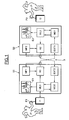
- Figure 1 is a schematic view of a system according to a first embodiment of the invention.
- Figure 2 is a detailed view of Figure 1.
- Figure 3 shows the evolution curves of certain parameters of the system.
- Figure 4 is a schematic view of a second mode of realization of the invention.
- a set of games where J1 and J2 players compare their strength from a distance - game often called "arm iron "- includes a handle P1 for player J1 and a handle P2 for the player J2.
- Each handle P1, P2 is connected to an interface I1, I2 comprising means for exerting a force on the handle P1, P2, by example an actuator of the electric jack type, and a means for measure the force exerted by day D1, D2 on the handle P1, P2, by example a torque sensor or a strain gauge.
- the interface I1, I2 will also include an acquisition card connected to the means of exerting a force and means of measurement and capable of exchanging digital data with another digital system such as computer.
- Each interface I1, I2 is connected to a control system S 1, S2.
- the systems S1 and S2 are identical. Only the S1 system will be described. However, one can consider modes of embodiment in which one of the two systems is of simplified structure compared to each other.
- the system S1 can take the form a computer, such as a personal computer generally with minus a microprocessor, of non-retentive and non-retentive memories, a communication bus, input and output ports and one or more several software stored in memory and able to be executed by the microprocessor.
- a computer such as a personal computer generally with minus a microprocessor, of non-retentive and non-retentive memories, a communication bus, input and output ports and one or more several software stored in memory and able to be executed by the microprocessor.
- the system S1 is connected on the one hand to the interface I1 for example by RS 232 type bus and S2 system via communication network referenced 3 as a whole and which may be of the synchronous type by ISDN or asynchronous example, ATM, UMTS or even Internet type (TCP / IP).
- the system S1 is located near the player J1, for example in the same room.
- the S2 system is located at a distance from the S1 system, distance which can range from a few meters to a few thousand kilometers.
- the system S1, the interface I1, the handle P1 and player J1 are arranged locally while system S2, the interface I2, the handle P2 and the player J2 are arranged distally compared to the previous ones.
- the system S1 comprises a local model ML1 capable of sending a setpoint to the interface I1 and of receiving from said interface II a variable measured by the interface I1, for example the position X of the handle P1.
- the setpoint can be a force or torque variable and is noted F e .
- the system S1 includes a remote model MD2 provided for estimating a state of the local model ML2 of the system S2.
- the remote model MD2 of the system S1 is able to receive data from the system S2, to receive data from the local model ML1 and to transmit data to the local model ML1.
- the system S1 comprises an extrapolator EXT2 receiving data coming from the system S2 via the communication network 3 to process a registration message coming from the system S2 and transmit update data to the remote model MD2 in function of the registration message received last.
- the system S1 includes a screen E1 connected to the local model ML1 for the display of data from the local model ML1, for example a curve retracing the evolution of the forces exerted and the positions of handles P1 and P2.
- the system S1 includes a register R1 receiving data from the local model ML1 and able to send output data to the S2 system, in particular for the EXT1 extrapolator of the S2 system.
- the R1 register is able to perform data preparation to send them in the form of a registration message which can include a date, the position X of the handle P1, the force F exerted on the handle P1 on said date as well as the force exerted on the handle P1 at an earlier date.
- the S1 system also includes a phantom model MF1 which also receives the readjustment messages coming from the registerer R1 of the system S1 and which performs an estimation of the state variables of the interface I1 according to the registration messages sent by the registerer R1 and received by the S2 system.
- the ghost model MF1 makes an estimate based on the same data as that received by the MD1 remote model of the S2 system.
- the phantom model MF1 allows to model the variables of the I1 interface as they are modeled by the S2 system.
- the output of the phantom model MF1 is connected to the register R1 which compare the estimate of state variables from the phantom model MF1 and the state variables coming from the local model ML1. In case of difference greater than a predetermined threshold, the registerer R1 emits a registration message for the phantom model MF1 and the extrapolator EXT1 of the S2 system.
- the volume of data exchanged between S1 and S2 systems is relatively small since a message from registration is only issued if one of the two systems S1, S2 considers that the other S2 system, S1 is no longer able to properly estimate these state variables.
- the state vector X is broken down into three parts: X e variable located at the interface with the handle P1, X m variable internal to the model mechanics of the player J1 and X i interaction variable located at the interface with the other player.
- the associated variable of force or torque F breaks down into: F e force exerted by the player J1 on the handle P1, F m force exerted by gravity, the other objects, other possible players, and the force F i exerted by player J1 on player J2.
- the interface I1 captures the position X e n and transmits it to the local model ML1.
- the interface I1 receives the setpoint force F e n from the local model ML1 and controls its actuator (s) with the feedback force - F e n .
- the interface I2 picks up position Y ' e n and transmits it to the local model ML2 and receives the force G' e n from the local model ML2 controls its actuator (s) with the feedback force - G ' e n .
- the local model ML1 receives the position X e n + 1 from the interface I1, the interaction estimate of the remote model MD2 and the prerecorded intrinsic variables F m n + 1 .
- the local model ML1 still calculates:
- the local model ML1 sends X n + 1 and F n + 1 to the readjuster R1, the setpoint - F e n + 1 to the interface I1 and the position variable X i n + 1 to the remote model MD2.
- the identity matrix is the identity matrix.
- the registration device R1 sends the registration message M n to the phantom model MF1 so that it is readjusted immediately and to the remote model MD1 via the extrapolator EXT1 of the system S2 so that it readjusts itself as soon as possible.
- the extrapolator EXT2 of the system S1 allows synchronization to be carried out.
- the message M p ⁇ p, Y p , G p , G p-1 ⁇ sent by the registerer R2 of the system S2 arrives at the system S1 at an instant between n and n + 1.
- the message M p is stamped with the date p coming from the system S2.
- the EXT2 extrapolator transmits the result of the registration to the remote model MD2: Y n + 1 , G n +1 and K 2 .
- the remote model MD2 of the system S1 is reset on reception of a message from the extrapolator EXT2 by taking the values provided by said extrapolator EXT2:
- the remote model MD2 Without receiving such a message, and at each time step, the remote model MD2 receives the position variable X i n + 1 from the local model ML1 and performs a predictive calculation:
- the remote model MD2 transmits to the local model ML1 the prediction of position variable relative to the player J2:
- the EXT2 extrapolator performs a bevel registration which smooths the evolutions.
- An example of this registration is shown on the curves of Figure 3.
- the registration is carried out in four stages between the instants n and n + 4 according to the following calculation:
- the MF1 phantom model receives the same data that the remote model MD1 from the other system and allows to perform the same simulation as said other system.
- the register operates blind to the other system and allows to continue simulating in the absence of data relevant transmitted by a registration message from the other system.
- the EXT2 extrapolator in particular in the case of bevel registration, allows to take into account the movement as measured by the other system during the transmission delay due to the communication.
- it is perfectly possible design that one of the two or both systems has no model ghost. We can also plan to operate together a number of systems greater than two.
- the local models represent the mechanical models of two users.
- Remote models represent replication distant from local mechanical models necessarily approached because transmission times via the communication network of the states of local models.
- ghost models represent a local copy approached distant models.
- Remote models and models ghosts all operate in predictor-corrector mode.
- the extrapolators extrapolate received messages with a some delay to reset the remote models to the clock value of the other system.
- the scorers assess the need to launch a message of readjustment on the communication network as soon as a too large difference appears between local models and witness ghost models local predictors of distant predictive models.
- the recalibers limit the number of messages sent across the network communication to avoid clutter.
- the information can be exchanged at the rate of one kHz. Between systems and therefore through the communication network the message exchanges take place if one of the readjusters considers it as necessary.
- FIG. 4 One embodiment of the invention for ultrasound is illustrated in Figure 4.
- a control system S1 installed by example in an establishment not specialized in obstetrics, in a establishment of a small city, or in a vehicle for serving rural areas.
- the S2 system is installed in a specialized hospital establishment where highly operators qualified personnel are available to perform ultrasound operations, for example in a regional or university hospital center.
- a patient J3 rests on a bed or table T.
- a SE ultrasound probe is in contact with his abdomen.
- a TR adjustment table of parameters of the SE probe is installed nearby.
- the SE probe is connected to the S1 system and transmits ultrasound image data to said system S1, and exchange of data relating to the position and effects exercised with the S1 system.
- the support of the SE probe which could be an articulated arm has not been shown here. However, we understands that it is a support allowing movement in space according to several degrees of freedom, in general at least six for ability to take a suitable position in contact with the abdomen of the patient J3.
- CA3 camera and video screen EV3 are also connected to the S1 system.
- the S1 and S2 systems include each a multiplexer-demultiplexer DM1 and DM2 to allow the transmission of data on network 3 which can for example be of the type ADSL.
- the operator J4 who could be a doctor specialized in ultrasound manipulates a P3 handle whose position in the space will be replicated by the SE probe.
- the handle P3 is connected to a articulated arm BA itself connected to an interface I3 of the type of interfaces I1 and I2 described above and comprising one or more actuators and a or several position sensors and force sensors. Measuring the effect can be performed by measuring an energy quantity of actuators, for example by the current still consumed by means of a strain gauge.
- the interface I3 is connected to the system S2.
- An EV4 video screen large size will simultaneously display a plurality images, for example an ultrasound image, an image of the face of patient J3 and an image showing the positioning of the SE probe on the patient's abdomen.
Landscapes
- Engineering & Computer Science (AREA)
- Health & Medical Sciences (AREA)
- General Engineering & Computer Science (AREA)
- Theoretical Computer Science (AREA)
- Life Sciences & Earth Sciences (AREA)
- Physics & Mathematics (AREA)
- General Health & Medical Sciences (AREA)
- Human Computer Interaction (AREA)
- General Physics & Mathematics (AREA)
- Orthopedic Medicine & Surgery (AREA)
- Physical Education & Sports Medicine (AREA)
- Surgery (AREA)
- Biophysics (AREA)
- Heart & Thoracic Surgery (AREA)
- Medical Informatics (AREA)
- Molecular Biology (AREA)
- Biomedical Technology (AREA)
- Animal Behavior & Ethology (AREA)
- Pathology (AREA)
- Public Health (AREA)
- Veterinary Medicine (AREA)
- Nuclear Medicine, Radiotherapy & Molecular Imaging (AREA)
- Radiology & Medical Imaging (AREA)
- Psychiatry (AREA)
- Oral & Maxillofacial Surgery (AREA)
- Rheumatology (AREA)
- Computer Vision & Pattern Recognition (AREA)
- Dentistry (AREA)
- Social Psychology (AREA)
- Multimedia (AREA)
- User Interface Of Digital Computer (AREA)
- Feedback Control In General (AREA)
- Manipulator (AREA)
- Control Of Position Or Direction (AREA)
Abstract
Description
- émission de l'ordre au muscle via l'arc sensitif moteur,
- action mécanique de la main sur le verre,
- sensation du toucher du verre (augmentation de la pression de contact) au niveau des bouts des doigts, et
- retour vers le cerveau via l'arc sensitif tactile de cette. information pour permettre au cerveau de décider l'ajustement de la force de la "pince".
- les messages peuvent se perdre, ne pas aboutir, ou être rejetés si l'accusé de réception tarde trop (TCP/IP),
- les messages qui arrivent à bon port mettent un délai variable pour traverser le réseau,
- ils n'arrivent pas forcément dans l'ordre où ils ont été émis,
- il n'existe pas d'horloge commune exacte à la milliseconde près entre deux machines.


j = p,..., n,




Claims (11)
- Système de commande (S1) d'un élément à retour d'effort (I1) apte à interagir avec un autre élément (I2), du type à constante de temps inférieure à celle liée à une commande à distance, caractérisé par le fait qu'il comprend un modèle local (ML1) pour le calcul d'une consigne (Fe) destinée à l'élément à retour d'effort à partir d'une variable (Xe) mesurée par l'élément à retour d'effort, de variables intrinsèques (Fm) à l'élément à retour d'effort et d'une estimation () d'une interaction extérieure sur l'élément à retour d'effort, et d'une variable d'état (Xm,i) de l'élément à retour d'effort, un modèle distant (MD2) pour l'estimation des interactions et des variables d'état de l'autre élément avec mise à jour lors de la réception de données reçues d'un autre système (S2) situé à distance, et un moyen de recalage (R1) apte à émettre un message de recalage (Mn) vers ledit autre système.

- Système selon la revendication 1, caractérisé par le fait qu'il comprend un modèle fantôme (MF1) pour effectuer une estimation (X and, F and) des variables d'état de l'élément à retour d'effort et recaler ladite estimation à réception du message de recalage.
- Système selon la revendication 2, caractérisé par le fait que le moyen de recalage (R1) comprend un moyen de comparaison de l'estimation des variables d'état provenant du modèle fantôme et de variables d'état provenant du modèle local de façon qu'en cas de différence supérieure à un seuil prédéterminé, le moyen de recalage émette un message de recalage vers le modèle fantôme (MF1) et vers l'autre système (S2).
- Système selon l'une quelconque des revendications précédentes, caractérisé par le fait qu'il comprend un moyen d'extrapolation (EXT 2) pour traiter un message de recalage provenant de l'autre système et pour mettre à jour le modèle distant.
- Ensemble de commande de deux éléments distants, chaque élément étant pourvu d'un système de commande selon l'une quelconque des revendications précédentes.
- Procédé de commande d'un élément à retour d'effort apte à interagir avec un autre élément, dans lequel :on effectue une modélisation locale pour obtenir une consigne destinée à l'élément à retour d'effort à partir d'une variable mesurée par ledit élément à retour d'effort, de variables intrinsèques audit élément à retour d'effort, d'une estimation d'une interaction extérieure sur l'élément à retour d'effort, et d'une variable d'état de l'élément à retour d'effort;on effectue une modélisation distante des interactions et des variables d'état de l'autre élément avec mise à jour lors de la réception de données reçues d'un autre système situé à distance;on élabore et on émet vers ledit autre système un message de recalage.
- Procédé selon la revendication 6, dans lequel on effectue une modélisation fantôme des variables d'état de l'élément à retour d'effort avec recalage à réception du message de recalage.
- Procédé selon la revendication 7, dans lequel lors du recalage, on compare l'estimation de variables d'état issues de la modélisation fantôme et de variables d'état issues de la modélisation locale de façon qu'en cas de différence supérieure à un seuil prédéterminé, on émette un message de recalage en vue d'une nouvelle modélisation fantôme, et vers l'autre système.
- Procédé selon l'une quelconque des revendications 6 à 8, dans lequel on effectue une extrapolation pour traiter un message de recalage provenant de l'autre système et effectuer une mise à jour de la modélisation distante.
- Programme d'ordinateur comprenant des moyens de code-programme pour mettre en oeuvre les étapes du procédé selon l'une quelconque des revendications 6 à 9, lorsque ledit programme fonctionne sur un ordinateur.
- Support capable d'être lu par un dispositif de lecture de moyens de code-programme qui s'y trouvent stockés et qui sont aptes à la mise en oeuvre des étapes du procédé selon l'une quelconque des revendications 6 à 9, lorsque ledit programme fonctionne sur un ordinateur.
Applications Claiming Priority (2)
| Application Number | Priority Date | Filing Date | Title |
|---|---|---|---|
| FR0014733A FR2816722B1 (fr) | 2000-11-15 | 2000-11-15 | Procede et systeme de commande d'un element a retour d'effort |
| FR0014733 | 2000-11-15 |
Publications (2)
| Publication Number | Publication Date |
|---|---|
| EP1207448A1 true EP1207448A1 (fr) | 2002-05-22 |
| EP1207448B1 EP1207448B1 (fr) | 2008-06-04 |
Family
ID=8856499
Family Applications (1)
| Application Number | Title | Priority Date | Filing Date |
|---|---|---|---|
| EP01402864A Expired - Lifetime EP1207448B1 (fr) | 2000-11-15 | 2001-11-08 | Procédé et système de commande d'un élément à retour d'effort |
Country Status (7)
| Country | Link |
|---|---|
| US (1) | US6847852B2 (fr) |
| EP (1) | EP1207448B1 (fr) |
| JP (1) | JP4744753B2 (fr) |
| AT (1) | ATE397767T1 (fr) |
| DE (1) | DE60134302D1 (fr) |
| ES (1) | ES2307578T3 (fr) |
| FR (1) | FR2816722B1 (fr) |
Cited By (2)
| Publication number | Priority date | Publication date | Assignee | Title |
|---|---|---|---|---|
| WO2010102384A1 (fr) * | 2009-03-10 | 2010-09-16 | Mcmaster University | Système chirurgical robotique mobile |
| CN105892690A (zh) * | 2016-05-17 | 2016-08-24 | 京东方科技集团股份有限公司 | 动作获取装置及方法、动作仿真装置及方法、触觉通信系统 |
Families Citing this family (19)
| Publication number | Priority date | Publication date | Assignee | Title |
|---|---|---|---|---|
| CA2450357A1 (fr) * | 2001-07-10 | 2003-01-23 | British Telecommunications Public Limited Company | Interface haptique |
| US7430453B2 (en) * | 2001-11-08 | 2008-09-30 | Eim Company, Inc. | Remote replication of local actuator mode selection |
| WO2003068461A1 (fr) * | 2002-02-13 | 2003-08-21 | Toudai Tlo, Ltd. | Robot-telephone |
| DE10217630A1 (de) * | 2002-04-19 | 2003-11-13 | Robert Riener | Verfahren und Vorrichtung zum Erlernen und Trainieren zahnärztlicher Behandlungsmethoden |
| FR2840422B1 (fr) * | 2002-06-03 | 2006-02-17 | France Telecom | Procede et systeme de construction a distance d'une surface tridimensionnelle |
| EP1376316A1 (fr) * | 2002-06-26 | 2004-01-02 | BRITISH TELECOMMUNICATIONS public limited company | Communications haptiques |
| GB0322875D0 (en) * | 2003-09-30 | 2003-10-29 | British Telecomm | Haptics transmission systems |
| FI117308B (fi) * | 2004-02-06 | 2006-08-31 | Nokia Corp | Eleohjausjärjestelmä |
| US20050235032A1 (en) * | 2004-04-15 | 2005-10-20 | Mason Wallace R Iii | System and method for haptic based conferencing |
| WO2006011076A1 (fr) * | 2004-07-22 | 2006-02-02 | Koninklijke Philips Electronics N.V. | Utilisation strategique d'informations de biocapteurs dans un jeu informatique a plusieurs joueurs |
| US8190292B2 (en) * | 2005-08-29 | 2012-05-29 | The Board Of Trustees Of The Leland Stanford Junior University | High frequency feedback in telerobotics |
| CN101569540B (zh) * | 2008-04-29 | 2011-05-11 | 香港理工大学 | 无线超声波扫描系统 |
| CN102122204B (zh) * | 2011-01-17 | 2012-07-18 | 北京邮电大学 | 分布式力觉同步感知方法及系统 |
| US20120239200A1 (en) * | 2011-02-28 | 2012-09-20 | D-Box Technologies Inc. | Remote object vibro-kinetic feedback system and method |
| US10471347B2 (en) * | 2017-05-24 | 2019-11-12 | Nintendo Co., Ltd. | Information processing system, information processing apparatus, storage medium storing information processing program, and information processing method |
| US20220147144A1 (en) * | 2019-03-18 | 2022-05-12 | Case Western Reserve University | Systems and methods for human-machine integration |
| CN112989605B (zh) * | 2021-03-12 | 2023-08-29 | 北京控制工程研究所 | 一种机器人自适应交互阻抗学习方法 |
| GB2610374B (en) * | 2021-08-05 | 2024-04-10 | Tacyt Ltd | Human machine interface device |
| WO2026058055A1 (fr) * | 2024-09-16 | 2026-03-19 | GOTLIBOVICH, Uri | Système et dispositif de compétition de réseau entre des concurrents seuls ou en groupe simulant des paramètres physiques du concurrent le plus fort dans le temps |
Citations (2)
| Publication number | Priority date | Publication date | Assignee | Title |
|---|---|---|---|---|
| FR2646612A1 (fr) * | 1989-05-02 | 1990-11-09 | Barbeau Christian | Systeme de jeux de force a distance |
| WO1998006024A1 (fr) * | 1996-08-01 | 1998-02-12 | Immersion Human Interface Corporation | Procede et appareil pour produire des donnees de retour de force sur un reseau informatique |
Family Cites Families (8)
| Publication number | Priority date | Publication date | Assignee | Title |
|---|---|---|---|---|
| US4925312A (en) * | 1988-03-21 | 1990-05-15 | Staubli International Ag | Robot control system having adaptive feedforward torque control for improved accuracy |
| US5629594A (en) * | 1992-12-02 | 1997-05-13 | Cybernet Systems Corporation | Force feedback system |
| US5659480A (en) * | 1995-06-27 | 1997-08-19 | Industrial Service And Machine, Incorporated | Method for coordinating motion control of a multiple axis machine |
| US5754023A (en) * | 1995-10-26 | 1998-05-19 | Cybernet Systems Corporation | Gyro-stabilized platforms for force-feedback applications |
| US6028593A (en) * | 1995-12-01 | 2000-02-22 | Immersion Corporation | Method and apparatus for providing simulated physical interactions within computer generated environments |
| US5904724A (en) * | 1996-01-19 | 1999-05-18 | Margolin; Jed | Method and apparatus for remotely piloting an aircraft |
| US5912454A (en) * | 1997-06-30 | 1999-06-15 | Microsoft Corporation | System and method for detecting a relative change in light intensity |
| US6219589B1 (en) * | 1997-10-22 | 2001-04-17 | Simon Fraser University | Remote manipulator with force feedback and control |
-
2000
- 2000-11-15 FR FR0014733A patent/FR2816722B1/fr not_active Expired - Fee Related
-
2001
- 2001-11-02 JP JP2001338293A patent/JP4744753B2/ja not_active Expired - Fee Related
- 2001-11-08 EP EP01402864A patent/EP1207448B1/fr not_active Expired - Lifetime
- 2001-11-08 AT AT01402864T patent/ATE397767T1/de not_active IP Right Cessation
- 2001-11-08 ES ES01402864T patent/ES2307578T3/es not_active Expired - Lifetime
- 2001-11-08 DE DE60134302T patent/DE60134302D1/de not_active Expired - Lifetime
- 2001-11-14 US US09/992,583 patent/US6847852B2/en not_active Expired - Fee Related
Patent Citations (2)
| Publication number | Priority date | Publication date | Assignee | Title |
|---|---|---|---|---|
| FR2646612A1 (fr) * | 1989-05-02 | 1990-11-09 | Barbeau Christian | Systeme de jeux de force a distance |
| WO1998006024A1 (fr) * | 1996-08-01 | 1998-02-12 | Immersion Human Interface Corporation | Procede et appareil pour produire des donnees de retour de force sur un reseau informatique |
Non-Patent Citations (1)
| Title |
|---|
| SATO M ET AL: "A REMOTE COLLABORATION SYSTEM USING HAND-FORCE VIRTUAL ENVIRONMENT", ELECTRONICS & COMMUNICATIONS IN JAPAN, PART III - FUNDAMENTAL ELECTRONIC SCIENCE,US,SCRIPTA TECHNICA. NEW YORK, vol. 80, no. 4, 1 April 1997 (1997-04-01), pages 51 - 58, XP000723464, ISSN: 1042-0967 * |
Cited By (2)
| Publication number | Priority date | Publication date | Assignee | Title |
|---|---|---|---|---|
| WO2010102384A1 (fr) * | 2009-03-10 | 2010-09-16 | Mcmaster University | Système chirurgical robotique mobile |
| CN105892690A (zh) * | 2016-05-17 | 2016-08-24 | 京东方科技集团股份有限公司 | 动作获取装置及方法、动作仿真装置及方法、触觉通信系统 |
Also Published As
| Publication number | Publication date |
|---|---|
| US20020082724A1 (en) | 2002-06-27 |
| ES2307578T3 (es) | 2008-12-01 |
| JP2002196854A (ja) | 2002-07-12 |
| US6847852B2 (en) | 2005-01-25 |
| JP4744753B2 (ja) | 2011-08-10 |
| FR2816722B1 (fr) | 2003-02-07 |
| DE60134302D1 (de) | 2008-07-17 |
| FR2816722A1 (fr) | 2002-05-17 |
| ATE397767T1 (de) | 2008-06-15 |
| EP1207448B1 (fr) | 2008-06-04 |
Similar Documents
| Publication | Publication Date | Title |
|---|---|---|
| EP1207448A1 (fr) | Procédé et système de commande d'un élément à retour d'effort | |
| EP1370188B1 (fr) | Procede et systeme de reconstruction a distance d'une surface | |
| CN114040230A (zh) | 视频码率确定方法、装置、电子设备及其存储介质 | |
| EP3595787A1 (fr) | Procédé de génération de données multimédia associée à un système de sport | |
| WO2020075622A1 (fr) | Dispositif, procédé et programme de traitement d'informations | |
| CN110827217B (zh) | 图像处理方法、电子设备及计算机可读存储介质 | |
| CN115713938A (zh) | 语音识别的置信度估计方法、存储介质及电子设备 | |
| WO2014079269A1 (fr) | Procédé, dispositif et système d'interaction d'images et terminal mobile | |
| EP1463980B1 (fr) | Procede et systeme de commande dynamique d un element a reto ur d effort | |
| CN116634231B (zh) | 视频码率确定方法、装置、电子设备及其存储介质 | |
| CN120430180A (zh) | 一种多模态融合ai数字人直播生成系统 | |
| Gutmann et al. | Predictive simulation: Using regression and artificial neural networks to negate latency in networked interactive virtual reality | |
| EP1369823A1 (fr) | Procédé et système de construction à distance d'une surface tridimensionnelle | |
| EP4004731B1 (fr) | Procédé de transmission de données | |
| CN108205372B (zh) | 应用于虚拟现实设备的操作方法和装置以及虚拟现实设备 | |
| EP2536075B1 (fr) | Procédé de demande d'accès par un terminal à un contenu numérique apte à être téléchargé depuis un réseau. | |
| US20250106573A1 (en) | Loudspeaker system identification and dynamic updating of loudspeaker system parameters | |
| US11671254B2 (en) | Extended reality authentication | |
| FR2855293A1 (fr) | Simulation en temps reel d'actions effectuees sur un objet virtuel par un outil virtuel teleopere par des dispositifs a retour d'effort correles | |
| FR2949069A1 (fr) | Accessoire immersif ambidextre pour console de jeux video portable. | |
| CN121963677A (zh) | 二胡、二胡教学系统、教学方法、设备和计算机可读介质 | |
| FR2898459A1 (fr) | Procede et dispositif de reception d'images ayant subi des pertes en cours de transmission | |
| CN108234952B (zh) | 移动目标图像压缩采样装置 | |
| CN108401136B (zh) | 移动目标图像压缩采样及重构方法 | |
| WO2005091114A1 (fr) | Procede et dispositif d’animation d’une entite virtuelle correspondant a un utilisateur dans un environnement virtuel |
Legal Events
| Date | Code | Title | Description |
|---|---|---|---|
| PUAI | Public reference made under article 153(3) epc to a published international application that has entered the european phase |
Free format text: ORIGINAL CODE: 0009012 |
|
| AX | Request for extension of the european patent |
Free format text: AL;LT;LV;MK;RO;SI |
|
| 17P | Request for examination filed |
Effective date: 20021119 |
|
| AKX | Designation fees paid |
Designated state(s): AT BE CH CY DE DK ES FI FR GB GR IE IT LI LU MC NL PT SE TR |
|
| 17Q | First examination report despatched |
Effective date: 20061128 |
|
| GRAP | Despatch of communication of intention to grant a patent |
Free format text: ORIGINAL CODE: EPIDOSNIGR1 |
|
| GRAS | Grant fee paid |
Free format text: ORIGINAL CODE: EPIDOSNIGR3 |
|
| GRAA | (expected) grant |
Free format text: ORIGINAL CODE: 0009210 |
|
| AK | Designated contracting states |
Kind code of ref document: B1 Designated state(s): AT BE CH CY DE DK ES FI FR GB GR IE IT LI LU MC NL PT SE TR |
|
| REG | Reference to a national code |
Ref country code: GB Ref legal event code: FG4D Free format text: NOT ENGLISH |
|
| REG | Reference to a national code |
Ref country code: CH Ref legal event code: EP |
|
| REF | Corresponds to: |
Ref document number: 60134302 Country of ref document: DE Date of ref document: 20080717 Kind code of ref document: P |
|
| REG | Reference to a national code |
Ref country code: IE Ref legal event code: FG4D Free format text: LANGUAGE OF EP DOCUMENT: FRENCH |
|
| PG25 | Lapsed in a contracting state [announced via postgrant information from national office to epo] |
Ref country code: FI Free format text: LAPSE BECAUSE OF FAILURE TO SUBMIT A TRANSLATION OF THE DESCRIPTION OR TO PAY THE FEE WITHIN THE PRESCRIBED TIME-LIMIT Effective date: 20080604 |
|
| PG25 | Lapsed in a contracting state [announced via postgrant information from national office to epo] |
Ref country code: NL Free format text: LAPSE BECAUSE OF FAILURE TO SUBMIT A TRANSLATION OF THE DESCRIPTION OR TO PAY THE FEE WITHIN THE PRESCRIBED TIME-LIMIT Effective date: 20080604 Ref country code: AT Free format text: LAPSE BECAUSE OF FAILURE TO SUBMIT A TRANSLATION OF THE DESCRIPTION OR TO PAY THE FEE WITHIN THE PRESCRIBED TIME-LIMIT Effective date: 20080604 |
|
| NLV1 | Nl: lapsed or annulled due to failure to fulfill the requirements of art. 29p and 29m of the patents act | ||
| REG | Reference to a national code |
Ref country code: ES Ref legal event code: FG2A Ref document number: 2307578 Country of ref document: ES Kind code of ref document: T3 |
|
| REG | Reference to a national code |
Ref country code: IE Ref legal event code: FD4D |
|
| PG25 | Lapsed in a contracting state [announced via postgrant information from national office to epo] |
Ref country code: SE Free format text: LAPSE BECAUSE OF FAILURE TO SUBMIT A TRANSLATION OF THE DESCRIPTION OR TO PAY THE FEE WITHIN THE PRESCRIBED TIME-LIMIT Effective date: 20080904 Ref country code: PT Free format text: LAPSE BECAUSE OF FAILURE TO SUBMIT A TRANSLATION OF THE DESCRIPTION OR TO PAY THE FEE WITHIN THE PRESCRIBED TIME-LIMIT Effective date: 20081104 Ref country code: IE Free format text: LAPSE BECAUSE OF FAILURE TO SUBMIT A TRANSLATION OF THE DESCRIPTION OR TO PAY THE FEE WITHIN THE PRESCRIBED TIME-LIMIT Effective date: 20080604 |
|
| PLBE | No opposition filed within time limit |
Free format text: ORIGINAL CODE: 0009261 |
|
| STAA | Information on the status of an ep patent application or granted ep patent |
Free format text: STATUS: NO OPPOSITION FILED WITHIN TIME LIMIT |
|
| PG25 | Lapsed in a contracting state [announced via postgrant information from national office to epo] |
Ref country code: DK Free format text: LAPSE BECAUSE OF FAILURE TO SUBMIT A TRANSLATION OF THE DESCRIPTION OR TO PAY THE FEE WITHIN THE PRESCRIBED TIME-LIMIT Effective date: 20080604 |
|
| 26N | No opposition filed |
Effective date: 20090305 |
|
| BERE | Be: lapsed |
Owner name: FRANCE TELECOM Effective date: 20081130 |
|
| PG25 | Lapsed in a contracting state [announced via postgrant information from national office to epo] |
Ref country code: MC Free format text: LAPSE BECAUSE OF NON-PAYMENT OF DUE FEES Effective date: 20081130 |
|
| REG | Reference to a national code |
Ref country code: CH Ref legal event code: PL |
|
| PG25 | Lapsed in a contracting state [announced via postgrant information from national office to epo] |
Ref country code: BE Free format text: LAPSE BECAUSE OF NON-PAYMENT OF DUE FEES Effective date: 20081130 |
|
| PG25 | Lapsed in a contracting state [announced via postgrant information from national office to epo] |
Ref country code: LI Free format text: LAPSE BECAUSE OF NON-PAYMENT OF DUE FEES Effective date: 20081130 Ref country code: CH Free format text: LAPSE BECAUSE OF NON-PAYMENT OF DUE FEES Effective date: 20081130 |
|
| PG25 | Lapsed in a contracting state [announced via postgrant information from national office to epo] |
Ref country code: LU Free format text: LAPSE BECAUSE OF NON-PAYMENT OF DUE FEES Effective date: 20081108 Ref country code: CY Free format text: LAPSE BECAUSE OF FAILURE TO SUBMIT A TRANSLATION OF THE DESCRIPTION OR TO PAY THE FEE WITHIN THE PRESCRIBED TIME-LIMIT Effective date: 20080604 |
|
| PG25 | Lapsed in a contracting state [announced via postgrant information from national office to epo] |
Ref country code: TR Free format text: LAPSE BECAUSE OF FAILURE TO SUBMIT A TRANSLATION OF THE DESCRIPTION OR TO PAY THE FEE WITHIN THE PRESCRIBED TIME-LIMIT Effective date: 20080604 |
|
| PG25 | Lapsed in a contracting state [announced via postgrant information from national office to epo] |
Ref country code: GR Free format text: LAPSE BECAUSE OF FAILURE TO SUBMIT A TRANSLATION OF THE DESCRIPTION OR TO PAY THE FEE WITHIN THE PRESCRIBED TIME-LIMIT Effective date: 20080905 |
|
| PGFP | Annual fee paid to national office [announced via postgrant information from national office to epo] |
Ref country code: DE Payment date: 20101025 Year of fee payment: 10 |
|
| PGFP | Annual fee paid to national office [announced via postgrant information from national office to epo] |
Ref country code: IT Payment date: 20101105 Year of fee payment: 10 Ref country code: GB Payment date: 20101026 Year of fee payment: 10 |
|
| PGFP | Annual fee paid to national office [announced via postgrant information from national office to epo] |
Ref country code: ES Payment date: 20111111 Year of fee payment: 11 Ref country code: FR Payment date: 20111205 Year of fee payment: 11 |
|
| GBPC | Gb: european patent ceased through non-payment of renewal fee |
Effective date: 20121108 |
|
| REG | Reference to a national code |
Ref country code: FR Ref legal event code: ST Effective date: 20130731 |
|
| PG25 | Lapsed in a contracting state [announced via postgrant information from national office to epo] |
Ref country code: IT Free format text: LAPSE BECAUSE OF NON-PAYMENT OF DUE FEES Effective date: 20121108 |
|
| REG | Reference to a national code |
Ref country code: DE Ref legal event code: R119 Ref document number: 60134302 Country of ref document: DE Effective date: 20130601 |
|
| PG25 | Lapsed in a contracting state [announced via postgrant information from national office to epo] |
Ref country code: DE Free format text: LAPSE BECAUSE OF NON-PAYMENT OF DUE FEES Effective date: 20130601 |
|
| PG25 | Lapsed in a contracting state [announced via postgrant information from national office to epo] |
Ref country code: FR Free format text: LAPSE BECAUSE OF NON-PAYMENT OF DUE FEES Effective date: 20121130 Ref country code: GB Free format text: LAPSE BECAUSE OF NON-PAYMENT OF DUE FEES Effective date: 20121108 |
|
| REG | Reference to a national code |
Ref country code: ES Ref legal event code: FD2A Effective date: 20140305 |
|
| PG25 | Lapsed in a contracting state [announced via postgrant information from national office to epo] |
Ref country code: ES Free format text: LAPSE BECAUSE OF NON-PAYMENT OF DUE FEES Effective date: 20121109 |