EP1207184A1 - Silica-containing curable-rubber mix for producing tire tread plies - Google Patents
Silica-containing curable-rubber mix for producing tire tread plies Download PDFInfo
- Publication number
- EP1207184A1 EP1207184A1 EP01127277A EP01127277A EP1207184A1 EP 1207184 A1 EP1207184 A1 EP 1207184A1 EP 01127277 A EP01127277 A EP 01127277A EP 01127277 A EP01127277 A EP 01127277A EP 1207184 A1 EP1207184 A1 EP 1207184A1
- Authority
- EP
- European Patent Office
- Prior art keywords
- mix
- silica
- carbon black
- reinforcing filler
- salt
- Prior art date
- Legal status (The legal status is an assumption and is not a legal conclusion. Google has not performed a legal analysis and makes no representation as to the accuracy of the status listed.)
- Withdrawn
Links
- VYPSYNLAJGMNEJ-UHFFFAOYSA-N Silicium dioxide Chemical compound O=[Si]=O VYPSYNLAJGMNEJ-UHFFFAOYSA-N 0.000 title claims abstract description 97
- 239000000377 silicon dioxide Substances 0.000 title claims abstract description 48
- 229920001971 elastomer Polymers 0.000 title claims abstract description 11
- 239000005060 rubber Substances 0.000 title claims abstract description 10
- 239000006229 carbon black Substances 0.000 claims abstract description 18
- 230000003014 reinforcing effect Effects 0.000 claims abstract description 11
- OKTJSMMVPCPJKN-UHFFFAOYSA-N Carbon Chemical compound [C] OKTJSMMVPCPJKN-UHFFFAOYSA-N 0.000 claims abstract description 8
- 229910052799 carbon Inorganic materials 0.000 claims abstract description 6
- 239000000203 mixture Substances 0.000 claims description 40
- 239000012763 reinforcing filler Substances 0.000 claims description 13
- 229910017053 inorganic salt Inorganic materials 0.000 claims description 12
- 238000004519 manufacturing process Methods 0.000 claims description 9
- 229920000642 polymer Polymers 0.000 claims description 9
- 239000007832 Na2SO4 Substances 0.000 claims description 5
- PMZURENOXWZQFD-UHFFFAOYSA-L Sodium Sulfate Chemical compound [Na+].[Na+].[O-]S([O-])(=O)=O PMZURENOXWZQFD-UHFFFAOYSA-L 0.000 claims description 5
- 229910052938 sodium sulfate Inorganic materials 0.000 claims description 5
- 229920001577 copolymer Polymers 0.000 claims description 4
- 244000043261 Hevea brasiliensis Species 0.000 claims description 3
- 229920003052 natural elastomer Polymers 0.000 claims description 3
- 229920001194 natural rubber Polymers 0.000 claims description 3
- LZZYPRNAOMGNLH-UHFFFAOYSA-M Cetrimonium bromide Chemical compound [Br-].CCCCCCCCCCCCCCCC[N+](C)(C)C LZZYPRNAOMGNLH-UHFFFAOYSA-M 0.000 claims description 2
- 229920002943 EPDM rubber Polymers 0.000 claims description 2
- 239000005062 Polybutadiene Substances 0.000 claims description 2
- 125000000129 anionic group Chemical group 0.000 claims description 2
- VLLYOYVKQDKAHN-UHFFFAOYSA-N buta-1,3-diene;2-methylbuta-1,3-diene Chemical compound C=CC=C.CC(=C)C=C VLLYOYVKQDKAHN-UHFFFAOYSA-N 0.000 claims description 2
- NTXGQCSETZTARF-UHFFFAOYSA-N buta-1,3-diene;prop-2-enenitrile Chemical compound C=CC=C.C=CC#N NTXGQCSETZTARF-UHFFFAOYSA-N 0.000 claims description 2
- MTAZNLWOLGHBHU-UHFFFAOYSA-N butadiene-styrene rubber Chemical compound C=CC=C.C=CC1=CC=CC=C1 MTAZNLWOLGHBHU-UHFFFAOYSA-N 0.000 claims description 2
- 125000002091 cationic group Chemical group 0.000 claims description 2
- 239000000839 emulsion Substances 0.000 claims description 2
- 229920002857 polybutadiene Polymers 0.000 claims description 2
- 229920001195 polyisoprene Polymers 0.000 claims description 2
- 229920001897 terpolymer Polymers 0.000 claims description 2
- 238000000034 method Methods 0.000 description 6
- 239000003795 chemical substances by application Substances 0.000 description 5
- 238000005096 rolling process Methods 0.000 description 4
- NINIDFKCEFEMDL-UHFFFAOYSA-N Sulfur Chemical compound [S] NINIDFKCEFEMDL-UHFFFAOYSA-N 0.000 description 3
- 239000005864 Sulphur Substances 0.000 description 3
- 230000003472 neutralizing effect Effects 0.000 description 3
- 239000012744 reinforcing agent Substances 0.000 description 3
- 238000005406 washing Methods 0.000 description 3
- 229920013645 Europrene Polymers 0.000 description 2
- BPQQTUXANYXVAA-UHFFFAOYSA-N Orthosilicate Chemical compound [O-][Si]([O-])([O-])[O-] BPQQTUXANYXVAA-UHFFFAOYSA-N 0.000 description 2
- GWEVSGVZZGPLCZ-UHFFFAOYSA-N Titan oxide Chemical compound O=[Ti]=O GWEVSGVZZGPLCZ-UHFFFAOYSA-N 0.000 description 2
- XLOMVQKBTHCTTD-UHFFFAOYSA-N Zinc monoxide Chemical compound [Zn]=O XLOMVQKBTHCTTD-UHFFFAOYSA-N 0.000 description 2
- 239000004615 ingredient Substances 0.000 description 2
- 238000001556 precipitation Methods 0.000 description 2
- 150000003839 salts Chemical class 0.000 description 2
- XLYOFNOQVPJJNP-UHFFFAOYSA-N water Substances O XLYOFNOQVPJJNP-UHFFFAOYSA-N 0.000 description 2
- ZZMVLMVFYMGSMY-UHFFFAOYSA-N 4-n-(4-methylpentan-2-yl)-1-n-phenylbenzene-1,4-diamine Chemical compound C1=CC(NC(C)CC(C)C)=CC=C1NC1=CC=CC=C1 ZZMVLMVFYMGSMY-UHFFFAOYSA-N 0.000 description 1
- 239000005995 Aluminium silicate Substances 0.000 description 1
- 241001441571 Hiodontidae Species 0.000 description 1
- VEXZGXHMUGYJMC-UHFFFAOYSA-N Hydrochloric acid Chemical compound Cl VEXZGXHMUGYJMC-UHFFFAOYSA-N 0.000 description 1
- NBIIXXVUZAFLBC-UHFFFAOYSA-N Phosphoric acid Chemical compound OP(O)(O)=O NBIIXXVUZAFLBC-UHFFFAOYSA-N 0.000 description 1
- 235000021355 Stearic acid Nutrition 0.000 description 1
- QAOWNCQODCNURD-UHFFFAOYSA-N Sulfuric acid Chemical compound OS(O)(=O)=O QAOWNCQODCNURD-UHFFFAOYSA-N 0.000 description 1
- 235000012211 aluminium silicate Nutrition 0.000 description 1
- 239000003963 antioxidant agent Substances 0.000 description 1
- 230000003078 antioxidant effect Effects 0.000 description 1
- 229910052788 barium Inorganic materials 0.000 description 1
- DSAJWYNOEDNPEQ-UHFFFAOYSA-N barium atom Chemical compound [Ba] DSAJWYNOEDNPEQ-UHFFFAOYSA-N 0.000 description 1
- 239000000440 bentonite Substances 0.000 description 1
- 229910000278 bentonite Inorganic materials 0.000 description 1
- SVPXDRXYRYOSEX-UHFFFAOYSA-N bentoquatam Chemical compound O.O=[Si]=O.O=[Al]O[Al]=O SVPXDRXYRYOSEX-UHFFFAOYSA-N 0.000 description 1
- 239000007767 bonding agent Substances 0.000 description 1
- 239000006227 byproduct Substances 0.000 description 1
- BVKZGUZCCUSVTD-UHFFFAOYSA-N carbonic acid Chemical compound OC(O)=O BVKZGUZCCUSVTD-UHFFFAOYSA-N 0.000 description 1
- -1 chalk Substances 0.000 description 1
- AFZSMODLJJCVPP-UHFFFAOYSA-N dibenzothiazol-2-yl disulfide Chemical compound C1=CC=C2SC(SSC=3SC4=CC=CC=C4N=3)=NC2=C1 AFZSMODLJJCVPP-UHFFFAOYSA-N 0.000 description 1
- 239000012153 distilled water Substances 0.000 description 1
- 239000000806 elastomer Substances 0.000 description 1
- 238000001914 filtration Methods 0.000 description 1
- 230000001788 irregular Effects 0.000 description 1
- NLYAJNPCOHFWQQ-UHFFFAOYSA-N kaolin Chemical compound O.O.O=[Al]O[Si](=O)O[Si](=O)O[Al]=O NLYAJNPCOHFWQQ-UHFFFAOYSA-N 0.000 description 1
- 238000009533 lab test Methods 0.000 description 1
- 238000002156 mixing Methods 0.000 description 1
- IUJLOAKJZQBENM-UHFFFAOYSA-N n-(1,3-benzothiazol-2-ylsulfanyl)-2-methylpropan-2-amine Chemical compound C1=CC=C2SC(SNC(C)(C)C)=NC2=C1 IUJLOAKJZQBENM-UHFFFAOYSA-N 0.000 description 1
- QIQXTHQIDYTFRH-UHFFFAOYSA-N octadecanoic acid Chemical compound CCCCCCCCCCCCCCCCCC(O)=O QIQXTHQIDYTFRH-UHFFFAOYSA-N 0.000 description 1
- OQCDKBAXFALNLD-UHFFFAOYSA-N octadecanoic acid Natural products CCCCCCCC(C)CCCCCCCCC(O)=O OQCDKBAXFALNLD-UHFFFAOYSA-N 0.000 description 1
- 239000003921 oil Substances 0.000 description 1
- 230000000704 physical effect Effects 0.000 description 1
- 230000001376 precipitating effect Effects 0.000 description 1
- 238000002360 preparation method Methods 0.000 description 1
- 239000000047 product Substances 0.000 description 1
- 229910000077 silane Inorganic materials 0.000 description 1
- 235000012239 silicon dioxide Nutrition 0.000 description 1
- 239000008117 stearic acid Substances 0.000 description 1
- 239000000126 substance Substances 0.000 description 1
- 239000000454 talc Substances 0.000 description 1
- 229910052623 talc Inorganic materials 0.000 description 1
- 239000004408 titanium dioxide Substances 0.000 description 1
- 239000011787 zinc oxide Substances 0.000 description 1
Classifications
-
- C—CHEMISTRY; METALLURGY
- C08—ORGANIC MACROMOLECULAR COMPOUNDS; THEIR PREPARATION OR CHEMICAL WORKING-UP; COMPOSITIONS BASED THEREON
- C08K—Use of inorganic or non-macromolecular organic substances as compounding ingredients
- C08K3/00—Use of inorganic substances as compounding ingredients
- C08K3/34—Silicon-containing compounds
- C08K3/36—Silica
-
- B—PERFORMING OPERATIONS; TRANSPORTING
- B60—VEHICLES IN GENERAL
- B60C—VEHICLE TYRES; TYRE INFLATION; TYRE CHANGING; CONNECTING VALVES TO INFLATABLE ELASTIC BODIES IN GENERAL; DEVICES OR ARRANGEMENTS RELATED TO TYRES
- B60C1/00—Tyres characterised by the chemical composition or the physical arrangement or mixture of the composition
- B60C1/0016—Compositions of the tread
-
- C—CHEMISTRY; METALLURGY
- C08—ORGANIC MACROMOLECULAR COMPOUNDS; THEIR PREPARATION OR CHEMICAL WORKING-UP; COMPOSITIONS BASED THEREON
- C08L—COMPOSITIONS OF MACROMOLECULAR COMPOUNDS
- C08L21/00—Compositions of unspecified rubbers
-
- C—CHEMISTRY; METALLURGY
- C08—ORGANIC MACROMOLECULAR COMPOUNDS; THEIR PREPARATION OR CHEMICAL WORKING-UP; COMPOSITIONS BASED THEREON
- C08L—COMPOSITIONS OF MACROMOLECULAR COMPOUNDS
- C08L9/00—Compositions of homopolymers or copolymers of conjugated diene hydrocarbons
-
- C—CHEMISTRY; METALLURGY
- C08—ORGANIC MACROMOLECULAR COMPOUNDS; THEIR PREPARATION OR CHEMICAL WORKING-UP; COMPOSITIONS BASED THEREON
- C08K—Use of inorganic or non-macromolecular organic substances as compounding ingredients
- C08K3/00—Use of inorganic substances as compounding ingredients
- C08K3/18—Oxygen-containing compounds, e.g. metal carbonyls
- C08K3/24—Acids; Salts thereof
-
- C—CHEMISTRY; METALLURGY
- C08—ORGANIC MACROMOLECULAR COMPOUNDS; THEIR PREPARATION OR CHEMICAL WORKING-UP; COMPOSITIONS BASED THEREON
- C08L—COMPOSITIONS OF MACROMOLECULAR COMPOUNDS
- C08L7/00—Compositions of natural rubber
-
- C—CHEMISTRY; METALLURGY
- C08—ORGANIC MACROMOLECULAR COMPOUNDS; THEIR PREPARATION OR CHEMICAL WORKING-UP; COMPOSITIONS BASED THEREON
- C08L—COMPOSITIONS OF MACROMOLECULAR COMPOUNDS
- C08L9/00—Compositions of homopolymers or copolymers of conjugated diene hydrocarbons
- C08L9/06—Copolymers with styrene
Definitions
- the present invention relates to a silica-containing mix for producing tire tread plies, in particular for passenger car tires.
- reinforcing fillers are used in which carbon black is replaced partly or entirely by inorganic reinforcing agents, such as chalk, talc, kaolin, bentonite, titanium dioxide, various types of silicate and, above all, silica.
- inorganic reinforcing agents such as chalk, talc, kaolin, bentonite, titanium dioxide, various types of silicate and, above all, silica.
- tread plies made from mixes with a silica-containing reinforcing filler are known to be inserted with one or more conducting elements, each of which is normally defined by a conducting mix, and has a surface defining a portion of the rolling surface of the tread.
- conducting elements pose various drawbacks, as a result of potentially irregular wear of the tread as a whole, and the complex preparation required of the tread, which may even involve using nonstandard production equipment.
- a tread with no conducting elements is normally produced using a single-screw extruder
- a tread with conducting elements calls for the use of an extruder with at least two screws.
- a further drawback of using mixes with a silica-based reinforcing filler is the relatively high cost - due to the complex production process involved - of the silica itself.
- the silica used in the rubber industry is normally obtained by a process of precipitation, which substantially consists in precipitating the silica by neutralizing a soluble-silicate solution with neutralizing agents under given, e.g. temperature, pH, silicate concentration, conditions.
- neutralizing agents are hydrochloric, sulphuric, phosphoric, and carbonic acid.
- the silica is first separated from the excess water by filtering, and is then washed to eliminate any precipitation by-products, such as salts, which are incorporated in and form about 30% by weight of the silica.
- washing the precipitated silica obviously involves a considerable outlay, both in terms of time and cost, particularly in view of the large amount of distilled water required for the washing process.
- the salts separated from the silica are normally disposed of directly, e.g. into rivers, lakes or the sea, and are therefore a serious source of pollution. Alternatively, they may be recycled, which, while solving the pollution problem, further increases the cost of the silica production process.
- a silica-containing curable-rubber mix for producing tire tread plies, in particular for passenger car tires; the mix comprising at least one cross-linkable unsaturated-chain polymer base, and a reinforcing filler comprising carbon black and silica, and being characterized by comprising an inorganic salt, the cationic part of which is selected from the group comprising Na + , Li + , Mg ++ and K + or combinations thereof, and the anionic part of which is selected from the group comprising Cl - , SO4 -- , CO3 -- and PO4 --- or combinations thereof; and by the mix containing a reinforcing filler-salt quantity, of which over 48% by weight is defined by a carbon black-salt quantity, and at least 30% by weight is defined by carbon black.
- the carbon black-salt quantity in the reinforcing filler-salt quantity ranges from 50% to 55% by weight.
- the inorganic salt is incorporated in the silica, and is derived from the silica production process.
- the inorganic salt is defined by Na 2 SO 4 .
- the reinforcing filler comprises a carbon black quantity ranging from 20 to 70 phr, and a silica quantity ranging from 5 to 70 phr.
- the reinforcing filler in the curable-rubber mix ranges from 30 to 110 phr.
- Examples 1, 2, 3 relate to three mixes (A, B, C) produced in accordance with the teachings of the present invention, and Example 4 to a comparison mix (D) produced in accordance with the known state of the art.
- the four mixes A-D differ solely as regards the composition of the reinforcing filler-salt quantity, the other components being the same, both in type and parts by weight, for all four mixes.
- a mix A was prepared comprising an inorganic salt.
- composition of mix A is shown in TABLE I, in which the component quantities are expressed in parts by weight per hundred parts of total polymer base (phr).
- a mix B was prepared comprising a reinforcing-filler-salt quantity composition as shown in TABLE II in phr. Reinforcing filler-salt quantity Carbon black 32 (44 %) Silica 35 (48 %) Na 2 SO 4 5.6 (8 %)
- a mix C was prepared comprising a reinforcing-filler-salt quantity composition as shown in TABLE III in phr. Reinforcing filler-salt quantity Carbon black 32 (40.7 %) Silica 35 (44.3 %) Na 2 SO 4 11.7 (15.0 %)
- a mix D was prepared in accordance with the teachings of the known state of the art, i.e. with no inorganic salt.
- Mix D comprises a reinforcing filler-salt quantity composition as shown in TABLE IV in phr.
- the right-hand column in Table IV shows the weight percentages of the reinforcing filler-salt quantity ingredients.
- Reinforcing filler-salt quantity Carbon black 32 (48 %) Silica 35 (52 %) Na 2 SO 4 --
- Specimens were taken from each of the mixtures in Examples 1 to 4 and tested to determine, for each mixture, the values of a number of particularly significant parameters.
- the presence of inorganic salt in the mix greatly reduces the electrical resistivity of the mix with no change in the other physical characteristic values, thus eliminating the drawbacks while at the same time retaining the advantages of silica-containing mixes, e.g. better rolling resistance, as shown by the 70°C TanD values.
- mixes according to the present invention permit the use of silica comprising inorganic salt, and therefore provide for greatly reducing, if not eliminating altogether, the washing stage in the silica production process, with obvious advantages in terms of both time and cost.
Landscapes
- Chemical & Material Sciences (AREA)
- Health & Medical Sciences (AREA)
- Chemical Kinetics & Catalysis (AREA)
- Medicinal Chemistry (AREA)
- Polymers & Plastics (AREA)
- Organic Chemistry (AREA)
- Engineering & Computer Science (AREA)
- Mechanical Engineering (AREA)
- Compositions Of Macromolecular Compounds (AREA)
- Tires In General (AREA)
Abstract
A silica-containing curable-rubber mix for producing tire
tread plies, in particular for passenger car tires; the
mix having a "reinforcing filler-salt" quantity wherein a
"carbon black-salt" quantity is over 48% by weight, and
the carbon black equals at least 30% by weight.
Description
- The present invention relates to a silica-containing mix for producing tire tread plies, in particular for passenger car tires.
- Here and hereinafter:
- the term "silica" is intended to mean a silicon dioxide-based reinforcing agent;
- the term "silica-containing mix" is intended to mean a mix containing various reinforcing agents which definitely comprise silica;
- the term "cross-linkable unsaturated-chain polymer base" is intended to mean any natural or synthetic noncross-linked polymer capable of assuming all the chemical, physical and mechanical characteristics typical of elastomers when cross-linked (cured) with sulphur-based systems;
- the term "reinforcing filler quantity" is intended to mean the quantity of reinforcing filler defined by carbon black and silica plus a quantity of an inorganic salt;
- the term "carbon black-salt quantity" is intended to mean the quantity of carbon black plus the quantity of an inorganic salt.
- In the production of mixes for tire tread plies, reinforcing fillers are used in which carbon black is replaced partly or entirely by inorganic reinforcing agents, such as chalk, talc, kaolin, bentonite, titanium dioxide, various types of silicate and, above all, silica.
- While affording considerable advantages in terms of rolling resistance and wet road-holding capacity, substituting silica for carbon black in such mixes has the disadvantage, in direct proportion to the silica content, of increasing the electrical resistivity of the mix.
- This is particularly undesirable when mixes with silica-based reinforcing fillers are used for producing passenger car tire tread plies, in which case, the high resistivity imparted to the tread plies by the silica-based reinforcing filler prevents electrostatic charges, inevitably formed on car bodies, from being discharged freely to ground.
- To enable ground discharge of electrostatic charges, tread plies made from mixes with a silica-containing reinforcing filler are known to be inserted with one or more conducting elements, each of which is normally defined by a conducting mix, and has a surface defining a portion of the rolling surface of the tread. The presence of such conducting elements, however, poses various drawbacks, as a result of potentially irregular wear of the tread as a whole, and the complex preparation required of the tread, which may even involve using nonstandard production equipment. For example, whereas a tread with no conducting elements is normally produced using a single-screw extruder, a tread with conducting elements calls for the use of an extruder with at least two screws.
- A further drawback of using mixes with a silica-based reinforcing filler is the relatively high cost - due to the complex production process involved - of the silica itself.
- In this connection, it should be pointed out that the silica used in the rubber industry is normally obtained by a process of precipitation, which substantially consists in precipitating the silica by neutralizing a soluble-silicate solution with neutralizing agents under given, e.g. temperature, pH, silicate concentration, conditions. The most commonly used neutralizing agents are hydrochloric, sulphuric, phosphoric, and carbonic acid.
- Once precipitated, the silica is first separated from the excess water by filtering, and is then washed to eliminate any precipitation by-products, such as salts, which are incorporated in and form about 30% by weight of the silica.
- In the silica production process, washing the precipitated silica obviously involves a considerable outlay, both in terms of time and cost, particularly in view of the large amount of distilled water required for the washing process. Moreover, the salts separated from the silica are normally disposed of directly, e.g. into rivers, lakes or the sea, and are therefore a serious source of pollution. Alternatively, they may be recycled, which, while solving the pollution problem, further increases the cost of the silica production process.
- It is an object of the present invention to provide a silica-containing curable-rubber mix for producing tread plies, designed to eliminate the drawbacks posed by the poor conductivity of silica-containing mixes.
- It is a further object of the present invention to provide a silica-containing curable-rubber mix enabling the use of a simplified, and therefore relatively low-cost, silica production process.
- According to the present invention, there is provided a silica-containing curable-rubber mix for producing tire tread plies, in particular for passenger car tires; the mix comprising at least one cross-linkable unsaturated-chain polymer base, and a reinforcing filler comprising carbon black and silica, and being characterized by comprising an inorganic salt, the cationic part of which is selected from the group comprising Na+, Li+, Mg++ and K+ or combinations thereof, and the anionic part of which is selected from the group comprising Cl-, SO4--, CO3-- and PO4--- or combinations thereof; and by the mix containing a reinforcing filler-salt quantity, of which over 48% by weight is defined by a carbon black-salt quantity, and at least 30% by weight is defined by carbon black.
- Preferably, the carbon black-salt quantity in the reinforcing filler-salt quantity ranges from 50% to 55% by weight.
- Preferably, the inorganic salt is incorporated in the silica, and is derived from the silica production process.
- Preferably, the inorganic salt is defined by Na2SO4.
- Preferably, the reinforcing filler comprises a carbon black quantity ranging from 20 to 70 phr, and a silica quantity ranging from 5 to 70 phr.
- Preferably, the reinforcing filler in the curable-rubber mix ranges from 30 to 110 phr.
- A number of non-limiting embodiments of the present invention will be described purely by way of example.
- The following are four examples of four different mixes. More specifically, Examples 1, 2, 3 relate to three mixes (A, B, C) produced in accordance with the teachings of the present invention, and Example 4 to a comparison mix (D) produced in accordance with the known state of the art.
- To show clearly the advantages of the invention, the four mixes A-D differ solely as regards the composition of the reinforcing filler-salt quantity, the other components being the same, both in type and parts by weight, for all four mixes.
- 1.2 kg of the mixes shown below was prepared in the usual way using a roughly 1.6-liter Banbury mixer at a speed of 40 to 80 rpm. Mixing was performed in two steps: a first step wherein all the components, except the curing agents, were mixed at 120 to 170°C for 2 to 5 minutes; and a second step wherein the curing agents were added, operating at a lower temperature of 105°C for 1 minute. Finally, the mixes were molded into sheets and cured at 160°C for 15 minutes.
- In the examples:
- the carbon black has a surface area value of 50 to 170 m2/g obtained using ASTM method D4820;
- the carbon black has a "structure" value of 50 to 170 DBP ml/100g obtained using ASTM method D2414;
- the silica has a total surface area value of 100 to 400 m2/g obtained using ASTM method D1993;
- the silica has an "external surface area" value of 100 to 300 CTAB m2/g obtained, in this case, using ISO/CD method DAM2 5794-1;
- the preferred cross-linkable unsaturated-chain polymer bases are selected from the group comprising natural rubber, polyisoprene, polybutadiene, isobutene-isoprene copolymers, possibly halogenated, acrylonitrile-butadiene, butadiene-styrene and isoprene-butadienestyrene terpolymers, either in solution or emulsion, and ethylene-propylene-diene terpolymers. The above polymer bases may be used individually or mixed according to the required characteristics of the finished product.
- Using the known methods indicated above, a mix A was prepared comprising an inorganic salt.
- The composition of mix A is shown in TABLE I, in which the component quantities are expressed in parts by weight per hundred parts of total polymer base (phr).
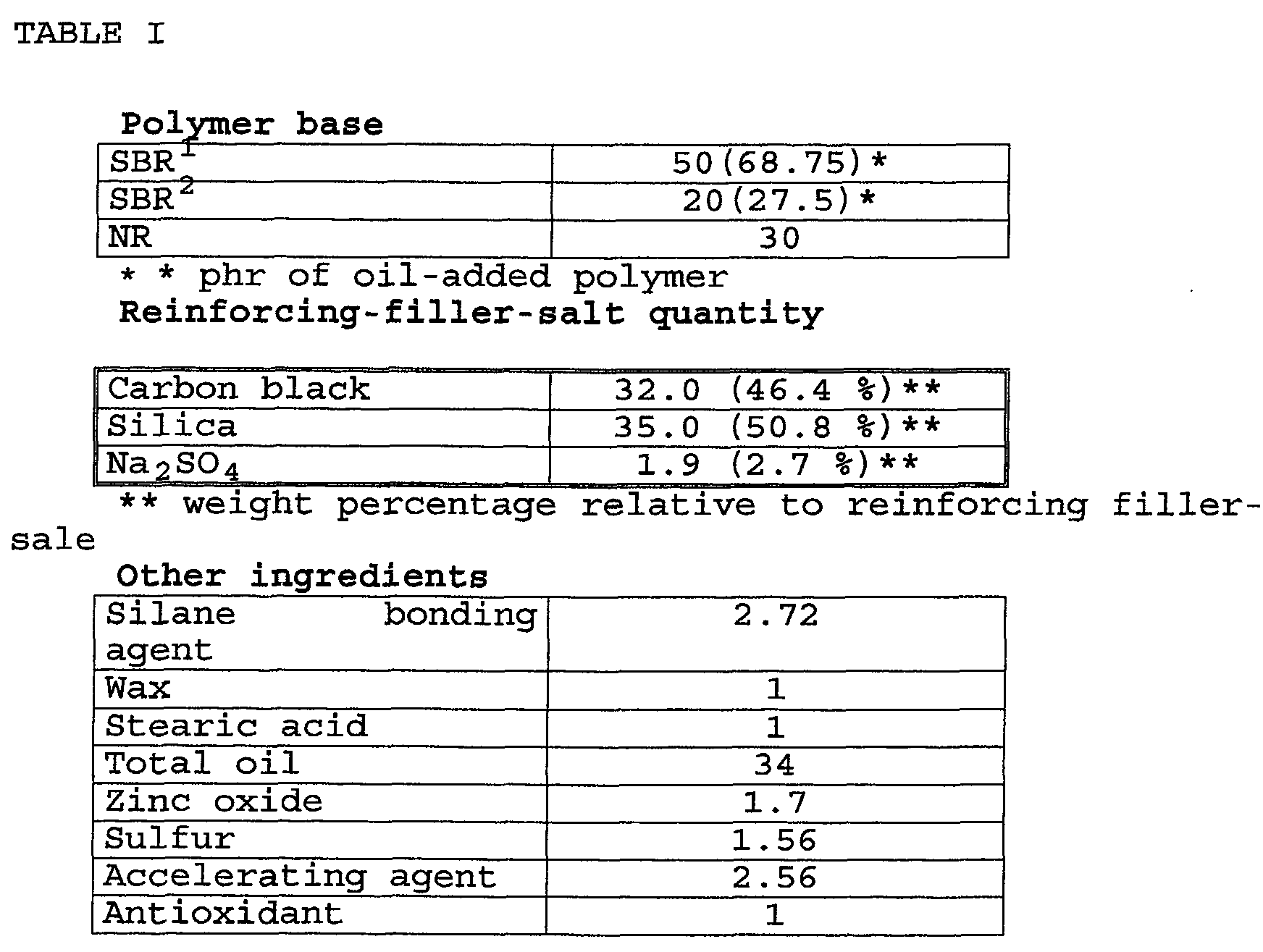
- The characteristics of the ingredients used are as follows:
- SBR1 = butadiene-styrene copolymer such as EUROPRENE S1712 (ENICHEM - Italy)
- SBR2 = butadiene-styrene copolymer such as EUROPRENE S1721 (ENICHEM - Italy)
- NR = natural rubber such as TSR20 (THAITECH RUBBER)
- Silica = such as ULTRASIL VN3 (DEGUSSA - Germany)
- Carbon black = standard carbon black such as N234, VULCAN 7 H (CABOT - Italy)
- Silane bonding agent = such as Si 69 ( DEGUSSA - Belgium)
- Wax = such as ANTIOZONANT WAX 6065 (SCHUMANN SASOL GMBH & CO KG - Germany)
- Stearic acid = such as INDUSTRENE R (UNICHEMA - Germany)
- Oil = such as ESAR 90DEN (AGIP PETROLI - Italy)
- Zinc oxide = such as OSSIDO DI ZINCO SIGGILLO VERDE (ZINOX SRL - Italy)
- Sulphur = such as GROUND SULPHUR (SOLVAY BARIUM STRONZIUM GMBH - Germany)
- Accelerating agent = such as TBBS (FLEXIS), MBTS (FLEXIS) and DPG (FLEXIS) appropriately dosed
- Antioxidant = such as SANTOFLEX 6PPD (FLEXSYS - Belgium)
-
- A mix B was prepared comprising a reinforcing-filler-salt quantity composition as shown in TABLE II in phr.
Reinforcing filler-salt quantity Carbon black 32 (44 %) Silica 35 (48 %) Na2SO4 5.6 (8 %) - A mix C was prepared comprising a reinforcing-filler-salt quantity composition as shown in TABLE III in phr.
Reinforcing filler-salt quantity Carbon black 32 (40.7 %) Silica 35 (44.3 %) Na2SO4 11.7 (15.0 %) - A mix D was prepared in accordance with the teachings of the known state of the art, i.e. with no inorganic salt.
- Mix D comprises a reinforcing filler-salt quantity composition as shown in TABLE IV in phr. The right-hand column in Table IV shows the weight percentages of the reinforcing filler-salt quantity ingredients.
Reinforcing filler-salt quantity Carbon black 32 (48 %) Silica 35 (52 %) Na2SO4 -- - Specimens were taken from each of the mixtures in Examples 1 to 4 and tested to determine, for each mixture, the values of a number of particularly significant parameters.
- The results of each parameter for each specimen are shown in TABLE V below.
- The parameters considered were the following:
- rheometric values (Tmin, Tmax, t'10, t'50, t'90) measured in accordance with ASTM standard D2084;
- Mooney viscosity and scorch time, both calculated at 130°C and measured in accordance with ASTM standard D1646;
- physical property values (ultimate elongation EB%, fracture strength TB, M50% / M300% modulus values), measured in accordance with ASTM standard D412C;
- loss factor [TanD] : the ratio between the viscous component of the dynamic modulus [G''(MPa)] and the elastic component of the dynamic modulus [G'(MPa)], both measured in accordance with ASTM standard D5992; more specifically, the 70°C TanD value is a parameter proportional to rolling resistance;
- electrical resistivity values, obtained in
accordance with ASTM standard D991-89.
MIX A B C D Tmin (dNm) 6.7 6.7 6.6 6.9 Tmax (dNm) 32.1 32.1 32.0 32.0 T'10 (min) 3.47 3.40 3.39 3.50 T'50 (min) 4.39 4.30 4.25 4.44 T'90 (min) 6.00 5.90 5.75 6.10 EB (%) 468 447 420 494 TB (Mpa) 19.1 18.8 18.0 19.7 M50% (Mpa) 1.2 1.2 1.2 1.2 M300% (Mpa) 10.3 10.4 10.7 9.9 Scorch time (min) 11.50 11.22 11.00 12.18 Mooney viscosity (Mooney units) 45 44 42 48 TanD at 70°C 0.201 0.190 0.180 0.208 ELECTRICAL RESISTIVITY
(Ohm cm)5.5x10⁷ 5.5x10⁶ 5.5x10⁵ 2.758x10 - As shown in TABLE V, the presence of inorganic salt in the mix greatly reduces the electrical resistivity of the mix with no change in the other physical characteristic values, thus eliminating the drawbacks while at the same time retaining the advantages of silica-containing mixes, e.g. better rolling resistance, as shown by the 70°C TanD values.
- Another important point to note is that the mixes according to the present invention permit the use of silica comprising inorganic salt, and therefore provide for greatly reducing, if not eliminating altogether, the washing stage in the silica production process, with obvious advantages in terms of both time and cost.
Claims (10)
- A silica-containing curable-rubber mix for producing tire tread plies, in particular for passenger car tires; the mix comprising at least one cross-linkable unsaturated-chain polymer base, and a reinforcing filler comprising carbon black and silica, and being characterized by comprising an inorganic salt, the cationic part of which is selected from the group comprising Na+, Li+, Mg++ and K+ or combinations thereof, and the anionic part of which is selected from the group comprising Cl-, SO4--, CO3-- and PO4--- or combinations thereof; and by the mix containing a reinforcing filler-salt quantity, of which over 48% by weight is defined by a carbon black-salt quantity, and at least 30% by weight is defined by carbon black.
- A mix as claimed in Claim 1, wherein the carbon black-salt quantity in the reinforcing filler-salt quantity ranges from 50% to 55% by weight.
- A mix as claimed in Claim 1 or 2, wherein the inorganic salt is incorporated in the silica, and is derived from the silica production process.
- A mix as claimed in any one of the foregoing Claims, wherein the inorganic salt is defined by Na2SO4.
- A mix as claimed in any one of the foregoing Claims, wherein said reinforcing filler comprises a carbon black quantity ranging from 20 to 70 phr, and a silica quantity ranging from 5 to 70 phr.
- A mix as claimed in any one of the foregoing Claims, wherein said reinforcing filler in said curable-rubber mix ranges from 30 to 110 phr.
- A mix as claimed in any one of the foregoing Claims, wherein said silica has total surface area values ranging from 100 to 400 m2/g, and external surface area values ranging from 100 to 300 CTAB m2/g.
- A mix as claimed in any one of the foregoing Claims, wherein said cross-linkable unsaturated-chain polymer base is selected from the group comprising natural rubber, polyisoprene, polybutadiene, isobutene-isoprene copolymers, possibly halogenated, acrylonitrile-butadiene, butadiene-styrene and isoprene-butadienestyrene terpolymers, either in solution or emulsion, and ethylene-propylene-diene terpolymers; which polymer bases may be used individually or mixed.
- A tread, characterized by being made from a mix as claimed in any one of the foregoing Claims.
- A passenger road vehicle tire, characterized by comprising a tread as claimed in Claim 9.
Applications Claiming Priority (2)
| Application Number | Priority Date | Filing Date | Title |
|---|---|---|---|
| ITTO001082 | 2000-11-17 | ||
| IT2000TO001082A IT1320840B1 (en) | 2000-11-17 | 2000-11-17 | VULCANIZABLE RUBBER MIXTURE CONTAINING SILICA AND AIMED AT THE PRODUCTION OF TIRES BANDS FOR TIRES. |
Publications (1)
| Publication Number | Publication Date |
|---|---|
| EP1207184A1 true EP1207184A1 (en) | 2002-05-22 |
Family
ID=11458226
Family Applications (1)
| Application Number | Title | Priority Date | Filing Date |
|---|---|---|---|
| EP01127277A Withdrawn EP1207184A1 (en) | 2000-11-17 | 2001-11-16 | Silica-containing curable-rubber mix for producing tire tread plies |
Country Status (4)
| Country | Link |
|---|---|
| US (1) | US20020103282A1 (en) |
| EP (1) | EP1207184A1 (en) |
| JP (1) | JP2002201314A (en) |
| IT (1) | IT1320840B1 (en) |
Cited By (1)
| Publication number | Priority date | Publication date | Assignee | Title |
|---|---|---|---|---|
| WO2012085063A1 (en) * | 2010-12-23 | 2012-06-28 | Compagnie Generale Des Etablissements Michelin | Rubber composition for the tread of a tyre |
Families Citing this family (4)
| Publication number | Priority date | Publication date | Assignee | Title |
|---|---|---|---|---|
| IT1320206B1 (en) * | 2000-06-20 | 2003-11-26 | Bridgestone Firestone Tech | METHOD FOR THE PREPARATION OF VULCANIZABLE RUBBER MIXTURES CONTAINING SILICA FOR THE PRODUCTION OF TREAD BANDS. |
| CN108264651B (en) * | 2017-01-04 | 2020-01-07 | 荆州市江汉精细化工有限公司 | Process for the preparation of substantially spherical reaction complexes of sulfur-containing silanes with carbon black and products obtained by said process |
| US12427739B2 (en) | 2020-11-30 | 2025-09-30 | Kolon Industries, Inc. | Rubber reinforcing material with reduced weight, method of preparing the same and tire comprising the same |
| LU503118B1 (en) | 2022-11-29 | 2024-06-03 | Apollo Tyres Global R & D Bv | A low rolling resistance rubber composition |
Citations (3)
| Publication number | Priority date | Publication date | Assignee | Title |
|---|---|---|---|---|
| JPH10330546A (en) * | 1997-05-29 | 1998-12-15 | Bridgestone Corp | Pneumatic tire |
| EP0890602A1 (en) * | 1997-07-11 | 1999-01-13 | Bridgestone Corporation | Addition of salts to improve the interaction of silica with rubber |
| EP1020492A1 (en) * | 1999-01-14 | 2000-07-19 | JSR Corporation | Conductive rubber composition and manufacturing method and conductive rubber member thereof |
-
2000
- 2000-11-17 IT IT2000TO001082A patent/IT1320840B1/en active
-
2001
- 2001-10-25 US US10/053,378 patent/US20020103282A1/en not_active Abandoned
- 2001-11-16 JP JP2001352276A patent/JP2002201314A/en not_active Withdrawn
- 2001-11-16 EP EP01127277A patent/EP1207184A1/en not_active Withdrawn
Patent Citations (3)
| Publication number | Priority date | Publication date | Assignee | Title |
|---|---|---|---|---|
| JPH10330546A (en) * | 1997-05-29 | 1998-12-15 | Bridgestone Corp | Pneumatic tire |
| EP0890602A1 (en) * | 1997-07-11 | 1999-01-13 | Bridgestone Corporation | Addition of salts to improve the interaction of silica with rubber |
| EP1020492A1 (en) * | 1999-01-14 | 2000-07-19 | JSR Corporation | Conductive rubber composition and manufacturing method and conductive rubber member thereof |
Non-Patent Citations (1)
| Title |
|---|
| PATENT ABSTRACTS OF JAPAN vol. 1999, no. 03 31 March 1999 (1999-03-31) * |
Cited By (2)
| Publication number | Priority date | Publication date | Assignee | Title |
|---|---|---|---|---|
| WO2012085063A1 (en) * | 2010-12-23 | 2012-06-28 | Compagnie Generale Des Etablissements Michelin | Rubber composition for the tread of a tyre |
| FR2969629A1 (en) * | 2010-12-23 | 2012-06-29 | Michelin Soc Tech | RUBBER COMPOSITION FOR PNEUMATIC ROLLER BAND |
Also Published As
| Publication number | Publication date |
|---|---|
| ITTO20001082A0 (en) | 2000-11-17 |
| JP2002201314A (en) | 2002-07-19 |
| US20020103282A1 (en) | 2002-08-01 |
| IT1320840B1 (en) | 2003-12-10 |
| ITTO20001082A1 (en) | 2002-05-17 |
Similar Documents
| Publication | Publication Date | Title |
|---|---|---|
| EP1321488B1 (en) | Preparation of reinforced elastomer, elastomer composite, and tire having component thereof | |
| KR100452574B1 (en) | A diene rubber composition based on alumina as a reinforcing filler, a tread and a tire containing the same, | |
| EP0875529B1 (en) | Rubber composition and tire having tread thereof | |
| EP2424737B1 (en) | Tread for heavy vehicle tires | |
| US20120270966A1 (en) | Composition based on natural rubber and a reinforcing inorganic filler comprising dihydrazide | |
| JPH08230411A (en) | Tire of sedimented silica base having improved rolling resistance | |
| WO2008145155A1 (en) | Tire and crosslinkable elastomeric composition | |
| CN113905897A (en) | Pneumatic tire | |
| WO2009080144A1 (en) | Run-flat tire | |
| EP2102017B1 (en) | Tire and crosslinkable elastomeric composition | |
| US20040143050A1 (en) | Rubber composition comprising composite pigment | |
| JPH11157302A (en) | Rubber composition and tire with its tread | |
| EP4588960A1 (en) | Master batch, method for producing master batch, rubber composition for tires, method for producing rubber composition for tires, rubber material for tires, and tire | |
| US20050056356A1 (en) | Farm tractor drive tire with tread of rubber composition containing dispersion of in situ silane modified composite of plasticizer treated starch core | |
| WO2014163478A1 (en) | Silica-filled enr masterbatch and cross linkable elastomeric composition | |
| US20020016403A1 (en) | Method of preparing curable-rubber mixtures containing silica, for producing treads | |
| JPH1072536A (en) | Vulcanizable rubber composition | |
| US20020103282A1 (en) | Silica-containing curable-rubber mix for producing tire tread plies | |
| JPH11240982A (en) | Rubber composition and pneumatic tire using the same | |
| KR19990012314A (en) | Rubber composition for tire tread | |
| JP2708147B2 (en) | Improved radial tires for passenger cars | |
| EP1767571A1 (en) | Tire with tread containing tin coupled amine functionalized polybutadiene and nanostructured inversion carbon black | |
| EP2231422A1 (en) | Run-flat tire | |
| EP3996918B1 (en) | A laminate | |
| CN114929791A (en) | Crosslinking system and diene rubber composition comprising said crosslinking system |
Legal Events
| Date | Code | Title | Description |
|---|---|---|---|
| PUAI | Public reference made under article 153(3) epc to a published international application that has entered the european phase |
Free format text: ORIGINAL CODE: 0009012 |
|
| AX | Request for extension of the european patent |
Free format text: AL;LT;LV;MK;RO;SI |
|
| 17P | Request for examination filed |
Effective date: 20021121 |
|
| AKX | Designation fees paid |
Designated state(s): DE ES FR GB IT |
|
| 17Q | First examination report despatched |
Effective date: 20030317 |
|
| STAA | Information on the status of an ep patent application or granted ep patent |
Free format text: STATUS: THE APPLICATION IS DEEMED TO BE WITHDRAWN |
|
| 18D | Application deemed to be withdrawn |
Effective date: 20030728 |