EP1207177A1 - Process for priming polyolefin surfaces - Google Patents
Process for priming polyolefin surfaces Download PDFInfo
- Publication number
- EP1207177A1 EP1207177A1 EP00125037A EP00125037A EP1207177A1 EP 1207177 A1 EP1207177 A1 EP 1207177A1 EP 00125037 A EP00125037 A EP 00125037A EP 00125037 A EP00125037 A EP 00125037A EP 1207177 A1 EP1207177 A1 EP 1207177A1
- Authority
- EP
- European Patent Office
- Prior art keywords
- azido
- compound
- process according
- group
- polyolefin
- Prior art date
- Legal status (The legal status is an assumption and is not a legal conclusion. Google has not performed a legal analysis and makes no representation as to the accuracy of the status listed.)
- Withdrawn
Links
- 229920000098 polyolefin Polymers 0.000 title claims abstract description 23
- 238000000034 method Methods 0.000 title claims abstract description 15
- 230000037452 priming Effects 0.000 title claims abstract 3
- 125000003118 aryl group Chemical group 0.000 claims abstract description 11
- 125000000852 azido group Chemical group *N=[N+]=[N-] 0.000 claims abstract description 9
- 125000000524 functional group Chemical group 0.000 claims abstract description 7
- 125000003710 aryl alkyl group Chemical group 0.000 claims abstract description 6
- 238000010438 heat treatment Methods 0.000 claims abstract description 6
- 125000000217 alkyl group Chemical group 0.000 claims abstract description 4
- 125000004432 carbon atom Chemical group C* 0.000 claims abstract description 3
- 239000004743 Polypropylene Substances 0.000 claims description 21
- -1 polypropylene Polymers 0.000 claims description 20
- 229920001155 polypropylene Polymers 0.000 claims description 16
- 239000000758 substrate Substances 0.000 claims description 15
- 239000002904 solvent Substances 0.000 claims description 7
- 230000005855 radiation Effects 0.000 claims description 6
- QQONPFPTGQHPMA-UHFFFAOYSA-N propylene Natural products CC=C QQONPFPTGQHPMA-UHFFFAOYSA-N 0.000 claims description 5
- 125000004805 propylene group Chemical group [H]C([H])([H])C([H])([*:1])C([H])([H])[*:2] 0.000 claims description 5
- 229920001577 copolymer Polymers 0.000 claims description 4
- 238000000354 decomposition reaction Methods 0.000 claims description 3
- 125000002887 hydroxy group Chemical group [H]O* 0.000 claims description 3
- 239000000178 monomer Substances 0.000 claims description 3
- 239000004593 Epoxy Substances 0.000 claims description 2
- BLRPTPMANUNPDV-UHFFFAOYSA-N Silane Chemical group [SiH4] BLRPTPMANUNPDV-UHFFFAOYSA-N 0.000 claims description 2
- 150000008065 acid anhydrides Chemical class 0.000 claims description 2
- 239000000956 alloy Substances 0.000 claims description 2
- 229910045601 alloy Inorganic materials 0.000 claims description 2
- 150000001412 amines Chemical class 0.000 claims description 2
- 125000003178 carboxy group Chemical group [H]OC(*)=O 0.000 claims description 2
- 150000002148 esters Chemical class 0.000 claims description 2
- 239000000203 mixture Substances 0.000 claims description 2
- 239000012948 isocyanate Substances 0.000 claims 1
- 150000002513 isocyanates Chemical class 0.000 claims 1
- 238000010422 painting Methods 0.000 claims 1
- OWULJVXJAZBQLL-UHFFFAOYSA-N 4-azidosulfonylbenzoic acid Chemical compound OC(=O)C1=CC=C(S(=O)(=O)N=[N+]=[N-])C=C1 OWULJVXJAZBQLL-UHFFFAOYSA-N 0.000 description 8
- CSCPPACGZOOCGX-UHFFFAOYSA-N Acetone Chemical compound CC(C)=O CSCPPACGZOOCGX-UHFFFAOYSA-N 0.000 description 8
- IJGRMHOSHXDMSA-UHFFFAOYSA-N Atomic nitrogen Chemical compound N#N IJGRMHOSHXDMSA-UHFFFAOYSA-N 0.000 description 8
- 239000010410 layer Substances 0.000 description 6
- 229920000573 polyethylene Polymers 0.000 description 6
- 239000004698 Polyethylene Substances 0.000 description 5
- 239000003973 paint Substances 0.000 description 5
- 229920000642 polymer Polymers 0.000 description 5
- 229910052757 nitrogen Inorganic materials 0.000 description 4
- UHOVQNZJYSORNB-UHFFFAOYSA-N Benzene Chemical compound C1=CC=CC=C1 UHOVQNZJYSORNB-UHFFFAOYSA-N 0.000 description 3
- 238000006243 chemical reaction Methods 0.000 description 3
- 238000000576 coating method Methods 0.000 description 3
- VGGSQFUCUMXWEO-UHFFFAOYSA-N Ethene Chemical compound C=C VGGSQFUCUMXWEO-UHFFFAOYSA-N 0.000 description 2
- 239000005977 Ethylene Substances 0.000 description 2
- UFWIBTONFRDIAS-UHFFFAOYSA-N Naphthalene Chemical compound C1=CC=CC2=CC=CC=C21 UFWIBTONFRDIAS-UHFFFAOYSA-N 0.000 description 2
- MWPLVEDNUUSJAV-UHFFFAOYSA-N anthracene Chemical compound C1=CC=CC2=CC3=CC=CC=C3C=C21 MWPLVEDNUUSJAV-UHFFFAOYSA-N 0.000 description 2
- 150000001540 azides Chemical class 0.000 description 2
- 239000011248 coating agent Substances 0.000 description 2
- 230000000052 comparative effect Effects 0.000 description 2
- 150000001875 compounds Chemical class 0.000 description 2
- 239000003431 cross linking reagent Substances 0.000 description 2
- ZUOUZKKEUPVFJK-UHFFFAOYSA-N diphenyl Chemical compound C1=CC=CC=C1C1=CC=CC=C1 ZUOUZKKEUPVFJK-UHFFFAOYSA-N 0.000 description 2
- 229920000554 ionomer Polymers 0.000 description 2
- 239000003960 organic solvent Substances 0.000 description 2
- 239000004033 plastic Substances 0.000 description 2
- 229920003023 plastic Polymers 0.000 description 2
- 239000000523 sample Substances 0.000 description 2
- 238000001228 spectrum Methods 0.000 description 2
- 239000000126 substance Substances 0.000 description 2
- 238000005406 washing Methods 0.000 description 2
- RDZZYOLESFPPLU-UHFFFAOYSA-N 1-n,2-n-didiazo-9-oxoxanthene-1,2-disulfonamide Chemical compound C1=CC=C2C(=O)C3=C(S(=O)(=O)N=[N+]=[N-])C(S(=O)(=O)N=[N+]=[N-])=CC=C3OC2=C1 RDZZYOLESFPPLU-UHFFFAOYSA-N 0.000 description 1
- IRERIDRZCDCZQJ-UHFFFAOYSA-N 2-azidosulfonyl-n-phenylacetamide Chemical compound [N-]=[N+]=NS(=O)(=O)CC(=O)NC1=CC=CC=C1 IRERIDRZCDCZQJ-UHFFFAOYSA-N 0.000 description 1
- RFKWPZSWBXUOCY-UHFFFAOYSA-N 2-azidosulfonylbenzoic acid Chemical compound OC(=O)C1=CC=CC=C1S(=O)(=O)N=[N+]=[N-] RFKWPZSWBXUOCY-UHFFFAOYSA-N 0.000 description 1
- YBSZPTGGIBVAKD-UHFFFAOYSA-N 4-azidosulfonylphthalic acid Chemical compound OC(=O)C1=CC=C(S(=O)(=O)N=[N+]=[N-])C=C1C(O)=O YBSZPTGGIBVAKD-UHFFFAOYSA-N 0.000 description 1
- 238000004483 ATR-FTIR spectroscopy Methods 0.000 description 1
- LSNNMFCWUKXFEE-UHFFFAOYSA-M Bisulfite Chemical compound OS([O-])=O LSNNMFCWUKXFEE-UHFFFAOYSA-M 0.000 description 1
- LFQSCWFLJHTTHZ-UHFFFAOYSA-N Ethanol Chemical compound CCO LFQSCWFLJHTTHZ-UHFFFAOYSA-N 0.000 description 1
- NYHMWDDVENZKHB-UHFFFAOYSA-N N-isocyanatoacetamide Chemical compound CC(=O)NN=C=O NYHMWDDVENZKHB-UHFFFAOYSA-N 0.000 description 1
- CTQNGGLPUBDAKN-UHFFFAOYSA-N O-Xylene Chemical compound CC1=CC=CC=C1C CTQNGGLPUBDAKN-UHFFFAOYSA-N 0.000 description 1
- ISWSIDIOOBJBQZ-UHFFFAOYSA-N Phenol Chemical compound OC1=CC=CC=C1 ISWSIDIOOBJBQZ-UHFFFAOYSA-N 0.000 description 1
- 235000010290 biphenyl Nutrition 0.000 description 1
- 239000004305 biphenyl Substances 0.000 description 1
- 229910052799 carbon Inorganic materials 0.000 description 1
- 239000011203 carbon fibre reinforced carbon Substances 0.000 description 1
- 125000001309 chloro group Chemical group Cl* 0.000 description 1
- 239000013068 control sample Substances 0.000 description 1
- 238000004132 cross linking Methods 0.000 description 1
- 229910001873 dinitrogen Inorganic materials 0.000 description 1
- 230000007613 environmental effect Effects 0.000 description 1
- 238000001704 evaporation Methods 0.000 description 1
- 230000008020 evaporation Effects 0.000 description 1
- 239000011521 glass Substances 0.000 description 1
- 239000001257 hydrogen Substances 0.000 description 1
- 229910052739 hydrogen Inorganic materials 0.000 description 1
- 238000007654 immersion Methods 0.000 description 1
- 150000002527 isonitriles Chemical class 0.000 description 1
- 150000003951 lactams Chemical class 0.000 description 1
- 150000002596 lactones Chemical class 0.000 description 1
- 150000007522 mineralic acids Chemical group 0.000 description 1
- NTMHWRHEGDRTPD-UHFFFAOYSA-N n-(4-azidosulfonylphenyl)acetamide Chemical compound CC(=O)NC1=CC=C(S(=O)(=O)N=[N+]=[N-])C=C1 NTMHWRHEGDRTPD-UHFFFAOYSA-N 0.000 description 1
- QJGQUHMNIGDVPM-UHFFFAOYSA-N nitrogen group Chemical group [N] QJGQUHMNIGDVPM-UHFFFAOYSA-N 0.000 description 1
- 150000003334 secondary amides Chemical class 0.000 description 1
- 238000005507 spraying Methods 0.000 description 1
- 125000001424 substituent group Chemical group 0.000 description 1
- HSVFKFNNMLUVEY-UHFFFAOYSA-N sulfuryl diazide Chemical group [N-]=[N+]=NS(=O)(=O)N=[N+]=[N-] HSVFKFNNMLUVEY-UHFFFAOYSA-N 0.000 description 1
- 230000003319 supportive effect Effects 0.000 description 1
- 238000004381 surface treatment Methods 0.000 description 1
- 125000000391 vinyl group Chemical group [H]C([*])=C([H])[H] 0.000 description 1
- XLYOFNOQVPJJNP-UHFFFAOYSA-N water Substances O XLYOFNOQVPJJNP-UHFFFAOYSA-N 0.000 description 1
- 239000008096 xylene Substances 0.000 description 1
Images

Classifications
-
- C—CHEMISTRY; METALLURGY
- C08—ORGANIC MACROMOLECULAR COMPOUNDS; THEIR PREPARATION OR CHEMICAL WORKING-UP; COMPOSITIONS BASED THEREON
- C08J—WORKING-UP; GENERAL PROCESSES OF COMPOUNDING; AFTER-TREATMENT NOT COVERED BY SUBCLASSES C08B, C08C, C08F, C08G or C08H
- C08J7/00—Chemical treatment or coating of shaped articles made of macromolecular substances
- C08J7/12—Chemical modification
Definitions
- a prime coat has to be applied to the surface.
- halogenated primers are currently used which are applied from organic solvents. Apart from the environmental concerns of the currently used solvent-based systems, there is a need to improve the adhesion of the paint to the polyolefin surface by a simple method.
- ionomers such as carboxylated propylene polymers
- the ionomers can be obtained by mechanically mixing polypropylene, for instance, with azidosulfonyl-benzoic acid at elevated temperatures (US-A-4945136).
- US-A-3714194 discloses the use of di(azidosulfonyl)xanthone as cross-linking agent in a photo resistor system by applying a solution of the linear polymer and the cross-linking agent to obtain a film on a supportive base, for instance glass, then placing a negative on the film and exposing it to ultraviolett radiation to obtain an insoluble polymer as a positive image.
- the surface of a polyolefin substrate is primed by
- the dominant chemistry of this group is as a double-free radical.
- the chemistry is very different.
- the nitrogen with the two lone electrons can insert into a bond.
- polyolefin, as polypropylene this would be a carbon-hydrogen or a carbon-carbon bond.
- the relative stability of the triplet and singlet states is dictated by the environment of the nitrogen, specifically the group it is bonded to. Nitrogen connected to -SO 2 - favors the triplet as well as the other electronegative groups as carbonylester and the phosphor- or silicone- containing groups defined above.
- the invention is basically applicable to all polyolefin substrates without functional groups. However, it is preferably used to prime the surface of substrates consisting of polyethylene and in particular of polypropylene for technical application.
- polypropylene is meant a plastic based on polypropylene or on co-polymers of propylene, the propylene monomer constituting the major part of the mass.
- polyethylene a plastic is meant based on polyethylene or on co-polymers of ethylene, in which the ethylene-monomer constitutes the major part of the mass.
- polypropylene or polyethylene includes all types of propylene and ethylene polymers such as propylene or ethylene homo-polymers and co-polymers, as well as blends and alloys containing polypropylene or polyethylene as the major part.
- the functional group Y of azido-compound (I) can be practically any functional group which withstands the decomposition treatment according to step b) and can be used to react or interact with the paint or any other layer the primed surface has to adhere to the polyolefin substrate.
- groups are, for instance, carboxy, acid anhydride, ester, including for instance lactone, amid, including for instance lactam, amine, acylamido, such as acetamido, isocyanate, hydroxyl, including alcohol and phenol, epoxy or silane group.
- groups Y are, for instance, inorganic acid groups, as sulfonic acid, or isonitriles, and so forth. Also groups with unsaturated carbon-carbon bonds as vinyl groups or any other group reacting or interacting with the paint, layer or coating which has to be applied to the polyolefin substrate can be used.
- Y can be one or more than one group bound to the aryl, alkyl or aralkyl group R.
- the aryl group, including the aryl group of the aralkyl group can be any aryl group, as benzene or poly-aryls, as biphenyl, including condensated polyaryls as naphtalene or anthracene.
- aryl and aralkyl groups in which Y is attached to the aromatic nucleus are particularly preferred, as 4-azidosulfonyl benzoic acid, 4-azidosulfonyl acetamido benzene, or for instance 4-azidosulfonyl-phthalic acid.
- Further substituents as chloro groups or hydroxy groups can be attached to the aromatic nucleus.
- reaction (I) with 4-azidosulfonyl benzoic acid grafted onto a polypropylene surface is illustrated below.
- the present invention offers a flexible system to obtain a covalently bound layer on the surface of the polyolefin substrate that provides a surface-chemical functionality that can be used to react or interact further with a paint or other layer or coating which has to adhere to the surface of the polyolefin substrate.
- the azido-compound (I) is preferably applied in solution.
- the solvent can be an organic solvent.
- a water-soluble azido-compound it is possible to use solvent-free, water-based systems.
- the concentration of the azido-compound (I) in the solution is preferably between 0.05 and 50 % by wt., in particular between 0.1 and 20 % by wt.
- the solution can be applied to the substrate by immersion or spraying, for instance.
- the solvent is removed, for instance by evaporation, from the substrate before the azido-compound (I) is decomposed in step (b).
- Decomposition of the azido-group according to reaction (I) can take place by heating the azido-compound (I) preferably to more than 120°C, in particular to more than 160°C.
- the azido-groups can be activated by exposing the azido-compound (I) applied to the surface of the polyolefin substrate to radiation, as thermal or ultraviolet radiation. It is, of course, possible to combine heating and radiating for decomposing compound (I).
- the azido-groups are activated at room temperature (that is between about 15 and 30°C) by UV radiation, for instance with a wave length between 200 and 350 nm.
- a primer coat on any polyolefin substrate a primer coat can easily be obtained providing a strong adherence between the substrate and the layer or layers applied to the primer coat.
- strong-adhering top coatings on polyolefin parts, in particular polypropylene parts can be obtained, as for instance on bumpers.
- Polypropylene (HC115J) plates were immersed in a 50:50 (v/v) xylene acetone solution containing 1 wt.% 4-azidosulfonylacetamidobenzene or 4-carboxybenzenesulfonazide (CBSA). The plates were removed, and the solvent allowed to evaporate for 10 minutes. The plates were then irradiated with UV at 254 nm (10 cm distance) for 30 seconds, 2 minutes, 56 minutes, and 10 minutes duration. The irradiated plates were then immersed in acetone for 5 minutes to remove unreacted azide. The plates were removed and the solvent allowed to evaporate (PP/CBSA washed).
- Control samples were prepared with the same solvent washing procedure, but without azide, and irradiated for 0 minutes, 2 minutes, 5 minutes, and 10 minutes. The plates were then washed in acetone (PP HC 115 J).
- Figure 1 and figure 2 show the ATR FTIR spectra of the plate after washing with acetone according to the example and the comparative example.
- figures 1 and 2 indicate that a chemical link has been established between the CBSA and the PP polymer after the surface treatment.
Landscapes
- Chemical & Material Sciences (AREA)
- General Chemical & Material Sciences (AREA)
- Health & Medical Sciences (AREA)
- Chemical Kinetics & Catalysis (AREA)
- Medicinal Chemistry (AREA)
- Polymers & Plastics (AREA)
- Organic Chemistry (AREA)
- Treatments Of Macromolecular Shaped Articles (AREA)
- Coating Of Shaped Articles Made Of Macromolecular Substances (AREA)
Abstract
Description
- Due to the weak adhesion of paint to polyolefins, such as polypropylene, a prime coat has to be applied to the surface. In the car industry halogenated primers are currently used which are applied from organic solvents. Apart from the environmental concerns of the currently used solvent-based systems, there is a need to improve the adhesion of the paint to the polyolefin surface by a simple method.
- To improve the paintability and adhesion to polar surfaces, it is known to modify the polymers and to use ionomers such as carboxylated propylene polymers as substrates. The ionomers can be obtained by mechanically mixing polypropylene, for instance, with azidosulfonyl-benzoic acid at elevated temperatures (US-A-4945136).
- A variety of methods have been employed for cross-linking polyolefins with diazidosulfonyl compounds. For instance, US-A-3714194 discloses the use of di(azidosulfonyl)xanthone as cross-linking agent in a photo resistor system by applying a solution of the linear polymer and the cross-linking agent to obtain a film on a supportive base, for instance glass, then placing a negative on the film and exposing it to ultraviolett radiation to obtain an insoluble polymer as a positive image.
- It is an objective of the invention to provide a primer coat which significantly improves the adhesion to the surface of polyolefin substrates.
- According to the invention the surface of a polyolefin substrate is primed by
- a) applying to the polyolefin surface an azido-compound of the formula (I)
- b) decomposing the azido-group of the azido-compound (I) by heating and/or irradiation.
-
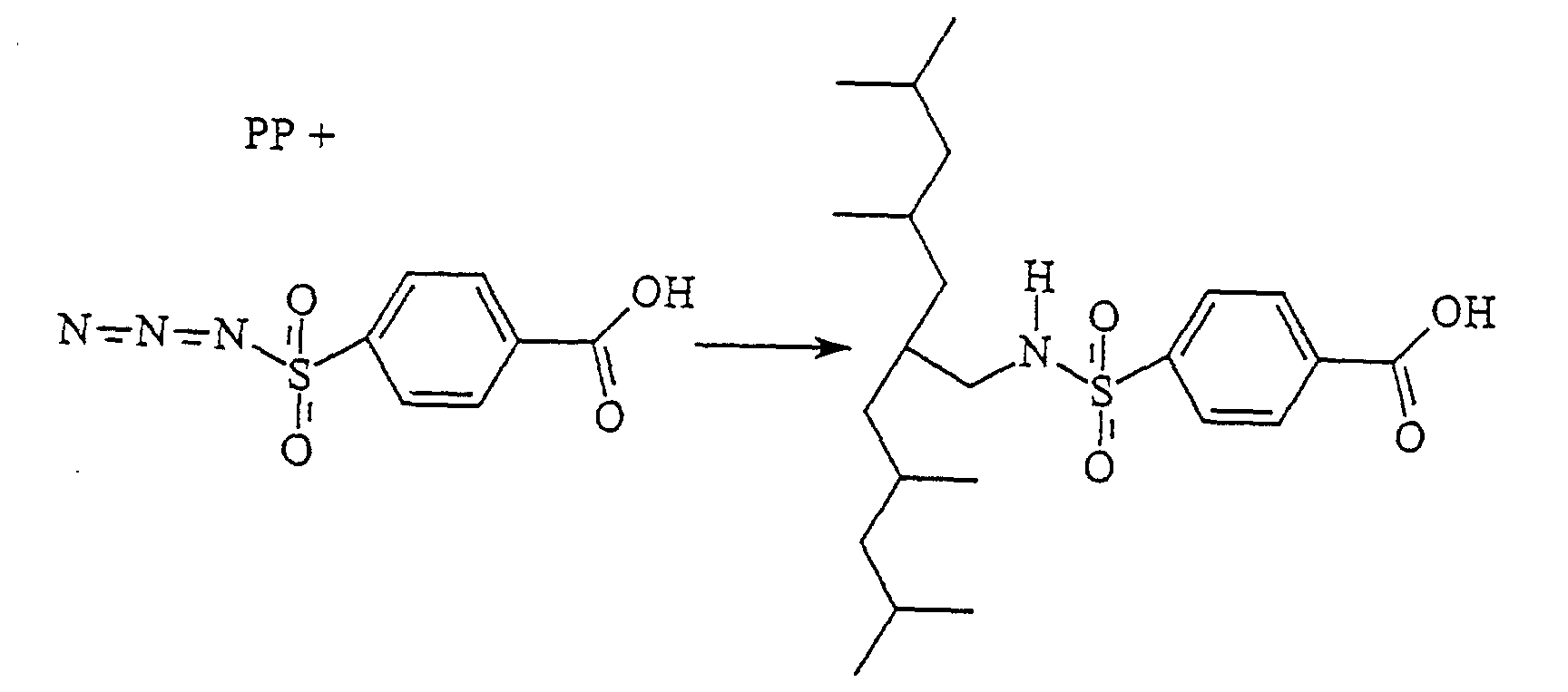
- When the azido-group of compound (I) decomposes, it loses nitrogen gas to leave a chemically very reactive nitrogen with two lone electrons according to the following reaction (I)
- In the singlet form the dominant chemistry of this group is as a double-free radical. In the triplet state, however, the chemistry is very different. The nitrogen with the two lone electrons can insert into a bond. With polyolefin, as polypropylene, this would be a carbon-hydrogen or a carbon-carbon bond. The relative stability of the triplet and singlet states is dictated by the environment of the nitrogen, specifically the group it is bonded to. Nitrogen connected to -SO2- favors the triplet as well as the other electronegative groups as carbonylester and the phosphor- or silicone- containing groups defined above.
- The invention is basically applicable to all polyolefin substrates without functional groups. However, it is preferably used to prime the surface of substrates consisting of polyethylene and in particular of polypropylene for technical application. By polypropylene is meant a plastic based on polypropylene or on co-polymers of propylene, the propylene monomer constituting the major part of the mass. Similarly, by polyethylene a plastic is meant based on polyethylene or on co-polymers of ethylene, in which the ethylene-monomer constitutes the major part of the mass. That is, the term polypropylene or polyethylene includes all types of propylene and ethylene polymers such as propylene or ethylene homo-polymers and co-polymers, as well as blends and alloys containing polypropylene or polyethylene as the major part.
- The functional group Y of azido-compound (I) can be practically any functional group which withstands the decomposition treatment according to step b) and can be used to react or interact with the paint or any other layer the primed surface has to adhere to the polyolefin substrate.
- From this large number some typical groups are, for instance, carboxy, acid anhydride, ester, including for instance lactone, amid, including for instance lactam, amine, acylamido, such as acetamido, isocyanate, hydroxyl, including alcohol and phenol, epoxy or silane group. Other groups Y are, for instance, inorganic acid groups, as sulfonic acid, or isonitriles, and so forth. Also groups with unsaturated carbon-carbon bonds as vinyl groups or any other group reacting or interacting with the paint, layer or coating which has to be applied to the polyolefin substrate can be used.
- Y can be one or more than one group bound to the aryl, alkyl or aralkyl group R. The aryl group, including the aryl group of the aralkyl group can be any aryl group, as benzene or poly-aryls, as biphenyl, including condensated polyaryls as naphtalene or anthracene.
- Particularly preferred are aryl and aralkyl groups in which Y is attached to the aromatic nucleus, as 4-azidosulfonyl benzoic acid, 4-azidosulfonyl acetamido benzene, or for instance 4-azidosulfonyl-phthalic acid. Further substituents as chloro groups or hydroxy groups can be attached to the aromatic nucleus.
- An example of reaction (I) with 4-azidosulfonyl benzoic acid grafted onto a polypropylene surface is illustrated below.
- The present invention offers a flexible system to obtain a covalently bound layer on the surface of the polyolefin substrate that provides a surface-chemical functionality that can be used to react or interact further with a paint or other layer or coating which has to adhere to the surface of the polyolefin substrate.
- The azido-compound (I) is preferably applied in solution. The solvent can be an organic solvent. However, when a water-soluble azido-compound is used, it is possible to use solvent-free, water-based systems.
- The concentration of the azido-compound (I) in the solution is preferably between 0.05 and 50 % by wt., in particular between 0.1 and 20 % by wt. The solution can be applied to the substrate by immersion or spraying, for instance.
- Preferably, the solvent is removed, for instance by evaporation, from the substrate before the azido-compound (I) is decomposed in step (b).
- Decomposition of the azido-group according to reaction (I) can take place by heating the azido-compound (I) preferably to more than 120°C, in particular to more than 160°C. In addition, the azido-groups can be activated by exposing the azido-compound (I) applied to the surface of the polyolefin substrate to radiation, as thermal or ultraviolet radiation. It is, of course, possible to combine heating and radiating for decomposing compound (I). However, according to a particularly preferred embodiment of the invention, the azido-groups are activated at room temperature (that is between about 15 and 30°C) by UV radiation, for instance with a wave length between 200 and 350 nm.
- According to the present invention, on any polyolefin substrate a primer coat can easily be obtained providing a strong adherence between the substrate and the layer or layers applied to the primer coat. For instance, in the car industry strong-adhering top coatings on polyolefin parts, in particular polypropylene parts, can be obtained, as for instance on bumpers.
- In order to further facilitate the understanding of the invention, an example follows below. The example is only intended to be illustrative and should not be interpreted as limiting to the invention.
- Polypropylene (HC115J) plates were immersed in a 50:50 (v/v) xylene acetone solution containing 1 wt.% 4-azidosulfonylacetamidobenzene or 4-carboxybenzenesulfonazide (CBSA). The plates were removed, and the solvent allowed to evaporate for 10 minutes. The plates were then irradiated with UV at 254 nm (10 cm distance) for 30 seconds, 2 minutes, 56 minutes, and 10 minutes duration. The irradiated plates were then immersed in acetone for 5 minutes to remove unreacted azide. The plates were removed and the solvent allowed to evaporate (PP/CBSA washed).
- Control samples were prepared with the same solvent washing procedure, but without azide, and irradiated for 0 minutes, 2 minutes, 5 minutes, and 10 minutes. The plates were then washed in acetone (PP HC 115 J).
- Figure 1 and figure 2 show the ATR FTIR spectra of the plate after washing with acetone according to the example and the comparative example.
- According to figure 1, in the sample "PP/CBSA washed" there is a strong band occurring at near 3500 cm-1 and 3400 cm-1 indicating N-H stretching frequencies. In the control sample PP HC 115 J these bands are not observed.
- According to figure 2, in the "PP/CBSA washed" sample a (broad) band around 1650 cm-1 indicates clearly C=O stretching vibrations. Since it is a rather broad band this also indicates a secondary amide. In the reference spectrum PP HC 115 J no such band is observed.
- Thus, figures 1 and 2 indicate that a chemical link has been established between the CBSA and the PP polymer after the surface treatment.
Claims (10)
- A process for priming polyolefin surfaces comprising the steps ofa) applying an azido-compound of the formula (I) on the polyolefin surfaceb) decomposing the azido group of the azido-compound (I) by heating and/or irradiation.
- Process according to claim 1, wherein the polyolefin is polypropylene, a co-polymer of polypropylene in which the propylene monomer constitutes the major part of the mass or a blend or alloy of polypropylene with another polyolefin in which the polypropylene constitutes the major part of the mass.
- Process according to claim 1, wherein the functional group Y of the azido-compound (I) is a carboxy, acid anhydride, ester, amid, amine, acylamido, isocyanate, hydroxyl, epoxy, or silane group.
- Process according to claim 1, wherein the azido-compound (I) is applied as solution.
- Process according to claim 4, wherein the solution contains 0.05 to 40 % by weight of the azido-compound (I).
- Process according to claim 4 or 5, wherein the solvent is removed before step b).
- Process according to claim 1, wherein the azido-group of the azido-compound (I) is decomposed by heating at a temperature of more than 120°C.
- Process according to claim 1, wherein the azido group of the azido-compound (I) is decomposed by ultraviolet radiation.
- Process according to claim 8, wherein the decomposition by ultraviolet radiation is performed at room temperature.
- Use of the process according to one of the preceding claims to provide a primer for painting polyolefin substrates.
Priority Applications (3)
| Application Number | Priority Date | Filing Date | Title |
|---|---|---|---|
| EP00125037A EP1207177A1 (en) | 2000-11-16 | 2000-11-16 | Process for priming polyolefin surfaces |
| PCT/EP2001/013199 WO2002040580A1 (en) | 2000-11-16 | 2001-11-14 | Process for priming polyolefin surfaces |
| AU2002224852A AU2002224852A1 (en) | 2000-11-16 | 2001-11-14 | Process for priming polyolefin surfaces |
Applications Claiming Priority (1)
| Application Number | Priority Date | Filing Date | Title |
|---|---|---|---|
| EP00125037A EP1207177A1 (en) | 2000-11-16 | 2000-11-16 | Process for priming polyolefin surfaces |
Publications (1)
| Publication Number | Publication Date |
|---|---|
| EP1207177A1 true EP1207177A1 (en) | 2002-05-22 |
Family
ID=8170400
Family Applications (1)
| Application Number | Title | Priority Date | Filing Date |
|---|---|---|---|
| EP00125037A Withdrawn EP1207177A1 (en) | 2000-11-16 | 2000-11-16 | Process for priming polyolefin surfaces |
Country Status (3)
| Country | Link |
|---|---|
| EP (1) | EP1207177A1 (en) |
| AU (1) | AU2002224852A1 (en) |
| WO (1) | WO2002040580A1 (en) |
Citations (3)
| Publication number | Priority date | Publication date | Assignee | Title |
|---|---|---|---|---|
| GB980160A (en) * | 1962-10-15 | 1965-01-13 | Hercules Powder Co Ltd | Improvements in or relating to modifying polymers |
| US4654262A (en) * | 1985-04-10 | 1987-03-31 | Itt Corporation | Polyolefin resin surface preparation |
| EP0308860A2 (en) * | 1987-09-22 | 1989-03-29 | Hercules Incorporated | A new epoxy-azide |
-
2000
- 2000-11-16 EP EP00125037A patent/EP1207177A1/en not_active Withdrawn
-
2001
- 2001-11-14 AU AU2002224852A patent/AU2002224852A1/en not_active Abandoned
- 2001-11-14 WO PCT/EP2001/013199 patent/WO2002040580A1/en not_active Ceased
Patent Citations (3)
| Publication number | Priority date | Publication date | Assignee | Title |
|---|---|---|---|---|
| GB980160A (en) * | 1962-10-15 | 1965-01-13 | Hercules Powder Co Ltd | Improvements in or relating to modifying polymers |
| US4654262A (en) * | 1985-04-10 | 1987-03-31 | Itt Corporation | Polyolefin resin surface preparation |
| EP0308860A2 (en) * | 1987-09-22 | 1989-03-29 | Hercules Incorporated | A new epoxy-azide |
Also Published As
| Publication number | Publication date |
|---|---|
| WO2002040580A9 (en) | 2002-09-19 |
| AU2002224852A1 (en) | 2002-05-27 |
| WO2002040580A1 (en) | 2002-05-23 |
Similar Documents
| Publication | Publication Date | Title |
|---|---|---|
| CN106133082B (en) | Plasma Induced Bonding Method | |
| US4613653A (en) | Modification of polymers | |
| JP2975303B2 (en) | Adhesion promoters for polyolefins | |
| US4966947A (en) | Modified chlorinated polyolefins | |
| US4954573A (en) | Modified chlorinated polyolefins | |
| US4355053A (en) | Method for improving the adhesiveness of the surface of a synthetic polymeric substrate to coatings | |
| AU759959B2 (en) | Coating compositions and processes | |
| JP2927743B2 (en) | Aqueous dispersion of acid-modified polyolefin and monoepoxide / polymeric acid adduct | |
| EP1516890B1 (en) | Aqueous resin dispersion composition and process for producing the same | |
| KR20020070253A (en) | Metal surface treatment agent, and metal material coated with same | |
| JPH09512853A (en) | Gasoline resistant multi-layer coated plastic substrate | |
| WO2002040580A1 (en) | Process for priming polyolefin surfaces | |
| US3759878A (en) | Polymers modified with sulfonazide isocyanate compounds | |
| DK1563003T3 (en) | Method for improving the fire resistance of polyethylene pipe elements and polyethylene pipe elements made according to the method | |
| CN113891922A (en) | Adhesive Primer for Flexographic Board Mounting Tape | |
| US5569685A (en) | Aqueous coating agent and its use in processes for coating plastics substrates | |
| US7262247B2 (en) | Binder resin solution composition, coatings, inks, adhesives and primers | |
| JPH0881643A (en) | Clear coating and coating method therewith | |
| JP2965579B2 (en) | Method for improving the adhesion of polyolefin products | |
| US20080087377A1 (en) | Method for Coating a Substrate Using a Paint Intensifier and Method for Bonding Coated Parts | |
| EP3947535B1 (en) | Polymeric films | |
| JPH09227794A (en) | Clear coating material and its coating | |
| US5089063A (en) | Method for providing adhesion to a metal surface | |
| CN116157422A (en) | Surface treatment film, manufacturing method and article thereof | |
| JPH0959406A (en) | Method for forming polyaraxylylene coating film |
Legal Events
| Date | Code | Title | Description |
|---|---|---|---|
| PUAI | Public reference made under article 153(3) epc to a published international application that has entered the european phase |
Free format text: ORIGINAL CODE: 0009012 |
|
| 17P | Request for examination filed |
Effective date: 20010131 |
|
| AX | Request for extension of the european patent |
Free format text: AL;LT;LV;MK;RO;SI |
|
| AKX | Designation fees paid |
Designated state(s): AT BE CH CY DE DK ES FI FR GB GR IE IT LI LU MC NL PT SE TR |
|
| 17Q | First examination report despatched |
Effective date: 20030320 |
|
| RTI1 | Title (correction) |
Free format text: USE OF AZIDO-COMPOUNDS IN A PROCESS FOR PRIMING POLYOLEFIN SURFACES |
|
| GRAP | Despatch of communication of intention to grant a patent |
Free format text: ORIGINAL CODE: EPIDOSNIGR1 |
|
| STAA | Information on the status of an ep patent application or granted ep patent |
Free format text: STATUS: THE APPLICATION IS DEEMED TO BE WITHDRAWN |
|
| 18D | Application deemed to be withdrawn |
Effective date: 20050405 |