EP1207162A1 - 7a-alkoxy-4H-pyrano-[3,2-d]-oxazol-2(3H)-one and process for producing the same - Google Patents

7a-alkoxy-4H-pyrano-[3,2-d]-oxazol-2(3H)-one and process for producing the same Download PDF

Info

Publication number
EP1207162A1
EP1207162A1 EP01127152A EP01127152A EP1207162A1 EP 1207162 A1 EP1207162 A1 EP 1207162A1 EP 01127152 A EP01127152 A EP 01127152A EP 01127152 A EP01127152 A EP 01127152A EP 1207162 A1 EP1207162 A1 EP 1207162A1
Authority
EP
European Patent Office
Prior art keywords
group
pyrano
oxazol
methoxy
methyl
Prior art date
Legal status (The legal status is an assumption and is not a legal conclusion. Google has not performed a legal analysis and makes no representation as to the accuracy of the status listed.)
Granted
Application number
EP01127152A
Other languages
German (de)
French (fr)
Other versions
EP1207162B1 (en
Inventor
Hiroyuki Ube Research Laboratory Miyata
Takashi Ube Research Laboratory Honma
Yasuhito Ube Research Laboratory Yamamoto
Kikuo Ube Research Laboratory Ataka
Current Assignee (The listed assignees may be inaccurate. Google has not performed a legal analysis and makes no representation or warranty as to the accuracy of the list.)
Ube Corp
Original Assignee
Ube Industries Ltd
Priority date (The priority date is an assumption and is not a legal conclusion. Google has not performed a legal analysis and makes no representation as to the accuracy of the date listed.)
Filing date
Publication date
Application filed by Ube Industries Ltd filed Critical Ube Industries Ltd
Publication of EP1207162A1 publication Critical patent/EP1207162A1/en
Application granted granted Critical
Publication of EP1207162B1 publication Critical patent/EP1207162B1/en
Anticipated expiration legal-status Critical
Expired - Lifetime legal-status Critical Current

Links

Classifications

    • CCHEMISTRY; METALLURGY
    • C07ORGANIC CHEMISTRY
    • C07DHETEROCYCLIC COMPOUNDS
    • C07D498/00Heterocyclic compounds containing in the condensed system at least one hetero ring having nitrogen and oxygen atoms as the only ring hetero atoms
    • C07D498/02Heterocyclic compounds containing in the condensed system at least one hetero ring having nitrogen and oxygen atoms as the only ring hetero atoms in which the condensed system contains two hetero rings
    • C07D498/04Ortho-condensed systems

Definitions

  • This invention relates to a novel 7a-alkoxy-4H-pyrano[3,2-d]-oxazol-2(3H)-one that can be used as a starting material or an intermediate for synthesizing a pharmaceutical product or an agricultural chemical and as a starting material for synthesizing other fine chemical products, and a process for producing the same.
  • 3-Diphenylmethyl-7a-methoxy-6-methyl-4H-pyrano[3,2-d]-oxazol-2(3H)-one obtainable by the present invention can be led to 5-methylproline methyl ester that is useful as a starting material or an intermediate for synthesis of pharmaceutical products or agricultural chemicals, for example, by reacting it with trifluoroacetic acid in methylene chloride, and subsequently reacting with hydrogen in the presence of a Pd/C catalyst (as later described in Reference Example 1).
  • an object of the present invention is to provide a novel 7a-alkoxy-4H-pyrano[3,2-d]-oxazol-2(3H)-one that is useful as a starting material for synthesis of pharmaceutical products or agricultural chemicals, and for synthesis of other fine chemicals, and also to provide a process for producing the same.
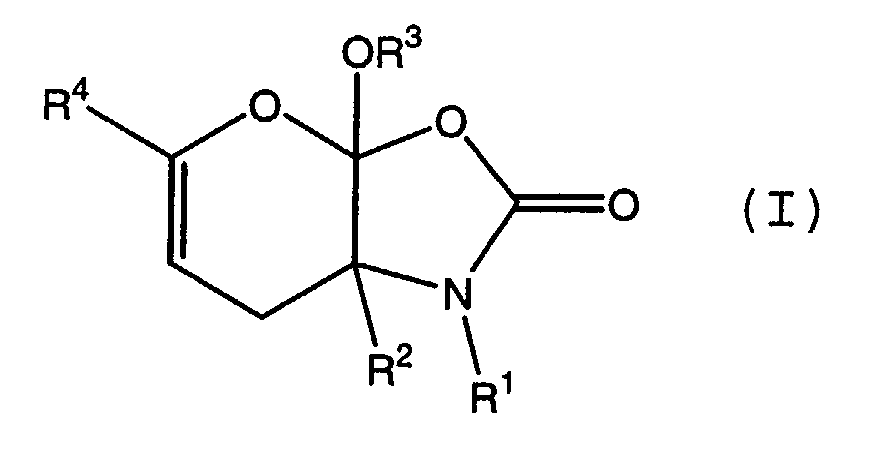
  • the present invention relates to a 7a-alkoxy-4H-pyrano[3,2-d]-oxazol-2(3H)-one represented by the formula (I): wherein R 1 represents a hydrogen atom, an alkyl group, an alkenyl group, an aryl group or an aralkyl group; R 2 represents a hydrogen atom, an alkyl group, an alkenyl group, an aryl group or an aralkyl group; R 3 represents an alkyl group, a cycloalkyl group, an alkenyl group, an aryl group or an aralkyl group, provided that a 2-alkenyl group is excluded from the alkenyl group of R 3 ; and R 4 represents an alkyl group, an aryl group, an alkoxycarbonyl group or a cyano group.
  • R 1 represents a hydrogen atom, an alkyl group, an alkenyl group, an aryl group or an aralkyl group
  • the present invention also relates to a process for producing a 7a-alkoxy-4H-pyrano[3,2-d]-oxazol-2(3H)-one represented by the formula (I): wherein R 1 , R 2 , R 3 and R 4 are the same as defined above, which comprises reacting a 5-alkoxy-2(3H)-oxazolone represented by the formula (II): wherein R 1 , R 2 and R 3 are the same as defined above, with an ⁇ , ⁇ -unsaturated ketone represented by the formula (III): wherein R 4 is the same as defined above, in an organic solvent in the presence of a Lewis acid.
  • the 7a-alkoxy-4H-pyrano[3,2-d]-oxazol-2(3H)-one of the present invention is represented by the formula (I) and may be referred to as a compound (I) hereinafter.
  • An alkyl group represented by R 1 in the compound (1) is a straight, branched or cyclic alkyl group, example of which include a straight, branched or cyclic alkyl group having 1 to 10 carbon atoms such as methyl, ethyl, propyl (including an isomer), butyl (including each isomer), pentyl (including each isomer), hexyl (including each isomer), heptyl (including each isomer), octyl (including each isomer), nonyl (including each isomer), decyl (including each isomer), cyclopropyl, cyclobutyl, cyclopentyl, cyclohexyl, cycloheptyl, cyclooctyl, cyclononyl, cyclodecyl and menthyl groups.
  • they are straight, branched or cyclic alkyl groups having 1 to 6 carbon atoms, and more preferably, they are each group of methyl, ethyl, n-propyl, isopropyl, n-butyl, isobutyl, sec-butyl, tert-butyl, cyclopropyl, cyclobutyl, cyclopentyl and cyclohexyl.
  • An alkenyl group represented by R 1 in the compound (I) is a straight, branched or cyclic alkenyl group, example of which include a straight, branched or cyclic alkenyl group having 2 to 10 carbon atoms such as vinyl, propenyl (including an isomer), butenyl (including each isomer), pentenyl (including each isomer), hexenyl (including each isomer), heptenyl (including each isomer), octenyl (including each isomer), nonenyl (including each isomer), decenyl (including each isomer) groups, etc.
  • a straight, branched or cyclic alkenyl group having 2 to 10 carbon atoms such as vinyl, propenyl (including an isomer), butenyl (including each isomer), pentenyl (including each isomer), hexenyl (including each isomer), heptenyl (including each isomer),
  • An aryl group represented by R 1 in the compound (1) is either (1) an aryl group having no substituent or (2) an aryl group having one or more substituents.
  • aryl group having no substituent there are exemplified by each group of phenyl, naphthyl, anthracenyl, phenanthryl, etc. Among them, preferred is each group of phenyl and naphthyl, and more preferred is a phenyl group.
  • aryl group of the above-mentioned (2) aryl group having one or more substituents it means the same as defined for the aryl group of (1) the aryl group having no substituent.
  • Preferred is each group of phenyl and naphthyl, and more preferred is a phenyl group.
  • substituent for (2) the aryl group having one or more substituents there are exemplified a straight or branched alkyl group having 1 to 6 carbon atoms such as methyl, ethyl, n-propyl, isopropyl, butyl (including each isomer), pentyl (including each isomer), hexyl (including each isomer) groups, etc.; each group of hydroxyl; nitro; cyano; a halogen atom (fluorine, chlorine, bromine and iodine atoms); a straight or branched alkoxy group having 1 to 6 carbon atoms such as methoxy, ethoxy, propoxy (including each isomer), butoxy (including each isomer), pentyloxy (including each isomer), hexyloxy (including each isomer) groups, etc.; an amino group which may be substituted by a straight or branched alkyl group having 1 to 6 carbon atoms such as methyl
  • an alkyl group having 1 to 6 carbon atoms Preferred are an alkyl group having 1 to 6 carbon atoms, an alkoxy group having 1 to 6 carbon atoms, a nitro, cyano, halogen atom, an aralkyloxy and trimethylsilyloxy group, and more preferred are methyl, ethyl, n-propyl, isopropyl, n-butyl, tert-butyl, methoxy, ethoxy, and tert-butoxy groups, fluorine, chlorine and bromine atoms, nitro and benzyloxy groups.
  • substituents are not limited in numbers or positions and a plural number of substituents which may be the same or different may substitute.
  • An aralkyl group represented by R 1 in the compound (1) is either (3) an aralkyl group having no substituent or (4) an aralkyl group having one or more substituents.
  • examples may include each group of benzyl, 1-phenylethyl, 2-phenylethyl, 1-phenylpropyl, 3-phenylpropyl, 1-(1-naphthyl)ethyl, 1-naphthylmethyl, 1-(2-naphthyl)ethyl, etc.
  • Preferred examples may include each group of benzyl, 1-phenylethyl, 2-phenylethyl, 1-(1-naphthyl)ethyl, 1-(2-naphthyl)ethyl, 1-naphthylmethyl, 1-phenylpropyl, diphenylmethyl and trityl. And more preferred are each group of benzyl, 1-phenylethyl, 1-(1-naphthyl)ethyl, 1-naphthylmethyl and diphenylmethyl.
  • An aralkyl group of the above-mentioned (4) aralkyl group having one or more substituents has the same meanings as defined for the aralkyl group of (3) the aralkyl group having no substituent.
  • Preferred examples may include each group of benzyl, 1-phenylethyl, 2-phenylethyl, 1-(1-naphthyl)ethyl, 1-(2-naphthyl)ethyl, 1-naphthylmethyl, 1-phenylpropyl and diphenylmethyl. And more preferred are each group of benzyl, 1-phenylethyl, 1-(1-naphthyl)ethyl, 1-naphthylmethyl and diphenylmethyl.
  • a substituent for (4) the aralkyl group having one or more substituents may include a straight or branched alkyl group having 1 to 6 carbon atoms such as methyl, ethyl, n-propyl, isopropyl, butyl (including each isomer), pentyl (including each isomer), hexyl (including each isomer) groups, etc.; each group of hydroxyl; nitro; cyano; a halogen atom (fluorine, chlorine, bromine and iodine atoms); a straight or branched alkoxy group having 1 to 6 carbon atoms such as methoxy, ethoxy, propoxy (including each isomer), butoxy (including each isomer), pentyloxy (including each isomer), hexyloxy (including each isomer) groups, etc.; an amino group which may be substituted by a straight or branched alkyl group having 1 to 6 carbon atoms such as methyl,
  • an alkyl group having 1 to 6 carbon atoms Preferred are an alkyl group having 1 to 6 carbon atoms, an alkoxy group having 1 to 6 carbon atoms, a halogen atom, each group of cyano, nitro, aralkyloxy and trimethylsilyloxy, and more preferred are each group of methyl, ethyl, n-propyl, isopropyl, n-butyl, tert-butyl, methoxy, ethoxy and tert-butoxy groups, fluorine, chlorine and bromine atoms, nitro and benzyloxy groups.
  • substituents are not limited in numbers or positions and a plural number of substituents which may be the same or different may substitute.
  • R 1 in the compound (I) may include a hydrogen atom, each group of methyl, ethyl, n-propyl, isopropyl, a n-butyl, isobutyl, sec-butyl, tert-butyl, n-pentyl, n-hexyl, cyclopropyl, cyclobutyl, cyclopentyl, cyclohexyl, vinyl, propenyl, butenyl, pentenyl, hexenyl, phenyl, 2-nitrophenyl, 4-nitrophenyl, 2-cyanophenyl, 4-cyanophenyl, 3,4-dibenzyloxyphenyl, 4-benzyloxyphenyl, 2-benzyloxyphenyl, 2-chlorophenyl, 3-chlorophenyl, 4-chlorophenyl, 3,4-dichlorophenyl, 2-fluorophenyl, 3-fluorophenyl, 4-ch
  • Preferred examples may include each group of methyl, ethyl, n-propyl, isopropyl, n-butyl, isobutyl, sec-butyl, tert-butyl, cyclopropyl, cyclobutyl, cyclopentyl, cyclohexyl, vinyl, propenyl, butenyl, phenyl, 2-nitrophenyl, 4-nitrophenyl, 3,4-dibenzyloxyphenyl, 4-benzyloxyphenyl, 2-chlorophenyl, 3-chlorophenyl, 4-chlorophenyl, 3,4-dichlorophenyl, 2-fluorophenyl, 3-fluorophenyl, 4-fluorophenyl, 3,4-difluorophenyl, 2-methylphenyl, 4-methylphenyl, 4-tert-butylphenyl, 2,4-dimethylphenyl, 3,4-dimethylphenyl, 4-eth
  • More preferred examples may include each group of methyl, ethyl, n-propyl, isopropyl, n-butyl, tert-butyl, cyclopropyl, cyclobutyl, cyclopentyl, cyclohexyl, vinyl, propenyl, butenyl, phenyl, 3,4-dibenzyloxyphenyl, 4-benzyloxyphenyl, 4-chlorophenyl, 3,4-dichlorophenyl, 4-fluorophenyl, 2-methylphenyl, 4-methylphenyl, 4-tert-butylphenyl, 2,4-dimethylphenyl, 3,4-dimethylphenyl, 4-methoxyphenyl, 3,4-dimethoxyphenyl, 2-methoxyphenyl, benzyl, (1-naphthyl)methyl, 1-phenylethyl, 1-(1-naphthyl)ethyl, 1-(
  • An alkyl group represented by R 2 in the compound (1) may be either (5) an alkyl group having no substituent or (6) an alkyl group having one or more substituents.
  • alkyl group having no substituent may include, for example, a straight, branched or cyclic alkyl group, example of which may include a straight, branched or cyclic alkyl group having 1 to 10 carbon atoms such as methyl, ethyl, propyl (including an isomer), butyl (including each isomer), pentyl (including each isomer), hexyl (including each isomer), heptyl (including each isomer), octyl (including each isomer), nonyl (including each isomer), decyl (including each isomer), cyclopropyl, cyclobutyl, cyclopentyl, cyclohexyl, cycloheptyl, cyclooctyl, cyclononyl, cyclodecyl and menthyl groups.
  • a straight, branched or cyclic alkyl group example of which may include a straight, branched
  • they are straight, branched or cyclic alkyl groups having 1 to 6 carbon atoms, and more preferably, they are methyl, ethyl, n-propyl, isopropyl, n-butyl, isobutyl, sec-butyl, tert-butyl, cyclopropyl, cyclobutyl, cyclopentyl and cyclohexyl groups.
  • alkyl group of the above-mentioned (6) alkyl group having one or more substituents has the same meanings as defined for the alkyl group of (5) the alkyl group having no substituent.
  • Preferred is a straight, branched or cyclic alkyl group having 1 to 6 carbon atoms, and more preferred are each group of methyl, ethyl, n-propyl, isopropyl, n-butyl, isobutyl, sec-butyl, tert-butyl, cyclopropyl, cyclobutyl, cyclopentyl and cyclohexyl.
  • examples may include each group of hydroxy; methoxy; benzyloxy; trimethylsilyloxy; tert-butyldimethylsilyloxy; acetoxy; thiomethyl; indolyl; imidazolyl; acylamino; methoxycarbonyl; ethoxycarbonyl; tert-butyloxycarbonyl; benzyloxycarbonyl; guanidyl; mercapto; amino; tert-butoxycarbonylamino; benzyloxycarbonylamino; methoxycarbonylamino; ethoxycarbonylamino; aminocarbonyl, etc.
  • An alkenyl group represented by R 2 in the compound (I) is a straight, branched or cyclic alkenyl group, example of which may include a straight, branched or cyclic alkenyl group having 2 to 10 carbon atoms such as vinyl, propenyl (including an isomer), butenyl (including each isomer), pentenyl (including each isomer), hexenyl (including each isomer), heptenyl (including each isomer), octenyl (including each isomer), nonenyl (including each isomer), decenyl (including each isomer) groups, etc.
  • a straight, branched or cyclic alkenyl group having 2 to 10 carbon atoms such as vinyl, propenyl (including an isomer), butenyl (including each isomer), pentenyl (including each isomer), hexenyl (including each isomer), heptenyl (including each isomer
  • An aryl group represented by R 2 in the compound (I) is either (7) an aryl group having no substituent or (8) an aryl group having one or more substituents.
  • aryl group having no substituent there are exemplified by each group of phenyl, naphthyl, anthracenyl, phenanthryl, etc. Among them, preferred is each group of phenyl and naphthyl, and more preferred is a phenyl group.
  • aryl group of the above-mentioned (8) aryl group having one or more substituents has the same meanings as defined for the aryl group of (7) the aryl group having no substituent.
  • Preferred is each group of phenyl and naphthyl, and more preferred is a phenyl group.
  • the aryl group having one or more substituents there are exemplified by a straight or branched alkyl group having 1 to 6 carbon atoms such as methyl, ethyl, n-propyl, isopropyl, butyl (including each isomer), pentyl (including each isomer), hexyl (including each isomer) groups, etc.; each group of hydroxyl; nitro; cyano; halogen atom (fluorine, chlorine, bromine and iodine atoms); a straight or branched alkoxy group having 1 to 6 carbon atoms such as methoxy, ethoxy, propoxy (including each isomer), butoxy (including each isomer), pentyloxy (including each isomer), hexyloxy (including each isomer) groups, etc.; an amino group which may be substituted by a straight or branched alkyl group having 1 to 6 carbon atoms such as methyl, ethy
  • an alkyl group having 1 to 6 carbon atoms Preferred are an alkyl group having 1 to 6 carbon atoms, an alkoxy group having 1 to 6 carbon atoms, a halogen atom, each group of cyano, nitro, benzyloxy and trimethylsilyloxy, and more preferred are each group of methyl, ethyl, n-propyl, isopropyl, n-butyl, tert-butyl, methoxy, ethoxy, tert-butoxy, fluorine, chlorine and bromine atoms, and each group of nitro and benzyloxy.
  • An aralkyl group represented by R 2 in the compound (1) is either (9) an aralkyl group having no substituent or (10) an aralkyl group having one or more substituents.
  • examples may include each group of benzyl, 1-phenylethyl, 2-phenylethyl, 1-phenylpropyl, 3-phenylpropyl, 4-phenylbutyl, 1-(1-naphthyl)ethyl, 1-naphthylmethyl, 1-(2-naphthyl)ethyl, etc.
  • Preferred examples may include each group of benzyl, 2-phenylethyl, 1-(1-naphthyl)ethyl group, a 1-(2-naphthyl)ethyl, 1-naphthylmethyl, 2-phenylpropyl, 3-phenylpropyl, 4-phenylbutyl, diphenylmethyl and trityl. And more preferred is each group of benzyl, 1-naphthylmethyl, 2-phenylethyl, 3-phenylpropyl, 4-phenylbutyl and diphenylmethyl.
  • An aralkyl group of the above-mentioned (10) aralkyl group having one or more substituents has the same meanings as defined for the aralkyl group of (9) the aralkyl group having no substituent.
  • Preferred examples may include each group of benzyl, 2-phenylethyl, 1-(1-naphthyl)ethyl group, 1-(2-naphthyl)ethyl, 1-naphthylmethyl, 2-phenylpropyl, 3-phenylpropyl, 4-phenylbutyl, diphenylmethyl and trityl. More preferred is each group of benzyl, 1-naphthylmethyl, 2-phenylethyl, 3-phenypropyl, 4-phenylbutyl and diphenylmethyl.
  • examples may include a straight or branched alkyl group having 1 to 6 carbon atoms such as methyl, ethyl, n-propyl, isopropyl, butyl (including each isomer), pentyl (including each isomer), hexyl (including each isomer) groups, etc.; each group of hydroxyl; nitro; cyano; halogen atom (fluorine, chlorine, bromine and iodine atoms); a straight or branched alkoxy group having 1 to 6 carbon atoms such as methoxy, ethoxy, propoxy (including each isomer), butoxy (including each isomer), pentyloxy (including each isomer), hexyloxy (including each isomer) groups, etc.; an amino group which may be substituted by a straight or branched alkyl group having 1 to 6 carbon atoms such as methyl, ethyl, n-propyl, isopropyl, buty
  • an alkyl group having 1 to 6 carbon atoms Preferred are an alkyl group having 1 to 6 carbon atoms, an alkoxy group having 1 to 6 carbon atoms, a halogen atom, and each group of cyano, nitro, benzyloxy and trimethylsilyloxy, and more preferred is each group of methyl, ethyl, n-propyl, isopropyl, n-butyl, tert-butyl, methoxy, ethoxy, tert-butoxy, fluorine, chlorine and bromine atoms, each group of nitro and benzyloxy.
  • substituents are not limited in numbers or positions and a plural number of substituents which may be the same or different may substitute.
  • R 2 in the compound (I) may include a hydrogen atom, each group of methyl, ethyl, n-propyl, isopropyl, n-butyl, isobutyl, sec-butyl, tert-butyl, n-hexyl, heptyl, octyl, nonyl, decyl, cyclopropyl, cyclobutyl, cyclopentyl, cyclohexyl, cycloheptyl, cyclooctyl, cyclononyl, cyclodecyl, methoxymethyl, benzyloxymethyl group, 1-(benzyloxy)ethyl, trimethylsilyloxymethyl, tert-butyldimethylsilyloxymethyl, acetoxymethyl, methylthiomethyl, indolylmethyl, aminocarbonylmethyl, 4-tert-butoxycarbonylaminobutyl, 4-benzyl
  • Preferred examples may include a hydrogen atom, each group of methyl, ethyl, propyl, isopropyl, n-butyl, sec-butyl, tert-butyl, n-hexyl, cyclopropyl, cyclobutyl, cyclopentyl, cyclohexyl, methoxymethyl, benzyloxymethyl, 1-(benzyloxy)ethyl, trimethylsilyloxymethyl, tert-butyldimethylsilyl oxymethyl, acetoxymethyl, methylthiomethyl, indolylmethyl, aminocarbonylmethyl, 4-tert-butoxycarbonylaminobutyl, 4-benzyloxycarbonylaminobutyl, methoxycarbonylmethyl, 2-methoxycarbonylethyl, ethoxycarbonylmethyl, 2-(methylthio)ethyl, imidazolylmethyl, 2-aminocarbonylethyl, hydroxymethyl
  • More preferred examples may include a hydrogen atom, each group of methyl, ethyl, propyl, isopropyl, n-butyl, sec-butyl, tert-butyl, n-hexyl, cyclopropyl, cyclobutyl, cyclopentyl, cyclohexyl, methoxymethyl, benzyloxymethyl, 1-(benzyloxy)ethyl, tert-butyldimethylsilyloxymethyl, acetoxymethyl, methylthiomethyl, indolylmethyl, aminocarbonylmethyl, 4-tert-butoxycarbonylaminobutyl, 4-benzyloxycarbonylaminobutyl, methoxycarbonylmethyl, 2-methoxycarbonylethyl, 2-methylthioethyl, 2-aminocarbonylethyl, vinyl, propenyl, 1-butenyl, 2-butenyl, 1-pentenyl, 2-pentenyl
  • An alkyl group represented by R 3 in the compound (1) is a straight, branched or cyclic alkyl group, example of which may include a straight, branched or cyclic alkyl group having 1 to 10 carbon atoms such as methyl, ethyl, propyl (including an isomer), butyl (including each isomer), pentyl (including each isomer), hexyl (including each isomer), heptyl (including each isomer), octyl (including each isomer), nonyl (including each isomer), decyl (including each isomer), cyclopropyl, cyclobutyl, cyclopentyl, cyclohexyl, cycloheptyl, cyclooctyl, cyclononyl and cyclodecyl groups.
  • they are straight, branched or cyclic alkyl groups having 1 to 6 carbon atoms, and more preferably, they are each group of methyl, ethyl, n-propyl, isopropyl, n-butyl, isobutyl, sec-butyl, tert-butyl, cyclopropyl, cyclobutyl, cyclopentyl and cyclohexyl.
  • An alkenyl group represented by R 3 in the compound (I) is a straight, branched or cyclic alkenyl group, example of which may include a straight, branched or cyclic alkenyl group having 2 to 10 carbon atoms such as vinyl, propenyl (including an isomer), butenyl (including each isomer), pentenyl (including each isomer), hexenyl (including each isomer), heptenyl (including each isomer), octenyl (including each isomer), nonenyl (including each isomer), decenyl (including each isomer) groups, etc.
  • An aryl group represented by R 3 in the compound (1) is either (11) an aryl group having no substituent or (12) an aryl group having one or more substituents.
  • aryl group having no substituent there are exemplified by each group of phenyl, naphthyl, anthracenyl, phenanthryl, etc. Among them, preferred is each group of phenyl and naphthyl, and more preferred is a phenyl group.
  • aryl group of the above-mentioned (12) aryl group having one or more substituents has the same meanings as defined for the aryl group of (11) the aryl group having no substituent.
  • Preferred is each group of phenyl and naphthyl, and more preferred is a phenyl group.
  • the aryl group having one or more substituents there are exemplified by a straight or branched alkyl group having 1 to 6 carbon atoms such as methyl, ethyl, n-propyl, isopropyl, butyl (including each isomer), pentyl (including each isomer), hexyl (including each isomer) groups, etc.; each group of hydroxyl; nitro; cyano; halogen atom (fluorine, chlorine, bromine and iodine atoms); a straight or branched alkoxy group having 1 to 6 carbon atoms such as methoxy, ethoxy, propoxy (including each isomer), butoxy (including each isomer), pentyloxy (including each isomer), hexyloxy (including each isomer) groups, etc.; an amino group which may be substituted by a straight or branched alkyl group having 1 to 6 carbon atoms such as methyl, ethy
  • an alkyl group having 1 to 6 carbon atoms Preferred are an alkyl group having 1 to 6 carbon atoms, an alkoxy group having 1 to 6 carbon atoms, a halogen atom, each group of cyano, nitro, benzyloxy and trimethylsilyloxy, and more preferred is each group of methyl, ethyl, n-propyl, isopropyl, n-butyl, tert-butyl, methoxy, ethoxy, tert-butoxy, fluorine, chlorine and bromine atoms, each group of nitro and benzyloxy.
  • substituents are not limited in numbers or positions and a plural number of substituents which may be the same or different may substitute.
  • An aralkyl group represented by R 3 in the compound (1) is either (13) an aralkyl group having no substituent or (14) an aralkyl group having one or more substituents.
  • examples may include each group of benzyl, 1-phenylethyl, 2-phenylethyl, 1-phenylpropyl, 2-phenylpropyl, 3-phenylpropyl, 4-phenylbutyl, 1-(1-naphthyl)ethyl, 1-naphthylmethyl, 1-(2-naphthyl)ethyl, etc.
  • Preferred examples may include each group of benzyl, 2-phenylethyl, 1-(1-naphthyl)ethyl, 1-(2-naphthyl)ethyl, 1-naphthylmethyl, 2-phenylpropyl, 3-phenylpropyl, 4-phenylbutyl, diphenylmethyl and trityl. And more preferred is each group of benzyl, 1-naphthylmethyl, 2-phenylethyl, 3-phenylpropyl, 4-phenylbutyl and diphenylmethyl.
  • An aralkyl group of the above-mentioned (14) aralkyl group having one or more substituents has the same meanings as defined for the aralkyl group of (13) the aralkyl group having no substituent.
  • Preferred examples may include each group of benzyl, 2-phenylethyl, 1-(1-naphthyl)ethyl, 1-(2-naphthyl)ethyl, 1-naphthylmethyl, 2-phenylpropyl, 3-phenylpropyl, 4-phenylbutyl, diphenylmethyl and trityl. And more preferred is each group of benzyl, 1-naphthylmethyl, 2-phenylethyl, 3-phenylpropyl, 4-phenylbutyl and diphenylmethyl.
  • examples may include a straight or branched alkyl group having 1 to 6 carbon atoms such as methyl, ethyl, n-propyl, isopropyl, butyl (including each isomer), pentyl (including each isomer), hexyl (including each isomer) groups, etc.; each group of hydroxyl; nitro; cyano; halogen atom (fluorine, chlorine, bromine and iodine atoms); a straight or branched alkoxy group having 1 to 6 carbon atoms such as methoxy, ethoxy, propoxy (including each isomer), butoxy (including each isomer), pentyloxy (including each isomer), hexyloxy (including each isomer) groups, etc.; an amino group which may be substituted by a straight or branched alkyl group having 1 to 6 carbon atoms such as methyl, ethyl, n-propyl, isopropyl, buty
  • an alkyl group having 1 to 6 carbon atoms Preferred are an alkyl group having 1 to 6 carbon atoms, an alkoxy group having 1 to 6 carbon atoms, a halogen atom, each group of cyano, nitro, benzyloxy and trimethylsilyloxy, and more preferred is each group of methyl, ethyl, n-propyl, isopropyl, n-butyl, tert-butyl, methoxy, ethoxy, tert-butoxy, fluorine, chlorine and bromine atoms, each group of nitro and benzyloxy.
  • substituents are not limited in numbers or positions and a plural number of substituents which may be the same or different may substitute.
  • R 3 in the compound (I) may include each group of methyl, ethyl, n-propyl, isopropyl, n-butyl, isobutyl, sec-butyl, tert-butyl, n-hexyl, heptyl, octyl, nonyl, decyl, cyclopropyl, cyclobutyl, cyclopentyl, cyclohexyl, cycloheptyl, cyclooctyl, cyclononyl, cyclodecyl, menthyl, 8-phenylmenthyl, vinyl, propenyl, 1-butenyl, 1-pentenyl, 3-pentenyl, 1-hexenyl, 3-hexenyl, 4-hexenyl, cyclopentenyl, cyclohexenyl, 3-heptenyl, 4-heptenyl, 3-octenyl, 3-
  • Preferred examples may include each group of methyl, ethyl, n-propyl, isopropyl, n-butyl, sec-butyl, tert-butyl, n-hexyl, cyclopropyl, cyclobutyl, cyclopentyl, cyclohexyl group, menthyl, 8-phenylmenthyl, vinyl, propenyl, 1-butenyl, 1-pentenyl, 3-pentenyl, 1-hexenyl, 3-hexenyl, 4-hexenyl, cyclopentenyl, cyclohexenyl, phenyl, 1-naphthyl, 2-naphthyl, 2-methylphenyl, 3-methylphenyl, 4-methylphenyl, 4-benzyloxyphenyl, 3-benzyloxyphenyl, 2-benzyloxyphenyl, 4-trimethylsilyloxyphenyl, 4-nitrophenyl, 2-nitrophen
  • More preferred examples may include each group of methyl, ethyl, n-propyl, isopropyl, n-butyl, sec-butyl, tert-butyl, n-hexyl, cyclopropyl, cyclobutyl, cyclopentyl, cyclohexyl, menthyl, 8-phenylmenthyl, vinyl, propenyl, 1-butenyl, 1-pentenyl, 3-pentenyl, 1-hexenyl, 3-hexenyl, 4-hexenyl, cyclopentenyl, cyclohexenyl, phenyl, 1-naphthyl, 2-naphthyl, 2-methylphenyl, 3-methylphenyl, 4-methylphenyl, 4-benzyloxyphenyl, 4-trimethylsilyloxyphenyl, 4-nitrophenyl, 4-cyanophenyl, 4-fluorophenyl group, a 4-chloroph
  • An alkyl group represented by R 4 in the compound (1) may be a straight, branched or cyclic alkyl group, examples of which may include a straight, branched or cyclic alkyl group having 1 to 10 carbon atoms such as methyl, ethyl, propyl (including an isomer), butyl (including each isomer), pentyl (including each isomer), hexyl (including each isomer), heptyl (including each isomer), octyl (including each isomer), nonyl (including each isomer), decyl (including each isomer), cyclopropyl, cyclobutyl, cyclopentyl, cyclohexyl, cycloheptyl, cyclooctyl, cyclononyl and cyclodecyl groups.
  • they are straight, branched or cyclic alkyl groups having 1 to 6 carbon atoms, and more preferably, they are each group of methyl, ethyl, n-propyl, isopropyl, n-butyl, isobutyl, sec-butyl, tert-butyl, cyclopropyl, cyclobutyl, cyclopentyl and cyclohexyl.
  • An aryl group represented by R 4 in the compound (I) means either (15) an aryl group having no substituent or (16) an aryl group having one or more substituents.
  • aryl group having no substituent there are exemplified by each group of phenyl, naphthyl, anthracenyl, phenanthryl, etc. Among them, preferred is each group of phenyl and naphthyl, and more preferred is a phenyl group.
  • aryl group of the above-mentioned (16) aryl group having one or more substituents means the same as defined for the aryl group of (15) the aryl group having no substituent.
  • Preferred is each group of phenyl and naphthyl, and more preferred is a phenyl group.
  • the aryl group having one or more substituents there are exemplified by a straight or branched alkyl group having 1 to 6 carbon atoms such as methyl, ethyl, n-propyl, isopropyl, butyl (including each isomer), pentyl (including each isomer), hexyl (including each isomer) groups, etc.; each group of hydroxyl; nitro; cyano; halogen atom (fluorine, chlorine, bromine and iodine atoms); a straight or branched alkoxy group having 1 to 6 carbon atoms such as methoxy, ethoxy, propoxy (including each isomer), butoxy (including each isomer), pentyloxy (including each isomer), hexyloxy (including each isomer) groups, etc.; an amino group which may be substituted by a straight or branched alkyl group having 1 to 6 carbon atoms such as methyl, ethy
  • an alkyl group having 1 to 6 carbon atoms Preferred are an alkyl group having 1 to 6 carbon atoms, an alkoxy group having 1 to 6 carbon atoms, a halogen atom, each group of cyano, nitro, benzyloxy and trimethylsilyloxy, and more preferred is each group of methyl, ethyl, n-propyl, isopropyl, n-butyl, tert-butyl, methoxy, ethoxy, tert-butoxy, fluorine, chlorine and bromine atoms, and each group of nitro and benzyloxy.
  • substituents are not limited in numbers or positions and a plural number of substituents which may be the same or different may substitute.
  • An alkoxycarbonyl group represented by R 4 in the compound (1) may be a straight, branched or cyclic alkoxycarbonyl group having 1 to 6 carbon atoms, example of which may include each group of methoxycarbonyl, ethoxycarbonyl, n-propoxycarbonyl, isopropoxycarbonyl, n-butoxycarbonyl, sec-butoxycarbonyl, tert-butoxycarbonyl, n-pentyloxycarbonyl, n-hexyloxycarbonyl, cyclopropoxycarbonyl, cyclobutoxycarbonyl, cyclopentyloxycarbonyl, cyclohexyloxycarbonyl, etc.
  • they are each group of methoxycarbonyl, ethoxycarbonyl, n-propoxycarbonyl, isopropoxycarbonyl, n-butoxycarbonyl, sec-butoxycarbonyl, tert-butoxycarbonyl, cyclopropoxycarbonyl, cyclobutoxycarbonyl, cyclopentyloxycarbonyl and cyclohexyloxycarbonyl. More preferably, they are each group of methoxycarbonyl, ethoxycarbonyl, isopropoxycarbonyl, n-butoxycarbonyl, tert-butoxycarbonyl, and cyclohexyloxycarbonyl.
  • R 4 in the compound (I) may include each group of methyl, ethyl, n-propyl, isopropyl, n-butyl, isobutyl, sec-butyl, tert-butyl, n-hexyl, heptyl, octyl, nonyl, decyl, cyclopropyl, cyclobutyl, cyclopentyl, cyclohexyl, cycloheptyl, cyclooctyl, cyclononyl, cyclodecyl, phenyl, 1-naphthyl, 2-naphthyl, 2-methylphenyl, 3-methylphenyl, 4-methylphenyl, 4-benzyloxyphenyl, 3-benzyloxyphenyl, 2-benzyloxyphenyl, 4-trimethylsilyloxyphenyl, 4-nitrophenyl, 2-nitrophenyl, 3-nitrophenyl, 4-cyan
  • Preferred examples may include each group of methyl, ethyl, n-propyl, isopropyl, n-butyl, isobutyl, sec-butyl, tert-butyl, n-hexyl, cyclohexyl, phenyl, 1-naphthyl, 2-naphthyl, methoxycarbonyl, ethoxycarbonyl, n-propoxycarbonyl, isopropoxycarbonyl, n-butoxycarbonyl, tert-butoxycarbonyl, cyclohexyloxycarbonyl and cyano.
  • More preferred examples may include each group of methyl, ethyl, n-propyl, isopropyl, n-butyl, tert-butyl, phenyl, 1-naphthyl, 2-naphthyl, methoxycarbonyl, ethoxycarbonyl, tert-butoxycarbonyl and cyano.
  • Preferred examples may include;
  • More preferred examples may include;
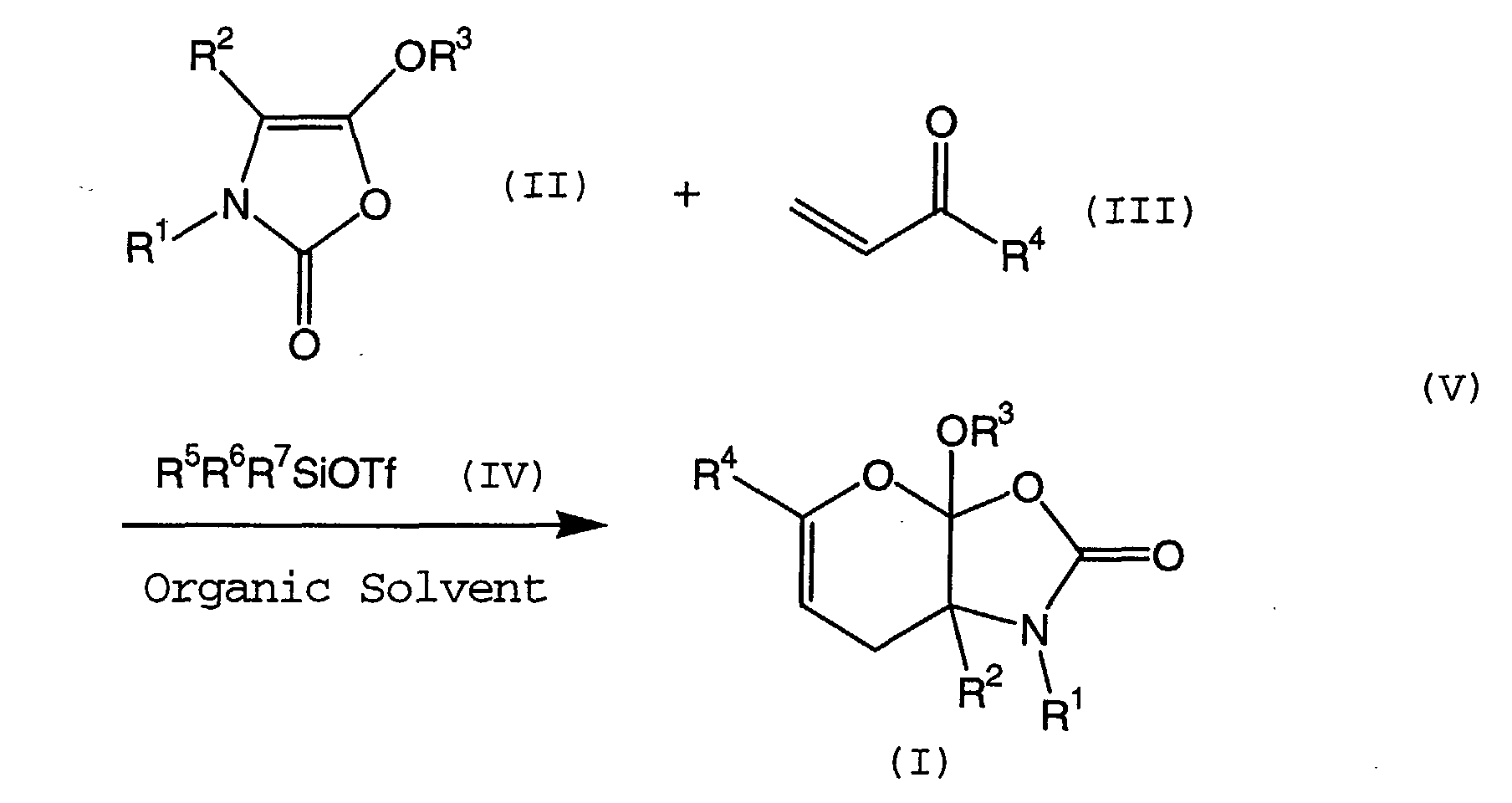
  • the 7a-alkoxy-4H-pyrano[3,2-d]-oxazol-2(3H)-one of the present invention represented by the formula (I) can be prepared, as shown by the formula (V), by reacting a 5-alkoxy-2(3H)-oxazolone represented by the formula (II) with an ⁇ , ⁇ -unsaturated ketone represented by the formula (III) in an organic solvent in the presence of a Lewis acid represented by the formula (IV).
  • R 1 , R 2 , R 3 and R 4 have the same meanings as defined above
  • R 5 , R 6 and R 7 each independently represent an alkyl group having 1 to 6 carbon atoms
  • Tf represents a trifluoromethanesulfonyl group.
  • the 5-alkoxy-2(3H)-oxazolones to be used in the reaction of the present invention are represented by the formula (II).
  • R 1 , R 2 and R 3 are the same as defined above.
  • the ⁇ , ⁇ -unsaturated ketone to be used in the reaction of the present invention is represented by the formula (III).
  • R 4 is the same as defined above.
  • ⁇ , ⁇ -unsaturated ketones may include;
  • An amount of the above ⁇ , ⁇ -unsaturated ketone to be used is preferably 1.0 to 10.0 mol, more preferably 1.0 to 5.0 mol based on 1 mol of the 5-alkoxy-2(3H)-oxazolone.
  • the Lewis acid to be used in the reaction in the present invention is represented by the formula (IV).
  • the alkyl group having 1 to 6 carbon atoms represented by R 5 , R 6 and R 7 is a straight, branched or cyclic alkyl group having 1 to 6 carbon atoms, examples of which may include each group of methyl, ethyl, propyl (including an isomer), butyl (including each isomer), pentyl (including each isomer) and hexyl (including each isomer).
  • they are each group of methyl, ethyl, n-propyl, isopropyl, n-butyl, isobutyl, sec-butyl and tert-butyl.
  • Lewis acid examples include;
  • An amount of the above-mentioned Lewis acid to be used is preferably 0.001 to 2.0 mol, more preferably 0.005 to 0.5 mol based on 1 mol of the 5-alkoxy-2(3H)-oxazolone.
  • the organic solvent to be used in the present invention is not limited as long as it is not involved in a reaction.
  • halogenated aliphatic hydrocarbons such as chlorobenzene, dichlorobenzene, methylene chloride, chloroform, carbon tetrachloride, 1,2-dichloroethane, etc.
  • aromatic hydrocarbons such as benzene, toluene, xylene, etc.
  • ethers such as diethyl ether, diisopropyl ether, dibutyl ether, dimethoxyethane, tetrahydrofuran, dioxane, etc.
  • nitriles such as acetonitrile, propionitrile, benzonitrile, etc.
  • they are halogenated hydrocarbons and more preferably, they are methylene chloride and/or 1,2-dichloroethane.
  • an amount of the above-mentioned organic solvent to be used may be properly adjusted according to uniformity of the solution or stirring property of the same, it is preferably 0.5 to 100 liters, more preferably, 1 to 30 liters based on 1 mol of the 5-alkoxy-2(3H)-oxazolone.
  • the reaction according to the present invention may be carried out, for example, by mixing a 5-alkoxy-2(3H)-oxazolone, an ⁇ , ⁇ -unsaturated ketone, a Lewis acid, and an organic solvent in an inert gas atmosphere, and letting the reaction undergo preferably at -80 to 200°C, and more preferably at -78 to 30°C, etc. There is no restriction on a reaction pressure during the reaction.
  • the 7a-alkoxy-4H-pyrano[3,2-d]-oxazol-2(3H)-one obtainable in the present invention is separated and purified, after completion of the reaction, according to the conventional method such as recrystallization, distillation, column chromatography, etc.
  • the diastereomer mixture of 3-(R)-(1-phenylethyl)-7a-methoxy-6-methyl-4H-pyrano[3,2-d]-oxazol-2(3H)-one is a novel compound having physical properties shown below.
  • a novel 7a-alkoxy-4H-pyrano[3,2-d]-oxazol-2(3H)-one that can be used as a starting material for synthesizing a pharmaceutical product, an agricultural chemical and other fine chemical products, and a process for producing the same.

Landscapes

  • Chemical & Material Sciences (AREA)
  • Organic Chemistry (AREA)
  • Nitrogen And Oxygen Or Sulfur-Condensed Heterocyclic Ring Systems (AREA)
  • Low-Molecular Organic Synthesis Reactions Using Catalysts (AREA)
  • Catalysts (AREA)

Abstract

The present invention provides a novel 7a-alkoxy-4H-pyrano-Ä3,2-dÜ-oxazol-2(3H)-one represented by the formula (I): <CHEM> wherein R<1> and R<2> each represent a hydrogen atom, an alkyl group, an alkenyl group, an aryl group or an aralkyl group; R<3> represents an alkyl group, a cycloalkyl group, an alkenyl group, an aryl group or an aralkyl group, provided that a 2-alkenyl group is excluded from the alkenyl group of R<3>; and R<4> represents an alkyl group, an aryl group, an alkoxycarbonyl group or a cyano group, and a process for producing the same which comprises reacting 5-alkoxy-2(3H)-oxazolone with an alpha , beta -unsaturated ketone in the presence of a Lewis acid in a solvent.

Description

BACKGROUND OF THE INVENTION 1. Field of the invention
This invention relates to a novel 7a-alkoxy-4H-pyrano[3,2-d]-oxazol-2(3H)-one that can be used as a starting material or an intermediate for synthesizing a pharmaceutical product or an agricultural chemical and as a starting material for synthesizing other fine chemical products, and a process for producing the same. 3-Diphenylmethyl-7a-methoxy-6-methyl-4H-pyrano[3,2-d]-oxazol-2(3H)-one obtainable by the present invention can be led to 5-methylproline methyl ester that is useful as a starting material or an intermediate for synthesis of pharmaceutical products or agricultural chemicals, for example, by reacting it with trifluoroacetic acid in methylene chloride, and subsequently reacting with hydrogen in the presence of a Pd/C catalyst (as later described in Reference Example 1).
2. Prior art
It has been conventionally known a method for producing 4-alkoxycarbonyl-2-oxazolidinone by reacting 5-alkoxy-2(3H)-oxazolones with aldehydes in an organic solvent in the presence of a Lewis acid (WO 99/02508). However, there has been known at all neither a process in which a 5-alkoxy-2(3H)-oxazolone is reacted with an α,β-unsaturated ketone in an organic solvent in the presence of a Lewis acid, nor 7a-alkoxy-4H-pyrano[3,2-d]-oxazol-2(3H)-one obtainable by the process.
That is, an object of the present invention is to provide a novel 7a-alkoxy-4H-pyrano[3,2-d]-oxazol-2(3H)-one that is useful as a starting material for synthesis of pharmaceutical products or agricultural chemicals, and for synthesis of other fine chemicals, and also to provide a process for producing the same.
SUMMARY OF THE INVENTION
The present invention relates to a 7a-alkoxy-4H-pyrano[3,2-d]-oxazol-2(3H)-one represented by the formula (I):
Figure 00020001
   wherein R1 represents a hydrogen atom, an alkyl group, an alkenyl group, an aryl group or an aralkyl group; R2 represents a hydrogen atom, an alkyl group, an alkenyl group, an aryl group or an aralkyl group;
   R3 represents an alkyl group, a cycloalkyl group, an alkenyl group, an aryl group or an aralkyl group, provided that a 2-alkenyl group is excluded from the alkenyl group of R3; and R4 represents an alkyl group, an aryl group, an alkoxycarbonyl group or a cyano group.
The present invention also relates to a process for producing a 7a-alkoxy-4H-pyrano[3,2-d]-oxazol-2(3H)-one represented by the formula (I):
Figure 00030001
   wherein R1, R2, R3 and R4 are the same as defined above,
which comprises reacting a 5-alkoxy-2(3H)-oxazolone represented by the formula (II):
Figure 00030002
   wherein R1, R2 and R3 are the same as defined above, with an α,β-unsaturated ketone represented by the formula (III):
Figure 00030003
   wherein R4 is the same as defined above, in an organic solvent in the presence of a Lewis acid.
DESCRIPTION OF THE PREFERRED EMBODIMENTS
In the following, the embodiments of the present invention are explained in detail.
The 7a-alkoxy-4H-pyrano[3,2-d]-oxazol-2(3H)-one of the present invention is represented by the formula (I) and may be referred to as a compound (I) hereinafter.
An alkyl group represented by R1 in the compound (1) is a straight, branched or cyclic alkyl group, example of which include a straight, branched or cyclic alkyl group having 1 to 10 carbon atoms such as methyl, ethyl, propyl (including an isomer), butyl (including each isomer), pentyl (including each isomer), hexyl (including each isomer), heptyl (including each isomer), octyl (including each isomer), nonyl (including each isomer), decyl (including each isomer), cyclopropyl, cyclobutyl, cyclopentyl, cyclohexyl, cycloheptyl, cyclooctyl, cyclononyl, cyclodecyl and menthyl groups. Preferably, they are straight, branched or cyclic alkyl groups having 1 to 6 carbon atoms, and more preferably, they are each group of methyl, ethyl, n-propyl, isopropyl, n-butyl, isobutyl, sec-butyl, tert-butyl, cyclopropyl, cyclobutyl, cyclopentyl and cyclohexyl.
An alkenyl group represented by R1 in the compound (I) is a straight, branched or cyclic alkenyl group, example of which include a straight, branched or cyclic alkenyl group having 2 to 10 carbon atoms such as vinyl, propenyl (including an isomer), butenyl (including each isomer), pentenyl (including each isomer), hexenyl (including each isomer), heptenyl (including each isomer), octenyl (including each isomer), nonenyl (including each isomer), decenyl (including each isomer) groups, etc. Preferred are straight, branched or cyclic alkenyl groups having 2 to 6 carbon atoms, and more preferred are vinyl, propenyl, 1-butenyl, 2-butenyl, 1-pentenyl, 2-pentenyl, 3-pentenyl, cyclopentenyl and cyclohexenyl groups.
An aryl group represented by R1 in the compound (1) is either (1) an aryl group having no substituent or (2) an aryl group having one or more substituents.
As the above-mentioned (1) aryl group having no substituent, there are exemplified by each group of phenyl, naphthyl, anthracenyl, phenanthryl, etc. Among them, preferred is each group of phenyl and naphthyl, and more preferred is a phenyl group.
As an aryl group of the above-mentioned (2) aryl group having one or more substituents, it means the same as defined for the aryl group of (1) the aryl group having no substituent. Preferred is each group of phenyl and naphthyl, and more preferred is a phenyl group.
As a substituent for (2) the aryl group having one or more substituents, there are exemplified a straight or branched alkyl group having 1 to 6 carbon atoms such as methyl, ethyl, n-propyl, isopropyl, butyl (including each isomer), pentyl (including each isomer), hexyl (including each isomer) groups, etc.; each group of hydroxyl; nitro; cyano; a halogen atom (fluorine, chlorine, bromine and iodine atoms); a straight or branched alkoxy group having 1 to 6 carbon atoms such as methoxy, ethoxy, propoxy (including each isomer), butoxy (including each isomer), pentyloxy (including each isomer), hexyloxy (including each isomer) groups, etc.; an amino group which may be substituted by a straight or branched alkyl group having 1 to 6 carbon atoms such as methyl, ethyl, propyl groups, etc.; an aralkyloxy group such as a benzyloxy group, etc.; a trimethylsilyloxy group; etc. Preferred are an alkyl group having 1 to 6 carbon atoms, an alkoxy group having 1 to 6 carbon atoms, a nitro, cyano, halogen atom, an aralkyloxy and trimethylsilyloxy group, and more preferred are methyl, ethyl, n-propyl, isopropyl, n-butyl, tert-butyl, methoxy, ethoxy, and tert-butoxy groups, fluorine, chlorine and bromine atoms, nitro and benzyloxy groups. These substituents are not limited in numbers or positions and a plural number of substituents which may be the same or different may substitute.
An aralkyl group represented by R1 in the compound (1) is either (3) an aralkyl group having no substituent or (4) an aralkyl group having one or more substituents.
As the above-mentioned (3) aralkyl group having no substituent, examples may include each group of benzyl, 1-phenylethyl, 2-phenylethyl, 1-phenylpropyl, 3-phenylpropyl, 1-(1-naphthyl)ethyl, 1-naphthylmethyl, 1-(2-naphthyl)ethyl, etc. Preferred examples may include each group of benzyl, 1-phenylethyl, 2-phenylethyl, 1-(1-naphthyl)ethyl, 1-(2-naphthyl)ethyl, 1-naphthylmethyl, 1-phenylpropyl, diphenylmethyl and trityl. And more preferred are each group of benzyl, 1-phenylethyl, 1-(1-naphthyl)ethyl, 1-naphthylmethyl and diphenylmethyl.
An aralkyl group of the above-mentioned (4) aralkyl group having one or more substituents has the same meanings as defined for the aralkyl group of (3) the aralkyl group having no substituent. Preferred examples may include each group of benzyl, 1-phenylethyl, 2-phenylethyl, 1-(1-naphthyl)ethyl, 1-(2-naphthyl)ethyl, 1-naphthylmethyl, 1-phenylpropyl and diphenylmethyl. And more preferred are each group of benzyl, 1-phenylethyl, 1-(1-naphthyl)ethyl, 1-naphthylmethyl and diphenylmethyl.
A substituent for (4) the aralkyl group having one or more substituents may include a straight or branched alkyl group having 1 to 6 carbon atoms such as methyl, ethyl, n-propyl, isopropyl, butyl (including each isomer), pentyl (including each isomer), hexyl (including each isomer) groups, etc.; each group of hydroxyl; nitro; cyano; a halogen atom (fluorine, chlorine, bromine and iodine atoms); a straight or branched alkoxy group having 1 to 6 carbon atoms such as methoxy, ethoxy, propoxy (including each isomer), butoxy (including each isomer), pentyloxy (including each isomer), hexyloxy (including each isomer) groups, etc.; an amino group which may be substituted by a straight or branched alkyl group having 1 to 6 carbon atoms such as methyl, ethyl, propyl groups, etc.; an aralkyloxy group such as a benzyloxy group, etc.; a trimethylsilyloxy group; etc. Preferred are an alkyl group having 1 to 6 carbon atoms, an alkoxy group having 1 to 6 carbon atoms, a halogen atom, each group of cyano, nitro, aralkyloxy and trimethylsilyloxy, and more preferred are each group of methyl, ethyl, n-propyl, isopropyl, n-butyl, tert-butyl, methoxy, ethoxy and tert-butoxy groups, fluorine, chlorine and bromine atoms, nitro and benzyloxy groups. These substituents are not limited in numbers or positions and a plural number of substituents which may be the same or different may substitute.
Specific examples of R1 in the compound (I) may include a hydrogen atom, each group of methyl, ethyl, n-propyl, isopropyl, a n-butyl, isobutyl, sec-butyl, tert-butyl, n-pentyl, n-hexyl, cyclopropyl, cyclobutyl, cyclopentyl, cyclohexyl, vinyl, propenyl, butenyl, pentenyl, hexenyl, phenyl, 2-nitrophenyl, 4-nitrophenyl, 2-cyanophenyl, 4-cyanophenyl, 3,4-dibenzyloxyphenyl, 4-benzyloxyphenyl, 2-benzyloxyphenyl, 2-chlorophenyl, 3-chlorophenyl, 4-chlorophenyl, 3,4-dichlorophenyl, 2-fluorophenyl, 3-fluorophenyl, 4-fluorophenyl, 3,4-difluorophenyl, 2-bromophenyl, 3-bromophenyl, 4-bromophenyl, 2-iodophenyl, 3-iodophenyl, 4-iodophenyl, 2-methylphenyl, 3-methylphenyl, 4-methylphenyl, 4-isopropylphenyl, 4-tert-butylphenyl, 2,4-dimethylphenyl, 3,4-dimethylphenyl, 4-ethylphenyl, 4-methoxyphenyl, 3,4-dimethoxyphenyl, 2-methoxyphenyl, 3-methoxyphenyl, 4-ethoxyphenyl, 2,4-diethoxyphenyl, benzyl, (1-naphthyl)methyl, 1-phenylethyl, 1-(1-naphthyl)ethyl, 1-(2-naphthyl)ethyl, diphenylmethyl, 1-(2-phenanthryl)ethyl, 1-(9-anthranyl)ethyl, trityl, 4-nitrobenzyl, 1-(4-nitrophenyl)ethyl, 4-cyanobenzyl, 4-benzyloxybenzyl, 4-trimethylsilyloxybenzyl, 3,4-difluorobenzyl, 3,4-dichlorobenzyl, 2-fluorobenzyl, 4-fluorobenzyl; 1-(4-bromophenyl)ethyl, 1-(4-fluorophenyl)ethyl, 1-(4-chlorophenyl)ethyl, di(4-chlorophenyl)methyl, 4-methylbenzyl, 2-methylbenzyl, 2,4-dimethylbenzyl, 4-isopropylbenzyl, 4-tert-butylbenzyl, 2-methoxybenzyl, 3-methoxybenzyl, 4-methoxybenzyl, 3,4-dimethoxybenzyl, 2,4-dimethoxybenzyl, 2-ethoxybenzyl, 4-isopropoxybenzyl, 4-tert-butoxybenzyl, 1-(4-methoxyphenyl)ethyl, di(4-methoxyphenyl)methyl, etc.
Preferred examples may include each group of methyl, ethyl, n-propyl, isopropyl, n-butyl, isobutyl, sec-butyl, tert-butyl, cyclopropyl, cyclobutyl, cyclopentyl, cyclohexyl, vinyl, propenyl, butenyl, phenyl, 2-nitrophenyl, 4-nitrophenyl, 3,4-dibenzyloxyphenyl, 4-benzyloxyphenyl, 2-chlorophenyl, 3-chlorophenyl, 4-chlorophenyl, 3,4-dichlorophenyl, 2-fluorophenyl, 3-fluorophenyl, 4-fluorophenyl, 3,4-difluorophenyl, 2-methylphenyl, 4-methylphenyl, 4-tert-butylphenyl, 2,4-dimethylphenyl, 3,4-dimethylphenyl, 4-ethylphenyl, 4-methoxyphenyl, 3,4-dimethoxyphenyl, 2-methoxyphenyl, 3-methoxyphenyl, benzyl, (1-naphthyl)methyl, 1-phenylethyl, 1-(1-naphthyl)ethyl, 1-(2-naphthyl)ethyl, diphenylmethyl, 4-nitrobenzyl, 1-(4-nitrophenyl)ethyl, 4-benzyloxybenzyl, 4-trimethylsilyloxybenzyl, 3,4-dichlorobenzyl, 2-fluorobenzyl, 4-fluorobenzyl, 1-(4-chlorophenyl)ethyl, di(4-chlorophenyl)methyl, 4-methylbenzyl, 2-methylbenzyl, 2,4-dimethylbenzyl, 2-methoxybenzyl, 3-methoxybenzyl, 4-methoxybenzyl, 3,4-dimethoxybenzyl, 2,4-dimethoxybenzyl, 2-ethoxybenzyl, 1-(4-methoxyphenyl)ethyl, di(4-methoxyphenyl)methyl.
More preferred examples may include each group of methyl, ethyl, n-propyl, isopropyl, n-butyl, tert-butyl, cyclopropyl, cyclobutyl, cyclopentyl, cyclohexyl, vinyl, propenyl, butenyl, phenyl, 3,4-dibenzyloxyphenyl, 4-benzyloxyphenyl, 4-chlorophenyl, 3,4-dichlorophenyl, 4-fluorophenyl, 2-methylphenyl, 4-methylphenyl, 4-tert-butylphenyl, 2,4-dimethylphenyl, 3,4-dimethylphenyl, 4-methoxyphenyl, 3,4-dimethoxyphenyl, 2-methoxyphenyl, benzyl, (1-naphthyl)methyl, 1-phenylethyl, 1-(1-naphthyl)ethyl, 1-(2-naphthyl)ethyl, diphenylmethyl, 4-methylbenzyl, 2,4-dimethylbenzyl, 4-methoxybenzyl, 3,4-dimethoxybenzyl, 2,4-dimethoxybenzyl, di(4-methoxyphenyl)methyl, etc.
An alkyl group represented by R2 in the compound (1) may be either (5) an alkyl group having no substituent or (6) an alkyl group having one or more substituents.
The above-mentioned (5) alkyl group having no substituent may include, for example, a straight, branched or cyclic alkyl group, example of which may include a straight, branched or cyclic alkyl group having 1 to 10 carbon atoms such as methyl, ethyl, propyl (including an isomer), butyl (including each isomer), pentyl (including each isomer), hexyl (including each isomer), heptyl (including each isomer), octyl (including each isomer), nonyl (including each isomer), decyl (including each isomer), cyclopropyl, cyclobutyl, cyclopentyl, cyclohexyl, cycloheptyl, cyclooctyl, cyclononyl, cyclodecyl and menthyl groups. Preferably, they are straight, branched or cyclic alkyl groups having 1 to 6 carbon atoms, and more preferably, they are methyl, ethyl, n-propyl, isopropyl, n-butyl, isobutyl, sec-butyl, tert-butyl, cyclopropyl, cyclobutyl, cyclopentyl and cyclohexyl groups.
An alkyl group of the above-mentioned (6) alkyl group having one or more substituents has the same meanings as defined for the alkyl group of (5) the alkyl group having no substituent. Preferred is a straight, branched or cyclic alkyl group having 1 to 6 carbon atoms, and more preferred are each group of methyl, ethyl, n-propyl, isopropyl, n-butyl, isobutyl, sec-butyl, tert-butyl, cyclopropyl, cyclobutyl, cyclopentyl and cyclohexyl.
As a substituent for (6) the alkyl group having one or more substituents, examples may include each group of hydroxy; methoxy; benzyloxy; trimethylsilyloxy; tert-butyldimethylsilyloxy; acetoxy; thiomethyl; indolyl; imidazolyl; acylamino; methoxycarbonyl; ethoxycarbonyl; tert-butyloxycarbonyl; benzyloxycarbonyl; guanidyl; mercapto; amino; tert-butoxycarbonylamino; benzyloxycarbonylamino; methoxycarbonylamino; ethoxycarbonylamino; aminocarbonyl, etc. Preferred is each group of methoxy, benzyloxy, tert-butyldimethylsilyloxy, acetoxy, thiomethyl, indolyl, imidazolyl, acylamino, methoxycarbonyl, tert-butoxycarbonylamino and benzyloxycarbonylamino group. More prefer-ably, they are each group of benzyloxy, tert-butyldimethylsilyloxy, acetoxy, thiomethyl, indolyl, imidazolyl, methoxycarbonyl, and tert-butoxycarbonylamino. These substituents are not limited in numbers or positions and a plural number of substituents which may be the same or different may substitute.
An alkenyl group represented by R2 in the compound (I) is a straight, branched or cyclic alkenyl group, example of which may include a straight, branched or cyclic alkenyl group having 2 to 10 carbon atoms such as vinyl, propenyl (including an isomer), butenyl (including each isomer), pentenyl (including each isomer), hexenyl (including each isomer), heptenyl (including each isomer), octenyl (including each isomer), nonenyl (including each isomer), decenyl (including each isomer) groups, etc. Preferred are straight, branched or cyclic alkenyl groups having 2 to 6 carbon atoms, and more preferred is each group of vinyl, propenyl, 1-butenyl, 2-butenyl, 1-pentenyl, 2-pentenyl, 3-pentenyl, cyclopentenyl and cyclohexenyl.
An aryl group represented by R2 in the compound (I) is either (7) an aryl group having no substituent or (8) an aryl group having one or more substituents.
As the above-mentioned (7) aryl group having no substituent, there are exemplified by each group of phenyl, naphthyl, anthracenyl, phenanthryl, etc. Among them, preferred is each group of phenyl and naphthyl, and more preferred is a phenyl group.
An aryl group of the above-mentioned (8) aryl group having one or more substituents has the same meanings as defined for the aryl group of (7) the aryl group having no substituent. Preferred is each group of phenyl and naphthyl, and more preferred is a phenyl group.
As a substituent for (8) the aryl group having one or more substituents, there are exemplified by a straight or branched alkyl group having 1 to 6 carbon atoms such as methyl, ethyl, n-propyl, isopropyl, butyl (including each isomer), pentyl (including each isomer), hexyl (including each isomer) groups, etc.; each group of hydroxyl; nitro; cyano; halogen atom (fluorine, chlorine, bromine and iodine atoms); a straight or branched alkoxy group having 1 to 6 carbon atoms such as methoxy, ethoxy, propoxy (including each isomer), butoxy (including each isomer), pentyloxy (including each isomer), hexyloxy (including each isomer) groups, etc.; an amino group which may be substituted by a straight or branched alkyl group having 1 to 6 carbon atoms such as methyl, ethyl, propyl groups, etc.; an aralkyloxy group such as a benzyloxy group, etc.; a trimethylsilyloxy group; etc. Preferred are an alkyl group having 1 to 6 carbon atoms, an alkoxy group having 1 to 6 carbon atoms, a halogen atom, each group of cyano, nitro, benzyloxy and trimethylsilyloxy, and more preferred are each group of methyl, ethyl, n-propyl, isopropyl, n-butyl, tert-butyl, methoxy, ethoxy, tert-butoxy, fluorine, chlorine and bromine atoms, and each group of nitro and benzyloxy.
These substituents are not limited in numbers or positions and a plural number of substituents which may be the same or different may substitute.
An aralkyl group represented by R2 in the compound (1) is either (9) an aralkyl group having no substituent or (10) an aralkyl group having one or more substituents.
As the above-mentioned (9) aralkyl group having no substituent, examples may include each group of benzyl, 1-phenylethyl, 2-phenylethyl, 1-phenylpropyl, 3-phenylpropyl, 4-phenylbutyl, 1-(1-naphthyl)ethyl, 1-naphthylmethyl, 1-(2-naphthyl)ethyl, etc. Preferred examples may include each group of benzyl, 2-phenylethyl, 1-(1-naphthyl)ethyl group, a 1-(2-naphthyl)ethyl, 1-naphthylmethyl, 2-phenylpropyl, 3-phenylpropyl, 4-phenylbutyl, diphenylmethyl and trityl. And more preferred is each group of benzyl, 1-naphthylmethyl, 2-phenylethyl, 3-phenylpropyl, 4-phenylbutyl and diphenylmethyl.
An aralkyl group of the above-mentioned (10) aralkyl group having one or more substituents has the same meanings as defined for the aralkyl group of (9) the aralkyl group having no substituent. Preferred examples may include each group of benzyl, 2-phenylethyl, 1-(1-naphthyl)ethyl group, 1-(2-naphthyl)ethyl, 1-naphthylmethyl, 2-phenylpropyl, 3-phenylpropyl, 4-phenylbutyl, diphenylmethyl and trityl. More preferred is each group of benzyl, 1-naphthylmethyl, 2-phenylethyl, 3-phenypropyl, 4-phenylbutyl and diphenylmethyl.
As a substituent for (10) the aralkyl group having one or more substituents, examples may include a straight or branched alkyl group having 1 to 6 carbon atoms such as methyl, ethyl, n-propyl, isopropyl, butyl (including each isomer), pentyl (including each isomer), hexyl (including each isomer) groups, etc.; each group of hydroxyl; nitro; cyano; halogen atom (fluorine, chlorine, bromine and iodine atoms); a straight or branched alkoxy group having 1 to 6 carbon atoms such as methoxy, ethoxy, propoxy (including each isomer), butoxy (including each isomer), pentyloxy (including each isomer), hexyloxy (including each isomer) groups, etc.; an amino group which may be substituted by a straight or branched alkyl group having 1 to 6 carbon atoms such as methyl, ethyl, propyl groups, etc.; an aralkyloxy group such as a benzyloxy group, etc.; a trimethylsilyloxy group; etc. Preferred are an alkyl group having 1 to 6 carbon atoms, an alkoxy group having 1 to 6 carbon atoms, a halogen atom, and each group of cyano, nitro, benzyloxy and trimethylsilyloxy, and more preferred is each group of methyl, ethyl, n-propyl, isopropyl, n-butyl, tert-butyl, methoxy, ethoxy, tert-butoxy, fluorine, chlorine and bromine atoms, each group of nitro and benzyloxy. These substituents are not limited in numbers or positions and a plural number of substituents which may be the same or different may substitute.
Specific examples of R2 in the compound (I) may include a hydrogen atom, each group of methyl, ethyl, n-propyl, isopropyl, n-butyl, isobutyl, sec-butyl, tert-butyl, n-hexyl, heptyl, octyl, nonyl, decyl, cyclopropyl, cyclobutyl, cyclopentyl, cyclohexyl, cycloheptyl, cyclooctyl, cyclononyl, cyclodecyl, methoxymethyl, benzyloxymethyl group, 1-(benzyloxy)ethyl, trimethylsilyloxymethyl, tert-butyldimethylsilyloxymethyl, acetoxymethyl, methylthiomethyl, indolylmethyl, aminocarbonylmethyl, 4-tert-butoxycarbonylaminobutyl, 4-benzyloxycarbonylaminobutyl, methoxycarbonylmethyl, 2-methoxycarbonylethyl, ethoxycarbonylmethyl, 2-methylthioethyl, imidazolylmethyl, 3-guanidylpropyl, 2-aminocarbonylethyl, hydroxymethyl, mercaptomethyl, vinyl, propenyl, 1-butenyl, 2-butenyl, 1-pentenyl, 2-pentenyl, 3-pentenyl, 1-hexenyl, 2-hexenyl, 3-hexenyl, 4-hexenyl, cyclopentenyl, cyclohexenyl, 2-heptenyl, 3-heptenyl, 4-heptenyl, 2-octenyl, 3-octenyl, 2-nonenyl, 2-decenyl, phenyl, 1-naphthyl, 2-naphthyl, anthracenyl, phenanthryl, 2-methylphenyl, 3-methylphenyl, 4-methylphenyl, 4-benzyloxyphenyl, 3-benzyloxyphenyl, 2-benzyloxyphenyl, 4-trimethylsilyloxyphenyl, 4-nitrophenyl, 2-nitrophenyl, 3-nitrophenyl, 4-cyanophenyl, 3-cyanophenyl, 2-cyanophenyl, 4-fluorophenyl, 3-fluorophenyl, 2-fluorophenyl, 4-chlorophenyl, 3-chlorophenyl, 2-chlorophenyl, 4-bromophenyl, 2-bromophenyl, 4-iodophenyl, 4-methoxyphenyl, 3-methoxyphenyl, 2-methoxyphenyl, 3,4-dimethoxyphenyl, 4-ethoxyphenyl, 3-methoxy-4-ethoxyphenyl, 4-tert-butoxyphenyl, 3,4-methylenedioxyphenyl, 4-ethylphenyl, 4-n-propylphenyl, 4-isopropylphenyl, 4-tert-butylphenyl, 4-dimethylaminophenyl, 4-monomethylaminophenyl, 4-diethylamionophenyl, benzyl, 1-phenylethyl, 2-phenylethyl, 1-phenylpropyl, 2-phenylpropyl, 3-phenylpropyl, 4-phenylbutyl, 1-(1-naphthyl)ethyl, 1-(2-naphthyl)ethyl, 1-naphthylmethyl, diphenylmethyl, trityl, 4-methylbenzyl, 3-methylbenzyl, 2-methylbenzyl, 4-ethylbenzyl, isobutylbenzyl, 4-isopropylbenzyl, 4-tert-butylbenzyl, 4-methoxybenzyl, 3-methoxybenzyl, 2-methoxybenzyl, 3,4-dimethoxybenzyl, 3,4-methylenedioxybenzyl, 3,4-diethoxybenzyl, 4-benzyloxybenzyl, 3-benzyloxybenzyl, 4-trimethylsilyloxybenzyl, 4-tert-butyldimethylsilyloxybenzyl, 4-nitrobenzyl, 3-nitrobenzyl, 2-nitrobenzyl, 4-fluorobenzyl, 3-fluorobenzyl, 2-fluorobenzyl, 4-chlorobenzyl, 3-chlorobenzyl, 2-chlorobenzyl, 4-bromobenzyl, 4-iodobenzyl, 4-cyanobenzyl, 4-dimethylaminobenzyl, 2-(4-methoxyphenyl)ethyl, 2-(4-benzyloxyphenyl)ethyl, 2-(4-tert-butyldimethylsilyloxyphenyl)ethyl, 2-(4-nitrophenyl)ethyl, etc.
Preferred examples may include a hydrogen atom, each group of methyl, ethyl, propyl, isopropyl, n-butyl, sec-butyl, tert-butyl, n-hexyl, cyclopropyl, cyclobutyl, cyclopentyl, cyclohexyl, methoxymethyl, benzyloxymethyl, 1-(benzyloxy)ethyl, trimethylsilyloxymethyl, tert-butyldimethylsilyl oxymethyl, acetoxymethyl, methylthiomethyl, indolylmethyl, aminocarbonylmethyl, 4-tert-butoxycarbonylaminobutyl, 4-benzyloxycarbonylaminobutyl, methoxycarbonylmethyl, 2-methoxycarbonylethyl, ethoxycarbonylmethyl, 2-(methylthio)ethyl, imidazolylmethyl, 2-aminocarbonylethyl, hydroxymethyl, mercaptomethyl, vinyl, propenyl, 1-butenyl, 2-butenyl, 1-pentenyl, 2-pentenyl, 3-pentenyl, 1-hexenyl, 2-hexenyl, 3-hexenyl, 4-hexenyl, cyclopentenyl, cyclohexenyl, phenyl, 1-naphthyl, 2-naphthyl, 2-methylphenyl, 3-methylphenyl, 4-methylphenyl, 4-benzyloxyphenyl, 3-benzyloxyphenyl, 2-benzyloxyphenyl, 4-trimethylsilyloxyphenyl, 4-nitrophenyl, 2-nitrophenyl, 3-nitrophenyl, 4-cyanophenyl, 4-fluorophenyl, 4-chlorophenyl, 3-chlorophenyl, 4-bromophenyl, 4-iodophenyl, 4-methoxyphenyl, 3-methoxyphenyl, 3,4-dimethoxyphenyl, 4-tert-butoxyphenyl, 3,4-methylenedioxyphenyl, 4-ethylphenyl, 4-n-propylphenyl, 4-isopropylphenyl, 4-tert-butylphenyl, 4-dimethylaminophenyl, 4-diethylamionophenyl, benzyl, 1-phenylethyl, 2-phenylethyl, 1-phenylpropyl, 2-phenylpropyl, 3-phenylpropyl, 4-phenylbutyl, 1-(1-naphthyl)ethyl, 1-(2-naphthyl)ethyl, 1-naphthylmethyl, 4-methylbenzyl, 4-ethylbenzyl, 4-isobutylbenzyl, 4-isopropylbenzyl, 4-tert-butylbenzyl, 4-methoxybenzyl, 3,4-dimethoxybenzyl, 3,4-methylenedioxybenzyl, 3,4-diethoxybenzyl, 4-benzyloxybenzyl, 4-tert-butyldimethylsilyloxybenzyl, 4-nitrobenzyl, 2-nitrobenzyl, 4-fluorobenzyl, 2-fluorobenzyl, 4-chlorobenzyl, 3-chlorobenzyl, 4-bromobenzyl, 4-iodobenzyl, 4-cyanobenzyl, 4-dimethylaminobenzyl, 2-(4-methoxyphenyl)ethyl, 2-(4-benzyloxyphenyl)ethyl, 2-(4-tert-butyldimethylsilyloxyphenyl)ethyl and 2-(4-nitrophenyl)ethyl.
More preferred examples may include a hydrogen atom, each group of methyl, ethyl, propyl, isopropyl, n-butyl, sec-butyl, tert-butyl, n-hexyl, cyclopropyl, cyclobutyl, cyclopentyl, cyclohexyl, methoxymethyl, benzyloxymethyl, 1-(benzyloxy)ethyl, tert-butyldimethylsilyloxymethyl, acetoxymethyl, methylthiomethyl, indolylmethyl, aminocarbonylmethyl, 4-tert-butoxycarbonylaminobutyl, 4-benzyloxycarbonylaminobutyl, methoxycarbonylmethyl, 2-methoxycarbonylethyl, 2-methylthioethyl, 2-aminocarbonylethyl, vinyl, propenyl, 1-butenyl, 2-butenyl, 1-pentenyl, 2-pentenyl, 3-pentenyl, 1-hexenyl, 2-hexenyl, 3-hexenyl, 4-hexenyl, cyclopentenyl, cyclohexenyl, phenyl, 1-naphthyl, 2-naphthyl, 2-methylphenyl, 3-methylphenyl, 4-methylphenyl, 4-benzyloxyphenyl, 4-trimethylsilyloxyphenyl, 4-nitrophenyl, 4-cyanophenyl, 4-fluorophenyl, 4-chlorophenyl, 4-bromophenyl, 4-iodophenyl, 4-methoxyphenyl, 3,4-dimethoxyphenyl, 4-tert-butoxyphenyl, 3,4-methylenedioxyphenyl, 4-dimethylamionophenyl, 4-diethylamionophenyl, benzyl, 1-phenylethyl, 2-phenylethyl, 1-phenylpropyl, 2-phenylpropyl, 3-phenylpropyl, 4-phenylbutyl, 1-(1-naphthyl)ethyl, 1-(2-naphthyl)ethyl, 1-naphthylmethyl, 4-methylbenzyl, 4-isobutylbenzyl, 4-isopropylbenzyl, 4-tert-butylbenzyl, 4-methoxybenzyl, 3,4-dimethoxybenzyl, 3,4-methylenedioxybenzyl, 4-benzyloxybenzyl, 4-tert-butyldimethylsilyloxybenzyl, 4-nitrobenzyl, 4-fluorobenzyl, 4-chlorobenzyl, 4-bromobenzyl, 4-iodobenzyl, 4-cyanobenzyl, 4-dimethylaminobenzyl, 2-(4-methoxyphenyl)ethyl, 2-(4-benzyloxyphenyl)ethyl, 2-(4-tert-butyldimethylsilyloxyphenyl)ethyl and 2-(4-nitrophenyl)ethyl.
An alkyl group represented by R3 in the compound (1) is a straight, branched or cyclic alkyl group, example of which may include a straight, branched or cyclic alkyl group having 1 to 10 carbon atoms such as methyl, ethyl, propyl (including an isomer), butyl (including each isomer), pentyl (including each isomer), hexyl (including each isomer), heptyl (including each isomer), octyl (including each isomer), nonyl (including each isomer), decyl (including each isomer), cyclopropyl, cyclobutyl, cyclopentyl, cyclohexyl, cycloheptyl, cyclooctyl, cyclononyl and cyclodecyl groups. Preferably, they are straight, branched or cyclic alkyl groups having 1 to 6 carbon atoms, and more preferably, they are each group of methyl, ethyl, n-propyl, isopropyl, n-butyl, isobutyl, sec-butyl, tert-butyl, cyclopropyl, cyclobutyl, cyclopentyl and cyclohexyl.
An alkenyl group represented by R3 in the compound (I) is a straight, branched or cyclic alkenyl group, example of which may include a straight, branched or cyclic alkenyl group having 2 to 10 carbon atoms such as vinyl, propenyl (including an isomer), butenyl (including each isomer), pentenyl (including each isomer), hexenyl (including each isomer), heptenyl (including each isomer), octenyl (including each isomer), nonenyl (including each isomer), decenyl (including each isomer) groups, etc. Preferred are straight, branched or cyclic alkenyl groups having 2 to 6 carbon atoms, and more preferred is each group of vinyl, propenyl, 1-butenyl, 2-butenyl, 1-pentenyl, 2-pentenyl, 3-pentenyl, cyclopentenyl and cyclohexenyl.
An aryl group represented by R3 in the compound (1) is either (11) an aryl group having no substituent or (12) an aryl group having one or more substituents.
As the above-mentioned (11) aryl group having no substituent, there are exemplified by each group of phenyl, naphthyl, anthracenyl, phenanthryl, etc. Among them, preferred is each group of phenyl and naphthyl, and more preferred is a phenyl group.
An aryl group of the above-mentioned (12) aryl group having one or more substituents has the same meanings as defined for the aryl group of (11) the aryl group having no substituent. Preferred is each group of phenyl and naphthyl, and more preferred is a phenyl group.
As a substituent for (12) the aryl group having one or more substituents, there are exemplified by a straight or branched alkyl group having 1 to 6 carbon atoms such as methyl, ethyl, n-propyl, isopropyl, butyl (including each isomer), pentyl (including each isomer), hexyl (including each isomer) groups, etc.; each group of hydroxyl; nitro; cyano; halogen atom (fluorine, chlorine, bromine and iodine atoms); a straight or branched alkoxy group having 1 to 6 carbon atoms such as methoxy, ethoxy, propoxy (including each isomer), butoxy (including each isomer), pentyloxy (including each isomer), hexyloxy (including each isomer) groups, etc.; an amino group which may be substituted by a straight or branched alkyl group having 1 to 6 carbon atoms such as methyl, ethyl, propyl groups, etc.; an aralkyloxy group such as a benzyloxy group, etc.; and a trimethylsilyloxy group; etc.
Preferred are an alkyl group having 1 to 6 carbon atoms, an alkoxy group having 1 to 6 carbon atoms, a halogen atom, each group of cyano, nitro, benzyloxy and trimethylsilyloxy, and more preferred is each group of methyl, ethyl, n-propyl, isopropyl, n-butyl, tert-butyl, methoxy, ethoxy, tert-butoxy, fluorine, chlorine and bromine atoms, each group of nitro and benzyloxy. These substituents are not limited in numbers or positions and a plural number of substituents which may be the same or different may substitute.
An aralkyl group represented by R3 in the compound (1) is either (13) an aralkyl group having no substituent or (14) an aralkyl group having one or more substituents.
As the above-mentioned (13) aralkyl group having no substituent, examples may include each group of benzyl, 1-phenylethyl, 2-phenylethyl, 1-phenylpropyl, 2-phenylpropyl, 3-phenylpropyl, 4-phenylbutyl, 1-(1-naphthyl)ethyl, 1-naphthylmethyl, 1-(2-naphthyl)ethyl, etc. Preferred examples may include each group of benzyl, 2-phenylethyl, 1-(1-naphthyl)ethyl, 1-(2-naphthyl)ethyl, 1-naphthylmethyl, 2-phenylpropyl, 3-phenylpropyl, 4-phenylbutyl, diphenylmethyl and trityl. And more preferred is each group of benzyl, 1-naphthylmethyl, 2-phenylethyl, 3-phenylpropyl, 4-phenylbutyl and diphenylmethyl.
An aralkyl group of the above-mentioned (14) aralkyl group having one or more substituents has the same meanings as defined for the aralkyl group of (13) the aralkyl group having no substituent. Preferred examples may include each group of benzyl, 2-phenylethyl, 1-(1-naphthyl)ethyl, 1-(2-naphthyl)ethyl, 1-naphthylmethyl, 2-phenylpropyl, 3-phenylpropyl, 4-phenylbutyl, diphenylmethyl and trityl. And more preferred is each group of benzyl, 1-naphthylmethyl, 2-phenylethyl, 3-phenylpropyl, 4-phenylbutyl and diphenylmethyl.
As a substituent for (14) the aralkyl group having one or more substituents, examples may include a straight or branched alkyl group having 1 to 6 carbon atoms such as methyl, ethyl, n-propyl, isopropyl, butyl (including each isomer), pentyl (including each isomer), hexyl (including each isomer) groups, etc.; each group of hydroxyl; nitro; cyano; halogen atom (fluorine, chlorine, bromine and iodine atoms); a straight or branched alkoxy group having 1 to 6 carbon atoms such as methoxy, ethoxy, propoxy (including each isomer), butoxy (including each isomer), pentyloxy (including each isomer), hexyloxy (including each isomer) groups, etc.; an amino group which may be substituted by a straight or branched alkyl group having 1 to 6 carbon atoms such as methyl, ethyl, propyl groups, etc.; an aralkyloxy group such as a benzyloxy group, etc.; a trimethylsilyloxy group; etc.
Preferred are an alkyl group having 1 to 6 carbon atoms, an alkoxy group having 1 to 6 carbon atoms, a halogen atom, each group of cyano, nitro, benzyloxy and trimethylsilyloxy, and more preferred is each group of methyl, ethyl, n-propyl, isopropyl, n-butyl, tert-butyl, methoxy, ethoxy, tert-butoxy, fluorine, chlorine and bromine atoms, each group of nitro and benzyloxy. These substituents are not limited in numbers or positions and a plural number of substituents which may be the same or different may substitute.
Specific examples of R3 in the compound (I) may include each group of methyl, ethyl, n-propyl, isopropyl, n-butyl, isobutyl, sec-butyl, tert-butyl, n-hexyl, heptyl, octyl, nonyl, decyl, cyclopropyl, cyclobutyl, cyclopentyl, cyclohexyl, cycloheptyl, cyclooctyl, cyclononyl, cyclodecyl, menthyl, 8-phenylmenthyl, vinyl, propenyl, 1-butenyl, 1-pentenyl, 3-pentenyl, 1-hexenyl, 3-hexenyl, 4-hexenyl, cyclopentenyl, cyclohexenyl, 3-heptenyl, 4-heptenyl, 3-octenyl, 3-nonenyl, 3-decenyl, phenyl, 1-naphthyl, 2-naphthyl, anthracenyl, phenanthryl, 2-methylphenyl, 3-methylphenyl, 4-methylphenyl, 4-benzyloxyphenyl, 3-benzyloxyphenyl, 2-benzyloxyphenyl, 4-trimethylsilyloxyphenyl, 4-nitrophenyl, 2-nitrophenyl, 3-nitrophenyl, 4-cyanophenyl, 3-cyanophenyl, 2-cyanophenyl, 4-fluorophenyl, 3-fluorophenyl, 2-fluorophenyl, 4-chlorophenyl, 3-chlorophenyl, 2-chlorophenyl, 4-bromophenyl, 2-bromophenyl, 4-iodophenyl, 4-methoxyphenyl, 3-methoxyphenyl, 2-methoxyphenyl, 3,4-dimethoxyphenyl, 4-ethoxyphenyl, 3-methoxy-4-ethoxyphenyl, 4-tert-butoxyphenyl, 3,4-methylenedioxyphenyl, 4-ethylphenyl, 4-n-propylphenyl, 4-isopropylphenyl, 4-tert-butylphenyl, 4-dimethylaminophenyl, 4-monomethylaminophenyl, 4-diethylamionophenyl, benzyl, 1-phenylethyl, 2-phenylethyl, 1-phenylpropyl, 2-phenylpropyl, 3-phenylpropyl, 4-phenylbutyl, 1-(1-naphthyl)ethyl, 1-(2-naphthyl)ethyl, 1-naphthylmethyl, diphenylmethyl, trityl, 4-methylbenzyl, 3-methylbenzyl, 2-methylbenzyl, 4-ethylbenzyl, 4-isobutylbenzyl, 4-isopropylbenzyl, 4-tert-butylbenzyl, 4-methoxybenzyl, 3-methoxybenzyl, 2-methoxybenzyl, 3,4-dimethoxybenzyl, 3,4-methylenedioxybenzyl, 3,4-diethoxybenzyl, 4-benzyloxybenzyl, 3-benzyloxybenzyl, 4-trimethylsilyloxybenzyl, 4-tert-butyldimethylsilyloxybenzyl, 4-nitrobenzyl, 3-nitrobenzyl, 2-nitrobenzyl, 4-fluorobenzyl, 3-fluorobenzyl, 2-fluorobenzyl, 4-chlorobenzyl, 3-chlorobenzyl, 2-chlorobenzyl, 4-bromobenzyl, 4-iodobenzyl, 4-cyanobenzyl, 4-dimethylaminobenzyl, 2-(4-methoxyphenyl)ethyl, 2-(4-benzyloxyphenyl)ethyl, 2-(4-tert-butyldimethylsilyloxyphenyl)ethyl, 2-(4-nitrophenyl)ethyl, etc.
Preferred examples may include each group of methyl, ethyl, n-propyl, isopropyl, n-butyl, sec-butyl, tert-butyl, n-hexyl, cyclopropyl, cyclobutyl, cyclopentyl, cyclohexyl group, menthyl, 8-phenylmenthyl, vinyl, propenyl, 1-butenyl, 1-pentenyl, 3-pentenyl, 1-hexenyl, 3-hexenyl, 4-hexenyl, cyclopentenyl, cyclohexenyl, phenyl, 1-naphthyl, 2-naphthyl, 2-methylphenyl, 3-methylphenyl, 4-methylphenyl, 4-benzyloxyphenyl, 3-benzyloxyphenyl, 2-benzyloxyphenyl, 4-trimethylsilyloxyphenyl, 4-nitrophenyl, 2-nitrophenyl, 3-nitrophenyl, 4-cyanophenyl, 4-fluorophenyl, 4-chlorophenyl, 3-chlorophenyl, 4-bromophenyl, 4-iodophenyl, 4-methoxyphenyl, 3-methoxyphenyl, 3,4-dimethoxyphenyl, 4-tert-butoxyphenyl, 3,4-methylenedioxyphenyl, 4-ethylphenyl, 4-(n-propyl)phenyl, 4-isopropylphenyl, 4-tert-butylphenyl, 4-dimethylaminophenyl, 4-diethylamionophenyl, benzyl, 1-phenylethyl, 2-phenylethyl, 1-phenylpropyl, 2-phenylpropyl, 3-phenylpropyl, 4-phenylbutyl, 1-(1-naphthyl)ethyl, 1-(2-naphthyl)ethyl, 1-naphthylmethyl, 4-methylbenzyl, 4-ethylbenzyl, 4-isobutylbenzyl, 4-isopropylbenzyl, 4-tert-butylbenzyl, 4-methoxybenzyl, 3,4-dimethoxybenzyl, 3,4-methylenedioxybenzyl, 3,4-diethoxybenzyl, 4-benzyloxybenzyl, 4-tert-butyldimethylsilyloxybenzyl, 4-nitrobenzyl, 2-nitrobenzyl, 4-fluorobenzyl, 2-fluorobenzyl, 4-chlorobenzyl, 3-chlorobenzyl, 4-bromobenzyl, 4-iodobenzyl, 4-cyanobenzyl, 4-dimethylaminobenzyl, 2-(4-methoxyphenyl)ethyl, 2-(4-benzyloxyphenyl)ethyl, 2-(4-tert-butyldimethylsilyloxyphenyl)ethyl, 2-(4-nitrophenyl)ethyl, etc.
More preferred examples may include each group of methyl, ethyl, n-propyl, isopropyl, n-butyl, sec-butyl, tert-butyl, n-hexyl, cyclopropyl, cyclobutyl, cyclopentyl, cyclohexyl, menthyl, 8-phenylmenthyl, vinyl, propenyl, 1-butenyl, 1-pentenyl, 3-pentenyl, 1-hexenyl, 3-hexenyl, 4-hexenyl, cyclopentenyl, cyclohexenyl, phenyl, 1-naphthyl, 2-naphthyl, 2-methylphenyl, 3-methylphenyl, 4-methylphenyl, 4-benzyloxyphenyl, 4-trimethylsilyloxyphenyl, 4-nitrophenyl, 4-cyanophenyl, 4-fluorophenyl group, a 4-chlorophenyl, 4-bromophenyl, 4-iodophenyl, 4-methoxyphenyl, 3,4-dimethoxyphenyl, 4-tert-butoxyphenyl, 3,4-methylenedioxyphenyl, 4-dimethylaminophenyl, 4-diethylamionophenyl, benzyl, 1-phenylethyl, 2-phenylethyl, 1-phenylpropyl, 2-phenylpropyl, 3-phenylpropyl, 4-phenylbutyl, 1-(1-naphthyl)ethyl, 1-(2-naphthyl)ethyl, 1-naphthylmethyl, 4-methylbenzyl, 4-isobutylbenzyl, 4-isopropylbenzyl, 4-tert-butylbenzyl, 4-methoxybenzyl, 3,4-dimethoxybenzyl, 3,4-methylenedioxybenzyl, 4-benzyloxybenzyl, 4-tert-butyldimethylsilyloxybenzyl, 4-nitrobenzyl, 4-fluorobenzyl, 4-chlorobenzyl, 4-bromobenzyl, 4-iodobenzyl, 4-cyanobenzyl, 4-dimethylaminobenzyl, 2-(4-methoxyphenyl)ethyl, 2-(4-benzyloxyphenyl)ethyl, 2-(4-tert-butyldimethylsilyloxyphenyl)ethyl, 2-(4-nitrophenyl)ethyl, etc.
An alkyl group represented by R4 in the compound (1) may be a straight, branched or cyclic alkyl group, examples of which may include a straight, branched or cyclic alkyl group having 1 to 10 carbon atoms such as methyl, ethyl, propyl (including an isomer), butyl (including each isomer), pentyl (including each isomer), hexyl (including each isomer), heptyl (including each isomer), octyl (including each isomer), nonyl (including each isomer), decyl (including each isomer), cyclopropyl, cyclobutyl, cyclopentyl, cyclohexyl, cycloheptyl, cyclooctyl, cyclononyl and cyclodecyl groups. Preferably, they are straight, branched or cyclic alkyl groups having 1 to 6 carbon atoms, and more preferably, they are each group of methyl, ethyl, n-propyl, isopropyl, n-butyl, isobutyl, sec-butyl, tert-butyl, cyclopropyl, cyclobutyl, cyclopentyl and cyclohexyl.
An aryl group represented by R4 in the compound (I) means either (15) an aryl group having no substituent or (16) an aryl group having one or more substituents.
As the above-mentioned (15) aryl group having no substituent, there are exemplified by each group of phenyl, naphthyl, anthracenyl, phenanthryl, etc. Among them, preferred is each group of phenyl and naphthyl, and more preferred is a phenyl group.
An aryl group of the above-mentioned (16) aryl group having one or more substituents means the same as defined for the aryl group of (15) the aryl group having no substituent. Preferred is each group of phenyl and naphthyl, and more preferred is a phenyl group.
As a substituent for (16) the aryl group having one or more substituents, there are exemplified by a straight or branched alkyl group having 1 to 6 carbon atoms such as methyl, ethyl, n-propyl, isopropyl, butyl (including each isomer), pentyl (including each isomer), hexyl (including each isomer) groups, etc.; each group of hydroxyl; nitro; cyano; halogen atom (fluorine, chlorine, bromine and iodine atoms); a straight or branched alkoxy group having 1 to 6 carbon atoms such as methoxy, ethoxy, propoxy (including each isomer), butoxy (including each isomer), pentyloxy (including each isomer), hexyloxy (including each isomer) groups, etc.; an amino group which may be substituted by a straight or branched alkyl group having 1 to 6 carbon atoms such as methyl, ethyl, propyl groups, etc.; an aralkyloxy group such as a benzyloxy group, etc.; a trimethylsilyloxy group; etc.
Preferred are an alkyl group having 1 to 6 carbon atoms, an alkoxy group having 1 to 6 carbon atoms, a halogen atom, each group of cyano, nitro, benzyloxy and trimethylsilyloxy, and more preferred is each group of methyl, ethyl, n-propyl, isopropyl, n-butyl, tert-butyl, methoxy, ethoxy, tert-butoxy, fluorine, chlorine and bromine atoms, and each group of nitro and benzyloxy. These substituents are not limited in numbers or positions and a plural number of substituents which may be the same or different may substitute.
An alkoxycarbonyl group represented by R4 in the compound (1) may be a straight, branched or cyclic alkoxycarbonyl group having 1 to 6 carbon atoms, example of which may include each group of methoxycarbonyl, ethoxycarbonyl, n-propoxycarbonyl, isopropoxycarbonyl, n-butoxycarbonyl, sec-butoxycarbonyl, tert-butoxycarbonyl, n-pentyloxycarbonyl, n-hexyloxycarbonyl, cyclopropoxycarbonyl, cyclobutoxycarbonyl, cyclopentyloxycarbonyl, cyclohexyloxycarbonyl, etc. Preferably, they are each group of methoxycarbonyl, ethoxycarbonyl, n-propoxycarbonyl, isopropoxycarbonyl, n-butoxycarbonyl, sec-butoxycarbonyl, tert-butoxycarbonyl, cyclopropoxycarbonyl, cyclobutoxycarbonyl, cyclopentyloxycarbonyl and cyclohexyloxycarbonyl. More preferably, they are each group of methoxycarbonyl, ethoxycarbonyl, isopropoxycarbonyl, n-butoxycarbonyl, tert-butoxycarbonyl, and cyclohexyloxycarbonyl.
Specific examples of R4 in the compound (I) may include each group of methyl, ethyl, n-propyl, isopropyl, n-butyl, isobutyl, sec-butyl, tert-butyl, n-hexyl, heptyl, octyl, nonyl, decyl, cyclopropyl, cyclobutyl, cyclopentyl, cyclohexyl, cycloheptyl, cyclooctyl, cyclononyl, cyclodecyl, phenyl, 1-naphthyl, 2-naphthyl, 2-methylphenyl, 3-methylphenyl, 4-methylphenyl, 4-benzyloxyphenyl, 3-benzyloxyphenyl, 2-benzyloxyphenyl, 4-trimethylsilyloxyphenyl, 4-nitrophenyl, 2-nitrophenyl, 3-nitrophenyl, 4-cyanophenyl, 3-cyanophenyl, 2-cyanophenyl, 4-fluorophenyl, 3-fluorophenyl, 2-fluorophenyl, 4-chlorophenyl, 3-chlorophenyl, 2-chlorophenyl, 4-bromophenyl, 2-bromophenyl, 4-iodophenyl, 4-methoxyphenyl, 3-methoxyphenyl, 2-methoxyphenyl, 3,4-dimethoxyphenyl, 4-ethoxyphenyl, 3-methoxy-4-ethoxyphenyl, 4-tert-butoxyphenyl, 3,4-methylenedioxyphenyl, 4-ethylphenyl, 4-n-propylphenyl, 4-isopropylphenyl, 4-tert-butylphenyl, 4-dimethylaminophenyl, 4-monomethylaminophenyl, 4-diethylamionophenyl, methoxycarbonyl, ethoxycarbonyl, n-propoxycarbonyl, isopropoxycarbonyl, n-butoxycarbonyl, sec-butoxycarbonyl, tert-butoxycarbonyl, n-pentyloxycarbonyl, n-hexyloxycarbonyl, cyclopropoxycarbonyl, cyclobutoxycarbonyl, cyclopentyloxycarbonyl, cyclohexyloxycarbonyl, cyano, etc.
Preferred examples may include each group of methyl, ethyl, n-propyl, isopropyl, n-butyl, isobutyl, sec-butyl, tert-butyl, n-hexyl, cyclohexyl, phenyl, 1-naphthyl, 2-naphthyl, methoxycarbonyl, ethoxycarbonyl, n-propoxycarbonyl, isopropoxycarbonyl, n-butoxycarbonyl, tert-butoxycarbonyl, cyclohexyloxycarbonyl and cyano. More preferred examples may include each group of methyl, ethyl, n-propyl, isopropyl, n-butyl, tert-butyl, phenyl, 1-naphthyl, 2-naphthyl, methoxycarbonyl, ethoxycarbonyl, tert-butoxycarbonyl and cyano.
Specific examples of the compound (I) represented by the formula (I) having the above-mentioned substituents R1, R2, R3 and R4 may include;
  • 3-diphenylmethyl-7a-methoxy-6-methyl-4H-pyrano[3,2-d]-oxazol-2(3H)-one;
  • 3-diphenylmethyl-7a-ethoxy-6-methyl-4H-pyrano[3,2-d]-oxazol-2(3H)-one;
  • 3-diphenylmethyl-7a-isopropoxy-6-methyl-4H-pyrano[3,2-d]-oxazol-2(3H)-one;
  • 3-diphenylmethyl-7a-((1)-menthyloxy)-6-methyl-4H-pyrano-[3,2-d]-oxazol-2(3H)-one;
  • 3-diphenylmethyl-7a-phenoxy-6-methyl-4H-pyrano[3,2-d]-oxazol-2(3H)-one;
  • 3-diphenylmethyl-7a-benzyloxy-6-methyl-4H-pyrano[3,2-d]-oxazol-2(3H)-one;
  • 3-diphenylmethyl-7a-methoxy-6-ethyl-4H-pyrano[3,2-d]-oxazol-2(3H)-one;
  • 3-diphenylmethyl-7a-methoxy-6-isopropyl-4H-pyrano[3,2-d]-oxazol-2(3H)-one;
  • 3-diphenylmethyl-7a-methoxy-6-tert-butyl-4H-pyrano[3,2-d]-oxazol-2(3H)-one;
  • 3-diphenylmethyl-7a-methoxy-6-methoxycarbonyl-4H-pyrano-[3,2-d]-oxazol-2(3H)-one;
  • 3-diphenylmethyl-7a-methoxy-6-isopropoxycarbonyl-4H-pyrano-[3,2-d]-oxazol-2(3H)-one;
  • 3-diphenylmethyl-7a-methoxy-6-ethoxycarbonyl-4H-pyrano[3,2-d]-oxazol-2(3H)-one;
  • 3-diphenylmethyl-7a-methoxy-6-cyano-4H-pyrano[3,2-d]-oxazol-2(3H)-one;
  • 3-diphenylmethyl-7a-methoxy-6-phenyl-4H-pyrano[3,2-d]-oxazol-2(3H)-one;
  • 3-diphenylmethyl-7a-ethoxy-6-ethyl-4H-pyrano[3,2-d]-oxazol-2 (3H)-one;
  • 3-diphenylmethyl-7a-ethoxy-6-isopropyl-4H-pyrano[3,2-d]-oxazol-2(3H)-one;
  • 3-diphenylmethyl-7a-ethoxy-6-tert-butyl-4H-pyrano[3,2-d]-oxazol-2(3H)-one;
  • 3-diphenylmethyl-7a-ethoxy-6-isobutyl-4H-pyrano[3,2-d]-oxazol-2(3H)-one;
  • 3-diphenylmethyl-7a-ethoxy-6-methoxycarbonyl-4H-pyrano[3,2-d]-oxazol-2(3H)-one;
  • 3-diphenylmethyl-7a-ethoxy-6-phenyl-4H-pyrano[3,2-d]-oxazol-2(3H)-one;
  • 3-diphenylmethyl-3a-methyl-7a-methoxy-6-methyl-4H-pyrano-[3,2-d]-oxazol-2(3H)-one;
  • 3-diphenylmethyl-3a-phenyl-7a-methoxy-6-methyl-4H-pyrano-[3,2-d]-oxazol-2(3H)-one;
  • 3-benzyl-7a-methoxy-6-methyl-4H-pyrano[3,2-d]-oxazol-2(3H)-one;
  • 3-benzyl-7a-ethoxy-6-methyl-4H-pyrano[3,2-d]-oxazol-2(3H)-one;
  • 3-benzyl-7a-isopropoxy-6-methyl-4H-pyrano[3,2-d]-oxazol-2(3H)-one;
  • 3-benzyl-7a-phenoxy-6-methyl-4H-pyrano[3,2-d]-oxazol-2(3H)-one;
  • 3-benzyl-7a-benzyloxy-6-methyl-4H-pyrano[3,2-d]-oxazol-2(3H)-one;
  • 3-benzyl-7a-((1)-menthyloxy)-6-methyl-4H-pyrano[3,2-d]-oxazol-2(3H)-one;
  • 3-benzyl-7a-methoxy-6-ethyl-4H-pyrano[3,2-d]-oxazol-2(3H)-one;
  • 3-benzyl-7a-methoxy-6-isopropyl-4H-pyrano[3,2-d]-oxazol-2(3H)-one;
  • 3-benzyl-7a-methoxy-6-n-butyl-4H-pyrano[3,2-d]-oxazol-2(3H)-one;
  • 3-benzyl-7a-methoxy-6-tert-butyl-4H-pyrano[3,2-d]-oxazol-2(3H)-one;
  • 3-benzyl-7a-methoxy-6-phenyl-4H-pyrano[3,2-d]-oxazol-2(3H)-one;
  • 3-benzyl-3a-methyl-7a-methoxy-6-methyl-4H-pyrano[3,2-d]-oxazol-2(3H)-one;
  • 3-benzyl-3a-phenylmethyl-7a-methoxy-6-methyl-4H-pyrano[3,2-d]-oxazol-2(3H)-one;
  • 3-(1-phenylethyl)-7a-methoxy-6-methyl-4H-pyrano[3,2-d]-oxazol-2(3H)-one;
  • 3-(1-phenylethyl)-7a-ethoxy-6-methyl-4H-pyrano[3,2-d]-oxazol-2(3H)-one;
  • 3-(1-phenylethyl)-7a-isopropoxy-6-methyl-4H-pyrano[3,2-d]-oxazol-2(3H)-one;
  • 3-(1-phenylethyl)-7a-methoxy-6-ethyl-4H-pyrano[3,2-d]-oxazol-2(3H)-one;
  • 3-(1-phenylethyl)-7a-methoxy-6-propyl-4H-pyrano[3,2-d]-oxazol-2(3H)-one;
  • 3-(1-phenylethyl)-7a-methoxy-6-n-butyl-4H-pyrano[3,2-d]-oxazol-2(3H)-one;
  • 3-(1-phenylethyl)-7a-methoxy-6-tert-butyl-4H-pyrano[3,2-d]-oxazol-2(3H)-one;
  • 3-(1-phenylethyl)-7a-methoxy-6-methoxycarbonyl-4H-pyrano-[3,2-d]-oxazol-2(3H)-one;
  • 3-(1-phenylethyl)-7a-methoxy-6-cyano-4H-pyrano[3,2-d]-oxazol-2(3H)-one;
  • 3-(1-phenylethyl)-7a-((1)-menthyloxy)-6-cyano-4H-pyrano-[3,2-d]-oxazol-2(3H)-one;
  • 3-(1-phenylethyl)-3a-methyl-7a-methoxy-6-tert-butyl-4H-pyrano[3,2-d]-oxazol-2(3H)-one;
  • 3-(1-phenylethyl)-7a-methoxy-6-phenyl-4H-pyrano[3,2-d]-oxazol-2(3H)-one;
  • 3-(1-(1-naphthyl)ethyl)-7a-methoxy-6-methyl-4H-pyrano[3,2-d]-oxazol-2(3H)-one;
  • 3-(1-(1-naphthyl)ethyl)-7a-ethoxy-6-methyl-4H-pyrano[3,2-d]-oxazol-2 (3H) -one;
  • 3-(1-(1-naphthyl)ethyl)-7a-isopropoxy-6-methyl-4H-pyrano-[3,2-d]-oxazol-2(3H)-one;
  • 3-(1-(1-naphthyl)ethyl)-7a-methoxy-6-ethyl-4H-pyrano[3,2-d]-oxazol-2(3H)-one;
  • 3-(1-(1-naphthyl)ethyl)-7a-methoxy-6-n-butyl-4H-pyrano[3,2-d]-oxazol-2(3H)-one;
  • 3-(1-(1-naphthyl)ethyl)-7a-methoxy-6-hexyl-4H-pyrano[3,2-d]-oxazol-2(3H)-one;
  • 3-(1-(1-naphthyl)ethyl)-7a-methoxy-6-methoxycarbonyl-4H-pyrano[3,2-d]-oxazol-2 (3H) -one;
  • 3-(1-(1-naphthyl)ethyl)-7a-methoxy-6-phenyl-4H-pyrano[3,2-d]-oxazol-2 (3H) -one;
  • 3-(1-(1-naphthyl)ethyl)-7a-methoxy-6-(3,4-dimethoxyphenyl)-4H-pyrano[3,2-d]-oxazol-2(3H)-one;
  • 3-(1-(1-naphthyl)ethyl)-3a-methyl-7a-methoxy-6-methyl-4H-pyrano[3,2-d]-oxazol-2(3H)-one;
  • 3-phenyl-7a-methoxy-6-methyl-4H-pyrano[3,2-d]-oxazol-2(3H)-one;
  • 3-methyl-7a-methoxy-6-methyl-4H-pyrano[3,2-d]-oxazol-2(3H)-one;
  • 3-(4-nitrobenzyl)-7a-methoxy-6-methyl-4H-pyrano[3,2-d]-oxazol-2(3H)-one;
  • 3-(1-naphthyl)methyl-7a-isopropoxy-6-methyl-4H-pyrano[3,2-d]-oxazol-2(3H)-one;
  • 3-(1-naphthyl)methyl-7a-methoxy-6-ethyl-4H-pyrano[3,2-d]-oxazol-2(3H)-one;
  • 3-(1-naphthyl)methyl-7a-methoxy-6-tert-butyl-4H-pyrano[3,2-d]-oxazol-2(3H)-one;
  • 3-(1-naphthyl)methyl-7a-methoxy-6-isopropyl-4H-pyrano[3,2-d]-oxazol-2(3H)-one;
  • 3-(1-(1-naphthyl)ethyl)-7a-methoxy-6-tert-butyl-4H-pyrano-[3,2-d]-oxazol-2(3H)-one;
  • 3-diphenylmethyl-3a-methyl-7a-methoxy-6-n-butyl-4H-pyrano-[3,2-d]-oxazol-2(3H)-one; and
  • 3-diphenylmethyl-7a-phenoxy-6-methyl-4H-pyrano[3,2-d]-oxazol-2(3H)-one.
  • Preferred examples may include;
  • 3-diphenylmethyl-7a-methoxy-6-methyl-4H-pyrano[3,2-d]-oxazol-2(3H)-one;
  • 3-diphenylmethyl-7a-ethoxy-6-methyl-4H-pyrano[3,2-d]-oxazol-2(3H)-one;
  • 3-diphenylmethyl-7a-((1)-menthyloxy)-6-methyl-4H-pyrano-[3,2-d]-oxazol-2(3H)-one;
  • 3-diphenylmethyl-3a-methyl-7a-methoxy-6-methyl-4H-pyrano-[3,2-d]-oxazol-2(3H)-one;
  • 3-diphenylmethyl-7a-methoxy-6-ethyl-4H-pyrano[3,2-d]-oxazol-2(3H)-one;
  • 3-diphenylmethyl-7a-methoxy-6-isopropyl-4H-pyrano[3,2-d]-oxazol-2(3H)-one;
  • 3-diphenylmethyl-7a-methoxy-6-tert-butyl-4H-pyrano[3,2-d]-oxazol-2(3H)-one;
  • 3-diphenylmethyl-7a-methoxy-6-methoxycarbonyl-4H-pyrano-[3,2-d]-oxazol-2(3H)-one;
  • 3-diphenylmethyl-7a-methoxy-6-isopropoxycarbonyl-4H-pyrano-[3,2-d]-oxazol-2(3H)-one;
  • 3-diphenylmethyl-7a-methoxy-6-ethoxycarbonyl-4H-pyrano[3,2-d]-oxazol-2(3H)-one;
  • 3-diphenylmethyl-7a-methoxy-6-cyano-4H-pyrano[3,2-d]-oxazol-2(3H)-one;
  • 3-diphenylmethyl-7a-methoxy-6-phenyl-4H-pyrano[3,2-d]-oxazol-2(3H)-one;
  • 3-diphenylmethyl-7a-ethoxy-6-ethyl-4H-pyrano[3,2-d]-oxazol-2(3H)-one;
  • 3-diphenylmethyl-7a-ethoxy-6-isopropyl-4H-pyrano[3,2-d]-oxazol-2(3H)-one;
  • 3-diphenylmethyl-7a-ethoxy-6-tert-butyl-4H-pyrano[3,2-d]-oxazol-2(3H)-one;
  • 3-diphenylmethyl-7a-ethoxy-6-isobutyl-4H-pyrano[3,2-d]-oxazol-2(3H)-one;
  • 3-diphenylmethyl-7a-ethoxy-6-methoxycarbonyl-4H-pyrano[3,2-d] -oxazol-2(3H)-one;
  • 3-diphenylmethyl-7a-ethoxy-6-phenyl-4H-pyrano[3,2-d]-oxazol-2(3H)-one;
  • 3-(1-phenylethyl)-7a-methoxy-6-methyl-4H-pyrano[3,2-d]-oxazol-2(3H)-one;
  • 3-(1-phenylethyl)-7a-isopropoxy-6-methyl-4H-pyrano[3,2-d]-oxazol-2(3H)-one;
  • 3-(1-phenylethyl)-7a-((1)-menthyloxy)-6-methyl-4H-pyrano-[3,2-d]-oxazol-2(3H)-one;
  • 3-(1-phenylethyl)-7a-methoxy-6-ethyl-4H-pyrano[3,2-d]-oxazol-2(3H)-one;
  • 3-(1-phenylethyl)-7a-methoxy-6-(n-butyl)-4H-pyrano[3,2-d]-oxazol-2(3H)-one;
  • 3-benzyl-7a-methoxy-6-methyl-4H-pyrano[3,2-d]-oxazol-2(3H)-one;
  • 3-benzyl-7a-isopropoxy-6-methyl-4H-pyrano[3,2-d]-oxazol-2(3H)-one;
  • 3-benzyl-7a-((1)-menthyloxy)-6-methyl-4H-pyrano[3,2-d]-oxazol-2(3H)-one;
  • 3-benzyl-7a-methoxy-6-tert-butyl-4H-pyrano[3,2-d]-oxazol-2(3H)-one;
  • 3-benzyl-7a-methoxy-6-ethyl-4H-pyrano[3,2-d]-oxazol-2(3H)-one;
  • 3-benzyl-7a-methoxy-6-isopropyl-4H-pyrano[3,2-d]-oxazol-2(3H)-one;
  • 3-benzyl-7a-methoxy-6-methoxycarbonyl-4H-pyrano[3,2-d]-oxazol-2(3H)-one;
  • 3-benzyl-7a-methoxy-6-phenyl-4H-pyrano[3,2-d]-oxazol-2(3H)-one;
  • 3-(1-naphthyl)methyl-7a-isopropoxy-6-methyl-4H-pyrano[3,2-d]-oxazol-2(3H)-one;
  • 3-(1-naphthyl)methyl-7a-methoxy-6-ethyl-4H-pyrano[3,2-d]-oxazol-2(3H)-one;
  • 3-(1-naphthyl)methyl-7a-methoxy-6-tert-butyl-4H-pyrano[3,2-d]-oxazol-2(3H)-one;
  • 3-(1-naphthyl)methyl-7a-methoxy-6-isopropyl-4H-pyrano[3,2-d]-oxazol-2(3H)-one;
  • 3-(1-(1-naphthyl)ethyl)-7a-methoxy-6-methyl-4H-pyrano[3,2-d]-oxazol-2(3H)-one; and
  • 3-(1-(1-naphthyl)ethyl)-7a-methoxy-6-tert-butyl-4H-pyrano-[3,2-d]-oxazol-2(3H)-one.
  • More preferred examples may include;
  • 3-diphenylmethyl-7a-methoxy-6-methyl-4H-pyrano[3,2-d]-oxazol-2(3H)-one;
  • 3-(1-phenylethyl)-7a-methoxy-6-methyl-4H-pyrano[3,2-d]-oxazol-2(3H)-one; and
  • 3-(1-(1-naphthyl)ethyl)-7a-methoxy-6-methyl-4H-pyrano[3,2-d]-oxazol-2(3H)-one.
  • The 7a-alkoxy-4H-pyrano[3,2-d]-oxazol-2(3H)-one of the present invention represented by the formula (I) can be prepared, as shown by the formula (V), by reacting a 5-alkoxy-2(3H)-oxazolone represented by the formula (II) with an α,β-unsaturated ketone represented by the formula (III) in an organic solvent in the presence of a Lewis acid represented by the formula (IV).
    Figure 00320001
       wherein R1, R2, R3 and R4 have the same meanings as defined above, R5, R6 and R7 each independently represent an alkyl group having 1 to 6 carbon atoms and Tf represents a trifluoromethanesulfonyl group.
    The 5-alkoxy-2(3H)-oxazolones to be used in the reaction of the present invention are represented by the formula (II). In the formula (II), R1, R2 and R3 are the same as defined above.
    Specific examples of the above 5-alkoxy-2(3H)-oxazolones may include;
  • 3-benzyl-5-methoxy-2(3H)-oxazolone;
  • 3-benzyl-5-ethoxy-2(3H)-oxazolone;
  • 3-benzyl-5-n-propyloxy-2(3H)-oxazolone;
  • 3-benzyl-5-n-butyloxy-2(3H)-oxazolone;
  • 3-benzyl-5-isopropyloxy-2(3H)-oxazolone;
  • 3-benzyl-5-phenyloxy-2(3H)-oxazolone;
  • 3-benzyl-5-(4-nitrophenyloxy)-2(3H)-oxazolone;
  • 3-benzyl-5-benzyloxy-2(3H)-oxazolone;
  • 3-benzyl-5-menthyloxy-2(3H)-oxazolone;
  • 3-benzyl-5-(8-phenylmenthyloxy)-2(3H)-oxazolone;
  • 3-benzyl-4-methyl-5-methoxy-2(3H)-oxazolone;
  • 3-benzyl-4-phenylmethyl-5-methoxy-2(3H)-oxazolone;
  • 3-diphenylmethyl-5-methoxy-2(3H)-oxazolone;
  • 3-diphenylmethyl-5-ethoxy-2(3H)-oxazolone;
  • 3-diphenylmethyl-5-n-propyloxy-2(3H)-oxazolone;
  • 3-diphenylmethyl-5-n-butyloxy-2(3H)-oxazolone;
  • 3-diphenylmethyl-5-isopropyloxy-2(3H)-oxazolone;
  • 3-diphenylmethyl-5-phenyloxy-2(3H)-oxazolone;
  • 3-diphenylmethyl-5-benzyloxy-2(3H)-oxazolone;
  • 3-diphenylmethyl-5-menthyloxy-2(3H)-oxazolone;
  • 3-diphenylmethyl-5-(8-phenylmenthyloxy)-2(3H)-oxazolone;
  • 3-diphenylomethyl-4-methyl-5-methoxy-2(3H)-oxazolone;
  • 3-diphenylmethyl-4-benzyloxyphenylmethyl-5-methoxy-2(3H)-oxazolone;
  • 3-diphenylmethyl-4-phenyl-5-methoxy-2(3H)-oxazolone;
  • 3-(1-phenylethyl)-5-methoxy-2(3H)-oxazolone;
  • 3-(1-phenylethyl)-5-ethoxy-2(3H)-oxazolone;
  • 3-(1-phenylethyl)-5-n-propyloxy-2(3H)-oxazolone;
  • 3-(1-phenylethyl)-5-n-butyloxy-2(3H)-oxazolone;
  • 3-(1-phenylethyl)-5-isopropyloxy-2(3H)-oxazolone;
  • 3-(1-phenylethyl)-5-phenyloxy-2(3H)-oxazolone;
  • 3-(1-phenylethyl)-5-(4-nitrophenyl)oxy-2(3H)-oxazolone;
  • 3-(1-phenylethyl)-5-benzyloxy-2(3H)-oxazolone;
  • 3-(1-phenylethyl)-5-menthyloxy-2(3H)-oxazolone;
  • 3-(1-phenylethyl)-5-(8-phenylmenthyloxy)-2(3H)-oxazolone;
  • 3-(1-phenylethyl)-4-methyl-5-methoxy-2(3H)-oxazolone;
  • 3-(1-phenylethyl)-4-phenylmethyl-5-methoxy-2(3H)-oxazolone;
  • 3-(1-phenylethyl)-4-(2-phenylethyl)-5-methoxy-2(3H)-oxazolone;
  • 3-(1-(1-naphthyl)ethyl)-5-methoxy-2(3H)-oxazolone;
  • 3-(1-(1-naphthyl)ethyl-5-ethoxy-2(3H)-oxazolone;
  • 3-(1-(1-naphthyl)ethyl-5-isopropyloxy-2(3H)-oxazolone;
  • 3-(1-(1-naphthyl)ethyl-5-phenyloxy-2(3H)-oxazolone;
  • 3-(1-(1-naphthyl)ethyl-5-benzyloxy-2(3H)-oxazolone;
  • 3-(1-(1-naphthyl)ethyl-5-menthyloxy-2(3H)-oxazolone;
  • 3-(1-(1-naphthyl)ethyl-5-(8-phenylmenthyloxy)-2(3H)-oxazolone;
  • 3-(1-(1-naphthyl)ethyl-4-methyl-5-methoxy-2(3H)-oxazolone;
  • 3-(1-phenylethyl)-4-phenylmethyl-5-methoxy-2(3H)-oxazolone;
  • 3-phenyl-5-methoxy-2(3H)-oxazolone;
  • 3-phenyl-4-methyl-5-methoxy-2(3H)-oxazolone;
  • 3-phenyl-4-phenylmethyl-5-methoxy-2(3H)-oxazolone;
  • 3-(2-methoxyphenyl)-5-methoxy-2(3H)-oxazolone;
  • 3-(3-methoxyphenyl)-5-methoxy-2(3H)-oxazolone;
  • 3-(4-methoxyphenyl)-5-methoxy-2(3H)-oxazolone;
  • 3-methyl-5-methoxy-2(3H)-oxazolone;
  • 3-methyl-5-benzyloxy-2(3H)-oxazolone;
  • 3-methyl-4-methyl-5-methoxy-2(3H)-oxazolone; etc.
  • The α,β-unsaturated ketone to be used in the reaction of the present invention is represented by the formula (III). In the formula (III), R4 is the same as defined above.
    Specific examples of the above α,β-unsaturated ketones may include;
  • 3-oxo-1-butene;
  • 3-oxo-1-pentene;
  • 3-oxo-1-hexene;
  • 3-oxo-1-heptene;
  • 3-oxo-1-octene;
  • 3-oxo-1-nonene;
  • 3-oxo-1-decene;
  • 3-oxo-4-methyl-1-pentene;
  • 3-oxo-5-methyl-1-hexene;
  • 3-oxo-4-phenyl-1-butene;
  • 3-oxo-4-dimethyl-1-pentene;
  • 3-oxo-3-phenyl-1-propene;
  • 3-oxo-3-(2-naphthyl)-1-propene;
  • 3-oxo-4-(2-furyl)-1-butene;
  • 3-oxo-5-methyl-1-heptene;
  • 3-oxo-5-ethyl-1-heptene;
  • 3-oxo-5-methyl-1-octene;
  • 3-oxo-4,4-diethyl-1-hexene;
  • 3-oxo-7-methyl-1-octene;
  • 3-oxo-5,5-dimethyl-1-hexene;
  • 3-oxo-3-(4-methylphenyl)-1-butene;
  • 3-oxo-3-(4-ethylphenyl)-1-butene;
  • 3-oxo-3-(4-bromophenyl)-1-butene;
  • 3-oxo-3-(4-chlorophenyl)-1-butene;
  • 3-oxo-3-(4-benzylphenyl)-1-butene;
  • 3-oxo-3-(4-dimethylaminophenyl)-1-butene;
  • 3-oxo-3-(4-methoxyphenyl)-1-butene;
  • 3-oxo-3-(2,4-dimethoxylphenyl)-1-butene;
  • 3-oxo-3-(3,4-dimethoxylphenyl)-1-butene;
  • 3-oxo-3-(2-nitrophenyl)-1-butene;
  • 3-oxo-3-(2-acetoxyphenyl)-1-butene;
  • 3-oxo-3-(2-phenanthryl)-1-butene;
  • 3-oxo-3-methoxycarbonyl-1-butene;
  • 3-oxo-3-ethoxycarbonyl-1-butene;
  • 3-oxo-3-isopropoxycarbonyl-1-butene;
  • 3-oxo-3-tert-butoxycarbonyl-1-butene;
  • 3-oxo-3-benzyloxycarbonyl-1-butene;
  • 3-oxo-3-cyano-1-butene; etc.
  • An amount of the above α,β-unsaturated ketone to be used is preferably 1.0 to 10.0 mol, more preferably 1.0 to 5.0 mol based on 1 mol of the 5-alkoxy-2(3H)-oxazolone.
    The Lewis acid to be used in the reaction in the present invention is represented by the formula (IV). In the formula (IV), the alkyl group having 1 to 6 carbon atoms represented by R5, R6 and R7 is a straight, branched or cyclic alkyl group having 1 to 6 carbon atoms, examples of which may include each group of methyl, ethyl, propyl (including an isomer), butyl (including each isomer), pentyl (including each isomer) and hexyl (including each isomer). Preferably, they are each group of methyl, ethyl, n-propyl, isopropyl, n-butyl, isobutyl, sec-butyl and tert-butyl.
    Examples of the above Lewis acid may include;
  • trimethylsilyltriflate;
  • triethylsilyltriflate;
  • tri(n-propyl)silyltriflate;
  • tert-butyldimethylsilyltriflate;
  • triisopropylsilyltriflate; etc.
  • An amount of the above-mentioned Lewis acid to be used is preferably 0.001 to 2.0 mol, more preferably 0.005 to 0.5 mol based on 1 mol of the 5-alkoxy-2(3H)-oxazolone.
    The organic solvent to be used in the present invention is not limited as long as it is not involved in a reaction. For example, halogenated aliphatic hydrocarbons such as chlorobenzene, dichlorobenzene, methylene chloride, chloroform, carbon tetrachloride, 1,2-dichloroethane, etc.; aromatic hydrocarbons such as benzene, toluene, xylene, etc.; ethers such as diethyl ether, diisopropyl ether, dibutyl ether, dimethoxyethane, tetrahydrofuran, dioxane, etc.; and nitriles such as acetonitrile, propionitrile, benzonitrile, etc. Preferably, they are halogenated hydrocarbons and more preferably, they are methylene chloride and/or 1,2-dichloroethane.
    Though an amount of the above-mentioned organic solvent to be used may be properly adjusted according to uniformity of the solution or stirring property of the same, it is preferably 0.5 to 100 liters, more preferably, 1 to 30 liters based on 1 mol of the 5-alkoxy-2(3H)-oxazolone.
    The reaction according to the present invention may be carried out, for example, by mixing a 5-alkoxy-2(3H)-oxazolone, an α,β-unsaturated ketone, a Lewis acid, and an organic solvent in an inert gas atmosphere, and letting the reaction undergo preferably at -80 to 200°C, and more preferably at -78 to 30°C, etc. There is no restriction on a reaction pressure during the reaction.
    The 7a-alkoxy-4H-pyrano[3,2-d]-oxazol-2(3H)-one obtainable in the present invention is separated and purified, after completion of the reaction, according to the conventional method such as recrystallization, distillation, column chromatography, etc.
    Examples
    In the following, the present invention is explained in more detail by referring to Examples, but the present invention is not limited by these Examples.
    Example 1
    To a 50 ml glass flask equipped with a stirrer, a thermometer and a dropping funnel were added 140.7 mg (0.50 mmol) of 3-diphenylmethyl-5-methoxy-2(3H)-oxazolone and 3.0 ml of methylene chloride and the mixture was cooled down to -78°C under nitrogen atmosphere. Subsequently, 52.6 mg (0.75 mmol) of methyl vinyl ketone and 9.1 µl (0.05 mmol) of trimethylsilyltriflate were added thereto and a reaction was carried out for 2 hours at the same temperature. After completion of the reaction, 15 ml of an aqueous solution of saturated sodium hydrogen carbonate was added thereto and the mixture was extracted with 15 ml of methylene chloride. After separating the organic layer (methylene chloride layer), it was washed twice with each 15 ml of water, and then, it was dried over anhydrous magnesium sulfate. It was then subjected to filtration and the resultant filtrate was concentrated under reduced pressure to give 200 mg of an oily product. This was purified by a silica gel column chromatography (eluent: n-hexane/ethyl acetate = 20/1 (volume ratio)), to obtain 158.4 mg of 3-diphenylmethyl-7a-methoxy-6-methyl-4H-pyrano[3,2-d]-oxazol-2(3H)-one as white crystal (isolation yield: 90%; based on 3-diphenylmethyl-5-methoxy-2(3H)-oxazolone).
    The 3-diphenylmethyl-7a-methoxy-6-methyl-4H-pyrano[3,2-d]-oxazol-2(3H)-one is a novel compound having physical properties shown below.
    1H-NMR (δ (ppm), CDCl3): 1.80 (m, 2H), 1.86 (s, 3H), 3.59 (s, 3H), 3.73-3.75 (m, 1H), 4.81-4.84 (m, 1H), 6.27 (s, 1H), 7.25-7.40 (m, 10H)
    13C-NMR (δ (ppm), CDCl3): 19.1, 23.5, 50.5, 51.1, 59.8, 99.9, 115.9, 127.8, 128.1, 128.2, 128.5, 128.7, 128.8, 137.6, 138.6, 150.8, 155.2
    MS (CI, i-C4H10) m/z: 352 (MH+)
    Elemental analysis(%) Calcd C;72.58, H;5.37, N:4.98,
    Found C;72.45, H;5.40, N:4.98.
    Example 2
    To a 50 ml glass flask equipped with a stirrer, a thermometer and a dropping funnel were added 134.7 mg (0.50 mmol) of 3-(R)-(1-(1-naphthyl)ethyl)-5-methoxy-2(3H)-oxazolone and 3.0 ml of methylene chloride and the mixture was cooled down to -78°C under nitrogen atmosphere. Subsequently, 52.6 mg (0.75 mmol) of methyl vinyl ketone and 9.1 µl (0.05 mmol) of trimethylsilyltriflate were added thereto and a reaction was carried out for one hour at the same temperature. After completion of the reaction, 15 ml of an aqueous solution of saturated sodium hydrogen carbonate was added thereto and the mixture was extracted with 15 ml of methylene chloride. After separating the organic layer (methylene chloride layer), it was washed twice with each 15 ml of water, and dried over anhydrous magnesium sulfate. It was then subjected to filtration and the resultant filtrate was concentrated under reduced pressure to give 181 mg of diastereomer mixture of 3-(R)-(1-(1-naphthyl)-ethyl)-7a-methoxy-6-methyl-4H-pyrano[3,2-d]-oxazol-2(3H)-one as an oily product (formation ratio between diastereomers was 66 : 34 (analyzed value from high performance liquid chromatography)). This was purified by a silica gel column chromatography (eluent: n-hexane/ethyl acetate = 20/1 (volume ratio)), to obtain 76 mg of a major diastereomer as white crystal (isolation yield: 45%; based on 3-(R)-(1-(1-naphthyl)ethyl)-5-methoxy-2(3H)-oxazolone).
    The major diastereomer of 3-(R)-(1-(1-naphthyl)ethyl)-7a-methoxy-6-methyl-4H-pyrano[3,2-d]-oxazol-2(3H)-one is a novel compound having physical properties shown below.
    1H-NMR (δ (ppm), CDCl3): 0.72-0.79 (m, 1H), 1.23-1.31 (m, 1H), 1.67 (d, J=1.0Hz, 3H), 1.76 (d, J=6.8Hz, 3H), 3.57(s,
    3H), 3.80 (dd, J=5.3Hz,J=4.4Hz, 1H), 3.94-3.98 (m, 1H), 5.99(q, J=6.8Hz, 1H), 7.42-7.59 (m, 4H), 7.85(t, J=8.3Hz, 2H), 8.18 (d, J=8.3 Hz, 1H)
    13C-NMR (δ (ppm), CDCl3): 16.0, 18.8, 48.1, 50.4, 58.2, 100.5, 116.2, 123.8, 124.9, 126.2, 126.8, 128.6, 129.2, 131.9, 133.6, 135.0, 150.2, 155.1
    MS (CI, i-C4H10) m/z: 340 (MH+), 155
    IR (KBr method, cm-1): 1749.7
    Elemental analysis (%) calcd C;70.78, H;6.24, N:4.13,
    Found C;70.79, H;6.25, N:4.18.
    Example 3
    To a 50 ml glass flask equipped with a stirrer, a thermometer and a dropping funnel were added 134.7 mg (0.50 mmol) of 3-(R)-(1-phenylethyl)-5-methoxy-2(3H)-oxazolone and 3.0 ml of methylene chloride and the mixture was cooled down to -78°C under nitrogen atmosphere. Subsequently, 52.6 mg (0.75 mmol) of methyl vinyl ketone and 9.1 µl (0.05 mmol) of trimethylsilyltriflate were added thereto and a reaction was carried out for one hour at the same temperature.
    After completion of the reaction, 15 ml of an aqueous solution of saturated sodium hydrogen carbonate was added thereto and the mixture was extracted with 15 ml of methylene chloride. After separating the organic layer (methylene chloride layer), it was washed twice with each 15 ml of water, and dried over anhydrous magnesium sulfate. It was then subjected to filtration and the resultant filtrate was concentrated under reduced pressure to give an oily product. This was purified by a silica gel column chromatography (eluent: n-hexane/ethyl acetate = 20/1 (volume ratio)), to obtain 114 mg of diastereomer mixture of 3-(R)-(1-phenylethyl)-7a-methoxy-6-methyl-4H-pyrano[3,2-d]-oxazol-2(3H)-one as a colorless transparent oily product (isolation yield: 67%; based on 3-(R)-(1-phenylethyl)-5-methoxy-2(3H)-oxazolone; formation ratio between diastereomers was 65 : 35 (analyzed value from high performance liquid chromatography)).
    The diastereomer mixture of 3-(R)-(1-phenylethyl)-7a-methoxy-6-methyl-4H-pyrano[3,2-d]-oxazol-2(3H)-one is a novel compound having physical properties shown below.
    1H-NMR (δ (ppm), CDCl3)
    major isomer: 1.52-1.61 (m, 2H), 1.23-1.31 (m, 1H), 1.67 (d, J=7.3Hz, 3H), 1.78 (s, 3H), 3.59 (s, 3H), 3.56 (t, J=4.8Hz, 1H), 3.92 (dd, J=3.4Hz, J=5.4Hz, 1H), 5.17 (q, J=6.8Hz, 1H), 7.23-7.43 (m, 5H),
    minor isomer: 1.65 (d, J=7.3Hz, 3H), 1.82 (s, 3H), 3.83-3.90 (m. 2H), 3.54 (s, 3H), 4.51-4.55 (m, 1H), 4.89 (t, J=5.4Hz, 1H), 5.10 (q, J=7.3Hz, 1H), 7.23-7.43(m, 5H)
    MS(CI, i-C4H10) m/z: 290(MH+), 105
    Reference Example 1 (synthesis of trifluoroacetate of 5-methylproline methyl ester)
    To a 50 ml glass flask equipped with a stirrer, a thermometer and a dropping funnel were added 932.6 mg (2.65 mmol) of 3-diphenylmethyl-7a-methoxy-6-methyl-4H-pyrano[3,2-d]-oxazol-2(3H)-one synthesized in the same manner as in Example 1, 906.5 mg (7.95 mmol) of trifluoro acetate and 26 ml of methylene chloride, and the mixture was reacted under argon atmosphere at room temperature for 17 hours. Subsequently, 26 ml of methanol and 564 mg of 5% by weight Pd/C were added thereto and reaction was carried out under hydrogen gas atmosphere (under normal pressure) at room temperature for 16 hours. After completion of the reaction, the reaction mixture was filtrated and the resultant filtrate was concentrated under reduced pressure to give 1228 mg of colorless transparent oily product. This was washed with each 20 ml of diethyl ether for 3 times, with each 20 ml of n-hexane for 2 times and with 20 ml of diethyl ether for once in this order, and dried under reduced pressure to give 534 mg of trifluoroacetate of 5-methylproline methyl ester as white crystal (isolation yield: 78%; based on 3-diphenylmethyl-7a-methoxy-6-methyl-4H-pyrano[3,2-d]-oxazol-2(3H)-one).
    Physical properties of the trifluoroacetate of 5-methylproline methyl ester are shown below.
    1H-NMR (δ (ppm), CDCl3): 1.51 (d, J=6.4Hz, 3H), 1.61-1.72 (m, 1H), 2.19-2.32 (m, 2H), 2.40-2.52 (m, 1H), 3.85 (s, 3H), 3.85-3.94 (m, 1H), 4.53 (dd, J=9.3Hz, J=4.9Hz, 1H),
    13C-NMR (δ (ppm), CDCl3): 17.7, 28.4, 31.4, 53.7, 56.8, 59.0, 170.3
    MS (CI, i-C4H10) m/z: 144 (MH+), 84
    Elemental analysis(%) Calcd C;42.03, H;5.49, N:5.42,
    Found C;41.74, H;5.48, N:5.44.
    According to the present invention, there are provided a novel 7a-alkoxy-4H-pyrano[3,2-d]-oxazol-2(3H)-one that can be used as a starting material for synthesizing a pharmaceutical product, an agricultural chemical and other fine chemical products, and a process for producing the same.

    Claims (6)

    1. A 7a-alkoxy-4H-pyrano[3,2-d]-oxazol-2(3H)-one represented by the formula (I):
      Figure 00430001
         wherein R1 represents a hydrogen atom, an alkyl group, an alkenyl group, an aryl group or an aralkyl group; R2 represents a hydrogen atom, an alkyl group, an alkenyl group, an aryl group or an aralkyl group;
         R3 represents an alkyl group, a cycloalkyl group, an alkenyl group, an aryl group or an aralkyl group, provided that a 2-alkenyl group is excluded from the alkenyl group of R3; and R4 represents an alkyl group, an aryl group, an alkoxycarbonyl group or a cyano group.
    2. The 7a-alkoxy-4H-pyrano[3,2-d]-oxazol-2(3H)-one according to Claim 1, wherein R1 represents an alkyl group, a phenyl group or an aralkyl group, R2 represents a hydrogen atom, an alkyl group, an alkenyl group, an aryl group or an aralkyl group, R3 represents an alkyl group, a cycloalkyl group or an aryl group, R4 represents an alkyl group or an aryl group.
    3. The 7a-alkoxy-4H-pyrano[3,2-d]-oxazol-2(3H)-one according to Claim 1, wherein R1 represents a benzyl group, a 1-phenylethyl group, a diphenylmethyl group, a phenyl group, a (1-naphthyl)methyl group or a 1-(1-naphthyl)ethyl group, R2 represents a hydrogen atom, a methyl group, an ethyl group, a n-propyl group or an isopropyl group, R3 represents a methyl group, an ethyl group, a n-propyl group, an isopropyl group, a tert-butyl group, a phenyl group, a cyclohexyl group, a menthyl group or an 8-phenylmenthyl group, R4 represents a methyl group, an ethyl group, a n-propyl group, an isopropyl group, an n-butyl group, an isobutyl group, a tert-butyl group or a phenyl group.
    4. The 7a-alkoxy-4H-pyrano[3,2-d]-oxazol-2(3H)-one according to Claim 1, wherein the 7a-alkoxy-4H-pyrano[3,2-d]-oxazol-2(3H)-one represented by the formula (I) is at least one compound selected from the group consisting of:
      3-diphenylmethyl-7a-methoxy-6-methyl-4H-pyrano[3,2-d]-oxazol-2(3H)-one;
      3-diphenylmethyl-7a-ethoxy-6-methyl-4H-pyrano[3,2-d]-oxazol-2(3H)-one;
      3-diphenylmethyl-7a-((1)-menthyloxy)-6-methyl-4H-pyrano-[3,2-d]-oxazol-2(3H)-one;
      3-diphenylmethyl-3a-methyl-7a-methoxy-6-methyl-4H-pyrano-[3,2-d]-oxazol-2(3H)-one;
      3-diphenylmethyl-7a-methoxy-6-ethyl-4H-pyrano[3,2-d]-oxazol-2(3H)-one;
      3-diphenylmethyl-7a-methoxy-6-isopropyl-4H-pyrano[3,2-d]-oxazol-2(3H)-one;
      3-diphenylmethyl-7a-methoxy-6-tert-butyl-4H-pyrano[3,2-d]-oxazol-2(3H)-one;
      3-diphenylmethyl-7a-methoxy-6-methoxycarbonyl-4H-pyrano-[3,2-d]-oxazol-2(3H)-one;
      3-diphenylmethyl-7a-methoxy-6-isopropoxycarbonyl-4H-pyrano-[3,2-d]-oxazol-2(3H)-one;
      3-diphenylmethyl-7a-methoxy-6-ethoxycarbonyl-4H-pyrano[3,2-d]-oxazol-2(3H)-one;
      3-diphenylmethyl-7a-methoxy-6-cyano-4H-pyrano[3,2-d]-oxazol-2(3H)-one;
      3-diphenylmethyl-7a-methoxy-6-phenyl-4H-pyrano[3,2-d]-oxazol-2(3H)-one;
      3-diphenylmethyl-7a-ethoxy-6-ethyl-4H-pyrano[3,2-d]-oxazol-2 (3H)-one;
      3-diphenylmethyl-7a-ethoxy-6-isopropyl-4H-pyrano[3,2-d]-oxazol-2(3H)-one;
      3-diphenylmethyl-7a-ethoxy-6-tert-butyl-4H-pyrano[3,2-d]-oxazol-2(3H)-one;
      3-diphenylmethyl-7a-ethoxy-6-isobutyl-4H-pyrano[3,2-d]-oxazol-2(3H)-one;
      3-diphenylmethyl-7a-ethoxy-6-methoxycarbonyl-4H-pyrano[3,2-d]-oxazol-2(3H)-one;
      3-diphenylmethyl-7a-ethoxy-6-phenyl-4H-pyrano[3,2-d]-oxazol-2(3H)-one;
      3-(1-phenylethyl)-7a-methoxy-6-methyl-4H-pyrano[3,2-d]-oxazol-2(3H)-one;
      3-(1-phenylethyl)-7a-isopropoxy-6-methyl-4H-pyrano[3,2-d]-oxazol-2(3H)-one;
      3-(1-phenylethyl)-7a-((1)-menthyloxy)-6-methyl-4H-pyrano-[3,2-d]-oxazol-2(3H)-one;
      3-(1-phenylethyl)-7a-methoxy-6-ethyl-4H-pyrano[3,2-d]-oxazol-2(3H)-one;
      3-(1-phenylethyl)-7a-methoxy-6-(n-butyl)-4H-pyrano[3,2-d]-oxazol-2(3H)-one;
      3-benzyl-7a-methoxy-6-methyl-4H-pyrano[3,2-d]-oxazol-2(3H)-one;
      3-benzyl-7a-isopropoxy-6-methyl-4H-pyrano[3,2-d]-oxazol-2(3H)-one;
      3-benzyl-7a-((1)-menthyloxy)-6-methyl-4H-pyrano[3,2-d]-oxazol-2(3H)-one;
      3-benzyl-7a-methoxy-6-tert-butyl-4H-pyrano[3,2-d]-oxazol-2(3H)-one;
      3-benzyl-7a-methoxy-6-ethyl-4H-pyrano[3,2-d]-oxazol-2(3H)-one;
      3-benzyl-7a-methoxy-6-isopropyl-4H-pyrano[3,2-d]-oxazol-2(3H)-one;
      3-benzyl-7a-methoxy-6-methoxycarbonyl-4H-pyrano[3,2-d]-oxazol-2(3H)-one;
      3-benzyl-7a-methoxy-6-phenyl-4H-pyrano[3,2-d]-oxazol-2(3H)-one;
      3-(1-naphthyl)methyl-7a-isopropoxy-6-methyl-4H-pyrano[3,2-d]-oxazol-2(3H)-one;
      3-(1-naphthyl)methyl-7a-methoxy-6-ethyl-4H-pyrano[3,2-d]-oxazol-2(3H)-one;
      3-(1-naphthyl)methyl-7a-methoxy-6-tert-butyl-4H-pyrano[3,2-d]-oxazol-2(3H)-one;
      3-(1-naphthyl)methyl-7a-methoxy-6-isopropyl-4H-pyrano[3,2-d]-oxazol-2(3H)-one;
      3-(1-(1-naphthyl)ethyl)-7a-methoxy-6-methyl-4H-pyrano[3,2-d]-oxazol-2(3H)-one; and
      3-(1-(1-naphthyl)ethyl)-7a-methoxy-6-tert-butyl-4H-pyrano-[3,2-d]-oxazol-2(3H)-one.
    5. A process for producing a 7a-alkoxy-4H-pyrano[3,2-d]-oxazol-2(3H)-one represented by the formula (I):
      Figure 00460001
         wherein R1 represents a hydrogen atom, an alkyl group, an alkenyl group, an aryl group or an aralkyl group; R2 represents a hydrogen atom, an alkyl group, an alkenyl group, an aryl group or an aralkyl group;
         R3 represents an alkyl group, a cycloalkyl group, an alkenyl group, an aryl group or an aralkyl group, provided that a 2-alkenyl group is excluded from the alkenyl group of R3; and R4 represents an alkyl group, an aryl group, an alkoxycarbonyl group or a cyano group,
      which comprises reacting a 5-alkoxy-2(3H)-oxazolone represented by the formula (II):
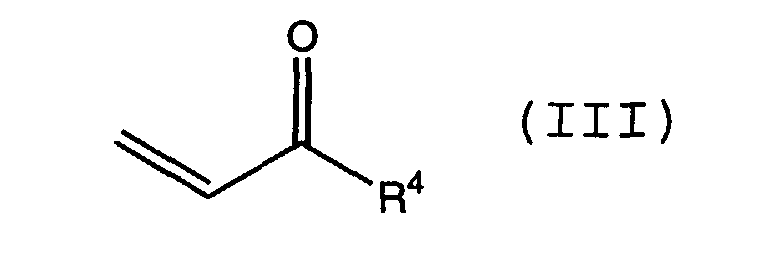
      Figure 00470001
         wherein R1, R2 and R3 are the same as defined above, with an α,β-unsaturated ketone represented by the formula (III):
      Figure 00470002
         wherein R4 is the same as defined above, in an organic solvent in the presence of a Lewis acid.
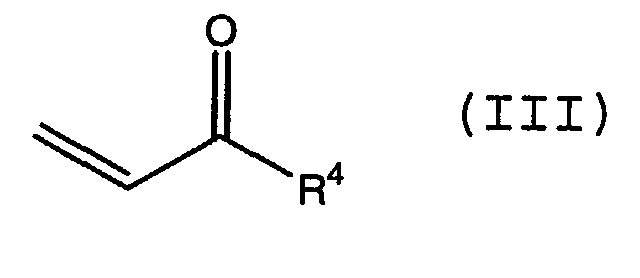
    6. The process for producing a 7a-alkoxy-4H-pyrano[3,2-d]-oxazol-2(3H)-one according to Claim 5, wherein the Lewis acid is represented by the formula (IV): R5R6R7SiOTf    wherein R5, R6 and R7 each independently represent an alkyl group having 1 to 6 carbon atoms and Tf represents a trifluoromethanesulfonyl group.
    EP01127152A 2000-11-16 2001-11-15 7a-alkoxy-4H-pyrano-[3,2-d]-oxazol-2(3H)-one and process for producing the same Expired - Lifetime EP1207162B1 (en)

    Applications Claiming Priority (2)

    Application Number Priority Date Filing Date Title
    JP2000349456A JP2002155086A (en) 2000-11-16 2000-11-16 7a-Alkoxy-4H-pyrano [3,2-d] -oxazol-2 (3H) -ones and method for producing the same
    JP2000349456 2000-11-16

    Publications (2)

    Publication Number Publication Date
    EP1207162A1 true EP1207162A1 (en) 2002-05-22
    EP1207162B1 EP1207162B1 (en) 2004-02-25

    Family

    ID=18822857

    Family Applications (1)

    Application Number Title Priority Date Filing Date
    EP01127152A Expired - Lifetime EP1207162B1 (en) 2000-11-16 2001-11-15 7a-alkoxy-4H-pyrano-[3,2-d]-oxazol-2(3H)-one and process for producing the same

    Country Status (4)

    Country Link
    US (1) US6723860B2 (en)
    EP (1) EP1207162B1 (en)
    JP (1) JP2002155086A (en)
    DE (1) DE60102120T2 (en)

    Citations (2)

    * Cited by examiner, † Cited by third party
    Publication number Priority date Publication date Assignee Title
    US3631175A (en) * 1970-04-14 1971-12-28 Ayerst Mckenna & Harrison Derivatives of pyrano(3 2-d)oxazole
    EP1000937A1 (en) * 1997-07-10 2000-05-17 Ube Industries Limited Process for producing 4-alkoxycarbonyl-2-oxazolidinone compounds

    Family Cites Families (1)

    * Cited by examiner, † Cited by third party
    Publication number Priority date Publication date Assignee Title
    SE9103612D0 (en) * 1991-12-04 1991-12-04 Astra Ab NEW PEPTIDE DERIVATIVES

    Patent Citations (2)

    * Cited by examiner, † Cited by third party
    Publication number Priority date Publication date Assignee Title
    US3631175A (en) * 1970-04-14 1971-12-28 Ayerst Mckenna & Harrison Derivatives of pyrano(3 2-d)oxazole
    EP1000937A1 (en) * 1997-07-10 2000-05-17 Ube Industries Limited Process for producing 4-alkoxycarbonyl-2-oxazolidinone compounds

    Non-Patent Citations (1)

    * Cited by examiner, † Cited by third party
    Title
    D.SEEBACH ET AL.: "Cycloadditionen an die Doppelbindung von (R)-tert-Butyl-.delta.4-1,3-oxazolin-3-carbonsäure-methylestern", CHEM. BER., vol. 122, 1989, pages 2377 - 2389, XP001056159 *

    Also Published As

    Publication number Publication date
    DE60102120T2 (en) 2004-12-02
    JP2002155086A (en) 2002-05-28
    US20020072612A1 (en) 2002-06-13
    EP1207162B1 (en) 2004-02-25
    US6723860B2 (en) 2004-04-20
    DE60102120D1 (en) 2004-04-01

    Similar Documents

    Publication Publication Date Title
    EP0209352B1 (en) Process and intermediates for beta-lactam antibiotics
    EP0416952B1 (en) 4-(1&#39;-Oxocyclohex-2&#39;-yl)azetidin-2-one derivatives
    KR102573454B1 (en) Preparation of substituted 3-aryl-5-trifluoromethyl-1,2,4-oxadiazoles
    MX2012009805A (en) A process using grignard reagents.
    CA2628047A1 (en) Process for production of cinnamide derivative
    JP4115546B2 (en) Method for producing 1- (haloaryl) heterocyclic compound for agricultural chemicals
    WO2010117796A2 (en) Processes for the preparation of alpha-chloroketones from carboxylic acids
    EP0252744A2 (en) 3-Beta-(3,4-disubstituted succinimido)azetidinones
    CA1234099A (en) Process for the production of penems
    KR960000048B1 (en) Chiral Azetidinone Intermediates Useful in the Preparation of Beta-lactam Antibiotics and Methods for Preparing the Same
    EP1207162B1 (en) 7a-alkoxy-4H-pyrano-[3,2-d]-oxazol-2(3H)-one and process for producing the same
    CA2657930A1 (en) Synthesis of (2s,5r)-5-ethynyl-1-{n-(4-methyl-1-(4-carboxy-pyridin-2-yl)piperidin-4-yl)glycyl}pyrrolidine-2-carbonitrile
    ES2292726T3 (en) PROCESS OF PREPARATION OF INTERMEDIARIES FOR THE MANUFACTURE OF DISCODERMOLIDA AND ANALOGS OF DISCODERMOLIDA.
    KR102946998B1 (en) Preparation of substituted 3-aryl-5-trifluoromethyl-1,2,4-oxadiazole
    KR20210099065A (en) Method for preparing cyclic dinucleotides
    Mollet et al. Synthesis of stereodefined 3, 4-disubstituted piperidines through rearrangement of 2-(2-bromo-1, 1-dimethylethyl) azetidines
    JPH069554A (en) Preparation of insecticidal, nematocidal and acaricidal 2-halo-3-substituted-5-arylpyrrole compound
    HU195772B (en) Process for producing n-(substituted methyl)-azetidin-2-one compounds
    NO335650B1 (en) Process and intermediate compounds useful in the preparation of statins, especially atorvastatin
    WO1988000941A1 (en) ASYMETRIC SYNTHESIS OF ENANTIOMERICALLY PURE MONOCLYCLIC beta-LACTAM INTERMEDIATES
    EP0492350B1 (en) Process for the production of (S)-vinyl and (S) allenyl gaba
    EP0276993B1 (en) Process for preparing azetidinones
    EP0146735A1 (en) Optically uniform beta-lactams
    US5817814A (en) Method for the preparation of benzyluracils
    KR100317832B1 (en) Synthesis method of 4-halo-5- (hydroxymethyl) imidazole compound and new imidazole compound

    Legal Events

    Date Code Title Description
    PUAI Public reference made under article 153(3) epc to a published international application that has entered the european phase

    Free format text: ORIGINAL CODE: 0009012

    AX Request for extension of the european patent

    Free format text: AL;LT;LV;MK;RO;SI

    17P Request for examination filed

    Effective date: 20021009

    AKX Designation fees paid

    Designated state(s): CH DE FR GB IT LI

    GRAH Despatch of communication of intention to grant a patent

    Free format text: ORIGINAL CODE: EPIDOS IGRA

    GRAS Grant fee paid

    Free format text: ORIGINAL CODE: EPIDOSNIGR3

    GRAA (expected) grant

    Free format text: ORIGINAL CODE: 0009210

    AK Designated contracting states

    Kind code of ref document: B1

    Designated state(s): CH DE FR GB IT LI

    REG Reference to a national code

    Ref country code: GB

    Ref legal event code: FG4D

    REG Reference to a national code

    Ref country code: CH

    Ref legal event code: EP

    Ref country code: CH

    Ref legal event code: NV

    Representative=s name: E. BLUM & CO. PATENTANWAELTE

    REG Reference to a national code

    Ref country code: IE

    Ref legal event code: FG4D

    REF Corresponds to:

    Ref document number: 60102120

    Country of ref document: DE

    Date of ref document: 20040401

    Kind code of ref document: P

    ET Fr: translation filed
    PLBE No opposition filed within time limit

    Free format text: ORIGINAL CODE: 0009261

    STAA Information on the status of an ep patent application or granted ep patent

    Free format text: STATUS: NO OPPOSITION FILED WITHIN TIME LIMIT

    26N No opposition filed

    Effective date: 20041126

    PGFP Annual fee paid to national office [announced via postgrant information from national office to epo]

    Ref country code: FR

    Payment date: 20051118

    Year of fee payment: 5

    PGFP Annual fee paid to national office [announced via postgrant information from national office to epo]

    Ref country code: CH

    Payment date: 20051123

    Year of fee payment: 5

    PGFP Annual fee paid to national office [announced via postgrant information from national office to epo]

    Ref country code: DE

    Payment date: 20060130

    Year of fee payment: 5

    PG25 Lapsed in a contracting state [announced via postgrant information from national office to epo]

    Ref country code: LI

    Free format text: LAPSE BECAUSE OF NON-PAYMENT OF DUE FEES

    Effective date: 20061130

    Ref country code: CH

    Free format text: LAPSE BECAUSE OF NON-PAYMENT OF DUE FEES

    Effective date: 20061130

    PGFP Annual fee paid to national office [announced via postgrant information from national office to epo]

    Ref country code: IT

    Payment date: 20061130

    Year of fee payment: 6

    PG25 Lapsed in a contracting state [announced via postgrant information from national office to epo]

    Ref country code: DE

    Free format text: LAPSE BECAUSE OF NON-PAYMENT OF DUE FEES

    Effective date: 20070601

    REG Reference to a national code

    Ref country code: CH

    Ref legal event code: PL

    GBPC Gb: european patent ceased through non-payment of renewal fee

    Effective date: 20061115

    REG Reference to a national code

    Ref country code: FR

    Ref legal event code: ST

    Effective date: 20070731

    PG25 Lapsed in a contracting state [announced via postgrant information from national office to epo]

    Ref country code: GB

    Free format text: LAPSE BECAUSE OF NON-PAYMENT OF DUE FEES

    Effective date: 20061115

    PG25 Lapsed in a contracting state [announced via postgrant information from national office to epo]

    Ref country code: FR

    Free format text: LAPSE BECAUSE OF NON-PAYMENT OF DUE FEES

    Effective date: 20061130

    PGFP Annual fee paid to national office [announced via postgrant information from national office to epo]

    Ref country code: GB

    Payment date: 20051031

    Year of fee payment: 5

    PG25 Lapsed in a contracting state [announced via postgrant information from national office to epo]

    Ref country code: IT

    Free format text: LAPSE BECAUSE OF NON-PAYMENT OF DUE FEES

    Effective date: 20071115