EP1206053A2 - System and method of common synchronisation for bursts transmitted over an uplink connection in an integrated multispot satellite communication system in a multimedia broadcasting network - Google Patents
System and method of common synchronisation for bursts transmitted over an uplink connection in an integrated multispot satellite communication system in a multimedia broadcasting network Download PDFInfo
- Publication number
- EP1206053A2 EP1206053A2 EP01402848A EP01402848A EP1206053A2 EP 1206053 A2 EP1206053 A2 EP 1206053A2 EP 01402848 A EP01402848 A EP 01402848A EP 01402848 A EP01402848 A EP 01402848A EP 1206053 A2 EP1206053 A2 EP 1206053A2
- Authority
- EP
- European Patent Office
- Prior art keywords
- satellite
- network
- dvb
- synchronisation
- communication system
- Prior art date
- Legal status (The legal status is an assumption and is not a legal conclusion. Google has not performed a legal analysis and makes no representation as to the accuracy of the status listed.)
- Granted
Links
Images

Classifications
-
- H—ELECTRICITY
- H04—ELECTRIC COMMUNICATION TECHNIQUE
- H04B—TRANSMISSION
- H04B7/00—Radio transmission systems, i.e. using radiation field
- H04B7/14—Relay systems
- H04B7/15—Active relay systems
- H04B7/204—Multiple access
- H04B7/212—Time-division multiple access [TDMA]
- H04B7/2125—Synchronisation
-
- H—ELECTRICITY
- H04—ELECTRIC COMMUNICATION TECHNIQUE
- H04H—BROADCAST COMMUNICATION
- H04H20/00—Arrangements for broadcast or for distribution combined with broadcast
- H04H20/44—Arrangements characterised by circuits or components specially adapted for broadcast
- H04H20/46—Arrangements characterised by circuits or components specially adapted for broadcast specially adapted for broadcast systems covered by groups H04H20/53-H04H20/95
- H04H20/51—Arrangements characterised by circuits or components specially adapted for broadcast specially adapted for broadcast systems covered by groups H04H20/53-H04H20/95 specially adapted for satellite broadcast systems
-
- H—ELECTRICITY
- H04—ELECTRIC COMMUNICATION TECHNIQUE
- H04H—BROADCAST COMMUNICATION
- H04H20/00—Arrangements for broadcast or for distribution combined with broadcast
- H04H20/65—Arrangements characterised by transmission systems for broadcast
- H04H20/71—Wireless systems
- H04H20/74—Wireless systems of satellite networks
Definitions
- the present invention relates to a system and a method of common synchronisation for bursts transmitted over an uplink connection in an integrated multispot satellite communication system in a multimedia broadcasting network, mainly in digital video broadcasting (DVB) applications that permit a user to request broadband interactive services employing standard stations both on the transmission and on the reception side.
- the invention proposes a single synchronisation that is common both for the interactive services and for the broadcast.
- the EN 300 421 standard of the ETSI European Telecommunications Standards Institute
- DVB-S digital video broadcasting via satellite
- TV television
- All the components of said services are time division multiplexed (TDM) on a single carrier.
- DVB-RCS001 makes reference to interaction channels on a transparent satellite distribution system.
- the purpose of this standard is to provide basic specifications for the provision of interaction channels for interactive networks based on geostationary satellites (GEO) that incorporate fixed return channel satellite terminals (RCST).
- GEO geostationary satellites
- RCST fixed return channel satellite terminals
- DVB-RCS digital video broadcasting - return channel satellite
- This standard facilitates the use of RCSTs for domestic installations both individual and collective types. Likewise, it supports the connection of said terminals with data networks at home, and can be applied to all the frequency bands allocated to GEO satellite services.
- DVB-S provides, although offering the possibility of direct communication to the user's home, has the drawback of not having foreseen the possibility of including a return channel in order that the user may communicate with the multimedia service provider.
- the service furnished through DVB-RCS, whilst providing said return channel does not include the possibility of direct communication with the user's home for broadcast applications.
- the regenerative payload performs the multiplexing of the information coming from diverse sources into a data stream suitable for being received by a user who has available any standard integrated receiver/decoder equipment.
- the synchronisation of the bursts transmitted by the return channel satellite terminal is carried out by receiving information on a network clock reference (NCR) inside the standard packets termed MPEG2-TS (Motion Picture Expert Group 2-Transport Stream), sent by a network control centre in DVB-S format.
- NCR network clock reference
- MPEG2-TS Motion Picture Expert Group 2-Transport Stream
- the mutually independent and transparent use of the two broadcasting and interaction services performed in a conventional manner makes it unnecessary to have synchronisation of the bursts in transmission of the programs offered to the users, thus the RCST could strictly employ the DVB-RCS standard.
- DVB regenerative multiplexer One of the components on board the satellites is a DVB regenerative multiplexer. Since said DVB regenerative multiplexer endeavours to use synchronised schemes for inserting different uplink channels -from both the service provider and the user- into a single DVB-S downlink signal, it is proposed, by means of the solution of the invention, to create a simple relationship between the reference frequency generated by the clock in the network control centre and the reference frequency of the satellite.
- clock reference of the actual satellite be employed to generate clock references for the network.
- an object of the invention is to provide an integrated multispot satellite communication system in a multimedia broadcasting network with return channel characterised in that it comprises common synchronisation means for the bursts, in such a manner that the transmission rate in a downlink direction from the satellite is a whole multiple of a clock reference of said network.
- the integrated multispot communication system includes a satellite suitable for generating said clock reference of the network.
- Another object of the invention is to provide a multiplexer to be included in the satellite of the invention.
- the multiplexer is suitable for fitting in synchronous fashion different uplink channels into a downlink signal, in such a manner that a period of the downlink frame is equal to a period of the uplink frame.
- Another additional object of the invention is to provide a method of common synchronisation of the bursts transmitted over an uplink connection in an integrated multispot satellite communication system in a multimedia broadcasting network with return channel characterised in that said synchronisation of the bursts is common for a provider of multimedia services and a user, and is carried out in such a manner that the transmission rate in a downlink direction is a whole multiple of a clock reference of the network.
- the method comprises the generation of said clock reference of the network in a satellite of said system.
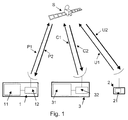
- a multimedia services provider 1 in a DVB system sends multimedia service signals, as for example video on demand, to a user 2 via a satellite S.
- the provider 1 comprises, among other components necessary for its operation, a broadcast signal producing means 11 and a return channel satellite terminal (RCST) 12.
- the provider sends the broadcast signal P1, which incorporates the multimedia channel, to the user 2 via the satellite S.
- This signal also contains information concerning the return signalling that serves for accessing and synchronising to the interactive network.
- the signal P1 is therefore an uplink signal of the type of signals that comply with the aforementioned DVB-RCS standard.
- a network controller means 3 serves to control and administer the network functions. In addition it is capable of transmitting information directly to the satellite regarding signalling and timing for the network operation from a signal generator 31, employing the same DVB-RCS standard mode; at the same time it is capable of receiving the different return channels coming from the multimedia services provider and from the user, which the satellite S transmits to it by means of DVB-S signals.
- the signalling is to be understood as including all network control operations, as for example network access request, authentication, synchronisation, etc.
- the direct signalling is that sent from the controller means 3, and the return signalling corresponds to the signal sent by the user 2 and/or the provider 1. Consequently, the signalling part of the signal P1 is addressed to the controller means 3.
- the controller means also comprises a return channel satellite terminal 32 in order to receive said DVB-S return signals.
- the satellite S can be, preferentially, of the multispot type whereby it may have a multiple coverage zone, whereby various users 2 can request, individually, broadband multimedia service independently of where they are located, provided that they are within the coverage zone of the multispot satellite S.
- various users 2 can request, individually, broadband multimedia service independently of where they are located, provided that they are within the coverage zone of the multispot satellite S.
- figure 1 only one user 2 is shown for reasons of simplification, it being understood that there can exist various users in communication with the satellite S.
- the user 2 requests, via a signal U1, a predetermined multimedia service from provider 1.
- Said signal is sent to the satellite S and contains the return channel to the provider 1 and return signalling to the control centre 3, both in DVB-RCS format.
- the satellite S serves to transmit the request to the service provider 1 by means of a signal P2 of the DVB-S type that contains the return channel of the user 2 and the signalling of the controller means 3.
- Said signal P2 is received by the return channel satellite terminal 12 and is then processed in a conventional manner in order to attend the request of the user 2.
- the control operations for sending the signals U1 and P2, as well as the verification of user identity and profile, are carried out in the controller means 3 through the interchange of signals C2 in DVB-S format and C1 in DVB-RCS format.
- the signal C1 serves for sending signalling to the provider 1 and/or to the user 2
- the signal C2 serves for receiving the return signalling from the provider 1 and/or from the user 2.
- These signals shall have to pass through the return channel satellite terminal 32 in a bidirectional manner.
- the provider 1 sends the broadcast signal P1 to the satellite. This signal is sent in DVB-RCS format.
- this signal Once received in the satellite this signal, together with other possible uplink signals received from this same or other broadcast sources are multiplexed in a multiplexer, to obtain a signal in DVB-S format in the form of a data stream suitable for being received by any integrated receiver/decoder equipment.
- the multiplexing is performed by means of a regenerator means on board the satellite. Said regenerator, as well as carrying out the multiplexing, is capable of performing functions of cross-connecting and/or broadcasting channels to different coverage zones.
- the user 2 receives the multimedia channel from the provider 1 and the signalling from the controller means 3, both in DVB-S format.
- the user 2 has installed in his home a return channel satellite terminal (RCST), thus he has the facility for communicating over a return channel with said satellite S and via the aforementioned signal U1 that, by being in DVB-RCS format, permits this operation.
- RCST return channel satellite terminal
- all the signals received in the satellite S from the users are multiplexed in the same multiplexer.
- the satellite S sends the output signal to the provider 1 via the signal P2 that is in DVB-S format.
- the operation of the RCST comprises the transmission in multifrequency mode in time division multiple access, that is MF-TDMA, of bursts that contain MPEG2-TS packets following an uplink frame structure just as described in the DVB-RCS standard.
- Nd/Rtd can provide a period of the downlink frame, Tdf, which coincides with the period of the uplink frame, Tuf, in expression (1).
- M can have different values. In the table below, some examples of said values are shown, as well as the resulting downlink signalling rate.
- BW M Rtd 36 MHz 2 54 Mbit/s 54 MHz 3 81 Mbit/s 72 MHz 4 108 Mbit/s
- the use of a downlink signalling rate that is a multiple of 27 MHz permits the satellite clock to be used as frequency generator for the network clock reference (NCR), whereby a substantial simplification is achieved in the synchronisation of the DVB repeater on board the satellite with the subsequent saving in costs.
- NCR network clock reference
- the carrier frequencies Fu1 and Fun represent an uplink transmission frame period Tuf that at each frequency contains a determined number of information packets Nu, which in the case of the example of this figure is 4.
- These packets after processing in demultiplexing, demodulation, decoding and descrambling stages, not shown in the figure for simplification, are applied to a multiplexer means 4, with n inputs 4 1 to 4 n and one output frequency Fd for the downlink signal.
- said multiplexer 4 can employ a synchronous scheme for fitting the uplink packets into a downlink signal by using a downlink transmission rate Rtd that is a multiple of the network clock reference frequency. The result is a number of downlink packets Ntd fitted into the downlink frame as illustrated in the figure.
Landscapes
- Engineering & Computer Science (AREA)
- Signal Processing (AREA)
- Computer Networks & Wireless Communication (AREA)
- Physics & Mathematics (AREA)
- Astronomy & Astrophysics (AREA)
- General Physics & Mathematics (AREA)
- Radio Relay Systems (AREA)
- Time-Division Multiplex Systems (AREA)
- Two-Way Televisions, Distribution Of Moving Picture Or The Like (AREA)
- Mobile Radio Communication Systems (AREA)
Abstract
Description
| BW | M | Rtd |
| 36 | 2 | 54 Mbit/s |
| 54 | 3 | 81 Mbit/s |
| 72 | 4 | 108 Mbit/s |
- The method of the invention permits, both the user and the provider of the multimedia service, to use the burst synchronisation scheme defined in the DVB-RCS standard.
- It likewise permits the on-board DVB multiplexer to utilise synchronous multiplexing, which is substantially simpler than asynchronous multiplexing.
- The generation of the clock frequency on board the satellite is simplified through the use of a single reference frequency both for synchronisation with the interactive network and for generating the downlink signal.
- Likewise it permits the network clock reference (NCR) frequency to be generated on board the satellite, whereby the synchronisation of the equipment on board with the interactive network is substantially simplified.
Claims (6)
- Integrated multispot satellite communication system (S) in a multimedia broadcasting network with return channel characterised in that it comprises common means of burst synchronisation (4) such that the transmission rate in a downlink direction (P2; U2; C2) from the satellite is a whole multiple of a clock reference of said network.
- System according to claim 1, characterised in that it includes a satellite (S) suitable for generating said network clock reference.
- Multiplexer for including in the satellite of claim 2.
- Multiplexer according to claim 3, characterised in that it is suitable for fitting in a synchronous manner different uplink channels into a downlink signal, in such a manner that a period of the downlink frame (Tdf) is equal to a period of the uplink frame (Tuf).
- Method of burst synchronisation in an integrated multispot satellite communication system in a multimedia broadcasting network with return channel characterised in that said synchronisation is common for a multimedia services provider and a user, in such a manner that the transmission rate in a downlink direction (P2; U2; C2) is a whole multiple of a network clock reference.
- Method according to claim 5, characterised in that it comprises the generation of said network clock reference in a satellite (S) of said system.
Applications Claiming Priority (2)
| Application Number | Priority Date | Filing Date | Title |
|---|---|---|---|
| ES200002709 | 2000-11-10 | ||
| ES200002709 | 2000-11-10 |
Publications (3)
| Publication Number | Publication Date |
|---|---|
| EP1206053A2 true EP1206053A2 (en) | 2002-05-15 |
| EP1206053A3 EP1206053A3 (en) | 2003-05-14 |
| EP1206053B1 EP1206053B1 (en) | 2008-07-23 |
Family
ID=8495606
Family Applications (1)
| Application Number | Title | Priority Date | Filing Date |
|---|---|---|---|
| EP01402848A Expired - Lifetime EP1206053B1 (en) | 2000-11-10 | 2001-11-05 | System and method of common synchronisation for bursts transmitted over an uplink connection in an integrated multispot satellite communication system in a multimedia broadcasting network |
Country Status (6)
| Country | Link |
|---|---|
| US (1) | US7836470B2 (en) |
| EP (1) | EP1206053B1 (en) |
| JP (1) | JP4213380B2 (en) |
| AT (1) | ATE402529T1 (en) |
| DE (1) | DE60134936D1 (en) |
| ES (1) | ES2310544T3 (en) |
Cited By (1)
| Publication number | Priority date | Publication date | Assignee | Title |
|---|---|---|---|---|
| KR100600811B1 (en) | 2004-12-09 | 2006-07-18 | 한국전자통신연구원 | Central station system of two-way satellite communication system |
Families Citing this family (9)
| Publication number | Priority date | Publication date | Assignee | Title |
|---|---|---|---|---|
| US6614371B2 (en) * | 2001-07-19 | 2003-09-02 | Broadcom Corporation | Synchronous data serialization circuit |
| US7401349B2 (en) * | 2002-02-26 | 2008-07-15 | Thomson Licensing | Satellite television system ground station having wideband multi-channel LNB converter/transmitter architecture utilizing a frequency stabilized common oscillator |
| US7383018B2 (en) * | 2002-02-26 | 2008-06-03 | Thomas Licensing | Satellite television system ground station having wideband multi-channel LNB converter/transmitter architecture with coarse tuner in outdoor unit |
| US8418210B2 (en) * | 2002-02-26 | 2013-04-09 | Thomson Licensing | Satellite television system ground station having wideband multi-channel LNB converter/transmitter architecture with controlled uplink transmission |
| US7593425B2 (en) * | 2003-11-14 | 2009-09-22 | Fujitsu Limited | Signal distribution method and a signal distribution apparatus |
| FR2891420B1 (en) * | 2005-09-23 | 2007-11-23 | Alcatel Sa | SEMI-TRANSPARENT DATA STREAM MULTIPLEXING DEVICE FOR A COMMUNICATION SATELLITE |
| CN101415173B (en) * | 2007-08-09 | 2013-12-18 | 华为技术有限公司 | Method for searching look-in service provider, as well as terminal and server |
| US20120185783A1 (en) | 2011-01-19 | 2012-07-19 | Abel Avellan | System and method for zero latency browsing |
| US20130038678A1 (en) | 2011-08-08 | 2013-02-14 | Emc Satcom Technologies, Llc | Video management system over satellite |
Family Cites Families (10)
| Publication number | Priority date | Publication date | Assignee | Title |
|---|---|---|---|---|
| US4577316A (en) * | 1984-02-13 | 1986-03-18 | Rca Corporation | Synchronization system for a regenerative subtransponder satellite communication system |
| DE4345251C2 (en) * | 1993-12-21 | 2001-07-12 | Grundig Ag | System for generating radio signals for satellite transmission |
| JP3895804B2 (en) * | 1996-07-26 | 2007-03-22 | 株式会社日立コミュニケーションテクノロジー | Two-way communication system |
| US6067453A (en) * | 1996-10-25 | 2000-05-23 | Pt Pasifik Satelit Nusantara | Satellite-based direct access telecommunications systems |
| US6091703A (en) * | 1997-10-10 | 2000-07-18 | Trw Inc. | Bulk despreading of multiple independent CDMA sources |
| US6301308B1 (en) * | 1998-06-23 | 2001-10-09 | Robert Rector | System and method for high speed data transmission |
| KR100345353B1 (en) * | 1998-11-08 | 2005-07-29 | 엘지전자 주식회사 | Method and ap-paratus for creating and recording management information for digital data streams |
| KR100314655B1 (en) * | 1998-12-11 | 2001-12-28 | 오길록 | Network Synchronizer and Its Method in Asymmetric Multimedia Satellite Communication System |
| US6836658B1 (en) * | 2000-03-03 | 2004-12-28 | Ems Technologies, Inc. | High data rate satellite communications system and method |
| US6400696B1 (en) * | 2000-11-07 | 2002-06-04 | Space Systems/Loral, Inc. | Bent-pipe satellite system which couples a lan to a gateway and uses a dynamic assignment/multiple access protocol |
-
2001
- 2001-11-01 JP JP2001336079A patent/JP4213380B2/en not_active Expired - Fee Related
- 2001-11-05 ES ES01402848T patent/ES2310544T3/en not_active Expired - Lifetime
- 2001-11-05 DE DE60134936T patent/DE60134936D1/en not_active Expired - Lifetime
- 2001-11-05 EP EP01402848A patent/EP1206053B1/en not_active Expired - Lifetime
- 2001-11-05 AT AT01402848T patent/ATE402529T1/en not_active IP Right Cessation
- 2001-11-09 US US09/986,555 patent/US7836470B2/en not_active Expired - Fee Related
Cited By (1)
| Publication number | Priority date | Publication date | Assignee | Title |
|---|---|---|---|---|
| KR100600811B1 (en) | 2004-12-09 | 2006-07-18 | 한국전자통신연구원 | Central station system of two-way satellite communication system |
Also Published As
| Publication number | Publication date |
|---|---|
| DE60134936D1 (en) | 2008-09-04 |
| ES2310544T3 (en) | 2009-01-16 |
| US20020087991A1 (en) | 2002-07-04 |
| JP2002198885A (en) | 2002-07-12 |
| EP1206053B1 (en) | 2008-07-23 |
| EP1206053A3 (en) | 2003-05-14 |
| ATE402529T1 (en) | 2008-08-15 |
| US7836470B2 (en) | 2010-11-16 |
| JP4213380B2 (en) | 2009-01-21 |
Similar Documents
| Publication | Publication Date | Title |
|---|---|---|
| US7515566B2 (en) | Partial mesh communication in hub based system | |
| US6993009B2 (en) | Method and apparatus for deriving uplink timing from asynchronous traffic across multiple transport streams | |
| US6836658B1 (en) | High data rate satellite communications system and method | |
| US5889765A (en) | Bi-directional communications network | |
| US6201798B1 (en) | Signaling protocol for satellite direct radio broadcast system | |
| US5625624A (en) | High data rate satellite communication system | |
| US20010017849A1 (en) | Signaling protocol for satellite direct radio broadcast system | |
| AU2001241854A1 (en) | High data rate satellite communications system and method | |
| US5712850A (en) | System for digital broadcasting by satellite | |
| EP1206053B1 (en) | System and method of common synchronisation for bursts transmitted over an uplink connection in an integrated multispot satellite communication system in a multimedia broadcasting network | |
| CA2365841C (en) | Program clock reference correction method in a multiplexed burst mode downlink transmission in an integrated multispot satellite communication system | |
| Sari | Broadband radio access to homes and businesses: MMDS and LMDS | |
| JPH10271075A (en) | A device for broadcasting digital information from multiple earth stations via satellites | |
| US20020006118A1 (en) | Integrated multispot satellite communication system in a multimedia broadcasting network | |
| US20020059612A1 (en) | Method for allocating satellite channel, a satellite communications system and an earth station for satellite communications | |
| JP4482257B2 (en) | Communication equipment for joint data reception | |
| Feltrin et al. | Design, implementation and performances of an on board processor-based satellite network | |
| JPH0998400A (en) | Cable telephone system | |
| JP2001008187A (en) | Two-way TV system | |
| Reimers | DVB Solutions for Interactive Services | |
| JP2002034036A (en) | Satellite broadcast transmission method, satellite broadcast system, satellite broadcast transmitter, CATV repeater retransmitter, receiver |
Legal Events
| Date | Code | Title | Description |
|---|---|---|---|
| PUAI | Public reference made under article 153(3) epc to a published international application that has entered the european phase |
Free format text: ORIGINAL CODE: 0009012 |
|
| AK | Designated contracting states |
Kind code of ref document: A2 Designated state(s): AT BE CH CY DE DK ES FI FR GB GR IE IT LI LU MC NL PT SE TR |
|
| AX | Request for extension of the european patent |
Free format text: AL;LT;LV;MK;RO;SI |
|
| PUAL | Search report despatched |
Free format text: ORIGINAL CODE: 0009013 |
|
| AK | Designated contracting states |
Designated state(s): AT BE CH CY DE DK ES FI FR GB GR IE IT LI LU MC NL PT SE TR |
|
| AX | Request for extension of the european patent |
Extension state: AL LT LV MK RO SI |
|
| 17P | Request for examination filed |
Effective date: 20031114 |
|
| AKX | Designation fees paid |
Designated state(s): AT BE CH CY DE DK ES FI FR GB GR IE IT LI LU MC NL PT SE TR |
|
| 17Q | First examination report despatched |
Effective date: 20061009 |
|
| RAP1 | Party data changed (applicant data changed or rights of an application transferred) |
Owner name: ALCATEL LUCENT |
|
| GRAP | Despatch of communication of intention to grant a patent |
Free format text: ORIGINAL CODE: EPIDOSNIGR1 |
|
| GRAS | Grant fee paid |
Free format text: ORIGINAL CODE: EPIDOSNIGR3 |
|
| GRAA | (expected) grant |
Free format text: ORIGINAL CODE: 0009210 |
|
| AK | Designated contracting states |
Kind code of ref document: B1 Designated state(s): AT BE CH CY DE DK ES FI FR GB GR IE IT LI LU MC NL PT SE TR |
|
| REG | Reference to a national code |
Ref country code: GB Ref legal event code: FG4D |
|
| REG | Reference to a national code |
Ref country code: CH Ref legal event code: EP |
|
| REG | Reference to a national code |
Ref country code: IE Ref legal event code: FG4D |
|
| REF | Corresponds to: |
Ref document number: 60134936 Country of ref document: DE Date of ref document: 20080904 Kind code of ref document: P |
|
| NLV1 | Nl: lapsed or annulled due to failure to fulfill the requirements of art. 29p and 29m of the patents act | ||
| REG | Reference to a national code |
Ref country code: ES Ref legal event code: FG2A Ref document number: 2310544 Country of ref document: ES Kind code of ref document: T3 |
|
| PG25 | Lapsed in a contracting state [announced via postgrant information from national office to epo] |
Ref country code: PT Free format text: LAPSE BECAUSE OF FAILURE TO SUBMIT A TRANSLATION OF THE DESCRIPTION OR TO PAY THE FEE WITHIN THE PRESCRIBED TIME-LIMIT Effective date: 20081223 Ref country code: NL Free format text: LAPSE BECAUSE OF FAILURE TO SUBMIT A TRANSLATION OF THE DESCRIPTION OR TO PAY THE FEE WITHIN THE PRESCRIBED TIME-LIMIT Effective date: 20080723 |
|
| PG25 | Lapsed in a contracting state [announced via postgrant information from national office to epo] |
Ref country code: FI Free format text: LAPSE BECAUSE OF FAILURE TO SUBMIT A TRANSLATION OF THE DESCRIPTION OR TO PAY THE FEE WITHIN THE PRESCRIBED TIME-LIMIT Effective date: 20080723 Ref country code: AT Free format text: LAPSE BECAUSE OF FAILURE TO SUBMIT A TRANSLATION OF THE DESCRIPTION OR TO PAY THE FEE WITHIN THE PRESCRIBED TIME-LIMIT Effective date: 20080723 |
|
| PG25 | Lapsed in a contracting state [announced via postgrant information from national office to epo] |
Ref country code: BE Free format text: LAPSE BECAUSE OF FAILURE TO SUBMIT A TRANSLATION OF THE DESCRIPTION OR TO PAY THE FEE WITHIN THE PRESCRIBED TIME-LIMIT Effective date: 20080723 |
|
| PG25 | Lapsed in a contracting state [announced via postgrant information from national office to epo] |
Ref country code: DK Free format text: LAPSE BECAUSE OF FAILURE TO SUBMIT A TRANSLATION OF THE DESCRIPTION OR TO PAY THE FEE WITHIN THE PRESCRIBED TIME-LIMIT Effective date: 20080723 |
|
| PLBE | No opposition filed within time limit |
Free format text: ORIGINAL CODE: 0009261 |
|
| STAA | Information on the status of an ep patent application or granted ep patent |
Free format text: STATUS: NO OPPOSITION FILED WITHIN TIME LIMIT |
|
| PG25 | Lapsed in a contracting state [announced via postgrant information from national office to epo] |
Ref country code: MC Free format text: LAPSE BECAUSE OF NON-PAYMENT OF DUE FEES Effective date: 20081130 |
|
| REG | Reference to a national code |
Ref country code: CH Ref legal event code: PL |
|
| 26N | No opposition filed |
Effective date: 20090424 |
|
| PG25 | Lapsed in a contracting state [announced via postgrant information from national office to epo] |
Ref country code: LI Free format text: LAPSE BECAUSE OF NON-PAYMENT OF DUE FEES Effective date: 20081130 Ref country code: CH Free format text: LAPSE BECAUSE OF NON-PAYMENT OF DUE FEES Effective date: 20081130 Ref country code: IE Free format text: LAPSE BECAUSE OF NON-PAYMENT OF DUE FEES Effective date: 20081105 |
|
| PG25 | Lapsed in a contracting state [announced via postgrant information from national office to epo] |
Ref country code: SE Free format text: LAPSE BECAUSE OF FAILURE TO SUBMIT A TRANSLATION OF THE DESCRIPTION OR TO PAY THE FEE WITHIN THE PRESCRIBED TIME-LIMIT Effective date: 20081023 |
|
| PG25 | Lapsed in a contracting state [announced via postgrant information from national office to epo] |
Ref country code: LU Free format text: LAPSE BECAUSE OF NON-PAYMENT OF DUE FEES Effective date: 20081105 Ref country code: CY Free format text: LAPSE BECAUSE OF FAILURE TO SUBMIT A TRANSLATION OF THE DESCRIPTION OR TO PAY THE FEE WITHIN THE PRESCRIBED TIME-LIMIT Effective date: 20080723 |
|
| PG25 | Lapsed in a contracting state [announced via postgrant information from national office to epo] |
Ref country code: TR Free format text: LAPSE BECAUSE OF FAILURE TO SUBMIT A TRANSLATION OF THE DESCRIPTION OR TO PAY THE FEE WITHIN THE PRESCRIBED TIME-LIMIT Effective date: 20080723 |
|
| PG25 | Lapsed in a contracting state [announced via postgrant information from national office to epo] |
Ref country code: GR Free format text: LAPSE BECAUSE OF FAILURE TO SUBMIT A TRANSLATION OF THE DESCRIPTION OR TO PAY THE FEE WITHIN THE PRESCRIBED TIME-LIMIT Effective date: 20081024 |
|
| REG | Reference to a national code |
Ref country code: GB Ref legal event code: 732E Free format text: REGISTERED BETWEEN 20130926 AND 20131002 |
|
| REG | Reference to a national code |
Ref country code: FR Ref legal event code: GC Effective date: 20131018 |
|
| REG | Reference to a national code |
Ref country code: FR Ref legal event code: RG Effective date: 20141016 |
|
| REG | Reference to a national code |
Ref country code: FR Ref legal event code: CA Effective date: 20150521 |
|
| REG | Reference to a national code |
Ref country code: FR Ref legal event code: CA Effective date: 20150521 |
|
| REG | Reference to a national code |
Ref country code: FR Ref legal event code: PLFP Year of fee payment: 15 |
|
| REG | Reference to a national code |
Ref country code: FR Ref legal event code: PLFP Year of fee payment: 16 |
|
| PGFP | Annual fee paid to national office [announced via postgrant information from national office to epo] |
Ref country code: FR Payment date: 20161118 Year of fee payment: 16 |
|
| PGFP | Annual fee paid to national office [announced via postgrant information from national office to epo] |
Ref country code: IT Payment date: 20161123 Year of fee payment: 16 Ref country code: ES Payment date: 20161114 Year of fee payment: 16 |
|
| PGFP | Annual fee paid to national office [announced via postgrant information from national office to epo] |
Ref country code: DE Payment date: 20171121 Year of fee payment: 17 |
|
| PGFP | Annual fee paid to national office [announced via postgrant information from national office to epo] |
Ref country code: GB Payment date: 20171123 Year of fee payment: 17 |
|
| REG | Reference to a national code |
Ref country code: FR Ref legal event code: ST Effective date: 20180731 |
|
| PG25 | Lapsed in a contracting state [announced via postgrant information from national office to epo] |
Ref country code: FR Free format text: LAPSE BECAUSE OF NON-PAYMENT OF DUE FEES Effective date: 20171130 Ref country code: IT Free format text: LAPSE BECAUSE OF NON-PAYMENT OF DUE FEES Effective date: 20171105 |
|
| REG | Reference to a national code |
Ref country code: ES Ref legal event code: FD2A Effective date: 20181226 |
|
| PG25 | Lapsed in a contracting state [announced via postgrant information from national office to epo] |
Ref country code: ES Free format text: LAPSE BECAUSE OF NON-PAYMENT OF DUE FEES Effective date: 20171106 |
|
| REG | Reference to a national code |
Ref country code: GB Ref legal event code: 732E Free format text: REGISTERED BETWEEN 20190429 AND 20190502 |
|
| REG | Reference to a national code |
Ref country code: DE Ref legal event code: R082 Ref document number: 60134936 Country of ref document: DE Representative=s name: MENZIETTI WETZEL, DE Ref country code: DE Ref legal event code: R081 Ref document number: 60134936 Country of ref document: DE Owner name: PROVENANCE ASSET GROUP LLC, PITTSFORD, US Free format text: FORMER OWNER: ALCATEL LUCENT, PARIS, FR |
|
| REG | Reference to a national code |
Ref country code: DE Ref legal event code: R119 Ref document number: 60134936 Country of ref document: DE |
|
| GBPC | Gb: european patent ceased through non-payment of renewal fee |
Effective date: 20181105 |
|
| PG25 | Lapsed in a contracting state [announced via postgrant information from national office to epo] |
Ref country code: DE Free format text: LAPSE BECAUSE OF NON-PAYMENT OF DUE FEES Effective date: 20190601 |
|
| PG25 | Lapsed in a contracting state [announced via postgrant information from national office to epo] |
Ref country code: GB Free format text: LAPSE BECAUSE OF NON-PAYMENT OF DUE FEES Effective date: 20181105 |