EP1205943A2 - Material useful as electric conductor and comprising polyacetylene or substituted polyacetylenes incorporated in a mesoporous support, production process, and conductors made of said material - Google Patents
Material useful as electric conductor and comprising polyacetylene or substituted polyacetylenes incorporated in a mesoporous support, production process, and conductors made of said material Download PDFInfo
- Publication number
- EP1205943A2 EP1205943A2 EP00945962A EP00945962A EP1205943A2 EP 1205943 A2 EP1205943 A2 EP 1205943A2 EP 00945962 A EP00945962 A EP 00945962A EP 00945962 A EP00945962 A EP 00945962A EP 1205943 A2 EP1205943 A2 EP 1205943A2
- Authority
- EP
- European Patent Office
- Prior art keywords
- aluminosilicate
- host
- polymer
- polyacetylene
- process according
- Prior art date
- Legal status (The legal status is an assumption and is not a legal conclusion. Google has not performed a legal analysis and makes no representation as to the accuracy of the status listed.)
- Granted
Links
- 239000000463 material Substances 0.000 title claims abstract description 49
- HSFWRNGVRCDJHI-UHFFFAOYSA-N alpha-acetylene Natural products C#C HSFWRNGVRCDJHI-UHFFFAOYSA-N 0.000 title claims abstract description 48
- 229920001197 polyacetylene Polymers 0.000 title claims abstract description 47
- 239000004020 conductor Substances 0.000 title claims abstract description 29
- 238000004519 manufacturing process Methods 0.000 title description 5
- 229910000323 aluminium silicate Inorganic materials 0.000 claims abstract description 79
- HNPSIPDUKPIQMN-UHFFFAOYSA-N dioxosilane;oxo(oxoalumanyloxy)alumane Chemical compound O=[Si]=O.O=[Al]O[Al]=O HNPSIPDUKPIQMN-UHFFFAOYSA-N 0.000 claims abstract description 70
- 229920000642 polymer Polymers 0.000 claims abstract description 43
- 238000000034 method Methods 0.000 claims abstract description 29
- 230000008569 process Effects 0.000 claims abstract description 26
- 238000006116 polymerization reaction Methods 0.000 claims abstract description 21
- 239000011148 porous material Substances 0.000 claims abstract description 19
- VYPSYNLAJGMNEJ-UHFFFAOYSA-N Silicium dioxide Chemical compound O=[Si]=O VYPSYNLAJGMNEJ-UHFFFAOYSA-N 0.000 claims abstract description 17
- 239000003795 chemical substances by application Substances 0.000 claims abstract description 17
- 125000002534 ethynyl group Chemical group [H]C#C* 0.000 claims abstract description 12
- 229920001940 conductive polymer Polymers 0.000 claims abstract description 11
- 239000000178 monomer Substances 0.000 claims abstract description 11
- 239000002322 conducting polymer Substances 0.000 claims abstract description 10
- 230000003647 oxidation Effects 0.000 claims abstract description 10
- 238000007254 oxidation reaction Methods 0.000 claims abstract description 10
- QVGXLLKOCUKJST-UHFFFAOYSA-N atomic oxygen Chemical compound [O] QVGXLLKOCUKJST-UHFFFAOYSA-N 0.000 claims abstract description 7
- 239000001301 oxygen Substances 0.000 claims abstract description 7
- 229910052760 oxygen Inorganic materials 0.000 claims abstract description 7
- -1 Ni2+ ions Chemical class 0.000 claims description 16
- 229910001428 transition metal ion Inorganic materials 0.000 claims description 14
- 238000005470 impregnation Methods 0.000 claims description 12
- OKTJSMMVPCPJKN-UHFFFAOYSA-N Carbon Chemical compound [C] OKTJSMMVPCPJKN-UHFFFAOYSA-N 0.000 claims description 9
- 239000007864 aqueous solution Substances 0.000 claims description 9
- CSCPPACGZOOCGX-UHFFFAOYSA-N Acetone Chemical group CC(C)=O CSCPPACGZOOCGX-UHFFFAOYSA-N 0.000 claims description 8
- 125000001997 phenyl group Chemical group [H]C1=C([H])C([H])=C(*)C([H])=C1[H] 0.000 claims description 8
- 238000005342 ion exchange Methods 0.000 claims description 7
- WHXSMMKQMYFTQS-UHFFFAOYSA-N Lithium Chemical compound [Li] WHXSMMKQMYFTQS-UHFFFAOYSA-N 0.000 claims description 5
- 239000010439 graphite Substances 0.000 claims description 5
- 229910002804 graphite Inorganic materials 0.000 claims description 5
- 239000000203 mixture Substances 0.000 claims description 5
- 239000003960 organic solvent Substances 0.000 claims description 5
- 239000012188 paraffin wax Substances 0.000 claims description 5
- 239000000243 solution Substances 0.000 claims description 5
- 239000004372 Polyvinyl alcohol Substances 0.000 claims description 4
- VCJMYUPGQJHHFU-UHFFFAOYSA-N iron(III) nitrate Inorganic materials [Fe+3].[O-][N+]([O-])=O.[O-][N+]([O-])=O.[O-][N+]([O-])=O VCJMYUPGQJHHFU-UHFFFAOYSA-N 0.000 claims description 4
- 229910052744 lithium Inorganic materials 0.000 claims description 4
- 239000013335 mesoporous material Substances 0.000 claims description 4
- 229920002451 polyvinyl alcohol Polymers 0.000 claims description 4
- 239000011248 coating agent Substances 0.000 claims description 3
- 238000000576 coating method Methods 0.000 claims description 3
- 239000000725 suspension Substances 0.000 claims description 3
- 230000008021 deposition Effects 0.000 claims description 2
- 125000002496 methyl group Chemical group [H]C([H])([H])* 0.000 claims description 2
- 229910021645 metal ion Inorganic materials 0.000 claims 4
- 238000007669 thermal treatment Methods 0.000 claims 1
- 238000002360 preparation method Methods 0.000 abstract description 5
- 238000005538 encapsulation Methods 0.000 abstract description 2
- 239000010457 zeolite Substances 0.000 description 11
- 229920000620 organic polymer Polymers 0.000 description 10
- 230000009467 reduction Effects 0.000 description 10
- 230000015572 biosynthetic process Effects 0.000 description 9
- OKKJLVBELUTLKV-UHFFFAOYSA-N Methanol Chemical group OC OKKJLVBELUTLKV-UHFFFAOYSA-N 0.000 description 6
- HEMHJVSKTPXQMS-UHFFFAOYSA-M Sodium hydroxide Chemical compound [OH-].[Na+] HEMHJVSKTPXQMS-UHFFFAOYSA-M 0.000 description 6
- 229910021536 Zeolite Inorganic materials 0.000 description 6
- 230000008030 elimination Effects 0.000 description 6
- 238000003379 elimination reaction Methods 0.000 description 6
- 229910052799 carbon Inorganic materials 0.000 description 5
- 238000006243 chemical reaction Methods 0.000 description 5
- 238000009838 combustion analysis Methods 0.000 description 5
- 239000007787 solid Substances 0.000 description 5
- 238000000605 extraction Methods 0.000 description 4
- 239000007789 gas Substances 0.000 description 4
- 125000001424 substituent group Chemical group 0.000 description 4
- 238000003786 synthesis reaction Methods 0.000 description 4
- WEVYAHXRMPXWCK-UHFFFAOYSA-N Acetonitrile Chemical compound CC#N WEVYAHXRMPXWCK-UHFFFAOYSA-N 0.000 description 3
- UFHFLCQGNIYNRP-UHFFFAOYSA-N Hydrogen Chemical compound [H][H] UFHFLCQGNIYNRP-UHFFFAOYSA-N 0.000 description 3
- ZMXDDKWLCZADIW-UHFFFAOYSA-N N,N-Dimethylformamide Chemical compound CN(C)C=O ZMXDDKWLCZADIW-UHFFFAOYSA-N 0.000 description 3
- 125000000217 alkyl group Chemical group 0.000 description 3
- 125000005211 alkyl trimethyl ammonium group Chemical group 0.000 description 3
- 230000008901 benefit Effects 0.000 description 3
- 238000002425 crystallisation Methods 0.000 description 3
- 230000018044 dehydration Effects 0.000 description 3
- 238000006297 dehydration reaction Methods 0.000 description 3
- 238000010438 heat treatment Methods 0.000 description 3
- 239000001257 hydrogen Substances 0.000 description 3
- 229910052739 hydrogen Inorganic materials 0.000 description 3
- 230000004048 modification Effects 0.000 description 3
- 238000012986 modification Methods 0.000 description 3
- 229910052680 mordenite Inorganic materials 0.000 description 3
- 239000002245 particle Substances 0.000 description 3
- 229920000128 polypyrrole Polymers 0.000 description 3
- 229920000123 polythiophene Polymers 0.000 description 3
- 239000002904 solvent Substances 0.000 description 3
- 239000004094 surface-active agent Substances 0.000 description 3
- IJGRMHOSHXDMSA-UHFFFAOYSA-N Atomic nitrogen Chemical compound N#N IJGRMHOSHXDMSA-UHFFFAOYSA-N 0.000 description 2
- DGAQECJNVWCQMB-PUAWFVPOSA-M Ilexoside XXIX Chemical compound C[C@@H]1CC[C@@]2(CC[C@@]3(C(=CC[C@H]4[C@]3(CC[C@@H]5[C@@]4(CC[C@@H](C5(C)C)OS(=O)(=O)[O-])C)C)[C@@H]2[C@]1(C)O)C)C(=O)O[C@H]6[C@@H]([C@H]([C@@H]([C@H](O6)CO)O)O)O.[Na+] DGAQECJNVWCQMB-PUAWFVPOSA-M 0.000 description 2
- KAESVJOAVNADME-UHFFFAOYSA-N Pyrrole Chemical compound C=1C=CNC=1 KAESVJOAVNADME-UHFFFAOYSA-N 0.000 description 2
- 238000001069 Raman spectroscopy Methods 0.000 description 2
- QAOWNCQODCNURD-UHFFFAOYSA-N Sulfuric acid Chemical compound OS(O)(=O)=O QAOWNCQODCNURD-UHFFFAOYSA-N 0.000 description 2
- YTPLMLYBLZKORZ-UHFFFAOYSA-N Thiophene Chemical compound C=1C=CSC=1 YTPLMLYBLZKORZ-UHFFFAOYSA-N 0.000 description 2
- 230000009102 absorption Effects 0.000 description 2
- 238000010521 absorption reaction Methods 0.000 description 2
- 150000000475 acetylene derivatives Chemical group 0.000 description 2
- 239000012298 atmosphere Substances 0.000 description 2
- 229910052792 caesium Inorganic materials 0.000 description 2
- TVFDJXOCXUVLDH-UHFFFAOYSA-N caesium atom Chemical compound [Cs] TVFDJXOCXUVLDH-UHFFFAOYSA-N 0.000 description 2
- 238000001354 calcination Methods 0.000 description 2
- 238000007796 conventional method Methods 0.000 description 2
- 125000004093 cyano group Chemical group *C#N 0.000 description 2
- 230000007423 decrease Effects 0.000 description 2
- 239000012535 impurity Substances 0.000 description 2
- 150000001455 metallic ions Chemical class 0.000 description 2
- 125000001160 methoxycarbonyl group Chemical group [H]C([H])([H])OC(*)=O 0.000 description 2
- 230000007935 neutral effect Effects 0.000 description 2
- 229910052757 nitrogen Inorganic materials 0.000 description 2
- 230000000750 progressive effect Effects 0.000 description 2
- MWWATHDPGQKSAR-UHFFFAOYSA-N propyne Chemical group CC#C MWWATHDPGQKSAR-UHFFFAOYSA-N 0.000 description 2
- 229910052708 sodium Inorganic materials 0.000 description 2
- 239000011734 sodium Substances 0.000 description 2
- 238000004611 spectroscopical analysis Methods 0.000 description 2
- 239000007858 starting material Substances 0.000 description 2
- 239000000126 substance Substances 0.000 description 2
- 239000001117 sulphuric acid Substances 0.000 description 2
- 235000011149 sulphuric acid Nutrition 0.000 description 2
- WGTYBPLFGIVFAS-UHFFFAOYSA-M tetramethylammonium hydroxide Chemical compound [OH-].C[N+](C)(C)C WGTYBPLFGIVFAS-UHFFFAOYSA-M 0.000 description 2
- 230000009466 transformation Effects 0.000 description 2
- 229910052723 transition metal Inorganic materials 0.000 description 2
- 238000001644 13C nuclear magnetic resonance spectroscopy Methods 0.000 description 1
- CPELXLSAUQHCOX-UHFFFAOYSA-M Bromide Chemical compound [Br-] CPELXLSAUQHCOX-UHFFFAOYSA-M 0.000 description 1
- MYMOFIZGZYHOMD-UHFFFAOYSA-N Dioxygen Chemical compound O=O MYMOFIZGZYHOMD-UHFFFAOYSA-N 0.000 description 1
- 238000004435 EPR spectroscopy Methods 0.000 description 1
- 238000005079 FT-Raman Methods 0.000 description 1
- BPQQTUXANYXVAA-UHFFFAOYSA-N Orthosilicate Chemical compound [O-][Si]([O-])([O-])[O-] BPQQTUXANYXVAA-UHFFFAOYSA-N 0.000 description 1
- 229910000831 Steel Inorganic materials 0.000 description 1
- 239000004809 Teflon Substances 0.000 description 1
- 229920006362 Teflon® Polymers 0.000 description 1
- 238000002441 X-ray diffraction Methods 0.000 description 1
- 230000004523 agglutinating effect Effects 0.000 description 1
- 238000007605 air drying Methods 0.000 description 1
- 150000001337 aliphatic alkines Chemical class 0.000 description 1
- 150000004645 aluminates Chemical class 0.000 description 1
- 238000004458 analytical method Methods 0.000 description 1
- 238000013459 approach Methods 0.000 description 1
- 239000012736 aqueous medium Substances 0.000 description 1
- 238000003491 array Methods 0.000 description 1
- 230000008033 biological extinction Effects 0.000 description 1
- 230000005587 bubbling Effects 0.000 description 1
- 229940075397 calomel Drugs 0.000 description 1
- 230000003197 catalytic effect Effects 0.000 description 1
- 230000008859 change Effects 0.000 description 1
- 239000003153 chemical reaction reagent Substances 0.000 description 1
- 238000004040 coloring Methods 0.000 description 1
- 150000001875 compounds Chemical class 0.000 description 1
- 230000021615 conjugation Effects 0.000 description 1
- 239000000470 constituent Substances 0.000 description 1
- 230000006378 damage Effects 0.000 description 1
- 238000000113 differential scanning calorimetry Methods 0.000 description 1
- ZOMNIUBKTOKEHS-UHFFFAOYSA-L dimercury dichloride Chemical compound Cl[Hg][Hg]Cl ZOMNIUBKTOKEHS-UHFFFAOYSA-L 0.000 description 1
- 229910001882 dioxygen Inorganic materials 0.000 description 1
- 230000000694 effects Effects 0.000 description 1
- 238000010265 fast atom bombardment Methods 0.000 description 1
- 238000011049 filling Methods 0.000 description 1
- 239000000499 gel Substances 0.000 description 1
- 238000009396 hybridization Methods 0.000 description 1
- 125000002887 hydroxy group Chemical group [H]O* 0.000 description 1
- 238000010348 incorporation Methods 0.000 description 1
- 239000011261 inert gas Substances 0.000 description 1
- 229910052500 inorganic mineral Inorganic materials 0.000 description 1
- 229910003480 inorganic solid Inorganic materials 0.000 description 1
- 239000012212 insulator Substances 0.000 description 1
- 150000002500 ions Chemical class 0.000 description 1
- 125000001449 isopropyl group Chemical group [H]C([H])([H])C([H])(*)C([H])([H])[H] 0.000 description 1
- 239000007788 liquid Substances 0.000 description 1
- 239000004973 liquid crystal related substance Substances 0.000 description 1
- 229910001486 lithium perchlorate Inorganic materials 0.000 description 1
- 238000004949 mass spectrometry Methods 0.000 description 1
- 239000011159 matrix material Substances 0.000 description 1
- 239000002609 medium Substances 0.000 description 1
- 125000000956 methoxy group Chemical group [H]C([H])([H])O* 0.000 description 1
- 239000011707 mineral Substances 0.000 description 1
- 239000002808 molecular sieve Substances 0.000 description 1
- 229910052750 molybdenum Inorganic materials 0.000 description 1
- 239000011733 molybdenum Substances 0.000 description 1
- 239000004570 mortar (masonry) Substances 0.000 description 1
- 239000005416 organic matter Substances 0.000 description 1
- 238000010525 oxidative degradation reaction Methods 0.000 description 1
- 238000004806 packaging method and process Methods 0.000 description 1
- 238000012856 packing Methods 0.000 description 1
- 229920000767 polyaniline Polymers 0.000 description 1
- 230000001681 protective effect Effects 0.000 description 1
- 230000035484 reaction time Effects 0.000 description 1
- 239000012047 saturated solution Substances 0.000 description 1
- URGAHOPLAPQHLN-UHFFFAOYSA-N sodium aluminosilicate Chemical compound [Na+].[Al+3].[O-][Si]([O-])=O.[O-][Si]([O-])=O URGAHOPLAPQHLN-UHFFFAOYSA-N 0.000 description 1
- BAZAXWOYCMUHIX-UHFFFAOYSA-M sodium perchlorate Chemical compound [Na+].[O-]Cl(=O)(=O)=O BAZAXWOYCMUHIX-UHFFFAOYSA-M 0.000 description 1
- 229910001488 sodium perchlorate Inorganic materials 0.000 description 1
- 238000000638 solvent extraction Methods 0.000 description 1
- 238000001179 sorption measurement Methods 0.000 description 1
- 238000001228 spectrum Methods 0.000 description 1
- 239000010959 steel Substances 0.000 description 1
- 238000003756 stirring Methods 0.000 description 1
- 239000003115 supporting electrolyte Substances 0.000 description 1
- WGHUNMFFLAMBJD-UHFFFAOYSA-M tetraethylazanium;perchlorate Chemical compound [O-]Cl(=O)(=O)=O.CC[N+](CC)(CC)CC WGHUNMFFLAMBJD-UHFFFAOYSA-M 0.000 description 1
- BFKJFAAPBSQJPD-UHFFFAOYSA-N tetrafluoroethene Chemical compound FC(F)=C(F)F BFKJFAAPBSQJPD-UHFFFAOYSA-N 0.000 description 1
- 238000002411 thermogravimetry Methods 0.000 description 1
- 229930192474 thiophene Natural products 0.000 description 1
- 150000003624 transition metals Chemical class 0.000 description 1
- WFKWXMTUELFFGS-UHFFFAOYSA-N tungsten Chemical compound [W] WFKWXMTUELFFGS-UHFFFAOYSA-N 0.000 description 1
- 238000000870 ultraviolet spectroscopy Methods 0.000 description 1
- 238000002371 ultraviolet--visible spectrum Methods 0.000 description 1
- XLYOFNOQVPJJNP-UHFFFAOYSA-N water Substances O XLYOFNOQVPJJNP-UHFFFAOYSA-N 0.000 description 1
Classifications
-
- H—ELECTRICITY
- H01—ELECTRIC ELEMENTS
- H01M—PROCESSES OR MEANS, e.g. BATTERIES, FOR THE DIRECT CONVERSION OF CHEMICAL ENERGY INTO ELECTRICAL ENERGY
- H01M4/00—Electrodes
- H01M4/02—Electrodes composed of, or comprising, active material
- H01M4/13—Electrodes for accumulators with non-aqueous electrolyte, e.g. for lithium-accumulators; Processes of manufacture thereof
- H01M4/137—Electrodes based on electro-active polymers
-
- H—ELECTRICITY
- H01—ELECTRIC ELEMENTS
- H01B—CABLES; CONDUCTORS; INSULATORS; SELECTION OF MATERIALS FOR THEIR CONDUCTIVE, INSULATING OR DIELECTRIC PROPERTIES
- H01B1/00—Conductors or conductive bodies characterised by the conductive materials; Selection of materials as conductors
- H01B1/06—Conductors or conductive bodies characterised by the conductive materials; Selection of materials as conductors mainly consisting of other non-metallic substances
- H01B1/12—Conductors or conductive bodies characterised by the conductive materials; Selection of materials as conductors mainly consisting of other non-metallic substances organic substances
- H01B1/124—Intrinsically conductive polymers
-
- H—ELECTRICITY
- H01—ELECTRIC ELEMENTS
- H01B—CABLES; CONDUCTORS; INSULATORS; SELECTION OF MATERIALS FOR THEIR CONDUCTIVE, INSULATING OR DIELECTRIC PROPERTIES
- H01B1/00—Conductors or conductive bodies characterised by the conductive materials; Selection of materials as conductors
- H01B1/06—Conductors or conductive bodies characterised by the conductive materials; Selection of materials as conductors mainly consisting of other non-metallic substances
- H01B1/12—Conductors or conductive bodies characterised by the conductive materials; Selection of materials as conductors mainly consisting of other non-metallic substances organic substances
- H01B1/124—Intrinsically conductive polymers
- H01B1/125—Intrinsically conductive polymers comprising aliphatic main chains, e.g. polyactylenes
-
- H—ELECTRICITY
- H01—ELECTRIC ELEMENTS
- H01M—PROCESSES OR MEANS, e.g. BATTERIES, FOR THE DIRECT CONVERSION OF CHEMICAL ENERGY INTO ELECTRICAL ENERGY
- H01M4/00—Electrodes
- H01M4/02—Electrodes composed of, or comprising, active material
- H01M4/36—Selection of substances as active materials, active masses, active liquids
- H01M4/60—Selection of substances as active materials, active masses, active liquids of organic compounds
- H01M4/602—Polymers
- H01M4/604—Polymers containing aliphatic main chain polymers
-
- Y—GENERAL TAGGING OF NEW TECHNOLOGICAL DEVELOPMENTS; GENERAL TAGGING OF CROSS-SECTIONAL TECHNOLOGIES SPANNING OVER SEVERAL SECTIONS OF THE IPC; TECHNICAL SUBJECTS COVERED BY FORMER USPC CROSS-REFERENCE ART COLLECTIONS [XRACs] AND DIGESTS
- Y02—TECHNOLOGIES OR APPLICATIONS FOR MITIGATION OR ADAPTATION AGAINST CLIMATE CHANGE
- Y02E—REDUCTION OF GREENHOUSE GAS [GHG] EMISSIONS, RELATED TO ENERGY GENERATION, TRANSMISSION OR DISTRIBUTION
- Y02E60/00—Enabling technologies; Technologies with a potential or indirect contribution to GHG emissions mitigation
- Y02E60/10—Energy storage using batteries
Definitions
- the present invention refers to electrical conducting organic polymers, particularly to conducting materials composed by an inorganic host and specifically to conducting materials in which the inorganic host incorporates an electrically conducting polymer.
- R 1 and R 2 are H or a substituent such as alkyl groups of less than four carbons (Me, Eth, Pr, i -Pr, Bu), phenyl groups with or without substituents at the para position (with groups such as Me, Eth, MeO, HO, etc), cyano group and methoxycarbonyl.
- substituents such as alkyl groups of less than four carbons (Me, Eth, Pr, i -Pr, Bu), phenyl groups with or without substituents at the para position (with groups such as Me, Eth, MeO, HO, etc), cyano group and methoxycarbonyl.
- the properties of the basic polyacetylene chain can be controlled by the presence of electron-donor or electron-acceptor substituents.
- electron-donor or electron-acceptor substituents include wolframium and molybdenum transition metals.
- wolframium and molybdenum transition metals have been described (Masuda and Higashimura: "Polyacetylenes with Substituents: Their Synthesis and Properties" (1987), Adv. Polym. Sci., 81: 121-165).
- conducting organic polymers could be applied as substitutes of metallic conductors in printed circuits and as electrodes, their application in the industrial practice has been essentially limited due to two reasons: i) the difficulties in the synthesis of polyacetylene and its derivatives, and ii) the great instability of polyacetylenes, particularly after being doped, which gives rise to their oxidative degradation in the presence of oxygen, which results in the destruction of the polyacetylene chain by reaction with molecular oxygen. This results in that polyacetylenes and their derivatives must be manipulated in inert gas atmosphere or under a vacuum, which considerably complicates the manufacture and handling of conducting elements which employ these materials.
- the previously mentioned materials do not permit to obtain sufficiently high contents of conducting organic polymers in the inorganic hosts so as to find utility in industrial applications. Therefore, the inner volume available for polymerization in zeolites and mordenites is insufficient to manage to house amounts of conducting polymer greater than 10%, which in addition is achieved without obtaining polymers with sufficient purity. Additionally, the reduced size of the pores of the microporous zeolite hosts does not allow the hosts to house organic polymers substituted with voluminous groups, such as for example phenyl (or other substituted phenyls of formula R-C 6 -H 4 where R can be an alkyl group of less than four carbons, as well as a methoxy or hydroxy group).
- voluminous groups such as for example phenyl (or other substituted phenyls of formula R-C 6 -H 4 where R can be an alkyl group of less than four carbons, as well as a methoxy or hydroxy group).
- polypyrrole and polythiophene polymers are structurally different from polyacetylene and its derivatives.
- the present invention has the object of providing materials useful as electrical conductors which comprise a host incorporating a conducting organic polymer, polyacetylene or polyacetylene derivatives, which protects the polymer from oxidation by oxygen in the environment, which are easy to manufacture and which are susceptible of containing the conducting polymer in a proportion sufficient to be able to take advantage if their conductive properties, and which permit the doping of the conducting polymer in a simple and effective manner.
- the invention also has the object of providing a process for the preparation of these materials.
- a further object of the invention is that of providing electrical conductors which incorporate the aforementioned materials.
- the present invention refers to a material useful as an electrical conductor which comprises a conducting polymer incorporated in channels within a porous host, in which the polymer is polyacetylene or a polyacetylene derivative, in which the polymer is formed by polymerization of vapours of the acetylene monomer, previously adsorbed in channels free of host structure directing agent, with the host encapsulating the polymer in such a way as to protect the polymer from oxidation by ambient oxygen, and where the host is a modified mesoporous aluminosilicate which presents a mean pore diameter between 2 nm and 100 nm.
- the host is an aluminosilicate with a mean pore diameter of 3.2 nm. In another preferred embodiment, the mean pore diameter of the host is 6.2 nm.
- Specially suitable hosts are those constituted by the MCM-41 type hexagonal-phase aluminosilicates or the MCM-48 type cubic-phase ones.
- the aluminosilicate is modified by ion-exchange with transition metal ions, or by impregnation by the introduction of transition metal ions.
- transition metal ions can be Fe 3+ , Cu 2+ and, especially Ni 2+ ions.
- Fe(NO 3 ) 3 , Cu(AcO) 2 and Ni(AcO) 2 are particularly suitable sources of these ions.
- the conducting organic polymers are polyacetylene and polyacetylenes substituted with, for example, methyl, phenyl, para -substituted phenyls, cyano and methoxycarbonyl.
- Said polymers can be present in the neutral state and become activated, for the corresponding use, by adding positive charges consisting in a p -doping or negative charges consisting in an n -doping.
- the invention also refers to a process for preparing the aforementioned materials, which consists in incorporating a conducting polymer into channels within a porous host, in which the polymer is polyacetylene or a polyacetylene derivative, which process is described below.
- a host is selected constituted by a modified mesoporous aluminosilicate, which presents a mean pore diameter between 2 nm and 100 nm.
- aluminosilicates of the MCM-41 and MCM-48 types can be employed.
- aluminosilicates can be obtained by means of conventional methods basically consisting in a hydrothermal crystallisation of a mixture of silicate and aluminate gels in the presence of concentrated alkyltrimethylammonium type surfactant solutions (Beck, Vartuli, et al.: "A New Family of Mesoporous Molecular Sieves Prepared with Liquid Crystal Templates” (1992). J. Am. Chem. Soc., 114: 10834-10843; Behrens: “Mesoporous Inorganic Solids” (1993), Adv. Mater.
- ketyltrimethylammonium bromide and tetramethylammonium hydroxide (approximately 15% by weight) is used, which is maintained, without stirring, in an autoclave with a steel reactor coated with TEFLON at approximately 130°C, at autogenous pressure for 24 hours.
- TEFLON at approximately 130°C
- Higher concentrations of the surfactant agent or longer crystallisation times usually lead to expanded mesoporous materials with a greater mean pore diameter.
- the parameters of the method for preparing mesoporous aluminosilicates are chosen so that a suitable pore size is obtained, for example, between 2.5 and 6.2 nm, with Si/Al ratios of between ⁇ and 13 for example.
- the structure directing agent usually present in the channels of the aluminosilicate must have been eliminated form the aluminosilicate.
- the elimination of the structure directing agent can be carried out by means of exhaustive extraction with a suitable solvent.
- a suitable solvent is methanol.
- the elimination of the structure directing agent present in the aluminosilicate can be carried out by means of controlled calcination in an oven using gentle temperature gradients up to 550°C, first under a nitrogen current and, in the final phase, under an air current. Both in the case of elimination by solvent extraction as in that employing controlled calcination, the operation is considered finished when the C content, measured by combustion analysis, is below 0.05% by weight compared with the initial value.
- aluminosilicates of the MCM-41 and MCM-48 types have an initial organic matter content of approximately 54% by weight.
- mesoporous aluminosilicates it must be taken into account that, as is well known, in a large number of mesoporous aluminosilicates, the elimination of the structure directing agent brings about the progressive collapse of the mesopores which can result in a complete collapse of the structure within a matter of months. Therefore, in mesoporous aluminosilicates of this type, it is convenient to use them as hosts in the manufacture of the materials of the present application before approximately 15 days have elapsed after the elimination of the structure directing agent.
- the aluminosilicate After being stripped of the structure directing agent, in a first phase of the process, the aluminosilicate is subjected to dehydration. This dehydration can be carried out by heating the aluminosilicate to approximately 300°C at a vacuum pressure of approximately 10 -2 torr for 24 hours.
- a gaseous current of an acetylene containing monomer is prepared, such as for example acetylene or a substituted acetylene, conveniently treated to ensure it is free of impurities, moisture or other residual gases.
- a treatment is carried out consisting in the impregnation of the aluminosilicate with the monomer vapours, so that the aluminosilicate channels become filled with the monomers. Once these have become adsorbed in the aluminosilicate channels, the monomers polymerise.
- the aluminosilicate is magnetically stirred during impregnation with the vapours of the polymer. Although polymerization takes place to a certain extent, at room temperature, it is convenient to carry out this third stage at a temperature between 25 and 400°C in order to achieve maximal incorporation and polymerization of the polymers.
- this treatment is carried out in the vapour phase at ambient conditions or at a high vapour pressure, in a reactor, such as for instance a Schlenk type reactor, which contains the aluminosilicate. After finishing the treatment the reactor is emptied under a vacuum. This treatment can be repeated until the necessary degree of impregnation has been achieved, or until maximum impregnation has been achieved. In practice, maximum impregnation has been achieved by repeating the third stage for a total of three times. At the end of this third stage, the material comprised by the aluminosilicate and the polymer is allowed to cool down to room temperature.
- the reaction time has an influence upon the achieved polymerization degree.
- a change can be observed in the mesoporous aluminosilicate from a white initial colouring towards a grey or to a black colour.
- the darkening degree of the impregnated host during the reaction is indicative of the polymerisation degree of acetylene into polyacetylene.
- the aluminosilicate is preferably modified by ion exchange with transition metal ions in an aqueous solution or by impregnation by the introduction of transition metal ions.
- the modification by ion-exchange is preferably carried out when the aluminosilicate contains Al in high amounts and it basically consists in a treatment in which the aluminosilicate is contacted with a concentrated aqueous solution which contains some of the transition metals specified above.
- this solution is of Ni(AcO) 2 and typically at a concentration between 0.4-0.8 M, employing, for example, a solid/liquid ratio of approximately 1:10.
- the contact time between the aluminosilicate and an aqueous solution of the type described above should be conveniently below 30 minutes in order to reduce to a minimum the negative influence of the solution upon the aluminosilicate structure.
- aluminosilicate in which the Si/Al ratio is ⁇
- its modification is preferably carried out by an impregnation treatment in which the aluminosilicate and the compound source (for example Fe(NO 3 ) 3 , Cu(AcO) 2 or, preferably Ni(AcO) 2 ) which contains the transition metal ion, in a ratio between 100:5 and 100:0.1, are mechanically mixed, progressively heating the resulting mixture, preferably up to 300°C.
- the compound source for example Fe(NO 3 ) 3 , Cu(AcO) 2 or, preferably Ni(AcO) 2
- the final structure of the aluminosilicate exchanged with transition metal ions is characterised by a specific x-ray pattern indicative of its crystalline nature and by a certain isothermal gas adsorption capacity indicative of the mesoporous nature and of its surface area. It can usually be observed that the modification of aluminosilicates modified by ion exchange with transition metal ions, gives rise to a reduction in the crystallinity values of up to over 40% and in surface area of up to over 10% with respect to the values corresponding to non-modified aluminosilicates.
- the MCM-41 material with a pore size of 3.2 nm undergoes, after two successive exchanges with Ni(AcO) 2 , a 50% reduction in the number of 2 ⁇ 2.4° peak counts and a reduction in surface area (according to the BET algorithm) from an initial value of 850 m 2 /g to 700 m 2 /g. Even so, they still exhibit a high mesoporosity level and are ideal as hosts in the materials of the present invention.
- the rigid matrix of the aluminosilicate employed according to the invention contains active centres that act as catalytic centres of the polymerization process. After polymerization, the aluminosilicate channels are packed with the polymer chains and its inert inorganic walls act as protective sheaths. In this way, the tendency of the polymers towards decomposing is drastically reduced. This implies that these materials can be stored and processed in environments in which oxygen is present without any loss in their properties.
- the doping of the conductive materials of the present invention that is, the oxidation or reduction of the polymers encapsulated within the mesoporous aluminosilicates, consists in charging the encapsulated polymer positively by means of a p- type doping or negatively by means of n- type doping. Doping can be carried out by chemical or by electrochemical means.
- modified electrodes are prepared by conventional methods, finally applying a positive electrical potential (for p- doping) or a negative electrical potential (for n- doping).
- the starting material consists of mesoporous aluminosilicates exchanged with Cu 2+ since, after polymerization, Cu 2+ becomes reduced to Cu + , which in turn implies the oxidation of the polymer.
- Sn 4+ or other metallic ions that can undergo reduction after the formation of the polymer can also be used.
- the starting materials are mesoporous aluminosilicates which contain Ni 2+ and which are subjected to a prior reduction under hydrogen current at approximately 500°C.
- the transformation of Ni 2+ into Ni(0) is achieved, being it possible to visually appreciate this transformation by the progressive darkening of the aluminosilicate which at the end becomes completely black.
- the aluminosilicate containing Ni(0) atoms must be stored and handled in an inert atmosphere in the absolute absence of moisture or oxygen.
- the polymerization of the monomers in Ni(0) based mesoporous aluminosilicate hosts is carried out following the process described above.
- the invention also refers to electrical conductors which comprise the materials described above.
- These conductors can be, for example, electrodes for batteries, especially lithium batteries, conducting surfaces for displays, conducting surfaces for luminous devices, and the like.
- an electrode according to the invention is prepared by coating a conductive, inert, vitrified and polished host, with a paste composed at least by a mixture of the conducting material, powdered graphite and paraffin with an agglutinating agent, for example in a ratio by weight between 80:15:5 and 10:85:5, and allowing the electrode so obtained to dry.
- a paste composed at least by a mixture of the conducting material, powdered graphite and paraffin with an agglutinating agent, for example in a ratio by weight between 80:15:5 and 10:85:5, and allowing the electrode so obtained to dry.
- lower ratios of the polymer-containing aluminosilicate and greater ones of graphite such as for example 50:40:10 remarkably decrease the resistivity of the paste.
- a preferred preparation of the invention employs a ratio between polymer-containing aluminosilicate: graphite:paraffin of 35:60:5.
- the conducting surfaces according to the invention are typically obtained from the deposition, on an inert conducting host, of a layer of a suspension of the polyacetylene-containing mesoporous host according to the invention in an organic solvent, such as for example acetone, adding, after allowing to air-dry, an aqueous solution, for example at 10%, of polyvinyl alcohol.
- an organic solvent such as for example acetone
- Conductors so prepared, be them in paste or layer form, are subjected to a positive electrical potential (for example +2,0 V, for p- doping) or to a negative electrical potential (for example - 1,7 V, for n- doping), to respectively achieve the polymer oxidation or reduction.
- a positive electrical potential for example +2,0 V, for p- doping
- a negative electrical potential for example - 1,7 V, for n- doping
- the mesoporous aluminosilicates which are used in the preparation of the conductive materials of the present application have the advantage of having an internal volume and an internal surface far greater to that of the zeolites and, therefore, permit the effective encapsulation of amounts greater than 30% of polyacetylene and polyacetylene derivatives, sufficient for a great part of industrial applications.
- the alkyltrimethylammonium ion content present as structure directing agent was determined by solids combustion analysis of ten samples of mesoporous aluminosilicates of the MCM-41 type, with pore sizes of 3.2 nm and 6.2 nm respectively, and mean particle sizes of 1 ⁇ m. A content of approximately 55% by weight was detected.
- the samples were subjected to exhaustive conventional extraction, using methanol as a solvent to eliminate the structure directing agent, checking the progress of the elimination by C combustion analysis.
- Ni 2+ ions were introduced by successively contacting the solids with two 0.6 and 1.0 M aqueous solutions of Ni(AcO) 2 for 20 minute periods.
- the final content of Ni 3- was around 3% by weight for the 3.2 nm aluminosilicate and 0.5 for the 6.2 nm aluminosilicate.
- the maximum packing density of an organic host within the channels corresponds to that of the structure directing agent. Accordingly, it is possible to conclude that by means of the process of the present invention, an almost complete filling of the internal spaces of the aluminosilicate was achieved, with an efficacy and packaging degree similar to that of the structure directing agent.
- aluminosilicate 80g are mixed in a mortar with 15g of graphite powder and 5g of paraffin are added as agglutinant (commercialised by Aldrich under the name Nujol oil for spectroscopy) to obtain a paste which is deposited on a conveniently polished inert conducting host, and allowed to dry.
- agglutinant commercialised by Aldrich under the name Nujol oil for spectroscopy
- the so formed electrode is subjected to +2.0V for a p -doping, or alternatively, to -1.7V for an n- doping, to achieve its complete oxidation or reduction, respectively.
- Pt is employed as ancillary electrode, and a saturated solution of calomel as reference electrode.
- the doping can be carried out in an aqueous medium, it can also be carried out in organic solvents such as acetonitrile and dimethylformamide.
- organic solvents such as acetonitrile and dimethylformamide.
- the supporting electrolytes that can be used in organic solvents it is possible to mention tetraethylammonium perchlorate, n-butylammonium hexafluorophosphate, whereas lithium or sodium perchlorate can be used in water.
- a suspension of 1g of MCM-41 is prepared in 25 ml of acetone and is deposited over an inert conductive host. After air-drying, few drops of an aqueous solution of 10% polyvinyl alcohol are added.
- the so formed electrode is subjected to +2.0V for a p -doping, or alternatively, to -1.7V for an n- doping, to achieve its complete oxidation or reduction, respectively.
- the electrochemical process is carried out using the same means and reagents as those described for example 3.
Landscapes
- Chemical & Material Sciences (AREA)
- Physics & Mathematics (AREA)
- Spectroscopy & Molecular Physics (AREA)
- Chemical Kinetics & Catalysis (AREA)
- Electrochemistry (AREA)
- General Chemical & Material Sciences (AREA)
- Engineering & Computer Science (AREA)
- Materials Engineering (AREA)
- Addition Polymer Or Copolymer, Post-Treatments, Or Chemical Modifications (AREA)
- Battery Electrode And Active Subsutance (AREA)
- Compositions Of Macromolecular Compounds (AREA)
- Silicates, Zeolites, And Molecular Sieves (AREA)
- Inorganic Insulating Materials (AREA)
Abstract
Description
- The present invention refers to electrical conducting organic polymers, particularly to conducting materials composed by an inorganic host and specifically to conducting materials in which the inorganic host incorporates an electrically conducting polymer.
- There are a series of organic polymers which under certain oxidation states exhibit a high electrical conductivity and which, for this reason, are called conducting organic polymers (Novák, Müller et al. "Electrochemically Active Polymers for Rechargeable Batteries" (1997), Chem. Rev. 97:207-281). Although in such polymers the monomeric unit which repeats itself throughout the polymer can be very varied, structurally they have in common the presence of a linear substructure of conjugated C=C double bonds. Among these conducting organic polymers, the most simple one, and for which a highest electrical conductivity has been described, includes polyacetylene and substituted polyacetylenes which present the structural formula:and which is obtained from the polymerisation of alkine monomers with the structural formula:

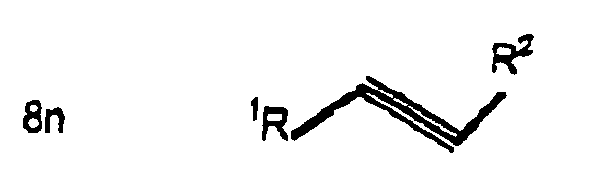
- Where R1 and R2 are H or a substituent such as alkyl groups of less than four carbons (Me, Eth, Pr, i-Pr, Bu), phenyl groups with or without substituents at the para position (with groups such as Me, Eth, MeO, HO, etc), cyano group and methoxycarbonyl.
- The properties of the basic polyacetylene chain can be controlled by the presence of electron-donor or electron-acceptor substituents. To this respect, the synthesis of substituted polyacetylenes from suitable polyacetylenes by using wolframium and molybdenum transition metals has been described (Masuda and Higashimura: "Polyacetylenes with Substituents: Their Synthesis and Properties" (1987), Adv. Polym. Sci., 81: 121-165).
- The existence of extended conjugation throughout the conducting polymer is not enough to provide polyacetylene with a high electrical conductivity since in neutral state these materials behave as insulators. It is therefore necessary to proceed to the introduction of electrical charges (= doping) into the polymer, be it positive charges (= p type doping) or negative (= n type doping). Conductivity manifests itself after a specific charge threshold.
- Although from a practical point of view, conducting organic polymers could be applied as substitutes of metallic conductors in printed circuits and as electrodes, their application in the industrial practice has been essentially limited due to two reasons: i) the difficulties in the synthesis of polyacetylene and its derivatives, and ii) the great instability of polyacetylenes, particularly after being doped, which gives rise to their oxidative degradation in the presence of oxygen, which results in the destruction of the polyacetylene chain by reaction with molecular oxygen. This results in that polyacetylenes and their derivatives must be manipulated in inert gas atmosphere or under a vacuum, which considerably complicates the manufacture and handling of conducting elements which employ these materials.
- Materials which combine conducting organic polymers with mineral hosts have been described (Cox and Stucky: "Polymerization of Methylacetylene in Hydrogen Zeolites" (1991), J. Phys. Chem., 95:710-720; Pereira, Kokotailo et al.: "Acetylene Polymerization in a H-ZSM-5 Zeolite" (1991), J. Mater. Chem., 3(8):867-872; Lewis, Millar et al.: "Trans-Polyacetylene on Sodium and Caesium Mordenites: A Resonance Raman Spectroscopic Study" (1993), Chem. Mat., 5:1509-1517; Millar, Lewis et al: "Raman-Spectroscopic Study of the Formation of Polyacetylene within Zeolite Channels" (1993), J. Mater. Chem., 3:867-872) obtained by the preparation of polyacetylene and polypropyne in the channels of microporous zeolites of medium pore size, that is, ZSM-5 Zeolite with elliptical channels of 0.54 x 0.56 nm, and of greater pore size, i.e. mordenite with 0.74 nm mean diameter channels.
- The direct polymerization of pyrrole and thiophene to respectively give polypyrrole and polythiophene in the interior of the MCM-41 mesoporous aluminosilicate has also been described (Wu and Bein: "Conducting Carbon Wires in Ordered Nanometer-Sized Channels" (1994), Science, 266:705-709: Wu and Hein: "Conducting Polymer Wires in Mesopore Hosts" (1994), Stud. Surf. Sci. Catal. 84:2269-2276; Wu and Bein "Polyaniline wires in Oxidant-Containing Mesoporous Channel Hosts" (1994), Chem, Mater., 6(8): 1109-1112; McCann, Millar et al.: "Formation of Polypyrrole and Polythiophene within Cu2+ Mordenite and H+ Mordenite Hosts Studied by EPR and UV-VIS Spectroscopy" (1995), J. Chem. Soc. Faraday Trans., 91(23): 4321-4328).
- The previously mentioned materials do not permit to obtain sufficiently high contents of conducting organic polymers in the inorganic hosts so as to find utility in industrial applications. Therefore, the inner volume available for polymerization in zeolites and mordenites is insufficient to manage to house amounts of conducting polymer greater than 10%, which in addition is achieved without obtaining polymers with sufficient purity. Additionally, the reduced size of the pores of the microporous zeolite hosts does not allow the hosts to house organic polymers substituted with voluminous groups, such as for example phenyl (or other substituted phenyls of formula R-C6-H4 where R can be an alkyl group of less than four carbons, as well as a methoxy or hydroxy group).
- On the other hand, polypyrrole and polythiophene polymers are structurally different from polyacetylene and its derivatives.
- The present invention has the object of providing materials useful as electrical conductors which comprise a host incorporating a conducting organic polymer, polyacetylene or polyacetylene derivatives, which protects the polymer from oxidation by oxygen in the environment, which are easy to manufacture and which are susceptible of containing the conducting polymer in a proportion sufficient to be able to take advantage if their conductive properties, and which permit the doping of the conducting polymer in a simple and effective manner.
- The invention also has the object of providing a process for the preparation of these materials.
- A further object of the invention is that of providing electrical conductors which incorporate the aforementioned materials.
- Other objects and advantages of the invention will become apparent in the description of the invention which will be exposed hereunder.
- The present invention refers to a material useful as an electrical conductor which comprises a conducting polymer incorporated in channels within a porous host, in which the polymer is polyacetylene or a polyacetylene derivative, in which the polymer is formed by polymerization of vapours of the acetylene monomer, previously adsorbed in channels free of host structure directing agent, with the host encapsulating the polymer in such a way as to protect the polymer from oxidation by ambient oxygen, and where the host is a modified mesoporous aluminosilicate which presents a mean pore diameter between 2 nm and 100 nm.
- In a preferred embodiment of the invention, the host is an aluminosilicate with a mean pore diameter of 3.2 nm. In another preferred embodiment, the mean pore diameter of the host is 6.2 nm.
- Specially suitable hosts are those constituted by the MCM-41 type hexagonal-phase aluminosilicates or the MCM-48 type cubic-phase ones.
- In a preferred embodiment of the invention the aluminosilicate is modified by ion-exchange with transition metal ions, or by impregnation by the introduction of transition metal ions. Such metallic ions can be Fe3+, Cu2+ and, especially Ni2+ ions. Fe(NO3)3, Cu(AcO)2 and Ni(AcO)2 are particularly suitable sources of these ions.
- According to what has been stated above, the conducting organic polymers are polyacetylene and polyacetylenes substituted with, for example, methyl, phenyl, para-substituted phenyls, cyano and methoxycarbonyl. Said polymers can be present in the neutral state and become activated, for the corresponding use, by adding positive charges consisting in a p-doping or negative charges consisting in an n-doping.
- The invention also refers to a process for preparing the aforementioned materials, which consists in incorporating a conducting polymer into channels within a porous host, in which the polymer is polyacetylene or a polyacetylene derivative, which process is described below.
- In a first stage, a host is selected constituted by a modified mesoporous aluminosilicate, which presents a mean pore diameter between 2 nm and 100 nm. According to what was stated above in relation to the description of the invention, aluminosilicates of the MCM-41 and MCM-48 types can be employed. These aluminosilicates can be obtained by means of conventional methods basically consisting in a hydrothermal crystallisation of a mixture of silicate and aluminate gels in the presence of concentrated alkyltrimethylammonium type surfactant solutions (Beck, Vartuli, et al.: "A New Family of Mesoporous Molecular Sieves Prepared with Liquid Crystal Templates" (1992). J. Am. Chem. Soc., 114: 10834-10843; Behrens: "Mesoporous Inorganic Solids" (1993), Adv. Mater. 5: 127-132; Behrens and Haak: "Ordered Molecular Arrays as Templates: A New Approach to Synthesis of Mesoporous Materials" (1993), Angew. Che, Int. Ed. Engl., 32(5): 696-699). In these methods the length of the chain of the alkyl group of alkyltrimethylammonium, concentration of the surfactant and the crystallisation time exert an influence upon the pore size of the final aluminosilicate. In a typical embodiment of these processes, a mixture of ketyltrimethylammonium bromide and tetramethylammonium hydroxide (approximately 15% by weight) is used, which is maintained, without stirring, in an autoclave with a steel reactor coated with TEFLON at approximately 130°C, at autogenous pressure for 24 hours. Higher concentrations of the surfactant agent or longer crystallisation times usually lead to expanded mesoporous materials with a greater mean pore diameter. In order to obtain aluminosilicates useful in relation to the present invention, the parameters of the method for preparing mesoporous aluminosilicates are chosen so that a suitable pore size is obtained, for example, between 2.5 and 6.2 nm, with Si/Al ratios of between ∞ and 13 for example.
- To carry out the process of the invention, the structure directing agent usually present in the channels of the aluminosilicate must have been eliminated form the aluminosilicate. The elimination of the structure directing agent can be carried out by means of exhaustive extraction with a suitable solvent. Thus, when the structure directing agent, as is the case with aluminosilicates of the MCM-41 and MCM-48 types, is constituted by alkyltrimethylammonium cations, a suitable solvent is methanol. During the extraction, the degree of progress of the extraction is verified by combustion analysis (C and N). Alternately, the elimination of the structure directing agent present in the aluminosilicate can be carried out by means of controlled calcination in an oven using gentle temperature gradients up to 550°C, first under a nitrogen current and, in the final phase, under an air current. Both in the case of elimination by solvent extraction as in that employing controlled calcination, the operation is considered finished when the C content, measured by combustion analysis, is below 0.05% by weight compared with the initial value. Typically, aluminosilicates of the MCM-41 and MCM-48 types have an initial organic matter content of approximately 54% by weight.
- It must be taken into account that, as is well known, in a large number of mesoporous aluminosilicates, the elimination of the structure directing agent brings about the progressive collapse of the mesopores which can result in a complete collapse of the structure within a matter of months. Therefore, in mesoporous aluminosilicates of this type, it is convenient to use them as hosts in the manufacture of the materials of the present application before approximately 15 days have elapsed after the elimination of the structure directing agent.
- After being stripped of the structure directing agent, in a first phase of the process, the aluminosilicate is subjected to dehydration. This dehydration can be carried out by heating the aluminosilicate to approximately 300°C at a vacuum pressure of approximately 10-2 torr for 24 hours.
- In a second stage, a gaseous current of an acetylene containing monomer is prepared, such as for example acetylene or a substituted acetylene, conveniently treated to ensure it is free of impurities, moisture or other residual gases.
- In a third stage, a treatment is carried out consisting in the impregnation of the aluminosilicate with the monomer vapours, so that the aluminosilicate channels become filled with the monomers. Once these have become adsorbed in the aluminosilicate channels, the monomers polymerise. Conveniently, in order to obtain more uniform materials, the aluminosilicate is magnetically stirred during impregnation with the vapours of the polymer. Although polymerization takes place to a certain extent, at room temperature, it is convenient to carry out this third stage at a temperature between 25 and 400°C in order to achieve maximal incorporation and polymerization of the polymers. Typically, this treatment is carried out in the vapour phase at ambient conditions or at a high vapour pressure, in a reactor, such as for instance a Schlenk type reactor, which contains the aluminosilicate. After finishing the treatment the reactor is emptied under a vacuum. This treatment can be repeated until the necessary degree of impregnation has been achieved, or until maximum impregnation has been achieved. In practice, maximum impregnation has been achieved by repeating the third stage for a total of three times. At the end of this third stage, the material comprised by the aluminosilicate and the polymer is allowed to cool down to room temperature.
- The reaction time has an influence upon the achieved polymerization degree. Thus, as the reaction proceeds, a change can be observed in the mesoporous aluminosilicate from a white initial colouring towards a grey or to a black colour. Taking into consideration that polyacetylene is essentially black, the darkening degree of the impregnated host during the reaction is indicative of the polymerisation degree of acetylene into polyacetylene.
- In the case of commercial non-substituted acetylene, in order to eliminate acetone, moisture and other impurities that might be present, it is convenient to bubble the gas through a scrubber containing concentrated sulphuric acid, and subsequently through NaOH.
- According to what has been indicated above, the aluminosilicate is preferably modified by ion exchange with transition metal ions in an aqueous solution or by impregnation by the introduction of transition metal ions.
- The modification by ion-exchange is preferably carried out when the aluminosilicate contains Al in high amounts and it basically consists in a treatment in which the aluminosilicate is contacted with a concentrated aqueous solution which contains some of the transition metals specified above. In a preferred embodiment of the invention, this solution is of Ni(AcO)2 and typically at a concentration between 0.4-0.8 M, employing, for example, a solid/liquid ratio of approximately 1:10. The contact time between the aluminosilicate and an aqueous solution of the type described above should be conveniently below 30 minutes in order to reduce to a minimum the negative influence of the solution upon the aluminosilicate structure. When higher exchange levels are desired, it is possible to again put the aluminosilicate into contact with a more concentrated solution, typically 1M. This ion exchange treatment to modify the aluminosilicate can also be analogously applied when a transition metal ion different from Ni is chosen.
- On the other hand, when dealing with an aluminosilicate in which the Si/Al ratio is ∞, its modification is preferably carried out by an impregnation treatment in which the aluminosilicate and the compound source (for example Fe(NO3)3, Cu(AcO)2 or, preferably Ni(AcO)2) which contains the transition metal ion, in a ratio between 100:5 and 100:0.1, are mechanically mixed, progressively heating the resulting mixture, preferably up to 300°C.
- It has been possible to demonstrate that the formation of the polymers in the aluminosilicate mesoporous host is especially effective when the aluminosilicate exhibits a high exchange degree.
- The final structure of the aluminosilicate exchanged with transition metal ions is characterised by a specific x-ray pattern indicative of its crystalline nature and by a certain isothermal gas adsorption capacity indicative of the mesoporous nature and of its surface area. It can usually be observed that the modification of aluminosilicates modified by ion exchange with transition metal ions, gives rise to a reduction in the crystallinity values of up to over 40% and in surface area of up to over 10% with respect to the values corresponding to non-modified aluminosilicates. By way of example, the MCM-41 material with a pore size of 3.2 nm undergoes, after two successive exchanges with Ni(AcO)2, a 50% reduction in the number of 2 2.4° peak counts and a reduction in surface area (according to the BET algorithm) from an initial value of 850 m2/g to 700 m2/g. Even so, they still exhibit a high mesoporosity level and are ideal as hosts in the materials of the present invention.
- The rigid matrix of the aluminosilicate employed according to the invention contains active centres that act as catalytic centres of the polymerization process. After polymerization, the aluminosilicate channels are packed with the polymer chains and its inert inorganic walls act as protective sheaths. In this way, the tendency of the polymers towards decomposing is drastically reduced. This implies that these materials can be stored and processed in environments in which oxygen is present without any loss in their properties.
- The doping of the conductive materials of the present invention, that is, the oxidation or reduction of the polymers encapsulated within the mesoporous aluminosilicates, consists in charging the encapsulated polymer positively by means of a p-type doping or negatively by means of n-type doping. Doping can be carried out by chemical or by electrochemical means.
- For the electrochemical doping of the materials of the present invention, modified electrodes are prepared by conventional methods, finally applying a positive electrical potential (for p-doping) or a negative electrical potential (for n-doping).
- To obtain a chemically doped material of the p-type, the starting material consists of mesoporous aluminosilicates exchanged with Cu2+ since, after polymerization, Cu2+ becomes reduced to Cu+, which in turn implies the oxidation of the polymer. Sn4+ or other metallic ions that can undergo reduction after the formation of the polymer can also be used.
- On the other hand, in order to obtain a doped material of the n-type, the starting materials are mesoporous aluminosilicates which contain Ni2+ and which are subjected to a prior reduction under hydrogen current at approximately 500°C. By means of this reduction, the transformation of Ni2+ into Ni(0) is achieved, being it possible to visually appreciate this transformation by the progressive darkening of the aluminosilicate which at the end becomes completely black. The aluminosilicate containing Ni(0) atoms must be stored and handled in an inert atmosphere in the absolute absence of moisture or oxygen. The polymerization of the monomers in Ni(0) based mesoporous aluminosilicate hosts is carried out following the process described above.
- The invention also refers to electrical conductors which comprise the materials described above. These conductors can be, for example, electrodes for batteries, especially lithium batteries, conducting surfaces for displays, conducting surfaces for luminous devices, and the like.
- Typically, an electrode according to the invention is prepared by coating a conductive, inert, vitrified and polished host, with a paste composed at least by a mixture of the conducting material, powdered graphite and paraffin with an agglutinating agent, for example in a ratio by weight between 80:15:5 and 10:85:5, and allowing the electrode so obtained to dry. In general, lower ratios of the polymer-containing aluminosilicate and greater ones of graphite, such as for example 50:40:10 remarkably decrease the resistivity of the paste. A preferred preparation of the invention employs a ratio between polymer-containing aluminosilicate: graphite:paraffin of 35:60:5.
- The conducting surfaces according to the invention are typically obtained from the deposition, on an inert conducting host, of a layer of a suspension of the polyacetylene-containing mesoporous host according to the invention in an organic solvent, such as for example acetone, adding, after allowing to air-dry, an aqueous solution, for example at 10%, of polyvinyl alcohol.
- Conductors so prepared, be them in paste or layer form, are subjected to a positive electrical potential (for example +2,0 V, for p-doping) or to a negative electrical potential (for example - 1,7 V, for n-doping), to respectively achieve the polymer oxidation or reduction.
- The mesoporous aluminosilicates which are used in the preparation of the conductive materials of the present application, have the advantage of having an internal volume and an internal surface far greater to that of the zeolites and, therefore, permit the effective encapsulation of amounts greater than 30% of polyacetylene and polyacetylene derivatives, sufficient for a great part of industrial applications.
- The following examples will illustrate the invention in greater detail.
- The alkyltrimethylammonium ion content present as structure directing agent, was determined by solids combustion analysis of ten samples of mesoporous aluminosilicates of the MCM-41 type, with pore sizes of 3.2 nm and 6.2 nm respectively, and mean particle sizes of 1 µm. A content of approximately 55% by weight was detected.
- The samples were subjected to exhaustive conventional extraction, using methanol as a solvent to eliminate the structure directing agent, checking the progress of the elimination by C combustion analysis.
- Subsequently the Ni2+ ions were introduced by successively contacting the solids with two 0.6 and 1.0 M aqueous solutions of Ni(AcO)2 for 20 minute periods. The final content of Ni3- was around 3% by weight for the 3.2 nm aluminosilicate and 0.5 for the 6.2 nm aluminosilicate.
- Subsequently the samples were subjected to dehydration by heating at 300°C at a pressure of 10-2 torr for 24 hours.
- Five samples of MCM-41 with a mean pore size of 3.2 nm and another five samples of MCM-41 with a mean pore size of 6.2 nm were placed into independent vials of 5 ml of capacity which are hermetically attached to a Schlenk type reactor, provided with a drum which permits the simultaneous treatment of five samples at controlled temperature, into which commercial acetylene gas was introduced, which had previously been purified by bubbling through a container with concentrated sulphuric acid and subsequently through a second container with NaOH, at a pressure of 1 atm and for a period of five minutes, and were subjected to different temperatures. Finally the reactor was effluxed to vacuum and the samples were allowed to cool at room temperature. This cycle was repeated three times.
- It was possible to observe that temperature exerted a crucial influence upon the polymerization of acetylene in the reactor. Therefore it was possible to quantitatively establish the amount of polymer formed by means of combustion analysis of the solid to determine the total C content of the obtained materials. The results of the analyses are shown in table I.
Effect of the reaction temperature upon the carbon content for the reaction of acetylene in the presence of mesoporous aluminosilicates. C Content (% by weight) Temperature (°C) MCM-41 (3.2 nm) MCM-48 (6.2 nm) Ambient 5.88 3.91 90 6.47 5.94 150 26.39 2.06 225 32.52 27.51 300 51.65 29.62 - According to what is shown by the values indicated in table I, the maximum content achieved for polyacetylene if 51%. This value is remarkable and allows applications such as the use of the material as electrodes in lithium batteries which demand a high content in the electroactive component. In fact, when the C content in the initial samples (54% by weight of alkyltrimethylammonium) is compared with the value for 3.2 nm MCM-41 at a temperature of 300°C, it is possible to observe that most part of the mesoporous aluminosilicate channels, which were initially occupied by the structure directing agent, have been occupied by polyacetylene.
- According to the current knowledge of mesoporous materials, the maximum packing density of an organic host within the channels, corresponds to that of the structure directing agent. Accordingly, it is possible to conclude that by means of the process of the present invention, an almost complete filling of the internal spaces of the aluminosilicate was achieved, with an efficacy and packaging degree similar to that of the structure directing agent.
- The samples prepared according to example 2 were analysed with regard to the presence and purity of the polyacetylene synthesised within the interior of the mesoporous aluminosilicate. It was possible to establish that
- i) the FT-Raman spectra of the samples coincide with those described in the chemical literature (Lewis, Millar et al.: "Trans-Polyacetylene on Sodium and Cesium Mordenites: A Resonance Raman Spectroscopic Study" (1993), Chem. Mat., 5:1509-1517; Millar, Lewis et al: "Raman-Spectroscopic Study of the Formation of Polyacetylene within Zeolite Channels" (1993), J. Mater. Chem., 3:867-872) for polyacetylenes, being the most characteristic absorptions in the bands of 1490 and 1110 cm-1;
- ii) the UV/vis spectra obtained by diffuse reflectance coincide with those described (Cox and Stucky: "Polymerization of Methylacetylene in Hydrogen Zeolites" (1991), J. Phys. Chem., 95:710-720; Pereira, Kokotailo et al.: "Acetylene Polymerization in a H-ZSM-5 Zeolite" (1991), J. Mater. Chem., 3(8) : 867-872) for the polyacetylenes and are characterised by absorption throughout the whole range of wavelengths, in which the extinction coefficient decreases progressively with the increase in wavelength;
- iii) in solids 13C NMR spectroscopy signals appear which correspond to olefinic carbons between 150 and 100 ppm, together with the signals characteristic of each constituent if any;
- iv) in X-ray photoelectronic spectroscopy (XPS) it is possible to confirm the presence, in the external surface, of carbon aluminosilicate particles with sp2 hybridisation, which is indicative of the presence of polyacetylene;
- v) in mass spectroscopy using the fast atom bombardment method (PAB-MS) it is established that the maximum weight of the polymer situated in the outermost parts of the aluminosilicate particle is greater than 1200 dalton;
- vi) when the polymer content of the samples was established by thermogravimetry coupled with differential scanning calorimetry it was established that the encapsulated polyacetylenes are thermally stable up to a temperature of 300°C.
-
- In order to obtain an electrcde comprising 6.2 nm MCM-41 obtained according to example 2, for a lithium battery, the following process is carried out:
- 80g of aluminosilicate are mixed in a mortar with 15g of graphite powder and 5g of paraffin are added as agglutinant (commercialised by Aldrich under the name Nujol oil for spectroscopy) to obtain a paste which is deposited on a conveniently polished inert conducting host, and allowed to dry.
- The so formed electrode is subjected to +2.0V for a p-doping, or alternatively, to -1.7V for an n-doping, to achieve its complete oxidation or reduction, respectively. In the electrochemical process Pt is employed as ancillary electrode, and a saturated solution of calomel as reference electrode. Although the doping can be carried out in an aqueous medium, it can also be carried out in organic solvents such as acetonitrile and dimethylformamide. Among the supporting electrolytes that can be used in organic solvents it is possible to mention tetraethylammonium perchlorate, n-butylammonium hexafluorophosphate, whereas lithium or sodium perchlorate can be used in water.
- In order to obtain a conducting surface comprising 6.2 nm MCM-41 obtained according to example 2, a suspension of 1g of MCM-41 is prepared in 25 ml of acetone and is deposited over an inert conductive host. After air-drying, few drops of an aqueous solution of 10% polyvinyl alcohol are added.
- The so formed electrode is subjected to +2.0V for a p-doping, or alternatively, to -1.7V for an n-doping, to achieve its complete oxidation or reduction, respectively. The electrochemical process is carried out using the same means and reagents as those described for example 3.
Claims (41)
- A material useful as an electrical conductor comprising a conducting polymer incorporated in channels within a porous host, wherein the polymer is polyacetylene or a polyacetylene derivative,
characterised in that
the polymer is formed by polymerization of vapours of the acetylene monomer, previously adsorbed in channels of the mesoporous material, free of host structure directing agent;
the host encapsulates the polymer in such a way that the polymer is protected against oxidation by ambient oxygen; and
the host is a modified mesoporous aluminosilicate which presents a mean pore diameter between 2 nm and 100 nm. - A host according to claim 1, characterised in that the host is an aluminosilicate with a mean pore diameter of 3.2 nm.
- A host according to claim 1, characterised in that the host is an aluminosilicate with a mean pore diameter of 6.2 nm.
- A material according to claims 1, 2 or 3, characterised in that it comprises an aluminosilicate host which incorporates a polymer comprised by polyacetylene substituted with phenyl groups.
- A material according to any of claims 1 to 4, characterised in that the host is an hexagonal-phase aluminosilicate of the MCM-41 type.
- A material according to any of claims 1 to 4, characterised in that the host is a cubic-phase aluminosilicate of the MCM-48 type.
- A material according to any of claims 1 to 6, characterised in that the aluminosilicate has been modified by ion-exchange with transition metal ions.
- A material according to any of claims 1 to 6, characterised in that the aluminosilicate has been modified by impregnation by means of the introduction of transition metal ions.
- A material according to claims 7 or 8, characterised in that the metal ions are Ni2+ ions.
- A material according to claim 9, characterised in that the transition metal ions originate from Ni(AcO)2.
- A material according to claims 7 or 8, characterised in that the metal ions are Fe3+ ions.
- A material according to claim 11, characterised in that the Fe3+ ions originate from Fe(NO3)3.
- A material according to claims 7 or 8, characterised in that the metal ions are Cu2+ ions.
- A material according to claim 13, characterised in that the transition metal ions originate from Cu(AcO)2.
- A material according to claims 1 to 4, characterised in that the polymer exhibits a positive charge consisting in a p-doping.
- A material according to claims 1 to 4, characterised in that the polymer exhibits a negative charge consisting in an n-doping.
- A process to prepare an electrically conductive material which comprises
incorporating a conductive polymer into channels within a porous host, in which the polymer is polyacetylene or a polyacetylene derivative,
characterised in that it comprises
dehydrating a modified aluminosilicate not containing a structure directing agent in its channels;
preparing a vapour of an acetylene monomer;
performing at least one impregnation and polymerization phase which comprises incorporating the vapour into the aluminosilicate channels, and subjecting the aluminosilicate with the monomers to polymerization by means of a thermal treatment at a temperature between 25 and 400°C;
the host being a modified mesoporous aluminosilicate which presents a mean pore diameter between 2 nm and 100 nm. - A process according co claim 17, characterised in that the host is selected from a MCM-41 type hexagonal-phase aluminosilicate and a MCM-48 type cubic-phase aluminosilicate.
- A process according to any of claims 16 to 18, characterised in that the aluminosilicate is modified by ion-exchange with transition metal ions in an aqueous solution prior to the polymerization phase.
- A process according to any of claims 16 to 18, characterised in that the aluminosilicate is modified by impregnation by means of the introduction of transition metal ions.
- A process according to claim 19 or 20, characterised in that the metal ions are selected from Ni2+, Fe3+ and Cu2+ ions.
- A process according tc claim 21, characterised in that the Ni2+ ions originate from Ni(AcO)2.
- A process according to claim 21, characterised in that the Fe2+ ions originate from Fe(NO3)3.
- A process according to claim 21, characterised in that the Cu2+ ions originate from Cu(AcO)2.
- A process according to claim 17, characterised in that the encapsulated polymer is positively charged by means of a p-type doping.
- A process according to claim 17, characterised in that the encapsulated polymer is negatively charged by means of a n-type doping.
- A process according to claims 25 or 26, characterised in that the doping is carried out electrochemically.
- A process according to claims 25 or 26, characterised in that the doping is carried out chemically.
- A process according to claim 17, characterised in that the impregnation and polymerization phase is repeated three times.
- A process according to claim 17, characterised in that the polymer is polyacetylene substituted with methyl, phenyl, para-substituted phenyls, cyano, methoxycarbonyl groups.
- An electrical conductor characterised in that it comprises a material according to any of claims 1-16.
- An electrical conductor characterised in that it comprises a material prepared according to the process according to any of claims 17-30.
- A conductor according to claims 31 or 32, characterised in that it is an electrode used in batteries, which comprises said material.
- A conductor according to claims 31 or 32, characterised in that it is a conductive surface for displays, which comprises said material.
- A conductor according to claims 31 or 32, characterised in that it is a conductive surface for luminous devices, which comprises said material.
- A conductor according to claim 33, characterised in that it is an electrode in lithium batteries, which comprises said material.
- A conductor according to claims 33 or 36, characterised in that the electrode comprises
an inert, vitrified and polished electrode
a coating of the inert electrode at least composed by a mixture of said material, powdered graphite and paraffin as an agglutinant. - A conductor according to claim 37, characterised in that the coating contains said material, graphite and paraffin in a ratio by weight of 80:15:5.
- A conductor according to claims 34 or 35, characterised in that the conducting surface is a layer obtained by the deposition on a host of a suspension of said material on an organic solvent with an aqueous solution of polyvinyl alcohol.
- A conductor according to claim 39, characterised in that the organic solvent is acetone.
- A conductor according to claim 39, characterised in that the aqueous solution of polyvinyl alcohol is a 10% solution.
Applications Claiming Priority (3)
| Application Number | Priority Date | Filing Date | Title |
|---|---|---|---|
| ES9901708 | 1999-07-21 | ||
| ES009901708A ES2165280B1 (en) | 1999-07-21 | 1999-07-21 | A USEFUL MATERIAL AS AN ELECTRIC CONDUCTOR THAT INCLUDES POLYACETIENE OR SUBSTITUTED POLYACETIENEES INCORPORATED IN A MESOPOROUS SUPPORT, PROCEDURE FOR OBTAINING THE MATERIAL AND CONDUCTORS THAT UNDERSTAND THE MATERIAL. |
| PCT/ES2000/000260 WO2001005840A2 (en) | 1999-07-21 | 2000-07-19 | Material useful as electric conductor and comprising polyacetylene or substituted polyacetylenes incorporated in a mesoporous support, production process, and conductors made of said material |
Publications (2)
| Publication Number | Publication Date |
|---|---|
| EP1205943A2 true EP1205943A2 (en) | 2002-05-15 |
| EP1205943B1 EP1205943B1 (en) | 2003-09-10 |
Family
ID=8309412
Family Applications (1)
| Application Number | Title | Priority Date | Filing Date |
|---|---|---|---|
| EP00945962A Expired - Lifetime EP1205943B1 (en) | 1999-07-21 | 2000-07-19 | Material useful as electric conductor and comprising polyacetylene or substituted polyacetylenes incorporated in a mesoporous support, production process, and conductors made of said material |
Country Status (6)
| Country | Link |
|---|---|
| EP (1) | EP1205943B1 (en) |
| AT (1) | ATE249677T1 (en) |
| AU (1) | AU5987800A (en) |
| DE (1) | DE60005202T2 (en) |
| ES (2) | ES2165280B1 (en) |
| WO (1) | WO2001005840A2 (en) |
Cited By (1)
| Publication number | Priority date | Publication date | Assignee | Title |
|---|---|---|---|---|
| WO2005008684A1 (en) * | 2003-07-23 | 2005-01-27 | Canon Kabushiki Kaisha | Structured material and producing method thereof |
Families Citing this family (1)
| Publication number | Priority date | Publication date | Assignee | Title |
|---|---|---|---|---|
| DE202013100463U1 (en) | 2013-02-01 | 2014-05-07 | Smp Deutschland Gmbh | Polymer harness |
Family Cites Families (2)
| Publication number | Priority date | Publication date | Assignee | Title |
|---|---|---|---|---|
| GB2058096B (en) * | 1979-03-29 | 1983-04-20 | Showa Denko Kk | Process for preparing gel-like composition of acetylene high polymer and process for fabrication thereof |
| US4394304A (en) * | 1982-01-29 | 1983-07-19 | Massachusetts Institute Of Technology | Electrically conducting polymer blends |
-
1999
- 1999-07-21 ES ES009901708A patent/ES2165280B1/en not_active Expired - Fee Related
-
2000
- 2000-07-19 AT AT00945962T patent/ATE249677T1/en not_active IP Right Cessation
- 2000-07-19 ES ES00945962T patent/ES2203497T3/en not_active Expired - Lifetime
- 2000-07-19 EP EP00945962A patent/EP1205943B1/en not_active Expired - Lifetime
- 2000-07-19 DE DE60005202T patent/DE60005202T2/en not_active Expired - Fee Related
- 2000-07-19 WO PCT/ES2000/000260 patent/WO2001005840A2/en not_active Ceased
- 2000-07-19 AU AU59878/00A patent/AU5987800A/en not_active Abandoned
Non-Patent Citations (1)
| Title |
|---|
| See references of WO0105840A2 * |
Cited By (2)
| Publication number | Priority date | Publication date | Assignee | Title |
|---|---|---|---|---|
| WO2005008684A1 (en) * | 2003-07-23 | 2005-01-27 | Canon Kabushiki Kaisha | Structured material and producing method thereof |
| US7781020B2 (en) | 2003-07-23 | 2010-08-24 | Canon Kabushiki Kaisha | Structured material and producing method thereof |
Also Published As
| Publication number | Publication date |
|---|---|
| EP1205943B1 (en) | 2003-09-10 |
| AU5987800A (en) | 2001-02-05 |
| WO2001005840A2 (en) | 2001-01-25 |
| ATE249677T1 (en) | 2003-09-15 |
| ES2165280B1 (en) | 2003-05-01 |
| DE60005202T2 (en) | 2004-07-01 |
| WO2001005840A3 (en) | 2001-07-19 |
| ES2165280A1 (en) | 2002-03-01 |
| DE60005202D1 (en) | 2003-10-16 |
| ES2203497T3 (en) | 2004-04-16 |
Similar Documents
| Publication | Publication Date | Title |
|---|---|---|
| Shacklette et al. | Solid‐state synthesis of highly conducting polyphenylene from crystalline oligomers | |
| KR101378029B1 (en) | Lithium rechargeable electrochemical cell | |
| Aratani et al. | Giant meso–meso‐Linked Porphyrin Arrays of Micrometer Molecular Length and Their Fabrication | |
| KR100917286B1 (en) | Fullerene-Based Secondary Battery Electrode | |
| Hou et al. | Boosting the reversible, high‐rate Na+ storage capability of the hard carbon anode via the synergistic structural tailoring and controlled presodiation | |
| Majumder et al. | Augmented gravimetric and volumetric capacitive performance of rare earth metal oxide (Eu2O3) incorporated polypyrrole for supercapacitor applications | |
| Yuan et al. | Hierarchical sulfur-impregnated hydrogenated TiO2 mesoporous spheres comprising anatase nanosheets with highly exposed (001) facets for advanced Li-S batteries | |
| Kumankuma‐Sarpong et al. | Yttrium Vanadium Oxide–Poly (3, 4‐ethylenedioxythiophene) Composite Cathode Material for Aqueous Zinc‐Ion Batteries | |
| Wu et al. | Conducting polymer wires in mesopore hosts | |
| Peng et al. | Boosting lithium storage performance of small‐molecule organic cathodes through synergistic molecular engineering and nanostructure design | |
| US12448291B2 (en) | Nitrogen and fluorine doped graphene and use thereof | |
| WO2021198868A1 (en) | Method of tuning the electronic energy level of covalent organic framework for crafting high-rate na-ion battery anode | |
| Hara et al. | Structural and electrochemical properties of lithiated polymerized aromatics. Anodes for lithium-ion cells | |
| Luca et al. | Intercalation and polymerisation of aniline within a tubular aluminosilicate | |
| Kaibarta et al. | Carbon-based hierarchical mesoporous polyaniline/montmorillonite nanocomposites for high energy density supercapacitors | |
| JP2024531355A (en) | Fused aromatic molecules as electrode materials | |
| Zhang et al. | Self-growing graphite felt/vanadium pentoxide/polyindole ternary composite as binder-free electrode for supercapacitor with 1.8 V operating potential window and excellent electrochemical performance | |
| KR20160085998A (en) | Method for synthesis of Silicon/Carbon/CNT as the lithium secondary battery anode material | |
| Haridas et al. | Simple and scalable gelatin-mediated synthesis of a novel iron sulfide/graphitic carbon nanoarchitecture for sustainable sodium-ion storage | |
| Bein | Conjugated and conducting nanostructures in zeolites | |
| WO2021025745A2 (en) | Conductive matrix and sulfur composite | |
| EP1205943B1 (en) | Material useful as electric conductor and comprising polyacetylene or substituted polyacetylenes incorporated in a mesoporous support, production process, and conductors made of said material | |
| Yadav et al. | Discerning the Role of A‐Site Cation on the Efficiency and Stability of the Halide Perovskite Solid‐State Supercapacitor | |
| Phani et al. | Influence of zeolite as medium on the polymerization of aniline at the electrode-electrolyte interface | |
| Van Damme et al. | Intercalation of tetrathiafulvalene in vanadium pentoxide gels |
Legal Events
| Date | Code | Title | Description |
|---|---|---|---|
| PUAI | Public reference made under article 153(3) epc to a published international application that has entered the european phase |
Free format text: ORIGINAL CODE: 0009012 |
|
| 17P | Request for examination filed |
Effective date: 20020114 |
|
| AK | Designated contracting states |
Kind code of ref document: A2 Designated state(s): AT BE CH CY DE DK ES FI FR GB GR IE IT LI LU MC NL PT SE |
|
| GRAH | Despatch of communication of intention to grant a patent |
Free format text: ORIGINAL CODE: EPIDOS IGRA |
|
| GRAS | Grant fee paid |
Free format text: ORIGINAL CODE: EPIDOSNIGR3 |
|
| GRAA | (expected) grant |
Free format text: ORIGINAL CODE: 0009210 |
|
| AK | Designated contracting states |
Kind code of ref document: B1 Designated state(s): AT BE CH CY DE DK ES FI FR GB GR IE IT LI LU MC NL PT SE |
|
| PG25 | Lapsed in a contracting state [announced via postgrant information from national office to epo] |
Ref country code: NL Free format text: LAPSE BECAUSE OF FAILURE TO SUBMIT A TRANSLATION OF THE DESCRIPTION OR TO PAY THE FEE WITHIN THE PRESCRIBED TIME-LIMIT Effective date: 20030910 Ref country code: CH Free format text: LAPSE BECAUSE OF FAILURE TO SUBMIT A TRANSLATION OF THE DESCRIPTION OR TO PAY THE FEE WITHIN THE PRESCRIBED TIME-LIMIT Effective date: 20030910 Ref country code: BE Free format text: LAPSE BECAUSE OF FAILURE TO SUBMIT A TRANSLATION OF THE DESCRIPTION OR TO PAY THE FEE WITHIN THE PRESCRIBED TIME-LIMIT Effective date: 20030910 Ref country code: AT Free format text: LAPSE BECAUSE OF FAILURE TO SUBMIT A TRANSLATION OF THE DESCRIPTION OR TO PAY THE FEE WITHIN THE PRESCRIBED TIME-LIMIT Effective date: 20030910 Ref country code: FI Free format text: LAPSE BECAUSE OF FAILURE TO SUBMIT A TRANSLATION OF THE DESCRIPTION OR TO PAY THE FEE WITHIN THE PRESCRIBED TIME-LIMIT Effective date: 20030910 Ref country code: CY Free format text: LAPSE BECAUSE OF FAILURE TO SUBMIT A TRANSLATION OF THE DESCRIPTION OR TO PAY THE FEE WITHIN THE PRESCRIBED TIME-LIMIT Effective date: 20030910 Ref country code: LI Free format text: LAPSE BECAUSE OF FAILURE TO SUBMIT A TRANSLATION OF THE DESCRIPTION OR TO PAY THE FEE WITHIN THE PRESCRIBED TIME-LIMIT Effective date: 20030910 Ref country code: IT Free format text: LAPSE BECAUSE OF FAILURE TO SUBMIT A TRANSLATION OF THE DESCRIPTION OR TO PAY THE FEE WITHIN THE PRESCRIBED TIME-LIMIT;WARNING: LAPSES OF ITALIAN PATENTS WITH EFFECTIVE DATE BEFORE 2007 MAY HAVE OCCURRED AT ANY TIME BEFORE 2007. THE CORRECT EFFECTIVE DATE MAY BE DIFFERENT FROM THE ONE RECORDED. Effective date: 20030910 |
|
| REG | Reference to a national code |
Ref country code: GB Ref legal event code: FG4D |
|
| REG | Reference to a national code |
Ref country code: CH Ref legal event code: EP |
|
| REF | Corresponds to: |
Ref document number: 60005202 Country of ref document: DE Date of ref document: 20031016 Kind code of ref document: P |
|
| REG | Reference to a national code |
Ref country code: IE Ref legal event code: FG4D |
|
| PG25 | Lapsed in a contracting state [announced via postgrant information from national office to epo] |
Ref country code: SE Free format text: LAPSE BECAUSE OF FAILURE TO SUBMIT A TRANSLATION OF THE DESCRIPTION OR TO PAY THE FEE WITHIN THE PRESCRIBED TIME-LIMIT Effective date: 20031210 Ref country code: GR Free format text: LAPSE BECAUSE OF FAILURE TO SUBMIT A TRANSLATION OF THE DESCRIPTION OR TO PAY THE FEE WITHIN THE PRESCRIBED TIME-LIMIT Effective date: 20031210 Ref country code: DK Free format text: LAPSE BECAUSE OF FAILURE TO SUBMIT A TRANSLATION OF THE DESCRIPTION OR TO PAY THE FEE WITHIN THE PRESCRIBED TIME-LIMIT Effective date: 20031210 |
|
| PG25 | Lapsed in a contracting state [announced via postgrant information from national office to epo] |
Ref country code: PT Free format text: LAPSE BECAUSE OF FAILURE TO SUBMIT A TRANSLATION OF THE DESCRIPTION OR TO PAY THE FEE WITHIN THE PRESCRIBED TIME-LIMIT Effective date: 20031222 |
|
| NLV1 | Nl: lapsed or annulled due to failure to fulfill the requirements of art. 29p and 29m of the patents act | ||
| REG | Reference to a national code |
Ref country code: CH Ref legal event code: PL |
|
| REG | Reference to a national code |
Ref country code: ES Ref legal event code: FG2A Ref document number: 2203497 Country of ref document: ES Kind code of ref document: T3 |
|
| ET | Fr: translation filed | ||
| PLBE | No opposition filed within time limit |
Free format text: ORIGINAL CODE: 0009261 |
|
| STAA | Information on the status of an ep patent application or granted ep patent |
Free format text: STATUS: NO OPPOSITION FILED WITHIN TIME LIMIT |
|
| PG25 | Lapsed in a contracting state [announced via postgrant information from national office to epo] |
Ref country code: LU Free format text: LAPSE BECAUSE OF NON-PAYMENT OF DUE FEES Effective date: 20040719 Ref country code: IE Free format text: LAPSE BECAUSE OF NON-PAYMENT OF DUE FEES Effective date: 20040719 |
|
| PG25 | Lapsed in a contracting state [announced via postgrant information from national office to epo] |
Ref country code: ES Free format text: LAPSE BECAUSE OF NON-PAYMENT OF DUE FEES Effective date: 20040720 |
|
| PGFP | Annual fee paid to national office [announced via postgrant information from national office to epo] |
Ref country code: FR Payment date: 20040729 Year of fee payment: 5 |
|
| PG25 | Lapsed in a contracting state [announced via postgrant information from national office to epo] |
Ref country code: MC Free format text: LAPSE BECAUSE OF NON-PAYMENT OF DUE FEES Effective date: 20040731 |
|
| PGFP | Annual fee paid to national office [announced via postgrant information from national office to epo] |
Ref country code: DE Payment date: 20040820 Year of fee payment: 5 |
|
| 26N | No opposition filed |
Effective date: 20040614 |
|
| REG | Reference to a national code |
Ref country code: IE Ref legal event code: MM4A |
|
| PGFP | Annual fee paid to national office [announced via postgrant information from national office to epo] |
Ref country code: GB Payment date: 20050715 Year of fee payment: 6 |
|
| REG | Reference to a national code |
Ref country code: ES Ref legal event code: FD2A Effective date: 20040720 |
|
| PG25 | Lapsed in a contracting state [announced via postgrant information from national office to epo] |
Ref country code: DE Free format text: LAPSE BECAUSE OF NON-PAYMENT OF DUE FEES Effective date: 20060201 |
|
| PG25 | Lapsed in a contracting state [announced via postgrant information from national office to epo] |
Ref country code: FR Free format text: LAPSE BECAUSE OF NON-PAYMENT OF DUE FEES Effective date: 20060331 |
|
| REG | Reference to a national code |
Ref country code: FR Ref legal event code: ST Effective date: 20060331 |
|
| PG25 | Lapsed in a contracting state [announced via postgrant information from national office to epo] |
Ref country code: GB Free format text: LAPSE BECAUSE OF NON-PAYMENT OF DUE FEES Effective date: 20060719 |
|
| GBPC | Gb: european patent ceased through non-payment of renewal fee |
Effective date: 20060719 |