EP1205570A1 - Color crt mask frame, steel plate for use therein, process for producing the steel plate, and color crt having the frame - Google Patents
Color crt mask frame, steel plate for use therein, process for producing the steel plate, and color crt having the frame Download PDFInfo
- Publication number
- EP1205570A1 EP1205570A1 EP01908231A EP01908231A EP1205570A1 EP 1205570 A1 EP1205570 A1 EP 1205570A1 EP 01908231 A EP01908231 A EP 01908231A EP 01908231 A EP01908231 A EP 01908231A EP 1205570 A1 EP1205570 A1 EP 1205570A1
- Authority
- EP
- European Patent Office
- Prior art keywords
- color crt
- mask frame
- frame
- steel sheet
- mask
- Prior art date
- Legal status (The legal status is an assumption and is not a legal conclusion. Google has not performed a legal analysis and makes no representation as to the accuracy of the status listed.)
- Withdrawn
Links
Images


Classifications
-
- C—CHEMISTRY; METALLURGY
- C22—METALLURGY; FERROUS OR NON-FERROUS ALLOYS; TREATMENT OF ALLOYS OR NON-FERROUS METALS
- C22C—ALLOYS
- C22C38/00—Ferrous alloys, e.g. steel alloys
- C22C38/18—Ferrous alloys, e.g. steel alloys containing chromium
- C22C38/40—Ferrous alloys, e.g. steel alloys containing chromium with nickel
- C22C38/42—Ferrous alloys, e.g. steel alloys containing chromium with nickel with copper
-
- C—CHEMISTRY; METALLURGY
- C22—METALLURGY; FERROUS OR NON-FERROUS ALLOYS; TREATMENT OF ALLOYS OR NON-FERROUS METALS
- C22C—ALLOYS
- C22C38/00—Ferrous alloys, e.g. steel alloys
- C22C38/18—Ferrous alloys, e.g. steel alloys containing chromium
- C22C38/22—Ferrous alloys, e.g. steel alloys containing chromium with molybdenum or tungsten
-
- C—CHEMISTRY; METALLURGY
- C21—METALLURGY OF IRON
- C21D—MODIFYING THE PHYSICAL STRUCTURE OF FERROUS METALS; GENERAL DEVICES FOR HEAT TREATMENT OF FERROUS OR NON-FERROUS METALS OR ALLOYS; MAKING METAL MALLEABLE, e.g. BY DECARBURISATION OR TEMPERING
- C21D8/00—Modifying the physical properties of ferrous metals or ferrous alloys by deformation combined with, or followed by, heat treatment
- C21D8/02—Modifying the physical properties of ferrous metals or ferrous alloys by deformation combined with, or followed by, heat treatment during manufacturing of plates or strips
- C21D8/0221—Modifying the physical properties of ferrous metals or ferrous alloys by deformation combined with, or followed by, heat treatment during manufacturing of plates or strips characterised by the working steps
- C21D8/0226—Hot rolling
-
- C—CHEMISTRY; METALLURGY
- C22—METALLURGY; FERROUS OR NON-FERROUS ALLOYS; TREATMENT OF ALLOYS OR NON-FERROUS METALS
- C22C—ALLOYS
- C22C38/00—Ferrous alloys, e.g. steel alloys
- C22C38/04—Ferrous alloys, e.g. steel alloys containing manganese
-
- C—CHEMISTRY; METALLURGY
- C22—METALLURGY; FERROUS OR NON-FERROUS ALLOYS; TREATMENT OF ALLOYS OR NON-FERROUS METALS
- C22C—ALLOYS
- C22C38/00—Ferrous alloys, e.g. steel alloys
- C22C38/06—Ferrous alloys, e.g. steel alloys containing aluminium
-
- C—CHEMISTRY; METALLURGY
- C22—METALLURGY; FERROUS OR NON-FERROUS ALLOYS; TREATMENT OF ALLOYS OR NON-FERROUS METALS
- C22C—ALLOYS
- C22C38/00—Ferrous alloys, e.g. steel alloys
- C22C38/12—Ferrous alloys, e.g. steel alloys containing tungsten, tantalum, molybdenum, vanadium, or niobium
-
- C—CHEMISTRY; METALLURGY
- C22—METALLURGY; FERROUS OR NON-FERROUS ALLOYS; TREATMENT OF ALLOYS OR NON-FERROUS METALS
- C22C—ALLOYS
- C22C38/00—Ferrous alloys, e.g. steel alloys
- C22C38/18—Ferrous alloys, e.g. steel alloys containing chromium
- C22C38/24—Ferrous alloys, e.g. steel alloys containing chromium with vanadium
-
- H—ELECTRICITY
- H01—ELECTRIC ELEMENTS
- H01J—ELECTRIC DISCHARGE TUBES OR DISCHARGE LAMPS
- H01J29/00—Details of cathode-ray tubes or of electron-beam tubes of the types covered by group H01J31/00
- H01J29/02—Electrodes; Screens; Mounting, supporting, spacing or insulating thereof
- H01J29/06—Screens for shielding; Masks interposed in the electron stream
- H01J29/07—Shadow masks for colour television tubes
-
- C—CHEMISTRY; METALLURGY
- C21—METALLURGY OF IRON
- C21D—MODIFYING THE PHYSICAL STRUCTURE OF FERROUS METALS; GENERAL DEVICES FOR HEAT TREATMENT OF FERROUS OR NON-FERROUS METALS OR ALLOYS; MAKING METAL MALLEABLE, e.g. BY DECARBURISATION OR TEMPERING
- C21D8/00—Modifying the physical properties of ferrous metals or ferrous alloys by deformation combined with, or followed by, heat treatment
- C21D8/02—Modifying the physical properties of ferrous metals or ferrous alloys by deformation combined with, or followed by, heat treatment during manufacturing of plates or strips
- C21D8/0221—Modifying the physical properties of ferrous metals or ferrous alloys by deformation combined with, or followed by, heat treatment during manufacturing of plates or strips characterised by the working steps
- C21D8/0236—Cold rolling
-
- C—CHEMISTRY; METALLURGY
- C21—METALLURGY OF IRON
- C21D—MODIFYING THE PHYSICAL STRUCTURE OF FERROUS METALS; GENERAL DEVICES FOR HEAT TREATMENT OF FERROUS OR NON-FERROUS METALS OR ALLOYS; MAKING METAL MALLEABLE, e.g. BY DECARBURISATION OR TEMPERING
- C21D8/00—Modifying the physical properties of ferrous metals or ferrous alloys by deformation combined with, or followed by, heat treatment
- C21D8/02—Modifying the physical properties of ferrous metals or ferrous alloys by deformation combined with, or followed by, heat treatment during manufacturing of plates or strips
- C21D8/0247—Modifying the physical properties of ferrous metals or ferrous alloys by deformation combined with, or followed by, heat treatment during manufacturing of plates or strips characterised by the heat treatment
- C21D8/0252—Modifying the physical properties of ferrous metals or ferrous alloys by deformation combined with, or followed by, heat treatment during manufacturing of plates or strips characterised by the heat treatment with application of tension
-
- C—CHEMISTRY; METALLURGY
- C21—METALLURGY OF IRON
- C21D—MODIFYING THE PHYSICAL STRUCTURE OF FERROUS METALS; GENERAL DEVICES FOR HEAT TREATMENT OF FERROUS OR NON-FERROUS METALS OR ALLOYS; MAKING METAL MALLEABLE, e.g. BY DECARBURISATION OR TEMPERING
- C21D8/00—Modifying the physical properties of ferrous metals or ferrous alloys by deformation combined with, or followed by, heat treatment
- C21D8/02—Modifying the physical properties of ferrous metals or ferrous alloys by deformation combined with, or followed by, heat treatment during manufacturing of plates or strips
- C21D8/0247—Modifying the physical properties of ferrous metals or ferrous alloys by deformation combined with, or followed by, heat treatment during manufacturing of plates or strips characterised by the heat treatment
- C21D8/0263—Modifying the physical properties of ferrous metals or ferrous alloys by deformation combined with, or followed by, heat treatment during manufacturing of plates or strips characterised by the heat treatment following hot rolling
-
- H—ELECTRICITY
- H01—ELECTRIC ELEMENTS
- H01J—ELECTRIC DISCHARGE TUBES OR DISCHARGE LAMPS
- H01J2229/00—Details of cathode ray tubes or electron beam tubes
- H01J2229/07—Shadow masks
- H01J2229/0727—Aperture plate
- H01J2229/0733—Aperture plate characterised by the material
Definitions
- This invention belongs to the technical field of color CRT's (color cathode ray tubes) (also referred to as color picture tubes) used in television receivers, displays, and the like. More specifically, this invention relates to a mask frame, a steel sheet used in manufacturing the mask frame and a manufacturing method therefor.
- the mask frame is a member which supports under tension a tension-type shadow mask which is disposed within a color CRT (in this specification referred to as a color CRT mask frame).
- a color CRT has in its interior three electron guns for red, blue, and green and a fluorescent screen (screen) impacted by electron beams discharged therefrom.
- the surface of the fluorescent screen has fluorescent dots formed thereon which generate the above-mentioned three colors and which are arranged in a regular sequence.
- a rectangular shadow mask having a large number of aligned beam passage holes is disposed just in front of the fluorescent screen.
- the shadow mask is a member for performing alignment of the electron beams and the fluorescent dots so that each electron beam irradiates the fluorescent dots of the corresponding color.
- a conventional ordinary shadow mask is made of a cold rolled steel sheet having a thickness of 0.15 - 0.28 mm in which fine holes with a regular spacing are formed by etching. After the shadow mask is bent by press forming, its four sides are welded to a mask frame and secured. The curvature of the mask is necessary so that thermal expansion of the mask and vibrations transmitted from the outside are absorbed by the mask and positional deviation of the holes in the mask does not take place. Accordingly, this type of mask can not adequately cope with flattening of the mask surface.
- a more recently developed type is a tension-type shadow mask.
- a typical tension-type shadow mask is made of a thin steel sheet having a thickness of 0.05 - 0.15 mm in which small holes for the passage of beams are formed. It is attached to a mask frame in a state in which a tensile force is applied to it in the vertical direction. Thermal expansion and vibration of the mask can be absorbed by the tension, and the mask can be made flat.
- a tension-type shadow mask in which bi-directional tension is applied in both the vertical direction and the horizontal direction is also possible.
- a mask frame for supporting the above-described typical tension-type shadow mask is normally assembled by welding two long-side frame members extending in the horizontal direction which form upper and lower frame portions and two short-side frame members extending in the vertical direction which form left and right frame portions.
- the long-side frame members are made from a steel sheet shaped by press forming or roll forming of the steel sheet.
- the thickness of the steel sheet is in the range of 3- 6 mm, and it is selected in accordance with the size of the CRT.
- Round or rectangular pipes or bars are normally used as the short-side frame members.
- blackening treatment of the mask frame is carried out.
- the blackening treatment is treatment in which a black film made of Fe 3 O 4 is formed on the surface of the steel by heat treatment.
- the black film increases the thermal emissivity of the surface of the material, it increases the absorption and irradiation of electron beams, and it also has the effect of preventing the generation of secondary electrons and the formation of rust.
- the heating conditions for this blackening treatment are normally 450 - 680°C for 10 - 30 minutes.
- Attaching the above-described tension-type shadow mask to a mask frame is carried out by welding the upper and lower edges of the shadow mask to the upper frame portion and the lower frame portion of the frame while compressing from the outside towards the inside the upper frame portion and the lower frame portion of the mask frame formed from the long-side frame members, and if necessary simultaneously applying tension to the shadow mask in the vertical direction. Then, when the pressure applied to the upper frame portion and the lower frame portion of the frame is removed, due to the rebound force of the frame, the shadow mask is supported by the frame in a state in which it is pulled in the vertical direction. The left and right edges of the shadow mask are not secured to the left and right frame portions of the mask frame (made from the short-side frame members).
- the upper frame portion and the lower frame portion of the mask frame are in a state in which a bending stress is applied, and the shadow mask is in a state in which it receives a tensile force in the vertical direction.
- the left and right frame portions of the mask frame perform the function of supporting the upper and lower frame portions which are under a bending stress.
- stress relief annealing is applied to the shadow mask/frame structure, and strains occurring at the time of mask installation are removed.
- the stress relief annealing is generally carried out by heating at a temperature of 400 - 680°C for 10 - 30 minutes.
- Process A The order of steps of the above-described process (referred to below as Process A) is as follows:
- the step of blackening treatment and the step of stress relief annealing can be reversed.
- the step of stress relief annealing strains in the mask frame due to forming and welding are removed.
- the mask frame and the shadow mask together undergo blackening treatment, and the strains resulting from installation of the shadow mask are also removed during the blackening treatment.
- Process B The order of steps in this process is as follows: Forming --> assembly --> stress relief annealing --> installation of shadow mask --> blackening treatment
- the heat treatment step which is carried out after installation of the shadow mask is heat treatment carried out under the special circumstances in which the upper and lower frame portions of the mask frame are subjected to a bending stress and the shadow mask receives tension.
- This heat treatment there is the possibility of deformation of the mask frame taking place.
- a tensile force in the vertical direction is applied to the shadow mask by the mask frame, so deformation of the upper and lower frame portions of the mask frame causes a reduction in the tensile force acting on the shadow mask and causes surface strains.
- wrinkles and nonuniformity of the pitch of the holes develop, and are cases in which a deterioration of properties occurs such as impurity of color. Accordingly, it is important to suppress deformation of the mask frame during heat treatment.
- the long-side frame members which make up the upper and lower frame portions of the mask frame which supports the shadow mask under tension have been manufactured from 36 Ni steel or 42 Ni steel having a high level of high-temperature creep strength. These steels respectively include 36% or 42% of Ni, which is expensive, so the mask frame becomes expensive.
- An object of the present invention is to provide a steel sheet for a color CRT mask frame which is relatively inexpensive, which has excellent high-temperature strength, and which has a small amount of creep at high temperatures.
- deformation of a frame during heat treatment such as stress relief annealing carried out after mounting of a tension-type shadow mask on a mask frame can be suppressed to a minimum value, and the occurrence of wrinkles in a shadow mask and the occurrence of irregularities in the pitch of holes due to heat treatment can be prevented.
- Another object of this invention is to provide a steel sheet for a color CRT mask frame which has a high strength so that the mask frame can be reduced in weight and which has adequate formability and on which a black film having good adhesion can be formed by blackening treatment.
- Another object of this invention is to provide a method of manufacturing the above-described steel sheet for a color CRT mask frame.
- the present invention is based on the below-described knowledge found by the present inventors.
- the present invention is a steel sheet for a color CRT mask frame having a steel composition consisting essentially of, in mass %, C: 0.03 - 0.30%, Si: at most 0.30%, Mn: 0.05-1.5%, P: at most 0.05%, S: at most 0.02%, Mo: 0.02 - 0.50%, V: 0.02 -0.20%, Al: at most 0.10%, N: 0.0040 - 0.0200%, optionally one or two or more of Cu: at most 1.0%, Ni: at most 1.0%, Cr: at most 2.0%, W: at most 1.0%, B: at most 0.003%, Ti: at most 0.030%, and Nb: at most 0.030%, and a balance of iron and unavoidable impurities, with Al ⁇ (7.0)N, and having a metal structure in which the ferrite particle diameter is at most 15 micrometers and the ferrite volume ratio is at most 90%.
- the present invention is a rectangular mask frame for a color CRT formed by joining four frame members, wherein at least a portion of the frame members is formed of the above-described steel sheets.
- This invention also relates to a color CRT equipped with this mask frame.
- the present invention is a method of manufacturing a steel sheet for a color CRT mask frame including the following steps:
- the above-described method may further include a step of carrying out cold rolling with a reduction of 0.2 - 15% of the hot rolled steel sheet obtained in the hot rolling step.
- it may further include a step of carrying out softening annealing of the hot rolled steel sheet at an annealing temperature of 600 - 750°C with a soaking time at the annealing temperature of 1 - 25 hours prior to the cold rolling step.
- the present invention also provides a color CRT mask frame manufactured by a method including the following steps:
- the present invention also provides a tension-type color CRT shadow mask/frame structure manufactured from the above-described color CRT mask frame by a method including the following steps:
- a steel sheet according to the present invention has excellent mechanical strength, but the room temperature and high-temperature mechanical strength and creep properties are further improved by precipitation of dissolved metal elements by the first heat treatment which is undergone (blackening treatment in Process A). For this reason, a mask frame which is manufactured from the steel sheet does not readily undergo deformation during heat treatment (stress relief annealing in Process A) which is carried out under the application of a bending stress after mounting of the shadow mask. Therefore, a decrease in tension of the shadow mask caused by this deformation can be suppressed to a minimum, and the generation of wrinkles and irregularity in the pitch of holes in the shadow mask due to the heat treatment are prevented.
- a steel sheet according to the present invention is excellent not only with respect to high-temperature yield strength, but also with respect to high-temperature creep strength, and it exhibits low creep at high temperatures.
- high-temperature strength will be used to include both high-temperature yield and high-temperature creep strength.
- Figure 1 - Figure 4 are respectively graphs showing the results of examples.
- % means mass percent.
- a steel sheet for a color CRT mask frame has a steel composition consisting essentially of, in mass %, C: 0.03 - 0.30%, Si: at most 0.30%, Mn: 0.05 - 1.5%, P: at most 0.05%, S: at most 0.02%, Mo: 0.02 - 0.50%, V: 0.02 -0.20%, Al: at most 0.10%, N: 0.0040 - 0.0200%, optionally one or two or more of Cu: at most 1.0%, Ni: at most 1.0%, Cr: at most 2.0%, W: at most 1.0%, B: at most 0.003%, Ti: at most 0.030%, and Nb: at most 0.030%, and a balance of iron and unavoidable impurities, with Al ⁇ (7.0)N.
- C is an element which is effective at increasing the strength of steel. At least 0.03% is contained in order to guarantee the strength of a mask frame.
- the upper limit on the C content is made 0.30% because addition of a larger amount of C worsens the formability and weldability of a steel sheet necessary for the manufacture of a mask frame.
- the lower limit on the C content is 0.05% and the upper limit is 0.20%.
- Si is effective as a deoxidizing agent at the time of preparing molten steel, and it is also effective at increasing the strength of steel.
- Si deteriorates the surface conditions of a hot rolled steel sheet, and it also has the tendency to decrease the adhesion of a black film.
- the amount of S is made at most 0.30%.
- the amount of S is at most 0.25%.
- Mn is an element which is necessary as a deoxidizing agent, and it is also effective at increasing the strength of steel.
- Mn fixes the impurity S as MnS, and it has the effect of preventing hot embrittlement. For this reason, at least 0.05% of Mn is contained.
- the upper limit on the Mn content is made 1.5% because addition of a larger amount of Mn worsens formability and weldability.
- the lower limit on the Mn content is 0.2% and the upper limit is 1.0%.
- P is an element which increases the strength of steel.
- P easily segregates, so a large P content causes the strength variation within a steel sheet to increase, and it worsens the formability and weldability of the steel sheet. Therefore, the P content is made at most 0.05% and preferably it is at most 0.03%.
- the S content is high, inclusions such as MnS become numerous, and formability is impaired. Accordingly, it is preferable for the S content to be low as possible, but up to 0.02% is allowable.
- Mo is an element which is important for imparting high-temperature strength to the steel sheet of the present invention. Mo scarcely dissolves in cementite, while it dissolves in ferrite. When the steel undergoes heat treatment, during the stage when the temperature increases, Mo which is dissolved in ferrite precipitates in the form of Mo 2 C separately from cementite. By coherent precipitation, this Mo 2 C finely precipitates on new nuclei which are formed by dislocation of the ferrite matrix phase, so it is effective in increasing the high-temperature strength of steel.
- this coherent precipitation of fine Mo 2 C occurs during the initial heat treatment of the steel sheet (the blackening treatment in Process A, but as described below, there are cases in which separate heat treatment in the form of softening annealing is performed first), so a mask frame having improved high-temperature strength can be manufactured.
- the mask frame to which bending stresses are applied exhibits low creep, and it can maintain tension in the shadow mask.
- Mo is contained in an amount of at least 0.02%.
- the upper limit on the Mo content is made 0.50%.
- the lower limit on the Mo content is 0.30% and the upper limit is 0.40%.
- V is an element which is as important as Mo. Like Mo, V does not dissolve much in cementite, and during the temperature increase stage of the first heat treatment which is performed on the steel sheet, it undergoes coherent precipitation as plate-shaped V 4 C 3 in the regions of ferrite dislocations. As a result, it increases the high-temperature strength of the mask frame, and it contributes to preventing deformation during stress relief annealing.
- V is contained in an amount of at least 0.02%.
- the upper limit on the V content is 0.20%.
- the lower limit on the V content is 0.04% and the upper limit is 0.15%.
- N can form carbides with V. Therefore, during the temperature increase stage of the first heat treatment which the steel sheet undergoes, V undergoes coherent precipitation as VN in addition to the above-described carbides, and it contributes to an increase in the high-temperature strength of a mask frame.
- N is contained in an amount of at least 0.0040%.
- the upper limit on the N content is made 0.0200% because it becomes easy for pinhole defects to be formed in the slab surface during casting if a larger amount of N is added.
- the lower limit on the N content is 0.0050%.
- N is generally contained in steel as an impurity, but in the case of the type of steel of the present invention, the content of N as an impurity is normally less than 0.0040%.
- Al is an element which is effective as a deoxidizing agent. It has the effect of fixing N, which is generally an impurity, as AlN.
- N is deliberately added in an amount of 0.0040 - 0.0200% in order to precipitate VN, so precipitation of AlN is undesirable.
- a large Al content makes it easy for surface defects of the steel sheet to occur, and as a result, the black film readily peels off.
- Al is more stable than VN, but if a large amount of Al is contained, at the time of slow cooling during coiling after the completion of hot rolling, N is fixed by Al, and the amount of effective solid solution N is decreased.
- the Al content is made at most 0.10%.
- the Al content is at most 0.05%.
- a steel sheet according to the present invention may further include 1 or 2 or more of Cu, Ni, Cr, W, B, Ti, and Nb. As a result, the high-temperature strength of the steel sheet after heat treatment and therefore of the mask frame can be further increased.
- Cu forms a solid solution in steel at the completion of hot rolling, it finely precipitates during blackening treatment, and it increases the strength at room temperature and high temperatures. However, if too much is added, it damages formability and weldability, so the Cu content is made at most 1.0%.
- Ni increases high-temperature strength, but addition of a large amount worsens formability and weldability. Ni is also an element which is effective at preventing hot embrittlement by Cu. Accordingly, when Cu is added, it is preferable to also add Ni, and it is suitable for the amount of Ni which is added at that time to be roughly the same as the amount of Cu. Taking into consideration that Ni is an expensive element, the Ni content is made at most 1.0%.
- Cr and W increase high-temperature strength, but a high content thereof worsens formability and weldability. Therefore, Cr is made at most 2.0%, and W is made at most 1.0%.
- B strengthens grain boundaries and it improves ductility, and by refining crystal grains, it has the effect of increasing high-temperature strength.
- N BN
- the upper limit on the B content is made 0.003%.
- Ti and Nb form precipitates such as TiC and NbC, and due to the effect of refining crystal grains, they can increase room temperature and high-temperature strength.
- Ti and Nb both decrease the precipitation of VN which is necessary for increasing high-temperature strength, by combining with N to form nitrides. Therefore, when these elements are added, it is preferable to add a small amount thereof, so Ti and Nb are each made at most 0.030%.
- a steel sheet of the present invention having the above-described steel composition has a two-phase metal structure of ferrite-pearlite, ferrite-bainite, or ferrite-martensite.
- a steel sheet of the present invention is characterized in that in this metal structure, the ferrite particle diameter is at most 15 micrometers, and the ferrite volume ratio is at most 90%.
- the ferrite particle diameter in the metal structure increases, there is a tendency for the strength of the steel sheet to decrease. Even if the steel composition is within the above-described range, it becomes difficult for a steel having a ferrite particle diameter larger than 15 micrometers to obtain the high-temperature strength desired of a mask frame. This is because the improvement in high-temperature strength based on precipitation of fine carbon-nitrides by the above-described initial heat treatment is not expected.
- the ferrite particle diameter is preferably at most 14 micrometers.
- the ferrite particle diameter can be adjusted by the hot rolling conditions, particularly the finishing temperature and the coiling temperature.
- the second phase other than ferrite in the above-described two-phase composition decreases to less than 10 volume percent.
- the volume ratio of ferrite is made at most 90% and preferably at most 88%.
- a steel sheet for a color CRT mask frame according to the present invention is manufactured by manufacturing a slab of steel having the above-described composition and then performing hot rolling of the slab with a finishing temperature of 820 - 950°C and a coiling temperature of 400 - 700°C.
- This steel sheet can be used as a mask frame even in the hot rolled state, or cold rolling may be additionally performed with a reduction of 0.2 - 15%.
- cold rolling with a reduction of at most 2% is known as skin pass rolling (or temper rolling). Accordingly, this cold rolling includes skin pass rolling.
- the finishing temperature for hot rolling be at least 820°C and at most 950°C and just above the Ar 3 transformation point. This finishing temperature also applies for the case in which cold rolling is carried out after hot rolling. If the finishing temperature is less than 820°C, hot rolling is carried out in the ⁇ phase region, and at greater than 950°C, hot rolling is carried out in the high-temperature ⁇ phase region. In either case, crystal grains coarsen, and ferrite grains become large.
- a rough guideline for keeping the ferrite particle diameter at most 15 micrometers is for the finishing temperature to preferably be in the high-temperature range of 820 - 930°C.
- the coiling temperature is less than 400°C, the shape of the steel sheet after rolling worsens. If the coiling temperature exceeds 700°C, there are cases in which the ferrite volume ratio exceeds 90% and the ferrite particle diameter exceeds 15 micrometers. In addition, scale becomes thick, and the ability to remove scale by pickling worsens.
- the finishing temperature for hot rolling and the coiling temperature can be set in the above-described range so as to obtain a metal structure with a ferrite particle diameter of at most 15 micrometers and a ferrite volume ratio of at most 90%. If the amounts of Mo, Nb, Cr, V, and the like which have the effect of suppressing recrystallization and ferrite transformation in a hot state become large, the limits on the finishing temperature and the coiling temperature are eased.
- a hot rolled steel sheet which is obtained in this manner has adequate properties as a steel sheet for a mask frame according to the present invention even in this state.
- the improvements in room temperature and high-temperature strength due to the initial heat treatment become larger, and creep of the mask frame during stress relief annealing can be further decreased.
- the reduction during cold rolling is made at least 0.2% and preferably at least 0.3%.
- the upper limit on the reduction is made 15% because formability deteriorates above this level.
- softening annealing Prior to this cold rolling, if necessary descaling of the surface is carried out, and then softening annealing may be carried out under conditions of an annealing temperature of 600 - 750°C with a soaking time of 1 - 25 hours. In this case, an increase in room temperature and high-temperature strength due to precipitation of the above-described fine carbon-nitrides occurs during the softening annealing. Descaling can be carried out by pickling, but other methods may also be used. Even when softening annealing is not carried out, it is preferable in general to perform descaling by pickling after the completion of rolling.
- a color CRT mask frame and a shadow mask/frame structure can be manufactured from a steel sheet for a color CRT mask frame according to the present invention.
- Process A the order of steps of the above-described Process A will be described, but Process B may also be employed.
- a steel sheet is first formed by press forming or roll forming, and a mask frame member is manufactured. It is possible to manufacture all four frame members of the mask frame from a steel sheet according to the present invention.
- the short-side frame members which form the left and right frame portions of the mask frame normally use round or square barstock or tubing. Accordingly, at least one portion of the frame members, and in particular the two long-side frame members which form the top and bottom frame portions, are normally manufactured from a steel sheet according to the present invention.
- the four frame members are normally joined by welding to assemble the mask frame.
- the assembled mask frame is next heated in a hot gas furnace and blackening treatment is performed.
- the blackening treatment can be carried out in a conventional manner.
- the heating conditions are normally 450 - 680°C for 10 - 30 minutes.
- Preferably the blackening treatment temperature is 500 - 650°C.
- the first heat treatment which is performed on the steel sheet is this blackening treatment, as explained with respect to the steel composition and the metal structure of the steel sheet of the present invention, during the blackening treatment, fine carbon-nitrides and the like such as Mo 2 C and VN precipitate, and the room temperature and high-temperature strength of the steel sheet (including the high-temperature creep properties) improve.
- the deformation of the mask frame is minimized when it subsequently undergoes stress relief annealing under a bending stress, and the tension in the shadow mask can be maintained.
- a steel sheet according to the present invention can form a black film having good adhesion to the frame surface.
- a tension-type shadow mask is attached to the mask frame which has undergone blackening treatment.
- attachment of the shadow mask is carried out by welding the upper and lower edges of the shadow mask to the upper and lower frame portions of the mask frame in a state in which an inwardly directed pressure is applied to the upper and lower frame portions of the mask frame. If necessary, a tensile force is applied in the vertical direction to the shadow mask. After completion of welding, the force applied to the frame or to the frame and the mask is released. As a result, a shadow mask/frame structure is obtained in which the shadow mask is supported by the mask frame under tension.
- the shadow mask/frame structure is subjected to stress relief annealing.
- the stress relief annealing can be carried out in a temperature range of 400 - 680°C and preferably 450 - 650°C.
- the heating time is normally 10 - 30 minutes.
- the high-temperature strength (both the yield strength and the creep strength) of the mask frame which has undergone heat treatment is high, and deformation of the frame during stress relief annealing is suppressed. Accordingly, tension in the shadow mask is maintained even after stress relief annealing, and the occurrence of defects such as color impurity caused by wrinkles or deviation of the pitch of holes in the shadow mask can be prevented.
- This shadow mask/frame structure is disposed immediately in front of the fluorescent screen of a color CRT.
- the structure of the color CRT other than that of the shadow mask/frame structure, and it can be made a desired known structure or one developed hereafter.
- the steel slabs having the steel compositions shown in Table 1 were prepared, the slabs were subjected to hot rolling under the hot rolling conditions (finishing temperature and coiling temperature) shown in Table 2, and hot rolled steel sheets having a thickness of 4.50 - 5.00 mm were obtained. Some of the hot rolled steel sheets were subjected to skin pass rolling or cold rolling with the reduction shown in Table 2. After the completion of rolling, the steel sheets obtained by hot rolling or by hot rolling plus cold rolling were subject to pickling.
- a steel sheet having a steel composition and metal structure according to the present invention had good tensile properties in an as-rolled state, and formability, weldability, and the surface condition after pickling were also good.
- it had an improved yield stress at room temperature after undergoing heat treatment in the form of blackening treatment, and it had good high-temperature strength at a stress relief annealing temperature. Therefore, the creep at high temperature was a low value of at most 0.10%, and the high-temperature creep properties were excellent.
- a black film having good adhesion could be formed by blackening treatment. Therefore, it is clear that according to the present invention, a steel sheet which has all of the various properties required of a mask frame for a tension-type shadow mask and which is relatively inexpensive is provided.
- Comparative steel sheets which had a steel composition and/or a metal structure which was outside the range of the present invention had at least one property which was inadequate.
- a steel sheet to which a large amount of Cr, Mo, or W was added had properties inferior to those of the steel sheet of the present invention in spite of being expensive.
- a relatively inexpensive steel sheet having the various properties (surface quality, formability, weldability, room temperature and high-temperature strength, low creep at a high temperature, adhesion of a black film) required of a mask frame for maintaining a tension-type color CRT shadow mask under tension is provided.
- the present invention is technology which contributes to a low cost and a decrease in weight of color CRT's having a tension-type shadow mask such as those for televisions.
- a steel sheet of the present invention can be used not only in the above-described type in which tension acts only in the vertical direction, but it can also be used in a mask frame for a tension-type shadow mask in which it is applied in the two directions of the vertical direction and the horizontal direction.
- a steel sheet according to the present invention can be used in a mask frame for supporting a conventional shadow mask which is not of the tension type.
Landscapes
- Chemical & Material Sciences (AREA)
- Engineering & Computer Science (AREA)
- Materials Engineering (AREA)
- Mechanical Engineering (AREA)
- Metallurgy (AREA)
- Organic Chemistry (AREA)
- Physics & Mathematics (AREA)
- Thermal Sciences (AREA)
- Crystallography & Structural Chemistry (AREA)
- Heat Treatment Of Sheet Steel (AREA)
Abstract
This invention provides a steel sheet for a mask frame which maintains a
tension-type color CRT shadow mask under tension.
The steel sheet has a steel composition consisting essentially of, in mass %,
C: 0.03 - 0.30%, Si: at most 0.30%, Mn: 0.05 - 1.5%, P: at most 0.05%, S: at
most 0.02%, Mo: 0.02 - 0.50%, V: 0.02 -0.20%, Al: at most 0.10%, N: 0.0040 -
0.0200%, optionally one or two or more of Cu: at most 1.0%, Ni: at most 1.0%,
Cr: at most 2.0%, W: at most 1.0%, B: at most 0.003%, Ti: at most 0.030%, and
Nb: at most 0.030%, and a balance of iron and unavoidable impurities, with Al ≤
(7.0)N, and having a metal structure in which the ferrite particle diameter is at
most 15 micrometers and the ferrite volume ratio is at most 90%. The steel sheet
is manufactured by hot rolling of a slab having the above-described steel
composition under the conditions of a finishing temperature of 820 - 950°C and a
coiling temperature of 400 - 700°C.
Description
This invention belongs to the technical field of color CRT's (color cathode
ray tubes) (also referred to as color picture tubes) used in television receivers,
displays, and the like. More specifically, this invention relates to a mask frame, a
steel sheet used in manufacturing the mask frame and a manufacturing method
therefor. The mask frame is a member which supports under tension a tension-type
shadow mask which is disposed within a color CRT (in this specification
referred to as a color CRT mask frame).
A color CRT has in its interior three electron guns for red, blue, and green
and a fluorescent screen (screen) impacted by electron beams discharged
therefrom. The surface of the fluorescent screen has fluorescent dots formed
thereon which generate the above-mentioned three colors and which are arranged
in a regular sequence.
In the type of shadow mask type used in the majority of color CRT's, a
rectangular shadow mask having a large number of aligned beam passage holes is
disposed just in front of the fluorescent screen. The shadow mask is a member
for performing alignment of the electron beams and the fluorescent dots so that
each electron beam irradiates the fluorescent dots of the corresponding color.
A conventional ordinary shadow mask is made of a cold rolled steel sheet
having a thickness of 0.15 - 0.28 mm in which fine holes with a regular spacing
are formed by etching. After the shadow mask is bent by press forming, its four
sides are welded to a mask frame and secured. The curvature of the mask is
necessary so that thermal expansion of the mask and vibrations transmitted from
the outside are absorbed by the mask and positional deviation of the holes in the
mask does not take place. Accordingly, this type of mask can not adequately
cope with flattening of the mask surface.
A more recently developed type is a tension-type shadow mask. A typical
tension-type shadow mask is made of a thin steel sheet having a thickness of 0.05
- 0.15 mm in which small holes for the passage of beams are formed. It is
attached to a mask frame in a state in which a tensile force is applied to it in the
vertical direction. Thermal expansion and vibration of the mask can be absorbed
by the tension, and the mask can be made flat. A tension-type shadow mask in
which bi-directional tension is applied in both the vertical direction and the
horizontal direction is also possible.
A mask frame for supporting the above-described typical tension-type
shadow mask is normally assembled by welding two long-side frame members
extending in the horizontal direction which form upper and lower frame portions
and two short-side frame members extending in the vertical direction which form
left and right frame portions. The long-side frame members are made from a
steel sheet shaped by press forming or roll forming of the steel sheet. The
thickness of the steel sheet is in the range of 3- 6 mm, and it is selected in
accordance with the size of the CRT. Round or rectangular pipes or bars are
normally used as the short-side frame members.
Before attaching the shadow mask to the mask frame, blackening treatment
of the mask frame is carried out. The blackening treatment is treatment in which
a black film made of Fe3O4 is formed on the surface of the steel by heat treatment.
The black film increases the thermal emissivity of the surface of the material, it
increases the absorption and irradiation of electron beams, and it also has the
effect of preventing the generation of secondary electrons and the formation of
rust. The heating conditions for this blackening treatment are normally 450 -
680°C for 10 - 30 minutes.
Attaching the above-described tension-type shadow mask to a mask frame
is carried out by welding the upper and lower edges of the shadow mask to the
upper frame portion and the lower frame portion of the frame while compressing
from the outside towards the inside the upper frame portion and the lower frame
portion of the mask frame formed from the long-side frame members, and if
necessary simultaneously applying tension to the shadow mask in the vertical
direction. Then, when the pressure applied to the upper frame portion and the
lower frame portion of the frame is removed, due to the rebound force of the
frame, the shadow mask is supported by the frame in a state in which it is pulled
in the vertical direction. The left and right edges of the shadow mask are not
secured to the left and right frame portions of the mask frame (made from the
short-side frame members).
In a structure in which a shadow mask is attached to a mask frame (also
referred to below as a shadow mask/frame structure) in this manner, the upper
frame portion and the lower frame portion of the mask frame are in a state in
which a bending stress is applied, and the shadow mask is in a state in which it
receives a tensile force in the vertical direction. The left and right frame portions
of the mask frame perform the function of supporting the upper and lower frame
portions which are under a bending stress.
Finally, stress relief annealing is applied to the shadow mask/frame
structure, and strains occurring at the time of mask installation are removed. The
stress relief annealing is generally carried out by heating at a temperature of 400 -
680°C for 10 - 30 minutes.
The order of steps of the above-described process (referred to below as
Process A) is as follows:
Forming mask frame members --> assembly of mask frame --> blackening
treatment of mask frame --> mounting of shadow mask on frame --> stress relief
annealing
In the above order of steps, the step of blackening treatment and the step of
stress relief annealing can be reversed. In this case, in the step of stress relief
annealing, strains in the mask frame due to forming and welding are removed. In
the step of blackening treatment, the mask frame and the shadow mask together
undergo blackening treatment, and the strains resulting from installation of the
shadow mask are also removed during the blackening treatment. The order of
steps in this process (referred to below as Process B) is as follows:
Forming --> assembly --> stress relief annealing --> installation of shadow mask --> blackening treatment
Forming --> assembly --> stress relief annealing --> installation of shadow mask --> blackening treatment
In either of these processes, in the step of blackening treatment, it is
desired to form a black film having good adhesion. If the adhesion of the black
film is poor, there are cases in which the black film peels off during use of a color
CRT, pieces of the black film fall down inside the CRT, the beam passage holes
in the shadow mask are plugged and the like, and as a result, the image receiving
properties of the CRT are greatly damaged.
The heat treatment step which is carried out after installation of the shadow
mask (stress relief annealing in the case of Process A and blackening treatment in
the case of Process B) is heat treatment carried out under the special
circumstances in which the upper and lower frame portions of the mask frame are
subjected to a bending stress and the shadow mask receives tension. When the
bending stresses in the upper and lower frame portions of the mask frame are
greatly alleviated by this heat treatment, there is the possibility of deformation of
the mask frame taking place. A tensile force in the vertical direction is applied to
the shadow mask by the mask frame, so deformation of the upper and lower
frame portions of the mask frame causes a reduction in the tensile force acting on
the shadow mask and causes surface strains. As a result, wrinkles and nonuniformity
of the pitch of the holes develop, and are cases in which a
deterioration of properties occurs such as impurity of color. Accordingly, it is
important to suppress deformation of the mask frame during heat treatment.
In order to decrease the deformation of the mask frame during the above-described
heat treatment step, which is a cause of a decrease in tensile force and
surface strains of a tension-type shadow mask, the long-side frame members
which make up the upper and lower frame portions of the mask frame which
supports the shadow mask under tension have been manufactured from 36 Ni
steel or 42 Ni steel having a high level of high-temperature creep strength. These
steels respectively include 36% or 42% of Ni, which is expensive, so the mask
frame becomes expensive.
Recently, televisions are tending to become large in size, and mask frames
are also becoming large. In order to achieve decreases in the weight of
televisions, there is a demand to increase the strength and decrease the thickness
of steel which is used as a material for hanging mask frames.
An object of the present invention is to provide a steel sheet for a color
CRT mask frame which is relatively inexpensive, which has excellent high-temperature
strength, and which has a small amount of creep at high
temperatures. As a result, deformation of a frame during heat treatment such as
stress relief annealing carried out after mounting of a tension-type shadow mask
on a mask frame can be suppressed to a minimum value, and the occurrence of
wrinkles in a shadow mask and the occurrence of irregularities in the pitch of
holes due to heat treatment can be prevented.
Another object of this invention is to provide a steel sheet for a color CRT
mask frame which has a high strength so that the mask frame can be reduced in
weight and which has adequate formability and on which a black film having
good adhesion can be formed by blackening treatment.
Another object of this invention is to provide a method of manufacturing
the above-described steel sheet for a color CRT mask frame.
The present invention is based on the below-described knowledge found
by the present inventors.
According to one aspect, the present invention is a steel sheet for a color
CRT mask frame having a steel composition consisting essentially of, in mass %,
optionally one or two or more of Cu: at most 1.0%, Ni: at most 1.0%, Cr: at most
2.0%, W: at most 1.0%, B: at most 0.003%, Ti: at most 0.030%, and Nb: at most
0.030%,
and a balance of iron and unavoidable impurities, with Al ≤ (7.0)N, and having a metal structure in which the ferrite particle diameter is at most 15 micrometers and the ferrite volume ratio is at most 90%.
| C: 0.03 - 0.30%, | Si: at most 0.30%, | Mn: 0.05-1.5%, |
| P: at most 0.05%, | S: at most 0.02%, | Mo: 0.02 - 0.50%, |
| V: 0.02 -0.20%, | Al: at most 0.10%, | N: 0.0040 - 0.0200%, |
and a balance of iron and unavoidable impurities, with Al ≤ (7.0)N, and having a metal structure in which the ferrite particle diameter is at most 15 micrometers and the ferrite volume ratio is at most 90%.
From another aspect, the present invention is a rectangular mask frame for
a color CRT formed by joining four frame members, wherein at least a portion of
the frame members is formed of the above-described steel sheets.
This invention also relates to a color CRT equipped with this mask frame.
According to another aspect, the present invention is a method of
manufacturing a steel sheet for a color CRT mask frame including the following
steps:
| C: 0.03 - 0.30%, | Si: at most 0.30%, | Mn: 0.05 - 1.5%, |
| P: at most 0.05%, | S: at most 0.02%, | Mo: 0.02 - 0.50%, |
| V: 0.02-0.20%, | Al: at most 0.10%, | N: 0.0040 - 0.0200%, |
and a balance of iron and unavoidable impurities, with Al ≤ (7.0)N, and
The above-described method may further include a step of carrying out
cold rolling with a reduction of 0.2 - 15% of the hot rolled steel sheet obtained in
the hot rolling step. In this case, it may further include a step of carrying out
softening annealing of the hot rolled steel sheet at an annealing temperature of
600 - 750°C with a soaking time at the annealing temperature of 1 - 25 hours
prior to the cold rolling step.
The present invention also provides a color CRT mask frame manufactured
by a method including the following steps:
The present invention also provides a tension-type color CRT shadow
mask/frame structure manufactured from the above-described color CRT mask
frame by a method including the following steps:
A steel sheet according to the present invention has excellent mechanical
strength, but the room temperature and high-temperature mechanical strength and
creep properties are further improved by precipitation of dissolved metal
elements by the first heat treatment which is undergone (blackening treatment in
Process A). For this reason, a mask frame which is manufactured from the steel
sheet does not readily undergo deformation during heat treatment (stress relief
annealing in Process A) which is carried out under the application of a bending
stress after mounting of the shadow mask. Therefore, a decrease in tension of the
shadow mask caused by this deformation can be suppressed to a minimum, and
the generation of wrinkles and irregularity in the pitch of holes in the shadow
mask due to the heat treatment are prevented.
In Japanese Published Unexamined Patent Application Hei 8-67945
(1996), a steel sheet for an aperture frame which supports an aperture grille,
which is a shadow mask formed from a large number of ribbons is disclosed. It is
explained that steel maintains a high level of high-temperature strength after
stress relief annealing. However, the high-temperature strength in that case is the
yield strength, and this is achieved by the addition of Mo. There is no suggestion
whatsoever of the combined addition of V and N, as in the present invention, of
the effect of ferrite structure, and of high-temperature creep properties.
A steel sheet according to the present invention is excellent not only with
respect to high-temperature yield strength, but also with respect to high-temperature
creep strength, and it exhibits low creep at high temperatures. In the
following explanation, the terminology "high-temperature strength" will be used
to include both high-temperature yield and high-temperature creep strength.
Figure 1 - Figure 4 are respectively graphs showing the results of
examples.
Below, the present invention will be described in greater detail. In the
following description, unless otherwise specified, % means mass percent.
A steel sheet for a color CRT mask frame according to this invention has a
steel composition consisting essentially of, in mass %,
optionally one or two or more of Cu: at most 1.0%, Ni: at most 1.0%, Cr: at most
2.0%, W: at most 1.0%, B: at most 0.003%, Ti: at most 0.030%, and Nb: at most
0.030%,
and a balance of iron and unavoidable impurities, with Al ≤ (7.0)N.
| C: 0.03 - 0.30%, | Si: at most 0.30%, | Mn: 0.05 - 1.5%, |
| P: at most 0.05%, | S: at most 0.02%, | Mo: 0.02 - 0.50%, |
| V: 0.02 -0.20%, | Al: at most 0.10%, | N: 0.0040 - 0.0200%, |
and a balance of iron and unavoidable impurities, with Al ≤ (7.0)N.
C is an element which is effective at increasing the strength of steel. At
least 0.03% is contained in order to guarantee the strength of a mask frame. The
upper limit on the C content is made 0.30% because addition of a larger amount
of C worsens the formability and weldability of a steel sheet necessary for the
manufacture of a mask frame. Preferably the lower limit on the C content is
0.05% and the upper limit is 0.20%.
Si is effective as a deoxidizing agent at the time of preparing molten steel,
and it is also effective at increasing the strength of steel. On the other hand, Si
deteriorates the surface conditions of a hot rolled steel sheet, and it also has the
tendency to decrease the adhesion of a black film. For this reason, the amount of
S is made at most 0.30%. Preferably, the amount of S is at most 0.25%.
Mn is an element which is necessary as a deoxidizing agent, and it is also
effective at increasing the strength of steel. In addition, Mn fixes the impurity S
as MnS, and it has the effect of preventing hot embrittlement. For this reason, at
least 0.05% of Mn is contained. The upper limit on the Mn content is made 1.5%
because addition of a larger amount of Mn worsens formability and weldability.
Preferably, the lower limit on the Mn content is 0.2% and the upper limit is 1.0%.
P is an element which increases the strength of steel. However, P easily
segregates, so a large P content causes the strength variation within a steel sheet
to increase, and it worsens the formability and weldability of the steel sheet.
Therefore, the P content is made at most 0.05% and preferably it is at most
0.03%.
If the S content is high, inclusions such as MnS become numerous, and
formability is impaired. Accordingly, it is preferable for the S content to be low
as possible, but up to 0.02% is allowable.
Mo is an element which is important for imparting high-temperature
strength to the steel sheet of the present invention. Mo scarcely dissolves in
cementite, while it dissolves in ferrite. When the steel undergoes heat treatment,
during the stage when the temperature increases, Mo which is dissolved in ferrite
precipitates in the form of Mo2C separately from cementite. By coherent
precipitation, this Mo2C finely precipitates on new nuclei which are formed by
dislocation of the ferrite matrix phase, so it is effective in increasing the high-temperature
strength of steel.
In a steel sheet of the present invention, this coherent precipitation of fine
Mo2C occurs during the initial heat treatment of the steel sheet (the blackening
treatment in Process A, but as described below, there are cases in which separate
heat treatment in the form of softening annealing is performed first), so a mask
frame having improved high-temperature strength can be manufactured. As a
result, at the time of heat treatment carried out after mounting of the shadow
mask (stress relief annealing in Process A), the mask frame to which bending
stresses are applied exhibits low creep, and it can maintain tension in the shadow
mask.
In order to utilize this effect of Mo, Mo is contained in an amount of at
least 0.02%. Taking into consideration that too high an Mo content reduces
formability and weldability and that Mo is an expensive element, the upper limit
on the Mo content is made 0.50%. Preferably, the lower limit on the Mo content
is 0.30% and the upper limit is 0.40%.
In a steel composition according to the present invention, V is an element
which is as important as Mo. Like Mo, V does not dissolve much in cementite,
and during the temperature increase stage of the first heat treatment which is
performed on the steel sheet, it undergoes coherent precipitation as plate-shaped
V4C3 in the regions of ferrite dislocations. As a result, it increases the high-temperature
strength of the mask frame, and it contributes to preventing
deformation during stress relief annealing.
In order to obtain the above-described effect, V is contained in an amount
of at least 0.02%. For the same reasons as for Mo, the upper limit on the V
content is 0.20%. Preferably, the lower limit on the V content is 0.04% and the
upper limit is 0.15%.
N can form carbides with V. Therefore, during the temperature increase
stage of the first heat treatment which the steel sheet undergoes, V undergoes
coherent precipitation as VN in addition to the above-described carbides, and it
contributes to an increase in the high-temperature strength of a mask frame.
In order to obtain this effect, N is contained in an amount of at least
0.0040%. The upper limit on the N content is made 0.0200% because it becomes
easy for pinhole defects to be formed in the slab surface during casting if a larger
amount of N is added. Preferably, the lower limit on the N content is 0.0050%.
N is generally contained in steel as an impurity, but in the case of the type
of steel of the present invention, the content of N as an impurity is normally less
than 0.0040%.
Al is an element which is effective as a deoxidizing agent. It has the effect
of fixing N, which is generally an impurity, as AlN. However, in the present
invention, N is deliberately added in an amount of 0.0040 - 0.0200% in order to
precipitate VN, so precipitation of AlN is undesirable. Furthermore, a large Al
content makes it easy for surface defects of the steel sheet to occur, and as a
result, the black film readily peels off. Furthermore, Al is more stable than VN,
but if a large amount of Al is contained, at the time of slow cooling during coiling
after the completion of hot rolling, N is fixed by Al, and the amount of effective
solid solution N is decreased. For these reasons, the Al content is made at most
0.10%. Preferably, the Al content is at most 0.05%.
In order to obtain an increase in high-temperature strength of a mask frame
by addition of N according to the present invention, it was found that it is
necessary to limit the content of Al, which fixes N, depending on the N content.
Specifically, if the Al content is more than 7.0 times the N content, the high-temperature
strength of the steel sheet after heat treatment decreases.
Accordingly, Al ≤ (7.0)N. Preferably, Al ≤ (6.0)N.
If desired, a steel sheet according to the present invention may further
include 1 or 2 or more of Cu, Ni, Cr, W, B, Ti, and Nb. As a result, the high-temperature
strength of the steel sheet after heat treatment and therefore of the
mask frame can be further increased.
Cu forms a solid solution in steel at the completion of hot rolling, it finely
precipitates during blackening treatment, and it increases the strength at room
temperature and high temperatures. However, if too much is added, it damages
formability and weldability, so the Cu content is made at most 1.0%.
Ni increases high-temperature strength, but addition of a large amount
worsens formability and weldability. Ni is also an element which is effective at
preventing hot embrittlement by Cu. Accordingly, when Cu is added, it is
preferable to also add Ni, and it is suitable for the amount of Ni which is added at
that time to be roughly the same as the amount of Cu. Taking into consideration
that Ni is an expensive element, the Ni content is made at most 1.0%.
Cr and W increase high-temperature strength, but a high content thereof
worsens formability and weldability. Therefore, Cr is made at most 2.0%, and W
is made at most 1.0%.
B strengthens grain boundaries and it improves ductility, and by refining
crystal grains, it has the effect of increasing high-temperature strength. However,
if a large amount of B is added, by fixing N as BN, it decreases the precipitation
of VN which is necessary for increasing high-temperature strength. Therefore,
the upper limit on the B content is made 0.003%.
Ti and Nb form precipitates such as TiC and NbC, and due to the effect of
refining crystal grains, they can increase room temperature and high-temperature
strength. However, Ti and Nb both decrease the precipitation of VN which is
necessary for increasing high-temperature strength, by combining with N to form
nitrides. Therefore, when these elements are added, it is preferable to add a small
amount thereof, so Ti and Nb are each made at most 0.030%.
A steel sheet of the present invention having the above-described steel
composition has a two-phase metal structure of ferrite-pearlite, ferrite-bainite, or
ferrite-martensite. A steel sheet of the present invention is characterized in that in
this metal structure, the ferrite particle diameter is at most 15 micrometers, and
the ferrite volume ratio is at most 90%.
As the ferrite particle diameter in the metal structure increases, there is a
tendency for the strength of the steel sheet to decrease. Even if the steel
composition is within the above-described range, it becomes difficult for a steel
having a ferrite particle diameter larger than 15 micrometers to obtain the high-temperature
strength desired of a mask frame. This is because the improvement in
high-temperature strength based on precipitation of fine carbon-nitrides by the
above-described initial heat treatment is not expected. The ferrite particle
diameter is preferably at most 14 micrometers. The ferrite particle diameter can
be adjusted by the hot rolling conditions, particularly the finishing temperature
and the coiling temperature.
If the coiling temperature of the steel sheet becomes high or the C content
of the steel composition becomes low, there are cases in which the second phase
other than ferrite in the above-described two-phase composition (pearlite, bainite,
martensite) decreases to less than 10 volume percent. In this manner, in a metal
structure in which the second phase is scarce, even if the content of Mo, V, and N
is controlled to suitable levels, it becomes difficult to obtain a desired high-temperature
strength after the initial heat treatment. For this reason, the volume
ratio of ferrite is made at most 90% and preferably at most 88%.
A steel sheet for a color CRT mask frame according to the present
invention is manufactured by manufacturing a slab of steel having the above-described
composition and then performing hot rolling of the slab with a
finishing temperature of 820 - 950°C and a coiling temperature of 400 - 700°C.
This steel sheet can be used as a mask frame even in the hot rolled state, or cold
rolling may be additionally performed with a reduction of 0.2 - 15%. As well
known to those skilled in the art, cold rolling with a reduction of at most 2% is
known as skin pass rolling (or temper rolling). Accordingly, this cold rolling
includes skin pass rolling.
There are no particular restrictions on the manufacture of the slab or up to
the finishing of the hot rolling, and it may be carried out in accordance with
conventional techniques.
In order to refine crystal grains, it is fundamental that the finishing
temperature for hot rolling be at least 820°C and at most 950°C and just above
the Ar3 transformation point. This finishing temperature also applies for the case
in which cold rolling is carried out after hot rolling. If the finishing temperature
is less than 820°C, hot rolling is carried out in the α phase region, and at greater
than 950°C, hot rolling is carried out in the high-temperature γ phase region. In
either case, crystal grains coarsen, and ferrite grains become large. A rough
guideline for keeping the ferrite particle diameter at most 15 micrometers is for
the finishing temperature to preferably be in the high-temperature range of 820 -
930°C.
If the coiling temperature is less than 400°C, the shape of the steel sheet
after rolling worsens. If the coiling temperature exceeds 700°C, there are cases
in which the ferrite volume ratio exceeds 90% and the ferrite particle diameter
exceeds 15 micrometers. In addition, scale becomes thick, and the ability to
remove scale by pickling worsens.
The finishing temperature for hot rolling and the coiling temperature can
be set in the above-described range so as to obtain a metal structure with a ferrite
particle diameter of at most 15 micrometers and a ferrite volume ratio of at most
90%. If the amounts of Mo, Nb, Cr, V, and the like which have the effect of
suppressing recrystallization and ferrite transformation in a hot state become
large, the limits on the finishing temperature and the coiling temperature are
eased.
A hot rolled steel sheet which is obtained in this manner has adequate
properties as a steel sheet for a mask frame according to the present invention
even in this state. However, if light cold rolling is carried out, the improvements
in room temperature and high-temperature strength due to the initial heat
treatment become larger, and creep of the mask frame during stress relief
annealing can be further decreased.
It is thought that the effects of this cold rolling can be derived from the
introduction of dislocations. When dislocations are introduced by cold rolling,
the precipitation of fine carbon-nitrides such as MoC, V4C3, VN, and Cu which
occur during the initial hot rolling of the steel sheet is promoted. The effect of
preventing movement of the dislocations by the precipitates is added to the effect
of the fine precipitates themselves, and the room temperature and high-temperature
strength of the steel sheet after hot rolling are increased.
In order to obtain these effects, the reduction during cold rolling is made at
least 0.2% and preferably at least 0.3%. The upper limit on the reduction is made
15% because formability deteriorates above this level.
Prior to this cold rolling, if necessary descaling of the surface is carried
out, and then softening annealing may be carried out under conditions of an
annealing temperature of 600 - 750°C with a soaking time of 1 - 25 hours. In this
case, an increase in room temperature and high-temperature strength due to
precipitation of the above-described fine carbon-nitrides occurs during the
softening annealing. Descaling can be carried out by pickling, but other methods
may also be used. Even when softening annealing is not carried out, it is
preferable in general to perform descaling by pickling after the completion of
rolling.
As already described, a color CRT mask frame and a shadow mask/frame
structure can be manufactured from a steel sheet for a color CRT mask frame
according to the present invention. Below, the order of steps of the above-described
Process A will be described, but Process B may also be employed.
A steel sheet is first formed by press forming or roll forming, and a mask
frame member is manufactured. It is possible to manufacture all four frame
members of the mask frame from a steel sheet according to the present invention.
However, the short-side frame members which form the left and right frame
portions of the mask frame normally use round or square barstock or tubing.
Accordingly, at least one portion of the frame members, and in particular the two
long-side frame members which form the top and bottom frame portions, are
normally manufactured from a steel sheet according to the present invention.
The four frame members are normally joined by welding to assemble the
mask frame. The assembled mask frame is next heated in a hot gas furnace and
blackening treatment is performed. The blackening treatment can be carried out
in a conventional manner. The heating conditions are normally 450 - 680°C for
10 - 30 minutes. Preferably the blackening treatment temperature is 500 - 650°C.
When the first heat treatment which is performed on the steel sheet is this
blackening treatment, as explained with respect to the steel composition and the
metal structure of the steel sheet of the present invention, during the blackening
treatment, fine carbon-nitrides and the like such as Mo2C and VN precipitate, and
the room temperature and high-temperature strength of the steel sheet (including
the high-temperature creep properties) improve. As a result, the deformation of
the mask frame is minimized when it subsequently undergoes stress relief
annealing under a bending stress, and the tension in the shadow mask can be
maintained. In addition, by the blackening treatment, a steel sheet according to
the present invention can form a black film having good adhesion to the frame
surface.
A tension-type shadow mask is attached to the mask frame which has
undergone blackening treatment. As already described, attachment of the shadow
mask is carried out by welding the upper and lower edges of the shadow mask to
the upper and lower frame portions of the mask frame in a state in which an
inwardly directed pressure is applied to the upper and lower frame portions of the
mask frame. If necessary, a tensile force is applied in the vertical direction to the
shadow mask. After completion of welding, the force applied to the frame or to
the frame and the mask is released. As a result, a shadow mask/frame structure is
obtained in which the shadow mask is supported by the mask frame under
tension.
Finally, the shadow mask/frame structure is subjected to stress relief
annealing. The stress relief annealing can be carried out in a temperature range
of 400 - 680°C and preferably 450 - 650°C. The heating time is normally 10 - 30
minutes. In this invention, the high-temperature strength (both the yield strength
and the creep strength) of the mask frame which has undergone heat treatment is
high, and deformation of the frame during stress relief annealing is suppressed.
Accordingly, tension in the shadow mask is maintained even after stress relief
annealing, and the occurrence of defects such as color impurity caused by
wrinkles or deviation of the pitch of holes in the shadow mask can be prevented.
This shadow mask/frame structure is disposed immediately in front of the
fluorescent screen of a color CRT. There are no particular restrictions on the
structure of the color CRT other than that of the shadow mask/frame structure,
and it can be made a desired known structure or one developed hereafter.
The following examples are provided to illustrate the present invention,
and they do not limit the present invention.
The steel slabs having the steel compositions shown in Table 1 were
prepared, the slabs were subjected to hot rolling under the hot rolling conditions
(finishing temperature and coiling temperature) shown in Table 2, and hot rolled
steel sheets having a thickness of 4.50 - 5.00 mm were obtained. Some of the hot
rolled steel sheets were subjected to skin pass rolling or cold rolling with the
reduction shown in Table 2. After the completion of rolling, the steel sheets
obtained by hot rolling or by hot rolling plus cold rolling were subject to
pickling.
Some specimens of each steel sheet which was obtained were subjected to
blackening treatment by heating in a hot gas furnace at 570°C for 30 minutes.
The below-described properties of the steel sheets were investigated. The
test results are also shown in Table 2.
A No. 5 tensile test piece in accordance with JIS Z2201 was taken in the rolling direction from steel sheet which had not been subjected to blackening treatment (referred to as "as-rolled" steel sheet) and from steel sheet which had been subjected to blackening treatment, and a tensile test was carried out at room temperature in accordance with JIS Z2241. A high-temperature tensile test at 460°C corresponding to a stress relief annealing temperature was carried out in accordance with JIS G0567 for steel sheet which had been subjected to blackening treatment.Table 2 shows the tensile properties of (0.2% yield stress YS, tensile stress TS, total elongation El) for the as-rolled steel sheet and the 0.2% yield stress YS at a high temperature of 460°C for the steel sheet which had been subjected to blackening treatment.


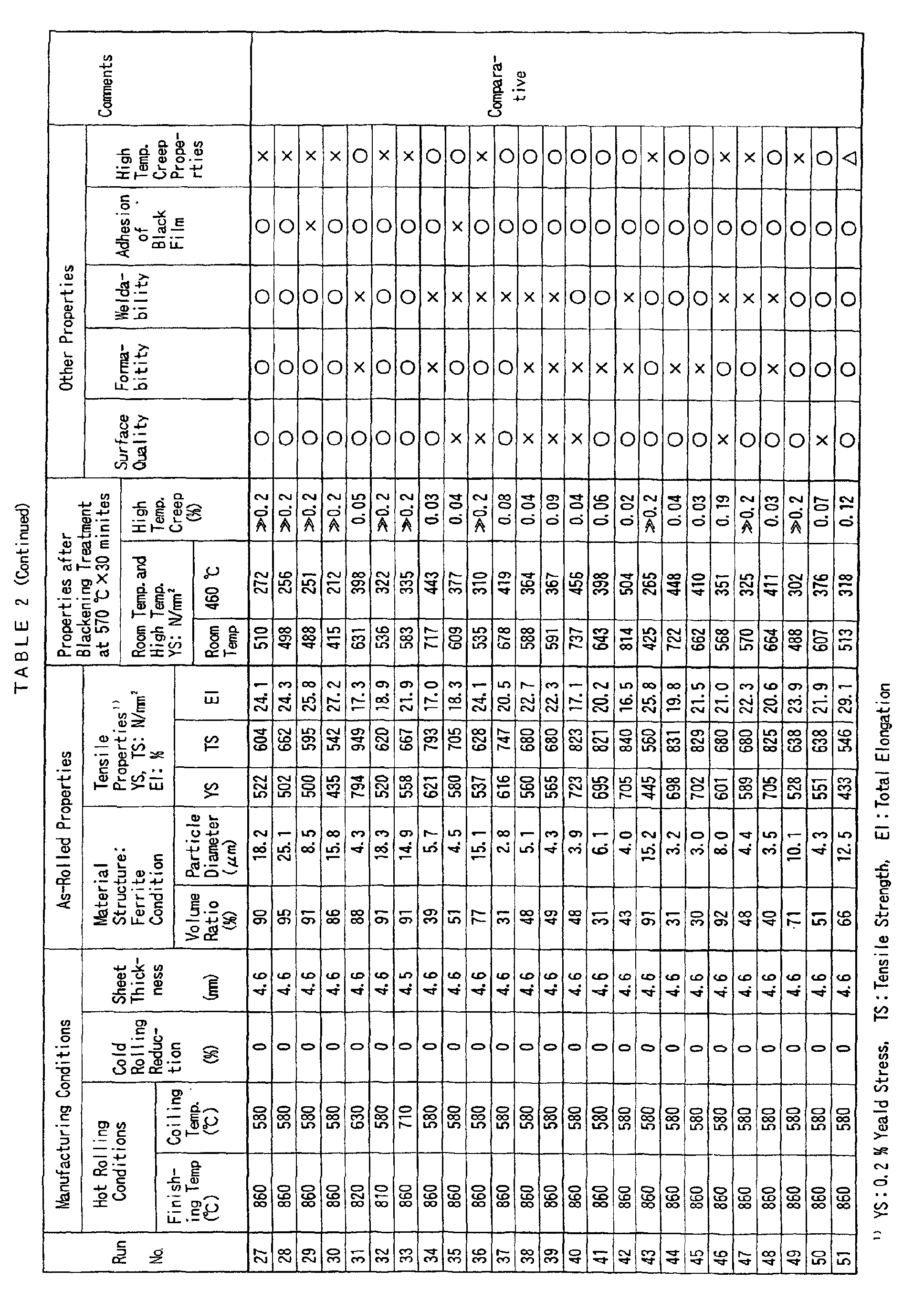
As can be seen from Table 2, a steel sheet having a steel composition and
metal structure according to the present invention had good tensile properties in
an as-rolled state, and formability, weldability, and the surface condition after
pickling were also good. In addition, it had an improved yield stress at room
temperature after undergoing heat treatment in the form of blackening treatment,
and it had good high-temperature strength at a stress relief annealing temperature.
Therefore, the creep at high temperature was a low value of at most 0.10%, and
the high-temperature creep properties were excellent. Furthermore, a black film
having good adhesion could be formed by blackening treatment. Therefore, it is
clear that according to the present invention, a steel sheet which has all of the
various properties required of a mask frame for a tension-type shadow mask and
which is relatively inexpensive is provided.
Comparative steel sheets which had a steel composition and/or a metal
structure which was outside the range of the present invention had at least one
property which was inadequate. In particular, as in Nos. 31, 42, 44, and 45, a
steel sheet to which a large amount of Cr, Mo, or W was added had properties
inferior to those of the steel sheet of the present invention in spite of being
expensive.
The relationships of the yield stress at 460°C and the creep (460°C for 1
hour) to the ferrite particle diameter and the ferrite volume ratio for Nos. 2 - 4, 6,
32, and 33 of Table 2 are shown in Figure 1 - Figure 4 as graphs. From these
figures, the criticality of a ferrite particle diameter of at most 15 micrometers and
a ferrite volume ratio of at most 90% according to the present invention is clear.
According to the present invention, a relatively inexpensive steel sheet
having the various properties (surface quality, formability, weldability, room
temperature and high-temperature strength, low creep at a high temperature,
adhesion of a black film) required of a mask frame for maintaining a tension-type
color CRT shadow mask under tension is provided.
The present invention is technology which contributes to a low cost and a
decrease in weight of color CRT's having a tension-type shadow mask such as
those for televisions. A steel sheet of the present invention can be used not only
in the above-described type in which tension acts only in the vertical direction,
but it can also be used in a mask frame for a tension-type shadow mask in which
it is applied in the two directions of the vertical direction and the horizontal
direction. In addition, a steel sheet according to the present invention can be used
in a mask frame for supporting a conventional shadow mask which is not of the
tension type.
Claims (14)
- A steel sheet for a color CRT mask frame having a steel composition consisting essentially of, in mass %,
C: 0.03 - 0.30%, Si: at most 0.30%, Mn: 0.05 - 1.5%, P: at most 0.05%, S: at most 0.02%, Mo: 0.02 - 0.50%, V: 0.02 -0.20%, Al: at most 0.10%, N: 0.0040 - 0.0200%, Cu: 0 - 1.0%, Ni: 0 - 1.0%, Cr: 0 - 2.0%, W: 0 - 1.0%, B: 0 - 0.003%, Ti: 0 - 0.030%, Nb: 0 - 0.030%, - A steel sheet for a color CRT mask frame as described in claim 1 wherein the steel composition does not include Cu, Ni, Cr, W, B, Ti, or Nb.
- A steel sheet for a color CRT mask frame as described in claim 1 wherein the steel composition contains one or two or more of Cu: at most 1.0%, Ni: at most 1.0%, Cr: at most 2.0%, W: at most 1.0%, B: at most 0.003%, Ti: at most 0.030 %, and Nb: at most 0.030%.
- A rectangular mask frame for a color CRT formed by joining four frame members, at least one of the frame members being formed from a steel sheet having a steel composition consisting essentially of, in mass %,
C: 0.03 - 0.30%, Si: at most 0.30%, Mn: 0.05 - 1.5%, P: at most 0.05%, S: at most 0.02%, Mo: 0.02 - 0.50%, V: 0.02 -0.20%, Al: at most 0.10%, N: 0.0040 - 0.0200%, Cu: 0 - 1.0%, Ni: 0 - 1.0%, Cr: 0 - 2.0%, W: 0 - 1.0%, B: 0 - 0.003%, Ti: 0 - 0.030%, Nb: 0 - 0.030%, - A color CRT mask frame as described in claim 4 wherein the steel composition does not include Cu, Ni, Cr, W, B, Ti, or Nb.
- A color CRT mask frame as described in claim 4 wherein the steel composition contains one or two or more of Cu: at most 1.0%, Ni: at most 1.0%, Cr: at most 2.0%, W: at most 1.0%, B: at most 0.003%, Ti: at most 0.030 %, and Nb: at most 0.030%.
- A color CRT equipped with the mask frame of claim 4.
- A method of manufacturing a steel sheet for a color CRT mask frame including the following steps:a step of manufacturing a slab having a steel composition consisting essentially of, in mass %,
C: 0.03 - 0.30%, Si: at most 0.30%, Mn: 0.05 - 1.5%, P: at most 0.05%, S: at most 0.02%, Mo: 0.02 - 0.50%, V: 0.02 -0.20%, Al: at most 0.10%, N: 0.0040 - 0.0200%, Cu: 0 - 1.0%, Ni: 0 - 1.0%, Cr: 0 - 2.0%, W: 0 - 1.0%, B: 0 - 0.003%, Ti: 0 - 0.030%, Nb: 0 - 0.030%, a step of hot rolling the slab under conditions of a finishing temperature of 820 - 950°C and a coiling temperature of 400 - 700°C to form a hot rolled steel sheet. - A method as described in claim 8 including a step of carrying out cold rolling with a reduction of 0.2 - 15% of the hot rolled steel sheet obtained in the hot rolling step.
- A method as described in claim 9 including a step of performing softening annealing of the hot rolled steel sheet prior to cold rolling under conditions of an annealing temperature of 600 - 750°C and a soaking time at the annealing temperature of 1 - 25 hours.
- A color CRT mask frame manufactured by a method including the following steps:a step of shaping the steel sheet of claim 1 to form a color CRT mask frame member,a step of joining four mask frame members, at least one of which are the above-described mask frame members, to form a color CRT mask frame, anda step of performing blackening treatment of the color CRT mask frame which was formed at a temperature in the range of 450 - 680°C to form a black film on the frame surface.
- A color CRT mask frame manufactured by a method including the following steps:a step of shaping the steel sheet of claim 1 to form a color CRT mask frame member,a step of joining four mask frame members, at least one of which are the above-described mask frame members, to form a color CRT mask frame, anda step of performing stress relief annealing of the color CRT mask frame which was formed at a temperature in the range of 400 - 680°C.
- A tension-type color CRT shadow mask/frame structure manufactured by a method including the following steps:a step of securing a shadow mask so that tension is applied thereto to the color CRT mask frame of claim 11 to form a shadow mask/frame structure, anda step of performing stress relief annealing of the structure at a temperature in the range of 400 - 680°C.
- A tension-type color CRT shadow mask/frame structure manufactured by a method including the following steps:a step of securing a shadow mask so that tension is applied thereto to the color CRT mask frame of claim 12 to form a shadow mask/frame structure, anda step of performing blackening treatment of the structure at a temperature in the range of 450 - 680°C to form a black film on the surface of the structure.
Applications Claiming Priority (3)
| Application Number | Priority Date | Filing Date | Title |
|---|---|---|---|
| JP2000057551 | 2000-03-02 | ||
| JP2000057551 | 2000-03-02 | ||
| PCT/JP2001/001602 WO2001064968A1 (en) | 2000-03-02 | 2001-03-02 | Color crt mask frame, steel plate for use therein, process for producing the steel plate, and color crt having the frame |
Publications (2)
| Publication Number | Publication Date |
|---|---|
| EP1205570A1 true EP1205570A1 (en) | 2002-05-15 |
| EP1205570A4 EP1205570A4 (en) | 2004-11-10 |
Family
ID=18578318
Family Applications (1)
| Application Number | Title | Priority Date | Filing Date |
|---|---|---|---|
| EP01908231A Withdrawn EP1205570A4 (en) | 2000-03-02 | 2001-03-02 | COLOR CATHODE RANGE MASK FRAME, STEEL PLATE USEFUL IN THIS MASK, METHOD FOR PRODUCING THE SAME, AND COLOR CATHODE RANGE WITH THIS FRAME |
Country Status (6)
| Country | Link |
|---|---|
| US (2) | US6699334B2 (en) |
| EP (1) | EP1205570A4 (en) |
| KR (1) | KR20020012191A (en) |
| CN (2) | CN1129675C (en) |
| TW (1) | TW513486B (en) |
| WO (1) | WO2001064968A1 (en) |
Cited By (3)
| Publication number | Priority date | Publication date | Assignee | Title |
|---|---|---|---|---|
| EP1557477A4 (en) * | 2002-11-01 | 2006-05-03 | Nat Inst For Materials Science | PROCESS FOR PRODUCING HIGH-HEAT CRYSTAL FERRITIC STEEL RESISTANT TO HEAT AND OXIDATION |
| EP2868762A4 (en) * | 2012-06-27 | 2016-03-09 | Jfe Steel Corp | STEEL SHEET FOR SOFT NITRIDING AND METHOD FOR PRODUCING SAME |
| US10301698B2 (en) | 2012-01-31 | 2019-05-28 | Jfe Steel Corporation | Hot-rolled steel sheet for generator rim and method for manufacturing the same |
Families Citing this family (12)
| Publication number | Priority date | Publication date | Assignee | Title |
|---|---|---|---|---|
| KR100673422B1 (en) * | 2003-08-28 | 2007-01-24 | 제이에프이 스틸 가부시키가이샤 | High carbon hot rolled steel sheet, cold rolled steel sheet and manufacturing method |
| CN1320153C (en) * | 2003-10-30 | 2007-06-06 | 中国地质大学(武汉) | Rock drill steel |
| JP4443910B2 (en) * | 2003-12-12 | 2010-03-31 | Jfeスチール株式会社 | Steel materials for automobile structural members and manufacturing method thereof |
| CN100430511C (en) * | 2005-06-30 | 2008-11-05 | 宝山钢铁股份有限公司 | Primary cold-rolled shadow mask strip steel and manufacturing method thereof |
| JP5050433B2 (en) * | 2005-10-05 | 2012-10-17 | Jfeスチール株式会社 | Method for producing extremely soft high carbon hot-rolled steel sheet |
| DE102008010749A1 (en) * | 2008-02-20 | 2009-09-24 | V & M Deutschland Gmbh | Steel alloy for a low-alloyed steel for the production of high-strength seamless steel tubes |
| KR101010971B1 (en) * | 2008-03-24 | 2011-01-26 | 주식회사 포스코 | Molded steel sheet having low temperature heat treatment characteristics, a method of manufacturing the same, a method of manufacturing a component using the same and the manufactured parts |
| JP5056876B2 (en) * | 2010-03-19 | 2012-10-24 | Jfeスチール株式会社 | Hot-rolled steel sheet with excellent cold workability and hardenability and method for producing the same |
| TW201145440A (en) * | 2010-06-09 | 2011-12-16 | Global Material Science Co Ltd | Shadow frame and manufacturing method thereof |
| CN102226255B (en) * | 2011-06-08 | 2013-06-12 | 江苏省沙钢钢铁研究院有限公司 | Preparation process of high strength and toughness steel plate with yield strength of 690MPa |
| CN105603309A (en) * | 2015-12-19 | 2016-05-25 | 丹阳市宸兴环保设备有限公司 | Concrete mixing paddle alloy steel material |
| CN110747322A (en) * | 2019-09-26 | 2020-02-04 | 中国电力科学研究院有限公司 | A kind of 1180MPa nanoparticle reinforced ferritic steel and preparation method thereof |
Family Cites Families (11)
| Publication number | Priority date | Publication date | Assignee | Title |
|---|---|---|---|---|
| DE3070180D1 (en) * | 1979-12-06 | 1985-03-28 | Salzgitter Peine Stahlwerke | Hot rolled strip or plate of denitrided steel and process for its production |
| US4990196A (en) * | 1988-06-13 | 1991-02-05 | Nippon Steel Corporation | Process for manufacturing building construction steel having excellent fire resistance and low yield ratio |
| JP2743116B2 (en) * | 1990-07-27 | 1998-04-22 | 愛知製鋼 株式会社 | Non-heat treated steel for hot forging |
| JPH04341541A (en) * | 1990-12-07 | 1992-11-27 | Nippon Steel Corp | Mask frame material for tv cathode-ray tube having blackened film excellent in adhesion |
| CA2124838C (en) * | 1992-10-30 | 1998-07-14 | Seinosuke Yano | High strength hot rolled steel plates and sheets excellent in uniform elongation after cold working and process for producing the same |
| US5542996A (en) * | 1993-01-14 | 1996-08-06 | Nkk Corporation | Method for manufacturing an ultra-high strength cold-rolled steel sheet with desirable delayed fracture resistance |
| JP3548606B2 (en) * | 1994-08-26 | 2004-07-28 | 日新製鋼株式会社 | Steel plate for aperture frame and method of manufacturing the same |
| JP2662198B2 (en) * | 1994-12-28 | 1997-10-08 | 日本鋳鍛鋼株式会社 | Manufacturing method of cast steel with excellent fire resistance, strength and toughness |
| JP3143054B2 (en) * | 1995-05-30 | 2001-03-07 | 株式会社神戸製鋼所 | High-strength hot-rolled steel sheet with low yield strength after forming, pipe formed using the same, and method for producing the high-strength hot-rolled steel sheet |
| JPH09118952A (en) * | 1995-10-20 | 1997-05-06 | Kobe Steel Ltd | Member made of high-strength hot rolled steel sheet having lower yield ratio |
| JP3984320B2 (en) * | 1997-02-19 | 2007-10-03 | 新日本製鐵株式会社 | Manufacturing method of processing thin steel sheet with excellent high-temperature strength |
-
2001
- 2001-03-02 WO PCT/JP2001/001602 patent/WO2001064968A1/en not_active Ceased
- 2001-03-02 TW TW090104858A patent/TW513486B/en active
- 2001-03-02 KR KR1020017013896A patent/KR20020012191A/en not_active Ceased
- 2001-03-02 EP EP01908231A patent/EP1205570A4/en not_active Withdrawn
- 2001-03-02 CN CN01800795A patent/CN1129675C/en not_active Expired - Fee Related
- 2001-03-02 CN CNA031084664A patent/CN1482648A/en active Pending
- 2001-11-01 US US09/985,131 patent/US6699334B2/en not_active Expired - Fee Related
-
2003
- 2003-10-10 US US10/682,407 patent/US6806631B2/en not_active Expired - Fee Related
Cited By (4)
| Publication number | Priority date | Publication date | Assignee | Title |
|---|---|---|---|---|
| EP1557477A4 (en) * | 2002-11-01 | 2006-05-03 | Nat Inst For Materials Science | PROCESS FOR PRODUCING HIGH-HEAT CRYSTAL FERRITIC STEEL RESISTANT TO HEAT AND OXIDATION |
| US10301698B2 (en) | 2012-01-31 | 2019-05-28 | Jfe Steel Corporation | Hot-rolled steel sheet for generator rim and method for manufacturing the same |
| EP2868762A4 (en) * | 2012-06-27 | 2016-03-09 | Jfe Steel Corp | STEEL SHEET FOR SOFT NITRIDING AND METHOD FOR PRODUCING SAME |
| US10077485B2 (en) | 2012-06-27 | 2018-09-18 | Jfe Steel Corporation | Steel sheet for soft-nitriding and method for manufacturing the same |
Also Published As
| Publication number | Publication date |
|---|---|
| US6806631B2 (en) | 2004-10-19 |
| US20020079028A1 (en) | 2002-06-27 |
| CN1129675C (en) | 2003-12-03 |
| US6699334B2 (en) | 2004-03-02 |
| KR20020012191A (en) | 2002-02-15 |
| CN1482648A (en) | 2004-03-17 |
| EP1205570A4 (en) | 2004-11-10 |
| TW513486B (en) | 2002-12-11 |
| CN1366557A (en) | 2002-08-28 |
| WO2001064968A1 (en) | 2001-09-07 |
| WO2001064968A8 (en) | 2001-11-22 |
| US20040095052A1 (en) | 2004-05-20 |
Similar Documents
| Publication | Publication Date | Title |
|---|---|---|
| US6818074B2 (en) | High-ductility steel sheet excellent in press formability and strain age hardenability, and method for manufacturing the same | |
| JP4214006B2 (en) | High strength steel sheet with excellent formability and method for producing the same | |
| US6699334B2 (en) | Steel sheet used for color CRT mask frame and a manufacturing method for the steel sheet | |
| JP3548606B2 (en) | Steel plate for aperture frame and method of manufacturing the same | |
| EP0627494B1 (en) | Alloy sheet for shadow mask and method for manufacturing thereof | |
| JP3987888B2 (en) | Steel plate for heat shrink band, method for producing the same, heat shrink band and cathode ray tube device equipped with the same | |
| US20040238076A1 (en) | Fe-ni based alloy for shadow mask raw material excellent in corrosion resistance and shadow mask material | |
| JP3756833B2 (en) | CRT inner frame, ferritic stainless steel plate therefor, and manufacturing method thereof | |
| JPH09227998A (en) | Cold rolled steel sheet for color picture tube color separating electrode structural body and its production | |
| JP3647582B2 (en) | High-strength steel sheet for low thermal expansion frame electrode assembly | |
| JP3892312B2 (en) | Method for manufacturing high-strength steel sheet for CRT frame | |
| US6372058B1 (en) | Semi-tension mask of low-expansion Fe-Ni alloy, and color picture tube using the mask | |
| US20020117241A1 (en) | Method of manufacturing Fe-Ni alloy material for pressed flat mask | |
| US6645317B1 (en) | Metal components for picture tubes | |
| JP3405339B2 (en) | Color CRT mask frame, steel plate used therefor, method for manufacturing the steel plate, and color CRT provided with the frame | |
| JP4297586B2 (en) | Stainless steel for CRT support frame and its manufacturing method | |
| JP3828838B2 (en) | Steel plate for TV CRT frame and manufacturing method thereof | |
| US12084734B2 (en) | Plated steel sheets for hot press forming having excellent hydrogen brittleness resistance and impact resistance, hot press formed parts, and manufacturing methods thereof | |
| JP3401307B2 (en) | Material for shadow mask excellent in recrystallization characteristics and manufacturing method | |
| JP3765222B2 (en) | Steel sheet for magnetic shield and manufacturing method thereof | |
| JP3647581B2 (en) | Steel plate for mask frame of shadow mask type color picture tube | |
| JP2002003948A (en) | Manufacturing method of steel sheet for tension mask with excellent high temperature creep resistance | |
| KR100435451B1 (en) | A method for producing a cold rolled steel sheet for braun tube mask frame with excellent magnetic property and adhesion of black scale | |
| US20010000580A1 (en) | Steel sheet for use as an electrode-supporting frame member of a color picture tube and manufacturing method thereof | |
| EP1154029B1 (en) | Color picture tube shadow mask material |
Legal Events
| Date | Code | Title | Description |
|---|---|---|---|
| PUAI | Public reference made under article 153(3) epc to a published international application that has entered the european phase |
Free format text: ORIGINAL CODE: 0009012 |
|
| AK | Designated contracting states |
Kind code of ref document: A1 Designated state(s): AT BE CH CY DE DK ES FI FR GB GR IE IT LI LU MC NL PT SE TR |
|
| AX | Request for extension of the european patent |
Free format text: AL;LT;LV;MK;RO;SI |
|
| 17P | Request for examination filed |
Effective date: 20020121 |
|
| A4 | Supplementary search report drawn up and despatched |
Effective date: 20040923 |
|
| STAA | Information on the status of an ep patent application or granted ep patent |
Free format text: STATUS: THE APPLICATION IS DEEMED TO BE WITHDRAWN |
|
| 18D | Application deemed to be withdrawn |
Effective date: 20061002 |
|
| R18D | Application deemed to be withdrawn (corrected) |
Effective date: 20061003 |