EP1205517A1 - Low-hygroscopicity low-birefringence resin compositions, molding material obtained therefrom, sheet or film, and optical part - Google Patents
Low-hygroscopicity low-birefringence resin compositions, molding material obtained therefrom, sheet or film, and optical part Download PDFInfo
- Publication number
- EP1205517A1 EP1205517A1 EP00940857A EP00940857A EP1205517A1 EP 1205517 A1 EP1205517 A1 EP 1205517A1 EP 00940857 A EP00940857 A EP 00940857A EP 00940857 A EP00940857 A EP 00940857A EP 1205517 A1 EP1205517 A1 EP 1205517A1
- Authority
- EP
- European Patent Office
- Prior art keywords
- polymer
- resin composition
- weight
- styrene
- indene
- Prior art date
- Legal status (The legal status is an assumption and is not a legal conclusion. Google has not performed a legal analysis and makes no representation as to the accuracy of the status listed.)
- Withdrawn
Links
Classifications
-
- G—PHYSICS
- G02—OPTICS
- G02B—OPTICAL ELEMENTS, SYSTEMS OR APPARATUS
- G02B1/00—Optical elements characterised by the material of which they are made; Optical coatings for optical elements
- G02B1/04—Optical elements characterised by the material of which they are made; Optical coatings for optical elements made of organic materials, e.g. plastics
-
- C—CHEMISTRY; METALLURGY
- C08—ORGANIC MACROMOLECULAR COMPOUNDS; THEIR PREPARATION OR CHEMICAL WORKING-UP; COMPOSITIONS BASED THEREON
- C08J—WORKING-UP; GENERAL PROCESSES OF COMPOUNDING; AFTER-TREATMENT NOT COVERED BY SUBCLASSES C08B, C08C, C08F, C08G or C08H
- C08J5/00—Manufacture of articles or shaped materials containing macromolecular substances
- C08J5/18—Manufacture of films or sheets
-
- C—CHEMISTRY; METALLURGY
- C08—ORGANIC MACROMOLECULAR COMPOUNDS; THEIR PREPARATION OR CHEMICAL WORKING-UP; COMPOSITIONS BASED THEREON
- C08L—COMPOSITIONS OF MACROMOLECULAR COMPOUNDS
- C08L25/00—Compositions of, homopolymers or copolymers of compounds having one or more unsaturated aliphatic radicals, each having only one carbon-to-carbon double bond, and at least one being terminated by an aromatic carbocyclic ring; Compositions of derivatives of such polymers
-
- C—CHEMISTRY; METALLURGY
- C08—ORGANIC MACROMOLECULAR COMPOUNDS; THEIR PREPARATION OR CHEMICAL WORKING-UP; COMPOSITIONS BASED THEREON
- C08L—COMPOSITIONS OF MACROMOLECULAR COMPOUNDS
- C08L45/00—Compositions of homopolymers or copolymers of compounds having no unsaturated aliphatic radicals in side chain, and having one or more carbon-to-carbon double bonds in a carbocyclic or in a heterocyclic ring system; Compositions of derivatives of such polymers
-
- C—CHEMISTRY; METALLURGY
- C08—ORGANIC MACROMOLECULAR COMPOUNDS; THEIR PREPARATION OR CHEMICAL WORKING-UP; COMPOSITIONS BASED THEREON
- C08L—COMPOSITIONS OF MACROMOLECULAR COMPOUNDS
- C08L2203/00—Applications
- C08L2203/16—Applications used for films
-
- C—CHEMISTRY; METALLURGY
- C08—ORGANIC MACROMOLECULAR COMPOUNDS; THEIR PREPARATION OR CHEMICAL WORKING-UP; COMPOSITIONS BASED THEREON
- C08L—COMPOSITIONS OF MACROMOLECULAR COMPOUNDS
- C08L25/00—Compositions of, homopolymers or copolymers of compounds having one or more unsaturated aliphatic radicals, each having only one carbon-to-carbon double bond, and at least one being terminated by an aromatic carbocyclic ring; Compositions of derivatives of such polymers
- C08L25/02—Homopolymers or copolymers of hydrocarbons
- C08L25/04—Homopolymers or copolymers of styrene
-
- C—CHEMISTRY; METALLURGY
- C08—ORGANIC MACROMOLECULAR COMPOUNDS; THEIR PREPARATION OR CHEMICAL WORKING-UP; COMPOSITIONS BASED THEREON
- C08L—COMPOSITIONS OF MACROMOLECULAR COMPOUNDS
- C08L2666/00—Composition of polymers characterized by a further compound in the blend, being organic macromolecular compounds, natural resins, waxes or and bituminous materials, non-macromolecular organic substances, inorganic substances or characterized by their function in the composition
- C08L2666/02—Organic macromolecular compounds, natural resins, waxes or and bituminous materials
- C08L2666/04—Macromolecular compounds according to groups C08L7/00 - C08L49/00, or C08L55/00 - C08L57/00; Derivatives thereof
Definitions
- the present invention relates to resin compositions having low hygroscopicity, low birefringence and low permittivity, being excellent in fluidity, causing little change in color in heating, and being excellent in mold release characteristics in injection molding, and to a molding material, a sheet, or a film obtained by molding these resin compositions and to an optical part.
- Many of the monomers having an unsaturated bond with reaction activity can yield a polymer by selecting a catalyst that can cause cleavage of the unsaturated bond to initiate a chain reaction and appropriate reaction conditions.
- a catalyst that can cause cleavage of the unsaturated bond to initiate a chain reaction and appropriate reaction conditions.
- monomers having an unsaturated bond so that kinds of the resins that can be obtained therefrom also come in a great many varieties.
- monomers that can yield a product having a high molecular weight of 10,000 or higher which is generally called as a high molecular compound.
- typical monomers include ethylene, substituted ethylenes, propylene, substituted propylenes, styrene, alkylstyrenes, alkoxystyrenes, norbornene, various acrylic esters, butadiene, cyclopentadiene, dicyclopentadiene, isoprene, maleic anhydride, maleimide, fumarate esters, allyl compounds, and the like.
- Various kinds of resins are synthesized from these monomers or various combinations thereof.
- a polymer comprising a hydrocarbon containing no polar groups.
- An example of such a polymer is a series of polymers called cyclic polyolefins. Specific examples include a polymer obtained by hydrogenating polynorbornene, or a polymer comprising polydicyclopentene and a derivative thereof.
- these polymers can exhibit extremely low permittivity, they have problems such as low heat resistance and very high permeability of water in spite of extremely low water absorption. In particular, the high permeability of water is a common characteristic of polyolefins, and it is considered to be extremely difficult to solve this problem.
- Another example is a syndiotactic polystyrene synthesized by using Ziegler-Natta catalyst or Kaminsky catalysts.
- This polymer has a structure that three-dimensional positions of the benzene rings to the backbone are located alternately in the opposite directions, so that it is possible to attain very high heat resistance and at the same time extremely low water absorption, extremely low permeability of water and very low level of permittivity.
- this polymer has such high crystallinity that it has a problem of considerably poor adhesion to a base material and also has another problem that methods of processing it are markedly limited because it is insoluble in any solvents. That is, at present, a polymer that can overcome the above-mentioned problems has not been developed yet.
- typical polymers for optical uses such as optical lenses, optical waveguide materials and the like include acrylic resins and polyolefin resins.
- Acrylic resins have characteristics of having excellent transparency and workability and extremely low birefringence. However, they have disadvantages that they have high hygroscopicity, relatively low heat resistance and low toughness.
- polyolefin resins have excellent heat resistance and extremely low hygroscopicity, but they are inferior to acrylic resins in transparency and low birefringence. That is, both of acrylic resins and polyolefin resins have both advantages and disadvantages, and thus it has strongly been desired to develop a resin compensating for the disadvantages of acrylic resins and polyolefin resins.
- Polyolefin resins have extremely great advantages of low hygroscopicity and high heat resistance as resins of optical use, but the high birefringence thereof has become a great disadvantage with the increasing sophistication of optical devices in recent years. Therefore, many attempts to lower the birefringence of polyolefin resins have been made particularly recently.
- a method of adding a compatibility agent as the third component is carried out as a polymer alloying technique, and it is specifically described in U.S. Patent No. 4,373,065.
- both should be in a molten state or a solution state.
- it is considered that it is extremely difficult to obtain a practical polymer material that is highly homogeneous and has no birefringence as a whole by using any physical method.
- the present invention provides resin compositions having low hygroscopicity, low birefringence and low permittivity, excelling in fluidity, causing little change in color upon heating, and being excellent in mold release characteristics in injection molding, a molding material, a sheet or a film obtained by molding these resin compositions, and an optical part.
- the present invention relates to the following items (1) to (22).
- a resin composition (a) of the present invention is a resin composition comprising the following polymers (A), and (B) and/or (C):
- the above polymer (A) is not particularly limited and any polymer may be employed as the polymer (A), as long as it may be any polymer containing one or more kinds of indene and indene derivatives represented by the above general formula (I).
- the indene derivatives for use in the above polymer (A) include those represented by the above general formula (I), wherein R 1 , R 2 , R 3 , R 4 , R 5 and R 6 may be the same or different, and each represents a hydrogen atom; a monovalent hydrocarbon group containing a nitrogen atom, an oxygen atom or a silicon atom; an alkyl group having 1 to 6 carbon atoms ; or a monovalent aromatic hydrocarbon group.
- Monovalent hydrocarbon groups containing a nitrogen atom, an oxygen atom or a silicon atom include, for example, dimethylaminoethyl group, diethylaminoethyl group, methoxy group, ethoxy group, propoxy group, butoxy group, pentoxy group, hexoxy group, trimethylsilyl group, triethylsilyl group, and the like.
- Alkyl groups having 1 to 6 carbon atoms include, for example, methyl group, ethyl group, propyl group, n-butyl group, isobutyl group, t-butyl group, n-pentyl group, 2-methylbutyl group, 3-methylbutyl group, t-pentyl group, n-hexyl group, 2-methylpentyl group, 3-methylpentyl group, 4-methylpentyl group, 1-methylpentyl group, 2,2-dimethylbutyl group, 2,3-dimethylbutyl group, 2,4-dimethylbutyl group, 3,3-dimethylbutyl group, 3,4-dimethylbutyl group, 4,4-dimethylbutyl group, 2-ethylbutyl group, 1-ethylbutyl group, cyclohexyl group, and the like.
- Monovalent aromatic hydrocarbon groups include phenyl group, naphthyl group, benzyl group, and the like. Those listed hereinbefore are simply examples, and monovolent aromatic hydrocarbon groups are not limited thereto.
- X represents a hydrogen atom, a halogen atom, an acyl group, an alkoxy group or a nitrile group.
- Halogen atoms in X include fluorine, chlorine, bromine, and iodine.
- Acyl groups in X include formyl group, acetyl group, propionyl group, butyryl group, isobutyryl group, and the like.
- Alkoxy groups in X include methoxy group, ethoxy group, propoxy group, butoxy group, pentoxy group, hexoxy group, and the like.
- x 0 or an integer of 1 to 4
- indene or indene derivatives may be used singly or in combination with two or more as a monomer for use in the polymer (A).
- the above indene derivatives having a substituent include nucleus-substituted alkylindenes such as nucleus-substituted methylindene, nucleus-substituted ethylindene, nucleus-substituted propylindene, nucleus-substituted butylindene and the like, nucleus-substituted chloroindene, nucleus-substituted bromoindene, and the like. More specifically, they preferably include methylindene, ⁇ -methylindene, ⁇ -methylindene, and the like.
- the polymer (B) for use in the resin composition (a) is a polymer comprising polystyrene or a polystyrene derivative.
- monomers for use in the production of the polymer (B) comprising polystyrene or a polystyrene derivative include, for example, styrene, nucleus-substituted alkylstyrenes, nucleus-substituted aromatic styrenes, ⁇ -substituted alkylstyrenes, ⁇ -substituted alkylstyrenes, nucleus-substituted alkoxystyrenes, and the like.
- Nucleus-substituted alkylstyrenes that may be employed include, for example, o-methylstyrene, m-methylstyrene, p-methylstyrene, o-ethylstyrene, m-ethylstyrene, p-ethylstyrene, o-propylstyrene, m-propylstyrene, p-propylstyrene, o-n-butylstyrene, m-n-butylstyrene, p-n-butylstyrene, o-isobutylstyrene, m-isobutylstyrene, p-isobutylstyrene, o-t-butylstyrene, m-t-butylstyrene, p-t-butylsty
- Nucleus-substituted aromatic styrenes that may be employed include, for example, o-phenylstyrene, m-phenylstyrene, p-phenylstyrene, and the like. Those listed hereinbefore are simply examples, and nucleus-substituted aromatic styrenes are not limited thereto.
- ⁇ -substituted alkylstyrenes that may be employed include, for example, ⁇ -methylstyrene, ⁇ -ethylstyrene, ⁇ -propylstyrene, ⁇ -n-butylstyrene, ⁇ -isobutylstyrene, ⁇ -t-butylstyrene, ⁇ -n-pentylstyrene, ⁇ -2-methylbutylstyrene, ⁇ -3-methylbutylstyrene, ⁇ -t-butylstyrene, ⁇ -t-pentylstyrene, ⁇ -n-hexylstyrene, ⁇ -2-methylpentylstyrene, ⁇ -3-methylpentylstyrene, ⁇ -1-methylpentylstyrene, ⁇ -2,2-dimethylbutylstyrene, ⁇ -2
- ⁇ -substituted alkylstyrenes that may be employed include, for example, ⁇ -methylstyrene, ⁇ -ethylstyrene, ⁇ -propylstyrene, ⁇ -n-butylstyrene, ⁇ -isobutylstyrene, ⁇ -t-butylstyrene, ⁇ -n-pentylstyrene, ⁇ -2-methylbutylstyrene, ⁇ -3-methylbutylstyrene, ⁇ -t-pentylstyrene, ⁇ -n-hexylstyrene, ⁇ -2-methylpentylstyrene, ⁇ -3-methylpentylstyrene, ⁇ -1-methylpentylstyrene, ⁇ -2,2-dimethylbutylstyrene, ⁇ -2,3-dimethylbutylstyrene
- Nucleus-substituted alkoxystyrenes that may be employed include, for example, o-methoxystyrene, m-methoxystyrene, p-methoxystyrene, o-ethoxystyrene, m-ethoxystyrene, p-ethoxystyrene, o-propoxystyrene, m-propoxystyrene, p-propoxystyrene, o-n-butoxystyrene, m-n-butoxystyrene, p-n-butoxystyrene, o-isobutoxystyrene, m-isobutoxystyrene, p-isobutoxystyrene, o-t-butoxystyrene, m-t-butoxystyrene, p-t-butoxystyrene, o-n-p
- the polymer (C) for use in the resin composition (a) is a polymer comprising a monomer copolymerizable with styrene or a styrene derivative.
- Monomers copolymerizable with styrene or a styrene derivative for use in the polymer (C) include, for example, styrene, nucleus-substituted alkylstyrenes, nucleus-substituted aromatic styrenes, ⁇ -substituted alkylstyrenes, ⁇ -substituted alkylstyrenes, nucleus-substituted alkoxystyrenes, alkyl vinyl ethers, aromatic vinyl ethers, isobutene, diisobutylene, (meth)acrylic esters having 1 to 8 carbon atoms, and the like. These may be used singly or in combination with two or more.
- Nucleus-substituted alkylstyrenes, nucleus-substituted aromatic styrenes, ⁇ -substituted alkylstyrenes, ⁇ -substituted alkylstyrenes, and nucleus-substituted alkoxystyrenes include the same as listed for the monomers for use in the polymer (B).
- Alkyl groups in alkyl vinyl ethers are not particularly limited, and any alkyl group may be employed.
- Alkyl vinyl ethers include, for example, those having alkyl groups such as methyl, ethyl, propyl, n-butyl, isobutyl, t-butyl, n-pentyl, 2-methylbutyl, 3-methylbutyl, t-pentyl, n-hexyl, 2-methylpentyl, 3-methylpentyl, 4-methylpentyl, 1-methylpentyl, 2,2-dimethylbutyl, 2,3-dimethylbutyl, 2,4-dimethylbutyl, 3,3-dimethylbutyl, 3,4-dimethylbutyl, 4,4-dimethylbutyl, 2-ethylbutyl, 1-ethylbutyl, cyclohexyl, and the like. Those listed hereinbefore are simply examples, and alkyl vinyl ethers are
- Aromatic vinyl ethers include, for example, phenyl vinyl ether and the like. Those listed hereinbefore are simply examples, and aromatic vinyl ethers are not limited thereto.
- (Meth)acrylic esters having 1 to 8 carbon atoms include methyl (meth)acrylate, ethyl (meth)acrylate, propyl (meth)acrylate, n-butyl (meth)acrylate, i-butyl (meth)acrylate, n-pentyl (meth)acrylate, n-hexyl (meth)acrylate, n-heptyl (meth)acrylate, n-octyl (meth)acrylate, 2-ethylhexyl (meth)acrylate, and the like.
- Those listed hereinbefore are simply examples, and (meth)acrylic esters having 1 to 8 carbon atoms are not limited thereto. These may be used singly or in combination with two or more.
- the above styrene, nucleus-substituted alkylstyrenes, ⁇ -substituted alkylstyrenes, ⁇ -substituted alkylstyrenes, nucleus-substituted alkoxystyrenes, alkyl vinyl ethers, aromatic vinyl ethers, isobutene, diisobutylene, (meth)acrylic esters having 1 to 8 carbon atoms, and the like for use in the polymer (C) may have a substituent such as an alkyl group, a phenyl group, a halogen atom and the like at an optional position.
- Methods of the production of the above polymers (A), (B) and (C) in the resin composition (a) of the present invention are not particularly limited, and the polymers can be produced by a conventional method.
- they can be produced by cationic polymerization, anionic polymerization, radical polymerization, living radical polymerization, or the like.
- the above polymerization methods can be selected depending on a catalyst employed.
- Catalysts for use in cationic polymerization are not particularly limited, and publicly known catalysts may be employed.
- Such catalysts that may be employed include, for example, Lewis acids such as aluminium chloride, iron chloride, tin chloride, zinc chloride, strontium chloride, scandium chloride and the like, proton acids such as sulfuric acid, para-toluenesulfonic acid, hydrochloric acid, nitric acid and the like, alkylaluminium chlorides, and the like.
- Lewis acids such as aluminium chloride, iron chloride, tin chloride, zinc chloride, strontium chloride, scandium chloride and the like
- proton acids such as sulfuric acid, para-toluenesulfonic acid, hydrochloric acid, nitric acid and the like, alkylaluminium chlorides, and the like.
- Those listed hereinbefore are simply examples, and the catalysts are not limited thereto. These may be used singly or in combination with two or
- Catalysts for use in anionic polymerization are not particularly limited, and publicly known catalysts may be employed. Such catalysts that may be employed include, for example, butyl lithium and the like. Those listed hereinbefore are simply examples, and the catalysts are not limited thereto.
- Catalysts for use in radical polymerization are not particularly limited, and publicly known catalysts may be employed.
- Such catalysts include, for example, peroxides such as benzoyl peroxide, lauryl peroxide, methyl ethyl ketone peroxide and the like. Those listed hereinbefore are simply examples, and the catalysts are not limited thereto. These may be used singly or in combination with two or more.
- Catalysts for use in living radical polymerization are not particularly limited, and publicly known catalysts may be employed.
- Such catalysts include, for example, a combined system of benzoyl peroxide and a nitroxide compound, a combined system of a Ru complex/an alkoxyaluminum and the like. Those listed hereinbefore are simply examples, and the catalysts are not limited thereto. These may be used singly or in combination with two or more.
- the polymers can be synthesized by solution polymerization, suspension polymerization, bulk polymerization, or the like.
- the solution polymerization method is the most preferable.
- Solvents employed are not particularly limited, and publicly known solvents may be employed. Typical solvents include, for example, chloromethane, dichloromethane, trichloromethane, tetrachloromethane, chloroethane, dichloroethane, trichloroethane, tetrachloroethane, chloroethylene, dichloroethylene, nitrobenzene, dinitrobenzene, trinitrobenzene, alkylbenzenes such as methylbenzene, dimethylbenzene, trimethylbenzene, ethylbenzene, diethylbenzene, triethylbenzene and the like, ketones such as acetone, methyl ethyl ketone, methyl isobutyl ketone and the like, and esters such as MMA, ethyl acetate, butyl acetate and the like. Those listed hereinbefore are simply examples, and the solvents are not limited thereto. These may
- the polymerization temperature is preferably in the range of -100 to 180°C. If the polymerization reaction is carried out at a lower temperature than -100°C, decrease in reactivity is caused, so that it is difficult to obtain a sufficiently high molecular weight compound. The temperatures exceeding 180°C lead to too high reactivity of the propagation terminal, so that it sometimes becomes to be difficult to obtain a high molecular weight compound because a vast number of chain transfer reactions occur.
- the weight-average molecular weight of the polymer (A) is preferably lower than 80000, more preferably lower than 40000. If the weight-average molecular weight of the polymer (A) is lower than 80000, fluidity and transparency of the resin composition (a) tend to decrease.
- the molecular weight can be adjusted by selecting the kind or amount of the catalyst used in polymerization, using a polymerization inhibitor, using a chain transfer agent, controlling the polymerization temperature or the like.
- the weight-average molecular weight(s) of the polymer (B) and/or the polymer (C) are/is preferably 50000 or higher, more preferably 100000 or higher. If the weight-average molecular weight(s) of the polymer (B) and/or the polymer (C) are/is lower than 50000, strength of a molding material tends to decrease.
- the molecular weight(s) of the polymer (B) and/or the polymer (C) can be adjusted by selecting the kind or amount of the catalyst used in polymerization, using a polymerization inhibitor, using a chain transfer agent, controlling the polymerization temperature or the like.
- Weight-average molecular weights can be determined by GPC measurement with a tetrahydrofuran solution.
- the polymers (A), (B) and (C) obtained by the above method can be used for the resin composition (a) after isolating the polymers by a conventional method.
- the content of the polymer (A) is preferably 30 to 90% by weight of the total of the resin composition (a), more preferably 50 to 90% by weight, still more preferably 60 to 85% by weight. If the content of the polymer (A) is less than 30% by weight or more than 90% by weight of the total of the resin composition (a), the absolute value of birefringence tends to increase.
- Viscosity of the diphenylsilicone (D) for use in the resin composition (a) of the present invention is not particularly limited, and any diphenylsilicone (D) having any viscosity may be used.
- the addition amount of the diphenylsilicone (D) is preferably in the range of 0.01 to 1.0% by weight, more preferably 0.05 to 0.8% by weight of the total of the resin composition (a). If the addition amount is less than 0.01% by weight, the effect on mold release characteristics from a die in injection molding tends to decrease, while if the addition amount exceeds 1.0% by weight, heat resistance tends to decrease.
- Phenolic antioxidants (E) for use in the present invention include, for example, dibutylhydroxytoluene, alkylated phenols, 4,4'-thiobis(6-t-butyl-3-methylphenol), 4,4'-butylidenebis(6-t-butyl-3-methylphenol), 2,2''-methylenebis(4-methyl-6-t-butylphenol), 2,2''-methylenebis(4-ethyl-6-t-butylphenol), 2,6-di-t-butyl-4-ethylphenol, 1,1,-tris(2-methyl-4-hydroxy-5-t-butylphenyl)butane, n-octadecyl-3-(4-hydroxy-3,5-t-dibutylphenyl)propionate, tetrakis(methylene-3-(3,5-di-t-butyl-4-hydroxyphenyl)propionate, dilaurylthiodipropionate
- the addition amount of a phenolic antioxidant (E) is preferably in the range of 0.1 to 3.0% by weight, more preferably 0.5 to 2.0% by weight of the total of the resin composition (a). If the addition amount is less than 0.1% by weight, the effect to suppress changes in hue is a little, while if the addition amount exceeds 3.0% by weight, transparency and heat resistance of the resin tend to decrease.
- Methods of mixing the polymers (A), and (B) and/or (C), a diphenylsilicone (D), and a phenolic antioxidant (E) are not particularly limited, and a resin composition can be produced by weighing out prescribed amounts of each polymer and a diphenylsilicone and a phenolic antioxidant, and melt-kneading these, or also can be produced by dissolving each polymer, a diphenylsilicone and a phenolic antioxidant in a solvent such as toluene, THF, NMP and the like, and then removing the solvent.
- a solvent such as toluene, THF, NMP and the like
- the resin composition (a) of the present invention obtained as mentioned above preferably has a saturated water absorption of 0.4% or less, and preferably has a birefringence in stretching the resin composition by 200% in the range of -2 x 10 -6 to 2 x 10 -6 . More preferable saturated water absorption is 0.2% or less, and more preferable birefringence in stretching the resin composition by 200% is in the range of -1 x 10 -6 to 1 x 10 -6 .
- the saturated water absorption (%) in the present invention can be calculated by measuring the water absorption when the water absorption reaches saturation with a sample fragment soaked in hot water at 70°C. "When the water absorption reaches saturation" is the state in which there is no more change in the water absorption even if the sample fragment is allowed to be soaked in hot water at 70°C for a longer time.
- the birefringence in stretching an obtained molding material by 200% at a temperature 5°C lower than the glass transition point of the material can be measured by using, for example, Ellipsometer AEP-100Type(produced by Shimadzu Corporation). Measurement conditions are as follows: temperature: 25°C; and wavelength of the laser light: 632.8 nm.
- the glass transition point of a molding material can be measured as follows .
- the glass transition point can be measured by DSC (differential scanning calorimetry). A measurement by DSC is carried out under a condition of a temperature-elevating rate of 10°C/min.
- a resin composition (b) of the present invention is a resin composition comprising the following polymers (F), (G) and (H):
- the polymer (F) for use in the resin composition (b) can be produced in the same manner as the polymer (A) for use in the resin composition (a) by using the same indene monomers as in the polymer (A).
- the weight-average molecular weight of the polymer (F) is preferably 4000 or higher, more preferably 8000 or higher. If the weight-average molecular weight of the polymer (F) is lower than 4000, heat resistance tends to decrease.
- the molecular weight can be adjusted by selecting the kind or amount of the catalyst used in polymerization, using a polymerization inhibitor, using a chain transfer agent, controlling the polymerization temperature or the like.
- the polymer (G) for use in the resin composition (b) can be produced in the same manner as the polymer (B) for use in the resin composition (a) by using the same styrene monomers as in the polymer (B).
- the graft polymer (H) for use in the resin composition (b) has a structure where a polymer comprising one or more kinds of indene and indene derivatives represented by the general formula (I) bonds to a side chain of a polymer comprising styrene or a styrene derivative. That is, the graft polymer (H) has a backbone unit of the polymer comprising styrene or a styrene derivative and branch units of the polymer comprising one or more kinds of indene and indene derivatives represented by the general formula (I).
- Monomers copolymerizable with styrene or a styrene derivative for use in a constitutional monomer of the backbone unit of the graft polymer (H) include, for example, styrene, nucleus-substituted alkylstyrenes, nucleus-substituted aromatic styrenes, ⁇ -substituted alkylstyrenes, ⁇ -substituted alkylstyrenes, nucleus-substituted alkoxystyrenes, alkyl vinyl ethers, aromatic vinyl ethers, isobutene, diisobutylene, (meth)acrylic esters having 1 to 8 carbon atoms, and the like.
- Nucleus-substituted alkylstyrenes, nucleus-substituted aromatic styrenes, ⁇ -substituted alkylstyrenes, ⁇ -substituted alkylstyrenes, and nucleus-substituted alkoxystyrenes include the same as listed for the monomers for use in the polymer (B) of the resin composition (a).
- alkyl vinyl ethers, aromatic vinyl ethers, and (meth)acrylic esters having 1 to 8 carbon atoms include the same as listed for the monomers for use in the polymer (C) of the resin composition (a).
- the above styrene, nucleus-substituted alkylstyrenes, ⁇ -substituted alkylstyrenes, ⁇ -substituted alkylstyrenes, nucleus-substituted alkoxystyrenes, alkyl vinyl ethers, aromatic vinyl ethers, isobutene, diisobutylene, (meth)acrylic esters having 1 to 8 carbon atoms, and the like for use in the graft polymer (H) may have a substituent such as an alkyl group, a benzene ring, a halogen atom at an optional position.
- Indene or indene derivatives for use in a constitutional monomer of a branched unit of the graft polymer (H) include those represented by the general formula (I) as mentioned above.
- methods for the production of the above graft polymer (H) include conventional methods for the production of a graft polymer, and, for example, there is a method as follows.
- the method comprises dissolving a polymer which was produced beforehand by radical polymerization of a monomer copolymerizable with styrene or a styrene derivative, etc., in toluene, THF, NMP or the like, further dissolving indene or an indene derivative represented by the general formula (I), thereafter adding a Lewis acid such as tin chloride, aluminum chloride and the like as a catalyst and 2,6-bis(t-butyl)pyridine and the like as an assist catalyst, and conducting cationic polymerization.
- a Lewis acid such as tin chloride, aluminum chloride and the like as a catalyst and 2,6-bis(t-butyl)pyridine and the like as an assist catalyst
- the weight-average molecular weight of the backbone unit of the graft polymer (H) is preferably 10000 or higher.
- the weight-average molecular weights of the polymer (G) and the graft polymer (H) are preferably 50000 or higher, more preferably 100000 or higher. If the weight-average molecular weights of the polymer (G) and the graft polymer (H) are lower than 50000, strength of a molding material tends to decrease.
- the molecular weight can be adjusted by selecting the kind or amount of the catalyst used in polymerization, using a polymerization inhibitor, using a chain transfer agent, controlling the polymerization temperature or the like.
- viscosity of the diphenylsilicone (D) for use in the resin composition (b) of the present invention is not particularly limited, and any diphenylsilicone (D) having any viscosity may be used.
- the addition amount of the diphenylsilicone (D) is preferably in the range of 0.01 to 1.0% by weight, more preferably 0.05 to 0.8% by weight of the total of the resin composition (b). If the addition amount is less than 0.01% by weight, the effect on mold release characteristics from a die in injection molding tends to decrease, while if the addition amount exceeds 1.0% by weight, heat resistance tends to decrease.
- Phenolic antioxidants for use in the resin composition (b) of the present invention include phenolic antioxidants (E) for use in the resin composition (a).
- the addition amount of a phenolic antioxidant is not particularly limited, and is preferably in the range of 0.1 to 3.0% by weight, more preferably 0.5 to 2.0% by weight of the total of the resin composition (b). If the addition amount of a phenolic antioxidant (E) is less than 0.1% by weight, the effect to suppress changes in hue is a little, while if the addition amount exceeds 3.0% by weight, transparency and heat resistance of the resin tend to decrease.
- Methods of mixing the polymers (F), (G) and (H) obtained by the above methods, a diphenylsilicone (D), and a phenolic antioxidant (E) are not particularly limited, and the same methods as in the above resin composition (a) may be used.
- the content of the polymer (F) is preferably 30 to 90% by weight of the total of the resin composition (b), more preferably 50 to 90% by weight, still more preferably 60 to 85% by weight. If the content of the polymer (F) is less than 30% by weight or more than 90% by weight of the total of the resin composition (b), the absolute value of birefringence tends to increase.
- the resin composition (b) of the present invention obtained as mentioned above preferably has a saturated water absorption of 0.4% or less, and preferably has a birefringence in stretching the resin composition by 200% in the range of -2 x 10 -6 to 2 x 10 -6 . More preferable saturated water absorption is 0.2% or less, and more preferable birefringence in stretching the resin composition by 200% is in the range of -1 x 10 -6 to 1 x 10 -6 .
- a resin composition (c) of the present invention is a resin composition comprising the following polymers (I) and (J), diphenylsilicone (D), and a phenolic antioxidant (E):
- indene monomers for use in the polymer (I) the same indene monomers as in the polymer (A) for use in the resin composition (a) may be used.
- Methods for introducing a heterocyclic structure into a side chain of the polymer (I) are not particularly limited, and the following method is an example.
- the polymer (I) having a heterocyclic structure in a side chain thereof is produced by reacting the above produced polymer with a compound having a heterocyclic structure.
- a copolymer having acid anhydride moieties as functional groups can be obtained by synthesizing a polymer of the above indene or an indene derivative and a vinyl monomer having an acid anhydride moiety, such as maleic anhydride. Then, a heterocyclic structure can be introduced into a side chain by ring-opening the acid anhydride moiety of maleic anhydride with an amino group of a compound having an amino group and a heterocyclic structure, such as aminopyridine.
- the polymer (I) having a heterocyclic structure in a side chain thereof is produced by copolymerizing a monomer having a heterocyclic structure with reaction activity with a monomer copolymerizable with indene or an indene derivative by a conventional method.
- Monomers having a heterocyclic structure with reaction activity for use in the above [2] include, for example, pyridine, imidazoline, pyrazine, pyrimidine, quinoline, indolizine, acridine, furan, thiophene, oxazole and the like, each of which has a polymerizable reactive group.
- pyridine imidazoline
- pyrazine pyrimidine
- quinoline indolizine
- acridine furan
- thiophene oxazole and the like
- vinylpyridine, pyridyl vinyl ether, pyridylmaleimide and the like may be used, and the monomers are not limited thereto. Furthermore, these may be used singly or in combination with two or more.
- the above polymer (J) comprises a monomer copolymerizable with styrene or a styrene derivative, and it has a carboxyl group and/or a phenolic hydroxyl group in a side chain thereof.
- Monomers copolymerizable with styrene or a styrene derivative for use in the polymer (J) include, for example, nucleus-substituted alkylstyrenes, nucleus-substituted aromatic styrenes, ⁇ -substituted alkylstyrenes, ⁇ -substituted alkylstyrenes, nucleus-substituted alkoxystyrenes, alkyl vinyl ethers, aromatic vinyl ethers, and the like, and specifically include the same monomers as the styrene monomers for use in the polymer (B) of the resin composition (a).
- monomers copolymerizable with a styrene derivative for use in the polymer (J) include, for example, nucleus-substituted alkylstyrenes, nucleus-substituted aromatic styrenes, ⁇ -substituted alkylstyrenes, ⁇ -substituted alkylstyrenes, nucleus-substituted alkoxystyrenes, alkyl vinyl ethers, aromatic vinyl ethers, isobutene, diisobutylene, (meth)acrylic esters having 1 to 8 carbon atoms, and the like, and specifically include the same monomers as the monomers for use in the polymer (C) of 38 the resin composition (c).
- Methods for introducing a carboxyl group and/or a phenolic hydroxyl group into a side chain of the polymer (J) are not particularly limited, and the following method is an example.
- the polymer (J) having a carboxyl group and/or a phenolic hydroxyl group in a side chain thereof is produced by reacting the above produced polymer with a compound having a carboxyl group or a phenolic hydroxyl group.
- a copolymer having alcoholic hydroxyl groups as functional groups can be obtained by synthesizing a copolymer of the above styrene or styrene derivative and a vinyl monomer having an alcoholic hydroxyl group, such as 2-hydroxylethyl methacrylate (HEMA). Then, a carboxyl group can be introduced into a side chain by conducting a ring-opening addition of an acid anhydride such as trimellitic anhydride to an alcoholic hydroxyl group of HEMA.
- an acid anhydride such as trimellitic anhydride
- a polymer having acid anhydride moieties as functional groups can be obtained by synthesizing a polymer of the above styrene or styrene derivative and a vinyl monomer having an acid anhydride moiety, such as maleic anhydride. Then, a phenolic hydroxyl group can be introduced into a side chain by ring-opening the acid anhydride moiety of maleic anhydride with an amino group of a compound having an amino group and a phenolic hydroxyl group, such as aminophenol.
- the polymer (J) having a carboxyl group and/or a phenolic hydroxyl group in a side chain thereof is produced by copolymerizing a monomer having a carboxyl group or a phenolic hydroxyl group with reaction activity with the above styrene or styrene derivatives by a conventional method.
- Monomers having a carboxyl group or a phenolic hydroxyl group with reaction activity for use in the above [2] include, for example, methacrylic acid, acrylic acid, maleic acid, vinylphenol, vinylbenzoic acid and the like, and the monomers are not limited thereto. Furthermore, these may be used singly or in combination with two or more.
- the content of the heterocyclic structure in the polymer (I) is 0.01 to 5 mol% of the total of the resin composition (c), more preferably 0.02 to 2 mol%. If the content of the heterocyclic structure is less than 0.01 mol%, transparency of the resin composition (c) tends to decrease, while if the content exceeds 5 mol%, water absorption of the resin composition tends to increase.
- the content(s) of the carboxyl group and/or the phenolic hydroxyl group in the polymer (J) are/is 0.01 to 5 mol% of the total of the resin composition (c), more preferably 0.02 to 2 mol%. If the content(s) of the carboxyl group and/or the phenolic hydroxyl group in the polymer (J) are/is less than 0.01 mol%, transparency of the resin composition (c) tends to decrease, while if the content exceeds 5 mol%, water absorption of the resin composition (c) tends to increase.
- the molar ratio of the heterocyclic structure to the carboxyl group and/or the phenolic hydroxyl group is preferably 0.1 to 10.0. If this ratio is less than 0.1 or exceeds 10.0, transparency of the resin composition (c) tends to decrease.
- Methods of the production of the above polymers (I) and (J) are not particularly limited in the present invention, and the polymers can be produced by a conventional method using the above-mentioned monomers.
- viscosity of the diphenylsilicone (D) for use in the resin composition (c) of the present invention is not particularly limited, and any diphenylsilicone (D) having any viscosity may be used.
- the addition amount of the diphenylsilicone (D) is preferably in the range of 0.01 to 1.0% by weight, more preferably 0.05 to 0.8% by weight of the total of the resin composition (c). If the addition amount is less than 0.01% by weight, the effect on mold release characteristics from a die in injection molding tends to decrease, while if the addition amount exceeds 1.0% by weight, heat resistance tends to decrease.
- Phenolic antioxidants for use in the resin composition (c) of the present invention include phenolic antioxidants (E) for use in the resin composition (a).
- the addition amount of a phenolic antioxidant is not particularly limited, and is preferably in the range of 0.1 to 3.0% by weight, more preferably 0.5 to 2.0% by weight of the total of the resin composition (c). If the addition amount of a phenolic antioxidant (E) is less than 0.1% by weight, the effect to suppress changes in hue is a little, while if the addition amount exceeds 3.0% by weight, transparency and heat resistance of the resin tend to decrease.
- Methods of mixing the polymers (I) and (J) obtained by the above methods, a diphenylsilicone (D), and a phenolic antioxidant (E) are not particularly limited, and the same methods as in the above resin composition (a) may be used.
- the content of the polymer (I) is preferably 30 to 90% by weight of the total of the resin composition (c), more preferably 50 to 90% by weight, still more preferably 60 to 85% by weight. If the content of the polymer (I) is less than 30% by weight or more than 90% by weight of the total of the resin composition (c), the absolute value of birefringence tends to increase.
- the resin composition (c) of the present invention obtained as mentioned above preferably has a saturated water absorption of 0.4% or less, and preferably has a birefringence in stretching the resin composition by 200% in the range of -2x10 -6 to 2 x 10 -6 . More preferable saturated water absorption is 0.2% or less, and more preferable birefringence in stretching the resin composition by 200% is in the range of -1 x 10 -6 to 1 x 10 -6 .
- each of the content(s) of the carboxyl group and/or the phenolic hydroxyl group in the polymer (I) and the content(s) of the heterocyclic structure and/or the alkylamino group in the polymer (J) satisfies the range of 0.005 to 5 mol%.
- the above resin composition (a), resin composition (b) and resin composition (c) according to the present invention can be processed to obtain a molding material, a sheet or a film.
- optional components may be added when required in making these resin compositions into molding materials.
- the resin compositions of the present invention may be applied to semiconductor-related materials that can satisfy the characteristics such as low permittivity, low hygroscopicity and high heat resistance, or to optical parts, as well as paints, photosensitive materials, adhesives, sewage disposal agents, heavy metal collectors, ion-exchange resins, antistatic agents, antioxidants, anti-fog agents, anti-corrosive agents, reverse printing agents, anti-microbial agents, insecticides, medical materials, coagulants, surfactants, lubricants, binders for solid fuel, conductivity imparting agents, and the like.
- semiconductor-related materials that can satisfy the characteristics such as low permittivity, low hygroscopicity and high heat resistance, or to optical parts, as well as paints, photosensitive materials, adhesives, sewage disposal agents, heavy metal collectors, ion-exchange resins, antistatic agents, antioxidants, anti-fog agents, anti-corrosive agents, reverse printing agents, anti-microbial agents, insecticides, medical materials, coagul
- Optical parts using a molding material of the present invention include pickup lenses for CD, pickup lenses for DVD, lenses for facsimile, lenses for LBP, polygon mirrors, prisms, and the like.
- the weight-average molecular weight of a polymer synthesized was determined by GPC measurement with a tetrahydrofuran solution.
- the fluidity of a resin composition was determined by measuring a melt flow rate at 220°C with a load of 5 kgf.
- the saturated water absorption of a sample was determined by measuring the water absorption when the water absorption reaches saturation with a sample soaked in hot water at 70°C. Water absorption in Table 1 shows the saturated water absorption.
- the heat resistance was evaluated by measuring the glass transition point by DSC (differential scanning calorimetry) .
- the measurement of DSC was carried out under a condition of a rate of temperature rise of 10°C/min.
- the relative permittivity was measured by using precision LCR meter 4284A Type produced by Hewlett-Packard Company under conditions of 20 kV, 1 kHz and 25°C.
- the bending strength of a sample fragment was measured by using AGS-1000G produced by Shimadzu Corporation. The test was carried out at room temperature under conditions of a test speed of 0.5 mm/min., a span of 20 mm and the width of the sample fragment of 10 mm.
- the transparency of a formed sample was measured by using V-570 produced by JASCO Corporation at 25 °C.
- the transparency measured at measurement wavelengths in the range of 400 to 800 nm was assumed to be the total light ray transparency.
- the birefringence of an obtained molding material stretched by 150% at a temperature 5°C lower than the glass transition temperature of the material was measured.
- the measurement was carried out by using Ellipsometer AEP-100 Type produced by Shimadzu Corporation at 25°C.
- the wavelength of the laser beam was 632.8 nm.
- Example 7 An experiment was carried out in the same manner as in Example 7 except not using 0.01 g of diphenylsilicone having a viscosity of 500 CS (produced by Shin-Etsu Chemical Co., Ltd.) and 0.05 g of n-octadecyl-3-(4-hydroxy-3,5-t-dibutylphenyl)propionate.
- the above-mentioned evaluations were conducted using this sample fragment. The evaluation results are shown in Table 6.
- the present invention can provide resin compositions having low hygroscopicity, low birefringence and low permittivity, being excellent in fluidity, causing little change in color upon heating, and excelling in mold release characteristics in injection molding. Furthermore, the use of a molding material, a sheet or a film obtained by molding these resin compositions can provide an optical part having low hygroscopicity, low birefringence and low permittivity.
Landscapes
- Chemical & Material Sciences (AREA)
- Health & Medical Sciences (AREA)
- Chemical Kinetics & Catalysis (AREA)
- Medicinal Chemistry (AREA)
- Polymers & Plastics (AREA)
- Organic Chemistry (AREA)
- Physics & Mathematics (AREA)
- General Physics & Mathematics (AREA)
- Optics & Photonics (AREA)
- Engineering & Computer Science (AREA)
- Manufacturing & Machinery (AREA)
- Materials Engineering (AREA)
- Compositions Of Macromolecular Compounds (AREA)
Abstract
Low-hygroscopicity low-birefringence resin
compositions, One of the compositions is a resin composition
(a) comprising the following polymers (A), and (B) and/or (C).
Another is a resin composition (b) comprising the following
polymers (A), (B) and (H). Still another is a polymer
comprising the following polymers (I) and (J),
diphenylsilicone (D), and a phenolic antioxidant (E).
(A) A polymer comprising one or more kinds of indene and indene
derivatives represented by the following general formula (I).
(B) A.polymer comprising polystyrene or a polystyrene
derivative. (C) A polymer comprising a monomer
copolymerizable with styrene or a styrene derivative. (H)
A graft polymer having a structure wherein a polymer comprising
at least one kind of indene and an indene derivative represented
by the general formula (I) bonds to a side chain of a polymer
comprising a monomer copolymerizable with styrene or a styrene
derivative. (I) A polymer comprising one or more kinds of
indene and indene derivatives represented by the general
formula (I), wherein the polymer has a heterocyclic structure
in a side chain thereof. (J) A polymer comprising styrene
or a styrene derivative, and a monomer copolymerizable with
styrene or a styrene derivative, wherein the polymer has a
carboxyl group and/or a phenolic hydroxyl group in a side chain
thereof.
Description
The present invention relates to resin compositions
having low hygroscopicity, low birefringence and low
permittivity, being excellent in fluidity, causing little
change in color in heating, and being excellent in mold release
characteristics in injection molding, and to a molding material,
a sheet, or a film obtained by molding these resin compositions
and to an optical part.
Many of the monomers having an unsaturated bond with
reaction activity can yield a polymer by selecting a catalyst
that can cause cleavage of the unsaturated bond to initiate
a chain reaction and appropriate reaction conditions. In
general, there are an extremely wide variety of kinds of the
monomers having an unsaturated bond, so that kinds of the resins
that can be obtained therefrom also come in a great many
varieties. However, there are relatively few kinds of monomers
that can yield a product having a high molecular weight of
10,000 or higher, which is generally called as a high molecular
compound. For example, typical monomers include ethylene,
substituted ethylenes, propylene, substituted propylenes,
styrene, alkylstyrenes, alkoxystyrenes, norbornene, various
acrylic esters, butadiene, cyclopentadiene,
dicyclopentadiene, isoprene, maleic anhydride, maleimide,
fumarate esters, allyl compounds, and the like. Various kinds
of resins are synthesized from these monomers or various
combinations thereof.
The use of these resins is mainly limited to the field
of relatively inexpensive commercial equipment, and there is
little application to the field of high technology such as
semiconductor-related materials and the like. This is because
heat resistance, low hygroscopicity and permittivity have not
been simultaneously achieved.
For instance, in the field of semiconductor-related
materials, on account of increased density in integration in
recent years, it has been desired to further attain low
permittivity in addition to heat resistance and low
hygroscopicity that have already been achieved. In order to
achieve low permittivity, it is indispensable in principle
to decrease the number of polar groups in a resin. At present,
polyimides are often employed as resins for semiconductors.
However, a lot of hard work has been made to achieve low
permittivity because polyimides contain many carbonyl groups
in a resin skeleton. As measures to overcome the situation,
researches using the monomers containing fluorine have been
done extensively, but sufficiently low permittivity has not
been achieved. Moreover, there are some problems such as the
rising price of resins, complicated synthesis of resins, and
the like.
As another method, attempts to synthesize a polymer
comprising a hydrocarbon containing no polar groups have been
made. An example of such a polymer is a series of polymers
called cyclic polyolefins. Specific examples include a
polymer obtained by hydrogenating polynorbornene, or a polymer
comprising polydicyclopentene and a derivative thereof.
Although these polymers can exhibit extremely low permittivity,
they have problems such as low heat resistance and very high
permeability of water in spite of extremely low water absorption.
In particular, the high permeability of water is a common
characteristic of polyolefins, and it is considered to be
extremely difficult to solve this problem.
Another example is a syndiotactic polystyrene
synthesized by using Ziegler-Natta catalyst or Kaminsky
catalysts. This polymer has a structure that
three-dimensional positions of the benzene rings to the
backbone are located alternately in the opposite directions,
so that it is possible to attain very high heat resistance
and at the same time extremely low water absorption, extremely
low permeability of water and very low level of permittivity.
However, this polymer has such high crystallinity that it has
a problem of considerably poor adhesion to a base material
and also has another problem that methods of processing it
are markedly limited because it is insoluble in any solvents.
That is, at present, a polymer that can overcome the
above-mentioned problems has not been developed yet.
On the other hand, typical polymers for optical uses,
such as optical lenses, optical waveguide materials and the
like include acrylic resins and polyolefin resins. Acrylic
resins have characteristics of having excellent transparency
and workability and extremely low birefringence. However,
they have disadvantages that they have high hygroscopicity,
relatively low heat resistance and low toughness. Bycontrast,
polyolefin resins have excellent heat resistance and extremely
low hygroscopicity, but they are inferior to acrylic resins
in transparency and low birefringence. That is, both of
acrylic resins and polyolefin resins have both advantages and
disadvantages, and thus it has strongly been desired to develop
a resin compensating for the disadvantages of acrylic resins
and polyolefin resins.
Thus, in order to improve acrylic resins, that is, to
overcome the disadvantages such as high hygroscopicity and
low heat resistance, a lot of investigations have been carried
out. For example, there is a method of improving
hygroscopicity and heat resistance by using a monomer having
abulkysubstituent (disclosed in Japanese Patent No. 2678029).
Although this invention is indeed effective to a certain extent,
the improved acrylic resin is still inferior to polyolefin
resins in hygroscopicity. This invention poses still another
problem that there is a drastic reduction in toughness and
strength because a bulky substituent is present in a side chain,
so that the resin becomes likely to be broken particularly
in molding processing. Although there is a method of
attempting to give toughness to the resin by copolymerizing
a monomer that gives flexibility for the purpose of improving
this, decrease in heat resistance is inevitable, and thus the
effect of introducing a bulky substituent is weakened.
Polyolefin resins have extremely great advantages of
low hygroscopicity and high heat resistance as resins of optical
use, but the high birefringence thereof has become a great
disadvantage with the increasing sophistication of optical
devices in recent years. Therefore, many attempts to lower
the birefringence of polyolefin resins have been made
particularly recently.
Such an example is disclosed in Japanese Patent
Application Laid-open No. Hei 8-110402. This invention is
that a resin or a low molecular weight compound having
birefringence with the opposite sign to the birefringence of
a polyolefin res in is mixed to the polyolefin res in to compensate
the birefringence intrinsic to the resin, thereby reducing
the birefringence of the resin mixture to zero. In this method,
it is required that a resin to be mixed and a polyolefin resin
be completely compatible. However, compatibility of a
polyolefin resin and a resin that is claimed is insufficient
in the above invention, so that satisfactory effect cannot
be achieved.
Thus, in order to realize as complete compatibility as
possible, a method of adding a compatibility agent as the third
component is carried out as a polymer alloying technique, and
it is specifically described in U.S. Patent No. 4,373,065.
In order to mix both of the above highly homogeneously, both
should be in a molten state or a solution state. However,
it is considered that it is extremely difficult to obtain a
practical polymer material that is highly homogeneous and has
no birefringence as a whole by using any physical method.
A method to solve these problems is disclosed in Japanese
Patent Application No. Hei 8-199901. This method has some
problems such as remaining a portion of a resin in a die when
removing a product from the die in injection molding of the
resin composition or breaking a product in mold releasing.
Moreover, it has a disadvantage in that the color of a product
changes while the resin stays in a molding machine for a long
time.
The present invention provides resin compositions having
low hygroscopicity, low birefringence and low permittivity,
excelling in fluidity, causing little change in color upon
heating, and being excellent in mold release characteristics
in injection molding, a molding material, a sheet or a film
obtained by molding these resin compositions, and an optical
part.
The present invention relates to the following items
(1) to (22).

Hereinbelow, the present invention will be described
in detail.
A resin composition (a) of the present invention is a
resin composition comprising the following polymers (A), and
(B) and/or (C):
In the resin composition (a) of the present invention,
the above polymer (A) is not particularly limited and any polymer
may be employed as the polymer (A), as long as it may be any
polymer containing one or more kinds of indene and indene
derivatives represented by the above general formula (I).
The indene derivatives for use in the above polymer (A)
include those represented by the above general formula (I),
wherein R1, R2, R3, R4, R5 and R6 may be the same or different,
and each represents a hydrogen atom; a monovalent hydrocarbon
group containing a nitrogen atom, an oxygen atom or a silicon
atom; an alkyl group having 1 to 6 carbon atoms ; or a monovalent
aromatic hydrocarbon group.
Monovalent hydrocarbon groups containing a nitrogen atom,
an oxygen atom or a silicon atom include, for example,
dimethylaminoethyl group, diethylaminoethyl group, methoxy
group, ethoxy group, propoxy group, butoxy group, pentoxy group,
hexoxy group, trimethylsilyl group, triethylsilyl group, and
the like.
Alkyl groups having 1 to 6 carbon atoms include, for
example, methyl group, ethyl group, propyl group, n-butyl group,
isobutyl group, t-butyl group, n-pentyl group, 2-methylbutyl
group, 3-methylbutyl group, t-pentyl group, n-hexyl group,
2-methylpentyl group, 3-methylpentyl group, 4-methylpentyl
group, 1-methylpentyl group, 2,2-dimethylbutyl group,
2,3-dimethylbutyl group, 2,4-dimethylbutyl group,
3,3-dimethylbutyl group, 3,4-dimethylbutyl group,
4,4-dimethylbutyl group, 2-ethylbutyl group, 1-ethylbutyl
group, cyclohexyl group, and the like.
Monovalent aromatic hydrocarbon groups include phenyl
group, naphthyl group, benzyl group, and the like. Those
listed hereinbefore are simply examples, and monovolent
aromatic hydrocarbon groups are not limited thereto.
X represents a hydrogen atom, a halogen atom, an acyl
group, an alkoxy group or a nitrile group. Halogen atoms in
X include fluorine, chlorine, bromine, and iodine.
Acyl groups in X include formyl group, acetyl group,
propionyl group, butyryl group, isobutyryl group, and the like.
Alkoxy groups in X include methoxy group, ethoxy group,
propoxy group, butoxy group, pentoxy group, hexoxy group, and
the like.
Furthermore, x represents 0 or an integer of 1 to 4,
and y represents an integer of 1 to 4, where x + y = 4.
The above indene or indene derivatives may be used singly
or in combination with two or more as a monomer for use in
the polymer (A).
The above indene derivatives having a substituent
include nucleus-substituted alkylindenes such as
nucleus-substituted methylindene, nucleus-substituted
ethylindene, nucleus-substituted propylindene,
nucleus-substituted butylindene and the like,
nucleus-substituted chloroindene, nucleus-substituted
bromoindene, and the like. More specifically, they preferably
include methylindene, α-methylindene, β-methylindene, and the
like.
The polymer (B) for use in the resin composition (a)
is a polymer comprising polystyrene or a polystyrene derivative.
In the present invention, monomers for use in the production
of the polymer (B) comprising polystyrene or a polystyrene
derivative include, for example, styrene, nucleus-substituted
alkylstyrenes, nucleus-substituted aromatic styrenes,
α-substituted alkylstyrenes, β-substituted alkylstyrenes,
nucleus-substituted alkoxystyrenes, and the like.
Nucleus-substituted alkylstyrenes that may be employed
include, for example, o-methylstyrene, m-methylstyrene,
p-methylstyrene, o-ethylstyrene, m-ethylstyrene,
p-ethylstyrene, o-propylstyrene, m-propylstyrene,
p-propylstyrene, o-n-butylstyrene, m-n-butylstyrene,
p-n-butylstyrene, o-isobutylstyrene, m-isobutylstyrene,
p-isobutylstyrene, o-t-butylstyrene, m-t-butylstyrene,
p-t-butylstyrene, o-n-pentylstyrene, m-n-pentylstyrene,
p-n-pentylstyrene, o-2-methylbutylstyrene,
m-2-methylbutylstyrene, p-2-methylbutylstyrene,
o-3-methylbutylstyrene, m-3-methylbutylstyrene,
p-3-methylbutylstyrene, o-t-pentylstyrene,
m-t-pentylstyrene, p-t-pentylstyrene, o-n-hexylstyrene,
m-n-hexylstyrene,p-n-hexylstyrene,o-2-methylpentylstyrene,
m-2-methylpentylstyrene, p-2-methylpentylstyrene,
o-3-methylpentylstyrene, m-3-methylpentylstyrene,
p-3-methylpentylstyrene, o-1-methylpentylstyrene,
m-1-methylpentylstyrene, p-1-methylpentylstyrene,
o-2,2-dimethylbutylstyrene, m-2,2-dimethylbutylstyrene,
p-2,2-dimethylbutylstyrene, o-2,3-dimethylbutylstyrene,
m-2,3-dimethylbutylstyrene, p-2,3-dimethylbutylstyrene,
o-2,4-dimethylbutylstyrene, m-2,4-dimethylbutylstyrene,
p-2,4-dimethylbutylstyrene, o-3,3-dimethylbutylstyrene,
m-3,3-dimethylbutylstyrene, p-3,3-dimethylbutylstyrene,
o-3,4-dimethylbutylstyrene, m-3,4-dimethylbutylstyrene,
p-3,4-dimethylbutylstyrene, o-4,4-dimethylbutylstyrene,
m-4,4-dimethylbutylstyrene, p-4,4-dimethylbutylstyrene,
o-2-ethylbutylstyrene, m-2-ethylbutylstyrene,
p-2-ethylbutylstyrene, o-1-ethylbutylstyrene,
m-1-ethylbutylstyrene, p-1-ethylbutylstyrene,
o-cyclohexylstyrene, m-cyclohexylstyrene,
p-cyclohexylstyrene, and the like. Those listed hereinbefore
are simply examples, and nucleus-substituted alkylstyrenes
are not limited thereto. These may be used singly or in
combination with two or more.
Nucleus-substituted aromatic styrenes that may be
employed include, for example, o-phenylstyrene,
m-phenylstyrene, p-phenylstyrene, and the like. Those listed
hereinbefore are simply examples, and nucleus-substituted
aromatic styrenes are not limited thereto.
α-substituted alkylstyrenes that may be employed include,
for example, α-methylstyrene, α-ethylstyrene,
α-propylstyrene, α-n-butylstyrene, α-isobutylstyrene,
α-t-butylstyrene, α-n-pentylstyrene,
α-2-methylbutylstyrene, α-3-methylbutylstyrene,
α-t-butylstyrene, α-t-pentylstyrene, α-n-hexylstyrene,
α-2-methylpentylstyrene, α-3-methylpentylstyrene,
α-1-methylpentylstyrene, α-2,2-dimethylbutylstyrene,
α-2,3-dimethylbutylstyrene, α-2,4-dimethylbutylstyrene,
α-3,3-dimethylbutylstyrene, α-3,4-dimethylbutylstyrene,
α-4,4-dimethylbutylstyrene, α-2-ethylbutylstyrene,
α-1-ethylbutylstyrene, α-cyclohexylstyrene, and the like.
Those listed hereinbefore are simply examples, and
α-substituted alkylstyrenes are not limited thereto. These
may be used singly or in combination with two or more.
β-substituted alkylstyrenes that may be employed include,
for example, β-methylstyrene, β-ethylstyrene,
β-propylstyrene, β-n-butylstyrene, β-isobutylstyrene,
β-t-butylstyrene, β-n-pentylstyrene, β-2-methylbutylstyrene,
β-3-methylbutylstyrene, β-t-pentylstyrene, β-n-hexylstyrene,
β-2-methylpentylstyrene, β-3-methylpentylstyrene,
β-1-methylpentylstyrene, β-2,2-dimethylbutylstyrene,
β-2,3-dimethylbutylstyrene, β-2,4-dimethylbutylstyrene,
β-3,3-dimethylbutylstyrene, β-3,4-dimethylbutylstyrene,
β-4,4-dimethylbutylstyrene, β-2-ethylbutylstyrene,
β-1-ethylbutylstyrene, β-cyclohexylstyrene, and the like.
Those listed hereinbefore are simply examples, and
β-substituted alkylstyrenes are not limited thereto. These
may be used singly or in combination with two or more.
Nucleus-substituted alkoxystyrenes that may be employed
include, for example, o-methoxystyrene, m-methoxystyrene,
p-methoxystyrene, o-ethoxystyrene, m-ethoxystyrene,
p-ethoxystyrene, o-propoxystyrene, m-propoxystyrene,
p-propoxystyrene, o-n-butoxystyrene, m-n-butoxystyrene,
p-n-butoxystyrene, o-isobutoxystyrene, m-isobutoxystyrene,
p-isobutoxystyrene, o-t-butoxystyrene, m-t-butoxystyrene,
p-t-butoxystyrene, o-n-pentoxystyrene, m-n-pentoxystyrene,
p-n-pentoxystyrene, o-2-methylbutoxystyrene,
m-2-methylbutoxystyrene, p-2-methylbutoxystyrene,
o-3-methylbutoxystyrene, m-3-methylbutoxystyrene,
p-3-methylbutoxystyrene, o-t-pentoxystyrene,
m-t-pentoxystyrene, p-t-pentoxystyrene, o-n-hexoxystyrene,
m-n-hexoxystyrene, p-n-hexoxystyrene,
o-2-methylpentoxystyrene, m-2-methylpentoxystyrene,
p-2-methylpentoxystyrene, o-3-methylpentoxystyrene,
m-3-methylpentoxystyrene, p-3-methylpentoxystyrene,
o-1-methylpentoxystyrene, m-1-methylpentoxystyrene,
p-1-methylpentoxystyrene, o-2,2-dimethylbutoxystyrene,
m-2,2-dimethylbutoxystyrene, p-2,2-dimethylbutoxystyrene,
o-2,3-dimethylbutoxystyrene, m-2,3-dimethylbutoxystyrene,
p-2,3-dimethylbutoxystyrene, o-2,4-dimethylbutoxystyrene,
m-2,4-dimethylbutoxystyrene, p-2,4-dimethylbutoxystyrene,
o-3,3-dimethylbutoxystyrene, m-3,3-dimethylbutoxystyrene,
p-3,3-dimethylbutoxystyrene, o-3,4-dimethylbutoxystyrene,
m-3,4-dimethylbutoxystyrene, p-3,4-dimethylbutoxystyrene,
o-4,4-dimethylbutoxystyrene, m-4,4-dimethylbutoxystyrene,
p-4,4-dimethylbutoxystyrene, o-2-ethylbutoxystyrene,
m-2-ethylbutoxystyrene, p-2-ethylbutoxystyrene,
o-1-ethylbutoxystyrene, m-1-ethylbutoxystyrene,
p-1-ethylbutoxystyrene, o-cyclohexoxystyrene,
m-cyclohexoxystyrene, p-cyclohexoxystyrene,
o-phenoxystyrene, m-phenoxystyrene, p-phenoxystyrene, and
the like. Those listed hereinbefore are simply examples, and
nucleus-substituted alkoxystyrenes are not limited thereto.
These may be used singly or in combination with two or more.
The polymer (C) for use in the resin composition (a)
is a polymer comprising a monomer copolymerizable with styrene
or a styrene derivative. Monomers copolymerizable with
styrene or a styrene derivative for use in the polymer (C)
include, for example, styrene, nucleus-substituted
alkylstyrenes, nucleus-substituted aromatic styrenes,
α-substituted alkylstyrenes, β-substituted alkylstyrenes,
nucleus-substituted alkoxystyrenes, alkyl vinyl ethers,
aromatic vinyl ethers, isobutene, diisobutylene,
(meth)acrylic esters having 1 to 8 carbon atoms, and the like.
These may be used singly or in combination with two or more.
Nucleus-substituted alkylstyrenes,
nucleus-substituted aromatic styrenes, α-substituted
alkylstyrenes, β-substituted alkylstyrenes, and
nucleus-substituted alkoxystyrenes include the same as listed
for the monomers for use in the polymer (B).
Alkyl groups in alkyl vinyl ethers are not particularly
limited, and any alkyl group may be employed. Alkyl vinyl
ethers include, for example, those having alkyl groups such
as methyl, ethyl, propyl, n-butyl, isobutyl, t-butyl, n-pentyl,
2-methylbutyl, 3-methylbutyl, t-pentyl, n-hexyl,
2-methylpentyl, 3-methylpentyl, 4-methylpentyl,
1-methylpentyl, 2,2-dimethylbutyl, 2,3-dimethylbutyl,
2,4-dimethylbutyl, 3,3-dimethylbutyl, 3,4-dimethylbutyl,
4,4-dimethylbutyl, 2-ethylbutyl, 1-ethylbutyl, cyclohexyl,
and the like. Those listed hereinbefore are simply examples,
and alkyl vinyl ethers are not limited thereto. These may
be used singly or in combination with two or more.
Aromatic vinyl ethers include, for example, phenyl vinyl
ether and the like. Those listed hereinbefore are simply
examples, and aromatic vinyl ethers are not limited thereto.
(Meth)acrylic esters having 1 to 8 carbon atoms include
methyl (meth)acrylate, ethyl (meth)acrylate, propyl
(meth)acrylate, n-butyl (meth)acrylate, i-butyl
(meth)acrylate, n-pentyl (meth)acrylate, n-hexyl
(meth)acrylate, n-heptyl (meth)acrylate, n-octyl
(meth)acrylate, 2-ethylhexyl (meth)acrylate, and the like.
Those listed hereinbefore are simply examples, and
(meth)acrylic esters having 1 to 8 carbon atoms are not limited
thereto. These may be used singly or in combination with two
or more.
The above styrene, nucleus-substituted alkylstyrenes,
α-substituted alkylstyrenes, β-substituted alkylstyrenes,
nucleus-substituted alkoxystyrenes, alkyl vinyl ethers,
aromatic vinyl ethers, isobutene, diisobutylene,
(meth)acrylic esters having 1 to 8 carbon atoms, and the like
for use in the polymer (C) may have a substituent such as an
alkyl group, a phenyl group, a halogen atom and the like at
an optional position.
Methods of the production of the above polymers (A),
(B) and (C) in the resin composition (a) of the present invention
are not particularly limited, and the polymers can be produced
by a conventional method. For example, they can be produced
by cationic polymerization, anionic polymerization, radical
polymerization, living radical polymerization, or the like.
The above polymerization methods can be selected depending
on a catalyst employed.
Catalysts for use in cationic polymerization are not
particularly limited, and publicly known catalysts may be
employed. Such catalysts that may be employed include, for
example, Lewis acids such as aluminium chloride, iron chloride,
tin chloride, zinc chloride, strontium chloride, scandium
chloride and the like, proton acids such as sulfuric acid,
para-toluenesulfonic acid, hydrochloric acid, nitric acid and
the like, alkylaluminium chlorides, and the like. Those listed
hereinbefore are simply examples, and the catalysts are not
limited thereto. These may be used singly or in combination
with two or more.
Catalysts for use in anionic polymerization are not
particularly limited, and publicly known catalysts may be
employed. Such catalysts that may be employed include, for
example, butyl lithium and the like. Those listed hereinbefore
are simply examples, and the catalysts are not limited thereto.
Catalysts for use in radical polymerization are not
particularly limited, and publicly known catalysts may be
employed. Such catalysts include, for example, peroxides such
as benzoyl peroxide, lauryl peroxide, methyl ethyl ketone
peroxide and the like. Those listed hereinbefore are simply
examples, and the catalysts are not limited thereto. These
may be used singly or in combination with two or more.
Catalysts for use in living radical polymerization are
not particularly limited, and publicly known catalysts may
be employed. Such catalysts include, for example, a combined
system of benzoyl peroxide and a nitroxide compound, a combined
system of a Ru complex/an alkoxyaluminum and the like. Those
listed hereinbefore are simply examples, and the catalysts
are not limited thereto. These may be used singly or in
combination with two or more.
With respect to polymerization methods, the polymers
can be synthesized by solution polymerization, suspension
polymerization, bulk polymerization, or the like. In
particular, the solution polymerization method is the most
preferable.
Solvents employed are not particularly limited, and
publicly known solvents may be employed. Typical solvents
include, for example, chloromethane, dichloromethane,
trichloromethane, tetrachloromethane, chloroethane,
dichloroethane, trichloroethane, tetrachloroethane,
chloroethylene, dichloroethylene, nitrobenzene,
dinitrobenzene, trinitrobenzene, alkylbenzenes such as
methylbenzene, dimethylbenzene, trimethylbenzene,
ethylbenzene, diethylbenzene, triethylbenzene and the like,
ketones such as acetone, methyl ethyl ketone, methyl isobutyl
ketone and the like, and esters such as MMA, ethyl acetate,
butyl acetate and the like. Those listed hereinbefore are
simply examples, and the solvents are not limited thereto.
These may be used singly or in combination with two or more.
The polymerization temperature is preferably in the
range of -100 to 180°C. If the polymerization reaction is
carried out at a lower temperature than -100°C, decrease in
reactivity is caused, so that it is difficult to obtain a
sufficiently high molecular weight compound. The
temperatures exceeding 180°C lead to too high reactivity of
the propagation terminal, so that it sometimes becomes to be
difficult to obtain a high molecular weight compound because
a vast number of chain transfer reactions occur.
In the resin composition (a), the weight-average
molecular weight of the polymer (A) is preferably lower than
80000, more preferably lower than 40000. If the weight-average
molecular weight of the polymer (A) is lower than 80000, fluidity
and transparency of the resin composition (a) tend to decrease.
To make the weight-average molecular weight of the
polymer (A) within the above range, the molecular weight can
be adjusted by selecting the kind or amount of the catalyst
used in polymerization, using a polymerization inhibitor,
using a chain transfer agent, controlling the polymerization
temperature or the like.
Furthermore, the weight-average molecular weight(s) of
the polymer (B) and/or the polymer (C) are/is preferably 50000
or higher, more preferably 100000 or higher. If the
weight-average molecular weight(s) of the polymer (B) and/or
the polymer (C) are/is lower than 50000, strength of a molding
material tends to decrease.
To make the weight-average molecular weight(s) of the
polymer (B) and/or the polymer (C) within the above range,
the molecular weight(s) can be adjusted by selecting the kind
or amount of the catalyst used in polymerization, using a
polymerization inhibitor, using a chain transfer agent,
controlling the polymerization temperature or the like.
Weight-average molecular weights can be determined by
GPC measurement with a tetrahydrofuran solution.
The polymers (A), (B) and (C) obtained by the above method
can be used for the resin composition (a) after isolating the
polymers by a conventional method.
In the present invention, the content of the polymer
(A) is preferably 30 to 90% by weight of the total of the resin
composition (a), more preferably 50 to 90% by weight, still
more preferably 60 to 85% by weight. If the content of the
polymer (A) is less than 30% by weight or more than 90% by
weight of the total of the resin composition (a), the absolute
value of birefringence tends to increase.
Moreover, it is preferred to add a diphenylsilicone (D)
and/or a phenolic antioxidant (E) to the resin composition
(a).
Viscosity of the diphenylsilicone (D) for use in the
resin composition (a) of the present invention is not
particularly limited, and any diphenylsilicone (D) having any
viscosity may be used. The addition amount of the
diphenylsilicone (D) is preferably in the range of 0.01 to
1.0% by weight, more preferably 0.05 to 0.8% by weight of the
total of the resin composition (a). If the addition amount
is less than 0.01% by weight, the effect on mold release
characteristics from a die in injection molding tends to
decrease, while if the addition amount exceeds 1.0% by weight,
heat resistance tends to decrease.
Phenolic antioxidants (E) for use in the present
invention include, for example, dibutylhydroxytoluene,
alkylated phenols, 4,4'-thiobis(6-t-butyl-3-methylphenol),
4,4'-butylidenebis(6-t-butyl-3-methylphenol),
2,2''-methylenebis(4-methyl-6-t-butylphenol),
2,2''-methylenebis(4-ethyl-6-t-butylphenol),
2,6-di-t-butyl-4-ethylphenol,
1,1,-tris(2-methyl-4-hydroxy-5-t-butylphenyl)butane,
n-octadecyl-3-(4-hydroxy-3,5-t-dibutylphenyl)propionate,
tetrakis(methylene-3-(3,5-di-t-butyl-4-hydroxyphenyl)prop
ionate, dilaurylthiodipropionate, distearylthiodipropionate,
dimyristylthiodipropionate, and the like, and the phenolic
antioxidants are not limited thereto. These may be used singly
or in combination with two or more. The addition amount of
a phenolic antioxidant (E) is preferably in the range of 0.1
to 3.0% by weight, more preferably 0.5 to 2.0% by weight of
the total of the resin composition (a). If the addition amount
is less than 0.1% by weight, the effect to suppress changes
in hue is a little, while if the addition amount exceeds 3.0%
by weight, transparency and heat resistance of the resin tend
to decrease.
Methods of mixing the polymers (A), and (B) and/or (C),
a diphenylsilicone (D), and a phenolic antioxidant (E) are
not particularly limited, and a resin composition can be
produced by weighing out prescribed amounts of each polymer
and a diphenylsilicone and a phenolic antioxidant, and
melt-kneading these, or also can be produced by dissolving
each polymer, a diphenylsilicone and a phenolic antioxidant
in a solvent such as toluene, THF, NMP and the like, and then
removing the solvent.
The resin composition (a) of the present invention
obtained as mentioned above preferably has a saturated water
absorption of 0.4% or less, and preferably has a birefringence
in stretching the resin composition by 200% in the range of
-2 x 10⁻⁶ to 2 x 10⁻⁶. More preferable saturated water absorption
is 0.2% or less, and more preferable birefringence in stretching
the resin composition by 200% is in the range of -1 x 10⁻⁶ to
1 x 10⁻⁶.
Saturated water absorptions exceeding 0.4% lead to an
increased change in refraction index in absorbing water, thus
it is not preferable. Moreover, if the birefringence in
stretching the resin composition by 200% is out of the range
of -2 x 10⁻⁶ to 2 x 10⁻⁶, it is not preferable because linearly
polarized light sometimes greatly changes to elliptically
polarized light.
To make the saturated water absorption within the above
range, it is satisfactory to make the content of the polymer
(A) within the range of 30 to 90% by weight of the total of
the resin composition (a).
To make the birefringence in stretching the resin
composition by 200% within the above range, it is satisfactory
to make the content of the polymer (A) within the range of
30 to 90% by weight of the total of the resin composition (a).
The saturated water absorption (%) in the present
invention can be calculated by measuring the water absorption
when the water absorption reaches saturation with a sample
fragment soaked in hot water at 70°C. "When the water
absorption reaches saturation" is the state in which there
is no more change in the water absorption even if the sample
fragment is allowed to be soaked in hot water at 70°C for a
longer time.
Furthermore, concerning birefringence, the
birefringence in stretching an obtained molding material by
200% at a temperature 5°C lower than the glass transition point
of the material can be measured by using, for example,
Ellipsometer AEP-100Type(produced by Shimadzu Corporation).
Measurement conditions are as follows: temperature: 25°C; and
wavelength of the laser light: 632.8 nm. Moreover, the glass
transition point of a molding material can be measured as follows .
The glass transition point can be measured by DSC (differential
scanning calorimetry). A measurement by DSC is carried out
under a condition of a temperature-elevating rate of 10°C/min.
A resin composition (b) of the present invention is a
resin composition comprising the following polymers (F), (G)
and (H):
The polymer (F) for use in the resin composition (b)
can be produced in the same manner as the polymer (A) for use
in the resin composition (a) by using the same indene monomers
as in the polymer (A). The weight-average molecular weight
of the polymer (F) is preferably 4000 or higher, more preferably
8000 or higher. If the weight-average molecular weight of
the polymer (F) is lower than 4000, heat resistance tends to
decrease.
To make the weight-average molecular weight of the
polymer (F) within the above range, the molecular weight can
be adjusted by selecting the kind or amount of the catalyst
used in polymerization, using a polymerization inhibitor,
using a chain transfer agent, controlling the polymerization
temperature or the like.
Furthermore, the polymer (G) for use in the resin
composition (b) can be produced in the same manner as the polymer
(B) for use in the resin composition (a) by using the same
styrene monomers as in the polymer (B).
The graft polymer (H) for use in the resin composition
(b) has a structure where a polymer comprising one or more
kinds of indene and indene derivatives represented by the
general formula (I) bonds to a side chain of a polymer comprising
styrene or a styrene derivative. That is, the graft polymer
(H) has a backbone unit of the polymer comprising styrene or
a styrene derivative and branch units of the polymer comprising
one or more kinds of indene and indene derivatives represented
by the general formula (I).
Monomers copolymerizable with styrene or a styrene
derivative for use in a constitutional monomer of the backbone
unit of the graft polymer (H) include, for example, styrene,
nucleus-substituted alkylstyrenes, nucleus-substituted
aromatic styrenes, α-substituted alkylstyrenes,
β-substituted alkylstyrenes, nucleus-substituted
alkoxystyrenes, alkyl vinyl ethers, aromatic vinyl ethers,
isobutene, diisobutylene, (meth)acrylic esters having 1 to
8 carbon atoms, and the like.
Nucleus-substituted alkylstyrenes,
nucleus-substituted aromatic styrenes, α-substituted
alkylstyrenes, β-substituted alkylstyrenes, and
nucleus-substituted alkoxystyrenes include the same as listed
for the monomers for use in the polymer (B) of the resin
composition (a). Furthermore, alkyl vinyl ethers, aromatic
vinyl ethers, and (meth)acrylic esters having 1 to 8 carbon
atoms include the same as listed for the monomers for use in
the polymer (C) of the resin composition (a).
The above styrene, nucleus-substituted alkylstyrenes,
α-substituted alkylstyrenes, β-substituted alkylstyrenes,
nucleus-substituted alkoxystyrenes, alkyl vinyl ethers,
aromatic vinyl ethers, isobutene, diisobutylene,
(meth)acrylic esters having 1 to 8 carbon atoms, and the like
for use in the graft polymer (H) may have a substituent such
as an alkyl group, a benzene ring, a halogen atom at an optional
position.
Indene or indene derivatives for use in a constitutional
monomer of a branched unit of the graft polymer (H) include
those represented by the general formula (I) as mentioned above.
In the resin composition (b) of the present invention,
methods for the production of the above graft polymer (H) include
conventional methods for the production of a graft polymer,
and, for example, there is a method as follows.
The method comprises dissolving a polymer which was
produced beforehand by radical polymerization of a monomer
copolymerizable with styrene or a styrene derivative, etc.,
in toluene, THF, NMP or the like, further dissolving indene
or an indene derivative represented by the general formula
(I), thereafter adding a Lewis acid such as tin chloride,
aluminum chloride and the like as a catalyst and
2,6-bis(t-butyl)pyridine and the like as an assist catalyst,
and conducting cationic polymerization.
Furthermore, the weight-average molecular weight of the
backbone unit of the graft polymer (H) is preferably 10000
or higher.
Furthermore, the weight-average molecular weights of
the polymer (G) and the graft polymer (H) are preferably 50000
or higher, more preferably 100000 or higher. If the
weight-average molecular weights of the polymer (G) and the
graft polymer (H) are lower than 50000, strength of a molding
material tends to decrease.
To make the weight-average molecular weights of the
polymer (G) and the graft polymer (H) within the above range,
the molecular weight can be adjusted by selecting the kind
or amount of the catalyst used in polymerization, using a
polymerization inhibitor, using a chain transfer agent,
controlling the polymerization temperature or the like.
Moreover, it is preferred to add a diphenylsilicone
and/or a phenolic antioxidant to the resin composition (b).
Similarly to the diphenylsilicone (D) for use in the
resin composition (a), viscosity of the diphenylsilicone (D)
for use in the resin composition (b) of the present invention
is not particularly limited, and any diphenylsilicone (D)
having any viscosity may be used. The addition amount of the
diphenylsilicone (D) is preferably in the range of 0.01 to
1.0% by weight, more preferably 0.05 to 0.8% by weight of the
total of the resin composition (b). If the addition amount
is less than 0.01% by weight, the effect on mold release
characteristics from a die in injection molding tends to
decrease, while if the addition amount exceeds 1.0% by weight,
heat resistance tends to decrease.
Phenolic antioxidants for use in the resin composition
(b) of the present invention include phenolic antioxidants
(E) for use in the resin composition (a). The addition amount
of a phenolic antioxidant is not particularly limited, and
is preferably in the range of 0.1 to 3.0% by weight, more
preferably 0.5 to 2.0% by weight of the total of the resin
composition (b). If the addition amount of a phenolic
antioxidant (E) is less than 0.1% by weight, the effect to
suppress changes in hue is a little, while if the addition
amount exceeds 3.0% by weight, transparency and heat resistance
of the resin tend to decrease.
Methods of mixing the polymers (F), (G) and (H) obtained
by the above methods, a diphenylsilicone (D), and a phenolic
antioxidant (E) are not particularly limited, and the same
methods as in the above resin composition (a) may be used.
In the resin composition (b) of the present invention,
the content of the polymer (F) is preferably 30 to 90% by weight
of the total of the resin composition (b), more preferably
50 to 90% by weight, still more preferably 60 to 85% by weight.
If the content of the polymer (F) is less than 30% by weight
or more than 90% by weight of the total of the resin composition
(b), the absolute value of birefringence tends to increase.
The resin composition (b) of the present invention
obtained as mentioned above preferably has a saturated water
absorption of 0.4% or less, and preferably has a birefringence
in stretching the resin composition by 200% in the range of
-2 x 10⁻⁶ to 2 x 10⁻⁶. More preferable saturated water absorption
is 0.2% or less, and more preferable birefringence in stretching
the resin composition by 200% is in the range of -1 x 10⁻⁶ to
1 x 10⁻⁶.
Saturated water absorptions exceeding 0.4% lead to an
increased change in refraction index in absorbing water, thus
it is not preferable. Moreover, if the birefringence in
stretching the resin composition by 200% is out of the range
of -2 x 10⁻⁶ to 2 x 10⁻⁶, it is not preferable because linearly
polarized light sometimes greatly changes to elliptically
polarized light.
To make the saturated water absorption within the above
range, it is satisfactory to make the content of the polymer
(F) within the range of 30 to 90% by weight of the total of
the resin composition.
To make the birefringence in stretching the resin
composition by 200% within the above range, it is satisfactory
to make the content of the polymer (F) within the range of
30 to 90% by weight of the total of the resin composition.
A resin composition (c) of the present invention is a
resin composition comprising the following polymers (I) and
(J), diphenylsilicone (D), and a phenolic antioxidant (E):
As indene monomers for use in the polymer (I), the same
indene monomers as in the polymer (A) for use in the resin
composition (a) may be used.
Methods for introducing a heterocyclic structure into
a side chain of the polymer (I) are not particularly limited,
and the following method is an example.
Specifically, in the case of introducing a heterocyclic
structure into a side chain of the polymer (I), for example,
a copolymer having acid anhydride moieties as functional groups
can be obtained by synthesizing a polymer of the above indene
or an indene derivative and a vinyl monomer having an acid
anhydride moiety, such as maleic anhydride. Then, a
heterocyclic structure can be introduced into a side chain
by ring-opening the acid anhydride moiety of maleic anhydride
with an amino group of a compound having an amino group and
a heterocyclic structure, such as aminopyridine.
Monomers having a heterocyclic structure with reaction
activity for use in the above [2] include, for example, pyridine,
imidazoline, pyrazine, pyrimidine, quinoline, indolizine,
acridine, furan, thiophene, oxazole and the like, each of which
has a polymerizable reactive group. Specifically,
vinylpyridine, pyridyl vinyl ether, pyridylmaleimide and the
like may be used, and the monomers are not limited thereto.
Furthermore, these may be used singly or in combination with
two or more.
In the resin composition (c) of the present invention,
the above polymer (J) comprises a monomer copolymerizable with
styrene or a styrene derivative, and it has a carboxyl group
and/or a phenolic hydroxyl group in a side chain thereof.
Monomers copolymerizable with styrene or a styrene
derivative for use in the polymer (J) include, for example,
nucleus-substituted alkylstyrenes, nucleus-substituted
aromatic styrenes, α-substituted alkylstyrenes,
β-substituted alkylstyrenes, nucleus-substituted
alkoxystyrenes, alkyl vinyl ethers, aromatic vinyl ethers,
and the like, and specifically include the same monomers as
the styrene monomers for use in the polymer (B) of the resin
composition (a).
Furthermore, monomers copolymerizable with a styrene
derivative for use in the polymer (J) include, for example,
nucleus-substituted alkylstyrenes, nucleus-substituted
aromatic styrenes, α-substituted alkylstyrenes,
β-substituted alkylstyrenes, nucleus-substituted
alkoxystyrenes, alkyl vinyl ethers, aromatic vinyl ethers,
isobutene, diisobutylene, (meth)acrylic esters having 1 to
8 carbon atoms, and the like, and specifically include the
same monomers as the monomers for use in the polymer (C) of
38
the resin composition (c).
Methods for introducing a carboxyl group and/or a
phenolic hydroxyl group into a side chain of the polymer (J)
are not particularly limited, and the following method is an
example.
Specifically, in the case of introducing a carboxyl group
into a side chain of the polymer (J), for example, a copolymer
having alcoholic hydroxyl groups as functional groups can be
obtained by synthesizing a copolymer of the above styrene or
styrene derivative and a vinyl monomer having an alcoholic
hydroxyl group, such as 2-hydroxylethyl methacrylate (HEMA).
Then, a carboxyl group can be introduced into a side chain
by conducting a ring-opening addition of an acid anhydride
such as trimellitic anhydride to an alcoholic hydroxyl group
of HEMA.
Furthermore, in the case of introducing a phenolic
hydroxyl group into a side chain of the polymer (J), a polymer
having acid anhydride moieties as functional groups can be
obtained by synthesizing a polymer of the above styrene or
styrene derivative and a vinyl monomer having an acid anhydride
moiety, such as maleic anhydride. Then, a phenolic hydroxyl
group can be introduced into a side chain by ring-opening the
acid anhydride moiety of maleic anhydride with an amino group
of a compound having an amino group and a phenolic hydroxyl
group, such as aminophenol.
Monomers having a carboxyl group or a phenolic hydroxyl
group with reaction activity for use in the above [2] include,
for example, methacrylic acid, acrylic acid, maleic acid,
vinylphenol, vinylbenzoic acid and the like, and the monomers
are not limited thereto. Furthermore, these may be used singly
or in combination with two or more.
In the resin composition (c) of the present invention,
the content of the heterocyclic structure in the polymer (I)
is 0.01 to 5 mol% of the total of the resin composition (c),
more preferably 0.02 to 2 mol%. If the content of the
heterocyclic structure is less than 0.01 mol%, transparency
of the resin composition (c) tends to decrease, while if the
content exceeds 5 mol%, water absorption of the resin
composition tends to increase.
The content(s) of the carboxyl group and/or the phenolic
hydroxyl group in the polymer (J) are/is 0.01 to 5 mol% of
the total of the resin composition (c), more preferably 0.02
to 2 mol%. If the content(s) of the carboxyl group and/or
the phenolic hydroxyl group in the polymer (J) are/is less
than 0.01 mol%, transparency of the resin composition (c) tends
to decrease, while if the content exceeds 5 mol%, water
absorption of the resin composition (c) tends to increase.
In the present invention, the molar ratio of the
heterocyclic structure to the carboxyl group and/or the
phenolic hydroxyl group is preferably 0.1 to 10.0. If this
ratio is less than 0.1 or exceeds 10.0, transparency of the
resin composition (c) tends to decrease.
Methods of the production of the above polymers (I) and
(J) are not particularly limited in the present invention,
and the polymers can be produced by a conventional method using
the above-mentioned monomers.
Similarly to the diphenylsilicone (D) for use in the
resin composition (a), viscosity of the diphenylsilicone (D)
for use in the resin composition (c) of the present invention
is not particularly limited, and any diphenylsilicone (D)
having any viscosity may be used. The addition amount of the
diphenylsilicone (D) is preferably in the range of 0.01 to
1.0% by weight, more preferably 0.05 to 0.8% by weight of the
total of the resin composition (c). If the addition amount
is less than 0.01% by weight, the effect on mold release
characteristics from a die in injection molding tends to
decrease, while if the addition amount exceeds 1.0% by weight,
heat resistance tends to decrease.
Phenolic antioxidants for use in the resin composition
(c) of the present invention include phenolic antioxidants
(E) for use in the resin composition (a). The addition amount
of a phenolic antioxidant is not particularly limited, and
is preferably in the range of 0.1 to 3.0% by weight, more
preferably 0.5 to 2.0% by weight of the total of the resin
composition (c). If the addition amount of a phenolic
antioxidant (E) is less than 0.1% by weight, the effect to
suppress changes in hue is a little, while if the addition
amount exceeds 3.0% by weight, transparency and heat resistance
of the resin tend to decrease.
Methods of mixing the polymers (I) and (J) obtained by
the above methods, a diphenylsilicone (D), and a phenolic
antioxidant (E) are not particularly limited, and the same
methods as in the above resin composition (a) may be used.
In the resin composition (c) of the present invention,
the content of the polymer (I) is preferably 30 to 90% by weight
of the total of the resin composition (c), more preferably
50 to 90% by weight, still more preferably 60 to 85% by weight.
If the content of the polymer (I) is less than 30% by weight
or more than 90% by weight of the total of the resin composition
(c), the absolute value of birefringence tends to increase.
The resin composition (c) of the present invention
obtained as mentioned above preferably has a saturated water
absorption of 0.4% or less, and preferably has a birefringence
in stretching the resin composition by 200% in the range of
-2x10⁻⁶ to 2 x 10⁻⁶. More preferable saturated water absorption
is 0.2% or less, and more preferable birefringence in stretching
the resin composition by 200% is in the range of -1 x 10⁻⁶ to
1 x 10⁻⁶.
Saturated water absorptions exceeding 0.4% lead to an
increased change in refraction index in absorbing water, thus
it is not preferable. Moreover, if the birefringence in
stretching the resin composition by 200% is out of the range
of -2 x 10⁻⁶ to 2 x 10⁻⁶, it is not preferable because linearly
polarized light sometimes greatly changes to elliptically
polarized light.
To make the saturated water absorption within the above
range, it is satisfactory that each of the content(s) of the
carboxyl group and/or the phenolic hydroxyl group in the polymer
(I) and the content(s) of the heterocyclic structure and/or
the alkylamino group in the polymer (J) satisfies the range
of 0.005 to 5 mol%.
To make the birefringence in stretching the resin
composition by 200% within the above range, it is satisfactory
to make the content of the polymer (I) within the range of
30 to 90% by weight of the total of the resin composition (c).
The above resin composition (a), resin composition (b)
and resin composition (c) according to the present invention
can be processed to obtain a molding material, a sheet or a
film. In the present invention, optional components may be
added when required in making these resin compositions into
molding materials.
The resin compositions of the present invention may be
applied to semiconductor-related materials that can satisfy
the characteristics such as low permittivity, low
hygroscopicity and high heat resistance, or to optical parts,
as well as paints, photosensitive materials, adhesives, sewage
disposal agents, heavy metal collectors, ion-exchange resins,
antistatic agents, antioxidants, anti-fog agents,
anti-corrosive agents, reverse printing agents,
anti-microbial agents, insecticides, medical materials,
coagulants, surfactants, lubricants, binders for solid fuel,
conductivity imparting agents, and the like.
Optical parts using a molding material of the present
invention include pickup lenses for CD, pickup lenses for DVD,
lenses for facsimile, lenses for LBP, polygon mirrors, prisms,
and the like.
The present invention is described in further detail
with reference to some examples. However, the present
invention should not be construed as being limited to these
examples.
Evaluation methods used in the examples are as follows.
The weight-average molecular weight of a polymer
synthesized was determined by GPC measurement with a
tetrahydrofuran solution.
The fluidity of a resin composition was determined by
measuring a melt flow rate at 220°C with a load of 5 kgf.
The saturated water absorption of a sample was determined
by measuring the water absorption when the water absorption
reaches saturation with a sample soaked in hot water at 70°C.
Water absorption in Table 1 shows the saturated water
absorption.
The heat resistance was evaluated by measuring the glass
transition point by DSC (differential scanning calorimetry) .
The measurement of DSC was carried out under a condition of
a rate of temperature rise of 10°C/min.
The relative permittivity was measured by using
precision LCR meter 4284A Type produced by Hewlett-Packard
Company under conditions of 20 kV, 1 kHz and 25°C.
The bending strength of a sample fragment was measured
by using AGS-1000G produced by Shimadzu Corporation. The test
was carried out at room temperature under conditions of a test
speed of 0.5 mm/min., a span of 20 mm and the width of the
sample fragment of 10 mm.
The transparency of a formed sample was measured by using
V-570 produced by JASCO Corporation at 25 °C. The transparency
measured at measurement wavelengths in the range of 400 to
800 nm was assumed to be the total light ray transparency.
The birefringence of an obtained molding material
stretched by 150% at a temperature 5°C lower than the glass
transition temperature of the material was measured. The
measurement was carried out by using Ellipsometer AEP-100 Type
produced by Shimadzu Corporation at 25°C. The wavelength of
the laser beam was 632.8 nm.
After a resin was allowed to abide in an injection molding
machine at 250°C for 30 minutes, injection molding was carried
out, and then the change in hue of the molding product thus
obtained was measured with a spectrocolormeter (produced by
Sakata Ink Corporation, Macbeth color-eye 7000A).
With respect to the mold release characteristics in
injection molding, injection molding of a resin was actually
carried out, and the surface condition of the resin
mold-released from a die and whether the resin was broken or
not were visually confirmed.
Placed in a 100-mL flask were 10.0 g of indene and 30.0
g of toluene, and 0.05 g of FeCl3 was added thereto at 25°C,
thereby being allowed to react for 12 hours. Thereafter, 0.05
g of methanol was added to this reaction mixture liquid, and
then the liquid was stirred to obtain a homogeneous solution.
The homogeneous solution thus obtained was gradually added
to 100 g of methanol to obtain 9.7 g of a white precipitate.
This white precipitate was dried under reduced pressure to
obtain a polymer (A). The weight-average molecular weight
of this polymer was 2200.
Placed in a 100-mL flask were 20.0 g of styrene and 0.1
g of benzoyl peroxide, and the mixture was stirred to dissolve.
Then, 60 g of distilled water and 0.01 g of calcium phosphate
were added thereto, and the mixture was allowed to react at
70°C for 12 hours with being stirred. A granular polymer thus
obtained was isolated and washed with hydrochloric acid.
Subsequently, the polymer was dried at 50°C for about 2 hours
to obtain a polymer (B). The weight-average molecular weight
of the polymer obtained was 200000.
Dissolved in 20 g of toluene were 6.0 g of the polymer
(A) and 4.0 g of the polymer (B), and the mixture was added
to about 300 g of methanol to precipitate a solid. This solid
was dried at 40°C for 6 hours to obtain a desired white
precipitate. This resin composition was hot-pressed to
produce a molding material having a thickness of 2 mm. This
molding material was used as a sample fragment. The
above-mentioned evaluations were carried out using this sample
fragment. The evaluation results are shown in Table 1.
Placed in a 100-mL flask were 8.0 g of indene, 2.0 g
of 4-methylstyrene and 30.0 g of methylene chloride, and 0.05
g of FeCl3 was added thereto at -40°C, thereby being allowed
to react for 12 hours. Thereafter 0.05 g of methanol was added
to this reaction mixture liquid, and then the liquid was stirred
to obtain a homogeneous solution. The homogeneous solution
thus obtained was gradually added to 100 g of methanol to obtain
9.8 g of a white precipitate. This white precipitate was dried
under reduced pressure to obtain a polymer (A). The
weight-average molecular weight of this polymer was 15000.
Placed in a 100-mL flask were 20.0 g of styrene and 0.1
g of benzoyl peroxide, and the mixture was stirred to dissolve.
Then, 60 g of distilled water and 0.01 g of calcium phosphate
were added thereto, and the mixture was allowed to react at
70°C for 12 hours with being stirred. After reaction was
allowed for a predetermined time, a granular polymer was
isolated and washed with hydrochloric acid. Subsequently,
the polymer was dried at 50°C for about 2 hours to obtain a
polymer (B). The weight-average molecular weight of the
polymer obtained was 200000.
Placed in a 100-mL flask were 14.0 g of styrene, 5.0
g of 4-methylstyrene, 1.0 g of butyl acrylate and 0.1 g of
benzoyl peroxide, and the mixture was stirred to dissolve.
Then, 60 g of distilled water and 0.01 g of calcium phosphate
were added thereto, and the mixture was allowed to react at
70°C for 12 hours with being stirred. The reaction was allowed
for a predetermined time. A granular polymer thus obtained
was isolated and washed with hydrochloric acid. Subsequently,
the polymer was dried at 50°C for about 2 hours to obtain a
polymer (C). The weight-average molecular weight of the
polymer obtained was 240000.
Dissolved in 20 g of toluene were 6.0 g of the polymer
(A), 1.5 g of the polymer (B) and 2.5 g of the polymer (C),
and the mixture was added to about 300 g of methanol to
precipitate a solid. This solid was dried at 40°C for 6 hours
to obtain a desired white precipitate. This resin composition
was hot-pressed to produce a moldingmaterial having a thickness
of 2 mm. This molding material was used as a sample fragment.
The evaluation results obtained by evaluating this sample
fragment in the same manner as in Example 1 are shown in Table
1.
Placed in a 100-mL flask were 10.0 g of indene and 30.0
g of toluene, and 0.05 g of FeCl3was added thereto at 25°C,
thereby being allowed to react for 12 hours. Thereafter 0.05
g of methanol was added to this reaction mixture liquid, and
then the liquid was stirred to obtain a homogeneous solution.
The homogeneous solution thus obtained was gradually added
to 100 g of methanol to obtain 9.7 g of a white precipitate.
This white precipitate was dried under reduced pressure to
obtain a polymer (A). The weight-average molecular weight
of this polymer was 2200.
Placed in a 100-mL flask were 20.0 g of styrene and 0.1
g of benzoyl peroxide, and the mixture was stirred to dissolve.
Then, 60 g of distilled water and 0.01 g of calcium phosphate
were added thereto, and the mixture was allowed to react at
70°C for 12 hours with being stirred. A granular polymer thus
obtained was isolated and washed with hydrochloric acid.
Subsequently, the polymer was dried at 50°C for about 2 hours
to obtain a polymer (B). The weight-average molecular weight
of the polymer obtained was 200000.
Dissolved in 20 g of toluene were 6.0 g of the polymer
(A) and 4.0 g of the polymer (B), 0.01 g of diphenylsilicone
(produced by Shin-Etsu Chemical Co., Ltd.) having a viscosity
of 500 CS and 0.05 g of n-octadecyl-3-(4-hydroxy
-3,5-t-dibutylphenyl)propionate, and the mixture was added
to about 300 g of methanol to precipitate a solid. This solid
was dried at 40°C for 6 hours to obtain a desired resin
composition. This resin composition was hot-pressed to
produce a molding material having a thickness of 2 mm. This
molding material was used as a sample fragment. The
above-mentioned evaluations were carried out using this sample
fragment. The evaluation results are shown in Table 1.
Placed in a 100-mL flask were 8.0 g of indene, 2.0 g
of 4-methylstyrene and 30.0 g of methylene chloride, and 0.05
g of FeCl3 was added thereto at -40°C, thereby being allowed
to react for 12 hours. Thereafter, 0.05 g of methanol was
added to this reaction mixture liquid, and then the liquid
was stirred to obtain a homogeneous solution. The homogeneous
solution thus obtained was gradually added to 100 g of methanol
to obtain 9.8 g of a white precipitate. This white precipitate
was dried under reduced pressure to obtain a polymer (A). The
weight-average molecular weight of this polymer was 15000.
Placed in a 100-mL flask were 20.0 g of styrene and 0.1
g of benzoyl peroxide, and the mixture was stirred to dissolve.
Then, 60 g of distilled water and 0.01 g of calcium phosphate
were added thereto, and the mixture was allowed to react at
70°C for 12 hours with being stirred. A granular polymer thus
obtained was isolated and washed with hydrochloric acid.
Subsequently, the polymer was dried at 50°C for about 2 hours
to obtain a polymer (B). The weight-average molecular weight
of the polymer obtained was 200000.
Placed in a 100-mL flask were 14.0 g of styrene, 5.0
g of 4-methylstyrene, 1.0 g of butyl acrylate and 0.1 g of
benzoyl peroxide, and the mixture was stirred to dissolve.
Then, 60 g of distilled water and 0.01 g of calcium phosphate
were added thereto, and the mixture was allowed to react at
70°C for 12 hours with stirring. A granular polymer thus
obtained was isolated and washed with hydrochloric acid.
Subsequently, the polymer was dried at 50 °C for about 2 hours
to obtain a polymer (B). The weight-average molecular weight
of the polymer obtained was 240000.
Dissolved in 20 g of toluene were 6.0 g of the polymer
(A), 1.5 g of the polymer (B), 2.5 g of the polymer (C), 0.01
g of diphenylsilicone having a viscosity of 500 CS and 0.05
g of n-octadecyl-3-(4-hydroxy-3,5-t-dibutylphenyl)
propionate, and the mixture was added to about 300 g of methanol
to precipitate a solid. This solid was dried at 40°C for 6
hours to obtain a desired resin composition. This resin
composition was hot-pressed to produce a molding material
having a thickness of 2 mm. This molding material was used
as a sample fragment. The above-mentioned evaluations were
carried out using this sample fragment. The evaluation results
are shown in Table 1.

Placed in a 100-mL flask were 10.0 g of indene and 30.0
g of toluene, and 0.05 g of FeCl3 was added thereto at 25°C,
thereby being allowed to react for 12 hours . Thereafter, 0.05
g of methanol was added to this reaction mixture liquid, and
then the liquid was stirred to obtain a homogeneous solution.
The homogeneous solution thus obtained was gradually added
to 100 g of methanol to obtain 9.7 g of a white precipitate.
This white precipitate was dried under reduced pressure to
obtain a polymer (A). The weight-average molecular weight
of this polymer was 2200.
Next, placed in a 100-mL flask were 20.0 g of styrene
and 0.1 g of benzoyl peroxide, and the mixture was stirred
to dissolve. Then, 60 g of distilled water and 0.01 g of calcium
phosphate were added thereto, and the mixture was allowed to
react at 70°C for 12 hours with being stirred. A granular
polymer thus obtained was isolated and washed with hydrochloric
acid. Subsequently, the polymer was dried at 50°C for about
2 hours to obtain a polymer (B). The weight-average molecular
weight of the polymer obtained was 200000.
Dissolved in 20 g of toluene were 4.0 g of the polymer
(A) and 6.0 g of the polymer (B), and the mixture was added
to about 300 g of methanol to precipitate a solid. This solid
was dried at 40°C for 6 hours to obtain a desired white
precipitate. This resin composition was hot-pressed to
produce a molding material having a thickness of 2 mm. This
molding material was used as a sample fragment. The
above-mentioned evaluations were carried out using this sample
fragment. The evaluation results are shown in Table 2.
Placed in a 100-mL flask were 10.0 g of indene and 30.0
g of nitrobenzene, and 0.05 g of FeCl3 was added thereto at
0°C, thereby being allowed to react for 12 hours. Thereafter,
0.05 g of methanol was added to this reaction mixture liquid,
and then the liquid was stirred to obtain a homogeneous solution.
The homogeneous solution thus obtained was gradually added
to 100 g of methanol to obtain 9.7 g of a white precipitate.
This white precipitate was dried under reduced pressure to
obtain a polymer (A). The weight-average molecular weight
of this polymer was 7500.
Next, placed in a 100-mL flask were 20.0 g of styrene
and 0.1 g of benzoyl peroxide, and the mixture was stirred
to dissolve. Then, 60 g of distilled water and 0.01 g of calcium
phosphate were added thereto, and the mixture was allowed to
react at 70°C for 12 hours with being stirred. A granular
polymer thus obtained was isolated and washed with hydrochloric
acid. Subsequently, the polymer was dried at 50°C for about
2 hours to obtain a polymer (B). The weight-average molecular
weight of the polymer obtained was 200000.
Dissolved in 20 g of toluene were 9.5 g of the polymer
(A) and 0.5 g of the polymer (B), and the mixture was added
to about 300 g of methanol to precipitate a solid. This solid
was dried at 40°C for 6 hours to obtain a white precipitate
of a desired resin composition. This resin composition was
hot-pressed to produce a molding material having a thickness
of 2 mm. This molding material was used as a sample fragment.
The above-mentioned evaluations were carried out using this
sample fragment. The evaluation results are shown in Table
2.
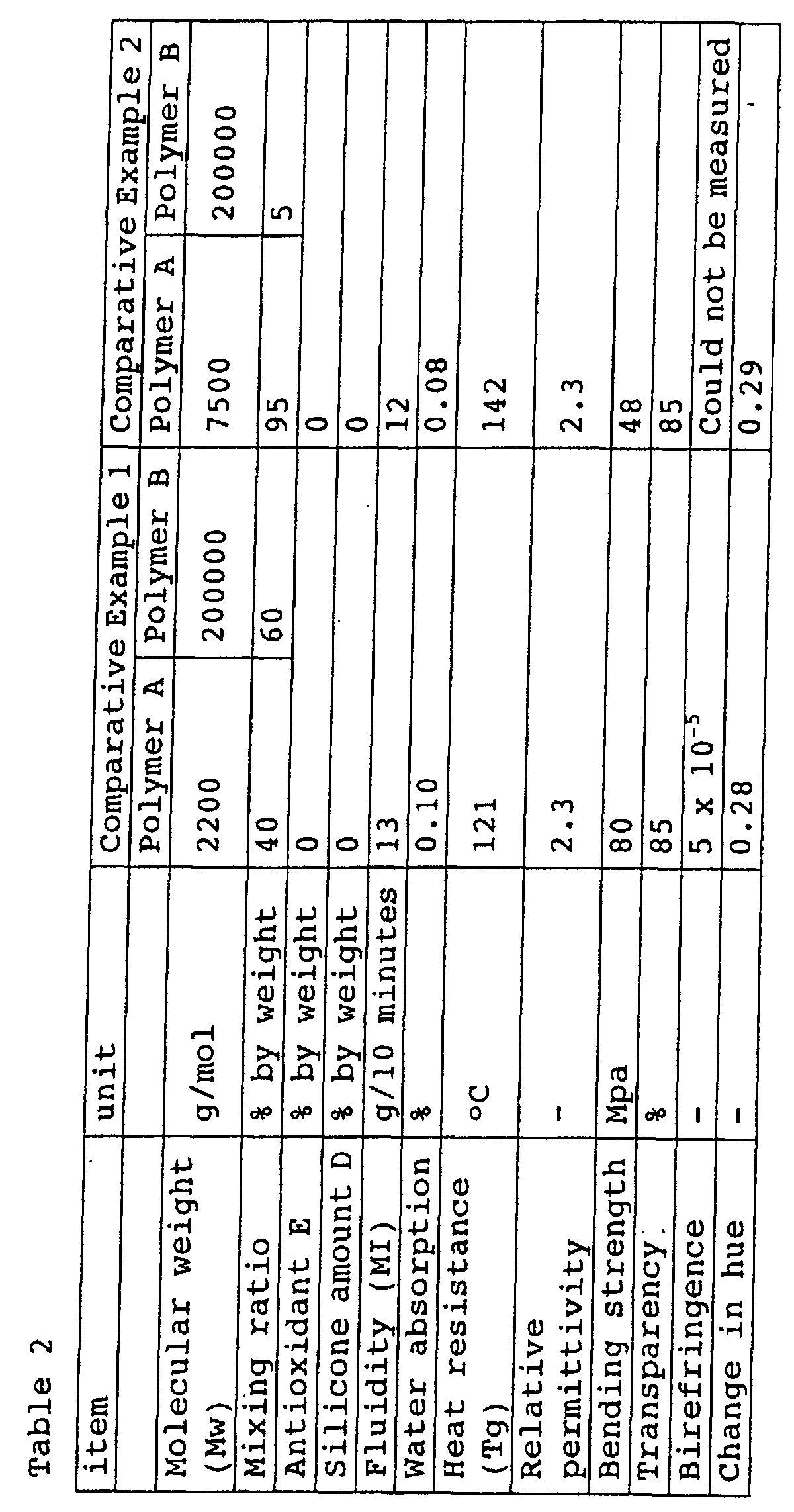
Placed in a 100-mL flask were 10.0 g of indene and 30.0
g of nitrobenzene, and 0.05 g of FeCl3 was added thereto at
0°C, thereby being allowed to react for 12 hours. Thereafter,
0.05 g of methanol was added to this reaction mixture liquid,
and then the liquid was stirred to obtain a homogeneous solution.
The homogeneous solution thus obtained was gradually added
to 100 g of methanol to obtain 9.7 g of a white precipitate.
This white precipitate was dried under reduced pressure to
obtain a polymer (F). The weight-average molecular weight
of this polymer was 7500.
Placed in a 100-mL flask were 20.0 g of styrene and 0.1
g of benzoyl peroxide, and the mixture was stirred to dissolve.
Then, 60 g of distilled water and 0.01 g of calcium phosphate
were added thereto, and the mixture was allowed to react at
70°C for 12 hours with being stirred. A granular polymer thus
obtained was isolated and washed with hydrochloric acid.
Subsequently, the polymer was dried at 50°C for about 2 hours
to obtain a polymer (G). The weight-average molecular weight
of the polymer obtained was 200000.
In advance, 18.0 g of styrene, 2.0 g of
p-chloromethylstyrene and 0.1 g of benzoyl peroxide were placed
in a 100-mL flask, the mixture was stirred to dissolve. Then,
60 g of distilled water and 0.1 g of calcium phosphate were
added thereto, and the mixture was allowed to react at 70°C
for 12 hours with stirring. Thereafter a granular polymer
was isolated and washed with hydrochloric acid. Subsequently,
the polymer was dried at 50°C for about 2 hours. Dissolved
in 30 g of toluene was 6.0 g of the granular polymer thus obtained,
and 4.0 g of indene was further added thereto, and the mixture
was stirred until the mixture became homogeneous. After that,
0.003 g of 2,6-bis(t-butyl)pyridine was added at 25°C and
dissolved. Then, 0.03 g of tin chloride was added, and the
mixture was allowed to stand for 24 hours to obtain a graft
polymer (H). After 0.05 g of methanol was added to the reaction
mixture liquid thus obtained, this reaction mixture liquid
was poured in methanol in an amount about 10 times that of
the reaction mixture liquid of methanol, and a polymer thus
formed was isolated. This polymer was dried at 40°C for 6
hours to obtain 9.8 g of a polymer (H). The weight-average
molecular weight of this polymer was 210000.
Dissolved in 20 g of toluene were 5.5 g of the polymer
(F), 3.5 g of the polymer (G), and 1.0 g of the polymer (H),
and the mixture was added to about 300 g of methanol to
precipitate a solid. This solid was dried at 40°C for 6 hours
to obtain a white precipitate of a desired resin composition.
This resin composition was hot-pressed to produce a molding
material having a thickness of 2 mm. This molding material
was used as a sample fragment. The above-mentioned evaluations
were carried out using this sample fragment. The evaluation
results are shown in Table 3.
Placed in a 100-mL flask were 10.0 g of indene and 30.0
g of nitrobenzene, and 0.05 g of FeCl3 was added thereto at
0°C, thereby being allowed to react for 12 hours. Thereafter,
0.05 g of methanol was added to this reaction mixture liquid,
and then the liquid was stirred to obtain a homogeneous solution.
The homogeneous solution thus obtained was gradually added
to 100 g of methanol to obtain 9.7 g of a white precipitate.
This white precipitate was dried under reduced pressure to
obtain a polymer (F). The weight-average molecular weight
of this polymer was 7500.
Placed in a 100-mL flask were 20.0 g of styrene and 0.1
g of benzoyl peroxide, and the mixture was stirred to dissolve.
Then, 60 g of distilled water and 0.01 g of calcium phosphate
were added thereto, and the mixture was allowed to react at
10°C for 12 hours with being stirred. A granular polymer thus
obtained was isolated and washed with hydrochloric acid.
Subsequently, the polymer was dried at 50°C for about 2 hours
to obtain a polymer (G). The weight-average molecular weight
of the polymer obtained was 200000.
In advance, 18.0 g of styrene, 2.0 g of
p-chloromethylstyrene and 0.1 g of benzoyl peroxide were placed
in a 100-mL flask, the mixture was stirred to dissolve. Then,
60 g of distilled water and 0.1 g of calcium phosphate were
added thereto, and the mixture was allowed to react at 70°C
for 12 hours with being stirred. After the reaction was allowed
for a predetermined time, the granular polymer was isolated
and washed with hydrochloric acid. Subsequently, the polymer
was dried at 50°C for about 2 hours. Dissolved in 30 g of
toluene was 6.0 g of the granular polymer thus obtained, and
4.0 g of indene was further added thereto, and the mixture
was stirred until the mixture became homogeneous. After that,
0.003 g of 2,6-bis(t-butyl)pyridine was added at 25°C and
dissolved. Then, 0.03 g of tin chloride was added, and the
mixture was allowed to stand for 24 hours to obtain a graft
polymer. After 0.05 g of methanol was added to the reaction
mixture liquid, this reaction mixture liquid was poured in
methanol in about 10 times the amount of the reaction mixture
liquid of methanol, and a polymer thus formed was isolated.
This polymer was dried at 40°C for 6 hours to obtain 9.8 g
of a polymer (H). The weight-average molecular weight of this
polymer was 210000.
Dissolved in 20 g of toluene were 5.5 g of the polymer
(F), 3.5 g of the polymer (G), 1.0 g of the polymer (H), 0.01
g of diphenylsilicone (produced by Shin-Etsu Chemical Co.,
Ltd.) having a viscosity of 500 CS and 0.05 g of
n-octadecyl-3-(4-hydroxy-3,5-t-dibutylphenyl)propionate,
and the mixture was added to about 300 g of methanol to
precipitate a solid. This solid was dried at 40°C for 6 hours
to obtain a white precipitate of a desired resin composition.
This resin composition was hot-pressed to produce a molding
material having a thickness of 2 mm. This molding material
was used as a sample fragment. The above-mentioned evaluations
were carried out using this sample fragment. The evaluation
results are shown in Table 3.
Placed in a 100-mL flask were 10.0 g of indene and 30.0
g of toluene, and 0.01 g of AlCl3 was added thereto at 25°C,
thereby being allowed to react for 6 hours. Thereafter 0.01
g of methanol was added to this reaction mixture liquid, and
then the liquid was stirred to obtain a homogeneous solution.
The homogeneous solution thus obtained was gradually added
to 100 g of methanol to obtain 9.8 g of a white precipitate.
This white precipitate was dried under reduced pressure to
obtain a polymer (F). The weight-average molecular weight
of this polymer was 10000.
Placed in a 100-mL flask were 20.0 g of styrene and 0.1
g of benzoyl peroxide, and the mixture was stirred to dissolve.
Then, 60 g of distilled water and 0.01 g of calcium phosphate
were added to the monomer mixture, and the mixture was allowed
to react at 70°C for 12 hours with being stirred. A granular
polymer thus obtained was isolated to obtain a polymer (G).
The weight-average molecular weight of the polymer obtained
was 200000.
In advance, 18.0 g of styrene, 2.0 g of
p-chloromethylstyrene and 0.1 g of benzoyl peroxide were placed
in a 100-mL flask, the mixture was stirred to dissolve. Then,
60 g of distilled water and 0.01 g of calcium phosphate were
added to the monomer mixture, and the mixture was allowed to
react at 70°C for 12 hours with bring stirred. The granular
polymer thus obtained was isolated and washed with hydrochloric
acid. Subsequently, the polymer was dried at 50°c for about
2 hours. Dissolved in 30 g of toluene was 6.0 g of the granular
polymer thus obtained, and 4.0 g of indene was further added
thereto, and the mixture was stirred until the mixture became
homogeneous. After that, 0.003 g of 2,6-bis(t-butyl)pyridine
was added at 25 °C and dissolved. Then, 0.03 g of tin chloride
was added, and the mixture was allowed to stand for 24 hours
to obtain a graft polymer. After 0.05 g of methanol was added
to the reaction mixture liquid thus obtained, this reaction
mixture liquid was poured in methanol in about 10 times the
amount of the reaction mixture liquid of methanol, and a polymer
thus formed was isolated. This polymer was dried at 40°C for
6 hours to obtain 9.8 g of a polymer (H). The weight-average
molecular weight of this polymer was 200000.
Dissolved in 20 g of toluene were 6.0 g of the polymer
(F), 3.5 g of the polymer (G), 0.5 g of the polymer (H), 0.01
g of diphenylsilicone (produced by Shin-Etsu Chemical Co.,
Ltd.) having a viscosity of 500 CS and 0.05 g of
n-octadecyl-3-(4-hydroxy-3,5-t-dibutylphenyl)propionate,
and the mixture was added to about 300 g of methanol to
precipitate a solid. This solid was dried at 40°C for 6 hours
to obtain a desired resin composition. This resin composition
was hot-pressed to produce a molding material having a thickness
of 2 mm. This molding material was used as a sample fragment.
The above-mentioned evaluations were carried out using this
sample fragment. The evaluation results are shown in Table
3.
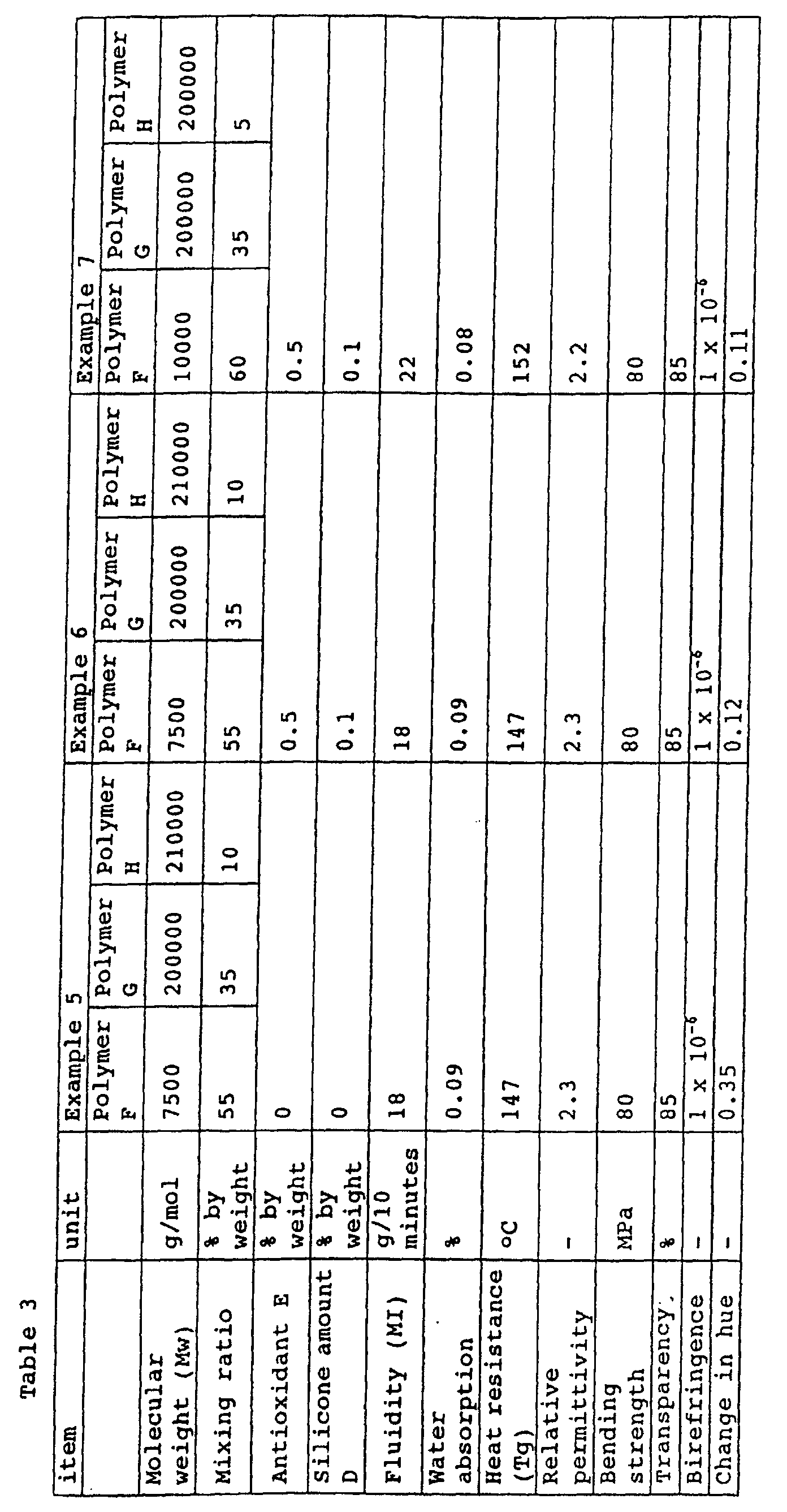
Placed in a 100-mL flask were 10.0 g of indene and 30.0
g of nitrobenzene, and 0.05 g of FeCl3 was added thereto at
0°C, thereby being allowed to react for 12 hours. Thereafter,
0.05 g of methanol was added to this reaction mixture liquid,
and then the liquid was stirred to obtain a homogeneous solution.
The homogeneous solution thus obtained was gradually added
to 100 g of methanol to obtain 9.7 g of a white precipitate.
This white precipitate was dried under reduced pressure to
obtain a polymer (F). The weight-average molecular weight
of this polymer was 7500.
Placed in a 100-mL flask were 20.0 g of styrene and 0.1
g of benzoyl peroxide, and the mixture was stirred to dissolve.
Then, 60 g of distilled water and 0.01 g of calcium phosphate
were added to the monomer mixture, and the mixture was allowed
to react at 70°C for 12 hours with being stirred. A granular
polymer thus obtained was isolated and washed with hydrochloric
acid. Subsequently, the polymer was dried at 50°C for about
2 hours to obtain a polymer (G). The weight-average molecular
weight of the polymer obtained was 200000.
Dissolved in 20 g of toluene were 6.0 g of the polymer
(F) and 4.0 g of the polymer (G), and the mixture was added
to about 300 g of methanol to precipitate a solid. This solid
was dried at 40°C for 6 hours to obtain a white precipitate
of a resin composition. This resin composition was hot-pressed
to produce a molding material having a thickness of 2 mm. This
molding material was used as a sample fragment. The
above-mentioned evaluations were carried out using this sample
fragment. The evaluation results are shown in Table 4.
| item | unit | Comparative Example 3 | |
| Polymer F | Polymer G | ||
| Molecular weight (Mw) | g/mol | 7500 | 200000 |
| Mixing ratio | % by weight | 60 | 40 |
| Antioxidant E | % by weight | 0 | |
| Silicone amount D | % by weight | 0 | |
| Fluidity (MI) | g/10 minutes | 17 | |
| Water absorption | % | 0.10 | |
| Heat resistance (Tg) | °C | 142 | |
| Relative permittivity | - | 2.3 | |
| Bending strength | MPa | 75 | |
| Transparency | % | 55 | |
| Birefringence | - | Could not be measured | |
| Change in hue | - | 0.35 |
Placed in a 100-mL flask were 9.95 g of indene, 0.05
g of vinylpyridine and 30.0 g of methylene chloride, and 0.01
g of FeCl3 was added thereto at -40°C, thereby being allowed
to react for 24 hours. Thereafter, 0.05 g of methanol was
added at room temperature to this reaction mixture liquid,
and then the liquid was stirred to obtain a homogeneous solution.
The homogeneous solution thus obtained was gradually added
to 100 g of methanol to obtain 9.8 g of a white precipitate.
This white precipitate was dried under reduced pressure to
obtain a polymer (I). The weight-average molecular weight
of this polymer was 97000.
Placed in a 100-mL flask were 19.9 g of styrene, 0.1
g of methacrylic acid and 0.1 g of benzoyl peroxide, and the
mixture was stirred to dissolve. Then, the mixture was sealed
and allowed to react at 70°C for 12 hours with reflux. The
polymer thus obtained was granulated and then washed with
methanol. Subsequently, the polymer was dried at 50°C for
about 8 hours to obtain a polymer (J). The weight-average
molecular weight of the polymer obtained was 250000.
Dissolved in 20 g of toluene were 6.0 g of the polymer
(I), 4.0 g of the polymer (J), 0.01 g of diphenylsilicone having
a viscosity of 500 CS and 0.05 g of n-octadecyl-3-(4-hydroxy-3,5-t-dibutylphenyl)propionate,
and the mixture was added to
about 300 g of methanol to precipitate a solid. This solid
was dried at 40°C for 6 hours to obtain a desired resin
composition. This resin composition was hot-pressed to
produce a molding material having a thickness of 2 mm. This
molding material was used as a sample fragment. The
above-mentioned evaluations were carried out using this sample
fragment. The evaluation results are shown in Table 5.
Placed in a 100-mL flask were 9.95 g of indene, 0.05
g of vinylpyridine and 30.0 g of toluene, and 0.01 g of AlCl3
was added thereto at -4°C, thereby being allowed to react for
24 hours. Thereafter, 0.05 g of methanol was added at room
temperature to this reaction mixture liquid, and then the liquid
was stirred to obtain a homogeneous solution. The homogeneous
solution thus obtained was gradually added to 100 g of methanol
to obtain 9.7 g of a white precipitate. This white precipitate
was dried under reduced pressure to obtain a polymer (I). The
weight-average molecular weight of this polymer was 50000.
Placed in a 100-mL flask were 19.8 g of styrene, 0.2
g of methacrylic acid and 0.1g of benzoyl peroxide, and the
mixture was stirred to dissolve. Then, the mixture was sealed
and allowed to react at 70°C for 12 hours with reflux. A polymer
thus obtained was granulated and then washed with methanol.
Subsequently, the polymer was dried at 50°C for about 8 hours
to obtain a polymer (J). The weight-average molecular weight
of the polymer obtained was 250000.
Dissolved in 20 g of toluene were 6.0 g of the polymer
(I), 4.0 g of the polymer (J), 0.01 g of diphenylsilicone
(produced by Shin-Etsu Chemical Co., Ltd.) having a viscosity
of 500 CS and 0.05 g of n-octadecyl-3-(4-hydroxy-3,5-t-dibutylphenyl)propionate,
and the mixture was added to
about 300 g of methanol to precipitate a solid. This solid
was dried at 40°C for 6 hours to obtain a desired resin
composition. This resin composition was hot-pressed to
produce a molding material having a thickness of 2 mm. This
molding material was used as a sample fragment. The
above-mentioned evaluations were carried out using this sample
fragment. The evaluation results are shown in Table 5.

An experiment was carried out in the same manner as in
Example 7 except using only 10.0 g of indene and not using
vinylpyridine and methylene chloride in the synthesis of the
polymer (I), and using only 20.0 g of styrene and not using
methacrylic acid in the synthesis of the polymer (H). The
above-mentioned evaluations were conducted using this sample
fragment. The evaluation results are shown in Table 6.
An experiment was carried out in the same manner as in
Example 7 except not using 0.01 g of diphenylsilicone having
a viscosity of 500 CS (produced by Shin-Etsu Chemical Co.,
Ltd.) and 0.05 g of n-octadecyl-3-(4-hydroxy-3,5-t-dibutylphenyl)propionate.
The above-mentioned
evaluations were conducted using this sample fragment. The
evaluation results are shown in Table 6.
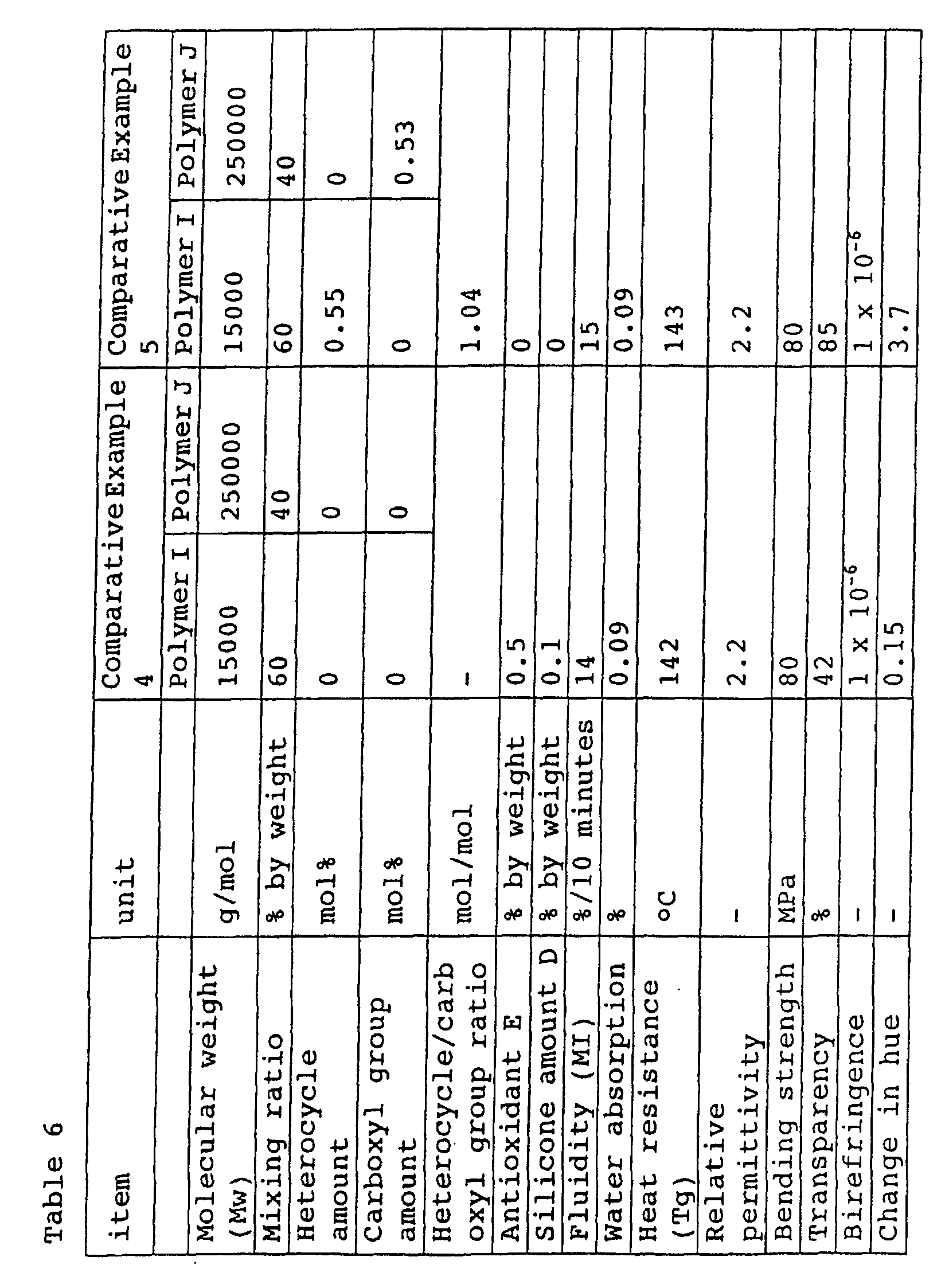
The present invention can provide resin compositions
having low hygroscopicity, low birefringence and low
permittivity, being excellent in fluidity, causing little
change in color upon heating, and excelling in mold release
characteristics in injection molding. Furthermore, the use
of a molding material, a sheet or a film obtained by molding
these resin compositions can provide an optical part having
low hygroscopicity, low birefringence and low permittivity.
Claims (22)
- A resin composition (a) comprising the following polymers (A), and (B) and/or (C):(A) a polymer comprising one or more kinds of indene and indene derivatives represented by the following general formula (I);(B) a polymer comprising polystyrene or a polystyrene derivative; and(C) a polymer comprising a monomer copolymerizable with styrene or a styrene derivative:(wherein R1, R2, R3, R4, R5 and R6 may be the same or different, and each represents a hydrogen atom; a monovalent hydrocarbon group containing a nitrogen atom, an oxygen atom or a silicon atom; an alkyl group having 1 to 6 carbon atoms; or a monovalent aromatic hydrocarbon group. X represents a hydrogen atom, a halogen atom, an acyl group, an alkoxy group or a nitrile group. x represents 0 or an integer of 1 to 4, and y represents an integer of 1 to 4, where x + y = 4.)
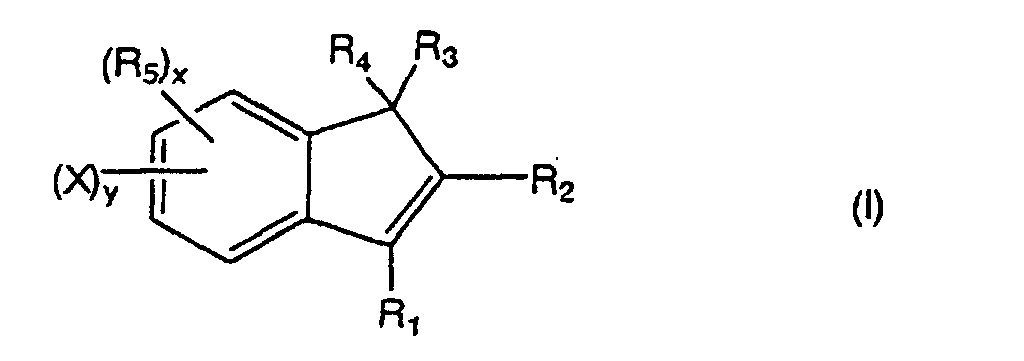
- The resin composition (a) according to claim 1, wherein a diphenylsilicone (D) and/or a phenolic antioxidant (E) are/is added to the resin composition comprising the polymers (A), and (B) and/or (C).
- The resin composition (a) according to claim 1 or 2, wherein the saturated water absorption is 0.4% or less, and the birefringence in stretching the resin composition by 200% is in the range of -2 x 10⁻⁶ to 2 x 10⁻⁶.
- The resin composition (a) according to any one of claims 1 to 3, wherein the weight-average molecular weight of the polymer (A) is lower than 80000.
- The resin composition (a) according to any one of claims 1 to 4, wherein the weight-average molecular weight(s) of the polymer (B) and/or the polymer (C) are/is 50000 or higher.
- The resin composition (a) according to any one of claims 1 to 5, wherein the content of the polymer (A) is 30 to 90% by weight of the total of the resin composition (a).
- A resin composition (b) comprising the following polymers (F), (G) and (H):(F) a polymer comprising one or more kinds of indene and indene derivatives represented by the general formula (I);(G) a polymer comprising polystyrene or a polystyrene derivative; and(H) a graft polymer having a structure wherein a polymer comprising at least one kind of indene and an indene derivative represented by the general formula (I) bonds to a side chain of a polymer comprising a monomer copolymerizable with styrene or a styrene derivative.
- The resin composition (b) according to claim 7, wherein a diphenylsilicone (D) and/or a phenolic antioxidant (E) are/is added to the resin composition comprising the polymers (F), (G) and (H).
- The resin composition (b) according to claim 7 or 8, wherein the saturated water absorption is 0.4% or less, and the birefringence in stretching the resin composition by 200% is in the range of -2 x 10⁻⁶ to 2 x 10⁻⁶.
- The resin composition (b) according to any one of claims 7 to 9, wherein the weight-average molecular weight of the polymer (F) is 4000 or higher.
- The resin composition (b) according to any one of claims 7 to 10, wherein the weight-average molecular weights of the polymer (G) and the polymer (H) are 50000 or higher.
- The resin composition (b) according to any one of claims 7 to 11, wherein the content of the polymer (F) is 30 to 90% by weight of the total of the resin composition (b).
- A resin composition (c) comprising the following polymers (I) and (J), diphenylsilicone (D), and a phenolic antioxidant (E):wherein the polymer has a carboxyl group and/or a phenolic hydroxyl group in a side chain thereof.(I) a polymer comprising one or more kinds of indene and indene derivatives represented by the general formula (I), wherein the polymer has a heterocyclic structure in a side chain thereof; and(J) a polymer comprising styrene or a styrene derivative, and a monomer copolymerizable with styrene or a styrene derivative,
- The resin composition (c) according to claim 13, wherein the saturated water absorption is 0.4% or less, and the birefringence in stretching the resin composition by 200% is in the range of -2 x 10⁻⁶ to 2 x 10⁻⁶.
- The resin composition (c) according to claim 13 or 14, wherein the content of the heterocyclic structure in the polymer (I) is 0.01 to 5 mol% of the total of the resin composition (c), and the content of the carboxyl group and/or the phenolic hydroxyl group in the polymer (J) are/is 0.01 to 5 mol% of the total of the resin composition (c).
- The resin composition (c) according to any one of claims 13 to 15, wherein the molar ratio of the heterocyclic structure to the carboxyl group and/or the phenolic hydroxyl group is 0.1 to 10.0.
- The resin composition (c) according to any one of claims 13 to 16, wherein the content of the polymer (I) is 30 to 90% by weight of the total of the resin composition (c).
- The resin composition (c) according to any one of claims 13 to 17, wherein the addition amount of the diphenylsilicone (D) is 0.01 to 1.0% by weight of the total of the resin composition (c), and the addition amount of the phenolic antioxidant (E) is 0.1 to 3.0% by weight of the total of the resin composition (c).
- A molding material obtained by molding a resin composition selected from the resin composition (a) according to claim 1, the resin composition (b) according to claim 7 and the resin composition (c) according to claim 13.
- A sheet obtained from a resin composition selected from the resin composition (a) according to claim 1, the resin composition (b) according to claim 7 and the resin composition (c) according to claim 13.
- A film obtained from a resin composition selected from the resin composition (a) according to claim 1, the resin composition (b) according to claim 7 and the resin composition (c) according to claim 13.
- An optical part using the molding material, the sheet or the film according to claims 19 to 21.
Applications Claiming Priority (11)
| Application Number | Priority Date | Filing Date | Title |
|---|---|---|---|
| JP18118199 | 1999-06-28 | ||
| JP18118299 | 1999-06-28 | ||
| JP18118199 | 1999-06-28 | ||
| JP18118299 | 1999-06-28 | ||
| JP2000024776 | 2000-01-28 | ||
| JP2000024774 | 2000-01-28 | ||
| JP2000024775 | 2000-01-28 | ||
| JP2000024774 | 2000-01-28 | ||
| JP2000024775 | 2000-01-28 | ||
| JP2000024776 | 2000-01-28 | ||
| PCT/JP2000/004215 WO2001000728A1 (en) | 1999-06-28 | 2000-06-27 | Low-hygroscopicity low-birefringence resin compositions, molding material obtained therefrom, sheet or film, and optical part |
Publications (2)
| Publication Number | Publication Date |
|---|---|
| EP1205517A1 true EP1205517A1 (en) | 2002-05-15 |
| EP1205517A4 EP1205517A4 (en) | 2005-01-26 |
Family
ID=27528797
Family Applications (1)
| Application Number | Title | Priority Date | Filing Date |
|---|---|---|---|
| EP00940857A Withdrawn EP1205517A4 (en) | 1999-06-28 | 2000-06-27 | Low-hygroscopicity low-birefringence resin compositions, molding material obtained therefrom, sheet or film, and optical part |
Country Status (4)
| Country | Link |
|---|---|
| US (2) | US6900273B1 (en) |
| EP (1) | EP1205517A4 (en) |
| KR (1) | KR20020026474A (en) |
| WO (1) | WO2001000728A1 (en) |
Cited By (2)
| Publication number | Priority date | Publication date | Assignee | Title |
|---|---|---|---|---|
| EP2237086A4 (en) * | 2007-12-28 | 2010-12-15 | Nippon Catalytic Chem Ind | Optical film and image forming apparatus having the same |
| EP3412449A4 (en) * | 2016-02-05 | 2019-08-07 | Mitsubishi Gas Chemical Company, Inc. | TEMPERED MULTILAYER THERMOPLASTIC RESIN FILM |
Family Cites Families (23)
| Publication number | Priority date | Publication date | Assignee | Title |
|---|---|---|---|---|
| US3888941A (en) * | 1974-02-26 | 1975-06-10 | Uniroyal Inc | Modified abs polymers |
| FR2291234A1 (en) * | 1974-11-18 | 1976-06-11 | Anvar | POLYMERS AND COPOLYMERS OF INDENE GRAFT ON ELASTOMERIC CHAINS |
| US4066717A (en) * | 1975-12-24 | 1978-01-03 | The Standard Oil Company | Thermoplastic resin compositions comprising polyindene or coumarone-indene resin |
| US4326045A (en) * | 1975-12-24 | 1982-04-20 | The Standard Oil Company | Thermoplastic resins containing coumarone-indene resin or polyindene |
| US4267086A (en) * | 1976-01-07 | 1981-05-12 | Ford Motor Company | Sacraficial binders for molding particulate solids |
| US4100226A (en) * | 1976-12-23 | 1978-07-11 | The Standard Oil Company | Indene-chlorobutyl rubber copolymers |
| US4082820A (en) * | 1977-06-15 | 1978-04-04 | The Standard Oil Company | High softening maleic anhydride copolymers |
| US4195135A (en) * | 1977-10-28 | 1980-03-25 | Standard Oil Company | Thermoplastic nitrile resin blends |
| US4267066A (en) * | 1979-10-17 | 1981-05-12 | International Flavors & Fragrances Inc. | Process for augmenting or enhancing the aroma of detergent using derivatives of cis-3-hexenol |
| US4492428A (en) * | 1981-10-27 | 1985-01-08 | At&T Bell Laboratories | Coated optical fiber |
| US4432607A (en) * | 1981-10-27 | 1984-02-21 | Bell Telephone Laboratories, Incorporated | Hot melt coated optical fiber |
| DE3333722A1 (en) * | 1983-09-17 | 1985-04-04 | Bayer Ag, 5090 Leverkusen | ABS MOLDS WITH IMPROVED FLAME RESISTANCE |
| US4603186A (en) * | 1985-10-21 | 1986-07-29 | The Standard Oil Company | Tetrapolymers containing indene |
| US5229449A (en) * | 1988-06-30 | 1993-07-20 | Kawasaki Steel Corporation | Copolymer of polymerizable components in naphtha oil and maleic anhydride, process for producing said copolymer, and derivatives thereof |
| DE3911829A1 (en) * | 1989-04-11 | 1990-10-18 | Basf Ag | OPTICAL RECORDING MEDIUM |
| EP0393685A1 (en) | 1989-04-20 | 1990-10-24 | Kawasaki Steel Corporation | Imidated copolymers and uses thereof |
| JPH04323246A (en) * | 1991-04-24 | 1992-11-12 | Mitsubishi Kasei Corp | Indene polymer composition |
| DE4325752A1 (en) * | 1993-07-31 | 1995-02-02 | Basf Ag | Sulfonated and oxidized indene polymers and their use as dispersants |
| JPH10231403A (en) | 1997-02-19 | 1998-09-02 | Arakawa Chem Ind Co Ltd | Aromatic vinyl resin composition |
| JPH11246733A (en) * | 1997-12-04 | 1999-09-14 | Kanegafuchi Chem Ind Co Ltd | Thermoplastic resin composition |
| US6228944B1 (en) * | 1999-06-24 | 2001-05-08 | The Goodyear Tire & Rubber Company | Polymeric resinous material derived from limonene, dimethyl-dicyclopentadiene, indene and vinyl toluene |
| US6265478B1 (en) * | 1999-08-18 | 2001-07-24 | The Goodyear Tire & Rubber Company | Polymeric resinous material derived from limonene dicyclopentadiene indene and alpha-methyl styrene |
| JP2002003706A (en) * | 2000-06-26 | 2002-01-09 | Hitachi Chem Co Ltd | Low-hygroscopic and low-birefringence resin composition, molding material, sheet or film obtained therefrom, and part for optics |
-
2000
- 2000-06-27 US US10/019,753 patent/US6900273B1/en not_active Expired - Fee Related
- 2000-06-27 EP EP00940857A patent/EP1205517A4/en not_active Withdrawn
- 2000-06-27 WO PCT/JP2000/004215 patent/WO2001000728A1/en not_active Ceased
- 2000-06-27 KR KR1020017016691A patent/KR20020026474A/en not_active Withdrawn
-
2004
- 2004-05-17 US US10/847,195 patent/US20040220342A1/en not_active Abandoned
Cited By (3)
| Publication number | Priority date | Publication date | Assignee | Title |
|---|---|---|---|---|
| EP2237086A4 (en) * | 2007-12-28 | 2010-12-15 | Nippon Catalytic Chem Ind | Optical film and image forming apparatus having the same |
| CN101910888B (en) * | 2007-12-28 | 2013-07-17 | 株式会社日本触媒 | Optical film and image display device having same |
| EP3412449A4 (en) * | 2016-02-05 | 2019-08-07 | Mitsubishi Gas Chemical Company, Inc. | TEMPERED MULTILAYER THERMOPLASTIC RESIN FILM |
Also Published As
| Publication number | Publication date |
|---|---|
| WO2001000728A1 (en) | 2001-01-04 |
| EP1205517A4 (en) | 2005-01-26 |
| US6900273B1 (en) | 2005-05-31 |
| KR20020026474A (en) | 2002-04-10 |
| US20040220342A1 (en) | 2004-11-04 |
Similar Documents
| Publication | Publication Date | Title |
|---|---|---|
| JP4338951B2 (en) | Soluble polyfunctional vinyl aromatic copolymer and polymerization method thereof | |
| JP6148802B1 (en) | Method for producing methacrylic resin | |
| JP5216744B2 (en) | High heat-resistant acrylic copolymer and method for producing the same | |
| US6900273B1 (en) | Low-hygroscopicity low-birefringence resin compositions, molding material obtained therefrom, sheet or film, and optical part | |
| WO2004089996A1 (en) | Modified cycloolefin copolymer, process for producing the same, and use of the polymer | |
| KR100952286B1 (en) | Optical film, retardation film, and liquid crystal display device comprising the same | |
| KR101142261B1 (en) | Methacrylic copolymer having good chemical resistance and heat resistance | |
| US6998442B2 (en) | Organic anti-reflective coating polymers, anti-reflective coating composition comprising the same and preparation methods thereof | |
| JP5457160B2 (en) | Soluble polyfunctional (meth) acrylic acid ester copolymer having alicyclic structure and method for producing the same | |
| JP2002003706A (en) | Low-hygroscopic and low-birefringence resin composition, molding material, sheet or film obtained therefrom, and part for optics | |
| JP5596390B2 (en) | Soluble polyfunctional (meth) acrylic acid ester copolymer having alcoholic hydroxyl group and method for producing the same | |
| JPWO2001000728A1 (en) | Low moisture absorption and low birefringence resin composition, molding material, sheet or film obtained therefrom, and optical component | |
| US6582883B2 (en) | Organic anti-reflective coating polymer, anti-reflective coating composition and methods of preparation thereof | |
| JP7434830B2 (en) | Resin compositions for optical materials, optical films and image display devices | |
| JP2002003683A (en) | Resin composition low in both hygroscopic property and birefringence and forming material, sheet of film and optical parts obtained from the resin composition | |
| JP2001089537A (en) | Indene-containing polymer, molding material, sheet or film and optical part obtained from the same polymer | |
| JP2002003544A (en) | Copolymer having acenaphthylene derivative,and molding material, sheet or film and optical part obtained from the same | |
| JP2006124569A (en) | Maleimide copolymer, process for producing the same, and optical film obtained therefrom | |
| JP2002003547A (en) | Acenaphthylene derivative-containing copolymer, and molding material, sheet or film and optical part obtained by using the same | |
| JP2002003684A (en) | Resin composition low in both hygroscopic property and birefringence and forming material, sheet or film and optical parts obtained from the resin composition | |
| JP2002003556A (en) | Copolymer containing acenaphthylene derivertive and molding material, sheet or film, and optical part obtained form the same | |
| JP2002003685A (en) | Resin composition low in both hygroscopic property and birefringence and forming material, sheet or film and optical parts obtained from the resin composition | |
| JP3284216B2 (en) | Method for producing copolymer | |
| KR102693069B1 (en) | Polymer composition | |
| JPH06220106A (en) | Method for producing copolymer |
Legal Events
| Date | Code | Title | Description |
|---|---|---|---|
| PUAI | Public reference made under article 153(3) epc to a published international application that has entered the european phase |
Free format text: ORIGINAL CODE: 0009012 |
|
| 17P | Request for examination filed |
Effective date: 20020111 |
|
| AK | Designated contracting states |
Kind code of ref document: A1 Designated state(s): AT BE CH CY DE DK ES FI FR GB GR IE IT LI LU MC NL PT SE |
|
| RBV | Designated contracting states (corrected) |
Designated state(s): DE NL |
|
| A4 | Supplementary search report drawn up and despatched |
Effective date: 20041209 |
|
| 17Q | First examination report despatched |
Effective date: 20050228 |
|
| STAA | Information on the status of an ep patent application or granted ep patent |
Free format text: STATUS: THE APPLICATION IS DEEMED TO BE WITHDRAWN |
|
| 18D | Application deemed to be withdrawn |
Effective date: 20051025 |