EP1205496A1 - Catalyst component comprising magnesium, titanium, a halogen and an electron donor, its preparation and use - Google Patents
Catalyst component comprising magnesium, titanium, a halogen and an electron donor, its preparation and use Download PDFInfo
- Publication number
- EP1205496A1 EP1205496A1 EP00124671A EP00124671A EP1205496A1 EP 1205496 A1 EP1205496 A1 EP 1205496A1 EP 00124671 A EP00124671 A EP 00124671A EP 00124671 A EP00124671 A EP 00124671A EP 1205496 A1 EP1205496 A1 EP 1205496A1
- Authority
- EP
- European Patent Office
- Prior art keywords
- process according
- magnesium
- solution
- solvent
- temperature
- Prior art date
- Legal status (The legal status is an assumption and is not a legal conclusion. Google has not performed a legal analysis and makes no representation as to the accuracy of the status listed.)
- Withdrawn
Links
- 239000003054 catalyst Substances 0.000 title claims abstract description 43
- 239000011777 magnesium Substances 0.000 title claims abstract description 43
- 229910052749 magnesium Inorganic materials 0.000 title claims abstract description 35
- 239000010936 titanium Substances 0.000 title claims abstract description 15
- 229910052719 titanium Inorganic materials 0.000 title claims abstract description 14
- FYYHWMGAXLPEAU-UHFFFAOYSA-N Magnesium Chemical compound [Mg] FYYHWMGAXLPEAU-UHFFFAOYSA-N 0.000 title claims description 24
- RTAQQCXQSZGOHL-UHFFFAOYSA-N Titanium Chemical compound [Ti] RTAQQCXQSZGOHL-UHFFFAOYSA-N 0.000 title claims description 11
- 229910052736 halogen Inorganic materials 0.000 title claims description 7
- 150000002367 halogens Chemical class 0.000 title claims description 7
- 238000002360 preparation method Methods 0.000 title claims description 5
- -1 magnesium halide Chemical class 0.000 claims abstract description 21
- 238000001556 precipitation Methods 0.000 claims abstract description 18
- 229920002601 oligoester Polymers 0.000 claims abstract description 14
- 150000001336 alkenes Chemical class 0.000 claims abstract description 9
- JRZJOMJEPLMPRA-UHFFFAOYSA-N olefin Natural products CCCCCCCC=C JRZJOMJEPLMPRA-UHFFFAOYSA-N 0.000 claims abstract description 8
- 150000001733 carboxylic acid esters Chemical class 0.000 claims abstract description 6
- 238000000975 co-precipitation Methods 0.000 claims abstract description 4
- 239000003426 co-catalyst Substances 0.000 claims abstract description 3
- 239000004711 α-olefin Substances 0.000 claims abstract 2
- YXFVVABEGXRONW-UHFFFAOYSA-N Toluene Chemical compound CC1=CC=CC=C1 YXFVVABEGXRONW-UHFFFAOYSA-N 0.000 claims description 51
- 238000000034 method Methods 0.000 claims description 47
- IMNFDUFMRHMDMM-UHFFFAOYSA-N N-Heptane Chemical compound CCCCCCC IMNFDUFMRHMDMM-UHFFFAOYSA-N 0.000 claims description 31
- 239000002904 solvent Substances 0.000 claims description 25
- 239000000203 mixture Substances 0.000 claims description 17
- LFQSCWFLJHTTHZ-UHFFFAOYSA-N Ethanol Chemical compound CCO LFQSCWFLJHTTHZ-UHFFFAOYSA-N 0.000 claims description 15
- OFBQJSOFQDEBGM-UHFFFAOYSA-N Pentane Chemical compound CCCCC OFBQJSOFQDEBGM-UHFFFAOYSA-N 0.000 claims description 14
- 238000006243 chemical reaction Methods 0.000 claims description 14
- 239000007795 chemical reaction product Substances 0.000 claims description 14
- 150000002681 magnesium compounds Chemical class 0.000 claims description 13
- 150000005846 sugar alcohols Polymers 0.000 claims description 12
- 230000015572 biosynthetic process Effects 0.000 claims description 11
- 150000008282 halocarbons Chemical class 0.000 claims description 11
- 150000003609 titanium compounds Chemical class 0.000 claims description 11
- 239000003849 aromatic solvent Substances 0.000 claims description 9
- VFWCMGCRMGJXDK-UHFFFAOYSA-N 1-chlorobutane Chemical compound CCCCCl VFWCMGCRMGJXDK-UHFFFAOYSA-N 0.000 claims description 8
- 238000005406 washing Methods 0.000 claims description 8
- 125000003545 alkoxy group Chemical group 0.000 claims description 6
- 125000004432 carbon atom Chemical group C* 0.000 claims description 5
- 239000007791 liquid phase Substances 0.000 claims description 5
- 239000002244 precipitate Substances 0.000 claims description 5
- 239000002253 acid Substances 0.000 claims description 4
- 150000004820 halides Chemical class 0.000 claims description 4
- PUPZLCDOIYMWBV-UHFFFAOYSA-N (+/-)-1,3-Butanediol Chemical compound CC(O)CCO PUPZLCDOIYMWBV-UHFFFAOYSA-N 0.000 claims description 3
- 239000004215 Carbon black (E152) Substances 0.000 claims description 3
- OFOBLEOULBTSOW-UHFFFAOYSA-N Malonic acid Chemical compound OC(=O)CC(O)=O OFOBLEOULBTSOW-UHFFFAOYSA-N 0.000 claims description 3
- 238000013019 agitation Methods 0.000 claims description 3
- 125000000217 alkyl group Chemical group 0.000 claims description 3
- 229930195733 hydrocarbon Natural products 0.000 claims description 3
- 239000012188 paraffin wax Substances 0.000 claims description 3
- 239000003153 chemical reaction reagent Substances 0.000 claims description 2
- 238000001035 drying Methods 0.000 claims description 2
- 230000000977 initiatory effect Effects 0.000 claims description 2
- 239000008096 xylene Substances 0.000 claims description 2
- UHOVQNZJYSORNB-UHFFFAOYSA-N monobenzene Natural products C1=CC=CC=C1 UHOVQNZJYSORNB-UHFFFAOYSA-N 0.000 claims 2
- 239000002798 polar solvent Substances 0.000 claims 2
- DNIAPMSPPWPWGF-GSVOUGTGSA-N (R)-(-)-Propylene glycol Chemical compound C[C@@H](O)CO DNIAPMSPPWPWGF-GSVOUGTGSA-N 0.000 claims 1
- CTQNGGLPUBDAKN-UHFFFAOYSA-N O-Xylene Chemical compound CC1=CC=CC=C1C CTQNGGLPUBDAKN-UHFFFAOYSA-N 0.000 claims 1
- XSTXAVWGXDQKEL-UHFFFAOYSA-N Trichloroethylene Chemical compound ClC=C(Cl)Cl XSTXAVWGXDQKEL-UHFFFAOYSA-N 0.000 claims 1
- 150000007824 aliphatic compounds Chemical class 0.000 claims 1
- 125000005234 alkyl aluminium group Chemical group 0.000 claims 1
- 150000001491 aromatic compounds Chemical class 0.000 claims 1
- 150000001735 carboxylic acids Chemical class 0.000 claims 1
- 125000005843 halogen group Chemical group 0.000 claims 1
- 125000001997 phenyl group Chemical group [H]C1=C([H])C([H])=C(*)C([H])=C1[H] 0.000 claims 1
- 238000004519 manufacturing process Methods 0.000 abstract description 4
- 150000001732 carboxylic acid derivatives Chemical class 0.000 abstract description 3
- 239000002243 precursor Substances 0.000 abstract description 2
- 239000000470 constituent Substances 0.000 abstract 1
- 125000002524 organometallic group Chemical group 0.000 abstract 1
- 235000001055 magnesium Nutrition 0.000 description 28
- LYCAIKOWRPUZTN-UHFFFAOYSA-N Ethylene glycol Chemical compound OCCO LYCAIKOWRPUZTN-UHFFFAOYSA-N 0.000 description 12
- 239000011541 reaction mixture Substances 0.000 description 12
- 239000000047 product Substances 0.000 description 11
- XJDNKRIXUMDJCW-UHFFFAOYSA-J titanium tetrachloride Chemical group Cl[Ti](Cl)(Cl)Cl XJDNKRIXUMDJCW-UHFFFAOYSA-J 0.000 description 9
- 238000003756 stirring Methods 0.000 description 8
- 230000000694 effects Effects 0.000 description 7
- YIWUKEYIRIRTPP-UHFFFAOYSA-N 2-ethylhexan-1-ol Chemical compound CCCCC(CC)CO YIWUKEYIRIRTPP-UHFFFAOYSA-N 0.000 description 6
- 229910003074 TiCl4 Inorganic materials 0.000 description 6
- 239000000376 reactant Substances 0.000 description 6
- 150000001298 alcohols Chemical class 0.000 description 5
- 238000001816 cooling Methods 0.000 description 5
- KXDANLFHGCWFRQ-UHFFFAOYSA-N magnesium;butane;octane Chemical compound [Mg+2].CCC[CH2-].CCCCCCC[CH2-] KXDANLFHGCWFRQ-UHFFFAOYSA-N 0.000 description 5
- IJGRMHOSHXDMSA-UHFFFAOYSA-N Atomic nitrogen Chemical compound N#N IJGRMHOSHXDMSA-UHFFFAOYSA-N 0.000 description 4
- AMQJEAYHLZJPGS-UHFFFAOYSA-N N-Pentanol Chemical compound CCCCCO AMQJEAYHLZJPGS-UHFFFAOYSA-N 0.000 description 4
- 239000011521 glass Substances 0.000 description 4
- PHTQWCKDNZKARW-UHFFFAOYSA-N isoamylol Chemical compound CC(C)CCO PHTQWCKDNZKARW-UHFFFAOYSA-N 0.000 description 4
- HEDRZPFGACZZDS-UHFFFAOYSA-N Chloroform Chemical compound ClC(Cl)Cl HEDRZPFGACZZDS-UHFFFAOYSA-N 0.000 description 3
- YMWUJEATGCHHMB-UHFFFAOYSA-N Dichloromethane Chemical compound ClCCl YMWUJEATGCHHMB-UHFFFAOYSA-N 0.000 description 3
- PEDCQBHIVMGVHV-UHFFFAOYSA-N Glycerine Chemical compound OCC(O)CO PEDCQBHIVMGVHV-UHFFFAOYSA-N 0.000 description 3
- OKKJLVBELUTLKV-UHFFFAOYSA-N Methanol Chemical compound OC OKKJLVBELUTLKV-UHFFFAOYSA-N 0.000 description 3
- DNIAPMSPPWPWGF-UHFFFAOYSA-N Propylene glycol Chemical compound CC(O)CO DNIAPMSPPWPWGF-UHFFFAOYSA-N 0.000 description 3
- FYXKZNLBZKRYSS-UHFFFAOYSA-N benzene-1,2-dicarbonyl chloride Chemical compound ClC(=O)C1=CC=CC=C1C(Cl)=O FYXKZNLBZKRYSS-UHFFFAOYSA-N 0.000 description 3
- 150000001875 compounds Chemical class 0.000 description 3
- SJJCABYOVIHNPZ-UHFFFAOYSA-N cyclohexyl-dimethoxy-methylsilane Chemical compound CO[Si](C)(OC)C1CCCCC1 SJJCABYOVIHNPZ-UHFFFAOYSA-N 0.000 description 3
- MTHSVFCYNBDYFN-UHFFFAOYSA-N diethylene glycol Chemical compound OCCOCCO MTHSVFCYNBDYFN-UHFFFAOYSA-N 0.000 description 3
- 238000001704 evaporation Methods 0.000 description 3
- 230000008020 evaporation Effects 0.000 description 3
- 239000000843 powder Substances 0.000 description 3
- QQONPFPTGQHPMA-UHFFFAOYSA-N propylene Natural products CC=C QQONPFPTGQHPMA-UHFFFAOYSA-N 0.000 description 3
- 125000004805 propylene group Chemical group [H]C([H])([H])C([H])([*:1])C([H])([H])[*:2] 0.000 description 3
- VOITXYVAKOUIBA-UHFFFAOYSA-N triethylaluminium Chemical compound CC[Al](CC)CC VOITXYVAKOUIBA-UHFFFAOYSA-N 0.000 description 3
- NMRPBPVERJPACX-UHFFFAOYSA-N (3S)-octan-3-ol Natural products CCCCCC(O)CC NMRPBPVERJPACX-UHFFFAOYSA-N 0.000 description 2
- KBPLFHHGFOOTCA-UHFFFAOYSA-N 1-Octanol Chemical compound CCCCCCCCO KBPLFHHGFOOTCA-UHFFFAOYSA-N 0.000 description 2
- BBMCTIGTTCKYKF-UHFFFAOYSA-N 1-heptanol Chemical compound CCCCCCCO BBMCTIGTTCKYKF-UHFFFAOYSA-N 0.000 description 2
- WOFPPJOZXUTRAU-UHFFFAOYSA-N 2-Ethyl-1-hexanol Natural products CCCCC(O)CCC WOFPPJOZXUTRAU-UHFFFAOYSA-N 0.000 description 2
- DSKYSDCYIODJPC-UHFFFAOYSA-N 2-butyl-2-ethylpropane-1,3-diol Chemical compound CCCCC(CC)(CO)CO DSKYSDCYIODJPC-UHFFFAOYSA-N 0.000 description 2
- CETWDUZRCINIHU-UHFFFAOYSA-N 2-heptanol Chemical compound CCCCCC(C)O CETWDUZRCINIHU-UHFFFAOYSA-N 0.000 description 2
- YVBCULSIZWMTFY-UHFFFAOYSA-N 4-Heptanol Natural products CCCC(O)CCC YVBCULSIZWMTFY-UHFFFAOYSA-N 0.000 description 2
- KFZMGEQAYNKOFK-UHFFFAOYSA-N Isopropanol Chemical compound CC(C)O KFZMGEQAYNKOFK-UHFFFAOYSA-N 0.000 description 2
- TWRXJAOTZQYOKJ-UHFFFAOYSA-L Magnesium chloride Chemical compound [Mg+2].[Cl-].[Cl-] TWRXJAOTZQYOKJ-UHFFFAOYSA-L 0.000 description 2
- LRHPLDYGYMQRHN-UHFFFAOYSA-N N-Butanol Chemical compound CCCCO LRHPLDYGYMQRHN-UHFFFAOYSA-N 0.000 description 2
- 150000001338 aliphatic hydrocarbons Chemical class 0.000 description 2
- 150000004945 aromatic hydrocarbons Chemical class 0.000 description 2
- 230000009286 beneficial effect Effects 0.000 description 2
- 150000001555 benzenes Chemical class 0.000 description 2
- 230000003197 catalytic effect Effects 0.000 description 2
- 239000003795 chemical substances by application Substances 0.000 description 2
- 150000008280 chlorinated hydrocarbons Chemical class 0.000 description 2
- 229960001701 chloroform Drugs 0.000 description 2
- NEHMKBQYUWJMIP-UHFFFAOYSA-N chloromethane Chemical compound ClC NEHMKBQYUWJMIP-UHFFFAOYSA-N 0.000 description 2
- 230000000052 comparative effect Effects 0.000 description 2
- 239000012043 crude product Substances 0.000 description 2
- MWKFXSUHUHTGQN-UHFFFAOYSA-N decan-1-ol Chemical compound CCCCCCCCCCO MWKFXSUHUHTGQN-UHFFFAOYSA-N 0.000 description 2
- 238000000354 decomposition reaction Methods 0.000 description 2
- 238000010438 heat treatment Methods 0.000 description 2
- BXWNKGSJHAJOGX-UHFFFAOYSA-N hexadecan-1-ol Chemical compound CCCCCCCCCCCCCCCCO BXWNKGSJHAJOGX-UHFFFAOYSA-N 0.000 description 2
- ZSIAUFGUXNUGDI-UHFFFAOYSA-N hexan-1-ol Chemical compound CCCCCCO ZSIAUFGUXNUGDI-UHFFFAOYSA-N 0.000 description 2
- 239000011261 inert gas Substances 0.000 description 2
- ZXEKIIBDNHEJCQ-UHFFFAOYSA-N isobutanol Chemical compound CC(C)CO ZXEKIIBDNHEJCQ-UHFFFAOYSA-N 0.000 description 2
- 229910052757 nitrogen Inorganic materials 0.000 description 2
- ZWRUINPWMLAQRD-UHFFFAOYSA-N nonan-1-ol Chemical compound CCCCCCCCCO ZWRUINPWMLAQRD-UHFFFAOYSA-N 0.000 description 2
- SJWFXCIHNDVPSH-UHFFFAOYSA-N octan-2-ol Chemical compound CCCCCCC(C)O SJWFXCIHNDVPSH-UHFFFAOYSA-N 0.000 description 2
- 239000002245 particle Substances 0.000 description 2
- AQIXEPGDORPWBJ-UHFFFAOYSA-N pentan-3-ol Chemical compound CCC(O)CC AQIXEPGDORPWBJ-UHFFFAOYSA-N 0.000 description 2
- IVDFJHOHABJVEH-UHFFFAOYSA-N pinacol Chemical compound CC(C)(O)C(C)(C)O IVDFJHOHABJVEH-UHFFFAOYSA-N 0.000 description 2
- 239000002574 poison Substances 0.000 description 2
- 231100000614 poison Toxicity 0.000 description 2
- 229920000642 polymer Polymers 0.000 description 2
- BDERNNFJNOPAEC-UHFFFAOYSA-N propan-1-ol Chemical compound CCCO BDERNNFJNOPAEC-UHFFFAOYSA-N 0.000 description 2
- YPFDHNVEDLHUCE-UHFFFAOYSA-N propane-1,3-diol Chemical compound OCCCO YPFDHNVEDLHUCE-UHFFFAOYSA-N 0.000 description 2
- 238000010926 purge Methods 0.000 description 2
- 238000003786 synthesis reaction Methods 0.000 description 2
- NBRKLOOSMBRFMH-UHFFFAOYSA-N tert-butyl chloride Chemical compound CC(C)(C)Cl NBRKLOOSMBRFMH-UHFFFAOYSA-N 0.000 description 2
- 125000000008 (C1-C10) alkyl group Chemical group 0.000 description 1
- 125000003837 (C1-C20) alkyl group Chemical group 0.000 description 1
- 125000006659 (C1-C20) hydrocarbyl group Chemical group 0.000 description 1
- 229940058015 1,3-butylene glycol Drugs 0.000 description 1
- 239000005968 1-Decanol Substances 0.000 description 1
- HLZKNKRTKFSKGZ-UHFFFAOYSA-N 1-Tetradecanol Natural products CCCCCCCCCCCCCCO HLZKNKRTKFSKGZ-UHFFFAOYSA-N 0.000 description 1
- BAYAKMPRFGNNFW-UHFFFAOYSA-N 2,4-dimethylpentan-3-ol Chemical compound CC(C)C(O)C(C)C BAYAKMPRFGNNFW-UHFFFAOYSA-N 0.000 description 1
- JJZZVQICFJITMO-UHFFFAOYSA-N 2,7-dimethyloctan-2-ol Chemical compound CC(C)CCCCC(C)(C)O JJZZVQICFJITMO-UHFFFAOYSA-N 0.000 description 1
- TZYRSLHNPKPEFV-UHFFFAOYSA-N 2-ethyl-1-butanol Chemical compound CCC(CC)CO TZYRSLHNPKPEFV-UHFFFAOYSA-N 0.000 description 1
- MSXVEPNJUHWQHW-UHFFFAOYSA-N 2-methylbutan-2-ol Chemical compound CCC(C)(C)O MSXVEPNJUHWQHW-UHFFFAOYSA-N 0.000 description 1
- WVYWICLMDOOCFB-UHFFFAOYSA-N 4-methyl-2-pentanol Chemical compound CC(C)CC(C)O WVYWICLMDOOCFB-UHFFFAOYSA-N 0.000 description 1
- GBZJVZOWESVSMX-UHFFFAOYSA-N CCCCCCCC[Mg]OCCCC Chemical compound CCCCCCCC[Mg]OCCCC GBZJVZOWESVSMX-UHFFFAOYSA-N 0.000 description 1
- DMVNHJNKGGFAEB-UHFFFAOYSA-N CCCCC[Mg]CCCC Chemical compound CCCCC[Mg]CCCC DMVNHJNKGGFAEB-UHFFFAOYSA-N 0.000 description 1
- UNCRKDFOOFDWDK-UHFFFAOYSA-N CCCCC[Mg]CCCCC Chemical compound CCCCC[Mg]CCCCC UNCRKDFOOFDWDK-UHFFFAOYSA-N 0.000 description 1
- HEYWGIVDJPKIAQ-UHFFFAOYSA-N CCCCO[Mg]CC Chemical compound CCCCO[Mg]CC HEYWGIVDJPKIAQ-UHFFFAOYSA-N 0.000 description 1
- MVECFARLYQAUNR-UHFFFAOYSA-N CCCC[Mg]CC Chemical compound CCCC[Mg]CC MVECFARLYQAUNR-UHFFFAOYSA-N 0.000 description 1
- IWCXHHNYQNVTHS-UHFFFAOYSA-N CCCC[Mg]CCC Chemical compound CCCC[Mg]CCC IWCXHHNYQNVTHS-UHFFFAOYSA-N 0.000 description 1
- ABXKXVWOKXSBNR-UHFFFAOYSA-N CCC[Mg]CCC Chemical compound CCC[Mg]CCC ABXKXVWOKXSBNR-UHFFFAOYSA-N 0.000 description 1
- ZAMOUSCENKQFHK-UHFFFAOYSA-N Chlorine atom Chemical compound [Cl] ZAMOUSCENKQFHK-UHFFFAOYSA-N 0.000 description 1
- HXQPUEQDBSPXTE-UHFFFAOYSA-N Diisobutylcarbinol Chemical compound CC(C)CC(O)CC(C)C HXQPUEQDBSPXTE-UHFFFAOYSA-N 0.000 description 1
- UFHFLCQGNIYNRP-UHFFFAOYSA-N Hydrogen Chemical compound [H][H] UFHFLCQGNIYNRP-UHFFFAOYSA-N 0.000 description 1
- ALQSHHUCVQOPAS-UHFFFAOYSA-N Pentane-1,5-diol Chemical compound OCCCCCO ALQSHHUCVQOPAS-UHFFFAOYSA-N 0.000 description 1
- DKGAVHZHDRPRBM-UHFFFAOYSA-N Tert-Butanol Chemical compound CC(C)(C)O DKGAVHZHDRPRBM-UHFFFAOYSA-N 0.000 description 1
- ZJCCRDAZUWHFQH-UHFFFAOYSA-N Trimethylolpropane Chemical compound CCC(CO)(CO)CO ZJCCRDAZUWHFQH-UHFFFAOYSA-N 0.000 description 1
- 125000001931 aliphatic group Chemical group 0.000 description 1
- 150000004791 alkyl magnesium halides Chemical class 0.000 description 1
- 125000003118 aryl group Chemical group 0.000 description 1
- 125000004429 atom Chemical group 0.000 description 1
- BTANRVKWQNVYAZ-UHFFFAOYSA-N butan-2-ol Chemical compound CCC(C)O BTANRVKWQNVYAZ-UHFFFAOYSA-N 0.000 description 1
- BMRWNKZVCUKKSR-UHFFFAOYSA-N butane-1,2-diol Chemical compound CCC(O)CO BMRWNKZVCUKKSR-UHFFFAOYSA-N 0.000 description 1
- 235000019437 butane-1,3-diol Nutrition 0.000 description 1
- WERYXYBDKMZEQL-UHFFFAOYSA-N butane-1,4-diol Chemical compound OCCCCO WERYXYBDKMZEQL-UHFFFAOYSA-N 0.000 description 1
- OWBTYPJTUOEWEK-UHFFFAOYSA-N butane-2,3-diol Chemical compound CC(O)C(C)O OWBTYPJTUOEWEK-UHFFFAOYSA-N 0.000 description 1
- 125000000484 butyl group Chemical group [H]C([*])([H])C([H])([H])C([H])([H])C([H])([H])[H] 0.000 description 1
- 229950005499 carbon tetrachloride Drugs 0.000 description 1
- 150000001768 cations Chemical class 0.000 description 1
- 229960000541 cetyl alcohol Drugs 0.000 description 1
- 239000000460 chlorine Substances 0.000 description 1
- 229910052801 chlorine Inorganic materials 0.000 description 1
- HRYZWHHZPQKTII-UHFFFAOYSA-N chloroethane Chemical compound CCCl HRYZWHHZPQKTII-UHFFFAOYSA-N 0.000 description 1
- 230000000295 complement effect Effects 0.000 description 1
- 230000003247 decreasing effect Effects 0.000 description 1
- 230000003111 delayed effect Effects 0.000 description 1
- 230000001419 dependent effect Effects 0.000 description 1
- 150000004796 dialkyl magnesium compounds Chemical class 0.000 description 1
- 238000009826 distribution Methods 0.000 description 1
- 239000012467 final product Substances 0.000 description 1
- 230000026030 halogenation Effects 0.000 description 1
- 238000005658 halogenation reaction Methods 0.000 description 1
- VHHHONWQHHHLTI-UHFFFAOYSA-N hexachloroethane Chemical compound ClC(Cl)(Cl)C(Cl)(Cl)Cl VHHHONWQHHHLTI-UHFFFAOYSA-N 0.000 description 1
- XXMIOPMDWAUFGU-UHFFFAOYSA-N hexane-1,6-diol Chemical compound OCCCCCCO XXMIOPMDWAUFGU-UHFFFAOYSA-N 0.000 description 1
- 150000002430 hydrocarbons Chemical class 0.000 description 1
- 125000001183 hydrocarbyl group Chemical group 0.000 description 1
- 239000001257 hydrogen Substances 0.000 description 1
- 229910052739 hydrogen Inorganic materials 0.000 description 1
- 238000011065 in-situ storage Methods 0.000 description 1
- 239000000543 intermediate Substances 0.000 description 1
- 238000011835 investigation Methods 0.000 description 1
- QTBFPMKWQKYFLR-UHFFFAOYSA-N isobutyl chloride Chemical compound CC(C)CCl QTBFPMKWQKYFLR-UHFFFAOYSA-N 0.000 description 1
- 229960004592 isopropanol Drugs 0.000 description 1
- 239000007788 liquid Substances 0.000 description 1
- 235000011147 magnesium chloride Nutrition 0.000 description 1
- KJJBSBKRXUVBMX-UHFFFAOYSA-N magnesium;butane Chemical compound [Mg+2].CCC[CH2-].CCC[CH2-] KJJBSBKRXUVBMX-UHFFFAOYSA-N 0.000 description 1
- KMYFNYFIPIGQQZ-UHFFFAOYSA-N magnesium;octane Chemical compound [Mg+2].CCCCCCC[CH2-].CCCCCCC[CH2-] KMYFNYFIPIGQQZ-UHFFFAOYSA-N 0.000 description 1
- JYVLIDXNZAXMDK-UHFFFAOYSA-N methyl propyl carbinol Natural products CCCC(C)O JYVLIDXNZAXMDK-UHFFFAOYSA-N 0.000 description 1
- FCBBRODPXVPZAH-UHFFFAOYSA-N nonan-5-ol Chemical compound CCCCC(O)CCCC FCBBRODPXVPZAH-UHFFFAOYSA-N 0.000 description 1
- GLDOVTGHNKAZLK-UHFFFAOYSA-N octadecan-1-ol Chemical compound CCCCCCCCCCCCCCCCCCO GLDOVTGHNKAZLK-UHFFFAOYSA-N 0.000 description 1
- OEIJHBUUFURJLI-UHFFFAOYSA-N octane-1,8-diol Chemical compound OCCCCCCCCO OEIJHBUUFURJLI-UHFFFAOYSA-N 0.000 description 1
- 125000002347 octyl group Chemical group [H]C([*])([H])C([H])([H])C([H])([H])C([H])([H])C([H])([H])C([H])([H])C([H])([H])C([H])([H])[H] 0.000 description 1
- BNIXVQGCZULYKV-UHFFFAOYSA-N pentachloroethane Chemical compound ClC(Cl)C(Cl)(Cl)Cl BNIXVQGCZULYKV-UHFFFAOYSA-N 0.000 description 1
- REIUXOLGHVXAEO-UHFFFAOYSA-N pentadecan-1-ol Chemical compound CCCCCCCCCCCCCCCO REIUXOLGHVXAEO-UHFFFAOYSA-N 0.000 description 1
- 229920000098 polyolefin Polymers 0.000 description 1
- 230000002028 premature Effects 0.000 description 1
- 230000010076 replication Effects 0.000 description 1
- 239000000725 suspension Substances 0.000 description 1
- VZGDMQKNWNREIO-UHFFFAOYSA-N tetrachloromethane Chemical compound ClC(Cl)(Cl)Cl VZGDMQKNWNREIO-UHFFFAOYSA-N 0.000 description 1
- ZIBGPFATKBEMQZ-UHFFFAOYSA-N triethylene glycol Chemical compound OCCOCCOCCO ZIBGPFATKBEMQZ-UHFFFAOYSA-N 0.000 description 1
- 150000004072 triols Chemical class 0.000 description 1
- 150000003738 xylenes Chemical class 0.000 description 1
Classifications
-
- C—CHEMISTRY; METALLURGY
- C08—ORGANIC MACROMOLECULAR COMPOUNDS; THEIR PREPARATION OR CHEMICAL WORKING-UP; COMPOSITIONS BASED THEREON
- C08F—MACROMOLECULAR COMPOUNDS OBTAINED BY REACTIONS ONLY INVOLVING CARBON-TO-CARBON UNSATURATED BONDS
- C08F110/00—Homopolymers of unsaturated aliphatic hydrocarbons having only one carbon-to-carbon double bond
- C08F110/04—Monomers containing three or four carbon atoms
- C08F110/06—Propene
-
- C—CHEMISTRY; METALLURGY
- C08—ORGANIC MACROMOLECULAR COMPOUNDS; THEIR PREPARATION OR CHEMICAL WORKING-UP; COMPOSITIONS BASED THEREON
- C08F—MACROMOLECULAR COMPOUNDS OBTAINED BY REACTIONS ONLY INVOLVING CARBON-TO-CARBON UNSATURATED BONDS
- C08F4/00—Polymerisation catalysts
- C08F4/42—Metals; Metal hydrides; Metallo-organic compounds; Use thereof as catalyst precursors
- C08F4/44—Metals; Metal hydrides; Metallo-organic compounds; Use thereof as catalyst precursors selected from light metals, zinc, cadmium, mercury, copper, silver, gold, boron, gallium, indium, thallium, rare earths or actinides
- C08F4/60—Metals; Metal hydrides; Metallo-organic compounds; Use thereof as catalyst precursors selected from light metals, zinc, cadmium, mercury, copper, silver, gold, boron, gallium, indium, thallium, rare earths or actinides together with refractory metals, iron group metals, platinum group metals, manganese, rhenium technetium or compounds thereof
- C08F4/62—Refractory metals or compounds thereof
- C08F4/64—Titanium, zirconium, hafnium or compounds thereof
- C08F4/65—Pretreating the metal or compound covered by group C08F4/64 before the final contacting with the metal or compound covered by group C08F4/44
- C08F4/651—Pretreating with non-metals or metal-free compounds
-
- C—CHEMISTRY; METALLURGY
- C08—ORGANIC MACROMOLECULAR COMPOUNDS; THEIR PREPARATION OR CHEMICAL WORKING-UP; COMPOSITIONS BASED THEREON
- C08F—MACROMOLECULAR COMPOUNDS OBTAINED BY REACTIONS ONLY INVOLVING CARBON-TO-CARBON UNSATURATED BONDS
- C08F4/00—Polymerisation catalysts
- C08F4/42—Metals; Metal hydrides; Metallo-organic compounds; Use thereof as catalyst precursors
- C08F4/44—Metals; Metal hydrides; Metallo-organic compounds; Use thereof as catalyst precursors selected from light metals, zinc, cadmium, mercury, copper, silver, gold, boron, gallium, indium, thallium, rare earths or actinides
- C08F4/60—Metals; Metal hydrides; Metallo-organic compounds; Use thereof as catalyst precursors selected from light metals, zinc, cadmium, mercury, copper, silver, gold, boron, gallium, indium, thallium, rare earths or actinides together with refractory metals, iron group metals, platinum group metals, manganese, rhenium technetium or compounds thereof
- C08F4/62—Refractory metals or compounds thereof
- C08F4/64—Titanium, zirconium, hafnium or compounds thereof
- C08F4/65—Pretreating the metal or compound covered by group C08F4/64 before the final contacting with the metal or compound covered by group C08F4/44
- C08F4/652—Pretreating with metals or metal-containing compounds
- C08F4/654—Pretreating with metals or metal-containing compounds with magnesium or compounds thereof
- C08F4/6546—Pretreating with metals or metal-containing compounds with magnesium or compounds thereof organo-magnesium compounds
Definitions
- the invention relates to a process for the preparation of a particulate olefin polymerisation catalyst component comprising a magnesium dihalide, a titanium tetrahalide and a carboxylic acid ester.
- the invention also relates to such a catalyst component and its use for the polymerisation of olefins.
- the process for the preparation of a particulate olefin polymer catalyst component described in WO 00/08073 and 00/08074 includes a step in which a fraction of a magnesium dihalide-titanium tetrahalide-carboxylic acid ester complex is recovered by precipitation from solution.
- This precipitation is made by contacting the solution with a large amount of an aliphatic hydrocarbon.
- such precipitation leads to a tar-like reaction product of low catalytic activity, that needs to be washed several times in order to decrease the amount of inactive titanium complex. Such washing leads to a further decreased activity of the catalyst.
- Aromatic hydrocarbons have also been used for the precipitation, but they lead to a very finely divided precipitate which is difficult to deposit.
- a process for preparing a particulate olefin polymerisation catalyst component comprising a magnesium dihalide, a titanium tetrahalide and carboxylic acid ester, comprises reacting, in solution in a C 6 -C 10 aromatic solvent, a magnesium compound containing an alkoxy group, a carboxylic acid halide and a IV-valent titanium compound containing halogen to obtain a dissolved reaction product, said solution also containing a C 2 -C 12 polyhydric alcohol and a reactive halogenated C 1 -C 20 hydrocarbon; initiating formation of one or more oligoesters of said carboxylic acid with said alcohol by addition to said solution of a quantity of apolar solvent insufficient to cause precipitation of said reaction product, the oligoester formation being continued until the resultant change in composition of the liquid phase causes co-precipitation of said one or more oligoesters and said reaction product; and recovering, washing and drying the precipitate to obtain said catalyst component.
- the reagents can be added to the aromatic solvent in any order.
- a preferred embodiment of the invention is characterised in that in a first step the magnesium compound containing an alkoxy group is reacted with the carboxylic acid halide and in a second step the obtained product is further reacted with the four-valent titanium compound containing a halogen.
- the magnesium compound preferably contains from 1 to 20 cations per alkoxy group, and the carboxylic acid should contains at least 8 carbon atoms.
- the apolar solvent is advantageously a C 5 to C 15 -aliphatic compound, particularly a paraffin, n-heptane being specially preferred.
- the quantity of apolar solvent added to initiate formation, and co-precipitation of the oligoesters with the reaction product may be from 1 to 10 mol% of the quantity of the solvent in which the reacting was carried out, and will usually be within the range 2 to 5 mol% thereof. However the necessary amount cannot be expressed absolutely, since its effect is partly dependent upon the concentration, in the solution to which it is added, of the precursors of the oligoesters which are formed. If too much of the apolar solvent is added precipitation of the reaction product will occur prematurely, and the advantages of the inventive process will not be realised.
- the apolar solvent may advantageously be added in the form of a mixture with an aromatic solvent such as employed in forming the reactant solution, particularly toluene. Suitable proportioning of such a mixture is provided by a 10 to 50 vol%, preferably 20 to 40%, complement of the apolar solvent. Use of such a mixture, rather than straight apolar solvent, avoids the build-up of local concentrations of the apolar solvent high enough to cause premature precipitation.
- Reaction of the magnesium compound, acid halide polyhydric alcohol and halogenated hydrocarbon proceeds satisfactorily at temperatures in the range 20 to 80°C, preferably 50 to 70°C.
- the product of that reaction referred to sometimes herein as the "Mg complex”
- the IV-valent titanium compound is advantageously reacted with the IV-valent titanium compound at a slightly higher temperature, say 75 to 85°C, which is the temperature of the reactant solution at the time the apolar solvent is added to it.
- the temperature of the reactant solution can be raised further, suitably to a temperature in the range 85-110°C, particularly 85-95°C, immediately after addition of the apolar solvent, during formation of the oligoester. This may accelerate oligoester formation, and eventual precipitation. However this further temperature raising may be delayed until the onset of precipitation, at which time it is advantageously accompanied by agitation for a period of at least 0.25 hr, or until that precipitation has been completed.
- a significant advantage of the inventive process results from its use of an aromatic solvent for the reaction of the magnesium compound.
- the requirement for a solvent-removing evaporation step - essential when heptane was used as solvent in the prior process - is dispensed with, and the loss of reactive halogenated hydrocarbon (such as butyl chloride) which inevitably occurred during such evaporation is completely obviated.
- the process of the invention for the first time applies a measure of control to the production of oligoester components.
- These components lead, as is known, to a diminution of ultimate catalyst activity.
- they have a beneficial effect on catalyst morphology, and a balance must be struck between these oppositely-directed consequences of their presence.
- According to the invention in which their production is effected under precise control, such a balance is deliberately achievable.
- the aromatic hydrocarbon used as solvent in the reaction is preferably selected from substituted and unsubstituted benzenes, preferably from alkylated benzenes, more preferably from toluene and the xylenes, and is most preferably toluene.
- the recovered fraction of the reaction product which has been obtained in particulate form is washed at least once, preferably at least twice, most preferably at least three times with a hydrocarbon, which preferably is selected from aromatic and aliphatic hydrocarbons.
- said recovered catalyst component is washed with toluene, preferably with hot (e.g. 90°C) toluene. It is further preferable if said recovered catalyst component is washed with heptane, most preferably with hot (e.g. 90°C) heptane. Yet further, it is preferable if said recovered catalyst component is washed with pentane.
- a washing step typically includes several substeps. Such a washing sequence is, for example, one wash with toluene at 90°C, two washes with heptane at 90°C and one or two washes with pentane at room temperature.
- the washing can according to the invention be optimised to give a catalyst with novel and desirable properties.
- the washed catalyst component is dried, preferably by evaporation.
- the molar ratio of said aromatic solvent to magnesium is preferably less than 10. According to an embodiment of the invention, the molar ratio of said solvent to magnesium is from 4 to 10, preferably from 5 to 9 and most preferably from 6 to 8.
- the intermediates as well as the final product of the claimed process are distinct compounds with an essentially stoichiometric composition. Often, they are complexes.
- a complex is, according to Römpps Chemie-Lexicon, 7. Edition, Franckh'sche Verlags Stuttgart, W. Keller & Co., Stuttgart, 1973, page 1831, "a derived name of compounds of higher order, which originate from the combination of molecules, - unlike compounds of first order, in the creation of which atoms participate".
- the magnesium compound containing an alkoxy group is preferably selected from the group consisting of magnesium dialkoxides, complexes of a magnesium dihalide and an alcohol, and complexes of a magnesium dihalide and a magnesium dialkoxide. It may be a reaction product of an alcohol and a magnesium compound selected from the group consisting of dialkyl magnesiums, alkyl magnesium alkoxides, alkyl magnesium halides and magnesium dihalides. It can further be selected from the group consisting of dialkyloxy magnesiums, diaryloxy magnesiums, alkyloxy magnesium halides, aryloxy magnesium halides, alkyl magnesium alkoxides, aryl magnesium alkoxides and alkyl magnesium aryloxides.
- the magnesium dialkoxide may be the reaction product of a magnesium dihalide such as magnesium dichloride or a dialkyl magnesium of the formula R 2 Mg, wherein each one of the two Rs is a similar or different C 1 -C 20 alkyl, preferably a similar or different C 4 -C 10 alkyl.
- Typical magnesium alkyls are ethylbutyl magnesium, dibutyl magnesium, dipropyl magnesium, propylbutyl magnesium, dipentyl magnesium, butylpentylmagnesium, butyloctyl magnesium and dioctyl magnesium.
- one R of the formula R 2 Mg is a butyl group and the other R is an octyl group, i.e. the dialkyl magnesium compound is butyl octyl magnesium.
- Typical alkyl-alkoxy magnesium compounds RMgOR when used, are ethyl magnesium butoxide, butyl magnesium pentoxide, octyl magnesium butoxide and octyl magnesium octoxide.
- Dialkyl magnesium, alkyl magnesium alkoxide or magnesium dihalide can react with a polyhydric alcohol R'(OH) m or a mixture thereof with a monohydric alcohol R'OH.
- R'(OH) m a polyhydric alcohol
- R'(OH) m improves the morphology of the catalyst component compared to the use of a monohydric alcohol alone.
- Typical C 2 to C 12 polyhydric alcohols may be straight-chain or branched and include ethylene glycol, propylene glycol, trimethylene glycol, 1,2-butylene glycol, 1,3-butylene glycol, 1,4-butylene glycol, 2,3-butylene glycol, 1,5-pentanediol, 1,6-hexanediol, 1,8-octanediol, pinacol, diethylene glycol, triethylene glycol, and triols such as glycerol, trimethylol propane and pentareythritol.
- the polyhydric alcohol can be selected on the basis of the activity and morphology it gives the catalyst component. E.g. larger particle size and broader particle size distribution can be obtained by using ethylene glycol.
- the reaction solution may also contain a monohydric alcohol, which may be straight- or branched-chain.
- Typical C 1 -C 20 monohydric alcohols are methanol, ethanol, n-propanol, iso-propanol, n-butanol, iso-butanol, sec.butanol, tert.butanol, n-amyl alcohol, iso-amyl alcohol, sec.amyl alcohol, tert.amyl alcohol, diethyl carbinol, akt. amyl alcohol, sec. isoamyl alcohol, tert.butyl carbinol.
- Typical C 6 -C 10 monohydric alcohols are hexanol, 2-ethyl-1-butanol, 4-methyl-2-pentanol, 1-heptanol, 2-heptanol, 4-heptanol, 2,4-dimethyl-3-pentanol, 1-octanol, 2-octanol, 2-ethyl-1-hexanol, 1-nonanol, 5-nonanol, diisobutyl carbinol, 1-decanol and 2,7-dimethyl-2-octanol.
- Typical >C 10 monohydric alcohols are n-1-undecanol, n-1-dodecanol, n-1-tridecanol, n-1-tetradecanol, n-1-pentadecanol, 1-hexadecanol, n-1-heptadecanol and n-1-octadecanol.
- the monohydric alcohols may be unsaturated, as long as they do not act as catalyst poisons.
- Preferable monohydric alcohols are those of formula R'OH in which R' is a C 2 -C 16 alkyl group, most preferably a C 4 -C 12 alkyl group, like 2-ethyl-1-hexanol.
- the carboxylic acid ester is a reaction product of the above mentioned carboxylic acid halide.
- the carboxylic acid halide is preferably a dicarboxylic acid dihalide, more preferably an unsaturated ⁇ , ⁇ -dicarboxylic acid dihalide, most preferably phthalic acid dichloride.
- the four-valent titanium compound containing a halogen is a titanium tetrahalide TiX" 4 , wherein X" is a halogen.
- Equivalent with said titanium tetrahalide is the combination of an alkoxy titanium halide and a halogenation agent thereof, which are able to form a titanium tetrahalide in situ.
- the most preferred titanium tetrahalide is titanium tetrachloride.
- reaction conditions used in the claimed process may be varied according to the used reactants and agents.
- the reactive halogenated hydrocarbon preferably has the formula R'"X'" n wherein R'" is an n-valent C 1 -C 20 hydrocarbyl group, particularly a C 1 -C 10 paraffin, X"' is a halogen and n is an integer from 1 to 4.
- chlorinated hydrocarbons include monochloromethane, dichloromethane, trichloromethane (chloroform), tetrachloromethane, monochloroethane, (1,1)-dichloroethane, (1,2)-dichloroethane, (1,1,1)-trichloroethane, (1,1,2)-trichloroethane, (1,1,1,2)-tetrachloroethane, (1,1,2,2)-tetrachloroethane, pentachloroethane, hexachloroethane, (1)-chloropropane, (2)-chloropropane, (1,2)-dichloropropane, (1,3)-dichloropropane, (1,2,3)-trichloropropane, (1)-chlorobutane, (2)-chlorobutane, isobutyl chloride, tert.butyl chloride, (1,4)-dichlorobutane
- R'" is preferably a mono-or bivalent C 1 -C 10 alkyl group, independently, X'" is preferably chlorine and, independently, n is preferably 1 or 2.
- X'" is preferably chlorine and, independently, n is preferably 1 or 2.
- said halogenated hydrocarbyl is a butyl chloride (BuCl) or a dichloroalkane like (1,4)-dichlorobutane, more preferably tertiary butyl chloride or a dichloroalkane like (1,4)-dichlorobutane, most preferably a dichloroalkane like (1,4)-dichlorobutane.
- the obtained crude product was stirred at 90°C for 30 minutes with 100 ml of toluene (toluene is preheated to 90°C before addition), followed by removing of the washing toluene by siphoning.
- the catalyst washed two times with 60 ml n-heptane at 90°C (20 minutes stirring) and two times with n-pentane at room temperature (10 min stirring).
- TSA triethyl aluminium
- CMMS cyclohexyl methyl dimethoxy silane
- Example 1 Seven repetitions of Example 1 were performed, in order to determine the reproducibility of product properties.
- Example 1 was repeated, except that the Mg-complex was added to the TiCl 4 at 70°C, and stirred at that temperature for 5 minutes before the reaction mixture was heated to 90°C.
- the bulk density of the resulting catalyst component was 0.48 g/ml.
- Example 1 was repeated, except that the Mg-complex was added to the TiCl 4 at 60°C, and stirred at that temperature for 5 minutes before the reaction mixture was heated to 90°C.
- the bulk density of the resulting catalyst component was 0.37 g/ml.
- Example 1 was repeated, except that the Mg-complex was added to the TiCl 4 at 80°C, and stirred at that temperature for 5 minutes before the reaction mixture was heated to 105°C.
- Example 1 was repeated, except that the Mg-complex was added to the TiCl 4 at 20°C, and stirred at that temperature for 5 minutes before the reaction mixture was heated to 90°C.
- composition, and properties in olefin polymerisation, of the catalysts of Examples 1 to 12 are set forth in Table 1 below.
- the so formed precipitate was then allowed to settle, and after separating the clear solution from the precipitated catalyst by siphoning, the obtained crude product was washed first at 90°C for 30 minutes with 150 ml of toluene (toluene was pre-heated to 90°C before addition), then twice with 150 ml of n-heptane at 90°C (20 minutes stirring) and two times with 150 ml of n-pentane at room temperature (10 minutes stirring). Finally the catalyst powder was dried at 60°C by purging nitrogen through the reactor, yielding about 3 g of the desired catalyst component in form of a yellow, air sensitive powder.
- the obtained Mg component was used to prepare an olefin polymerisation catalyst, and tested for propylene polymerisation, exactly as was described in Example 1. Also as in that Example, seven repetitions were performed by way of investigation of reproducibility. The result are set forth in Table 2 below.
Landscapes
- Chemical & Material Sciences (AREA)
- Health & Medical Sciences (AREA)
- Chemical Kinetics & Catalysis (AREA)
- Medicinal Chemistry (AREA)
- Polymers & Plastics (AREA)
- Organic Chemistry (AREA)
- Engineering & Computer Science (AREA)
- Materials Engineering (AREA)
- Transition And Organic Metals Composition Catalysts For Addition Polymerization (AREA)
- Catalysts (AREA)
Abstract
Description
- The invention relates to a process for the preparation of a particulate olefin polymerisation catalyst component comprising a magnesium dihalide, a titanium tetrahalide and a carboxylic acid ester. The invention also relates to such a catalyst component and its use for the polymerisation of olefins.
- The process for the preparation of a particulate olefin polymer catalyst component described in WO 00/08073 and 00/08074 includes a step in which a fraction of a magnesium dihalide-titanium tetrahalide-carboxylic acid ester complex is recovered by precipitation from solution. This precipitation is made by contacting the solution with a large amount of an aliphatic hydrocarbon. However, such precipitation leads to a tar-like reaction product of low catalytic activity, that needs to be washed several times in order to decrease the amount of inactive titanium complex. Such washing leads to a further decreased activity of the catalyst. Aromatic hydrocarbons have also been used for the precipitation, but they lead to a very finely divided precipitate which is difficult to deposit.
- Moreover it is difficult to carry out such precipitations in a controlled and reproducible manner, leading to unsatisfactory product morphology, and to a variable and low concentration of butyl chloride in the product as a consequence of pre-precipitation evaporative removal of aliphatic solvent.
- We have devised a new technique for effecting the precipitation of such a component, which leads to an improved product morphology and consistent product composition.
- According to the present invention a process for preparing a particulate olefin polymerisation catalyst component comprising a magnesium dihalide, a titanium tetrahalide and carboxylic acid ester, comprises reacting, in solution in a C6-C10 aromatic solvent, a magnesium compound containing an alkoxy group, a carboxylic acid halide and a IV-valent titanium compound containing halogen to obtain a dissolved reaction product, said solution also containing a C2-C12 polyhydric alcohol and a reactive halogenated C1-C20 hydrocarbon; initiating formation of one or more oligoesters of said carboxylic acid with said alcohol by addition to said solution of a quantity of apolar solvent insufficient to cause precipitation of said reaction product, the oligoester formation being continued until the resultant change in composition of the liquid phase causes co-precipitation of said one or more oligoesters and said reaction product; and recovering, washing and drying the precipitate to obtain said catalyst component.
- The reagents can be added to the aromatic solvent in any order. However a preferred embodiment of the invention is characterised in that in a first step the magnesium compound containing an alkoxy group is reacted with the carboxylic acid halide and in a second step the obtained product is further reacted with the four-valent titanium compound containing a halogen. The magnesium compound preferably contains from 1 to 20 cations per alkoxy group, and the carboxylic acid should contains at least 8 carbon atoms.
- The apolar solvent is advantageously a C5 to C15-aliphatic compound, particularly a paraffin, n-heptane being specially preferred. The quantity of apolar solvent added to initiate formation, and co-precipitation of the oligoesters with the reaction product, may be from 1 to 10 mol% of the quantity of the solvent in which the reacting was carried out, and will usually be within the range 2 to 5 mol% thereof. However the necessary amount cannot be expressed absolutely, since its effect is partly dependent upon the concentration, in the solution to which it is added, of the precursors of the oligoesters which are formed. If too much of the apolar solvent is added precipitation of the reaction product will occur prematurely, and the advantages of the inventive process will not be realised.
- The apolar solvent may advantageously be added in the form of a mixture with an aromatic solvent such as employed in forming the reactant solution, particularly toluene. Suitable proportioning of such a mixture is provided by a 10 to 50 vol%, preferably 20 to 40%, complement of the apolar solvent. Use of such a mixture, rather than straight apolar solvent, avoids the build-up of local concentrations of the apolar solvent high enough to cause premature precipitation.
- Reaction of the magnesium compound, acid halide polyhydric alcohol and halogenated hydrocarbon proceeds satisfactorily at temperatures in the range 20 to 80°C, preferably 50 to 70°C. The product of that reaction, referred to sometimes herein as the "Mg complex", is advantageously reacted with the IV-valent titanium compound at a slightly higher temperature, say 75 to 85°C, which is the temperature of the reactant solution at the time the apolar solvent is added to it.
- It can be beneficial, although it is not essential, for the temperature of the reactant solution to be raised further, suitably to a temperature in the range 85-110°C, particularly 85-95°C, immediately after addition of the apolar solvent, during formation of the oligoester. This may accelerate oligoester formation, and eventual precipitation. However this further temperature raising may be delayed until the onset of precipitation, at which time it is advantageously accompanied by agitation for a period of at least 0.25 hr, or until that precipitation has been completed.
- The use of relatively low temperatures during formation of the oligoester conduces to better product morphology, in particular higher catalyst bulk density, whilst the use of relatively high temperature conduces to higher catalyst activity.
- A significant advantage of the inventive process results from its use of an aromatic solvent for the reaction of the magnesium compound. In consequence the requirement for a solvent-removing evaporation step - essential when heptane was used as solvent in the prior process - is dispensed with, and the loss of reactive halogenated hydrocarbon (such as butyl chloride) which inevitably occurred during such evaporation is completely obviated. The consequent controllable higher concentration of this reactive component in the solution in which the Mg complex is formed, or in the Mg complex itself, leads to consistent morphology and to higher product bulk density. Catalyst bulk density and morphology correlate with product bulk density and morphology - the so-called "replication effect".
- Moreover the technique of precipitation adopted in the novel regimen of the invention is inherently more precise than that formerly employed, and thus further contributes to product consistency, as well as sharply reducing the volumes of solvent to be handled and thus improving process economics.
- Still further, the process of the invention for the first time applies a measure of control to the production of oligoester components. These components lead, as is known, to a diminution of ultimate catalyst activity. On the other hand, they have a beneficial effect on catalyst morphology, and a balance must be struck between these oppositely-directed consequences of their presence. According to the invention, in which their production is effected under precise control, such a balance is deliberately achievable.
- The aromatic hydrocarbon used as solvent in the reaction is preferably selected from substituted and unsubstituted benzenes, preferably from alkylated benzenes, more preferably from toluene and the xylenes, and is most preferably toluene.
- According to a preferred embodiment of the invention, the recovered fraction of the reaction product which has been obtained in particulate form is washed at least once, preferably at least twice, most preferably at least three times with a hydrocarbon, which preferably is selected from aromatic and aliphatic hydrocarbons.
- It is preferable if said recovered catalyst component is washed with toluene, preferably with hot (e.g. 90°C) toluene. It is further preferable if said recovered catalyst component is washed with heptane, most preferably with hot (e.g. 90°C) heptane. Yet further, it is preferable if said recovered catalyst component is washed with pentane. A washing step typically includes several substeps. Such a washing sequence is, for example, one wash with toluene at 90°C, two washes with heptane at 90°C and one or two washes with pentane at room temperature.
- The washing can according to the invention be optimised to give a catalyst with novel and desirable properties. Finally, the washed catalyst component is dried, preferably by evaporation.
- The molar ratio of said aromatic solvent to magnesium is preferably less than 10. According to an embodiment of the invention, the molar ratio of said solvent to magnesium is from 4 to 10, preferably from 5 to 9 and most preferably from 6 to 8.
- It is preferable if the intermediates as well as the final product of the claimed process are distinct compounds with an essentially stoichiometric composition. Often, they are complexes. A complex is, according to Römpps Chemie-Lexicon, 7. Edition, Franckh'sche Verlagshandlung, W. Keller & Co., Stuttgart, 1973, page 1831, "a derived name of compounds of higher order, which originate from the combination of molecules, - unlike compounds of first order, in the creation of which atoms participate".
- The magnesium compound containing an alkoxy group is preferably selected from the group consisting of magnesium dialkoxides, complexes of a magnesium dihalide and an alcohol, and complexes of a magnesium dihalide and a magnesium dialkoxide. It may be a reaction product of an alcohol and a magnesium compound selected from the group consisting of dialkyl magnesiums, alkyl magnesium alkoxides, alkyl magnesium halides and magnesium dihalides. It can further be selected from the group consisting of dialkyloxy magnesiums, diaryloxy magnesiums, alkyloxy magnesium halides, aryloxy magnesium halides, alkyl magnesium alkoxides, aryl magnesium alkoxides and alkyl magnesium aryloxides.
- The magnesium dialkoxide may be the reaction product of a magnesium dihalide such as magnesium dichloride or a dialkyl magnesium of the formula R2Mg, wherein each one of the two Rs is a similar or different C1-C20 alkyl, preferably a similar or different C4-C10 alkyl. Typical magnesium alkyls are ethylbutyl magnesium, dibutyl magnesium, dipropyl magnesium, propylbutyl magnesium, dipentyl magnesium, butylpentylmagnesium, butyloctyl magnesium and dioctyl magnesium. Most preferably, one R of the formula R2Mg is a butyl group and the other R is an octyl group, i.e. the dialkyl magnesium compound is butyl octyl magnesium.
- Typical alkyl-alkoxy magnesium compounds RMgOR, when used, are ethyl magnesium butoxide, butyl magnesium pentoxide, octyl magnesium butoxide and octyl magnesium octoxide.
- Dialkyl magnesium, alkyl magnesium alkoxide or magnesium dihalide can react with a polyhydric alcohol R'(OH)m or a mixture thereof with a monohydric alcohol R'OH. The use of a polyhydric alcohol R'(OH)m improves the morphology of the catalyst component compared to the use of a monohydric alcohol alone.
- Typical C2 to C12 polyhydric alcohols may be straight-chain or branched and include ethylene glycol, propylene glycol, trimethylene glycol, 1,2-butylene glycol, 1,3-butylene glycol, 1,4-butylene glycol, 2,3-butylene glycol, 1,5-pentanediol, 1,6-hexanediol, 1,8-octanediol, pinacol, diethylene glycol, triethylene glycol, and triols such as glycerol, trimethylol propane and pentareythritol. The polyhydric alcohol can be selected on the basis of the activity and morphology it gives the catalyst component. E.g. larger particle size and broader particle size distribution can be obtained by using ethylene glycol.
- The reaction solution may also contain a monohydric alcohol, which may be straight- or branched-chain. Typical C1-C20 monohydric alcohols are methanol, ethanol, n-propanol, iso-propanol, n-butanol, iso-butanol, sec.butanol, tert.butanol, n-amyl alcohol, iso-amyl alcohol, sec.amyl alcohol, tert.amyl alcohol, diethyl carbinol, akt. amyl alcohol, sec. isoamyl alcohol, tert.butyl carbinol. Typical C6-C10 monohydric alcohols are hexanol, 2-ethyl-1-butanol, 4-methyl-2-pentanol, 1-heptanol, 2-heptanol, 4-heptanol, 2,4-dimethyl-3-pentanol, 1-octanol, 2-octanol, 2-ethyl-1-hexanol, 1-nonanol, 5-nonanol, diisobutyl carbinol, 1-decanol and 2,7-dimethyl-2-octanol. Typical >C10 monohydric alcohols are n-1-undecanol, n-1-dodecanol, n-1-tridecanol, n-1-tetradecanol, n-1-pentadecanol, 1-hexadecanol, n-1-heptadecanol and n-1-octadecanol. The monohydric alcohols may be unsaturated, as long as they do not act as catalyst poisons.
- Preferable monohydric alcohols are those of formula R'OH in which R' is a C2-C16 alkyl group, most preferably a C4-C12 alkyl group, like 2-ethyl-1-hexanol.
- Preferably, essentially all of the carboxylic acid ester is a reaction product of the above mentioned carboxylic acid halide. The carboxylic acid halide is preferably a dicarboxylic acid dihalide, more preferably an unsaturated α,β-dicarboxylic acid dihalide, most preferably phthalic acid dichloride.
- According to yet another embodiment of the invention, the four-valent titanium compound containing a halogen is a titanium tetrahalide TiX"4, wherein X" is a halogen. Equivalent with said titanium tetrahalide is the combination of an alkoxy titanium halide and a halogenation agent thereof, which are able to form a titanium tetrahalide in situ. However, the most preferred titanium tetrahalide is titanium tetrachloride.
- The reaction conditions used in the claimed process may be varied according to the used reactants and agents.
- In the invention, it was further found that the addition of at least one halogenated hydrocarbon during the process led to a further improved catalytic activity.
- The reactive halogenated hydrocarbon preferably has the formula R'"X'"n wherein R'" is an n-valent C1-C20 hydrocarbyl group, particularly a C1-C10 paraffin, X"' is a halogen and n is an integer from 1 to 4.
- Such chlorinated hydrocarbons include monochloromethane, dichloromethane, trichloromethane (chloroform), tetrachloromethane, monochloroethane, (1,1)-dichloroethane, (1,2)-dichloroethane, (1,1,1)-trichloroethane, (1,1,2)-trichloroethane, (1,1,1,2)-tetrachloroethane, (1,1,2,2)-tetrachloroethane, pentachloroethane, hexachloroethane, (1)-chloropropane, (2)-chloropropane, (1,2)-dichloropropane, (1,3)-dichloropropane, (1,2,3)-trichloropropane, (1)-chlorobutane, (2)-chlorobutane, isobutyl chloride, tert.butyl chloride, (1,4)-dichlorobutane, (1)-chloropentane, (1,5)-dichloropentane. The chlorinated hydrocarbons of the invention may also be unsaturated, provided that the unsaturation does not act as catalyst poison in the final catalyst component.
- In said halogenated hydrocarbon having the above formula, R'" is preferably a mono-or bivalent C1-C10 alkyl group, independently, X'" is preferably chlorine and, independently, n is preferably 1 or 2. Preferably said halogenated hydrocarbyl is a butyl chloride (BuCl) or a dichloroalkane like (1,4)-dichlorobutane, more preferably tertiary butyl chloride or a dichloroalkane like (1,4)-dichlorobutane, most preferably a dichloroalkane like (1,4)-dichlorobutane.
- Some preferred embodiments of the invention are described, by way of illustration, in the following Examples.
- In a glass reactor 3,10 ml of ethylene glycol and 8,80 g of 2-butyl-2ethyl-1,3-propanediol were added to 69,5 ml of 2-ethyl hexanol. The reaction mixture was then heated to 50°C and stirred until a clear solution was obtained. After cooling to 10 - 15 °C, 216,0 ml of a 20% butyloctyl magnesium (BOMAG) solution in toluene was added slowly to the alcohol mixture within a period of about 60 minutes. During the addition of the Mg-alkyl the temperature of the reaction mixture was kept below 20°C. The temperature was then increased to 60°C and the reactants were allowed to react for 30 minutes.
- After addition of 15,8 ml of 1,2-phthaloyl dichloride during a period of 15 minutes, the reaction mixture was stirred at 60°C for 90 minutes. Finally, 50,2 ml of n-butyl chloride was added and stirring of the solution at 60°C was continued for another 15 minutes to ensure complete reaction.
- After cooling to room temperature a yellow solution was obtained, which could be stored under inert gas for several months without any indication of decomposition.
- 19,5 ml (0,175 mol) titanium tetrachloride were placed in a 250 ml synthesis glass reactor equipped with a mechanical stirrer. After heating the reactor to 80°C, about 35-36 g (the amount containing 25,0 mmol Mg) of the Mg-complex was added to the well-stirred TiCl4 within 1 minute via a syringe. The mixture was then stirred for 5 minutes at 80°C. After addition of 6 ml of a toluene/n-heptane mixture (70/30=Volume/Volume) using a syringe, a clear dark red solution was obtained. The temperature of this solution was then increased from 80°C to 90°C over a period of 7 to 8 minutes, and stirring of the reaction mixture at that higher temperature was continued for additional 30 minutes.
- After separating the liquid from the precipitated catalyst by siphoning, the obtained crude product was stirred at 90°C for 30 minutes with 100 ml of toluene (toluene is preheated to 90°C before addition), followed by removing of the washing toluene by siphoning. In the same way was the catalyst then washed two times with 60 ml n-heptane at 90°C (20 minutes stirring) and two times with n-pentane at room temperature (10 min stirring).
- Finally the precipitate was dried at 60°C by purging nitrogen through the reactor, yielding about 3 g of the desired catalyst component in form of a yellow, air sensitive powder. Its bulk density was 0.61 g/ml.
- Preparation of an olefin polymerisation catalyst including the obtained component was carried out as follows.
- About 0.9 ml triethyl aluminium (TEA) (co-catalyst), ca 0.12 ml cyclohexyl methyl dimethoxy silane (CMMS) as an external donor and 30 ml n-pentane were mixed and allowed to react for 5 minutes. Half of the mixture was then added to a polymerisation reactor and the other half was mixed with about 20 mg of the Mg component. After an additional 5 minutes the catalyst/TEA/donor/n-pentane mixture was added to the reactor. The Al/Ti mole ratio was 250 mol/mol and the Al/CMMS mole ratio was 10 mol/mol.
- Propylene standard bulk polymerisation was carried out in a stirred 5 1 tank reactor.
- 70 mmol hydrogen and 1400 g propylene were introduced into the reactor and the temperature was raised within ca 15 minutes to the polymerisation temperature of 70°C. The polymerisation time at 70°C was 60 minutes, after which the polymer formed was taken out from the reactor.
- Seven repetitions of Example 1 were performed, in order to determine the reproducibility of product properties.
- Example 1 was repeated, except that the Mg-complex was added to the TiCl4 at 70°C, and stirred at that temperature for 5 minutes before the reaction mixture was heated to 90°C. The bulk density of the resulting catalyst component was 0.48 g/ml.
- Example 1 was repeated, except that the Mg-complex was added to the TiCl4 at 60°C, and stirred at that temperature for 5 minutes before the reaction mixture was heated to 90°C. The bulk density of the resulting catalyst component was 0.37 g/ml.
- Example 1 was repeated, except that the Mg-complex was added to the TiCl4 at 80°C, and stirred at that temperature for 5 minutes before the reaction mixture was heated to 105°C.
- Example 1 was repeated, except that the Mg-complex was added to the TiCl4 at 20°C, and stirred at that temperature for 5 minutes before the reaction mixture was heated to 90°C.
- The composition, and properties in olefin polymerisation, of the catalysts of Examples 1 to 12 are set forth in Table 1 below.

- In a glass reactor 3,10 ml of ethylene glycol and 8,80 g of 2-butyl-2ethyl-1,3-propanediol were added to 69,5 ml of 2-ethyl hexanol. The reaction mixture was then heated to 50°C and stirred until a clear solution was obtained. After cooling to 10-15°C, 250,0 ml of a 20% BOMAG A solution in heptane was added slowly to the alcohol mixture within about 60 minutes. During the addition of the Mg-alkyl the temperature of the reaction mixture was kept below 20°C. The temperature was then increased to 60°C and the reactants were allowed to react for 30 minutes.
- After addition of 15,8 ml of 1,2-phthaloyl dichloride during a period of 15 minutes, the reaction mixture was stirred at 60°C for 30 minutes. Finally, 25,1 ml of n-butyl chloride was added and stirring of the solution at 60°C was continued for another 20 minutes to ensure complete reaction. The n-heptane, coming from the Mg-alkyl solution, together with unreacted butyl chloride, was then removed in vacuum at 107°C.
- After cooling to room temperature 116 ml of toluene was added. The resulting Mg-was in the form of a yellow, air sensitive solution which could be stored under inert gas for several months without any indication of decomposition.
- 18,7 ml titanium tetrachloride were placed in a 250 ml synthesis glass reactor equipped with a mechanical stirrer. After heating the reactor to 110°C, 21,5 g of the Mg-complex was added to the well-stirred TiCl4 within 1 minute via a syringe. The mixture was then stirred for 5 minutes at 110°C. After cooling to 90°C, 100 ml of a toluene/n-heptane mixture (70/30=Volume/ Volume) were added, resulting in substantial immediate precipitation, creating a dark red suspension. Stirring of this reaction mixture was then continued for another 30 minutes at 90°C.
- The so formed precipitate was then allowed to settle, and after separating the clear solution from the precipitated catalyst by siphoning, the obtained crude product was washed first at 90°C for 30 minutes with 150 ml of toluene (toluene was pre-heated to 90°C before addition), then twice with 150 ml of n-heptane at 90°C (20 minutes stirring) and two times with 150 ml of n-pentane at room temperature (10 minutes stirring). Finally the catalyst powder was dried at 60°C by purging nitrogen through the reactor, yielding about 3 g of the desired catalyst component in form of a yellow, air sensitive powder.
- The obtained Mg component was used to prepare an olefin polymerisation catalyst, and tested for propylene polymerisation, exactly as was described in Example 1. Also as in that Example, seven repetitions were performed by way of investigation of reproducibility. The result are set forth in Table 2 below.
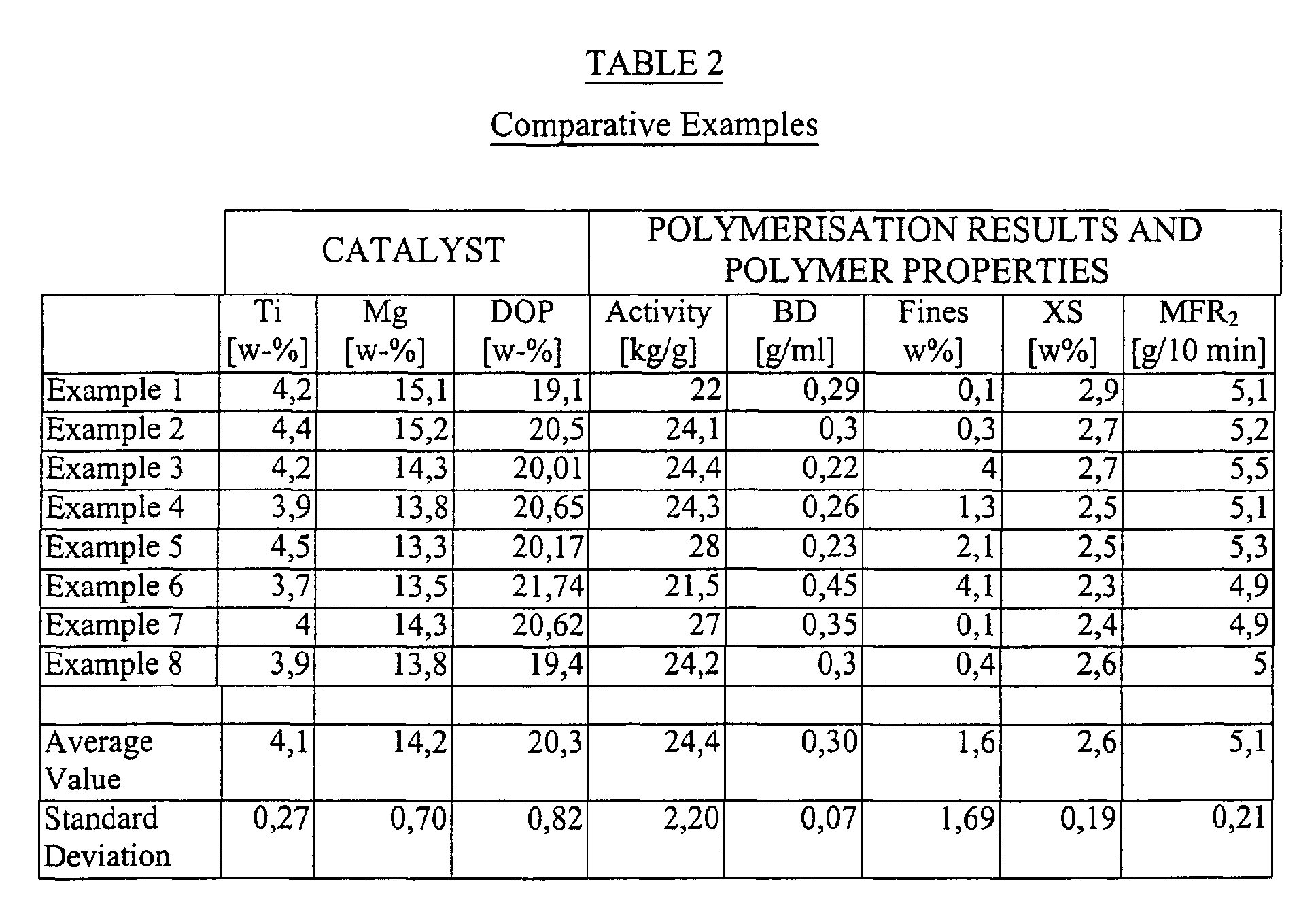
- It will be observed that, except in the case of MFR, the standard deviations for the comparative catalysts are significantly larger than those reported in Table 1. The differences are significant in both polymer morphology parameters (bulk density and fines content), and particularly marked in the vital parameter catalyst activity.
Claims (37)
- A process for the preparation of a particulate olefin polymerisation catalyst component comprising a magnesium dihalide, a titanium tetrahalide and carboxylic acid ester, comprisingreacting, in solution in a C6-C10 aromatic solvent, a magnesium compound containing an alkoxy group, a carboxylic acid halide and a IV-valent titanium compound containing halogen to obtain a dissolved reaction product, said solution also containing a C2-C12 polyhydric alcohol and a reactive halogenated C1-C20 hydrocarbon;initiating formation in said solution of one or more oligoesters of said carboxylic acid with said alcohol, by addition to said solution of a quantity of apolar solvent insufficient to cause precipitation of said reaction product, the oligoester formation being continued until the resultant change in composition of the liquid phase causes co-precipitation of said one or more oligoesters and of said reaction product; andrecovering, washing and drying the co-precipitate to obtain said catalyst component.
- A process according to claim 1 wherein each alkoxy group of said magnesium compound contains 1 to 20 carbon atoms and said dicarboxylic acid contains at least 8 carbon atoms.
- A process according to claim 1 or claim 2 wherein the quantity of said added apolar solvent is from 1 to 10 mol% of the already-present polar solvent.
- A process according to claim 3 wherein the quantity of the added apolar solvent is from 2 to 5 mol% of the already-present polar solvent.
- A process according to any preceding claim wherein said apolar solvent comprises a C5 to C15 aliphatic compound.
- A process according to any preceding claim wherein said apolar solvent is added in admixture with a C6 to C10 aromatic compound.
- A process according to claim 6 wherein said apolar solvent constitutes 10 to 50 vol% of said admixture.
- A process according to claim 6 wherein said apolar solvent constitutes 20 to 40 vol% of said admixture.
- A process according to any preceding claim wherein after the addition of said apolar solvent said solution is heated to a higher temperature at which it is maintained with agitation.
- A process according to any preceding claim wherein said IV-valent titanium compound is added to said solution in a C6 to C10 aromatic solvent after the magnesium compound, acid halide. polyhydric alcohol and halogenated hydrocarbon therein have reacted.
- A process according to claim 10 wherein the reaction of magnesium compound, acid halide, polyhydric alcohol and halogenated hydrocarbon is carried out at a temperature of 20 to 80°C, preferably 50 to 70°C.
- A process according to claim 10 to claim 11 wherein said IV-valent titanium compound is reacted with the reaction product of said magnesium compound, acid halide, polyhydric alcohol and halogenated hydrocarbon at a temperature higher than that at which those reagents were reacted.
- A process according to claim 12 wherein said IV-valent titanium compound is reacted at a temperature of 75 to 85°C.
- A process according to any preceding claim wherein during oligoester formation the temperature of said liquid phase is higher than the temperature at which the IV-valent titanium compound reacted.
- A process according to claim 14 wherein the temperature of said liquid phase is 85 to 110°C.
- A process according to claim 15 wherein the liquid phase is maintained at said temperature for at least 0.25 hr with agitation.
- A process according to any preceding claim wherein the washing is with toluene, n-heptane and/or n-pentane.
- A process according to any preceding claim wherein said aromatic solvent is benzene, toluene or xylene.
- A process according to any preceding claim wherein each alkyl group in said magnesium compound has 2 to 12 carbon atoms.
- A process according to claim 19 wherein each said alkyl group has 4 to 10 carbon atoms.
- A process according to any preceding claim wherein said carboxylic acid halide is a dicarboxylic acid dihalide .
- A process according to claim 21 wherein said dicarboxylic acid halide is α, β-unsaturated.
- A process according to any preceding claim wherein said IV-valent titanium compound is a titanium tetrahalide.
- A process according to any preceding claim wherein said polyhydric alcohol is a straight- or branched-chain aliphatic diol.
- A process according to claim 24 wherein said solution in a C6-C10 aromatic solvent further includes a monohydric alcohol and/or a triol.
- A process according to claim 24 wherein the monohydric alcohol is a C1-C20 straight- or branched-claim aliphatic alcohol.
- A process according to any preceding claim wherein said reactive halogenated hydrocarbon is a C1-C10 paraffin having 1 to 4 halogen atoms per molecule.
- A process according to claim 27 wherein said reactive halogenated hydrocarbon is a butyl chloride or dichloride.
- A process according to any preceding claim wherein until the precipitation the molar ratio of solvent to magnesium is maintained at a value with the range 4 to 10.
- A process according to any preceding claim wherein in said solution in which reaction occurs the molar ratio of magnesium to carboxylic acid halide is from 1 to 10.
- A process according to any preceding claim wherein in said solution in which reaction occurs the molar ratio of magnesium to polyhydric alcohol is from 1 to 4.
- A process according to any of claims 25-31 wherein in said solution in which reaction occurs the molar ratio of magnesium to monohydric alcohol is from 0.2 to 1.
- A process according to any preceding claim wherein in said solution in which reaction occurs the molar ratio of magnesium to said reactive halogenated hydrocarbon is from 0.05 to 5.
- A process according to any preceding claim wherein in said solution in which reaction occurs the molar ratio of magnesium to titanium compound is from 0.01 to 1.
- A process according to any preceding claim wherein said recovered catalyst component comprises a titanium tetrahalide, a magnesium dihalide and a carboxylic acid ester in the molar proportions 1:(8 to 10):(0.7 to 1.3).
- An olefin polymerisation catalyst comprising a catalyst component prepared according to any of claims 1 to 35 and an alkyl aluminium co-catalyst.
- Use of a catalyst in accordance with claim 36 for the polymerisation of C2 to C10 α-olefins.
Priority Applications (8)
| Application Number | Priority Date | Filing Date | Title |
|---|---|---|---|
| EP00124671A EP1205496A1 (en) | 2000-11-10 | 2000-11-10 | Catalyst component comprising magnesium, titanium, a halogen and an electron donor, its preparation and use |
| EP01993631A EP1335942B1 (en) | 2000-11-10 | 2001-10-18 | Catalyst component comprising magnesium, titanium, a halogen and an electron donor, its preparation and use |
| AU2002223624A AU2002223624A1 (en) | 2000-11-10 | 2001-10-18 | Catalyst component comprising magnesium, titanium, a halogen and an electron donor, its preparation and use |
| PCT/EP2001/012052 WO2002038631A1 (en) | 2000-11-10 | 2001-10-18 | Catalyst component comprising magnesium, titanium, a halogen and an electron donor, its preparation and use |
| DE60122922T DE60122922T2 (en) | 2000-11-10 | 2001-10-18 | Magnesium, titanium, a halogen-containing and electron-donating catalyst component, their preparation and use |
| US10/415,838 US7026265B2 (en) | 2000-11-10 | 2001-10-18 | Catalyst component comprising magnesium, titanium, a halogen and an electron donor, its preparation and use |
| AT01993631T ATE338776T1 (en) | 2000-11-10 | 2001-10-18 | CATALYST COMPONENT CONTAINING MAGNESIUM, TITANIUM, A HALOGEN AND AN ELECTRON DONATOR, THEIR PRODUCTION AND USE |
| JP2002541962A JP2004513995A (en) | 2000-11-10 | 2001-10-18 | Catalyst component containing magnesium, titanium, halogen and electron donor, method for producing and using the same |
Applications Claiming Priority (1)
| Application Number | Priority Date | Filing Date | Title |
|---|---|---|---|
| EP00124671A EP1205496A1 (en) | 2000-11-10 | 2000-11-10 | Catalyst component comprising magnesium, titanium, a halogen and an electron donor, its preparation and use |
Publications (1)
| Publication Number | Publication Date |
|---|---|
| EP1205496A1 true EP1205496A1 (en) | 2002-05-15 |
Family
ID=8170351
Family Applications (2)
| Application Number | Title | Priority Date | Filing Date |
|---|---|---|---|
| EP00124671A Withdrawn EP1205496A1 (en) | 2000-11-10 | 2000-11-10 | Catalyst component comprising magnesium, titanium, a halogen and an electron donor, its preparation and use |
| EP01993631A Expired - Lifetime EP1335942B1 (en) | 2000-11-10 | 2001-10-18 | Catalyst component comprising magnesium, titanium, a halogen and an electron donor, its preparation and use |
Family Applications After (1)
| Application Number | Title | Priority Date | Filing Date |
|---|---|---|---|
| EP01993631A Expired - Lifetime EP1335942B1 (en) | 2000-11-10 | 2001-10-18 | Catalyst component comprising magnesium, titanium, a halogen and an electron donor, its preparation and use |
Country Status (7)
| Country | Link |
|---|---|
| US (1) | US7026265B2 (en) |
| EP (2) | EP1205496A1 (en) |
| JP (1) | JP2004513995A (en) |
| AT (1) | ATE338776T1 (en) |
| AU (1) | AU2002223624A1 (en) |
| DE (1) | DE60122922T2 (en) |
| WO (1) | WO2002038631A1 (en) |
Cited By (3)
| Publication number | Priority date | Publication date | Assignee | Title |
|---|---|---|---|---|
| EP2407492A1 (en) * | 2010-07-13 | 2012-01-18 | Borealis AG | Catalyst Component |
| CN106749779A (en) * | 2016-12-09 | 2017-05-31 | 营口市向阳催化剂有限责任公司 | A kind of magnesium ethylate modified support and its ziegler natta catalyst for preparing |
| CN107683294A (en) * | 2015-04-29 | 2018-02-09 | 切弗朗菲利浦化学公司 | The method of preparing the catalyst |
Families Citing this family (3)
| Publication number | Priority date | Publication date | Assignee | Title |
|---|---|---|---|---|
| US20080051535A1 (en) * | 2006-08-23 | 2008-02-28 | Fina Technology, Inc. | Promoter system for polymerization processes and polymers formed therefrom |
| RU2615153C2 (en) | 2012-09-24 | 2017-04-04 | Индийская Нефтяная Корпорация Лимитэд | Catalyst for polymerisation of olefins and preparation method thereof |
| US20250109218A1 (en) | 2023-09-29 | 2025-04-03 | Formosa Plastics Corporation, U.S.A. | Method for preparing catalyst component for polymerization of polyolefin without the use of internal electron donors |
Citations (3)
| Publication number | Priority date | Publication date | Assignee | Title |
|---|---|---|---|---|
| EP0921135A1 (en) * | 1997-06-26 | 1999-06-09 | Toho Titanium Co., Ltd. | Solid catalytic components and catalysts for polymerization of olefins |
| WO2000008073A1 (en) * | 1998-08-07 | 2000-02-17 | Borealis Technology Oy | Catalyst component comprising magnesium, titanium, a halogen and an electron donor, its preparation and use |
| WO2000068277A1 (en) * | 1999-05-10 | 2000-11-16 | Borealis Technology Oy | Catalyst component comprising magnesium, titanium, a halogen and an electron donor, its preparation and use |
Family Cites Families (1)
| Publication number | Priority date | Publication date | Assignee | Title |
|---|---|---|---|---|
| CA2032344A1 (en) * | 1989-12-18 | 1991-06-19 | Tatsuya Miyatake | Catalyst for production of 1,4-polybutadiene and process for selective production of trans-or cis-1, 4-polybutadiene |
-
2000
- 2000-11-10 EP EP00124671A patent/EP1205496A1/en not_active Withdrawn
-
2001
- 2001-10-18 EP EP01993631A patent/EP1335942B1/en not_active Expired - Lifetime
- 2001-10-18 AU AU2002223624A patent/AU2002223624A1/en not_active Abandoned
- 2001-10-18 WO PCT/EP2001/012052 patent/WO2002038631A1/en not_active Ceased
- 2001-10-18 AT AT01993631T patent/ATE338776T1/en not_active IP Right Cessation
- 2001-10-18 DE DE60122922T patent/DE60122922T2/en not_active Expired - Lifetime
- 2001-10-18 JP JP2002541962A patent/JP2004513995A/en active Pending
- 2001-10-18 US US10/415,838 patent/US7026265B2/en not_active Expired - Fee Related
Patent Citations (3)
| Publication number | Priority date | Publication date | Assignee | Title |
|---|---|---|---|---|
| EP0921135A1 (en) * | 1997-06-26 | 1999-06-09 | Toho Titanium Co., Ltd. | Solid catalytic components and catalysts for polymerization of olefins |
| WO2000008073A1 (en) * | 1998-08-07 | 2000-02-17 | Borealis Technology Oy | Catalyst component comprising magnesium, titanium, a halogen and an electron donor, its preparation and use |
| WO2000068277A1 (en) * | 1999-05-10 | 2000-11-16 | Borealis Technology Oy | Catalyst component comprising magnesium, titanium, a halogen and an electron donor, its preparation and use |
Cited By (6)
| Publication number | Priority date | Publication date | Assignee | Title |
|---|---|---|---|---|
| EP2407492A1 (en) * | 2010-07-13 | 2012-01-18 | Borealis AG | Catalyst Component |
| WO2012007427A1 (en) * | 2010-07-13 | 2012-01-19 | Borealis Ag | Catalyst component |
| US9115223B2 (en) | 2010-07-13 | 2015-08-25 | Borealis Ag | Catalyst component |
| CN107683294A (en) * | 2015-04-29 | 2018-02-09 | 切弗朗菲利浦化学公司 | The method of preparing the catalyst |
| CN107683294B (en) * | 2015-04-29 | 2020-11-06 | 切弗朗菲利浦化学公司 | Process for preparing a catalyst |
| CN106749779A (en) * | 2016-12-09 | 2017-05-31 | 营口市向阳催化剂有限责任公司 | A kind of magnesium ethylate modified support and its ziegler natta catalyst for preparing |
Also Published As
| Publication number | Publication date |
|---|---|
| US7026265B2 (en) | 2006-04-11 |
| WO2002038631A1 (en) | 2002-05-16 |
| ATE338776T1 (en) | 2006-09-15 |
| JP2004513995A (en) | 2004-05-13 |
| EP1335942B1 (en) | 2006-09-06 |
| US20040043892A1 (en) | 2004-03-04 |
| AU2002223624A1 (en) | 2002-05-21 |
| DE60122922D1 (en) | 2006-10-19 |
| EP1335942A1 (en) | 2003-08-20 |
| DE60122922T2 (en) | 2007-04-26 |
Similar Documents
| Publication | Publication Date | Title |
|---|---|---|
| EP1270610B1 (en) | Preparation of olefin polymerisation catalyst component | |
| EP1273595B1 (en) | Preparation of olefin polymerisation catalyst component | |
| US6706655B2 (en) | Catalyst component comprising magnesium, titanium, a halogen and an electron donor, its preparation and use | |
| EP1114072B1 (en) | Catalyst component comprising magnesium, titanium, a halogen and an electron donor, its preparation and use | |
| AU2002325246A1 (en) | Preparation of olefin polymerisation catalyst component | |
| EP1862480A1 (en) | Process for preparing an olefin polymerisation catalyst component with improved high temperature activity | |
| US7026265B2 (en) | Catalyst component comprising magnesium, titanium, a halogen and an electron donor, its preparation and use | |
| US20100216957A1 (en) | Catalyst preparation with phosphorous compound | |
| EP1229054B1 (en) | Catalyst component comprising magnesium, titanium, a halogen and an electron donor and its preparation | |
| EP0811021B1 (en) | Components and catalysts for the polymerization of olefins | |
| EP1183278B1 (en) | Catalyst component comprising magnesium, titanium, a halogen and an electron donor, its preparation and use | |
| CN110799549A (en) | Production method of solid catalyst component for olefin polymerization, catalyst for olefin polymerization, and propylene polymerization method | |
| KR20210047150A (en) | The preparation method of solid catalyst for propylene polymerization |
Legal Events
| Date | Code | Title | Description |
|---|---|---|---|
| PUAI | Public reference made under article 153(3) epc to a published international application that has entered the european phase |
Free format text: ORIGINAL CODE: 0009012 |
|
| 17P | Request for examination filed |
Effective date: 20010131 |
|
| AK | Designated contracting states |
Kind code of ref document: A1 Designated state(s): AT BE CH CY DE DK ES FI FR GB GR IE IT LI LU MC NL PT SE TR |
|
| AX | Request for extension of the european patent |
Free format text: AL;LT;LV;MK;RO;SI |
|
| AKX | Designation fees paid |
Designated state(s): AT BE CH CY DE DK ES FI FR GB GR IE IT LI LU MC NL PT SE TR |
|
| 17Q | First examination report despatched |
Effective date: 20030801 |
|
| STAA | Information on the status of an ep patent application or granted ep patent |
Free format text: STATUS: THE APPLICATION IS DEEMED TO BE WITHDRAWN |
|
| 18D | Application deemed to be withdrawn |
Effective date: 20031212 |