EP1205231A1 - Use of lithium-containing faujasite in air separation processes including water and/or carbon dioxide removal - Google Patents
Use of lithium-containing faujasite in air separation processes including water and/or carbon dioxide removal Download PDFInfo
- Publication number
- EP1205231A1 EP1205231A1 EP01126404A EP01126404A EP1205231A1 EP 1205231 A1 EP1205231 A1 EP 1205231A1 EP 01126404 A EP01126404 A EP 01126404A EP 01126404 A EP01126404 A EP 01126404A EP 1205231 A1 EP1205231 A1 EP 1205231A1
- Authority
- EP
- European Patent Office
- Prior art keywords
- carbon dioxide
- adsorbent
- gas
- water
- oxygen
- Prior art date
- Legal status (The legal status is an assumption and is not a legal conclusion. Google has not performed a legal analysis and makes no representation as to the accuracy of the status listed.)
- Withdrawn
Links
- CURLTUGMZLYLDI-UHFFFAOYSA-N Carbon dioxide Chemical compound O=C=O CURLTUGMZLYLDI-UHFFFAOYSA-N 0.000 title claims abstract description 91
- 229910002092 carbon dioxide Inorganic materials 0.000 title claims abstract description 49
- XLYOFNOQVPJJNP-UHFFFAOYSA-N water Substances O XLYOFNOQVPJJNP-UHFFFAOYSA-N 0.000 title claims abstract description 47
- 239000001569 carbon dioxide Substances 0.000 title claims abstract description 42
- 238000000926 separation method Methods 0.000 title claims abstract description 25
- 229910052744 lithium Inorganic materials 0.000 title claims description 7
- WHXSMMKQMYFTQS-UHFFFAOYSA-N Lithium Chemical compound [Li] WHXSMMKQMYFTQS-UHFFFAOYSA-N 0.000 title claims description 5
- 239000012013 faujasite Substances 0.000 title 1
- 239000003463 adsorbent Substances 0.000 claims abstract description 53
- 239000007789 gas Substances 0.000 claims abstract description 48
- IJGRMHOSHXDMSA-UHFFFAOYSA-N Atomic nitrogen Chemical compound N#N IJGRMHOSHXDMSA-UHFFFAOYSA-N 0.000 claims abstract description 40
- 238000001179 sorption measurement Methods 0.000 claims abstract description 34
- QVGXLLKOCUKJST-UHFFFAOYSA-N atomic oxygen Chemical compound [O] QVGXLLKOCUKJST-UHFFFAOYSA-N 0.000 claims abstract description 24
- 239000001301 oxygen Substances 0.000 claims abstract description 24
- 229910052760 oxygen Inorganic materials 0.000 claims abstract description 24
- 238000000034 method Methods 0.000 claims abstract description 20
- 229910052757 nitrogen Inorganic materials 0.000 claims abstract description 20
- 238000003795 desorption Methods 0.000 claims abstract description 16
- 238000001035 drying Methods 0.000 claims abstract description 14
- 238000011068 loading method Methods 0.000 claims abstract description 9
- VUZPPFZMUPKLLV-UHFFFAOYSA-N methane;hydrate Chemical compound C.O VUZPPFZMUPKLLV-UHFFFAOYSA-N 0.000 claims description 6
- 150000002910 rare earth metals Chemical group 0.000 claims description 2
- 229910052723 transition metal Inorganic materials 0.000 claims description 2
- 150000003624 transition metals Chemical class 0.000 claims description 2
- 239000010457 zeolite Substances 0.000 description 15
- 239000000463 material Substances 0.000 description 11
- HNPSIPDUKPIQMN-UHFFFAOYSA-N dioxosilane;oxo(oxoalumanyloxy)alumane Chemical compound O=[Si]=O.O=[Al]O[Al]=O HNPSIPDUKPIQMN-UHFFFAOYSA-N 0.000 description 10
- 229910021536 Zeolite Inorganic materials 0.000 description 9
- 239000000203 mixture Substances 0.000 description 6
- 241000341495 Fornax Species 0.000 description 5
- 238000002474 experimental method Methods 0.000 description 5
- VYPSYNLAJGMNEJ-UHFFFAOYSA-N Silicium dioxide Chemical compound O=[Si]=O VYPSYNLAJGMNEJ-UHFFFAOYSA-N 0.000 description 4
- PNEYBMLMFCGWSK-UHFFFAOYSA-N aluminium oxide Inorganic materials [O-2].[O-2].[O-2].[Al+3].[Al+3] PNEYBMLMFCGWSK-UHFFFAOYSA-N 0.000 description 4
- 239000001307 helium Substances 0.000 description 4
- 229910052734 helium Inorganic materials 0.000 description 4
- SWQJXJOGLNCZEY-UHFFFAOYSA-N helium atom Chemical compound [He] SWQJXJOGLNCZEY-UHFFFAOYSA-N 0.000 description 4
- 150000001768 cations Chemical class 0.000 description 3
- 239000012535 impurity Substances 0.000 description 3
- 238000012545 processing Methods 0.000 description 3
- 238000010926 purge Methods 0.000 description 3
- 239000000741 silica gel Substances 0.000 description 3
- 229910002027 silica gel Inorganic materials 0.000 description 3
- -1 Alkali Metal Cations Chemical class 0.000 description 2
- OKTJSMMVPCPJKN-UHFFFAOYSA-N Carbon Chemical compound [C] OKTJSMMVPCPJKN-UHFFFAOYSA-N 0.000 description 2
- 125000004122 cyclic group Chemical group 0.000 description 2
- 239000008246 gaseous mixture Substances 0.000 description 2
- 238000004519 manufacturing process Methods 0.000 description 2
- 239000002245 particle Substances 0.000 description 2
- 230000035515 penetration Effects 0.000 description 2
- 229910052708 sodium Inorganic materials 0.000 description 2
- MYMOFIZGZYHOMD-UHFFFAOYSA-N Dioxygen Chemical compound O=O MYMOFIZGZYHOMD-UHFFFAOYSA-N 0.000 description 1
- 229910000831 Steel Inorganic materials 0.000 description 1
- JUGOREOARAHOCO-UHFFFAOYSA-M acetylcholine chloride Chemical compound [Cl-].CC(=O)OCC[N+](C)(C)C JUGOREOARAHOCO-UHFFFAOYSA-M 0.000 description 1
- 229910052783 alkali metal Inorganic materials 0.000 description 1
- 238000004458 analytical method Methods 0.000 description 1
- 238000012993 chemical processing Methods 0.000 description 1
- 238000004891 communication Methods 0.000 description 1
- 239000000356 contaminant Substances 0.000 description 1
- 230000007423 decrease Effects 0.000 description 1
- 230000001419 dependent effect Effects 0.000 description 1
- 238000013461 design Methods 0.000 description 1
- 238000010586 diagram Methods 0.000 description 1
- 229910001882 dioxygen Inorganic materials 0.000 description 1
- 230000000694 effects Effects 0.000 description 1
- 230000008030 elimination Effects 0.000 description 1
- 238000003379 elimination reaction Methods 0.000 description 1
- 230000002349 favourable effect Effects 0.000 description 1
- 238000002156 mixing Methods 0.000 description 1
- 238000012986 modification Methods 0.000 description 1
- 230000004048 modification Effects 0.000 description 1
- 239000002808 molecular sieve Substances 0.000 description 1
- 229940110728 nitrogen / oxygen Drugs 0.000 description 1
- 238000012856 packing Methods 0.000 description 1
- 231100000572 poisoning Toxicity 0.000 description 1
- 230000000607 poisoning effect Effects 0.000 description 1
- 229910052700 potassium Inorganic materials 0.000 description 1
- 238000011084 recovery Methods 0.000 description 1
- 230000008929 regeneration Effects 0.000 description 1
- 238000011069 regeneration method Methods 0.000 description 1
- 229920006395 saturated elastomer Polymers 0.000 description 1
- 239000000377 silicon dioxide Substances 0.000 description 1
- URGAHOPLAPQHLN-UHFFFAOYSA-N sodium aluminosilicate Chemical compound [Na+].[Al+3].[O-][Si]([O-])=O.[O-][Si]([O-])=O URGAHOPLAPQHLN-UHFFFAOYSA-N 0.000 description 1
- 241000894007 species Species 0.000 description 1
- 239000010959 steel Substances 0.000 description 1
- 238000013519 translation Methods 0.000 description 1
Images




Classifications
-
- B—PERFORMING OPERATIONS; TRANSPORTING
- B01—PHYSICAL OR CHEMICAL PROCESSES OR APPARATUS IN GENERAL
- B01D—SEPARATION
- B01D53/00—Separation of gases or vapours; Recovering vapours of volatile solvents from gases; Chemical or biological purification of waste gases, e.g. engine exhaust gases, smoke, fumes, flue gases, aerosols
- B01D53/02—Separation of gases or vapours; Recovering vapours of volatile solvents from gases; Chemical or biological purification of waste gases, e.g. engine exhaust gases, smoke, fumes, flue gases, aerosols by adsorption, e.g. preparative gas chromatography
- B01D53/04—Separation of gases or vapours; Recovering vapours of volatile solvents from gases; Chemical or biological purification of waste gases, e.g. engine exhaust gases, smoke, fumes, flue gases, aerosols by adsorption, e.g. preparative gas chromatography with stationary adsorbents
- B01D53/047—Pressure swing adsorption
- B01D53/0476—Vacuum pressure swing adsorption
-
- B—PERFORMING OPERATIONS; TRANSPORTING
- B01—PHYSICAL OR CHEMICAL PROCESSES OR APPARATUS IN GENERAL
- B01D—SEPARATION
- B01D53/00—Separation of gases or vapours; Recovering vapours of volatile solvents from gases; Chemical or biological purification of waste gases, e.g. engine exhaust gases, smoke, fumes, flue gases, aerosols
- B01D53/02—Separation of gases or vapours; Recovering vapours of volatile solvents from gases; Chemical or biological purification of waste gases, e.g. engine exhaust gases, smoke, fumes, flue gases, aerosols by adsorption, e.g. preparative gas chromatography
- B01D53/04—Separation of gases or vapours; Recovering vapours of volatile solvents from gases; Chemical or biological purification of waste gases, e.g. engine exhaust gases, smoke, fumes, flue gases, aerosols by adsorption, e.g. preparative gas chromatography with stationary adsorbents
- B01D53/047—Pressure swing adsorption
-
- B—PERFORMING OPERATIONS; TRANSPORTING
- B01—PHYSICAL OR CHEMICAL PROCESSES OR APPARATUS IN GENERAL
- B01J—CHEMICAL OR PHYSICAL PROCESSES, e.g. CATALYSIS OR COLLOID CHEMISTRY; THEIR RELEVANT APPARATUS
- B01J20/00—Solid sorbent compositions or filter aid compositions; Sorbents for chromatography; Processes for preparing, regenerating or reactivating thereof
- B01J20/02—Solid sorbent compositions or filter aid compositions; Sorbents for chromatography; Processes for preparing, regenerating or reactivating thereof comprising inorganic material
- B01J20/10—Solid sorbent compositions or filter aid compositions; Sorbents for chromatography; Processes for preparing, regenerating or reactivating thereof comprising inorganic material comprising silica or silicate
- B01J20/16—Alumino-silicates
- B01J20/18—Synthetic zeolitic molecular sieves
- B01J20/186—Chemical treatments in view of modifying the properties of the sieve, e.g. increasing the stability or the activity, also decreasing the activity
-
- B—PERFORMING OPERATIONS; TRANSPORTING
- B01—PHYSICAL OR CHEMICAL PROCESSES OR APPARATUS IN GENERAL
- B01D—SEPARATION
- B01D2253/00—Adsorbents used in seperation treatment of gases and vapours
- B01D2253/10—Inorganic adsorbents
- B01D2253/102—Carbon
-
- B—PERFORMING OPERATIONS; TRANSPORTING
- B01—PHYSICAL OR CHEMICAL PROCESSES OR APPARATUS IN GENERAL
- B01D—SEPARATION
- B01D2253/00—Adsorbents used in seperation treatment of gases and vapours
- B01D2253/10—Inorganic adsorbents
- B01D2253/104—Alumina
-
- B—PERFORMING OPERATIONS; TRANSPORTING
- B01—PHYSICAL OR CHEMICAL PROCESSES OR APPARATUS IN GENERAL
- B01D—SEPARATION
- B01D2253/00—Adsorbents used in seperation treatment of gases and vapours
- B01D2253/10—Inorganic adsorbents
- B01D2253/106—Silica or silicates
-
- B—PERFORMING OPERATIONS; TRANSPORTING
- B01—PHYSICAL OR CHEMICAL PROCESSES OR APPARATUS IN GENERAL
- B01D—SEPARATION
- B01D2253/00—Adsorbents used in seperation treatment of gases and vapours
- B01D2253/10—Inorganic adsorbents
- B01D2253/106—Silica or silicates
- B01D2253/108—Zeolites
-
- B—PERFORMING OPERATIONS; TRANSPORTING
- B01—PHYSICAL OR CHEMICAL PROCESSES OR APPARATUS IN GENERAL
- B01D—SEPARATION
- B01D2253/00—Adsorbents used in seperation treatment of gases and vapours
- B01D2253/10—Inorganic adsorbents
- B01D2253/106—Silica or silicates
- B01D2253/108—Zeolites
- B01D2253/1085—Zeolites characterized by a silicon-aluminium ratio
-
- B—PERFORMING OPERATIONS; TRANSPORTING
- B01—PHYSICAL OR CHEMICAL PROCESSES OR APPARATUS IN GENERAL
- B01D—SEPARATION
- B01D2253/00—Adsorbents used in seperation treatment of gases and vapours
- B01D2253/30—Physical properties of adsorbents
-
- B—PERFORMING OPERATIONS; TRANSPORTING
- B01—PHYSICAL OR CHEMICAL PROCESSES OR APPARATUS IN GENERAL
- B01D—SEPARATION
- B01D2256/00—Main component in the product gas stream after treatment
- B01D2256/12—Oxygen
-
- B—PERFORMING OPERATIONS; TRANSPORTING
- B01—PHYSICAL OR CHEMICAL PROCESSES OR APPARATUS IN GENERAL
- B01D—SEPARATION
- B01D2257/00—Components to be removed
- B01D2257/50—Carbon oxides
- B01D2257/504—Carbon dioxide
-
- B—PERFORMING OPERATIONS; TRANSPORTING
- B01—PHYSICAL OR CHEMICAL PROCESSES OR APPARATUS IN GENERAL
- B01D—SEPARATION
- B01D2257/00—Components to be removed
- B01D2257/80—Water
-
- B—PERFORMING OPERATIONS; TRANSPORTING
- B01—PHYSICAL OR CHEMICAL PROCESSES OR APPARATUS IN GENERAL
- B01D—SEPARATION
- B01D2259/00—Type of treatment
- B01D2259/40—Further details for adsorption processes and devices
- B01D2259/414—Further details for adsorption processes and devices using different types of adsorbents
- B01D2259/4141—Further details for adsorption processes and devices using different types of adsorbents within a single bed
- B01D2259/4145—Further details for adsorption processes and devices using different types of adsorbents within a single bed arranged in series
- B01D2259/4146—Contiguous multilayered adsorbents
-
- B—PERFORMING OPERATIONS; TRANSPORTING
- B01—PHYSICAL OR CHEMICAL PROCESSES OR APPARATUS IN GENERAL
- B01D—SEPARATION
- B01D53/00—Separation of gases or vapours; Recovering vapours of volatile solvents from gases; Chemical or biological purification of waste gases, e.g. engine exhaust gases, smoke, fumes, flue gases, aerosols
- B01D53/02—Separation of gases or vapours; Recovering vapours of volatile solvents from gases; Chemical or biological purification of waste gases, e.g. engine exhaust gases, smoke, fumes, flue gases, aerosols by adsorption, e.g. preparative gas chromatography
- B01D53/04—Separation of gases or vapours; Recovering vapours of volatile solvents from gases; Chemical or biological purification of waste gases, e.g. engine exhaust gases, smoke, fumes, flue gases, aerosols by adsorption, e.g. preparative gas chromatography with stationary adsorbents
- B01D53/0407—Constructional details of adsorbing systems
- B01D53/0431—Beds with radial gas flow
-
- B—PERFORMING OPERATIONS; TRANSPORTING
- B01—PHYSICAL OR CHEMICAL PROCESSES OR APPARATUS IN GENERAL
- B01D—SEPARATION
- B01D53/00—Separation of gases or vapours; Recovering vapours of volatile solvents from gases; Chemical or biological purification of waste gases, e.g. engine exhaust gases, smoke, fumes, flue gases, aerosols
- B01D53/02—Separation of gases or vapours; Recovering vapours of volatile solvents from gases; Chemical or biological purification of waste gases, e.g. engine exhaust gases, smoke, fumes, flue gases, aerosols by adsorption, e.g. preparative gas chromatography
- B01D53/06—Separation of gases or vapours; Recovering vapours of volatile solvents from gases; Chemical or biological purification of waste gases, e.g. engine exhaust gases, smoke, fumes, flue gases, aerosols by adsorption, e.g. preparative gas chromatography with moving adsorbents, e.g. rotating beds
-
- Y—GENERAL TAGGING OF NEW TECHNOLOGICAL DEVELOPMENTS; GENERAL TAGGING OF CROSS-SECTIONAL TECHNOLOGIES SPANNING OVER SEVERAL SECTIONS OF THE IPC; TECHNICAL SUBJECTS COVERED BY FORMER USPC CROSS-REFERENCE ART COLLECTIONS [XRACs] AND DIGESTS
- Y02—TECHNOLOGIES OR APPLICATIONS FOR MITIGATION OR ADAPTATION AGAINST CLIMATE CHANGE
- Y02C—CAPTURE, STORAGE, SEQUESTRATION OR DISPOSAL OF GREENHOUSE GASES [GHG]
- Y02C20/00—Capture or disposal of greenhouse gases
- Y02C20/40—Capture or disposal of greenhouse gases of CO2
Definitions
- This invention relates to pressure swing adsorption (PSA) systems. More particularly, it relates to the use of a PSA system in the separation of a gas mixture containing oxygen and nitrogen, and the removal of feed impurities, such as water and/or carbon dioxide, by using lithium-containing FAU adsorbents.
- PSA pressure swing adsorption
- PSA systems are particularly suitable for a wide variety of important commercial applications.
- high purity oxygen is used in various industries, such as chemical processing, steel mills, paper mills, and lead and gas production operations.
- a feed gas mixture such as air
- a more readily adsorbable component and a less readily adsorbable component e.g., the nitrogen and oxygen components of air
- a feed gas mixture such as air
- a less readily adsorbable component e.g., the nitrogen and oxygen components of air
- the bed is depressurized to a lower desorption pressure for desorption of the more readily adsorbable component, and its removal from the bed prior to the introduction of additional quantities of the feed gas mixture for repressurization and adsorption as cyclic adsorption-desorption-repressurization operations are continued in the bed.
- PSA processing is commonly, but not exclusively, carried out in multi-bed systems, with each bed employing the PSA processing sequence on a cyclic basis interrelated to the carrying out of such processing sequence in the other beds of the adsorption system.
- each adsorbent bed will commonly contain an adsorbent material capable of selectively adsorbing nitrogen as the more readily adsorbable component, with the selectively adsorbed nitrogen being subsequently desorbed from the bed upon reduction of the pressure of the bed from the upper adsorption pressure level to the lower desorption pressure level.
- VSA Vacuum Swing Adsorption
- a feed gas mixture may contain impurities, such as water and carbon dioxide.
- impurities such as water and carbon dioxide.
- Conventional wisdom teaches that it is necessary to remove water and carbon dioxide, so as to avoid poisoning the nitrogen adsorbing capacity of high-capacity main-stage adsorbents. This removal can be accomplished through the use of either a separate pretreatment material or a separate pretreatment stage.
- Canadian Patent Application No. 2,234,924 to Ackley discloses the removal of feed stream contaminants, typically water and carbon dioxide, in a pretreatment stage at the feed end of the adsorbent bed, by use of material selected from the group consisting of zeolites, activated alumina, activated carbon and silica gel. Lithium-exchanged zeolites are taught to be useful in the main stage of the disclosed process.
- Canadian Patent Application No. 2,182,641 discloses a PSA process using two layers of adsorbent materials comprising a first adsorbent layer of NaX and a second adsorbent layer of LiX. It also discloses that the gas stream can be dried before passage through the zeolite packing, by means of a drying layer of silica gel.
- U.S. Patent No. 5,810,909 discloses the use of a pretreatment zone containing, e.g., alumina, to remove water and carbon dioxide before bulk separation through multiple adsorbent layers that can include lithium-exchanged zeolites.
- U. S. Patent No. 3,636,679 discloses an apparatus in which CaA is used as the only adsorbent and the inventors explicitly state that the air is feed without pretreatment to remove water or CO 2 .
- CaA's air separation performance is inferior to those of lithium-exchanged FAUs.
- U. S. Patent No. 5,133,784 discloses an apparatus in which flow is radial in a bed composed of co-annular cylinders.
- the apparatus is said to be suitable for separating at least one component, such as oxygen, from a gaseous mixture.
- Alumina is the only adsorbent mentioned.
- U.S. Patent No. 5,203,887 discloses replacing a portion of an adsorbent bed of the lithium-exchanged zeolite type with an adsorbent of another type. This is achieved by utilizing an adsorption zone including two adsorbent beds arranged in series. The first bed comprises a zeolite X exchanged to at least 80% with lithium, and the second bed comprises an unexchanged conventional zeolite X, such as NaX.
- the precise nature of the feed gas is not described, and there is no suggestion in this patent that feed gases containing carbon dioxide and/or water can be fed to the lithium-exchanged zeolite without pretreatment to remove carbon dioxide and water.
- U.S. Patent No. 5,658,370 discloses a process for the separation of nitrogen from a gaseous mixture, such as air, by selective adsorption of nitrogen on an adsorbent mass, using a rotating radial flow bed geometry, wherein at least 50% of the adsorbent mass consists of at least one lithium-exchanged zeolite with an exchange level ranging from 50% to 95%.
- this patent is silent on the issue of the removal of water and carbon dioxide.
- the heat of adsorption is highest for LiX. However, beyond that loading, the heat of adsorption decreases for LiX and actually becomes much lower than for NaX or KX. This behavior is similar to that reported by Avgul et al. for the water heat of adsorption. Thus, after a certain initial loading, the LiX actually has equal or lower affinity for water and carbon dioxide than the common pretreatment adsorbent, NaX.
- the invention provides a process for separating a feed gas into at least one product gas, comprising: (a) providing a gas separation apparatus comprising at least one adsorption layer comprising a lithium-exchanged FAU having water desorption characteristics, defined by drying curves, similar to those for the corresponding fully sodium-exchanged FAU, a heat of adsorption for carbon dioxide equal to or lower than that for the corresponding fully sodium-exchanged FAU at high loadings of carbon dioxide, and onto which said adsorption layer water and/or carbon dioxide adsorb, (b) feeding into the gas separation apparatus a feed gas including nitrogen, oxygen, and at least one of carbon dioxide and water; and (c) collecting from a product end of the gas separation apparatus at least one product gas comprising oxygen.
- the process of the invention employs FAU adsorbents that possess highly desirable capacity and selectivity for the adsorption of nitrogen from air or other streams containing nitrogen and less polar or less polarizable molecular species, such as oxygen, and also possess favorable water and carbon dioxide adsorption and desorption characteristics.
- the separation of nitrogen from oxygen, as well as the removal of feed impurities, such as water and/or carbon dioxide is achieved through the use of a single FAU adsorbent, essentially eliminating the pretreatment stage from the system. Such an elimination would still generate the preferred temperature profile along the adsorbent bed, and would, in addition, simplify the design and reduce the cost.
- lithium-exchanged FAU adsorbents can also allow one to use thinner layers of traditional pretreatment adsorbents, such as NaX or mixtures of NaX and Li-exchanged FAUs. Such a layering or mixing of adsorbents is still within the scope of this invention if some water and/or carbon dioxide removal is performed by the Li-exchanged FAU adsorbent.
- Adsorbents suitable for use in the invention are adapted to separate nitrogen from oxygen in the presence of water and/or carbon dioxide.
- Preferred adsorbents possess the following properties: water desorption characteristics, defined by drying curves, similar to those for the corresponding fully sodium-exchanged FAU, and a heat of adsorption for carbon dioxide equal to or lower than that for the corresponding fully sodium-exchanged FAU at high loadings of carbon dioxide.
- the drying curves to define the water desorption characteristics were generated in the following manner. All sample treatment and analyses were performed on a Cahn 1100 microbalance. Gas flow meters were used to control the amount of helium delivered to the system. Ball valves were used to switch from the wet purge gas to dry helium gas. The dew point of the drying gas was measured at the entrance and exit of the sample bed. The recorder was calibrated with a 10 milligram class A weight on the 1 milligram scale under the same conditions as in the desorption experiment. In order to obtain a true sample weight, the sample pan and reference pan were zeroed under the same flow and temperature conditions at which the desorption experiment was conducted.
- the samples, F9HA (NaX from TOSOH), SA-600 and VSAII (CaX from TOSOH and UOP, respectively), and NSA-100 and Z10-05-03 (Li-exchanged X from TOSOH and Zeochem, respectively) were screened to particle sizes between 1.00 mm to 1.40 mm to minimize any effects that particle size might have on drying equilibrium. Prior to the experiment the samples were saturated at 30°C with wet helium gas to attain a constant loading. The conditions for the desorption experiment were a 23 cc/min flow rate of helium and the sample bed temperature of 30°C. During the course of the desorption experiment, weight readings were collected at specific time intervals so that a drying curve profile could be plotted.
- the amount desorbed is measured from changes in the microbalance weight readings.
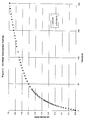
- the fractional desorption curves are defined as (Mi-Mt)/(Mi-M200) versus time in minutes, where Mi is the initial fully hydrated weight, Mt is the weight for given time after starting the dry He flow and M200 is the weight at 200 minutes after starting the dry He flow.
- Figure 1 contains the drying curve for NaX, which is commonly used in the art as a pretreatment adsorbent for water and carbon dioxide removal.
- Figure 2 contains drying curves for two CaX materials. The initial slopes of the curves are smaller for the CaX materials than for NaX, indicating slower water desorption, which means isothermal regeneration by a purge gas is more difficult for CaX than for NaX.
- Figure 3 shows the drying curves for two LiX materials. These curves are essentially the same as that for NaX. This indicates a similar ability to remove water from LiX adsorbents by ambient purge gas, which is the current state of the art in oxygen production by PSA.
- the adsorbent employed in this invention is a zeolite with a FAU structure and lithium-exchanged cation sites.
- the adsorbent preferably has a Si/Al ratio between 1.0 and 1.3 and a lithium exchange level of more than 67%, more preferably 78% or higher.
- Suitable adsorbents include lithium-exchanged low-silica X zeolite (i.e., LiMLSX), wherein the M represents one or more elements selected from alkaline, alkaline-earth, transition metals and rare-earth groups.
- LiMLSX lithium-exchanged low-silica X zeolite
- M represents one or more elements selected from alkaline, alkaline-earth, transition metals and rare-earth groups.
- Additional adsorbents differing from the above described adsorbents can be employed downstream of the feed end of the gas separation apparatus, or even as minor components of an adsorbent mixture at the feed end. These different adsorbents need not, by themselves, be effective in totally removing carbon dioxide and/or water from a gas.
- suitable additional adsorbents are not particularly limited, and can include, e.g., CaA, NaX, CaX, alumina, silica gel.
- the invention is useful for obtaining enriched oxygen gas.
- the inventive process provides a product gas preferably containing at least 85% oxygen.
- the invention is adaptable to a wide variety of separation apparatuses and separation schemes. Suitable gas separation apparatuses for use in the process of the invention include, e.g., radial flow, vertical flow, and cross flow configurations.
- Figure 4 shows a vertical bed with a conventional adsorbent configuration of NaX pretreatment, followed by LiLSX main adsorbent.
- the height of the typical NaX layer represents approximately 20% of the total bed height.
- This quantity of pretreatment is greater than the minimum needed for water and/or carbon dioxide to insure those gases do not penetrate into the main adsorbent.
- the extra NaX does not perform as well as LiLSX for oxygen/nitrogen separation. Note that actual water and/or carbon dioxide penetration is dependent upon the specific cycle and operating conditions.
- FIG. 5 shows an embodiment of the invention.
- the entire bed is comprised of LiLSX and water and/or carbon dioxide penetrate into the LiLSX layer. Consequently, the portion of the adsorbent bed that is not required for water and/or carbon dioxide adsorption is now LiLSX, with oxygen/nitrogen separation parameters superior to those of NaX.
- Figure 6 shows another example of this invention.
- a shallow layer of NaX has been used.
- water and/or carbon dioxide penetrate past the NaX layer and into the main adsorbent layer.
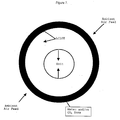
- Figure 7 shows an embodiment of the invention in a radial flow configuration.
- the entire annular region of the radial flow vessel is filled with LiLSX.
- Water and/or carbon dioxide penetration is shown as an outer ring within this layer, with the remainder of LiLSX available for nitrogen/oxygen separation.
- This invention is especially advantageous for radial flow beds because only a single adsorbent is necessary, thereby avoiding the complexities associated with multiple layers.
Landscapes
- Chemical & Material Sciences (AREA)
- Analytical Chemistry (AREA)
- Chemical Kinetics & Catalysis (AREA)
- Engineering & Computer Science (AREA)
- General Chemical & Material Sciences (AREA)
- Oil, Petroleum & Natural Gas (AREA)
- Inorganic Chemistry (AREA)
- Organic Chemistry (AREA)
- Separation Of Gases By Adsorption (AREA)
- Solid-Sorbent Or Filter-Aiding Compositions (AREA)
- Oxygen, Ozone, And Oxides In General (AREA)
Abstract
Description
- This invention relates to pressure swing adsorption (PSA) systems. More particularly, it relates to the use of a PSA system in the separation of a gas mixture containing oxygen and nitrogen, and the removal of feed impurities, such as water and/or carbon dioxide, by using lithium-containing FAU adsorbents.
- PSA systems are particularly suitable for a wide variety of important commercial applications. For example, high purity oxygen is used in various industries, such as chemical processing, steel mills, paper mills, and lead and gas production operations.
- In a PSA process, a feed gas mixture, such as air, containing a more readily adsorbable component and a less readily adsorbable component, e.g., the nitrogen and oxygen components of air, is passed through the feed end of an adsorbent bed capable of selectively adsorbing the more readily adsorbable component at an upper adsorption pressure. The less readily adsorbable component passes through the bed and is recovered from the discharge end of the bed. Thereafter, the bed is depressurized to a lower desorption pressure for desorption of the more readily adsorbable component, and its removal from the bed prior to the introduction of additional quantities of the feed gas mixture for repressurization and adsorption as cyclic adsorption-desorption-repressurization operations are continued in the bed. Such PSA processing is commonly, but not exclusively, carried out in multi-bed systems, with each bed employing the PSA processing sequence on a cyclic basis interrelated to the carrying out of such processing sequence in the other beds of the adsorption system.
- In PSA systems for the recovery of high-purity oxygen product as the less readily adsorbable component of air, each adsorbent bed will commonly contain an adsorbent material capable of selectively adsorbing nitrogen as the more readily adsorbable component, with the selectively adsorbed nitrogen being subsequently desorbed from the bed upon reduction of the pressure of the bed from the upper adsorption pressure level to the lower desorption pressure level. When the lower pressure level is below atmospheric pressure, it is generally referred to as Vacuum Swing Adsorption (VSA). However, for purposes of simplicity, the term "PSA" shall be used hereinafter to denote both PSA and VSA systems unless noted otherwise.
- In addition to nitrogen and oxygen, a feed gas mixture may contain impurities, such as water and carbon dioxide. Conventional wisdom teaches that it is necessary to remove water and carbon dioxide, so as to avoid poisoning the nitrogen adsorbing capacity of high-capacity main-stage adsorbents. This removal can be accomplished through the use of either a separate pretreatment material or a separate pretreatment stage.
- For instance, Canadian Patent Application No. 2,234,924 to Ackley discloses the removal of feed stream contaminants, typically water and carbon dioxide, in a pretreatment stage at the feed end of the adsorbent bed, by use of material selected from the group consisting of zeolites, activated alumina, activated carbon and silica gel. Lithium-exchanged zeolites are taught to be useful in the main stage of the disclosed process.
- Canadian Patent Application No. 2,182,641 discloses a PSA process using two layers of adsorbent materials comprising a first adsorbent layer of NaX and a second adsorbent layer of LiX. It also discloses that the gas stream can be dried before passage through the zeolite packing, by means of a drying layer of silica gel.
- U.S. Patent No. 5,810,909 discloses the use of a pretreatment zone containing, e.g., alumina, to remove water and carbon dioxide before bulk separation through multiple adsorbent layers that can include lithium-exchanged zeolites.
- Likewise, Rege et al., "Limits for Air Separation by Adsorption with LiX Zeolite" Ind. Eng. Chem. Res. (1997), vol 36, pp. 5358-5365, teaches the use of a pretreatment bed to remove water and carbon dioxide from the feed gas before it enters the main LiX bed.
- U. S. Patent No. 3,636,679 discloses an apparatus in which CaA is used as the only adsorbent and the inventors explicitly state that the air is feed without pretreatment to remove water or CO2. However, CaA's air separation performance is inferior to those of lithium-exchanged FAUs.
- U. S. Patent No. 5,133,784 discloses an apparatus in which flow is radial in a bed composed of co-annular cylinders. The apparatus is said to be suitable for separating at least one component, such as oxygen, from a gaseous mixture. Alumina is the only adsorbent mentioned.
- U.S. Patent No. 5,203,887 discloses replacing a portion of an adsorbent bed of the lithium-exchanged zeolite type with an adsorbent of another type. This is achieved by utilizing an adsorption zone including two adsorbent beds arranged in series. The first bed comprises a zeolite X exchanged to at least 80% with lithium, and the second bed comprises an unexchanged conventional zeolite X, such as NaX. The precise nature of the feed gas is not described, and there is no suggestion in this patent that feed gases containing carbon dioxide and/or water can be fed to the lithium-exchanged zeolite without pretreatment to remove carbon dioxide and water.
- U.S. Patent No. 5,658,370 discloses a process for the separation of nitrogen from a gaseous mixture, such as air, by selective adsorption of nitrogen on an adsorbent mass, using a rotating radial flow bed geometry, wherein at least 50% of the adsorbent mass consists of at least one lithium-exchanged zeolite with an exchange level ranging from 50% to 95%. However, this patent is silent on the issue of the removal of water and carbon dioxide.
- Avgul et al., "Heats of Adsorption on X-Type Zeolites Containing Different Alkali Metal Cations", Molecular Sieve Zeolites - II, Advances in Chemistry Series 102, 1971, pp. 184-192, compares the heat of adsorption of water in LiX to that of NaX. The authors speculate that this initial water adsorption probably occurs on the SIII cation sites. Li, Na, and K-exchanged X all show initially high heats of adsorption. Li and NaX are very similar after water adsorption progresses to the SII and SI, cation sites.
- Information on CO2 adsorption is provided by Vasil'eva and Khvoshchev, "Heats of Adsorption of CO2 and NH3 on Synthetic Zeolites of Different Structural Types. Communication 3. CO2 Adsorption on Li, Na, and K forms of X and Y Zeolites.", Izvestiya Akademii Nauk SSSR, Seriya Khimicheskaya, No. 9, pp1942-1947, September 1984 (translation by I. V. Grebenshchikov, Institute of Silicate Chemistry). In Figure 4 of this article, the CO2 heats of adsorption for KX, NaX, and LiX are plotted as a function of CO2 loading. For the first 20 or so CO2 molecules per unit cell, the heat of adsorption is highest for LiX. However, beyond that loading, the heat of adsorption decreases for LiX and actually becomes much lower than for NaX or KX. This behavior is similar to that reported by Avgul et al. for the water heat of adsorption. Thus, after a certain initial loading, the LiX actually has equal or lower affinity for water and carbon dioxide than the common pretreatment adsorbent, NaX.
- It would be desirable to provide a process for isolating oxygen from a feed gas containing oxygen, nitrogen, and at least one of water and carbon dioxide, wherein at least one adsorbent used to separate oxygen from nitrogen can also remove water and carbon dioxide from the feed gas without being entirely poisoned thereby.
- All references cited herein are incorporated herein by reference in their entireties.
- Accordingly, the invention provides a process for separating a feed gas into at least one product gas, comprising: (a) providing a gas separation apparatus comprising at least one adsorption layer comprising a lithium-exchanged FAU having water desorption characteristics, defined by drying curves, similar to those for the corresponding fully sodium-exchanged FAU, a heat of adsorption for carbon dioxide equal to or lower than that for the corresponding fully sodium-exchanged FAU at high loadings of carbon dioxide, and onto which said adsorption layer water and/or carbon dioxide adsorb, (b) feeding into the gas separation apparatus a feed gas including nitrogen, oxygen, and at least one of carbon dioxide and water; and (c) collecting from a product end of the gas separation apparatus at least one product gas comprising oxygen.
-
- Figure 1 is a graph showing water desorption for an NaX material;
- Figure 2 is a graph showing the drying curves for two CaX materials;
- Figure 3 is a graph showing drying curves for two LiX materials;
- Figure 4 is a schematic diagram of a vertical bed for carrying out the present invention;
- Figure 5 is a schematic drawing of a further embodiment of the invention;
- Figure 6 is a schematic drawing of a second embodiment of the invention; and
- Figure 7 is a schematic drawing of a third embodiment of the invention.
-
- The process of the invention employs FAU adsorbents that possess highly desirable capacity and selectivity for the adsorption of nitrogen from air or other streams containing nitrogen and less polar or less polarizable molecular species, such as oxygen, and also possess favorable water and carbon dioxide adsorption and desorption characteristics. In preferred embodiments, the separation of nitrogen from oxygen, as well as the removal of feed impurities, such as water and/or carbon dioxide, is achieved through the use of a single FAU adsorbent, essentially eliminating the pretreatment stage from the system. Such an elimination would still generate the preferred temperature profile along the adsorbent bed, and would, in addition, simplify the design and reduce the cost. Those skilled in the art will appreciate that the ability of lithium-exchanged FAU adsorbents to remove water and/or carbon dioxide can also allow one to use thinner layers of traditional pretreatment adsorbents, such as NaX or mixtures of NaX and Li-exchanged FAUs. Such a layering or mixing of adsorbents is still within the scope of this invention if some water and/or carbon dioxide removal is performed by the Li-exchanged FAU adsorbent.
- Adsorbents suitable for use in the invention are adapted to separate nitrogen from oxygen in the presence of water and/or carbon dioxide. Preferred adsorbents possess the following properties: water desorption characteristics, defined by drying curves, similar to those for the corresponding fully sodium-exchanged FAU, and a heat of adsorption for carbon dioxide equal to or lower than that for the corresponding fully sodium-exchanged FAU at high loadings of carbon dioxide.
- The drying curves to define the water desorption characteristics were generated in the following manner. All sample treatment and analyses were performed on a Cahn 1100 microbalance. Gas flow meters were used to control the amount of helium delivered to the system. Ball valves were used to switch from the wet purge gas to dry helium gas. The dew point of the drying gas was measured at the entrance and exit of the sample bed. The recorder was calibrated with a 10 milligram class A weight on the 1 milligram scale under the same conditions as in the desorption experiment. In order to obtain a true sample weight, the sample pan and reference pan were zeroed under the same flow and temperature conditions at which the desorption experiment was conducted.
- The samples, F9HA (NaX from TOSOH), SA-600 and VSAII (CaX from TOSOH and UOP, respectively), and NSA-100 and Z10-05-03 (Li-exchanged X from TOSOH and Zeochem, respectively) were screened to particle sizes between 1.00 mm to 1.40 mm to minimize any effects that particle size might have on drying equilibrium. Prior to the experiment the samples were saturated at 30°C with wet helium gas to attain a constant loading. The conditions for the desorption experiment were a 23 cc/min flow rate of helium and the sample bed temperature of 30°C. During the course of the desorption experiment, weight readings were collected at specific time intervals so that a drying curve profile could be plotted.
- The amount desorbed is measured from changes in the microbalance weight readings. For Figures 1, 2, and 3, the fractional desorption curves are defined as (Mi-Mt)/(Mi-M200) versus time in minutes, where Mi is the initial fully hydrated weight, Mt is the weight for given time after starting the dry He flow and M200 is the weight at 200 minutes after starting the dry He flow.
- Figure 1 contains the drying curve for NaX, which is commonly used in the art as a pretreatment adsorbent for water and carbon dioxide removal. Figure 2 contains drying curves for two CaX materials. The initial slopes of the curves are smaller for the CaX materials than for NaX, indicating slower water desorption, which means isothermal regeneration by a purge gas is more difficult for CaX than for NaX. Figure 3 shows the drying curves for two LiX materials. These curves are essentially the same as that for NaX. This indicates a similar ability to remove water from LiX adsorbents by ambient purge gas, which is the current state of the art in oxygen production by PSA.
- The adsorbent employed in this invention is a zeolite with a FAU structure and lithium-exchanged cation sites. The adsorbent preferably has a Si/Al ratio between 1.0 and 1.3 and a lithium exchange level of more than 67%, more preferably 78% or higher.
- Specific, non-limiting examples of suitable adsorbents include lithium-exchanged low-silica X zeolite (i.e., LiMLSX), wherein the M represents one or more elements selected from alkaline, alkaline-earth, transition metals and rare-earth groups. Although certain adsorbents encompassed by the foregoing definition have been used in PSA processes to separate oxygen from nitrogen, it was conventionally understood that such adsorbents would be rendered ineffective by the presence of carbon dioxide and/or water in the gas contacting the adsorbent. This invention is based, at least in part, on the surprising discovery that these materials reversibly adsorb water and carbon dioxide at high loading, which runs counter to conventional wisdom in the art.
- Additional adsorbents differing from the above described adsorbents can be employed downstream of the feed end of the gas separation apparatus, or even as minor components of an adsorbent mixture at the feed end. These different adsorbents need not, by themselves, be effective in totally removing carbon dioxide and/or water from a gas. Thus, suitable additional adsorbents are not particularly limited, and can include, e.g., CaA, NaX, CaX, alumina, silica gel.
- The invention is useful for obtaining enriched oxygen gas. In embodiments, the inventive process provides a product gas preferably containing at least 85% oxygen. The invention is adaptable to a wide variety of separation apparatuses and separation schemes. Suitable gas separation apparatuses for use in the process of the invention include, e.g., radial flow, vertical flow, and cross flow configurations.
- The invention will be illustrated in more detail with reference to the following Examples, but it should be understood that the present invention is not deemed to be limited thereto.
- The drawings in Figures 4 through 7 are for illustrative purposes only and are not to scale. Figure 4 shows a vertical bed with a conventional adsorbent configuration of NaX pretreatment, followed by LiLSX main adsorbent. The height of the typical NaX layer represents approximately 20% of the total bed height. This quantity of pretreatment is greater than the minimum needed for water and/or carbon dioxide to insure those gases do not penetrate into the main adsorbent. However, it is well known in the art that the extra NaX does not perform as well as LiLSX for oxygen/nitrogen separation. Note that actual water and/or carbon dioxide penetration is dependent upon the specific cycle and operating conditions.
- Figure 5 shows an embodiment of the invention. The entire bed is comprised of LiLSX and water and/or carbon dioxide penetrate into the LiLSX layer. Consequently, the portion of the adsorbent bed that is not required for water and/or carbon dioxide adsorption is now LiLSX, with oxygen/nitrogen separation parameters superior to those of NaX.
- Figure 6 shows another example of this invention. A shallow layer of NaX has been used. In this example, water and/or carbon dioxide penetrate past the NaX layer and into the main adsorbent layer.
- Figure 7 shows an embodiment of the invention in a radial flow configuration. The entire annular region of the radial flow vessel is filled with LiLSX. Water and/or carbon dioxide penetration is shown as an outer ring within this layer, with the remainder of LiLSX available for nitrogen/oxygen separation. This invention is especially advantageous for radial flow beds because only a single adsorbent is necessary, thereby avoiding the complexities associated with multiple layers.
- While the invention has been described in detail and with reference to specific examples thereof, it will be apparent to one skilled in the art that various changes and modifications can be made therein without departing from the spirit and scope thereof.
Claims (8)
- A process for separating a feed gas into at least one product gas, said process comprising:providing a gas separation apparatus comprising at least one adsorption layer comprising a lithium-exchanged FAU adsorbent having:and onto which said adsorption layer water and/or carbon dioxide adsorb;water desorption characteristics, defined by drying curves, similar to those for the corresponding fully sodium-exchanged FAU,a heat of adsorption for carbon dioxide equal to or lower than that for the corresponding fully sodium-exchanged FAU at high loadings of carbon dioxide,feeding into said gas separation apparatus said feed gas comprising nitrogen, oxygen, and at least one of carbon dioxide and water; andcollecting from said gas separation apparatus said at least one product gas comprising oxygen.
- The process of claim 1, wherein said FAU adsorbent has a Si/Al ratio between 1.0 and 1.3.
- The process of claim 2, wherein said adsorbent has a lithium exchange level of more than 67%.
- The process of claim 3, wherein said adsorbent is LiLSX.
- The process of claim 3, wherein said adsorbent is LiMLSX, wherein M represents one or more elements selected from alkaline, alkaline-earth, transition metals and rare-earth groups.
- The process of claim 1, wherein said at least one product gas contains at least 85% oxygen.
- The process of claim 1, wherein said gas separation apparatus has a radial flow bed configuration.
- The process of claim 1, wherein said gas separation apparatus has a cross flow configuration.
Applications Claiming Priority (2)
| Application Number | Priority Date | Filing Date | Title |
|---|---|---|---|
| US70731700A | 2000-11-07 | 2000-11-07 | |
| US707317 | 2000-11-07 |
Publications (1)
| Publication Number | Publication Date |
|---|---|
| EP1205231A1 true EP1205231A1 (en) | 2002-05-15 |
Family
ID=24841206
Family Applications (1)
| Application Number | Title | Priority Date | Filing Date |
|---|---|---|---|
| EP01126404A Withdrawn EP1205231A1 (en) | 2000-11-07 | 2001-11-07 | Use of lithium-containing faujasite in air separation processes including water and/or carbon dioxide removal |
Country Status (4)
| Country | Link |
|---|---|
| EP (1) | EP1205231A1 (en) |
| JP (1) | JP2002204917A (en) |
| CN (1) | CN1195569C (en) |
| CA (1) | CA2360717C (en) |
Cited By (13)
| Publication number | Priority date | Publication date | Assignee | Title |
|---|---|---|---|---|
| EP1437171A1 (en) * | 2003-01-13 | 2004-07-14 | Air Products And Chemicals, Inc. | The use of lithium-containing faujasite in air separation processes |
| EP1732667A4 (en) * | 2004-03-12 | 2009-02-25 | Mmr Technologies Inc | Device and method for removing water and carbon dioxide from a gas mixture using pressure swing adsorption |
| US8603228B2 (en) | 2010-09-07 | 2013-12-10 | Inova Labs, Inc. | Power management systems and methods for use in an oxygen concentrator |
| US8616207B2 (en) | 2010-09-07 | 2013-12-31 | Inova Labs, Inc. | Oxygen concentrator heat management system and method |
| US8794237B2 (en) | 2007-09-06 | 2014-08-05 | Inova Labs, Inc. | Oxygen concentrator apparatus and method having flow restricted coupling of the canisters |
| CN104258828A (en) * | 2014-09-23 | 2015-01-07 | 青岛科技大学 | Carbon dioxide adsorbent and preparation method thereof |
| FR3024375A1 (en) * | 2014-08-01 | 2016-02-05 | Air Liquide | (V) PSA O2 PROCESSING A GASEOUS FLOW STREAM ENRICHED IN O2 |
| FR3032130A1 (en) * | 2015-02-02 | 2016-08-05 | Ceca Sa | EXTERNAL HIGH SURFACE ZEOLITHIC ADSORBENTS, PROCESS FOR THEIR PREPARATION AND USES THEREOF |
| US9440036B2 (en) | 2012-10-12 | 2016-09-13 | InovaLabs, LLC | Method and systems for the delivery of oxygen enriched gas |
| US9440179B2 (en) | 2014-02-14 | 2016-09-13 | InovaLabs, LLC | Oxygen concentrator pump systems and methods |
| US9440180B2 (en) | 2012-10-12 | 2016-09-13 | Inova Labs, Llc | Oxygen concentrator systems and methods |
| US9717876B2 (en) | 2012-10-12 | 2017-08-01 | Inova Labs, Inc. | Dual oxygen concentrator systems and methods |
| US11458274B2 (en) | 2016-05-03 | 2022-10-04 | Inova Labs, Inc. | Method and systems for the delivery of oxygen enriched gas |
Families Citing this family (4)
| Publication number | Priority date | Publication date | Assignee | Title |
|---|---|---|---|---|
| DE102010023327A1 (en) * | 2010-06-10 | 2011-12-15 | Süd-Chemie AG | Drying device containing an aluminophosphate |
| CN103055659B (en) * | 2012-12-25 | 2015-08-19 | 国电新能源技术研究院 | A kind of trapping carbon dioxide in flue gas system and method |
| CN107970884A (en) * | 2017-12-08 | 2018-05-01 | 苏州思美特表面材料科技有限公司 | The preparation method of the low si molecular sieves load filler of lithium type |
| JP7815893B2 (en) * | 2021-03-29 | 2026-02-18 | 東ソー株式会社 | Zeolite separation material and method for separating ethyleneamines from water |
Citations (3)
| Publication number | Priority date | Publication date | Assignee | Title |
|---|---|---|---|---|
| EP0718024A2 (en) * | 1994-12-23 | 1996-06-26 | The Boc Group, Inc. | Removal of carbon dioxide from gas streams |
| EP0997190A1 (en) * | 1998-09-23 | 2000-05-03 | L'air Liquide, Societe Anonyme Pour L'etude Et L'exploitation Des Procedes Georges Claude | Ellipsoidal adsorbent particles and use thereof in a method for producing gas |
| EP1005904A2 (en) * | 1998-10-30 | 2000-06-07 | The Boc Group, Inc. | Adsorbents and adsorptive separation process |
-
2001
- 2001-10-31 CA CA002360717A patent/CA2360717C/en not_active Expired - Lifetime
- 2001-11-07 CN CNB011378085A patent/CN1195569C/en not_active Expired - Lifetime
- 2001-11-07 EP EP01126404A patent/EP1205231A1/en not_active Withdrawn
- 2001-11-07 JP JP2001342147A patent/JP2002204917A/en active Pending
Patent Citations (3)
| Publication number | Priority date | Publication date | Assignee | Title |
|---|---|---|---|---|
| EP0718024A2 (en) * | 1994-12-23 | 1996-06-26 | The Boc Group, Inc. | Removal of carbon dioxide from gas streams |
| EP0997190A1 (en) * | 1998-09-23 | 2000-05-03 | L'air Liquide, Societe Anonyme Pour L'etude Et L'exploitation Des Procedes Georges Claude | Ellipsoidal adsorbent particles and use thereof in a method for producing gas |
| EP1005904A2 (en) * | 1998-10-30 | 2000-06-07 | The Boc Group, Inc. | Adsorbents and adsorptive separation process |
Cited By (25)
| Publication number | Priority date | Publication date | Assignee | Title |
|---|---|---|---|---|
| US6824590B2 (en) | 2000-11-07 | 2004-11-30 | Air Products And Chemicals, Inc. | Use of lithium-containing fau in air separation processes including water and/or carbon dioxide removal |
| EP1437171A1 (en) * | 2003-01-13 | 2004-07-14 | Air Products And Chemicals, Inc. | The use of lithium-containing faujasite in air separation processes |
| EP1732667A4 (en) * | 2004-03-12 | 2009-02-25 | Mmr Technologies Inc | Device and method for removing water and carbon dioxide from a gas mixture using pressure swing adsorption |
| US8794237B2 (en) | 2007-09-06 | 2014-08-05 | Inova Labs, Inc. | Oxygen concentrator apparatus and method having flow restricted coupling of the canisters |
| US8915248B2 (en) | 2007-09-06 | 2014-12-23 | Inova Labs, Inc. | Oxygen concentrator apparatus and method with an oxygen assisted venting system |
| US9956370B2 (en) | 2007-09-06 | 2018-05-01 | Inova, Labs, LLC. | Oxygen concentrator apparatus and method having flow restricted coupling of the canisters |
| US9649464B2 (en) | 2007-09-06 | 2017-05-16 | Inova Labs, Inc. | Oxygen concentrator apparatus and method having an ultrasonic detector |
| US9649465B2 (en) | 2007-09-06 | 2017-05-16 | Inova Labs, Inc. | Oxygen concentrator apparatus and method having variable operation modes |
| US8603228B2 (en) | 2010-09-07 | 2013-12-10 | Inova Labs, Inc. | Power management systems and methods for use in an oxygen concentrator |
| US8616207B2 (en) | 2010-09-07 | 2013-12-31 | Inova Labs, Inc. | Oxygen concentrator heat management system and method |
| US9440036B2 (en) | 2012-10-12 | 2016-09-13 | InovaLabs, LLC | Method and systems for the delivery of oxygen enriched gas |
| US9717876B2 (en) | 2012-10-12 | 2017-08-01 | Inova Labs, Inc. | Dual oxygen concentrator systems and methods |
| US11684744B2 (en) | 2012-10-12 | 2023-06-27 | Inova Labs, Inc. | Method and systems for the delivery of oxygen enriched gas |
| US11364359B2 (en) | 2012-10-12 | 2022-06-21 | Inova Labs, Inc. | Method and systems for the delivery of oxygen enriched gas |
| US9440180B2 (en) | 2012-10-12 | 2016-09-13 | Inova Labs, Llc | Oxygen concentrator systems and methods |
| US9440179B2 (en) | 2014-02-14 | 2016-09-13 | InovaLabs, LLC | Oxygen concentrator pump systems and methods |
| FR3024375A1 (en) * | 2014-08-01 | 2016-02-05 | Air Liquide | (V) PSA O2 PROCESSING A GASEOUS FLOW STREAM ENRICHED IN O2 |
| CN104258828B (en) * | 2014-09-23 | 2016-08-31 | 青岛科技大学 | A kind of carbon dioxide absorber and preparation method thereof |
| CN104258828A (en) * | 2014-09-23 | 2015-01-07 | 青岛科技大学 | Carbon dioxide adsorbent and preparation method thereof |
| FR3032130A1 (en) * | 2015-02-02 | 2016-08-05 | Ceca Sa | EXTERNAL HIGH SURFACE ZEOLITHIC ADSORBENTS, PROCESS FOR THEIR PREPARATION AND USES THEREOF |
| AU2016214208B2 (en) * | 2015-02-02 | 2018-03-01 | Arkema France | Zeolite adsorbents having a high external surface area and uses thereof |
| CN107810041A (en) * | 2015-02-02 | 2018-03-16 | 阿肯马法国公司 | Zeolite adsorbents with high external area and uses thereof |
| US10888837B2 (en) | 2015-02-02 | 2021-01-12 | Arkema France | Zeolite adsorbents having a high external surface area and uses thereof |
| WO2016124842A1 (en) * | 2015-02-02 | 2016-08-11 | Ceca S.A. | Zeolite adsorbents having a high external surface area and uses thereof |
| US11458274B2 (en) | 2016-05-03 | 2022-10-04 | Inova Labs, Inc. | Method and systems for the delivery of oxygen enriched gas |
Also Published As
| Publication number | Publication date |
|---|---|
| CA2360717A1 (en) | 2002-05-07 |
| CA2360717C (en) | 2005-12-06 |
| CN1195569C (en) | 2005-04-06 |
| JP2002204917A (en) | 2002-07-23 |
| CN1360962A (en) | 2002-07-31 |
Similar Documents
| Publication | Publication Date | Title |
|---|---|---|
| US6824590B2 (en) | Use of lithium-containing fau in air separation processes including water and/or carbon dioxide removal | |
| CA2360717C (en) | Use of lithium-containing fau in air separation processes including water and/or carbon dioxide removal | |
| EP1080771B1 (en) | Gas separation process using composite adsorbent particles | |
| CA1201662A (en) | Pressure swing absorption system | |
| US6444014B1 (en) | VPSA process using adsorbent materials | |
| KR100291115B1 (en) | Use of zeolites and alumina in adsorption processes | |
| US6506236B2 (en) | Process for reducing the level of carbon dioxide in a gaseous mixture | |
| CA2370795C (en) | Argon/oxygen selective x-zeolite | |
| CN110267727B (en) | Core-shell composite adsorbent for PSA prepurifier | |
| EP1380336A1 (en) | Pressure swing adsorption process operation and optimization | |
| EP0391718A2 (en) | Heaterless adsorption system for combined purification and fractionation of air | |
| EP0490632A1 (en) | Continuous method for removing oil vapor from feed gases containing oil and water vapor | |
| KR20240073843A (en) | Removal of hydrogen impurity from gas streams | |
| IE71669B1 (en) | Pressure swing adsorption method for separating gaseous mixtures | |
| KR19980081442A (en) | Multilayer Adsorbent Bed Used for Gas Separation Using Pressure Swing Adsorption Process | |
| JPH10323527A (en) | Gas purification method and apparatus | |
| CA2162345A1 (en) | Removal of carbon dioxide from gas streams | |
| KR20140064836A (en) | Process for separating gases and adsorbent compositions used therein | |
| EP1340532B2 (en) | Process and apparatus for nitrous oxide removal | |
| EP0147277A2 (en) | Process for separating a feed stream gas mixture using pressure swing adsorption | |
| EP1574246B2 (en) | Periodic high temperature regeneration of thermal swing adsorption systems | |
| NZ248804A (en) | Argon purification by cryogenic adsorption | |
| KR20230079471A (en) | Method of decarbonating gaseous flows |
Legal Events
| Date | Code | Title | Description |
|---|---|---|---|
| PUAI | Public reference made under article 153(3) epc to a published international application that has entered the european phase |
Free format text: ORIGINAL CODE: 0009012 |
|
| AK | Designated contracting states |
Kind code of ref document: A1 Designated state(s): AT BE CH CY DE DK ES FI FR GB GR IE IT LI LU MC NL PT SE TR |
|
| AX | Request for extension of the european patent |
Free format text: AL;LT;LV;MK;RO;SI |
|
| 17P | Request for examination filed |
Effective date: 20020612 |
|
| AKX | Designation fees paid |
Designated state(s): AT BE CH CY DE DK ES FI FR GB GR IE IT LI LU MC NL PT SE TR |
|
| 17Q | First examination report despatched |
Effective date: 20030516 |
|
| STAA | Information on the status of an ep patent application or granted ep patent |
Free format text: STATUS: THE APPLICATION IS DEEMED TO BE WITHDRAWN |
|
| 18D | Application deemed to be withdrawn |
Effective date: 20050526 |