EP1205117B1 - Flavouring materials from yeast extracts - Google Patents
Flavouring materials from yeast extracts Download PDFInfo
- Publication number
- EP1205117B1 EP1205117B1 EP02003084A EP02003084A EP1205117B1 EP 1205117 B1 EP1205117 B1 EP 1205117B1 EP 02003084 A EP02003084 A EP 02003084A EP 02003084 A EP02003084 A EP 02003084A EP 1205117 B1 EP1205117 B1 EP 1205117B1
- Authority
- EP
- European Patent Office
- Prior art keywords
- fungus
- materials
- water
- centrate
- cysteine
- Prior art date
- Legal status (The legal status is an assumption and is not a legal conclusion. Google has not performed a legal analysis and makes no representation as to the accuracy of the status listed.)
- Expired - Lifetime
Links
- 239000000463 material Substances 0.000 title claims abstract description 37
- 239000012138 yeast extract Substances 0.000 title description 3
- XLYOFNOQVPJJNP-UHFFFAOYSA-N water Substances O XLYOFNOQVPJJNP-UHFFFAOYSA-N 0.000 claims abstract description 33
- 241000233866 Fungi Species 0.000 claims abstract description 22
- 108020004707 nucleic acids Proteins 0.000 claims abstract description 22
- 102000039446 nucleic acids Human genes 0.000 claims abstract description 22
- 150000007523 nucleic acids Chemical class 0.000 claims abstract description 22
- 238000006243 chemical reaction Methods 0.000 claims abstract description 14
- 239000005864 Sulphur Substances 0.000 claims abstract description 9
- 150000001413 amino acids Chemical class 0.000 claims abstract description 8
- NINIDFKCEFEMDL-UHFFFAOYSA-N Sulfur Chemical compound [S] NINIDFKCEFEMDL-UHFFFAOYSA-N 0.000 claims abstract description 7
- 235000018417 cysteine Nutrition 0.000 claims description 24
- XUJNEKJLAYXESH-UHFFFAOYSA-N cysteine Natural products SCC(N)C(O)=O XUJNEKJLAYXESH-UHFFFAOYSA-N 0.000 claims description 24
- 238000000034 method Methods 0.000 claims description 24
- QTBSBXVTEAMEQO-UHFFFAOYSA-N Acetic acid Chemical compound CC(O)=O QTBSBXVTEAMEQO-UHFFFAOYSA-N 0.000 claims description 14
- 235000013305 food Nutrition 0.000 claims description 12
- 235000001014 amino acid Nutrition 0.000 claims description 10
- UHPMCKVQTMMPCG-UHFFFAOYSA-N 5,8-dihydroxy-2-methoxy-6-methyl-7-(2-oxopropyl)naphthalene-1,4-dione Chemical compound CC1=C(CC(C)=O)C(O)=C2C(=O)C(OC)=CC(=O)C2=C1O UHPMCKVQTMMPCG-UHFFFAOYSA-N 0.000 claims description 5
- 241000223218 Fusarium Species 0.000 claims description 5
- 239000007795 chemical reaction product Substances 0.000 claims description 5
- 239000001963 growth medium Substances 0.000 claims description 4
- RWSOTUBLDIXVET-UHFFFAOYSA-N Dihydrogen sulfide Chemical compound S RWSOTUBLDIXVET-UHFFFAOYSA-N 0.000 claims description 3
- ZGSDJMADBJCNPN-UHFFFAOYSA-N [S-][NH3+] Chemical compound [S-][NH3+] ZGSDJMADBJCNPN-UHFFFAOYSA-N 0.000 claims description 2
- 230000002538 fungal effect Effects 0.000 claims description 2
- 239000007787 solid Substances 0.000 abstract description 21
- 239000007864 aqueous solution Substances 0.000 abstract description 4
- 239000000796 flavoring agent Substances 0.000 description 18
- 230000007062 hydrolysis Effects 0.000 description 16
- 238000006460 hydrolysis reaction Methods 0.000 description 16
- 239000000243 solution Substances 0.000 description 15
- 235000019634 flavors Nutrition 0.000 description 14
- MIDXCONKKJTLDX-UHFFFAOYSA-N 3,5-dimethylcyclopentane-1,2-dione Chemical compound CC1CC(C)C(=O)C1=O MIDXCONKKJTLDX-UHFFFAOYSA-N 0.000 description 12
- 238000004458 analytical method Methods 0.000 description 12
- 235000013736 caramel Nutrition 0.000 description 12
- 238000010438 heat treatment Methods 0.000 description 12
- 239000003039 volatile agent Substances 0.000 description 12
- 239000000203 mixture Substances 0.000 description 11
- NYHBQMYGNKIUIF-UUOKFMHZSA-N Guanosine Chemical compound C1=NC=2C(=O)NC(N)=NC=2N1[C@@H]1O[C@H](CO)[C@@H](O)[C@H]1O NYHBQMYGNKIUIF-UUOKFMHZSA-N 0.000 description 10
- 230000000694 effects Effects 0.000 description 9
- 238000004128 high performance liquid chromatography Methods 0.000 description 9
- IJGRMHOSHXDMSA-UHFFFAOYSA-N Atomic nitrogen Chemical compound N#N IJGRMHOSHXDMSA-UHFFFAOYSA-N 0.000 description 8
- 150000001875 compounds Chemical class 0.000 description 8
- 239000011541 reaction mixture Substances 0.000 description 8
- HMFHBZSHGGEWLO-SOOFDHNKSA-N D-ribofuranose Chemical compound OC[C@H]1OC(O)[C@H](O)[C@@H]1O HMFHBZSHGGEWLO-SOOFDHNKSA-N 0.000 description 7
- PYMYPHUHKUWMLA-LMVFSUKVSA-N Ribose Natural products OC[C@@H](O)[C@@H](O)[C@@H](O)C=O PYMYPHUHKUWMLA-LMVFSUKVSA-N 0.000 description 7
- HMFHBZSHGGEWLO-UHFFFAOYSA-N alpha-D-Furanose-Ribose Natural products OCC1OC(O)C(O)C1O HMFHBZSHGGEWLO-UHFFFAOYSA-N 0.000 description 7
- OKKJLVBELUTLKV-UHFFFAOYSA-N Methanol Chemical compound OC OKKJLVBELUTLKV-UHFFFAOYSA-N 0.000 description 6
- 239000002904 solvent Substances 0.000 description 6
- 235000000346 sugar Nutrition 0.000 description 6
- MIKUYHXYGGJMLM-GIMIYPNGSA-N Crotonoside Natural products C1=NC2=C(N)NC(=O)N=C2N1[C@H]1O[C@@H](CO)[C@H](O)[C@@H]1O MIKUYHXYGGJMLM-GIMIYPNGSA-N 0.000 description 5
- NYHBQMYGNKIUIF-UHFFFAOYSA-N D-guanosine Natural products C1=2NC(N)=NC(=O)C=2N=CN1C1OC(CO)C(O)C1O NYHBQMYGNKIUIF-UHFFFAOYSA-N 0.000 description 5
- 235000009508 confectionery Nutrition 0.000 description 5
- 238000011156 evaluation Methods 0.000 description 5
- 229940029575 guanosine Drugs 0.000 description 5
- 230000014759 maintenance of location Effects 0.000 description 5
- WQZGKKKJIJFFOK-GASJEMHNSA-N Glucose Natural products OC[C@H]1OC(O)[C@H](O)[C@@H](O)[C@@H]1O WQZGKKKJIJFFOK-GASJEMHNSA-N 0.000 description 4
- UGQMRVRMYYASKQ-KQYNXXCUSA-N Inosine Chemical compound O[C@@H]1[C@H](O)[C@@H](CO)O[C@H]1N1C2=NC=NC(O)=C2N=C1 UGQMRVRMYYASKQ-KQYNXXCUSA-N 0.000 description 4
- 229930010555 Inosine Natural products 0.000 description 4
- 108091028664 Ribonucleotide Proteins 0.000 description 4
- 240000004808 Saccharomyces cerevisiae Species 0.000 description 4
- PPQRONHOSHZGFQ-LMVFSUKVSA-N aldehydo-D-ribose 5-phosphate Chemical compound OP(=O)(O)OC[C@@H](O)[C@@H](O)[C@@H](O)C=O PPQRONHOSHZGFQ-LMVFSUKVSA-N 0.000 description 4
- 238000010790 dilution Methods 0.000 description 4
- 239000012895 dilution Substances 0.000 description 4
- 239000008103 glucose Substances 0.000 description 4
- UYTPUPDQBNUYGX-UHFFFAOYSA-N guanine Chemical compound O=C1NC(N)=NC2=C1N=CN2 UYTPUPDQBNUYGX-UHFFFAOYSA-N 0.000 description 4
- 229960003786 inosine Drugs 0.000 description 4
- 229910052757 nitrogen Inorganic materials 0.000 description 4
- 238000002360 preparation method Methods 0.000 description 4
- 239000002336 ribonucleotide Substances 0.000 description 4
- 230000035943 smell Effects 0.000 description 4
- 150000008163 sugars Chemical class 0.000 description 4
- RFFLAFLAYFXFSW-UHFFFAOYSA-N 1,2-dichlorobenzene Chemical compound ClC1=CC=CC=C1Cl RFFLAFLAYFXFSW-UHFFFAOYSA-N 0.000 description 3
- RQFCJASXJCIDSX-UHFFFAOYSA-N 14C-Guanosin-5'-monophosphat Natural products C1=2NC(N)=NC(=O)C=2N=CN1C1OC(COP(O)(O)=O)C(O)C1O RQFCJASXJCIDSX-UHFFFAOYSA-N 0.000 description 3
- DHMQDGOQFOQNFH-UHFFFAOYSA-N Glycine Chemical compound NCC(O)=O DHMQDGOQFOQNFH-UHFFFAOYSA-N 0.000 description 3
- 238000005903 acid hydrolysis reaction Methods 0.000 description 3
- 239000003708 ampul Substances 0.000 description 3
- 235000013339 cereals Nutrition 0.000 description 3
- 239000012141 concentrate Substances 0.000 description 3
- 235000008504 concentrate Nutrition 0.000 description 3
- XVOYSCVBGLVSOL-UHFFFAOYSA-N cysteic acid Chemical compound OC(=O)C(N)CS(O)(=O)=O XVOYSCVBGLVSOL-UHFFFAOYSA-N 0.000 description 3
- 238000002474 experimental method Methods 0.000 description 3
- RQFCJASXJCIDSX-UUOKFMHZSA-N guanosine 5'-monophosphate Chemical compound C1=2NC(N)=NC(=O)C=2N=CN1[C@@H]1O[C@H](COP(O)(O)=O)[C@@H](O)[C@H]1O RQFCJASXJCIDSX-UUOKFMHZSA-N 0.000 description 3
- 238000002347 injection Methods 0.000 description 3
- 239000007924 injection Substances 0.000 description 3
- 239000012528 membrane Substances 0.000 description 3
- 235000013379 molasses Nutrition 0.000 description 3
- 125000001477 organic nitrogen group Chemical group 0.000 description 3
- 125000002652 ribonucleotide group Chemical group 0.000 description 3
- 230000001953 sensory effect Effects 0.000 description 3
- -1 sulphur amino acids Chemical class 0.000 description 3
- HNSDLXPSAYFUHK-UHFFFAOYSA-N 1,4-bis(2-ethylhexyl) sulfosuccinate Chemical compound CCCCC(CC)COC(=O)CC(S(O)(=O)=O)C(=O)OCC(CC)CCCC HNSDLXPSAYFUHK-UHFFFAOYSA-N 0.000 description 2
- 240000007087 Apium graveolens Species 0.000 description 2
- 235000015849 Apium graveolens Dulce Group Nutrition 0.000 description 2
- 235000010591 Appio Nutrition 0.000 description 2
- UDMBCSSLTHHNCD-UHFFFAOYSA-N Coenzym Q(11) Natural products C1=NC=2C(N)=NC=NC=2N1C1OC(COP(O)(O)=O)C(O)C1O UDMBCSSLTHHNCD-UHFFFAOYSA-N 0.000 description 2
- SRBFZHDQGSBBOR-IOVATXLUSA-N D-xylopyranose Chemical compound O[C@@H]1COC(O)[C@H](O)[C@H]1O SRBFZHDQGSBBOR-IOVATXLUSA-N 0.000 description 2
- RTZKZFJDLAIYFH-UHFFFAOYSA-N Diethyl ether Chemical compound CCOCC RTZKZFJDLAIYFH-UHFFFAOYSA-N 0.000 description 2
- VEXZGXHMUGYJMC-UHFFFAOYSA-N Hydrochloric acid Chemical compound Cl VEXZGXHMUGYJMC-UHFFFAOYSA-N 0.000 description 2
- MHAJPDPJQMAIIY-UHFFFAOYSA-N Hydrogen peroxide Chemical compound OO MHAJPDPJQMAIIY-UHFFFAOYSA-N 0.000 description 2
- QIVBCDIJIAJPQS-VIFPVBQESA-N L-tryptophane Chemical compound C1=CC=C2C(C[C@H](N)C(O)=O)=CNC2=C1 QIVBCDIJIAJPQS-VIFPVBQESA-N 0.000 description 2
- ISWSIDIOOBJBQZ-UHFFFAOYSA-N Phenol Chemical compound OC1=CC=CC=C1 ISWSIDIOOBJBQZ-UHFFFAOYSA-N 0.000 description 2
- 229930006000 Sucrose Natural products 0.000 description 2
- CZMRCDWAGMRECN-UGDNZRGBSA-N Sucrose Chemical compound O[C@H]1[C@H](O)[C@@H](CO)O[C@@]1(CO)O[C@@H]1[C@H](O)[C@@H](O)[C@H](O)[C@@H](CO)O1 CZMRCDWAGMRECN-UGDNZRGBSA-N 0.000 description 2
- QIVBCDIJIAJPQS-UHFFFAOYSA-N Tryptophan Natural products C1=CC=C2C(CC(N)C(O)=O)=CNC2=C1 QIVBCDIJIAJPQS-UHFFFAOYSA-N 0.000 description 2
- UDMBCSSLTHHNCD-KQYNXXCUSA-N adenosine 5'-monophosphate Chemical compound C1=NC=2C(N)=NC=NC=2N1[C@@H]1O[C@H](COP(O)(O)=O)[C@@H](O)[C@H]1O UDMBCSSLTHHNCD-KQYNXXCUSA-N 0.000 description 2
- 229950006790 adenosine phosphate Drugs 0.000 description 2
- PYMYPHUHKUWMLA-UHFFFAOYSA-N arabinose Natural products OCC(O)C(O)C(O)C=O PYMYPHUHKUWMLA-UHFFFAOYSA-N 0.000 description 2
- 235000019568 aromas Nutrition 0.000 description 2
- SRBFZHDQGSBBOR-UHFFFAOYSA-N beta-D-Pyranose-Lyxose Natural products OC1COC(O)C(O)C1O SRBFZHDQGSBBOR-UHFFFAOYSA-N 0.000 description 2
- 150000001720 carbohydrates Chemical class 0.000 description 2
- 235000014633 carbohydrates Nutrition 0.000 description 2
- 239000012153 distilled water Substances 0.000 description 2
- 238000001704 evaporation Methods 0.000 description 2
- 230000008020 evaporation Effects 0.000 description 2
- 239000004744 fabric Substances 0.000 description 2
- 238000001914 filtration Methods 0.000 description 2
- 239000007789 gas Substances 0.000 description 2
- 238000002290 gas chromatography-mass spectrometry Methods 0.000 description 2
- 239000001307 helium Substances 0.000 description 2
- 229910052734 helium Inorganic materials 0.000 description 2
- SWQJXJOGLNCZEY-UHFFFAOYSA-N helium atom Chemical compound [He] SWQJXJOGLNCZEY-UHFFFAOYSA-N 0.000 description 2
- FDGQSTZJBFJUBT-UHFFFAOYSA-N hypoxanthine Chemical compound O=C1NC=NC2=C1NC=N2 FDGQSTZJBFJUBT-UHFFFAOYSA-N 0.000 description 2
- 238000010409 ironing Methods 0.000 description 2
- 239000007788 liquid Substances 0.000 description 2
- 238000004519 manufacturing process Methods 0.000 description 2
- 238000001819 mass spectrum Methods 0.000 description 2
- 235000013372 meat Nutrition 0.000 description 2
- BDAGIHXWWSANSR-UHFFFAOYSA-N methanoic acid Natural products OC=O BDAGIHXWWSANSR-UHFFFAOYSA-N 0.000 description 2
- 235000015097 nutrients Nutrition 0.000 description 2
- GNSKLFRGEWLPPA-UHFFFAOYSA-M potassium dihydrogen phosphate Chemical compound [K+].OP(O)([O-])=O GNSKLFRGEWLPPA-UHFFFAOYSA-M 0.000 description 2
- 239000002243 precursor Substances 0.000 description 2
- 125000002924 primary amino group Chemical group [H]N([H])* 0.000 description 2
- 150000003216 pyrazines Chemical class 0.000 description 2
- 230000000284 resting effect Effects 0.000 description 2
- 235000015067 sauces Nutrition 0.000 description 2
- 235000011888 snacks Nutrition 0.000 description 2
- 238000001228 spectrum Methods 0.000 description 2
- 238000003860 storage Methods 0.000 description 2
- 239000005720 sucrose Substances 0.000 description 2
- 239000001117 sulphuric acid Substances 0.000 description 2
- 235000020357 syrup Nutrition 0.000 description 2
- 239000006188 syrup Substances 0.000 description 2
- 210000002700 urine Anatomy 0.000 description 2
- RZWHKKIXMPLQEM-UHFFFAOYSA-N 1-chloropropan-1-ol Chemical class CCC(O)Cl RZWHKKIXMPLQEM-UHFFFAOYSA-N 0.000 description 1
- OWEGMIWEEQEYGQ-UHFFFAOYSA-N 100676-05-9 Natural products OC1C(O)C(O)C(CO)OC1OCC1C(O)C(O)C(O)C(OC2C(OC(O)C(O)C2O)CO)O1 OWEGMIWEEQEYGQ-UHFFFAOYSA-N 0.000 description 1
- TWADJGWUKGOPFG-UHFFFAOYSA-N 2-methoxy-5-methyl-1,3-diphenylbenzene Chemical compound COC1=C(C=2C=CC=CC=2)C=C(C)C=C1C1=CC=CC=C1 TWADJGWUKGOPFG-UHFFFAOYSA-N 0.000 description 1
- FOGRQMPFHUHIGU-XVFCMESISA-L 3'-UMP(2-) Chemical compound O[C@@H]1[C@H](OP([O-])([O-])=O)[C@@H](CO)O[C@H]1N1C(=O)NC(=O)C=C1 FOGRQMPFHUHIGU-XVFCMESISA-L 0.000 description 1
- OSWFIVFLDKOXQC-UHFFFAOYSA-N 4-(3-methoxyphenyl)aniline Chemical compound COC1=CC=CC(C=2C=CC(N)=CC=2)=C1 OSWFIVFLDKOXQC-UHFFFAOYSA-N 0.000 description 1
- HOZCHTFDGMSKNK-UHFFFAOYSA-N 6-methylspiro[4.5]dec-9-ene-10-carboxylic acid Chemical compound CC1CCC=C(C(O)=O)C11CCCC1 HOZCHTFDGMSKNK-UHFFFAOYSA-N 0.000 description 1
- CYJRNFFLTBEQSQ-UHFFFAOYSA-N 8-(3-methyl-1-benzothiophen-5-yl)-N-(4-methylsulfonylpyridin-3-yl)quinoxalin-6-amine Chemical compound CS(=O)(=O)C1=C(C=NC=C1)NC=1C=C2N=CC=NC2=C(C=1)C=1C=CC2=C(C(=CS2)C)C=1 CYJRNFFLTBEQSQ-UHFFFAOYSA-N 0.000 description 1
- 229920000742 Cotton Polymers 0.000 description 1
- WQZGKKKJIJFFOK-QTVWNMPRSA-N D-mannopyranose Chemical compound OC[C@H]1OC(O)[C@@H](O)[C@@H](O)[C@@H]1O WQZGKKKJIJFFOK-QTVWNMPRSA-N 0.000 description 1
- 102000053602 DNA Human genes 0.000 description 1
- 108020004414 DNA Proteins 0.000 description 1
- 108010082495 Dietary Plant Proteins Proteins 0.000 description 1
- 229930091371 Fructose Natural products 0.000 description 1
- 239000005715 Fructose Substances 0.000 description 1
- RFSUNEUAIZKAJO-ARQDHWQXSA-N Fructose Chemical compound OC[C@H]1O[C@](O)(CO)[C@@H](O)[C@@H]1O RFSUNEUAIZKAJO-ARQDHWQXSA-N 0.000 description 1
- 241000287828 Gallus gallus Species 0.000 description 1
- 239000004471 Glycine Substances 0.000 description 1
- 235000010469 Glycine max Nutrition 0.000 description 1
- UGQMRVRMYYASKQ-UHFFFAOYSA-N Hypoxanthine nucleoside Natural products OC1C(O)C(CO)OC1N1C(NC=NC2=O)=C2N=C1 UGQMRVRMYYASKQ-UHFFFAOYSA-N 0.000 description 1
- 101710125769 Importin-5 Proteins 0.000 description 1
- 239000007836 KH2PO4 Substances 0.000 description 1
- XVOYSCVBGLVSOL-REOHCLBHSA-N L-cysteic acid Chemical compound OC(=O)[C@@H](N)CS(O)(=O)=O XVOYSCVBGLVSOL-REOHCLBHSA-N 0.000 description 1
- LEVWYRKDKASIDU-IMJSIDKUSA-N L-cystine Chemical compound [O-]C(=O)[C@@H]([NH3+])CSSC[C@H]([NH3+])C([O-])=O LEVWYRKDKASIDU-IMJSIDKUSA-N 0.000 description 1
- FFEARJCKVFRZRR-BYPYZUCNSA-N L-methionine Chemical compound CSCC[C@H](N)C(O)=O FFEARJCKVFRZRR-BYPYZUCNSA-N 0.000 description 1
- UCUNFLYVYCGDHP-BYPYZUCNSA-N L-methionine sulfone Chemical compound CS(=O)(=O)CC[C@H](N)C(O)=O UCUNFLYVYCGDHP-BYPYZUCNSA-N 0.000 description 1
- 235000019687 Lamb Nutrition 0.000 description 1
- GUBGYTABKSRVRQ-PICCSMPSSA-N Maltose Natural products O[C@@H]1[C@@H](O)[C@H](O)[C@@H](CO)O[C@@H]1O[C@@H]1[C@@H](CO)OC(O)[C@H](O)[C@H]1O GUBGYTABKSRVRQ-PICCSMPSSA-N 0.000 description 1
- 229910019142 PO4 Inorganic materials 0.000 description 1
- 108010084695 Pea Proteins Proteins 0.000 description 1
- 101100182935 Penicillium citrinum MSDC gene Proteins 0.000 description 1
- 102100026820 Signal peptide peptidase-like 2C Human genes 0.000 description 1
- VYPSYNLAJGMNEJ-UHFFFAOYSA-N Silicium dioxide Chemical compound O=[Si]=O VYPSYNLAJGMNEJ-UHFFFAOYSA-N 0.000 description 1
- 229910021607 Silver chloride Inorganic materials 0.000 description 1
- VMHLLURERBWHNL-UHFFFAOYSA-M Sodium acetate Chemical compound [Na+].CC([O-])=O VMHLLURERBWHNL-UHFFFAOYSA-M 0.000 description 1
- QAOWNCQODCNURD-UHFFFAOYSA-N Sulfuric acid Chemical compound OS(O)(=O)=O QAOWNCQODCNURD-UHFFFAOYSA-N 0.000 description 1
- 241000209140 Triticum Species 0.000 description 1
- 235000021307 Triticum Nutrition 0.000 description 1
- FOGRQMPFHUHIGU-UHFFFAOYSA-N Uridylic acid Natural products OC1C(OP(O)(O)=O)C(CO)OC1N1C(=O)NC(=O)C=C1 FOGRQMPFHUHIGU-UHFFFAOYSA-N 0.000 description 1
- 239000005862 Whey Substances 0.000 description 1
- 102000007544 Whey Proteins Human genes 0.000 description 1
- 108010046377 Whey Proteins Proteins 0.000 description 1
- 239000008351 acetate buffer Substances 0.000 description 1
- 239000002253 acid Substances 0.000 description 1
- 239000000654 additive Substances 0.000 description 1
- 230000000996 additive effect Effects 0.000 description 1
- 238000005349 anion exchange Methods 0.000 description 1
- 238000013459 approach Methods 0.000 description 1
- PYMYPHUHKUWMLA-WDCZJNDASA-N arabinose Chemical compound OC[C@@H](O)[C@@H](O)[C@H](O)C=O PYMYPHUHKUWMLA-WDCZJNDASA-N 0.000 description 1
- 238000003556 assay Methods 0.000 description 1
- 235000015278 beef Nutrition 0.000 description 1
- 230000015572 biosynthetic process Effects 0.000 description 1
- 235000015895 biscuits Nutrition 0.000 description 1
- 235000013605 boiled eggs Nutrition 0.000 description 1
- 235000014121 butter Nutrition 0.000 description 1
- 229940041514 candida albicans extract Drugs 0.000 description 1
- 238000012511 carbohydrate analysis Methods 0.000 description 1
- 239000012159 carrier gas Substances 0.000 description 1
- 230000001413 cellular effect Effects 0.000 description 1
- 235000013330 chicken meat Nutrition 0.000 description 1
- 238000010411 cooking Methods 0.000 description 1
- 229960003067 cystine Drugs 0.000 description 1
- IERHLVCPSMICTF-XVFCMESISA-N cytidine 5'-monophosphate Chemical compound O=C1N=C(N)C=CN1[C@H]1[C@H](O)[C@H](O)[C@@H](COP(O)(O)=O)O1 IERHLVCPSMICTF-XVFCMESISA-N 0.000 description 1
- 239000005547 deoxyribonucleotide Substances 0.000 description 1
- 125000002637 deoxyribonucleotide group Chemical group 0.000 description 1
- 238000004821 distillation Methods 0.000 description 1
- 238000002635 electroconvulsive therapy Methods 0.000 description 1
- 239000003480 eluent Substances 0.000 description 1
- 238000010828 elution Methods 0.000 description 1
- 235000019253 formic acid Nutrition 0.000 description 1
- 238000004108 freeze drying Methods 0.000 description 1
- 238000007710 freezing Methods 0.000 description 1
- 230000008014 freezing Effects 0.000 description 1
- 239000005350 fused silica glass Substances 0.000 description 1
- 229930182830 galactose Natural products 0.000 description 1
- 239000011521 glass Substances 0.000 description 1
- 235000001727 glucose Nutrition 0.000 description 1
- 235000013882 gravy Nutrition 0.000 description 1
- 235000012907 honey Nutrition 0.000 description 1
- 239000004615 ingredient Substances 0.000 description 1
- 238000011835 investigation Methods 0.000 description 1
- 239000005351 kimble Substances 0.000 description 1
- 235000012054 meals Nutrition 0.000 description 1
- 229910052751 metal Inorganic materials 0.000 description 1
- 239000002184 metal Substances 0.000 description 1
- MYWUZJCMWCOHBA-VIFPVBQESA-N methamphetamine Chemical compound CN[C@@H](C)CC1=CC=CC=C1 MYWUZJCMWCOHBA-VIFPVBQESA-N 0.000 description 1
- 229930182817 methionine Natural products 0.000 description 1
- 230000000813 microbial effect Effects 0.000 description 1
- 238000002156 mixing Methods 0.000 description 1
- 229910000402 monopotassium phosphate Inorganic materials 0.000 description 1
- 231100000252 nontoxic Toxicity 0.000 description 1
- 230000003000 nontoxic effect Effects 0.000 description 1
- 239000002777 nucleoside Substances 0.000 description 1
- 125000003835 nucleoside group Chemical group 0.000 description 1
- 239000002773 nucleotide Substances 0.000 description 1
- 125000003729 nucleotide group Chemical group 0.000 description 1
- 230000003647 oxidation Effects 0.000 description 1
- 238000007254 oxidation reaction Methods 0.000 description 1
- 239000003973 paint Substances 0.000 description 1
- 235000019702 pea protein Nutrition 0.000 description 1
- 239000010452 phosphate Substances 0.000 description 1
- 235000015277 pork Nutrition 0.000 description 1
- 239000000843 powder Substances 0.000 description 1
- 239000002244 precipitate Substances 0.000 description 1
- 238000012545 processing Methods 0.000 description 1
- 239000000047 product Substances 0.000 description 1
- 239000012713 reactive precursor Substances 0.000 description 1
- 238000011084 recovery Methods 0.000 description 1
- 230000001105 regulatory effect Effects 0.000 description 1
- 238000001223 reverse osmosis Methods 0.000 description 1
- 230000002441 reversible effect Effects 0.000 description 1
- 229920002477 rna polymer Polymers 0.000 description 1
- 150000003839 salts Chemical class 0.000 description 1
- 238000000926 separation method Methods 0.000 description 1
- HKZLPVFGJNLROG-UHFFFAOYSA-M silver monochloride Chemical compound [Cl-].[Ag+] HKZLPVFGJNLROG-UHFFFAOYSA-M 0.000 description 1
- 239000001632 sodium acetate Substances 0.000 description 1
- 235000017281 sodium acetate Nutrition 0.000 description 1
- 235000014347 soups Nutrition 0.000 description 1
- 230000003595 spectral effect Effects 0.000 description 1
- 229910001220 stainless steel Inorganic materials 0.000 description 1
- 239000010935 stainless steel Substances 0.000 description 1
- 235000013547 stew Nutrition 0.000 description 1
- 239000011550 stock solution Substances 0.000 description 1
- 230000002311 subsequent effect Effects 0.000 description 1
- 239000000126 substance Substances 0.000 description 1
- 235000011149 sulphuric acid Nutrition 0.000 description 1
- 239000000725 suspension Substances 0.000 description 1
- 150000003505 terpenes Chemical class 0.000 description 1
- 235000007586 terpenes Nutrition 0.000 description 1
- 150000003557 thiazoles Chemical class 0.000 description 1
- 229930192474 thiophene Natural products 0.000 description 1
- 150000003577 thiophenes Chemical class 0.000 description 1
- 238000000108 ultra-filtration Methods 0.000 description 1
- 235000013311 vegetables Nutrition 0.000 description 1
- 239000003643 water by type Substances 0.000 description 1
- 210000002268 wool Anatomy 0.000 description 1
- 235000013618 yogurt Nutrition 0.000 description 1
Classifications
-
- A—HUMAN NECESSITIES
- A23—FOODS OR FOODSTUFFS; TREATMENT THEREOF, NOT COVERED BY OTHER CLASSES
- A23L—FOODS, FOODSTUFFS OR NON-ALCOHOLIC BEVERAGES, NOT OTHERWISE PROVIDED FOR; PREPARATION OR TREATMENT THEREOF
- A23L27/00—Spices; Flavouring agents or condiments; Artificial sweetening agents; Table salts; Dietetic salt substitutes; Preparation or treatment thereof
- A23L27/20—Synthetic spices, flavouring agents or condiments
- A23L27/24—Synthetic spices, flavouring agents or condiments prepared by fermentation
-
- A—HUMAN NECESSITIES
- A23—FOODS OR FOODSTUFFS; TREATMENT THEREOF, NOT COVERED BY OTHER CLASSES
- A23L—FOODS, FOODSTUFFS OR NON-ALCOHOLIC BEVERAGES, NOT OTHERWISE PROVIDED FOR; PREPARATION OR TREATMENT THEREOF
- A23L31/00—Edible extracts or preparations of fungi; Preparation or treatment thereof
-
- A—HUMAN NECESSITIES
- A23—FOODS OR FOODSTUFFS; TREATMENT THEREOF, NOT COVERED BY OTHER CLASSES
- A23L—FOODS, FOODSTUFFS OR NON-ALCOHOLIC BEVERAGES, NOT OTHERWISE PROVIDED FOR; PREPARATION OR TREATMENT THEREOF
- A23L27/00—Spices; Flavouring agents or condiments; Artificial sweetening agents; Table salts; Dietetic salt substitutes; Preparation or treatment thereof
- A23L27/20—Synthetic spices, flavouring agents or condiments
- A23L27/21—Synthetic spices, flavouring agents or condiments containing amino acids
- A23L27/215—Synthetic spices, flavouring agents or condiments containing amino acids heated in the presence of reducing sugars, e.g. Maillard's non-enzymatic browning
-
- A—HUMAN NECESSITIES
- A23—FOODS OR FOODSTUFFS; TREATMENT THEREOF, NOT COVERED BY OTHER CLASSES
- A23L—FOODS, FOODSTUFFS OR NON-ALCOHOLIC BEVERAGES, NOT OTHERWISE PROVIDED FOR; PREPARATION OR TREATMENT THEREOF
- A23L27/00—Spices; Flavouring agents or condiments; Artificial sweetening agents; Table salts; Dietetic salt substitutes; Preparation or treatment thereof
- A23L27/20—Synthetic spices, flavouring agents or condiments
- A23L27/23—Synthetic spices, flavouring agents or condiments containing nucleotides
-
- A—HUMAN NECESSITIES
- A23—FOODS OR FOODSTUFFS; TREATMENT THEREOF, NOT COVERED BY OTHER CLASSES
- A23L—FOODS, FOODSTUFFS OR NON-ALCOHOLIC BEVERAGES, NOT OTHERWISE PROVIDED FOR; PREPARATION OR TREATMENT THEREOF
- A23L31/00—Edible extracts or preparations of fungi; Preparation or treatment thereof
- A23L31/10—Yeasts or derivatives thereof
- A23L31/15—Extracts
-
- A—HUMAN NECESSITIES
- A23—FOODS OR FOODSTUFFS; TREATMENT THEREOF, NOT COVERED BY OTHER CLASSES
- A23L—FOODS, FOODSTUFFS OR NON-ALCOHOLIC BEVERAGES, NOT OTHERWISE PROVIDED FOR; PREPARATION OR TREATMENT THEREOF
- A23L5/00—Preparation or treatment of foods or foodstuffs, in general; Food or foodstuffs obtained thereby; Materials therefor
Definitions
- THIS INVENTION relates to flavouring materials.
- yeast extracts hydrolysed yeast extracts as flavouring materials.
- Yeast is nontoxic to humans and is normally cultured at high density (high dry cell weight per litre).
- the nucleic acid content of filamentous fungi may be reduced by contacting them with water at high temperatures and separating them from the water, and such a process is described for Fusarium in PCT patent Application WO95/23843.
- the water from which the fungus is separated contains materials which can be used as or converted to flavouring materials for foods, especially if the fungus is Fusarium, for example Fusarium IMI 145,425.
- the current invention comprises a method whereby the soluble components lost from filamentous fungal cells as a result of this heat treatment can be isolated and used as, or converted into, flavouring substances for foods.
- This invention comprises a method of processing a filamentous fungus to improve its suitability as food which comprises subjecting it in the presence of water to a temperature sufficient to reduce its nucleic acid content substantially characterised by using materials removed from the fungus in the said method directly or after chemical reaction to flavour food.
- the invention also comprises a flavouring material for food which is an aqueous solution which comprises nucleic acids removed from a filamentous fungus by contacting it with water at an elevated temperature in which the concentration of dissolved solids is sufficiently high to render the material stable to storage at a temperature of 20°C for a period of one month or is a solid comprising such nucleic acids or is a flavouring material comprising a reaction product of such nucleic acids with a sulphur containing amino acid, hydrogen sulphide or ammonium sulphide.
- a flavouring material for food which is an aqueous solution which comprises nucleic acids removed from a filamentous fungus by contacting it with water at an elevated temperature in which the concentration of dissolved solids is sufficiently high to render the material stable to storage at a temperature of 20°C for a period of one month or is a solid comprising such nucleic acids or is a flavouring material comprising a reaction product of such nucleic acids with a sulphur containing amino acid,
- the flavouring materials when in the form of an aqueous solution preferably comprises at least 30% by weight and more preferably 45 to 60% by weight of solids.
- flavouring materials Whilst taste is an important factor in food flavours, the odours of flavouring materials are also important.
- the soluble components are preferably concentrated from the aqueous solution arising from the nucleic acid reduction step by removing water for example by evaporation, distillation (preferably at reduced pressure) reverse osmosis, freeze drying or freezing out the water as ice leaving an aqueous concentrate. It may suitably be removed by evaporation at reduced pressure for example at a temperature of 40 to 70°C
- the dissolved solids may be separated as such or left as a concentrated solution where the Aw (water activity) is reduced sufficiently to ensure biostasis at a range of storage temperatures.
- the water recovered will contain salts and other nutrients, for example glucose and/or complex nitrogen nutrients in addition to the nucleic acids and other materials derived from the fungus. If the flavour imparted by such materials is required they may be left in the materials, but if not they may either be removed, for example by osmosis or ultrafiltration, or the fungus may be washed before its nucleic acid content is reduced thereby avoiding their presence.
- salts and other nutrients for example glucose and/or complex nitrogen nutrients in addition to the nucleic acids and other materials derived from the fungus.
- the flavour imparted by such materials may be left in the materials, but if not they may either be removed, for example by osmosis or ultrafiltration, or the fungus may be washed before its nucleic acid content is reduced thereby avoiding their presence.
- the concentrate can be used as an altemative to hydrolysed vegetable proteins, yeast autolysates or yeast extract as an additive for food.
- roast-type aroma if desired it may be partially hydrolysed before heating, for example by hydrolysis with acetic acid, to produce modified roast flavours.
- sulphur containing amino acids preferably cysteine or optionally with H 2 S and/or (NH 4 ) 2 S to produce savoury flavours.
- flavourings may be used in flavouring Meat (beef, chicken, lamb, pork, etc), meat altematives (e.g. based on soy, wheat, pea protein, myco-protein), prepared meals, snacks and drinks at inclusion levels of preferably between 0.1 and 10 for example 1 to 8 dry weight %.
- the flavourings may be produced by reacting materials removed from the fungus as aforesaid with cysteine. This may be carried out in the presence of water if desired; for example a 1.5 to 75 and preferably a 5 to 50 weight % solution of such materials may be reacted with cysteine in quantities of up to 10%, for example 1 to 5% of cysteine by weight based on such materials.
- the reaction may be carried out at a temperature of for example 110 to 140°C at a pH of 5.5 to 9. Reaction is suitably continued for 0.5 to 7.5 hours.
- hydrolysis increases the free ribose content of the concentrate and this may be appropriate if certain flavours are desired. It is desirable to avoid treatment with hydrochloric acid for regulatory reasons (possible production of chloro-propanol derivatives), but hydrolysis with for example acetic acid may be desirable.
- Centrate is used for the extracellular liquid recovered by the heat shock treatment of a suspension of Fusarium at about 70°C in the presence of its growth medium after separation of the cellular material.
- FDC means "freeze dried centrate”.
- the liquid centrate was freeze dried in order to:
- the moisture content was determined by measuring the weight decrease of the FDC, until constant weight, while placed in an oven at 100°C.
- the ash content was determined by placing the FDC in an oven at 600°C until constant weight was obtained.
- the amino acids determination was done with a 6300 Beckman auto-analyser.
- the free amino adds present in the FDC were analysed using a 0.06% solution of the FDC. It was possible to measure the total amino add content by a prior hydrolysis (HCI 6N, 24h, oven 110°C) of the FDC.
- HCI 6N, 24h, oven 110°C the add is known to hydrolyse tryptophan and the sulphur amino acids.
- the hydrolysis of the sulphur amino acids can be avoided by a prior oxidation of cysteine into cysteic acid, and methionine into methionine sulfone.
- the carbohydrate content of the FDC was assessed by the phenol-sulphuric acid assay method (Carbohydrate analysis: a practical approach, ed. Chaplin, Kennedy, IRL Press). Solutions of FDC and glucose (standard for calibration) were mixed with a solution of phenol in water (5% w/v). Concentrated sulphuric acid (1 ml) was added rapidly and directly to the solution surface without allowing it to touch the sides of the tube. The solutions were left undisturbed for 10 min before shaking vigorously. The absorbencies were read at 490 nm after a further 30 min.
- the sugar analysis was performed using a Dionex System of High Pressure Liquid Chromatography (HPLC), in which an eluent of HPLC grade water (1 ml/min) was used with an anion-exchange column (column Dionex PA-1) and a pulsed amperometric detector. Pure compounds were used as standards for retention time determination and quantitation. Free sugars were analysed using a 0.15% solution of FDC after filtering the solution through a 0.45 ⁇ m Minisart 25 membrane.
- HPLC Dionex System of High Pressure Liquid Chromatography
- a Perkin Elmer Binary HPLC pump 250 equipped with a Spectroflow 757 ABI Analytical Kratos Division was used. Standards and samples were filtered through Acrodisc 0.45 ⁇ m Gelman Sciences membranes filters and injected by means of an injector valve equipped with a 20 ⁇ l injection loop into a reverse-phase ⁇ Bondapack C18 (3.9 x 300 mm) Waters analytical column, protected by a ⁇ Bondapack C18 guard column. A wavelength of 254 nm was used.
- mobile solvent A was a 60/40 methanol/water mixture and mobile solvent B was 0.02M KH 2 PO 4 (pH 5.5) prepared from potassium dihydrogen orthophosphate in distilled water and pH adjusted with IM KOH. All mobile solvents were filtered (Nylaflo 0.2 ⁇ m Gelman Sciences membranes filters) and degassed with Helium before use. The total run time was 51 min and the flow rate 1 ml/min which consisted of 100% solvent B during 5 min, followed by a gradient from 0% to 36% solvent A in 36 min and 36% solvent A for 5 min. Then a reverse gradient of 36% to 0% A was set for 5 min and the HPLC was ready for further injection after 15 min equilibrium.
- FDC is considered to have the potential of being either a flavouring in its own right, or a precursor in the generation of reaction - product flavours. Therefore a range of reaction mixtures were prepared and are presented in Table 4.
- Reaction mixtures (2 ml) were prepared by mixing appropriate quantities of stock solutions in glass tubes and then transferring to 20 ml Kimble ampules that were sealed in hot flame. The ampules were then placed in a metal cover and heated in a Carlo Erba 4200 gas chromatograph oven.
- reaction mixtures were stored in the freezer at -20°C before analysis.
- ampules were broken for analysis after bringing the reaction mixtures to room temperature.
- GC-MS gas chromatrograph-mass spectrometer
- the helium carrier gas flow rate was 1.5 ml/min. Mass spectra were recorded in the electron impact mode at an ionisation voltage of 70 eV and source temperature of 200°C. A scan range of 29-400 m/z and a scan time of 0.69 s were used. The date were controlled and stored by the HP G1034C Chemstation data system.
- the nucleic acid composition of the centrate was determined from 3 replicates and is presented in Table 5. It explains most of the HPLC eluted peaks. A number of compounds co-eluted, but it was not possible to investigate alternative analysis conditions and, therefore, for co-eluting compounds it was not possible to determine which of the compounds contributed to the peak obtained in the centrate analysis.
- the major nucleic acid components are cytosine 5' monophosphate (26% of the total nucleic acid content), uridine 3' monophosphate and/or guanosine 5' monophosphate (18%), adenosine 5' monophosphate and/or deoxyribo guanosine 5' monophosphate (16%). All of them are potential sources of ribose and ribose phosphate which are good reactive precursors the Maillard reaction. Excluding the bases, the potential source of ribose or ribose phosphate represents 96% of the nucleic acid content of the centrate, which is equivalent to 202 ppm of the content of the centrate.
- Table 6 presents the results of hydrolysis of solutions of inosine, guanosine and their respective 5' phosphate ribonucleotides. The method is based on that used by Matoba et al (J. Food Science, vol. 53, n.4, 1988, p1156). The last column gives an indication of quantity recovery and it can be seen that the results of the hydrolysis on the guanosine showed a significant loss, which suggests that the guanine molecule is unstable.
- the most interesting model systems are the ribonucleotides since they are major components in the centrate. They were hydrolysed by half or less, producing their respective nucleosides which were further hydrolysed into their bases. Although it is possible to hydrolyse the ribonucleotides into their bases and consequently produce ribose and/or ribose phosphate, relatively low yields of bases were obtained and an optimisation of this process should be carried out.
- the nucleic acid composition of the FDC has been characterised. It comprises mainly ribonucleotides with relatively small amounts of deoxyribonucleotides. Hydrolysis of nucleotides releases free ribose or ribose phosphate only occurs to a relatively small extent in acetate buffer at pH 4.
- Tables 7 and 8 present the effect of heating and the impact of the hydrolysis, with or without the addition of cysteine.
- the pyrazines, thiazoles and thiophenes content was very much affected by the reaction conditions.
- the highest levels of pyrazines were found at pH9, as expected, since the formation of N-heterocyclic compounds in the Maillard reaction is favoured by high pH.
- sulphur compounds were formed only in the presence of cysteine, confirming that the content of sulphur amino acids in the freeze dried centrate was very low.
- the yeast autolysate aroma volatiles were dominated by terpenes and its composition was very different from the volatiles obtained from the centrate.
- the range of flavours was generated from the centrate, showing its potential as a flavouring ingredient or as a source of precursors for reaction product flavourings.
- the variables that were applied in this study were the centrate concentration, the pH, the presence of added cysteine, and the temperature/duration of the heating conditions. An addition of cysteine was necessary to generate meaty aromas which derive from sulphur-containing volatiles.
Landscapes
- Life Sciences & Earth Sciences (AREA)
- Engineering & Computer Science (AREA)
- Health & Medical Sciences (AREA)
- Nutrition Science (AREA)
- Chemical & Material Sciences (AREA)
- Food Science & Technology (AREA)
- Polymers & Plastics (AREA)
- Microbiology (AREA)
- Mycology (AREA)
- Proteomics, Peptides & Aminoacids (AREA)
- Biotechnology (AREA)
- Seasonings (AREA)
- Preparation Of Compounds By Using Micro-Organisms (AREA)
- Coloring Foods And Improving Nutritive Qualities (AREA)
- Medicines Containing Material From Animals Or Micro-Organisms (AREA)
- Saccharide Compounds (AREA)
- Medicines Containing Plant Substances (AREA)
- Jellies, Jams, And Syrups (AREA)
- Disinfection, Sterilisation Or Deodorisation Of Air (AREA)
- Fats And Perfumes (AREA)
- Peptides Or Proteins (AREA)
- Compounds Of Unknown Constitution (AREA)
Abstract
Description
- THIS INVENTION relates to flavouring materials.
- It is known to use hydrolysed yeast extracts as flavouring materials. Yeast is nontoxic to humans and is normally cultured at high density (high dry cell weight per litre).
- The nucleic acid content of filamentous fungi may be reduced by contacting them with water at high temperatures and separating them from the water, and such a process is described for Fusarium in PCT patent Application WO95/23843. We have discovered that the water from which the fungus is separated contains materials which can be used as or converted to flavouring materials for foods, especially if the fungus is Fusarium, for example Fusarium IMI 145,425.
- The current invention comprises a method whereby the soluble components lost from filamentous fungal cells as a result of this heat treatment can be isolated and used as, or converted into, flavouring substances for foods.
- This invention comprises a method of processing a filamentous fungus to improve its suitability as food which comprises subjecting it in the presence of water to a temperature sufficient to reduce its nucleic acid content substantially characterised by using materials removed from the fungus in the said method directly or after chemical reaction to flavour food.
- The invention also comprises a flavouring material for food which is an aqueous solution which comprises nucleic acids removed from a filamentous fungus by contacting it with water at an elevated temperature in which the concentration of dissolved solids is sufficiently high to render the material stable to storage at a temperature of 20°C for a period of one month or is a solid comprising such nucleic acids or is a flavouring material comprising a reaction product of such nucleic acids with a sulphur containing amino acid, hydrogen sulphide or ammonium sulphide.
- The flavouring materials when in the form of an aqueous solution preferably comprises at least 30% by weight and more preferably 45 to 60% by weight of solids.
- Whilst taste is an important factor in food flavours, the odours of flavouring materials are also important.
- The soluble components are preferably concentrated from the aqueous solution arising from the nucleic acid reduction step by removing water for example by evaporation, distillation (preferably at reduced pressure) reverse osmosis, freeze drying or freezing out the water as ice leaving an aqueous concentrate. It may suitably be removed by evaporation at reduced pressure for example at a temperature of 40 to 70°C
- The dissolved solids may be separated as such or left as a concentrated solution where the Aw (water activity) is reduced sufficiently to ensure biostasis at a range of storage temperatures.
- If the nucleic acid content of the filamentous fungus is reduced by raising the temperature of its growth medium the water recovered will contain salts and other nutrients, for example glucose and/or complex nitrogen nutrients in addition to the nucleic acids and other materials derived from the fungus. If the flavour imparted by such materials is required they may be left in the materials, but if not they may either be removed, for example by osmosis or ultrafiltration, or the fungus may be washed before its nucleic acid content is reduced thereby avoiding their presence. In WO95/23843 the removal of nudeic acid from a filamentous fungus in its growing state is described; such a process is an improvement over the treatment of fungus in its resting state, for example in pure water. We have found however that the organism takes a short time to adjust from its growing to its resting state and that providing the nucleic acids are removed soon after it is separated from its growth medium the nucleic acids may be satisfactorily removed according to the procedure of WO95/23843.
- We have found that after partial or complete removal of water as aforesaid the concentrate can be used as an altemative to hydrolysed vegetable proteins, yeast autolysates or yeast extract as an additive for food. The materials removed from the fungus of value in the production of savoury flavouring preparations and process flavourings. Because of the savoury nature of the flavour it may be used directly in the flavouring of Snacks, Biscuits, Stocks, Soups, Stews, Sauces and Gravies at inclusion levels of preferably between 0.1 and 15 for example 1 to 10 dry weight %.
- We have also found that on heating it produces an attractive roast-type aroma. If desired it may be partially hydrolysed before heating, for example by hydrolysis with acetic acid, to produce modified roast flavours.
- It may also be reacted, optionally after at least partial hydrolysis, with sulphur containing amino acids, preferably cysteine or optionally with H2S and/or (NH4)2S to produce savoury flavours.
- The savoury nature of the material may be altered by chemical reaction to provide a different flavour profile in that the meaty/roasted flavour notes are increased. Such "reaction flavourings" may be used in flavouring Meat (beef, chicken, lamb, pork, etc), meat altematives (e.g. based on soy, wheat, pea protein, myco-protein), prepared meals, snacks and drinks at inclusion levels of preferably between 0.1 and 10 for example 1 to 8 dry weight %.
- The flavourings may be produced by reacting materials removed from the fungus as aforesaid with cysteine. This may be carried out in the presence of water if desired; for example a 1.5 to 75 and preferably a 5 to 50 weight % solution of such materials may be reacted with cysteine in quantities of up to 10%, for example 1 to 5% of cysteine by weight based on such materials. The reaction may be carried out at a temperature of for example 110 to 140°C at a pH of 5.5 to 9. Reaction is suitably continued for 0.5 to 7.5 hours.
- It is believed that hydrolysis increases the free ribose content of the concentrate and this may be appropriate if certain flavours are desired. It is desirable to avoid treatment with hydrochloric acid for regulatory reasons (possible production of chloro-propanol derivatives), but hydrolysis with for example acetic acid may be desirable.
- In the following descriptions the term "Centrate" is used for the extracellular liquid recovered by the heat shock treatment of a suspension of Fusarium at about 70°C in the presence of its growth medium after separation of the cellular material. The term FDC means "freeze dried centrate".
- The liquid centrate was freeze dried in order to:
- reduce the water content and therefore inhibit microbial growth;
- carry out studies at a high concentration of centrate;
- facilitate the handling of the product
- All further analyses described in this report deal with the freeze dried centrate abbreviated FDC.
- The moisture content was determined by measuring the weight decrease of the FDC, until constant weight, while placed in an oven at 100°C.
- The ash content was determined by placing the FDC in an oven at 600°C until constant weight was obtained.
- Kjeldahl nitrogen determination was carried out; sucrose was used as blank and glycine as standard. The results are shown in Table 1.
Moisture, Ash and Organic Nitrogen Content of FDC Replicates 1 2 3 Mean Moisture (%) 13 13 13 13 Ash(%) 18 18 17 18 Organic Nitrogen (%) 6 6 6 6 - The amino acids determination was done with a 6300 Beckman auto-analyser. The free amino adds present in the FDC were analysed using a 0.06% solution of the FDC. It was possible to measure the total amino add content by a prior hydrolysis (HCI 6N, 24h, oven 110°C) of the FDC. However, the add is known to hydrolyse tryptophan and the sulphur amino acids. The hydrolysis of the sulphur amino acids can be avoided by a prior oxidation of cysteine into cysteic acid, and methionine into methionine sulfone. This was carried out by treating the FDC with a solution of formic acid/hydrogen peroxide/methanol (48.5/1/0.5) during 4h at 0°C in the dark. The results are shown in Table 1a.
Amino Acid Content of FDC mean results in g/100g FDC Amino Acids FDC (free AA) Hydrolysed FDC (total AA) CYSTEIC ACID 0.09 0.32 ASP 0.14 0.50 THR 0.02 0.24 SER 0.12 0.16 GLU 2.02 1.70 CYSTEINE 0.00 0.21 PRO 0.00 0.20 GLY 0.05 0.24 ALA 2.05 1.73 VAL 0.14 0.37 CYSTINE 0.00 0.01 METH 0.00 0.13 ILE 0.00 0.21 LEU 0.00 0.30 TYR 0.00 0.06 PHE 0.00 0.17 TRYPTOPHAN 0.00 0.00 NH3 1.49 4.56 LYS 0.15 0.26 HIS 0.00 0.08 ARG 0.71 0.65 TOTAL 6.98 11.80 - The carbohydrate content of the FDC was assessed by the phenol-sulphuric acid assay method (Carbohydrate analysis: a practical approach, ed. Chaplin, Kennedy, IRL Press). Solutions of FDC and glucose (standard for calibration) were mixed with a solution of phenol in water (5% w/v). Concentrated sulphuric acid (1 ml) was added rapidly and directly to the solution surface without allowing it to touch the sides of the tube. The solutions were left undisturbed for 10 min before shaking vigorously. The absorbencies were read at 490 nm after a further 30 min.
- The sugar analysis was performed using a Dionex System of High Pressure Liquid Chromatography (HPLC), in which an eluent of HPLC grade water (1 ml/min) was used with an anion-exchange column (column Dionex PA-1) and a pulsed amperometric detector. Pure compounds were used as standards for retention time determination and quantitation. Free sugars were analysed using a 0.15% solution of FDC after filtering the solution through a 0.45 µm Minisart 25 membrane. Total sugars were also evaluated after a preliminary acid hydrolysis of the FDC (solution 0.15% in HCI 1N, 2h, oven 110°C) and filtration through first an Ag filter (precipitate of AgCl) and second a 0.45 µm Minisart 25 filter. The results are shown in Table 2.
HPLC Analysis of Sugar Content of FDC
g sugar per 100g of FDCFDC mean HYDROLYSED FDC mean arabinose 0.02 0.04 galactose 0.10 0.10 glucose 8.62 23.01 sucrose 0.09 0.23 xylose 0.00 0.00 mannose 0.00 0.10 fructose 0.01 0.00 ribose 0.00 0.06 maltose 2.08 TOTAL SUGARS 12.66 25.10 - A Perkin Elmer Binary HPLC pump 250 equipped with a Spectroflow 757 ABI Analytical Kratos Division was used. Standards and samples were filtered through Acrodisc 0.45 µm Gelman Sciences membranes filters and injected by means of an injector valve equipped with a 20 µl injection loop into a reverse-phase µBondapack C18 (3.9 x 300 mm) Waters analytical column, protected by a µBondapack C18 guard column. A wavelength of 254 nm was used. A gradient programme with two mobile phases was used: mobile solvent A was a 60/40 methanol/water mixture and mobile solvent B was 0.02M KH2PO4 (pH 5.5) prepared from potassium dihydrogen orthophosphate in distilled water and pH adjusted with IM KOH. All mobile solvents were filtered (Nylaflo 0.2 µm Gelman Sciences membranes filters) and degassed with Helium before use. The total run time was 51 min and the flow rate 1 ml/min which consisted of 100% solvent B during 5 min, followed by a gradient from 0% to 36% solvent A in 36 min and 36% solvent A for 5 min. Then a reverse gradient of 36% to 0% A was set for 5 min and the HPLC was ready for further injection after 15 min equilibrium.
- Identification of the compounds was made by comparison with the retention time obtained from standards analysed in the same HPLC conditions. Standards were analysed separately to know their individual retention time and then all together to check any elution over lap that may occur in the sample case. These standards are presented in Table 3.
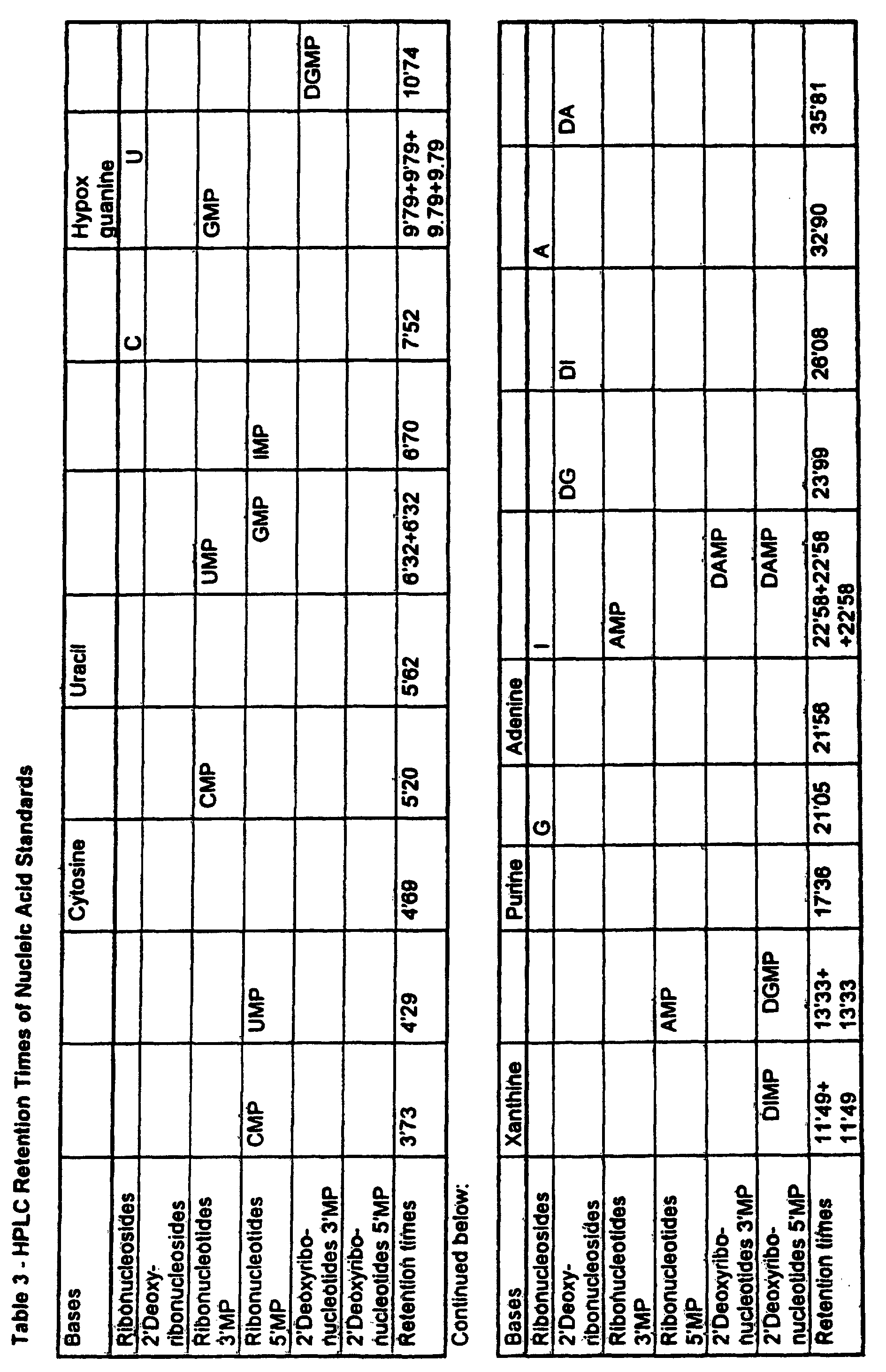
- Since free ribose is highly reactive in the Maillard reaction, the effect of gentle hydrolysis conditions on FDC and the subsequent effects on flavour generation were investigated. Add hydrolysis was carried out with sodium acetate 0.01 M, pH4 adjusted with acetic acid. Standards (inosine, adenosine 5'mono phosphate -AMP5', guanosine and guanosine 5'mono phosphate -GMP5') were prepared at 4000 µM in duplicate and an aliquot of each solution was taken and run under the same HPLC conditions as were adapted for the analysis of nucleic acids derivatives above. The solutions were then subjected to hydrolysis for 7.5 h in an oven 100°C (GC oven Carlo Erba). The reaction was stopped by placing the tubes in an ice bath and kept in freezer until analysis.
- FDC at 2% w/v was subjected to similar hydrolysis conditions.
- As indicated previously, FDC is considered to have the potential of being either a flavouring in its own right, or a precursor in the generation of reaction - product flavours. Therefore a range of reaction mixtures were prepared and are presented in Table 4.


- Reaction mixtures (2 ml) were prepared by mixing appropriate quantities of stock solutions in glass tubes and then transferring to 20 ml Kimble ampules that were sealed in hot flame. The ampules were then placed in a metal cover and heated in a Carlo Erba 4200 gas chromatograph oven.
- The reaction mixtures were stored in the freezer at -20°C before analysis. The ampules were broken for analysis after bringing the reaction mixtures to room temperature.
- An informal panel of 6 persons (3 females, 3 males) experienced in flavour evaluation was recruited.
- For sensory evaluation, 1 ml aliquots of the samples under investigation were transferred into brown screw-cap bottles and diluted 10 times (except for the concentration study where no dilution was applied). The coded samples were presented to one panellist at one time at room temperature and the panellists were asked to describe the aromas using their own terms.
- A dynamic headspace collection procedure was used. Each sample (1.7 ml of reaction mixture so that it was equivalent to 0.4 g of FDC) was placed in a 250 ml conical flask fitted with a Drechsel head. Distilled water was added to a final volume of 10 ml and the mixture shaken gently. Oxygen-free nitrogen was passed over the sample for 1 h at a rate of 40 ml/min. The volatiles were swept onto a preconditioned glass-lined stainless-steel trap (105 mm x 3 mm i.d.) packed with 85 mg Tenax GC (CHIS system. SGE Limited). Throughout the collection, the sample was maintained at 37°C using a water bath. The internal standard was 1,2-dichlorobenzene in ether (130 µl/ml) and 1 µl was injected onto the trap at the end of the collection time, the trap was then flushed with nitrogen for 10 min.
- A Hewlett-Packard (HP) 5890/5972 gas chromatrograph-mass spectrometer (GC-MS), fitted with a 50 m x 0.32 mm i.d. fused-silica capillary column coated with BPX-5) SGE Limited) at 0.5 µm film thickness, was used to analyse the collected volatiles. These were thermally desorbed at 250°C in the CHIS injection port (SGE Limited) and cryofocused directly onto the front of the GC column, while the oven was held at 0°C for 5 min. The oven temperature was then raised to 40°C over 1 min and held for 5 min before raising the temperature to 250°C at a rate of 4°C/min and holding for a further 10 min. The helium carrier gas flow rate was 1.5 ml/min. Mass spectra were recorded in the electron impact mode at an ionisation voltage of 70 eV and source temperature of 200°C. A scan range of 29-400 m/z and a scan time of 0.69 s were used. The date were controlled and stored by the HP G1034C Chemstation data system.
- Volatiles were identified by comparison of their mass spectra with the spectra from authentic compounds in the Reading Laboratory or in the NIST/EPA/MSDC Mass Spectral Database or other published spectra. The linear retention index (LRI) was calculated for each component using the retention times of a homologous series of C6-C22 n-alkanes.
- The nucleic acid composition of the centrate was determined from 3 replicates and is presented in Table 5. It explains most of the HPLC eluted peaks. A number of compounds co-eluted, but it was not possible to investigate alternative analysis conditions and, therefore, for co-eluting compounds it was not possible to determine which of the compounds contributed to the peak obtained in the centrate analysis.
- As expected, there were few deoxyribonucleic add derived compounds compared with the ribonucleic acid derived compounds, which are more abundant in nature. The major nucleic acid components are cytosine 5' monophosphate (26% of the total nucleic acid content), uridine 3' monophosphate and/or guanosine 5' monophosphate (18%), adenosine 5' monophosphate and/or deoxyribo guanosine 5' monophosphate (16%). All of them are potential sources of ribose and ribose phosphate which are good reactive precursors the Maillard reaction. Excluding the bases, the potential source of ribose or ribose phosphate represents 96% of the nucleic acid content of the centrate, which is equivalent to 202 ppm of the content of the centrate.

- Table 6 presents the results of hydrolysis of solutions of inosine, guanosine and their respective 5' phosphate ribonucleotides. The method is based on that used by Matoba et al (J. Food Science, vol. 53, n.4, 1988, p1156). The last column gives an indication of quantity recovery and it can be seen that the results of the hydrolysis on the guanosine showed a significant loss, which suggests that the guanine molecule is unstable.
- The most interesting model systems are the ribonucleotides since they are major components in the centrate. They were hydrolysed by half or less, producing their respective nucleosides which were further hydrolysed into their bases. Although it is possible to hydrolyse the ribonucleotides into their bases and consequently produce ribose and/or ribose phosphate, relatively low yields of bases were obtained and an optimisation of this process should be carried out.
Acid hydrolysis results of model systems Quantity (%) initial After hydrolysis hypoxanthine inosine IMPS' total inosine IMP5' 100 13 85 98 100 6 15 71 92 guanine guanosine GMP5' guanosine GMP5' 100 2 42 44 100 2 35 51 88 - The nucleic acid composition of the FDC has been characterised. It comprises mainly ribonucleotides with relatively small amounts of deoxyribonucleotides. Hydrolysis of nucleotides releases free ribose or ribose phosphate only occurs to a relatively small extent in acetate buffer at pH 4.
- It was decided to present the individual results of each panellist and not to group them under specific common descriptors because of the too large diversity of the terms described.
- Tables 7 and 8 present the effect of heating and the impact of the hydrolysis, with or without the addition of cysteine.
Aroma panel results on centrate - Study of the effect of cooking Sample name Aqueous Centrate Heated Aqueous Centrate Sample Composition 1.7%(w/v, solids of centrate/water 1/7%(w/v, solids of centrate/water) 0.5, 140°C Panellist 1 scrumpy, glucose, syrup, molasses molasses, caramel Panellist 2 caramel, sweet burnt Panellist 3 whey, old yoghurt, sharp, creamy raw celery, braised celery, weird smell Panellist 4 wet cloth/ironing/scorching auto-claving media, slightly acrid fermenting cereal, ironing/wet cloth, cotton/wool, treacle, golden syrup Panellist 5 honey, urine caramel, fatty Panellist 6 caramel, slightly fruity slightly fruity caramel, burnt, sharp 
- The study of the effect of concentration of centrate involved the range of concentrations likely to be reached in commercial practice, i.e., within the range 12% and 30% of solids. These were compared with the non diluted freeze dried centrate powder (87% solids). The other preparation conditions were kept constant. viz. pH 5.5 and heating at 140°C for 30 min. The results are presented in Table 9. The odours were very strong and the reproducibility of the results within 2 replicates for each panellist was fairly poor. However, there was a noticeable trend within the sample set from low to high concentration: at 12%, the odours were mainly sweet, vegetable and molasses. These notes became associated with burnt and sharp as well as savoury at 20 and 30% solids. At 50%, the sample had roasted and paint smells that became dominant at 75%. Some extra metallic, burnt rubbery, and sulphur notes were detected with the 87% sample. The 20 and 30% solid samples seemed the most interesting because of their meaty savour smells and therefore they were selected for further analysis. it was also decided to dilute the original flavoured reaction mixtures before sniffing further reaction mixtures.


- The pH effect was studied on the centrate at 3 different values: 5.5, 7.5 and 9, with the heating conditions kept at 140°C for 30 min. The results are in Table 10. There was not much difference in the results between the 20% and the 30% solids samples. The results at pH 7.5 were similar to those at pH 5.5 and the smells were mainly autoclave and caramel. The odour became burnt with pH 9. Therefore it was decided to carry on the sniffing expenments by selecting the two extreme pHs and to keep only one concentration (20% solids).
Aroma panel results on heated centrate study of the effect of pH Sample Name Heated aqueous centrate 20% pH 5.5 Heated aqueous centrate 30% pH 5.5 Sample composition 20%(w/v, solids of centrate/water) 0.5h 140°C 30% (w/v, solids of centrate/water) 0.5h 140°C Dilution before sniffing 50 for panellist 1 50 for panellist 1 10 for panellist 2 10 for panellist 2 Panellist 1 1-slight autoclaving
2-diacetyl then going to caramel, butter scotch, slightly nutty1-slightly autoclave, "catching" in nose.
2-then quite a lot of caramelpanellist 2 caramel, butter-like caramel, sweet Sample name Heated aqueous centrate
20% pH 7.5Heated aqueous centrate
30% pH 7.5Sample composition 20%(w/v, solids of centrate/water 0.5h 140°C 30%(w/v, solids of centrate/water) 0.5h 140°C Dilution before sniffing 50 50 Panellist 1 similar to sample 20% pH 5.5 in the way it changes, bit more autoclaving, caramel but not really butterscotch 1-slightly autoclave
2-caramelSample name Heated aqueous centrate
20% pH 9Heated aqueous centrate
30% pH9Sample composition 20% (w/v, solids of centrate/water) 0.5h 140°C 30% (w/v, solids of centrate/water) 0.5h 140°C Dilution before sniffing 10 10 Panellist 2 burnt, baked, roasted, cereals slightly burnt, caramel sweet - The effect of addition of cysteine was studied on the centrate in solution at 20% solids at pH 5.5 and 9. There were three concentrations of cysteine tested: ratios 1/20, 1/10 and 1/5 of cysteine (g)/centrate solids (g). The heating conditions were kept the same as previously (104°C for 30 min). The results are presented in Table 11. Within the pH 5.5 sample series, the low concentration of cysteine sample lead to a somewhat pleasant odour of sweet, greasy, meaty sauce, that was progressively replaced by roasted and rubber notes as the cysteine concentration increased. At pH 9, the burnt roasted cereals notes already mentioned in the previous experiment were present again with cysteine at low concentration. When the cysteine content increased, the odour became strong and more nutty and then dose to savoury, meaty stock. It was therefore decided to select pH 5.5 with cysteine 1/20 sample and pH9 with cysteine 1/5 sample for the next set of experiments.
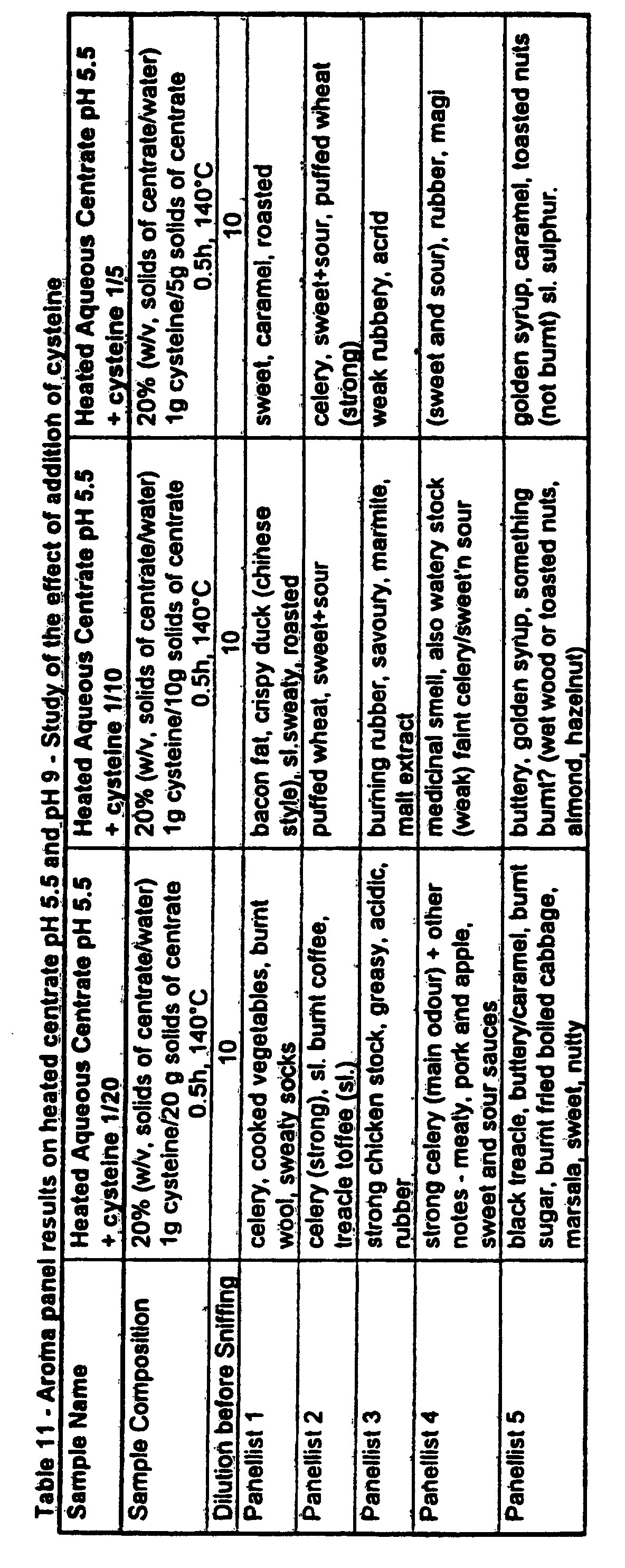
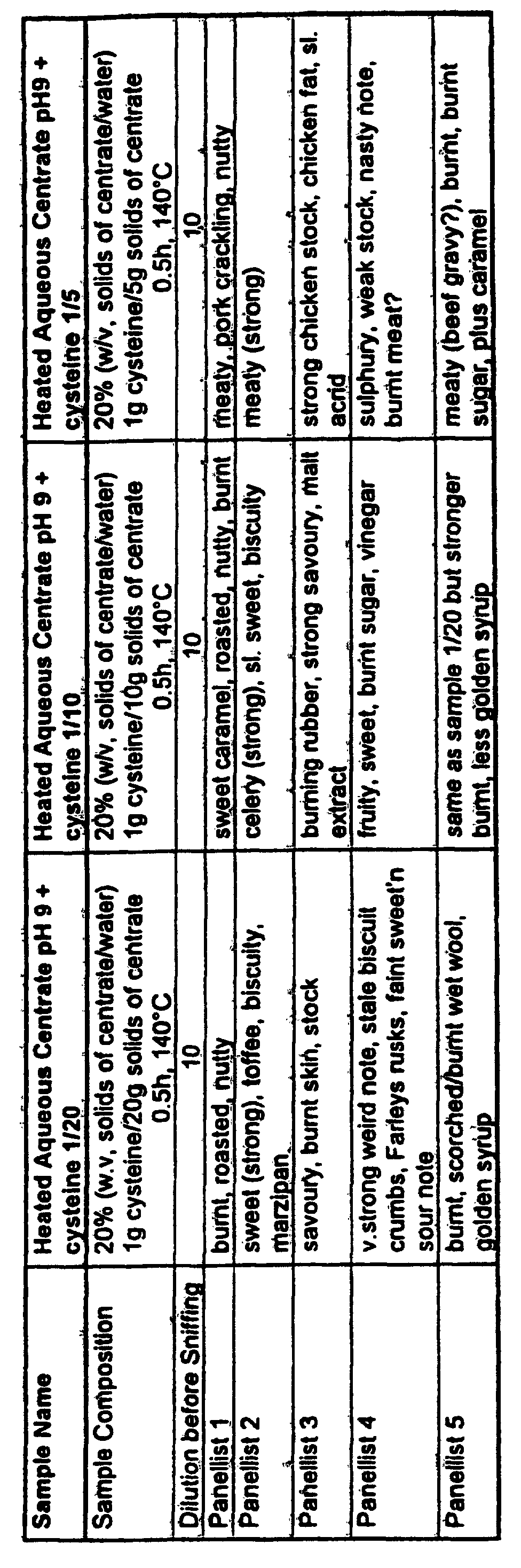
- The results of the temperature/duration heating conditions study are presented in Table 12. They involve the two selected samples previously described which were then cooked at a lower temperature and longer time: 100°C for 60 min and 90 min, and at a higher temperature but for a shorter time: 175°C for 5 min. Compared to the original heating conditions, similar results were obtained for the pH 5.5 cysteine 1/20 sample by heating 100°C for 60 min. Longer time of heating at 100°C resulted in more roasted burnt notes and a similar type of odour was obtained after 5 min at 175°C. Regarding the pH 9 cysteine 1/5 sample, the meaty notes obtained by 30 min at 140°C were reached by the treatment 5 min at 175°C. At 100°C, some very strong odours of urine and boiled eggs were described.

- A selection of the reaction mixtures described above were further studied by GC-MS analysis of the headspace volatiles by the method described previously. These mixtures are underlined in Table 2. A sample of autolysed yeast was analysed under the same conditions for comparison of the volatiles. The results of the study are presented in detail in Table 13.

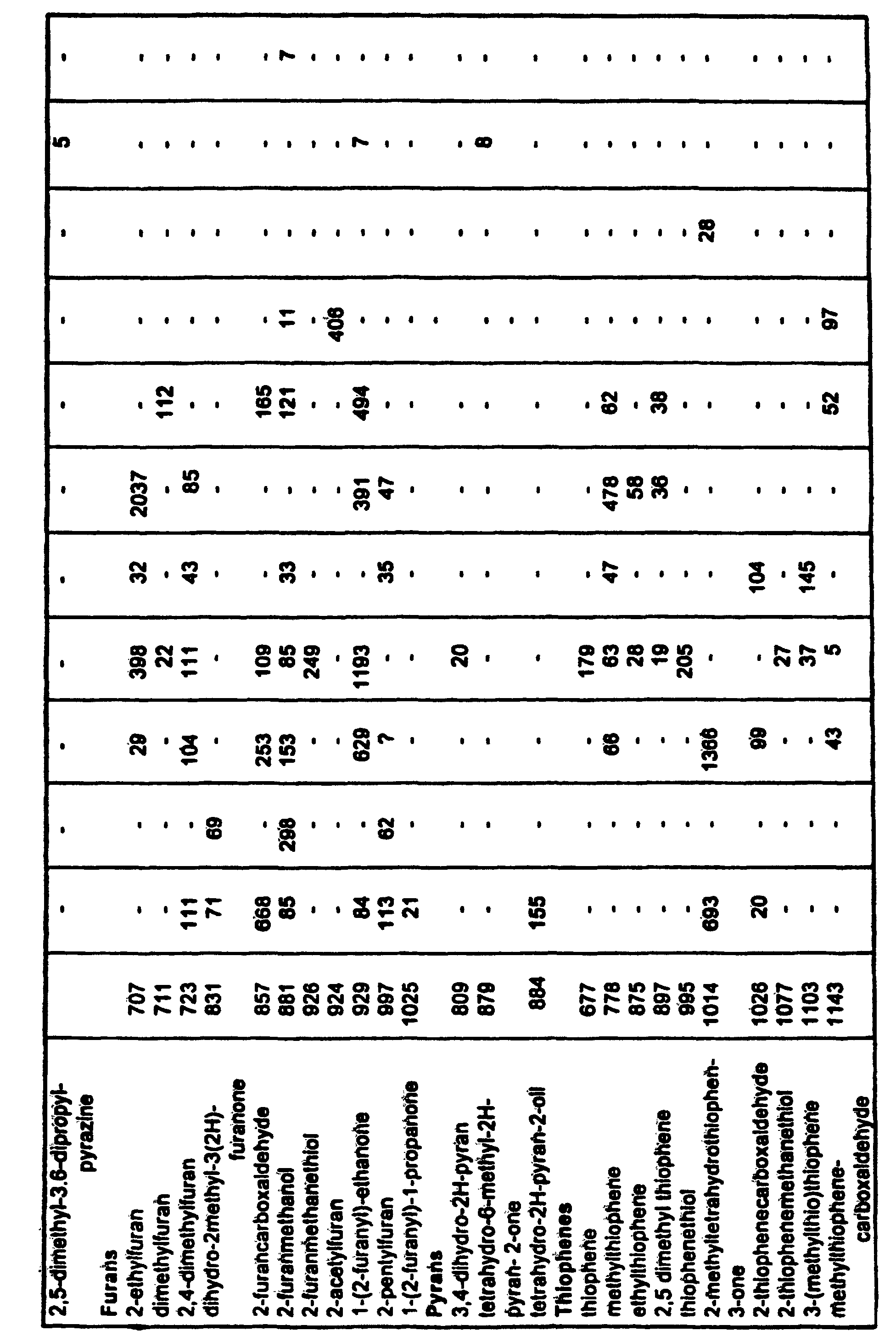
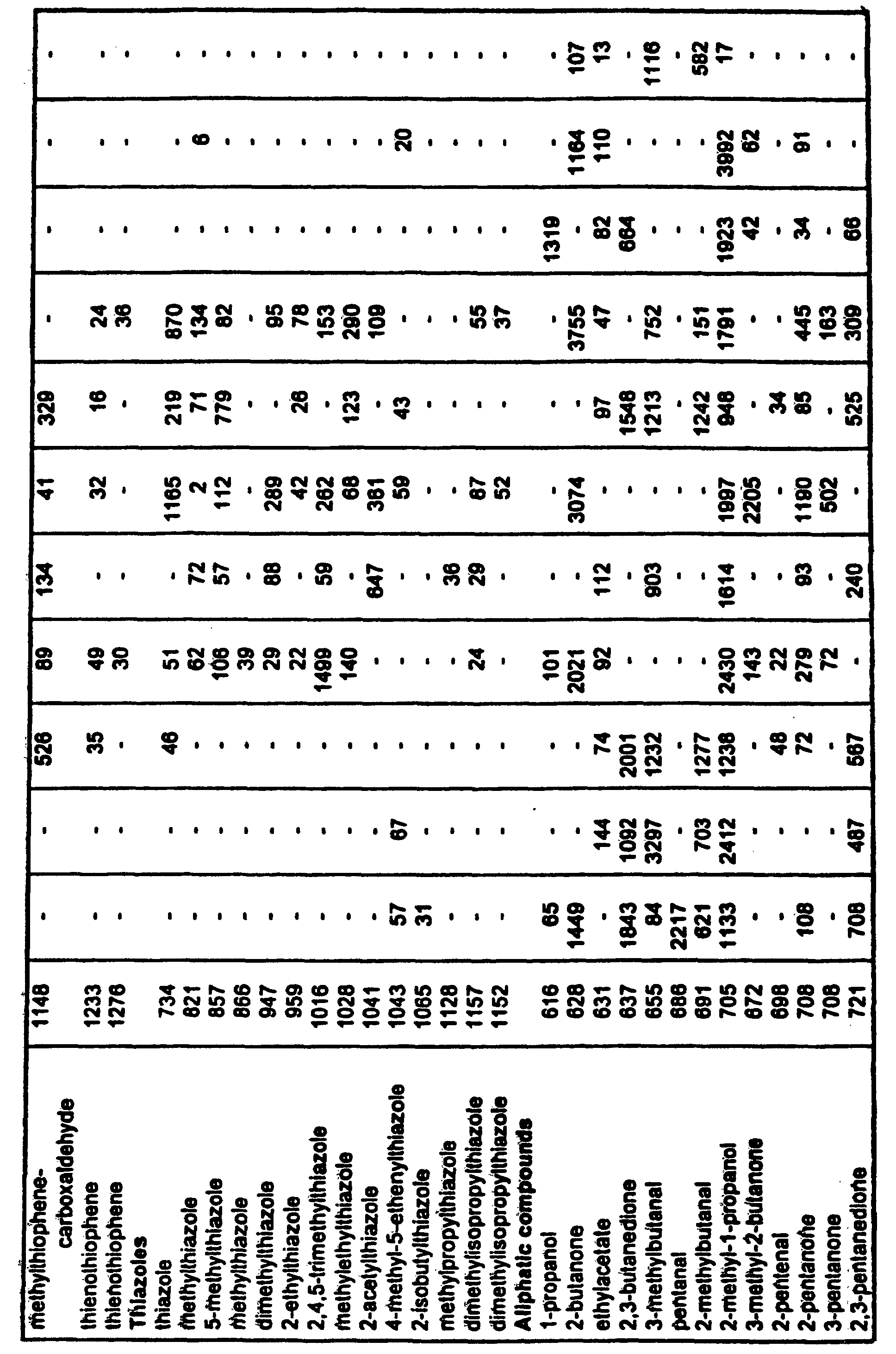


- The pyrazines, thiazoles and thiophenes content was very much affected by the reaction conditions. The highest levels of pyrazines were found at pH9, as expected, since the formation of N-heterocyclic compounds in the Maillard reaction is favoured by high pH. With a few exceptions, sulphur compounds were formed only in the presence of cysteine, confirming that the content of sulphur amino acids in the freeze dried centrate was very low.
- The yeast autolysate aroma volatiles were dominated by terpenes and its composition was very different from the volatiles obtained from the centrate.
- The range of flavours was generated from the centrate, showing its potential as a flavouring ingredient or as a source of precursors for reaction product flavourings. The variables that were applied in this study were the centrate concentration, the pH, the presence of added cysteine, and the temperature/duration of the heating conditions. An addition of cysteine was necessary to generate meaty aromas which derive from sulphur-containing volatiles.
Claims (12)
- A method of preparing a flavouring material for food which comprises subjecting a filamentous fungus in the presence of water to a temperature sufficient to remove materials therefrom and thereby reduce its nucleic acid content; and subjecting materials removed from the fungus to a chemical reaction thereby to prepare a flavouring material for food.
- A method according to Claim 1 which comprises subjecting filamentous fungal cells of said filamentous fungus to said temperature.
- A method according to claim 1 or claim 2, wherein said materials removed are partially hydrolysed to prepare a flavouring material for food.
- A method according to Claim 3, wherein said materials removed are partially hydrolysed by treatment with acetic acid.
- A method according to any preceding claim, wherein said flavouring material comprises a reaction product of materials removed from the fungus with a sulphur containing amino acid, hydrogen sulphide or ammonium sulphide.
- A method according to Claim 5, wherein said flavouring material comprises a reaction product of materials removed from the fungus with cysteine.
- A method according to Claim 5 or Claim 6, in which the reaction is carried out in the presence of water.
- A method according to Claim 7, in which a solution of 1.5 to 75% by weight of the materials removed from the fungus in water is reacted with cysteine in amounts up to 10% of cysteine by weight based on the said materials at a pH of 5.5 to 9.
- A method according to Claim 8, in which the temperature of the reaction is 110 to 140°C.
- A method according to any preceding claim, wherein said filamentous fungus is in its growing state and/or is in the presence of its growth medium when subjected to said temperature.
- A method according to any preceding claim, wherein said filamentous fungus is Fusarium.
- A food comprising a flavouring material obtainable by a method according to any of Claims 1 to 11.
Applications Claiming Priority (3)
| Application Number | Priority Date | Filing Date | Title |
|---|---|---|---|
| GBGB9726452.7A GB9726452D0 (en) | 1997-12-16 | 1997-12-16 | Flavouring materials |
| GB9726452 | 1997-12-16 | ||
| EP98960003A EP1052909B1 (en) | 1997-12-16 | 1998-12-11 | Flavouring materials |
Related Parent Applications (1)
| Application Number | Title | Priority Date | Filing Date |
|---|---|---|---|
| EP98960003A Division EP1052909B1 (en) | 1997-12-16 | 1998-12-11 | Flavouring materials |
Publications (2)
| Publication Number | Publication Date |
|---|---|
| EP1205117A1 EP1205117A1 (en) | 2002-05-15 |
| EP1205117B1 true EP1205117B1 (en) | 2004-07-14 |
Family
ID=10823620
Family Applications (2)
| Application Number | Title | Priority Date | Filing Date |
|---|---|---|---|
| EP02003084A Expired - Lifetime EP1205117B1 (en) | 1997-12-16 | 1998-12-11 | Flavouring materials from yeast extracts |
| EP98960003A Expired - Lifetime EP1052909B1 (en) | 1997-12-16 | 1998-12-11 | Flavouring materials |
Family Applications After (1)
| Application Number | Title | Priority Date | Filing Date |
|---|---|---|---|
| EP98960003A Expired - Lifetime EP1052909B1 (en) | 1997-12-16 | 1998-12-11 | Flavouring materials |
Country Status (21)
| Country | Link |
|---|---|
| US (2) | US6579553B1 (en) |
| EP (2) | EP1205117B1 (en) |
| JP (1) | JP4046472B2 (en) |
| KR (1) | KR20010033250A (en) |
| CN (1) | CN1285717A (en) |
| AT (2) | ATE270823T1 (en) |
| AU (1) | AU746569B2 (en) |
| BR (1) | BR9813631A (en) |
| CA (1) | CA2309830A1 (en) |
| DE (2) | DE69825086D1 (en) |
| DK (1) | DK1052909T3 (en) |
| ES (1) | ES2184344T3 (en) |
| GB (1) | GB9726452D0 (en) |
| IL (1) | IL136623A (en) |
| IN (1) | IN192137B (en) |
| NO (1) | NO20003066L (en) |
| NZ (1) | NZ505228A (en) |
| PT (1) | PT1052909E (en) |
| RU (1) | RU2223668C2 (en) |
| WO (1) | WO1999030579A1 (en) |
| ZA (1) | ZA9811530B (en) |
Families Citing this family (6)
| Publication number | Priority date | Publication date | Assignee | Title |
|---|---|---|---|---|
| GB9726452D0 (en) * | 1997-12-16 | 1998-02-11 | Zeneca Ltd | Flavouring materials |
| WO2008069173A1 (en) * | 2006-12-04 | 2008-06-12 | Ajinomoto Co., Inc. | Process for producing seasoning |
| BR112021008782A2 (en) * | 2019-03-28 | 2021-11-03 | Firmenich S/A | Flavor system |
| GB2597437B (en) * | 2020-05-22 | 2025-02-12 | Marlow Foods Ltd | Edible fungi |
| CN113156000B (en) * | 2021-03-29 | 2022-06-07 | 完美(广东)日用品有限公司 | Detection method of hydrolyzed amino acid |
| WO2023239868A1 (en) * | 2022-06-10 | 2023-12-14 | Mycotechnology, Inc. | Methods for the production of mycelial biomass |
Family Cites Families (6)
| Publication number | Priority date | Publication date | Assignee | Title |
|---|---|---|---|---|
| JPS556350B1 (en) * | 1970-08-20 | 1980-02-15 | ||
| CH556647A (en) * | 1971-05-07 | 1974-12-13 | Greenshields Inventions Ltd | Cellular extract prodn - using mould growths substantially spore free for a lysis |
| JPS61158761A (en) * | 1984-12-28 | 1986-07-18 | Ajinomoto Co Inc | Production of seasoning of good body or food having enriched good body |
| ATE71265T1 (en) * | 1987-05-01 | 1992-01-15 | Nestle Sa | MUSHROOM FLAVOUR. |
| GB9403930D0 (en) * | 1994-03-01 | 1994-04-20 | Zeneca Ltd | Production of food |
| GB9726452D0 (en) * | 1997-12-16 | 1998-02-11 | Zeneca Ltd | Flavouring materials |
-
1997
- 1997-12-16 GB GBGB9726452.7A patent/GB9726452D0/en active Pending
-
1998
- 1998-12-11 PT PT98960003T patent/PT1052909E/en unknown
- 1998-12-11 EP EP02003084A patent/EP1205117B1/en not_active Expired - Lifetime
- 1998-12-11 RU RU2000118798/13A patent/RU2223668C2/en not_active IP Right Cessation
- 1998-12-11 IL IL13662398A patent/IL136623A/en not_active IP Right Cessation
- 1998-12-11 AU AU15694/99A patent/AU746569B2/en not_active Ceased
- 1998-12-11 KR KR1020007006681A patent/KR20010033250A/en not_active Withdrawn
- 1998-12-11 EP EP98960003A patent/EP1052909B1/en not_active Expired - Lifetime
- 1998-12-11 DE DE69825086T patent/DE69825086D1/en not_active Expired - Lifetime
- 1998-12-11 US US09/582,133 patent/US6579553B1/en not_active Expired - Lifetime
- 1998-12-11 AT AT02003084T patent/ATE270823T1/en not_active IP Right Cessation
- 1998-12-11 CA CA002309830A patent/CA2309830A1/en not_active Abandoned
- 1998-12-11 BR BR9813631-3A patent/BR9813631A/en not_active IP Right Cessation
- 1998-12-11 WO PCT/GB1998/003716 patent/WO1999030579A1/en not_active Ceased
- 1998-12-11 NZ NZ505228A patent/NZ505228A/en unknown
- 1998-12-11 DE DE69808341T patent/DE69808341T2/en not_active Expired - Fee Related
- 1998-12-11 DK DK98960003T patent/DK1052909T3/en active
- 1998-12-11 ES ES98960003T patent/ES2184344T3/en not_active Expired - Lifetime
- 1998-12-11 AT AT98960003T patent/ATE224651T1/en not_active IP Right Cessation
- 1998-12-11 JP JP2000538576A patent/JP4046472B2/en not_active Expired - Fee Related
- 1998-12-11 CN CN98812088A patent/CN1285717A/en active Pending
- 1998-12-15 ZA ZA9811530A patent/ZA9811530B/en unknown
-
2000
- 2000-06-01 IN IN51BO2000 patent/IN192137B/en unknown
- 2000-06-15 NO NO20003066A patent/NO20003066L/en unknown
-
2003
- 2003-01-16 US US10/345,215 patent/US6767571B2/en not_active Expired - Lifetime
Also Published As
| Publication number | Publication date |
|---|---|
| DE69825086D1 (en) | 2004-08-19 |
| NO20003066D0 (en) | 2000-06-15 |
| NO20003066L (en) | 2000-08-11 |
| CN1285717A (en) | 2001-02-28 |
| EP1205117A1 (en) | 2002-05-15 |
| US20030134021A1 (en) | 2003-07-17 |
| JP4046472B2 (en) | 2008-02-13 |
| ZA9811530B (en) | 1999-06-17 |
| AU1569499A (en) | 1999-07-05 |
| WO1999030579A1 (en) | 1999-06-24 |
| KR20010033250A (en) | 2001-04-25 |
| DK1052909T3 (en) | 2003-02-24 |
| DE69808341T2 (en) | 2003-07-31 |
| PT1052909E (en) | 2003-01-31 |
| DE69808341D1 (en) | 2002-10-31 |
| NZ505228A (en) | 2002-10-25 |
| ATE270823T1 (en) | 2004-07-15 |
| US6767571B2 (en) | 2004-07-27 |
| IL136623A0 (en) | 2001-06-14 |
| ATE224651T1 (en) | 2002-10-15 |
| BR9813631A (en) | 2002-01-22 |
| US6579553B1 (en) | 2003-06-17 |
| GB9726452D0 (en) | 1998-02-11 |
| CA2309830A1 (en) | 1999-06-24 |
| AU746569B2 (en) | 2002-05-02 |
| IN192137B (en) | 2004-02-21 |
| EP1052909B1 (en) | 2002-09-25 |
| EP1052909A1 (en) | 2000-11-22 |
| RU2223668C2 (en) | 2004-02-20 |
| ES2184344T3 (en) | 2003-04-01 |
| IL136623A (en) | 2003-10-31 |
| JP2002508164A (en) | 2002-03-19 |
Similar Documents
| Publication | Publication Date | Title |
|---|---|---|
| Beal et al. | Compounds contributing to the characteristic aroma of malted barley | |
| Maga et al. | Pyrazines in foods | |
| CA1080699A (en) | Flavoured bouillon base | |
| US5252188A (en) | Process for producing hydroxyacetaldehyde | |
| MacLeod et al. | A comparison of the chemical composition of boiled and roasted aromas of heated beef | |
| US4066793A (en) | Seasoning composition and preparation thereof | |
| US11896042B2 (en) | Ribonucleotide-rich yeast extract and use of same for masking undesirable flavours and undesirable aromatic notes | |
| EP3027055B1 (en) | Potato derived flavour enhancing composition and method for the manufacture thereof | |
| EP1052909B1 (en) | Flavouring materials | |
| Nunomura et al. | Isolation of 4-hydroxy-5-methyl-3 (2H)-furanone, a flavor component in shoyu (soy sauce) | |
| Maga et al. | Pyrazines in the foods | |
| EP2526782B1 (en) | Process for producing flavor-enhancing agent | |
| Park et al. | Characteristics of taste components of commercial soybean paste | |
| Shahidi et al. | Effect of processing on flavor precursor amino acids and volatiles of sesame paste (tehina) | |
| Wang et al. | Effect of cooking method on the aroma constituents of sweet potatoes [Ipomoea batatas (L.) Lam.] | |
| US20010008647A1 (en) | Flavorings | |
| US4194017A (en) | Flavored bouillon base | |
| US5948453A (en) | Food flavorant preparation via bioconversion of elemental sulphur | |
| Hayashida et al. | The influence of mash pre-aging on the development of the flavour-active compound, 4-hydroxy-2 (or5)-ethyl-5 (or2)-methyl-3 (2H)-furanone (HEMF), during soy sauce fermentation | |
| Sucan et al. | Process and reaction flavors: An overview | |
| MXPA00005711A (en) | Flavouring materials from yeast extracts | |
| HK1034166A (en) | Flavouring materials from yeast extracts | |
| Li et al. | Changes in levels of amino acids and basic components in burley tobacco produced by roasting | |
| CN112911945A (en) | Preparation method of flavoring agent | |
| NO313733B1 (en) | Process for the preparation of a flavoring agent |
Legal Events
| Date | Code | Title | Description |
|---|---|---|---|
| PUAI | Public reference made under article 153(3) epc to a published international application that has entered the european phase |
Free format text: ORIGINAL CODE: 0009012 |
|
| 17P | Request for examination filed |
Effective date: 20020213 |
|
| AC | Divisional application: reference to earlier application |
Ref document number: 1052909 Country of ref document: EP |
|
| AK | Designated contracting states |
Kind code of ref document: A1 Designated state(s): AT BE CH CY DE DK ES FI FR GB GR IE IT LI LU MC NL PT SE |
|
| 17Q | First examination report despatched |
Effective date: 20021120 |
|
| AKX | Designation fees paid |
Designated state(s): AT BE CH CY DE DK ES FI FR GB GR IE IT LI LU MC NL PT SE |
|
| GRAP | Despatch of communication of intention to grant a patent |
Free format text: ORIGINAL CODE: EPIDOSNIGR1 |
|
| GRAS | Grant fee paid |
Free format text: ORIGINAL CODE: EPIDOSNIGR3 |
|
| GRAA | (expected) grant |
Free format text: ORIGINAL CODE: 0009210 |
|
| AC | Divisional application: reference to earlier application |
Ref document number: 1052909 Country of ref document: EP Kind code of ref document: P |
|
| AK | Designated contracting states |
Kind code of ref document: B1 Designated state(s): AT BE CH CY DE DK ES FI FR GB GR IE IT LI LU MC NL PT SE |
|
| PG25 | Lapsed in a contracting state [announced via postgrant information from national office to epo] |
Ref country code: IT Free format text: LAPSE BECAUSE OF FAILURE TO SUBMIT A TRANSLATION OF THE DESCRIPTION OR TO PAY THE FEE WITHIN THE PRESCRIBED TIME-LIMIT;WARNING: LAPSES OF ITALIAN PATENTS WITH EFFECTIVE DATE BEFORE 2007 MAY HAVE OCCURRED AT ANY TIME BEFORE 2007. THE CORRECT EFFECTIVE DATE MAY BE DIFFERENT FROM THE ONE RECORDED. Effective date: 20040714 Ref country code: NL Free format text: LAPSE BECAUSE OF FAILURE TO SUBMIT A TRANSLATION OF THE DESCRIPTION OR TO PAY THE FEE WITHIN THE PRESCRIBED TIME-LIMIT Effective date: 20040714 Ref country code: CY Free format text: LAPSE BECAUSE OF FAILURE TO SUBMIT A TRANSLATION OF THE DESCRIPTION OR TO PAY THE FEE WITHIN THE PRESCRIBED TIME-LIMIT Effective date: 20040714 Ref country code: LI Free format text: LAPSE BECAUSE OF FAILURE TO SUBMIT A TRANSLATION OF THE DESCRIPTION OR TO PAY THE FEE WITHIN THE PRESCRIBED TIME-LIMIT Effective date: 20040714 Ref country code: FI Free format text: LAPSE BECAUSE OF FAILURE TO SUBMIT A TRANSLATION OF THE DESCRIPTION OR TO PAY THE FEE WITHIN THE PRESCRIBED TIME-LIMIT Effective date: 20040714 Ref country code: BE Free format text: LAPSE BECAUSE OF FAILURE TO SUBMIT A TRANSLATION OF THE DESCRIPTION OR TO PAY THE FEE WITHIN THE PRESCRIBED TIME-LIMIT Effective date: 20040714 Ref country code: FR Free format text: LAPSE BECAUSE OF FAILURE TO SUBMIT A TRANSLATION OF THE DESCRIPTION OR TO PAY THE FEE WITHIN THE PRESCRIBED TIME-LIMIT Effective date: 20040714 Ref country code: AT Free format text: LAPSE BECAUSE OF FAILURE TO SUBMIT A TRANSLATION OF THE DESCRIPTION OR TO PAY THE FEE WITHIN THE PRESCRIBED TIME-LIMIT Effective date: 20040714 Ref country code: CH Free format text: LAPSE BECAUSE OF FAILURE TO SUBMIT A TRANSLATION OF THE DESCRIPTION OR TO PAY THE FEE WITHIN THE PRESCRIBED TIME-LIMIT Effective date: 20040714 |
|
| REG | Reference to a national code |
Ref country code: GB Ref legal event code: FG4D |
|
| REG | Reference to a national code |
Ref country code: CH Ref legal event code: EP |
|
| REF | Corresponds to: |
Ref document number: 69825086 Country of ref document: DE Date of ref document: 20040819 Kind code of ref document: P |
|
| REG | Reference to a national code |
Ref country code: IE Ref legal event code: FG4D |
|
| PG25 | Lapsed in a contracting state [announced via postgrant information from national office to epo] |
Ref country code: DK Free format text: LAPSE BECAUSE OF FAILURE TO SUBMIT A TRANSLATION OF THE DESCRIPTION OR TO PAY THE FEE WITHIN THE PRESCRIBED TIME-LIMIT Effective date: 20041014 Ref country code: GR Free format text: LAPSE BECAUSE OF FAILURE TO SUBMIT A TRANSLATION OF THE DESCRIPTION OR TO PAY THE FEE WITHIN THE PRESCRIBED TIME-LIMIT Effective date: 20041014 Ref country code: SE Free format text: LAPSE BECAUSE OF FAILURE TO SUBMIT A TRANSLATION OF THE DESCRIPTION OR TO PAY THE FEE WITHIN THE PRESCRIBED TIME-LIMIT Effective date: 20041014 |
|
| PG25 | Lapsed in a contracting state [announced via postgrant information from national office to epo] |
Ref country code: DE Free format text: LAPSE BECAUSE OF FAILURE TO SUBMIT A TRANSLATION OF THE DESCRIPTION OR TO PAY THE FEE WITHIN THE PRESCRIBED TIME-LIMIT Effective date: 20041015 |
|
| PG25 | Lapsed in a contracting state [announced via postgrant information from national office to epo] |
Ref country code: ES Free format text: LAPSE BECAUSE OF FAILURE TO SUBMIT A TRANSLATION OF THE DESCRIPTION OR TO PAY THE FEE WITHIN THE PRESCRIBED TIME-LIMIT Effective date: 20041025 |
|
| PG25 | Lapsed in a contracting state [announced via postgrant information from national office to epo] |
Ref country code: LU Free format text: LAPSE BECAUSE OF NON-PAYMENT OF DUE FEES Effective date: 20041211 |
|
| PG25 | Lapsed in a contracting state [announced via postgrant information from national office to epo] |
Ref country code: IE Free format text: LAPSE BECAUSE OF NON-PAYMENT OF DUE FEES Effective date: 20041213 |
|
| PG25 | Lapsed in a contracting state [announced via postgrant information from national office to epo] |
Ref country code: MC Free format text: LAPSE BECAUSE OF NON-PAYMENT OF DUE FEES Effective date: 20041231 |
|
| NLV1 | Nl: lapsed or annulled due to failure to fulfill the requirements of art. 29p and 29m of the patents act | ||
| REG | Reference to a national code |
Ref country code: CH Ref legal event code: PL |
|
| PLBE | No opposition filed within time limit |
Free format text: ORIGINAL CODE: 0009261 |
|
| STAA | Information on the status of an ep patent application or granted ep patent |
Free format text: STATUS: NO OPPOSITION FILED WITHIN TIME LIMIT |
|
| 26N | No opposition filed |
Effective date: 20050415 |
|
| EN | Fr: translation not filed | ||
| REG | Reference to a national code |
Ref country code: IE Ref legal event code: MM4A |
|
| PG25 | Lapsed in a contracting state [announced via postgrant information from national office to epo] |
Ref country code: PT Free format text: LAPSE BECAUSE OF NON-PAYMENT OF DUE FEES Effective date: 20041214 |
|
| REG | Reference to a national code |
Ref country code: GB Ref legal event code: 732E Free format text: REGISTERED BETWEEN 20090205 AND 20090211 |
|
| REG | Reference to a national code |
Ref country code: GB Ref legal event code: 732E Free format text: REGISTERED BETWEEN 20090423 AND 20090429 |
|
| REG | Reference to a national code |
Ref country code: GB Ref legal event code: 732E Free format text: REGISTERED BETWEEN 20111020 AND 20111025 |
|
| PGFP | Annual fee paid to national office [announced via postgrant information from national office to epo] |
Ref country code: GB Payment date: 20171215 Year of fee payment: 20 |
|
| REG | Reference to a national code |
Ref country code: GB Ref legal event code: PE20 Expiry date: 20181210 |
|
| PG25 | Lapsed in a contracting state [announced via postgrant information from national office to epo] |
Ref country code: GB Free format text: LAPSE BECAUSE OF EXPIRATION OF PROTECTION Effective date: 20181210 |