EP1204323B1 - Fungicides - Google Patents
Fungicides Download PDFInfo
- Publication number
- EP1204323B1 EP1204323B1 EP00960499A EP00960499A EP1204323B1 EP 1204323 B1 EP1204323 B1 EP 1204323B1 EP 00960499 A EP00960499 A EP 00960499A EP 00960499 A EP00960499 A EP 00960499A EP 1204323 B1 EP1204323 B1 EP 1204323B1
- Authority
- EP
- European Patent Office
- Prior art keywords
- alkyl
- phenyl
- substituted
- optionally substituted
- hydrogen
- Prior art date
- Legal status (The legal status is an assumption and is not a legal conclusion. Google has not performed a legal analysis and makes no representation as to the accuracy of the status listed.)
- Expired - Lifetime
Links
- 239000000417 fungicide Substances 0.000 title claims abstract description 6
- 150000001875 compounds Chemical class 0.000 claims abstract description 155
- 230000003032 phytopathogenic effect Effects 0.000 claims abstract description 5
- 239000000203 mixture Substances 0.000 claims description 85
- 125000000217 alkyl group Chemical group 0.000 claims description 46
- 125000001997 phenyl group Chemical group [H]C1=C([H])C([H])=C(*)C([H])=C1[H] 0.000 claims description 45
- 229910052739 hydrogen Inorganic materials 0.000 claims description 40
- 239000001257 hydrogen Substances 0.000 claims description 40
- 229910052736 halogen Inorganic materials 0.000 claims description 33
- 150000002367 halogens Chemical class 0.000 claims description 33
- -1 phenylsulphonyl Chemical group 0.000 claims description 27
- 125000000623 heterocyclic group Chemical group 0.000 claims description 26
- 238000000034 method Methods 0.000 claims description 26
- 125000004435 hydrogen atom Chemical class [H]* 0.000 claims description 23
- 125000002252 acyl group Chemical group 0.000 claims description 21
- 150000003839 salts Chemical class 0.000 claims description 21
- 125000004452 carbocyclyl group Chemical group 0.000 claims description 19
- UFHFLCQGNIYNRP-UHFFFAOYSA-N Hydrogen Chemical compound [H][H] UFHFLCQGNIYNRP-UHFFFAOYSA-N 0.000 claims description 17
- 125000003545 alkoxy group Chemical group 0.000 claims description 17
- 125000004453 alkoxycarbonyl group Chemical group 0.000 claims description 13
- 125000001188 haloalkyl group Chemical group 0.000 claims description 13
- 125000004093 cyano group Chemical group *C#N 0.000 claims description 12
- 125000000449 nitro group Chemical group [O-][N+](*)=O 0.000 claims description 12
- 125000004429 atom Chemical group 0.000 claims description 9
- 125000002924 primary amino group Chemical group [H]N([H])* 0.000 claims description 9
- 125000000547 substituted alkyl group Chemical group 0.000 claims description 9
- 241000233866 Fungi Species 0.000 claims description 8
- 125000003342 alkenyl group Chemical group 0.000 claims description 8
- 125000000304 alkynyl group Chemical group 0.000 claims description 8
- 239000003085 diluting agent Substances 0.000 claims description 8
- 229910052760 oxygen Inorganic materials 0.000 claims description 8
- QVGXLLKOCUKJST-UHFFFAOYSA-N atomic oxygen Chemical group [O] QVGXLLKOCUKJST-UHFFFAOYSA-N 0.000 claims description 7
- 239000001301 oxygen Substances 0.000 claims description 7
- 125000004105 2-pyridyl group Chemical group N1=C([*])C([H])=C([H])C([H])=C1[H] 0.000 claims description 6
- JCXJVPUVTGWSNB-UHFFFAOYSA-N Nitrogen dioxide Chemical group O=[N]=O JCXJVPUVTGWSNB-UHFFFAOYSA-N 0.000 claims description 6
- NINIDFKCEFEMDL-UHFFFAOYSA-N Sulfur Chemical group [S] NINIDFKCEFEMDL-UHFFFAOYSA-N 0.000 claims description 6
- 125000000753 cycloalkyl group Chemical group 0.000 claims description 6
- 125000002883 imidazolyl group Chemical group 0.000 claims description 6
- 125000000951 phenoxy group Chemical group [H]C1=C([H])C([H])=C(O*)C([H])=C1[H] 0.000 claims description 6
- 229910052717 sulfur Chemical group 0.000 claims description 6
- 239000011593 sulfur Chemical group 0.000 claims description 6
- 125000004414 alkyl thio group Chemical group 0.000 claims description 5
- 125000001624 naphthyl group Chemical group 0.000 claims description 5
- 125000005118 N-alkylcarbamoyl group Chemical group 0.000 claims description 4
- 125000004390 alkyl sulfonyl group Chemical group 0.000 claims description 4
- 239000000460 chlorine Substances 0.000 claims description 4
- 230000000855 fungicidal effect Effects 0.000 claims description 4
- 125000005647 linker group Chemical group 0.000 claims description 4
- 125000002023 trifluoromethyl group Chemical group FC(F)(F)* 0.000 claims description 4
- ZAMOUSCENKQFHK-UHFFFAOYSA-N Chlorine atom Chemical compound [Cl] ZAMOUSCENKQFHK-UHFFFAOYSA-N 0.000 claims description 3
- 125000001164 benzothiazolyl group Chemical group S1C(=NC2=C1C=CC=C2)* 0.000 claims description 3
- 125000004541 benzoxazolyl group Chemical group O1C(=NC2=C1C=CC=C2)* 0.000 claims description 3
- 125000001584 benzyloxycarbonyl group Chemical group C(=O)(OCC1=CC=CC=C1)* 0.000 claims description 3
- 229910052801 chlorine Inorganic materials 0.000 claims description 3
- 125000000113 cyclohexyl group Chemical group [H]C1([H])C([H])([H])C([H])([H])C([H])(*)C([H])([H])C1([H])[H] 0.000 claims description 3
- 125000001559 cyclopropyl group Chemical group [H]C1([H])C([H])([H])C1([H])* 0.000 claims description 3
- 125000001570 methylene group Chemical group [H]C([H])([*:1])[*:2] 0.000 claims description 3
- UYWQUFXKFGHYNT-UHFFFAOYSA-N phenylmethyl ester of formic acid Natural products O=COCC1=CC=CC=C1 UYWQUFXKFGHYNT-UHFFFAOYSA-N 0.000 claims description 3
- 125000004076 pyridyl group Chemical group 0.000 claims description 3
- 125000000714 pyrimidinyl group Chemical group 0.000 claims description 3
- 125000001422 pyrrolinyl group Chemical group 0.000 claims description 3
- 125000002943 quinolinyl group Chemical group N1=C(C=CC2=CC=CC=C12)* 0.000 claims description 3
- 125000003831 tetrazolyl group Chemical group 0.000 claims description 3
- 125000001113 thiadiazolyl group Chemical group 0.000 claims description 3
- 125000002769 thiazolinyl group Chemical group 0.000 claims description 3
- 125000001544 thienyl group Chemical group 0.000 claims description 3
- 125000001425 triazolyl group Chemical group 0.000 claims description 3
- 150000001204 N-oxides Chemical class 0.000 claims description 2
- 125000004423 acyloxy group Chemical group 0.000 claims description 2
- 125000004644 alkyl sulfinyl group Chemical group 0.000 claims description 2
- 125000003236 benzoyl group Chemical group [H]C1=C([H])C([H])=C(C([H])=C1[H])C(*)=O 0.000 claims description 2
- 125000004663 dialkyl amino group Chemical group 0.000 claims description 2
- 125000003983 fluorenyl group Chemical group C1(=CC=CC=2C3=CC=CC=C3CC12)* 0.000 claims description 2
- 230000000361 pesticidal effect Effects 0.000 claims 1
- YMWUJEATGCHHMB-UHFFFAOYSA-N Dichloromethane Chemical compound ClCCl YMWUJEATGCHHMB-UHFFFAOYSA-N 0.000 description 102
- OKKJLVBELUTLKV-UHFFFAOYSA-N Methanol Chemical compound OC OKKJLVBELUTLKV-UHFFFAOYSA-N 0.000 description 87
- RTZKZFJDLAIYFH-UHFFFAOYSA-N Diethyl ether Chemical compound CCOCC RTZKZFJDLAIYFH-UHFFFAOYSA-N 0.000 description 73
- ZMANZCXQSJIPKH-UHFFFAOYSA-N Triethylamine Chemical group CCN(CC)CC ZMANZCXQSJIPKH-UHFFFAOYSA-N 0.000 description 57
- 239000007787 solid Substances 0.000 description 37
- HEDRZPFGACZZDS-MICDWDOJSA-N Trichloro(2H)methane Chemical compound [2H]C(Cl)(Cl)Cl HEDRZPFGACZZDS-MICDWDOJSA-N 0.000 description 36
- WYURNTSHIVDZCO-UHFFFAOYSA-N Tetrahydrofuran Chemical compound C1CCOC1 WYURNTSHIVDZCO-UHFFFAOYSA-N 0.000 description 34
- ZMXDDKWLCZADIW-UHFFFAOYSA-N N,N-Dimethylformamide Chemical compound CN(C)C=O ZMXDDKWLCZADIW-UHFFFAOYSA-N 0.000 description 33
- XLYOFNOQVPJJNP-UHFFFAOYSA-N water Substances O XLYOFNOQVPJJNP-UHFFFAOYSA-N 0.000 description 27
- 239000000047 product Substances 0.000 description 24
- 239000000243 solution Substances 0.000 description 23
- CSNNHWWHGAXBCP-UHFFFAOYSA-L Magnesium sulfate Chemical compound [Mg+2].[O-][S+2]([O-])([O-])[O-] CSNNHWWHGAXBCP-UHFFFAOYSA-L 0.000 description 20
- XEKOWRVHYACXOJ-UHFFFAOYSA-N Ethyl acetate Chemical compound CCOC(C)=O XEKOWRVHYACXOJ-UHFFFAOYSA-N 0.000 description 18
- YLQBMQCUIZJEEH-UHFFFAOYSA-N tetrahydrofuran Natural products C=1C=COC=1 YLQBMQCUIZJEEH-UHFFFAOYSA-N 0.000 description 17
- QTBSBXVTEAMEQO-UHFFFAOYSA-N Acetic acid Chemical compound CC(O)=O QTBSBXVTEAMEQO-UHFFFAOYSA-N 0.000 description 16
- VYPSYNLAJGMNEJ-UHFFFAOYSA-N Silicium dioxide Chemical compound O=[Si]=O VYPSYNLAJGMNEJ-UHFFFAOYSA-N 0.000 description 16
- YXFVVABEGXRONW-UHFFFAOYSA-N Toluene Chemical compound CC1=CC=CC=C1 YXFVVABEGXRONW-UHFFFAOYSA-N 0.000 description 15
- 241000196324 Embryophyta Species 0.000 description 13
- VEXZGXHMUGYJMC-UHFFFAOYSA-N Hydrochloric acid Chemical compound Cl VEXZGXHMUGYJMC-UHFFFAOYSA-N 0.000 description 13
- 238000006243 chemical reaction Methods 0.000 description 13
- 239000002585 base Substances 0.000 description 12
- 239000000706 filtrate Substances 0.000 description 11
- 239000003208 petroleum Substances 0.000 description 11
- 239000002904 solvent Substances 0.000 description 11
- IJGRMHOSHXDMSA-UHFFFAOYSA-N Atomic nitrogen Chemical compound N#N IJGRMHOSHXDMSA-UHFFFAOYSA-N 0.000 description 10
- 229910052943 magnesium sulfate Inorganic materials 0.000 description 10
- 238000002360 preparation method Methods 0.000 description 10
- 239000007858 starting material Substances 0.000 description 10
- 239000000725 suspension Substances 0.000 description 9
- 239000004480 active ingredient Substances 0.000 description 8
- 239000000284 extract Substances 0.000 description 8
- 239000004094 surface-active agent Substances 0.000 description 8
- 0 CC(*)(*)N* Chemical compound CC(*)(*)N* 0.000 description 7
- 239000000543 intermediate Substances 0.000 description 7
- 229910052757 nitrogen Inorganic materials 0.000 description 7
- 239000000377 silicon dioxide Substances 0.000 description 7
- 238000003756 stirring Methods 0.000 description 7
- 125000001424 substituent group Chemical group 0.000 description 7
- DIEGHTBYTFRSDU-UHFFFAOYSA-N [3-chloro-5-(trifluoromethyl)pyridin-2-yl]methanamine;hydrochloride Chemical compound Cl.NCC1=NC=C(C(F)(F)F)C=C1Cl DIEGHTBYTFRSDU-UHFFFAOYSA-N 0.000 description 6
- 229960000583 acetic acid Drugs 0.000 description 6
- 150000001412 amines Chemical class 0.000 description 6
- 150000003840 hydrochlorides Chemical class 0.000 description 6
- 125000005928 isopropyloxycarbonyl group Chemical group [H]C([H])([H])C([H])(OC(*)=O)C([H])([H])[H] 0.000 description 6
- 239000010410 layer Substances 0.000 description 6
- 239000000843 powder Substances 0.000 description 6
- 238000010898 silica gel chromatography Methods 0.000 description 6
- 125000004432 carbon atom Chemical group C* 0.000 description 5
- PFKFTWBEEFSNDU-UHFFFAOYSA-N carbonyldiimidazole Chemical compound C1=CN=CN1C(=O)N1C=CN=C1 PFKFTWBEEFSNDU-UHFFFAOYSA-N 0.000 description 5
- 125000004182 2-chlorophenyl group Chemical group [H]C1=C([H])C(Cl)=C(*)C([H])=C1[H] 0.000 description 4
- 125000001622 2-naphthyl group Chemical group [H]C1=C([H])C([H])=C2C([H])=C(*)C([H])=C([H])C2=C1[H] 0.000 description 4
- SECXISVLQFMRJM-UHFFFAOYSA-N N-Methylpyrrolidone Chemical compound CN1CCCC1=O SECXISVLQFMRJM-UHFFFAOYSA-N 0.000 description 4
- WQDUMFSSJAZKTM-UHFFFAOYSA-N Sodium methoxide Chemical compound [Na+].[O-]C WQDUMFSSJAZKTM-UHFFFAOYSA-N 0.000 description 4
- DTQVDTLACAAQTR-UHFFFAOYSA-N Trifluoroacetic acid Chemical compound OC(=O)C(F)(F)F DTQVDTLACAAQTR-UHFFFAOYSA-N 0.000 description 4
- 235000014113 dietary fatty acids Nutrition 0.000 description 4
- 238000010410 dusting Methods 0.000 description 4
- 239000000194 fatty acid Substances 0.000 description 4
- 229930195729 fatty acid Natural products 0.000 description 4
- 239000000463 material Substances 0.000 description 4
- 229910052751 metal Inorganic materials 0.000 description 4
- 239000002184 metal Substances 0.000 description 4
- XHXFXVLFKHQFAL-UHFFFAOYSA-N phosphoryl trichloride Chemical compound ClP(Cl)(Cl)=O XHXFXVLFKHQFAL-UHFFFAOYSA-N 0.000 description 4
- 239000002689 soil Substances 0.000 description 4
- CSCPPACGZOOCGX-UHFFFAOYSA-N Acetone Chemical compound CC(C)=O CSCPPACGZOOCGX-UHFFFAOYSA-N 0.000 description 3
- 241000221785 Erysiphales Species 0.000 description 3
- LFQSCWFLJHTTHZ-UHFFFAOYSA-N Ethanol Chemical compound CCO LFQSCWFLJHTTHZ-UHFFFAOYSA-N 0.000 description 3
- 241001330975 Magnaporthe oryzae Species 0.000 description 3
- 240000007594 Oryza sativa Species 0.000 description 3
- 235000007164 Oryza sativa Nutrition 0.000 description 3
- 241000736122 Parastagonospora nodorum Species 0.000 description 3
- 241000233622 Phytophthora infestans Species 0.000 description 3
- 241001281803 Plasmopara viticola Species 0.000 description 3
- VMHLLURERBWHNL-UHFFFAOYSA-M Sodium acetate Chemical compound [Na+].CC([O-])=O VMHLLURERBWHNL-UHFFFAOYSA-M 0.000 description 3
- UIIMBOGNXHQVGW-UHFFFAOYSA-M Sodium bicarbonate Chemical class [Na+].OC([O-])=O UIIMBOGNXHQVGW-UHFFFAOYSA-M 0.000 description 3
- HEMHJVSKTPXQMS-UHFFFAOYSA-M Sodium hydroxide Chemical compound [OH-].[Na+] HEMHJVSKTPXQMS-UHFFFAOYSA-M 0.000 description 3
- 239000002253 acid Substances 0.000 description 3
- 239000007864 aqueous solution Substances 0.000 description 3
- 125000003118 aryl group Chemical group 0.000 description 3
- 235000013339 cereals Nutrition 0.000 description 3
- 238000004587 chromatography analysis Methods 0.000 description 3
- KRKNYBCHXYNGOX-UHFFFAOYSA-N citric acid Chemical compound OC(=O)CC(O)(C(O)=O)CC(O)=O KRKNYBCHXYNGOX-UHFFFAOYSA-N 0.000 description 3
- 239000007859 condensation product Substances 0.000 description 3
- 238000001816 cooling Methods 0.000 description 3
- 239000006185 dispersion Substances 0.000 description 3
- 238000001704 evaporation Methods 0.000 description 3
- 230000008020 evaporation Effects 0.000 description 3
- 239000008187 granular material Substances 0.000 description 3
- 230000002363 herbicidal effect Effects 0.000 description 3
- 125000005842 heteroatom Chemical group 0.000 description 3
- 239000007788 liquid Substances 0.000 description 3
- 125000000040 m-tolyl group Chemical group [H]C1=C([H])C(*)=C([H])C(=C1[H])C([H])([H])[H] 0.000 description 3
- 239000003921 oil Substances 0.000 description 3
- 239000012044 organic layer Substances 0.000 description 3
- 239000012074 organic phase Substances 0.000 description 3
- 230000008635 plant growth Effects 0.000 description 3
- 238000010992 reflux Methods 0.000 description 3
- 235000009566 rice Nutrition 0.000 description 3
- 238000005507 spraying Methods 0.000 description 3
- 150000003871 sulfonates Chemical class 0.000 description 3
- RMVRSNDYEFQCLF-UHFFFAOYSA-N thiophenol Chemical compound SC1=CC=CC=C1 RMVRSNDYEFQCLF-UHFFFAOYSA-N 0.000 description 3
- NWZSZGALRFJKBT-KNIFDHDWSA-N (2s)-2,6-diaminohexanoic acid;(2s)-2-hydroxybutanedioic acid Chemical compound OC(=O)[C@@H](O)CC(O)=O.NCCCC[C@H](N)C(O)=O NWZSZGALRFJKBT-KNIFDHDWSA-N 0.000 description 2
- HYBDSXBLGCQKRE-UHFFFAOYSA-N 1-(2,6-dichlorophenyl)ethanone Chemical compound CC(=O)C1=C(Cl)C=CC=C1Cl HYBDSXBLGCQKRE-UHFFFAOYSA-N 0.000 description 2
- CVBUKMMMRLOKQR-UHFFFAOYSA-N 1-phenylbutane-1,3-dione Chemical compound CC(=O)CC(=O)C1=CC=CC=C1 CVBUKMMMRLOKQR-UHFFFAOYSA-N 0.000 description 2
- JBLIDPPHFGWTKU-UHFFFAOYSA-N 2,6-dichlorobenzoyl chloride Chemical compound ClC(=O)C1=C(Cl)C=CC=C1Cl JBLIDPPHFGWTKU-UHFFFAOYSA-N 0.000 description 2
- NGNBDVOYPDDBFK-UHFFFAOYSA-N 2-[2,4-di(pentan-2-yl)phenoxy]acetyl chloride Chemical compound CCCC(C)C1=CC=C(OCC(Cl)=O)C(C(C)CCC)=C1 NGNBDVOYPDDBFK-UHFFFAOYSA-N 0.000 description 2
- CKJGQVVWJYEUNV-UHFFFAOYSA-N 2-[2-[3-chloro-5-(trifluoromethyl)pyridin-2-yl]ethyl]isoindole-1,3-dione Chemical compound ClC1=CC(C(F)(F)F)=CN=C1CCN1C(=O)C2=CC=CC=C2C1=O CKJGQVVWJYEUNV-UHFFFAOYSA-N 0.000 description 2
- XZPAHUSHYKUMPU-UHFFFAOYSA-N 2-[3-chloro-5-(trifluoromethyl)pyridin-2-yl]ethanamine;hydrochloride Chemical compound Cl.NCCC1=NC=C(C(F)(F)F)C=C1Cl XZPAHUSHYKUMPU-UHFFFAOYSA-N 0.000 description 2
- HBAHZZVIEFRTEY-UHFFFAOYSA-N 2-heptylcyclohex-2-en-1-one Chemical compound CCCCCCCC1=CCCCC1=O HBAHZZVIEFRTEY-UHFFFAOYSA-N 0.000 description 2
- NUSXEDNPFNWFDQ-UHFFFAOYSA-N 3-chloro-2-(chloromethyl)-5-(trifluoromethyl)pyridine Chemical compound FC(F)(F)C1=CN=C(CCl)C(Cl)=C1 NUSXEDNPFNWFDQ-UHFFFAOYSA-N 0.000 description 2
- LCVOKMHOXJEVPG-UHFFFAOYSA-N 9h-fluoren-9-ylmethyl n-[[3-chloro-5-(trifluoromethyl)pyridin-2-yl]methyl]carbamate Chemical compound ClC1=CC(C(F)(F)F)=CN=C1CNC(=O)OCC1C2=CC=CC=C2C2=CC=CC=C21 LCVOKMHOXJEVPG-UHFFFAOYSA-N 0.000 description 2
- 241000895502 Blumeria graminis f. sp. tritici Species 0.000 description 2
- CPELXLSAUQHCOX-UHFFFAOYSA-N Hydrogen bromide Chemical compound Br CPELXLSAUQHCOX-UHFFFAOYSA-N 0.000 description 2
- DGAQECJNVWCQMB-PUAWFVPOSA-M Ilexoside XXIX Chemical compound C[C@@H]1CC[C@@]2(CC[C@@]3(C(=CC[C@H]4[C@]3(CC[C@@H]5[C@@]4(CC[C@@H](C5(C)C)OS(=O)(=O)[O-])C)C)[C@@H]2[C@]1(C)O)C)C(=O)O[C@H]6[C@@H]([C@H]([C@@H]([C@H](O6)CO)O)O)O.[Na+] DGAQECJNVWCQMB-PUAWFVPOSA-M 0.000 description 2
- XEEYBQQBJWHFJM-UHFFFAOYSA-N Iron Chemical compound [Fe] XEEYBQQBJWHFJM-UHFFFAOYSA-N 0.000 description 2
- 235000007688 Lycopersicon esculentum Nutrition 0.000 description 2
- 229920001367 Merrifield resin Polymers 0.000 description 2
- YNAVUWVOSKDBBP-UHFFFAOYSA-N Morpholine Chemical compound C1COCCN1 YNAVUWVOSKDBBP-UHFFFAOYSA-N 0.000 description 2
- ZSXGLVDWWRXATF-UHFFFAOYSA-N N,N-dimethylformamide dimethyl acetal Chemical compound COC(OC)N(C)C ZSXGLVDWWRXATF-UHFFFAOYSA-N 0.000 description 2
- SUZRRICLUFMAQD-UHFFFAOYSA-N N-Methyltaurine Chemical compound CNCCS(O)(=O)=O SUZRRICLUFMAQD-UHFFFAOYSA-N 0.000 description 2
- PXHVJJICTQNCMI-UHFFFAOYSA-N Nickel Chemical compound [Ni] PXHVJJICTQNCMI-UHFFFAOYSA-N 0.000 description 2
- 241000233679 Peronosporaceae Species 0.000 description 2
- NBIIXXVUZAFLBC-UHFFFAOYSA-N Phosphoric acid Chemical compound OP(O)(O)=O NBIIXXVUZAFLBC-UHFFFAOYSA-N 0.000 description 2
- KEAYESYHFKHZAL-UHFFFAOYSA-N Sodium Chemical compound [Na] KEAYESYHFKHZAL-UHFFFAOYSA-N 0.000 description 2
- 240000003768 Solanum lycopersicum Species 0.000 description 2
- 241000209140 Triticum Species 0.000 description 2
- 235000021307 Triticum Nutrition 0.000 description 2
- 150000003973 alkyl amines Chemical class 0.000 description 2
- 125000003277 amino group Chemical group 0.000 description 2
- 150000001450 anions Chemical class 0.000 description 2
- 125000000499 benzofuranyl group Chemical group O1C(=CC2=C1C=CC=C2)* 0.000 description 2
- MDKCFLQDBWCQCV-UHFFFAOYSA-N benzyl isothiocyanate Chemical compound S=C=NCC1=CC=CC=C1 MDKCFLQDBWCQCV-UHFFFAOYSA-N 0.000 description 2
- 230000015572 biosynthetic process Effects 0.000 description 2
- 239000012267 brine Substances 0.000 description 2
- 229910052799 carbon Inorganic materials 0.000 description 2
- 150000007942 carboxylates Chemical class 0.000 description 2
- 150000001732 carboxylic acid derivatives Chemical class 0.000 description 2
- 150000001768 cations Chemical class 0.000 description 2
- 239000012141 concentrate Substances 0.000 description 2
- 239000012043 crude product Substances 0.000 description 2
- MNGNZBFGEJCZSB-UHFFFAOYSA-N diethyl 2-[3-chloro-5-(trifluoromethyl)pyridin-2-yl]-2-[(1,3-dioxoisoindol-2-yl)methyl]propanedioate Chemical compound O=C1C2=CC=CC=C2C(=O)N1CC(C(=O)OCC)(C(=O)OCC)C1=NC=C(C(F)(F)F)C=C1Cl MNGNZBFGEJCZSB-UHFFFAOYSA-N 0.000 description 2
- VRPNAVYQHJYROG-UHFFFAOYSA-N diethyl 2-[3-chloro-5-(trifluoromethyl)pyridin-2-yl]propanedioate Chemical compound CCOC(=O)C(C(=O)OCC)C1=NC=C(C(F)(F)F)C=C1Cl VRPNAVYQHJYROG-UHFFFAOYSA-N 0.000 description 2
- 239000004491 dispersible concentrate Substances 0.000 description 2
- 238000005553 drilling Methods 0.000 description 2
- 230000000694 effects Effects 0.000 description 2
- 239000004495 emulsifiable concentrate Substances 0.000 description 2
- 239000003995 emulsifying agent Substances 0.000 description 2
- 239000000839 emulsion Substances 0.000 description 2
- 150000002148 esters Chemical class 0.000 description 2
- 150000002191 fatty alcohols Chemical class 0.000 description 2
- 238000001914 filtration Methods 0.000 description 2
- 238000009472 formulation Methods 0.000 description 2
- 230000002538 fungal effect Effects 0.000 description 2
- 239000012362 glacial acetic acid Substances 0.000 description 2
- 150000002334 glycols Chemical class 0.000 description 2
- 125000004438 haloalkoxy group Chemical group 0.000 description 2
- IKDUDTNKRLTJSI-UHFFFAOYSA-N hydrazine monohydrate Substances O.NN IKDUDTNKRLTJSI-UHFFFAOYSA-N 0.000 description 2
- 125000002887 hydroxy group Chemical group [H]O* 0.000 description 2
- 150000002466 imines Chemical group 0.000 description 2
- 125000001841 imino group Chemical group [H]N=* 0.000 description 2
- 208000015181 infectious disease Diseases 0.000 description 2
- OGTKPZAFSWXKGE-UHFFFAOYSA-N methyl 2-[(2-bromobenzoyl)amino]-3-[3-chloro-5-(trifluoromethyl)pyridin-2-yl]propanoate Chemical compound C=1C=CC=C(Br)C=1C(=O)NC(C(=O)OC)CC1=NC=C(C(F)(F)F)C=C1Cl OGTKPZAFSWXKGE-UHFFFAOYSA-N 0.000 description 2
- IBZYRCBWLIXTNI-UHFFFAOYSA-N methyl 2-[(2-chlorophenyl)methylamino]-3-[3-chloro-5-(trifluoromethyl)pyridin-2-yl]propanoate Chemical compound C=1C=CC=C(Cl)C=1CNC(C(=O)OC)CC1=NC=C(C(F)(F)F)C=C1Cl IBZYRCBWLIXTNI-UHFFFAOYSA-N 0.000 description 2
- 239000004530 micro-emulsion Substances 0.000 description 2
- LJGIXLLBGPAWCE-UHFFFAOYSA-N n-[[3-chloro-5-(trifluoromethyl)pyridin-2-yl]methyl]-2-(2-nitrophenyl)acetamide Chemical compound [O-][N+](=O)C1=CC=CC=C1CC(=O)NCC1=NC=C(C(F)(F)F)C=C1Cl LJGIXLLBGPAWCE-UHFFFAOYSA-N 0.000 description 2
- VUCLQAAHLQCVRC-UHFFFAOYSA-N n-[[3-chloro-5-(trifluoromethyl)pyridin-2-yl]methyl]-2-phenylpropanethioamide Chemical compound C=1C=CC=CC=1C(C)C(=S)NCC1=NC=C(C(F)(F)F)C=C1Cl VUCLQAAHLQCVRC-UHFFFAOYSA-N 0.000 description 2
- XPTVUDIZTDELGL-UHFFFAOYSA-N n-[[3-chloro-5-(trifluoromethyl)pyridin-2-yl]methyl]-3-(2-methylphenyl)propanamide Chemical compound CC1=CC=CC=C1CCC(=O)NCC1=NC=C(C(F)(F)F)C=C1Cl XPTVUDIZTDELGL-UHFFFAOYSA-N 0.000 description 2
- GWKRXNIXFOPTEU-UHFFFAOYSA-N o-[[3-chloro-5-(trifluoromethyl)pyridin-2-yl]methyl]hydroxylamine Chemical compound NOCC1=NC=C(C(F)(F)F)C=C1Cl GWKRXNIXFOPTEU-UHFFFAOYSA-N 0.000 description 2
- ZQPPMHVWECSIRJ-KTKRTIGZSA-N oleic acid Chemical compound CCCCCCCC\C=C/CCCCCCCC(O)=O ZQPPMHVWECSIRJ-KTKRTIGZSA-N 0.000 description 2
- CTSLXHKWHWQRSH-UHFFFAOYSA-N oxalyl chloride Chemical compound ClC(=O)C(Cl)=O CTSLXHKWHWQRSH-UHFFFAOYSA-N 0.000 description 2
- 244000052769 pathogen Species 0.000 description 2
- XKJCHHZQLQNZHY-UHFFFAOYSA-N phthalimide Chemical compound C1=CC=C2C(=O)NC(=O)C2=C1 XKJCHHZQLQNZHY-UHFFFAOYSA-N 0.000 description 2
- 125000003386 piperidinyl group Chemical group 0.000 description 2
- 229920000768 polyamine Polymers 0.000 description 2
- BWHMMNNQKKPAPP-UHFFFAOYSA-L potassium carbonate Chemical compound [K+].[K+].[O-]C([O-])=O BWHMMNNQKKPAPP-UHFFFAOYSA-L 0.000 description 2
- LPNYRYFBWFDTMA-UHFFFAOYSA-N potassium tert-butoxide Chemical compound [K+].CC(C)(C)[O-] LPNYRYFBWFDTMA-UHFFFAOYSA-N 0.000 description 2
- 239000002244 precipitate Substances 0.000 description 2
- 238000000746 purification Methods 0.000 description 2
- 239000011541 reaction mixture Substances 0.000 description 2
- 229920005989 resin Polymers 0.000 description 2
- 239000011347 resin Substances 0.000 description 2
- 125000006413 ring segment Chemical group 0.000 description 2
- 229920006395 saturated elastomer Polymers 0.000 description 2
- 239000011734 sodium Substances 0.000 description 2
- 229910052708 sodium Inorganic materials 0.000 description 2
- 239000001632 sodium acetate Substances 0.000 description 2
- 235000017281 sodium acetate Nutrition 0.000 description 2
- BEOOHQFXGBMRKU-UHFFFAOYSA-N sodium cyanoborohydride Chemical compound [Na+].[B-]C#N BEOOHQFXGBMRKU-UHFFFAOYSA-N 0.000 description 2
- 239000012312 sodium hydride Substances 0.000 description 2
- 229910000104 sodium hydride Inorganic materials 0.000 description 2
- HPALAKNZSZLMCH-UHFFFAOYSA-M sodium;chloride;hydrate Chemical compound O.[Na+].[Cl-] HPALAKNZSZLMCH-UHFFFAOYSA-M 0.000 description 2
- 239000007921 spray Substances 0.000 description 2
- 150000003467 sulfuric acid derivatives Chemical class 0.000 description 2
- PYOKUURKVVELLB-UHFFFAOYSA-N trimethyl orthoformate Chemical compound COC(OC)OC PYOKUURKVVELLB-UHFFFAOYSA-N 0.000 description 2
- 239000000080 wetting agent Substances 0.000 description 2
- WMSUFWLPZLCIHP-UHFFFAOYSA-N (2,5-dioxopyrrolidin-1-yl) 9h-fluoren-9-ylmethyl carbonate Chemical compound C12=CC=CC=C2C2=CC=CC=C2C1COC(=O)ON1C(=O)CCC1=O WMSUFWLPZLCIHP-UHFFFAOYSA-N 0.000 description 1
- HCMJWOGOISXSDL-UHFFFAOYSA-N (2-isothiocyanato-1-phenylethyl)benzene Chemical compound C=1C=CC=CC=1C(CN=C=S)C1=CC=CC=C1 HCMJWOGOISXSDL-UHFFFAOYSA-N 0.000 description 1
- WMUZDBZPDLHUMW-UHFFFAOYSA-N (2-nitrophenyl)acetic acid Chemical compound OC(=O)CC1=CC=CC=C1[N+]([O-])=O WMUZDBZPDLHUMW-UHFFFAOYSA-N 0.000 description 1
- WRIDQFICGBMAFQ-UHFFFAOYSA-N (E)-8-Octadecenoic acid Natural products CCCCCCCCCC=CCCCCCCC(O)=O WRIDQFICGBMAFQ-UHFFFAOYSA-N 0.000 description 1
- OQCFWECOQNPQCG-UHFFFAOYSA-N 1,3,4,8-tetrahydropyrimido[4,5-c]oxazin-7-one Chemical compound C1CONC2=C1C=NC(=O)N2 OQCFWECOQNPQCG-UHFFFAOYSA-N 0.000 description 1
- RYHBNJHYFVUHQT-UHFFFAOYSA-N 1,4-Dioxane Chemical compound C1COCCO1 RYHBNJHYFVUHQT-UHFFFAOYSA-N 0.000 description 1
- QEHWFOASMCDNBQ-UHFFFAOYSA-N 1-(2-chlorophenyl)-3-[[3-chloro-5-(trifluoromethyl)pyridin-2-yl]methyl]thiourea Chemical compound ClC1=CC(C(F)(F)F)=CN=C1CNC(=S)NC1=CC=CC=C1Cl QEHWFOASMCDNBQ-UHFFFAOYSA-N 0.000 description 1
- WZZBNLYBHUDSHF-DHLKQENFSA-N 1-[(3s,4s)-4-[8-(2-chloro-4-pyrimidin-2-yloxyphenyl)-7-fluoro-2-methylimidazo[4,5-c]quinolin-1-yl]-3-fluoropiperidin-1-yl]-2-hydroxyethanone Chemical compound CC1=NC2=CN=C3C=C(F)C(C=4C(=CC(OC=5N=CC=CN=5)=CC=4)Cl)=CC3=C2N1[C@H]1CCN(C(=O)CO)C[C@@H]1F WZZBNLYBHUDSHF-DHLKQENFSA-N 0.000 description 1
- PSYKWWAWLRLLPL-UHFFFAOYSA-N 1-benzyl-3-[[3-chloro-5-(trifluoromethyl)pyridin-2-yl]methyl]thiourea Chemical compound ClC1=CC(C(F)(F)F)=CN=C1CNC(=S)NCC1=CC=CC=C1 PSYKWWAWLRLLPL-UHFFFAOYSA-N 0.000 description 1
- YZUPZGFPHUVJKC-UHFFFAOYSA-N 1-bromo-2-methoxyethane Chemical compound COCCBr YZUPZGFPHUVJKC-UHFFFAOYSA-N 0.000 description 1
- DASSPOJBUMBXLU-UHFFFAOYSA-N 1-chloro-2-isothiocyanatobenzene Chemical compound ClC1=CC=CC=C1N=C=S DASSPOJBUMBXLU-UHFFFAOYSA-N 0.000 description 1
- SQAINHDHICKHLX-UHFFFAOYSA-N 1-naphthaldehyde Chemical class C1=CC=C2C(C=O)=CC=CC2=C1 SQAINHDHICKHLX-UHFFFAOYSA-N 0.000 description 1
- 238000005160 1H NMR spectroscopy Methods 0.000 description 1
- YBYIRNPNPLQARY-UHFFFAOYSA-N 1H-indene Natural products C1=CC=C2CC=CC2=C1 YBYIRNPNPLQARY-UHFFFAOYSA-N 0.000 description 1
- LTMRRSWNXVJMBA-UHFFFAOYSA-L 2,2-diethylpropanedioate Chemical compound CCC(CC)(C([O-])=O)C([O-])=O LTMRRSWNXVJMBA-UHFFFAOYSA-L 0.000 description 1
- ABNQGNFVSFKJGI-UHFFFAOYSA-N 2,3-dichloro-5-(trifluoromethyl)pyridine Chemical compound FC(F)(F)C1=CN=C(Cl)C(Cl)=C1 ABNQGNFVSFKJGI-UHFFFAOYSA-N 0.000 description 1
- SVPKNMBRVBMTLB-UHFFFAOYSA-N 2,3-dichloronaphthalene-1,4-dione Chemical compound C1=CC=C2C(=O)C(Cl)=C(Cl)C(=O)C2=C1 SVPKNMBRVBMTLB-UHFFFAOYSA-N 0.000 description 1
- LXOFYPKXCSULTL-UHFFFAOYSA-N 2,4,7,9-tetramethyldec-5-yne-4,7-diol Chemical compound CC(C)CC(C)(O)C#CC(C)(O)CC(C)C LXOFYPKXCSULTL-UHFFFAOYSA-N 0.000 description 1
- JVIQVNKNOLAZLZ-UHFFFAOYSA-N 2,6-dichloro-n-[2-[3-chloro-5-(trifluoromethyl)pyridin-2-yl]ethyl]benzamide Chemical compound ClC1=CC(C(F)(F)F)=CN=C1CCNC(=O)C1=C(Cl)C=CC=C1Cl JVIQVNKNOLAZLZ-UHFFFAOYSA-N 0.000 description 1
- UUSLLECLCKTJQF-UHFFFAOYSA-N 2-(bromomethyl)isoindole-1,3-dione Chemical compound C1=CC=C2C(=O)N(CBr)C(=O)C2=C1 UUSLLECLCKTJQF-UHFFFAOYSA-N 0.000 description 1
- VRPJIFMKZZEXLR-UHFFFAOYSA-N 2-[(2-methylpropan-2-yl)oxycarbonylamino]acetic acid Chemical compound CC(C)(C)OC(=O)NCC(O)=O VRPJIFMKZZEXLR-UHFFFAOYSA-N 0.000 description 1
- NZCKTGCKFJDGFD-UHFFFAOYSA-N 2-bromobenzoyl chloride Chemical compound ClC(=O)C1=CC=CC=C1Br NZCKTGCKFJDGFD-UHFFFAOYSA-N 0.000 description 1
- MONMFXREYOKQTI-UHFFFAOYSA-N 2-bromopropanoic acid Chemical compound CC(Br)C(O)=O MONMFXREYOKQTI-UHFFFAOYSA-N 0.000 description 1
- FPYUJUBAXZAQNL-UHFFFAOYSA-N 2-chlorobenzaldehyde Chemical compound ClC1=CC=CC=C1C=O FPYUJUBAXZAQNL-UHFFFAOYSA-N 0.000 description 1
- TZGPACAKMCUCKX-UHFFFAOYSA-N 2-hydroxyacetamide Chemical class NC(=O)CO TZGPACAKMCUCKX-UHFFFAOYSA-N 0.000 description 1
- CFMZSMGAMPBRBE-UHFFFAOYSA-N 2-hydroxyisoindole-1,3-dione Chemical compound C1=CC=C2C(=O)N(O)C(=O)C2=C1 CFMZSMGAMPBRBE-UHFFFAOYSA-N 0.000 description 1
- BVRDQVRQVGRNHG-UHFFFAOYSA-N 2-morpholin-4-ylpyrimido[2,1-a]isoquinolin-4-one Chemical compound N1=C2C3=CC=CC=C3C=CN2C(=O)C=C1N1CCOCC1 BVRDQVRQVGRNHG-UHFFFAOYSA-N 0.000 description 1
- 125000003903 2-propenyl group Chemical group [H]C([*])([H])C([H])=C([H])[H] 0.000 description 1
- 125000001494 2-propynyl group Chemical group [H]C#CC([H])([H])* 0.000 description 1
- LQJBNNIYVWPHFW-UHFFFAOYSA-N 20:1omega9c fatty acid Natural products CCCCCCCCCCC=CCCCCCCCC(O)=O LQJBNNIYVWPHFW-UHFFFAOYSA-N 0.000 description 1
- HLIIURRHLIYNGV-UHFFFAOYSA-N 3-(2-methylphenyl)propanoyl chloride Chemical compound CC1=CC=CC=C1CCC(Cl)=O HLIIURRHLIYNGV-UHFFFAOYSA-N 0.000 description 1
- WFOVEDJTASPCIR-UHFFFAOYSA-N 3-[(4-methyl-5-pyridin-4-yl-1,2,4-triazol-3-yl)methylamino]-n-[[2-(trifluoromethyl)phenyl]methyl]benzamide Chemical compound N=1N=C(C=2C=CN=CC=2)N(C)C=1CNC(C=1)=CC=CC=1C(=O)NCC1=CC=CC=C1C(F)(F)F WFOVEDJTASPCIR-UHFFFAOYSA-N 0.000 description 1
- QSBYPNXLFMSGKH-UHFFFAOYSA-N 9-Heptadecensaeure Natural products CCCCCCCC=CCCCCCCCC(O)=O QSBYPNXLFMSGKH-UHFFFAOYSA-N 0.000 description 1
- QTBSBXVTEAMEQO-UHFFFAOYSA-M Acetate Chemical compound CC([O-])=O QTBSBXVTEAMEQO-UHFFFAOYSA-M 0.000 description 1
- 239000005995 Aluminium silicate Substances 0.000 description 1
- QGZKDVFQNNGYKY-UHFFFAOYSA-O Ammonium Chemical compound [NH4+] QGZKDVFQNNGYKY-UHFFFAOYSA-O 0.000 description 1
- 241000235349 Ascomycota Species 0.000 description 1
- 241001480061 Blumeria graminis Species 0.000 description 1
- 241000123650 Botrytis cinerea Species 0.000 description 1
- WKBOTKDWSSQWDR-UHFFFAOYSA-N Bromine atom Chemical compound [Br] WKBOTKDWSSQWDR-UHFFFAOYSA-N 0.000 description 1
- OYPRJOBELJOOCE-UHFFFAOYSA-N Calcium Chemical compound [Ca] OYPRJOBELJOOCE-UHFFFAOYSA-N 0.000 description 1
- VEXZGXHMUGYJMC-UHFFFAOYSA-M Chloride anion Chemical compound [Cl-] VEXZGXHMUGYJMC-UHFFFAOYSA-M 0.000 description 1
- KRKNYBCHXYNGOX-UHFFFAOYSA-K Citrate Chemical compound [O-]C(=O)CC(O)(CC([O-])=O)C([O-])=O KRKNYBCHXYNGOX-UHFFFAOYSA-K 0.000 description 1
- FEWJPZIEWOKRBE-JCYAYHJZSA-N Dextrotartaric acid Chemical compound OC(=O)[C@H](O)[C@@H](O)C(O)=O FEWJPZIEWOKRBE-JCYAYHJZSA-N 0.000 description 1
- 229920005682 EO-PO block copolymer Polymers 0.000 description 1
- VGGSQFUCUMXWEO-UHFFFAOYSA-N Ethene Chemical compound C=C VGGSQFUCUMXWEO-UHFFFAOYSA-N 0.000 description 1
- 239000005977 Ethylene Substances 0.000 description 1
- IAYPIBMASNFSPL-UHFFFAOYSA-N Ethylene oxide Chemical compound C1CO1 IAYPIBMASNFSPL-UHFFFAOYSA-N 0.000 description 1
- 206010061217 Infestation Diseases 0.000 description 1
- 239000005909 Kieselgur Substances 0.000 description 1
- 229920001732 Lignosulfonate Polymers 0.000 description 1
- 235000019738 Limestone Nutrition 0.000 description 1
- FYYHWMGAXLPEAU-UHFFFAOYSA-N Magnesium Chemical compound [Mg] FYYHWMGAXLPEAU-UHFFFAOYSA-N 0.000 description 1
- 208000031888 Mycoses Diseases 0.000 description 1
- YJLYANLCNIKXMG-UHFFFAOYSA-N N-Methyldioctylamine Chemical class CCCCCCCCN(C)CCCCCCCC YJLYANLCNIKXMG-UHFFFAOYSA-N 0.000 description 1
- QAADZYUXQLUXFX-UHFFFAOYSA-N N-phenylmethylthioformamide Natural products S=CNCC1=CC=CC=C1 QAADZYUXQLUXFX-UHFFFAOYSA-N 0.000 description 1
- 229910002651 NO3 Inorganic materials 0.000 description 1
- NHNBFGGVMKEFGY-UHFFFAOYSA-N Nitrate Chemical compound [O-][N+]([O-])=O NHNBFGGVMKEFGY-UHFFFAOYSA-N 0.000 description 1
- 241001668536 Oculimacula yallundae Species 0.000 description 1
- 239000005642 Oleic acid Substances 0.000 description 1
- ZQPPMHVWECSIRJ-UHFFFAOYSA-N Oleic acid Natural products CCCCCCCCC=CCCCCCCCC(O)=O ZQPPMHVWECSIRJ-UHFFFAOYSA-N 0.000 description 1
- 229910019142 PO4 Inorganic materials 0.000 description 1
- OAICVXFJPJFONN-UHFFFAOYSA-N Phosphorus Chemical compound [P] OAICVXFJPJFONN-UHFFFAOYSA-N 0.000 description 1
- 241000233629 Phytophthora parasitica Species 0.000 description 1
- 229920003171 Poly (ethylene oxide) Polymers 0.000 description 1
- 229920001214 Polysorbate 60 Polymers 0.000 description 1
- ZLMJMSJWJFRBEC-UHFFFAOYSA-N Potassium Chemical compound [K] ZLMJMSJWJFRBEC-UHFFFAOYSA-N 0.000 description 1
- GOOHAUXETOMSMM-UHFFFAOYSA-N Propylene oxide Chemical compound CC1CO1 GOOHAUXETOMSMM-UHFFFAOYSA-N 0.000 description 1
- 241001123569 Puccinia recondita Species 0.000 description 1
- 241000221535 Pucciniales Species 0.000 description 1
- 241000813090 Rhizoctonia solani Species 0.000 description 1
- 206010039509 Scab Diseases 0.000 description 1
- DBMJMQXJHONAFJ-UHFFFAOYSA-M Sodium laurylsulphate Chemical compound [Na+].CCCCCCCCCCCCOS([O-])(=O)=O DBMJMQXJHONAFJ-UHFFFAOYSA-M 0.000 description 1
- 244000061456 Solanum tuberosum Species 0.000 description 1
- 235000002595 Solanum tuberosum Nutrition 0.000 description 1
- QAOWNCQODCNURD-UHFFFAOYSA-L Sulfate Chemical compound [O-]S([O-])(=O)=O QAOWNCQODCNURD-UHFFFAOYSA-L 0.000 description 1
- ULUAUXLGCMPNKK-UHFFFAOYSA-N Sulfobutanedioic acid Chemical class OC(=O)CC(C(O)=O)S(O)(=O)=O ULUAUXLGCMPNKK-UHFFFAOYSA-N 0.000 description 1
- 241001617088 Thanatephorus sasakii Species 0.000 description 1
- GSEJCLTVZPLZKY-UHFFFAOYSA-N Triethanolamine Chemical compound OCCN(CCO)CCO GSEJCLTVZPLZKY-UHFFFAOYSA-N 0.000 description 1
- 239000007983 Tris buffer Substances 0.000 description 1
- 241000228452 Venturia inaequalis Species 0.000 description 1
- HCHKCACWOHOZIP-UHFFFAOYSA-N Zinc Chemical compound [Zn] HCHKCACWOHOZIP-UHFFFAOYSA-N 0.000 description 1
- OXAMFFBSIZEIHK-UHFFFAOYSA-N [Cl-].CCOC(=O)C[NH2+]C1=NC=C(C(F)(F)F)C=C1Cl Chemical compound [Cl-].CCOC(=O)C[NH2+]C1=NC=C(C(F)(F)F)C=C1Cl OXAMFFBSIZEIHK-UHFFFAOYSA-N 0.000 description 1
- 230000000895 acaricidal effect Effects 0.000 description 1
- 150000007513 acids Chemical class 0.000 description 1
- NIXOWILDQLNWCW-UHFFFAOYSA-N acrylic acid group Chemical group C(C=C)(=O)O NIXOWILDQLNWCW-UHFFFAOYSA-N 0.000 description 1
- 239000000443 aerosol Substances 0.000 description 1
- 239000003905 agrochemical Substances 0.000 description 1
- 125000001931 aliphatic group Chemical group 0.000 description 1
- 229910052783 alkali metal Inorganic materials 0.000 description 1
- 150000001340 alkali metals Chemical class 0.000 description 1
- 229910052784 alkaline earth metal Inorganic materials 0.000 description 1
- 150000001342 alkaline earth metals Chemical class 0.000 description 1
- 150000008055 alkyl aryl sulfonates Chemical class 0.000 description 1
- 125000005277 alkyl imino group Chemical group 0.000 description 1
- 229910000147 aluminium phosphate Inorganic materials 0.000 description 1
- 235000012211 aluminium silicate Nutrition 0.000 description 1
- 150000001408 amides Chemical class 0.000 description 1
- 238000004458 analytical method Methods 0.000 description 1
- 229940040526 anhydrous sodium acetate Drugs 0.000 description 1
- 150000001449 anionic compounds Chemical class 0.000 description 1
- 230000000844 anti-bacterial effect Effects 0.000 description 1
- 230000000845 anti-microbial effect Effects 0.000 description 1
- 239000008346 aqueous phase Substances 0.000 description 1
- 229960000892 attapulgite Drugs 0.000 description 1
- 238000010533 azeotropic distillation Methods 0.000 description 1
- 125000002785 azepinyl group Chemical group 0.000 description 1
- 125000000852 azido group Chemical group *N=[N+]=[N-] 0.000 description 1
- 125000003785 benzimidazolyl group Chemical group N1=C(NC2=C1C=CC=C2)* 0.000 description 1
- 125000003310 benzodiazepinyl group Chemical group N1N=C(C=CC2=C1C=CC=C2)* 0.000 description 1
- RWCCWEUUXYIKHB-UHFFFAOYSA-N benzophenone Chemical compound C=1C=CC=CC=1C(=O)C1=CC=CC=C1 RWCCWEUUXYIKHB-UHFFFAOYSA-N 0.000 description 1
- 239000012965 benzophenone Substances 0.000 description 1
- 125000004622 benzoxazinyl group Chemical group O1NC(=CC2=C1C=CC=C2)* 0.000 description 1
- GDTBXPJZTBHREO-UHFFFAOYSA-N bromine Substances BrBr GDTBXPJZTBHREO-UHFFFAOYSA-N 0.000 description 1
- 229910052794 bromium Inorganic materials 0.000 description 1
- JIJAYWGYIDJVJI-UHFFFAOYSA-N butyl naphthalene-1-sulfonate Chemical compound C1=CC=C2C(S(=O)(=O)OCCCC)=CC=CC2=C1 JIJAYWGYIDJVJI-UHFFFAOYSA-N 0.000 description 1
- FJDQFPXHSGXQBY-UHFFFAOYSA-L caesium carbonate Chemical compound [Cs+].[Cs+].[O-]C([O-])=O FJDQFPXHSGXQBY-UHFFFAOYSA-L 0.000 description 1
- 229910000024 caesium carbonate Inorganic materials 0.000 description 1
- 239000011575 calcium Substances 0.000 description 1
- 229910052791 calcium Inorganic materials 0.000 description 1
- 125000003917 carbamoyl group Chemical group [H]N([H])C(*)=O 0.000 description 1
- 150000001735 carboxylic acids Chemical class 0.000 description 1
- 125000002091 cationic group Chemical group 0.000 description 1
- RICFWCXESOWLSS-UHFFFAOYSA-M cesium;2-[(2-methylpropan-2-yl)oxycarbonylamino]acetate Chemical compound [Cs+].CC(C)(C)OC(=O)NCC([O-])=O RICFWCXESOWLSS-UHFFFAOYSA-M 0.000 description 1
- 239000003153 chemical reaction reagent Substances 0.000 description 1
- 239000003795 chemical substances by application Substances 0.000 description 1
- 239000004927 clay Substances 0.000 description 1
- 229910017052 cobalt Inorganic materials 0.000 description 1
- 239000010941 cobalt Substances 0.000 description 1
- GUTLYIVDDKVIGB-UHFFFAOYSA-N cobalt atom Chemical compound [Co] GUTLYIVDDKVIGB-UHFFFAOYSA-N 0.000 description 1
- 238000009833 condensation Methods 0.000 description 1
- 230000005494 condensation Effects 0.000 description 1
- 238000002425 crystallisation Methods 0.000 description 1
- 125000001651 cyanato group Chemical group [*]OC#N 0.000 description 1
- 125000001511 cyclopentyl group Chemical group [H]C1([H])C([H])([H])C([H])([H])C([H])(*)C1([H])[H] 0.000 description 1
- 125000002576 diazepinyl group Chemical group N1N=C(C=CC=C1)* 0.000 description 1
- 150000005690 diesters Chemical class 0.000 description 1
- ZBCBWPMODOFKDW-UHFFFAOYSA-N diethanolamine Chemical compound OCCNCCO ZBCBWPMODOFKDW-UHFFFAOYSA-N 0.000 description 1
- 125000004609 dihydroquinazolinyl group Chemical group N1(CN=CC2=CC=CC=C12)* 0.000 description 1
- 238000010790 dilution Methods 0.000 description 1
- 239000012895 dilution Substances 0.000 description 1
- KWABLUYIOFEZOY-UHFFFAOYSA-N dioctyl butanedioate Chemical class CCCCCCCCOC(=O)CCC(=O)OCCCCCCCC KWABLUYIOFEZOY-UHFFFAOYSA-N 0.000 description 1
- 125000000532 dioxanyl group Chemical group 0.000 description 1
- 125000005879 dioxolanyl group Chemical group 0.000 description 1
- SXZIXHOMFPUIRK-UHFFFAOYSA-N diphenylmethanimine Chemical compound C=1C=CC=CC=1C(=N)C1=CC=CC=C1 SXZIXHOMFPUIRK-UHFFFAOYSA-N 0.000 description 1
- 238000007598 dipping method Methods 0.000 description 1
- 201000010099 disease Diseases 0.000 description 1
- 208000037265 diseases, disorders, signs and symptoms Diseases 0.000 description 1
- KPUWHANPEXNPJT-UHFFFAOYSA-N disiloxane Chemical class [SiH3]O[SiH3] KPUWHANPEXNPJT-UHFFFAOYSA-N 0.000 description 1
- 239000002270 dispersing agent Substances 0.000 description 1
- 239000000428 dust Substances 0.000 description 1
- 235000013399 edible fruits Nutrition 0.000 description 1
- 238000007336 electrophilic substitution reaction Methods 0.000 description 1
- 230000007613 environmental effect Effects 0.000 description 1
- 150000002170 ethers Chemical class 0.000 description 1
- HALBMIAQWSCPJI-UHFFFAOYSA-N ethyl 2-[3-chloro-5-(trifluoromethyl)pyridin-2-yl]-2-(9h-fluoren-9-ylmethoxycarbonylamino)acetate Chemical compound C12=CC=CC=C2C2=CC=CC=C2C1COC(=O)NC(C(=O)OCC)C1=NC=C(C(F)(F)F)C=C1Cl HALBMIAQWSCPJI-UHFFFAOYSA-N 0.000 description 1
- 150000004665 fatty acids Chemical class 0.000 description 1
- 150000002194 fatty esters Chemical class 0.000 description 1
- 230000009969 flowable effect Effects 0.000 description 1
- SLGWESQGEUXWJQ-UHFFFAOYSA-N formaldehyde;phenol Chemical class O=C.OC1=CC=CC=C1 SLGWESQGEUXWJQ-UHFFFAOYSA-N 0.000 description 1
- 239000002316 fumigant Substances 0.000 description 1
- 125000002541 furyl group Chemical group 0.000 description 1
- 229930182470 glycoside Natural products 0.000 description 1
- 229920000578 graft copolymer Polymers 0.000 description 1
- 238000000227 grinding Methods 0.000 description 1
- 230000012010 growth Effects 0.000 description 1
- 229940093915 gynecological organic acid Drugs 0.000 description 1
- 238000010438 heat treatment Methods 0.000 description 1
- 239000004009 herbicide Substances 0.000 description 1
- 125000005638 hydrazono group Chemical group 0.000 description 1
- 229910000042 hydrogen bromide Inorganic materials 0.000 description 1
- IXCSERBJSXMMFS-UHFFFAOYSA-N hydrogen chloride Substances Cl.Cl IXCSERBJSXMMFS-UHFFFAOYSA-N 0.000 description 1
- 229910000041 hydrogen chloride Inorganic materials 0.000 description 1
- 125000002632 imidazolidinyl group Chemical group 0.000 description 1
- MTNDZQHUAFNZQY-UHFFFAOYSA-N imidazoline Chemical compound C1CN=CN1 MTNDZQHUAFNZQY-UHFFFAOYSA-N 0.000 description 1
- 125000002636 imidazolinyl group Chemical group 0.000 description 1
- 125000004857 imidazopyridinyl group Chemical group N1C(=NC2=C1C=CC=N2)* 0.000 description 1
- 238000011065 in-situ storage Methods 0.000 description 1
- 125000003392 indanyl group Chemical group C1(CCC2=CC=CC=C12)* 0.000 description 1
- 125000003454 indenyl group Chemical group C1(C=CC2=CC=CC=C12)* 0.000 description 1
- 125000001041 indolyl group Chemical group 0.000 description 1
- 230000000749 insecticidal effect Effects 0.000 description 1
- 229910052742 iron Inorganic materials 0.000 description 1
- JEIPFZHSYJVQDO-UHFFFAOYSA-N iron(III) oxide Inorganic materials O=[Fe]O[Fe]=O JEIPFZHSYJVQDO-UHFFFAOYSA-N 0.000 description 1
- 125000000904 isoindolyl group Chemical group C=1(NC=C2C=CC=CC12)* 0.000 description 1
- QXJSBBXBKPUZAA-UHFFFAOYSA-N isooleic acid Natural products CCCCCCCC=CCCCCCCCCC(O)=O QXJSBBXBKPUZAA-UHFFFAOYSA-N 0.000 description 1
- 125000001786 isothiazolyl group Chemical group 0.000 description 1
- 125000000842 isoxazolyl group Chemical group 0.000 description 1
- NLYAJNPCOHFWQQ-UHFFFAOYSA-N kaolin Chemical compound O.O.O=[Al]O[Si](=O)O[Si](=O)O[Al]=O NLYAJNPCOHFWQQ-UHFFFAOYSA-N 0.000 description 1
- 239000006028 limestone Substances 0.000 description 1
- 150000004668 long chain fatty acids Chemical class 0.000 description 1
- 239000011777 magnesium Substances 0.000 description 1
- 229910052749 magnesium Inorganic materials 0.000 description 1
- WPBNNNQJVZRUHP-UHFFFAOYSA-L manganese(2+);methyl n-[[2-(methoxycarbonylcarbamothioylamino)phenyl]carbamothioyl]carbamate;n-[2-(sulfidocarbothioylamino)ethyl]carbamodithioate Chemical compound [Mn+2].[S-]C(=S)NCCNC([S-])=S.COC(=O)NC(=S)NC1=CC=CC=C1NC(=S)NC(=O)OC WPBNNNQJVZRUHP-UHFFFAOYSA-L 0.000 description 1
- 239000002480 mineral oil Substances 0.000 description 1
- 235000010446 mineral oil Nutrition 0.000 description 1
- 150000007522 mineralic acids Chemical class 0.000 description 1
- IFVGFQAONSKBCR-UHFFFAOYSA-N n-[bis(aziridin-1-yl)phosphoryl]pyrimidin-2-amine Chemical compound C1CN1P(N1CC1)(=O)NC1=NC=CC=N1 IFVGFQAONSKBCR-UHFFFAOYSA-N 0.000 description 1
- 125000005609 naphthenate group Chemical group 0.000 description 1
- 229910052759 nickel Inorganic materials 0.000 description 1
- 150000002823 nitrates Chemical class 0.000 description 1
- IOQPZZOEVPZRBK-UHFFFAOYSA-N octan-1-amine Chemical compound CCCCCCCCN IOQPZZOEVPZRBK-UHFFFAOYSA-N 0.000 description 1
- 229940049964 oleate Drugs 0.000 description 1
- 230000003287 optical effect Effects 0.000 description 1
- 150000007524 organic acids Chemical class 0.000 description 1
- 235000005985 organic acids Nutrition 0.000 description 1
- 125000001715 oxadiazolyl group Chemical group 0.000 description 1
- 125000002971 oxazolyl group Chemical group 0.000 description 1
- 125000005646 oximino group Chemical group 0.000 description 1
- 125000004043 oxo group Chemical group O=* 0.000 description 1
- 229910052625 palygorskite Inorganic materials 0.000 description 1
- 125000005561 phenanthryl group Chemical group 0.000 description 1
- 150000002989 phenols Chemical class 0.000 description 1
- 235000021317 phosphate Nutrition 0.000 description 1
- 150000003013 phosphoric acid derivatives Chemical class 0.000 description 1
- 229910052698 phosphorus Inorganic materials 0.000 description 1
- 239000011574 phosphorus Substances 0.000 description 1
- 125000005544 phthalimido group Chemical group 0.000 description 1
- 125000004193 piperazinyl group Chemical group 0.000 description 1
- 230000008121 plant development Effects 0.000 description 1
- 229920000642 polymer Polymers 0.000 description 1
- 229920001451 polypropylene glycol Polymers 0.000 description 1
- 239000011591 potassium Substances 0.000 description 1
- 229910052700 potassium Inorganic materials 0.000 description 1
- 229910000027 potassium carbonate Inorganic materials 0.000 description 1
- 150000003141 primary amines Chemical class 0.000 description 1
- 230000001681 protective effect Effects 0.000 description 1
- 230000005180 public health Effects 0.000 description 1
- 125000004309 pyranyl group Chemical group O1C(C=CC=C1)* 0.000 description 1
- 125000003373 pyrazinyl group Chemical group 0.000 description 1
- 125000003072 pyrazolidinyl group Chemical group 0.000 description 1
- 125000002755 pyrazolinyl group Chemical group 0.000 description 1
- 125000003226 pyrazolyl group Chemical group 0.000 description 1
- 125000002098 pyridazinyl group Chemical group 0.000 description 1
- ZDYVRSLAEXCVBX-UHFFFAOYSA-N pyridinium p-toluenesulfonate Chemical compound C1=CC=[NH+]C=C1.CC1=CC=C(S([O-])(=O)=O)C=C1 ZDYVRSLAEXCVBX-UHFFFAOYSA-N 0.000 description 1
- 125000000719 pyrrolidinyl group Chemical group 0.000 description 1
- 125000000168 pyrrolyl group Chemical group 0.000 description 1
- 150000003242 quaternary ammonium salts Chemical class 0.000 description 1
- 125000002294 quinazolinyl group Chemical group N1=C(N=CC2=CC=CC=C12)* 0.000 description 1
- 125000001567 quinoxalinyl group Chemical group N1=C(C=NC2=CC=CC=C12)* 0.000 description 1
- 239000000376 reactant Substances 0.000 description 1
- 150000003335 secondary amines Chemical class 0.000 description 1
- 239000000741 silica gel Substances 0.000 description 1
- 229910002027 silica gel Inorganic materials 0.000 description 1
- 239000000779 smoke Substances 0.000 description 1
- 229940080236 sodium cetyl sulfate Drugs 0.000 description 1
- KSAVQLQVUXSOCR-UHFFFAOYSA-M sodium lauroyl sarcosinate Chemical compound [Na+].CCCCCCCCCCCC(=O)N(C)CC([O-])=O KSAVQLQVUXSOCR-UHFFFAOYSA-M 0.000 description 1
- GGHPAKFFUZUEKL-UHFFFAOYSA-M sodium;hexadecyl sulfate Chemical compound [Na+].CCCCCCCCCCCCCCCCOS([O-])(=O)=O GGHPAKFFUZUEKL-UHFFFAOYSA-M 0.000 description 1
- NWZBFJYXRGSRGD-UHFFFAOYSA-M sodium;octadecyl sulfate Chemical compound [Na+].CCCCCCCCCCCCCCCCCCOS([O-])(=O)=O NWZBFJYXRGSRGD-UHFFFAOYSA-M 0.000 description 1
- 239000008247 solid mixture Substances 0.000 description 1
- 238000003860 storage Methods 0.000 description 1
- 239000000126 substance Substances 0.000 description 1
- 150000005846 sugar alcohols Polymers 0.000 description 1
- BDHFUVZGWQCTTF-UHFFFAOYSA-M sulfonate Chemical compound [O-]S(=O)=O BDHFUVZGWQCTTF-UHFFFAOYSA-M 0.000 description 1
- 239000003447 supported reagent Substances 0.000 description 1
- 239000000375 suspending agent Substances 0.000 description 1
- 239000004546 suspension concentrate Substances 0.000 description 1
- 238000003786 synthesis reaction Methods 0.000 description 1
- 229920003002 synthetic resin Polymers 0.000 description 1
- 239000000057 synthetic resin Substances 0.000 description 1
- 229940095064 tartrate Drugs 0.000 description 1
- 125000000383 tetramethylene group Chemical group [H]C([H])([*:1])C([H])([H])C([H])([H])C([H])([H])[*:2] 0.000 description 1
- 125000005308 thiazepinyl group Chemical group S1N=C(C=CC=C1)* 0.000 description 1
- 125000000335 thiazolyl group Chemical group 0.000 description 1
- 238000004809 thin layer chromatography Methods 0.000 description 1
- 125000000858 thiocyanato group Chemical group *SC#N 0.000 description 1
- 125000003396 thiol group Chemical class [H]S* 0.000 description 1
- 125000005505 thiomorpholino group Chemical group 0.000 description 1
- 125000004665 trialkylsilyl group Chemical group 0.000 description 1
- 125000004306 triazinyl group Chemical group 0.000 description 1
- 238000001665 trituration Methods 0.000 description 1
- 235000013311 vegetables Nutrition 0.000 description 1
- 125000000391 vinyl group Chemical group [H]C([*])=C([H])[H] 0.000 description 1
- 229920002554 vinyl polymer Polymers 0.000 description 1
- 238000010626 work up procedure Methods 0.000 description 1
- 239000011701 zinc Substances 0.000 description 1
- 229910052725 zinc Inorganic materials 0.000 description 1
Classifications
-
- C—CHEMISTRY; METALLURGY
- C07—ORGANIC CHEMISTRY
- C07D—HETEROCYCLIC COMPOUNDS
- C07D231/00—Heterocyclic compounds containing 1,2-diazole or hydrogenated 1,2-diazole rings
- C07D231/02—Heterocyclic compounds containing 1,2-diazole or hydrogenated 1,2-diazole rings not condensed with other rings
- C07D231/10—Heterocyclic compounds containing 1,2-diazole or hydrogenated 1,2-diazole rings not condensed with other rings having two or three double bonds between ring members or between ring members and non-ring members
- C07D231/12—Heterocyclic compounds containing 1,2-diazole or hydrogenated 1,2-diazole rings not condensed with other rings having two or three double bonds between ring members or between ring members and non-ring members with only hydrogen atoms, hydrocarbon or substituted hydrocarbon radicals, directly attached to ring carbon atoms
-
- A—HUMAN NECESSITIES
- A01—AGRICULTURE; FORESTRY; ANIMAL HUSBANDRY; HUNTING; TRAPPING; FISHING
- A01N—PRESERVATION OF BODIES OF HUMANS OR ANIMALS OR PLANTS OR PARTS THEREOF; BIOCIDES, e.g. AS DISINFECTANTS, AS PESTICIDES OR AS HERBICIDES; PEST REPELLANTS OR ATTRACTANTS; PLANT GROWTH REGULATORS
- A01N43/00—Biocides, pest repellants or attractants, or plant growth regulators containing heterocyclic compounds
- A01N43/34—Biocides, pest repellants or attractants, or plant growth regulators containing heterocyclic compounds having rings with one nitrogen atom as the only ring hetero atom
- A01N43/40—Biocides, pest repellants or attractants, or plant growth regulators containing heterocyclic compounds having rings with one nitrogen atom as the only ring hetero atom six-membered rings
-
- A—HUMAN NECESSITIES
- A01—AGRICULTURE; FORESTRY; ANIMAL HUSBANDRY; HUNTING; TRAPPING; FISHING
- A01N—PRESERVATION OF BODIES OF HUMANS OR ANIMALS OR PLANTS OR PARTS THEREOF; BIOCIDES, e.g. AS DISINFECTANTS, AS PESTICIDES OR AS HERBICIDES; PEST REPELLANTS OR ATTRACTANTS; PLANT GROWTH REGULATORS
- A01N47/00—Biocides, pest repellants or attractants, or plant growth regulators containing organic compounds containing a carbon atom not being member of a ring and having no bond to a carbon or hydrogen atom, e.g. derivatives of carbonic acid
- A01N47/08—Biocides, pest repellants or attractants, or plant growth regulators containing organic compounds containing a carbon atom not being member of a ring and having no bond to a carbon or hydrogen atom, e.g. derivatives of carbonic acid the carbon atom having one or more single bonds to nitrogen atoms
- A01N47/28—Ureas or thioureas containing the groups >N—CO—N< or >N—CS—N<
- A01N47/30—Derivatives containing the group >N—CO—N aryl or >N—CS—N—aryl
-
- C—CHEMISTRY; METALLURGY
- C07—ORGANIC CHEMISTRY
- C07D—HETEROCYCLIC COMPOUNDS
- C07D213/00—Heterocyclic compounds containing six-membered rings, not condensed with other rings, with one nitrogen atom as the only ring hetero atom and three or more double bonds between ring members or between ring members and non-ring members
- C07D213/02—Heterocyclic compounds containing six-membered rings, not condensed with other rings, with one nitrogen atom as the only ring hetero atom and three or more double bonds between ring members or between ring members and non-ring members having three double bonds between ring members or between ring members and non-ring members
- C07D213/04—Heterocyclic compounds containing six-membered rings, not condensed with other rings, with one nitrogen atom as the only ring hetero atom and three or more double bonds between ring members or between ring members and non-ring members having three double bonds between ring members or between ring members and non-ring members having no bond between the ring nitrogen atom and a non-ring member or having only hydrogen or carbon atoms directly attached to the ring nitrogen atom
- C07D213/60—Heterocyclic compounds containing six-membered rings, not condensed with other rings, with one nitrogen atom as the only ring hetero atom and three or more double bonds between ring members or between ring members and non-ring members having three double bonds between ring members or between ring members and non-ring members having no bond between the ring nitrogen atom and a non-ring member or having only hydrogen or carbon atoms directly attached to the ring nitrogen atom with hetero atoms or with carbon atoms having three bonds to hetero atoms with at the most one bond to halogen, e.g. ester or nitrile radicals, directly attached to ring carbon atoms
- C07D213/61—Halogen atoms or nitro radicals
-
- C—CHEMISTRY; METALLURGY
- C07—ORGANIC CHEMISTRY
- C07D—HETEROCYCLIC COMPOUNDS
- C07D233/00—Heterocyclic compounds containing 1,3-diazole or hydrogenated 1,3-diazole rings, not condensed with other rings
- C07D233/54—Heterocyclic compounds containing 1,3-diazole or hydrogenated 1,3-diazole rings, not condensed with other rings having two double bonds between ring members or between ring members and non-ring members
- C07D233/56—Heterocyclic compounds containing 1,3-diazole or hydrogenated 1,3-diazole rings, not condensed with other rings having two double bonds between ring members or between ring members and non-ring members with only hydrogen atoms or radicals containing only hydrogen and carbon atoms, attached to ring carbon atoms
-
- C—CHEMISTRY; METALLURGY
- C07—ORGANIC CHEMISTRY
- C07D—HETEROCYCLIC COMPOUNDS
- C07D249/00—Heterocyclic compounds containing five-membered rings having three nitrogen atoms as the only ring hetero atoms
- C07D249/02—Heterocyclic compounds containing five-membered rings having three nitrogen atoms as the only ring hetero atoms not condensed with other rings
- C07D249/08—1,2,4-Triazoles; Hydrogenated 1,2,4-triazoles
-
- C—CHEMISTRY; METALLURGY
- C07—ORGANIC CHEMISTRY
- C07D—HETEROCYCLIC COMPOUNDS
- C07D401/00—Heterocyclic compounds containing two or more hetero rings, having nitrogen atoms as the only ring hetero atoms, at least one ring being a six-membered ring with only one nitrogen atom
- C07D401/02—Heterocyclic compounds containing two or more hetero rings, having nitrogen atoms as the only ring hetero atoms, at least one ring being a six-membered ring with only one nitrogen atom containing two hetero rings
- C07D401/06—Heterocyclic compounds containing two or more hetero rings, having nitrogen atoms as the only ring hetero atoms, at least one ring being a six-membered ring with only one nitrogen atom containing two hetero rings linked by a carbon chain containing only aliphatic carbon atoms
-
- C—CHEMISTRY; METALLURGY
- C07—ORGANIC CHEMISTRY
- C07D—HETEROCYCLIC COMPOUNDS
- C07D401/00—Heterocyclic compounds containing two or more hetero rings, having nitrogen atoms as the only ring hetero atoms, at least one ring being a six-membered ring with only one nitrogen atom
- C07D401/02—Heterocyclic compounds containing two or more hetero rings, having nitrogen atoms as the only ring hetero atoms, at least one ring being a six-membered ring with only one nitrogen atom containing two hetero rings
- C07D401/12—Heterocyclic compounds containing two or more hetero rings, having nitrogen atoms as the only ring hetero atoms, at least one ring being a six-membered ring with only one nitrogen atom containing two hetero rings linked by a chain containing hetero atoms as chain links
-
- C—CHEMISTRY; METALLURGY
- C07—ORGANIC CHEMISTRY
- C07D—HETEROCYCLIC COMPOUNDS
- C07D409/00—Heterocyclic compounds containing two or more hetero rings, at least one ring having sulfur atoms as the only ring hetero atoms
- C07D409/02—Heterocyclic compounds containing two or more hetero rings, at least one ring having sulfur atoms as the only ring hetero atoms containing two hetero rings
- C07D409/12—Heterocyclic compounds containing two or more hetero rings, at least one ring having sulfur atoms as the only ring hetero atoms containing two hetero rings linked by a chain containing hetero atoms as chain links
-
- C—CHEMISTRY; METALLURGY
- C07—ORGANIC CHEMISTRY
- C07D—HETEROCYCLIC COMPOUNDS
- C07D417/00—Heterocyclic compounds containing two or more hetero rings, at least one ring having nitrogen and sulfur atoms as the only ring hetero atoms, not provided for by group C07D415/00
- C07D417/02—Heterocyclic compounds containing two or more hetero rings, at least one ring having nitrogen and sulfur atoms as the only ring hetero atoms, not provided for by group C07D415/00 containing two hetero rings
- C07D417/12—Heterocyclic compounds containing two or more hetero rings, at least one ring having nitrogen and sulfur atoms as the only ring hetero atoms, not provided for by group C07D415/00 containing two hetero rings linked by a chain containing hetero atoms as chain links
Definitions
- This invention relates to compounds having fungicidal activity.
- WO 96/17840 discloses the use as fungicide of heterocyclyl substituted hydroxy-acetamide derivatives. This document does not disclose the compounds of the present invention.
- the invention provides the use of a compound of general formula I, complexes and salts thereof as phytopathogenic fungicides
- a 1 is 2-pyridyl or its N -oxide, each of which is substituted by up to four groups at least one of which is haloalkyl;
- Y is a formula (D) or (E): -L-A 2 - -L 1 -A 3 -
- a 2 is heterocyclyl or carbocyclyl, each of which may be substituted;
- a 3 is heterocyclyl or carbocyclyl, each of which may be substituted, or acyl;
- R 1 , R 2 , R 3 , R 4 , R 7 and R 8 which may be the same or different, are R b , cyano, nitro, halogen, -OR b , -SR b or optionally substituted amino;
- R 5 and R 6 which may be the same or different, are R b , cyano or nitro; or any R 1 , R 3 or R 5 group, together with the interconnecting atoms, can form a 3-, 4-, 5- or 6-membered ring with any R 2 , R 4 or R 6 or any R 1 , R 2 , R 3 , R 4 , R 5 or R 6 group, together with the interconnecting atoms can form a 5- or 6-membered ring with A 2 ;
- R 1 and R 2 , or R 7 and R 8 together with the interconnecting atoms, may form a 3-, 4-, 5- or 6-membered ring, which may be substituted;
- R b is alkyl, alkenyl, alkynyl, carbocyclyl or heterocyclyl, each of which may be substituted, or hydrogen or acyl;
- X is oxygen or sulfur
- X 1 is oxygen, sulfur or-N(R 9 )-;
- R 9 is R b , cyano or nitro, or R 9 and A 3 , R 1 , R 2 , R 7 or R 8 , together with the interconnecting atoms, may form a 3-, 4-, 5- or 6-membered ring, which may be substituted.
- the 2-pyridyl group is substituted at the 3 and/or 5 position.
- Preferred compounds are those in which one or more of the following features are present:
- a 2 is optionally substituted phenyl, optionally substituted heterocyclyl, optionally substituted cyclohexyl or optionally substituted cyclopropyl; or
- a 3 is optionally substituted phenyl, optionally substituted heterocyclyl or acyl;
- R 1 , R 2 , R 3 , R 4 , R 7 and R 8 are hydrogen, optionally substituted alkyl, optionally substituted phenyl, cyano, acyl or halogen (more preferably R 1 and R 2 are hydrogen); or R 5 and R 6 are hydrogen, optionally substituted alkyl or acyl; or R 7 and R 8 are hydrogen, optionally substituted alkyl or acyl; or R 9 is hydrogen or optionally substituted alkyl; or the 2-pyridyl group (A 1 ) is substituted by alkoxy, alkyl, cyano, halogen, nitro, alkoxycarbonyl, alkylsulfinyl, alkylsulfonyl or trifluoromethyl, (preferably chlorine or trifluoromethyl).
- the invention also includes any of the compounds specifically exemplified hereinafter.
- Any alkyl group may be straight or branched and is preferably of 1 to 10 carbon atoms. especially 1 to 7 and particularly 1 to 5 carbon atoms.
- Any alkenyl or alkynyl group may be straight or branched and is preferably of 2 to 7 carbon atoms and may contain up to 3 double or triple bonds which may be conjugated, for example vinyl, allyl, butadienyl or propargyl.
- Any carbocyclyl group may be saturated, unsaturated or aromatic, and contain 3 to 8 ring-atoms.
- Preferred saturated carbocyclyl groups are cyclopropyl, cyclopentyl or cyclohexyl.
- Preferred unsaturated carbocyclyl groups contain up to 3 double bonds.
- a preferred aromatic carbocyclyl group is phenyl.
- the term carbocylic should be similarly construed.
- carbocyclyl includes any fused combination of carbocyclyl groups, for example naphthyl, phenanthryl, indanyl and indenyl.
- Any heterocyclyl group may be saturated, unsaturated or aromatic, and contain 5 to 7 ring-atoms up to 4 of which may be hetero-atoms such as nitrogen, oxygen and sulfur.
- heterocyclyl groups are furyl, thienyl, pyrrolyl, pyrrolinyl, pyrrolidinyl, imidazolyl, dioxolanyl, oxazolyl, thiazolyl, imidazolyl, imidazolinyl, imidazolidinyl, pyrazolyl, pyrazolinyl, pyrazolidinyl, isoxazolyl, isothiazolyl, oxadiazolyl, triazolyl, thiadiazolyl, pyranyl, pyridyl, piperidinyl, dioxanyl, morpholino, dithianyl, thiomorpholino, pyridazinyl, pyrimidinyl, pyrazinyl, piperaz
- heterocyclyl includes fused heterocyclyl groups, for example benzimidazolyl, benzoxazolyl, imidazopyridinyl, benzoxazinyl, benzothiazinyl, oxazolopyridinyl, benzofuranyl, quinolinyl, quinazolinyl, quinoxalinyl, dihydroquinazolinyl, benzothiazolyl, phthalimido, benzofuranyl, benzodiazepinyl, indolyl and isoindolyl.
- heterocyclic should be similarly construed.
- Any alkyl, alkenyl, alkynyl, carbocyclyl or heterocyclyl group, when substituted, may be substituted by one or more substituents, which may be the same or different, and may be selected from the list: hydroxy; mercapto; azido; nitro; halogen; cyano; acyl; optionally substituted amino; optionally substituted carbocyclyl; optionally substituted heterocyclyl; cyanato; thiocyanato; -SF 5 ; -OR a ; - SR a and -Si(R a ) 3 , where R a is alkyl, alkenyl, alkynyl, carbocyclyl or heterocyclyl, each of which may be substituted.
- any carbocyclyl or heterocyclyl group includes additionally: alkyl, alkenyl and alkynyl, each of which may be substituted.
- Preferred substituents on any alkyl, alkenyl or alkynyl group are alkoxy, haloalkoxy or alkylthio, each containing 1 to 5 carbon atoms; halogen; or optionally substituted phenyl.
- Preferred substituents on any carbocyclyl or heterocyclyl group are alkyl, haloalkyl, alkoxy, haloalkoxy or alkylthio, each containing 1 to 5 carbon atoms; halogen; or optionally substituted phenyl.
- any alkyl group or any unsaturated ring-carbon in any carbocyclyl or heterocyclyl group includes a divalent group such as oxo or imino, which may be substituted by optionally substituted amino, R a or -OR a .
- Preferred groups are oxo, imino, alkylimino, oximino, alkyloximino or hydrazono.
- Any amino group when substituted and where appropriate, may be substituted by one or two substituents which may be the same or different, selected from the list: optionally substituted alkyl, optionally substituted amino, -OR a and acyl groups.
- substituents which may be the same or different, selected from the list: optionally substituted alkyl, optionally substituted amino, -OR a and acyl groups.
- two substituents together with the nitrogen to which they are attached may form a heterocyclyl group, preferably a 5 to 7-membered heterocyclyl group, which may be substituted and may contain other hetero atoms, for example morpholino, thiomorpholino or piperidinyl.
- salts salts the cations or anions of which are known and accepted in the art for the formation of sails for agricultural or horticultural use.
- Suitable salts with bases include alkali metal (e.g. sodium and potassium), alkaline earth metal (e.g. calcium and magnesium), ammonium and amine (e.g. diethanolamine, triethanolamine, octylamine, morpholine and dioctylmethylamine) salts.
- Suitable acid addition salts e.g. formed by compounds of formula I containing an amino group, include salts with inorganic acids, for example hydrochlorides, sulphates, phosphates and nitrates and salts with organic acids for example acetic acid.
- Complexes of compounds of the invention are usually formed from a salt of formula MAn 2 , in which M is a divalent metal cation, e.g. copper, manganese, cobalt, nickel, iron or zinc and An is an anion, e.g. chloride, nitrate or sulfate.
- M is a divalent metal cation, e.g. copper, manganese, cobalt, nickel, iron or zinc
- An is an anion, e.g. chloride, nitrate or sulfate.
- the invention includes individual isomers as well as mixtures thereof.
- the invention includes individual tautomers as well as mixtures thereof.
- the invention includes individual isomers as well as mixtures thereof.
- the compounds of the invention have activity as fungicides, especially against fungal diseases of plants, e.g. mildews and particularly cereal powdery mildew ( Erysiphe graminis ) and vine downy mildew ( Plasmopara viticola ), rice blast ( Pyricularia oryzae ), cereal eyespot ( Pseudocercosporella herpotrichoides ), rice sheath blight ( Pellicularia sasakii ), grey mould ( Botrytis cinerea ), damping off ( Rhizoctonia solani ), wheat brown rust ( Puccinia recondita ), late tomato or potato blight ( Phytophthora infestans ), apple scab ( Venturia inaequalis ), and glume blotch ( Leptosphaeria nodorum ).
- Other fungi against which the compounds may be active include other powdery mildews, other rusts, and other general pathogens of Deuterom
- the invention thus also provides a method of combating phytopathogenic fungi at a locus infested or liable to be infested therewith, which comprises applying to the locus a compound of formula I or a complex or salt thereof.
- the invention also provides an agricultural composition
- an agricultural composition comprising a compound of formula I or a complex or salt thereof in admixture with an agriculturally acceptable diluent or carrier.
- composition of the invention may of course include more than one compound of the invention.
- composition can comprise one or more additional active ingredients, for example compounds known to possess plant-growth regulant, herbicidal, fungicidal, insecticidal, acaricidal, antimicrobial or antibacterial properties.
- additional active ingredients for example compounds known to possess plant-growth regulant, herbicidal, fungicidal, insecticidal, acaricidal, antimicrobial or antibacterial properties.
- the compound of the invention can be used in sequence with the other active ingredient.
- the diluent or carrier in the composition of the invention can be a solid or a liquid optionally in association with a surface-active agent, for example a dispersing agent, emulsifying agent or wetting agent.
- Suitable surface-active agents include anionic compounds such as a carboxylate, for example a metal carboxylate of a long chain fatty acid; an N -acylsarcosinate: mono- or di-esters of phosphoric acid with fatty alcohol ethoxylates or alkyl phenol ethoxylates or salts of such esters; fatty alcohol sulfates such as sodium dodecyl sulfate, sodium octadecyl sulfate or sodium cetyl sulfate; ethoxylated fatty alcohol sulfates; ethoxylated alkylphenol sulfates; lignin sulfonates; petroleum sulfonates; alkyl-aryl sulf
- butyl-naphthalene sulfonate salts of sulfonated naphthalene-formaldehyde condensates; salts of sulfonated phenol-formaldehyde condensates; or more complex sulfonates such as the amide sulfonates.
- the amide sulfonates e.g. the sulfonated condensation product of oleic acid and N -methyl taurine; the dialkyl sulfosuccinates, e.g. the sodium sulfonate of dioctyl succinate; acid derivatives of alkyl glycosides and alkylpolyglycosides materials and their metal salts, e.g. alkyl polyglycoside citrate or tartrate materials; or mono-, di- and tri-alkyl esters of citric acid and their metal salts.
- Nonionic agents include condensation products of fatty acid esters, fatty alcohols, fatty acid amides or fatty-alkyl- or alkenyl-substituted phenols with ethylene and/or propylene oxide; fatty esters of polyhydric alcohol ethers, e.g. sorbitan fatty acid esters; condensation products of such esters with ethylene oxide, e.g.
- polyoxyethylene sorbitan fatty acid esters alkyl elycosides, alkyl polyglycoside materials; block copolymers of ethylene oxide and propylene oxide; acetylenic glycols such as 2,4,7,9-tetramethyl-5-decyne-4,7-diol, ethoxylated acetylenic glycols; acrylic based graft copolymers; alkoxylated siloxane surfactants; or imidazoline type surfactants, e.g. 1-hydroxyethyl-2-alkylimidazoline.
- a cationic surface-active agent examples include, for instance, an aliphatic mono-, di-, or polyamine as an acetate, naphthenate or oleate; an oxygen-containing amine such as an amine oxide, polyoxyethylene alkylamine or polyoxypropylene alkylamine; an amide-linked amine prepared by the condensation of a carboxylic acid with a di- or polyamine; or a quaternary ammonium salt.
- compositions of the invention can take any form known in the art for the formulation of agrochemicals, for example, a solution, an aerosol, a dispersion, an aqueous emulsion, a microemulsion, a dispersible concentrate, a dusting powder, a seed dressing, a fumigant, a smoke, a dispersible powder, an emulsifiable concentrate, granules or an impregnated strip.
- a dispersible concentrate comprises a compound of the invention dissolved in one or more water miscible or semi-water miscible solvents together with one or more surface active and/or polymeric material. Addition of the formulation to water results in the crystallisation of the active ingredient, the process being controlled by the surfactants and/or polymers resulting in a fine dispersion.
- a dusting powder comprises a compound of the invention intimately mixed and ground with a solid pulverulent diluent, for example, kaolin.
- An emulsifiable concentrate comprises a compound of the invention dissolved in a water-immiscible solvent which forms an emulsion or microemulsion on addition to water in the presence of an emulsifying agent.
- a granular solid comprises a compound of the invention associated with similar diluents to those that may be employed in dusting powders, but the mixture is granulated by known methods. Alternatively it comprises the active ingredient absorbed or coated on a pre-formed granular carrier, for example, Fuller's earth, attapulgite, silica or limestone grit.
- Wettable powders, granules or grains usually comprise the active ingredient in admixture with suitable surfactants and an inert powder diluent such as clay or diatomaceous earth.
- Another suitable concentrate is a flowable suspension concentrate which is formed by grinding the compound with water or other liquid, surfactants and a suspending agent.
- the concentration of the active ingredient in the composition of the present invention, as applied to plants is preferably within the range of 0.0001 to 1.0 per cent by weight, especially 0.0001 to 0.01 per cent by weight.
- the amount of active ingredient can vary widely and can be, for example, from 5 to 95 per cent by weight of the composition.
- the invention is generally applied to seeds, plants or their habitat.
- the compound can be applied directly to the soil before, at or after drilling so that the presence of active compound in the soil can control the growth of fungi which may attack seeds.
- the active compound can be applied in any manner which allows it to be intimately mixed with the soil such as by spraying, by broadcasting a solid form of granules, or by applying the active ingredient at the same time as drilling by inserting it in the same drill as the seeds.
- a suitable application rate is within the range of from 5 to 1000 g per hectare, more preferably from 10 to 500 g per hectare.
- the active compound can be applied directly to the plant by, for example, spraying or dusting either at the time when the fungus has begun to appear on the plant or before the appearance of fungus as a protective measure.
- the preferred mode of application is by foliar spraying. It is generally important to obtain good control of fungi in the early stages of plant growth, as this is the time when the plant can be most severely damaged.
- the spray or dust can conveniently contain a pre- or post-emergence herbicide if this is thought necessary.
- a suitable rate of application is from 0.025 to 5 kg per hectare, preferably from 0.05 to 1 kg per hectare.
- the compounds of the invention can be applied to harvested fruits, vegetables or seeds to prevent infection during storage.
- the compounds of the invention can be applied to plants or parts thereof which have been genetically modified to exhibit a trait such as fungal and/or herbicidal resistance.
- the compounds of the invention can be used to treat fungal infestations in timber and in public health applications.
- a preferred base is triethylamine.
- a variety of methods are available to the chemist, for example, generation of the acid chloride of IV, using reagents such as phosphoryl chloride or oxalyl chloride, followed by addition of II.
- carbonyl diimidazole (CDI) can be used to activate compounds of formula IV prior to addition of II.
- Collections of compounds of formula (I) may also be prepared in a parallel manner, either manually, automatically or semi-automatically. This parallel preparation may be applied to the reaction procedure, work-up or purification of products or intermediates.
- This parallel preparation may be applied to the reaction procedure, work-up or purification of products or intermediates.
- compounds of the formula (I) may be prepared using solid-supported methods, where the reactants are bound to a synthetic resin. See for example: Barry A. Bunin in “The Combinatorial Index", Academic Press, 1998 and “The tea-bag method” (Houghten, US 4,631,211: Houghten et al., Proc. Natl. Acad. Sci, 1985, 82, 5131-5135).
- the preparation of the processes described herein yields compounds of the formula (I) in the form of substance collections which are termed libraries.
- the present invention also relates to libraries which comprise at least two compounds of the formula (I).
- Intermediates of formula V may be prepared in turn from compounds of formula XV, by methods analogous to that depicted in reaction scheme 11.
- Compounds of formula Va may be prepared by treating XV with a compound of formula XVI in the presence of a suitable base, such as triethylamine.
- Compounds of formula Vb may be prepared from compounds of formula XVa by treatment with compounds of formula XVII, sodium cyanoborohydride and acetic acid followed by reaction with compounds of formula XVIII and triethylamine.
- a mixture of the product from stage f) in 10% triethylamine in dichloromethane was stirred at room temperature for 2 hours.
- the mixture was filtered and the solid was stirred in 5% triethylamine in dichloromethane for 1 hour.
- the mixture was filtered again, and the solid was stirred in dichloromethane for 1 hour.
- the mixture was filtered and the solid washed successively with portions of methanol, dichloromethane, methanol and diethyl ether (x2).
- the solid was dried in a vacuum oven overnight.
- the phthalimide (2.0 g) was dissolved in methanol (20 ml) and the resulting solution treated with hydrazine hydrate (0.42 g). The reaction was left to stand for 19 hours before heating at reflux for 3 hours to yield a white precipitate. The reaction mixture was filtered and the methanol filtrate evaporated. The residue was treated with diethyl ether and refiltered. Evaporation of the filtrate yielded the title compound as a green yellow oil.
- Aqueous solutions or dispersions of the compounds at the desired concentration, including a wetting agent, were applied by spray or by drenching the stem base of the test plants, as appropriate. After a given time, plants or plant parts were inoculated with appropriate test pathogens before or after application of the compounds as appropriate, and kept under controlled environmental conditions suitable for maintaining plant growth and development of the disease. After an appropriate time, the degree of infection of the affected part of the plant was visually estimated. Compounds are assessed on a score of 1 to 3 where 1 is little or no control, 2 is moderate control and 3 is good to total control. At a concentration of 500 ppm (w/v) or less, the following compounds scored 2 or more against the fungi specified.
Landscapes
- Chemical & Material Sciences (AREA)
- Organic Chemistry (AREA)
- Life Sciences & Earth Sciences (AREA)
- Dentistry (AREA)
- Wood Science & Technology (AREA)
- Plant Pathology (AREA)
- Health & Medical Sciences (AREA)
- Engineering & Computer Science (AREA)
- Agronomy & Crop Science (AREA)
- General Health & Medical Sciences (AREA)
- Pest Control & Pesticides (AREA)
- Zoology (AREA)
- Environmental Sciences (AREA)
- Agricultural Chemicals And Associated Chemicals (AREA)
- Plural Heterocyclic Compounds (AREA)
- Pyridine Compounds (AREA)
- Organic Low-Molecular-Weight Compounds And Preparation Thereof (AREA)
Abstract
Description
- This invention relates to compounds having fungicidal activity. WO 96/17840 discloses the use as fungicide of heterocyclyl substituted hydroxy-acetamide derivatives. This document does not disclose the compounds of the present invention.
- In a first aspect the invention provides the use of a compound of general formula I, complexes and salts thereof as phytopathogenic fungicides

- where
- A1 is 2-pyridyl or its N-oxide, each of which is substituted by up to four groups at least one of which is haloalkyl;
- Y is a formula (D) or (E):
- A2 is heterocyclyl or carbocyclyl, each of which may be substituted;
- A3 is heterocyclyl or carbocyclyl, each of which may be substituted, or acyl;
- L is a 3-atom linker, selected from the list: -N(R5)C(=X)N(R6)-, - N(R5)C(=X)CH(R3)-, -CH(R3)N(R5)CH(R4)-, -CH(R3)N(R5)C(=X)-, - N(R3)CH(R4)C(=X)- and -O-N(R5)C(=X)-; wherein A1 is attached to the left hand side of linker L;
L1 is a 4-atom linker selected from the list: -N(R9)C(=X)-X1-CH(R7)-,
-N(R9)C(=X)CH(R7)CH(R8)-, -N(R9)C(=X)C(R7)=C(R8)-,
-N(R9)C(R7)=C(R8)-C(=X)-, -N(R9)C(R7)=C(R8)-SO2-,
- N(R9)C(=X)C(R7)(R8)-SO2- and -N(R9)C(=X)C(R7)(R8)-X1-; wherein A1 is attached to the left hand side of linker L1; - R1, R2, R3, R4, R7 and R8, which may be the same or different, are Rb, cyano, nitro, halogen, -ORb, -SRb or optionally substituted amino;
- R5 and R6 which may be the same or different, are Rb, cyano or nitro; or any R1, R3 or R5 group, together with the interconnecting atoms, can form a 3-, 4-, 5- or 6-membered ring with any R2, R4 or R6 or any R1, R2, R3, R4, R5 or R6 group, together with the interconnecting atoms can form a 5- or 6-membered ring with A2;
- or R1 and R2, or R7 and R8, together with the interconnecting atoms, may form a 3-, 4-, 5- or 6-membered ring, which may be substituted;
- Rb is alkyl, alkenyl, alkynyl, carbocyclyl or heterocyclyl, each of which may be substituted, or hydrogen or acyl;
- X is oxygen or sulfur;
- X1 is oxygen, sulfur or-N(R9)-; and
- R9 is Rb, cyano or nitro, or R9 and A3, R1, R2, R7 or R8, together with the interconnecting atoms, may form a 3-, 4-, 5- or 6-membered ring, which may be substituted.
- Preferred substituents on the 2-pyridyl group (A1) are halogen, hydroxy, cyano, nitro, SF5, trialkylsilyl, optionally substituted amino, acyl, or a group -Ra, - ORa or -SRa, or a group -C(Ra)=N-Q, where Q is -Ra, -ORa, -SRa or optionally substituted amino, wherein Ra is alkyl, alkenyl, alkynyl, carbocyclyl or heterocyclyl, each of which may be substituted; or two adjacent substituents together with the atoms to which they are attached form an optionally substituted ring which can contain up to 3 hetero atoms.
Preferably, the 2-pyridyl group is substituted at the 3 and/or 5 position. - Preferred compounds are those in which one or more of the following features are present:
- A2 is optionally substituted phenyl, optionally substituted heterocyclyl, optionally substituted cyclohexyl or optionally substituted cyclopropyl; or
- A3 is optionally substituted phenyl, optionally substituted heterocyclyl or acyl; or
- R1, R2, R3, R4, R7 and R8 are hydrogen, optionally substituted alkyl, optionally substituted phenyl, cyano, acyl or halogen (more preferably R1 and R2 are hydrogen); or
R5 and R6 are hydrogen, optionally substituted alkyl or acyl; or
R7 and R8 are hydrogen, optionally substituted alkyl or acyl; or
R9 is hydrogen or optionally substituted alkyl; or
the 2-pyridyl group (A1) is substituted by alkoxy, alkyl, cyano, halogen, nitro, alkoxycarbonyl, alkylsulfinyl, alkylsulfonyl or trifluoromethyl, (preferably chlorine or trifluoromethyl). - Many of the compounds of formula I are novel. Therefore, according to a further aspect, the invention provides compounds of formula I where:
Y is -L-A2- and;
L is -NHC(=X)NH-; and
A2 is phenyl optionally substituted by halogen, haloalkyl, phenoxy, alkoxy, alkyl, CN, NO2, SO2-(N-tetrahydropyridinyl), alkylthio, acyl, phenylsulphonyl, dialkylamino, alkylsulphonyl, benzylsulphonyl, S(phenyl substituted by halogen); or
A2 is cycloalkyl; or naphthyl optionally substituted by NO2; or
L is -NHC(=O)CH(R3)-;
R3 is hydrogen, alkyl, phenyl, halogen or acyloxy;
A2 is phenyl optionally substituted by halogen, NO2 or alkoxy; or thienyl; or imidazolyl; or pyrrolinyl substituted by alkoxy; or
L is -CH(R3)N(R5)CH2-;
R3 is N-alkylcarbamoyl or alkoxycarbonyl;
R5 is hydrogen or acyl;
A2 is phenyl optionally substituted by alkyl, alkoxy, halogen, NO2, haloalkyl or phenoxy; or is naphthyl; or
L is -CH(R3)NHC(=O)-;
R3 is N-alkylcarbamoyl or alkoxycarbonyl;
A2 is phenyl optionally substituted by alkoxy, halogen, NO2, haloalkyl, phenoxy or phenyl; or is cycloalkyl; or
L is -O-NHC(=O)- and A2 is phenyl substituted by alkyl;
or
Y is -L1-A3- and:
L1 is -NHC(=O)(CH2)2-, and A3 is phenyl substituted by alkyl; or
L1 is -NHC(=S)NHCH2-, and A3 is phenyl; or
L1 is -NHC(=O)CH(alkyl)S-, and A3 is phenyl; or
L1 is -NHC(=O)OCH2-, -NHC(=O)(CH2)2-, -NHC(=O)NHCH2-,
-NHC(=S)NHCH2-, -N(alkyl)C(=O)CH2O- or -NHC(=O)CH2O-;
R1 is hydrogen;
R2 is hydrogen or alkoxycarbonyl;
A3 is phenyl optionally substituted by halogen, alkyl, phenyl, OH, alkoxy or alkoxycarbonyl; or fluorenyl; or pyridyl optionally substituted by halogen or haloalkyl; or thiadiazolyl substituted by alkyl; or benzthiazolyl optionally substituted by halogen or by phenyl substituted by halogen; or quinolinyl substituted by haloalkyl; or triazolyl substituted by alkyl or phenyl; or tetrazolyl substituted by alkyl or cycloalkyl; or pyrimidinyl substituted by alkyl; or benzoxazolyl; or imidazolyl substituted by alkyl; or thiazolinyl substituted by alkyl and methylene; or
L1 is -NHC(=O)CH(R8)N(R9)-;
R1 is hydrogen;
R2 is hydrogen or alkyl;
R8 and R9 are each hydrogen or alkyl;
A3 is benzoyl optionally substituted by alkyl; or benzyloxycarbonyl; or alkoxycarbonyl; or
L1 is -NHC(=O)CH(alkyl)SO2-;
R1 and R2 are each hydrogen;
A3 is phenyl; or
L1 is -NHC(=O)CH2X1 -; where X1 and A3 form a 2-oxo-N-benzthiazolyl ring which is substituted by halogen; and
R1 and R2 are each hydrogen. - The invention also includes any of the compounds specifically exemplified hereinafter.
- Any alkyl group may be straight or branched and is preferably of 1 to 10 carbon atoms. especially 1 to 7 and particularly 1 to 5 carbon atoms.
- Any alkenyl or alkynyl group may be straight or branched and is preferably of 2 to 7 carbon atoms and may contain up to 3 double or triple bonds which may be conjugated, for example vinyl, allyl, butadienyl or propargyl.
- Any carbocyclyl group may be saturated, unsaturated or aromatic, and contain 3 to 8 ring-atoms. Preferred saturated carbocyclyl groups are cyclopropyl, cyclopentyl or cyclohexyl. Preferred unsaturated carbocyclyl groups contain up to 3 double bonds. A preferred aromatic carbocyclyl group is phenyl. The term carbocylic should be similarly construed. In addition, the term carbocyclyl includes any fused combination of carbocyclyl groups, for example naphthyl, phenanthryl, indanyl and indenyl.
- Any heterocyclyl group may be saturated, unsaturated or aromatic, and contain 5 to 7 ring-atoms up to 4 of which may be hetero-atoms such as nitrogen, oxygen and sulfur. Examples of heterocyclyl groups are furyl, thienyl, pyrrolyl, pyrrolinyl, pyrrolidinyl, imidazolyl, dioxolanyl, oxazolyl, thiazolyl, imidazolyl, imidazolinyl, imidazolidinyl, pyrazolyl, pyrazolinyl, pyrazolidinyl, isoxazolyl, isothiazolyl, oxadiazolyl, triazolyl, thiadiazolyl, pyranyl, pyridyl, piperidinyl, dioxanyl, morpholino, dithianyl, thiomorpholino, pyridazinyl, pyrimidinyl, pyrazinyl, piperazinyl, sulfolanyl, tetrazolyl, triazinyl, azepinyl, oxazepinyl, thiazepinyl, diazepinyl and thiazolinyl. In addition, the term heterocyclyl includes fused heterocyclyl groups, for example benzimidazolyl, benzoxazolyl, imidazopyridinyl, benzoxazinyl, benzothiazinyl, oxazolopyridinyl, benzofuranyl, quinolinyl, quinazolinyl, quinoxalinyl, dihydroquinazolinyl, benzothiazolyl, phthalimido, benzofuranyl, benzodiazepinyl, indolyl and isoindolyl. The term heterocyclic should be similarly construed.
- Any alkyl, alkenyl, alkynyl, carbocyclyl or heterocyclyl group, when substituted, may be substituted by one or more substituents, which may be the same or different, and may be selected from the list: hydroxy; mercapto; azido; nitro; halogen; cyano; acyl; optionally substituted amino; optionally substituted carbocyclyl; optionally substituted heterocyclyl; cyanato; thiocyanato; -SF5; -ORa; - SRa and -Si(Ra)3, where Ra is alkyl, alkenyl, alkynyl, carbocyclyl or heterocyclyl, each of which may be substituted. In the case of any carbocyclyl or heterocyclyl group the list includes additionally: alkyl, alkenyl and alkynyl, each of which may be substituted. Preferred substituents on any alkyl, alkenyl or alkynyl group are alkoxy, haloalkoxy or alkylthio, each containing 1 to 5 carbon atoms; halogen; or optionally substituted phenyl. Preferred substituents on any carbocyclyl or heterocyclyl group are alkyl, haloalkyl, alkoxy, haloalkoxy or alkylthio, each containing 1 to 5 carbon atoms; halogen; or optionally substituted phenyl.
- In the case of any alkyl group or any unsaturated ring-carbon in any carbocyclyl or heterocyclyl group the list includes a divalent group such as oxo or imino, which may be substituted by optionally substituted amino, Ra or -ORa. Preferred groups are oxo, imino, alkylimino, oximino, alkyloximino or hydrazono.
- Any amino group, when substituted and where appropriate, may be substituted by one or two substituents which may be the same or different, selected from the list: optionally substituted alkyl, optionally substituted amino, -ORa and acyl groups. Alternatively two substituents together with the nitrogen to which they are attached may form a heterocyclyl group, preferably a 5 to 7-membered heterocyclyl group, which may be substituted and may contain other hetero atoms, for example morpholino, thiomorpholino or piperidinyl.
- The term acyl includes the residues of sulfur and phosphorus-containing acids as well as carboxylic acids. Typically the residues are covered by the general formulae -C(=Xa)Rc, -S(O)pRc and -P(=Xa)(ORa)(ORa), where appropriate Xa is O or S, Rc is as defined for Ra, -ORa, -SRa, optionally substituted amino or acyl; and p is 1 or 2. Preferred groups are -C(=O)Rd, -C(=S)Rd,and -S(O)pRd where Rd is alkyl, C1 to C5 alkoxy, C1 to C5 alkylthio, phenyl, heterocyclyl or amino, each of which may be substituted.
- By the term "salts" is meant salts the cations or anions of which are known and accepted in the art for the formation of sails for agricultural or horticultural use. Suitable salts with bases include alkali metal (e.g. sodium and potassium), alkaline earth metal (e.g. calcium and magnesium), ammonium and amine (e.g. diethanolamine, triethanolamine, octylamine, morpholine and dioctylmethylamine) salts. Suitable acid addition salts, e.g. formed by compounds of formula I containing an amino group, include salts with inorganic acids, for example hydrochlorides, sulphates, phosphates and nitrates and salts with organic acids for example acetic acid.
- Complexes of compounds of the invention are usually formed from a salt of formula MAn2, in which M is a divalent metal cation, e.g. copper, manganese, cobalt, nickel, iron or zinc and An is an anion, e.g. chloride, nitrate or sulfate.
- In cases where the compounds of the invention exist as the E and Z isomers, the invention includes individual isomers as well as mixtures thereof.
- In cases where compounds of the invention exist as tautomeric isomers, the invention includes individual tautomers as well as mixtures thereof.
- In cases where the compounds of the invention exist as optical isomers (for example where R1 and R2 are different), the invention includes individual isomers as well as mixtures thereof.
- The compounds of the invention have activity as fungicides, especially against fungal diseases of plants, e.g. mildews and particularly cereal powdery mildew (Erysiphe graminis) and vine downy mildew (Plasmopara viticola), rice blast (Pyricularia oryzae), cereal eyespot (Pseudocercosporella herpotrichoides), rice sheath blight (Pellicularia sasakii), grey mould (Botrytis cinerea), damping off (Rhizoctonia solani), wheat brown rust (Puccinia recondita), late tomato or potato blight (Phytophthora infestans), apple scab (Venturia inaequalis), and glume blotch (Leptosphaeria nodorum). Other fungi against which the compounds may be active include other powdery mildews, other rusts, and other general pathogens of Deuteromycete, Ascomycete, Phycomycete and Basidomycete origin.
- The invention thus also provides a method of combating phytopathogenic fungi at a locus infested or liable to be infested therewith, which comprises applying to the locus a compound of formula I or a complex or salt thereof.
- The invention also provides an agricultural composition comprising a compound of formula I or a complex or salt thereof in admixture with an agriculturally acceptable diluent or carrier.
- The composition of the invention may of course include more than one compound of the invention.
- In addition, the composition can comprise one or more additional active ingredients, for example compounds known to possess plant-growth regulant, herbicidal, fungicidal, insecticidal, acaricidal, antimicrobial or antibacterial properties. Alternatively the compound of the invention can be used in sequence with the other active ingredient.
- The diluent or carrier in the composition of the invention can be a solid or a liquid optionally in association with a surface-active agent, for example a dispersing agent, emulsifying agent or wetting agent. Suitable surface-active agents include anionic compounds such as a carboxylate, for example a metal carboxylate of a long chain fatty acid; an N-acylsarcosinate: mono- or di-esters of phosphoric acid with fatty alcohol ethoxylates or alkyl phenol ethoxylates or salts of such esters; fatty alcohol sulfates such as sodium dodecyl sulfate, sodium octadecyl sulfate or sodium cetyl sulfate; ethoxylated fatty alcohol sulfates; ethoxylated alkylphenol sulfates; lignin sulfonates; petroleum sulfonates; alkyl-aryl sulfonates such as alkyl-benzene sulfonates or lower alkylnaphthalene sulfonates, e.g. butyl-naphthalene sulfonate; salts of sulfonated naphthalene-formaldehyde condensates; salts of sulfonated phenol-formaldehyde condensates; or more complex sulfonates such as the amide sulfonates. e.g. the sulfonated condensation product of oleic acid and N-methyl taurine; the dialkyl sulfosuccinates, e.g. the sodium sulfonate of dioctyl succinate; acid derivatives of alkyl glycosides and alkylpolyglycosides materials and their metal salts, e.g. alkyl polyglycoside citrate or tartrate materials; or mono-, di- and tri-alkyl esters of citric acid and their metal salts.
- Nonionic agents include condensation products of fatty acid esters, fatty alcohols, fatty acid amides or fatty-alkyl- or alkenyl-substituted phenols with ethylene and/or propylene oxide; fatty esters of polyhydric alcohol ethers, e.g. sorbitan fatty acid esters; condensation products of such esters with ethylene oxide, e.g. polyoxyethylene sorbitan fatty acid esters; alkyl elycosides, alkyl polyglycoside materials; block copolymers of ethylene oxide and propylene oxide; acetylenic glycols such as 2,4,7,9-tetramethyl-5-decyne-4,7-diol, ethoxylated acetylenic glycols; acrylic based graft copolymers; alkoxylated siloxane surfactants; or imidazoline type surfactants, e.g. 1-hydroxyethyl-2-alkylimidazoline.
- Examples of a cationic surface-active agent include, for instance, an aliphatic mono-, di-, or polyamine as an acetate, naphthenate or oleate; an oxygen-containing amine such as an amine oxide, polyoxyethylene alkylamine or polyoxypropylene alkylamine; an amide-linked amine prepared by the condensation of a carboxylic acid with a di- or polyamine; or a quaternary ammonium salt.
- The compositions of the invention can take any form known in the art for the formulation of agrochemicals, for example, a solution, an aerosol, a dispersion, an aqueous emulsion, a microemulsion, a dispersible concentrate, a dusting powder, a seed dressing, a fumigant, a smoke, a dispersible powder, an emulsifiable concentrate, granules or an impregnated strip. Moreover it can be in a suitable form for direct application or as a concentrate or primary composition which requires dilution with a suitable quantity of water or other diluent before application.
- A dispersible concentrate comprises a compound of the invention dissolved in one or more water miscible or semi-water miscible solvents together with one or more surface active and/or polymeric material. Addition of the formulation to water results in the crystallisation of the active ingredient, the process being controlled by the surfactants and/or polymers resulting in a fine dispersion.
- A dusting powder comprises a compound of the invention intimately mixed and ground with a solid pulverulent diluent, for example, kaolin.
- An emulsifiable concentrate comprises a compound of the invention dissolved in a water-immiscible solvent which forms an emulsion or microemulsion on addition to water in the presence of an emulsifying agent.
- A granular solid comprises a compound of the invention associated with similar diluents to those that may be employed in dusting powders, but the mixture is granulated by known methods. Alternatively it comprises the active ingredient absorbed or coated on a pre-formed granular carrier, for example, Fuller's earth, attapulgite, silica or limestone grit.
- Wettable powders, granules or grains usually comprise the active ingredient in admixture with suitable surfactants and an inert powder diluent such as clay or diatomaceous earth.
- Another suitable concentrate is a flowable suspension concentrate which is formed by grinding the compound with water or other liquid, surfactants and a suspending agent.
- The concentration of the active ingredient in the composition of the present invention, as applied to plants is preferably within the range of 0.0001 to 1.0 per cent by weight, especially 0.0001 to 0.01 per cent by weight. In a primary composition, the amount of active ingredient can vary widely and can be, for example, from 5 to 95 per cent by weight of the composition.
- The invention is generally applied to seeds, plants or their habitat. Thus, the compound can be applied directly to the soil before, at or after drilling so that the presence of active compound in the soil can control the growth of fungi which may attack seeds. When the soil is treated directly the active compound can be applied in any manner which allows it to be intimately mixed with the soil such as by spraying, by broadcasting a solid form of granules, or by applying the active ingredient at the same time as drilling by inserting it in the same drill as the seeds. A suitable application rate is within the range of from 5 to 1000 g per hectare, more preferably from 10 to 500 g per hectare.
- Alternatively the active compound can be applied directly to the plant by, for example, spraying or dusting either at the time when the fungus has begun to appear on the plant or before the appearance of fungus as a protective measure. In both such cases the preferred mode of application is by foliar spraying. It is generally important to obtain good control of fungi in the early stages of plant growth, as this is the time when the plant can be most severely damaged. The spray or dust can conveniently contain a pre- or post-emergence herbicide if this is thought necessary. Sometimes, it is practicable to treat the roots, bulbs, tubers or other vegetative propagule of a plant before or during planting, for example, by dipping the roots in a suitable liquid or solid composition. When the active compound is applied directly to the plant a suitable rate of application is from 0.025 to 5 kg per hectare, preferably from 0.05 to 1 kg per hectare.
- In addition, the compounds of the invention can be applied to harvested fruits, vegetables or seeds to prevent infection during storage.
- In addition, the compounds of the invention can be applied to plants or parts thereof which have been genetically modified to exhibit a trait such as fungal and/or herbicidal resistance.
- In addition the compounds of the invention can be used to treat fungal infestations in timber and in public health applications.
- Compounds of the invention may be prepared, in known manner, in a variety of ways. Such processes for the preparation of novel compounds of formula I constitute a feature of the invention.
- Compounds of formula Ia, i.e. compounds of general formula I where Y is a formula (D) and L is -N(R5)C(=X)NH-, can be prepared by reacting compounds of formula II or their hydrochloride salts, with compounds of formula III according to reaction scheme I. A preferred base is triethylamine.
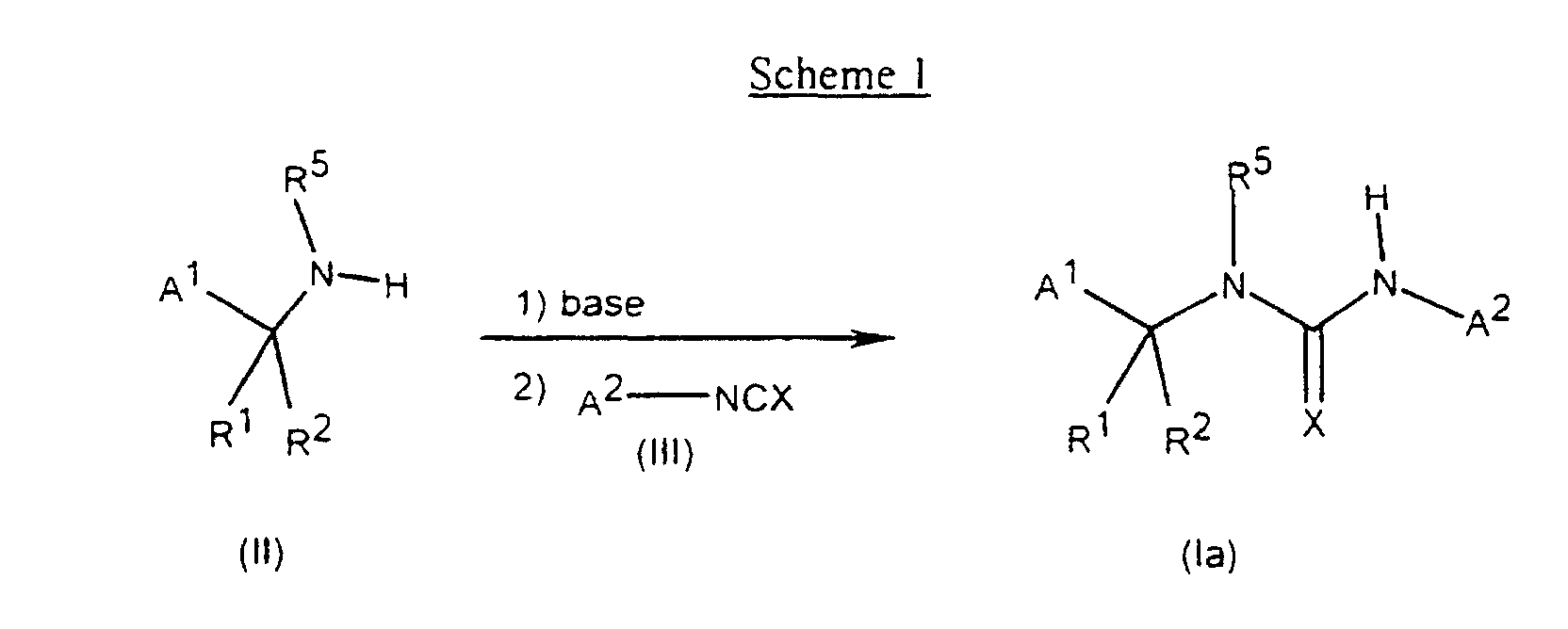
- Compounds of formula Ib, i.e. compounds of general formula I where Y is of formula (D) and L is -N(R5)C(=O)CH(R3)-, may be prepared by reacting compounds of formula IV with compounds of formula II according to reaction scheme 2. A variety of methods are available to the chemist, for example, generation of the acid chloride of IV, using reagents such as phosphoryl chloride or oxalyl chloride, followed by addition of II. Alternatively, carbonyl diimidazole (CDI) can be used to activate compounds of formula IV prior to addition of II.
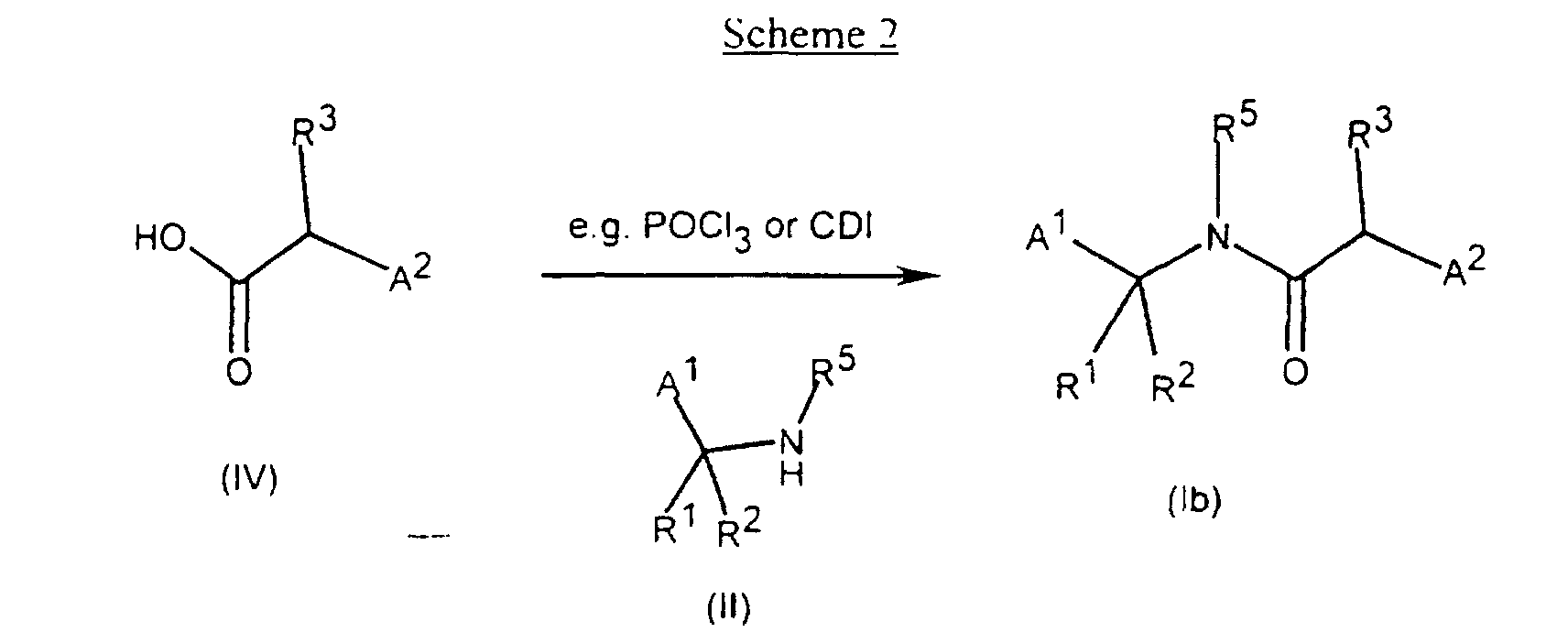
- Compounds of formula Ic and Id, i.e. compounds of general formula I where Y is of formula (D) and L is -CH(R3)-N(R5)-W- and W is -C(=X)- or -CH(R4)-, wherein R3 is alkoxycarbonyl or carbamoyl respectively, can be prepared by various methods known to the skilled chemist. In particular, compounds of formula Ic or ld may be prepared from solid supported reagents of formula V according to reaction scheme 3, wherein the black circle represents Merrifield resin.
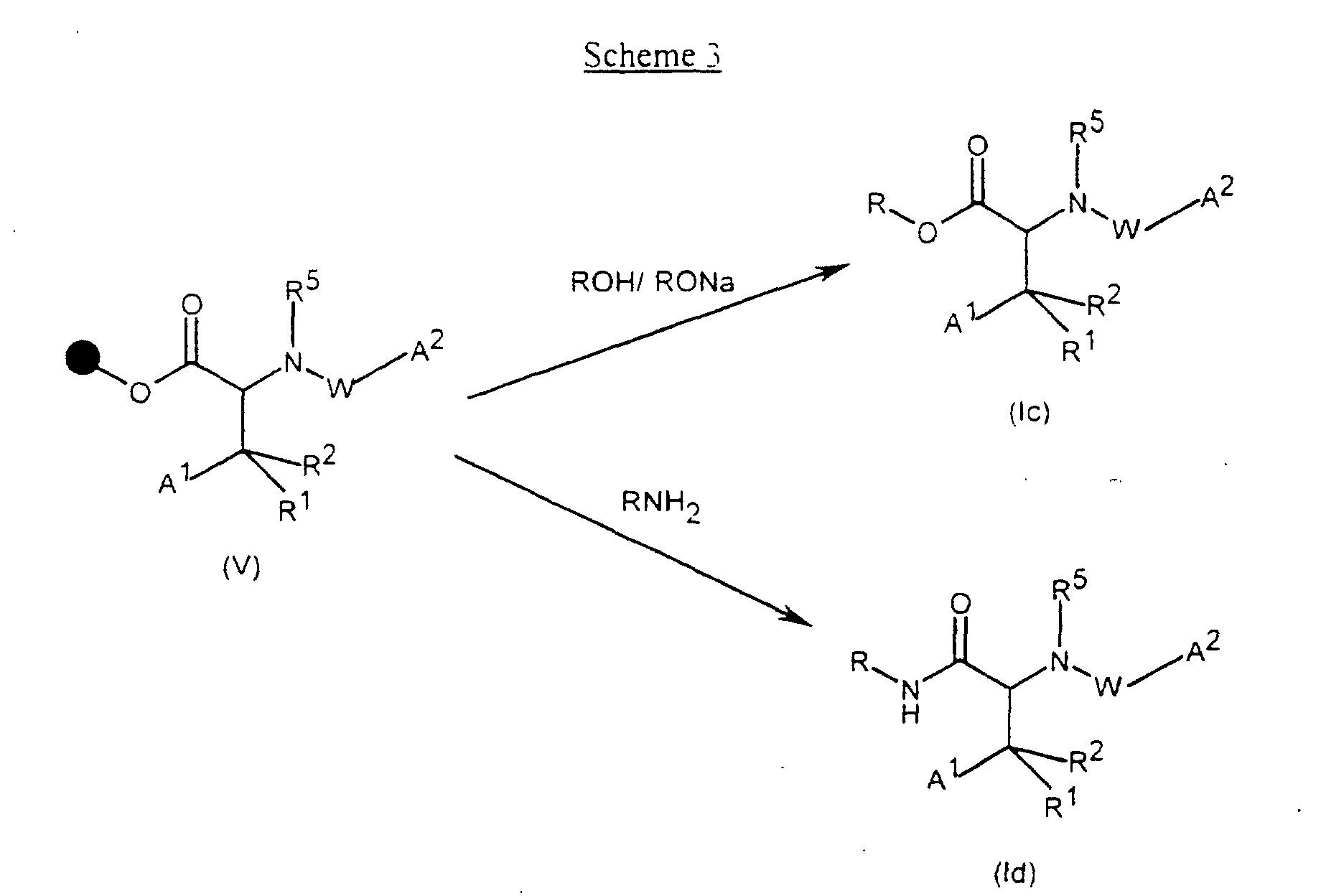
- Compounds of formula le, i.e. compounds of general formula I where Y is of formula (D) and L is -CH(R3)N(R5)C(=X)- may be prepared by reacting compounds of formula VI with compounds of formula VII according to reaction scheme 4.

- Compounds of formula If, i.e. compounds of general formula I where Y is of formula (B) and L1 is -N(R9)C(=X)-L2-, where L2 is -CH(R7)CH(R8)-, -C(R8)(R7)-X1- or -C(R7)=C(R8)-, may be prepared according to Scheme 5 by reacting compounds of formula VIII or their hydrochloride salts with compounds of formula IX in the presence of a base, where Q1 is a leaving group such as halogen, preferably chlorine. A preferred base is triethylamine. Compounds of formula IX can either be isolated or generated in situ.

- Compounds of formula Ig, i.e. compounds of general formula I where Y is of formula (E) and L1 is -N(R9)C(=X)-NH-CH(R7)-, may be prepared according to Scheme 6 by reacting compounds of formula VIII or their hydrochloride salts with compounds of formula X. A preferred base is triethylamine.
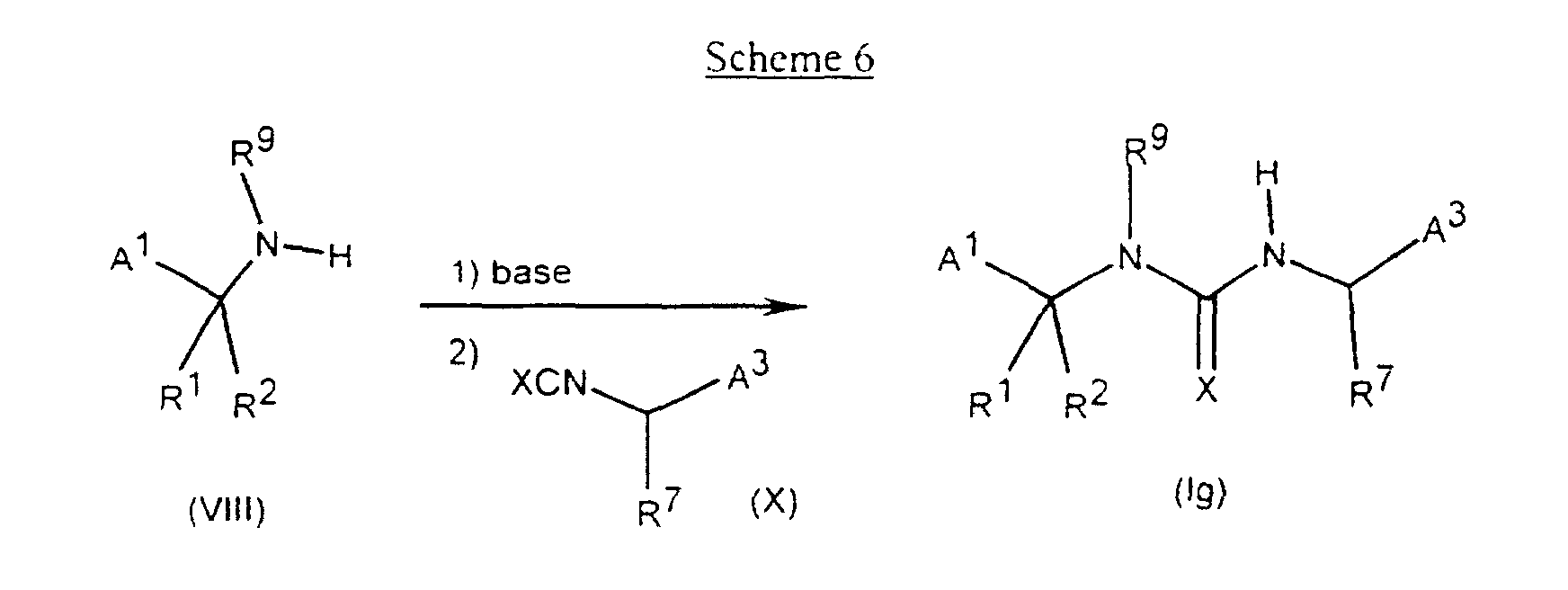
- Compounds of formula Ih, i.e. compounds of general formula I where Y is of formula (E) and L1 is -N(R9)C(=X)-C(R7)(R8)-X1- wherein R7 and R8 are not both hydrogen and X is oxygen, may also be prepared according to Scheme 7 by reacting compounds of formula Xl where Q1 is a leaving group, preferably bromine, with A2-X1-H in the presence of a suitable base, preferably potassium tert-butoxide.

- Compounds of formula Ii, i.e. compounds of general formula I where Y is of formula (E) and L1 is -N(R9)C(R7)=C(R8)-C(=X)- wherein R7 is not hydrogen, may be prepared according to Scheme 8 by reacting compounds of formula VIII or their hydrochloride salts in the presence of a suitable base such as sodium acetate with compounds of formula XII.
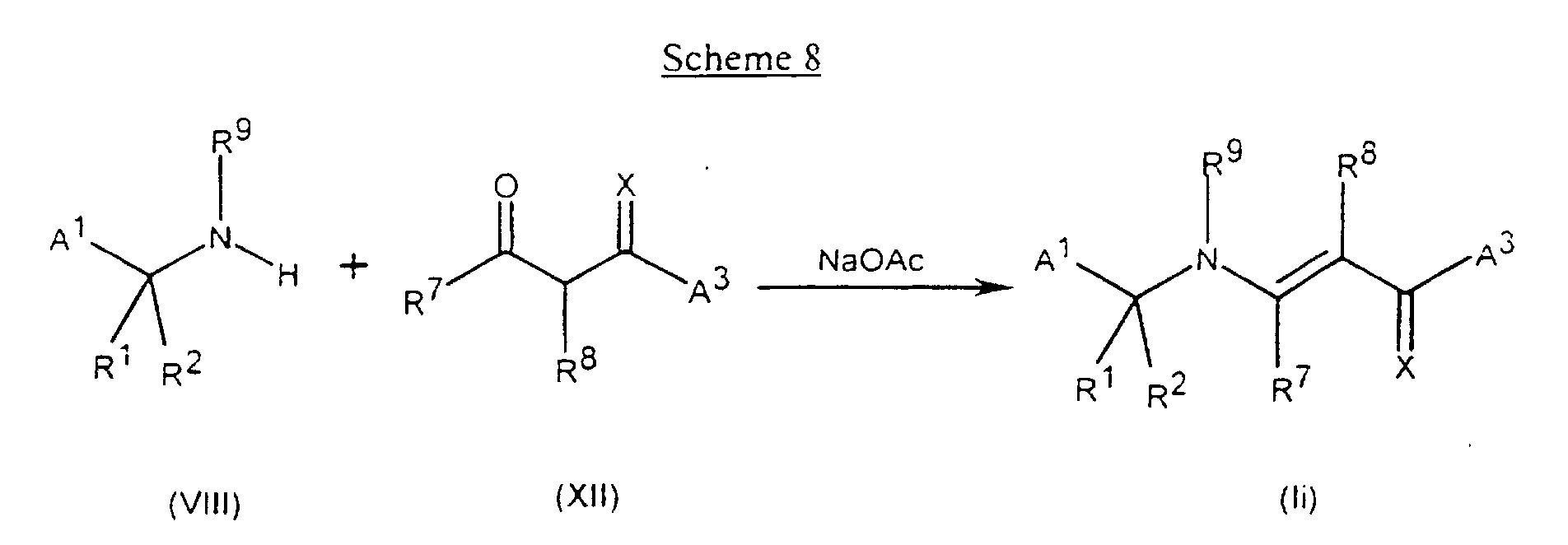
- Compounds of formula Ij, i.e. compounds of general formula I where Y is of formula (E) and L1 is -N(R9)CH=C(R8)-C(=X)-, may be prepared according to Scheme 9 by reacting compounds of formula VIII or their hydrochloride salts in the presence of a suitable base such as sodium acetate with compounds of formula XIII.

- Compounds of formula Ik, i.e. compounds of general formula I where Y is of formula (E) and L1 is -N(R9)C(=X)O-C(H)(R7)-, may be prepared according to Scheme 10 by reacting compounds of formula VIII or their hydrochloride sales in the presence of a suitable base such as triethylamine with compounds of formula XIV.

- Collections of compounds of formula (I) may also be prepared in a parallel manner, either manually, automatically or semi-automatically. This parallel preparation may be applied to the reaction procedure, work-up or purification of products or intermediates. For a review of such procedures see by S.H. DeWitt in "Annual Reports in Combinatorial Chemistry and Molecular Diversity: Automated synthesis", Volume 1, Verlag Escom 1997, pages 69 to 77.
- Furthermore, compounds of the formula (I) may be prepared using solid-supported methods, where the reactants are bound to a synthetic resin. See for example: Barry A. Bunin in "The Combinatorial Index", Academic Press, 1998 and "The tea-bag method" (Houghten, US 4,631,211: Houghten et al., Proc. Natl. Acad. Sci, 1985, 82, 5131-5135).
- The preparation of the processes described herein yields compounds of the formula (I) in the form of substance collections which are termed libraries. The present invention also relates to libraries which comprise at least two compounds of the formula (I).
- Intermediates of formula V may be prepared in turn from compounds of formula XV, by methods analogous to that depicted in reaction scheme 11. Compounds of formula Va may be prepared by treating XV with a compound of formula XVI in the presence of a suitable base, such as triethylamine. Compounds of formula Vb may be prepared from compounds of formula XVa by treatment with compounds of formula XVII, sodium cyanoborohydride and acetic acid followed by reaction with compounds of formula XVIII and triethylamine.
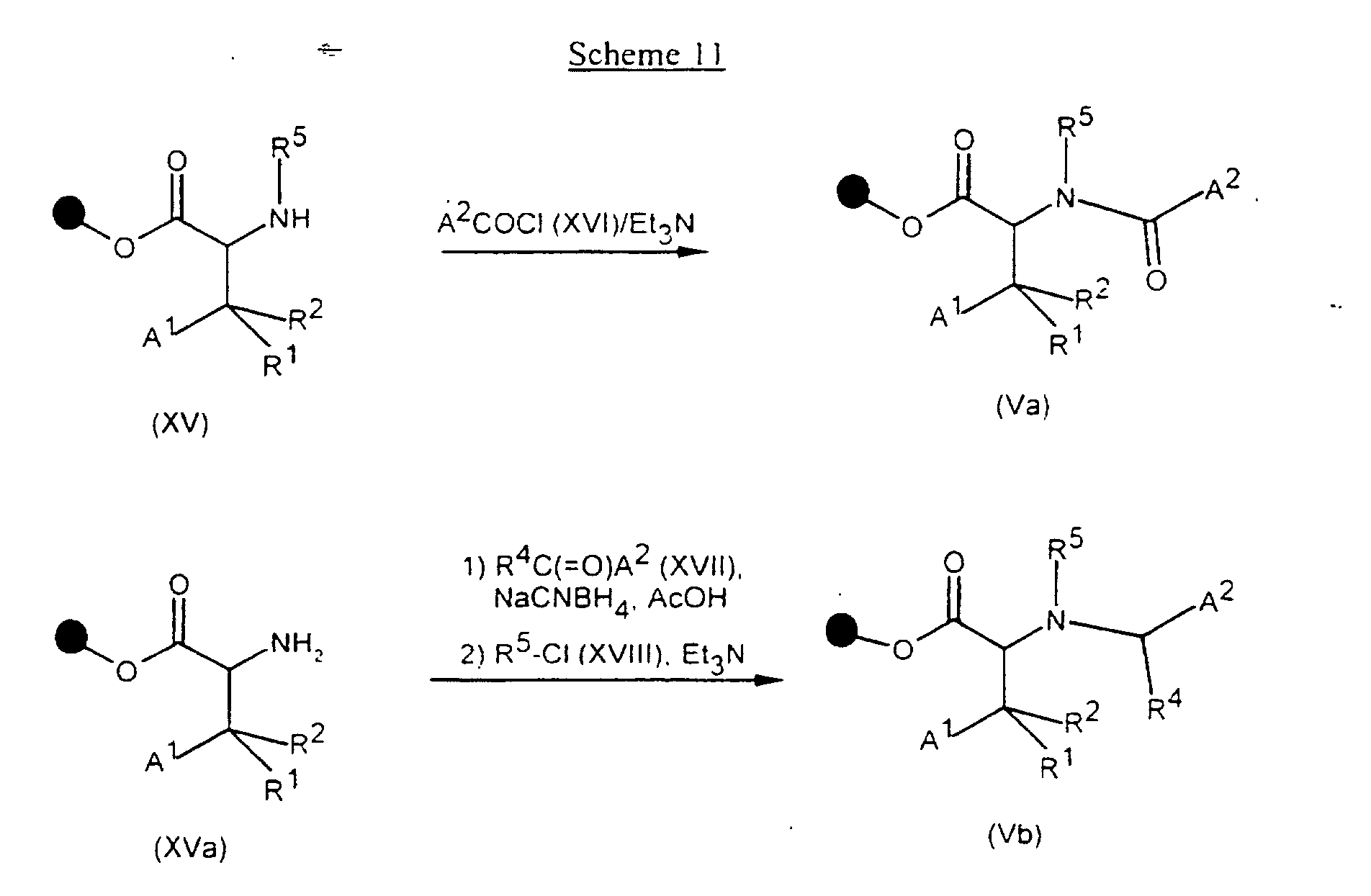
- Compounds of formula XV can be prepared using similar methods to reaction scheme 12.

- Intermediates of formula VIII may be prepared by methods described in international application WO99/42447.
- Intermediates of formula IX can prepared from the corresponding carboxylic acid by methods known to the skilled chemist.
- Intermediates of formula XI may be prepared according to Scheme 13 by reacting compounds of formula VIII in the presence of a suitable base such as triethylamine with compounds of formula XIX, in the presence of a carbonyl diimidazole (CDI).
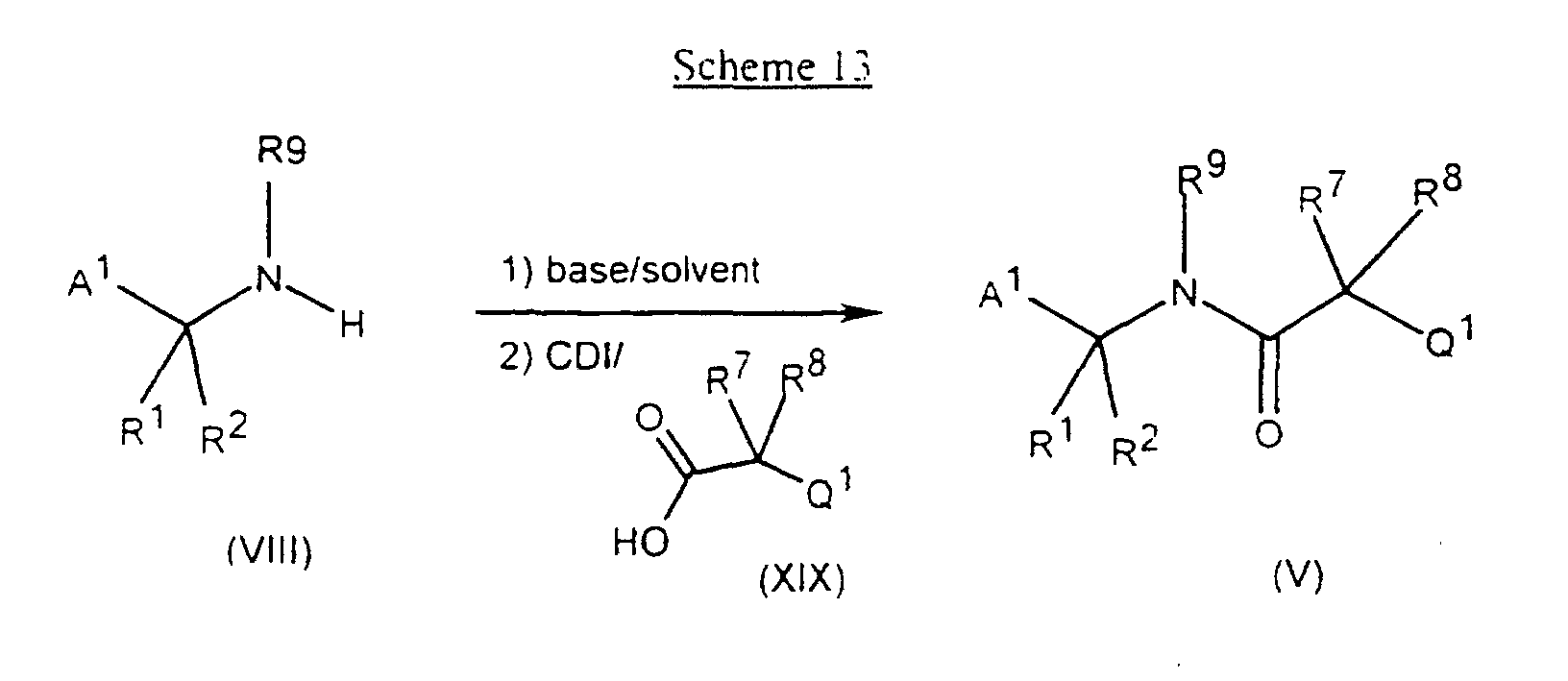
- Other methods will be apparent to the chemist skilled in the art, as will be the methods for preparing starting materials and intermediates.
- The invention is illustrated in the following Examples. Structures of isolated, novel compounds were confirmed by 1H NMR (in CDCl3) and/or other appropriate analyses.
- To a suspension of (3-chloro-5-trifluoromethyl-2-pyridyl)methylamine hydrochloride (0.12 g) and 2-chlorophenylisothiocyanate (0.09 g) in dry tetrahydrofuran (10 ml) was added 10 drops of triethylamine. The mixture was stirred at room temperature overnight. The solvent was removed by evaporation in vacuo and the residue extracted with ethyl acetate and washed with 2M hydrochloric acid. The layers were separated and the organic phase was evaporated to dryness to give the title product. m.p. 126°C.
- The following compounds of formula Im (see Table A), i.e. compounds of general formula I where Y is of formula (D) and A1 is 3-Cl-5-CF3-2-pyridyl, R1 and R2 are hydrogen and L is -NHC(=X)NH-, may be prepared by methods analogous to those of Example 1.

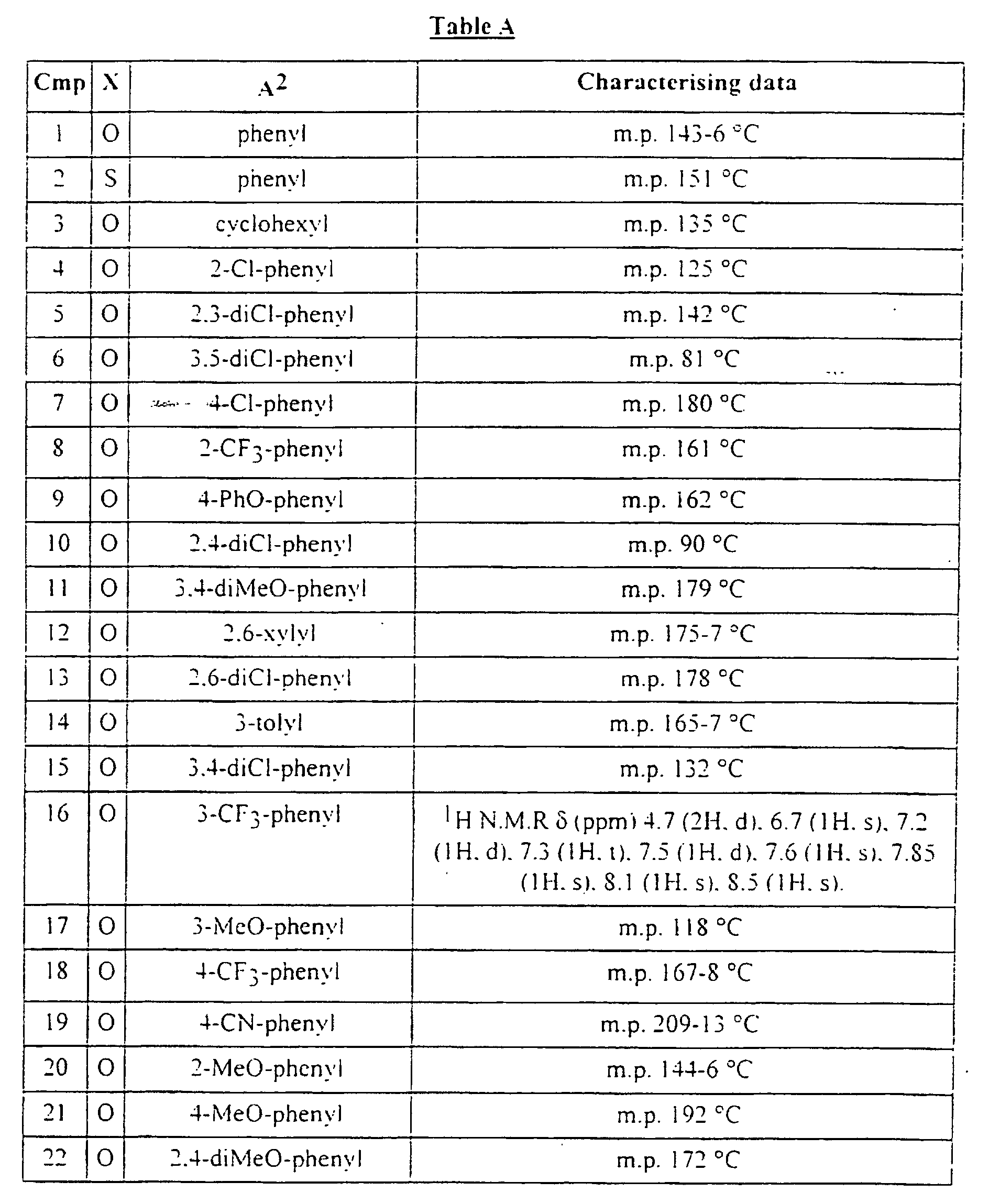


- To a stirred suspension of 2-nitrophenylacetic acid (0.36 g) in dry toluene (5 ml) at room temperature was added phosphoryl chloride (0.37 g) and stirring was continued overnight. Meanwhile a solution of the amine was prepared, (3-Chloro-5-trifluoromethyl-2-pyridyl)methylamine hydrochloride (0.49 g) in dry toluene (5 ml) and triethylamine (1.23 g) was stirred at room temperature for 1 hour and then filtered. The solid was washed with dry toluene and the combined filtrates were added dropwise to the above suspension of acid chloride with ice-cooling. After addition, the mixture was stirred at room temperature overnight. Dichloromethane was added and the mixture was washed with water. The aqueous layer was separated and back-extracted with dichloromethane. The combined organic extracts were washed with saturated sodium bicarbonate solution, then brine, then dried (MgSO4), and the solvent removed. The resulting residue was purified by silica gel chromatography eluting with ethyl acetate/light petroleum (b.p. 40-60°C) to give the title product, m.p. 123-4°C.
- The following compounds of formula In (see Table B), i.e. compounds of general formula I where Y is of formula (D) and A1 is 3-Cl-5-CF3-2-pyridyl, R1 and R2 are hydrogen and L is -NHC(=O)CH(R3)-, may be prepared by methods analogous to those of Example 2.
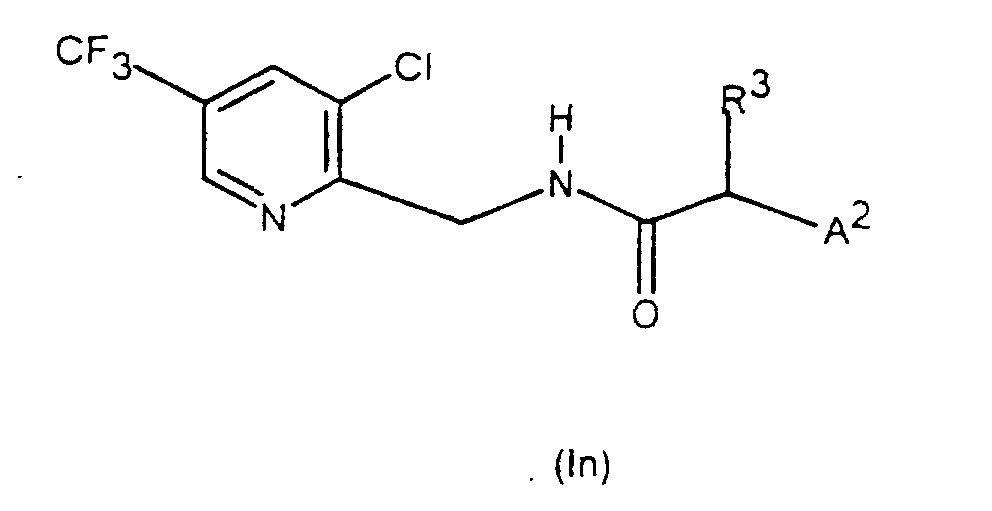
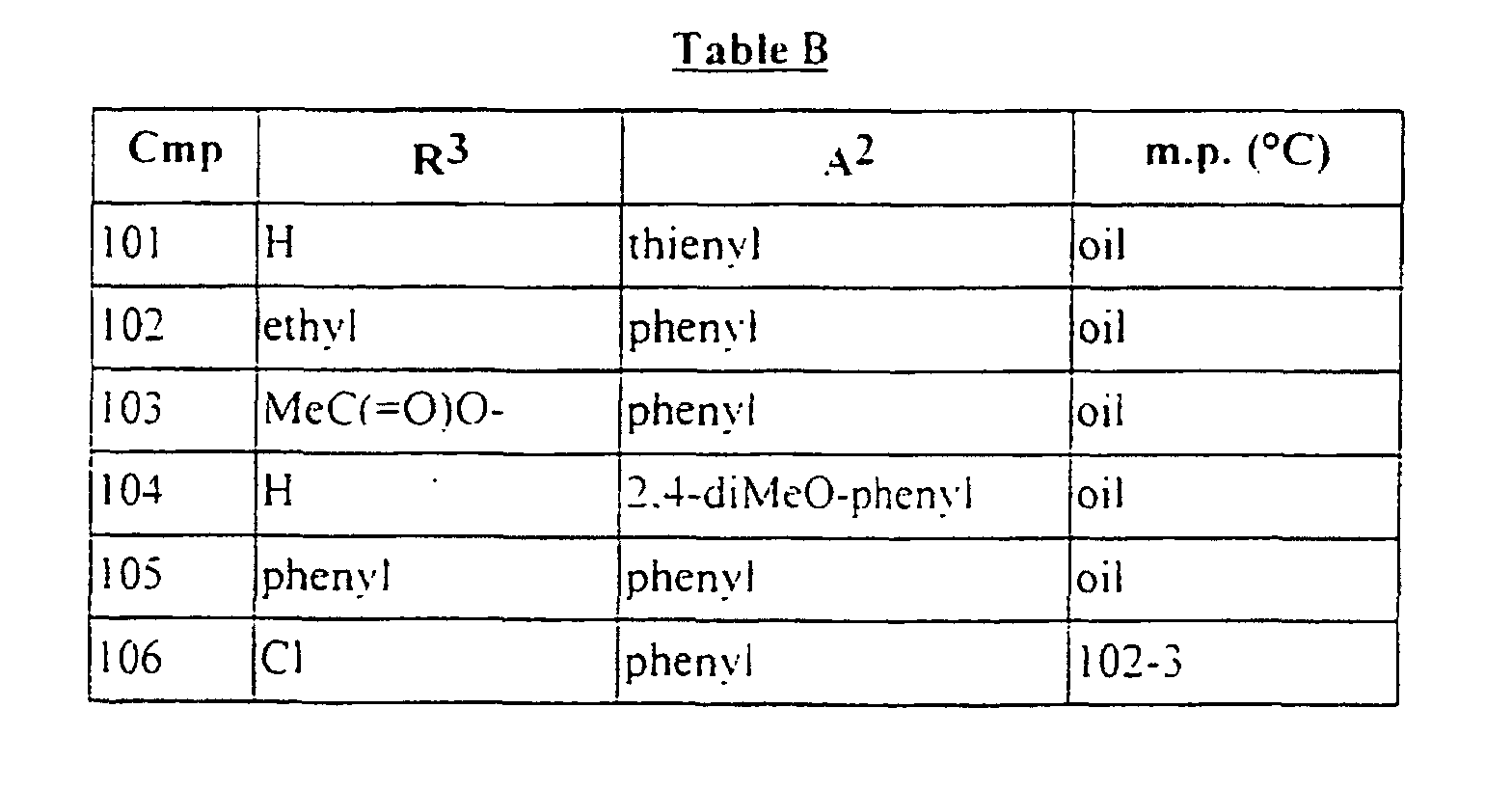

- The 1H N.M.R. data of those compounds in Table B which were not solid at room temperature are presented below.
- 1H N.M.R. (CDCl3) δ(ppm) 3.9 (2H, s), 4.7 (2H, d), 7.0 (2H, d), 7.1 (1H, br.s), 7.3 (2H, m), 7.9 (1H, stand 8.7 (1H, s);
- 1H N.M.R. (CDCl3) δ(ppm) 0.9 (3H, t), 1.9 (1H, m), 2.25 (1H, m), 3.4 (1H, t), 4.7 (2H, qd), 6.9 (1H, bs), 7.2-7.4 (5H, m), 7.9 (1H, s), 8.65 (1H, s);
- 1H N.M.R. (CDCl3) δ(ppm) 2.25 (3H, s), 4.75 (2H, d), 6.2 (1H, s), 7.4 (3H, m), 7.5 (2H, m), 7.7 (1H, bs), 8.0 (1H, s), 8.75 (1H, s);
- 1H N.M.R. (CDCl3) δ(ppm) 3.65 (2H, s), 3.8 (3H, s), 3.9 (3H, s), 4.7 (2H, d), 6.8-7.0 (3H, m), 7.1 (1H, bs), 7.9 (1H, s), 8.75 (1H, s); and
- 1H N.M.R. (CDCl3) δ(ppm) 4.8 (2H, d), 5.1 (1H, s), 7.1-7.4 (1H, m), 7.9 (1H, s) and 8.65 (1H, s).
- To a mixture of the product from stage h) below in tetrahydrofuran (12 ml) and methanol (4 ml) was added 1M sodium methoxide in methanol (4 drops) and the mixture was heated at 65°C for 3 days. The mixture was filtered and the solid washed successively with portions (5 ml) of methanol, dichloromethane and methanol. The combined filtrates were evaporated to give the title product. 1H N.M.R δ (ppm) 8.63 (1H, s), 7.89 (1H, s), 7.15-7.35 (4H, m), 3.92 (3H, m), 3.74 (3H, s), 3.42 (2H, d).
- To a mixture of N-(tert-butoxycarbonyl)glycine (42.0 g) in water (250 ml) was added cesium carbonate (39.1 g). The mixture was stirred at room temperature for 10 minutes. The water was removed by azeotropic distillation with toluene to give the title product.
- Merrifield resin (61.2 g) was swollen in dry dimethylformamide (350 ml). The product from stage a) (75.5, g) was added followed by more dry dimethylformamide (250 ml) and the mixture was stirred at 65°C overnight. On cooling, the mixture was filtered and the solid washed successively with portions (400 ml) of dimethylformamide, dimethylformamide/water (1:1), water, dichloromethane, methanol, dichloromethane and finally methanol (x2). The solid was dried in a vacuum oven overnight.
- To a mixture of the product from stage b) (76.2 g) swollen in dry dichloromethane (660 ml) was added trifluoroacetic acid (220 ml) and the mixture was stirred at room temperature for 5.5 hours. The mixture was filtered and the solid was washed successively with portions (400 ml) of dichloromethane (x2), methanol, dichloromethane and methanol (x2). The resin was dried overnight.
- To a mixture of the product from stage c) (76.6 g) swollen in dry dichloromethane (650 ml) was added benzophenone imine (61 ml) in dichloromethane (100 ml) and the mixture stirred overnight. The mixture was filtered and the solid was successively washed with portions (400 ml) of dichloromethane, 20% aqueous tetrahydrofuran (x2), tetrahydrofuran, dichloromethane, methanol, dichloromethane and methanol (x2). The solid was dried in a vacuum oven overnight.
- To a mixture of the product from stage d) (40.4 g) swollen in N-methylpyrrolidinone (250 ml) was added phosphazine base P(1)-tert-Bu-tris(tetramethylene) (38 ml). 3-Chloro-2-chloromethyl-5-trifluoromethylpyridine (42.4 g) was then added and the mixture was stirred at room temperature overnight. The mixture was filtered and the solid was washed successively with portions (200 ml) of N-methylpyrrolidinone (x2), dichloromethane (x2) methanol, dichloromethane and methanol (x2). The solid was dried in a vacuum oven overnight.
- To a mixture of the product from stage e) (52.1 g) swollen in tetrahydrofuran (750 ml) was added 2M hydrochloric acid (250 ml). The mixture was stirred for 4 hours and then filtered. The solid was washed successively with portions (250 ml) of tetrahydrofuran (x2), dichloromethane (x2), methanol, dichloromethane, methanol and diethyl ether. The solid was dried in a vacuum oven overnight.
- A mixture of the product from stage f) in 10% triethylamine in dichloromethane was stirred at room temperature for 2 hours. The mixture was filtered and the solid was stirred in 5% triethylamine in dichloromethane for 1 hour. The mixture was filtered again, and the solid was stirred in dichloromethane for 1 hour. The mixture was filtered and the solid washed successively with portions of methanol, dichloromethane, methanol and diethyl ether (x2). The solid was dried in a vacuum oven overnight.
- A mixture of the product from stage g) (4.2 mmol) in trimethylorthoformate (90 ml) was treated with 2-chlorobenzaldehyde (42 mmol) and stirred at room temperature for 6 hours. Sodium cyanoborohydride (42 mmol) followed by acetic acid (1.3 ml) was then added and the mixture stirred at room temperature for 16 hours. The mixture was filtered and the solid was washed successiveiy with portions of aqueous tetrahydrofuran, tetrahydrofuran, methanol, dichloromethane, methanol, dichloromethane, methanol and diethyl ether (x2). The solid was dried in a vacuum oven overnight.
- The following compounds of formula Ip (see Table C), i.e. compounds of general formula I where Y is of formula (D) and A1 is 3-Cl-5-CF3-2-pyridyl, R1 and R2 are hydrogen and L is -CH(R3)N(R5)CH2-, may be prepared by methods analogous to those of Example 3.

Cmp R3 R5 A2 Characterising data 201 EtNHC(=O)- H phenyl 1H N.M.R δ (ppm) 8.61 (1H, s), 7 8 (1H, s), 7.43 (1H, m), 7.1-7.3 (5H, m), 3.1-3.3 (7H, m), 1.16 (3H, t) 202 EtNHC(=O)- MeC(=O)- phenyl 1H N.M.R δ (ppm) 8.64 (1H, s), 7.73 (1H, s), 7.27 (3H, m), 7.10 (2H, m), 6.53 (1H, m), 5.82 (1H, t), 4.70 (2H, m), 3.43 (2H, m), 3.20 (2H, m), 2.14 (3H, s) and 1.03 (3H, t). 203 EtNHC(=O)- H 3-tolyl 1H N.M.R δ (ppm) 8.63 (1H, s), 7.86 (1H, s), 7.54 (1H, m), 7.13 (1H, m), 7.06 (1H, m), 6.98 (2H, m), 3.1-3.8 (7H, m), 2.34 (3H, s), 1.17 (3H, t) 204 MeOC(=O)- H 3-tolyl m/z (ES) 387 (M+H)+ 205 EtOC(=O)- H 3-tolyl 1H N.M.R δ (ppm) 8.67 (1H, s), 7.88 (1H, s), 7.18 (1H, m), 7.02 (2H, m), 4.10 (2H, q), 3.78 (3H, m), 3.37 (2H, m), 2.32 (3H, s), 1.24 (3H, t) 206 EtNHC(=O)- H 4-MeO-phenyl m/z (ES) 416 (M+H)+ 207 EtNHC(=O)- H 2-Cl-phenyl m/z (ES) 420 (M+H)+ 208 EtNHC(=O)- H 2.6-diF-phenyl m/z (ES) 422 (M+H)+ 209 EtNHC(=O)- H 2-NO2-phenyl m/z (ES) 431 (M+H)+ 210 EtNHC(=O)- H 2-naphthyl m/z (ES) 436 (M+H)+ 211 EtNHC(=O)- H 3,4-diMeO-phenyl m/z (ES) 446 (M+H)+ 212 EtNHC(=O)- H 2-CF3-phenyl m/z (ES) 454 (M+H)+ 213 EtNHC(=O)- H 2,4-diCl-phenyl m/z (ES) 454 (M+H)+ 214 EtNHC(=O)- H 3-PhO-phenyl m/z (ES) 478 (M+H)+ 215 MeNHC(=O)- H 2-Cl-phenyl m/z (ES) 406 (M+H)+ 216 MeNHC(=O)- H 3-NO2-phenyl m/z (ES) 417 (M+H)+ 217 MeOC(=O)- H 4-MeO-phenyl m/z (ES) 403 (M+H)+ 218 MeOC(=O)- H 2-Cl-phenyl 1H N.M.R δ (ppm) 8.63 (1H, s), 7.89 (1H, s), 7.15-7.35 (4H, m), 3.92 (3H, m), 3.74 (3H, s), 3.42 (2H, d) 219 MeOC(=O)- H 2.6-diF-phenyl 1H N.M.R δ (ppm) 8.62 (1H, s), 7.83 (1H, s), 7.20 (1H, m), 6.34 (2H, m), 3.73 (3H, m), 3.68 (3H, s), 3.28 (2H, d) 220 MeOC(=O)- H 2-NO2-phenyl m/z (ES) 418 (M+H)+ 221 MeOC(=O)- H 2-naphthyl m/z (ES) 423 (M+H)+ 222 MeOC(=O)- H 3.4-diMeO-phenyl m/z (ES) 433 (M+H)+ 223 MeOC(=O)- H 2-CF3-phenyl m/z (ES) 441 (M+H)+ 224 MeOC(=O)- H 2.6-diCl-phenyl 1H N.M.R δ (ppm) 8.62 (1H, s), 7.89 (1H, s), 7.1-7.35 (3H, m), 3.83 (3H, m), 3.72 (3H, s), 3.39 (2H, m) 225 MeOC(=O)- H 3-PhO-phenyl 1H N.M.R δ (ppm) 8.62 (1H, s), 7.83 (1H, s), 6.3-7.2 (9H, m), 3.79 (3H, m), 3.71 (3H, s), 3.38 (2H, m) 226 EtOC(=O)- H phenyl 1H N.M.R δ (ppm) 8.62 (1H, s), 7.88 (1H, s), 7.1-7.3 (5H, m), 4.18 (2H, q), 3.79 (3H, m), 3.38 (2H, m), 1.21 (3H, t) 227 EtOC(=O)- H 4-MeO-phenyl 1H N.M.R δ (ppm) 8.63 (1H, s), 7.88 (1H, s), 7.12 (2H, d), 6.79 (2H, d), 4.10 (2H, q), 3.81 (3H, s), 3.73 (3H, m), 3.38 (2H, m), 1.23 (3H, t) 228 EtOC(=O)- H 2-Cl-phenyl 1H N.M.R δ (ppm) 8.62 (1H, s), 7.86 (1H, s), 7.1-7.4 (4H, m), 4.19 (2H, q), 3.89 (3H, m), 3.40 (2H, m), 1.23 (3H, t) 229 EtOC(=O)- H 2,6-diF-phenyl 1H N.M.R δ (ppm) 8.61 (1H, s), 7.82 (1H, s), 7.21 (1H, m), 6.82 (2H, t), 4.16 (2H, q), 3.91 (3H, m), 3.38 (2H, d), 1.22 (3H, t) 230 EtOC(=O)- H 2-NO2-phenyl 1H N.M.R δ (ppm) 8.62 (1H, s), 7.87 (2H, m), 7.35-7.55 (3H, m) 4.20 (2H, m), 4.08 (2H, m), 3.36 (m), 3.37 (2H, m), 1.14 (3H, t) 231 EtOC(=O)- H 2-naphthyl 1H N.M.R δ (ppm) 8.61 (1H, s), 7.25-7.9 (8H, m), 3.8-4.3 (5H, m), 3.41 (2H, m), 1.24 (3H, t) 232 EtOC(=O)- H 3,4-diMeO-phenyl 1H N.M.R δ (ppm) 8.64 (1H, s), 7.89 (1H, s), 6.78 (3H, m), 4.19 (2H, q), 3.86 (3H, s), 3.81 (3H, s), 3.75 (2H, m), 3.39 (2H, m), 1.24 (3H, t) 233 EtOC(=O)- H 2-CF3-phenyl 1H N.M.R δ (ppm) 8.66 (1H, s), 7.91 (1H, s), 7.3-7.65 (4H, m), 4.21 (2H, m), 3.98 (3H, m), 3.41 (3H, m), 1.26 (3H, t) 234 EtOC(=O)- H 2.4-diCl-phenyl 1H N.M.R δ (ppm) 8.64 (1H, s), 7.89 (1H, s), 7.1-7.35 (3H, m), 4.20 (2H, m), 3.86 (3H, m), 3.40 (2H, m), 1.24 (3H, t) 235 EtOC(=O)- H 3-PhO-phenyl 1H N.M.R δ (ppm) 8.62 (1H, s), 7.83 (1H, s), 6.8-7.4 (9H, m), 4.18 (2H, q), 3.77 (3H, m), 3.38 (2H, m), 1.22 (3H, t) 236 MeNHC(=O)- H 2-naphthyl m/z (ES) 422 (M+H)+ 237 MeNHC(=O)- H 2,4-diCl-phenyl m/z (ES) 440 (M+H)+ 238 MeNHC(=O)- H 3-PhO-phenyl m/z (ES) 464 (M+H)+ 239 MeOC(=O)- H phenyl m/z (ES) 373 (M+H)+ - To a mixture of the product from Example 3 stage g) in dry dichloromethane was added triethylamine and the solution was stirred for 15 minutes, 2-Bromobenzoyl chloride in dry dichloromethane was added, and the mixture was stirred at room temperature overnight. The mixture was filtered and the solid was washed successively with portions (125 ml) of dichloromethane (x2), methanol, dichloromethane, methanol, dichloromethane (x2), methanol and diethyl ether (x2).
- The solid was dried in a vacuum oven overnight. To this solid in tetrahydrofuran (12 ml) and methanol (4 ml) was added 1M sodium methoxide in methanol (4 drops) and the mixture was heated at 65°C for 3 days. The mixture was filtered and the solid washed successively with portions (5 ml) of methanol, dichloromethane and methanol. The combined filtrates were evaporated to give the title product. 1H N.M.R δ (ppm) 8.62 (s), 7.31 (s), 7.56 (2H, m), 7.37 (m), 7.29 (m), 5.40 (m), 3.76 (3H, s) and 3.71 (2H, m).
- The following compounds of formula Iq (see Table D); i.e. compounds of general formula I where Y is of formula (D) and A1 is 3-Cl-5-CF3-2-pyridyl, R1 and R2 are hydrogen and L is -CH(R3)NHC(=O)-, may be prepared by methods analogous to those of Example 4.
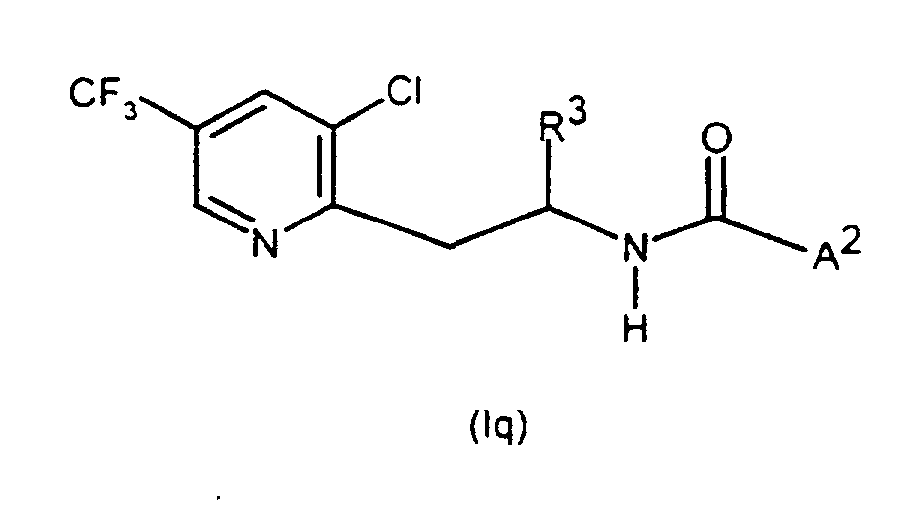
Cmp R3 A2 Characterising data 301 EtNHC(=O)- 4-MeO-phenyl 1H N.M.R δ (ppm) 8.66 (1H, s), 7.91 (1H, s), 7.89 (1H, d), 7.77 (2H, d), 6.94 (2H, d), 6.32 (1H, d), 6.32 (1H, d), 5.21 (1H, m), 3.97 (3H, s), 3.55 (2H, m), 3.25 (2H, m), 1.08 (3H, t) 302 EtNHC(=O)- 2,6-diCl-phenyl 1H N.M.R δ (ppm) 8.60 (1H, s), 7.91 (1H, s), 7.2-7.4 (3H, m), 6.74 (1H, m), 5.33 (1H, m), 3.62 (2H, m), 3.29 (2H, m), 1.12 (3H, t) 303 EtNHC(=O)- cyclopropyl m/z (ES) 364 (M+H)+ 304 EtNHC(=O)- phenyl m/z (ES) 400 (M+H)+ 305 EtNHC(=O)- cyclohexyl m/z (ES) 406 (M+H)+ 306 EtNHC(=O)- 4-Cl-phenyl m/z (ES) 435 (M+H)+ 307 EtNHC(=O)- 3-NO2-phenyl m/z (ES) 445 (M+H)+ 308 EtNHC(=O)- 3-CF3-phenyl m/z (ES) 468 (M+H)+ 309 EtNHC(=O)- 4-PhO-phenyl m/z (ES) 476 (M+H)+ 310 EtNHC(=O)- 2-Br-phenyl m/z (ES) 478 (M+H)+ 311 MeNHC(=O)- cyclopropyl 1H N.M.R δ (ppm) 8.67 (1H. s), 7.92 (1H, s), 6.70 (1H, br), 5.09 (1H, m), 3.46 (2H, m), 2.80 (3H, m), 1.42 (1H, m), 0.97 (2H, m), 0.81 (2H, m) 312 MeNHC(=O)- cyclohexyl 1H N.M.R δ (ppm) 8.64 (1H, s), 7.91 (1H, s), 7.08 (1H, d), 6.68 (1H, m), 5.04 (1H, q), 3.43 (2H, m), 2.73 (3H, m), 1.2-2.3 (11H, m) 313 MeNHC(=O)- 2,6-diCl-phenyl 1H N.M.R δ (ppm) 8.62 (1H, s), 7.85 (1H, s), 7.46 (1H, d), 7.34 (3H, m), 4.82 (1H, m), 5.36 (1H, m), 3.62 (2H, m), 2.84 (3H, d) 314 MeNHC(=O)- phenyl m/z (ES) 386 (M+H)+ 315 MeNHC(=O)- 4-MeO-phenyl m/z (ES) 416 (M+H)+ 316 MeNHC(=O)- 4-biphenylyl m/z (ES) 462 (M+H)+ 317 MeOC(=O)- phenyl 1H N.M.R δ (ppm) 8.95 (1H, s), 7.93 (2H, m), 7.26 (3H, m), 5.38 (1H, m), 3.76 (3H, s), 3.70 (2H, m) 318 MeOC(=O)- cyclohexyl 1H N.M.R δ (ppm) 8.66 (1H, s), 7.91 (1H, s), 6.63 (1H, d), 5.18 (1H, m), 3.71 (3H, s), 3.57 (2H, m), 1.2-2.15 (11H, m) 319 MeOC(=O)- 2,6-diCl-phenyl 1H N.M.R δ (ppm) 8.60 (1H, s), 7.95 (1H, s), 7.28 (3H, m), 1.03 (1H, d), 5.42 (2H, m), 3.74 (5H, m) 320 MeOC(=O)- 4-biphenylyl 1H N.M.R δ (ppm) 8.72 (1H, s), 7.92 (1H, s), 7.35-7.9 (9H, m), 5.39 (1H, m), 3.78 (3H, s), 3.70 (2H, m) 321 MeOC(=O)- 2-Br-phenyl 1H N.M.R δ (ppm) 8.62 (1H, s), 7.31 (1H, s), 7.56 (2H, m), 7.37 (1H, m), 7.29 (1H, m), 5.40 (1H, m), 3.76 (3H, s), 3.71 (2H, m) 322 EtOC(=O)- cyclohexyl 1H N.M.R δ (ppm) 8.64 (1H, s), 7.92 (1H, s), 6.64 (1H, d), 5.16 (1H, m), 4.18 (2H, m), 3.59 (2H, m), 0.3-2.2 (11H, m), 1.22 (3H, t) 323 EtOC(=O)- 4-MeO-phenyl 1H N.M.R δ (ppm) 8.69 (1H, s), 7.91 (1H, s), 7.77 (2H, d), 7.38 (1H, d), 8.92 (2H, d), 5.32 (1H, m), 4.20 (2H, m), 3.34 (3H, t), 3.67 (2H, m) 324 EtOC(=O)- 3-CF3-phenyl 1H N.M.R δ (ppm) 8.68 (1H, s), 8.06 (1H, s), 7.96 (2H, m), 7.30 (2H, m), 7.60 (2H, m), 5.36 (1H, m), 4.21 (2H, m) 3.71 (2H, m). 1.23 (3H, t), 325 EtOC(=O)- 2.6-diCl-phenyl 1H N.M.R δ (ppm) 8.62 (1H, s), 7.94 (1H, s), 7.26 (3H, m), 7.04 (1H, d), 5.41 (1H, m), 4.21 (2H, m), 3.73 (2H, m), 1.22 (3H, t) 326 EtOC(=O)- 2-Br-phenyl 1H N.M.R δ (ppm) 8.64 (1H, s), 7.93 (1H, s), 7.57 (1H, m), 7.33 (1H, m), 7.26 (1H, m), 5.39 (1H, m), 4.22 (2H, m), 3.75 (2H, m), 1.23 (3H, t) 327 MeOC(=O)- cyclopropyl m/z (ES) 351 (M+H)+ 328 MeOC(=O)- 4-MeO-phenyl m/z (ES) 417 (M+H)+ 329 MeOC(=O)- 4-Cl-phenyl m/z (ES) 421 (M+H)+ 330 MeOC(=O)- 3-NO2-phenyl m/z (ES) 432 (M+H)+ 331 MeOC(=O)- 3-CF3-phenyl m/z (ES) 455 (M+H)+ 332 EtOC(=O)- cyclopropyl m/z (ES) 365 (M+H)+ 333 EtOC(=O)- phenyl m/z (ES) 401 (M+H)+ 334 EtOC(=O)- 4-Cl-phenyl m/z (ES) 435 (M+H)+ 335 EtOC(=O)- 3-NO2-phenyl m/z (ES) 446 (M+H)+ 336 EtOC(=O)- 4-biphenylyl m/z (ES) 477 (M+H)+ 337 MeNHC(=O)- 4-Cl-phenyl m/z (ES) 420 (M+H)+ 338 MeNHC(=O)- 3-NO2-phenyl m/z (ES) 431 (M+H)+ 339 MeNHC(=O)- 3-CF3-phenyl m/z (ES) 454 (M+H)+ 340 MeNHC(=O)- 2-Br-phenyl m/z (ES) 464 (M+H)+ - To a suspension of 2-(3-chloro-5-trifluoromethyl-2-pyridyl)ethylammonium chloride (0.2 g) in dry dichloromethane at 10°C was added 2.6-dichlorobenzoyl chloride (0.13 ml) followed by dropwise addition of dry triethylamine (0.3 ml). The mixture was warmed with stirring to 22°C over 18 hours. The mixture was evaporated on to flash silica. Chromatography over silica eluting with 20-50% diethyl ether in light petroleum (b.p. 40-60°C) gave the title product. m.p. 103-5°C.
- To a solution of the product from Example 6 (1.0 g) in ethanol (10 ml) was added hydrazine hydrate (0.15 ml) and the mixture was heated under reflux for 3 hours. Concentrated hydrochloric acid (1 ml) was added and the mixture was heated at 80°C for 1 hour to give a filterable precipitate. The mixture was cooled to 10°C, filtered and then evaporated to dryness in vacuo. The residue was dissolved in water (10 ml) and then basified to greater than pH 10 using 2M aqueous sodium hydroxide solution. The aqueous solution was ether extracted (3x15 ml) and the combined extracts were brine washed (2x10 ml). The organic extract was dried (MgSO4), the filtrate acidified with 6M hydrogen chloride in diethyl ether (5 ml) and evaporated to dryness. The solid residue was triturated with ethyl ether, filtered and dried in vacuo to give the title compound. m.p. 188-92°C.
- To a solution of the product from Example 7 (5.63 g) in glacial acetic acid (50 ml) was added 48% hydrogen bromide solution (10 ml) and the mixture was heated at 120°C for 2 hours. The cold mixture was evaporated in vacuo and partitioned between water (100 ml) and dichloromethane (100 ml). The aqueous layer was separated and extracted with dichloromethane (2x10 ml). The combined extracts were water washed (2x20 ml), dned (MgSO4), and evaporated onto flash silica. Chromatography over silica eluting with 3-30% diethyl ether in light petroleum (b.p 40-60°C) gave the title compound, m.p. 147-8°C.
- To a suspension of 60% sodium hydride (0.65 g) in dry dimethylformamide (20 ml) at 0°C was added a solution of diethyl 2-(3-chloro-5-trifluoromethyl-2-pyridyl)malonate (5 g) in dry dimethylformamide (10 ml) and the mixture was stirred for 15 minutes. A solution of N-bromomethylphthalimide (3.55 g) in dry dimethylformamide (10 ml) was added dropwise and the mixture was warmed with stirring to 22°C over 18 hours. Glacial acetic acid (1 ml) was added and the mixture was poured into cold water (500 ml). The aqueous solution was extracted with diethyl ether (3x150 ml) and the combined extract was water washed (3x100 ml). The organic extract was dried (MgSO4) and evaporated to give a crude product. Trituration with diethyl ether/light petroleum (b.p. 40-60°C) (1:1) gave the title compound. m.p. 159-61°C.
- To a suspension of 60% sodium hydride in mineral oil (5.28 g) in dry dimethylformamide (50 ml) at 0°C was added a solution of diethyl malonate (10 ml) in dry dimethylformamide (25 ml) and the mixture was stirred for 30 minutes. A solution of 2,3-dichloro-5-(trifluoromethyl)pyridine (9.8 ml) in dry dimethylformamide (10 ml) was added dropwise and the mixture warmed with stirring to 22°C over 18 hours. Acetic acid (7.5 ml) in diethyl ether (20 ml) was added dropwise and the mixture was stirred until hydrogen evolution had ceased. The mixture was diluted with diethyl ether (600 ml) and then water washed (3x200 ml).
- The organic extract was dried (MgSO4) and evaporated onto flash silica. Chromatography over silica eluting with 0-20% diethyl ether in light petroleum (b.p. 40-60°C) gave the title compound. 1H N.M.R. (CDCl3) δ(ppm) 1.28 (6H, t, 2x CH 3CH2), 4.30 (4H, q, 2xCH 2CH3), 5.24 (1H, s, CH(CO2Et)2), 7.96 (1H, s, py-H), 8.74 (1H, s, py-H).
- To a solution of O-{[3-chloro-5-(trifluoromethyl)-2-pyridyl]methyl} hydroxylamine (0.4 g) and triethylamine (0.18 g) in tetrahydrofuran (20 ml) was added 2.6-dichlorobenzoyl chloride (0.37 g). The reaction mixture was stirred for 20 hours at room temperature before filtering the solution and evaporation of the filtrate. The resulting residue was redissolved in ethyl acetate and washed successively with dilute hydrochloric acid, saturated sodium bicarbonate solution and water. The organic phase was dried, filtered and evaporated to yield the crude product which was further purified by silica gel column chromatography to give the title compound.
- To a solution of N-hydroxyphthalimide (3.55 g) in dimethylformamide (50 ml) was added potassium carbonate (3.0 g) to give a thick yellow suspension which was stirred for 1 hour. 3-Chloro-2-chloromethyl-5-trifluoromethylpyridine (5.0 g) was added and the reaction stirred at room temperature for 20 hours. The mixture was filtered and the filtrate poured into water. The resulting white solid was isolated by filtration, washed with water, redissolved in ethyl acetate and the organic solution dried and evaporated to yield the intermediate phthalimide as a white solid. The phthalimide (2.0 g) was dissolved in methanol (20 ml) and the resulting solution treated with hydrazine hydrate (0.42 g). The reaction was left to stand for 19 hours before heating at reflux for 3 hours to yield a white precipitate. The reaction mixture was filtered and the methanol filtrate evaporated. The residue was treated with diethyl ether and refiltered. Evaporation of the filtrate yielded the title compound as a green yellow oil.
- The following compounds of general formula I where Y is of formula (D) and A1 is 3-Cl-5-CF3-2-pyridyl, R1 and R2 are hydrogen and L is -O-NHC(=O)-, may be prepared by methods analogous to those of Example 8:
- Compound 501 m.p. 127-9°C
and

- Compound 502 m.p. 108-10°C

-
- To a mixture of (3-chloro-5-trifluoromethyl-2-pyridyl)methylamine hydrochloride (1 mmol, 0.247 g) in tetrahydrofuran (5 ml) was added triethylamine (2 mmol, 0.202 g) at room temperature and the mixture was stirred at room temperature for 1 hour. The mixture was filtered and the filtrate added to a solution of 3-(2-tolyl)propionyl chloride (1.1 mmol, 0.2 g) in tetrahydrofuran (5 ml) at room temperature. After 4 hours stirring at room temperature the solvent was evaporated and the residue washed with water. The solid was filtered and washed with diethyl ether/light petroleum (1:20) to give the title product, m.p. 152-3°C.
- To a mixture of (3-chloro-5-trifluoromethyl-2-pyridyl)methylamine hydrochloride (0.12 g) and benzylisothiocyanate (0.11 g ) in dry tetrahydrofuran (10 ml) was added triethylamine (10 drops) and the mixture stirred at room temperature for 12 hours. The solvent was evaporated and ethyl acetate added. The mixture was washed with 2M hydrochloric acid and then with saturated sodium bicarbonate solution. The organic layer was separated and the solvent removed to give the title product. 1H N.M.R. δ(ppm) 4.7 (2H, broad s), 4.95 (2H, d), 6.9 (1H, broad s), 7.3-7.55 (6H, m), 7.95 (1H, s) and 8.58 (1H, s).
- A mixture of thiophenol (55 mg) and potassium tert-butoxide (56 mg) in tetrahydrofuran (5 ml) was stirred at room temperature for 30 minutes. Starting material (see below) (173 mg) was added and the mixture was heated at 65°C with stirring for 2 hours. When cool, the mixture was evaporated and the residue was purified by silica gel chromatography to give the title product. 1H N.M.R. δ(ppm) 1.6 (3h, d), 3.9 (1H, q), 4.67 (2H, d), 7.25 (3H, m), 7.38 (2H, m), 7.9 (1H, s), 8.0 (1H, broad s) and 8.7 (1H, s).
- To a mixture of (3-chloro-5-trifluoromethyl-2-pyridyl)methylamine hydrochloride (1.0 g) in tetrahydrofuran (5 ml) and triethylamine (0.41 g) which had been stirred at room temperature for 30 minutes, was added a mixture of 2-bromopropionic acid (0.62 g) and carbonyldiimidazole (0.65 g) in tetrahydrofuran (5 ml) which had also been stirred at room temperature for 30 minutes. The combined mixture was stirred at room temperature for 12 hours and then the solvent was removed. The residue was partitioned between diethyl ether and water and the layers separated. The organic phase was dried (MgSO4) and the solvent removed to give the title product.
- To a suspension of (3-chloro-5-trifluoromethyl-2-pyridyl)methylamine hydrochloride (2.5 g) in dry tetrahydrofuran (20 ml) was added anhydrous sodium acetate (1.64 g) and benzoyl acetone (1.62g). The suspension was stirred at 20°C for 18 hours, then heated at 50°C for 4 hours. The mixture was evaporated and the residue partitioned between ethyl acetate and water. The organic extracts were dried (MgSO4), filtered and evaporated to give a solid. The solid was triturated with diethyl ether, filtered and washed with diethyl ether to give the title product. m.p. 123-5°C.
- The title compound was prepared in analogous fashion to Example 4 replacing benzoyl acetone with 1-(2,6-dichlorophenyl)-3-hydroxypropenone (see below). Purification was performed by silica gel chromatography eluting with 2% triethylamine in diethyl ether/light petroleum (b.p. 40-60°C) (1:1) to give a mixture of E and Z isomers. 1H N.M.R. δ(ppm) 4.54 (2H, m, py-CH 2), 4.76 (2H, m, py-CH 2), 5.24 (1H, m, HNCH=CH), 5.60 (1H, m, HNCH=CH), 6.72 (1H, broad s, NH), 7.02-7.35 (8H, m, 2xHNCH=CH-, 6xAr-H), 7.42 (1H, broad s, NH), 7.96 (2H, d, 2xpy-H), 8.7 (1H, s, py-H), 8.86 (1H, s, py-H) and 10.5 (4H, broad s, 2xN+H2Cl).
- To a solution of 2,6-dichloroacetophenone (2 g) in dry dimethylformamide dimethyl acetal (10 ml) was added pyridinium 4-toluene sulfonate (0.2 g). The mixture was stirred under nitrogen and heated to reflux for 90 minutes. An azeotrope of dimethylformamide dimethylacetal/methanol was distilled under nitrogen to complete loss of 2,6-dichloroacetophenone by thin layer chromatography. The cold mixture was evaporated to give a solid. The solid was triturated with 10% diethyl ether in light petroleum (b.p. 40-60°C). filtered and washed with the same to give the title compound. m.p. 98-100°C.
- To a solution of the product from stage a) (1.2 g) in acetone (20 ml) and water (2 ml) was added dry Amberlyst 15 resin (2 g) and the mixture was refluxed with stirring under nitrogen for 18 hours. The solution was vacuum filtered and the filtrate evaporated. The residue was dissolved in diethyl ether (50 ml) and dried (MgSO4). The filtrate was presorbed onto silica gel (10 g) and purified by silica gel chromatography gradient eluting with 20 to 30% diethyl ether in light petroleum (b.p. 40-60°C) to give the title compound.
- A mixture of the starting material (see below) (1.97 g), dioxane (40 ml), water (20 ml) and concentrated hydrochloric acid (10 ml) was refluxed for 48 hours. On cooling, diethyl ether (100 ml) was added and the layers separated. The organic layer was washed with water (50 ml), dried (MgSO4) and the solvent removed to give a solid which was recrystallised from toluene, m.p. 159-61°C.
- To a mixture of 3-chloro-5-trifluoromethyl-2-pyridyl-α-ethoxycarbonylmethyl ammonium chloride (1.91 g) in dichloromethane (25 ml) and triethylamine (0.85 ml), was added N-(9-fluorenylmethoxycarbonyloxy)succinimide (2.02 g) and the mixture was stirred at room temperature for 90 minutes. Water (15 ml) was then added and the layers separated. The aqueous phase was extracted with dichloromethane and the combined organic layers were dried (MgSO4) and the solvent removed The residue was purified by silica gel chromatography gradient eluting with diethyl ether/light petroleum (b.p. 40-60°C) to give the title compound.
- The following compounds of formula lr (see Table E), i.e. compounds of general formula I where Y is of formula (E) and A1 is 3-Cl-5-CF3-2-pyridyl and R1 is hydrogen, may be prepared by methods analogous to the above Examples.

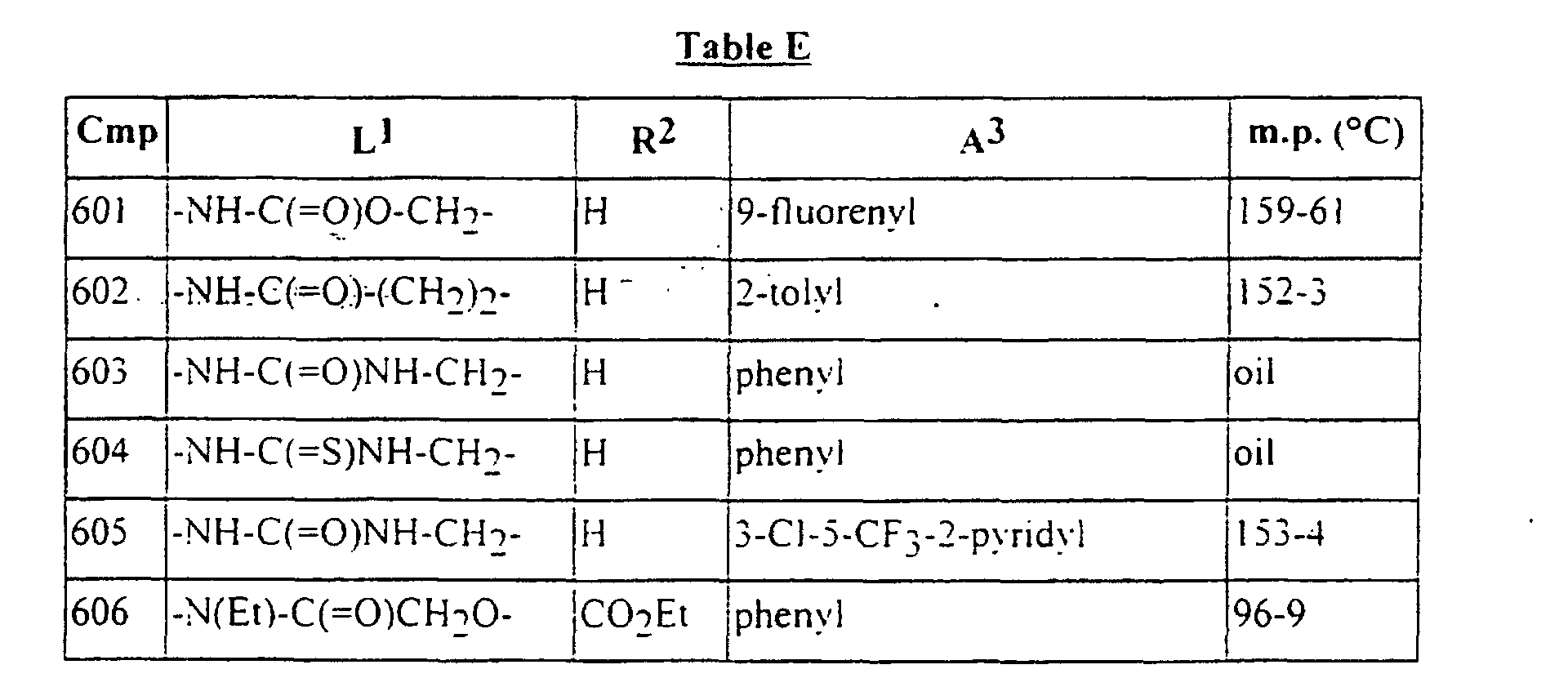


- 1H N.M.R. (CDCl3) δ(ppm) 4.4 (2H, s), 4.7 (2H, s), 7.2-7.4 (5H, m), 7.9(1H, s) and 8.65 (1H, s);
- 1H N.M.R. (CDCl3) δ(ppm) 1.55 (3H, d), 4.75 (3H, m), 6.8 (2H, d), 7.2 (2H, d). 7.7 (1H, br.s), 7.85 (1H, s) and 8.6 (1H, s);
- 1H N.M.R. (CDCl3) δ(ppm) 1.55 (3H, d), 2.3 (3H, s), 4.75 (3H, m), 6.65 (1H, m), 6.8 (1H, s), 7.2 (1H, m), 7.7 (1H, br.s), 7.85 (1H, s) and 8.6 (1H, s);
- 1H N.M.R. (CDCl3) δ(ppm) 1.65 (3H, d), 4.6 (2H, d), 4.65 (1H, q), 7.25-7.45 (3H, m), 7.75 (1H, s), 7.8 (1H, s), 7.9 (1H, d) and 8.3 (1H, br.s);
- 1H N.M.R. (CDCl3) δ(ppm) 1.55 (3H, d), 2.4 (3H, s), 4.3 (1H, q), 4.7 (2H, q), 7.3-7.5 (5H, m), 7.8 (1H, s), 8.15 (1H, s) and 8.4 (1H, br.s);
- 1H N.M.R. (CDCl3) δ(ppm) 1.6 (3H, d), 2.6 (3H, s), 4.6 (1H, q), 4.65 (2H,s), 7.85 (1H, s), 8.1 (1H, br.s) and 8.65 (1H);
- 1H N.M.R. (CDCl3) δ(ppm) 1.15-2.0 (13H, m), 4.0-4.1 (1H, m), 4.6 (2H, s), 7.8 (1H, s), 8.0 (1H, br.s) and 8.6 (1H, s);
- 1H N.M.R. (CDCl3) δ(ppm) 1.25 (3H, s), 1.35 (3H, s), 1.5 (3H, d), 4.45 (1H, q), 4.75 (2H, qd), 5.05 (2H, d), 7.85 (1H, s), 8.15 (1H, br.s) and 8.6 (1H, s);
- 1H N.M.R. (CDCl3) δ(ppm) 1.6 (3H, d), 4.5-4.75 (3H, m), 7.0 (1H, t), 7.1 (1H, m), 7.4 (1H, m), 7.8 (1H, s), 8.4 (1H, d), 8.55 (1H, s) and 8.7 (1H, br.s);
- 1H N.M.R. (CDCl3) δ(ppm) 1.5 (3H, d), 3.5 (3H, s), 4.15 (1H, q), 4.6 (2H, qd), 6.8 (1H, s), 7.0 (1H, s), 7.8 (1H, s), 8.65 (1H, s) and 8.75 (1H, br,s); and
- 1H N.M.R. (CDCl3)δ(ppm) 1.6 (3H, d), 2.65 (3H, s), 4.65 (3H, m), 7.8 (1H, m), 8.15 (1H, br,s) and 8.6 (1H, s).
- The following compounds of formula Is (see Table F), i.e. compounds of general formula I where Y is a formula (E) and A1 is 3-Cl-5-CF3-2-pyridyl, R1 is hydrogen and L1 is -NHC(=O)CH(R8)N(R9)-, may be prepared by methods analogous to the above Examples.
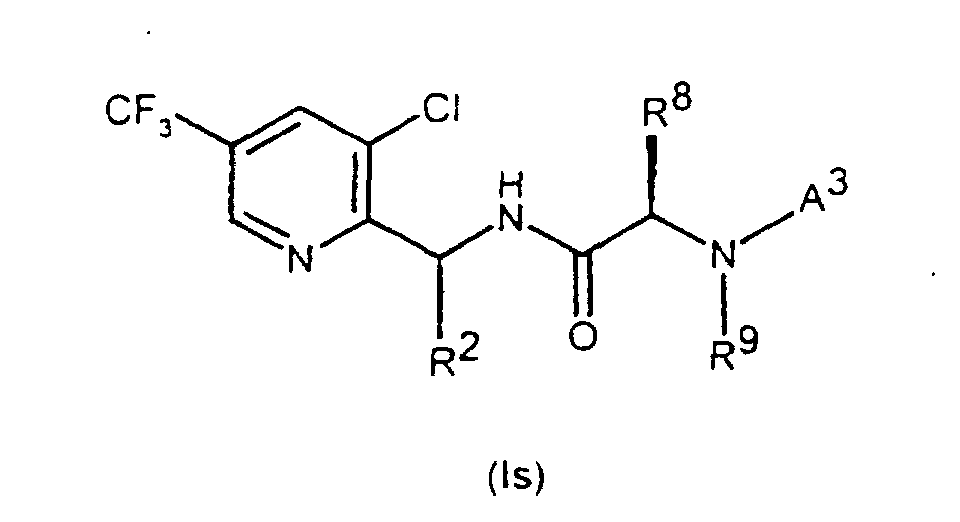
Cmp R2 R8 R9 A3 m.p. (°C) 701 H H H 2-Me-benzoyl 126 702 H Me (racemic) H benzyloxycarbonyl 114 703 H Pri H isopropyloxycarbonyl 134 704 H Bui H isopropyloxycarbonyl 142 705 H Bui Me isopropyloxycarbonyl oil 706 Me Pri H isopropyloxycarbonyl 151 707 Me Bui H isopropyloxycarbonyl 134 708 Me Bui Me isopropyloxycarbonyl oil - Compound 801 m.p. 148°C
and
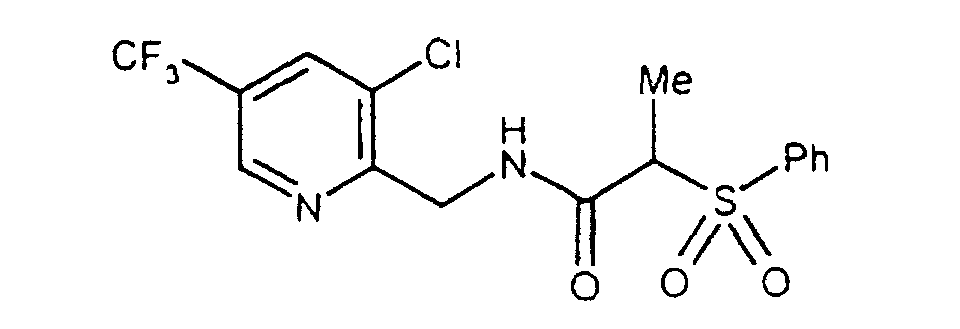
- Compound 802 m.p. 185°C
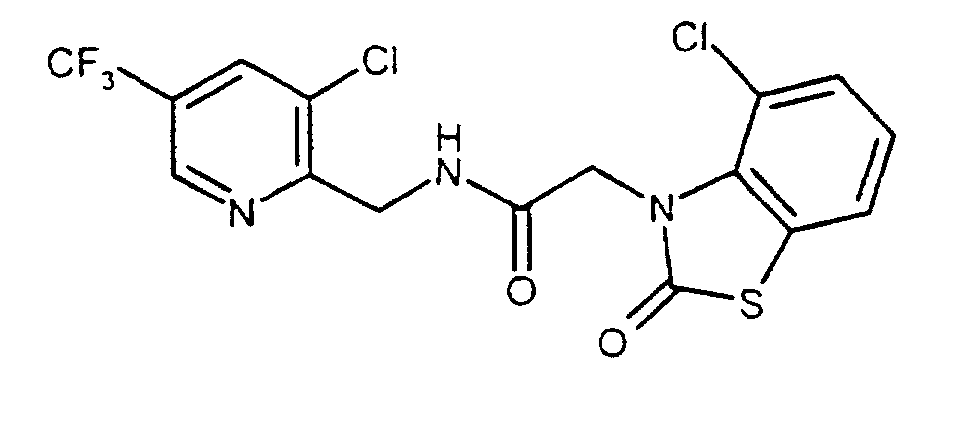
-
- Compounds were assessed for activity against one or more of the following:
- Phytophthora infestans: late tomato blight
- Plasmopara viticola: vine downy mildew
- Erysiphe graminis f. sp. tritici: wheat powdery mildew
- Pyricularia oryzae: rice blast
- Leptosphaeria nodorum: glume blotch
-
- Aqueous solutions or dispersions of the compounds at the desired concentration, including a wetting agent, were applied by spray or by drenching the stem base of the test plants, as appropriate. After a given time, plants or plant parts were inoculated with appropriate test pathogens before or after application of the compounds as appropriate, and kept under controlled environmental conditions suitable for maintaining plant growth and development of the disease. After an appropriate time, the degree of infection of the affected part of the plant was visually estimated. Compounds are assessed on a score of 1 to 3 where 1 is little or no control, 2 is moderate control and 3 is good to total control. At a concentration of 500 ppm (w/v) or less, the following compounds scored 2 or more against the fungi specified.
- Phytophthora infestans:
- 31 and 105-7.
- Plasmopara viticola :
- 50, 55, 104, 105, 201, 215, 221, 222, 224, 225, 227, 230, 232, 233, 234, 235, 328 and 606.
- Erysiphe graminis f. sp. tritici :
- 4, 25, 26, 39, 40, 44, 101, 201, 214, 304, 305, 306, 308, 310, 312, 313, 603, 606 and 642.
- Pyricularia oryzae :
- 111, 112, 306, 312, 606, 624, 645, 650 and 701.
- Leptosphaeria nodorum :
- 13, 105, 107, 108, 201, 229, 232, 238, 317, 336 and 626.
Claims (7)
- The use of a compound of general formula I, complexes and salts thereof as phytopathogenic fungicideswhere
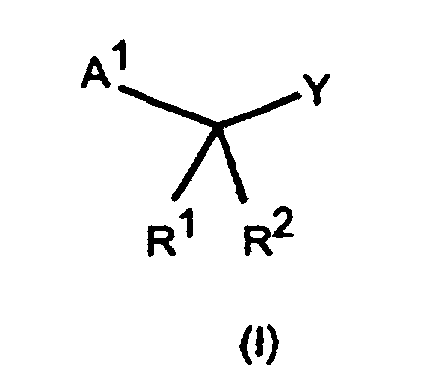
A1 is 2-pyridyl or its N-oxide, each of which is substituted by up to four groups at least one of which is haloalkyl;
Y is a formula (D) or (E):
A3 is heterocyclyl or carbocyclyl, each of which may be substituted, or acyl;
L is a 3-atom linker, selected from the list: -N(R5)C(=X)N(R6)-, - N(R5)C(=X)CH(R3)-, -CH(R3)N(R5)CH(R4)-, -CH(R3)N(R5)C(=X)-, - N(R3)CH(R4)C(=X)- and -O-N(R5)C(=X)-; wherein A1 is attached to the left hand side of linker L;
L1 is a 4-atom linker selected from the list: -N(R9)C(=X)-X1-CH(R7)-, -N(R9)C(=X)CH(R7)CH(R8)-, -N(R9)C(=X)C(R7)=C(R8)-, -N(R9)C(R7)=C(R8)-C(=X)-, -N(R9)C(R7)=C(R8)-SO2-, - N(R9)C(=X)C(R7)(R8)-SO2- and -N(R9)C(=X)C(R7)(R8)-X1-; wherein A1 is attached to the left hand side of linker L1;
R1, R2, R3, R4, R7 and R8, which may be the same or different, are Rb, cyano, nitro, halogen, -ORb, -SRb or optionally substituted amino;
R5 and R6 which may be the same or different, are Rb, cyano or nitro;
or any R1, R3 or R5 group, together with the interconnecting atoms, can form a 3-, 4-, 5- or 6-membered ring with any R2, R4 or R6 or any R1, R2, R3, R4, R5 or R6 group, together with the interconnecting atoms can form a 5- or 6-membered ring with A2;
or R1 and R2, or R7 and R8, together with the interconnecting atoms, may form a 3-, 4-, 5- or 6-membered ring, which may be substituted;
Rb is alkyl, alkenyl, alkynyl, carbocyclyl or heterocyclyl, each of which may be substituted, or hydrogen or acyl;
X is oxygen or sulfur;
X1 is oxygen, sulfur or-N(R9)-; and
R9 is Rb, cyano or nitro, or R9 and A3, R1, R2, R7 or R8, together with the interconnecting atoms, may form a 3-, 4-, 5- or 6-membered ring, which may be substituted. - A method of combating phytopathogenic fungi at a locus infested or liable to be infested therewith, which comprises applying to the locus a compound as defined in claim 1, or a complex or salt thereof.
- A method according to claim 2 in which the said compound is applied at an application rate of from 5 to 1000 g per hectare.
- A pesticidal composition comprising at least one compound as defined in claim 1, or a complex or salt thereof, in admixture with an agriculturally acceptable diluent or carrier.
- A fungicidal composition comprising at least one compound as defined in claim 1, or a complex or salt thereof, in admixture with an agriculturally acceptable diluent or carrier.
- A compound of formula I as defined in claim 1 or a complex or salt thereof in which one or more of the following features are present:a) A2 is optionally substituted phenyl, optionally substituted heterocyclyl, optionally substituted cyclohexyl or optionally substituted cyclopropyl; orb) A3 is optionally substituted phenyl, optionally substituted heterocyclyl or acyl; orc) R1, R2, R3, R4, R7 and R8 are hydrogen, optionally substituted alkyl, optionally substituted phenyl, cyano, acyl or halogen (more preferably R1 and R2 are hydrogen); ord) R5 and R6 are hydrogen, optionally substituted alkyl or acyl; ore) R7 and R8 are hydrogen, optionally substituted alkyl or acyl; orf) R9 is hydrogen or optionally substituted alkyl; org) the 2-pyridyl group (A1) is substituted by alkoxy, alkyl, cyano, halogen, nitro, alkoxycarbonyl, alkylsulfinyl, alkylsulfonyl or trifluoromethyl, (preferably chlorine or trifluoromethyl).
- A compound of formula I as defined in claim 1 or a complex or salt thereof in which:
Y is -L-A2- and:Y is -L1-A3- and:i) L is -NHC(=X)NH-; and
A2 is phenyl optionally substituted by halogen, haloalkyl, phenoxy, alkoxy, alkyl, CN, NO SO2-(N-tetrahydropyridinyl), alkylthio, acyl, phenylsulphonyl, dialkylamino, alkylsulphonyl, benzylsulphonyl, S(phenyl substituted by halogen); or A2 is cycloalkyl; or naphthyl optionally substituted by NO2; orii) L is -NHC(=O)CH(R3)-;
R3 is hydrogen, alkyl, phenyl, halogen or acyloxy;
A2 is phenyl optionally substituted by halogen, NO2 or alkoxy; or thienyl; or imidazolyl; or pyrrolinyl substituted by alkoxy; oriii) L is -CH(R3)N(R5)CH2-;
R3 is N-alkylcarbamoyl or alkoxycarbonyl;
R5 is hydrogen or acyl;
A2 is phenyl optionally substituted by alkyl, alkoxy, halogen, NO2, haloalkyl or phenoxy; or is naphthyl; oriv) L is -CH(R3)NHC(=O)-;
R3 is N-alkylcarbamoyl or alkoxycarbonyl;
A2 is phenyl optionally substituted by alkoxy, halogen, NO2, haloalkyl, phenoxy or phenyl; or is cycloalkyl; orv) L is -O-NHC(=O)- and A2 is phenyl substituted by alkyl; ora) L1 is -NHC(=O)(CH2)2-, and A3 is phenyl substituted by alkyl; orb) L1 is -NHC(=S)NHCH2-, and A3 is phenyl; orc) L1 is -NHC(=O)CH(alkyl)S-, and A3 is phenyl;ord) L1 is -NHC(=O)OCH2-, -NHC(=O)(CH2)2-, -NHC(=O)NHCH2-, - NHC(=S)NHCH2-, -N(alkyl)C(=O)CH2O- or -NHC(=O)CH2O-;
R1 is hydrogen;
R2 is hydrogen or alkoxycarbonyl;
A3 is phenyl optionally substituted by halogen, alkyl, phenyl, OH, alkoxy or alkoxycarbonyl; or fluorenyl; or pyridyl optionally substituted by halogen or haloalkyl; or thiadiazolyl substituted by alkyl; or benzthiazolyl optionally substituted by halogen or by phenyl substituted by halogen; or quinolinyl substituted by haloalkyl; or triazolyl substituted by alkyl or phenyl; or tetrazolyl substituted by alkyl or cycloalkyl; or pyrimidinyl substituted by alkyl; or benzoxazolyl; or imidazolyl substituted by alkyl; or thiazolinyl substituted by alkyl and methylene; ore) L1 is -NHC(=O)CH(R8)N(R9)-;
R1 is hydrogen;
R2 is hydrogen or alkyl;
R8 and R9 are each hydrogen or alkyl;
A3 is benzoyl optionally substituted by alkyl; or benzyloxycarbonyl; or alkoxycarbonyl; orf) L1 is -NHC(=O)CH(alkyl)SO2-;
R1 and R2 are each hydrogen;
A3 is phenyl; org) L1 is -NHC(=O)CH2X1-; where X1 and A3 form a 2-oxo-N-benzthiazolyl ring which is substituted by halogen; and
R1 and R2 are each hydrogen.
Applications Claiming Priority (5)
| Application Number | Priority Date | Filing Date | Title |
|---|---|---|---|
| GB9919500 | 1999-08-18 | ||
| GB9919499 | 1999-08-18 | ||
| GBGB9919499.5A GB9919499D0 (en) | 1999-08-18 | 1999-08-18 | Fungicidal compounds |
| GBGB9919500.0A GB9919500D0 (en) | 1999-08-18 | 1999-08-18 | Fungicidal compounds |
| PCT/EP2000/008143 WO2001011965A1 (en) | 1999-08-18 | 2000-08-09 | Fungicides |
Publications (2)
| Publication Number | Publication Date |
|---|---|
| EP1204323A1 EP1204323A1 (en) | 2002-05-15 |
| EP1204323B1 true EP1204323B1 (en) | 2004-07-14 |
Family
ID=26315854
Family Applications (1)
| Application Number | Title | Priority Date | Filing Date |
|---|---|---|---|
| EP00960499A Expired - Lifetime EP1204323B1 (en) | 1999-08-18 | 2000-08-09 | Fungicides |
Country Status (13)
| Country | Link |
|---|---|
| US (1) | US6821992B1 (en) |
| EP (1) | EP1204323B1 (en) |
| JP (1) | JP4936623B2 (en) |
| KR (1) | KR100718863B1 (en) |
| CN (1) | CN1209016C (en) |
| AT (1) | ATE270817T1 (en) |
| AU (1) | AU7278500A (en) |
| BR (1) | BR0013371A (en) |
| DE (1) | DE60012188T2 (en) |
| ES (1) | ES2220533T3 (en) |
| MX (1) | MXPA02001453A (en) |
| PT (1) | PT1204323E (en) |
| WO (1) | WO2001011965A1 (en) |
Families Citing this family (62)
| Publication number | Priority date | Publication date | Assignee | Title |
|---|---|---|---|---|
| US6927210B1 (en) | 1999-08-12 | 2005-08-09 | Eli Lilly And Company | Ectoparasiticidal aqueous suspension formulations of spinosyns |
| IL154004A0 (en) | 2000-09-18 | 2003-07-31 | Du Pont | Pyridinyl amides and imides for use as fungicides |
| EP1389614A1 (en) * | 2002-08-12 | 2004-02-18 | Bayer CropScience S.A. | Novel N-[2-(2-Pyridyl)ethyl]benzamide derivatives as fungicides |
| PL224002B1 (en) | 2002-08-12 | 2016-11-30 | Bayer Sas | 2-pyridyl ethyl benzamide derivative |
| EP1449841A1 (en) | 2003-02-19 | 2004-08-25 | Bayer CropScience SA | New fungicidal compounds |
| DE10325133A1 (en) * | 2003-06-04 | 2004-12-23 | Bayer Cropscience Ag | triazolopyrimidines |
| EP1500651A1 (en) | 2003-07-25 | 2005-01-26 | Bayer CropScience S.A. | N-[2-(2-Pyridinyl)ethyl]benzamide compounds and their use as fungicides |
| US20070272594A1 (en) * | 2003-12-09 | 2007-11-29 | William Jones | Oxidic Catalyst Composition Comprising a Divalent, a Trivalent, and a Rare Earth Metal |
| TWI368482B (en) * | 2003-12-19 | 2012-07-21 | Bayer Sas | New 2-pyridinylethylbenzamide derivatives |
| EP1548007A1 (en) * | 2003-12-19 | 2005-06-29 | Bayer CropScience S.A. | 2-Pyridinylethylcarboxamide derivatives and their use as fungicides |
| DE10360370A1 (en) * | 2003-12-22 | 2005-07-14 | Bayer Cropscience Ag | triazolopyrimidines |
| EP1563731A1 (en) | 2004-02-12 | 2005-08-17 | Bayer CropScience S.A. | Fungicidal composition comprising a pyridylethylbenzamide derivative and a compound capable of inhibiting the ergosterol biosynthesis |
| EP1570737A1 (en) | 2004-02-12 | 2005-09-07 | Bayer CropScience S.A. | Fungicidal composition comprising a pyridylethylbenzamide derivative and a compound capable of inhibiting the methionine biosynthesis |
| DE602005013952D1 (en) | 2004-02-12 | 2009-05-28 | Bayer Cropscience Sa | A FUNGICIDAL COMPOSITION CONTAINING A PYRIDYL ETHYL BENZEDIDE DERIVATIVE AND A COMPOUND WHICH IS CAPABLE OF PREVENTING THE TRANSPORT OF ELECTRONS OF THE BREATHING CHAIN IN PHYTOPATHOGENIC FUNGI ORGANISMS |
| DE602005009325D1 (en) * | 2004-02-12 | 2008-10-09 | Bayer Cropscience Sa | A FUNGICIDAL COMPOSITION COMPRISING A PYRIDYL ETHYL BENZIDEDIVATE AND A COMPOUND AOMED TO INHIBIT THE METHIONE IN BIOSYNTHESIS |
| EP1563733A1 (en) * | 2004-02-12 | 2005-08-17 | Bayer CropScience S.A. | Fungicidal composition comprising a pyridylethylbenzamide derivative and a compound capable of inhibiting mitosis and cell division |
| EP1570738A1 (en) | 2004-02-12 | 2005-09-07 | Bayer CropScience S.A. | Fungicidal composition comprising a pyridylethylbenzamide derivative and a compound capable of inhibiting the spores germination or mycelium growth by acting on different metabolic routes |
| US7786148B2 (en) * | 2004-02-12 | 2010-08-31 | Bayer Cropscience S.A. | Fungicidal composition comprising a pyridylethylbenzamide derivative and a compound capable of inhibiting the transport of electrons of the respiratory chain in phytopathogenic fungal organisms |
| KR100838540B1 (en) * | 2004-02-12 | 2008-06-17 | 바이엘 크롭사이언스 소시에떼아노님 | Fungicidal compositions comprising pyridylethylbenzamide derivatives and compounds capable of inhibiting spore germination or mycelial growth by acting on different metabolic pathways |
| WO2005077179A1 (en) * | 2004-02-12 | 2005-08-25 | Bayer Cropscience Sa | Fungicidal composition comprising a pyridylethylbenzamide derivative and a compound capable of inhibiting the melanin biosynthisis |
| EP1571143A1 (en) * | 2004-02-12 | 2005-09-07 | Bayer CropScience S.A. | Fungicidal composition comprising a pyridylethylbenzamide derivative and a compound capable of inhibiting the transport of electrons of the respiratory chain in phytopathogenic fungal organisms |
| EP1563732A1 (en) * | 2004-02-12 | 2005-08-17 | Bayer CropScience S.A. | Fungicidal composition comprising a pyridylethylbenzamide derivative and a compound capable of inhibiting the melanin biosynthesis |
| EP1574511A1 (en) * | 2004-03-03 | 2005-09-14 | Bayer CropScience S.A. | 2-Pyridinylethylcarboxamide derivatives and their use as fungicides |
| WO2005103006A1 (en) * | 2004-04-26 | 2005-11-03 | Bayer Cropscience Sa | 2-pyridinylcycloalkylcarboxamide derivatives useful as fungicides |
| EP1591442A1 (en) * | 2004-04-26 | 2005-11-02 | Bayer CropScience S.A. | 2-Pyridinycycloalkylbenzamide derivatives and their use as fungicides |
| UA87854C2 (en) * | 2004-06-07 | 2009-08-25 | Мерк Энд Ко., Инк. | N-(2-benzyl)-2-phenylbutanamides as androgen receptor modulators |
| WO2006008194A1 (en) * | 2004-07-23 | 2006-01-26 | Bayer Cropscience Sa | 3-pyridinylethylcarboxamide derivatives as fungicides |
| WO2006008192A1 (en) * | 2004-07-23 | 2006-01-26 | Bayer Cropscience Sa | N-[2-(4-pyridinyl)ethyl]benzamide derivatives as fungicides |
| EP1773776A1 (en) * | 2004-07-23 | 2007-04-18 | Bayer Cropscience Sa | 3-pyridinylethylbenzamide derivatives as fungicides |
| WO2006008193A1 (en) * | 2004-07-23 | 2006-01-26 | Bayer Cropscience Sa | 4-pyridinylethylcarboxamide derivatives useful as fungicides |
| CN101080391B (en) * | 2004-12-21 | 2010-09-22 | 拜尔农科股份有限公司 | The preparation method of 2-pyridyl ethyl carboxamide derivative |
| EP1710237A1 (en) | 2005-04-08 | 2006-10-11 | Bayer CropScience S.A. | New heterocyclylethylbenzamide derivatives |
| DE602006003756D1 (en) * | 2005-05-03 | 2009-01-02 | Bayer Cropscience Sa | NEW HETEROCYCLYLETHYLBENZAMIDE DERIVATIVES |
| WO2006117358A1 (en) * | 2005-05-03 | 2006-11-09 | Bayer Cropscience Sa | New heterocyclylethylamide derivatives |
| JP2008545637A (en) * | 2005-05-18 | 2008-12-18 | バイエル・クロツプサイエンス・エス・アー | 2-Pyridinylcycloalkylbenzamide derivatives and their use as fungicides |
| JP2008545638A (en) | 2005-05-18 | 2008-12-18 | バイエル・クロツプサイエンス・エス・アー | Novel 2-pyridinylcycloalkylcarboxamide derivatives as fungicides |
| FR2889192A1 (en) * | 2005-07-27 | 2007-02-02 | Cytomics Systems Sa | ANTIFUNGAL COMPOUNDS, COMPOSITIONS CONTAINING THESE COMPOUNDS, AND USES THEREOF |
| WO2007045462A2 (en) * | 2005-10-19 | 2007-04-26 | Grünenthal GmbH | Novel vanilloid receptor ligands and their use for producing medicaments |
| CN101360736A (en) * | 2005-11-23 | 2009-02-04 | 阿斯利康(瑞典)有限公司 | L-alanine derivatives |
| EP2041092A1 (en) * | 2006-07-06 | 2009-04-01 | Bayer CropScience SA | N- [ (pyridin- 2 -yl) methoxy]heterocyclyl carboxamide derivatives and related compounds as fungicides |
| EP2041090A1 (en) * | 2006-07-06 | 2009-04-01 | Bayer CropScience SA | N- (4-pyridin-2-ylbutyl) benzamide derivatives and their use as fungicides |
| JP5466503B2 (en) * | 2006-07-06 | 2014-04-09 | バイエル・クロップサイエンス・アーゲー | Pesticide composition comprising a pyridylethylbenzamide derivative and an insecticidal compound |
| WO2008003739A1 (en) * | 2006-07-06 | 2008-01-10 | Bayer Cropscience Sa | N-[(pyridin-2-yl) methoxy]benzamide derivatives and related compounds as fungicides |
| US20090298890A1 (en) * | 2006-07-06 | 2009-12-03 | Bayer Cropscience Sa | New n-methyl benzamide derivatives |
| WO2008061866A1 (en) * | 2006-11-20 | 2008-05-29 | Bayer Cropscience Sa | New benzamide derivatives |
| AR064565A1 (en) * | 2007-01-03 | 2009-04-08 | Bayer Cropscience Sa | DERIVATIVES OF N-METILCARBOXAMIDE, A PROCEDURE FOR THEIR PREPARATION, A FUNGITIVE COMPOSITION THAT UNDERSTANDS THEM AND A METHOD FOR COMBATING FITOPATOGEN FUNDS THAT USES THEM. |
| RU2532135C2 (en) * | 2007-02-22 | 2014-10-27 | Зингента Партисипейшнс Аг | Iminopyridine derivatives and use thereof as microbiocides |
| DE102007018151A1 (en) | 2007-04-16 | 2008-10-23 | Günenthal GmbH | Novel vanilloid receptor ligands and their use in the preparation of medicines |
| EP2036438A1 (en) * | 2007-09-12 | 2009-03-18 | Bayer CropScience AG | Post-harvest treatment |
| MY153626A (en) * | 2009-05-20 | 2015-02-27 | Nippon Soda Co | Composition for preparing emulsion or microemulsion formulations |
| EP2289880A1 (en) | 2009-07-08 | 2011-03-02 | Bayer CropScience AG | 2-Pyridinylcyclopropylbenzamide fungicides |
| EP2606728A1 (en) | 2011-12-21 | 2013-06-26 | Bayer CropScience AG | Compounds with nematicidal activity |
| EP2773203A1 (en) * | 2011-11-02 | 2014-09-10 | Bayer Intellectual Property GmbH | Compounds with nematicidal activity |
| EP2589292A1 (en) | 2011-11-02 | 2013-05-08 | Bayer CropScience AG | Compounds with nematicidal activity |
| EP2606727A1 (en) | 2011-12-21 | 2013-06-26 | Bayer CropScience AG | Compounds with nematicidal activity |
| US20140256728A1 (en) | 2011-11-02 | 2014-09-11 | Bayer Intellectual Property Gmbh | Compounds with nematicidal activity |
| EP2589294A1 (en) | 2011-11-02 | 2013-05-08 | Bayer CropScience AG | Compounds with nematicidal activity |
| UY34997A (en) * | 2012-08-30 | 2014-03-31 | Nihon Nohyaku Co Ltd | ENDOPARASIT CONTROL AGENT AND METHOD FOR USE |
| UY35772A (en) | 2013-10-14 | 2015-05-29 | Bayer Cropscience Ag | NEW PESTICIDED COMPOUNDS |
| EP3787612A4 (en) | 2018-05-04 | 2021-11-17 | Remedy Plan, Inc. | TARGETING CANCER TREATMENTS IN CANCERY STEM CELLS |
| PH12022551081A1 (en) | 2019-11-06 | 2024-06-19 | Remedy Plan Inc | Cancer treatments targeting cancer stem cells |
| WO2025239340A1 (en) * | 2024-05-14 | 2025-11-20 | 日本農薬株式会社 | Amide compound or salt thereof, agricultural and horticultural microbicide containing said compound or salt, and method for using said microbicide |
Family Cites Families (9)
| Publication number | Priority date | Publication date | Assignee | Title |
|---|---|---|---|---|
| DE3702852A1 (en) * | 1987-01-31 | 1988-08-11 | Bayer Ag | 1-AMINOMETHYL-3-ARYL-4-CYANO-PYRROLE |
| DE3804128A1 (en) * | 1988-02-11 | 1989-08-24 | Bayer Ag | 1-AMINOMETHYL-3- (2-FLUOR-3-CHLORPHENYL) -4-CYANO-PYRROL DERIVATIVES |
| IL91083A (en) * | 1988-07-25 | 1993-04-04 | Ciba Geigy | Cyclohexanedione derivatives, their preparation and their use as herbicides |
| JPH02223558A (en) * | 1988-11-02 | 1990-09-05 | Kaken Pharmaceut Co Ltd | Phenylalkylamine derivatives and antifungal agents containing them as active ingredients |
| AU4265596A (en) * | 1994-12-06 | 1996-06-26 | Agrevo Uk Limited | Heterocyclyl substituted hydroxyacetamide derivatives as fongicides |
| JPH09301954A (en) * | 1996-05-14 | 1997-11-25 | Kumiai Chem Ind Co Ltd | N- (Fused Heteroarylalkyl) alkanoic acid amide derivative and agricultural / horticultural fungicide |
| TW575562B (en) | 1998-02-19 | 2004-02-11 | Agrevo Uk Ltd | Fungicides |
| JP2000256322A (en) * | 1999-03-11 | 2000-09-19 | Otsuka Chem Co Ltd | Cyanomethylene hydrazine compound and pest control agent |
| DE19922934A1 (en) * | 1999-05-19 | 2000-11-23 | Bayer Ag | New 5,5-dihalo- or 4,5,5-trihalo-4-pentenoic acid derivatives, useful as bactericides, fungicides, insecticides, acaricides and nematocides, especially plant fungicides |
-
2000
- 2000-08-09 AU AU72785/00A patent/AU7278500A/en not_active Abandoned
- 2000-08-09 AT AT00960499T patent/ATE270817T1/en not_active IP Right Cessation
- 2000-08-09 CN CNB008118027A patent/CN1209016C/en not_active Expired - Lifetime
- 2000-08-09 MX MXPA02001453A patent/MXPA02001453A/en active IP Right Grant
- 2000-08-09 EP EP00960499A patent/EP1204323B1/en not_active Expired - Lifetime
- 2000-08-09 US US10/049,976 patent/US6821992B1/en not_active Expired - Lifetime
- 2000-08-09 WO PCT/EP2000/008143 patent/WO2001011965A1/en not_active Ceased
- 2000-08-09 ES ES00960499T patent/ES2220533T3/en not_active Expired - Lifetime
- 2000-08-09 JP JP2001516328A patent/JP4936623B2/en not_active Expired - Lifetime
- 2000-08-09 KR KR1020027002072A patent/KR100718863B1/en not_active Expired - Lifetime
- 2000-08-09 DE DE60012188T patent/DE60012188T2/en not_active Expired - Lifetime
- 2000-08-09 PT PT00960499T patent/PT1204323E/en unknown
- 2000-08-09 BR BR0013371-0A patent/BR0013371A/en not_active IP Right Cessation
Also Published As
| Publication number | Publication date |
|---|---|
| EP1204323A1 (en) | 2002-05-15 |
| AU7278500A (en) | 2001-03-13 |
| DE60012188D1 (en) | 2004-08-19 |
| US6821992B1 (en) | 2004-11-23 |
| ATE270817T1 (en) | 2004-07-15 |
| CN1209016C (en) | 2005-07-06 |
| KR20020059365A (en) | 2002-07-12 |
| JP2003506465A (en) | 2003-02-18 |
| PT1204323E (en) | 2004-11-30 |
| WO2001011965A1 (en) | 2001-02-22 |
| CN1370047A (en) | 2002-09-18 |
| KR100718863B1 (en) | 2007-05-16 |
| JP4936623B2 (en) | 2012-05-23 |
| BR0013371A (en) | 2002-05-07 |
| ES2220533T3 (en) | 2004-12-16 |
| MXPA02001453A (en) | 2003-01-28 |
| DE60012188T2 (en) | 2005-08-25 |
Similar Documents
| Publication | Publication Date | Title |
|---|---|---|
| US6821992B1 (en) | Fungicides | |
| EP1204322B1 (en) | Fungicides | |
| US6939882B1 (en) | Fungicides | |
| EP1150944B1 (en) | N2-phenylamidine derivatives | |
| RS50017B (en) | 2-PYRIDYLMETHYLAMINE DERIVATIVES AS A USEFUL FUNGICIDE | |
| US6664295B2 (en) | Fungicidal phenylamidine derivatives | |
| EP1178037B1 (en) | Fungicidal phenylimidate derivatives | |
| EP1178035B1 (en) | Fungicidal phenylimine derivatives | |
| WO1998004525A1 (en) | Fungicidal n-aryl five-membered cyclic imides | |
| EP1180512A1 (en) | Fungicidal phenylimine derivatives | |
| WO1998004532A1 (en) | Fungicidal aryl-substituted five-membered heterocylic compounds |
Legal Events
| Date | Code | Title | Description |
|---|---|---|---|
| PUAI | Public reference made under article 153(3) epc to a published international application that has entered the european phase |
Free format text: ORIGINAL CODE: 0009012 |
|
| 17P | Request for examination filed |
Effective date: 20020114 |
|
| AK | Designated contracting states |
Kind code of ref document: A1 Designated state(s): AT BE CH CY DE DK ES FI FR GB GR IE IT LI LU MC NL PT SE |
|
| AX | Request for extension of the european patent |
Free format text: AL;LT;LV;MK;RO;SI |
|
| RAP1 | Party data changed (applicant data changed or rights of an application transferred) |
Owner name: AVENTIS CROPSCIENCE GMBH |
|
| 17Q | First examination report despatched |
Effective date: 20021011 |
|
| GRAP | Despatch of communication of intention to grant a patent |
Free format text: ORIGINAL CODE: EPIDOSNIGR1 |
|
| GRAS | Grant fee paid |
Free format text: ORIGINAL CODE: EPIDOSNIGR3 |
|
| GRAA | (expected) grant |
Free format text: ORIGINAL CODE: 0009210 |
|
| AK | Designated contracting states |
Kind code of ref document: B1 Designated state(s): AT BE CH CY DE DK ES FI FR GB GR IE IT LI LU MC NL PT SE |
|
| PG25 | Lapsed in a contracting state [announced via postgrant information from national office to epo] |
Ref country code: FI Free format text: LAPSE BECAUSE OF FAILURE TO SUBMIT A TRANSLATION OF THE DESCRIPTION OR TO PAY THE FEE WITHIN THE PRESCRIBED TIME-LIMIT Effective date: 20040714 Ref country code: CH Free format text: LAPSE BECAUSE OF FAILURE TO SUBMIT A TRANSLATION OF THE DESCRIPTION OR TO PAY THE FEE WITHIN THE PRESCRIBED TIME-LIMIT Effective date: 20040714 Ref country code: LI Free format text: LAPSE BECAUSE OF FAILURE TO SUBMIT A TRANSLATION OF THE DESCRIPTION OR TO PAY THE FEE WITHIN THE PRESCRIBED TIME-LIMIT Effective date: 20040714 Ref country code: AT Free format text: LAPSE BECAUSE OF FAILURE TO SUBMIT A TRANSLATION OF THE DESCRIPTION OR TO PAY THE FEE WITHIN THE PRESCRIBED TIME-LIMIT Effective date: 20040714 Ref country code: CY Free format text: LAPSE BECAUSE OF FAILURE TO SUBMIT A TRANSLATION OF THE DESCRIPTION OR TO PAY THE FEE WITHIN THE PRESCRIBED TIME-LIMIT Effective date: 20040714 |
|
| REG | Reference to a national code |
Ref country code: GB Ref legal event code: FG4D |
|
| REG | Reference to a national code |
Ref country code: CH Ref legal event code: EP |
|
| PG25 | Lapsed in a contracting state [announced via postgrant information from national office to epo] |
Ref country code: LU Free format text: LAPSE BECAUSE OF NON-PAYMENT OF DUE FEES Effective date: 20040809 Ref country code: IE Free format text: LAPSE BECAUSE OF NON-PAYMENT OF DUE FEES Effective date: 20040809 |
|
| REF | Corresponds to: |
Ref document number: 60012188 Country of ref document: DE Date of ref document: 20040819 Kind code of ref document: P |
|
| REG | Reference to a national code |
Ref country code: IE Ref legal event code: FG4D |
|
| PG25 | Lapsed in a contracting state [announced via postgrant information from national office to epo] |
Ref country code: MC Free format text: LAPSE BECAUSE OF NON-PAYMENT OF DUE FEES Effective date: 20040831 |
|
| PG25 | Lapsed in a contracting state [announced via postgrant information from national office to epo] |
Ref country code: DK Free format text: LAPSE BECAUSE OF FAILURE TO SUBMIT A TRANSLATION OF THE DESCRIPTION OR TO PAY THE FEE WITHIN THE PRESCRIBED TIME-LIMIT Effective date: 20041014 Ref country code: GR Free format text: LAPSE BECAUSE OF FAILURE TO SUBMIT A TRANSLATION OF THE DESCRIPTION OR TO PAY THE FEE WITHIN THE PRESCRIBED TIME-LIMIT Effective date: 20041014 Ref country code: SE Free format text: LAPSE BECAUSE OF FAILURE TO SUBMIT A TRANSLATION OF THE DESCRIPTION OR TO PAY THE FEE WITHIN THE PRESCRIBED TIME-LIMIT Effective date: 20041014 |
|
| REG | Reference to a national code |
Ref country code: PT Ref legal event code: SC4A Free format text: AVAILABILITY OF NATIONAL TRANSLATION Effective date: 20040920 |
|
| REG | Reference to a national code |
Ref country code: ES Ref legal event code: FG2A Ref document number: 2220533 Country of ref document: ES Kind code of ref document: T3 |
|
| LTIE | Lt: invalidation of european patent or patent extension |
Effective date: 20040714 |
|
| ET | Fr: translation filed | ||
| REG | Reference to a national code |
Ref country code: CH Ref legal event code: PL |
|
| REG | Reference to a national code |
Ref country code: IE Ref legal event code: MM4A |
|
| PLBE | No opposition filed within time limit |
Free format text: ORIGINAL CODE: 0009261 |
|
| STAA | Information on the status of an ep patent application or granted ep patent |
Free format text: STATUS: NO OPPOSITION FILED WITHIN TIME LIMIT |
|
| 26N | No opposition filed |
Effective date: 20050415 |
|
| NLS | Nl: assignments of ep-patents |
Owner name: BAYER CROPSCIENCE AG Effective date: 20071214 |
|
| NLT1 | Nl: modifications of names registered in virtue of documents presented to the patent office pursuant to art. 16 a, paragraph 1 |
Owner name: BAYER CROPSCIENCE GMBH |
|
| REG | Reference to a national code |
Ref country code: PT Ref legal event code: PD4A Owner name: BAYER CROPSCIENCE GMBH, DE Effective date: 20080403 Ref country code: PT Ref legal event code: PC4A Owner name: BAYER CROPSCIENCE AG, DE Effective date: 20080403 |
|
| REG | Reference to a national code |
Ref country code: GB Ref legal event code: 732E |
|
| REG | Reference to a national code |
Ref country code: FR Ref legal event code: TP |
|
| REG | Reference to a national code |
Ref country code: FR Ref legal event code: PLFP Year of fee payment: 17 |
|
| REG | Reference to a national code |
Ref country code: FR Ref legal event code: PLFP Year of fee payment: 18 |
|
| REG | Reference to a national code |
Ref country code: FR Ref legal event code: PLFP Year of fee payment: 19 |
|
| PGFP | Annual fee paid to national office [announced via postgrant information from national office to epo] |
Ref country code: NL Payment date: 20190814 Year of fee payment: 20 |
|
| PGFP | Annual fee paid to national office [announced via postgrant information from national office to epo] |
Ref country code: PT Payment date: 20190719 Year of fee payment: 20 Ref country code: DE Payment date: 20190730 Year of fee payment: 20 Ref country code: FR Payment date: 20190730 Year of fee payment: 20 Ref country code: IT Payment date: 20190821 Year of fee payment: 20 Ref country code: ES Payment date: 20190902 Year of fee payment: 20 |
|
| PGFP | Annual fee paid to national office [announced via postgrant information from national office to epo] |
Ref country code: BE Payment date: 20190724 Year of fee payment: 20 |
|
| PGFP | Annual fee paid to national office [announced via postgrant information from national office to epo] |
Ref country code: GB Payment date: 20190814 Year of fee payment: 20 |
|
| REG | Reference to a national code |
Ref country code: DE Ref legal event code: R071 Ref document number: 60012188 Country of ref document: DE |
|
| REG | Reference to a national code |
Ref country code: NL Ref legal event code: MK Effective date: 20200808 |
|
| REG | Reference to a national code |
Ref country code: GB Ref legal event code: PE20 Expiry date: 20200808 |
|
| REG | Reference to a national code |
Ref country code: BE Ref legal event code: MK Effective date: 20200809 |
|
| PG25 | Lapsed in a contracting state [announced via postgrant information from national office to epo] |
Ref country code: PT Free format text: LAPSE BECAUSE OF EXPIRATION OF PROTECTION Effective date: 20200819 Ref country code: GB Free format text: LAPSE BECAUSE OF EXPIRATION OF PROTECTION Effective date: 20200808 |
|
| REG | Reference to a national code |
Ref country code: ES Ref legal event code: FD2A Effective date: 20201126 |
|
| PG25 | Lapsed in a contracting state [announced via postgrant information from national office to epo] |
Ref country code: ES Free format text: LAPSE BECAUSE OF EXPIRATION OF PROTECTION Effective date: 20200810 |
|
| P01 | Opt-out of the competence of the unified patent court (upc) registered |
Effective date: 20230519 |