EP1204283A1 - Cellular radio network reusing frequencies - Google Patents
Cellular radio network reusing frequencies Download PDFInfo
- Publication number
- EP1204283A1 EP1204283A1 EP00124124A EP00124124A EP1204283A1 EP 1204283 A1 EP1204283 A1 EP 1204283A1 EP 00124124 A EP00124124 A EP 00124124A EP 00124124 A EP00124124 A EP 00124124A EP 1204283 A1 EP1204283 A1 EP 1204283A1
- Authority
- EP
- European Patent Office
- Prior art keywords
- radio network
- cellular radio
- cell
- cells
- cluster
- Prior art date
- Legal status (The legal status is an assumption and is not a legal conclusion. Google has not performed a legal analysis and makes no representation as to the accuracy of the status listed.)
- Withdrawn
Links
- 230000001413 cellular effect Effects 0.000 title claims abstract description 601
- 230000005540 biological transmission Effects 0.000 claims abstract description 194
- 238000000034 method Methods 0.000 claims abstract description 34
- 238000005259 measurement Methods 0.000 claims description 23
- 238000004590 computer program Methods 0.000 claims description 6
- 210000004027 cell Anatomy 0.000 description 502
- 238000001228 spectrum Methods 0.000 description 12
- 230000006854 communication Effects 0.000 description 10
- 238000004891 communication Methods 0.000 description 10
- 238000000926 separation method Methods 0.000 description 10
- 238000012545 processing Methods 0.000 description 8
- 230000003287 optical effect Effects 0.000 description 6
- 238000005192 partition Methods 0.000 description 6
- 230000003247 decreasing effect Effects 0.000 description 5
- 230000006978 adaptation Effects 0.000 description 4
- 230000001186 cumulative effect Effects 0.000 description 4
- 238000009826 distribution Methods 0.000 description 4
- 238000013459 approach Methods 0.000 description 3
- 230000007423 decrease Effects 0.000 description 3
- 230000005484 gravity Effects 0.000 description 3
- 230000001105 regulatory effect Effects 0.000 description 3
- 230000000694 effects Effects 0.000 description 2
- 238000005516 engineering process Methods 0.000 description 2
- 239000010410 layer Substances 0.000 description 2
- 210000004460 N cell Anatomy 0.000 description 1
- 230000009286 beneficial effect Effects 0.000 description 1
- 230000007175 bidirectional communication Effects 0.000 description 1
- 230000033228 biological regulation Effects 0.000 description 1
- 230000001419 dependent effect Effects 0.000 description 1
- 238000013461 design Methods 0.000 description 1
- 230000007613 environmental effect Effects 0.000 description 1
- 238000012423 maintenance Methods 0.000 description 1
- 238000004088 simulation Methods 0.000 description 1
- 239000002356 single layer Substances 0.000 description 1
- 238000009827 uniform distribution Methods 0.000 description 1
Images

Classifications
-
- H—ELECTRICITY
- H04—ELECTRIC COMMUNICATION TECHNIQUE
- H04W—WIRELESS COMMUNICATION NETWORKS
- H04W16/00—Network planning, e.g. coverage or traffic planning tools; Network deployment, e.g. resource partitioning or cells structures
- H04W16/14—Spectrum sharing arrangements between different networks
-
- H—ELECTRICITY
- H04—ELECTRIC COMMUNICATION TECHNIQUE
- H04W—WIRELESS COMMUNICATION NETWORKS
- H04W16/00—Network planning, e.g. coverage or traffic planning tools; Network deployment, e.g. resource partitioning or cells structures
- H04W16/02—Resource partitioning among network components, e.g. reuse partitioning
-
- H—ELECTRICITY
- H04—ELECTRIC COMMUNICATION TECHNIQUE
- H04W—WIRELESS COMMUNICATION NETWORKS
- H04W16/00—Network planning, e.g. coverage or traffic planning tools; Network deployment, e.g. resource partitioning or cells structures
- H04W16/24—Cell structures
- H04W16/32—Hierarchical cell structures
Definitions
- the invention relates to a cellular radio network and to a method of arranging a cellular radio network in a geographical area.
- Cellular radio networks are increasingly used to provide a variety of communication and information services to users.
- communication networks coexist with each other in a given geographical area and simultaneously provide services to subscribers.
- a cellular radio network generally uses a certain partition of the available spectrum for providing services. However, as the available spectrum is limited, the usage of the spectrum is normally subject to regulation and each communication network will have a certain partition of the spectrum allocated for usage. In this case it needs to be assured that the coexisting cellular radio networks, or in general any radio networks, do not interfere with each other above a certain tolerable level.
- One straightforward approach to avoid interference between cellular radio networks is to exclusively allocate a certain partition of the spectrum in one geographical area. Each cellular radio network may then provide communication services in the allocated partition of the spectrum. Interference may be further reduced by guard bands introduced between the allocated partitions of the spectrum.
- a frequency range allocated to a cellular radio network may be a continuous range of frequencies, or certain partitions of the spectrum may be combined to a frequency range for one cellular radio network. Therefore, a frequency range of a cellular radio network may include a single sequence of frequencies or multiple discontinuous sequences of frequencies, or a set of individual frequencies.
- a cellular radio network constituting an introduced cellular radio network and using a first frequency range, arranged in a geographical area served by an existing cellular radio network, the existing cellular radio network using a second frequency range at least overlapping the first frequency range, comprises a plurality of cell clusters, each cell cluster including at least one cell, the center of each cell cluster being located in an area defined by connecting at least two cells of the existing cellular radio network, the at least two cells being arranged to use the same transmission frequency; and wherein both the cell cluster of the introduced cellular radio network and the at least two cells of the existing cellular radio network are arranged to use the same transmission frequency.
- the invention allows an improved efficiency in using an available frequency spectrum in a geographical area served by multiple cellular radio networks. Further, an interference between networks using the same transmission frequencies in the same geographical area can be reduced and/or a larger number of subscribers may be served.
- the center of each cell cluster may be located in an area of a smallest polygon defined by connecting at least two cells of the existing cellular radio network, and both the cell cluster of the introduced cellular radio network and the at least two cells of the existing cellular radio network may use the same transmission frequency.
- the area may be defined by the smallest triangle connecting the centers of three cells of the existing cellular radio network, the three cells using the same transmission frequency.
- the at least two cells of the existing cellular radio network may use at least one further transmission frequency and the cell cluster of the introduced cellular radio network may use the at least one further transmission frequency.
- interference determining means may be provided for receiving a value indicating an interference from the introduced cellular radio network to the existing cellular radio network; and adjusting means may be provided for reducing the size of at least one cell of at least one cell cluster of the introduced cellular radio network and for introducing new cells into the at least one cell cluster, if the measured interference from the introduced cellular radio network to the existing cellular radio network is larger than a predetermined threshold.
- interference determining means may be provided for receiving a value indicating an interference from the existing cellular radio network to the introduced cellular radio network; and the adjusting means may be arranged for at least one of - to increase a transmission power in the cells of the cell clusters, and - to reduce the size of at least one cell of at least one cell cluster of the introduced cellular radio network and to introduce new cells into the at least one cell cluster, if the measured interference from the existing cellular radio network to the introduced cellular radio network is larger than a predetermined threshold.
- Cells at the periphery of the cluster may use at least one transmission frequency within the first frequency range and not within the second frequency range.
- the cell clusters of the introduced cellular radio network may be arranged such that they do not overlap with cells of the existing cellular radio network which are using the same transmission frequency as the cell cluster.
- a first cluster may use a first set of transmission frequencies; a second cluster may be located adjacent to the first cluster may use a second set of transmission frequencies; and the cells at the periphery of the first cluster may be arranged to use at least one transmission frequency of the second set of transmission frequencies and the cells at the periphery of the second cluster may be arranged to use at least one transmission frequency of the first set of transmission frequencies and wherein adjacent cells use at least one identical transmission frequency.
- An apparatus for adjusting cell parameters of cells of a plurality of cell clusters of a introduced cellular radio network using a first frequency range, each cell cluster including at least one cell, the introduced cellular radio network being arranged in a geographical area served by an existing cellular radio network, the existing cellular radio network using a second frequency range at least overlapping the first frequency range comprises: interference determining means for receiving a value indicating an interference from the introduced cellular radio network to the existing cellular radio network; and adjusting means for adjusting the size of at least one cell of at least one cell cluster of the introduced cellular radio network and for adjusting the number of cells of the at least one cell cluster in dependence on the measured interference from the introduced cellular radio network to the existing cellular radio network.
- the adjusting means may be adapted to reduce the size of at least one cell of at least one cell cluster of the introduced cellular radio network and to introduce at least one cell into the at least one cell cluster, in case the measured interference from the introduced cellular radio network to the existing cellular radio network is larger than a first predetermined threshold; and the adjusting means may be adapted to increase the size of at least one cell of at least one cell cluster of the introduced cellular radio network and for removing at least one cell from the at least one cell cluster, in case the measured interference from the introduced cellular radio network to the existing cellular radio network is smaller than a second predetermined threshold.
- the interference determining means may be adapted to receive values indicating the interference from the introduced cellular radio network to the existing cellular radio network at a plurality of measurement locations, and the adjusting means may be adapted to determine at least one cell cluster causing the measured interference at each measurement location and to adjust the determined cell clusters in accordance with the measured interference.
- a method of arranging a introduced cellular radio network using a first frequency range in a geographical area served by an existing cellular radio network, the existing cellular radio network using a second frequency range at least overlapping the first frequency range comprises arranging at least one cell of the introduced cellular radio network in a cell cluster; determining an area defined by connecting at least two cells of the existing cellular radio network, the at least two cells being arranged to use the same transmission frequency; arranging the cell cluster in the determined area; wherein both the cell cluster of the introduced cellular radio network and the at least two cells of the existing cellular radio network are arranged to use the same transmission frequency.
- Another method of adjusting cell parameters of cells of a plurality of cell clusters of a introduced cellular radio network using a first frequency range, each cell cluster including at least one cell, the introduced cellular radio network being arranged in a geographical area served by an existing cellular radio network, the existing cellular radio network using a second frequency range at least overlapping the first frequency range comprises: receiving a value indicating an interference from the introduced cellular radio network to the existing cellular radio network; and adjusting the size of at least one cell of at least one cell cluster of the introduced cellular radio network and adjusting the number of cells of the at least one cell cluster depending on the measured interference from the introduced cellular radio network to the existing cellular radio network.
- the invention may employ the fact that a cellular radio network servicing a given geographical area does not use the allocated spectrum to its full potential at each and every location in the given geographical area.
- the cells of the cellular radio network to be introduced into a geographical area already served by an existing cellular radio network may advantageously be located such that the frequencies used by the introduced cellular radio network at a particular location are not used by the existing cellular radio network in overlapping cells at the same location.
- the introduced cellular radio network may reuse frequencies of an existing cellular radio network in the same geographical area.
- the invention may advantageously allow to adjust the operational parameters of the introduced cellular radio network to avoid an interference from the introduced cellular radio network into the existing cellular radio network above a certain tolerable limit.
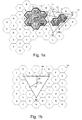
- Figs. 1a-c schematically illustrate elements of an existing cellular radio network (existing CRN) and elements of an introduced cellular radio network (introduced CRN) located in the same geographical area. Further, Figs. 1a-c illustrate steps performed in locating cell clusters of the introduced cellular radio network into the geographical area.
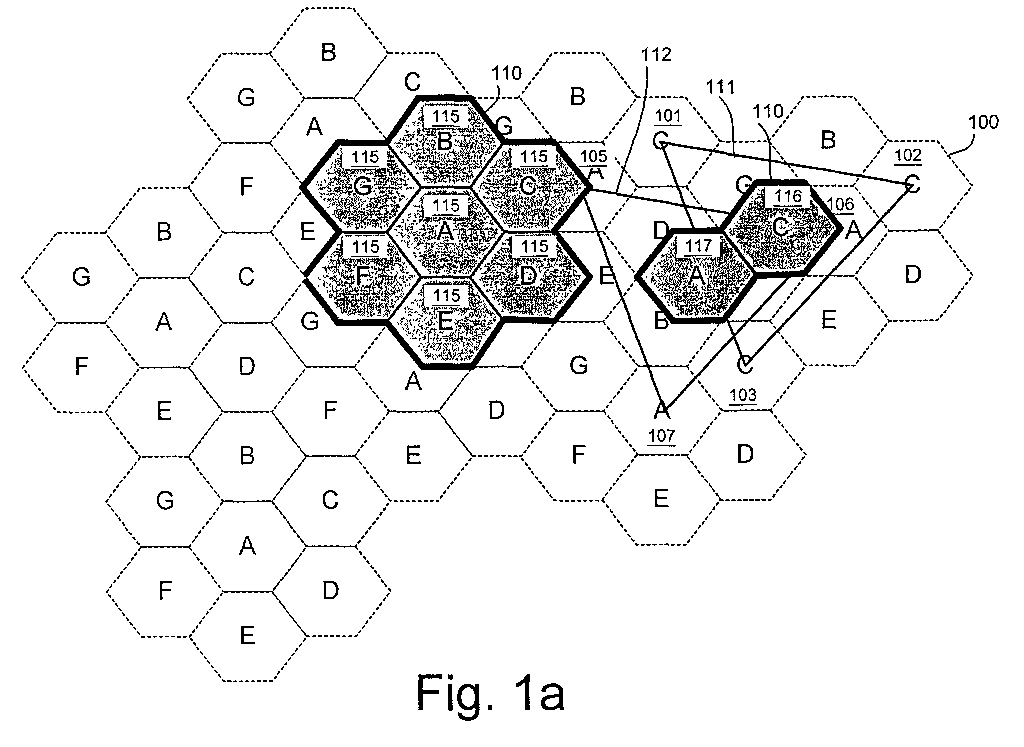
- Fig. 1a shows an existing cellular radio network 100 comprising a plurality of cells using transmission frequencies A-G of a frequency range allocated to the existing cellular radio network, e.g., according to a frequency plan as known in the art.
- the existing cellular radio network thus has a frequency reuse factor of 7.
- the cells are shown as hexagons, however, any other representation of cells may be chosen, such as squares, circles, etc..
- Fig. 1a shows exemplary portions of an introduced cellular radio network 110, which may be a network to be arranged or rearranged in the geographical area of the existing cellular network.
- the introduced cellular radio network includes seven exemplary cell clusters 115, each cell cluster in this embodiment consisting of a single cell.
- Each cell cluster of the introduced cellular radio network 110 uses one of the transmission frequencies A-G.
- the introduced cellular radio network 110 includes a cell cluster 116 using a frequency C and a cell cluster 117 using a transmission frequency A.
- Fig. 1a illustrates a triangle 111 for locating the cell cluster 116 and a triangle 112 for locating the cell cluster 117 of the introduced cellular radio network 110.
- the triangle 111 has corner points at cells 101, 102 and 103 of the existing cellular radio network 100, each of the cells 101-103 using a transmission frequency C.
- the triangle 112 has corner points at cells 105, 106 and 107 of the existing cellular radio network 100, each of the cells 105-107 using a transmission frequency A.
- the corner point of the triangles may be located in the center of the cells of the existing cellular radio network 100 or at any other location inside the cells of the existing cellular radio network 100.
- the introduced cellular radio network 110 preferably uses a first frequency range, as exemplary shown in Fig. 1a a frequency range A-G, and is arranged in a geographical area served by the existing cellular radio network 100, wherein the existing cellular radio network preferably has a frequency reuse factor larger than 1 and uses a second frequency range, as exemplary shown in Fig. 1a a frequency range A-G.
- the frequency ranges do not necessarily coincide, they may also only overlap or influence each other.
- the introduced cellular radio network 110 includes a plurality of cell clusters, each of the cell clusters including at least one cell.
- each cell cluster includes one cell.
- the center of each cell cluster is preferably located in an area defined by connecting at least two cells of the existing cellular radio network 100.
- the area is constituted by the triangles 111 and 112, obtained by connecting three cells of the existing cellular radio network 100.
- any other polygon may be used to define the area.
- the at least two cells of the existing cellular radio network 100 use the same transmission frequency, in the present case transmission frequency A, and the cell cluster of the introduced cellular radio network 110, to be located in the defined area, also uses the transmission frequency A.
- both a cell cluster of the introduced cellular radio network 110 and the at least two cells of the existing cellular radio network 100 used for defining the area are using the same transmission frequency.
- the existing cellular network 100 servicing the shown may not fully use the allocated spectrum of transmission frequencies A-G at each location in the shown area and the cell clusters of the introduced cellular radio network 110 may be advantageously located such that the frequencies used by cell clusters of the introduced cellular radio network at a particular location are not used by the existing cellular radio network in cells at this location.
- the existing cellular radio network 100 may in general be any cellular radio network having a cell structure for covering a given geographical area.
- the existing cellular radio network 100 may be a GSM network, a wideband CDMA network, a UTRAN network or broadcast network, e.g. a network for television broadcast, video on demand or similar such as DVB-T or similar.
- the existing cellular radio network 100 may generally have any frequency reuse factor larger than one, i.e. may reuse frequencies of an allocated set of frequencies according to any given scheme.
- the existing cellular radio network 100 uses transmission frequencies A-G, i.e. seven frequencies, and therefore is defined to have a frequency reuse factor of 7.
- A-G i.e. seven frequencies
- the transmission frequencies A-G used by the existing cellular radio network 100 and the introduced cellular radio network may be single frequencies, however, in practical cases, each of the transmission frequencies A-G may include a set of transmission frequencies or ranges of transmission frequencies.
- a transmission frequency is to be understood as including one or more frequencies.
- a transmission frequency may include a single carrier frequency and, if modulated with the transmission signal, cover a frequency range.
- Fig. 1a only shows a single layer of cells of the existing cellular radio network 100
- the existing cellular radio network 100 may employ multiple layers of cells, e.g. layers of macro cells and layers of micro cells.
- same transmission frequency is not to be construed as limited to mathematically identical frequencies, rather, the expression "same" transmission frequencies may also include frequencies which are mathematically different but influence each other, e.g. interfere. This may also include a transmission frequency which comprises frequency components which are integer multiples of the components of the another transmission frequency.
- transmission frequencies each include multiple frequencies or ranges of frequencies, e.g. radio channels, they may be considered to constitute "same" transmission frequencies, in case frequencies of, e.g. radio channels coincide.
- the introduced cellular radio network 110 may be any communication network, for example, a GSM network, a wideband CDMA network, a UTRAN network or broadcast network, e.g. a network for television broadcast, video on demand or similar such as DVB-T or similar.
- the illustrated exemplary introduced cellular radio network 110 includes a plurality of cell clusters 115, 116 and 117, each cell cluster using one of transmission frequencies A-G. Nevertheless, it is possible that the introduced cellular radio network 110 uses a sub-set of the transmission frequencies A-G or additional transmission frequencies, thus, the introduced cellular radio network 110 may use for example transmission frequencies A, B, C, H, K, L.
- the frequency ranges of the existing cellular radio network and the introduced cellular radio network may only overlap, i.e., that at least some frequencies are used by both the existing cellular radio network and the introduced cellular radio network.
- each cell cluster 115, 116, 117 of the introduced cellular radio network 110 includes one cell, however, a cell cluster may also include a plurality of cells.
- a cell cluster 115, 116, 117 of the introduced cellular radio network may have a frequency reuse factor of 1 or above. For example, in case each cell cluster has a plurality of cells and the frequency reuse factor is 1, each cell of the cell cluster will use the same transmission frequency.
- the cell clusters 115, 116 and 117 of the introduced cellular radio network 110 may be located in the same geographical area as the cells of the existing cellular radio network 100, however, at locations where the existing cellular radio network does not use the transmission frequency of a cluster of the introduced cellular radio network.
- a cell cluster of the introduced cellular radio network is preferably located in an area defined by connecting at least two cells of the existing cellular radio network 100 using the same transmission frequency, while the thus defined area preferably does not include any further cells of the existing cellular radio network 100 using the same transmission frequency as the transmission frequency of the cells used for defining the area.
- the cell cluster of the introduced cellular radio network located in the defined area also uses the same transmission frequency, i.e., the transmission frequency of the cells of the existing cellular radio network used for defining the area.
- a triangle 111 defines an area for an exemplary cell cluster 116 of the introduced cellular radio network 110, the cell cluster 116 using the transmission frequency C.
- the triangle 111 is obtained by connecting three cells of the existing cellular radio network using the transmission frequency C, in the shown case the three cells 101, 102 and 103 of the existing cellular radio network.
- the cell cluster 116 is located inside the thus defined area, i.e. triangle 111, and, as it may be taken from Fig. 1a the cell cluster 116 is now located in a geographical area at which the existing cellular radio network does not directly use transmission frequency C.
- the cell cluster 116 of the introduced cellular radio network may be located anywhere inside the area 111, however, it may be preferred that the cell cluster 116 is arranged inside the area 111 such that the cell cluster 116 using transmission frequency C does not overlap with cells of the existing cellular radio network 100 at the corner points of the triangle, i.e. cells 101, 102 and 103, also using transmission frequency C.
- a triangle 112 defines an area for an exemplary cell cluster 117 of the introduced cellular radio network 110, the cell cluster 117 using the transmission frequency A and lying adjacent to cell cluster 116.
- the triangle 112 is obtained by connecting three cells of the existing cellular radio network using the transmission frequency A, in the shown case the three cells 105, 106 and 107.
- the cell cluster 117 is located inside the thus defined area.
- the adjacent cell clusters 116 and 117 have the same size, different sizes for the clusters are possible, e.g. one of the clusters could have a larger radius, e.g. due to system requirements, terrain characteristics, subscriber density, interference conditions between the introduced cellular radio network and the existing cellular radio network and similar.
- the cell clusters 115 and further cell clusters may be arranged according to the outlined rules, in order to obtain a full coverage of a given geographical area.
- the area 111 for locating the cell cluster 116 is a triangle
- any polygon or shape such as a circle or ellipsoid may be employed.
- the polygon or shape may be a polygon having a given number of corners defined by connecting cells of the existing cellular radio network using the same transmission frequency, e.g. transmission frequency A, preferably to avoid that cells of the existing cellular radio network using the transmission frequency of the cells used for defining the polygon, are located inside the thus defined area.
- the polygon may be the smallest thus defined polygon of a given number of cells.
- the smallest polygon may be the polygon with the smallest area connecting any given number of cells using the same transmission frequency.
- the introduced cellular radio network 110 and the existing cellular radio network 100 may coexist in a given geographical area while using the same transmission frequencies. Since the cell clusters of the introduced cellular radio network and the cells of the existing cellular radio network, each using the same transmission frequency, are at least not overlapping, or have some guard space therebetween, particularly an interference from the introduced cellular radio network to the existing cellular radio network may be kept advantageously low. However, also an interference from the existing to the introduced cellular radio network may be kept advantageously low.
- the existing cellular radio network may be a broadcast network
- the introduced cellular radio network may be a network for bi-directional communication, such as a GSM network, CDMA network.
- GSM Global System for Mobile communications
- CDMA Code Division Multiple Access
- Fig. 1b showing an example of locating a cell cluster of the introduced cellular radio network.
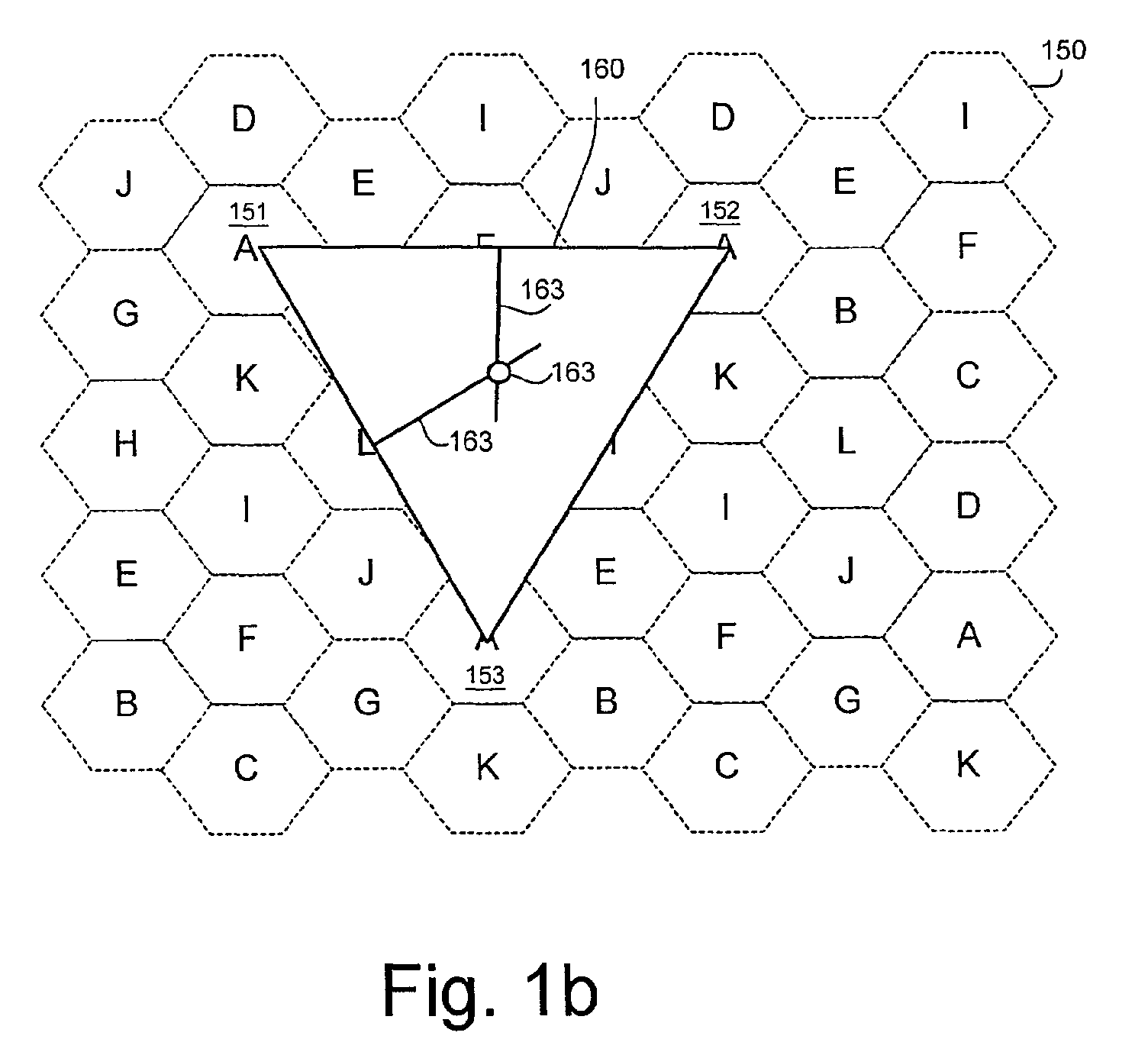
- Fig. 1b illustrates an existing cellular radio network 150, the cells of which using frequencies A-L, i.e. the existing cellular radio network 150 has a frequency reuse factor of 12.
- the existing cellular radio network 150 may be any cellular radio network for bi-directional or uni-directional communication such as a GSM network, UMTS, broadcast network for video on demand and similar, as outlined before with respect to Fig. 1a.
- the existing cellular radio network 150 of the present example has a frequency reuse factor of 12, however, this is an example only, any other frequency reuse factor may be present.
- Fig. 1b shows a triangle 160 for locating a cell cluster of the introduced cellular radio network using transmission frequency A.
- the corners of the triangle 160 are located in the centers of cells 151, 152 and 153 of the existing cellular radio network 150, the cells using a transmission frequency A.
- Fig. 1b an example is shown wherein the area is defined by the smallest triangle connecting the centers of 3 cells of the existing cellular radio network, wherein the cells of the existing cellular radio network are arranged to use the same transmission frequency. It is noted, that any other smallest polygon or shape may be defined connecting at least two cells of the existing cellular radio network arranged to use the same transmission frequency, such that no cell of the existing cellular radio network using this transmission frequency is located inside the polygon or shape.
- the triangle is an equilateral triangle.
- the obtained triangle may not necessarily be equilateral, e.g., due to terrain characteristics, subscriber density and similar.
- a cell cluster of the introduced cellular radio network is located in the defined area.
- the center of the cell cluster of the introduced cellular radio network is located at the center of the defined area, i.e. in the present embodiment located at the center 163 of the triangle 160, such that the distance between the cells of the existing cellular radio network used for obtaining the area and the cell cluster is as large as possible.
- the distance between cells and cell clusters using the same transmission frequency may be advantageously large, in the present case between cells 151, 152 and 153 using the transmission frequency A and a cell cluster using the transmission frequency A located at the center 163. In this case an interference between the introduced cellular radio network and the existing cellular radio network may be kept low.
- the center 163 may be obtained by determining the intersection of lines 161 and 162, the lines 161 and 162 being lines vertical to the corresponding sides of the triangle 160, intersecting the corresponding sides of the triangle 160 at their midpoint.
- a center of gravity or any other location inside the triangle 160 is determined, e.g. allowing reduced interference between the existing and introduced cellular radio network.
- any other cell cluster of the introduced cellular radio network may be located at similar locations, determined by triangles connecting three cells of the existing cellular radio network using the same transmission frequency, e.g. three cells using transmission frequency B, three cells using transmission frequency C, etc..
- the existing cellular radio network 150 and the introduced cellular radio network 110 may use the same set of transmission frequencies, it is also possible that only some frequencies are at the same time used by the existing cellular radio network and the introduced cellular radio network. It is further possible that the cells of the existing cellular radio network, used for determining the corner points of the triangle 160 are using at least one further transmission frequency and the cell cluster of the introduced cellular radio network, i.e. the cell cluster located at the center 163 also uses the at least one further transmission frequency. As already outlined with respect to the embodiment of Fig. 1a, locating cell clusters as outlined above may keep an interference advantageously low.
- Fig. 1c shows a further example of areas defined for locating cell clusters of the introduced cellular radio network.
- Fig. 1c shows an exemplary existing cellular radio network 170 having a frequency reuse factor of 12 and using transmission frequencies A-L.
- the existing cellular radio network may be a cellular radio network as outlined with respect to the previous embodiments.
- Fig. 1c shows an area 181 determined by connecting two cells 171 and 172 using a transmission frequency A of the existing cellular radio network 170. Even though the area 181 could be drawn as a single line, e.g., a line connecting the centers of cells 171 and 172 of the existing cellular radio network 170, the area 181 is drawn having a certain width determined by the width of the cells 171 and 172 or similar. Further, Fig. 1c shows a similar area 183 determined by connecting two cells 173 and 174 using a transmission frequency C of the existing cellular radio network 170.
- Fig. 1c shows a cell cluster 180 of the introduced cellular radio network, such as the cellular radio network 110 described with respect to Fig. 1a, the cell cluster using a transmission frequency A and the center of the cell cluster 180 being located in the area 181, and, Fig. 1c shows a cell cluster 182 using a transmission frequency C located in the area 183.
- the cell cluster 180 is located in an area which is defined by connecting a plurality of cells of the existing cellular radio network, in the present case two cells 171 and 172 of the existing cellular radio network, wherein the cells of the existing cellular radio network used for defining the areas and the respective cell cluster of the introduced cellular radio network use the same transmission frequency, e.g. the cells 171 and 172 used for defining the area 181 and the cell cluster 180 use the same transmission frequency, in the present case transmission frequency A.
- the cell cluster 180 may be located generally anywhere within the area 181, it may be preferred that the cell cluster 180 is located in the middle of the area 181, such that the distance between the cell cluster 180 and the cells 171 and 172 of the existing cellular radio network are identical, in order to achieve improved performance, i.e. reduced interference. The same applies to cell cluster 182.
- the size of the cell clusters may be chosen such that a seamless coverage is possible, as in the present case. Since the size of the cell clusters in the present example is exemplarily shown larger than the size of the cells of the existing cellular radio network, a sub-set of the transmission frequencies A-L of the existing cellular radio network will suffice in this case for establishing the introduced cellular radio network.
- the introduced cellular radio network may provide full geographical coverage, as the cell clusters may be arranged contiguously with one another.
- Fig. 2 shows an example of a cell cluster 200 of an introduced cellular radio network, e.g. the introduced cellular radio network 110 described with respect to the embodiment of Fig. 1a.
- the cell cluster 200 of Fig. 2 is assumed to include seven cells with reference numeral 210 using a transmission frequency A, i.e., the cell cluster 200 of Fig. 2 is assumed to have a frequency reuse factor of 1.
- the cell cluster 200 is shown to include seven cells 210, any other number of cells is possible and may also be altered during operation of the network.
- At least one of the cells 210 of the cell cluster 200 may itself be constituted by cell clusters.
- the size of the cell cluster 200 may preferably be chosen such that cell clusters of an introduced cellular radio network are arranged contiguously with each other and thus cover a given geographical area without gaps. Further, the size of the cells of the cell cluster may be different, e.g. larger cells may be placed into the center of the cell cluster.
- the number of cells of the introduced cellular radio network may be varied in accordance with an interference of the introduced cellular radio network with the existing cellular radio network, i.e. an interference introduced in the existing cellular radio network through the operation of the introduced cellular radio network. Since the transmission power required in a cellular radio network among other factors depends on the size of a cell, a transmission power can be reduced by reducing the cell size of the cell cluster 200 of the introduced cellular radio network. Thus, if for example an interference measured at a given location in the existing cellular radio network is high, caused by the introduced cellular radio network, the cell size of the cells of a cluster of the introduced cellular radio network may be reduced, and, in order to still fully cover a given geographical area, new cells may be included into the cell clusters.
- the process may be reverted and the cell size of the cells of the cell clusters may be increased.
- the size of the cell cluster 200 may be chosen such that a contiguous area may be covered by the introduced cellular radio network, however, the size of the cell clusters of the introduced cellular radio network at different locations may vary according to circumstances, e.g. terrain characteristics, subscriber density and similar. It may be preferred that the cell size of the introduced cellular radio network is limited such that the cell clusters do not overlap with cells of the existing cellular radio network using the same transmission frequency as the cell cluster.
- any other frequency reuse factor may be used. However, it should be ensured that a frequency of the introduced cellular radio network is not already used by the existing cellular radio network at the same location.
- cells at the periphery of the cluster may use a transmission frequency within the frequency range assigned to the introduced cellular radio network and not within the frequency range of the existing cellular radio network, in order to further reduce the interference between the networks.
- the size of a cell cluster of the introduced cellular radio network may be equal to the average size of the cells of the existing cellular radio network used for obtaining the area for locating the cell cluster.
- cell size of a cell at the periphery of a cluster of the introduced cellular radio network may be smaller than the cell size of a cell at the center of the cell cluster.
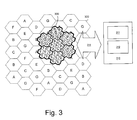
- Fig. 3 partially shows an example of an introduced cellular radio network 300, e.g. as outlined before.
- the introduced cellular radio network includes a plurality of cell clusters 301, each using at least one of the transmission frequencies A-G and having a plurality of cells.
- the cell clusters may be arranged as described with respect to the previous embodiments.
- An existing cellular radio network e.g. as outlined with respect to previous embodiments, is denoted with reference numeral 320, and coexists with the introduced cellular radio network in the same geographical area.
- Fig. 3 further shows control means 310 for dynamically adjusting characteristics of the introduced cellular radio network.
- the control means 310 includes interference measuring means 311 and adjusting means 312 for adjusting cell clusters.
- An arrow 314 illustrates control information exchanged between the cellular radio networks and the control means 310.
- the introduced cellular radio network 300 is illustrated with seven cell clusters 301, each cell cluster being constituted by seven cells. Each of the shown cell clusters uses one of the frequencies A-G. Further, the frequencies A-G are also used by the existing cellular radio network 320. However, this is an example only, any other scenario is possible, as outlined before.
- the exemplary cell clusters of the introduced cellular radio network 300 have a frequency reuse factor of 1, indicating that the cells of each cell cluster use the same transmission frequency.
- frequency reuse factors larger than 1 may be employed for cell clusters of the introduced cellular radio network.
- the cell clusters of the introduced cellular radio network may be arranged as it was outlined with respect to previous embodiments, i.e., each cell cluster is located in an area defined by connecting at least two cells of the existing cellular radio network 320, wherein the at least two cells of the existing cellular radio network are arranged to use the same transmission frequency, which is the transmission frequency also used by the cell cluster arranged in the thus defined area.
- the control means 310 is provided for dynamically adjusting parameters of the introduced cellular radio network, in order to maintain a proper coexistence between the existing cellular radio network and the introduced cellular radio network.
- the control means is arranged to adjust parameters of the introduced cellular radio network in order to maintain an interference from the introduced cellular radio network into the existing cellular radio network below a certain acceptable level.
- the acceptable level may be defined by the operator of the existing cellular radio network or may be a limit self-imposed by the operator of the introduced cellular radio network or may be a limit imposed by regulating authorities.
- an interference from the introduced cellular radio network in the existing cellular radio network i.e. an interference measured in the existing cellular radio network, caused by the introduced cellular radio network
- the parameters of the introduced cellular radio network may be adjusted such that the interference is reduced below the acceptable level.
- the parameters of the introduced cellular radio network may be adapted, as explained below, such that interference is increased but does not exceed the acceptable limit.
- an interference in the existing cellular radio network, caused by the introduced cellular radio network is measured at a plurality of locations, and that the parameters of the introduced cellular radio network are locally adapted to the measured interference level, i.e., the introduced cellular radio network may be locally adapted to interference conditions.
- an interference could be measured at statistically representative positions in the existing cellular radio network, for example located at base stations or mobile stations, determined according to subscriber density, terrain characteristics and similar.
- the interference may be measured on the downlink transmission path and on the uplink transmission path.
- the control means 310 may be constituted by a data processing unit or a plurality of data processing units communicating via a network or via dedicated communication links.
- the control means 310 includes the interference measuring means 311, at least for measuring the interference in the existing cellular radio network caused by the introduced cellular radio network. It is also possible that the control means only includes means for receiving values indicating an interference caused by the introduced cellular radio network. These interference measurements may for example be provided by the operator of the existing cellular radio network, e.g. using base stations and measurements on communication links.
- the control means 310 further includes means for adjusting the parameters of the introduced cellular radio network, e.g., for adjusting parameters of the cell clusters of the introduced cellular radio network.
- the cell parameters to be adjusted may be at least one of:
- the transmission power in a cell of a cell cluster of the introduced cellular radio network may depend on terrain characteristics, a number of subscribers, and similar. Further, it may be preferred that the adjusting means 312 for adjusting cell clusters is adapted to locally adjust the parameters of the cell clusters of the introduced cellular radio network in accordance with the interference measurements obtained. Thus, the adjusting means may be used to locally adjust the characteristics of the introduced cellular radio network. Thus, the adjusting means may reduce the size of at least one cell of at least one cell cluster of the introduced cellular radio network and/or introduce new cells into the at least one cell cluster, in case the measured interference from the introduced cellular radio network to the existing cellular radio network or the interference from the existing cellular radio network to the introduced cellular radio network is larger than a predetermined threshold.
- the adjusting means 312 for adjusting cell clusters may be arranged to determine cell clusters which are actually causing the measured interference at each measurement location and may be arranged to adjust the determined cell clusters in accordance with the measured interference, as outlined before. This may, for example, be achieved by determining the cell clusters in the neighborhood of the measurement locationlikely to cause interference. Further, by determining which transmission frequencies cause the interference, cell clusters causing interference may be identified.
- the cell site density of at least one cell cluster in an area the interference measurement is representative for could be adjusted accordingly. For example, a cell radius could be decreased and in order to maintain the size of the cell cluster or full geographical coverage, new cells could be introduced into a cell cluster.
- the size of a cell cluster could be reduced and/or further cell clusters could be introduced or neighboring cell clusters could be increased in size.
- an allowed maximum number of subscribers in a cell cluster could be reduced, in order to reduce the transmission power in a cell cluster, or further frequencies of a frequency range allocated for the introduced cellular radio network could be introduced into cell clusters, e.g., by introducing cells using further transmission frequencies.
- the interference measuring means may further include means for measuring the interference from the existing cellular radio network to the introduced cellular radio network, e.g. at statistically representative locations, as outlined before.
- the interference measurements of an interference in the introduced cellular radio network caused by the existing cellular radio network may be used to further adapt the characteristics of the introduced cellular radio network. For example, in case the interference from the existing cellular radio network to the introduced cellular radio network is above a certain threshold, meaning that operations of the introduced cellular radio network are deteriorated, a transmit power in the introduced cellular radio network may be adjusted so that a desired distribution of carrier to interference ratios is achieved in the introduced cellular radio network.
- means may be provided for measuring a propagation attenuation from the positions of measurement of an interference from the existing cellular radio network to the introduced cellular radio network, e.g. to a serving base station of the introduced cellular radio network.
- an upper threshold for a maximum acceptable interference from the introduced cellular radio network to the existing cellular radio network is defined, and that a lower threshold for the interference from the introduced cellular radio network to the existing cellular radio network is defined.
- the parameters of the introduced cellular radio network may be adjusted such that the interference is below the upper threshold.
- the parameters of the introduced cellular radio network are only adjusted, if the measured interference decreases below the lower threshold, in which case the parameters of the introduced cellular radio network are adjusted such that the interference slightly rises.
- the thus introduced hysteresis avoids a permanent control operation, control operations may only be performed, if the measured interference is above the upper threshold or below the lower threshold. It is noted that the described hysteresis may be applied in both cases, i.e., in case the interference from the introduced cellular radio network to the existing cellular radio network is measured, and in case the interference from the existing cellular radio network to the introduced cellular radio network is measured.
- a computer readable medium may be provided having a program recorded thereon, where the program is to make a computer or system of data processing devices execute functions of the above described elements.
- a computer readable medium can be a magnetic or optical or other tangible medium on which a program is recorded, but can also be a signal, e.g. analog or digital, electromagnetic or optical, in which the program is embodied for transmission.
- a computer program product may be provided comprising the computer readable medium.
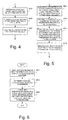
- Fig. 4 shows a sequence of steps performed for arranging or re-arranging cell clusters of the introduced cellular radio network in a given geographical area which is already covered by an existing cellular radio network, for example as performed by the control means described with respect to Fig. 3.
- an area is determined by connecting at least two cells of the existing cellular radio network, the at least two cells using the same transmission frequency.
- a corridor may be defined, e.g. determined by the width of the cells of the existing cellular radio network.
- a triangle is obtained, which preferably does not cover any other cells of the existing cellular radio network using the transmission frequency of the cells used for defining the triangle, i.e. cells at the corners of the triangle. Further, four or more cells of the existing cellular radio network may be used to determine the area.
- step S402 at least one cell of the cellular radio network to be introduced is arranged in a cell cluster, and in a step S403 the center of the cell cluster is located in the area determined in step S401.
- the cell cluster to be located in the determined area will be arranged to use the same transmission frequency as the cells of the existing cellular radio network used for determining the area.
- the number of cells of the cell cluster to be introduced into the area may be determined in accordance with interference measurements or estimated interference from the cell cluster of the cellular radio network to be introduced to the cells of the existing cellular radio network.
- the interference will depend on the size of the cells of the cell cluster, in case the interference is high, a larger number of cells may be arranged in a cell cluster. Further, the number of cells in a cell cluster may also be determined by the number of subscribers, terrain characteristics and similar.
- the dependency between the cumulative power emitted from the cell cluster of the introduced cellular radio network and the cell size of a cluster of the introduced cellular radio network may be used, as it may be derived as follows.
- Equation 2 it is assumed that the cell has a circular border and that the base station is located at the center of the circle. It is furthermore assumed that the users are randomly distributed in the cell with uniform distribution.
- the transmit power P is an average power over dimensions time t, user u and user distribution z.
- P (z, u, t) is denoted the power used for a given user distribution z at a time t for a user u.
- P (z, u, t) may be the power used by the mobile station of the user, when the uplink connection from the user to the base station is considered, or it may be the power used by the base station for the connection to the mobile station of the user, if the downlink is considered.
- the function f(k) depends on the radio access technology of the introduced cellular radio network.
- f(k) For system like UTRAN with user individual transmit power control that regulates the carrier to interference ratio at the user to a constant (possibly user individual) target, f(k) approaches a positive minimal value a for k ⁇ 0 (a > 0 is caused by the power required for broadcast control channels) and the first and second derivative of f(k) is positive, as outlined in Kimmo Hiltunen, Riccardo de Bernardi: WCDMA capacity estimation; VTC 2000 spring, pages 992-996, May 2000, Tokyo, Japan. However, this is an example only.
- f(k) may also increase with the interference floor caused from the existing cellular radio network to the introduced cellular radio network, and thus the interference from the existing cellular radio network to the introduced cellular radio network influences P.
- the cell radius r 2 should be adapted accordingly.
- the limit on the largest acceptable P tot may be determined by the propagation attenuation from the cell cluster of the introduced cellular radio network to a cell of the existing cellular radio network using the same frequency and by a tolerable interference from the introduced cellular radio network to the existing cellular radio network.
- the cell cluster parameters may be determined or adjusted.
- the adaptation of the transmit power and the cell site density of the introduced cell cluster i.e. the number of cells of the introduced cell cluster and its size has to be performed in dependency on each other.
- An increase of the number of cells allows a decrease of the transmit power and enables a decrease of the cumulative power that emits from the cell cluster.
- the cumulative power of a cell cluster determines the interference caused to the existing cellular radio network.
- the cell site density will preferably be set to the smallest value for which the interference is still acceptable.
- the cell cluster uses one transmission frequency, i.e. should be designed for a frequency reuse factor 1 or must at least be able to achieve acceptable performance for this reuse factor, larger reuse factors for the cell cluster are possible. In this case for each frequency it could be decided separately if it can be used in the cluster, i.e., whether it fulfils the above-stated requirements.
- Steps S401, S402 and S403 may be repeated for a plurality of cell clusters of the introduced cellular radio network to be arranged adjacent to one another in order to obtain a full coverage of a given geographical area.
- the size of a cell cluster also depends on an overall number of cell clusters to be introduced and their size. It may be desirable to adjust the size of a cell cluster approximately equal to the size of a cell of the existing cellular radio network, in which case an even distribution of cell clusters may be achieved.
- a plurality of cellular radio networks may be arranged according to the described method, i.e., the cellular radio network referred to as existing cellular radio network may already be a cellular radio network introduced into another existing cellular radio network.
- Fig. 5 outlines a sequence of steps for arranging or re-arranging a number of cell clusters of the cellular radio network to be introduced in a geographical area which is already covered by an existing cellular radio network.
- a first step S501 the center of an area of a smallest polygon obtained by connecting at least two cells of the existing cellular radio network with the same transmission frequency is determined.
- the center may be a location at midpoint between the two cells used for defining the polygon.
- a triangle will be obtained, which, in case the cells of the existing cellular radio network are evenly distributed, will be equilateral.
- the requirement of the smallest polygon or shape connecting cells using the same transmission frequency assures that no other cells of the existing cellular radio network using the transmission frequency of cells used for determining the polygon are located inside the area of the polygon or shape.
- the requirement of determining the center assures that the distance from the center to the cells of the existing cellular radio network at the corner points of the polygon is as large as possible for all used cells of the existing cellular radio network.
- a center of gravity of the polygon is determined, or any other point in the area of the polygon allowing a large distance between the determined point and the cells at the corner points of the polygon. Any other point inside the area may be defined which provides a good tradeoff between the obtained distances between the determined point and the cells at the corners of the polygon.
- a step S502 the center of a cell cluster using the same transmission frequency as the cells used for determining the polygon is located at the point inside the area determined in step S501, e.g., the center of the area of the polygon, the center of gravity or similar.
- a step S503 the size of the introduced cell cluster is adjusted such that it preferably does not overlap with cells of the existing cellular radio network at the corner points of the polygon which are using the same transmission frequency as the cell cluster. While this determines a preferred maximum size of a cell cluster, a practical size of a cell cluster may be chosen smaller than the defined rule, e.g., within the range of the sizes of the cells of the existing cellular radio network.
- a step S504 the above steps S501-S503 are repeated in order to arrange a plurality of cell cluster adjacent to each other for entirely covering the given geographical area.
- the described method allows to arrange cell clusters containing at least one cell of the introduced cellular radio network in a geographical area which is already covered by cells of an existing cellular radio network while avoiding an interference between the cellular radio networks to be maintained at a tolerable level.
- the cell clusters i.e., the cell site density, transmission power and similar may be adjusted, as outlined before with respect to the embodiment of Fig. 4.
- Fig. 6 describes in further detail a method to adjust the cell clusters of the introduced cellular radio network in order to maintain an overall interference between the cellular radio networks within a tolerable level.
- the steps outlined with respect to Fig. 6 may be performed during arranging the cell clusters, i.e., during establishing the cellular radio network to be introduced, or may be used in adjusting the cell clusters of the introduced cellular radio network to changing requirements, e.g. in case the existing cellular radio network is changed by altered circumstances such as user density, environmental changes such as buildings and similar.
- the steps may be performed, for example by the control means described with respect to Fig. 3.
- the steps may be used to adjust the introduced cellular radio network in case conditions of the introduced cellular radio network change, e.g. subscriber number, terrain changes as before and similar.
- a first step S601 the interference from the introduced cellular radio network to the existing cellular radio network is measured, preferably at selected locations, e.g. defined by base stations or selected according to statistical considerations.
- the interference may be measured at the selected locations by the operator of the existing cellular radio network or by any other entity and may be provided to the operator of the introduced cellular radio network.
- step S602 it is preferably determined which cell clusters actually cause the measured interference, measured in step S601, i.e., which cell clusters of the introduced cellular radio network are responsible for the interference measured at at least one selected location. This may be for example a number of cell clusters in the vicinity of the measurement location, e.g. cell clusters using a particular frequency or similar.
- a step S603 the size of the cells of the cell clusters determined in step S602 may be reduced and/or new cells may be introduced into the cell clusters of the introduced cellular radio network, in order to maintain a full coverage of the given geographical area. Further, it is possible that the size of a particular cell cluster is reduced, and further cell clusters are introduced or neighboring cell clusters are increased in size, according to further interference measurements.
- An increased interference may be due to increased numbers of subscribers in one or both of the existing cellular radio network and introduced cellular radio network, or may be due to terrain changes or other conditions such as weather, subscriber activity and similar.
- Steps S601-S603 may be repeated for a larger number of locations, if necessary, in order to adjust all areas of the introduced cellular radio network according to interference measurements.
- the threshold for the interference may be set by an operator of the existing cellular radio network, by a regulating authority or may be self-imposed by the operator of the introduced cellular radio network.
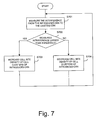
- Fig. 7 shows a sequence of steps of adjusting the cell clusters of the introduced cellular radio network, e.g., in a particular area determined to influence an interference measurement taken at a selected geographical location.
- a first step S701 the interference from the introduced cellular radio network to the existing cellular radio network is measured, e.g. at a selected location, as outlined with respect to previous embodiments.
- step S702 it is determined whether the measured interference is larger than a threshold and if the decision in step S702 is "yes", in a step S703 the cell site density of clusters of the introduced cellular radio network is increased, i.e., new cells may be introduced into the cell clusters and/or the cell size of the cells of the cell clusters may be reduced . Since this may cause a reduced transmit power of the cells and an reduced overall transmit power of the cell cluster, step S703 may reduce the interference measured.
- step S704 the cell site density of the cell clusters of the introduced cellular radio network is decreased, e.g., cells may be removed from cell clusters and/or a transmit power may be increased in order to increase the radius of a cell of the cell cluster.
- step S703 and S704 the flow returns to step S701, and the adjustment step is repeated.
- the steps outlined with respect to Fig. 7 may be repeated for a plurality of selected geographical locations, as outlined before.
- the adaptation process described in Fig. 7 allows to maintain the interference from the introduced cellular radio network to the existing cellular radio network around the level of the defined threshold and thus allows to maintain proper operation of both networks.
- the introduced cellular radio network may be designed to employ macro diversity techniques. However in this case there is the drawback that further borders between cells of the introduced cellular radio network are established that use different frequencies. Applying macro diversity with different frequencies may be implemented using two separate receivers, which, however, is expensive.
- the invention allows to introduce macro diversity at reduced costs.
- the distance from a cell border, within which macro diversity is effective, depends on the cell size and consequently the size of the border areas lacking macro diversity are reduced with the cell size of the cell clusters. However, cells may not be arbitrarily small.
- the border cells may use one frequency of a frequency group Y, which is a frequency group used by an adjacent cell cluster, as a replacement for one frequency of the frequency group X.
- the same may be applied for all cells of cell clusters at borders between two cell clusters using any other pair of frequency groups than X and Y.
- a first cluster may be arranged to use a first set of transmission frequencies, and a second cluster located adjacent to the first cluster may be arranged to use a second set of frequencies. And at least one cell at the periphery of the first cell cluster may be arranged to use at least one transmission frequency of the second set of transmission frequency and at least one cell at the periphery of the second cell cluster may be arranged to use at least one transmission frequency of the first set of transmission frequencies and adjacent cells may use at least one identical transmission frequency.
- the method steps for locating and adjusting the cell clusters of the introduced cellular radio network as well as steps for measuring an interference may be implemented by programs including coded instructions for execution on a data processing unit or a plurality of data processing units connected by a network or by dedicated communication links.
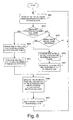
- Fig. 8 describes a further sequence of steps for arranging and/or adjusting cell clusters of the introduced cellular radio network to an existing cellular radio network in a given geographical area.
- a first step S801 the interference from the introduced cellular radio network to the existing cellular radio network is measured, e.g. at a selected location, as outlined before.
- a step S802 it is determined whether the measured interference is larger than a predefined upper threshold, e.g. defined as outlined before by the operators of the networks or a regulating authority.
- step S803 the size of cells of the cell clusters of the introduced cellular radio network may be reduced and/or a transmit power may be reduced.
- the cell clusters to be adjusted according to step S803 may be determined beforehand, e.g., cell clusters which cause the measured interference, e.g., cell clusters in the vicinity of a measurement location for measuring interference and/or cell clusters using specific frequencies in a particular area.
- a step S804 since the size of the cells of the cell clusters are reduced, new cells are introduced into the cell clusters, in order to maintain four geographical coverage.
- step S805 it is determined whether the interference is below a lower determined threshold, e.g. defined as before.
- step S805 the decision is "no"
- the flow returns to step S801.
- step S806 the size of the cells of the cell clusters is increased and/or the transmit power is increased.
- the cell clusters may be determined as outlined with respect to step S803.
- step S807 cells from the cell clusters of the introduced cellular radio network are removed, as after increasing the size of cells a reduced number of cells is necessary for full coverage of a geographical area.
- the interference from the existing cellular radio network to the introduced cellular radio network may be measured and a propagation attenuation at selected locations from the measurement positions to serving base stations of the introduced cellular radio network may be measured.
- the transmit power in the introduced cellular radio network may be adapted in accordance with the measurements of step S808.
- Interference determining means may be provided for receiving a value indicating an interference and from the existing cellular radio network to the introduced cellular radio network; and the adjusting means may reduce the size of at least one cell of at least one cell cluster of the introduced cellular radio network and introduce new cells into the at least one cell cluster, in case the measured interference from the existing cellular radio network to the introduced cellular radio network is larger than a predetermined threshold.
- the adjusting means may further increase the size of at least one cell of at least one cell clusters and remove at least one cell from at least one cell cluster of the introduced cellular radio network, in case the measured interference from the existing cellular radio network to the introduced cellular radio network is smaller than another predetermined threshold.
- steps S808 and S809 may be optional. After step S809 the flow returns to step S801.
- the method steps outlined with respect to Fig. 8 allow to adjust the introduced cellular radio network to meet interference requirements, while avoiding a continuous adaptation process by introducing a hysteresis between the upper and lower defined threshold. In case the interference is between the upper and lower threshold, no adaptation step is required, reducing operational costs. Further, the steps described in Fig. 8, particularly steps S808 and S809 allow to adjust the cell clusters of the introduced cellular radio network to interference measurements of an interference from the existing cellular radio network to the introduced cellular radio network, in order to avoid deteriorated operation of the introduced cellular radio network.
- a computer readable medium may be provided having a program recorded thereon, where the program is to make a computer or system of data processing devices execute functions of the above described method steps.
- a computer readable medium can be a magnetic or optical or other tangible medium on which a program is recorded, but can also be a signal, e.g. analog or digital, electromagnetic or optical, in which the program is embodied for transmission.
- a computer program product may be provided comprising the computer readable medium.
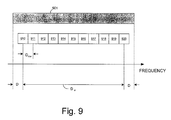
- Fig. 9 shows an embodiment where the radio channel bandwidth of the existing cellular radio network is considerably larger than the bandwidth of a radio channel of the introduced cellular radio network.
- Reference numeral 901 in Fig. 9 exemplary illustrates a radio channel bandwidth of the existing cellular radio network.
- Fig. 9 shows radio channels of the introduced cellular radio network 910-920 adjacent to one another. In Fig. 9 frequency is denoted in horizontal direction.
- a transmission frequency as described with respect to the previous embodiments may include at least one radio channel.
- the radio channels 910-920 may be obtained as outlined in the following.
- D denotes a frequency separation from the smallest carrier frequency of the cell cluster of the introduced cellular radio network, in this example including radio channels 910-920, to the lower limit of the radio channel bandwidth of the existing cellular radio network, and, likewise the frequency separation from the largest carrier frequency of the cell cluster of the introduced cellular radio network to the upper limit of the radio channel bandwidth of the existing cellular radio network.
- D min denotes a frequency separation between the carrier frequencies of adjacent radio channels, i.e. transmission frequencies of the cell cluster of the introduced cellular radio network.
- D sl denotes the resulting frequency separation between the smallest and the largest transmission frequency of the cell cluster and is an integer multiple of the given minimum carrier frequency separation of the introduced cellular radio network.
- the radio channel bandwidth of the existing cellular radio network is more than twice the radio channel network of the introduced cellular radio network, then it may be unreasonable to reuse only a single carrier or transmission frequency per transmission frequency of the existing cellular radio network in a cell cluster of the introduced cellular radio network. Instead, it may be beneficial to use multiple carrier frequencies for the cell cluster of the introduced cellular radio network.
- the individual carrier or transmission frequencies may be allocated as shown in Fig. 9, i.e. adjacent to each other in a certain frequency range.
- the frequency separation D from the smallest transmission frequency of the cell cluster to the lower limit of the radio channel bandwidth of the existing cellular radio network and likewise from the largest transmission frequency of the cell cluster to the upper limit of the channel bandwidth of the existing cellular radio network is chosen such that it is larger than a given minimum required separation D min illustrated in Fig. 9.
- the frequency separation D may be further chosen such that the resulting frequency separation D sl between the smallest and largest carrier frequency of the cell cluster is an integer multiple of the given minimum carrier frequency separation of the introduced cellular radio network.
- N D sl /D min - 1
- further carrier frequencies f n may be chosen, each at an individual offset of n-D min from the smallest carrier frequency of the cell cluster of the introduced cellular radio network.
- the invention described in the above embodiments or individual aspects thereof may be utilized in various ways.
- the invention may be employed in a maintenance tool to dynamically adjust a cellular radio network during operation and a simulation tool to determine in advance, i.e. before implementing a change to a cellular radio network, effects of changes of parameters such as transmission power of an introduced cellular radio network, e.g., based on conditions such as subscriber density and terrain characteristics.
- the invention may also be used in a network planning tool to design a cellular radio network to be introduced into an existing cellular radio network.
- the functions of the embodiments of the invention may be realized by at least one computer program to be executed on a data processing device or a network of data processing devices.
- the at least one computer program may be stored on at least one computer readable medium, which may be a magnetic or optical or other tangible medium on which a program is recorded, but can also be a signal, e.g. analog or digital, electromagnetic or optical, in which the program is embodied for transmission.
Landscapes
- Engineering & Computer Science (AREA)
- Computer Networks & Wireless Communication (AREA)
- Signal Processing (AREA)
- Mobile Radio Communication Systems (AREA)
- Radio Relay Systems (AREA)
- Aerials With Secondary Devices (AREA)
Abstract
Cellular radio network and method of arranging a cellular
radio network in a geographical area which is already covered
by an existing cellular radio network, wherein cell clusters
of the cellular radio network to be introduced and using a
specific transmission frequency are located in areas
determined by connecting at least two cells of the existing
cellular radio network using the specific transmission
frequency, and wherein the cell clusters are arranged such
that they do not overlap with the cells of the existing
cellular radio network. By locating the cell clusters inside
the determined area, interference from the introduced
cellular radio network to the existing cellular radio network
may be kept low. In case interference from the introduced
cellular radio network to the existing cellular radio network
rises above an acceptable level, the cell clusters of the
introduced cellular radio network may be adjusted by reducing
the cell size of cell clusters of the introduced cellular
radio network, and by introducing new cells into cell
clusters of the introduced cellular radio network. Likewise,
in case the interference becomes lower than a lower
threshold, cell sizes of cell clusters of the introduced
cellular radio network may be increased and cells may be
removed. The invention allows to reuse frequencies of an
existing cellular radio network by an introduced cellular
radio network in the same geographical area.
Description
The invention relates to a cellular radio network and to a
method of arranging a cellular radio network in a
geographical area.
Cellular radio networks are increasingly used to provide a
variety of communication and information services to users.
In many cases communication networks coexist with each other
in a given geographical area and simultaneously provide
services to subscribers.
A cellular radio network generally uses a certain partition
of the available spectrum for providing services. However, as
the available spectrum is limited, the usage of the spectrum
is normally subject to regulation and each communication
network will have a certain partition of the spectrum
allocated for usage. In this case it needs to be assured that
the coexisting cellular radio networks, or in general any
radio networks, do not interfere with each other above a
certain tolerable level.
One straightforward approach to avoid interference between
cellular radio networks is to exclusively allocate a certain
partition of the spectrum in one geographical area. Each
cellular radio network may then provide communication
services in the allocated partition of the spectrum.
Interference may be further reduced by guard bands introduced
between the allocated partitions of the spectrum.
A frequency range allocated to a cellular radio network may
be a continuous range of frequencies, or certain partitions
of the spectrum may be combined to a frequency range for one
cellular radio network. Therefore, a frequency range of a
cellular radio network may include a single sequence of
frequencies or multiple discontinuous sequences of
frequencies, or a set of individual frequencies.
While this approach may work well up to a certain number of
subscribers or up to a certain number of networks, in case
the number of networks or subscribers needs to be further
increased, the available spectrum may not suffice for
introducing new cellular radio networks or providing services
to further subscribers.
In this case it is desirable to be able to introduce a
further cellular radio network in an geographical area
already covered by at least one cellular radio network,
wherein the introduced cellular radio network may reuse
frequencies already used in the existing cellular radio
network.
It is therefore the object of the invention to provide a
cellular radio network in a geographical area covered by
another cellular radio network, wherein both cellular radio
networks can provide communication services in at least
overlapping frequency ranges.
This object of the invention is solved by the features of
claims 1, 10, 18 and 27.
A cellular radio network constituting an introduced cellular
radio network and using a first frequency range, arranged in
a geographical area served by an existing cellular radio
network, the existing cellular radio network using a second
frequency range at least overlapping the first frequency
range, comprises a plurality of cell clusters, each cell
cluster including at least one cell, the center of each cell
cluster being located in an area defined by connecting at
least two cells of the existing cellular radio network, the
at least two cells being arranged to use the same
transmission frequency; and wherein both the cell cluster of
the introduced cellular radio network and the at least two
cells of the existing cellular radio network are arranged to
use the same transmission frequency.
The invention allows an improved efficiency in using an
available frequency spectrum in a geographical area served by
multiple cellular radio networks. Further, an interference
between networks using the same transmission frequencies in
the same geographical area can be reduced and/or a larger
number of subscribers may be served.
Advantageously, the center of each cell cluster may be
located in an area of a smallest polygon defined by
connecting at least two cells of the existing cellular radio
network, and both the cell cluster of the introduced cellular
radio network and the at least two cells of the existing
cellular radio network may use the same transmission
frequency.
The area may be defined by the smallest triangle connecting
the centers of three cells of the existing cellular radio
network, the three cells using the same transmission
frequency.
The at least two cells of the existing cellular radio network
may use at least one further transmission frequency and the
cell cluster of the introduced cellular radio network may use
the at least one further transmission frequency.
Further, interference determining means may be provided for
receiving a value indicating an interference from the
introduced cellular radio network to the existing cellular
radio network; and adjusting means may be provided for
reducing the size of at least one cell of at least one cell
cluster of the introduced cellular radio network and for
introducing new cells into the at least one cell cluster, if
the measured interference from the introduced cellular radio
network to the existing cellular radio network is larger than
a predetermined threshold.
Still further, interference determining means may be provided
for receiving a value indicating an interference from the
existing cellular radio network to the introduced cellular
radio network; and the adjusting means may be arranged for at
least one of - to increase a transmission power in the cells
of the cell clusters, and - to reduce the size of at least
one cell of at least one cell cluster of the introduced
cellular radio network and to introduce new cells into the at
least one cell cluster, if the measured interference from the
existing cellular radio network to the introduced cellular
radio network is larger than a predetermined threshold.
Cells at the periphery of the cluster may use at least one
transmission frequency within the first frequency range and
not within the second frequency range.
The cell clusters of the introduced cellular radio network
may be arranged such that they do not overlap with cells of
the existing cellular radio network which are using the same
transmission frequency as the cell cluster.
Moreover, a first cluster may use a first set of transmission
frequencies; a second cluster may be located adjacent to the
first cluster may use a second set of transmission
frequencies; and the cells at the periphery of the first
cluster may be arranged to use at least one transmission
frequency of the second set of transmission frequencies and
the cells at the periphery of the second cluster may be
arranged to use at least one transmission frequency of the
first set of transmission frequencies and wherein adjacent
cells use at least one identical transmission frequency.
An apparatus for adjusting cell parameters of cells of a
plurality of cell clusters of a introduced cellular radio
network using a first frequency range, each cell cluster
including at least one cell, the introduced cellular radio
network being arranged in a geographical area served by an
existing cellular radio network, the existing cellular radio
network using a second frequency range at least overlapping
the first frequency range, comprises: interference
determining means for receiving a value indicating an
interference from the introduced cellular radio network to
the existing cellular radio network; and adjusting means for
adjusting the size of at least one cell of at least one cell
cluster of the introduced cellular radio network and for
adjusting the number of cells of the at least one cell
cluster in dependence on the measured interference from the
introduced cellular radio network to the existing cellular
radio network.
Advantageously, the adjusting means may be adapted to reduce
the size of at least one cell of at least one cell cluster of
the introduced cellular radio network and to introduce at
least one cell into the at least one cell cluster, in case
the measured interference from the introduced cellular radio
network to the existing cellular radio network is larger than
a first predetermined threshold; and the adjusting means may
be adapted to increase the size of at least one cell of at
least one cell cluster of the introduced cellular radio
network and for removing at least one cell from the at least
one cell cluster, in case the measured interference from the
introduced cellular radio network to the existing cellular
radio network is smaller than a second predetermined
threshold.
The interference determining means may be adapted to receive
values indicating the interference from the introduced
cellular radio network to the existing cellular radio network
at a plurality of measurement locations, and the adjusting
means may be adapted to determine at least one cell cluster
causing the measured interference at each measurement
location and to adjust the determined cell clusters in
accordance with the measured interference.
A method of arranging a introduced cellular radio network
using a first frequency range in a geographical area served
by an existing cellular radio network, the existing cellular
radio network using a second frequency range at least
overlapping the first frequency range, comprises arranging at
least one cell of the introduced cellular radio network in a
cell cluster; determining an area defined by connecting at
least two cells of the existing cellular radio network, the
at least two cells being arranged to use the same
transmission frequency; arranging the cell cluster in the
determined area; wherein both the cell cluster of the
introduced cellular radio network and the at least two cells
of the existing cellular radio network are arranged to use
the same transmission frequency.
Another method of adjusting cell parameters of cells of a
plurality of cell clusters of a introduced cellular radio
network using a first frequency range, each cell cluster
including at least one cell, the introduced cellular radio
network being arranged in a geographical area served by an
existing cellular radio network, the existing cellular radio
network using a second frequency range at least overlapping
the first frequency range, comprises: receiving a value
indicating an interference from the introduced cellular radio
network to the existing cellular radio network; and adjusting
the size of at least one cell of at least one cell cluster of
the introduced cellular radio network and adjusting the
number of cells of the at least one cell cluster depending on
the measured interference from the introduced cellular radio
network to the existing cellular radio network.
The invention may employ the fact that a cellular radio
network servicing a given geographical area does not use the
allocated spectrum to its full potential at each and every
location in the given geographical area. The cells of the
cellular radio network to be introduced into a geographical
area already served by an existing cellular radio network may
advantageously be located such that the frequencies used by
the introduced cellular radio network at a particular
location are not used by the existing cellular radio network
in overlapping cells at the same location.
Thus, the introduced cellular radio network may reuse
frequencies of an existing cellular radio network in the same
geographical area.
Further, the invention may advantageously allow to adjust the
operational parameters of the introduced cellular radio
network to avoid an interference from the introduced cellular
radio network into the existing cellular radio network above
a certain tolerable limit.
Further advantageous features of the invention are recited in
further dependent claims.
Figs. 1a-c schematically illustrate elements of an existing
cellular radio network (existing CRN) and elements of an
introduced cellular radio network (introduced CRN) located in
the same geographical area. Further, Figs. 1a-c illustrate
steps performed in locating cell clusters of the introduced
cellular radio network into the geographical area.
Fig. 1a shows an existing cellular radio network 100
comprising a plurality of cells using transmission
frequencies A-G of a frequency range allocated to the
existing cellular radio network, e.g., according to a
frequency plan as known in the art. In the shown embodiment,
the existing cellular radio network thus has a frequency
reuse factor of 7. In the embodiment the cells are shown as
hexagons, however, any other representation of cells may be
chosen, such as squares, circles, etc..
Further, Fig. 1a shows exemplary portions of an introduced
cellular radio network 110, which may be a network to be
arranged or rearranged in the geographical area of the
existing cellular network. The introduced cellular radio
network includes seven exemplary cell clusters 115, each cell
cluster in this embodiment consisting of a single cell. Each
cell cluster of the introduced cellular radio network 110
uses one of the transmission frequencies A-G. Further, the
introduced cellular radio network 110 includes a cell cluster
116 using a frequency C and a cell cluster 117 using a
transmission frequency A.
Still further, Fig. 1a illustrates a triangle 111 for
locating the cell cluster 116 and a triangle 112 for locating
the cell cluster 117 of the introduced cellular radio network
110.
The triangle 111 has corner points at cells 101, 102 and 103
of the existing cellular radio network 100, each of the cells
101-103 using a transmission frequency C. The triangle 112
has corner points at cells 105, 106 and 107 of the existing
cellular radio network 100, each of the cells 105-107 using a
transmission frequency A.
The corner point of the triangles may be located in the
center of the cells of the existing cellular radio network
100 or at any other location inside the cells of the existing
cellular radio network 100.
The introduced cellular radio network 110 preferably uses a
first frequency range, as exemplary shown in Fig. 1a a
frequency range A-G, and is arranged in a geographical area
served by the existing cellular radio network 100, wherein
the existing cellular radio network preferably has a
frequency reuse factor larger than 1 and uses a second
frequency range, as exemplary shown in Fig. 1a a frequency
range A-G. However, the frequency ranges do not necessarily
coincide, they may also only overlap or influence each other.
Further, the introduced cellular radio network 110 includes a
plurality of cell clusters, each of the cell clusters
including at least one cell. In the shown embodiment each
cell cluster includes one cell. The center of each cell
cluster is preferably located in an area defined by
connecting at least two cells of the existing cellular radio
network 100. In the present case, the area is constituted by
the triangles 111 and 112, obtained by connecting three cells
of the existing cellular radio network 100. However, it is
possible that any other polygon may be used to define the
area. The at least two cells of the existing cellular radio
network 100 use the same transmission frequency, in the
present case transmission frequency A, and the cell cluster
of the introduced cellular radio network 110, to be located
in the defined area, also uses the transmission frequency A.
Thus, both a cell cluster of the introduced cellular radio
network 110 and the at least two cells of the existing
cellular radio network 100 used for defining the area, are
using the same transmission frequency.
As it can be seen in Fig. 1a, the existing cellular network
100 servicing the shown may not fully use the allocated
spectrum of transmission frequencies A-G at each location in
the shown area and the cell clusters of the introduced
cellular radio network 110 may be advantageously located such
that the frequencies used by cell clusters of the introduced
cellular radio network at a particular location are not used
by the existing cellular radio network in cells at this
location.
In the following, the elements shown in Fig. 1a are outlined
in further detail.
The existing cellular radio network 100 may in general be any
cellular radio network having a cell structure for covering a
given geographical area. For example, the existing cellular
radio network 100 may be a GSM network, a wideband CDMA
network, a UTRAN network or broadcast network, e.g. a network
for television broadcast, video on demand or similar such as
DVB-T or similar. The existing cellular radio network 100 may
generally have any frequency reuse factor larger than one,
i.e. may reuse frequencies of an allocated set of frequencies
according to any given scheme. In the shown embodiment the
existing cellular radio network 100 uses transmission
frequencies A-G, i.e. seven frequencies, and therefore is
defined to have a frequency reuse factor of 7. However, it is
noted that any other frequency reuse factor including a
frequency reuse factor is possible.
The transmission frequencies A-G used by the existing
cellular radio network 100 and the introduced cellular radio
network may be single frequencies, however, in practical
cases, each of the transmission frequencies A-G may include a
set of transmission frequencies or ranges of transmission
frequencies.
Thus, in the present application, the term transmission
frequency is to be understood as including one or more
frequencies. For example, a transmission frequency may
include a single carrier frequency and, if modulated with the
transmission signal, cover a frequency range. Further, even
though Fig. 1a only shows a single layer of cells of the
existing cellular radio network 100, the existing cellular
radio network 100 may employ multiple layers of cells, e.g.
layers of macro cells and layers of micro cells.
Still further, the person skilled in the art understands that
same transmission frequency is not to be construed as limited
to mathematically identical frequencies, rather, the
expression "same" transmission frequencies may also include
frequencies which are mathematically different but influence
each other, e.g. interfere. This may also include a
transmission frequency which comprises frequency components
which are integer multiples of the components of the another
transmission frequency.
If transmission frequencies each include multiple frequencies
or ranges of frequencies, e.g. radio channels, they may be
considered to constitute "same" transmission frequencies, in
case frequencies of, e.g. radio channels coincide.
The introduced cellular radio network 110 may be any
communication network, for example, a GSM network, a wideband
CDMA network, a UTRAN network or broadcast network, e.g. a
network for television broadcast, video on demand or similar
such as DVB-T or similar. The illustrated exemplary
introduced cellular radio network 110 includes a plurality of
cell clusters 115, 116 and 117, each cell cluster using one
of transmission frequencies A-G. Nevertheless, it is possible
that the introduced cellular radio network 110 uses a sub-set
of the transmission frequencies A-G or additional
transmission frequencies, thus, the introduced cellular radio
network 110 may use for example transmission frequencies A,
B, C, H, K, L. According to the invention, the frequency
ranges of the existing cellular radio network and the
introduced cellular radio network may only overlap, i.e.,
that at least some frequencies are used by both the existing
cellular radio network and the introduced cellular radio
network.
In the shown embodiment each cell cluster 115, 116, 117 of
the introduced cellular radio network 110 includes one cell,
however, a cell cluster may also include a plurality of
cells. A cell cluster 115, 116, 117 of the introduced
cellular radio network may have a frequency reuse factor of 1
or above. For example, in case each cell cluster has a
plurality of cells and the frequency reuse factor is 1, each
cell of the cell cluster will use the same transmission
frequency.
The cell clusters 115, 116 and 117 of the introduced cellular
radio network 110 may be located in the same geographical
area as the cells of the existing cellular radio network 100,
however, at locations where the existing cellular radio
network does not use the transmission frequency of a cluster
of the introduced cellular radio network. A cell cluster of
the introduced cellular radio network is preferably located
in an area defined by connecting at least two cells of the
existing cellular radio network 100 using the same
transmission frequency, while the thus defined area
preferably does not include any further cells of the existing
cellular radio network 100 using the same transmission
frequency as the transmission frequency of the cells used for
defining the area. The cell cluster of the introduced
cellular radio network located in the defined area also uses
the same transmission frequency, i.e., the transmission
frequency of the cells of the existing cellular radio network
used for defining the area.
In the example of Fig. 1a, a triangle 111 defines an area for
an exemplary cell cluster 116 of the introduced cellular
radio network 110, the cell cluster 116 using the
transmission frequency C. The triangle 111 is obtained by
connecting three cells of the existing cellular radio network
using the transmission frequency C, in the shown case the
three cells 101, 102 and 103 of the existing cellular radio
network. The cell cluster 116 is located inside the thus
defined area, i.e. triangle 111, and, as it may be taken from
Fig. 1a the cell cluster 116 is now located in a geographical
area at which the existing cellular radio network does not
directly use transmission frequency C.
In general the cell cluster 116 of the introduced cellular
radio network may be located anywhere inside the area 111,
however, it may be preferred that the cell cluster 116 is
arranged inside the area 111 such that the cell cluster 116
using transmission frequency C does not overlap with cells of
the existing cellular radio network 100 at the corner points
of the triangle, i.e. cells 101, 102 and 103, also using
transmission frequency C.
Similarly, a triangle 112 defines an area for an exemplary
cell cluster 117 of the introduced cellular radio network
110, the cell cluster 117 using the transmission frequency A
and lying adjacent to cell cluster 116. The triangle 112 is
obtained by connecting three cells of the existing cellular
radio network using the transmission frequency A, in the
shown case the three cells 105, 106 and 107. The cell cluster
117 is located inside the thus defined area.
Even though in the present embodiment the adjacent cell
clusters 116 and 117 have the same size, different sizes for
the clusters are possible, e.g. one of the clusters could
have a larger radius, e.g. due to system requirements,
terrain characteristics, subscriber density, interference
conditions between the introduced cellular radio network and
the existing cellular radio network and similar.
Similar to the cell clusters 116 and 117, the cell clusters
115 and further cell clusters may be arranged according to
the outlined rules, in order to obtain a full coverage of a
given geographical area.
Further, even though in the embodiment described with respect
to Fig. 1a the area 111 for locating the cell cluster 116 is
a triangle, in general any polygon or shape such as a circle
or ellipsoid may be employed. Preferably, the polygon or
shape may be a polygon having a given number of corners
defined by connecting cells of the existing cellular radio
network using the same transmission frequency, e.g.
transmission frequency A, preferably to avoid that cells of
the existing cellular radio network using the transmission
frequency of the cells used for defining the polygon, are
located inside the thus defined area. The polygon may be the
smallest thus defined polygon of a given number of cells.
The smallest polygon may be the polygon with the smallest
area connecting any given number of cells using the same
transmission frequency.
Even though in Fig. 1a the existing cellular radio network
110 has a frequency reuse factor of 7, theoretically any
other frequency reuse factor is possible, for example
frequency reuse factors 3, 4, 9, 12 and similar.
As shown in Fig. 1a, in providing the cell clusters of the
introduced cellular radio network at the defined locations,
the introduced cellular radio network 110 and the existing
cellular radio network 100 may coexist in a given
geographical area while using the same transmission
frequencies. Since the cell clusters of the introduced
cellular radio network and the cells of the existing cellular
radio network, each using the same transmission frequency,
are at least not overlapping, or have some guard space
therebetween, particularly an interference from the
introduced cellular radio network to the existing cellular
radio network may be kept advantageously low. However, also
an interference from the existing to the introduced cellular
radio network may be kept advantageously low.
As an example, the existing cellular radio network may be a
broadcast network, and the introduced cellular radio network
may be a network for bi-directional communication, such as a
GSM network, CDMA network. However, any other combination is
possible.
In the following, a further embodiment of the invention will
be described with respect to Fig. 1b, showing an example of
locating a cell cluster of the introduced cellular radio
network.
Fig. 1b illustrates an existing cellular radio network 150,
the cells of which using frequencies A-L, i.e. the existing
cellular radio network 150 has a frequency reuse factor of
12. The existing cellular radio network 150 may be any
cellular radio network for bi-directional or uni-directional
communication such as a GSM network, UMTS, broadcast network
for video on demand and similar, as outlined before with
respect to Fig. 1a. The existing cellular radio network 150
of the present example has a frequency reuse factor of 12,
however, this is an example only, any other frequency reuse
factor may be present.
Further, Fig. 1b shows a triangle 160 for locating a cell
cluster of the introduced cellular radio network using
transmission frequency A. The corners of the triangle 160 are
located in the centers of cells 151, 152 and 153 of the
existing cellular radio network 150, the cells using a
transmission frequency A.
In the embodiment of Fig. 1b an example is shown wherein the
area is defined by the smallest triangle connecting the
centers of 3 cells of the existing cellular radio network,
wherein the cells of the existing cellular radio network are
arranged to use the same transmission frequency. It is noted,
that any other smallest polygon or shape may be defined
connecting at least two cells of the existing cellular radio
network arranged to use the same transmission frequency, such
that no cell of the existing cellular radio network using
this transmission frequency is located inside the polygon or
shape.
Since in the present example the cells of the existing
cellular radio network 150 are arranged regularly, in the
shown example the triangle is an equilateral triangle. In
practical scenarios, however, the obtained triangle may not
necessarily be equilateral, e.g., due to terrain
characteristics, subscriber density and similar.
Further, in the shown embodiment of Fig. 1b it may be
preferred that a cell cluster of the introduced cellular
radio network is located in the defined area. Further, it may
also be preferred that the center of the cell cluster of the
introduced cellular radio network is located at the center of
the defined area, i.e. in the present embodiment located at
the center 163 of the triangle 160, such that the distance
between the cells of the existing cellular radio network used
for obtaining the area and the cell cluster is as large as
possible. Thus, the distance between cells and cell clusters
using the same transmission frequency may be advantageously
large, in the present case between cells 151, 152 and 153
using the transmission frequency A and a cell cluster using
the transmission frequency A located at the center 163. In
this case an interference between the introduced cellular
radio network and the existing cellular radio network may be
kept low.
In case the triangle 160 is an equilateral triangle as in the
present case, the center 163 may be obtained by determining
the intersection of lines 161 and 162, the lines 161 and 162
being lines vertical to the corresponding sides of the
triangle 160, intersecting the corresponding sides of the
triangle 160 at their midpoint. However, it is also possible
that instead a center of gravity or any other location inside
the triangle 160 is determined, e.g. allowing reduced
interference between the existing and introduced cellular
radio network.
Even though the location of a single cell cluster of the
introduced cellular radio network having transmission
frequency A is illustrated, any other cell cluster of the
introduced cellular radio network may be located at similar
locations, determined by triangles connecting three cells of
the existing cellular radio network using the same
transmission frequency, e.g. three cells using transmission
frequency B, three cells using transmission frequency C,
etc..
Even though the existing cellular radio network 150 and the
introduced cellular radio network 110 may use the same set of
transmission frequencies, it is also possible that only some
frequencies are at the same time used by the existing
cellular radio network and the introduced cellular radio
network. It is further possible that the cells of the
existing cellular radio network, used for determining the
corner points of the triangle 160 are using at least one
further transmission frequency and the cell cluster of the
introduced cellular radio network, i.e. the cell cluster
located at the center 163 also uses the at least one further
transmission frequency. As already outlined with respect to
the embodiment of Fig. 1a, locating cell clusters as outlined
above may keep an interference advantageously low.
In the following, a further embodiment of the invention will
be described with respect to Fig. 1c. Fig. 1c shows a further
example of areas defined for locating cell clusters of the
introduced cellular radio network.
Fig. 1c shows an exemplary existing cellular radio network
170 having a frequency reuse factor of 12 and using
transmission frequencies A-L. The existing cellular radio
network may be a cellular radio network as outlined with
respect to the previous embodiments.
Further, Fig. 1c shows an area 181 determined by connecting
two cells 171 and 172 using a transmission frequency A of the
existing cellular radio network 170. Even though the area 181
could be drawn as a single line, e.g., a line connecting the
centers of cells 171 and 172 of the existing cellular radio
network 170, the area 181 is drawn having a certain width
determined by the width of the cells 171 and 172 or similar.
Further, Fig. 1c shows a similar area 183 determined by
connecting two cells 173 and 174 using a transmission
frequency C of the existing cellular radio network 170.
Still further, Fig. 1c shows a cell cluster 180 of the
introduced cellular radio network, such as the cellular radio
network 110 described with respect to Fig. 1a, the cell
cluster using a transmission frequency A and the center of
the cell cluster 180 being located in the area 181, and, Fig.
1c shows a cell cluster 182 using a transmission frequency C
located in the area 183.
Thus, as in the previous embodiments, the cell cluster 180 is
located in an area which is defined by connecting a plurality
of cells of the existing cellular radio network, in the
present case two cells 171 and 172 of the existing cellular
radio network, wherein the cells of the existing cellular
radio network used for defining the areas and the respective
cell cluster of the introduced cellular radio network use the
same transmission frequency, e.g. the cells 171 and 172 used
for defining the area 181 and the cell cluster 180 use the
same transmission frequency, in the present case transmission
frequency A.
Even though the cell cluster 180 may be located generally
anywhere within the area 181, it may be preferred that the
cell cluster 180 is located in the middle of the area 181,
such that the distance between the cell cluster 180 and the
cells 171 and 172 of the existing cellular radio network are
identical, in order to achieve improved performance, i.e.
reduced interference. The same applies to cell cluster 182.
The size of the cell clusters may be chosen such that a
seamless coverage is possible, as in the present case. Since
the size of the cell clusters in the present example is
exemplarily shown larger than the size of the cells of the
existing cellular radio network, a sub-set of the
transmission frequencies A-L of the existing cellular radio
network will suffice in this case for establishing the
introduced cellular radio network.
Even though only two cell clusters 181 and 183 of the
introduced cellular radio network are illustrated, it is
understood that all cell clusters of the introduced cellular
radio network may be similarly located, e.g. in the area of
the smallest polygon defined by connecting at least two cells
of the existing cellular radio network, using the same
transmission frequency. According to the invention, the
introduced cellular radio network may provide full
geographical coverage, as the cell clusters may be arranged
contiguously with one another.
In the following, a further embodiment of the invention will
be described with respect to Fig. 2.
Fig. 2 shows an example of a cell cluster 200 of an
introduced cellular radio network, e.g. the introduced
cellular radio network 110 described with respect to the
embodiment of Fig. 1a. The cell cluster 200 of Fig. 2 is
assumed to include seven cells with reference numeral 210
using a transmission frequency A, i.e., the cell cluster 200
of Fig. 2 is assumed to have a frequency reuse factor of 1.
Even though the cell cluster 200 is shown to include seven
cells 210, any other number of cells is possible and may also
be altered during operation of the network.
Even though not illustrated, at least one of the cells 210 of
the cell cluster 200 may itself be constituted by cell
clusters.
The size of the cell cluster 200 may preferably be chosen
such that cell clusters of an introduced cellular radio
network are arranged contiguously with each other and thus
cover a given geographical area without gaps. Further, the
size of the cells of the cell cluster may be different, e.g.
larger cells may be placed into the center of the cell
cluster.
The number of cells of the introduced cellular radio network
may be varied in accordance with an interference of the
introduced cellular radio network with the existing cellular
radio network, i.e. an interference introduced in the
existing cellular radio network through the operation of the
introduced cellular radio network. Since the transmission
power required in a cellular radio network among other
factors depends on the size of a cell, a transmission power
can be reduced by reducing the cell size of the cell cluster
200 of the introduced cellular radio network. Thus, if for
example an interference measured at a given location in the
existing cellular radio network is high, caused by the
introduced cellular radio network, the cell size of the cells
of a cluster of the introduced cellular radio network may be
reduced, and, in order to still fully cover a given
geographical area, new cells may be included into the cell
clusters.
Further, in case the measured interference of the introduced
cellular radio network to the existing cellular radio network
is lowered, the process may be reverted and the cell size of
the cells of the cell clusters may be increased.
The size of the cell cluster 200 may be chosen such that a
contiguous area may be covered by the introduced cellular
radio network, however, the size of the cell clusters of the
introduced cellular radio network at different locations may
vary according to circumstances, e.g. terrain
characteristics, subscriber density and similar. It may be
preferred that the cell size of the introduced cellular radio
network is limited such that the cell clusters do not overlap
with cells of the existing cellular radio network using the
same transmission frequency as the cell cluster.
Even though the cell cluster illustrated in Fig. 2 is shown
to have a frequency reuse factor of 1, any other frequency
reuse factor may be used. However, it should be ensured that
a frequency of the introduced cellular radio network is not
already used by the existing cellular radio network at the
same location.
Moreover, cells at the periphery of the cluster may use a
transmission frequency within the frequency range assigned to
the introduced cellular radio network and not within the
frequency range of the existing cellular radio network, in
order to further reduce the interference between the
networks.
Further, the size of a cell cluster of the introduced
cellular radio network may be equal to the average size of
the cells of the existing cellular radio network used for
obtaining the area for locating the cell cluster.
Finally, cell size of a cell at the periphery of a cluster of
the introduced cellular radio network may be smaller than the
cell size of a cell at the center of the cell cluster.
In the following a further embodiment of the invention will
be described with respect to Fig. 3. Fig. 3 partially shows
an example of an introduced cellular radio network 300, e.g.
as outlined before. The introduced cellular radio network
includes a plurality of cell clusters 301, each using at
least one of the transmission frequencies A-G and having a
plurality of cells. The cell clusters may be arranged as
described with respect to the previous embodiments.
An existing cellular radio network, e.g. as outlined with
respect to previous embodiments, is denoted with reference
numeral 320, and coexists with the introduced cellular radio
network in the same geographical area.
Fig. 3 further shows control means 310 for dynamically
adjusting characteristics of the introduced cellular radio
network. The control means 310 includes interference
measuring means 311 and adjusting means 312 for adjusting
cell clusters. An arrow 314 illustrates control information
exchanged between the cellular radio networks and the control
means 310.
The introduced cellular radio network 300 is illustrated with
seven cell clusters 301, each cell cluster being constituted
by seven cells. Each of the shown cell clusters uses one of
the frequencies A-G. Further, the frequencies A-G are also
used by the existing cellular radio network 320. However,
this is an example only, any other scenario is possible, as
outlined before.
The exemplary cell clusters of the introduced cellular radio
network 300 have a frequency reuse factor of 1, indicating
that the cells of each cell cluster use the same transmission
frequency. However, as outlined with respect to previous
embodiments, it is also possible that frequency reuse factors
larger than 1 may be employed for cell clusters of the
introduced cellular radio network. The cell clusters of the
introduced cellular radio network may be arranged as it was
outlined with respect to previous embodiments, i.e., each
cell cluster is located in an area defined by connecting at
least two cells of the existing cellular radio network 320,
wherein the at least two cells of the existing cellular radio
network are arranged to use the same transmission frequency,
which is the transmission frequency also used by the cell
cluster arranged in the thus defined area.
The control means 310 is provided for dynamically adjusting
parameters of the introduced cellular radio network, in order
to maintain a proper coexistence between the existing
cellular radio network and the introduced cellular radio
network. The control means is arranged to adjust parameters
of the introduced cellular radio network in order to maintain
an interference from the introduced cellular radio network
into the existing cellular radio network below a certain
acceptable level. The acceptable level may be defined by the
operator of the existing cellular radio network or may be a
limit self-imposed by the operator of the introduced cellular
radio network or may be a limit imposed by regulating
authorities.
If for example an interference from the introduced cellular
radio network in the existing cellular radio network, i.e. an
interference measured in the existing cellular radio network,
caused by the introduced cellular radio network, is above the
acceptable limit, the parameters of the introduced cellular
radio network may be adjusted such that the interference is
reduced below the acceptable level. Likewise, in case the
interference measured in the existing cellular radio network
is decreased, the parameters of the introduced cellular radio
network may be adapted, as explained below, such that
interference is increased but does not exceed the acceptable
limit.
It may be preferred that an interference in the existing
cellular radio network, caused by the introduced cellular
radio network, is measured at a plurality of locations, and
that the parameters of the introduced cellular radio network
are locally adapted to the measured interference level, i.e.,
the introduced cellular radio network may be locally adapted
to interference conditions.
For example, an interference could be measured at
statistically representative positions in the existing
cellular radio network, for example located at base stations
or mobile stations, determined according to subscriber
density, terrain characteristics and similar. Thus, the
interference may be measured on the downlink transmission
path and on the uplink transmission path.
The control means 310 may be constituted by a data processing
unit or a plurality of data processing units communicating
via a network or via dedicated communication links.
The control means 310 includes the interference measuring
means 311, at least for measuring the interference in the
existing cellular radio network caused by the introduced
cellular radio network. It is also possible that the control
means only includes means for receiving values indicating an
interference caused by the introduced cellular radio network.
These interference measurements may for example be provided
by the operator of the existing cellular radio network, e.g.
using base stations and measurements on communication links.
The control means 310 further includes means for adjusting
the parameters of the introduced cellular radio network,
e.g., for adjusting parameters of the cell clusters of the
introduced cellular radio network. The cell parameters to be
adjusted may be at least one of:
- the number of cells included in a cell cluster,
- the cell size of a cell of a cell cluster,
- a maximum number of subscribers, and
- the transmission power used for transmissions in a cell of a cell cluster of the introduced cellular radio network,
The transmission power in a cell of a cell cluster of the
introduced cellular radio network may depend on terrain
characteristics, a number of subscribers, and similar.
Further, it may be preferred that the adjusting means 312 for
adjusting cell clusters is adapted to locally adjust the
parameters of the cell clusters of the introduced cellular
radio network in accordance with the interference
measurements obtained. Thus, the adjusting means may be used
to locally adjust the characteristics of the introduced
cellular radio network. Thus, the adjusting means may reduce
the size of at least one cell of at least one cell cluster of
the introduced cellular radio network and/or introduce new
cells into the at least one cell cluster, in case the
measured interference from the introduced cellular radio
network to the existing cellular radio network or the
interference from the existing cellular radio network to the
introduced cellular radio network is larger than a
predetermined threshold.
Still further, the adjusting means 312 for adjusting cell
clusters may be arranged to determine cell clusters which are
actually causing the measured interference at each
measurement location and may be arranged to adjust the
determined cell clusters in accordance with the measured
interference, as outlined before. This may, for example, be
achieved by determining the cell clusters in the neighborhood
of the measurement locationlikely to cause interference.
Further, by determining which transmission frequencies cause
the interference, cell clusters causing interference may be
identified.
For example, in case in a given local area the measured
interference from the introduced cellular radio network to
the existing cellular radio network is above a certain limit,
the cell site density of at least one cell cluster in an area
the interference measurement is representative for, could be
adjusted accordingly. For example, a cell radius could be
decreased and in order to maintain the size of the cell
cluster or full geographical coverage, new cells could be
introduced into a cell cluster.
Further, the size of a cell cluster could be reduced and/or
further cell clusters could be introduced or neighboring cell
clusters could be increased in size. Also, an allowed maximum
number of subscribers in a cell cluster could be reduced, in
order to reduce the transmission power in a cell cluster, or
further frequencies of a frequency range allocated for the
introduced cellular radio network could be introduced into
cell clusters, e.g., by introducing cells using further
transmission frequencies.
In a further embodiment of the invention the interference
measuring means may further include means for measuring the
interference from the existing cellular radio network to the
introduced cellular radio network, e.g. at statistically
representative locations, as outlined before. The
interference measurements of an interference in the
introduced cellular radio network caused by the existing
cellular radio network may be used to further adapt the
characteristics of the introduced cellular radio network. For
example, in case the interference from the existing cellular
radio network to the introduced cellular radio network is
above a certain threshold, meaning that operations of the
introduced cellular radio network are deteriorated, a
transmit power in the introduced cellular radio network may
be adjusted so that a desired distribution of carrier to
interference ratios is achieved in the introduced cellular
radio network. Further, means may be provided for measuring a
propagation attenuation from the positions of measurement of
an interference from the existing cellular radio network to
the introduced cellular radio network, e.g. to a serving base
station of the introduced cellular radio network.
Further, it is possible that different thresholds are
defined, e.g., an upper threshold for a maximum acceptable
interference from the introduced cellular radio network to
the existing cellular radio network is defined, and that a
lower threshold for the interference from the introduced
cellular radio network to the existing cellular radio network
is defined. In case the interference measured is above the
upper threshold, the parameters of the introduced cellular
radio network may be adjusted such that the interference is
below the upper threshold.
In order to avoid a continuous control operation, the
parameters of the introduced cellular radio network are only
adjusted, if the measured interference decreases below the
lower threshold, in which case the parameters of the
introduced cellular radio network are adjusted such that the
interference slightly rises. The thus introduced hysteresis
avoids a permanent control operation, control operations may
only be performed, if the measured interference is above the
upper threshold or below the lower threshold. It is noted
that the described hysteresis may be applied in both cases,
i.e., in case the interference from the introduced cellular
radio network to the existing cellular radio network is
measured, and in case the interference from the existing
cellular radio network to the introduced cellular radio
network is measured.
It is noted that a computer readable medium may be provided
having a program recorded thereon, where the program is to
make a computer or system of data processing devices execute
functions of the above described elements. A computer
readable medium can be a magnetic or optical or other
tangible medium on which a program is recorded, but can also
be a signal, e.g. analog or digital, electromagnetic or
optical, in which the program is embodied for transmission.
Further, a computer program product may be provided
comprising the computer readable medium.
In the following a further embodiment of the invention will
be described with respect to Fig. 4. Fig. 4 shows a sequence
of steps performed for arranging or re-arranging cell
clusters of the introduced cellular radio network in a given
geographical area which is already covered by an existing
cellular radio network, for example as performed by the
control means described with respect to Fig. 3.
In a first step S401 an area is determined by connecting at
least two cells of the existing cellular radio network, the
at least two cells using the same transmission frequency. In
case two cells of the existing cellular radio network are
connected, a corridor may be defined, e.g. determined by the
width of the cells of the existing cellular radio network. In
case the area is determined by connecting three cells of the
existing cellular radio network, a triangle is obtained,
which preferably does not cover any other cells of the
existing cellular radio network using the transmission
frequency of the cells used for defining the triangle, i.e.
cells at the corners of the triangle. Further, four or more
cells of the existing cellular radio network may be used to
determine the area.
In the following, in a step S402 at least one cell of the
cellular radio network to be introduced is arranged in a cell
cluster, and in a step S403 the center of the cell cluster is
located in the area determined in step S401.
As outlined with respect to previous embodiments, the cell
cluster to be located in the determined area will be arranged
to use the same transmission frequency as the cells of the
existing cellular radio network used for determining the
area.
In step S402 the number of cells of the cell cluster to be
introduced into the area may be determined in accordance with
interference measurements or estimated interference from the
cell cluster of the cellular radio network to be introduced
to the cells of the existing cellular radio network. As the
interference will depend on the size of the cells of the cell
cluster, in case the interference is high, a larger number of
cells may be arranged in a cell cluster. Further, the number
of cells in a cell cluster may also be determined by the
number of subscribers, terrain characteristics and similar.
For the dimensioning of the transmit power and the cell size
of the cells of the cell cluster, the dependency between the
cumulative power emitted from the cell cluster of the
introduced cellular radio network and the cell size of a
cluster of the introduced cellular radio network may be used,
as it may be derived as follows.
The propagation attenuation L, e.g. of a base station of the
introduced cellular radio network versus distance d to a
transmitter, e.g. of a base station may be assumed to be of
Okumura Hata type, as described in Hata Masahura "Empirical
Formula for Propagation Loss in Land Mobile Radio Services",
IEEE Transactions on Vehicular Technology, Vol. VT-29, No. 3,
pp.317-325, August 1980 with parameters L0,2 and ξ2:
L = L0,2 · dξ2
wherein L0,2 and ξ2 depend on parameters as the frequency and
used antenna, terrain characteristics and similar.
The transmit power P required in one cell of the cell cluster
depends on the radius r2 as follows:
P =ƒ (k )·r ξ2 2
wherein r2 is the radius of a cell of a cell cluster and k is
the number of users in the cell of the cell cluster. f(k) is
a non decreasing function of k. For example, if the transmit
power P is independent of the number of users (as it is the
case for broadcast systems) then f(k) = c with c being a
constant.
For equation 2 it is assumed that the cell has a circular
border and that the base station is located at the center of
the circle. It is furthermore assumed that the users are
randomly distributed in the cell with uniform distribution.
The transmit power P is an average power over dimensions time
t, user u and user distribution z.
P (z, u, t) is denoted the power used for a given user
distribution z at a time t for a user u. P (z, u, t) may be
the power used by the mobile station of the user, when the
uplink connection from the user to the base station is
considered, or it may be the power used by the base station
for the connection to the mobile station of the user, if the
downlink is considered.
The function f(k) depends on the radio access technology of
the introduced cellular radio network.
For system like UTRAN with user individual transmit power
control that regulates the carrier to interference ratio at
the user to a constant (possibly user individual) target,
f(k) approaches a positive minimal value a for k → 0 (a > 0
is caused by the power required for broadcast control
channels) and the first and second derivative of f(k) is
positive, as outlined in Kimmo Hiltunen, Riccardo de
Bernardi: WCDMA capacity estimation; VTC 2000 spring, pages
992-996, May 2000, Tokyo, Japan. However, this is an example
only.
For these systems, f(k) may also increase with the
interference floor caused from the existing cellular radio
network to the introduced cellular radio network, and thus
the interference from the existing cellular radio network to
the introduced cellular radio network influences P.
The number of users in a hexagonal cell of the introduced
cellular radio network depends on the given user density U
and on r2 as follows:
k = 3·3 2 U·r 2 2
and, in case the size of a cell cluster is equal to the size
of a cell of the existing cellular radio network, the number
N of cells per cell cluster of the introduced cellular radio
network depends on r2 and the cell radius r1 of the cells of
the existing cellular radio network:
N = r 1 2 r 2 2
Finally, the cumulative transmit power of all N cells of a
cell cluster of the introduced cellular radio network may be
written as:
Ptot = r 1 2 · ƒ(3·3 2 U·r 2 2 )·r ξ2 2 r 2 2
As ξs > 2 and f(k) → a for k → 0 follows Ptot → 0 for r2 →
0. This means that the interference from the introduced
cellular radio network to the existing cellular radio network
can be made arbitrarily small for decreasing r2.
As Ptot must be limited in order to avoid excessive
interference from the introduced cellular radio network to
the existing cellular radio network, the cell radius r2
should be adapted accordingly. The limit on the largest
acceptable Ptot may be determined by the propagation
attenuation from the cell cluster of the introduced cellular
radio network to a cell of the existing cellular radio
network using the same frequency and by a tolerable
interference from the introduced cellular radio network to
the existing cellular radio network.
Thus, in step S402 the cell cluster parameters, as cell size,
transmit power etc., may be determined or adjusted. The
adaptation of the transmit power and the cell site density of
the introduced cell cluster, i.e. the number of cells of the
introduced cell cluster and its size has to be performed in
dependency on each other. An increase of the number of cells
allows a decrease of the transmit power and enables a
decrease of the cumulative power that emits from the cell
cluster. The cumulative power of a cell cluster determines
the interference caused to the existing cellular radio
network. The cell site density will preferably be set to the
smallest value for which the interference is still
acceptable.
While it may be preferred that the cell cluster uses one
transmission frequency, i.e. should be designed for a
frequency reuse factor 1 or must at least be able to achieve
acceptable performance for this reuse factor, larger reuse
factors for the cell cluster are possible. In this case for
each frequency it could be decided separately if it can be
used in the cluster, i.e., whether it fulfils the above-stated
requirements.
Steps S401, S402 and S403 may be repeated for a plurality of
cell clusters of the introduced cellular radio network to be
arranged adjacent to one another in order to obtain a full
coverage of a given geographical area. Preferably the size of
a cell cluster also depends on an overall number of cell
clusters to be introduced and their size. It may be desirable
to adjust the size of a cell cluster approximately equal to
the size of a cell of the existing cellular radio network, in
which case an even distribution of cell clusters may be
achieved.
It is noted that a plurality of cellular radio networks may
be arranged according to the described method, i.e., the
cellular radio network referred to as existing cellular radio
network may already be a cellular radio network introduced
into another existing cellular radio network.
In the following, a further embodiment of the invention will
be described with respect to Fig. 5. Fig. 5 outlines a
sequence of steps for arranging or re-arranging a number of
cell clusters of the cellular radio network to be introduced
in a geographical area which is already covered by an
existing cellular radio network.
In a first step S501 the center of an area of a smallest
polygon obtained by connecting at least two cells of the
existing cellular radio network with the same transmission
frequency is determined.
In case two cells of the existing cellular radio network are
used for determining the polygon or shape, the center may be
a location at midpoint between the two cells used for
defining the polygon. In case for example three cells using
the same transmission frequency of the existing cellular
radio network are used for determining the polygon or shape,
a triangle will be obtained, which, in case the cells of the
existing cellular radio network are evenly distributed, will
be equilateral. The requirement of the smallest polygon or
shape connecting cells using the same transmission frequency
assures that no other cells of the existing cellular radio
network using the transmission frequency of cells used for
determining the polygon are located inside the area of the
polygon or shape. The requirement of determining the center
assures that the distance from the center to the cells of the
existing cellular radio network at the corner points of the
polygon is as large as possible for all used cells of the
existing cellular radio network.
Instead of the center of the polygon it is also possible that
a center of gravity of the polygon is determined, or any
other point in the area of the polygon allowing a large
distance between the determined point and the cells at the
corner points of the polygon. Any other point inside the area
may be defined which provides a good tradeoff between the
obtained distances between the determined point and the cells
at the corners of the polygon.
In a step S502 the center of a cell cluster using the same
transmission frequency as the cells used for determining the
polygon is located at the point inside the area determined in
step S501, e.g., the center of the area of the polygon, the
center of gravity or similar.
It is noted that in practical cases according to terrain
characteristics, subscriber densities and similar the center
of the cell cluster may not always be located exactly at the
determined point inside the polygon, the described rules are
rather to be considered as guidelines for locating cell
clusters.
In a step S503 the size of the introduced cell cluster is
adjusted such that it preferably does not overlap with cells
of the existing cellular radio network at the corner points
of the polygon which are using the same transmission
frequency as the cell cluster. While this determines a
preferred maximum size of a cell cluster, a practical size of
a cell cluster may be chosen smaller than the defined rule,
e.g., within the range of the sizes of the cells of the
existing cellular radio network.
In a step S504 the above steps S501-S503 are repeated in
order to arrange a plurality of cell cluster adjacent to each
other for entirely covering the given geographical area.
The described method allows to arrange cell clusters
containing at least one cell of the introduced cellular radio
network in a geographical area which is already covered by
cells of an existing cellular radio network while avoiding an
interference between the cellular radio networks to be
maintained at a tolerable level. The cell clusters, i.e., the
cell site density, transmission power and similar may be
adjusted, as outlined before with respect to the embodiment
of Fig. 4.
In the following, a further embodiment of the invention will
be described with respect to Fig. 6. Fig. 6 describes in
further detail a method to adjust the cell clusters of the
introduced cellular radio network in order to maintain an
overall interference between the cellular radio networks
within a tolerable level. The steps outlined with respect to
Fig. 6 may be performed during arranging the cell clusters,
i.e., during establishing the cellular radio network to be
introduced, or may be used in adjusting the cell clusters of
the introduced cellular radio network to changing
requirements, e.g. in case the existing cellular radio
network is changed by altered circumstances such as user
density, environmental changes such as buildings and similar.
The steps may be performed, for example by the control means
described with respect to Fig. 3.
Further, the steps may be used to adjust the introduced
cellular radio network in case conditions of the introduced
cellular radio network change, e.g. subscriber number,
terrain changes as before and similar.
In a first step S601 the interference from the introduced
cellular radio network to the existing cellular radio network
is measured, preferably at selected locations, e.g. defined
by base stations or selected according to statistical
considerations. The interference may be measured at the
selected locations by the operator of the existing cellular
radio network or by any other entity and may be provided to
the operator of the introduced cellular radio network.
In a step S602 it is preferably determined which cell
clusters actually cause the measured interference, measured
in step S601, i.e., which cell clusters of the introduced
cellular radio network are responsible for the interference
measured at at least one selected location. This may be for
example a number of cell clusters in the vicinity of the
measurement location, e.g. cell clusters using a particular
frequency or similar.
In a step S603 the size of the cells of the cell clusters
determined in step S602 may be reduced and/or new cells may
be introduced into the cell clusters of the introduced
cellular radio network, in order to maintain a full coverage
of the given geographical area. Further, it is possible that
the size of a particular cell cluster is reduced, and further
cell clusters are introduced or neighboring cell clusters are
increased in size, according to further interference
measurements.
An increased interference may be due to increased numbers of
subscribers in one or both of the existing cellular radio
network and introduced cellular radio network, or may be due
to terrain changes or other conditions such as weather,
subscriber activity and similar.
Steps S601-S603 may be repeated for a larger number of
locations, if necessary, in order to adjust all areas of the
introduced cellular radio network according to interference
measurements. The threshold for the interference may be set
by an operator of the existing cellular radio network, by a
regulating authority or may be self-imposed by the operator
of the introduced cellular radio network.
In the following a further embodiment of the invention will
be described with respect to Fig. 7. Fig. 7 shows a sequence
of steps of adjusting the cell clusters of the introduced
cellular radio network, e.g., in a particular area determined
to influence an interference measurement taken at a selected
geographical location.
In a first step S701 the interference from the introduced
cellular radio network to the existing cellular radio network
is measured, e.g. at a selected location, as outlined with
respect to previous embodiments.
In a step S702 it is determined whether the measured
interference is larger than a threshold and if the decision
in step S702 is "yes", in a step S703 the cell site density
of clusters of the introduced cellular radio network is
increased, i.e., new cells may be introduced into the cell
clusters and/or the cell size of the cells of the cell
clusters may be reduced . Since this may cause a reduced
transmit power of the cells and an reduced overall transmit
power of the cell cluster, step S703 may reduce the
interference measured.
In case the decision in step S702 is "no", in a step S704 the
cell site density of the cell clusters of the introduced
cellular radio network is decreased, e.g., cells may be
removed from cell clusters and/or a transmit power may be
increased in order to increase the radius of a cell of the
cell cluster.
Following to step S703 and S704 the flow returns to step
S701, and the adjustment step is repeated. The steps outlined
with respect to Fig. 7 may be repeated for a plurality of
selected geographical locations, as outlined before.
The adaptation process described in Fig. 7 allows to maintain
the interference from the introduced cellular radio network
to the existing cellular radio network around the level of
the defined threshold and thus allows to maintain proper
operation of both networks.
The introduced cellular radio network may be designed to
employ macro diversity techniques. However in this case there
is the drawback that further borders between cells of the
introduced cellular radio network are established that use
different frequencies. Applying macro diversity with
different frequencies may be implemented using two separate
receivers, which, however, is expensive.
In a further advantageous embodiment the invention allows to
introduce macro diversity at reduced costs.
The distance from a cell border, within which macro diversity
is effective, depends on the cell size and consequently the
size of the border areas lacking macro diversity are reduced
with the cell size of the cell clusters. However, cells may
not be arbitrarily small.
Therefore, according to this embodiment of the invention, in
a cell cluster using a frequency group X the border cells may
use one frequency of a frequency group Y, which is a
frequency group used by an adjacent cell cluster, as a
replacement for one frequency of the frequency group X. The
same may be applied for all cells of cell clusters at borders
between two cell clusters using any other pair of frequency
groups than X and Y.
Accordingly, a first cluster may be arranged to use a first
set of transmission frequencies, and a second cluster located
adjacent to the first cluster may be arranged to use a second
set of frequencies. And at least one cell at the periphery of
the first cell cluster may be arranged to use at least one
transmission frequency of the second set of transmission
frequency and at least one cell at the periphery of the
second cell cluster may be arranged to use at least one
transmission frequency of the first set of transmission
frequencies and adjacent cells may use at least one identical
transmission frequency.
It is noted that the method steps for locating and adjusting
the cell clusters of the introduced cellular radio network as
well as steps for measuring an interference may be
implemented by programs including coded instructions for
execution on a data processing unit or a plurality of data
processing units connected by a network or by dedicated
communication links.
In the following a further embodiment of the invention will
be described with respect to Fig. 8. Fig. 8 describes a
further sequence of steps for arranging and/or adjusting cell
clusters of the introduced cellular radio network to an
existing cellular radio network in a given geographical area.
In a first step S801 the interference from the introduced
cellular radio network to the existing cellular radio network
is measured, e.g. at a selected location, as outlined before.
In a step S802 it is determined whether the measured
interference is larger than a predefined upper threshold,
e.g. defined as outlined before by the operators of the
networks or a regulating authority.
In case in step S802 the decision is "yes" in a step S803 the
size of cells of the cell clusters of the introduced cellular
radio network may be reduced and/or a transmit power may be
reduced. The cell clusters to be adjusted according to step
S803 may be determined beforehand, e.g., cell clusters which
cause the measured interference, e.g., cell clusters in the
vicinity of a measurement location for measuring interference
and/or cell clusters using specific frequencies in a
particular area.
In a step S804, since the size of the cells of the cell
clusters are reduced, new cells are introduced into the cell
clusters, in order to maintain four geographical coverage.
In case in step S802 the decision is "no", in a step S805 it
is determined whether the interference is below a lower
determined threshold, e.g. defined as before.
In case in step S805 the decision is "no", the flow returns
to step S801.
In case in step S805 the decision is "yes", in a step S806
the size of the cells of the cell clusters is increased
and/or the transmit power is increased. The cell clusters may
be determined as outlined with respect to step S803.
In the following, in a step S807 cells from the cell clusters
of the introduced cellular radio network are removed, as
after increasing the size of cells a reduced number of cells
is necessary for full coverage of a geographical area.
After steps S804 and S807 in a step S808 the interference
from the existing cellular radio network to the introduced
cellular radio network may be measured and a propagation
attenuation at selected locations from the measurement
positions to serving base stations of the introduced cellular
radio network may be measured. In a step S809 the transmit
power in the introduced cellular radio network may be adapted
in accordance with the measurements of step S808.
Interference determining means may be provided for receiving
a value indicating an interference and from the existing
cellular radio network to the introduced cellular radio
network; and the adjusting means may reduce the size of at
least one cell of at least one cell cluster of the introduced
cellular radio network and introduce new cells into the at
least one cell cluster, in case the measured interference
from the existing cellular radio network to the introduced
cellular radio network is larger than a predetermined
threshold. The adjusting means may further increase the size
of at least one cell of at least one cell clusters and remove
at least one cell from at least one cell cluster of the
introduced cellular radio network, in case the measured
interference from the existing cellular radio network to the
introduced cellular radio network is smaller than another
predetermined threshold.
It is, however, noted that steps S808 and S809 may be
optional. After step S809 the flow returns to step S801.
The method steps outlined with respect to Fig. 8 allow to
adjust the introduced cellular radio network to meet
interference requirements, while avoiding a continuous
adaptation process by introducing a hysteresis between the
upper and lower defined threshold. In case the interference
is between the upper and lower threshold, no adaptation step
is required, reducing operational costs. Further, the steps
described in Fig. 8, particularly steps S808 and S809 allow
to adjust the cell clusters of the introduced cellular radio
network to interference measurements of an interference from
the existing cellular radio network to the introduced
cellular radio network, in order to avoid deteriorated
operation of the introduced cellular radio network.
It is noted that a computer readable medium may be provided
having a program recorded thereon, where the program is to
make a computer or system of data processing devices execute
functions of the above described method steps. A computer
readable medium can be a magnetic or optical or other
tangible medium on which a program is recorded, but can also
be a signal, e.g. analog or digital, electromagnetic or
optical, in which the program is embodied for transmission.
Further, a computer program product may be provided
comprising the computer readable medium.
In the following a further embodiment of the invention will
be described with respect to Fig. 9. Fig. 9 shows an
embodiment where the radio channel bandwidth of the existing
cellular radio network is considerably larger than the
bandwidth of a radio channel of the introduced cellular radio
network. Reference numeral 901 in Fig. 9 exemplary
illustrates a radio channel bandwidth of the existing
cellular radio network. Further, Fig. 9 shows radio channels
of the introduced cellular radio network 910-920 adjacent to
one another. In Fig. 9 frequency is denoted in horizontal
direction.
A transmission frequency as described with respect to the
previous embodiments may include at least one radio channel.
The radio channels 910-920 may be obtained as outlined in the
following.
D denotes a frequency separation from the smallest carrier
frequency of the cell cluster of the introduced cellular
radio network, in this example including radio channels 910-920,
to the lower limit of the radio channel bandwidth of the
existing cellular radio network, and, likewise the frequency
separation from the largest carrier frequency of the cell
cluster of the introduced cellular radio network to the upper
limit of the radio channel bandwidth of the existing cellular
radio network.
Dmin denotes a frequency separation between the carrier
frequencies of adjacent radio channels, i.e. transmission
frequencies of the cell cluster of the introduced cellular
radio network.
Dsl denotes the resulting frequency separation between the
smallest and the largest transmission frequency of the cell
cluster and is an integer multiple of the given minimum
carrier frequency separation of the introduced cellular radio
network.
If the radio channel bandwidth of the existing cellular radio
network is more than twice the radio channel network of the
introduced cellular radio network, then it may be
unreasonable to reuse only a single carrier or transmission
frequency per transmission frequency of the existing cellular
radio network in a cell cluster of the introduced cellular
radio network. Instead, it may be beneficial to use multiple
carrier frequencies for the cell cluster of the introduced
cellular radio network. The individual carrier or
transmission frequencies may be allocated as shown in Fig. 9,
i.e. adjacent to each other in a certain frequency range.
The frequency separation D from the smallest transmission
frequency of the cell cluster to the lower limit of the radio
channel bandwidth of the existing cellular radio network and
likewise from the largest transmission frequency of the cell
cluster to the upper limit of the channel bandwidth of the
existing cellular radio network is chosen such that it is
larger than a given minimum required separation Dmin
illustrated in Fig. 9.
The frequency separation D may be further chosen such that
the resulting frequency separation Dsl between the smallest
and largest carrier frequency of the cell cluster is an
integer multiple of the given minimum carrier frequency
separation of the introduced cellular radio network. In
addition to the thus defined smallest and largest carrier
frequency of the cell cluster of the introduced cellular
radio network, N = Dsl/Dmin - 1 further carrier frequencies fn
may be chosen, each at an individual offset of n-Dmin from the
smallest carrier frequency of the cell cluster of the
introduced cellular radio network.
The resulting N+1 (= 11 in the present case) carrier
frequencies 910 to 920 for the cell cluster are allocated to
cells of the introduced cellular radio network in the cell
cluster according to the frequency planning method
appropriate for cellular radio networks to be introduced and
without considering the interference from existing cellular
networks.
The above is an example which makes it possible to use
multiple carrier frequencies for a cell cluster of the
introduced cellular radio network. It is noted that this is
also possible even in case the existing cellular radio
network uses only a single transmission frequency per cell.
It is further noted that the invention described in the above
embodiments or individual aspects thereof may be utilized in
various ways. For example, the invention may be employed in a
maintenance tool to dynamically adjust a cellular radio
network during operation and a simulation tool to determine
in advance, i.e. before implementing a change to a cellular
radio network, effects of changes of parameters such as
transmission power of an introduced cellular radio network,
e.g., based on conditions such as subscriber density and
terrain characteristics. Further, the invention may also be
used in a network planning tool to design a cellular radio
network to be introduced into an existing cellular radio
network.
Further, the functions of the embodiments of the invention
may be realized by at least one computer program to be
executed on a data processing device or a network of data
processing devices. The at least one computer program may be
stored on at least one computer readable medium, which may be
a magnetic or optical or other tangible medium on which a
program is recorded, but can also be a signal, e.g. analog or
digital, electromagnetic or optical, in which the program is
embodied for transmission.
Claims (37)
- Cellular radio network constituting an introduced cellular radio network and using a first frequency range, arranged in a geographical area served by an existing cellular radio network, the existing cellular radio network using a second frequency range at least overlapping the first frequency range, comprisinga plurality of cell clusters, each cell cluster including at least one cell, the center of each cell cluster being located in an area defined by connecting at least two cells of the existing cellular radio network, the at least two cells being arranged to use the same transmission frequency; andwherein both the cell cluster of the introduced cellular radio network and the at least two cells of the existing cellular radio network are arranged to use the same transmission frequency.
- Cellular radio network of claim 1, wherein the center of each cell cluster being located in an area of a smallest polygon defined by connecting at least two cells of the existing cellular radio network, and both the cell cluster of the introduced cellular radio network and the at least two cells of the existing cellular radio network are arranged to use the same transmission frequency.
- Cellular radio network of claim 1 or 2, wherein the area is defined by the smallest triangle connecting the centers of three cells of the existing cellular radio network, the three cells being arranged to use the same transmission frequency.
- Cellular radio network of one of the claim 1 to 3, wherein the at least two cells of the existing cellular radio network are arranged to use at least one further transmission frequency and the cell cluster of the introduced cellular radio network is also arranged to use the at least one further transmission frequency.
- Cellular radio network of one of the claim 1 to 4, includinginterference determining means for receiving a value indicating an interference from the introduced cellular radio network to the existing cellular radio network; andadjusting means for reducing the size of at least one cell of at least one cell cluster of the introduced cellular radio network and for introducing new cells into the at least one cell cluster, in case the measured interference from the introduced cellular radio network to the existing cellular radio network is larger than a predetermined threshold.
- Cellular radio network of one of the claim 1 to 5, includinginterference determining means for receiving a value indicating an interference from the existing cellular radio network to the introduced cellular radio network; andwherein the adjusting means is arranged for at least one of - increasing a transmission power in the cells of the cell clusters, and - reducing the size of at least one cell of at least one cell cluster of the introduced cellular radio network and introducing new cells into the at least one cell cluster, in case the measured interference from the existing cellular radio network to the introduced cellular radio network is larger than a predetermined threshold.
- Cellular radio network of one of the claim 1 to 6, wherein cells at the periphery of the cluster use at least one transmission frequency within the first frequency range and not within the second frequency range.
- Cellular radio network of one of the claim 1 to 7, wherein the cell clusters of the introduced cellular radio network are arranged such that they do not overlap with cells of the existing cellular radio network which are arranged to use the same transmission frequency as the cell cluster.
- Cellular radio network of one of the claim 1 to 8, includinga first cluster arranged to use a first set of transmission frequencies;a second cluster located adjacent to the first cluster and arranged to use a second set of transmission frequencies; andwherein the cells at the periphery of the first cluster are arranged to use at least one transmission frequency of the second set of transmission frequencies and the cells at the periphery of the second cluster are arranged to use at least one transmission frequency of the first set of transmission frequencies and wherein adjacent cells use at least one identical transmission frequency.
- Apparatus for adjusting cell parameters of cells of a plurality of cell clusters of a introduced cellular radio network using a first frequency range, each cell cluster including at least one cell, the introduced cellular radio network being arranged in a geographical area served by an existing cellular radio network, the existing cellular radio network using a second frequency range at least overlapping the first frequency range, comprisinginterference determining means for receiving a value indicating an interference from the introduced cellular radio network to the existing cellular radio network; andadjusting means for adjusting the size of at least one cell of at least one cell cluster of the introduced cellular radio network and for adjusting the number of cells of the at least one cell cluster in dependence on the measured interference from the introduced cellular radio network to the existing cellular radio network.
- Apparatus according to claim 10, wherein the adjusting means is adapted to reduce the size of at least one cell of at least one cell cluster of the introduced cellular radio network and to introduce at least one cell into the at least one cell cluster, in case the measured interference from the introduced cellular radio network to the existing cellular radio network is larger than a first predetermined threshold; and the adjusting means is adapted to increase the size of at least one cell of at least one cell cluster of the introduced cellular radio network and for removing at least one cell from the at least one cell cluster, in case the measured interference from the introduced cellular radio network to the existing cellular radio network is smaller than a second predetermined threshold.
- Apparatus of one of the claim 10 - 11, wherein the interference determining means is adapted to receive values indicating the interference from the introduced cellular radio network to the existing cellular radio network at a plurality of measurement locations, and the adjusting means is adapted to determine at least one cell cluster causing the measured interference at each measurement location and to adjust the determined cell clusters in accordance with the measured interference.
- Apparatus of one of the claim 10 - 12, includinginterference determining means for receiving a value indicating an interference from the existing cellular radio network to the introduced cellular radio network; andwherein the adjusting means is adapted to reduce the size of at least one cell of at least one cell cluster of the introduced cellular radio network and to introduce new cells into the at least one cell cluster, in case the measured interference from the existing cellular radio network to the introduced cellular radio network is larger than a third predetermined threshold.
- Apparatus of one of the claim 10 - 13, wherein the adjusting means is adapted to increase the size of at least one cell of at least one cell clusters and to remove at least one cell from at least one cell cluster of the introduced cellular radio network, in case the measured interference from the existing cellular radio network to the introduced cellular radio network is smaller than a fourth predetermined threshold.
- Apparatus of one of the claim 10 - 14, wherein the center of each cell cluster being located in an area defined by connecting at least two cells of the existing cellular radio network arranged to use the same transmission frequency, the cell clusters of the introduced cellular radio network are arranged such that they do not overlap with cells of the existing cellular radio network which are arranged to use the same transmission frequency as the cell cluster and both the cell cluster of the introduced cellular radio network and the at least two cells of the existing cellular radio network are arranged to use the same transmission frequency.
- Apparatus of one of the claim 10 - 15, wherein the area is defined by the smallest triangle connecting the centers of three cells of the existing cellular radio network, the three cells being arranged to use the same transmission frequency.
- Apparatus of one of the claim 10 - 16, includinga first cluster arranged to use a first set of transmission frequencies;a second cluster located adjacent to the first cluster and arranged to use a second set of transmission frequencies; andwherein the cells at the periphery of the first cluster are arranged to use at least one transmission frequency of the second set of transmission frequencies and the cells at the periphery of the second cluster are arranged to use at least one transmission frequency of the first set of transmission frequencies and wherein adjacent cells use at least one identical transmission frequency.
- Method of arranging a introduced cellular radio network using a first frequency range in a geographical area served by an existing cellular radio network, the existing cellular radio network using a second frequency range at least overlapping the first frequency range, comprisingarranging at least one cell of the introduced cellular radio network in a cell cluster,determining an area defined by connecting at least two cells of the existing cellular radio network, the at least two cells being arranged to use the same transmission frequency,arranging the cell cluster in the determined area,wherein both the cell cluster of the introduced cellular radio network and the at least two cells of the existing cellular radio network are arranged to use the same transmission frequency.
- Method of claim 18, wherein the center of each cell cluster is located in an area of a smallest polygon defined by connecting at least two cells of the existing cellular radio network, and both the cell cluster of the introduced cellular radio network and the at least two cells of the existing cellular radio network are arranged to use the same transmission frequency.
- Method of claim 18 or 19, wherein the area is defined by the smallest triangle connecting the centers of three cells of the existing cellular radio network, the three cells being arranged to use the same transmission frequency.
- Method of one of the claim 18 to 20, wherein the at least two cells of the existing cellular radio network use at least one further transmission frequency and the cell cluster of the introduced cellular radio network also uses the at least one further transmission frequency.
- Method of one of the claim 18 to 21, includingreceiving a value indicating an interference from the introduced cellular radio network to the existing cellular radio network; andreducing the size of at least one cell of at least one cell cluster of the introduced cellular radio network and introducing new cells into the at least one cell cluster, in case the measured interference from the introduced cellular radio network to the existing cellular radio network is larger than a predetermined threshold.
- Method of one of the claim 18 to 22, includingreceiving a value indicating an interference from the existing cellular radio network to the introduced cellular radio network; andreducing the size of at least one cell of at least one cell cluster of the introduced cellular radio network and introducing new cells into the at least one cell cluster, in case the measured interference from the existing cellular radio network to the introduced cellular radio network is larger than a predetermined threshold.
- Method of one of the claim 18 to 23, wherein cells at the periphery of the cluster use at least one transmission frequency within the first frequency range and not within the second frequency range.
- Method of one of the claim 18 to 24, including arranging the cell clusters of the introduced cellular radio network such that they do not overlap with cells of the existing cellular radio network using the same transmission frequency as the cell cluster.
- Method of one of the claim 18 to 24, includingarranging a first cluster to use a first set of transmission frequencies;arranging a second cluster located adjacent to the first cluster to use a second set of transmission frequencies; andarranging the cells at the periphery of the first cluster to use at least one transmission frequency of the second set of transmission frequencies and the cells at the periphery of the second cluster to use at least one transmission frequency of the first set of transmission frequencies and wherein adjacent cells use at least one identical transmission frequency.
- Method of adjusting cell parameters of cells of a plurality of cell clusters of a introduced cellular radio network using a first frequency range, each cell cluster including at least one cell, the introduced cellular radio network being arranged in a geographical area served by an existing cellular radio network, the existing cellular radio network using a second frequency range at least overlapping the first frequency range, comprisingreceiving a value indicating an interference from the introduced cellular radio network to the existing cellular radio network; andadjusting the size of at least one cell of at least one cell cluster of the introduced cellular radio network and adjusting the number of cells of the at least one cell cluster depending on the measured interference from the introduced cellular radio network to the existing cellular radio network.
- Method of adjusting cell parameters of claim 27, includingreducing the size of at least one cell of at least one cell cluster of the introduced cellular radio network and introducing at least one new cell into the at least one cell cluster, in case the measured interference from the introduced cellular radio network to the existing cellular radio network is larger than a first predetermined threshold; andincreasing the size of at least one cell of at least one cell cluster of the introduced cellular radio network and removing at least one cell from the at least one cell cluster, in case the measured interference from the introduced cellular radio network to the existing cellular radio network is smaller than a second predetermined threshold.
- Method of adjusting cell parameters of one of the claims 27 or 28, includingreceiving values indicating an interference from the introduced cellular radio network to the existing cellular radio network at a plurality of measurement locations,determining the cell clusters causing the measured interference at each measurement location, andadjusting the determined cell clusters in accordance with the measured interference.
- Method of adjusting cell parameters of one of the claims 27 to 29, includingreceiving a value indicating an interference from the existing cellular radio network to the introduced cellular radio network; andreducing the size of at least one cell of at least one cell cluster of the introduced cellular radio network and introducing at least one new cell into the at least one cell cluster, in case the measured interference from the existing cellular radio network to the introduced cellular radio network is larger than a third predetermined threshold.
- Method of adjusting cell parameters of one of the claims 27 to 30, increasing the size of at least one cell of at least one cell cluster of the introduced cellular radio network and removing at least one cell from the at least one cell cluster, in case the measured interference from the existing cellular radio network to the introduced cellular radio network is smaller than a fourth predetermined threshold.
- Method of adjusting cell parameters of one of the claims 27 to 31, including locating the center of each cell cluster in an area defined by connecting at least two cells of the existing cellular radio network using the same transmission frequency, such that they do not overlap with cells of the existing cellular radio network which are arranged to use the same transmission frequency as the cell cluster and both the cell cluster of the introduced cellular radio network.
- Method of adjusting cell parameters of one of the claims 27 to 32, including defining the smallest triangle connecting the centers of three cells of the existing cellular radio network, the three cells using the same transmission frequency.
- Method of adjusting cell parameters of one of the claims 27 to 33, includingarranging a first cluster use a first set of transmission frequencies;arranging a second cluster located adjacent to the first cluster to use a second set of transmission frequencies; andarranging the cells at the periphery of the first cluster to use at least one transmission frequency of the second set of transmission frequencies and arranging the cells at the periphery of the second cluster to use at least one transmission frequency of the first set of transmission frequencies and wherein adjacent cells use at least one identical transmission frequency.
- A computer program provided in accordance with the method of one of the claims 18 - 34.
- A computer readable medium, having recorded thereon the program according to claim 35.
- A computer program product comprising the computer readable medium according to claim 36.
Priority Applications (10)
| Application Number | Priority Date | Filing Date | Title |
|---|---|---|---|
| EP00124124A EP1204283A1 (en) | 2000-11-06 | 2000-11-06 | Cellular radio network reusing frequencies |
| PCT/EP2001/007264 WO2002037881A1 (en) | 2000-11-06 | 2001-06-26 | Cellular radio network reusing frequencies |
| US10/415,983 US7146132B2 (en) | 2000-11-06 | 2001-06-26 | Cellular radio network reusing frequencies |
| EP07007606A EP1827040A1 (en) | 2000-11-06 | 2001-06-26 | Cellular radio network reusing frequencies |
| DE60138724T DE60138724D1 (en) | 2000-11-06 | 2001-06-26 | Cellular radio network with reuse of frequencies |
| EP01957890A EP1332636B1 (en) | 2000-11-06 | 2001-06-26 | Cellular radio network reusing frequencies |
| AU2001279690A AU2001279690A1 (en) | 2000-11-06 | 2001-06-26 | Cellular radio network reusing frequencies |
| AT01957890T ATE431684T1 (en) | 2000-11-06 | 2001-06-26 | CELLULAR RADIO NETWORK WITH REUSE OF FREQUENCIES |
| US11/492,916 US7366517B2 (en) | 2000-11-06 | 2006-07-26 | Cellular radio network reusing frequencies |
| US11/798,560 US20070225002A1 (en) | 2000-11-06 | 2007-05-15 | Cellular radio network reusing frequencies |
Applications Claiming Priority (1)
| Application Number | Priority Date | Filing Date | Title |
|---|---|---|---|
| EP00124124A EP1204283A1 (en) | 2000-11-06 | 2000-11-06 | Cellular radio network reusing frequencies |
Publications (1)
| Publication Number | Publication Date |
|---|---|
| EP1204283A1 true EP1204283A1 (en) | 2002-05-08 |
Family
ID=8170302
Family Applications (3)
| Application Number | Title | Priority Date | Filing Date |
|---|---|---|---|
| EP00124124A Withdrawn EP1204283A1 (en) | 2000-11-06 | 2000-11-06 | Cellular radio network reusing frequencies |
| EP07007606A Withdrawn EP1827040A1 (en) | 2000-11-06 | 2001-06-26 | Cellular radio network reusing frequencies |
| EP01957890A Expired - Lifetime EP1332636B1 (en) | 2000-11-06 | 2001-06-26 | Cellular radio network reusing frequencies |
Family Applications After (2)
| Application Number | Title | Priority Date | Filing Date |
|---|---|---|---|
| EP07007606A Withdrawn EP1827040A1 (en) | 2000-11-06 | 2001-06-26 | Cellular radio network reusing frequencies |
| EP01957890A Expired - Lifetime EP1332636B1 (en) | 2000-11-06 | 2001-06-26 | Cellular radio network reusing frequencies |
Country Status (6)
| Country | Link |
|---|---|
| US (3) | US7146132B2 (en) |
| EP (3) | EP1204283A1 (en) |
| AT (1) | ATE431684T1 (en) |
| AU (1) | AU2001279690A1 (en) |
| DE (1) | DE60138724D1 (en) |
| WO (1) | WO2002037881A1 (en) |
Cited By (1)
| Publication number | Priority date | Publication date | Assignee | Title |
|---|---|---|---|---|
| WO2008035287A2 (en) | 2006-09-18 | 2008-03-27 | Nokia Corporation | Method and apparatus for reducing the guard band between wireless communication systems operating in the same geographical area |
Families Citing this family (51)
| Publication number | Priority date | Publication date | Assignee | Title |
|---|---|---|---|---|
| EP1204283A1 (en) * | 2000-11-06 | 2002-05-08 | Telefonaktiebolaget L M Ericsson (Publ) | Cellular radio network reusing frequencies |
| US7206584B2 (en) * | 2004-02-27 | 2007-04-17 | Lucent Technologies Inc. | Methods of determining cells for deletion in network design |
| US7382743B1 (en) * | 2004-08-06 | 2008-06-03 | Lockheed Martin Corporation | Multiple-beam antenna system using hybrid frequency-reuse scheme |
| US8164533B1 (en) | 2004-10-29 | 2012-04-24 | Lockhead Martin Corporation | Horn antenna and system for transmitting and/or receiving radio frequency signals in multiple frequency bands |
| US7639988B2 (en) * | 2005-03-07 | 2009-12-29 | Alcatel-Lucent Usa Inc. | Methods of simplifying network simulation |
| US20060247053A1 (en) * | 2005-03-30 | 2006-11-02 | Nokia Corporation | System, game server, terminal, and computer program product for link point scaling in a multiplayer location-aware game |
| US8194760B2 (en) | 2006-06-01 | 2012-06-05 | Ntt Docomo, Inc. | Method and apparatus for distributed space-time coding in wireless radio networks |
| US8027407B2 (en) | 2006-11-06 | 2011-09-27 | Ntt Docomo, Inc. | Method and apparatus for asynchronous space-time coded transmission from multiple base stations over wireless radio networks |
| US8059732B2 (en) | 2006-11-28 | 2011-11-15 | Ntt Docomo, Inc. | Method and apparatus for wideband transmission from multiple non-collocated base stations over wireless radio networks |
| US8825065B2 (en) * | 2007-01-19 | 2014-09-02 | Wi-Lan, Inc. | Transmit power dependent reduced emissions from a wireless transceiver |
| US8290447B2 (en) * | 2007-01-19 | 2012-10-16 | Wi-Lan Inc. | Wireless transceiver with reduced transmit emissions |
| US8861356B2 (en) | 2007-03-13 | 2014-10-14 | Ntt Docomo, Inc. | Method and apparatus for prioritized information delivery with network coding over time-varying network topologies |
| WO2008117168A2 (en) * | 2007-03-26 | 2008-10-02 | Nokia Corporation | Method and apparatus for providing high bandwidth utilization |
| EP1978394A1 (en) * | 2007-04-06 | 2008-10-08 | Global Bionic Optics Pty Ltd. | Optical system for increasing depth of field |
| US8064548B2 (en) | 2007-05-18 | 2011-11-22 | Ntt Docomo, Inc. | Adaptive MaxLogMAP-type receiver structures |
| US20090069020A1 (en) * | 2007-09-07 | 2009-03-12 | Beibei Wang | Dynamic On-Off Spectrum Access Scheme to Enhance Spectrum Efficiency |
| US7801077B2 (en) * | 2007-09-19 | 2010-09-21 | Eaton Corporation | Channel hopping method of interference avoidance for a wireless communication network and wireless communication system employing the same |
| KR101384182B1 (en) * | 2007-10-31 | 2014-04-11 | 삼성전자주식회사 | Femto base station connectable with internet network and terminal |
| GB0725049D0 (en) * | 2007-12-21 | 2008-01-30 | Fujitsu Lab Of Europ Ltd | Communiactions systems |
| US8325840B2 (en) | 2008-02-25 | 2012-12-04 | Ntt Docomo, Inc. | Tree position adaptive soft output M-algorithm receiver structures |
| US8279954B2 (en) | 2008-03-06 | 2012-10-02 | Ntt Docomo, Inc. | Adaptive forward-backward soft output M-algorithm receiver structures |
| US8565329B2 (en) | 2008-06-03 | 2013-10-22 | Ntt Docomo, Inc. | Soft output M-algorithm receiver structures with generalized survivor selection criteria for MIMO systems |
| US7737904B2 (en) * | 2008-06-11 | 2010-06-15 | Lockheed Martin Corporation | Antenna systems for multiple frequency bands |
| US8891350B2 (en) * | 2008-07-07 | 2014-11-18 | Mediatek Inc. | Method and apparatus of data transmission over guard sub-carriers in multi-carrier OFDM systems |
| KR101527008B1 (en) * | 2008-07-07 | 2015-06-09 | 엘지전자 주식회사 | A method for providing a control information associated with fractional frequency reuse |
| US9226300B2 (en) * | 2008-07-11 | 2015-12-29 | Qualcomm Incorporated | Hierarchical control channel structure for wireless communication |
| US8229443B2 (en) | 2008-08-13 | 2012-07-24 | Ntt Docomo, Inc. | Method of combined user and coordination pattern scheduling over varying antenna and base-station coordination patterns in a multi-cell environment |
| US8705484B2 (en) | 2008-08-15 | 2014-04-22 | Ntt Docomo, Inc. | Method for varying transmit power patterns in a multi-cell environment |
| US8451951B2 (en) | 2008-08-15 | 2013-05-28 | Ntt Docomo, Inc. | Channel classification and rate adaptation for SU-MIMO systems |
| US8542640B2 (en) | 2008-08-28 | 2013-09-24 | Ntt Docomo, Inc. | Inter-cell approach to operating wireless beam-forming and user selection/scheduling in multi-cell environments based on limited signaling between patterns of subsets of cells |
| US8855221B2 (en) | 2008-09-15 | 2014-10-07 | Ntt Docomo, Inc. | Method and apparatus for iterative receiver structures for OFDM/MIMO systems with bit interleaved coded modulation |
| US20100232380A1 (en) * | 2009-03-10 | 2010-09-16 | Nec Laboratories America, Inc. | System and method for utilizing spectrum operation modes in dynamic spectrum access systems |
| CN102369774B (en) * | 2009-03-30 | 2015-02-18 | 鲁门无线电通信公司 | Method for Selecting Working Channel in Wireless Communication Network |
| ES2360328B1 (en) * | 2009-04-23 | 2012-05-08 | Vodafone España S.A.U | TRANSMISSION OF THE PILOT CHANNEL IN A CELLULAR COMMUNICATION NETWORK. |
| US9048977B2 (en) | 2009-05-05 | 2015-06-02 | Ntt Docomo, Inc. | Receiver terminal driven joint encoder and decoder mode adaptation for SU-MIMO systems |
| US8831523B2 (en) | 2009-06-18 | 2014-09-09 | Qualcomm Incorporated | Methods and apparatus for beamforming for femtocells |
| TW201105151A (en) * | 2009-07-31 | 2011-02-01 | Fang-Yi Lv | Method of deploying base stations |
| CN102083107B (en) * | 2009-11-30 | 2014-06-04 | 中国移动通信集团广东有限公司 | Method and system for optimizing wireless network |
| US8514961B2 (en) | 2010-02-04 | 2013-08-20 | Ntt Docomo, Inc. | Method and apparatus for distributed space-time coding in wireless radio networks |
| CN102457853B (en) * | 2010-10-25 | 2014-12-10 | 中国移动通信集团广东有限公司 | Method and device capable of dividing cell clusters |
| CN104054077A (en) * | 2012-01-13 | 2014-09-17 | 谷歌公司 | local thermal geometry |
| WO2014044310A1 (en) * | 2012-09-20 | 2014-03-27 | Telefonaktiebolaget L M Ericsson (Publ) | Method and network node for improving resource utilization of a radio cell |
| US8965385B2 (en) * | 2013-01-04 | 2015-02-24 | The Boeing Company | Staggered cells for wireless coverage |
| BR112015017342A2 (en) * | 2013-01-28 | 2017-07-11 | Sony Corp | system and computer readable media |
| US9565577B2 (en) | 2013-11-21 | 2017-02-07 | At&T Intellectual Property I, L.P. | Method and apparatus for maximizing network capacity of cell sites in a wireless network |
| BR112016013334B1 (en) * | 2013-12-13 | 2022-12-13 | Huawei Technologies Co., Ltd | CENTRALIZED VIRTUAL PROGRAMMER, REAL PROGRAMMER, PROGRAMMING SYSTEM AND PROGRAMMING METHOD |
| CN104202752B (en) * | 2014-09-18 | 2017-12-08 | 湖南华凯文化创意股份有限公司 | Bluetooth base. station distance of reaction adjusting method and system |
| EP3616266A4 (en) * | 2017-04-25 | 2020-12-16 | Center for Medical Interoperability Inc. | Improved wireless network system with multiple access point layers |
| CN108462964B (en) * | 2018-03-21 | 2021-12-31 | 河南理工大学 | Interference reduction method based on overlapping clustering in UDN |
| WO2023057684A1 (en) * | 2021-10-04 | 2023-04-13 | Koherent Oy | Method and arrangement for performing radio transmissions |
| US12446056B2 (en) * | 2023-02-06 | 2025-10-14 | Cisco Technology, Inc. | Systems and methods for dynamically configuring wireless access points for a wireless local area network |
Citations (1)
| Publication number | Priority date | Publication date | Assignee | Title |
|---|---|---|---|---|
| US5247699A (en) * | 1990-04-12 | 1993-09-21 | Telefonaktiebolaget L M Ericsson | Cellular frequency reuse cell plan |
Family Cites Families (17)
| Publication number | Priority date | Publication date | Assignee | Title |
|---|---|---|---|---|
| CA2023053C (en) * | 1990-08-10 | 1994-06-28 | Frank D. Benner | Method for assigning telecommunications channels in a cellular telephone system |
| SE468965B (en) * | 1991-08-30 | 1993-04-19 | Ericsson Telefon Ab L M | COMBINED MOBILE RADIO SYSTEM |
| DE4141398C2 (en) * | 1991-12-16 | 1994-01-20 | Detecon Gmbh | Method for improving the radio cell illumination in a cellular mobile radio system and device for carrying out the method |
| US5490285A (en) * | 1993-05-20 | 1996-02-06 | Motorola, Inc. | Method of topographically displaying selected information in a cellular communication system |
| US5432118A (en) * | 1994-06-28 | 1995-07-11 | Motorola, Inc. | Process for forming field isolation |
| GB2304495B (en) * | 1995-08-15 | 1999-12-29 | Nokia Mobile Phones Ltd | Radio resource sharing |
| FI102649B1 (en) * | 1995-10-13 | 1999-01-15 | Nokia Telecommunications Oy | Increasing the capacity of a cellular radio network |
| US5999818A (en) * | 1996-08-06 | 1999-12-07 | Cirrus Logic, Inc. | Frequency re-used and time-shared cellular communication system having multiple radio communication systems |
| US5946624A (en) * | 1996-08-29 | 1999-08-31 | Pacific Communication Sciences, Inc. | Synchronized frequency hopping |
| DE19705903A1 (en) * | 1997-02-14 | 1998-08-20 | Alsthom Cge Alcatel | Method for determining the spatial distribution of traffic in a mobile network |
| WO1998038821A1 (en) * | 1997-02-28 | 1998-09-03 | Koninklijke Philips Electronics N.V. | A universal wireless communication system, a transmission protocol, a wireless communication station, and a radio base station |
| US6002935A (en) * | 1997-05-22 | 1999-12-14 | At&T Corp | Wireless communications cellular architecture for improving communications resource allocation |
| US6128497A (en) * | 1997-12-03 | 2000-10-03 | Nortel Networks Limited | High capacity cell planning based on fractional frequency reuse |
| US6094584A (en) * | 1998-03-26 | 2000-07-25 | Lucent Technologies, Inc. | Method for operating a wireless telecommunications system |
| US6154654A (en) * | 1998-05-07 | 2000-11-28 | Ericsson Inc. | System and method for frequency reuse in a four cell plan |
| FI990488A0 (en) * | 1999-03-05 | 1999-03-05 | Nokia Telecommunications Oy | The method distributes traffic over a cellular radio network |
| EP1204283A1 (en) * | 2000-11-06 | 2002-05-08 | Telefonaktiebolaget L M Ericsson (Publ) | Cellular radio network reusing frequencies |
-
2000
- 2000-11-06 EP EP00124124A patent/EP1204283A1/en not_active Withdrawn
-
2001
- 2001-06-26 WO PCT/EP2001/007264 patent/WO2002037881A1/en not_active Ceased
- 2001-06-26 EP EP07007606A patent/EP1827040A1/en not_active Withdrawn
- 2001-06-26 DE DE60138724T patent/DE60138724D1/en not_active Expired - Lifetime
- 2001-06-26 AT AT01957890T patent/ATE431684T1/en not_active IP Right Cessation
- 2001-06-26 EP EP01957890A patent/EP1332636B1/en not_active Expired - Lifetime
- 2001-06-26 AU AU2001279690A patent/AU2001279690A1/en not_active Abandoned
- 2001-06-26 US US10/415,983 patent/US7146132B2/en not_active Expired - Lifetime
-
2006
- 2006-07-26 US US11/492,916 patent/US7366517B2/en not_active Expired - Lifetime
-
2007
- 2007-05-15 US US11/798,560 patent/US20070225002A1/en not_active Abandoned
Patent Citations (1)
| Publication number | Priority date | Publication date | Assignee | Title |
|---|---|---|---|---|
| US5247699A (en) * | 1990-04-12 | 1993-09-21 | Telefonaktiebolaget L M Ericsson | Cellular frequency reuse cell plan |
Non-Patent Citations (1)
| Title |
|---|
| YAMAGUCHI A ET AL: "PROPOSAL OF MULTI LAYERED MICROCELL SYSTEM WITH NO HANDOVER AREAS", IEICE TRANSACTIONS ON COMMUNICATIONS,JP,INSTITUTE OF ELECTRONICS INFORMATION AND COMM. ENG. TOKYO, vol. E79-B, no. 3, 1 March 1996 (1996-03-01), pages 266 - 271, XP000588449, ISSN: 0916-8516 * |
Cited By (4)
| Publication number | Priority date | Publication date | Assignee | Title |
|---|---|---|---|---|
| WO2008035287A2 (en) | 2006-09-18 | 2008-03-27 | Nokia Corporation | Method and apparatus for reducing the guard band between wireless communication systems operating in the same geographical area |
| WO2008035287A3 (en) * | 2006-09-18 | 2008-08-14 | Nokia Corp | Method and apparatus for reducing the guard band between wireless communication systems operating in the same geographical area |
| EP2070359A4 (en) * | 2006-09-18 | 2013-04-17 | Nokia Corp | METHOD AND APPARATUS FOR DECREASING THE GUARD STRIP BETWEEN WIRELESS COMMUNICATION SYSTEMS OPERATING IN THE SAME GEOGRAPHIC REGION |
| US8554146B2 (en) | 2006-09-18 | 2013-10-08 | Nokia Corporation | Method and apparatus for reducing the guard band between wireless communication systems operating in the same geographical area |
Also Published As
| Publication number | Publication date |
|---|---|
| US20070225002A1 (en) | 2007-09-27 |
| EP1827040A1 (en) | 2007-08-29 |
| US20040092256A1 (en) | 2004-05-13 |
| WO2002037881A1 (en) | 2002-05-10 |
| US20070042778A1 (en) | 2007-02-22 |
| DE60138724D1 (en) | 2009-06-25 |
| AU2001279690A1 (en) | 2002-05-15 |
| EP1332636A1 (en) | 2003-08-06 |
| EP1332636B1 (en) | 2009-05-13 |
| US7146132B2 (en) | 2006-12-05 |
| US7366517B2 (en) | 2008-04-29 |
| ATE431684T1 (en) | 2009-05-15 |
Similar Documents
| Publication | Publication Date | Title |
|---|---|---|
| EP1204283A1 (en) | Cellular radio network reusing frequencies | |
| KR100411675B1 (en) | Adjacent Channel Interference Management in Channelized Cellular Systems | |
| EP2259613B1 (en) | Neigboring cell interference management in a SC-FDMA system | |
| US8391877B2 (en) | Measurement-assisted dynamic frequency-reuse in cellular telecommunications networks | |
| KR100470006B1 (en) | Interference Handling Method and Memory Means in Wireless Communication Networks | |
| CA2147312C (en) | Apparatus and method for dynamic resource allocation in wireless communication networks utilizing ordered borrowing | |
| CA2266939C (en) | Cellular system and frequency carrier allocation method thereof | |
| RU2197791C2 (en) | Computer-aided planning of control channels in adaptive channel allocation systems | |
| CA2287528C (en) | Method and apparatus for configuring pn-offsets for a non-uniform cdma cellular network | |
| EP1388268B1 (en) | Resource allocation in cellular systems | |
| US20090186623A1 (en) | Base Station Device And Cell Forming Method | |
| EP1925172B1 (en) | Communication resource allocation method of base station | |
| Qin et al. | A dynamic subcarrier exchange scheme for SFR-aided LTE networks | |
| WO2000011900A1 (en) | Wireless communication system and method of assigning communication resources | |
| HK1001161B (en) | System and method for management of neighbor-channel interference with cellular reuse partitioning |
Legal Events
| Date | Code | Title | Description |
|---|---|---|---|
| PUAI | Public reference made under article 153(3) epc to a published international application that has entered the european phase |
Free format text: ORIGINAL CODE: 0009012 |
|
| AK | Designated contracting states |
Kind code of ref document: A1 Designated state(s): AT BE CH CY DE DK ES FI FR GB GR IE IT LI LU MC NL PT SE TR |
|
| AX | Request for extension of the european patent |
Free format text: AL;LT;LV;MK;RO;SI |
|
| AKX | Designation fees paid | ||
| REG | Reference to a national code |
Ref country code: DE Ref legal event code: 8566 |
|
| STAA | Information on the status of an ep patent application or granted ep patent |
Free format text: STATUS: THE APPLICATION IS DEEMED TO BE WITHDRAWN |
|
| 18D | Application deemed to be withdrawn |
Effective date: 20021109 |