EP1204281A1 - Radio communication system - Google Patents
Radio communication system Download PDFInfo
- Publication number
- EP1204281A1 EP1204281A1 EP01938722A EP01938722A EP1204281A1 EP 1204281 A1 EP1204281 A1 EP 1204281A1 EP 01938722 A EP01938722 A EP 01938722A EP 01938722 A EP01938722 A EP 01938722A EP 1204281 A1 EP1204281 A1 EP 1204281A1
- Authority
- EP
- European Patent Office
- Prior art keywords
- base station
- communication terminal
- data
- downlink
- station
- Prior art date
- Legal status (The legal status is an assumption and is not a legal conclusion. Google has not performed a legal analysis and makes no representation as to the accuracy of the status listed.)
- Withdrawn
Links
Images



Classifications
-
- H—ELECTRICITY
- H04—ELECTRIC COMMUNICATION TECHNIQUE
- H04W—WIRELESS COMMUNICATION NETWORKS
- H04W36/00—Hand-off or reselection arrangements
- H04W36/16—Performing reselection for specific purposes
- H04W36/18—Performing reselection for specific purposes for allowing seamless reselection, e.g. soft reselection
Definitions
- the present invention relates to a wireless communication system that performs data communications.
- SSDT Site Selection Diversity Transmit Power Control
- a communication terminal measures channel states such as received power and SIR on channels from base stations, selects a base station that provides the highest level, and transmits information indicative of having selected the base station on uplink to the base station. Only the selected base station transmits data on downlink.
- SSDT it is possible to prevent interference in other stations caused by transmission with high power of a base station with poor channel state.
- FIG.1 is a block diagram to explain data communications using conventional SSDT. A case will be described herein where communication terminals (abbreviated as terminal in the figure) 1a and 1b perform wireless communications with base stations 2a and 2b.
- communication terminals abbreviated as terminal in the figure
- distribution section 31 in control station 3 replicates data A to communication terminal 1a as data A-1 to base station 2a and as data A-2 to base station 2b, and transmits respective data to base stations 2a and 2b.
- received signals undergo the predetermined radio processing in radio reception sections 23a and 23b, and are demodulated in demodulation sections 24a and 24b to be received data, respectively.
- modulation section 25a modulates data A-1 from control station 3 to output to radio transmission section 26a.
- Radio transmission section 26a performs the predetermined radio transmission processing (such as D/A conversion and upconverting) on the modulated data A-1.
- the data A-1 subjected to the radio transmission processing is transmitted via duplexer 22a from antenna 21a to communication terminal 1a.
- modulation section 25b modulates data A-2 from control station 3 to output to radio transmission section 26b.
- Radio transmission section 26b performs the predetermined radio transmission processing on the modulated data A-2.
- the data A-2 subjected to the radio transmission processing is transmitted via duplexer 22b from antenna 21b to communication terminal 1a.
- Distribution section 31 in control station 3 also replicates data B to communication terminal 1b as data B-1 to base station 2a and as data B-2 to base station 2b, and transmits respective data to base stations 2a and 2b.
- Base station 2a performs the same processing as described above, and transmits the data B-1 to communication terminal 1b.
- Base station 2b performs the same processing as described above, and transmits the data B-2 to communication terminal 1b.
- base station 2b to which communication terminal 1a does not request abandons the data A-2 to communication terminal 1a already transmitted from control station 3, while base station 2a to which communication terminal 1b does not request abandons the data B-1 to communication terminal 1b already transmitted from control station 3.
- a control station or base station determines the base station with the high possibility of being requested from the communication terminal to transmit data, and the control station transmits data to the determined base station, thereby decreasing the amount of data transmitted from the control station to the base stations.
- This embodiment describes a case where a base station makes a determination of a base station with the high possibility of being requested from a communication terminal to transmit data, and performs data flow control on downlink between a control station and base station.
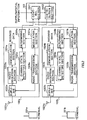
- FIG.2 is a block diagram illustrating a wireless communication system according to the first embodiment of the present invention.
- uplink signals transmitted from communication terminals 101a and 101b are received in radio reception section 1023a via antenna 1021a and duplexer 1022a in base station 102a.
- Radio reception section 023a performs the predetermined radio reception processing on the received signals.
- the signals subjected to the radio reception processing are output to demodulation section 024a, where the signals are demodulated to be received data.
- the signals subjected to the radio reception processing are output to channel state detecting section 1025a, which detects downlink states reported from the communication terminals.
- the detection result is output to determining section 1026a. Based on the detection result, determining section 1026a determines whether base station 102a is a base station with the high possibility of being requested transmission of data from either of the communication terminals.
- Transmit data to be transmitted to communication terminals 101a and 101b is distributed in distribution section 1032 in control station 103 and is transmitted to modulation section 1027a in base station 102a.
- Modulation section 1027a modulates the transmit data to output to radio transmission section 1028a.
- Radio transmission section 1028b performs the predetermined radio transmission processing on the modulated transmit data. Signals subjected to the radio transmission processing are transmitted to communication terminals 101a and 101b from antenna 1021a via duplexer 1022a.
- uplink signals transmitted from communication terminals 101a and 101b are received in radio reception section 1023b via antenna 1021b and duplexer 1022b in base station 102b.
- Radio reception section 1023b performs the predetermined radio reception processing on the received signals.
- the signals subjected to the radio reception processing are output to demodulation section 1024b, where the signals are demodulated to be received data.
- the signals subjected to the radio reception processing are output to channel state detecting section 1025b, which detects downlink states reported from the communication terminals.
- the detection result is output to determining section 1026b. Based on the detection result, determining section 1026b determines whether base station 102b is a base station with the high possibility of being requested transmission of data from either of the communication terminals.
- Transmit data to be transmitted to communication terminals 101a and 101b is distributed in distribution section 1032 in control station 103 and is transmitted to modulation section 1027b in base station 102b.
- Modulation section 1027b modulates the transmit data to output to radio transmission section 1028b.
- Radio transmission section 1028b performs the predetermined radio transmission processing on the modulated transmit data. Signals subjected to the radio transmission processing are transmitted to communication terminals 101a and 101b from antenna 1021b via duplexer 1022b.
- FIG.3 is a block diagram illustrating a configuration of a communication terminal in the wireless communication system of the present invention.
- downlink signals transmitted from base stations 102a and 102b are received in radio reception section 203 via antenna 201 and duplexer 202.
- Radio reception section 203 performs the predetermined radio reception processing on the received signals.
- the signals subjected to the radio reception processing are output to demodulation section 204, where the signals are demodulated to be received data.
- the signals subjected to the radio reception processing are output to channel state measuring section 205, which measures downlink states of signals from the base stations, while generating downlink power control information.
- the measurement result and power control information is output to adder 206.
- Transmit data to be transmitted to base stations 102a and 102b is multiplexed with the measurement result in adder 206, and the resultant is output to modulation section 207.
- Modulation section 207 modulates the transmit data to output to radio transmission section 208.
- Radio transmission section 208 performs the predetermined radio transmission processing on the modulated transmit data. Signals subjected to the radio transmission processing are transmitted to base stations 102a and 102b from antenna 201 via duplexer 202.
- channel state measuring section 205 measures a channel state of the downlink signal. Measurement of the channel state includes, for example, but not limited, measurement of received SIR (Signal to Interference Ratio) of the downlink signal.
- Channel state measuring section 205 outputs the measured channel state and downlink power control information based on the channel state to adder 206, and adder 206 multiplexes the measurement and information on transmit data.
- the multiplexed channel state measurement, downlink power control information and transmit data is transmitted to base stations 102a and 102b on uplink.
- the channel state measurement, downlink power control information is demultiplexed from the received signal, and channel state detecting section 1025a or 1025b detects the channel state, and transmits the detection result of the channel state to determining section 1026a or 1026b, respectively.
- the detection result of the channel state includes, for example, but not limited, received SIR on downlink, an average value of received SIR over a plurality of radio frames, an estimate of bit error rate, and count of downlink power control information, each measured in a terminal.
- Determining sections 1026a and 1026b each determine a base station with the high possibility of being requested from the communication terminal to transmit data, based on the detection result of the channel state. Then, determining sections 1026a and 1026b each transmit the determination result of whether base station 102a or 102b is the base station with the high possibility of being requested to control section 1031 in control station 103 as flow control information of downlink data between the control station and base station, respectively. According to the determination results from base stations 102a and 102b, control section 1031 instructs distribution section 1032 to distribute data only to the base station with the high possibility of being requested from the communication terminal to transmit data. According to the determination result from control section 1031, distribution section 1032 distributes data to each communication terminal.
- determining section 1026a determines that base station 102a is the base station with the high possibility of being requested from the communication terminal, and transmits the detection result to control section 1031 in control station 103 as the flow control information of downlink data between the control station and base station.
- determining section 1026b determines base station 102b has a low possibility of being requested transmission of data from communication terminal 101a, and transmits the detection result to control section 1031 in control station 103 as the flow control information of downlink data between the control station and base station.
- control section 1031 determines to transmit data only to base station 102a to instruct distribution section 1032. According to the instruction, distribution section 1032 distributes the data only to base station 102a.
- determining sections 1026a and 1026b it may be possible to use buffer usage amounts in modulation sections 1027a and 1027b, other than the channel states from channel state detecting sections 1025a and 1025b, respectively.
- the determination may be made so that downlink data transmission from the control station to the base station is suppressed only when the buffer usage amount in modulation section 1027a or 1027b is not less than a predetermined value, and the station 102a or 102b may transmit the determination result to control section 1031 in control station 103 as the flow control information of downlink data between the control station and base station.
- supplemental information indicative of required quality such as an allowance of delay time for each of communication terminals 101a and 101b, other than the channel states from channel state detecting sections 1025a and 1025b, and buffer usage amounts in modulation sections 1027a and 1027b,respectively.
- the determination may be made so that the control station transmits data to communication terminal 101a preferentially to the base station when the data to communication terminal 101a has a less allowance of delay time than data to communication terminal 101b, and the stations 102a and 102b may transmit the determination results to control section 1031 in control station 103 as the flow control information of downlink data between the control station and base station.
- each of base stations uses a downlink state report transmitted from the communication terminal to the base station, determines whether the base station is a base station with the high possibility of being requested from the communication terminal to transmit data, based on the report, and transmits the determination result to a control station as flow control information of downlink data between the control station and base station. Then, based on the determination result, the control station transmits data only to the base station with the high possibility of being requested from the communication terminal to transmit data. It is thereby possible to reduce an amount of data transmitted from the control station to base stations in SSDT.
- control section 1031 in control station 103 controls data transmission timing using supplemental information indicative of required quality such as an allowance of delay time for each of communication terminals 101a and 101b.
- delay information may be used which instructs to delay data of packet transmission, while preferentially transmitting data of speech transmission.
- This embodiment describes a case where base stations report respective downlink channel states to a control station, and the control station makes a determination of a base station with the high possibility of being requested from a communication terminal to transmit data, and transmits data to the base station with the high possibility of being requested from the communication terminal to transmit data.
- FIG.4 is a block diagram illustrating a wireless communication system according to the second embodiment of the present invention.
- uplink signals transmitted from communication terminals 301a and 301b are received in radio reception section 3023a via antenna 3021a and duplexer 3022a in base station 302a.
- Radio reception section 3023a performs the predetermined radio reception processing (such as downconverting and A/D conversion) on the received signals.
- the signals subjected to the radio reception processing are output to demodulation section 3024a, where the signals are demodulated to be received data.
- the signals subjected to the radio reception processing are output to channel state detecting section 3025a, which detects downlink states reported from the communication terminals.
- the detection result is output to determining section 3031 in control station 303.
- Transmit data to be transmitted to communication terminals 301a and 301b are distributed in distribution section 3032 in control station 303 and are transmitted to modulation section 3026a in base station 302a.
- Modulation section 3026a modulates the transmit data to output to radio transmission section 3027a.
- Radio transmission section 3027a performs the predetermined radio transmission processing (such as D/A conversion and upconverting) on the modulated transmit data. Signals subjected to the radio transmission processing are transmitted to communication terminals 301a and 301b from antenna 3021a via duplexer 3022a.
- predetermined radio transmission processing such as D/A conversion and upconverting
- uplink signals transmitted from communication terminals 301a and 301b are received in radio reception section 3023b via antenna 3021b and duplexer 3022b in base station 302b.
- Radio reception section 3023b performs the predetermined radio reception processing (such as downconverting and A/D conversion) on the received signals.
- the signals subjected to the radio reception processing are output to demodulation section 3024b, where the signals are demodulated to be received data.
- the signals subjected to the radio reception processing are output to channel state detecting section 3025b, which detects downlink states reported from the communication terminals.
- the detection result is output to determining section 3031 in control station 301.
- Transmit data to be transmitted to communication terminals 301a and 301b are distributed in distribution section 3032 in control station 303 and are transmitted to modulation section 3026b in base station 302b.
- Modulation section 3026b modulates the transmit data to output to radio transmission section 3027b.
- Radio transmission section 3027b performs the predetermined radio transmission processing (such as D/A conversion and upconverting) on the modulated transmit data. Signals subjected to the radio transmission processing are transmitted to communication terminals 301a and 301b from antenna 3021b via duplexer 3022b.
- predetermined radio transmission processing such as D/A conversion and upconverting
- FIG.3 will be used as appropriate in the following description.
- a downlink signal is received, and channel statemeasuring section 205 measures a channel state of the downlink signal.
- Measurement of the channel state includes, for example, but not limited, measurement of received SIR (Signal to Interference Ratio) of the downlink signal.
- Channel state measuring section 205 outputs the measured channel state and power control information on downlink based on the channel state to adder 206, and adder 206 multiplexes the measurement and information on transmit data.
- the multiplexed channel state measurement, downlink power control information and transmit data is transmitted to base stations 302a and 302b on uplink.
- the channel state measurement, downlink power control information is demultiplexed from the received signal, and channel state detecting section 3025a or 3025b detects the channel state, and transmits the detection result of the channel state to determining section 3031 in control station 303, as detected information.
- the detection result of the channel state includes, for example, but not limited, received SIR on downlink, an average value of received SIR over a plurality of radio frames, an estimate of bit error rate, and count of power control information on downlink, each measured in a terminal.
- determining section 3031 receives the detected information on channel state, and based on the detected information, determines a base station with the high possibility of being requested from the communication terminal to transmit data. Then, determining section 3031 instructs distribution section 3032 to distribute data only to the base station with the high possibility of being requested from the communication terminal to transmit data. According to the determination result from determining section 3031, distribution section 3032 distributes data to each communication terminal.
- determining section 3031 determines to transmit data only to base station 302a based on the channel state information indicative of the downlink state to instruct distribution section 3032 . According to the determination result from determining section 3031, distribution section 3032 distributes data only to base station 302a.
- a control station in order to select a base station with the high possibility of being requested from a communication terminal to transmit data, uses downlink state reports transmitted from a communication terminal to base stations, determines based on the reports a base station with the high possibility of being requested from the communication terminal to transmit data, and based on the determination, transmits data only to the base station with the high possibility of being requested from the communication terminal to transmit data. It is thereby possible to reduce an amount of data transmitted from the control station to base stations in SSDT.
- a communication terminal transmits a report of downlink state to a base station at short intervals, for example, using a radio frame as a basic interval. Therefore, by using the report at short intervals, a determining section in a control station is capable of making a determination always corresponding to a radio channel state.
- determining section 3031 in control station 303 controls data transmission timing using supplemental information indicative of required quality such as an allowance of delay time for each of communication terminals 301a and 301b.
- delay information may be used which instructs to delay data of packet transmission, while preferentially transmitting data of speech transmission.
- a communication terminal transmits a report of downlink state to a base station at short intervals, for example, using a radio frame as a basic interval. Therefore, by using the report at short intervals, a determining section in a control station is capable of making a determination always corresponding to a radio channel state.
- the present invention is not limited to the above embodiments 1 and 2, and is capable of being carried into practice with various modifications thereof.
- the above embodiments 1 and 2 describe the case of transmitting data only to a base station with the high possibility of being requested from a communication terminal to transmit data, it may be possible in the present invention to transmit data to a plurality of base stations in descending order of the possibility of being requested from a communication terminal to transmit data.
- a wireless communication system of the present invention adopts a configuration, in site selection diversity transmit power control, where base stations report to a control station respective downlink states, measured in a communication terminal, of downlink signals from base stations to the communication terminal, and based on the downlink states, the control station determines a base station with a high possibility of being requested from the communication terminal to transmit data, and transmits data for a downlink signal to the determined base station.
- a wireless communication system of the present invention adopts a configuration, in site selection diversity transmit power control, where a base station determines whether the base station is a base station with a high possibility of being requested from a communication terminal to transmit data, based on the downlink state, measured in the communication terminal, of a downlink signal from the base station to the communication terminal, and transmits to a control station the determination result as flow control information of downlink data between the control station and the base station, and the control station transmits data for a downlink signal to the determined base station.
- a wireless communication system of the present invention in the above configuration further adopts a configuration where the control station determines transmission priorities corresponding to required quality of data for a downlink signal.
- control station since the control station instructs to transmit data in descending order of required quality taking account of the required quality such as an allowance of delay time of for each communication terminal, it is possible to reduce an amount of data from the control station to base stations, and to ensure communication quality such as delay time.
- a control station apparatus of the present invention adopts a configuration, in site selection diversity transmit power control, comprising a determining section that determines a base station with a high possibility of being requested from a communication terminal to transmit data, based on downlink states, measured in the communication terminal, of downlink signals from base stations to the communication terminal, and a transmitting section that transmits data for a downlink signal to the determined base station.
- a control station apparatus of the present invention adopts a configuration, in site selection diversity transmit power control, comprising a receiving section that receives, as flow control information of downlink data between the control station and a base station, information on the base station with a high possibility of being requested from a communication terminal to transmit data, where the base station is determined based on the downlink state, measured in the communication terminal, of a downlink signal from the base station to the communication terminal, and a transmitting section that transmits data for a downlink signal according to the information.
- a control station apparatus of the present invention in the above configuration further adopts a configuration comprising a determining section that determines transmission priorities corresponding to required quality of data for a downlink signal.
- control station since the control station instructs to transmit data in descending order of required quality taking account of the required quality such as an allowance of delay time for each communication terminal, it is possible to reduce an amount of data from the control station to base stations, and to ensure communication quality such as delay time.
- a control station or base station determines the base station with the high possibility of being requested from the communication terminal to transmit data, and the control station transmits data to the base station, whereby it is possible to reduce an amount of data transmitted from the control station to the base stations.
- the present invention is applicable to a wireless communication system that performs data communications using a site selection system.
Landscapes
- Engineering & Computer Science (AREA)
- Computer Networks & Wireless Communication (AREA)
- Signal Processing (AREA)
- Mobile Radio Communication Systems (AREA)
Abstract
Description


Claims (11)
- A wireless communication system in site selection diversity transmit power control, wherein each base station determines whether the base station is a base station with a high possibility of being requested from a communication terminal to transmit data, based on a downlink state, in the communication terminal, of a downlink signal from the base station to the communication terminal, and transmits the determination result to a control station, and the control station transmits data for a downlink signal to the determined base station.
- The wireless communication system according to claim 1, wherein the base station determines whether to request data to the communication terminal to the control station corresponding to a buffer usage amount in the base station, in addition to the downlink state, in the communication terminal, of the downlink signal from the base station to the communication terminal.
- The wireless communication system according to claim 1, wherein the base station determines whether to request data to the communication terminal to the control station corresponding to required quality of the data to the communication terminal, in addition to the downlink state, in the communication terminal, of the downlink signal from the base station to the communication terminal.
- A wireless communication system in site selection diversity transmit power control, wherein each base station reports to a control station a downlink state, in a communication terminal, of a downlink signal from the base station to the communication terminal, and based on the downlink state, the control station determines a base station with a high possibility of being requested from the communication terminal to transmit data, and transmits data for a downlink signal to the determined base station.
- The wireless communication system according to claim 1, wherein the control station determines transmission priorities corresponding to required quality of data for a downlink signal.
- A control station apparatus, in site selection diversity transmit power control, comprising:receiving means for receiving information on a base station with a high possibility of being requested from a communication terminal to transmit data, the base station determined based on a downlink state, in the communication terminal, of a downlink signal from the base station to the communication terminal and;transmitting means for transmitting data for a downlink signal according to the information.
- A control station apparatus, in site selection diversity transmit power control, comprising:determining means for determining a base station with a high possibility of being requested from a communication terminal to transmit data, based on respective downlink states, in the communication terminal, of downlink signals from base stations to the communication terminal; andtransmitting means for transmitting data for a downlink signal to the determined base station.
- The control station apparatus according to claim 6, further comprising:determining means for determining transmission priorities corresponding to required quality of data for a downlink signal.
- A site selection diversity transmit power control method, comprising the steps of:in each base station,determining whether the base station is a base station with a high possibility of being requested from a communication terminal to transmit data, based on a downlink state, in the communication terminal, of a downlink signal from the base station to the communication terminal; andtransmitting the determination result to a control station, andin the control station,transmitting data for a downlink signal to the determined base station.
- A site selection diversity transmit power control method, comprising the steps of:in each base station,determining whether to request data to the communication terminal to the control station corresponding to a buffer usage amount in the base station, in addition to the downlink state, in the communication terminal, of the downlink signal from the base station to the communication terminal; andtransmitting the determination result to a control station, andin the control station,transmitting data for a downlink signal to the determined base station.
- A site selection diversity transmit power control method, comprising the steps of:in each base station,reporting to a control station a downlink state, in a communication terminal, of a downlink signal from the base station to the communication terminal, andin the control station,determining a base station with a high possibility of being requested from the communication terminal to transmit data, based on the downlink state; andtransmitting data for a downlink signal to the determined base station.
Applications Claiming Priority (3)
| Application Number | Priority Date | Filing Date | Title |
|---|---|---|---|
| JP2000181805 | 2000-06-16 | ||
| JP2000181805 | 2000-06-16 | ||
| PCT/JP2001/005179 WO2001097540A1 (en) | 2000-06-16 | 2001-06-18 | Radio communication system |
Publications (2)
| Publication Number | Publication Date |
|---|---|
| EP1204281A1 true EP1204281A1 (en) | 2002-05-08 |
| EP1204281A4 EP1204281A4 (en) | 2002-09-18 |
Family
ID=18682678
Family Applications (1)
| Application Number | Title | Priority Date | Filing Date |
|---|---|---|---|
| EP01938722A Withdrawn EP1204281A4 (en) | 2000-06-16 | 2001-06-18 | RADIOCOMMUNICATION SYSTEM |
Country Status (5)
| Country | Link |
|---|---|
| US (1) | US20020128032A1 (en) |
| EP (1) | EP1204281A4 (en) |
| CN (1) | CN1383689A (en) |
| AU (1) | AU6431001A (en) |
| WO (1) | WO2001097540A1 (en) |
Families Citing this family (3)
| Publication number | Priority date | Publication date | Assignee | Title |
|---|---|---|---|---|
| US7280842B2 (en) * | 2001-12-17 | 2007-10-09 | Marvell International Ltd. | Wireless communication device and method for communicating in site selection diversity mode |
| US7515883B1 (en) | 2002-12-16 | 2009-04-07 | Marvell D.S.P.C. Ltd. | Wireless communication device and method for communicating in site selection diversity mode |
| JP2006115156A (en) * | 2004-10-14 | 2006-04-27 | Matsushita Electric Ind Co Ltd | Access point, access point control device, and wireless LAN system |
Family Cites Families (11)
| Publication number | Priority date | Publication date | Assignee | Title |
|---|---|---|---|---|
| US5390339A (en) * | 1991-10-23 | 1995-02-14 | Motorola Inc. | Method and apparatus for selecting a serving transceiver |
| US5267261A (en) * | 1992-03-05 | 1993-11-30 | Qualcomm Incorporated | Mobile station assisted soft handoff in a CDMA cellular communications system |
| EP0917308A1 (en) * | 1992-04-17 | 1999-05-19 | TELEFONAKTIEBOLAGET L M ERICSSON (publ) | Mobile assisted handover using CDMA |
| JPH08154266A (en) * | 1994-11-28 | 1996-06-11 | Matsushita Electric Works Ltd | Radio communication system |
| US5812540A (en) * | 1996-11-06 | 1998-09-22 | Motorola, Inc. | Method and apparatus for mitigating an orphan condition in a spread-spectrum communication system |
| JP2960365B2 (en) * | 1997-02-26 | 1999-10-06 | 株式会社ワイ・アール・ピー移動通信基盤技術研究所 | Handoff method and mobile communication network with handoff function |
| JP3019061B2 (en) * | 1997-06-27 | 2000-03-13 | 日本電気株式会社 | Mobile communication system and radio channel control method therefor |
| US6307849B1 (en) * | 1997-09-08 | 2001-10-23 | Qualcomm Incorporated | Method and system for changing forward traffic channel power allocation during soft handoff |
| JP3092662B2 (en) * | 1998-04-10 | 2000-09-25 | 日本電気株式会社 | Handoff control method |
| GB2337414A (en) * | 1998-05-14 | 1999-11-17 | Fujitsu Ltd | Soft handoff in cellular communications networks |
| FR2798810B1 (en) * | 1999-09-16 | 2002-05-31 | Cit Alcatel | PACKET-BASED TELECOMMUNICATION METHOD AND SYSTEM IN WHICH MULTIPLE COMMUNICATIONS ARE TRANSFERABLE FROM ONE WAY TO ANOTHER |
-
2001
- 2001-01-18 US US10/049,439 patent/US20020128032A1/en not_active Abandoned
- 2001-06-18 WO PCT/JP2001/005179 patent/WO2001097540A1/en not_active Ceased
- 2001-06-18 CN CN01801673.1A patent/CN1383689A/en active Pending
- 2001-06-18 EP EP01938722A patent/EP1204281A4/en not_active Withdrawn
- 2001-06-18 AU AU64310/01A patent/AU6431001A/en not_active Abandoned
Also Published As
| Publication number | Publication date |
|---|---|
| EP1204281A4 (en) | 2002-09-18 |
| CN1383689A (en) | 2002-12-04 |
| US20020128032A1 (en) | 2002-09-12 |
| AU6431001A (en) | 2001-12-24 |
| WO2001097540A1 (en) | 2001-12-20 |
Similar Documents
| Publication | Publication Date | Title |
|---|---|---|
| AU772392B2 (en) | Power control in radio system | |
| EP1231807B1 (en) | Controlling data transmission rate on the reserve link for each mobile station in a dedicated manner | |
| JP3349477B2 (en) | Mobile communication device, mobile communication system, and communication channel assignment request method | |
| EP1519496A1 (en) | Transmission power control method and base station device | |
| EP1128577A1 (en) | Radio communication device and radio communication method | |
| EP1956728B1 (en) | Method for controlling communication of radio terminal, and radio terminal | |
| US20020154616A1 (en) | Base station apparatus, communication terminal apparatus, and communication method | |
| EP0886389A2 (en) | Transmission power control for variable bit rate CDMA mobile telephone system | |
| US6907014B1 (en) | Apparatus and method for TDMA-TDD based transmission/reception | |
| KR100573177B1 (en) | Method and system for controlling reverse link rate in CDMA 1BE-DO mobile communication system | |
| KR20040105255A (en) | Method and apparatus for a reverse link supplemental channel scheduling | |
| US8452284B2 (en) | Base station apparatus, mobile communication system and cell selection communication method | |
| JP5128714B2 (en) | Secondary station and method for operating the secondary station | |
| US7974584B2 (en) | Wireless communication system | |
| KR20050007349A (en) | Radio network controller peer-to-peer exchange of user equipment measurement information | |
| US20040146017A1 (en) | Base station device and communication terminal device | |
| US20030008655A1 (en) | Communication terminal apparatus, base station apparatus, and radio communication method | |
| EP1204281A1 (en) | Radio communication system | |
| JP4931324B2 (en) | Secondary station and method for operating the secondary station | |
| JP2002077967A (en) | Radio communication system | |
| JP2004032561A (en) | Transmission power control method, signaling method, communication terminal device, base station device, and control station device | |
| KR20050082659A (en) | Method for determining data rate of forward packet data in mobile telecommunication system using smart antenna and base station apparatus using the same |
Legal Events
| Date | Code | Title | Description |
|---|---|---|---|
| PUAI | Public reference made under article 153(3) epc to a published international application that has entered the european phase |
Free format text: ORIGINAL CODE: 0009012 |
|
| AK | Designated contracting states |
Kind code of ref document: A1 Designated state(s): AT BE CH CY DE DK ES FI FR GB GR IE IT LI LU MC NL PT SE TR |
|
| AX | Request for extension of the european patent |
Free format text: AL;LT;LV;MK;RO;SI |
|
| 17P | Request for examination filed |
Effective date: 20020307 |
|
| A4 | Supplementary search report drawn up and despatched |
Effective date: 20020807 |
|
| AK | Designated contracting states |
Kind code of ref document: A4 Designated state(s): AT BE CH CY DE DK ES FI FR GB GR IE IT LI LU MC NL PT SE TR |
|
| 17Q | First examination report despatched |
Effective date: 20021008 |
|
| STAA | Information on the status of an ep patent application or granted ep patent |
Free format text: STATUS: THE APPLICATION IS DEEMED TO BE WITHDRAWN |
|
| 18D | Application deemed to be withdrawn |
Effective date: 20030219 |