EP1204071A2 - Method for generating a dispersed message for data embedding - Google Patents
Method for generating a dispersed message for data embedding Download PDFInfo
- Publication number
- EP1204071A2 EP1204071A2 EP01204015A EP01204015A EP1204071A2 EP 1204071 A2 EP1204071 A2 EP 1204071A2 EP 01204015 A EP01204015 A EP 01204015A EP 01204015 A EP01204015 A EP 01204015A EP 1204071 A2 EP1204071 A2 EP 1204071A2
- Authority
- EP
- European Patent Office
- Prior art keywords
- message
- image
- bit
- dispersed
- forming
- Prior art date
- Legal status (The legal status is an assumption and is not a legal conclusion. Google has not performed a legal analysis and makes no representation as to the accuracy of the status listed.)
- Withdrawn
Links
Images

Classifications
-
- G—PHYSICS
- G06—COMPUTING OR CALCULATING; COUNTING
- G06T—IMAGE DATA PROCESSING OR GENERATION, IN GENERAL
- G06T1/00—General purpose image data processing
- G06T1/0021—Image watermarking
Definitions
- the invention relates generally to the field of embedding and extracting hidden messages in source data. This field is also referred to as data hiding, information hiding, watermarking and also steganography. More specifically the invention relates to the generation of a dispersed message for embedding in a digital image in a camera or printer.
- U.S. Patent No. 6,044,156 issued March 28, 2000 to Honsinger et al. entitled Method For Generating An Improved Carrier For Use In An Image Data Embedding Application discloses a technique for embedding messages in digital image data.
- This method for embedding a hidden message into a digitized image includes the steps of: forming a digitized version of the desired message; generating a random phase carrier; convolving the digitized version of the desired message and the random phase carrier to form a dispersed message; and combining the dispersed message with the digitized image to form an embedded hidden message image.
- Hidden messages may be embedded in photographic images recorded on film and paper using conventional photographic printing techniques, or they may be embedded in images produced on printers such as ink jet and thermal dye transfer printers, by combining the dispersed message with a digital image using digital image processing techniques.
- the hidden messages are recovered from the embedded hidden message image by cross correlating the embedded hidden message image containing the dispersed message with a decoding carrier to recover the embedded dispersed message; and extracting the digital message data from the recovered dispersed message.
- the need is met according to the present invention by providing a method for forming a dispersed message for embedding in an image, that includes the steps of: providing a random phase carrier; defining a set of ordered bit locations; assigning a polarity to each bit location corresponding to a bit of the message; cyclically shifting the random phase carrier in accordance with each bit location and weighting the cyclically shifted carriers by the polarity of the corresponding bit; and forming a sum of the cyclically shifted weighted carriers to form the dispersed message.
- the method of the present invention has the advantage of requiring very little image processing capability for implementation, and is therefore suitable for use in apparatus such a digital camera or printer.
- Fig. 1 is a block diagram showing a typical digital camera configuration useful for practicing the method of the present invention
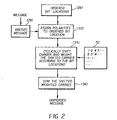
- Fig. 2 is a flow chart showing the steps of the method of the present invention.
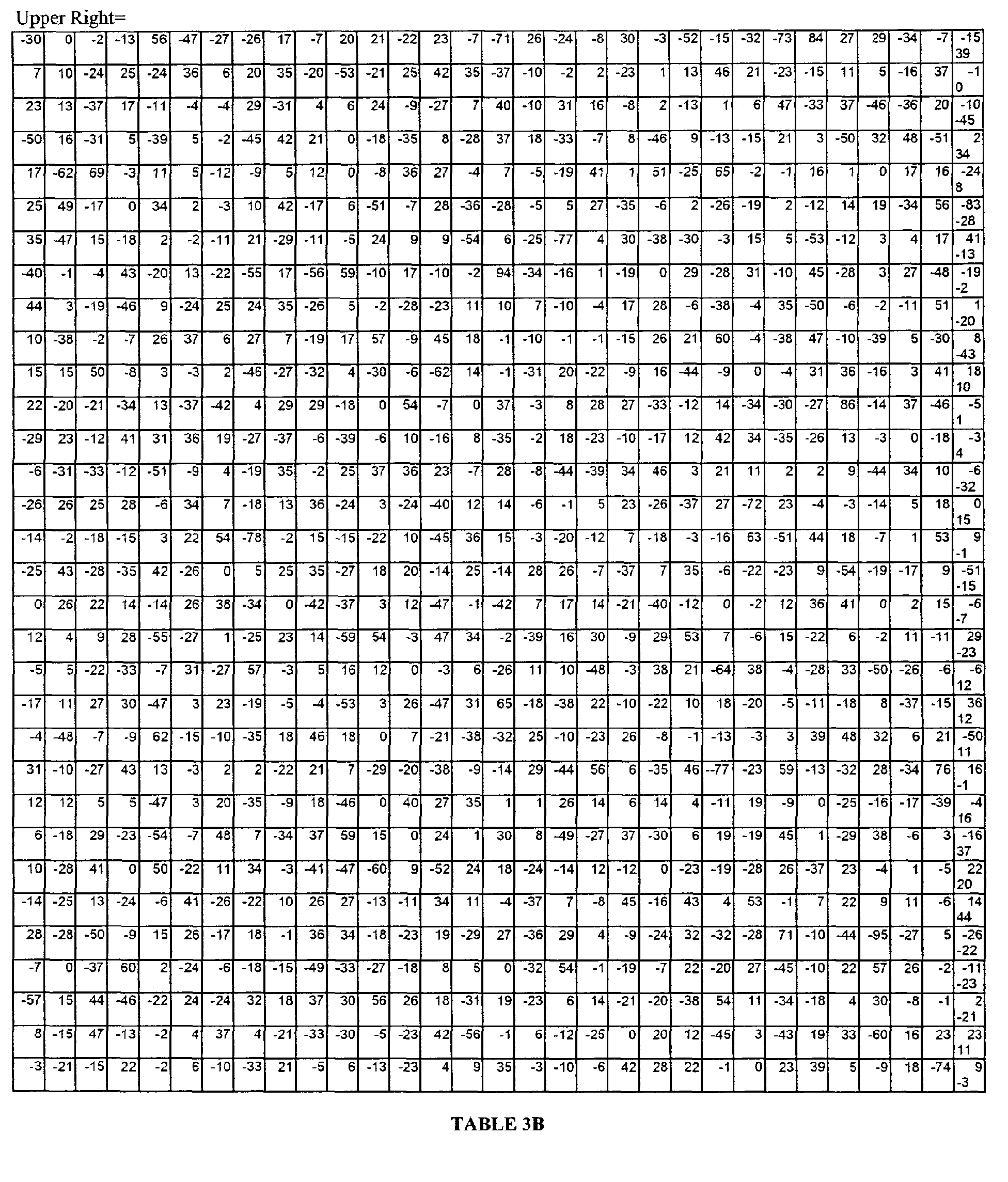
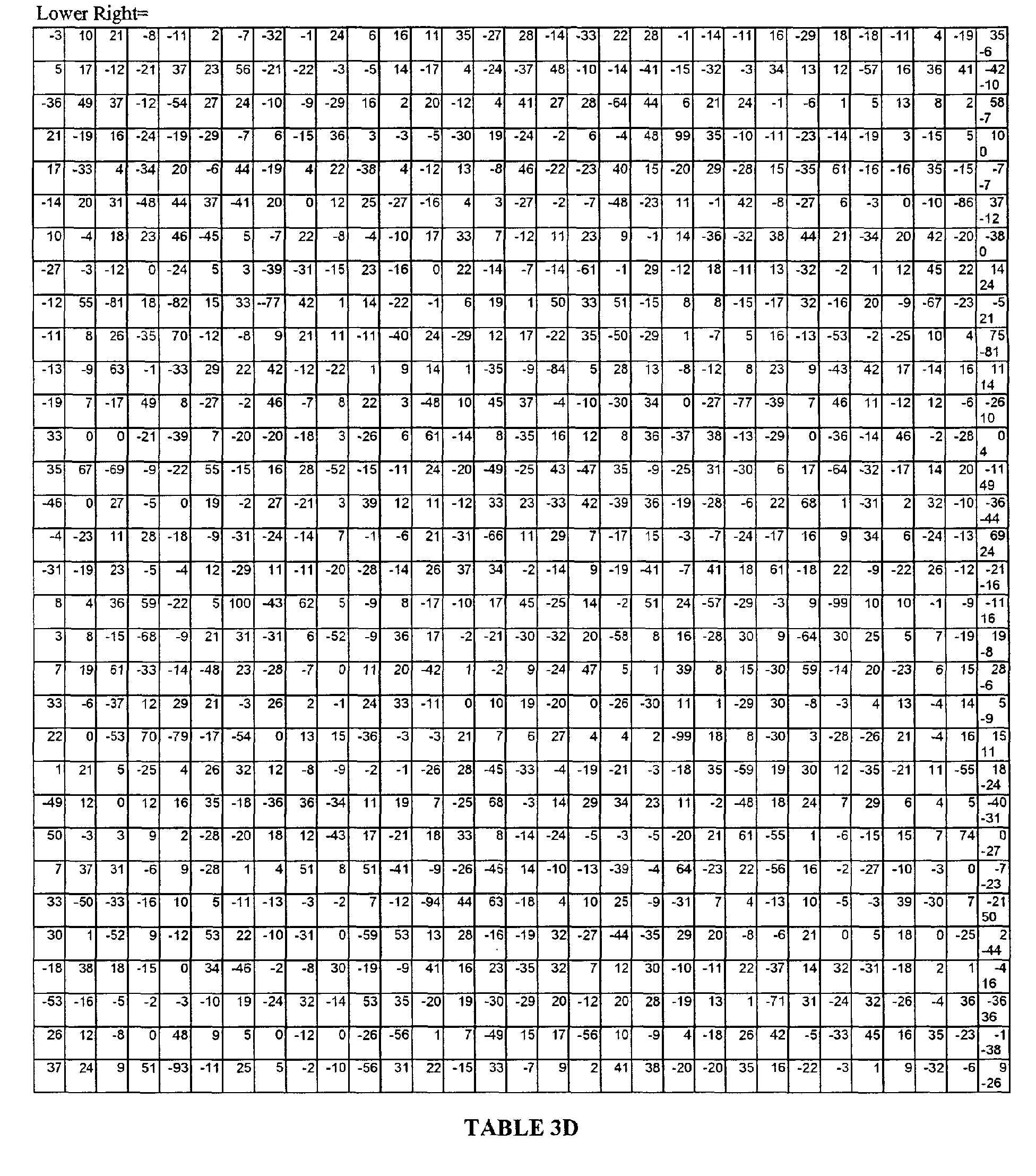
- Fig. 3 is a table showing a 64 x 64 pixel carrier according to the present invention.
- a digital camera useful for practice of the present invention includes a lens 10 for forming an image a subject 12 onto a solid state image sensor 14 .
- the image sensor 14 may include a color filter array 16 .
- the image signals produced by the image sensor 14 are processed in process and control electronics 18 , which is generally embodied as a microprocessor having limited memory storage and data processing capability.
- Image processing carried out by the process and control electronics 18 includes data formatting, color interpolation, image enhancement and data compression.
- the processed digital image can be displayed on a display screen 20 , or stored in a digital image memory 22 , such as a magnetic storage device, or solid state memory chip.
- An operator interface 24 includes camera controls, and data input means such as a physical keyboard, or a virtual keyboard provided via a touch sensitive screen over the display screen 20 whereby the operator can enter a message that will be embedded in the image data recorded by the camera. Alternatively, a message, such as a current date, can be generated by the process and control electronics 18 .
- the camera may include sensors such as a global position sensor for generating message data.
- the message is generated according to the present invention by defining ( 26 ) a list of ordered bit locations, an example of which is shown in Table 1 32 place X,Y ordered bit location table BIT NUMBER XLOC YLOC 0 43 4 1 4 7 2 15 7 3 28 9 4 9 12 5 55 12 6 15 16 7 37 17 8 5 18 9 44 21 10 11 22 11 35 24 12 27 25 13 55 28 14 9 29 15 31 31 16 48 34 17 9 37 18 17 38 19 2 40 20 34 41 21 12 44 22 41 46 23 5 47 24 34 48 25 16 49 26 44 53 27 22 53 28 29 56 29 15 58 30 7 60 31 43 61
- the ordered bit locations are generated in such a way that the autocorrelation of the bit locations in an image is highly peaked.
- An example of how to generate such a list of bit locations is disclosed in U. S. Patent Application No. 09/453,160 filed December 2, 1999 by Honsinger et al. entitled Method And Computer Program For Embedding And Extracting An Embedded Message From A Digital Image.
- the message which may have been input by the camera user, or generated by the process and control electronics is digitized ( 28 ), if required, and each bit of the digital message is assigned ( 30 ) as a polarity (+ or -) with ones being assigned a plus polarity and zeros a minus polarity, to one of the ordered bit locations.
- a random carrier 32 is cyclically shifted ( 34 ) according to the corresponding bit location and the shifted carriers are weighted by the corresponding polarity assigned to the bit location. If the polarity is +, no change is made to the shifted carrier, however if the polarity is -, all of the values of the carrier are reversed in sign.
- the carrier is a random array of values, for example from +10 to -10 that is preferably generated according to the disclosure in U.S. Patent No. 6,044,156, referenced above.
- the carrier preferably has a random phase and a flat Fourier spectrum.
- An example of a 64 pixel by 64 line carrier generated according to the method described by Honsinger et al. is shown in Fig. 3 and Tables 3A-3D.
- the cyclic shifting operation ( 34 ) can be simply implemented in the process and control computer by use of a look up table that defines the new locations for the shifted data from the carrier based on the bit location data.
- the LUT is a 128 place table that starts with 0 and goes up to 63 and then repeats. The effect of the table is to implement the mathematical process of cyclically shifting and eliminates the need for the use of the C language runtime library Modulus function when the program is implemented in the C programming language.
- weighted, cyclically shifted carriers are summed ( 36 ) to produce the dispersed message.
- the dispersed message is preferably added to the digital image in a tile wise fashion as is known in the prior art.
- the image containing the hidden message is then stored in the memory 22 . If the digital image is compressed, for example by using JPEG compression, the hidden message is can be added to the image prior to compression to minimize the amount of redesign from current practice that is required.
- the present invention may be implemented in existing cameras by addition of a computer program to the computer in the process and control electronics.
- the invention can be implemented in a digital printer such as an ink jet printer or thermal resistive printer, a display device such as an Liquid Crystal Display or Organic Light Emitting Diode Display, or a scanner such as a flatbed or handheld scanner.
- Hidden message such as a copyright notice, to an image can be added respectively before printing, displaying, or after scanning an image.
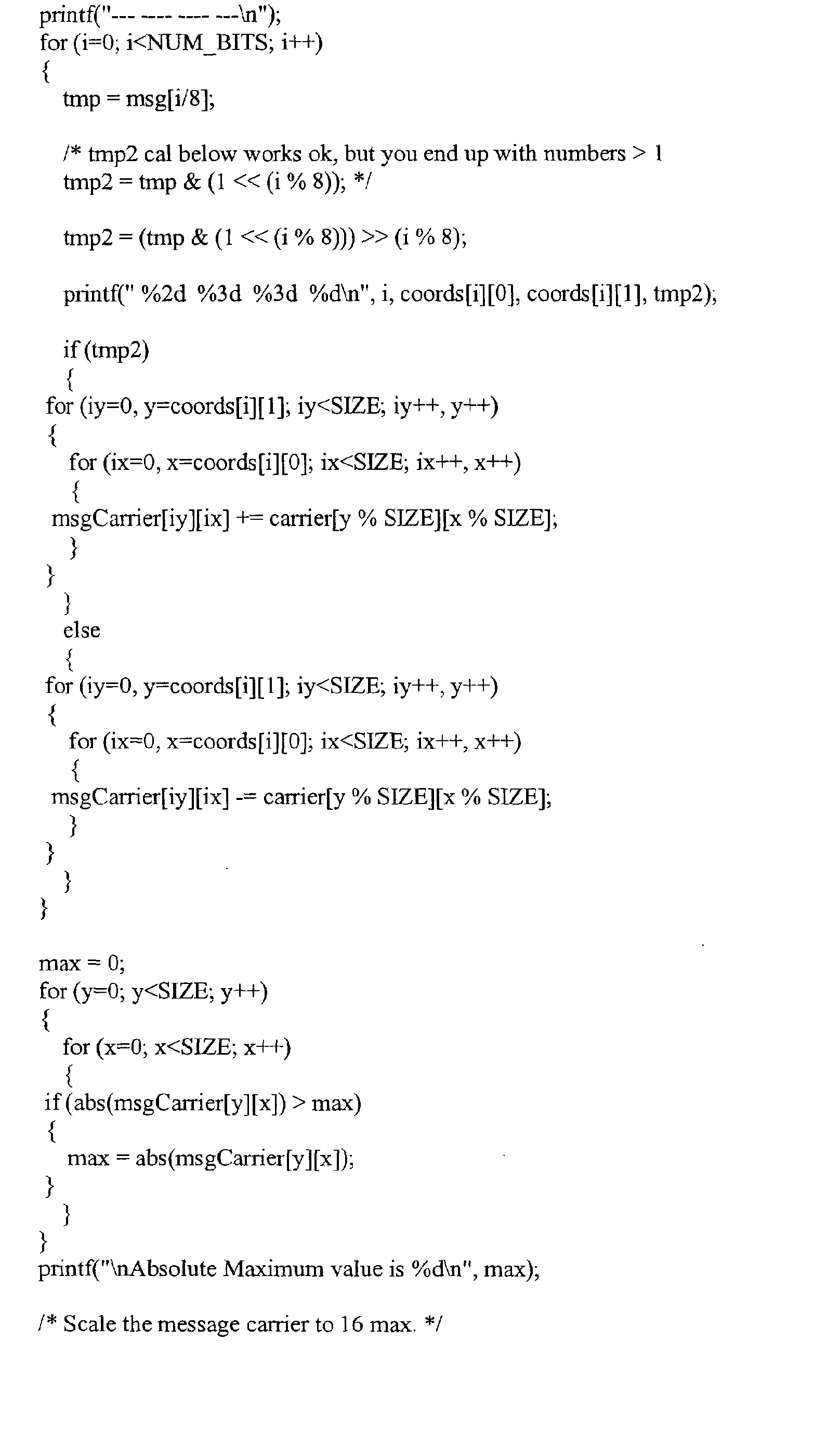
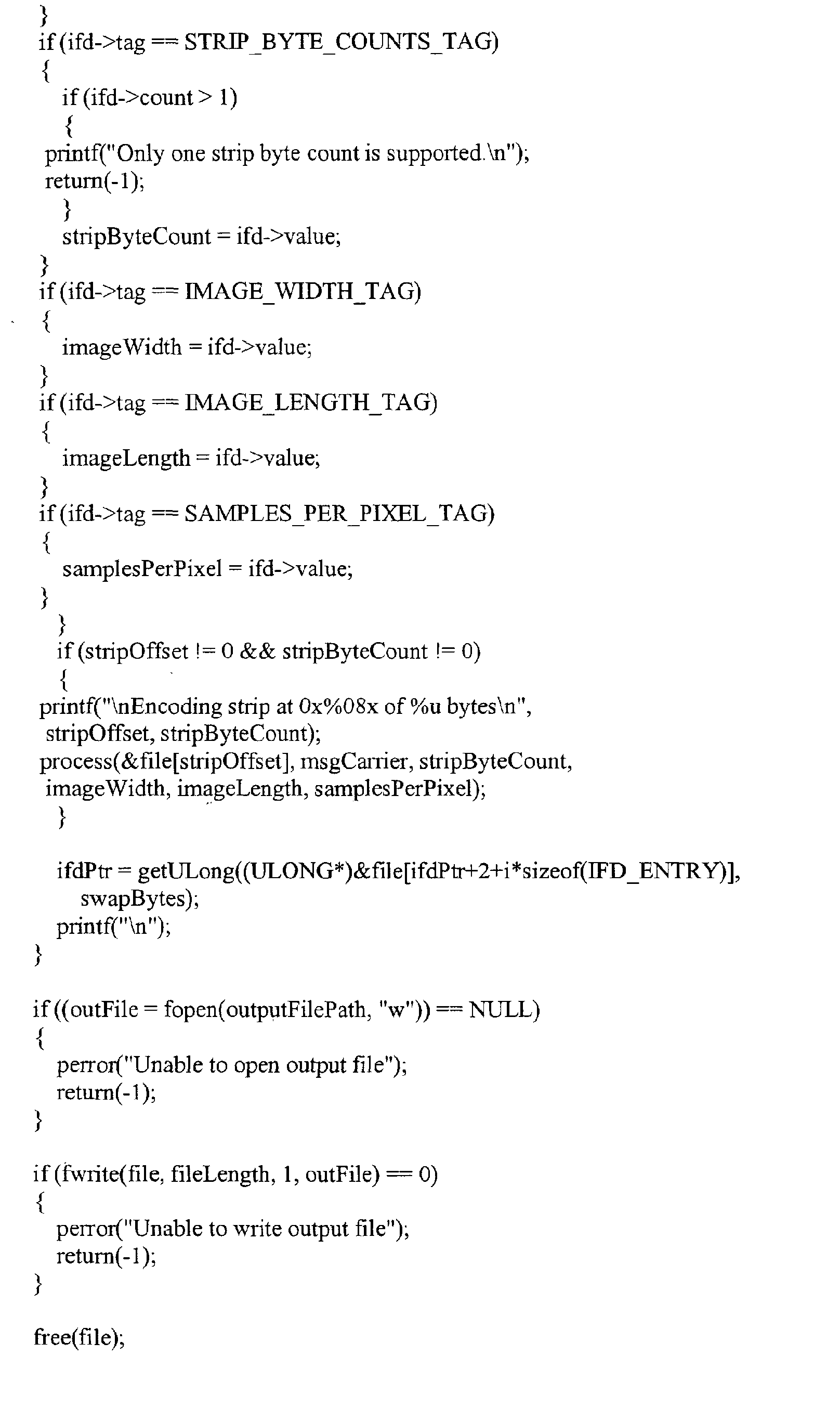
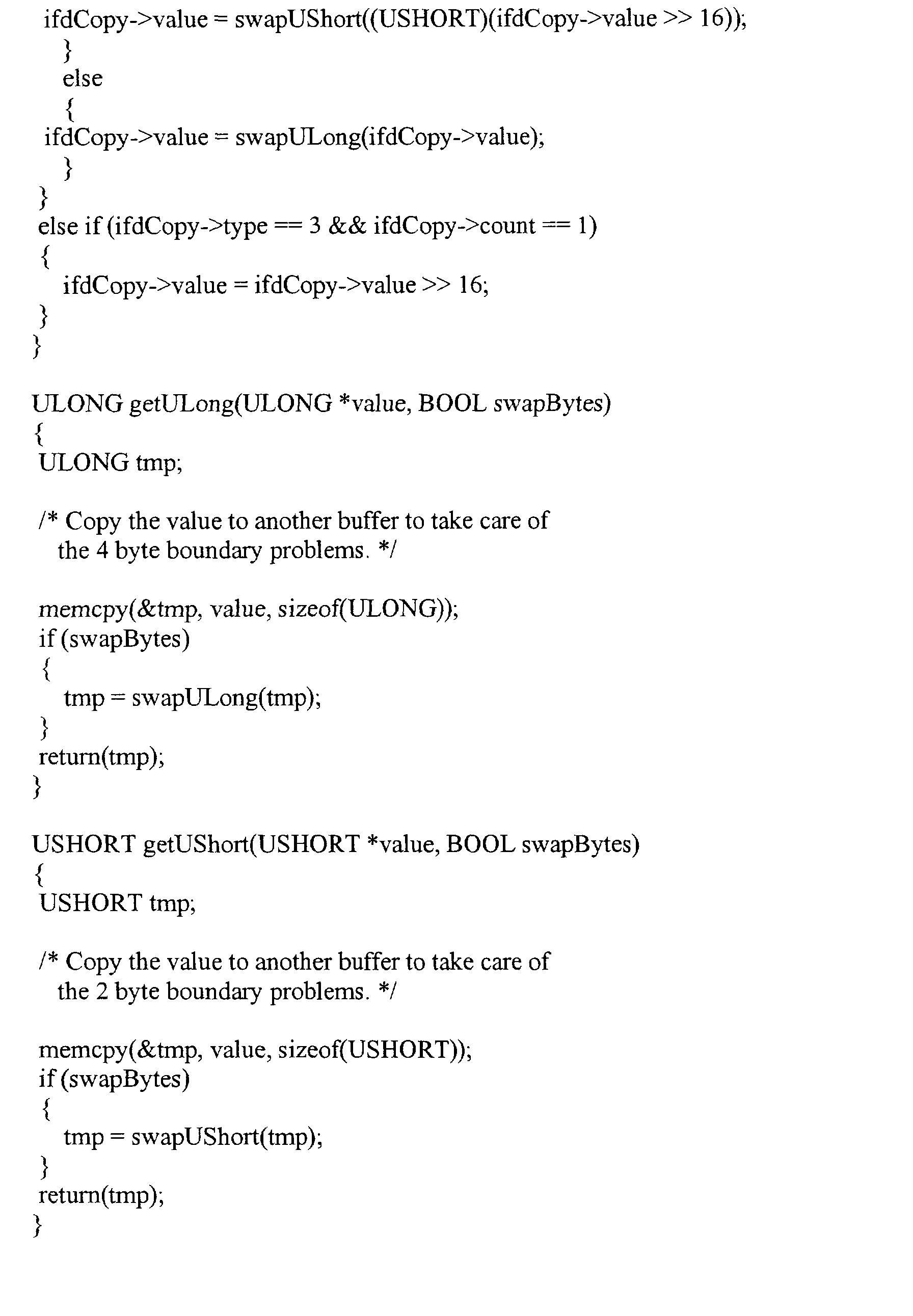
- Appendix A contains a computer program written in the C language for generating an embedded message according to the present invention.
- the computer program can be distributed to camera users for example by delivering the software on a PCMCIA memory card or a CompactFlash card available from the SanDisc corporation that is plugged into the camera and accessed by the process and control electronics.
- the hidden messages are recovered from the image by cross correlating the image containing the dispersed message with the carrier to produce a recovered message image that appears as a digital image having negative or positive peaks located at the same bit locations that are noted in Table 1 above.
- the digital message data is then reconstructed by detecting the polarity of the peaks and assigning corresponding bit values (i.e. a 1 for positive peaks and a 0 for negative peaks).
Landscapes
- Physics & Mathematics (AREA)
- General Physics & Mathematics (AREA)
- Engineering & Computer Science (AREA)
- Theoretical Computer Science (AREA)
- Editing Of Facsimile Originals (AREA)
- Image Processing (AREA)
- Television Systems (AREA)
Abstract
Description
| 32 place X,Y ordered bit location table | ||
| BIT NUMBER | XLOC | YLOC |
| 0 | 43 | 4 |
| 1 | 4 | 7 |
| 2 | 15 | 7 |
| 3 | 28 | 9 |
| 4 | 9 | 12 |
| 5 | 55 | 12 |
| 6 | 15 | 16 |
| 7 | 37 | 17 |
| 8 | 5 | 18 |
| 9 | 44 | 21 |
| 10 | 11 | 22 |
| 11 | 35 | 24 |
| 12 | 27 | 25 |
| 13 | 55 | 28 |
| 14 | 9 | 29 |
| 15 | 31 | 31 |
| 16 | 48 | 34 |
| 17 | 9 | 37 |
| 18 | 17 | 38 |
| 19 | 2 | 40 |
| 20 | 34 | 41 |
| 21 | 12 | 44 |
| 22 | 41 | 46 |
| 23 | 5 | 47 |
| 24 | 34 | 48 |
| 25 | 16 | 49 |
| 26 | 44 | 53 |
| 27 | 22 | 53 |
| 28 | 29 | 56 |
| 29 | 15 | 58 |
| 30 | 7 | 60 |
| 31 | 43 | 61 |








Claims (10)
- A method of forming a dispersed message for embedding in an image, comprising the steps of:a) providing a random phase carrier;b) defining a set of ordered bit location;c) cyclically shifting the random phase carrier in accordance with each bit location; andd) forming a sum of the cyclically shifted weighted carriers to form the dispersed message.
- The method claimed in claim 1, further comprising the steps of:a) assigning a polarity to each bit location corresponding to a bit of the message; andb) weighting the cyclically shifted carriers by the polarity of the corresponding bit.
- A computer storage medium having instructions thereon for causing a computer to perform the method of claim 1.
- The method claimed in claim 1 wherein the method is practiced in a digital camera.
- The method claimed in claim 1 wherein the method is practiced in a printer.
- Apparatus for forming a dispersed message for embedding in an image, comprising:a) means for providing a random phase carrier;b) means for defining a set of ordered bit locationsc) means for cyclically shifting the random phase carrier in accordance with each bit location; andd) means for forming a sum of the cyclically shifted weighted carriers to form the dispersed message.
- The apparatus of claim 6, wherein the apparatus is a camera.
- The apparatus of claim 6, wherein the apparatus is a printer.
- The apparatus of claim 6, wherein the apparatus is a scanner.
- The apparatus of claim 6, wherein the apparatus is a display device.
Applications Claiming Priority (2)
| Application Number | Priority Date | Filing Date | Title |
|---|---|---|---|
| US09/703,540 US6751335B1 (en) | 2000-11-01 | 2000-11-01 | Method for generating a dispersed message for data embedding |
| US703540 | 2000-11-01 |
Publications (2)
| Publication Number | Publication Date |
|---|---|
| EP1204071A2 true EP1204071A2 (en) | 2002-05-08 |
| EP1204071A3 EP1204071A3 (en) | 2003-11-05 |
Family
ID=24825786
Family Applications (1)
| Application Number | Title | Priority Date | Filing Date |
|---|---|---|---|
| EP01204015A Withdrawn EP1204071A3 (en) | 2000-11-01 | 2001-10-22 | Method for generating a dispersed message for data embedding |
Country Status (3)
| Country | Link |
|---|---|
| US (1) | US6751335B1 (en) |
| EP (1) | EP1204071A3 (en) |
| JP (1) | JP3884267B2 (en) |
Cited By (1)
| Publication number | Priority date | Publication date | Assignee | Title |
|---|---|---|---|---|
| WO2007060567A1 (en) * | 2005-11-24 | 2007-05-31 | Koninklijke Philips Electronics N.V. | Multibit forensic watermark with encrypted detection key |
Families Citing this family (3)
| Publication number | Priority date | Publication date | Assignee | Title |
|---|---|---|---|---|
| US7330561B2 (en) * | 2003-11-19 | 2008-02-12 | Eastman Kodak Company | Optimal templates for image data embedding |
| US7352879B2 (en) * | 2004-12-06 | 2008-04-01 | Xerox Corporation | Conjugate cluster screens for embedding digital watermarks into printed halftone documents |
| US8542949B1 (en) * | 2008-08-07 | 2013-09-24 | Bank Of America Corporation | TIFF validation |
Family Cites Families (14)
| Publication number | Priority date | Publication date | Assignee | Title |
|---|---|---|---|---|
| US4392220A (en) * | 1980-05-30 | 1983-07-05 | Nippon Electric Co., Ltd. | Modem to be coupled to a directional transmission line of an SS multiplex communication network |
| US5721788A (en) | 1992-07-31 | 1998-02-24 | Corbis Corporation | Method and system for digital image signatures |
| ATE287176T1 (en) * | 1993-11-18 | 2005-01-15 | Digimarc Corp | VIDEO WITH HIDDEN IN-BAND DIGITAL DATA |
| DE19520232C1 (en) | 1995-06-01 | 1996-08-14 | Siemens Ag | Method for encrypting sequences consisting of number-coded information units |
| US5937000A (en) * | 1995-09-06 | 1999-08-10 | Solana Technology Development Corporation | Method and apparatus for embedding auxiliary data in a primary data signal |
| US5859920A (en) * | 1995-11-30 | 1999-01-12 | Eastman Kodak Company | Method for embedding digital information in an image |
| US5915027A (en) * | 1996-11-05 | 1999-06-22 | Nec Research Institute | Digital watermarking |
| US6044156A (en) | 1997-04-28 | 2000-03-28 | Eastman Kodak Company | Method for generating an improved carrier for use in an image data embedding application |
| KR20000029626A (en) | 1997-05-29 | 2000-05-25 | 요트.게.아. 롤페즈 | Method and arrangement for detecting a watermark |
| DE69836455T2 (en) | 1997-08-20 | 2007-03-29 | Canon K.K. | Electronic watermarking system, electronic information distribution system and device for storing images |
| JPH11232779A (en) | 1997-11-20 | 1999-08-27 | Toshiba Corp | Copy protection device |
| US6263086B1 (en) | 1998-04-15 | 2001-07-17 | Xerox Corporation | Automatic detection and retrieval of embedded invisible digital watermarks from halftone images |
| JP3214554B2 (en) | 1998-05-06 | 2001-10-02 | 日本電気株式会社 | Digital watermark system, digital watermark insertion device, and electronic image demodulation device |
| US6192139B1 (en) * | 1999-05-11 | 2001-02-20 | Sony Corporation Of Japan | High redundancy system and method for watermarking digital image and video data |
-
2000
- 2000-11-01 US US09/703,540 patent/US6751335B1/en not_active Expired - Lifetime
-
2001
- 2001-10-22 EP EP01204015A patent/EP1204071A3/en not_active Withdrawn
- 2001-10-29 JP JP2001330600A patent/JP3884267B2/en not_active Expired - Fee Related
Cited By (1)
| Publication number | Priority date | Publication date | Assignee | Title |
|---|---|---|---|---|
| WO2007060567A1 (en) * | 2005-11-24 | 2007-05-31 | Koninklijke Philips Electronics N.V. | Multibit forensic watermark with encrypted detection key |
Also Published As
| Publication number | Publication date |
|---|---|
| US6751335B1 (en) | 2004-06-15 |
| EP1204071A3 (en) | 2003-11-05 |
| JP2002209089A (en) | 2002-07-26 |
| JP3884267B2 (en) | 2007-02-21 |
Similar Documents
| Publication | Publication Date | Title |
|---|---|---|
| EP1349370B1 (en) | Image processing | |
| US8427509B2 (en) | Method for embedding messages into documents using distance fields | |
| KR101297177B1 (en) | The method and system of adaptive reformatting of digital images | |
| US7164500B2 (en) | Method and apparatus for the automatic generation of image capture device control marks | |
| US20090136088A1 (en) | Image processing apparatus and image forming apparatus | |
| JP4296126B2 (en) | Screen creation device | |
| JPH09191395A (en) | Method for embedding digital information in image | |
| JPS5814270A (en) | Picture scanning and recording method | |
| WO2002087129A1 (en) | Digital watermarks as a communication channel in documents for controlling document processing devices | |
| US20040223626A1 (en) | Method for embedding spatially variant metadata in imagery | |
| US6678390B1 (en) | Method and computer program for embedding and extracting an embedded message from a digital image | |
| US6154577A (en) | Digital image processing method and computer program product | |
| JP5071523B2 (en) | Background pattern image synthesis apparatus, background pattern image synthesis method, and computer program | |
| JP4461167B2 (en) | Image forming apparatus | |
| EP1628466A1 (en) | Watermark information embedding device, image processing device, watermark information embedding method, and image processing method | |
| EP1204071A2 (en) | Method for generating a dispersed message for data embedding | |
| EP1107180A2 (en) | Storing sharpness data using embedded carriers | |
| JPH0575835A (en) | Character data padding printing system to image data | |
| CN101277358B (en) | Apparatus, method for image processing | |
| US20110194785A1 (en) | Image Processing Apparatus, Method, And Computer Program | |
| EP1137252A2 (en) | Embedding two sets of information in a digital image | |
| JP5454380B2 (en) | Background pattern image processing apparatus and background pattern image processing method | |
| EP1120741A2 (en) | Adaptive data embedding method for improved image quality | |
| US20060061798A1 (en) | Method, apparatus, and system for controlling image, image forming apparatus, and computer product | |
| US6700992B1 (en) | Adaptive message embedding error diffusion method |
Legal Events
| Date | Code | Title | Description |
|---|---|---|---|
| PUAI | Public reference made under article 153(3) epc to a published international application that has entered the european phase |
Free format text: ORIGINAL CODE: 0009012 |
|
| AK | Designated contracting states |
Kind code of ref document: A2 Designated state(s): AT BE CH CY DE DK ES FI FR GB GR IE IT LI LU MC NL PT SE TR |
|
| AX | Request for extension of the european patent |
Free format text: AL;LT;LV;MK;RO;SI |
|
| PUAL | Search report despatched |
Free format text: ORIGINAL CODE: 0009013 |
|
| AK | Designated contracting states |
Kind code of ref document: A3 Designated state(s): AT BE CH CY DE DK ES FI FR GB GR IE IT LI LU MC NL PT SE TR |
|
| AX | Request for extension of the european patent |
Extension state: AL LT LV MK RO SI |
|
| 17P | Request for examination filed |
Effective date: 20040405 |
|
| 17Q | First examination report despatched |
Effective date: 20040603 |
|
| AKX | Designation fees paid |
Designated state(s): DE FR GB |
|
| STAA | Information on the status of an ep patent application or granted ep patent |
Free format text: STATUS: THE APPLICATION IS DEEMED TO BE WITHDRAWN |
|
| 18D | Application deemed to be withdrawn |
Effective date: 20041214 |