EP1203997A1 - Processing photographic material - Google Patents
Processing photographic material Download PDFInfo
- Publication number
- EP1203997A1 EP1203997A1 EP01203843A EP01203843A EP1203997A1 EP 1203997 A1 EP1203997 A1 EP 1203997A1 EP 01203843 A EP01203843 A EP 01203843A EP 01203843 A EP01203843 A EP 01203843A EP 1203997 A1 EP1203997 A1 EP 1203997A1
- Authority
- EP
- European Patent Office
- Prior art keywords
- film
- solution
- processing
- temperature
- developer
- Prior art date
- Legal status (The legal status is an assumption and is not a legal conclusion. Google has not performed a legal analysis and makes no representation as to the accuracy of the status listed.)
- Withdrawn
Links
- 238000012545 processing Methods 0.000 title claims abstract description 38
- 239000000463 material Substances 0.000 title claims abstract description 15
- 238000000034 method Methods 0.000 claims description 28
- 230000008569 process Effects 0.000 description 14
- 230000000694 effects Effects 0.000 description 13
- 239000000126 substance Substances 0.000 description 8
- 239000007844 bleaching agent Substances 0.000 description 5
- BWHMMNNQKKPAPP-UHFFFAOYSA-L potassium carbonate Chemical compound [K+].[K+].[O-]C([O-])=O BWHMMNNQKKPAPP-UHFFFAOYSA-L 0.000 description 4
- JHJLBTNAGRQEKS-UHFFFAOYSA-M sodium bromide Chemical compound [Na+].[Br-] JHJLBTNAGRQEKS-UHFFFAOYSA-M 0.000 description 4
- 230000003287 optical effect Effects 0.000 description 3
- QPCDCPDFJACHGM-UHFFFAOYSA-N N,N-bis{2-[bis(carboxymethyl)amino]ethyl}glycine Chemical compound OC(=O)CN(CC(O)=O)CCN(CC(=O)O)CCN(CC(O)=O)CC(O)=O QPCDCPDFJACHGM-UHFFFAOYSA-N 0.000 description 2
- PCHJSUWPFVWCPO-UHFFFAOYSA-N gold Chemical compound [Au] PCHJSUWPFVWCPO-UHFFFAOYSA-N 0.000 description 2
- 239000010931 gold Substances 0.000 description 2
- 229910052737 gold Inorganic materials 0.000 description 2
- NXPHCVPFHOVZBC-UHFFFAOYSA-N hydroxylamine;sulfuric acid Chemical compound ON.OS(O)(=O)=O NXPHCVPFHOVZBC-UHFFFAOYSA-N 0.000 description 2
- 229910000027 potassium carbonate Inorganic materials 0.000 description 2
- 230000009467 reduction Effects 0.000 description 2
- 230000004044 response Effects 0.000 description 2
- GEHJYWRUCIMESM-UHFFFAOYSA-L sodium sulfite Chemical compound [Na+].[Na+].[O-]S([O-])=O GEHJYWRUCIMESM-UHFFFAOYSA-L 0.000 description 2
- 239000007787 solid Substances 0.000 description 2
- 238000013019 agitation Methods 0.000 description 1
- 230000008901 benefit Effects 0.000 description 1
- 238000004061 bleaching Methods 0.000 description 1
- 230000008859 change Effects 0.000 description 1
- 239000000470 constituent Substances 0.000 description 1
- 238000007796 conventional method Methods 0.000 description 1
- 238000012937 correction Methods 0.000 description 1
- 238000001035 drying Methods 0.000 description 1
- 235000011194 food seasoning agent Nutrition 0.000 description 1
- 238000009499 grossing Methods 0.000 description 1
- 238000012986 modification Methods 0.000 description 1
- 230000004048 modification Effects 0.000 description 1
- 238000003672 processing method Methods 0.000 description 1
- 230000035945 sensitivity Effects 0.000 description 1
- 238000005406 washing Methods 0.000 description 1
Images



Classifications
-
- G—PHYSICS
- G03—PHOTOGRAPHY; CINEMATOGRAPHY; ANALOGOUS TECHNIQUES USING WAVES OTHER THAN OPTICAL WAVES; ELECTROGRAPHY; HOLOGRAPHY
- G03D—APPARATUS FOR PROCESSING EXPOSED PHOTOGRAPHIC MATERIALS; ACCESSORIES THEREFOR
- G03D13/00—Processing apparatus or accessories therefor, not covered by groups G11B3/00 - G11B11/00
Definitions
- This invention relates to a method of processing photographic material.
- the invention relates to a method of processing which uses a low volume of processing solution and which provides images of non-varying quality.
- photosensitive material such as photographic film
- steps such as developing, bleaching, fixing, washing and drying.
- a continuous web of film or cut sheet of film is sequentially conveyed through a series of stations or tanks, with each one containing a different processing solution appropriate to the process step at that stage.
- the temperature must be held constant to + 0 .15 °C and fresh chemistry must be added to the bath or tank to maintain steady chemical activity.
- EP 694,815 shows that temperature can be used to compensate for the activity loss during colour paper processing but in this instance to yield a fixed sensitometric result.
- the availability of digital image processing allows the image to be corrected from what otherwise would be a un-correctable image in a optical print system if information is known about the current state of the process.
- a method of processing photosensitive material comprising passing the material through at least one processing chamber containing processing solution, the volume of the solution being less than 1000 ml, and raising the temperature of the solution as the material passes through the chamber, the rate of temperature increase being determined by the rate at which the material passes through the solution.
- the volume of the processing solution is less than 500 ml.
- the method of the invention ensures that acceptable images can be obtained from the entire length of the film. Digital image processing time may be reduced by using the invention.
- the invention is easily applied to standard processing apparatus.
- Figure 1 shows the outline of an apparatus which may be used to perform the invention.
- Figure 1 shows a narrow processing channel 18 through which material to be processed passes.
- a pair of rollers 9 and 16 are provided at the inlet to the channel.
- a pair of rollers 11 and 12 are provided at the exit of the channel 18.
- Two passages 21 and 23 connect the channel 18 to a circulation system.
- the system includes a pump 19 and a heater 20.
- the solution heater 20 is situated in the circulation system loop before the pump 19, in the direction of flow.
- Located on the roller 8 is a sensor 24.
- the sensor 24 is in connection with a micro processor 1.
- film is fed in the direction of the arrow shown in Figure 1.
- the presence of the film is detected by detector 6.
- the pump 19 and the heater 20 are switched on.
- the heater 20 increases the temperature of the processing solution by a predetermined amount.
- the temperature rise is predetermined by parameters set in the microprocessor 1, such as the transport speed of the apparatus and the starting temperature of the processing solution.
- the temperature of the processing solution may be varied either along the length of a film as it passes through the apparatus and/or from one film to the next. These two modes of temperature rise are set by a switch on the micro-processor.
- the drive rollers 7, 8, 9, 10, 11 and 12 start to rotate and drive the film through the processor.
- the film passes through the channel 18 in the direction shown by the arrows.
- the channel contains the solution for processing the film. Agitation of the solution is provided by the circulation pump 19.
- the flow of processing solution through the system can be seen by the arrows.
- the apparatus is charged with a small amount of solution when the film is detected by the detector 6 and that the volume of the solution and its chemical constituents are not sufficient to satisfactorily process the film along its whole length.
- the sensor 24 measures the length of film that has passed into the processor.
- the sensor sends its output to the micro-processor 1 which sends a signal to raise the temperature of the heater 20. This in turn increases the solution temperature and raises the chemical activity of the solution.
- the rate of the temperature rise is determined by a predetermined algorithm thus ensuring that the film will produce acceptable pictures along its whole length.
- the chemistry would be fresh at the start of each film and then discarded once used.
- the same set up could be used to run a batch system whereby the chemistry is returned to the bulk reservoir after each use.
- the film would be processed in sufficient solution to ensure no difference in processing along its whole length.
- the drop in chemical activity which would be seen from film to film in apparatus of the prior art would be compensated for in this case by progressively increasing the temperature of the solution.
- the temperature of the processing solutions may be either varied along the length of a film as it passes through the apparatus or from one film to the next.
- temperature is a viable way of increasing the developer activity and hence the densities obtained from a scanned film in order that the said densities are maintained above a certain minimal threshold below which good image scans cannot be obtained.
- the developer film combination is not able to produce an optically printable negative original.
- increasing the temperature allows more film to be processed per unit volume of developer solution without the densities falling below the minimum required to produce an reasonable image.
- Kodak Royal Gold 400 film was exposed to a 21 step tablet for 1/100 th second with a daylight (6500K) colour correction filter.
- the film was processed in 1.3 litres of developer A, Kodak Flexicolor C41RA bleach, and Kodak Flexicolor fixer and replenisher.
- developer A is made using the formula below.
- Developer A Antical 8 (DTPA solid) 2.6 g/L KI 0.02 g/L NaBr 2.8 g/L Na 2 SO 3 (anhydrous) 10.53 g/L Hydroxylamine sulphate 3 g/L Polyvinylporolidone K 15 3 g/L K 2 CO 3 40 g/L CD4 15 g/L pH 10.48
- Developer A* Antical 8 (DTPA solid) 2.6 g/L KI 0.02 g/L NaBr 3.8 g/L Na 2 SO 3 (anhydrous) 10.53 g/L Hydroxylamine sulphate 3 g/L Polyvinylporolidone K 15 3 g/L K 2 CO 3 40 g/L CD4 12.5 g/L pH 10.40
- the number of films which can be processed can be enhanced by the invention by increasing the temperature to compensate for the sensitometric density loss.
- a temperature can be selected that returns the sensitometry above the minimum required D log E curve required to produce a digitally corrected image.
- the example shows that the sensitometric response relative to the Developer A starting position can be preserved in the desired range for digitally correctable images of good quality, as shown in Figure 7.
- the activity of the chemicals can be boosted ensuring that the variability along the length of the film is reduced to acceptable limits.
- the tank process could be performed at a constant temperature per length but that temperature could be raised film to film as the ballast becomes exhausted. This would also help maintain sensitometric performance from film to film as the chemistry exhausts itself.
- the invention is applicable to developer, bleach, fix or bleach/fix solutions.
Landscapes
- Physics & Mathematics (AREA)
- General Physics & Mathematics (AREA)
- Photographic Processing Devices Using Wet Methods (AREA)
- Photosensitive Polymer And Photoresist Processing (AREA)
- Photographic Developing Apparatuses (AREA)
Abstract
Photosensitive material is processed by passing the material through a
chamber holding processing solution, the temperature of the solution being raised
as the material passes through the chamber.
Description
- This invention relates to a method of processing photographic material. In particular the invention relates to a method of processing which uses a low volume of processing solution and which provides images of non-varying quality.
- The processing of photosensitive material such as photographic film involves a series of steps such as developing, bleaching, fixing, washing and drying. In this process a continuous web of film or cut sheet of film is sequentially conveyed through a series of stations or tanks, with each one containing a different processing solution appropriate to the process step at that stage.
- When using small volumes to process a film the chemicals slowly exhaust themselves and lose activity. This can lead to unacceptable processing variations along the length of the film. It is important to maintain the activity of the process to give repeatable results and match manufacturer's specifications.
- To achieve repeatable results for the C41 process the temperature must be held constant to + 0.15 °C and fresh chemistry must be added to the bath or tank to maintain steady chemical activity.
- Work has been done on this in the past. EP 694,815 shows that temperature can be used to compensate for the activity loss during colour paper processing but in this instance to yield a fixed sensitometric result. The availability of digital image processing allows the image to be corrected from what otherwise would be a un-correctable image in a optical print system if information is known about the current state of the process.
- With the advent of digital scanning lower image contrast can be tolerated and this has led to the use of smaller volumes of chemistry in the tanks and the reduction of process times. New processing methods using single shot and batch non-replenished systems have led to the use of volumes that are at or approaching the manufactures typical replenishment volumes (4-6ml/ft). However, without the benefit of the large volumes held in conventional processors smoothing sensitometric changes, unacceptable results are obtained even with scanning. This can be seen in Figure 2 of the accompanying drawings.
- It is an aim of the invention to provide a method of processing which gives acceptable results with very low volumes of processing solution.
- According to the present invention there is provided a method of processing photosensitive material comprising passing the material through at least one processing chamber containing processing solution, the volume of the solution being less than 1000 ml, and raising the temperature of the solution as the material passes through the chamber, the rate of temperature increase being determined by the rate at which the material passes through the solution.
- Preferably the volume of the processing solution is less than 500 ml.
- The method of the invention ensures that acceptable images can be obtained from the entire length of the film. Digital image processing time may be reduced by using the invention.
- Lower volumes of processing solutions are used which leads to cost reductions.
- The invention is easily applied to standard processing apparatus.
- The invention will now be described, by way of example only, with reference to the accompanying drawings in which:
- Figure 1 is a sketch of an apparatus which may be used to perform the method of the invention;
- Figure 2 is a graph showing how contrast changes with length of film using conventional methods of processing;
- Figure 3 is a graph showing how contrast changes with length of film using the method of the invention; and
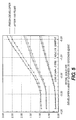
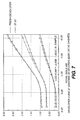
- Figures 4 to 7 are graphs illustrating the results of the example described below.
-
- Figure 1 shows the outline of an apparatus which may be used to perform the invention.
- Figure 1 shows a
narrow processing channel 18 through which material to be processed passes. A pair ofrollers rollers 11 and 12 are provided at the exit of thechannel 18. Twopassages channel 18 to a circulation system. The system includes apump 19 and aheater 20. In the embodiment shown thesolution heater 20 is situated in the circulation system loop before thepump 19, in the direction of flow. Prior to the processing channel there is provided adetector 6 and a pair ofrollers 7 and 8. Located on theroller 8 is asensor 24. Thesensor 24 is in connection with amicro processor 1. - In operation film is fed in the direction of the arrow shown in Figure 1. The presence of the film is detected by
detector 6. When film is detected thepump 19 and theheater 20 are switched on. Theheater 20 increases the temperature of the processing solution by a predetermined amount. The temperature rise is predetermined by parameters set in themicroprocessor 1, such as the transport speed of the apparatus and the starting temperature of the processing solution. The temperature of the processing solution may be varied either along the length of a film as it passes through the apparatus and/or from one film to the next. These two modes of temperature rise are set by a switch on the micro-processor. - When the
heater 20 has heated the solution by the predetermined amount thedrive rollers channel 18 in the direction shown by the arrows. The channel contains the solution for processing the film. Agitation of the solution is provided by thecirculation pump 19. The flow of processing solution through the system can be seen by the arrows. It will be appreciated that the apparatus is charged with a small amount of solution when the film is detected by thedetector 6 and that the volume of the solution and its chemical constituents are not sufficient to satisfactorily process the film along its whole length. To over come this thesensor 24 measures the length of film that has passed into the processor. The sensor sends its output to the micro-processor 1 which sends a signal to raise the temperature of theheater 20. This in turn increases the solution temperature and raises the chemical activity of the solution. The rate of the temperature rise is determined by a predetermined algorithm thus ensuring that the film will produce acceptable pictures along its whole length. - In one embodiment the chemistry would be fresh at the start of each film and then discarded once used. In another embodiment the same set up could be used to run a batch system whereby the chemistry is returned to the bulk reservoir after each use. In this instance the film would be processed in sufficient solution to ensure no difference in processing along its whole length. The drop in chemical activity which would be seen from film to film in apparatus of the prior art would be compensated for in this case by progressively increasing the temperature of the solution.
- As explained above, the temperature of the processing solutions may be either varied along the length of a film as it passes through the apparatus or from one film to the next.
- As the volumes of processing solutions used are very low it is possible to accurately heat the solutions to a given temperature ramp rate over the length of the film as it passes through the process. It is known that raising the temperature of the solution will increase the activity of the process. Therefore, by determining the rate of temperature rise required, close to constant sensitometric output can be achieved. The results are certainly within acceptable limits for image quality. Figure 3 illustrates this effect. It is desired that the contrast slope achieved by the method of the invention should not fall below 0.2.
- The example below shows that temperature is a viable way of increasing the developer activity and hence the densities obtained from a scanned film in order that the said densities are maintained above a certain minimal threshold below which good image scans cannot be obtained. In all cases the developer film combination is not able to produce an optically printable negative original. However, increasing the temperature allows more film to be processed per unit volume of developer solution without the densities falling below the minimum required to produce an reasonable image.
-
Kodak Royal Gold 400 film was exposed to a 21 step tablet for 1/100th second with a daylight (6500K) colour correction filter. The film was processed in 1.3 litres of developer A, Kodak Flexicolor C41RA bleach, and Kodak Flexicolor fixer and replenisher. - The process times and temperatures were as shown in Table 1.
Developer A 30 seconds 55 °C Kodak Flexicolor C41RA bleach 60 seconds 55 °C Kodak Flexicolor fixer and replenisher 120 sconds 55 °C Wash 60 seconds 40 °C - Kodak Flexicolor C41RA bleach, and Kodak Flexicolor fixer and replenisher are commercially available, developer A is made using the formula below.
Developer A Antical 8 (DTPA solid) 2.6 g/L KI 0.02 g/L NaBr 2.8 g/L Na2SO3 (anhydrous) 10.53 g/L Hydroxylamine sulphate 3 g/L Polyvinylporolidone K 15 3 g/L K2CO3 40 g/L CD4 15 g/L pH 10.48 - The above film was processed in Developer A for the above conditions and resulted in the sensitometric response shown in Figure 4. This sensitometry is not ideal for the optical printing of the negative onto colour photographic paper. The result for the Kodak C41 process can be seen as the dashed line. This process provides negatives that can be optically printed onto colour photographic paper.
- The effect of processing 100 rolls of 24 exposure 135 film was modelled using a 1 litre developer batch size, knowing the film's chemical usage rates. No replenishment was added to the batch during this time. Therefore the chemicals in the developer were consumed and seasoning products released. From the model the composition of the tank after the 100th roll of film processed was deduced. This developer is called Developer A* and is shown below.
Developer A* Antical 8 (DTPA solid) 2.6 g/L KI 0.02 g/L NaBr 3.8 g/L Na2SO3 (anhydrous) 10.53 g/L Hydroxylamine sulphate 3 g/L Polyvinylporolidone K 15 3 g/L K2CO3 40 g/L CD4 12.5 g/L pH 10.40 - The above developer was made and
Royal Gold 400 film was processed as described above. The sensitometry relative to the fresh starting developer can be seen in Figure 5. Speed and contrast changes are seen which if the film was continued to be processed would fall below that which can be digitally corrected by algorithms. At this point, the number of films processed represents the maximum capacity of the developer for obtaining an adequate image. - The number of films which can be processed can be enhanced by the invention by increasing the temperature to compensate for the sensitometric density loss. Depending on the sensitometric density loss per unit area of film processed, a temperature can be selected that returns the sensitometry above the minimum required D log E curve required to produce a digitally corrected image.
- The temperature sensitivity of the solution can be seen in figure 6. It is apparent that there is ample activity to be gained by increasing the temperature. Hence the number of films processed per unit volume of developer can be increased substantially as the sensitometry does not have to be ideal (for optical printing) or identical to the starting point as long as the change in sensitometry with the film area and temperature rise is well known. Algorithms can then be used to restore the image to the ideal tone scale and colour.
- The example shows that the sensitometric response relative to the Developer A starting position can be preserved in the desired range for digitally correctable images of good quality, as shown in Figure 7.
- By increasing the temperature as the film passes through the process the activity of the chemicals can be boosted ensuring that the variability along the length of the film is reduced to acceptable limits.
- In a similar fashion when drawing from an un-replenished ballast or batch system the tank process could be performed at a constant temperature per length but that temperature could be raised film to film as the ballast becomes exhausted. This would also help maintain sensitometric performance from film to film as the chemistry exhausts itself.
- The invention is applicable to developer, bleach, fix or bleach/fix solutions.
- The invention has been described in detail with reference to a preferred embodiment thereof. It will be understood by those skilled in the art that variations and modifications can be effected within the scope of the invention.
Claims (5)
- A method of processing photosensitive material comprising passing the material through at least one processing chamber containing processing solution, the volume of the solution being less than 1000 ml, and raising the temperature of the solution as the material passes through the chamber, the rate of temperature increase being determined by the rate at which the material passes through the solution.
- A method as claimed in claim 1 wherein the volume of the processing solution is less than 500 ml.
- A method as claimed in claim 1 or 2 wherein the volume of the processing solution is less than 300 ml.
- A method as claimed in claim 1, 2 or 3 wherein the temperature of the solution is raised as one film passes through the processing chamber.
- A method as claimed in claim 1, 2 or 3 wherein the temperature of the solution is raised from film to film as a batch of films pass through the processing chamber.
Applications Claiming Priority (2)
| Application Number | Priority Date | Filing Date | Title |
|---|---|---|---|
| GBGB0026953.0A GB0026953D0 (en) | 2000-11-03 | 2000-11-03 | Processing photographic material |
| GB0026953 | 2000-11-03 |
Publications (1)
| Publication Number | Publication Date |
|---|---|
| EP1203997A1 true EP1203997A1 (en) | 2002-05-08 |
Family
ID=9902539
Family Applications (1)
| Application Number | Title | Priority Date | Filing Date |
|---|---|---|---|
| EP01203843A Withdrawn EP1203997A1 (en) | 2000-11-03 | 2001-10-11 | Processing photographic material |
Country Status (6)
| Country | Link |
|---|---|
| US (1) | US6443640B1 (en) |
| EP (1) | EP1203997A1 (en) |
| JP (1) | JP2002182355A (en) |
| CN (1) | CN1352414A (en) |
| BR (1) | BR0104928A (en) |
| GB (1) | GB0026953D0 (en) |
Families Citing this family (1)
| Publication number | Priority date | Publication date | Assignee | Title |
|---|---|---|---|---|
| US7621808B2 (en) * | 2003-11-25 | 2009-11-24 | Walker Shandra L | African American board game system and method |
Citations (4)
| Publication number | Priority date | Publication date | Assignee | Title |
|---|---|---|---|---|
| US4985720A (en) * | 1987-07-15 | 1991-01-15 | Dainippon Screen Mfg. Co., Ltd. | Method of controlling temperature for drying photosensitive material |
| EP0446769A2 (en) * | 1990-03-16 | 1991-09-18 | Eastman Kodak Company | Processor with temperature responsive film transport lockout |
| EP0694815A1 (en) * | 1994-07-30 | 1996-01-31 | Kodak Limited | Method of processing photographic colour silver halide materials |
| US5809362A (en) * | 1996-01-31 | 1998-09-15 | Fuji Photo Film Co., Ltd. | Photosensitive material processing device |
Family Cites Families (4)
| Publication number | Priority date | Publication date | Assignee | Title |
|---|---|---|---|---|
| US3680463A (en) * | 1967-03-10 | 1972-08-01 | Curtis C Attridge | Automatic film processing device |
| DE2861444D1 (en) * | 1977-08-18 | 1982-02-11 | Vickers Ltd | Apparatus and method for the controlled processing of radiation sensitive devices in dependence upon the temperature of the developer liquid |
| US5845169A (en) * | 1997-04-17 | 1998-12-01 | Eastman Kodak Company | Photographic processor |
| US6222607B1 (en) * | 1999-12-08 | 2001-04-24 | Eastman Kodak Company | System and method for process and/or manipulating images |
-
2000
- 2000-11-03 GB GBGB0026953.0A patent/GB0026953D0/en not_active Ceased
-
2001
- 2001-09-24 US US09/961,496 patent/US6443640B1/en not_active Expired - Fee Related
- 2001-10-11 EP EP01203843A patent/EP1203997A1/en not_active Withdrawn
- 2001-10-29 JP JP2001330714A patent/JP2002182355A/en active Pending
- 2001-11-01 BR BR0104928-3A patent/BR0104928A/en not_active Application Discontinuation
- 2001-11-01 CN CN01137739A patent/CN1352414A/en active Pending
Patent Citations (4)
| Publication number | Priority date | Publication date | Assignee | Title |
|---|---|---|---|---|
| US4985720A (en) * | 1987-07-15 | 1991-01-15 | Dainippon Screen Mfg. Co., Ltd. | Method of controlling temperature for drying photosensitive material |
| EP0446769A2 (en) * | 1990-03-16 | 1991-09-18 | Eastman Kodak Company | Processor with temperature responsive film transport lockout |
| EP0694815A1 (en) * | 1994-07-30 | 1996-01-31 | Kodak Limited | Method of processing photographic colour silver halide materials |
| US5809362A (en) * | 1996-01-31 | 1998-09-15 | Fuji Photo Film Co., Ltd. | Photosensitive material processing device |
Also Published As
| Publication number | Publication date |
|---|---|
| GB0026953D0 (en) | 2000-12-20 |
| US6443640B1 (en) | 2002-09-03 |
| JP2002182355A (en) | 2002-06-26 |
| CN1352414A (en) | 2002-06-05 |
| BR0104928A (en) | 2002-06-25 |
| US20020081117A1 (en) | 2002-06-27 |
Similar Documents
| Publication | Publication Date | Title |
|---|---|---|
| US6505977B2 (en) | System and method for digital color dye film processing | |
| JPH0934025A (en) | Automatic photofinishing device and method | |
| JPH06214369A (en) | Photographic sensitive material processing device | |
| JP3034644B2 (en) | Photographic negative film processing method for photography | |
| US6443640B1 (en) | Processing photographic material | |
| US6817789B2 (en) | Photosensitive material processing apparatus and photosensitive material | |
| JP3006067B2 (en) | Photographic film processing method for photography | |
| JP2708634B2 (en) | Photo processing improvements | |
| JP2715352B2 (en) | Automatic development printing equipment | |
| US6555300B2 (en) | Image formation process | |
| JP3874481B2 (en) | Automatic processing machine for silver halide photographic materials | |
| JP3848194B2 (en) | Automatic developing device | |
| JP2822232B2 (en) | Photosensitive material processing equipment | |
| JP3432618B2 (en) | Processor system | |
| JP2002287271A (en) | Image recorder | |
| JPS62178966A (en) | Processor for photosensitive material | |
| EP1267204A1 (en) | Photographic processing system | |
| JPH02278258A (en) | Device for processing photographic sensitive material | |
| JPH09166859A (en) | Automatic processing unit for photographic film for photography | |
| JPH10301241A (en) | Processing method of silver halide photographic light-sensitive material and automatic developing machine used therefor | |
| JPS62249160A (en) | Waste liquid device for photosensitive material processing device | |
| EP0694815A1 (en) | Method of processing photographic colour silver halide materials | |
| JPH03296052A (en) | Processing method for color photographic paper | |
| JPH11249278A (en) | Automatic developing machine | |
| JPS62257163A (en) | Automatic development processor |
Legal Events
| Date | Code | Title | Description |
|---|---|---|---|
| PUAI | Public reference made under article 153(3) epc to a published international application that has entered the european phase |
Free format text: ORIGINAL CODE: 0009012 |
|
| AK | Designated contracting states |
Kind code of ref document: A1 Designated state(s): AT BE CH CY DE DK ES FI FR GB GR IE IT LI LU MC NL PT SE TR |
|
| AX | Request for extension of the european patent |
Free format text: AL;LT;LV;MK;RO;SI |
|
| 17P | Request for examination filed |
Effective date: 20021014 |
|
| AKX | Designation fees paid |
Designated state(s): DE FR GB |
|
| 17Q | First examination report despatched |
Effective date: 20040521 |
|
| STAA | Information on the status of an ep patent application or granted ep patent |
Free format text: STATUS: THE APPLICATION IS DEEMED TO BE WITHDRAWN |
|
| 18D | Application deemed to be withdrawn |
Effective date: 20041001 |