EP1203777A1 - Process for removal of catalyst residues - Google Patents
Process for removal of catalyst residues Download PDFInfo
- Publication number
- EP1203777A1 EP1203777A1 EP01126102A EP01126102A EP1203777A1 EP 1203777 A1 EP1203777 A1 EP 1203777A1 EP 01126102 A EP01126102 A EP 01126102A EP 01126102 A EP01126102 A EP 01126102A EP 1203777 A1 EP1203777 A1 EP 1203777A1
- Authority
- EP
- European Patent Office
- Prior art keywords
- nitrile rubber
- hydrogenated nitrile
- resin
- rubber
- solution
- Prior art date
- Legal status (The legal status is an assumption and is not a legal conclusion. Google has not performed a legal analysis and makes no representation as to the accuracy of the status listed.)
- Granted
Links
- 238000000034 method Methods 0.000 title claims abstract description 66
- 230000008569 process Effects 0.000 title claims abstract description 44
- 239000003054 catalyst Substances 0.000 title claims description 28
- 229920000459 Nitrile rubber Polymers 0.000 claims abstract description 45
- 239000011347 resin Substances 0.000 claims abstract description 39
- 229920005989 resin Polymers 0.000 claims abstract description 39
- UMGDCJDMYOKAJW-UHFFFAOYSA-N aminothiocarboxamide Natural products NC(N)=S UMGDCJDMYOKAJW-UHFFFAOYSA-N 0.000 claims abstract description 18
- OMEXLMPRODBZCG-UHFFFAOYSA-N iron rhodium Chemical compound [Fe].[Rh] OMEXLMPRODBZCG-UHFFFAOYSA-N 0.000 claims abstract description 8
- 239000002904 solvent Substances 0.000 claims description 11
- CHRJZRDFSQHIFI-UHFFFAOYSA-N 1,2-bis(ethenyl)benzene;styrene Chemical compound C=CC1=CC=CC=C1.C=CC1=CC=CC=C1C=C CHRJZRDFSQHIFI-UHFFFAOYSA-N 0.000 claims description 4
- 229920006026 co-polymeric resin Polymers 0.000 claims description 3
- MVPPADPHJFYWMZ-UHFFFAOYSA-N chlorobenzene Chemical group ClC1=CC=CC=C1 MVPPADPHJFYWMZ-UHFFFAOYSA-N 0.000 claims description 2
- XEEYBQQBJWHFJM-UHFFFAOYSA-N Iron Chemical compound [Fe] XEEYBQQBJWHFJM-UHFFFAOYSA-N 0.000 abstract description 53
- 239000010948 rhodium Substances 0.000 abstract description 53
- 229920001971 elastomer Polymers 0.000 abstract description 47
- 239000005060 rubber Substances 0.000 abstract description 47
- 229910052703 rhodium Inorganic materials 0.000 abstract description 29
- 229910052742 iron Inorganic materials 0.000 abstract description 22
- MHOVAHRLVXNVSD-UHFFFAOYSA-N rhodium atom Chemical compound [Rh] MHOVAHRLVXNVSD-UHFFFAOYSA-N 0.000 abstract description 19
- 239000003456 ion exchange resin Substances 0.000 abstract description 11
- 229920003303 ion-exchange polymer Polymers 0.000 abstract description 11
- NWUYHJFMYQTDRP-UHFFFAOYSA-N 1,2-bis(ethenyl)benzene;1-ethenyl-2-ethylbenzene;styrene Chemical compound C=CC1=CC=CC=C1.CCC1=CC=CC=C1C=C.C=CC1=CC=CC=C1C=C NWUYHJFMYQTDRP-UHFFFAOYSA-N 0.000 abstract description 10
- XSQUKJJJFZCRTK-UHFFFAOYSA-N Urea Natural products NC(N)=O XSQUKJJJFZCRTK-UHFFFAOYSA-N 0.000 abstract description 8
- 238000005342 ion exchange Methods 0.000 abstract description 2
- 229920000642 polymer Polymers 0.000 description 45
- 239000000243 solution Substances 0.000 description 36
- 239000011324 bead Substances 0.000 description 31
- 239000000523 sample Substances 0.000 description 25
- 239000000178 monomer Substances 0.000 description 24
- 239000000203 mixture Substances 0.000 description 21
- MYRTYDVEIRVNKP-UHFFFAOYSA-N 1,2-Divinylbenzene Chemical compound C=CC1=CC=CC=C1C=C MYRTYDVEIRVNKP-UHFFFAOYSA-N 0.000 description 16
- HEMHJVSKTPXQMS-UHFFFAOYSA-M Sodium hydroxide Chemical compound [OH-].[Na+] HEMHJVSKTPXQMS-UHFFFAOYSA-M 0.000 description 15
- 150000001875 compounds Chemical class 0.000 description 15
- 238000006116 polymerization reaction Methods 0.000 description 15
- PPBRXRYQALVLMV-UHFFFAOYSA-N Styrene Chemical compound C=CC1=CC=CC=C1 PPBRXRYQALVLMV-UHFFFAOYSA-N 0.000 description 14
- 108010010803 Gelatin Proteins 0.000 description 11
- 229920000159 gelatin Polymers 0.000 description 11
- 239000008273 gelatin Substances 0.000 description 11
- 235000019322 gelatine Nutrition 0.000 description 11
- 235000011852 gelatine desserts Nutrition 0.000 description 11
- XLYOFNOQVPJJNP-UHFFFAOYSA-N water Substances O XLYOFNOQVPJJNP-UHFFFAOYSA-N 0.000 description 11
- IJGRMHOSHXDMSA-UHFFFAOYSA-N Atomic nitrogen Chemical compound N#N IJGRMHOSHXDMSA-UHFFFAOYSA-N 0.000 description 10
- 239000002245 particle Substances 0.000 description 10
- 239000008346 aqueous phase Substances 0.000 description 9
- 238000005984 hydrogenation reaction Methods 0.000 description 9
- 239000008367 deionised water Substances 0.000 description 8
- 229910021641 deionized water Inorganic materials 0.000 description 8
- WSFSSNUMVMOOMR-UHFFFAOYSA-N Formaldehyde Chemical compound O=C WSFSSNUMVMOOMR-UHFFFAOYSA-N 0.000 description 7
- 238000006243 chemical reaction Methods 0.000 description 7
- XKJCHHZQLQNZHY-UHFFFAOYSA-N phthalimide Chemical class C1=CC=C2C(=O)NC(=O)C2=C1 XKJCHHZQLQNZHY-UHFFFAOYSA-N 0.000 description 7
- 229920006216 polyvinyl aromatic Polymers 0.000 description 7
- 239000000126 substance Substances 0.000 description 7
- 239000000725 suspension Substances 0.000 description 7
- 230000000052 comparative effect Effects 0.000 description 6
- 239000003999 initiator Substances 0.000 description 6
- 229910052751 metal Inorganic materials 0.000 description 6
- 239000002184 metal Substances 0.000 description 6
- 238000002360 preparation method Methods 0.000 description 6
- 150000003839 salts Chemical class 0.000 description 6
- ZMZDMBWJUHKJPS-UHFFFAOYSA-N thiocyanic acid Chemical class SC#N ZMZDMBWJUHKJPS-UHFFFAOYSA-N 0.000 description 6
- RIOQSEWOXXDEQQ-UHFFFAOYSA-N triphenylphosphine Chemical compound C1=CC=CC=C1P(C=1C=CC=CC=1)C1=CC=CC=C1 RIOQSEWOXXDEQQ-UHFFFAOYSA-N 0.000 description 6
- 230000032683 aging Effects 0.000 description 5
- MPMBRWOOISTHJV-UHFFFAOYSA-N but-1-enylbenzene Chemical compound CCC=CC1=CC=CC=C1 MPMBRWOOISTHJV-UHFFFAOYSA-N 0.000 description 5
- 239000000084 colloidal system Substances 0.000 description 5
- 229920001577 copolymer Polymers 0.000 description 5
- 125000000524 functional group Chemical group 0.000 description 5
- 239000003112 inhibitor Substances 0.000 description 5
- 150000002739 metals Chemical class 0.000 description 5
- 229910052757 nitrogen Inorganic materials 0.000 description 5
- 230000001681 protective effect Effects 0.000 description 5
- KAKZBPTYRLMSJV-UHFFFAOYSA-N Butadiene Chemical compound C=CC=C KAKZBPTYRLMSJV-UHFFFAOYSA-N 0.000 description 4
- VEXZGXHMUGYJMC-UHFFFAOYSA-N Hydrochloric acid Chemical compound Cl VEXZGXHMUGYJMC-UHFFFAOYSA-N 0.000 description 4
- QAOWNCQODCNURD-UHFFFAOYSA-N Sulfuric acid Chemical compound OS(O)(=O)=O QAOWNCQODCNURD-UHFFFAOYSA-N 0.000 description 4
- 125000000217 alkyl group Chemical group 0.000 description 4
- 238000000921 elemental analysis Methods 0.000 description 4
- 238000001914 filtration Methods 0.000 description 4
- 229910052739 hydrogen Inorganic materials 0.000 description 4
- 239000001257 hydrogen Substances 0.000 description 4
- 239000000463 material Substances 0.000 description 4
- 239000003361 porogen Substances 0.000 description 4
- 238000011084 recovery Methods 0.000 description 4
- 230000009467 reduction Effects 0.000 description 4
- GHMLBKRAJCXXBS-UHFFFAOYSA-N resorcinol Chemical compound OC1=CC=CC(O)=C1 GHMLBKRAJCXXBS-UHFFFAOYSA-N 0.000 description 4
- 238000003756 stirring Methods 0.000 description 4
- SCYULBFZEHDVBN-UHFFFAOYSA-N 1,1-Dichloroethane Chemical compound CC(Cl)Cl SCYULBFZEHDVBN-UHFFFAOYSA-N 0.000 description 3
- SMZOUWXMTYCWNB-UHFFFAOYSA-N 2-(2-methoxy-5-methylphenyl)ethanamine Chemical compound COC1=CC=C(C)C=C1CCN SMZOUWXMTYCWNB-UHFFFAOYSA-N 0.000 description 3
- ZWEHNKRNPOVVGH-UHFFFAOYSA-N 2-Butanone Chemical compound CCC(C)=O ZWEHNKRNPOVVGH-UHFFFAOYSA-N 0.000 description 3
- NIXOWILDQLNWCW-UHFFFAOYSA-N 2-Propenoic acid Natural products OC(=O)C=C NIXOWILDQLNWCW-UHFFFAOYSA-N 0.000 description 3
- HRPVXLWXLXDGHG-UHFFFAOYSA-N Acrylamide Chemical compound NC(=O)C=C HRPVXLWXLXDGHG-UHFFFAOYSA-N 0.000 description 3
- YMWUJEATGCHHMB-UHFFFAOYSA-N Dichloromethane Chemical compound ClCCl YMWUJEATGCHHMB-UHFFFAOYSA-N 0.000 description 3
- UFHFLCQGNIYNRP-UHFFFAOYSA-N Hydrogen Chemical compound [H][H] UFHFLCQGNIYNRP-UHFFFAOYSA-N 0.000 description 3
- KWYUFKZDYYNOTN-UHFFFAOYSA-M Potassium hydroxide Chemical compound [OH-].[K+] KWYUFKZDYYNOTN-UHFFFAOYSA-M 0.000 description 3
- 239000002253 acid Substances 0.000 description 3
- -1 alkyl methacrylates Chemical class 0.000 description 3
- 125000003118 aryl group Chemical group 0.000 description 3
- 229920002678 cellulose Polymers 0.000 description 3
- 239000003795 chemical substances by application Substances 0.000 description 3
- 238000004821 distillation Methods 0.000 description 3
- 230000000694 effects Effects 0.000 description 3
- 238000001704 evaporation Methods 0.000 description 3
- 230000008020 evaporation Effects 0.000 description 3
- 238000002474 experimental method Methods 0.000 description 3
- VLKZOEOYAKHREP-UHFFFAOYSA-N n-Hexane Chemical compound CCCCCC VLKZOEOYAKHREP-UHFFFAOYSA-N 0.000 description 3
- DAHPIMYBWVSMKQ-UHFFFAOYSA-N n-hydroxy-n-phenylnitrous amide Chemical compound O=NN(O)C1=CC=CC=C1 DAHPIMYBWVSMKQ-UHFFFAOYSA-N 0.000 description 3
- 229910000510 noble metal Inorganic materials 0.000 description 3
- BASFCYQUMIYNBI-UHFFFAOYSA-N platinum Chemical compound [Pt] BASFCYQUMIYNBI-UHFFFAOYSA-N 0.000 description 3
- 239000000047 product Substances 0.000 description 3
- 230000008961 swelling Effects 0.000 description 3
- XWJBRBSPAODJER-UHFFFAOYSA-N 1,7-octadiene Chemical compound C=CCCCCC=C XWJBRBSPAODJER-UHFFFAOYSA-N 0.000 description 2
- KBPLFHHGFOOTCA-UHFFFAOYSA-N 1-Octanol Chemical compound CCCCCCCCO KBPLFHHGFOOTCA-UHFFFAOYSA-N 0.000 description 2
- LMLDOTHTMKGQKH-UHFFFAOYSA-N 2-(1,3-dioxoisoindol-2-yl)oxyisoindole-1,3-dione Chemical compound O=C1C2=CC=CC=C2C(=O)N1ON1C(=O)C2=CC=CC=C2C1=O LMLDOTHTMKGQKH-UHFFFAOYSA-N 0.000 description 2
- GTJOHISYCKPIMT-UHFFFAOYSA-N 2-methylundecane Chemical compound CCCCCCCCCC(C)C GTJOHISYCKPIMT-UHFFFAOYSA-N 0.000 description 2
- NLHHRLWOUZZQLW-UHFFFAOYSA-N Acrylonitrile Chemical compound C=CC#N NLHHRLWOUZZQLW-UHFFFAOYSA-N 0.000 description 2
- OMPJBNCRMGITSC-UHFFFAOYSA-N Benzoylperoxide Chemical compound C=1C=CC=CC=1C(=O)OOC(=O)C1=CC=CC=C1 OMPJBNCRMGITSC-UHFFFAOYSA-N 0.000 description 2
- BTBUEUYNUDRHOZ-UHFFFAOYSA-N Borate Chemical compound [O-]B([O-])[O-] BTBUEUYNUDRHOZ-UHFFFAOYSA-N 0.000 description 2
- OAKJQQAXSVQMHS-UHFFFAOYSA-N Hydrazine Chemical compound NN OAKJQQAXSVQMHS-UHFFFAOYSA-N 0.000 description 2
- QIGBRXMKCJKVMJ-UHFFFAOYSA-N Hydroquinone Chemical compound OC1=CC=C(O)C=C1 QIGBRXMKCJKVMJ-UHFFFAOYSA-N 0.000 description 2
- SGVYKUFIHHTIFL-UHFFFAOYSA-N Isobutylhexyl Natural products CCCCCCCC(C)C SGVYKUFIHHTIFL-UHFFFAOYSA-N 0.000 description 2
- CERQOIWHTDAKMF-UHFFFAOYSA-N Methacrylic acid Chemical compound CC(=C)C(O)=O CERQOIWHTDAKMF-UHFFFAOYSA-N 0.000 description 2
- 229910019142 PO4 Inorganic materials 0.000 description 2
- 239000004952 Polyamide Substances 0.000 description 2
- NINIDFKCEFEMDL-UHFFFAOYSA-N Sulfur Chemical compound [S] NINIDFKCEFEMDL-UHFFFAOYSA-N 0.000 description 2
- 150000007513 acids Chemical class 0.000 description 2
- 230000009471 action Effects 0.000 description 2
- 125000004202 aminomethyl group Chemical group [H]N([H])C([H])([H])* 0.000 description 2
- 238000001479 atomic absorption spectroscopy Methods 0.000 description 2
- 229920005601 base polymer Polymers 0.000 description 2
- 235000019400 benzoyl peroxide Nutrition 0.000 description 2
- 239000000872 buffer Substances 0.000 description 2
- 239000011203 carbon fibre reinforced carbon Substances 0.000 description 2
- YCIMNLLNPGFGHC-UHFFFAOYSA-N catechol Chemical compound OC1=CC=CC=C1O YCIMNLLNPGFGHC-UHFFFAOYSA-N 0.000 description 2
- 239000001913 cellulose Substances 0.000 description 2
- 230000008859 change Effects 0.000 description 2
- 239000007859 condensation product Substances 0.000 description 2
- 239000013068 control sample Substances 0.000 description 2
- 238000000354 decomposition reaction Methods 0.000 description 2
- 238000009826 distribution Methods 0.000 description 2
- 238000001035 drying Methods 0.000 description 2
- 230000008030 elimination Effects 0.000 description 2
- 238000003379 elimination reaction Methods 0.000 description 2
- 238000005538 encapsulation Methods 0.000 description 2
- 238000009616 inductively coupled plasma Methods 0.000 description 2
- VKPSKYDESGTTFR-UHFFFAOYSA-N isododecane Natural products CC(C)(C)CC(C)CC(C)(C)C VKPSKYDESGTTFR-UHFFFAOYSA-N 0.000 description 2
- 230000014759 maintenance of location Effects 0.000 description 2
- 238000004519 manufacturing process Methods 0.000 description 2
- 150000002825 nitriles Chemical class 0.000 description 2
- 150000002989 phenols Chemical class 0.000 description 2
- NBIIXXVUZAFLBC-UHFFFAOYSA-K phosphate Chemical compound [O-]P([O-])([O-])=O NBIIXXVUZAFLBC-UHFFFAOYSA-K 0.000 description 2
- 239000010452 phosphate Substances 0.000 description 2
- 229920002647 polyamide Polymers 0.000 description 2
- 229920000867 polyelectrolyte Polymers 0.000 description 2
- WQGWDDDVZFFDIG-UHFFFAOYSA-N pyrogallol Chemical compound OC1=CC=CC(O)=C1O WQGWDDDVZFFDIG-UHFFFAOYSA-N 0.000 description 2
- 239000011541 reaction mixture Substances 0.000 description 2
- 238000000926 separation method Methods 0.000 description 2
- LPXPTNMVRIOKMN-UHFFFAOYSA-M sodium nitrite Chemical compound [Na+].[O-]N=O LPXPTNMVRIOKMN-UHFFFAOYSA-M 0.000 description 2
- GEHJYWRUCIMESM-UHFFFAOYSA-L sodium sulfite Chemical compound [Na+].[Na+].[O-]S([O-])=O GEHJYWRUCIMESM-UHFFFAOYSA-L 0.000 description 2
- 238000001179 sorption measurement Methods 0.000 description 2
- 230000035882 stress Effects 0.000 description 2
- 229910052717 sulfur Inorganic materials 0.000 description 2
- 239000011593 sulfur Substances 0.000 description 2
- AKEJUJNQAAGONA-UHFFFAOYSA-N sulfur trioxide Chemical compound O=S(=O)=O AKEJUJNQAAGONA-UHFFFAOYSA-N 0.000 description 2
- 150000003573 thiols Chemical class 0.000 description 2
- 150000003585 thioureas Chemical class 0.000 description 2
- FVQMJJQUGGVLEP-UHFFFAOYSA-N (2-methylpropan-2-yl)oxy 2-ethylhexaneperoxoate Chemical compound CCCCC(CC)C(=O)OOOC(C)(C)C FVQMJJQUGGVLEP-UHFFFAOYSA-N 0.000 description 1
- OXYKVVLTXXXVRT-UHFFFAOYSA-N (4-chlorobenzoyl) 4-chlorobenzenecarboperoxoate Chemical compound C1=CC(Cl)=CC=C1C(=O)OOC(=O)C1=CC=C(Cl)C=C1 OXYKVVLTXXXVRT-UHFFFAOYSA-N 0.000 description 1
- 125000004169 (C1-C6) alkyl group Chemical group 0.000 description 1
- WVAFEFUPWRPQSY-UHFFFAOYSA-N 1,2,3-tris(ethenyl)benzene Chemical compound C=CC1=CC=CC(C=C)=C1C=C WVAFEFUPWRPQSY-UHFFFAOYSA-N 0.000 description 1
- QLLUAUADIMPKIH-UHFFFAOYSA-N 1,2-bis(ethenyl)naphthalene Chemical compound C1=CC=CC2=C(C=C)C(C=C)=CC=C21 QLLUAUADIMPKIH-UHFFFAOYSA-N 0.000 description 1
- PRBHEGAFLDMLAL-UHFFFAOYSA-N 1,5-Hexadiene Natural products CC=CCC=C PRBHEGAFLDMLAL-UHFFFAOYSA-N 0.000 description 1
- UXQAEOWCSOPBLF-UHFFFAOYSA-N 2,2,3,3-tetramethyloctane Chemical compound CCCCCC(C)(C)C(C)(C)C UXQAEOWCSOPBLF-UHFFFAOYSA-N 0.000 description 1
- OZAIFHULBGXAKX-UHFFFAOYSA-N 2-(2-cyanopropan-2-yldiazenyl)-2-methylpropanenitrile Chemical compound N#CC(C)(C)N=NC(C)(C)C#N OZAIFHULBGXAKX-UHFFFAOYSA-N 0.000 description 1
- NGNBDVOYPDDBFK-UHFFFAOYSA-N 2-[2,4-di(pentan-2-yl)phenoxy]acetyl chloride Chemical compound CCCC(C)C1=CC=C(OCC(Cl)=O)C(C(C)CCC)=C1 NGNBDVOYPDDBFK-UHFFFAOYSA-N 0.000 description 1
- SBYMUDUGTIKLCR-UHFFFAOYSA-N 2-chloroethenylbenzene Chemical compound ClC=CC1=CC=CC=C1 SBYMUDUGTIKLCR-UHFFFAOYSA-N 0.000 description 1
- NFEGKOIJMCGIKN-UHFFFAOYSA-N 3-(2-methylbutan-2-ylperoxymethyl)heptane Chemical compound CCCCC(CC)COOC(C)(C)CC NFEGKOIJMCGIKN-UHFFFAOYSA-N 0.000 description 1
- IWTYTFSSTWXZFU-UHFFFAOYSA-N 3-chloroprop-1-enylbenzene Chemical compound ClCC=CC1=CC=CC=C1 IWTYTFSSTWXZFU-UHFFFAOYSA-N 0.000 description 1
- JIGUICYYOYEXFS-UHFFFAOYSA-N 3-tert-butylbenzene-1,2-diol Chemical compound CC(C)(C)C1=CC=CC(O)=C1O JIGUICYYOYEXFS-UHFFFAOYSA-N 0.000 description 1
- DBCAQXHNJOFNGC-UHFFFAOYSA-N 4-bromo-1,1,1-trifluorobutane Chemical compound FC(F)(F)CCCBr DBCAQXHNJOFNGC-UHFFFAOYSA-N 0.000 description 1
- ABCGRFHYOYXEJV-UHFFFAOYSA-N 4-methylisoindole-1,3-dione Chemical compound CC1=CC=CC2=C1C(=O)NC2=O ABCGRFHYOYXEJV-UHFFFAOYSA-N 0.000 description 1
- 0 C*C1NC1*C(C)C Chemical compound C*C1NC1*C(C)C 0.000 description 1
- OKTJSMMVPCPJKN-UHFFFAOYSA-N Carbon Chemical compound [C] OKTJSMMVPCPJKN-UHFFFAOYSA-N 0.000 description 1
- 239000004215 Carbon black (E152) Substances 0.000 description 1
- 229920002134 Carboxymethyl cellulose Polymers 0.000 description 1
- SXRSQZLOMIGNAQ-UHFFFAOYSA-N Glutaraldehyde Chemical compound O=CCCCC=O SXRSQZLOMIGNAQ-UHFFFAOYSA-N 0.000 description 1
- 229920000663 Hydroxyethyl cellulose Polymers 0.000 description 1
- 239000004354 Hydroxyethyl cellulose Substances 0.000 description 1
- 229920001479 Hydroxyethyl methyl cellulose Polymers 0.000 description 1
- AVXURJPOCDRRFD-UHFFFAOYSA-N Hydroxylamine Chemical compound ON AVXURJPOCDRRFD-UHFFFAOYSA-N 0.000 description 1
- NHTMVDHEPJAVLT-UHFFFAOYSA-N Isooctane Chemical compound CC(C)CC(C)(C)C NHTMVDHEPJAVLT-UHFFFAOYSA-N 0.000 description 1
- YIVJZNGAASQVEM-UHFFFAOYSA-N Lauroyl peroxide Chemical compound CCCCCCCCCCCC(=O)OOC(=O)CCCCCCCCCCC YIVJZNGAASQVEM-UHFFFAOYSA-N 0.000 description 1
- LRHPLDYGYMQRHN-UHFFFAOYSA-N N-Butanol Chemical compound CCCCO LRHPLDYGYMQRHN-UHFFFAOYSA-N 0.000 description 1
- GRYLNZFGIOXLOG-UHFFFAOYSA-N Nitric acid Chemical compound O[N+]([O-])=O GRYLNZFGIOXLOG-UHFFFAOYSA-N 0.000 description 1
- 229920002845 Poly(methacrylic acid) Polymers 0.000 description 1
- 229920002396 Polyurea Polymers 0.000 description 1
- 239000004372 Polyvinyl alcohol Substances 0.000 description 1
- OFOBLEOULBTSOW-UHFFFAOYSA-N Propanedioic acid Natural products OC(=O)CC(O)=O OFOBLEOULBTSOW-UHFFFAOYSA-N 0.000 description 1
- 239000007868 Raney catalyst Substances 0.000 description 1
- NPXOKRUENSOPAO-UHFFFAOYSA-N Raney nickel Chemical compound [Al].[Ni] NPXOKRUENSOPAO-UHFFFAOYSA-N 0.000 description 1
- 229910000564 Raney nickel Inorganic materials 0.000 description 1
- BQCADISMDOOEFD-UHFFFAOYSA-N Silver Chemical compound [Ag] BQCADISMDOOEFD-UHFFFAOYSA-N 0.000 description 1
- DWAQJAXMDSEUJJ-UHFFFAOYSA-M Sodium bisulfite Chemical compound [Na+].OS([O-])=O DWAQJAXMDSEUJJ-UHFFFAOYSA-M 0.000 description 1
- 229920002125 Sokalan® Polymers 0.000 description 1
- 229920002472 Starch Polymers 0.000 description 1
- OKKRPWIIYQTPQF-UHFFFAOYSA-N Trimethylolpropane trimethacrylate Chemical compound CC(=C)C(=O)OCC(CC)(COC(=O)C(C)=C)COC(=O)C(C)=C OKKRPWIIYQTPQF-UHFFFAOYSA-N 0.000 description 1
- 239000007983 Tris buffer Substances 0.000 description 1
- AZFNGPAYDKGCRB-XCPIVNJJSA-M [(1s,2s)-2-amino-1,2-diphenylethyl]-(4-methylphenyl)sulfonylazanide;chlororuthenium(1+);1-methyl-4-propan-2-ylbenzene Chemical compound [Ru+]Cl.CC(C)C1=CC=C(C)C=C1.C1=CC(C)=CC=C1S(=O)(=O)[N-][C@@H](C=1C=CC=CC=1)[C@@H](N)C1=CC=CC=C1 AZFNGPAYDKGCRB-XCPIVNJJSA-M 0.000 description 1
- JUIBLDFFVYKUAC-UHFFFAOYSA-N [5-(2-ethylhexanoylperoxy)-2,5-dimethylhexan-2-yl] 2-ethylhexaneperoxoate Chemical compound CCCCC(CC)C(=O)OOC(C)(C)CCC(C)(C)OOC(=O)C(CC)CCCC JUIBLDFFVYKUAC-UHFFFAOYSA-N 0.000 description 1
- CKUAXEQHGKSLHN-UHFFFAOYSA-N [C].[N] Chemical compound [C].[N] CKUAXEQHGKSLHN-UHFFFAOYSA-N 0.000 description 1
- 239000000654 additive Substances 0.000 description 1
- 230000001476 alcoholic effect Effects 0.000 description 1
- 150000001298 alcohols Chemical class 0.000 description 1
- 150000001299 aldehydes Chemical class 0.000 description 1
- 150000001338 aliphatic hydrocarbons Chemical class 0.000 description 1
- 239000003513 alkali Substances 0.000 description 1
- 150000008044 alkali metal hydroxides Chemical class 0.000 description 1
- 125000005250 alkyl acrylate group Chemical group 0.000 description 1
- XYLMUPLGERFSHI-UHFFFAOYSA-N alpha-Methylstyrene Chemical compound CC(=C)C1=CC=CC=C1 XYLMUPLGERFSHI-UHFFFAOYSA-N 0.000 description 1
- AZDRQVAHHNSJOQ-UHFFFAOYSA-N alumane Chemical class [AlH3] AZDRQVAHHNSJOQ-UHFFFAOYSA-N 0.000 description 1
- 229910052782 aluminium Inorganic materials 0.000 description 1
- 150000001412 amines Chemical class 0.000 description 1
- 125000004103 aminoalkyl group Chemical group 0.000 description 1
- 150000003863 ammonium salts Chemical class 0.000 description 1
- SOIFLUNRINLCBN-UHFFFAOYSA-N ammonium thiocyanate Chemical compound [NH4+].[S-]C#N SOIFLUNRINLCBN-UHFFFAOYSA-N 0.000 description 1
- 238000004458 analytical method Methods 0.000 description 1
- 239000012298 atmosphere Substances 0.000 description 1
- QVGXLLKOCUKJST-UHFFFAOYSA-N atomic oxygen Chemical compound [O] QVGXLLKOCUKJST-UHFFFAOYSA-N 0.000 description 1
- 239000010953 base metal Substances 0.000 description 1
- 238000010923 batch production Methods 0.000 description 1
- 230000008901 benefit Effects 0.000 description 1
- 150000001642 boronic acid derivatives Chemical class 0.000 description 1
- 239000007853 buffer solution Substances 0.000 description 1
- 239000002775 capsule Substances 0.000 description 1
- DKVNPHBNOWQYFE-UHFFFAOYSA-N carbamodithioic acid Chemical compound NC(S)=S DKVNPHBNOWQYFE-UHFFFAOYSA-N 0.000 description 1
- 229910052799 carbon Inorganic materials 0.000 description 1
- 125000004432 carbon atom Chemical group C* 0.000 description 1
- 239000001768 carboxy methyl cellulose Substances 0.000 description 1
- 235000010948 carboxy methyl cellulose Nutrition 0.000 description 1
- 125000002843 carboxylic acid group Chemical group 0.000 description 1
- 239000008112 carboxymethyl-cellulose Substances 0.000 description 1
- 230000015556 catabolic process Effects 0.000 description 1
- 230000003197 catalytic effect Effects 0.000 description 1
- 229920003086 cellulose ether Polymers 0.000 description 1
- 238000005119 centrifugation Methods 0.000 description 1
- 238000001311 chemical methods and process Methods 0.000 description 1
- 239000012295 chemical reaction liquid Substances 0.000 description 1
- 239000003153 chemical reaction reagent Substances 0.000 description 1
- 150000008280 chlorinated hydrocarbons Chemical class 0.000 description 1
- 229910017052 cobalt Inorganic materials 0.000 description 1
- 239000010941 cobalt Substances 0.000 description 1
- 238000009833 condensation Methods 0.000 description 1
- 230000005494 condensation Effects 0.000 description 1
- 238000007796 conventional method Methods 0.000 description 1
- 229920006037 cross link polymer Polymers 0.000 description 1
- 239000003431 cross linking reagent Substances 0.000 description 1
- BLCKNMAZFRMCJJ-UHFFFAOYSA-N cyclohexyl cyclohexyloxycarbonyloxy carbonate Chemical compound C1CCCCC1OC(=O)OOC(=O)OC1CCCCC1 BLCKNMAZFRMCJJ-UHFFFAOYSA-N 0.000 description 1
- 238000006731 degradation reaction Methods 0.000 description 1
- 150000001993 dienes Chemical class 0.000 description 1
- FVCOIAYSJZGECG-UHFFFAOYSA-N diethylhydroxylamine Chemical compound CCN(O)CC FVCOIAYSJZGECG-UHFFFAOYSA-N 0.000 description 1
- JVSWJIKNEAIKJW-UHFFFAOYSA-N dimethyl-hexane Natural products CCCCCC(C)C JVSWJIKNEAIKJW-UHFFFAOYSA-N 0.000 description 1
- DGLRDKLJZLEJCY-UHFFFAOYSA-L disodium hydrogenphosphate dodecahydrate Chemical compound O.O.O.O.O.O.O.O.O.O.O.O.[Na+].[Na+].OP([O-])([O-])=O DGLRDKLJZLEJCY-UHFFFAOYSA-L 0.000 description 1
- ZRRLFMPOAYZELW-UHFFFAOYSA-N disodium;hydrogen phosphite Chemical compound [Na+].[Na+].OP([O-])[O-] ZRRLFMPOAYZELW-UHFFFAOYSA-N 0.000 description 1
- 239000012990 dithiocarbamate Substances 0.000 description 1
- 150000004662 dithiols Chemical group 0.000 description 1
- 238000007720 emulsion polymerization reaction Methods 0.000 description 1
- STVZJERGLQHEKB-UHFFFAOYSA-N ethylene glycol dimethacrylate Substances CC(=C)C(=O)OCCOC(=O)C(C)=C STVZJERGLQHEKB-UHFFFAOYSA-N 0.000 description 1
- 230000002349 favourable effect Effects 0.000 description 1
- 239000000499 gel Substances 0.000 description 1
- 239000011521 glass Substances 0.000 description 1
- 229960000587 glutaral Drugs 0.000 description 1
- PCHJSUWPFVWCPO-UHFFFAOYSA-N gold Chemical compound [Au] PCHJSUWPFVWCPO-UHFFFAOYSA-N 0.000 description 1
- 229910052737 gold Inorganic materials 0.000 description 1
- 239000010931 gold Substances 0.000 description 1
- PYGSKMBEVAICCR-UHFFFAOYSA-N hexa-1,5-diene Chemical compound C=CCCC=C PYGSKMBEVAICCR-UHFFFAOYSA-N 0.000 description 1
- 239000002815 homogeneous catalyst Substances 0.000 description 1
- 150000002429 hydrazines Chemical class 0.000 description 1
- 229930195733 hydrocarbon Natural products 0.000 description 1
- 150000002430 hydrocarbons Chemical class 0.000 description 1
- 150000002431 hydrogen Chemical class 0.000 description 1
- 125000004435 hydrogen atom Chemical group [H]* 0.000 description 1
- 235000019447 hydroxyethyl cellulose Nutrition 0.000 description 1
- 150000002443 hydroxylamines Chemical class 0.000 description 1
- 230000006872 improvement Effects 0.000 description 1
- 229910052500 inorganic mineral Inorganic materials 0.000 description 1
- 239000012948 isocyanate Substances 0.000 description 1
- 150000002513 isocyanates Chemical class 0.000 description 1
- VZCYOOQTPOCHFL-UPHRSURJSA-N maleic acid Chemical compound OC(=O)\C=C/C(O)=O VZCYOOQTPOCHFL-UPHRSURJSA-N 0.000 description 1
- 239000011976 maleic acid Substances 0.000 description 1
- 150000002734 metacrylic acid derivatives Chemical class 0.000 description 1
- FQPSGWSUVKBHSU-UHFFFAOYSA-N methacrylamide Chemical compound CC(=C)C(N)=O FQPSGWSUVKBHSU-UHFFFAOYSA-N 0.000 description 1
- JYVLIDXNZAXMDK-UHFFFAOYSA-N methyl propyl carbinol Natural products CCCC(C)O JYVLIDXNZAXMDK-UHFFFAOYSA-N 0.000 description 1
- 239000003094 microcapsule Substances 0.000 description 1
- 239000011707 mineral Substances 0.000 description 1
- 238000002156 mixing Methods 0.000 description 1
- QYZFTMMPKCOTAN-UHFFFAOYSA-N n-[2-(2-hydroxyethylamino)ethyl]-2-[[1-[2-(2-hydroxyethylamino)ethylamino]-2-methyl-1-oxopropan-2-yl]diazenyl]-2-methylpropanamide Chemical compound OCCNCCNC(=O)C(C)(C)N=NC(C)(C)C(=O)NCCNCCO QYZFTMMPKCOTAN-UHFFFAOYSA-N 0.000 description 1
- ODHYIQOBTIWVRZ-UHFFFAOYSA-N n-propan-2-ylhydroxylamine Chemical compound CC(C)NO ODHYIQOBTIWVRZ-UHFFFAOYSA-N 0.000 description 1
- 229910017604 nitric acid Inorganic materials 0.000 description 1
- 229910017464 nitrogen compound Inorganic materials 0.000 description 1
- 150000002830 nitrogen compounds Chemical class 0.000 description 1
- QJGQUHMNIGDVPM-UHFFFAOYSA-N nitrogen group Chemical group [N] QJGQUHMNIGDVPM-UHFFFAOYSA-N 0.000 description 1
- 150000002832 nitroso derivatives Chemical class 0.000 description 1
- TVMXDCGIABBOFY-UHFFFAOYSA-N octane Chemical compound CCCCCCCC TVMXDCGIABBOFY-UHFFFAOYSA-N 0.000 description 1
- 239000003960 organic solvent Substances 0.000 description 1
- 229910052760 oxygen Inorganic materials 0.000 description 1
- 239000001301 oxygen Substances 0.000 description 1
- NWVVVBRKAWDGAB-UHFFFAOYSA-N p-methoxyphenol Chemical compound COC1=CC=C(O)C=C1 NWVVVBRKAWDGAB-UHFFFAOYSA-N 0.000 description 1
- 238000012856 packing Methods 0.000 description 1
- DBSDMAPJGHBWAL-UHFFFAOYSA-N penta-1,4-dien-3-ylbenzene Chemical compound C=CC(C=C)C1=CC=CC=C1 DBSDMAPJGHBWAL-UHFFFAOYSA-N 0.000 description 1
- 150000002978 peroxides Chemical class 0.000 description 1
- 125000000864 peroxy group Chemical group O(O*)* 0.000 description 1
- 239000012071 phase Substances 0.000 description 1
- 150000003013 phosphoric acid derivatives Chemical class 0.000 description 1
- XNGIFLGASWRNHJ-UHFFFAOYSA-N phthalic acid group Chemical group C(C=1C(C(=O)O)=CC=CC1)(=O)O XNGIFLGASWRNHJ-UHFFFAOYSA-N 0.000 description 1
- 125000005543 phthalimide group Chemical class 0.000 description 1
- JAMNHZBIQDNHMM-UHFFFAOYSA-N pivalonitrile Chemical compound CC(C)(C)C#N JAMNHZBIQDNHMM-UHFFFAOYSA-N 0.000 description 1
- 229910052697 platinum Inorganic materials 0.000 description 1
- 239000004584 polyacrylic acid Substances 0.000 description 1
- 229920000728 polyester Polymers 0.000 description 1
- 239000004848 polyfunctional curative Substances 0.000 description 1
- 229920002635 polyurethane Polymers 0.000 description 1
- 239000004814 polyurethane Substances 0.000 description 1
- 229920002451 polyvinyl alcohol Polymers 0.000 description 1
- 235000019422 polyvinyl alcohol Nutrition 0.000 description 1
- 229920000036 polyvinylpyrrolidone Polymers 0.000 description 1
- 239000001267 polyvinylpyrrolidone Substances 0.000 description 1
- 235000013855 polyvinylpyrrolidone Nutrition 0.000 description 1
- 239000011148 porous material Substances 0.000 description 1
- 235000010289 potassium nitrite Nutrition 0.000 description 1
- 239000004304 potassium nitrite Substances 0.000 description 1
- 150000003141 primary amines Chemical class 0.000 description 1
- FBCQUCJYYPMKRO-UHFFFAOYSA-N prop-2-enyl 2-methylprop-2-enoate Chemical compound CC(=C)C(=O)OCC=C FBCQUCJYYPMKRO-UHFFFAOYSA-N 0.000 description 1
- HJWLCRVIBGQPNF-UHFFFAOYSA-N prop-2-enylbenzene Chemical compound C=CCC1=CC=CC=C1 HJWLCRVIBGQPNF-UHFFFAOYSA-N 0.000 description 1
- 229940079877 pyrogallol Drugs 0.000 description 1
- 150000003254 radicals Chemical class 0.000 description 1
- 239000012429 reaction media Substances 0.000 description 1
- 230000035484 reaction time Effects 0.000 description 1
- 150000003283 rhodium Chemical class 0.000 description 1
- IGTVAJJAPJKARK-UHFFFAOYSA-N rhodium;triphenylphosphane Chemical compound [Rh].C1=CC=CC=C1P(C=1C=CC=CC=1)C1=CC=CC=C1.C1=CC=CC=C1P(C=1C=CC=CC=1)C1=CC=CC=C1.C1=CC=CC=C1P(C=1C=CC=CC=1)C1=CC=CC=C1.C1=CC=CC=C1P(C=1C=CC=CC=1)C1=CC=CC=C1 IGTVAJJAPJKARK-UHFFFAOYSA-N 0.000 description 1
- 150000003335 secondary amines Chemical class 0.000 description 1
- 229910052709 silver Inorganic materials 0.000 description 1
- 239000004332 silver Substances 0.000 description 1
- 235000002639 sodium chloride Nutrition 0.000 description 1
- JVBXVOWTABLYPX-UHFFFAOYSA-L sodium dithionite Chemical compound [Na+].[Na+].[O-]S(=O)S([O-])=O JVBXVOWTABLYPX-UHFFFAOYSA-L 0.000 description 1
- 235000010267 sodium hydrogen sulphite Nutrition 0.000 description 1
- 235000010288 sodium nitrite Nutrition 0.000 description 1
- 235000010265 sodium sulphite Nutrition 0.000 description 1
- VGTPCRGMBIAPIM-UHFFFAOYSA-M sodium thiocyanate Chemical compound [Na+].[S-]C#N VGTPCRGMBIAPIM-UHFFFAOYSA-M 0.000 description 1
- AKHNMLFCWUSKQB-UHFFFAOYSA-L sodium thiosulfate Chemical compound [Na+].[Na+].[O-]S([O-])(=O)=S AKHNMLFCWUSKQB-UHFFFAOYSA-L 0.000 description 1
- 235000019345 sodium thiosulphate Nutrition 0.000 description 1
- 238000010561 standard procedure Methods 0.000 description 1
- 239000008107 starch Substances 0.000 description 1
- 235000019698 starch Nutrition 0.000 description 1
- 238000006467 substitution reaction Methods 0.000 description 1
- 239000000758 substrate Substances 0.000 description 1
- 239000006228 supernatant Substances 0.000 description 1
- 238000010557 suspension polymerization reaction Methods 0.000 description 1
- 229920001059 synthetic polymer Polymers 0.000 description 1
- FBWNMEQMRUMQSO-UHFFFAOYSA-N tergitol NP-9 Chemical compound CCCCCCCCCC1=CC=C(OCCOCCOCCOCCOCCOCCOCCOCCOCCO)C=C1 FBWNMEQMRUMQSO-UHFFFAOYSA-N 0.000 description 1
- ISIJQEHRDSCQIU-UHFFFAOYSA-N tert-butyl 2,7-diazaspiro[4.5]decane-7-carboxylate Chemical compound C1N(C(=O)OC(C)(C)C)CCCC11CNCC1 ISIJQEHRDSCQIU-UHFFFAOYSA-N 0.000 description 1
- 125000000999 tert-butyl group Chemical group [H]C([H])([H])C(*)(C([H])([H])[H])C([H])([H])[H] 0.000 description 1
- VZCYOOQTPOCHFL-UHFFFAOYSA-N trans-butenedioic acid Natural products OC(=O)C=CC(O)=O VZCYOOQTPOCHFL-UHFFFAOYSA-N 0.000 description 1
- 238000010977 unit operation Methods 0.000 description 1
- 229920003169 water-soluble polymer Polymers 0.000 description 1
Images


Classifications
-
- C—CHEMISTRY; METALLURGY
- C08—ORGANIC MACROMOLECULAR COMPOUNDS; THEIR PREPARATION OR CHEMICAL WORKING-UP; COMPOSITIONS BASED THEREON
- C08C—TREATMENT OR CHEMICAL MODIFICATION OF RUBBERS
- C08C2/00—Treatment of rubber solutions
- C08C2/02—Purification
- C08C2/04—Removal of catalyst residues
Definitions
- This invention provides a process for the removal of iron- and rhodium-containing catalyst residues from hydrogenated nitrile rubber.
- certain rhodium-containing catalysts are known to be particularly suitable for the selective hydrogenation of nitrile rubber (i.e. reduction of the carbon-carbon double bonds without concomitant reduction of the carbon-nitrogen triple bonds present in nitrile rubber).
- Such hydrogenated nitrile rubber is less susceptible to heat-induced degradation in comparison to unsaturated nitrile rubber.
- UK Patent 1,558,491 teaches the use of chlororhodium-(tris triphenylphosphine), [i.e. RhCl(PPh 3 ) 3 ] in such a process.
- US Patent 4,464,515 teaches the use of hydridorhodiumtetrakis(triphenylphosphine) catalyst [i.e. HRh(PPh 3 ) 4 ] for the same purpose.
- HRh(PPh 3 ) 4 hydridorhodiumtetrakis(triphenylphosphine) catalyst
- An advantage of the above homogeneous processes is that they require minimal amounts of catalyst to effect the hydrogenation.
- a major disadvantage of such processes is that it is difficult to remove the catalyst from the reaction mixture once the reaction is complete (by comparison, in a heterogeneous process (i.e. where the catalyst is not dissolved in the reaction medium) the catalyst may be readily removed by filtration or centrifugation).
- the ion-exchange resin utilized was characterized as being a heterodispersed macroporous resin having a functional group selected from a primary amine, a secondary amine, a thiol, a carbodithioate, a thiourea, and a dithiocarbamate.
- CA 95: 10502r (1981) relates to the recovery of platinum and rhodium by extracting the metals from spent catalysts using HCI and HNO 3 , followed by the subsequent use of an ion-exchange column to separate the metals.
- An improved process for the removal of iron- and rhodium-containing catalyst residues from hydrogenated nitrile rubber comprising the treatment of a solution of hydrogenated nitrile rubber containing such residues with an ion-exchange resin, the resin being a homodispersed macroporous cross-linked styrene-divinylbenzene copolymer resin having thiourea functional groups.
- the aforementioned ion-exchange resin is capable of removing both iron and rhodium residues from the hydrogenated nitrile rubber.
- the term "hydrogenated nitrile rubber” refers to the product which is obtained by the hydrogenation of at least 80 mole%, preferably from 85-99.5 mole% of the original carbon-carbon double bonds present in an unsaturated nitrile rubber.
- the unsaturated nitrile rubber is a copolymer of a C 3-5 ⁇ , ⁇ -unsaturated nitrile monomer and a C 4-6 conjugated diene monomer.
- a typical example is acrylonitrile-butadiene rubber, which is commonly referred to as NBR.
- Unsaturated nitrile rubber may be produced by the well-known free radical emulsion polymerization process.
- a typical unsaturated nitrile rubber produced by the polymerization of acrylonitrile and butadiene contains from 18-50 weight percent bound acrylonitrile units, the balance being bound butadiene.
- Hydrogenated nitrile rubber is preferably prepared using a rhodium-containing catalyst, since many of the inexpensive base-metal catalysts (such as Raney nickel, cobalt alkyls and aluminum alkyls) are either not sufficiently active to catalyze the hydrogenation of nitrile rubber or are not selective (i.e. they also catalyze the reduction of carbon-nitrogen triple bonds).
- rhodium-containing complexes as catalysts for the hydrogenation of nitrile rubber is described in UK Patent 1,558,491.
- the process of the present invention requires the use of a homodispersed macroporous cross-linked styrene-divinylbenzene copolymer resin having thiourea functional groups.
- Such resins typically comprise crosslinked copolymers of monovinylaromatic and at least one polyvinylaromatic compounds, and are described in application DE-A 19940868, the disclosure of which is hereby incorporated by reference.
- Such resins may be prepared by the following process :
- the monodispersed, crosslinked vinylaromatic base polymer according to process step (a) may be prepared by processes known from the literature. Processes of this type are described, for example, in U.S. Patent 4,444,961, EP-A 46,535, U.S. Patent 4,419,245, or WO 93/12167.
- process step (a) at least one monovinylaromatic compound and at least one polyvinylaromatic compound are used. However, it is also possible to use mixtures of two or more monovinylaromatic compounds and mixtures of two or more polyvinylaromatic compounds.
- Preferred monovinylaromatic compounds for use in process step (a) are monoethylenically unsaturated compounds such as styrene, vinyltoluene, ethylstyrene, ⁇ -methylstyrene, chlorostyrene, chloromethylstyrene, alkyl acrylates, and alkyl methacrylates. Particular preference is given to the use of styrene or mixtures of styrene with the above-mentioned monomers.
- Preferred polyvinylaromatic compounds for use in process step (a) are multifunctional ethylenically unsaturated compounds such as divinylbenzene, divinyltoluene, trivinylbenzene, divinylnaphthalene, trivinylnaphthalene, 1,7-octadiene, 1,5-hexadiene, ethylene glycol dimethacrylate, trimethylolpropane trimethacrylate, or allyl methacrylate.
- the amounts used of the polyvinylaromatic compounds are generally from 1 to 20% by weight (preferably from 2 to 12% by weight, particularly preferably from 4 to 10% by weight), based on the monomer or its mixture with other monomers.
- the nature of the polyvinylaromatic compounds (crosslinking agents) is selected with the subsequent use of the spherical polymer in mind. In many cases divinylbenzene is suitable. For most uses, commercial grades of divinylbenzene are sufficient, and comprise ethylvinylbenzene besides the divinylbenzene isomers.
- microencapsulated monomer droplets are used in process step (a).
- Possible materials for the microencapsulation of the monomer droplets are those known for use as complex co-acervates, in particular polyesters, natural or synthetic polyamides, polyurethanes, and polyureas.
- gelatin which is used in particular as co-acervate and complex co-acervate.
- gelatin-containing complex co-acervates are primarily combinations of gelatin with synthetic polyelectrolytes.
- Suitable synthetic polyelectrolytes are copolymers incorporating units of, for example, maleic acid, acrylic acid, methacrylic acid, acrylamide, or methacrylamide. Particular preference is given to the use of acrylic acid and acrylamide.
- Gelatin-containing capsules may be hardened using conventional hardeners, such as formaldehyde or glutaric dialdehyde.
- the monomer droplets may, if desired, contain an initiator or mixtures of initiators to initiate the polymerization.
- initiators suitable for the novel process are peroxy compounds such as dibenzoyl peroxide, dilauroyl peroxide, bis( p -chlorobenzoyl) peroxide, dicyclohexyl peroxydicarbonate, t -butyl peroctoate, t -butyl peroxy-2-ethylhexanoate, 2,5-bis-(2-ethylhexanoyl-peroxy)-2,5-dimethylhexane, and t -amylperoxy-2-ethylhexane; and azo compounds such as 2,2'-azobis(isobutyronitrile) and 2,2'-azobis(2-methyl-isobutyronitrile).
- the amount of initiator used is generally from 0.05 to 2.5% by weight (preferably from 0.1 to 1.5% by weight), based on the mixture of monomers.
- porogens as other additives in the optionally microencapsulated monomer droplets.
- Suitable compounds for this purpose are organic solvents which are poor solvents and, respectively, swelling agents with respect to the polymer produced. Examples that may be mentioned are hexane, octane, isooctane, isododecane, methyl ethyl ketone, butanol, and octanol and isomers thereof.
- microporous or “gel” and “macroporous” have been described in detail in the technical literature.
- Bead polymers preferred for the purposes of the present invention and prepared in process step (a) have a macroporous structure.
- Substances that are monodispersed for the purposes of the present application are those for which the diameter of at least 90% by volume or by weight of the particles varies from the most frequent diameter by not more than ⁇ 10% of the most frequent diameter.
- At least 90% by volume or by weight have a size range from 0.45 mm to 0.55 mm
- at least 90% by volume or by weight have a size range from 0.77 mm to 0.63 mm.
- Monodispersed macroporous bead polymers may be produced, for example, by adding inert materials (porogens) to the monomer mixture during the polymerization.
- Suitable substances of this type are primarily organic substances that dissolve in the monomer but are poor solvents for the polymer (swelling agents); for example, certain aliphatic hydrocarbons.
- U.S. Patent 4,382,124 uses alcohols having from 4 to 10 carbon atoms as porogens for preparing monodispersed, macroporous bead polymers based on styrene/divinylbenzene. An overview of preparation methods for macroporous bead polymers is also given.
- the monomer droplets which may be microencapsulated if desired, may also, if desired, comprise up to 30% by weight (based on the monomer) of crosslinked or non-crosslinked polymer.
- Preferred polymers derive from the above-mentioned monomers, particularly preferably from styrene.
- the average particle size of the monomer droplets which may be encapsulated if desired, is from 10 to 1000 ⁇ m, preferably from 100 to 1000 ⁇ m.
- the process is also very suitable for preparing monodispersed spherical polymers.
- the aqueous phase may, if desired, comprise a dissolved polymerization inhibitor, which may be an inorganic or organic substance.
- a dissolved polymerization inhibitor which may be an inorganic or organic substance.
- inorganic inhibitors are nitrogen compounds such as hydroxylamine, hydrazine, sodium nitrite, potassium nitrite, salts of phosphorous acid such as sodium hydrogenphosphite, and sulfur-containing compounds such as sodium dithionite, sodium thiosulfate, sodium sulfite, sodium bisulfite, sodium thiocyanate, and ammonium thiocyanate.
- organic inhibitors examples include phenolic compounds such as hydroquinone, hydroquinone monomethyl ether, resorcinol, pyrocatechol, tert-butyl-pyrocatechol, pyrogallol, and condensation products made from phenols with aldehydes.
- Suitable organic inhibitors are nitrogen-containing compounds, including hydroxylamine derivatives such as N,N-diethyl-hydroxylamine, N-isopropylhydroxylamine, and sulfonated or carboxylated derivatives of N-alkylhydroxylamine or of N,N-dialkylhydroxylamine, hydrazine derivatives such as N,N-hydrazinodiacetic acid, nitroso compounds such as N-nitrosophenylhydroxylamine, the ammonium salt of N-nitrosophenyl-hydroxylamine, or the aluminum salt of N-nitrosophenyl-hydroxylamine.
- the concentration of the inhibitor is from 5 to 1000 ppm (based on the aqueous phase), preferably from 10 to 500 ppm, particularly preferably from 10 to 250 ppm.
- the polymerization of the optionally microencapsulated monomer droplets to give the spherical monodispersed bead polymer may, if desired, take place in the presence of one or more protective colloids in the aqueous phase.
- Suitable protective colloids are natural or synthetic water-soluble polymers such as gelatin, starch, polyvinyl alcohol, polyvinylpyrrolidone, polyacrylic acid, polymethacrylic acid, or copolymers made from methacrylic acid and from methacrylates.
- Other suitable materials are cellulose derivatives, particularly cellulose esters and cellulose ethers such as carboxymethylcellulose, methylhydroxyethylcellulose, methylhydroxypropyl-cellulose, and hydroxyethylcellulose.
- Gelatin is particularly suitable.
- the amount of the protective colloid used is generally from 0.05 to 1% by weight (preferably from 0.05 to 0.5% by weight), based on the aqueous phase.
- the polymerization to give the spherical, monodispersed, macroporous bead polymer in process step (a) may, if desired, also be carried out in the presence of a buffer system.
- buffer systems Preference is given to buffer systems that set the pH of the aqueous phase at the beginning of the polymerization to between 14 and 6 (preferably between 12 and 8).
- protective colloids having carboxylic acid groups are present to some extent, or entirely, in the form of salts, which has a favorable effect on the action of the protective colloids.
- Buffer systems that are particularly suitable for the purposes of the present invention comprise phosphate salts or borate salts.
- the terms phosphate and borate include the condensation products of the ortho forms of the corresponding acids and salts.
- the concentration of the phosphate or borate in the aqueous phase is from 0.5 to 500 mmol/l, preferably from 2.5 to 100 mmol/l.
- the stirring speed during the polymerization is relatively non-critical and, unlike in conventional bead polymerization, has no effect on the particle size.
- the stirring speeds used are low speeds which are sufficient to keep the monomer droplets in suspension and to promote dissipation of the heat of polymerization.
- a variety of stirrer types can be used for this task. Gate stirrers with an axial action are particularly suitable.
- the ratio by volume of encapsulated monomer droplets to aqueous phase is from 1:0.75 to 1:20, preferably from 1:1 to 1:6.
- the polymerization temperature depends on the decomposition temperature of the initiator used and is generally from 50 to 180°C (preferably from 55 to 130°C).
- the polymerization takes from 0.5 hours to a few hours. It has proven successful to use a temperature program in which the polymerization is begun at a low temperature (for example, 60°C) and the reaction temperature is raised as the polymerization conversion progresses. This is a very good way of fulfilling, for example, the requirement for a reaction that proceeds reliably and with a high polymerization conversion.
- the polymer is isolated using conventional methods (for example, by filtration or decanting) and washed if desired.
- the amidomethylating reagent is first prepared. This is done, for example, by dissolving a phthalimide or a phthalimide derivative in a solvent and mixing with formalin. A bis(phthalimido) ether is then formed from this material with elimination of water. The bis(phthalimido) ether may, if desired, be reacted to give the phthalimido ester.
- Preferred phthalimide derivatives are phthalimide itself and substituted phthalimides such as methylphthalimide.
- Solvents used in process step (b) are inert and suitable for swelling the polymer and are preferably chlorinated hydrocarbons, particularly preferably dichloroethane or methylene chloride.
- the bead polymer is condensed with phthalimide derivatives.
- the catalyst used here comprises oleum, sulfuric acid, or sulfur trioxide.
- process step (c) via treatment of the phthalimidomethylated crosslinked bead polymer with aqueous or alcoholic solutions of an alkali metal hydroxide such as sodium hydroxide or potassium hydroxide, at temperatures of from 100 to 250°C (preferably from 120 to 190°C).
- concentration of the aqueous sodium hydroxide is from 10 to 50% by weight, preferably from 20 to 40% by weight.
- the resultant aminomethylated bead polymer is finally washed with deionized water until free of alkali.
- the polymers are prepared by reacting the aminomethylated monodispersed, crosslinked vinylaromatic base polymer in suspension with thiourea or with substituted thiourea or with salts of thiocyanic acid. It is particularly preferable to use thiourea or salts of thiocyanic acid.
- Mineral acids are used as suspension medium, preferably aqueous hydrochloric acid at concentrations of from 10 to 40% by weight (preferably from 20 to 35% by weight).
- the process preferably gives monodispersed bead polymers having the following functional groups which form during process step (d): wherein
- alkyl is preferably in each case C 1 -C 6 -alkyl.
- each aromatic ring preferably has from 0.1 to 2 of the above-mentioned functional groups (1), (2), (3), or (4).
- the proportion of the individual functional groups, based on the total of all of the functional groups, is preferably :
- the bead polymers are particularly suitable for removing rhodium, elements of the platinum group, gold, silver, or rhodium- or noble-metal-containing catalyst residues from organic solutions or solvents.
- such bead polymers can be used to remove iron- and rhodium-containing catalyst residues from the product of the hydrogenation of nitrile rubber using a homogeneous catalyst system.
- the rubber solution may contain from 0.5 to 20 weight percent rubber, preferably from 3 to 12 weight percent, and hence is viscous.
- the resin is added to a solution of the hydrogenated nitrile rubber containing catalyst residues and the mixture stirred for a period of time sufficient for the catalyst residues to be removed by the resin.
- the reaction time can vary from 5 to 100 hours, and is preferably in the range of from 48 to 72 hours.
- the resin is removed by simple filtration and the rubber recovered by removal of the solvent using standard techniques known in the art, such as evaporation under reduced pressure.
- the reaction may be carried out in an inert atmosphere, for example under a blanket of nitrogen.
- the amount of resin used in the practice of the invention ranges from 0.1 to 10 weight percent, based upon the amount of hydrogenated nitrile rubber in the solution. More preferably, from 0.5 to 5 weight percent is used.
- Suitable operating temperatures range from 60 to 120°C. Preferably, the operating temperature is in the range of from 90 to 120°C. Temperatures higher than 160°C should not be used because of the potential for decomposition of the ion-exchange resin.
- the ion-exchange resin is assembled in a bed configuration, for example by packing the resin in a column (i.e. a cylindrical container), and the nitrile rubber solution run through the column in a continuous manner.
- a column i.e. a cylindrical container
- the rubber solution may be passed through the column more than once, thus ensuring that as much of the catalyst residue as possible is removed by the resin.
- 3000 g of deionized water were placed in a 10 liter glass reactor, and a solution made from 10 g of gelatin, 16 g of disodium hydrogen phosphate dodecahydrate, and 0.73 g of resorcinol in 320 g of deionized water was added and thoroughly mixed. The temperature of the mixture was controlled to 25°C.
- a mixture made from 3200 g of microencapsulated monomer droplets with a narrow particle size distribution and made from 3.6% by weight of divinylbenzene and 0.9% by weight of ethylstyrene (used in the form of a commercially available isomer mixture of divinylbenzene and ethylstyrene in 80% of divinylbenzene), 0.5% by weight of dibenzoyl peroxide, 56.2% by weight of styrene, and 38.8% by weight of isododecane (industrial isomer mixture with a high proportion of pentamethylheptane), wherein the microcapsules were composed of a formaldehyde-hardened complex co-acervate made from gelatin and from a copolymer of acrylamide and acrylic acid, was introduced and 3200 g of aqueous phase with a pH of 12 was added. The average particle size of the monomer droplets was 460 ⁇ m.
- the mix was polymerized to completion, with stirring, by increasing the temperature according to a temperature program starting at 25°C and finishing at 95°C.
- the mix was cooled, washed using a 32 ⁇ m screen, and then dried in vacuo at 80°C. This gave 1893 g of a spherical polymer with an average particle size of 440 ⁇ m, narrow particle size distribution, and a smooth surface.
- the polymer had a chalky white appearance from above and had a bulk density of about 370 g/l.
- the resultant bead polymer was washed with deionized water. Yield of aminomethylated bead polymer: 1770 ml The overall yield (extrapolated) was 1804 ml. Composition by elemental analysis: nitrogen 11.75% by weight.
- the suspension was stirred for 30 minutes at room temperature.
- the autoclave was then heated to 145°C over a period of 2 hours.
- the mixture was stirred at 145°C for a further 15 hours.
- This example illustrates the use of the thiourea-functionalized macroporous resin (Lewatit OC 1601, obtained from Bayer AG (Leverkusen, Germany)) to remove iron and rhodium from an iron- and rhodium-containing solution of hydrogenated nitrile rubber in a batch process.
- the thiourea-functionalized macroporous resin (Lewatit OC 1601, obtained from Bayer AG (Leverkusen, Germany)
- Rh content of the rubber recovered after treatment was found to be in the range of 13.7- 43.6 parts, depending upon the amount of resin used. These results indicate that 56 - 86 % of the Rh was removed (i.e. in comparison to the Rh content in the standard rubber sample). The more resin sample used, the more Rh was removed from the hydrogenated nitrile rubber solution.
- Rh content of the rubber recovered after treatment was found to be in the range of 26.9 - 70.2 parts, depending upon the amount of resin used. These results indicate that 30 - 73 % of the Rh was removed (i.e. in comparison to the Rh content in the standard rubber sample). The more resin sample used, the more Rh was removed from the hydrogenated nitrile rubber solution.
- the Fe content of the rubber after treatment was found to be in the range of 40 - 98.2 parts depending on the amount of resin used. These results indicate that 2 - 60 % of the Fe was removed (i.e. in comparison to the Rh content in the standard rubber sample). The more resin sample used, the more Fe was removed from the hydrogenated nitrile rubber solution.
- This example illustrates the use of the thiourea-functionalized macroporous resin to remove iron and rhodium from an iron and rhodium-containing solution of hydrogenated nitrile rubber in a column process.
- the resin employed was the same thiourea-functionalized macroreticular resin used in example 1. Approximately 65-75 grams (dry weight) of the resin was packed into a column having a length of approximately 91 cm and an internal diameter of approximately 1.9 cm.
- the adsorption experiment was conducted by continually passing the standard rubber solution through the packed column (once through basis) for a period of 8 hours.
- the column was preheated to between 80 and 100°C and the rubber solution was also preheated to between 50 and 70°C.
- One US gallon of the rubber solution was added to the column at a flow rate between 11.5 and 12.5 g/min.
- the effluent exiting the column was collected, dried, and the final rubber sample was analyzed for rhodium and iron.
- Sample of standard rubber was analyzed to determine the rhodium and iron concentration of the rubber solution prior to treatment in the column. Rhodium and iron analyses were carried out according to the procedures described in Example 1.
- Rh content of the final rubber sample after treatment was 3.08 parts, indicating that some 97% of the Rh was removed (i.e. in comparison to the Rh content in the standard rubber sample).
- the Rh content of the final rubber sample after treatment was 20.1 parts, indicating that some 80% of the Rh was removed (i.e. in comparison to the Rh content in the standard rubber sample).
- the Fe content of the final rubber sample after treatment was 60.3 parts, indicating that some 40% of the Fe was removed (i.e. in comparison to the Fe content in the standard rubber sample).
- the treated rubber samples from examples 4 and 5 were compounded (using a peroxide method) and the properties of the resulting vulcanizates investigated in order to determine the effects of residual metals (Rh and Fe) upon hot air aging.
- the results are illustrated in Figures 1 and 2.
- the vulcanizate derived from example 4 showed slightly better retention of tensile strength and elongation, but slightly worse in moduli than that of the sample derived from example 5.
- a marked difference was observed after aging at 150°C for 672 hours, where the vulcanizate derived from example 4 showed much better retention of properties such as tensile strength, elongation and moduli than that of the vulcanizate derived from example 5.
Landscapes
- Chemical & Material Sciences (AREA)
- General Chemical & Material Sciences (AREA)
- Health & Medical Sciences (AREA)
- Chemical Kinetics & Catalysis (AREA)
- Medicinal Chemistry (AREA)
- Polymers & Plastics (AREA)
- Organic Chemistry (AREA)
- Addition Polymer Or Copolymer, Post-Treatments, Or Chemical Modifications (AREA)
- Solid-Sorbent Or Filter-Aiding Compositions (AREA)
- Treatment Of Liquids With Adsorbents In General (AREA)
Abstract
Description
- This invention provides a process for the removal of iron- and rhodium-containing catalyst residues from hydrogenated nitrile rubber.
- Polymer hydrogenation, and the subsequent separation of the hydrogenation catalyst from the polymer, are both well known unit operations, as disclosed, for example, in US Patents 4,396,761; 4,510,293 and 4,595,749.
- More specifically, certain rhodium-containing catalysts are known to be particularly suitable for the selective hydrogenation of nitrile rubber (i.e. reduction of the carbon-carbon double bonds without concomitant reduction of the carbon-nitrogen triple bonds present in nitrile rubber). Such hydrogenated nitrile rubber is less susceptible to heat-induced degradation in comparison to unsaturated nitrile rubber.
- For example, UK Patent 1,558,491 teaches the use of chlororhodium-(tris triphenylphosphine), [i.e. RhCl(PPh3)3] in such a process. Similarly, US Patent 4,464,515 teaches the use of hydridorhodiumtetrakis(triphenylphosphine) catalyst [i.e. HRh(PPh3)4] for the same purpose. In both of these processes the unsaturated nitrile rubber is first dissolved in a suitable solvent to provide a viscous rubber solution. The catalyst is then dissolved in the rubber solution. These hydrogenation processes are said to be homogeneous because the substrate and catalyst are contained in the same phase.
- An advantage of the above homogeneous processes is that they require minimal amounts of catalyst to effect the hydrogenation. However, a major disadvantage of such processes is that it is difficult to remove the catalyst from the reaction mixture once the reaction is complete (by comparison, in a heterogeneous process (i.e. where the catalyst is not dissolved in the reaction medium) the catalyst may be readily removed by filtration or centrifugation).
- Besides rhodium, iron residue may also be present in the nitrile polymer. Both iron and rhodium are active catalytic metals and, therefore, it is desirable to remove them from the hydrogenated rubber in order to improve the overall quality of the product. Furthermore, the high price of rhodium provides an economic incentive for its recovery. The prior art directed towards the recovery of rhodium from hydrogenated rubber is disclosed in U.S. Patent 4,985,540, which describes a process in which a solution containing hydrogenated nitrile rubber in a hydrocarbon solvent is treated with an ion-exchange resin. The ion-exchange resin utilized was characterized as being a heterodispersed macroporous resin having a functional group selected from a primary amine, a secondary amine, a thiol, a carbodithioate, a thiourea, and a dithiocarbamate.
- The recovery of rhodium complexes from non-viscous chemical process streams using ion-exchange resins is also known. For example, Chemical Abstracts (CA) 75: 19878e (1971) describes the separation of rhodium-containing catalysts from oxo reaction streams using an ion-exchange resin. CA 85: 588k (1976) teaches the use of a thiol-functionalized resin to recover Group VII metals from spent organic solutions which contain catalysts. CA 87: 26590p (1977) describes a two-stage process in which (I) an aqueous, noble-metal containing solution is prepared by extracting metal from a catalyst carrier and (ii) the noble metal is adsorbed by an ion-exchange resin. Finally, CA 95: 10502r (1981) relates to the recovery of platinum and rhodium by extracting the metals from spent catalysts using HCI and HNO3, followed by the subsequent use of an ion-exchange column to separate the metals.
- Notwithstanding the above methods of the art, there remains room for improvement in methods for removing iron- and rhodium-containing catalyst residues from hydrogenated nitrile rubber, particularly with respect to viscous solutions of hydrogenated nitrile rubber.
- An improved process for the removal of iron- and rhodium-containing catalyst residues from hydrogenated nitrile rubber is provided, the process comprising the treatment of a solution of hydrogenated nitrile rubber containing such residues with an ion-exchange resin, the resin being a homodispersed macroporous cross-linked styrene-divinylbenzene copolymer resin having thiourea functional groups.
- The aforementioned ion-exchange resin is capable of removing both iron and rhodium residues from the hydrogenated nitrile rubber.
- In a further aspect of the invention there is provided a column process for the removal of iron- and rhodium-containing catalyst residues from hydrogenated nitrile rubber which results in a markedly lower pressure drop across the system, thus increasing production capacity by allowing higher volume throughput.
- As used herein, the term "hydrogenated nitrile rubber" refers to the product which is obtained by the hydrogenation of at least 80 mole%, preferably from 85-99.5 mole% of the original carbon-carbon double bonds present in an unsaturated nitrile rubber. The unsaturated nitrile rubber is a copolymer of a C3-5 α,β-unsaturated nitrile monomer and a C4-6 conjugated diene monomer. A typical example is acrylonitrile-butadiene rubber, which is commonly referred to as NBR. Unsaturated nitrile rubber may be produced by the well-known free radical emulsion polymerization process. A typical unsaturated nitrile rubber produced by the polymerization of acrylonitrile and butadiene contains from 18-50 weight percent bound acrylonitrile units, the balance being bound butadiene.
- Hydrogenated nitrile rubber is preferably prepared using a rhodium-containing catalyst, since many of the inexpensive base-metal catalysts (such as Raney nickel, cobalt alkyls and aluminum alkyls) are either not sufficiently active to catalyze the hydrogenation of nitrile rubber or are not selective (i.e. they also catalyze the reduction of carbon-nitrogen triple bonds). The use of rhodium-containing complexes as catalysts for the hydrogenation of nitrile rubber is described in UK Patent 1,558,491.
- The process of the present invention requires the use of a homodispersed macroporous cross-linked styrene-divinylbenzene copolymer resin having thiourea functional groups. Such resins typically comprise crosslinked copolymers of monovinylaromatic and at least one polyvinylaromatic compounds, and are described in application DE-A 19940868, the disclosure of which is hereby incorporated by reference.
- Such resins may be prepared by the following process :
- (a) reacting monomer droplets made from at least one monovinylaromatic compound and at least one polyvinylaromatic compound; together, if desired, with a porogen (pore former) and with an initiator or an initiator-combination to give a monodispersed, crosslinked bead polymer,
- (b) amidomethylating the monodispersed, crosslinked bead polymer from step (a) with phthalimide derivatives,
- (c) converting the amidomethylated bead polymer from step (b) to an aminomethylated bead polymer, and
- (d) reacting the aminomethylated bead polymer from step (c) with thiourea, with substituted thiourea, or with salts of thiocyanic acid.
-
- The monodispersed, crosslinked vinylaromatic base polymer according to process step (a) may be prepared by processes known from the literature. Processes of this type are described, for example, in U.S. Patent 4,444,961, EP-A 46,535, U.S. Patent 4,419,245, or WO 93/12167.
- In process step (a), at least one monovinylaromatic compound and at least one polyvinylaromatic compound are used. However, it is also possible to use mixtures of two or more monovinylaromatic compounds and mixtures of two or more polyvinylaromatic compounds.
- Preferred monovinylaromatic compounds for use in process step (a) are monoethylenically unsaturated compounds such as styrene, vinyltoluene, ethylstyrene, α-methylstyrene, chlorostyrene, chloromethylstyrene, alkyl acrylates, and alkyl methacrylates. Particular preference is given to the use of styrene or mixtures of styrene with the above-mentioned monomers.
- Preferred polyvinylaromatic compounds for use in process step (a) are multifunctional ethylenically unsaturated compounds such as divinylbenzene, divinyltoluene, trivinylbenzene, divinylnaphthalene, trivinylnaphthalene, 1,7-octadiene, 1,5-hexadiene, ethylene glycol dimethacrylate, trimethylolpropane trimethacrylate, or allyl methacrylate.
- The amounts used of the polyvinylaromatic compounds are generally from 1 to 20% by weight (preferably from 2 to 12% by weight, particularly preferably from 4 to 10% by weight), based on the monomer or its mixture with other monomers. The nature of the polyvinylaromatic compounds (crosslinking agents) is selected with the subsequent use of the spherical polymer in mind. In many cases divinylbenzene is suitable. For most uses, commercial grades of divinylbenzene are sufficient, and comprise ethylvinylbenzene besides the divinylbenzene isomers.
- In a preferred process, microencapsulated monomer droplets are used in process step (a).
- Possible materials for the microencapsulation of the monomer droplets are those known for use as complex co-acervates, in particular polyesters, natural or synthetic polyamides, polyurethanes, and polyureas.
- An example of a particularly suitable natural polyamide is gelatin, which is used in particular as co-acervate and complex co-acervate. For the purposes of the present invention, gelatin-containing complex co-acervates are primarily combinations of gelatin with synthetic polyelectrolytes. Suitable synthetic polyelectrolytes are copolymers incorporating units of, for example, maleic acid, acrylic acid, methacrylic acid, acrylamide, or methacrylamide. Particular preference is given to the use of acrylic acid and acrylamide. Gelatin-containing capsules may be hardened using conventional hardeners, such as formaldehyde or glutaric dialdehyde. The encapsulation of monomer droplets with gelatin, with gelatin-containing co-acervates and with gelatin-containing complex co-acervates is described in detail in EP-A 46,535. The methods for encapsulation using synthetic polymers are known. An example of a highly suitable process is interfacial condensation, in which a reactive component dissolved in the monomer droplet (for example, an isocyanate or an acid chloride) is reacted with a second reactive component (for example, an amine) dissolved in the aqueous phase.
- The monomer droplets, which may be microencapsulated if desired, may, if desired, contain an initiator or mixtures of initiators to initiate the polymerization. Examples of initiators suitable for the novel process are peroxy compounds such as dibenzoyl peroxide, dilauroyl peroxide, bis(p-chlorobenzoyl) peroxide, dicyclohexyl peroxydicarbonate, t-butyl peroctoate, t-butyl peroxy-2-ethylhexanoate, 2,5-bis-(2-ethylhexanoyl-peroxy)-2,5-dimethylhexane, and t-amylperoxy-2-ethylhexane; and azo compounds such as 2,2'-azobis(isobutyronitrile) and 2,2'-azobis(2-methyl-isobutyronitrile).
- The amount of initiator used is generally from 0.05 to 2.5% by weight (preferably from 0.1 to 1.5% by weight), based on the mixture of monomers.
- To create a macroporous structure in the spherical polymer it is possible, if desired, to use porogens as other additives in the optionally microencapsulated monomer droplets. Suitable compounds for this purpose are organic solvents which are poor solvents and, respectively, swelling agents with respect to the polymer produced. Examples that may be mentioned are hexane, octane, isooctane, isododecane, methyl ethyl ketone, butanol, and octanol and isomers thereof.
- The concepts "microporous" or "gel" and "macroporous" have been described in detail in the technical literature.
- Bead polymers preferred for the purposes of the present invention and prepared in process step (a) have a macroporous structure.
- Substances that are monodispersed for the purposes of the present application are those for which the diameter of at least 90% by volume or by weight of the particles varies from the most frequent diameter by not more than ± 10% of the most frequent diameter.
- For example, in the case of a substance with a most frequent diameter of 0.5 mm, at least 90% by volume or by weight have a size range from 0.45 mm to 0.55 mm, and in the case of a substance with a most frequent diameter of 0.7 mm, at least 90% by volume or by weight have a size range from 0.77 mm to 0.63 mm.
- Monodispersed macroporous bead polymers may be produced, for example, by adding inert materials (porogens) to the monomer mixture during the polymerization. Suitable substances of this type are primarily organic substances that dissolve in the monomer but are poor solvents for the polymer (swelling agents); for example, certain aliphatic hydrocarbons.
- U.S. Patent 4,382,124, for example, uses alcohols having from 4 to 10 carbon atoms as porogens for preparing monodispersed, macroporous bead polymers based on styrene/divinylbenzene. An overview of preparation methods for macroporous bead polymers is also given.
- The monomer droplets, which may be microencapsulated if desired, may also, if desired, comprise up to 30% by weight (based on the monomer) of crosslinked or non-crosslinked polymer. Preferred polymers derive from the above-mentioned monomers, particularly preferably from styrene.
- The average particle size of the monomer droplets, which may be encapsulated if desired, is from 10 to 1000 µm, preferably from 100 to 1000 µm. The process is also very suitable for preparing monodispersed spherical polymers.
- When monodispersed bead polymers are prepared according to process step (a) the aqueous phase may, if desired, comprise a dissolved polymerization inhibitor, which may be an inorganic or organic substance. Examples of inorganic inhibitors are nitrogen compounds such as hydroxylamine, hydrazine, sodium nitrite, potassium nitrite, salts of phosphorous acid such as sodium hydrogenphosphite, and sulfur-containing compounds such as sodium dithionite, sodium thiosulfate, sodium sulfite, sodium bisulfite, sodium thiocyanate, and ammonium thiocyanate. Examples of organic inhibitors are phenolic compounds such as hydroquinone, hydroquinone monomethyl ether, resorcinol, pyrocatechol, tert-butyl-pyrocatechol, pyrogallol, and condensation products made from phenols with aldehydes. Other suitable organic inhibitors are nitrogen-containing compounds, including hydroxylamine derivatives such as N,N-diethyl-hydroxylamine, N-isopropylhydroxylamine, and sulfonated or carboxylated derivatives of N-alkylhydroxylamine or of N,N-dialkylhydroxylamine, hydrazine derivatives such as N,N-hydrazinodiacetic acid, nitroso compounds such as N-nitrosophenylhydroxylamine, the ammonium salt of N-nitrosophenyl-hydroxylamine, or the aluminum salt of N-nitrosophenyl-hydroxylamine. The concentration of the inhibitor is from 5 to 1000 ppm (based on the aqueous phase), preferably from 10 to 500 ppm, particularly preferably from 10 to 250 ppm.
- As mentioned above, the polymerization of the optionally microencapsulated monomer droplets to give the spherical monodispersed bead polymer may, if desired, take place in the presence of one or more protective colloids in the aqueous phase. Suitable protective colloids are natural or synthetic water-soluble polymers such as gelatin, starch, polyvinyl alcohol, polyvinylpyrrolidone, polyacrylic acid, polymethacrylic acid, or copolymers made from methacrylic acid and from methacrylates. Other suitable materials are cellulose derivatives, particularly cellulose esters and cellulose ethers such as carboxymethylcellulose, methylhydroxyethylcellulose, methylhydroxypropyl-cellulose, and hydroxyethylcellulose. Gelatin is particularly suitable. The amount of the protective colloid used is generally from 0.05 to 1% by weight (preferably from 0.05 to 0.5% by weight), based on the aqueous phase.
- The polymerization to give the spherical, monodispersed, macroporous bead polymer in process step (a) may, if desired, also be carried out in the presence of a buffer system. Preference is given to buffer systems that set the pH of the aqueous phase at the beginning of the polymerization to between 14 and 6 (preferably between 12 and 8). Under these conditions protective colloids having carboxylic acid groups are present to some extent, or entirely, in the form of salts, which has a favorable effect on the action of the protective colloids. Buffer systems that are particularly suitable for the purposes of the present invention comprise phosphate salts or borate salts. For the purposes of the present invention, the terms phosphate and borate include the condensation products of the ortho forms of the corresponding acids and salts. The concentration of the phosphate or borate in the aqueous phase is from 0.5 to 500 mmol/l, preferably from 2.5 to 100 mmol/l.
- The stirring speed during the polymerization is relatively non-critical and, unlike in conventional bead polymerization, has no effect on the particle size. The stirring speeds used are low speeds which are sufficient to keep the monomer droplets in suspension and to promote dissipation of the heat of polymerization. A variety of stirrer types can be used for this task. Gate stirrers with an axial action are particularly suitable.
- The ratio by volume of encapsulated monomer droplets to aqueous phase is from 1:0.75 to 1:20, preferably from 1:1 to 1:6.
- The polymerization temperature depends on the decomposition temperature of the initiator used and is generally from 50 to 180°C (preferably from 55 to 130°C). The polymerization takes from 0.5 hours to a few hours. It has proven successful to use a temperature program in which the polymerization is begun at a low temperature (for example, 60°C) and the reaction temperature is raised as the polymerization conversion progresses. This is a very good way of fulfilling, for example, the requirement for a reaction that proceeds reliably and with a high polymerization conversion. After polymerization, the polymer is isolated using conventional methods (for example, by filtration or decanting) and washed if desired.
- In process step (b) the amidomethylating reagent is first prepared. This is done, for example, by dissolving a phthalimide or a phthalimide derivative in a solvent and mixing with formalin. A bis(phthalimido) ether is then formed from this material with elimination of water. The bis(phthalimido) ether may, if desired, be reacted to give the phthalimido ester. Preferred phthalimide derivatives are phthalimide itself and substituted phthalimides such as methylphthalimide.
- Solvents used in process step (b) are inert and suitable for swelling the polymer and are preferably chlorinated hydrocarbons, particularly preferably dichloroethane or methylene chloride.
- In process step (b) the bead polymer is condensed with phthalimide derivatives. The catalyst used here comprises oleum, sulfuric acid, or sulfur trioxide.
- The elimination of the phthalic acid residue, and with this the release of the aminomethyl group, takes place in process step (c) via treatment of the phthalimidomethylated crosslinked bead polymer with aqueous or alcoholic solutions of an alkali metal hydroxide such as sodium hydroxide or potassium hydroxide, at temperatures of from 100 to 250°C (preferably from 120 to 190°C). The concentration of the aqueous sodium hydroxide is from 10 to 50% by weight, preferably from 20 to 40% by weight. This process allows the preparation of crosslinked bead polymers containing aminoalkyl groups with substitution of the aromatic rings at a level greater than 1.
- The resultant aminomethylated bead polymer is finally washed with deionized water until free of alkali.
- In process step (d) the polymers are prepared by reacting the aminomethylated monodispersed, crosslinked vinylaromatic base polymer in suspension with thiourea or with substituted thiourea or with salts of thiocyanic acid. It is particularly preferable to use thiourea or salts of thiocyanic acid.
- Mineral acids are used as suspension medium, preferably aqueous hydrochloric acid at concentrations of from 10 to 40% by weight (preferably from 20 to 35% by weight).
- The process preferably gives monodispersed bead polymers having the following functional groups which form during process step (d):

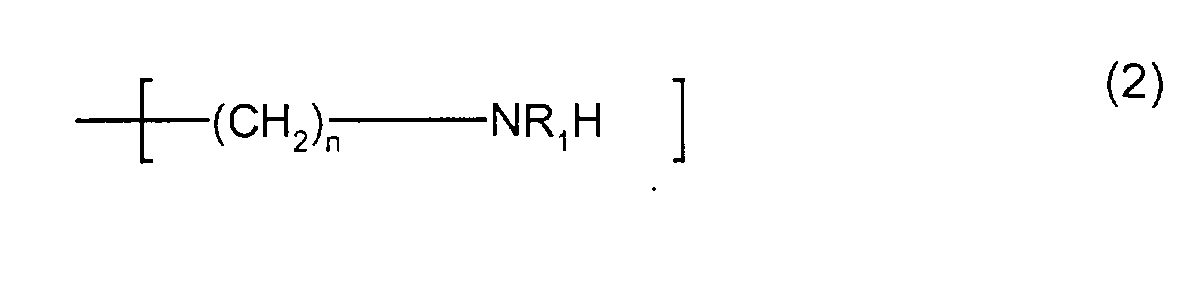
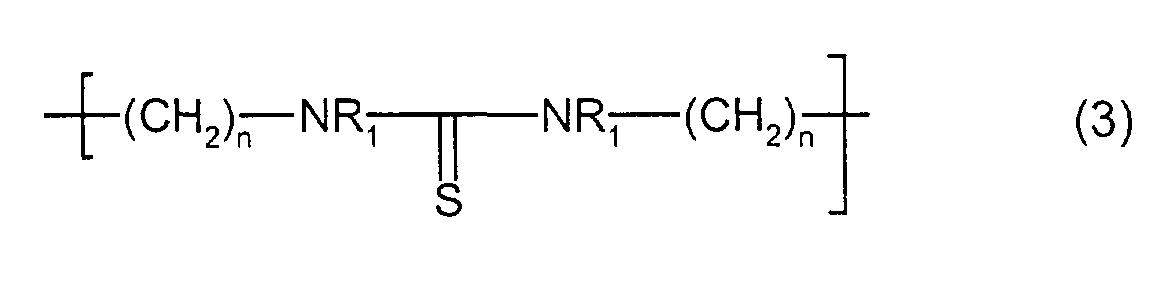 wherein
- R1
- is hydrogen or an alkyl group,
- R2
- is hydrogen or an alkyl group,
- R3
- is hydrogen or an alkyl group, and
- n
- is an integer from 1 to 5 (particularly preferably 1).
- In the groups R1, R2, and R3, alkyl is preferably in each case C1-C6-alkyl.
- In the monodispersed bead polymers having thiourea groups each aromatic ring preferably has from 0.1 to 2 of the above-mentioned functional groups (1), (2), (3), or (4).
- The proportion of the individual functional groups, based on the total of all of the functional groups, is preferably :
- from 30 to 80% of (1)
- from 5 to 30% of (2)
- from 1 to 67% of (3)
- from 1 to 5% of (4).
-
- The bead polymers are particularly suitable for removing rhodium, elements of the platinum group, gold, silver, or rhodium- or noble-metal-containing catalyst residues from organic solutions or solvents.
- For example, such bead polymers can be used to remove iron- and rhodium-containing catalyst residues from the product of the hydrogenation of nitrile rubber using a homogeneous catalyst system. The rubber solution may contain from 0.5 to 20 weight percent rubber, preferably from 3 to 12 weight percent, and hence is viscous.
- In a typical embodiment of the invention the resin is added to a solution of the hydrogenated nitrile rubber containing catalyst residues and the mixture stirred for a period of time sufficient for the catalyst residues to be removed by the resin. The reaction time can vary from 5 to 100 hours, and is preferably in the range of from 48 to 72 hours. The resin is removed by simple filtration and the rubber recovered by removal of the solvent using standard techniques known in the art, such as evaporation under reduced pressure.
- The reaction may be carried out in an inert atmosphere, for example under a blanket of nitrogen.
- Preferably, the amount of resin used in the practice of the invention ranges from 0.1 to 10 weight percent, based upon the amount of hydrogenated nitrile rubber in the solution. More preferably, from 0.5 to 5 weight percent is used.
- Suitable operating temperatures range from 60 to 120°C. Preferably, the operating temperature is in the range of from 90 to 120°C. Temperatures higher than 160°C should not be used because of the potential for decomposition of the ion-exchange resin.
- In a further embodiment of the present invention the ion-exchange resin is assembled in a bed configuration, for example by packing the resin in a column (i.e. a cylindrical container), and the nitrile rubber solution run through the column in a continuous manner.
- In another embodiment of the invention the rubber solution may be passed through the column more than once, thus ensuring that as much of the catalyst residue as possible is removed by the resin.
- As will be appreciated by those skilled in the art, a substantial pressure drop is caused by the flow of a solution through a bed of small particles. This phenomenon is particularly pronounced when the solution is viscous and the particles are very fine and of varying particle size. In a preferred embodiment of the present invention, however, the pressure drop resulting from the flow of the iron and rhodium-containing hydrogenated rubber solution through the ion-exchange resin bed is substantially less that that observed using a heterodispersed resin. This significant reduction in pressure drop (by a factor of about two-thirds) permits much higher volume throughput than would otherwise be possible, resulting in greatly increased production capacity of such a column process.
- Further details of the invention are provided by the following non-limiting examples.
- 3000 g of deionized water were placed in a 10 liter glass reactor, and a solution made from 10 g of gelatin, 16 g of disodium hydrogen phosphate dodecahydrate, and 0.73 g of resorcinol in 320 g of deionized water was added and thoroughly mixed. The temperature of the mixture was controlled to 25°C. Then, with stirring, a mixture made from 3200 g of microencapsulated monomer droplets with a narrow particle size distribution and made from 3.6% by weight of divinylbenzene and 0.9% by weight of ethylstyrene (used in the form of a commercially available isomer mixture of divinylbenzene and ethylstyrene in 80% of divinylbenzene), 0.5% by weight of dibenzoyl peroxide, 56.2% by weight of styrene, and 38.8% by weight of isododecane (industrial isomer mixture with a high proportion of pentamethylheptane), wherein the microcapsules were composed of a formaldehyde-hardened complex co-acervate made from gelatin and from a copolymer of acrylamide and acrylic acid, was introduced and 3200 g of aqueous phase with a pH of 12 was added. The average particle size of the monomer droplets was 460 µm.
- The mix was polymerized to completion, with stirring, by increasing the temperature according to a temperature program starting at 25°C and finishing at 95°C. The mix was cooled, washed using a 32 µm screen, and then dried in vacuo at 80°C. This gave 1893 g of a spherical polymer with an average particle size of 440 µm, narrow particle size distribution, and a smooth surface.
- The polymer had a chalky white appearance from above and had a bulk density of about 370 g/l.
- 2373 g of dichloroethane, 705 g of phthalimide, and 505 g of 29.2% strength by weight formalin were placed in a vessel at room temperature. The pH of the suspension was adjusted to from 5.5 to 6 using aqueous sodium hydroxide. The water was then removed by distillation. 51.7 g of sulfuric acid were then metered in and the resultant water was removed by distillation. The mix was cooled. 189 g of 65% strength oleum were metered in at 30°C, followed by 371.4 g of monodispersed bead polymer prepared according to process step a) of Example 1. The suspension was heated to 70°C and stirred for a further 6 hours at this temperature. The reaction liquid was drawn off, deionized water was metered in, and residual dichloroethane was removed by distillation.
Yield of amidomethylated bead polymer: 2140 mlComposition by elemental analysis: carbon 75.3% by weight; hydrogen 4.9% by weight; nitrogen 5.8% by weight; remainder oxygen. - 1019 g of 45% strength by weight aqueous sodium hydroxide and 406 ml of deionized water were metered at room temperature into 2100 ml of amidomethylated bead polymer. The suspension was heated to 180°C and stirred for 6 hours at this temperature.
- The resultant bead polymer was washed with deionized water.
Yield of aminomethylated bead polymer: 1770 ml
The overall yield (extrapolated) was 1804 ml.Composition by elemental analysis: nitrogen 11.75% by weight. - From the composition of the aminomethylated bead polymer by elemental analysis, it could be calculated that on statistical average per aromatic ring - stemming from the styrene and divinylbenzene units - 1.17 hydrogen atoms had been substituted by aminomethyl groups.
- 1132 ml of deionized water were placed in a 4 liter autoclave at room temperature. 1700 ml of aminomethylated bead polymer from step c), 470 g of 30% strength by weight hydrochloric acid, and 485 g of thiourea were metered into the autoclave.
- The suspension was stirred for 30 minutes at room temperature. The autoclave was then heated to 145°C over a period of 2 hours. The mixture was stirred at 145°C for a further 15 hours.
- The mix was cooled and the pressure released. The supernatant liquor was drawn off. The resultant bead polymer was washed with 4% strength by weight aqueous sodium hydroxide and finally with deionized water. Yield: 1652 ml
Elemental analyses: Nitrogen 10.4% by weight Sulfur 10.2% by weight - This example illustrates the use of the thiourea-functionalized macroporous resin (Lewatit OC 1601, obtained from Bayer AG (Leverkusen, Germany)) to remove iron and rhodium from an iron- and rhodium-containing solution of hydrogenated nitrile rubber in a batch process.
- A 7.5% (by weight) solution in monochlorobenzene of 99% hydrogenated nitrile rubber was used as the standard for all experimental work, and the term "standard rubber solution", as used herein, refers to this solution.
- In a series of 500 ml three-necked round bottom flasks, various quantities of the thiourea-functionalized monodispersed resin (namely 0.1, 0.2, 0.3, and 0.5 g) were added together with 180 g of the standard rubber solution, as indicated in Table 1. Each reaction mixture was stirred at ca. 100°C, under nitrogen, for 64 hours. The resin was then removed from the mixture by filtration and the rubber was recovered by evaporation of the solvent in a rotary evaporator, followed by drying in a reduced pressure oven at 60°C. Samples of the recovered rubber were analyzed for Rh and Fe content by atomic absorption spectroscopy and inductively coupled plasma, respectively. The results are shown in Table 1.
- In a comparative experiment, the rubber from an untreated, 180 g sample of the standard rubber solution was recovered by the evaporation/drying procedures described above. The amount of Rh in this "control sample" was measured by atomic absorption spectroscopy and the amount of Fe measured by inductively coupled plasma. The amounts of Rh and Fe initially present were normalized to 100 parts, and all subsequent results are quoted with respect to the initial amounts present.
- In contrast to the control sample, the Rh content of the rubber recovered after treatment was found to be in the range of 13.7- 43.6 parts, depending upon the amount of resin used. These results indicate that 56 - 86 % of the Rh was removed (i.e. in comparison to the Rh content in the standard rubber sample). The more resin sample used, the more Rh was removed from the hydrogenated nitrile rubber solution.
- The Fe content of the rubber after treatment was found to be consistently in the range of 24.4 - 30.2 parts (with one exception where 0.2 g of resin was used). These results indicate that the resin is capable of removing a certain amount of Fe (70- 76 %, i.e. in comparison to the Fe content in the standard rubber sample) independent of the amount of resin used.
Sample wt. resin (g) initial Rh content % Rh removal initial Fe content % Fe removal Standard rubber 100 100 0.1 43.6 56 24.9 75 0.2 23.6 76 63.1 37 0.3 19.5 81 30.2 70 0.5 13.7 86 24.4 76 - This is a comparative example in which a heterodispersed macroporous resin having dithiol functionality is used to remove Rh and Fe from a sample of the standard rubber solution in example 1. Results are shown in Table 2.
- The Rh content of the rubber recovered after treatment was found to be in the range of 26.9 - 70.2 parts, depending upon the amount of resin used. These results indicate that 30 - 73 % of the Rh was removed (i.e. in comparison to the Rh content in the standard rubber sample). The more resin sample used, the more Rh was removed from the hydrogenated nitrile rubber solution.
- The Fe content of the rubber after treatment was found to be in the range of 40 - 98.2 parts depending on the amount of resin used. These results indicate that 2 - 60 % of the Fe was removed (i.e. in comparison to the Rh content in the standard rubber sample). The more resin sample used, the more Fe was removed from the hydrogenated nitrile rubber solution.
- Thus, it can be clearly seen that the use of the thiourea-functionalized monodispersed resin removed significantly more Rh and Fe from the hydrogenated nitrile rubber solution than the method of the art.
Sample wt. Resin (g) initial Rh content % Rh removal initial Fe content % Fe removal Standard rubber 100 100 0.1 70.2 30 98.2 2 0.2 40 60 77.3 23 0.3 36.1 64 45.3 55 0.5 26.9 73 40 60 * the initial Rh and Fe content was normalized to 100 - This example illustrates the use of the thiourea-functionalized macroporous resin to remove iron and rhodium from an iron and rhodium-containing solution of hydrogenated nitrile rubber in a column process.
- The resin employed was the same thiourea-functionalized macroreticular resin used in example 1. Approximately 65-75 grams (dry weight) of the resin was packed into a column having a length of approximately 91 cm and an internal diameter of approximately 1.9 cm.
- The adsorption experiment was conducted by continually passing the standard rubber solution through the packed column (once through basis) for a period of 8 hours.
- The column was preheated to between 80 and 100°C and the rubber solution was also preheated to between 50 and 70°C. One US gallon of the rubber solution was added to the column at a flow rate between 11.5 and 12.5 g/min. The effluent exiting the column was collected, dried, and the final rubber sample was analyzed for rhodium and iron. Sample of standard rubber was analyzed to determine the rhodium and iron concentration of the rubber solution prior to treatment in the column. Rhodium and iron analyses were carried out according to the procedures described in Example 1.
- The Rh content of the final rubber sample after treatment was 3.08 parts, indicating that some 97% of the Rh was removed (i.e. in comparison to the Rh content in the standard rubber sample).
- The Fe content of the final rubber sample after treatment was 17.2 parts, indicating that some 83% of the Fe was removed (i.e. in comparison to the Fe content in the standard rubber sample).
Sample initial Rh content (%) Rh removal initial Fe content (%)Fe removal Standard rubber 100 - 100 - Treated rubber 3.08 97 17.2 83 * the initial Rh and Fe content was normalized to 100 - This is a comparative example in which a heterodispersed macroporous resin having thiol functionality was used to remove Rh and Fe from a sample of the standard rubber solution in example 1 in a column process.
- The adsorption experiment was conducted under the same conditions as described in Example 3. The Rh and Fe analytical results are shown in Table 4.
- The Rh content of the final rubber sample after treatment was 20.1 parts, indicating that some 80% of the Rh was removed (i.e. in comparison to the Rh content in the standard rubber sample).
- The Fe content of the final rubber sample after treatment was 60.3 parts, indicating that some 40% of the Fe was removed (i.e. in comparison to the Fe content in the standard rubber sample).
- Again, it can be clearly seen that the use of the thiourea-functionalized monodispersed resin in a column process removed significantly more Rh and Fe from the hydrogenated nitrile rubber solution than the method of the art.
Sample initial Rh content (%) Rh removal initial Fe content (%)Fe removal Standard rubber 100 - 100 - Treated rubber 20.1 80 60.3 40 * the initial Rh and Fe content was normalized to 100 - The treated rubber samples from examples 4 and 5 were compounded (using a peroxide method) and the properties of the resulting vulcanizates investigated in order to determine the effects of residual metals (Rh and Fe) upon hot air aging. The results are illustrated in Figures 1 and 2. After aging at 150°C for 168 hours, the vulcanizate derived from example 4 showed slightly better retention of tensile strength and elongation, but slightly worse in moduli than that of the sample derived from example 5. However, a marked difference was observed after aging at 150°C for 672 hours, where the vulcanizate derived from example 4 showed much better retention of properties such as tensile strength, elongation and moduli than that of the vulcanizate derived from example 5.
- Figur 1: After hot air aging for 168 hours at 150 °C
- Figur 2: After hot air aging for 672 hours at 150 °C
- In the figures:
- Change stress @ xx (%) means Change stress at elongation of xx % in %
Claims (11)
- A process for the removal of iron- and rhodium-containing catalyst residues from hydrogenated nitrile rubber which comprises the treatment of a solution of hydrogenated nitrile rubber containing such residues with a homodispersed, macroporous, cross-linked styrene-divinylbenzene copolymer resin having thiourea functional groups.
- A process according to claim 1 wherein the hydrogenated nitrile rubber is dissolved in a halogenated solvent.
- A process according to claim 2 wherein the solvent is monochlorobenzene.
- A process according to claim 2 wherein solution contains from 0.5 to 20 weight percent of hydrogenated nitrile rubber.
- A process according to claim 4 wherein solution contains from 3 to 12 weight percent of hydrogenated nitrile rubber.
- A process according to claim 5 wherein the process is carried out at a temperature in the range of from 60°C to 120°C.
- A process according to claim 6 wherein the process is carried out at a temperature in the range of from 90°C to 120°C.
- A process according to claim 7 wherein the amount of resin used is in the range of from 0.1 to 10 weight percent, based upon the amount of hydrogenated nitrile rubber in the solution.
- A process according to claim 8 wherein the amount of resin used is in the range of from 0.5 to 5 weight percent, based upon the amount of hydrogenated nitrile rubber in the solution.
- A process according to claim 1 wherein the resin is packed into a column and the solution containing the hydrogenated nitrile rubber passed through the column in a continuous fashion.
- A process according to claim 10 in which the solution containing the hydrogenated nitrile rubber is cycled through the column more than once.
Applications Claiming Priority (2)
| Application Number | Priority Date | Filing Date | Title |
|---|---|---|---|
| CA2325240 | 2000-11-06 | ||
| CA002325240A CA2325240A1 (en) | 2000-11-06 | 2000-11-06 | A process for removing iron- and rhodium-containing catalyst residues from hydrogenated nitrile rubber |
Publications (3)
| Publication Number | Publication Date |
|---|---|
| EP1203777A1 true EP1203777A1 (en) | 2002-05-08 |
| EP1203777B1 EP1203777B1 (en) | 2005-07-06 |
| EP1203777B8 EP1203777B8 (en) | 2005-08-31 |
Family
ID=4167568
Family Applications (1)
| Application Number | Title | Priority Date | Filing Date |
|---|---|---|---|
| EP01126102A Expired - Lifetime EP1203777B8 (en) | 2000-11-06 | 2001-11-02 | Process for removal of catalyst residues |
Country Status (5)
| Country | Link |
|---|---|
| US (1) | US6646059B2 (en) |
| EP (1) | EP1203777B8 (en) |
| JP (1) | JP3719970B2 (en) |
| CA (1) | CA2325240A1 (en) |
| DE (1) | DE60111808T2 (en) |
Cited By (5)
| Publication number | Priority date | Publication date | Assignee | Title |
|---|---|---|---|---|
| EP2072532A1 (en) * | 2007-12-21 | 2009-06-24 | Lanxess Deutschland GmbH | A process for removing iron-residues, rhodium- and ruthenium-containing catalyst residues from optionally hydrogenated nitrile rubber |
| EP2243516A1 (en) * | 2009-04-23 | 2010-10-27 | Rohm and Haas Company | Reduction of antimicrobial compound levels during product dispensing |
| WO2015101602A1 (en) * | 2013-12-30 | 2015-07-09 | Lanxess Deutschland Gmbh | Hydrogenated nitrile rubber containing phosphine sulfide or diphosphine sulfide |
| CN105985456A (en) * | 2015-02-05 | 2016-10-05 | 中国石油天然气股份有限公司 | A method for removing metal rhodium in hydrogenated nitrile rubber |
| WO2024153212A1 (en) * | 2023-01-20 | 2024-07-25 | 华为技术有限公司 | Method for removing impurities from cobalt solution |
Families Citing this family (5)
| Publication number | Priority date | Publication date | Assignee | Title |
|---|---|---|---|---|
| JP4124004B2 (en) * | 2002-03-26 | 2008-07-23 | 日本ゼオン株式会社 | Hydrogenated conjugated diene polymer latex, process for producing the same, and hydrogenated conjugated diene polymer rubber |
| US20080245233A1 (en) * | 2007-04-05 | 2008-10-09 | Baker Hughes Incorporated | Method for Inhibiting Fouling in Basic Washing Systems |
| CA2646056A1 (en) | 2007-12-21 | 2009-06-21 | Lanxess Deutschland Gmbh | A process for removing ruthenium-containing catalyst residues from optionally hydrogenated nitrile rubber |
| TW200934662A (en) * | 2007-12-28 | 2009-08-16 | Du Pont | Method for reworking adhesively bonded liquid crystal displays |
| WO2013098056A1 (en) | 2011-12-28 | 2013-07-04 | Lanxess Deutschland Gmbh | Purification of optionally hydrogenated nitrile rubber |
Citations (4)
| Publication number | Priority date | Publication date | Assignee | Title |
|---|---|---|---|---|
| US4985540A (en) * | 1989-11-20 | 1991-01-15 | Polysar Limited | Process for removing rhodium-containing catalyst residue from hydrogenated nitrile rubber |
| EP0467429A2 (en) * | 1990-06-14 | 1992-01-22 | Shell Internationale Researchmaatschappij B.V. | Removal of hydrogenation catalyst from polymer solutions by catalyzed precipitation |
| EP1000660A1 (en) * | 1998-11-16 | 2000-05-17 | Bayer Aktiengesellschaft | Method for producing monodispersed gel-like anion exchangers |
| EP1078689A2 (en) * | 1999-08-27 | 2001-02-28 | Bayer Ag | Method for producing monodispersed anion exchangers with strong basic functional groups |
Family Cites Families (10)
| Publication number | Priority date | Publication date | Assignee | Title |
|---|---|---|---|---|
| US4382124B1 (en) | 1958-07-18 | 1994-10-04 | Rohm & Haas | Process for preparing macroreticular resins, copolymers and products of said process |
| DE2539132C2 (en) | 1975-09-03 | 1987-04-09 | Bayer Ag, 5090 Leverkusen | Use of hydrogenated diene copolymers as temperature-resistant materials in the sealing sector |
| DE3031737A1 (en) | 1980-08-22 | 1982-04-01 | Bayer Ag, 5090 Leverkusen | METHOD FOR PRODUCING PEARL POLYMERISATS OF UNIFORM PARTICLE SIZE |
| CA1166413A (en) | 1980-10-30 | 1984-05-01 | Edward E. Timm | Process and apparatus for preparing uniform size polymer beads |
| US4396761A (en) | 1981-08-21 | 1983-08-02 | Shell Oil Company | Method for removing hydrogenation catalyst residues from hydrogenated conjugated diene polymers |
| US4419245A (en) | 1982-06-30 | 1983-12-06 | Rohm And Haas Company | Copolymer process and product therefrom consisting of crosslinked seed bead swollen by styrene monomer |
| CA1220300A (en) | 1982-12-08 | 1987-04-07 | Polysar Limited | Polymer hydrogenation process |
| JPS59117501A (en) | 1982-12-23 | 1984-07-06 | Nippon Zeon Co Ltd | Hydrogenation of conjugated diene polymer |
| US4595749A (en) | 1984-11-23 | 1986-06-17 | Shell Oil Company | Direct removal of NI catalysts |
| US5231115A (en) | 1991-12-19 | 1993-07-27 | The Dow Chemical Company | Seeded porous copolymers and ion-exchange resins prepared therefrom |
-
2000
- 2000-11-06 CA CA002325240A patent/CA2325240A1/en not_active Abandoned
-
2001
- 2001-11-02 US US10/000,520 patent/US6646059B2/en not_active Expired - Lifetime
- 2001-11-02 DE DE60111808T patent/DE60111808T2/en not_active Expired - Lifetime
- 2001-11-02 EP EP01126102A patent/EP1203777B8/en not_active Expired - Lifetime
- 2001-11-06 JP JP2001340351A patent/JP3719970B2/en not_active Expired - Lifetime
Patent Citations (4)
| Publication number | Priority date | Publication date | Assignee | Title |
|---|---|---|---|---|
| US4985540A (en) * | 1989-11-20 | 1991-01-15 | Polysar Limited | Process for removing rhodium-containing catalyst residue from hydrogenated nitrile rubber |
| EP0467429A2 (en) * | 1990-06-14 | 1992-01-22 | Shell Internationale Researchmaatschappij B.V. | Removal of hydrogenation catalyst from polymer solutions by catalyzed precipitation |
| EP1000660A1 (en) * | 1998-11-16 | 2000-05-17 | Bayer Aktiengesellschaft | Method for producing monodispersed gel-like anion exchangers |
| EP1078689A2 (en) * | 1999-08-27 | 2001-02-28 | Bayer Ag | Method for producing monodispersed anion exchangers with strong basic functional groups |
Cited By (9)
| Publication number | Priority date | Publication date | Assignee | Title |
|---|---|---|---|---|
| EP2072532A1 (en) * | 2007-12-21 | 2009-06-24 | Lanxess Deutschland GmbH | A process for removing iron-residues, rhodium- and ruthenium-containing catalyst residues from optionally hydrogenated nitrile rubber |
| EP2243516A1 (en) * | 2009-04-23 | 2010-10-27 | Rohm and Haas Company | Reduction of antimicrobial compound levels during product dispensing |
| CN101869749A (en) * | 2009-04-23 | 2010-10-27 | 罗门哈斯公司 | Reduction of antimicrobial compound content during product distribution |
| CN101869749B (en) * | 2009-04-23 | 2014-04-09 | 罗门哈斯公司 | Reduction of antimicrobial compound levels during product dispensing |
| WO2015101602A1 (en) * | 2013-12-30 | 2015-07-09 | Lanxess Deutschland Gmbh | Hydrogenated nitrile rubber containing phosphine sulfide or diphosphine sulfide |
| CN105873956A (en) * | 2013-12-30 | 2016-08-17 | 阿朗新科德国有限责任公司 | Hydrogenated nitrile rubber containing phosphine sulfide or diphosphine sulfide |
| CN105985456A (en) * | 2015-02-05 | 2016-10-05 | 中国石油天然气股份有限公司 | A method for removing metal rhodium in hydrogenated nitrile rubber |
| CN105985456B (en) * | 2015-02-05 | 2017-11-07 | 中国石油天然气股份有限公司 | A method for removing metal rhodium in hydrogenated nitrile rubber |
| WO2024153212A1 (en) * | 2023-01-20 | 2024-07-25 | 华为技术有限公司 | Method for removing impurities from cobalt solution |
Also Published As
| Publication number | Publication date |
|---|---|
| US6646059B2 (en) | 2003-11-11 |
| JP3719970B2 (en) | 2005-11-24 |
| JP2002206001A (en) | 2002-07-26 |
| CA2325240A1 (en) | 2002-05-06 |
| DE60111808T2 (en) | 2006-03-30 |
| EP1203777B8 (en) | 2005-08-31 |
| US20020120071A1 (en) | 2002-08-29 |
| EP1203777B1 (en) | 2005-07-06 |
| DE60111808D1 (en) | 2005-08-11 |
Similar Documents
| Publication | Publication Date | Title |
|---|---|---|
| US7077964B2 (en) | Process for preparing monodisperse ion exchangers having chelating functional | |
| US6329435B1 (en) | Process for preparing monodisperse, crosslinked bead polymers having thiourea groups and their use for adsorbing metal compounds | |
| CA2030066C (en) | Polymer treatment process | |
| US8562922B2 (en) | Picolylamine resins | |
| US7053129B1 (en) | Process for preparing monodisperse anion exchangers | |
| US8177982B2 (en) | Method of producing monodisperse chelate resins | |
| US8563622B2 (en) | Picolylamine resins | |
| EP1203777B1 (en) | Process for removal of catalyst residues | |
| CN103998135A (en) | Thiol group-containing acrylate resin | |
| US20030191201A1 (en) | Process for producing coarse-particle anion-exchanger gels | |
| US6699913B1 (en) | Process for preparing monodisperse anion exchangers having strongly basic functional groups | |
| US20130245140A1 (en) | Chelate resins | |
| US20010002656A1 (en) | Process for preparing monodisperse adsorber resins and their use | |
| US20070027222A1 (en) | Monodisperse cation exchangers | |
| AU2004274134B2 (en) | Method for the purification of sulphuric acids | |
| MXPA01011153A (en) | Process for removing iron-and rhodium-containing catalyst residues from hydrogenated nitrile rubber |
Legal Events
| Date | Code | Title | Description |
|---|---|---|---|
| PUAI | Public reference made under article 153(3) epc to a published international application that has entered the european phase |
Free format text: ORIGINAL CODE: 0009012 |
|
| AK | Designated contracting states |
Kind code of ref document: A1 Designated state(s): AT BE CH CY DE DK ES FI FR GB GR IE IT LI LU MC NL PT SE TR |
|
| AX | Request for extension of the european patent |
Free format text: AL;LT;LV;MK;RO;SI |
|
| RIN1 | Information on inventor provided before grant (corrected) |
Inventor name: SPADOLA, IGNAZIO Inventor name: MERSMANN, FRANZ-JOSEF Inventor name: NGUYEN, PAUL Inventor name: ARSENAULT, GILLES JOSEPH Inventor name: BENDER, HARALD, DR. |
|
| 17P | Request for examination filed |
Effective date: 20021108 |
|
| AKX | Designation fees paid |
Designated state(s): DE FR GB IT |
|
| 17Q | First examination report despatched |
Effective date: 20040218 |
|
| GRAP | Despatch of communication of intention to grant a patent |
Free format text: ORIGINAL CODE: EPIDOSNIGR1 |
|
| GRAS | Grant fee paid |
Free format text: ORIGINAL CODE: EPIDOSNIGR3 |
|
| GRAA | (expected) grant |
Free format text: ORIGINAL CODE: 0009210 |
|
| AK | Designated contracting states |
Kind code of ref document: B1 Designated state(s): DE FR GB IT |
|
| REG | Reference to a national code |
Ref country code: GB Ref legal event code: FG4D |
|
| RAP2 | Party data changed (patent owner data changed or rights of a patent transferred) |
Owner name: LANXESS INC. |
|
| REF | Corresponds to: |
Ref document number: 60111808 Country of ref document: DE Date of ref document: 20050811 Kind code of ref document: P |
|
| ET | Fr: translation filed | ||
| PLBE | No opposition filed within time limit |
Free format text: ORIGINAL CODE: 0009261 |
|
| STAA | Information on the status of an ep patent application or granted ep patent |
Free format text: STATUS: NO OPPOSITION FILED WITHIN TIME LIMIT |
|
| 26N | No opposition filed |
Effective date: 20060407 |
|
| REG | Reference to a national code |
Ref country code: FR Ref legal event code: PLFP Year of fee payment: 15 |
|
| REG | Reference to a national code |
Ref country code: FR Ref legal event code: PLFP Year of fee payment: 16 |
|
| REG | Reference to a national code |
Ref country code: DE Ref document number: 60111808 Ref country code: DE Ref legal event code: R082 Ref document number: 60111808 Country of ref document: DE Representative=s name: ZOBEL, MANFRED, DIPL.-CHEM. DR., DE Ref country code: DE Ref legal event code: R081 Ref document number: 60111808 Country of ref document: DE Owner name: ARLANXEO CANADA INC., SARNIA, CA Free format text: FORMER OWNER: LANXESS INC., SARNIA, ONTARIO, CA |
|
| REG | Reference to a national code |
Ref country code: FR Ref legal event code: PLFP Year of fee payment: 17 |
|
| REG | Reference to a national code |
Ref country code: GB Ref legal event code: 732E Free format text: REGISTERED BETWEEN 20180419 AND 20180425 |
|
| REG | Reference to a national code |
Ref country code: FR Ref legal event code: PLFP Year of fee payment: 18 |
|
| REG | Reference to a national code |
Ref country code: DE Ref legal event code: R082 Ref document number: 60111808 Country of ref document: DE |
|
| PGFP | Annual fee paid to national office [announced via postgrant information from national office to epo] |
Ref country code: FR Payment date: 20200914 Year of fee payment: 20 |
|
| PGFP | Annual fee paid to national office [announced via postgrant information from national office to epo] |
Ref country code: GB Payment date: 20201021 Year of fee payment: 20 Ref country code: DE Payment date: 20201020 Year of fee payment: 20 Ref country code: IT Payment date: 20201013 Year of fee payment: 20 |
|
| REG | Reference to a national code |
Ref country code: DE Ref legal event code: R071 Ref document number: 60111808 Country of ref document: DE |
|
| REG | Reference to a national code |
Ref country code: GB Ref legal event code: PE20 Expiry date: 20211101 |
|
| PG25 | Lapsed in a contracting state [announced via postgrant information from national office to epo] |
Ref country code: GB Free format text: LAPSE BECAUSE OF EXPIRATION OF PROTECTION Effective date: 20211101 |