EP1203771A1 - Remedies or preventives for frequent urination or urinary incontinence - Google Patents
Remedies or preventives for frequent urination or urinary incontinence Download PDFInfo
- Publication number
- EP1203771A1 EP1203771A1 EP00946400A EP00946400A EP1203771A1 EP 1203771 A1 EP1203771 A1 EP 1203771A1 EP 00946400 A EP00946400 A EP 00946400A EP 00946400 A EP00946400 A EP 00946400A EP 1203771 A1 EP1203771 A1 EP 1203771A1
- Authority
- EP
- European Patent Office
- Prior art keywords
- alkyl
- hydrogen
- compound
- represent
- acid salt
- Prior art date
- Legal status (The legal status is an assumption and is not a legal conclusion. Google has not performed a legal analysis and makes no representation as to the accuracy of the status listed.)
- Withdrawn
Links
- 206010046543 Urinary incontinence Diseases 0.000 title claims abstract description 20
- 230000027939 micturition Effects 0.000 title claims abstract description 17
- 230000003449 preventive effect Effects 0.000 title 1
- 239000003795 chemical substances by application Substances 0.000 claims abstract description 13
- 230000001225 therapeutic effect Effects 0.000 claims abstract description 13
- 150000003839 salts Chemical class 0.000 claims abstract description 8
- 239000002253 acid Substances 0.000 claims abstract description 7
- 239000004615 ingredient Substances 0.000 claims abstract description 4
- -1 chloro, bromo, iodo Chemical group 0.000 claims description 50
- 229910052739 hydrogen Inorganic materials 0.000 claims description 33
- 239000001257 hydrogen Substances 0.000 claims description 33
- 125000006527 (C1-C5) alkyl group Chemical group 0.000 claims description 22
- 125000004432 carbon atom Chemical group C* 0.000 claims description 16
- 125000000217 alkyl group Chemical group 0.000 claims description 10
- 125000001316 cycloalkyl alkyl group Chemical group 0.000 claims description 9
- 125000003710 aryl alkyl group Chemical group 0.000 claims description 8
- 125000001997 phenyl group Chemical group [H]C1=C([H])C([H])=C(*)C([H])=C1[H] 0.000 claims description 8
- 125000001153 fluoro group Chemical group F* 0.000 claims description 7
- 125000003545 alkoxy group Chemical group 0.000 claims description 6
- 125000005605 benzo group Chemical group 0.000 claims description 6
- 125000001589 carboacyl group Chemical group 0.000 claims description 6
- 125000000816 ethylene group Chemical group [H]C([H])([*:1])C([H])([H])[*:2] 0.000 claims description 6
- 125000002023 trifluoromethyl group Chemical group FC(F)(F)* 0.000 claims description 6
- 125000001424 substituent group Chemical group 0.000 claims description 5
- 125000003258 trimethylene group Chemical group [H]C([H])([*:2])C([H])([H])C([H])([H])[*:1] 0.000 claims description 5
- LKDRXBCSQODPBY-AMVSKUEXSA-N L-(-)-Sorbose Chemical compound OCC1(O)OC[C@H](O)[C@@H](O)[C@@H]1O LKDRXBCSQODPBY-AMVSKUEXSA-N 0.000 claims description 4
- 125000004423 acyloxy group Chemical group 0.000 claims description 4
- OFDNQWIFNXBECV-VFSYNPLYSA-N dolastatin 10 Chemical compound CC(C)[C@H](N(C)C)C(=O)N[C@@H](C(C)C)C(=O)N(C)[C@@H]([C@@H](C)CC)[C@H](OC)CC(=O)N1CCC[C@H]1[C@H](OC)[C@@H](C)C(=O)N[C@H](C=1SC=CN=1)CC1=CC=CC=C1 OFDNQWIFNXBECV-VFSYNPLYSA-N 0.000 claims description 4
- 125000006699 (C1-C3) hydroxyalkyl group Chemical group 0.000 claims description 3
- 125000003342 alkenyl group Chemical group 0.000 claims description 3
- 125000002887 hydroxy group Chemical group [H]O* 0.000 claims description 3
- 125000002102 aryl alkyloxo group Chemical group 0.000 claims description 2
- 125000005199 aryl carbonyloxy group Chemical group 0.000 claims description 2
- 125000004093 cyano group Chemical group *C#N 0.000 claims description 2
- 125000002768 hydroxyalkyl group Chemical group 0.000 claims description 2
- 125000001810 isothiocyanato group Chemical group *N=C=S 0.000 claims description 2
- 125000000383 tetramethylene group Chemical group [H]C([H])([*:1])C([H])([H])C([H])([H])C([H])([H])[*:2] 0.000 claims description 2
- 125000000876 trifluoromethoxy group Chemical group FC(F)(F)O* 0.000 claims description 2
- 125000004435 hydrogen atom Chemical group [H]* 0.000 claims 7
- 239000000203 mixture Substances 0.000 description 57
- 150000001875 compounds Chemical class 0.000 description 50
- 239000000243 solution Substances 0.000 description 45
- UIIMBOGNXHQVGW-UHFFFAOYSA-M Sodium bicarbonate Chemical compound [Na+].OC([O-])=O UIIMBOGNXHQVGW-UHFFFAOYSA-M 0.000 description 30
- HEDRZPFGACZZDS-UHFFFAOYSA-N Chloroform Chemical compound ClC(Cl)Cl HEDRZPFGACZZDS-UHFFFAOYSA-N 0.000 description 28
- OKKJLVBELUTLKV-UHFFFAOYSA-N Methanol Chemical compound OC OKKJLVBELUTLKV-UHFFFAOYSA-N 0.000 description 24
- 230000015572 biosynthetic process Effects 0.000 description 24
- 150000002431 hydrogen Chemical group 0.000 description 24
- 238000003786 synthesis reaction Methods 0.000 description 24
- 238000000034 method Methods 0.000 description 22
- AFVFQIVMOAPDHO-UHFFFAOYSA-N Methanesulfonic acid Chemical class CS(O)(=O)=O AFVFQIVMOAPDHO-UHFFFAOYSA-N 0.000 description 21
- 239000012043 crude product Substances 0.000 description 21
- 238000010898 silica gel chromatography Methods 0.000 description 20
- 239000012044 organic layer Substances 0.000 description 19
- XEKOWRVHYACXOJ-UHFFFAOYSA-N Ethyl acetate Chemical compound CCOC(C)=O XEKOWRVHYACXOJ-UHFFFAOYSA-N 0.000 description 18
- 238000006243 chemical reaction Methods 0.000 description 18
- 125000001495 ethyl group Chemical group [H]C([H])([H])C([H])([H])* 0.000 description 17
- 125000002496 methyl group Chemical group [H]C([H])([H])* 0.000 description 17
- PMZURENOXWZQFD-UHFFFAOYSA-L Sodium Sulfate Chemical compound [Na+].[Na+].[O-]S([O-])(=O)=O PMZURENOXWZQFD-UHFFFAOYSA-L 0.000 description 15
- 235000017557 sodium bicarbonate Nutrition 0.000 description 15
- 229910000030 sodium bicarbonate Inorganic materials 0.000 description 15
- 229920006395 saturated elastomer Polymers 0.000 description 14
- 150000003892 tartrate salts Chemical class 0.000 description 13
- LFQSCWFLJHTTHZ-UHFFFAOYSA-N Ethanol Chemical compound CCO LFQSCWFLJHTTHZ-UHFFFAOYSA-N 0.000 description 12
- ZMXDDKWLCZADIW-UHFFFAOYSA-N N,N-Dimethylformamide Chemical compound CN(C)C=O ZMXDDKWLCZADIW-UHFFFAOYSA-N 0.000 description 11
- 230000008602 contraction Effects 0.000 description 11
- 230000001020 rhythmical effect Effects 0.000 description 10
- QTBSBXVTEAMEQO-UHFFFAOYSA-N Acetic acid Chemical compound CC(O)=O QTBSBXVTEAMEQO-UHFFFAOYSA-N 0.000 description 9
- YMWUJEATGCHHMB-UHFFFAOYSA-N Dichloromethane Chemical compound ClCCl YMWUJEATGCHHMB-UHFFFAOYSA-N 0.000 description 9
- IAZDPXIOMUYVGZ-UHFFFAOYSA-N Dimethylsulphoxide Chemical compound CS(C)=O IAZDPXIOMUYVGZ-UHFFFAOYSA-N 0.000 description 9
- 230000000694 effects Effects 0.000 description 9
- 238000000605 extraction Methods 0.000 description 8
- 239000012046 mixed solvent Substances 0.000 description 8
- INAXVFBXDYWQFN-XHSDSOJGSA-N morphinan Chemical compound C1C2=CC=CC=C2[C@]23CCCC[C@H]3[C@@H]1NCC2 INAXVFBXDYWQFN-XHSDSOJGSA-N 0.000 description 8
- 125000001436 propyl group Chemical group [H]C([*])([H])C([H])([H])C([H])([H])[H] 0.000 description 8
- 125000001797 benzyl group Chemical group [H]C1=C([H])C([H])=C(C([H])=C1[H])C([H])([H])* 0.000 description 7
- 239000003814 drug Substances 0.000 description 7
- 239000012264 purified product Substances 0.000 description 7
- 238000010992 reflux Methods 0.000 description 7
- WFDIJRYMOXRFFG-UHFFFAOYSA-N Acetic anhydride Chemical compound CC(=O)OC(C)=O WFDIJRYMOXRFFG-UHFFFAOYSA-N 0.000 description 6
- UHOVQNZJYSORNB-UHFFFAOYSA-N Benzene Chemical compound C1=CC=CC=C1 UHOVQNZJYSORNB-UHFFFAOYSA-N 0.000 description 6
- ZMANZCXQSJIPKH-UHFFFAOYSA-N Triethylamine Chemical compound CCN(CC)CC ZMANZCXQSJIPKH-UHFFFAOYSA-N 0.000 description 6
- ILAHWRKJUDSMFH-UHFFFAOYSA-N boron tribromide Chemical compound BrB(Br)Br ILAHWRKJUDSMFH-UHFFFAOYSA-N 0.000 description 6
- 230000002401 inhibitory effect Effects 0.000 description 6
- CSNNHWWHGAXBCP-UHFFFAOYSA-L Magnesium sulfate Chemical compound [Mg+2].[O-][S+2]([O-])([O-])[O-] CSNNHWWHGAXBCP-UHFFFAOYSA-L 0.000 description 5
- 125000000484 butyl group Chemical group [H]C([*])([H])C([H])([H])C([H])([H])C([H])([H])[H] 0.000 description 5
- 229940079593 drug Drugs 0.000 description 5
- 239000002904 solvent Substances 0.000 description 5
- 238000003756 stirring Methods 0.000 description 5
- QSNSCYSYFYORTR-UHFFFAOYSA-N 4-chloroaniline Chemical compound NC1=CC=C(Cl)C=C1 QSNSCYSYFYORTR-UHFFFAOYSA-N 0.000 description 4
- VEXZGXHMUGYJMC-UHFFFAOYSA-N Hydrochloric acid Chemical class Cl VEXZGXHMUGYJMC-UHFFFAOYSA-N 0.000 description 4
- JUJWROOIHBZHMG-UHFFFAOYSA-N Pyridine Chemical compound C1=CC=NC=C1 JUJWROOIHBZHMG-UHFFFAOYSA-N 0.000 description 4
- SMWDFEZZVXVKRB-UHFFFAOYSA-N Quinoline Chemical compound N1=CC=CC2=CC=CC=C21 SMWDFEZZVXVKRB-UHFFFAOYSA-N 0.000 description 4
- 125000004186 cyclopropylmethyl group Chemical group [H]C([H])(*)C1([H])C([H])([H])C1([H])[H] 0.000 description 4
- 208000037265 diseases, disorders, signs and symptoms Diseases 0.000 description 4
- 238000010438 heat treatment Methods 0.000 description 4
- 125000004029 hydroxymethyl group Chemical group [H]OC([H])([H])* 0.000 description 4
- 125000001841 imino group Chemical group [H]N=* 0.000 description 4
- 230000036724 intravesical pressure Effects 0.000 description 4
- LPNYRYFBWFDTMA-UHFFFAOYSA-N potassium tert-butoxide Chemical compound [K+].CC(C)(C)[O-] LPNYRYFBWFDTMA-UHFFFAOYSA-N 0.000 description 4
- SUVIGLJNEAMWEG-UHFFFAOYSA-N propane-1-thiol Chemical compound CCCS SUVIGLJNEAMWEG-UHFFFAOYSA-N 0.000 description 4
- 239000011541 reaction mixture Substances 0.000 description 4
- 238000002560 therapeutic procedure Methods 0.000 description 4
- AOSZTAHDEDLTLQ-AZKQZHLXSA-N (1S,2S,4R,8S,9S,11S,12R,13S,19S)-6-[(3-chlorophenyl)methyl]-12,19-difluoro-11-hydroxy-8-(2-hydroxyacetyl)-9,13-dimethyl-6-azapentacyclo[10.8.0.02,9.04,8.013,18]icosa-14,17-dien-16-one Chemical compound C([C@@H]1C[C@H]2[C@H]3[C@]([C@]4(C=CC(=O)C=C4[C@@H](F)C3)C)(F)[C@@H](O)C[C@@]2([C@@]1(C1)C(=O)CO)C)N1CC1=CC=CC(Cl)=C1 AOSZTAHDEDLTLQ-AZKQZHLXSA-N 0.000 description 3
- SZUVGFMDDVSKSI-WIFOCOSTSA-N (1s,2s,3s,5r)-1-(carboxymethyl)-3,5-bis[(4-phenoxyphenyl)methyl-propylcarbamoyl]cyclopentane-1,2-dicarboxylic acid Chemical compound O=C([C@@H]1[C@@H]([C@](CC(O)=O)([C@H](C(=O)N(CCC)CC=2C=CC(OC=3C=CC=CC=3)=CC=2)C1)C(O)=O)C(O)=O)N(CCC)CC(C=C1)=CC=C1OC1=CC=CC=C1 SZUVGFMDDVSKSI-WIFOCOSTSA-N 0.000 description 3
- GHYOCDFICYLMRF-UTIIJYGPSA-N (2S,3R)-N-[(2S)-3-(cyclopenten-1-yl)-1-[(2R)-2-methyloxiran-2-yl]-1-oxopropan-2-yl]-3-hydroxy-3-(4-methoxyphenyl)-2-[[(2S)-2-[(2-morpholin-4-ylacetyl)amino]propanoyl]amino]propanamide Chemical compound C1(=CCCC1)C[C@@H](C(=O)[C@@]1(OC1)C)NC([C@H]([C@@H](C1=CC=C(C=C1)OC)O)NC([C@H](C)NC(CN1CCOCC1)=O)=O)=O GHYOCDFICYLMRF-UTIIJYGPSA-N 0.000 description 3
- QFLWZFQWSBQYPS-AWRAUJHKSA-N (3S)-3-[[(2S)-2-[[(2S)-2-[5-[(3aS,6aR)-2-oxo-1,3,3a,4,6,6a-hexahydrothieno[3,4-d]imidazol-4-yl]pentanoylamino]-3-methylbutanoyl]amino]-3-(4-hydroxyphenyl)propanoyl]amino]-4-[1-bis(4-chlorophenoxy)phosphorylbutylamino]-4-oxobutanoic acid Chemical compound CCCC(NC(=O)[C@H](CC(O)=O)NC(=O)[C@H](Cc1ccc(O)cc1)NC(=O)[C@@H](NC(=O)CCCCC1SC[C@@H]2NC(=O)N[C@H]12)C(C)C)P(=O)(Oc1ccc(Cl)cc1)Oc1ccc(Cl)cc1 QFLWZFQWSBQYPS-AWRAUJHKSA-N 0.000 description 3
- IWZSHWBGHQBIML-ZGGLMWTQSA-N (3S,8S,10R,13S,14S,17S)-17-isoquinolin-7-yl-N,N,10,13-tetramethyl-2,3,4,7,8,9,11,12,14,15,16,17-dodecahydro-1H-cyclopenta[a]phenanthren-3-amine Chemical compound CN(C)[C@H]1CC[C@]2(C)C3CC[C@@]4(C)[C@@H](CC[C@@H]4c4ccc5ccncc5c4)[C@@H]3CC=C2C1 IWZSHWBGHQBIML-ZGGLMWTQSA-N 0.000 description 3
- ONBQEOIKXPHGMB-VBSBHUPXSA-N 1-[2-[(2s,3r,4s,5r)-3,4-dihydroxy-5-(hydroxymethyl)oxolan-2-yl]oxy-4,6-dihydroxyphenyl]-3-(4-hydroxyphenyl)propan-1-one Chemical compound O[C@@H]1[C@H](O)[C@@H](CO)O[C@H]1OC1=CC(O)=CC(O)=C1C(=O)CCC1=CC=C(O)C=C1 ONBQEOIKXPHGMB-VBSBHUPXSA-N 0.000 description 3
- UNILWMWFPHPYOR-KXEYIPSPSA-M 1-[6-[2-[3-[3-[3-[2-[2-[3-[[2-[2-[[(2r)-1-[[2-[[(2r)-1-[3-[2-[2-[3-[[2-(2-amino-2-oxoethoxy)acetyl]amino]propoxy]ethoxy]ethoxy]propylamino]-3-hydroxy-1-oxopropan-2-yl]amino]-2-oxoethyl]amino]-3-[(2r)-2,3-di(hexadecanoyloxy)propyl]sulfanyl-1-oxopropan-2-yl Chemical compound O=C1C(SCCC(=O)NCCCOCCOCCOCCCNC(=O)COCC(=O)N[C@@H](CSC[C@@H](COC(=O)CCCCCCCCCCCCCCC)OC(=O)CCCCCCCCCCCCCCC)C(=O)NCC(=O)N[C@H](CO)C(=O)NCCCOCCOCCOCCCNC(=O)COCC(N)=O)CC(=O)N1CCNC(=O)CCCCCN\1C2=CC=C(S([O-])(=O)=O)C=C2CC/1=C/C=C/C=C/C1=[N+](CC)C2=CC=C(S([O-])(=O)=O)C=C2C1 UNILWMWFPHPYOR-KXEYIPSPSA-M 0.000 description 3
- 125000000094 2-phenylethyl group Chemical group [H]C1=C([H])C([H])=C(C([H])=C1[H])C([H])([H])C([H])([H])* 0.000 description 3
- NLXLAEXVIDQMFP-UHFFFAOYSA-N Ammonium chloride Substances [NH4+].[Cl-] NLXLAEXVIDQMFP-UHFFFAOYSA-N 0.000 description 3
- VHUUQVKOLVNVRT-UHFFFAOYSA-N Ammonium hydroxide Chemical compound [NH4+].[OH-] VHUUQVKOLVNVRT-UHFFFAOYSA-N 0.000 description 3
- 208000014644 Brain disease Diseases 0.000 description 3
- KCBAMQOKOLXLOX-BSZYMOERSA-N CC1=C(SC=N1)C2=CC=C(C=C2)[C@H](C)NC(=O)[C@@H]3C[C@H](CN3C(=O)[C@H](C(C)(C)C)NC(=O)CCCCCCCCCCNCCCONC(=O)C4=C(C(=C(C=C4)F)F)NC5=C(C=C(C=C5)I)F)O Chemical compound CC1=C(SC=N1)C2=CC=C(C=C2)[C@H](C)NC(=O)[C@@H]3C[C@H](CN3C(=O)[C@H](C(C)(C)C)NC(=O)CCCCCCCCCCNCCCONC(=O)C4=C(C(=C(C=C4)F)F)NC5=C(C=C(C=C5)I)F)O KCBAMQOKOLXLOX-BSZYMOERSA-N 0.000 description 3
- 229940126657 Compound 17 Drugs 0.000 description 3
- 208000032274 Encephalopathy Diseases 0.000 description 3
- 208000001089 Multiple system atrophy Diseases 0.000 description 3
- 206010036018 Pollakiuria Diseases 0.000 description 3
- 241000700159 Rattus Species 0.000 description 3
- HEMHJVSKTPXQMS-UHFFFAOYSA-M Sodium hydroxide Chemical compound [OH-].[Na+] HEMHJVSKTPXQMS-UHFFFAOYSA-M 0.000 description 3
- QAOWNCQODCNURD-UHFFFAOYSA-N Sulfuric acid Chemical class OS(O)(=O)=O QAOWNCQODCNURD-UHFFFAOYSA-N 0.000 description 3
- YXFVVABEGXRONW-UHFFFAOYSA-N Toluene Chemical compound CC1=CC=CC=C1 YXFVVABEGXRONW-UHFFFAOYSA-N 0.000 description 3
- TVXBFESIOXBWNM-UHFFFAOYSA-N Xylitol Natural products OCCC(O)C(O)C(O)CCO TVXBFESIOXBWNM-UHFFFAOYSA-N 0.000 description 3
- LNUFLCYMSVYYNW-ZPJMAFJPSA-N [(2r,3r,4s,5r,6r)-2-[(2r,3r,4s,5r,6r)-6-[(2r,3r,4s,5r,6r)-6-[(2r,3r,4s,5r,6r)-6-[[(3s,5s,8r,9s,10s,13r,14s,17r)-10,13-dimethyl-17-[(2r)-6-methylheptan-2-yl]-2,3,4,5,6,7,8,9,11,12,14,15,16,17-tetradecahydro-1h-cyclopenta[a]phenanthren-3-yl]oxy]-4,5-disulfo Chemical compound O([C@@H]1[C@@H](COS(O)(=O)=O)O[C@@H]([C@@H]([C@H]1OS(O)(=O)=O)OS(O)(=O)=O)O[C@@H]1[C@@H](COS(O)(=O)=O)O[C@@H]([C@@H]([C@H]1OS(O)(=O)=O)OS(O)(=O)=O)O[C@@H]1[C@@H](COS(O)(=O)=O)O[C@H]([C@@H]([C@H]1OS(O)(=O)=O)OS(O)(=O)=O)O[C@@H]1C[C@@H]2CC[C@H]3[C@@H]4CC[C@@H]([C@]4(CC[C@@H]3[C@@]2(C)CC1)C)[C@H](C)CCCC(C)C)[C@H]1O[C@H](COS(O)(=O)=O)[C@@H](OS(O)(=O)=O)[C@H](OS(O)(=O)=O)[C@H]1OS(O)(=O)=O LNUFLCYMSVYYNW-ZPJMAFJPSA-N 0.000 description 3
- WREOTYWODABZMH-DTZQCDIJSA-N [[(2r,3s,4r,5r)-3,4-dihydroxy-5-[2-oxo-4-(2-phenylethoxyamino)pyrimidin-1-yl]oxolan-2-yl]methoxy-hydroxyphosphoryl] phosphono hydrogen phosphate Chemical compound O[C@@H]1[C@H](O)[C@@H](COP(O)(=O)OP(O)(=O)OP(O)(O)=O)O[C@H]1N(C=C\1)C(=O)NC/1=N\OCCC1=CC=CC=C1 WREOTYWODABZMH-DTZQCDIJSA-N 0.000 description 3
- 125000002777 acetyl group Chemical group [H]C([H])([H])C(*)=O 0.000 description 3
- QGZKDVFQNNGYKY-UHFFFAOYSA-N ammonia Natural products N QGZKDVFQNNGYKY-UHFFFAOYSA-N 0.000 description 3
- 235000011114 ammonium hydroxide Nutrition 0.000 description 3
- XRWSZZJLZRKHHD-WVWIJVSJSA-N asunaprevir Chemical compound O=C([C@@H]1C[C@H](CN1C(=O)[C@@H](NC(=O)OC(C)(C)C)C(C)(C)C)OC1=NC=C(C2=CC=C(Cl)C=C21)OC)N[C@]1(C(=O)NS(=O)(=O)C2CC2)C[C@H]1C=C XRWSZZJLZRKHHD-WVWIJVSJSA-N 0.000 description 3
- 229940125773 compound 10 Drugs 0.000 description 3
- 229940125797 compound 12 Drugs 0.000 description 3
- 229940126543 compound 14 Drugs 0.000 description 3
- 229940125758 compound 15 Drugs 0.000 description 3
- 229940126142 compound 16 Drugs 0.000 description 3
- 229940125810 compound 20 Drugs 0.000 description 3
- 229940125833 compound 23 Drugs 0.000 description 3
- 229940125961 compound 24 Drugs 0.000 description 3
- 229940125898 compound 5 Drugs 0.000 description 3
- 238000001816 cooling Methods 0.000 description 3
- 201000010099 disease Diseases 0.000 description 3
- JAXFJECJQZDFJS-XHEPKHHKSA-N gtpl8555 Chemical compound OC(=O)C[C@H](N)C(=O)N[C@@H](CCC(O)=O)C(=O)N[C@@H](C(C)C)C(=O)N[C@@H](C(C)C)C(=O)N1CCC[C@@H]1C(=O)N[C@H](B1O[C@@]2(C)[C@H]3C[C@H](C3(C)C)C[C@H]2O1)CCC1=CC=C(F)C=C1 JAXFJECJQZDFJS-XHEPKHHKSA-N 0.000 description 3
- 125000001449 isopropyl group Chemical group [H]C([H])([H])C([H])(*)C([H])([H])[H] 0.000 description 3
- ZLVXBBHTMQJRSX-VMGNSXQWSA-N jdtic Chemical compound C1([C@]2(C)CCN(C[C@@H]2C)C[C@H](C(C)C)NC(=O)[C@@H]2NCC3=CC(O)=CC=C3C2)=CC=CC(O)=C1 ZLVXBBHTMQJRSX-VMGNSXQWSA-N 0.000 description 3
- HEBKCHPVOIAQTA-UHFFFAOYSA-N meso ribitol Natural products OCC(O)C(O)C(O)CO HEBKCHPVOIAQTA-UHFFFAOYSA-N 0.000 description 3
- 238000011321 prophylaxis Methods 0.000 description 3
- 208000022934 urinary frequency Diseases 0.000 description 3
- 230000036318 urination frequency Effects 0.000 description 3
- 239000000811 xylitol Substances 0.000 description 3
- HEBKCHPVOIAQTA-SCDXWVJYSA-N xylitol Chemical compound OC[C@H](O)[C@@H](O)[C@H](O)CO HEBKCHPVOIAQTA-SCDXWVJYSA-N 0.000 description 3
- 229960002675 xylitol Drugs 0.000 description 3
- 235000010447 xylitol Nutrition 0.000 description 3
- WWTBZEKOSBFBEM-SPWPXUSOSA-N (2s)-2-[[2-benzyl-3-[hydroxy-[(1r)-2-phenyl-1-(phenylmethoxycarbonylamino)ethyl]phosphoryl]propanoyl]amino]-3-(1h-indol-3-yl)propanoic acid Chemical compound N([C@@H](CC=1C2=CC=CC=C2NC=1)C(=O)O)C(=O)C(CP(O)(=O)[C@H](CC=1C=CC=CC=1)NC(=O)OCC=1C=CC=CC=1)CC1=CC=CC=C1 WWTBZEKOSBFBEM-SPWPXUSOSA-N 0.000 description 2
- DBLJZZQZTIXACJ-UHFFFAOYSA-N 2-(4-methylphenyl)ethyl 4-methylbenzenesulfonate Chemical compound C1=CC(C)=CC=C1CCOS(=O)(=O)C1=CC=C(C)C=C1 DBLJZZQZTIXACJ-UHFFFAOYSA-N 0.000 description 2
- FXWFZIRWWNPPOV-UHFFFAOYSA-N 2-aminobenzaldehyde Chemical compound NC1=CC=CC=C1C=O FXWFZIRWWNPPOV-UHFFFAOYSA-N 0.000 description 2
- AKCRQHGQIJBRMN-UHFFFAOYSA-N 2-chloroaniline Chemical compound NC1=CC=CC=C1Cl AKCRQHGQIJBRMN-UHFFFAOYSA-N 0.000 description 2
- PNPCRKVUWYDDST-UHFFFAOYSA-N 3-chloroaniline Chemical compound NC1=CC=CC(Cl)=C1 PNPCRKVUWYDDST-UHFFFAOYSA-N 0.000 description 2
- UFHFLCQGNIYNRP-UHFFFAOYSA-N Hydrogen Chemical compound [H][H] UFHFLCQGNIYNRP-UHFFFAOYSA-N 0.000 description 2
- 206010020853 Hypertonic bladder Diseases 0.000 description 2
- DGAQECJNVWCQMB-PUAWFVPOSA-M Ilexoside XXIX Chemical compound C[C@@H]1CC[C@@]2(CC[C@@]3(C(=CC[C@H]4[C@]3(CC[C@@H]5[C@@]4(CC[C@@H](C5(C)C)OS(=O)(=O)[O-])C)C)[C@@H]2[C@]1(C)O)C)C(=O)O[C@H]6[C@@H]([C@H]([C@@H]([C@H](O6)CO)O)O)O.[Na+] DGAQECJNVWCQMB-PUAWFVPOSA-M 0.000 description 2
- 241001465754 Metazoa Species 0.000 description 2
- OPFJDXRVMFKJJO-ZHHKINOHSA-N N-{[3-(2-benzamido-4-methyl-1,3-thiazol-5-yl)-pyrazol-5-yl]carbonyl}-G-dR-G-dD-dD-dD-NH2 Chemical compound S1C(C=2NN=C(C=2)C(=O)NCC(=O)N[C@H](CCCN=C(N)N)C(=O)NCC(=O)N[C@H](CC(O)=O)C(=O)N[C@H](CC(O)=O)C(=O)N[C@H](CC(O)=O)C(N)=O)=C(C)N=C1NC(=O)C1=CC=CC=C1 OPFJDXRVMFKJJO-ZHHKINOHSA-N 0.000 description 2
- 208000000693 Neurogenic Urinary Bladder Diseases 0.000 description 2
- 206010029279 Neurogenic bladder Diseases 0.000 description 2
- 239000004698 Polyethylene Substances 0.000 description 2
- DTQVDTLACAAQTR-UHFFFAOYSA-N Trifluoroacetic acid Chemical compound OC(=O)C(F)(F)F DTQVDTLACAAQTR-UHFFFAOYSA-N 0.000 description 2
- 230000001078 anti-cholinergic effect Effects 0.000 description 2
- 210000004556 brain Anatomy 0.000 description 2
- 125000003917 carbamoyl group Chemical group [H]N([H])C(*)=O 0.000 description 2
- 208000026106 cerebrovascular disease Diseases 0.000 description 2
- 229940125782 compound 2 Drugs 0.000 description 2
- 229940126086 compound 21 Drugs 0.000 description 2
- 229940126208 compound 22 Drugs 0.000 description 2
- 229940126214 compound 3 Drugs 0.000 description 2
- 230000006378 damage Effects 0.000 description 2
- 206010013990 dysuria Diseases 0.000 description 2
- 125000004005 formimidoyl group Chemical group [H]\N=C(/[H])* 0.000 description 2
- 238000009472 formulation Methods 0.000 description 2
- 125000001160 methoxycarbonyl group Chemical group [H]C([H])([H])OC(*)=O 0.000 description 2
- 125000001624 naphthyl group Chemical group 0.000 description 2
- 210000005036 nerve Anatomy 0.000 description 2
- GTDQGKWDWVUKTI-UHFFFAOYSA-N o-aminoacetophenone Chemical compound CC(=O)C1=CC=CC=C1N GTDQGKWDWVUKTI-UHFFFAOYSA-N 0.000 description 2
- RNVCVTLRINQCPJ-UHFFFAOYSA-N o-toluidine Chemical compound CC1=CC=CC=C1N RNVCVTLRINQCPJ-UHFFFAOYSA-N 0.000 description 2
- RZXMPPFPUUCRFN-UHFFFAOYSA-N p-toluidine Chemical compound CC1=CC=C(N)C=C1 RZXMPPFPUUCRFN-UHFFFAOYSA-N 0.000 description 2
- 150000003016 phosphoric acids Chemical class 0.000 description 2
- 239000002504 physiological saline solution Substances 0.000 description 2
- 229920000573 polyethylene Polymers 0.000 description 2
- BWHMMNNQKKPAPP-UHFFFAOYSA-L potassium carbonate Chemical compound [K+].[K+].[O-]C([O-])=O BWHMMNNQKKPAPP-UHFFFAOYSA-L 0.000 description 2
- UMJSCPRVCHMLSP-UHFFFAOYSA-N pyridine Natural products COC1=CC=CN=C1 UMJSCPRVCHMLSP-UHFFFAOYSA-N 0.000 description 2
- 230000011514 reflex Effects 0.000 description 2
- 239000011734 sodium Substances 0.000 description 2
- 229910052708 sodium Inorganic materials 0.000 description 2
- LPXPTNMVRIOKMN-UHFFFAOYSA-M sodium nitrite Chemical compound [Na+].[O-]N=O LPXPTNMVRIOKMN-UHFFFAOYSA-M 0.000 description 2
- 208000024891 symptom Diseases 0.000 description 2
- 230000002485 urinary effect Effects 0.000 description 2
- 210000001635 urinary tract Anatomy 0.000 description 2
- QBYIENPQHBMVBV-HFEGYEGKSA-N (2R)-2-hydroxy-2-phenylacetic acid Chemical class O[C@@H](C(O)=O)c1ccccc1.O[C@@H](C(O)=O)c1ccccc1 QBYIENPQHBMVBV-HFEGYEGKSA-N 0.000 description 1
- MIOPJNTWMNEORI-GMSGAONNSA-N (S)-camphorsulfonic acid Chemical class C1C[C@@]2(CS(O)(=O)=O)C(=O)C[C@@H]1C2(C)C MIOPJNTWMNEORI-GMSGAONNSA-N 0.000 description 1
- WSLDOOZREJYCGB-UHFFFAOYSA-N 1,2-Dichloroethane Chemical compound ClCCCl WSLDOOZREJYCGB-UHFFFAOYSA-N 0.000 description 1
- VYTFNVGKANGTGU-UHFFFAOYSA-N 2-(4-fluorophenyl)ethyl 4-methylbenzenesulfonate Chemical compound C1=CC(C)=CC=C1S(=O)(=O)OCCC1=CC=C(F)C=C1 VYTFNVGKANGTGU-UHFFFAOYSA-N 0.000 description 1
- 125000004974 2-butenyl group Chemical group C(C=CC)* 0.000 description 1
- FTZQXOJYPFINKJ-UHFFFAOYSA-N 2-fluoroaniline Chemical compound NC1=CC=CC=C1F FTZQXOJYPFINKJ-UHFFFAOYSA-N 0.000 description 1
- 125000006029 2-methyl-2-butenyl group Chemical group 0.000 description 1
- 125000003903 2-propenyl group Chemical group [H]C([*])([H])C([H])=C([H])[H] 0.000 description 1
- HLPRKWVEMYDPAU-UHFFFAOYSA-N 2-thiophen-2-ylethyl 4-methylbenzenesulfonate Chemical compound C1=CC(C)=CC=C1S(=O)(=O)OCCC1=CC=CS1 HLPRKWVEMYDPAU-UHFFFAOYSA-N 0.000 description 1
- SHBHYINHXNTBRP-UHFFFAOYSA-N 3-[4-(aminomethyl)-6-(trifluoromethyl)pyridin-2-yl]oxy-N-(2-methylsulfonylethyl)benzamide Chemical compound NCC1=CC(=NC(=C1)C(F)(F)F)OC=1C=C(C(=O)NCCS(=O)(=O)C)C=CC=1 SHBHYINHXNTBRP-UHFFFAOYSA-N 0.000 description 1
- 125000004975 3-butenyl group Chemical group C(CC=C)* 0.000 description 1
- 125000006032 3-methyl-3-butenyl group Chemical group 0.000 description 1
- 208000003174 Brain Neoplasms Diseases 0.000 description 1
- GAWIXWVDTYZWAW-UHFFFAOYSA-N C[CH]O Chemical group C[CH]O GAWIXWVDTYZWAW-UHFFFAOYSA-N 0.000 description 1
- BVKZGUZCCUSVTD-UHFFFAOYSA-L Carbonate Chemical compound [O-]C([O-])=O BVKZGUZCCUSVTD-UHFFFAOYSA-L 0.000 description 1
- 206010008252 Cervical cord compression Diseases 0.000 description 1
- 206010010774 Constipation Diseases 0.000 description 1
- 206010063057 Cystitis noninfective Diseases 0.000 description 1
- 206010012289 Dementia Diseases 0.000 description 1
- XIQVNETUBQGFHX-UHFFFAOYSA-N Ditropan Chemical compound C=1C=CC=CC=1C(O)(C(=O)OCC#CCN(CC)CC)C1CCCCC1 XIQVNETUBQGFHX-UHFFFAOYSA-N 0.000 description 1
- 208000008967 Enuresis Diseases 0.000 description 1
- JOYRKODLDBILNP-UHFFFAOYSA-N Ethyl urethane Chemical compound CCOC(N)=O JOYRKODLDBILNP-UHFFFAOYSA-N 0.000 description 1
- VZCYOOQTPOCHFL-OWOJBTEDSA-N Fumaric acid Chemical class OC(=O)\C=C\C(O)=O VZCYOOQTPOCHFL-OWOJBTEDSA-N 0.000 description 1
- CPELXLSAUQHCOX-UHFFFAOYSA-N Hydrogen bromide Chemical class Br CPELXLSAUQHCOX-UHFFFAOYSA-N 0.000 description 1
- 208000005377 Meningomyelocele Diseases 0.000 description 1
- 208000003926 Myelitis Diseases 0.000 description 1
- 201000003503 Myelomeningocele Diseases 0.000 description 1
- 206010028570 Myelopathy Diseases 0.000 description 1
- AFBPFSWMIHJQDM-UHFFFAOYSA-N N-methyl-N-phenylamine Natural products CNC1=CC=CC=C1 AFBPFSWMIHJQDM-UHFFFAOYSA-N 0.000 description 1
- GRYLNZFGIOXLOG-UHFFFAOYSA-N Nitric acid Chemical class O[N+]([O-])=O GRYLNZFGIOXLOG-UHFFFAOYSA-N 0.000 description 1
- CTQNGGLPUBDAKN-UHFFFAOYSA-N O-Xylene Chemical compound CC1=CC=CC=C1C CTQNGGLPUBDAKN-UHFFFAOYSA-N 0.000 description 1
- 206010031127 Orthostatic hypotension Diseases 0.000 description 1
- 208000009722 Overactive Urinary Bladder Diseases 0.000 description 1
- MUBZPKHOEPUJKR-UHFFFAOYSA-N Oxalic acid Chemical class OC(=O)C(O)=O MUBZPKHOEPUJKR-UHFFFAOYSA-N 0.000 description 1
- 208000018737 Parkinson disease Diseases 0.000 description 1
- 206010060862 Prostate cancer Diseases 0.000 description 1
- 206010051482 Prostatomegaly Diseases 0.000 description 1
- 208000009106 Shy-Drager Syndrome Diseases 0.000 description 1
- KEAYESYHFKHZAL-UHFFFAOYSA-N Sodium Chemical compound [Na] KEAYESYHFKHZAL-UHFFFAOYSA-N 0.000 description 1
- FAPWRFPIFSIZLT-UHFFFAOYSA-M Sodium chloride Chemical compound [Na+].[Cl-] FAPWRFPIFSIZLT-UHFFFAOYSA-M 0.000 description 1
- 201000010829 Spina bifida Diseases 0.000 description 1
- 208000006097 Spinal Dysraphism Diseases 0.000 description 1
- 206010042928 Syringomyelia Diseases 0.000 description 1
- 206010066334 Tethered cord syndrome Diseases 0.000 description 1
- OKJPEAGHQZHRQV-UHFFFAOYSA-N Triiodomethane Natural products IC(I)I OKJPEAGHQZHRQV-UHFFFAOYSA-N 0.000 description 1
- 206010046555 Urinary retention Diseases 0.000 description 1
- 230000002159 abnormal effect Effects 0.000 description 1
- 150000001242 acetic acid derivatives Chemical class 0.000 description 1
- OIPILFWXSMYKGL-UHFFFAOYSA-N acetylcholine Chemical compound CC(=O)OCC[N+](C)(C)C OIPILFWXSMYKGL-UHFFFAOYSA-N 0.000 description 1
- 229960004373 acetylcholine Drugs 0.000 description 1
- 125000003668 acetyloxy group Chemical group [H]C([H])([H])C(=O)O[*] 0.000 description 1
- 239000000654 additive Substances 0.000 description 1
- 230000032683 aging Effects 0.000 description 1
- 229940035676 analgesics Drugs 0.000 description 1
- 230000000954 anitussive effect Effects 0.000 description 1
- 239000000730 antalgic agent Substances 0.000 description 1
- 239000003434 antitussive agent Substances 0.000 description 1
- 229940124584 antitussives Drugs 0.000 description 1
- 239000007864 aqueous solution Substances 0.000 description 1
- 238000010533 azeotropic distillation Methods 0.000 description 1
- 150000008107 benzenesulfonic acids Chemical class 0.000 description 1
- 150000001558 benzoic acid derivatives Chemical class 0.000 description 1
- 125000001231 benzoyloxy group Chemical group C(C1=CC=CC=C1)(=O)O* 0.000 description 1
- 125000001584 benzyloxycarbonyl group Chemical group C(=O)(OCC1=CC=CC=C1)* 0.000 description 1
- 230000037396 body weight Effects 0.000 description 1
- 208000029028 brain injury Diseases 0.000 description 1
- 239000012267 brine Substances 0.000 description 1
- 239000006172 buffering agent Substances 0.000 description 1
- 239000002775 capsule Substances 0.000 description 1
- 150000001734 carboxylic acid salts Chemical class 0.000 description 1
- 208000013677 cerebrovascular dementia Diseases 0.000 description 1
- 201000003139 chronic cystitis Diseases 0.000 description 1
- 208000013507 chronic prostatitis Diseases 0.000 description 1
- KRKNYBCHXYNGOX-UHFFFAOYSA-N citric acid Chemical class OC(=O)CC(O)(C(O)=O)CC(O)=O KRKNYBCHXYNGOX-UHFFFAOYSA-N 0.000 description 1
- 229940125904 compound 1 Drugs 0.000 description 1
- 125000004981 cycloalkylmethyl group Chemical group 0.000 description 1
- 125000004850 cyclobutylmethyl group Chemical group C1(CCC1)C* 0.000 description 1
- 125000004851 cyclopentylmethyl group Chemical group C1(CCCC1)C* 0.000 description 1
- 230000018109 developmental process Effects 0.000 description 1
- 208000024829 digestive system symptom Diseases 0.000 description 1
- 239000003085 diluting agent Substances 0.000 description 1
- 206010013781 dry mouth Diseases 0.000 description 1
- 230000002526 effect on cardiovascular system Effects 0.000 description 1
- 239000003995 emulsifying agent Substances 0.000 description 1
- 206010014599 encephalitis Diseases 0.000 description 1
- CCIVGXIOQKPBKL-UHFFFAOYSA-N ethanesulfonic acid Chemical class CCS(O)(=O)=O CCIVGXIOQKPBKL-UHFFFAOYSA-N 0.000 description 1
- 125000003754 ethoxycarbonyl group Chemical group C(=O)(OCC)* 0.000 description 1
- 229960003064 flavoxate hydrochloride Drugs 0.000 description 1
- XOEVKNFZUQEERE-UHFFFAOYSA-N flavoxate hydrochloride Chemical compound Cl.C1=CC=C2C(=O)C(C)=C(C=3C=CC=CC=3)OC2=C1C(=O)OCCN1CCCCC1 XOEVKNFZUQEERE-UHFFFAOYSA-N 0.000 description 1
- 239000012458 free base Substances 0.000 description 1
- JFCQEDHGNNZCLN-UHFFFAOYSA-N glutaric acid Chemical class OC(=O)CCCC(O)=O JFCQEDHGNNZCLN-UHFFFAOYSA-N 0.000 description 1
- 239000008187 granular material Substances 0.000 description 1
- 150000004678 hydrides Chemical class 0.000 description 1
- XMBWDFGMSWQBCA-UHFFFAOYSA-N hydrogen iodide Chemical class I XMBWDFGMSWQBCA-UHFFFAOYSA-N 0.000 description 1
- 238000001802 infusion Methods 0.000 description 1
- 239000007924 injection Substances 0.000 description 1
- 238000002347 injection Methods 0.000 description 1
- 238000010255 intramuscular injection Methods 0.000 description 1
- 239000007927 intramuscular injection Substances 0.000 description 1
- 239000007928 intraperitoneal injection Substances 0.000 description 1
- 238000010253 intravenous injection Methods 0.000 description 1
- INQOMBQAUSQDDS-UHFFFAOYSA-N iodomethane Chemical compound IC INQOMBQAUSQDDS-UHFFFAOYSA-N 0.000 description 1
- 239000007951 isotonicity adjuster Substances 0.000 description 1
- JVTAAEKCZFNVCJ-UHFFFAOYSA-N lactic acid Chemical class CC(O)C(O)=O JVTAAEKCZFNVCJ-UHFFFAOYSA-N 0.000 description 1
- 239000007788 liquid Substances 0.000 description 1
- 229910052943 magnesium sulfate Inorganic materials 0.000 description 1
- 235000019341 magnesium sulphate Nutrition 0.000 description 1
- 150000002688 maleic acid derivatives Chemical class 0.000 description 1
- 150000004701 malic acid derivatives Chemical class 0.000 description 1
- 229940098779 methanesulfonic acid Drugs 0.000 description 1
- 125000000956 methoxy group Chemical group [H]C([H])([H])O* 0.000 description 1
- 201000006417 multiple sclerosis Diseases 0.000 description 1
- HWMFFWCDLWDYGX-UHFFFAOYSA-N n-(4-aminophenyl)furan-2-carboxamide Chemical compound C1=CC(N)=CC=C1NC(=O)C1=CC=CO1 HWMFFWCDLWDYGX-UHFFFAOYSA-N 0.000 description 1
- 201000010193 neural tube defect Diseases 0.000 description 1
- 206010029446 nocturia Diseases 0.000 description 1
- 201000003077 normal pressure hydrocephalus Diseases 0.000 description 1
- 208000031237 olivopontocerebellar atrophy Diseases 0.000 description 1
- 208000020629 overactive bladder Diseases 0.000 description 1
- 229960005434 oxybutynin Drugs 0.000 description 1
- 238000007911 parenteral administration Methods 0.000 description 1
- 125000006678 phenoxycarbonyl group Chemical group 0.000 description 1
- DTUQWGWMVIHBKE-UHFFFAOYSA-N phenylacetaldehyde Chemical compound O=CCC1=CC=CC=C1 DTUQWGWMVIHBKE-UHFFFAOYSA-N 0.000 description 1
- 125000003884 phenylalkyl group Chemical group 0.000 description 1
- UYWQUFXKFGHYNT-UHFFFAOYSA-N phenylmethyl ester of formic acid Natural products O=COCC1=CC=CC=C1 UYWQUFXKFGHYNT-UHFFFAOYSA-N 0.000 description 1
- 125000004344 phenylpropyl group Chemical group 0.000 description 1
- 150000003021 phthalic acid derivatives Chemical class 0.000 description 1
- 229910000027 potassium carbonate Inorganic materials 0.000 description 1
- 239000000843 powder Substances 0.000 description 1
- 125000001844 prenyl group Chemical group [H]C([*])([H])C([H])=C(C([H])([H])[H])C([H])([H])[H] 0.000 description 1
- 239000003755 preservative agent Substances 0.000 description 1
- 201000002212 progressive supranuclear palsy Diseases 0.000 description 1
- 229960001187 propiverine hydrochloride Drugs 0.000 description 1
- 201000001514 prostate carcinoma Diseases 0.000 description 1
- 201000007094 prostatitis Diseases 0.000 description 1
- 238000000746 purification Methods 0.000 description 1
- 210000000664 rectum Anatomy 0.000 description 1
- 230000002040 relaxant effect Effects 0.000 description 1
- 210000002460 smooth muscle Anatomy 0.000 description 1
- 229910000033 sodium borohydride Inorganic materials 0.000 description 1
- 239000012279 sodium borohydride Substances 0.000 description 1
- 239000011780 sodium chloride Substances 0.000 description 1
- 239000012312 sodium hydride Substances 0.000 description 1
- 229910000104 sodium hydride Inorganic materials 0.000 description 1
- 235000010288 sodium nitrite Nutrition 0.000 description 1
- HPALAKNZSZLMCH-UHFFFAOYSA-M sodium;chloride;hydrate Chemical compound O.[Na+].[Cl-] HPALAKNZSZLMCH-UHFFFAOYSA-M 0.000 description 1
- 238000001228 spectrum Methods 0.000 description 1
- 210000005070 sphincter Anatomy 0.000 description 1
- 210000000278 spinal cord Anatomy 0.000 description 1
- 208000020431 spinal cord injury Diseases 0.000 description 1
- 206010062261 spinal cord neoplasm Diseases 0.000 description 1
- 239000003381 stabilizer Substances 0.000 description 1
- 208000003755 striatonigral degeneration Diseases 0.000 description 1
- 238000010254 subcutaneous injection Methods 0.000 description 1
- 239000007929 subcutaneous injection Substances 0.000 description 1
- 239000000126 substance Substances 0.000 description 1
- 150000003460 sulfonic acids Chemical class 0.000 description 1
- 239000003826 tablet Substances 0.000 description 1
- 229940124597 therapeutic agent Drugs 0.000 description 1
- 229940126585 therapeutic drug Drugs 0.000 description 1
- JOXIMZWYDAKGHI-UHFFFAOYSA-N toluene-4-sulfonic acid Chemical class CC1=CC=C(S(O)(=O)=O)C=C1 JOXIMZWYDAKGHI-UHFFFAOYSA-N 0.000 description 1
- 210000003708 urethra Anatomy 0.000 description 1
- 208000019553 vascular disease Diseases 0.000 description 1
- 239000003981 vehicle Substances 0.000 description 1
- 239000008096 xylene Substances 0.000 description 1
Classifications
-
- A—HUMAN NECESSITIES
- A61—MEDICAL OR VETERINARY SCIENCE; HYGIENE
- A61K—PREPARATIONS FOR MEDICAL, DENTAL OR TOILETRY PURPOSES
- A61K31/00—Medicinal preparations containing organic active ingredients
- A61K31/33—Heterocyclic compounds
- A61K31/395—Heterocyclic compounds having nitrogen as a ring hetero atom, e.g. guanethidine or rifamycins
- A61K31/435—Heterocyclic compounds having nitrogen as a ring hetero atom, e.g. guanethidine or rifamycins having six-membered rings with one nitrogen as the only ring hetero atom
- A61K31/47—Quinolines; Isoquinolines
- A61K31/4738—Quinolines; Isoquinolines ortho- or peri-condensed with heterocyclic ring systems
- A61K31/4745—Quinolines; Isoquinolines ortho- or peri-condensed with heterocyclic ring systems condensed with ring systems having nitrogen as a ring hetero atom, e.g. phenantrolines
-
- C—CHEMISTRY; METALLURGY
- C07—ORGANIC CHEMISTRY
- C07D—HETEROCYCLIC COMPOUNDS
- C07D491/00—Heterocyclic compounds containing in the condensed ring system both one or more rings having oxygen atoms as the only ring hetero atoms and one or more rings having nitrogen atoms as the only ring hetero atoms, not provided for by groups C07D451/00 - C07D459/00, C07D463/00, C07D477/00 or C07D489/00
- C07D491/12—Heterocyclic compounds containing in the condensed ring system both one or more rings having oxygen atoms as the only ring hetero atoms and one or more rings having nitrogen atoms as the only ring hetero atoms, not provided for by groups C07D451/00 - C07D459/00, C07D463/00, C07D477/00 or C07D489/00 in which the condensed system contains three hetero rings
- C07D491/20—Spiro-condensed systems
-
- A—HUMAN NECESSITIES
- A61—MEDICAL OR VETERINARY SCIENCE; HYGIENE
- A61K—PREPARATIONS FOR MEDICAL, DENTAL OR TOILETRY PURPOSES
- A61K31/00—Medicinal preparations containing organic active ingredients
- A61K31/33—Heterocyclic compounds
- A61K31/395—Heterocyclic compounds having nitrogen as a ring hetero atom, e.g. guanethidine or rifamycins
- A61K31/435—Heterocyclic compounds having nitrogen as a ring hetero atom, e.g. guanethidine or rifamycins having six-membered rings with one nitrogen as the only ring hetero atom
- A61K31/47—Quinolines; Isoquinolines
- A61K31/485—Morphinan derivatives, e.g. morphine, codeine
-
- A—HUMAN NECESSITIES
- A61—MEDICAL OR VETERINARY SCIENCE; HYGIENE
- A61P—SPECIFIC THERAPEUTIC ACTIVITY OF CHEMICAL COMPOUNDS OR MEDICINAL PREPARATIONS
- A61P13/00—Drugs for disorders of the urinary system
- A61P13/02—Drugs for disorders of the urinary system of urine or of the urinary tract, e.g. urine acidifiers
Definitions
- the present invention relates to a therapeutic or prophylatic agent for frequent urination or urinary incontinence.
- Cerebrovascular diseases and dementia are thought to be the largest cause of dysuria in old people. Recently, it is concerned that by administering the existing drugs having anticholinergic activities for the therapy of frequent urination or urinary incontinence accompanied by encephalopathies, acetylcholine in the brain is inhibited, so that the encephalopathies per se progress.
- An object of the present invention is to provide a novel therapeutic or prophylatic agent for frequent urination or urinary incontinence, of which side effects are reduced.
- the present invention provides a therapeutic or prophylatic agent for frequent urination or urinary incontinence, comprising as an effective ingredient a quinolinomorphinane derivative of the Formula (I): (wherein R 1 is hydrogen, C 1 -C 5 alkyl, C 4 -C 7 cycloalkylalkyl, C 5 -C 7 cycloalkenylalkyl, C 6 -C 12 aryl, C 7 -C 13 aralkyl, C 2 -C 7 alkenyl, C 1 -C 5 alkanoyl, furan-2-ylalkyl (wherein the number of carbon atoms in the alkyl moiety is 1 to 5), or thiophene-2-ylalkyl (wherein the number of carbon atoms in the alkyl moiety is 1 to 5);
- novel therapeutic or prophylatic agent for frequent urination or urinary incontinence, of which side effects are reduced, was provided.
- the present invention is a therapeutic or prophylatic agent for frequent urination or urinary incontinence, comprising as an effective ingredient the quinolinomorphinan derivatives represented by Formula (I) or a pharmaceutically acceptable acid addition salt thereof.
- R 1 is C 1 -C 5 alkyl, C 4 -C 7 cycloalkylalkyl, C 7 -C 13 aralkyl, furan-2-ylalkyl (wherein the number of carbon atoms in the alkyl moiety is 1 to 5) or thiophene-2-ylalkyl (wherein the number of carbon atoms in the alkyl moiety is 1 to 5) are especially preferred.
- R 1 are hydrogen, C 1 -C 5 alkyl, C 4 -C 7 cycloalkylmethyl, C 5 -C 7 cycloalkenylmethyl, phenyl, naphthyl, C 7 -C 13 phenylalkyl, C 2 -C 7 alkenyl, C 1 -C 5 alkanoyl, C 1 -C 5 furan-2-ylalkyl (the number of carbon atoms mentioned here is the number of carbon atoms in the alkyl moiety in furan-2-ylalkyl) and C 1 -C 5 thiophene-2-ylalkyl (the number of carbon atoms mentioned here is the number of carbon atoms in the alkyl moiety in thiophene-2-ylalkyl), and more preferred examples of R 1 are hydrogen, methyl, ethyl, propyl, butyl, cyclopropylmethyl, cyclobutylmethyl, cyclopentylmethyl
- R 2 and R 3 may preferably be hydrogen, hydroxy, methoxy, ethoxy, propoxy, acetoxy, benzyloxy or benzoyloxy. Among these, hydroxy, methoxy and acetoxy are preferred as R 2 , and hydrogen, hydroxy and methoxy are preferred as R 3 .
- R 5 represents R 18 when it does not form a fused ring structure A.
- R 18 may preferably be fluoro, chloro, bromo, iodo, nitro, hydroxy, methyl, ethyl, propyl, butyl, methoxy, ethoxy, isothiocyanato, trifluoromethyl, trifluoromethoxy, cyano, phenyl, hydroxymethyl, SR 6 , SOR 6 , SO 2 R 6 , CO 2 R 7 , CH 2 CO 2 R 7 , (CH 2 ) 2 CO 2 R 7 , SO 2 NR 7 R 8 , CONR 7 R 8 , NR 7 R 8 , CH 2 NR 7 R 8 , (CH 2 ) 2 NR 7 R 8 , N(R 7 )COR 8 , CH 2 N(R 7 )COR 8 or (CH 2 ) 2 N(R 7 )COR 8 .
- R 6 may preferably be methyl or ethyl
- R 7 may preferably be hydrogen or methyl
- R 8 may preferably be hydrogen, methyl, ethyl, propyl, butyl, cyclopropylmethyl or cyclopropylbutyl.
- the remaining 0 to 2 R 5 s represent the above-described R 18 , or the additional two R 5 s cooperatively form another fused ring structure A.
- fused ring structure A preferred are benzo, indeno, naphtho, pyrido or cyclohexeno, each of which is substituted with 0 to 2 R 9 s, and non-substituted dioxoleno, and especially preferred are benzo, indeno or cyclohexeno, each of which is substituted with 0 or 1 R 9 , and non-substituted dioxoleno.
- the compounds of Formula (I) may be exemplified by the following Formulae (IIa), (IIb),(IIc) and (IId), but these do not restrict Formula (I).
- R 9 does not form a bridging structure represented by R 9 -R 18
- preferred examples of R 9 are fluoro, chloro, bromo, iodo, nitro, hydroxy, methyl, ethyl, propyl, butyl, methoxy, ethoxy, isothiocyanato, trifluoromethyl, trifluoromethoxy, cyano, phenyl, hydroxymethyl, SR 6 , SOR 6 , SO 2 R 6 , CO 2 R 7 , CH 2 CO 2 R 7 , (CH 2 ) 2 CO 2 R 7 , SO 2 NR 7 R 8 , CONR 7 R 8 , NR 7 R 8 , CH 2 NR 7 R 8 , (CH 2 ) 2 NR 7 R 8 , N(R 7 )COR 8 , CH 2 N(R 7 )COR 8 and (CH 2 ) 2 N(R 7 )COR 8 .
- R 6 may preferably be methyl or ethyl
- R 7 may preferably be hydrogen or methyl
- R 8 may preferably be hydrogen, methyl, ethyl, propyl, butyl, cyclopropylmethyl or cyclopropylbutyl.
- R 9 and R 18 may cooperatively form a bridging structure R 9 -R 18 .
- ethano and o-benzeno are preferred.
- R 4 and R 5 which substitutes on the peri-position do not cooperatively form a bridging structure R 4 -R 5
- preferred examples of R 4 are hydrogen, methyl, ethyl, propyl, isopropyl, C 1 -C 3 hydroxyalkyl, C 6 -C 12 aryl (which may be substituted with one or more substituents R 17 ), NR 10 R 11 , OR 12 , COOR 13 and CONR 14 R 15 .
- R 10 may preferably be hydrogen, methyl, ethyl, propyl or benzyl;
- R 11 may preferably be hydrogen, C 1 -C 5 alkyl, C 4 -C 7 cycloalkylalkyl, benzyl, phenethyl or C 1 -C 5 alkanoyl;
- R 12 may preferably be hydrogen, methyl or acetyl;
- R 13 may preferably be hydrogen, methyl, ethyl, phenyl or benzyl;
- R 14 may preferably be hydrogen, methyl, ethyl, phenyl or benzyl;
- R 15 may preferably be hydrogen, methyl, ethyl, phenyl or benzyl; and
- R 17 may preferably be fluoro, chloro, bromo, amino, methyl or ethyl.
- R 4 more preferred are hydrogen, methyl, ethyl, isopropyl, hydroxymethyl, hydroxyethyl, phenyl, naphthyl, amino, methylamino, dimethylamino, (cyclohexylmethyl)amino, benzylamino, phenethylamino, formylamino, acetylamino, propionylamino, hydroxy, methoxy, acetoxy, carboxyl, methoxycarbonyl, ethoxycarbonyl, phenoxycarbonyl, benzyloxycarbonyl, carbamoyl, methylcarbamoyl, phenylcarbamoyl, benzylcarbamoyl and dimethylcarbamoyl.
- especially preferred are hydrogen, methyl, ethyl, isopropyl, hydroxymethyl, phenyl, amino, methylamino, dimethylamino, (cyclohexylmethyl)amino, benzylamino, formylamino, acetylamino, hydroxy, methoxy, carboxyl, methoxycarbonyl, carbamoyl, methylcarbamoyl and dimethylcarbamoyl.
- R 4 and R 5 which substitutes on the peri-position cooperatively form a bridging structure R 4 -R 5
- R 16 may preferably be hydrogen, methyl, ethyl, benzyl or acetyl.
- R 4 and R 5 which substitutes on the peri-position cooperatively form a bridging structure R 4 -R 5 , and this bridging structure R 4 -R 5 is N(R 16 )CO
- the compounds of Formula (I) may be exemplified by the following Formulae (IV), but this does not restrict Formula (I).
- Preferred examples of the pharmaceutically acceptable acid addition salt include inorganic acid salts such as hydrochloric acid salt, sulfuric acid salt, nitric acid salt, hydrobromic acid salt, hydroiodic acid salt and phosphoric acid salt; organic carboxylic acid salts such as acetic acid salt, lactic acid salt, citric acid salt, oxalic acid salt, glutaric acid salt, malic acid salt, tartaric acid salt, fumaric acid salt, mandelic acid salt, maleic acid salt, benzoic acid salt and phthalic acid salt; and organic sulfonic acid salts such as methanesulfonic acid salt, ethanesulfonic acid salt, benzenesulfonic acid salt, p-toluenesulfonic acid salt and camphorsulfonic acid salt.
- hydrochloric acid salt, phosphoric acid salt, tartaric acid salt, methanesulfonic acid salt and the like are preferred, but the acid addition salt is not restricted thereto.
- the compounds of Formula (I) may be produced by the method described in U.S. Patent 4,816,586, or International Publication WO98/43977.
- the fact that the quinolinomorphinane derivatives represented by Formula (I) is effective for therapy or prophylaxis of urinary frequency or urinary incontinence may be confirmed by the effect of inhibiting rhythmic bladder contraction or by the effect of extending bladder reflex in animals.
- the effect of inhibiting rhythmic bladder contraction and the action of extending bladder reflex in animals may be carried out according to a reported method (Brain. Res., vol. 297, 191(1984) or J. Pharmcol. Exp. Ther., vol. 240, 978(1987)), but the method is not restricted thereto.
- the compounds of the present invention may be used as pharmaceuticals useful for the therapy or prophylaxis of urinary frequency or urinary incontinence.
- the compounds may be used for the therapy or prophylaxis of urinary frequency or urinary incontinence caused by the diseases such as neurogenic bladder, nocturia, overactive bladder, unstable bladder, pollakisuria nervosa, psycogenic frequency, enuresis, cystospasm, chronic cystitis, chronic prostatitis, prostatomegaly and prostate carcinoma.
- neurogenic bladder means that the function of urinary storage or evacuation of the lower urinary tract is in an abnormal state because of some damage of the nerve governing the lower urinary tract comprising bladder, urethra and external urinary sphincter.
- diseases which damage the nerve include cerebrovascular disease, brain tumor, brain injury, encephalitis, normal pressure hydrocephalus, dementia, Parkinson's disease, striato-nigral degeneration, progressive supranuclear palsy, olivo-ponto-cerebellar atrophy, Shy-Drager syndrome, spinal cord injury, vascular disease of spinal cord, spinal cord tumor, myelitis, cervical cord compression disease, syringomyelia, multiple sclerosis, spina bifida, myelomeningocele, Tethered cord syndrome and myelopathy.
- use of the therapeutic or prophylatic agent for frequent urination or urinary incontinence according to the present invention is not restricted to these diseases.
- the drug When using the therapeutic or prophylatic agent for frequent urination or urinary incontinence according to the present invention as a pharmaceutical, the drug may be the free base or a salt thereof alone, or the drug may optionally be admixed with one or more additives such as vehicles, stabilizers, preservatives, buffering agents, solubilizers, emulsifiers, diluents and isotonic agents.
- the pharmaceutical may be administered either orally or parenterally. Examples of the parenteral administration include intravenous injection, subcutaneous injection, intramuscular injection and per rectum administration.
- the compound may be formulated into an injection solution, tablet, liquid, capsule, granule, powder or the like. The formulation may be carried out by known formulation techniques.
- the administration dose may be appropriately selected depending on the symptom, age and body weight of the patient, administration route and the like, the dose of the effective component per adult per day may be 0.0001 mg to 10 g, preferably 0.001 mg to 1 g, and may be administered in one time or dividedly in several times.
- the compound was synthesized according to the method described in International Publication WO98/43977.
- 315 mg (1.00 mmol) of 17-methyl-6-oxo-4,5 ⁇ -epoxy-14 ⁇ -hydroxy-3-methoxy-morphinan and 133 ⁇ L (1.10 mmol) of o-aminoacetophenone were dissolved, and the mixture was heated to reflux, thereby carrying out synthesis of quinoline.
- saturated aqueous sodium hydrogen carbonate solution was added to the obtained residue, and the resulting mixture was extracted with ethyl acetate.
- reaction solution was twice or thrice subjected to azeotropic distillation with toluene, and the mixture was concentrated to obtain a crude product, which was then purified by silica gel chromatography to obtain 110 mg (yield 66%) of 17-methyl-6,7-dehydro-4,5 ⁇ -epoxy-3-acetoxy-14 ⁇ -hydroxy-6,7,2',3'-quinolinomorpholin. This was converted to tartaric acid salt to obtain the captioned Compound 18 .
- the compound was synthesized by the method described in U.S. Patent 4,816,586.
- the compound was synthesized by the method described in U.S. Patent 4,816,586.
- This purified product was dissolved in 5 ml of dichloromethane and the mixture was cooled to 0 °C. Thereafter, 1.30 mL (1.30 mmol) of 1 N boron tribromide solution was added, and then the mixture was stirred at room temperature for 30 minutes. After adding 6 ml of aqueous ammonia solution, the reaction mixture was stirred for an additional 1 hour. Saturated aqueous sodium hydrogen carbonate solution was added to the reaction mixture and the resulting mixture was extracted with chloroform. Combined organic layers were washed with brine and dried over magnesium sulfate, followed by concentration of the resultant under reduced pressure.
- urethane 1.0 g/kg.
- a polyethylene tube was inserted from urethral opening to the bladder and the tube was fixed by ligating.
- Physiological saline was appropriately infused via the tube (rate of infusion: about 0.2 ml/min; maximum dose: about 1.5 ml/rat) to induce rhythmic contraction of bladder.
- the rhythmic contraction of bladder was monitored by measuring the intravesical pressure through the polyethylene tube inserted into the bladder. After confirming that stable rhythmic contraction occurred at least 10 times, each test compound was intravenously administered at a doseof 1 ml/kg.
- 5% xylitol was used for test Compounds 1 , 2 , 3 , 4 , 5 , 11 , 12 , 21 , 23 and 24 ; physiological saline was used for test Compounds 6 , 9 , 10 , 13 , 14 , 15 , 16 , 17 , 18 , 19 , 20 and 22 ; 10% ethanol solution was used for test Compound 7 ; and 10% DMSO solution was used for test Compound 8 .
- the solvents 5% xylitol solution, 10% ethanol solution and 10% DMSO solution, each of which is said to somewhat influence on the rhythmic bladder contraction-inhibiting time, were also tested at the dose of 1 ml/kg.
Landscapes
- Health & Medical Sciences (AREA)
- Chemical & Material Sciences (AREA)
- Organic Chemistry (AREA)
- Animal Behavior & Ethology (AREA)
- Pharmacology & Pharmacy (AREA)
- Veterinary Medicine (AREA)
- Public Health (AREA)
- Medicinal Chemistry (AREA)
- General Health & Medical Sciences (AREA)
- Life Sciences & Earth Sciences (AREA)
- Epidemiology (AREA)
- Urology & Nephrology (AREA)
- Bioinformatics & Cheminformatics (AREA)
- Engineering & Computer Science (AREA)
- Nuclear Medicine, Radiotherapy & Molecular Imaging (AREA)
- General Chemical & Material Sciences (AREA)
- Chemical Kinetics & Catalysis (AREA)
- Emergency Medicine (AREA)
- Pharmaceuticals Containing Other Organic And Inorganic Compounds (AREA)
Abstract
A therapeutic or prophylatic agent for frequent urination or urinary incontinence comprising as an effective ingredient a quinolinomorphinane derivative, for example, of the formula: <CHEM> or a pharmaceutically acceptable acid addition salt thereof.n
Description
The present invention relates to a therapeutic or prophylatic agent for frequent
urination or urinary incontinence.
Recently, with coming of an aging society, the number of patients suffering
from frequent urination or urinary incontinence is increasing year by year. At
present, as therapeutic drugs for frequent urination or urinary incontinence,
propiverine hydrochloride, oxybutynin hydrochloride and flavoxate hydrochloride,
which have anticholinergic activities and activities to directly relaxing smooth
muscle, are used.
However, these existing drugs often cause dry mouth, digestive system
symptoms such as constipation, cardiovascular symptoms such as orthostatic
hypotension, and dysuria such as ischuria and residual urine, as side effects.
Cerebrovascular diseases and dementia are thought to be the largest cause of
dysuria in old people. Recently, it is concerned that by administering the existing
drugs having anticholinergic activities for the therapy of frequent urination or urinary
incontinence accompanied by encephalopathies, acetylcholine in the brain is
inhibited, so that the encephalopathies per se progress.
The side effects of these existing drugs are not satisfactory in view of quality
of life (QOL) of the patients, and so development of a therapeutic or prophylatic
agent for frequent urination or urinary incontinence is strongly demanded.
On the other hands, prior art of quinolinomorphinane derivatives include U.S.
Patent 4,816,586, International Publications WO94/14445 and WO98/43977. These
patent references disclose analgesics, antitussives and therapeutic agents for
encephalopathies, but do not disclose a therapeutic or prophylatic agent for frequent
urination or urinary incontinence at all.
An object of the present invention is to provide a novel therapeutic or
prophylatic agent for frequent urination or urinary incontinence, of which side effects
are reduced.
The above-mentioned object is attained by the present invention, which
follows:
That is, the present invention provides a therapeutic or prophylatic agent for
frequent urination or urinary incontinence, comprising as an effective ingredient a
quinolinomorphinane derivative of the Formula (I):
 (wherein R1 is hydrogen, C1-C5 alkyl, C4-C7 cycloalkylalkyl, C5-C7
cycloalkenylalkyl, C6-C12 aryl, C7-C13 aralkyl, C2-C7 alkenyl, C1-C5 alkanoyl, furan-2-ylalkyl
(wherein the number of carbon atoms in the alkyl moiety is 1 to 5), or
thiophene-2-ylalkyl (wherein the number of carbon atoms in the alkyl moiety is 1 to
5);
(wherein R1 is hydrogen, C1-C5 alkyl, C4-C7 cycloalkylalkyl, C5-C7
cycloalkenylalkyl, C6-C12 aryl, C7-C13 aralkyl, C2-C7 alkenyl, C1-C5 alkanoyl, furan-2-ylalkyl
(wherein the number of carbon atoms in the alkyl moiety is 1 to 5), or
thiophene-2-ylalkyl (wherein the number of carbon atoms in the alkyl moiety is 1 to
5);
wherein said ring structure A is benzo, indeno, naphtho or pyrido, or C5-C7 cycloalkeno, each of which is substituted with 0 to 4 R9s, or non-substituted dioxoleno;
By the present invention, novel therapeutic or prophylatic agent for frequent
urination or urinary incontinence, of which side effects are reduced, was provided.
The present invention is a therapeutic or prophylatic agent for frequent
urination or urinary incontinence, comprising as an effective ingredient the
quinolinomorphinan derivatives represented by Formula (I) or a pharmaceutically
acceptable acid addition salt thereof.
Among the quinolinomorphinan derivatives represented by Formula (I), those
wherein R1, R2, R3, R5 and m represent the same meanings as described above, and
R4 is hydrogen, C1-C5 alkyl, NR10R11, or R4 and R5 which substitutes on the peri-position
cooperatively form R4-R5 that represent a bridging structure of the formula
N(R16)CO (wherein R10, R11 and R16 represent the same meanings as described
above) are preferred. Among these preferred derivatives, those wherein R1 is C1-C5
alkyl, C4-C7 cycloalkylalkyl, C7-C13 aralkyl, furan-2-ylalkyl (wherein the number of
carbon atoms in the alkyl moiety is 1 to 5) or thiophene-2-ylalkyl (wherein the
number of carbon atoms in the alkyl moiety is 1 to 5) are especially preferred.
Each subsistent in the quinolinomorphinane derivatives represented by
Formula (I) will now be described more concretely.
Preferred examples of R1 are hydrogen, C1-C5 alkyl, C4-C7 cycloalkylmethyl,
C5-C7 cycloalkenylmethyl, phenyl, naphthyl, C7-C13 phenylalkyl, C2-C7 alkenyl, C1-C5
alkanoyl, C1-C5 furan-2-ylalkyl (the number of carbon atoms mentioned here is
the number of carbon atoms in the alkyl moiety in furan-2-ylalkyl) and C1-C5
thiophene-2-ylalkyl (the number of carbon atoms mentioned here is the number of
carbon atoms in the alkyl moiety in thiophene-2-ylalkyl), and more preferred
examples of R1 are hydrogen, methyl, ethyl, propyl, butyl, cyclopropylmethyl,
cyclobutylmethyl, cyclopentylmethyl, benzyl, phenethyl, phenylpropyl, allyl, 2-butenyl,
3-butenyl, 2-methyl-2-butenyl, 3-methyl-2-butenyl, 3-methyl-3-butenyl,
acetyl, furan-2-ylmethyl, furan-2-ylethyl, furan-2-ylpropyl, thiophene-2-ylmethyl,
thiophene-2-ylethyl and thiophene-2-ylpropyl. Among these, particularly preferred
are hydrogen, methyl, ethyl, propyl, cyclopropylmethyl, phenethyl, furan-2-ylethyl
and thiophene-2-ylethyl.
R2 and R3 may preferably be hydrogen, hydroxy, methoxy, ethoxy, propoxy,
acetoxy, benzyloxy or benzoyloxy. Among these, hydroxy, methoxy and acetoxy
are preferred as R2, and hydrogen, hydroxy and methoxy are preferred as R3.
R5 represents R18 when it does not form a fused ring structure A. In this
case, R18 may preferably be fluoro, chloro, bromo, iodo, nitro, hydroxy, methyl, ethyl,
propyl, butyl, methoxy, ethoxy, isothiocyanato, trifluoromethyl, trifluoromethoxy,
cyano, phenyl, hydroxymethyl, SR6, SOR6, SO2R6, CO2R7, CH2CO2R7, (CH2)2CO2R7,
SO2NR7R8, CONR7R8, NR7R8, CH2NR7R8, (CH2)2NR7R8, N(R7)COR8,
CH2N(R7)COR8 or (CH2)2N(R7)COR8. Here, R6 may preferably be methyl or ethyl,
and R7 may preferably be hydrogen or methyl, and R8 may preferably be hydrogen,
methyl, ethyl, propyl, butyl, cyclopropylmethyl or cyclopropylbutyl. In cases where
two R5s cooperatively form a fused ring structure A, the remaining 0 to 2 R5s
represent the above-described R18, or the additional two R5s cooperatively form
another fused ring structure A. As the fused ring structure A, preferred are benzo,
indeno, naphtho, pyrido or cyclohexeno, each of which is substituted with 0 to 2 R9s,
and non-substituted dioxoleno, and especially preferred are benzo, indeno or
cyclohexeno, each of which is substituted with 0 or 1 R9, and non-substituted
dioxoleno. For example, when two R5s cooperatively form one fused ring structure
A, and this fused ring structure A is benzo, the compounds of Formula (I) may be
exemplified by the following Formulae (IIa), (IIb),(IIc) and (IId), but these do not
restrict Formula (I).

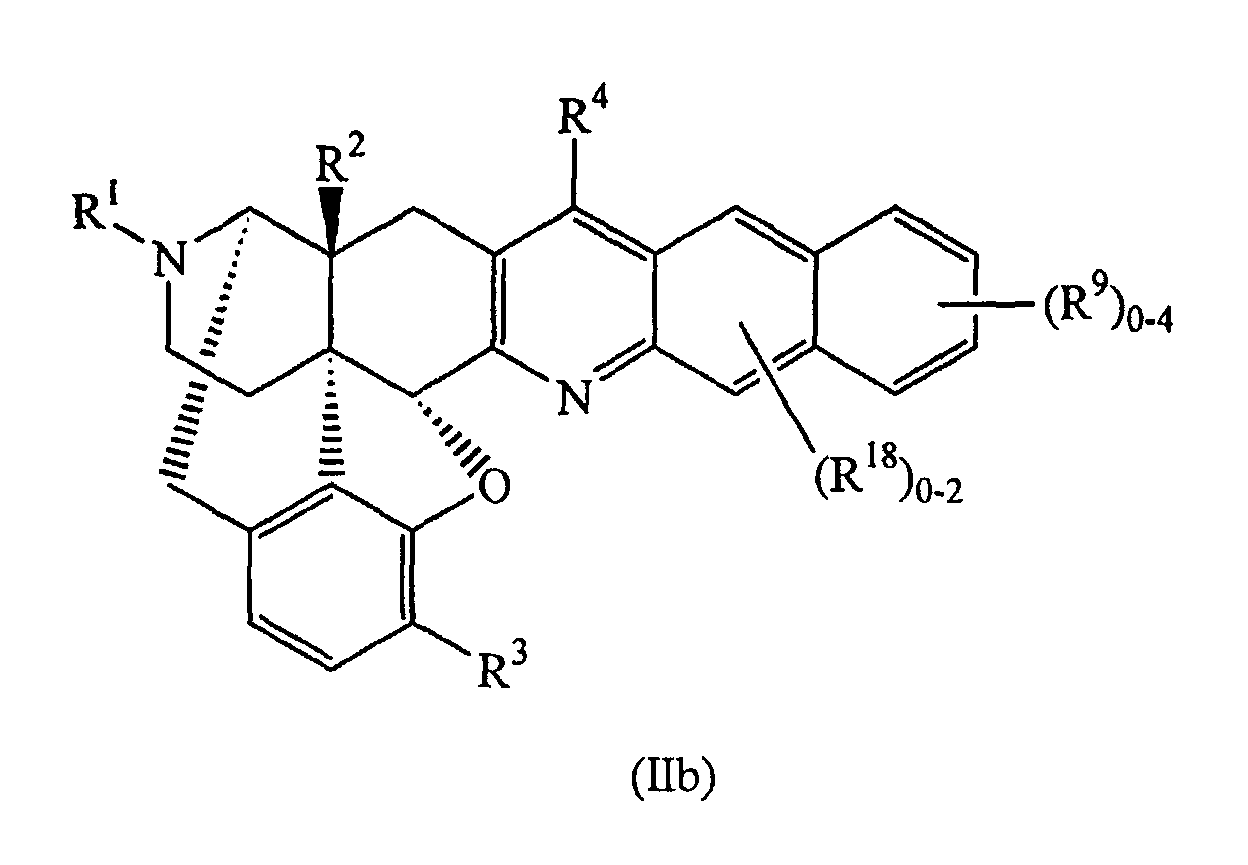


In cases where R9 does not form a bridging structure represented by R9-R18,
preferred examples of R9 are fluoro, chloro, bromo, iodo, nitro, hydroxy, methyl,
ethyl, propyl, butyl, methoxy, ethoxy, isothiocyanato, trifluoromethyl,
trifluoromethoxy, cyano, phenyl, hydroxymethyl, SR6, SOR6, SO2R6, CO2R7,
CH2CO2R7, (CH2)2CO2R7, SO2NR7R8, CONR7R8, NR7R8, CH2NR7R8, (CH2)2NR7R8,
N(R7)COR8, CH2N(R7)COR8 and (CH2)2N(R7)COR8. Here, R6 may preferably be
methyl or ethyl, R7 may preferably be hydrogen or methyl, and R8 may preferably be
hydrogen, methyl, ethyl, propyl, butyl, cyclopropylmethyl or cyclopropylbutyl. R9
and R18 may cooperatively form a bridging structure R9-R18. In this case, as the
bridging structure, ethano and o-benzeno are preferred. For example, when this
bridging structure is ethano, and the above-mentioned fused ring structure A is benzo,
the compounds of Formula (I) may be exemplified by the following Formulae (IIIa),
(IIIb), (IIIc) and (IIId), but these do not restrict Formula (I).
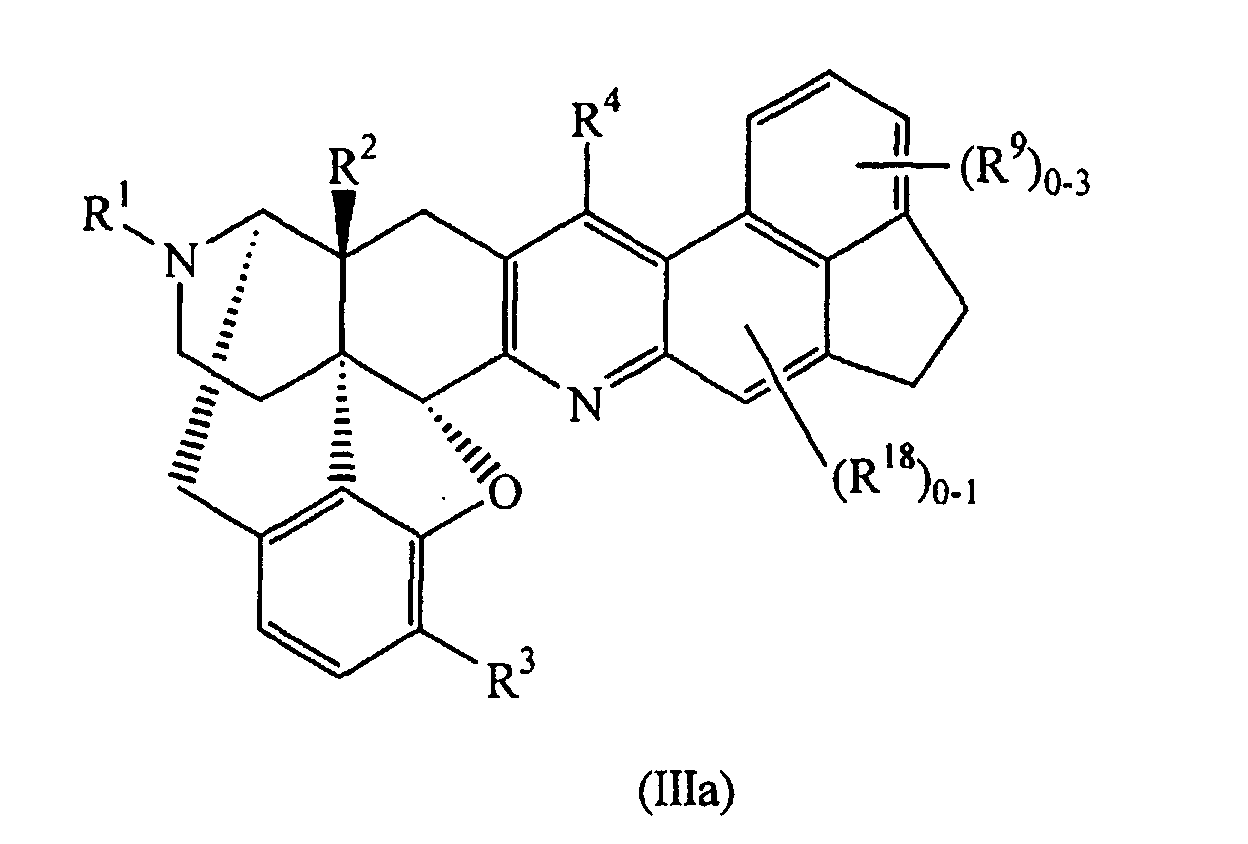
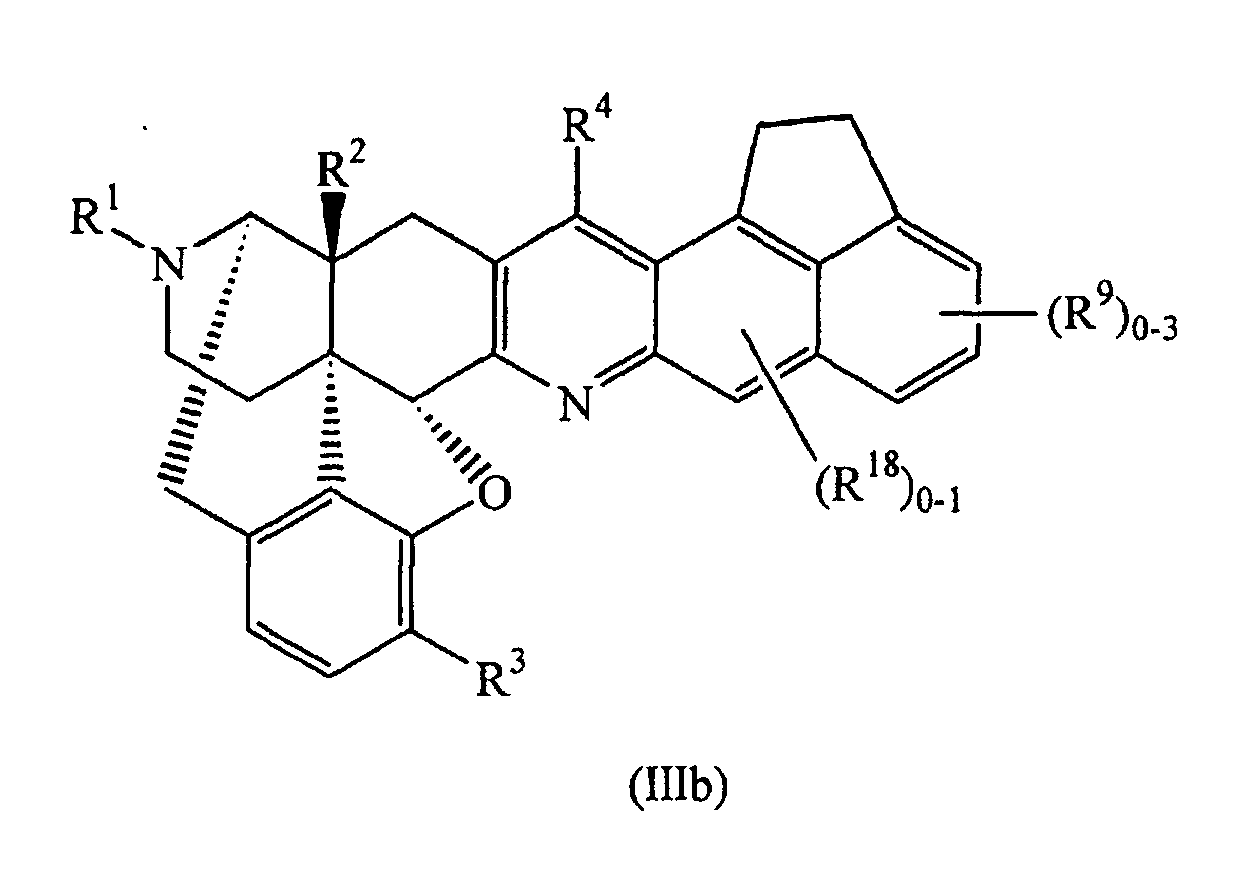

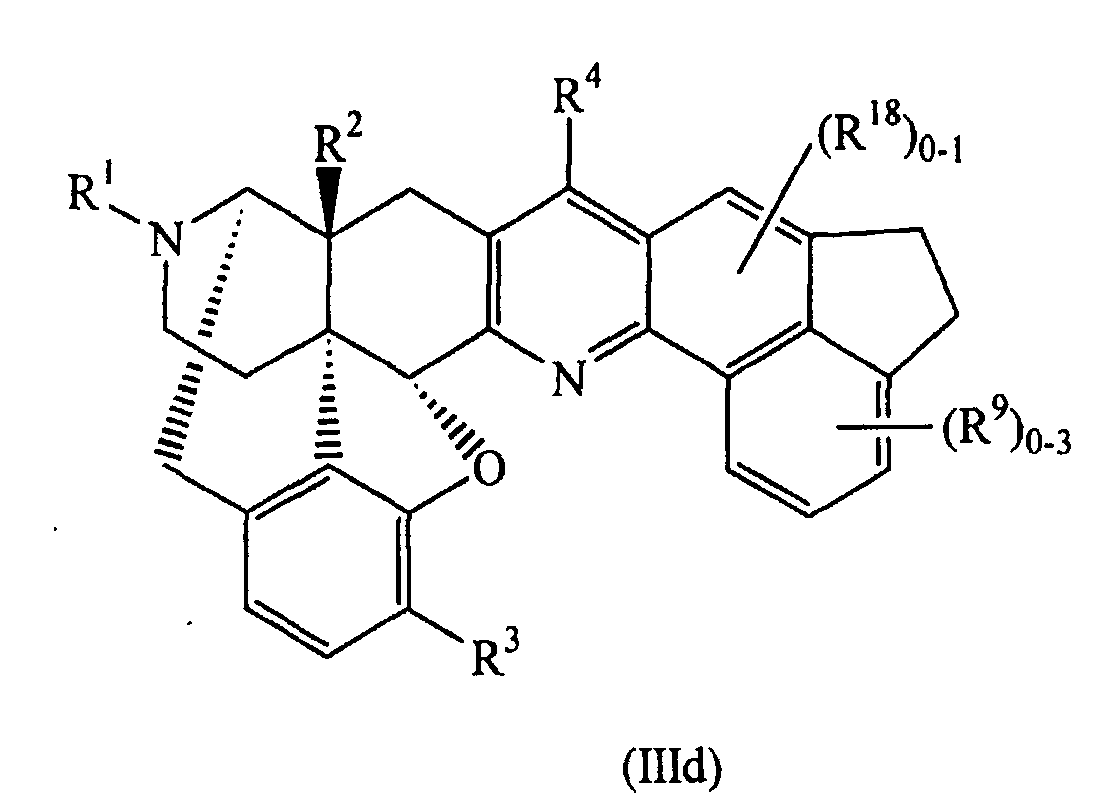
In cases where R4 and R5 which substitutes on the peri-position do not
cooperatively form a bridging structure R4-R5, preferred examples of R4 are
hydrogen, methyl, ethyl, propyl, isopropyl, C1-C3 hydroxyalkyl, C6-C12 aryl (which
may be substituted with one or more substituents R17), NR10R11, OR12, COOR13 and
CONR14R15. In these cases, R10 may preferably be hydrogen, methyl, ethyl, propyl
or benzyl; R11 may preferably be hydrogen, C1-C5 alkyl, C4-C7 cycloalkylalkyl,
benzyl, phenethyl or C1-C5 alkanoyl; R12 may preferably be hydrogen, methyl or
acetyl; R13 may preferably be hydrogen, methyl, ethyl, phenyl or benzyl; R14 may
preferably be hydrogen, methyl, ethyl, phenyl or benzyl; R15 may preferably be
hydrogen, methyl, ethyl, phenyl or benzyl; and R17 may preferably be fluoro, chloro,
bromo, amino, methyl or ethyl. Among the above-mentioned preferred examples of
R4, more preferred are hydrogen, methyl, ethyl, isopropyl, hydroxymethyl,
hydroxyethyl, phenyl, naphthyl, amino, methylamino, dimethylamino,
(cyclohexylmethyl)amino, benzylamino, phenethylamino, formylamino, acetylamino,
propionylamino, hydroxy, methoxy, acetoxy, carboxyl, methoxycarbonyl,
ethoxycarbonyl, phenoxycarbonyl, benzyloxycarbonyl, carbamoyl, methylcarbamoyl,
phenylcarbamoyl, benzylcarbamoyl and dimethylcarbamoyl. Among these,
especially preferred are hydrogen, methyl, ethyl, isopropyl, hydroxymethyl, phenyl,
amino, methylamino, dimethylamino, (cyclohexylmethyl)amino, benzylamino,
formylamino, acetylamino, hydroxy, methoxy, carboxyl, methoxycarbonyl,
carbamoyl, methylcarbamoyl and dimethylcarbamoyl. In cases where R4 and R5
which substitutes on the peri-position cooperatively form a bridging structure R4-R5,
preferred examples of the bridging structure R4-R5 are N(R16)CO, N(R16)C(=NH),
N(R16)CH2, o-benzeno and propano, and especially preferred examples are N(R16)CO,
N(R16)C(=NH) and N(R16)CH2. In this case, R16 may preferably be hydrogen,
methyl, ethyl, benzyl or acetyl. For example, R4 and R5 which substitutes on the
peri-position cooperatively form a bridging structure R4-R5, and this bridging
structure R4-R5 is N(R16)CO, the compounds of Formula (I) may be exemplified by
the following Formulae (IV), but this does not restrict Formula (I).

Preferred examples of the pharmaceutically acceptable acid addition salt
include inorganic acid salts such as hydrochloric acid salt, sulfuric acid salt, nitric
acid salt, hydrobromic acid salt, hydroiodic acid salt and phosphoric acid salt;
organic carboxylic acid salts such as acetic acid salt, lactic acid salt, citric acid salt,
oxalic acid salt, glutaric acid salt, malic acid salt, tartaric acid salt, fumaric acid salt,
mandelic acid salt, maleic acid salt, benzoic acid salt and phthalic acid salt; and
organic sulfonic acid salts such as methanesulfonic acid salt, ethanesulfonic acid salt,
benzenesulfonic acid salt, p-toluenesulfonic acid salt and camphorsulfonic acid salt.
Among these, hydrochloric acid salt, phosphoric acid salt, tartaric acid salt,
methanesulfonic acid salt and the like are preferred, but the acid addition salt is not
restricted thereto.
The compounds of Formula (I) may be produced by the method described in
U.S. Patent 4,816,586, or International Publication WO98/43977.
The fact that the quinolinomorphinane derivatives represented by Formula (I)
is effective for therapy or prophylaxis of urinary frequency or urinary incontinence
may be confirmed by the effect of inhibiting rhythmic bladder contraction or by the
effect of extending bladder reflex in animals. The effect of inhibiting rhythmic
bladder contraction and the action of extending bladder reflex in animals may be
carried out according to a reported method (Brain. Res., vol. 297, 191(1984) or J.
Pharmcol. Exp. Ther., vol. 240, 978(1987)), but the method is not restricted thereto.
The compounds of the present invention may be used as pharmaceuticals
useful for the therapy or prophylaxis of urinary frequency or urinary incontinence.
Particularly, the compounds may be used for the therapy or prophylaxis of urinary
frequency or urinary incontinence caused by the diseases such as neurogenic
bladder, nocturia, overactive bladder, unstable bladder, pollakisuria nervosa,
psycogenic frequency, enuresis, cystospasm, chronic cystitis, chronic prostatitis,
prostatomegaly and prostate carcinoma. The term "neurogenic bladder" means that
the function of urinary storage or evacuation of the lower urinary tract is in an
abnormal state because of some damage of the nerve governing the lower urinary
tract comprising bladder, urethra and external urinary sphincter. Examples of the
diseases which damage the nerve include cerebrovascular disease, brain tumor, brain
injury, encephalitis, normal pressure hydrocephalus, dementia, Parkinson's disease,
striato-nigral degeneration, progressive supranuclear palsy, olivo-ponto-cerebellar
atrophy, Shy-Drager syndrome, spinal cord injury, vascular disease of spinal cord,
spinal cord tumor, myelitis, cervical cord compression disease, syringomyelia,
multiple sclerosis, spina bifida, myelomeningocele, Tethered cord syndrome and
myelopathy. However, use of the therapeutic or prophylatic agent for frequent
urination or urinary incontinence according to the present invention is not restricted
to these diseases.
When using the therapeutic or prophylatic agent for frequent urination or
urinary incontinence according to the present invention as a pharmaceutical, the drug
may be the free base or a salt thereof alone, or the drug may optionally be admixed
with one or more additives such as vehicles, stabilizers, preservatives, buffering
agents, solubilizers, emulsifiers, diluents and isotonic agents. The pharmaceutical
may be administered either orally or parenterally. Examples of the parenteral
administration include intravenous injection, subcutaneous injection, intramuscular
injection and per rectum administration. The compound may be formulated into an
injection solution, tablet, liquid, capsule, granule, powder or the like. The
formulation may be carried out by known formulation techniques. Although the
administration dose may be appropriately selected depending on the symptom, age
and body weight of the patient, administration route and the like, the dose of the
effective component per adult per day may be 0.0001 mg to 10 g, preferably 0.001
mg to 1 g, and may be administered in one time or dividedly in several times.
The present invention will now be described more concretely by way of
Reference Examples and Examples. The structure and the physical data of each of
the compounds synthesized in the following Reference Examples are shown in
Tables 1 to 8 below.
The above-mentioned 3 compounds were synthesized according to the
method described in International Publication WO98/43977.
The compound was synthesized according to the method described in
International Publication WO98/43977. In 6 mL of acetic acid, 315 mg (1.00
mmol) of 17-methyl-6-oxo-4,5α-epoxy-14β-hydroxy-3-methoxy-morphinan and 133
µL (1.10 mmol) of o-aminoacetophenone were dissolved, and the mixture was heated
to reflux, thereby carrying out synthesis of quinoline. After concentrating the
reaction solution under reduced pressure, saturated aqueous sodium hydrogen
carbonate solution was added to the obtained residue, and the resulting mixture was
extracted with ethyl acetate. Organic layers were combined, dried over anhydrous
sodium sulfate, and concentrated to obtain a crude product, followed by purification
of the crude product by silica gel column chromatography to obtain 382 mg (yield
92%) of 17-methyl-6,7-dehydro-4,5α-epoxy-14β-hydroxy-3-methoxy-6,7,2',3'-(4'-methylquinolino)morphinan.
This purified product was dissolved in 10 mL of DMF,
and then 0.40mL (4.58 mmol) of n-propanethiol and 496 mg (4.42 mmol) of
potassium t-butoxide were added thereto, followed by allowing the mixture to react
at 120 °C for 3 hours. After cooling the reaction solution, saturated aqueous sodium
hydrogen carbonate solution was added and the resulting mixture was extracted with
chloroform:methanol (4:1) mixed solvent. Organic layers were combined, dried
over anhydrous sodium sulfate and concentrated to obtain a crude product which was
then purified by silica gel column chromatography to obtain 181 mg (yield 49%) of
the captioned compound in free form. This was converted to methanesulfonic acid
salt to obtain the captioned Compound 4.
In a mixed solvent of 2.5 mL of acetic acid and 4 mL of 20% aqueous sulfuric
acid solution, 400 mg (0.96 mmol) of 17-methyl-6,7-dehydro-4,5α-epoxy-14β-dihydroxy-3-methoxy-6,7,2',3'-(4'-aminoquinolino)morphinan
synthesized by the
method described in Reference Example 1 was dissolved, and the mixture was
cooled to 0 °C. To this mixture, 87 mg of sodium nitrite as 1 mL of aqueous
solution was added dropwise, and the resulting mixture was stirred at 0 °C for 1 hour,
followed by heating the resulting mixture to reflux for 4 hours. After allowing the
reaction solution to cool, 2 N aqueous sodium hydroxide solution was added to make
the mixture basic, and the resulting mixture was extracted with chloroform:methanol
(4:1) mixed solvent. Organic layers were combined, dried over anhydrous sodium
sulfate and concentrated to obtain a crude product which was then purified by silica
gel column chromatography to obtain 167 mg (yield 40%) of 17-methyl-6,7-dehydro-4,5α-epoxy-14β-hydroxy-3-methoxy-6,7,2',3'-(4'-hydroxyquinolino)morphinan.
This purified product was dissolved in 7 mL of DMF, and then 0.17 mL (1.84 mmol)
of n-propanethiol and 215 mg (1.92 mmol) of potassium t-butoxide were added,
followed by allowing the resulting mixture to react at 120 °C for 3 hours. After
allowing the reaction solution to cool, saturated aqueous sodium hydrogen carbonate
solution was added, and the resulting mixture was extracted with
chloroform:methanol (4:1) mixed solvent. Organic layers were combined, dried
over anhydrous sodium sulfate and concentrated to obtain a crude product, which
was then purified by silica gel column chromatography to obtain 69 mg (yield 45%)
of the captioned compound in free form. This was converted to methanesulfonic
acid salt to obtain the captioned Compound 5.
In accordance with the method described in Reference Example 2, the
captioned Compound 6 was obtained by using o-aminobenzaldehyde in place of o-aminoacetophenone.
To 150 mg (0.39 mmol) of 17-hydrogen-6,7-dehydro-4,5α-epoxy-14β-dihydroxy-3-methoxy-6,7,2',3'-quinolinomorphinan,
were added 240 mg (0.80 mmol)
of phenylacetoaldehyde and 165 mg (0.78 mmol) of sodium borotriacetoxy hydride,
and the resulting mixture was dissolved in 5 mL of 1,2-dichloroethane and 22 µL of
acetic acid, followed by stirring the resulting mixture at room temperature for 2 hours.
After the reaction compreted, saturated aqueous sodium hydrogen carbonate solution
was added and the resulting solution was extracted with chloroform. Organic layers
were combined, dried over anhydrous sodium sulfate and concentrated to obtain a
crude product which was then purified by silica gel column chromatography to obtain
186 mg (yield 97%) of 17-phenethyl-6,7-dehydro-4,5α-epoxy-14β-hydroxy-3-methoxy-6,7,2',3'-quinolinomorphinan.
This purified product was dissolved in 5
mL of DMF, and then 0.19 mL (2.10 mmol) of n-propanethiol and 210 mg (1.87
mmol) of potassium t-butoxide were added, followed by allowing the resulting
mixture to react at 120 °C for 3 hours. After allowing the reaction solution to cool,
saturated aqueous sodium hydrogen carbonate solution was added, and the resulting
mixture was extracted with chloroform:methanol (4:1) mixed solvent. Organic
layers were combined, dried over anhydrous sodium sulfate and concentrated to
obtain a crude product, which was then purified by silica gel column chromatography
to obtain 143 mg (yield 79%) of the captioned compound in free form. This was
converted to methanesulfonic acid salt to obtain the captioned Compound 7.
In 8 mL of benzene, 99 mg (0.39 mmol) of 17-hydrogen-6,7-dehydro-4,5α-epoxy-14β-dihydroxy-3-methoxy-6,7,2',3'-morphinan
synthesized by the method
described in Reference Example 1 was dissolved, and 327 mg (1.16 mmol) of (2-thienyl)ethyltosylate
and 0.36 mL (2.58 mmol) of triethylamine were added, followed
by heating the mixture to reflux overnight under stirring. After allowing the
reaction solution to cool, saturated aqueous sodium hydrogen carbonate solution was
added and the mixture was extracted with chloroform. Organic layers were
combined, dried over anhydrous sodium sulfate and concentrated to obtain a crude
product which was then purified by silica gel column chromatography to obtain 112
mg (yield 88%) of 17-(2-thienyl)ethyl-6,7-dehydro-4,5α-epoxy-14β-hydroxy-3-methoxy-6,7,2',3'-quinolinomorphinan.
The obtained purified product was
dissolved in 5 ml of DMF, and then 0.10 mL (1.10 mmol) of n-propanethiol and 124
mg (1.11 mmol) of potassium t-butoxide were added, followed by allowing the
mixture to react at 120 °C for 3 hours. After cooling the reaction solution, saturated
aqueous sodium hydrogen carbonate solution was added and the resulting mixture
was extracted with chloroform:methanol (4:1) mixed solvent. Organic layers were
combined, dried over anhydrous sodium sulfate and concentrated to obtain a crude
product, which was then purified by silica gel column chromatography to obtain 85
mg (yield 79%) of the captioned compound in free form. This was converted to
methanesulfonic acid salt to obtain the captioned Compound 8.
In 7 mL of dimethylformamide, 200 mg (0.50 mmol) of the synthetic
intermediate 17-methyl-6,7-dehydro-4,5α-epoxy-14β-hydroxy-3-methoxy-6,7,2',3'-quinolinomorphinane
described in Reference Example 4 was dissolved, and the
mixture was cooled to 0°C. To the mixture, 24 mg (1.00 mmol) of sodium hydride
was added and the resulting mixture was stirred for 15 minutes. Then, 47 µl (0.75
mmol) of iodomethane was added and the reaction mixture was stirred for 1 hour.
Saturated aqueous sodium hydrogen carbonate solution was added to the reaction
mixture, and the resulting mixture was extracted with ethyl acetate. Organic layers
were combined, dried over anhydrous sodium sulfate and concentrated to obtain a
crude product which was then purified by silica gel column chromatography to obtain
166 mg (yield 80%) of 17-methyl-6,7-dehydro-4,5α-epoxy-3,14β-dimethoxy-6,7,2',3'-quinolinomorphinan.
This purified product was dissolved in 10 mL of
methylene chloride, and the mixture was cooled to -20 °C. To the mixture, 1.9 mL
(1.93 mmol) of 1N boron tribromide solution was added and the resulting mixture
was stirred for 1 hour. To the obtained mixture, 20 mL of 20% aqueous ammonia
solution was added and the resulting mixture was stirred at room temperature for 30
minutes, followed by extraction of the resulting mixture with chloroform:methanol
(4:1) mixed solvent. Organic layers were combined, dried over anhydrous sodium
sulfate and concentrated to obtain a crude product, which was then purified by silica
gel column chromatography to obtain 99 mg (yield 64%) of the captioned compound
in free form. This was converted to methanesulfonic acid salt to obtain the
captioned Compound 9.
To 500 mg (1.35 mmol) of 17-methyl-6-oxo-4,5α-epoxy-14β-hydroxy-3-methoxymorphinan
and 0.58 mL (5.40 mmol) of 2-chloroaniline, 10 mL of
trifluoroacetic acid was added and the mixture was heated to reflux. The reaction
solution was concentrated under reduced pressure to obtain a residue, and aqueous
sodium hydrogen carbonate solution was added to the residue, followed by extraction
of the resulting mixture with ethyl acetate. Organic layers were combined, dried
over anhydrous sodium sulfate and concentrated to obtain a crude product, which
was then purified by silica gel column chromatography to obtain a mixture of 17-methyl-6,7-dehydro-4,5α-epoxy-14β-hydroxy-3-methoxy-6,7,2',3'-(8'-chloroquinolino)morphinan
and non-cyclized compound. This mixture was
dissolved in 10 mL of THF, and 10 mL of 6 N hydrochloric acid was added, followed
by heating the resulting mixture to reflux. The reaction solution was concentrated
under reduced pressure to obtain a residue, and aqueous sodium hydrogen carbonate
solution was added to the residue, followed by extraction of the resulting mixture
with ethyl acetate. Organic layers were combined, dried over anhydrous sodium
sulfate and concentrated to obtain a crude product, which was then purified by silica
gel column chromatography to obtain 290 mg (yield 49%) of 17-methyl-6,7-dehydro-4,5α-epoxy-14β-hydroxy-3-methoxy-6,7,2',3'-(8'-chloroquinolino)morphinan.
After
dissolving this purified product in 10 mL of dichloromethane, 2.0 mL of 1 N boron
tribromide solution was added thereto at 0 °C and the mixture was stirred for 15
minutes, and then at room temperature for 30 minutes. After cooling the reaction
solution to 0 °C, 10 mL of 7% aqueous ammonia solution was added and the mixture
was stirred for 1 hour, followed by extraction of the reaction solution with
chloroform. Organic layers were combined, dried over anhydrous sodium sulfate
and concentrated to obtain a crude product, which was then purified by silica gel
column chromatography to obtain 139 mg (yield 50%) of the captioned compound in
free form. This was converted to methanesulfonic acid salt to obtain the captioned
Compound 10.
According to the method described in Reference Example 8, by using 4-chloroaniline
in place of 2-chloroaniline, and by using xylene as the solvent, a
mixture of 17-methyl-6,7-dehydro-4,5α-epoxy-14β-hydroxy-3-methoxy-6,7,2',3'-(6'-chloroquinolino)morphinan
and a non-cyclized compound was obtained. After
dissolving this mixture in 12 mL of methanol, 220 mg (5.80 mmol) of sodium
borohydride was added thereto at 0 °C and the mixture was stirred for 15 minutes,
and then at room temperature for 16 hours. Saturated aqueous sodium hydrogen
carbonate solution was added to the reaction solution and the mixture was
concentrated under reduced pressure, followed by extraction of the obtained residue
with ethyl acetate. Organic layers were combined, dried over anhydrous magnesium
sulfate and concentrated to obtain a crude product, which was then purified by silica
gel column chromatography to obtain 163 mg (yield 38%) of 17-methyl-6,7-dehydro-4,5α-epoxy-14β-hydroxy-3-methoxy-6,7,2',3'-(6'-chloroquinolino)morphinan.
This
was converted to methanesulfonic acid salt to obtain the captioned Compound 11.
According to the method described in Reference Example 9, by using 3-chloroaniline
in place of 4-chloroaniline, free form of the captioned compound was
obtained. This was converted to tartaric acid salt to obtain the captioned Compound
12.
According to the method described in Reference Example 9, by using o-toluidine
in place of 4-chloroaniline, the captioned Compound 13 was obtained.
According to the method described in Reference Example 9, by using p-toluidine
in place of 4-chloroaniline, the captioned Compound 14 was obtained.
According to the method described in Reference Example 10, by using 2-fluoroaniline
in place of 3-chloroaniline, the captioned Compound 15 was obtained.
In 5 mL of pyridine, 200 mg (0.39 mmol) of 17-methyl-6,7-dehydro-4,5α-epoxy-3,14β-hydroxy-6,7,2',3'-quinolinomorphinan
synthesized by the method
described in Reference Example 4 was dissolved, and 10 mL (1.10 mmol) of acetic
anhydride was added, followed by stirring the mixture at room temperature for 16
hours. The reaction solution was concentrated under reduced pressure and saturated
aqueous sodium hydrogen carbonate solution was added to the obtained residue,
followed by extraction of the resulting mixture with chloroform. Organic layers
were combined, dried over anhydrous magnesium sulfate and concentrated to obtain
a crude product, which was then purified by silica gel column chromatography to
obtain 250 mg (yield 98%) of the captioned compound in free form. This was
converted to tartaric acid salt to obtain the captioned Compound 16.
Synthesis of 17-methyl-6,7-dehydro-4,5α-epoxy-3-hydroxy-14β-acetoxy-6,7,2',3'-quinolinomorphinan
tartaric acid salt (Compound 17)
In a mixed solvent of 10 mL of methanol and 2 mL of chloroform, 156 mg
(0.03 mmol) of 17-methyl-6,7-dehydro-4,5α-epoxy-3,14β-diacetoxy-6,7,2',3'-quinolinomorphinan
synthesized by the method described in Reference Example 14
was dissolved, and 68.1 mg (0.49 mmol) of potassium carbonate was added,
followed by stirring the resulting mixture at room temperature for 1 hour. Saturated
aqueous sodium hydrogen carbonate solution was added to the reaction solution, and
the mixture was concentrated under reduced pressure, followed by extraction of the
obtained residue with chloroform. Organic layers were combined, dried over
anhydrous magnesium sulfate and concentrated to obtain a crude product, which was
then purified by silica gel column chromatography to obtain 104 mg (yield 73%) of
the captioned compound in free form. This was converted to tartaric acid salt to
obtain the captioned Compound 17.
In 5 mL of pyridine, 150 mg (0.39 mmol) of 17-methyl-6,7-dehydro-4,5α-epoxy-3,14β-dihydroxy-6,7,2',3'-quinolinomorphinan
synthesized by the method
described in Reference Example 4 and 109 µL (1.16 mmol) of acetic anhydride were
dissolved, and the mixture was stirred at room temperature for 3 hours. The
reaction solution was twice or thrice subjected to azeotropic distillation with toluene,
and the mixture was concentrated to obtain a crude product, which was then purified
by silica gel chromatography to obtain 110 mg (yield 66%) of 17-methyl-6,7-dehydro-4,5α-epoxy-3-acetoxy-14β-hydroxy-6,7,2',3'-quinolinomorpholin.
This
was converted to tartaric acid salt to obtain the captioned Compound 18.
17-methyl-6,7-dehydro-4,5α-epoxy-14β-hydroxy-3-methoxy-6,7,2',3'-quinolinomorphinan
synthesized by the method of Reference Example 4 was
converted to tartaric acid salt to obtain the captioned Compound 19.
In 10 mL of ethanol, 112 mg (0.39 mmol) of 17-methyl-6-oxo-4,5α-epoxy-14β-hydroxy-morphinan,
143 mg (1.18 mmol) of o-aminobenzaldehyde and 77 µL
(11.8 mmol) of methanesulfonic acid were dissolved, and the mixture was heated to
reflux for 3 hours, thereby carrying out quinoline synthesis. The reaction solution
was concentrated under reduced pressure to obtain a residue, and saturated aqueous
sodium hydoren carbonate solution was added to the residue, followed by extraction
of the resulting mixture with ethyl acetate. Organic layers were combined, dried
over anhydrous sodium sulfate and concentrated to obtain a crude product, which
was then purified by silica gel column chromatography to obtain 114 mg (yield 79%)
of the captioned compound in free form. This was converted to tartaric acid salt to
obtain the captioned Compound 20.
The compound was synthesized by the method described in U.S. Patent
4,816,586.
The compound was synthesized by the method described in U.S. Patent
4,816,586.
In 8 mL of benzene, 95 mg (0.25 mmol) of 17-hydrogen-6,7-dehydro-4,5α-epoxy-14β-hydroxy-3-methoxy-6,7,2',3'-morphinan
synthesized by the method
described in Reference Example 1 was dissolved, and 335 mg (1.15 mmol) of (4-methylphenyl)ethyl
tosylate and 0.30 mL (2.15 mmol) of triethylamine were added,
followed by heating the resulting mixture to reflux overnight under stirring. After
allowing the reaction solution to cool, saturated aqueous sodium hydrogen carbonate
solution was added and the resulting mixture was extracted with chloroform.
Organic layers were combined, dried over anhydrous sodium sulfate and
concentrated to obtain a crude product, which was then purified by silica gel column
chromatography to obtain 90 mg (yield 73%) of 17-(4-methylphenyl)ethyl-6,7-dehydro-4,5α-epoxy-14β-hydroxy-3-methoxy-6,7,2',3'-quinolinomorphinan.
This purified product was dissolved in 5 ml of dichloromethane and the
mixture was cooled to 0 °C. Thereafter, 1.30 mL (1.30 mmol) of 1 N boron
tribromide solution was added, and then the mixture was stirred at room temperature
for 30 minutes. After adding 6 ml of aqueous ammonia solution, the reaction
mixture was stirred for an additional 1 hour. Saturated aqueous sodium hydrogen
carbonate solution was added to the reaction mixture and the resulting mixture was
extracted with chloroform. Combined organic layers were washed with brine and
dried over magnesium sulfate, followed by concentration of the resultant under
reduced pressure. The obtained crude product was purified by silica gel column
chromatography to obtain 83 mg (yield 95%) of 17-(4-methylphenyl)ethyl-6,7-dehydro-4,5α-epoxy-3,14β-dihydroxy-6,7,2',3'-quinolinomorphinan.
This was
converted to methanesulfonic acid salt to obtain the captioned Compound 23.
According to the method described in Reference Example 21, by using (4-fluorophenyl)ethyl
tosylate in place of (4-methylphenyl)ethyl tosylate, the captioned
Compound 24 was obtained.
The chemical structure, acid addition salts and various spectra data of the
above-described Compounds 1 to 24 are shown in the following tables.

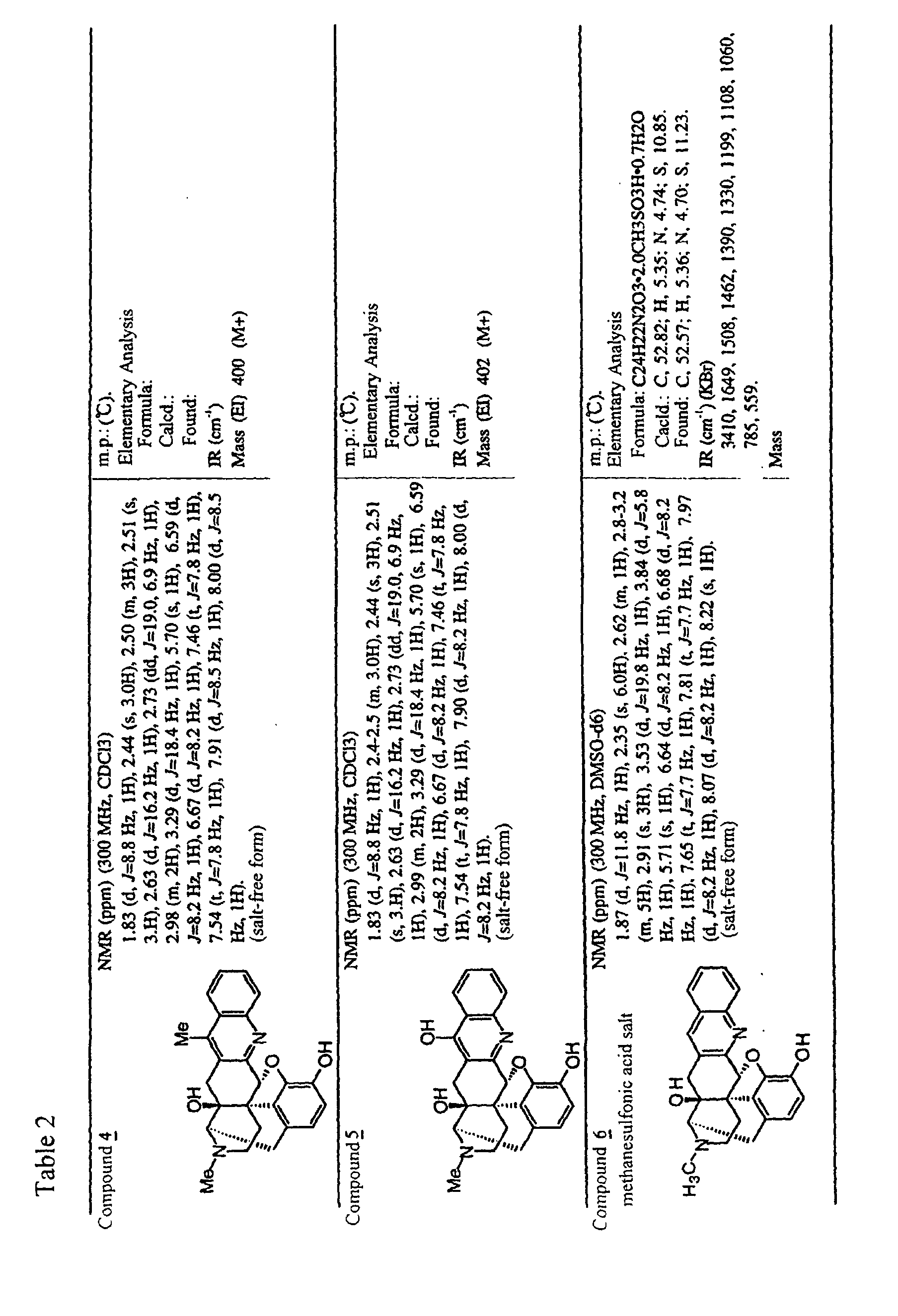

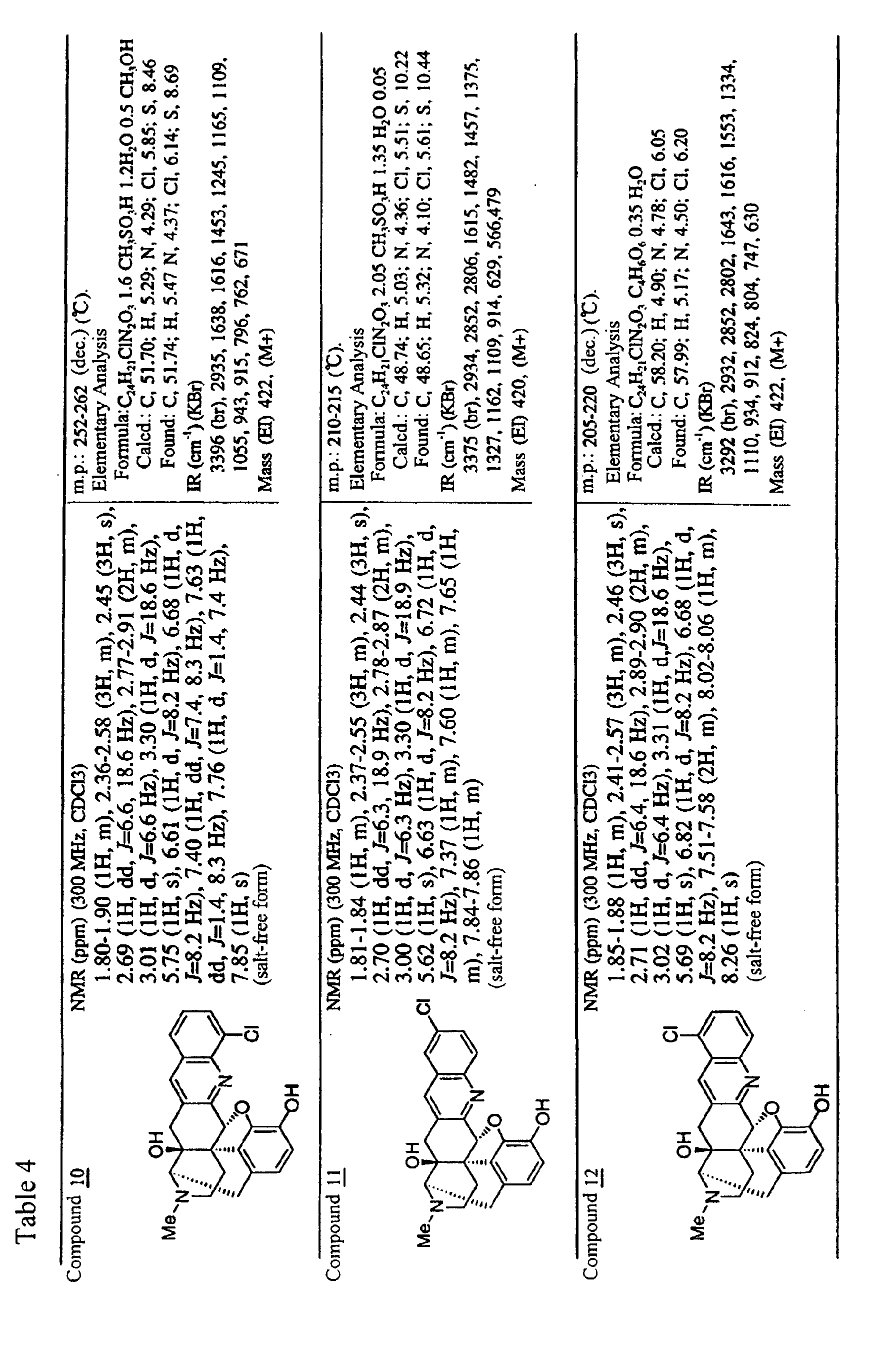
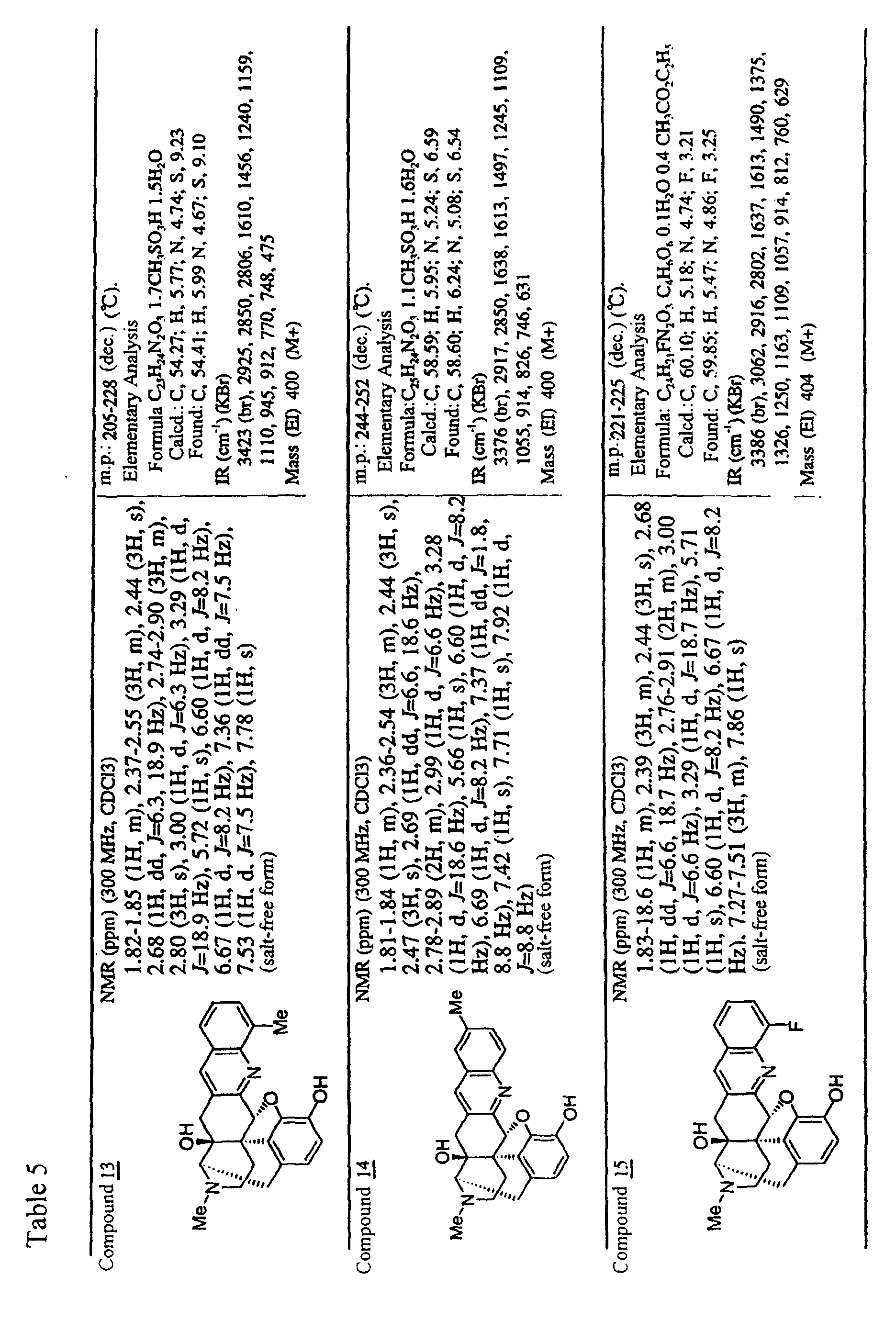

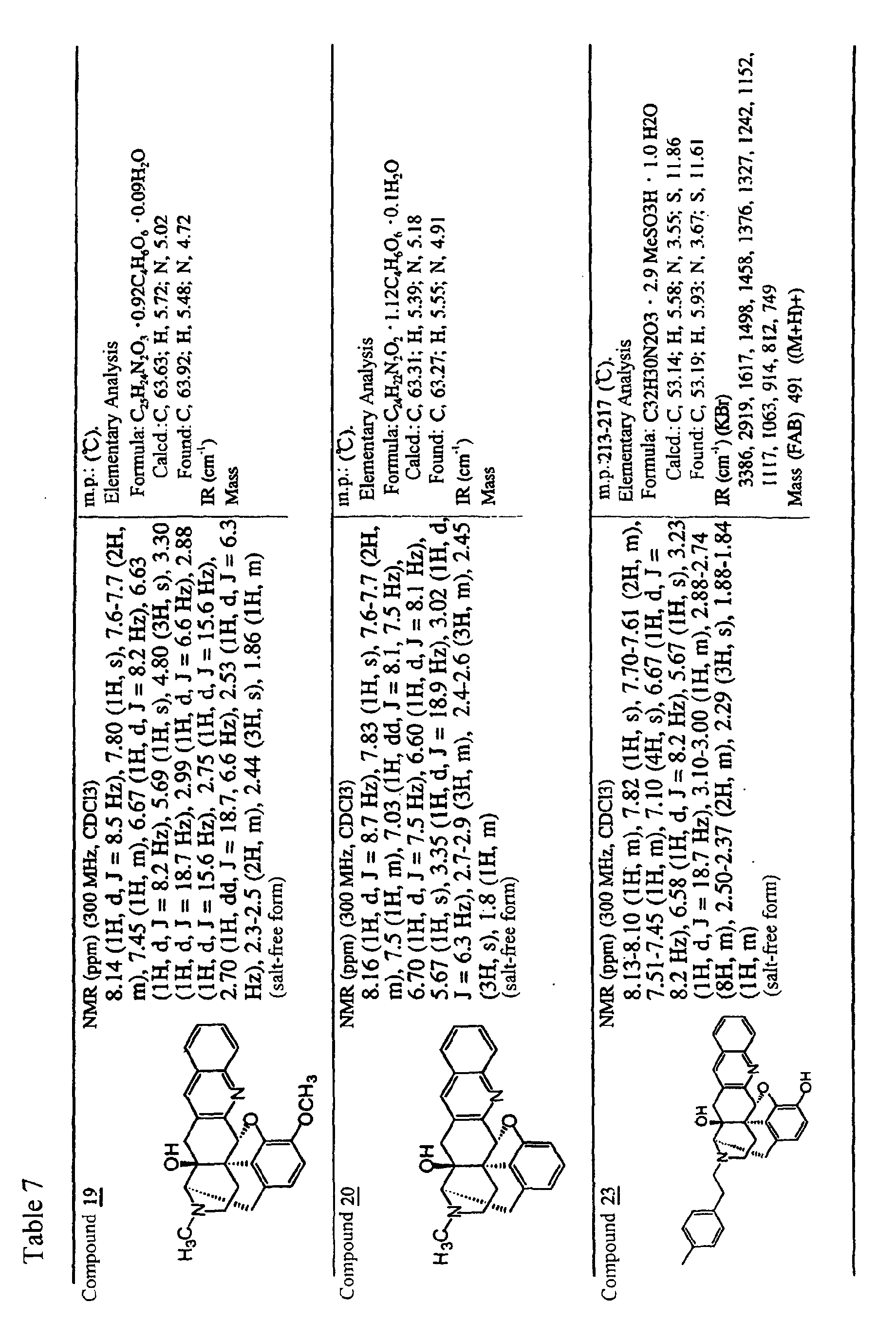
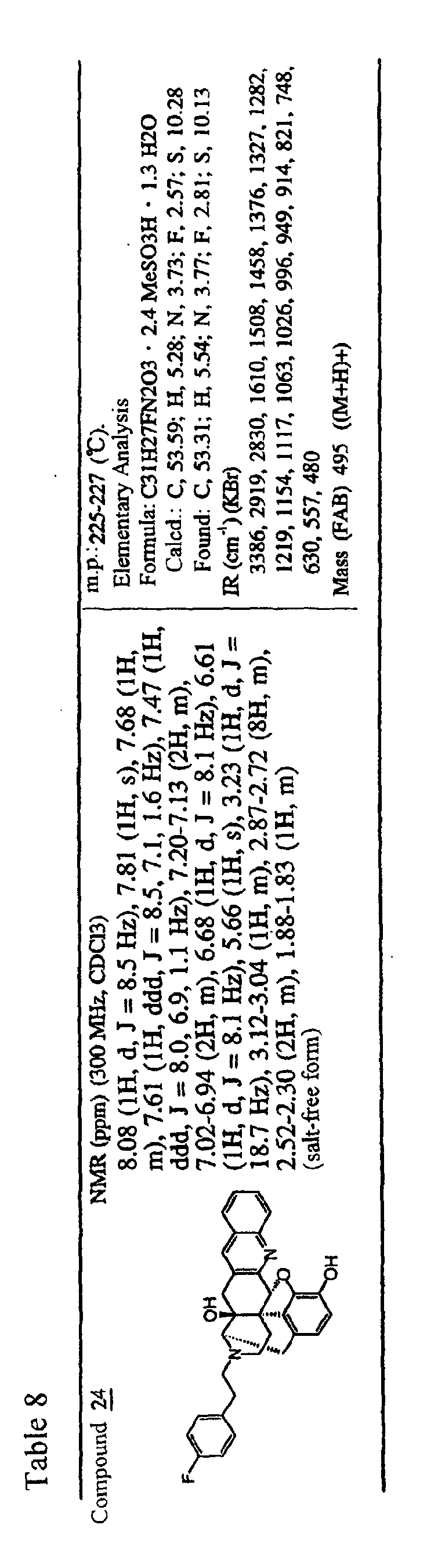
Female SD rats were anesthetized with an intraperitoneal injection of
urethane (1.0 g/kg). A polyethylene tube was inserted from urethral opening to the
bladder and the tube was fixed by ligating. Physiological saline was appropriately
infused via the tube (rate of infusion: about 0.2 ml/min; maximum dose: about 1.5
ml/rat) to induce rhythmic contraction of bladder. The rhythmic contraction of
bladder was monitored by measuring the intravesical pressure through the
polyethylene tube inserted into the bladder. After confirming that stable rhythmic
contraction occurred at least 10 times, each test compound was intravenously
administered at a doseof 1 ml/kg. If the intravesical pressure became, within 10
minutes from the administration of the test compound, not more than 50% of the
intravesical pressure at the time point immediately after the administration of the test
compound, it was judged that bladder contraction occurred, and the time period until
the intravesical pressure again became not less than 50% was defined as the rhythmic
bladder contraction-inhibiting time. As the solvent for administration of the test
compounds, 5% xylitol was used for test Compounds 1, 2, 3, 4, 5, 11, 12, 21, 23 and
24; physiological saline was used for test Compounds 6, 9, 10, 13, 14, 15, 16, 17, 18,
19, 20 and 22; 10% ethanol solution was used for test Compound 7; and 10% DMSO
solution was used for test Compound 8. The solvents 5% xylitol solution, 10%
ethanol solution and 10% DMSO solution, each of which is said to somewhat
influence on the rhythmic bladder contraction-inhibiting time, were also tested at the
dose of 1 ml/kg. The results are shown in Table 9. Any of the tested compounds
exhibited rhythmic bladder contraction-inhibiting action when compared with the
corresponding solvent used.
| Test Compound | Dose | n | Mean Rhythmic Bladder Contraction-inhibiting Time (min) |
| 5% xylitol | 1 ml/kg | 4 | 1.3 |
| Compound 1 | 30 mg/kg | 4 | 6.2 |
| Compound 2 | 10 mg/kg | 4 | 4.5 |
| Compound 3 | 20 mg/kg | 4 | 5.0 |
| Compound 4 | 10 mg/kg | 4 | 13.9 |
| Compound 5 | 30 mg/kg | 4 | 5.7 |
| Compound 11 | 10 mg/kg | 4 | 12.4 |
| Compound 12 | 0.3 mg/kg | 5 | 14.6 |
| Compound 21 | 10 mg/kg | 4 | 10.0 |
| Compound 23 | 10 mg/kg | 4 | 9.2 |
| Compound 24 | 10 mg/kg | 4 | 2.3 |
| Saline | |||
| Compound 6 | 3 mg/kg | 6 | 24.1 |
| Compound 9 | 1 mg/kg | 6 | 7.3 |
| Compound 10 | 10 mg/kg | 4 | 7.4 |
| Compound 13 | 1 mg/kg | 4 | 6.5 |
| Compound 14 | 3 mg/kg | 4 | 12.3 |
| Compound 15 | 1 mg/kg | 6 | 10.7 |
| Compound 16 | 0.3 mg/kg | 4 | 15.0 |
| Compound 17 | 1 mg/kg | 5 | 7.4 |
| Compound 18 | 1 mg/kg | 4 | 6.6 |
| Compound 19 | 1 mg/kg | 4 | 7.7 |
| Compound 20 | 1 mg/kg | 4 | 11.1 |
| Compound 22 | 10 mg/kg | 3 | 1.4 |
| 10% Ethanol | 1 ml/kg | 5 | 1.5 |
| Compound 7 | 5 mg/kg | 5 | 17.1 |
| 10% DMSO | 1 ml/kg | 4 | 3.5 |
| Compound 8 | 10 mg/kg | 4 | 19.5 |
Claims (3)
- A therapeutic or prophylatic agent for frequent urination or urinary incontinence, comprising as an effective ingredient a quinolinomorphinan derivative of the Formula (I):(wherein R1 is hydrogen, C1-C5 alkyl, C4-C7 cycloalkylalkyl, C5-C7 cycloalkenylalkyl, C6-C12 aryl, C7-C13 aralkyl, C2-C7 alkenyl, C1-C5 alkanoyl, furan-2-ylalkyl (wherein the number of carbon atoms in the alkyl moiety is 1 to 5), or thiophene-2-ylalkyl (wherein the number of carbon atoms in the alkyl moiety is 1 to 5);
 or a pharmaceutically acceptable acid addition salt thereof.R2 and R3 independently are hydrogen, hydroxy, C1-C5 alkoxy, C1-C5 alkanoyloxy, C7-C13 aralkyloxy or C7-C13 arylcarbonyloxy;m is an integer of 0 to 4;R5(s) is(are) substituent(s) on the benzene ring and independently represent(s) R18, or two R5s on adjacent carbon atoms cooperatively represent a fused ring structure A (with the proviso that the remaining 0 to 2 R5s independently represent R18 or a pair of R5s represent another fused ring structure A),
wherein said ring structure A is benzo, indeno, naphtho or pyrido, or C5-C7 cycloalkeno, each of which is substituted with 0 to 4 R9s, or non-substituted dioxoleno;R9 and R18 represent (1) independently fluoro, chloro, bromo, iodo, nitro, hydroxy, C1-C5 alkyl, C1-C5 alkoxy, isothiocyanato, trifluoromethyl, trifluoromethoxy, cyano, phenyl, C1-C3 hydroxyalkyl, SR6, SOR6, SO2R6, (CH2)kCO2R7, SO2NR7R8, CONR7R8, (CH2)kNR7R8, or (CH2)kN(R7)COR8 (wherein k is an integer of 0 to 5, R6 is C1-C5 alkyl, R7 and R8 independently are hydrogen, C1-C5 alkyl or C4-C6 cycloalkylalkyl), and/or (2) R9 and R18 on adjacent carbon atoms via the fused ring moiety cooperatively form R9-R18 which represents a bridging structure selected from the group consisting of ethano, propano and o-benzeno;R4 is hydrogen, C1-C5 alkyl, C1-C5 hydroxyalkyl, C6-C12 aryl (which may be substituted with one or more substituents R17), NR10R11, OR12, COOR13 or CONR14R15, or R4 and R5 which substitutes on the peri-position cooperatively form R4-R5 that represent a bridging structure selected from the group consisting of N(R16)CO, N(R16)C(=NH), N(R16)CH2, o-benzeno, ethano, propano and butano; R17 is fluoro, chloro, bromo, iodo, nitro, amino, hydroxy, C1-C5 alkyl, C1-C5 alkoxy, C1-C5 alkanoyloxy, trifluoromethyl, trifluoromethoxy or cyano; R10, R11, R12 and R16 independently are hydrogen, C1-C5 alkyl, C4-C7 cycloalkylalkyl, C7-C13 aralkyl or C1-C5 alkanoyl, and R13, R14 and R15 independently are hydrogen, C1-C5 alkyl, C6-C12 aryl or C7-C13 aralkyl) - A therapeutic or prophylatic agent for frequent urination or urinary incontinence according to claim 1, wherein in Formula (I), R4 is hydrogen, C1-C5 alkyl or NR10R11, or R4 and R5 which substitutes on the peri-position cooperatively form R4-R5 that represent a bridging structure N(R16)CO (wherein R10, R11 and R16 represent the same meanings as in claim 1).
- A therapeutic or prophylatic agent for frequent urination or urinary incontinence according to claim 2, wherein in Formula (I), R1 is C1-C5 alkyl, C4-C7 cycloalkylalkyl, C7-C13 aralkyl, furan-2-ylalkyl (wherein the number of carbon atoms in the alkyl moiety is 1 to 5), or thiophene-2-ylalkyl (wherein the number of carbon atoms in the alkyl moiety is 1 to 5).
Applications Claiming Priority (3)
| Application Number | Priority Date | Filing Date | Title |
|---|---|---|---|
| JP20480999 | 1999-07-19 | ||
| JP20480999 | 1999-07-19 | ||
| PCT/JP2000/004839 WO2001005795A1 (en) | 1999-07-19 | 2000-07-19 | Remedies or preventives for frequent urination or urinary incontinence |
Publications (2)
| Publication Number | Publication Date |
|---|---|
| EP1203771A1 true EP1203771A1 (en) | 2002-05-08 |
| EP1203771A4 EP1203771A4 (en) | 2003-07-30 |
Family
ID=16496737
Family Applications (1)
| Application Number | Title | Priority Date | Filing Date |
|---|---|---|---|
| EP00946400A Withdrawn EP1203771A4 (en) | 1999-07-19 | 2000-07-19 | Remedies or preventives for frequent urination or urinary incontinence |
Country Status (6)
| Country | Link |
|---|---|
| EP (1) | EP1203771A4 (en) |
| KR (1) | KR20020012314A (en) |
| CN (1) | CN1374963A (en) |
| AU (1) | AU6020300A (en) |
| CA (1) | CA2379577A1 (en) |
| WO (1) | WO2001005795A1 (en) |
Cited By (1)
| Publication number | Priority date | Publication date | Assignee | Title |
|---|---|---|---|---|
| US20180078596A1 (en) * | 2016-09-21 | 2018-03-22 | Wellstrong Biotech Co., Ltd. | Method for protection of bladder from damage |
Families Citing this family (5)
| Publication number | Priority date | Publication date | Assignee | Title |
|---|---|---|---|---|
| WO2003070175A2 (en) | 2002-02-15 | 2003-08-28 | Howard Brooks-Korn | Use of opioid compound to treat a neurologic or neurogenic disorder |
| MXPA05002983A (en) * | 2002-09-18 | 2005-06-22 | Univ Missouri | OPIATE ANALOGS SELECTIVE FOR THE delta-OPIOID RECEPTOR. |
| JP4656081B2 (en) * | 2002-10-09 | 2011-03-23 | 東レ株式会社 | Morphinane derivatives having nitrogen-containing cyclic substituents |
| CN100537573C (en) * | 2002-10-09 | 2009-09-09 | 东丽株式会社 | Remedies or preventives for urinary frequency or urinary incontinence and morphinan derivatives having nitrogen-containing heterocyclic group |
| TW200621785A (en) | 2004-11-04 | 2006-07-01 | Toray Industries | Analgesic |
Family Cites Families (4)
| Publication number | Priority date | Publication date | Assignee | Title |
|---|---|---|---|---|
| US4816586A (en) * | 1987-07-29 | 1989-03-28 | Regents Of The University Of Minnesota | Delta opioid receptor antagonists |
| AU674379B2 (en) * | 1992-12-22 | 1996-12-19 | Toray Industries, Inc. | Antitussive |
| NZ268969A (en) * | 1993-07-23 | 1997-06-24 | Toray Industries | Morphinan derivatives and pharmaceutical compositions |
| WO1998043977A1 (en) * | 1997-03-31 | 1998-10-08 | Toray Industries, Inc. | Quinolinomorphinane derivatives and medicinal use thereof |
-
2000
- 2000-07-19 AU AU60203/00A patent/AU6020300A/en not_active Abandoned
- 2000-07-19 EP EP00946400A patent/EP1203771A4/en not_active Withdrawn
- 2000-07-19 WO PCT/JP2000/004839 patent/WO2001005795A1/en not_active Ceased
- 2000-07-19 CA CA002379577A patent/CA2379577A1/en not_active Abandoned
- 2000-07-19 KR KR1020027000601A patent/KR20020012314A/en not_active Withdrawn
- 2000-07-19 CN CN00813069A patent/CN1374963A/en active Pending
Cited By (2)
| Publication number | Priority date | Publication date | Assignee | Title |
|---|---|---|---|---|
| US20180078596A1 (en) * | 2016-09-21 | 2018-03-22 | Wellstrong Biotech Co., Ltd. | Method for protection of bladder from damage |
| US10441620B2 (en) * | 2016-09-21 | 2019-10-15 | Wellstrong Biotech Co., Ltd. | Method for protection of bladder from damage |
Also Published As
| Publication number | Publication date |
|---|---|
| WO2001005795A1 (en) | 2001-01-25 |
| CN1374963A (en) | 2002-10-16 |
| EP1203771A4 (en) | 2003-07-30 |
| CA2379577A1 (en) | 2001-01-25 |
| KR20020012314A (en) | 2002-02-15 |
| AU6020300A (en) | 2001-02-05 |
Similar Documents
| Publication | Publication Date | Title |
|---|---|---|
| US4816586A (en) | Delta opioid receptor antagonists | |
| US6734203B2 (en) | Fused imidazolium derivatives | |
| JP2024529070A (en) | Naphthyridine derivatives as ATR inhibitors and their preparation method | |
| DK160501B (en) | SUBSTITUTED BENZO TESTERS OF 3-HYDROXYMORPHINANES AND PHARMACEUTICAL PREPARATIONS CONTAINING SUCH SUGAR | |
| EP1071684B1 (en) | IMIDAZO 1,2-a]PYRIDINES AS PERIPHERAL BENZODIAZEPINE RECEPTOR BINDING AGENTS | |
| JPH0648944A (en) | Analgesic for oral administration | |
| TW202202508A (en) | Nitrogen-containing heterocyclic compound, pharmaceutical composition and use thereof | |
| HUP0500024A2 (en) | 6-aminomorphinane derivatives, their use and pharmaceutical compositions containing them | |
| JP2002542248A (en) | Haloalkoxyimidazonaphthyridine | |
| EP1736157A1 (en) | Anti-itching agent | |
| EP0805157B1 (en) | Indole derivatives and medicinal use thereof | |
| US4990617A (en) | N-oxide prodrug derivatives of 3-hydroxy morphinans and partial morphinans and derivatives | |
| US20120302563A1 (en) | Substituted norindenoisoquinolines, syntheses thereof, and methods of use | |
| JPWO1997011948A1 (en) | Indole derivatives and their medicinal uses | |
| AU6020300A (en) | Remedies or preventives for frequent urination or urinary incontinence | |
| BRPI0707089A2 (en) | camptothecin derivatives and their uses | |
| US5714483A (en) | Antitussive | |
| EP1923387B1 (en) | Acylguanidine derivative or salt thereof | |
| CN113248524A (en) | Bisindole alkaloid compound and synthesis method and application thereof | |
| AU2006313137B2 (en) | Therapeutic or prophylactic agent for functional bowel disorder | |
| GB1590155A (en) | Cis-4a-phenyl-2,3,4,4a,5,6,7,7a-octahydro-1h-2-pyrindines and pharmaceutical compositions containing them | |
| JPWO2001005795A1 (en) | Treatment or prevention of frequent urination or urinary incontinence | |
| US6172078B1 (en) | Quinolinomorphinane derivatives and medicinal use thereof | |
| JPH11503128A (en) | New heterocyclic compounds | |
| JP2003327534A (en) | Agent for treating or preventing pollakiuria or urinary incontinence |
Legal Events
| Date | Code | Title | Description |
|---|---|---|---|
| PUAI | Public reference made under article 153(3) epc to a published international application that has entered the european phase |
Free format text: ORIGINAL CODE: 0009012 |
|
| 17P | Request for examination filed |
Effective date: 20020214 |
|
| AK | Designated contracting states |
Kind code of ref document: A1 Designated state(s): AT BE CH CY DE DK ES FI FR GB GR IE IT LI LU MC NL PT SE |
|
| AX | Request for extension of the european patent |
Free format text: AL;LT;LV;MK;RO;SI |
|
| A4 | Supplementary search report drawn up and despatched |
Effective date: 20030613 |
|
| 17Q | First examination report despatched |
Effective date: 20030911 |
|
| STAA | Information on the status of an ep patent application or granted ep patent |
Free format text: STATUS: THE APPLICATION IS DEEMED TO BE WITHDRAWN |
|
| 18D | Application deemed to be withdrawn |
Effective date: 20040122 |