EP1202483A1 - Correlated spreading sequences for high rate non-coherent communication systems - Google Patents
Correlated spreading sequences for high rate non-coherent communication systems Download PDFInfo
- Publication number
- EP1202483A1 EP1202483A1 EP00440287A EP00440287A EP1202483A1 EP 1202483 A1 EP1202483 A1 EP 1202483A1 EP 00440287 A EP00440287 A EP 00440287A EP 00440287 A EP00440287 A EP 00440287A EP 1202483 A1 EP1202483 A1 EP 1202483A1
- Authority
- EP
- European Patent Office
- Prior art keywords
- spreading sequences
- orthogonal
- spreading
- sequences
- chips
- Prior art date
- Legal status (The legal status is an assumption and is not a legal conclusion. Google has not performed a legal analysis and makes no representation as to the accuracy of the status listed.)
- Withdrawn
Links
- 238000004891 communication Methods 0.000 title claims abstract description 22
- 230000001427 coherent effect Effects 0.000 title description 20
- 230000002596 correlated effect Effects 0.000 title description 4
- 238000000034 method Methods 0.000 claims abstract description 23
- 238000012937 correction Methods 0.000 claims description 3
- 241000545744 Hirudinea Species 0.000 claims description 2
- 230000003595 spectral effect Effects 0.000 description 10
- 238000001514 detection method Methods 0.000 description 7
- 230000015556 catabolic process Effects 0.000 description 3
- 230000000875 corresponding effect Effects 0.000 description 3
- 238000006731 degradation reaction Methods 0.000 description 3
- 238000013461 design Methods 0.000 description 3
- 238000005562 fading Methods 0.000 description 3
- 230000005540 biological transmission Effects 0.000 description 2
- 238000010276 construction Methods 0.000 description 2
- 238000010586 diagram Methods 0.000 description 2
- 238000001228 spectrum Methods 0.000 description 2
- 238000013519 translation Methods 0.000 description 2
- 239000000654 additive Substances 0.000 description 1
- 230000000996 additive effect Effects 0.000 description 1
- 230000001413 cellular effect Effects 0.000 description 1
- 230000001419 dependent effect Effects 0.000 description 1
- 230000000694 effects Effects 0.000 description 1
- PCHJSUWPFVWCPO-UHFFFAOYSA-N gold Chemical compound [Au] PCHJSUWPFVWCPO-UHFFFAOYSA-N 0.000 description 1
- 239000010931 gold Substances 0.000 description 1
- 229910052737 gold Inorganic materials 0.000 description 1
- 230000000135 prohibitive effect Effects 0.000 description 1
- 230000001131 transforming effect Effects 0.000 description 1
- 239000013598 vector Substances 0.000 description 1
Images


Classifications
-
- H—ELECTRICITY
- H04—ELECTRIC COMMUNICATION TECHNIQUE
- H04L—TRANSMISSION OF DIGITAL INFORMATION, e.g. TELEGRAPHIC COMMUNICATION
- H04L23/00—Apparatus or local circuits for systems other than those covered by groups H04L15/00 - H04L21/00
- H04L23/02—Apparatus or local circuits for systems other than those covered by groups H04L15/00 - H04L21/00 adapted for orthogonal signalling
-
- H—ELECTRICITY
- H04—ELECTRIC COMMUNICATION TECHNIQUE
- H04B—TRANSMISSION
- H04B1/00—Details of transmission systems, not covered by a single one of groups H04B3/00 - H04B13/00; Details of transmission systems not characterised by the medium used for transmission
- H04B1/69—Spread spectrum techniques
- H04B1/707—Spread spectrum techniques using direct sequence modulation
-
- H—ELECTRICITY
- H04—ELECTRIC COMMUNICATION TECHNIQUE
- H04J—MULTIPLEX COMMUNICATION
- H04J13/00—Code division multiplex systems
-
- H—ELECTRICITY
- H04—ELECTRIC COMMUNICATION TECHNIQUE
- H04J—MULTIPLEX COMMUNICATION
- H04J13/00—Code division multiplex systems
- H04J13/0007—Code type
- H04J2013/0037—Multilevel codes
Definitions
- the present invention relates to communication systems and in particular to modulation of information symbols in communication systems.
- information symbols are coded and modulated at the sender, transmitted on the medium and demodulated and decoded at the receiver.
- demodulation can be performed in a coherent or a non-coherent manner.
- Coherent detection requires equalization and channel response estimation so that the effects of phase and magnitude distortion caused by the communication channel can be compensated for with matched filters.
- Coherent demodulation brings prohibitive complexity and poor robustness.
- Non-coherent detection is based on the fact that decision for received symbols can be made without compensating for the phase distortion of the received signal.
- Non-coherent detection at the receiver is preferred to coherent detection because of the relative simplicity at the receiver.
- orthogonal modulation are conventionally used since specially good appropriate for non-coherent detection at the receiver.
- signals modulated by an orthogonal modulation are very bandwidth consuming.
- a compromise often consists in reducing the bandwidth by using non-orthogonal modulations resulting however in a performance degradation in the non-coherent detector since the transmitted signals are correlated.
- TDMA Time Division Multiple Access
- FDMA Frequency Division Multiple Access
- the channel is basically partitioned into equal independent and non-overlapping single user subchannels. Each user is respectively assigned a particular time slot within each frame or a frequency subchannel. These techniques are frequently used in data and digital voice transmission. However both methods tend to be inefficient when users transmit bursty information.
- an alternative is to allow more than one user to share a channel or subchannel by use of direct-sequence spread spectrum signals.
- CDMA Code Division Multiple Access
- each user is assigned a unique code sequence and spreads the information signal across the assigned frequency band.
- CDMA Code Division Multiple Access
- TDMA and FDMA systems Q-ary Frequency Shift Keying (FSK) is used and non-coherent detection is made with Q orthogonal FSK signals having a tone spacing equal to the inverse of the symbol period. Reducing the tone spacing of FSK signals leads to non-orthogonal modulations that can be advantageously used to reduce the bandwidth of the modulated signals.
- FSK Frequency Shift Keying
- the modulation is preferably chosen to be a family of orthogonal spreading sequences, e.g. Walsh-Hadamard.
- orthogonal spreading sequences e.g. Walsh-Hadamard.
- the number of strictly orthogonal spreading sequences is limited for a given spreading sequence length (the spectral efficiency of orthogonal spreading sequences is poor).
- Non-orthogonal spreading sequences are then advantageously used to enhance the system capacity. They are mainly characterised by their cross-correlation, which is equivalent to the tone non-orthogonality in the FSK case.
- a known solution is to replace the Walsh-Hadamard set by a new non-orthogonal set.
- this kind of sets cannot be used, one can think of considering several masked versions of an initially orthogonal set (used for instance in IS-95 systems).
- An alternative is to use well known families of PN-like sequences (e.g. Gold or Kasami sequences).
- US 5,938,787 describes a method of encoding information symbols according to a concatenation of an error correction code and a non-orthogonal modulation code where the non-orthogonal modulation code is obtained by a translation of a set of orthogonal code vectors according to a predetermined translation.
- This modulation set contains spreading sequences with binary chip values. This fact implies a strong limitation on the number of spreading sequences that could be generated. Indeed, when considering spreading sequences of N chips length, the ultimate upper limit on the number of spreading sequences is 2 N . A large number of these 2 N spreading sequences is not usable since a limit for the cross-correlation value between the spreading sequences should be ensured.
- the spectral efficiency can defined be as log 2 (M)/N and represents the number of bits to map a sequence divided by the sequence length. This quantity is given in bit/s/Hz.
- the spectral efficiency is ⁇ 1 (very smaller than one).
- the object of the present invention is to provide a method for transmitting coded information symbols in a communication network by using a non-orthogonal modulation code having a large spectral efficiency.
- Another object of the invention is to provide a non-orthogonal modulator for performing the above mentioned method.
- Another object of the present invention is to provide non-orthogonal modulation codes families to be used by the non-orthogonal modulator.
- the spreading sequence sets according to the invention have the advantage to have a spectral efficiency that can easily exceed 1bit/s/Hz.
- Another advantage of this method is that it increases the capacity of the communication network.
- the spreading sequences constituting the non-orthogonal modulation code have a cross correlation smaller than a predefined threshold.
- the modulation code according to the invention is combined with an efficient error correction code to compensate the fact that the correlation between the spreading sequences of the sets are not negligible.
- FIG. 1 shows a communication chain where a non-orthogonal modulation code according to the invention can be used.
- Communication chain comprises a transmit part 11, a radio channel 12 and a receiver part 13.
- Transmit part comprises an information source 111, an encoder 112, an interleaver 113, a non-orthogonal modulator 114.
- Receiver part comprises a non-coherent demodulator 131, a deinterleaver 132 and a decoder 133.
- Non-orthogonal modulator 114 is responsible for transforming a numeric information flow composed of sequence of digital symbols in an electrical signal.
- Non-orthogonal modulator 114 supports the method according to the invention and generates an electrical signal having a period equal to the chip duration and an amplitude depending on the used spreading sequences. Spreading sequences to be used are generated and stored at non-orthogonal modulator 114.
- a unique spreading sequence may be used at non-orthogonal modulator 114 as in usual multiple user CDMA systems.
- each user is allocated one spreading sequence.
- the information flow transmitted by each user is spread by the spreading sequence (i.e each symbol to be modulated is multiplied by the spreading sequence).
- the receiver i.e. a base station
- the incoming digital information flow at the non-orthogonal modulator is considered as groups of K bits. There are 2 K possible groups of K bits. One spreading sequence is associated to each group of K bits. The modulator uses 2 K spreading sequences to modulate the signal. One spreading sequence corresponds in that case to one modulation symbol. This technique is called coded modulation.
- the electrical signal generated by non-orthogonal modulator 114 is a succession of electrical signals representing the successive spreading sequences associated to the successive symbols to transmit.
- the proposed construction method consists in designing non-orthogonal spreading sequence sets containing a large number of spreading sequences M (M >> sequence length N) and ensuring a reasonable correlation value by allowing the chip value to be any real number instead of only ⁇ 1 as known in the art. These spreading sequences should be chosen with equal energy.
- Each one of the M spreading sequences is related to one of M points on the N-dimensional sphere.
- the N components (chips) s m,n 1 ⁇ n ⁇ N of a spreading sequence are coordinates of the associated point on the N-dimensional sphere.
- the cross-correlation values between spreading sequences are directly related to angles between the associated points.
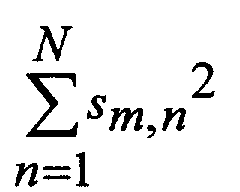
- the energy of the spreading sequence is proportional to
- the M points should be placed on a half of the N-dimensional sphere only, so that the maximal correlation value never reaches one and remains smaller than a predefined threshold value smaller than one.
- a possible threshold values is 0,5.
- Other threshold values may be envisaged depending on the maximum accepted cross-correlation.
- Figure 2 shows an example of a non-orthogonal spreading sequence set according to the invention having a sequence length of 2.
- Figure 2a gives the geometrical representation when the choice of the 8 points corresponding to the 8 spreading sequences of length 2 are located on the half unitary circle.
- the corresponding eight modulation code signals of length 2 are represented on figure 2b.
- the chip value are chosen among a set of 8 chip values: 1, 0 , 0,923, 0.382, 0.707,-0.382, -0.707, -0.923.
- Figure 2c represents an example of code modulated signal.
- the digital sequence 000100101110111001010111 is modulated according to the present invention.
- One user is allocated all eight spreading sequences ( s 1 , ..., s 8 ).
- the bits of the digital sequences are grouped by three and each of the eight possible value for a group of three bits is attributed one of the eight spreading sequences.
- the modulated signal for the digital sequence is represented by the succession of spreading sequences s 1 , s 5 , s 6 , s 7 , s 8 , s 2 , s 3 , s 8 .
- ⁇ i,j cos( ⁇ i,j ) where ⁇ i,j is the angle between the geometrical representations of s i and s j .
- M is directly related to the spectral efficiency.
- a trade-off is necessary between the spectral efficiency log 2 (M)/N and the acceptable performance degradation due to not negligible maximum correlation value when M grows.
- the use of an efficient error correcting code in combination with a non-orthogonal modulation code according to the invention enables it to minimize the disadvantage of high correlating spreading sequences while increasing the capacity of the communication network.
- a second example of a set of spreading sequences according to the present invention consists in considering lattice in higher dimension spaces to build sets of spreading sequences having a higher lenght.
- the Gosset lattice, E 8 is the densest lattice in dimension 8.
- the lattice points are assimilated to the centers of unit spheres one tangent to the other.
- the number of tangent spheres to one sphere in the Gosset Lattice equals 240. Therefore, each point P of the lattice has 240 neighbors at the same minimal distance. These 240 points are as a consequence located on a sphere having as center the point P.
- 240 spreading sequences having as eight successive chip values the eight coordinates of one of the 240 points form a family of spreading sequences according to the present invention.
- the non-orthogonal spreading sequence code comprises 240 spreading sequences.
- ⁇ N the unit sphere of R N and ( * ) the usual inner product and (N,M,s) a subset of ⁇ N of size M for which (u*v) ⁇ s for all u,v ⁇ subset and u ⁇ v.
- the subset (24, 196560, 0.5) can be extracted from the Leech lattice ⁇ 24 , and is also a modulation code according to the construction method of the present invention.
- a subset according to the present invention extracted from a dense integer lattice always gives the maximum number of non-orthogonal spreading sequences with a correlation between each couple of spreading sequences smaller than a predefined threshold, than if the code were extracted from another lattice.
- Another example of set of spreading sequences according to the present invention can be constructed as follows.
- Each component (chip) s m,n 1 ⁇ m ⁇ M of the nth. complex spreading sequence of the set is associated to one of the M possible phases in the M-PSK : where n[M] denotes n modulo M.
- the obtained M spreading sequences are distributed on an N-dimensional unit sphere.
- Another example of a set of complex spreading sequences consists in selecting M randomly chosen complex spreading sequences s m 1 ⁇ m ⁇ M of length N on a N-dimensional unit complex sphere.
- s m 1 N ( e J ⁇ 1 , e J ⁇ 2 ,..., e J ⁇ N ) where ⁇ n is a random variable uniformly distributed on [0,2 ⁇ ].
- Figures 3 respectively Figure 4, illustrates the performance of randomly generated non-orthogonal sets of complex spreading sequences for a AWGN channel, respectively for a Rayleigh fading channel.
- the non-coherent receiver for correlated signals consists in a maximum envelope detector at the output of the matched filters.
- the capacity is given in bit/s/Hz i.e. bits per complex dimension.
- Non-orthogonal set of spreading sequences largely outperform orthogonal ones from a mutual information point of view whichever channel is considered. This performance enhancement can be obtained in practice with a reduced increase of the complexity.
- the non-orthogonal spreading sequence sets according to the present invention exhibit higher spectral efficiency than orthogonal sets and increase the capacity of the communication network.
- the increase of the capacity of the communication network is preferably obtained by combining an efficient error correcting code to the use of the non-orthogonal spreading sequences according to the present invention.
- Tha method according to the invention may as well be used in a system combining CDMA (Code Division Multiple Access) and TDMA (Time Division Multiple Access) techniques also called TD-CDMA.
- CDMA Code Division Multiple Access
- TDMA Time Division Multiple Access
Landscapes
- Engineering & Computer Science (AREA)
- Computer Networks & Wireless Communication (AREA)
- Signal Processing (AREA)
- Mobile Radio Communication Systems (AREA)
Abstract
The invention relates notably to a method for modulating information symbols to be transmitted in a CDMA communication network by using a non-orthogonal modulation code comprising M spreading sequences (sm 1 ≤ m ≤ M), each consisting in N chips (sm,n 1 ≤ n ≤ N), the M spreading sequences having the same energy. According to the invention, the amplitude of the chips take a plurality of values the number M of spreading sequences is higher than the number of chips N per spreading sequence. <IMAGE>
Description
The present invention relates to communication systems and in
particular to modulation of information symbols in communication systems.
In usual communication systems, for example wireless
communication systems, information symbols are coded and modulated at
the sender, transmitted on the medium and demodulated and decoded at
the receiver.
Depending on the communication system, demodulation can be
performed in a coherent or a non-coherent manner.
Coherent detection requires equalization and channel response
estimation so that the effects of phase and magnitude distortion caused by
the communication channel can be compensated for with matched filters.
Coherent demodulation brings prohibitive complexity and poor robustness.
Non-coherent detection, on the contrary, is based on the fact that
decision for received symbols can be made without compensating for the
phase distortion of the received signal. Non-coherent detection at the
receiver is preferred to coherent detection because of the relative simplicity
at the receiver.
As is well known from those skilled in the art, orthogonal
modulation are conventionally used since specially good appropriate for
non-coherent detection at the receiver. However, signals modulated by an
orthogonal modulation are very bandwidth consuming. A compromise
often consists in reducing the bandwidth by using non-orthogonal
modulations resulting however in a performance degradation in the non-coherent
detector since the transmitted signals are correlated.
The design of multidimensional constellations for non-coherent,
non-orthogonal modulations has proved to be a good way to compensate
the performance degradation at the non-coherent receiver.
In multiple users communication networks, there are several ways
for users to send information through the communication channel. For both
Time Division Multiple Access (TDMA) and Frequency Division Multiple
Access (FDMA) techniques, the channel is basically partitioned into equal
independent and non-overlapping single user subchannels. Each user is
respectively assigned a particular time slot within each frame or a frequency
subchannel. These techniques are frequently used in data and digital voice
transmission. However both methods tend to be inefficient when users
transmit bursty information. In this particular case, an alternative is to allow
more than one user to share a channel or subchannel by use of direct-sequence
spread spectrum signals. In this technique, called Code Division
Multiple Access (CDMA), each user is assigned a unique code sequence
and spreads the information signal across the assigned frequency band.
Thus, signals from the various users are separated at the receiver by cross-correlation
of the received signal with each of the possible user signature
sequences. CDMA is a promising technique for radio access in future
cellular mobile and personal communication systems. It offers some
attractive features compared to TDMA or FDMA such as the potential for
high radio capacity, soft handover, simplified frequency planning, etc.
In non-coherent TDMA and FDMA systems, Q-ary Frequency Shift
Keying (FSK) is used and non-coherent detection is made with Q orthogonal
FSK signals having a tone spacing equal to the inverse of the symbol
period. Reducing the tone spacing of FSK signals leads to non-orthogonal
modulations that can be advantageously used to reduce the bandwidth of
the modulated signals.
In non-coherent CDMA systems, the modulation is preferably
chosen to be a family of orthogonal spreading sequences, e.g. Walsh-Hadamard.
However, the number of strictly orthogonal spreading
sequences is limited for a given spreading sequence length (the spectral
efficiency of orthogonal spreading sequences is poor). Non-orthogonal
spreading sequences are then advantageously used to enhance the system
capacity. They are mainly characterised by their cross-correlation, which is
equivalent to the tone non-orthogonality in the FSK case.
A known solution is to replace the Walsh-Hadamard set by a new
non-orthogonal set. When this kind of sets cannot be used, one can think of
considering several masked versions of an initially orthogonal set (used for
instance in IS-95 systems). An alternative is to use well known families of
PN-like sequences (e.g. Gold or Kasami sequences).
US 5,938,787 describes a method of encoding information
symbols according to a concatenation of an error correction code and a
non-orthogonal modulation code where the non-orthogonal modulation
code is obtained by a translation of a set of orthogonal code vectors
according to a predetermined translation. This modulation set contains
spreading sequences with binary chip values. This fact implies a strong
limitation on the number of spreading sequences that could be generated.
Indeed, when considering spreading sequences of N chips length, the
ultimate upper limit on the number of spreading sequences is 2N. A large
number of these 2N spreading sequences is not usable since a limit for the
cross-correlation value between the spreading sequences should be
ensured.
In "Complex spreading sequences with a wide range of correlation
properties" (I. Opperman and B. Vucetic, IEEE transaction on
communications, VOL. 45 NO. 3 March 1997, pages 365 to 375), a
method for building sets of complex spreading sequences with good
correlation properties is presented. For ensuring good correlation
properties, the number of spreading sequences M constituting the alphabet
is chosen smaller than the spreading sequence length N.
All above described modulation sets have a low spectral efficiency.
The spectral efficiency can defined be as log2(M)/N and represents the
number of bits to map a sequence divided by the sequence length. This
quantity is given in bit/s/Hz. For the modulation sets described above, the
spectral efficiency is << 1 (very smaller than one).
The object of the present invention is to provide a method for
transmitting coded information symbols in a communication network by
using a non-orthogonal modulation code having a large spectral efficiency.
Another object of the invention is to provide a non-orthogonal
modulator for performing the above mentioned method.
Another objet of the present invention is to provide non-orthogonal
modulation codes families to be used by the non-orthogonal modulator.
These objects, and others that appear below, are achieved by a
method for modulating information symbols to be transmitted in a CDMA
communication network by using a non-orthogonal modulation code
according to claim 1, non-orthogonal modulation codes family according
to claim 8 and a modulator according to claim 9.
The spreading sequence sets according to the invention have the
advantage to have a spectral efficiency that can easily exceed 1bit/s/Hz.
Another advantage of this method is that it increases the capacity of
the communication network.
In a preferred embodiment of the invention, the spreading
sequences constituting the non-orthogonal modulation code have a cross
correlation smaller than a predefined threshold.
In another preferred embodiment, the modulation code according
to the invention is combined with an efficient error correction code to
compensate the fact that the correlation between the spreading sequences
of the sets are not negligible.
Further advantageous features of the invention are defined in the
dependent claims.
Other characteristics and advantages of the invention will appear
on reading the following description of a preferred implementation given by
way of non-limiting illustrations, and from the accompanying drawings, in
which:
- Figure 1 shows a communication chain where a non-orthogonal modulation code according to the invention can be used;
- Figure 2 shows a set of non-orthogonal spreading sequences according to the invention having a sequence length of 2. Figure 2a is a geometrical representation of these, figure 2b represents the corresponding modulation codes and figure 2c represents an exemple of information flow modulated with said spreading sequences;
- Figure 3 shows the performance of a non-orthogonal spreading sequence set according to the invention compared to an orthogonal sequence set for a Additive White Gaussian Noise (AWGN) channel;
- Figure 4 shows the performance of a non-orthogonal spreading sequence set according to the invention compared to an orthogonal sequence set for a Raleigh fading channel.
Figure 1 shows a communication chain where a non-orthogonal
modulation code according to the invention can be used. Communication
chain comprises a transmit part 11, a radio channel 12 and a receiver part
13. Transmit part comprises an information source 111, an encoder 112,
an interleaver 113, a non-orthogonal modulator 114. Receiver part
comprises a non-coherent demodulator 131, a deinterleaver 132 and a
decoder 133. Non-orthogonal modulator 114, as known in the art, is
responsible for transforming a numeric information flow composed of
sequence of digital symbols in an electrical signal. Non-orthogonal
modulator 114 supports the method according to the invention and
generates an electrical signal having a period equal to the chip duration
and an amplitude depending on the used spreading sequences. Spreading
sequences to be used are generated and stored at non-orthogonal
modulator 114.
A unique spreading sequence may be used at non-orthogonal
modulator 114 as in usual multiple user CDMA systems. In that case, each
user is allocated one spreading sequence. The information flow transmitted
by each user is spread by the spreading sequence (i.e each symbol to be
modulated is multiplied by the spreading sequence). In the uplink, the
receiver (i.e. a base station) receives a composed signal consisting in a
superposition of spread signals spread with different spreading sequences.
By correlating the composed signal with the different spreading sequences,
the receiver can extract the information flow of each user from the
composed signal.
Alternatively, several spreading sequences may be used at the non-orthogonal
modulator 114. In that case, the incoming digital information
flow at the non-orthogonal modulator is considered as groups of K bits.
There are 2K possible groups of K bits. One spreading sequence is
associated to each group of K bits. The modulator uses 2K spreading
sequences to modulate the signal. One spreading sequence corresponds in
that case to one modulation symbol. This technique is called coded
modulation. The electrical signal generated by non-orthogonal modulator
114 is a succession of electrical signals representing the successive
spreading sequences associated to the successive symbols to transmit.
Any combination of the two above mentioned applications may be
envisaged. For all these applications, the design of appropriate non-orthogonal
spreading sequences is essential.
According to the invention, the proposed construction method
consists in designing non-orthogonal spreading sequence sets containing a
large number of spreading sequences M (M >> sequence length N) and
ensuring a reasonable correlation value by allowing the chip value to be
any real number instead of only ±1 as known in the art. These spreading
sequences should be chosen with equal energy.
Geometrically this is equivalent to place M points on an N-dimensional
sphere, while ensuring a good repartition of the correlations.
Each one of the M spreading sequences is related to one of M
points on the N-dimensional sphere. The N components (chips)
s m,n 1 ≤ n ≤ N of a spreading sequence are coordinates of the associated
point on the N-dimensional sphere. The cross-correlation values between
spreading sequences are directly related to angles between the associated
points. The energy of the spreading sequence is proportional to
When allowing the use of the whole sphere, we can find
diametrically opposed points, leading to a correlation value equal to 1. In
that case, it would be impossible to distinguish at demodulation between
the two spreading sequences.
Preferably, the M points should be placed on a half of the N-dimensional
sphere only, so that the maximal correlation value never
reaches one and remains smaller than a predefined threshold value smaller
than one. A possible threshold values is 0,5. Other threshold values may be
envisaged depending on the maximum accepted cross-correlation.
Real as well as complex spreading sequences are considered in the
present invention. Complex spreading sequences being essentially used for
base band transmission with an in-phase and in-quadrature path.
In the following several examples are given to illustrate sets of
spreading sequences according to the present invention.
Figure 2 shows an example of a non-orthogonal spreading sequence set
according to the invention having a sequence length of 2.
The case M=8, N=2 corresponds to a family of 8 spreading
sequences (s 1,..., s 8) of length 2 detailed below.
| s 1 (1, 0) | s 2 (0.923, 0.382) |
| s 3 (0.707, 0.707) | s 4 (0.382, 0.923) |
| s 5 (0, 1) | s 6 (-0.382, 0.923) |
| s 7 (-0.707, 0.707) | s 8 (-0.923, 0.382) |
Figure 2a gives the geometrical representation when the choice of
the 8 points corresponding to the 8 spreading sequences of length 2 are
located on the half unitary circle. The corresponding eight modulation code
signals of length 2 are represented on figure 2b. In this case the chip value
are chosen among a set of 8 chip values: 1, 0 , 0,923, 0.382, 0.707,-0.382,
-0.707, -0.923.
Figure 2c represents an example of code modulated signal. In that
case the digital sequence 000100101110111001010111 is modulated
according to the present invention. One user is allocated all eight spreading
sequences (s 1, ..., s 8). The bits of the digital sequences are grouped by
three and each of the eight possible value for a group of three bits is
attributed one of the eight spreading sequences.
Assumed that s 1 represents 000, s 2 represents 001, s 3 represents
010, ..., s 8 represents 111, then the modulated signal for the digital
sequence is represented by the succession of spreading sequences s 1, s 5,
s 6, s 7, s 8, s 2, s 3, s 8.
The correlation between any two spreading sequences s i and s j,
defined as the inner product between both associated points, is given by
µi,j =cos(αi,j) where αi,j is the angle between the geometrical representations
of s i and s j. µi,j is real and the maximum correlation value is given by
µmax=cos(π/8). If the threshold value is set to µmax=cos(π/8), the family of 8
spreading sequence fulfill the requirements regarding the maximum
correlation between two spreading sequences of the set.
This can be generalized to the case of M spreading sequences of
length N=2 on the half unitary circle. For any couple (s i, s j), with i≠j,
µmax=cos(π/M).
M is directly related to the spectral efficiency. A trade-off is
necessary between the spectral efficiency log2(M)/N and the acceptable
performance degradation due to not negligible maximum correlation value
when M grows. The use of an efficient error correcting code in combination
with a non-orthogonal modulation code according to the invention enables
it to minimize the disadvantage of high correlating spreading sequences
while increasing the capacity of the communication network.
A second example of a set of spreading sequences according to the
present invention consists in considering lattice in higher dimension spaces
to build sets of spreading sequences having a higher lenght.
The Gosset lattice, E8, is the densest lattice in dimension 8. The
lattice points are assimilated to the centers of unit spheres one tangent to
the other. The number of tangent spheres to one sphere in the Gosset
Lattice equals 240. Therefore, each point P of the lattice has 240 neighbors
at the same minimal distance. These 240 points are as a consequence
located on a sphere having as center the point P.
As a consequence, 240 spreading sequences having as eight
successive chip values the eight coordinates of one of the 240 points form a
family of spreading sequences according to the present invention.
Thanks to geometrical considerations in the space of dimension 8,
the minimum angle between any two points associated to a spreading
sequence is π/3, i.e. a maximal correlation cos(π/3)=0.5. As a
consequence if the threshold value is chosen equal to 0.5, the non-orthogonal
spreading sequence code comprises 240 spreading sequences.
This leads to the design of a family of 240 spreading sequences of
length eight having a maximum correlation of 0.5 in comparison to the
eight orthogonal sequences of length eight given by the Walsh-Hadamard
set having a maximal correlation of zero.
The previous example can be generalized as follows:
Let's denote ΩN the unit sphere of RN and ( * ) the usual inner
product and (N,M,s) a subset of ΩN of size M for which (u*v)≥s for all u,v ∈
subset and u≠v.
In the previous example, the subset (8,240,0.5)of Ω8 has been
considered.
In dimension 24, the subset (24, 196560, 0.5) can be extracted
from the Leech lattice Λ24, and is also a modulation code according to the
construction method of the present invention.
For a given length N, a subset according to the present invention
extracted from a dense integer lattice always gives the maximum number of
non-orthogonal spreading sequences with a correlation between each
couple of spreading sequences smaller than a predefined threshold, than if
the code were extracted from another lattice.
Another example of set of spreading sequences according to the
present invention can be constructed as follows.
In analogy to a M-PSK (Pulse Shift Keying) modulation, a set of
complex spreading sequence according to the present invention can be
obtained.
A M-PSK modulating signal um (t) can be expressed as follows:
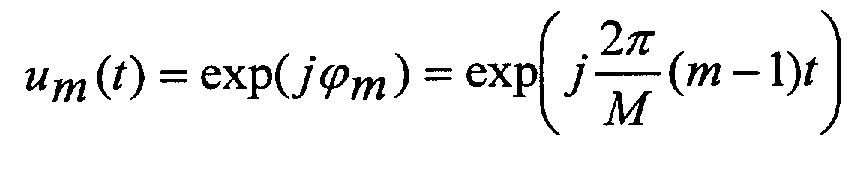 for m=1,...,M and ϕm ∈ [0,2π].
Each component (chip) s m,n 1 ≤ m ≤ M of the nth. complex
spreading sequence of the set is associated to one of the M possible phases
in the M-PSK :
 where n[M] denotes n modulo M. The phase βm,n is in [0,2π] when
n=1,...,N and m=1,...,M.
where n[M] denotes n modulo M. The phase βm,n is in [0,2π] when
n=1,...,N and m=1,...,M.
The obtained M spreading sequences are distributed on an N-dimensional
unit sphere.
Another example of a set of complex spreading sequences
according to the present invention, consists in selecting M randomly chosen
complex spreading sequences sm 1 ≤ m ≤ M of length N on a N-dimensional
unit complex sphere.
sm = 1 N (eJ ϕ1 , eJ ϕ2 ,..., eJϕN )
where ϕn is a random variable uniformly distributed on [0,2π].
Figures 3, respectively Figure 4, illustrates the performance of
randomly generated non-orthogonal sets of complex spreading sequences
for a AWGN channel, respectively for a Rayleigh fading channel.
For non-orthogonal signals and for a given size M of the set of
spreading sequences, the envelope of the maximum achievable capacity
curves with respect to Eb/N0 for various lengths N is represented on the
diagrams shown of figures 3 and 4.
As reference to compare the performance, the envelope of capacity
curves is also given for various N for orthogonal spreading sequences
(M=N in this case).
Moreover, for comparison, we include a curve of the capacity of the
considered AWGN or Rayleigh fading channel with coherent detection
which represents an absolute upper limit.
Preferably, the non-coherent receiver for correlated signals consists
in a maximum envelope detector at the output of the matched filters.
For all curves, the capacity is given in bit/s/Hz i.e. bits per complex
dimension.
Non-orthogonal set of spreading sequences largely outperform
orthogonal ones from a mutual information point of view whichever
channel is considered. This performance enhancement can be obtained in
practice with a reduced increase of the complexity.
For instance, a family of M=1024 correlated signals of length N=8
reaches a mutual information of 1 bit/s/Hz with a loss of 3 dB when
compared to the coherent AWGN channel capacity (figure 3) while it
reaches 0.5 bit/s/Hz with a loss of 3.5 dB when compared to the coherent
Rayleigh channel capacity (figure 4).
For both channels, there is no orthogonal spreading sequence set
able to exceed a mutual information of 0.5 bit/s/Hz. This maximum is
reached by both orthogonal sets of size N=2 and N=4 at Eb/N0 values far
from the ones of the coherent channel capacity curves (respectively 8 and
16 dB on AWGN and Rayleigh channels).
However, with non-orthogonal signals, an increase of either the set
size M or the sequence length N always leads to higher spectral efficiencies.
Hence, there is a trade-off between the improvement of spectrum efficiency
and the complexity of the set of spreading sequences.
According to the diagram shown on both figure 3 and figure 4, the
non-orthogonal spreading sequence sets according to the present invention
exhibit higher spectral efficiency than orthogonal sets and increase the
capacity of the communication network.
The increase of the capacity of the communication network is
preferably obtained by combining an efficient error correcting code to the
use of the non-orthogonal spreading sequences according to the present
invention. For example, a convolutional 2/3 encoding (octal generators 27,
75, 72) of a set of M=64 spreading sequences of length N=8 leads to a
loss of only 2 dB from the maximum achievable capacity on AWGN non-coherent
channel.
Tha method according to the invention may as well be used in a
system combining CDMA (Code Division Multiple Access) and TDMA (Time
Division Multiple Access) techniques also called TD-CDMA.
Claims (9)
- Method for modulating information symbols to be transmitted in a CDMA communication network by using a non-orthogonal modulation code comprising M spreading sequences (sm 1 ≤ m ≤ M), each consisting in N chips (sm,n 1 ≤ n ≤ N) used to modulate said coded information symbols, said M spreading sequences having the same energy, the amplitude of said chips taking a plurality of values, and said number M of spreading sequences being higher than the number of chips N per spreading sequence.

- Method according to claim 1, characterized in that the correlation between each couple of said spreading sequences is smaller than a predefined threshold.
- Method according to any of the claims 1 to 2, characterized in that said spreading sequences are extracted from a dense lattice in a space of dimension N.
- Method according to claim 3, characterized in that said spreading sequences are extracted from the Gosset lattice (N=8).
- Method according to claim 3, characterized in that said spreading sequences are extracted from the Leech lattice (N=24).
- Method according to any of the claims 1 or 2, characterized in that said chip values correspond to the coordinates of points randomly chosen on an N-dimensional complex sphere.
- Method according to any of the claims 1 to 6, characterized in that said symbols are coded with an efficient error correction code.
- Non-orthogonal modulation code families comprising M spreading sequences (sm 1 ≤ m ≤ M), each consisting in N chips (sm,n 1 ≤ n ≤ N) used to modulate said coded information symbols, said M spreading sequences having the same energy, the amplitude of said chips taking a plurality of values; and said number M of spreading sequences being higher than the number of chips N per spreading sequence.

- Modulator for modulating coded information signal with non-orthogonal spreading sequences characterized in that it comprisesmeans for generating non-orthogonal spreading sequence families according to claim 7; andmeans for storing said non-orthogonal spreading sequences.
Priority Applications (2)
| Application Number | Priority Date | Filing Date | Title |
|---|---|---|---|
| EP00440287A EP1202483A1 (en) | 2000-10-27 | 2000-10-27 | Correlated spreading sequences for high rate non-coherent communication systems |
| US09/983,974 US6990138B2 (en) | 2000-10-27 | 2001-10-26 | Correlated spreading sequences for high rate non-coherent communication systems |
Applications Claiming Priority (1)
| Application Number | Priority Date | Filing Date | Title |
|---|---|---|---|
| EP00440287A EP1202483A1 (en) | 2000-10-27 | 2000-10-27 | Correlated spreading sequences for high rate non-coherent communication systems |
Publications (1)
| Publication Number | Publication Date |
|---|---|
| EP1202483A1 true EP1202483A1 (en) | 2002-05-02 |
Family
ID=8174179
Family Applications (1)
| Application Number | Title | Priority Date | Filing Date |
|---|---|---|---|
| EP00440287A Withdrawn EP1202483A1 (en) | 2000-10-27 | 2000-10-27 | Correlated spreading sequences for high rate non-coherent communication systems |
Country Status (2)
| Country | Link |
|---|---|
| US (1) | US6990138B2 (en) |
| EP (1) | EP1202483A1 (en) |
Cited By (5)
| Publication number | Priority date | Publication date | Assignee | Title |
|---|---|---|---|---|
| EP2015110A1 (en) * | 2007-07-10 | 2009-01-14 | Sick Ag | Optoelectronic sensor |
| EP2103962A1 (en) * | 2008-03-20 | 2009-09-23 | Sick Ag | Optoelectronic sensor |
| US8050570B2 (en) | 2007-07-10 | 2011-11-01 | Sick Ag | Optoelectronic sensor |
| US8288707B2 (en) | 2009-03-04 | 2012-10-16 | Sick Ag | Optoelectronic sensor |
| EP3125457A3 (en) * | 2015-07-31 | 2017-03-22 | Sony Corporation | Signal processing system and method, base station and user equipment |
Families Citing this family (70)
| Publication number | Priority date | Publication date | Assignee | Title |
|---|---|---|---|---|
| EP1202483A1 (en) * | 2000-10-27 | 2002-05-02 | Alcatel | Correlated spreading sequences for high rate non-coherent communication systems |
| US7957263B2 (en) * | 2003-09-08 | 2011-06-07 | Qualcomm Corporation | Method and apparatus for acknowledging reverse link transmissions in a communications system |
| JP4790484B2 (en) * | 2006-05-01 | 2011-10-12 | 株式会社エヌ・ティ・ティ・ドコモ | Transmitting apparatus, receiving apparatus, and paging information receiving method |
| US9288089B2 (en) | 2010-04-30 | 2016-03-15 | Ecole Polytechnique Federale De Lausanne (Epfl) | Orthogonal differential vector signaling |
| US8593305B1 (en) | 2011-07-05 | 2013-11-26 | Kandou Labs, S.A. | Efficient processing and detection of balanced codes |
| US9564994B2 (en) | 2010-05-20 | 2017-02-07 | Kandou Labs, S.A. | Fault tolerant chip-to-chip communication with advanced voltage |
| US9246713B2 (en) | 2010-05-20 | 2016-01-26 | Kandou Labs, S.A. | Vector signaling with reduced receiver complexity |
| US8539318B2 (en) * | 2010-06-04 | 2013-09-17 | École Polytechnique Fédérale De Lausanne (Epfl) | Power and pin efficient chip-to-chip communications with common-mode rejection and SSO resilience |
| US9124557B2 (en) | 2010-05-20 | 2015-09-01 | Kandou Labs, S.A. | Methods and systems for chip-to-chip communication with reduced simultaneous switching noise |
| US9401828B2 (en) | 2010-05-20 | 2016-07-26 | Kandou Labs, S.A. | Methods and systems for low-power and pin-efficient communications with superposition signaling codes |
| US9479369B1 (en) | 2010-05-20 | 2016-10-25 | Kandou Labs, S.A. | Vector signaling codes with high pin-efficiency for chip-to-chip communication and storage |
| US9300503B1 (en) | 2010-05-20 | 2016-03-29 | Kandou Labs, S.A. | Methods and systems for skew tolerance in and advanced detectors for vector signaling codes for chip-to-chip communication |
| US9106238B1 (en) | 2010-12-30 | 2015-08-11 | Kandou Labs, S.A. | Sorting decoder |
| US9362962B2 (en) | 2010-05-20 | 2016-06-07 | Kandou Labs, S.A. | Methods and systems for energy-efficient communications interface |
| US9596109B2 (en) | 2010-05-20 | 2017-03-14 | Kandou Labs, S.A. | Methods and systems for high bandwidth communications interface |
| US9251873B1 (en) | 2010-05-20 | 2016-02-02 | Kandou Labs, S.A. | Methods and systems for pin-efficient memory controller interface using vector signaling codes for chip-to-chip communications |
| US9077386B1 (en) | 2010-05-20 | 2015-07-07 | Kandou Labs, S.A. | Methods and systems for selection of unions of vector signaling codes for power and pin efficient chip-to-chip communication |
| US9288082B1 (en) | 2010-05-20 | 2016-03-15 | Kandou Labs, S.A. | Circuits for efficient detection of vector signaling codes for chip-to-chip communication using sums of differences |
| US9985634B2 (en) | 2010-05-20 | 2018-05-29 | Kandou Labs, S.A. | Data-driven voltage regulator |
| US9450744B2 (en) | 2010-05-20 | 2016-09-20 | Kandou Lab, S.A. | Control loop management and vector signaling code communications links |
| WO2011151469A1 (en) | 2010-06-04 | 2011-12-08 | Ecole Polytechnique Federale De Lausanne | Error control coding for orthogonal differential vector signaling |
| US9275720B2 (en) | 2010-12-30 | 2016-03-01 | Kandou Labs, S.A. | Differential vector storage for dynamic random access memory |
| US9268683B1 (en) | 2012-05-14 | 2016-02-23 | Kandou Labs, S.A. | Storage method and apparatus for random access memory using codeword storage |
| DE102012221121A1 (en) * | 2012-11-20 | 2014-06-05 | Zf Friedrichshafen Ag | Concept for sending and receiving an information symbol |
| WO2014124450A1 (en) | 2013-02-11 | 2014-08-14 | Kandou Labs, S.A. | Methods and systems for high bandwidth chip-to-chip communications interface |
| CN110166217B (en) | 2013-04-16 | 2022-05-17 | 康杜实验室公司 | High bandwidth communication interface method and system |
| CN105393512B (en) | 2013-06-25 | 2019-06-28 | 康杜实验室公司 | Vector signaling with low receiver complexity |
| US9106465B2 (en) | 2013-11-22 | 2015-08-11 | Kandou Labs, S.A. | Multiwire linear equalizer for vector signaling code receiver |
| US9806761B1 (en) | 2014-01-31 | 2017-10-31 | Kandou Labs, S.A. | Methods and systems for reduction of nearest-neighbor crosstalk |
| JP6317474B2 (en) | 2014-02-02 | 2018-04-25 | カンドウ ラボズ ソシエテ アノニム | Method and apparatus for low power chip-to-chip communication using constrained ISI ratio |
| US9369312B1 (en) | 2014-02-02 | 2016-06-14 | Kandou Labs, S.A. | Low EMI signaling for parallel conductor interfaces |
| EP3672176B1 (en) | 2014-02-28 | 2022-05-11 | Kandou Labs, S.A. | Clock-embedded vector signaling codes |
| US9509437B2 (en) | 2014-05-13 | 2016-11-29 | Kandou Labs, S.A. | Vector signaling code with improved noise margin |
| US11240076B2 (en) | 2014-05-13 | 2022-02-01 | Kandou Labs, S.A. | Vector signaling code with improved noise margin |
| US9148087B1 (en) | 2014-05-16 | 2015-09-29 | Kandou Labs, S.A. | Symmetric is linear equalization circuit with increased gain |
| US9852806B2 (en) | 2014-06-20 | 2017-12-26 | Kandou Labs, S.A. | System for generating a test pattern to detect and isolate stuck faults for an interface using transition coding |
| US9112550B1 (en) | 2014-06-25 | 2015-08-18 | Kandou Labs, SA | Multilevel driver for high speed chip-to-chip communications |
| CN106797352B (en) | 2014-07-10 | 2020-04-07 | 康杜实验室公司 | High signal-to-noise characteristic vector signaling code |
| US9432082B2 (en) | 2014-07-17 | 2016-08-30 | Kandou Labs, S.A. | Bus reversable orthogonal differential vector signaling codes |
| CN106664272B (en) | 2014-07-21 | 2020-03-27 | 康杜实验室公司 | Method and apparatus for receiving data from a multi-point communication channel |
| US9461862B2 (en) | 2014-08-01 | 2016-10-04 | Kandou Labs, S.A. | Orthogonal differential vector signaling codes with embedded clock |
| US9674014B2 (en) | 2014-10-22 | 2017-06-06 | Kandou Labs, S.A. | Method and apparatus for high speed chip-to-chip communications |
| EP3298702A1 (en) * | 2015-06-23 | 2018-03-28 | Huawei Technologies Co., Ltd. | Controller, access node and aggregation node in a radio communication network |
| EP3314835B1 (en) | 2015-06-26 | 2020-04-08 | Kandou Labs S.A. | High speed communications system |
| US9557760B1 (en) | 2015-10-28 | 2017-01-31 | Kandou Labs, S.A. | Enhanced phase interpolation circuit |
| US9577815B1 (en) | 2015-10-29 | 2017-02-21 | Kandou Labs, S.A. | Clock data alignment system for vector signaling code communications link |
| US10055372B2 (en) | 2015-11-25 | 2018-08-21 | Kandou Labs, S.A. | Orthogonal differential vector signaling codes with embedded clock |
| WO2017132292A1 (en) | 2016-01-25 | 2017-08-03 | Kandou Labs, S.A. | Voltage sampler driver with enhanced high-frequency gain |
| CN115085727B (en) | 2016-04-22 | 2026-04-21 | 康杜实验室公司 | High-performance phase-locked loop |
| US10003454B2 (en) | 2016-04-22 | 2018-06-19 | Kandou Labs, S.A. | Sampler with low input kickback |
| CN109313622B (en) | 2016-04-28 | 2022-04-15 | 康杜实验室公司 | Vector Signaling Codes for Dense Routing Line Groups |
| US10153591B2 (en) | 2016-04-28 | 2018-12-11 | Kandou Labs, S.A. | Skew-resistant multi-wire channel |
| CN109417521B (en) | 2016-04-28 | 2022-03-18 | 康杜实验室公司 | Low power multi-level driver |
| US9906358B1 (en) | 2016-08-31 | 2018-02-27 | Kandou Labs, S.A. | Lock detector for phase lock loop |
| US10411922B2 (en) | 2016-09-16 | 2019-09-10 | Kandou Labs, S.A. | Data-driven phase detector element for phase locked loops |
| US10200188B2 (en) | 2016-10-21 | 2019-02-05 | Kandou Labs, S.A. | Quadrature and duty cycle error correction in matrix phase lock loop |
| US10372665B2 (en) | 2016-10-24 | 2019-08-06 | Kandou Labs, S.A. | Multiphase data receiver with distributed DFE |
| US10200218B2 (en) | 2016-10-24 | 2019-02-05 | Kandou Labs, S.A. | Multi-stage sampler with increased gain |
| EP3610576B1 (en) | 2017-04-14 | 2022-12-28 | Kandou Labs, S.A. | Pipelined forward error correction for vector signaling code channel |
| CN110945830B (en) | 2017-05-22 | 2022-09-09 | 康杜实验室公司 | Multimode Data Driven Clock Recovery Circuit |
| US10116468B1 (en) | 2017-06-28 | 2018-10-30 | Kandou Labs, S.A. | Low power chip-to-chip bidirectional communications |
| CN109217969B (en) | 2017-07-03 | 2021-06-15 | 中兴通讯股份有限公司 | Data processing method and apparatus, device, storage medium and processor |
| US10686583B2 (en) | 2017-07-04 | 2020-06-16 | Kandou Labs, S.A. | Method for measuring and correcting multi-wire skew |
| US10693587B2 (en) | 2017-07-10 | 2020-06-23 | Kandou Labs, S.A. | Multi-wire permuted forward error correction |
| US10203226B1 (en) | 2017-08-11 | 2019-02-12 | Kandou Labs, S.A. | Phase interpolation circuit |
| US10467177B2 (en) | 2017-12-08 | 2019-11-05 | Kandou Labs, S.A. | High speed memory interface |
| US10326623B1 (en) | 2017-12-08 | 2019-06-18 | Kandou Labs, S.A. | Methods and systems for providing multi-stage distributed decision feedback equalization |
| CN116614338B (en) | 2017-12-28 | 2026-04-21 | 康杜实验室公司 | Method and apparatus for synchronously switching multiple-input demodulation comparators |
| US10554380B2 (en) | 2018-01-26 | 2020-02-04 | Kandou Labs, S.A. | Dynamically weighted exclusive or gate having weighted output segments for phase detection and phase interpolation |
| US11831472B1 (en) | 2022-08-30 | 2023-11-28 | Kandou Labs SA | Pre-scaler for orthogonal differential vector signalling |
Citations (2)
| Publication number | Priority date | Publication date | Assignee | Title |
|---|---|---|---|---|
| US5008898A (en) * | 1989-03-30 | 1991-04-16 | Clarion Co., Ltd. | Carrier modulating device for a spread spectrum communication device |
| US5938787A (en) * | 1997-03-27 | 1999-08-17 | Ericsson Inc. | Communications systems and methods employing code rate partitioning with nonorthogonal modulation |
Family Cites Families (8)
| Publication number | Priority date | Publication date | Assignee | Title |
|---|---|---|---|---|
| MX9603336A (en) * | 1994-02-17 | 1997-05-31 | Micrilor Inc | A high-data-rate wireless local-area network. |
| US5604806A (en) * | 1995-01-20 | 1997-02-18 | Ericsson Inc. | Apparatus and method for secure radio communication |
| US6393047B1 (en) * | 1998-06-16 | 2002-05-21 | Telefonaktiebolaget Lm Ericsson (Publ) | Quadriphase spreading codes in code division multiple access communications |
| US6501788B1 (en) * | 1999-01-22 | 2002-12-31 | Ericsson Inc. | Apparatus and methods for intereference cancellation in spread spectrum communications systems |
| US6574270B1 (en) * | 1999-07-30 | 2003-06-03 | Ericsson Inc. | Baseband interference canceling spread spectrum communications methods and apparatus |
| US6665288B1 (en) * | 1999-11-08 | 2003-12-16 | Ericsson Inc. | Method and apparatus for reducing synchronization code interference in CDMA communications systems |
| US6614836B1 (en) * | 2000-01-28 | 2003-09-02 | Intersil Americas Inc. | Biased-corrected rake receiver for direct sequence spread spectrum waveform |
| EP1202483A1 (en) * | 2000-10-27 | 2002-05-02 | Alcatel | Correlated spreading sequences for high rate non-coherent communication systems |
-
2000
- 2000-10-27 EP EP00440287A patent/EP1202483A1/en not_active Withdrawn
-
2001
- 2001-10-26 US US09/983,974 patent/US6990138B2/en not_active Expired - Fee Related
Patent Citations (2)
| Publication number | Priority date | Publication date | Assignee | Title |
|---|---|---|---|---|
| US5008898A (en) * | 1989-03-30 | 1991-04-16 | Clarion Co., Ltd. | Carrier modulating device for a spread spectrum communication device |
| US5938787A (en) * | 1997-03-27 | 1999-08-17 | Ericsson Inc. | Communications systems and methods employing code rate partitioning with nonorthogonal modulation |
Non-Patent Citations (1)
| Title |
|---|
| BURR A G: "SPHERICAL CODES FOR M-ARY CODE SHIFT KEYING", NATIONAL CONFERENCE ON TELECOMMUNICATIONS,GB,LONDON, IEE, vol. CONF. 2, 2 April 1989 (1989-04-02), pages 67 - 72, XP000041169, ISBN: 0-85296-378-5 * |
Cited By (6)
| Publication number | Priority date | Publication date | Assignee | Title |
|---|---|---|---|---|
| EP2015110A1 (en) * | 2007-07-10 | 2009-01-14 | Sick Ag | Optoelectronic sensor |
| US8050570B2 (en) | 2007-07-10 | 2011-11-01 | Sick Ag | Optoelectronic sensor |
| EP2103962A1 (en) * | 2008-03-20 | 2009-09-23 | Sick Ag | Optoelectronic sensor |
| DE102008015286A1 (en) * | 2008-03-20 | 2009-10-01 | Sick Ag | Optoelectronic sensor |
| US8288707B2 (en) | 2009-03-04 | 2012-10-16 | Sick Ag | Optoelectronic sensor |
| EP3125457A3 (en) * | 2015-07-31 | 2017-03-22 | Sony Corporation | Signal processing system and method, base station and user equipment |
Also Published As
| Publication number | Publication date |
|---|---|
| US20020097781A1 (en) | 2002-07-25 |
| US6990138B2 (en) | 2006-01-24 |
Similar Documents
| Publication | Publication Date | Title |
|---|---|---|
| US6990138B2 (en) | Correlated spreading sequences for high rate non-coherent communication systems | |
| US5949814A (en) | High-data-rate supplemental channel for CDMA telecommunications system | |
| US5515396A (en) | Method and apparatus for selecting a spreading code in a spectrum spread communication system | |
| US5452328A (en) | Technique for generating sets of binary spreading-code sequences for a high data-rate spread-spectrum network | |
| US5353352A (en) | Multiple access coding for radio communications | |
| US5742678A (en) | Multiple access coding for radio communications | |
| EP0992120A1 (en) | Wireless communications system for transmitting and receiving data with increased data rates and robustness | |
| US6122310A (en) | Method and apparatus for facilitating multi-rate data transmission by selecting a plurality of spreading codes | |
| KR20040067707A (en) | Constant amplitude coded bi-orthogonal coding and decoding apparatus | |
| JP2007524267A (en) | Parallel spread spectrum communication system and method | |
| JP2001148678A (en) | Multi-carrier communication device | |
| US6215813B1 (en) | Method and apparatus for encoding trellis coded direct sequence spread spectrum communication signals | |
| EA007357B1 (en) | Parallel spread spectrum communication system and method | |
| JP2008022567A (en) | Method and device for achieving a variability of channels for use by spread spectrum communication systems | |
| EP1211835A1 (en) | Multi-carrier communication device and peak power suppressing method | |
| Zhou | Fast Frequency Hopping and its Commercial Applications | |
| WO2001020799A1 (en) | Method and apparatus for decoding trellis coded direct sequence spread spectrum communication signals | |
| KR20040095843A (en) | Constant amplitude coded bi-orthogonal coding and decoding apparatus | |
| HK1135245B (en) | Method and apparatus for operating a multichannel communication system | |
| HK1108980B (en) | Transmission of a plurality of channels for cdma telecommunications system |
Legal Events
| Date | Code | Title | Description |
|---|---|---|---|
| PUAI | Public reference made under article 153(3) epc to a published international application that has entered the european phase |
Free format text: ORIGINAL CODE: 0009012 |
|
| AK | Designated contracting states |
Kind code of ref document: A1 Designated state(s): AT BE CH CY DE DK ES FI FR GB GR IE IT LI LU MC NL PT SE |
|
| AX | Request for extension of the european patent |
Free format text: AL;LT;LV;MK;RO;SI |
|
| 17P | Request for examination filed |
Effective date: 20020724 |
|
| AKX | Designation fees paid |
Free format text: AT BE CH CY DE DK ES FI FR GB GR IE IT LI LU MC NL PT SE |
|
| STAA | Information on the status of an ep patent application or granted ep patent |
Free format text: STATUS: THE APPLICATION HAS BEEN WITHDRAWN |
|
| 18W | Application withdrawn |
Effective date: 20051221 |