EP1201628A1 - Electrophilic fluorination - Google Patents
Electrophilic fluorination Download PDFInfo
- Publication number
- EP1201628A1 EP1201628A1 EP01308932A EP01308932A EP1201628A1 EP 1201628 A1 EP1201628 A1 EP 1201628A1 EP 01308932 A EP01308932 A EP 01308932A EP 01308932 A EP01308932 A EP 01308932A EP 1201628 A1 EP1201628 A1 EP 1201628A1
- Authority
- EP
- European Patent Office
- Prior art keywords
- triazinium
- independently
- fluoro
- fluorine
- moieties
- Prior art date
- Legal status (The legal status is an assumption and is not a legal conclusion. Google has not performed a legal analysis and makes no representation as to the accuracy of the status listed.)
- Granted
Links
- 238000003682 fluorination reaction Methods 0.000 title claims description 34
- -1 amino, hydroxyl Chemical group 0.000 claims abstract description 68
- 229910052731 fluorine Inorganic materials 0.000 claims abstract description 41
- 239000011737 fluorine Substances 0.000 claims abstract description 38
- 125000001424 substituent group Chemical group 0.000 claims abstract description 32
- IJGRMHOSHXDMSA-UHFFFAOYSA-N Atomic nitrogen Chemical compound N#N IJGRMHOSHXDMSA-UHFFFAOYSA-N 0.000 claims abstract description 30
- 239000012025 fluorinating agent Substances 0.000 claims abstract description 26
- 229910052757 nitrogen Inorganic materials 0.000 claims abstract description 26
- LYGJENNIWJXYER-UHFFFAOYSA-N nitromethane Chemical compound C[N+]([O-])=O LYGJENNIWJXYER-UHFFFAOYSA-N 0.000 claims abstract description 17
- SOJDEHBJMSOVDX-UHFFFAOYSA-N 1-fluorotriazin-1-ium Chemical class F[N+]1=CC=CN=N1 SOJDEHBJMSOVDX-UHFFFAOYSA-N 0.000 claims abstract description 16
- 229910052799 carbon Inorganic materials 0.000 claims abstract description 14
- 229910052736 halogen Inorganic materials 0.000 claims abstract description 13
- 150000002367 halogens Chemical class 0.000 claims abstract description 13
- OKTJSMMVPCPJKN-UHFFFAOYSA-N Carbon Chemical compound [C] OKTJSMMVPCPJKN-UHFFFAOYSA-N 0.000 claims abstract description 11
- 229910052739 hydrogen Inorganic materials 0.000 claims abstract description 11
- 150000003839 salts Chemical class 0.000 claims abstract description 11
- 125000001183 hydrocarbyl group Chemical group 0.000 claims abstract description 10
- 239000001257 hydrogen Substances 0.000 claims abstract description 10
- 125000004433 nitrogen atom Chemical group N* 0.000 claims abstract description 10
- 239000000126 substance Substances 0.000 claims abstract description 10
- 125000004435 hydrogen atom Chemical class [H]* 0.000 claims abstract description 8
- 229920000642 polymer Polymers 0.000 claims abstract description 8
- 125000004093 cyano group Chemical group *C#N 0.000 claims abstract description 7
- 125000002924 primary amino group Chemical group [H]N([H])* 0.000 claims abstract description 5
- PXGOKWXKJXAPGV-UHFFFAOYSA-N Fluorine Chemical compound FF PXGOKWXKJXAPGV-UHFFFAOYSA-N 0.000 claims abstract 6
- 238000000034 method Methods 0.000 claims description 42
- 239000000758 substrate Substances 0.000 claims description 32
- 125000003118 aryl group Chemical group 0.000 claims description 17
- LQNUZADURLCDLV-UHFFFAOYSA-N nitrobenzene Chemical compound [O-][N+](=O)C1=CC=CC=C1 LQNUZADURLCDLV-UHFFFAOYSA-N 0.000 claims description 14
- MVPPADPHJFYWMZ-UHFFFAOYSA-N chlorobenzene Chemical compound ClC1=CC=CC=C1 MVPPADPHJFYWMZ-UHFFFAOYSA-N 0.000 claims description 12
- 125000002023 trifluoromethyl group Chemical group FC(F)(F)* 0.000 claims description 12
- 230000008569 process Effects 0.000 claims description 9
- 239000000460 chlorine Substances 0.000 claims description 7
- KRHYYFGTRYWZRS-UHFFFAOYSA-M Fluoride anion Chemical compound [F-] KRHYYFGTRYWZRS-UHFFFAOYSA-M 0.000 claims description 6
- 229910052801 chlorine Inorganic materials 0.000 claims description 5
- 150000003431 steroids Chemical class 0.000 claims description 5
- XTEGARKTQYYJKE-UHFFFAOYSA-M Chlorate Chemical compound [O-]Cl(=O)=O XTEGARKTQYYJKE-UHFFFAOYSA-M 0.000 claims description 4
- ZAMOUSCENKQFHK-UHFFFAOYSA-N Chlorine atom Chemical compound [Cl] ZAMOUSCENKQFHK-UHFFFAOYSA-N 0.000 claims description 4
- 125000002887 hydroxy group Chemical group [H]O* 0.000 claims description 4
- 229910021653 sulphate ion Inorganic materials 0.000 claims description 4
- ITMCEJHCFYSIIV-UHFFFAOYSA-M triflate Chemical compound [O-]S(=O)(=O)C(F)(F)F ITMCEJHCFYSIIV-UHFFFAOYSA-M 0.000 claims description 4
- JOXIMZWYDAKGHI-UHFFFAOYSA-N toluene-4-sulfonic acid Chemical compound CC1=CC=C(S(O)(=O)=O)C=C1 JOXIMZWYDAKGHI-UHFFFAOYSA-N 0.000 claims description 3
- QAOWNCQODCNURD-UHFFFAOYSA-L Sulfate Chemical compound [O-]S([O-])(=O)=O QAOWNCQODCNURD-UHFFFAOYSA-L 0.000 claims description 2
- UQSQSQZYBQSBJZ-UHFFFAOYSA-M fluorosulfate group Chemical group S(=O)(=O)([O-])F UQSQSQZYBQSBJZ-UHFFFAOYSA-M 0.000 claims description 2
- QAOWNCQODCNURD-UHFFFAOYSA-M hydrogensulfate Chemical compound OS([O-])(=O)=O QAOWNCQODCNURD-UHFFFAOYSA-M 0.000 claims description 2
- 239000012442 inert solvent Substances 0.000 claims 1
- QJGQUHMNIGDVPM-UHFFFAOYSA-N nitrogen group Chemical group [N] QJGQUHMNIGDVPM-UHFFFAOYSA-N 0.000 claims 1
- 239000002904 solvent Substances 0.000 abstract description 19
- 150000001768 cations Chemical class 0.000 abstract description 5
- MGNCLNQXLYJVJD-UHFFFAOYSA-N cyanuric chloride Chemical group ClC1=NC(Cl)=NC(Cl)=N1 MGNCLNQXLYJVJD-UHFFFAOYSA-N 0.000 abstract description 4
- 150000001491 aromatic compounds Chemical class 0.000 abstract description 2
- 238000006243 chemical reaction Methods 0.000 description 60
- UHOVQNZJYSORNB-UHFFFAOYSA-N Benzene Chemical compound C1=CC=CC=C1 UHOVQNZJYSORNB-UHFFFAOYSA-N 0.000 description 42
- 150000001875 compounds Chemical class 0.000 description 33
- YCKRFDGAMUMZLT-UHFFFAOYSA-N Fluorine atom Chemical compound [F] YCKRFDGAMUMZLT-UHFFFAOYSA-N 0.000 description 32
- 239000000243 solution Substances 0.000 description 32
- 230000009102 absorption Effects 0.000 description 31
- 238000010521 absorption reaction Methods 0.000 description 31
- DTQVDTLACAAQTR-UHFFFAOYSA-N Trifluoroacetic acid Chemical compound OC(=O)C(F)(F)F DTQVDTLACAAQTR-UHFFFAOYSA-N 0.000 description 24
- 239000000047 product Substances 0.000 description 20
- WEVYAHXRMPXWCK-UHFFFAOYSA-N Acetonitrile Chemical group CC#N WEVYAHXRMPXWCK-UHFFFAOYSA-N 0.000 description 18
- RTZKZFJDLAIYFH-UHFFFAOYSA-N Diethyl ether Chemical compound CCOCC RTZKZFJDLAIYFH-UHFFFAOYSA-N 0.000 description 18
- 238000000806 fluorine-19 nuclear magnetic resonance spectrum Methods 0.000 description 17
- 238000012360 testing method Methods 0.000 description 17
- 238000004293 19F NMR spectroscopy Methods 0.000 description 14
- 239000011541 reaction mixture Substances 0.000 description 14
- WEVYAHXRMPXWCK-FIBGUPNXSA-N acetonitrile-d3 Chemical compound [2H]C([2H])([2H])C#N WEVYAHXRMPXWCK-FIBGUPNXSA-N 0.000 description 13
- 239000002253 acid Substances 0.000 description 13
- RDOXTESZEPMUJZ-UHFFFAOYSA-N anisole Chemical compound COC1=CC=CC=C1 RDOXTESZEPMUJZ-UHFFFAOYSA-N 0.000 description 12
- 125000000956 methoxy group Chemical group [H]C([H])([H])O* 0.000 description 12
- 238000001228 spectrum Methods 0.000 description 12
- 125000002496 methyl group Chemical group [H]C([H])([H])* 0.000 description 11
- 239000000203 mixture Substances 0.000 description 11
- 239000007787 solid Substances 0.000 description 11
- DFBIDODHQQFFTD-UHFFFAOYSA-M 1-fluoro-2,4,6-trimethoxy-1,3,5-triazin-1-ium;trifluoromethanesulfonate Chemical compound [O-]S(=O)(=O)C(F)(F)F.COC1=NC(OC)=[N+](F)C(OC)=N1 DFBIDODHQQFFTD-UHFFFAOYSA-M 0.000 description 10
- 238000004458 analytical method Methods 0.000 description 10
- 239000003153 chemical reaction reagent Substances 0.000 description 10
- 239000007789 gas Substances 0.000 description 10
- PYLWMHQQBFSUBP-UHFFFAOYSA-N monofluorobenzene Chemical compound FC1=CC=CC=C1 PYLWMHQQBFSUBP-UHFFFAOYSA-N 0.000 description 9
- HEDRZPFGACZZDS-MICDWDOJSA-N Trichloro(2H)methane Chemical compound [2H]C(Cl)(Cl)Cl HEDRZPFGACZZDS-MICDWDOJSA-N 0.000 description 8
- CYRMSUTZVYGINF-UHFFFAOYSA-N trichlorofluoromethane Chemical compound FC(Cl)(Cl)Cl CYRMSUTZVYGINF-UHFFFAOYSA-N 0.000 description 8
- ITMCEJHCFYSIIV-UHFFFAOYSA-N triflic acid Chemical compound OS(=O)(=O)C(F)(F)F ITMCEJHCFYSIIV-UHFFFAOYSA-N 0.000 description 8
- 239000000463 material Substances 0.000 description 7
- ICGSFYVOFWQISY-UHFFFAOYSA-M 1-fluoro-2,4,6-trimethyl-1,3,5-triazin-1-ium;trifluoromethanesulfonate Chemical compound [O-]S(=O)(=O)C(F)(F)F.CC1=NC(C)=[N+](F)C(C)=N1 ICGSFYVOFWQISY-UHFFFAOYSA-M 0.000 description 6
- WMASLRCNNKMRFP-UHFFFAOYSA-N 1-fluoro-3-nitrobenzene Chemical compound [O-][N+](=O)C1=CC=CC(F)=C1 WMASLRCNNKMRFP-UHFFFAOYSA-N 0.000 description 6
- XKRFYHLGVUSROY-UHFFFAOYSA-N Argon Chemical compound [Ar] XKRFYHLGVUSROY-UHFFFAOYSA-N 0.000 description 6
- 229910017048 AsF6 Inorganic materials 0.000 description 6
- YMWUJEATGCHHMB-UHFFFAOYSA-N Dichloromethane Chemical compound ClCCl YMWUJEATGCHHMB-UHFFFAOYSA-N 0.000 description 6
- 125000004432 carbon atom Chemical group C* 0.000 description 6
- 238000004519 manufacturing process Methods 0.000 description 6
- UZKWTJUDCOPSNM-UHFFFAOYSA-N methoxybenzene Substances CCCCOC=C UZKWTJUDCOPSNM-UHFFFAOYSA-N 0.000 description 6
- PQDJYEQOELDLCP-UHFFFAOYSA-N trimethylsilane Chemical compound C[SiH](C)C PQDJYEQOELDLCP-UHFFFAOYSA-N 0.000 description 6
- BYEAHWXPCBROCE-UHFFFAOYSA-N 1,1,1,3,3,3-hexafluoropropan-2-ol Chemical compound FC(F)(F)C(O)C(F)(F)F BYEAHWXPCBROCE-UHFFFAOYSA-N 0.000 description 5
- OFYIVIDYCRJHOG-UHFFFAOYSA-M 2,4,6-trichloro-1-fluoro-1,3,5-triazin-1-ium;trifluoromethanesulfonate Chemical compound [O-]S(=O)(=O)C(F)(F)F.F[N+]1=C(Cl)N=C(Cl)N=C1Cl OFYIVIDYCRJHOG-UHFFFAOYSA-M 0.000 description 5
- DFUGJTBMQKRCPI-UHFFFAOYSA-N 2,4,6-trimethoxy-1,3,5-triazine Chemical compound COC1=NC(OC)=NC(OC)=N1 DFUGJTBMQKRCPI-UHFFFAOYSA-N 0.000 description 5
- 238000005481 NMR spectroscopy Methods 0.000 description 5
- 150000007513 acids Chemical class 0.000 description 5
- 238000000921 elemental analysis Methods 0.000 description 5
- 238000002360 preparation method Methods 0.000 description 5
- GOYDNIKZWGIXJT-UHFFFAOYSA-N 1,2-difluorobenzene Chemical compound FC1=CC=CC=C1F GOYDNIKZWGIXJT-UHFFFAOYSA-N 0.000 description 4
- LASVAZQZFYZNPK-UHFFFAOYSA-N 2,4,6-trimethyl-1,3,5-triazine Chemical compound CC1=NC(C)=NC(C)=N1 LASVAZQZFYZNPK-UHFFFAOYSA-N 0.000 description 4
- 125000005915 C6-C14 aryl group Chemical group 0.000 description 4
- CSNNHWWHGAXBCP-UHFFFAOYSA-L Magnesium sulfate Chemical compound [Mg+2].[O-][S+2]([O-])([O-])[O-] CSNNHWWHGAXBCP-UHFFFAOYSA-L 0.000 description 4
- 150000001298 alcohols Chemical class 0.000 description 4
- 230000015572 biosynthetic process Effects 0.000 description 4
- 125000005842 heteroatom Chemical group 0.000 description 4
- 239000008240 homogeneous mixture Substances 0.000 description 4
- 239000000376 reactant Substances 0.000 description 4
- 238000003786 synthesis reaction Methods 0.000 description 4
- XLYOFNOQVPJJNP-UHFFFAOYSA-N water Substances O XLYOFNOQVPJJNP-UHFFFAOYSA-N 0.000 description 4
- JYEUMXHLPRZUAT-UHFFFAOYSA-N 1,2,3-triazine Chemical compound C1=CN=NN=C1 JYEUMXHLPRZUAT-UHFFFAOYSA-N 0.000 description 3
- QUGUFLJIAFISSW-UHFFFAOYSA-N 1,4-difluorobenzene Chemical compound FC1=CC=C(F)C=C1 QUGUFLJIAFISSW-UHFFFAOYSA-N 0.000 description 3
- YWGTTWQJRZCIEI-UHFFFAOYSA-M 1-fluoro-2,4,6-tris(trifluoromethyl)-1,3,5-triazin-1-ium;trifluoromethanesulfonate Chemical compound [O-]S(=O)(=O)C(F)(F)F.F[N+]1=C(C(F)(F)F)N=C(C(F)(F)F)N=C1C(F)(F)F YWGTTWQJRZCIEI-UHFFFAOYSA-M 0.000 description 3
- PWKNBLFSJAVFAB-UHFFFAOYSA-N 1-fluoro-2-nitrobenzene Chemical compound [O-][N+](=O)C1=CC=CC=C1F PWKNBLFSJAVFAB-UHFFFAOYSA-N 0.000 description 3
- QTBSBXVTEAMEQO-UHFFFAOYSA-N Acetic acid Chemical compound CC(O)=O QTBSBXVTEAMEQO-UHFFFAOYSA-N 0.000 description 3
- QGZKDVFQNNGYKY-UHFFFAOYSA-N Ammonia Chemical compound N QGZKDVFQNNGYKY-UHFFFAOYSA-N 0.000 description 3
- 239000007848 Bronsted acid Substances 0.000 description 3
- QJTBJHOQMPDSSA-ACNJIEPASA-N CCC(CC)CN(C[C@@H](O)[C@H](Cc1ccccc1)NC(=O)O[C@H]1CO[C@H]2OCC[C@@H]12)S(=O)(=O)c1ccc(cc1)[C@H](C)O Chemical compound CCC(CC)CN(C[C@@H](O)[C@H](Cc1ccccc1)NC(=O)O[C@H]1CO[C@H]2OCC[C@@H]12)S(=O)(=O)c1ccc(cc1)[C@H](C)O QJTBJHOQMPDSSA-ACNJIEPASA-N 0.000 description 3
- XEKOWRVHYACXOJ-UHFFFAOYSA-N Ethyl acetate Chemical compound CCOC(C)=O XEKOWRVHYACXOJ-UHFFFAOYSA-N 0.000 description 3
- KRHYYFGTRYWZRS-UHFFFAOYSA-N Fluorane Chemical compound F KRHYYFGTRYWZRS-UHFFFAOYSA-N 0.000 description 3
- OKKJLVBELUTLKV-UHFFFAOYSA-N Methanol Chemical compound OC OKKJLVBELUTLKV-UHFFFAOYSA-N 0.000 description 3
- YPDSOAPSWYHANB-UHFFFAOYSA-N [N].[F] Chemical compound [N].[F] YPDSOAPSWYHANB-UHFFFAOYSA-N 0.000 description 3
- 125000003545 alkoxy group Chemical group 0.000 description 3
- 229910052786 argon Inorganic materials 0.000 description 3
- 125000004104 aryloxy group Chemical group 0.000 description 3
- 230000008859 change Effects 0.000 description 3
- 238000000354 decomposition reaction Methods 0.000 description 3
- 238000002474 experimental method Methods 0.000 description 3
- 125000001153 fluoro group Chemical group F* 0.000 description 3
- 239000011261 inert gas Substances 0.000 description 3
- 230000000269 nucleophilic effect Effects 0.000 description 3
- 239000007800 oxidant agent Substances 0.000 description 3
- 230000003647 oxidation Effects 0.000 description 3
- 238000007254 oxidation reaction Methods 0.000 description 3
- 125000005010 perfluoroalkyl group Chemical group 0.000 description 3
- 125000001997 phenyl group Chemical group [H]C1=C([H])C([H])=C(*)C([H])=C1[H] 0.000 description 3
- NHKJPPKXDNZFBJ-UHFFFAOYSA-N phenyllithium Chemical compound [Li]C1=CC=CC=C1 NHKJPPKXDNZFBJ-UHFFFAOYSA-N 0.000 description 3
- NLKNQRATVPKPDG-UHFFFAOYSA-M potassium iodide Chemical compound [K+].[I-] NLKNQRATVPKPDG-UHFFFAOYSA-M 0.000 description 3
- 125000000008 (C1-C10) alkyl group Chemical group 0.000 description 2
- 125000000923 (C1-C30) alkyl group Chemical group 0.000 description 2
- CHLXNUMAMSEJKV-UHFFFAOYSA-N 1-fluoro-2,4,6-trimethoxy-1,3,5-triazin-1-ium Chemical class COC1=NC(OC)=[N+](F)C(OC)=N1 CHLXNUMAMSEJKV-UHFFFAOYSA-N 0.000 description 2
- WFQDTOYDVUWQMS-UHFFFAOYSA-N 1-fluoro-4-nitrobenzene Chemical compound [O-][N+](=O)C1=CC=C(F)C=C1 WFQDTOYDVUWQMS-UHFFFAOYSA-N 0.000 description 2
- BJJDXAFKCKSLTE-UHFFFAOYSA-N 2,6-dimethylpyrimidin-4-amine Chemical compound CC1=CC(N)=NC(C)=N1 BJJDXAFKCKSLTE-UHFFFAOYSA-N 0.000 description 2
- COANMWJRJDRXNS-UHFFFAOYSA-N 2-n-methylpyridine-2,3-diamine Chemical compound CNC1=NC=CC=C1N COANMWJRJDRXNS-UHFFFAOYSA-N 0.000 description 2
- UFHFLCQGNIYNRP-UHFFFAOYSA-N Hydrogen Chemical compound [H][H] UFHFLCQGNIYNRP-UHFFFAOYSA-N 0.000 description 2
- WQDUMFSSJAZKTM-UHFFFAOYSA-N Sodium methoxide Chemical compound [Na+].[O-]C WQDUMFSSJAZKTM-UHFFFAOYSA-N 0.000 description 2
- NINIDFKCEFEMDL-UHFFFAOYSA-N Sulfur Chemical group [S] NINIDFKCEFEMDL-UHFFFAOYSA-N 0.000 description 2
- 230000002378 acidificating effect Effects 0.000 description 2
- 125000003342 alkenyl group Chemical group 0.000 description 2
- 125000000217 alkyl group Chemical group 0.000 description 2
- 150000001450 anions Chemical class 0.000 description 2
- QVGXLLKOCUKJST-UHFFFAOYSA-N atomic oxygen Chemical compound [O] QVGXLLKOCUKJST-UHFFFAOYSA-N 0.000 description 2
- 230000008901 benefit Effects 0.000 description 2
- WTEOIRVLGSZEPR-UHFFFAOYSA-N boron trifluoride Chemical compound FB(F)F WTEOIRVLGSZEPR-UHFFFAOYSA-N 0.000 description 2
- 125000000753 cycloalkyl group Chemical group 0.000 description 2
- 125000005843 halogen group Chemical group 0.000 description 2
- 238000010438 heat treatment Methods 0.000 description 2
- MBAKFIZHTUAVJN-UHFFFAOYSA-I hexafluoroantimony(1-);hydron Chemical compound F.F[Sb](F)(F)(F)F MBAKFIZHTUAVJN-UHFFFAOYSA-I 0.000 description 2
- 239000002198 insoluble material Substances 0.000 description 2
- 229910052943 magnesium sulfate Inorganic materials 0.000 description 2
- 230000007246 mechanism Effects 0.000 description 2
- JZMJDSHXVKJFKW-UHFFFAOYSA-M methyl sulfate(1-) Chemical compound COS([O-])(=O)=O JZMJDSHXVKJFKW-UHFFFAOYSA-M 0.000 description 2
- 239000002777 nucleoside Substances 0.000 description 2
- 150000002894 organic compounds Chemical class 0.000 description 2
- 230000001590 oxidative effect Effects 0.000 description 2
- 229910052760 oxygen Inorganic materials 0.000 description 2
- 239000001301 oxygen Substances 0.000 description 2
- 239000012363 selectfluor Substances 0.000 description 2
- 239000000725 suspension Substances 0.000 description 2
- 125000000876 trifluoromethoxy group Chemical group FC(F)(F)O* 0.000 description 2
- IGELFKKMDLGCJO-UHFFFAOYSA-N xenon difluoride Chemical compound F[Xe]F IGELFKKMDLGCJO-UHFFFAOYSA-N 0.000 description 2
- FIARMZDBEGVMLV-UHFFFAOYSA-N 1,1,2,2,2-pentafluoroethanolate Chemical group [O-]C(F)(F)C(F)(F)F FIARMZDBEGVMLV-UHFFFAOYSA-N 0.000 description 1
- KUGBQWBWWNPMIT-UHFFFAOYSA-N 1,1,2,2,3,3,4,4-octafluoropentan-1-ol Chemical compound CC(F)(F)C(F)(F)C(F)(F)C(O)(F)F KUGBQWBWWNPMIT-UHFFFAOYSA-N 0.000 description 1
- COWKRCCNQSQUGJ-UHFFFAOYSA-N 1,1,2,2,3-pentafluoropropan-1-ol Chemical compound OC(F)(F)C(F)(F)CF COWKRCCNQSQUGJ-UHFFFAOYSA-N 0.000 description 1
- CSUFEOXMCRPQBB-UHFFFAOYSA-N 1,1,2,2-tetrafluoropropan-1-ol Chemical compound CC(F)(F)C(O)(F)F CSUFEOXMCRPQBB-UHFFFAOYSA-N 0.000 description 1
- NFAPWQHXXUKGHB-UHFFFAOYSA-N 1,2,4,6-tetrafluoro-1,3,5-triazin-1-ium Chemical compound FC1=NC(F)=[N+](F)C(F)=N1 NFAPWQHXXUKGHB-UHFFFAOYSA-N 0.000 description 1
- FYADHXFMURLYQI-UHFFFAOYSA-N 1,2,4-triazine Chemical class C1=CN=NC=N1 FYADHXFMURLYQI-UHFFFAOYSA-N 0.000 description 1
- FTYOUSOXJIUHFF-UHFFFAOYSA-N 1,2-dichloro-1-fluoroethanol Chemical compound OC(F)(Cl)CCl FTYOUSOXJIUHFF-UHFFFAOYSA-N 0.000 description 1
- JIHQDMXYYFUGFV-UHFFFAOYSA-N 1,3,5-triazine Chemical class C1=NC=NC=N1 JIHQDMXYYFUGFV-UHFFFAOYSA-N 0.000 description 1
- NYMLVPSRCHELKT-UHFFFAOYSA-N 1-chloro-1,1,3,3,3-pentafluoro-2-(trifluoromethyl)propan-2-ol Chemical compound FC(F)(F)C(O)(C(F)(F)F)C(F)(F)Cl NYMLVPSRCHELKT-UHFFFAOYSA-N 0.000 description 1
- RJCGZNCCVKIBHO-UHFFFAOYSA-N 1-chloro-4-fluorobenzene Chemical compound FC1=CC=C(Cl)C=C1 RJCGZNCCVKIBHO-UHFFFAOYSA-N 0.000 description 1
- WFVDXLRAQBDXGS-UHFFFAOYSA-N 1-fluoro-4,5,6-tris(trifluoromethyl)triazin-1-ium Chemical class F[N+]1=NN=C(C(F)(F)F)C(C(F)(F)F)=C1C(F)(F)F WFVDXLRAQBDXGS-UHFFFAOYSA-N 0.000 description 1
- UWDCUCCPBLHLTI-UHFFFAOYSA-N 1-fluoropyridin-1-ium Chemical class F[N+]1=CC=CC=C1 UWDCUCCPBLHLTI-UHFFFAOYSA-N 0.000 description 1
- JFZMMCYRTJBQQI-UHFFFAOYSA-M 1-fluoropyridin-1-ium;trifluoromethanesulfonate Chemical compound F[N+]1=CC=CC=C1.[O-]S(=O)(=O)C(F)(F)F JFZMMCYRTJBQQI-UHFFFAOYSA-M 0.000 description 1
- 125000004793 2,2,2-trifluoroethoxy group Chemical group FC(CO*)(F)F 0.000 description 1
- 125000004206 2,2,2-trifluoroethyl group Chemical group [H]C([H])(*)C(F)(F)F 0.000 description 1
- SOFUZJVNPWXHOH-UHFFFAOYSA-M 2,3,4,5,6-pentachloro-1-fluoropyridin-1-ium;trifluoromethanesulfonate Chemical compound [O-]S(=O)(=O)C(F)(F)F.F[N+]1=C(Cl)C(Cl)=C(Cl)C(Cl)=C1Cl SOFUZJVNPWXHOH-UHFFFAOYSA-M 0.000 description 1
- LSGBKABSSSIRJF-UHFFFAOYSA-N 2,4,6-tris(trifluoromethyl)-1,3,5-triazine Chemical compound FC(F)(F)C1=NC(C(F)(F)F)=NC(C(F)(F)F)=N1 LSGBKABSSSIRJF-UHFFFAOYSA-N 0.000 description 1
- CCZKGYUURJYYBO-UHFFFAOYSA-N 2-chloro-1,1-difluoroethanol Chemical compound OC(F)(F)CCl CCZKGYUURJYYBO-UHFFFAOYSA-N 0.000 description 1
- 229910015900 BF3 Inorganic materials 0.000 description 1
- WKBOTKDWSSQWDR-UHFFFAOYSA-N Bromine atom Chemical compound [Br] WKBOTKDWSSQWDR-UHFFFAOYSA-N 0.000 description 1
- 0 Cc1*c(N)*c(C)*1N Chemical compound Cc1*c(N)*c(C)*1N 0.000 description 1
- LFQSCWFLJHTTHZ-UHFFFAOYSA-N Ethanol Chemical compound CCO LFQSCWFLJHTTHZ-UHFFFAOYSA-N 0.000 description 1
- 229910016861 F9SO3 Inorganic materials 0.000 description 1
- 239000002841 Lewis acid Substances 0.000 description 1
- AFVFQIVMOAPDHO-UHFFFAOYSA-M Methanesulfonate Chemical compound CS([O-])(=O)=O AFVFQIVMOAPDHO-UHFFFAOYSA-M 0.000 description 1
- AFVFQIVMOAPDHO-UHFFFAOYSA-N Methanesulfonic acid Chemical compound CS(O)(=O)=O AFVFQIVMOAPDHO-UHFFFAOYSA-N 0.000 description 1
- 229920001774 Perfluoroether Polymers 0.000 description 1
- QAOWNCQODCNURD-UHFFFAOYSA-N Sulfuric acid Chemical compound OS(O)(=O)=O QAOWNCQODCNURD-UHFFFAOYSA-N 0.000 description 1
- 239000005864 Sulphur Substances 0.000 description 1
- RHQDFWAXVIIEBN-UHFFFAOYSA-N Trifluoroethanol Chemical compound OCC(F)(F)F RHQDFWAXVIIEBN-UHFFFAOYSA-N 0.000 description 1
- 238000002441 X-ray diffraction Methods 0.000 description 1
- 125000001931 aliphatic group Chemical group 0.000 description 1
- 125000002947 alkylene group Chemical group 0.000 description 1
- 125000005530 alkylenedioxy group Chemical group 0.000 description 1
- 150000001408 amides Chemical class 0.000 description 1
- 229910021529 ammonia Inorganic materials 0.000 description 1
- 239000007864 aqueous solution Substances 0.000 description 1
- 239000012300 argon atmosphere Substances 0.000 description 1
- GDTBXPJZTBHREO-UHFFFAOYSA-N bromine Substances BrBr GDTBXPJZTBHREO-UHFFFAOYSA-N 0.000 description 1
- 229910052794 bromium Inorganic materials 0.000 description 1
- 125000002915 carbonyl group Chemical group [*:2]C([*:1])=O 0.000 description 1
- 150000001735 carboxylic acids Chemical class 0.000 description 1
- 125000002091 cationic group Chemical group 0.000 description 1
- 239000003795 chemical substances by application Substances 0.000 description 1
- TVWHTOUAJSGEKT-UHFFFAOYSA-N chlorine trioxide Chemical compound [O]Cl(=O)=O TVWHTOUAJSGEKT-UHFFFAOYSA-N 0.000 description 1
- 238000010924 continuous production Methods 0.000 description 1
- 239000013078 crystal Substances 0.000 description 1
- QPJDMGCKMHUXFD-UHFFFAOYSA-N cyanogen chloride Chemical compound ClC#N QPJDMGCKMHUXFD-UHFFFAOYSA-N 0.000 description 1
- SINKOGOPEQSHQD-UHFFFAOYSA-N cyclopentadienide Chemical class C=1C=C[CH-]C=1 SINKOGOPEQSHQD-UHFFFAOYSA-N 0.000 description 1
- 230000003247 decreasing effect Effects 0.000 description 1
- 238000010790 dilution Methods 0.000 description 1
- 239000012895 dilution Substances 0.000 description 1
- LDTLFVAJBQGQPV-UHFFFAOYSA-M dimethyl 1-fluoropyridin-1-ium-2,6-dicarboxylate;trifluoromethanesulfonate Chemical compound [O-]S(=O)(=O)C(F)(F)F.COC(=O)C1=CC=CC(C(=O)OC)=[N+]1F LDTLFVAJBQGQPV-UHFFFAOYSA-M 0.000 description 1
- 229910001873 dinitrogen Inorganic materials 0.000 description 1
- 238000006073 displacement reaction Methods 0.000 description 1
- 231100000584 environmental toxicity Toxicity 0.000 description 1
- 150000002148 esters Chemical class 0.000 description 1
- 150000002170 ethers Chemical class 0.000 description 1
- 125000001301 ethoxy group Chemical group [H]C([H])([H])C([H])([H])O* 0.000 description 1
- 125000001495 ethyl group Chemical group [H]C([H])([H])C([H])([H])* 0.000 description 1
- 239000000706 filtrate Substances 0.000 description 1
- 238000001914 filtration Methods 0.000 description 1
- 239000011521 glass Substances 0.000 description 1
- 231100001261 hazardous Toxicity 0.000 description 1
- 239000001307 helium Substances 0.000 description 1
- 229910052734 helium Inorganic materials 0.000 description 1
- SWQJXJOGLNCZEY-UHFFFAOYSA-N helium atom Chemical compound [He] SWQJXJOGLNCZEY-UHFFFAOYSA-N 0.000 description 1
- 229910000040 hydrogen fluoride Inorganic materials 0.000 description 1
- 150000003949 imides Chemical class 0.000 description 1
- 238000011065 in-situ storage Methods 0.000 description 1
- 239000003701 inert diluent Substances 0.000 description 1
- 229910052500 inorganic mineral Inorganic materials 0.000 description 1
- 150000007517 lewis acids Chemical class 0.000 description 1
- 125000005647 linker group Chemical group 0.000 description 1
- 239000007791 liquid phase Substances 0.000 description 1
- 239000011707 mineral Substances 0.000 description 1
- 238000012986 modification Methods 0.000 description 1
- 230000004048 modification Effects 0.000 description 1
- VKLXCJUTALKRGY-UHFFFAOYSA-N n,1,1,1-tetrafluoro-n-(2,3,5,6-tetrafluoropyridin-4-yl)methanesulfonamide Chemical compound FC(F)(F)S(=O)(=O)N(F)C1=C(F)C(F)=NC(F)=C1F VKLXCJUTALKRGY-UHFFFAOYSA-N 0.000 description 1
- FWVMBCPMKAMZQN-UHFFFAOYSA-N n,1,1,1-tetrafluoro-n-methylmethanesulfonamide Chemical compound CN(F)S(=O)(=O)C(F)(F)F FWVMBCPMKAMZQN-UHFFFAOYSA-N 0.000 description 1
- 230000007935 neutral effect Effects 0.000 description 1
- 150000002825 nitriles Chemical class 0.000 description 1
- 125000000449 nitro group Chemical group [O-][N+](*)=O 0.000 description 1
- 239000012454 non-polar solvent Substances 0.000 description 1
- 150000003833 nucleoside derivatives Chemical class 0.000 description 1
- 125000003835 nucleoside group Chemical group 0.000 description 1
- 125000002524 organometallic group Chemical group 0.000 description 1
- 125000006340 pentafluoro ethyl group Chemical group FC(F)(F)C(F)(F)* 0.000 description 1
- 125000005007 perfluorooctyl group Chemical group FC(C(C(C(C(C(C(C(F)(F)F)(F)F)(F)F)(F)F)(F)F)(F)F)(F)F)(F)* 0.000 description 1
- 125000000951 phenoxy group Chemical group [H]C1=C([H])C([H])=C(O*)C([H])=C1[H] 0.000 description 1
- 230000000750 progressive effect Effects 0.000 description 1
- 230000005588 protonation Effects 0.000 description 1
- 150000003254 radicals Chemical class 0.000 description 1
- 230000009257 reactivity Effects 0.000 description 1
- 238000010992 reflux Methods 0.000 description 1
- 238000012552 review Methods 0.000 description 1
- 238000002390 rotary evaporation Methods 0.000 description 1
- 238000000926 separation method Methods 0.000 description 1
- 239000011343 solid material Substances 0.000 description 1
- 229910001220 stainless steel Inorganic materials 0.000 description 1
- 239000010935 stainless steel Substances 0.000 description 1
- 239000007858 starting material Substances 0.000 description 1
- 230000003637 steroidlike Effects 0.000 description 1
- 238000003756 stirring Methods 0.000 description 1
- 238000000967 suction filtration Methods 0.000 description 1
- 125000000446 sulfanediyl group Chemical group *S* 0.000 description 1
- 150000003456 sulfonamides Chemical class 0.000 description 1
- 239000001117 sulphuric acid Substances 0.000 description 1
- 235000011149 sulphuric acid Nutrition 0.000 description 1
- DKGAVHZHDRPRBM-UHFFFAOYSA-N tert-butyl alcohol Substances CC(C)(C)O DKGAVHZHDRPRBM-UHFFFAOYSA-N 0.000 description 1
- 238000004448 titration Methods 0.000 description 1
- JOXIMZWYDAKGHI-UHFFFAOYSA-M toluene-4-sulfonate Chemical compound CC1=CC=C(S([O-])(=O)=O)C=C1 JOXIMZWYDAKGHI-UHFFFAOYSA-M 0.000 description 1
- 150000003918 triazines Chemical class 0.000 description 1
- 150000008648 triflates Chemical class 0.000 description 1
- 125000005034 trifluormethylthio group Chemical group FC(S*)(F)F 0.000 description 1
- JPJIEXKLJOWQQK-UHFFFAOYSA-K trifluoromethanesulfonate;yttrium(3+) Chemical compound [Y+3].[O-]S(=O)(=O)C(F)(F)F.[O-]S(=O)(=O)C(F)(F)F.[O-]S(=O)(=O)C(F)(F)F JPJIEXKLJOWQQK-UHFFFAOYSA-K 0.000 description 1
- SMBZJSVIKJMSFP-UHFFFAOYSA-N trifluoromethyl hypofluorite Chemical compound FOC(F)(F)F SMBZJSVIKJMSFP-UHFFFAOYSA-N 0.000 description 1
- 238000002061 vacuum sublimation Methods 0.000 description 1
- 238000010626 work up procedure Methods 0.000 description 1
Classifications
-
- C—CHEMISTRY; METALLURGY
- C07—ORGANIC CHEMISTRY
- C07C—ACYCLIC OR CARBOCYCLIC COMPOUNDS
- C07C201/00—Preparation of esters of nitric or nitrous acid or of compounds containing nitro or nitroso groups bound to a carbon skeleton
- C07C201/06—Preparation of nitro compounds
- C07C201/12—Preparation of nitro compounds by reactions not involving the formation of nitro groups
-
- C—CHEMISTRY; METALLURGY
- C07—ORGANIC CHEMISTRY
- C07B—GENERAL METHODS OF ORGANIC CHEMISTRY; APPARATUS THEREFOR
- C07B39/00—Halogenation
-
- C—CHEMISTRY; METALLURGY
- C07—ORGANIC CHEMISTRY
- C07C—ACYCLIC OR CARBOCYCLIC COMPOUNDS
- C07C17/00—Preparation of halogenated hydrocarbons
- C07C17/093—Preparation of halogenated hydrocarbons by replacement by halogens
- C07C17/10—Preparation of halogenated hydrocarbons by replacement by halogens of hydrogen atoms
- C07C17/12—Preparation of halogenated hydrocarbons by replacement by halogens of hydrogen atoms in the ring of aromatic compounds
-
- C—CHEMISTRY; METALLURGY
- C07—ORGANIC CHEMISTRY
- C07C—ACYCLIC OR CARBOCYCLIC COMPOUNDS
- C07C41/00—Preparation of ethers; Preparation of compounds having groups, groups or groups
- C07C41/01—Preparation of ethers
- C07C41/18—Preparation of ethers by reactions not forming ether-oxygen bonds
- C07C41/22—Preparation of ethers by reactions not forming ether-oxygen bonds by introduction of halogens; by substitution of halogen atoms by other halogen atoms
-
- C—CHEMISTRY; METALLURGY
- C07—ORGANIC CHEMISTRY
- C07D—HETEROCYCLIC COMPOUNDS
- C07D251/00—Heterocyclic compounds containing 1,3,5-triazine rings
- C07D251/02—Heterocyclic compounds containing 1,3,5-triazine rings not condensed with other rings
- C07D251/12—Heterocyclic compounds containing 1,3,5-triazine rings not condensed with other rings having three double bonds between ring members or between ring members and non-ring members
- C07D251/26—Heterocyclic compounds containing 1,3,5-triazine rings not condensed with other rings having three double bonds between ring members or between ring members and non-ring members with only hetero atoms directly attached to ring carbon atoms
- C07D251/28—Only halogen atoms, e.g. cyanuric chloride
Definitions
- This invention relates to electrophilic fluorination and in particular to the use of N -fluorotriazinium salts as electrophilic fluorinating agents.
- the invention provides a method of electophilically fluorinating a substrate, especially an organic substrate using N -fluorotriazinium salt fluorinating agents and has particularly, but not exclusive, application to the fluorination of electron-rich species, for example activated aromatic compounds (i.e. carrying electron-donating substituents) or overt or covert carbanions.
- At least the preferred tri(halo or trifluoromethyl)- substituted N -fluorotriazinium salts are sufficiently strong fluorinating agents to readily fluorinate unsubstituted aromatic substrates and aromatic substrates having one or more electron-withdrawing substituents.
- Fluorination is an important process in many areas of industry, in particular where the synthesis of speciality chemicals is concerned.
- Known fluorination methods are conveniently categorized according to the perceived manner in which the fluorinating agents provide fluorine for combination with an active site in an organic molecule, namely as fluorine atom (F • ), fluoride ion (F - ) or, conceptually, fluoronium ion (F + ).
- F-TEDA-BF 4 1-Chloromethyl-4-fluoro-1,4-diazoniabicyclo[2.2.2]octane bis(tetrafluoroborate)
- Selectfluor 1-Chloromethyl-4-fluoro-1,4-diazoniabicyclo[2.2.2]octane bis(tetrafluoroborate)
- this material has only a moderate fluorinating power and is able to fluorinate benzene only under forcing conditions, for example under reflux for 24 hours.
- the chemistry of F-TEDA-BF 4 has been reviewed by R.E. Banks in J. Fluorine Chemistry 87 (1998) 1-17, the whole content of which is incorporated herein by reference.
- N -Fluoropyridinium salts and ring-substituted analogues thereof are known for use as a fluorinating agent but have relatively low fluorinating power.
- US-A-4828764 discloses that certain N -fluoro- N -perfluoroalkyl or perfluoroaryl sulphonamides including, inter alia , those of the formula R f SO 2 NFR are electrophilic fluorinating agents.
- R f represents a perfluorinated C 1 -C 30 alkyl, C 3 -C 30 cycloalkyl, C 6 -C 14 aryl substituted C 1 -C 10 alkyl or a C 6 -C 14 aryl group and R represents a C 1 -C 30 alkyl, C 3 -C 30 cycloalkyl, C 6 -C 14 aryl substituted C 1 -C 10 alkyl, or C 6 -C 14 aryl group optionally substituted with one or more inert substituents including, inter alia, fluorine and, when R f is trifluoromethyl, R alternatively can represent perfluoromethylsulphonamido.
- DesMarteau's Reagent is a powerful electrophilic fluorinating agent which is capable of converting benzene to fluorobenzene at room temperature but is hazardous, time-consuming and expensive to prepare requiring eight or nine reaction steps from readily available material.
- fluorinate benzene Only a very limited number of other known fluorinating agents are strong enough to fluorinate benzene without forcing conditions but they often provide relatively low yields or require special precautions. Those reported to fluorinate benzene include, in addition to DesMarteau's Reagent, CF 3 OF, XeF 2 , NF 4 + BF 4 - , N 2 F + AsF 6 - , N -fluoropentachloropyridinium triflate, perfluoro-[ N -fluoro- N -(4-pyridyl)methanesulphonamide] and N -fluoro-2,6-bis(methoxycarbonyl)pyridinium triflate. Very few of these compounds, only NF 4 + BF 4 - and XeF 2 , are known to fluorinate aromatic substrates having electron-withdrawing substituents such as nitrobenzene..
- N -Fluorotriazinium salts of the following Formula A are known: wherein:
- N -fluorinated triazinium salts are excellent electrophilic fluorinating agents yet do not possess some of the drawbacks of known electrophilic fluorinating agents.
- the present invention provides a method of electrophilic fluorination which comprises contacting an organic substrate with a N -fluorotriazinium salt electrophilic fluorinating agent.
- N -fluorotriazinium salt as an electrophilic fluorinating agent.
- N -Fluorotriazinium salts have a high fluorinating power which allows substrates which are difficult to fluorinate using known fluorinating agents to be fluorinated especially electron-rich species for example carbanionic and/or activated aromatic substrates. Also they may be employed to fluorinate substrates which may presently be fluorinated electrophilically using known fluorinating agents but under milder reaction conditions due to the effective fluorinating power of the N -fluorotriazinium cation.
- N -fluorotriazinium salts are of the following Formula I: wherein:
- triazinium compounds are 1,2,4-triazinium compounds of the following Formula IA or, especially, 1,3,5-triazinium compounds of the following Formula IB: wherein:
- each R substituent, or each of R 1 , R 2 and R 3 for Formulae IA and IB, is halogen or trifluoromethyl.
- the N -fluoro-trihalotriazinium and N -fluorotris(trifluoromethyl)triazinium salts are remarkably strong fluorinating agents capable of room temperature fluorination of unsubstituted aromatic substrates such as benzene and aromatic substrates having one or more electron-withdrawing substituents such as chlorobenzene or nitrobenzene.
- the said carbon-containing substituent(s) may be unsubstituted and contain only hydrogen and carbon atoms, and in the case of hydrocarbyloxy and hydrocarbylthio, also an oxygen or sulphur atom respectively, or they may be substituted and contain one or more heteroatoms for example oxygen, nitrogen, halogen and sulphur, and/or heterogroups, for example carbonyl, ester and amide links.
- the carbon-containing substituent(s) may contain a heteroatom in the carbon chain and/or may be substituted with a substituent containing a heteroatom such as, for example, OH, alkoxy and halogen, for example chlorine, bromine and especially fluorine.
- One or more (including all) hydrogen atoms in the said carbon-containing substituent(s) may be substituted as desired.
- the hydrocarbyl and hydrocarbyloxy groups may be alkyl, alkenyl, aryl, aryloxy and alkoxy groups which optionally are substituted.
- the alkyl and alkoxy group have from 1 to 12 carbon atoms, more preferably 1 to 8 carbon atoms and especially 1 to 4 carbon atoms, for example methyl, ethyl, methoxy and ethoxy.
- the alkenyl group and aryl group have from 2 to 12, especially 2 to 8, carbon atoms and from 6 to 12, especially 6 to 9, carbon atoms respectively.
- At least one R, or at least one of R 1 , R 2 and R 3 for Formulae IA and IB, is selected from hydrohaloalkyl groups, especially hydrofluoroalkyl groups, and perhaloalkyl groups, especially perfluoroalkyl groups.
- suitable perfluoroalkyl groups include trifluoromethyl, pentafluoroethyl and perfluorooctyl groups
- suitable hydrofluoroalkyl groups include 2,2,2-trifluoroethyl, 2,2,3,3-tetrafluoropropyl and H(CF 2 CF 2 ) p CH 2 groups (where p is at least 2).
- Perhaloalkyl groups may be preferred in some cases due to the absence of a carbon-hydrogen bond which may be susceptible to electrophilic fluorination.
- At least one R, or at least one of R 1 , R 2 and R 3 for Formulae IA and IB is selected from hydrohaloalkoxy groups, especially hydrofluoroalkoxy groups, and perhaloalkyl groups, especially perfluoroalkyl groups.
- suitable perfluoroalkoxy groups include trifluoromethoxy, pentafluoroethoxy and perfluorooctoxy groups
- suitable hydrofluoroalkoxy groups include 2,2,2-trifluoroethoxy and 2,2,3,3-tetrafluoropropoxy.
- Particularly preferred are H(CF 2 CF 2 ) p CH 2 O groups (where p is at least 2) which are readily available using known telomer alcohols of the corresponding formula H(CF 2 CF 2 ) p CH 2 OH.
- At least one R, or R 1 , R 2 and/or R 3 for Formulae IA and IB is a thio analogue of the aforementioned hydrohaloalkoxy and perhaloalkoxy groups, for example trifluoromethylthio (CF 3 S), or a perfluorothio group such as trifluorothio (SF 3 ) or pentafluorothio (SF 5 ).
- CF 3 S trifluoromethylthio
- SF 3 trifluorothio
- SF 5 pentafluorothio
- aryl and aryloxy include moieties which contain aliphatic as well as aromatic groups.
- Preferred aryl and aryloxy groups include phenyl, phenoxy, and groups of formula C 6 H 5 (CH 2 ) r [OC 2 H 4 ] q O t where q is 0 to 6, r is 0 to 8 and t is 0 or 1, which may be optionally substituted, preferably with fluorine.
- At least one of R, or at least one of R 1 , R 2 and R 3 for Formulae IA and IB is hydrocarbyl, hydrocarbyloxy, hydrohalocarbyl, hydrohalocarbyloxy, perhalocarbyl, or perhalocarbyloxy, , and Z, or Z 1 and Z 2 for Formulae IA and IB, and Y - are as defined above.
- R substituents are identical in a given compound.
- examples of especially preferred compounds are those in which all R substituents, or all of R 1 , R 2 and R 3 are methyl, methoxy, trifluoromethoxy groups, or, most preferably, halogen or trifluoromethyl.
- a practical advantage of R 1 , R 2 and R 3 being the same group is the manufacture of the compound may be simplified and isomers or a mixture of compounds is less likely to be produced.
- R, or R 1 , R 2 and R 3 for Formulae IA and IB may be selected so as to provide technical advantages to the compound of Formula I in addition to the fluorination characteristics such as improving the solubility of the compound in non-polar solvents and solvents of low polarity.
- R, or R 1 , R 2 and R 3 for Formulae IA and IB may be selected so as to provide technical advantages to the compound of Formula I in addition to the fluorination characteristics such as improving the solubility of the compound in non-polar solvents and solvents of low polarity.
- greater flexibility in chemical synthesis involving electrophilic fluorination is also provided by the compounds of Formula I.
- the compounds of Formula I can be oligomers or polymers in which adjacent triazinium moieties are linked by a common R substituent, for example, a hydrocarbyl, perfluorohydrocarbyl or hydrocarbyldioxy group.
- a common R substituent for example, a hydrocarbyl, perfluorohydrocarbyl or hydrocarbyldioxy group.
- Presently preferred linking groups are dioxyphenyl, di(oxycarbyl)phenyl, alkylenedioxy or bis(oxyaryl)alkylene groups, such as, for example, 1,5-dioxypent-2,4-diyl (i.e. -O-CH 2 -CH-CH 2 -CH-CH 2 -O-), 1,3-bis( p -oxyphenyl)prop-1,3-diyl (i.e.
- the compounds of Formula I contain at least one fluorinated quaternary nitrogen atom in the triazinium ring and one or both of the other triazinium nitrogen atoms may be quaternary, preferably fluorinated, nitrogen.
- both Z, or both Z 1 and Z 2 for Formulae IA and IB are nitrogen and the most preferred compounds are those of the following Formula II: wherein R 1 , R 2 , R 3 and Y - are as defined above.
- Examples of preferred compounds according to the invention are those having a triazinium cation as shown below in Formulae III to VII, especially those of Formulae IV, V and VI.
- the counterion Y - is resistant to chemical attack by fluorine and desirably, is thermally stable and possesses low environmental toxicity.
- the counterion(s) can be any anion(s) which can be counterion(s) to the triazinium cation.
- the counterion(s) may have a single charge or a multiple charge or be a group of counterions so as to balance the charge of the triazinium moiety.
- the counterion may be a counterion to more than one mole of the triazinium cation, for example where the cation has a single charge and the counterion has a multiple charge.
- the counterion is weakly nucleophilic.
- Suitable anions include fluoride; fluorosulphate (SO 3 F - ); alkanesulphonate, especially methanesulphonate (CH 3 SO 3 - ); alkyl sulphate, especially methyl sulphate (CH 3 SO 4 - ); perfluoroalkanesulphonate, preferably triflate (CF 3 SO 3 - ) and nonaflate (C 4 F 9 SO 3 - ); arenesulphonate, especially tosylate (i.e.
- the compounds of Formula I are prepared using a solvent-based process which comprises contacting a triazine compound with a fluorine source under acidic conditions in a solvent which is inert under the process conditions.
- the fluorine source is an electrophilic fluorine source such as, for example, fluorine gas or a mixture of fluorine gas and a neutral compound derivable from a fluorine-containing counterion Y - by removing at least one fluoride ion from Y - , for example boron trifluoride.
- the fluorine source is fluorine gas. While the fluorine gas may be used without dilution, in general, it is preferable to use fluorine gas diluted with an inert gas so that the volume of the inert gas is between 99.9% and 50% for controlling the vigorous reaction. Suitable inert gases include nitrogen, helium and argon.
- the triazine compound to be fluorinated is suitably a compound of the Formula VIII and may be obtained by subjecting a compound or a mixture of compounds of formula RCN to a known process for producing a triazine compound of formula (RCN) 3 wherein R is independently R 1 , R 2 or R 3 as described herein:
- the fluorination process is carried out in the presence of an acid which may be a Br ⁇ nsted acid (organic or mineral) or a Lewis acid.
- the level of acid is suitably adjusted so as to reduce and desirably avoid double protonation of the triazine compound and to provide a yield (as determined by 19 F NMR) of F-N + of at least 20% and desirably of at least 50%.
- the molar ratio of acid to triazine substrate is 0.5 to 2.5, preferably 1 to 2.2.
- Br ⁇ nsted acid have pKa in the range from about 12.4 to about 4.6 and include halogenated alcohols, for example chlorodifluoroethanol, dichlorofluoroethanol, chlorooctafluoro-t-butanol, trifluoroethanol, tetrafluoropropanol, pentafluoropropanol, hexafluoroisopropanol, octafluoropentanol, and nonafluoro-t-butanol.
- halogenated alcohols for example chlorodifluoroethanol, dichlorofluoroethanol, chlorooctafluoro-t-butanol, trifluoroethanol, tetrafluoropropanol, pentafluoropropanol, hexafluoroisopropanol, octafluoropentanol, and nonafluoro-t-butanol.
- acids of the counterion Y - described above for example anhydrous hydrofluoric acid, hexafluoroantimonic acid, tetrafluoroboric acid and triflic acid, sulphuric acid, methanesulphonic acid, acetic acid and trifluoroacetic acid.
- Br ⁇ nsted acids may be used in the form of a complex with ethers, water, alcohols, nitriles, carboxylic acids and the like and may be used in the form of an aqueous solution.
- the solvent is non-aqueous and it is presently particularly preferred that the solvent is acetonitrile, a halogenated, especially fluorinated, alcohol or, especially, nitromethane.
- acetonitrile a halogenated, especially fluorinated, alcohol or, especially, nitromethane.
- the same material may be used as both the acid and the solvent.
- the reaction to produce compound of Formula I is carried out at a temperature at which the solvent is in the liquid phase and suitably at a sufficiently low temperature that reaction due to a free radical mechanism is reduced and suitably avoided.
- the particular temperature selected depends on the solvent and also the reactants.
- the reaction suitably may be carried out at a temperature of -40 to 10 °C.
- a temperature of -40 to -20 °C is preferred for acetonitrile and a temperature of -10 to 5 °C is preferred for hexafluoroisopropyl alcohol.
- the reaction may be carried out at elevated pressure although this is not essential.
- Fluorination of the triazine compound may be carried out using a stirred-tank batch reactor.
- the fluorine source is gaseous
- the fluorine source is suitably admitted either as neat gas at sub-atmospheric pressure or as a continuous flow of fluorine blended with nitrogen or other inert diluent at about atmospheric pressure.
- the process for producing compound of Formula I may be operated as a continuous process.
- the invention also provides a method of producing a fluorinated substrate which comprises contacting a substrate with a compound of Formula I so as to fluorinate the substrate.
- the compounds of Formula I may be used as electrophilic fluorinating agents in a similar manner to SelectfluorTM and in manner know in the art (see, for example, R.E. Banks et al . J. Chem. Soc. Perkin Trans. I, 1996, 2069).
- the fluorinating agent may be contacted with the substrate neat and optionally at elevated temperature. If desired the fluorination process may be carried out in a solvent, for example acetonitrile or, especially, nitromethane.
- a solvent for example acetonitrile or, especially, nitromethane.
- the compounds of Formula I may be used to fluorinate organic compounds, for example nucleosides, nucleoside bases and steroids, or cationic organometallic compounds for example cyclopentadienides. They are especially useful in fluorinating carbanionic and/or aromatic substrates and in particular aromatic substrates having electron-withdrawing substituents, for example halo or nitro substituents.
- a fluorinated steroid is prepared by contacting a steroid or a suitable derivative such as a steroidal enol acetate or silyl enol ether with a fluorinating agent of Formula I optionally in the presence of a solvent and optionally at elevated temperature.
- a fluorinating agent of Formula I optionally in the presence of a solvent and optionally at elevated temperature.
- the steroid is fluorinated at the 6 and/or 16 position.
- Compounds of Formula I may be isolated or used without separation from the reaction mixture. If desired, the reaction mixture may be fed to a separate fluorination reactor or the compound of Formula I may be purified or otherwise treated prior to use.
- the invention also provides a method of producing a fluorinated substrate which comprises contacting, preferably under acidic conditions, a triazine compound with a fluorine source in a solvent, which is inert under the process conditions, such that at least one of the nitrogen atoms in the triazine compound is fluorinated to produce a compound of Formula I and contacting, in situ or subsequently, the compound with a substrate to be fluorinated.
- reaction was carried out on both a 1:1 and 2:1 molar ratio basis (methoxybenzene: + NF). In both experiments the reaction was immediate and exothermic, and the solution's changed colour from yellow (at 0 °C) to dark violet at room temperature).
- the reaction was carried out using a 1:1 molar ratio of reactants. A progressive colour change of the reaction solution was observed [colourless (0 °C to room temperature, 1.0 hour), pale yellow (room temperature, 2.0 to 4.0 hours), yellow to pale brown (room temperature, 4.0 to 8.0 hrs)], and after 8.0 hours the 19 F NMR (CFCl 3 ) spectrum was measured and found to contain only the characteristic absorption for fluorobenzene at ⁇ F -115.2 (m) ppm and a BF 4 - peak.
- a suspension of 1-fluoro-2,4,6-trichloro-1,3,5-triazinium tetrafluoroborate (0.1 g, 3.4 mmol) and an excess of the substrate was prepared in a sealed tube at room temperature (using an argon-filled dry box). The mixture was heated to about 60 °C for a few minutes, then cooled to room temperature, before a small sample was syringed out and filtered to remove any insoluble materials (i.e. 1-fluoro-2,4,6-trichloro-1,3,5-triazinium tetrafluoroborate) before its 19 F NMR (CFCl 3 ) spectrum was measured using D 2 O as an external lock.
- CFCl 3 19 F NMR
- the 19F NMR spectrum of the product was measured shortly after the reaction had been carried out and found to contain absorptions at ⁇ F -111.0 (m, 3-F); -115.7 (m, 2-F) and -116.1 (m, 4-F) (the ratio of 2-:3-:4-isomers was about 1:0.3:2). After 14 days (negative Kl test), the 19 F NMR spectrum showed no evidence for the presence of any other products.
- the 19 F NMR spectrum of the reaction solution contained one weak absorption assignable to 3-fluoronitrobenzene at ⁇ F -110.27 (m) after about 25 minutes. After 14 days (positive Kl test still) however, the 19 F NMR spectrum showed absorptions corresponding to 3-fluoronitrobenzene at ⁇ F -110.3 (m) and 2-fluoronitrobenzene at ⁇ F -119.1(m) (ratio about 2:1); also, in keeping with the result of the Kl test, the + NF absorption of the reagent was still present.
- Cyanuric chloride (5.0 g, 27 mmol) was added dropwise to a cold (-5 °C ) stirred solution of sodium methoxide (5.0 g, 93 mmol) in dry methanol (50 cm 3 ); the mixture was then allowed to warm to room temperature and then refluxed for 3.0 hours. The reaction mixture was filtered to isolate inorganic salts and the filtrate freed from solvent (RotavaporTM) yielding an off-white solid which was dissolved in diethyl ether (50 cm 3 ).
- Example 5 The procedure of Example 5 was repeated except that hexafluoroisopropanol was used as the solvent and the reaction was carried out at -5 °C.
- the product (1-fluoro-2,4,6-trimethoxy-1,3,5-triazinium triflate) was characterised using elemental analysis and NMR spectroscopy and obtained in a yield of 98%.
- Example 6 The procedure of Example 6 was repeated except that the reactants employed were 2,4,6-trimethoxy-1,3,5-triazine (0.5g; 2.92 mmol) and hexafluoroantimonic acid (0.69g; 2.92 mmol) and diethyl ether (50cm 3 ) instead of dichloromethane was used in the "work-up".
- the product (1-fluoro-2,4,6-trimethoxy-1,3,5-triazinium hexafluoroantimonate) was characterised by NMR spectroscopy and elemental analysis and obtained in a yield (1.22g; 2.86 mmol) of 98%.
- a stainless steel pressure vessel (100 cm 3 ) was charged with dry acetonitrile (10.0 g, 244 mmol) and yttrium triflate (1.07 g, 2 mmol). The vessel was cooled (-196 °C), evacuated and charged with anhydrous ammonia (4.2 cm 3 , 247 mmol), sealed and then heated for 24 hours at 200 °C. The autoclave was cooled to room temperature before the volatile material (unchanged ammonia) was allowed to bleed off.
- Rotary evaporation of the ethereal solution provided 5.0 g (41 mmol, 17%) of an off-white solid; this was purified by vacuum sublimation to give pure 2,4,6-trimethyl-1,3,5-triazine as a crystalline white solid.
- Example 5 The procedure of Example 5 was repeated except that that the reactants employed were 2,4,6-trimethyl-1,3,5-triazine (0.1g) and triflic acid (0.12g).
- Example Acid Acid:substrate (moles) + N- F % yield 9 Triflic 1.1:1 89 10 Triflic 1.5:1 76 11 Triflic 2:1 5 12 Sulphuric (98%) 1.2:1 91 13 Sulphuric (98%) 2:1 82 14 Tetrafluoroboric (48%) 1.1:1 77 15 Tetrafluoroboric (48%) 2:1 23 16 Trifluoroacetic 1.8:1 92 17 Acetic 2.1:1 85 18 Anhydrous hydrogen fluoride 1:1 94
- the yield of 1-fluoro-2,4,6-trimethoxy-1,3,5-triazinium salts was sensitive to the amount of Br ⁇ nsted acid used in the synthesis.
- a 1.5 or less molar equivalent of triflic acid was used, the simple triflate salt of the triazine was obtained in high yields.
- the use of more than 1.5 molar equivalents of triflic acid caused the yield of the + N-F salt to depreciate greatly and mainly the + N-H salt was produced. Similar results were obtained with other acids.
- the 19 F NMR spectrum of the product was measured immediately and showed the characteristic absorptions for monofluorobenzene at ⁇ F -113.3 (m) ppm and 1,4-difluorobenzene at ⁇ F -119.9 ppm, with a ratio of approximately 2:1.
- a Kl test on the reaction mixture gave a strong positive result, indicating that the reaction had not gone to completion at this stage, hence, the reaction mixture was heated to 70 °C and its 19 F NMR spectrum measured at intervals to determine the progress of reaction. After 2.0 hours, the spectrum showed only absorptions for fluorobenzene and 1,4-difluorobenzene and the reaction mixture still gave a positive Kl test.
- the 19 F NMR spectrum of the reaction solution was measured shortly after it had been prepared and found to contain absorptions at ⁇ F -111.0 (m, 3-F); -115.7 (m, 2-F) and -116.1 (m, 4-F) (the ratio of 2- : 3- : 4-isomers was about 1:0.3:2). After heating the solution at 70 °C for 6.0 hours (negative Kl test), its 19 F NMR spectrum showed no evidence for the presence of any other products.
- the 19 F NMR spectrum of the reaction solution contained one weak absorption assignable to 3-fluoronitrobenzene at ⁇ F -110.27 (m) after about 25 minutes. After 6.0 hours of heating at 70 °C (positive Kl test still) however, the 19 F NMR spectrum showed absorptions corresponding to 3-fluoronitrobenzene at ⁇ F -110.3 (m) and 2-fluoronitrobenzene at ⁇ F -119.1 (m) (ratio about 2:1); also, in keeping with the result of a Kl test (weakly positive), the + NF absorption of the reagent was still present.
- Cyanuric chloride (0.1 g, 0.54 mmol), triflic acid (0.08 g, 0.53 mmol) and nitromethane (80 cm 3 ) were placed in a flow fluorination reactor, cooled (about -30 °C), stirred vigorously and treated with a 1:9 (v/v) fluorine-nitrogen blend (flow-rate 130 cm 3 per minute) until the exit gas gave a strong positive test (Kl) for fluorine. A small sample (20 cm 3 ) of the resulting colourless reaction solution was tested for oxidation properties with aqueous Kl and gave a strong positive result.
Landscapes
- Chemical & Material Sciences (AREA)
- Organic Chemistry (AREA)
- Chemical Kinetics & Catalysis (AREA)
- Organic Low-Molecular-Weight Compounds And Preparation Thereof (AREA)
- Steroid Compounds (AREA)
Abstract
Description
- This invention relates to electrophilic fluorination and in particular to the use of N-fluorotriazinium salts as electrophilic fluorinating agents. The invention provides a method of electophilically fluorinating a substrate, especially an organic substrate using N-fluorotriazinium salt fluorinating agents and has particularly, but not exclusive, application to the fluorination of electron-rich species, for example activated aromatic compounds (i.e. carrying electron-donating substituents) or overt or covert carbanions. At least the preferred tri(halo or trifluoromethyl)- substituted N-fluorotriazinium salts are sufficiently strong fluorinating agents to readily fluorinate unsubstituted aromatic substrates and aromatic substrates having one or more electron-withdrawing substituents.
- Fluorination is an important process in many areas of industry, in particular where the synthesis of speciality chemicals is concerned. Known fluorination methods are conveniently categorized according to the perceived manner in which the fluorinating agents provide fluorine for combination with an active site in an organic molecule, namely as fluorine atom (F•), fluoride ion (F-) or, conceptually, fluoronium ion (F+). Fluorinations involving fluorine atom are notoriously exothermic and non-selective, hence "light" strategic fluorination of organic compounds (that is, the introduction of one or two fluorine substituents or a trifluoromethyl group at key molecular sites) rests on the availability of versatile ranges of nucleophilic and electrophilic sources of fluorine. Of late, the use of N-fluoro compounds has become one of the most widely used methods for the selective formation of carbon-fluorine bonds via "electrophilic" mechanisms. A recent comprehensive review of this synthetic methodology contains no reference to N-F reagents derived from triazines (see G.G. Furin in Methods of Organic Chemistry (Houben-Weyl): Volume E10a; Organofluorine Compounds (ed. B. Baasner, H. Hagemann, and J.C. Tatlow), Georg Thieme Verlag, Stuttgart, 1999, pp. 432-499.
- 1-Chloromethyl-4-fluoro-1,4-diazoniabicyclo[2.2.2]octane bis(tetrafluoroborate) (so-called F-TEDA-BF4) is a known, commercially available (under the trade name "Selectfluor") fluorinating agent and is useful as a general purpose fluorinating agent. However this material has only a moderate fluorinating power and is able to fluorinate benzene only under forcing conditions, for example under reflux for 24 hours. The chemistry of F-TEDA-BF4 has been reviewed by R.E. Banks in J. Fluorine Chemistry 87 (1998) 1-17, the whole content of which is incorporated herein by reference.
- N-Fluoropyridinium salts and ring-substituted analogues thereof, e.g. N-fluoropyridinium triflate, are known for use as a fluorinating agent but have relatively low fluorinating power. US-A-4828764 discloses that certain N-fluoro-N-perfluoroalkyl or perfluoroaryl sulphonamides including, inter alia, those of the formula RfSO2NFR are electrophilic fluorinating agents. In this formula Rf represents a perfluorinated C1-C30 alkyl, C3-C30 cycloalkyl, C6-C14 aryl substituted C1-C10 alkyl or a C6-C14 aryl group and R represents a C1-C30 alkyl, C3-C30 cycloalkyl, C6-C14 aryl substituted C1-C10 alkyl, or C6-C14 aryl group optionally substituted with one or more inert substituents including, inter alia, fluorine and, when Rf is trifluoromethyl, R alternatively can represent perfluoromethylsulphonamido. The preferred fluorinating agents are stated to be N-fluorobis-(trifluoromethanesulphonyl)imide (Rf = CF3 and R = CF3SO2), known as DesMarteau's Reagent, and N-fluoro-N-methyltrifluoromethanesulphonamide (Rf = CF3 and R = CH3). DesMarteau's Reagent is a powerful electrophilic fluorinating agent which is capable of converting benzene to fluorobenzene at room temperature but is hazardous, time-consuming and expensive to prepare requiring eight or nine reaction steps from readily available material. Only a very limited number of other known fluorinating agents are strong enough to fluorinate benzene without forcing conditions but they often provide relatively low yields or require special precautions. Those reported to fluorinate benzene include, in addition to DesMarteau's Reagent, CF3OF, XeF2, NF4 +BF4 -, N2F+AsF6 -, N-fluoropentachloropyridinium triflate, perfluoro-[N-fluoro-N-(4-pyridyl)methanesulphonamide] and N-fluoro-2,6-bis(methoxycarbonyl)pyridinium triflate. Very few of these compounds, only NF4 + BF4 - and XeF2, are known to fluorinate aromatic substrates having electron-withdrawing substituents such as nitrobenzene..
- N-Fluorotriazinium salts of the following Formula A are known:wherein:
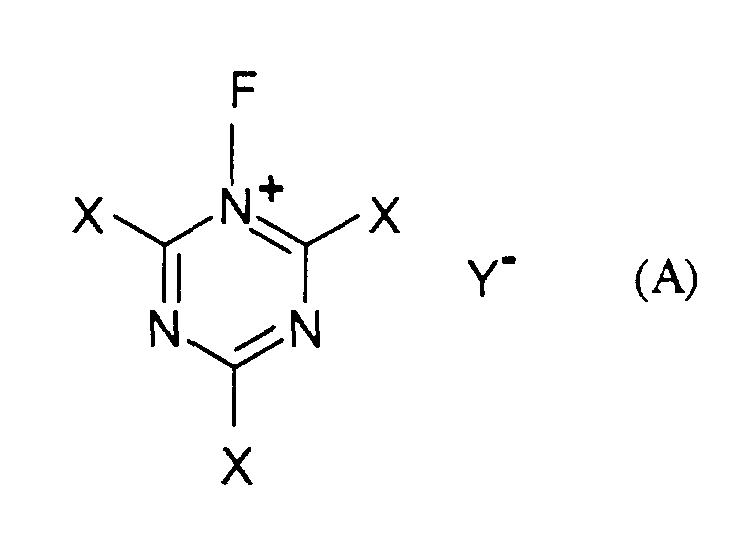
- (i) X = H & Y- = AsF6 - (Ref. 1 - see below)
- (ii) X = F & Y- = AsF6 - (Ref. 2 - see below)
- (iii) X = F & Y- = BF4 - (Ref. 3 - see below) and
- (iv) X = Cl & Y- = AsF6 - (Refs. 2 & 4 - see below). The N-fluorotriazinium salts of Formula A are reported to be oxidising agents of use in, for example, organometallic chemistry. The cationic component of compounds of Formula A in which X is H, F and Cl have been described as "oxidative fluorinators" and a qualitative scale for their oxidising strength and that of NF4 + has been computed ab initio (Ref. 3 - see below).
- Ref. 1 = Broschag et al. Inorg. Chim. Acta, 205 (1993) 167-173;
- Ref. 2 = Schleyer et al. Inorg. Chem. 32 (1993) 1523-1524;
- Ref. 3 = Schulz and Klapötke J. Organometal. Chem. 480 (1994) 195-197; and
- Ref. 4 = Broschag et al. Z. Anorg. Allg. Chem., 620 (1994) 1132-1136.
-
- There is a statement in Schleyer et al. that 1-fluoro-2,4,6-trichloro-s-triazinium hexafluoroarsenate (Formula A; X = Cl; and Y- = AsF6 -) "is a promising fluorination agent" but no further details were provided or subsequently reported. It is believed that uses of the compounds of Formula A other than as oxidising agents was not contemplated or investigated. In particular, there is no disclosure in the prior art of any of these compounds being evaluated as oxidative fluorinators (as distinct from non-fluorinating oxidising agents) despite the computed values reported in Refs. 3 and 4.
- We have now found that certain N-fluorinated triazinium salts are excellent electrophilic fluorinating agents yet do not possess some of the drawbacks of known electrophilic fluorinating agents.
- UK Patent Application No. 0026010.9 (filed 24th October 2000) discloses and claims electrophilic fluorinating agents which are triazinium compounds of the following Formula B:wherein:
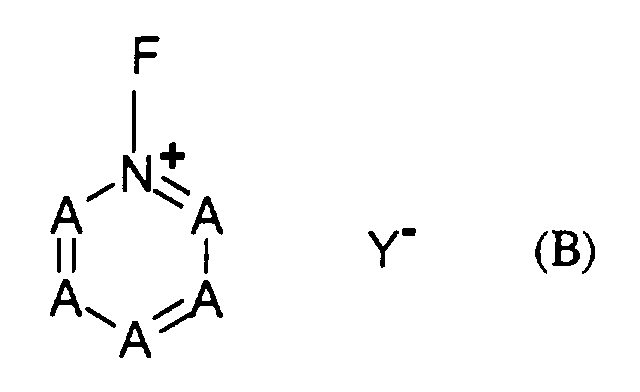
- three A moieties are independently CR, where each R is independently, hydrogen, halogen, hydroxyl, (primary, secondary or tertiary) amino, cyano, perfluorothio, hydroxysulphonyl, halosulphonyl, hydrocarbyloxysulphonyl, or a carbon-containing substituent selected from optionally substituted hydrocarbyl, hydrocarbyloxy, hydrocarbyloxycarbonyl, and hydrocarbylthio groups, and at least one R is neither hydrogen nor halogen;
- two A moieties are independently Z, where each Z is independently nitrogen or a quaternary nitrogen atom; and
- Y- is a counterion or group of counterions which are inert to chemical attack by fluorine, and oligomers or polymers thereof in which adjacent triazinium moieties are linked by a common R substituent.
-
- In its broadest aspect, the present invention provides a method of electrophilic fluorination which comprises contacting an organic substrate with a N-fluorotriazinium salt electrophilic fluorinating agent.
- In another aspect of the invention there is provided use of a N-fluorotriazinium salt as an electrophilic fluorinating agent.
- N-Fluorotriazinium salts have a high fluorinating power which allows substrates which are difficult to fluorinate using known fluorinating agents to be fluorinated especially electron-rich species for example carbanionic and/or activated aromatic substrates. Also they may be employed to fluorinate substrates which may presently be fluorinated electrophilically using known fluorinating agents but under milder reaction conditions due to the effective fluorinating power of the N-fluorotriazinium cation.
- Suitably, the N-fluorotriazinium salts are of the following Formula I:wherein:

- three A moieties are independently CR, where each R is independently, hydrogen, halogen, hydroxyl, (primary, secondary or tertiary) amino, cyano, perfluorothio, hydroxysulphonyl, halosulphonyl, hydrocarbyloxysulphonyl, or a carbon-containing substituent selected from optionally substituted hydrocarbyl, hydrocarbyloxy, hydrocarbyloxycarbonyl, and hydrocarbylthio groups;
- two A moieties are independently Z, where each Z is independently nitrogen or a quaternary nitrogen atom; and
- Y- is a counterion or group of counterions which are inert to chemical attack by fluorine, and oligomers or polymers thereof in which adjacent triazinium moieties are linked by a common R substituent.
-
- It is presently preferred that the triazinium compounds are 1,2,4-triazinium compounds of the following Formula IA or, especially, 1,3,5-triazinium compounds of the following Formula IB:
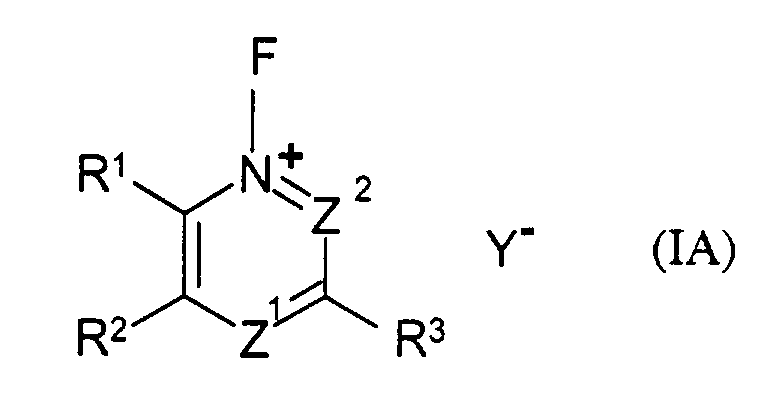 wherein: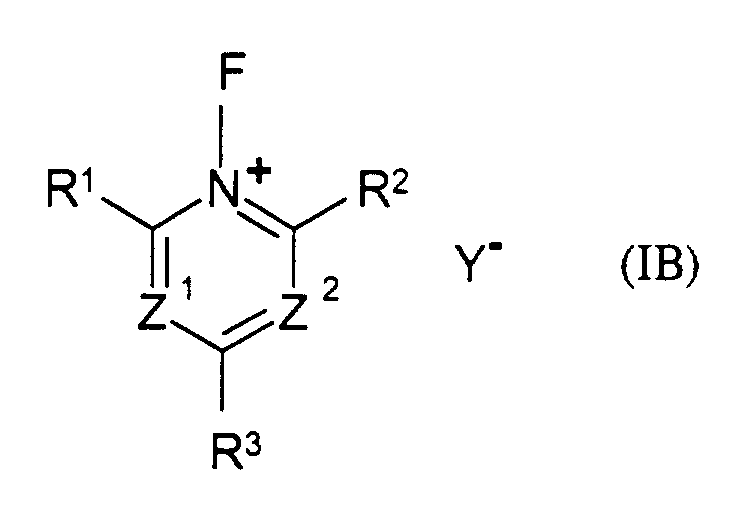
- R1, R2 and R3 are, independently, hydrogen, halogen, (primary, secondary or tertiary) amino, hydroxyl, cyano, perfluorothio, hydroxysulphonyl, halosulphonyl, hydrocarbyloxysulphonyl, or a carbon-containing substituent selected from optionally substituted hydrocarbyl, hydrocarbyloxy, hydrocarbyloxycarbonyl, and hydrocarbylthio groups;
- Z1 and Z2 are independently nitrogen or a quaternary nitrogen atom; and
- Y- is a counterion or group of counterions which are inert to chemical attack by fluorine, and oligomers or polymers thereof in which adjacent triazinium moieties are linked by a common R substituent.
-
- The presently most preferred compounds are those in which each R substituent, or each of R1, R2 and R3 for Formulae IA and IB, is halogen or trifluoromethyl. As mentioned above, the N-fluoro-trihalotriazinium and N-fluorotris(trifluoromethyl)triazinium salts are remarkably strong fluorinating agents capable of room temperature fluorination of unsubstituted aromatic substrates such as benzene and aromatic substrates having one or more electron-withdrawing substituents such as chlorobenzene or nitrobenzene.
- The said carbon-containing substituent(s) may be unsubstituted and contain only hydrogen and carbon atoms, and in the case of hydrocarbyloxy and hydrocarbylthio, also an oxygen or sulphur atom respectively, or they may be substituted and contain one or more heteroatoms for example oxygen, nitrogen, halogen and sulphur, and/or heterogroups, for example carbonyl, ester and amide links. Thus, optionally the carbon-containing substituent(s) may contain a heteroatom in the carbon chain and/or may be substituted with a substituent containing a heteroatom such as, for example, OH, alkoxy and halogen, for example chlorine, bromine and especially fluorine. One or more (including all) hydrogen atoms in the said carbon-containing substituent(s) may be substituted as desired.
- The hydrocarbyl and hydrocarbyloxy groups may be alkyl, alkenyl, aryl, aryloxy and alkoxy groups which optionally are substituted. Preferably the alkyl and alkoxy group have from 1 to 12 carbon atoms, more preferably 1 to 8 carbon atoms and especially 1 to 4 carbon atoms, for example methyl, ethyl, methoxy and ethoxy. Preferably the alkenyl group and aryl group have from 2 to 12, especially 2 to 8, carbon atoms and from 6 to 12, especially 6 to 9, carbon atoms respectively.
- In one embodiment, at least one R, or at least one of R1, R2 and R3 for Formulae IA and IB, is selected from hydrohaloalkyl groups, especially hydrofluoroalkyl groups, and perhaloalkyl groups, especially perfluoroalkyl groups. Examples of suitable perfluoroalkyl groups include trifluoromethyl, pentafluoroethyl and perfluorooctyl groups and examples of suitable hydrofluoroalkyl groups include 2,2,2-trifluoroethyl, 2,2,3,3-tetrafluoropropyl and H(CF2CF2)pCH2 groups (where p is at least 2). Perhaloalkyl groups may be preferred in some cases due to the absence of a carbon-hydrogen bond which may be susceptible to electrophilic fluorination.
- In another embodiment, preferred for ease of synthesis, at least one R, or at least one of R1, R2 and R3 for Formulae IA and IB, is selected from hydrohaloalkoxy groups, especially hydrofluoroalkoxy groups, and perhaloalkyl groups, especially perfluoroalkyl groups. Examples of suitable perfluoroalkoxy groups include trifluoromethoxy, pentafluoroethoxy and perfluorooctoxy groups and examples of suitable hydrofluoroalkoxy groups include 2,2,2-trifluoroethoxy and 2,2,3,3-tetrafluoropropoxy. Particularly preferred are H(CF2CF2)pCH2O groups (where p is at least 2) which are readily available using known telomer alcohols of the corresponding formula H(CF2CF2)pCH2OH.
- In another embodiment, at least one R, or R1, R2 and/or R3 for Formulae IA and IB, is a thio analogue of the aforementioned hydrohaloalkoxy and perhaloalkoxy groups, for example trifluoromethylthio (CF3S), or a perfluorothio group such as trifluorothio (SF3) or pentafluorothio (SF5).
- The terms aryl and aryloxy include moieties which contain aliphatic as well as aromatic groups. Preferred aryl and aryloxy groups include phenyl, phenoxy, and groups of formula C6H5(CH2)r [OC2H4]q Ot where q is 0 to 6, r is 0 to 8 and t is 0 or 1, which may be optionally substituted, preferably with fluorine.
- It is preferred that at least one of R, or at least one of R1, R2 and R3 for Formulae IA and IB, is hydrocarbyl, hydrocarbyloxy, hydrohalocarbyl, hydrohalocarbyloxy, perhalocarbyl, or perhalocarbyloxy, , and Z, or Z1 and Z2 for Formulae IA and IB, and Y- are as defined above.
- It is especially preferred that all R substituents, or R1, R2 and R3 for Formulae IA and IB, are identical in a given compound. Examples of especially preferred compounds are those in which all R substituents, or all of R1, R2 and R3 are methyl, methoxy, trifluoromethoxy groups, or, most preferably, halogen or trifluoromethyl. A practical advantage of R1, R2 and R3 being the same group is the manufacture of the compound may be simplified and isomers or a mixture of compounds is less likely to be produced.
- R, or R1, R2 and R3 for Formulae IA and IB, may be selected so as to provide technical advantages to the compound of Formula I in addition to the fluorination characteristics such as improving the solubility of the compound in non-polar solvents and solvents of low polarity. Thus greater flexibility in chemical synthesis involving electrophilic fluorination is also provided by the compounds of Formula I.
- The compounds of Formula I can be oligomers or polymers in which adjacent triazinium moieties are linked by a common R substituent, for example, a hydrocarbyl, perfluorohydrocarbyl or hydrocarbyldioxy group. Presently preferred linking groups are dioxyphenyl, di(oxycarbyl)phenyl, alkylenedioxy or bis(oxyaryl)alkylene groups, such as, for example, 1,5-dioxypent-2,4-diyl (i.e. -O-CH2-CH-CH2-CH-CH2-O-), 1,3-bis(p-oxyphenyl)prop-1,3-diyl (i.e. -p-OC6H4-CH-CH2-CH-C6H4O-p-), or 1,3-bis(m/p-oxymethylphenyl)prop-1,3-diyl (i.e. -m/p-OCH2C6H4-CH-CH2-CH-C6H4CH2O-m/p-).
- The compounds of Formula I contain at least one fluorinated quaternary nitrogen atom in the triazinium ring and one or both of the other triazinium nitrogen atoms may be quaternary, preferably fluorinated, nitrogen. In a preferred embodiment both Z, or both Z1 and Z2 for Formulae IA and IB, are nitrogen and the most preferred compounds are those of the following Formula II:wherein R1, R2, R3 and Y- are as defined above.

- Examples of preferred compounds according to the invention are those having a triazinium cation as shown below in Formulae III to VII, especially those of Formulae IV, V and VI.1-fluoro-2,4,6-trimethyl-1,3,5-triazinium
 1-fluoro-2,4,6-trimethoxy-1,3,5-triazinium
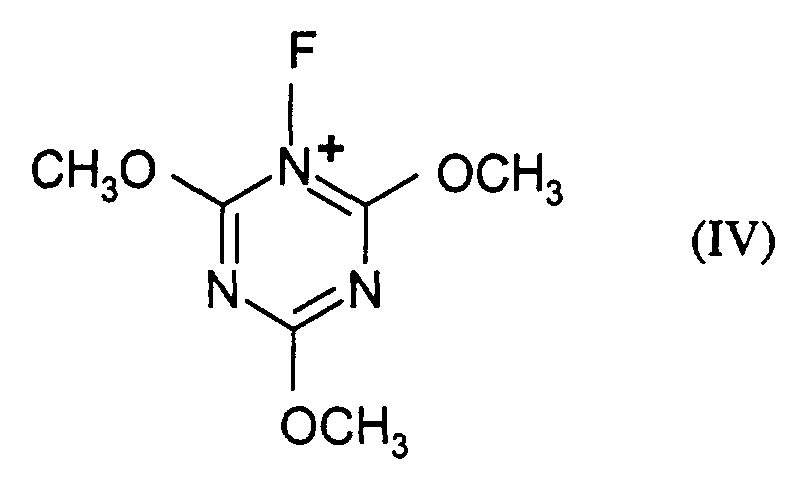 1-fluoro-2,4,6-tris(trifluoromethyl)-1,3,5-triazinium
 1-fluoro-2,4,6-trichloro-1,3,5-triazinium
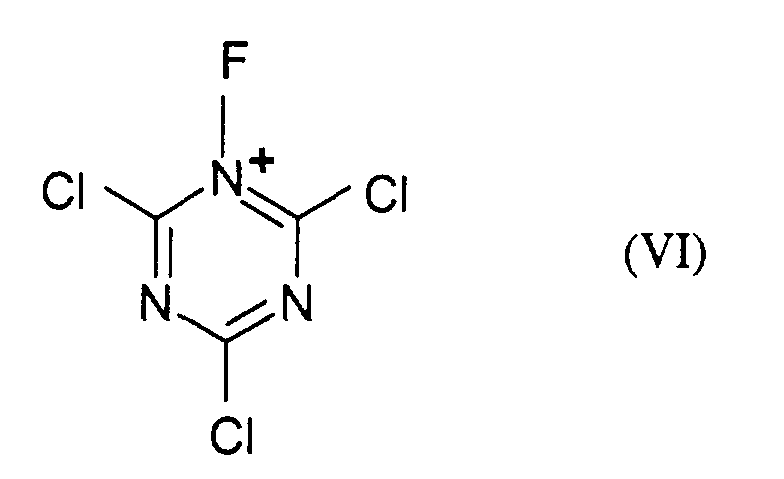 1-fluoro-2,4,6-trifluoro-1,3,5-triazinium
- The counterion Y- is resistant to chemical attack by fluorine and desirably, is thermally stable and possesses low environmental toxicity. The counterion(s) can be any anion(s) which can be counterion(s) to the triazinium cation. The counterion(s) may have a single charge or a multiple charge or be a group of counterions so as to balance the charge of the triazinium moiety. Also the counterion may be a counterion to more than one mole of the triazinium cation, for example where the cation has a single charge and the counterion has a multiple charge.
- Suitably the counterion is weakly nucleophilic. Suitable anions include fluoride; fluorosulphate (SO3F-); alkanesulphonate, especially methanesulphonate (CH3SO3 -); alkyl sulphate, especially methyl sulphate (CH3SO4 -); perfluoroalkanesulphonate, preferably triflate (CF3SO3 -) and nonaflate (C4F9SO3 -); arenesulphonate, especially tosylate (i.e. p-toluenesulphonate; p-CH3C6H4SO3 -); alkanecarboxylate; perfluoroalkanecarboxylate; tetrafluoroborate (BF4 -); tetraphenylborate (Ph4B-); hexafluorophosphate (PF6 -); hexafluoroantimonate (SbF6 -); hexafluoroarsenate (AsF6 -); chlorate (ClO3 -); sulphate (SO4 2- = 2Y-); hydrogen sulphate (HSO4 -) and F(HF)x - where x is at least 1. Presently preferred counterions include fluoride, tetrafluoroborate, triflate, tosylate, hexafluoroarsenate and hexafluorophosphate.
- Preferably, the compounds of Formula I are prepared using a solvent-based process which comprises contacting a triazine compound with a fluorine source under acidic conditions in a solvent which is inert under the process conditions.
- Suitably the fluorine source is an electrophilic fluorine source such as, for example, fluorine gas or a mixture of fluorine gas and a neutral compound derivable from a fluorine-containing counterion Y- by removing at least one fluoride ion from Y-, for example boron trifluoride. Preferably, the fluorine source is fluorine gas. While the fluorine gas may be used without dilution, in general, it is preferable to use fluorine gas diluted with an inert gas so that the volume of the inert gas is between 99.9% and 50% for controlling the vigorous reaction. Suitable inert gases include nitrogen, helium and argon.
- The triazine compound to be fluorinated is suitably a compound of the Formula VIII and may be obtained by subjecting a compound or a mixture of compounds of formula RCN to a known process for producing a triazine compound of formula (RCN)3 wherein R is independently R1, R2 or R3 as described herein:

- The fluorination process is carried out in the presence of an acid which may be a Brønsted acid (organic or mineral) or a Lewis acid. The level of acid is suitably adjusted so as to reduce and desirably avoid double protonation of the triazine compound and to provide a yield (as determined by 19F NMR) of F-N+ of at least 20% and desirably of at least 50%. Desirably the molar ratio of acid to triazine substrate is 0.5 to 2.5, preferably 1 to 2.2.
- Preferable examples of Brønsted acid have pKa in the range from about 12.4 to about 4.6 and include halogenated alcohols, for example chlorodifluoroethanol, dichlorofluoroethanol, chlorooctafluoro-t-butanol, trifluoroethanol, tetrafluoropropanol, pentafluoropropanol, hexafluoroisopropanol, octafluoropentanol, and nonafluoro-t-butanol. Fluorinated alcohols, particularly those which are free of chlorine, are especially preferred.
- Other acids which are especially preferred include acids of the counterion Y- described above, for example anhydrous hydrofluoric acid, hexafluoroantimonic acid, tetrafluoroboric acid and triflic acid, sulphuric acid, methanesulphonic acid, acetic acid and trifluoroacetic acid.
- Brønsted acids may be used in the form of a complex with ethers, water, alcohols, nitriles, carboxylic acids and the like and may be used in the form of an aqueous solution.
- Preferably, the solvent is non-aqueous and it is presently particularly preferred that the solvent is acetonitrile, a halogenated, especially fluorinated, alcohol or, especially, nitromethane. In this connection, it is believed that there has not been any previous proposal to use nitromethane as a solvent, or for any other purpose, with any N-F or +N-F reagent.
- If desired the same material may be used as both the acid and the solvent.
- The reaction to produce compound of Formula I is carried out at a temperature at which the solvent is in the liquid phase and suitably at a sufficiently low temperature that reaction due to a free radical mechanism is reduced and suitably avoided. The particular temperature selected depends on the solvent and also the reactants. By way of example only, the reaction suitably may be carried out at a temperature of -40 to 10 °C. A temperature of -40 to -20 °C is preferred for acetonitrile and a temperature of -10 to 5 °C is preferred for hexafluoroisopropyl alcohol. The reaction may be carried out at elevated pressure although this is not essential.
- Fluorination of the triazine compound may be carried out using a stirred-tank batch reactor. Where the fluorine source is gaseous, the fluorine source is suitably admitted either as neat gas at sub-atmospheric pressure or as a continuous flow of fluorine blended with nitrogen or other inert diluent at about atmospheric pressure. Advantageously, the process for producing compound of Formula I may be operated as a continuous process.
- The invention also provides a method of producing a fluorinated substrate which comprises contacting a substrate with a compound of Formula I so as to fluorinate the substrate.
- The compounds of Formula I may be used as electrophilic fluorinating agents in a similar manner to Selectfluor™ and in manner know in the art (see, for example, R.E. Banks et al. J. Chem. Soc. Perkin Trans. I, 1996, 2069). The fluorinating agent may be contacted with the substrate neat and optionally at elevated temperature. If desired the fluorination process may be carried out in a solvent, for example acetonitrile or, especially, nitromethane. As mentioned above, it is believed that there has not been any previous proposal to use nitromethane as a solvent, or for any other purpose, with any N-F or +N-F reagent.
- When a compound of Formula I has been used in a fluorination reaction and so depleted in fluorine, it may be recovered and regenerated by introducing the fluorine source for reuse in further fluorination reactions.
- The compounds of Formula I may be used to fluorinate organic compounds, for example nucleosides, nucleoside bases and steroids, or cationic organometallic compounds for example cyclopentadienides. They are especially useful in fluorinating carbanionic and/or aromatic substrates and in particular aromatic substrates having electron-withdrawing substituents, for example halo or nitro substituents.
- In a preferred embodiment of the fluorination aspect invention, a fluorinated steroid is prepared by contacting a steroid or a suitable derivative such as a steroidal enol acetate or silyl enol ether with a fluorinating agent of Formula I optionally in the presence of a solvent and optionally at elevated temperature. Preferably, the steroid is fluorinated at the 6 and/or 16 position.
- Compounds of Formula I may be isolated or used without separation from the reaction mixture. If desired, the reaction mixture may be fed to a separate fluorination reactor or the compound of Formula I may be purified or otherwise treated prior to use.
- Accordingly, the invention also provides a method of producing a fluorinated substrate which comprises contacting, preferably under acidic conditions, a triazine compound with a fluorine source in a solvent, which is inert under the process conditions, such that at least one of the nitrogen atoms in the triazine compound is fluorinated to produce a compound of Formula I and contacting, in situ or subsequently, the compound with a substrate to be fluorinated.
- The invention is illustrated by the following non-limiting Examples.
- Cyanuric chloride (0.1 g, 0.54 mmol), triflic acid (0.08 g, 0.53 mmol) and acetonitrile (80 cm3) were placed in the flow fluorination reactor, cooled to -35 °C, stirred vigorously and treated with a 1:9 (v/v) fluorine-nitrogen blend (flow rate of 130 cm3 per minute) until the exit gas gave a strong positive test (Kl) for fluorine. A small sample (20 cm3) of the resulting colourless reaction solution was tested for oxidation properties with aqueous Kl and gave a strong positive result. A sample (20 cm3) of the cold (-35 °C) reaction solution was treated with dry benzene (2.0 cm3) and the homogeneous mixture left to warm to room temperature before being analysed by 19F NMR, using D2O as an external lock. The spectrum showed the characteristic absorption for fluorobenzene at δF -36.2 (m) ppm (TFA (trifluoroacetic acid) ref.). The remaining reaction solution was evaporated under reduced pressure, yielding a white solid which fumed in air. The 19F NMR spectrum of this fuming solid (dissolved in CD3CN) was found to contain the expected OTf- absorption at 5.4(s) ppm (TFA ref.), as well as an absorption at 39.3 (br. s) ppm assignable to the +NF function of 1-fluoro-2,4,6-trichloro-1,3,5-triazinium triflate. Owing to the highly hygroscopic nature of this white solid, a satisfactory elemental analysis was impossible to obtain; iodometric titration of a sample of this product revealed that the F+ content was 62% (i.e. the percentage of oxidising F+ present per mole of the reagent). The reaction was repeated using hexafluoroisopropanol as the fluorination solvent, but the material obtained was only 86% pure (estimated by 19F NMR).
- The required amount of 1-fluoro-2,4,6-trichloro-1,3,5-triazinium tetrafluoroborate was weighed into a glass vial in an efficient dry box (argon atmosphere) before it was added to a cold solution (0 °C) of the substrate in CD3CN. The reaction mixture was allowed to warm to room temperature, transferred to a standard NMR tube and its spectrum measured.
- The reaction was carried out on both a 1:1 and 2:1 molar ratio basis (methoxybenzene:+NF). In both experiments the reaction was immediate and exothermic, and the solution's changed colour from yellow (at 0 °C) to dark violet at room temperature). After 8 hours, the 19F NMR spectra (188.8 MHz; 27 °C; CFCl3) of the reaction solutions showed absorptions at δF (1:1 reaction) -126.6 (m, 4-F) and -137.8 (m, 2-F) and (1:2 reaction) -126.6 (m, 4-F) and -137.9 (m, 2-F) ppm (product ratio: 4-F:2-F, 2:1); other (unidentified) absorptions were observed at δF -123.2, -123.3, -132.0, and -132.9 ppm.
- The reaction was carried out using a 1:1 molar ratio of reactants. A progressive colour change of the reaction solution was observed [colourless (0 °C to room temperature, 1.0 hour), pale yellow (room temperature, 2.0 to 4.0 hours), yellow to pale brown (room temperature, 4.0 to 8.0 hrs)], and after 8.0 hours the 19F NMR (CFCl3) spectrum was measured and found to contain only the characteristic absorption for fluorobenzene at δF -115.2 (m) ppm and a BF4 - peak.
- The reaction was carried out on a 1:1 molar ratio basis. After 8.0 hours (room temperature; change from colourless to pale brown solution) the 19F NMR (CFCl3) spectrum was measured and showed an absorption at δF -116.0 (m, 4-F) ppm assignable to 4-chlorofluorobenzene.
- The reaction was carried out on a 1:1 molar ratio basis. After 8.0 hours (room temperature; colourless solution changed to pale brown), the 19F NMR (CFCl3) spectrum of the product was measured and showed an absorption at δF -109.4 (m, 3-F) which was more intense than an absorption associated with decomposition of 1-fluoro-2,4,6-trichloro-1,3,5-triazinium tetrafluoroborate (see below) and hence indicated that 3-fluoronitrobenzene had been formed.
- A solution of 1-fluoro-2,4,6-trichloro-1,3,5-triazinium tetrafluoroborate in CD3CN was made at room temperature (colourless) and its 19F NMR (ref. CFCl3) spectrum was measured immediately; this showed absorptions at +15.3 (br.s., +NF) ppm and -146.7 (br.s., BF4 -) ppm. A number of minor peaks were observed in the region between δF -1.0 and -110 ppm, suggesting that a decomposition of the +NF salt was taking place. The sample was left standing for 2.0 hours (the solution's colour changed to pale yellow) before the spectrum was measured again; this revealed that the intensity of +NF absorption at δF +15.3 had markedly decreased, while the intensities of the absorption peaks associated with decomposition of the salt (δF -1.0 to -110 ppm) had noticeably increased. These minor absorptions were present in the spectra of all of the products from the above reactions.
- A suspension of 1-fluoro-2,4,6-trichloro-1,3,5-triazinium tetrafluoroborate (0.1 g, 3.4 mmol) and an excess of the substrate was prepared in a sealed tube at room temperature (using an argon-filled dry box). The mixture was heated to about 60 °C for a few minutes, then cooled to room temperature, before a small sample was syringed out and filtered to remove any insoluble materials (i.e. 1-fluoro-2,4,6-trichloro-1,3,5-triazinium tetrafluoroborate) before its 19F NMR (CFCl3) spectrum was measured using D2O as an external lock.
- The 19F NMR spectrum of the product was measured immediately and showed the characteristic absorptions for monofluorobenzene at δF -113.3(m) ppm and 1,4-difluorobenzene at δF -119.9 ppm, with a ratio of approximately 2:1. A Kl test of the reaction mixture gave a strong positive result, indicating that the reaction had not gone to completion at this stage, and the reaction mixture was left standing at room temperature for 14 days (an excessive period, negative Kl test at this stage). The 19F NMR spectrum of the sample was then measured again and revealed the presence of another difluoro-isomer, namely 1,2-difluorobenzene [δF -138.7 (m) ppm; the ratio of 1,4- to 1,2-C6H4F2 was about 2:1].
- The 19F NMR spectrum of the product was measured shortly after the reaction had been carried out and found to contain absorptions at δF -111.0 (m, 3-F); -115.7 (m, 2-F) and -116.1 (m, 4-F) (the ratio of 2-:3-:4-isomers was about 1:0.3:2). After 14 days (negative Kl test), the 19F NMR spectrum showed no evidence for the presence of any other products.
- The 19F NMR spectrum of the reaction solution contained one weak absorption assignable to 3-fluoronitrobenzene at δF -110.27 (m) after about 25 minutes. After 14 days (positive Kl test still) however, the 19F NMR spectrum showed absorptions corresponding to 3-fluoronitrobenzene at δF -110.3 (m) and 2-fluoronitrobenzene at δF -119.1(m) (ratio about 2:1); also, in keeping with the result of the Kl test, the +NF absorption of the reagent was still present.
- A homogeneous reaction mixture was obtained in this experiment, whereas in the aforementioned fluorinations of benzene and chlorobenzene, the reaction mixtures contained suspended [(ClCN)3F]+BF4 -. In order to drive the fluorination of nitrobenzene to completion, the reaction mixture was heated at 90 °C for 2 hours before it was tested with Kl solution and gave a negative result. G.C. analysis revealed the presence of only 3-fluoronitrobenzene and 2-fluoronitrobenzene with no marked change in ratio (about 2:1 ratio). Despite the presence of the 2-fluoro derivative, no evidence was obtained for the presence of 4-fluoronitrobenzene. The absence of 4-fluoronitrobenzene may have resulted from loss of this isomer during the reaction or subsequent handling operations via nucleophilic displacement of the highly mobile fluorine. In this connection, the reaction vessel became etched during the reaction.
- 2,4,6-Tris(trifluoromethyl)-1,3,5-triazine (0.2 g, 0.7 mmol), triflic acid (0.11 g, 0.73 mmol) and hexafluoroisopropanol (80 cm3) were placed in a flow fluorination reactor, cooled (-5°C), stirred vigorously and treated with a 1:9 (vol./vol.) fluorine-nitrogen blend (flow rate of 130 cm3 per minute) until the exit gas gave a strong positive test (Kl) for fluorine. A small sample (10 cm3) of the resultant colourless reaction solution was tested for oxidation properties with aqueous Kl and gave a strong positive test. The remaining reaction solution was evaporated under reduced pressure, yielding a colourless oily material, which fumed when exposed to air. The 19F NMR spectrum of this material (in CD3CN) contained the expected OTf- and CF3 at δF + 0.5 -6.0 (s; TFA ref.) ppm as well as a weak absorption at + 28.3 (br. s) assignable to the +NF function of 1-fluoro-2,4,6-tris (trifluoromethyl)-1,3,5-triazinium triflate. The reaction was repeated a number of times, but no pure +NF salt was isolated, believed to be due to the hygroscopic nature of +NF salt and its reactivity towards water.
- A sample (30 cm3) of the cold (-5°C) reaction solution from (i) above was treated with dry benzene (2.0 cm3) and the homogeneous mixture left to warm to room temperature overnight before being analysed by 19F NMR, using D2O as an external lock. The spectrum showed the characteristic absorption for fluorobenzene at δF-36.4 (m; TFA ref.) ppm.
- Cyanuric chloride (5.0 g, 27 mmol) was added dropwise to a cold (-5 °C ) stirred solution of sodium methoxide (5.0 g, 93 mmol) in dry methanol (50 cm3); the mixture was then allowed to warm to room temperature and then refluxed for 3.0 hours. The reaction mixture was filtered to isolate inorganic salts and the filtrate freed from solvent (Rotavapor™) yielding an off-white solid which was dissolved in diethyl ether (50 cm3). The ethereal solution was washed with water (3 x 30 cm3), charcoaled, dried over MgSO4 and finally evaporated (Rotavapor™) to give pure 2,4,6-trimethoxy-1,3,5-triazine (4.3 g, 25 mmol, 93%) as a crystalline white solid.
- M.P. 136 °C. Found: C, 42.2; H, 5.1; N, 24.4%. Calculated for C6H9N3O3: C, 42.1; H, 5.3; N, 24.6%], δ1H (CDCl3) 4.1 (s, 3 x OCH3) ppm, δ13C (CDCl3) 175.5 (C=N), 58.4 (s, 3 x OCH3) ppm.
- A homogeneous mixture of 2,4,6-trimethoxy-1,3,5-triazine (0.1g; 0.585 mmol), triflic acid (0.1g; 0.66 mmol) and acetonitrile (80cm3) was placed in a flow fluorination reactor, cooled to -35 °C, stirred vigorously and treated with a 1:9 (volume/volume) blend of fluorine and nitrogen gas at a flow-rate of 130 cm3/minute until the exit gas gave a strong positive test for fluorine (using potassium iodide).
- The solution was concentrated under reduced pressure to 10cm3 and dry dichloromethane (30cm3) was added. A white solid material was obtained by suction filtration, and was washed with dry diethyl ether (30cm3) and dried in vacuo and characterised by elemental analysis and NMR spectroscopy as 1-fluoro-2,4,6-trimethoxy-1,3,5-triazinium triflate. The product (1-fluoro-2,4,6-trimethoxy-1,3,5-triazinium triflate) was obtained in a yield (0.18g; 0.53 mmol) of 91% based on the triazine starting material.
- M.P. 186 °C; Found: C, 23.4; H, 2.5; N, 11.8%. Calculated for C7H9F4N3O6S. H2O; C, 23.5; H, 3.1; N, 11.8%; δH (CD3CN, TMS (trimethylsilane)) 4.59 (s, 2 x OCH3), 4.42 (s, OCH3) ppm.; δC (CD3CN) 167.6 (s, C=N), 156.1 (q, CF3SO3 -, J CF276 Hz), 61.2 (s, 2 x OCH3), 59.6 (s, OCH3) ppm; δF (CD3CN, TFA) 18.65 (br s, N+F), 1.72 (s, CF3SO3 -) ppm.
- The procedure of Example 5 was repeated except that hexafluoroisopropanol was used as the solvent and the reaction was carried out at -5 °C. The product (1-fluoro-2,4,6-trimethoxy-1,3,5-triazinium triflate) was characterised using elemental analysis and NMR spectroscopy and obtained in a yield of 98%.
- The procedure of Example 6 was repeated except that the reactants employed were 2,4,6-trimethoxy-1,3,5-triazine (0.5g; 2.92 mmol) and hexafluoroantimonic acid (0.69g; 2.92 mmol) and diethyl ether (50cm3) instead of dichloromethane was used in the "work-up". The product (1-fluoro-2,4,6-trimethoxy-1,3,5-triazinium hexafluoroantimonate) was characterised by NMR spectroscopy and elemental analysis and obtained in a yield (1.22g; 2.86 mmol) of 98%.
- M.P. 211 °C (dec). Found: C, 17.1; H, 1.9; N, 9.5; Sb, 28.9%. Calculated for C6H9F7N3O3Sb: C, 17.0; H, 2.1: N, 9.9; Sb, 28.6%; δH (CD3CH, TMS) 4.59 (s, 2 x OCH3), 4.44 (s, OCH3) ppm; δC (CD3CN) 167.7 (s, C=N), 61.1 (s, 2 x OCH3), 59.4 (s, OCH3) ppm; δF (CD3CN, TFA) 18.88 (br s, N+F), -20.75 to -79.96 (complex, SbF6 -) ppm. The structure was confirmed by single crystal X-ray analysis (bond length: F-N, 1.354 Å).
- A stainless steel pressure vessel (100 cm3) was charged with dry acetonitrile (10.0 g, 244 mmol) and yttrium triflate (1.07 g, 2 mmol). The vessel was cooled (-196 °C), evacuated and charged with anhydrous ammonia (4.2 cm3, 247 mmol), sealed and then heated for 24 hours at 200 °C. The autoclave was cooled to room temperature before the volatile material (unchanged ammonia) was allowed to bleed off. Diethyl ether (300 cm3) was added to the reaction mixture and the insoluble material removed by filtration, dissolved in ethyl acetate (30 cm3), washed with water (3 x 20 cm3), dried with MgSO4 then evaporated (Rotavapor™) to give 4-amino-2,6-dimethylpyrimidine (22.0 g, 179 mmol, 73%) as a crystalline white solid.
- M.P. 184 °C. Found: C, 58.2; H, 7.5; N, 34.3%. Calculated for C6H9N3:C, 58.5; H, 7.4; N, 34.2%; δH (CD3CH, TMS) 6.0 (s, HC=C), 5.2 (br.s, NH2), 2.2 (s, CH3) and 2.1 (br.s, CH3) ppm.
- Rotary evaporation of the ethereal solution provided 5.0 g (41 mmol, 17%) of an off-white solid; this was purified by vacuum sublimation to give pure 2,4,6-trimethyl-1,3,5-triazine as a crystalline white solid.
- M.P. 56 °C. Found: C, 58.3; H, 7.6; N, 33.8%. Calculated for C6H9N3: C, 58.5; H, 7.3; N, 34.2%; δH (CD3CN3, TMS) 2.52 (s, 3 x CH3) ppm; δC ( CDCl3) 176.3 (s, C=N), 25.8 (s, CH3) ppm.
- The procedure of Example 5 was repeated except that that the reactants employed were 2,4,6-trimethyl-1,3,5-triazine (0.1g) and triflic acid (0.12g). The product (1-fluoro-2,4,6-trimethyl-1,3,5-triazinium triflate) was characterised using elemental analysis and NMR spectroscopy as hexahydrated 1-fluoro-2,4,6-trimethyl-1,3,5-triazinium triflate and obtained in a yield of 68%.
- M.P. 205 °C (dec); Found: C, 21.8; H, 3.0; N, 9.7%. Calculated for C7H9F4N3O3S.6H2O: C, 21.1; H, 5.3; N, 10.5%; δH (CD3CN, TMS) 2.4 (d., 2 x CH3), 2.1 (s, CH3) ppm.; δC (CD3CN) 178.4 (s, C=N), 168.6 (q, CF3 J CF287.3 Hz), 26.6 (s, 2 x CH3), 23.5 (s, CH3) ppm; δF (CD3CN3, TFA) 1.43 (s, CF3) 19.2 (br s, N+F) ppm.
- A variety of salts were produced using different acids and with different ratios of acid to substrate as set out in Table 1. The procedure of Example 5 was followed in producing these salts.
Example Acid Acid:substrate (moles) +N- F % yield 9 Triflic 1.1:1 89 10 Triflic 1.5:1 76 11 Triflic 2:1 5 12 Sulphuric (98%) 1.2:1 91 13 Sulphuric (98%) 2:1 82 14 Tetrafluoroboric (48%) 1.1:1 77 15 Tetrafluoroboric (48%) 2:1 23 16 Trifluoroacetic 1.8:1 92 17 Acetic 2.1:1 85 18 Anhydrous hydrogen fluoride 1:1 94 - As shown by Table 1, the yield of 1-fluoro-2,4,6-trimethoxy-1,3,5-triazinium salts was sensitive to the amount of Brønsted acid used in the synthesis. When a 1.5 or less molar equivalent of triflic acid was used, the simple triflate salt of the triazine was obtained in high yields. However, the use of more than 1.5 molar equivalents of triflic acid caused the yield of the +N-F salt to depreciate greatly and mainly the +N-H salt was produced. Similar results were obtained with other acids.
- 1 Mole of phenyl-lithium (in dry diethyl ether) was added dropwise to a stirred suspension of 1 mole of 1-fluoro-2,4,6-trimethoxy-1,3,5-triazinium triflate in dry diethyl ether at a temperature of about -70 °C. The mixture was stirred for 2 hours and then allowed to warm slowly to room temperature overnight with continuous stirring. The reaction mixture was filtered and distilled. The residue was analysed by 19F NMR spectroscopy (in CDCl3; TFA ref.) and showed the characteristic absorption for fluorobenzene at δF-36.2ppm.
- Attempts to fluorinate benzene or methoxybenzene using 1-fluoro-2,4,6-trimethoxy-1,3,5-triazinium triflate or 1-fluoro-2,4,6-trimethyl-1,3,5-triazinium triflate under similar conditions to those successfully used in Example 19 to fluorinate phenyl lithium were unsuccessful indicating that 1-fluoro-2,4,6-trichloro-1,3,5-triazinium triflate is a significantly stronger fluorinating agent than either 1-fluoro-2,4,6-trimethoxy-1,3,5-triazinium triflate or 1-fluoro-2,4,6-trimethyl-1,3,5-triazinium triflate.
- A solution of 1-fluoro-2,4,6-trichloro-1,3,5-triazinium tetrafluoroborate (0.1 g, 3.4 mmol) and the substrate in equimolar proportion was prepared in nitromethane (20 cm3) in a sealed tube at room temperature (except for the reaction involving methoxybenzene), using an argon-filled dry box. Reaction progress was determined by removing small samples via a syringe and subjecting them to 19F NMR analysis (CFCl3 ref.; D2O ext. lock).
- The reaction was carried out on both a 1:1 and 2:1 molar ratio basis (methoxybenzene:+NF). In both experiments the reaction was immediate and exothermic, and the solutions changed colour from colourless (at about -20 °C) to dark violet (at room temperature). After 2.0 hours (-ve Kl test), the 19F NMR spectra (188.8 MHz; 27 °C, CFCl3) of the reaction solutions showed absorptions at δF (1:1 reaction) -126.6 (m, 4-F) and -137.8 (m, 2-F), and (1:2 reaction) -126.6 (m, 4-F) and -137.9 (m, 2-F) ppm (product ratio: 4-F:2-F = 2:1).
- The 19F NMR spectrum of the product was measured immediately and showed the characteristic absorptions for monofluorobenzene at δF -113.3 (m) ppm and 1,4-difluorobenzene at δF -119.9 ppm, with a ratio of approximately 2:1. A Kl test on the reaction mixture gave a strong positive result, indicating that the reaction had not gone to completion at this stage, hence, the reaction mixture was heated to 70 °C and its 19F NMR spectrum measured at intervals to determine the progress of reaction. After 2.0 hours, the spectrum showed only absorptions for fluorobenzene and 1,4-difluorobenzene and the reaction mixture still gave a positive Kl test. However, after 6.0 hours a negative Kl test was obtained, indicating that consumption of the NF reagent was complete, and 19F NMR analysis revealed the presence of another difluorinated isomer, namely 1,2-difluorobenzene [δF -138.7 (m) ppm; the ratio of 1,4- to 1,2-C6H4F2 was about 2:1].
- The 19F NMR spectrum of the reaction solution was measured shortly after it had been prepared and found to contain absorptions at δF -111.0 (m, 3-F); -115.7 (m, 2-F) and -116.1 (m, 4-F) (the ratio of 2- : 3- : 4-isomers was about 1:0.3:2). After heating the solution at 70 °C for 6.0 hours (negative Kl test), its 19F NMR spectrum showed no evidence for the presence of any other products.
- The 19F NMR spectrum of the reaction solution contained one weak absorption assignable to 3-fluoronitrobenzene at δF -110.27 (m) after about 25 minutes. After 6.0 hours of heating at 70 °C (positive Kl test still) however, the 19F NMR spectrum showed absorptions corresponding to 3-fluoronitrobenzene at δF-110.3 (m) and 2-fluoronitrobenzene at δF -119.1 (m) (ratio about 2:1); also, in keeping with the result of a Kl test (weakly positive), the +NF absorption of the reagent was still present.
- Cyanuric chloride (0.1 g, 0.54 mmol), triflic acid (0.08 g, 0.53 mmol) and nitromethane (80 cm3) were placed in a flow fluorination reactor, cooled (about -30 °C), stirred vigorously and treated with a 1:9 (v/v) fluorine-nitrogen blend (flow-rate 130 cm3 per minute) until the exit gas gave a strong positive test (Kl) for fluorine. A small sample (20 cm3) of the resulting colourless reaction solution was tested for oxidation properties with aqueous Kl and gave a strong positive result. A sample (20 cm3) of the cold (about -30 °C) reaction solution was treated with dry benzene (2.0 cm3) and the homogeneous mixture left to warm to room temperature before being analysed by 19F NMR, using D2O as an external lock. The spectrum showed the characteristic absorption for fluorobenzene at δF -36.2 (m) ppm (TFA ref.). The remaining reaction solution was allowed to warm to room temperature (it remained clear and colourless) then evaporated under reduced pressure, yielding an off-white solid which fumed profusely in air. The 19F NMR spectrum of this fuming solid (dissolved in CH3NO2 and using D2O as an external lock) was found to contain the expected OTf- absorption at 5.4 (s) ppm (TFA ref.), as well as an absorption at 39.3 (br. s) ppm assignable to the +NF function of 1-fluoro-2,4,6-trichloro-1,3,5-triazinium triflate. Owing to the highly hygroscopic nature of this white solid, no further analysis was obtained.
- The above reaction was repeated using CH3NO2 diluted with CHCl3 (mixtures containing 10%, 50% and 80% of CH3NO2 were studied) as a solvent. Fluorination proceeded more cleanly as the proportion of nitromethane increased; thus, while use of neat CH3NO2 or 80% CH3NO2 produced clean, colourless reaction solutions at room temperature, use of the lower concentrations of CH3NO2 gave coloured solutions (dark brown at 10% concentration; pale yellow at 50%), again after the reaction solutions had warmed to ambient temperature.
- It will be appreciated that the invention is not restricted to the details described above with reference to the preferred embodiments but that numerous modifications and variations can be made without departing from the scope of the invention as defined in the following claims.
Claims (22)
- A method of electrophilic fluorination which comprises contacting an organic substrate with a N-fluorotriazinium salt electrophilic fluorinating agent.
- A method according to Claim 1, wherein the N-fluorotriazinium salt electrophilic fluorinating agent has the following Formula I:wherein:
 or is an oligomer or polymer thereof in which adjacent triazinium moieties are linked by a common R substituent.three A moieties are independently CR, where each R is independently, hydrogen, halogen, hydroxyl, (primary, secondary or tertiary) amino, cyano, perfluorothio, hydroxysulphonyl, halosulphonyl, hydrocarbyloxysulphonyl, or a carbon-containing substituent selected from optionally substituted hydrocarbyl, hydrocarbyloxy, hydrocarbyloxycarbonyl, and hydrocarbylthio groups;two A moieties are independently Z, where each Z is independently nitrogen or a quaternary nitrogen atom; andY- is a counterion or group of counterions which are inert to chemical attack by fluorine,
 - A method according to Claim 2, wherein the N-fluorotriazinium salt is a N-fluoro-1,2,4-triazinium compound of the following Formula IA:wherein:
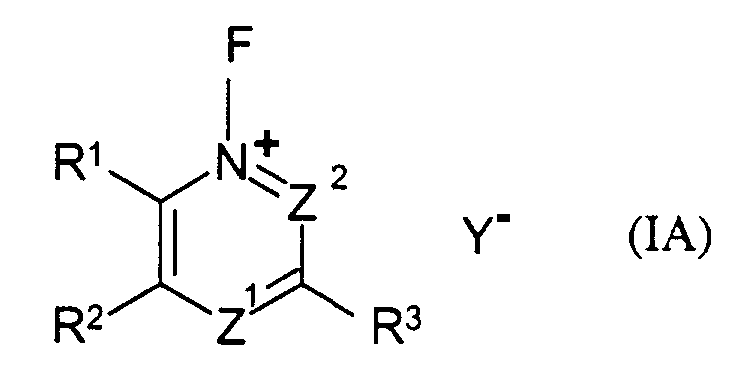 or is an oligomer or polymer thereof in which adjacent triazinium moieties are linked by a common R substituent.R1, R2 and R3 are, independently, hydrogen, halogen, hydroxyl, (primary, secondary or tertiary) amino, cyano, perfluorothio, hydroxysulphonyl, halosulphonyl, hydrocarbyloxysulphonyl, or a carbon-containing substituent selected from optionally substituted hydrocarbyl, hydrocarbyloxy, hydrocarbyloxycarbonyl, and hydrocarbylthio groups;Z1 and Z2 are independently nitrogen or a quaternary nitrogen atom and Y- is a counterion or group of counterions which are inert to chemical attack by fluorine,
 - A method according to Claim 2, wherein the N-fluorotriazinium salt is a N-fluoro-1,3,5-triazinium compound of the following Formula IB:wherein:
 or is an oligomer or polymer thereof in which adjacent triazinium moieties are linked by a common R substituent.R1, R2 and R3 are, independently, hydrogen, halogen, (primary, secondary or tertiary) amino, hydroxyl, cyano, perfluorothio, hydroxysulphonyl, halosulphonyl, hydrocarbyloxysulphonyl, or a carbon-containing substituent selected from optionally substituted hydrocarbyl, hydrocarbyloxy, hydrocarbyloxycarbonyl, and hydrocarbylthio groups;Z1 and Z2 are independently nitrogen or a quaternary nitrogen atom andY- is a counterion or group of counterions which are inert to chemical attack by fluorine,
 - A method according to any one of Claims 2 to 4, wherein the R substituents, or R1, R2 and R3, are selected from halogen and trifluoromethyl.
- A method according to Claim 5, wherein the R substituents, or R1, R2 and R3, are selected from chlorine, fluorine and trifluoromethyl.
- A method according to Claim 5 or Claim 6, wherein an unsubstituted aromatic substrate or an aromatic substrate having one or more electron-withdrawing substituents is contacted with a N-fluoro-trihalotriazinium salt.
- A method according to Claim 7, wherein the aromatic substrate is selected from chlorobenzene and nitrobenzene.
- A method according to any one of Claims 1 to 4, wherein the substrate is an electron-rich species.
- A method according to Claim 9, wherein the electron-rich species is a carbanionic substrate.
- A method according to Claim 9, wherein the electron-rich species is an activated aromatic substrate.
- A method according to Claim 9, wherein the electron-rich species is steroid or derivative thereof.
- A method according to any one of Claims 2 to 12, wherein the R substituents, or R1, R2 and R3, are identical.
- A method according to Claim 13, wherein each R, or each of R1, R2 and R3 chlorine.
- A method according to any one of Claims 2 to 14, wherein both Z, or both of Z1 and Z2, is nitrogen or a fluorinated quaternary nitrogen.
- A method according to Claim 15, wherein both Z, or both of Z1 and Z2, is nitrogen.
- A method according to Claim 16, wherein the N-fluorotriazinium salt is a N-fluoro-1,3,5-triazinium compound of the following Formula II:wherein R1, R2, R3 and Y- are as defined in the relevant claim.

- A method according to Claim 16, wherein the N-fluorotriazinium salt is a N-fluoro-2,4,6-trichloro-1,3,5-triazinium compound of the following Formula IIA:wherein Y- is a counterion or group of counterions which are inert to chemical attack by fluorine.

- A method according to any one of Claims 2 to 18, wherein Y- is selected from fluoride, fluorosulphate, alkanesulphonate, alkyl sulphate, perfluoroalkanesulphonate, arenesulphonate, alkanecarboxylate; perfluoroalkanecarboxylate, tetrafluoroborate, tetraphenylborate, hexafluorophosphate; hexafluoroantimonate; hexafluoroarsenate; chlorate; sulphate (= 2Y-), hydrogen sulphate and F(HF)x - where x is at least 1.
- A method according to Claim 19, wherein Y- is selected from fluoride, tetrafluoroborate, triflate, tosylate, hexafluoroarsenate and hexafluorophosphate.
- A method according to Claim 14, wherein Y- is triflate.
- A process according to any one of Claims 2 to 21, wherein the inert solvent comprises nitromethane.
Applications Claiming Priority (2)
| Application Number | Priority Date | Filing Date | Title |
|---|---|---|---|
| GBGB0026012.5A GB0026012D0 (en) | 2000-10-24 | 2000-10-24 | Electrophilic fluorination |
| GB0026012 | 2000-10-24 |
Publications (2)
| Publication Number | Publication Date |
|---|---|
| EP1201628A1 true EP1201628A1 (en) | 2002-05-02 |
| EP1201628B1 EP1201628B1 (en) | 2005-12-14 |
Family
ID=9901875
Family Applications (1)
| Application Number | Title | Priority Date | Filing Date |
|---|---|---|---|
| EP01308932A Expired - Lifetime EP1201628B1 (en) | 2000-10-24 | 2001-10-19 | Electrophilic fluorination |
Country Status (6)
| Country | Link |
|---|---|
| US (1) | US6737525B2 (en) |
| EP (1) | EP1201628B1 (en) |
| JP (1) | JP2002201181A (en) |
| AT (1) | ATE312805T1 (en) |
| DE (1) | DE60115810T2 (en) |
| GB (1) | GB0026012D0 (en) |
Families Citing this family (2)
| Publication number | Priority date | Publication date | Assignee | Title |
|---|---|---|---|---|
| JP2007284415A (en) * | 2006-03-10 | 2007-11-01 | Daicel Chem Ind Ltd | Method for producing amide or lactam |
| FR3010407B1 (en) | 2013-09-12 | 2015-09-04 | Rhodia Operations | PROCESS FOR THE PREPARATION OF OXYSULFIDE AND FLUORINATED DERIVATIVES BY SULFINATION |
Citations (2)
| Publication number | Priority date | Publication date | Assignee | Title |
|---|---|---|---|---|
| FR1201782A (en) * | 1957-08-27 | 1960-01-06 | Bayer Ag | Process for the production of n-heterocyclic fluorinated ring compounds |
| EP0204535A1 (en) * | 1985-06-03 | 1986-12-10 | Sagami Chemical Research Center | N-fluoropyridinium salt and process for preparing same |
Family Cites Families (9)
| Publication number | Priority date | Publication date | Assignee | Title |
|---|---|---|---|---|
| US5081249A (en) | 1985-06-03 | 1992-01-14 | Sagami Chemical Research Center | N-fluoropyridinium-Sulfonates and a process for their preparation |
| US4828764A (en) | 1985-07-24 | 1989-05-09 | Research Corporation | N-Fluoro-N-Perfluoromethyl sulfonamides |
| US5086178A (en) | 1990-09-20 | 1992-02-04 | Air Products And Chemicals, Inc. | Fluorinated diazabicycloalkane derivatives |
| JP2859451B2 (en) | 1991-01-11 | 1999-02-17 | 太平洋セメント株式会社 | Method for producing N-fluoropyridinium salt |
| US5367071A (en) | 1993-12-07 | 1994-11-22 | Air Products And Chemicals, Inc. | Process for preparing difluorinated diazoniabicycloalkane derivatives |
| US5473065A (en) | 1993-12-07 | 1995-12-05 | Air Products And Chemicals, Inc. | Fluorinated diazabicycloalkane derivatives |
| US5631372A (en) | 1993-12-23 | 1997-05-20 | Alliedsignal Inc. | Process for the manufacture of 1-substituted-4-fluoro-1,4-diazoniabicyclo[2.] octane salts |
| US5459267A (en) | 1993-12-23 | 1995-10-17 | Alliedsignal Inc. | 1-substituted-4-fluoro-1,4-diazoniabicyclo[2.2.2]octane salts and their application as fluorinating agents |
| DE19607450A1 (en) | 1996-02-28 | 1997-09-04 | Hoechst Schering Agrevo Gmbh | 2-Amino-4-bicycloamino-1,3,5-triazines, process for their preparation and their use as herbicides and plant growth regulators |
-
2000
- 2000-10-24 GB GBGB0026012.5A patent/GB0026012D0/en not_active Ceased
-
2001
- 2001-10-19 DE DE60115810T patent/DE60115810T2/en not_active Expired - Fee Related
- 2001-10-19 EP EP01308932A patent/EP1201628B1/en not_active Expired - Lifetime
- 2001-10-19 AT AT01308932T patent/ATE312805T1/en not_active IP Right Cessation
- 2001-10-23 US US10/044,049 patent/US6737525B2/en not_active Expired - Fee Related
- 2001-10-24 JP JP2001326400A patent/JP2002201181A/en not_active Withdrawn
Patent Citations (2)
| Publication number | Priority date | Publication date | Assignee | Title |
|---|---|---|---|---|
| FR1201782A (en) * | 1957-08-27 | 1960-01-06 | Bayer Ag | Process for the production of n-heterocyclic fluorinated ring compounds |
| EP0204535A1 (en) * | 1985-06-03 | 1986-12-10 | Sagami Chemical Research Center | N-fluoropyridinium salt and process for preparing same |
Non-Patent Citations (1)
| Title |
|---|
| BROSCHAG, M. ET AL: "Fluorination of cyanuric chloride and low-temperature crystal structure of [(ClCN)3F]+[AsF6]-", Z. ANORG. ALLG. CHEM. (1994), 620(6), 1132-6, XP001041853 * |
Also Published As
| Publication number | Publication date |
|---|---|
| US20020123657A1 (en) | 2002-09-05 |
| DE60115810T2 (en) | 2006-08-03 |
| US6737525B2 (en) | 2004-05-18 |
| GB0026012D0 (en) | 2000-12-13 |
| ATE312805T1 (en) | 2005-12-15 |
| DE60115810D1 (en) | 2006-01-19 |
| EP1201628B1 (en) | 2005-12-14 |
| JP2002201181A (en) | 2002-07-16 |
Similar Documents
| Publication | Publication Date | Title |
|---|---|---|
| US6222064B1 (en) | Fluorination with aminosulfur trifluorides | |
| JP3533134B2 (en) | Fluorinating agents and their production and use | |
| US7393980B2 (en) | Use of a composition of an ionic nature as a substrate reagent, a composition constituting a fluorination reagent and a method using same | |
| US4828764A (en) | N-Fluoro-N-Perfluoromethyl sulfonamides | |
| US4780559A (en) | Process for preparing organic fluorides | |
| US4937397A (en) | Preparation of halofluorobenzenes | |
| US6737525B2 (en) | Electrophilic fluorination | |
| EP0734363B1 (en) | Fluorination process | |
| EP1201658B1 (en) | N-Fluorotriazinium fluorinating agents | |
| EP1201627B1 (en) | Ring fluorination of non-activated aromatic compounds | |
| US4697011A (en) | N-fluoro-N-perfluoromethyl sulfonamides | |
| IE49918B1 (en) | Process for the preparation of aryl ethers | |
| US4837364A (en) | Processes for preparing pentafluoroethoxy- and pentafluoroethylthiobenzene drivatives | |
| US4517388A (en) | Process for the selective preparation of parabromophenol and its derivatives | |
| US7592486B2 (en) | Anhydrous fluoride salts and reagents and methods for their production | |
| US5185474A (en) | Synthesis of fluorinated dimethyl ethers | |
| EP0471755B1 (en) | N-fluoropyridinium pyridine heptafluorodiborate | |
| JP2010504917A (en) | Method for producing fluoromethyl 2,2,2-trifluoro-1- (trifluoromethyl) ethyl ether | |
| Zollinger et al. | Organic fluoronitrogens. XI. Hydroxy addition compounds of fluorimines | |
| JP2693126B2 (en) | N, N'-difluorinated diazabicycloalkane derivatives, N-fluorinated azoniabicycloalkane-Lewis acid adducts and their use as electrophilic fluorinating agents | |
| Bauknight Jr et al. | Fluoride-promoted competitive reactions of cyanogen fluoride, perfluoromethanimine, and pentafluoro-2-azapropene | |
| Banks et al. | 1-Fluoro-2, 4, 6-trichloro-1, 3, 5-triazinium tetrafluoroborate: synthesis, characterization, and ability to effect electrophilic aromatic substitution | |
| US5105034A (en) | Branched perfluoroalkyl halides and preparation | |
| JPH04243846A (en) | Process for producing fluorophenol, fluorohalo- phenol, n-acylfluoroaniline and n-acylfluorohalo- aniline | |
| US4423260A (en) | Method for introducing fluorine into an aromatic ring |
Legal Events
| Date | Code | Title | Description |
|---|---|---|---|
| PUAI | Public reference made under article 153(3) epc to a published international application that has entered the european phase |
Free format text: ORIGINAL CODE: 0009012 |
|
| AK | Designated contracting states |
Kind code of ref document: A1 Designated state(s): AT BE CH CY DE DK ES FI FR GB GR IE IT LI LU MC NL PT SE TR |
|
| AX | Request for extension of the european patent |
Free format text: AL;LT;LV;MK;RO;SI |
|
| 17P | Request for examination filed |
Effective date: 20020531 |
|
| 17Q | First examination report despatched |
Effective date: 20021128 |
|
| AKX | Designation fees paid |
Free format text: AT BE CH CY DE DK ES FI FR GB GR IE IT LI LU MC NL PT SE TR |
|
| GRAP | Despatch of communication of intention to grant a patent |
Free format text: ORIGINAL CODE: EPIDOSNIGR1 |
|
| GRAS | Grant fee paid |
Free format text: ORIGINAL CODE: EPIDOSNIGR3 |
|
| GRAA | (expected) grant |
Free format text: ORIGINAL CODE: 0009210 |
|
| AK | Designated contracting states |
Kind code of ref document: B1 Designated state(s): AT BE CH CY DE DK ES FI FR GB GR IE IT LI LU MC NL PT SE TR |
|
| PG25 | Lapsed in a contracting state [announced via postgrant information from national office to epo] |
Ref country code: AT Free format text: LAPSE BECAUSE OF FAILURE TO SUBMIT A TRANSLATION OF THE DESCRIPTION OR TO PAY THE FEE WITHIN THE PRESCRIBED TIME-LIMIT Effective date: 20051214 Ref country code: FI Free format text: LAPSE BECAUSE OF FAILURE TO SUBMIT A TRANSLATION OF THE DESCRIPTION OR TO PAY THE FEE WITHIN THE PRESCRIBED TIME-LIMIT Effective date: 20051214 Ref country code: CH Free format text: LAPSE BECAUSE OF FAILURE TO SUBMIT A TRANSLATION OF THE DESCRIPTION OR TO PAY THE FEE WITHIN THE PRESCRIBED TIME-LIMIT Effective date: 20051214 Ref country code: NL Free format text: LAPSE BECAUSE OF FAILURE TO SUBMIT A TRANSLATION OF THE DESCRIPTION OR TO PAY THE FEE WITHIN THE PRESCRIBED TIME-LIMIT Effective date: 20051214 Ref country code: LI Free format text: LAPSE BECAUSE OF FAILURE TO SUBMIT A TRANSLATION OF THE DESCRIPTION OR TO PAY THE FEE WITHIN THE PRESCRIBED TIME-LIMIT Effective date: 20051214 Ref country code: BE Free format text: LAPSE BECAUSE OF FAILURE TO SUBMIT A TRANSLATION OF THE DESCRIPTION OR TO PAY THE FEE WITHIN THE PRESCRIBED TIME-LIMIT Effective date: 20051214 |
|
| REG | Reference to a national code |
Ref country code: GB Ref legal event code: FG4D |
|
| REG | Reference to a national code |
Ref country code: CH Ref legal event code: EP |
|
| REG | Reference to a national code |
Ref country code: IE Ref legal event code: FG4D |
|
| REF | Corresponds to: |
Ref document number: 60115810 Country of ref document: DE Date of ref document: 20060119 Kind code of ref document: P |
|
| PG25 | Lapsed in a contracting state [announced via postgrant information from national office to epo] |
Ref country code: GR Free format text: LAPSE BECAUSE OF FAILURE TO SUBMIT A TRANSLATION OF THE DESCRIPTION OR TO PAY THE FEE WITHIN THE PRESCRIBED TIME-LIMIT Effective date: 20060314 Ref country code: SE Free format text: LAPSE BECAUSE OF FAILURE TO SUBMIT A TRANSLATION OF THE DESCRIPTION OR TO PAY THE FEE WITHIN THE PRESCRIBED TIME-LIMIT Effective date: 20060314 Ref country code: DK Free format text: LAPSE BECAUSE OF FAILURE TO SUBMIT A TRANSLATION OF THE DESCRIPTION OR TO PAY THE FEE WITHIN THE PRESCRIBED TIME-LIMIT Effective date: 20060314 |
|
| PG25 | Lapsed in a contracting state [announced via postgrant information from national office to epo] |
Ref country code: ES Free format text: LAPSE BECAUSE OF FAILURE TO SUBMIT A TRANSLATION OF THE DESCRIPTION OR TO PAY THE FEE WITHIN THE PRESCRIBED TIME-LIMIT Effective date: 20060325 |
|
| PG25 | Lapsed in a contracting state [announced via postgrant information from national office to epo] |
Ref country code: PT Free format text: LAPSE BECAUSE OF FAILURE TO SUBMIT A TRANSLATION OF THE DESCRIPTION OR TO PAY THE FEE WITHIN THE PRESCRIBED TIME-LIMIT Effective date: 20060515 |
|
| NLV1 | Nl: lapsed or annulled due to failure to fulfill the requirements of art. 29p and 29m of the patents act | ||
| REG | Reference to a national code |
Ref country code: CH Ref legal event code: PL |
|
| ET | Fr: translation filed | ||
| PGFP | Annual fee paid to national office [announced via postgrant information from national office to epo] |
Ref country code: GB Payment date: 20060915 Year of fee payment: 6 |
|
| PG25 | Lapsed in a contracting state [announced via postgrant information from national office to epo] |
Ref country code: IE Free format text: LAPSE BECAUSE OF NON-PAYMENT OF DUE FEES Effective date: 20061019 |
|
| PLBE | No opposition filed within time limit |
Free format text: ORIGINAL CODE: 0009261 |
|
| STAA | Information on the status of an ep patent application or granted ep patent |
Free format text: STATUS: NO OPPOSITION FILED WITHIN TIME LIMIT |
|
| PG25 | Lapsed in a contracting state [announced via postgrant information from national office to epo] |
Ref country code: MC Free format text: LAPSE BECAUSE OF NON-PAYMENT OF DUE FEES Effective date: 20061031 |
|
| PGFP | Annual fee paid to national office [announced via postgrant information from national office to epo] |
Ref country code: DE Payment date: 20061031 Year of fee payment: 6 Ref country code: IT Payment date: 20061031 Year of fee payment: 6 |
|
| 26N | No opposition filed |
Effective date: 20060915 |
|
| REG | Reference to a national code |
Ref country code: IE Ref legal event code: MM4A |
|
| GBPC | Gb: european patent ceased through non-payment of renewal fee |
Effective date: 20071019 |
|
| PG25 | Lapsed in a contracting state [announced via postgrant information from national office to epo] |
Ref country code: LU Free format text: LAPSE BECAUSE OF NON-PAYMENT OF DUE FEES Effective date: 20061019 Ref country code: DE Free format text: LAPSE BECAUSE OF NON-PAYMENT OF DUE FEES Effective date: 20080501 Ref country code: TR Free format text: LAPSE BECAUSE OF FAILURE TO SUBMIT A TRANSLATION OF THE DESCRIPTION OR TO PAY THE FEE WITHIN THE PRESCRIBED TIME-LIMIT Effective date: 20051214 |
|
| REG | Reference to a national code |
Ref country code: FR Ref legal event code: ST Effective date: 20080630 |
|
| PGFP | Annual fee paid to national office [announced via postgrant information from national office to epo] |
Ref country code: FR Payment date: 20061003 Year of fee payment: 6 |
|
| PG25 | Lapsed in a contracting state [announced via postgrant information from national office to epo] |
Ref country code: GB Free format text: LAPSE BECAUSE OF NON-PAYMENT OF DUE FEES Effective date: 20071019 Ref country code: CY Free format text: LAPSE BECAUSE OF FAILURE TO SUBMIT A TRANSLATION OF THE DESCRIPTION OR TO PAY THE FEE WITHIN THE PRESCRIBED TIME-LIMIT Effective date: 20051214 |
|
| PG25 | Lapsed in a contracting state [announced via postgrant information from national office to epo] |
Ref country code: FR Free format text: LAPSE BECAUSE OF NON-PAYMENT OF DUE FEES Effective date: 20071031 |
|
| PG25 | Lapsed in a contracting state [announced via postgrant information from national office to epo] |
Ref country code: IT Free format text: LAPSE BECAUSE OF NON-PAYMENT OF DUE FEES Effective date: 20071019 |