EP1201609A1 - Apparatus for oxidatively destructing trace injurious substance - Google Patents
Apparatus for oxidatively destructing trace injurious substance Download PDFInfo
- Publication number
- EP1201609A1 EP1201609A1 EP00922961A EP00922961A EP1201609A1 EP 1201609 A1 EP1201609 A1 EP 1201609A1 EP 00922961 A EP00922961 A EP 00922961A EP 00922961 A EP00922961 A EP 00922961A EP 1201609 A1 EP1201609 A1 EP 1201609A1
- Authority
- EP
- European Patent Office
- Prior art keywords
- cathode
- trace
- oxidative destruction
- anode
- electrically conductive
- Prior art date
- Legal status (The legal status is an assumption and is not a legal conclusion. Google has not performed a legal analysis and makes no representation as to the accuracy of the status listed.)
- Withdrawn
Links
Images




Classifications
-
- B—PERFORMING OPERATIONS; TRANSPORTING
- B01—PHYSICAL OR CHEMICAL PROCESSES OR APPARATUS IN GENERAL
- B01D—SEPARATION
- B01D53/00—Separation of gases or vapours; Recovering vapours of volatile solvents from gases; Chemical or biological purification of waste gases, e.g. engine exhaust gases, smoke, fumes, flue gases, aerosols
- B01D53/32—Separation of gases or vapours; Recovering vapours of volatile solvents from gases; Chemical or biological purification of waste gases, e.g. engine exhaust gases, smoke, fumes, flue gases, aerosols by electrical effects other than those provided for in group B01D61/00
- B01D53/326—Separation of gases or vapours; Recovering vapours of volatile solvents from gases; Chemical or biological purification of waste gases, e.g. engine exhaust gases, smoke, fumes, flue gases, aerosols by electrical effects other than those provided for in group B01D61/00 in electrochemical cells
-
- B—PERFORMING OPERATIONS; TRANSPORTING
- B01—PHYSICAL OR CHEMICAL PROCESSES OR APPARATUS IN GENERAL
- B01D—SEPARATION
- B01D53/00—Separation of gases or vapours; Recovering vapours of volatile solvents from gases; Chemical or biological purification of waste gases, e.g. engine exhaust gases, smoke, fumes, flue gases, aerosols
- B01D53/32—Separation of gases or vapours; Recovering vapours of volatile solvents from gases; Chemical or biological purification of waste gases, e.g. engine exhaust gases, smoke, fumes, flue gases, aerosols by electrical effects other than those provided for in group B01D61/00
-
- C—CHEMISTRY; METALLURGY
- C02—TREATMENT OF WATER, WASTE WATER, SEWAGE, OR SLUDGE
- C02F—TREATMENT OF WATER, WASTE WATER, SEWAGE, OR SLUDGE
- C02F1/00—Treatment of water, waste water, or sewage
- C02F1/46—Treatment of water, waste water, or sewage by electrochemical methods
- C02F1/461—Treatment of water, waste water, or sewage by electrochemical methods by electrolysis
-
- C—CHEMISTRY; METALLURGY
- C02—TREATMENT OF WATER, WASTE WATER, SEWAGE, OR SLUDGE
- C02F—TREATMENT OF WATER, WASTE WATER, SEWAGE, OR SLUDGE
- C02F1/00—Treatment of water, waste water, or sewage
- C02F1/46—Treatment of water, waste water, or sewage by electrochemical methods
- C02F1/461—Treatment of water, waste water, or sewage by electrochemical methods by electrolysis
- C02F1/46104—Devices therefor; Their operating or servicing
-
- C—CHEMISTRY; METALLURGY
- C02—TREATMENT OF WATER, WASTE WATER, SEWAGE, OR SLUDGE
- C02F—TREATMENT OF WATER, WASTE WATER, SEWAGE, OR SLUDGE
- C02F1/00—Treatment of water, waste water, or sewage
- C02F1/46—Treatment of water, waste water, or sewage by electrochemical methods
- C02F1/461—Treatment of water, waste water, or sewage by electrochemical methods by electrolysis
- C02F1/467—Treatment of water, waste water, or sewage by electrochemical methods by electrolysis by electrochemical disinfection; by electrooxydation or by electroreduction
- C02F1/4672—Treatment of water, waste water, or sewage by electrochemical methods by electrolysis by electrochemical disinfection; by electrooxydation or by electroreduction by electrooxydation
-
- C—CHEMISTRY; METALLURGY
- C02—TREATMENT OF WATER, WASTE WATER, SEWAGE, OR SLUDGE
- C02F—TREATMENT OF WATER, WASTE WATER, SEWAGE, OR SLUDGE
- C02F1/00—Treatment of water, waste water, or sewage
- C02F1/48—Treatment of water, waste water, or sewage with magnetic or electric fields
-
- C—CHEMISTRY; METALLURGY
- C02—TREATMENT OF WATER, WASTE WATER, SEWAGE, OR SLUDGE
- C02F—TREATMENT OF WATER, WASTE WATER, SEWAGE, OR SLUDGE
- C02F1/00—Treatment of water, waste water, or sewage
- C02F1/28—Treatment of water, waste water, or sewage by sorption
- C02F1/283—Treatment of water, waste water, or sewage by sorption using coal, charred products, or inorganic mixtures containing them
-
- C—CHEMISTRY; METALLURGY
- C02—TREATMENT OF WATER, WASTE WATER, SEWAGE, OR SLUDGE
- C02F—TREATMENT OF WATER, WASTE WATER, SEWAGE, OR SLUDGE
- C02F1/00—Treatment of water, waste water, or sewage
- C02F1/44—Treatment of water, waste water, or sewage by dialysis, osmosis or reverse osmosis
- C02F1/441—Treatment of water, waste water, or sewage by dialysis, osmosis or reverse osmosis by reverse osmosis
-
- C—CHEMISTRY; METALLURGY
- C02—TREATMENT OF WATER, WASTE WATER, SEWAGE, OR SLUDGE
- C02F—TREATMENT OF WATER, WASTE WATER, SEWAGE, OR SLUDGE
- C02F1/00—Treatment of water, waste water, or sewage
- C02F1/44—Treatment of water, waste water, or sewage by dialysis, osmosis or reverse osmosis
- C02F1/444—Treatment of water, waste water, or sewage by dialysis, osmosis or reverse osmosis by ultrafiltration or microfiltration
-
- C—CHEMISTRY; METALLURGY
- C02—TREATMENT OF WATER, WASTE WATER, SEWAGE, OR SLUDGE
- C02F—TREATMENT OF WATER, WASTE WATER, SEWAGE, OR SLUDGE
- C02F1/00—Treatment of water, waste water, or sewage
- C02F2001/007—Processes including a sedimentation step
-
- C—CHEMISTRY; METALLURGY
- C02—TREATMENT OF WATER, WASTE WATER, SEWAGE, OR SLUDGE
- C02F—TREATMENT OF WATER, WASTE WATER, SEWAGE, OR SLUDGE
- C02F1/00—Treatment of water, waste water, or sewage
- C02F1/46—Treatment of water, waste water, or sewage by electrochemical methods
- C02F1/461—Treatment of water, waste water, or sewage by electrochemical methods by electrolysis
- C02F1/46104—Devices therefor; Their operating or servicing
- C02F1/46109—Electrodes
- C02F2001/46133—Electrodes characterised by the material
- C02F2001/46138—Electrodes comprising a substrate and a coating
-
- C—CHEMISTRY; METALLURGY
- C02—TREATMENT OF WATER, WASTE WATER, SEWAGE, OR SLUDGE
- C02F—TREATMENT OF WATER, WASTE WATER, SEWAGE, OR SLUDGE
- C02F1/00—Treatment of water, waste water, or sewage
- C02F1/46—Treatment of water, waste water, or sewage by electrochemical methods
- C02F1/461—Treatment of water, waste water, or sewage by electrochemical methods by electrolysis
- C02F1/46104—Devices therefor; Their operating or servicing
- C02F1/46109—Electrodes
- C02F2001/46152—Electrodes characterised by the shape or form
-
- C—CHEMISTRY; METALLURGY
- C02—TREATMENT OF WATER, WASTE WATER, SEWAGE, OR SLUDGE
- C02F—TREATMENT OF WATER, WASTE WATER, SEWAGE, OR SLUDGE
- C02F1/00—Treatment of water, waste water, or sewage
- C02F1/46—Treatment of water, waste water, or sewage by electrochemical methods
- C02F1/461—Treatment of water, waste water, or sewage by electrochemical methods by electrolysis
- C02F1/46104—Devices therefor; Their operating or servicing
- C02F1/46109—Electrodes
- C02F2001/46152—Electrodes characterised by the shape or form
- C02F2001/46157—Perforated or foraminous electrodes
- C02F2001/46161—Porous electrodes
-
- C—CHEMISTRY; METALLURGY
- C02—TREATMENT OF WATER, WASTE WATER, SEWAGE, OR SLUDGE
- C02F—TREATMENT OF WATER, WASTE WATER, SEWAGE, OR SLUDGE
- C02F2101/00—Nature of the contaminant
- C02F2101/10—Inorganic compounds
- C02F2101/16—Nitrogen compounds, e.g. ammonia
-
- C—CHEMISTRY; METALLURGY
- C02—TREATMENT OF WATER, WASTE WATER, SEWAGE, OR SLUDGE
- C02F—TREATMENT OF WATER, WASTE WATER, SEWAGE, OR SLUDGE
- C02F2101/00—Nature of the contaminant
- C02F2101/10—Inorganic compounds
- C02F2101/16—Nitrogen compounds, e.g. ammonia
- C02F2101/163—Nitrates
-
- C—CHEMISTRY; METALLURGY
- C02—TREATMENT OF WATER, WASTE WATER, SEWAGE, OR SLUDGE
- C02F—TREATMENT OF WATER, WASTE WATER, SEWAGE, OR SLUDGE
- C02F2101/00—Nature of the contaminant
- C02F2101/30—Organic compounds
- C02F2101/36—Organic compounds containing halogen
-
- C—CHEMISTRY; METALLURGY
- C02—TREATMENT OF WATER, WASTE WATER, SEWAGE, OR SLUDGE
- C02F—TREATMENT OF WATER, WASTE WATER, SEWAGE, OR SLUDGE
- C02F2101/00—Nature of the contaminant
- C02F2101/30—Organic compounds
- C02F2101/36—Organic compounds containing halogen
- C02F2101/363—PCB's; PCP's
-
- C—CHEMISTRY; METALLURGY
- C02—TREATMENT OF WATER, WASTE WATER, SEWAGE, OR SLUDGE
- C02F—TREATMENT OF WATER, WASTE WATER, SEWAGE, OR SLUDGE
- C02F2101/00—Nature of the contaminant
- C02F2101/30—Organic compounds
- C02F2101/36—Organic compounds containing halogen
- C02F2101/366—Dioxine; Furan
-
- C—CHEMISTRY; METALLURGY
- C02—TREATMENT OF WATER, WASTE WATER, SEWAGE, OR SLUDGE
- C02F—TREATMENT OF WATER, WASTE WATER, SEWAGE, OR SLUDGE
- C02F2303/00—Specific treatment goals
- C02F2303/04—Disinfection
-
- C—CHEMISTRY; METALLURGY
- C02—TREATMENT OF WATER, WASTE WATER, SEWAGE, OR SLUDGE
- C02F—TREATMENT OF WATER, WASTE WATER, SEWAGE, OR SLUDGE
- C02F2305/00—Use of specific compounds during water treatment
- C02F2305/02—Specific form of oxidant
- C02F2305/023—Reactive oxygen species, singlet oxygen, OH radical
-
- C—CHEMISTRY; METALLURGY
- C02—TREATMENT OF WATER, WASTE WATER, SEWAGE, OR SLUDGE
- C02F—TREATMENT OF WATER, WASTE WATER, SEWAGE, OR SLUDGE
- C02F9/00—Multistage treatment of water, waste water or sewage
Definitions
- the invention of the present application relates to an apparatus for the oxidative destruction of trace injurious substances.
- the invention of the present application relates to an apparatus for the oxidative destruction of trace injurious substances contained in polluted water or gas exhaust, useful for separating and destroying the algae fertilized by the eutrophication of ponds, lakes, or lagoons, or predatory small animals or fungi that live on them, as well as for the decomposition treatment of injurious chemical compounds and the like known as environmental hormones such as trihalomethanes, tributyltin, etc.
- the present invention relates to a method for oxidative destruction using the above apparatus.
- an object of the present invention is to solve the problems of the prior art, and to provide apparatus for the oxidative destruction of trace injurious substance contained in polluted water or gas exhaust for general use, capable of efficient mass treatment and yet widely applicable to various types of objects to be treated.
- Another object of the invention of the present application is to provide methods using the above apparatus.
- an object of the present invention is to provide a novel oxidative destruction apparatus capable of solving the problems of prior art technology, i.e., that a pressure flotation method applied to the removal of algae floating in polluted water is an energy input type method unable to completely remove soluble COD, and that the decomposition efficiency in the removal of aromatic substances such as a phenol remains as low as in a range of 40 to 50 % in the case of using oxygen radical oxidation using ozone or UV, due to the inability to achieve a ring opening reaction within a short period of time.
- Another object of the invention of the present application is to provide a method using the apparatus above.
- an apparatus for the oxidative destruction of trace injurious substances characterized by having a structure comprising anodes each integrally provided with an electrically conductive oxide on their surface and made of a metal, a partition made of a porous ceramic or resin provided between the anodes and surrounded by cathodes made of a metal plate having inner walls on both sides to which a noble metal is fused, such that at least two chambers with spaces are formed in a plane symmetrical arrangement to provide an apparatus for the oxidative destruction of trace injurious substances contained in polluted water, said apparatus equipped with a rectangular wave discharging device for applying an electric field to the chambers, such that polluted water is flowed through the inner space of one of the chambers and subjected to the irradiation of an electric field, and that the supernatant is thereafter flowed through the inner space of the other chamber and subjected to the irradiation of an electric field.
- an oxidative destruction apparatus in accordance with the apparatus above, wherein the partition is set at a distance in a range of from 1 to 10 cm from the anode and the cathode, the rectangular wave discharge is applied to the spaces at a frequency of from 10 to 200 kHz, a linear voltage of from 200 V/cm to 10 kV/cm, and a current of from 0.5 to 50 mA, and the polluted water is flowed to the first space at a flow rate in a range of from 0.01 to 0.1 m/s.
- an oxidative destruction apparatus in accordance with the apparatus above, wherein the electrically conductive oxide integrally provided to the surface is made of at least one selected from the group consisting of titanium oxide, tin oxide, and ruthenium oxide, and the noble metal fused to the metal plate is platinum.
- the invention of the present application provides an apparatus differing from those described in the first to the third inventions described above, i.e., an apparatus for the oxidative destruction of trace injurious substance, characterized by having a structure comprising a box-like vessel made of a metal or having a metallic surface which forms a space by surrounding porous metal plates each integrally provided with a thin film of electrically conductive oxide particles on its both surfaces and thereby imparted with selective molecular fractionation transmittance to provide a cathode, and porous metal plates as anodes to provide an apparatus for the oxidative destruction of trace injurious substances contained in polluted water, said apparatus equipped with a voltage applying device for applying an electric field to the anode and the cathode, such that polluted water is pressure circulated through the inner space of one of the chambers surrounded by the porous metal plate and the box-like vessel while applying voltage to the anode and the cathode, thereby performing ultrafiltration to output the filtrate into the space on the
- an oxidative destruction apparatus in accordance with the apparatus above, wherein the porous metal plates are provided with a thin film 10 to 20 ⁇ m in thickness made of electrically conductive oxide particles 0.001 to 0.01 ⁇ m in particle diameter and having a selective transmittance of 50 x 10 4 to 2 x 10 4 Dalton in molecular fractionation, the polluted water being pressure circulated under a pressure of 0.2 to 6.0 MPa, and the voltage being applied between the anode and the cathode at a frequency of from 10 to 200 kHz and at a linear voltage of from 200 V/cm to 10 kV/cm.
- the electrically conductive oxide thin film is made of at least one selected from the group consisting of titanium oxide, tin oxide, and ruthenium oxide, and the box-like vessel is made of stainless metal or such having a platinum surface.
- an apparatus for the oxidative destruction of trace injurious substances having a structure comprising an electrically insulated cylindrical vessel provided at the central portion thereof with a metallic rod coated with an electrically conductive oxide to provide an anode, the outer side thereof being surrounded concentrically by a porous metal plate to provide a cathode, and further comprising a metallic cylinder the inner surface of which is coated with an electrically conductive oxide provided with a gas inlet portion to introduce a gas into the inner side of said cylinder and with a gas outlet portion, thereby providing an apparatus for the oxidative destruction of trace injurious substances contained in gas exhaust, characterized by comprising a power generator for applying a current from 1 to 50 mA at a linear voltage of from 0.4 kV/cm to 7 kV/cm and at a frequency of from 50 to 150 kHz between the anode and the cathode; and in the eighth aspect, there is provided an oxidative destruction apparatus
- an apparatus for the oxidative destruction of trace injurious substances having a structure comprising an electrically insulated cylindrical vessel provided at the central portion thereof with a metallic rod-like body which may optionally have platinum provided on the surface thereof to provide a cathode, ceramics or a resin provided to electrically insulate the cathode, a spiral hoop having its surface coated with an electrically conductive oxide and being wound around said cathode, and a stainless steel plate or a titanium plate covering the outer wall of the resulting structure to provide an anode, the cylindrical vessel further comprising a gas inlet portion and a gas exhaust portion to provide an apparatus for the oxidative destruction of trace injurious substances of a gas exhaust, characterized by comprising a power generator for applying a current from 1 to 50 mA at a linear voltage of from 0.4 kV/cm to 7 kV/cm and at a frequency of from 50 to 150 kHz between the anode and the cathode
- an oxidative destruction apparatus as claimed in one of the seventh to tenth aspects, wherein the electrically conductive oxide is at least one selected from the group consisting of titanium oxide, tin oxide, and ruthenium oxide.
- a method for the oxidative destruction of trace injurious substances in which one of the apparatus described in the first to the third aspects is used; in the thirteenth aspect, there is provided a method for the oxidative destruction of trace injurious substances, in which one of the apparatus described in the fourth to the sixth aspects is used; and in the fourteenth aspect, there is provided a method for the oxidative destruction of trace injurious substances, in which one of the apparatus described in the seventh to the eleventh aspect is used.
- the invention comprises exposing algae to the irradiation of pulsed electric field, thereby enabling the destruction of cells by electric perforation while oxidatively decomposing contents or COD components as well as ammonia or nitrate nitrogen that are dissolved in water within a short period of time.
- the principle of the apparatus in accordance with the first to the seventh aspects of the present application is as follows.
- oxygen radicals or hydroxyl radicals generate on the surface for a duration of 10 to 100 ⁇ s.
- oxygen radicals or hydroxyl radicals oxidize the soluble components, and the hydroxyl radicals are known to pose great effect on the ring opening of the aromatic phenolic substances.
- the apparatus of the present invention is an apparatus for treating wastewater taking advantage of the characteristics of the pulsed irradiation of a high energy electric field.
- this method is effective for sterilization.
- blue algae are destructed by irradiating electron beams at a linear voltage of 1 kV/cm and at a current of 1 mA. Since ⁇ O radicals and ⁇ OH radicals leave H + ions in the liquid after oxidation, the electrically perforated cells are degassed in case they contain oxygen in the cavity. At the same time, the cell membranes are rapidly charged and cause flocculation to easily form deposits. Thus, this method is useful for destroying and removing biological cells.
- the apparatus for the oxidative destruction of injurious substances in polluted water according to the first to the third aspects (Claims 1 to 3) according to the present invention are best suited for the separation and the removal of algae.
- the basic construction of the apparatus comprises anodes each integrally provided with an electrically conductive oxide on their surface and made of a metal, a partition made of a porous ceramic or resin provided between the anodes and surrounded by cathodes made of a metal plate having inner walls on both sides to which a noble metal is fused, such that at least two chambers with spaces are formed in a plane symmetrical arrangement; and it is equipped with a rectangular wave discharging device for applying an electric field to the spaces , such that polluted water is flowed through the inner space of one of the chambers and subjected to the irradiation of an electric field, and that the supernatant is thereafter flowed through the inner space of the other chamber and subjected to the irradiation of an electric field.
- the anodes are spatially provided at a distance of 1 to 10 cm with respect to the partition and the cathodes, and rectangular wave discharge is applied to the spaces at a frequency of from 10 to 200 kHz, a linear voltage of from 200 V/cm to 10 kV/cm, and a current of from 0.5 to 50 mA, while flowing the polluted water to the first space at a flow rate in a range of from 0.01 to 0.1 m/s; and that the electrically conductive oxide integrally provided to the surface is made of at least one selected from the group consisting of titanium oxide, tin oxide, and rubidium oxide, and the noble metal fused to the metal plate is platinum.
- Fig. 1 shows an example of the constitution described above.
- an anode (1A) and a cathode (1B) are provided to a first chamber (1), while an anode (2A) and a cathode (2B) are provided to a second chamber (2), and a partition (20) is provided between the anodes (1A) and (2A).
- the liquid containing algae transferred by using a pump P1 is flowed through the first chamber (1), such that it can be subjected to the irradiation of an electric field, and the algae are easily settled and separated from the liquid in a settling tank (3). Then, the supernatant from the settling tank (3), i.e., the supernatant containing the destroyed product of cells and soluble substances, is fed into the second chamber (2) by using a pump P2, such that it is subjected to the irradiation of an electric field. Fine particles deposit in a settling tank (4).
- a large part of the product is discharged in the form of gaseous CO 2 and N 2 from the upper part of the settling tanks (3) and (4); however, since there are generated toxic gases such as gaseous hydrogen sulfide, NOx, SOx, etc., preferably, for instance, a treatment of gaseous substances or an adsorption using active carbon as described in the seventh and the eighth aspects of the present invention, is applied.
- toxic gases such as gaseous hydrogen sulfide, NOx, SOx, etc.
- the flocculation of the fractions of dead cells is accelerated by taking advantage of the chargeability of the H + ions that generate on the oxidative decomposition of the oxygen radicals. Furthermore, by employing the structure consisting of one electrode and two chambers, the oxidation of the content of the cells is sufficiently achieved to overcome the problems.
- the constitution basically comprises a box-like vessel made of a metal or having a metallic surface, which forms a space by surrounding porous metal plates each integrally provided with a thin film of electrically conductive oxide particles on both its surfaces and thereby imparted with selective molecular fractionation transmittance to provide a cathode, and porous metal plates as anodes to provide an apparatus for the oxidative destruction of trace injurious substances contained in polluted water, said apparatus equipped with a voltage applying device for applying an electric field to the anode and the cathode, such that polluted water is pressure circulated through the inner space of one of the chambers surrounded by the porous metal plate and the box-like vessel while applying voltage to the anode and the cathode, thereby performing ultrafiltration to output the filtrate into the space on the other side.
- the porous metal plates are provided with a thin film 10 to 20 ⁇ m in thickness made of electrically conductive oxide particles 0.001 to 0.01 ⁇ m in particle diameter and having a selective transmittance of 50 x 10 4 to 2 x 10 4 Dalton in molecular fractionation, the polluted water being pressure circulated under a pressure of 0.2 to 6.0 MPa, and the voltage being applied at a frequency of from 10 to 200 kHz and at a linear voltage of from 200 V/cm to 10 kV/cm between the anode and the cathode; and that the electrically conductive oxide thin film is made of at least one selected from the group consisting of titanium oxide, tin oxide, and ruthenium oxide, and the box-like vessel is made of a stainless metal or such having a platinum surface.
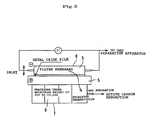
- Fig. 2 shows an example of the constitution described above.
- the raw water to be treated is compressed to a pressure in a range of from 0.2 to 5.0 MPa by using, for instance, a pressurizing pump P1, and is circulation flowed through the upper space (8) that is formed by a porous metal plate (5) used as the anode and a box-like vessel (6), (7) provided as the cathode.
- the structure functions as a so-called ultrafiltration membrane or a reverse osmosis membrane to intercept the transmission of molecules having a molecular weight of 200 Da (Dalton) or greater.
- the substance having a molecular weight of 200 Da or smaller passes through the metallic oxide film and is filtrated to the lower space (9) through the porous metal plate (5).
- the filtrate water is circulated two to three times by using a pump to completely obtain CO 2 and N 2 .
- the frequency, linear voltage, and current of the electric field are varied depending on the molecular weight or the strength of intermolecular bonding force of the hardly decomposable substance. Since decomposed gases are discharged from the circulated water in the upper space (8) and the lower space (9), toxic gases must be treated with the apparatus according to the present invention or absorbed by using active carbon. Presumed from their chemical structures, dioxin and PCB can be easily decomposed. It is confirmed that, injurious substances contained in underground water, such as trihalomethanes and N-hexane-isopropanol, are 100 % decomposed.
- Oxygen radicals generate in large quantities in the cavities that are present in the surface of the oxidation electrode, however, the oxidizing force thereof is not so strong, and by carefully choosing the oxidative metals and the morphology of the particles thereof, it is possible to generate ⁇ OH radicals in the place of ⁇ O radicals depending on conditions. Since such conditions can be confirmed by the colouring of the chemical substances, ring-opening of the aromatic groups can be accomplished in a short period of time by selecting the condition and by using the ⁇ OH radicals. Since the ⁇ OH radicals become ⁇ O radicals by oxidation as to dissociate H + ions, such conditions are advantageous in charged flocculation of particles.
- the generation frequency must be set high, but this conversely makes it difficult to obtain a large linear voltage. Accordingly, by setting the electrode planes disposed near to each other, it is possible to increase the generation of ⁇ OH radicals. In this manner, phenols can be decomposed in an extremely short period of time as shown in, for instance, Fig. 6.
- the decomposed products are re-decomposed in the liquid portion of the lower space (9).
- the decomposition efficiency can be increased by thus providing a two-stage decomposition complex structure of membranes.
- an apparatus for implementing such a treatment comprising an electrically insulated cylindrical vessel provided at the central portion thereof with a metallic rod coated with an electrically conductive oxide to provide an anode, the outer side thereof being surrounded concentrically by a porous metal plate to provide a cathode, and further comprising a metallic cylinder the inner surface of which is coated with an electrically conductive oxide provided with a gas inlet portion to introduce a gas into the inner side of said cylinder and with a gas outlet portion, thereby providing an apparatus for the oxidative destruction of trace injurious substances contained in gas exhaust, characterized by comprising a power generator for applying a current from 1 to 50 mA at a linear voltage of from 0.4 kV/
- an oxidative destruction apparatus in which a partition is provided inside the cylindrical vessel in a direction orthogonal to the central axis.
- Fig. 3 is shown an example of a constitution described above.
- a rod of titanium, stainless steel, etc., which are coated with an electrically conductive oxide such as titanium oxide, tin oxide, ruthenium oxide, etc., is used as an anode (10), and a porous metal plate made of stainless steel or titanium is used as a cathode (11) concentrically surrounding the anode (10).
- a titanium or a stainless steel cylinder (12) comprising an inner wall covered with the electrically conductive oxide as above is provided to the outer side of the resulting structure. These are enclosed in an electrically insulated cylindrical vessel (not shown).
- the gas is introduced from a gas flow inlet (13), and while being interfered with by the partition plate (14), is flowed along the axial direction towards the gas outlet (15) in a single path.
- NO x , H 2 S, etc. are 70 to 80 % decomposed by performing a treatment under conditions of a linear voltage of 1 kV/cm, a current of 2 mA, and a frequency of 50 kHz.
- an apparatus comprising an electrically insulated cylindrical vessel provided at the central portion thereof with a metallic rod-like body having provided optionally on the surface thereof platinum to provide a cathode, ceramics or a resin provided to electrically insulate the cathode, a spiral hoop having its surface coated with an electrically conductive oxide is being wound around said cathode, and a stainless steel plate or a titanium plate covering the outer wall of the resulting structure to provide an anode, the cylindrical vessel further comprising a gas inlet portion and a gas exhaust portion to provide an apparatus for oxidatively destructing trace injurious substance of a gas exhaust, characterized by comprising a power generator for applying a current from 1 to 50 mA at a linear voltage of from 0.4 kV/cm to 7 kV/cm and at a frequency of from 50 to 150 kHz between the anode and the cathode.
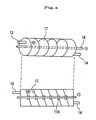
- Fig. 4 is shown an example of a constitution described above.
- an axial portion (16) is provided as a cathode, and a spiral hoop having its spiral surface (17) coated with a metallic oxide is used as an anode.
- the inner side of the outer casing of the spiral plane (17) of the anode is also coated with a metallic oxide, such that the gas entered from the gas flow inlet (13) may be flowed along the spiral plane.
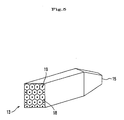
- an apparatus for the oxidative destruction of trace injurious substances having a structure comprising electrically insulated cylinders or rectangular pipes provided with a plurality of metallic cylinders the inside of which is coated with an electrically conductive oxide such as tin oxide or titanium oxide or platinum to provide an anode, and metal placed at the inner center of each of the metallic cylinders to provide cathodes, said structure further comprising a gas inlet portion and a gas exhaust portion to provide an apparatus for oxidatively destructing trace injurious substance of a gas exhaust, characterized by comprising a power generator for applying a current from 0.5 to 50 mA at a linear voltage of from 0.4 kV/cm to 7 kV/cm and at a frequency of from 50 to 150 kHz between the anode and the cathode.
- Fig. 5 is shown an example of the constitution above.
- Compost waste gas from sewage disposal, bad odour from water closet and the like, combustion gas wastes, dioxin, NO x and SO x , gas exhaust from automobiles, hydrocarbons.
- the treatment is conducted under conditions as follows. Voltage set at higher values of from 6 to 7 kV/cm with a pulse width of from 20 to 25 ⁇ s, at a duty ratio of from 30 to 50 % (at a gas flow rate of 1 m/s or lower), and at a current of from 1 to 5 mA (set at lower values).
- Water is supplied by gas spray method using an atomizer.
- the temperature is set to 200 °C or lower (to avoid hydrolysis).
- the apparatus according to the present invention realize complete and efficient removal of soluble COD, while considerably suppressing the cost of treatment by applying electric power to the surface of the metal oxide in pulses at a high voltage and at a low current, thereby realizing low duty ratio with low power consumption, and yet eliminating the use of flocculants.
- the electromagnetic waves function to generate ⁇ O radicals and ⁇ OH radicals on the surface of the electrodes to leave H + ions in the liquid.
- the apparatus according to the present invention oxidatively destroys environmental hormones such as trace injurious substances such as trihalomethanes and tributyltin and ring-opens aromatic compounds to make the substances harmless. Furthermore, the irradiation of high electric field in pulses destroys the cells of algae and fungi, and is therefore effective for sterilization. In the case of blue-algae, oxygen is degassed from the cavities in the cells on irradiating electromagnetic radiations, and the remaining cells rapidly become charged by H + ions to cause flocculation and settling.
Landscapes
- Chemical & Material Sciences (AREA)
- Engineering & Computer Science (AREA)
- General Chemical & Material Sciences (AREA)
- Chemical Kinetics & Catalysis (AREA)
- Electrochemistry (AREA)
- Life Sciences & Earth Sciences (AREA)
- Hydrology & Water Resources (AREA)
- Environmental & Geological Engineering (AREA)
- Water Supply & Treatment (AREA)
- Organic Chemistry (AREA)
- Analytical Chemistry (AREA)
- Oil, Petroleum & Natural Gas (AREA)
- Water Treatment By Electricity Or Magnetism (AREA)
- Catalysts (AREA)
- Physical Or Chemical Processes And Apparatus (AREA)
Abstract
Description
- 1A
- Anode
- 1B
- Cathode
- 2
- Second chamber
- 2A
- Anode
- 2B
- Cathode
- 3, 4
- Settling tank
- 5
- Porous metal plate
- 6, 7
- Box-like vessel
- 8
- Upper space
- 9
- Lower space
- 10
- Anode
- 11
- Cathode
- 12
- Cylinder
- 13
- Flow inlet
- 14
- Partition plate
- 15
- Flow outlet
- 16
- Axial portion
- 17
- Spiral plane
- 17A
- Insulating plate
- 18
- Piping
- 19
- Platinum wire
- 20
- Partition
The temperature is set to 200 °C or lower (to avoid hydrolysis).
| Treatment of polluted water containing water-bloom | ||||
| Items | COD | TOC | T-N | T-P |
| Raw water (mg/L) | 6.7 | 68.0 | 1.45 | 0.93 |
| Supernatant after treatment (mg/L) | 1.0 | 7.0 | 0.22 | 0.09 |
| Deposit (%) | - | 9.5 | 3.60 | 1.36 |
| Results for oxidative destruction test on home wastewater | |||||
| Voltage | Current | mg/L | Soluble COD | NH4-N | NO3- |
| 10 kV | 50 mA | Raw water | 12.3 | 7.0 | 2.0 |
| Treated water | 2.4 | 1.3 | 0.35 | ||
| 5 kV | 25 mA | Raw water | 12.9 | 7.8 | 2.5 |
| Treated water | 4.0 | 2.3 | 0.72 | ||
| (Note) NH4-N: Ammonia nitrogen NO3-N: Nitrate nitrogen |
Claims (14)
- An apparatus for the oxidative destruction of trace injurious substances, characterized by having a structure comprising anodes each integrally provided with an electrically conductive oxide on their surface and made of a metal, a partition made of a porous ceramic or resin provided between the anodes and surrounded by cathodes made of a metal plate having inner walls on both sides to which a noble metal is fused, such that at least two chambers with spaces are formed in a plane symmetrical arrangement to provide an apparatus for the oxidative destruction of trace injurious substances contained in polluted water, said apparatus equipped with a rectangular wave discharging device for applying an electric field to the spaces, such that polluted water is flowed through the inner space of one of the chambers and subjected to the irradiation of an electric field, and that the supernatant is thereafter flowed through the inner space of the other chamber and subjected to the irradiation of an electric field.
- An oxidative destruction apparatus as claimed in Claim 1, wherein the partition is set at a distance in a range of from 1 to 10 cm from the anode and the cathode, the rectangular wave discharge is applied to the spaces at a frequency of from 10 to 200 kHz, a linear voltage of from 200 V/cm to 10 kV/cm, and a current of from 0.5 to 50 mA, and the polluted water is flowed to the first space at a flow rate in a range of from 0.01 to 0.1 m/s.
- An oxidative destruction apparatus as claimed in Claim 1 or 2, wherein the electrically conductive oxide integrally provided to the surface is made of at least one selected from the group consisting of titanium oxide, tin oxide, and ruthenium oxide, and the noble metal fused to the metal plate is platinum.
- An apparatus for the oxidative destruction of trace injurious substances, characterized by having a structure comprising a box-like vessel made of a metal or having a metallic surface, which forms a space by surrounding porous metal plates each integrally provided with a thin film of electrically conductive oxide particles on both its surfaces and thereby imparted with selective molecular fractionation transmittance to provide a cathode, and porous metal plates as anodes to provide an apparatus for the oxidative destruction of trace injurious substances contained in polluted water, said apparatus equipped with a voltage applying device for applying an electric field to the anode and the cathode, such that polluted water is pressure circulated through the inner space of one of the chambers surrounded by the porous metal plate and the box-like vessel while applying voltage to the anode and the cathode, thereby performing ultrafiltration to output the filtrate into the space on the other side.
- An oxidative destruction apparatus as claimed in Claim 4, wherein the porous metal plates are provided with a thin film 10 to 20 µm in thickness made of electrically conductive oxide particles 0.001 to 0.01 µm in particle diameter and having a selective transmittance of 50 x 104 to 2 x 10⁴ Dalton in molecular fractionation, the polluted water being pressure circulated under a pressure of 0.2 to 6.0 MPa, and the voltage being applied at a frequency of from 10 to 200 kHz and at a linear voltage of from 200 V/cm to 10 kV/cm between the anode and the cathode.
- An oxidative destruction apparatus as claimed in Claim 4 or 5, wherein the electrically conductive oxide thin film is made of at least one selected from the group consisting of titanium oxide, tin oxide, and ruthenium oxide, and the box-like vessel is made of a stainless metal or such having a platinum surface.
- An apparatus for the oxidative destruction of trace injurious substances having a structure comprising an electrically insulated cylindrical vessel provided with a metallic rod coated with an electrically conductive oxide on its surface to provide an anode, the outer side thereof being surrounded concentrically by a porous metal plate to provide a cathode, and further comprising a metallic cylinder the inner surface of which is coated with an electrically conductive oxide provided with a gas inlet portion to introduce a gas into the inner side of said cylinder and with a gas outlet portion, thereby providing an apparatus for the oxidative destruction of trace injurious substances contained in gas exhaust, characterized by comprising a power generator for applying a current from 1 to 50 mA at a linear voltage of from 0.4 kV/cm to 7 kV/cm and at a frequency of from 50 to 150 kHz to the anode and the cathode.
- An oxidative destruction apparatus as claimed in Claim 7, wherein a partition is provided inside the cylindrical vessel in a direction orthogonal to the central axis.
- An apparatus for the oxidative destruction of trace injurious substances having a structure comprising an electrically insulated cylindrical vessel provided at the central portion thereof with a metallic rod-like body optionally having platinum provided to the surface thereof to provide a cathode, ceramics or a resin provided to electrically insulate the cathode, a spiral hoop having its surface coated with an electrically conductive oxide and being wound around said cathode, and a stainless steel plate or a titanium plate covering the outer wall of the resulting structure to provide an anode, the cylindrical vessel further comprising a gas inlet portion and a gas exhaust portion to provide an apparatus for the oxidative destruction of trace injurious substances of a gas exhaust, characterized by comprising a power generator for applying a current from 1 to 50 mA at a linear voltage of from 0.4 kV/cm to 7 kV/cm and at a frequency of from 50 to 150 kHz between the anode and the cathode.
- An apparatus for the oxidative destruction of trace injurious substances having a structure comprising electrically insulated cylinders or rectangular pipes provided with a plurality of metallic cylinders the inside of which is coated with an electrically conductive oxide or platinum to provide an anode, and metal placed at the inner center of each of the metallic cylinders to provide cathodes, said structure further comprising a gas inlet portion and a gas exhaust portion to provide an apparatus for the oxidative destruction of trace injurious substances of a gas exhaust, characterized by comprising a power generator for applying a current from 0.5 to 50 mA at a linear voltage of from 0.4 kV/cm to 7 kV/cm and at a frequency of from 50 to 150 kHz between the anode and the cathode.
- An oxidative destruction apparatus as claimed in one of Claims 7 to 10, wherein the electrically conductive oxide is at least one selected from the group consisting of titanium oxide, tin oxide, and ruthenium oxide.
- A method for the oxidative destruction of trace injurious substances, characterized by using one of the apparatus described in one of Claims 1 to 3.
- A method for the oxidative destruction of trace injurious substances, characterized by using one of the apparatus described in one of Claims 4 to 6.
- A method for the oxidative destruction of trace injurious substances, characterized by using one of the apparatus described in one of Claims 7 to 11.
Applications Claiming Priority (3)
| Application Number | Priority Date | Filing Date | Title |
|---|---|---|---|
| JP12639299 | 1999-05-06 | ||
| JP12639299 | 1999-05-06 | ||
| PCT/JP2000/002907 WO2000068153A1 (en) | 1999-05-06 | 2000-05-02 | Apparatus for oxidatively destructing trace injurious substance |
Publications (2)
| Publication Number | Publication Date |
|---|---|
| EP1201609A1 true EP1201609A1 (en) | 2002-05-02 |
| EP1201609A4 EP1201609A4 (en) | 2006-12-13 |
Family
ID=14934012
Family Applications (1)
| Application Number | Title | Priority Date | Filing Date |
|---|---|---|---|
| EP00922961A Withdrawn EP1201609A4 (en) | 1999-05-06 | 2000-05-02 | APPARATUS WHICH CAN DETURN BY OXIDATION A NOCIVE SUBSTANCE FOR TRACES |
Country Status (4)
| Country | Link |
|---|---|
| US (1) | US6896790B1 (en) |
| EP (1) | EP1201609A4 (en) |
| CN (2) | CN1266050C (en) |
| WO (1) | WO2000068153A1 (en) |
Cited By (2)
| Publication number | Priority date | Publication date | Assignee | Title |
|---|---|---|---|---|
| WO2010132957A1 (en) * | 2009-05-22 | 2010-11-25 | Aqua Diagnostic Holdings Pty Ltd | Water analysis |
| CN102249369A (en) * | 2011-04-29 | 2011-11-23 | 中国地质大学(武汉) | Pumice-carried cyanobacteria scavenger capable of floating on water surface |
Families Citing this family (10)
| Publication number | Priority date | Publication date | Assignee | Title |
|---|---|---|---|---|
| AU2001291645A1 (en) * | 2000-09-29 | 2002-04-08 | Dhi Vand And Miljo | Electrochemical cell and electrochemical treatment of contaminated water |
| KR20120022718A (en) * | 2009-03-10 | 2012-03-12 | 에스알에스 에너지 | Algae biomass fractionation |
| CN101798132A (en) * | 2010-04-08 | 2010-08-11 | 大连理工大学 | Large liquid phase high pressure pulse discharging water processor |
| CN102219276B (en) * | 2011-04-29 | 2012-07-25 | 中国地质大学(武汉) | Blue-green algae scavenging agent using polystyrene foam as carrier and capable of floating on water surface |
| US9617646B2 (en) * | 2012-11-14 | 2017-04-11 | Elwha Llc | Comminution water contaminant removal system |
| TWI491436B (en) * | 2012-12-18 | 2015-07-11 | 國立清華大學 | Production method of exhaust gas purifying reactor |
| TWI491794B (en) * | 2012-12-18 | 2015-07-11 | Nat Univ Tsing Hua | And a method for producing an exhaust gas purifying reactor in which a plurality of layers are arranged |
| CN104909436B (en) * | 2015-06-10 | 2017-07-07 | 苏州大学 | A kind of electrolysis-type sterilization and disinfection device, preparation method and application |
| CN105600885B (en) * | 2015-11-11 | 2018-07-03 | 合肥工业大学 | It is a kind of to utilize the method for strengthening Inner sources Estrogen in absorption and low-voltage degradation collaboration removal water body |
| CN108238695B (en) * | 2016-12-23 | 2020-09-15 | 有研工程技术研究院有限公司 | Ultraviolet light catalysis water treatment device applying floating type photocatalyst |
Family Cites Families (12)
| Publication number | Priority date | Publication date | Assignee | Title |
|---|---|---|---|---|
| NL266652A (en) * | 1960-07-11 | |||
| US3849201A (en) * | 1967-08-08 | 1974-11-19 | Union Carbide Corp | Anode and sensing cell for hydrazine fuel cell |
| US4072596A (en) * | 1975-04-30 | 1978-02-07 | Westinghouse Electric Corporation | Apparatus for removal of contaminants from water |
| JPS5917762U (en) * | 1982-07-22 | 1984-02-03 | クロリンエンジニアズ株式会社 | Anode for electrolysis |
| EP0379760A1 (en) * | 1989-01-26 | 1990-08-01 | Univerzita Komenskeho | Device for continuously reducing concentration of carbon monoxide and other harmful types of emission |
| US5256268A (en) * | 1990-07-18 | 1993-10-26 | Konica Corporation | Water treatment method and apparatus |
| JPH04338215A (en) | 1991-05-15 | 1992-11-25 | Mitsubishi Heavy Ind Ltd | Exhaust gas treating device |
| JP3208628B2 (en) | 1994-03-31 | 2001-09-17 | 日立造船株式会社 | Exhaust gas purification system by plasma method |
| DE4416676C2 (en) * | 1994-05-11 | 2002-11-07 | Siemens Ag | Device for the detoxification of exhaust gases from mobile systems |
| WO1997003746A1 (en) | 1995-07-14 | 1997-02-06 | Siemens Aktiengesellschaft | Process and device for the plasma-chemical decomposition and/or destruction of harmful substances |
| JPH11169645A (en) | 1997-12-11 | 1999-06-29 | Sekisui Chem Co Ltd | Gas decomposition treatment method |
| DE60036529T2 (en) * | 1999-04-19 | 2008-06-19 | Japan Science And Technology Agency, Kawaguchi | METHOD OF WATER TREATMENT |
-
2000
- 2000-05-02 EP EP00922961A patent/EP1201609A4/en not_active Withdrawn
- 2000-05-02 CN CNB03142581XA patent/CN1266050C/en not_active Expired - Fee Related
- 2000-05-02 WO PCT/JP2000/002907 patent/WO2000068153A1/en not_active Ceased
- 2000-05-02 CN CNB008072558A patent/CN1145588C/en not_active Expired - Fee Related
- 2000-05-02 US US09/959,726 patent/US6896790B1/en not_active Expired - Fee Related
Cited By (2)
| Publication number | Priority date | Publication date | Assignee | Title |
|---|---|---|---|---|
| WO2010132957A1 (en) * | 2009-05-22 | 2010-11-25 | Aqua Diagnostic Holdings Pty Ltd | Water analysis |
| CN102249369A (en) * | 2011-04-29 | 2011-11-23 | 中国地质大学(武汉) | Pumice-carried cyanobacteria scavenger capable of floating on water surface |
Also Published As
| Publication number | Publication date |
|---|---|
| CN1266050C (en) | 2006-07-26 |
| WO2000068153A1 (en) | 2000-11-16 |
| US6896790B1 (en) | 2005-05-24 |
| EP1201609A4 (en) | 2006-12-13 |
| CN1478729A (en) | 2004-03-03 |
| CN1352622A (en) | 2002-06-05 |
| CN1145588C (en) | 2004-04-14 |
Similar Documents
| Publication | Publication Date | Title |
|---|---|---|
| Wardenier et al. | Removal of micropollutants from water in a continuous-flow electrical discharge reactor | |
| US10183880B2 (en) | Wastewater treatment plant and method for treatment of waste sludge | |
| JPH1170386A (en) | Plasma reactor, waste water treatment apparatus utilizing the same and waste water treatment method | |
| US6896790B1 (en) | Apparatus for oxidatively destructing trace injurious substance | |
| JP2004268003A (en) | Underwater discharge plasma method and liquid treatment apparatus | |
| EP1268350B1 (en) | Water purification system and method | |
| HK1045678A1 (en) | Method and apparatus for treatment of organic matter-containing wastewater | |
| JP2000093967A (en) | Method and apparatus for liquid treatment | |
| CN108602694B (en) | Wastewater treatment equipment and method for treating waste sludge by using pulse discharge | |
| CN107673445A (en) | A kind of method of literary formula trunnion discharge plasma processing waste water | |
| AU2000234638A1 (en) | Water purification system and method | |
| EP3894358B1 (en) | System and method for treatment of wastewater fluids | |
| CN111889049A (en) | Pulse discharge plasma reactor, organic wastewater treatment device and treatment method | |
| JP3746184B2 (en) | Oxidative decomposition equipment for trace hazardous substances | |
| CN103466755A (en) | Apparatus for processing sewage through high-pressure submerged gas jet discharge plasma, and method thereof | |
| Balanagu et al. | Review of nonthermal plasma-based water treatment: Prerequisites, procedures, and potency | |
| KR101444290B1 (en) | Wastewater purification apparatus using the magnetic resonance device | |
| JP2000279977A (en) | Fluid treatment method and fluid treatment device | |
| RU2234470C2 (en) | Water purification system and method | |
| KR200407858Y1 (en) | Wastewater and Odor Multiple Plasma Treatment Units | |
| JP4962688B2 (en) | Oxidative decomposition equipment for trace hazardous substances | |
| KR100709983B1 (en) | Selective hardly degradable dye wastewater purification device using low temperature plasma | |
| CN207435114U (en) | A kind of device of text formula trunnion discharge plasma processing waste water | |
| KR100446437B1 (en) | Electronic radiation apparatus for Sewage/waste water treatment | |
| 白敏冬 et al. | Study on treating halobios pollution by hydroxyl radical |
Legal Events
| Date | Code | Title | Description |
|---|---|---|---|
| PUAI | Public reference made under article 153(3) epc to a published international application that has entered the european phase |
Free format text: ORIGINAL CODE: 0009012 |
|
| 17P | Request for examination filed |
Effective date: 20011129 |
|
| AK | Designated contracting states |
Kind code of ref document: A1 Designated state(s): AT BE CH CY DE DK ES FI FR GB GR IE IT LI LU MC NL PT SE |
|
| RIN1 | Information on inventor provided before grant (corrected) |
Inventor name: MAEKAWA, TAKAAKI Inventor name: CHUANPING FENG |
|
| RBV | Designated contracting states (corrected) |
Designated state(s): DE FR GB |
|
| RAP1 | Party data changed (applicant data changed or rights of an application transferred) |
Owner name: JAPAN SCIENCE AND TECHNOLOGY AGENCY |
|
| A4 | Supplementary search report drawn up and despatched |
Effective date: 20061114 |
|
| 17Q | First examination report despatched |
Effective date: 20071026 |
|
| STAA | Information on the status of an ep patent application or granted ep patent |
Free format text: STATUS: THE APPLICATION IS DEEMED TO BE WITHDRAWN |
|
| 18D | Application deemed to be withdrawn |
Effective date: 20080306 |