EP1201387B1 - Method for regulating the manufacturing process in a mixer - Google Patents
Method for regulating the manufacturing process in a mixer Download PDFInfo
- Publication number
- EP1201387B1 EP1201387B1 EP00830651A EP00830651A EP1201387B1 EP 1201387 B1 EP1201387 B1 EP 1201387B1 EP 00830651 A EP00830651 A EP 00830651A EP 00830651 A EP00830651 A EP 00830651A EP 1201387 B1 EP1201387 B1 EP 1201387B1
- Authority
- EP
- European Patent Office
- Prior art keywords
- rotors
- parameter
- indirect
- phase
- processing
- Prior art date
- Legal status (The legal status is an assumption and is not a legal conclusion. Google has not performed a legal analysis and makes no representation as to the accuracy of the status listed.)
- Expired - Lifetime
Links
- 238000000034 method Methods 0.000 title claims abstract description 76
- 230000001105 regulatory effect Effects 0.000 title claims abstract description 15
- 238000004519 manufacturing process Methods 0.000 title description 16
- 239000000203 mixture Substances 0.000 claims abstract description 45
- 230000008569 process Effects 0.000 claims abstract description 45
- 238000012545 processing Methods 0.000 claims abstract description 33
- 150000001875 compounds Chemical class 0.000 claims abstract description 25
- 229920000642 polymer Polymers 0.000 claims abstract description 13
- 238000003825 pressing Methods 0.000 claims abstract description 5
- VYPSYNLAJGMNEJ-UHFFFAOYSA-N Silicium dioxide Chemical compound O=[Si]=O VYPSYNLAJGMNEJ-UHFFFAOYSA-N 0.000 claims description 32
- 239000004615 ingredient Substances 0.000 claims description 16
- 239000000377 silicon dioxide Substances 0.000 claims description 16
- 238000006243 chemical reaction Methods 0.000 claims description 6
- BLRPTPMANUNPDV-UHFFFAOYSA-N Silane Chemical compound [SiH4] BLRPTPMANUNPDV-UHFFFAOYSA-N 0.000 claims description 5
- 229910000077 silane Inorganic materials 0.000 claims description 5
- 239000000126 substance Substances 0.000 claims description 5
- 239000007767 bonding agent Substances 0.000 claims description 3
- 239000006229 carbon black Substances 0.000 claims description 3
- 235000021355 Stearic acid Nutrition 0.000 claims description 2
- XLOMVQKBTHCTTD-UHFFFAOYSA-N Zinc monoxide Chemical compound [Zn]=O XLOMVQKBTHCTTD-UHFFFAOYSA-N 0.000 claims description 2
- 230000003712 anti-aging effect Effects 0.000 claims description 2
- 239000003795 chemical substances by application Substances 0.000 claims description 2
- QIQXTHQIDYTFRH-UHFFFAOYSA-N octadecanoic acid Chemical compound CCCCCCCCCCCCCCCCCC(O)=O QIQXTHQIDYTFRH-UHFFFAOYSA-N 0.000 claims description 2
- OQCDKBAXFALNLD-UHFFFAOYSA-N octadecanoic acid Natural products CCCCCCCC(C)CCCCCCCCC(O)=O OQCDKBAXFALNLD-UHFFFAOYSA-N 0.000 claims description 2
- 239000008117 stearic acid Substances 0.000 claims description 2
- 238000002444 silanisation Methods 0.000 description 9
- 239000000463 material Substances 0.000 description 7
- 238000012360 testing method Methods 0.000 description 7
- 238000012937 correction Methods 0.000 description 4
- 238000010586 diagram Methods 0.000 description 4
- 230000006870 function Effects 0.000 description 4
- 230000001276 controlling effect Effects 0.000 description 3
- 230000008901 benefit Effects 0.000 description 2
- 230000008859 change Effects 0.000 description 2
- 239000007795 chemical reaction product Substances 0.000 description 2
- 238000004132 cross linking Methods 0.000 description 2
- 239000006185 dispersion Substances 0.000 description 2
- 239000002861 polymer material Substances 0.000 description 2
- 239000000047 product Substances 0.000 description 2
- 239000011265 semifinished product Substances 0.000 description 2
- 238000004438 BET method Methods 0.000 description 1
- NINIDFKCEFEMDL-UHFFFAOYSA-N Sulfur Chemical compound [S] NINIDFKCEFEMDL-UHFFFAOYSA-N 0.000 description 1
- 239000005864 Sulphur Substances 0.000 description 1
- 125000001931 aliphatic group Chemical group 0.000 description 1
- 238000004140 cleaning Methods 0.000 description 1
- 238000013329 compounding Methods 0.000 description 1
- 229920001577 copolymer Polymers 0.000 description 1
- 230000003247 decreasing effect Effects 0.000 description 1
- 230000007547 defect Effects 0.000 description 1
- 230000001419 dependent effect Effects 0.000 description 1
- 238000011161 development Methods 0.000 description 1
- 150000001993 dienes Chemical class 0.000 description 1
- 238000007599 discharging Methods 0.000 description 1
- 239000013067 intermediate product Substances 0.000 description 1
- 238000005304 joining Methods 0.000 description 1
- 239000011159 matrix material Substances 0.000 description 1
- 238000012986 modification Methods 0.000 description 1
- 230000004048 modification Effects 0.000 description 1
- 239000000178 monomer Substances 0.000 description 1
- 230000008447 perception Effects 0.000 description 1
- 230000000704 physical effect Effects 0.000 description 1
- 230000000750 progressive effect Effects 0.000 description 1
- 230000009467 reduction Effects 0.000 description 1
- 238000009877 rendering Methods 0.000 description 1
- 238000010058 rubber compounding Methods 0.000 description 1
- 150000004756 silanes Chemical class 0.000 description 1
- 229920002554 vinyl polymer Polymers 0.000 description 1
- 238000004073 vulcanization Methods 0.000 description 1
- XLYOFNOQVPJJNP-UHFFFAOYSA-N water Substances O XLYOFNOQVPJJNP-UHFFFAOYSA-N 0.000 description 1
Images


Classifications
-
- B—PERFORMING OPERATIONS; TRANSPORTING
- B29—WORKING OF PLASTICS; WORKING OF SUBSTANCES IN A PLASTIC STATE IN GENERAL
- B29B—PREPARATION OR PRETREATMENT OF THE MATERIAL TO BE SHAPED; MAKING GRANULES OR PREFORMS; RECOVERY OF PLASTICS OR OTHER CONSTITUENTS OF WASTE MATERIAL CONTAINING PLASTICS
- B29B7/00—Mixing; Kneading
- B29B7/02—Mixing; Kneading non-continuous, with mechanical mixing or kneading devices, i.e. batch type
- B29B7/22—Component parts, details or accessories; Auxiliary operations
- B29B7/28—Component parts, details or accessories; Auxiliary operations for measuring, controlling or regulating, e.g. viscosity control
- B29B7/286—Component parts, details or accessories; Auxiliary operations for measuring, controlling or regulating, e.g. viscosity control measuring properties of the mixture, e.g. temperature, density
-
- B—PERFORMING OPERATIONS; TRANSPORTING
- B29—WORKING OF PLASTICS; WORKING OF SUBSTANCES IN A PLASTIC STATE IN GENERAL
- B29B—PREPARATION OR PRETREATMENT OF THE MATERIAL TO BE SHAPED; MAKING GRANULES OR PREFORMS; RECOVERY OF PLASTICS OR OTHER CONSTITUENTS OF WASTE MATERIAL CONTAINING PLASTICS
- B29B7/00—Mixing; Kneading
- B29B7/02—Mixing; Kneading non-continuous, with mechanical mixing or kneading devices, i.e. batch type
- B29B7/06—Mixing; Kneading non-continuous, with mechanical mixing or kneading devices, i.e. batch type with movable mixing or kneading devices
- B29B7/10—Mixing; Kneading non-continuous, with mechanical mixing or kneading devices, i.e. batch type with movable mixing or kneading devices rotary
- B29B7/18—Mixing; Kneading non-continuous, with mechanical mixing or kneading devices, i.e. batch type with movable mixing or kneading devices rotary with more than one shaft
- B29B7/183—Mixing; Kneading non-continuous, with mechanical mixing or kneading devices, i.e. batch type with movable mixing or kneading devices rotary with more than one shaft having a casing closely surrounding the rotors, e.g. of Banbury type
-
- B—PERFORMING OPERATIONS; TRANSPORTING
- B29—WORKING OF PLASTICS; WORKING OF SUBSTANCES IN A PLASTIC STATE IN GENERAL
- B29B—PREPARATION OR PRETREATMENT OF THE MATERIAL TO BE SHAPED; MAKING GRANULES OR PREFORMS; RECOVERY OF PLASTICS OR OTHER CONSTITUENTS OF WASTE MATERIAL CONTAINING PLASTICS
- B29B7/00—Mixing; Kneading
- B29B7/02—Mixing; Kneading non-continuous, with mechanical mixing or kneading devices, i.e. batch type
- B29B7/22—Component parts, details or accessories; Auxiliary operations
- B29B7/24—Component parts, details or accessories; Auxiliary operations for feeding
- B29B7/246—Component parts, details or accessories; Auxiliary operations for feeding in mixers having more than one rotor and a casing closely surrounding the rotors, e.g. with feeding plungers
-
- B—PERFORMING OPERATIONS; TRANSPORTING
- B29—WORKING OF PLASTICS; WORKING OF SUBSTANCES IN A PLASTIC STATE IN GENERAL
- B29B—PREPARATION OR PRETREATMENT OF THE MATERIAL TO BE SHAPED; MAKING GRANULES OR PREFORMS; RECOVERY OF PLASTICS OR OTHER CONSTITUENTS OF WASTE MATERIAL CONTAINING PLASTICS
- B29B7/00—Mixing; Kneading
- B29B7/02—Mixing; Kneading non-continuous, with mechanical mixing or kneading devices, i.e. batch type
- B29B7/22—Component parts, details or accessories; Auxiliary operations
- B29B7/28—Component parts, details or accessories; Auxiliary operations for measuring, controlling or regulating, e.g. viscosity control
- B29B7/283—Component parts, details or accessories; Auxiliary operations for measuring, controlling or regulating, e.g. viscosity control measuring data of the driving system, e.g. torque, speed, power
-
- B—PERFORMING OPERATIONS; TRANSPORTING
- B29—WORKING OF PLASTICS; WORKING OF SUBSTANCES IN A PLASTIC STATE IN GENERAL
- B29B—PREPARATION OR PRETREATMENT OF THE MATERIAL TO BE SHAPED; MAKING GRANULES OR PREFORMS; RECOVERY OF PLASTICS OR OTHER CONSTITUENTS OF WASTE MATERIAL CONTAINING PLASTICS
- B29B7/00—Mixing; Kneading
- B29B7/74—Mixing; Kneading using other mixers or combinations of mixers, e.g. of dissimilar mixers ; Plant
- B29B7/7476—Systems, i.e. flow charts or diagrams; Plants
- B29B7/7495—Systems, i.e. flow charts or diagrams; Plants for mixing rubber
-
- B—PERFORMING OPERATIONS; TRANSPORTING
- B29—WORKING OF PLASTICS; WORKING OF SUBSTANCES IN A PLASTIC STATE IN GENERAL
- B29K—INDEXING SCHEME ASSOCIATED WITH SUBCLASSES B29B, B29C OR B29D, RELATING TO MOULDING MATERIALS OR TO MATERIALS FOR MOULDS, REINFORCEMENTS, FILLERS OR PREFORMED PARTS, e.g. INSERTS
- B29K2021/00—Use of unspecified rubbers as moulding material
Definitions
- the present invention relates to the manufacturing process of mixtures and compounds made of rubber and other ingredients, for the production of tyres and components thereof such as tread bands and the like.
- Continuous mixers essentially consist of a cylindrical chamber inside which an endless screw (referred to hereinbelow as “rotor") rotates and conveys the material being processed from one end to the other of the above mentioned chamber, in a continuous manner: mixing of the material occurs during passage inside the cylindrical chamber.
- rotor endless screw
- Discontinuous (closed) mixers essentially consist of a mixing chamber containing a pair of rotors which rotate in opposite directions to each other: the material is processed in predefined separate quantities (batches), which are completely discharged from the mixer at the end of the process, before starting the processing of a new batch.
- the present invention is particularly suitable for the latter mixers and, among them, for those commonly known by the name "Banbury®” or "Intermix®”.
- mixture will be intended to mean the general intermediate product obtained during the various operating phases of the production cycle, while the term “compound” will indicate the final mixing product, resulting from the addition of the crosslinking system to the mixture.
- Control of the processing conditions in the mixers considered herein has a very important role in the quality of the end product.
- the process parameters may be divided into direct and indirect parameters, wherein the former are those acted upon by the mixer control system in order to vary the latter: for example, the pressure of the ram and the speed of the rotors may be increased or decreased so as to vary the temperature and/or the energy conferred to the mixture.
- this experimental curve is used as a reference parameter for regulating the actual process by varying over time the speed of the rotors and/or the pressure of the ram, so as to maintain the temperature detected consistent with the reference temperature.
- This manner of operating allows to eliminate the non-uniform quality referred to above of the compounds or mixtures having the same composition, caused by the different initial temperatures of the materials which may occur in summer or in winter, or when a working cycle is performed with the mixer still cold.
- Correction of the process temperature is performed by intermittently varying the speed of the rotors and/or the pressure of the ram each time there is a deviation beyond predefined tolerances between the temperature detected and the reference curve.
- control system does not appear to be very flexible.
- the temperature versus time reference curve should change because a shorter cycle (albeit with the same operating phases) would require a curve which is also shorter and generally has a steeper gradient.
- EP-A-728 803 deals with thermal and chemical conditions to be met in the manufacturing of silica-based rubber compounds, but not to the method of controlling such conditions.
- the present invention aims at improving the state of the art considered heretofore.
- the invention arises from the Applicant's perception that it is not necessary to regulate the temperature of the mixture or the energy used during mixing and/or other indirect process parameters, continuously throughout the whole processing.
- processing is firstly divided into successive phases: within these phases it is possible to approximate the profile of the various process parameters with rectilinear segments.
- the desired variation over time ⁇ parameter/ ⁇ time is determined for at least one indirect process parameter; this variation will depend on each case and will be determined preliminarily on the basis of the working cycle to be performed, the composition of the mixture, the duration of the phase and other factors.
- the ratio ⁇ P/ ⁇ t is the gradient of the rectilinear segment which approximates the reference curve during that phase.
- the regulation of the working process during its phases is performed by using as reference values those of the rectilinear segments relating to one or more indirect process parameters.
- Regulation of the working process in the invention is preferably carried out by choosing for each phase the indirect parameter of greatest importance for the quality of the end product to be obtained.
- this is carried out by correcting during one or more predetermined phases, preferably using an algorithm of the proportional-integral type, the speed of the rotors and/or the pressure of the ram in order to obtain a rectilinear trend of the selected indirect parameter, having the same gradient as that of the reference segment.
- the mixer 1 shown therein comprises a pair of tangential rotors 2 and 3 which rotate in opposite directions inside a mixing chamber 4 cooled by water circulating inside a series of adjacent channels 5, 6.
- the mixer 1 comprises the usual pressing ram 8 fixed to the end of a rod 9 actuated by a pneumatic (or hydraulic) cylinder 10.
- the mixer 1 is also provided, for the introduction inside it of the material to be processed, with a lateral hopper 11; discharging of the processed mixtures or compounds instead occurs underneath, through an opening present in the bottom of the mixing chamber 4 and closed by a hydraulic or pneumatic obturator device 12.
- Figure 2 refers to the processing of a typical mixture for silica-reinforced compounds, whose composition is set out below for purpose of indication, with the variation ranges of each ingredient and the quantities expressed in "phr", i.e. parts by weight for 100 parts of polymer material: Polymer base 100 Carbon black 0-80 Silica 10-80 Bonding agent (of the silica) 4-15% of silica Zinc oxide (ZnO) 1-3 Stearic acid 0-3 Anti-aging agents 1-3 Plasticizing oil 0-30 Anti-ozone wax 0.5-3 Specific chemical ingredients 0-15
- this system preferably consists of sulphur (0.5 to 2.5 phr) and vulcanization accelerators.
- polymers or copolymers with an unsaturated chain obtained by means of polymerisation of aliphatic or aromatic vinyl monomers and/or conjugated dienes.
- Silica has a surface area, measured using the BET method, preferably of between 100 and 300 m 2 /g and preferably silanes are used as bonding agent thereof.
- the rotors 2 and 3 of the mixer 1 are brought to the required speed for the initial introduction of the ingredients via the hopper 11; after that, in phases 2-4 the polymer materials, the silane, the carbon black and/or the silica are fed via the hopper.
- the piston is lowered and then the temperature T and the energy E rapidly increase during phase 5 which has a predefined duration (60 seconds), and then increase only slightly until phase 7 which also has a predefined duration.
- phase 6 the speed of the rotors is reduced in connection with the raising of the piston which is performed so as to favour the cleaning thereof from any residual non-mixed initial ingredients.
- the latter is a reaction through which chemical bonding of the silica to the polymer matrix via the silane is performed; in the example of Fig. 2, silanization starts with the phase 13, after about 218 seconds the start of the working process.
- phase 17 the temperature is kept within a range of predefined values, which are known to persons skilled in the art and outside of which the desired qualities of the semi-finished product to be manufactured are not reached.
- the regulating method according to the present invention takes advantage of this possibility.
- the most important parameter to be controlled may be the temperature, in another phase the energy, in other phases the torque or the power applied to the rotors, etc.
- the reference curve used for regulation (which in the Hanna Compounding patent was the temperature curve) is approximated during the various phases with a rectilinear segment.
- This segment provides the values needed by the mixer regulating system (PLC or the like), for calculating the corrections to be made on the pressure of the ram and/or the speed of the rotors.
- PLC mixer regulating system
- the system operates using a logic of the proportional-integral type, which is summarised in schematic form in Figure 4.
- the first value is a coefficient for multiplying the difference between the detected value of the indirect process parameter and the corresponding value of the rectilinear reference segment
- the second value is a coefficient for dividing the correction to be applied. For example, by entering a reset value equal to 10, any correction to the number of rotations of the rotors equal to 2 rpm is imparted with a series of stepwise variations of 0.2 rpm per second.
- the regulation concerned the pattern of the temperature during silanization of the mixtures, with the aim of obtaining a more uniform duration of phase 16 which terminates when the mixture reaches the temperature of 150°C.
- the various segments provide the basis for the necessary regulation.
- the logic by means of which regulation of the temperature was carried out in the example considered above is also applicable to the other parameters such as the energy supplied to the rotors, the torque and/or the power applied to them, the degree of progress of the chemical reactions between the ingredients of the mixture such as silanization and the like, etc.
- the method according to the present invention is particularly suitable for processing mixtures for silica-reinforced compounds.
Landscapes
- Engineering & Computer Science (AREA)
- Mechanical Engineering (AREA)
- Processing And Handling Of Plastics And Other Materials For Molding In General (AREA)
- Accessories For Mixers (AREA)
- Control Of Non-Electrical Variables (AREA)
- Processes Of Treating Macromolecular Substances (AREA)
Abstract
Description
- The present invention relates to the manufacturing process of mixtures and compounds made of rubber and other ingredients, for the production of tyres and components thereof such as tread bands and the like.
- In general the manufacturing process considered herein is the mixing process performed using mixers of any type, namely both continuous and discontinuous mixers. Continuous mixers essentially consist of a cylindrical chamber inside which an endless screw (referred to hereinbelow as "rotor") rotates and conveys the material being processed from one end to the other of the above mentioned chamber, in a continuous manner: mixing of the material occurs during passage inside the cylindrical chamber.
- Discontinuous (closed) mixers essentially consist of a mixing chamber containing a pair of rotors which rotate in opposite directions to each other: the material is processed in predefined separate quantities (batches), which are completely discharged from the mixer at the end of the process, before starting the processing of a new batch.
- The present invention is particularly suitable for the latter mixers and, among them, for those commonly known by the name "Banbury®" or "Intermix®".
- With these devices the various mixing operations required in the tyre production cycle, are performed; for example, they serve to combine the basic ingredients from which there are obtained the intermediate mixtures then used during subsequent processings, or to mix these mixtures with others which have a different composition so as to form particular "blends", or to produce the final compounds to be vulcanized.
- In this connection it is pointed out that for an easier understanding of this description, the term "mixture" will be intended to mean the general intermediate product obtained during the various operating phases of the production cycle, while the term "compound" will indicate the final mixing product, resulting from the addition of the crosslinking system to the mixture.
- Control of the processing conditions in the mixers considered herein has a very important role in the quality of the end product.
- Indeed, if during the manufacturing process excessively high temperatures are reached or if the applied mixing energy is too high, the chemical and physical properties of the processed materials may change such that the product subsequently obtained must be discarded or in any case it does not satisfy the required standards of quality.
- For example, in certain cases there will be found mechanical and/or rheological properties (hardness, viscosity, elasticity, etc.) lower than predefined requested values or, in other cases, there will be difficulties during subsequent processing of the compound with the presence of possible surface defects or a non-uniform quality of the compounds obtained using the same ingredients.
- The variables which influence the manufacturing process in the mixers are, however, many and this makes it difficult to control the operating conditions during the course of the production cycle.
- Among these variables there can be mentioned the characteristics of the ingredients used for the compounds and the sequence with which they are introduced into the mixer, the temperature fluctuations of the processed mixtures, the pressure of the pressing ram inside the closed mixer, the torque and the speed of the rotor or rotors, the mixing time and energy, the mixer filling level, etc.
- From a practical point of view, the process parameters may be divided into direct and indirect parameters, wherein the former are those acted upon by the mixer control system in order to vary the latter: for example, the pressure of the ram and the speed of the rotors may be increased or decreased so as to vary the temperature and/or the energy conferred to the mixture.
- Recently, various solutions have been proposed for controlling the working process in closed mixers, based on these parameters.
- One of these solutions is described in US Patent No. 4,455,091, in the name of Bamberger et al.; in such document it is suggested to control the working of the mixtures by regulating their temperature during the process, together with the energy supplied to the rotors of the mixer.
- For this purpose, it is first obtained experimentally a curve showing the desired temperature as a function of the energy, for a given process to be performed.
- Then this experimental curve is used as a reference parameter for regulating the actual process by varying over time the speed of the rotors and/or the pressure of the ram, so as to maintain the temperature detected consistent with the reference temperature.
- This manner of operating allows to eliminate the non-uniform quality referred to above of the compounds or mixtures having the same composition, caused by the different initial temperatures of the materials which may occur in summer or in winter, or when a working cycle is performed with the mixer still cold.
- However this solution appears to be not very flexible because it requires that the course of the temperature and of the power supplied to the system be continuously controlled during the whole mixing process.
- This is not always easy because during the working cycle, situations (such as the movement of the pressing ram or any other unforeseen technical event) may arise that modify the mixing process with respect to the nominal conditions, thereby rendering difficult to regulate the system subsequently for bringing it back to the desired nominal conditions.
- Similar arguments apply also to another method for controlling the manufacturing process of compounds and mixtures in a closed mixer, described in international patent application WO-A-99/24230, in the name of Hanna Rubber Compounding.
- In this application it is described how, in order to achieve a constant quality between one batch and the other, it is sufficient to control continuously the profile of the temperature as a function of the time during the whole process and correct it, where necessary, to follow a predetermined reference curve.
- Correction of the process temperature is performed by intermittently varying the speed of the rotors and/or the pressure of the ram each time there is a deviation beyond predefined tolerances between the temperature detected and the reference curve.
- The latter and the associated tolerance range are obtained experimentally by means of mixing tests.
- From what has been set out just above, it may be seen that also in this case the control system does not appear to be very flexible.
- For example, if it were required to reduce the planned duration of the processing cycle in the mixer for increasing the hourly production, the temperature versus time reference curve should change because a shorter cycle (albeit with the same operating phases) would require a curve which is also shorter and generally has a steeper gradient.
- Consequently, in such circumstances it would be necessary to obtain a new temperature versus time experimental curve corresponding to the shorter duration of the operating cycle to be defined; this would require a series of further preliminary tests in order to obtain this curve, with obvious negative consequences as regards the processing duration and costs.
- More generally, it may be concluded that with this manner of operating, the same drawbacks will arise every time it is required to modify the working cycle; furthermore, the fact that in order to control mixing it is necessary to detect (and if necessary correct) the temperature continuously during the whole process, gives rise to the same difficulties mentioned above in connection with the Bamberger US patent.
- Other known methods of processing polymer-based compounds and mixtures are disclosed in EP-A-244121, US-A-4,707,139 and EP-A-728 803.
- However in the first of them there is no control of the intermediate working phases, but only the adjustment of the ram pressure and rotor speed in order to obtain final target values at discharge of the rubber compound from the mixer, as a consequence this method is not suitable for processing compounds (like those with silica) where it is necessary to maintain preset working conditions in some particular intermediate phases before final discharge.
- The same is true also for US-A-4,707,139 which concerns the discharge of the material from a continuous mixer controlled in relation to the torque produced by the motor which drives the bladed rotors, whereas EP-A-728 803 deals with thermal and chemical conditions to be met in the manufacturing of silica-based rubber compounds, but not to the method of controlling such conditions.
- The present invention aims at improving the state of the art considered heretofore.
- In other words, it is the object of the invention to provide a method for regulating the manufacturing process of compounds and mixtures in a mixer, which is able to achieve a uniform quality of the produced batches having the same composition, and which is operationally flexible so as to ensure said quality, even when there is a variation in the operating conditions under which processing may be performed.
- This object is achieved according to the invention by the method as defined in claim 1. Particular embodiments of the invention are the subject of the dependent claims.
- The invention arises from the Applicant's perception that it is not necessary to regulate the temperature of the mixture or the energy used during mixing and/or other indirect process parameters, continuously throughout the whole processing.
- In accordance with the present invention a method has been developed wherein processing is firstly divided into successive phases: within these phases it is possible to approximate the profile of the various process parameters with rectilinear segments.
- On the basis of this principle, in accordance with the method according to the invention, for the various phases the desired variation over time Δparameter/Δtime, is determined for at least one indirect process parameter; this variation will depend on each case and will be determined preliminarily on the basis of the working cycle to be performed, the composition of the mixture, the duration of the phase and other factors.
- By tracing the parameter P on a diagram as a function of the time, the ratio ΔP/Δt is the gradient of the rectilinear segment which approximates the reference curve during that phase.
- The regulation of the working process during its phases is performed by using as reference values those of the rectilinear segments relating to one or more indirect process parameters.
- For this purpose it is possible to use, during the various phases, one or more of the following parameters: temperature of the mixtures or the compounds, quantity of energy supplied, torque and/or power applied to the rotors, degree of progress of any chemical reactions between some of the ingredients such as, for example, the polymer base, the silica and the silane.
- Regulation of the working process in the invention is preferably carried out by choosing for each phase the indirect parameter of greatest importance for the quality of the end product to be obtained.
- In particular, this is carried out by correcting during one or more predetermined phases, preferably using an algorithm of the proportional-integral type, the speed of the rotors and/or the pressure of the ram in order to obtain a rectilinear trend of the selected indirect parameter, having the same gradient as that of the reference segment.
- Further advantages of the present invention will emerge more clearly from the description of an embodiment thereof, set out hereinbelow with reference to the attached drawings and tables, wherein:
- Fig. 1 shows a closed mixer (of the Banbury® type) in which the method according to the invention is implemented;
- Fig. 2 is a diagram showing the profiles traced of some process parameters relating to a working process carried out in a mixer like that of Fig. 1;
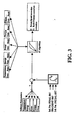
- Fig. 3 is a block diagram which illustrates the regulating method according to the invention.
- For better understanding the invention, the explanation which follows will refer without any limiting intention, to the closed mixer of Figure 1 and to the related method of processing compounds and mixtures.
- With reference to the first figure, the mixer 1 shown therein comprises a pair of
tangential rotors 2 and 3 which rotate in opposite directions inside a mixing chamber 4 cooled by water circulating inside a series ofadjacent channels - The mixer 1 comprises the usual
pressing ram 8 fixed to the end of arod 9 actuated by a pneumatic (or hydraulic)cylinder 10. - The mixer 1 is also provided, for the introduction inside it of the material to be processed, with a
lateral hopper 11; discharging of the processed mixtures or compounds instead occurs underneath, through an opening present in the bottom of the mixing chamber 4 and closed by a hydraulic orpneumatic obturator device 12. - An example of working process performed in the mixer described above is illustrated in the graph of Figure 2, which shows in segmented lines approximating the actual trend with respect to the time, the temperature T of the mixture, the number of rotations N of the rotors and the energy E absorbed during the operating cycle.
- Figure 2 refers to the processing of a typical mixture for silica-reinforced compounds, whose composition is set out below for purpose of indication, with the variation ranges of each ingredient and the quantities expressed in "phr", i.e. parts by weight for 100 parts of polymer material:
Polymer base 100 Carbon black 0-80 Silica 10-80 Bonding agent (of the silica) 4-15% of silica Zinc oxide (ZnO) 1-3 Stearic acid 0-3 Anti-aging agents 1-3 Plasticizing oil 0-30 Anti-ozone wax 0.5-3 Specific chemical ingredients 0-15 - In order to obtain the mixtures, it is required to add the crosslinking system to these ingredients in the usual quantities, depending on the composition of the mixture; this system preferably consists of sulphur (0.5 to 2.5 phr) and vulcanization accelerators.
- Among the preferred polymer bases there are polymers or copolymers with an unsaturated chain obtained by means of polymerisation of aliphatic or aromatic vinyl monomers and/or conjugated dienes.
- Silica has a surface area, measured using the BET method, preferably of between 100 and 300 m2/g and preferably silanes are used as bonding agent thereof.
- The processing cycle, to which the graph of Fig. 2 refers, is divided into successive phases which are indicated with a progressive numbering from 1 to 17 in the table hereinbelow:

- In the first of these phases the
rotors 2 and 3 of the mixer 1 are brought to the required speed for the initial introduction of the ingredients via thehopper 11; after that, in phases 2-4 the polymer materials, the silane, the carbon black and/or the silica are fed via the hopper. - In this connection it should be noted that the diagram according to Fig. 2, for the sake of simplicity, shows the profiles of the process parameters only starting from phase 4.
- Once the first introduction of the basic ingredients has been completed, the piston is lowered and then the temperature T and the energy E rapidly increase during
phase 5 which has a predefined duration (60 seconds), and then increase only slightly untilphase 7 which also has a predefined duration. - During this latter period there is a gradual reduction in the viscosity of the mixture and therefore a gradual decrease in the power required to mix it, as can be deduced from the minimum gradient of the line E of the energy.
- Moreover, in
phase 6 the speed of the rotors is reduced in connection with the raising of the piston which is performed so as to favour the cleaning thereof from any residual non-mixed initial ingredients. - After this, addition of such ingredients is completed in order to obtain the final composition of the mixture (phases 8-9), thus amalgamating them with those already present in the mixer (phases 10-12).
- During these phases the working of the mixture causes a gradual increase in its temperature, up to a predefined value (of about 120°C) for which it is considered that dispersion of the silica has been completed and so-called "silanization" may begin.
- The latter is a reaction through which chemical bonding of the silica to the polymer matrix via the silane is performed; in the example of Fig. 2, silanization starts with the
phase 13, after about 218 seconds the start of the working process. - The silanization then continues in the successive phases (14-16) until the end of processing (phase 17), when the mixture is discharged; during this period the temperature is kept within a range of predefined values, which are known to persons skilled in the art and outside of which the desired qualities of the semi-finished product to be manufactured are not reached.
- The temperature and energy lines T and E in the graph of Fig. 2 were obtained experimentally on the basis of a series of repeated tests of the same processing cycle, reporting the average values of T and E at the start of the various phases.
- These lines show how, in connection with said phases, it is possible to approximate with a rectilinear segment the pattern of the process parameters.
- The regulating method according to the present invention takes advantage of this possibility.
- For this purpose it devises to determine for one or more processing phases, the indirect parameter P which is most significant or most critical for the concerned phase; this will depend on the processing cycle to be performed.
- For example, in one phase the most important parameter to be controlled may be the temperature, in another phase the energy, in other phases the torque or the power applied to the rotors, etc.
- Thereafter it is determined the linear variation through the time, ΔP/Δt, for that parameter during the associated phase, starting from an initial value Pi; in this manner it is possible to identify the reference progression for that parameter during the phase, which consists of the rectilinear segment joining the values of the parameter P at the start and at the end of the phase.
- Basically, in the method according to this invention the reference curve used for regulation (which in the Hanna Compounding patent was the temperature curve) is approximated during the various phases with a rectilinear segment.
- This segment provides the values needed by the mixer regulating system (PLC or the like), for calculating the corrections to be made on the pressure of the ram and/or the speed of the rotors.
- In particular, according to a preferred embodiment of the invention the system operates using a logic of the proportional-integral type, which is summarised in schematic form in Figure 4.
- As can be seen, for a given phase the gradient ΔP/Δt of the rectilinear segment relating to the most significant or critical indirect parameter for that phase, as well as its initial value, are entered.
- Preferably at the same time two so-called "gain" and "reset" values are also entered; the first value is a coefficient for multiplying the difference between the detected value of the indirect process parameter and the corresponding value of the rectilinear reference segment, while the second value is a coefficient for dividing the correction to be applied. For example, by entering a reset value equal to 10, any correction to the number of rotations of the rotors equal to 2 rpm is imparted with a series of stepwise variations of 0.2 rpm per second.
- Regulation according to the present invention was applied to
phase 16 of a series of experimental tests, whose duration has been shown in the penultimate column of the preceding table (marked "controlled" at the top). - More specifically, the regulation concerned the pattern of the temperature during silanization of the mixtures, with the aim of obtaining a more uniform duration of
phase 16 which terminates when the mixture reaches the temperature of 150°C. - As can be seen, in the case of batches processed using the method according to the invention, an average duration of the
phase 16 equal to 45 seconds and a standard deviation of 0.42 seconds was obtained. - When no regulation of
phase 16 is provided, on the other hand, it can be seen from the values shown in the column marked "not controlled" in the abovementioned table (which refers to the tests used to obtain the graph according to Fig. 2) that attainment of the predefined temperature of 150°C forphase 16 occurs with greater lack of uniformity as demonstrated by the standard deviation of 6.72 sec. with respect to a mean of 39 seconds. - In the case referred to it must be emphasized that the smaller standard deviation for the duration of phase 16 (0.42 sec.) obtained with the abovementioned temperature regulation, compared to the standard deviation (6.72 sec.) present in the same phase when no temperature regulation is carried out, constitutes an important result obtained by the method according to the invention.
- Indeed, as already mentioned, during this phase silanization takes place, whereby it is necessary to keep the temperature of the mixture within a range of well-defined values.
- With the method according to the invention, in addition to obtaining this result it is also possible to increase the average duration of the aforesaid phase (45 seconds instead of 39), so as to favour the development of the reaction between silane, polymer base and silica, thus achieving a better silanization in the processed mass.
- From the foregoing description it is possible to understand how the method according to the present invention achieves the objects set out initially.
- Indeed it renders possible to regulate processing of the mixtures and the compounds in a flexible manner, so as to adapt efficiently the production process to the changes in the operating conditions likewise, for example, the duration of the production cycle or some parts thereof, which occur in practice.
- This result is obtained owing to the division of the working process into a series of successive phases, during which the pattern, as a function of time, of the process parameters such as temperature, energy, torque, etc., may be approximated with a rectilinear segment.
- The various segments provide the basis for the necessary regulation.
- Indeed, for the different processing phases it is possible to establish a variation ΔP/Δt of the most important parameter to be controlled; this variation corresponds to the gradient of the associated segment during that phase and provides the reference values necessary for regulation.
- For this purpose it is sufficient to set the gradient and the values of the associated rectilinear reference segment, in order to be able to apply the proportional-integral regulating algorithm described above.
- Furthermore, should it be required to modify the production cycle by increasing or reducing the duration of one or more phases (or of the entire cycle), it is sufficient to update only the gradient of the rectilinear reference segments, without having to modify the regulating algorithm as a whole.
- This is not possible in the known state of the art considered above where, if it is required to modify the duration of the working process or some phase thereof, a new reference curve must be provided by means of experimental tests.
- Moreover, it must be pointed out that the method according to the present invention is valid for all the indirect process parameters which affect processing.
- In other words, it may be stated that the logic by means of which regulation of the temperature was carried out in the example considered above, is also applicable to the other parameters such as the energy supplied to the rotors, the torque and/or the power applied to them, the degree of progress of the chemical reactions between the ingredients of the mixture such as silanization and the like, etc.
- To this end it will be sufficient that for each processing phase in which regulation is to be performed, the "gain", "reset" and gradient values of the reference segments for the selected parameter be input in the control system.
- Since the regulating algorithm should be preferably the same, processing is controlled in a manner similar to that already mentioned, without having to make modifications to the system.
- In particular, owing to this flexibility of the regulating method according to the invention, it is possible to use for the various processing phases the indirect process parameter which is most suitable for the final result to be obtained.
- On the contrary, in the known regulating systems similar circumstances would require the provision of a respective reference curve for each process parameter, with a specific series of experimental tests.
- The method according to the present invention is particularly suitable for processing mixtures for silica-reinforced compounds.
- In these processing operations, indeed, there are some critical operations such as the silanization mentioned above or dispersion of the silica in the polymer mass, which are of crucial importance for the quality of the semi-finished product obtained.
- These operations are suit well for division into successive phases (such as, for example, the silanization phases 13-16 in the graphs according to Fig. 2), during which the pattern of the indirect process parameters may be defined by the segments so as to form the broken or segmented line already mentioned.
- However, nonetheless, the same criteria may also be applied to the processing of silica-free compounds.
Claims (8)
- Method for processing polymer-based compounds and mixtures, which includes regulation of at least one indirect process parameter performed by operating on at least one direct process parameter, characterized in that it comprises the following phases:- dividing up processing into a plurality of successive phases;- determining a linear reference variation, with respect to time (ΔP/Δt), of at least one indirect process parameter in at least one of said phases;- regulating at least one of said direct process parameters, so as to vary said at least one indirect parameter in accordance with the linear reference variation in said phase.
- Method according to Claim 1, wherein said linear variation (ΔP/Δt) is determined as a ratio between the difference of the reference values at the start and at the end of the phase, and the duration of said phase.
- Method according to Claim 1, carried out in a mixer (1) of the closed type comprising a pair of rotors (2, 3) counter-rotating inside a mixing chamber (4), and a pressing ram (8) operating inside said chamber in position above the rotors,
wherein the direct process parameters comprise at least one parameter selected from the group including the speed of the rotors (2, 3) and the pressure of the ram (8). - Method according to Claim 3, wherein the indirect process parameters comprise at least one parameter selected from the group which includes: temperature of the mixture or of the compound being processed, power applied to the rotors, torque applied to the rotors, energy supplied to the rotors, degree of progress of the chemical reactions between ingredients of the mixture or the compound.
- Method according to Claim 4, wherein the indirect process parameter is the degree of progress of the chemical reaction between polymer base, silica and silane.
- Method according to Claim 1, wherein the reference values of the indirect process parameters at the start and at the end of said at least one phase are mean values obtained experimentally.
- Method according to Claim 1, wherein regulation of the values of said direct process parameters is performed using an algorithm of the proportional-integral type.
- Method according to Claim 1, wherein the processed mixtures comprise the following ingredients, in variable quantities expressed per hundred parts by weight (phr) of polymer base:
Polymer base 100 Carbon black 0-80 Silica 10-80 Bonding agent (of the silica) 4-15% of silica Zinc oxide (ZnO) 1-3 Stearic acid 0-3 Anti-aging agents 1-3 Plasticizing oil 0-30 Anti-ozone wax 0.5-3 Specific chemical ingredients 0-15
Priority Applications (4)
| Application Number | Priority Date | Filing Date | Title |
|---|---|---|---|
| DE60027166T DE60027166T2 (en) | 2000-10-04 | 2000-10-04 | Method for controlling the production process in a mixing device |
| ES00830651T ES2261175T3 (en) | 2000-10-04 | 2000-10-04 | PROCEDURE TO REGULATE MANUFACTURING WITHIN A MIXER. |
| EP00830651A EP1201387B1 (en) | 2000-10-04 | 2000-10-04 | Method for regulating the manufacturing process in a mixer |
| AT00830651T ATE322365T1 (en) | 2000-10-04 | 2000-10-04 | METHOD FOR REGULATING THE PRODUCTION PROCESS IN A MIXING DEVICE |
Applications Claiming Priority (1)
| Application Number | Priority Date | Filing Date | Title |
|---|---|---|---|
| EP00830651A EP1201387B1 (en) | 2000-10-04 | 2000-10-04 | Method for regulating the manufacturing process in a mixer |
Publications (2)
| Publication Number | Publication Date |
|---|---|
| EP1201387A1 EP1201387A1 (en) | 2002-05-02 |
| EP1201387B1 true EP1201387B1 (en) | 2006-04-05 |
Family
ID=8175498
Family Applications (1)
| Application Number | Title | Priority Date | Filing Date |
|---|---|---|---|
| EP00830651A Expired - Lifetime EP1201387B1 (en) | 2000-10-04 | 2000-10-04 | Method for regulating the manufacturing process in a mixer |
Country Status (4)
| Country | Link |
|---|---|
| EP (1) | EP1201387B1 (en) |
| AT (1) | ATE322365T1 (en) |
| DE (1) | DE60027166T2 (en) |
| ES (1) | ES2261175T3 (en) |
Families Citing this family (2)
| Publication number | Priority date | Publication date | Assignee | Title |
|---|---|---|---|---|
| US6817748B2 (en) | 2002-11-05 | 2004-11-16 | The Goodyear Tire & Rubber Company | Method for evaluating and controlling a mixing process |
| CN106346630B (en) * | 2016-08-30 | 2018-08-31 | 南京永腾化工装备有限公司 | Mixer material pressing device |
Family Cites Families (3)
| Publication number | Priority date | Publication date | Assignee | Title |
|---|---|---|---|---|
| US4707139A (en) * | 1985-11-22 | 1987-11-17 | Farrell Corporation | Control system and method for continuous mixer with moving surface discharge device |
| GB2190006B (en) * | 1986-04-26 | 1990-01-04 | Farrel Bridge Ltd | Control for batch mixers |
| IT1274257B (en) * | 1995-02-24 | 1997-07-15 | Pirelli | PROCEDURE FOR THE PRODUCTION OF A VULCANIZABLE RUBBER MIXTURE WITH SILICA-BASED REINFORCING CHARGE |
-
2000
- 2000-10-04 DE DE60027166T patent/DE60027166T2/en not_active Expired - Lifetime
- 2000-10-04 ES ES00830651T patent/ES2261175T3/en not_active Expired - Lifetime
- 2000-10-04 EP EP00830651A patent/EP1201387B1/en not_active Expired - Lifetime
- 2000-10-04 AT AT00830651T patent/ATE322365T1/en not_active IP Right Cessation
Also Published As
| Publication number | Publication date |
|---|---|
| DE60027166D1 (en) | 2006-05-18 |
| ATE322365T1 (en) | 2006-04-15 |
| EP1201387A1 (en) | 2002-05-02 |
| ES2261175T3 (en) | 2006-11-16 |
| DE60027166T2 (en) | 2006-12-21 |
Similar Documents
| Publication | Publication Date | Title |
|---|---|---|
| EP1035958B1 (en) | Dynamic mixer control in plastics and rubber processing | |
| EP0244121B2 (en) | Control for batch mixers | |
| KR100190725B1 (en) | Continuous mixing method of elastomer compound | |
| EP3359361B1 (en) | Process for producing an elastomeric compound | |
| US4657871A (en) | Mixing polymers such as rubber | |
| EP2379294B9 (en) | Process and plant for producing tyres | |
| CN101043994A (en) | Apparatus and method for mixing rubber materials | |
| US20040213075A1 (en) | Closed mixer working process with stroke control ram | |
| EP1201387A1 (en) | Method for regulating the manufacturing process in a mixer | |
| EP1194272B1 (en) | Processing method of a mixture for tyre rubber compound | |
| EP1165298B1 (en) | Process for producing a silica-reinforced rubber compound | |
| JP2012200949A (en) | Tire forming method | |
| EP1236504B1 (en) | Process for charging a closed mixer with pressing ram | |
| US20060067159A1 (en) | Thermally regulated closed mixer | |
| CN104772833B (en) | A kind of epoxide resin vacuum degassing control method | |
| GB2196547A (en) | Mixing polymers such as rubber | |
| JP4923437B2 (en) | Method and apparatus for mixing rubber composition | |
| CN104750142B (en) | Resin vacuum degassing secondary mixed material temperature and pressure control system | |
| JP6667976B1 (en) | Adjustment method of holding pressure switching position of electric injection molding machine | |
| JP4599031B2 (en) | Temperature control hermetic mixer | |
| JP2005262725A (en) | Rubber material kneading control method | |
| JP4205504B2 (en) | Control method of raw rubber kneader | |
| JP2681090B2 (en) | Speed control method of gear pump in extrusion molding apparatus | |
| Freakley et al. | Mixing Polymers Such as Rubber | |
| JP2006205583A (en) | Rubber kneading equipment and rubber kneading method |
Legal Events
| Date | Code | Title | Description |
|---|---|---|---|
| PUAI | Public reference made under article 153(3) epc to a published international application that has entered the european phase |
Free format text: ORIGINAL CODE: 0009012 |
|
| AK | Designated contracting states |
Kind code of ref document: A1 Designated state(s): AT BE CH CY DE DK ES FI FR GB GR IE IT LI LU MC NL PT SE |
|
| AX | Request for extension of the european patent |
Free format text: AL;LT;LV;MK;RO;SI |
|
| 17P | Request for examination filed |
Effective date: 20021015 |
|
| AKX | Designation fees paid |
Free format text: AT BE CH CY DE DK ES FI FR GB GR IE IT LI LU MC NL PT SE |
|
| 17Q | First examination report despatched |
Effective date: 20040407 |
|
| GRAP | Despatch of communication of intention to grant a patent |
Free format text: ORIGINAL CODE: EPIDOSNIGR1 |
|
| GRAS | Grant fee paid |
Free format text: ORIGINAL CODE: EPIDOSNIGR3 |
|
| GRAA | (expected) grant |
Free format text: ORIGINAL CODE: 0009210 |
|
| AK | Designated contracting states |
Kind code of ref document: B1 Designated state(s): AT BE CH CY DE DK ES FI FR GB GR IE IT LI LU MC NL PT SE |
|
| PG25 | Lapsed in a contracting state [announced via postgrant information from national office to epo] |
Ref country code: IT Free format text: LAPSE BECAUSE OF FAILURE TO SUBMIT A TRANSLATION OF THE DESCRIPTION OR TO PAY THE FEE WITHIN THE PRESCRIBED TIME-LIMIT;WARNING: LAPSES OF ITALIAN PATENTS WITH EFFECTIVE DATE BEFORE 2007 MAY HAVE OCCURRED AT ANY TIME BEFORE 2007. THE CORRECT EFFECTIVE DATE MAY BE DIFFERENT FROM THE ONE RECORDED. Effective date: 20060405 Ref country code: CH Free format text: LAPSE BECAUSE OF FAILURE TO SUBMIT A TRANSLATION OF THE DESCRIPTION OR TO PAY THE FEE WITHIN THE PRESCRIBED TIME-LIMIT Effective date: 20060405 Ref country code: FI Free format text: LAPSE BECAUSE OF FAILURE TO SUBMIT A TRANSLATION OF THE DESCRIPTION OR TO PAY THE FEE WITHIN THE PRESCRIBED TIME-LIMIT Effective date: 20060405 Ref country code: AT Free format text: LAPSE BECAUSE OF FAILURE TO SUBMIT A TRANSLATION OF THE DESCRIPTION OR TO PAY THE FEE WITHIN THE PRESCRIBED TIME-LIMIT Effective date: 20060405 Ref country code: LI Free format text: LAPSE BECAUSE OF FAILURE TO SUBMIT A TRANSLATION OF THE DESCRIPTION OR TO PAY THE FEE WITHIN THE PRESCRIBED TIME-LIMIT Effective date: 20060405 Ref country code: BE Free format text: LAPSE BECAUSE OF FAILURE TO SUBMIT A TRANSLATION OF THE DESCRIPTION OR TO PAY THE FEE WITHIN THE PRESCRIBED TIME-LIMIT Effective date: 20060405 Ref country code: NL Free format text: LAPSE BECAUSE OF FAILURE TO SUBMIT A TRANSLATION OF THE DESCRIPTION OR TO PAY THE FEE WITHIN THE PRESCRIBED TIME-LIMIT Effective date: 20060405 |
|
| REG | Reference to a national code |
Ref country code: GB Ref legal event code: FG4D |
|
| REG | Reference to a national code |
Ref country code: CH Ref legal event code: EP |
|
| REG | Reference to a national code |
Ref country code: IE Ref legal event code: FG4D |
|
| REF | Corresponds to: |
Ref document number: 60027166 Country of ref document: DE Date of ref document: 20060518 Kind code of ref document: P |
|
| PG25 | Lapsed in a contracting state [announced via postgrant information from national office to epo] |
Ref country code: DK Free format text: LAPSE BECAUSE OF FAILURE TO SUBMIT A TRANSLATION OF THE DESCRIPTION OR TO PAY THE FEE WITHIN THE PRESCRIBED TIME-LIMIT Effective date: 20060705 Ref country code: SE Free format text: LAPSE BECAUSE OF FAILURE TO SUBMIT A TRANSLATION OF THE DESCRIPTION OR TO PAY THE FEE WITHIN THE PRESCRIBED TIME-LIMIT Effective date: 20060705 |
|
| RAP2 | Party data changed (patent owner data changed or rights of a patent transferred) |
Owner name: PIRELLI TYRE S.P.A. |
|
| PG25 | Lapsed in a contracting state [announced via postgrant information from national office to epo] |
Ref country code: PT Free format text: LAPSE BECAUSE OF FAILURE TO SUBMIT A TRANSLATION OF THE DESCRIPTION OR TO PAY THE FEE WITHIN THE PRESCRIBED TIME-LIMIT Effective date: 20060905 |
|
| NLV1 | Nl: lapsed or annulled due to failure to fulfill the requirements of art. 29p and 29m of the patents act | ||
| PG25 | Lapsed in a contracting state [announced via postgrant information from national office to epo] |
Ref country code: IE Free format text: LAPSE BECAUSE OF NON-PAYMENT OF DUE FEES Effective date: 20061004 |
|
| REG | Reference to a national code |
Ref country code: CH Ref legal event code: PL |
|
| PG25 | Lapsed in a contracting state [announced via postgrant information from national office to epo] |
Ref country code: MC Free format text: LAPSE BECAUSE OF NON-PAYMENT OF DUE FEES Effective date: 20061031 |
|
| ET | Fr: translation filed | ||
| REG | Reference to a national code |
Ref country code: ES Ref legal event code: FG2A Ref document number: 2261175 Country of ref document: ES Kind code of ref document: T3 |
|
| PLBI | Opposition filed |
Free format text: ORIGINAL CODE: 0009260 |
|
| PLAX | Notice of opposition and request to file observation + time limit sent |
Free format text: ORIGINAL CODE: EPIDOSNOBS2 |
|
| 26 | Opposition filed |
Opponent name: HARBURG-FREUNDENBERGER MASCHINENBAU GMBH Effective date: 20070105 |
|
| PLAF | Information modified related to communication of a notice of opposition and request to file observations + time limit |
Free format text: ORIGINAL CODE: EPIDOSCOBS2 |
|
| PLBB | Reply of patent proprietor to notice(s) of opposition received |
Free format text: ORIGINAL CODE: EPIDOSNOBS3 |
|
| PLCK | Communication despatched that opposition was rejected |
Free format text: ORIGINAL CODE: EPIDOSNREJ1 |
|
| PG25 | Lapsed in a contracting state [announced via postgrant information from national office to epo] |
Ref country code: GR Free format text: LAPSE BECAUSE OF FAILURE TO SUBMIT A TRANSLATION OF THE DESCRIPTION OR TO PAY THE FEE WITHIN THE PRESCRIBED TIME-LIMIT Effective date: 20060706 |
|
| APBP | Date of receipt of notice of appeal recorded |
Free format text: ORIGINAL CODE: EPIDOSNNOA2O |
|
| APAH | Appeal reference modified |
Free format text: ORIGINAL CODE: EPIDOSCREFNO |
|
| APBQ | Date of receipt of statement of grounds of appeal recorded |
Free format text: ORIGINAL CODE: EPIDOSNNOA3O |
|
| PG25 | Lapsed in a contracting state [announced via postgrant information from national office to epo] |
Ref country code: CY Free format text: LAPSE BECAUSE OF FAILURE TO SUBMIT A TRANSLATION OF THE DESCRIPTION OR TO PAY THE FEE WITHIN THE PRESCRIBED TIME-LIMIT Effective date: 20060405 |
|
| PGFP | Annual fee paid to national office [announced via postgrant information from national office to epo] |
Ref country code: LU Payment date: 20081031 Year of fee payment: 9 |
|
| APBU | Appeal procedure closed |
Free format text: ORIGINAL CODE: EPIDOSNNOA9O |
|
| PLBN | Opposition rejected |
Free format text: ORIGINAL CODE: 0009273 |
|
| STAA | Information on the status of an ep patent application or granted ep patent |
Free format text: STATUS: OPPOSITION REJECTED |
|
| 27O | Opposition rejected |
Effective date: 20100228 |
|
| PG25 | Lapsed in a contracting state [announced via postgrant information from national office to epo] |
Ref country code: LU Free format text: LAPSE BECAUSE OF NON-PAYMENT OF DUE FEES Effective date: 20091004 |
|
| REG | Reference to a national code |
Ref country code: FR Ref legal event code: PLFP Year of fee payment: 16 |
|
| REG | Reference to a national code |
Ref country code: FR Ref legal event code: PLFP Year of fee payment: 17 |
|
| REG | Reference to a national code |
Ref country code: FR Ref legal event code: PLFP Year of fee payment: 18 |
|
| REG | Reference to a national code |
Ref country code: FR Ref legal event code: PLFP Year of fee payment: 19 |
|
| PGFP | Annual fee paid to national office [announced via postgrant information from national office to epo] |
Ref country code: DE Payment date: 20191029 Year of fee payment: 20 |
|
| PGFP | Annual fee paid to national office [announced via postgrant information from national office to epo] |
Ref country code: ES Payment date: 20191104 Year of fee payment: 20 Ref country code: FR Payment date: 20191025 Year of fee payment: 20 Ref country code: IT Payment date: 20191023 Year of fee payment: 20 |
|
| PGFP | Annual fee paid to national office [announced via postgrant information from national office to epo] |
Ref country code: GB Payment date: 20191028 Year of fee payment: 20 |
|
| REG | Reference to a national code |
Ref country code: DE Ref legal event code: R071 Ref document number: 60027166 Country of ref document: DE |
|
| REG | Reference to a national code |
Ref country code: GB Ref legal event code: PE20 Expiry date: 20201003 |
|
| REG | Reference to a national code |
Ref country code: ES Ref legal event code: FD2A Effective date: 20210126 |
|
| PG25 | Lapsed in a contracting state [announced via postgrant information from national office to epo] |
Ref country code: GB Free format text: LAPSE BECAUSE OF EXPIRATION OF PROTECTION Effective date: 20201003 |
|
| PG25 | Lapsed in a contracting state [announced via postgrant information from national office to epo] |
Ref country code: ES Free format text: LAPSE BECAUSE OF EXPIRATION OF PROTECTION Effective date: 20201005 |