EP1200503B1 - Process for the polymerisation of cycloolefins and polymerisable cycloolefins - Google Patents
Process for the polymerisation of cycloolefins and polymerisable cycloolefins Download PDFInfo
- Publication number
- EP1200503B1 EP1200503B1 EP00942251A EP00942251A EP1200503B1 EP 1200503 B1 EP1200503 B1 EP 1200503B1 EP 00942251 A EP00942251 A EP 00942251A EP 00942251 A EP00942251 A EP 00942251A EP 1200503 B1 EP1200503 B1 EP 1200503B1
- Authority
- EP
- European Patent Office
- Prior art keywords
- monomers
- monomer
- strained
- difunctional
- catalyst
- Prior art date
- Legal status (The legal status is an assumption and is not a legal conclusion. Google has not performed a legal analysis and makes no representation as to the accuracy of the status listed.)
- Expired - Lifetime
Links
- 238000000034 method Methods 0.000 title claims abstract description 56
- 150000001925 cycloalkenes Chemical class 0.000 title description 3
- 239000000178 monomer Substances 0.000 claims abstract description 99
- -1 activated cyclic olefins Chemical class 0.000 claims abstract description 36
- 239000003054 catalyst Substances 0.000 claims abstract description 27
- JRZJOMJEPLMPRA-UHFFFAOYSA-N olefin Natural products CCCCCCCC=C JRZJOMJEPLMPRA-UHFFFAOYSA-N 0.000 claims abstract description 20
- 238000006243 chemical reaction Methods 0.000 claims abstract description 16
- 238000004132 cross linking Methods 0.000 claims abstract description 13
- 229920001577 copolymer Polymers 0.000 claims abstract description 11
- 238000002360 preparation method Methods 0.000 claims abstract description 7
- 230000003197 catalytic effect Effects 0.000 claims abstract description 6
- 238000007152 ring opening metathesis polymerisation reaction Methods 0.000 claims abstract description 5
- 239000003795 chemical substances by application Substances 0.000 claims abstract description 3
- 230000000977 initiatory effect Effects 0.000 claims abstract description 3
- 239000000047 product Substances 0.000 claims description 28
- IISBACLAFKSPIT-UHFFFAOYSA-N bisphenol A Chemical compound C=1C=C(O)C=CC=1C(C)(C)C1=CC=C(O)C=C1 IISBACLAFKSPIT-UHFFFAOYSA-N 0.000 claims description 16
- QIGBRXMKCJKVMJ-UHFFFAOYSA-N Hydroquinone Chemical compound OC1=CC=C(O)C=C1 QIGBRXMKCJKVMJ-UHFFFAOYSA-N 0.000 claims description 10
- 239000000203 mixture Substances 0.000 claims description 8
- 239000003999 initiator Substances 0.000 claims description 7
- 229920001187 thermosetting polymer Polymers 0.000 claims description 7
- 239000004215 Carbon black (E152) Substances 0.000 claims description 5
- ISWSIDIOOBJBQZ-UHFFFAOYSA-N Phenol Chemical compound OC1=CC=CC=C1 ISWSIDIOOBJBQZ-UHFFFAOYSA-N 0.000 claims description 5
- 229930195733 hydrocarbon Natural products 0.000 claims description 5
- 239000002904 solvent Substances 0.000 claims description 5
- 125000006273 (C1-C3) alkyl group Chemical group 0.000 claims description 4
- PXKLMJQFEQBVLD-UHFFFAOYSA-N bisphenol F Chemical compound C1=CC(O)=CC=C1CC1=CC=C(O)C=C1 PXKLMJQFEQBVLD-UHFFFAOYSA-N 0.000 claims description 4
- 125000004122 cyclic group Chemical group 0.000 claims description 4
- 229920001971 elastomer Polymers 0.000 claims description 4
- 239000000806 elastomer Substances 0.000 claims description 4
- 238000010107 reaction injection moulding Methods 0.000 claims description 4
- 229910052707 ruthenium Inorganic materials 0.000 claims description 4
- KJTLSVCANCCWHF-UHFFFAOYSA-N Ruthenium Chemical compound [Ru] KJTLSVCANCCWHF-UHFFFAOYSA-N 0.000 claims description 3
- 238000000576 coating method Methods 0.000 claims description 3
- 239000002131 composite material Substances 0.000 claims description 3
- 150000003950 cyclic amides Chemical class 0.000 claims description 3
- 150000002430 hydrocarbons Chemical class 0.000 claims description 3
- 229910044991 metal oxide Inorganic materials 0.000 claims description 3
- 150000004706 metal oxides Chemical class 0.000 claims description 3
- 229920003023 plastic Polymers 0.000 claims description 3
- 239000004033 plastic Substances 0.000 claims description 3
- 238000006116 polymerization reaction Methods 0.000 claims description 3
- 125000003003 spiro group Chemical group 0.000 claims description 3
- 239000000126 substance Substances 0.000 claims description 3
- 125000004209 (C1-C8) alkyl group Chemical group 0.000 claims description 2
- 229930185605 Bisphenol Natural products 0.000 claims description 2
- 125000000520 N-substituted aminocarbonyl group Chemical group [*]NC(=O)* 0.000 claims description 2
- 239000002168 alkylating agent Substances 0.000 claims description 2
- 229940100198 alkylating agent Drugs 0.000 claims description 2
- 150000008064 anhydrides Chemical class 0.000 claims description 2
- 125000003118 aryl group Chemical group 0.000 claims description 2
- 239000007795 chemical reaction product Substances 0.000 claims description 2
- 150000004820 halides Chemical class 0.000 claims description 2
- 238000010438 heat treatment Methods 0.000 claims description 2
- 125000005842 heteroatom Chemical group 0.000 claims description 2
- 125000004356 hydroxy functional group Chemical group O* 0.000 claims description 2
- 229910001507 metal halide Inorganic materials 0.000 claims description 2
- HZVOZRGWRWCICA-UHFFFAOYSA-N methanediyl Chemical compound [CH2] HZVOZRGWRWCICA-UHFFFAOYSA-N 0.000 claims description 2
- 125000001570 methylene group Chemical group [H]C([H])([*:1])[*:2] 0.000 claims description 2
- 239000011347 resin Substances 0.000 claims description 2
- 229920005989 resin Polymers 0.000 claims description 2
- 229920006395 saturated elastomer Polymers 0.000 claims description 2
- 238000001721 transfer moulding Methods 0.000 claims description 2
- 125000005843 halogen group Chemical group 0.000 claims 3
- 125000006850 spacer group Chemical group 0.000 abstract description 4
- 239000000543 intermediate Substances 0.000 abstract description 2
- HEDRZPFGACZZDS-MICDWDOJSA-N Trichloro(2H)methane Chemical compound [2H]C(Cl)(Cl)Cl HEDRZPFGACZZDS-MICDWDOJSA-N 0.000 description 20
- 230000015572 biosynthetic process Effects 0.000 description 19
- 238000003786 synthesis reaction Methods 0.000 description 19
- 229910052757 nitrogen Inorganic materials 0.000 description 18
- 150000001875 compounds Chemical class 0.000 description 12
- HECLRDQVFMWTQS-RGOKHQFPSA-N 1755-01-7 Chemical compound C1[C@H]2[C@@H]3CC=C[C@@H]3[C@@H]1C=C2 HECLRDQVFMWTQS-RGOKHQFPSA-N 0.000 description 6
- IJGRMHOSHXDMSA-UHFFFAOYSA-N Atomic nitrogen Chemical compound N#N IJGRMHOSHXDMSA-UHFFFAOYSA-N 0.000 description 6
- YMWUJEATGCHHMB-UHFFFAOYSA-N Dichloromethane Chemical compound ClCCl YMWUJEATGCHHMB-UHFFFAOYSA-N 0.000 description 6
- YXFVVABEGXRONW-UHFFFAOYSA-N Toluene Chemical compound CC1=CC=CC=C1 YXFVVABEGXRONW-UHFFFAOYSA-N 0.000 description 6
- 150000001336 alkenes Chemical class 0.000 description 6
- 238000012512 characterization method Methods 0.000 description 6
- 150000002148 esters Chemical class 0.000 description 6
- VLKZOEOYAKHREP-UHFFFAOYSA-N n-Hexane Chemical compound CCCCCC VLKZOEOYAKHREP-UHFFFAOYSA-N 0.000 description 6
- 239000000843 powder Substances 0.000 description 6
- 239000011541 reaction mixture Substances 0.000 description 6
- XLYOFNOQVPJJNP-UHFFFAOYSA-N water Substances O XLYOFNOQVPJJNP-UHFFFAOYSA-N 0.000 description 6
- 239000004971 Cross linker Substances 0.000 description 5
- QTBSBXVTEAMEQO-UHFFFAOYSA-N Acetic acid Chemical compound CC(O)=O QTBSBXVTEAMEQO-UHFFFAOYSA-N 0.000 description 4
- CSCPPACGZOOCGX-UHFFFAOYSA-N Acetone Chemical compound CC(C)=O CSCPPACGZOOCGX-UHFFFAOYSA-N 0.000 description 4
- CSNNHWWHGAXBCP-UHFFFAOYSA-L Magnesium sulfate Chemical compound [Mg+2].[O-][S+2]([O-])([O-])[O-] CSNNHWWHGAXBCP-UHFFFAOYSA-L 0.000 description 4
- 239000012153 distilled water Substances 0.000 description 4
- 239000000463 material Substances 0.000 description 4
- 229920000642 polymer Polymers 0.000 description 4
- 239000000243 solution Substances 0.000 description 4
- 239000007858 starting material Substances 0.000 description 4
- 239000003039 volatile agent Substances 0.000 description 4
- 238000001644 13C nuclear magnetic resonance spectroscopy Methods 0.000 description 3
- ZMANZCXQSJIPKH-UHFFFAOYSA-N Triethylamine Chemical compound CCN(CC)CC ZMANZCXQSJIPKH-UHFFFAOYSA-N 0.000 description 3
- GTDPSWPPOUPBNX-UHFFFAOYSA-N ac1mqpva Chemical compound CC12C(=O)OC(=O)C1(C)C1(C)C2(C)C(=O)OC1=O GTDPSWPPOUPBNX-UHFFFAOYSA-N 0.000 description 3
- 239000012298 atmosphere Substances 0.000 description 3
- 125000006575 electron-withdrawing group Chemical group 0.000 description 3
- 125000001475 halogen functional group Chemical group 0.000 description 3
- 238000004949 mass spectrometry Methods 0.000 description 3
- 125000001424 substituent group Chemical group 0.000 description 3
- OKTJSMMVPCPJKN-UHFFFAOYSA-N Carbon Chemical compound [C] OKTJSMMVPCPJKN-UHFFFAOYSA-N 0.000 description 2
- 238000005698 Diels-Alder reaction Methods 0.000 description 2
- LFQSCWFLJHTTHZ-UHFFFAOYSA-N Ethanol Chemical compound CCO LFQSCWFLJHTTHZ-UHFFFAOYSA-N 0.000 description 2
- 229960000583 acetic acid Drugs 0.000 description 2
- 230000001588 bifunctional effect Effects 0.000 description 2
- VHRGRCVQAFMJIZ-UHFFFAOYSA-N cadaverine Chemical compound NCCCCCN VHRGRCVQAFMJIZ-UHFFFAOYSA-N 0.000 description 2
- 150000004985 diamines Chemical class 0.000 description 2
- 150000008056 dicarboxyimides Chemical class 0.000 description 2
- 239000000539 dimer Substances 0.000 description 2
- 239000012467 final product Substances 0.000 description 2
- 239000012362 glacial acetic acid Substances 0.000 description 2
- 229910052943 magnesium sulfate Inorganic materials 0.000 description 2
- 235000019341 magnesium sulphate Nutrition 0.000 description 2
- 229910052751 metal Inorganic materials 0.000 description 2
- 239000002184 metal Substances 0.000 description 2
- 150000002739 metals Chemical class 0.000 description 2
- 239000012044 organic layer Substances 0.000 description 2
- 125000001997 phenyl group Chemical group [H]C1=C([H])C([H])=C(*)C([H])=C1[H] 0.000 description 2
- 238000001953 recrystallisation Methods 0.000 description 2
- 239000007787 solid Substances 0.000 description 2
- 238000012360 testing method Methods 0.000 description 2
- 230000007704 transition Effects 0.000 description 2
- XFNJVJPLKCPIBV-UHFFFAOYSA-N trimethylenediamine Chemical compound NCCCN XFNJVJPLKCPIBV-UHFFFAOYSA-N 0.000 description 2
- DYLIWHYUXAJDOJ-OWOJBTEDSA-N (e)-4-(6-aminopurin-9-yl)but-2-en-1-ol Chemical compound NC1=NC=NC2=C1N=CN2C\C=C\CO DYLIWHYUXAJDOJ-OWOJBTEDSA-N 0.000 description 1
- IUVCFHHAEHNCFT-INIZCTEOSA-N 2-[(1s)-1-[4-amino-3-(3-fluoro-4-propan-2-yloxyphenyl)pyrazolo[3,4-d]pyrimidin-1-yl]ethyl]-6-fluoro-3-(3-fluorophenyl)chromen-4-one Chemical compound C1=C(F)C(OC(C)C)=CC=C1C(C1=C(N)N=CN=C11)=NN1[C@@H](C)C1=C(C=2C=C(F)C=CC=2)C(=O)C2=CC(F)=CC=C2O1 IUVCFHHAEHNCFT-INIZCTEOSA-N 0.000 description 1
- NIXOWILDQLNWCW-UHFFFAOYSA-M Acrylate Chemical compound [O-]C(=O)C=C NIXOWILDQLNWCW-UHFFFAOYSA-M 0.000 description 1
- OWYWGLHRNBIFJP-UHFFFAOYSA-N Ipazine Chemical compound CCN(CC)C1=NC(Cl)=NC(NC(C)C)=N1 OWYWGLHRNBIFJP-UHFFFAOYSA-N 0.000 description 1
- XTZNCVSCVHTPAI-UHFFFAOYSA-N Salmeterol xinafoate Chemical compound C1=CC=CC2=C(O)C(C(=O)O)=CC=C21.C1=C(O)C(CO)=CC(C(O)CNCCCCCCOCCCCC=2C=CC=CC=2)=C1 XTZNCVSCVHTPAI-UHFFFAOYSA-N 0.000 description 1
- HFBMWMNUJJDEQZ-UHFFFAOYSA-N acryloyl chloride Chemical compound ClC(=O)C=C HFBMWMNUJJDEQZ-UHFFFAOYSA-N 0.000 description 1
- 230000002411 adverse Effects 0.000 description 1
- 125000003545 alkoxy group Chemical group 0.000 description 1
- 125000000217 alkyl group Chemical group 0.000 description 1
- 239000000538 analytical sample Substances 0.000 description 1
- 239000011230 binding agent Substances 0.000 description 1
- 230000033228 biological regulation Effects 0.000 description 1
- 229910052799 carbon Inorganic materials 0.000 description 1
- 125000004432 carbon atom Chemical group C* 0.000 description 1
- 125000002915 carbonyl group Chemical group [*:2]C([*:1])=O 0.000 description 1
- 238000001816 cooling Methods 0.000 description 1
- 239000012043 crude product Substances 0.000 description 1
- 230000007423 decrease Effects 0.000 description 1
- 238000007872 degassing Methods 0.000 description 1
- QFTYSVGGYOXFRQ-UHFFFAOYSA-N dodecane-1,12-diamine Chemical compound NCCCCCCCCCCCCN QFTYSVGGYOXFRQ-UHFFFAOYSA-N 0.000 description 1
- 125000000524 functional group Chemical group 0.000 description 1
- 239000011521 glass Substances 0.000 description 1
- 230000009477 glass transition Effects 0.000 description 1
- NAQMVNRVTILPCV-UHFFFAOYSA-N hexane-1,6-diamine Chemical compound NCCCCCCN NAQMVNRVTILPCV-UHFFFAOYSA-N 0.000 description 1
- 238000011065 in-situ storage Methods 0.000 description 1
- 229910052741 iridium Inorganic materials 0.000 description 1
- 125000005647 linker group Chemical group 0.000 description 1
- 239000007788 liquid Substances 0.000 description 1
- 238000004519 manufacturing process Methods 0.000 description 1
- MEFBJEMVZONFCJ-UHFFFAOYSA-N molybdate Chemical compound [O-][Mo]([O-])(=O)=O MEFBJEMVZONFCJ-UHFFFAOYSA-N 0.000 description 1
- 229910052750 molybdenum Inorganic materials 0.000 description 1
- SXJVFQLYZSNZBT-UHFFFAOYSA-N nonane-1,9-diamine Chemical compound NCCCCCCCCCN SXJVFQLYZSNZBT-UHFFFAOYSA-N 0.000 description 1
- JFNLZVQOOSMTJK-KNVOCYPGSA-N norbornene Chemical compound C1[C@@H]2CC[C@H]1C=C2 JFNLZVQOOSMTJK-KNVOCYPGSA-N 0.000 description 1
- 230000009965 odorless effect Effects 0.000 description 1
- 229910052762 osmium Inorganic materials 0.000 description 1
- 230000000737 periodic effect Effects 0.000 description 1
- 239000002243 precursor Substances 0.000 description 1
- 230000009257 reactivity Effects 0.000 description 1
- 238000010992 reflux Methods 0.000 description 1
- 230000002787 reinforcement Effects 0.000 description 1
- 238000009877 rendering Methods 0.000 description 1
- 229910052702 rhenium Inorganic materials 0.000 description 1
- 229910052703 rhodium Inorganic materials 0.000 description 1
- 229920002545 silicone oil Polymers 0.000 description 1
- 238000010301 surface-oxidation reaction Methods 0.000 description 1
- 229910052723 transition metal Inorganic materials 0.000 description 1
- 150000003624 transition metals Chemical class 0.000 description 1
- 239000013638 trimer Substances 0.000 description 1
Images



Classifications
-
- C—CHEMISTRY; METALLURGY
- C08—ORGANIC MACROMOLECULAR COMPOUNDS; THEIR PREPARATION OR CHEMICAL WORKING-UP; COMPOSITIONS BASED THEREON
- C08G—MACROMOLECULAR COMPOUNDS OBTAINED OTHERWISE THAN BY REACTIONS ONLY INVOLVING UNSATURATED CARBON-TO-CARBON BONDS
- C08G61/00—Macromolecular compounds obtained by reactions forming a carbon-to-carbon link in the main chain of the macromolecule
- C08G61/02—Macromolecular compounds containing only carbon atoms in the main chain of the macromolecule, e.g. polyxylylenes
- C08G61/04—Macromolecular compounds containing only carbon atoms in the main chain of the macromolecule, e.g. polyxylylenes only aliphatic carbon atoms
- C08G61/06—Macromolecular compounds containing only carbon atoms in the main chain of the macromolecule, e.g. polyxylylenes only aliphatic carbon atoms prepared by ring-opening of carbocyclic compounds
- C08G61/08—Macromolecular compounds containing only carbon atoms in the main chain of the macromolecule, e.g. polyxylylenes only aliphatic carbon atoms prepared by ring-opening of carbocyclic compounds of carbocyclic compounds containing one or more carbon-to-carbon double bonds in the ring
Definitions
- the present invention relates to a process for the polymerisation of olefins, novel polymerisable olefins, curable compositions thereof, the products thereof and their use in the preparation of shaped products, coatings and the like. More particularly the invention relates to a process for the copolymerisation of monofunctional and bifunctional strained bicyclic olefin monomers, novel monofunctional and bifunctional strained bicyclic olefin monomers, and their associated compositions, products and uses.
- DCPD dicyclopentadiene
- the polymerisation of dicyclopentadiene (DCPD) has long been known and commercially operated for the production of shaped thermoset cross linked products which are extremely hard.
- the products are particularly useful since they undergo surface oxidation allowing them to be painted, and rendering them odorless.
- the catalysts employed are air sensitive and functional group sensitive, complicating the process, and limiting the reaction in terms of monomer variation.
- Cycloolefin ring substituents are inert and do not adversely affect the chemical and thermal stability of the catalyst.
- WO 96/20235 describes the corresponding polymerisation of dicyclopentadiene (DCPD) optionally with an at least 3 membered alicyclic cycloolefin.
- WO 96/16008 describes the corresponding polymerisation of a bridged cycloolefin as a dimer, trimer or the like .
- the present invention provides a process for the catalytic copolymerisation of strained (poly)cyclic olefins substituted by at least one carbon skeletal group, wherein the. olefins comprise a monofunctional monomer and a difunctional monomer.
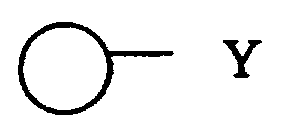
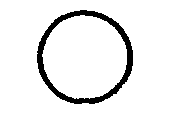
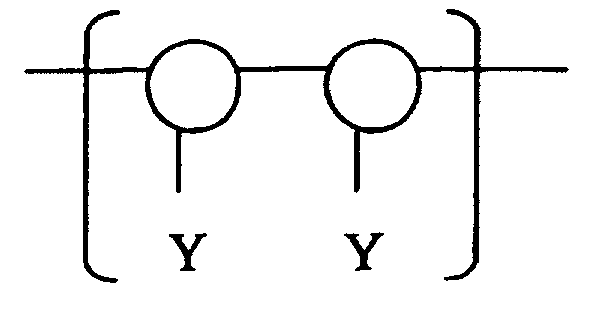
- a process for the catalytic copolymerisation of strained activated cyclic olefins consisting of contacting 99 - 50 parts of an activated strained mono (poly)cyclic olefin monofunctional monomer of formula with 1 - 50 parts of a strained di (poly)cyclic olefin difunctional monomer of formula in the presence of a catalyst or an initiating agent, wherein the amount of mono and difunctional monomers totals 100 parts of monomer wherein the group represents a strained (poly)cyclic olefin, whereby the monomers form a copolymer comprising the repeating unit and 1 - 50 parts of the unit which is adapted for subsequent cross linking of respective copolymer chains in the presence of heat and catalyst to form an amount of a cross linked copolymer comprising the unit, wherein the monofunctional and difunctional monomer are of formulae I and II: wherein at least one R 1 is a group Y facilitating non-D
- the process of the invention provides for preparation of polymeric materials having tailored properties, whereby monofunctional monomer tail Y and difunctional monomer spacer X may be selected to have desired properties in terms of stiffness or flexibility, mobility or immobility, in terms of tail or spacer length, spatial orientation, and may be combined in any given ratio of monomers and the like.
- the strained (poly)cyclic olefins of the invention may in fact be substituted by any nature of substituent which allows variation in "softness” and “hardness” or the like and regulation of crosslinking of polymeric material.
- the most convenient form allowing gradation of properties is that of a carbon skeleton which may be varied in length.
- the substituent according to the invention is also normally linked to the olefin by an electron withdrawing group, for reasons of ease of synthesis and the like.
- Other linking groups may be envisaged such as simple hydrocarbon, phenyl, or alkoxyl (electron donating), whereby the process of the invention may however be carried out with use of any combination of mono and difunctional monomer as hereinafter defined
- references herein to a monofunctional monomer, hereinafter CnM, and a difunctional monomer, hereinafter CmD, is to compounds comprising respectively one and two strained (poly)cyclic olefin functional units.
- the cyclic olefin is preferably a monocyclic olefin, more preferably norbornene, substituted in the 5 and/or 6 positions by exo- and/or endo-normally electron withdrawing group(s) and property modulating tail Y and spacer X as hereinbefore defined.
- At least one R 1 is a group Y and comprises an electron withdrawing group, preferably a carbonyl group.
- Monomers may be exo-, endo- or a mixture thereof.
- the process of the invention allows the option to select isomers for desired Tg (endo is stiffer than exo) and %trans isomer in the product.
- Preferably monomers are exo-, which are generally more reactive than endo- although resulting in lower product Tg.
- the process comprises dissolving the difunctional monomer in the monofunctional monomer and adding initiator in monomer solution.
- the process conditions may be controlled by selection of monomer ratio and isomer type to provide well ordered living polymerisation or otherwise. It is a particular advantage that the process provides substantially complete cure.
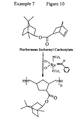
- the process of the invention provides as polymeric product of the reaction of I and II a crosslinked structure, an example of which is illustrated in Figure 1, in which the nature (length) of R leads to control of properties within the system from soft thermoset elastomers to hard or rigid thermoset materials.
- the polymerisation is suitably carried out in a predetermined ratio of I:II determining cross-link density and Tg.
- the selection of groups R 2 , R 3 and X as appropriate determines the material as hard or soft and its modulus and Tg.
- a preferred ratio of monomer to difunctional monomer I:II is in the range 99:1 to 50:50, preferably 95:5 to 70:30 or 99:1 to 90:10, which may conveniently be expressed as CnM + x% CmD. More preferably x is 1, 2, 2.5, 3, 5, 8, 10, 30 etc, and is preferably 1 for homogeneous cure.
- a catalyst comprising the reaction product of a metal oxide or halide and an alkylating agent.
- Preferred metals are selected from metals of Group VIII of the Periodic Table of the Elements Mo, Ru, Os, Ir, Rh and Re. Preferred is the "Grubbs" catalyst.
- the catalyst may be as described in WO 97/38036, WO 96/20235 or WO96/16008 as hereinbefore referred.
- ring opening metathesis catalysts comprising a metal oxide MXn and cocatalyst such as R 3 Al or EtAlCl 2 in combination, optionally with an O-containing promoter such as EtOH or PhOH may also be employed, depending on selection of cyclic olefin substituent.
- the catalyst may be in the presence of or include additional catalytic components or catalytic supports. Reaction may be in a suitable inert atmosphere according to choice of catalyst.
- the catalyst is present in catalytically effective amount, for example in an amount of 10,000:1 eg 4,000:1 monomer :catalyst.
- the polymerisation reaction is suitably carried out in substantial absence of any added solvents, the components being mutually compatible.
- the reaction is carried out at elevated temperature preferably in excess of room temperature up to approximately 200°C, preferably in the range of 60°C - 140°C or 160°C - 200°C, depending on preferred Tg, eg 90°C - 100°C to give homogeneous cure. Curing is carried out for a suitable period for example approximately 1 hour.
- Degassing of monomers is preferably carried out prior to reaction, which may be carried out without need for atmosphere control, or may be carried out in an inert atmosphere, depending on choice of catalyst.
- the process of the invention is preferably suited for the preparation of elastomers, plastics, composites in any desired form as shaped products, films, coatings and the like. It is a particular advantage of the process of the invention that such compounds may be readily prepared in which polymerisable monofunctional monomers and/or difunctional bridged monomers are selected to allow controlled crosslinking. The process therefore provides a known and a novel route to access whole ranges of new products using known and novel polymerisable monofunctional monomers and/or difunctional bridged monomers.
- Copolymers may be exo- or endo- or mixtures thereof and are preferably substantially all exo- as hereinbefore described.
- a method for selecting a mono and difunctional monomer as hereinbefore defined comprising determining modulus and chemical properties of desired cross-links, selecting a ratio of mono:di functional monomers determining the degree of cross-linking, for the cross-linking copolymerisation reaction thereof to provide product with desired properties.
- the present invention provides choice of multiplicity and nature of polymerisable components to control properties of product in the range of thermoplast (polymerisation of Ii or of IIi) through thermoset (copolymerisation of I and II). Selection of substituents and control of monomer molecular weight allow control of malodourous volatiles during the process and from the polymerised product.
- reaction injection molding RIM
- resin transfer molding RTM
- RTM may be employed, by virtue of the lowered reactivity and slower rate of reaction of the polymerisation process of the present invention, by virtue of the presence of the functionalised cyclic olefin groups.
- the method comprises combining separate streams of polymerisable monofunctional monomers and/or difunctional bridged monomers and catalyst (RIM) or premixing (RTM), injecting into a suitable mold and simultaneously or subsequently heating to activate and/or complete the polymerisation reaction.
- RIM polymerisable monofunctional monomers and/or difunctional bridged monomers and catalyst
- RTM premixing
- the method may employ any suitable reinforcement fibres and the like as known in the art.
- the mold suitably contains the fibres preformed with use of a binder according to known techniques.
- the shaped product is suitable for any of the hereinbefore defined uses and is associated with-advantages in terms of properties (modulus, Tg) as hereinbefore defined.
- thermoset or thermoplast polymeric product obtained by a method as hereinbefore defined.
- Bisphenol A dinorbornenyl ester Bisphenol A diacrylyl ester (1 mol) was dissolved in toluene and freshly prepared CPD (2.2 mol) was added slowly at room temperature under nitrogen. The reaction mixture was then refluxed for 12 hours. The monomer was recovered by removing volatiles under reduced pressure. The structure of the monomer was confirmed by 1 H and 13 C nmr and mass spectroscopy and is shown in Figure 5.
- the monomer was converted to the difunctional monomer Hydroquinone dinorbornenyl ester using the above synthesis as shown in Figure 6.
- exo -AN (20.0 g, 0.12 mol) was dissolved in glacial acetic acid (130 ml) at 118-120°C in a 3-necked round bottom flask equipped with a condenser, addition funnel, a thermometer and a magnetic stirrer bar.
- 1,3-Diaminopropane (4.4 g, 5 ml, 0.06 mol) was added to the flask via the dropping funnel over a period of 1 hour.
- the reaction mixture was heat to reflux for 2 hours, giving a pale yellow solution.
- the solution was poured into cold distilled water which was then extracted with dichloromethane.
- the organic layer was washed twice with distilled water, dried over anhydrous magnesium sulphate, filtered and the solvent was removed under vacuum.
- the final product was obtained by further recrystallisation from acetone to give the white powder, exo -C3D (40.0 g, 0.11 mol, 91% yield).
- exo-C5D The same procedure as for the synthesis of exo-C3D was used to synthesise exo-C5D, but the starting material in this case was 1,5-diaminopentane (6.1 g, 0.06 mol) to yield exo-C5D as a white powder (42.5 g, 0.11 mol, 90% yield).
- exo-C6D The same procedure as for the synthesis of exo-C3D was used to synthesise exo-C6D, but the starting material in this case was 1,6-diaminohexane (7.0 g, 0.06 mol) to yield exo-C6D as a white powder ( 45.3 g, 0.11 mol, 92% yield).
- exo-C9D The same procedure as for the synthesis of exo-C3D was used to synthesise exo-C9D, but the starting material in this case was 1,9-diaminononane (9.5 g, 0.06 mol) to yield exo-C9D as a white powder ( 44.7g, 0.10 mol, 83% yield).
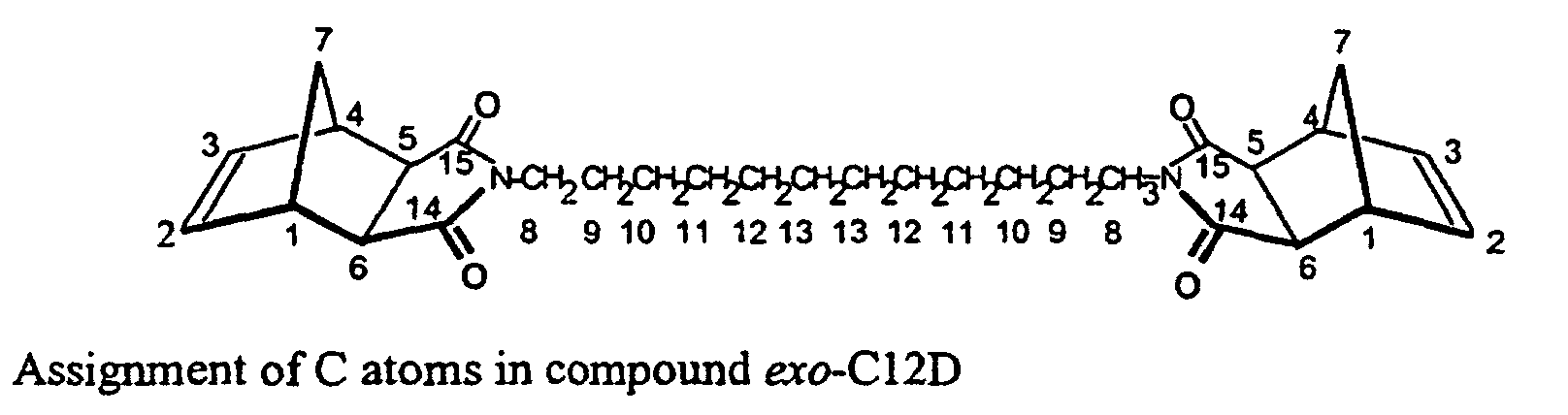
- exo-C12D The same procedure as for the synthesis of exo-C3D was used to synthesise exo-C12D, but the starting material in this case was 1,12-diaminododecane (12.0 g, 0.06 mol) to yield exo-C12D as a white powder (47.1 g, 0.10 mol, 80% yield).
- the monomer (20g , 0.08mol) and ruthenium carbene initiator (17 mg, 2.1 x 10⁻⁵ mol, ratio [monomer]:[initiator] 3,900:1) were mixed in a small reaction vessel and stirred at room temperature for 15 minutes. After 15 minutes, the reacting mixture was introduced into a glass mould using a syringe. The filled mould was placed in an oven at 60C for 20 minutes and 160C for 60 minutes. The mould then was removed from the oven and the final product was removed and allowed to cool to room temperature. The product is a glassy polymer, the extent of polymerisation is 98% (ie 2% residual monomer).
- thermoset polymer was obtained.
- Example A1 Testing of copolymer samples C5M M/I 8,000 and C12D
- Samples obtained from Example 8 were subject to tests to measure Tg and modulus as a function of incomplete/complete cure, homogeneity of cure, crosslinker and absolute values as a function of amount of crosslinker present.
Landscapes
- Chemical & Material Sciences (AREA)
- Chemical Kinetics & Catalysis (AREA)
- Medicinal Chemistry (AREA)
- Polymers & Plastics (AREA)
- Organic Chemistry (AREA)
- Health & Medical Sciences (AREA)
- Polyoxymethylene Polymers And Polymers With Carbon-To-Carbon Bonds (AREA)
- Addition Polymer Or Copolymer, Post-Treatments, Or Chemical Modifications (AREA)
- Casting Or Compression Moulding Of Plastics Or The Like (AREA)
- Indole Compounds (AREA)
- Manufacture Of Macromolecular Shaped Articles (AREA)
- Organic Low-Molecular-Weight Compounds And Preparation Thereof (AREA)
- Transition And Organic Metals Composition Catalysts For Addition Polymerization (AREA)
- Polymerisation Methods In General (AREA)
Abstract
Description

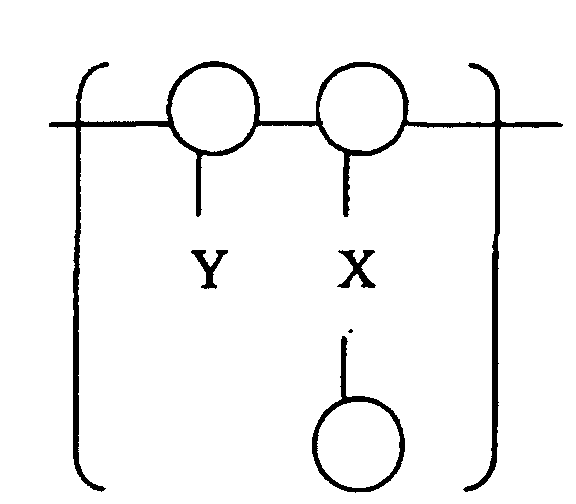
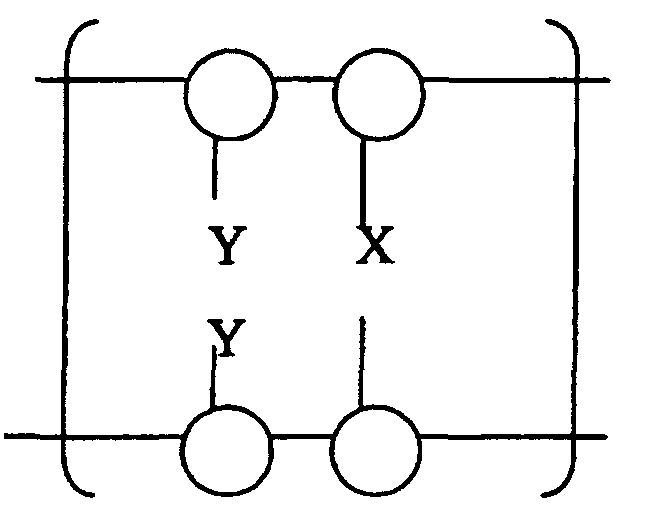
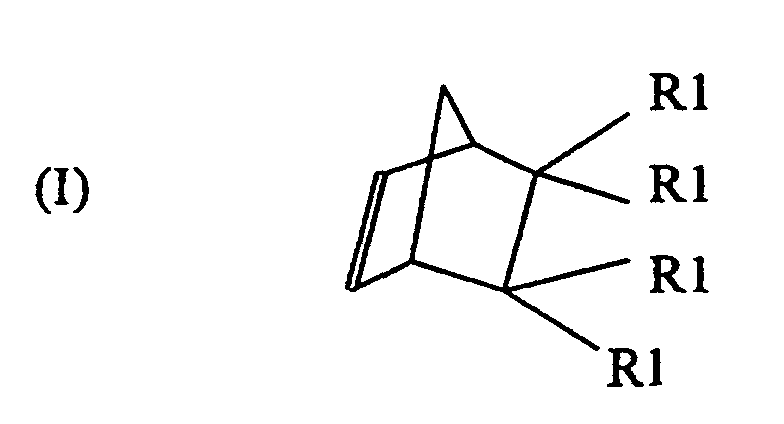

wherein at least one R1 is independently selected from COOR2, CONR2, COR2 and the like
in which R2 is selected from straight chain and branched, saturated and unsaturated C1-12 hydrocarbon optionally substituted by one or more hydroxy, halo, aryl, cycle C1-8 alkyl, bisphenol such as bisphenol A, bisphenol F, phenol, hydroquinone and the like, and optionally including at least one heteroatom such as O, P;
and one or more of the remaining groups R1 may be selected from H, C1-3 alkyl, halo such as F and the like;
or two groups R1 together form a cyclic amide or anhydride
-(CH2)pCONR3CO- ; -(CH2)pCOOCO-
in which p is 0 - 4 , and is 0 when the two groups form a fused structure or 1-4 when the two groups form a spiro structure;
- R3
- is as hereinbefore defined for R2 and is a bridging unit; and wherein
- X
- is a linear bridging group -COOR2COO- wherein R2 is as hereinbefore defined, substituting the cyclic olefin at the 5 positions and the 6 positions are unsubstituted or substituted by H, C1-3 alkyl, halo such as F and the like; or
- X
- is a fused bridging group -(CO)2NR3N(CO)2- in which
-(CO)2 N forms a 5 membered cyclic ring with the 5 and/or 6 positions of each cyclic olefin, or a methylene groupand wherein R3 is as hereinbefore defined.
The catalyst is present in catalytically effective amount, for example in an amount of 10,000:1 eg 4,000:1 monomer :catalyst.


- Mpt: 131.6 °C
- Elemental analysis- Found C, 68.78%, H, 5.98%, N, 7.73%; calculated for C21H22N2O4: C, 68.84%, H, 6.05%, N, 7.64%.
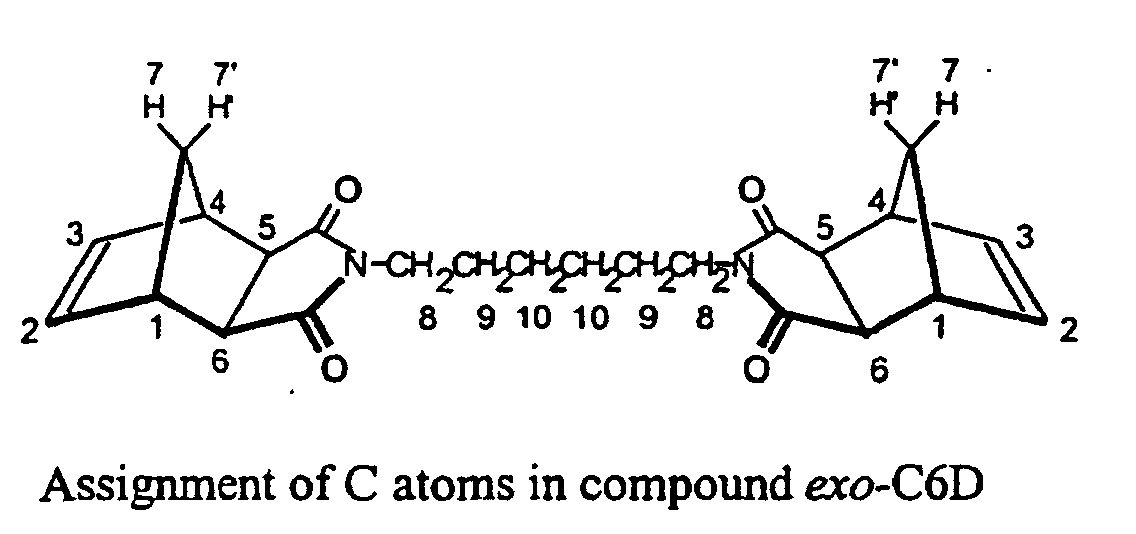
- 1H nmr- (see Appendix 2.33), (CDCl3, 400 MHz), δ (ppm)): 6.28 (t, 4H, H2,3), 3.46 (t, 4H, H8), 3.25 (p, 4H, H1,4), 2.66 (d, 4H, H5,6), 1.86 (p, 2H, H9), 1.52 (m, 2H, H7), 1.29 (m, 2H, H7').
- 13C nmr- (see Appendix 2.34), (CDCl3, 100 MHz), δ (ppm)): 177.94 (C10,11), 137.82 (C2,3), 47.84 (C5,6), 45.55 (C1,4), 43.20 (C7), 36.20 (C8), 26.32 (C9).
- Mass spectrum- (see Apendix 2.35), (EI+): 366 (C21H22N4O2, M+), 301 (MH+-C5H6), 235 (MH+-C10H12), 66 (M+-C16H16N4O2).
- IR- (see Appendix 2.36), (KBr disc, cm-1): 3048 (olefinic C-H stretching), 2996-2881 (saturated C-H stretching), 1859, 1776 (Asymmetric and symmetric C=O stretching, respectively), 1425 (C-N stretching).
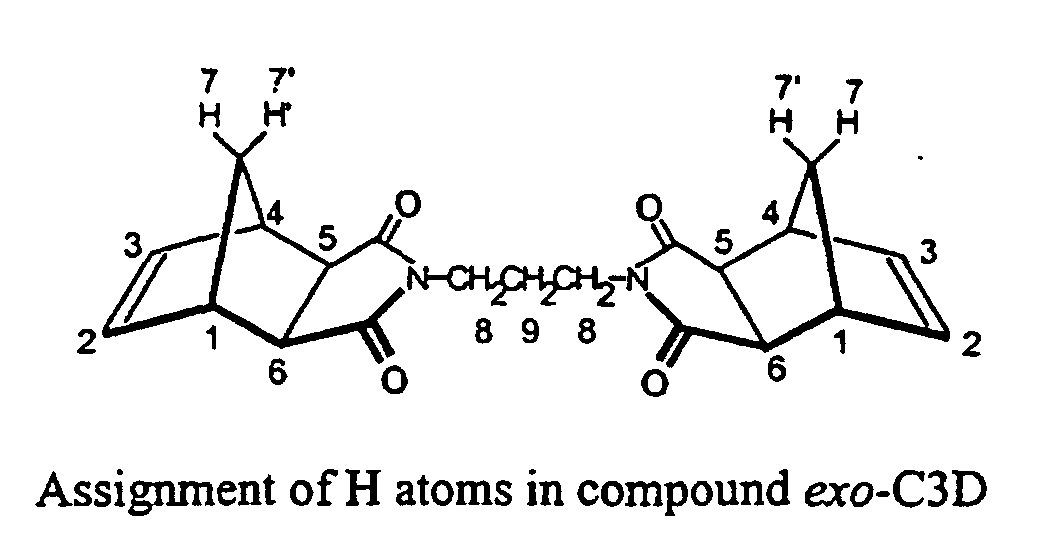

- Mpt: 185.1 °C
- Elemental analysis- Found C, 69.96%, H, 6.56%, N, 7.20%; calculated for C23H26N2O4: C, 70.03%, H, 6.64%, N, 7.10%.
- 1H nmr- (see Appendix 2.37), (CDCl3, 400 MHz, δ (ppm)): 6.28 (t, 4H, H2,3), 3.44 (t, 4H, H8), 3.26 (p, 4H, H1,4), 2.67 (d, 4H, H5,6), 1.57 (m, 4H, H9), 1.51(m, 2H, H7), 1.21 (m, 2H, H7'), 1.31 (p, 2H, H10).
- 13C nmr- (see Appendix 2.38), (CDCl3, 100 MHz), δ (ppm)): 178.05 (C11,12), 137.80 (C2,3), 47.79 (C5,6), 45.13 (C1,4), 42.75 (C7), 38.35 (C8), 27.26 (C9), 24.30 (C10).
- Mass spectrum- (see Appendix 2.39), (EI+): 394 (C23H26N4O2, M+), 329 (MH+-C5H6), 263 (MH+-C10H12), 66 (M+-C18H20N4O2).
- IR- (see Appendix 2.40), (KBr disc, cm-1): 3050 (olefinic C-H stretching), 2999-2847 (saturated C-H stretching), 1858, 1777 (Asymmetric and symmetric C=O stretching, respectively), 1420 (C-N stretching).


- Mpt: 154°C
- Elemental analysis- Found C, 70.13%, H, 6.84%, N, 6.84%; calculated for C24H28N2O4: C, 70.57%, H, 6.91%, N, 6.86%.
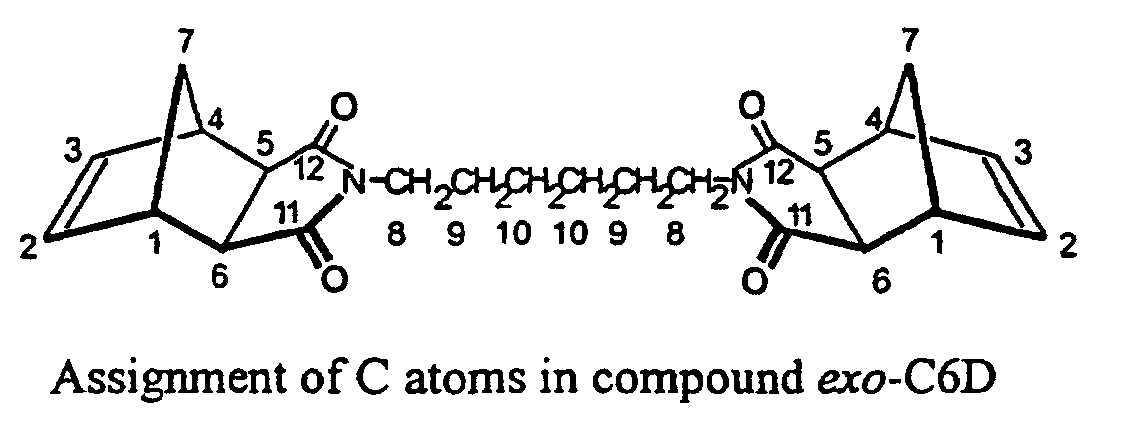
- 1H nmr- (see Appendix 2.41), (CDCl3, 400 MHz, δ (ppm)): 6.27 (t, 4H, H2,3), 3.43 (t, 4H, H8), 3.26 (p, 4H, H1,4), 2.66 (d, 4H, H5,6), 1.52 (m, 6H, H9, and H7), 1.31 (m, 4H, H10), 1.20 (m, 2H, H7').
- 13C nmr- (see Appendix 2.42), (CDCl3, 100 MHz, δ (ppm)): 177.94 (C11,12), 137.67 (C2,3), 47.66 (C5,6), 45.01 (C1,4), 42.62 (C7), 38.40 (C8), 27.45 (C9), 26.33 (C10).
- Mass spectrum- (see Apendix 2.43), (EI+): 408 (C24H28N4O2, M+), 343 (MH+-C5H6), 277 (MH+-C10H12), 66 (M+-C19H22N4O2).
- IR- (see Appendix 2.44), (KBr disc, cm-1): 3050 (olefinic C-H stretching), 2999-2889 (saturated C-H stretching), 1860, 1777 (Asymmetric and symmetric C=O stretching, respectively), 1420 (C-N stretching).
- Mpt: 68 °C
- Elemental analysis- Found C, 71.82%, H, 7.99%, N, 6.23%; calculated for C27H34N2O4: C, 71.97%, H, 7.61%, N, 6.22%.
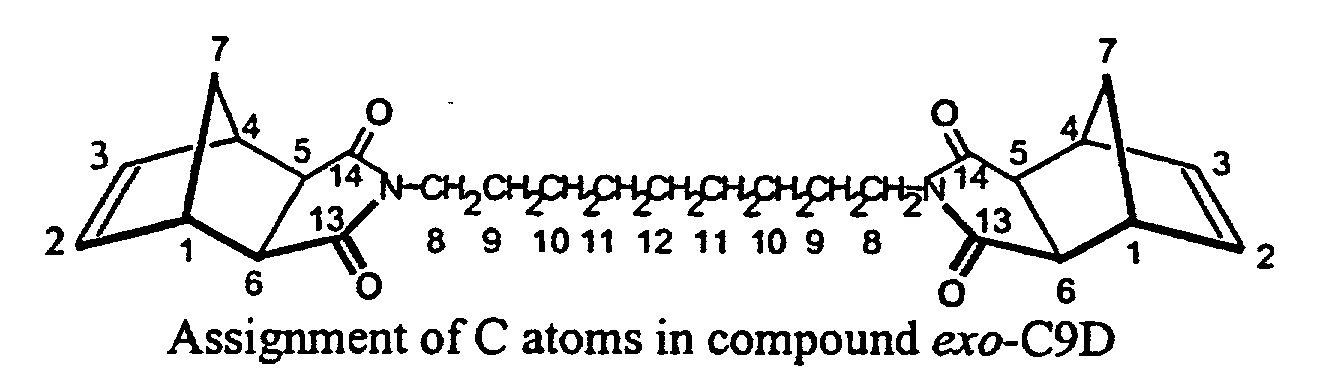
- 1H nmr- (see Appendix 2.45), (CDCl3, 400 MHz, δ (ppm)): 6.28 (t, 4H, H2,3), 3.43 (t, 4H, H8), 3.26 (p, 4H, H1,4), 2.66 (d, 4H, H5,6), 1.52 (m, 6H, H9 and H7), 1.25 (m, 12H, H10-12 and H7').
- 13C nmr- (see Appendix 2.46), (CDCl3, 100 MHz, δ (ppm)): 178.07 (C13,14), 137.78 (C2,3), 47.75 (C5,6), 45.11 (C1,4), 42.68 (C7), 38.67 (C8), 29.19 (C9), 27.00 (C10), 27.69 (C11), 26.84 (C12).
- Mass spectrum- (see Appendix 2.47), (EI+): 450 (C27H34N4O2, M+), 385 (MH+-C5H6), 319 (MH+-C10H12), 66 (M+-C22H28N4O2).
- IR- (see Appendix 2.48), (KBr disc, cm-1): 3050 (olefinic C-H stretching), 2997-2880 (saturated C-H stretching), 1860, 1779 (Asymmetric and symmetric C=O stretching, respectively), 1427 (C-N stretching).

- Mpt: 64 °C
- Elemental analysis- Found C, 73.29%, H, 8.51%, N, 5.79%; calculated for C30H40N2O4: C, 73.14%, H, 8.18%, N, 5.69%.
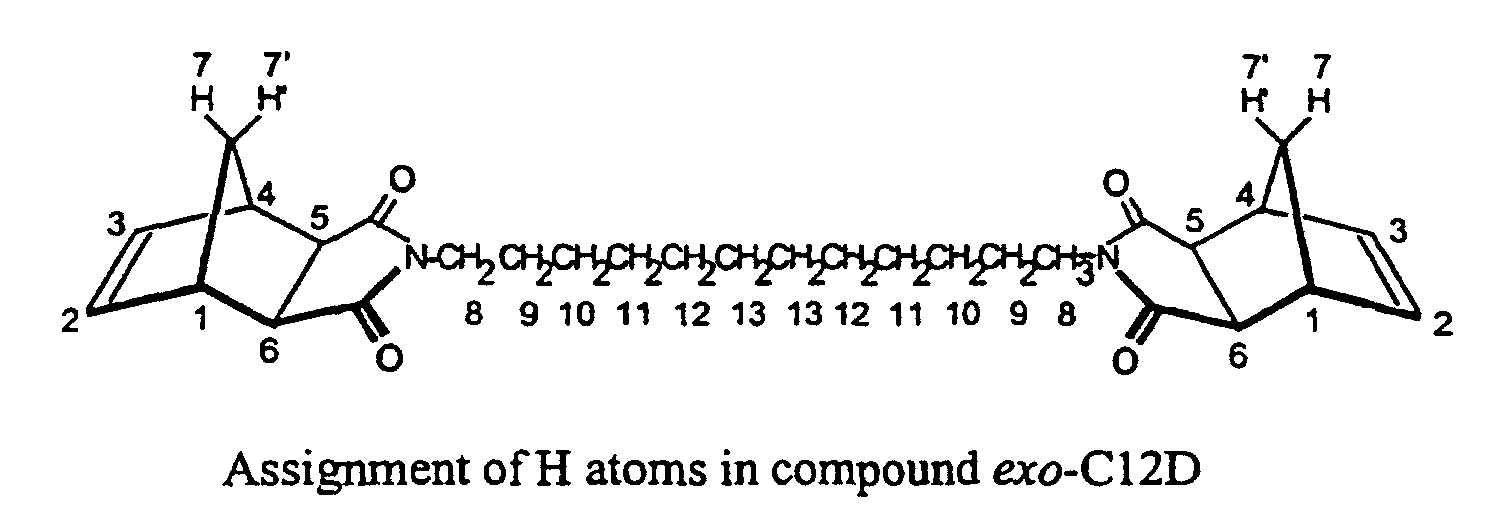
- 1H nmr- (see Appendix 2.49), (CDCl3, 400 MHz, δ (ppm)): 6.28 (t, 4H, H2,3), 3.46 (t, 4H, H8), 3.27 (p, 4H, H1,4), 2.66 (d, 4H, H5,6), 1.44 (m, 6H, H9 and H7), 1.24 (m, 18H, H10-13 and H7').
- 13C nmr- (see Appendix 2.50), (CDCl3, 100 MHz, δ (ppm)): 178.35 (C14,15), 138.06 (C2,3), 48.02 (C5,6), 45.39 C1,4), 42.94 (C7), 38.99 (C8), 29.70 (C9), 29.66 (C10), 29.37 (C11), 28.01 (C12), 27.19 (C13).
- Mass spectrum- (see Appendix 2.51), (EI+): 492 (C30H40N4O2, M+), 427 (MH+-C5H6), 361 (MH+-C10H12), 66 (M+-C25H34N4O2).
- IR- (see Appendix 2.52), (KBr disc, cm-1): 3045 (olefinic C-H stretching), 2997-2879 (saturated C-H stretching), 1860, 1779 (Asymmetric and symmetric C=O stretching, respectively), 1424 (C-N stretching).
Claims (11)
- Process for the catalytic copolymerisation of strained activated cyclic olefins consisting of contacting 99 - 50 parts of an activated strained mono (poly)cyclic olefin monofunctional monomer of formulawith 1 - 50 parts of a strained di (poly)cyclic olefin difunctional monomer of formula
 in the presence of a catalyst or an initiating agent, wherein the amount of mono and difunctional monomers totals 100 parts of monomer wherein the group
 represents a strained (poly)cyclic olefin, whereby the monomers form a copolymer comprising the repeating unit
 and 1 - 50 parts of the unit
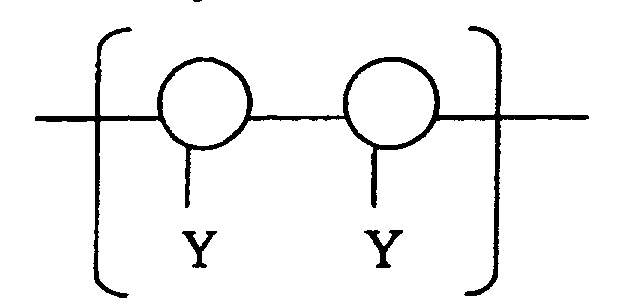 which is adapted for subsequent cross linking of respective copolymer chains in the presence of heat and catalyst to form an amount of a cross linked copolymer comprising the unit,
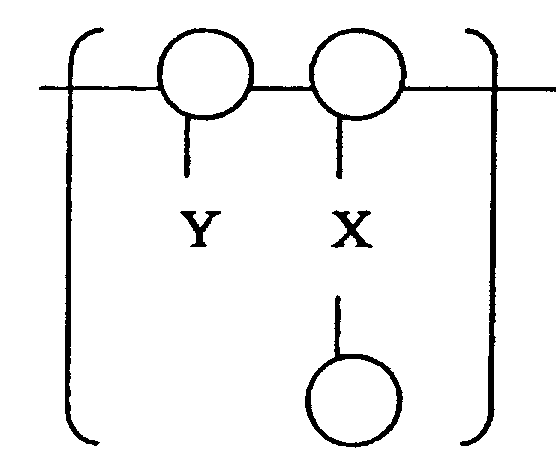 wherein the monofunctional and difunctional monomer are of formulae I and II: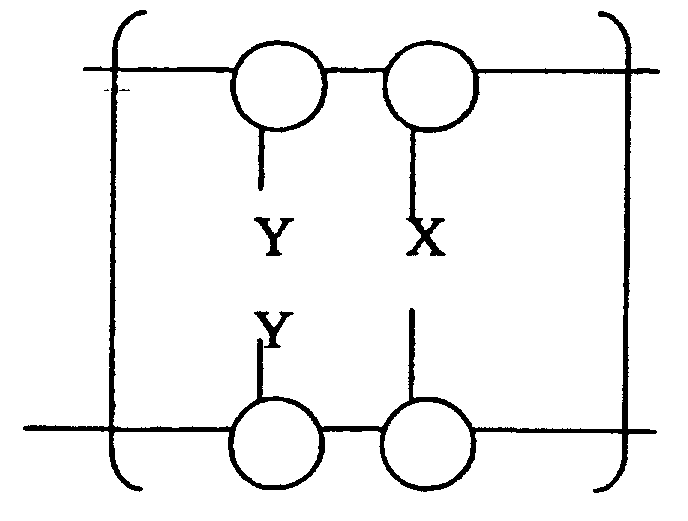
 wherein at least one R1 is a group Y facilitating non-DCP ROMP reaction with monomer II, and X comprises a 2, 3 or 4-valent or two 2-valent optionally substituted hydrocarbon spacer group(s) adapted to bridge adjacent crosslinked chains and which provides for controllable uniformity and degree of cross linking, providing controlled modulus and Tg
wherein at least one R1 is independently selected from COOR2, CONR2 and COR2;
in which R2 is selected from straight chain and branched, saturated and unsaturated C1-12 hydrocarbon optionally substituted by one or more hydroxy, halo, aryl, cycle C1-8 alkyl, bisphenol such as bisphenol A, bisphenol F, phenol, hydroquinone and the like, and optionally including at least one heteroatom such as O, P;
and one or more of the remaining groups R1 may be selected from H, C1-3 alkyl, halo such as F and the like;
or two groups R1 together form a cyclic amide or anhydride
-(CH2)pCONR3CO- ; -(CH2)pCOOCO-
in which p is 0 - 4 , and is 0 when the two groups form a fused structure or 1-4 when the two groups form a spiro structure;- R3
- is as hereinbefore defined for R2 and is a bridging unit; and wherein
- X
- is a linear bridging group -COOR2COO- wherein R2 is as hereinbefore defined, substituting the cyclic olefin at the 5 positions and the 6 positions are unsubstituted or substituted by H, C1-3 alkyl, halo such as F and the like; or
- X
- is a fused bridging group -(CO)2NR3N(CO)2- in which
-(CO)2 N forms a 5 membered cyclic ring with the 5 and/or 6 positions of each cyclic olefin, or a methylene groupand wherein R3 is as hereinbefore defined.
- Process as claimed in Claim I wherein monomers are exo-.
- Process as claimed in any of Claims 1 to 2 which comprises dissolving the difunctional monomer in the monofunctional monomer in the absence of added solvent and adding initiator to the mixture of neat monomers in the absence of added solvent.
- Process as claimed in any of Claims 1 to 3 wherein ratio of monofunctional monomer to difunctional monomer I:II is in the range 99:1 to 50:50.
- Process as claimed in any of Claims 1 to 4 wherein the catalyst comprises the reaction product of a metal oxide or halide and an alkylating agent.
- Process as claimed in any of Claims 1 to 5 wherein catalyst comprises the ruthenium carbene initiator.
- Process as claimed in any of Claims 1 to 6 which is carried out at elevated temperature in excess of room temperature up to approximately 200°C, depending on preferred Tg to give homogeneous cure.
- Process as claimed in any of Claims 1 to 7 for the preparation of elastomers, plastics, composites in any desired form as shaped products, films, coatings and the like.
- A process as claimed in any of Claims 1 to 8 including additionally selecting the mono and difunctional monomer as hereinbefore defined in any of Claims 1 and 2 for polymerisation, comprising determining modulus and chemical properties of desired cross-links, selecting a ratio of mono:di functional monomers determining the degree of cross-linking, for the cross-linking copolymerisation reaction thereof to provide product with desired properties.
- A method for the preparation of shaped products comprising using the method as claimed in any of Claims 1 to 9 for reaction injection molding (RIM) or resin transfer molding (RTM), by combining separate streams of the polymerisable monofunctional monomers and/or difunctional bridged monomers and catalyst (RIM) or premixing (RTM), injecting into a suitable mold and simultaneously or subsequently heating to activate and/or complete the polymerisation reaction.
- A thermoset or thermoplast polymeric product or a shaped product obtained by the process or method of the invention as hereinbefore defined in any of Claims 1 to 10.
Applications Claiming Priority (3)
| Application Number | Priority Date | Filing Date | Title |
|---|---|---|---|
| GB9916235 | 1999-07-09 | ||
| GBGB9916235.6A GB9916235D0 (en) | 1999-07-09 | 1999-07-09 | Process for polymerisation of olefins and novel polymerisable olefins |
| PCT/GB2000/002548 WO2001004173A1 (en) | 1999-07-09 | 2000-07-10 | Process for the polymerisation of cycloolefins and polymerisable cycloolefins |
Publications (2)
| Publication Number | Publication Date |
|---|---|
| EP1200503A1 EP1200503A1 (en) | 2002-05-02 |
| EP1200503B1 true EP1200503B1 (en) | 2005-04-13 |
Family
ID=10857042
Family Applications (1)
| Application Number | Title | Priority Date | Filing Date |
|---|---|---|---|
| EP00942251A Expired - Lifetime EP1200503B1 (en) | 1999-07-09 | 2000-07-10 | Process for the polymerisation of cycloolefins and polymerisable cycloolefins |
Country Status (8)
| Country | Link |
|---|---|
| US (1) | US6677418B1 (en) |
| EP (1) | EP1200503B1 (en) |
| JP (1) | JP2003504498A (en) |
| AT (1) | ATE293137T1 (en) |
| AU (1) | AU5695400A (en) |
| DE (1) | DE60019427D1 (en) |
| GB (1) | GB9916235D0 (en) |
| WO (1) | WO2001004173A1 (en) |
Cited By (1)
| Publication number | Priority date | Publication date | Assignee | Title |
|---|---|---|---|---|
| DE10102086B4 (en) * | 2000-08-26 | 2008-08-14 | Hemmasi, Bahram, Dr. | Synthesis and Applications of Extremely Swellable, Functionalized Crosslinked Polymers by Ring-Opening Metathesis Copolymerization (ROMC) |
Families Citing this family (32)
| Publication number | Priority date | Publication date | Assignee | Title |
|---|---|---|---|---|
| WO2001071309A2 (en) * | 2000-03-21 | 2001-09-27 | Wisconsin Alumni Research Foundation | Methods and reagents for regulation of cellular responses in biological systems |
| US20040248801A1 (en) * | 2000-03-21 | 2004-12-09 | Kiessling Laura L. | Methods and reagents for regulation of cellular responses in biological systems |
| GB0329812D0 (en) * | 2003-12-23 | 2004-01-28 | Amersham Plc | Romp polymer synthesis |
| US20090156735A1 (en) * | 2007-12-14 | 2009-06-18 | General Electric Company | Composition, article, and associated method |
| US20090156726A1 (en) * | 2007-12-14 | 2009-06-18 | General Electric Company | Composition, article, and associated method |
| US9688631B2 (en) * | 2009-03-02 | 2017-06-27 | Isp Investments Llc | Thermosetting ring-opening metathesis polymerization materials with thermally degradable linkages |
| US8895667B2 (en) * | 2009-07-17 | 2014-11-25 | Tyco Electronics Corporation | Methods of making reversible crosslinked polymers and related methods |
| FR3031517B1 (en) | 2015-01-08 | 2018-08-17 | Bostik Sa | HYDROCARBON POLYMERS WITH TWO ALCOXYSILANE TERMINAL GROUPS |
| FR3031979B1 (en) | 2015-01-22 | 2017-07-14 | Bostik Sa | HYDROCARBON POLYMERS WITH TWO ALCOXYSILANE TERMINAL GROUPS |
| US9649603B2 (en) | 2015-03-31 | 2017-05-16 | Pall Corporation | Hydrophilically modified fluorinated membrane (III) |
| US9724650B2 (en) | 2015-03-31 | 2017-08-08 | Pall Corporation | Hydrophilically modified fluorinated membrane (II) |
| US9643130B2 (en) | 2015-03-31 | 2017-05-09 | Pall Corporation | Hydrophilically modified fluorinated membrane (IV) |
| US9630151B2 (en) | 2015-03-31 | 2017-04-25 | Pall Corporation | Hydrophilically modified fluorinated membrane (V) |
| US9636641B2 (en) | 2015-03-31 | 2017-05-02 | Pall Corporation | Hydrophilically modified fluorinated membrane (I) |
| FR3034770B1 (en) | 2015-04-10 | 2017-05-12 | Bostik Sa | HYDROCARBON POLYMERS COMPRISING TWO EXO-VINYLENE CYCLOCARBONATE TERMINAL GROUPS |
| US9849428B2 (en) | 2015-04-30 | 2017-12-26 | Pall Corporation | Hydrophilically modified fluorinated membrane (VI) |
| FR3036399B1 (en) | 2015-05-20 | 2017-06-16 | Bostik Sa | HYDROCARBON POLYMERS COMPRISING TWO TERMINAL GROUPS (2-THIONE-1,3-OXATHIOLAN-4-YL) ALKYLOXYCARBONYL |
| US10315168B2 (en) | 2015-07-31 | 2019-06-11 | Pall Corporation | Hydrophilic porous polytetrafluoroethylene membrane (II) |
| US9643131B2 (en) | 2015-07-31 | 2017-05-09 | Pall Corporation | Hydrophilic porous polytetrafluoroethylene membrane (I) |
| FR3051471A1 (en) | 2016-05-17 | 2017-11-24 | Bostik Sa | HYDROCARBON POLYMERS WITH TWO ALCOXYSILANE TERMINAL GROUPS |
| WO2018002473A1 (en) | 2016-06-29 | 2018-01-04 | Bostik Sa | New hydrocarbon polymers comprising two alkoxysilane end groups, and methods for preparing same |
| FR3054235B1 (en) | 2016-07-19 | 2018-08-24 | Bostik Sa | HYDROCARBON POLYMERS WITH TWO AZLACTONE TERMINAL GROUPS |
| FR3055134B1 (en) | 2016-08-16 | 2018-08-24 | Bostik Sa | NOVEL HYDROCARBON POLYMERS WITH DITHIOCYCLOCARBONATE TERMINAL GROUPS |
| FR3055900B1 (en) | 2016-09-15 | 2018-08-31 | Bostik Sa | HYDROCARBON POLYMERS WITH TWO TERMINAL GROUPS 2-OXO-1,3-DIOXOLAN-4-CARBOXYLATE |
| FR3057269B1 (en) | 2016-10-07 | 2018-11-23 | Bostik Sa | NOVEL HYDROCARBON POLYMERS WITH EXO-VINYLENE CYCLOCARBONATE TERMINAL GROUPS |
| FR3066763B1 (en) | 2017-05-24 | 2019-06-28 | Bostik Sa | NOVEL HYDROCARBON COPOLYMERS LIQUID TO TWO ALCOXYSILANE TERMINAL GROUPS AND PROCESS FOR PREPARING THE SAME |
| FR3066762B1 (en) | 2017-05-24 | 2019-06-28 | Bostik Sa | LIQUID HYDROCARBON COPOLYMERS WITH TWO ALCOXYSILANE TERMINAL GROUPS AND PROCESS FOR PREPARING THE SAME |
| FR3071502B1 (en) | 2017-09-28 | 2020-06-19 | Bostik Sa | LIQUID HYDROCARBON COPOLYMERS WITH TWO ESTER CYCLOCARBONATE TERMINAL GROUPS |
| FR3071501A1 (en) | 2017-09-28 | 2019-03-29 | Bostik Sa | LIQUID HYDROCARBON COPOLYMERS WITH TWO TERMINAL GROUPS ETHER CYCLOCARBONATE |
| FR3087442B1 (en) | 2018-10-18 | 2020-10-02 | Bostik Sa | HYDROCARBON COPOLYMERS WITH ALTERNATE BLOCKS AND ALCOXYSILANE TERMINAL GROUPS |
| FR3115789B1 (en) | 2020-11-03 | 2024-04-12 | Bostik Sa | HYDROCARBON polymer with POLYETHER AND POLYOLEFINE blocks COMPRISING AT LEAST ONE terminal alkoxysilane group |
| US20240239958A1 (en) * | 2021-04-01 | 2024-07-18 | The Board Of Trustees Of The Leland Stanford Junior University | Degradable copolymers of enol ethers with olefinic monomers |
Family Cites Families (10)
| Publication number | Priority date | Publication date | Assignee | Title |
|---|---|---|---|---|
| US3658669A (en) * | 1968-09-13 | 1972-04-25 | Union Carbide Corp | Radiation crosslinked dinorbornene polymers |
| FR1594934A (en) | 1968-12-05 | 1970-06-08 | ||
| US4354012A (en) * | 1981-06-12 | 1982-10-12 | United Technologies Corporation | Aliphatic diene bis-imide polymers |
| EP0283719A3 (en) * | 1987-02-23 | 1989-06-14 | Hercules Incorporated | Metathesis polymerized cross-linked halogen-containing copolymer |
| CA1296836C (en) * | 1987-03-13 | 1992-03-03 | Zen-Ichiro Endo | Metathesis polymerized copolymer |
| AU604132B2 (en) | 1987-06-26 | 1990-12-06 | Monsanto Company | Norbornene dicarboximide polymers |
| US5219966A (en) * | 1988-05-20 | 1993-06-15 | Monsanto Company | Norbornene dicarboximide polymers |
| AU700404B2 (en) | 1994-11-17 | 1999-01-07 | Ciba Specialty Chemicals Holding Inc. | Monomers and composition which can be crosslinked and croslinked polymers |
| US6235856B1 (en) | 1994-12-23 | 2001-05-22 | Ciba Specialty Chemicals Corporation | Polymerization of dicyclopentadiene |
| JP2000513393A (en) | 1996-04-04 | 2000-10-10 | チバ スペシャルティ ケミカルズ ホールディング インコーポレーテッド | Catalyst mixture and polymerizable composition |
-
1999
- 1999-07-09 GB GBGB9916235.6A patent/GB9916235D0/en not_active Ceased
-
2000
- 2000-07-10 AT AT00942251T patent/ATE293137T1/en not_active IP Right Cessation
- 2000-07-10 DE DE60019427T patent/DE60019427D1/en not_active Expired - Lifetime
- 2000-07-10 WO PCT/GB2000/002548 patent/WO2001004173A1/en not_active Ceased
- 2000-07-10 AU AU56954/00A patent/AU5695400A/en not_active Abandoned
- 2000-07-10 JP JP2001509781A patent/JP2003504498A/en active Pending
- 2000-07-10 US US10/019,315 patent/US6677418B1/en not_active Expired - Fee Related
- 2000-07-10 EP EP00942251A patent/EP1200503B1/en not_active Expired - Lifetime
Cited By (1)
| Publication number | Priority date | Publication date | Assignee | Title |
|---|---|---|---|---|
| DE10102086B4 (en) * | 2000-08-26 | 2008-08-14 | Hemmasi, Bahram, Dr. | Synthesis and Applications of Extremely Swellable, Functionalized Crosslinked Polymers by Ring-Opening Metathesis Copolymerization (ROMC) |
Also Published As
| Publication number | Publication date |
|---|---|
| US6677418B1 (en) | 2004-01-13 |
| JP2003504498A (en) | 2003-02-04 |
| AU5695400A (en) | 2001-01-30 |
| WO2001004173A1 (en) | 2001-01-18 |
| ATE293137T1 (en) | 2005-04-15 |
| GB9916235D0 (en) | 1999-09-15 |
| EP1200503A1 (en) | 2002-05-02 |
| DE60019427D1 (en) | 2005-05-19 |
Similar Documents
| Publication | Publication Date | Title |
|---|---|---|
| US6677418B1 (en) | Process for polymerization of cycloolefins and polymerizable cycloolefins | |
| EP0626402B1 (en) | Linear telechelic difunctional polymers and process for their preparation. | |
| EP3107655B1 (en) | Catalysts and methods for ring opening metathesis polymerization | |
| KR100441214B1 (en) | Polymerization Method of Lower DCPD Monomer Using Olefin Metathesis Catalyst | |
| US4011386A (en) | Process for producing polymers or copolymers of norbornene-carboxylic acid amides | |
| KR930007877B1 (en) | Copolymers of norbornene-type cycloolefins | |
| US11794179B2 (en) | Synthesis and characterization of metathesis catalysts | |
| EP0841988B1 (en) | A ruthenium-based catalyst composition for olefin metathesis | |
| Xue et al. | Synthesis of polymeric antioxidants based on ring-opening metathesis polymerization (ROMP) and their antioxidant ability for preventing polypropylene (PP) from thermal oxidation degradation | |
| EP1598384B1 (en) | Novel polymer and process for producing the same | |
| KR101595604B1 (en) | Cycloolefin Polymers and Method for Preparing the Same | |
| JPH01256518A (en) | Amine-containing oxidation inhibitor performing ring opening methathesis polymerization | |
| WO2018191373A1 (en) | Synthesis and characterization of metathesis catalysts | |
| Lee et al. | A systematic study of stereochemical effects in homologous poly (alkenamer) s: Dewar benzene versus norbornene | |
| KR100503371B1 (en) | Addition polymers derived from pauson-khand type norborbene monomers and preparation method therof | |
| Alonso et al. | Homopolymerization of norbornene by rhenium olefin metathesis catalysts | |
| RU2805057C1 (en) | Ruthenium catalyst and its use in metathesis reactions | |
| JPH03220230A (en) | Hydrogenated ring-opening polymer and its production | |
| Alupei et al. | Forgotten monomers: free radical polymerization behavior of norbornadiene derivatives in comparison with methyl methacrylate | |
| KR100497177B1 (en) | Addition polymers derived from pauson-khand type norborbene monomers and preparation method therof | |
| KR100503374B1 (en) | Addition polymers derived from pauson-khand type norborbene monomers and preparation method therof | |
| JP3862808B2 (en) | Polymer having oxidation-resistant carbon in chemical structure and method for producing the same | |
| Tsonis et al. | Ring retention in the homopolymerization of cyclic olefins by rhenium olefin metathesis catalysts | |
| KR100497178B1 (en) | Addition polymers derived from pauson-khand type norborbene monomers and preparation method therof | |
| Çetinkaya et al. | Synthesis of high‐Tg polymers via ROMP of oxanorbornene dicarboximides with halogen groups |
Legal Events
| Date | Code | Title | Description |
|---|---|---|---|
| PUAI | Public reference made under article 153(3) epc to a published international application that has entered the european phase |
Free format text: ORIGINAL CODE: 0009012 |
|
| 17P | Request for examination filed |
Effective date: 20020211 |
|
| AK | Designated contracting states |
Kind code of ref document: A1 Designated state(s): AT BE CH CY DE DK ES FI FR GB GR IE IT LI LU MC NL PT SE |
|
| AX | Request for extension of the european patent |
Free format text: AL;LT;LV;MK;RO;SI |
|
| 17Q | First examination report despatched |
Effective date: 20030327 |
|
| GRAP | Despatch of communication of intention to grant a patent |
Free format text: ORIGINAL CODE: EPIDOSNIGR1 |
|
| GRAS | Grant fee paid |
Free format text: ORIGINAL CODE: EPIDOSNIGR3 |
|
| GRAA | (expected) grant |
Free format text: ORIGINAL CODE: 0009210 |
|
| AK | Designated contracting states |
Kind code of ref document: B1 Designated state(s): AT BE CH CY DE DK ES FI FR GB GR IE IT LI LU MC NL PT SE |
|
| PG25 | Lapsed in a contracting state [announced via postgrant information from national office to epo] |
Ref country code: IT Free format text: LAPSE BECAUSE OF FAILURE TO SUBMIT A TRANSLATION OF THE DESCRIPTION OR TO PAY THE FEE WITHIN THE PRESCRIBED TIME-LIMIT;WARNING: LAPSES OF ITALIAN PATENTS WITH EFFECTIVE DATE BEFORE 2007 MAY HAVE OCCURRED AT ANY TIME BEFORE 2007. THE CORRECT EFFECTIVE DATE MAY BE DIFFERENT FROM THE ONE RECORDED. Effective date: 20050413 Ref country code: BE Free format text: LAPSE BECAUSE OF FAILURE TO SUBMIT A TRANSLATION OF THE DESCRIPTION OR TO PAY THE FEE WITHIN THE PRESCRIBED TIME-LIMIT Effective date: 20050413 Ref country code: AT Free format text: LAPSE BECAUSE OF FAILURE TO SUBMIT A TRANSLATION OF THE DESCRIPTION OR TO PAY THE FEE WITHIN THE PRESCRIBED TIME-LIMIT Effective date: 20050413 Ref country code: CH Free format text: LAPSE BECAUSE OF FAILURE TO SUBMIT A TRANSLATION OF THE DESCRIPTION OR TO PAY THE FEE WITHIN THE PRESCRIBED TIME-LIMIT Effective date: 20050413 Ref country code: LI Free format text: LAPSE BECAUSE OF FAILURE TO SUBMIT A TRANSLATION OF THE DESCRIPTION OR TO PAY THE FEE WITHIN THE PRESCRIBED TIME-LIMIT Effective date: 20050413 Ref country code: ES Free format text: LAPSE BECAUSE OF FAILURE TO SUBMIT A TRANSLATION OF THE DESCRIPTION OR TO PAY THE FEE WITHIN THE PRESCRIBED TIME-LIMIT Effective date: 20050413 Ref country code: FI Free format text: LAPSE BECAUSE OF FAILURE TO SUBMIT A TRANSLATION OF THE DESCRIPTION OR TO PAY THE FEE WITHIN THE PRESCRIBED TIME-LIMIT Effective date: 20050413 Ref country code: NL Free format text: LAPSE BECAUSE OF FAILURE TO SUBMIT A TRANSLATION OF THE DESCRIPTION OR TO PAY THE FEE WITHIN THE PRESCRIBED TIME-LIMIT Effective date: 20050413 |
|
| REG | Reference to a national code |
Ref country code: GB Ref legal event code: FG4D |
|
| REG | Reference to a national code |
Ref country code: CH Ref legal event code: EP |
|
| REG | Reference to a national code |
Ref country code: IE Ref legal event code: FG4D |
|
| REF | Corresponds to: |
Ref document number: 60019427 Country of ref document: DE Date of ref document: 20050519 Kind code of ref document: P |
|
| PG25 | Lapsed in a contracting state [announced via postgrant information from national office to epo] |
Ref country code: CY Free format text: LAPSE BECAUSE OF FAILURE TO SUBMIT A TRANSLATION OF THE DESCRIPTION OR TO PAY THE FEE WITHIN THE PRESCRIBED TIME-LIMIT Effective date: 20050710 Ref country code: LU Free format text: LAPSE BECAUSE OF NON-PAYMENT OF DUE FEES Effective date: 20050710 |
|
| PG25 | Lapsed in a contracting state [announced via postgrant information from national office to epo] |
Ref country code: IE Free format text: LAPSE BECAUSE OF NON-PAYMENT OF DUE FEES Effective date: 20050711 |
|
| PG25 | Lapsed in a contracting state [announced via postgrant information from national office to epo] |
Ref country code: SE Free format text: LAPSE BECAUSE OF FAILURE TO SUBMIT A TRANSLATION OF THE DESCRIPTION OR TO PAY THE FEE WITHIN THE PRESCRIBED TIME-LIMIT Effective date: 20050713 Ref country code: DK Free format text: LAPSE BECAUSE OF FAILURE TO SUBMIT A TRANSLATION OF THE DESCRIPTION OR TO PAY THE FEE WITHIN THE PRESCRIBED TIME-LIMIT Effective date: 20050713 Ref country code: GR Free format text: LAPSE BECAUSE OF FAILURE TO SUBMIT A TRANSLATION OF THE DESCRIPTION OR TO PAY THE FEE WITHIN THE PRESCRIBED TIME-LIMIT Effective date: 20050713 |
|
| PG25 | Lapsed in a contracting state [announced via postgrant information from national office to epo] |
Ref country code: DE Free format text: LAPSE BECAUSE OF FAILURE TO SUBMIT A TRANSLATION OF THE DESCRIPTION OR TO PAY THE FEE WITHIN THE PRESCRIBED TIME-LIMIT Effective date: 20050714 |
|
| PG25 | Lapsed in a contracting state [announced via postgrant information from national office to epo] |
Ref country code: MC Free format text: LAPSE BECAUSE OF NON-PAYMENT OF DUE FEES Effective date: 20050731 |
|
| PG25 | Lapsed in a contracting state [announced via postgrant information from national office to epo] |
Ref country code: PT Free format text: LAPSE BECAUSE OF FAILURE TO SUBMIT A TRANSLATION OF THE DESCRIPTION OR TO PAY THE FEE WITHIN THE PRESCRIBED TIME-LIMIT Effective date: 20050913 |
|
| NLV1 | Nl: lapsed or annulled due to failure to fulfill the requirements of art. 29p and 29m of the patents act | ||
| REG | Reference to a national code |
Ref country code: CH Ref legal event code: PL |
|
| PLBE | No opposition filed within time limit |
Free format text: ORIGINAL CODE: 0009261 |
|
| STAA | Information on the status of an ep patent application or granted ep patent |
Free format text: STATUS: NO OPPOSITION FILED WITHIN TIME LIMIT |
|
| 26N | No opposition filed |
Effective date: 20060116 |
|
| REG | Reference to a national code |
Ref country code: IE Ref legal event code: MM4A |
|
| EN | Fr: translation not filed | ||
| PGFP | Annual fee paid to national office [announced via postgrant information from national office to epo] |
Ref country code: GB Payment date: 20060619 Year of fee payment: 7 |
|
| GBPC | Gb: european patent ceased through non-payment of renewal fee |
Effective date: 20070710 |
|
| PG25 | Lapsed in a contracting state [announced via postgrant information from national office to epo] |
Ref country code: GB Free format text: LAPSE BECAUSE OF NON-PAYMENT OF DUE FEES Effective date: 20070710 |
|
| PG25 | Lapsed in a contracting state [announced via postgrant information from national office to epo] |
Ref country code: FR Free format text: LAPSE BECAUSE OF NON-PAYMENT OF DUE FEES Effective date: 20050731 |
|
| PG25 | Lapsed in a contracting state [announced via postgrant information from national office to epo] |
Ref country code: FR Free format text: LAPSE BECAUSE OF NON-PAYMENT OF DUE FEES Effective date: 20050413 |