EP1199598A2 - Color photographic element exhibiting increased red speed - Google Patents
Color photographic element exhibiting increased red speed Download PDFInfo
- Publication number
- EP1199598A2 EP1199598A2 EP01203777A EP01203777A EP1199598A2 EP 1199598 A2 EP1199598 A2 EP 1199598A2 EP 01203777 A EP01203777 A EP 01203777A EP 01203777 A EP01203777 A EP 01203777A EP 1199598 A2 EP1199598 A2 EP 1199598A2
- Authority
- EP
- European Patent Office
- Prior art keywords
- layer
- red
- grains
- silver halide
- red light
- Prior art date
- Legal status (The legal status is an assumption and is not a legal conclusion. Google has not performed a legal analysis and makes no representation as to the accuracy of the status listed.)
- Withdrawn
Links
Classifications
-
- G—PHYSICS
- G03—PHOTOGRAPHY; CINEMATOGRAPHY; ANALOGOUS TECHNIQUES USING WAVES OTHER THAN OPTICAL WAVES; ELECTROGRAPHY; HOLOGRAPHY
- G03C—PHOTOSENSITIVE MATERIALS FOR PHOTOGRAPHIC PURPOSES; PHOTOGRAPHIC PROCESSES, e.g. CINE, X-RAY, COLOUR, STEREO-PHOTOGRAPHIC PROCESSES; AUXILIARY PROCESSES IN PHOTOGRAPHY
- G03C7/00—Multicolour photographic processes or agents therefor; Regeneration of such processing agents; Photosensitive materials for multicolour processes
- G03C7/30—Colour processes using colour-coupling substances; Materials therefor; Preparing or processing such materials
- G03C7/3029—Materials characterised by a specific arrangement of layers, e.g. unit layers, or layers having a specific function
-
- G—PHYSICS
- G03—PHOTOGRAPHY; CINEMATOGRAPHY; ANALOGOUS TECHNIQUES USING WAVES OTHER THAN OPTICAL WAVES; ELECTROGRAPHY; HOLOGRAPHY
- G03C—PHOTOSENSITIVE MATERIALS FOR PHOTOGRAPHIC PURPOSES; PHOTOGRAPHIC PROCESSES, e.g. CINE, X-RAY, COLOUR, STEREO-PHOTOGRAPHIC PROCESSES; AUXILIARY PROCESSES IN PHOTOGRAPHY
- G03C7/00—Multicolour photographic processes or agents therefor; Regeneration of such processing agents; Photosensitive materials for multicolour processes
- G03C7/30—Colour processes using colour-coupling substances; Materials therefor; Preparing or processing such materials
- G03C7/3029—Materials characterised by a specific arrangement of layers, e.g. unit layers, or layers having a specific function
- G03C2007/3032—Non-sensitive AgX or layer containing it
-
- G—PHYSICS
- G03—PHOTOGRAPHY; CINEMATOGRAPHY; ANALOGOUS TECHNIQUES USING WAVES OTHER THAN OPTICAL WAVES; ELECTROGRAPHY; HOLOGRAPHY
- G03C—PHOTOSENSITIVE MATERIALS FOR PHOTOGRAPHIC PURPOSES; PHOTOGRAPHIC PROCESSES, e.g. CINE, X-RAY, COLOUR, STEREO-PHOTOGRAPHIC PROCESSES; AUXILIARY PROCESSES IN PHOTOGRAPHY
- G03C7/00—Multicolour photographic processes or agents therefor; Regeneration of such processing agents; Photosensitive materials for multicolour processes
- G03C7/30—Colour processes using colour-coupling substances; Materials therefor; Preparing or processing such materials
- G03C7/3029—Materials characterised by a specific arrangement of layers, e.g. unit layers, or layers having a specific function
- G03C2007/3037—At least three unit layers
-
- G—PHYSICS
- G03—PHOTOGRAPHY; CINEMATOGRAPHY; ANALOGOUS TECHNIQUES USING WAVES OTHER THAN OPTICAL WAVES; ELECTROGRAPHY; HOLOGRAPHY
- G03C—PHOTOSENSITIVE MATERIALS FOR PHOTOGRAPHIC PURPOSES; PHOTOGRAPHIC PROCESSES, e.g. CINE, X-RAY, COLOUR, STEREO-PHOTOGRAPHIC PROCESSES; AUXILIARY PROCESSES IN PHOTOGRAPHY
- G03C2200/00—Details
- G03C2200/35—Intermediate layer
Definitions
- This invention relates to color photographic silver halide elements containing a non-light sensitive light reflecting 3-D silver halide emulsion layer below the most sensitive red light sensitive layer.
- ECD equivalent circular diameter
- tabular grain indicates a grain having two parallel crystal faces that are clearly larger than any remaining crystal face and having an aspect ratio of at least 5.
- 3-D indicates a grain that is not a tabular grain as defined above.
- tabular grain emulsion refers to an emulsion in which tabular grains account for greater than 50 percent of total grain projected area.
- non-tabular grain emulsion refers to an emulsion in which tabular grains account for 50 percent or less of the total grain projected area.
- small 3-D grain emulsion refers to a tabular or non-tabular grain emulsion in which at least 20 mol% of the grains in the emulsion are 3-D grains having an ECD in the range of 0.1 to 0.8 ⁇ m.
- ⁇ 111 ⁇ tabular in referring to grains and emulsions indicates those in which the tabular grains have parallel major crystal faces lying in ⁇ 111 ⁇ crystal planes.
- high bromide in referring to grains and emulsions indicates that bromide is present in a concentration greater than 50 mole percent, based on total silver.
- the halides are named in order of ascending concentrations.
- blue indicates the portions of the visible spectrum lying, respectively, within the wavelength ranges of from 400 to 500 nm, 500 to 600 nm and 600 to 700 nm.
- minus blue indicates the visible portion of the spectrum outside the blue portion of the spectrum--e.g., any spectral region in the range of from 500 to 700 nm.
- half peak absorption bandwidth indicates the spectral region over which a dye exhibits an absorption equal to half its peak absorption.
- front and back indicate a position that is nearer or farther, respectively, than the support from the source of exposing radiation, with the support being on the back.
- subject designates the person(s) and/or object(s) photographed.
- stop in comparing photographic speeds indicates an exposure difference of 0.3 log E required to produce the same reference density, where E is exposure in lux-seconds.
- relatively non-light sensitive when referring to the grains of an emulsion means that the emulsion exhibits no more than 10% of the sensitivity of any of the red-light sensitive layers, as measured by red toe speed.
- maximum gamma is herein defined as the highest observed ratio of ⁇ D/ ⁇ E, where ⁇ D is the increase in density that occurs in response to an increase in exposure ⁇ E.
- Photographic images that allow re-creation or approximation of the natural hues of a subject are conventionally captured on photographic film mounted in a camera.
- Camera speed films typically employ high bromide silver halide emulsions.
- Separate images of each of blue, green and red exposures are captured in blue, green and red recording layer units within the film.
- the blue recording layer unit contains chemically sensitized high bromide grains that may either rely on native blue sensitivity or are spectrally sensitized to the blue region of the spectrum with one or more blue absorbing spectral sensitizing dyes.
- the green recording layer unit contains chemically sensitized high bromide grains that are sensitized to the green region of the spectrum with one or more green absorbing spectral sensitizing dyes.
- the red recording layer unit contains chemically sensitized high bromide grains that are sensitized to the red region of the spectrum with one or more red absorbing spectral sensitizing dyes.
- Dye-forming couplers are typically included in the layer units to allow dye images of distinguishable hue to be formed upon color processing.
- the blue, green and red recording layer units contain couplers that form blue absorbing (yellow), green absorbing (magenta), and red absorbing (cyan) image dyes, respectively.
- the dye image information is intended to be retrieved from the photographic film by digital scanning, the dye images can be of any hue, provided they are distinguishable.
- the layer units in a camera speed film are coated so that exposing radiation is first received by a blue recording layer unit, then a green recording layer unit, and finally a red recording layer unit.
- exposing radiation receiving coating sequence of the slower, but not the faster recording layer units is sometimes varied.
- the high bromide silver halide grains incorporated in the green and red (minus blue) recording layer units of camera speed films have significant blue sensitivity. Coating the blue recording layer unit over the minus blue recording layer units protects the latter from blue light contamination.
- the red light reflective layer is free of red absorbing dye and contains tabular silver halide grains having a thickness in the range of from 0.03 to 0.12 ⁇ m, an average aspect ratio of greater than 20, and a coating coverage of 0.5 to 1.25 g/m 2 , and formed of greater than 50 mole percent bromide, based on silver.
- the reflective layer is located in the red recording layer unit interposed between two emulsion layers.
- the human eye obtains 60 percent of its visual information from the green region of the spectrum. Thirty percent of visual information comes from the red region of the spectrum, and only 10 percent of visual information comes from the blue region of the spectrum.
- the red recording layer unit being coated beneath the blue and green recording layer units, is placed in the optically least favored position in the photographic film. In this least favored position the speed and sharpness of the red recording layer unit are degraded by any red light absorption and reflecting that occurs in the overlying layer units.
- the speed of the red recording layer unit can be increased by increasing the sensitivity of the silver halide grains in this layer unit.
- a common technique for accomplishing this is to increase the mean ECD of the grains.
- each stop increase in speed arrived at by increasing grain size can be expected to increase image granularity by 7 grain units.
- U.S. Patent 4,539,289 discloses a silver halide light-sensitive material "comprised of a support, comprising thereon at least two emulsion layers having the same color sensitivity and being different light sensitivities, with a layer containing comparatively light insensitive silver halide grains of 0.05 to 0.60 um in average grain size being positioned in at least one of two interspaces defined by every two adjacent members of said at least two emulsion layers".
- a problem to be solved is to increase the speed of a red sensitive record while maintaining or improving the sharpness of the record.
- the invention provides a color photographic element containing a support bearing:
- the invention also includes an imaging method.
- the invention provides improved red speed while maintaining or improving the sharpness of the record.
- this invention is directed to a color photographic element comprised of a transparent film support and, coated on the support, blue, green and red recording layer units containing couplers that form first, second and third image dyes, respectively, each of the layer units being comprised of radiation-sensitive silver halide grains containing greater than 50 mole percent bromide, based on silver, for forming a developable latent image upon imagewise exposure, and at least the red recording layer unit containing the radiation-sensitive silver halide grains in a plurality of emulsion layers with each emulsion layer located to receive exposing radiation prior to an underlying emulsion layer containing silver halide grains of higher sensitivity than the silver halide grains located in the underlying emulsion layer, wherein, a red light reflective layer free of red absorbing dye and containing a silver halide grain emulsion with 3-D grains having an ECD of from 0.10 to 0.80 ⁇ m, preferably from 0.30 to 0.60 ⁇ m, and
- each of the first, second and third image dyes exhibits a half-peak absorption bandwidth that occupies at least one 25 nm spectral region not occupied by the remaining of the first, second and third image dyes.
- the non-sensitive emulsion is formed of greater than 50 mole percent bromide, based on silver, is located in the red recording layer unit interposed between two of the emulsion layers.
- the reflecting layer is a relatively non-light sensitive that is substantially free of red light absorbing dye if the sensitivity of the layer to red light is at least 0.5 logE slower than the least red sensitive layer.
- the addition of the red light reflective layer is capable of increasing the speed and/or gamma of the red recording layer unit. Further, the enhancement of these photographic properties is realized with little or no image degradation in the granularity of the red recording layer unit and with improved or equal sharpness.
- Each of the blue, green and red recording layer units incorporate high bromide silver halide grains for latent image formation upon imagewise exposure.
- the high bromide grains preferably each contain greater than 70 mole percent bromide and optimally greater than 90 mole percent bromide, based on total silver.
- the grains can form latent image sites at the surface of the grains, internally or at both locations, but preferably form latent image sites primarily at the surface of the grains.
- the portion of the silver halide not accounted for by silver bromide can be any convenient conventional concentration of silver iodide and/or chloride. Silver iodide can be present up to its solubility limit in silver bromide, typically cited as 40 mole percent, based on total silver.
- iodide concentrations of less than 20 mole percent are preferred and iodide concentrations of less than 10 mole percent, based on total silver, are most preferred.
- Silver chloride concentrations are preferably limited to less than 30 mole percent and optimally less than 10 mole percent, based on total silver.
- Silver iodobromide grain compositions are specifically preferred.
- Other contemplated grain compositions include silver bromide, silver chlorobromide, silver iodochlorobromide and silver chloroiodobromide.
- the latent image forming silver halide gains can take the form of those disclosed in Research Disclosure, Item 38957, cited above, I. Emulsion grains and their preparation.
- the latent image forming silver halide grains in at least the minus blue (i.e, green and red) recording layer units are provided by chemically and spectrally sensitized ⁇ 111 ⁇ tabular grain emulsions.
- Similar latent image forming silver halide grains can be employed in the blue recording layer unit, although non-tabular grain emulsions are often used in the blue recording layer unit for latent image formation in combination with minus blue layer units that incorporate tabular gain latent image forming emulsions.
- Specific illustrations of high bromide tabular grain emulsions are provided by the following patents, here incorporated by reference:
- the ⁇ 111 ⁇ tabular grain emulsions are those in which the ⁇ 111 ⁇ tabular grains account for greater than 50 percent, preferably 70 percent and optimally 90 percent, of total grain projected area.
- High bromide emulsions in which ⁇ 111 ⁇ tabular grains account for substantially all (>97%) of total grain projected area are disclosed in the patents of List T cited above and are specifically contemplated.
- the ⁇ 111 ⁇ tabular grains preferably have an average thickness of less than 0.3 ⁇ m and most preferably less than 0.2 ⁇ m. It is specifically contemplated to employ ultrathin tabular grain emulsions in which the tabular grains having a thickness of less than 0.07 ⁇ m account for greater than 50 percent of total grain projected area.
- tabular grain emulsions When relied upon for latent image formation in the blue recording layer unit, they can have the thickness characteristics noted above. However, to obtain speed by absorption of blue light within the grains, it is recognized that the tabular grains having a thickness of up to 0.50 ⁇ m can account for at least 50 percent of total grain projected area in the blue recording layer units.
- the high bromide ⁇ 111 ⁇ tabular grains preferably have an average aspect ratio of at least 5, most preferably greater than 8. Average aspect ratios can range up to 100 or higher, but are typically in the range of from 12 to 60.
- the average ECD of the latent image forming emulsions is typically less than 10 ⁇ m, with mean ECD's of less than 6 ⁇ m being particularly preferred to maintain low levels of granularity.
- the latent image forming high bromide emulsions are chemically sensitized. Any of the chemical sensitizations of Research Disclosure, Item 38957, IV. Chemical sensitization, cited above as well as the patents, incorporated by reference, of List T, above, can be employed. One or a combination of sulfur, selenium and gold sensitizations are commonly employed. Additionally, the epitaxial sensitization of the grains is contemplated.
- the latent image forming grains in the minus blue recording layer units are spectrally sensitized.
- the green recording layer unit contains one or a combination of green absorbing spectral sensitizing dyes adsorbed to the surfaces of the latent image forming grains.
- the red recording layer unit contains one or a combination of red absorbing spectral sensitizing dyes adsorbed to the surfaces of the latent image forming grains.
- the latent image forming grains of the blue recording layer unit can rely entirely on native blue absorption, particularly when the grains contain iodide.
- the blue recording layer unit contains one or a combination of blue absorbing spectral sensitizing dyes adsorbed to the surfaces of the latent image forming grains.
- Spectral sensitizing dyes and dye combinations can take the forms disclosed in Research Disclosure, Item 38957, V. Spectral sensitization and desensitization, A. sensitizing dyes, and in the patents, here incorporated by reference of List T.
- the dye image forming layer units contain dye image-forming couplers to produce image dyes following imagewise exposure and color processing.
- the blue, green and red recording layer units contain dye-forming couplers that form on coupling yellow, magenta and cyan image dyes, respectively.
- an image dye of any convenient hue can be formed in any of the blue, green and red recording layer units, provided that the image dyes can be differentiated by inspection or scanning.
- each image dye is contemplated to exhibit a half peak absorption bandwidth of at least 25 nm, preferably 50 nm, that does not overlap the half peak absorption bandwidth of any image dye in another recording layer unit.
- Dye image-forming couplers can take any of the various forms disclosed in Research Disclosure, Item 38957, X. Dye image formers and modifiers, B. Image-dye-forming couplers.
- the red recording layer unit is made up of at least two latent image forming emulsion layers of differing speeds.
- Common coating arrangements include "double coated" red recording layer units containing a fast and a slow emulsion layer and "triple coated” red recording layer units containing fast, intermediate (a.k.a., mid) and slow speed emulsion layers.
- the minimum speed difference between two emulsion layers is at least one stop (0.3 log E) and often range up to three stops (0.9 log E).
- triple coated arrangements slow to mid and mid to fast speed differences are in these ranges.
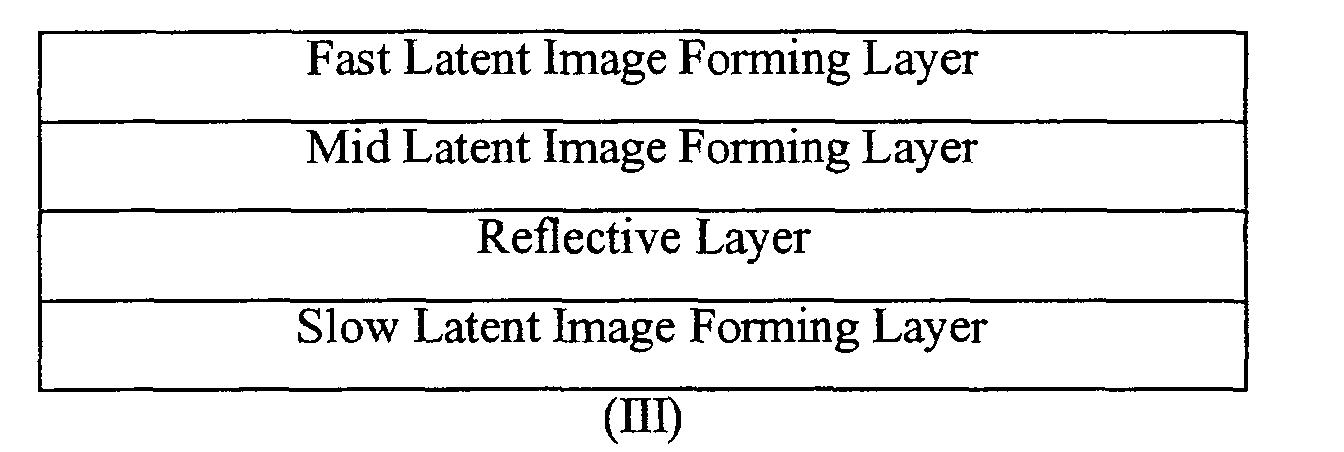
- the red recording layer unit contains a red reflective layer.
- Typical arrangements include the following:
- the reflective layer contains 3-D grains meaning they have an aspect ratio less than 5.
- the tabular imaging grains can take any of the silver halide compositions described above for the image recording layer units. Additionally, the silver halide grains in the reflective layer are substantialy free of any red absorbing dye, notably any red absorbing spectral sensitizing dye.
- the red light reflective layer contains silver halide grains having a mean grain size in the range of from 0.10 to 0.80 ⁇ m, preferably 0.20 to 0.60 ⁇ m. Throughout this thickness range the grains feflect red light efficiently and, depending upon the exact size chosen, have the capability of reflecting blue and/or green light. However, blue and/or green light reflection is reduced by light of these wavelengths being absorbed in the overlying blue recording layer unit, blue filter layer (commonly employed), and the green recording layer unit.
- the less efficient red light reflection per grain exhibited by the emulsion grains toward the lower end of the size range may at any given coating coverage level, be compensated for by the larger number of emulsion grains.
- eight grains having a size of 0.25 ⁇ m can be substituted for each grain having a size of 0.50 ⁇ m. While each of the 0.25 ⁇ m grains does not reflect red light as efficiently as one 0.50 ⁇ m grain, the eight to one ratio at a fixed coating coverage compensates for differences in efficiencies. Reflective grain coating coverages in the range of from 0.4 to 1.25 g/m 2 , based on silver, are contemplated.
- the reflective layer high bromide grains in the selected size range that are present with silver halide grains that are tabular or are non-tabular but exhibit size outside the selected range.
- a high bromide silver halide emulsion in which the grains in the selected range are precipitated along with other grains.
- the presence of grains outside the selected size range increase total silver coverages and reduce the overall efficiency of the reflective layer. It is therefore preferred to minimize the presence of grains outside the selected size range.
- the grains in the selected size range account for greater than 70 percent of total grain projected area and most preferably greater than 90 percent of total grain projected area in the reflective layer.
- the silver halide grains in the red light reflective layer are substantially free of dye that absorbs red light, since this would interfere with red light reflection.
- the grains in the reflective layer are desirably free of adsorbed red absorbing spectral sensitizing dye. This precludes the red light reflective layer from significantly participating in latent image formation within the red recording layer unit.
- the grains in the reflective layer can be chemically sensitized or free of intentional chemical sensitization, since, in the absence of spectral sensitization, the grains in either form do not participate in latent image formation. For the same reason it is also possible to locate image dye forming compound in the reflective layer, but preferably no image dye forming compound is present. Oxidized developer scavenging compounds which do not form image dyes can also be used in the reflective layer, if desired.
- the remaining features of the color photographic element (I) can take any convenient conventional form.
- the blue, green and red recording layer units as well as all other processing solution permeable layers of the color photographic elements, such as the protective overcoat and the antihalation layer unit shown in element (I) contain processing solution permeable vehicle, typically hydrophilic colloid, such as gelatin or a gelatin derivative, as well as vehicle extenders and hardener, examples of which are listed in Research Disclosure, Item 38957, II. Vehicles, vehicle extenders, vehicle-like addenda and vehicle related addenda.
- the layers containing latent image forming silver halide grains additionally usually contain antifoggants and/or stabilizers, such as those listed Research Disclosure, Item 38957, VII. Antifoggants and stabilizers.
- the dye image forming layers can contain in addition to the dye image-forming couplers other dye image enhancing addenda, such as image dye modifiers, hue modifiers and/or stabilizers, and solvents for dispersing couplers and related hydrophobic addenda, summarized in X.
- Colored dye-forming couplers, such as masking couplers are commonly incorporated in negative-working photographic films, as illustrated in Research Disclosure, Item 38957, XII. Features applicable only to color negative.
- the antihalation layer unit shown in element (I) is not essential, but is highly preferred to improve image sharpness.
- the antihalation layer unit can be coated between the red recording layer unit and the transparent film support or, alternatively, coated on the back side of the transparent film support.
- the antihalation layer unit contains light absorbing materials, typically dyes, chosen to be decolorized (discharged) on processing, a summary of which is provided in Research Disclosure, Item 38957, VIII. Absorbing and scattering materials, B. Absorbing materials and C. Discharge.
- the protective overcoat is not essential, but is highly preferred to provide physical protection to the blue recording layer unit.
- the protective overcoat can consist of a single layer containing a hydrophilic vehicle of the type described above.
- the protective overcoat is a convenient location for including coating aids, plasticizers and lubricants, antistats and matting agents, a summary of which is provided in Research Disclosure, Item 38957, IX. Coating and physical property modifying addenda.
- ultraviolet absorbers are often located in the protective overcoat, illustrated in Research Disclosure, Item 38957, UV dyes/optical brighteners/luminescent dyes.
- the protective overcoat is divided into two layers with the above addenda being distributed between these layers. It is also common practice to place a layer similar to the protective overcoat in the back side of the support containing surface property modifying addenda. When an antihalation layer is coated on the back side of the support, surface modifying addenda are usually incorporated in this layer.
- a oxidized developing agent scavenger a.k.a. antistain agent
- the oxidized color developing agent is located in a separate layer, not shown in (I) above, at the interface of the layer units.
- Antistain agents are summarized in Research Disclosure, Item 38957, D. Hue modifiers/stabilization, paragraph (2).
- a blue filter material such as a processing solution decolorizable yellow dye or Carey Lea silver
- a processing solution decolorizable yellow dye or Carey Lea silver is also preferred.
- These filter materials are also disclosed in Research Disclosure, Item 38957, VIII. Absorbing and scattering materials, B. Absorbing materials and C. Discharge.
- the transparent film support can take any convenient conventional form.
- the film support is generally understood to include subbing layers placed on the film to improve the adhesion of hydrophilic colloid layers.
- Conventional transparent film support characteristics are summarized in Research Disclosure, Item 38957, XV. Supports (2), (3), (4), (7), (8) and (9).
- the color photographic films When the color photographic films are intended to be scanned, either for image retrieval or for retrieving information incorporated during manufacture for aiding exposure or processing, they can contain features such as those illustrated by Research Disclosure, Item 38957, XIV. Scan facilitating features.
- a magnetic recording layer When a magnetic recording layer is incorporated in the color film, it is preferably located on the back side of the film support.
- the color films of invention are specifically contemplated for use in cameras used to capture visible light images of photographic subjects. Exposures can range from high intensity, short duration exposures to low intensity, long duration exposures. Since the present invention offers the capability of increasing red speeds, shorter exposures at lower lighting intensities are specifically contemplated. For example, the present invention is particularly suited for producing color films having ISO ratings higher than 200, preferably higher than 400 and optimally higher than 1000.
- the color films can be employed in cameras intended for repeated use or only limited use (e.g., single-use) cameras. Contemplated features of limited use cameras are disclosed in Research Disclosure, Item 38957, XVI. Exposure, (2).
- the color photographic films of the invention can be processed in any convenient conventional manner to produce dye images that correspond to the latent images in the recording layer units or that are reversals of the latent images.
- negative-working emulsions are incorporated in the recording layer units which produce a color negative dye image when subjected to a single color development step. If direct-positive emulsions are substituted in the recording layer units, a single color development step produces a positive dye image--i.e., a reproduction of the subject photographed.
- reversal processing black-and-white development followed by color development
- Illustrations of conventional color processing systems are provided by Research Disclosure, Item 38957, XVIII. Chemical development systems, B. Color-specific processing systems.
- a specifically preferred processing system is the Kodak Flexicolor TM C-41 color negative process. It is specifically contemplated to introduce modifications to the color film and the process to permit development times of less than 2 minutes with improved results, as illustrated by Becher et al U.S. Serial No. 09/014,842, filed January 28, 1998; U.S. Serial No. 09/015,720, filed January 29, 1998; and USSN 09/024,335, filed Feb. 17, 1998; each commonly assigned and currently allowed, here incorporated by reference.
- Multilayer films in varied formats ML-A, ML-B, and ML-C demonstrating the principles of this invention were produced by coating the following layers on a cellulose triacetate film support (emulsion sizes are determined by the disc centrifuge method and are reported in Diameter x Thickness in micrometers).
- Antifoggants including 4-hydroxy-6-methyl-1,3,3a,7-tetraazaindene
- surfactants including 4-hydroxy-6-methyl-1,3,3a,7-tetraazaindene
- coating aids emulsion addenda, sequestrants, thickeners, lubricants, matte and tinting dyes were added to the appropriate layers as is common in the art.
- Layer 1 Protective Overcoat Layer: POL-1 at 0.108 as matte with gelatin at 0.883.
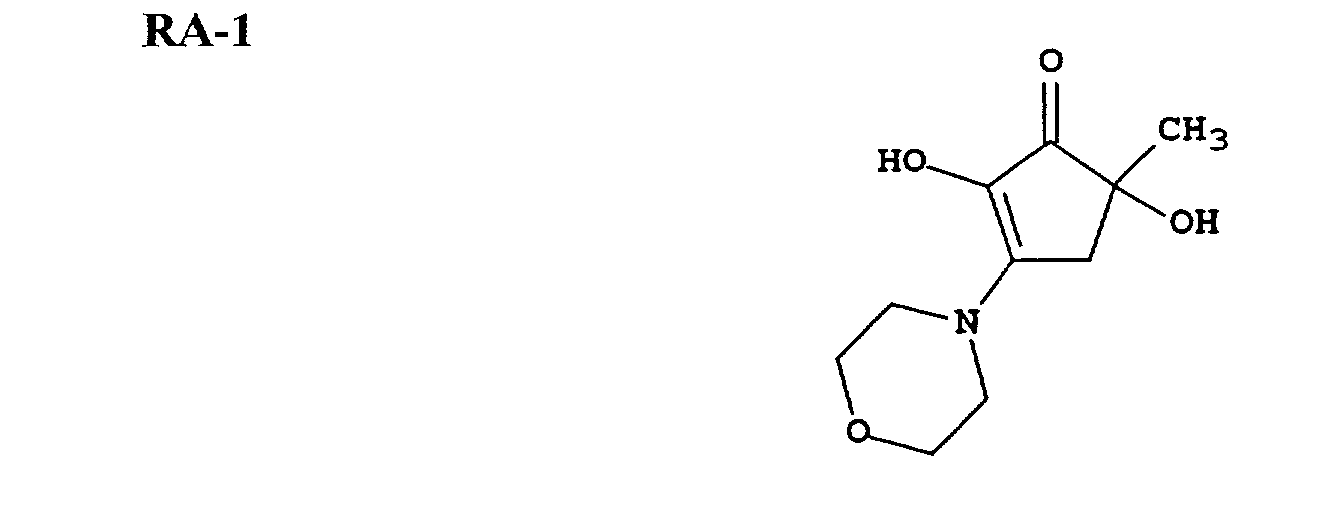
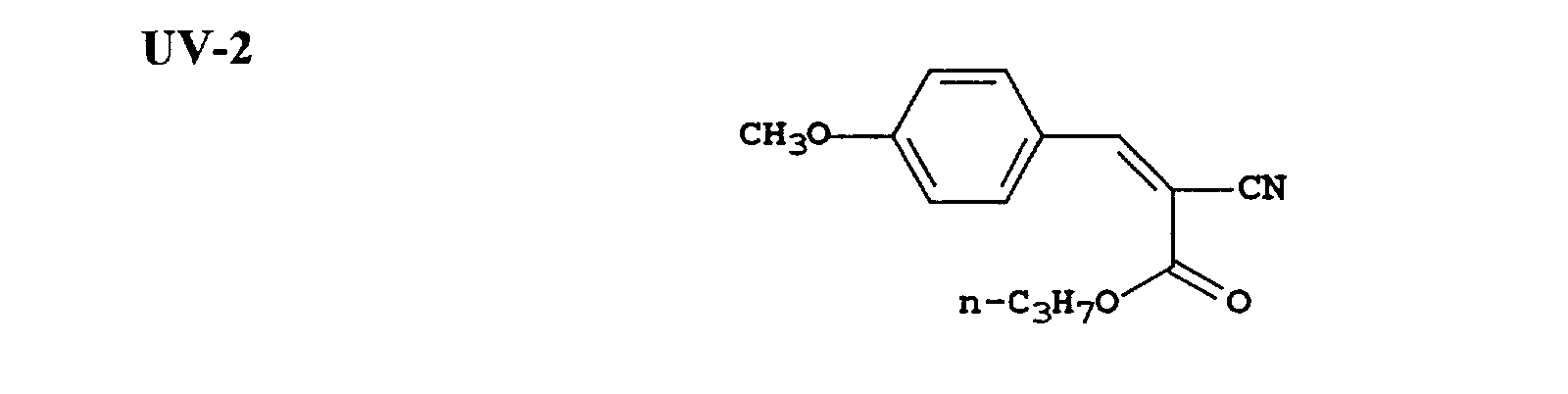
- UV Filter Layer 2 silver bromide Lippmann emulsion at 0.108, UV-1 and UV-2 both at 0.108, RA-1 at 0.009 and gelatin at 0.700.
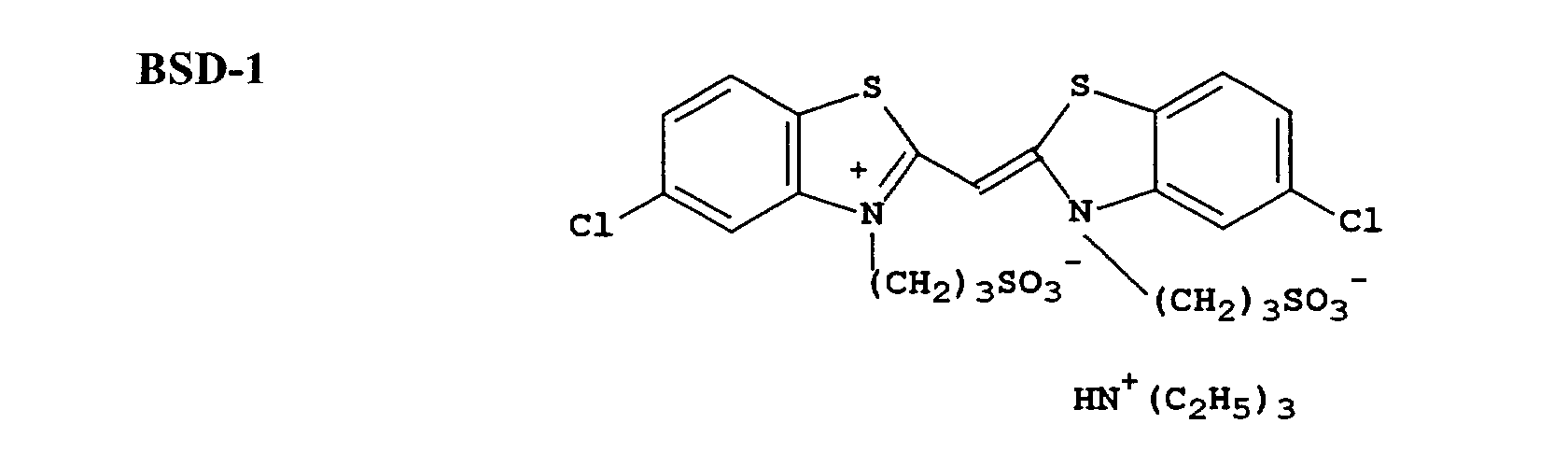
- Layer 3 (Fast Yellow Layer): a blue (BSD-1) sensitized silver iodobromide 3-D emulsion, 1.4 ⁇ m in diameter, 9.7 mole % I at 1.292, silver bromide Lippmann emulsion at 0.108, yellow dye forming coupler Y-1 at 0.484, Soluble Mercaptide Agent Releasing Coupler SMARC-1 at 0.004, and gelatin at 1.70.
- BSD-1 blue sensitized silver iodobromide 3-D emulsion, 1.4 ⁇ m in diameter, 9.7 mole % I at 1.292, silver bromide Lippmann emulsion at 0.108, yellow dye forming coupler Y-1 at 0.484, Soluble Mercaptide Agent Releasing Coupler SMARC-1 at 0.004, and gelatin at 1.70.
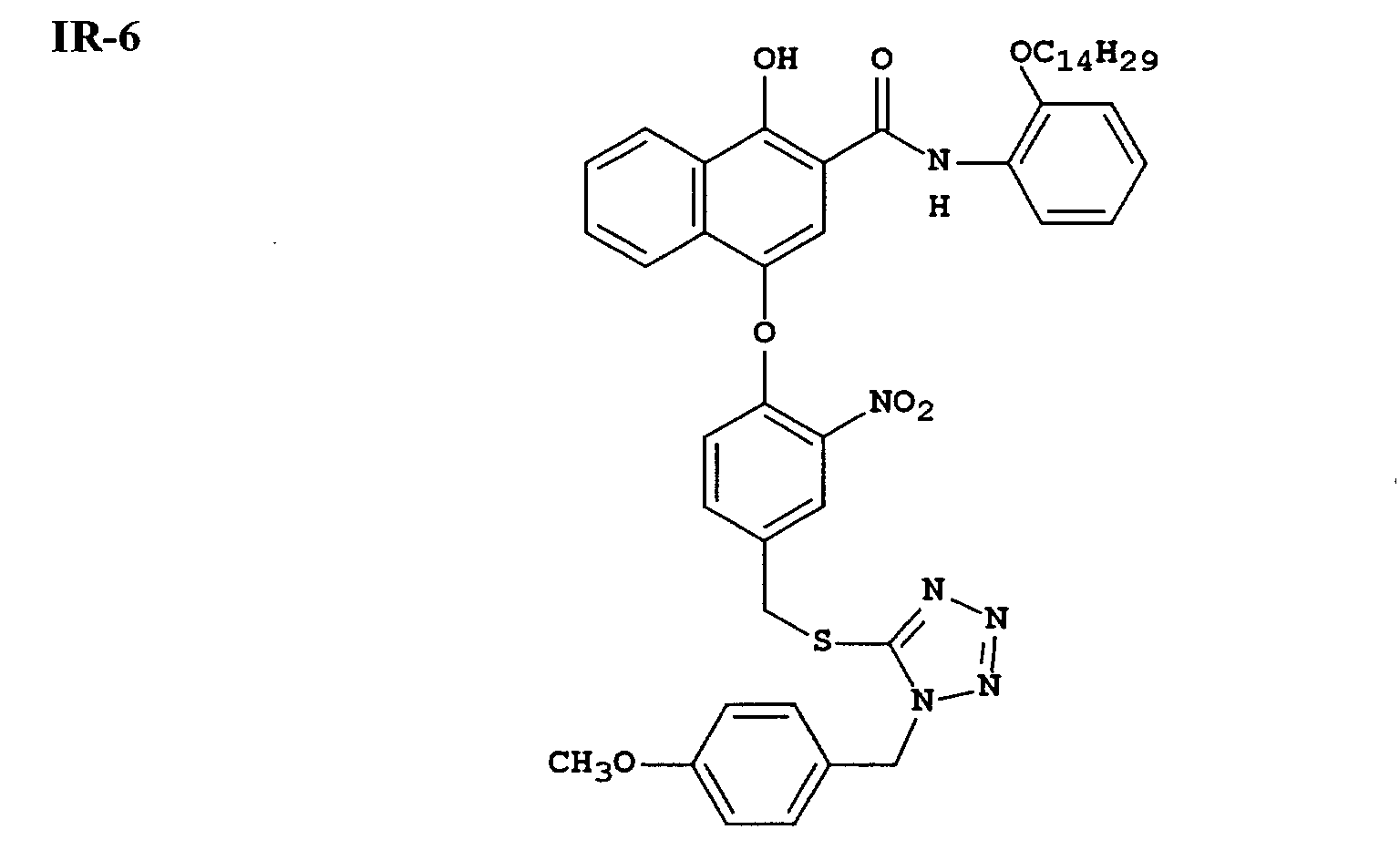
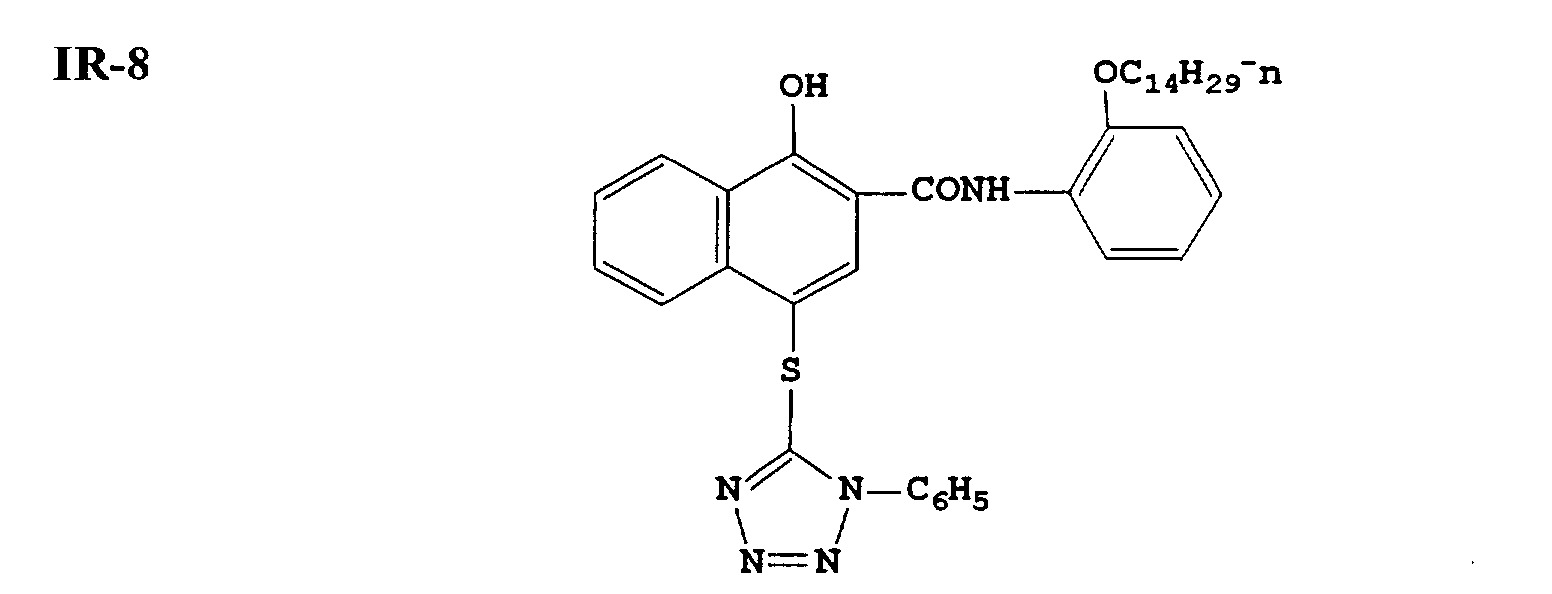
- Layer 4 (Slow Yellow Layer): a blend of three blue (BSD-1+ BSD-2) sensitized tabular silver iodobromide emulsions: (i) 2.15 x 0.143 ⁇ m, 2.0 mole % I at 0.269, (ii) 0.98 x 0.133 ⁇ m, 2.0 mole % I at 0.269 and (iii) 0.6 x 0.115 ⁇ m, 3 mole % I at 0.323, silver bromide Lippmann emulsion at 0.108, yellow dye forming coupler Y-1 at 0.566, IR-6 at 0.019, SMARC-1 at 0.004 and gelatin at 1.70
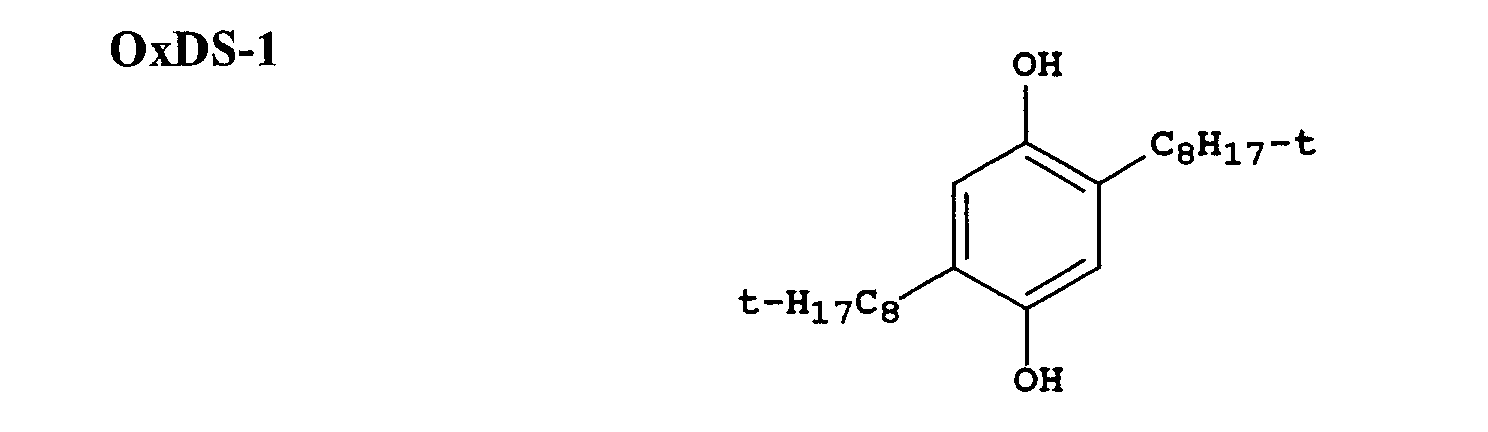
- Layer 5 (Top Interlayer): OxDS-1 at 0.075, X at 0.043 and gelatin at 0.538.
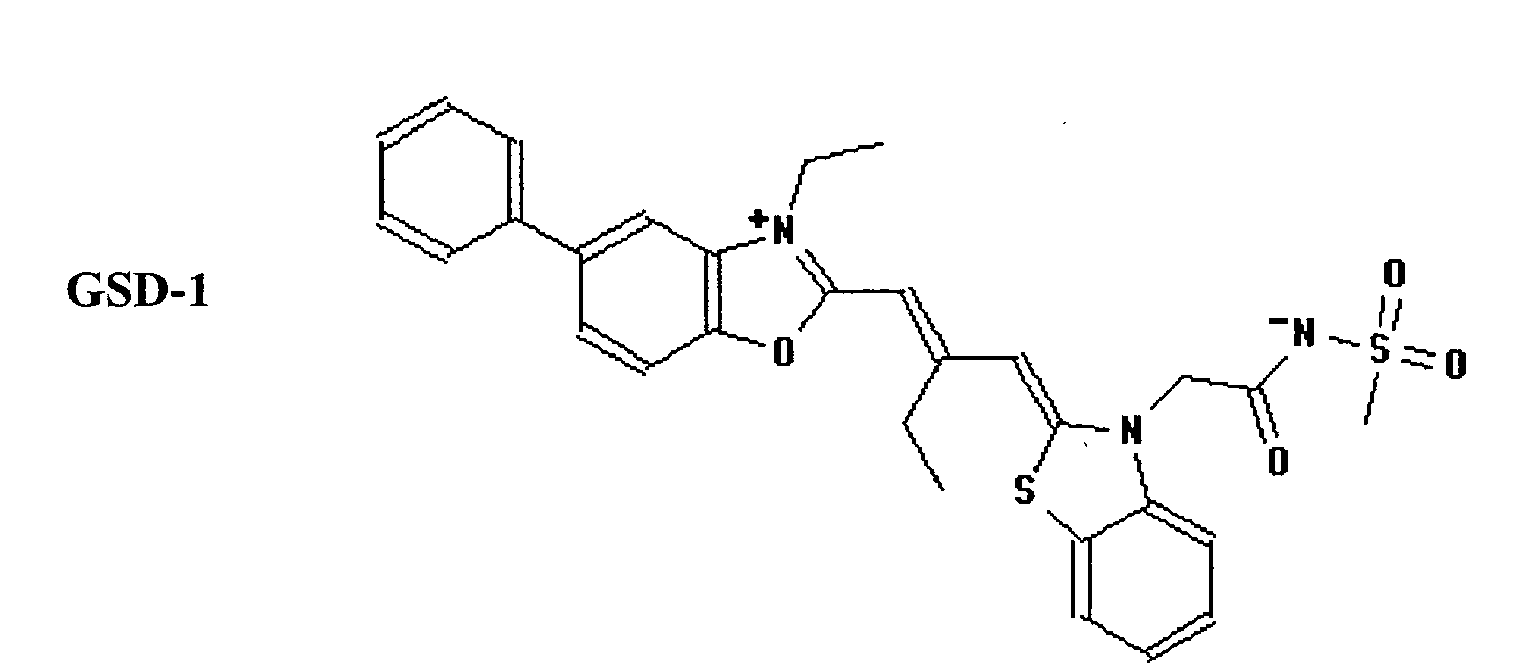
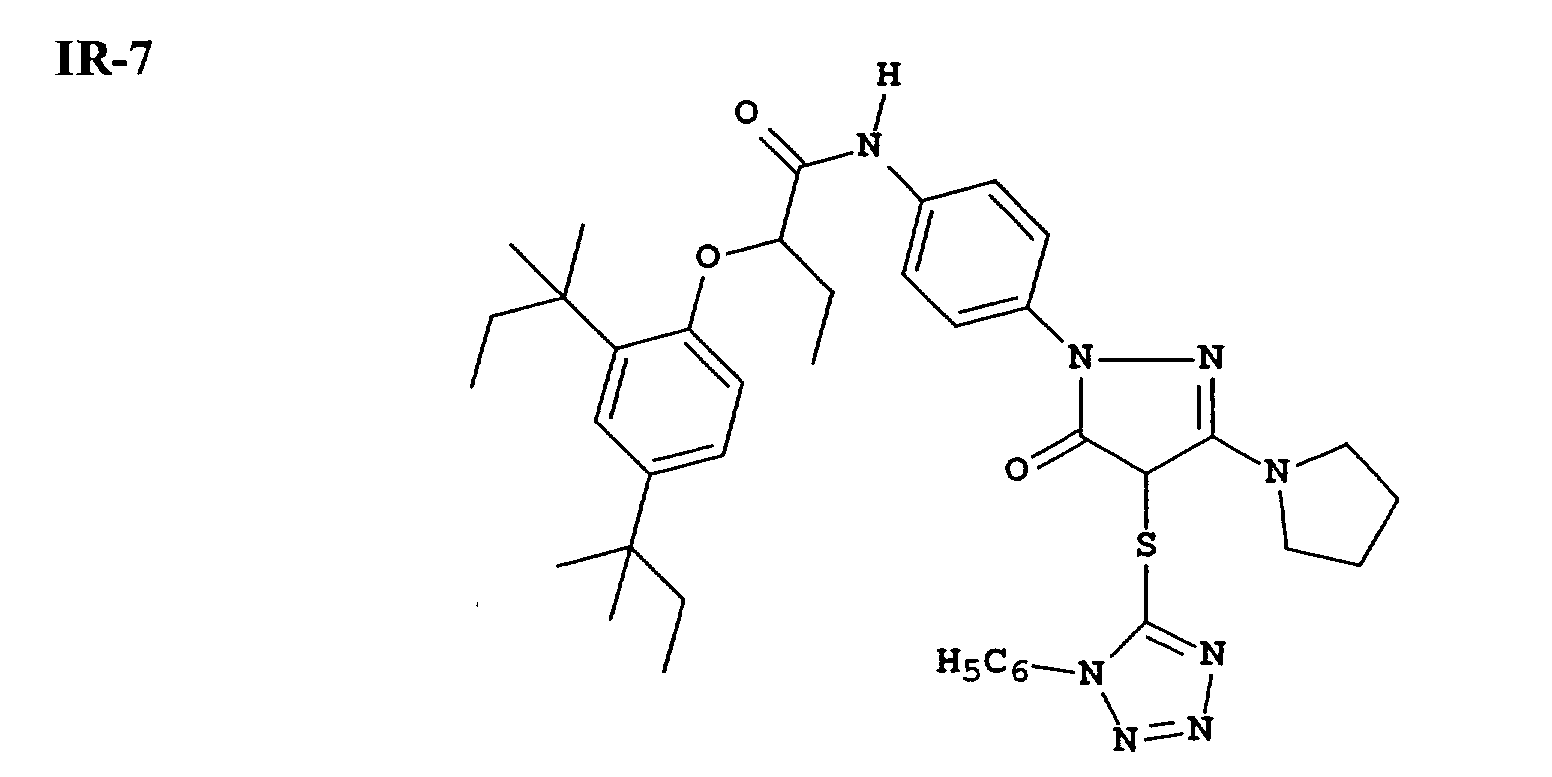
- Layer 6 (Fast Magenta Layer): a blend of two green sensitized (with a mixture of GSD-1 and GSD-2) silver iodobromide tabular emulsions: (i) 2.76 x 0.127 ⁇ m, 3.7 mole % I at 0.823 and (ii) 2.19 x 0.120 ⁇ m, 3.7 mole % I at 0.353, magenta dye forming coupler M-1 at 0.090, masking coupler MM-1 at 0.022, IR-7 at 0.003, IR-2 at 0.011, OxDS-1 at 0.012, X at 0.006 and gelatin at 1.43.
- Layer 7 (Mid Magenta Layer): a blend of two green sensitized (both with a mixture of GSD-1 and GSD-2) silver iodobromide tabular emulsions: (i) 1.45 x 0.12 ⁇ m, 3.7 mole % I at 0.250 and (ii) 1.0 x 0.13 ⁇ m, 4.5 mole % I at 0.181, magenta dye forming coupler M-1 at 0.075, masking coupler MM-1 at 0.065, IR-2 at 0.016, OxDS-1 at 0 010, X at 0.005 and gelatin at 1.45.
- Layer 8 (Slow magenta layer): a green sensitized (with a mixture of GSD-1 and GSD-2) silver iodobromide tabular emulsion, 0.6 x.0.115 ⁇ m, 3 mole % I at 0.548, magenta dye forming coupler M-1 at 0.258, masking coupler MM-1 at 0.069, IR-2 at 0.022, OxDS-1 at 0.011 and gelatin at 1.20.
- Green magenta layer a green sensitized (with a mixture of GSD-1 and GSD-2) silver iodobromide tabular emulsion, 0.6 x.0.115 ⁇ m, 3 mole % I at 0.548, magenta dye forming coupler M-1 at 0.258, masking coupler MM-1 at 0.069, IR-2 at 0.022, OxDS-1 at 0.011 and gelatin at 1.20.
- Layer 9 (Bottom Interlayer): OxDS-1 at 0.075 and gelatin at 0.538.
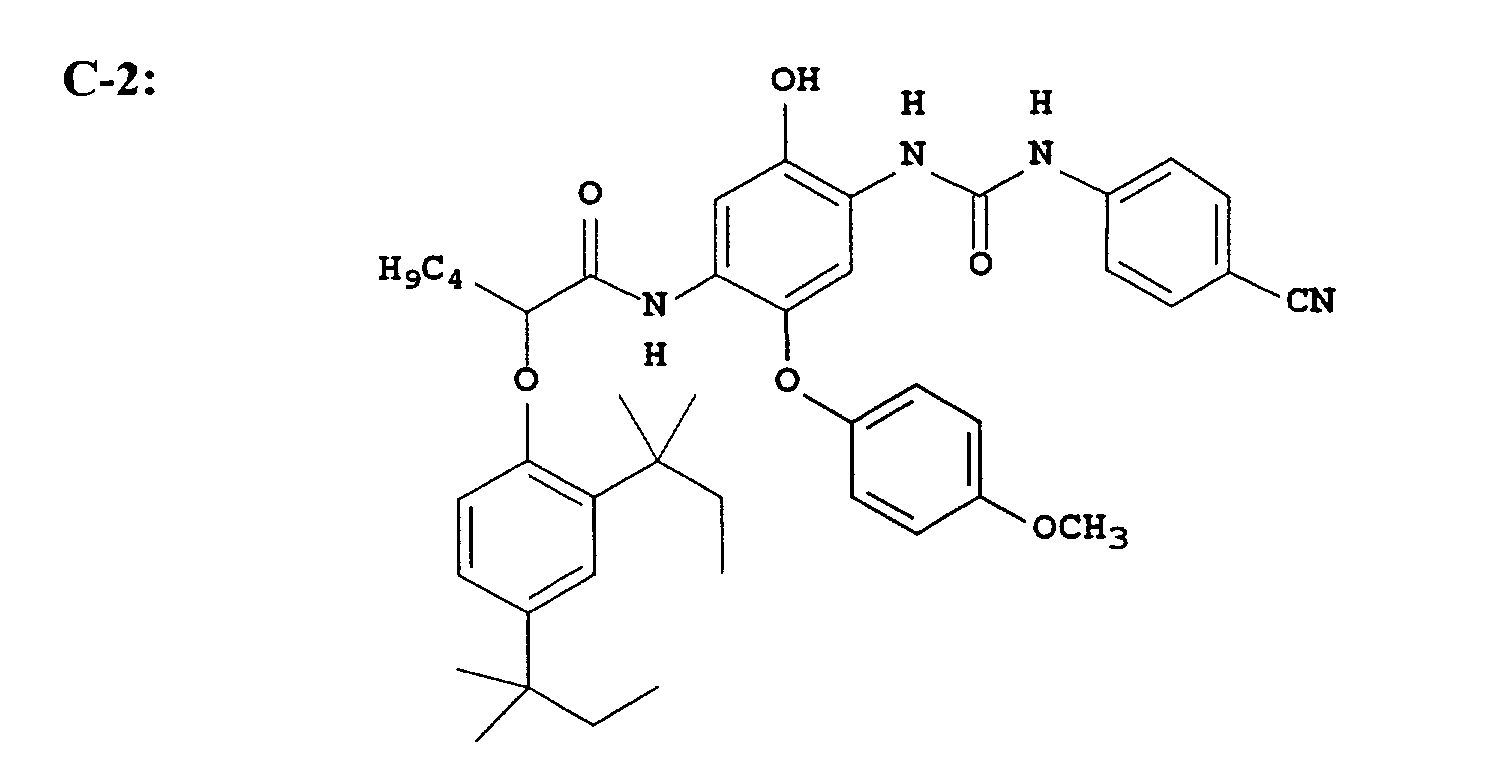
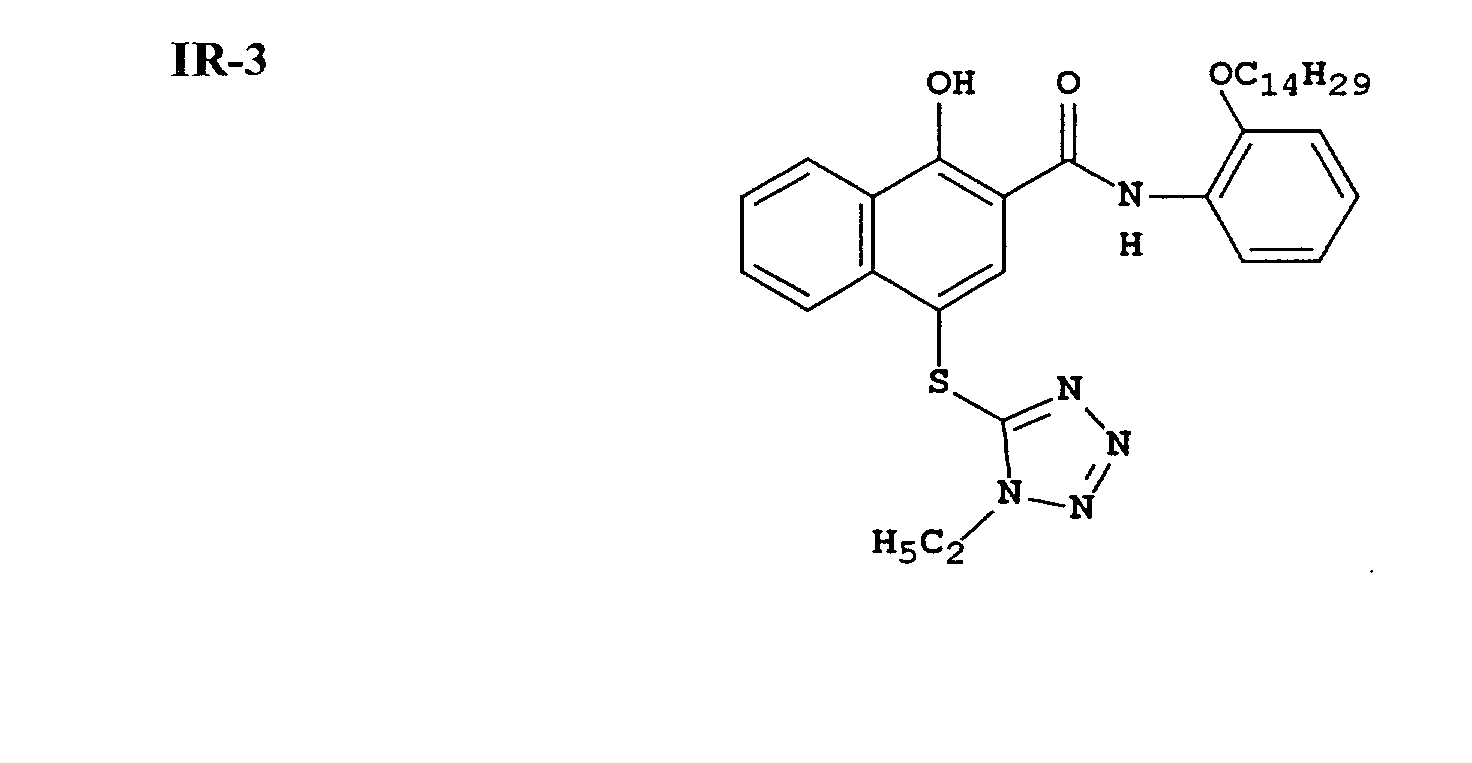
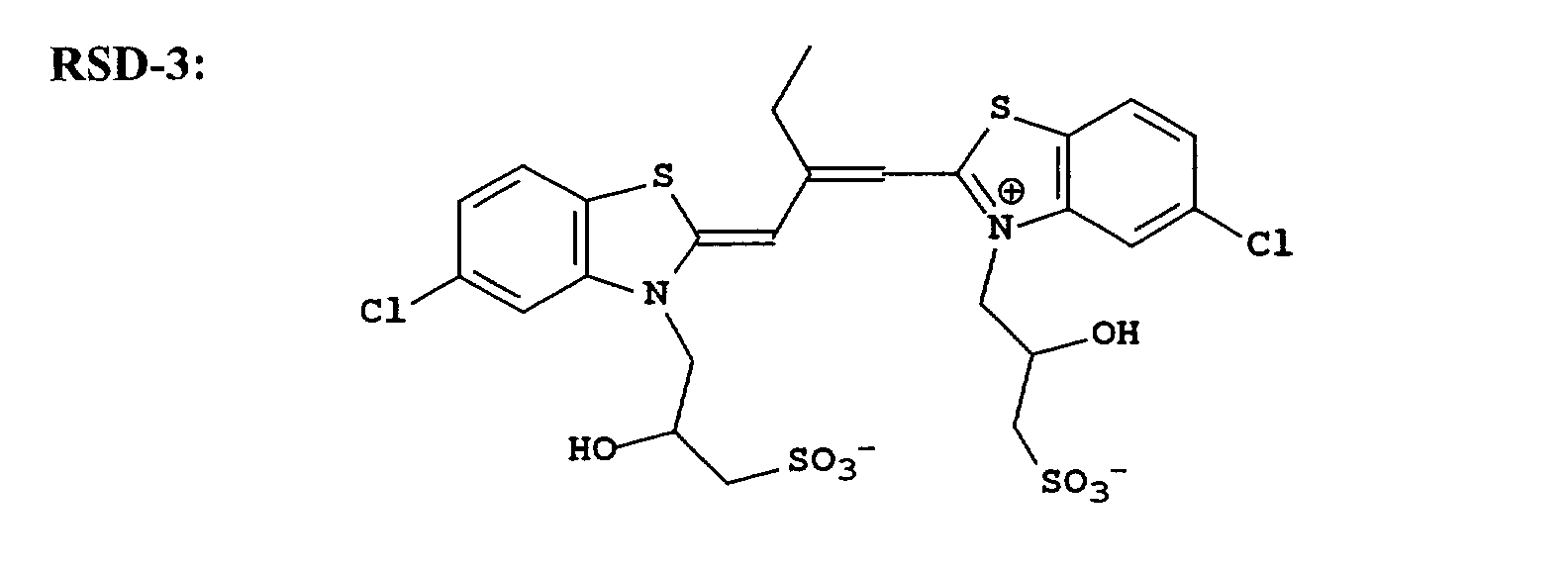
- Layer 10 (Fast Cyan layer): a red-sensitized (with a mixture of RSD-1, RSD-3, and RSD-2) silver iodobromide tabular emulsion (3.64 x 0.12 ⁇ m, 3.7 mole % I) at 1.13, cyan dye-forming coupler C-2 at 0.228, IR-4 at 0.032, IR-3 at 0.022, OxDS-1 at 0.014 and gelatin at 1.24.
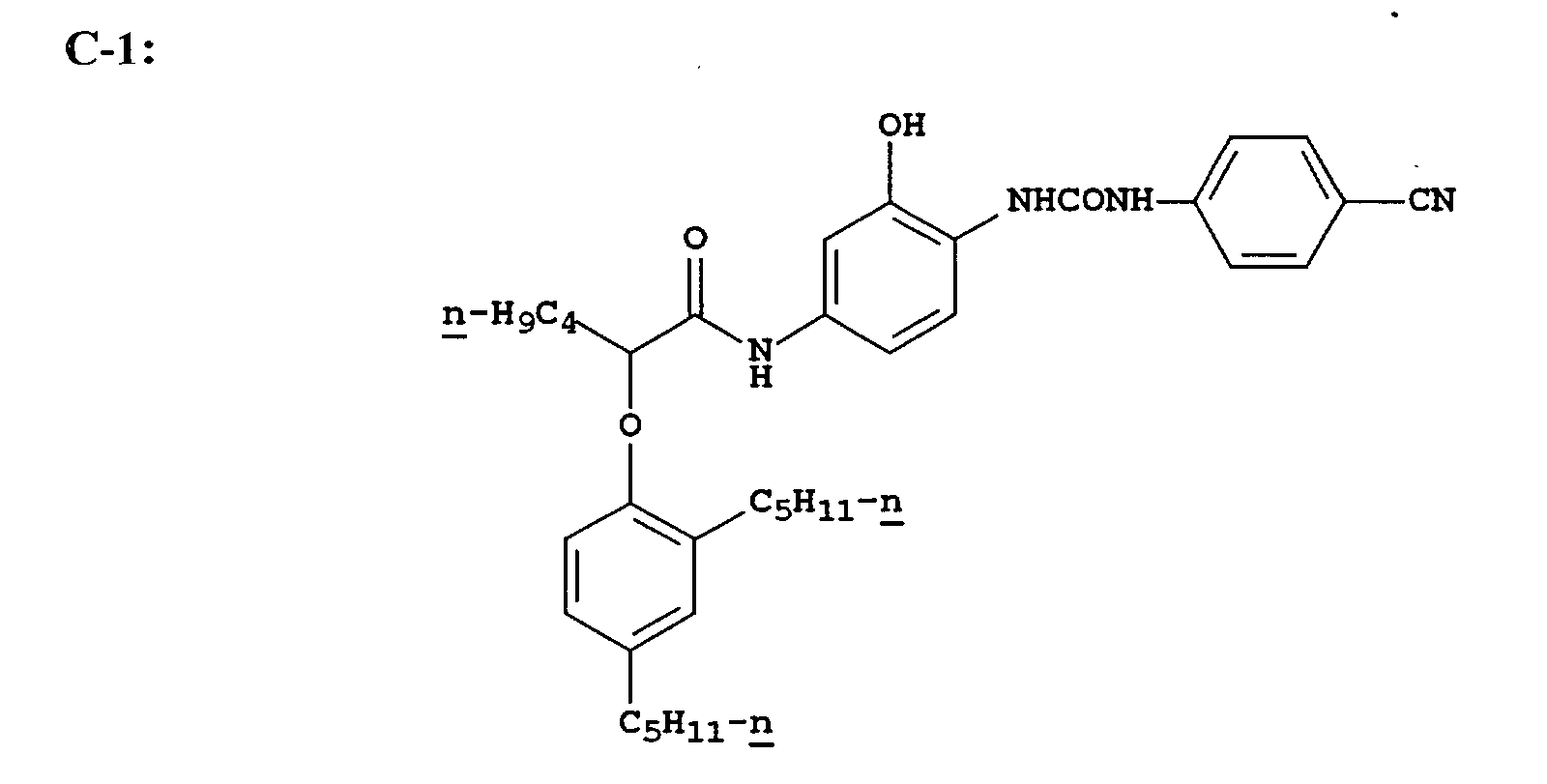
- Layer 12 (Mid Cyan Layer): a blend of two red-sensitized (both with a mixture of RSD-1, RSD-3 and RSD-2) silver iodobromide tabular emulsions: (i) 2.25 x 0.12 ⁇ m, 3.7 mole % I at 0.915 and (ii) 1.31 x 0.125 ⁇ m, 3.7 mole % I at 0.161, cyan dye-forming coupler C-1 at 0.215, C-2 at 0.075, IR-5 at 0.060, masking coupler CM-1 at 0.022, Soluble Mercaptide Agent Releasing Coupler SMARC-1 at 0.013, and gelatin at 1.55.
- Red Cyan Layer a blend of two red-sensitized (both with a mixture of RSD-1, RSD-3 and RSD-2) silver iodobromide tabular emulsions: (i) 2.25 x 0.12 ⁇ m, 3.7 mole % I at
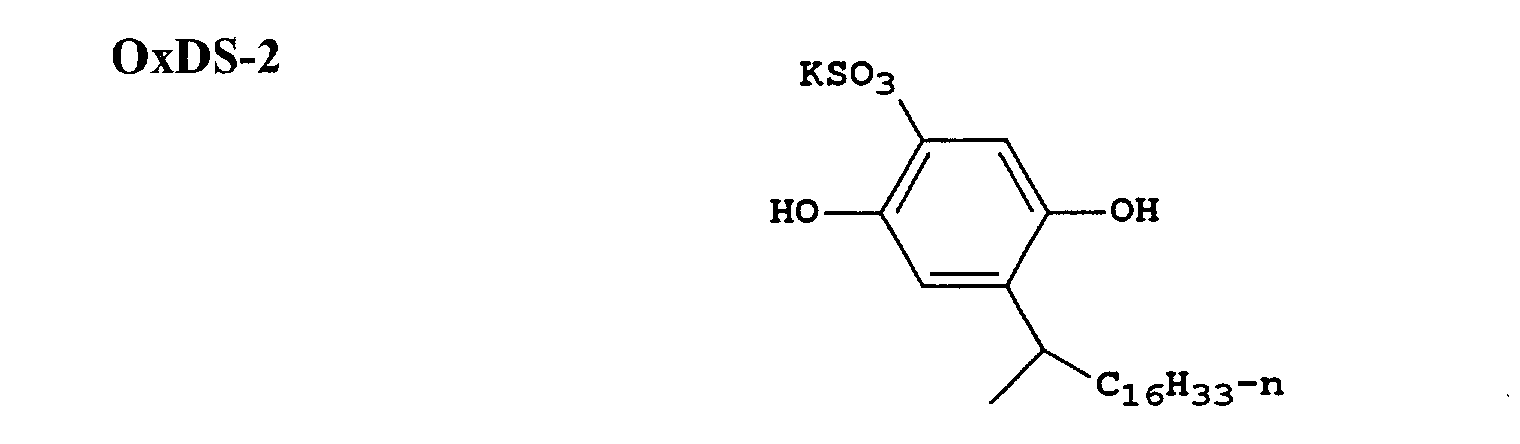
- Layer 13 (Slow Cyan Layer): a blend of two red sensitized (both with a mixture of RSD-1, RSD-3 and RSD-2) silver iodobromide tabular emulsions: (i) 0.77 x 0.10 ⁇ m, 4.5 mole % I at 0.108 and (ii) 0.6 x.0.115 ⁇ m, 3.0 mole % I at 0.861, cyan dye-forming coupler C-1 at 0.334, C-2 at 0.194, IR-6 at 0.032, SMARC-1 at 0.086, OxDS-2 at 0.006, and gelatin at 1.51.
- Layer 14 Black Colloidal Silver at 0.135, UV-1 and UV-2 both at 0.075, OxDS-1 at 0.097, X at 0.043 and gelatin at 1.61.
- Hardener (Bisvinylsulfonyl)methane at 1.55% of total gelatin weight.
- Layer 11 (Cyan Reflector Layer): an unsensitized reflecting material (0.40 ⁇ m 3-D iodobromide emulsion, 3% mole % iodide) at 0.861 was added to this layer.
- Layer 1 Protective Overcoat Layer: POL-1 at 0.108 as matte with gelatin at 0.888.
- UV Filter Layer silver bromide Lippmann emulsion at 0.107, UV-1 and UV-2 both at 0.108 and gelatin at 0.700.
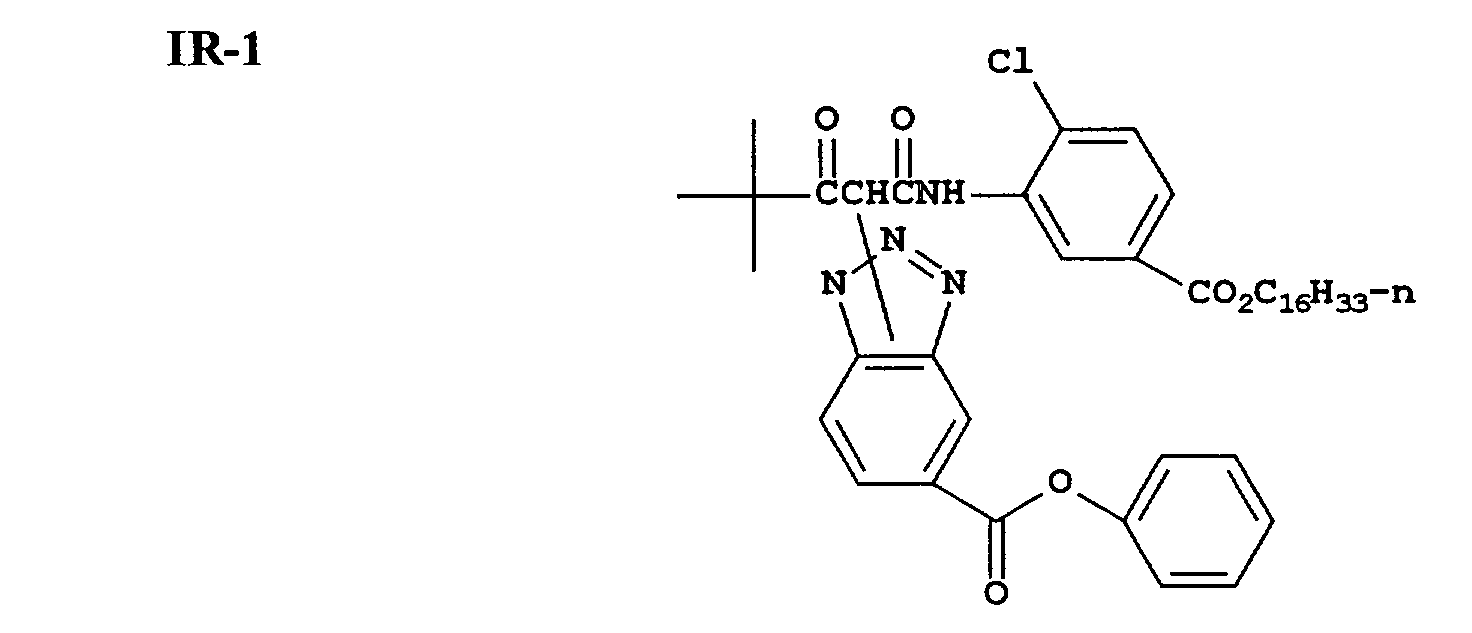
- Layer 3 (Fast Yellow Layer): a blend of two blue sensitized silver iodobromide emulsions: (i) a large tabular emulsion (BSD-1 and BSD-2), 4.21 x 0.131 ⁇ m, 2.0 mole % I at 0.332 and (ii) a 3-D emulsion. 1.2 ⁇ m diameter (BSD-1), 9.7 mole % I at 0.900, silver bromide Lippmann emulsion at 0.135, Y-1 at 0.400, IR-1 at 0.065, SMARC-1 at 0.008, RA-1 at 0.009, and gelatin at 1.70.
- Layer 4 (Slow Yellow Layer): a blend of three blue (BSD-1+ BSD-2) sensitized tabular silver iodobromide emulsions: (i) 1.25 x 0.1 ⁇ m, 2.0 mole % I at 0.360, (ii) 0.77 x 0.14 ⁇ m, 2.0 mole % I at 0.386 and (iii) 0.82 x 0.12 ⁇ m, 3.0mole % I at 0.357, silver bromide Lippmann emulsion at 0.135, yellow dye forming coupler Y-1 at 0.725, IR-1 at 0.038, IR-6 at 0.022, SMARC-1 at 0.008 and gelatin at 1.70
- Layer 5 (Top Interlayer): OxDS-1 at 0.182, X at 0.054 and gelatin at 0.538.
- Layer 6 (Fast Magenta Layer): a green sensitized (with a mixture of GSD-1 and GSD-2) silver iodobromide tabular emulsions (2.76 x 0.13 ⁇ m, 3.7 mole % iodide) at 1.076, magenta dye forming coupler M-1 at 0.082, masking coupler MM-1 at 0.022, IR-7 at 0.003, IR-2 at 0.011, X at 0.011, OxDS-1 at 0.012 and gelatin at 1.42.
- Layer 7 (Mid Magenta Layer): a blend of two green sensitized (both with a mixture of GSD-1 and GSD-2) silver iodobromide tabular emulsions: (i) 2.19 x 0.12 ⁇ m, 3.7 mole % iodide at 0.269 and(ii) 1.45 x 0.12 ⁇ m, 3.7 mole % iodide at 0.465, magenta dye forming coupler M-1 at 0.086, Masking Coupler MM-1 at 0.086, IR-2 at 0.016, X at 0.011, OxDS-1 at 0 012 and gelatin at 1.45.
- Layer 8 (Slow magenta layer): a blend of two green sensitized (both with a mixture of GSD-1 and GSD-2) silver iodobromide tabular emulsions: (i) 1.0 x 0.12 ⁇ m, 4.5 mole % iodide at 0.161 and (ii) 0.5 x.0.13 ⁇ m, 2.6 mole % iodide at 0.323, magenta dye forming coupler M-1 at 0.215, Masking Coupler MM-1 at 0.047, IR-2 at 0.032, OxDS-1 at 0.011 and gelatin at 1.21.
- Layer 9 (Bottom Interlayer): OxDS-1 at 0.182 and gelatin at 0.538.
- Layer 10 (Fast Cyan layer): a red-sensitized (with a mixture of RSD-1, RSD-3, and RSD-2) silver iodobromide tabular emulsion (3.64 x 0.12 ⁇ m, 3.7 mole % I) at 1.27, cyan dye-forming coupler C-2 at 0..228, IR-4 at 0.032, IR-3 at 0.022, OxDS-1 at 0.014 and gelatin at 1.24.
- Layer 12 (Mid Cyan Layer): a blend of two red sensitized (both with a mixture of RSD-1, RSD-3, and RSD-2) silver iodobromide tabular emulsions: (i) a large sized iodobromide tabular grain emulsion (2.25 x 0.12 ⁇ m, 3.7 mole % I) at 0.716, (ii) a smaller iodobromide tabular emulsion (1.31 x 0.125 ⁇ m, 3.7 mole % I) at 0.452, cyan dye-forming coupler C-1 at 0.307, C-2 at 0.075, IR-5 at 0.060, Soluble Mercaptide Agent Releasing Coupler SMARC-1 at 0.013, masking coupler CM-1 at 0.022 and gelatin at 1.55.
- Layer 13 (Slow Cyan Layer): a blend of two red sensitized (both with a mixture of RSD-1 and RSD-3) silver iodobromide emulsions: (i) a large sized iodobromide tabular grain emulsion (0.8 x 0.10 ⁇ m, 4.5 mole % I) at 0.330, (ii) a smaller iodobromide tabular emulsion (.0.5 x 0.13 ⁇ m, 3.0 mole % iodide) at 0.270, cyan dye-forming coupler C-1 at 0.291, C-2 at 0.194, IR-6 at 0.032, Soluble Mercaptide Agent Releasing Coupler SMARC-1 at 0.086, OxDS-2 at 0.006, and gelatin at 1.51.
- a large sized iodobromide tabular grain emulsion 0.8 x 0.10 ⁇ m, 4.5 mole % I
- Layer 14 Black Colloidal Silver at 0.135, UV-1 and UV-2 both at 0.075, OxDS-1 at 0.097, X at 0.043 and gelatin at 1.61.
- Hardener (Bisvinylsulfonyl)methane at 1.75% of total gelatin weight.
- Layer 11 (Cyan Reflector Layer): an unsensitized reflecting material (0.32 ⁇ m 3-D iodobromide emulsion, 3% mole % iodide) at 0.861, OxDS-1 at 0.032 and gelatin at 0.66 were added to this layer.
- Layer 11 (Cyan Reflector Layer): a red-sensitized (with a mixture of RSD-1, RSD-3, and RSD-2) silver iodobromide tabular emulsion (2.25 x 0.12 ⁇ m, 3.7 mole % I) at 1.022, cyan dye-forming coupler C-1 at 0.198, C-2 at 0.006, IR-5 at 0.043, Soluble Mercaptide Agent Releasing Coupler SMARC-1 at 0.008 and gelatin at 1.13 were added to this layer.
- Red Reflector Layer a red-sensitized (with a mixture of RSD-1, RSD-3, and RSD-2) silver iodobromide tabular emulsion (2.25 x 0.12 ⁇ m, 3.7 mole % I) at 1.022, cyan dye-forming coupler C-1 at 0.198, C-2 at 0.006, IR-5 at 0.043, Soluble Mercaptide Agent Releasing Coupler SMARC
- Layer 12 (Mid Cyan Layer): the larger of the two red sensitized silver iodobromide tabular emulsions was omitted, the smaller one was coated at 0.650, C-1 at 0.240, C-2 at 0.100, IR-5 at 0.043, CM-1 at 0.022, SMARC-1 at 0.011 and gelatin at 1.079. Results from testing of multilayers ML-B-1 through 3 are shown in Table II.
- Layer 1 (Protective Overcoat Layer): gelatin at (0.871).
- UV Filter Layer 2 silver bromide Lippmann emulsion at (0.215), UV-1 at (0.022) and UV-2 at (0.114) and gelatin at (0.860).
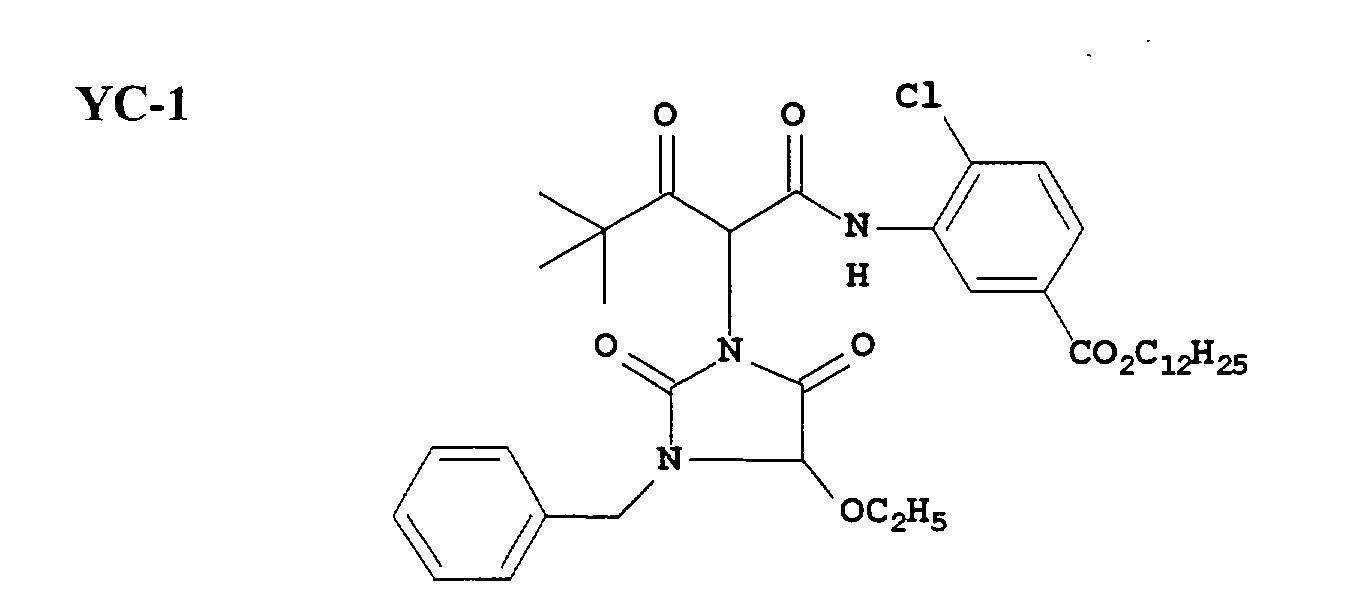
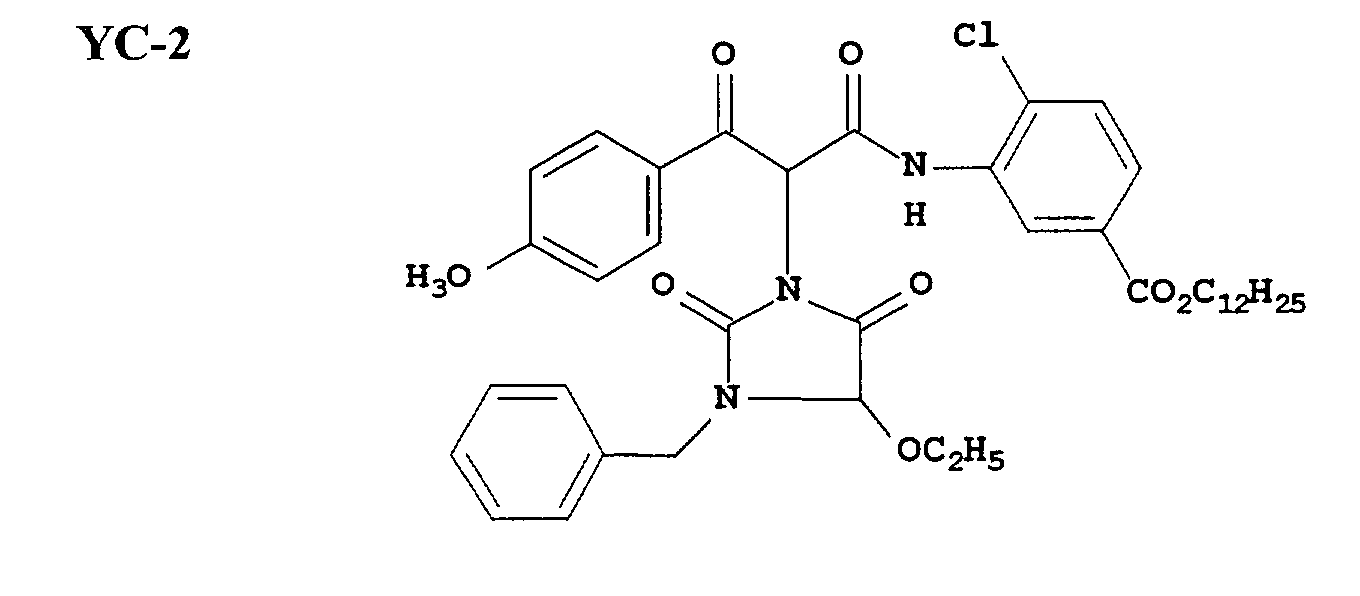
- Layer 3 (Fast Yellow Layer): a blue sensitized (with BSD-1) silver iodobromide nontabular emulsion, 2 ⁇ m ECD, 9mole % I, based on total Ag, at (1.72), YC-1 at (0.088), YC-2 at (0.234) and gelatin at (2.0).
- Layer 3B (reflector layer) omitted.
- Layer 4 (Slow Yellow Layer): a blend of two blue sensitized (all with BSD-1) tabular grain silver iodobromide emulsions (i) 2.7 ⁇ m ECD x 0.13 ⁇ m t, 3.3 mole % I, based on total Ag, at (0.484) and (ii) 1.6 ⁇ m ECD x 0.13 ⁇ m t, 1.3 mole % I, based on total Ag, at (0.323), yellow dye forming coupler YC-1 at (0.464), YC-2 at (0.099), IR-1 at (0.042) and gelatin at (1.58).
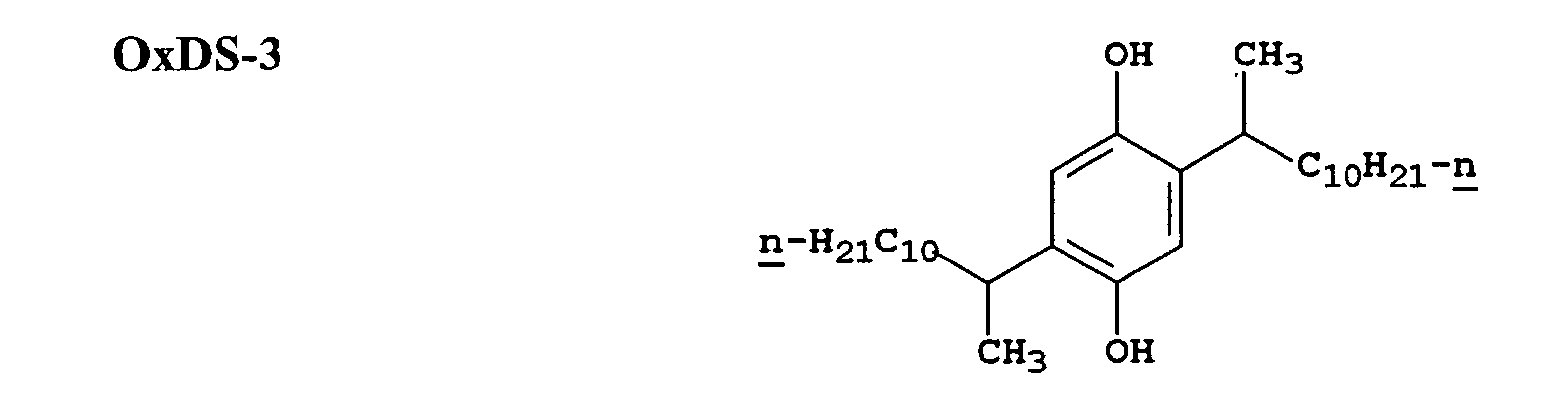
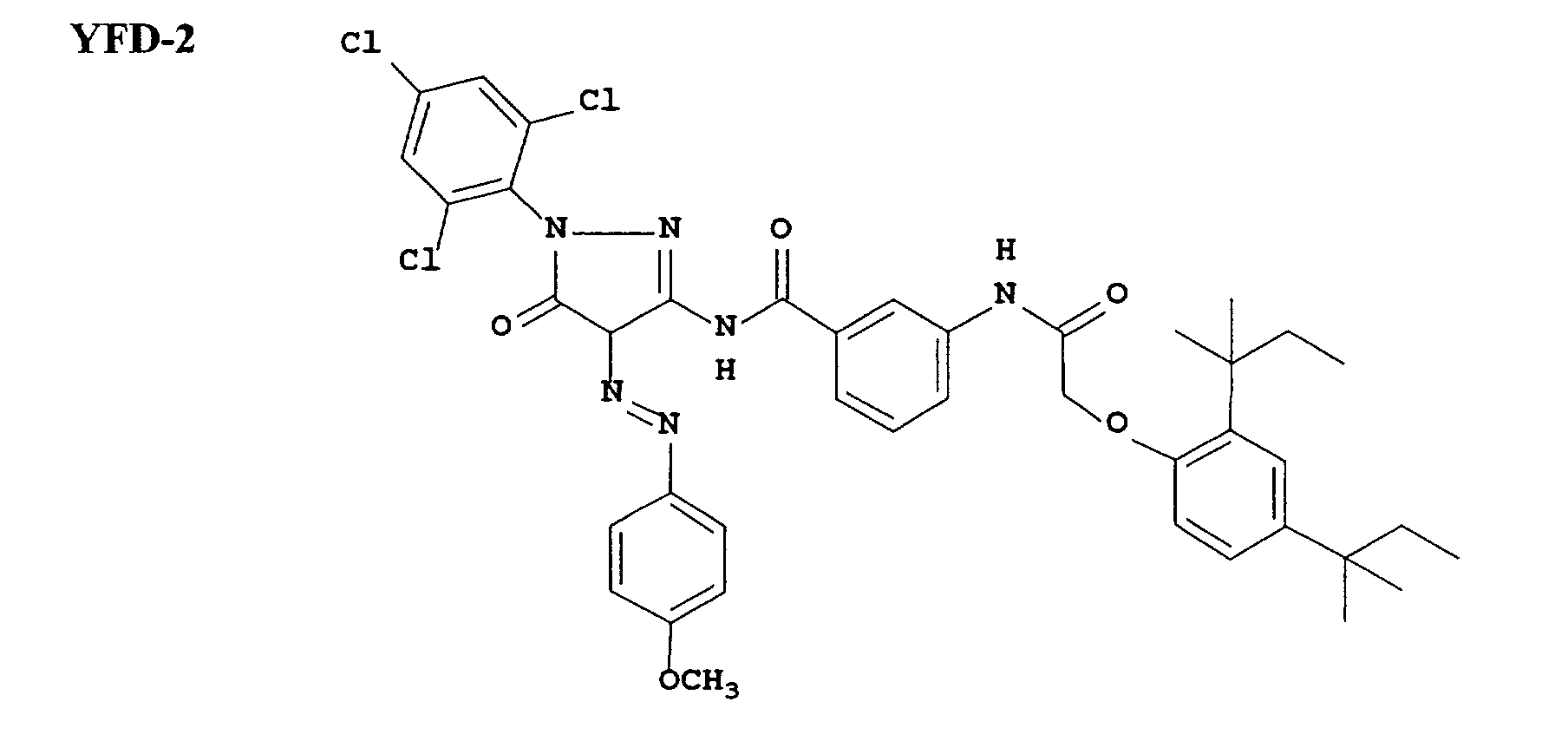
- Layer 5 (Yellow filter layer): YFD-1 at (0.151), YFD-2 at (0.043), OxDS-3 at (0.108) and gelatin at (0.645).
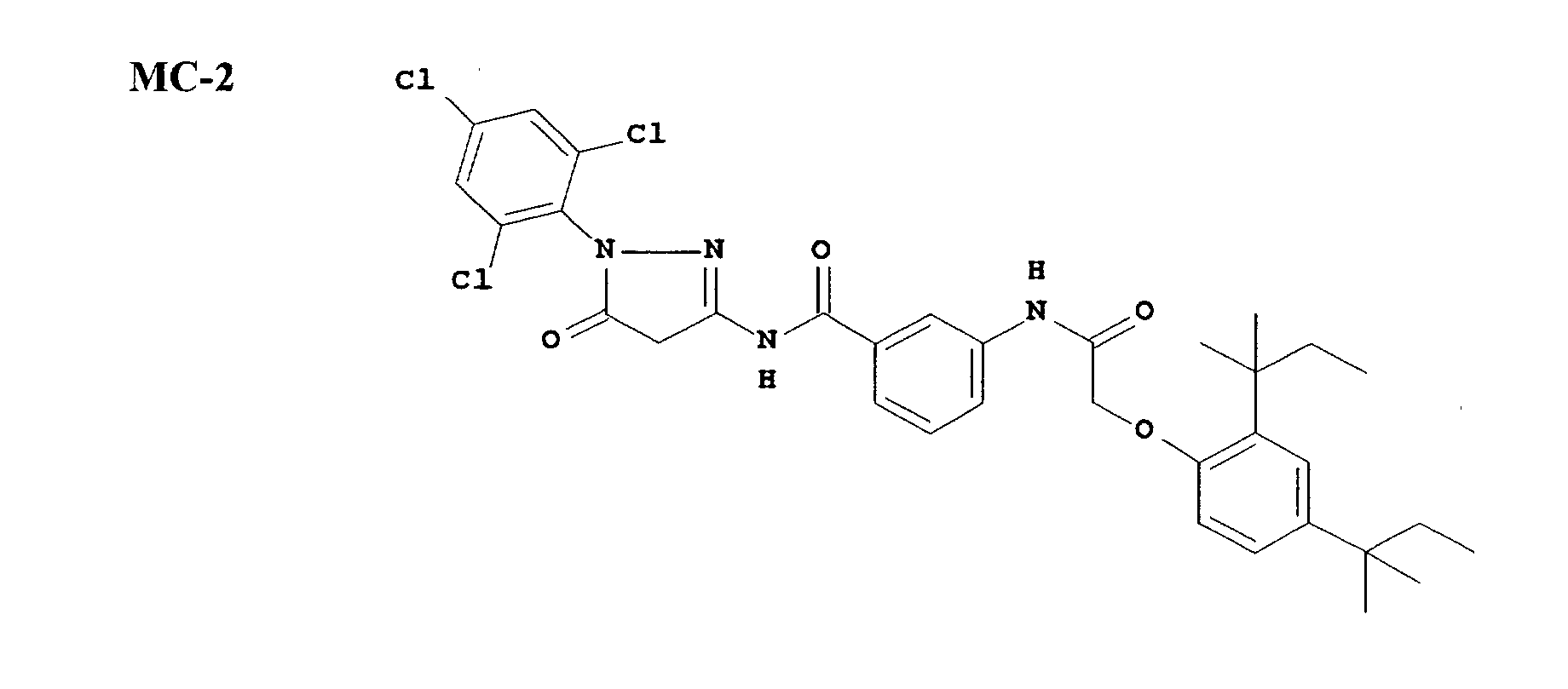
- Layer 6 (Fast Magenta Layer): a green sensitized (with a mixture of GSD-1 and GSD-2) silver iodobromide tabular grain silver iodobromide emulsions 3.4 ⁇ m ECD x 0.11 ⁇ m t, 4 mole % iodide, based on Ag, at (1.032), magenta dye forming coupler M-1 at (0.088), MC-2 at (0.011), MC-3 at (0.003), Masking Coupler MM-1 at (0.022) and gelatin at (1.25).
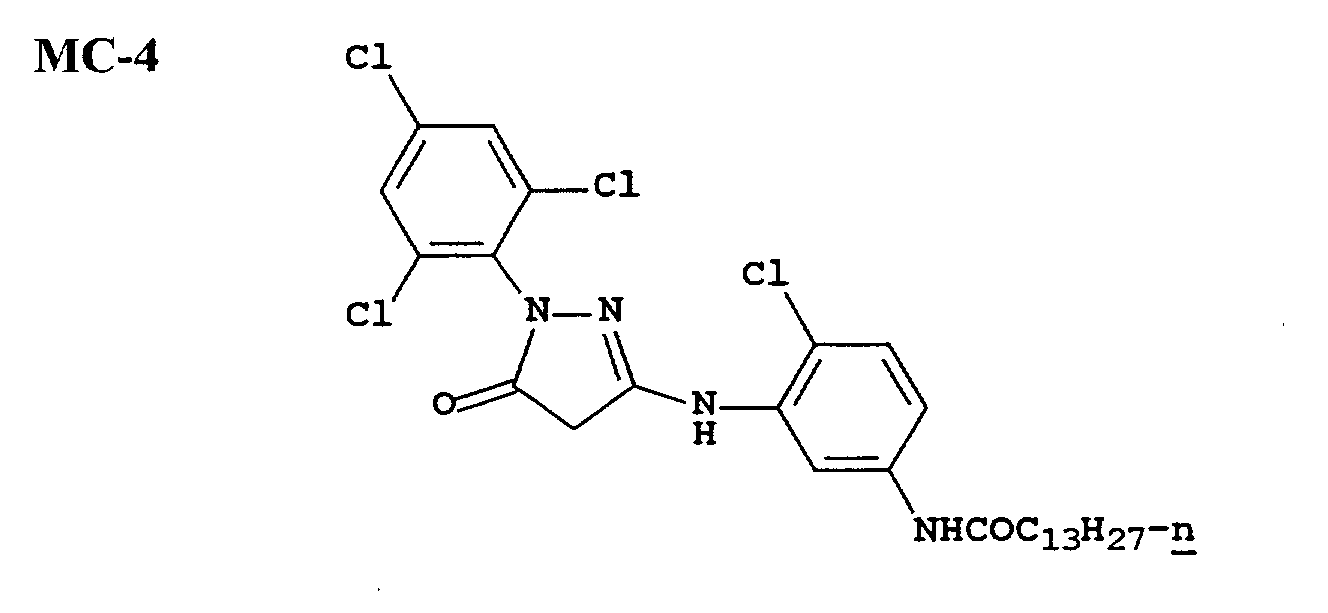
- Layer 7 (Mid Magenta Layer): a green sensitized (with a mixture of GSD-1 and GSD-2) silver iodobromide tabular grain emulsions: (i) 1.2 ⁇ m ECD x 0.14 ⁇ m t, 4.5 mole % iodide, based on Ag, at (1.28), magenta dye forming coupler MC-2 at (0.074), MC-3 at (0.022), MC-4 at (0.106), masking coupler MM-1 at (0.048), IR-7 at (0.010) and gelatin at (1.42).
- Layer 8 (Slow magenta layer): a green sensitized (with a mixture of GSD-1 and GSD-2) silver iodobromide tabular grain emulsion: (i) 0.7 ⁇ m ECD x 0.14 ⁇ m t, 0.3 mole % iodide, based on Ag, at (0.484), magenta dye forming coupler MC-2 at (0.069), MC-3 at (0.21), MC-4 at (0.099), Masking Coupler MM-1 at (0.086) and gelatin at (0.914).
- Layer 9 OxDS-3 at (0.110) and gelatin at (1.08).
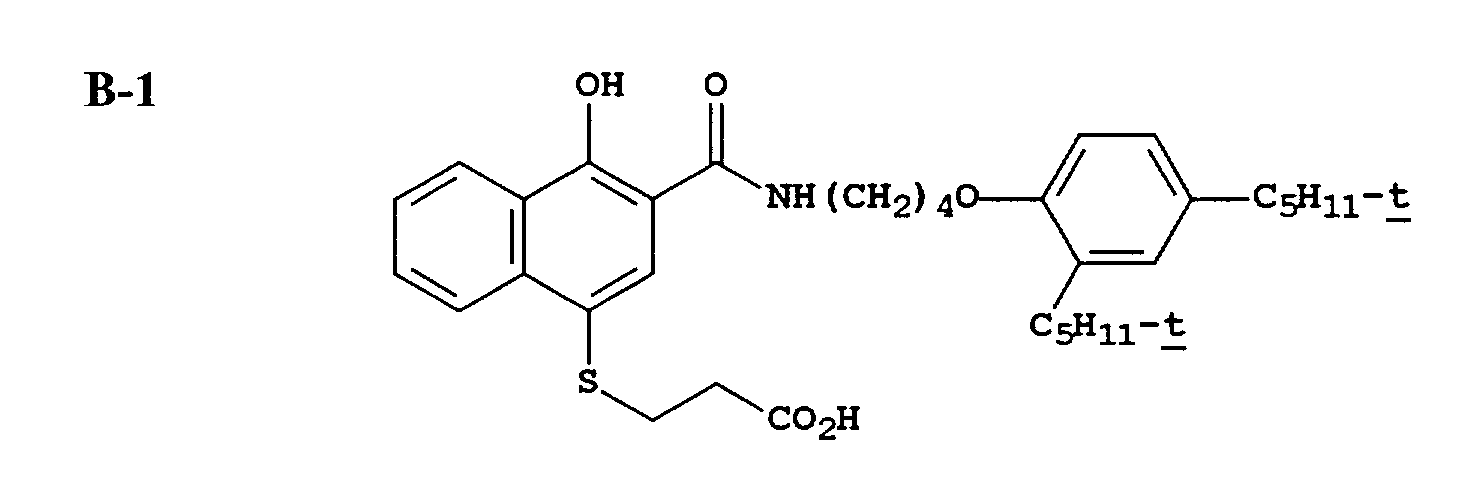
- Layer 10 (Fast Cyan layer): a blend of two red sensitized (with a mixture of RSD-1 and RSD-2) silver iodobromide tabular grain emulsions: (i) 3.0 ⁇ m ECD x 0.12 ⁇ m t, 4.0 mole % I, based on Ag, at (0.634), (ii) 1.3 ⁇ m ECD x .0.14 ⁇ m t, 4.5 mole % I, based on Ag, at (0.333), cyan dye-forming coupler C-1 at (0.060), yellow dye-forming coupler YC-2 at (0.022), masking coupler CM-1 at (0.027), bleach accelerator releasing coupler B-1 at (0.044) and gelatin at (0.882).
- Layer 11 (Slow cyan layer): a blend of two red sensitized (all with a mixture of RSD-1 and RSD-2) silver iodobromide tabular grain emulsions: (i) 1.3 ⁇ m ECD x 0.14 ⁇ m t, 4.5 mole % I, based on Ag, at (0.950) and (ii) 1.0 ⁇ m ECD x .0.11 ⁇ m t, 3.5 mole % I, based on Ag, at (0.674), cyan dye-forming coupler C-1 at (0.409), yellow dye-forming coupler YC-2 at (0.022), masking coupler CM-1 at (0.011), bleach accelerator releasing coupler B-1 at (0.065), IR-6 at (0.017), IR-9 at (0.026) and gelatin at (1.72).
- layer 3b contained a non light-sensitive silver halide emulsion, free of absorbing dye, having an average size of 0.22 um at 0.861 g/m 2 and gelatin at 1.08 g/m 2 .
- Control check check check C-2 Comp 0.22 ⁇ m 3-D reflecting emulsion in Layer 3b 0.08 0 -1.9
- C-3 Comp 0.32 ⁇ m 3-D reflecting emulsion in Layer 3b 0.08 0 -2.1
- Embodiments of the invention also include photographic elements wherein: the silver halide grains in the red light reflective layer are primarily silver bromide grains and wherein the red record is comprised of three layers of varying light sensitivity and the red light reflective layer is located between the mid red light sensitive layer and the least light sensitive layer of the red record.
- Embodiments also include a color photographic element containing a support bearing (a) a red record comprising, in order from the support, a less and a more red light sensitive silver halide emulsion layer, each having associated therewith at least one cyan dye-forming coupler, (b) further from the support a green record comprising, in order from the support, a less and a more green light sensitive silver halide emulsion layer, each having associated therewith at least one magenta dye-forming coupler, and (c) still further from the support, a blue record comprising in order from the support, a less and a more blue light sensitive silver halide emulsion layer, each having associated therewith at least one yellow dye-forming coupler, wherein: (d) there is located, below and only below the most red light sensitive layer of the red record, a relatively non-light sensitive red light reflective 3-D silver halide emulsion layer containing 3-D grains which have a proportion of 3-D grains of an ECD in the range of from 0.10
Landscapes
- Physics & Mathematics (AREA)
- General Physics & Mathematics (AREA)
- Silver Salt Photography Or Processing Solution Therefor (AREA)
Abstract
wherein:
Description
wherein:



All results are given as differences relative to the "Control" case for each example.
Results from testing of multilayers ML-A-1 through 4 are shown in Table I.
| ML-A Results | |||||
| Sample ML-A | Type | Feature | Δ Red Toe Speed (logE) | Δ% Red GNG at D = 0.45 | Δ Red CMT |
| A-1 | Comp | Control | check | check | Check |
| A-2 | Inv | A-1 + Inventive 3-D Reflecting Material in Layer #11 | 0.08 | 3 | +0.30 |
| A-3 | Comp | A-1 Except larger emulsion used in Layer #10 | 0.08 | 20 | -0.20 |
| A-4 | Comp | B-1 + Tabular Reflecting Non-spectrally sensitized Material in Layer #11 | 0.12 | 6 | -0.40 |
Results from testing of multilayers ML-B-1 through 3 are shown in Table II.
| ML-B Results | |||||
| Sample ML-B | Type | Feature | Δ Red Toe Speed (logE) | Δ% Red GNG at D = 0.45 | Δ Red CMT |
| B-1 | Comp | Control | check | check | check |
| B-2 | Inv | D-1 + 3-D Reflecting Material in Layer #11 | 0.11 | -3 | 0 |
| B-3 | Comp | D-1 + Spectrally Sensitized Tabular Material in Layer #11 | -0.02 | -7 | -0.05 |
Results from testing of multilayers ML-C-1 through 3 are shown in Table III.
| ML-C Results | |||||
| Sample ML-C | Type | Feature | Δ Blue Toe Speed (logE) | Δ% Red GNG at D = 0.45 | Δ Red CMT |
| C-1 | Comp | Control | check | check | check |
| C-2 | Comp | 0.22 µm 3-D reflecting emulsion in Layer 3b | 0.08 | 0 | -1.9 |
| C-3 | Comp | 0.32 µm 3-D reflecting emulsion in Layer 3b | 0.08 | 0 | -2.1 |

















(c) still further from the support, a blue record comprising in order from the support, a less and a more blue light sensitive silver halide emulsion layer, each having associated therewith at least one yellow dye-forming coupler, wherein:
(d) there is located, below and only below the most red light sensitive layer of the red record, a relatively non-light sensitive red light reflective 3-D silver halide emulsion layer containing 3-D grains which have a proportion of 3-D grains of an ECD in the range of from 0.10 to 0.80 µm sufficient to improve the red speed of the element without degrading the sharpness of the element. Also included is a method of forming an image comprising contacting the element of claim 1, after imagewise exposure to light, with a color developing compound.
Claims (10)
- A color photographic element containing a support bearing:(a) a red record comprising, in order from the support, a less and a more red light sensitive silver halide emulsion layer, each having associated therewith at least one cyan dye-forming coupler;(b) further from the support a green record comprising, in order from the support, a less and a more green light sensitive silver halide emulsion layer, each having associated therewith at least one magenta dye-forming coupler, and(c) still further from the support, a blue record comprising in order from the support, a less and a more blue light sensitive silver halide emulsion layer, each having associated therewith at least one yellow dye-forming coupler;
wherein:(d) there is located below and only below the most red light sensitive layer of the red record a relatively non-light sensitive red light reflective "small 3-D emulsion layer" that is substantially free of red light absorbing dye. - A color photographic element according to claim 1 wherein the small 3-D emulsion layer contains greater than 50 mol% of grains having an ECD of 0.1 to 0.8 µm.
- A color photographic element according to claim 2 wherein the 3-D grains in the red light reflective layer primarily have an ECD in the range of from 0.30 to 0.60 µm.
- A color photographic element according to any one of claims 1-3 wherein the silver halide grains in the red light reflective layer are present at a silver laydown from 0.4 to 1.25 g/m2.
- A color photographic element according to claim 4 wherein the silver halide grains in the red light reflective layer are present at a silver laydown from 0.6 to 1.00 g/m2.
- A color photographic element according to any one of claims 1-5 wherein the silver halide grains in each of the layers contains greater than 90 mole percent bromide, based on silver.
- A color photographic element according to claim 6 wherein the silver halide grains for forming a developable latent image are silver iodobromide grains.
- A color photographic element according to any one of claims 1-7 wherein the red light reflective layer is contiguous to the most red light sensitive layer of the red record.
- A color photographic element according to claim 8 wherein the red record is comprised of three layers of varying light sensitivity and the red light reflective layer is located between the most red light sensitive layer and the mid light sensitive layer of the red record.
- A color photographic element according to any one of claims 1-7 wherein the red record is comprised of three layers of varying light sensitivity and the red light reflective layer is located below the least red light sensitive layer of the red record.
Applications Claiming Priority (2)
| Application Number | Priority Date | Filing Date | Title |
|---|---|---|---|
| US690230 | 2000-10-17 | ||
| US09/690,230 US6350565B1 (en) | 2000-10-17 | 2000-10-17 | Color photographic element exhibiting increased red speed |
Publications (2)
| Publication Number | Publication Date |
|---|---|
| EP1199598A2 true EP1199598A2 (en) | 2002-04-24 |
| EP1199598A3 EP1199598A3 (en) | 2002-09-25 |
Family
ID=24771642
Family Applications (1)
| Application Number | Title | Priority Date | Filing Date |
|---|---|---|---|
| EP01203777A Withdrawn EP1199598A3 (en) | 2000-10-17 | 2001-10-05 | Color photographic element exhibiting increased red speed |
Country Status (3)
| Country | Link |
|---|---|
| US (1) | US6350565B1 (en) |
| EP (1) | EP1199598A3 (en) |
| JP (1) | JP2002162716A (en) |
Families Citing this family (1)
| Publication number | Priority date | Publication date | Assignee | Title |
|---|---|---|---|---|
| WO2004086140A1 (en) * | 2003-03-25 | 2004-10-07 | Konica Corporation | Silver halide color photographic lightsensitive material |
Family Cites Families (9)
| Publication number | Priority date | Publication date | Assignee | Title |
|---|---|---|---|---|
| JPS59160135A (en) | 1983-03-02 | 1984-09-10 | Fuji Photo Film Co Ltd | Silver halide photosensitive material |
| JPH0727180B2 (en) * | 1986-12-26 | 1995-03-29 | 富士写真フイルム株式会社 | Photosensitive silver halide emulsion and color photosensitive material using the same |
| US5601967A (en) * | 1990-12-24 | 1997-02-11 | Eastman Kodak Company | Blue sensitized tabular emulsions for inverted record order film |
| US5300413A (en) | 1992-11-27 | 1994-04-05 | Eastman Kodak Company | Photoelectric elements for producing spectral image records retrievable by scanning |
| US5763145A (en) * | 1996-11-27 | 1998-06-09 | Eastman Kodak Company | Photographic element containing a reductone and, in the most blue light sensitive layer, a fine grain emulsion |
| US5939246A (en) * | 1997-03-17 | 1999-08-17 | Eastman Kodak Company | Color photographic silver halide negative imaging material and process |
| US5998114A (en) | 1999-04-15 | 1999-12-07 | Eastman Kodak Company | Color photographic film exhibiting increased red speed and sharpness |
| US6001548A (en) | 1999-04-15 | 1999-12-14 | Eastman Kodak Company | Color photographic film with a plurality of grain populations in its red recording layer unit |
| US6245497B1 (en) * | 1999-12-20 | 2001-06-12 | Eastman Kodak Company | Performance of high speed emulsions for color film |
-
2000
- 2000-10-17 US US09/690,230 patent/US6350565B1/en not_active Expired - Fee Related
-
2001
- 2001-10-05 EP EP01203777A patent/EP1199598A3/en not_active Withdrawn
- 2001-10-17 JP JP2001319077A patent/JP2002162716A/en active Pending
Also Published As
| Publication number | Publication date |
|---|---|
| US6350565B1 (en) | 2002-02-26 |
| EP1199598A3 (en) | 2002-09-25 |
| JP2002162716A (en) | 2002-06-07 |
Similar Documents
| Publication | Publication Date | Title |
|---|---|---|
| EP0575006B1 (en) | Color film with closely matched acutance between different color records | |
| EP0163283B1 (en) | A photographic element exhibiting reduced sensitizing dye stain | |
| EP1045287B1 (en) | Color photographic film exhibiting increased red speed and sharpness | |
| US6296994B1 (en) | Photographic elements for colorimetrically accurate recording intended for scanning | |
| US6001548A (en) | Color photographic film with a plurality of grain populations in its red recording layer unit | |
| US5994042A (en) | Color photographic film exhibiting increased blue speed | |
| US6350565B1 (en) | Color photographic element exhibiting increased red speed | |
| US5994043A (en) | Color photographic film with inverted blue recording layers | |
| US6146818A (en) | Color negative films intended for scanning having interleaved green and red recording layer units | |
| US5998113A (en) | Color photographic film with a plurality of grain population in its blue recording layer unit | |
| EP1045285B1 (en) | Photographic elements containing composite reflective grains | |
| US6372418B1 (en) | Color motion picture print film with improved tonescale | |
| US5601967A (en) | Blue sensitized tabular emulsions for inverted record order film | |
| EP0942323B1 (en) | Photographic element having ultrathin tabular grains | |
| EP1033619B1 (en) | Photographic film element containing an emulsion with broadened green responsivity | |
| US5965340A (en) | Rapid access color photographic element exhibiting increased red and green speeds | |
| EP1041437A1 (en) | Color photographic film exhibiting increased blue speed | |
| JP2835632B2 (en) | Silver halide color negative photographic material | |
| EP0901042A1 (en) | An improvement in color negative films adapted for digital scanning | |
| US5968718A (en) | Color development process that results in high observed speeds | |
| US20010040701A1 (en) | Photographic film having time resolved sensitivity distinction | |
| US5914225A (en) | Color photographic element with enhanced properties at reduced development times | |
| JP2887687B2 (en) | Color photographic photosensitive material with excellent hue reproducibility | |
| JP2000029187A (en) | Color negative photographic element having improved distribution of scavenging compound | |
| JP2004054275A (en) | Reversal photographic element comprising image forming layer containing image forming emulsion and non-image forming emulsion |
Legal Events
| Date | Code | Title | Description |
|---|---|---|---|
| PUAI | Public reference made under article 153(3) epc to a published international application that has entered the european phase |
Free format text: ORIGINAL CODE: 0009012 |
|
| AK | Designated contracting states |
Kind code of ref document: A2 Designated state(s): AT BE CH CY DE DK ES FI FR GB GR IE IT LI LU MC NL PT SE TR |
|
| AX | Request for extension of the european patent |
Free format text: AL;LT;LV;MK;RO;SI |
|
| PUAL | Search report despatched |
Free format text: ORIGINAL CODE: 0009013 |
|
| AK | Designated contracting states |
Kind code of ref document: A3 Designated state(s): AT BE CH CY DE DK ES FI FR GB GR IE IT LI LU MC NL PT SE TR |
|
| AX | Request for extension of the european patent |
Free format text: AL;LT;LV;MK;RO;SI |
|
| 17P | Request for examination filed |
Effective date: 20030219 |
|
| AKX | Designation fees paid |
Designated state(s): DE FR GB IT NL |
|
| 17Q | First examination report despatched |
Effective date: 20031211 |
|
| STAA | Information on the status of an ep patent application or granted ep patent |
Free format text: STATUS: THE APPLICATION IS DEEMED TO BE WITHDRAWN |
|
| 18D | Application deemed to be withdrawn |
Effective date: 20040423 |