EP1199458A2 - Internal combustion engine fuel injection apparatus and control method thereof - Google Patents
Internal combustion engine fuel injection apparatus and control method thereof Download PDFInfo
- Publication number
- EP1199458A2 EP1199458A2 EP01124812A EP01124812A EP1199458A2 EP 1199458 A2 EP1199458 A2 EP 1199458A2 EP 01124812 A EP01124812 A EP 01124812A EP 01124812 A EP01124812 A EP 01124812A EP 1199458 A2 EP1199458 A2 EP 1199458A2
- Authority
- EP
- European Patent Office
- Prior art keywords
- valve
- solenoid coil
- fuel injection
- closing
- injection apparatus
- Prior art date
- Legal status (The legal status is an assumption and is not a legal conclusion. Google has not performed a legal analysis and makes no representation as to the accuracy of the status listed.)
- Granted
Links
- 239000000446 fuel Substances 0.000 title claims abstract description 313
- 238000002347 injection Methods 0.000 title claims abstract description 162
- 239000007924 injection Substances 0.000 title claims abstract description 162
- 238000002485 combustion reaction Methods 0.000 title claims abstract description 30
- 238000000034 method Methods 0.000 title claims description 20
- 230000007423 decrease Effects 0.000 claims description 6
- 230000003247 decreasing effect Effects 0.000 claims description 5
- 230000001105 regulatory effect Effects 0.000 description 11
- 230000009467 reduction Effects 0.000 description 10
- 238000010276 construction Methods 0.000 description 8
- 230000008859 change Effects 0.000 description 3
- 230000001276 controlling effect Effects 0.000 description 3
- 230000004907 flux Effects 0.000 description 3
- 230000033228 biological regulation Effects 0.000 description 2
- 238000010586 diagram Methods 0.000 description 2
- 230000000694 effects Effects 0.000 description 2
- 238000005516 engineering process Methods 0.000 description 2
- 239000002828 fuel tank Substances 0.000 description 2
- 230000005415 magnetization Effects 0.000 description 2
- 230000009471 action Effects 0.000 description 1
- 230000008602 contraction Effects 0.000 description 1
- 230000003111 delayed effect Effects 0.000 description 1
- 230000005347 demagnetization Effects 0.000 description 1
- 230000001419 dependent effect Effects 0.000 description 1
- 238000012986 modification Methods 0.000 description 1
- 230000004048 modification Effects 0.000 description 1
- 230000010355 oscillation Effects 0.000 description 1
- 230000002093 peripheral effect Effects 0.000 description 1
- 229920000747 poly(lactic acid) Polymers 0.000 description 1
- 230000008569 process Effects 0.000 description 1
- 238000004549 pulsed laser deposition Methods 0.000 description 1
- 230000004043 responsiveness Effects 0.000 description 1
- 239000007921 spray Substances 0.000 description 1
Images



Classifications
-
- F—MECHANICAL ENGINEERING; LIGHTING; HEATING; WEAPONS; BLASTING
- F02—COMBUSTION ENGINES; HOT-GAS OR COMBUSTION-PRODUCT ENGINE PLANTS
- F02D—CONTROLLING COMBUSTION ENGINES
- F02D45/00—Electrical control not provided for in groups F02D41/00 - F02D43/00
-
- F—MECHANICAL ENGINEERING; LIGHTING; HEATING; WEAPONS; BLASTING
- F02—COMBUSTION ENGINES; HOT-GAS OR COMBUSTION-PRODUCT ENGINE PLANTS
- F02D—CONTROLLING COMBUSTION ENGINES
- F02D41/00—Electrical control of supply of combustible mixture or its constituents
- F02D41/20—Output circuits, e.g. for controlling currents in command coils
-
- F—MECHANICAL ENGINEERING; LIGHTING; HEATING; WEAPONS; BLASTING
- F02—COMBUSTION ENGINES; HOT-GAS OR COMBUSTION-PRODUCT ENGINE PLANTS
- F02M—SUPPLYING COMBUSTION ENGINES IN GENERAL WITH COMBUSTIBLE MIXTURES OR CONSTITUENTS THEREOF
- F02M51/00—Fuel-injection apparatus characterised by being operated electrically
- F02M51/06—Injectors peculiar thereto with means directly operating the valve needle
- F02M51/061—Injectors peculiar thereto with means directly operating the valve needle using electromagnetic operating means
- F02M51/0614—Injectors peculiar thereto with means directly operating the valve needle using electromagnetic operating means characterised by arrangement of electromagnets or fixed armature
- F02M51/0617—Injectors peculiar thereto with means directly operating the valve needle using electromagnetic operating means characterised by arrangement of electromagnets or fixed armature having two or more electromagnets
- F02M51/0621—Injectors peculiar thereto with means directly operating the valve needle using electromagnetic operating means characterised by arrangement of electromagnets or fixed armature having two or more electromagnets acting on one mobile armature
Definitions
- the invention relates to an internal combustion engine fuel injection apparatus and a control method thereof.
- Japanese Patent Application Laid-Open No. 7-239050 discloses a technology in which a single armature for driving a needle valve is driven by using a valve-opening solenoid coil and a valve-closing solenoid coil that are independent from each other. The result of this technology is that the bouncing oscillation of the needle valve at the open/closing time is reduced and the precision regarding the amount of fuel injected is improved.
- the electrification of the valve-closing solenoid coil is started at an overlap time prior to the stop of electrification of the valve-opening solenoid coil, so as to quickly and reliably perform the valve closing action.
- overlap time herein refers to a time between a start of electrification of the valve-closing solenoid coil and the end of electrification of the valve-opening solenoid coil.
- the overlap time may also be termed "magnetization delay time" of the valve-closing solenoid coil.
- the overlap time is set to an amount of delay time that is needed for the current through the valve-closing solenoid coil to reach a predetermined value.
- the needle valve is moved in the valve-closing direction to close the fuel injection hole simultaneously with the stop of electrification of the valve-opening solenoid coil.
- a high-precision control of the fuel injection amount can be achieved.
- variable factors in the electrification control are the timing of starting electrifying the valve-opening solenoid coil and the duration of its electrification.
- the aforementioned overlap time that is, the time between the timing of starting electrifying the valve-closing solenoid coil and the stop of electrification of the valve-opening solenoid coil, is kept constant.
- the fuel pressure supplied to the fuel injection apparatus is changed in some cases, particularly in a direct injection type internal combustion engine or the like. If in such an engine, the fuel pressure supplied to the fuel injection apparatus is raised, the raised fuel pressure increases the force that urges the needle valve disposed within the fuel passage in the valve-closing direction. In correspondence with the amount of increase in the urging force in the valve-closing direction (caused by the increase in fuel pressure), the value of current that produces a magnetic attraction force needed to move the needle valve in the valve-closing direction is reduced.
- the aforementioned reduced value of current is reached prior to the timing of stopping electrifying the valve-opening solenoid coil. Consequently, as the magnetic attraction force needed to move the needle valve in the valve-closing direction is reached (i.e., prior to the timing of stopping electrifying the valve-opening solenoid), the needle valve is driven in the valve-closing direction. Therefore, the needle valve is closed at an earlier timing. That is, the raised fuel pressure results in an open valve duration that is shorter than a control-targeted open valve duration. Hence, the problem of a reduced amount of fuel injection may occur.
- an object of the invention to provide an internal combustion engine fuel injection apparatus having a valve-opening solenoid coil and a valve-closing solenoid coil which is capable of curbing the reduction in the amount of fuel injection caused by a failure in achieving a control-targeted open valve duration if the fuel pressure supplied to the fuel injection apparatus is raised in accordance with the state of operation of an internal combustion engine, and is therefore capable of regulating the amount of fuel injection with even higher precision.
- one aspect of the invention provides a fuel injection apparatus of an internal combustion engine including a valve body movably disposed for back and forth moment in a fuel passage to open and close a fuel injection hole of the fuel injection apparatus.
- An armature is attached to the valve body.
- a valve-opening solenoid coil drives the armature in a valve-opening direction.
- a valve-closing solenoid coil drives the armature in a valve-closing direction.
- Overlap time setting means sets an overlap time, which is a time by which starting of electrifying of the valve-closing solenoid coil precedes stopping of electrifying of the valve-opening solenoid coil.
- the solenoid coils are controlled in accordance with a fuel pressure supplied to the fuel injection apparatus such that a valve-closing force on the valve body does not exceed an open valve holding force on the valve body prior to the time when stopping of the electrifying of the valve-opening solenoid coil occurs.
- the invention also provides a control method of a fuel injection apparatus of an internal combustion engine, the fuel injection apparatus including a valve body movably disposed for back and forth movement in a fuel passage to open and close a fuel injection hole of the fuel injection apparatus, an armature attached to the valve body, a valve-opening solenoid coil to drive the armature in a valve-opening direction, and a valve-closing solenoid coil to drive the armature in a valve-closing direction.
- the control method includes the steps of: setting an overlap time, which is a time by which starting of electrifying of the valve-closing solenoid coil precedes stopping of electrifying of the valve-opening solenoid coil; and controlling the solenoid coils in accordance with a fuel pressure supplied to the fuel injection apparatus such that a valve-closing force on the valve body does not exceed an open valve holding force on the valve body prior to the time when stopping of the electrifying of the valve-opening solenoid coil occurs.
- a control is performed in accordance with the fuel pressure supplied to the fuel injection apparatus such that the valve-closing force on the valve body does not exceed the open valve holding force on the valve body prior to the time when of stopping of the electrifying of the valve-opening solenoid coil occurs, even if the supplied fuel pressure changes. Therefore, even if the fuel pressure is set high, the open valve holding force on the valve body can be maintained by offsetting the amount of increase in the valve-closing force on the valve body. Hence, it is possible to substantially prevent a reduction in the open valve duration of the valve body and therefore prevent a reduction in the amount of fuel injected. Thus, the amount of fuel injection can be regulated with high precision.
- the overlap time setting means may change the overlap time in accordance with the fuel pressure supplied to the fuel injection apparatus so that the valve-closing force on the valve body does not exceed the open valve holding force on the valve body prior to the time when stopping of the electrifying of the valve-opening solenoid coil occurs.
- the overlap time setting means may set the overlap time so that the overlap time decreases as the fuel pressure supplied to the fuel injection apparatus increases.
- the overlap time setting means may set the overlap time to zero when the fuel pressure supplied to the fuel injection apparatus by the fuel pressure control means is at least a predetermined value.
- the internal combustion engine fuel injection apparatus may further include electrification control means for controlling an electrification condition of at least one of the valve-opening solenoid coil and the valve-closing solenoid coil so that the valve-closing force on the valve body does not exceed the open valve holding force on the valve body prior to the time when stopping of the electrifying of the valve-opening solenoid coil occurs.
- the electrification control means may change a voltage condition of at least one of the valve-opening solenoid coil and the valve-closing solenoid coil in accordance with the fuel pressure so that the valve-closing force on the valve body does not exceed the open valve holding force on the valve body prior to the time when stopping of the electrifying of the valve-opening solenoid coil occurs.
- the electrification control means may increase a voltage across the valve-opening solenoid coil when the fuel pressure increases.
- the electrification control means may reduce a voltage across the valve-closing solenoid coil when the fuel pressure increases.
- the fuel injection apparatus may include electrification prohibiting means for prohibiting electrification of the valve-closing solenoid coil when the fuel pressure is at least a predetermined pressure value.
- FIG. 1 is a diagram illustrating a construction of a fuel injection apparatus 1 of an internal combustion engine in accordance with the invention.
- a fuel injection valve 2 is provided for injecting fuel into a combustion chamber (not shown) of the engine.
- the fuel injection valve 2 is connected to a fuel tank 4 that stores fuel, via a fuel supply pipe 3.
- the fuel supply pipe 3 is provided with a fuel pump 5 whose ejection amount can be changed based on the state of operation of the engine so as to change the fuel pressure supplied to the fuel injection valve 2.
- fuel is supplied from the fuel tank 4 to the fuel injection valve 2.
- An ECU (electronic control unit) 6 is connected to various sensors (not shown) for detecting states of operation of the engine. On the basis of input signals from the sensors, the ECU 6 controls the fuel injection valve 2 and the fuel pump 5.
- the ECU 6 has the functions of controlling the fuel pressure supplied by the pump 5, and setting the overlap time, etc., as described below.
- FIG. 2 is a fragmental sectional side view of an embodiment of a fuel injection valve in accordance with the invention.
- the fuel injection valve 2 shown in FIG. 2 has a fuel supply passage 7 to which fuel ejected from the fuel pump 5 is supplied.
- the fuel injection valve 2 further has a fuel injection hole 8 for injecting fuel into the combustion chamber (not shown) of the engine, and a rod-like needle valve 9 for closing the fuel injection hole 8.
- a plurality of fuel injection holes may be formed.
- An armature 10 is welded to an end portion of the needle valve 9 opposite from the fuel injection hole 8.
- the armature 10 has a substantially annular shape.
- a valve-closing solenoid coil 11 is disposed at the fuel injection hole 8-side of the armature 10.
- the valve-closing solenoid coil 11 has a substantially annular shape, and surrounds the needle valve 9.
- the valve-closing solenoid coil 11 produces a magnetic field when voltage is applied to it.
- the magnetic field produced by the valve-closing solenoid coil 11 drives the armature 10 toward the fuel injection hole 8, that is, drives the needle valve 9 in such a direction as to close the fuel injection hole 8.
- the needle valve 9 is urged by a spring 12 that engages the armature 10.
- the spring 12 urges the needle valve 9 toward the fuel injection hole 8, that is, in the direction of closing the fuel injection hole 8.
- valve-opening solenoid coil 13 Disposed at the fuel supply passage 7-side of the armature 10 is a valve-opening solenoid coil 13 that is separate from the valve-closing solenoid coil 11.
- the valve-opening solenoid coil 13 has a substantially annular shape, and surrounds the needle valve 9.
- the valve-opening solenoid coil 13 produces a magnetic field when voltage is applied thereto.
- the magnetic field produced by the valve-opening solenoid coil 13 drives the armature 10 away from the fuel injection hole 8, that is, drives the needle valve 9 in such a direction as to open the fuel injection hole 8.
- valve-opening solenoid coil 13 drives the needle valve 9 in the fuel injection hole-opening direction, overcoming the elastic force of the spring 12.
- the fuel injection hole 8 is opened, and fuel is injected from the fuel injection hole 8.
- the voltage applied to the valve-opening solenoid coil 13 is set to zero, and a voltage is applied to the valve-closing solenoid coil 11.
- the valve-closing solenoid coil 11 drives the needle valve 9 in the fuel injection hole-closing direction, with the assistance of the elastic force of the spring 12.
- the fuel injection hole 8 is closed, and the fuel injection from the fuel injection valve 2 stops.
- the needle valve 9 is surrounded by a first guide wall 14 for guiding the reciprocating movements of the needle valve 9.
- the first guide wall 14 has a substantially cylindrical shape, and is disposed very close to the needle valve 9.
- the first guide wall 14 is contained in a substantially cylindrical sleeve 15.
- the spring 12 is surrounded by a second guide wall 16 for guiding the elongation and contraction of the spring 12.
- the second guide wall 16 has a substantially cylindrical shape, and is disposed very close to the spring 12. Similarly to the first guide wall 14, the second guide wall 16 is contained in the sleeve 15.
- a first non-magnetic member 17 is disposed between the valve-closing solenoid coil 11 and the armature 10.
- a second non-magnetic member 18 is disposed between the valve-opening solenoid coil 13 and the armature 10.
- the non-magnetic members 17, 18 have a substantially annular shape, and ensure that the magnetic fields produced by the solenoid coils 11, 13 have the appropriate effect on the armature 10.
- the valve-closing solenoid coil 11 is also surrounded by a first housing part 19.
- the first housing part 19 is attached onto the sleeve 15.
- the valve-opening solenoid coil 13 is surrounded by a second housing part 20 that is separate from the first housing part 19.
- the second housing part 20 is attached to the sleeve 15, similarly to the first housing part 19.
- the housing parts 19, 20 are spaced from each other, so that an insulating space 21 is formed between the housing parts 19, 20.
- the insulating space 21 ensures that the magnetic fields produced by the solenoid coils 11, 13 have the appropriate effect on the armature 10, as is the case with the non-magnetic members 17, 18.
- a non-magnetic member 22 is disposed between the first housing part 19 and the second housing part 20.
- Another non-magnetic member 23 is disposed between the non-magnetic member 22 and the armature 10, in contact with the non-magnetic member 22.
- the non-magnetic members 22, 23 each have a substantially annular shape. The non-magnetic members 22, 23 serve to prevent overlap of the magnetic fields produced by the solenoid coils 11, 13.
- FIG. 3a is a graph indicating a relationship of the voltage applied to the valve-opening solenoid coil 13, a relationship of the voltage applied to the valve-closing solenoid coil 11, a relationship of the value of current through the valve-opening solenoid coil 13, and a relationship of the value of current through the valve-closing solenoid coil 11, with respect to time during a low-fuel pressure operation.
- the valve-opening current OI through the valve-opening solenoid coil 13 starts to gradually rise.
- the magnetic flux produced by the valve-opening current OI produces a magnetic attraction force that draws the armature 10 in the valve-opening direction.
- the magnetic attraction force increases proportionally to the magnitude of the valve-opening current OI.
- the value of current through the valve-opening solenoid coil 13 reaches a predetermined valve-opening current OIp that moves the needle valve 9 so as to completely open the fuel injection valve 2 overcoming the force of the spring 12 and the fuel pressure acting on the needle valve 9. Therefore, the fuel injection valve 2 is completely opened.
- the voltage applied to the valve-opening solenoid coil 13 is set to a predetermined open valve holding voltage value that maintains an open valve state, the value of current through the valve-opening solenoid coil 13 gradually decreases until the value of current is held at a predetermined open valve holding current value OIk that maintains the open valve state.
- the open valve holding force produced by the open valve holding current value OIk balances with the elastic force of the spring 12 and the fuel pressure, so that the open state of the needle valve 9 is maintained and fuel is injected from the fuel injection hole 8.
- the fuel injection hole 8 is closed, thereby ending the valve opening control of the fuel injection valve 2.
- a valve closing control described below is performed in this embodiment. That is, a voltage is applied to the valve-closing solenoid coil 11 at a time point t2 that is earlier than the time point t3 at which the voltage applied to the valve-opening solenoid coil 13 is discontinued, taking into account a magnetization delay time of the valve-closing solenoid coil 11 that elapses before the valve-closing current CI through the valve-closing solenoid coil 11 reaches a predetermined valve-closing current CIp that produces a magnetic attraction force needed to move the armature 10 in the valve-closing direction to completely close the fuel injection valve 2.
- valve-closing current CI through the valve-closing solenoid coil 11 gradually rises.
- the magnetic flux produced by the valve-closing current CI produces a magnetic attraction force that draws the armature 10 in the valve-closing direction.
- the magnetic attraction force increases proportionally to the magnitude of the valve-closing current CI.
- the value of current through the valve-closing solenoid coil 11 reaches the predetermined valve-closing current CIp that produces the magnetic attraction force to move the armature 10 in the valve-closing direction.
- the voltage applied to the valve-opening solenoid coil 13 is discontinued, so that the valve-opening force disappears.
- the fuel injection valve 2 Due to the valve-closing force based on the magnetic attraction force produced by the valve-closing current CIp in addition to the fuel pressure and the elastic force of the spring 12, the fuel injection valve 2 is immediately closed at the time point t3. Subsequently at a time point t4, the voltage applied to the valve-closing solenoid coil 11 is discontinued, thereby ending the valve-closing control.
- the circuit for driving the valve-opening solenoid coil 13 preferably has an incorporated circuit that immediately sets the current through the valve-opening solenoid coil 13 to zero when the electrification of the valve-opening solenoid coil 13 stops. Therefore, at the time point t3 when the voltage applied to the valve-opening solenoid coil 13 is set to zero, the current through the valve-opening solenoid coil 13 immediately becomes zero as well. As a result, the magnetic attraction force exerted on the armature 10 in the valve-opening direction by the valve-opening solenoid coil 13 immediately disappears, and therefore the fuel injection valve 2 is immediately closed.
- the fuel injection valve is promptly closed at a targeted time by performing the valve-closing control in addition to the valve-opening control. Therefore, a target amount of fuel is injected from the fuel injection valve 2 without fail.
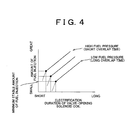
- the amount of fuel injected is determined proportionally to the duration of electrification of the valve-opening solenoid coil 13 as indicated in FIG. 4. If the fuel pressure supplied to the fuel injection valve 2 is changed in accordance with the state of operation of the engine, the amount of fuel injected also changes depending on the fuel pressure. However, in an operation region where the electrification duration is short, there is a region where it is difficult to control the amount of fuel injection as intended because the amount of operation of the needle valve 9 is not completely dependent on the electrification duration due to construction factors of the fuel injection valve 2, more specifically, the set load of the spring 12, the fuel pressure, the responsiveness of the valve-closing/opening solenoid coils 11, 13, etc.
- Such an operation region varies depending on the fuel pressure, and a minimum amount of fuel injection that can be precisely controlled (minimum stable amount of fuel injection) is determined in accordance with the fuel pressure.
- the minimum stable amount of fuel injection decreases with decreases in the fuel pressure. Therefore, if a higher precision in regulating the amount of fuel injection is required, for example, when the amount of fuel injection is small, the fuel pressure is reduced. In contrast, if the requirement for a large amount of fuel injection is given higher priority than the requirement for a high precision in regulating the amount of fuel injection, for example, when the amount of fuel injection is large, the fuel pressure is increased.
- FIG. 3b is a graph indicating a relationship of the voltage applied to the valve-opening solenoid coil 13, a relationship of the voltage applied to the valve-closing solenoid coil 11, a relationship of the value of current through the valve-opening solenoid coil 13, and a relationship of the value of current through the valve-closing solenoid coil 11, with respect to time during a high-fuel pressure operation.
- the valve-opening current OI through the valve-opening solenoid coil 13 starts to gradually rise.
- the value of current through the valve-opening solenoid coil 13 reaches the predetermined valve-opening current OIp, so that the fuel injection valve 2 is fully opened. After that, the value of current is held at the predetermined open valve holding current value OIk.
- the force that urges the needle valve 9 in the valve-closing direction is also great corresponding to the high fuel pressure. Therefore, in this case, the magnitude of magnetic attraction force that moves the armature 10 in the valve-closing direction is smaller than during the low-fuel pressure operation by the amount of increase in the valve-closing force caused by the raised fuel pressure. That is, such a magnitude of magnetic attraction force is produced by a correspondingly reduced valve-closing current CIp'. Therefore, if an overlap time equal to the overlap time set for the low-fuel pressure operation (Fig.
- valve-closing solenoid coil 11 the value of current through the valve-closing solenoid coil 11 will reach CIp' before a time point t3' (Fig. 3b) at which the voltage applied to the valve-opening solenoid coil 13 is discontinued. Then, the valve-closing force produced by the predetermined valve-closing current value CIp' will exceed the valve-opening force that is produced by the predetermined open valve holding current value OIk so as to balance with the fuel pressure and the elastic force of the spring 12, so that the needle valve 9 will be moved in the valve-closing direction. As a result, the amount of fuel injection will be reduced.
- a shortened overlap time is set by delaying the timing of starting electrifying the valve-closing solenoid coil 11 so that the predetermined valve-closing current value CIp' that produces a magnitude of magnetic attraction force that allows a movement of the armature 10 in the valve-closing direction will occur at the time point t3' at which the voltage applied to the valve-opening solenoid coil 13 is discontinued.
- the time between t1 and t2 is much greater in Fig. 3b than in Fig. 3a
- the set overlap time is reduced with increases in the fuel pressure as indicated in FIG. 5, so as to offset the amount of increase in the valve-closing force caused by the increased fuel pressure.
- the overlap time may be set to zero to considerably delay the start timing of a rise in the valve-closing force produced by the valve-closing solenoid coil 11 as indicated in FIG. 3c. In this manner, the amount of increase in the valve-closing force caused by the raised fuel pressure can be offset, and therefore the reduction in the amount of fuel injection can be curbed.
- the start timing of the rise in the valve-closing force produced by the valve-closing solenoid coil is correspondingly delayed. Therefore, it is possible to offset the amount of increase in the valve-closing force caused by the raised fuel pressure while adopting an inexpensive construction without adding any special device. Furthermore, it is possible to curb the reduction in the amount of fuel injection caused by the increase in the valve-closing force caused by the raised fuel pressure while securing the minimum stable amount of fuel injection for the low-fuel pressure operation. Consequently, the amount of fuel injection can be regulated with high precision even if the fuel pressure is changed in accordance with the state of operation.
- the amount of fuel injection varies depending on the fuel pressure, even if the electrification duration is fixed. Therefore, if an injection amount correction map is set such that the duration of electrification of the valve-opening solenoid coil 13 is decreased with increases in the fuel pressure as indicated in FIG. 6, a fuel injection control with a higher precision in regulating the amount of fuel injection can be performed.
- the correction of injection amount in accordance with the fuel pressure or the setting of the overlap time may be calculated based on the state of operation of the engine detected by the sensors connected to the ECU 6, on an as-needed basis.
- various data concerned are prepared as maps beforehand.
- map data in accordance with the state of operation detected by the sensors connected to the ECU 6, a basic fuel pressure, the timings of starting and stopping electrifying the valve-opening solenoid coil 13, and the valve-closing solenoid coil electrification start timing that reflects the overlap time corresponding to the set fuel pressure are read out. Then, the drive control of the fuel pump 5 and the electrification control of the solenoid coils 11, 13 are performed based on the values read from the map data.
- the fuel pressure As for the fuel pressure, a simple setting of two values, such as a low fuel pressure and a high fuel pressure, is possible. In accordance with the two values of fuel pressure, two overlap times, that is, an overlap time corresponding to the low fuel pressure and a shorter overlap time corresponding to the high fuel pressure, may be provided. In still another possible example of the setting, the fuel pressure is continuously changed from a low fuel pressure to a high fuel pressure, and the overlap time is continuously decreased with increases in the fuel pressure.
- the overlap time is changed in the electrification control of the solenoid coils for offsetting the amount of increase in the valve-closing force on the needle valve caused by raised fuel pressure.
- the electrification control in accordance with the invention is not limited to the embodiment, but may be any other control whereby the electrification of at least one of the valve-opening solenoid coil and the valve-closing solenoid coil is controlled in accordance with the pressure of fuel supplied to the fuel injection apparatus so that the valve-closing force on the needle valve does not exceed the open valve holding force on the needle valve prior to the timing of stopping electrifying the valve-opening solenoid coil.
- the voltage applied to the valve-opening solenoid coil is variably controlled in accordance with the fuel pressure, and in which an electrification control is performed such that the amount of increase in the valve-closing force caused by raised fuel pressure is offset by increasing the open valve hold voltage applied to the valve-opening solenoid coil, and the open state of the needle valve is thereby maintained.
- the voltage applied to the valve-closing solenoid coil is variably controlled in accordance with the fuel pressure, and an electrification control is performed so as to decrease the voltage applied to the valve-closing solenoid coil.
- a variable resistor is provided in a solenoid coil drive circuit, and an electrification control is performed such that the value of current through the valve-opening or valve-closing solenoid coil is increased or decreased in accordance with changes in the fuel pressure so as to offset the amount of increase in the valve-closing force on the needle valve caused by raised fuel pressure.
- the amount of increase in the valve-closing force on the needle valve caused by raised fuel pressure can be offset. Therefore, it is possible to curb the reduction in the amount of fuel injection caused by the increase in the valve-closing force caused by raised fuel pressure while securing the minimum stable amount of fuel injection for the low-fuel pressure operation. Therefore, the amount of fuel to be injected can be regulated with high precision even if the fuel pressure changes in accordance with the state of operation of the engine.
- the fuel injection valve can be immediately driven in the valve-closing direction merely by the valve-closing force based on the spring force and the fuel pressure, and demagnetization of the valve-opening solenoid coil. Therefore, a sufficient precision in the amount regulation can be achieved without a need for electrification of the valve-closing solenoid coil.
- the electrification of the valve-closing solenoid coil is prohibited when the fuel pressure reaches or exceeds a predetermined value, it becomes possible to simplify the control while achieving high-precision regulation of the amount of fuel injection by curbing the reduction in the amount of fuel injection caused by the increase in the valve-closing force caused by raised fuel pressure and securing the minimum stable amount of fuel injection for the low-fuel pressure operation.
- the set overlap time is reduced with increases in the fuel pressure, so that the amount of increase in the valve-closing force caused by raised fuel pressure is offset by a delay in the start timing of the rise in the valve-closing force produced by the valve-closing solenoid coil. Therefore, the reduction in the amount of fuel injection caused by the increase in the valve-closing force caused by raised fuel pressure can be curbed. Hence, the amount of fuel injection can be regulated with high precision even if the fuel pressure changes in accordance with the state of operation.
- the electrification of at least one of the valve-opening solenoid coil and the valve-closing solenoid coil is controlled in accordance with the fuel pressure supplied to the fuel injection apparatus so that the valve-closing force on the needle valve does not exceed the open valve holding force on the needle valve prior to the timing of stopping electrifying the valve-opening solenoid coil.
- the amount of fuel injection can be regulated with high precision even if the fuel pressure changes in accordance with the state of operation.
- the internal combustion engine fuel injection apparatus and the control method thereof of one embodiment of the invention during a high-fuel pressure operation during which the minimum stable amount of fuel injection may be relatively large, the electrification of the valve-closing solenoid coil is prohibited if the fuel pressure is equal to or greater than a predetermined pressure value. Therefore, the control can be simplified, and the reduction in the amount of fuel injection caused by the increase in the valve-closing force caused by raised fuel pressure can be curbed. Hence, the amount of fuel injection can be regulated with high precision even if the fuel pressure changes in accordance with the state of operation.
- the controller (ECU 6) is implemented as a programmed general purpose computer. It will be appreciated by those skilled in the art that the controller can be implemented using a single special purpose integrated circuit (e.g., ASIC) having a main or central processor section for overall, system-level control, and separate sections dedicated to performing various different specific computations, functions and other processes under control of the central processor section.
- the controller can be a plurality of separate dedicated or programmable integrated or other electronic circuits or devices (e.g., hardwired electronic or logic circuits such as discrete element circuits, or programmable logic devices such as PLDs, PLAs, PALs or the like).
- the controller can be implemented using a suitably programmed general purpose computer, e.g., a microprocessor, microcontroller or other processor device (CPU or MPU), either alone or in conjunction with one or more peripheral (e.g., integrated circuit) data and signal processing devices.
- a suitably programmed general purpose computer e.g., a microprocessor, microcontroller or other processor device (CPU or MPU)
- CPU or MPU processor device
- peripheral e.g., integrated circuit
- a distributed processing architecture can be used for maximum data/signal processing capability and speed.
- a fuel injection apparatus (1) of an internal combustion engine includes a valve body (9) movably disposed for back and forth movement in a fuel passage (7) to open and close a fuel injection hole (8) of the fuel injection apparatus (1).
- An armature (10) is attached to the valve body (9).
- a valve-opening solenoid coil (13) drives the armature (10) in a valve-opening direction.
- a valve-closing solenoid coil (11) drives the armature (10) in a valve-closing direction.
- a controller that sets an overlap time, which is a time by which starting of electrifying of the valve-closing solenoid coil (11) precedes stopping of electrifying of the valve-opening solenoid coil (13), controls the solenoid coils in accordance with a fuel pressure supplied to the fuel injection apparatus (1) such that a valve-closing force on the valve body (9) does not exceed an open valve holding force on the valve body (9) prior to the time when stopping of the electrifying of the valve-opening solenoid (13) coil occurs.
Landscapes
- Engineering & Computer Science (AREA)
- Physics & Mathematics (AREA)
- Electromagnetism (AREA)
- Chemical & Material Sciences (AREA)
- Combustion & Propulsion (AREA)
- Mechanical Engineering (AREA)
- General Engineering & Computer Science (AREA)
- Fuel-Injection Apparatus (AREA)
- Electrical Control Of Air Or Fuel Supplied To Internal-Combustion Engine (AREA)
Abstract
Description
- The invention relates to an internal combustion engine fuel injection apparatus and a control method thereof.
- Recently, with regard to the fuel injection apparatus of internal combustion engines, there is a demand for high precision in regulating the amount of fuel injected due to the need to perform a fine fuel injection control in accordance with the state of operation of an engine. For example, Japanese Patent Application Laid-Open No. 7-239050 discloses a technology in which a single armature for driving a needle valve is driven by using a valve-opening solenoid coil and a valve-closing solenoid coil that are independent from each other. The result of this technology is that the bouncing oscillation of the needle valve at the open/closing time is reduced and the precision regarding the amount of fuel injected is improved.
- As for the timing of starting electrification of the valve-closing solenoid coil in the above-described conventional fuel injection apparatus, the electrification of the valve-closing solenoid coil is started at an overlap time prior to the stop of electrification of the valve-opening solenoid coil, so as to quickly and reliably perform the valve closing action. The "overlap time" herein refers to a time between a start of electrification of the valve-closing solenoid coil and the end of electrification of the valve-opening solenoid coil. After electrification of the valve-closing solenoid coil is started, the current through the valve-closing solenoid coil gradually increases. Thus, a certain time is required before the current through the valve-closing solenoid coil reaches a predetermined value that will cause the solenoid coil to produce a predetermined magnetic attraction force. Therefore, it is necessary to set an overlap time. The overlap time may also be termed "magnetization delay time" of the valve-closing solenoid coil.
- More specifically, when a voltage is applied to a solenoid coil, current flows through the solenoid coil, so that a magnetic flux produced by the current produces a magnetic attraction force that attracts the armature. The current through the solenoid coil gradually increases with a time delay. Therefore, the magnetic attraction force, which is proportional to the magnitude of current, also gradually increases with a time delay. Hence, in order to produce a magnetic attraction force that immediately moves the needle valve in the valve-closing direction simultaneously with a stop of electrification of the valve-opening solenoid coil, the overlap time is set to an amount of delay time that is needed for the current through the valve-closing solenoid coil to reach a predetermined value. With such setting of the overlap time, the needle valve is moved in the valve-closing direction to close the fuel injection hole simultaneously with the stop of electrification of the valve-opening solenoid coil. Thus, a high-precision control of the fuel injection amount can be achieved.
- In this case, the amount of fuel injection is determined by the open valve duration of the fuel injection valve. Therefore, variable factors in the electrification control are the timing of starting electrifying the valve-opening solenoid coil and the duration of its electrification. The aforementioned overlap time, that is, the time between the timing of starting electrifying the valve-closing solenoid coil and the stop of electrification of the valve-opening solenoid coil, is kept constant.
- If the amount of fuel injection, the shape of fuel spray, or the like is to be changed in accordance with the state of operation of the internal combustion engine, the fuel pressure supplied to the fuel injection apparatus is changed in some cases, particularly in a direct injection type internal combustion engine or the like. If in such an engine, the fuel pressure supplied to the fuel injection apparatus is raised, the raised fuel pressure increases the force that urges the needle valve disposed within the fuel passage in the valve-closing direction. In correspondence with the amount of increase in the urging force in the valve-closing direction (caused by the increase in fuel pressure), the value of current that produces a magnetic attraction force needed to move the needle valve in the valve-closing direction is reduced. However, if the overlap time is fixed, the aforementioned reduced value of current is reached prior to the timing of stopping electrifying the valve-opening solenoid coil. Consequently, as the magnetic attraction force needed to move the needle valve in the valve-closing direction is reached (i.e., prior to the timing of stopping electrifying the valve-opening solenoid), the needle valve is driven in the valve-closing direction. Therefore, the needle valve is closed at an earlier timing. That is, the raised fuel pressure results in an open valve duration that is shorter than a control-targeted open valve duration. Hence, the problem of a reduced amount of fuel injection may occur.
- Accordingly, it is an object of the invention to provide an internal combustion engine fuel injection apparatus having a valve-opening solenoid coil and a valve-closing solenoid coil which is capable of curbing the reduction in the amount of fuel injection caused by a failure in achieving a control-targeted open valve duration if the fuel pressure supplied to the fuel injection apparatus is raised in accordance with the state of operation of an internal combustion engine, and is therefore capable of regulating the amount of fuel injection with even higher precision.
- In order to achieve the above and/or other objects, one aspect of the invention provides a fuel injection apparatus of an internal combustion engine including a valve body movably disposed for back and forth moment in a fuel passage to open and close a fuel injection hole of the fuel injection apparatus. An armature is attached to the valve body. A valve-opening solenoid coil drives the armature in a valve-opening direction. A valve-closing solenoid coil drives the armature in a valve-closing direction. Overlap time setting means sets an overlap time, which is a time by which starting of electrifying of the valve-closing solenoid coil precedes stopping of electrifying of the valve-opening solenoid coil. The solenoid coils are controlled in accordance with a fuel pressure supplied to the fuel injection apparatus such that a valve-closing force on the valve body does not exceed an open valve holding force on the valve body prior to the time when stopping of the electrifying of the valve-opening solenoid coil occurs.
- Furthermore, in order to achieve the aforementioned and/or other objects, the invention also provides a control method of a fuel injection apparatus of an internal combustion engine, the fuel injection apparatus including a valve body movably disposed for back and forth movement in a fuel passage to open and close a fuel injection hole of the fuel injection apparatus, an armature attached to the valve body, a valve-opening solenoid coil to drive the armature in a valve-opening direction, and a valve-closing solenoid coil to drive the armature in a valve-closing direction. The control method includes the steps of: setting an overlap time, which is a time by which starting of electrifying of the valve-closing solenoid coil precedes stopping of electrifying of the valve-opening solenoid coil; and controlling the solenoid coils in accordance with a fuel pressure supplied to the fuel injection apparatus such that a valve-closing force on the valve body does not exceed an open valve holding force on the valve body prior to the time when stopping of the electrifying of the valve-opening solenoid coil occurs.
- According to the internal combustion engine fuel injection apparatus and control method described above, a control is performed in accordance with the fuel pressure supplied to the fuel injection apparatus such that the valve-closing force on the valve body does not exceed the open valve holding force on the valve body prior to the time when of stopping of the electrifying of the valve-opening solenoid coil occurs, even if the supplied fuel pressure changes. Therefore, even if the fuel pressure is set high, the open valve holding force on the valve body can be maintained by offsetting the amount of increase in the valve-closing force on the valve body. Hence, it is possible to substantially prevent a reduction in the open valve duration of the valve body and therefore prevent a reduction in the amount of fuel injected. Thus, the amount of fuel injection can be regulated with high precision.
- In the invention, the overlap time setting means may change the overlap time in accordance with the fuel pressure supplied to the fuel injection apparatus so that the valve-closing force on the valve body does not exceed the open valve holding force on the valve body prior to the time when stopping of the electrifying of the valve-opening solenoid coil occurs.
- According to a further aspect of the invention, the overlap time setting means may set the overlap time so that the overlap time decreases as the fuel pressure supplied to the fuel injection apparatus increases.
- According to a further aspect of the invention, the overlap time setting means may set the overlap time to zero when the fuel pressure supplied to the fuel injection apparatus by the fuel pressure control means is at least a predetermined value.
- According to a further aspect of the invention, the internal combustion engine fuel injection apparatus may further include electrification control means for controlling an electrification condition of at least one of the valve-opening solenoid coil and the valve-closing solenoid coil so that the valve-closing force on the valve body does not exceed the open valve holding force on the valve body prior to the time when stopping of the electrifying of the valve-opening solenoid coil occurs.
- According to a further aspect of the invention, the electrification control means may change a voltage condition of at least one of the valve-opening solenoid coil and the valve-closing solenoid coil in accordance with the fuel pressure so that the valve-closing force on the valve body does not exceed the open valve holding force on the valve body prior to the time when stopping of the electrifying of the valve-opening solenoid coil occurs.
- According to a further aspect of the invention, the electrification control means may increase a voltage across the valve-opening solenoid coil when the fuel pressure increases.
- According to a further aspect of the invention, the electrification control means may reduce a voltage across the valve-closing solenoid coil when the fuel pressure increases.
- According to a further aspect of the invention, the fuel injection apparatus may include electrification prohibiting means for prohibiting electrification of the valve-closing solenoid coil when the fuel pressure is at least a predetermined pressure value.
- The above mentioned and other objects, features, advantages, technical and industrial significance of this invention will be better understood by reading the following detailed description of preferred embodiments of the invention, when considered in connection with the accompanying drawings, in which:
- FIG. 1 is a diagram illustrating a construction of a fuel injection apparatus of an internal combustion engine in accordance with the invention;
- FIG. 2 is a schematic sectional view of a fuel injection valve in accordance with the invention;
- FIG. 3a is a graph indicating a relationship of the voltage applied to a valve-opening solenoid coil, a relationship of the voltage applied to a valve-closing solenoid coil, a relationship of the value of current through the valve-opening solenoid coil, and a relationship of the value of current through the valve-closing solenoid coil, with respect to time during a low-fuel pressure operation (with a long overlap time);
- FIG. 3b is a graph indicating a relationship of the voltage applied to the valve-opening solenoid coil, a relationship of the voltage applied to the valve-closing solenoid coil, a relationship of the value of current through the valve-opening solenoid coil, and a relationship of the value of current through the valve-closing solenoid coil, with respect to time during a high-fuel pressure operation (with a short overlap time);
- FIG. 3c is a graph indicating a relationship of the voltage applied to the valve-opening solenoid coil, a relationship of the voltage applied to the valve-closing solenoid coil, a relationship of the value of current through the valve-opening solenoid coil, and a relationship of the value of current through the valve-closing solenoid coil, with respect to time during an operation with the overlap time set to zero;
- FIG. 4 is a graph indicating a relationship between the electrification duration of the valve-opening solenoid coil and the amount of fuel injection in accordance with the fuel pressure;
- FIG. 5 is a graph indicating a relationship between the fuel pressure and the overlap time; and
- FIG. 6 is a fuel injection amount correction map based on the fuel pressure.
-
- In the following description and the accompanying drawings, the present invention will be described in more detail with reference to exemplary, preferred embodiments.
- FIG. 1 is a diagram illustrating a construction of a fuel injection apparatus 1 of an internal combustion engine in accordance with the invention. In FIG. 1, a
fuel injection valve 2 is provided for injecting fuel into a combustion chamber (not shown) of the engine. Thefuel injection valve 2 is connected to a fuel tank 4 that stores fuel, via afuel supply pipe 3. Thefuel supply pipe 3 is provided with afuel pump 5 whose ejection amount can be changed based on the state of operation of the engine so as to change the fuel pressure supplied to thefuel injection valve 2. Using thisfuel pump 5, fuel is supplied from the fuel tank 4 to thefuel injection valve 2. An ECU (electronic control unit) 6 is connected to various sensors (not shown) for detecting states of operation of the engine. On the basis of input signals from the sensors, theECU 6 controls thefuel injection valve 2 and thefuel pump 5. In this embodiment, theECU 6 has the functions of controlling the fuel pressure supplied by thepump 5, and setting the overlap time, etc., as described below. - FIG. 2 is a fragmental sectional side view of an embodiment of a fuel injection valve in accordance with the invention. The
fuel injection valve 2 shown in FIG. 2 has afuel supply passage 7 to which fuel ejected from thefuel pump 5 is supplied. Thefuel injection valve 2 further has afuel injection hole 8 for injecting fuel into the combustion chamber (not shown) of the engine, and a rod-like needle valve 9 for closing thefuel injection hole 8. Although only one fuel injection hole is formed in this embodiment, a plurality of fuel injection holes may be formed. Anarmature 10 is welded to an end portion of the needle valve 9 opposite from thefuel injection hole 8. Thearmature 10 has a substantially annular shape. - A valve-closing
solenoid coil 11 is disposed at the fuel injection hole 8-side of thearmature 10. The valve-closingsolenoid coil 11 has a substantially annular shape, and surrounds the needle valve 9. The valve-closingsolenoid coil 11 produces a magnetic field when voltage is applied to it. The magnetic field produced by the valve-closingsolenoid coil 11 drives thearmature 10 toward thefuel injection hole 8, that is, drives the needle valve 9 in such a direction as to close thefuel injection hole 8. The needle valve 9 is urged by aspring 12 that engages thearmature 10. Thespring 12 urges the needle valve 9 toward thefuel injection hole 8, that is, in the direction of closing thefuel injection hole 8. - Disposed at the fuel supply passage 7-side of the
armature 10 is a valve-openingsolenoid coil 13 that is separate from the valve-closingsolenoid coil 11. The valve-openingsolenoid coil 13 has a substantially annular shape, and surrounds the needle valve 9. Similarly to the valve-closingsolenoid coil 11, the valve-openingsolenoid coil 13 produces a magnetic field when voltage is applied thereto. Unlike the magnetic field produced by the valve-closingsolenoid coil 11, the magnetic field produced by the valve-openingsolenoid coil 13 drives thearmature 10 away from thefuel injection hole 8, that is, drives the needle valve 9 in such a direction as to open thefuel injection hole 8. - In this embodiment, a voltage is applied to the valve-opening
solenoid coil 13, but not to the valve-closingsolenoid coil 11, when thefuel injection hole 8 is to be opened. As a result, the valve-openingsolenoid coil 13 drives the needle valve 9 in the fuel injection hole-opening direction, overcoming the elastic force of thespring 12. Thus, thefuel injection hole 8 is opened, and fuel is injected from thefuel injection hole 8. - Conversely, when the
fuel injection hole 8 is to be closed, the voltage applied to the valve-openingsolenoid coil 13 is set to zero, and a voltage is applied to the valve-closingsolenoid coil 11. As a result, the valve-closingsolenoid coil 11 drives the needle valve 9 in the fuel injection hole-closing direction, with the assistance of the elastic force of thespring 12. Thus, thefuel injection hole 8 is closed, and the fuel injection from thefuel injection valve 2 stops. - The needle valve 9 is surrounded by a
first guide wall 14 for guiding the reciprocating movements of the needle valve 9. Thefirst guide wall 14 has a substantially cylindrical shape, and is disposed very close to the needle valve 9. Thefirst guide wall 14 is contained in a substantiallycylindrical sleeve 15. Thespring 12 is surrounded by asecond guide wall 16 for guiding the elongation and contraction of thespring 12. Thesecond guide wall 16 has a substantially cylindrical shape, and is disposed very close to thespring 12. Similarly to thefirst guide wall 14, thesecond guide wall 16 is contained in thesleeve 15. - A first
non-magnetic member 17 is disposed between the valve-closingsolenoid coil 11 and thearmature 10. A secondnon-magnetic member 18 is disposed between the valve-openingsolenoid coil 13 and thearmature 10. Thenon-magnetic members armature 10. The valve-closingsolenoid coil 11 is also surrounded by afirst housing part 19. Thefirst housing part 19 is attached onto thesleeve 15. The valve-openingsolenoid coil 13 is surrounded by asecond housing part 20 that is separate from thefirst housing part 19. Thesecond housing part 20 is attached to thesleeve 15, similarly to thefirst housing part 19. Thehousing parts space 21 is formed between thehousing parts space 21 ensures that the magnetic fields produced by the solenoid coils 11, 13 have the appropriate effect on thearmature 10, as is the case with thenon-magnetic members - A
non-magnetic member 22 is disposed between thefirst housing part 19 and thesecond housing part 20. Anothernon-magnetic member 23 is disposed between thenon-magnetic member 22 and thearmature 10, in contact with thenon-magnetic member 22. Thenon-magnetic members non-magnetic members - Operation of the
fuel injection valve 2 in the embodiment will be described with reference to FIGS. 3a to 3c. FIG. 3a is a graph indicating a relationship of the voltage applied to the valve-openingsolenoid coil 13, a relationship of the voltage applied to the valve-closingsolenoid coil 11, a relationship of the value of current through the valve-openingsolenoid coil 13, and a relationship of the value of current through the valve-closingsolenoid coil 11, with respect to time during a low-fuel pressure operation. As indicated in FIG. 3a, upon application of a voltage to the valve-openingsolenoid coil 13 at a time point t0, the valve-opening current OI through the valve-openingsolenoid coil 13 starts to gradually rise. The magnetic flux produced by the valve-opening current OI produces a magnetic attraction force that draws thearmature 10 in the valve-opening direction. The magnetic attraction force increases proportionally to the magnitude of the valve-opening current OI. At a time point t1, the value of current through the valve-openingsolenoid coil 13 reaches a predetermined valve-opening current OIp that moves the needle valve 9 so as to completely open thefuel injection valve 2 overcoming the force of thespring 12 and the fuel pressure acting on the needle valve 9. Therefore, thefuel injection valve 2 is completely opened. If at the time point t1, the voltage applied to the valve-openingsolenoid coil 13 is set to a predetermined open valve holding voltage value that maintains an open valve state, the value of current through the valve-openingsolenoid coil 13 gradually decreases until the value of current is held at a predetermined open valve holding current value OIk that maintains the open valve state. The open valve holding force produced by the open valve holding current value OIk balances with the elastic force of thespring 12 and the fuel pressure, so that the open state of the needle valve 9 is maintained and fuel is injected from thefuel injection hole 8. Subsequently at a time point t3 when the voltage applied to the valve-openingsolenoid coil 13 is discontinued, thefuel injection hole 8 is closed, thereby ending the valve opening control of thefuel injection valve 2. - In addition to the valve opening control of the
fuel injection valve 2, a valve closing control described below is performed in this embodiment. That is, a voltage is applied to the valve-closingsolenoid coil 11 at a time point t2 that is earlier than the time point t3 at which the voltage applied to the valve-openingsolenoid coil 13 is discontinued, taking into account a magnetization delay time of the valve-closingsolenoid coil 11 that elapses before the valve-closing current CI through the valve-closingsolenoid coil 11 reaches a predetermined valve-closing current CIp that produces a magnetic attraction force needed to move thearmature 10 in the valve-closing direction to completely close thefuel injection valve 2. Therefore, starting at the time point t2, the valve-closing current CI through the valve-closingsolenoid coil 11 gradually rises. The magnetic flux produced by the valve-closing current CI produces a magnetic attraction force that draws thearmature 10 in the valve-closing direction. The magnetic attraction force increases proportionally to the magnitude of the valve-closing current CI. At the time point t3, the value of current through the valve-closingsolenoid coil 11 reaches the predetermined valve-closing current CIp that produces the magnetic attraction force to move thearmature 10 in the valve-closing direction. Simultaneously, the voltage applied to the valve-openingsolenoid coil 13 is discontinued, so that the valve-opening force disappears. Due to the valve-closing force based on the magnetic attraction force produced by the valve-closing current CIp in addition to the fuel pressure and the elastic force of thespring 12, thefuel injection valve 2 is immediately closed at the time point t3. Subsequently at a time point t4, the voltage applied to the valve-closingsolenoid coil 11 is discontinued, thereby ending the valve-closing control. - The circuit for driving the valve-opening
solenoid coil 13 preferably has an incorporated circuit that immediately sets the current through the valve-openingsolenoid coil 13 to zero when the electrification of the valve-openingsolenoid coil 13 stops. Therefore, at the time point t3 when the voltage applied to the valve-openingsolenoid coil 13 is set to zero, the current through the valve-openingsolenoid coil 13 immediately becomes zero as well. As a result, the magnetic attraction force exerted on thearmature 10 in the valve-opening direction by the valve-openingsolenoid coil 13 immediately disappears, and therefore thefuel injection valve 2 is immediately closed. - In this manner, the fuel injection valve is promptly closed at a targeted time by performing the valve-closing control in addition to the valve-opening control. Therefore, a target amount of fuel is injected from the
fuel injection valve 2 without fail. - The amount of fuel injected is determined proportionally to the duration of electrification of the valve-opening
solenoid coil 13 as indicated in FIG. 4. If the fuel pressure supplied to thefuel injection valve 2 is changed in accordance with the state of operation of the engine, the amount of fuel injected also changes depending on the fuel pressure. However, in an operation region where the electrification duration is short, there is a region where it is difficult to control the amount of fuel injection as intended because the amount of operation of the needle valve 9 is not completely dependent on the electrification duration due to construction factors of thefuel injection valve 2, more specifically, the set load of thespring 12, the fuel pressure, the responsiveness of the valve-closing/opening solenoid coils 11, 13, etc. Such an operation region varies depending on the fuel pressure, and a minimum amount of fuel injection that can be precisely controlled (minimum stable amount of fuel injection) is determined in accordance with the fuel pressure. The minimum stable amount of fuel injection decreases with decreases in the fuel pressure. Therefore, if a higher precision in regulating the amount of fuel injection is required, for example, when the amount of fuel injection is small, the fuel pressure is reduced. In contrast, if the requirement for a large amount of fuel injection is given higher priority than the requirement for a high precision in regulating the amount of fuel injection, for example, when the amount of fuel injection is large, the fuel pressure is increased. - Next will described be an operation of the
fuel injection valve 2 performed in the embodiment when the fuel pressure is increased based on the state of operation of the engine. FIG. 3b is a graph indicating a relationship of the voltage applied to the valve-openingsolenoid coil 13, a relationship of the voltage applied to the valve-closingsolenoid coil 11, a relationship of the value of current through the valve-openingsolenoid coil 13, and a relationship of the value of current through the valve-closingsolenoid coil 11, with respect to time during a high-fuel pressure operation. As indicated in FIG. 3b, upon application of a voltage to the valve-openingsolenoid coil 13 at a time point t0, the valve-opening current OI through the valve-openingsolenoid coil 13 starts to gradually rise. Subsequently at a time point t1, the value of current through the valve-openingsolenoid coil 13 reaches the predetermined valve-opening current OIp, so that thefuel injection valve 2 is fully opened. After that, the value of current is held at the predetermined open valve holding current value OIk. - Since the fuel pressure supplied to the
fuel injection valve 2 is high based on a request regarding the operation of the engine, the force that urges the needle valve 9 in the valve-closing direction is also great corresponding to the high fuel pressure. Therefore, in this case, the magnitude of magnetic attraction force that moves thearmature 10 in the valve-closing direction is smaller than during the low-fuel pressure operation by the amount of increase in the valve-closing force caused by the raised fuel pressure. That is, such a magnitude of magnetic attraction force is produced by a correspondingly reduced valve-closing current CIp'. Therefore, if an overlap time equal to the overlap time set for the low-fuel pressure operation (Fig. 3a) is set, the value of current through the valve-closingsolenoid coil 11 will reach CIp' before a time point t3' (Fig. 3b) at which the voltage applied to the valve-openingsolenoid coil 13 is discontinued. Then, the valve-closing force produced by the predetermined valve-closing current value CIp' will exceed the valve-opening force that is produced by the predetermined open valve holding current value OIk so as to balance with the fuel pressure and the elastic force of thespring 12, so that the needle valve 9 will be moved in the valve-closing direction. As a result, the amount of fuel injection will be reduced. - Therefore, for the high-fuel pressure operation, a shortened overlap time is set by delaying the timing of starting electrifying the valve-closing
solenoid coil 11 so that the predetermined valve-closing current value CIp' that produces a magnitude of magnetic attraction force that allows a movement of thearmature 10 in the valve-closing direction will occur at the time point t3' at which the voltage applied to the valve-openingsolenoid coil 13 is discontinued. (As can be appreciated by comparing Figs. 3a and 3b, the time between t1 and t2 is much greater in Fig. 3b than in Fig. 3a) Since the short overlap time is set during the high-fuel pressure operation, the amount of increase in the valve-closing force caused by the raised fuel pressure is offset. - That is, according to the embodiment, if the fuel pressure supplied to the
fuel injection valve 2 is changed, the set overlap time is reduced with increases in the fuel pressure as indicated in FIG. 5, so as to offset the amount of increase in the valve-closing force caused by the increased fuel pressure. - If the fuel pressure is further raised, the overlap time may be set to zero to considerably delay the start timing of a rise in the valve-closing force produced by the valve-closing
solenoid coil 11 as indicated in FIG. 3c. In this manner, the amount of increase in the valve-closing force caused by the raised fuel pressure can be offset, and therefore the reduction in the amount of fuel injection can be curbed. - As described above, if the set overlap time is decreased with increases in the fuel pressure, the start timing of the rise in the valve-closing force produced by the valve-closing solenoid coil is correspondingly delayed. Therefore, it is possible to offset the amount of increase in the valve-closing force caused by the raised fuel pressure while adopting an inexpensive construction without adding any special device. Furthermore, it is possible to curb the reduction in the amount of fuel injection caused by the increase in the valve-closing force caused by the raised fuel pressure while securing the minimum stable amount of fuel injection for the low-fuel pressure operation. Consequently, the amount of fuel injection can be regulated with high precision even if the fuel pressure is changed in accordance with the state of operation.
- The amount of fuel injection varies depending on the fuel pressure, even if the electrification duration is fixed. Therefore, if an injection amount correction map is set such that the duration of electrification of the valve-opening
solenoid coil 13 is decreased with increases in the fuel pressure as indicated in FIG. 6, a fuel injection control with a higher precision in regulating the amount of fuel injection can be performed. - The correction of injection amount in accordance with the fuel pressure or the setting of the overlap time may be calculated based on the state of operation of the engine detected by the sensors connected to the
ECU 6, on an as-needed basis. In a simplest method, however, various data concerned are prepared as maps beforehand. By referring to such map data in accordance with the state of operation detected by the sensors connected to theECU 6, a basic fuel pressure, the timings of starting and stopping electrifying the valve-openingsolenoid coil 13, and the valve-closing solenoid coil electrification start timing that reflects the overlap time corresponding to the set fuel pressure are read out. Then, the drive control of thefuel pump 5 and the electrification control of the solenoid coils 11, 13 are performed based on the values read from the map data. - As for the fuel pressure, a simple setting of two values, such as a low fuel pressure and a high fuel pressure, is possible. In accordance with the two values of fuel pressure, two overlap times, that is, an overlap time corresponding to the low fuel pressure and a shorter overlap time corresponding to the high fuel pressure, may be provided. In still another possible example of the setting, the fuel pressure is continuously changed from a low fuel pressure to a high fuel pressure, and the overlap time is continuously decreased with increases in the fuel pressure.
- In the foregoing embodiment, the overlap time is changed in the electrification control of the solenoid coils for offsetting the amount of increase in the valve-closing force on the needle valve caused by raised fuel pressure. However, the electrification control in accordance with the invention is not limited to the embodiment, but may be any other control whereby the electrification of at least one of the valve-opening solenoid coil and the valve-closing solenoid coil is controlled in accordance with the pressure of fuel supplied to the fuel injection apparatus so that the valve-closing force on the needle valve does not exceed the open valve holding force on the needle valve prior to the timing of stopping electrifying the valve-opening solenoid coil.
- For example, it is feasible to adopt a construction in which the voltage applied to the valve-opening solenoid coil is variably controlled in accordance with the fuel pressure, and in which an electrification control is performed such that the amount of increase in the valve-closing force caused by raised fuel pressure is offset by increasing the open valve hold voltage applied to the valve-opening solenoid coil, and the open state of the needle valve is thereby maintained. In another feasible construction, the voltage applied to the valve-closing solenoid coil is variably controlled in accordance with the fuel pressure, and an electrification control is performed so as to decrease the voltage applied to the valve-closing solenoid coil. In still another feasible construction, a variable resistor is provided in a solenoid coil drive circuit, and an electrification control is performed such that the value of current through the valve-opening or valve-closing solenoid coil is increased or decreased in accordance with changes in the fuel pressure so as to offset the amount of increase in the valve-closing force on the needle valve caused by raised fuel pressure.
- Thus, if the electrification of at least one of the valve-opening solenoid coil and the valve-closing solenoid coil is controlled in accordance with the pressure of fuel supplied to the fuel injection apparatus so that the valve-closing force on the needle valve does not exceed the open valve holding force on the needle valve prior to the timing of stopping electrifying the valve-opening solenoid coil, the amount of increase in the valve-closing force on the needle valve caused by raised fuel pressure can be offset. Therefore, it is possible to curb the reduction in the amount of fuel injection caused by the increase in the valve-closing force caused by raised fuel pressure while securing the minimum stable amount of fuel injection for the low-fuel pressure operation. Therefore, the amount of fuel to be injected can be regulated with high precision even if the fuel pressure changes in accordance with the state of operation of the engine.
- Furthermore, during a high-fuel pressure operation during which the amount of fuel injection is great so that the minimum amount of fuel injection that can be accurately controlled (minimum stable amount of fuel injection) may be a relatively great amount, the fuel injection valve can be immediately driven in the valve-closing direction merely by the valve-closing force based on the spring force and the fuel pressure, and demagnetization of the valve-opening solenoid coil. Therefore, a sufficient precision in the amount regulation can be achieved without a need for electrification of the valve-closing solenoid coil. Hence, if the electrification of the valve-closing solenoid coil is prohibited when the fuel pressure reaches or exceeds a predetermined value, it becomes possible to simplify the control while achieving high-precision regulation of the amount of fuel injection by curbing the reduction in the amount of fuel injection caused by the increase in the valve-closing force caused by raised fuel pressure and securing the minimum stable amount of fuel injection for the low-fuel pressure operation.
- According to the internal combustion engine fuel injection apparatus and the control method thereof in accordance with one embodiment of the invention, if the pressure of fuel supplied to the fuel injection apparatus changes in accordance with the state of operation of the engine, the set overlap time is reduced with increases in the fuel pressure, so that the amount of increase in the valve-closing force caused by raised fuel pressure is offset by a delay in the start timing of the rise in the valve-closing force produced by the valve-closing solenoid coil. Therefore, the reduction in the amount of fuel injection caused by the increase in the valve-closing force caused by raised fuel pressure can be curbed. Hence, the amount of fuel injection can be regulated with high precision even if the fuel pressure changes in accordance with the state of operation.
- Furthermore, according to the internal combustion engine fuel injection apparatus and the control method thereof of one embodiment of the invention, if the pressure of fuel supplied to the fuel injection apparatus changes in accordance with the state of operation of the engine, the electrification of at least one of the valve-opening solenoid coil and the valve-closing solenoid coil is controlled in accordance with the fuel pressure supplied to the fuel injection apparatus so that the valve-closing force on the needle valve does not exceed the open valve holding force on the needle valve prior to the timing of stopping electrifying the valve-opening solenoid coil. Therefore, it is possible to offset the amount of increase in the valve-closing force on the needle valve caused by raised fuel pressure and therefore curb the reduction in the amount of fuel injection caused by the increase in the valve-closing force caused by the raised fuel pressure. Hence, the amount of fuel injection can be regulated with high precision even if the fuel pressure changes in accordance with the state of operation.
- Still further, according to the internal combustion engine fuel injection apparatus and the control method thereof of one embodiment of the invention, during a high-fuel pressure operation during which the minimum stable amount of fuel injection may be relatively large, the electrification of the valve-closing solenoid coil is prohibited if the fuel pressure is equal to or greater than a predetermined pressure value. Therefore, the control can be simplified, and the reduction in the amount of fuel injection caused by the increase in the valve-closing force caused by raised fuel pressure can be curbed. Hence, the amount of fuel injection can be regulated with high precision even if the fuel pressure changes in accordance with the state of operation.
- In the illustrated embodiment, the controller (ECU 6) is implemented as a programmed general purpose computer. It will be appreciated by those skilled in the art that the controller can be implemented using a single special purpose integrated circuit (e.g., ASIC) having a main or central processor section for overall, system-level control, and separate sections dedicated to performing various different specific computations, functions and other processes under control of the central processor section. The controller can be a plurality of separate dedicated or programmable integrated or other electronic circuits or devices (e.g., hardwired electronic or logic circuits such as discrete element circuits, or programmable logic devices such as PLDs, PLAs, PALs or the like). The controller can be implemented using a suitably programmed general purpose computer, e.g., a microprocessor, microcontroller or other processor device (CPU or MPU), either alone or in conjunction with one or more peripheral (e.g., integrated circuit) data and signal processing devices. In general, any device or assembly of devices on which a finite state machine capable of implementing the procedures described herein can be used as the controller. A distributed processing architecture can be used for maximum data/signal processing capability and speed.
- While the invention has been described with reference to preferred embodiments thereof, it is to be understood that the invention is not limited to the preferred embodiments or constructions. To the contrary, the invention is intended to cover various modifications and equivalent arrangements. In addition, while the various elements of the preferred embodiments are shown in various combinations and configurations, which are exemplary, other combinations and configurations, including more, less or only a single element, are also within the spirit and scope of the invention.
- A fuel injection apparatus (1) of an internal combustion engine includes a valve body (9) movably disposed for back and forth movement in a fuel passage (7) to open and close a fuel injection hole (8) of the fuel injection apparatus (1). An armature (10) is attached to the valve body (9). A valve-opening solenoid coil (13) drives the armature (10) in a valve-opening direction. A valve-closing solenoid coil (11) drives the armature (10) in a valve-closing direction. A controller that sets an overlap time, which is a time by which starting of electrifying of the valve-closing solenoid coil (11) precedes stopping of electrifying of the valve-opening solenoid coil (13), controls the solenoid coils in accordance with a fuel pressure supplied to the fuel injection apparatus (1) such that a valve-closing force on the valve body (9) does not exceed an open valve holding force on the valve body (9) prior to the time when stopping of the electrifying of the valve-opening solenoid (13) coil occurs.
Claims (16)
- A fuel injection apparatus of an internal combustion engine, comprising: a valve body (9) movably disposed for back and forth movement in a fuel passage (7) to open and close a fuel injection hole (8) of the fuel injection apparatus (1); an armature (10) attached to the valve body (9); a valve-opening solenoid coil (13) that drives the armature (10) in a valve-opening direction; a valve-closing solenoid coil (11) that drives the armature (10) in a valve-closing direction; and overlap time setting means (6) for setting an overlap time, which is a time by which starting of electrifying of the valve-closing solenoid coil (11) precedes stopping of electrifying of the valve-opening solenoid coil (13),
the fuel injection apparatus being characterized in that the solenoid coils are controlled in accordance with a fuel pressure supplied to the fuel injection apparatus (1) such that a valve-closing force on the valve body (9) does not exceed an open valve holding force on the valve body (9) prior to the time when stopping of the electrifying of the valve-opening solenoid coil (13) occurs. - A fuel injection apparatus of an internal combustion engine, according to claim 1, characterized in that the overlap time setting means (6) changes the overlap time in accordance with the fuel pressure supplied to the fuel injection apparatus (1) so that the valve-closing force on the valve body (9) does not exceed the open valve holding force on the valve body (9) prior to the time when stopping of the electrifying of the valve-opening solenoid coil (13) occurs.
- A fuel injection apparatus of an internal combustion engine, according to claim 2, characterized in that the overlap time setting means (6) sets the overlap time so that the overlap time decreases as the fuel pressure supplied to the fuel injection apparatus (1) increases.
- A fuel injection apparatus of an internal combustion engine according to claim 2, characterized in that the overlap time setting means (6) sets the overlap time to zero when the fuel pressure supplied to the fuel injection apparatus (1) is at least a predetermined value.
- A fuel injection apparatus of an internal combustion engine according to claim 1, characterized by further comprising electrification control means (6) for controlling an electrification condition of at least one of the valve-opening solenoid coil (13) and the valve-closing solenoid coil (11) so that the valve-closing force on the valve body (9) does not exceed the open valve holding force on the valve body (9) prior to the time when stopping of the electrifying of the valve-opening solenoid coil (13) occurs.
- A fuel injection apparatus of an internal combustion engine according to claim 5, characterized in that the electrification control means (6) changes a voltage condition of at least one of the valve-opening solenoid coil (13) and the valve-closing solenoid coil (11) in accordance with the fuel pressure so that the valve-closing force on the valve body (9) does not exceed the open valve holding force on the valve body (9) prior to the time when stopping of the electrifying of the valve-opening solenoid coil (13) occurs.
- A fuel injection apparatus of an internal combustion engine according to claim 6, characterized in that the electrification control means (6) increases a voltage across the valve-opening solenoid coil (13) when the fuel pressure increases.
- A fuel injection apparatus of an internal combustion engine according to claim 6, characterized in that the electrification control means reduces a voltage across the valve-closing solenoid coil (11) when the fuel pressure increases.
- A fuel injection apparatus of an internal combustion engine according to claim 5, characterized by further comprising electrification prohibiting means (6) for prohibiting electrification of the valve-closing solenoid coil (11) when the fuel pressure is at least a predetermined pressure value.
- A control method of a fuel injection apparatus of an internal combustion engine, the fuel injection apparatus including a valve body (9) movably disposed for back and forth movement in a fuel passage (7) to open and close a fuel injection hole of the fuel injection apparatus; an armature (10) attached to the valve body (9); a valve-opening solenoid coil (13) to drive the armature (10) in a valve-opening direction; and a valve-closing solenoid coil (11) to drive the armature (10) in a valve-closing direction, the control method comprising:setting an overlap time, which is a time by which starting of electrifying of the valve-closing solenoid coil (11) precedes stopping of electrifying the valve-opening solenoid coil (13),
the control method being characterized in that the solenoid coils are controlled in accordance with a fuel pressure supplied to the fuel injection apparatus (1) such that a valve-closing force on the valve body (9) does not exceed an open valve holding force on the valve body (9) prior to the time when stopping of the electrifying of the valve-opening solenoid coil (13) occurs. - A control method according to claim 10, characterized in that the controlling step includes changing the overlap time in accordance with the fuel pressure supplied to the fuel injection apparatus (1) so that the valve-closing force on the valve body (9) does not exceed the open valve holding force on the valve body (9) prior to the time when stopping of the electrifying of the valve-opening solenoid coil (13) occurs.
- A control method according to claim 11, characterized in that the overlap time is decreased as the fuel pressure supplied to the fuel injection apparatus (1) is increased, or the overlap time is set to zero when the fuel pressure is at least a predetermined value.
- A control method according to claim 10, characterized in that the controlling step includes changing a voltage or a value of current of at least one of the valve-opening solenoid coil (13) and the valve-closing solenoid coil (11) in accordance with the fuel pressure supplied to the fuel injection apparatus (1) so that the valve-closing force on the valve body (9) does not exceed the open valve holding force on the valve body (9) prior to the time when stopping of the electrifying of the valve-opening solenoid coil (13) occurs.
- A control method according to claim 13, characterized in that the voltage across the valve-opening solenoid coil (13) or the value of current through the valve-opening solenoid coil (13) is increased when the fuel pressure increases.
- A control method according to claim 13, characterized in that the voltage across the valve- closing solenoid coil (11) or the value of current through the valve-closing solenoid coil (11) is reduced when the fuel pressure increases.
- A control method according to claim 10, characterized in that the controlling step includes prohibiting electrification of the valve-closing solenoid coil (11) when the fuel pressure is at least a predetermined value so that the valve-closing force on the valve body (9) does not exceed the open valve holding force on the valve body (9) prior to the time when stopping of the electrifying of the valve-opening solenoid coil (13) occurs.
Applications Claiming Priority (2)
| Application Number | Priority Date | Filing Date | Title |
|---|---|---|---|
| JP2000317737 | 2000-10-18 | ||
| JP2000317737A JP2002130072A (en) | 2000-10-18 | 2000-10-18 | Fuel injection device for internal combustion engine |
Publications (3)
| Publication Number | Publication Date |
|---|---|
| EP1199458A2 true EP1199458A2 (en) | 2002-04-24 |
| EP1199458A3 EP1199458A3 (en) | 2004-06-16 |
| EP1199458B1 EP1199458B1 (en) | 2005-05-11 |
Family
ID=18796475
Family Applications (1)
| Application Number | Title | Priority Date | Filing Date |
|---|---|---|---|
| EP01124812A Expired - Lifetime EP1199458B1 (en) | 2000-10-18 | 2001-10-17 | Internal combustion engine fuel injection apparatus and control method thereof |
Country Status (5)
| Country | Link |
|---|---|
| US (1) | US6606978B2 (en) |
| EP (1) | EP1199458B1 (en) |
| JP (1) | JP2002130072A (en) |
| KR (1) | KR100440758B1 (en) |
| DE (1) | DE60110721T2 (en) |
Cited By (3)
| Publication number | Priority date | Publication date | Assignee | Title |
|---|---|---|---|---|
| EP1619385A1 (en) * | 2004-07-23 | 2006-01-25 | Dualon International Holding SA | Actuator for a fuel injection system |
| WO2012048881A1 (en) * | 2010-10-14 | 2012-04-19 | Continental Automotive Gmbh | Method for determining the opening point in time of a fuel injector |
| CN103221675A (en) * | 2010-09-23 | 2013-07-24 | 万国引擎知识产权有限责任公司 | Method of controlling the operation of an intensifier piston in a fuel injector |
Families Citing this family (10)
| Publication number | Priority date | Publication date | Assignee | Title |
|---|---|---|---|---|
| JP4596353B2 (en) * | 2001-02-27 | 2010-12-08 | 株式会社デンソー | Solenoid valve drive |
| US7013876B1 (en) | 2005-03-31 | 2006-03-21 | Caterpillar Inc. | Fuel injector control system |
| DE102006016892A1 (en) * | 2006-04-11 | 2007-10-25 | Robert Bosch Gmbh | Method for controlling at least one solenoid valve |
| US8091530B2 (en) * | 2008-12-08 | 2012-01-10 | Ford Global Technologies, Llc | High pressure fuel pump control for idle tick reduction |
| JP5152052B2 (en) * | 2009-03-16 | 2013-02-27 | 株式会社デンソー | Fuel injection device |
| US9115678B2 (en) | 2012-08-09 | 2015-08-25 | Ford Global Technologies, Llc | Magnetized fuel injector valve and valve seat |
| JP5761144B2 (en) * | 2012-09-13 | 2015-08-12 | 株式会社デンソー | Fuel injection control device |
| US20160115921A1 (en) * | 2013-05-24 | 2016-04-28 | International Engine Intellectual Property Company , Llc | Injector waveform |
| DE102014219499B4 (en) * | 2014-09-26 | 2019-06-13 | Continental Automotive Gmbh | Method and device for controlling an internal combustion engine during a tank ventilation period |
| JP2016094910A (en) * | 2014-11-14 | 2016-05-26 | トヨタ自動車株式会社 | Control device for internal combustion engine |
Citations (1)
| Publication number | Priority date | Publication date | Assignee | Title |
|---|---|---|---|---|
| JPH07239050A (en) | 1994-02-25 | 1995-09-12 | Mitsubishi Electric Corp | Fluid control valve, control magnetic path means thereof, wear resistance means thereof and damping means thereof |
Family Cites Families (9)
| Publication number | Priority date | Publication date | Assignee | Title |
|---|---|---|---|---|
| DE2400065C3 (en) * | 1974-01-02 | 1980-11-27 | Hitachi, Ltd., Tokio | Electrically controlled fuel injection system for internal combustion engines |
| DE69430596T2 (en) * | 1993-12-28 | 2002-11-14 | Hitachi Ltd | Method and device for controlling an internal combustion engine |
| AUPP401998A0 (en) * | 1998-06-10 | 1998-07-02 | Hunter, Frank | A dental prophylaxis handpiece |
| US6053134A (en) * | 1998-08-28 | 2000-04-25 | Linebarger; Terry Glyn | Cam operating system |
| JP3911905B2 (en) * | 1999-04-30 | 2007-05-09 | 松下電工株式会社 | Impact rotary tool |
| US6412713B2 (en) * | 1999-12-07 | 2002-07-02 | Denso Corporation | Fuel injection apparatus |
| JP2001193535A (en) * | 2000-01-12 | 2001-07-17 | Toyota Motor Corp | Fuel injection valve for internal combustion engine |
| US6422836B1 (en) * | 2000-03-31 | 2002-07-23 | Bombardier Motor Corporation Of America | Bi-directionally driven reciprocating fluid pump |
| JP4253109B2 (en) * | 2000-08-31 | 2009-04-08 | 日産自動車株式会社 | Variable valve operating device for internal combustion engine |
-
2000
- 2000-10-18 JP JP2000317737A patent/JP2002130072A/en active Pending
-
2001
- 2001-10-11 US US09/973,779 patent/US6606978B2/en not_active Expired - Fee Related
- 2001-10-17 EP EP01124812A patent/EP1199458B1/en not_active Expired - Lifetime
- 2001-10-17 KR KR10-2001-0063873A patent/KR100440758B1/en not_active Expired - Fee Related
- 2001-10-17 DE DE60110721T patent/DE60110721T2/en not_active Expired - Fee Related
Patent Citations (1)
| Publication number | Priority date | Publication date | Assignee | Title |
|---|---|---|---|---|
| JPH07239050A (en) | 1994-02-25 | 1995-09-12 | Mitsubishi Electric Corp | Fluid control valve, control magnetic path means thereof, wear resistance means thereof and damping means thereof |
Cited By (4)
| Publication number | Priority date | Publication date | Assignee | Title |
|---|---|---|---|---|
| EP1619385A1 (en) * | 2004-07-23 | 2006-01-25 | Dualon International Holding SA | Actuator for a fuel injection system |
| CN103221675A (en) * | 2010-09-23 | 2013-07-24 | 万国引擎知识产权有限责任公司 | Method of controlling the operation of an intensifier piston in a fuel injector |
| WO2012048881A1 (en) * | 2010-10-14 | 2012-04-19 | Continental Automotive Gmbh | Method for determining the opening point in time of a fuel injector |
| US9127634B2 (en) | 2010-10-14 | 2015-09-08 | Continental Automotive Gmbh | Method for determining the opening point in the time of a fuel injector |
Also Published As
| Publication number | Publication date |
|---|---|
| EP1199458B1 (en) | 2005-05-11 |
| US6606978B2 (en) | 2003-08-19 |
| KR100440758B1 (en) | 2004-07-21 |
| DE60110721T2 (en) | 2006-05-11 |
| US20020043250A1 (en) | 2002-04-18 |
| JP2002130072A (en) | 2002-05-09 |
| DE60110721D1 (en) | 2005-06-16 |
| KR20020033416A (en) | 2002-05-06 |
| EP1199458A3 (en) | 2004-06-16 |
Similar Documents
| Publication | Publication Date | Title |
|---|---|---|
| US9982616B2 (en) | Fuel injection controller and fuel injection system | |
| EP1199458B1 (en) | Internal combustion engine fuel injection apparatus and control method thereof | |
| JP4691523B2 (en) | Control circuit for electromagnetic fuel injection valve | |
| CN109072805B (en) | fuel injection control device | |
| CN109328261B (en) | fuel injection control device | |
| JP3505453B2 (en) | Fuel injection control device | |
| CN103807041B (en) | Fuel injection controller and fuel injection system | |
| JP4456285B2 (en) | Fuel injection valve drive device | |
| JP2002021679A (en) | Fuel injection device and internal combustion engine | |
| JP2001152940A (en) | Fuel injection system | |
| US6412713B2 (en) | Fuel injection apparatus | |
| JP6524206B2 (en) | Fuel injection device, control device for fuel injection device, control method for fuel injection device, fuel injection system | |
| US6648297B1 (en) | Method for controlling an electromechanical actuator | |
| JP2001165014A (en) | Fuel injection device | |
| EP1201898B1 (en) | Device for controlling fuel injection | |
| JP7235477B2 (en) | Vehicle control device, vehicle fuel injection control method, and vehicle fuel injection control program | |
| US9249766B2 (en) | Fuel injector and fuel injection device using the same | |
| JP3763492B2 (en) | Valve operating device for internal combustion engine | |
| JP2001263141A (en) | Electromagnetic fuel injection device | |
| WO2020100485A1 (en) | Control device for fuel injection apparatus | |
| JP2002013435A (en) | Method and apparatus for controlling an electromagnetic load | |
| JPH1182123A (en) | Drive control device for fuel injection valve | |
| JP2000291821A (en) | Electromagnetic drive valve device | |
| WO2025258199A1 (en) | Fuel injection control device and fuel injection control method |
Legal Events
| Date | Code | Title | Description |
|---|---|---|---|
| PUAI | Public reference made under article 153(3) epc to a published international application that has entered the european phase |
Free format text: ORIGINAL CODE: 0009012 |
|
| 17P | Request for examination filed |
Effective date: 20011017 |
|
| AK | Designated contracting states |
Kind code of ref document: A2 Designated state(s): AT BE CH CY DE DK ES FI FR GB GR IE IT LI LU MC NL PT SE TR |
|
| AX | Request for extension of the european patent |
Free format text: AL;LT;LV;MK;RO;SI |
|
| PUAL | Search report despatched |
Free format text: ORIGINAL CODE: 0009013 |
|
| AK | Designated contracting states |
Kind code of ref document: A3 Designated state(s): AT BE CH CY DE DK ES FI FR GB GR IE IT LI LU MC NL PT SE TR |
|
| AX | Request for extension of the european patent |
Extension state: AL LT LV MK RO SI |
|
| GRAP | Despatch of communication of intention to grant a patent |
Free format text: ORIGINAL CODE: EPIDOSNIGR1 |
|
| GRAS | Grant fee paid |
Free format text: ORIGINAL CODE: EPIDOSNIGR3 |
|
| AKX | Designation fees paid |
Designated state(s): DE FR GB |
|
| GRAA | (expected) grant |
Free format text: ORIGINAL CODE: 0009210 |
|
| AK | Designated contracting states |
Kind code of ref document: B1 Designated state(s): DE FR GB |
|
| REG | Reference to a national code |
Ref country code: GB Ref legal event code: FG4D |
|
| REG | Reference to a national code |
Ref country code: IE Ref legal event code: FG4D |
|
| REF | Corresponds to: |
Ref document number: 60110721 Country of ref document: DE Date of ref document: 20050616 Kind code of ref document: P |
|
| ET | Fr: translation filed | ||
| PLBE | No opposition filed within time limit |
Free format text: ORIGINAL CODE: 0009261 |
|
| STAA | Information on the status of an ep patent application or granted ep patent |
Free format text: STATUS: NO OPPOSITION FILED WITHIN TIME LIMIT |
|
| 26N | No opposition filed |
Effective date: 20060214 |
|
| PGFP | Annual fee paid to national office [announced via postgrant information from national office to epo] |
Ref country code: DE Payment date: 20081014 Year of fee payment: 8 |
|
| PGFP | Annual fee paid to national office [announced via postgrant information from national office to epo] |
Ref country code: FR Payment date: 20081014 Year of fee payment: 8 |
|
| PGFP | Annual fee paid to national office [announced via postgrant information from national office to epo] |
Ref country code: GB Payment date: 20081015 Year of fee payment: 8 |
|
| REG | Reference to a national code |
Ref country code: FR Ref legal event code: ST Effective date: 20100630 |
|
| PG25 | Lapsed in a contracting state [announced via postgrant information from national office to epo] |
Ref country code: FR Free format text: LAPSE BECAUSE OF NON-PAYMENT OF DUE FEES Effective date: 20091102 Ref country code: DE Free format text: LAPSE BECAUSE OF NON-PAYMENT OF DUE FEES Effective date: 20100501 |
|
| PG25 | Lapsed in a contracting state [announced via postgrant information from national office to epo] |
Ref country code: GB Free format text: LAPSE BECAUSE OF NON-PAYMENT OF DUE FEES Effective date: 20091017 |