This invention relates to a method of preventing or treating cartilage
damage by administering a gamma-aminobutyric acid (GABA) analog.
BACKGROUND OF THE INVENTION
Cartilage damage is a major problem that afflicts many people worldwide.
Many people engaged in athletic activities suffer from sprains and torn cartilage
resulting from the physical activity. Cartilage damage is particularly prevalent
within the aging population, as it generally is associated with degenerative
diseases such as osteoarthritis.
Osteoarthritis (OA) is primarily a disorder of cartilage and subchondral
bone, although other tissues in and around affected joints are involved. OA is a
result of a complex system of interrelated mechanical, biochemical, and molecular
mechanisms. OA is itself noninflammatory, although the cartilage damage that
accompanies OA can initiate an inflammatory process secondary to OA. Many
mechanisms can initiate the cellular and tissue events that constitute a final
common pathway for osteoarthritis, including: congenital joint abnormalities;
genetic defects (primary generalized OA); infectious, metabolic, endocrine, and
neuropathic diseases; virtually any disease process that alters the normal structure
and function of hyaline cartilage (e.g., RA, gout, chondrocalcinosis); and acute or
chronic trauma (including fracture) to the hyaline cartilage or tissue surrounding it
(e.g., prolonged overuse of a joint or group of joints, as in certain occupations―
foundry work, coal mining, and bus driving).
Treatment includes rehabilitation, patient education, drug therapy, and
surgery when all conservative treatment has failed. Aspirin and nonsteroidal anti-inflammatory
drugs (NSAIDs) are the primary agents used to treat OA-related
pain. These agents inhibit prostaglandin release by blocking cyclooxygenase-mediated
conversion of cell membrane lipids from arachidonic acid. Muscle
relaxants used to treat OA include diazepam, cyclobenzaprine, carisoprodol, and
methocarbamol (usually in low doses). Analgesic drugs occasionally may be
useful. Tricyclic antidepressants may be helpful for depressed patients. Each of
these drugs only treat secondary conditions associated with cartilage damage such
as inflammation, muscle tension, pain, or depression, but do not prevent or treat
the primary condition, which is damage to the cartilage.
PCT International Application Publication No. WO 98/58641 describes a
method of preventing and treating inflammatory diseases comprising
administering to a subject suffering from such disease or suspected of developing
such disease and in need of treatment an effective amount of a GABA analog. A
preferred embodiment utilizes a cyclic amino acid compound of Formula I
wherein R
1 is hydrogen or lower alkyl and n is an integer of from 4 to 6, and the
pharmaceutically acceptable salts thereof. Another preferred embodiment utilizes
a GABA analog of Formula II
or a pharmaceutically acceptable salt thereof, wherein:
United States Patent No. 6,001,876 describes a method of treating pain,
especially for treatment of chronic pain disorders, using a compound of Formula
II above.
PCT International Application Publication No. WO 99/37296 describes a
method of treating muscular and skeletal pain comprising administering to a
subject suffering from such pain an effective amount of a GABA analog,
especially a compound of Formula I or II above.
However, applicant's remarkable discovery―disclosed in the instant
application―that GABA analogs having the characteristic of being inhibitors of
cartilage damage, or a pharmaceutically acceptable salt thereof, are useful for
preventing or treating cartilage damage is not found or suggested in WO
98/58641, US Patent No. 6,001,876, or WO 99/37296.
Because many agents used to prevent or treat diseases with a component of
cartilage damage actually treat secondary aspects such as inflammation or pain,
but do not prevent or treat the damage to cartilage that underlies the diseases, the
need for new therapies continues. We have now discovered the surprising result
that a GABA analog having the characteristic of being an inhibitor of cartilage
damage, or a pharmaceutically acceptable salt thereof, are useful to prevent or
treat cartilage damage. All that is required to prevent and/or treat the cartilage
damage according to the invention is to administer to a subject in need of
treatment a cartilage damage preventing and/or treating amount of a GABA
analog having the characteristic of being an inhibitor of cartilage damage, or a
pharmaceutically acceptable salt thereof. None of the above references teach the
instant method of preventing and/or treating cartilage damage.
Several GABA analogs are known. Gabapentin, a cyclic GABA analog, is
now commercially available (Neurontin®, Warner-Lambert Company) and
extensively used clinically for treatment of epilepsy and neuropathic pain. Such
cyclic GABA analogs are described in US Patent No. 4,024,175 and its divisional
US Patent No. 4,087,544. Another series of GABA analogs is described in US
Patent No. 5,563,175.
SUMMARY OF THE INVENTION
This invention provides a method of preventing or treating cartilage
damage in a mammal suffering therefrom, comprising administering a
therapeutically effective amount of a GABA analog having the characteristic of
being an inhibitor of cartilage damage, or a pharmaceutically acceptable salt
thereof.
A preferred embodiment of the invention method utilizes a GABA analog
that is a cyclic amino acid compound of Formula I
wherein R
1 is hydrogen or lower alkyl and n is an integer of from 4 to 6, and the
pharmaceutically acceptable salts thereof. An especially preferred embodiment
utilizes a compound of Formula I where R
1 is hydrogen and n is 5, which
compound is 1-(aminomethyl)-cyclohexane acetic acid, known generically as
gabapentin. Other preferred GABA analogs, or a pharmaceutically acceptable salt
thereof, are compounds of Formula I wherein the cyclic ring is substituted, for
example with alkyl such as methyl or ethyl. Typical of such compounds include
(1-aminomethyl-3-methylcyclohexyl)acetic acid, (1-aminomethyl-3-methylcyclopentyl)
acetic acid, and (1-aminomethyl-3,4-dimethylcyclopentyl)
acetic acid.
In another preferred embodiment, the invention method utilizes a
GABA analog of Formula II
or a pharmaceutically acceptable salt thereof, wherein:
Diastereomers and enantiomers of compounds of Formula II can be
utilized in the invention method.
An especially preferred embodiment of the invention method employs a
compound of Formula II where R2 and R3 are both hydrogen, and R1 is
-(CH2)0-2-i C4H9 as an (R), (S), or (R,S) isomer.
A more preferred embodiment of the invention method utilizes a
compound of Formula II named 3-aminomethyl-5-methyl-hexanoic acid, or
especially (S)-3-(aminomethyl)-5-methylhexanoic acid, now known generically as
pregabalin. Pregabalin is also known as "CI-1008" and "S-(+)-3-IBG." Another
preferred embodiment of the invention method utilizes a compound of Formula II
named 3-(1-aminoethyl)-5-methylhepanoic acid.
Another preferred embodiment of the invention method utilizes a GABA
analog that is a compound of Formulas III, IIIC, IIIF, IIIG, or IIIH
or a pharmaceutically acceptable salt thereof wherein:
A' is a bridged ring selected from
wherein
- is the point of attachment;
- Z1 to Z4 are each independently selected from hydrogen and methyl;
- o is an integer of from 1 to 4; and
- p is an integer of from 0 to 2.
In Formula 1 above R cannot be sulfonic acid when m is 2 and n is 1.
(Suman-Chaulan N., et al., European Journal of Pharmacology ,
1993;244:293-301.)
Another preferred embodiment of the invention method utilizes a
compound of Formulas III, IIIC, IIIF, IIIG, or IIIH selected from:
Another preferred embodiment of the invention method utilizes a
compound of Formulas III, IIIC, IIIF, IIIG, or IIIH, wherein preferred compounds
are those wherein R is a sulfonamide selected from -NHSO2R15 or
-SO2NHR15 wherein R15 is straight or branched alkyl or trifluoromethyl.
Another preferred embodiment of the invention method utilizes a
compound of Formulas III, IIIC, IIIF, IIIG, or IIIH, wherein especially preferred
is N-[2-(1-aminomethyl-cyclohexyl)-ethyl]-methanesulfonamide.
Another preferred embodiment of the invention method utilizes a
compound of Formulas III, IIIC, IIIF, IIIG, or IIIH, wherein other preferred
compounds are those wherein R is a phosphonic acid, -PO3H2.
Another preferred embodiment of the invention method utilizes a
compound of Formulas III, IIIC, IIIF, IIIG, or IIIH, wherein especially preferred
are (1-aminomethyl-cyclohexylmethyl)-phosphonic acid and (2-aminomethyl-4-methyl-pentyl)-phosphonic
acid.
Another preferred embodiment of the invention method utilizes a
compound of Formulas III, IIIC, IIIF, IIIG, or IIIH, wherein other preferred
compounds are those wherein R is a heterocycle selected from:
Another preferred embodiment of the invention method utilizes a
compound of Formulas III, IIIC, IIIF, IIIG, or IIIH, wherein especially preferred
are C-[1-(1H-tetrazol-5-ylmethyl)cyclohexyl]-methylamine and 4-methyl-2-(
1H-tetrazol-5-ylmethyl)-pentylamine.
An especially preferred embodiment of the invention method utilizes a
compound of Formula III wherein:
Still more preferred is an embodiment of the invention method which
utilizes a compound of Formulas III, IIIC, IIIF, IIIG, or IIIH named
3-(1-aminomethyl-cyclohexylmethyl)-4H-[1,2,4]oxadiazol-5-one, or a
pharmaceutically acceptable salt thereof
Still more preferred is an embodiment of the invention method which
utilizes a compound of Formulas III, IIIC, IIIF, IIIG, or IIIH named
3-(1-aminomethyl-cyclohexylmethyl)-4H-[1,2,4]oxadiazol-5-one hydrochloride.
Also preferred is an embodiment of the invention method which utilizes a
compound of Formulas III, IIIC, IIIF, IIIG, or IIIH named 3-(1-aminomethylcycloheptylmethyl)-4H-[1,2,4]oxadiazol-5-one,
or a pharmaceutically acceptable
salt thereof.
Also more preferred is an embodiment of the invention method which
utilizes a compound of Formulas III, IIIC, IIIF, IIIG, or IIIH named
3-(1-aminomethyl-cycloheptylmethyl)-4H-[1,2,4]oxadiazol-5-one hydrochloride.
Also preferred is an embodiment of the invention method which utilizes a
compound of Formulas III, IIIC, IIIF, IIIG, or IIIH named C-[1-(1H-tetrazol-5-ylmethyl)-cycloheptyl]-methylamine,
or a pharmaceutically acceptable salt
thereof.
Also more preferred is an embodiment which utilizes a compound of
Formulas III, IIIC, IIIF, IIIG, or IIIH named C-[1-(1H-tetrazol-5-ylmethyl)-cycloheptyl]-methylamine.
Another preferred embodiment of the invention method utilizes a GABA
analog that is a compound of Formula IV
or a pharmaceutically acceptable salt thereof wherein:
Preferred is an embodiment of the invention method employing a
compound of Formula IV wherein R1 is hydrogen, and R2 is alkyl.
Another preferred embodiment of the invention method employing a
compound of Formula IV wherein R1 is methyl, and R2 is alkyl.
Still another preferred embodiment of the invention method utilizes a
compound of Formula IV wherein R1 is methyl, and R2 is methyl or ethyl.
Especially preferred is an embodiment of the invention method utilizing a
compound of Formula IV selected from:
Another especially preferred embodiment of the invention method uses a
compound of Formula IV selected from:
Another preferred embodiment of the invention method uses a compound
of Formula IV selected from:
Still another more preferred embodiment of the invention method utilizes a
compound of Formula IV selected from:
Another preferred embodiment of the invention method utilizes a GABA
analog which is a compound of Formulas (1A) or (1B)
or a pharmaceutically acceptable salt thereof wherein:
A preferred embodiment utilizes a GABA analog which is a compound of
Formulas (1A) or (1B), wherein R is a sulfonamide selected from -NHSO2R15
and -SO2NHR15, wherein R15 is straight or branched alkyl or trifluoromethyl.
An especially preferred embodiment utilizes a compound of Formulas
(1A) or (1B) selected from:
Another preferred embodiment utilizes a compound of Formulas (1A) or
(1B), wherein R is a phosphonic acid, -PO3H2.
Another preferred embodiment utilizes a compound of Formulas (1A) or
(1B), wherein R is
More preferred is an embodiment that utilizes a compound of Formulas
(1A) or (1B), wherein R is
Still more preferred is an embodiment that utilizes a compound of
Formulas (1A) or (1B) named 3-(2-aminomethyl-4-methyl-pentyl)-4H-[1,3,4]oxadiazol-5-one,
or a pharmaceutically acceptable salt thereof.
Still more preferred is an embodiment that utilizes a compound of
Formulas (1A) or (1B) named 3-(2-aminomethyl-4-methyl-pentyl)-4H-[1,2,4]oxadiazol-5-one
hydrochloride.
Another embodiment of the present invention utilizes a GABA analog that
is a compound of Formulas V, VI, VII, or VIII
or a pharmaceutically acceptable salt thereof, wherein n is integer of from 1 to 4,
where there are stereocenters, each center may be independently R or S.
A preferred embodiment utilizes a compound of Formulas V, VI, VII, or
VIII, wherein n is an integer of from 2 to 4.
Another preferred embodiment utilizes a compound of Formula V.
A still more preferred embodiment utilizes a compound of Formulas V,
VI, VII, or VIII selected from:
A more preferred embodiment utilizes a compound of Formulas V, VI,
VII, or VIII named (1α,3α,5α)(3-aminomethyl-bicyclo[3.2.0]hept-3-yl)-acetic
acid, or a pharmaceutically acceptable salt thereof.
A still more preferred embodiment utilizes a compound of Formulas V,
VI, VII, or VIII named (1α,3α,5α)(3-aminomethyl-bicyclo[3.2.0]hept-3-yl)-acetic
acid hydrochloride.
DETAILED DESCRIPTION OF THE INVENTION
As noted above, the method of this invention utilizes any GABA analog
having the characteristic of being an inhibitor of cartilage damage, or a
pharmaceutically acceptable salt thereof. For the purposes of the instant invention,
a GABA analog having the characteristic of being an inhibitor of cartilage damage
is any compound derived from or based upon gamma-aminobutyric acid that
provides a cartilage damage inhibiting effect in accordance with this invention.
A compound that is a GABA analog having the characteristic of being an
inhibitor of cartilage damage may be readily identified by one of ordinary skill in
the pharmaceutical or medical arts by assaying a GABA analog in any number of
well known assays for measuring cartilage effects of a compound, and
determining the GABA analog's effects on cartilage damage. These assays
include in vitro assays that utilize cartilage samples or in vivo assays in whole
animals. In in vitro assays, an amount of a GABA analog or control vehicle may
be administered with a cartilage damaging agent to cartilage, and the cartilage
damage inhibiting effects in both tests studied by gross examination or
histopathologic examination of the cartilage, or by measurement of biological
markers of cartilage damage such as, for example, proteoglycan content or
hydroxyproline content. In in vivo assays, an amount of a GABA analog or
control vehicle may be administered with a cartilage damaging agent to an animal,
and the effects of the GABA analog being assayed on cartilage in the animal may
be evaluated by gross examination or histopathologic examination of the cartilage,
by observation of the effects in an acute model on functional limitations of the
affected joint that result from cartilage damage, or by measurement of biological
markers of cartilage damage such as, for example, proteoglycan content or
hydroxyproline content. Several methods of identifying a GABA analog having
the characteristic of being an inhibitor of cartilage damage are described below.
The amount to be administered in an assay to identify a GABA analog having the
characteristic of being an inhibitor of cartilage damage is dependent upon the
particular assay employed, but in any event is not higher than the well known
maximum amount of a compound that the particular assay can effectively
accommodate.
Any GABA analog having the characteristic of being an inhibitor of
cartilage damage is readily available, either commercially, or by synthetic
methodology, well-known to those skilled in the art of organic chemistry. A
preferred GABA analog to be utilized in the method of this invention is selected
from the cyclic amino acids of Formula I. These are described in US Patent No.
4,024,175 and its divisional US Patent No. 4,087,544, which are both incorporated
herein by reference.
Another preferred method utilizes a GABA analog of Formula II, and
these compounds are described in US Patent 5,563,175, which is incorporated
herein by reference.
Another preferred method utilizes a GABA analog of Formula III, IIIC,
IIIF, IIIG, or IIIH, and these compounds are described in PCT International
Application Publication No. WO 99/31075, which is herein incorporated by
reference.
Another preferred method utilizes a GABA analog of Formula IV, which
are described in PCT International Application Publication No. WO 00/76958,
which is herein incorporated by reference.
Other preferred GABA analogs to be utilized in the method of the present
invention are compounds of Formulas (1A) and (1B), which are described in PCT
International Application Publication No. WO 99/31074, which is herein
incorporated by reference.
PCT International Application Publication No. WO 01/28978, which is
herein incorporated by reference, describes other preferred GABA analogs to be
utilized in the method of the present invention, which are compounds of Formulas
V, VI, VII, and VIII.
Other preferred GABA analogs for use in the present invention method are
described in PCT International Application No. WO 99/31057, which is herein
incorporated by reference. Such GABA analogs are compounds of Formula (1D)
and (1E)
or a pharmaceutically acceptable salt thereof wherein:
Other preferred GABA analogs that may be utilized in the method of the
present invention are described in PCT International Application No.
WO 98/17627, which is herein incorporated by reference. This embodiment uses a
GABA analog that is a compound of formula
or a pharmaceutically acceptable salt thereof wherein:
wherein phenyl and benzyl can be unsubstituted or substituted with from
1 to 3 substituents each independently selected from alkyl, alkoxy,
halogen, hydroxy, carboxy, carboalkoxy, trifluoromethyl, amino,
and nitro.
Other preferred GABA analogs that may be utilized in the method of the
present invention are described in PCT International Application No.
WO 99/61424, which is herein incorporated by reference. This embodiment of the
invention method uses a GABA analog that is a compound of formulas (1), (2),
(3), (4), (5), (6), (7), or (8)
or a pharmaceutically acceptable salt thereof or a prodrug thereof wherein:
All U.S. patents and WO publications referenced above are hereby
incorporated by reference.
The terms are as defined below or as they otherwise occur in the
specification.
As used herein, the phrase "cartilage damage" means a disorder of hyaline
cartilage and subchondral bone characterized by hypertrophy of tissues in and
around the involved joints, which may or may not be accompanied by
deterioration of hyaline cartilage surface.
The phrase "having the characteristic of being an inhibitor of cartilage
damage" means having the ability to prevent, block, or inhibit damage to
cartilage.
It should be appreciated that the terms "uses", "utilizes", and "employs",
and their derivatives thereof, are used interchangeably when describing an
embodiment of the present invention.
The phrase "lower alkyl" means a straight or branched alkyl group or
radical having from 1 to 6 carbon atoms, and includes methyl, ethyl, n-propyl,
i-propyl, n-butyl, i-butyl, sec-butyl, tert-butyl, n-pentyl, n-hexyl, and the like.
The term "alkyl" is a straight or branched group of from 1 to 8 carbon
atoms, unless stated otherwise, including but not limited to methyl, ethyl, propyl,
n-propyl, isopropyl, butyl, 2-butyl, tert-butyl, and octyl. Alkyl can be
unsubstituted or substituted by hydroxy or from 1 to 3 fluorine atoms. Preferred
groups are methyl and ethyl.
The term "alkenyl" is a straight or branched group of from 2 to 8 carbon
atoms containing 1 or 2 or 3 double bonds including but not limited to ethenyl,
propen-1-yl, propen-2-yl, propen-3-yl, 1-hexen-3-yl, and hept-1,3-dien-7-yl.
Alkenyl can be unsubstituted or substituted by from 1 to 3 fluorine atoms.
The term "cycloalkyl" means a cyclic group of from 3 to 7 carbon atoms
including but not limited to cyclopropyl, cyclobutyl, and cycloheptyl.
The benzyl and phenyl groups may be unsubstituted or substituted with
from 1 to 3 groups each independently selected from halogen, especially fluoro,
alkoxy, alkyl, and NH2.
Halogen includes fluorine, chlorine, bromine, and iodine.
The term "alkoxy" means the group -O-alkyl wherein alkyl is as defined
above.
The terms used to define the invention of compounds of Formulas (1A),
(1B), III, IIIC, IIIF, IIIG, and IIIH are as described below.
Sulfonamides are those of formula -NHSO2R15 or -SO2NHR15 wherein
R15 is a straight or branched alkyl group of from 1 to 6 carbons or a
trifluoromethyl.
Amides are compounds of formula -NHCOR12 wherein R12 is straight or
branched alkyl of from 1 to 6 carbons, benzyl, and phenyl.
Phosphonic acids are -PO3H2.
Sulfonic acids are -SO3H.
Heterocycles are groups of from 1 to 2 rings, with from 1 to 6 heteroatoms
selected from oxygen, nitrogen, and sulfur.
Preferred heterocycles are
The term alkyl is a straight or branched group of from 1 to 11 carbon
atoms including but not limited to methyl, ethyl, propyl, n-propyl, isopropyl,
butyl, 2-butyl, tert-butyl, pentyl, hexyl, and n-hexyl, heptyl, octyl, nonyl, decyl,
and undecyl except as where otherwise stated.
The cycloalkyl groups are from 3 to 8 carbons and are cyclopropyl,
cyclobutyl, cyclopentyl, cyclohexyl, cycloheptyl, and cyclooctyl unless otherwise
stated.
The benzyl and phenyl groups may be unsubstituted or substituted by from
1 to 3 substituents selected from hydroxy, carboxy, carboalkoxy, halogen, CF3,
nitro, alkyl, and alkoxy. Preferred are halogens.
Alkoxy is as defined above for alkyl.
Halogen is fluorine, chlorine, and bromine and preferred are fluorine and
chlorine.
Carboalkoxy is -COOalkyl wherein alkyl is as described above. Preferred
are carbomethoxy and carboethoxy.
All that is required to practice the method of this invention is to administer
a GABA analog having the characteristic of being an inhibitor of cartilage
damage, or a pharmaceutically acceptable salt thereof, in an amount that is
therapeutically effective to prevent or treat the cartilage damaging condition. Such
cartilage damage-inhibiting amount will generally be from about 1 to about
300 mg/kg of subject body weight. Typical doses will be from about 10 to about
5000 mg/day for an adult subject of normal weight. In a clinical setting, regulatory
agencies such as, for example, the Food and Drug Administration ("FDA") in the
U.S. may require a particular therapeutically effective amount.
In determining what constitutes an effective amount or a therapeutically
effective amount of a GABA analog having the characteristic of being an inhibitor
of cartilage damage, or a pharmaceutically acceptable salt thereof, for treating or
preventing cartilage damage according to the invention method, a number of
factors will generally be considered by the medical practitioner or veterinarian in
view of the experience of the medical practitioner or veterinarian, published
clinical studies, the subject's (ie, mammal's) age, sex, weight and general
condition, as well as the type and extent of the disease, disorder or condition being
treated, and the use of other medications, if any, by the subject. As such, the
administered dose may fall within the ranges or concentrations recited above, or
may vary outside, ie, either below or above, those ranges depending upon the
requirements of the individual subject, the severity of the condition being treated,
and the particular therapeutic formulation being employed. Determination of a
proper dose for a particular situation is within the skill of the medical or veterinary
arts. Generally, treatment may be initiated using smaller dosages of the GABA
analog that are less than optimum for a particular subject. Thereafter, the dosage
can be increased by small increments until the optimum effect under the
circumstance is reached. For convenience, the total daily dosage may be divided
and administered in portions during the day, if desired.
Pharmaceutical compositions of a GABA analog having the characteristic
of being an inhibitor of cartilage damage, or a pharmaceutically acceptable salt
thereof, are produced by formulating the active compound in dosage unit form
with a pharmaceutical carrier. Some examples of dosage unit forms are tablets,
capsules, pills, powders, aqueous and nonaqueous oral solutions and suspensions,
and parenteral solutions packaged in containers containing either one or some
larger number of dosage units and capable of being subdivided into individual
doses.
Some examples of suitable pharmaceutical carriers, including
pharmaceutical diluents, are gelatin capsules; sugars such as lactose and sucrose;
starches such as corn starch and potato starch; cellulose derivatives such as
sodium carboxymethyl cellulose, ethyl cellulose, methyl cellulose, and cellulose
acetate phthalate; gelatin; talc; stearic acid; magnesium stearate; vegetable oils
such as peanut oil, cottonseed oil, sesame oil, olive oil, corn oil, and oil of
theobroma; propylene glycol, glycerin; sorbitol; polyethylene glycol; water; agar;
alginic acid; isotonic saline, and phosphate buffer solutions; as well as other
compatible substances normally used in pharmaceutical formulations.
The compositions to be employed in the invention can also contain other
components such as coloring agents, flavoring agents, and/or preservatives. These
materials, if present, are usually used in relatively small amounts. The
compositions can, if desired, also contain other therapeutic agents commonly
employed to treat cartilage damage. Further, the compositions can, if desired, also
contain other therapeutic agents commonly employed to treat secondary
symptoms such as, for example, inflammation or pain that may or may not
accompany cartilage damage. For example, the compositions may contain aspirin,
naprosyn, or similar anti-inflammatory analgesic agents.
The percentage of the active ingredients in the foregoing compositions can
be varied within wide limits, but for practical purposes it is preferably present in a
concentration of at least 10% in a solid composition and at least 2% in a primary
liquid composition. The most satisfactory compositions are those in which a much
higher proportion of the active ingredient is present, for example, up to about
95%.
Preferred routes of administration of a GABA analog having the
characteristic of being an inhibitor of cartilage damage, or a pharmaceutically
acceptable salt thereof, are oral or parenteral. For example, a useful intravenous
dose is between 5 and 50 mg, and a useful oral dosage is between 20 and 800 mg.
The dosage is within the dosing range used in treatment of diseases resulting in
cartilage damage such as osteoarthritis, or as would be determined by the needs of
the patient as described by the physician.
The GABA analog having the characteristic of being an inhibitor of
cartilage damage, or a pharmaceutically acceptable salt thereof, may be
administered in any form. Preferably, administration is in unit dosage form. A unit
dosage form of the GABA analog, or a pharmaceutically acceptable salt thereof,
to be used in this invention may also comprise other compounds useful in the
therapy of diseases resulting in cartilage damage.
The advantages of using a compound of Formulas I, II, III, IIIC, IIIF, IIIG,
IIIH, IV, (1A), (1B), V, VI, VII, or VIII, or a pharmaceutically acceptable salt
thereof, including gabapentin, pregabalin, 3-(1-aminomethyl-cyclohexylmethyl)-4H-[1,2,4]oxadiazol-5-one
hydrochloride, 3-(1-aminomethyl-cycloheptylmethyl)-4H-[1,2,4]oxadiazol-5-one
hydrochloride, C-[1-(1H-tetrazol-5-ylmethyl)-cycloheptyl]-methylamine,
3-(2-aminomethyl-4-methyl-pentyl)-4H-[1,2,4]oxadiazol-5-one
hydrochloride, (1α,3α,5α)(3-aminomethyl-bicyclo[3.2.0]hept-3-yl)-acetic
acid hydrochloride, or (3S,5R)-3-aminomethyl-5-methyl-octanoic
acid, in the instant invention include the relatively nontoxic
nature of the compounds, the ease of preparation, the fact that the compounds are
well-tolerated, and the ease of IV and oral administration of the drugs. Further,
typically the drugs are not metabolized in the body.
Another important advantage is that the independent anti-inflammatory
and pain reducing properties described above for GABA analogs, in combination
with the new and unexpected cartilage damage-inhibiting effect of the instant
invention, are surprisingly found in one relatively nontoxic agent. The instant
invention may, if desired, allow the amount of an anti-inflammatory agent and/or
pain relieving agent used in the treatment of patients suffering from cartilage
damage and inflammation and/or pain to be reduced or even eliminated. It is
known that anti-inflammatory and analgesic agents may produce undesirable side
effects such as gastro-intestinal bleeding and ulceration. These side effects may be
reduced or eliminated by using the instant invention to supplement or substitute
treatments using anti-inflammatory and/or analgesic agents.
The invention method is useful in human and veterinary medicines for
treating or preventing cartilage damage in a mammal. A mammal includes
humans, cats, dogs, horses, cows, pigs, and sheep.
Some of the compounds utilized in a method of the present invention are
capable of further forming pharmaceutically acceptable salts, including, but not
limited to, acid addition and/or base salts. The acid addition salts are formed from
basic compounds, whereas the base addition salts are formed from acidic
compounds. All of these forms are within the scope of the compounds useful in
the method of the present invention.
Pharmaceutically acceptable acid addition salts of the basic compounds
useful in the method of the present invention include nontoxic salts derived from
inorganic acids such as hydrochloric, nitric, phosphoric, sulfuric, hydrobromic,
hydroiodic, hydrofluoric, phosphorous, and the like, as well nontoxic salts derived
from organic acids, such as aliphatic mono- and dicarboxylic acids, phenyl-substituted
alkanoic acids, hydroxy alkanoic acids, alkanedioic acids, aromatic
acids, aliphatic and aromatic sulfonic acids, etc. Such salts thus include sulfate,
pyrosulfate, bisulfate, sulfite, bisulfite, nitrate, phosphate,
monohydrogenphosphate, dihydrogenphosphate, metaphosphate, pyrophosphate,
chloride, bromide, iodide, acetate, trifluoroacetate, propionate, caprylate,
isobutyrate, oxalate, malonate, succinate, suberate, sebacate, fumarate, maleate,
mandelate, benzoate, chlorobenzoate, methylbenzoate, dinitrobenzoate, phthalate,
benzenesulfonate, toluenesulfonate, phenylacetate, citrate, lactate, malate, tartrate,
methanesulfonate, and the like. Also contemplated are salts of amino acids such as
arginate and the like and gluconate, galacturonate (see, for example, Berge S.M.
et al., "Pharmaceutical Salts," J. of Pharma. Sci., 1977;66:1).
An acid addition salt of a basic compound useful in the method of the
present invention is prepared by contacting the free base form of the compound
with a sufficient amount of a desired acid to produce a nontoxic salt in the
conventional manner. The free base form of the compound may be regenerated by
contacting the acid addition salt so formed with a base, and isolating the free base
form of the compound in the conventional manner. The free base forms of
compounds prepared according to a process of the present invention differ from
their respective acid addition salt forms somewhat in certain physical properties
such as solubility, crystal structure, hygroscopicity, and the like, but otherwise
free base forms of the compounds and their respective acid addition salt forms are
equivalent for purposes of the present invention.
A pharmaceutically acceptable base addition salt of an acidic compound
useful in the method of the present invention may be prepared by contacting the
free acid form of the compound with a nontoxic metal cation such as an alkali or
alkaline earth metal cation, or an amine, especially an organic amine. Examples of
suitable metal cations include sodium cation (Na+), potassium cation (K+),
magnesium cation (Mg2+), calcium cation (Ca2+), and the like. Examples of
suitable amines are N,N'-dibenzylethylenediamine, chloroprocaine, choline,
diethanolamine, dicyclohexylamine, ethylenediamine, N-methylglucamine, and
procaine (see, for example, Berge, supra., 1977).
A base addition salt of an acidic compound useful in the method of the
present invention may be prepared by contacting the free acid form of the
compound with a sufficient amount of a desired base to produce the salt in the
conventional manner. The free acid form of the compound may be regenerated by
contacting the salt form so formed with an acid, and isolating the free acid of the
compound in the conventional manner. The free acid forms of the compounds
useful in the method of the present invention differ from their respective salt
forms somewhat in certain physical properties such as solubility, crystal structure,
hygroscopicity, and the like, but otherwise the salts are equivalent to their
respective free acid for purposes of the present invention.
Certain of the compounds useful in the method of the present invention
can exist in unsolvated forms as well as solvated forms, including hydrated forms.
In general, the solvated forms, including hydrated forms, are equivalent to
unsolvated forms and are intended to be encompassed within the scope of the
present invention.
Certain of the compounds useful in the method of the present invention
possess one or more chiral centers, and each center may exist in the R or S
configuration. A method of the present invention may utilize any diastereomeric,
enantiomeric, or epimeric form of a GABA analog, or a pharmaceutically
acceptable salt thereof, as well as mixtures thereof.
Additionally, certain compounds useful in the method of the present
invention may exist as geometric isomers such as the entgegen (E) and
zusammen (Z) isomers of alkenyl groups. A method of the present invention may
utilize any cis, trans, syn, anti, entgegen (E), or zusammen (Z) isomer of a GABA
analog, or a pharmaceutically acceptable salt thereof, as well as mixtures thereof.
Certain compounds useful in the method of the present invention can exist
as two or more tautomeric forms. Tautomeric forms of the compounds may
interchange, for example, via enolization/de-enolization and the like. A method of
the present invention may utilize any tautomeric form of a GABA analog, or a
pharmaceutically acceptable salt thereof, as well as mixtures thereof.
Intermediates for the synthesis of a GABA analog, or a pharmaceutically
acceptable salt thereof, useful in the invention method, and pharmaceutically
acceptable salts thereof, may be prepared by one of ordinary skill in the art of
organic chemistry by adapting various synthetic procedures that are well-known in
the art of organic chemistry. These synthetic procedures may be found in the
literature in, for example, Reagents for Organic Synthesis, by Fieser and Fieser,
John Wiley & Sons, Inc, New York, 2000; Comprehensive Organic
Transformations, by Richard C. Larock, VCH Publishers, Inc, New York, 1989;
the series Compendium of Organic Synthetic Methods, 1989,by Wiley-Interscience;
the text Advanced Organic Chemistry, 4th edition, by Jerry March,
Wiley-Interscience, New York, 1992; or the Handbook of Heterocyclic Chemistry
by Alan R. Katritzky, Pergamon Press Ltd, London, 1985, to name a few.
Alternatively, a skilled artisan may find methods useful for preparing the
intermediates in the chemical literature by searching widely available databases
such as, for example, those available from the Chemical Abstracts Service,
Columbus, Ohio, or MDL Information Systems GmbH (formerly Beilstein
Information Systems GmbH), Frankfurt, Germany.
Preparations of the compounds useful in a method of the present invention
may use starting materials, reagents, solvents, and catalysts that may be purchased
from commercial sources or they may be readily prepared by adapting procedures
in the references or resources cited above. Commercial sources of starting
materials, reagents, solvents, and catalysts useful in preparing invention
compounds include, for example, The Aldrich Chemical Company, and other
subsidiaries of Sigma-Aldrich Corporation, St. Louis, Missouri, BACHEM,
BACHEM A.G., Switzerland, or Lancaster Synthesis Ltd, United Kingdom.
Syntheses of some compounds useful in the method of the present
invention may utilize starting materials, intermediates, or reaction products that
contain a reactive functional group. During chemical reactions, a reactive
functional group may be protected using protecting groups that render the reactive
group substantially inert to the reaction conditions employed. A protecting group
is introduced onto a starting material prior to carrying out the reaction step for
which a protecting group is needed. Once the protecting group is no longer
needed, the protecting group can be removed. It is well within the ordinary skill in
the art to introduce protecting groups during a synthesis of a GABA analog, or a
pharmaceutically acceptable salt thereof, and then later remove them. Procedures
for introducing and removing protecting groups are known and referenced such as,
for example, in Protective Groups in Organic Synthesis, 2nd ed., Greene T.W. and
Wuts P.G., John Wiley & Sons, New York: New York, 1991, which is hereby
incorporated by reference. Thus, for example, protecting groups such as the
following may be utilized to protect amino, hydroxyl, and other groups:
carboxylic acyl groups such as, for example, formyl, acetyl, and trifluoroacetyl;
alkoxycarbonyl groups such as, for example, ethoxycarbonyl, tert-butoxycarbonyl
(BOC), β,β,β-trichloroethoxycarbonyl (TCEC), and β-iodoethoxycarbonyl;
aralkyloxycarbonyl groups such as, for example, benzyloxycarbonyl (CBZ), para-methoxybenzyloxycarbonyl,
and 9-fluorenylmethyloxycarbonyl (FMOC);
trialkylsilyl groups such as, for example, trimethylsilyl (TMS) and tert-butyldimethylsilyl
(TBDMS); and other groups such as, for example,
triphenylmethyl (trityl), tetrahydropyranyl, vinyloxycarbonyl, ortho-nitrophenylsulfenyl,
diphenylphosphinyl, para-toluenesulfonyl (Ts), mesyl,
trifluoromethanesulfonyl, and benzyl. Examples of procedures for removal of
protecting groups include hydrogenolysis of CBZ groups using, for example,
hydrogen gas at 50 psi in the presence of a hydrogenation catalyst such as 10%
palladium on carbon, acidolysis of BOC groups using, for example, hydrogen
chloride in dichloromethane, trifluoroacetic acid (TFA) in dichloromethane, and
the like, reaction of silyl groups with fluoride ions, and reductive cleavage of
TCEC groups with zinc metal.
Preparations of a GABA analog, or a pharmaceutically acceptable salt
thereof, useful in the method of the present invention are incorporated by
reference to the patents or patent application publications described above, or are
illustrated in the Schemes below.
Compounds of Formulas III, IIIC, IIIF, IIIG, and IIIH may be prepared
according to the following methods. Sulfonamides can be synthesized by the
general route outlined in Scheme 1.
Tetrazoles can be synthesized by the general route outlined in Scheme 2.
Reagents:
(i) Trimethylsilylazide, Trimethylaluminium (2M in hexanes), toluene;
(ii) Raney Nickel, Methanol.
Amides can be synthesized by the general route outlined in Scheme 3.
Heterocycles such as
can be synthesized by the general route outlined in Scheme 4.
Compound 1 [(1-nitromethyl-cyclohexyl)acetonitrile] can be treated with
hydroxylamine hydrochloride in the presence of a base such as triethylamine to
give compound 2.
The heterocyclic compound 3 can be prepared from compound 2 by
treatment with iso-butyl chloroformate in the presence of a base such as pyridine
followed by reflux in a solvent such as xylene. The nitro compound (compound 3)
can be converted to the required amine by reduction, for example, with iron and
hydrochloric acid.
Heterocycles such as
can be synthesized by the general route outlined in Scheme 5a.
Heterocycles such as
can be synthesized by the general route outlined in Scheme 5b.
Heterocycles such as
can be synthesized by the general route shown in Scheme 6 below:
Compound 1 [(nitromethyl-cyclohexyl)acetonitrile] can be treated with
hydroxylamine hydrochloride in the presence of a base such as triethylamine to
give compound 2.
The heterocyclic compound 3 can be prepared from compound 2 by
treatment with 1,1'-thiocarbonyldiimidazole followed by a base such as
1,8-diazabicyclo-[4,5,0]-undec-7-ene (DBU) or 1,5-diazabicyclo[2.2.2]octane]
(DBN).
The nitro compound (compound 3) can be converted to the required amine
by reduction, for example, with iron and hydrochloric acid.
Heterocycles such as
can be synthesized following the general route as shown in Scheme 7.
Compound 1 [(nitromethyl-cyclohexyl)acetonitrile] can be treated with
hydroxylamine hydrochloride in the presence of a base such as triethylamine to
give compound 2.
The heterocyclic compound 3 can be prepared from compound 2 by
treatment with 1,1'-thiocarbonyldiimidazole followed by treatment with silica gel
or boron trifluoride etherate.
The nitro compound (compound 3) can be converted to the required amine
by reduction, for example, with iron and hydrochloric acid.
Heterocycles such as
can be synthesized following the general route outlined in Scheme 8:
Compound 1 [(nitromethyl-cyclohexyl)acetonitrile] can be treated with
hydroxylamine hydrochloride in the presence of a base such as triethylamine to
give compound 2.
The heterocyclic compound 3 can be prepared from compound 2 by
treatment with thionyl chloride in the presence of a base such as pyridine.
The nitro compound (compound 3) can be converted to the required amine
by reduction, for example, with iron and hydrochloric acid.
The following examples are illustrative of the preparation of compounds of
Formulas III, IIIC, IIIF, IIIG, or IIIH; they are not intended to limit the scope.
Cyclohexylidene-acetonitrile (2)
Sodium hydride (60% in oil, 0.80 g, 20 mmol) was suspended in 50 mL
tetrahydrofuran and chilled in ice under nitrogen. Diethylcyanomethyl
phosphonate (3.85 g, 22 mmol) was added dropwise in 10 mL tetrahydrofuran and
stirring continued for 15 minutes to give a clear solution. Cyclohexanone (1.90 g,
19 mol) was added in 5 mL tetrahydrofuran and the reaction mixture allowed to
warm up to room temperature. The liquor was decanted and the residue washed
three times with ether. The liquor and washings were combined, washed with
dilute hydrochloric acid and water, dried over magnesium sulphate, filtered, and
evaporated to dryness. The residue was purified by chromatography on silica
eluting with heptane/ethyl acetate 4:1 to give the required product as a colorless
oil (1.5 g, 67%).
1H NMR 400 MHz (CDCl3): δ 1.50 (m, 6H), 2.25 (t, J = 5.6 Hz, 2H), 2.49 (t,
J = 6.8 Hz, 2H), 5.04 (s, 1H).
IR vmax 2933, 2859, 2217, 1633, 1449
(1-Nitromethyl-cyclohexyl)-acetonitrile (3)
The nitrile (compound 2, 0.78 g, 6.44 mmol), nitromethane (0.80 g,
13.11 mmol) and tetrabutyl ammonium fluoride (1.0 M in tetrahydrofuran, 10 mL,
10 mmol) were heated in 20 mL tetrahydrofuran to 70°C overnight. The reaction
mixture was diluted with ethyl acetate and washed with dilute hydrochloric acid
and water, dried over magnesium sulphate, filtered, and evaporated to dryness.
The residue was purified by chromatography on silica eluting with heptane/ethyl
acetate 3:1 to give the required product as a yellow oil (0.83 g, 71%).
1H NMR 400 MHz (CDCl3): δ 1.57 (s, 10H), 2.63 (s, 2H), 4.52 (s, 2H).
Analysis calculated for C9H13N2O2:
C, 59.32; H, 7.74; N, 15.37.
Found: C, 59.40; H, 7.65; N, 15.18.
2-(1-Nitromethyl-cyclohexyl)-ethylamine (4)
Borane methyl sulphide (2.0 M in toluene, 1.3 mL, 2.6 mmol) was added
to compound 3 (0.4 g, 2.2 mmol) in toluene (10 mL) under nitrogen. After heating
to 60°C for 3 hours, the mixture was allowed to cool, and 15 mL methanol was
added followed by 15 mL 4 M HCl in dioxane. After reflux for 1 hour, the
mixture was evaporated to dryness. Crystallization from ethyl acetate gave the
required product as colorless crystals (0.23 g, 47%); mp 170-173°C.
1H NMR 400 MHz (d6-DMSO): δ 1.30-1.50 (m, 10H), 1.64-1.69 (m, 2H),
2.82-2.86 (m, 2H), 4.57 (s, 2H), 7.89 (s, 3H).
Analysis calculated for C9H18N2O2•HCl•0.2H2O:
C, 47.77; H, 8.64: N, 12.38.
Found: C, 47.80; H, 8.66; N, 12.64.
N-[2-(1-Nitromethyl-cyclohexyl)-ethyl]-methanesulfonamide (5)
Triethylamine (0.64 g, 6.3 mmol) was added dropwise to a mixture of the
amine hydrochloride salt (compound 4, 0.70 g, 3.1 mmol) and methane sulfonyl
chloride (0.36 g, 6.3 mmol) in tetrahydrofuran (35 mL). After stirring at room
temperature for 2 hours, the mixture was filtered, diluted with ethyl acetate, and
washed with dilute hydrochloric acid, saturated sodium bicarbonate solution, and
water, dried over magnesium sulphate, filtered, and evaporated to dryness. The
residue was crystallized from ethyl acetate/heptane to give colorless crystals
(0.39 g, 47%); mp 86-88°C.
1H NMR 400 MHz (d6-DMSO): δ 1.35-1.50 (m, 10H), 1.55-1.60 (m, 2H),
2.89 (s, 3H), 2.99-3.06 (m, 2H), 4.55 (s, 2H), 6.93 (t, J = 6 Hz, 1H).
Analysis calculated for C10H20N2O4S:
C, 45.44; H, 7.63; N, 10.60; S, 12.13.
Found: C, 45.77; H, 7.64; N, 10.58; S, 12.17.
N-[2-(1-Aminomethyl-cyclohexyl)-ethyl]-methanesulfonamide
hydrochloride (6)
Ten percent Palladium on carbon was added under nitrogen to a solution of
compound 5 (0.35 g, 1.3 mmol) in methanol (50 mL). The mixture was shaken
under 40 psi hydrogen for 6 hours and then filtered through keiselguhr. The
filtrate was evaporated to dryness. 4N HCl in dioxane was added followed by
ether to give the product as a colorless crystalline solid (0.33 g, 92%);
mp 196-199°C.
1H NMR 400 MHz (d
6-DMSO): δ 1.25-1.45 (m, 10H), 1.55-1.60 (m, 5H),
2.70-2.75 (m, 2H), 2.90-2.95 (m, 5H), 6.86 (t, J = 6.0 Hz, 1H), 7.86 (bs, 3H).
Analysis calculated for C
10H
22N
2O
2S•HCl•0.25H
2O:
C, 43.63; H, 8.60; N, 10.17.
Found: C, 43.43; H, 8.64; N, 9.95.
1-(1H-Tetrazol-5-ylmethyl)-cyclohexanecarbonitrile (2)
To a solution of the bis nitrile (Griffiths G., Mettler H., Mills L.S., and
Previdoli F., Hely. Chim. Acta, 74:309 (1991)) (1.48 g, 10 mmol) in toluene
(20 mL) under nitrogen was added trimethylsilylazide (1.15 g, 10 mmol) followed
by trimethylaluminium (5 mL, 2.0 M in hexanes, 10 mmol). After heating to 90°C
overnight, the mixture was allowed to cool and added carefully to ethyl acetate,
ice and 6N hydrochloric acid. The aqueous phase was extracted with ethyl acetate,
and the extracts washed with water, dried over magnesium sulphate, and
evaporated to dryness. Crystallization gave the required compound (158 mg, 8%).
C-[1-(1H-Tetrazol-5-ylmethyl)-cyclohexyl]-methylamine hydrochloride (3)
The tetrazole (compound 8, 158 mg, 0.83 mmol) in methanol was added to
a washed suspension of Raney nickel in methanol. The mixture was shaken under
40 psi hydrogen for 3.5 hours and then filtered to remove the catalyst and
evaporated to dryness. The residue was partitioned between ethyl acetate and
dilute hydrochloric acid. The aqueous phase was separated and evaporated to
dryness. Recrystallization from methanol/ether gave the required product (44 mg,
23%); mp 176-179°C.
1H NMR 400 MHz (d
6-DMSO): δ 1.20-1.60 (m, 10H), 2.84 (s, 2H), 3.07 (s, 2H),
8.06 (bs, 3H).
Cyclohexylidene-acetonitrile (2)
Sodium hydride (60% in oil, 0.80 g, 20 mmol) was suspended in 50 mL
tetrahydrofuran and chilled in ice under nitrogen. Diethylcyanomethyl
phosphonate (3.85 g, 22 mmol) was added dropwise in 10 mL tetrahydrofuran and
stirring continued for 15 minutes to give a clear solution. Cyclohexanone (1.90 g,
19 mmol) was added in 5 mL tetrahydrofuran and the reaction mixture allowed to
warm up to room temperature. The liquor was decanted and the residue washed
three times with ether. The liquor and washings were combined, washed with
dilute hydrochloric acid and water, dried over magnesium sulphate, filtered, and
evaporated to dryness. The residue was purified by chromatography on silica
eluting with heptane/ethyl acetate 4:1 to give the required product as a colorless
oil (1.5 g, 67%).
1H NMR 400 MHz (CDCl3): δ 1.50 (m, 6H), 2.25 (t, J = 5.6 Hz, 2H), 2.49 (t,
J = 6.8 Hz, 2H), 5.04 (s, 1H).
IR νmax 2933, 2859, 2217, 1633, 1449.
(1-Nitromethyl-cyclohexyl)-acetonitrile (3)
The nitrite (compound 2, 0.78 g, 6.44 mmol), nitromethane (0.80 g,
13.11 mmol) and tetrabutyl ammonium fluoride (1.0 M in tetrahydrofuran, 10 mL,
10 mmol) were heated in 20 mL tetrahydrofuran to 70°C overnight. The reaction
mixture was diluted with ethyl acetate and washed with dilute hydrochloric acid
and water, dried over magnesium sulphate, filtered, and evaporated to dryness.
The residue was purified by chromatography on silica eluting with heptane/ethyl
acetate 3:1 to give the required product as a yellow oil (0.83 g, 71%).
1H NMR 400 MHz (CDCl3): δ 1.57 (s, 10H), 2.63 (s, 2H), 4.52 (s, 2H).
Analysis calculated for C9H13N2O2:
C, 59.32; H, 7.74; N, 15.37.
Found: C, 59.40; H, 7.65; N, 15.18.
2-(1-Nitromethyl-cyclohexyl)-ethylamine (4)
Borane methyl sulphide (2.0 M in toluene, 1.3 mL, 2.6 mmol) was added
to compound 3 (0.4 g, 2.2 mmol) in toluene (10 mL) under nitrogen. After heating
to 60°C for 3 hours, the mixture was allowed to cool, and 15 mL methanol was
added followed by 15 mL 4 M HCl in dioxane. After reflux for 1 hour, the
mixture was evaporated to dryness. Crystallization from ethyl acetate gave the
required product as colorless crystals (0.23 g, 47%); mp 170-173°C.
1H NMR 400 MHz (d6-DMSO): δ 1.30-1.50 (m, 10H), 1.64-1.69 (m, 2H),
2.82-2.86 (m, 2H), 4.57 (s, 2H), 7.89 (s, 3H).
Analysis calculated for C9H18N2O2•HCl•0.2H2O:
C, 47.77; H, 8.64; N, 12.38.
Found: C, 47.80; H, 8.66; N, 12.64.
N-[2-(1-Nitromethyl-cyclohexyl)-ethyl]-acetamide (5)
The amine hydrochloride salt (compound 4, 0.50 g, 2.25 mmol) was
reacted with acetyl chloride (0.20 g, 2.55 mmol) and triethylamine (0.45 g,
4.45 mmol) in tetrahydrofuran following the procedure described in Example 1,
Step 4. Purification by chromatography on silica eluting with ethyl acetate gave
the required product as a crystalline solid (0.35 g, 69%); mp 68-70°C.
1H NMR 400 MHz (CDCl3): δ 1.40-1.60 (m, 10H), 1.60-1.65 (m, 2H), 1.98 (s,
3H), 3.30-3.40 (m, 2H), 4.40 (s, 2H), 5.59 (bs, 1H).
N-[2-(1-Aminomethyl-cyclohexyl)-ethyl]-acetamide hydrochloride (6)
Compound 5 (0.30 g, 1.3 mmol) was hydrogenated in the presence of 10%
palladium on carbon following the procedure described in Example 1, Step 5 to
give the product as the hydrochloride salt (0.35 g, 100%).
1H NMR 400 MHz (d6-DMSO): δ 1.20-1.40 (m, 10H), 1.40-1.50 (m, 2H),
1.81 (s, 3H), 2.75 (q, J = 6.0 Hz, 2H), 2.95-3.05 (m, 2H), 7.99 (bs, 3H), 8.06 (t,
J = 4.8Hz, 1H).
IR νmax 3265, 2929, 1628, 1553, 1446, 1373, 1298.
EXAMPLE 4
3-(1-Aminomethyl-cyclohexylmethyl)-4H-[1,2,4]oxadiazol-5-one;
hydrochloride
[1-(tert-Butoxycarbonylamino-methyl)-cyclohexyl]-acetic acid (2)
A solution of Gabapentin (1) (9.37g, 0.0547 mol) in 125 mL 1N NaOH
and 50 mL THF was cooled to 0°C and a solution of di-tert-butyl dicarbonate
(13.1 g, 0.06 mol) in 200 mL THF was slowly added. The reaction mixture was
stirred at room temperature 2 hours and concentrated on a rotary evaporator to
remove THF. The concentrate was saturated with KH2PO4 and extracted 3X
EtOAc. The EtOAc extracts were washed 2X brine and dried over MgSO4.
Evaporation yielded 14.8 g (100%) white solid, mp 109-111°C.
1HNMR(CDCl3) δ 1.2-1.4 (m, 19H), 2.27 (s, 2H), 3.11 (d, 2H, J = 6.84 Hz),
4.95 (broad, 1H).
MS (APCI) m/z 272 (M + 1).
Analysis calculated for C14H25NO4:
C, 61.97; H, 9.29; N, 5.16.
Found: C, 62.36; H, 9.27; N, 5.19.
(1-Carbamoylmethyl-cyclohexylmethyl)-carbamic acid tert-butyl ester (3)
[1-(tert-Butoxycarbonylamino-methyl)-cyclohexyl]-acetic acid (2) (152 g,
0.56 mol) was taken up in 1 L THF and triethylamine (66.2 g, 0.65 mol) and
cooled to -10°C. Over a 1-hour period, isobutyraldehyde was added (84.7 g,
0.62 mol), and the heterogeneous mixture was stirred at 0°C for 15 minutes.
Ammonia gas was bubbled into the cold reaction mixture for 30 minutes, and the
mixture was allowed to warm to room temperature. After 16 hours stirring, the
reaction mixture was evaporated to dryness on a rotary evaporator, and the residue
was taken up in water, extracted 3X EtOAc, washed 2X brine and dried over
MgSO4. Evaporation yielded an oil which was crystallized from pentane to yield
116.5 g (77%) white crystals; mp 123-125°C.
1HNMR (CDCl3) δ 1.2-1.6 (m, 19H), 2.12 (s, 2H), 3.13 (d, 2H, J = 7.08 Hz),
4.97 (s, 1H), 5.43 (s, 1H), 7.34 (s, 1H).
MS (APCI) 271 m/z. (M+1).
Analysis calculated for C14H26N2O3:
C, 62.19; H, 9.69; N, 10.36.
Found: C, 62.00; H, 9.72; N, 9.96.
(1-Cyanomethyl-cyclohexylmethyl)-carbamic acid tert-butyl ester (4)
Cyanuric chloride (39.5 g, 0.214 mol) was added to (1-carbamoylmethylcyclohexylmethyl)-carbamic
acid tert-butyl ester (3) (116 g, 0.429 mol) in 400 mL
DMF. An ice-water bath was used to moderate the exotherm, and the reaction
mixture was stirred at room temperature for 1.5 hours. The mixture was poured
into ice-water containing 120 g (1.43 mol) NaHCO3 and was extracted 4X
EtOAc. The extracts were washed 1X water, 2X brine and dried over Na2SO4.
Evaporation yielded an oil which was taken up in 3:1 hexane/EtOAc and filtered
through silica gel. Evaporation yielded white crystals (86.5 g, 80%); mp 54-58°C.
1HNMR (CDCl3) δ 1.3-1.5 (m, 19H), 2.30 (s, 2H), 3.15 (d, 2h, J = 7.00 Hz),
4.60 (broad, 1H).
MS (APCI) m/z 253 (M + 1).
Analysis calculated for C14H24N2O2:
C, 66.63; H, 9.59; N, 11.10.
Found: C, 66.64; H, 9.52; N, 10.80.
[1-(N-Hydroxycarbamimidoylmethyl)-cyclohexylmethyl]-carbamic acid tert-butyl
ester (5)
A suspension of hydroxylamine hydrochloride (69.5 g, 1.00 mol) in
DMSO (300 mL) was cooled in ice-water, and triethylamine (106.7 g, 1.05 mol)
was added. The resulting exotherm brought the temperature to 20°C. The mixture
was stirred at this temperature 15 minutes, and triethylamine hydrochloride was
filtered off and washed with THF. The filtrate was concentrated to remove THF,
and (1-cyanomethyl-cyclohexylmethyl)-carbamic acid tert-butyl ester (4) (50.4 g,
0.2 mol) was added, and the mixture was heated at 75°C for 15 hours. After
cooling, the reaction mixture was diluted with water (1 L) and extracted 3X
EtOAc. The EtOAc extracts were washed 1X saturated KH2PO4, 1X saturated
NaHCO3, 2X brine and dried over Na2SO4. Evaporation yielded a gummy solid
which was triturated in Et2O to give white crystals, 25.2 g (44%); mp 125-127°C.
1HNMR (CDCl3) δ 1.3-1.5 (m 19H), 1.99 (s, 2H), 3.12 (d, 2H J = 6.84 Hz),
4.93 (t, 1H, J = 6.84 Hz), 5.40 (s, 1H).
MS (APCI) m/z 286 (M + 1).
Analysis calculated for C14H27N3O3:
C, 58.92; H, 9.54; N, 14.72.
Found: C, 58.96; H, 9.80; N, 14.65.
BOC-Gabapentin amidoxime carbamate (6)
A solution of [1-(N-Hydroxycarbamimidoylmethyl)-cyclohexylmethyl]-carbamic
acid tert-butyl ester (5) (25.1 g, 0.088 mol) and pyridine (7.82 g,
0.099 mol) in DMF (200 mL) was cooled in ice-water as isobutyraldehyde
(12.32 g, 0.09 mol) was added dropwise. After 15 minutes, the bath was removed
and the mixture was stirred at room temperature 2 hours, diluted with water, and
extracted 3X EtOAc. The extracts were washed 1X water, 2X brine and dried over
Na2SO4. Evaporation yielded an oil, 34 g (100%) which was used without further
purification.
MS (APCI) m/z 386 (M + 1).
[1-(5-Oxo-4,5-dihydro-[1,2,4]oxadiazol-3-ylmethyl)-cyclohexylmethyl]-carbamic
acid tert-butyl (7)
BOC-Gabapentin amidoxime carbamate (33.88 g, 0.088 mol) was taken up
in xylene (250 mL) and heated under reflux 2.5 hours. The xylene was evaporated
off and the residue taken up in Et2O and extracted 3X 75 mL 1N NaOH. The
alkaline extracts were acidified with saturated KH2PO4 and extracted 3X Et2O.
The Et2O extracts were washed 1X saturated KH2PO4, 2X brine and dried over
Na2SO4. Evaporation yielded 17.9 g (65%) of a cream-colored solid,
mp 140-143°C.
1HNMR (CDCl3) δ 1.0-1.6 (m, 19H), 2.42 (s, 2H), 3.00 (d, 2H, J = 7.32 Hz),
4.86 (t, 1H, J = 7.08 Hz), 11.30 (s. 1H).
MS (APCI) m/z 312 (M + 1).
Analysis calculated for C15H25N3O4:
C, 57.86; H, 8.09; N, 13.49.
Found: C, 58.21; H, 8.31; N, 13.30.
3-(1-Aminomethyl-cyclohexylmethyl)-4H-[1,2,4]oxadiazol-5-one;
hydrochloride (8)
A solution of BOC-Gabapentin oxadiazolone (17.7 g, 0.0568 mol) in 4 M
HCl in dioxane (200 mL) was allowed to stand 1.5 hours. Concentration to half
volume followed by addition of Et2O gave a precipitate which was filtered off and
recrystallized from MeOH to give white crystals (12.98 g, 92.7%), mp 209-212°C.
1HNMR (DMSO-d6) δ 1.2-1.5 (m, 10H), 2.64 (s, 4H), 2.79 (s, 2H), 7.98 (s, 3H),
12.35 (s, 1H).
MS (APCI) m/z 212 (M +1).
Analysis calculated for C10H17N3O2·HCl:
C, 48.49; H, 7.32; N, 16.96; C1, 14.31.
Found: C, 48.71; H, 7.18; N, 17.03; C1, 14.32.
EXAMPLE 5
[1-(5-Thioxo-4,5-dihydro-[1,2,4]oxadiazol-3-ylmethyl)-cyclohexylmethyl]-carbamic
acid tert-butyl ester (9)
A mixture of [1-(N-Hydroxycarbamimidoylmethyl)-cyclohexylmethyl]-carbamic
acid tert-butyl ester (4.85 g, 0.017 mol), 90% 1,1'-thiocarbonyldiimidazole
(3.96 g, 0.02 mol) and DBU (10.39 g, 0.068 mol) in
MeCN (150 mL) was stirred at room temperature 19 hours. The reaction mixture
was evaporated to dryness, suspended in saturated KH2PO4 and extracted 3X
EtOAc. The EtOAc extracts were washed 2X saturated KH2PO4, 2X brine and
dried over Na2SO4. Evaporation followed by filtration through silica gel, eluting
with 3:1 EtQAc/hexane yielded, upon evaporation, a solid which was
recrystallized from Et2O/hexane to give a pale pink solid, 2.6 g (47%),
mp 160-161°C.
1HNMR (CDCl3) δ 1.1-1.6 (m, 19H), 2.53 (s, 2H), 3.00 (d, 2H, J = 7.33 Hz),
4.90 (t, 1H, J = 7.08 Hz), 12.88 (s, 1H).
MS (APCI) m/z 328 (M + 1).
Analysis calculated for C15H25N3O3S:
C, 55.02; H, 7.70; N, 12.83; S, 9.79.
Found: C, 55.34; H, 7.80; N, 12.72; S, 9.43.
3-(1-Aminomethyl-cyclohexylmethyl)-4H-[1,2,4]oxadiazole-5-thione;
hydrochloride (10)
[1-(5-Thioxo-4,5-dihydro-[1,2,4]oxadiazol-3-ylmethyl)-cyclohexylmethyl]-carbamic
acid tert-butyl ester (9)
(2.5 g, 0.0076 mol) was taken up in 4 M HCl in 1,4-dioxane (75 mL) and
stirred at room temperature. The precipitate which formed was filtered off and
recrystallized from MeOH- Et
2O to yield 1.31 g (66%) white solid,
mp 210-212°C.
1HNMR (DMSO-d
6) δ 1.2-1.5 (m, 10H), 2.79-2.85 (m, 4H), 7.99 (s, 3H).
MS (APCI) m/z 228 (M +1).
Analysis calculated for C
10H
17N
3OS·HCl:
C, 45.53; H, 6.88; N, 15.93; S, 12.16; C1, 13.44.
Found: C, 45.92; H, 6.71; N, 15.83; S, 11.81; C1, 13.48.
Synthesis of 9-(1H-Tetrazol-5-ylmethyl)-bicyclo[3.3.1]nonane-9-carbonitrile
(2)
To a solution of the bis nitrile (ref WO 9733859) (1.2 g, 6.38 mmol) in
toluene (10 mL) was added trimethylsilylazide (1.48 g, 12.87 mmol) followed by
dibutyl tin oxide (0.16 g, 0.64 mmol). After heating to 95° for 3 days the mixture
was diluted with ethyl acetate, washed with 1N HCl and water, dried over
magnesium sulphate, and evaporated to dryness. Crystallization gave the required
compound (0.3 g, 20%); mp 189-191°C.
400 MHz NMR (d6-DMSO) δ 1.50-1.70 (m, 4H), 1.75-2.10 (m, 10H), 3.48 (s,
2H).
Synthesis of C-[9-(1H-Tetrazol-5-ylmethyl)-bicyclo[3.3.1]non-9-yl]-methylamine
hydrochloride (3)
The tetrazole obtained in Step 1 (0.60 g, 2.59 mmol) in methanol (100 mL)
was added to a washed suspension of nickel catalyst in methanol. The mixture was
shaken under 40 psi hydrogen overnight and then filtered to remove the catalyst
and evaporated to dryness. The residue was dissolved in methanol and ethereal
hydrogen chloride added. Addition of ether and filtration gave the required
product (0.19 g, 22%). mp 232-236°C.
400 MHz NMR (d
6-DMSO) δ 1.40-1.70 (m, 8H), 1.75-1.95 (m, 4H),
2.05-2.15 (m, 2H), 3.13 (s, 2H), 3.29 (s, 2H), 8.0 (bs, 3H).
Synthesis of 2-(1H-Tetrazol-5-ylmethyl)-adamantane-2-carbonitrile (4)
Prepared in the same manner as 9-(1H-Tetrazol-5-ylmethyl)-bicyclo[3.3.1]nonane-9-carbonitrile
in Example 4.
Synthesis of C-[2-(1H-Tetrazol-5-ylmethyl)-adamantan-2-yl]-methylamine
hydrochloride (5)
The nitrile obtained in Step 3 was prepared in an analogous manner to
(0.47 g, 1.9 mmol) was shaken with nickel catalyst (one spatula full, washed)
under 50 psi hydrogen overnight. Filtration through kieselguhr and evaporation
followed by treatment with methanol and ethereal hydrogen chloride gave the
required product which was crystallized from methanol and acetonitrile (25 mg,
5%); mp 250-252°C.
400 MHz NMR δ 1.49 (s, 2H), 1.54 (d, J = 13.7 Hz, 2H), 1.59 (d, J = 13.7 Hz),
1.67 (s, 2H), 1.83 (s, 1H), 1.90 (s, 1H), 1.97 (d, J = 12.9 Hz, 2H), 2.19 (d,
J = 12.7 Hz, 2H), 3.15 (s, 2H), 3.34 (s, obscured by water), 7.99 (bs, 3H).
Mass Spec ES
+ 248 (100%, (M+H)
+).
Synthesis of (trans)Cyano-(3,4-dimethyl-cyclopentylidene)-acetic acid ethyl
ester (2)
Trans-3,4-dimethyl cyclopentanone (2.91 g, 25.94 mmol), ethyl
cyanoacetate (2.93 g, 25.93 mmol), ammonium acetate (0.20 g, 2.60 mmol), and
acetic acid (0.31 g, 5.17 mmol) were heated together in refluxing toluene under a
Dean-Stark trap for 24 hours. After cooling and filtration through kieselguhr,
evaporation gave the required product as an off-white solid (5.0 g, 93%).
400 MHz NMR δ 1.08 (d, J = 6.0 Hz, 3H), 1.09 (d, J = 6.4 Hz, 3H), 1.34 (t,
J = 7.2 Hz, 3H), 1.55-1.70 (m, 2H), 2.30-2.45 (m, 2H), 3.08 (dd, J = 20.0 Hz,
8.0 Hz, 1H), 3.43 (dd, J = 20.0 Hz, 7.0 Hz, 1H), 4.26 (q, J = 7.1 Hz, 2H).
Mass Spec ES+ 208.19 (M+H)+, 225.19, 230.16 (100%, (M+Na)+).
Synthesis of (trans)1-Cyanomethyl-3,4-dimethyl-cyclopentanecarbonitrile (3)
The product from Step 1 (5.0 g, 24.1 mmol) was refluxed with potassium
cyanide (1.57 g, 24.2 mmol) in ethanol/10%water (50 mL) overnight. Evaporation
to dryness and purification by chromatography eluting with ethyl acetate/heptane
1:1 gave the required product as a yellow oil 2.9 g (74%). tlc rf 0.45 ethyl
acetate/heptane 1:1.
400 MHz NMR δ 1.05 (d, J = 8.4 Hz, 3H), 1.07 (d, J = 8.8 Hz, 3H), 1.49 (dd,
J= 13.2, 11.6 Hz, 1H), 1.60-1.70 (m, 1H), 1.75-1.90 (m, 1H), 1.96 (dd, J = 13.6,
14.8 Hz, 1H), 2.19 (dd, J = 14.0, 8.4 Hz, 1H), 2.48 (dd, J = 13.2, 6.4 Hz, 1H),
2.73 (s, 2H).
Synthesis of (trans)3,4-Dimethyl-1-(1H-tetrazol-5-ylmethyl)-cyclopentanecarbonitrile
(4)
The bis-nitrile from Step 2 (1.62 g, 10 mmol) was heated with
trimethylsilyl azide (2.84 g, 24.7 mmol) and di-butyl tin oxide (0.24 g,
0.96 mmol) in toluene (50 mL) to 100°C overnight. The reaction mixture was
diluted with ethyl acetate and washed with dilute hydrochloric acid and water. The
solution was dried over magnesium sulphate and evaporated to dryness.
Purification by chromatography eluting with ethyl acetate gave the required
product as a colorless oil 0.94 g, (46%).
Mass Spec ES+ 206.23 (M+H)+, 228.26 (M+Na)+.
400 MHz NMR CDCl3 δ 1.04 (d, J = 7.2 Hz, 3H), 1.05 (d, J = 6.4 Hz), 1.56 (dd,
J = 11.6, 11.6 Hz, 1H), 1.55-1.65 (m, 1H), 1.65-1.75 (m, 1H), 1.83 (dd, J = 13.6,
9.2 Hz, 1H), 2.27 (dd, J = 14.0, 8.0 Hz), 2.35 (dd, J = 13.0, 6.8 Hz, 1H), 3.36 (s,
2H).
Synthesis of (trans)C-[3,4-Dimethyl-1-(1H-tetrazol-5-ylmethyl)-cyclopentyl]-methylamine
hydrochloride (5)
The tetrazole obtained in Step 3 (0.90 g, 0.44 mmol) and nickel catalyst
(one spatula full, washed) were shaken together in methanol (200 mL) overnight.
The mixture was filtered through kieselguhr and evaporated to dryness. The
residue was treated with methanol and ethereal hydrogen chloride and then stirred
with di-tertiarybutyl dicarbonate (0.80 g, 3.67 mmol) and sodium bicarbonate
(0.80 g, 9.52 mmol) in aqueous dioxane (1:1, 20 mL) overnight. The mixture was
diluted with ethyl acetate and the aqueous phase separated, acidified, and
extracted 3X with ethyl acetate. The extracts were dried over magnesium sulphate,
filtered and evaporated to give a colorless oil. This oil was stirred with 4 M
hydrogen chloride in dioxane (5 mL) overnight and then evaporated to dryness to
give the required product 0.24 g (76%).
400 MHz d6-DMSO δ 0.88 (d, J = 6.4 Hz, 3H), 0.89 (d, J = 5.6 Hz, 3H),
1.15-1.25 (m, 3H), 1.35-1.45 (m, 1H), 1.70-1.80 (m, 2H), 2.82 (d, J = 13.2 Hz,
1H), 2.89 (d, J = 13.2 Hz, 1H), 3.04 (d, J = 15.2 Hz, 1H), 3.05 (d, J = 15.2 Hz,
1H).
Mass Spec ES+ 210 100%, (M+H)+.
Elemental analysis calculated for C10H19N5·HCl·0.5H2O:
C, 47.14; H, 8.31; N, 27.49.
Found: C, 47.23; H, 7.97; N, 27.16.
Compounds of Formula IV wherein R1 and R2 are as defined above may
be prepared according to the following methods.
General synthetic schemes
a) LiAlH4;
b) pyridinium dichromate;
c) triethylphosphonoacetate, NaH;
d) Nitromethane DBU;
e) i. H2 Pd/C; ii. HCl; iii ion exchange chromatography.
- X = OEt or chiral oxazolidine auxiliary.
- a) Triethylphosphonoacetate, NaH;
- b) i. NaOH, ii. Pivaloyl chloride, Et3N, XH;
- c) R1MgBr, CuBr2 DMS;
- d) NaHMDS, BrCH2CO2tBu;
- e) R = tBu i. LiOH, H2O2; ii. BH3, iii. TsCl. ET3N, iv. NaN3, DMSO;
- f) R = Et i. LiOH, H2O2; ii. BH3, iii. PTSA, THF; iv HBr EtOH,
v. NaN3 DMSO;
- g) i. H2 Pd/C; ii. HCl, iii. Ion exchange chromatography.
Specific Examples
Synthesis of Example 9:
3-Aminomethyl-5-methylheptanoic acid
3-Methyl-1-pentanal 11
To a stirred suspension of pyridinum dichromate (112.17 g, 298.1 mmol)
in dichloromethane 500 mL was added 3-methyl-1-pentanol 10 (15 g,
146.79 mmol). After stirring for 2.5 hours, ether 400 mL was added, and stirring
was continued for another 5 minutes. The filtrate from the mixture was
concentrated to a small volume and applied to a column of Florisil. The compound
was eluted with petroleum ether, and further chromatographed on silica gel
column using 10% ether in petroleum ether as eluent gave 11 (6.5 g, 44%).
1H-NMR (CDCl3) δ 9.72, (d, -CHO), 2.38 (dd, 1H, -CH 2CHO), 2.19 (dd, 1H,
-CH 2CHO), 1.95 (m, 1H, C2H5(CH3)CHCH2-), 1.4-1.0 (m), 0.9-0.8 (m).
Ethyl 5-methyl-2-heptenoate 12
Sodium hydride (60% dispersion, 2.4 g, 65 mmol) was washed with
hexane and suspended in dimethoxyethane 60 mL. While cooling in ice water bath
triethyl phosphonoacetate was slowly added, calcd. 5 minutes. The reaction was
stirred for 15 minutes at 0°C and a solution of 3-methyl-1-pentanal 11 (6.5 g,
65 mmol) in methoxyethane 20 mL was added. After refluxing overnight, it was
concentrated, water and hexane were added, the organic phase was separated, and
the aqueous portion discarded. The solution was washed twice with brine and
dried on magnesium sulfate. The solvent was evaporated to give 12 (6.75 g, 61%).
1H-NMR (CDCl3) δ 6.89 (m, 1H, -CH2CH:CHCOOEt), 5.77 (d, 1H,
-CH2CH:CHCOOEt), 4.16 (q, 2H, -COOCH 2CH3), 2.15 and 1.98 (1H each and a
multiplet, -CH 2 CH:CHCOOEt), 1.48 (m, 1H, C2H5(CH3)CHCH2),
1.30-1.10 (m), and 0.83.
Ethyl 5-methyl-3-nitromethylheptanoate 13
Ethyl 5-methyl-2-heptanoate 12 (6.75 g, 39.70 mmol), DBU (6.0 g,
39.7 mmol), nitromethane (21.97 g, 359.9 mmol) in acetonitrile 80 mL was stirred
at room temperature under nitrogen atmosphere overnight. The mixture was
concentrated to an oil. A solution of the oil in ether was washed with 1N HCl,
brine and dried. It was evaporated to give a light oil which was chromatographed
on silica gel, eluting with 5% to 10% ether in Pet. ether to give 13 (3.6 g, 42%).
1H-NMR (CDCl3) δ 4.49-4.39 (m), 4.12-4.07 (m), 3.61 (m), 2.36 (m),
1.36-1.18 (m), 0.86-0.79.
3-Aminomethyl-5-methylheptanoic acid (Example 9)
Ethyl 5-methyl-3-nitromethylheptanoate 13 (3.6 g) was hydrogenated in
ethanol in the presence of 20% Pd/C and evaporated to give 14. Six normal
hydrochloric acid 30 mL was added and refluxed overnight. The solvent was
evaporated at reduced pressure, and the residue was azeotroped with toluene.
Aqueous solution of the residue was applied to Dowex 50WX 8-100 ion exchange
resin that had been washed to neutral pH with HPLC grade water. The column
was eluted with water until eluent was neutral pH, and then with 0.5N. NH4OH
solution to give factions containing 3-aminomethyl-5-methylheptanoic acid. The
fractions were combined and further chromatographed on a C18 column. The
compound was eluted with 40% water in methanol and crystallized from
methanol-ether to give Example 9 630 mg. 1H-NMR (CD3OD) δ 2.83 (m, 1H),
2.75 (m, 1H), 2.35 (m, 1H), 2.15 (m, 1H), 1.95 (1H, bs), 1.38 (1H, m),
1.3-1.15 (m, 2H), 1.14-0.95 (m, 2H). 0.80 (m, 2CH3). MS found molecular ion at
(M+1) 174 and other ions at 156, 139, and 102. Anal. Calcd. for C9H19NO2:
C, 62.39; H 11.05; N 8.08. Found C, 62.00; H, 10.83; N, 7.98.
In a similar way the following examples can be prepared.
Synthesis of Example 10: (3R,4S)3-Aminomethyl-4,5-dimethyl-hexanoic acid
Reagents and Conditions:
a) (R)-(-)-4-phenyl-2-oxazolidinone, (CH3)3CCOCl, Et3N, LiCl, THF, -20 to
23°C;
b) MeMgCl, CuBrSMe2, THF, -35°C;
c) NaHMDS, BrCH2CO2tBu, THF, -78°C to -40°C;
d) LiOH, H2O2, THF, H2O, 25°C;
e) BH3SMe2, THF, 0 to 25°C;
f) pTsCl, pyridine, 25°C;
g) NaN3, DMSO, 60°C;
h) Raney nickel, MeOH, H2; i) 3M HCl, reflux, ion exchange resin
(Dowex 50WX8, strongly acidic).
[R-(E)]3-(4-Methyl-pent-2-enoyl)-4-phenyl-oxazolidin-2-one 16
Trimethylacetyl chloride (7.8 g, 0.065 mol) was added to acid 14 (6.9 g,
0.06 mol) and triethylamine (18 g, 0.187 mol) in THF (200 mL) at -20°C. After
1 hour, lithium chloride (2.35 g, 0.55 mol) and (R)-(-)-4-phenyl-2-oxazolidinone
(8.15 g, 0.05 mol) were added and the thick suspension warmed to room
temperature. After 20 hours, the suspension was filtered and the filtrate
concentrated. The resultant solid was recrystallized from hexane/ethyl acetate
(5:1) to give the oxazolidinone 16 as a white solid (8.83 g, 68%). 1H NMR
(CDCl3) δ 7.35 (m, 5H), 7.18 (dd, 1H, J = 15.4 and 1.2 Hz), 7.02 (dd, 1H,
J= 15.4 and 6.8 Hz), 5.45 (dd, 1H, J= 8.8 and 3.9 Hz), 4.68 (t, 1H, J= 8.8 Hz),
4.22 (dd, 1H, J= 8.8 and 3.9 Hz), 2.50 (m, 1H), 1.04 (d, 1H, J= 1.4 Hz), 1.02 (d,
1H, J= 1.4 Hz). MS, m/z (relative intensity): 260 [M+H, 100%].
(3R,3R*)3-(3,4-Dimethyl-pentanoyl)-4-phenyl-oxazolidin-2-one 17
To copper(I) bromide-dimethyl sulphide complex in THF (45 mL) at
-20°C was added methylmagnesium chloride (as a 3 M solution in THF). After
20 minutes, the oxazolidinone 16 (3.69 g, 0.014 mol) in THF (20 mL) was added
dropwise over 10 minutes. After 2.5 hours, the reaction was quenched through the
addition of a saturated aqueous solution of ammonium chloride. The resultant two
layers were separated and the aqueous phase extracted with ether. The combined
organic phases were washed with 1 M hydrochloric acid, then with 5% aqueous
ammonium hydroxide. The organic phases were dried (MgSO4) and concentrated
to give the oxazolidinone 17 as a white solid (3.39 g, 88%). 1H NMR (CDCl3) δ
7.30 (m, 1H), 5.40 (dd, 1H, J= 8.8 and 3.7 Hz), 4.63 (t, 1H, J= 8.8 Hz), 4.21 (dd,
1H, J= 8.8 and 3.7Hz), 2.85 (dd, 1H, J= 16.1 and 5.6 Hz), 2.8 (dd, 1H,
J= 16.1 and 8.5 Hz), 1.90 (m, 1H), 1.56 (m, 2H), 0.83 (d, 3H, J= 6.8 Hz),
0.78 (d, 3H, J= 6.8 Hz), 0.75 (d, 3H, J= 6.8 Hz). MS, m/z (relative intensity):
276 [M+H, 100%].
[3R-(3R*(R*),4S*)]-4,5-Dimethyl-3-(2-oxo-4-phenyl-oxazolidine-3-carbonyl)-hexanoic
acid tert-butyl ester 18
Sodium bis(trimethylsilyl)amide (14.4 mL, 0.014 mol of a 1 M solution in
THF) was added to a solution of the oxazolidinone 17 (3.37 g, 0.012 mol) in THF
(35 mL) at -78°C. After35 minutes, tert-butyl bromoacetate (3.5 g, 0.018 mol)
was added and the solution immediately warmed to -40°C. After 3 hours, the
reaction was quenched through the addition of a saturated aqueous solution of
ammonium chloride. The resultant two layers were separated and the aqueous
phase extracted with ether. The combined organic phases were dried (MgSO4)
and concentrated. Flash chromatography (9:1 to 5:1 hexane/ethyl acetate gradient)
gave the ester 18 (3.81 g, 82%) as a white solid. 1H NMR (CDCl3) δ 7.35 (m,
5H), 5.37 (dd, 1H, J = 8.4 and 3.1 Hz), 4.67 (t, 1H, J = 8.7 Hz), 4.41 (dt, 1H,
J = 12.0 and 3.5 Hz), 4.25 (dd, 1H, J = 8.68 and 3.1 Hz), 2.65 (dd, 1H,
J = 16.9 and 12.0 Hz), 2.25 (dd, 1H, J = 16.9 and 3.5 Hz), 1.6 (m, 1H), 1.45 (m,
1H), 1.23 (s, 9H), 1.02 (d, 1H, J = 6.5 Hz), 0.93 (d, 1H, J = 6.7 Hz), 0.80 (d, 1H,
J = 7.0 Hz). MS, m/z (relative intensity): 429 [M-H+CH3CN, 100%], 388 [M-H,
20%].
(3R,4S)-2-(1,2-Dimethyl-propyl)-succinic acid 4-tert-butyl ester 19
To the oxazolidinone 18 (3.62 g, 9.3 mmol) in THF (54 mL)/water
(15 mL) was added a premixed solution of lithium hydroxide (20 mL of a 0.8 M
aqueous solution, 0.016 mol)/H2O2 (5.76 mL of a 30% aqueous solution). After
7 hours, the solution was diluted with water and sodium bisulfite added (∼10 g).
After stirring for a further 0.5 hours, the two layers were separated and the
aqueous phase extracted with ether. The aqueous phase was then rendered acidic
(pH 2) with 1 M hydrochloric acid and extracted with ether. The combined
organic phases were dried (MgSO4) and concentrated. Flash chromatography
(5:1 hexane/ethyl acetate) gave the acid 19 (2.1 g, 95%) as a colorless oil.
1H NMR (CDCl3) δ 3.0 (m, 1H), 2.55 (dd, 1H, J = 16.6 and 11.2 Hz), 2.27 (dd,
1H, J = 16.6 and 3.4 Hz), 1.70 (m, 1H), 1.53 (m, 1H), 1.45 (m, 1H), 1.43 (s, 9H),
0.95 (d, 1H, J = 6.8 Hz), 0.90 (d, 1H, J = 6.6 Hz), 0.83 (d, 1H, J = 6.8 Hz). MS,
m/z (relative intensity): 243 [M-H, 100%].
(3R,4S)-3-Hydroxymethyl-4,5-dimethyl-hexanoic acid tert-butyl ester 20
Borane-methyl sulfide complex (16 mL, 0.032 mol of a 2 M solution in
THF) was added to a stirred solution of the acid 19 (1.96 g, 8 mmol) in THF
(20 mL) at 0°C. After 20 hours, methanol was added until effervescence ceased
and the solution concentrated. Flash chromatography (5:1 hexane/ethyl acetate
gradient) gave the alcohol 20 (1.29 g, 70%) as a colorless oil. 1H NMR (CDCl3) δ
3.62 (m, 1H), 2.32 (m, 1H), 2.14 (m, 1H), 1.6 (m, 1H), 1.45 (s, 9H), 1.35 (m, 1H),
0.93 (d, 1H, J = 6.8 Hz), 0.86 (d, 1H, J = 6.8 Hz), 0.77 (d, 1H, J = 6.9 Hz). MS,
m/z (relative intensity): 175 [M-tBu, 100%].
(3R,4S)-4,5-Dimethyl-3-(toluene-4-sulfonyloxymethyl)-hexanoic acid tert-butyl
ester 21
p-Toluenesulfonyl chloride (847 mg, 4.4 mmol) was added to a stirred
solution of the alcohol 6 (850 mg, 3.7 mmol), DMAP (10 mg, 0.08 mmol) and
triethylamine (1.23 mL, 8.88 mmol) in CH2Cl2 (20 mL) at 0°C and the solution
warmed to room temperature. After 15 hours, the solution was washed with 1N
hydrochloric acid then with brine. The combined organic phases were dried
(MgSO4) and concentrated. Flash chromatography (100 to 92% hexane/ethyl
acetate gradient) gave the tosylate 7 (1.22 g, 86%) as a thick gum. 1H NMR
(CDCl3) δ 7.80 (d, 2H, J = 8.2 Hz), 7.25 (d, 2H, J = 8.2 Hz), 3.92 (m, 1H),
2.38 (s, 3H), 2.20 (m, 2H), 1.95 (m, 1H), 1.40 (m, 1H), 1.32 (s, 9H), 1.27 (m, 1H),
0.78 (d, 1H, J = 6.6 Hz), 0.73 (d, 1H, J = 6.6 Hz), 0.63 (d, 1H, J = 7.1 Hz). MS,
m/z (relative intensity): 311 [85%], 198 [100%], 157 [95%].
(3R,4S)-3-Azidomethyl-4,5-dimethyl-hexanoic acid tert-butyl ester 22
A solution of the tosylate 21 (1.19 g, 3.1 mmol) and sodium azide
(402 mg, 6.2 mmol) in DMSO (15 mL) was warmed to 60°C for 2.5 hours. Water
(100 mL) was added and the solution extracted with ether. The combined organic
phases were dried (MgSO4) and concentrated. Flash chromatography (9:1 hexane/
ethyl acetate) gave the azide 22 (628 mg, 80%) as a colorless oil. 1H NMR
(CDCl3) δ 3.4 (dd, 1H, J = 12.21 and 6.11 Hz), 3.3 (dd, 1H, J = 21.11 and
6.59 Hz), 2.30 (dd, 1H, J = 15.14 and 3.66 Hz), 2.25 (m, 1H), 2.05 (dd, 1H,
J = 15.14 and 9.04 Hz), 1.55 (m, 1H), 1.45 (s, 9H), 1.35 (m, 1H), 0.95 (d, 1H,
J = 6.59 Hz), 0.90 (d, 1H, J = 6.83 Hz), 0.80 (d, 1H, J = 7.08 Hz). MS (m/z):
(relative intensity): 228 [M-N2, 35%], 172 [M-N2-tBu, 100%].
(3R,4S)-3-Aminomethyl-4,5-dimethyl-hexanoic acid tert-butyl ester 23 and
[4R-[4R*(S*)]]-4-(1,2-Dimethyl-propyl)-pyrrolidin-2-one 24
The azide 8 (640 mg, 2.5 mmol) and Raney nickel (1 g) in methanol
(50 mL) were shaken under an atmosphere of hydrogen for 4 hours. The solution
was filtered and the filtrate concentrated to give a mixture of the amine 23 and
lactam 24 which was used without further purification in the next step.
(3R,4S)-3-Aminomethyl-4,5-dimethyl-hexanoic acid (Example 10)
A solution of the amine 23 and lactam 24 (500 mg) in 3 M hydrochloric
acid were heated to reflux for 9 hours, then stirred at room temperature for
15 hours. The solution was concentrated and the resultant solid subjected to a
sequential purification which involved ion exchange chromatography
(Dowex 50WX8, strongly acidic), oxalate salt formation then further purification
by ion exchange chromatography (Dowex 50WX8, strongly acidic) to give the
Example 10 (343 mg) as a white solid. 1H NMR (D2O) δ 2.87 (m, 2H), 2.22 (dd,
1H, J = 15.4 and 3.4 Hz), 2.12 (m, 1H), 1.93 (dd, 1H, J = 15.4 and 9.5 Hz),
1.38 (m, 1H), 1.12 (m, 1H), 0.77 (d, 1H, J = 6.6 Hz), 0.74 (d, 1H, J = 6.6 Hz),
0.70 (d, 1H, J = 6.8 Hz). MS, m/z (relative intensity): 174 [M+H, 100%].
In a similar way, the following examples can be prepared:
where
- R3 = OMe or H
- R4 =Me, Et
- n = 0 to 2
A compound of structure 30 could be prepared from a compound of
structure 29 by treatment with an aqueous acid such as hydrochloric acid and alike
at a temperature between room temperature and reflux. As an alternative, a
compound of structure 30 can be prepared from a compound of structure 32 by
treatment with trifluoroacetic acid in a solvent such as CH2Cl2 or EtOAc and
alike. Compound 32 could be prepared by base mediate hydrolysis of a Boc
protected lactam such as compound 31 which itself could be prepared from a
compound of structure 29 by treatment with di-tert-butyl dicarbonate in a solvent
such as THF and alike. The treatment of the Boc-lactam 31 with aqueous sodium
hydroxide for example would give rise to the acid 32.
A compound of structure 29 could be prepared from compound of
structure 28 (n = 0) by treatment with sodium or lithium metal in ammonia.
Preferably, the reaction is carried out with sodium metal in ammonia.
Alternatively, a compound of structure 29 could be prepared from compound of
structure 28 (n = 1 or 2) by treatment with ceric ammonium nitrate in a mixture of
acetonitrile and water. Other methods known in the literature for the removal of
substituted alkoxy benzyl groups from nitrogen are described in Green, Protective
Groups in Organic Synthesis, Wiley, 2 ed, 1991 and could be utilized.
A compound of structure 28 could be prepared from a compound of
structure 27 (where LG is a suitable leaving group such as a halide or an alkyl
sulphonate, preferably an iodide would be used) by carbon-carbon bond forming
reactions known in the art. Several methods exist in the literature for the coupling
of organohalides or organoalkyl sulphonates with organometallic reagents in the
presence of various metal salts as summarized in Comprehensive Organic
Synthesis, volume 3:413 which could be utilized. For example, a compound of
structure 28 could be prepared from a compound of structure 27 (where LG is
iodide) by treatment with a suitable secondary halide (chloride or iodide) in the
presence of magnesium metal, iodine and copper bromide dimethylsulphide in a
solvent such as tetrahydrofuran and alike. Alternatively the method according to
El Marini, Synthesis, 1992:1104 could be used. Hence, a compound of
structure 28 could be prepared from a compound of structure 27 (where LG is
iodide) by treatment with suitable methyl-substituted secondary halide such as an
iodide in the presence of magnesium, iodine and lithium tetrachlorocuprate in a
solvent such as tetrahydrofuran and alike.
A compound of structure 27 incorporates a suitable leaving group, which
would undergo nucleophilic substitution with suitable nucleophile. Examples of
such leaving groups include halides such as chloride, bromide, or iodide, and
sulphonic esters such as mesylate, tosylate, triflate, nosylate, and alike. A
compound of structure 27 (where LG = iodide) could be prepared from a
compound of structure 26 through treatment with iodine, triphenylphosphine, and
imidazole in a solvent such as toluene and alike.
A compound of structure 26 could be prepared from compound of
structure 25 by treatment with a metal borohydride, such as sodium borohydride
in a solvent such as tetrahydrofuran or DME and alike.
Compound 25 could be prepared in a similar fashion to the procedures of
Zoretic et al, J. Org. Chem., 1980;45:810-814 or Nielsen et al J. Med. Chem.,
1990;33:71-77 using an appropriate benzylamine, such as but not limited to
benzylamine, 4-methoxybenzylamine or 2,4-dimethoxybenzylamine.
As an alternative approach, a compound of structure
26 could be treated
with sodium metal and ammonia to give 4-hydroxymethyl-pyrrolidinone which
could be iodinated affording 4-iodomethyl-pyrrolidinone. 4-iodomethyl-pyrrolidinone
could then be coupled with organometallic reagents according to the
above procedures avoiding protection of the lactam nitrogen as below.
Analogous to the above methods a lactam of structure
33 (see
Nielsen et. al.,
J. Med. Chem., 1990;33:71-77 for general method of preparation)
could be employed thus establishing fixed stereochemistry at C3 of the final
amino acids.
Compounds which could be prepared in this manner include:
3-Aminomethyl-5-methyl-6-phenyl-hexanoic acid;
3-Aminomethyl-6-(4-chloro-phenyl)-5-methyl-hexanoic acid;
3-Aminomethyl-6-(3-chloro-phenyl)-5-methyl-hexanoic acid;
3-Aminomethyl-6-(2-chloro-phenyl)-5-methyl-hexanoic acid;
3-Aminomethyl-6-(4-fluoro-phenyl)-5-methyl-hexanoic acid;
3-Aminomethyl-6-(3-fluoro-phenyl)-5-methyl-hexanoic acid;
3-Aminomethyl-6-(2-fluoro-phenyl)-5-methyl-hexanoic acid;
3-Aminomethyl-5-methyl-7-phenyl-heptanoic acid;
3 -Aminomethyl-7-(4-chloro-phenyl)-5-methyl-heptanoic acid;
3-Aminomethyl-7-(3-chloro-phenyl)-5-methyl-heptanoic acid;
3-Aminomethyl-7-(2-chloro-phenyl)-5-methyl-heptanoic acid;
3-Aminomethyl-7-(4-fluoro-phenyl)-5-methyl-heptanoic acid;
3-Aminomethyl-7-(3-fluoro-phenyl)-5-methyl-heptanoic acid;
3-Aminomethyl-7-(2-fluoro-phenyl)-5-methyl-heptanoic acid;
(3S)-3-Aminomethyl-6-cyclopropyl-5-methyl-hexanoic acid;
(3S)-3-Aminomethyl-6-cyclobutyl-5-methyl-hexanoic acid;
(3S)-3-Aminomethyl-6-cyclopentyl-5-methyl-hexanoic acid;
(3S)-3-Aminomethyl-6-cyclohexyl-5-methyl-hexanoic acid;
(3S)-3-Aminomethyl-7-cyclopropyl-5-methyl-heptanoic acid;
(3S)-3-Aminomethyl-7-cyclobutyl-5-methyl-heptanoic acid;
(3S)-3-Aminomethyl-7-cyclopentyl-5-methyl-heptanoic acid;
(3S)-3-Aminomethyl-7-cyclohexyl-5-methyl-heptanoic acid;
(3S)-3-Aminomethyl-8-cyclopropyl-5-methyl-octanoic acid;
(3S)-3-Aminomethyl-8-cyclobutyl-5-methyl-octanoic acid;
(3S)-3-Aminomethyl-8-cyclopentyl-5-methyl-octanoic acid;
(3S)-3-Aminomethyl-8-cyclohexyl-5-methyl-octanoic acid;
(3S)-3-Aminomethyl-5-methyl-heptanoic acid;
(3S)-3-Aminomethyl-5-methyl-octanoic acid;
(3S)-3-Aminomethyl-5-methyl-nonanoic acid;
(3S)-3-Aminomethyl-5-methyl-decanoic acid;
(3S)-3-Aminomethyl-5-methyl-undecanoic acid;
(3S)-3-Aminomethyl-5,7-dimethyl-octanoic acid;
(3S)-3-Aminomethyl-5,8-dimethyl-nonanoic acid;
(3S)-3-Aminomethyl-5,9-dimethyl-decanoic acid;
(3S)-3-Aminomethyl-5,6-dimethyl-heptanoic acid;
(3S)-3-Aminomethyl-5,6, 6-trimethyl-heptanoic acid;
(3S)-3-Aminomethyl-5-cyclopropyl-hexanoic acid;
(3S)-3-Aminomethyl-6-fluoro-5-methyl-hexanoic acid;
(3S)-3-Aminomethyl-7-fluoro-5-methyl-heptanoic acid;
(3S)-3-Aminomethyl-8-fluoro-5-methyl-octanoic acid;
(3S)-3-Aminomethyl-7,7,7-trifluoro-5-methyl-heptanoic acid;
(3S)-3-Aminomethyl-8,8,8-trifluoro-5-methyl-octanoic acid;
(3S)-3-Aminomethyl-5-methyl-hept-6-enoic acid;
(3S)-3-Aminomethyl-5-methyl-oct-7-enoic acid;
(3S)-3-Aminomethyl-5-methyl-non-8-enoic acid;
(E)-(3S)-3-Aminomethyl-5-methyl-oct-6-enoic acid;
(Z)-(3S)-3-Aminomethyl-5-methyl-oct-6-enoic acid;
(E)-(3S)-3-Aminomethyl-5-methyl-non-6-enoic acid;
(Z)-(3S)-3-Aminomethyl-5-methyl- non -6-enoic acid;
(E)-(3S)-3-Aminomethyl-5-methyl-non-7-enoic acid;
(Z)-(3S)-3-Aminomethyl-5-methyl- non -7-enoic acid;
(E)-(3S)-3-Aminomethyl-5-methyl-dec-7-enoic acid;
(Z)-(3S)-3-Aminomethyl-5-methyl- dec -7-enoic acid;
3-Aminomethyl-6-cyclopropyl-5-methyl-hexanoic acid;
3-Aminomethyl-6-cyclobutyl-5-methyl-hexanoic acid;
3-Aminomethyl-6-cyclopentyl-5-methyl-hexanoic acid;
3-Aminomethyl-6-cyclohexyl-5-methyl-hexanoic acid;
3-Aminomethyl-7-cyclopropyl-5-methyl-heptanoic acid;
3-Aminomethyl-7-cyclobutyl-5-methyl-heptanoic acid;
3-Aminomethyl-7-cyclopentyl-5-methyl-heptanoic acid;
3-Aminomethyl-7-cyclohexyl-5-methyl-heptanoic acid;
3-Aminomethyl-8-cyclopropyl-5-methyl-octanoic acid;
3-Aminomethyl-8-cyclobutyl-5-methyl-octanoic acid;
3-Aminomethyl-8-cyclopentyl-5-methyl-octanoic acid;
3-Aminomethyl-8-cyclohexyl-5-methyl-octanoic acid;
3-Aminomethyl-5-methyl-heptanoic acid;
3-Aminomethyl-5-methyl-octanoic acid;
3-Aminomethyl-5-methyl-nonanoic acid;
3-Aminomethyl-5-methyl-decanoic acid;
3-Aminomethyl-5-methyl-undecanoic acid;
3-Aminomethyl-5,7-dimethyl-octanoic acid;
3-Aminomethyl-5,8-dimethyl-nonanoic acid;
3-Aminomethyl-5,9-dimethyl-decanoic acid;
3-Aminomethyl-5,6-dimethyl-heptanoic acid;
3-Aminomethyl-5,6, 6-trimethyl-heptanoic acid;
3-Aminomethyl-5-cyclopropyl-hexanoic acid;
3-Aminomethyl-6-fluoro-5-methyl-hexanoic acid;
3-Aminomethyl-7-fluoro-5-methyl-heptanoic acid;
3 -Aminomethyl-8-fluoro-5-methyl-octanoic acid;
3 -Aminomethyl-7,7,7-trifluoro-5-methyl-heptanoic acid;
3-Aminomethyl-8,8,8-trifiuoro-5-methyl-octanoic acid;
3-Aminomethyl-5-methyl-hept-6-enoic acid;
3-Aminomethyl-5-methyl-oct-7-enoic acid;
3-Aminomethyl-5-methyl-non-8-enoic acid;
(E)-3-Aminomethyl-5-methyl-oct-6-enoic acid;
(Z)-3-Aminomethyl-5-methyl-oct-6-enoic acid;
(E)3-Aminomethyl-5-methyl-non-6-enoic acid;
(Z)-3-Aminomethyl-5-methyl- non -6-enoic acid;
(E)-3-Aminomethyl-5-methyl-non-7-enoic acid;
(Z)-3-Aminomethyl-5-methyl- non -7-enoic acid;
(E)-3-Aminomethyl-5-methyl-dec-7-enoic acid; and
(Z)-3-Aminomethyl-5-methyl- dec -7-enoic acid.
A compound of structure 40 could be prepared from compound of
structure 39 through treatment with diethylaminosulphur trifluoride in a solvent
such as methylene chloride at a temperature between -78°C and room temperature.
Other methods for the fluorination of alcohols are known and could be utilized as
exemplified in Wilkinson, Chem. Rev. 1992;92:505-519. Compounds of
structure 40 can be converted to the requisite γ-amino acid as described in
method 3 above.
A compound of structure 39 could be prepared from compound of
structure 38 through treatment with osmium tetroxide and sodium periodate in a
solvent such as THF and water and reduction of the resultant intermediate with
sodium borohydride in a solvent such as ethanol.
Compounds of structures 38 and 34 could be prepared from compound of
structure 33 according to the principles described in method 3.
An alternative procedure for the synthesis of alcohol 39 (n =0) involves the
treatment of a compound of structure 36 with a metal borohydride, such as sodium
borohydride in a solvent such as tetrahydrofuran or DME and alike to give a
compound of structure 37, the fluorination of which could be achieved in a similar
manner to the preparation of a compound of structure 40. A compound of
structure 36 could be prepared from compound of structure 35 through treatment
with sodium or lithium chloride in aqueous DMSO at a temperature between room
temperature and reflux. Preferably the reaction is carried out using sodium
chloride in aqueous DMSO at reflux. A compound of structure 35 could be
prepared from compound of structure 34 through treatment with a suitable methyl
malonic acid diester, such as dimethyl methylmalonate and alike with sodium
hydride in a solvent such as DMSO or THF and alike. Preferably the reaction is
carried out by adding NaH to a solution of dimethyl methylmalonate in DMSO
followed by the addition of the lactam 34 (where LG is preferably iodide or as
defined in method 3) pre-dissolved in DMSO.
Compounds 39 and 37 can be converted to the free amino acids bearing a
hydroxyl group by the methods described above.
The following compounds could be prepared in this manner:
A compound of structure 41 could be prepared from compound of
structure 39 through treatment with a suitable alkyl iodide (or alkyl sulphonate),
such as methyl iodide and alike, and a base such as n-butyl lithium or sodium
hydride and alike, in a solvent such as DMSO or THF and alike. Preferably the
reaction is carried out by adding NaH to a solution of the alcohol in DMSO
followed by the addition of the alkyl iodide and heating of the reaction mixture at
a temperature between room temperature and reflux. The conversion of
compounds of structure 41 to the γ-amino acids has been described above.
Alternatively, compounds of structure 41 could be derived from
compounds of structure 42 (where LG = iodide, bromide or an sulphonic acid
ester, as exampled in method 3) by treatment of an appropriate alkoxy anion in a
solvent such as DMSO or THF and alike. A compound of structure 42would also
serve as a substrate for carbon-carbon bond forming procedures as outlined in
method 3.
Compounds which could be prepared in this manner include:
Compounds of structure 53 could be prepared from a compound of
structure 45 as shown above and by the general procedures described in
Hoekstra et. al., Organic Process Research and Development, 1997; 1:26-38.
Compounds of structure 45 can be prepared from compounds of
structure 44 by treatment with a solution of chromium trioxide in water/sulfuric
acid. Alternative methods of cleaving the olefin in 44 could be utilized as detailed
in Hudlicky, Oxidations in Organic Chemistry, ACS Monograph 186, ACS
1990:77.
Compounds of structure 44 (where R2 = alkyl, branched alkyl, cycloalkyl,
alkyl-cycloalkyl) could be prepared from (S)-citronellyl bromide by carbon-carbon
bond forming reactions known in the art and as described in method 3. The
substitution of the halide in (S)-citronellyl bromide with alkoxy anions could also
be used to provide compounds of structure 44 where R = alkoxy or phenoxy ethers
(and appropriate substitutions thereof as according to Formula 1). Alternatively
(S)-citronellol could be utilized to afford compounds of structure 44 by treatment
of (S)-citronellol with a base such as sodium hydride, and treatment of the
resultant alkoxide with an appropriate alkyl halide to afford ethers. In another
method (S)-citronellyl bromide (or an appropriate sulphonic ester such as, but not
limited to, methanesulfonic acid (S)-3,7-dimethyl-oct-6-enyl ester) could be
reduced with an appropriate metal borohydride or with an aluminum hydride
species, such as LAH, to provide (R)-2,6-dimethyl-oct-2-ene.
To one skilled in the art it will be appreciated that rational choice of either
R- or S-citronellol or R- or S-citronellyl bromide would give rise to the requisite
isomer at C5 of the final amino acid.
Compounds which could be prepared in this manner include:
A compound of structure 58 can be prepared from a compound of
structure 57 by treatment with borontrifluoride diethyletherate and triethylsilane in
a solvent such as CH2Cl2. Alternatively the method described in Meyers, J. Org.
Chem., 1993;58:36-42, could be utilized thus treating a compound of
structure 57 with sodium cyanoborohydride in a solvent such as THF/methanol
with 3% HCl in methanol.
A compound of structure 57 can be prepared from a compound of
structure 56 by treatment with dimethylamine in a solvent such as DMF and alike
according to the procedure of Koot, Tetrahedron Lett., 1992;33:7969-7972.
A compound of structure 56 can be prepared from a compound of
structure 54 by treatment of a suitable primary halide 55 (iodide, bromide, or
chloride) under standard transmetallation conditions with tBuLi and treatment of
the resultant organometallic reagent with suitable copper salt, such as but not
limited to, copper bromide or copper iodide. The resultant organo-cuprate is added
to lactam (see Koot et al, J. Org. Chem., 1992;57:1059-1061 for the preparation of
the chiral lactam 54) in a solvent such as THF and alike. The procedure of Koot,
Tetrahedron Lett., 1992;33:7969-7972 exemplifies this method.
To one skilled in the art it will be appreciated that rational choice of either
R- or S-primary halides 55 would give rise to the requisite isomer at C5 of the
final amino acid.
Compounds which could be prepared in this manner include:
A compound of structure 60 can be prepared from a compound of
structure 59 through treatment with an appropriately substituted phenol (including
phenol itself) under conditions described by Mitsunobu, Synthesis, 1981:1.
A compound of structure 59 could be prepared from compound of
structure 39 by treatment with sodium or lithium metal and alike in ammonia.
Preferably, the reaction is carried out with sodium metal in ammonia.
The direct hydrolysis of compound 60 would give rise to the desired amino
acid or the approach via hydrolysis of the Boc protected lactam could be utilized.
Compounds which could be prepared in this manner include:
A compound of structure 64 could be prepared from compound of
structure 63 by treatment of 63 with hydrogen at 50 psi in the presence of a
catalyst such as such as Raney nickel in the presence of a base such as triethyl
amine in an organic solvent for example methanol. The resulting product is then
treated with an aqueous acid such as 6N HCl at a temperature between room
temperature and reflux. The resulting mixture could be subjected to ion exchange
chromatography to isolate the product 64.
A compound of structure 63 can be prepared from a compound of
structure 62B by treatment with an appropriate base, such as but not limited too
sodium hydride, n-butyl lithium and alike, and an alkylating reagent such as
t-butylbromoacetate or benzylbromoacetate in a solvent such as DMSO or THF an
alike. Preferably, the reaction is carried out by treating a solution of a compound
of structure 62B in THF with sodium hydride and alkylation of the resultant anion
with t-butylbromoacetate.
A compound of structure 62B can be prepared from a compound of
structure 62A by treatment with sodium chloride in a solvent such as aqueous
DMSO at a temperature between 50°C and reflux.
A compound of structure 62A can be prepared from a compound of
structure 61 by treatment with an appropriate alkylmetalhalide such as an alkyl
lithium reagent or an organomagnesium halide in a solvent such as TEF or ether
in the presence of a copper salt, such as but not limited to copper iodide, copper
bromide dimethylsulphide. Alternatively, the reaction may be carried out by the
treatment of the nitrile in a solvent such as ether at, or below, room temperature
with an alkylmagnesium chloride.
A compound such as
61 can be prepared according to known literature
procedures between the condensation of isobutylaldheyde and
methylcyanoacetate.
Doubly branched 3-substituted GABA analogs 72 can be prepared in two
steps from the azide 71 through hydrogenation of the azide 71 in the presence of a
noble metal catalyst such as 5% palladium on carbon and hydrolysis of the
resulting lactam with a strong acid such as 6 N HCl at reflux. The final
product 72 can then be isolated using ion exchange chromatography.
Compound 71 can be prepared in two steps by treatment of a lactone such
as 70 with HBr in a solvent such as ethanol at a temperature such as 0°C and
reacting the resulting bromide with sodium azide in a solvent such as dimethyl
sulfoxide at a temperature between 10°C and 80°C.
Lactone 70 can be prepared in two steps by oxidation of a compound such
as 69 with an oxidant such as sodium periodate in the presence of a catalytic
amount of ruthenium trichloride in a solvent such as acetonitrile at a temperature
between 0°C and 100°C and treatment of the resulting compound with potassium
carbonate in methanol followed at a temperature between 25°C and 70°C and then
treatment with an acid such as p-toluene sulfonic acid in a solvent such as THF at
reflux or an aqueous acid such as HCl in water at ambient temperature.
A compound such as 69 can be prepared by a by reduction of a compound
such as 68 with a hydride reducing agent such as lithium aluminum hydride in a
solvent such as ether or THF and reaction of the resulting alcohol with an
acylating agent such as acetic anhydride in the presence of a base such as triethyl
amine or pyridine or the like.
Compounds of structure 68 can be prepared by reaction of a compound
such as 67 with hydrogen at approximately 50 psi in the presence of a noble metal
catalyst such as 5% palladium on carbon in a solvent such as ethanol. A
compound of the formula 67 can be prepared by reaction of a compound of
structure 66 with a solution of ethanol saturated with hydrogen bromide gas. A
compound such as 66 can be prepared from a compound such as 65 by treatment
of a compound such as one with a strong base such as lithium diisopropyl amine
in a solvent such as THF at a temperature such as -78°C and reaction of the
resulting anion with a compound such as benzyl bromide or benzyl iodide.
Compounds of the structure 66 (R = H or lower allcyl) can be prepared in optical
form from methods known in the literature (Davies, J. Org. Chem.,
1999;64(23):8501-8508; Koch J. Org. Chem., 1993;58(10):2725-37; Afonso,
Tetrahedron, 1993;49(20):4283-92; Bertus, Tetrahedron, Asymmetry
1999;10(7): 1369-1380; Yamamoto, J. Am. Chem. Soc., 1992;114(20):7652-60).
Specific Examples
Example 11: Synthesis of 3-Aminomethyl-5-methyl-octanoic acid
1-Benzyl-4-hydroxymethyl-pyrrolidine-2-one 74
Sodium borohydride (8.0 g, 0.211 mol) was added to a solution of methyl-1-benzyl-5-oxo-3-pyrrolidnecarboxylate
73 (See Zoretic et al, J. Org. Chem.,
1980;45:810-814 for general method of synthesis) (32.0 g, 0.137 mol) in
1,2-dimethoxyethane (600 mL) and refluxed for 19 hours. The reaction was
cooled to room temperature and 200 mL of water was added. The reaction was
quenched with 1 M citric acid and concentrated under reduced pressure. The
residue was extracted with dichloromethane, dried over magnesium sulfate, and
evaporated to dryness to give 17.47 g, 62% of the alcohol 74 as clear oil.
1H NMR (CDCl3) δ 7.30 (m, 5H), 4.38 (d, 1H, J = 14.7), 4.46 (d, 1H, J = 14.7),
3.56 (m, 2H), 3.36 (m, 1H), 3.10 (m, 1H), 2.52 (m, 2H), 2.26 (m, 1H). MS, m/z
(relative intensity): 207 [M+2H, 66%]. IR (KBr) 3345, 2946, 2866, 1651, 1445,
1025, 737, and 698 cm-1.
1-Benzyl-4-iodomethyl-pyrrolidin-2-one 75
To alcohol lactam 74 (11.18 g, 0.056 mol) in 210 mL toluene was added in
turn, triphenylphosphine (20.0 g, 0.076 mol), imidazole (10.8 g, 0.159 mol), and
iodine (19.0 g, 0.075 mol). After stirring the suspension for 1.5 hours, the
supernatant was poured into another flask. The sticky yellow residue was washed
twice with ether and the solutions were combined. The solvent was evaporated
and the residue was chromatographed on silica, eluting with 1:1 acetone/hexane to
give 7.92 g, 46% of the iodolactam 75 as yellow oil. 1H NMR (CDCl3) δ 7.25 (m,
5H), 4.38 (d, 1H, J = 14.6), 4.46 (d, 1H, J = 14.6), 3.38 (dd, 1H, J = 7.8 and 2.2),
3.20 (dd, 1H, J = 5.6 and 4.4), 3.12 (dd, 1H, J = 7.3 and 2.4), 2.96 (dd, 1H,
J = 5.8 and 4.4), 2.60 (m, 2H), 2.22 (dd, 1H, J = 10.5 and 9.7). MS, m/z (relative
intensity): 224 [M-H-Bn, 94%], 317 [M+2H, 64%]. IR 3027, 2917, 1688, 1438,
1267, and 701 cm-1.
1-Benzyl-4-(2-methyl-pentyl)-pyrrolidin-2-one 76
To a suspension of magnesium turnings (0.50 g, 0.021 mol) in 15 mL of
dry THF under nitrogen, was added an iodine crystal and 2-bromopentane (2.88 g,
0.019 mol). After an exothermic reaction which was periodically cooled in an ice
bath, the reaction was stirred at room temperature for 2 hours. Eight milliliters of
Li2CuCl4 (made from 84 mg LiCl and 134 mg CuCl2 in 10 mL of dry THF) was
added at 0°C followed by dropwise addition of l-Benzyl-4-iodomethyl-pyrolidine-2-one
75 in 15 mL dry THF, and the resulting suspension was let stir at
0°C for 3 hours. Stirring was continued at room temperature for 1 hour before
quenching with a saturated solution of ammonium chloride. Water was added to
dissolve the precipitate formed, and the solution was then extracted with ether and
dried over magnesium sulfate. The solvent was evaporated under vacuum and the
residue chromatographed on silica eluting with 1:1 acetone/hexane to give 1.13 g,
69% of the 1-benzyl-4-(2-methyl-pentyl)-pyrrolidin-2-one 76. 1H NMR (CDCl3)
δ 7.30 (m, 5H), 4.44 (m, 2H), 3.32 (m, 1H), 2.86 (m, 1H), 2.56 (m, 1H), 2.40 (m,
1H), 2.10 (m, 1H), 1.30 (m, 6H), 1.10 (m, 1H), 0.90 (m, 6H). MS, m/z (relative
intensity): 261 [M+2H, 100%], 301 [M-H+CH3CN, 82%], 260 [M+H, 72%].
4-(2-Methyl-pentyl)-pyrrolidin-2-one 77
A 250 mL 3-neck flask equipped with a dry ice condenser was chilled to
-78°C. Ammonia (80 mL) was condensed into the flask and 1-benzyl-4-(2-methyl-pentyl)-pyrrolidin-2-one
76 (1.67 g, 0.006 mol) in 15 mL THF was added. Freshly
cut sodium beads were added until a deep blue color persisted. The cooling bath
was removed and the reaction stirred at reflux (-33°C) for 1 hour. The reaction
was quenched with ammonium chloride and the excess ammonia was allowed to
evaporate. The resulting residue was diluted with water, extracted with
dichloromethane, and dried over magnesium sulfate. Evaporation of the solvent
followed by chromatography on silica eluting with 1:1 acetone/hexane gave
0.94 g, 86% of the 4-(2-Methyl-pentyl)-pyrrolidin-2-one 77. 1H NMR (CDCl3)
δ 6.25 (br, 1H), 3.44 (m, 1H), 2.95 (m, 1H), 2.54 (m, 1H), 2.40 (m, 1H),
1.98 (m, 1H), 1.30 (m, 6H), 0.80 (m, 6H). MS, m/z (relative intensity):
212 [M+2H+CH3CN, 100%], 171[M+2H, 72%], 170 [M+1H, 65%].
3-Aminomethyl-5-methyl-octanoic acid (Example 11)
The 4-(2-methyl-pentyl)-pyrrolidin-2-one 77 (0.94 g, 0.007 mol) was
dissolved in 70 mL of 6N HCl and refluxed for 20 hours. The solution was
evaporated under vacuum and an aqueous solution of the residue was applied to
Dowex 50WX 8-100 (strongly acidic) ion exchange resin that had been washed
with HPLC grade water. The column was eluted, first with water until the eluent
was at constant pH, and then with 5% ammonium hydroxide solution. The
ammonium hydroxide fractions were evaporated and azeotroped with toluene. The
white solid was washed with acetone filtered and dried in a vacuum oven for
24 hours to give the amino acid 0.61 g, 59%. 1H NMR (CD3OD) δ 3.00 (m, 1H),
2.85 (m, 1H), 2.48 (m, 1H), 2.30 (m, 1H), 2.14 (brm, 1H), 1.60 (brm, 1H),
1.38 (m, 4H), 1.18 (m, 2H), 0.60 (m, 6H). MS, m/z (relative intensity): 188 [M+H,
100%].
Example 12: Synthesis of 3-Aminomethyl-5,7-dimethyl-octanoic acid
1-(4-Methoxy-benzyl)-5-oxo-pyrrolidine-3-carboxylic acid methyl ester 79
To 4-methoxybenzylamine (42 g, 0.306 mol) in methanol (40 mL) at 0°C
was added the dimethyl itaconate (48 g, 0.306 mol) in methanol (13 mL). The
solution was stirred at room temperature for 4 days. 1N HCl was added to the
solution followed by ether. The two layers were separated and the aqueous phase
extracted with ether. The combined organic phases were dried (MgSO4). Upon
filtration of the drying agent the desired material 79 precipitated from solution that
was collected and dried under vacuum. 23.26 g, 29%. MS, m/z (relative intensity):
264 [M+H, 100%]. Anal. Calcd for C14H17N1O4: C, 63.87; H, 6.51; N, 5.32.
Found: C, 63.96; H, 6.55; N, 5.29.
4-Hydroxymethyl-1-(4-methoxy-benzyl)-pyrrolidine-2-one 80
NaBH4 (15 g, 0.081 mol) was added in portions to ester 79 in ethanol
(600 mL) at room temperature. After 4.5 hours water (∼200 mL) was carefully
added to the reaction and the solution stirred at room temperature overnight. The
resultant solid was removed by filtration and the filtrate concentrated to give
alcohol 80 as an oil. 15.33 g, 81%. MS, m/z (relative intensity): 235 [M+H,
100%].
4-Iodomethyl-1-(4-methoxy-benzyl)-pyrrolidin-2-one 81
To alcohol 80 (12.9 g, 0.055 mol) in PhMe was added triphenylphosphine
(20 g, 0.077 mol), imidazole (10.8 g, 0.16 mol), and iodine (19 g, 0.075 mol). The
suspension was stirred at room temperature 5 hours. A saturated aqueous solution
of sodium thiosulphate was added and the two layers separated. The aqueous
phase was extracted with ether and the combined organic phases washed with
brine, dried (MgSO4) and concentrated. Flash chromatography (6:1 to
4:1 toluene/acetone) of the residue gave iodide 81 as an oil. 11.9g, 63%. MS, m/z
(relative intensity): 346 [M+H, 100%].
4-(2,4-Dimethyl-pentyl)-1-(4-methoxy-benzyl)-pyrrolidin-2-one 82
A procedure similar to the preparation of 1-benzyl-4-(2-methyl-pentyl)-pyrrolidin-2-one
76 was utilized to give 4-(2,4-dimethyl-pentyl)-1-(4-methoxy-benzyl)-pyrrolidin-2-one
as an oil. 1.22g, 29%. MS, m/z (relative intensity):
304 [M+H, 100%].
4-(2,4-Dimethyl-pentyl)-pyrrolidin-2-one 83
To the lactam (1.17 g, 3.86 mmol) in MeCN (20 mL) at 0°C was added
ceric ammonium nitrate (4.2 g, 7.7 mmol) in H2O (10 mL). After 50 minutes a
further portion of ceric ammonium nitrate (2.1 g, 3.86 mmol) was added, and after
1 hour the mixture was absorbed onto silica and flash chromatographed to give an
oil. MS, m/z (relative intensity): 183 [M+H, 100%].
3-Aminomethyl-5,7-dimethyl-octanoic acid (Example 12)
A procedure similar to the preparation of3-aminomethyl-5-methyl-octanoic
acid (Example 3) was utilized to give the amino acid as a solid. MS, m/z
(relative intensity): 202 [M+H, 100%].
Example 13: Synthesis of (S)-3-Aminomethyl-5-methyl-octanoic acid
(S)-4-Hydroxymethyl-1-((S)-1-phenyl-ethyl)-pyrrolidin-2-one 84
To the ester 33 (49 g, 0.198 mol) in EtOH (600 mL) was added sodium
borohydride (22 g, 0.595 mol). After 7 hours, 1 M citric acid was carefully added
and, after effervescence had ceased, water was added to fully quench the reaction.
The ethanol was removed under reduced pressure and ethyl acetate added. The
resultant two layers were separated, the aqueous phase was extracted with EtOAc,
and the combined organic phases dried (MgSO4) and concentrated to give a heavy
oil. MS, m/z (relative intensity): [M+H, 100%].
(S)-4-Iodomethyl-1-((S)-1-phenyl-ethyl)-pyrrolidin-2-one 85
A procedure similar to the iodination of compound 80 was utilized giving
iodide 85 as an oil. 35.2 g, 56%. Anal. Calcd for C13H16I1N1O1: C, 47.43; H,
4.90; N, 4.25. Found: C, 47.41; H, 4.83; N, 4.17.
4-(2-Methyl-pentyl)-1-((S)-1-phenyl-ethyl)-pyrrolidin-2-one 86
A procedure similar to the preparation of 1-benzyl-4-(2-methyl-pentyl)-pyrrolidin-2-one
76 was utilized to give 2.71 g, 81.0% of 86 as an oil. MS, m/z
(relative intensity): 274 [M+1H, 100%], 315 [M+H+CH3CN, 65%].
(S)-4-(2-Methyl-pentyl)-pyrrolidin-2-one 87
A procedure similar to the preparation of 4-(2-methyl-pentyl)-pyrrolidin-2-one
77 was used to give 1.14 g, 72.8% of 87 as an oil. MS, m/z (relative
intensity): 170 [M+1H, 10%], 211 [M+1H+CH3CN, 90%].
Example 13: (S)-3-Aminomethyl-5-methyl-octanoic acid
A procedure similar to the preparation of 3-aminomethyl-5-methyl-octanoic
acid (Example 11) was used to give the amino acid (example 5) 0.88 g,
74.3%. 1H NMR (CD3OD) δ 2.95 (m, 1H), 2.80 (m, 1H), 2.40 (m, 1H), 2.25 (m,
1H), 2.05 (brm, 1H), 1.50 (brm, 1H), 1.30 (m, 4H), 1.10 (m, 2H), 0.90 (m, 6H).
MS, m/z (relative intensity): 188 [M+1H, 100%], 186 [M-1H, 100%],
229 [M+1H+CH3CN, 30%].
Example 14: Synthesis of (S)-3-Aminomethyl-7-methoxy-5-methyl-heptanoic
acid
(S)-4-(2-Methyl-pent-4-enyl)-1-((S)-1-phenyl-ethyl)-pyrrolidin-2-one 88
A procedure similar to the preparation of 1-benzyl-4-(2-methyl-pentyl)-pyrrolidin-2-one
76 was followed giving the adduct 88 as an oil. 6 g, 74%. MS,
m/z (relative intensity): 272 [M+H, 100%].
(S)-4-(4-Hydroxy-2-methyl-butyl)-1-((S)-1-phenyl-ethyl)-pyrrolidin-2-one 89
OsO4 (2 mL of a 4% wt solution in t-BuOH) was added to the alkene
88 (5.8 g, 0.021 mol) in THF/H2O (3:1, 100 mL). After 1 hour, sodium periodate
(11.4 g, 0.053 mol) was added. After 2 hours, the suspension was filtered and the
solids washed with dichloromethane. The filtrate was concentrated and the residue
azeotroped with toluene. The residue was dissolved in ethanol and sodium
borohydride (2.5 g) added. The suspension was stirred at room temperature
overnight. 1N citric acid was added and the mixture diluted with ether. The
resultant two layers were separated and the aqueous phase was extracted with
ether and the combined organic dried (MgSO4) and concentrated. Flash
chromatography (1:1 hexane/EtOAc) of the residue gave an oil. 4.2 g, 73%. MS,
m/z (relative intensity): 276 [M+H, 100%].
(S)-4-(4-Methoxy-2-methyl-butyl)-1-((S)-1-phenyl-ethyl)-pyrrolidin-2-one 90
To alcohol 89 (2 g, 7.66 mmol) in DMSO (60 mL) at room temperature
was added NaH (368 mg, 60% in oil). After 30 minutes the methyl iodide (1.08 g,
7.66 mmol) was added and the solution stirred at room temperature overnight,
upon which the reaction was diluted with water (500 mL). The solution was
extracted with ether, and the combined organic extracts were dried (MgSO4) and
concentrated. Flash chromatography (90% to 50% hexane/acetone) of the residue
gave the product 90 as an oil (1.1 g, 52%). MS m/z 290 (M+H, 100%).
(S)-4-(4-Methoxy-2-methyl-butyl)-pyrrolidin-2-one 91
A procedure similar to the synthesis of4-(2-methyl-pentyl)-pyrrolidin-2-one
77 was utilized giving lactam 91 as an oil. MS m/z 186 (M+H, 100%).
Example 14: (S)-3-Aminomethyl-7-methoxy-5-methyl-heptanoic acid
A procedure similar to the synthesis of example 3 was followed. The
resultant amino acid isolated from ion-exchange chromatography was
recrystallized from methanol/ethyl acetate to give the example 6 as a white solid.
MS m/z 204 (M+H, 100%). Anal. Calcd for C10H21N1O3: C, 59.09; H, 10.41; N,
6.89. Found: C, 58.71; H, 10.21; N, 6.67.
Example 15: Synthesis of (S)-3-Aminomethyl-6-fluoro-5-methyl-hexanoic
acid
2-Methyl-2-[(S)-5-oxo-1-((S)-1-phenyl-ethyl)-pyrrolidin-3-ylmethyl]-malonic
acid dimethyl ester 92
To dimethyl methylmalonate (1.06 g, 7.29 mmol) in DMSO (7 mL) at
room temperature was added NaH (291 mg of a 60% dispersion in oil). After the
effervescence had ceased the lactam 85 (2 g, 7.29 mol) in DMSO (5 mL) was
added. After 1 hour water was added and the aqueous solution extracted with
ether. The combined organic extracts were dried (MgSO4) and concentrated.
Flash chromatography (1:1 hexane/acetone) of the residue gave the product as an
oil (1.7 g, 81%). MS m/z 348 (M+H, 100%).
2-Methyl-3-[(S)-5-oxo-1-((S)-1-phenyl-ethyl)-pyrrolidin-3-yl]-propionic acid
methyl ester 93
The ester 92 (483 mg, 1.4 mmol), NaCl (104 mg, 1.8 mmol), water
(105 µL) and DMSO (5 mL) were heated to reflux for 2 hours. The solution was
cooled to room temperature water was added and the aqueous solution extracted
with ether. The combined organic extracts were dried (MgSO4) and concentrated.
Flash chromatography (80% to 66% hexane/acetone) of the residue gave the
product as an oil (160 mg, 40%). MS m/z 290 (M+H, 100%).
(S)-4-(3-Hydroxy-2-methyl-propyl)-1-((S)-1-phenyl-ethyl)-pyrrolidin-2-one
37
To the ester 93 (4.82 g, 0.017 mol) in EtOH (100 mL) was added
NaBH4 (3.7 g, 0.10 mol) and the mixture heated to reflux for 2.5 hours. The
solution was cooled to 0°C and 1 M citric acid carefully added followed by water.
The solution was concentrated to half volume added and extracted with ether. The
combined organic extracts were dried (MgSO4) and concentrated. Flash
chromatography (1:1 hexane/acetone) of the residue gave the product as an oil
(2.6 g, 59%). MS m/z 262 (M+H, 100%).
(S)-4-(3-Fluoro-2-methyl-propyl)-1-((S)-1-phenyl-ethyl)-pyrrolidin-2-one 94
To DAST (1 g, 6.2 mmol) in CH2Cl2 (20 mL) at -78°C was added the
alcohol 37 in CH2Cl2 (10 mL). After 1 hour at -78°C the solution was warmed to
room temperature. After 7 hours the solution was carefully quenched with a
saturated aqueous solution of sodium bicarbonate and the two layers separated.
The organic phase was dried (MgSO4) and concentrated. Flash chromatography
(90% to 66% hexane/acetone) of the residue gave the product as an oil (600 mg,
37%). MS m/z 264 (M+H, 100%).
(S)-4-(3-Fluoro-2-methyl-propyl)-pyrrolidin-2-one 95
A procedure similar to the preparation of 4-(2-methyl-pentyl)-pyrrolidin-2-one
77 was utilized affording the lactam as an oil (242 mg, 68%). MS m/z
159 (M, 100%).
Example 15 (S)-3-Aminomethyl-6-fluoro-5-methyl-hexanoic acid
A procedure similar to the synthesis of example 11 was followed. The
resultant amino acid isolated from ion-exchange chromatography was
recrystallized from methanol/ethyl acetate to give example 15 as a white solid.
MS m/z 177 (M, 100%). Anal. Calcd for C8H16F1N1O2:0.02 H2O: C, 54.11; H,
9.10; N, 7.89. Found: C, 53.75; H, 9.24; N, 7.72.
Example 16: Synthesis of (S)-3-Aminomethyl-6-methoxy-5-methyl-hexanoic
acid
(S)-4-(3-Methoxy-2-methyl-propyl)-1-((S)-1-phenyl-ethyl)-pyrrolidin-2-one
96
A procedure similar to the synthesis of (S)-4-(4-methoxy-2-methyl-butyl)-1-((S)-1-phenyl-ethyl)-pyrrolidin-2-one
90 was utilized giving ether 96 as an oil
(90 mg, 37%). MS m/z 276 (M+H, 100%).
(S)-4-(3-Methoxy-2-methyl-propyl)-pyrrolidin-2-one 97
A procedure similar to the synthesis of 4-(2-methyl-pentyl)-pyrrolidin-2-one
77 was utilized giving 97 as an oil (760 mg, 93%). MS m/z 171 (M+H,
100%).
Example 16 (S)-3-Aminomethyl-6-methoxy-5-methyl-hexanoic acid
A procedure similar to the synthesis of example 11 was followed. The
resultant amino acid isolated from ion-exchange chromatography was
recrystallized from methanol/ethyl acetate to give Example 16 as a white solid.
MS m/z 190 (M+H, 100%). Anal. Calcd for C9H19N1O3: C, 57.12; H, 10.12; N,
7.40. Found: C, 57.04; H, 10.37; N, 7.30. A second batch precipitated from the
mother liquors (1:5 ratio of C5 isomers by 1H NMR). MS m/z 190 (M+H, 100%).
Example 17: Synthesis of (3S,5R)-3-Aminomethyl-5-methyl-octanoic acid
hydrochloride
(R)-2,6-Dimethyl-non-2-ene 98
To (S)-citronellyl bromide (50 g, 0.228 mol) in THF (800 mL) at 0°C was
added LiCl (4.3 g) followed by CuCl2 (6.8 g). After 30 minutes
methylmagnesium chloride (152 mL of a 3 M solution in THF, Aldrich) was
added and the solution warmed to room temperature. After 10 hours the solution
was cooled to 0°C and a saturated aqueous solution of ammonium chloride
carefully added. The resultant two layers were separated and the aqueous phase
extracted with ether. The combined organic phases were dried (MgSO4) and
concentrated to give an oil. 32.6 g; 93%. Used without further purification.
13C NMR (100 MHz; CDCl3) 131.13, 125.28, 39.50, 37.35, 32.35, 25.92, 25.77,
20.31, 19.74, 17.81, 14.60.
(R)-4-Methyl-heptanoic acid 99
To alkene 98 (20 g, 0.13 mol) in acetone (433 mL) was added a solution of
CrO3 (39 g, 0.39 mol) in H2SO4 (33 mL)/H2O (146 mL) over 50 minutes. After
6 hours a further amount of CrO3 (26 g, 0.26 mol) in H2SO4 (22 mL)/H2O
(100 mL) was added. After 12 hours the solution was diluted with brine and the
solution extracted with ether. The combined organic phases were dried (MgSO4)
and concentrated. Flash chromatography (gradient of 6:1 to 2:1 hexane/EtOAc)
gave the product 99 as an oil. 12.1 g; 65%. MS, m/z (relative intensity): 143 [M-H,
100%].
(4R,5S)-4-Methyl-3-((R)-4-methyl-heptanoyl)-5-phenyl-oxazolidin-2-one 100
To the acid 99 (19 g, 0.132 mol) and triethylamine (49.9 g, 0.494 mol) in
THF (500 mL) at 0°C was added trimethylacetylchloride (20 g, 0.17 mol). After
1 hour LiCl (7.1 g, 0.17 mol) was added followed by the oxazolidinone (30 g,
0.17 mol). The mixture was warmed to room temperature and after 16 hours the
filtrate was removed by filtration and the solution concentrated under reduced
pressure. Flash chromatography (7:1 hexane/EtOAc) gave the product 100 as an
oil. 31.5 g; 79%. [α]D = 5.5 (c 1 in CHCl3). MS, m/z (relative intensity):
304 [M+H, 100%].
(3S,5R)-5-Methyl-3-((4R,5S)-4-methyl-2-oxo-5-phenyl-oxazolidine-3-carbonyl)-octanoic
acid tert-butyl ester 101
To oxazolidinone 100 (12.1 g, 0.04 mol) in THF (200 mL) at -50°C was
added NaHMDS (48 mL of a 1 M solution in THF). After 30 t-butylbromoacetate
(15.6 g, 0.08 mol) was added. The solution was stirred for 4 hours at -50°C and
then warmed to room temperature. After 16 hours a saturated aqueous solution of
ammonium chloride was added and the two layers separated. The aqueous phase
was extracted with ether and the combined organic phases dried (MgSO4) and
concentrated. Flash chromatography (9:1 hexane/EtOAc) gave the product 101 as
a white solid 12 g; 72%. [α]D = 30.2 (c 1 in CHCl3). 13C NMR (100 MHz;
CDCl3) 176.47, 171.24, 152.72, 133.63, 128.87, 125.86, 80.85, 78.88, 55.34,
39.98, 38.77, 38.15, 37.58, 30.60, 28.23, 20.38, 20.13, 14.50, 14.28.
(S)-2-((R)-2-Methyl-pentyl)-succinic acid 4-tert-butyl ester 102
To ester 101 (10.8 g, 0.025 mol) in H2O (73 mL) and THF (244 mL) at
0°C was added a premixed solution of LiOH (51.2 mL of a 0.8 M solution) and
H2O2 (14.6 mL of a 30% solution). After 4 hours a further 12.8 mL LiOH (0.8 M
solution) and 3.65 mL of H2O2 (30% solution) was added. After 30 minutes
sodium bisulfite (7 g), sodium sulfite (13 g), and water (60 mL) was added
followed by hexane (100 mL) and ether (100 mL). The two layers were separated
and the aqueous layer extracted with ether. The combined organic phases were
concentrated to an oil that was dissolved in heptane (300 mL). The resultant solid
was filtered off and the filtrate dried (MgSO4) and concentrated to afford an oil
(6 g, 93%) which was used without further purification. MS, m/z (relative
intensity): 257 [M+H, 100%].
(3S,5R)-3-Hydroxymethyl-5-methyl-octanoic acid tert-butyl ester 103
To acid 102 (3.68 g, 0.014 mol) in THF (100 mL) at 0°C was added
BH3.Me2 (36 mL of a 2 M solution in THF, Aldrich) upon which the solution was
warmed to room temperature. After 15 hours ice was carefully added (in order to
control the effervescence) to the solution followed by brine. The solution was
extracted with ether and the combined organic phases dried (MgSO4) and
concentrated under reduced pressure. Flash chromatography (4:1 hexane/EtOAc)
gave alcohol 103 as an oil (2.0 g, 59%). 13C NMR (100 MHz; CDCl3) 173.56,
80.85, 65.91, 39.74, 39.20, 38.90, 35.65, 29.99, 28.31, 20.18, 19.99, 14.56.
(3S,5R)-5-Methyl-3-(toluene-4-sulfonyloxymethyl)-octanoic acid tert-butyl
ester 104
To alcohol 103 (1.98 g, 8.1 mmol) in CH2Cl2 (40 mL) at room temperature was
added triethylamine (2.4 g, 0.024 mol), DMAP (20 mg) and tosyl chloride (2.3 g,
0.012 mol). After 14 hours 1N HCl was added and the two layers separated. The
aqueous phase was extracted with ether and the combined organic phases dried
(MgSO4) and concentrated. Flash chromatography (95% hexane/EtOAc) gave
tosylate 104 as an oil (2.94 g, 91%). 13C NMR (100 MHz; CDCl3) 171.60,
144.92, 133.07, 130.02, 128.12, 80.80, 72.15, 39.73, 38.09, 37.89, 32.67, 29.71,
28.22, 21.83, 20.10, 19.54, 14.49.
(3S,5R)-3-Azidomethyl-5-methyl-octanoic acid tert-butyl ester 105
Tosylate 104 (2.92 g, 7.3 mmol) and sodium azide (1.43 g, 0.02 mol) were
warmed to ∼50°C in DMSO (30 mL). After 2 hours the solution was cooled to
room temperature and diluted with water. The solution was extracted with ether
and the combined organic phases dried (MgSO4) and concentrated to give an oil
1.54 g, 79%. Further purification by flash chromatography (95% hexane/EtOAc)
gave an oil. [α]D = -8.3 (c 1 in CHCl3). 13C NMR (100 MHz; CDCl3) 172.01,
80.73, 54.89, 39.73, 39.46, 39.00, 33.40, 29.85, 28.30, 20.15, 19.82, 14.52.
(S)-4-((R)-2-Methyl-pentyl)-pyrrolidin-2-one 107 and (3S,5R)-3-aminomethyl-5-methyl-octanoic
acid tert-butyl ester 106
Azide 105 was treated with 5% Pd/C and shaken under an atmosphere of
hydrogen for 20 hours where upon a further 200 mg of 5% Pd/C added. After
6 hours the filtrate was concentrated to afford an oil which by 1H NMR was found
to be a mixture of primary amine 106 and lactam 107 (1.75 g) which was used
without further purification.
Example 17 (3S,5R)-3-Aminomethyl-5-methyl-octanoic acid hydrochloride
The mixture of the amine 106 and the lactam 107 (1.74 g) was treated with
3N HCl (40 mL) and the solution warmed to 50°C for 4 hours then cooled to room
temperature. After 12 hours the solution was concentrated and the residue
recrystallized from ethyl acetate to give the amino acid as a white solid 605 mg.
MS, m/z (relative intensity): 188 [M+H, 100%]. Anal. Calcd for
C10H21N1O2:H1Cl1 C, 53.68; H, 9.91; N, 6.26. Found: C, 53.83; H, 10.12; N,
6.07.
Example 18: Synthesis of (3S,5R)-3-Aminomethyl-5-methyl-heptanoic acid
Methanesulfonic acid (S)-3,7-dimethyl-oct-6-enyl ester 108
To S-(-)-citronellol (42.8 g, 0.274 mol) and triethylamine (91 mL,
0.657 mol) in CH2Cl2 (800 mL) at 0°C was added methanesulphonyl chloride
(26 mL, 0.329 mol) in CH2Cl2 (200 mL). After 2 hours at 0°C the solution was
washed with 1N HCl then brine. The organic phase was dried (MgSO4) and
concentrated to afford an oil (60.5 g, 94%) which was used without further
purification. 1H NMR (400 MHz; CDCl3) 5.05 (1H, m), 4.2 (2H, m), 2.95 (3H, s),
1.98 (2H, m), 1.75 (1H, m), 1.6 (3H,s), 1.5 (4H, m), 1.35 (2H, m), 1.2 (1H, m),
0.91 (3H, d, J= 6.5 Hz).
(R)-2,6-Dimethyl-oct-2-ene 109
To alkene 108 (60 g, 0.256 mol) in THF (1 L) at 0°C was added lithium
aluminum hydride (3.8 g, 0.128 mol). After 7 hours, a further 3.8 g of lithium
aluminum hydride was added and the solution warmed to room temperature. After
18 hours, a further 3.8 g of lithium aluminum hydride was added. After a further
21 hours, the reaction was carefully quenched with 1N citric acid and the solution
diluted further with brine. The resultant two phases were separated and the
organic phase was dried (MgSO4) and concentrated to afford an oil which was
used without further purification. MS, m/z (relative intensity): 139 [M-H, 100%].
(R)-4-Methyl-hexanoic acid 110
A procedure similar to the synthesis of (R)-4-methyl-heptanoic
acid 99 was utilized giving the acid as an oil (9.3 g, 56%). MS, m/z (relative
intensity): 129 [M-H, 100%].
(4R,5S)-4-Methyl-3-((R)-4-methyl-hexanoyl)-5-phenyl-oxazolidin-2-one 111
A procedure similar to the synthesis of (4R,5S)-4-methyl-3-((R)-4-methyl-heptanoyl)-5-phenyl-oxazolidin-2-one
100 was utilized giving
oxazolidinone 111 as an oil (35.7 g, 95%). MS, m/z (relative intensity):
290 [M+H, 100%].
(3S,5R)-5-Methyl-3-[1-((4R,5S)-4-methyl-2-oxo-5-phenyl-oxazolidin-3-yl)-methanoyl]-heptanoic
acid tert-butyl ester 112
A procedure similar to the preparation of (3S,5R)-5-methyl-3-((4R,5S)-4-methyl-2-oxo-5-phenyl-oxazolidine-3-carbonyl)-octanoic
acid tert-butyl ester
101 was followed giving 112 as an oil (7.48 g; 31%).
(S)-2-((R)-2-Methyl-butyl)-succinic acid 4-tert-butyl ester 113
To ester 112 (7.26 g, 0.018 mol) in H2O (53 mL) and THF (176 mL) at
0°C was added a premixed solution of LiOH (37 mL of a 0.8 M solution) and
H2O2 (10.57 mL of a 30% solution) and the solution warmed to room
temperature. After 2 hours sodium bisulfite (7 g), sodium sulfite (13 g), and water
(60 mL) was added and the two layers were separated and the aqueous layer
extracted with ether. The combined organic phases were concentrated to an oil
that was dissolved in heptane (200 mL). The resultant solid was filtered off and
the filtrate dried (MgSO4) and concentrated to afford an oil (4.4 g) that was used
without further purification.
(3S,5R)-3-Hydroxymethyl-5-methyl-heptanoic acid tert-butyl ester 114
A procedure similar to the preparation of (3S,5R)-3-hydroxymethyl-5-methyl-octanoic
acid tert-butyl ester 103 was utilized giving alcohol 114 as an
oil (2.68 g, 69%). MS, m/z (relative intensity): 216 [89%], 174 [M-(CH3)3C,
100%].
(3S,5R)-5-Methyl-3-(toluene-4-sulfonyloxymethyl)-heptanoic acid tert-butyl
ester 115
To 114 alcohol (2.53 g, 0.011 mmol) in CH2Cl2 (140 mL) at 0°C was
added pyridine (2.6 g, 0.033 mol), DMAP (100 mg), and tosyl chloride (3.15 g,
0.016 mol) and the solution warmed to room temperature for 3.5 hours whereupon
more DMAP and TsCI (3.15 g) were added. After 14 hours 1N HCl was added
and the two layers separated. The organic phase was washed with brine then or
dried (MgSO4) and concentrated. Flash chromatography (95% to
86%hexane/EtOAc) gave tosylate 115 as an oil (1.53 g, 36%). 13C NMR
(100 MHz; CDCl3) 130.03, 128.12, 72.18, 37.89, 37.71, 32.67, 31.49, 29.88,
28.22, 21.83, 19.07, 11.37.
(3S,5R)-3-Azidomethyl-5-methyl-heptanoic acid tert-butyl ester 116
A procedure similar to the preparation of (3S,5R)-3-azidomethyl-5-methyl-octanoic
acid tert-butyl ester 105 was utilized giving an oil 0.956 g,
97%. MS, m/z (relative intensity): 228 [M-N2, 80%].
(S)-4-((R)-2-Methyl-butyl)-pyrrolidin-2-one 118 and (3S,5R)-3-Aminomethyl-5-methyl-heptanoic
acid tert-butyl ester 117
Azide 116 (689 mg) was treated with 20% Pd/C (90 mg) in THF (20 mL)
and shaken under an atmosphere of hydrogen for 36 hours. The catalyst was
removed by filtration and the resultant oil used without further purification.
Example 18 (3S,5R)-3-Aminomethyl-5-methyl-heptanoic acid
The mixture of amine 117 and lactam 118 was treated with 6N HCl and
the solution warmed to 50°C for 17 hours then cooled to room temperature and
concentrated. The resultant oil was subjected to ion-exchange chromatography
(Dowex, strongly acidic resin) using 5% ammonium hydroxide to give a cream
solid which was recrystallized from methanol/ethyl acetate to give (3S, 5R)-3-aminomethyl-5-methyl-heptanoic
acid, example 10. MS, m/z (relative intensity):
174 [M+H, 100%]. Anal. Calcd for C19H19N1O2. C, 62.39; H, 11.05; N, 8.08.
Found: C, 62.23; H, 11.33; N, 7.89.
Example 19: Synthesis of (3S,5S)-3-Aminomethyl-5-methyl-octanoic acid
(S)-2,6-Dimethyl-non-2-ene 119
CuCl2 (5.36 g, 39.7 mmol) and LiCl (3.36, 80.0 mmol) were stirred
together in dry THF (40 mL) for 15 minutes. The resulting solution was added to
methylmagnesium chloride, 3.0 M in THF (168 mL) at 0°C under nitrogen
atmosphere and stirred at that temperature for 15 minutes. To the reaction
suspension was added slowly (R)-(-)-Citronellyl bromide (55.16 g, 251.8 mmol)
in THF (100 mL), and stirred at 0°C for 2.5 hours. It was warmed to room
temperature and stirring was continued for an additional 1 hour. The mixture was
cooled to 0°C and quenched with saturated ammonium chloride solution. The
suspension was then extracted into ether, washed with water, and dried over
MgSO4. The solution was concentrated under reduced pressure to afford 36.3 g;
94% of (S)-2,6-Dimethyl-non-2-ene as an oil. MS, m/z (relative intensity):
153 [M-1H, 100%], 194 [M-1H+CH3CN, 45%].
(S)-4-Methyl-heptanoic acid 120
To the (S)-2,6-Dimethyl-non-2-ene 119 (39.0 g, 253.2 mmol) in acetone
(1L) at 0°C was added Jones reagent (2.7 M, 600 mL) dropwise over 1.5 hours
and let stir at room temperature for 18 hours. The reaction mixture was poured
into a saturated solution of Na2SO4 and extracted into ether. It was washed with
brine and concentrated in vacuo. The oily residue was dissolved in methanol
(70 mL) and 1 M NaOH (700 mL) and then stirred for 30 minutes. The aqueous
solution was washed with CH2Cl2, acidified with 10% HCl and extracted into
CH2Cl2. The solution was dried over MgSO4 and concentrated to dryness to give
24.22 g; 66% of (S)-4-Methyl-heptanoic acid as an oil. MS, m/z (relative
intensity): 143 [M-1H, 100%].
(4R,5S)-4-Methyl-3-((S)-4-methyl-heptanoyl)-5-phenyl-oxazolidin-2-one 121
A procedure similar to the preparation of (4R,5S)-4-methyl-3-((R)-4-methyl-heptanoyl)-5-phenyl-oxazolidin-2-one
100 was utilized giving (4R,5S)-4-methyl-3-((S)-4-methyl-heptanoyl)-5-phenyl-oxazolidin-2-one
121 6.2 g;
80.0%, as an oil. MS, m/z (relative intensity): 304 [M+1H, 90%],
355 [M+1H+CH3CN, 60%].
(3S,5S)-5-Methyl-3-((4R,5S)-4-methyl-2-oxo-5-phenyl-oxazolidine-3-carbonyl)-octanoic
acid tert-butyl ester 122
n-BuLi, 1.6 M in Hexane (18.0 mL, 30.1 mmol) was added dropwise to a
solution of diisopropylamine (4.6 mL, 32.6 mmol) in dry THF (50 mL) under
nitrogen at -5°C keeping the temperature below 0°C during addition. The mixture
was let stir at -5°C for 20 minutes and then cooled to -78°C. 121 (7.6 g,
25.1 mmol) in dry THF (12 mL) was added to the LDA solution and stirred at
-78°C for 30 minutes. t-Butylbromo acetate (4.8 mL, 32.6 mmol) as added to the
reaction and stirring at -78°C was continued for 2 hours. It was let warm to room
temperature before stirring for an additional 18 hours. The reaction was quenched
with a saturated solution NaH2PO4, extracted into ethyl acetate, and dried over
MgSO4. The solution was concentrated to give a solid residue which was
dissolved in hot hexane. The hexane solution was allowed to cool to room
temperature before cooling further in an ice bath. The resulting precipitate was
collected and allowed to air dry to give 122 as a fluffy white solid. 4.3 g; 41%.
MS, m/z (relative intensity): 362 [M-C(CH3)3+1H, 100%], 418 [M+1H, 20%].
(S)-2-((S)-2-Methyl-pentyl)-succinic acid 4-tert-butyl ester and (3S,5S)
3-Hydroxymethyl-5-methyl-octanoic acid tert-butyl ester 123
To the ester 122 in a mixture of THF (203.0 mL) and water (61.0 mL) at
0°C was added a premixed solution of 30% H2O2 (12.2 mL) and LiOH (0.8 M,
42.7 mL). The resulting solution was stirred at 0°C for 4 hours. To the reaction
was added sodium bisulfite (7 g), sodium sulfite (13 g), and water (60 mL). A
1:1 mixture of ether/hexane (200 mL) was then added and the organic phase was
separated. The aqueous phase was extracted with ether and the combined organic
extract was dried over MgSO4 and concentrated in vacuo. The residue was
dissolved in heptane and let stir for 5 minutes. The resulting precipitate was
filtered and the filtrate was concentrated to dryness to give as an oil.
(3S,5S)-3-Hydroxymethyl-5-methyl-octanoic acid tert-butyl ester 123
A procedure similar to the preparation of (3S,5R)-3-hydroxymethyl-5-methyl-octanoic
acid tert-butyl ester 103 was followed giving 123 as an oil.
4.0 g; 76.0%. MS, m/z (relative intensity): 230 [M-C(CH3)3+1H+CH3CN,
100%], 189 [M-C(CH3)3+1H, 70%].
(3S,5S)-5-Methyl-3-(toluene-4-sulfonyloxymethyl)-octanoic acid tert-butyl
ester 124
A procedure similar to the preparation of (3S,5R)-5-methyl-3-(toluene-4-sulfonyloxymethyl)-octanoic
acid tert-butyl ester 104 was followed giving 6.9 g
of 124. MS, m/z (relative intensity): 343 [M-C(CH3)3 +1H, 70%],
384 [M-C(CH3)3+1H+CH3CN, 100%].
(3S,5S)-3-Azidomethyl-5-methyl-heptanoic acid tert-butyl ester 125
A procedure similar to the preparation of (3S,5R)-3-azidomethyl-5-methyl-octanoic
acid tert-butyl ester 105 was followed giving 2.9 g; 66% of
125 as an oil. MS, m/z (relative intensity): 212 [M-C(CH3)3 -1H, 45%].
(3S,5S)-3-Aminomethyl-5-methyl-octanoic acid tert-butyl ester 126
A mixture of 125 (2.8 g, 10.4 mmol) and 10% Pd/C (1.0 g) in methanol
(50.0 mL) was hydrogenated at 41 PSI for 96 hours. The solution was filtered to
give 1.7 g of crude 126 which was used in the next step without further
purification. MS, m/z (relative intensity): 244 [M +1H, 100%],
285 [M+1H+CH3CN, 25%].
Example 19 (3S,5S)-3-Aminomethyl-5-methyl-octanoic acid
A procedure similar to the preparation of example 18 (3S,5R)-3-aminomethyl-5-methyl-heptanoic
acid was followed giving example 19.
380 mg; 29.0%. 1H NMR (CD3OD) δ 2.90 (dd, J = 3.9, 8.8 Hz, 1H), 2.80 (dd,
J = 7.6, 5.1 Hz, 1H), 2.40 (dd, J = 3.2, 12.51 Hz, 1H), 2.20 (dd, J = 8.8, 6.8 Hz,
1H), 2.05 (m, 1H), 1.55 (m, 1H), 1.30 (m, 3H), 1.10 (m, 2H), 0.85 (m, 6H); MS,
m/z (relative intensity): 187 [M+1H, 100%], 211 [M+1H+CH3CN, 30%].
Example 20: Synthesis of (3S,5S)-3-Aminomethyl-5-methyl-heptanoic acid
(S)-2,6-Dimethyl-oct-2-ene 127
(R)-(-)-Citronellyl bromide (49.1 g, 224.2 mmol) was dropwise added to a
solution of LAH 1.0 M in THF (336 mL, 336 mmol) at 0°C over a 45-minute
period. Stirring was continued for an additional 4 hours at 0°C. The reaction was
slowly quenched with a saturated solution of ammonium chloride followed by the
addition of ether (100 mL). The resulting white slurry was filtered and the filtrate
was dried over MgSO4. The solution was concentrated under reduced pressure to
afford 26.2 g; 83% of 127 as an oil. MS, m/z (relative intensity):
180 [M-1H+CH3CN, 100%], 139 [M-1H, 90%].
(S)-4-Methyl-hexanoic acid 128
A procedure similar to that used to prepare compound 120 was used giving
15.9 g of 128 as an oil. MS, m/z (relative intensity): 129 [M-1H, 100%],
170 [M-1H+CH3CN, 70%].
(4R,5S)-4-Methyl-3-((S)-4-methyl-hexanoyl)-5-phenyl-oxazolidin-2-one 129
A procedure similar to that used to prepare (4R,5S)-4-Methyl-3-((S)-4-methyl-heptanoyl)-5-phenyl-oxazolidin-2-one
121 was used giving 35.0 g of
crude (4R,5S)-4-methyl-3-((S)-4-methyl-hexanoyl)-5-phenyl-oxazolidin-2-one
129 as an oil. It was used in the next step without further purification. MS, m/z
(relative intensity): 290 [M+1H, 100%], 331[M+1H+CH3CN, 20%].
(3S,5S)-5-Methyl-3-((4R,5S)-4-methyl-2-oxo-5-phenyl-oxazolidine-3-carbonyl)-heptanoic
acid tert-butyl ester 130
A procedure similar to that used to prepare (3S,5S)-5-methyl-3-((4R,5S)-4-methyl-2-oxo-5-phenyl-oxazolidine-3-carbonyl)-octanoic
acid tert-butyl ester
122 was used to give 4.6.0 g, 25.4% of 130 as a white solid. MS, m/z (relative
intensity): 348 [M-C(CH3)3+1H, 100%], 443 [M-1H+CH3CN, 100%],
402 [M-1H, 55%], 404 [M+1H, 45%].
(3S,5S)-3-Hydroxymethyl-5-methyl-heptanoic acid tert-butyl ester 131
A procedure similar to that used to prepare (3S,5S)-3-Hydroxymethyl-5-methyl-octanoic
acid tert-butyl ester 123 was giving 1.2 g, 52.1% of 131 as an
oil. MS, m/z (relative intensity): 175 [M-C(CH3)3+1H, 100%], 173 [M-C(CH3)3-1H,
100%], 216 [M-C(CH3)3+1H +CH3CN, 95%].
(3S,5S)-5-Methyl-3-(toluene-4-sulfonyloxymethyl)-heptanoic acid tert-butyl
ester 132
A procedure similar to the preparation of (3S,5R)-5-methyl-3-(toluene-4-sulfonyloxymethyl)-octanoic
acid tert-butyl ester 104 was followed giving 2.1 g
of 132 as an oil. The product was used in the next step without further
purification. MS, m/z (relative intensity): 329 [M-C(CH3)3+1H, 85%],
370 [M-C(CH3)3+1H+CH3CN, 65%].
(3S,5S)-3-Azidomethyl-5-methyl-heptanoic acid tert-butyl ester 133
A procedure similar to the preparation of (3S,5R)-3-azidomethyl-5-methyl-octanoic
acid tert-butyl ester 105 was followed giving 0.76 g, 54.0% of
133 as an oil. MS, m/z (relative intensity): 198 [M-C(CH3)3-1H, 100%]
(3S,5S)-3-Aminomethyl-5-methyl-heptanoic acid tert-butyl ester 134
A procedure similar to that used for (3S,5S)-3-aminomethyl-5-methyl-octanoic
acid tert-butyl ester 126 was used giving 0.62 g of 134 as an oil. The
product was used in the next step without further purification. MS, m/z (relative
intensity): 230 [M+1H, 100%], 271 [M+1H +CH3CN, 45%].
Example 20 (3S,5S)-3-Aminomethyl-5-methyl-heptanoic acid
A procedure similar to that used for Example 19 was used giving (3S,5S)-3-aminomethyl-5-methyl-heptanoic
acid (0.3 g, 65.1%) as a white solid. 1H NMR
(CD3OD) δ 2.80-3.00 (m, 2H), 2.40 (m, 1H), 2.20 (dd, J = 8.2, 7.1 Hz, 1H),
2.05 (m, 1H), 1.30-1.50 (m, 3H), 1.00-1.20 (m, 2H), 0.9 (m, 6H); MS, m/z
(relative intensity): 187 [M+1H, 100%], 211 [M+1H+CH3CN, 30%]. MS, m/z
(relative intensity): 174 [M+1H, 100%], 172 [M-1H, 100%],
215 [M+1H +CH3CN, 20%].
Example 21: Synthesis of (3S,5R)-3-Aminomethyl-5-methyl-nonanoic acid
hydrochloride
(R)-4-Methyl-octanoic acid 136
Lithium chloride (0.39 g, 9.12 mmol) and copper (I) chloride (0.61 g,
4.56 mmol) were combined in 45 mL THF at ambient temperature and stirred
15 minutes, then cooled to 0°C at which time ethyl magnesium bromide (1 M
solution in THF, 45 mL, 45 mmol) was added. (S)-citronellyl bromide (5.0 g,
22.8 mmol) was added dropwise and the solution was allowed to warm slowly to
ambient temperature with stirring overnight. The reaction was quenched by
cautious addition of sat. NH4Cl (aq), and stirred with Et2O and sat. NH4Cl (aq)
for 30 minutes. The phases were separated and the organic phase dried (MgSO4)
and concentrated. The crude product was used without purification.
To a solution of alkene 135 (3.8 g, 22.8 mmol) in 50 mL acetone at 0°C
was added Jones' reagent (2.7 M in H2SO4 (aq), 40 mL, 108 mmol) and the
solution was allowed to warm slowly to ambient temperature with stirring
overnight. The mixture was partitioned between Et2O and H2O, the phases were
separated, and the organic phase washed with brine, dried (MgSO4), and
concentrated. The residue was purified by flash chromatography
(8:1 hexanes:EtOAc) to afford 2.14 g (59%) of acid 136 as a colorless oil: LRMS:
m/z 156.9 (M+); 1H NMR (CDCl3): δ 2.33 (m, 2H), 1.66 (m, 1H), 1.43 (m, 2H),
1.23 (m, 5H), 1.10 (m, 1H), 0.86 (m, 6H). Jones' reagent was prepared as a 2.7M
solution by combining 26.7g CrO3, 23 mL H2SO4, and diluting to 100 mL with
H2O.
(4R,5S)-4-Methyl-3-((R)-4-methyl-octanoyl)-5-phenyl-oxazolidin-2-one 137
To acid 136 (2.14 g, 13.5 mmol) in 25 mL CH2Cl2 at 0°C was added
3 drops DMF, followed by oxalyl chloride (1.42 mL, 16.2 mmol) resulting in
vigorous gas evolution. The solution was warmed directly to ambient temperature,
stirred 30 minutes, and concentrated. Meanwhile, to a solution of the
oxazolidinone (2.64 g, 14.9 mmol) in 40 mL THF at -78°C was added n-butyl
lithium (1.6 M solution in hexanes, 9.3 mL, 14.9 mmol) dropwise. The mixture
was stirred for 10 minutes at which time the acid chloride in 10 mL THF was
added dropwise. The reaction was stirred 30 minutes at -78°C, then warmed
directly to ambient temperature and quenched with sat. NH4Cl. The mixture was
partitioned between Et2O and sat. NH4Cl (aq), the phases were separated, and the
organic phase dried (MgSO4), and concentrated to furnish 3.2 g of oxazolidinone
137 as a colorless oil. LRMS: m/z 318.2 (M+); 1H NMR (CDCl3): δ 7.34 (m, 5H),
5.64 (d, J = 7.3 Hz, 1H), 4.73 (quint, J = 6.8 Hz, 1H), 2.96 (m, 1H), 2.86 (m, 1H),
1.66 (m, 1H), 1.47 (m, 2H), 1.26 (m, 5H), 1.13 (m, 1H), 0.88 (m, 9H). The crude
product was used without purification.
(3S,5R)-5-Methyl-3-((4R,5S)-4-methyl-2-oxo-5-phenyl-oxazolidine-3-carbonyl)-nonanoic
acid tert-butyl ester 138
To a solution of diisopropylamine (1.8 mL, 12.6 mmol) in 30 mL THF at
-78°C was added n-butyl lithium (1.6 M solution in hexanes, 7.6 mL, 12.1 mmol),
and the mixture stirred 10 minutes at which time oxazolidinone 137 (3.2 g,
10.1 mmol) in 10 mL THF was added dropwise. The solution was stirred for
30 minutes, t-butyl bromoacetate (1.8 mL, 12.1 mmol) was added quickly
dropwise at -50°C, and the mixture was allowed to warm slowly to 10°C over
3 hours. The mixture was partitioned between Et2O and sat. NH4Cl (aq), the
phases were separated, and the organic phase dried (MgSO4), and concentrated.
The residue was purified by flash chromatography (16:1 to 8:1 hexanes:EtOAc) to
provide 2.65 g (61%) of ester 138 as a colorless crystalline solid, mp = 84-86°C.
[α]D 23 +17.1 (c = 1.00, CHCl3); 1H NMR (CDCl3): δ 7.34 (m, 5H), 5.62 (d,
J = 7.3 Hz, 1H), 4.73 (quint, J = 6.8 Hz, 1H), 4.29 (m, 1H), 2.67 (dd, J = 9.8,
16.4 Hz, 1H), 2.40 (dd, J = 5.1, 16.4 Hz, 1H), 1.69 (m, 1H), 1.38 (s, 9H), 1.28 (m,
7H), 1.08 (m, 1H), 0.88 (m, 9H); 13C NMR (CDCl3) δ 176.45, 171.22, 152.71,
133.64, 128.86, 125.86, 80.83, 78.87, 55.33, 40.02, 38.21, 37.59, 36.31, 30.86,
29.29, 28.22, 23.14, 20.41, 14.36, 14.26. Anal. Calcd for C25H37NO5: C, 69.58;
H, 8.64; N, 3.25. Found: C, 69.37; H, 8.68; N, 3.05.
(S)-2-((R)-2-Methyl-hexyl)-succinic acid 4-tert-butyl ester 139
To a solution of ester 138 (2.65 g, 6.14 mmol) in 20 mL THF at 0°C was
added a precooled (0°C) solution of LiOH monohydrate (1.0 g, 23.8 mmol) and
hydrogen peroxide (30 wt% aqueous solution, 5.0 mL) in 10 mL H2O. The
mixture was stirred vigorously for 90 minutes, then warmed to ambient
temperature and stirred 90 minutes. The reaction was quenched at 0°C by addition
of 100 mL 10% NaHSO3 (aq), then extracted with Et2O. The phases were
separated, and the organic phase washed with brine, dried (MgSO4), and
concentrated. The crude acid 139 was used without purification.
(3S,5R)-3-Hydroxymethyl-5-methyl-nonanoic acid tert-butyl ester 140
To a solution of the crude acid 139 (6.14 mmol) in 30 mL THF at 0°C was
added borane-dimethyl sulfide complex (2.0 M solution in THF, 4.6 mL,
9.2 mmol), and the mixture was allowed to warm slowly to ambient temperature
overnight. Additional BH3-DMS was added until the acid was completely
consumed (ca. 5 mL). The reaction was quenched by addition of MeOH, then
partitioned between Et2O and sat. NaHCO3 (aq). The phases were separated, and
the organic phase washed with brine, dried (MgSO4), and concentrated to provide
alcohol 140. LRMS: m/z 226.1; 1H NMR (CDCl3): δ 3.63 (dd, J = 11.0, 4.2 Hz,
1H), 3.42 (dd, J = 11.0, 6.8 Hz, 1H), 2.30 (dd, J = 14.9, 7.6 Hz, 1H), 2.20 (dd,
J = 14.9, 5.6 Hz, 1H), 2.03 (m, 2H), 1.42 (s, 9H), 1.24 (m, 6H), 1.02 (m, 2H),
0.85 (m, 6H). The crude product was used without purification.
(3S,5R)-5-Methyl-3-(toluene-4-sulfonyloxymethyl)-nonanoic acid tert-butyl
ester 141
To alcohol 140 (6.14 mmol) in 30 mL CH2Cl2 at 0°C was added DMAP
(0.1 g), p-toluenesulfonyl chloride (1.37 g, 7.2 mmol), and then triethylamine
(1.8 mL, 13 mmol) was added quickly dropwise. The mixture was warmed
immediately to ambient temperature following addition and stirred overnight, and
did not proceed to completion. The mixture was partitioned between Et2O and 1N
HCl (aq), the phases were separated, and the organic phase washed with sat.
NaHCO3 (aq), dried (MgSO4), and concentrated to provide tosylate 141. The
product was used without further purification.
(3S,5R)-3-Azidomethyl-5-methyl-nonanoic acid tert-butyl ester 142
A procedure similar to the preparation of (3 S,5R)-3-azidomethyl-5-methyl-octanoic
acid tert-butyl ester 105 was followed giving azide 142 as a
colorless oil. LRMS: m/z 200.1; 1H NMR (CDCl3): δ 3.31 (dd, J = 12.2, 4.2 Hz,
1H), 3.19 (dd, J = 12.2, 5.9 Hz, 1H), 2.22 (m, 1H), 2.10 (m, 1H), 1.39 (s, 9H),
1.21 (m, 8H), 1.00 (m, 2H), 0.81 (m, 6H).
Example 21 (3S,5R)-3-Aminomethyl-5-methyl-nonanoic acid hydrochloride
The azide 142 (1.0 g) was hydrogenated in the presence of 20% Pd/C,
EtOH, at 45 psi of H2 for 15 hours to provide the crude amino ester 143 which
was concentrated and used without purification. To the amino ester 143 was added
6 mL 6N HCl (aq) and the mixture was heated to reflux 90 minutes, cooled, and
concentrated. Recrystallization from EtOAc:hexanes provided 0.38 g (45% from
azide) of (3S,5R)-3-aminomethyl-5-methyl-nonanoic acid hydrochloride as a
colorless crystalline solid (HCl salt), and a second crop of 82 mg (10% from
azide) was also obtained. mp = 146-156°C. LRMS: m/z 200.1 (M+); 1H NMR
(CDCl3): δ 2.87 (dd, J = 13.2, 5.4 Hz, 1H), 2.79 (dd, J = 13.2, 7.3 Hz, 1H),
2.29 (d, J = 6.8 Hz, 2H), 2.08 (m, 1H), 1.31 (m, 1H), 1.09 (m, 7H0, 0.92 (m, 1H),
0.68 (m, 6H). Anal. Calcd for C11H24NO2Cl: C, 55.57; H, 10.17; N, 5.89.
Found: C, 55.69; H, 10.10; N, 5.86.
Example 22: Synthesis of (3S, 5S)-3-Aminomethyl-5-methyl-nonanoic acid
The (S)-acid 145 was prepared from (R)-citronellyl bromide according to
the procedure outlined above for (R)-4-methyl-octanoic acid 136. The yield was
comparable and the 1H NMR spectrum was identical to that of the (R)-acid
enantiomer. LRMS: m/z 158.9 (M+1).
Oxazolidinone 146 was prepared from acid 145 as described above for
(4R, 55)-4-methyl-3-((R)-4-methyl-octanoyl)-5-phenyl-oxazolidin-2-one 137.
LRMS: m/z 290.1 (M-27); 1H NMR (CDCl3): δ 7.38 (m, 3H), 7.28 (m, 2H),
5.64 (d, J = 7.1 Hz, 1H), 4.74 (quint, J = 6.8 Hz, 1H), 2.92 (m, 2H), 1.71 (m, 1H),
1.42 (m, 7H), 1.18 (m, 1H), 0.88 (m, 9H)
t-Butyl ester 147 was prepared from oxazolidinone 146 as described above
for compound 138. LRMS: m/z 348.1 (M-83).
Alcohol 149 was prepared from the t-butyl ester 147 as described above
for (3S,5R)-3-hydroxymethyl-5-methyl-nonanoic acid tert-butyl ester 140. LRMS:
m/z 156.9 (M-100); 1H NMR (CDCl3): δ 3.60 (dd, J = 11.0, 4.6 Hz, 1H),
3.45 (dd, J = 11.0, 6.8 Hz, 1H), 2.24 (m, 2H), 2.04 (m, 2H), 1.42 (s, 9H),
1.17-1.38 (m, 7H), 1.11 (m, 1H), 0.84 (m, 6H).
Example 22: (3S, 5S)-3-Aminomethyl-5-methyl-nonanoic acid
(3S, 5S)-3-Aminomethyl-5-methyl-nonanoic acid was obtained from
149 as described above for (3S,5R)-3-aminomethyl-5-methyl-nonanoic acid
hydrochloride. The crude HCl salt thus obtained was purified by ion exchange
chromatography on Dowex 50WX8 50-100 mesh, H-Form resin, using
10%NH4OH as eluent to provide the free base. The waxy solid was washed twice
with Et2O and dried to furnish an amorphous white solid, mp 144-146°C. LRMS:
m/z 172.0 (M-28); 1H NMR (CDCl3): δ 2.76 (d, J = 5.9 Hz, 2H); 2.14 (m, 1H),
1.96 (m, 2H), 1.25 (m, 1H), 1.12 (m, 6H), 0.96 (m, 2H), 0.66 (m, 6H).
Example 23: Synthesis of (3S,5R)-3-Aminomethyl-5-methyl-decanoic acid
(R)-2,6-Dimethylundec-2-ene 153
A procedure similar to the preparation of (S)-2,6-dimethyl-non-2-ene
119 was used giving 153 as a colorless oil (20.16 g, 98%). 1H NMR (400 MHz,
CDCl3) δ 5.10-5.06 (m, 1H), 2.10-1.89 (m, 2H), 1.66 (s, 3H), 1.58 (s, 3H),
1.34-1.23 (m, 4H), 1.15-1.06 (m, 2H), 0.88-0.81 (m, 11H).
(R)-4-methylnonanoic acid 154
(R)-2,6-Dimethylundec-2-ene 153 (10.03 g, 55.03 mmol) was dissolved in
acetone (270 mL) and cooled to 0°C. Jones reagent (CrO3/H2SO4) (2.7 M,
120 mL) was added dropwise, and the reaction allowed to warm to room
temperature over 18 hours. The reaction was poured on to
water/Na2SO4 (200 mL), and the aqueous layer extracted with ethyl acetate
(4 × 100 mL). The combined organics were dried over MgSO4, filtered, and
rotovapped to give an oil. The crude oil was dissolved in CH2Cl2 (400 mL) and
cooled to -78°C. Ozone was bubbled into reaction until blue to remove traces of
the impurity (6E)(3S)-3,7-dimethylocta-1,6-diene. Dimethylsulfide (5 mL) was
added, and the reaction stirred at room temperature for 2 hours. The solvent was
removed, and the crude material chromatographed on silica eluting with 20%
EtOAc/hex to give oil. The oil was dissolved in ether (100 mL) and extracted with
10% NaOH (2 × 25 mL). The aqueous layers were combined and extracted with
ether (50 mL). The aqueous layer was cooled to 0°C and acidified with HCl. The
acidic layer was extracted with EtOAc (3 × 100 mL), and the combined extracts
dried over MgSO4, filtered and rotovapped to give 154 as an oil (6.86 g, 54%).
1H NMR (400 MHz, CDCl3) δ 2.40-2.25 (m, 4H), 1.70-1.62 (m, 2H),
1.47-1.11 (m, 8H), 0.87-0.84 (m, 6H); [α]D = -11.4 (c1 in CHCl3).
(4R,5S)-4-Methyl-3-((R)-4-methyl-nonanoyl)-5-phenyl-oxazolidin-2-one 155
Compound 154 (6.504 g, 37.76 mmol) was dissolved in THF (95 mL) and
cooled to 0°C. Triethylamine (19.74 mL, 141.6 mmol) was added dropwise,
followed by dropwise addition of trimethylacetyl chloride (6.98 mL, 56.64 mmol).
The thick white suspension was stirred at 0°C for 90 minutes. LiCl (1.86 g,
41.54 mmol), (4R)-4-methyl-5-phenyl-1,3-oxazolidin-2-one (6.824 g,
38.51 mmol), and THF (70 mL) were added, and the reaction warmed to room
temperature overnight. The solvent was evaporated. The solids were taken up in
EtOAc, filtered off, and washed generously with EtOAc. The filtrate was washed
with water (2 × 50 mL), and brine. The organics were dried over MgSO4, filtered,
and rotovapped. The crude material was chromatographed on silica eluting with
10% EtOAc/hexanes to give 155 as an oil (10.974 g, 88%). 1H NMR (400 MHz,
CDCl3) δ 7.44-7.35 (m, 3H), 7.31-7.26 (m, 2H), 5.66 (d, J = 7.33 Hz, 1H),
4.76 (quint, J = 7.03 Hz, 1H), 3.04-2.96 (m, 1H), 2.93-2.86 (m, 1H), 1.74-1.66 (m,
1H), 1.52-1.47 (m, 1H), 1.46-1.36 (m, 2H), 1.27-1.16 (m, 2H), 0.92-0.87 (m, 8H);
[α]D = +34.1 (c1 in CHCl3).
(3S,5R)-5-Methyl-3-((4R,5S)-4-methyl-2-oxo-5-phenyl-oxazolidine-3-carbonyl)-decanoic
acid tert-butyl ester 156
A procedure similar to the preparation of (3S,5S)-5-methyl-3-((4R,5S)-4-methyl-2-oxo-5-phenyl-oxazolidine-3-carbonyl)-octanoic
acid tert-butyl ester
122 was followed giving (3S,5R)-5-methyl-3-((4R,5S)-4-methyl-2-oxo-5-phenyl-oxazolidine-3-carbonyl)-decanoic
acid tert-butyl ester 156 as an oil (0.668g,
90%). 1H NMR (400 MHz, CDCl3) δ 7.41-7.28 (m, 5H), 5.63 (d, J = 7.33 Hz,
1H), 4.74 (quint, J = 6.84 Hz, 1H), 4.33-4.26 (m, 1H), 2.68 (dd, J = 16.4, 9.77 Hz,
1H), 2.41 (dd, J = 16.6, 4.88 Hz, 1H), 1.68 (quint, J = 6.6 Hz, 1H), 1.50-1.32 (m,
10H), 1.28-1.21 (m, 1H), 1.15-1.08 (m, 1H), 0.90-0.86 (m, 9H); MS (APCI) m/z
348 (M+-97, 100%); [α]D = +18.8 (c1 in CHCl3).
(S)-2-((R)-2-Methyl-heptyl)-succinic acid 4-tert-butyl ester 157
Compound 156 (5.608 b, 12.59 mmol) was dissolved in THF/H2O
(60 mL/14 mL) and cooled to 0°C. LiOH (1N, 18.89 mL) and H2O2 (35%,
4.45 mL, 50.4 mmol) were combined, and then added to the reaction dropwise
keeping T <5°C. the reaction was stirred at 0°C for 4 hours, and quenched with
Na2SO3 (6.3 g) and NaHSO3 (3.4 g) in 50 mL H2O added dropwise. The reaction
was stirred for 15 minutes, and the layers separated. The aqueous layer was
extracted with EtOAc (3 × 100 mL), and the combined extracts dried over
MgSO4, filtered, and rotovapped to give an oil. The crude material was dissolved
in EtOAc (10 mL) and added dropwise to heptane (250 mL). The suspension was
stirred for 20 minutes, and the solids filtered and washed with heptane. The filtrate
was washed with 60°C H2O (100 mL), dried over MgSO4, filtered, and
rotovapped to give 157 as an oil (3.52 g). the material was used directly in the
next step.
(3S,5R)-3-Hydroxymethyl-5-methyl-decanoic acid tert-butyl ester 158
Compound 157 (3.52 g, 12.3 mmol) was dissolved in anhydrous THF
(123 mL) and cooled to 0°C. Borane dimethylsulfide complex (10 M, 3.69 mL)
was added dropwise, and the reaction then warmed to room temperature and
stirred for 1 hour. The reaction was cooled to 0°C, and quenched with MeOH
(20 mL) added dropwise. The reaction was stirred for 18 hours, and the solvent
rotovapped off. The crude material was chromatographed on silica eluting with
20% EtOAc/hexanes to give 158 (2.28 g, 68%) as an oil. 1H NMR (400 MHz,
CDCl3) δ 3.65-3.59 (m, 1H), 3.43 (dd, J = 11.1, 6.96 Hz, 1H), 2.31 (dd, J = 14.9,
7.57 Hz, 1H), 2.21 (dd, J = 15.1, 5.62 Hz, 1H), 2.06-2.02 (m, 1H), 1.43 (s, 9H),
1.40-1.25 (m, 4H), 1.07-1.13 (m, 1H), 1.03-0.96 (m, 1H), 0.86-0.84 (m, 6H); MS
(APCI) m/z 216 (M+-56, 100%).
(3S,5R)-5-Methyl-3-(toluene-4-sulfonyloxymethyl)-decanoic acid tert-butyl
ester 159
Compound 158 (2.27 g, 8.33 mmol) was dissolved in CH2Cl2 (30 mL)
and cooled to 0°C. Tosyl chloride (1.91 g, 10.0 mmol) and catalytic DMAP were
added, followed by dropwise addition of triethylamine (2.55 mL, 18.33 mmol).
The reaction was then stirred at 0°C for 18 hours. The solvent was rotovapped off
(removed under reduced pressure), and the crude material washed with EtOAc and
filtered. The solids were washed with EtOAc, and the filtrate washed with 0.5N
HCl (20 mL), brine (30 mL), dried over MgSO4, filtered, and rotovapped. The oil
was chromatographed on silica eluting with a 5% EtOAc/hexanes gradient to 10%
EtOAc/hexanes to give 159 (3.399 g, 96%) as an oil. 1H NMR (400 MHz,
CDCl3) δ 7.75 (d, J = 8.30 Hz, 2H), 7.31 (d, J = 8.30 Hz, 2H), 3.99 (dd, J = 9.65,
3.54 Hz, 1H), 3.89 (dd, J = 9.52, 5.37 Hz, 1H), 2.42 (s, 3H), 2.28 (dd, J = 14.7,
6.23 Hz, 1H), 2.19-2.14 (m, 1H), 2.10 (dd, J = 14.9, 6.35 Hz, 1H), 1.38 (s, 9H),
1.31-1.17 (m, 3H), 1.08-0.81 (m, 2H), 0.79-0.76 (m, 6H); [α]D = -10.1 (c1 in
CHCl3).
(3S,5R)-3-Azidomethyl-5-methyl-decanoic acid tert-butyl ester 160
Compound 159 (3.01 g, 7.05 mmol), sodium azide (1.26 g, 19.40 mmol)
and DMSO (12 mL) were combined and heated to 60°C for 3 hours. EtOAc
(100 mL) was added to the reaction and filtered. The solids were washed with
EtOAc (20 mL), and the filtrated evaporated. The crude material was
chromatographed on silica eluting with 5% EtOAc/hexanes to give 160 as an oil
(1.86 g, 89%).
(3S,5R)-3-Aminomethyl-5-methyl-decanoic acid tert-butyl ester 161
A solution of compound 160 (1.86 g, 6.25 mmol) in THF (50 mL) was
shaken over 5% Pd/C under hydrogen and pressure for 8 hours with three purges
of hydrogen. The catalyst was filtered off and the filtrate evaporated. The crude
material was chromatographed on silica eluting with methanol to give 161 as an
oil (1.21 g, 71%). 1H NMR (400 MHz, CDCl3) δ 2.70 (dd, J = 12.9, 4.40 Hz,
1H), 2.54 (dd, J = 12.7, 6.59 Hz, 1H), 2.26 (dd, J = 14.5, 6.96, 1H), 2.12 (dd,
J = 14.5, 6.47 Hz, 1H), 1.91 (m, 1H), 1.91 (m, 1H), 1.43 (s, 12H), 1.39-1.25 (m,
4H), 1.14-1.07 (m, 1H), 1.03-0.97 (m, 1H), 0.86-0.82 (m, 6H).
Example 23 (3S,5R)-3-Aminomethyl-5-methyl-decanoic acid
Compound 161 (1.20 g, 4.44 mmol) was heated to 50°C in 3N HCl
(30 mL) for 4 hours. The solvent was evaporated, and the oil washed with toluene,
and evaporated. The crude material was passed through an ion exchange column
(Dowex 50WX8-100, strongly acidic) eluting with water, then 0.5N NH4OH.
Isolate (3S,5R)-3-aminomethyl-5-methyl-decanoic acid as a white solid (0.725 g,
75%): mp = 174-175°C; 1H NMR (400 MHz, CDCl3) δ 2.83 (dd, J = 12.69,
4.88 Hz, 1H), 2.70 (dd, J = 13.1, 7.45 Hz, 1H), 2.08 (d, J = 6.59 Hz, 2H), 1.98 (m,
1H), 1.28-1.20 (m, 1H), 1.19-1.09 (m, 2H), 0.99-0.91 (m, 2H), 0.66 (m, 6H); MS
(APCI) m/z 215 (M+, 10%), 174 (M+-41, 100%); [α]D = -5.7 (c1.025 in H2O).
Example 24: Synthesis of (3S,5S)-3-Aminomethyl-5-methyl-decanoic acid
(S)-2,6-Dimethyl-undec-2-ene 162
nPropylmagnesium chloride/ether solution (2.0 M, 228 mL) was cooled to
-20°C under a N2 atmosphere. LiCl (3.87 g, 91.25 mmol), CuCl2 (6.13 g,
45.63 mmol), and distilled THF (456 mL) were combined and stirred for
30 minutes. The Li2CuCl4 solution was added via cannula to the Grignard
reagent, and the resulting solution stirred for 30 minutes at -20°C. R-(-)-Citronellyl
bromide (50 g, 228.1 mmol) was dissolved in THF (60 mL) and added
dropwise to the Grignard solution. The reaction was stirred at 0°C for 1 hour. The
reaction was cooled to -40°C and quenched with NH4Cl (saturated, 200 mL)
added dropwise. The layers were separated and the aqueous layer extracted with
ether (3 × 100 mL). The combined organics were dried over MgSO4, filtered, and
rotovapped to give an oil. The crude material was chromatographed on silica
eluting with hexanes to give 162 as a colorless oil (9.15 g, 22%). 1H NMR
(400 MHz, CDCl3) δ 5.10-5.06 (m, 1H), 2.10-1.89 (m, 2H), 1.66 (s, 3H), 1.58 (s,
3H), 1.34-1.23 (m, 4H), 1.15-1.06 (m, 2H), 0.88-0.81 (m, 11H).
(S)-4-Methylnonanoic acid 163
Compound 162 (7.97 g, 43.7 mmol) was dissolved in acetone (214 mL)
and cooled to 0°C. Jones reagent (CrO3/H2SO4) (2.7 M, 95 mL) was added
dropwise, and the reaction allowed to warm to room temperature over 18 hours.
The reaction was poured on to water/Na2SO4 (200 mL), and the aqueous layer
extracted with ethyl acetate (4 × 100 mL). The combined organics were dried over
MgSO4, filtered, and rotovapped to give an oil. The crude oil was
chromatographed on silica eluting with hexanes to give 163 as an oil (5.56 g,
74%). 1H NMR (400 MHz, CDCl3) δ 2.40-2.25 (m, 4H), 1.70-1.62 (m, 2H),
1.47-1.11 (m, 8H), 0.87-0.84 (m, 6H); MS APCI m/z 170.9 (M_1, 100%).
(4R,5S)-4-Methyl-3-((S)-4-methyl-nonanoyl)-5-phenyl-oxazolidin-2-one 164
A procedure similar to that used to prepare compound 155 was used except
that (S)4-methylnonanoic acid 163 (5.56 g, 32.27 mmol) was used as a reactant to
give 164 as an oil (10.70 g 100%). 1H NMR (400 MHz, CDCl3) δ 7.42-7.34 (m,
3H), 7.28 (d, J = 6.59 Hz, 2H), 5.64 (d, J = 7.33 Hz, 1H), 4.74 (quint, J = 6.78 Hz,
1H), 2.94-2.85 (m, 2H), 1.73-1.67 (m, 1H), 1.47-1.43 (m, 1H), 1.39-1.22 (m, 7H),
0.90-0.84 (m, 8H).
(3S,5S)-5-Methyl-3-((4R,5S)-4-methyl-2-oxo-5-phenyl-oxazolidine-3-carbonyl)-decanoic
acid tert-butyl ester 165
A procedure similar to that used to prepare compound 156 was used to
give 165 as a solid (4.25 g, 61%). MS (APCI) m/z 446 (M++1, 10%), 390 (M+-55,
100%, -tBu).
(S)-2-((S)-2-Methyl-heptyl)-succinic acid 4-tert-butyl ester 166
A procedure similar to that used for compound 157 was used except that
ester 165 (8.42 g, 18.89 mmol) was used as a reactant to give 166 as an oil
(5.81 g). The material was used directly in the next step. MS (APCI) m/z
285 (M―1, 100%).
(3S,5S)-3-Hydroxymethyl-5-methyl-decanoic acid tert-butyl ester 167
A procedure similar to that used to prepare compound 158 was used except
that (S)-2-((S)-2-methyl-heptyl)-succinic acid 4-tert-butyl ester 166 (5.78 g,
20.18 mmol) was used as a reactant to give 167 as an oil (4.18 g, 76%). 1H NMR
(400 MHz, CDCl3) δ 3.64-3.58 (m, 1H), 3.84-3.42 (m, 1H), 2.28-2.20 (m, 1H),
2.09-2.02 (m, 1H), 1.43 (s, 9H), 1.26-1.18 (m, 8H), 1.11-1.04 (m, 2H),
0.87-0.83 (m, 6H); MS (APCI) m/z 217 (M+-55, 50%, -tBu).
(3S,5S)-5-Methyl-3-(toluene-4-sulfonyloxymethyl)-decanoic acid tert-butyl
ester 168
A procedure similar to that used to prepare compound 159 was used except
that (3S,5S)-3-Hydroxymethyl-5-methyl-decanoic acid tert-butyl ester
167 (4.164 g, 15.29 mmol) was used as a reactant to give 168 as an oil (4.17 g,
64%). 1H NMR (400 MHz, CDCl3) δ 7.75 (d, J = 8.30 Hz, 2H), 7.31 (d,
J = 8.30 Hz, 2H), 3.97 (dd, J = 9.52, 4.15 Hz, 1H), 3.90 (dd, J = 9.52, 5.13 Hz,
1H), 2.42 (s, 3H), 2.28, 2.19-2.13 (m, 2H), 1.37 (s, 9H), 1.27-1.01 (m, 11H),
0.85 (t, J = 7.08 Hz, 3H), 0.76 (d, J = 6.35 Hz, 3H).
(3S,5S)-3-Azidomethyl-5-methyl-decanoic acid tert-butyl ester 169
A procedure similar to that used to prepare compound 160 was used except
(3S,5S)-5-methyl-3-(toluene-4-sulfonyloxymethyl)-decanoic acid tert-butyl ester
168 (4.155 g, 9.74 mmol) was used as a reactant to give 169 as an oil (2.77 g,
96%). MS (APCI) m/z 270 (M+-27, 30%, -N2), 214 (M+-87, 100%, -tBu, -N2).
(3S,5S)-3-Aminomethyl-5-methyl-decanoic acid tert-butyl ester 170
A procedure similar to that used to prepare compound 161 was used except
that (3S,5S)-3-Azidomethyl-5-methyl-decanoic acid tert-butyl ester 169 (2.50 g,
8.405 mmol) was used as a reactant to give 170 as an oil (1.648 g, 72%). MS
(APCI) m/z 272 (M++1, 100%).
Example 24 (3S,5S)-3-Aminomethyl-5-methyl-decanoic acid
A procedure similar to that used for Example 15 was used except tert-butyl
(3S,5S)-3-(aminomethyl)-5-methyldecanoate 170 (1.6 g, 6.00 mmol) was used as
a reactant to give Example 16 as a white solid (72%). MS (APCI) m/z 272 (M++1,
100%). mp = 174-175°C; 1H NMR (400 MHz, CD3OD) δ 2.91 (dd, J = 12.9,
3.91 Hz, 1H), 2.83 (dd, J = 12.7, 7.57 Hz, 1H), 2.43 (dd, J = 15.6, 3.17 Hz, 1H),
2.19 (dd, J = 15.6, 8.80 Hz, 1H), 2.08-2.04 (m, 1H), 1.53 (m, 1H), 1.38-1.27 (m,
7H), 1.78-1.03 (m, 2H), 0.90-0.86 (m, 6H), 0.66 (m, 6H); MS (APCI) m/z
216 (M++1, 100%), 214 (M-1, 100%); [α]D = +21.4 (cl in MeOH).
Example 25: Synthesis of (3R,4R)-3-Aminomethyl-4,5-dimethyl-hexanoic
acid
(S)-2-Benzyl-3-methyl-butan-1-ol 172
Ref. JACS 1997;119:6510. Amide 171.
Large scale procedure for the synthesis of acetic acid (S)-2-benzyl-3-methyl-butyl
ester 173 from 171
A of n-butyl lithium (10 M in hexane, 100 mL, 1000 mmol, 3.9 equiv.)
was added to a solution of diisopropylamine (108.9 g, 150.9 mL, 1.076 mol,
4.20 equiv.) in THF (600 mL), at -78°C. The resulting solution was stirred for
10 minutes and warmed to 0°C, and held at the temperature for 10 minutes.
Borane-ammonia complex (31.65 g, 1.025 mmol, and 4.0 equiv) was added in one
portion, and the suspension was stirred at 0°C for 15 minutes, and at 23°C for
15 minutes, and then cooled to 0°C. A solution of amide 171 (86 g, 256.41 mmol,
1 equiv.) in THF was added to the cold hydride via a cannula over 3 minutes. The
reaction was stirred at 23°C for overnight, then cooled to 0°C. Excess hydride was
quenched by the slow addition of 3N HCl (700 mL). The reaction mixture was
diluted with more aqueous HCl (3N, 200 mL), and brine and then extracted with
ether (4 × 15 mL). The ether solution was concentrated to a small volume, and
200 mL 2N NaOH was added, and stirred at 23°C for 2.5 hours. More ether was
added and the layers were separated. The aqueous layer was saturated with salt
and extracted with ether (3 × 200 mL). The combined organic was washed with
brine and dried on sodium sulfate. The residue was flash chromatographed (Pet.
ether-25% ether -TEA ) to give alcohol 172, 50 g. NMR (CDCl3) δ 7.35-7.16 (m,
5H, C6 H 5), 3.55 (app. t, 2H, -CH 2OH), 2.71 (dd, 1H, ArCH 2CH-), 2.52 (dd, 1H,
ArCH 2CH), 1.87 (m, 1H, CHCH(Me), 1.67 (m, 1H, CH(Me)2), 0.98 (d, 3H, CH 3)
and 0.96 (d, 3H, CH 3).
A sample 3.3 g was saved for characterization and the rest was
immediately acetylated (triethylamine 50 mL, DMAP 4.6 g, acetic acid anhydride
32 mL) overnight at room temperature. Work up followed by chromatography on
silica gel eluted with pet ether and then 10% ether in pet ether gave 62 g of 173.
NMR (CDCl3) δ 7.30-7.14 (m, 5H, C6 H 5), 3.98 (m, 2H, -CH 2OAc), 2.71 (dd,
1H, ArCH 2CH-), 2.51 (dd, 1H, ArCH 2CH), 1.99 (s, 3H, CH 3C = O), 1.82 (m,
1H, CHCH(Me) and CH(Me)2), 0.97 (d, 3H, CH 3) and 0.95 (d, 3H, CH 3).
(S)-Acetoxymethyl-4-methyl-pentanoic acid 174 and (S)-4-Isopropyl-dihydro-furan-2-one
175
Acetate 173 (15 g, 68.18 mmol) was dissolved in CH3CN (150 mL),
carbon tetrachloride (150 mL) and HPLC grade water (300 mL) and stirred.
Sodium periodate (262.50 g, 1220 mmol) was added followed by ruthenium
chloride (650 mg, 3.136 mmol). After overnight stirring it was diluted with ether
and water, and filtered through a pad of Celite. The organic portion was separated
and the aqueous phase was further extracted with ether. After drying on
magnesium sulfate the solvent was evaporated. Potassium carbonate (42 g) was
added to the residue and refluxed overnight in methanol (250 mL) and cooled to
room temperature. After evaporation, water was added to dissolve the solid, and
conc. HCl was added to bring the pH to 2. Chloroform was added and extracted
overnight. The organic phase was separated, and aqueous was further extracted
with chloroform. The combined organic extracts were dried, evaporated, and the
product was purified on a silica gel column and the compound was eluted with
20% ether in methylene chloride. Fractions were monitored by tlc, and spots were
detected with I2/KI solution. Fractions were combined to give 4.6 g of lactone
175. NMR (CDCl3) δ 4.38 (dd, 1H, CH aHbO), 3.93 (app. t, 1H, CHa H bO),
2.54 (dd, 1H, CH cHd C = O), 2.23 (m, 2H, CHCH(Me) and CHc H d C = O),
1.60 (m, 1H, CH(Me)2), 0.92 (d, 3H, CH 3) and 0.85 (d, 3H, CH 3).
(3R,4R)-3-Benzyl-4-isopropyl-dihydro-furan-2-one 176
Lithium bis(trimethylsilyl)amide (1.0 M solution in THF, 92 mL,
92 mmol) was added in 3 to 5 minutes to a solution of (S)-β-(2-propyl)-γ-butyrolactone
175 (11.68 g, 91.25 mmol) in dry THF 100 mL at -78°C under
argon atmosphere. It was stirred for 1 hour and a solution of benzyl iodide
(21.87 g, 100.37 mmol) in dry THF was added rapidly. Stirring was continued for
1.5 hours and quenched at -78°C by the addition of a solution of brine followed by
ethyl acetate. The organic phase was separated and the aqueous was further
extracted with ether. Chromatography on silica gel first eluted with 5% methylene
chloride in pet ether, and finally with 10% ether in pet ether gave desired
compound 11.6 g, 58%. NMR (CDCl3) δ 7.19 (m, 5H, C6 H 5), 4.02 (app. t, 1H,
CH aHbO), 3.87 (dd, 1H, CHa H bO), 2.98 (d, 2H, ArCH 2), 2.57 (q, 1H,
BnCHC = O), 2.05 (m, 1H, CHCH(Me)2, 1.55 (m, 1H, CH(Me)2), 0.81 (d, 3H,
CH 3) and 0.72 (d, 3H, CH 3).
(2R,3R)-2-Benzyl-3-bromomethyl-4-methyl-pentanoic acid ethyl ester 177
Lactone 176 (6.5 g, 29.8 mmol) was dissolved in absolute ethanol (80 mL)
and cooled in ice bath. Anhydrous HBr was bubbled through the solution for
1 hour and stirred at room temperature overnight while maintaining reaction under
dry atmosphere. It was poured onto ice cooled mixture of pet ether and brine. The
organic phase was separated, and the aqueous was further extracted with pet ether.
The combined organic solution was washed repeatedly with cold water and dried.
Solvent was removed in vacuo to give crude compound 7.0 g. NMR (CDCl3)
δ 7.27 (m, 5H, C6 H 5), 4.02 (m, 2H, CH3CH 2O), 3.70 (dd, 1H, CHaHbBr),
3.55 (dd, 1H, CHa H bBr), 2.97 (m, 2H, ArCH 2), 2.83 (q, 1H, BnCHC = O),
2.11 (m, 1H, CHCH(Me)2, 1.97 (m, 1H, CH(Me)2), 1.10 (t, 3H, CH 3CH2O),
0.96 (d, 3H, CH 3) and 0.93 (d, 3H, CH 3).
(2R,3R)-2-Benzyl-3,4-dimethyl-pentanoic acid ethyl ester 178
Bromoester 177 (7.25 g, about 80% pure), in ethanol (100 mL) containing
triethylamine (3.2 mL) was hydrogenated overnight in the presence of 20% Pd/C
(1.0 g). It was filtered through a pad of Celite, and the cake was washed with
ethanol. Solvent was evaporated, and the residue was taken up in ether,
whereupon solid (Et3N.HCl) separated. The solid was removed by filtration. The
filtrate was concentrated, and the procedure was repeated to eliminate all
hydrochloride salt. Product was chromatographed on a silica gel column which
was eluted with pet ether to give the desired debrominated compound 3.35 g.
NMR (CDCl3) δ 7.21 (m, 5H, C6 H 5), 3.95 (m, 2H, CH3CH 2O), 2.85 (m, 2H,
ArCH 2), 2.64 (q, 1H, BnCHC = O), 1.85 (m, 1H, CHCH(Me)2, 1.62 (m, 1H,
CH(Me)2), 1.05 (t, 3H, CH 3CH2O), 0.95 (d, 3H, CH3) 0.84 (d, 3H, CH 3) and
0.82 (d, 3H, CH 3). MS gave 290 (M + CH3CN), 249 (M + 1), and others at 203.
Further elution with ether gave lactone (2.25 g) that was carried over from
previous step.
Acetic acid (2R,3R)-2-benzyl-3,4-dimethyl-pentyl-ester 179
Ethyl ester 178 (3.20 g, 12.85 mmol) was dissolved in anhydrous ether and
cooled in ice bath under inert atmosphere. Lithium aluminum hydride (500 mg,
13.15 mmol) was added, and the suspension was stirred at room temperature
overnight. Excess LAH was destroyed by careful addition of ethyl acetate while
the reaction was stirred in ice bath. Saturated sodium sulfate was added cautiously
to coagulate the alumina that separated at room temperature as white precipitate.
The reaction mixture was diluted with methylene chloride, and anhydrous sodium
sulfate was added to dry the mixture. After filtration the solution was concentrated
to give an oil 3.0 g.
The material (3.0 g) was dissolved in dichloromethane (30 mL) and
triethylamine (2.5 mL), DMAP (200 mg), and acetic anhydride (1.5 mL) were
added. It was stirred at room temperature for 3 hours, and diluted with ether. The
ether solution was washed with waster, 1N HCl, saturated sodium bicarbonate,
brine and dried. The solution was concentrated in vacuo to give the acetoxy
compound 179 3.16 g. NMR (CDCl3) δ 7.19 (m, 5H, C6 H 5), 4.03 (m, 2H,
CH3CH 2O), 2.69 (m, 2H, ArCH 2), 2.09 (m, 1H, BnCHCH2O), 2.02 (s, 3H,
CH 3C=O), 1.68 (m, 1H, CH3CHCH(Me)2, 1.23 (m, 1H, CH(Me)2), 0.87 (d, 3H,
CH 3), 0.84 (d, 3H, CH 3) and 0.81 (d, 3H, CH 3).
(R)-4-((R)-1,2-Dimethyl-propyl)-dihydro-furan-2-one 180
To a solution of aromatic compound 179 (5.0 g, 20.16 mmol) in HPLC
grade acetonitrile (60 mL), carbon tetrachloride (60 mL), and water (120 mL) was
added sodium periodate (86.24 g, 403.32 mmol, 20 equiv.), followed by
RuCl3 (414 mg, 10 mol%). The mixture was stirred vigorously overnight at room
temperature, and diluted with methylene chloride (400 mL). The mixture was
filtered through a pad of Celite to remove the solid precipitate. The organic
portion was separated, and the aqueous was further extracted with methylene
chloride. After the combined organic portions concentrated, the residue was
dissolved in ether and applied to a column of Florisil. The compound was eluted
with 3% methanol in ether, evaporated to a paste that was dissolved in methanol
(100 mL). Potassium carbonate (8.0 g) was added, and the mixture was refluxed
for 6 hours. The solvent was evaporated, and the solid residue was dissolved in
water. The pH was adjusted to 2 by the careful addition of concentrated HCl while
being cooled in ice water bath and stirred. Chloroform (200 mL) was added to the
solution and stirred as such overnight at room temperature. The organic phase was
separated, and the aqueous portion was further extracted with chloroform. After
drying, the solvent was evaporated to give the lactone 180 5.0 g. NMR (CDCl3)
δ 4.36 (app. t, 1H, CH aHbO), 3.85 (app. t, 1H, CHa H bO), 2.46 (m, 2H, CH c H d
C = O), 2.13 (m, 2H, CHCH2C=O), 1.60 (m, 1H, CH(Me)2), 1.35 (m, 1H,
CH3CHCH(Me)2), 0.86 (d, 3H, CH 3) and 0.72 (t, 3H, CH 3).
(3R,4R)-3-Bromomethyl-4,5-dimethyl-hexanoic acid ethyl ester 181
Lactone 180 (5.0 g) was dissolved in absolute ethanol (25 mL) and flushed
with argon. While being cooled in ice water bath, anhydrous HBr gas was bubbled
through the mixture for 45 minutes and allowed to stand at room temperature
overnight. The mixture was poured into ice-salt water and hexane. The organic
phase was separated, and the aqueous was further extracted with hexane. The
combined organic extract was dried and evaporated. Flash chromatography with
10% ether in pet ether on a silica gel column gave the bromoester 181 3.54 g.
NMR (CDCl3) δ 4.14 (q, 2H, CH3 H 2O), 3.60 (dd, 1H, CHa H bBr), 3.41 (dd, 1H,
CH cHb Br), 2.54 (dd, 1H, Cha H bC = O), 2.44 (dd, 1H, Cha HbC = O), 2.22 (m,
1H, O=CCH2CHCH2Br), 1.67 (m, 1H, CHCH3CH(Me)2, 1.37 (m, 1H,
CH(Me)2), 1.26 (t, 3H, CH 3CH2O), 0.94 (d, 3H, CHCH 3CH(Me)2, 0.81 (d, 3H,
((CH 3)2)CHCH3CH) and 0.79 (d, 3H, ((CH 3)2)CHCH3CH).
(3R,4R)-3-Azidomethyl-4,5-dimethyl-hexanoic acid ethyl ester 182 and
Example 25 (3R,4R)-3-Aminomethyl-4,5-dimethyl-hexanoic acid
Bromoester 181 (3.54 g, 13.34 mmol), sodium azide (1.04 g, 16.13 mmol)
in anhydrous DMF (8.0 mL) was stirred at room temperature overnight. Water
(16 mL) and hexane were added, the organic portion was separated, and the
aqueous portion was further extracted with hexane. It was dried and evaporated to
give azido ester 3.0 g. NMR (CDCl3) δ 4.14 (q, 2H, CH3 H 2O), 3.48 (dd, 1H,
CHa H bN3), 3.21 (dd, 1H, CH cHb N3), 2.34 (m 2H, Ch a H bC = O), 2.20 (m, 1H,
O = CCH2CHCH2 N3), 1.60 (m, 1H, CHCH3CH(Me)2. Compound was
submitted for hydrogenation (HPL, 66480 × 100). The hydrogenated crude was
dissolved in 6N HCl and refluxed overnight. The solvent was evaporated in vacuo
the residue was azeotroped with toluene. The crude was further purified by
loading onto an ion exchange column chromatography (Dowex 50Wb × 8-100),
washed to neutral eluent with HPLC grade water followed by elution of
compound with 0.5N NH4OH solution. Crystallization of product from methanol
gave 720 mg. NMR (CD3OD) δ 3.04 (dd, 1H, CHa H bNH2), 2.82 (dd, 1H,
CH cHb NH2), 2.52 (dd, 1H, Cha H bC = O), 2.40 (dd, 1H, Cha HbC = O), 2.07 (m,
1H, O = CCH2CHCH2NH2), 1.67 (m, 1H, CHCH3CH(Me)2, 1.35 (m, 1H,
CH(Me)2), 0.97 (d, 3H, CHCH 3CH(Me)2, 0.88 (d, 3H, ((CH 3)2)CHCH3CH) and
0.83 (d, 3H, ((CH 3)2)CHCH3CH). [α]D -5.3 (c, MeOH, 1.9 mg/mL). Anal. Calcd
for C9H19NO2: C 62.39, H 11.05, N 8.08. Found C 62.01, H 11.35, N 7.88.
MS showed ions at 215 (M + CH3CN), 197 (M + Na+), 174 (M + H+). Analysis
of derivative by reverse phase HPLC, Hypersil BDS C18 5 micron and mobile
phase 50/50 CH3CN-water containing 0.1%TFA gave 99.93% purity at retention
time of 8.21 minutes.
Examples 26-28: Synthesis of 3-Aminomethyl-4-isopropyl-heptanoic acid
2-Cyano-4-methyl-2-pentenoic acid methyl ester 61
A solution of isobutyraldehyde (30.0 g, 416 mmol), methyl-cyano-acetate
(20.6 g, 208 mmol), ammonium hydroxide (3.2 g, 41.6 mmol) and acetic acid
(5.0 g, 83.2 mmol) in 500 mL of toluene is warmed to reflux under a Dean-Stark
trap for 12 hours. The mixture is cooled to room temperature and extracted with
saturated NaHSO3 (3 × 100 mL), saturated NaHCO3 (3 × 100 mL), and 100 mL
of brine. The organic layer is dried over Na2SO4, and the solvent is evaporated.
The remaining oil is distilled under high vacuum (0.5 mm Hg, B.P. = 115-120°C)
to give 28.8 g of 2-cyano-4-methyl-2-pentenoic acid methyl ester 61 as an oil
(90% yield).
2-Cyano-3-isopropyl-hexanoic acid methyl ester 183
A 2.0 M solution of propyl magnesium chloride in Et2O (9.8 mL,
19.6 mmol) is added to a solution of 2-cyano-4-methyl-2-pentenoic acid (3.0 g,
19.6 mmol) in 50 mL of THF which is cooled in an IPA/dry ice bath to -40°C
under argon. The solution is stirred for 4 hours, and the reaction is quenched by
addition of 50 mL of saturated KH2PO4. The THF is evaporated, and the
remaining oil is chromatographed under medium pressure over silica gel with
50% CH2Cl2/hexane. Yield = 1.9 g (50%) of 2-cyano-3-isopropyl-hexanoic acid
methyl ester as an oil.
2-Cyano-2-(1-isopropyl-butyl)-succinic acid 4-tert-butyl ester 1-methyl
ester 184
A solution of 2-cyano-3-isopropyl-hexanoic acid methyl ester (1.9 g,
9.6 mmol) in 10 mL of THF is added to a slurry of NaH (washed with hexane,
0.23 g, 9.6 mmol) in 20 mL of THE which is cooled in an ice water bath under
argon. The solution is stirred for 10 minutes, and t-butyl bromoacetate (2.1 g,
10.6 mmol) is added. The solution is warmed to room temperature. After
12 hours, the reaction is quenched by addition of 50 mL of saturated KH2PO4 and
the THF is evaporated. The organic products are extracted into Et2O (3 × 50 mL),
and the combined organic layers are dried over MgSO4. The solvent is
evaporated, and the remaining oil is chromatographed under medium pressure
over silica gel in 25% hexane/CH2Cl2. Yield of 2-cyano-2-(1-isopropyl-butyl)-succinic
acid 4-tert-butyl ester 1-methyl ester = 1.3 g (42%) as an oil.
3-Cyano-4-isopropyl-heptanoic acid t-butyl ester 185
A mixture of 2-cyano-2-(1-isopropyl-butyl)-succinic acid 4-tert-butyl ester
1-methyl ester (1.3 g, 4.2 mmol), NaCl (0.25 g, 4.2 mmol), and H2O (0.15 g,
8.3 mmol) in 25 mL of DMSO is warmed to 130°C for 12 hours. The mixture is
cooled to room temperature and diluted with 100 mL of brine. The organic
products are extracted into Et2O (3 × 50 mL). The organic layers are combined
and washed with 50 mL of H2O and 50 mL of brine. Drying over Na2SO4 and
evaporation of the solvent gives 0.8 g (75% yield) of 3-cyano-4-isopropyl-heptanoic
acid t-butyl ester as an oil.
4-(1-Isopropyl-butyl)-2-pyrrolidone 186
3-Cyano-4-isopropyl-heptanoic acid t-butyl ester (0.8 g, 3.2 mmol) is
reduced under 50 psi of H2 in MeOH containing TEA and Ra Ni. When the
theoretical amount of H2 is taken up, the catalyst is removed by filtration, and the
solvent is evaporated to give 0.6 g(100% yield) of 4-(1-isopropyl-butyl)-2-pyrrolidone
as an oil.
Example 26: 3-Aminomethyl-4-isopropyl-heptanoic acid
4-(1-Isopropyl-butyl)-2-pyrrolidone (0.6 g, 2.3 mmol) is warmed to reflux
in 50 mL of 6.0 M HCl for 12 hours. The solution is cooled to room temperature
and filtered through Celite. The filtrate is evaporated, and the solid remaining is
recrystallized from MeOH/EtOAc. Yield 0.035 g (6% yield) of 3-aminomethyl-4-isopropyl-heptanoic
acid as an HCl salt, mp 160-170°C. 1H NMR (CD3OD) δ
0.9 (m, 9H), 1.30 (m, 5H), 1.78 (m, 1H), 2.30 (m, 2H), 2.45 (m, 1H), 2.95 (m,
2H). MS (APCI, CH3CN, H2O) 201 (M+, 100%).
Example 27: 3-Aminomethyl-4-isopropyl-octanoic acid
Prepared according to the procedure of Example 26. Yield = 0.13 g (15%)
of 3-aminomethyl-4-isopropyl-octanoic acid. mp = 160-170°C. 1H NMR
(CD3OD) δ 0.9 (m, 9H), 1.30 (m, 7H), 1.78 (m, 1H), 2.30 (m, 1H), 2.45 (m, 2H),
2.95 (m, 2H). MS (APCI, CH3CN, H2O) 198 (M-17, 100%), 216 (M+, 50%).
Example 28: 3-Aminomethyl-4-isopropyl-hexanoic acid
Prepared according to the procedure of Example 26. Yield = 0.11 g (42%)
of 3-aminomethyl-4-isopropyl-hexanoic acid, mp = 170-180°C. 1H NMR
(CD3OD) δ 0.9 (m, 9H), 1.18 (m, 1H), 1.39 (m, 3H), 1.78 (m, 1H), 2.30 (m, 1H),
2.45 (m, 1H), 2.95 (m, 2H). MS (APCI, CH3CN, H2O) 188 (M+, 100%).
Example 29
(i) MeO2CCH = PPh3, THF, 40°C; (ii) MeNO2, DBU; (iii) Raney Nickel, H2,
MeOH; (iv) Pd-C, MeOH, H2; (v) 6N HCl
Synthesis of the unsaturated ester 188
(S)-(-)-citronellal 187 (2.0 mL, 11.03 mmol) was stirred at 40°C in dry
tetrahydrofuran (30 mL) with methyl triphenylphosphoranylidene acetate (3.69 g,
11.03 mmol). After 8 hours the mixture was cooled to room temperature and
stirred overnight. The solvent was removed in vacuo and the residue stirred with
n-pentane (50 mL). After 1 hour the solid was removed by filtration and the
solvent removed in vacuo to give an oil which was purified by flash
chromatography (silica, ethyl acetate:heptane 1:9) to give 2.05 g (88%) of 188 as
a clear oil. 1H NMR (400 MHz) (CDCl3) δ 0.90 (3H, d, J = 6 Hz); 1.12-1.40 (2H,
m); 1.60 (3H, s); 1.62 (1H, m); 1.68 (3H, s); 2.01 (3H, m); 2.21 (1H, m);
3.73 (3H, s); 5.08 (1H, m); 5.82 (1H, d, J = 16 Hz); 6.94 (1H, m).
MS (CI+) (m/z): 211 (MH+, 75%), 179 (78%), 151 (100%).
IR (thin film) (cm-1) v: 1271, 1436, 1728, 2917.
Synthesis of the nitroester 189
The ester 188 (2.02 g, 9.6 mmol) was dissolved in nitromethane (25 mL)
with 1,8-diazabicyclo[5,4,0]undec-7-ene (1.44 mL, 9.6 mmol) and stirred at room
temperature. After 23 hours the mixture was diluted with diethyl ether (150 mL)
and washed with water (50 mL) and then 2N HCl (50 mL). The organic phase was
collected, dried (MgSO4), and the solvent removed in vacuo. The residue was
purified by flash chromatography (silica, ethyl acetate:heptane 3:7) to give 2.26 g
(87%) of 189 as a clear oil. Note that this and all subsequent compounds are
equimolar mixtures of 2 diastereoisomers. 1H NMR (400 MHz) (CDCl3) δ
0.90 (2 × 3H, each d, J = 6 Hz); 1.09-1.58 (10H, m); 1.602 (6H, s); 1.685 (6H, s);
1.94 (4H, m); 2.42 (4H, m); 2.66 (2H, m); 3.70 (6H, s); 4.42 (4H, m);
5.07 (2H, m).
MS (CI+) (m/z): 272 (MH+, 90%), 240 (100%), 151 (100%).
IR (thin film) (cm-1) v: 1554, 1739, 2918.
Synthesis of the lactam 191
The nitro ester 189 (2.09 g, 7.7 mmol) was dissolved in methanol (75 mL)
and shaken over Raney Nickel (catalytic, prewashed with water and then
methanol) under an atmosphere of hydrogen gas (39 psi) at 35°C. After 17 hours
the mixture was filtered through Celite. The solvent was removed in vacuo to give
an oil. 1H NMR showed there had been partial reduction of the double bond so
this was carried on without further purification. A sample of this partial reduced
product (440 mg, 2.1 mmol) was dissolved in methanol (40 mL) and shaken over
5% Pd-C under an atmosphere of hydrogen gas. After 18 hours the catalyst was
removed by filtration through Celite to obtain 442 mg (99% from partial reduced
material) as a clear oil which did not need purification. Note that this and all
subsequent compounds are equimolar mixtures of 2 diastereoisomers. 1H NMR
(400 MHz) (CDCl3) δ: 0.88 (18H, m); 1.04-1.58 (20H, m); 1.96 (2H, m);
2.40 (2H, m); 2.58 (2H, m); 2.98 (2H, m); (3.45 (2H, m), 5.82 (2H, br s).
MS (CI+) (m/z): 212 (MH+, 100%).
Synthesis of Example 29
The lactam 191 (428 mg, 2.0 mmol) was heated to reflux in 6N HCl
(20 mL). After 5 hours the mixture was cooled to room temperature and washed
with dichloromethane (2 × 10 mL). The aqueous phase was collected and the
solvent removed in vacuo. The residue was dissolved in water (10 mL) and freeze-dried
to give 382 mg (71%) of Example 29 as a white solid. Note that this
compound is an equimolar mixture of 2 diastereoisomers. 1H NMR (400 MHz)
(d6-DMSO) δ 0.82 (18H, m); 0.95-1.55 (20H, m); 2.05-2.45 (6H, m);
2.75 (4H, m); 7.98 (6H, br s).
MS (CI+) (m/z): 230 ([MH-HCl]+, 90%), 212 (100%).
Microanalysis: Calculated for C13H28NO2Cl:
C 58.74; H 10.62; N 5.27.
Found: C 58.46; H 10.50; N 5.33.
To one skilled in the art; the use of (R)-(+)-citronellal would afford
compounds of opposite C5-stereochemistry to Example 29.
Syntheses of compounds of Formulas (1A) or (1B) are described below in
Scheme 19 and Examples 30-33.
Tetrazoles of Formula (1A) can be synthesized by the route outlined in
Scheme 19.
The following examples are illustrative of the instant invention, they are
not intended to limit the scope.
EXAMPLE 30
4-Methyl-2-(1H-tetrazol-5-ylmethyl)-pentylamine
Compound 3 in Scheme 19 {2-[(2-Cyano-ethylcarbamoyl)-methyl]-4-methylpentyl}-carbamic
acid tert-butyl ester.
A solution of compound 2 (8.0 g, 0.03 mol) (prepared in the usual manner
from (BOC)2 and pregabalin) was taken up in 250 mL dry THF and cooled in an
ice water bath. Triethyl amine (4.62 mL, 0.033 mol) was added followed by the
addition of isobutyl chloroformate (4 mL, 0.031 mol). The reaction was stirred a
0°C for about 15 minutes during which time a precipitate formed. In a separate
flask was placed 3-aminoproprionitrile fumarate (3.95 g, 0.03 mol) in 35 mL of 1
M NaOH and 300 mL of THF. This mixture was cooled to 0°C and treated with
the mixed anhydride formed above in four portions. Before each portion was
added, 35 mL of 1 M NaOH was added to the mixture. The reaction was stirred
for 24 hours and was then concentrated to remove THF. The resulting aqueous
was extracted with three times ethyl acetate. The combined organic extracts were
washed with brine, dried over magnesium sulfate. The solvents were removed
under pressure to give 6.6 g green oil. MS(APCI) m/z 312 (M + 1).
Compound 4 in Scheme 19 [4-Methyl-2-(1-(2-cyano-ethyl)-tetrazol-5-ylmethyl)-pentyl]-carbamic
acid tert-butyl ester and compound 5 [4-Methyl-2-(1H-tetrazol-5-ylmethyl)-pentyl]-carbamic
acid tert-butyl ester.
The cyanoamide (6.5 g, 0.0209 mol) and triphenylphosphine (11.06 g,
0.042 mol) were dissolved in 300 mL of dry THF. The solution was treated with
DEAD (6.7 mL, 0.0425 mol) and TMSN3 (5.75 mL, 0.043 mol). The reaction was
stirred for 24 hours, and the reaction mixture was cooled to 0°C and treated with
900 mL of an aqueous solution containing 46.9 g of (NH4)2Ce(IV)NO3. The
reaction mixture was concentrated to remove THF and extracted with three
portions of CH2Cl2. The combined organic layers were dried with brine and
Na2SO4, and the solvents were removed under reduced pressure to give a clear oil
which was passed through a plug of silica gel to give the product admixed with
triphenylphosphine oxide. This crude mixture was dissolved in 200 mL THF and
50 mL of 2N NaOH. The mixture was heated to reflux for 2 hours then stirred at
room temperature overnight. The THF was removed under reduced pressure and
the resulting residue diluted with water. After extraction with ether, the aqueous
phase was acidified to pH 7 and extracted with 21 mL of 4N HCl. The aqueous
phase was then saturated with solid KH2PO4. The aqueous mixture was extracted
with CH2Cl2. The organic extracts were washed with brine and dried over
Na2SO4. Evaporation if the organic solvents under reduced pressure resulted in
isolation of 3.4 g of an amber oil.
4-Methyl-2-(1H-tetrazol-5-ylmethyl)-pentylamine
The material from the previous step (0.9 g, 3.18 mmol) was taken up in
20 mL of 4 M HCl in dioxane. The reaction was allowed to stand for 1 hour. A
solid formed, 10 mL of ether was added, and the reaction was filtered to give
Example 30 as 780 mg of a white solid; MS(APCI) m/z 184 (M + 1).
EXAMPLE 31
IsobutylGABA oxadiazolonethione (G) is also named 3-(2-Aminomethyl-4-methyl-pentyl)-4H-[1,2,4]oxadiazole-5-thione;
HCl
BOC-IsobutylGABA (B)
A solution of di-tert-butyl dicarbonate (13.1 g, 0.06 mol) in THF (200 mL)
was added, over a 10-minute period, to a solution of isobutylGABA (9.95 g,
0.056 mol) in 1N NaOH (125 mL) and THF (50 mL) cooled in an ice-water bath.
The reaction mixture was stirred at room temperature 3 hours, concentrated to
remove THF, saturated with saturated KH2PO4 and extracted 3 × EtOAc. The
extracts were washed 2× brine, dried over MgSO4, and evaporated to yield 13.8 g
(95%) of a white solid, mp 84-88°C. MS (APCI) m/z 260 (M+1).
BOC-IsobutylGABA amide (C)
A solution of BOC-IsobutylGABA (6.78 g, 0.026 mol) and
triethylamine (3.0 g, 0.030 mol) was cooled to 0°C and isobutyl chloroformate
(3.9 g, 0.029 mol) was slowly added. After stirring 20 minutes at 0°C,
ammonia gas was bubbled into the reaction mixture for 30 minutes, and then
the mixture was stirred at room temperature 18 hours. The mixture was
concentrated to remove THF, suspended in water, and extracted 3 × EtOAc.
The extracts were washed 1 × 10% Na2CO3, 2× brine, and dried over Na2SO4,
Evaporation yielded 4.9 g (73%) of an oil which was used without further
purification. MS (APCI) m/z 259 (M+1).
BOC-IsobutylGABA nitrile (D)
A solution of BOC-IsobutylGABA amide (4.6 g, 0.0178 mol) in
DMF (15 mL) was added, all at once, to cyanuric chloride (1.66 g, 0.009 mol)
and stirred 30 minutes at room temperature. The reaction mixture was poured
into a cold solution of NaHCO3 (4.2 g, 0.05 mol) in water (150 mL). Solid
K2CO3 was added to bring the pH to 9 and the mixture was extracted 2×
CH2C12, washed 1× brine, and dried over Na2SO4. Evaporation yielded an
oil, which was filtered through silica gel, eluting with CH2Cl2-EtOAc which
yielded 3.8 g oil (89%), which was used without further purification. MS
(APCI) m/z 240 (M), 239 (M-1); IR (Film) 2215 cm-1.
BOC-IsobutylGABA amidoxime (E)
A solution of hydroxylamine was prepared by adding triethylamine
(7.62 g, 0.075 mol) to a suspension of hydroxylamine hydrochloride (5.21 g,
0.075 mol) in DMSO (25 mL). After 15 minutes, the triethylamine
hydrochloride was filtered off, and BOC-IsobutylGABA nitrile (3.61 g,
0.015 mol) was added to the filtrate. The mixture was heated at 75°C for
17 hours. The mixture was diluted with water and extracted 3× EtOAc. The
extracts were washed 2× brine, dried over Na2SO4, and evaporated to give an
oil which was filtered through a short silica gel column, eluting with
CH2Cl2-EtOAc to give 3.2 g (78%) oil. 1H NMR (CDCl3) δ 0.84 (d, 6H,
J = 6.35 Hz), 1.11 (m, 2H), 1.40 (s, 9H), 1.63 (m, 1H), 3.05 (m, 1H), 3.15 (m,
1H), 4.85 (m, 1H), 5.43 (m 1H); MS (APCI) 274 (M+1).
BOC-IsobutylGABA oxadiazolonethione (F)
A solution containing BOC-IsobutylGABA amidoxime (0.5 g,
0.00183 mol), DBU (1.12 g, 0.00736 mol) and 90%
1,1'-thiocarbonyldiimidazole (0.398 g, 0.002 mol) in MeCN (12 mL) was
stirred at room temperature 16 hours. The reaction mixture was evaporated to
dryness, taken up in EtOAc, and washed with KHSO4 solution. The EtOAc
layer was extracted with 1N NaOH (100 mL). The alkaline extract was
washed with Et2O and acidified with saturated KH2PO4 and extracted 3 ×
EtOAc. The extracts were washed I× water, 1× brine and dried over MgSO4.
Evaporation yielded an oil, 0.25 g (43%). 1H NMR (CDCl3) δ 0.84 (d, 6H,
J = 6.59 Hz), 1.1 (m, 2H), 1.41 (s, 9H), 1.65 (m, 1H), 1.85 (m, 1H), 2.60 (m,
2H), 3.1 (m, 2H), 4.94 (m, 1H), 12.8 (s, 1H). MS (APCI) 316 (M+1).
IsobutylGABA oxadiazolonethione (G) is also named 3-(2-Aminomethyl-4-methyl-pentyl)-4H-[1,2,4]oxadiazole-5-thione;
HCl
BOC-IsobutylGABA oxadiazolonethione (0.25 g, 0.79 mmol) was taken
up in 4 M HCl in dioxane (10 mL) at room temperature for 1 hour. Evaporation
followed by recrystallization of the residue from MeCN yielded Example 31 as
cream-colored crystals, 0.108 g, mp 183-185°C. 1H NMR (DMSO-d6) δ 0.84 (d,
6H, J = 6.59 Hz), 1.1 (m, 2H), 1.41 (s, 9H), 1.65 (m, 1H), 0.80 (d, 6H,
J = 6.59 Hz), 1.06 (m, 1H), 1.25 (m, IH), 1.55 (m, 1H), 2.1 (m, 1H), 2.7 (m, 4H),
7.95 (s, 3H); MS (APCI) 216 (M+1). Anal. Calcd for C9H17N3OS-HCl: C, 42.93;
H, 7.21; N, 16.69; C1, 14.08. Found: C, 43.38; H, 7.24; N, 16.29; C1, 14.17.
EXAMPLE 32
IsobutylGABA oxadiazolone (J) is also named 3-(2-Aminomethyl-4-methylpentyl)-4H-[1,2,4]oxadiazole-5-one
HCl
BOC-IsobutylGABA amidoxime carbamate (H)
Isobutyl chloroformate (0.253 g, 0.00185 mol) was added dropwise to a
solution of BOC-IsobutylGABA amidoxime (0.5 g, 0.00183 mol) and pyridine
(0.158 g, 0.002 mol) in DMF (10 mL) at 0°C. After 30 minutes at that temperature,
the reaction mixture was diluted with water and extracted 3× EtOAc. The extracts
were washed 1× water, 1× brine and dried over MgSO4. Evaporation yielded an
oil, 0.7 g (100%) which was used without further purification. MS (APCI) m/z
374 (M+1).
BOC-IsobutylGABA oxadiazolone (I)
BOC-IsobutylGABA amidoxime carbamate (0.7 g, 0.00183 mol) was
taken up in xylene (20 mL) and heated under reflux 2 hours. Evaporation yielded
a dark glassy oil which was taken up in Et2O and extracted with 1N NaOH. The
alkaline phase was acidified with saturated KH2PO4 and extracted 3 × EtOAc. The
extracts were washed with brine, dried over MgSO4 and evaporated to yield a
brown oil, 0.25 g (46%), which was used without further purification. MS (APCI)
m/z 300 (M+1).
IsobutylGABA oxadiazolone (J) is also named 3-(2-Aminomethyl-4-methyl-pentyl)-4H-[1,2,4]oxadiazole-5-one;
HCl
BOC-IsobutylGABA oxadiazolone (0.25 g, 0.835 mmol) was taken up in
4 M HCl in dioxane and allowed to stand 2.5 hours. Evaporation followed by
recrystallization of the residue from MeCN-Et2O yielded Example 32 as a tan
solid, 53 mg (27%), mp 181-184°C. 1H NMR (DMSO-d6) δ 0.80 (d, 6H,
J = 6.35 Hz), 1.1 (m, 2H), 1.25 (s, 9H), 1.60 (m, 1H), 2.10 (m, 1H), 2.5-2.8 (m,
4H), 7.95 (s, 3H), 12.39 (s, 1H). MS (APCI) 216 (M+1). Anal. Calcd for
C9H17N3O2·HCl: C, 45.86; H, 7.70; N, 17.83; C1, 15.04. Found: C, 45.40; H,
7.55; N, 16.79; C1, 15.81.
EXAMPLE 33
Preparation of (2-Aminomethyl-4-methyl-pentyl)-phosphonic acid (9)
Preparation of 2-lsobutyl-succinic acid-4-t-butyl ester-1-methyl ester (2):
4-Methylpentanoic acid methyl ester (10.0 g, 76.8 mmol) is added to a
solution of LDA in 150 mL of THF at -78°C under Ar. After 15 minutes, the
anion solution is added by cannula to a solution of t-butyl bromoacetate (22.5 g,
115.2 mmol) in 50 mL of THF at -78°C, and the solution is stirred for 45 minutes.
The reaction mixture is then warmed to room temperature, and treated with
100 mL of saturated KH2PO4. The THF is evaporated, and the organics are
extracted into Et2O (3 × 50 mL). The Et2O is washed with 10% Na2S2O3 and
dried with MgSO4. The solvent is evaporated, and the remaining oil is distilled
under vacuum (0.1 mm Hg) to give 11.1 g (59% yield) of 2-isobutyl-succinic
acid-4-t butyl ester-1-methyl ester boiling at 65°C to 72°C. NMR (H1, 400 MHz,
CDCl3) δ 0.9 (6H, m); δ 1.2 (1H, m); δ 1.4 (9H, s); δ 1.5 (2H, m); δ 2.3 (1H, dd);
δ 2.5 (1H, dd); δ 2.8 (1H, m); δ 3:6 (3H, s).
Preparation of 2-lsobutyl-succinic acid-4-t-butyl ester (3):
2-Isobutylsuccinic acid-4-t-butyl ester-1-methyl ester (11.1 g, 45.4 mmol)
and LiOH·H2O (2.0 g, 47.7 mmol) are stirred in 180 mL of 3 :1 IPA/H2O at room
temperature overnight. The reaction mixture is extracted with Et2O (3 × 25 mL).
The aqueous phase is acidified to pH = 4, with saturated KH2PO4 and extracted
with Et2O (3 × 50 mL). The Et2O is dried over MgSO4, and evaporated to give
8.0 g (77% yield) of 2-isobutyl-succinic acid-4-t-butyl ester as an oil NMR (H1,
400 MHz,
CDCl3) δ 0.9 (6H, m); δ 1.3 (1H, m); δ 1.4 (9H, s); δ 1.6 (2H, m); δ 2.3 (1H, dd);
δ 2.6 (1H, dd); δ 2.8 (1H, m).
Preparation of 4-Isobutyl-dihydro-furan-2-one (4):
A solution of 2-isobutyl-succinic acid-4-t-butyl ester (8.0 g, 34.7 mmol) in
100 mL of THF is cooled to 0°C under Ar and borane dimethyl sulphide complex
(2.6 g, 34.7 mmol) is added. The reaction mixture is stirred at 0°C for 10 minutes,
and at room temperature overnight. The solution is cooled to 0°C and 100 mL of
MeOH is added. The solvents are evaporated, and the remaining oil is dried under
hi-vacuum for 2 hours. The oil remaining is taken up in 100 mL of THF, and a
catalytic amount of p-toluene sulfonic acid is added. The solution is warmed to
reflux overnight. After being cooled to room temperature, the solvent is
evaporated, and the oil is taken up in Et2O (100 mL). The Et2O solution is
extracted with 2.0N Na2CO3 (2 × 50 mL) followed by 100 mL of brine and dried
over MgSO4. Evaporation of Et2O followed by medium pressure chromatography
(MPLC) of the remaining oil in 20% EtOAc/Hexanes gives 4.4 g (89% yield) of
4-isopropyldihydro-furan-2-one as an oil. NMR (H1, 400 MHz, CDCl3) δ
0.9 (6H, m); δ 1.3 (2H, dd); δ 1.5 (1H, m); δ 2.1 (1H, m); δ 2.6 (2H, m); δ
3.6 (1H, m); δ 4.4 (1H, m).
Preparation of 3-Bromomethyl-3-isobutyl-propionic acid ethyl ester
(5):
A solution of 4-isopropyl-dihydro-furan-2-one (4.4 g, 30.9 mmol) in
absolute EtOH (50 mL) is cooled to 0°C and saturated with HBr by passing HBr
gas through it for 10 minutes. The solution is warmed to room temperature and
stirred for 2.5 hours. It is diluted with 150 mL of brine and extracted with Et2O
(3 × 100 mL). Drying over MgSO4 followed by evaporation of the solvent gives
4.9 g (63% yield) of 3-bromomethyl-3-isobutyl-propionic acid ethyl ester as an
oil. NMR(H1, 300 MHz, CDCl3) δ 0.9 (6H, d); δ 8 1.3 (5H, m); δ 1.6 (1H, m); δ
2.3 (1H, m); 8 2.5 (1H. dd); δ 3.2 (1H, dd); δ 3.6 (1H, dd); δ 4.1 (2H, q).
Preparation of 3-(Diethoxy-phosphorylmethyl)-5-methyl-hexanoic acid ethyl ester
(6):
3-Bromomethyl-3-isobutyl-propionic acid ethyl ester (4.6 g, 18.3 mmol) is
warmed in a 170°C oil bath under Ar. Triethyl phosphite (3.6 g, 22 mmol) is
added dropwise over 2 hours. When addition is complete, the oil bath temperature
is raised to 190°C for 4 hours. The reaction mixture is cooled to room
temperature, and the product is purified by MPLC in EtOAc to give 2.7 g (48%
yield) of 3-(diethoxy-phosphorylmethyl)-5-methyl-hexanoic acid ethyl ester.
NMR (H1, 400 MHz, CDCl3) δ 0.8 (6H, d); δ 1.2 (5H, m); δ 1.3 (6H, m); δ
1.6 (1H, m); δ 1.7 (1H, d); δ 1.8 (1H, d); δ 2.3 (2H, m); δ 2.5 (1H, dd); δ 4.1 (6H,
m).
Preparation of 3-(Diethoxy-phosphorylmethyl)-5-methyl-hexanoic acid (7):
3-(Diethoxy-phosphorylmethyl)-5-methyl-hexanoic acid ethyl ester (1.0 g,
3.2 mmol) and NaOH (1.8 mL, 2.0 M) are combined in 10 mL of EtOH at 0°C.
After 15 minutes, the reaction mixture is warmed to room temperature and stirred
overnight. The EtOH is evaporated, and 50 mL of 2.0 M NaOH is added. The
solution is extracted with Et2O (2 × 50 mL), and then acidified to pH = 1 with
concentrated HCI. The acidic solution is extracted with EtOAc (3 × 50 mL), and
the combined extracts are dried over MgSO4 and evaporated to give 0.65 g (72%
yield) of 3-(diethoxy-phosphorylmethyl)-5-methyl-hexanoic acid as an oil. NMR
(H1, 400 MHz, CDCl3) δ 0.9 (6H, d); δ 1.3 (8H, m); δ 1.6 (1H, m); δ 1.8 (2H, m);
δ 2.3 (1 H, m); δ 2.5 (2H, m); δ 4.1 (4H, m).
Preparation of [2-(Benzyloxycarbonylamino-methyl)-4-methyl-pentyl)phosphonic
acid diethyl ester (8):
A solution 3-(Diethoxy-phosphorylmethyl)5-methyl-hexanoic acid (0.65 g,
2.3 mmol), diphenyl-di-phosphoryl-azide (0.76 g, 2.8 mmol), triethyl amine
(0.47 g, 4.6 mmol), and benzyl alcohol (0.5 g, 4.6 mmol) in 100 mL of toluene is
warmed to reflux overnight. The toluene is evaporated, and the remaining oil is
taken up in 50 mL of EtOAc. The EtOAc solution is washed with 1.0N HCl (2 ×
50 mL), saturated NaHCO3 (2 × 50 mL), and 50 mL of brine. Drying over
Na2SO4 followed by evaporation of the solvent gives an oil which is purified by
MPLC in EtOAc. Yield of
[2-(benzyloxycarbonylamino-methyl)-4-methyl-pentyl]-phosphonic acid diethyl
ester = 0.46 g (52%). NMR (H1, 400 MHz, CDCl3) δ 0.9 (6H, m); δ 1.1-1.4 (9H,
m); 1.7 (2H, m); δ 2.0 (1H, m); δ 3.1 (1H, m); δ 3.3 (1H, m); δ 4.1 (4H, q); δ
5.0 (2H, s); δ 5.7 (1H, bs); δ 7.3 (5H, m).
Preparation of (2-Aminomethyl-4-methyl-pentyl)-phosphoric acid (9):
A solution of
2-(berzyloxycarborylamiro-methyl)-4-methyl-pentyl]-phosphoric acid diethyl
ester (0.46 g, 1.2 mmol) in 20 mL of 47% aqueous HBr is warmed at reflux
overnight. The solution is cooled to room temperature, and the H2O is evaporated.
The remaining solid is taken up in 10 mL of H2O, filtered through Celite® 545,
and passed through a Dowex® 50 ion exchange column (Bed Volume = 30 mL).
The column is eluted with 200 mL of H2O, 150 mL of 3% NH4OH, and 150 mL
of 10% NH4OH. The basic eluates are combined and evaporated to give 0.14 g of
a white solid. After drying under vacuum at 60°C with P2O2, the yield of 0.11g
(47%) of Example 33, (2-Aminomethyl-4-methyl-pentyl)-phosphonic acid, was
obtained. NMR (H1, 400 MHz, CD3OD) δ 0.9 (6H, m); δ 1.2 (2H, t); δ 1.4 (1H,
m); δ 1.7(2H, m);δ 2.1 (1H, m); δ 2.7 (1H, dd); δ 3.0 (1H, dd). MS (m/e)
196 (M+1, 100%. Analysis for C7H18NO3P: Calculated: C-43.07, H-9.29,
N-7.18. Found: C-43.08, H-8.62, N-6.89.
The following examples are illustrative of the preparation of compounds of
Formulas V-VIII.
EXAMPLE 34
(±)-(1α,6β)(2-Aminomethyl-octahydro-inden-2-yl)-acetic acid hydrochloride
Step (i)
Sodium hydride (0.11 mg, 2.7 mmol) was stirred with THF (5 mL) at 0°C under
argon. Triethylphosphonoacetate (0.5 mL) was added dropwise and the solution
stirred for 10 minutes. The ketone (0.37 g, 7.7 mmol) in THF (5 mL) was added
dropwise with stirring and left to warm to room temperature. After 18 hours, the
reaction mixture was separated between water (80 mL) and diethyl ether (3 ×
20 mL). Solvent was removed in vacuo to give a yellow oil, which was purified
via flash chromatography (silica, heptane/EtOAc 19:1). To give 0.34 g (62%) of
the ester as a colorless oil:
1H NMR (CDCl3) (400 MHz): 1.05-1.29(9H, m, ring protons + CH3), 1.76-1.78
(2H, m, ring protons), 1.87-1.97 (2H, m, ring protons), 2.0-2.16 (2H, m, ring
protons), 2.51-2.56 (1H, dd, J = 5.7, 27.5 Hz, ring protons), 3.12-3.18 (1 H, dd,
J = 5.4, 18.8 Hz, ring protons), 4.12-4.20 (2H, m, CH2), 5.77 (1H, s, CH).
MS (ES+) m/e 209 [M + H)+ 100%.
Step (ii)
Ester (0.34 g, 1.63 mmol) was dissolved in THF (5 mL), with stirring under argon.
Nitromethane (0.25 mL) was added and the reaction mixture heated to 60°C.
TBAF (2.3 mL) was added dropwise to the hot solution over 1 hour and stirred for
4 hours. The reaction mixture was partitioned between 2N HCl and diethyl ether,
and the diethyl ether layer was washed with brine. Solvent was removed in vacuo
to give a yellow oil, which was purified via flash chromatography (silica,
heptane/EtOAc, 19:1), to give 0.264 g (60%) of the product as a colorless oil.
1H NMR (CDCl3) (400 MHz): δ 0.97-1.30 (11H, m, ring protons + CH3),
1.73-1.95 (6H, m, 2 × CH + 4 ring protons), 2.5 (1H, d, J = 16.6 Hz, CH2CO2Et),
2.7 (1H, d, J = 16.6 Hz, CH2CO2Et, 4.12-4.18 (2H, m, CH2), 4.49-4.51 (1H, d,
J = 11.5 Hz, CH2NO2), 4.73-4.75 (1H, d, J = 11.5 Hz, CH2NO2).
Step (iii)
Nitroester (0.24 g, 0.9 mmol) was dissolved in methanol with Nickel sponge.
Reaction was hydrogenated at 50 psi, 30°C for 15 hours. The reaction mixture was
filtered through celite, and the solvent removed in vacuo to give the product
0.18 g (85%) as a yellow solid. This product was a mixture of lactam and amino
ester.
Step (iv)
Amino ester was taken up in 6N HC1 (5 mL) and dioxane (2.5 mL), and heated to
reflux for 4 hours. The solution was washed with dichloromethane (3 × 5 mL),
and the aqueous fraction was evaporated in vacuo to give 0.196 g (99%) of
Example 34 as a colorless solid.
1H NMR (DMSO) (400 MHz): δ 0.86-1.04 (2H, m), 1.08-1.17 (6H, m), 1.60-1.78
(6H, m), 2.35-2.39 (1H, d, J = 16 Hz, CH2CO2H), 2.46 (1H, m, CH2CO2H),
2.83-2.87 (1H, d, J = 13 Hz, CH2NH2), 2.97-3.00 (1H, d, J = 13 Hz, CH2NH2),
7.91 (2H, bs, NH2).
MS (ES+) m/e 212 [M + H]+ 100%.
HPLC, Prodigy C18 column, 5% methanol/acetonitrile. Retention time =
3.00 minutes, and a purity of 99%.
EXAMPLE 35
(±)-(1α,5β)(2-Aminomethyl-octahydro-pentalen-2-yl)-acetic acid hydrochloride
Step (i)
Sodium hydride (0.6 g, 14.5 mmol) was stirred with THF (50 mL) at 0°C under
argon. Triethylphosphonoacetate (2.9 mL) was added dropwise and the solution
stirred for 10 minutes. The ketone (1.8 g, 14.5 mmol) in THF (10 mL) was added
dropwise with stirring and left to warm to room temperature. After 18 hours, the
reaction mixture was separated between water (250 mL) and diethyl ether (3 ×
50 mL). Solvent was removed in vacuo to give a yellow oil, which was purified
via flash chromatography (silica, heptane/EtOAc 19:1). To give 1.95 g (69%) of
the ester was a colorless oil. 1H NMR (CDCl3) (400 MHz): δ 1.14-1.19 (2H, m,
CH2), 1.25-1.29 (3H, m, CH3), 1.55-1.79 (4H, m, 2 × CH2), 2.03-2.10 (4H, m,
2 × CH2), 2.45-2.55 (1H, dd, CH), 3.05-3.15 (1H, dd, CH), 4.12-4.17 (2H, q,
J = 7.3, 14.4 Hz, COCH2, 5.76 (1H, m, CH).
Step (ii)
Ester (1.9 g, 10 mmol) was dissolved in THF (15 mL), with stirring under argon.
Nitromethane (1.4 mL) was added, and the reaction mixture heated to 60°C.
TBAF (14 mL) was added dropwise to the hot solution over 1 hour, and stirred for
5 hours. The reaction mixture was separated between 2N HCl and diethyl ether,
and then the ether layer was washed with brine. Diethyl ether was removed
in vacuo to give an orange oil, which was purified via flash chromatography
(silica, heptane/EtOAc, 19:1), to give 1.59 g (64%) of the product as a colorless
oil. 1H NMR (CDCl3) (400 MHz): δ 1.14-1.31 (7H, m, CH3 + ring protons),
1.64-1.72 (5H, m, ring protons), 1.03-1.09 (1H, m, ring protons), 2.00-2.05 (2H,
m, ring protons), 2.57-2.61 (1H, d, J = 16.4 Hz, CH2CO2Et), 2.71-2.75 (1H, d,
J = 16.4 Hz, CH2CO2Et), 4.12-4.18 (2H, q, J = 7.1, 14.2 Hz, OCH2CH3),
4.56-4.59 (1H, d, J = 11.5 Hz, CH2NO2), 4.77-4.80 (1H, d, J = 11.5 Hz,
CH2NO2). IR (neat) 2957, 2870, 1731, 1547, 1374, 1182, 1030 cm-1.
Step (iii)
Nitroester (1.59 g, 5.9 mmol) was dissolved in methanol (40 mL) with Nickel
sponge. Reaction was hydrogenated at 50 psi, 30°C for 5 hours. The reaction
mixture was filtered through celite, and the solvent removed in vacuo to give the
lactam 1.08 g (97%) as an off-white solid. 1H NMR (CDCl3) (400 MHz):
δ 1.08-1.11 (2H, m, ring protons), 1.23-1.28 (2H, m, ring protons), 1.62-1.68 (4H,
m), 1.82-1.89 (2H, m), 2.00-2.06 (2H, m), 2.30-2.40 (2H, m, CH2CO), 3.29-3.30
(2H, M, CH2NH), 5.45 (1H, bs, NH). MS (ES+) m/e 180 [M + H]+ 3%, 359
[2M + H]+ 21%, 381 [2M + Na]+ 100%.
Step (iv)
Lactam was taken up in 6N HCl (20 mL) and dioxane (8 mL), and heated to
reflux for 4 hours. The solution was washed with dichloromethane (3 × 10 mL),
and the aqueous fraction was evaporated in vacuo to give 0.65 g (84%) of
Example 35 as a colorless solid. 1H NMR (DMSO) (400 MHz): δ 1.0-1.18 (4H,
m, ring protons), 1.52-1.72 (6H, m, ring protons), 1.95-2.02 (2H, m, ring protons),
2.33-2.67 (2H, m, CH2CO2H), 2.90-2.94 (1H, d, J = 12.9 Hz, CH2NH2),
3.00-3.03 (1H, d, J = 12.7 Hz, CH2NH2), 7.94 (2H, bs, NH2). MS (ES+) m/e
198 [M + H]+ 100%. LCMS (ELSD) Prodigy ODS3 50 mm × 2 mm column,
5%-50% MeCN/H2O. Retention time = 2.30 minutes, mass found = 198. 100%
purity.
EXAMPLE 36
(1α,3α,5α)(2-Aminomethyl-octahydro-pentalen-2-yl)-acetic acid hydrochloride
Step (i)
To a suspension of NaH (0.45 g, 11.3 mmol) in THF (25 mL), at 0°C under argon,
was slowly added (over ∼10 minutes) triethylphosphonoacetate (2.3 mL,
11.6 mmol), followed by 5 (1.29 g, 10.4 mmol in 2 × 3 mL THF). The reaction
was allowed to warm to room temperature and left to stir for 4 hours, after which
it was diluted with water (100 mL), extracted with ether (2 × 200 mL), washed
with saturated brine (50 mL), and dried (MgSO4). Column chromatography
(9:1 heptane/ethyl acetate) gave the product as a colorless oil, 1.75 g, 86%.
IR (thin film) (cm-1) ν = 2964, 1713, 1655, 1371, 1208, 1125, 1040.
1H NMR (CDCl3): δ 5.72 (1H, m), 4.14 (2H, q, J = 7.2), 3.02-2.92 (1H, m),
2.72-2.54 (3H, m), 2.52-2.42 (1H, m), 2.28-2.20 (1H, m), 1.85-1.31 (6H, m), 1.27
(3H, t, J = 7.2). (m/z AP+ 195 (MI + 1) at 100%.
Step (ii)
To a solution of 6 (2.75 g, 22.2 mmol) in THF (22 mL) was added TBAF (24 mL,
24.0 mmol) followed by nitromethane (4.4 mL, 8.14 mmol). The reaction was
heated (oil bath at 60°C) for 4.75 hours, after which it was diluted with ethyl
acetate (100 mL) and washed with 2 M HCl (30 mL), followed by saturated brine
(40 mL), dried (MgSO4), and concentrated under reduced pressure. Column
chromatography (9:1 heptane/ethyl acetate) gave the product as a colorless oil,
0.73 g, 20%. The product was found by 1H NMR to be a 9:1 mixture of
diastereoisomers. 1H NMR (CDCl3): δ 4.67 (1H, s), 4.60 (1H, s), 4.15 (2H, q, J =
7.2), 4.14 (2H, q, 7.2), 2.58 (2H, s), 2.49 (2H, s), 2.12-2.0 (2H + 2H, m),
1.63-1.49 (4H + 4H, m), 1.44-1.36 (2H + 2H, m), 1.28 (3H, t, J = 7.2), 1.27 (3H, t,
J = 7), 1.16-1.04 (2H + 2H, m).
Step (iii)
Compound 7 (0.88 g, 3.45 mmol) in methanol (100 mL) with nickel sponge
catalyst underwent hydrogenation at 30°C and a pressure of 56 psi; this was left
for 5 hours. Before use, the nickel sponge catalyst was washed several times, first
with water and then methanol. After hydrogenation was complete, the reaction
mixture was filtered through celite and the resulting solution concentrated
in vacuo to give a yellow solid, 0.62 g, 80%, 1H NMR (CDCl3): δ 5.43 (1H,
br s), 3.15 (2H, s), 2.56-2.44 (3H, m), 1.99 (2H, dd, J = 12.6, 8.2), 1.64-1.50(2H,
m), 1.44-1.34 (3H, m), 1.22-1.14 (2H, m).
m/z ES+ 226 (MI + 1) at 100%.
Step (iv)
Compound 8 (0.61 g, 2.7 mmol) in dioxane (10 mL) and 6 M HCl (30 mL) was
heated to reflux (oil bath at 100°C) for 4 hours. After cooling, the reaction was
diluted with water (40 mL) and the reaction mixture washed with dichloromethane
(3 × 40 mL) and concentrated in vacuo to yield Example 36 as a white crystalline
product as a 6:1 ratio of diastereoisomers. The product was recrystallized twice
from ethyl acetate/methanol to give a 10:1 mixture of diastereoisomers.
m/z ES+ 198 (MI + 1) at 100%.
1H NMR (D2O): δ 3.03 (2H, s), 2.50-2.36 (4H, m), 1.84 (2H, dd, J = 12, 8),
1.41 (4H, s), 1.26 (2H, s), 1.02 (2H, m).
HPLC column = Prodigy ODS 3, room temperature = 0.87, Purity =100%.
EXAMPLE 37
(1α,6α,8α)(2-Aminomethyl-octahydro-inden-2-yl)-acetic acid hydrochloride
Synthesis of compound 1
Indan-2-one (1.0 g, 7.6 mmol), ethylene glycol (0.43 mL, 7.6 mmol), and
para-toluene sulphonic acid were refluxed in benzene (40 mL) using a Dean-Stark
trap for 6 hours. The mixture was allowed to cool and was then diluted with ethyl
acetate (100 mL) and washed with saturated sodium hydrogen carbonate solution
(60 mL). The organic layer was separated off, and the aqueous layer was extracted
further with ethyl acetate (2 × 50 mL). The combined organic fractions were
washed with brine, dried (MgSO4), and the solvent was evaporated under reduced
pressure. The residue was chromatographed (SiO2, heptane/ethyl acetate, 97:3) to
give the acetal 1 (1.14 g, 85%) as a colorless oil; Rf(heptane/ethyl acetate, 8:2)
0.36; vmax(film)/cm-1 1483, 1331, 1291, 1105; δH (400 MHz; CDCl3):
7.19-7.14 (4H, m, Ph), 4.02 (4H, s, 2 × CH 2CO2, 3.18 (4H, s, 2 × CH 2O).
Synthesis of compound 2
Acetal 1 (0.5 g, 2.84 mmol) in ethanol (50 mL) was shaken over a catalytic
amount of 5% rhodium on alumina under a hydrogen atmosphere (70 Psi, 50°C)
for 16 hours. The catalyst was filtered off, and the solvent was evaporated under
reduced pressure to give the acetal 2 (0.51 g, 99%) as a colorless oil;
νmax,·(film)/cm-1 2923, 1449, 1337, 1192, 1115, 1089; δH (400 MHz; CDCl3):
3.89-3.86 (4H, m, 2 × CH 2O), 2.10-2.00 (2H, m), 1.88 (2H, dd, J = 13.9, 7.6),
1.81 (2H, dd, J = 13.7, 7.0), 1.56-1.26 (6H, m).
Synthesis of compound 3
Acetal 2 (1.01 g, 5.54 mmol) was stirred in a mixture of 2N hydrochloric acid
(10 mL) and acetone (10 mL) for 24 hours. After this time, tlc showed complete
consumption of the starting acetal. Saturated sodium carbonate solution (20 mL)
was added, and the mixture was extracted with ether (3 × 25 mL). The combined
ether fractions were washed with brine, dried (MgSO4), and the solvent was
evaporated under reduced pressure. The residue was chromatographed (SiO2,
pentane/ether, 95:5) to give the ketone 3 (0.75 g, 97%) as a colorless oil; Rf
(heptane/ethyl acetate, 8:2) 0.42; νmax(film)/cm-1 1743 (C = O); δH (400 MHz;
CDCl3): 2.37-2.28 (2H, m), 2.20 (2H, dd, J = 18.5, 7.5), 2.12 (2H, dd, J =18.7,
6.3), 1.65-1.24 (10H, m).
Synthesis of compound 4
Triethyl phosphonoacetate (1.13 mL, 5.70 mmol) was added dropwise to a stirring
suspension of sodium hydride (0.22 g of a 60% dispersion in oil, 5.43 mmol) in
THF (15 mL) at 0°C under argon. After 20 minutes, ketone 3 (0.75 g, 5.43 mmol)
in THF (6 mL) was added dropwise. The mixture was allowed to warm to room
temperature and stirred for 16 hours. Water (5 mL) was added, and the mixture
was extracted with ether (15 mL × 3). The combined organic fractions were
washed with brine and dried (MgSO4). The solvent was evaporated under reduced
pressure. The residue was chromatographed (SiO2, heptane/ethyl acetate, 95:5) to
give the ester 4 (0.81 g, 72%) as a colorless oil; Rf(heptane/ethyl acetate, 8:2)
0.66; νmax(film)/cm-1 1715 (C = O), 1652 (C = C); δH (400 MHz; CDCl3):
5.80 (1H, quint, J = 2.2, CHCO2Et), 4.15 (2H, q, J = 7.1, CO2CH 2Me), 2.79 (1H,
dd, J = 19.5, 8.1), 2.69 (1H, ddt, J = 19.8, 7.3, 2.3), 2.47 (1H, dd, J =17.3, 7.2),
2.34 (1H, ddt, J = 17.3, 5.6, 1.8), 2.14 (1H, m), 2.02 (1H, m), 1.60-1.22 (8H, m);
m/z (ES+) 209 (M + H, 57%), 455 (2M + K, 67).
Synthesis of compounds 5 and 6
Ester 4 (0.45 g, 2.16 mmol), nitromethane (0.24 mL, 4.31 mmol), and tetrabutylammonium
fluoride (3.10 mmol of a 1 M solution in THF, 3.10 mmol) were
heated to 65°C in THF for 4 hours. The mixture was allowed to cool, diluted with
ethyl acetate (20 mL), and acidified with dilute hydrochloric acid (15 mL). The
organic layer was separated off, and the aqueous layer was further extracted with
ethyl acetate (2 × 15 mL). The combined organic fractions were washed with
brine, dried (MgSO4), and the solvent was evaporated under reduced pressure.
The residue was chromatographed (SiO2, heptane/ethyl acetate, 98:2) to give a
9:1 ratio of nitro-esters 5 and 6 (0.35 g, 60%) as a yellow oil; Rf(heptane/ethyl
acetate, 9:1) 0.28; νmax(film)/cm-1 1732 (C = O), 1547 (NO2), 1375 (NO2);
major isomer 5: δH (400 MHz; CDCl3): 4.61 (2H, s, CH 2NO2), 4.15 (2H, q,
J = 7.2, OCH 2Me), 2.70 (2H, s, CH 2CO2Et), 2.06 (2H, m), 1.81 (2H, dd,
J= 13.9, 7.1), 1.56 (2H, dd, J= 13.1, 6.8), 1.51-1.22 (8H, m)1.28 (3H, t, J = 7.2).
Synthesis of compounds 7 and 8
The mixture of 5 and 6 (0.81 g, 3.01 mmol) in methanol (30 mL) was shaken over
a catalytic amount of nickel sponge catalyst under a hydrogen atmosphere (50 Psi,
30°C) for 12 hours. The mixture was filtered, and the solvent was evaporated
under reduced pressure to give a 9:1 mixture of amino-esters 7 and 8 (0.42 g,
72%) as a white solid; νmax(film)/cm-1 3214 (NH), 1706 (C = O); major isomer
7: δH (400 MHz; CDCl3): 5.57 (1H, br s, NH), 3.20 (2H, s, CH 2NH), 2.36 (2H, s,
CH 2CO), 2.04-1.94 (2H, m), 1.77 (2H, dd, J = 13.2, 7.0), 1.62 (2H, dd, J = 13.4,
6.7), 1.60-1.20 (8H, m); m/z (ES+) 387 (2M + H, 97%).
Synthesis of Example 37
(1α,6α,8α)(2-Aminomethyl-octahydro-inden-2-yl)-acetic acid hydrochloride.
The mixture of 7 and 8 (0.42 g, 2.17 mmol) was dissolved in 1,4-dioxane (8 mL)
and hydrochloric acid (20 mL of a 6N solution), and the mixture was refluxed for
6 hours. After cooling, the mixture was diluted with water (20 mL) and washed
with dichloromethane (2 × 15 mL). The aqueous layer was evaporated under
reduced pressure to give a 9:1 mixture of acids 9 and 10 (0.43 g, 79%) as a white
solid. Recrystallization using ethyl acetate/methanol gave acid Example 37
exclusively (0.27 g); δH (400 MHz; d6-DMSO): 12.3 (1H, br s, CO2H), 7.94 (2H,
br s, NH2), 2.90 (2H, s, CH 2NH2), 2.52 (2H, s, CH 2CO2H), 1.97 (2H, br s), 1.65
(2H, dd, J = 13.5, 6.7), 1.54-1.20 (10H, m); m/z (ES+) 212 (M + H, 100%);
(Found: C, 56.4; H, 8.74; N, 5.43 C12H21NO2·1HCl·0.5H2O requires C, 56.1; H,
9.03; N, 5.45%); LCMS (Prodigy C18 50 mm × 4.6 mmid column, 5%-50%
Acetonitrile/water); Retention Time = 1.53 minutes, 98% purity.
EXAMPLE 38
((1α,6α,8β)(2-Aminomethyl-octahydro-inden-2-yl)-acetic acid hydrochloride
Synthesis of compound 1
n-Butyllithium (5.1 mL of a 2.5 M solution in hexanes, 12.75 mmol) was added
dropwise to a stirring mixture of nitromethane (0.34 mL, 6.3 mmol) in THF
(20 mL) and HMPA (2 mL) at -78°C under argon. The mixture was allowed to
warm to -60°C and stirred for 1 hour. The mixture was cooled to -78°C and 3
(0.79 g, 5.73 mmol) was added. The mixture was allowed to warm to -60°C and
stirred for a further 2 hours. The mixture was quenched by addition of saturated
ammonium chloride solution (5 mL). After warming to room temperature, dilute
hydrochloric acid (10 mL) and ether (30 mL) were added. The organic layer was
separated, and the aqueous layer was further extracted with ether (2 × 25 mL). The
combined organic fractions were washed with brine, dried (MgSO4), and the
solvent was evaporated under reduced pressure. The residue was chromatographed
(SiO2, heptane/ethyl acetate, 95:5) to give the nitro-alcohol 1 (0.50 g, 43%) as a
white solid; Rf(heptane/ethyl acetate, 9:1) 0.14; vmax(CH2Cl2)/cm-1 3424 (OH),
1548 (NO2), 1379 (NO2); δH (400 MHz; CDCl3): 4.45 (2H, s, CH 2NO2), 3.26
(1H, s, OH), 2.04-1.95 (2H, m), 1.85-1.80 (4H, m), 1.64-1.24 (8H, m).
Synthesis of compound 2
A mixture of 1 (0.50 g, 2.49 mmol) and concentrated sulphuric acid (1 drop) was
heated to 50°C in acetic anhydride (1 mL) for 5 minutes. The mixture was allowed
to cool and then partitioned between ether (100 mL) and water (50 mL). The ether
layer was washed with brine, dried (MgSO4), and the solvent was evaporated
under reduced pressure to give the nitro-acetate 2 (0.49 g, 82%) as a colorless oil;
Rf(heptane/ethyl acetate, 9:1) 0.44; vmax(film)/cm-1 1739 (C = O), 1551 (NO2),
1375 (NO2); δH (400 MHz; CDCl3): 4.88 (2H, s, CH 2NO2), 2.38-2.00 (8H, m),
2.07 (3H, s, MeCO), 1.62-1.32 (6H, m).
Synthesis of compound 3
Potassium methoxide (0.15 g, 2.04 mmol) in methanol (3 mL) was added
dropwise to a stirring solution of 2 (0.49 g, 2.04 mmol) in methanol (5 mL) at
0°C. After 10 minutes, the mixture was partitioned between ether (100 mL) and
water (50 mL). The ether layer was washed with brine, dried (MgSO4) and the
solvent was evaporated under reduced pressure. The residue was chromatographed
(SiO2, pentane/ether, 98:2) to give the nitro-alkene 3 (0.21 g, 57%) as a pale
yellow oil; Rf(heptane/ethyl acetate, 8:2) 0.54; vmax(film)/cm-1 1643 (C = C),
1509 (NO2), 1342 (NO2); δH (400 MHz; CDCl3): 7.12 (1H, quint, J = 2.0,
CHNO2), 3.01 (1H, ddt, J = 20.5, 8.0, 2.1), 2.90 (1H, ddt, J = 20.5, 7.3, 2.1), 2.54
(1H, ddt, J = 17.8, 7.1, 2.0), 2.43 (1H, ddt, J17.7, 5.6, 1.9), 2.21 (1H, m), 2.12
(1H, m), 1.60-1:24 (8H, m).
Synthesis of compound 4
Ethyl acetate (0.12 mL, 1.22 mmol) in THF (2 mL) was added dropwise to a
stirring solution of lithium bis(trimethylsilyl)amide (1.22 mL of a 1 M solution in
THF, 1.22 mmol) at -78°C under argon. After 20 minutes, 3 (0.21 g, 1.16 mmol)
in THF (1 mL) was added, and the mixture was stirred for 2 hours. The mixture
was quenched by addition of saturated ammonium chloride solution (3 mL) and
allowed to warm to room temperature. The mixture was diluted with ether
(20 mL) and dilute hydrochloric acid (15 mL) was added. The organic layer was
separated, and the aqueous layer was further extracted with ether (2 × 10 mL). The
combined organic fractions were washed with brine, dried (MgSO4), and the
solvent was evaporated under reduced pressure. The residue was chromatographed
(SiO2, heptane/ethyl acetate, 99:1) to give the nitro-ester 4 (0.13 g, 41%) as a
colorless liquid; Rf(heptane/ethyl acetate, 9:1) 0.32; vmax(film)/cm-1 1731
(C = O), 1547 (NO2), 1375 (NO2); δH (400 MHz; CDCl3): 4.73 (2H, s,
CH 2NO2), 4.14 (2H, q, J = 7.1, CO2CH 2Me), 2.58 (2H, s, CH 2CO2Et), 2.07
(2H, m), 1.71-1.66 (4H, m), 1.60-1.24 (8H, m), 1.26 (3H, t, J = 7.2, CO2CH2 Me);
m/z (ES+) 270 (M + H, 100%).
Synthesis of compound 5
4 (0.122 g, 0.45 mmol) in methanol (40 mL) was shaken over a catalytic amount
of nickel sponge catalyst under a hydrogen atmosphere (60 Psi, 30°C) for 6 hours.
The mixture was filtered and the solvent was evaporated under reduced pressure
to give amino-ester 5 (0.084 g, 96%) as a white solid; vmax(film)/cm-1 3228
(NH), 1665 (C = O); δH (400 MHz; CDCl3): 5.49 (1H, br s, NH), 3.34 (2H, s,
CH 2NH), 2.25 (2H, s, CH 2CO), 2.10-1.98 (2H, m), 1.77 (2H, dd, J= 13.2, 7.1),
1.65 (2H, dd, J =13.2, 6.8), 1.62-1.20 (8H, m).
Synthesis of Example 38
(2-Aminomethyl-octahydro-inden-2-yl)-acetic acid 5 (0.083 g, 0.43 mmol) was
dissolved in 1,4-dioxane (2 mL) and hydrochloric acid (8 mL of a 6N solution),
and the mixture was refluxed for 5 hours. After cooling, the mixture was diluted
with water (20 mL) and washed with dichloromethane (2 × 15 mL). The aqueous
layer was evaporated under reduced pressure to give the acid 6 (0.097 g, 91%) as
a white solid. This was recrystallized using ethyl acetate/methanol to give pure
Example 38 (0.057 g); δH (400 MHz; d6-DMSO): 7.90 (2H, br s, NH2), 3.02 (2H,
s, CH 2NH2), 2.43 (2H, s, CH 2CO2H), 2.00 (2H, br s), 1.53-1.24 (12H, m); m/z
(ES+) 212 (M + H, 100%); LCMS (Prodigy C18 50 mm × 4.6 mmid column,
5%-50% Acetonitrile/water) Retention Time = 1.12 minutes, 100% purity.
EXAMPLE 39
(1α,3α,5α)(3-Aminomethyl-bicyclo[3.2.0]hept-3-yl)-acetic acid hydrochloride
Synthesis of compound 1
Lithium aluminum hydride (69.4 mL of a 1 M solution in ether, 69.4 mmol) was
added dropwise to a stirring solution of cis-cyclobutane-1,2-dicarboxylic acid (5 g,
34.7 mmol) in THF (60 mL) at 0°C under argon. The mixture was allowed to
warm to room temperature and stirred for 16 hours. The mixture was cooled to
0°C and quenched by careful addition of water (2.7 mL), sodium hydroxide
solution (2.7 mL of a 15% w/v solution), and water (8.1 mL). The mixture was
stirred for 15 minutes, and the precipitate was removed by filtration. The solvent
was evaporated under reduced pressure to give the alcohol 1 as a colorless oil
(4.0 g, 98%); δH (400 MHz; CDCl3): 3.85 (2H, m), 3.6 (2H, m), 3.2 (2H, s),
2.7 (2H, m), 2 (2H, m); 1.55 (2H, m); δC (400 MHz; CDCl3): 63.15, 37.83, 20.40.
Synthesis of compound 2
Mesyl chloride (6.2 mL, 79.1 mmol) was added dropwise to a stirring solution of
1 (4.0 g, 34.4 mmol) in dichloromethane (150 mL) at -40°C under argon.
Triethylamine (12.0 mL, 86.0 mmol) was then added dropwise, and the mixture
was allowed to warm slowly to room temperature. After stirring for 16 hours, the
mixture was quenched by addition of dilute hydrochloric acid (50 mL). The
organic layer was separated, and the aqueous layer was further extracted with
dichloromethane (2 × 50 mL). The combined organic fractions were washed with
brine, dried (MgSO4), and the solvent was evaporated under reduced pressure.
The residue was chromatographed (SiO2, heptane/ethyl acetate, 6:4) to give the
mesylate 2 (6.1 g, 73%) as a white solid; Rf(heptane/ethyl acetate, 1:1) 0.18. δH
(400 MHz; CDCl3): 4.3 (4H, m), 3.05 (6H, s), 2.9 (2H, m), 2.2 (2H, m), 1.8 (2H,
m); δc(400 MHz; CDCl3): 69.51, 37.45, 35.28, 21.09.
Synthesis of compound 3
Anhydrous lithium bromide (10.6 g, 121.8 mmol) was added to a stirring mixture
of 2 (5.95 g, 24.4 mmol) in acetone (50 mL) under argon, and the mixture was
refluxed for 2 hours. After cooling, the acetone was evaporated under reduced
pressure, and the residue was taken up in ether (50 mL), washed with water
(50 mL), brine, dried (MgSO4), and the solvent was evaporated under reduced
pressure. The residue was chromatographed (SiO2, heptane/ethyl acetate, 95:5) to
give the dibromide 3 (5.36 g, 86%) as an orange liquid; Rf (heptane-ethyl acetate,
8:2), 0.82. δH (400 MHz; CDCl3): 3.6 (2H, m), 3.45 (2H, m), 2.85 (2H, m), 2.1
(2H, m), 1.7 (2H, m; δc(400 MHz; CDCl3): 39.70, 33.79, 23.95.
Synthesis of compound 4
To a cooled (0°C) suspension of potassium hydride (1.58 g, 39.5 mmol)
(previously washed 3 times with pentane) in tetrahydrofuran (22 mL) was added,
under an argon atmosphere, a solution of methyl methylthiomethyl sulfoxide
(1.36 mL, 13.04 mmol, previously dried over molecular sieves for 3 hours) in
tetrahydrofuran (3 mL) over 1 hour. After stirring for a further 30 minutes, a
solution of 3 (3.17 g, 13.1 mmol) in THF (2 mL) was added, at 0°C, over 1 hour.
The reaction mixture was then allowed to warm up to room temperature and was
stirred overnight. The mixture was quenched by addition of aqueous ammonium
chloride (6 mL, 25%). After 10 minutes, the solid was filtered off and the filtrate
concentrated. The residue was taken up in ether (20 mL) and 9N sulfuric acid
(0.05 mL) was added. After stirring for 30 hours, saturated sodium hydrogen
carbonate was added. The ether phase was separated and concentrated to 5 mL.
Saturated sodium hydrogen sulphite (1.5 g) solution was added and the mixture
stirred for 30 minutes. The phases were separated. The ethereal phase was stirred
for further 30 minutes with a saturated sodium hydrogen sulphite (0.5 g) solution.
The phases were separated, and the collected aqueous phases were treated with
aqueous sodium hydroxide (5 mL, 20%) and extracted with ether. The ether phase
was dried (MgSO4) and evaporated under reduced pressure to give 4 as a yellow
liquid (0.16 g, 11%). δH (400 MHz; CDCl3): 3.0 (2H, m), 2.15-2.45 (6H, m), 1.65
(2H, m).
Synthesis of compound 5
Triethyl phosphonoacetate (0.32 mL, 1.61 mmol) was added dropwise to a stirring
suspension of sodium hydride (0.059 g of a 60% dispersion in oil, 1.47 mmol) in
THF (2 mL) at 0°C under argon. After 20 minutes, ketone 4 (0.16 g, 1.45 mmol)
in THF (1 mL) was added dropwise. The mixture was allowed to warm to room
temperature and stirred for 16 hours. Water (5 mL) was added, and the mixture
was extracted with ethyl acetate. The combined organic fractions were washed
with brine and dried (MgSO4). The solvent was evaporated under reduced
pressure. The residue was chromatographed (SiO2, heptane-ethyl acetate, 95:5) to
give the ester 5 (0.166 g, 0.92 mmol, 64%) as a colorless oil; δH (400 MHz;
CDCl3): 5.9 (1H, s), 4.2 (2H, q), 3.15 (1H, d), 2.9 (1H, m), 2.8 (1H, m); 2.65 (2H,
m), 2.3 (1H, d), 2.15 (2H, m), 1.5 (2H, m), 1.3 (3H, t); δC (400 MHz; CDCl3):
169.51, 166.98, 113.37, 59.62, 43.23, 38.79, 38.45, 36.20, 25.62, 24.95, 14.44.
Synthesis of compound 6
Ester 5 (0.152 g, 0.84 mmol), nitromethane (0.092 mL, 1.7 mmol), and tetrabutylammonium
fluoride (1.03 mL of a 1 M solution in THF, 1.03 mmol) were
heated to 65°C in THF (1 mL) for 4 hours. The mixture was allowed to cool,
diluted with ether (30 mL), and acidified with 2N hydrochloric acid (5 mL). The
organic layer was washed with brine, dried (MgSO4), and the solvent was
evaporated under reduced pressure. The residue was chromatographed (SiO2,
heptane/ether, 95:5) to give nitro-ester 6 (0.085 g, 0.35 mmol, 41%) as a colorless
liquid; δH (400 MHz; CDCl3): 4.4 (2H, s), 4.15 (2H, q), 2.75 (2H, bs), 2.7 (2H,
s), 2.3 (2H, m); 2.1 (2H, m), 1.65 (4H, m), 1.15 (3H, t); δC (400 MHz; CDCl3):
171.48, 79.68, 60.52, 50.10, 44.15, 41.06, 37.36, 25.76, 14.28.
Synthesis of compounds 7A and 7B
Nitro-ester 6 (0.076 g, 0.31 mmol) in methanol (10 mL) was shaken over a
catalytic amount of nickel sponge catalyst under a hydrogen atmosphere (50 Psi,
30°C) for 12 hours. The mixture was filtered, and the solvent was evaporated
under reduced pressure to give a mixture of lactam 7A and amino-ester 7B
(0.05 g) as a white solid. This was used without further purification and
characterization.
Synthesis of Example 39
7A and 7B (0.05 g) were dissolved in hydrochloric acid (2 mL of a 6N solution),
and the mixture was refluxed for 4 hours. After cooling, solvent was evaporated
under reduced pressure to give the acid as a white solid. This was recrystallized
using ethyl acetate/methanol to give pure Example 39 (0.045 g, 0.2 mmol, 64%);
δH (400 MHz; D2O): 3 (2H, s), 2.85 (4H, m + s), 2.35 (2H, m), 2.1 (2H, m),
1.75 (4H, m). δC (400 MHz; D2O): 167.5, 46.64, 43.89, 42.03, 40.89, 36.08,
23.91. m/z (ES+) 184 (M + H, 100%).
EXAMPLE 40
(±)-(1α,5β)(3-aminomethyl-bicyclo[3.2.0]hepty-3-yl)-ascetic acid hydrochloride
Synthesis of compound 1
Lithium aluminum hydride (134.8 mL of a 1 M solution in ether, 134.8 mmol)
was added dropwise to a stirring solution of cis-cyclobutane-1,2-dicarboxylic acid
(9.71 g, 67.39 mmol) in THF (120 mL) at 0°C under argon. The mixture was
allowed to warm to room temperature and stirred for 16 hours. The mixture was
cooled to 0°C and quenched by careful addition of water (5.2 mL), sodium
hydroxide solution (5.2 mL of a 15% w/v solution), and water (15.7 mL). The
mixture was stirred for 15 minutes, and the precipitate was removed by filtration.
The solvent was evaporated under reduced pressure to give the alcohol 1 as a pale
yellow oil (6.73 g, 57.64 mmol, 85%); δH (400 MHz; CDCl3): 3.85 (2H, m),
3.6 (2H, m), 2.9 (2H, s), 2.7 (2H, m), 2 (2H, m); 1.55 (2H, m).
Synthesis of compound 2
Mesyl chloride (29.3 mL, 373.8 mmol) was added dropwise to a stirring solution
of 1 (8.85 g, 75.8 mmol) in dichloromethane (500 mL) at -40°C under argon.
Triethylamine (63.4 mL, 454.4 mmol) was then added dropwise, and the mixture
was allowed to warm slowly to room temperature. After stirring for 16 hours, the
mixture was quenched by addition of dilute hydrochloric acid (100 mL). The
organic layer was separated, and the aqueous layer was further extracted with
dichloromethane (2 × 100 mL). The combined organic fractions were washed with
brine, dried (MgSO4), and the solvent was evaporated under reduced pressure.
The residue was chromatographed (SiO2, heptane-ethyl acetate, 6:4) to give the
mesylate 2 (15.89 g, 58.3 mmol, 77%) as a white solid; δH (400 MHz; CDCl3):
3.0 (6H, m), 2.6 (2H, m), 2.05 (2H, m), 1.8 (2H, m).
Synthesis of compound 3
Anhydrous lithium bromide (25 g, 287.3 mmol) was added to a stirring mixture of
2 (15.84 g, 57.4 mmol) in acetone (150 mL) under argon, and the mixture was
refluxed for 2 hours. After cooling, the acetone was evaporated under reduced
pressure, and the residue was taken up in ether (100 mL), washed with water
(100 mL), brine, dried (MgSO4), and the solvent was evaporated under reduced
pressure to give the dibromide 3 (13.5 g, 55.8 mmol, 97%) as an orange liquid; δH
(400 MHz; CDCl3): 3.5 (4H, m), 2.45 (2H, m), 2.05 (2H, m), 1.6 (2H, m).
Synthesis of compound 4
To a cooled (0°C) suspension of potassium hydride (1.08 g, 27 mmol) (previously
washed 3 times with pentane) in THF (15 mL) was added, under an argon
atmosphere, a solution of methyl methylthiomethyl sulfoxide (0.93 mL,
8.92 mmol, previously dried over molecular sieves for 3 hours) in THF (2 mL)
over a period of 1 hour. After stirring for a further 30 minutes, a solution of
3 (2.16 g, 8.93 mmol) in THF (1 mL) was added, at 0°C, over a period of 1 hour.
The reaction mixture was then allowed to warm up to room temperature and was
stirred overnight. The mixture was quenched by addition of aqueous ammonium
chloride (6 mL, 25%). After 10 minutes, the solid was filtered off and the filtrate
concentrated. The residue was taken up in ether (20 mL), and 9N sulfuric acid
(0.03 mL) was added. After stirring for 30 hours, saturated sodium hydrogen
carbonate was added. The ether phase was separated and concentrated to 5 mL.
Saturated sodium hydrogen sulphite (1.5 g) solution was added and the mixture
stirred for 30 minutes. The phases were separated. The ethereal phase was stirred
for further 30 minutes with a saturated sodium hydrogen sulphite (0.5 g) solution.
The phases were separated, and the collected aqueous phases were treated with
aqueous sodium hydroxide (5 mL, 20%) and extracted with ether. The ether phase
was dried (MgSO4), and the solvent was evaporated under reduced pressure to
give 4 as a yellow liquid (0.141 δH, 15%); SH (400 MHz; CDCl3): 2.25 (4H, m),
2.0 (4H, m), 1.7 (2H, m).
Synthesis of compound 5
Triethyl phosphonoacetate (0.28 mL, 1.41 mmol) was added dropwise to a stirring
suspension of sodium hydride (0.052 g of a 60% dispersion in oil, 1.29 mmol) in
THF (2 mL) at 0°C under argon. After 20 minutes, ketone 4 (0.141 g, 1.28 mmol)
in THF (1 mL) was added dropwise. The mixture was allowed to warm to room
temperature and stirred for 16 hours: Water (5 mL) was added, and the mixture
was extracted. The combined organic fractions were washed with brine and dried
(MgSO4). The solvent was evaporated under reduced pressure. The residue was
chromatographed (SiO2, heptane/ethyl acetate, 95:5) to give the ester 5 (0.092 g,
0.51 mmol, 40%) as a colorless oil; δH (400 MHz; CDCl3): 5.85 (1H, s), 4.1 (2H,
q), 3.1 (1H, d.d), 2.45 (1H, d.d), 2.2 (2H, m), 1.75 (2H, m), 1.4 (2H, m), 1.25 (3H,
t); δC (400 MHz; CDCl3): 170.53, 166.57, 115.13, 59.62, 47.06, 45.69, 39.89,
37.24, 28.52, 28.17, 14.44.
Synthesis of compound 6
Ester 5 (0.09 g, 0.5 mmol), nitromethane (0.055 mL, 1.02 mmol), and tetrabutylammonium
fluoride (0.61 mL of a 1 M solution in THF, 0.61 mmol) were
heated to 65°C in THF (1 mL) for 4 hours. The mixture was allowed to cool,
diluted with ether (30 mL), and acidified with 2N hydrochloric acid (5 mL). The
organic layer was washed with brine, dried (MgSO4), and the solvent was
evaporated under reduced pressure. The residue was chromatographed (SiO2,
heptane/ether, 95:5) to give nitro-ester 6 (0.063 g, 0.26 mmol, 52%) as a colorless
liquid. δH (400 MHz; CDCl3): 4.65 (2H, [AB]q), 4.15 (2H, q), 2.65 (2H, [AB]q),
1.2-1.95 (3H, t and m, 13H); δC (400 MHz; CDC13): 171.28, 82.42, 60.56, 49.97,
45.80, 45.32, 42.88, 40.19, 40.09, 27.64, 14.26.
Synthesis of compounds 7A and 7B
Nitro-ester 6 (0.063 g, 0.26 mmol) in methanol (10 mL) was shaken over a
catalytic amount of nickel sponge catalyst under a hydrogen atmosphere (50 Psi,
30°C) for 12 hours. The mixture was filtered, and the solvent was evaporated
under reduced pressure to give a mixture of lactam 7A and amino-ester 7B
(0.051 g) as a white solid. This was used without further purification and
characterization.
Synthesis of Example 40
7A and 7B (0.051 g) were dissolved in hydrochloric acid (2 mL of a 6N solution),
and the mixture was refluxed for 4 hours. After cooling, solvent was evaporated
under reduced pressure to give the acid as a white sold. This was recrystallized
using ethyl acetate/methanol to give pure Example 40 (0.046 g, 0.21 mmol,
81%); δH (400 MHz; D2O): 3.3 (2H, [AB]q), 2.7 (2H, [AB]q), 2 (2H, m),
1.35-1.85 (8H, m); δC (400 MHz; D2O): 174.8, 47.50, 46.59, 44.28, 43.61, 41.64,
38.37, 38.09, 25.88. m/z (ES+) 184 (M + H, 100%).
EXAMPLE 41
(1α,3β,5α)(3-Aminomethyl-bicyclo[3.2.0]hept-3-yl)-acetic acid hydrochloride
Synthesis of compound (2)
Dibromide 1 (5.7 g, 22.3 mmol), ethyl cyanoacetate (4.8 mL, 44.5 mmol) and
potassium carbonate (6.15 g, 44.5 mmol) were stirred together in DMF (100 mL)
for 48 hours. Dilute hydrochloric acid (100 mL) was added, and the mixture was
extracted with ether (3 × 100 mL). The combined organic fractions were washed
with brine, dried (MgSO4), and the solvent was evaporated under reduced
pressure. The residue was chromatographed (SiO2, heptane-ethyl acetate, 98:2) to
give the cyanoester 2 (4.3 g, 100%) as a 68:32 mixture of diastereoisomers:
Rf(heptane-ethyl acetate, 9:1) 0.28; νmax(film)/cm-1 2241 (CN), 1741 (C=O);
Major diastereoisomer: δH(400 MHz; CDCl3) 4.30 (2H, q, J 7.1, CO2CH 2Me),
2.98 (2H, m), 2.56-2.22 (6H, m), 1.70 (2H, m), 1.35 (3H, t, J7.1, Me); Minor
diastereoisomer: δH (400 MHz; CDCl3) 4.26 (2H, q, J7.1, CO2CH 2Me), 3.05
(2H, m), 2.56-2.22 (6H, m), 1.99 (2H, m), 1.33 (3H, t, J 7.1, Me).
Synthesis of compound (3)
Cyanoester 2 (0.76 g, 3.91 mmol), water (0.14 mL, 7.82 mmol) and lithium
chloride (0.66 g, 15.6 mmol) were heated to 150°C in DMSO (40 mmL) for
22 hours. The mixture was allowed to cool, diluted with water (150 mL), and
extracted with ether (3 × 50 mL). The combined ether fractions were washed
with brine, dried (MgSO4), and the solvent was evaporated under reduced
pressure. The residue was chromatographed (SiO2, heptane-ethyl acetate, 95:5)
to give the cyanide 3 (0.21 g, 44%) as a 60:40 mixture of diastereoisomers;
Rf(heptane-ethyl acetate, 9:1) 0.44; νmax(film)/cm-1 2238 (CN); Major
diastereoisomer: δH (400 MHz; CDCl3) 2.97 (1H, m), 2.87 (2H, m), 2.32-2.18
(2H, m), 2.10-1.96 (3H, m), 1.92-1.78 (2H, m), 1.48-1.38 (1H, m); Minor
diastereoisomer: δH (400 MHz; CDCl3) 3.13 (1H, m), 2.87 (2H, m), 2.32-2.18
(2H, m), 2.10-1.96 (3H, m), 1.92-1.78 (2H, m), 1.48-1.38 (1H, m).
Synthesis of compound (4)
Cyanide 3 (0.86 g, 7.1 mmol) in THF (30 mL) was added dropwise over 1 hour
to a stirring mixture of lithium hexamethyldisilazide (7.8 mL of a 1 M solution in
THF, 7.8 mmol) in THF (40 mL) at -78°C under argon. The mixture was allowed
to warm to -40°C and stirred for 2 hours. The mixture was cooled to -78°C and
dimethylallyl bromide (1.3 mL, 10.6 mmol) was added. The mixture was stirred
for a further 2 hours at -78°C and then allowed to warm to room temperature
overnight. Saturated ammonium chloride solution (20 mL) was added, and the
mixture was diluted with ether (50 mL) and dilute hydrochloric acid (30 mL).
The aqueous layer was further extracted with ether (2 × 50 mL), and the
combined 15 organic fractions were washed with brine, dried (MgSO4), and the
solvent was evaporated under reduced pressure. The residue was
chromatographed (SiO2, heptane-ethyl acetate, 98:2) to give the cyanoalkene 4
(0.96 g, 72%) as a colorless oil; Rf(heptane-ethyl acetate, 95:5) 0.38;
νmax(film)/cm-1 2230 (CN),1673 (C=C); δH (400 MHz; CDCl3) 5.27 (1H, tt, J
7.6, 1.3, CHCMe2), 2.89 (2H, m), 2.30-2.22 (4H, m), 2.10 (2H, d, J 14.2), 1.94
(2H, m), 1.84-1.62 (2H, m), 1.65 (3 H, s, Me), 1.55 (3H, s, Me); m/z (AP+) 190
(M+H, 100%).
Synthesis of compound (5)
Cyanoalkene 4 (0.96 g, 5.1 mmol) and sodium hydroxide (10.2 mL of a 2.5 M
solution in methanol, 25.5 mmol) were stirred together in dichloromethane
(80 mL) at -78°C. Ozone was passed through the mixture which immediately
went orange. After 2 hours, the mixture turned to a green color, and the solution
was purged with oxygen for 5 minutes and then with nitrogen. The stirring
mixture was diluted with ether (100 mL) and water (100 mL) and allowed to
warm to room temperature overnight. The aqueous layer was further extracted
with ether (2 × 50 mL), and the combined organic fractions were washed with
brine, dried (MgSO4), and the solvent was evaporated under reduced pressure.
The residue was chromatographed (SiO2, heptane-ethyl acetate, 95:5) to give the
cyanoester 5 (0.70 g, 71%) as a yellow oil; Rf(heptane-ethyl acetate, 8:2) 0.36;
νmax(film)/cm-1 2233 (CN), 1740 (C=O); δH (400 MHz; CDCl3) 3.75 (3H, s,
OMe), 2.94 (2H, m), 2.63 (2H, s, CH 2CO2Me), 2.35-2.21 (4H, m), 2.00 (2H, m),
1.86 (2H, m); m/z (AP+) 194 (M+H, 95%).
Synthesis of compound (6)
Cyanoester 5 (0.81 g, 4.2 mmol) in methanol (100 mL) was shaken over a
catalytic amount of nickel sponge catalyst under a hydrogen atmosphere (60 Psi,
30°C) for 6 hours. The mixture was filtered, and the solvent was evaporated
under reduced pressure to give lactam 6 (0.64 g, 92%) as a white solid;
νmax(film)/cm-1 1692 (C=O); δH (400 MHz; CDCl3 5.52 (1H, br s, NH),
3.54 (2H, s, CH2 NH), 2.80 (2H, m), 2.26 (2H, m), 2.16 (2H, s, CH2 CO),
1.93 (2H, ddd, J 13.4, 8.1, 2.4), 1.74 (2H, dd, J 13.0, 3.2), 1.64 (2H, m).
Synthesis of (Iα,3β,5α)(3-Aminomethyl-bicyclo[3.2.0]hept 3-yl)-acetic acid
hydrochloride (Example 41)
Lactam 6 (0.64 g, 3.87 mmol) was dissolved in 1,4-dioxane (4 mL) and
hydrochloric acid (16 mL of a 6N solution), and the mixture was refluxed for
6 hours. After cooling, the mixture was diluted with water (20 mL) and washed
with dichloromethane (2 × 15 mL). The aqueous layer was evaporated under
reduced pressure to give acid 7 (0.67 g, 79%) as a white solid. Recrystallization
using ethyl acetate/methanol gave Example 41 exclusively (0.26 g); δH
(400 MHz; d6-DMSO) 7.98 (2H, br s, NH2), 3.13 (2H, s, CH2 NH2), 2.70 (2H,
s), 2.17-2.14 (4H, m), 1.85 (2H, dd, J 13.3, 8.0), 1.63 (2H, m), 1.55 (2H, dd, J
12.9, 5.1); m/z (ES+) 184 (M+H, 100%); LCMS (Prodigy C18,
50 mm × 4.6 mmid column, 5-50% Acetonitrile/water) Retention
Time = 2.40 minutes, 98% purity.
The following compounds are made by one of the methods of
Examples 34 to 41.
The following methods relate specifically to the preparation of
Example 42, (1α,3α,5α)(3-Aminomethyl-bicyclo[3.2.0]hept-3-yl)-acetic acid.
Method 1
Nitromethane is added to the unsaturated ester in a solvent such as
dimethylsulphoxide or N,N-dimethylformamide with a base such as potassium
carbonate, sodium carbonate or cesium carbonate, at a temperature of from 0°C to
120°C. This process achieves higher yields of the nitro ester and reduces the yield
of deconjugated ester compared to previous routes.
Method 2A
a) An alkyl cyanoacetate, for example ethyl cyanoacetate, is added to a mixture
of cyclopentanone of formula (1) in a solvent selected from toluene, benzene,
xylenes, or n-heptane to which acetic acid and β-alanine or ammonium
acetate, or piperidine are added. The mixture is stirred at a temperature from
0°C to 150°C with removal of water by, for example, use of a Dean-Stark trap
or activated molecular sieves, to produce the alkene of formula (2);
b) Adding the product of step a) above to a mixture of benzylmagnesium
chloride or benzyl magnesium bromide or benzylmagnesium iodide, in a dry
solvent selected from tetrahydrofuran, 1,4-dioxane, n-heptane, toluene,
diethyl ether, or tert-butyl methyl ether at a temperature from -100°C to
110°C to produce the addition product of formula (3);
c) Adding the product of step b) above to a mixture of a base selected from
potassium hydroxide, sodium hydroxide, lithium hydroxide, or cesium
hydroxide in a solvent selected from ethylene glycol, 2-methoxyethyl ether,
1,4-dioxane, or diethylene glycol and stirring the mixture at a temperature
from 25°C to 250°C to produce the carboxylic acid of formula (4);
d) Adding the product of step c) above to a mixture of iodomethane in a solvent
selected from dichloromethane, chloroform, tetrahydrofuran, toluene, or
1,4-dioxane to which a base such as 1,8-diazabicyclo[5.4.0]undec-7-ene
(DBU), triethylamine, or 1,5-diazabicyclo[4.3.0]non-5-ene (DBN) is added
and stirred at a temperature from -40°C to 110°C to produce the ester of
formula (5); or adding the product of step c) above to a mixture of methanol
and a concentrated acid such as sulphuric acid or hydrochloric acid at a
temperature ranging from 0°C to 100°C; or adding the product of step c)
above to trimethylsilyldiazomethane and methanol in benzene or toluene at a
temperature from -40°C to 100°C; or adding the product of step c) above to
diazomethane in a solvent such as benzene, toluene, dichloromethane, or
diethyl ether at a temperature from -40°C to 40°C;
e) Adding the product of step d) above to a mixture of carbon tetrachloride or
ethyl acetate and acetonitrile to which water, sodium periodate, and ruthenium
(III) chloride are added, and stirred at a temperature from -40°C to 80°C to
produce carboxylic acid of formula (6);
f) Adding the product of step e) above to a mixture of a base selected from
triethylamine or diisopropylethylamine and a solvent selected from toluene,
benzene, xylenes, tetrahydrofuran, diethyl ether, or n-heptane to which
diphenylphosphoryl azide (DPPA) is added and stirring at a temperature from
0°C to 150°C to produce the isocyanate of formula (7); or adding the product
of step e) above to ethyl chloroformate or isobutyl chloroformate and a base
such as triethylamine or diisopropylethylamine in tetrahydrofuran or acetone
or diethyl ether at a temperature of -40°C to 78°C followed by addition of
sodium azide in water and tetrahydrofuran or acetone followed by addition of
toluene or benzene and refluxing; and
g) Adding the product of step f) above to a solvent selected from toluene,
benzene, xylenes, or n-heptane to which methanol or tert-butanol was added
to give (8) and then adding (8) to aqueous hydrochloric acid at a concentration
of from 0.01 M to 12 M in the presence or absence of a solvent such as
1,4-dioxane, acetic acid or water to produce the amino acid (9); or adding the
product of step f) above to a solvent selected from toluene, benzene, xylenes,
or n-heptane to which benzyl alcohol was added to give (8) and then
hydrogenating (8) over nickel or palladium or platinum to give lactam which
was then hydrolyzed using aqueous hydrochloric acid at a concentration of
from 0.01 M to 12 M in the presence or absence of a solvent such as
1,4-dioxane, acetic acid, or water to produce Example 42.
Method 2B
a) Cyanoester (2) is added to allylmagnesium chloride or bromide or
2-butenylmagnesium chloride in a dry solvent selected from tetrahydrofuran,
1,4-dioxane, n-heptane, toluene, diethyl ether, or tert-butyl methyl ether at a
temperature from -100°C to 110°C to produce the addition product of
formula (10);
b) Adding the product of step a) above to a mixture of a base selected from
potassium hydroxide, sodium hydroxide, lithium hydroxide, or cesium
hydroxide in a solvent selected from ethylene glycol, 2-methoxyethyl ether,
1,4-dioxane, or diethylene glycol and stirring the mixture at a temperature
from 25°C to 250°C to produce the carboxylic acid of formula (11);
c) Adding the product of step b) above to a mixture of iodomethane in a solvent
selected from dichloromethane, chloroform, tetrahydrofuran, toluene, or 1,4
dioxane to which a base such as 1,8-diazabicyclo[5.4.0]undec-7-ene (DBU),
triethylamine, or 1,5-diazabicyclo[4.3.0]non-5-ene (DBN) was added and
stirred at a temperature from -40°C to 110°C to produce the ester of formula
(11); or adding the product of step b) above to a mixture of methanol and a
concentrated acid such as sulphuric acid or hydrochloric acid at a temperature
ranging from 0°C to 100°C; or adding the product of step b) above to
trimethylsilyldiazomethane and methanol in benzene or toluene at a
temperature from -40°C to 100°C; or adding the product of step b) above to
diazomethane in a solvent such as benzene, toluene, dichloromethane, or
diethyl ether at a temperature from -40°C to 40°C; and
d) Adding the product of step c) above to a mixture of carbon tetrachloride or
ethyl acetate and acetonitrile to which water, sodium periodate, and ruthenium
(III) chloride were added, and stirred at a temperature from -40°C to 80°C to
produce Example 42.
Method 2C
a) An organometallic reagent such as vinyl lithium or vinyl magnesium chloride
or bromide in a solvent such as tetrahydrofuran or diethyl ether at a
temperature from -100°C to 0°C is added to the cyanoester (2) to give (13);
b) Adding the product of step a) above to a mixture of a base selected from
potassium hydroxide, sodium hydroxide, lithium hydroxide, or cesium
hydroxide in a solvent selected from ethylene glycol, 2-methoxyethyl ether,
1,4-dioxane, or diethylene glycol and stirring the mixture at a temperature
from 25°C to 250°C to produce the carboxylic acid of formula (14);
c) Adding the product of step b) above to a mixture of iodomethane in a solvent
selected from dichloromethane, chloroform, tetrahydrofuran, toluene, or 1,4-dioxane
to which a base such as 1,8-diazabicyclo[5.4.0]undec-7-ene (DBU),
triethylamine, or 1,5-diazabicyclo[4.3.0]non-5-ene (DBN) is added and stirred
at a temperature from -40°C to 110°C to produce the ester of formula (15); or
adding the product of step b) above to a mixture of methanol and a
concentrated acid such as sulphuric acid or hydrochloric acid at a temperature
ranging from 0°C to 100°C; or adding the product of step b) above to
trimethylsilyldiazomethane and methanol in benzene or toluene at a
temperature from -40°C to 100°C; or adding the product of step b) above to
diazomethane in a solvent such as benzene, toluene, dichloromethane, or
diethyl ether at a temperature from -40°C to 40°C;
d) The product of step c) above is ozonolyzed in a solvent such as chloroform or
dichloromethane or methanol followed by addition of a quench such as
triphenylphosphine or dimethylsulphide at a temperature from -100°C to 0°C
to give (16);
e) The product of step d) above in a solvent such as methanol or ethanol was
reacted with ammonia solution or ammonia gas followed by reduction using
sodium borohydride, sodium cyanoborohydride or sodium
triacetoxyborohydride, or by reduction by hydrogenation in the presence of a
catalyst such as nickel, palladium, or platinum to give (17); and
f) The product of step e) above is hydrolyzed using aqueous hydrochloric acid at
a concentration of from 0.01 M to 12 M in the presence or absence of a
solvent such as 1,4-dioxane, acetic acid, or water to produce Example 42.
Method 3
The unsaturated ester and benzyl thioisocyanate is stirred in a solvent
mixture made up of tetrahydrofuran, diethyl ether, or 1,4-dioxane, a coordinating
solvent such as HMPA or DMPU and an alcohol such as tert-butanol with
samarium diiodide at a temperature of -100°C to 0°C; the resulting ester is
hydrogenated in a solvent such as methanol, ethanol, ethyl acetate using a catalyst
such as nickel, palladium, platinum, or rhodium at a temperature from 20°C to
100°C to give the amino ester.
Method 4A
a) An organometallic reagent such as vinyl lithium or vinyl magnesium chloride
or bromide is mixed with dimethylzinc, zinc chloride, copper (I) iodide,
copper (I) bromide dimethyl sulphide complex, or copper (I) cyanide in the
presence of a Lewis acid such as boron trifluoride etherate or aluminum
chloride in a solvent such as tetrahydrofuran or diethyl ether at a temperature
from -100°C to 0°C, and the unsaturated ester (1) is added to give addition
product (2);
b) The product of step a) above is ozonolyzed in a solvent such as chloroform or
dichloromethane or methanol followed by addition of a quench such as
triphenylphosphine or dimethylsulphide at a temperature from -100°C to 0°C
to give (3);
c) The product of step b) above in a solvent such as methanol or ethanol was
reacted with ammonia solution or ammonia gas followed by reduction using
sodium borohydride, sodium cyanoborohydride or sodium
triacetoxyborohydride, or by reduction by hydrogenation in the presence of a
catalyst such as nickel, palladium, or platinum to give (4); and
d) The product of step c) above is hydrolyzed using aqueous hydrochloric acid at
a concentration of from 0.01 M to 12 M in the presence or absence of a
solvent such as 1,4-dioxane, acetic acid, or water to produce Example 42.
Method 4B
a) An organometallic reagent such as allylmagnesium chloride or bromide is
mixed with dimethylzinc, zinc chloride, copper (I) iodide, copper (I) bromide
dimethyl sulphide complex, or copper (I) cyanide in the presence of a Lewis acid
such as boron trifluoride etherate or aluminum chloride in a solvent such as
tetrahydrofuran or diethyl ether at a temperature from -100°C to 0°C and the
unsaturated ester (1) is added to give addition product (6); or an organometallic
reagent such as benzylmagnesium chloride or bromide is mixed with
dimethylzinc, zinc chloride, copper (I) iodide, copper (I) bromide dimethyl
sulphide complex, or copper (I) cyanide in the presence of a Lewis acid such as
boron trifluoride etherate or aluminum chloride in a solvent such as
tetrahydrofuran or diethyl ether at a temperature from -100°C to 0°C, and the
unsaturated ester (1) is added to give addition product (7);
b) Adding the product of step a) above to a mixture of carbon tetrachloride or
ethyl acetate and acetonitrile to which water, sodium periodate, and ruthenium
(III) chloride are added, and stirred at a temperature from -40°C to 80°C to
produce carboxylic acid of formula (8);
c) Adding the product of step b) above to a mixture of a base selected from
triethylamine or diisopropylethylamine and a solvent selected from toluene,
benzene, xylenes, tetrahydrofuran, diethyl ether, or n-heptane to which
diphenylphosphoryl azide (DPPA) is added and stirring at a temperature from 0°C
to 150°C to produce the isocyanate of formula (9); or adding the product of step b)
above to ethyl chloroformate or isobutyl chloroformate and a base such as
triethylamine or diisopropylethylamine in tetrahydrofuran or acetone or diethyl
ether at a temperature of -40°C to 78°C followed by addition of sodium azide in
water and tetrahydrofuran or acetone followed by addition of toluene or benzene
and refluxing;
d). Adding the product of step c) above to a solvent selected from toluene,
benzene, xylenes, or n-heptane to which methanol or tert-butanol was added to
give (10) and then adding (10) to aqueous hydrochloric acid at a concentration of
from 0.01 M to 12 M in the presence or absence of a solvent such as 1,4-dioxane,
acetic acid, or water to produce the amino acid (5); or adding the product of step
c) above to a solvent selected from toluene, benzene, xylenes, or n-heptane to
which benzyl alcohol was added to give (10) and then hydrogenating (10) over
nickel or palladium or platinum to give lactam which was then hydrolyzed using
aqueous hydrochloric acid at a concentration of from 0.01 M to 12 M in the
presence or absence of a solvent such as 1,4-dioxane, acetic acid, or water to
produce Example 42.
Method 5
a) Compound (1) and potassium cyanide or sodium cyanide and water
and ethanol or methanol are refluxed together with removal of water
by, for example, use of a Dean-Stark trap to give (2);
b) The product of step a) is stirred with ethanol or toluene or benzene, and
the solution is saturated with gaseous hydrochloric acid at a
temperature from -30°C to 40°C to give (3);
c) The product of step b) above is hydrogenated in methanol, ethanol,
or ethyl acetate using a catalyst such as nickel, palladium, platinum, or rhodium at
a temperature from 15°C to 60°C to give (4); and
d) The product of step c) above is hydrolyzed using aqueous
hydrochloric acid at a concentration of from 0.01 M to 12 M in the presence or
absence of a solvent such as 1,4-dioxane, acetic acid, or water to produce
Example 42.
The newly discovered ability of a GABA analog having the characteristic
of being an inhibitor of cartilage damage, or a pharmaceutically acceptable salt
thereof, to treat or prevent cartilage damage has been established in animal models
as described below.
BIOLOGICAL METHOD 1
Induction of Experimental Osteoarthritis in Rabbit ("EOA in Rabbit")
Normal rabbits were anaesthetized and anteromedial incisions of the right
knees performed. The anterior cruciate ligaments were visualized and sectioned.
The wounds were closed and the animals were housed in individual cages,
exercised, and fed ad libitum. Rabbits were given either vehicle (water),
gabapentin, or 3-(1-aminomethyl-cyclohexylmethyl)-4h-[1,2,4]oxadiazol-5-one
hydrochloride (10 rabbits per group). Each group was dosed three times per day
with the gabapentin group receiving 100-mg/kg/dose and the 3-(1-aminomethyl-cyclohexylmethyl)-4h-[1,2,4]oxadiazol-5-one
hydrochloride group receiving
50-mg/kg/dose. The rabbits were euthanized 8 weeks after surgery and the
proximal end of the tibia and the distal end of the femur were removed from each
animal.
Macroscopic Grading
The cartilage changes on the femoral condyles and tibial plateaus were
graded separately under a dissecting microscope (Stereozoom, Bausch & Lomb,
Rochester, NY). The depth of erosion was graded on a scale of 0 to 4 as follows:
grade 0 = normal surface; Grade 1 = minimal fibrillation or a slight yellowish
discoloration of the surface; Grade 2 = erosion extending into superficial or
middle layers only; Grade 3 = erosion extending into deep layers; Grade
4 = erosion extending to subchondral bone. The surface area changes was
measured and expressed in mm2. Representative specimens will also be used for
histologic grading (see below).
Histologic Grading
Histologic evaluation was performed on sagittal sections of cartilage from
the lesional areas of the femoral condyle and tibial plateau. Serial sections (5 um)
were prepared and stained with safranin-O. The severity of OA lesions was graded
on a scale of 0 - 14 by two independent observers using the histologic-histochemical
scale of Mankin et al. This scale evaluates the severity of OA
lesions based on the loss of safranin-O staining (scale 0 - 4), cellular changes
(scale 0 - 3), invasion oftidemark by blood vessels (scale 0 - 1) and structural
changes (scale 0 - 6). On this latter scale, 0 indicates normal cartilage structure
and 6 indicates erosion of the cartilage down to the subchondral bone. The scoring
system was based on the most severe histologic changes in the multiple sections.
Representative specimens of synovial membrane from the medial and
lateral knee compartments were dissected from underlying tissues. The specimens
were fixed, embedded, and sectioned (5 um) as above, and stained with
hematoxylin-eosin. For each compartment, two synovial membrane specimens
were examined for scoring purposes and the highest score from each compartment
was retained. The average was calculated and considered as a unit for the whole
knee. The severity of synovitis was graded on a scale of 0 to 10 by two
independent observers, adding the scores of 3 histologic criteria: synovial lining
cell hyperplasia (scale 0 - 2); villous hyperplasia (scale 0 - 3); and degree of
cellular infiltration by mononuclear and polymorphonuclear cells (scale 0 - 5):
0 indicates normal structure.
Statistical Analysis
Mean values and SEM was calculated and statistical analysis was done
using the Mann-Whitney U-test.
The results of these studies are presented below in Tables 1-4. In Table 1,
the results indicate that gabapentin reduced cartilage damage. Gabapentin reduced
the size of the lesion on the tibial plateaus but had no significant effects on grade
of damage in the tibia or on the femoral condyles. The compound named
3-(1-aminomethyl-cyclohexylmethyl-4H-[1,2,4]oxadiazol-5-one hydrochloride
reduced the damage score for both the femoral condyles and the tibial plateaus.
This test compound also reduced the lesion size on the plateaus. In support of
these observations, the latter compound also reduced histologic damage as shown
in Table 2 and 3. Moreover, both compounds reduced evidence of synovial
changes as shown in Table 4. In conclusion, these results show that gabapentin,
and especially the test compound, have significant effects on the damage to
cartilage and other tissues that occur in this model of cartilage damage.
| Cartilage Macroscopic Lesions on Femoral Condyles and Tibial Plateaus |
| Group | No. of Animals | Femoral Condyles | Tibial Plateaus |
| | | Size (mm2) | Grade (0-4) | Size (mm2) | Grade (0-4) |
| OA (water) | 10 | 8.55 ± 1.6 | 1.95 ± 0.3 | 7.80 ± 1.4 | 1.50 ± 0.3 |
| Gabapentin (300 mg/kg/po/day) | 10 | 5.43 ± 1.0 | 1.25 ± 0.2 | 3.35 ± 1.0 (p<0.03) | 0.75 ± 0.2 |
| 3(1-Aminomethylcyclohexylmethyl)-4H-[1,2,4]oxadiazol-5-one hydrochloride-(150 mg/kg/po/day) | 10 | 6.93 ± 3.1 | 0.67 ± 0.2 (p<0.04) | 1.95 ± 0.8 (p<0.002) | 0.55 ± 0.2 (p<0.02) |
| Histological-Histochemical Grading of Cartilage Lesions on Femoral Condyles |
| Group | No. of Animals | Structure (0-6) | Cells (0-3) | Safranin-O Staining (0-4) | Total (0-13) |
| OA (water) | 10 | 2.71 ± 0.4 | 1.97 ± 0.1 | 2.03 ± 0.4 | 6.71 ± 0.8 |
| Gabapentin (300 mg/kg/day) | 10 | 1.92 ± 0.3 | 1.71 ± 0.2 | 1.08 + 0.3 | 4.71 ± 0.6 |
| 3-(1-Aminomethylcyclohexylmethyl)-4H-[1,2,4]oxadiazol-5-one hydrochloride (150 mg/kg/po/day) | 10 | 1.35 ± 0.3 (p <0.01) | 1.60 ± 0.2 | 1.25 ± 0.3 | 4.20 ± 0.6 (p <0.04) |
| Histological-Histochemical Grading of Cartilage Lesions on Tibial Plateaus |
| Group | No. of Animals | Structure (0-6) | Cells (0-3) | Safranin-O Staining (0-4) | Total (0-13) (p)® |
| OA (water) | 10 | 1.87 ± 0.4 | 1.33 ± 0.2 | 0.80 ± 0.3 | 3.93 ± 0.8 |
| Gabapentin (300 mg/kg/day) | 10 | 1.08 ± 0.3 | 1.08 ± 0.2 | 0.55 ± 0.3 | 2.72 ± 0.7 |
| 3-(1-Aminomethylcyclohexylmethyl)-4H-[1,2,4] oxadiazol-5-one hydrochloride (150 mg/kg/po/day) | 10 | 0.90 ± 0.2 | 0.60 ± 0.2 | 0.18 ± 0.1 | 1.77 ± 0.4
(p >0.02) |
| Histological Grading of Synovial Membrane |
| Group | No. of Anima ls | Synovial Lining (0-2 Scale) | Villous Hyperplasia (0-3 Scale) | Cellular Infiltration (0-5 Scale) | Total (0-10) |
| OA | 10 | 0.95 ± 0.1 | 2.20 ± 0.1 | 0.80 ± 0.2 | 3.95 ± 0.3 |
| Gabapentin (300 mg/kg/day) | 10 | 1.05 ± 0.2 | 1.35 ± 0.2
(p <0.003) | 0.50 ± 0.2 | 2.90 ± 0.4
(p <0.04) |
| 3-(1-Aminomethylcyclohexylmethyl)-4H-[1,2,4] oxadiazol-5-one hydrochloride (150 mg/kg/po/day) | 10 | 0.85 ± 0.1 | 1.15 ± 0.1
(p <0.001) | 0.35 ± 0.2 | 2.35 ± 0.3
(p <0.002) |
The foregoing study establishes that GABA analogs such as a compound
named 3-(1-aminomethyl-cyclohexylmethyl)-4H-[1,2,4]oxadiazol-5-one
hydrochloride and gabapentin are effective for the treatment of cartilage damage
in human and other mammalian disorders. Such a treatment offers a distinct
advantage over existing treatments that only modify pain and other secondary
symptoms. The effectiveness of 3-(1-aminomethyl-cyclohexylmethyl)-4H-[1,2,4]oxadiazol-5-one
hydrochloride and gabapentin in this model indicates that
3-(1-aminomethyl-cyclohexylmethyl)-4H-[1,2,4]oxadiazol-5-one hydrochloride,
gabapentin, and other GABA analogs will have clinically useful effects in
preventing and/or treating cartilage damage.
BIOLOGICAL METHOD 2
Monosodium Iodoacetate-induced Osteoarthritis in Rat Model of Cartilage
Damage ("MIA Rat")
One end result of the induction of osteoarthritis in this model, as
determined by histologic analysis, is the development of an osteoarthritic
condition within the affected joint, as characterized by the loss of Toluidine blue
staining and formation of osteophytes. Associated with the histologic changes is a
concentration-dependent degradation of joint cartilage, as evidenced by affects on
hind-paw weight distribution of the limb containing the affected joint, the
presence of increased amounts of proteoglycan or hydroxyproline in the joint
upon biochemical analysis, or histopathological analysis of the osteoarthritic
lesions. As it is well known that GABA analogs are not effective for relieving
pain when administered in an acute model, such as the instant MIA Rat model,
which has a duration of just 14 days, the hind-paw weight distribution effects
observed below for the GABA analogs result from the GABA analogs ability to
directly inhibit damage to cartilage.
In the MIA Rat model on Day 0, the hind-paw weight differential between
the right arthritic joint and the left healthy joint of male Wistar rats (150 g) were
determined with an incapacitance tester, model 2KG (Linton Instrumentation,
Norfolk, United Kingdom). The incapacitance tester has a chamber on top with an
outwardly sloping front wall that supports a rat's front limbs, and two weight
sensing pads, one for each hind paw, that facilitates this determination. Then the
rats were anesthetized with isofluorine, and the right, hind leg knee joint was
injected with 1.0 mg of mono-iodoacetate ("MIA") through the infrapatellar
ligament. Injection of MIA into the joint resulted in the inhibition of glycolysis
and eventual death of surrounding chondrocytes. The rats were further
administered either a GABA analog or vehicle (in the instant case, water) daily for
14 days. The GABA analog was typically administered at a dose of 30 mg of
GABA analog per kilogram of rat per day (30 mg/kg/day), but may be
administered at other doses such as, for example, 10 mg/kg/day, 60 mg/kg/day, or
100 mg/kg/day according to the requirements of the compound being studied. It is
well within the level of ordinary skill in the pharmaceutical arts to determine a
proper dosage of a GABA analog in this model. In the instant experiment,
administration of the GABA analog was optionally by oral administration or
intravenous administration via an osmotic pump. After 7 and 14 days, the hind-paw
weight distribution was again determined. Typically, the animals
administered vehicle alone placed greater weight on their unaffected left hind paw
than on their right hind paw, while animals administered a GABA analog having
the characteristic of being an inhibitor of cartilage damage, or a pharmaceutically
acceptable salt thereof, showed a more normal (i.e., more like a healthy animal)
weight distribution between their hind paws. Percent inhibition of cartilage
damage was calculated as the percent change in hind-paw weight distribution for
treated animals versus control animals:
Percent inhibition of cartilage damage = (ΔWG) X 100(ΔWC)
wherein:
The results of the hind-paw weight distribution data are shown below in
Table 5 in the column labelled "% Inhibition".
| GABA Analog | Daily Dose (mg/kg) | Administration Route | % Inhibition |
| 3-(1-aminomethylcyclohexyl methyl)-4H-[1,2,4]oxadiazol-5-one hydrochloride | 30 | oral | 47±20 |
| Gabapentin | 100 | Oral | 17±11 |
| Pregabalin | 30 | Oral | -3±12 |
| 3-(1-aminomethylcyclohexylmethyl)-4H-[1,2,4]oxadiazol-5-one hydrochloride | 30 | Osmotic pump | 46±10 |
| 3-(2-aminomethyl-4-methylpentyl)-4H-[1,2,4]-oxadiazol-5-one hydrochloride | 30 | Osmotic pump | 35±8 |
| 3-(1-aminomethylcycloheptyl methyl)-4H-[1,2,4]oxadiazol-5-one hydrochloride | 30 | Osmotic pump | 62±8 |
| C-[1-(1H-tetrazol-5-ylmethyl)-cycloheptyl]-methylamine | 30 | Osmotic pump | -33±17 |
| Gabapentin | 60 | Osmotic pump | 33±13 |
| 3-(2-amino-1-cyclopentyl-ethyl)-4H-[1,2,4]oxadiazol-5-one hydrochloride | 30 | Osmotic pump | 104 |
| (1α, 3α, 5α) (3-aminomethylbicyclo[3.2.0.]hept-3-yl)-acetic acid hydrochloride | 30 | Osmotic pump | -3±34 |
The MIA Rat data reported above in Table 5 establish that GABA analogs,
including gabapentin, 3-(1-aminomethyl-cyclohexylmethyl)-4H-[1,2,4]oxadiazol-5-one
hydrochloride, 3-(2-aminomethyl-4-methyl-pentyl)-4H-[1,2,4]-oxadiazol-5-onehydrochloride,
3-(2-amino-1-cyclopentyl-ethyl)-4H-[1,2,4]oxadiazol-5-one
hydrochloride, and 3-(1-aminomethyl-cycloheptylmethyl)-4H-[1,2,4]oxadiazol-5-one
hydrochloride, are effective at preventing or treating
cartilage damage.
In order to measure biochemical or histopathological end points in the
MIA Rat model, some of the animals in the above study were then sacrificed, and
the amounts of free proteoglycan in both the osteoarthritic right knee joint and the
contralateral left knee joint were determined by biochemical analysis. The amount
of free proteoglycan in the contralateral left knee joint provides a baseline value
for the amount of free proteoglycan in a healthy joint. The amount of proteoglycan
in the osteoarthritic right knee joint in animals further administered a GABA
analog, and the amount of proteoglycan in the osteoarthritic right knee joint in
animals further administered vehicle alone, were independently compared to the
amount of proteoglycan in the contralateral left knee joint. The amounts of
proteoglycan lost in the osteoarthritic right knee joints were expressed as percent
loss of proteoglycan compared to the contralateral left knee joint control.
The results are shown below in Table 6 in the column labelled,
"Proteoglycan loss (%)". Also shown in Table 6, in the column labelled
"Inhibition of Proteoglycan loss (%)", is the percent inhibition of proteoglycan
loss, which was calculated as {[(proteoglycan loss from joint (%) with vehicle)-(proteoglycan
loss from joint with GABA analog)] ÷ (proteoglycan loss from joint
(%) with vehicle)} × 100.
The MIA Rat data reported above in Table 6 establish that
3-(1-aminomethyl-cyclohexylmethyl)-4H-[1,2,4]oxadiazol-5-one hydrochloride
and (1α,3α,5α)(3-aminomethyl-bicyclo[3.2.0]hept-3-yl)-acetic acid hydrochloride
are each independently effective for the treatment of cartilage damage in
mammalian patients, including human.
As shown above, the invention method offers a distinct advantage over
existing treatments for diseases that comprise cartilage damage, wherein the
existing treatments modify pain or secondary symptoms, but do not show a
disease modifying effect. The effectiveness of gabapentin, 3-(1-aminomethyl-cyclohexylmethyl)-4H-[1,2,4]oxadiazol-5-one
hydrochloride, 3-(2-aminomethyl-4-methyl-pentyl)-4H-[1,2,4]-
oxadiazol-5-one hydrochloride, 3-(1-aminomethyl-cycloheptylmethyl)-4H-[1,2,4]oxadiazol-5-one
hydrochloride, 3-(2-amino-1-cyclopentyl-ethyl)-4H-[1,2,4]oxadiazol-5-one
hydrochloride, or
(1α,3α,5α)(3-aminomethyl-bicyclo[3.2.0]hept-3-yl)-acetic acid hydrochloride in
MIA Rat indicate that GABA analogs are useful for preventing or treating
cartilage damage.
Having described the invention method, various embodiments of the
invention are hereupon claimed.

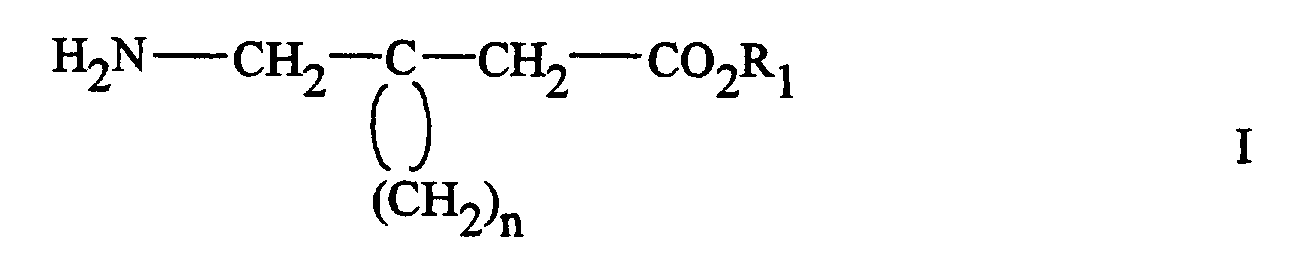
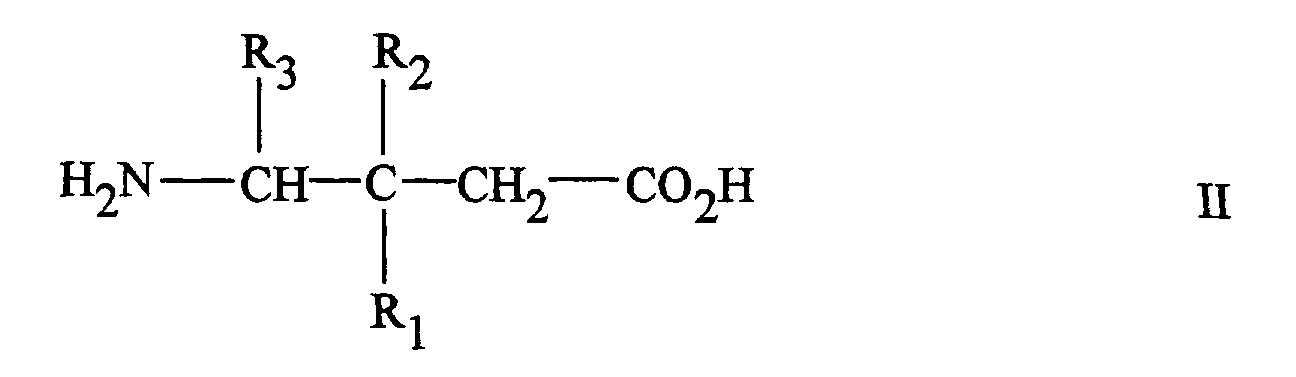


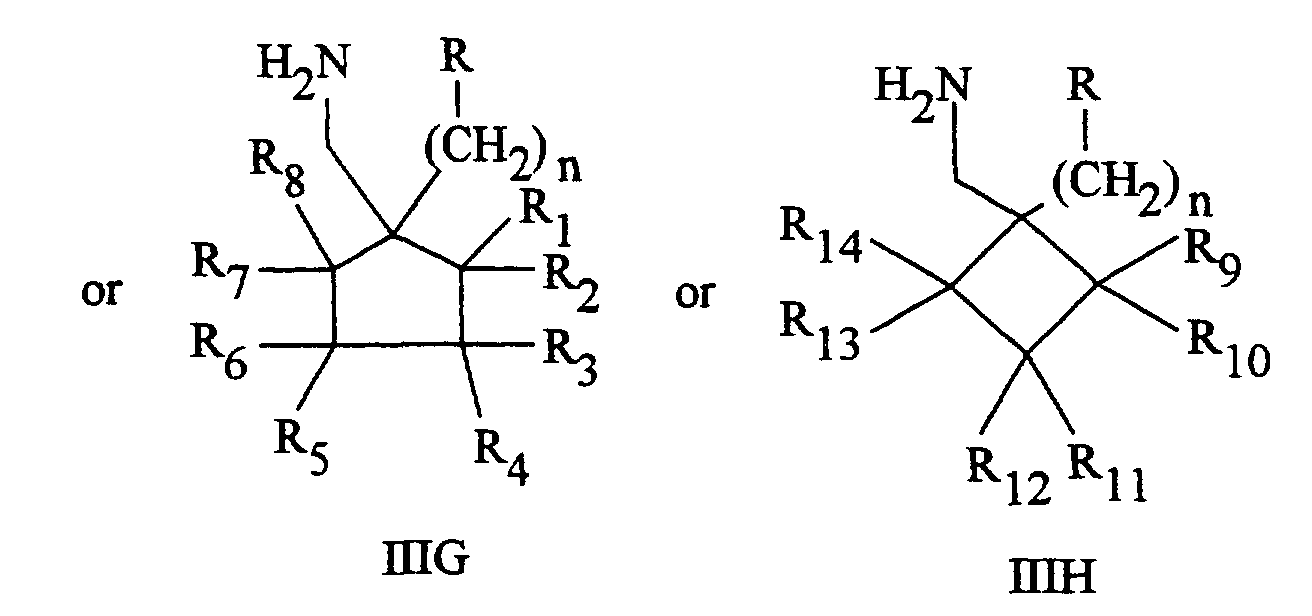

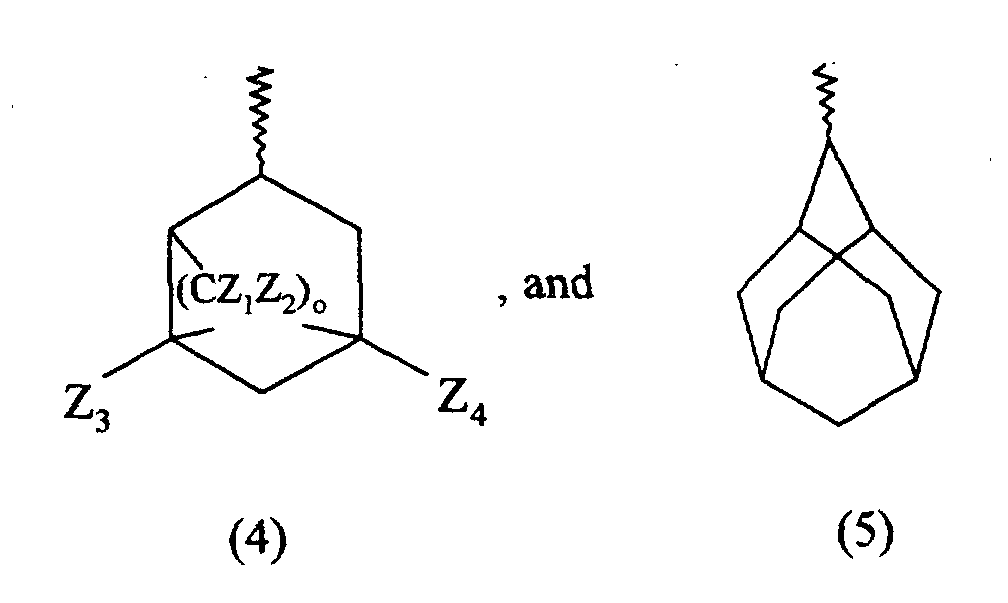


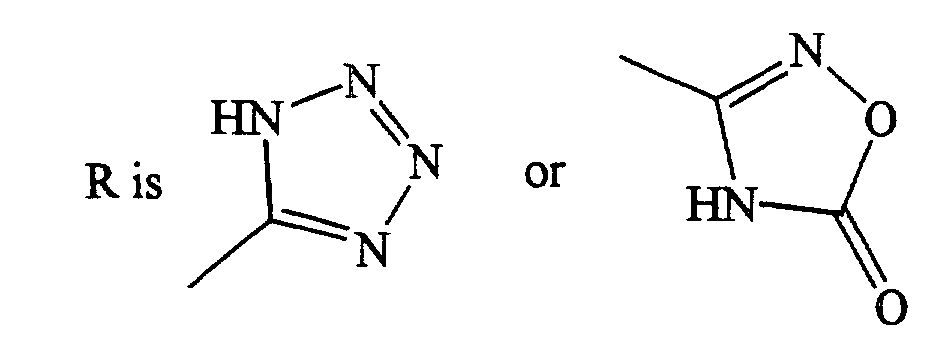
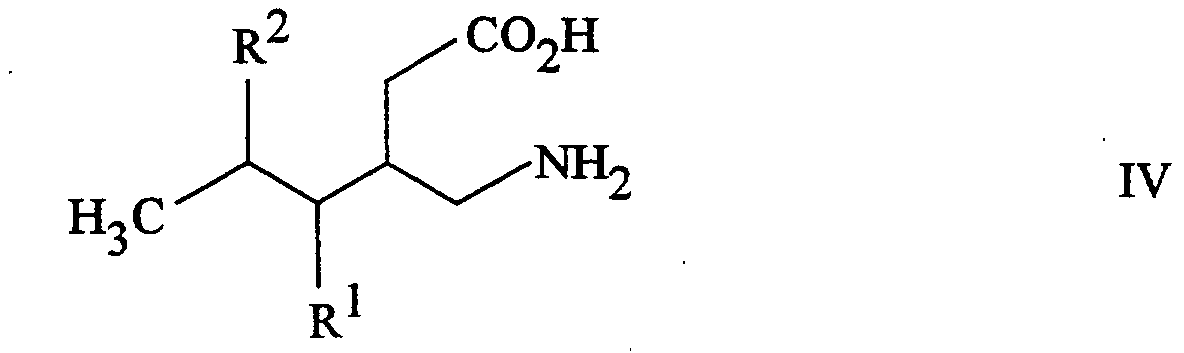




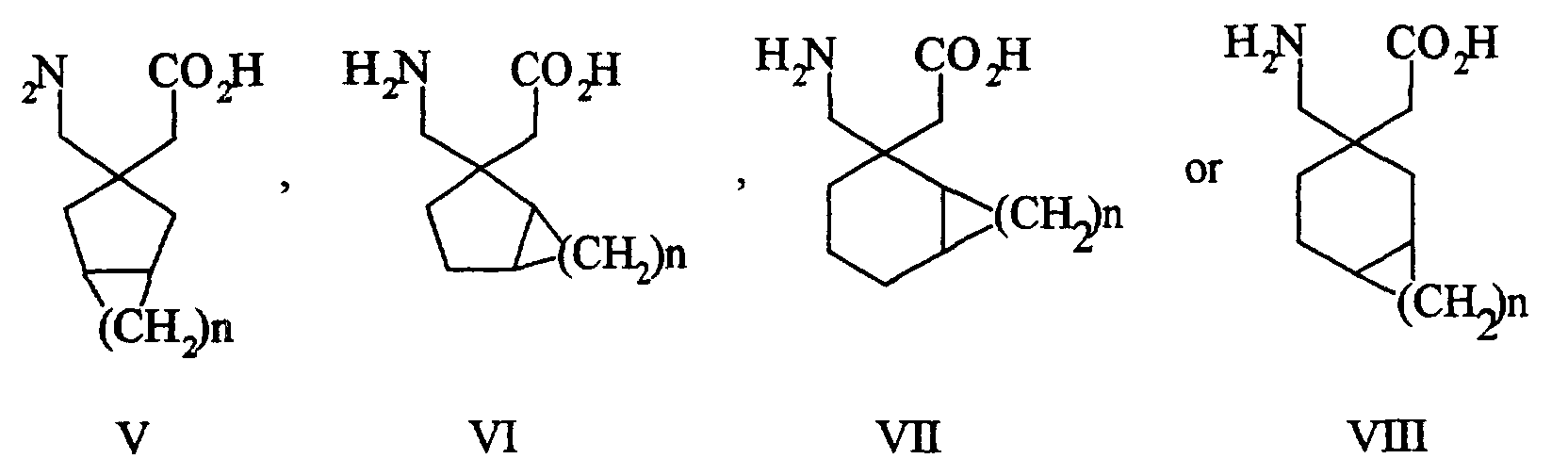
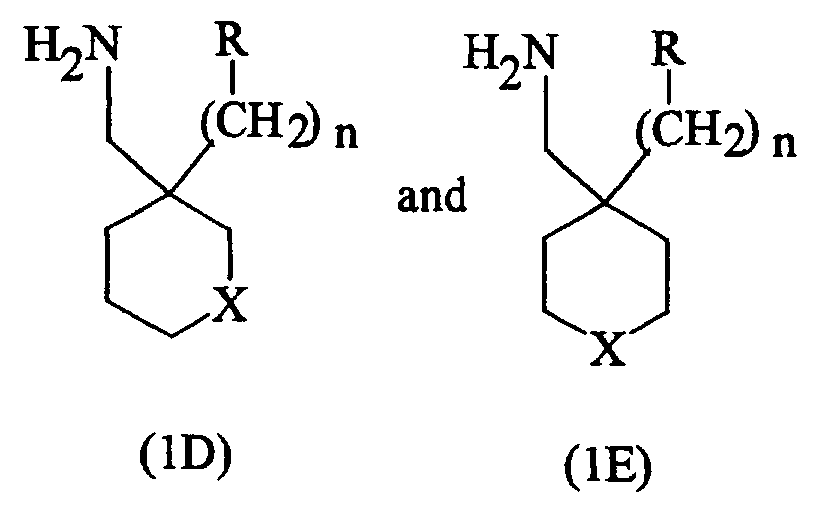
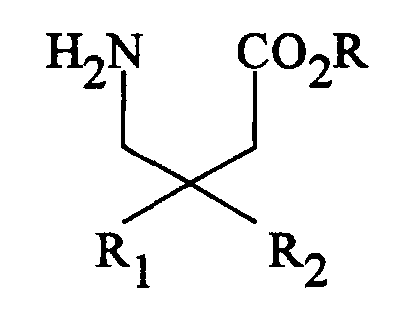

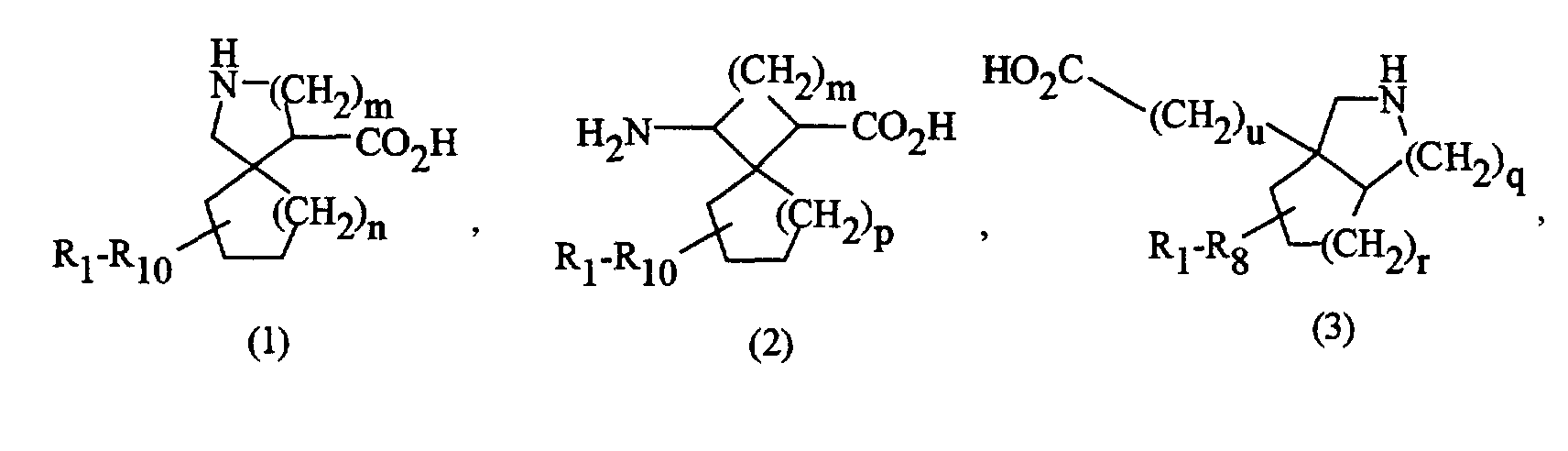

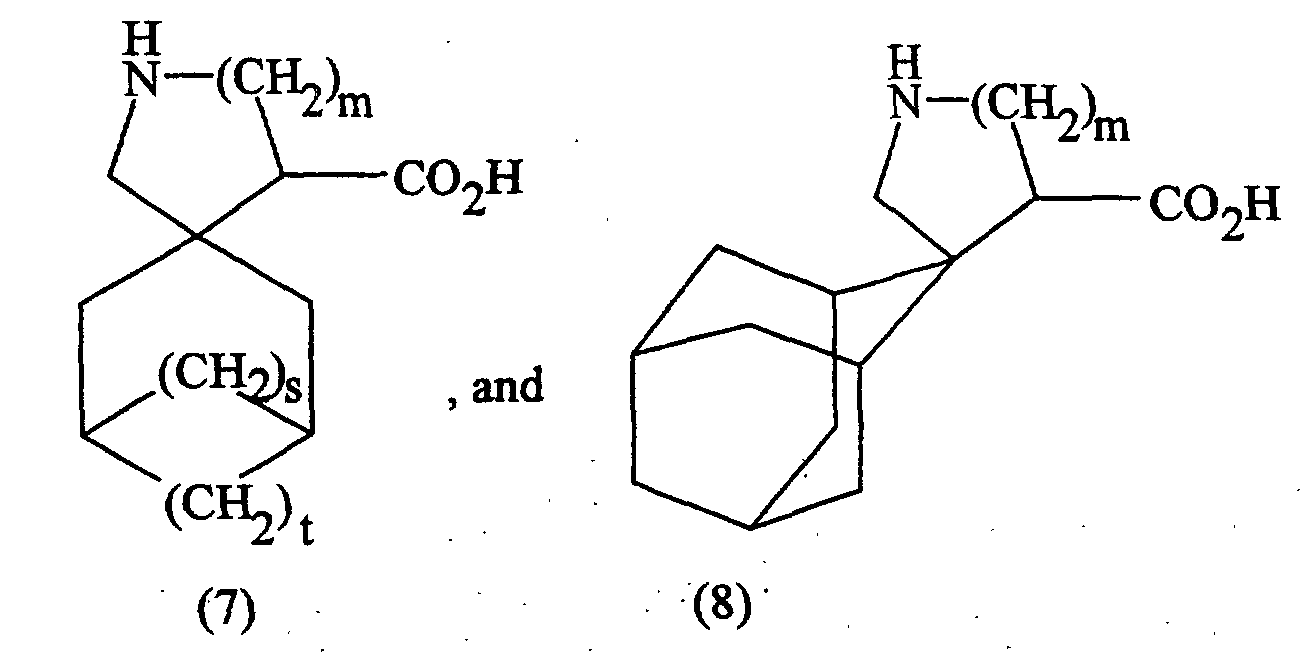



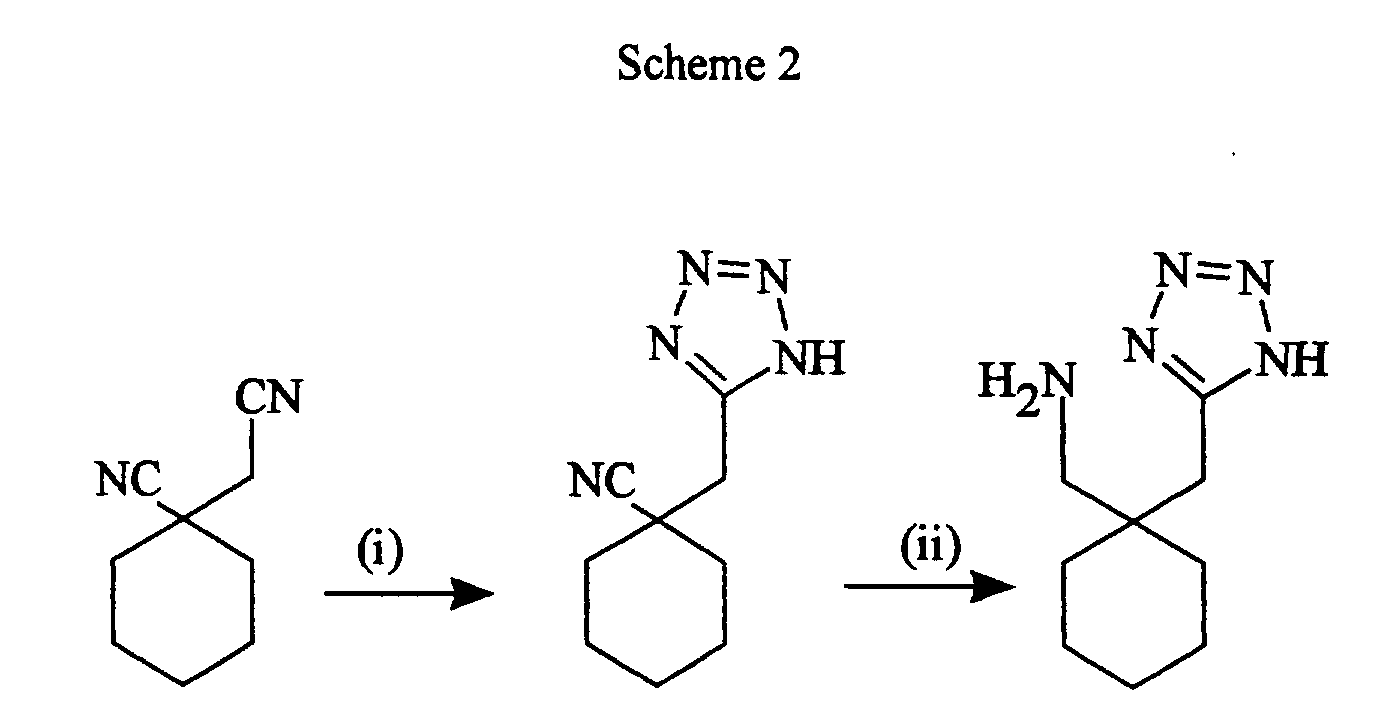
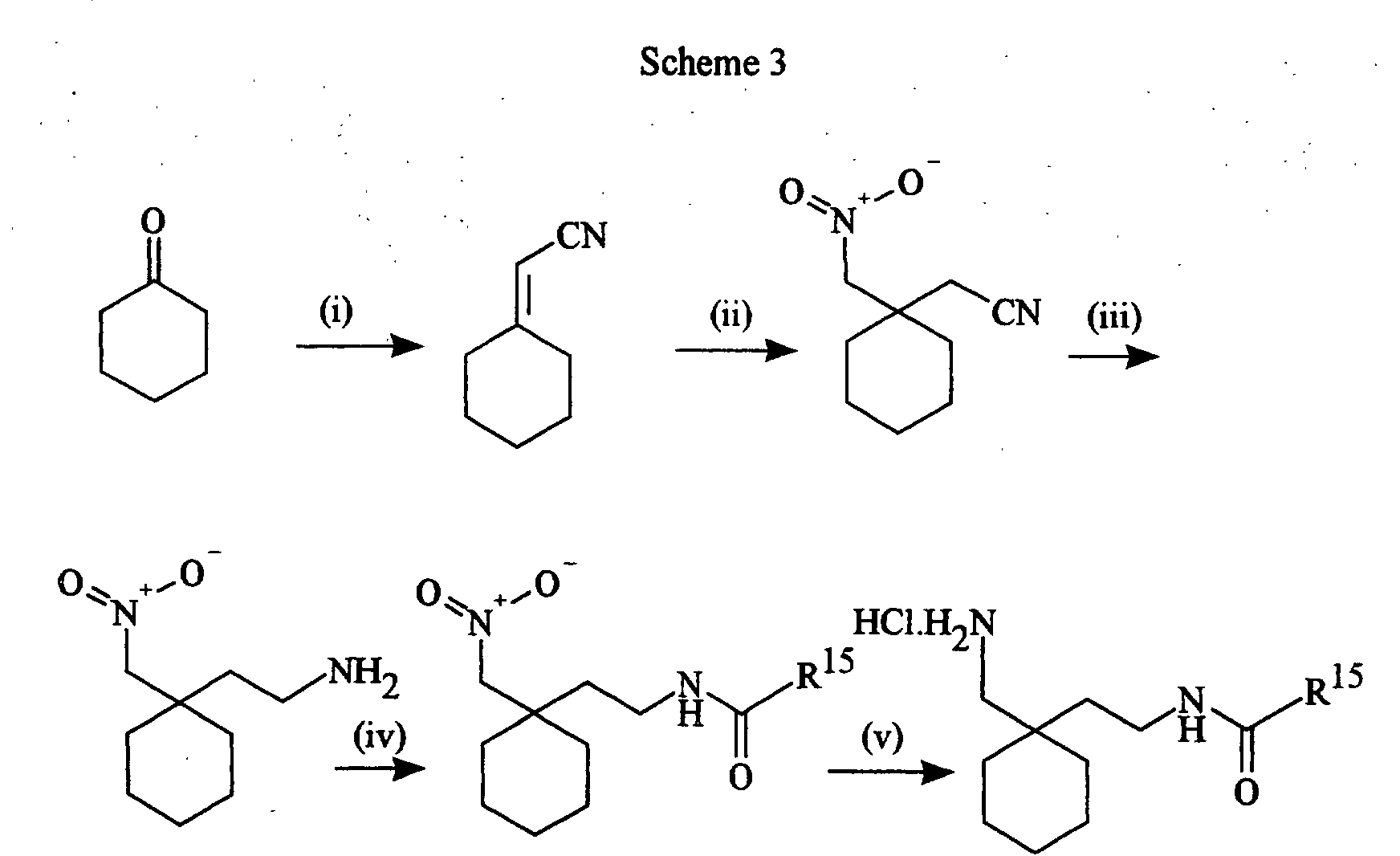


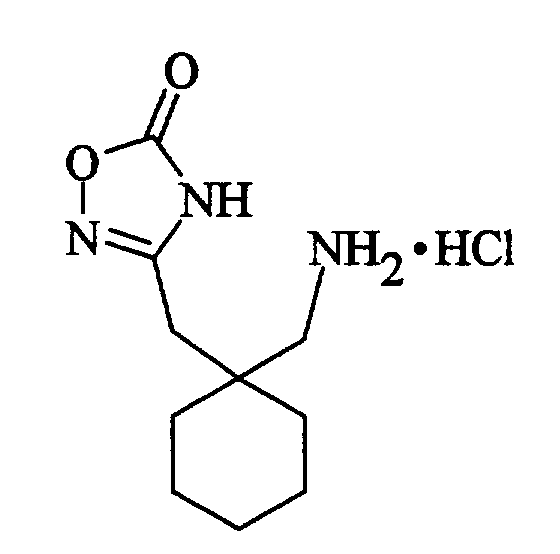


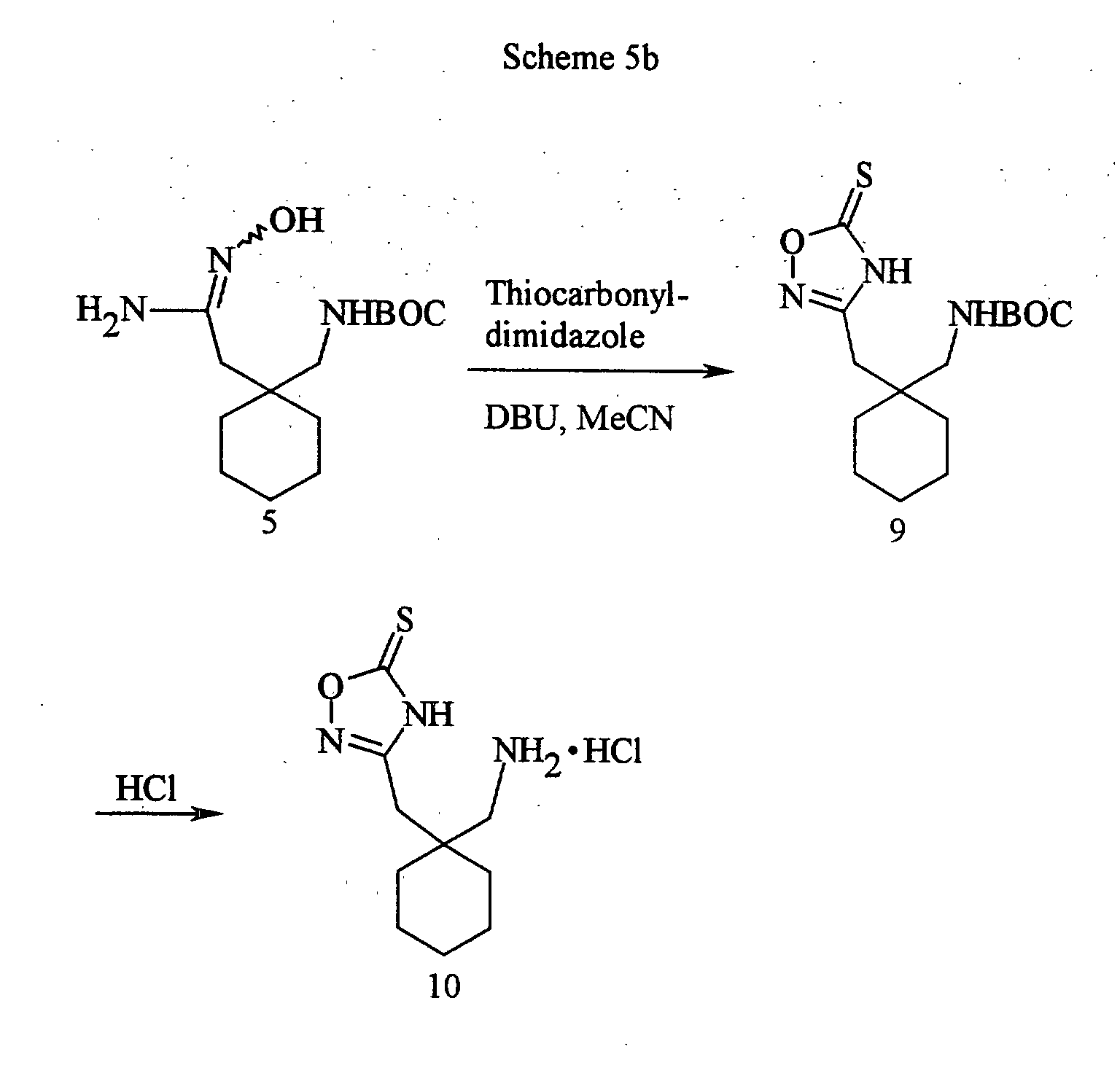
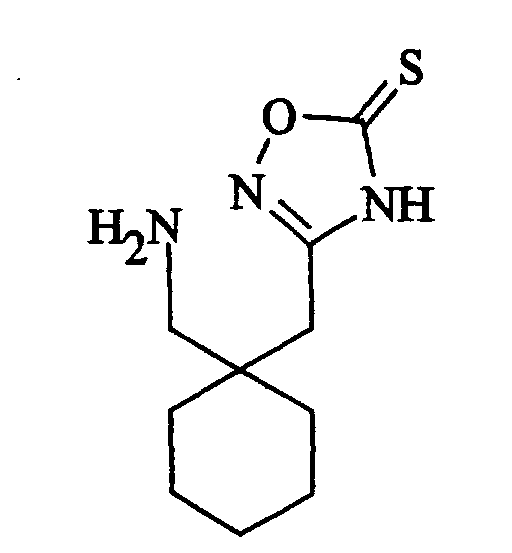
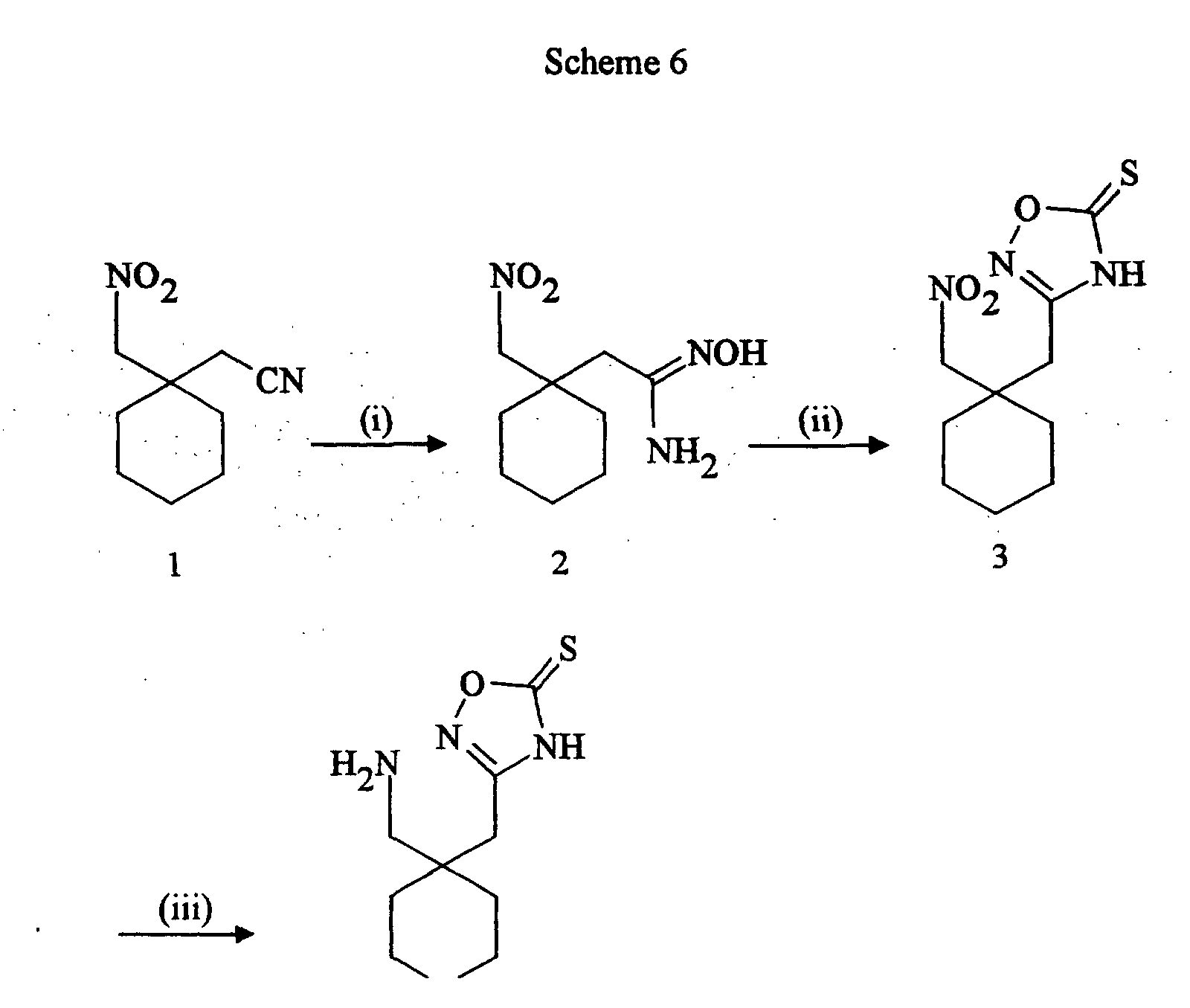
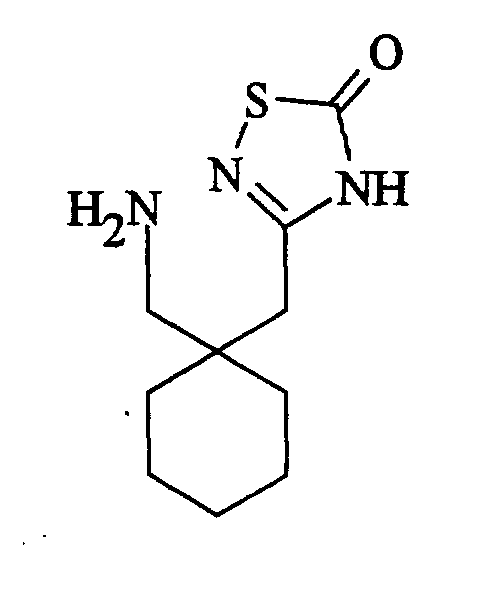
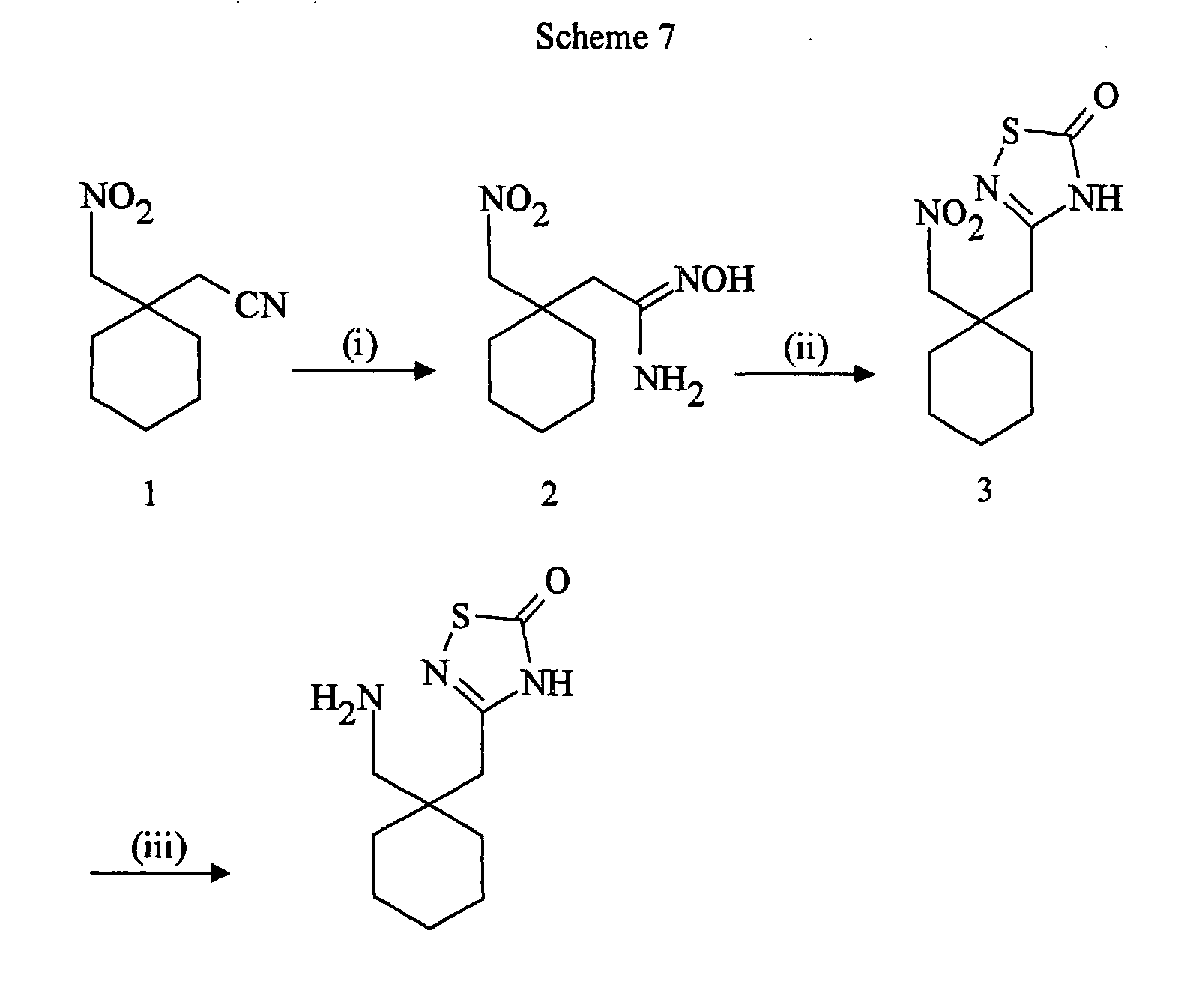
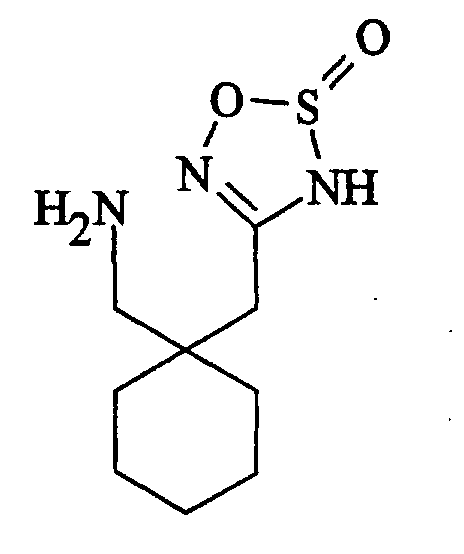
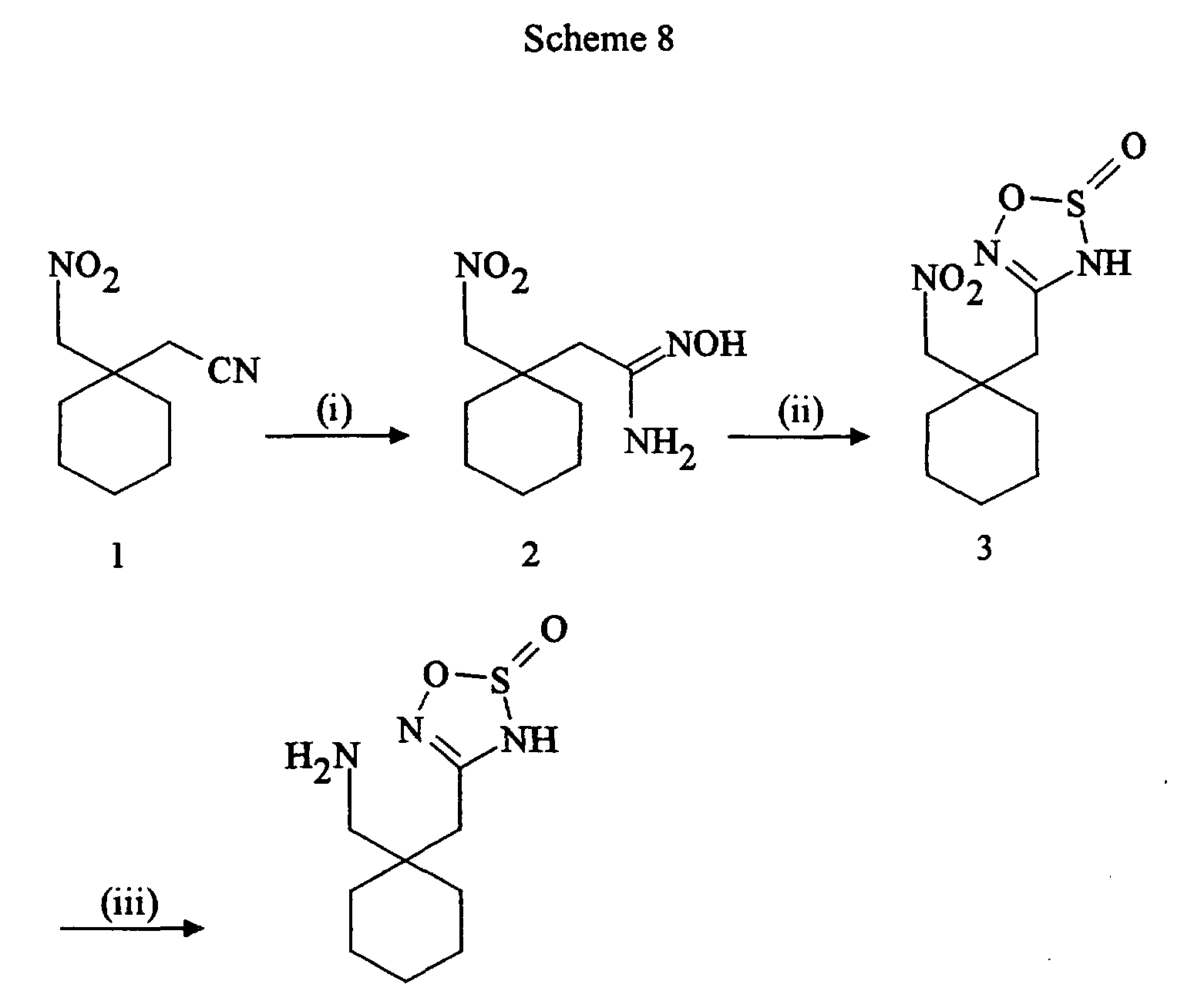


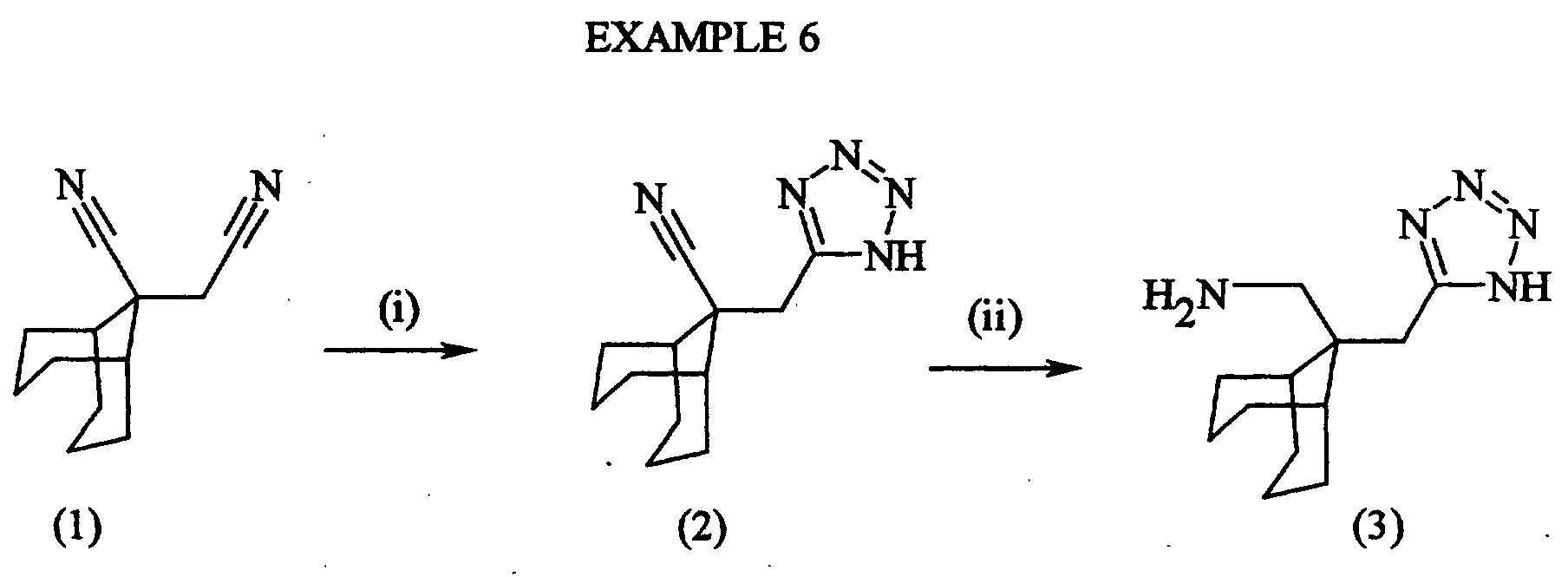


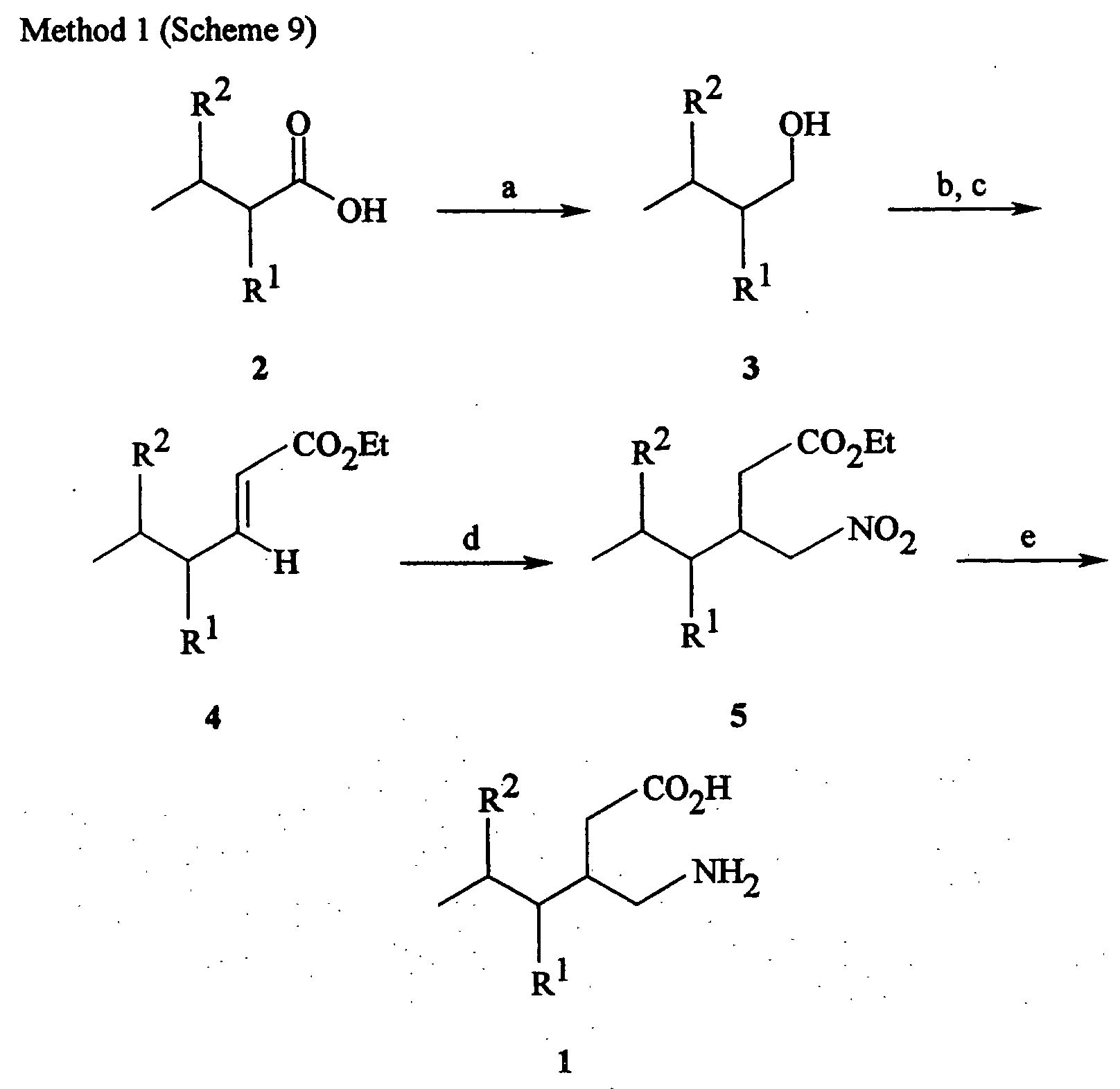


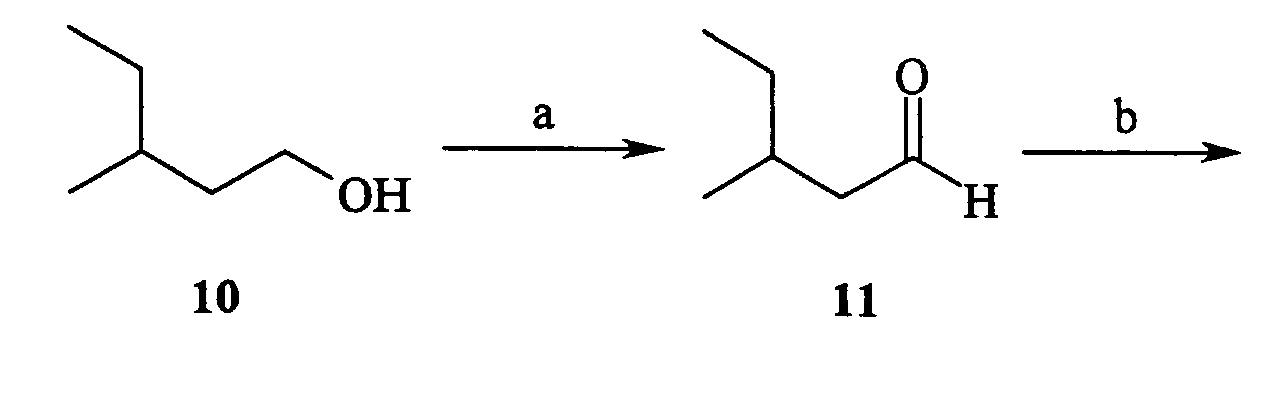

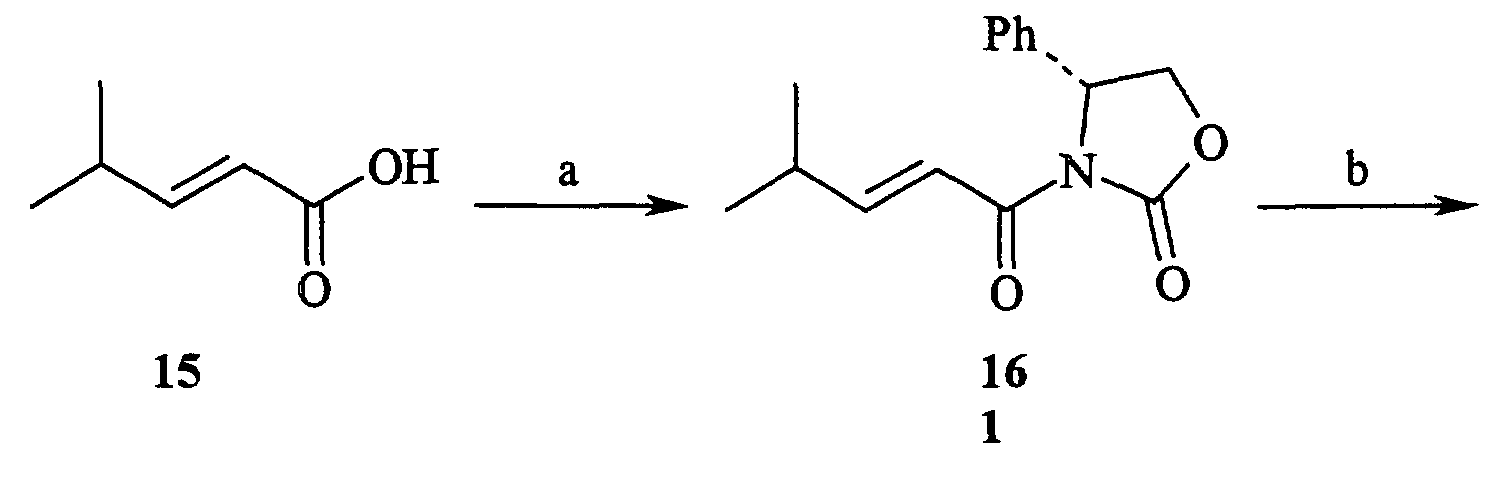
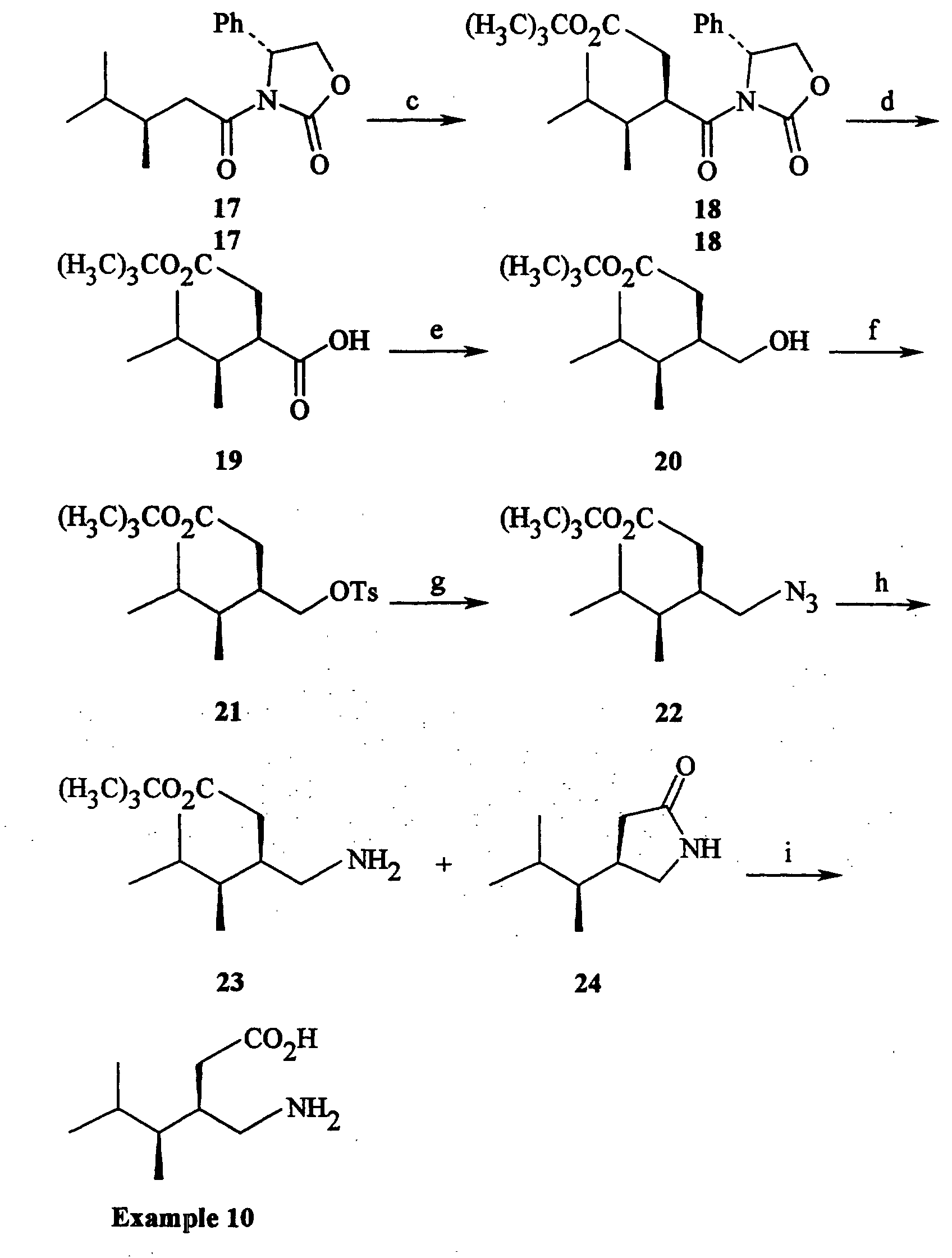


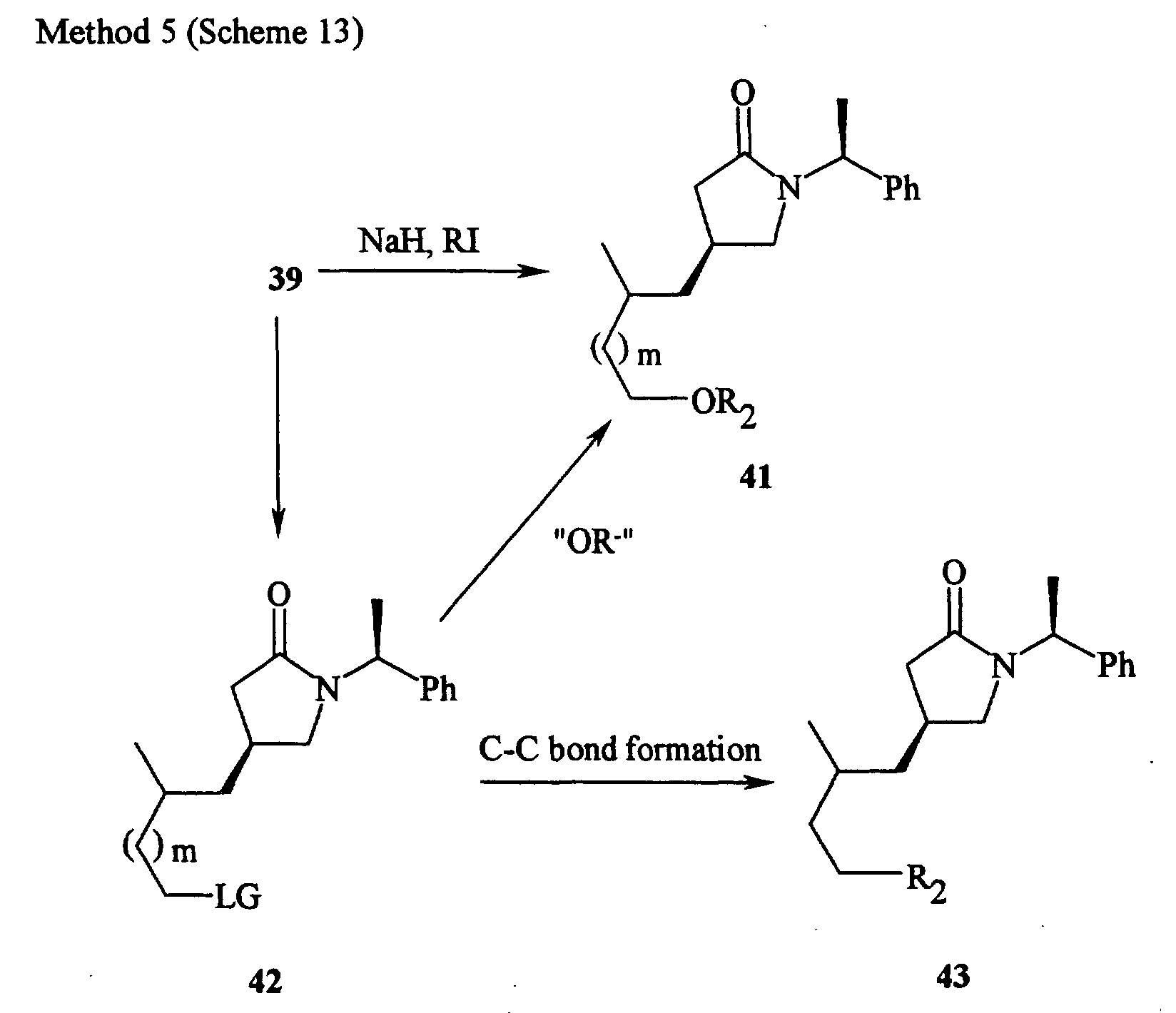


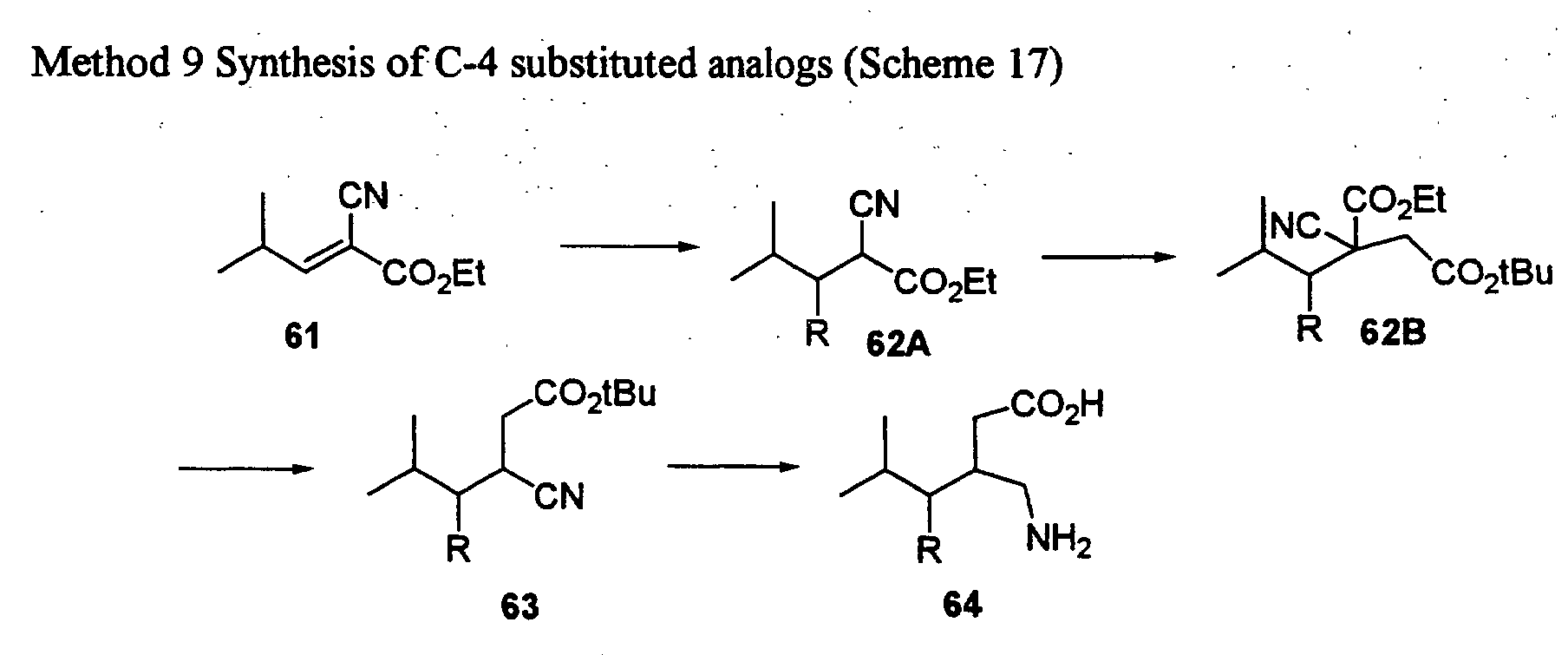
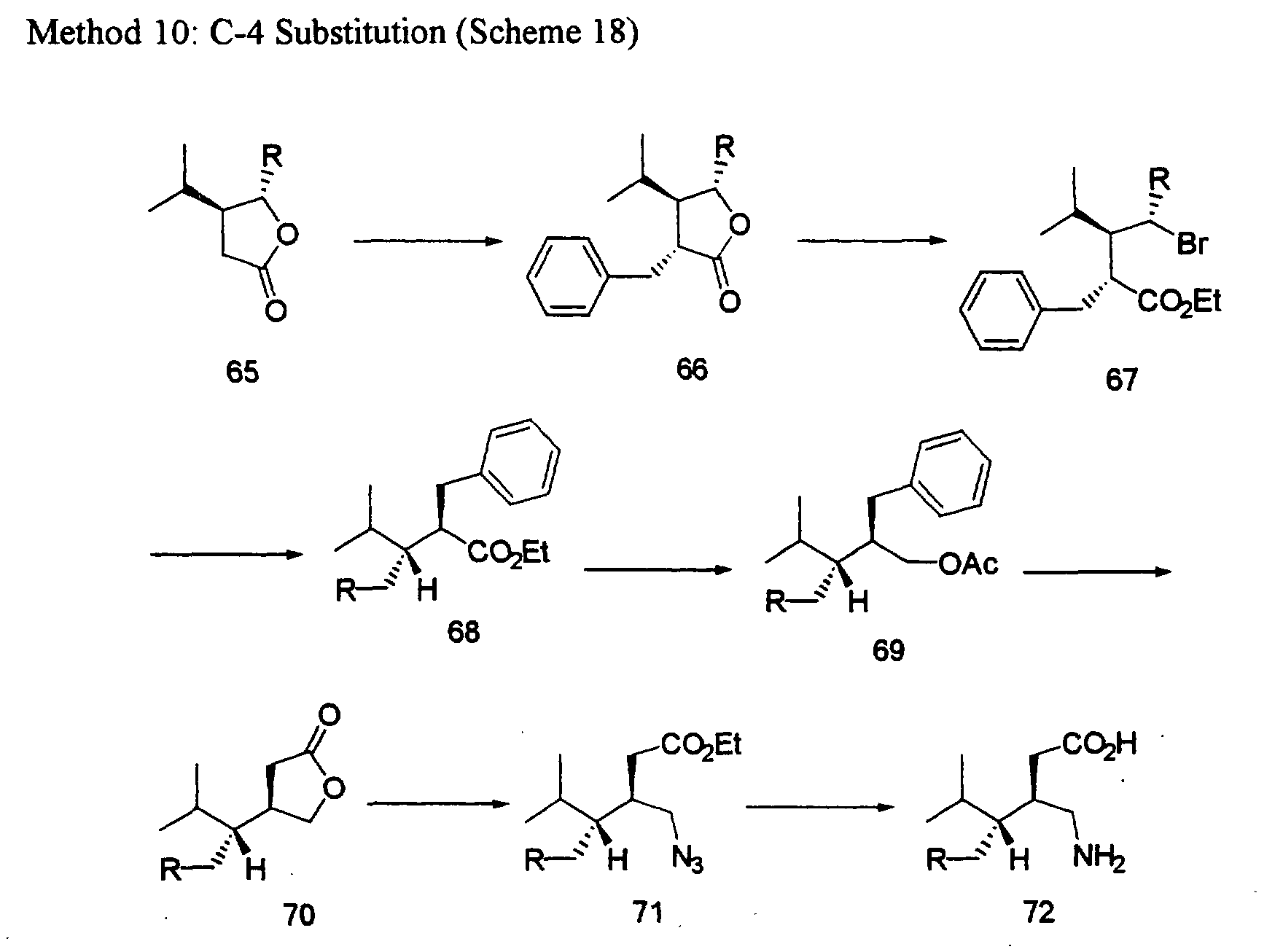


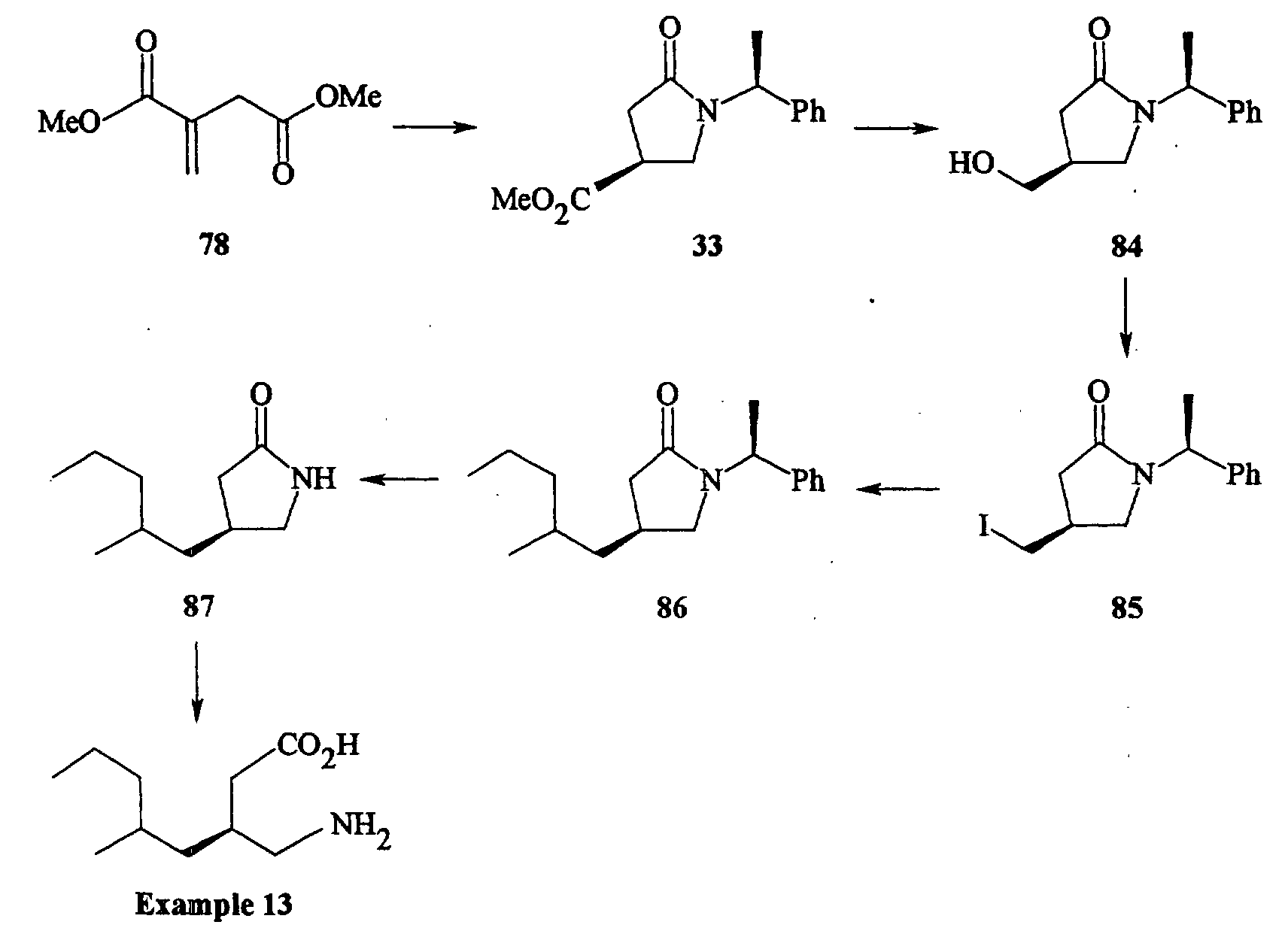


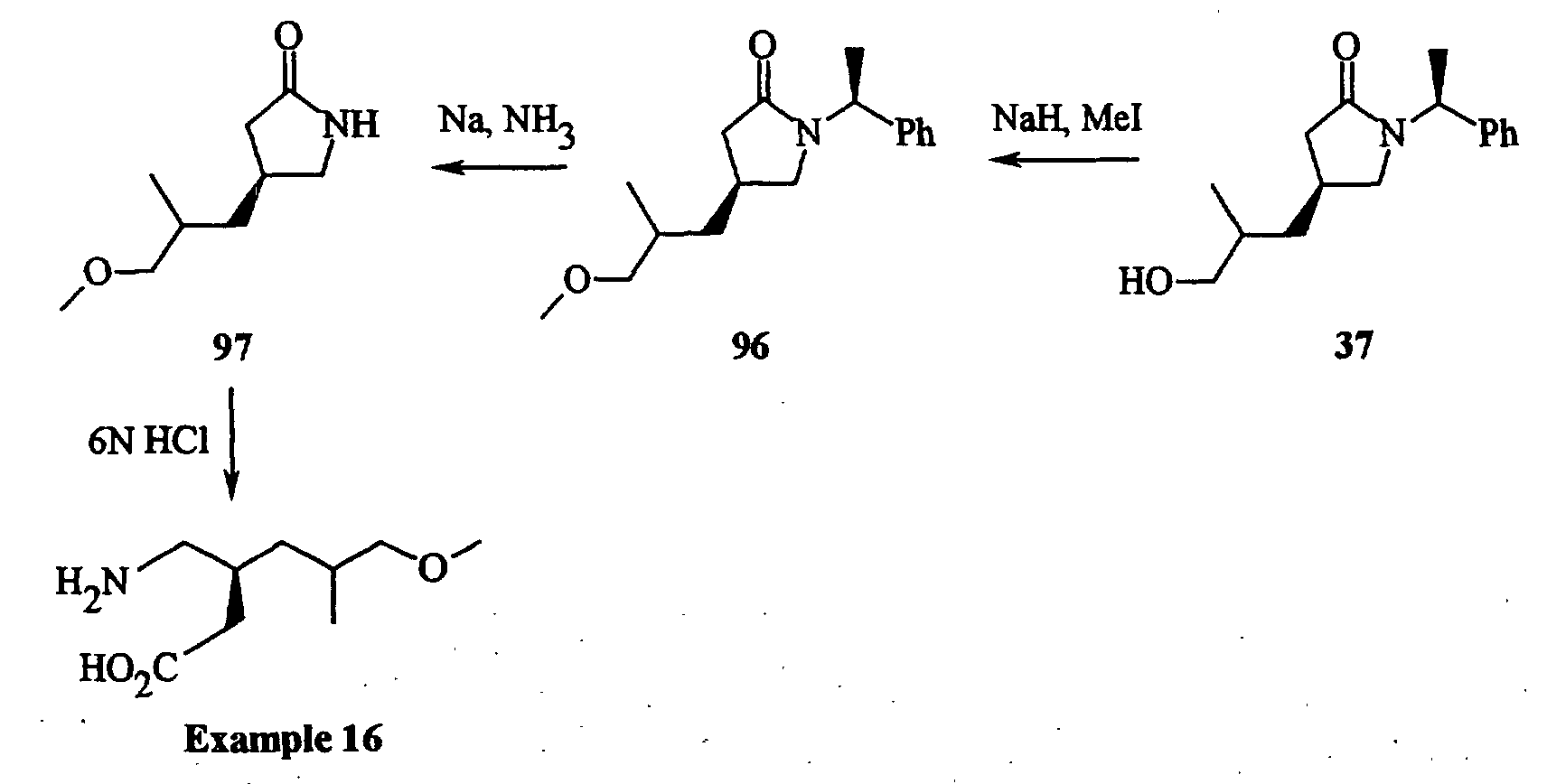

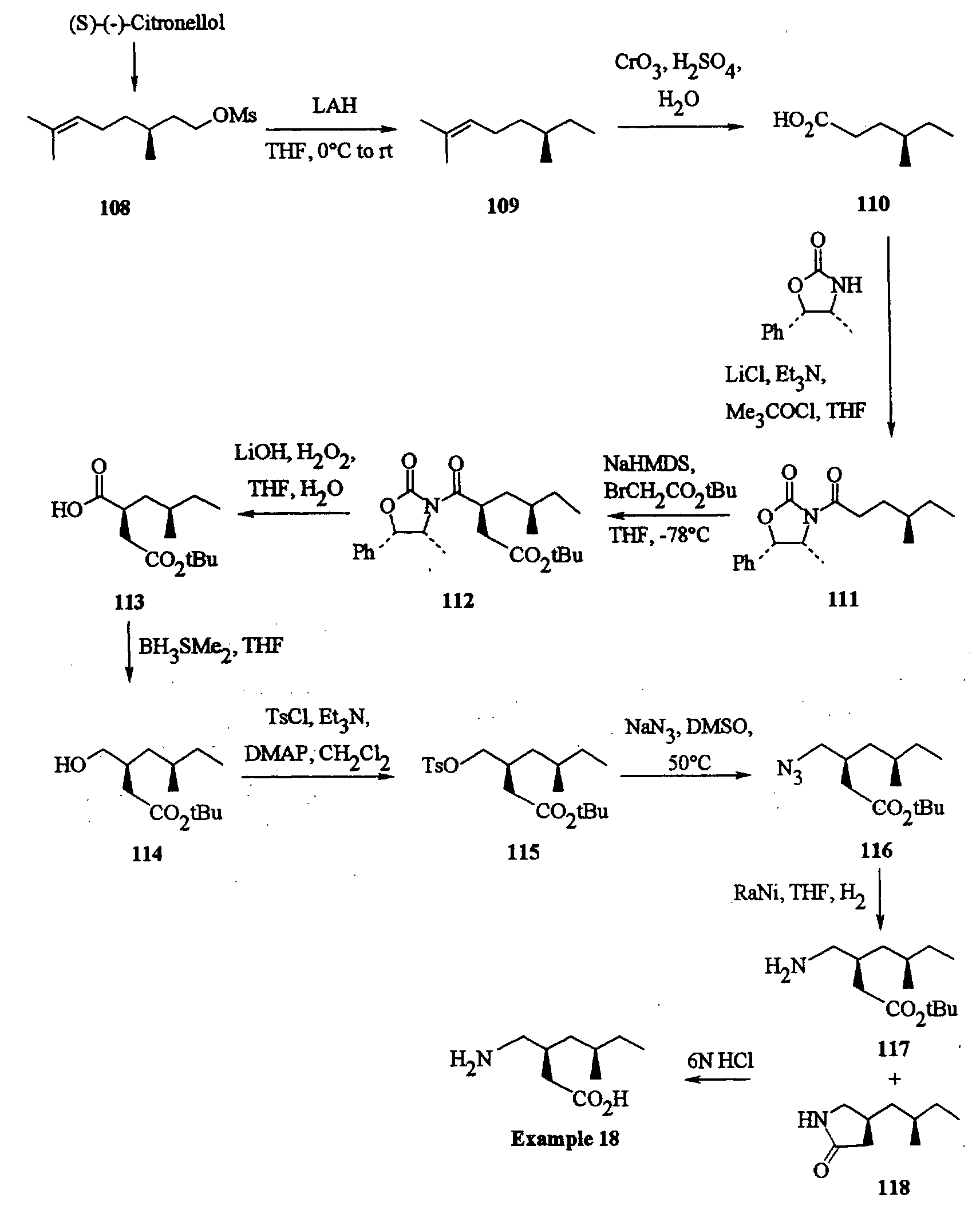
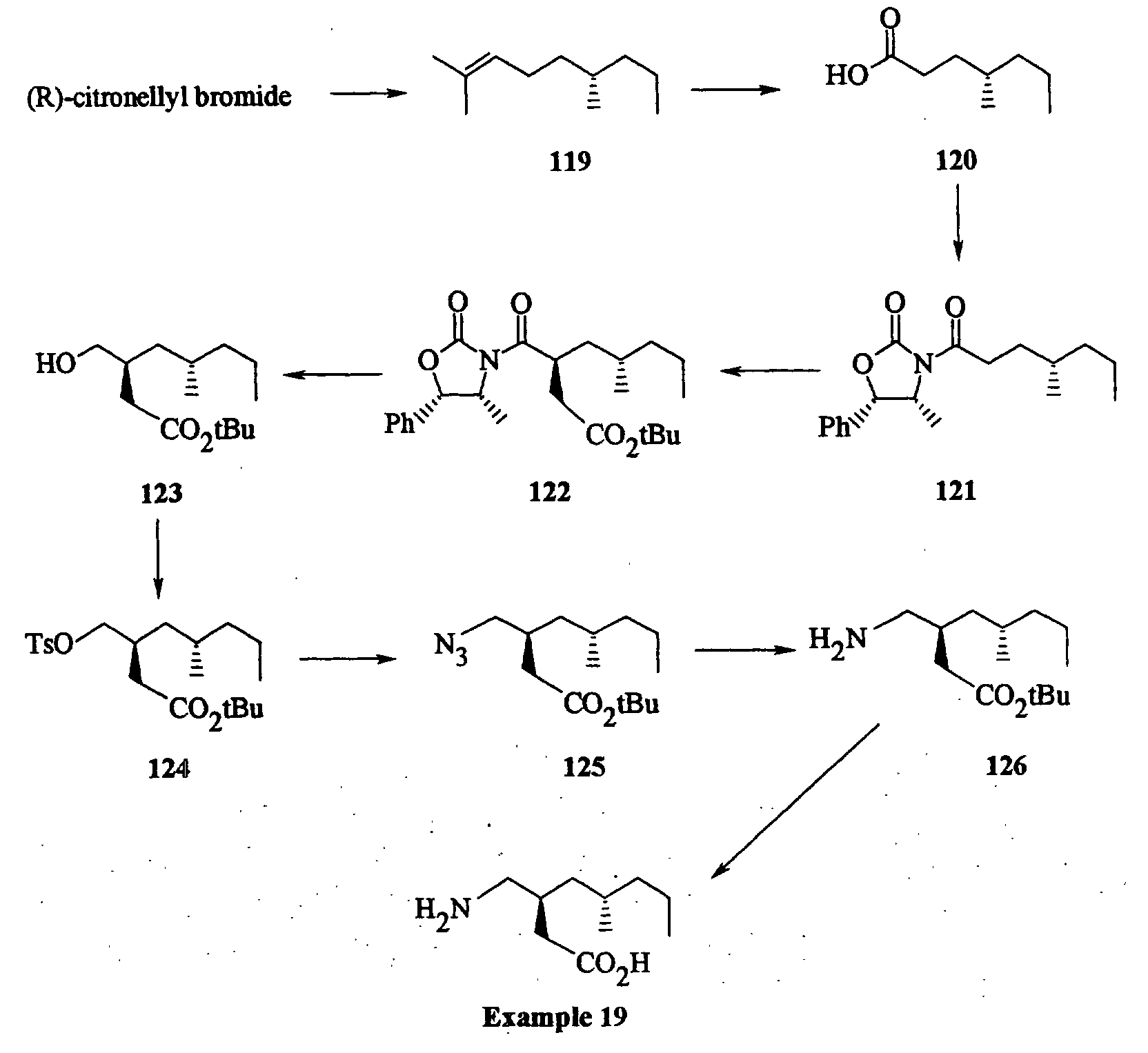

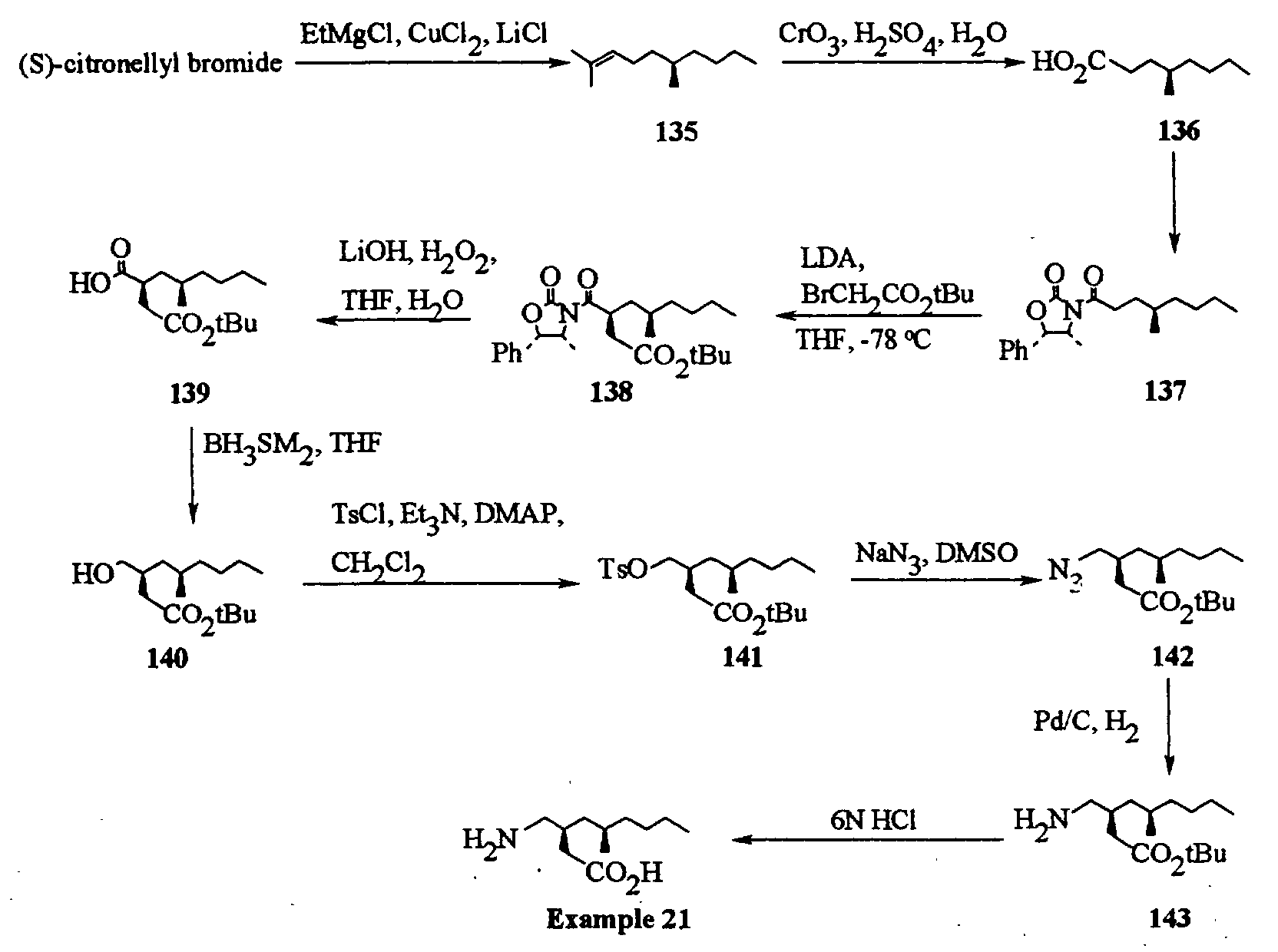


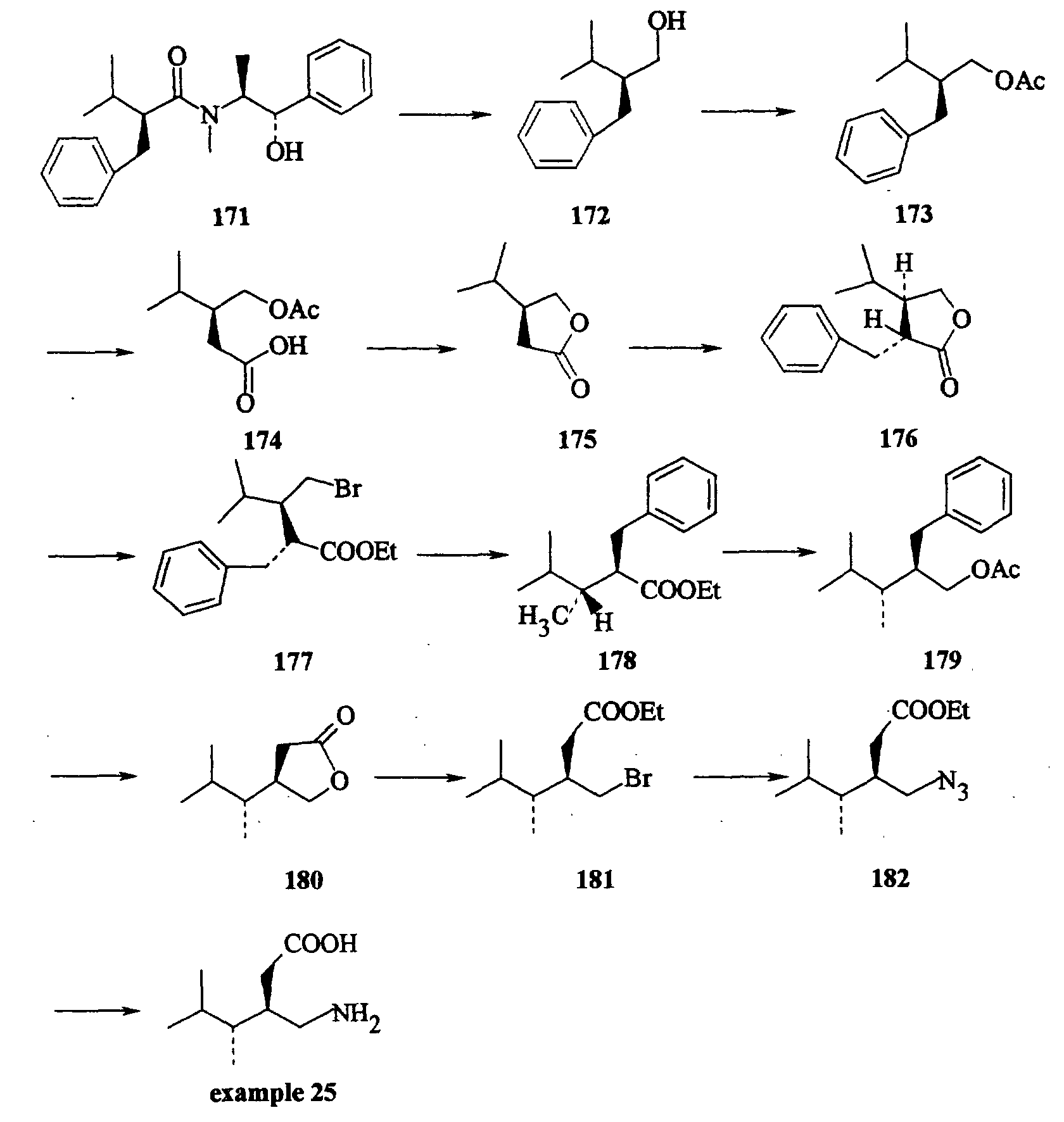
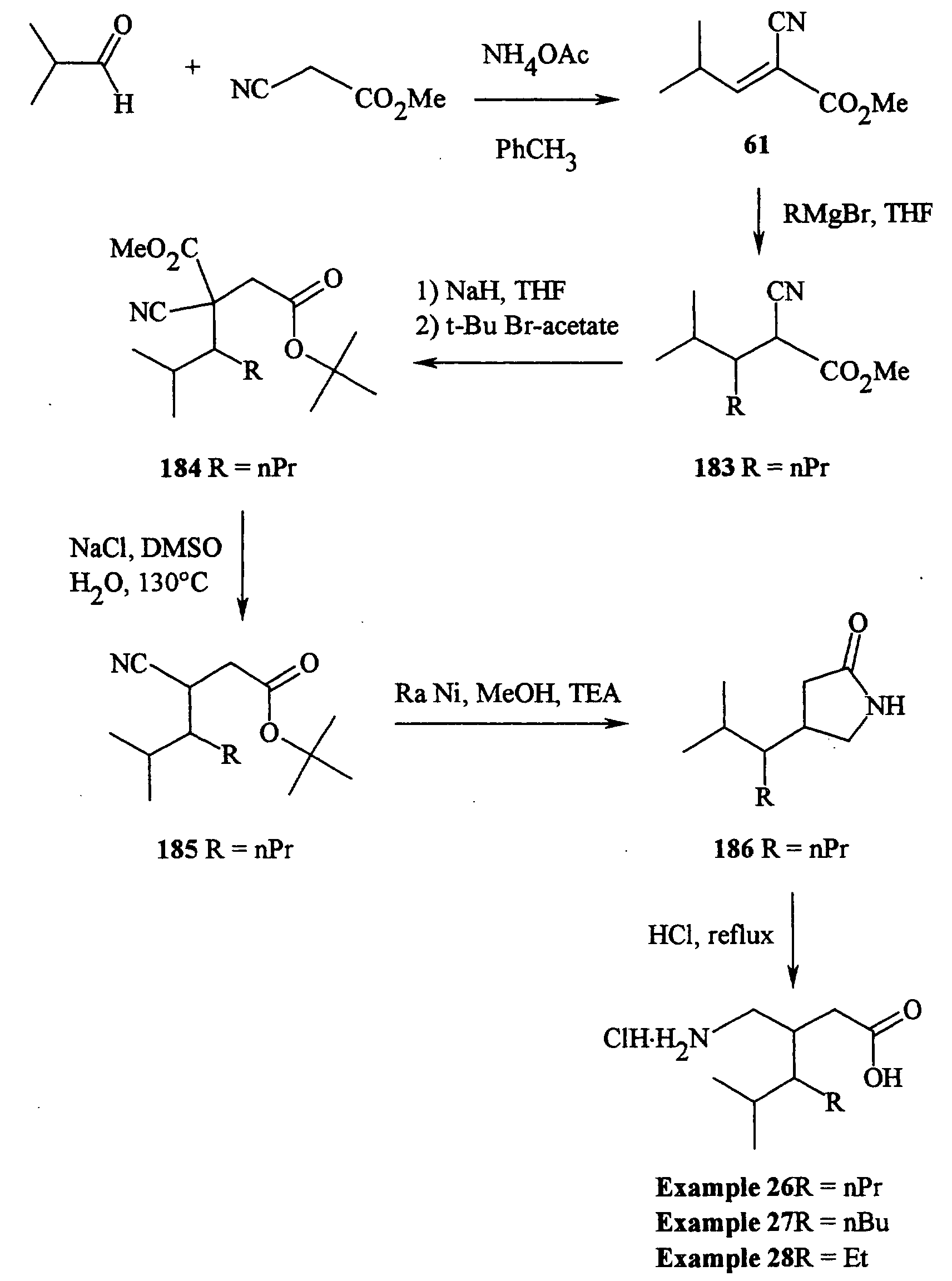


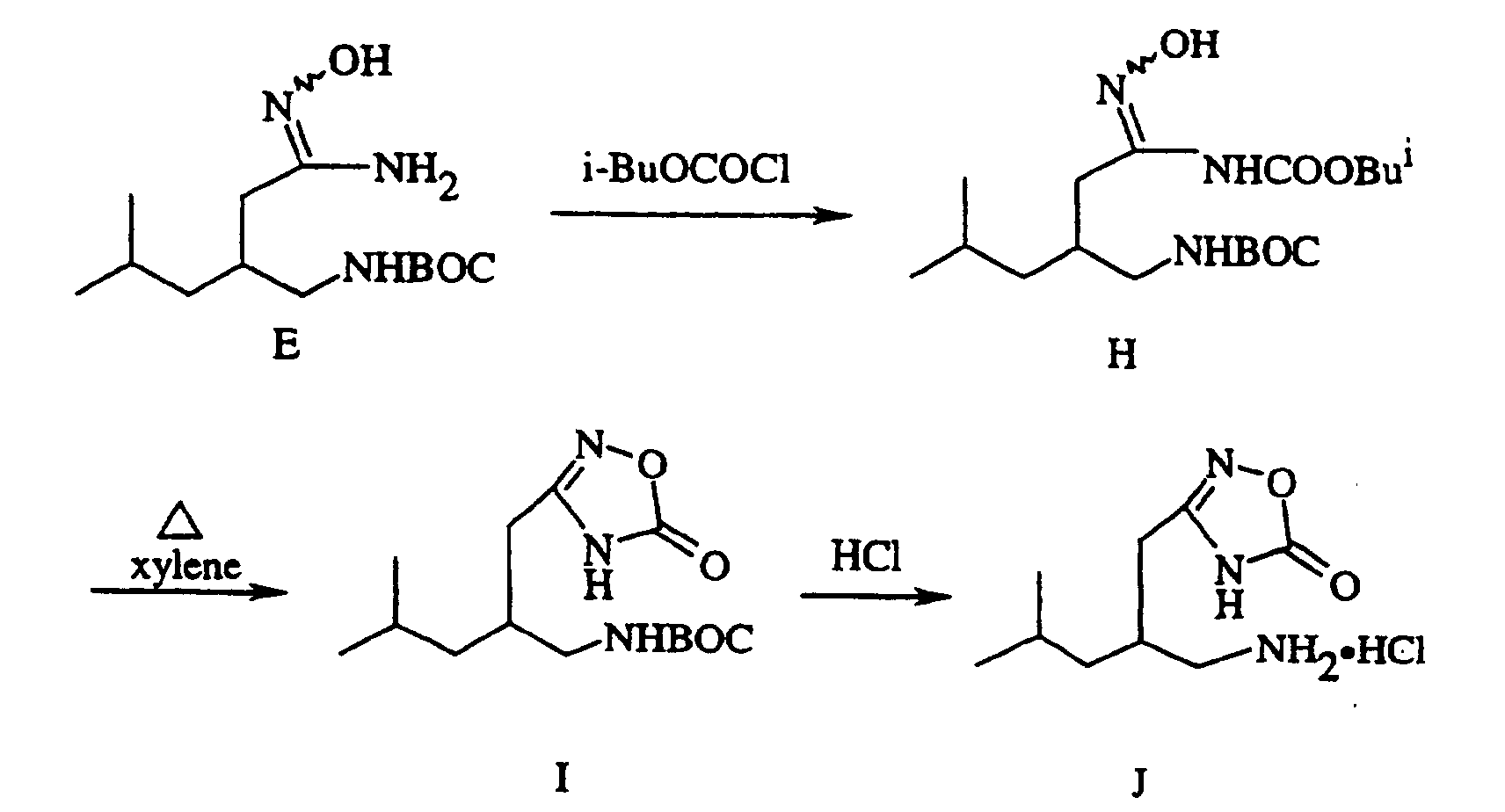
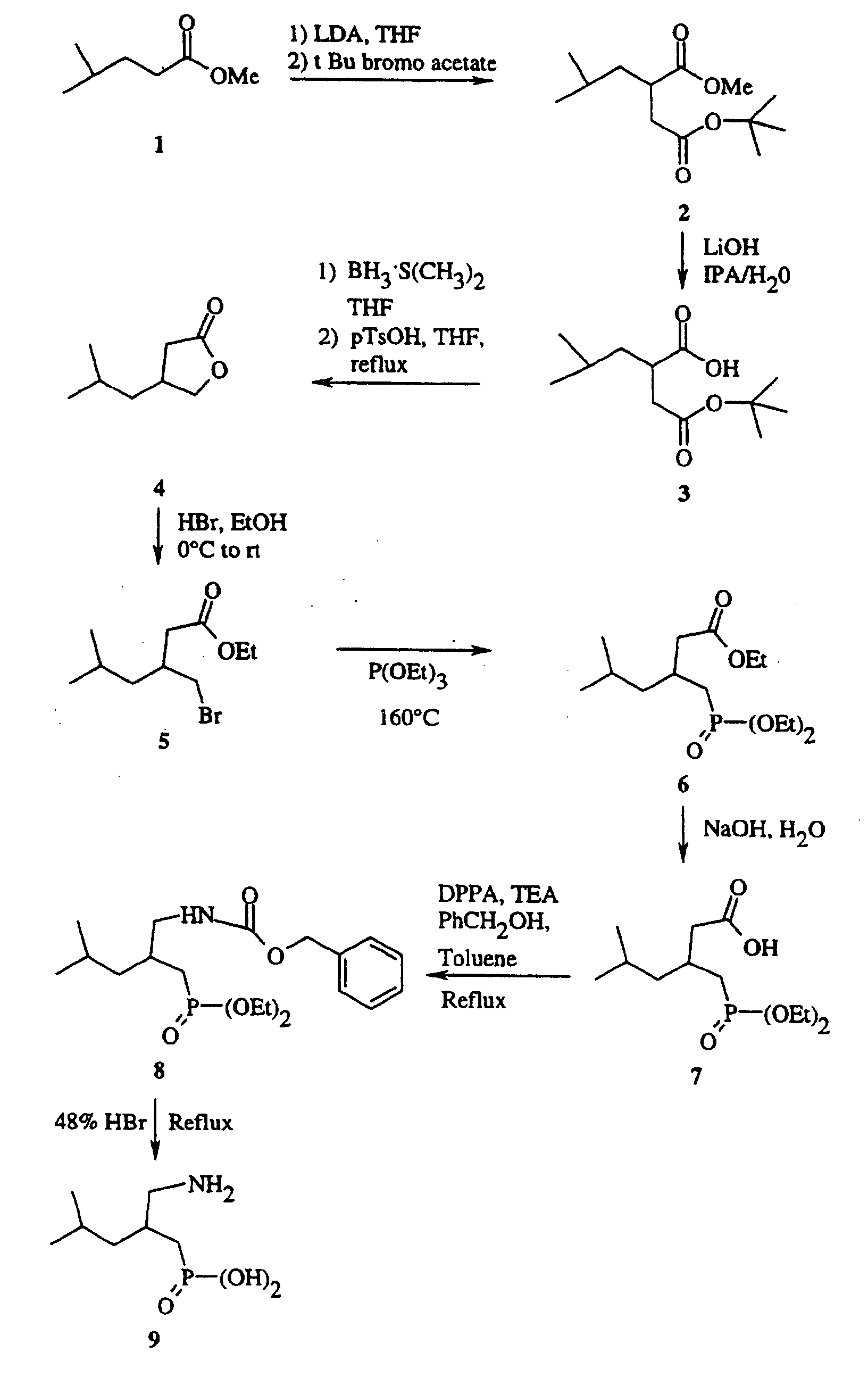
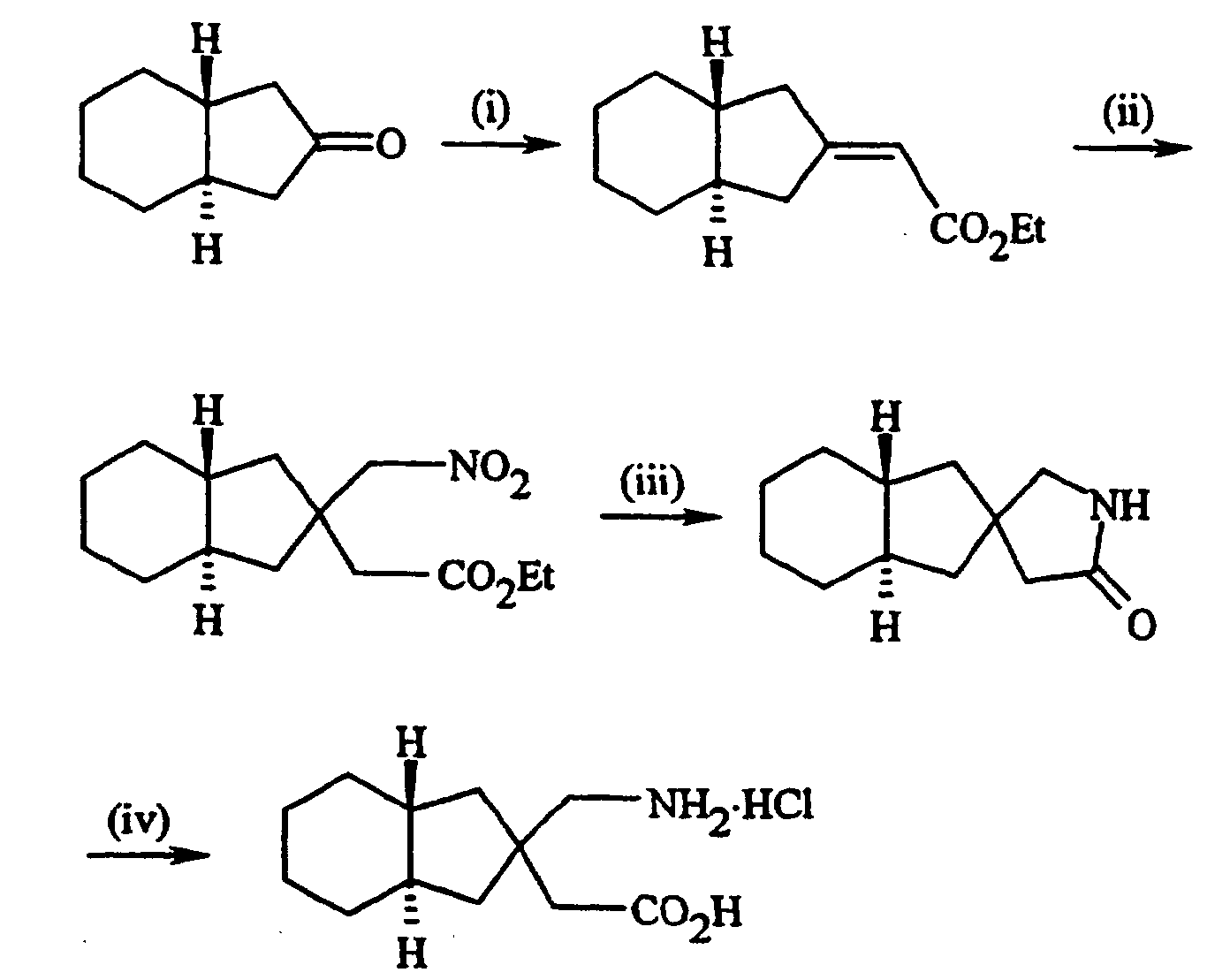


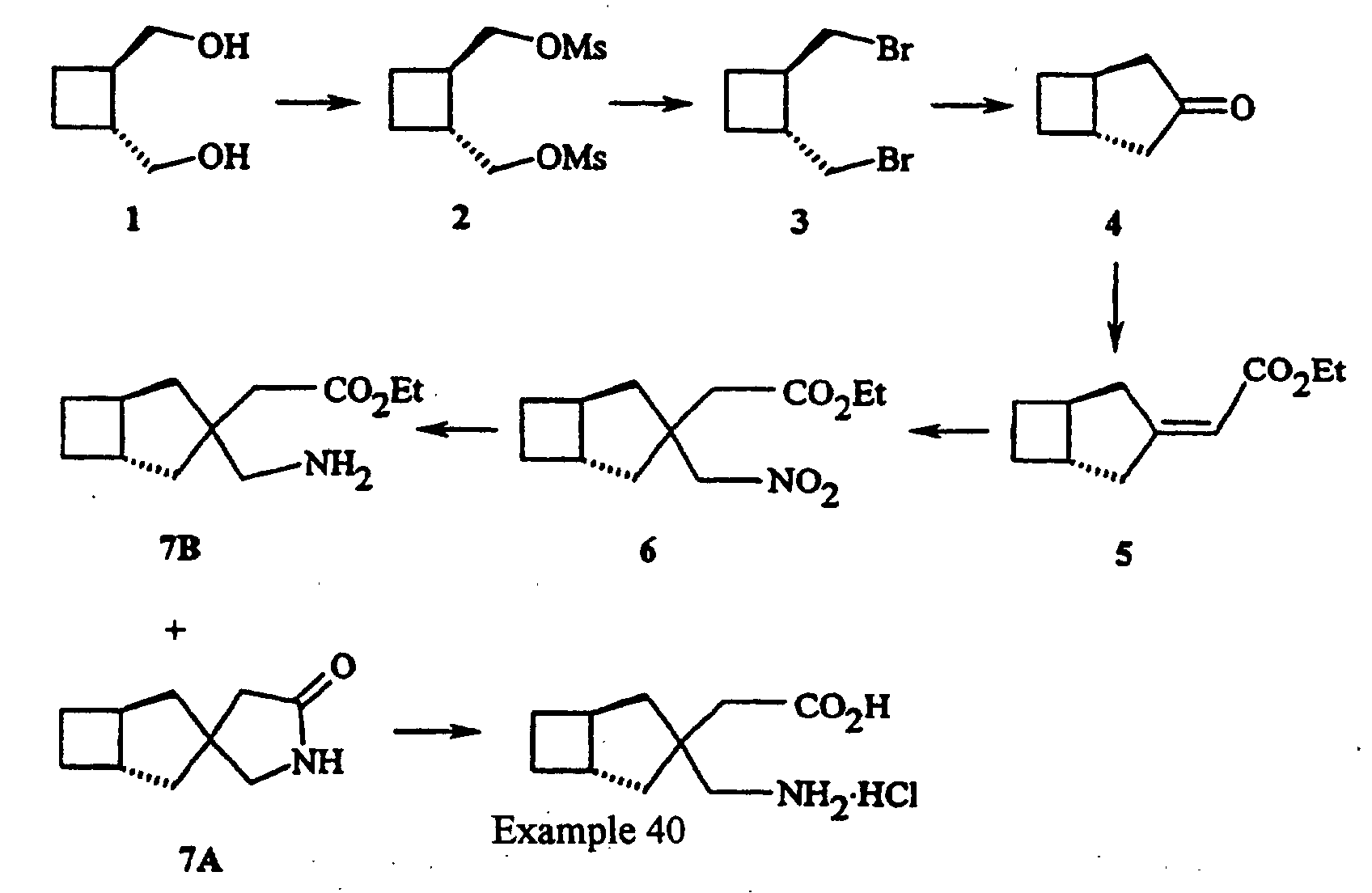
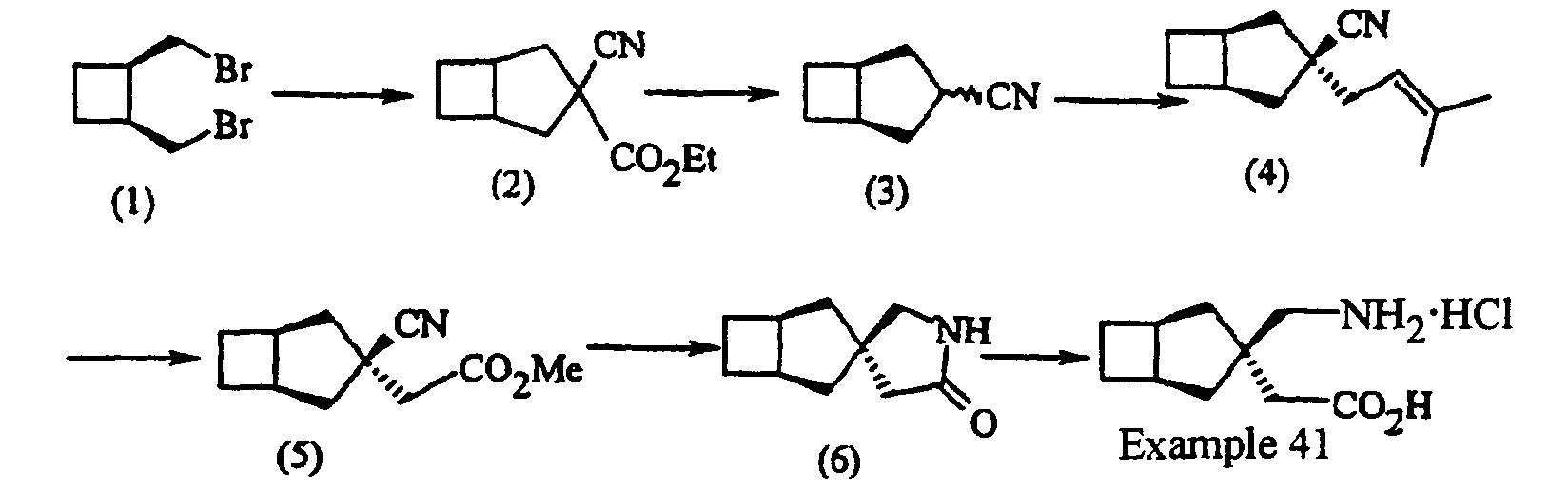


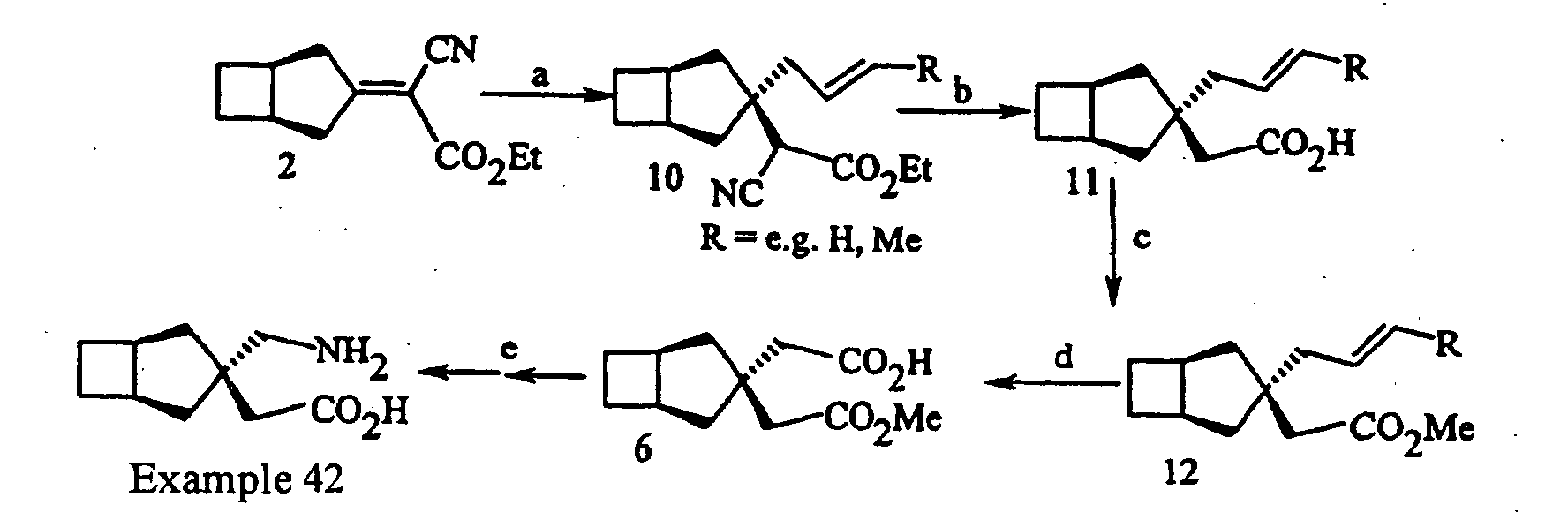

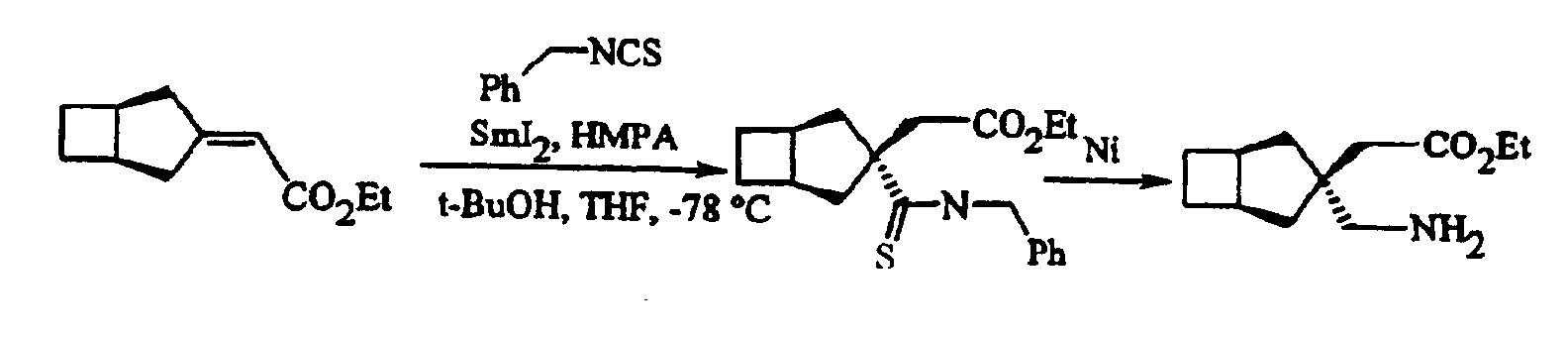


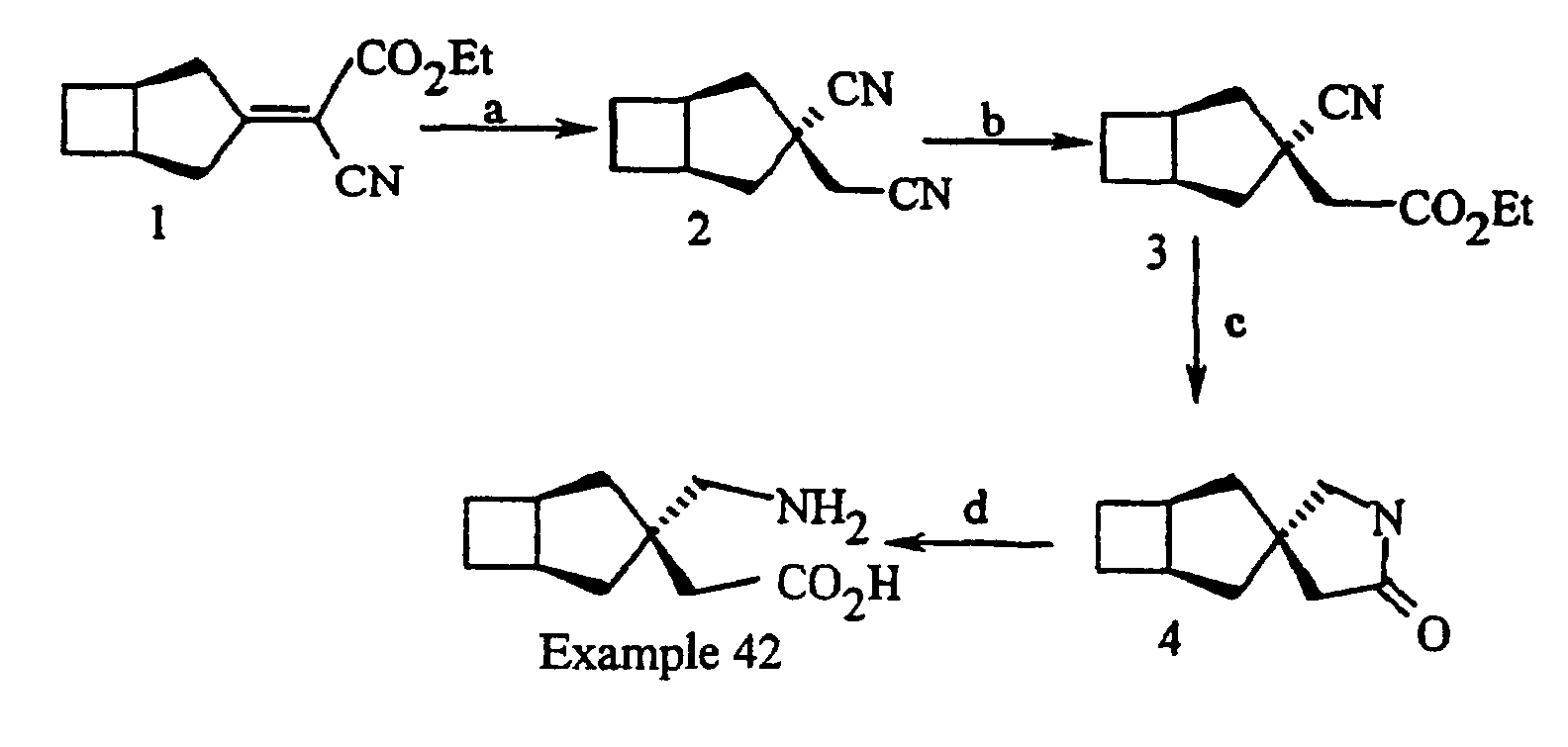

 and pharmaceutically acceptable salts thereof, wherein R1 is hydrogen orstraight or branched lower alkyl, and n is an integer of from 4 to 6; orthe GABA analog is a compound of Formula II
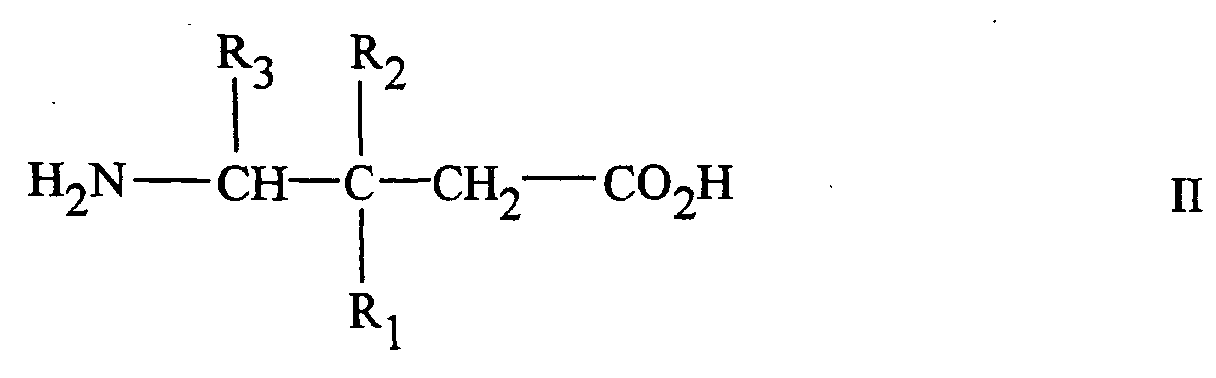 and pharmaceutically acceptable salts thereof, wherein:R1 is straight or branched unsubstituted alkyl of from 1 to 6 carbon atoms, unsubstituted phenyl, or unsubstituted cycloalkyl of from 3 to 6 carbon atoms;R2 is hydrogen or methyl; andR3 is hydrogen, methyl, or carboxy; orthe GABA analog is a compound of Formulaor
 whereinn is an integer of from 0 to 2;m is an integer of from 0 to 3 ;R is sulfonamide,amide,phosphonic acid,heterocycle,sulfonic acid, orhydroxamic acid;R1 to R14 are each independently selected from hydrogen or straight or branched alkyl of from 1 to 6 carbons, unsubstituted or substituted benzyl or phenyl which substituents are selected from halogen, alkyl, alkoxy, hydroxy, carboxy, carboalkoxy, trifluoromethyl, and nitro;A' is a bridged ring selected from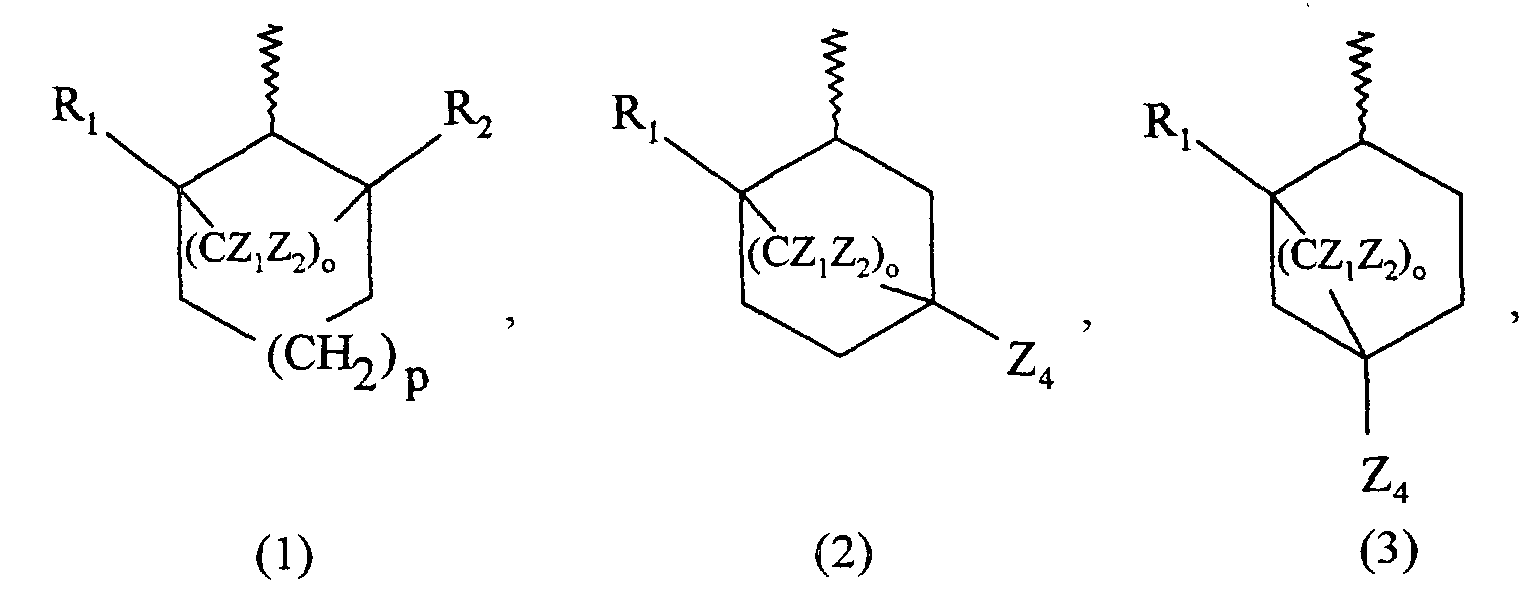
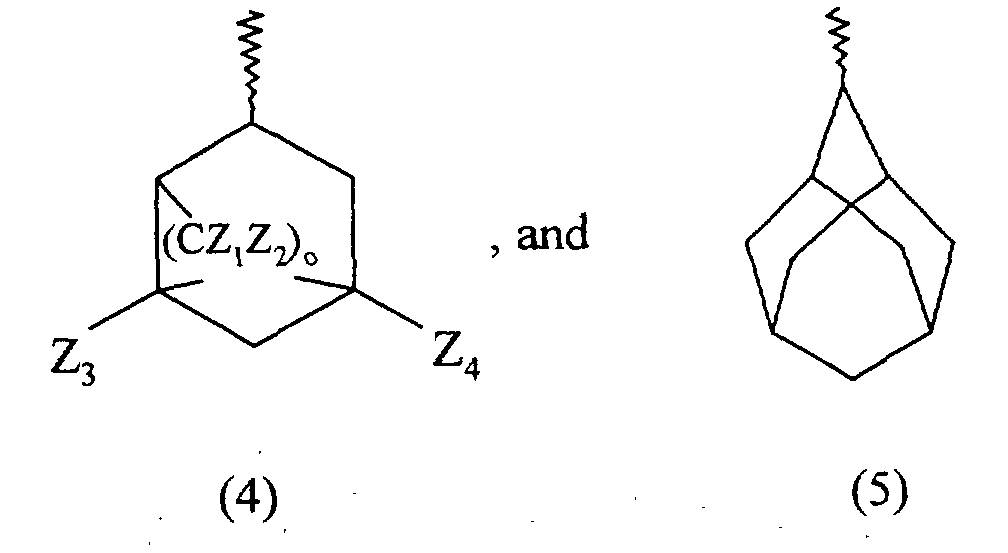 or a pharmaceutically acceptable salt thereof wherein:is the point of attachment;
 Z1 to Z4 are each independently selected from hydrogen and methyl;o is an integer of from 1 to 4; andp is an integer of from 0 to 2 with the proviso that in formula 1R is not -SO3H when m is 2 and n is 1; orthe GABA analog is a compound of Formula IV
 or a pharmaceutically acceptable salt thereof wherein:R1 is hydrogen, straight or branched alkyl of from 1 to 6 carbon atoms or phenyl;R2 is straight or branched alkyl of from 1 to 8 carbon atoms,straight or branched alkenyl of from 2 to 8 carbon atoms, cycloalkyl of from 3 to 7 carbon atoms,alkoxy of from 1 to 6 carbon atoms,-alkylcycloalkyl,-alkylalkoxy,-alkyl OH,-alkylphenyl,-alkylphenoxy,-phenyl or substituted phenyl; andR1 is straight or branched alkyl of from 1 to 6 carbon atoms or phenyl
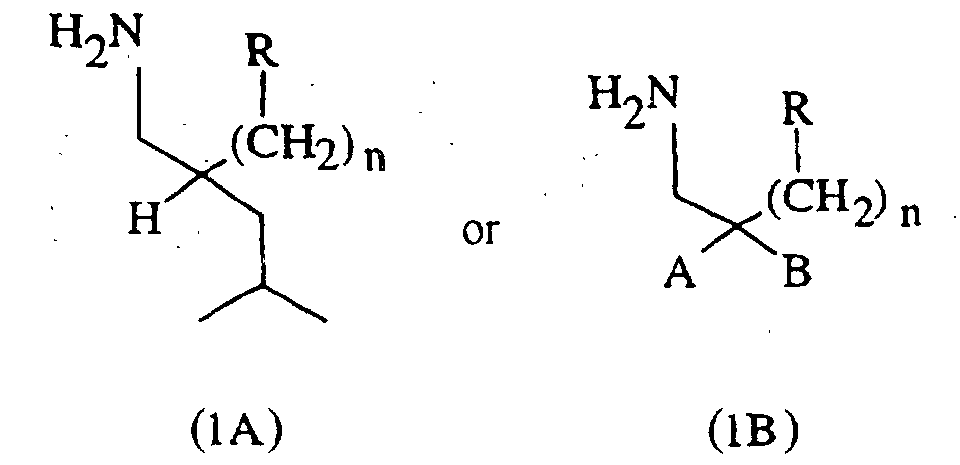 or a pharmaceutically acceptable salt thereof wherein:n is an integer of from 0 to 2;R is sulfonamide,amide,phosphonic acid,heterocycle,sulfonic acid, orhydroxamic acid;A is hydrogen or methyl; andB isstraight or branched alkyl of from 1 to 11 carbons, or -(CH2)1-4-Y-(CH2)0-4-phenyl wherein Y is -O-, -S-, -NR'3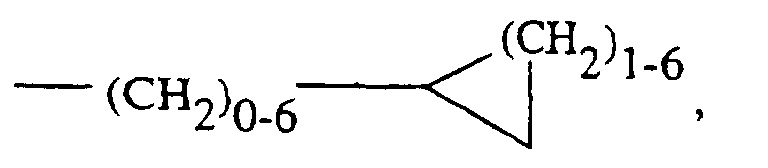
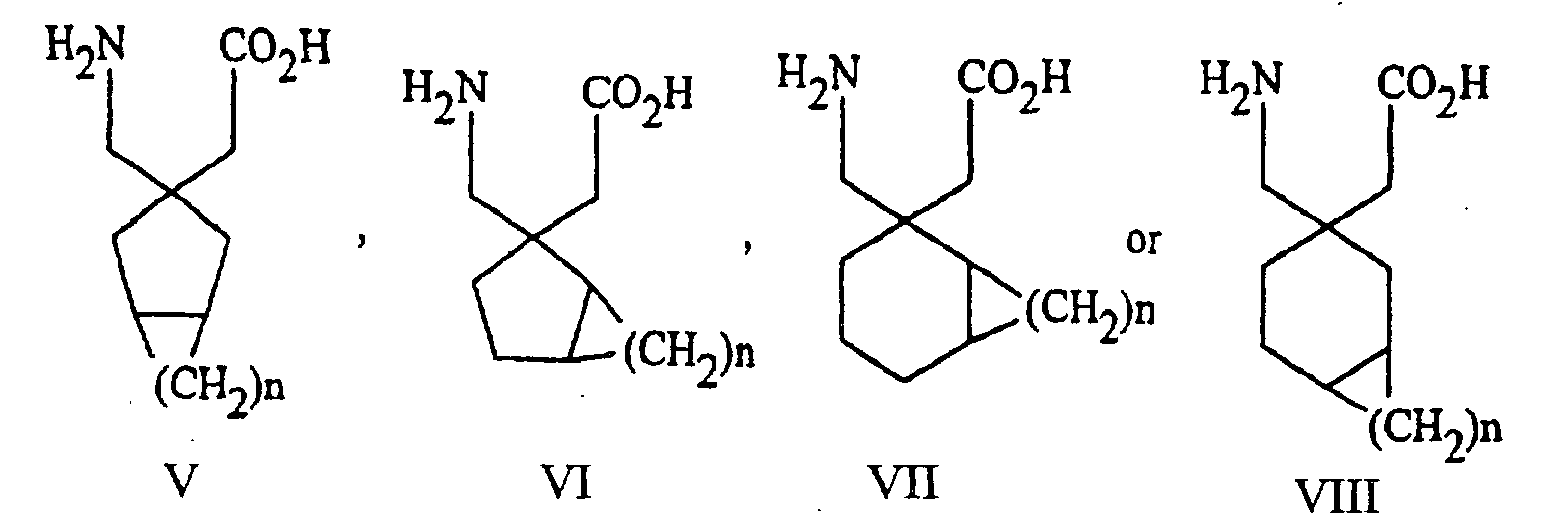
 wherein phenyl and benzyl can be unsubstituted or substituted with from 1 to 3 substituents each independently selected from alkyl, alkoxy, halogen, hydroxy, carboxy, carboalkoxy, trifluoromethyl, amino, andn is an integer of from 0 to 2;R is sulfonamide,amide,phosphonic acid,heterocycle,sulfonic acid, orhydroxamic acid; andX is -O-, -S-, -S(O)-, -S(O)2-,or NR'1 wherein R'1 is hydrogen, straight or branched alkyl of from 1 to 6 carbons, benzyl, -C(O)R'2 wherein R'2 is straight or branched alkyl of 1 to 6 carbons, benzyl or phenyl or -CO2R'3 wherein R'3 is straight or branched alkyl of from 1 to 6 carbons, or benzyl wherein the benzyl or phenyl groups can be unsubstituted or substituted by from 1 to 3 substituents selected from halogen, trifluoromethyl, and nitro; orthe GABA analog is a compound of Formulaor a pharmaceutically acceptable salt thereof wherein:
 R is hydrogen or lower alkyl;R1 is hydrogen or lower alkyl;R2 isstraight or branched alkyl of from 7 to 11 carbon atoms, or -(CH2)(1-4)-X-(CH2)(0-4)-phenyl wherein
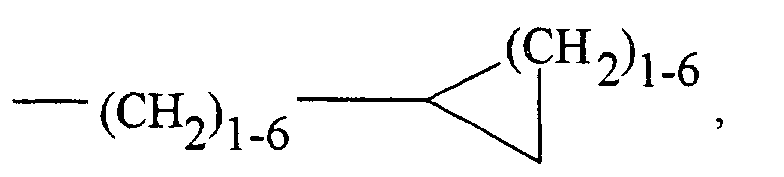 X is -O-, -S-, -NR3- whereinR3 is alkyl of from 1 to 6 carbons, cycloalkyl of from 3 to 8 carbons, benzyl or phenyl;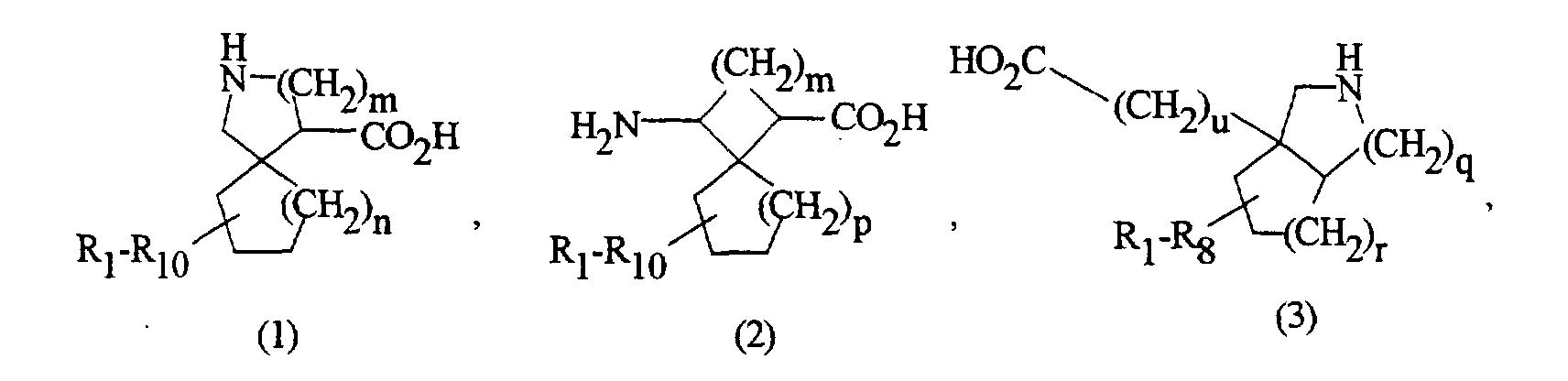
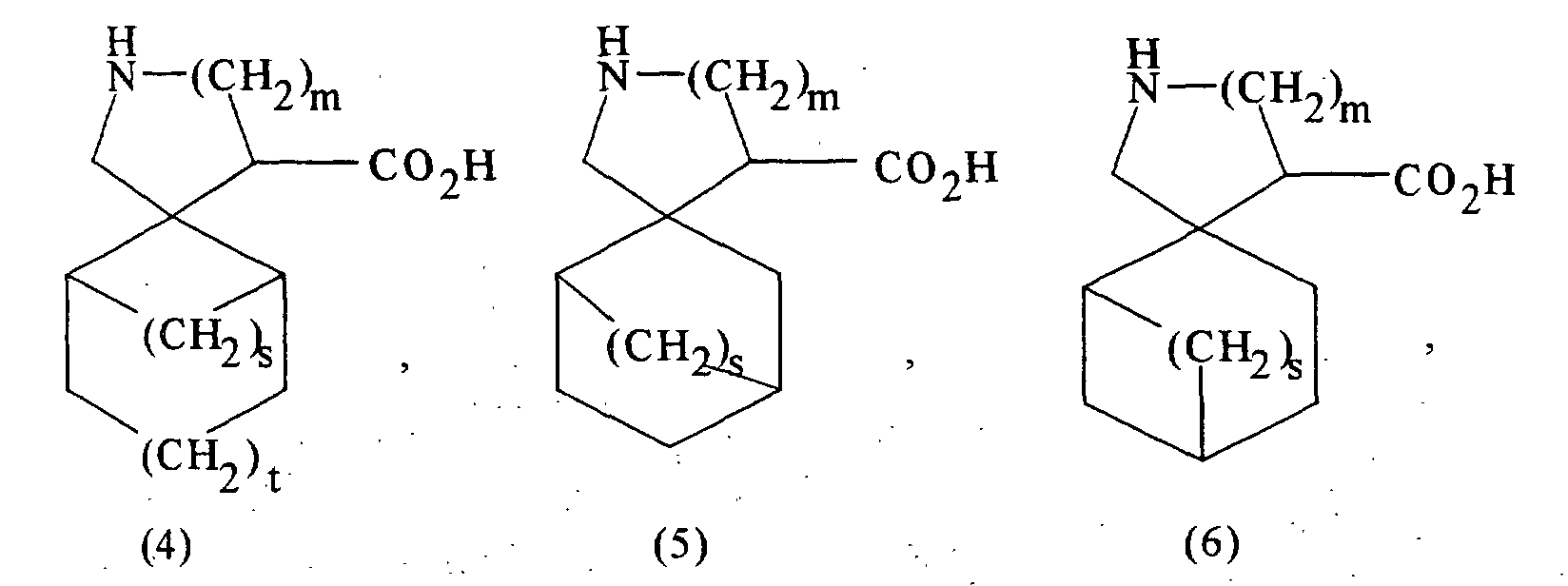 or a pharmaceutically acceptable salt thereof or a prodrug thereof wherein:
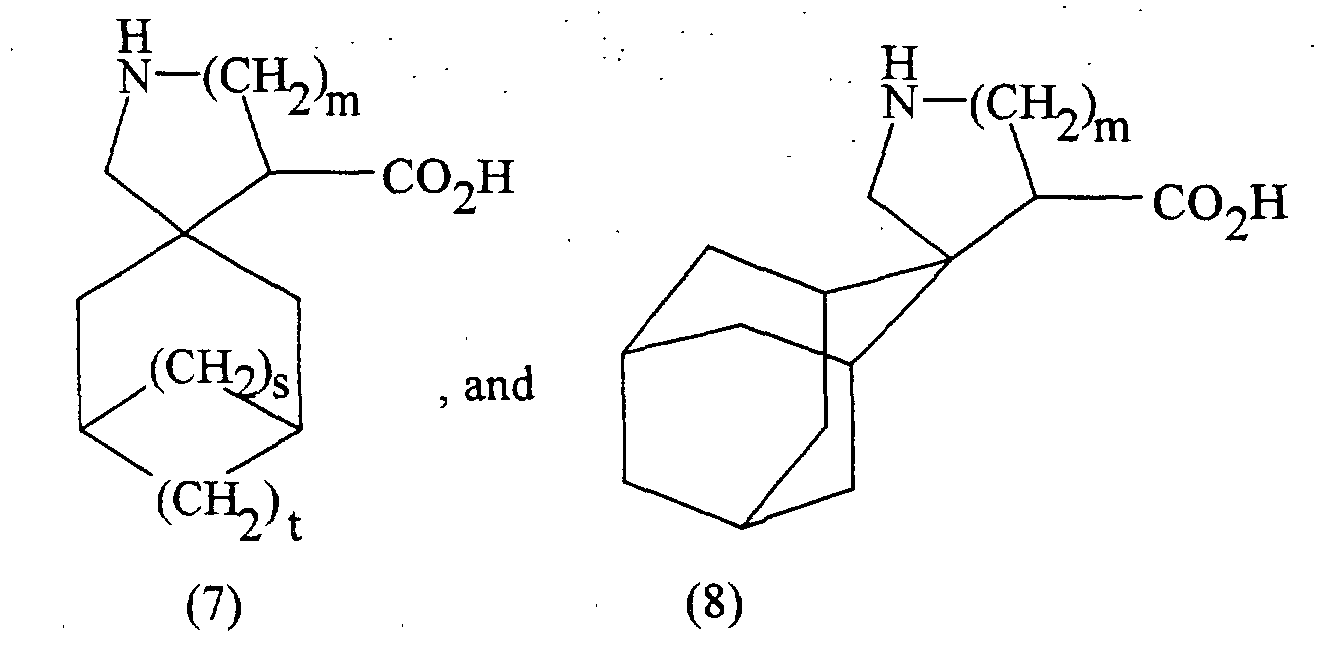 R1 to R10 are each independently selected from hydrogen or a straight or branched alkyl of from 1 to 6 carbons, benzyl, or phenyl;m is an integer of from 0 to 3;n is an integer of from 1 to 2;o is an integer of from 0 to 3;p is an integer of from 1 to 2;q is an integer of from 0 to 2;r is an integer of from 1 to 2;s is an integer of from 1 to 3;t is an integer of from 0 to 2; andu is an integer of from 0 to 1.