EP1199049A1 - Metallic composite surface composition for an implant structure - Google Patents
Metallic composite surface composition for an implant structure Download PDFInfo
- Publication number
- EP1199049A1 EP1199049A1 EP00122794A EP00122794A EP1199049A1 EP 1199049 A1 EP1199049 A1 EP 1199049A1 EP 00122794 A EP00122794 A EP 00122794A EP 00122794 A EP00122794 A EP 00122794A EP 1199049 A1 EP1199049 A1 EP 1199049A1
- Authority
- EP
- European Patent Office
- Prior art keywords
- implant
- composition
- core
- particles
- composite
- Prior art date
- Legal status (The legal status is an assumption and is not a legal conclusion. Google has not performed a legal analysis and makes no representation as to the accuracy of the status listed.)
- Granted
Links
- 239000000203 mixture Substances 0.000 title claims abstract description 73
- 239000007943 implant Substances 0.000 title claims abstract description 66
- 239000002131 composite material Substances 0.000 title claims abstract description 41
- 229910052751 metal Inorganic materials 0.000 claims abstract description 39
- 239000002184 metal Substances 0.000 claims abstract description 39
- 239000002245 particle Substances 0.000 claims abstract description 23
- 150000002739 metals Chemical class 0.000 claims abstract description 19
- 229910001092 metal group alloy Inorganic materials 0.000 claims abstract description 17
- 239000002923 metal particle Substances 0.000 claims abstract description 4
- 210000000988 bone and bone Anatomy 0.000 claims description 19
- 238000000576 coating method Methods 0.000 claims description 17
- 239000011248 coating agent Substances 0.000 claims description 15
- 229910000510 noble metal Inorganic materials 0.000 claims description 15
- KDLHZDBZIXYQEI-UHFFFAOYSA-N Palladium Chemical compound [Pd] KDLHZDBZIXYQEI-UHFFFAOYSA-N 0.000 claims description 6
- BASFCYQUMIYNBI-UHFFFAOYSA-N platinum Chemical compound [Pt] BASFCYQUMIYNBI-UHFFFAOYSA-N 0.000 claims description 6
- 238000009472 formulation Methods 0.000 claims description 4
- PCHJSUWPFVWCPO-UHFFFAOYSA-N gold Chemical compound [Au] PCHJSUWPFVWCPO-UHFFFAOYSA-N 0.000 claims description 3
- 229910052737 gold Inorganic materials 0.000 claims description 3
- 239000010931 gold Substances 0.000 claims description 3
- 229910052741 iridium Inorganic materials 0.000 claims description 3
- GKOZUEZYRPOHIO-UHFFFAOYSA-N iridium atom Chemical compound [Ir] GKOZUEZYRPOHIO-UHFFFAOYSA-N 0.000 claims description 3
- 229910052763 palladium Inorganic materials 0.000 claims description 3
- 230000000737 periodic effect Effects 0.000 claims description 3
- 229910052697 platinum Inorganic materials 0.000 claims description 3
- 230000004936 stimulating effect Effects 0.000 claims description 2
- 230000011164 ossification Effects 0.000 claims 1
- 229910045601 alloy Inorganic materials 0.000 description 55
- 239000000956 alloy Substances 0.000 description 55
- 238000012360 testing method Methods 0.000 description 10
- 230000008468 bone growth Effects 0.000 description 7
- 239000011159 matrix material Substances 0.000 description 7
- 239000000243 solution Substances 0.000 description 5
- BQCADISMDOOEFD-UHFFFAOYSA-N Silver Chemical compound [Ag] BQCADISMDOOEFD-UHFFFAOYSA-N 0.000 description 4
- 239000000560 biocompatible material Substances 0.000 description 4
- 238000007654 immersion Methods 0.000 description 4
- 229910052709 silver Inorganic materials 0.000 description 4
- 239000004332 silver Substances 0.000 description 4
- 210000004872 soft tissue Anatomy 0.000 description 4
- RTAQQCXQSZGOHL-UHFFFAOYSA-N Titanium Chemical compound [Ti] RTAQQCXQSZGOHL-UHFFFAOYSA-N 0.000 description 3
- 239000003792 electrolyte Substances 0.000 description 3
- 230000035876 healing Effects 0.000 description 3
- 238000000034 method Methods 0.000 description 3
- 239000010936 titanium Substances 0.000 description 3
- 229910052719 titanium Inorganic materials 0.000 description 3
- XKRFYHLGVUSROY-UHFFFAOYSA-N Argon Chemical compound [Ar] XKRFYHLGVUSROY-UHFFFAOYSA-N 0.000 description 2
- OKTJSMMVPCPJKN-UHFFFAOYSA-N Carbon Chemical compound [C] OKTJSMMVPCPJKN-UHFFFAOYSA-N 0.000 description 2
- 229940075397 calomel Drugs 0.000 description 2
- 239000000919 ceramic Substances 0.000 description 2
- 238000005253 cladding Methods 0.000 description 2
- 239000000470 constituent Substances 0.000 description 2
- 238000010276 construction Methods 0.000 description 2
- 230000007797 corrosion Effects 0.000 description 2
- 238000005260 corrosion Methods 0.000 description 2
- ZOMNIUBKTOKEHS-UHFFFAOYSA-L dimercury dichloride Chemical compound Cl[Hg][Hg]Cl ZOMNIUBKTOKEHS-UHFFFAOYSA-L 0.000 description 2
- 229910002804 graphite Inorganic materials 0.000 description 2
- 239000010439 graphite Substances 0.000 description 2
- 238000003780 insertion Methods 0.000 description 2
- 230000037431 insertion Effects 0.000 description 2
- 230000001788 irregular Effects 0.000 description 2
- 238000005245 sintering Methods 0.000 description 2
- XLYOFNOQVPJJNP-UHFFFAOYSA-N water Substances O XLYOFNOQVPJJNP-UHFFFAOYSA-N 0.000 description 2
- 241000894006 Bacteria Species 0.000 description 1
- 208000010392 Bone Fractures Diseases 0.000 description 1
- RYGMFSIKBFXOCR-UHFFFAOYSA-N Copper Chemical compound [Cu] RYGMFSIKBFXOCR-UHFFFAOYSA-N 0.000 description 1
- 206010017076 Fracture Diseases 0.000 description 1
- 239000007864 aqueous solution Substances 0.000 description 1
- 229910052786 argon Inorganic materials 0.000 description 1
- QVGXLLKOCUKJST-UHFFFAOYSA-N atomic oxygen Chemical compound [O] QVGXLLKOCUKJST-UHFFFAOYSA-N 0.000 description 1
- 230000015572 biosynthetic process Effects 0.000 description 1
- 230000010478 bone regeneration Effects 0.000 description 1
- 230000005587 bubbling Effects 0.000 description 1
- 229910052802 copper Inorganic materials 0.000 description 1
- 239000010949 copper Substances 0.000 description 1
- 239000008367 deionised water Substances 0.000 description 1
- 229910021641 deionized water Inorganic materials 0.000 description 1
- 239000004053 dental implant Substances 0.000 description 1
- 238000002848 electrochemical method Methods 0.000 description 1
- 239000008151 electrolyte solution Substances 0.000 description 1
- 238000005516 engineering process Methods 0.000 description 1
- 230000002708 enhancing effect Effects 0.000 description 1
- 238000002474 experimental method Methods 0.000 description 1
- 239000012530 fluid Substances 0.000 description 1
- 239000011261 inert gas Substances 0.000 description 1
- 230000008595 infiltration Effects 0.000 description 1
- 238000001764 infiltration Methods 0.000 description 1
- 230000010354 integration Effects 0.000 description 1
- 230000000813 microbial effect Effects 0.000 description 1
- 230000000399 orthopedic effect Effects 0.000 description 1
- 239000001301 oxygen Substances 0.000 description 1
- 229910052760 oxygen Inorganic materials 0.000 description 1
- 239000012466 permeate Substances 0.000 description 1
- 238000007750 plasma spraying Methods 0.000 description 1
- 238000007747 plating Methods 0.000 description 1
- 238000005498 polishing Methods 0.000 description 1
- 239000000843 powder Substances 0.000 description 1
- 238000002360 preparation method Methods 0.000 description 1
- 239000010935 stainless steel Substances 0.000 description 1
- 229910001220 stainless steel Inorganic materials 0.000 description 1
- 230000000638 stimulation Effects 0.000 description 1
- 238000001356 surgical procedure Methods 0.000 description 1
- 239000011800 void material Substances 0.000 description 1
- 238000001238 wet grinding Methods 0.000 description 1
Images



Classifications
-
- A—HUMAN NECESSITIES
- A61—MEDICAL OR VETERINARY SCIENCE; HYGIENE
- A61N—ELECTROTHERAPY; MAGNETOTHERAPY; RADIATION THERAPY; ULTRASOUND THERAPY
- A61N1/00—Electrotherapy; Circuits therefor
- A61N1/18—Applying electric currents by contact electrodes
- A61N1/20—Applying electric currents by contact electrodes continuous direct currents
- A61N1/22—Electromedical belts, e.g. neck chains, armbands
- A61N1/24—Electromedical belts, e.g. neck chains, armbands with built-in power source
-
- A—HUMAN NECESSITIES
- A61—MEDICAL OR VETERINARY SCIENCE; HYGIENE
- A61B—DIAGNOSIS; SURGERY; IDENTIFICATION
- A61B17/00—Surgical instruments, devices or methods
- A61B17/56—Surgical instruments or methods for treatment of bones or joints; Devices specially adapted therefor
- A61B17/58—Surgical instruments or methods for treatment of bones or joints; Devices specially adapted therefor for osteosynthesis, e.g. bone plates, screws or setting implements
- A61B17/68—Internal fixation devices, including fasteners and spinal fixators, even if a part thereof projects from the skin
- A61B17/84—Fasteners therefor or fasteners being internal fixation devices
- A61B17/86—Pins or screws or threaded wires; nuts therefor
- A61B17/866—Material or manufacture
-
- A—HUMAN NECESSITIES
- A61—MEDICAL OR VETERINARY SCIENCE; HYGIENE
- A61C—DENTISTRY; APPARATUS OR METHODS FOR ORAL OR DENTAL HYGIENE
- A61C8/00—Means to be fixed to the jaw-bone for consolidating natural teeth or for fixing dental prostheses thereon; Dental implants; Implanting tools
- A61C8/0003—Not used, see subgroups
- A61C8/0004—Consolidating natural teeth
- A61C8/0006—Periodontal tissue or bone regeneration
- A61C8/0007—Stimulation of growth around implant by electrical means
-
- A—HUMAN NECESSITIES
- A61—MEDICAL OR VETERINARY SCIENCE; HYGIENE
- A61C—DENTISTRY; APPARATUS OR METHODS FOR ORAL OR DENTAL HYGIENE
- A61C8/00—Means to be fixed to the jaw-bone for consolidating natural teeth or for fixing dental prostheses thereon; Dental implants; Implanting tools
- A61C8/0012—Means to be fixed to the jaw-bone for consolidating natural teeth or for fixing dental prostheses thereon; Dental implants; Implanting tools characterised by the material or composition, e.g. ceramics, surface layer, metal alloy
- A61C8/0013—Means to be fixed to the jaw-bone for consolidating natural teeth or for fixing dental prostheses thereon; Dental implants; Implanting tools characterised by the material or composition, e.g. ceramics, surface layer, metal alloy with a surface layer, coating
-
- A—HUMAN NECESSITIES
- A61—MEDICAL OR VETERINARY SCIENCE; HYGIENE
- A61F—FILTERS IMPLANTABLE INTO BLOOD VESSELS; PROSTHESES; DEVICES PROVIDING PATENCY TO, OR PREVENTING COLLAPSING OF, TUBULAR STRUCTURES OF THE BODY, e.g. STENTS; ORTHOPAEDIC, NURSING OR CONTRACEPTIVE DEVICES; FOMENTATION; TREATMENT OR PROTECTION OF EYES OR EARS; BANDAGES, DRESSINGS OR ABSORBENT PADS; FIRST-AID KITS
- A61F2/00—Filters implantable into blood vessels; Prostheses, i.e. artificial substitutes or replacements for parts of the body; Appliances for connecting them with the body; Devices providing patency to, or preventing collapsing of, tubular structures of the body, e.g. stents
- A61F2/02—Prostheses implantable into the body
- A61F2/30—Joints
- A61F2/30767—Special external or bone-contacting surface, e.g. coating for improving bone ingrowth
-
- A—HUMAN NECESSITIES
- A61—MEDICAL OR VETERINARY SCIENCE; HYGIENE
- A61L—METHODS OR APPARATUS FOR STERILISING MATERIALS OR OBJECTS IN GENERAL; DISINFECTION, STERILISATION OR DEODORISATION OF AIR; CHEMICAL ASPECTS OF BANDAGES, DRESSINGS, ABSORBENT PADS OR SURGICAL ARTICLES; MATERIALS FOR BANDAGES, DRESSINGS, ABSORBENT PADS OR SURGICAL ARTICLES
- A61L27/00—Materials for grafts or prostheses or for coating grafts or prostheses
- A61L27/02—Inorganic materials
- A61L27/04—Metals or alloys
- A61L27/047—Other specific metals or alloys not covered by A61L27/042 - A61L27/045 or A61L27/06
-
- A—HUMAN NECESSITIES
- A61—MEDICAL OR VETERINARY SCIENCE; HYGIENE
- A61L—METHODS OR APPARATUS FOR STERILISING MATERIALS OR OBJECTS IN GENERAL; DISINFECTION, STERILISATION OR DEODORISATION OF AIR; CHEMICAL ASPECTS OF BANDAGES, DRESSINGS, ABSORBENT PADS OR SURGICAL ARTICLES; MATERIALS FOR BANDAGES, DRESSINGS, ABSORBENT PADS OR SURGICAL ARTICLES
- A61L27/00—Materials for grafts or prostheses or for coating grafts or prostheses
- A61L27/28—Materials for coating prostheses
- A61L27/30—Inorganic materials
- A61L27/306—Other specific inorganic materials not covered by A61L27/303 - A61L27/32
-
- A—HUMAN NECESSITIES
- A61—MEDICAL OR VETERINARY SCIENCE; HYGIENE
- A61L—METHODS OR APPARATUS FOR STERILISING MATERIALS OR OBJECTS IN GENERAL; DISINFECTION, STERILISATION OR DEODORISATION OF AIR; CHEMICAL ASPECTS OF BANDAGES, DRESSINGS, ABSORBENT PADS OR SURGICAL ARTICLES; MATERIALS FOR BANDAGES, DRESSINGS, ABSORBENT PADS OR SURGICAL ARTICLES
- A61L27/00—Materials for grafts or prostheses or for coating grafts or prostheses
- A61L27/40—Composite materials, i.e. containing one material dispersed in a matrix of the same or different material
- A61L27/42—Composite materials, i.e. containing one material dispersed in a matrix of the same or different material having an inorganic matrix
- A61L27/427—Composite materials, i.e. containing one material dispersed in a matrix of the same or different material having an inorganic matrix of other specific inorganic materials not covered by A61L27/422 or A61L27/425
-
- A—HUMAN NECESSITIES
- A61—MEDICAL OR VETERINARY SCIENCE; HYGIENE
- A61L—METHODS OR APPARATUS FOR STERILISING MATERIALS OR OBJECTS IN GENERAL; DISINFECTION, STERILISATION OR DEODORISATION OF AIR; CHEMICAL ASPECTS OF BANDAGES, DRESSINGS, ABSORBENT PADS OR SURGICAL ARTICLES; MATERIALS FOR BANDAGES, DRESSINGS, ABSORBENT PADS OR SURGICAL ARTICLES
- A61L27/00—Materials for grafts or prostheses or for coating grafts or prostheses
- A61L27/50—Materials characterised by their function or physical properties, e.g. injectable or lubricating compositions, shape-memory materials, surface modified materials
-
- A—HUMAN NECESSITIES
- A61—MEDICAL OR VETERINARY SCIENCE; HYGIENE
- A61N—ELECTROTHERAPY; MAGNETOTHERAPY; RADIATION THERAPY; ULTRASOUND THERAPY
- A61N1/00—Electrotherapy; Circuits therefor
- A61N1/18—Applying electric currents by contact electrodes
- A61N1/20—Applying electric currents by contact electrodes continuous direct currents
- A61N1/205—Applying electric currents by contact electrodes continuous direct currents for promoting a biological process
-
- A—HUMAN NECESSITIES
- A61—MEDICAL OR VETERINARY SCIENCE; HYGIENE
- A61F—FILTERS IMPLANTABLE INTO BLOOD VESSELS; PROSTHESES; DEVICES PROVIDING PATENCY TO, OR PREVENTING COLLAPSING OF, TUBULAR STRUCTURES OF THE BODY, e.g. STENTS; ORTHOPAEDIC, NURSING OR CONTRACEPTIVE DEVICES; FOMENTATION; TREATMENT OR PROTECTION OF EYES OR EARS; BANDAGES, DRESSINGS OR ABSORBENT PADS; FIRST-AID KITS
- A61F2/00—Filters implantable into blood vessels; Prostheses, i.e. artificial substitutes or replacements for parts of the body; Appliances for connecting them with the body; Devices providing patency to, or preventing collapsing of, tubular structures of the body, e.g. stents
- A61F2/02—Prostheses implantable into the body
- A61F2/30—Joints
- A61F2/30767—Special external or bone-contacting surface, e.g. coating for improving bone ingrowth
- A61F2/30771—Special external or bone-contacting surface, e.g. coating for improving bone ingrowth applied in original prostheses, e.g. holes or grooves
-
- A—HUMAN NECESSITIES
- A61—MEDICAL OR VETERINARY SCIENCE; HYGIENE
- A61F—FILTERS IMPLANTABLE INTO BLOOD VESSELS; PROSTHESES; DEVICES PROVIDING PATENCY TO, OR PREVENTING COLLAPSING OF, TUBULAR STRUCTURES OF THE BODY, e.g. STENTS; ORTHOPAEDIC, NURSING OR CONTRACEPTIVE DEVICES; FOMENTATION; TREATMENT OR PROTECTION OF EYES OR EARS; BANDAGES, DRESSINGS OR ABSORBENT PADS; FIRST-AID KITS
- A61F2/00—Filters implantable into blood vessels; Prostheses, i.e. artificial substitutes or replacements for parts of the body; Appliances for connecting them with the body; Devices providing patency to, or preventing collapsing of, tubular structures of the body, e.g. stents
- A61F2/02—Prostheses implantable into the body
- A61F2/28—Bones
- A61F2002/2821—Bone stimulation by electromagnetic fields or electric current for enhancing ossification
-
- A—HUMAN NECESSITIES
- A61—MEDICAL OR VETERINARY SCIENCE; HYGIENE
- A61F—FILTERS IMPLANTABLE INTO BLOOD VESSELS; PROSTHESES; DEVICES PROVIDING PATENCY TO, OR PREVENTING COLLAPSING OF, TUBULAR STRUCTURES OF THE BODY, e.g. STENTS; ORTHOPAEDIC, NURSING OR CONTRACEPTIVE DEVICES; FOMENTATION; TREATMENT OR PROTECTION OF EYES OR EARS; BANDAGES, DRESSINGS OR ABSORBENT PADS; FIRST-AID KITS
- A61F2/00—Filters implantable into blood vessels; Prostheses, i.e. artificial substitutes or replacements for parts of the body; Appliances for connecting them with the body; Devices providing patency to, or preventing collapsing of, tubular structures of the body, e.g. stents
- A61F2/02—Prostheses implantable into the body
- A61F2/30—Joints
- A61F2002/30001—Additional features of subject-matter classified in A61F2/28, A61F2/30 and subgroups thereof
- A61F2002/30003—Material related properties of the prosthesis or of a coating on the prosthesis
- A61F2002/30004—Material related properties of the prosthesis or of a coating on the prosthesis the prosthesis being made from materials having different values of a given property at different locations within the same prosthesis
- A61F2002/30052—Material related properties of the prosthesis or of a coating on the prosthesis the prosthesis being made from materials having different values of a given property at different locations within the same prosthesis differing in electric or magnetic properties
-
- A—HUMAN NECESSITIES
- A61—MEDICAL OR VETERINARY SCIENCE; HYGIENE
- A61F—FILTERS IMPLANTABLE INTO BLOOD VESSELS; PROSTHESES; DEVICES PROVIDING PATENCY TO, OR PREVENTING COLLAPSING OF, TUBULAR STRUCTURES OF THE BODY, e.g. STENTS; ORTHOPAEDIC, NURSING OR CONTRACEPTIVE DEVICES; FOMENTATION; TREATMENT OR PROTECTION OF EYES OR EARS; BANDAGES, DRESSINGS OR ABSORBENT PADS; FIRST-AID KITS
- A61F2/00—Filters implantable into blood vessels; Prostheses, i.e. artificial substitutes or replacements for parts of the body; Appliances for connecting them with the body; Devices providing patency to, or preventing collapsing of, tubular structures of the body, e.g. stents
- A61F2/02—Prostheses implantable into the body
- A61F2/30—Joints
- A61F2002/30001—Additional features of subject-matter classified in A61F2/28, A61F2/30 and subgroups thereof
- A61F2002/30108—Shapes
- A61F2002/30199—Three-dimensional shapes
- A61F2002/30289—Three-dimensional shapes helically-coiled
-
- A—HUMAN NECESSITIES
- A61—MEDICAL OR VETERINARY SCIENCE; HYGIENE
- A61F—FILTERS IMPLANTABLE INTO BLOOD VESSELS; PROSTHESES; DEVICES PROVIDING PATENCY TO, OR PREVENTING COLLAPSING OF, TUBULAR STRUCTURES OF THE BODY, e.g. STENTS; ORTHOPAEDIC, NURSING OR CONTRACEPTIVE DEVICES; FOMENTATION; TREATMENT OR PROTECTION OF EYES OR EARS; BANDAGES, DRESSINGS OR ABSORBENT PADS; FIRST-AID KITS
- A61F2/00—Filters implantable into blood vessels; Prostheses, i.e. artificial substitutes or replacements for parts of the body; Appliances for connecting them with the body; Devices providing patency to, or preventing collapsing of, tubular structures of the body, e.g. stents
- A61F2/02—Prostheses implantable into the body
- A61F2/30—Joints
- A61F2/30767—Special external or bone-contacting surface, e.g. coating for improving bone ingrowth
- A61F2/30771—Special external or bone-contacting surface, e.g. coating for improving bone ingrowth applied in original prostheses, e.g. holes or grooves
- A61F2002/3082—Grooves
-
- A—HUMAN NECESSITIES
- A61—MEDICAL OR VETERINARY SCIENCE; HYGIENE
- A61F—FILTERS IMPLANTABLE INTO BLOOD VESSELS; PROSTHESES; DEVICES PROVIDING PATENCY TO, OR PREVENTING COLLAPSING OF, TUBULAR STRUCTURES OF THE BODY, e.g. STENTS; ORTHOPAEDIC, NURSING OR CONTRACEPTIVE DEVICES; FOMENTATION; TREATMENT OR PROTECTION OF EYES OR EARS; BANDAGES, DRESSINGS OR ABSORBENT PADS; FIRST-AID KITS
- A61F2/00—Filters implantable into blood vessels; Prostheses, i.e. artificial substitutes or replacements for parts of the body; Appliances for connecting them with the body; Devices providing patency to, or preventing collapsing of, tubular structures of the body, e.g. stents
- A61F2/02—Prostheses implantable into the body
- A61F2/30—Joints
- A61F2/30767—Special external or bone-contacting surface, e.g. coating for improving bone ingrowth
- A61F2/30771—Special external or bone-contacting surface, e.g. coating for improving bone ingrowth applied in original prostheses, e.g. holes or grooves
- A61F2002/30904—Special external or bone-contacting surface, e.g. coating for improving bone ingrowth applied in original prostheses, e.g. holes or grooves serrated profile, i.e. saw-toothed
-
- A—HUMAN NECESSITIES
- A61—MEDICAL OR VETERINARY SCIENCE; HYGIENE
- A61F—FILTERS IMPLANTABLE INTO BLOOD VESSELS; PROSTHESES; DEVICES PROVIDING PATENCY TO, OR PREVENTING COLLAPSING OF, TUBULAR STRUCTURES OF THE BODY, e.g. STENTS; ORTHOPAEDIC, NURSING OR CONTRACEPTIVE DEVICES; FOMENTATION; TREATMENT OR PROTECTION OF EYES OR EARS; BANDAGES, DRESSINGS OR ABSORBENT PADS; FIRST-AID KITS
- A61F2/00—Filters implantable into blood vessels; Prostheses, i.e. artificial substitutes or replacements for parts of the body; Appliances for connecting them with the body; Devices providing patency to, or preventing collapsing of, tubular structures of the body, e.g. stents
- A61F2/02—Prostheses implantable into the body
- A61F2/30—Joints
- A61F2/30767—Special external or bone-contacting surface, e.g. coating for improving bone ingrowth
- A61F2002/30929—Special external or bone-contacting surface, e.g. coating for improving bone ingrowth having at least two superposed coatings
-
- A—HUMAN NECESSITIES
- A61—MEDICAL OR VETERINARY SCIENCE; HYGIENE
- A61F—FILTERS IMPLANTABLE INTO BLOOD VESSELS; PROSTHESES; DEVICES PROVIDING PATENCY TO, OR PREVENTING COLLAPSING OF, TUBULAR STRUCTURES OF THE BODY, e.g. STENTS; ORTHOPAEDIC, NURSING OR CONTRACEPTIVE DEVICES; FOMENTATION; TREATMENT OR PROTECTION OF EYES OR EARS; BANDAGES, DRESSINGS OR ABSORBENT PADS; FIRST-AID KITS
- A61F2/00—Filters implantable into blood vessels; Prostheses, i.e. artificial substitutes or replacements for parts of the body; Appliances for connecting them with the body; Devices providing patency to, or preventing collapsing of, tubular structures of the body, e.g. stents
- A61F2/02—Prostheses implantable into the body
- A61F2/30—Joints
- A61F2/3094—Designing or manufacturing processes
- A61F2002/30968—Sintering
-
- A—HUMAN NECESSITIES
- A61—MEDICAL OR VETERINARY SCIENCE; HYGIENE
- A61F—FILTERS IMPLANTABLE INTO BLOOD VESSELS; PROSTHESES; DEVICES PROVIDING PATENCY TO, OR PREVENTING COLLAPSING OF, TUBULAR STRUCTURES OF THE BODY, e.g. STENTS; ORTHOPAEDIC, NURSING OR CONTRACEPTIVE DEVICES; FOMENTATION; TREATMENT OR PROTECTION OF EYES OR EARS; BANDAGES, DRESSINGS OR ABSORBENT PADS; FIRST-AID KITS
- A61F2230/00—Geometry of prostheses classified in groups A61F2/00 - A61F2/26 or A61F2/82 or A61F9/00 or A61F11/00 or subgroups thereof
- A61F2230/0063—Three-dimensional shapes
- A61F2230/0091—Three-dimensional shapes helically-coiled or spirally-coiled, i.e. having a 2-D spiral cross-section
-
- A—HUMAN NECESSITIES
- A61—MEDICAL OR VETERINARY SCIENCE; HYGIENE
- A61F—FILTERS IMPLANTABLE INTO BLOOD VESSELS; PROSTHESES; DEVICES PROVIDING PATENCY TO, OR PREVENTING COLLAPSING OF, TUBULAR STRUCTURES OF THE BODY, e.g. STENTS; ORTHOPAEDIC, NURSING OR CONTRACEPTIVE DEVICES; FOMENTATION; TREATMENT OR PROTECTION OF EYES OR EARS; BANDAGES, DRESSINGS OR ABSORBENT PADS; FIRST-AID KITS
- A61F2250/00—Special features of prostheses classified in groups A61F2/00 - A61F2/26 or A61F2/82 or A61F9/00 or A61F11/00 or subgroups thereof
- A61F2250/0014—Special features of prostheses classified in groups A61F2/00 - A61F2/26 or A61F2/82 or A61F9/00 or A61F11/00 or subgroups thereof having different values of a given property or geometrical feature, e.g. mechanical property or material property, at different locations within the same prosthesis
- A61F2250/0043—Special features of prostheses classified in groups A61F2/00 - A61F2/26 or A61F2/82 or A61F9/00 or A61F11/00 or subgroups thereof having different values of a given property or geometrical feature, e.g. mechanical property or material property, at different locations within the same prosthesis differing in electric properties, e.g. in electrical conductivity, in galvanic properties
-
- A—HUMAN NECESSITIES
- A61—MEDICAL OR VETERINARY SCIENCE; HYGIENE
- A61F—FILTERS IMPLANTABLE INTO BLOOD VESSELS; PROSTHESES; DEVICES PROVIDING PATENCY TO, OR PREVENTING COLLAPSING OF, TUBULAR STRUCTURES OF THE BODY, e.g. STENTS; ORTHOPAEDIC, NURSING OR CONTRACEPTIVE DEVICES; FOMENTATION; TREATMENT OR PROTECTION OF EYES OR EARS; BANDAGES, DRESSINGS OR ABSORBENT PADS; FIRST-AID KITS
- A61F2310/00—Prostheses classified in A61F2/28 or A61F2/30 - A61F2/44 being constructed from or coated with a particular material
- A61F2310/00005—The prosthesis being constructed from a particular material
- A61F2310/00011—Metals or alloys
- A61F2310/00023—Titanium or titanium-based alloys, e.g. Ti-Ni alloys
-
- A—HUMAN NECESSITIES
- A61—MEDICAL OR VETERINARY SCIENCE; HYGIENE
- A61F—FILTERS IMPLANTABLE INTO BLOOD VESSELS; PROSTHESES; DEVICES PROVIDING PATENCY TO, OR PREVENTING COLLAPSING OF, TUBULAR STRUCTURES OF THE BODY, e.g. STENTS; ORTHOPAEDIC, NURSING OR CONTRACEPTIVE DEVICES; FOMENTATION; TREATMENT OR PROTECTION OF EYES OR EARS; BANDAGES, DRESSINGS OR ABSORBENT PADS; FIRST-AID KITS
- A61F2310/00—Prostheses classified in A61F2/28 or A61F2/30 - A61F2/44 being constructed from or coated with a particular material
- A61F2310/00389—The prosthesis being coated or covered with a particular material
- A61F2310/00395—Coating or prosthesis-covering structure made of metals or of alloys
- A61F2310/00419—Other metals
- A61F2310/00514—Coating made of palladium or Pd-based alloys
-
- A—HUMAN NECESSITIES
- A61—MEDICAL OR VETERINARY SCIENCE; HYGIENE
- A61F—FILTERS IMPLANTABLE INTO BLOOD VESSELS; PROSTHESES; DEVICES PROVIDING PATENCY TO, OR PREVENTING COLLAPSING OF, TUBULAR STRUCTURES OF THE BODY, e.g. STENTS; ORTHOPAEDIC, NURSING OR CONTRACEPTIVE DEVICES; FOMENTATION; TREATMENT OR PROTECTION OF EYES OR EARS; BANDAGES, DRESSINGS OR ABSORBENT PADS; FIRST-AID KITS
- A61F2310/00—Prostheses classified in A61F2/28 or A61F2/30 - A61F2/44 being constructed from or coated with a particular material
- A61F2310/00389—The prosthesis being coated or covered with a particular material
- A61F2310/00395—Coating or prosthesis-covering structure made of metals or of alloys
- A61F2310/00419—Other metals
- A61F2310/00556—Coating made of iridium or Ir-based alloys
-
- A—HUMAN NECESSITIES
- A61—MEDICAL OR VETERINARY SCIENCE; HYGIENE
- A61F—FILTERS IMPLANTABLE INTO BLOOD VESSELS; PROSTHESES; DEVICES PROVIDING PATENCY TO, OR PREVENTING COLLAPSING OF, TUBULAR STRUCTURES OF THE BODY, e.g. STENTS; ORTHOPAEDIC, NURSING OR CONTRACEPTIVE DEVICES; FOMENTATION; TREATMENT OR PROTECTION OF EYES OR EARS; BANDAGES, DRESSINGS OR ABSORBENT PADS; FIRST-AID KITS
- A61F2310/00—Prostheses classified in A61F2/28 or A61F2/30 - A61F2/44 being constructed from or coated with a particular material
- A61F2310/00389—The prosthesis being coated or covered with a particular material
- A61F2310/00395—Coating or prosthesis-covering structure made of metals or of alloys
- A61F2310/00419—Other metals
- A61F2310/00562—Coating made of platinum or Pt-based alloys
-
- A—HUMAN NECESSITIES
- A61—MEDICAL OR VETERINARY SCIENCE; HYGIENE
- A61F—FILTERS IMPLANTABLE INTO BLOOD VESSELS; PROSTHESES; DEVICES PROVIDING PATENCY TO, OR PREVENTING COLLAPSING OF, TUBULAR STRUCTURES OF THE BODY, e.g. STENTS; ORTHOPAEDIC, NURSING OR CONTRACEPTIVE DEVICES; FOMENTATION; TREATMENT OR PROTECTION OF EYES OR EARS; BANDAGES, DRESSINGS OR ABSORBENT PADS; FIRST-AID KITS
- A61F2310/00—Prostheses classified in A61F2/28 or A61F2/30 - A61F2/44 being constructed from or coated with a particular material
- A61F2310/00389—The prosthesis being coated or covered with a particular material
- A61F2310/00395—Coating or prosthesis-covering structure made of metals or of alloys
- A61F2310/00419—Other metals
- A61F2310/00568—Coating made of gold or Au-based alloys
-
- A—HUMAN NECESSITIES
- A61—MEDICAL OR VETERINARY SCIENCE; HYGIENE
- A61L—METHODS OR APPARATUS FOR STERILISING MATERIALS OR OBJECTS IN GENERAL; DISINFECTION, STERILISATION OR DEODORISATION OF AIR; CHEMICAL ASPECTS OF BANDAGES, DRESSINGS, ABSORBENT PADS OR SURGICAL ARTICLES; MATERIALS FOR BANDAGES, DRESSINGS, ABSORBENT PADS OR SURGICAL ARTICLES
- A61L2430/00—Materials or treatment for tissue regeneration
- A61L2430/02—Materials or treatment for tissue regeneration for reconstruction of bones; weight-bearing implants
Definitions
- This invention relates to an implant structure for dental or medical use having a composite surface composition of a formulation for enhancing the stability of the implant and for stimulating bone growth upon being surgically inserted into bone.
- An implant is a prosthesis surgically implanted into skeletal bone.
- the implant provides anchorage for the attachment of a dental restorative device.
- the dental implant is surgically inserted into a cavity formed in an edentulous region of the alveolar jawbone to become an integral part of the bone structure.
- an abutment is attached to the implant in the preparation of a conventional dental restoration for use as a replacement of an extracted natural tooth.
- the implant is typically used as an orthopedic appliance to repair or replace damaged skeletal parts and to stimulate fracture healing of bone. After the implant is surgically inserted a substantial healing period is required to assure bone growth and to permit clinical ossiointergration between the implant and bone.
- Factors which will affect assimilation of the implant in bone and the stimulation of new bone growth include the healing time period, the type of surgical procedure and the construction and composition of the implant.
- the implant must be composed of a biocompatible material and must provide sufficient strength for the intended dental or medical application.
- Conventional biocompatible materials used in the construction of the implant include stainless steel, titanium and their alloys. Titanium implants when surgically inserted into bone do not readily promote bone regeneration at the interface between the implant and bone and if a sufficient void exists microbial leakage and bacteria will accumulate leading to clinical failure of the implant.
- the stability of an implant and its ability to stimulate bone growth particularly at the bone implant interface can be substantially enhanced by constructing the implant of a biocompatible material composition having an outer surface composed of at least two dissimilar biocompatible metal components or metal alloy components in intimate contact with one another.
- each of the dissimilar metal components or metal alloy components forming the outer surface of the implant must possess an electromotive potential ("EMF") sufficient to provide a potential difference between the dissimilar metal components of above at least 25mv and preferably above 100mv.
- EMF electromotive potential
- the dissimilar metal components must be in intimate contact and must surround at least part of the implant surface although it is preferable for the entire outer periphery of the implant to be composed of this composition.
- the outer surface composition of the implant should preferably include at least two or more dissimilar metals or metal alloy compositions of which at least 50% by weight are noble metals and preferably between 50-100% by weight constitute noble metals.
- the noble metals should be selected from the group consisting of gold, palladium, platinum and iridium with the balance of the dissimilar metal composition preferably selected from any of the elements in the 3rd or 4th column of the periodic table of elements.
- the electromotive potential difference of at least 25mv, optimally above 100mv, should exist between the dissimilar biocompatible metal components or metal alloy components. It should be understood that live bone is porous and that the fluid which permeates live bone is known to be electrolytic. In accordance with the present invention the existence of a composite surface of such dissimilar metals promotes bone integration and accelerates new bone growth at the interface between the implant and bone.
- an implant 10 is shown in cross section having a body 12 of a biocompatible material such as titanium and a surface coating 14 of a composite composition of at least two dissimilar conducting metals.
- the implant may have any desired geometry to facilitate surgical insertion into skeletal bone. It should be understood that although the formation of a surface coating 14 is preferred the entire implant may be fabricated from the composite material composition of dissimilar metals or metal alloys. It is also preferable but not essential to the present invention to have the surface coating 14 surround the entire outer surface of the implant body 12.
- the surface coating 14 should be composed of at least two dissimilar biocompatible metal components or metal alloy components which are in intimate contact with one another and are electrically conductive.
- the distribution of the components on the surface of the implant can be homogeneous or non-homogeneous.
- the composition of each of the components can be of elemental metal(s) or of metal alloys and should include at least 50% by weight noble metals although between 50 - 100 weight % is preferred.
- the noble metals should predominantly be limited to one or more of the following metals: gold, palladium, platinum and iridium.
- the balance of the composition may include any or a combination of the elements in the 3rd or 4th column of the periodic table of elements.
- the surface composition may include appropriate ceramic an/or non-metallic constituents which may react with the electrolyte to further stimulate bone growth and to provide other characteristics such as strength.
- the surface coating 14 as above defined can be formed over the implant body 12 to provide different geometrical arrangements and to form various different surface patterns with different surface textures as will be illustrated in connection with Figures 1-7 inclusive.
- the composition of the surface coating 14 may be formed starting with two or more metallic powder compositions pressed or sintered together or, alternatively, with one of the components part of a homogeneous matrix of the other component or with the components assembled as a laminated structure of various different layer compositions.
- FIG 1 a single coating of a surface composition 14 is shown surrounding an implant 10 with the surface composite composition 14 containing two or more of dissimilar metals or metal compositions in intimate contact with one another as explained heretofore with each of the dissimilar metals or metal compositions having an electromotive potential "EMF" sufficient to provide a potential difference between the metals or metal compositions of at least 25mv and preferably over 100mv.
- Figure 2 is an example of an implant 10 coated with two separate surface composites 1 and 2 abutting one another.
- Each surface composite is of a composition of the elements of surface composition 14 as explained above so as to contain two or more dissimilar metals or metal alloys in intimate contact which will cause a potential difference of at least 25mv to exist preferably between both the dissimilar metals or metal alloys in the composite as well as between the composite compositions 1 and 2 respectively. Stated otherwise, the potential difference can exist not only between the dissimilar metals in each composite composition 1 and 2 but also between the two composite compositions 1 and 2 respectively.
- the difference is composition between the surface composites 1 and 2 will provide a different EMF by a variation in the selection of dissimilar metals and their proportion to one another and may have a different surface pattern and surface texture.
- two different composite alloys 3 and 4 are separately coated over the implant 10 to form an arrangement in which the second coated alloy 4 forms layered bands of the alloy 4 separated from each other to expose the first coated alloy 3.
- the layered bands 4 may be uniformity spaced apart to expose sections of alloy 3 on each opposite side thereof as shown in Figure 3a.
- the layered bands of the alloy 4 may be arranged in a continuous spiral configuration over the surface of alloy 3.
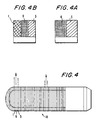
- the implant 10 is covered with a surface coating of three different layers of different composite alloys 5, 6 and 7 which are formed sequentially as adjacent layers such as by cladding etc.
- the surface patterns of each coating 5, 6 and 7 are different as evident in Figures 4a and 4b respectively.
- the method of forming the surface composition 14 is not critical to the present invention and accordingly, any known technology for forming a coating may be employed including but not limited to: cladding, plating, thermal sintering, pressure sintering, plasma spraying, molten infiltration, or a combination thereof.
- the coating technique used will strongly influence the particle sizes of the dissimilar coated metals and their topographical distribution and surface texture. In this regard there can be a homogeneous or non homogeneous distribution of the composite components on the surface of the implant.
- the particles of each composite component may vary in size from 0.1 micron to a few millimeters. Accordingly, each layer of a surface composite component may vary in thickness from 0.1 microns to a few millimeters.
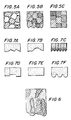
- Figures 5A-5C show different coated particle arrangements on the surface of the implant 10. It should be understood that the metal particles when coated should preferably have an irregular platelet like morphology as shown in Figure 6 made up of one or more different metals in a metal or metal alloy matrix.
- Figures 7A-7F show various surface textures having different elevations in cross section which can be either inherently formed by the coating method used or by texturing the surface after coating.
- the texture at the surface of the implant may be smooth, rough, granular, grooved or hammered and may have any surface configuration and/or irregular surface geometry.
- a free standing structure of a surface composite in accordance with the present invention can be formed from a mixture of dissimilar metals or metal alloys in particulate form which may then be compacted or pressure sintered into a desired geometrical shape. Additional layers can be coated over the surface as explained heretofore.
- the determination of the EMF for each of the above alloy compositions relative to a reference electrode was based upon potentiodynamic anodic plots of the 5 alloys in a standard cell for electrochemical measurement.
- the use of this determination in a standard cell is the basis for determining the EMF of each dissimilar metal component in the surface composition 14 surrounding the implant 10 and may serve to calculate the minimum potential difference between the dissimilar metal components to establish the existence of a potential difference of at least 25mv.
- the standard cell was constructed to allow the insertion of a test electrode of the specimen alloy into a solution chamber, two auxiliary rod graphite electrodes, a Luggin capillary with salt bridge connection to a reference calomel electrode (SCE) and an inlet and outlet for inert gas and a thermometer.
- This standard electrochemical cell set up was used for testing each of the 5 alloys under conditions recommended by ASTM F746-94. The cell was kept at a constant temperature with a thermostat.
- the experimental procedure used was as follows:
- the above table substantiates the level of EMF that can be generated in an electrochemical cell using different noble metal alloy compositions for the test electrode.
- a composite alloy was formed from particles of specimen alloy 98/4 in an amorphous matrix of specimen alloy 98/3. Particles of specimen Alloy 98/4 having the size of about 5 microns (thickness) x 20 microns (average width) x 30 microns (average length) were alloyed in an amorphous matrix of specimen alloy 98/3.
- This composite alloy was then tested in the same electrolyte cell set up for each of the above specimen alloy compositions using the above described procedure.
- the EMF potential difference between the two components was found to be 23mv (millivolts) when measured after one hour immersion in 0.9% NaCI in aqueous solution.
- the surface of a conventional implant was covered using this alloy composite and the implant inserted into a test animal. The results showed that the bone and soft tissue responded more positively against this surface relative to the conventional surface.
- a second composite alloy of two components was formed from particles of specimen alloy 98/1 in an amorphous matrix of specimen alloy 98/5.
- the particles of specimen alloy 98/1 were flakes having a general particle size of 0.1 microns (thickness) x 15 micron (average width) x 35 micron (average length).
- the second composite alloy of two components formed an EMF potential difference between the two components of 283mv.
- a conventional implant having a surface composition of the above second composite alloy was formed and tested in a animal. The bone and soft tissue showed excellent responses adjacent this second composition. Based upon these results it is evident that the EMF between the dissimilar metal components should be at least 25mv and preferably above 100mv and optimally above 250mv.
- the preferred implant comprises a core having at least two different surface compositions with the first and second surface compositions represented by a composite of multiple metal particles with the particles of the first surface composition being so small in size that a multiple number of particles (at least 10 particles and preferably over 100 particles) exist in each square mm of surface area of said core and having a geometry with an average length of less than 100 microns such that an EMF potential difference of at least 25mv will be generated between the particles of the first and second composition in each square mm of the core surface area.
Landscapes
- Health & Medical Sciences (AREA)
- Life Sciences & Earth Sciences (AREA)
- Veterinary Medicine (AREA)
- Animal Behavior & Ethology (AREA)
- General Health & Medical Sciences (AREA)
- Public Health (AREA)
- Oral & Maxillofacial Surgery (AREA)
- Engineering & Computer Science (AREA)
- Orthopedic Medicine & Surgery (AREA)
- Chemical & Material Sciences (AREA)
- Epidemiology (AREA)
- Biomedical Technology (AREA)
- Transplantation (AREA)
- Dentistry (AREA)
- Dermatology (AREA)
- Medicinal Chemistry (AREA)
- Nuclear Medicine, Radiotherapy & Molecular Imaging (AREA)
- Inorganic Chemistry (AREA)
- Radiology & Medical Imaging (AREA)
- Molecular Biology (AREA)
- Heart & Thoracic Surgery (AREA)
- Developmental Biology & Embryology (AREA)
- Ceramic Engineering (AREA)
- Surgery (AREA)
- Vascular Medicine (AREA)
- Cardiology (AREA)
- Neurology (AREA)
- Medical Informatics (AREA)
- Composite Materials (AREA)
- Materials Engineering (AREA)
- Materials For Medical Uses (AREA)
Abstract
Description
- This invention relates to an implant structure for dental or medical use having a composite surface composition of a formulation for enhancing the stability of the implant and for stimulating bone growth upon being surgically inserted into bone.
- An implant is a prosthesis surgically implanted into skeletal bone. In dental applications the implant provides anchorage for the attachment of a dental restorative device. The dental implant is surgically inserted into a cavity formed in an edentulous region of the alveolar jawbone to become an integral part of the bone structure. Thereafter an abutment is attached to the implant in the preparation of a conventional dental restoration for use as a replacement of an extracted natural tooth. In medical applications the implant is typically used as an orthopedic appliance to repair or replace damaged skeletal parts and to stimulate fracture healing of bone. After the implant is surgically inserted a substantial healing period is required to assure bone growth and to permit clinical ossiointergration between the implant and bone. Factors which will affect assimilation of the implant in bone and the stimulation of new bone growth include the healing time period, the type of surgical procedure and the construction and composition of the implant. The implant must be composed of a biocompatible material and must provide sufficient strength for the intended dental or medical application. Conventional biocompatible materials used in the construction of the implant include stainless steel, titanium and their alloys. Titanium implants when surgically inserted into bone do not readily promote bone regeneration at the interface between the implant and bone and if a sufficient void exists microbial leakage and bacteria will accumulate leading to clinical failure of the implant.
- It has been discovered in accordance with the present invention that the stability of an implant and its ability to stimulate bone growth particularly at the bone implant interface can be substantially enhanced by constructing the implant of a biocompatible material composition having an outer surface composed of at least two dissimilar biocompatible metal components or metal alloy components in intimate contact with one another. For purposes of the present invention each of the dissimilar metal components or metal alloy components forming the outer surface of the implant must possess an electromotive potential ("EMF") sufficient to provide a potential difference between the dissimilar metal components of above at least 25mv and preferably above 100mv. The dissimilar metal components must be in intimate contact and must surround at least part of the implant surface although it is preferable for the entire outer periphery of the implant to be composed of this composition. The outer surface composition of the implant should preferably include at least two or more dissimilar metals or metal alloy compositions of which at least 50% by weight are noble metals and preferably between 50-100% by weight constitute noble metals. The noble metals should be selected from the group consisting of gold, palladium, platinum and iridium with the balance of the dissimilar metal composition preferably selected from any of the elements in the 3rd or 4th column of the periodic table of elements. The electromotive potential difference of at least 25mv, optimally above 100mv, should exist between the dissimilar biocompatible metal components or metal alloy components. It should be understood that live bone is porous and that the fluid which permeates live bone is known to be electrolytic. In accordance with the present invention the existence of a composite surface of such dissimilar metals promotes bone integration and accelerates new bone growth at the interface between the implant and bone.
- It is further contemplated in accordance with the present invention to include appropriate ceramic and/or non-metallic constituents in the surface composition of the implant to further stimulate bone growth.
- Other features and advantages of the present invention will become apparent from the following detailed description of the invention when read in conjunction with the accompanying drawings of which:
- FIG. 1 is a cross sectional view of one embodiment of an implant in accordance with the present invention;
- FIG. 2 is a cross sectional view similar to Figure 1 using two different composite alloys on the external surface of the implant adjacent to one another;
- FIG. 3 is a diagrammatic view of another embodiment of an implant in accordance with the present invention composed of two different composite alloys in one preferred arrangement relative one another over the implant outer surface;
- FIG. 3A shows an enlarged detail of a one section of the surface of Figure 3;
- FIG. 4 shows an alternative surface geometry for the surface composite composition in accordance with the present invention;
- FIGS. 4A and 4B show various patterns for the surface composite composition of Figure 4;
- FIGS. 5A, 5B and 5C show different particle arrangements on the surface of the implant body in accordance with the present invention;
- Figure 6 is an illustration of a preferred surface morphology for the coated particles of the surface composite on the implant in accordance with the present invention;
- FIGS. 7A, 7B, 7C, 7D, 7E and 7F show different surface textures of the composites forming a variety of different surface cross-sectional patterns in accordance with the present invention; and
- FIG. 8 shows a graphical plot of the potential of each of five different sample composites of dissimilar metal components in accordance with the present invention.
-
- The invention will now be explained with reference to Figures 1-8 inclusive. In figure 1 an
implant 10 is shown in cross section having abody 12 of a biocompatible material such as titanium and asurface coating 14 of a composite composition of at least two dissimilar conducting metals. The implant may have any desired geometry to facilitate surgical insertion into skeletal bone. It should be understood that although the formation of asurface coating 14 is preferred the entire implant may be fabricated from the composite material composition of dissimilar metals or metal alloys. It is also preferable but not essential to the present invention to have thesurface coating 14 surround the entire outer surface of theimplant body 12. - The
surface coating 14 should be composed of at least two dissimilar biocompatible metal components or metal alloy components which are in intimate contact with one another and are electrically conductive. The distribution of the components on the surface of the implant can be homogeneous or non-homogeneous. The composition of each of the components can be of elemental metal(s) or of metal alloys and should include at least 50% by weight noble metals although between 50 - 100 weight % is preferred. The noble metals should predominantly be limited to one or more of the following metals: gold, palladium, platinum and iridium. The balance of the composition may include any or a combination of the elements in the 3rd or 4th column of the periodic table of elements. In addition the surface composition may include appropriate ceramic an/or non-metallic constituents which may react with the electrolyte to further stimulate bone growth and to provide other characteristics such as strength. - The
surface coating 14 as above defined can be formed over theimplant body 12 to provide different geometrical arrangements and to form various different surface patterns with different surface textures as will be illustrated in connection with Figures 1-7 inclusive. Moreover, the composition of thesurface coating 14 may be formed starting with two or more metallic powder compositions pressed or sintered together or, alternatively, with one of the components part of a homogeneous matrix of the other component or with the components assembled as a laminated structure of various different layer compositions. - In Figure 1 a single coating of a
surface composition 14 is shown surrounding animplant 10 with thesurface composite composition 14 containing two or more of dissimilar metals or metal compositions in intimate contact with one another as explained heretofore with each of the dissimilar metals or metal compositions having an electromotive potential "EMF" sufficient to provide a potential difference between the metals or metal compositions of at least 25mv and preferably over 100mv. Figure 2 is an example of animplant 10 coated with twoseparate surface composites 1 and 2 abutting one another. Each surface composite is of a composition of the elements ofsurface composition 14 as explained above so as to contain two or more dissimilar metals or metal alloys in intimate contact which will cause a potential difference of at least 25mv to exist preferably between both the dissimilar metals or metal alloys in the composite as well as between thecomposite compositions 1 and 2 respectively. Stated otherwise, the potential difference can exist not only between the dissimilar metals in eachcomposite composition 1 and 2 but also between the twocomposite compositions 1 and 2 respectively. The difference is composition between thesurface composites 1 and 2 will provide a different EMF by a variation in the selection of dissimilar metals and their proportion to one another and may have a different surface pattern and surface texture. - In Figure 3 two different
composite alloys implant 10 to form an arrangement in which the second coatedalloy 4 forms layered bands of thealloy 4 separated from each other to expose the first coatedalloy 3. Thelayered bands 4 may be uniformity spaced apart to expose sections ofalloy 3 on each opposite side thereof as shown in Figure 3a. Alternatively, the layered bands of thealloy 4 may be arranged in a continuous spiral configuration over the surface ofalloy 3. - In Figure 4 the
implant 10 is covered with a surface coating of three different layers ofdifferent composite alloys coating - The method of forming the
surface composition 14 is not critical to the present invention and accordingly, any known technology for forming a coating may be employed including but not limited to: cladding, plating, thermal sintering, pressure sintering, plasma spraying, molten infiltration, or a combination thereof. The coating technique used will strongly influence the particle sizes of the dissimilar coated metals and their topographical distribution and surface texture. In this regard there can be a homogeneous or non homogeneous distribution of the composite components on the surface of the implant. The particles of each composite component may vary in size from 0.1 micron to a few millimeters. Accordingly, each layer of a surface composite component may vary in thickness from 0.1 microns to a few millimeters. - Figures 5A-5C show different coated particle arrangements on the surface of the
implant 10. It should be understood that the metal particles when coated should preferably have an irregular platelet like morphology as shown in Figure 6 made up of one or more different metals in a metal or metal alloy matrix. Figures 7A-7F show various surface textures having different elevations in cross section which can be either inherently formed by the coating method used or by texturing the surface after coating. The texture at the surface of the implant may be smooth, rough, granular, grooved or hammered and may have any surface configuration and/or irregular surface geometry. - A free standing structure of a surface composite in accordance with the present invention can be formed from a mixture of dissimilar metals or metal alloys in particulate form which may then be compacted or pressure sintered into a desired geometrical shape. Additional layers can be coated over the surface as explained heretofore.
- The following five separate specimen noble metal alloy compositions were tested to determine the level of EMF electromotive potential that could be generated from different alloy composition and to substantiate that the potentials would be substantially different from one another:
- Specimen Alloy 98/1 is a homogeneous noble metal alloy of the following
composition in wt%: gold-35%; palladium-32%; platinum-27%; iridium-4% and
silver 2%. - Specimen Alloy 98/2 is a homogeneous noble metal alloy composition of the following composition in wt%: gold-65%; palladium-32%; ruthenium-2%; silver 0.5% other-0.5%.
- Specimen Alloy 98/3 is a homogeneous noble metal alloy of the following composition in wt%: gold-94.5%; palladium-1.5%; silver-3% and copper 1.0%.
- Specimen Alloy 98/4 is a homogeneous noble metal alloy composition of the following composition in wt%: gold-85%; palladium-4.7%; platinum-4.0%; silver 2.5%; other 0.3%; and
- Specimen Alloy 98/5 is a homogeneous noble metal alloy of the following
composition in wt%: gold-97%; and
silver 3%. -
- The determination of the EMF for each of the above alloy compositions relative to a reference electrode was based upon potentiodynamic anodic plots of the 5 alloys in a standard cell for electrochemical measurement. The use of this determination in a standard cell is the basis for determining the EMF of each dissimilar metal component in the
surface composition 14 surrounding theimplant 10 and may serve to calculate the minimum potential difference between the dissimilar metal components to establish the existence of a potential difference of at least 25mv. - The standard cell was constructed to allow the insertion of a test electrode of the specimen alloy into a solution chamber, two auxiliary rod graphite electrodes, a Luggin capillary with salt bridge connection to a reference calomel electrode (SCE) and an inlet and outlet for inert gas and a thermometer. This standard electrochemical cell set up was used for testing each of the 5 alloys under conditions recommended by ASTM F746-94. The cell was kept at a constant temperature with a thermostat. The experimental procedure used was as follows:
- 1. The electrolyte solution used was 0.9% NaCI with a fresh solution used for each test.
- 2. The graphite auxiliary electrodes, salt-bridge and other components were placed in the test cell.
- 3. The temperature of the solution was brought to 37±1° C by immersion in a controlled temperature water bath.
- 4. Prior to immersion of each test specimen the oxygen level in the solution was reduced by bubbling in argon for 0.5 hours.
- 5. The working electrode surface was prepared by wet grinding with 240 grit SiC paper and wet polishing with 66 grit paper and rinsed with deionized water and dried.
- 6. The test specimen was mounted on an electrode holder and placed into solution.
- 7. The cell was connected to a computer controlled potentiostat and the corrosion potential was measured for 1 hour after which time a potential scan was started. The current was continuously recorded while the potential was changed from corrosion potential up to +1V verses standard calomel electrode. It should be understood that the standard cell configuration used in the determination of the EMF for the metal component or metal alloy component selected in accordance with the present invention may be any conventional standard cell configuration.
-
- The plots of potential verses time for each of the five specimen alloy compositions is shown in Figure 8 and the steady state potential reached at the end of one hour after immersion in the electrolyte is shown in the following table:
Sample tested EMF (at steady state) in mV Specimen Alloy 98/1 -136 Specimen Alloy 98/2 98 Specimen Alloy 98/3 197 Specimen Alloy 98/4 174 Specimen Alloy 98/5 147 - The above table substantiates the level of EMF that can be generated in an electrochemical cell using different noble metal alloy compositions for the test electrode. To establish that a potential difference between dissimilar metal compositions can be developed in accordance with the present invention in a composite alloy another test was conducted in which a composite alloy was formed from particles of specimen alloy 98/4 in an amorphous matrix of specimen alloy 98/3. Particles of specimen Alloy 98/4 having the size of about 5 microns (thickness) x 20 microns (average width) x 30 microns (average length) were alloyed in an amorphous matrix of specimen alloy 98/3. This composite alloy was then tested in the same electrolyte cell set up for each of the above specimen alloy compositions using the above described procedure. The EMF potential difference between the two components was found to be 23mv (millivolts) when measured after one hour immersion in 0.9% NaCI in aqueous solution. To test the response of bone and soft tissue to an implant having a surface of this composition relative to a conventional metal implant the surface of a conventional implant was covered using this alloy composite and the implant inserted into a test animal. The results showed that the bone and soft tissue responded more positively against this surface relative to the conventional surface.
- Further studies were conducted using two different implant surface compositions with the first represented by as composite alloy formed from particles of specimen alloy 98/2 in an amorphous matrix of specimen alloy 98/5. More specifically the particles of specimen alloy 98/2 were composed of flakes having a general particle size of 2 microns (thickness) x 30 micron (average width) x 80 micron (average length) which were alloyed in a matrix of specimen alloy 98/5. The two components were measured to form an EMF potential difference between the two components of 99mv. A conventional implant having a surface composition of the above composite alloy was formed and tested in a animal. The bone and soft tissue response were found to be good around these implant surfaces. A second composite alloy of two components was formed from particles of specimen alloy 98/1 in an amorphous matrix of specimen alloy 98/5. The particles of specimen alloy 98/1 were flakes having a general particle size of 0.1 microns (thickness) x 15 micron (average width) x 35 micron (average length). The second composite alloy of two components formed an EMF potential difference between the two components of 283mv. Once again a conventional implant having a surface composition of the above second composite alloy was formed and tested in a animal. The bone and soft tissue showed excellent responses adjacent this second composition. Based upon these results it is evident that the EMF between the dissimilar metal components should be at least 25mv and preferably above 100mv and optimally above 250mv. The preferred implant comprises a core having at least two different surface compositions with the first and second surface compositions represented by a composite of multiple metal particles with the particles of the first surface composition being so small in size that a multiple number of particles (at least 10 particles and preferably over 100 particles) exist in each square mm of surface area of said core and having a geometry with an average length of less than 100 microns such that an EMF potential difference of at least 25mv will be generated between the particles of the first and second composition in each square mm of the core surface area.
Claims (9)
- An implant for stimulating and accelerating bone formation at the interface between the implant and bone comprising a core having at least two different surface compositions with the first and second surface compositions represented by a composite of multiple metal particles with the particles of the first surface composition being so small in size that a multiple number of particles exist in each square mm of surface area of said core and with said particles in said first surface composition having a geometry with an average length of less than 100 microns such that an EMF potential difference of at least 25mv will be generated between said particles of said first and second composition in each square mm of the core surface area.
- An implant as defined in claim 1 wherein the EMF potential difference between said first and second compositions is at least 100mv.
- An implant as defined in claims 1 or 2 wherein each surface composition on said core defines a coating covering at least a substantial part of the periphery of said core.
- An implant as defined in claim 3 wherein said surface compositions define coatings of at least two composite formulations each of dissimilar metals or metal alloys in a laminated arrangement forming adjacent alternating layers in the form of bands spaced apart from one another along the outer periphery of the core.
- An implant as defined in claim 3 wherein said coating comprises at least two composite formulations each of dissimilar metals in a laminated arrangement with each composite formulation forming adjacent alternating layers in the form of bands spaced apart from one another along the outer periphery of the core.
- An implant as defined in claim 5 wherein each coating has a predetermined surface texture.
- An implant as defined in claim 4 wherein at least one of said surface compositions is composed of at least 50wt% noble metals or metal alloys.
- An implant as defined in claim 7 wherein said at least one surface composition is composed of at between 50-100 % by weight noble metals or metal alloys.
- An implant as defined in claim 8 wherein said noble metals are selected from the group consisting of gold, palladium, platinum and iridium. 10: An implant as defined in claim 9 wherein the balance of said surface composition is composed of metals selected from the 3rd and 4th column of the periodic table of elements.
Priority Applications (5)
| Application Number | Priority Date | Filing Date | Title |
|---|---|---|---|
| US09/131,788 US6168633B1 (en) | 1998-08-10 | 1998-08-10 | Composite surface composition for an implant structure |
| EP00122794A EP1199049B1 (en) | 1998-08-10 | 2000-10-19 | Metallic composite surface composition for an implant structure |
| ES00122794T ES2239988T3 (en) | 1998-08-10 | 2000-10-19 | COMPOSITION OF METAL COMPOSITE BASED SURFACE FOR AN IMPLANT. |
| DE2000618938 DE60018938T2 (en) | 2000-10-19 | 2000-10-19 | Composition of a metallic composite material coating for implants |
| AT00122794T ATE291389T1 (en) | 2000-10-19 | 2000-10-19 | COMPOSITION OF A METAL COMPOSITE MATERIAL COATING FOR IMPLANTS |
Applications Claiming Priority (2)
| Application Number | Priority Date | Filing Date | Title |
|---|---|---|---|
| US09/131,788 US6168633B1 (en) | 1998-08-10 | 1998-08-10 | Composite surface composition for an implant structure |
| EP00122794A EP1199049B1 (en) | 1998-08-10 | 2000-10-19 | Metallic composite surface composition for an implant structure |
Publications (2)
| Publication Number | Publication Date |
|---|---|
| EP1199049A1 true EP1199049A1 (en) | 2002-04-24 |
| EP1199049B1 EP1199049B1 (en) | 2005-03-23 |
Family
ID=26071523
Family Applications (1)
| Application Number | Title | Priority Date | Filing Date |
|---|---|---|---|
| EP00122794A Expired - Lifetime EP1199049B1 (en) | 1998-08-10 | 2000-10-19 | Metallic composite surface composition for an implant structure |
Country Status (3)
| Country | Link |
|---|---|
| US (1) | US6168633B1 (en) |
| EP (1) | EP1199049B1 (en) |
| ES (1) | ES2239988T3 (en) |
Cited By (8)
| Publication number | Priority date | Publication date | Assignee | Title |
|---|---|---|---|---|
| WO2004017857A1 (en) * | 2002-08-23 | 2004-03-04 | Woodwelding Ag | Implant for implanting in bone tissue or in bone tissue supplemented with bone substitute material |
| US6913666B1 (en) | 1997-03-21 | 2005-07-05 | Woodwelding Ag | Process for anchoring connecting elements in a material with pores or cavities and connecting elements therefor |
| WO2005074845A1 (en) * | 2004-02-02 | 2005-08-18 | Ams Research Corporation | Enhancing tissue ingrowth for contraception |
| WO2006065205A1 (en) * | 2004-12-13 | 2006-06-22 | Rickard Branemark Consulting Ab | An implant and an implant member |
| US7073504B2 (en) | 1996-12-18 | 2006-07-11 | Ams Research Corporation | Contraceptive system and method of use |
| US7749240B2 (en) | 2003-08-07 | 2010-07-06 | Olympus Corporation | Ultrasonic surgical system |
| US9615872B2 (en) | 2001-03-02 | 2017-04-11 | Woodwelding Ag | Implants for creating connections to tissue parts, in particular to skeletal parts, as well as device and method for implantation thereof |
| US9713549B2 (en) | 2004-02-02 | 2017-07-25 | Bayer Healthcare Llc | Contraceptive with permeable and impermeable components |
Families Citing this family (68)
| Publication number | Priority date | Publication date | Assignee | Title |
|---|---|---|---|---|
| US6241747B1 (en) * | 1993-05-03 | 2001-06-05 | Quill Medical, Inc. | Barbed Bodily tissue connector |
| US8795332B2 (en) * | 2002-09-30 | 2014-08-05 | Ethicon, Inc. | Barbed sutures |
| US6537310B1 (en) * | 1999-11-19 | 2003-03-25 | Advanced Bio Prosthetic Surfaces, Ltd. | Endoluminal implantable devices and method of making same |
| US6645226B1 (en) | 2000-05-19 | 2003-11-11 | Coapt Systems, Inc. | Multi-point tension distribution system device and method of tissue approximation using that device to improve wound healing |
| US7156862B2 (en) | 2000-05-19 | 2007-01-02 | Coapt Systems, Inc. | Multi-point tension distribution system device and method of tissue approximation using that device to improve wound healing |
| US7510566B2 (en) * | 2000-05-19 | 2009-03-31 | Coapt Systems, Inc. | Multi-point tissue tension distribution device and method, a chin lift variation |
| US20050119694A1 (en) * | 2000-05-19 | 2005-06-02 | Jacobs Daniel I. | Remotely anchored tissue fixation device and method |
| US20040010275A1 (en) * | 2000-05-19 | 2004-01-15 | Daniel Jacobs | Multi-point tissue tension distribution device and method, a custom-fittable variation |
| US6485503B2 (en) * | 2000-05-19 | 2002-11-26 | Coapt Systems, Inc. | Multi-point tissue tension distribution device, a brow and face lift variation, and a method of tissue approximation using the device |
| US7172615B2 (en) * | 2000-05-19 | 2007-02-06 | Coapt Systems, Inc. | Remotely anchored tissue fixation device |
| US7056331B2 (en) | 2001-06-29 | 2006-06-06 | Quill Medical, Inc. | Suture method |
| US6848152B2 (en) * | 2001-08-31 | 2005-02-01 | Quill Medical, Inc. | Method of forming barbs on a suture and apparatus for performing same |
| US20030142676A1 (en) * | 2002-01-25 | 2003-07-31 | Raymond Zeisz | Method and apparauts for admission control in packet switch |
| US6773450B2 (en) * | 2002-08-09 | 2004-08-10 | Quill Medical, Inc. | Suture anchor and method |
| US6955540B2 (en) | 2002-08-23 | 2005-10-18 | Woodwelding Ag | Preparation for being fastened on a natural tooth part or tooth and corresponding fastening method |
| US20040088003A1 (en) | 2002-09-30 | 2004-05-06 | Leung Jeffrey C. | Barbed suture in combination with surgical needle |
| US8100940B2 (en) | 2002-09-30 | 2012-01-24 | Quill Medical, Inc. | Barb configurations for barbed sutures |
| US7624487B2 (en) | 2003-05-13 | 2009-12-01 | Quill Medical, Inc. | Apparatus and method for forming barbs on a suture |
| US20050197699A1 (en) * | 2004-02-10 | 2005-09-08 | Jacobs Daniel I. | Tissue repair apparatus and method |
| US20050209542A1 (en) * | 2004-03-16 | 2005-09-22 | Jacobs Daniel I | Tissue approximation sling and method |
| EP2664283B1 (en) | 2004-05-14 | 2017-06-28 | Ethicon, LLC | Suture devices |
| US20060129240A1 (en) * | 2004-12-10 | 2006-06-15 | Joe Lessar | Implants based on engineered composite materials having enhanced imaging and wear resistance |
| US7431734B2 (en) * | 2005-02-04 | 2008-10-07 | Intellistem Orthopaedic Innovations, Inc. | Implanted prosthetic device |
| US8814567B2 (en) * | 2005-05-26 | 2014-08-26 | Zimmer Dental, Inc. | Dental implant prosthetic device with improved osseointegration and esthetic features |
| CA2609390A1 (en) * | 2005-05-26 | 2006-11-30 | Zimmer Dental, Inc. | Prosthetic dental device |
| WO2007027794A1 (en) | 2005-08-30 | 2007-03-08 | Zimmer Dental, Inc. | Dental implant with improved osseointegration features |
| US8562346B2 (en) | 2005-08-30 | 2013-10-22 | Zimmer Dental, Inc. | Dental implant for a jaw with reduced bone volume and improved osseointegration features |
| US8235047B2 (en) | 2006-03-30 | 2012-08-07 | Conceptus, Inc. | Methods and devices for deployment into a lumen |
| EP2012839B1 (en) * | 2006-04-07 | 2012-01-04 | Bactiguard AB | Novel antimicrobial substrates and uses thereof |
| WO2007142579A1 (en) * | 2006-06-05 | 2007-12-13 | Bactiguard Ab | A polymer matrix, uses thereof and a method of manufacturing the same |
| EP2104471B1 (en) * | 2006-12-22 | 2017-01-25 | Thommen Medical Ag | Dental implant and method for the production thereof |
| US20080255612A1 (en) * | 2007-04-13 | 2008-10-16 | Angiotech Pharmaceuticals, Inc. | Self-retaining systems for surgical procedures |
| US20090061389A1 (en) | 2007-08-30 | 2009-03-05 | Matthew Lomicka | Dental implant prosthetic device with improved osseointegration and shape for resisting rotation |
| EP2526975B1 (en) | 2007-09-27 | 2014-06-04 | Ethicon, LLC | Self-retaining sutures including tissue retainers having improved strength |
| US8916077B1 (en) | 2007-12-19 | 2014-12-23 | Ethicon, Inc. | Self-retaining sutures with retainers formed from molten material |
| CA2709328C (en) * | 2007-12-19 | 2017-01-03 | Angiotech Pharmaceuticals, Inc. | Self-retaining sutures with heat-contact mediated retainers |
| US8118834B1 (en) | 2007-12-20 | 2012-02-21 | Angiotech Pharmaceuticals, Inc. | Composite self-retaining sutures and method |
| WO2009094166A1 (en) * | 2008-01-22 | 2009-07-30 | Medical Research Products-B, Inc | Prothesis attachment method and apparatus with soft tissue integrating seal |
| US8615856B1 (en) | 2008-01-30 | 2013-12-31 | Ethicon, Inc. | Apparatus and method for forming self-retaining sutures |
| EP2242430B1 (en) * | 2008-01-30 | 2016-08-17 | Ethicon, LLC | Apparatus and method for forming self-retaining sutures |
| WO2009105663A2 (en) * | 2008-02-21 | 2009-08-27 | Angiotech Pharmaceuticals, Inc. | Method and apparatus for elevating retainers on self-retaining sutures |
| US8216273B1 (en) | 2008-02-25 | 2012-07-10 | Ethicon, Inc. | Self-retainers with supporting structures on a suture |
| US8641732B1 (en) | 2008-02-26 | 2014-02-04 | Ethicon, Inc. | Self-retaining suture with variable dimension filament and method |
| US20090228021A1 (en) * | 2008-03-06 | 2009-09-10 | Leung Jeffrey C | Matrix material |
| BRPI0911132B8 (en) | 2008-04-15 | 2021-06-22 | Angiotech Pharm Inc | suture to be used in a tissue-applied procedure |
| US8961560B2 (en) | 2008-05-16 | 2015-02-24 | Ethicon, Inc. | Bidirectional self-retaining sutures with laser-marked and/or non-laser marked indicia and methods |
| US8899982B2 (en) | 2008-07-02 | 2014-12-02 | Zimmer Dental, Inc. | Implant with structure for securing a porous portion |
| US8562348B2 (en) | 2008-07-02 | 2013-10-22 | Zimmer Dental, Inc. | Modular implant with secured porous portion |
| US8231387B2 (en) | 2008-07-02 | 2012-07-31 | Zimmer, Inc. | Porous implant with non-porous threads |
| US9095396B2 (en) | 2008-07-02 | 2015-08-04 | Zimmer Dental, Inc. | Porous implant with non-porous threads |
| EP3420923A1 (en) | 2008-11-03 | 2019-01-02 | Ethicon, LLC | Length of self-retaining suture and device for using the same |
| US20100114314A1 (en) | 2008-11-06 | 2010-05-06 | Matthew Lomicka | Expandable bone implant |
| US9707058B2 (en) * | 2009-07-10 | 2017-07-18 | Zimmer Dental, Inc. | Patient-specific implants with improved osseointegration |
| US8602782B2 (en) | 2009-11-24 | 2013-12-10 | Zimmer Dental, Inc. | Porous implant device with improved core |
| BR112012028331B1 (en) | 2010-05-04 | 2020-04-28 | Ethicon Endo Surgery Llc | self-retaining suture |
| CA2801271C (en) | 2010-06-11 | 2018-10-30 | Ethicon, Llc | Suture delivery tools for endoscopic and robot-assisted surgery and methods |
| US11007296B2 (en) | 2010-11-03 | 2021-05-18 | Ethicon, Inc. | Drug-eluting self-retaining sutures and methods relating thereto |
| EP3138506B1 (en) | 2010-11-09 | 2020-08-26 | Ethicon, LLC | Emergency self-retaining sutures |
| US9433480B2 (en) * | 2010-12-21 | 2016-09-06 | Zimmer Dental, Inc. | Implant with porous sleeve including anti-rotation features |
| RU2659454C2 (en) | 2011-03-23 | 2018-07-02 | ЭТИКОН ЭлЭлСи | Self-retaining variable loop sutures |
| US20130172931A1 (en) | 2011-06-06 | 2013-07-04 | Jeffrey M. Gross | Methods and devices for soft palate tissue elevation procedures |
| ITBO20120145A1 (en) * | 2012-03-20 | 2013-09-21 | Medical Device Innovative S R L | ENDOOSSEO MEDICAL PLANT, DENTAL IN PARTICULAR |
| USD816841S1 (en) | 2014-12-15 | 2018-05-01 | Jjgc Industria E Comercio De Materiais Dentarios S/A | Bone implant |
| BR102014031426B1 (en) | 2014-12-15 | 2018-07-24 | Jjgc Ind E Comercio De Materiais Dentarios S/A | implant |
| US10092764B2 (en) | 2015-08-20 | 2018-10-09 | Cardiac Pacemakers, Inc. | Implantable medical device with modified surface texture |
| BR102016010184B1 (en) | 2016-05-05 | 2020-10-27 | Jjgc Indústria E Comércio De Materiais Dentários S.A. | prosthetic set and process for producing the same |
| US11738123B2 (en) * | 2019-06-05 | 2023-08-29 | Korea Institute Of Science And Technology | Implant having controlled generation rate of reactive oxygen species and method of controlling generation of reactive oxygen species using the same |
| US11484396B1 (en) * | 2021-06-21 | 2022-11-01 | Identical, Inc. | Root-analog dental implants and systems, devices, and methods for designing and manufacturing same |
Citations (4)
| Publication number | Priority date | Publication date | Assignee | Title |
|---|---|---|---|---|
| US4252525A (en) * | 1979-12-17 | 1981-02-24 | Child Frank W | Dental implant |
| US4532660A (en) * | 1982-05-17 | 1985-08-06 | National Research Development Corporation | Endoprosthetic bone joint devices |
| US4606354A (en) * | 1985-05-21 | 1986-08-19 | Ezekiel Jacob J | Gold coated carbon implant and method of treating arthritis therewith |
| WO1986007543A1 (en) * | 1985-06-20 | 1986-12-31 | Noel Desmond Gray | Internally applied self energising healing electrodes |
Family Cites Families (8)
| Publication number | Priority date | Publication date | Assignee | Title |
|---|---|---|---|---|
| DE2611744C2 (en) * | 1976-03-19 | 1982-01-28 | Werner Dipl.-Ing. 8000 Muenchen Kraus | Device for maintaining the vitality of bone tissue for endoprostheses |
| US4027392A (en) * | 1976-05-10 | 1977-06-07 | Interface Biomedical Laboratories Corporation | Endosteal bionic tooth and implantation method |
| US5681575A (en) * | 1992-05-19 | 1997-10-28 | Westaim Technologies Inc. | Anti-microbial coating for medical devices |
| GEP20002074B (en) * | 1992-05-19 | 2000-05-10 | Westaim Tech Inc Ca | Modified Material and Method for its Production |
| US5292252A (en) * | 1992-12-14 | 1994-03-08 | Impla-Med, Inc. | Stimulator healing cap |
| US5759205A (en) * | 1994-01-21 | 1998-06-02 | Brown University Research Foundation | Negatively charged polymeric electret implant |
| US5593438A (en) * | 1995-01-20 | 1997-01-14 | Akhavi; David S. | Intraocular lens with metallic coatings for preventing secondary cataracts |
| US5759564A (en) * | 1996-04-16 | 1998-06-02 | Implemed, Inc. | Iontophoretic material |
-
1998
- 1998-08-10 US US09/131,788 patent/US6168633B1/en not_active Expired - Lifetime
-
2000
- 2000-10-19 EP EP00122794A patent/EP1199049B1/en not_active Expired - Lifetime
- 2000-10-19 ES ES00122794T patent/ES2239988T3/en not_active Expired - Lifetime
Patent Citations (4)
| Publication number | Priority date | Publication date | Assignee | Title |
|---|---|---|---|---|
| US4252525A (en) * | 1979-12-17 | 1981-02-24 | Child Frank W | Dental implant |
| US4532660A (en) * | 1982-05-17 | 1985-08-06 | National Research Development Corporation | Endoprosthetic bone joint devices |
| US4606354A (en) * | 1985-05-21 | 1986-08-19 | Ezekiel Jacob J | Gold coated carbon implant and method of treating arthritis therewith |
| WO1986007543A1 (en) * | 1985-06-20 | 1986-12-31 | Noel Desmond Gray | Internally applied self energising healing electrodes |
Cited By (17)
| Publication number | Priority date | Publication date | Assignee | Title |
|---|---|---|---|---|
| US7073504B2 (en) | 1996-12-18 | 2006-07-11 | Ams Research Corporation | Contraceptive system and method of use |
| US7398780B2 (en) | 1996-12-18 | 2008-07-15 | Ams Research Corporation | Contraceptive system and method of use |
| US6913666B1 (en) | 1997-03-21 | 2005-07-05 | Woodwelding Ag | Process for anchoring connecting elements in a material with pores or cavities and connecting elements therefor |
| US9924988B2 (en) | 2001-03-02 | 2018-03-27 | Woodwelding Ag | Implants for creating connections to tissue parts, in particular to skeletal parts, as well as device and method for implantation thereof |
| US9615872B2 (en) | 2001-03-02 | 2017-04-11 | Woodwelding Ag | Implants for creating connections to tissue parts, in particular to skeletal parts, as well as device and method for implantation thereof |
| CN100506186C (en) * | 2002-08-23 | 2009-07-01 | 伍德韦尔丁公司 | Implant to be implanted in bone tissue or bone tissue supplemented with bone substitute material |
| WO2004017857A1 (en) * | 2002-08-23 | 2004-03-04 | Woodwelding Ag | Implant for implanting in bone tissue or in bone tissue supplemented with bone substitute material |
| US7749240B2 (en) | 2003-08-07 | 2010-07-06 | Olympus Corporation | Ultrasonic surgical system |
| US9713549B2 (en) | 2004-02-02 | 2017-07-25 | Bayer Healthcare Llc | Contraceptive with permeable and impermeable components |
| WO2005074845A1 (en) * | 2004-02-02 | 2005-08-18 | Ams Research Corporation | Enhancing tissue ingrowth for contraception |
| JP2008522714A (en) * | 2004-12-13 | 2008-07-03 | リカード ブレーンマーク コンサルティング アーベー | Implants and implant components |
| RU2393813C2 (en) * | 2004-12-13 | 2010-07-10 | Риккард Бронемарк Консалтинг Аб | Implant and element thereof |
| AU2005317276B2 (en) * | 2004-12-13 | 2011-11-10 | Integrum Ab | An implant and an implant member |
| JP2012176243A (en) * | 2004-12-13 | 2012-09-13 | Rickard Branemark Consulting Ab | Implant and implant member |
| US8377106B2 (en) | 2004-12-13 | 2013-02-19 | Rickard Branemark Consulting Ab | Implant and an implant member |
| CN101102727B (en) * | 2004-12-13 | 2013-03-27 | 里卡德·布雷恩马克咨询公司 | An implant and an implant member |
| WO2006065205A1 (en) * | 2004-12-13 | 2006-06-22 | Rickard Branemark Consulting Ab | An implant and an implant member |
Also Published As
| Publication number | Publication date |
|---|---|
| ES2239988T3 (en) | 2005-10-16 |
| EP1199049B1 (en) | 2005-03-23 |
| US6168633B1 (en) | 2001-01-02 |
Similar Documents
| Publication | Publication Date | Title |
|---|---|---|
| EP1199049B1 (en) | Metallic composite surface composition for an implant structure | |
| Gnedenkov et al. | Hydroxyapatite-containing PEO-coating design for biodegradable Mg-0.8 Ca alloy: Formation and corrosion behaviour | |
| Cai et al. | Electrochemical characterization of cast titanium alloys | |
| Speck et al. | Anodic polarization behavior of Ti-Ni and Ti-6A 1-4 V in simulated physiological solutions | |
| Zeng et al. | A comparison of corrosion resistance of cobalt-chromium-molybdenum metal ceramic alloy fabricated with selective laser melting and traditional processing | |
| Songur et al. | The plasma electrolytic oxidation (PEO) coatings to enhance in-vitro corrosion resistance of Ti–29Nb–13Ta–4.6 Zr alloys: The combined effect of duty cycle and the deposition frequency | |
| Cortada et al. | Galvanic corrosion behavior of titanium implants coupled to dental alloys | |
| Grosgogeat et al. | Measurement and evaluation of galvanic corrosion between titanium/Ti6Al4V implants and dental alloys by electrochemical techniques and auger spectrometry | |
| Han et al. | Characterization and stability of hydroxyapatite coatings prepared by an electrodeposition and alkaline‐treatment process | |
| Venugopalan et al. | Evaluation of restorative and implant alloys galvanically coupled to titanium | |
| Fais et al. | Titanium surface topography after brushing with fluoride and fluoride-free toothpaste simulating 10 years of use | |
| de Viteri et al. | Structure, tribocorrosion and biocide characterization of Ca, P and I containing TiO2 coatings developed by plasma electrolytic oxidation | |
| Koike et al. | Corrosion behavior of cast titanium with reduced surface reaction layer made by a face-coating method | |
| JP2002126071A (en) | Composite surface composition for implant construction | |
| Johansson et al. | Corrosion of copper, nickel, and gold dental casting alloys: an in vitro and in vivo study | |
| Soares et al. | Galvanic corrosion of Ti dental implants coupled to CoCrMo prosthetic component | |
| Kiel-Jamrozik et al. | Technological capabilities of surface layers formation on implant made of Ti-6Al-4V ELI alloy | |
| Naganawa et al. | In Vitro Biocompatibility of a New Titanium‐29Niobium‐13Tantalum‐4.6 Zirconium Alloy With Osteoblast‐Like MG63 Cells | |
| dos Reis Barros et al. | Galvanic corrosion of Ti6Al4V coupled with NiCr as a dental implant alloy in fluoride solutions | |
| Bilhan et al. | The effect of mucine, IgA, urea, and lysozyme on the corrosion behavior of various non-precious dental alloys and pure titanium in artificial saliva | |
| Barros et al. | Tribocorrosion resistance of dental implant alloys—assessment of cp-Ti, Ti6Al4V, and NiCr in neutral and acidified saliva | |
| Qin et al. | Microstructure, mechanical properties and fretting corrosion behavior of micro-arc oxide coatings on biomedical Ti6Al4V alloy for modular hip implant: Effect of Na2SiO3/KOH electrolyte concentration | |
| Berbel et al. | Corrosion mechanism of Ti-6Al-4V morse taper dental implants connected to 316 L stainless steel prosthetic abutment | |
| Wilk et al. | A quantitative assessment of the influence of voltage on the formation of oxide layers on the surface of titanium by anodization | |
| Taira et al. | In vitro corrosion fatigue of 316L cold worked stainless steel |
Legal Events
| Date | Code | Title | Description |
|---|---|---|---|
| PUAI | Public reference made under article 153(3) epc to a published international application that has entered the european phase |
Free format text: ORIGINAL CODE: 0009012 |
|
| AK | Designated contracting states |
Kind code of ref document: A1 Designated state(s): AT BE CH CY DE DK ES FI FR GB GR IE IT LI LU MC NL PT SE |
|
| AX | Request for extension of the european patent |
Free format text: AL;LT;LV;MK;RO;SI |
|
| 17P | Request for examination filed |
Effective date: 20021017 |
|
| AKX | Designation fees paid |
Free format text: AT BE CH CY DE DK ES FI FR GB GR IE IT LI LU MC NL PT SE |
|
| 17Q | First examination report despatched |
Effective date: 20031024 |
|
| GRAP | Despatch of communication of intention to grant a patent |
Free format text: ORIGINAL CODE: EPIDOSNIGR1 |
|
| GRAS | Grant fee paid |
Free format text: ORIGINAL CODE: EPIDOSNIGR3 |
|
| GRAA | (expected) grant |
Free format text: ORIGINAL CODE: 0009210 |
|
| AK | Designated contracting states |
Kind code of ref document: B1 Designated state(s): AT BE CH CY DE DK ES FI FR GB GR IE IT LI LU MC NL PT SE |
|
| PG25 | Lapsed in a contracting state [announced via postgrant information from national office to epo] |
Ref country code: LI Free format text: LAPSE BECAUSE OF FAILURE TO SUBMIT A TRANSLATION OF THE DESCRIPTION OR TO PAY THE FEE WITHIN THE PRESCRIBED TIME-LIMIT Effective date: 20050323 Ref country code: NL Free format text: LAPSE BECAUSE OF FAILURE TO SUBMIT A TRANSLATION OF THE DESCRIPTION OR TO PAY THE FEE WITHIN THE PRESCRIBED TIME-LIMIT Effective date: 20050323 Ref country code: BE Free format text: LAPSE BECAUSE OF FAILURE TO SUBMIT A TRANSLATION OF THE DESCRIPTION OR TO PAY THE FEE WITHIN THE PRESCRIBED TIME-LIMIT Effective date: 20050323 Ref country code: AT Free format text: LAPSE BECAUSE OF FAILURE TO SUBMIT A TRANSLATION OF THE DESCRIPTION OR TO PAY THE FEE WITHIN THE PRESCRIBED TIME-LIMIT Effective date: 20050323 Ref country code: FI Free format text: LAPSE BECAUSE OF FAILURE TO SUBMIT A TRANSLATION OF THE DESCRIPTION OR TO PAY THE FEE WITHIN THE PRESCRIBED TIME-LIMIT Effective date: 20050323 Ref country code: CH Free format text: LAPSE BECAUSE OF FAILURE TO SUBMIT A TRANSLATION OF THE DESCRIPTION OR TO PAY THE FEE WITHIN THE PRESCRIBED TIME-LIMIT Effective date: 20050323 |
|
| REG | Reference to a national code |
Ref country code: GB Ref legal event code: FG4D |
|
| REG | Reference to a national code |
Ref country code: CH Ref legal event code: EP |
|
| REG | Reference to a national code |
Ref country code: IE Ref legal event code: FG4D |
|
| REF | Corresponds to: |
Ref document number: 60018938 Country of ref document: DE Date of ref document: 20050428 Kind code of ref document: P |
|
| PG25 | Lapsed in a contracting state [announced via postgrant information from national office to epo] |
Ref country code: DK Free format text: LAPSE BECAUSE OF FAILURE TO SUBMIT A TRANSLATION OF THE DESCRIPTION OR TO PAY THE FEE WITHIN THE PRESCRIBED TIME-LIMIT Effective date: 20050623 Ref country code: GR Free format text: LAPSE BECAUSE OF FAILURE TO SUBMIT A TRANSLATION OF THE DESCRIPTION OR TO PAY THE FEE WITHIN THE PRESCRIBED TIME-LIMIT Effective date: 20050623 |
|
| REG | Reference to a national code |
Ref country code: SE Ref legal event code: TRGR |
|
| NLV1 | Nl: lapsed or annulled due to failure to fulfill the requirements of art. 29p and 29m of the patents act | ||
| PG25 | Lapsed in a contracting state [announced via postgrant information from national office to epo] |
Ref country code: PT Free format text: LAPSE BECAUSE OF FAILURE TO SUBMIT A TRANSLATION OF THE DESCRIPTION OR TO PAY THE FEE WITHIN THE PRESCRIBED TIME-LIMIT Effective date: 20050907 |
|
| REG | Reference to a national code |
Ref country code: CH Ref legal event code: PL |
|
| REG | Reference to a national code |
Ref country code: ES Ref legal event code: FG2A Ref document number: 2239988 Country of ref document: ES Kind code of ref document: T3 |
|
| PG25 | Lapsed in a contracting state [announced via postgrant information from national office to epo] |
Ref country code: IE Free format text: LAPSE BECAUSE OF NON-PAYMENT OF DUE FEES Effective date: 20051019 Ref country code: CY Free format text: LAPSE BECAUSE OF FAILURE TO SUBMIT A TRANSLATION OF THE DESCRIPTION OR TO PAY THE FEE WITHIN THE PRESCRIBED TIME-LIMIT Effective date: 20051019 |
|
| PG25 | Lapsed in a contracting state [announced via postgrant information from national office to epo] |
Ref country code: LU Free format text: LAPSE BECAUSE OF NON-PAYMENT OF DUE FEES Effective date: 20051031 Ref country code: MC Free format text: LAPSE BECAUSE OF NON-PAYMENT OF DUE FEES Effective date: 20051031 |
|
| PLBE | No opposition filed within time limit |
Free format text: ORIGINAL CODE: 0009261 |
|
| STAA | Information on the status of an ep patent application or granted ep patent |
Free format text: STATUS: NO OPPOSITION FILED WITHIN TIME LIMIT |
|
| ET | Fr: translation filed | ||
| 26N | No opposition filed |
Effective date: 20051227 |
|
| REG | Reference to a national code |
Ref country code: IE Ref legal event code: MM4A |
|
| PGFP | Annual fee paid to national office [announced via postgrant information from national office to epo] |
Ref country code: DE Payment date: 20081016 Year of fee payment: 9 |
|
| PGFP | Annual fee paid to national office [announced via postgrant information from national office to epo] |
Ref country code: ES Payment date: 20081121 Year of fee payment: 9 |
|
| PGFP | Annual fee paid to national office [announced via postgrant information from national office to epo] |
Ref country code: IT Payment date: 20081029 Year of fee payment: 9 Ref country code: SE Payment date: 20081022 Year of fee payment: 9 |
|
| PGFP | Annual fee paid to national office [announced via postgrant information from national office to epo] |
Ref country code: FR Payment date: 20081014 Year of fee payment: 9 |
|
| PGFP | Annual fee paid to national office [announced via postgrant information from national office to epo] |
Ref country code: GB Payment date: 20081015 Year of fee payment: 9 |
|
| EUG | Se: european patent has lapsed | ||
| REG | Reference to a national code |
Ref country code: FR Ref legal event code: ST Effective date: 20100630 |
|
| PG25 | Lapsed in a contracting state [announced via postgrant information from national office to epo] |
Ref country code: FR Free format text: LAPSE BECAUSE OF NON-PAYMENT OF DUE FEES Effective date: 20091102 Ref country code: DE Free format text: LAPSE BECAUSE OF NON-PAYMENT OF DUE FEES Effective date: 20100501 |
|
| PG25 | Lapsed in a contracting state [announced via postgrant information from national office to epo] |
Ref country code: GB Free format text: LAPSE BECAUSE OF NON-PAYMENT OF DUE FEES Effective date: 20091019 |
|
| PG25 | Lapsed in a contracting state [announced via postgrant information from national office to epo] |
Ref country code: IT Free format text: LAPSE BECAUSE OF NON-PAYMENT OF DUE FEES Effective date: 20091019 |
|
| REG | Reference to a national code |
Ref country code: ES Ref legal event code: FD2A Effective date: 20110331 |
|
| PG25 | Lapsed in a contracting state [announced via postgrant information from national office to epo] |
Ref country code: SE Free format text: LAPSE BECAUSE OF NON-PAYMENT OF DUE FEES Effective date: 20091020 |
|
| PG25 | Lapsed in a contracting state [announced via postgrant information from national office to epo] |
Ref country code: ES Free format text: LAPSE BECAUSE OF NON-PAYMENT OF DUE FEES Effective date: 20110321 |
|
| PG25 | Lapsed in a contracting state [announced via postgrant information from national office to epo] |
Ref country code: ES Free format text: LAPSE BECAUSE OF NON-PAYMENT OF DUE FEES Effective date: 20091020 |