EP1198570B1 - Monomeric protein of the tgf-beta family - Google Patents
Monomeric protein of the tgf-beta family Download PDFInfo
- Publication number
- EP1198570B1 EP1198570B1 EP00958383A EP00958383A EP1198570B1 EP 1198570 B1 EP1198570 B1 EP 1198570B1 EP 00958383 A EP00958383 A EP 00958383A EP 00958383 A EP00958383 A EP 00958383A EP 1198570 B1 EP1198570 B1 EP 1198570B1
- Authority
- EP
- European Patent Office
- Prior art keywords
- protein
- tissue
- nucleic acid
- proteins
- pharmaceutical composition
- Prior art date
- Legal status (The legal status is an assumption and is not a legal conclusion. Google has not performed a legal analysis and makes no representation as to the accuracy of the status listed.)
- Expired - Lifetime
Links
- 108090000623 proteins and genes Proteins 0.000 title claims abstract description 166
- 102000004169 proteins and genes Human genes 0.000 title claims abstract description 163
- 102000043168 TGF-beta family Human genes 0.000 title description 2
- 108091085018 TGF-beta family Proteins 0.000 title description 2
- 235000018102 proteins Nutrition 0.000 claims abstract description 162
- 108020004707 nucleic acids Proteins 0.000 claims abstract description 47
- 102000039446 nucleic acids Human genes 0.000 claims abstract description 47
- 150000007523 nucleic acids Chemical class 0.000 claims abstract description 47
- 235000018417 cysteine Nutrition 0.000 claims abstract description 32
- XUJNEKJLAYXESH-UHFFFAOYSA-N cysteine Natural products SCC(N)C(O)=O XUJNEKJLAYXESH-UHFFFAOYSA-N 0.000 claims abstract description 29
- 239000008194 pharmaceutical composition Substances 0.000 claims abstract description 29
- 239000000539 dimer Substances 0.000 claims abstract description 15
- 238000006467 substitution reaction Methods 0.000 claims abstract description 15
- 230000015572 biosynthetic process Effects 0.000 claims abstract description 14
- 238000012217 deletion Methods 0.000 claims abstract description 13
- 230000037430 deletion Effects 0.000 claims abstract description 13
- ZRKFYGHZFMAOKI-QMGMOQQFSA-N tgfbeta Chemical compound C([C@H](NC(=O)[C@H](C(C)C)NC(=O)CNC(=O)[C@H](CCC(O)=O)NC(=O)[C@H](CCCNC(N)=N)NC(=O)[C@H](CC(N)=O)NC(=O)[C@H](CC(C)C)NC(=O)[C@H]([C@@H](C)O)NC(=O)[C@H](CCC(O)=O)NC(=O)[C@H]([C@@H](C)O)NC(=O)[C@H](CC(C)C)NC(=O)CNC(=O)[C@H](C)NC(=O)[C@H](CO)NC(=O)[C@H](CCC(N)=O)NC(=O)[C@@H](NC(=O)[C@H](C)NC(=O)[C@H](C)NC(=O)[C@@H](NC(=O)[C@H](CC(C)C)NC(=O)[C@@H](N)CCSC)C(C)C)[C@@H](C)CC)C(=O)N[C@@H]([C@@H](C)O)C(=O)N[C@@H](C(C)C)C(=O)N[C@@H](CC=1C=CC=CC=1)C(=O)N[C@@H](C)C(=O)N1[C@@H](CCC1)C(=O)N[C@@H]([C@@H](C)O)C(=O)N[C@@H](CC(N)=O)C(=O)N[C@@H](CCC(O)=O)C(=O)N[C@@H](C)C(=O)N[C@@H](CC=1C=CC=CC=1)C(=O)N[C@@H](CCCNC(N)=N)C(=O)N[C@@H](C)C(=O)N[C@@H](CC(C)C)C(=O)N1[C@@H](CCC1)C(=O)N1[C@@H](CCC1)C(=O)N[C@@H](CCCNC(N)=N)C(=O)N[C@@H](CCC(O)=O)C(=O)N[C@@H](CCCNC(N)=N)C(=O)N[C@@H](CO)C(=O)N[C@@H](CCCNC(N)=N)C(=O)N[C@@H](CC(C)C)C(=O)N[C@@H](CC(C)C)C(O)=O)C1=CC=C(O)C=C1 ZRKFYGHZFMAOKI-QMGMOQQFSA-N 0.000 claims abstract description 13
- 239000013598 vector Substances 0.000 claims abstract description 10
- 210000004027 cell Anatomy 0.000 claims description 44
- 101100472152 Trypanosoma brucei brucei (strain 927/4 GUTat10.1) REL1 gene Proteins 0.000 claims description 40
- 210000001519 tissue Anatomy 0.000 claims description 35
- 150000001413 amino acids Chemical class 0.000 claims description 33
- 235000001014 amino acid Nutrition 0.000 claims description 29
- 229940024606 amino acid Drugs 0.000 claims description 28
- 239000013604 expression vector Substances 0.000 claims description 22
- 239000011159 matrix material Substances 0.000 claims description 21
- 102000004887 Transforming Growth Factor beta Human genes 0.000 claims description 18
- 108090001012 Transforming Growth Factor beta Proteins 0.000 claims description 18
- 230000014509 gene expression Effects 0.000 claims description 18
- 125000000151 cysteine group Chemical group N[C@@H](CS)C(=O)* 0.000 claims description 13
- 210000000988 bone and bone Anatomy 0.000 claims description 11
- 238000011282 treatment Methods 0.000 claims description 11
- 108020004414 DNA Proteins 0.000 claims description 10
- DHMQDGOQFOQNFH-UHFFFAOYSA-N Glycine Chemical compound NCC(O)=O DHMQDGOQFOQNFH-UHFFFAOYSA-N 0.000 claims description 8
- 108091035707 Consensus sequence Proteins 0.000 claims description 7
- 210000000845 cartilage Anatomy 0.000 claims description 7
- 230000001537 neural effect Effects 0.000 claims description 7
- 230000002265 prevention Effects 0.000 claims description 7
- 210000000130 stem cell Anatomy 0.000 claims description 7
- 235000004279 alanine Nutrition 0.000 claims description 6
- 210000002808 connective tissue Anatomy 0.000 claims description 6
- 201000010099 disease Diseases 0.000 claims description 6
- 208000037265 diseases, disorders, signs and symptoms Diseases 0.000 claims description 6
- 230000035755 proliferation Effects 0.000 claims description 6
- 102100035379 Growth/differentiation factor 5 Human genes 0.000 claims description 5
- 230000006698 induction Effects 0.000 claims description 5
- 239000000126 substance Substances 0.000 claims description 5
- 238000002560 therapeutic procedure Methods 0.000 claims description 5
- 239000004471 Glycine Substances 0.000 claims description 4
- QNAYBMKLOCPYGJ-REOHCLBHSA-N L-alanine Chemical compound C[C@H](N)C(O)=O QNAYBMKLOCPYGJ-REOHCLBHSA-N 0.000 claims description 4
- 208000025865 Ulcer Diseases 0.000 claims description 4
- 230000004069 differentiation Effects 0.000 claims description 4
- 239000012634 fragment Substances 0.000 claims description 4
- 208000014674 injury Diseases 0.000 claims description 4
- 210000004185 liver Anatomy 0.000 claims description 4
- 239000000203 mixture Substances 0.000 claims description 4
- 210000002435 tendon Anatomy 0.000 claims description 4
- 230000029663 wound healing Effects 0.000 claims description 4
- 101001023988 Homo sapiens Growth/differentiation factor 5 Proteins 0.000 claims description 3
- 208000027418 Wounds and injury Diseases 0.000 claims description 3
- 210000004204 blood vessel Anatomy 0.000 claims description 3
- 230000000747 cardiac effect Effects 0.000 claims description 3
- 230000006378 damage Effects 0.000 claims description 3
- 230000004927 fusion Effects 0.000 claims description 3
- 230000002496 gastric effect Effects 0.000 claims description 3
- 230000012010 growth Effects 0.000 claims description 3
- 238000012423 maintenance Methods 0.000 claims description 3
- 210000000056 organ Anatomy 0.000 claims description 3
- 210000000496 pancreas Anatomy 0.000 claims description 3
- 238000004321 preservation Methods 0.000 claims description 3
- 230000001953 sensory effect Effects 0.000 claims description 3
- 210000001685 thyroid gland Anatomy 0.000 claims description 3
- 230000017423 tissue regeneration Effects 0.000 claims description 3
- 230000000699 topical effect Effects 0.000 claims description 3
- 238000002054 transplantation Methods 0.000 claims description 3
- 231100000397 ulcer Toxicity 0.000 claims description 3
- 239000003981 vehicle Substances 0.000 claims description 3
- MTCFGRXMJLQNBG-REOHCLBHSA-N (2S)-2-Amino-3-hydroxypropansäure Chemical compound OC[C@H](N)C(O)=O MTCFGRXMJLQNBG-REOHCLBHSA-N 0.000 claims description 2
- 208000020084 Bone disease Diseases 0.000 claims description 2
- 206010007710 Cartilage injury Diseases 0.000 claims description 2
- AGPKZVBTJJNPAG-WHFBIAKZSA-N L-isoleucine Chemical compound CC[C@H](C)[C@H](N)C(O)=O AGPKZVBTJJNPAG-WHFBIAKZSA-N 0.000 claims description 2
- ROHFNLRQFUQHCH-YFKPBYRVSA-N L-leucine Chemical compound CC(C)C[C@H](N)C(O)=O ROHFNLRQFUQHCH-YFKPBYRVSA-N 0.000 claims description 2
- AYFVYJQAPQTCCC-GBXIJSLDSA-N L-threonine Chemical compound C[C@@H](O)[C@H](N)C(O)=O AYFVYJQAPQTCCC-GBXIJSLDSA-N 0.000 claims description 2
- KZSNJWFQEVHDMF-BYPYZUCNSA-N L-valine Chemical compound CC(C)[C@H](N)C(O)=O KZSNJWFQEVHDMF-BYPYZUCNSA-N 0.000 claims description 2
- ROHFNLRQFUQHCH-UHFFFAOYSA-N Leucine Natural products CC(C)CC(N)C(O)=O ROHFNLRQFUQHCH-UHFFFAOYSA-N 0.000 claims description 2
- MTCFGRXMJLQNBG-UHFFFAOYSA-N Serine Natural products OCC(N)C(O)=O MTCFGRXMJLQNBG-UHFFFAOYSA-N 0.000 claims description 2
- AYFVYJQAPQTCCC-UHFFFAOYSA-N Threonine Natural products CC(O)C(N)C(O)=O AYFVYJQAPQTCCC-UHFFFAOYSA-N 0.000 claims description 2
- 239000004473 Threonine Substances 0.000 claims description 2
- KZSNJWFQEVHDMF-UHFFFAOYSA-N Valine Natural products CC(C)C(N)C(O)=O KZSNJWFQEVHDMF-UHFFFAOYSA-N 0.000 claims description 2
- 230000009471 action Effects 0.000 claims description 2
- 230000033115 angiogenesis Effects 0.000 claims description 2
- 210000002798 bone marrow cell Anatomy 0.000 claims description 2
- 208000015100 cartilage disease Diseases 0.000 claims description 2
- 239000004053 dental implant Substances 0.000 claims description 2
- 210000003038 endothelium Anatomy 0.000 claims description 2
- 210000000981 epithelium Anatomy 0.000 claims description 2
- 230000035558 fertility Effects 0.000 claims description 2
- 229960000310 isoleucine Drugs 0.000 claims description 2
- AGPKZVBTJJNPAG-UHFFFAOYSA-N isoleucine Natural products CCC(C)C(N)C(O)=O AGPKZVBTJJNPAG-UHFFFAOYSA-N 0.000 claims description 2
- 239000002502 liposome Substances 0.000 claims description 2
- 230000004807 localization Effects 0.000 claims description 2
- 210000004400 mucous membrane Anatomy 0.000 claims description 2
- 239000002077 nanosphere Substances 0.000 claims description 2
- 210000005036 nerve Anatomy 0.000 claims description 2
- 230000002981 neuropathic effect Effects 0.000 claims description 2
- 210000002379 periodontal ligament Anatomy 0.000 claims description 2
- 230000035935 pregnancy Effects 0.000 claims description 2
- 210000003491 skin Anatomy 0.000 claims description 2
- 230000009885 systemic effect Effects 0.000 claims description 2
- 239000004474 valine Substances 0.000 claims description 2
- 230000008468 bone growth Effects 0.000 claims 1
- 230000000063 preceeding effect Effects 0.000 claims 1
- 230000009465 prokaryotic expression Effects 0.000 claims 1
- 230000004071 biological effect Effects 0.000 description 22
- 230000000694 effects Effects 0.000 description 17
- WEVYAHXRMPXWCK-UHFFFAOYSA-N Acetonitrile Chemical compound CC#N WEVYAHXRMPXWCK-UHFFFAOYSA-N 0.000 description 9
- 101710167839 Morphogenetic protein Proteins 0.000 description 8
- 239000000872 buffer Substances 0.000 description 7
- 230000006870 function Effects 0.000 description 7
- 238000000034 method Methods 0.000 description 7
- 102000034615 Glial cell line-derived neurotrophic factor Human genes 0.000 description 5
- 241000282414 Homo sapiens Species 0.000 description 5
- 150000001945 cysteines Chemical class 0.000 description 5
- 238000011161 development Methods 0.000 description 5
- 230000018109 developmental process Effects 0.000 description 5
- 239000003102 growth factor Substances 0.000 description 5
- 239000000178 monomer Substances 0.000 description 5
- 231100000219 mutagenic Toxicity 0.000 description 5
- 230000003505 mutagenic effect Effects 0.000 description 5
- 230000011164 ossification Effects 0.000 description 5
- 239000013612 plasmid Substances 0.000 description 5
- 108090000765 processed proteins & peptides Proteins 0.000 description 5
- 230000004083 survival effect Effects 0.000 description 5
- 108010059616 Activins Proteins 0.000 description 4
- 108091010837 Glial cell line-derived neurotrophic factor Proteins 0.000 description 4
- 102100035368 Growth/differentiation factor 6 Human genes 0.000 description 4
- 102100026818 Inhibin beta E chain Human genes 0.000 description 4
- 108091028043 Nucleic acid sequence Proteins 0.000 description 4
- FAPWRFPIFSIZLT-UHFFFAOYSA-M Sodium chloride Chemical compound [Na+].[Cl-] FAPWRFPIFSIZLT-UHFFFAOYSA-M 0.000 description 4
- 239000000488 activin Substances 0.000 description 4
- 108020001507 fusion proteins Proteins 0.000 description 4
- 102000037865 fusion proteins Human genes 0.000 description 4
- 238000001727 in vivo Methods 0.000 description 4
- 230000001965 increasing effect Effects 0.000 description 4
- 238000004519 manufacturing process Methods 0.000 description 4
- 210000002569 neuron Anatomy 0.000 description 4
- 239000008188 pellet Substances 0.000 description 4
- 238000000746 purification Methods 0.000 description 4
- 102100022544 Bone morphogenetic protein 7 Human genes 0.000 description 3
- 108020004705 Codon Proteins 0.000 description 3
- LFQSCWFLJHTTHZ-UHFFFAOYSA-N Ethanol Chemical compound CCO LFQSCWFLJHTTHZ-UHFFFAOYSA-N 0.000 description 3
- 108010050777 Growth Differentiation Factors Proteins 0.000 description 3
- 102000014015 Growth Differentiation Factors Human genes 0.000 description 3
- 102100035363 Growth/differentiation factor 7 Human genes 0.000 description 3
- 101001023964 Homo sapiens Growth/differentiation factor 6 Proteins 0.000 description 3
- 101001023968 Homo sapiens Growth/differentiation factor 7 Proteins 0.000 description 3
- 102000007453 TGF-beta Superfamily Proteins Human genes 0.000 description 3
- 108010085004 TGF-beta Superfamily Proteins Proteins 0.000 description 3
- 102000046299 Transforming Growth Factor beta1 Human genes 0.000 description 3
- 101800002279 Transforming growth factor beta-1 Proteins 0.000 description 3
- 238000007792 addition Methods 0.000 description 3
- 230000001851 biosynthetic effect Effects 0.000 description 3
- 210000004556 brain Anatomy 0.000 description 3
- 230000022159 cartilage development Effects 0.000 description 3
- 229960003067 cystine Drugs 0.000 description 3
- 238000006471 dimerization reaction Methods 0.000 description 3
- 210000005064 dopaminergic neuron Anatomy 0.000 description 3
- 238000002513 implantation Methods 0.000 description 3
- 230000001939 inductive effect Effects 0.000 description 3
- 239000002773 nucleotide Substances 0.000 description 3
- 125000003729 nucleotide group Chemical group 0.000 description 3
- 230000003239 periodontal effect Effects 0.000 description 3
- 230000001737 promoting effect Effects 0.000 description 3
- 230000009772 tissue formation Effects 0.000 description 3
- 208000024827 Alzheimer disease Diseases 0.000 description 2
- CJLHTKGWEUGORV-UHFFFAOYSA-N Artemin Chemical compound C1CC2(C)C(O)CCC(=C)C2(O)C2C1C(C)C(=O)O2 CJLHTKGWEUGORV-UHFFFAOYSA-N 0.000 description 2
- ULGZDMOVFRHVEP-RWJQBGPGSA-N Erythromycin Chemical compound O([C@@H]1[C@@H](C)C(=O)O[C@@H]([C@@]([C@H](O)[C@@H](C)C(=O)[C@H](C)C[C@@](C)(O)[C@H](O[C@H]2[C@@H]([C@H](C[C@@H](C)O2)N(C)C)O)[C@H]1C)(C)O)CC)[C@H]1C[C@@](C)(OC)[C@@H](O)[C@H](C)O1 ULGZDMOVFRHVEP-RWJQBGPGSA-N 0.000 description 2
- 108010090254 Growth Differentiation Factor 5 Proteins 0.000 description 2
- 102100040898 Growth/differentiation factor 11 Human genes 0.000 description 2
- 102100040892 Growth/differentiation factor 2 Human genes 0.000 description 2
- 101000893545 Homo sapiens Growth/differentiation factor 11 Proteins 0.000 description 2
- 108010004250 Inhibins Proteins 0.000 description 2
- 108091034117 Oligonucleotide Proteins 0.000 description 2
- 208000018737 Parkinson disease Diseases 0.000 description 2
- 108091081024 Start codon Proteins 0.000 description 2
- 101710137500 T7 RNA polymerase Proteins 0.000 description 2
- DTQVDTLACAAQTR-UHFFFAOYSA-N Trifluoroacetic acid Chemical compound OC(=O)C(F)(F)F DTQVDTLACAAQTR-UHFFFAOYSA-N 0.000 description 2
- XSQUKJJJFZCRTK-UHFFFAOYSA-N Urea Chemical compound NC(N)=O XSQUKJJJFZCRTK-UHFFFAOYSA-N 0.000 description 2
- 239000013543 active substance Substances 0.000 description 2
- 108010023082 activin A Proteins 0.000 description 2
- 125000003295 alanine group Chemical group N[C@@H](C)C(=O)* 0.000 description 2
- 230000008901 benefit Effects 0.000 description 2
- 230000033228 biological regulation Effects 0.000 description 2
- 210000003169 central nervous system Anatomy 0.000 description 2
- 210000004087 cornea Anatomy 0.000 description 2
- 210000002308 embryonic cell Anatomy 0.000 description 2
- 230000001747 exhibiting effect Effects 0.000 description 2
- 210000003958 hematopoietic stem cell Anatomy 0.000 description 2
- GPRLSGONYQIRFK-UHFFFAOYSA-N hydron Chemical compound [H+] GPRLSGONYQIRFK-UHFFFAOYSA-N 0.000 description 2
- 239000007943 implant Substances 0.000 description 2
- 238000000338 in vitro Methods 0.000 description 2
- 210000003000 inclusion body Anatomy 0.000 description 2
- 239000000893 inhibin Substances 0.000 description 2
- ZPNFWUPYTFPOJU-LPYSRVMUSA-N iniprol Chemical compound C([C@H]1C(=O)NCC(=O)NCC(=O)N[C@H]2CSSC[C@H]3C(=O)N[C@@H](CCCCN)C(=O)N[C@@H](C)C(=O)N[C@@H](CCCNC(N)=N)C(=O)N[C@H](C(N[C@H](C(=O)N[C@@H](CCCNC(N)=N)C(=O)N[C@@H](CC=4C=CC(O)=CC=4)C(=O)N[C@@H](CC=4C=CC=CC=4)C(=O)N[C@@H](CC=4C=CC(O)=CC=4)C(=O)N[C@@H](CC(N)=O)C(=O)N[C@@H](C)C(=O)N[C@@H](CCCCN)C(=O)N[C@@H](C)C(=O)NCC(=O)N[C@@H](CC(C)C)C(=O)N[C@@H](CSSC[C@H](NC(=O)[C@H](CC(O)=O)NC(=O)[C@H](CCC(O)=O)NC(=O)[C@H](C)NC(=O)[C@H](CO)NC(=O)[C@H](CCCCN)NC(=O)[C@H](CC=4C=CC=CC=4)NC(=O)[C@H](CC(N)=O)NC(=O)[C@H](CC(N)=O)NC(=O)[C@H](CCCNC(N)=N)NC(=O)[C@H](CCCCN)NC(=O)[C@H](C)NC(=O)[C@H](CCCNC(N)=N)NC2=O)C(=O)N[C@@H](CCSC)C(=O)N[C@@H](CCCNC(N)=N)C(=O)N[C@@H]([C@@H](C)O)C(=O)N[C@@H](CSSC[C@H](NC(=O)[C@H](CC=2C=CC=CC=2)NC(=O)[C@H](CC(O)=O)NC(=O)[C@H]2N(CCC2)C(=O)[C@@H](N)CCCNC(N)=N)C(=O)N[C@@H](CC(C)C)C(=O)N[C@@H](CCC(O)=O)C(=O)N2[C@@H](CCC2)C(=O)N2[C@@H](CCC2)C(=O)N[C@@H](CC=2C=CC(O)=CC=2)C(=O)N[C@@H]([C@@H](C)O)C(=O)NCC(=O)N2[C@@H](CCC2)C(=O)N3)C(=O)NCC(=O)NCC(=O)N[C@@H](C)C(O)=O)C(=O)N[C@@H](CCC(N)=O)C(=O)N[C@H](C(=O)N[C@@H](CC=2C=CC=CC=2)C(=O)N[C@H](C(=O)N1)C(C)C)[C@@H](C)O)[C@@H](C)CC)=O)[C@@H](C)CC)C1=CC=C(O)C=C1 ZPNFWUPYTFPOJU-LPYSRVMUSA-N 0.000 description 2
- 210000003041 ligament Anatomy 0.000 description 2
- 238000005259 measurement Methods 0.000 description 2
- 230000001404 mediated effect Effects 0.000 description 2
- 210000003061 neural cell Anatomy 0.000 description 2
- 229920002338 polyhydroxyethylmethacrylate Polymers 0.000 description 2
- 239000002243 precursor Substances 0.000 description 2
- 230000008569 process Effects 0.000 description 2
- 102000004196 processed proteins & peptides Human genes 0.000 description 2
- 108020003175 receptors Proteins 0.000 description 2
- 230000008929 regeneration Effects 0.000 description 2
- 238000011069 regeneration method Methods 0.000 description 2
- 238000004153 renaturation Methods 0.000 description 2
- 210000001525 retina Anatomy 0.000 description 2
- 230000008054 signal transmission Effects 0.000 description 2
- 239000011780 sodium chloride Substances 0.000 description 2
- 230000000638 stimulation Effects 0.000 description 2
- 238000012360 testing method Methods 0.000 description 2
- YLOCGHYTXIINAI-XKUOMLDTSA-N (2s)-2-amino-3-(4-hydroxyphenyl)propanoic acid;(2s)-2-aminopentanedioic acid;(2s)-2-aminopropanoic acid;(2s)-2,6-diaminohexanoic acid Chemical compound C[C@H](N)C(O)=O.NCCCC[C@H](N)C(O)=O.OC(=O)[C@@H](N)CCC(O)=O.OC(=O)[C@@H](N)CC1=CC=C(O)C=C1 YLOCGHYTXIINAI-XKUOMLDTSA-N 0.000 description 1
- RPAJSBKBKSSMLJ-DFWYDOINSA-N (2s)-2-aminopentanedioic acid;hydrochloride Chemical compound Cl.OC(=O)[C@@H](N)CCC(O)=O RPAJSBKBKSSMLJ-DFWYDOINSA-N 0.000 description 1
- KLXQAXYSOJNJRI-KVTDHHQDSA-N (2s,3s,4r,5r)-5-amino-2,3,4,6-tetrahydroxyhexanal Chemical compound OC[C@@H](N)[C@@H](O)[C@H](O)[C@H](O)C=O KLXQAXYSOJNJRI-KVTDHHQDSA-N 0.000 description 1
- UMCMPZBLKLEWAF-BCTGSCMUSA-N 3-[(3-cholamidopropyl)dimethylammonio]propane-1-sulfonate Chemical compound C([C@H]1C[C@H]2O)[C@H](O)CC[C@]1(C)[C@@H]1[C@@H]2[C@@H]2CC[C@H]([C@@H](CCC(=O)NCCC[N+](C)(C)CCCS([O-])(=O)=O)C)[C@@]2(C)[C@@H](O)C1 UMCMPZBLKLEWAF-BCTGSCMUSA-N 0.000 description 1
- 102100021253 Antileukoproteinase Human genes 0.000 description 1
- 102100026376 Artemin Human genes 0.000 description 1
- 101710205806 Artemin Proteins 0.000 description 1
- 108010049870 Bone Morphogenetic Protein 7 Proteins 0.000 description 1
- 108010007726 Bone Morphogenetic Proteins Proteins 0.000 description 1
- 102000007350 Bone Morphogenetic Proteins Human genes 0.000 description 1
- 102100028726 Bone morphogenetic protein 10 Human genes 0.000 description 1
- 102100028727 Bone morphogenetic protein 15 Human genes 0.000 description 1
- 102100024506 Bone morphogenetic protein 2 Human genes 0.000 description 1
- 102100024504 Bone morphogenetic protein 3 Human genes 0.000 description 1
- 102100024505 Bone morphogenetic protein 4 Human genes 0.000 description 1
- 102100022526 Bone morphogenetic protein 5 Human genes 0.000 description 1
- 102100022525 Bone morphogenetic protein 6 Human genes 0.000 description 1
- 102100022545 Bone morphogenetic protein 8B Human genes 0.000 description 1
- 101100175319 Bos taurus GDF6 gene Proteins 0.000 description 1
- 102000014914 Carrier Proteins Human genes 0.000 description 1
- 108010078791 Carrier Proteins Proteins 0.000 description 1
- 235000005979 Citrus limon Nutrition 0.000 description 1
- 244000131522 Citrus pyriformis Species 0.000 description 1
- 102000016726 Coat Protein Complex I Human genes 0.000 description 1
- 108010092897 Coat Protein Complex I Proteins 0.000 description 1
- FBPFZTCFMRRESA-KVTDHHQDSA-N D-Mannitol Chemical compound OC[C@@H](O)[C@@H](O)[C@H](O)[C@H](O)CO FBPFZTCFMRRESA-KVTDHHQDSA-N 0.000 description 1
- LEVWYRKDKASIDU-QWWZWVQMSA-N D-cystine Chemical compound OC(=O)[C@H](N)CSSC[C@@H](N)C(O)=O LEVWYRKDKASIDU-QWWZWVQMSA-N 0.000 description 1
- 102000016928 DNA-directed DNA polymerase Human genes 0.000 description 1
- 108010014303 DNA-directed DNA polymerase Proteins 0.000 description 1
- KCXVZYZYPLLWCC-UHFFFAOYSA-N EDTA Chemical compound OC(=O)CN(CC(O)=O)CCN(CC(O)=O)CC(O)=O KCXVZYZYPLLWCC-UHFFFAOYSA-N 0.000 description 1
- 102100040897 Embryonic growth/differentiation factor 1 Human genes 0.000 description 1
- 102100031780 Endonuclease Human genes 0.000 description 1
- 108010042407 Endonucleases Proteins 0.000 description 1
- 241000588724 Escherichia coli Species 0.000 description 1
- IAYPIBMASNFSPL-UHFFFAOYSA-N Ethylene oxide Chemical compound C1CO1 IAYPIBMASNFSPL-UHFFFAOYSA-N 0.000 description 1
- 101150117713 GDF6 gene Proteins 0.000 description 1
- 101000993347 Gallus gallus Ciliary neurotrophic factor Proteins 0.000 description 1
- 108010001589 Glial Cell Line-Derived Neurotrophic Factors Proteins 0.000 description 1
- 108010053070 Glutathione Disulfide Proteins 0.000 description 1
- 108060003393 Granulin Proteins 0.000 description 1
- 108010090290 Growth Differentiation Factor 2 Proteins 0.000 description 1
- 102100040895 Growth/differentiation factor 10 Human genes 0.000 description 1
- 102100039939 Growth/differentiation factor 8 Human genes 0.000 description 1
- 101000766116 Haloarcula vallismortis Cruxrhodopsin-3 Proteins 0.000 description 1
- 101000695367 Homo sapiens Bone morphogenetic protein 10 Proteins 0.000 description 1
- 101000695360 Homo sapiens Bone morphogenetic protein 15 Proteins 0.000 description 1
- 101000762366 Homo sapiens Bone morphogenetic protein 2 Proteins 0.000 description 1
- 101000762375 Homo sapiens Bone morphogenetic protein 3 Proteins 0.000 description 1
- 101000762379 Homo sapiens Bone morphogenetic protein 4 Proteins 0.000 description 1
- 101000899388 Homo sapiens Bone morphogenetic protein 5 Proteins 0.000 description 1
- 101000899390 Homo sapiens Bone morphogenetic protein 6 Proteins 0.000 description 1
- 101000899368 Homo sapiens Bone morphogenetic protein 8B Proteins 0.000 description 1
- 101000893552 Homo sapiens Embryonic growth/differentiation factor 1 Proteins 0.000 description 1
- 101000893563 Homo sapiens Growth/differentiation factor 10 Proteins 0.000 description 1
- 101000893585 Homo sapiens Growth/differentiation factor 2 Proteins 0.000 description 1
- 101000886562 Homo sapiens Growth/differentiation factor 8 Proteins 0.000 description 1
- 101000651373 Homo sapiens Serine palmitoyltransferase small subunit B Proteins 0.000 description 1
- 208000023105 Huntington disease Diseases 0.000 description 1
- 102000014150 Interferons Human genes 0.000 description 1
- 108010050904 Interferons Proteins 0.000 description 1
- 229930195725 Mannitol Natural products 0.000 description 1
- 108010025020 Nerve Growth Factor Proteins 0.000 description 1
- 102000007072 Nerve Growth Factors Human genes 0.000 description 1
- 102100021584 Neurturin Human genes 0.000 description 1
- 108010015406 Neurturin Proteins 0.000 description 1
- 241000906034 Orthops Species 0.000 description 1
- 108700020797 Parathyroid Hormone-Related Proteins 0.000 description 1
- 102000043299 Parathyroid hormone-related Human genes 0.000 description 1
- 108020004511 Recombinant DNA Proteins 0.000 description 1
- 102000007056 Recombinant Fusion Proteins Human genes 0.000 description 1
- 108010008281 Recombinant Fusion Proteins Proteins 0.000 description 1
- 102100026436 Regulator of MON1-CCZ1 complex Human genes 0.000 description 1
- 101710180672 Regulator of MON1-CCZ1 complex Proteins 0.000 description 1
- 208000001647 Renal Insufficiency Diseases 0.000 description 1
- 102100027676 Serine palmitoyltransferase small subunit B Human genes 0.000 description 1
- 102000007562 Serum Albumin Human genes 0.000 description 1
- 108010071390 Serum Albumin Proteins 0.000 description 1
- 229930006000 Sucrose Natural products 0.000 description 1
- CZMRCDWAGMRECN-UGDNZRGBSA-N Sucrose Chemical compound O[C@H]1[C@H](O)[C@@H](CO)O[C@@]1(CO)O[C@@H]1[C@H](O)[C@@H](O)[C@H](O)[C@@H](CO)O1 CZMRCDWAGMRECN-UGDNZRGBSA-N 0.000 description 1
- 239000004809 Teflon Substances 0.000 description 1
- 229920006362 Teflon® Polymers 0.000 description 1
- 102000011117 Transforming Growth Factor beta2 Human genes 0.000 description 1
- 102000009618 Transforming Growth Factors Human genes 0.000 description 1
- 108010009583 Transforming Growth Factors Proteins 0.000 description 1
- 101800000304 Transforming growth factor beta-2 Proteins 0.000 description 1
- 108090000097 Transforming growth factor beta-3 Proteins 0.000 description 1
- 102000056172 Transforming growth factor beta-3 Human genes 0.000 description 1
- 239000007983 Tris buffer Substances 0.000 description 1
- 229930003316 Vitamin D Natural products 0.000 description 1
- QYSXJUFSXHHAJI-XFEUOLMDSA-N Vitamin D3 Natural products C1(/[C@@H]2CC[C@@H]([C@]2(CCC1)C)[C@H](C)CCCC(C)C)=C/C=C1\C[C@@H](O)CCC1=C QYSXJUFSXHHAJI-XFEUOLMDSA-N 0.000 description 1
- 239000000654 additive Substances 0.000 description 1
- 229920013820 alkyl cellulose Polymers 0.000 description 1
- DIZPMCHEQGEION-UHFFFAOYSA-H aluminium sulfate (anhydrous) Chemical compound [Al+3].[Al+3].[O-]S([O-])(=O)=O.[O-]S([O-])(=O)=O.[O-]S([O-])(=O)=O DIZPMCHEQGEION-UHFFFAOYSA-H 0.000 description 1
- 229960000723 ampicillin Drugs 0.000 description 1
- AVKUERGKIZMTKX-NJBDSQKTSA-N ampicillin Chemical compound C1([C@@H](N)C(=O)N[C@H]2[C@H]3SC([C@@H](N3C2=O)C(O)=O)(C)C)=CC=CC=C1 AVKUERGKIZMTKX-NJBDSQKTSA-N 0.000 description 1
- 230000002491 angiogenic effect Effects 0.000 description 1
- 239000003242 anti bacterial agent Substances 0.000 description 1
- 230000000340 anti-metabolite Effects 0.000 description 1
- 230000002421 anti-septic effect Effects 0.000 description 1
- 229940088710 antibiotic agent Drugs 0.000 description 1
- 239000000504 antifibrinolytic agent Substances 0.000 description 1
- 229940100197 antimetabolite Drugs 0.000 description 1
- 239000002256 antimetabolite Substances 0.000 description 1
- 229940064004 antiseptic throat preparations Drugs 0.000 description 1
- 210000001130 astrocyte Anatomy 0.000 description 1
- 230000001580 bacterial effect Effects 0.000 description 1
- 230000004888 barrier function Effects 0.000 description 1
- 239000008280 blood Substances 0.000 description 1
- 210000004369 blood Anatomy 0.000 description 1
- 210000001185 bone marrow Anatomy 0.000 description 1
- 229940112869 bone morphogenetic protein Drugs 0.000 description 1
- 239000007853 buffer solution Substances 0.000 description 1
- 210000004899 c-terminal region Anatomy 0.000 description 1
- 239000004202 carbamide Substances 0.000 description 1
- 210000003321 cartilage cell Anatomy 0.000 description 1
- 230000015556 catabolic process Effects 0.000 description 1
- 230000004663 cell proliferation Effects 0.000 description 1
- 230000001413 cellular effect Effects 0.000 description 1
- 238000005119 centrifugation Methods 0.000 description 1
- 239000003795 chemical substances by application Substances 0.000 description 1
- 230000035605 chemotaxis Effects 0.000 description 1
- 102000006533 chordin Human genes 0.000 description 1
- 108010008846 chordin Proteins 0.000 description 1
- 239000012141 concentrate Substances 0.000 description 1
- 230000007547 defect Effects 0.000 description 1
- 238000006731 degradation reaction Methods 0.000 description 1
- 239000013578 denaturing buffer Substances 0.000 description 1
- 208000002925 dental caries Diseases 0.000 description 1
- 239000003599 detergent Substances 0.000 description 1
- 239000003814 drug Substances 0.000 description 1
- 210000002889 endothelial cell Anatomy 0.000 description 1
- 230000002708 enhancing effect Effects 0.000 description 1
- 229960003276 erythromycin Drugs 0.000 description 1
- 229960003707 glutamic acid hydrochloride Drugs 0.000 description 1
- YPZRWBKMTBYPTK-BJDJZHNGSA-N glutathione disulfide Chemical compound OC(=O)[C@@H](N)CCC(=O)N[C@H](C(=O)NCC(O)=O)CSSC[C@@H](C(=O)NCC(O)=O)NC(=O)CC[C@H](N)C(O)=O YPZRWBKMTBYPTK-BJDJZHNGSA-N 0.000 description 1
- 230000035876 healing Effects 0.000 description 1
- 230000011132 hemopoiesis Effects 0.000 description 1
- 230000001976 improved effect Effects 0.000 description 1
- 230000002757 inflammatory effect Effects 0.000 description 1
- 108010019691 inhibin beta A subunit Proteins 0.000 description 1
- 108010032659 inhibin beta D subunit Proteins 0.000 description 1
- 230000002401 inhibitory effect Effects 0.000 description 1
- 239000007972 injectable composition Substances 0.000 description 1
- 238000002347 injection Methods 0.000 description 1
- 239000007924 injection Substances 0.000 description 1
- 230000010354 integration Effects 0.000 description 1
- 229940079322 interferon Drugs 0.000 description 1
- BPHPUYQFMNQIOC-NXRLNHOXSA-N isopropyl beta-D-thiogalactopyranoside Chemical compound CC(C)S[C@@H]1O[C@H](CO)[C@H](O)[C@H](O)[C@H]1O BPHPUYQFMNQIOC-NXRLNHOXSA-N 0.000 description 1
- 201000006370 kidney failure Diseases 0.000 description 1
- 239000007788 liquid Substances 0.000 description 1
- 239000000594 mannitol Substances 0.000 description 1
- 235000010355 mannitol Nutrition 0.000 description 1
- 239000000463 material Substances 0.000 description 1
- 210000004379 membrane Anatomy 0.000 description 1
- 239000012528 membrane Substances 0.000 description 1
- 210000001259 mesencephalon Anatomy 0.000 description 1
- 230000000921 morphogenic effect Effects 0.000 description 1
- 230000001095 motoneuron effect Effects 0.000 description 1
- 231100000350 mutagenesis Toxicity 0.000 description 1
- 238000002703 mutagenesis Methods 0.000 description 1
- 230000035772 mutation Effects 0.000 description 1
- 210000004165 myocardium Anatomy 0.000 description 1
- 239000013642 negative control Substances 0.000 description 1
- 210000004126 nerve fiber Anatomy 0.000 description 1
- 210000000944 nerve tissue Anatomy 0.000 description 1
- 230000004770 neurodegeneration Effects 0.000 description 1
- 208000015122 neurodegenerative disease Diseases 0.000 description 1
- 230000000926 neurological effect Effects 0.000 description 1
- 239000003900 neurotrophic factor Substances 0.000 description 1
- 238000011587 new zealand white rabbit Methods 0.000 description 1
- 125000002347 octyl group Chemical group [H]C([*])([H])C([H])([H])C([H])([H])C([H])([H])C([H])([H])C([H])([H])C([H])([H])C([H])([H])[H] 0.000 description 1
- 239000002674 ointment Substances 0.000 description 1
- 210000001328 optic nerve Anatomy 0.000 description 1
- 230000035515 penetration Effects 0.000 description 1
- 230000009984 peri-natal effect Effects 0.000 description 1
- 208000028169 periodontal disease Diseases 0.000 description 1
- 230000035479 physiological effects, processes and functions Effects 0.000 description 1
- 238000002264 polyacrylamide gel electrophoresis Methods 0.000 description 1
- 229920000642 polymer Polymers 0.000 description 1
- 235000010482 polyoxyethylene sorbitan monooleate Nutrition 0.000 description 1
- 229920000053 polysorbate 80 Polymers 0.000 description 1
- 239000013641 positive control Substances 0.000 description 1
- 230000026341 positive regulation of angiogenesis Effects 0.000 description 1
- 239000002244 precipitate Substances 0.000 description 1
- 238000001556 precipitation Methods 0.000 description 1
- 230000002035 prolonged effect Effects 0.000 description 1
- 230000001179 pupillary effect Effects 0.000 description 1
- 238000003259 recombinant expression Methods 0.000 description 1
- 210000005084 renal tissue Anatomy 0.000 description 1
- 238000004007 reversed phase HPLC Methods 0.000 description 1
- 210000003705 ribosome Anatomy 0.000 description 1
- 238000007789 sealing Methods 0.000 description 1
- 210000001044 sensory neuron Anatomy 0.000 description 1
- 210000000697 sensory organ Anatomy 0.000 description 1
- 230000021317 sensory perception Effects 0.000 description 1
- 238000012163 sequencing technique Methods 0.000 description 1
- 125000003607 serino group Chemical group [H]N([H])[C@]([H])(C(=O)[*])C(O[H])([H])[H] 0.000 description 1
- -1 serum albumin) Chemical class 0.000 description 1
- 238000002741 site-directed mutagenesis Methods 0.000 description 1
- AJPJDKMHJJGVTQ-UHFFFAOYSA-M sodium dihydrogen phosphate Chemical compound [Na+].OP(O)([O-])=O AJPJDKMHJJGVTQ-UHFFFAOYSA-M 0.000 description 1
- 229910000162 sodium phosphate Inorganic materials 0.000 description 1
- 238000010561 standard procedure Methods 0.000 description 1
- 230000001954 sterilising effect Effects 0.000 description 1
- 238000004659 sterilization and disinfection Methods 0.000 description 1
- 230000004936 stimulating effect Effects 0.000 description 1
- MNQYNQBOVCBZIQ-JQOFMKNESA-A sucralfate Chemical compound O[Al](O)OS(=O)(=O)O[C@@H]1[C@@H](OS(=O)(=O)O[Al](O)O)[C@H](OS(=O)(=O)O[Al](O)O)[C@@H](COS(=O)(=O)O[Al](O)O)O[C@H]1O[C@@]1(COS(=O)(=O)O[Al](O)O)[C@@H](OS(=O)(=O)O[Al](O)O)[C@H](OS(=O)(=O)O[Al](O)O)[C@@H](OS(=O)(=O)O[Al](O)O)O1 MNQYNQBOVCBZIQ-JQOFMKNESA-A 0.000 description 1
- 229960004291 sucralfate Drugs 0.000 description 1
- 239000005720 sucrose Substances 0.000 description 1
- 230000002195 synergetic effect Effects 0.000 description 1
- 230000008685 targeting Effects 0.000 description 1
- 230000000451 tissue damage Effects 0.000 description 1
- 231100000827 tissue damage Toxicity 0.000 description 1
- 230000008467 tissue growth Effects 0.000 description 1
- 210000003781 tooth socket Anatomy 0.000 description 1
- 108010042974 transforming growth factor beta4 Proteins 0.000 description 1
- 230000008733 trauma Effects 0.000 description 1
- LENZDBCJOHFCAS-UHFFFAOYSA-N tris Chemical compound OCC(N)(CO)CO LENZDBCJOHFCAS-UHFFFAOYSA-N 0.000 description 1
- 230000001228 trophic effect Effects 0.000 description 1
- 108010071304 univin Proteins 0.000 description 1
- 108700026220 vif Genes Proteins 0.000 description 1
- 239000013603 viral vector Substances 0.000 description 1
- 235000019166 vitamin D Nutrition 0.000 description 1
- 239000011710 vitamin D Substances 0.000 description 1
- 150000003710 vitamin D derivatives Chemical class 0.000 description 1
- 229940046008 vitamin d Drugs 0.000 description 1
- 230000037314 wound repair Effects 0.000 description 1
Images
Classifications
-
- C—CHEMISTRY; METALLURGY
- C07—ORGANIC CHEMISTRY
- C07K—PEPTIDES
- C07K14/00—Peptides having more than 20 amino acids; Gastrins; Somatostatins; Melanotropins; Derivatives thereof
- C07K14/435—Peptides having more than 20 amino acids; Gastrins; Somatostatins; Melanotropins; Derivatives thereof from animals; from humans
- C07K14/475—Growth factors; Growth regulators
- C07K14/495—Transforming growth factor [TGF]
-
- A—HUMAN NECESSITIES
- A61—MEDICAL OR VETERINARY SCIENCE; HYGIENE
- A61L—METHODS OR APPARATUS FOR STERILISING MATERIALS OR OBJECTS IN GENERAL; DISINFECTION, STERILISATION OR DEODORISATION OF AIR; CHEMICAL ASPECTS OF BANDAGES, DRESSINGS, ABSORBENT PADS OR SURGICAL ARTICLES; MATERIALS FOR BANDAGES, DRESSINGS, ABSORBENT PADS OR SURGICAL ARTICLES
- A61L27/00—Materials for grafts or prostheses or for coating grafts or prostheses
- A61L27/14—Macromolecular materials
- A61L27/22—Polypeptides or derivatives thereof, e.g. degradation products
- A61L27/227—Other specific proteins or polypeptides not covered by A61L27/222, A61L27/225 or A61L27/24
-
- A—HUMAN NECESSITIES
- A61—MEDICAL OR VETERINARY SCIENCE; HYGIENE
- A61P—SPECIFIC THERAPEUTIC ACTIVITY OF CHEMICAL COMPOUNDS OR MEDICINAL PREPARATIONS
- A61P1/00—Drugs for disorders of the alimentary tract or the digestive system
- A61P1/02—Stomatological preparations, e.g. drugs for caries, aphtae, periodontitis
-
- A—HUMAN NECESSITIES
- A61—MEDICAL OR VETERINARY SCIENCE; HYGIENE
- A61P—SPECIFIC THERAPEUTIC ACTIVITY OF CHEMICAL COMPOUNDS OR MEDICINAL PREPARATIONS
- A61P1/00—Drugs for disorders of the alimentary tract or the digestive system
- A61P1/04—Drugs for disorders of the alimentary tract or the digestive system for ulcers, gastritis or reflux esophagitis, e.g. antacids, inhibitors of acid secretion, mucosal protectants
-
- A—HUMAN NECESSITIES
- A61—MEDICAL OR VETERINARY SCIENCE; HYGIENE
- A61P—SPECIFIC THERAPEUTIC ACTIVITY OF CHEMICAL COMPOUNDS OR MEDICINAL PREPARATIONS
- A61P15/00—Drugs for genital or sexual disorders; Contraceptives
-
- A—HUMAN NECESSITIES
- A61—MEDICAL OR VETERINARY SCIENCE; HYGIENE
- A61P—SPECIFIC THERAPEUTIC ACTIVITY OF CHEMICAL COMPOUNDS OR MEDICINAL PREPARATIONS
- A61P17/00—Drugs for dermatological disorders
- A61P17/02—Drugs for dermatological disorders for treating wounds, ulcers, burns, scars, keloids, or the like
-
- A—HUMAN NECESSITIES
- A61—MEDICAL OR VETERINARY SCIENCE; HYGIENE
- A61P—SPECIFIC THERAPEUTIC ACTIVITY OF CHEMICAL COMPOUNDS OR MEDICINAL PREPARATIONS
- A61P19/00—Drugs for skeletal disorders
-
- A—HUMAN NECESSITIES
- A61—MEDICAL OR VETERINARY SCIENCE; HYGIENE
- A61P—SPECIFIC THERAPEUTIC ACTIVITY OF CHEMICAL COMPOUNDS OR MEDICINAL PREPARATIONS
- A61P19/00—Drugs for skeletal disorders
- A61P19/08—Drugs for skeletal disorders for bone diseases, e.g. rachitism, Paget's disease
-
- A—HUMAN NECESSITIES
- A61—MEDICAL OR VETERINARY SCIENCE; HYGIENE
- A61P—SPECIFIC THERAPEUTIC ACTIVITY OF CHEMICAL COMPOUNDS OR MEDICINAL PREPARATIONS
- A61P21/00—Drugs for disorders of the muscular or neuromuscular system
-
- A—HUMAN NECESSITIES
- A61—MEDICAL OR VETERINARY SCIENCE; HYGIENE
- A61P—SPECIFIC THERAPEUTIC ACTIVITY OF CHEMICAL COMPOUNDS OR MEDICINAL PREPARATIONS
- A61P25/00—Drugs for disorders of the nervous system
-
- A—HUMAN NECESSITIES
- A61—MEDICAL OR VETERINARY SCIENCE; HYGIENE
- A61P—SPECIFIC THERAPEUTIC ACTIVITY OF CHEMICAL COMPOUNDS OR MEDICINAL PREPARATIONS
- A61P43/00—Drugs for specific purposes, not provided for in groups A61P1/00-A61P41/00
-
- C—CHEMISTRY; METALLURGY
- C07—ORGANIC CHEMISTRY
- C07K—PEPTIDES
- C07K14/00—Peptides having more than 20 amino acids; Gastrins; Somatostatins; Melanotropins; Derivatives thereof
- C07K14/435—Peptides having more than 20 amino acids; Gastrins; Somatostatins; Melanotropins; Derivatives thereof from animals; from humans
- C07K14/475—Growth factors; Growth regulators
-
- C—CHEMISTRY; METALLURGY
- C07—ORGANIC CHEMISTRY
- C07K—PEPTIDES
- C07K14/00—Peptides having more than 20 amino acids; Gastrins; Somatostatins; Melanotropins; Derivatives thereof
- C07K14/435—Peptides having more than 20 amino acids; Gastrins; Somatostatins; Melanotropins; Derivatives thereof from animals; from humans
- C07K14/575—Hormones
-
- A—HUMAN NECESSITIES
- A61—MEDICAL OR VETERINARY SCIENCE; HYGIENE
- A61K—PREPARATIONS FOR MEDICAL, DENTAL OR TOILETRY PURPOSES
- A61K38/00—Medicinal preparations containing peptides
Definitions
- the present invention concerns a biologically active protein from the TGF- ⁇ superfamily, wherein this protein remains in monomeric form due to substitution or deletion of a cysteine which is reponsible for the dimerization in the wild-type protein.
- the invention concerns a nucleic acid, which codes for a protein according to the invention, an expression vector containing such nucleic acid and a host cell, containing a corresponding nucleic acid or an expression vector, said nucleic acid being suitable for the expression of the protein.
- the invention also concerns a pharmaceutical composition containing the protein according to the invention or a nucleic acid coding therefor.
- the use of the pharmaceutical composition according to the invention concerns the prevention or treatment of all conditions which can also be treated with the dimeric form of the corresponding protein.
- TGF- ⁇ transformation growth factor
- transforming growth factor cf. e.g. Roberts and Sporn
- DVR-group Hötten et al., Biochem. Biophys. Res. Comm. 206 (1995), page 608-613 and further literature cited therein
- BMPs bone morphogenetic protein
- TGF- ⁇ superfamily shows high amino acid homologies in the mature part of the protein, in particular 7 conserved cysteines, they show considerable variations in their exact functions. Often individual growth factors of these families exhibit a plurality of functions at the same time, so that their application is of interest in various medical indications. Some of these multifunctional proteins also have survival promoting effects on neurons in addition to functions such as e.g. regulation of the proliferation and differention in many cell types (Roberts and Sporn, supra; Sakurai et al., J. Biol. Chem. 269 (1994), page 14118-14122). Thus e.g.
- TGF- ⁇ trophic effects on embryonic motoric and sensory neurons were demonstrated for TGF- ⁇ in vitro (Martinou et al., Devl. Brain Res. 52, page 175-181 (1990) and Chalazonitis et al., Dev. Biol. 152, page 121-132 (1992)).
- effects promoting survival are shown for dopaminergic neurons of the mid-brain for the proteins TGF- ⁇ -1, -2, -3, activin A and GDNF (glial cell line-derived neurotrophic factor), a protein which has structural similarities to TGF- ⁇ superfamily members, these effects being not mediated via astrocytes (Krieglstein et al., EMBO J. 14, page 736-742 (1995)).
- TGF- ⁇ superfamily or active variants thereof comprise the TGF- ⁇ proteins like TGF- ⁇ 1, TGF- ⁇ 2, TGF- ⁇ 3, TGF- ⁇ 4, TGF- ⁇ 5 (U.S. 5,284,763; EP 0376785; U.S. 4,886,747; DNA 7 (1988), page 1-8), EMBO J. 7 (1988), page 3737-3743), Mol. Endo. 2 (1988), page 1186-1195), J. Biol. Chem. 265 (1990), page 1089-1093), OP1, OP2 and OP3 proteins (U.S. 5,011,691, U.S.
- GDF8 (WO 94/21681), GDF10 (WO95/10539), GDF11 (WO 96/01845), GDF5 (CDMP1, MP52) (WO 95/04819; WO96/01316; WO 94/15949, WO 96/14335 and WO 93/16099 and Nature 368 (1994), page 639-643), GDF6 (CDMP2, BMP13) (WO 95/01801, WO 96/14335 and WO95/16035), GDF7 (CDMP3, BMP12) (WO 95/01802 and WO 95/10635), GDF14 (WO 97/36926), GFD15 (WO 99/06445), GDF16 (WO 99/06556), 60A (Proc.Natl.
- biosynthetic constructs including biosynthetic proteins designed using sequences from two or more known morphogenetic proteins. Examples of biosynthetic constructs are disclosed in U.S. 5,011,691 (e.g. COP-1, COP-3, COP-4, COP-5, COP-7 and COP-16). The disclosure of the cited publications including patents or patent applications are incorporated herein by reference.
- the proteins of the TGF- ⁇ superfamily exist as homodimers or heterodimers having a single disulfide bond. This disulfide bond is mediated by a specific and in most of the proteins conserved cysteine residue of the respective monomers.
- This disulfide bond is mediated by a specific and in most of the proteins conserved cysteine residue of the respective monomers.
- biological activity can only be obtained for dimeric proteins and it was speculated that this dimer formation is important for further polymer formation of two or more dimers to achieve intercellular signal transmission by simultaneous binding to type I and type II receptors for the TGF- ⁇ superfamily proteins on cells.
- This object is solved according to the invention by a protein selected from the members of the TGF- ⁇ protein superfamily, such protein being necessarily monomeric due to substitution or deletion of a cysteine which is responsible for dimeric formation.
- the findings of the present invention are very surprising since, as already mentioned above, it was common understanding that only a dimer of the morphogenetic proteins has biological activity. Despite this understanding the proteins according to the invention show an up to two-fold higher activity than that of the dimer on the basis of protein weight. The smaller size of the proteins of the invention, while maintaining the biological activity, can also be considered as advantageous, e.g. for applications concerning the brain since the monomeric protein can much easier pass the btood-brain-barrier than the dimeric form.
- proteins according to the invention encompass all proteins of the mentioned protein families that are normally present in dimeric form. Also parts of such proteins that retain substantial activity or fusion proteins or precursor forms of proteins shall be considered as encompassed by the present invention as well as biologically active naturally occurring or biosynthetic variants of TGF- ⁇ superfamily proteins, as long as they show at least considerable biological activity.
- the monomeric protein is a mature protein or a biologically active part or variant thereof.
- biologically active part or variant thereof is meant to define either fragments retaining activity, precursor proteins that are e.g. cleaved at the site of activity to the mature form or show biological activity themselves, or also variants that still maintain essentially the biological activity of the wild-type protein.
- Such variants preferably contain conservative amino acid substitutions, but especially at the N-terminal part of the mature proteins even considerable deletions or substitutions do not lead to a considerable loss of biological activity. It is well within the skill of the man in the art to determine whether a certain protein shows the required biological activity.
- Proteins showing at least 70% and preferably at least 80% homology to the mature wild-type proteins of the above referenced protein families should be understood as encompassed by the present invention, as long as they contain the deletion or substitution of a cysteine, as required for the proteins according the invention, and therefore do not form dimers.
- proteins according to the invention contain at least the 7 cysteine region characteristic for the TGF- ⁇ protein superfamily.
- This specific 7 cysteine region is considered to be the most important part of the proteins in view of the biological activity. Therefore proteins retaining this critical region are preferred proteins according to the invention. It is disclosed in the state of the art which cysteine is responsible in a certain protein family or protein for dimer formation (see for example: Schlunegger & Grutter (1992) Nature 358, 430-434; Daopin et al., (1992) Science 257, 369-373 and Griffith et at., Proc. Natl. Acad. Sci. 93 (1996), page 878-883). This cysteine has to be deleted or substituted by another amino acid to form a protein according to the invention.
- the 7 cysteine region is known for many proteins of the TGF- ⁇ protein superfamily. In this region the respective location of the cysteine residues to each other is important and is only allowed to vary slightly in order not to lose the biological activity. Consensus sequences for such proteins are known in the state of the art and all proteins complying with such consensus sequences are considered to be encompassed by the present invention.
- the protein of the present invention contains a consensus sequence according to the following sequence C(Y) 28 C Y Y Y C (Y) 30-32 X C (Y) 31 C Y C wherein C denotes cysteine, Y denotes any amino acid including cysteine and X denotes any amino acid except cysteine.
- the protein according to the invention contains a consensus sequence according to the following sequence C(X) 28 C X X X C (X) 31-33 C(X) 31 C X C wherein C, X and Y have the same meaning as defined above.
- the monomeric protein according to the invention is a morphogenetic protein.
- TGF- ⁇ protein superfamily Most of the members of the TGF- ⁇ protein superfamily are morphogenetic proteins that are useful for treatments where regulation of differentiation and proliferation of cells or progenitor cells is of interest. This can result in replacement of damaged and/or diseased tissue like for example skeletal (bone, cartilage) tissue, connective tissue, periodontal or dental tissue, neural tissue, tissue of the sensory system, liver, pancreas, cardiac, blood vessel and renal tissue, uterine or thyroid tissue etc.
- Morphogenetic proteins are often useful for the treatment of ulcerative or inflammatory tissue damage and wound healing of any kind such as enhanced healing of ulcers, burns, injuries or skin grafts. Especially preferred proteins belong to the BMP or GDF families.
- BMP proteins which were originally discovered by their ability to induce bone formation, have been described, as also indicated above. Meanwhile, several additional functions have been found as it is also true for members of the GDFs. These proteins show a very broad field of applications and especially are in addition to their bone and cartilage growth promoting activity (see for example: WO 88/00205, WO 90/11366, WO 91/05802) useful in periodontal disease, for inhibiting periodontal and tooth tissue loss, for sealing tooth cavities, for enhancing integration of a tooth in a tooth socket (see for example: WO 96/26737, WO 94/06399, WO 95/24210), for connective tissue such as tendon or ligament (see for example: WO 95/1 6035), for improving survival of neural cells, for inducing growth of neural cells and repairing neural defects, for damaged CNS tissue due to stroke or trauma (see for example: WO 97/34626, WO 94/03200, WO 95/05846), for maintaining or restoring sensory perception (
- GDF-5 One preferred member of the GDF family is the protein MP52 which is also termed GDF-5 or CDMP-1.
- Applications for MP52 reflect several of the already described applications for the BMP/GDF family.
- MP52 is considered to be a very effective promoter of bone and cartilage formation as well as connective tissue formation (see for example WO 95/04819, Hötten et al., (1996), Growth Factors 13, 65-74, Storm et al., (1994) Nature 368, 639-643, Chang et al., (1994) J. Biol. Chem. 269 (45), 28227-28234).
- MP52 is useful for applications concerning the joints between skeletal elements (see for example Storm & Kingsley (1996) Development 122, 3969-3979).
- MP52 is also useful for tooth (dental and periodontal) applications (see for example WO 95/04819, WO 93/16099, Morotome et al. (1998), Biochem Biophys Res Comm 244, 85-90).
- MP52 is useful in wound repair of any kind. It is in addition very useful for promoting tissue growth in the neuronal system and survival of dopaminergic neurons, for example.
- MP52 in this connection is useful for applications in neurodegenerative diseases like e.g.
- MP52 allows to maintain nervous function or to retain nervous function in already damaged tissues. MP52 is therefore considered to be a generally applicable neurotrophic factor. It is also useful for diseases of the eye, in particular retina cornea and optic nerve (see for example WO 97/03188, You et al. (1999), Invest Opthalmol Vis Sci 40, 296-311).
- the monomeric MP52 is expected to show all the already described activities of the dimeric form as well as some further described activities as described for the dimeric BMP/GDF family members. It is expected to be for example also useful for increasing progenitor cell populations and for stimulating differentiation of progenitor cells ex vivo.
- Progenitor cells can be cells which take part in the cartilage formation process or hematopoietic progenitor cells. It is also useful for damaged or diseased tissue where a stimulation of angiogenesis is advantageous (see for example: Yamashita et al. (1997), Exp Cell Res 235, 218-226).
- An especially preferred protein according to the invention therefore is protein MP52 or a biologically active part or variant thereof.
- MP52 can e.g. be used in its mature form, however, it can also be used as a fragment thereof at least containing the 7 cysteine region or also in a precursory form. Deviations at the N-terminal part of mature MP52 do not affect its activity to a considerable degree. Therefore, substitutions, deletions or additions on the N-terminal part of the proteins are still within the scope of the present invention. It might be useful to add a peptide to the N-terminal part of the protein, e.g. for purification reasons. It might not be necessary to cleave off this added peptide after expression and purification of the protein.
- Additional peptides at the N- or C-terminal part of the protein may also serve for the targeting of the protein to special tissues such as nerve or bone tissue or for the penetration of the blood/brain barrier.
- fusion proteins of a monomeric protein according to the invention and another peptide or group are considered within the scope of the present invention, wherein these other peptides or groups are directing the localization of the fusion protein, e.g. because of an affinity to a certain tissue type etc. Examples for such fusion proteins are described in WO 97/23612.
- the protein containing such addition will retain its biological activity at least as long as such addition does not impair the formation of the biologically active conformation of the protein.
- the proteins comprises the amino acid sequence according to SEQ.ID.NO.1 (DNA and protein sequence) and SEQ.ID.No.2 (protein sequence, only), respectively.
- SEQ.ID.NO.2 shows the complete protein sequence of the prepro protein of human MP52, as already disclosed in WO 95/04819.
- the start of the mature protein lies preferably in the area of amino acids 352-400, especially preferred at amino acids 381 or 382. Therefore, the mature protein comprises amino acids 381-501 or 382-501.
- the first alanine of the mature protein can be deleted and the mature protein then preferably comprises amino acids 383-501.
- the cysteine at position 465 that is present in the already described dimeric MP52 protein is according to the invention either deleted or substituted by another amino acid. This deletion or substitution is represented by Xaa at the respective position in SEQ.ID.Nos.1 and 2.
- the amino acid by which the cysteine residue effecting the dimerization is substitued can be selected by any amino acid that does not impair the formation of a biologically active conformation.
- the amino acid is preferably selected from the group of alanine, serine, threonine, leucine, isoleucine, glycine and valine.
- the proteins according to the invention are in summary characterized by the absence of the cysteine residue in the amino acid sequence responsible for the dimer formation. This absence can be effected by substitution of this cysteine by another amino acid or by deletion. In case of deletion, however, it must be assured for the protein that the formation of the biologically active conformation is not hindered. The same is true for the selection of the substitution amino acid, wherein it is preferred to use an amino acid which has a form similar to cysteine.
- the monomeric proteins according to the invention can be easily produced, in particular by expression in prokaryots and renaturation according to known methods. It is advantageous that the protein can be obtained in exceedingly biologically active form.
- the proteins exhibit in monomeric form about the same activity as the dimer so that based on the amount of active substance only the same amount of the monomeric protein has to be used in order to obtain the same positive biological effects.
- a further subject matter of the present invention is a nucleic acid encoding a protein according to the invention. It is obvious that the nucleic acid has to have such a sequence that a deletion or substitution of the cysteine responsible for the dimer formation is achieved.
- the nucleic acid can be a naturally occurring nucleic acid, but also a recombinantly produced or processed nucleic acid.
- the nucleic acid can be both a DNA sequence and an RNA sequence, as long as the protein according to the invention can be obtained from this nucleic acid upon expression in a suitable system.
- the nucleic acid is a DNA sequence.
- This DNA sequence in an especially preferred embodiment of the invention comprises a sequence as shown in SEQ.ID.NO.1 or parts thereof.
- SEQ.ID.NO.1 shows a nucleic acid encoding MP52, wherein the codon for the cysteine responsible for the dimer formation is replaced by another codon which does not encode cysteine or deleted. This substitution or deletion is shown as "nnn" in the sequence protocols.
- SEQ.ID.NO .1 also parts can be used that encode the mature protein or fragments also described above.
- the nucleic acid apart from the coding sequences also contains expression control sequences.
- expression control sequences are known to the man skilled in the art and serve to control the expression of the encoded protein in a host cell.
- the host cell does not have to be an isolated cell, moreover, the nucleic acid can be expressed in the patient in vivo in the target tissue. This can be done by inserting the nucleic acid into the cell genome, however, it is also possible to transform host cells with expression vectors containing a nucleic acid according to the invention.
- Such expression vectors are a further subject matter of the present invention, wherein the nucleic acid is inserted in a suitable vector system, the vector system being selected according to the desired expression of the protein.
- the vector system can be a eukaryotic vector system, but - in the framework of the present invention - it is preferably a prokaryotic vector system, with which the proteins can be produced in prokaryotic host cells in a particularly easy and pure manner.
- the expression vector can be a viral vector.
- host cells in turn are a further subject matter of the present invention.
- the host cells are characterized in that they contain a nucleic acid according to the invention or an expression vector according to the invention and that they are able to use the information present in the nucleic acids and in the expression vector, respectively, for the expression of a monomeric protein according to the invention.
- eukaryotic host cells are suitable for the production of the protein, it is, as mentioned already several times above, particularly advantageous that the protein according to the invention can be produced in prokaryotic host cells, which therefore represent a preferred embodiment of the present invention. After such preferred expression in prokaryotic host cells the protein is purified and renatured according to known methods, thereby effecting intramolecular cystine bridge formation.
- a further preferred embodiment is a eukaryotic host cell, and especially a eukaryotic host cell containing the DNA in its genome, or as an expression vector.
- Such host cell can also be useful for application to an individual in need of morphogenic treatment.
- compositions comprising at least one monomeric protein according to the invention or at least one nucleic acid encoding for such a protein or at least one corresponding expression vector, or at least one eukaryotic host cell expressing the monomeric protein.
- the protein itself but also a nucleic acid according to the invention, an expression vector or a host cell can be considered to be advantageous as active substances in a pharmaceutical composition.
- combinations of monomeric proteins, with either biological activities in the same or different applications, can be used in preferred pharmaceutical compositions.
- Especially preferred for neuronal applications are combinations of MP52 with other TGF- ⁇ superfamily proteins, both in monomeric form, like for example with GDNF (see WO 97/03188).
- the combination of several monomeric proteins might be useful, like MP52 with a protein of TGF- ⁇ (see e.g. WO 92/09697) or MP52 with a cartilage maintenance-inducing protein such as BMP-9 (see e.g. WO 96/39170).
- a nucleic acid or an expression vector it has to be ensured that when administering to the patient there has to be an environment in which the nucleic acid and the expression vector, respectively, can be expressed and the protein according to the invention can be produced in vivo at the site of action. The same applies accordingly to the host cell according to the invention.
- expression vectors or host cells it is also possible that they encode more than one monomeric protein of the invention to produce a combination of two or more monomeric proteins.
- the matrix material can be transplanted into the patient, e.g. surgically, wherein the protein either is effective on the surface of the matrix material or the protein or the DNA encoding the protein can be slowly released from the matrix material and then be effective over a long period of time.
- a biodegradable matrix material in the pharmaceutical composition, wherein this material preferably dissolves during the protein induced tissue formation so that a protein or a nucleic acid contained therein is released and the newly formed tissue replaces the matrix material.
- a matrix material which is itself e.g. osteogenically active.
- a matrix material which is itself e.g. osteogenically active.
- An especially preferred matrix material that can be used according to the invention is a matrix material as described in U.S. 5,231,169 and U.S. 5,776,193 and especially for applications like spinal fusion.
- a combination of a matrix material and protein and/or nucleic acid and/or expression vector it is preferable to sterilize such a combination prior to its use.
- the matrix and the morphogenetic protein can be separately sterilized and then combined, but it is preferred to terminally sterilize the device consisting of matrix and morphogenetic protein. Terminal sterilization can be achieved by ionizing radation as already described for dimeric proteins (U.S. 5,674,292) but it is also advantageous to use ethylene oxide.
- this invention also comprises pharmaceutical compositions containing further substances like e.g. pharmacologically acceptable auxiliary and carrier substances.
- the protein according to the invention also in case a matrix material is used, does not necessarily have to be used together with this matrix material, but can also be administered systemically, wherein it concentrates preferably in the surrounding of an implanted matrix material.
- the protein according to the invention and the nucleic acid forming this protein, respectively or the expression vector or host cell can preferably be present in an injectable composition.
- Implants are not necessary or possible for every form of application of the proteins according to the invention.
- the pharmaceutical composition according to the invention can also contain other vehicles which make it possible that the proteins or the nucleic acids or the expression vectors encoding these proteins be transported to the site of activity and released there, wherein e.g. liposomes or nanospheres can be used.
- host cells like e.g. implanted embryonic cells expressing the proteins.
- Cells transfected with recombinant DNA may be encapusled prior to implantation.
- Any other practicable but herein not explicitly described form of application of the pharmaceutical composition according the invention and their corresponding manufacture are also comprised by the present invention, as long as they contain a protein according to the invention or a nucleic acid or an expression vector coding therefor, or a host cell expressing it.
- compositions according to the invention can be used in any desired way, the pharmaceutical compositions are formulated preferably for surgical local application, topical or systemic application.
- Auxiliary substances for the individual application form can of course be present in the pharmaceutical composition according to the invention.
- it can be advantageous to add some further substances to the pharmaceutical composition as for example Vitamin D (WO 92/21365), parathyroid hormone related peptide (WO 97/35607), chordin (WO 98/21335), anti-fibrinolytic agent (EP 535091), anti-metabolites (WO 95/09004), alkyl cellulose (WO 93/00050), mannitol (WO 98/33514), sugar, glycine, glutamic acid hydrochloride (U.S.
- the proteins according to the invention and respective nucleic acids which provide for an expression of the proteins at the site of activity, can advantageously be applied in all areas for which also the dimeric forms of the proteins, as described, can be applied.
- a pharmaceutical composition according to the present invention for the treatment or prevention of any indications of the dimeric forms of the proteins according to the invention.
- an administration in liquid or otherwise suitable form via, e.g. injection or oral administration seems to be as suitable as a topical application for e.g. tissue regeneration.
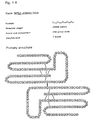
- Fig. 1A shows a two dimensional graph of the conformation of recombinantly produced dimeric MP52 with the deleted first alanine.
- the 7 cysteine bridges contained in a dimer are shown, wherein there are 3 intramolecular cystine bridges per monomer unit and 1 intermolecular cystine brigde connecting both monomers.
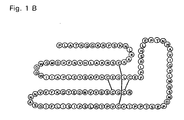
- Fig. 1B shows the monomeric protein according to the invention wherein the cysteine of the amino acid sequence of MP52 has been replaced by X that denotes any amino acid except cysteine.
- the mature part of human MP52 was mutated by converting Cysteine to Alanine at position 465 of SEQ ID NO 2.
- the nucleotides at the position 2032 and 2033 of SEQ ID NO 1 were converted from TG to GC.
- the substitution of the nucleotides was performed by using the prokaryotic plasmid pBP2MP52m and a PCR method.
- the vector pBP2MP52m is a derivative of the pBR322 plasmid containing an ampicillin resistance gene, a T7-promoter followed by a ribosomal binding site, a start codon, the mature part of MP52 (coding for the amino acids 382-501 in SEQ ID NO. 2 with a Cysteine at position 465), stop codons in each reading frame and a terminator.
- the plasmid was deposited at the DSM (DSM 10029, 2nd June 1995).
- the mutation was performed by using the QuickChangeTM Site-Directed Mutagenesis Kit with the PfuTurboTM DNA polymerase and the Dpn I endonuclease from Stratagene (Catalog #200518) according to the instruction manual of the manufacturer.
- the oligonucleotide CCACACCACCCACCGCCTGTGTGCCCACGC (SEQ ID NO. 5) and the oligonucleotide GCGTGGGCACACAGGCGGTGGGTGGTGTGG (SEQ ID NO. 6) were purified by polyacrylamide gel electrophoresis and used as the mutagenic primers.
- the resulting plasmid pBP2MP52 ALA contained after the start codon the nucleotide sequence coding for the amino acids 382-501 in SEQ ID NO. 2 with an Alanine at position 465 which was verified by sequencing.
- monomeric MP52 can be induced by providing a source of T7 RNA polymerase.
- monomeric MP52 can be expressed in inclusion bodies which can be isolated according to standard procedures. Further purification was done on a reversed phase column (Nucleosil 300-7C4, Machery-Nagel) with a 0 to 50% buffer B gradient (buffer A: 0.1% TFA in water, buffer B: 90% acetonitrile, 0.1 % TFA) in 50 minutes (flow rate: 2 ml/min).
- the fractions containing monomeric MP52 were pooled, lyophilized and stored at -70°C.
- MP52 was solubilized in a denaturing buffer (6M Urea, 500 mM NaCl, 10 mM DTT, 1 mM EDTA , 20 mM Tris pH 8.3) and added for refolding in 9 times of a 50 mM Glycine-buffer system (pH 9.8) containing CHAPS (20 mM), NaCl (500 mM) and 3 mM GSSG and gently stirred at 4°C. After approximately 24 hours the sample was diluted 2.8 times with 14 mM NaH 2 PO 4 and subjected to isoelectric precipitation.
- MP52 was loaded on a column (Aquapore Octyl 20 micron, Applied Biosystems) equilibrated with 25% buffer B (buffer A: 0.1% TFA in water, buffer B: 90% acetonitrile, 0.1 % TFA). Monomeric MP52 was eluted with a 25-60% buffer B gradient in 70 minutes (flow rate 3 ml/min). Fractions containing purified refolded monomeric MP52 were pooled, lyophilized, stored at -70°C and can be used in biological activity studies.
- Useful for biological activity studies of monomeric MP52 in the field of cartilage and bone induction are for example the measurement of increasing ALP activity (Takuwa et al., Am. J. Physiol. 257, E797-E803, 1989) using osteoprogenitor-like ROB-C26 cells (Yamaguchi et al., Calcif. Tissue Int. 49, 221-225, 1991) as described in WO95/04819 or ATDC5 cells (Riken Gene Bank, RCB 0565, embryonic cells which differentiate like cartilage cells).
- Useful activity tests showing the neurological capacities of refolded monomeric MP52 are the measurement of increased survival of dopaminergic neurons as described for example by Krieglstein et al. (J.
- monomeric MP52 can be dissolved in 20 ⁇ l of 50% acetonitrile, stabilized with 5 mg sucralfate (sucrose aluminum sulfate; Bukh Meditec, Copenhagen) and mixed with 20 ⁇ l of 12% (wt/vol) Hydron NCC (Interferon Science, New Brunswick, NJ) in ethanol.
- sucralfate sucralfate
- Bukh Meditec, Copenhagen sucralfate
- Hydron NCC Interferon Science, New Brunswick, NJ
- the mixture can be pipetted onto Teflon pegs and dried to produce a pellet.
- the pellet can be implanted into corneal micropockets of the eye of a male New Zealand White rabbit.
- an intrastromal tunnel starting from a perpendicular linear incision in the pupillary plane and ending 2.75 mm prior to the limbus can be created.
- erythromycin ointment should be given onto the surface of the cornea. About 10 days after implantation new capillaries which grow toward the implantation site should be seen. The outgrowth towards the pellet can reflect the chemotactic response of the endothelial cells to the released MP52 and can be quantified by measuring the vascularized area and the number of vessels at the limbus.
- Monomeric MP52 isolated and purified from inclusion bodies but not subjected to the refolding process can be used as a negative control.
- Dimeric MP52 can be used as the positive control.
- Stimulation of hematopoiesis can be determined for examples on bone marrow aspirate cultures as described in example 8 of WO98/22492.
Landscapes
- Health & Medical Sciences (AREA)
- Chemical & Material Sciences (AREA)
- Life Sciences & Earth Sciences (AREA)
- Organic Chemistry (AREA)
- Medicinal Chemistry (AREA)
- General Health & Medical Sciences (AREA)
- Animal Behavior & Ethology (AREA)
- Public Health (AREA)
- Veterinary Medicine (AREA)
- General Chemical & Material Sciences (AREA)
- Engineering & Computer Science (AREA)
- Nuclear Medicine, Radiotherapy & Molecular Imaging (AREA)
- Chemical Kinetics & Catalysis (AREA)
- Pharmacology & Pharmacy (AREA)
- Bioinformatics & Cheminformatics (AREA)
- Zoology (AREA)
- Proteomics, Peptides & Aminoacids (AREA)
- Toxicology (AREA)
- Gastroenterology & Hepatology (AREA)
- Biochemistry (AREA)
- Biophysics (AREA)
- Genetics & Genomics (AREA)
- Molecular Biology (AREA)
- Physical Education & Sports Medicine (AREA)
- Endocrinology (AREA)
- Dermatology (AREA)
- Oral & Maxillofacial Surgery (AREA)
- Orthopedic Medicine & Surgery (AREA)
- Neurology (AREA)
- Transplantation (AREA)
- Epidemiology (AREA)
- Reproductive Health (AREA)
- Neurosurgery (AREA)
- Biomedical Technology (AREA)
- Rheumatology (AREA)
- Medicines That Contain Protein Lipid Enzymes And Other Medicines (AREA)
- Peptides Or Proteins (AREA)
- Materials For Medical Uses (AREA)
- Medicines Containing Material From Animals Or Micro-Organisms (AREA)
- Micro-Organisms Or Cultivation Processes Thereof (AREA)
Abstract
Description
Especially preferred proteins belong to the BMP or GDF families.
Several BMP proteins which were originally discovered by their ability to induce bone formation, have been described, as also indicated above. Meanwhile, several additional functions have been found as it is also true for members of the GDFs. These proteins show a very broad field of applications and especially are in addition to their bone and cartilage growth promoting activity (see for example: WO 88/00205, WO 90/11366, WO 91/05802) useful in periodontal disease, for inhibiting periodontal and tooth tissue loss, for sealing tooth cavities, for enhancing integration of a tooth in a tooth socket (see for example: WO 96/26737, WO 94/06399, WO 95/24210), for connective tissue such as tendon or ligament (see for example: WO 95/1 6035), for improving survival of neural cells, for inducing growth of neural cells and repairing neural defects, for damaged CNS tissue due to stroke or trauma (see for example: WO 97/34626, WO 94/03200, WO 95/05846), for maintaining or restoring sensory perception (see for example WO 98/20890, WO 98/20889), for renal failure (see for example: WO 97/41880, WO 97/41881), for liver regeneration (see for example WO 94/06449), for regeneration of myocardium (see for example WO 98/27995), for treatment or preservation of tissues or cells for organ or tissue transplantation, for integrity of gastrointestinal lining (see for example WO 94/06420), for increasing progenitor cell population as for example hematopoietic progenitor cells by ex vivo stimulation (see for example WO 92/15323), etc. One preferred member of the GDF family is the protein MP52 which is also termed GDF-5 or CDMP-1. Applications for MP52 reflect several of the already described applications for the BMP/GDF family. MP52 is considered to be a very effective promoter of bone and cartilage formation as well as connective tissue formation (see for example WO 95/04819, Hötten et al., (1996), Growth Factors 13, 65-74, Storm et al., (1994) Nature 368, 639-643, Chang et al., (1994) J. Biol. Chem. 269 (45), 28227-28234). In this connection MP52 is useful for applications concerning the joints between skeletal elements (see for example Storm & Kingsley (1996) Development 122, 3969-3979). One example for connective tissue is tendon and ligament (Wolfman et al., (1997), J. Clin. Invest. 100, 321-330, Aspenberg & Forslund (1999), Acta Orthop Scand 70, 51-54, WO 95/16035). MP52 is also useful for tooth (dental and periodontal) applications (see for example WO 95/04819, WO 93/16099, Morotome et al. (1998), Biochem Biophys Res Comm 244, 85-90). MP52 is useful in wound repair of any kind. It is in addition very useful for promoting tissue growth in the neuronal system and survival of dopaminergic neurons, for example. MP52 in this connection is useful for applications in neurodegenerative diseases like e.g. Parkinson's disease and possibly also Alzheimer's disease for Huntington chorea tissues (see for example WO 97/03188, Krieglstein et al., (1995) J. Neurosci Res. 42, 724-732, Sullivan et al., (1997) Neurosci Lett 233, 73-76, Sullivan et al. (1998), Eur. J. Neurosci 10, 3681-3688). MP52 allows to maintain nervous function or to retain nervous function in already damaged tissues. MP52 is therefore considered to be a generally applicable neurotrophic factor. It is also useful for diseases of the eye, in particular retina cornea and optic nerve (see for example WO 97/03188, You et al. (1999), Invest Opthalmol Vis Sci 40, 296-311). The monomeric MP52 is expected to show all the already described activities of the dimeric form as well as some further described activities as described for the dimeric BMP/GDF family members. It is expected to be for example also useful for increasing progenitor cell populations and for stimulating differentiation of progenitor cells ex vivo. Progenitor cells can be cells which take part in the cartilage formation process or hematopoietic progenitor cells. It is also useful for damaged or diseased tissue where a stimulation of angiogenesis is advantageous (see for example: Yamashita et al. (1997), Exp Cell Res 235, 218-226).
The mutation was performed by using the QuickChange™ Site-Directed Mutagenesis Kit with the PfuTurbo™ DNA polymerase and the Dpn I endonuclease from Stratagene (Catalog #200518) according to the instruction manual of the manufacturer. The oligonucleotide CCACACCACCCACCGCCTGTGTGCCCACGC (SEQ ID NO. 5) and the oligonucleotide GCGTGGGCACACAGGCGGTGGGTGGTGTGG (SEQ ID NO. 6) were purified by polyacrylamide gel electrophoresis and used as the mutagenic primers. The resulting plasmid pBP2MP52ALA contained after the start codon the nucleotide sequence coding for the amino acids 382-501 in SEQ ID NO. 2 with an Alanine at position 465 which was verified by sequencing.
<141>
<151> 1999-08-06
<211> 2703
<212> DNA
<213> Homo sapiens
<221> CDS
<222> (640) (2142)

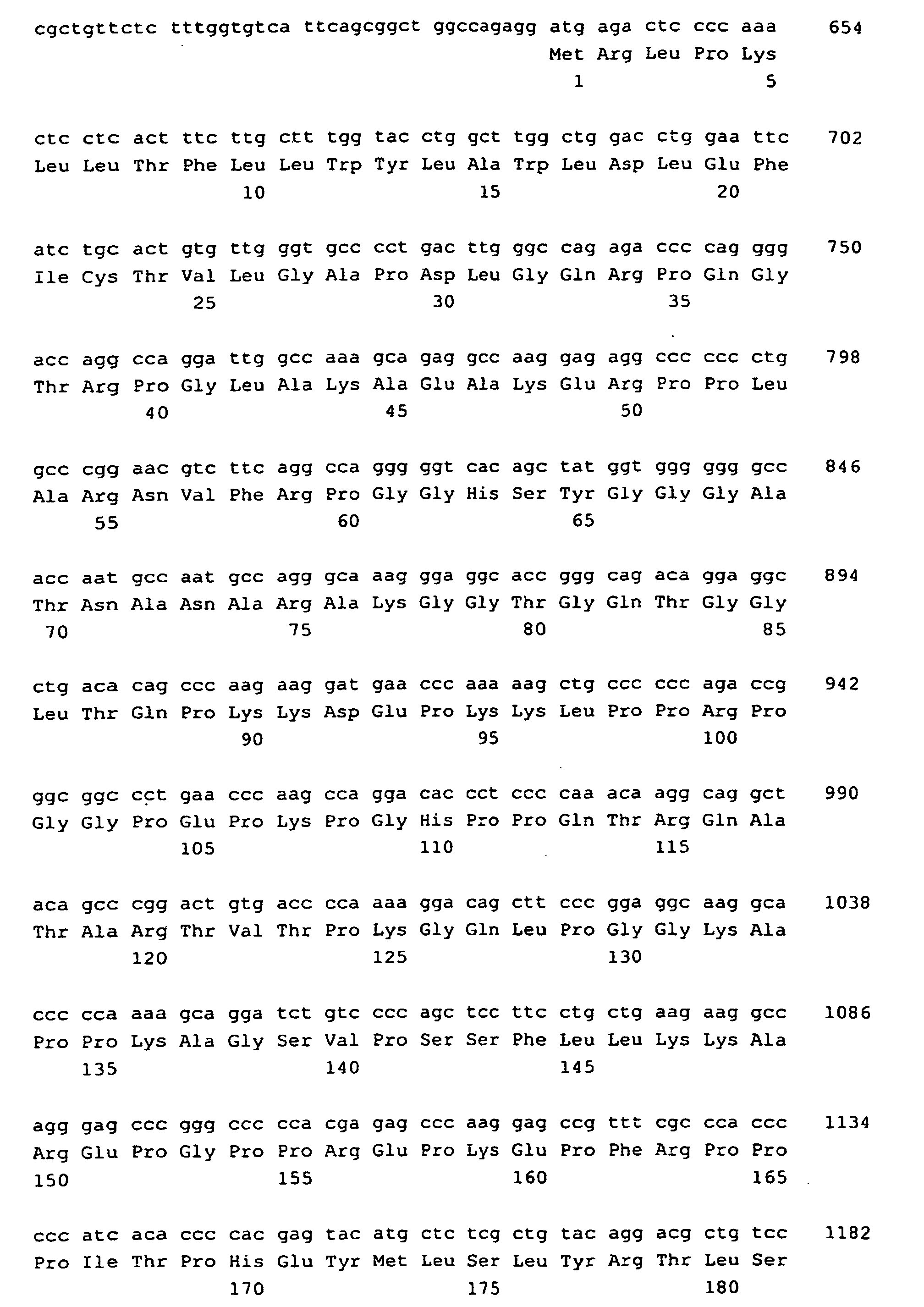

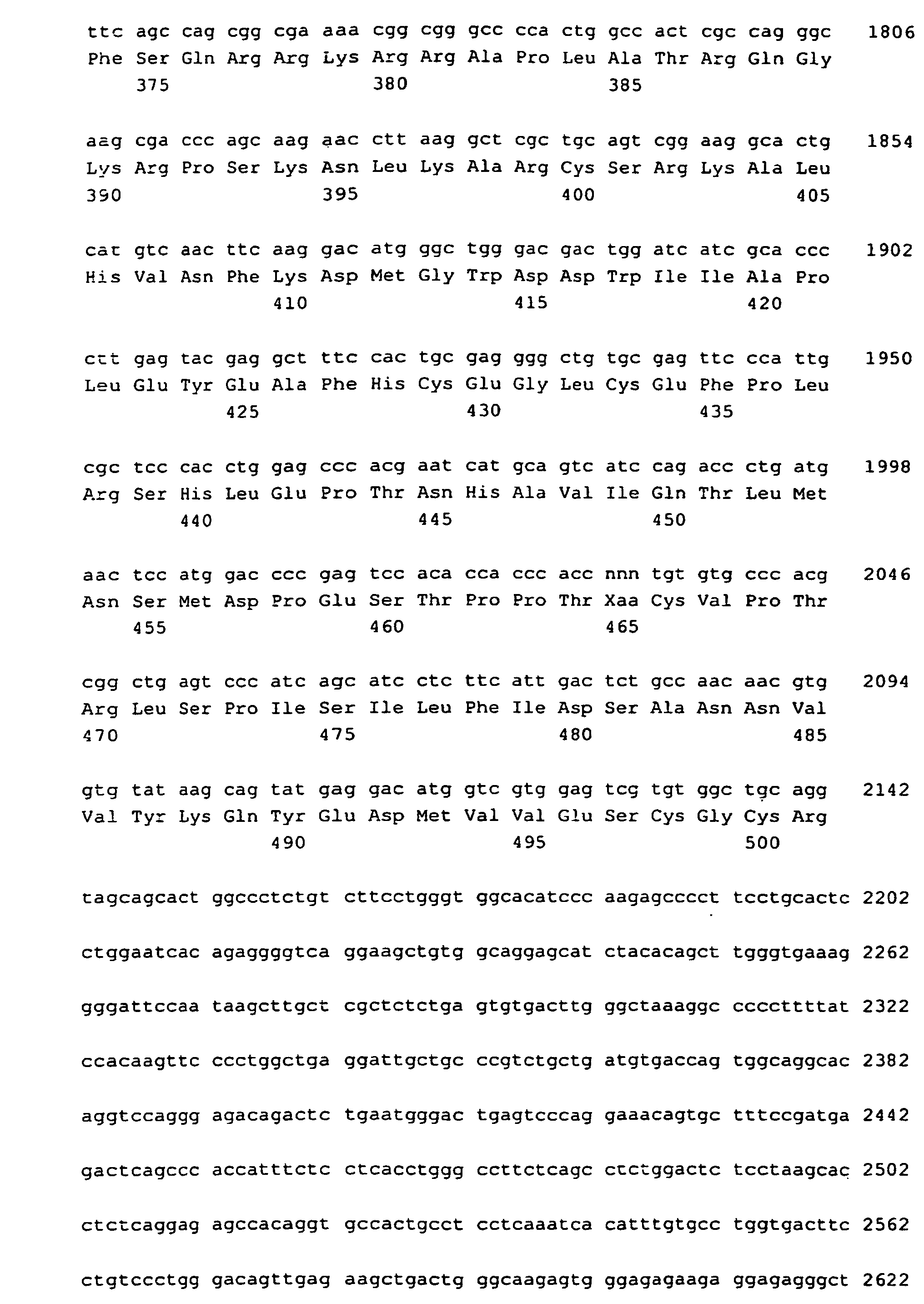

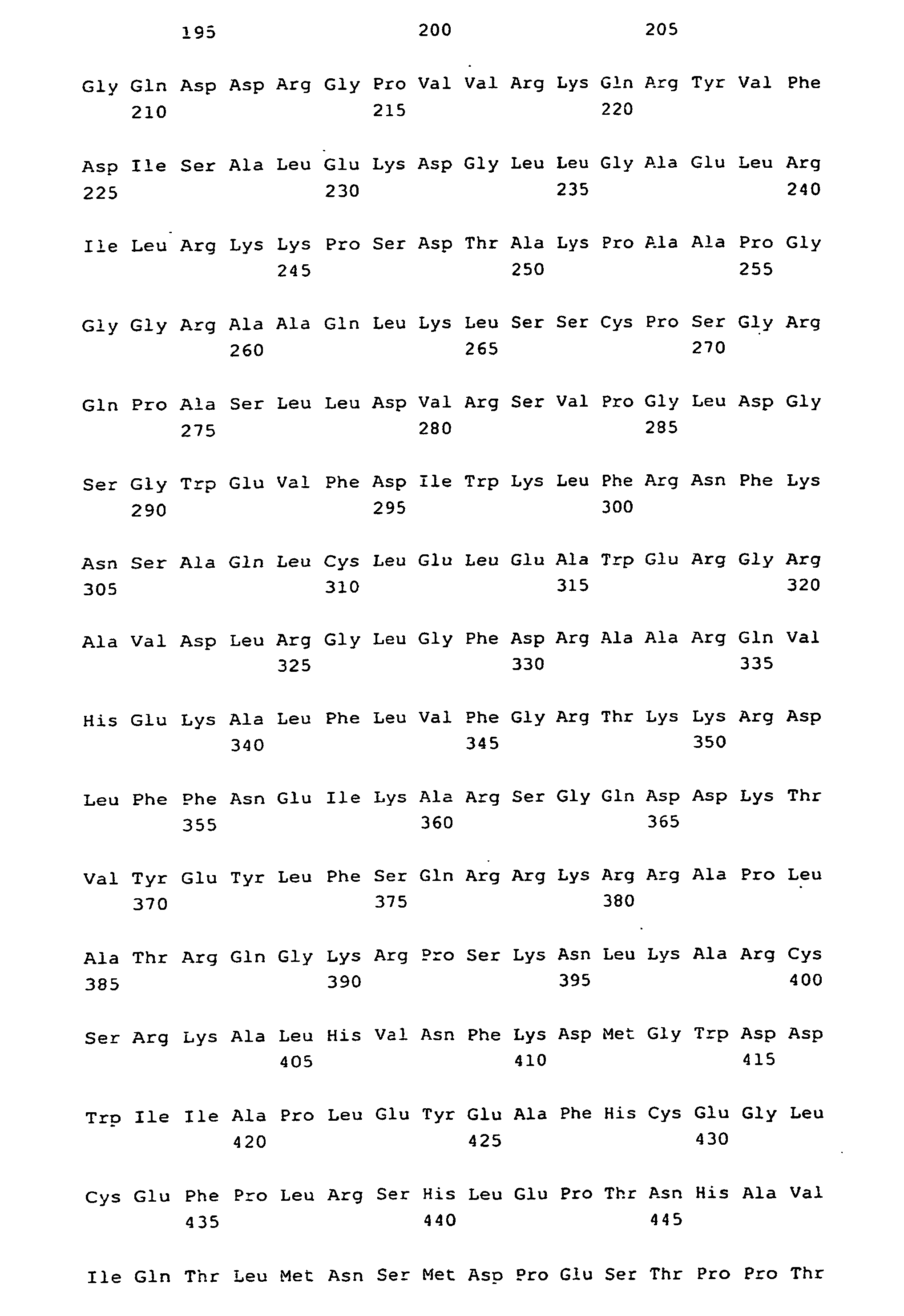
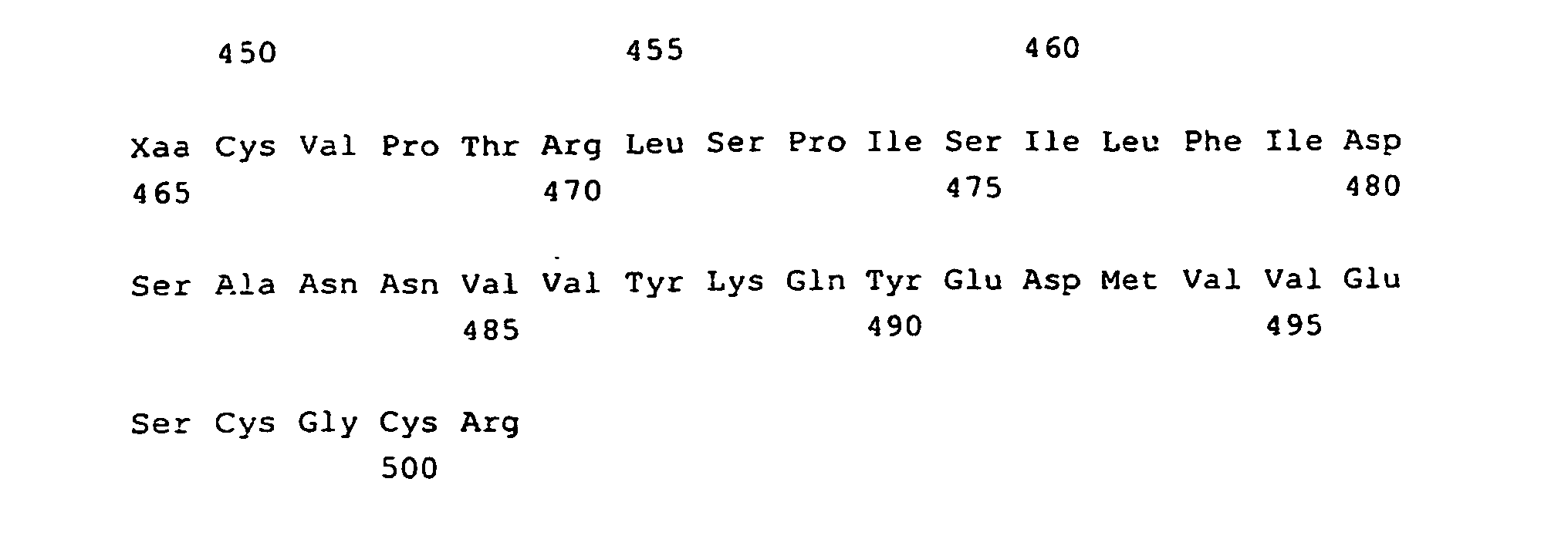
<211> 30
<212> DNA
<213> Artificial Sequence
<223> Description of Artificial Sequence: mutagenic primer

<211> 30
<212> DNA
<213> Artificial Sequence
<223> Description of Artificial Sequence: mutagenic primer

<211> 30
<212> DNA
<213> Artificial Sequence
<223> Description of Artificial Sequence: mutagenic primer

<211> 30
<212> DNA
<213> Artificial Sequence
<223> Description of Artificial Sequence: mutagenic primer

Claims (28)
- Protein selected from the members of the TGF-β superfamily characterized in that the protein is necessarily monomeric due to substitution or deletion of the cysteine which is responsible for dimer formation and which comprises the consensus sequence
- Protein according to claim 1, characterized in that the protein is a mature protein or a biologically active part or variant thereof.
- Protein according to claim 1 or 2, characterized in that the protein belongs to the BMP or GDF family.
- Protein according to claim 3, characterized in that the protein is MP52 (GDF5) or a biologically active part or variant thereof.
- Protein according to any one of the preceeding claims,
characterized in that it comprises the amino acid sequence according to SEQ.ID.NO.2 or a part thereof. - Protein according to any one of claims 1 to 5,
characterized in that the cysteine residue is substituted by an amino acid selected from the group of alanine, serine, threonine, leucine, isoleucine, glycine and valine. - Protein according to any one of claims 1 to 6,
characterized in that it contains additional amino acids that facilitate or mediate the transfer and localization of the protein in a certain tissue. - Nucleic acid,
characterized in that it encodes a protein according to any one of claims 1 to 7. - Nucleic acid according to claim 8,
characterized in that it is a DNA. - Nucleic acid according to claim 8 or 9,
characterized in that it contains a sequence as shown in SEQ.ID.NO.1 or a fragment thereof. - Nucleic acid according to any one of claims 8 to 10,
characterized in that it further contains suitable expression control sequences facilitating and/or driving expression of the encoded protein. - Expression vector,
characterized in that it contains a nucleic acid according to any one of claims 8 to 11 in a suitable vector system. - Expression vector according to claim 12,
characterized in that the vector system is suitable for prokaryotic expression. - Host cell,
characterized in that it contains a nucleic acid according to any one of claims 8 to 11 or an expression vector according to claims 12 or 13 and upon expression of said nucleic acid or vector is able to produce a monomeric protein according to any one of claims 1 to 7. - Host cell according to claim 14,
characterized in that it is a prokaryotic host cell. - Non-human host cell according to claim 14,
characterized in that it is an embryonal cell. - Pharmaceutical composition,
characterized in that it contains at least one protein according to any one of claims 1 to 7 or at least one nucleic acid according to any one of claims 8 to 11, at least one expression vector according to any one of claims 1 2 or 13 or one host cell according to anyone of claims 14 to 16, - Pharmaceutical composition according to claim 17,
characterized in that the protein and/or nucleic acid are contained in and/or on a biocompatible matrix material. - Pharmaceutical composition according to claim 18,
characterized in that the matrix material is biodegradable. - Pharmaceutical composition according to claims 18 or 19,
characterized in that the matrix material is itself osteogenically active. - Pharmaceutical compostion according to any one of claims 17 to 20,
for the prevention or therapy of diseases for which also the dimeric form of the protein would be indicated. - Pharmaceutical composition according to claim 21,
for prevention or therapy of diseases associated with bone and/or cartilage damage or affecting bone and/or cartilage disease or situations in which cartilage and/or bone growth is desirable or for spinal fusion. - Pharmaceutical composition according to claim 21,
for prevention or therapy of damaged or diseased tissue associated with connective tissue including tendon and/or ligament, periodontal or dental tissue including dental implants, neural tissue including CNS tissue and neuropathological situations, tissue of the sensory system, liver, pancreas, cardiac, blood vessel, renal, uterine and thyroid tissue, skin, mucous membranes, endothelium, epithelium, for promotion or induction of nerve growth, tissue regeneration, angiogenesis, wound healing including ulcers, burns, injuries or skin grafts, induction of proliferation of progenitor cells or bone marrow cells, for maintenance of a state of proliferation or differentiation, for treatment or preservation of tissue or cells for organ or tissue transplantation, for integrity of gastrointestinal lining, for treatment of disturbances in fertility, contraception or pregnancy. - Pharmaceutical composition according to any one of claims 17 to 23 for surgical local application, topical or systemic application.
- Pharmaceutical compostion according to any one of claims 17 to 24
characterized in that it further contains pharmacologically acceptable auxiliary substances. - Pharmaceutical composition according to any one of claims 24 or 25,
characterized in that the composition is injectable. - Pharmaceutical composition according to anyone of claims 24 to 26,
characterized in that it is contained in a vehicle that allows to direct and release the composition to a determined site of action. - Pharmaceutical composition according to claim 27,
characterized in that the vehicle is selected from liposomes, nanospheres, larger implantable containers and micropumps.
Priority Applications (3)
| Application Number | Priority Date | Filing Date | Title |
|---|---|---|---|
| DK00958383T DK1198570T3 (en) | 1999-08-06 | 2000-08-04 | Monomeric protein of the TGF-Beta family |
| EP05013166A EP1574578A1 (en) | 1999-08-06 | 2000-08-04 | Monomeric protein of the TGF-beta family |
| EP00958383A EP1198570B1 (en) | 1999-08-06 | 2000-08-04 | Monomeric protein of the tgf-beta family |
Applications Claiming Priority (4)
| Application Number | Priority Date | Filing Date | Title |
|---|---|---|---|
| EP99115613 | 1999-08-06 | ||
| EP99115613A EP1074620A1 (en) | 1999-08-06 | 1999-08-06 | Monomeric protein of the TGF-beta family |
| PCT/EP2000/007600 WO2001011041A1 (en) | 1999-08-06 | 2000-08-04 | MONOMERIC PROTEIN OF THE TGF-β FAMILY |
| EP00958383A EP1198570B1 (en) | 1999-08-06 | 2000-08-04 | Monomeric protein of the tgf-beta family |
Publications (2)
| Publication Number | Publication Date |
|---|---|
| EP1198570A1 EP1198570A1 (en) | 2002-04-24 |
| EP1198570B1 true EP1198570B1 (en) | 2005-07-20 |
Family
ID=8238746
Family Applications (3)
| Application Number | Title | Priority Date | Filing Date |
|---|---|---|---|
| EP99115613A Withdrawn EP1074620A1 (en) | 1996-12-25 | 1999-08-06 | Monomeric protein of the TGF-beta family |
| EP00958383A Expired - Lifetime EP1198570B1 (en) | 1999-08-06 | 2000-08-04 | Monomeric protein of the tgf-beta family |
| EP05013166A Withdrawn EP1574578A1 (en) | 1999-08-06 | 2000-08-04 | Monomeric protein of the TGF-beta family |
Family Applications Before (1)
| Application Number | Title | Priority Date | Filing Date |
|---|---|---|---|
| EP99115613A Withdrawn EP1074620A1 (en) | 1996-12-25 | 1999-08-06 | Monomeric protein of the TGF-beta family |
Family Applications After (1)
| Application Number | Title | Priority Date | Filing Date |
|---|---|---|---|
| EP05013166A Withdrawn EP1574578A1 (en) | 1999-08-06 | 2000-08-04 | Monomeric protein of the TGF-beta family |
Country Status (12)
| Country | Link |
|---|---|
| US (2) | US6972321B1 (en) |
| EP (3) | EP1074620A1 (en) |
| JP (1) | JP2003506086A (en) |
| AT (1) | ATE299937T1 (en) |
| AU (1) | AU782481B2 (en) |
| CA (1) | CA2381219C (en) |
| DE (1) | DE60021388T2 (en) |
| DK (1) | DK1198570T3 (en) |
| ES (1) | ES2242630T3 (en) |
| NZ (1) | NZ517125A (en) |
| WO (1) | WO2001011041A1 (en) |
| ZA (1) | ZA200201032B (en) |
Families Citing this family (26)
| Publication number | Priority date | Publication date | Assignee | Title |
|---|---|---|---|---|
| US6586388B2 (en) | 1988-04-08 | 2003-07-01 | Stryker Corporation | Method of using recombinant osteogenic protein to repair bone or cartilage defects |
| US7811793B2 (en) * | 1996-12-25 | 2010-10-12 | Biopharma Gesellschaft Zur Biotechnologischen Entwicklung Von Pharmaka Mbh | Process for preparing purified active monomer of bone-derived factor |
| CA2405680C (en) * | 2000-04-20 | 2018-02-13 | St. Vincent's Hospital Sydney Limited | Diagnostic assay and method of treatment involving macrophage inhibitory cytokine -1 (mic-1) |
| CA2441588A1 (en) | 2001-03-23 | 2002-10-03 | Biopharm Gesellschaft Zue Biotechnologischen Entwicklung Von Pharmaka Mbh | Use of cytokines of the tgf-.beta. superfamily for the treatment and diagnosis of skin related disorders |
| FI116827B (en) | 2001-08-24 | 2006-03-15 | Univ Zuerich | Deletion mutant of a bone morphogenetic protein (BMP), pharmaceutical composition containing it and its use |
| EG23432A (en) | 2001-12-17 | 2005-07-25 | New Zealand Dairy Board | |
| JP2005533089A (en) * | 2002-07-09 | 2005-11-04 | ストライカー コーポレイション | Compositions and methods for ligament growth and repair |
| EP1462126A1 (en) * | 2003-03-28 | 2004-09-29 | BIOPHARM GESELLSCHAFT ZUR BIOTECHNOLOGISCHEN ENTWICKLUNG VON PHARMAKA mbH | Improved Osteoinductive Materials |
| GB0514262D0 (en) * | 2005-07-12 | 2005-08-17 | Renovo Ltd | Promotion of epithelial regeneration |
| PT1948689E (en) * | 2005-11-18 | 2012-05-09 | Bioph Biotech Entw Pharm Gmbh | High activity growth factor mutants |
| GB0604938D0 (en) * | 2006-03-11 | 2006-04-19 | Renovo Ltd | Proteins, nucleic acids and medicaments |
| GB0604966D0 (en) * | 2006-03-11 | 2006-04-19 | Renovo Ltd | Medicaments and proteins |
| PL2027152T3 (en) | 2006-06-13 | 2012-04-30 | Helix Biomedix Inc | Peptide fragments for inducing synthesis of extracellular matrix proteins |
| EP1880731A1 (en) | 2006-07-18 | 2008-01-23 | BIOPHARM GESELLSCHAFT ZUR BIOTECHNOLOGISCHEN ENTWICKLUNG VON PHARMAKA mbH | Human growth and differentiation factor GDF-5 |
| GB0617816D0 (en) * | 2006-09-11 | 2006-10-18 | Renovo Ltd | Nucleic acids and methods of protein expression |
| SI2121142T1 (en) * | 2007-01-25 | 2012-12-31 | Biopharm Gesellschaft Zur Biotechnologischen Entwicklung Von Pharmaka Mbh | Use of gdf-5 for the improvement or maintenance of dermal appearance |
| EP2300610A1 (en) * | 2008-06-09 | 2011-03-30 | Wyeth LLC | Novel bmp-12-related proteins and methods of their manufacture |
| AU2011284657B2 (en) | 2010-07-30 | 2013-11-14 | Biopharm Gesellschaft Zur Biotechnologischen Entwicklung Von Pharmaka Mbh | Drug delivery devices and growth factor formulations for accelerated wound healing |
| US8455436B2 (en) | 2010-12-28 | 2013-06-04 | Depuy Mitek, Llc | Compositions and methods for treating joints |
| US8524662B2 (en) | 2010-12-28 | 2013-09-03 | Depuy Mitek, Llc | Compositions and methods for treating joints |
| US8398611B2 (en) | 2010-12-28 | 2013-03-19 | Depuy Mitek, Inc. | Compositions and methods for treating joints |
| EP2537538A1 (en) | 2011-06-22 | 2012-12-26 | Biopharm Gesellschaft Zur Biotechnologischen Entwicklung Von Pharmaka mbH | Bioresorbable Wound Dressing |
| US8623839B2 (en) | 2011-06-30 | 2014-01-07 | Depuy Mitek, Llc | Compositions and methods for stabilized polysaccharide formulations |
| EP2602264A1 (en) | 2011-12-05 | 2013-06-12 | Biopharm Gesellschaft Zur Biotechnologischen Entwicklung Von Pharmaka mbH | GDF-5 mutant for inducing cartilage formation |
| US9682099B2 (en) | 2015-01-20 | 2017-06-20 | DePuy Synthes Products, Inc. | Compositions and methods for treating joints |
| CN114786707A (en) | 2019-12-18 | 2022-07-22 | 默克专利股份公司 | Use of GDF-5 mutants for the treatment of pain and cartilage destruction |
Family Cites Families (8)
| Publication number | Priority date | Publication date | Assignee | Title |
|---|---|---|---|---|
| DE19525416A1 (en) * | 1995-07-12 | 1997-01-16 | Bioph Biotech Entw Pharm Gmbh | Use of MP52 for the treatment and prevention of diseases of the nervous system |
| EP0690871A4 (en) * | 1993-01-12 | 1999-10-20 | Univ Johns Hopkins Med | GROWTH AND DIFFERENTIATION FACTOR-5 |
| US5420243A (en) * | 1993-01-26 | 1995-05-30 | Celtrix Pharmaceuticals, Inc. | Biologically active TGF-β2 peptides |
| IL110589A0 (en) * | 1993-08-10 | 1994-11-11 | Bioph Biotech Entw Pharm Gmbh | Growth/differentiation factor of the TGF- beta family |
| EP0733109B9 (en) * | 1993-12-07 | 2006-07-05 | Genetics Institute, LLC | Bmp-12, bmp-13 and tendon-inducing compositions thereof |
| IL114397A0 (en) * | 1994-07-01 | 1995-10-31 | Bioph Biotech Entw Pharm Gmbh | Growth/differentiation factor of the TGF-beta-family |
| JPH09295945A (en) * | 1996-04-30 | 1997-11-18 | Hoechst Yakuhin Kogyo Kk | Method for producing mature osteoinductive factor |
| JPH11335398A (en) * | 1998-05-22 | 1999-12-07 | Hoechst Marion Roussel Kk | Monomeric proteins having novel osteoinductive activity and preventive and therapeutic agents for cartilage and bone diseases comprising them |
-
1999
- 1999-08-06 EP EP99115613A patent/EP1074620A1/en not_active Withdrawn
-
2000
- 2000-08-04 US US10/048,458 patent/US6972321B1/en not_active Expired - Lifetime
- 2000-08-04 WO PCT/EP2000/007600 patent/WO2001011041A1/en not_active Ceased
- 2000-08-04 DE DE60021388T patent/DE60021388T2/en not_active Expired - Lifetime
- 2000-08-04 ES ES00958383T patent/ES2242630T3/en not_active Expired - Lifetime
- 2000-08-04 DK DK00958383T patent/DK1198570T3/en active
- 2000-08-04 EP EP00958383A patent/EP1198570B1/en not_active Expired - Lifetime
- 2000-08-04 JP JP2001515827A patent/JP2003506086A/en active Pending
- 2000-08-04 EP EP05013166A patent/EP1574578A1/en not_active Withdrawn
- 2000-08-04 NZ NZ517125A patent/NZ517125A/en not_active IP Right Cessation
- 2000-08-04 AU AU69927/00A patent/AU782481B2/en not_active Ceased
- 2000-08-04 CA CA002381219A patent/CA2381219C/en not_active Expired - Fee Related
- 2000-08-04 AT AT00958383T patent/ATE299937T1/en active
-
2002
- 2002-02-06 ZA ZA200201032A patent/ZA200201032B/en unknown
-
2005
- 2005-07-28 US US11/191,072 patent/US7569227B2/en not_active Expired - Fee Related
Also Published As
| Publication number | Publication date |
|---|---|
| US6972321B1 (en) | 2005-12-06 |
| AU782481B2 (en) | 2005-08-04 |
| DE60021388T2 (en) | 2006-01-05 |
| WO2001011041A1 (en) | 2001-02-15 |
| ATE299937T1 (en) | 2005-08-15 |
| EP1198570A1 (en) | 2002-04-24 |
| US7569227B2 (en) | 2009-08-04 |
| EP1074620A1 (en) | 2001-02-07 |
| DE60021388D1 (en) | 2005-08-25 |
| EP1574578A1 (en) | 2005-09-14 |
| ZA200201032B (en) | 2002-12-24 |
| CA2381219A1 (en) | 2001-02-15 |
| ES2242630T3 (en) | 2005-11-16 |
| US20050282255A1 (en) | 2005-12-22 |
| NZ517125A (en) | 2003-08-29 |
| DK1198570T3 (en) | 2005-10-31 |
| JP2003506086A (en) | 2003-02-18 |
| AU6992700A (en) | 2001-03-05 |
| CA2381219C (en) | 2008-11-18 |
Similar Documents
| Publication | Publication Date | Title |
|---|---|---|
| US7569227B2 (en) | Monomeric protein of the TGF-β family | |
| US8163694B2 (en) | Method of treating diseases or abnormal conditions of periodontal or dental tissues with GDF5 | |
| JP5124495B2 (en) | Bone-forming device not containing matrix, graft, and method of use thereof | |
| JP3807749B2 (en) | Complex having improved cartilage-inducing activity and / or bone-inducing activity | |
| US9200048B2 (en) | High activity growth factor mutants | |
| EP1698691A1 (en) | Growth factor mutants with improved biological activity |
Legal Events
| Date | Code | Title | Description |
|---|---|---|---|
| PUAI | Public reference made under article 153(3) epc to a published international application that has entered the european phase |
Free format text: ORIGINAL CODE: 0009012 |
|
| 17P | Request for examination filed |
Effective date: 20020129 |
|
| AK | Designated contracting states |
Kind code of ref document: A1 Designated state(s): AT BE CH CY DE DK ES FI FR GB GR IE IT LI LU MC NL PT SE |
|
| AX | Request for extension of the european patent |
Free format text: AL;LT;LV;MK;RO;SI |
|
| 17Q | First examination report despatched |
Effective date: 20030526 |
|
| GRAP | Despatch of communication of intention to grant a patent |
Free format text: ORIGINAL CODE: EPIDOSNIGR1 |
|
| GRAS | Grant fee paid |
Free format text: ORIGINAL CODE: EPIDOSNIGR3 |
|
| GRAA | (expected) grant |
Free format text: ORIGINAL CODE: 0009210 |
|
| AK | Designated contracting states |
Kind code of ref document: B1 Designated state(s): AT BE CH CY DE DK ES FI FR GB GR IE IT LI LU MC NL PT SE |
|
| REG | Reference to a national code |
Ref country code: GB Ref legal event code: FG4D |
|
| REG | Reference to a national code |
Ref country code: CH Ref legal event code: EP |
|
| REG | Reference to a national code |
Ref country code: IE Ref legal event code: FG4D |
|
| REF | Corresponds to: |
Ref document number: 60021388 Country of ref document: DE Date of ref document: 20050825 Kind code of ref document: P |
|
| REG | Reference to a national code |
Ref country code: GR Ref legal event code: EP Ref document number: 20050402328 Country of ref document: GR |
|
| REG | Reference to a national code |
Ref country code: CH Ref legal event code: NV Representative=s name: A. BRAUN, BRAUN, HERITIER, ESCHMANN AG PATENTANWAE |
|
| REG | Reference to a national code |
Ref country code: SE Ref legal event code: TRGR |
|
| REG | Reference to a national code |
Ref country code: DK Ref legal event code: T3 |
|
| REG | Reference to a national code |
Ref country code: ES Ref legal event code: FG2A Ref document number: 2242630 Country of ref document: ES Kind code of ref document: T3 |
|
| ET | Fr: translation filed | ||
| PLBE | No opposition filed within time limit |
Free format text: ORIGINAL CODE: 0009261 |
|
| STAA | Information on the status of an ep patent application or granted ep patent |
Free format text: STATUS: NO OPPOSITION FILED WITHIN TIME LIMIT |
|
| 26N | No opposition filed |
Effective date: 20060421 |
|
| REG | Reference to a national code |
Ref country code: CH Ref legal event code: PFA Owner name: HYGENE AG Free format text: HYGENE AG#C/O MAEDER + BAUMGARTNER TREUHAND AG, SCHWANENFELSSTRASSE 10A#8121 NEUHAUSEN AM RHEINFALL (CH) -TRANSFER TO- HYGENE AG#C/O MAEDER + BAUMGARTNER TREUHAND AG, SCHWANENFELSSTRASSE 10A#8121 NEUHAUSEN AM RHEINFALL (CH) |
|
| PGFP | Annual fee paid to national office [announced via postgrant information from national office to epo] |
Ref country code: DK Payment date: 20110822 Year of fee payment: 12 |
|
| PGFP | Annual fee paid to national office [announced via postgrant information from national office to epo] |
Ref country code: LU Payment date: 20120824 Year of fee payment: 13 |
|
| PGFP | Annual fee paid to national office [announced via postgrant information from national office to epo] |
Ref country code: IE Payment date: 20120821 Year of fee payment: 13 Ref country code: MC Payment date: 20120813 Year of fee payment: 13 Ref country code: FI Payment date: 20120813 Year of fee payment: 13 |
|
| PGFP | Annual fee paid to national office [announced via postgrant information from national office to epo] |
Ref country code: GR Payment date: 20120821 Year of fee payment: 13 |
|
| PGFP | Annual fee paid to national office [announced via postgrant information from national office to epo] |
Ref country code: IT Payment date: 20120823 Year of fee payment: 13 Ref country code: ES Payment date: 20120828 Year of fee payment: 13 |
|
| PGFP | Annual fee paid to national office [announced via postgrant information from national office to epo] |
Ref country code: CY Payment date: 20120803 Year of fee payment: 13 Ref country code: PT Payment date: 20120206 Year of fee payment: 13 |
|
| PGFP | Annual fee paid to national office [announced via postgrant information from national office to epo] |
Ref country code: AT Payment date: 20120813 Year of fee payment: 13 |
|
| REG | Reference to a national code |
Ref country code: PT Ref legal event code: MM4A Free format text: LAPSE DUE TO NON-PAYMENT OF FEES Effective date: 20140204 |
|
| REG | Reference to a national code |
Ref country code: DK Ref legal event code: EBP Effective date: 20130831 |
|
| REG | Reference to a national code |
Ref country code: AT Ref legal event code: MM01 Ref document number: 299937 Country of ref document: AT Kind code of ref document: T Effective date: 20130804 |
|
| REG | Reference to a national code |
Ref country code: GR Ref legal event code: ML Ref document number: 20050402328 Country of ref document: GR Effective date: 20140305 |
|
| PG25 | Lapsed in a contracting state [announced via postgrant information from national office to epo] |
Ref country code: MC Free format text: LAPSE BECAUSE OF NON-PAYMENT OF DUE FEES Effective date: 20130902 Ref country code: FI Free format text: LAPSE BECAUSE OF NON-PAYMENT OF DUE FEES Effective date: 20130804 |
|
| REG | Reference to a national code |
Ref country code: IE Ref legal event code: MM4A |
|
| PG25 | Lapsed in a contracting state [announced via postgrant information from national office to epo] |
Ref country code: CY Free format text: LAPSE BECAUSE OF NON-PAYMENT OF DUE FEES Effective date: 20130804 Ref country code: GR Free format text: LAPSE BECAUSE OF NON-PAYMENT OF DUE FEES Effective date: 20140305 Ref country code: AT Free format text: LAPSE BECAUSE OF NON-PAYMENT OF DUE FEES Effective date: 20130804 Ref country code: IT Free format text: LAPSE BECAUSE OF NON-PAYMENT OF DUE FEES Effective date: 20130804 |
|
| PG25 | Lapsed in a contracting state [announced via postgrant information from national office to epo] |
Ref country code: PT Free format text: LAPSE BECAUSE OF NON-PAYMENT OF DUE FEES Effective date: 20140204 |
|
| REG | Reference to a national code |
Ref country code: CH Ref legal event code: PCAR Free format text: NEW ADDRESS: HOLBEINSTRASSE 36-38, 4051 BASEL (CH) |
|
| PG25 | Lapsed in a contracting state [announced via postgrant information from national office to epo] |
Ref country code: IE Free format text: LAPSE BECAUSE OF NON-PAYMENT OF DUE FEES Effective date: 20130804 |
|
| PG25 | Lapsed in a contracting state [announced via postgrant information from national office to epo] |
Ref country code: DK Free format text: LAPSE BECAUSE OF NON-PAYMENT OF DUE FEES Effective date: 20130831 |
|
| REG | Reference to a national code |
Ref country code: ES Ref legal event code: FD2A Effective date: 20141013 |
|
| PG25 | Lapsed in a contracting state [announced via postgrant information from national office to epo] |
Ref country code: ES Free format text: LAPSE BECAUSE OF NON-PAYMENT OF DUE FEES Effective date: 20130805 |
|
| PG25 | Lapsed in a contracting state [announced via postgrant information from national office to epo] |
Ref country code: LU Free format text: LAPSE BECAUSE OF NON-PAYMENT OF DUE FEES Effective date: 20130804 |
|
| REG | Reference to a national code |
Ref country code: FR Ref legal event code: PLFP Year of fee payment: 16 |
|
| REG | Reference to a national code |
Ref country code: FR Ref legal event code: PLFP Year of fee payment: 17 |
|
| REG | Reference to a national code |
Ref country code: FR Ref legal event code: PLFP Year of fee payment: 18 |
|
| PGFP | Annual fee paid to national office [announced via postgrant information from national office to epo] |
Ref country code: NL Payment date: 20170821 Year of fee payment: 18 |
|
| PGFP | Annual fee paid to national office [announced via postgrant information from national office to epo] |
Ref country code: GB Payment date: 20170822 Year of fee payment: 18 Ref country code: FR Payment date: 20170822 Year of fee payment: 18 Ref country code: CH Payment date: 20170821 Year of fee payment: 18 Ref country code: DE Payment date: 20170626 Year of fee payment: 18 |
|
| PGFP | Annual fee paid to national office [announced via postgrant information from national office to epo] |
Ref country code: BE Payment date: 20170821 Year of fee payment: 18 Ref country code: SE Payment date: 20170821 Year of fee payment: 18 |
|
| REG | Reference to a national code |
Ref country code: DE Ref legal event code: R119 Ref document number: 60021388 Country of ref document: DE |
|
| REG | Reference to a national code |
Ref country code: CH Ref legal event code: PL |
|
| REG | Reference to a national code |
Ref country code: SE Ref legal event code: EUG |
|
| REG | Reference to a national code |
Ref country code: NL Ref legal event code: MM Effective date: 20180901 |
|
| GBPC | Gb: european patent ceased through non-payment of renewal fee |
Effective date: 20180804 |
|
| PG25 | Lapsed in a contracting state [announced via postgrant information from national office to epo] |
Ref country code: CH Free format text: LAPSE BECAUSE OF NON-PAYMENT OF DUE FEES Effective date: 20180831 Ref country code: LI Free format text: LAPSE BECAUSE OF NON-PAYMENT OF DUE FEES Effective date: 20180831 |
|
| REG | Reference to a national code |
Ref country code: BE Ref legal event code: MM Effective date: 20180831 |
|
| PG25 | Lapsed in a contracting state [announced via postgrant information from national office to epo] |
Ref country code: SE Free format text: LAPSE BECAUSE OF NON-PAYMENT OF DUE FEES Effective date: 20180805 |
|
| PG25 | Lapsed in a contracting state [announced via postgrant information from national office to epo] |
Ref country code: NL Free format text: LAPSE BECAUSE OF NON-PAYMENT OF DUE FEES Effective date: 20180901 |
|
| PG25 | Lapsed in a contracting state [announced via postgrant information from national office to epo] |
Ref country code: DE Free format text: LAPSE BECAUSE OF NON-PAYMENT OF DUE FEES Effective date: 20190301 |
|
| PG25 | Lapsed in a contracting state [announced via postgrant information from national office to epo] |
Ref country code: BE Free format text: LAPSE BECAUSE OF NON-PAYMENT OF DUE FEES Effective date: 20180831 Ref country code: FR Free format text: LAPSE BECAUSE OF NON-PAYMENT OF DUE FEES Effective date: 20180831 |
|
| PG25 | Lapsed in a contracting state [announced via postgrant information from national office to epo] |
Ref country code: GB Free format text: LAPSE BECAUSE OF NON-PAYMENT OF DUE FEES Effective date: 20180804 |