EP1198456B1 - Potassium channel openers - Google Patents
Potassium channel openers Download PDFInfo
- Publication number
- EP1198456B1 EP1198456B1 EP00955327A EP00955327A EP1198456B1 EP 1198456 B1 EP1198456 B1 EP 1198456B1 EP 00955327 A EP00955327 A EP 00955327A EP 00955327 A EP00955327 A EP 00955327A EP 1198456 B1 EP1198456 B1 EP 1198456B1
- Authority
- EP
- European Patent Office
- Prior art keywords
- amino
- methyl
- alkyl
- benzamide
- group
- Prior art date
- Legal status (The legal status is an assumption and is not a legal conclusion. Google has not performed a legal analysis and makes no representation as to the accuracy of the status listed.)
- Expired - Lifetime
Links
- 229940127315 Potassium Channel Openers Drugs 0.000 title claims abstract description 32
- 150000001875 compounds Chemical class 0.000 claims abstract description 188
- 208000037265 diseases, disorders, signs and symptoms Diseases 0.000 claims abstract description 32
- 201000010099 disease Diseases 0.000 claims abstract description 11
- 230000001668 ameliorated effect Effects 0.000 claims abstract description 6
- 241000124008 Mammalia Species 0.000 claims abstract description 5
- -1 CHNO2 Chemical compound 0.000 claims description 447
- 125000000217 alkyl group Chemical group 0.000 claims description 408
- 125000003118 aryl group Chemical group 0.000 claims description 367
- 239000001257 hydrogen Substances 0.000 claims description 273
- 229910052739 hydrogen Inorganic materials 0.000 claims description 273
- 125000004435 hydrogen atom Chemical group [H]* 0.000 claims description 264
- 125000000623 heterocyclic group Chemical group 0.000 claims description 228
- 125000003710 aryl alkyl group Chemical group 0.000 claims description 188
- 125000001997 phenyl group Chemical group [H]C1=C([H])C([H])=C(*)C([H])=C1[H] 0.000 claims description 171
- 125000002924 primary amino group Chemical group [H]N([H])* 0.000 claims description 133
- KXDAEFPNCMNJSK-UHFFFAOYSA-N Benzamide Chemical compound NC(=O)C1=CC=CC=C1 KXDAEFPNCMNJSK-UHFFFAOYSA-N 0.000 claims description 114
- 125000001188 haloalkyl group Chemical group 0.000 claims description 111
- RWRDLPDLKQPQOW-UHFFFAOYSA-N Pyrrolidine Chemical compound C1CCNC1 RWRDLPDLKQPQOW-UHFFFAOYSA-N 0.000 claims description 105
- 125000003342 alkenyl group Chemical group 0.000 claims description 88
- JUJWROOIHBZHMG-UHFFFAOYSA-N Pyridine Chemical group C1=CC=NC=C1 JUJWROOIHBZHMG-UHFFFAOYSA-N 0.000 claims description 84
- 125000002496 methyl group Chemical group [H]C([H])([H])* 0.000 claims description 82
- 125000000753 cycloalkyl group Chemical group 0.000 claims description 78
- YTPLMLYBLZKORZ-UHFFFAOYSA-N Thiophene Chemical compound C=1C=CSC=1 YTPLMLYBLZKORZ-UHFFFAOYSA-N 0.000 claims description 70
- 125000003302 alkenyloxy group Chemical group 0.000 claims description 66
- 125000004093 cyano group Chemical group *C#N 0.000 claims description 66
- 125000004966 cyanoalkyl group Chemical group 0.000 claims description 63
- 125000005452 alkenyloxyalkyl group Chemical group 0.000 claims description 59
- 125000004183 alkoxy alkyl group Chemical group 0.000 claims description 58
- 125000001316 cycloalkyl alkyl group Chemical group 0.000 claims description 58
- 125000006350 alkyl thio alkyl group Chemical group 0.000 claims description 57
- 125000003545 alkoxy group Chemical group 0.000 claims description 56
- 125000004448 alkyl carbonyl group Chemical group 0.000 claims description 55
- UMJSCPRVCHMLSP-UHFFFAOYSA-N pyridine Natural products COC1=CC=CN=C1 UMJSCPRVCHMLSP-UHFFFAOYSA-N 0.000 claims description 42
- 125000004397 aminosulfonyl group Chemical group NS(=O)(=O)* 0.000 claims description 39
- VDFVNEFVBPFDSB-UHFFFAOYSA-N 1,3-dioxane Chemical compound C1COCOC1 VDFVNEFVBPFDSB-UHFFFAOYSA-N 0.000 claims description 35
- 125000004453 alkoxycarbonyl group Chemical group 0.000 claims description 35
- SMWDFEZZVXVKRB-UHFFFAOYSA-N anhydrous quinoline Chemical group N1=CC=CC2=CC=CC=C21 SMWDFEZZVXVKRB-UHFFFAOYSA-N 0.000 claims description 35
- 229930192474 thiophene Natural products 0.000 claims description 35
- 125000000304 alkynyl group Chemical group 0.000 claims description 34
- 125000002915 carbonyl group Chemical group [*:2]C([*:1])=O 0.000 claims description 33
- 125000001424 substituent group Chemical group 0.000 claims description 33
- 125000005078 alkoxycarbonylalkyl group Chemical group 0.000 claims description 30
- 125000003368 amide group Chemical group 0.000 claims description 30
- 125000001495 ethyl group Chemical group [H]C([H])([H])C([H])([H])* 0.000 claims description 30
- 125000004391 aryl sulfonyl group Chemical group 0.000 claims description 29
- 125000002485 formyl group Chemical group [H]C(*)=O 0.000 claims description 29
- 125000004438 haloalkoxy group Chemical group 0.000 claims description 29
- 125000004390 alkyl sulfonyl group Chemical group 0.000 claims description 27
- 125000005197 alkyl carbonyloxy alkyl group Chemical group 0.000 claims description 26
- 125000000449 nitro group Chemical group [O-][N+](*)=O 0.000 claims description 26
- CZPWVGJYEJSRLH-UHFFFAOYSA-N Pyrimidine Chemical group C1=CN=CN=C1 CZPWVGJYEJSRLH-UHFFFAOYSA-N 0.000 claims description 23
- 125000005196 alkyl carbonyloxy group Chemical group 0.000 claims description 23
- 125000004441 haloalkylsulfonyl group Chemical group 0.000 claims description 22
- 208000035475 disorder Diseases 0.000 claims description 21
- 229910052760 oxygen Inorganic materials 0.000 claims description 19
- 229910052717 sulfur Inorganic materials 0.000 claims description 19
- 125000002102 aryl alkyloxo group Chemical group 0.000 claims description 18
- 125000004432 carbon atom Chemical group C* 0.000 claims description 18
- 125000002768 hydroxyalkyl group Chemical group 0.000 claims description 18
- 125000002950 monocyclic group Chemical group 0.000 claims description 18
- 238000011282 treatment Methods 0.000 claims description 18
- 239000011570 nicotinamide Substances 0.000 claims description 17
- 229960003966 nicotinamide Drugs 0.000 claims description 17
- 239000004202 carbamide Substances 0.000 claims description 16
- 125000000392 cycloalkenyl group Chemical group 0.000 claims description 16
- 229910052736 halogen Inorganic materials 0.000 claims description 16
- 150000002367 halogens Chemical group 0.000 claims description 16
- 150000003839 salts Chemical class 0.000 claims description 16
- 125000001054 5 membered carbocyclic group Chemical group 0.000 claims description 15
- 125000004008 6 membered carbocyclic group Chemical group 0.000 claims description 15
- 125000004644 alkyl sulfinyl group Chemical group 0.000 claims description 15
- 125000003178 carboxy group Chemical group [H]OC(*)=O 0.000 claims description 15
- 125000004688 alkyl sulfonyl alkyl group Chemical group 0.000 claims description 14
- 125000003170 phenylsulfonyl group Chemical group C1(=CC=CC=C1)S(=O)(=O)* 0.000 claims description 14
- 125000005129 aryl carbonyl group Chemical group 0.000 claims description 13
- IJGRMHOSHXDMSA-UHFFFAOYSA-N Atomic nitrogen Chemical group N#N IJGRMHOSHXDMSA-UHFFFAOYSA-N 0.000 claims description 12
- 125000004104 aryloxy group Chemical group 0.000 claims description 12
- 125000002943 quinolinyl group Chemical group N1=C(C=CC2=CC=CC=C12)* 0.000 claims description 11
- SOPNIIKLTZGWOX-UHFFFAOYSA-N 4-chloro-n-[1-[[(cyanoamino)-(pyridin-3-ylamino)methylidene]amino]-2-(2,6,6-trimethylcyclohexen-1-yl)ethyl]benzamide Chemical compound CC1(C)CCCC(C)=C1CC(NC(NC=1C=NC=CC=1)=NC#N)NC(=O)C1=CC=C(Cl)C=C1 SOPNIIKLTZGWOX-UHFFFAOYSA-N 0.000 claims description 10
- UFHFLCQGNIYNRP-UHFFFAOYSA-N Hydrogen Chemical compound [H][H] UFHFLCQGNIYNRP-UHFFFAOYSA-N 0.000 claims description 10
- 125000005093 alkyl carbonyl alkyl group Chemical group 0.000 claims description 10
- 229910052799 carbon Inorganic materials 0.000 claims description 10
- 239000003814 drug Substances 0.000 claims description 10
- 125000004692 haloalkylcarbonyl group Chemical group 0.000 claims description 10
- 125000001037 p-tolyl group Chemical group [H]C1=C([H])C(=C([H])C([H])=C1*)C([H])([H])[H] 0.000 claims description 10
- 150000001721 carbon Chemical group 0.000 claims description 9
- 125000004122 cyclic group Chemical group 0.000 claims description 9
- PCQPNLGLGNWDNM-UHFFFAOYSA-N 4-chloro-n-[2,2,2-trichloro-1-[[(cyanoamino)-(pyridin-3-ylamino)methylidene]amino]ethyl]benzamide Chemical compound C1=CC(Cl)=CC=C1C(=O)NC(C(Cl)(Cl)Cl)NC(=NC#N)NC1=CC=CN=C1 PCQPNLGLGNWDNM-UHFFFAOYSA-N 0.000 claims description 8
- RGQNJIIWPCTVRZ-UHFFFAOYSA-N 4-chloro-n-[4-cyano-1-[[(cyanoamino)-(pyridin-3-ylamino)methylidene]amino]-2,2-diethylbutyl]benzamide Chemical compound C=1C=C(Cl)C=CC=1C(=O)NC(C(CC)(CCC#N)CC)NC(=NC#N)NC1=CC=CN=C1 RGQNJIIWPCTVRZ-UHFFFAOYSA-N 0.000 claims description 8
- 206010004446 Benign prostatic hyperplasia Diseases 0.000 claims description 8
- 208000004403 Prostatic Hyperplasia Diseases 0.000 claims description 8
- 206010037211 Psychomotor hyperactivity Diseases 0.000 claims description 8
- 125000002490 anilino group Chemical group [H]N(*)C1=C([H])C([H])=C([H])C([H])=C1[H] 0.000 claims description 8
- ZEBGRPVZGUGIFN-UHFFFAOYSA-N n-[1-[[(cyanoamino)-(pyridin-3-ylamino)methylidene]amino]-2,2-dimethylpropyl]-4-methylbenzamide Chemical compound C1=CC(C)=CC=C1C(=O)NC(C(C)(C)C)NC(=NC#N)NC1=CC=CN=C1 ZEBGRPVZGUGIFN-UHFFFAOYSA-N 0.000 claims description 8
- 229910052757 nitrogen Inorganic materials 0.000 claims description 8
- XLFLOQIOYZSTCT-UHFFFAOYSA-N 4-chloro-n-[1-[[(cyanoamino)-(pyridin-3-ylamino)methylidene]amino]-2,2-dimethylpent-4-enyl]benzamide Chemical compound C=1C=CN=CC=1NC(=NC#N)NC(C(C)(CC=C)C)NC(=O)C1=CC=C(Cl)C=C1 XLFLOQIOYZSTCT-UHFFFAOYSA-N 0.000 claims description 7
- 201000004384 Alopecia Diseases 0.000 claims description 7
- 125000005336 allyloxy group Chemical group 0.000 claims description 7
- 125000005098 aryl alkoxy carbonyl group Chemical group 0.000 claims description 7
- 125000005161 aryl oxy carbonyl group Chemical group 0.000 claims description 7
- VWXQCJYCNKGDEL-UHFFFAOYSA-N 4-chloro-n-[2,2-dichloro-1-[[(cyanoamino)-(pyridin-3-ylamino)methylidene]amino]propyl]benzamide Chemical compound C=1C=C(Cl)C=CC=1C(=O)NC(C(Cl)(Cl)C)NC(=NC#N)NC1=CC=CN=C1 VWXQCJYCNKGDEL-UHFFFAOYSA-N 0.000 claims description 6
- QEFLYIZGZYZGLK-UHFFFAOYSA-N 4-chloro-n-[3,3-dimethyl-1-[[nitramido-(pyridin-3-ylamino)methylidene]amino]butyl]benzamide Chemical compound C=1C=C(Cl)C=CC=1C(=O)NC(CC(C)(C)C)NC(=N[N+]([O-])=O)NC1=CC=CN=C1 QEFLYIZGZYZGLK-UHFFFAOYSA-N 0.000 claims description 6
- 206010057671 Female sexual dysfunction Diseases 0.000 claims description 6
- 206010020853 Hypertonic bladder Diseases 0.000 claims description 6
- 206010046543 Urinary incontinence Diseases 0.000 claims description 6
- 125000004687 alkyl sulfinyl alkyl group Chemical group 0.000 claims description 6
- 125000005160 aryl oxy alkyl group Chemical group 0.000 claims description 6
- 239000011203 carbon fibre reinforced carbon Substances 0.000 claims description 6
- 125000004181 carboxyalkyl group Chemical group 0.000 claims description 6
- 125000004858 cycloalkoxyalkyl group Chemical group 0.000 claims description 6
- 125000006254 cycloalkyl carbonyl group Chemical group 0.000 claims description 6
- 206010015037 epilepsy Diseases 0.000 claims description 6
- 125000000262 haloalkenyl group Chemical group 0.000 claims description 6
- 125000000232 haloalkynyl group Chemical group 0.000 claims description 6
- 201000001881 impotence Diseases 0.000 claims description 6
- 208000028867 ischemia Diseases 0.000 claims description 6
- 125000005358 mercaptoalkyl group Chemical group 0.000 claims description 6
- 206010029446 nocturia Diseases 0.000 claims description 6
- 125000003854 p-chlorophenyl group Chemical group [H]C1=C([H])C(*)=C([H])C([H])=C1Cl 0.000 claims description 6
- 206010013935 Dysmenorrhoea Diseases 0.000 claims description 5
- 208000030814 Eating disease Diseases 0.000 claims description 5
- 208000008967 Enuresis Diseases 0.000 claims description 5
- 208000019454 Feeding and Eating disease Diseases 0.000 claims description 5
- 206010022562 Intermittent claudication Diseases 0.000 claims description 5
- 208000002193 Pain Diseases 0.000 claims description 5
- 206010036018 Pollakiuria Diseases 0.000 claims description 5
- 208000006399 Premature Obstetric Labor Diseases 0.000 claims description 5
- 206010036600 Premature labour Diseases 0.000 claims description 5
- 208000012322 Raynaud phenomenon Diseases 0.000 claims description 5
- 231100000360 alopecia Toxicity 0.000 claims description 5
- 208000006673 asthma Diseases 0.000 claims description 5
- 125000002619 bicyclic group Chemical group 0.000 claims description 5
- 235000014632 disordered eating Nutrition 0.000 claims description 5
- 208000021156 intermittent vascular claudication Diseases 0.000 claims description 5
- 238000004519 manufacturing process Methods 0.000 claims description 5
- 230000004770 neurodegeneration Effects 0.000 claims description 5
- 208000026440 premature labor Diseases 0.000 claims description 5
- 125000000472 sulfonyl group Chemical group *S(*)(=O)=O 0.000 claims description 5
- AVUZRARUSZVDEZ-UHFFFAOYSA-N 4-chloro-n-[1-[[(cyanoamino)-(2,5-difluoroanilino)methylidene]amino]-2,2-dimethylpropyl]benzamide Chemical compound C=1C=C(Cl)C=CC=1C(=O)NC(C(C)(C)C)NC(=NC#N)NC1=CC(F)=CC=C1F AVUZRARUSZVDEZ-UHFFFAOYSA-N 0.000 claims description 4
- MZVILOXSHHCAPR-UHFFFAOYSA-N 4-chloro-n-[1-[[(cyanoamino)-(pyridin-3-ylamino)methylidene]amino]-2,2,2-trifluoroethyl]benzamide Chemical compound C=1C=C(Cl)C=CC=1C(=O)NC(C(F)(F)F)NC(=NC#N)NC1=CC=CN=C1 MZVILOXSHHCAPR-UHFFFAOYSA-N 0.000 claims description 4
- NEFNRFAMRRZKOA-UHFFFAOYSA-N 4-chloro-n-[1-[[(cyanoamino)-(pyridin-3-ylamino)methylidene]amino]-2-ethylbutyl]benzamide Chemical compound C=1C=C(Cl)C=CC=1C(=O)NC(C(CC)CC)NC(=NC#N)NC1=CC=CN=C1 NEFNRFAMRRZKOA-UHFFFAOYSA-N 0.000 claims description 4
- ORKFWBFITAEEAY-UHFFFAOYSA-N 4-chloro-n-[1-[[(cyanoamino)-(pyridin-3-ylamino)methylidene]amino]-2-methylpropyl]benzamide Chemical compound C=1C=C(Cl)C=CC=1C(=O)NC(C(C)C)NC(=NC#N)NC1=CC=CN=C1 ORKFWBFITAEEAY-UHFFFAOYSA-N 0.000 claims description 4
- PGRDDGNVNUAXNB-UHFFFAOYSA-N 4-chloro-n-[1-[[(cyanoamino)-(pyridin-3-ylamino)methylidene]amino]-3,3-dimethylbutyl]benzamide Chemical compound C=1C=C(Cl)C=CC=1C(=O)NC(CC(C)(C)C)NC(=NC#N)NC1=CC=CN=C1 PGRDDGNVNUAXNB-UHFFFAOYSA-N 0.000 claims description 4
- UVMLHLWVYIMJCI-UHFFFAOYSA-N 4-chloro-n-[1-[[(cyanoamino)-(pyridin-3-ylamino)methylidene]amino]-3-methylbutyl]benzamide Chemical compound C=1C=C(Cl)C=CC=1C(=O)NC(CC(C)C)NC(=NC#N)NC1=CC=CN=C1 UVMLHLWVYIMJCI-UHFFFAOYSA-N 0.000 claims description 4
- JOULRWPEHUHVJX-UHFFFAOYSA-N 4-chloro-n-[1-[[(cyanoamino)-(pyridin-3-ylamino)methylidene]amino]propyl]benzamide Chemical compound C=1C=C(Cl)C=CC=1C(=O)NC(CC)NC(=NC#N)NC1=CC=CN=C1 JOULRWPEHUHVJX-UHFFFAOYSA-N 0.000 claims description 4
- RQYPCKZEMDMHDO-UHFFFAOYSA-N 4-chloro-n-[1-[[(cyanoamino)-(quinolin-3-ylamino)methylidene]amino]-2,2-dimethylpropyl]benzamide Chemical compound C=1N=C2C=CC=CC2=CC=1NC(=NC#N)NC(C(C)(C)C)NC(=O)C1=CC=C(Cl)C=C1 RQYPCKZEMDMHDO-UHFFFAOYSA-N 0.000 claims description 4
- BORSVHVKNAYUDS-UHFFFAOYSA-N 4-chloro-n-[1-[[(cyanoamino)-[3-(trifluoromethyl)anilino]methylidene]amino]-2,2-dimethylpropyl]benzamide Chemical compound C=1C=C(Cl)C=CC=1C(=O)NC(C(C)(C)C)NC(=NC#N)NC1=CC=CC(C(F)(F)F)=C1 BORSVHVKNAYUDS-UHFFFAOYSA-N 0.000 claims description 4
- LDCIIVHTBBMQSM-UHFFFAOYSA-N 4-chloro-n-[2,2,2-trichloro-1-(pyridin-3-ylcarbamoylamino)ethyl]benzamide Chemical compound C1=CC(Cl)=CC=C1C(=O)NC(C(Cl)(Cl)Cl)NC(=O)NC1=CC=CN=C1 LDCIIVHTBBMQSM-UHFFFAOYSA-N 0.000 claims description 4
- UGVAQWFZNKFVSH-UHFFFAOYSA-N 4-chloro-n-[2,2,2-trifluoro-1-(pyridin-3-ylcarbamothioylamino)ethyl]benzamide Chemical compound C=1C=C(Cl)C=CC=1C(=O)NC(C(F)(F)F)NC(=S)NC1=CC=CN=C1 UGVAQWFZNKFVSH-UHFFFAOYSA-N 0.000 claims description 4
- YFTMELUSFCLREP-UHFFFAOYSA-N 4-chloro-n-[2,2-dimethyl-1-(pyridin-3-ylcarbamothioylamino)propyl]benzamide Chemical compound C=1C=C(Cl)C=CC=1C(=O)NC(C(C)(C)C)NC(=S)NC1=CC=CN=C1 YFTMELUSFCLREP-UHFFFAOYSA-N 0.000 claims description 4
- MJWQMSJAILHHDA-UHFFFAOYSA-N 4-chloro-n-[2-ethyl-1-[[2-nitro-1-(pyridin-3-ylamino)ethenyl]amino]butyl]benzamide Chemical compound C=1C=C(Cl)C=CC=1C(=O)NC(C(CC)CC)NC(=C[N+]([O-])=O)NC1=CC=CN=C1 MJWQMSJAILHHDA-UHFFFAOYSA-N 0.000 claims description 4
- DZJMPHFZKVXZAM-UHFFFAOYSA-N 4-methyl-n-[2,2,2-trichloro-1-[(2-fluorophenyl)carbamoylamino]ethyl]benzamide Chemical compound C1=CC(C)=CC=C1C(=O)NC(C(Cl)(Cl)Cl)NC(=O)NC1=CC=CC=C1F DZJMPHFZKVXZAM-UHFFFAOYSA-N 0.000 claims description 4
- ATPUDUPIRJDKPR-UHFFFAOYSA-N 4-methyl-n-[2,2,2-trichloro-1-[[(cyanoamino)-(2-fluoroanilino)methylidene]amino]ethyl]benzamide Chemical compound C1=CC(C)=CC=C1C(=O)NC(C(Cl)(Cl)Cl)NC(=NC#N)NC1=CC=CC=C1F ATPUDUPIRJDKPR-UHFFFAOYSA-N 0.000 claims description 4
- ZFYCYFNABYGTHG-UHFFFAOYSA-N 4-methyl-n-[2,2,2-trichloro-1-[[(cyanoamino)-(pyridin-3-ylamino)methylidene]amino]ethyl]benzamide Chemical compound C1=CC(C)=CC=C1C(=O)NC(C(Cl)(Cl)Cl)NC(=NC#N)NC1=CC=CN=C1 ZFYCYFNABYGTHG-UHFFFAOYSA-N 0.000 claims description 4
- 208000000187 Abnormal Reflex Diseases 0.000 claims description 4
- 208000005171 Dysmenorrhea Diseases 0.000 claims description 4
- 208000010228 Erectile Dysfunction Diseases 0.000 claims description 4
- 208000019695 Migraine disease Diseases 0.000 claims description 4
- 208000003782 Raynaud disease Diseases 0.000 claims description 4
- NINIDFKCEFEMDL-UHFFFAOYSA-N Sulfur Chemical group [S] NINIDFKCEFEMDL-UHFFFAOYSA-N 0.000 claims description 4
- 125000005127 aryl alkoxy alkyl group Chemical group 0.000 claims description 4
- QVGXLLKOCUKJST-UHFFFAOYSA-N atomic oxygen Chemical group [O] QVGXLLKOCUKJST-UHFFFAOYSA-N 0.000 claims description 4
- 125000003236 benzoyl group Chemical group [H]C1=C([H])C([H])=C(C([H])=C1[H])C(*)=O 0.000 claims description 4
- 125000002527 bicyclic carbocyclic group Chemical group 0.000 claims description 4
- 230000005961 cardioprotection Effects 0.000 claims description 4
- 125000005842 heteroatom Chemical group 0.000 claims description 4
- 206010020745 hyperreflexia Diseases 0.000 claims description 4
- 230000035859 hyperreflexia Effects 0.000 claims description 4
- 125000000040 m-tolyl group Chemical group [H]C1=C([H])C(*)=C([H])C(=C1[H])C([H])([H])[H] 0.000 claims description 4
- 206010027599 migraine Diseases 0.000 claims description 4
- IDGFVZWTEAZHEA-UHFFFAOYSA-N n-[(phenylcarbamoylamino)methyl]pyridine-3-carboxamide Chemical compound C=1C=CC=CC=1NC(=O)NCNC(=O)C1=CC=CN=C1 IDGFVZWTEAZHEA-UHFFFAOYSA-N 0.000 claims description 4
- BNGGBVOISPXMPB-UHFFFAOYSA-N n-[1-[[[(6-chloropyridin-3-yl)amino]-(cyanoamino)methylidene]amino]-2,2-dimethylpropyl]-4-methylbenzamide Chemical compound C1=CC(C)=CC=C1C(=O)NC(C(C)(C)C)NC(=NC#N)NC1=CC=C(Cl)N=C1 BNGGBVOISPXMPB-UHFFFAOYSA-N 0.000 claims description 4
- DULQRJDLNFVZDO-UHFFFAOYSA-N n-[1-[[anilino-(cyanoamino)methylidene]amino]-2,2,2-trichloroethyl]-4-methylbenzamide Chemical compound C1=CC(C)=CC=C1C(=O)NC(C(Cl)(Cl)Cl)NC(=NC#N)NC1=CC=CC=C1 DULQRJDLNFVZDO-UHFFFAOYSA-N 0.000 claims description 4
- YVIXLNPHCMOKBE-UHFFFAOYSA-N n-[2,2,2-trichloro-1-(pyridin-3-ylcarbamoylamino)ethyl]benzamide Chemical compound C=1C=CC=CC=1C(=O)NC(C(Cl)(Cl)Cl)NC(=O)NC1=CC=CN=C1 YVIXLNPHCMOKBE-UHFFFAOYSA-N 0.000 claims description 4
- IETHEAUZLFFESN-UHFFFAOYSA-N n-[2,2-dimethyl-1-(pyridin-3-ylcarbamothioylamino)propyl]-2-methylbenzamide Chemical compound CC1=CC=CC=C1C(=O)NC(C(C)(C)C)NC(=S)NC1=CC=CN=C1 IETHEAUZLFFESN-UHFFFAOYSA-N 0.000 claims description 4
- AGDSSJIOIMSADQ-UHFFFAOYSA-N n-[2,2-dimethyl-1-(pyridin-3-ylcarbamothioylamino)propyl]-4-methylbenzamide Chemical compound C1=CC(C)=CC=C1C(=O)NC(C(C)(C)C)NC(=S)NC1=CC=CN=C1 AGDSSJIOIMSADQ-UHFFFAOYSA-N 0.000 claims description 4
- HYPVVDFQMIUCNC-UHFFFAOYSA-N n-[2,2-dimethyl-1-(pyridin-3-ylcarbamothioylamino)propyl]benzamide Chemical compound C=1C=CC=CC=1C(=O)NC(C(C)(C)C)NC(=S)NC1=CC=CN=C1 HYPVVDFQMIUCNC-UHFFFAOYSA-N 0.000 claims description 4
- 125000003261 o-tolyl group Chemical group [H]C1=C([H])C(*)=C(C([H])=C1[H])C([H])([H])[H] 0.000 claims description 4
- 125000004043 oxo group Chemical group O=* 0.000 claims description 4
- 239000001301 oxygen Substances 0.000 claims description 4
- 125000000636 p-nitrophenyl group Chemical group [H]C1=C([H])C(=C([H])C([H])=C1*)[N+]([O-])=O 0.000 claims description 4
- 206010036596 premature ejaculation Diseases 0.000 claims description 4
- 239000011593 sulfur Chemical group 0.000 claims description 4
- VGFFTHFWHORCNI-UHFFFAOYSA-N 2-methyl-n-[2,2,2-trichloro-1-[[(cyanoamino)-(pyridin-3-ylamino)methylidene]amino]ethyl]benzamide Chemical compound CC1=CC=CC=C1C(=O)NC(C(Cl)(Cl)Cl)NC(=NC#N)NC1=CC=CN=C1 VGFFTHFWHORCNI-UHFFFAOYSA-N 0.000 claims description 3
- XJBRQPSSOKUCAA-UHFFFAOYSA-N 4-chloro-n-[1-[[(3-chloroanilino)-(cyanoamino)methylidene]amino]-2,2-dimethylpropyl]benzamide Chemical compound C=1C=C(Cl)C=CC=1C(=O)NC(C(C)(C)C)NC(=NC#N)NC1=CC=CC(Cl)=C1 XJBRQPSSOKUCAA-UHFFFAOYSA-N 0.000 claims description 3
- GAEFMBPCGQTLLM-UHFFFAOYSA-N 4-chloro-n-[1-[[(cyanoamino)-(2,6-difluoroanilino)methylidene]amino]-2,2-dimethylpropyl]benzamide Chemical compound C=1C=C(Cl)C=CC=1C(=O)NC(C(C)(C)C)NC(=NC#N)NC1=C(F)C=CC=C1F GAEFMBPCGQTLLM-UHFFFAOYSA-N 0.000 claims description 3
- PFVUYKZHXMWNJB-UHFFFAOYSA-N 4-chloro-n-[1-[[(cyanoamino)-(3,5-difluoroanilino)methylidene]amino]-2,2-dimethylpropyl]benzamide Chemical compound C=1C=C(Cl)C=CC=1C(=O)NC(C(C)(C)C)NC(=NC#N)NC1=CC(F)=CC(F)=C1 PFVUYKZHXMWNJB-UHFFFAOYSA-N 0.000 claims description 3
- FXUWZYSTOUBPSG-UHFFFAOYSA-N 4-chloro-n-[1-[[(cyanoamino)-(3-fluoroanilino)methylidene]amino]-2,2-dimethylpropyl]benzamide Chemical compound C=1C=C(Cl)C=CC=1C(=O)NC(C(C)(C)C)NC(=NC#N)NC1=CC=CC(F)=C1 FXUWZYSTOUBPSG-UHFFFAOYSA-N 0.000 claims description 3
- JEOOXVKYQFKRQE-UHFFFAOYSA-N 4-chloro-n-[1-[[(cyanoamino)-(3-methoxyanilino)methylidene]amino]-2,2-dimethylpropyl]benzamide Chemical compound COC1=CC=CC(NC(NC(NC(=O)C=2C=CC(Cl)=CC=2)C(C)(C)C)=NC#N)=C1 JEOOXVKYQFKRQE-UHFFFAOYSA-N 0.000 claims description 3
- KGYWBJFMHNMOCE-UHFFFAOYSA-N 4-chloro-n-[1-[[(cyanoamino)-(pyridin-3-ylamino)methylidene]amino]-2-cyclohexyl-2-methylpropyl]benzamide Chemical compound C1CCCCC1C(C)(C)C(NC(=O)C=1C=CC(Cl)=CC=1)NC(=NC#N)NC1=CC=CN=C1 KGYWBJFMHNMOCE-UHFFFAOYSA-N 0.000 claims description 3
- RRSFWHRTCCIBPE-UHFFFAOYSA-N 4-chloro-n-[1-[[(cyanoamino)-(pyridin-3-ylamino)methylidene]amino]-3,3-dimethylpent-4-enyl]benzamide Chemical compound C=1C=CN=CC=1NC(=NC#N)NC(CC(C)(C)C=C)NC(=O)C1=CC=C(Cl)C=C1 RRSFWHRTCCIBPE-UHFFFAOYSA-N 0.000 claims description 3
- HKJAEUZSTYHOCC-UHFFFAOYSA-N 4-chloro-n-[1-[[n'-[(4-chlorophenyl)methyl]-n-cyanocarbamimidoyl]amino]-2,2-dimethylpropyl]benzamide Chemical compound C=1C=C(Cl)C=CC=1C(=O)NC(C(C)(C)C)NC(=NC#N)NCC1=CC=C(Cl)C=C1 HKJAEUZSTYHOCC-UHFFFAOYSA-N 0.000 claims description 3
- KQLJAMDAUXTMIE-UHFFFAOYSA-N 4-chloro-n-[1-[[n-cyano-n'-(pyridin-2-ylmethyl)carbamimidoyl]amino]-2,2-dimethylpropyl]benzamide Chemical compound C=1C=C(Cl)C=CC=1C(=O)NC(C(C)(C)C)NC(=NC#N)NCC1=CC=CC=N1 KQLJAMDAUXTMIE-UHFFFAOYSA-N 0.000 claims description 3
- DCVHYXHKBAFLSY-UHFFFAOYSA-N 4-chloro-n-[1-[[n-cyano-n'-(pyridin-3-ylmethyl)carbamimidoyl]amino]-2,2-dimethylpropyl]benzamide Chemical compound C=1C=C(Cl)C=CC=1C(=O)NC(C(C)(C)C)NC(=NC#N)NCC1=CC=CN=C1 DCVHYXHKBAFLSY-UHFFFAOYSA-N 0.000 claims description 3
- WWVXRSWCYKUVAW-UHFFFAOYSA-N 4-chloro-n-[1-[[n-cyano-n'-(pyridin-4-ylmethyl)carbamimidoyl]amino]-2,2-dimethylpropyl]benzamide Chemical compound C=1C=C(Cl)C=CC=1C(=O)NC(C(C)(C)C)NC(=NC#N)NCC1=CC=NC=C1 WWVXRSWCYKUVAW-UHFFFAOYSA-N 0.000 claims description 3
- VKDMPFHHQUNXHL-UHFFFAOYSA-N 4-chloro-n-[2,2,2-trifluoro-1-[(2-fluorophenyl)carbamothioylamino]ethyl]benzamide Chemical compound FC1=CC=CC=C1NC(=S)NC(C(F)(F)F)NC(=O)C1=CC=C(Cl)C=C1 VKDMPFHHQUNXHL-UHFFFAOYSA-N 0.000 claims description 3
- FYPSRVASZOSSMH-UHFFFAOYSA-N 4-chloro-n-[[[(cyanoamino)-(pyridin-3-ylamino)methylidene]amino]-cyclohexylmethyl]benzamide Chemical compound C1=CC(Cl)=CC=C1C(=O)NC(C1CCCCC1)NC(=NC#N)NC1=CC=CN=C1 FYPSRVASZOSSMH-UHFFFAOYSA-N 0.000 claims description 3
- PEDRQVRMYRWQEG-UHFFFAOYSA-N 4-chloro-n-[[[(cyanoamino)-(pyridin-3-ylamino)methylidene]amino]-cyclopropylmethyl]benzamide Chemical compound C1=CC(Cl)=CC=C1C(=O)NC(C1CC1)NC(=NC#N)NC1=CC=CN=C1 PEDRQVRMYRWQEG-UHFFFAOYSA-N 0.000 claims description 3
- HSGVAUYFHSATEW-WMLDXEAASA-N 4-methyl-n-[(1r,2s)-2-methyl-1-(pyridin-3-ylcarbamothioylamino)butyl]benzamide Chemical compound N([C@H]([C@@H](C)CC)NC(=O)C=1C=CC(C)=CC=1)C(=S)NC1=CC=CN=C1 HSGVAUYFHSATEW-WMLDXEAASA-N 0.000 claims description 3
- UYNYBUIPWTUIHW-UHFFFAOYSA-N 4-methyl-n-[1-[(3-nitrophenyl)carbamothioylamino]ethyl]benzamide Chemical compound C=1C=C(C)C=CC=1C(=O)NC(C)NC(=S)NC1=CC=CC([N+]([O-])=O)=C1 UYNYBUIPWTUIHW-UHFFFAOYSA-N 0.000 claims description 3
- VGHBOZCMKOXANF-UHFFFAOYSA-N 4-methyl-n-[2,2,2-trichloro-1-(phenylcarbamoylamino)ethyl]benzamide Chemical compound C1=CC(C)=CC=C1C(=O)NC(C(Cl)(Cl)Cl)NC(=O)NC1=CC=CC=C1 VGHBOZCMKOXANF-UHFFFAOYSA-N 0.000 claims description 3
- IPPPTPWWCMPFDH-UHFFFAOYSA-N 4-methyl-n-[2,2,2-trichloro-1-(pyridin-3-ylcarbamoylamino)ethyl]benzamide Chemical compound C1=CC(C)=CC=C1C(=O)NC(C(Cl)(Cl)Cl)NC(=O)NC1=CC=CN=C1 IPPPTPWWCMPFDH-UHFFFAOYSA-N 0.000 claims description 3
- ZXUUKYSHDLNRKK-UHFFFAOYSA-N 4-methyl-n-[2,2,2-trichloro-1-[[(cyanoamino)-(pyrimidin-5-ylamino)methylidene]amino]ethyl]benzamide Chemical compound C1=CC(C)=CC=C1C(=O)NC(C(Cl)(Cl)Cl)NC(=NC#N)NC1=CN=CN=C1 ZXUUKYSHDLNRKK-UHFFFAOYSA-N 0.000 claims description 3
- PRRSTBPLKWZJMK-UHFFFAOYSA-N 4-methyl-n-[2,2,2-trifluoro-1-(pyridin-3-ylcarbamothioylamino)ethyl]benzamide Chemical compound C1=CC(C)=CC=C1C(=O)NC(C(F)(F)F)NC(=S)NC1=CC=CN=C1 PRRSTBPLKWZJMK-UHFFFAOYSA-N 0.000 claims description 3
- JYVVVXKGOPVIPF-UHFFFAOYSA-N 4-methyl-n-[2,2,2-trifluoro-1-[(2-fluorophenyl)carbamothioylamino]ethyl]benzamide Chemical compound C1=CC(C)=CC=C1C(=O)NC(C(F)(F)F)NC(=S)NC1=CC=CC=C1F JYVVVXKGOPVIPF-UHFFFAOYSA-N 0.000 claims description 3
- HKEPIOXQWJUSJX-UHFFFAOYSA-N 4-methyl-n-[2,2,2-trifluoro-1-[(2-methoxyphenyl)carbamothioylamino]ethyl]benzamide Chemical compound COC1=CC=CC=C1NC(=S)NC(C(F)(F)F)NC(=O)C1=CC=C(C)C=C1 HKEPIOXQWJUSJX-UHFFFAOYSA-N 0.000 claims description 3
- LKOOGAYQJKDNEL-UHFFFAOYSA-N 4-methyl-n-[2,2,2-trifluoro-1-[(3-methoxyphenyl)carbamothioylamino]ethyl]benzamide Chemical compound COC1=CC=CC(NC(=S)NC(NC(=O)C=2C=CC(C)=CC=2)C(F)(F)F)=C1 LKOOGAYQJKDNEL-UHFFFAOYSA-N 0.000 claims description 3
- QTAQEDVPLAQXQL-UHFFFAOYSA-N 4-methyl-n-[2,2,2-trifluoro-1-[(3-nitrophenyl)carbamothioylamino]ethyl]benzamide Chemical compound C1=CC(C)=CC=C1C(=O)NC(C(F)(F)F)NC(=S)NC1=CC=CC([N+]([O-])=O)=C1 QTAQEDVPLAQXQL-UHFFFAOYSA-N 0.000 claims description 3
- QETFKWDYGATXEN-UHFFFAOYSA-N 4-methyl-n-[2,2,2-trifluoro-1-[(4-fluorophenyl)carbamothioylamino]ethyl]benzamide Chemical compound C1=CC(C)=CC=C1C(=O)NC(C(F)(F)F)NC(=S)NC1=CC=C(F)C=C1 QETFKWDYGATXEN-UHFFFAOYSA-N 0.000 claims description 3
- JIMPPMDLQRTMHE-UHFFFAOYSA-N 4-methyl-n-[2,2,2-trifluoro-1-[(4-methoxyphenyl)carbamothioylamino]ethyl]benzamide Chemical compound C1=CC(OC)=CC=C1NC(=S)NC(C(F)(F)F)NC(=O)C1=CC=C(C)C=C1 JIMPPMDLQRTMHE-UHFFFAOYSA-N 0.000 claims description 3
- INTHYSVUXFRBCW-UHFFFAOYSA-N 4-methyl-n-[2-methyl-1-(pyridin-3-ylcarbamothioylamino)propyl]benzamide Chemical compound C=1C=C(C)C=CC=1C(=O)NC(C(C)C)NC(=S)NC1=CC=CN=C1 INTHYSVUXFRBCW-UHFFFAOYSA-N 0.000 claims description 3
- 208000018737 Parkinson disease Diseases 0.000 claims description 3
- AGDSSJIOIMSADQ-QGZVFWFLSA-N n-[(1r)-2,2-dimethyl-1-(pyridin-3-ylcarbamothioylamino)propyl]-4-methylbenzamide Chemical compound C1=CC(C)=CC=C1C(=O)N[C@@H](C(C)(C)C)NC(=S)NC1=CC=CN=C1 AGDSSJIOIMSADQ-QGZVFWFLSA-N 0.000 claims description 3
- BQPIRBGXQUOJBM-UHFFFAOYSA-N n-[(phenylcarbamothioylamino)methyl]benzamide Chemical compound C=1C=CC=CC=1C(=O)NCNC(=S)NC1=CC=CC=C1 BQPIRBGXQUOJBM-UHFFFAOYSA-N 0.000 claims description 3
- NTVXOLLJQPHUOI-UHFFFAOYSA-N n-[(phenylcarbamoylamino)methyl]benzamide Chemical compound C=1C=CC=CC=1NC(=O)NCNC(=O)C1=CC=CC=C1 NTVXOLLJQPHUOI-UHFFFAOYSA-N 0.000 claims description 3
- WOAFFEGYQVDRNE-UHFFFAOYSA-N n-[1-[(2,4-difluorophenyl)carbamothioylamino]-2,2,2-trifluoroethyl]-4-methylbenzamide Chemical compound C1=CC(C)=CC=C1C(=O)NC(C(F)(F)F)NC(=S)NC1=CC=C(F)C=C1F WOAFFEGYQVDRNE-UHFFFAOYSA-N 0.000 claims description 3
- SJFVXIKAWACZFW-UHFFFAOYSA-N n-[1-[(2,6-difluorophenyl)carbamothioylamino]-2,2,2-trifluoroethyl]-4-methylbenzamide Chemical compound C1=CC(C)=CC=C1C(=O)NC(C(F)(F)F)NC(=S)NC1=C(F)C=CC=C1F SJFVXIKAWACZFW-UHFFFAOYSA-N 0.000 claims description 3
- QUJJKTNTKNVWRZ-UHFFFAOYSA-N n-[1-[(6-chloropyridin-3-yl)carbamothioylamino]-2,2,2-trifluoroethyl]-4-methylbenzamide Chemical compound C1=CC(C)=CC=C1C(=O)NC(C(F)(F)F)NC(=S)NC1=CC=C(Cl)N=C1 QUJJKTNTKNVWRZ-UHFFFAOYSA-N 0.000 claims description 3
- IINYSOZDOONMIH-UHFFFAOYSA-N n-[1-[[(cyanoamino)-(3-fluoroanilino)methylidene]amino]-2,2-dimethylpropyl]-4-methylbenzamide Chemical compound C1=CC(C)=CC=C1C(=O)NC(C(C)(C)C)NC(=NC#N)NC1=CC=CC(F)=C1 IINYSOZDOONMIH-UHFFFAOYSA-N 0.000 claims description 3
- JQNOFJRSPKPUSV-UHFFFAOYSA-N n-[2,2,2-trichloro-1-(phenylcarbamothioylamino)ethyl]acetamide Chemical compound CC(=O)NC(C(Cl)(Cl)Cl)NC(=S)NC1=CC=CC=C1 JQNOFJRSPKPUSV-UHFFFAOYSA-N 0.000 claims description 3
- WSDKQHJFKQWJDE-UHFFFAOYSA-N n-[2,2,2-trichloro-1-(phenylcarbamothioylamino)ethyl]butanamide Chemical compound CCCC(=O)NC(C(Cl)(Cl)Cl)NC(=S)NC1=CC=CC=C1 WSDKQHJFKQWJDE-UHFFFAOYSA-N 0.000 claims description 3
- CZLSITUXPFHZHR-UHFFFAOYSA-N n-[2,2-dimethyl-1-[(3-nitrophenyl)carbamothioylamino]propyl]-4-methylbenzamide Chemical compound C1=CC(C)=CC=C1C(=O)NC(C(C)(C)C)NC(=S)NC1=CC=CC([N+]([O-])=O)=C1 CZLSITUXPFHZHR-UHFFFAOYSA-N 0.000 claims description 3
- QROLMDRGHULZBS-UHFFFAOYSA-N n-[[(2-methylphenyl)carbamoylamino]-phenylmethyl]benzamide Chemical compound CC1=CC=CC=C1NC(=O)NC(C=1C=CC=CC=1)NC(=O)C1=CC=CC=C1 QROLMDRGHULZBS-UHFFFAOYSA-N 0.000 claims description 3
- SUHXXGDHBKCADR-UHFFFAOYSA-N n-[[(4-chlorophenyl)carbamoylamino]-phenylmethyl]benzamide Chemical compound C1=CC(Cl)=CC=C1NC(=O)NC(C=1C=CC=CC=1)NC(=O)C1=CC=CC=C1 SUHXXGDHBKCADR-UHFFFAOYSA-N 0.000 claims description 3
- 125000000475 sulfinyl group Chemical group [*:2]S([*:1])=O 0.000 claims description 3
- 229940124597 therapeutic agent Drugs 0.000 claims description 3
- LOXCEKFFOQPUAJ-UHFFFAOYSA-N 3-chloro-n-[1-[[(cyanoamino)-(pyridin-3-ylamino)methylidene]amino]-2,2,3,3,3-pentafluoropropyl]benzamide Chemical compound C=1C=CC(Cl)=CC=1C(=O)NC(C(F)(F)C(F)(F)F)NC(=NC#N)NC1=CC=CN=C1 LOXCEKFFOQPUAJ-UHFFFAOYSA-N 0.000 claims description 2
- ZRYMZYJAOOWFPI-UHFFFAOYSA-N 3-chloro-n-[2,2-dichloro-1-[[(cyanoamino)-(pyridin-3-ylamino)methylidene]amino]propyl]benzamide Chemical compound C=1C=CC(Cl)=CC=1C(=O)NC(C(Cl)(Cl)C)NC(=NC#N)NC1=CC=CN=C1 ZRYMZYJAOOWFPI-UHFFFAOYSA-N 0.000 claims description 2
- PQZKFUKUYRKXCM-UHFFFAOYSA-N 3-chloro-n-[2,2-dichloro-1-[[nitramido-(pyridin-3-ylamino)methylidene]amino]propyl]benzamide Chemical compound C=1C=CC(Cl)=CC=1C(=O)NC(C(Cl)(Cl)C)NC(=N[N+]([O-])=O)NC1=CC=CN=C1 PQZKFUKUYRKXCM-UHFFFAOYSA-N 0.000 claims description 2
- LVJDXPNOIXPZST-UHFFFAOYSA-N 4-bromo-n-[1-[[(cyanoamino)-(pyridin-3-ylamino)methylidene]amino]-2,2-dimethylpropyl]benzamide Chemical compound C=1C=C(Br)C=CC=1C(=O)NC(C(C)(C)C)NC(=NC#N)NC1=CC=CN=C1 LVJDXPNOIXPZST-UHFFFAOYSA-N 0.000 claims description 2
- WTZKHTKUXFIVEQ-UHFFFAOYSA-N 4-chloro-2-fluoro-n-[2,2,2-trichloro-1-[[(cyanoamino)-(pyrimidin-5-ylamino)methylidene]amino]ethyl]benzamide Chemical compound FC1=CC(Cl)=CC=C1C(=O)NC(C(Cl)(Cl)Cl)NC(=NC#N)NC1=CN=CN=C1 WTZKHTKUXFIVEQ-UHFFFAOYSA-N 0.000 claims description 2
- LTURLFXWXWNOHQ-UHFFFAOYSA-N 4-chloro-2-fluoro-n-[2,2,2-trichloro-1-[[(cyanoamino)-[(4-ethylpyridin-3-yl)amino]methylidene]amino]ethyl]benzamide Chemical compound CCC1=CC=NC=C1NC(=NC#N)NC(C(Cl)(Cl)Cl)NC(=O)C1=CC=C(Cl)C=C1F LTURLFXWXWNOHQ-UHFFFAOYSA-N 0.000 claims description 2
- USYKBGOMSPMQNQ-UHFFFAOYSA-N 4-chloro-N-[2,2,2-trichloro-1-[[2-cyano-1-(pyridin-3-ylamino)ethenyl]amino]ethyl]benzamide Chemical compound C1=CC(Cl)=CC=C1C(=O)NC(C(Cl)(Cl)Cl)NC(=CC#N)NC1=CC=CN=C1 USYKBGOMSPMQNQ-UHFFFAOYSA-N 0.000 claims description 2
- RDYVPJGZFGRJNA-UHFFFAOYSA-N 4-chloro-n-[(phenylcarbamoylamino)methyl]benzamide Chemical compound C1=CC(Cl)=CC=C1C(=O)NCNC(=O)NC1=CC=CC=C1 RDYVPJGZFGRJNA-UHFFFAOYSA-N 0.000 claims description 2
- DNZDWKPDQAWOBS-UHFFFAOYSA-N 4-chloro-n-[1-[(2-fluorophenyl)carbamoylamino]-2,2-dimethylpropyl]benzamide Chemical group C=1C=C(Cl)C=CC=1C(=O)NC(C(C)(C)C)NC(=O)NC1=CC=CC=C1F DNZDWKPDQAWOBS-UHFFFAOYSA-N 0.000 claims description 2
- ZSYVYVXBAYPQSP-UHFFFAOYSA-N 4-chloro-n-[1-[(n-cyano-n'-pyridin-3-ylcarbamimidoyl)-hydroxyamino]-2,2-dimethylpropyl]benzamide Chemical compound C=1C=CN=CC=1NC(=NC#N)N(O)C(C(C)(C)C)NC(=O)C1=CC=C(Cl)C=C1 ZSYVYVXBAYPQSP-UHFFFAOYSA-N 0.000 claims description 2
- WIBBQDUDUYXVCO-UHFFFAOYSA-N 4-chloro-n-[1-[(z)-[(cyanoamino)-(pyridin-3-ylamino)methylidene]amino]cyclohexyl]benzamide Chemical compound C1=CC(Cl)=CC=C1C(=O)NC1(NC(NC=2C=NC=CC=2)=NC#N)CCCCC1 WIBBQDUDUYXVCO-UHFFFAOYSA-N 0.000 claims description 2
- NKIDUPWYKVDGKD-UHFFFAOYSA-N 4-chloro-n-[1-[(z)-[(cyanoamino)-(pyridin-3-ylamino)methylidene]amino]cyclopentyl]benzamide Chemical compound C1=CC(Cl)=CC=C1C(=O)NC1(NC(NC=2C=NC=CC=2)=NC#N)CCCC1 NKIDUPWYKVDGKD-UHFFFAOYSA-N 0.000 claims description 2
- YWEVIYPMZGZZOP-UHFFFAOYSA-N 4-chloro-n-[1-[(z)-[(dimethylsulfamoylamino)-(pyridin-3-ylamino)methylidene]amino]-2,2-dimethylpropyl]benzamide Chemical compound C=1C=CN=CC=1NC(=NS(=O)(=O)N(C)C)NC(C(C)(C)C)NC(=O)C1=CC=C(Cl)C=C1 YWEVIYPMZGZZOP-UHFFFAOYSA-N 0.000 claims description 2
- QKQHYQRTAIIYFF-UHFFFAOYSA-N 4-chloro-n-[1-[[(cyanoamino)-(pyridin-3-ylamino)methylidene]amino]-2,2-dimethyl-4-sulfamoylbutyl]benzamide Chemical compound C=1C=C(Cl)C=CC=1C(=O)NC(C(C)(CCS(N)(=O)=O)C)NC(=NC#N)NC1=CC=CN=C1 QKQHYQRTAIIYFF-UHFFFAOYSA-N 0.000 claims description 2
- MKMVNHFGQFNVAD-UHFFFAOYSA-N 4-chloro-n-[1-[[(cyanoamino)-(pyridin-3-ylamino)methylidene]amino]-2,2-dimethylpropyl]-2-fluorobenzamide Chemical compound C=1C=C(Cl)C=C(F)C=1C(=O)NC(C(C)(C)C)NC(=NC#N)NC1=CC=CN=C1 MKMVNHFGQFNVAD-UHFFFAOYSA-N 0.000 claims description 2
- TWGCFZQISPCDME-UHFFFAOYSA-N 4-chloro-n-[1-[[(cyanoamino)-(pyridin-3-ylamino)methylidene]amino]-2-methyl-2-phenylpropyl]benzamide Chemical compound C=1C=CC=CC=1C(C)(C)C(NC(=O)C=1C=CC(Cl)=CC=1)NC(=NC#N)NC1=CC=CN=C1 TWGCFZQISPCDME-UHFFFAOYSA-N 0.000 claims description 2
- PJLHQAWWVKBWTO-UHFFFAOYSA-N 4-chloro-n-[1-[[(cyanoamino)-(pyridin-3-ylamino)methylidene]amino]-3,3,3-trifluoro-2-methyl-2-(trifluoromethyl)propyl]benzamide Chemical compound C=1C=C(Cl)C=CC=1C(=O)NC(C(C)(C(F)(F)F)C(F)(F)F)NC(=NC#N)NC1=CC=CN=C1 PJLHQAWWVKBWTO-UHFFFAOYSA-N 0.000 claims description 2
- ICPBSFOFBOZDFJ-UHFFFAOYSA-N 4-chloro-n-[1-[[(cyanoamino)-(pyridin-3-ylamino)methylidene]amino]-3,3,3-trifluoro-2-oxopropyl]benzamide Chemical compound C=1C=C(Cl)C=CC=1C(=O)NC(C(=O)C(F)(F)F)NC(=NC#N)NC1=CC=CN=C1 ICPBSFOFBOZDFJ-UHFFFAOYSA-N 0.000 claims description 2
- QEYGAMMLMDVHBB-UHFFFAOYSA-N 4-chloro-n-[1-[[(cyanoamino)-(pyridin-3-ylamino)methylidene]amino]-3,3-dimethyl-2-oxobutyl]benzamide Chemical compound C=1C=C(Cl)C=CC=1C(=O)NC(C(=O)C(C)(C)C)NC(=NC#N)NC1=CC=CN=C1 QEYGAMMLMDVHBB-UHFFFAOYSA-N 0.000 claims description 2
- RRQKQIYQUQRHPX-UHFFFAOYSA-N 4-chloro-n-[1-[[(cyanoamino)-(pyridin-3-ylamino)methylidene]amino]-3-(dimethylamino)-2,2-dimethylpropyl]benzamide Chemical compound C=1C=C(Cl)C=CC=1C(=O)NC(C(C)(C)CN(C)C)NC(=NC#N)NC1=CC=CN=C1 RRQKQIYQUQRHPX-UHFFFAOYSA-N 0.000 claims description 2
- QVDNLVSRCQUNIO-UHFFFAOYSA-N 4-chloro-n-[1-[[(cyanoamino)-(pyridin-3-ylamino)methylidene]amino]-3-hydroxy-2,2-dimethylpropyl]benzamide Chemical compound C=1C=C(Cl)C=CC=1C(=O)NC(C(C)(CO)C)NC(=NC#N)NC1=CC=CN=C1 QVDNLVSRCQUNIO-UHFFFAOYSA-N 0.000 claims description 2
- BXZRDBSKJUZSFC-UHFFFAOYSA-N 4-chloro-n-[1-[[(cyanoamino)-(pyridin-3-ylamino)methylidene]amino]-3-methylsulfanylpropyl]benzamide Chemical compound C=1C=C(Cl)C=CC=1C(=O)NC(CCSC)NC(=NC#N)NC1=CC=CN=C1 BXZRDBSKJUZSFC-UHFFFAOYSA-N 0.000 claims description 2
- VKROSJVEUORTKO-UHFFFAOYSA-N 4-chloro-n-[1-[[(cyanoamino)-(pyridin-3-ylamino)methylidene]amino]-4-(dimethylamino)-2,2-dimethylbutyl]benzamide Chemical compound C=1C=C(Cl)C=CC=1C(=O)NC(C(C)(C)CCN(C)C)NC(=NC#N)NC1=CC=CN=C1 VKROSJVEUORTKO-UHFFFAOYSA-N 0.000 claims description 2
- ZOWCBWJLSGVGHJ-UHFFFAOYSA-N 4-chloro-n-[1-[[(cyanoamino)-(pyridin-3-ylamino)methylidene]amino]-4-methoxy-2,2-dimethylbutyl]benzamide Chemical compound C=1C=C(Cl)C=CC=1C(=O)NC(C(C)(C)CCOC)NC(=NC#N)NC1=CC=CN=C1 ZOWCBWJLSGVGHJ-UHFFFAOYSA-N 0.000 claims description 2
- DCGRLPHOFDXNNR-UHFFFAOYSA-N 4-chloro-n-[1-[[(cyanoamino)-(pyrimidin-5-ylamino)methylidene]amino]-2,2-dimethylpropyl]-2-fluorobenzamide Chemical compound C=1C=C(Cl)C=C(F)C=1C(=O)NC(C(C)(C)C)NC(=NC#N)NC1=CN=CN=C1 DCGRLPHOFDXNNR-UHFFFAOYSA-N 0.000 claims description 2
- QZVZVBXKEYMZDT-UHFFFAOYSA-N 4-chloro-n-[1-[[(cyanoamino)-(pyrimidin-5-ylamino)methylidene]amino]-2,2-dimethylpropyl]benzamide Chemical compound C=1C=C(Cl)C=CC=1C(=O)NC(C(C)(C)C)NC(=NC#N)NC1=CN=CN=C1 QZVZVBXKEYMZDT-UHFFFAOYSA-N 0.000 claims description 2
- VNYIIEVXJGTCHY-UHFFFAOYSA-N 4-chloro-n-[1-[[(cyanoamino)-[(2-ethylpyridin-3-yl)amino]methylidene]amino]-2,2-dimethylpropyl]benzamide Chemical compound CCC1=NC=CC=C1NC(=NC#N)NC(C(C)(C)C)NC(=O)C1=CC=C(Cl)C=C1 VNYIIEVXJGTCHY-UHFFFAOYSA-N 0.000 claims description 2
- HMQPAPMKQRPIOQ-UHFFFAOYSA-N 4-chloro-n-[1-[[(cyanoamino)-[(4,5-dibromopyridin-3-yl)amino]methylidene]amino]-2,2-dimethylpropyl]benzamide Chemical compound C=1C=C(Cl)C=CC=1C(=O)NC(C(C)(C)C)NC(=NC#N)NC1=CN=CC(Br)=C1Br HMQPAPMKQRPIOQ-UHFFFAOYSA-N 0.000 claims description 2
- BZHJDQYBCGAWSO-UHFFFAOYSA-N 4-chloro-n-[1-[[(cyanoamino)-[(4-ethylpyridin-3-yl)amino]methylidene]amino]-2,2-dimethylpropyl]-2-fluorobenzamide Chemical compound CCC1=CC=NC=C1NC(=NC#N)NC(C(C)(C)C)NC(=O)C1=CC=C(Cl)C=C1F BZHJDQYBCGAWSO-UHFFFAOYSA-N 0.000 claims description 2
- ZAKOZVLJLFWRMV-UHFFFAOYSA-N 4-chloro-n-[1-[[(cyanoamino)-[(4-ethylpyridin-3-yl)amino]methylidene]amino]-2,2-dimethylpropyl]benzamide Chemical compound CCC1=CC=NC=C1NC(=NC#N)NC(C(C)(C)C)NC(=O)C1=CC=C(Cl)C=C1 ZAKOZVLJLFWRMV-UHFFFAOYSA-N 0.000 claims description 2
- AORBNPMHYIXTFN-UHFFFAOYSA-N 4-chloro-n-[1-[[(dimethylsulfamoylamino)-(pyridin-3-ylamino)methylidene]amino]-3,3-dimethylbutyl]benzamide Chemical compound C=1C=CN=CC=1NC(=NS(=O)(=O)N(C)C)NC(CC(C)(C)C)NC(=O)C1=CC=C(Cl)C=C1 AORBNPMHYIXTFN-UHFFFAOYSA-N 0.000 claims description 2
- MXTXDDDWXYCAPK-UHFFFAOYSA-N 4-chloro-n-[1-[[(hydroxyamino)-(pyridin-3-ylamino)methylidene]amino]-2,2-dimethylpropyl]benzamide Chemical compound C=1C=C(Cl)C=CC=1C(=O)NC(C(C)(C)C)NC(=NO)NC1=CC=CN=C1 MXTXDDDWXYCAPK-UHFFFAOYSA-N 0.000 claims description 2
- ULXSONALABTRHZ-UHFFFAOYSA-N 4-chloro-n-[1-[[(methoxyamino)-(pyridin-3-ylamino)methylidene]amino]-2,2-dimethylpropyl]benzamide Chemical compound C=1C=CN=CC=1NC(=NOC)NC(C(C)(C)C)NC(=O)C1=CC=C(Cl)C=C1 ULXSONALABTRHZ-UHFFFAOYSA-N 0.000 claims description 2
- KUMNAKAZAZFSAA-UHFFFAOYSA-N 4-chloro-n-[1-[[2,2-dicyano-1-(pyridin-3-ylamino)ethenyl]amino]-2,2-dimethylpropyl]benzamide Chemical group C=1C=CN=CC=1NC(=C(C#N)C#N)NC(C(C)(C)C)NC(=O)C1=CC=C(Cl)C=C1 KUMNAKAZAZFSAA-UHFFFAOYSA-N 0.000 claims description 2
- AZGJPOSPIZQCFD-UHFFFAOYSA-N 4-chloro-n-[1-[[[(4-fluorophenyl)methoxyamino]-(pyridin-3-ylamino)methylidene]amino]-2,2-dimethylpropyl]benzamide Chemical compound C=1C=C(Cl)C=CC=1C(=O)NC(C(C)(C)C)NC(=NOCC=1C=CC(F)=CC=1)NC1=CC=CN=C1 AZGJPOSPIZQCFD-UHFFFAOYSA-N 0.000 claims description 2
- UHOSJNNMPMYSOR-UHFFFAOYSA-N 4-chloro-n-[1-[[[(5-chloropyridin-3-yl)amino]-(cyanoamino)methylidene]amino]-2,2-dimethylpropyl]benzamide Chemical compound C=1C=C(Cl)C=CC=1C(=O)NC(C(C)(C)C)NC(=NC#N)NC1=CN=CC(Cl)=C1 UHOSJNNMPMYSOR-UHFFFAOYSA-N 0.000 claims description 2
- ACPLVTKQQNXCPL-UHFFFAOYSA-N 4-chloro-n-[1-[[methanesulfonamido-(pyridin-3-ylamino)methylidene]amino]-2,2-dimethylpropyl]benzamide Chemical compound C=1C=C(Cl)C=CC=1C(=O)NC(C(C)(C)C)NC(=NS(C)(=O)=O)NC1=CC=CN=C1 ACPLVTKQQNXCPL-UHFFFAOYSA-N 0.000 claims description 2
- DUCBQIKWPWGCKW-UHFFFAOYSA-N 4-chloro-n-[1-[[n'-[(2-chlorophenyl)methyl]-n-cyanocarbamimidoyl]amino]-2,2-dimethylpropyl]benzamide Chemical compound C=1C=C(Cl)C=CC=1C(=O)NC(C(C)(C)C)NC(=NC#N)NCC1=CC=CC=C1Cl DUCBQIKWPWGCKW-UHFFFAOYSA-N 0.000 claims description 2
- CGTUQBMCSBOVRZ-UHFFFAOYSA-N 4-chloro-n-[1-[[n'-[(3-chlorophenyl)methyl]-n-cyanocarbamimidoyl]amino]-2,2-dimethylpropyl]benzamide Chemical compound C=1C=C(Cl)C=CC=1C(=O)NC(C(C)(C)C)NC(=NC#N)NCC1=CC=CC(Cl)=C1 CGTUQBMCSBOVRZ-UHFFFAOYSA-N 0.000 claims description 2
- QTUWSWVZLDGUEU-UHFFFAOYSA-N 4-chloro-n-[1-[[nitramido-(pyridin-3-ylamino)methylidene]amino]-2-(2,6,6-trimethylcyclohexen-1-yl)ethyl]benzamide Chemical compound CC1(C)CCCC(C)=C1CC(NC(=O)C=1C=CC(Cl)=CC=1)NC(=N[N+]([O-])=O)NC1=CC=CN=C1 QTUWSWVZLDGUEU-UHFFFAOYSA-N 0.000 claims description 2
- LHKYDWVADQBVSA-UHFFFAOYSA-N 4-chloro-n-[2,2,2-trichloro-1-[[(cyanoamino)-(pyrimidin-5-ylamino)methylidene]amino]ethyl]benzamide Chemical compound C1=CC(Cl)=CC=C1C(=O)NC(C(Cl)(Cl)Cl)NC(=NC#N)NC1=CN=CN=C1 LHKYDWVADQBVSA-UHFFFAOYSA-N 0.000 claims description 2
- RJHQPMAGUKMCQF-UHFFFAOYSA-N 4-chloro-n-[2,2,2-trifluoro-1-(phenylcarbamothioylamino)ethyl]benzamide Chemical compound C=1C=C(Cl)C=CC=1C(=O)NC(C(F)(F)F)NC(=S)NC1=CC=CC=C1 RJHQPMAGUKMCQF-UHFFFAOYSA-N 0.000 claims description 2
- FIAIGTYMYOTVDD-UHFFFAOYSA-N 4-chloro-n-[2,2-dichloro-1-[[(cyanoamino)-(pyridin-3-ylamino)methylidene]amino]-4-sulfamoylbutyl]benzamide Chemical compound C=1C=C(Cl)C=CC=1C(=O)NC(C(Cl)(Cl)CCS(=O)(=O)N)NC(=NC#N)NC1=CC=CN=C1 FIAIGTYMYOTVDD-UHFFFAOYSA-N 0.000 claims description 2
- UZTYXEBOKVWQPC-UHFFFAOYSA-N 4-chloro-n-[2,2-dichloro-1-[[(cyanoamino)-(pyridin-3-ylamino)methylidene]amino]pentyl]benzamide Chemical compound C=1C=C(Cl)C=CC=1C(=O)NC(C(Cl)(Cl)CCC)NC(=NC#N)NC1=CC=CN=C1 UZTYXEBOKVWQPC-UHFFFAOYSA-N 0.000 claims description 2
- ATQPBHVPQUUKHG-UHFFFAOYSA-N 4-chloro-n-[2,2-dichloro-1-[[2-nitro-1-(pyridin-3-ylamino)ethenyl]amino]pentyl]benzamide Chemical group C=1C=C(Cl)C=CC=1C(=O)NC(C(Cl)(Cl)CCC)NC(=C[N+]([O-])=O)NC1=CC=CN=C1 ATQPBHVPQUUKHG-UHFFFAOYSA-N 0.000 claims description 2
- RYGAQMKLTGPEKA-UHFFFAOYSA-N 4-chloro-n-[2,2-dichloro-1-[[nitramido-(pyridin-3-ylamino)methylidene]amino]pentyl]benzamide Chemical compound C=1C=C(Cl)C=CC=1C(=O)NC(C(Cl)(Cl)CCC)NC(=N[N+]([O-])=O)NC1=CC=CN=C1 RYGAQMKLTGPEKA-UHFFFAOYSA-N 0.000 claims description 2
- JUSFHXQSEPULEW-UHFFFAOYSA-N 4-chloro-n-[2,2-dichloro-1-[[nitramido-(pyridin-3-ylamino)methylidene]amino]propyl]benzamide Chemical compound C=1C=C(Cl)C=CC=1C(=O)NC(C(Cl)(Cl)C)NC(=N[N+]([O-])=O)NC1=CC=CN=C1 JUSFHXQSEPULEW-UHFFFAOYSA-N 0.000 claims description 2
- PWRTXFFFEVPTCB-UHFFFAOYSA-N 4-chloro-n-[2,2-dimethyl-1-[[(pyridin-3-ylamino)-(sulfamoylamino)methylidene]amino]propyl]benzamide Chemical compound C=1C=C(Cl)C=CC=1C(=O)NC(C(C)(C)C)NC(=NS(N)(=O)=O)NC1=CC=CN=C1 PWRTXFFFEVPTCB-UHFFFAOYSA-N 0.000 claims description 2
- XEFXZYXVPWTXPZ-UHFFFAOYSA-N 4-chloro-n-[2,2-dimethyl-1-[[(pyridin-3-ylamino)-(trifluoromethylsulfonylamino)methylidene]amino]propyl]benzamide Chemical compound C=1C=C(Cl)C=CC=1C(=O)NC(C(C)(C)C)NC(=NS(=O)(=O)C(F)(F)F)NC1=CC=CN=C1 XEFXZYXVPWTXPZ-UHFFFAOYSA-N 0.000 claims description 2
- WOUKEIYSZSAXRR-UHFFFAOYSA-N 4-chloro-n-[2,2-dimethyl-1-[[2-nitro-1-(pyridin-3-ylamino)ethenyl]amino]propyl]benzamide Chemical compound C=1C=C(Cl)C=CC=1C(=O)NC(C(C)(C)C)NC(=C[N+]([O-])=O)NC1=CC=CN=C1 WOUKEIYSZSAXRR-UHFFFAOYSA-N 0.000 claims description 2
- LEJATAVHADOAMR-UHFFFAOYSA-N 4-chloro-n-[2,2-dimethyl-1-[[nitramido-(pyridin-3-ylamino)methylidene]amino]-3-phenylpropyl]benzamide Chemical compound C=1C=CN=CC=1NC(=N[N+]([O-])=O)NC(NC(=O)C=1C=CC(Cl)=CC=1)C(C)(C)CC1=CC=CC=C1 LEJATAVHADOAMR-UHFFFAOYSA-N 0.000 claims description 2
- HIHJTATVMRMPHK-UHFFFAOYSA-N 4-chloro-n-[2,2-dimethyl-1-[[nitramido-(pyridin-3-ylamino)methylidene]amino]propyl]benzamide Chemical compound C=1C=C(Cl)C=CC=1C(=O)NC(C(C)(C)C)NC(=N[N+]([O-])=O)NC1=CC=CN=C1 HIHJTATVMRMPHK-UHFFFAOYSA-N 0.000 claims description 2
- QQPCORQXNJAOKG-UHFFFAOYSA-N 4-chloro-n-[2-[[(cyanoamino)-(pyridin-3-ylamino)methylidene]amino]-1,1,1,3,3,3-hexafluoropropan-2-yl]benzamide Chemical compound C=1C=C(Cl)C=CC=1C(=O)NC(C(F)(F)F)(C(F)(F)F)NC(=NC#N)NC1=CC=CN=C1 QQPCORQXNJAOKG-UHFFFAOYSA-N 0.000 claims description 2
- WIRJODSVWQDZJR-UHFFFAOYSA-N 4-chloro-n-[2-cyclohexyl-2-methyl-1-[[nitramido-(pyridin-3-ylamino)methylidene]amino]propyl]benzamide Chemical compound C1CCCCC1C(C)(C)C(NC(=O)C=1C=CC(Cl)=CC=1)NC(=N[N+]([O-])=O)NC1=CC=CN=C1 WIRJODSVWQDZJR-UHFFFAOYSA-N 0.000 claims description 2
- IMLJEINAFZKKBH-UHFFFAOYSA-N 4-chloro-n-[3,3-dimethyl-1-[[nitramido-(pyridin-3-ylamino)methylidene]amino]pent-4-enyl]benzamide Chemical compound C=1C=C(Cl)C=CC=1C(=O)NC(CC(C)(C)C=C)NC(=N[N+]([O-])=O)NC1=CC=CN=C1 IMLJEINAFZKKBH-UHFFFAOYSA-N 0.000 claims description 2
- WJPSDNHICXDHNE-UHFFFAOYSA-N 4-chloro-n-[4-cyano-1-[[(cyanoamino)-(pyridin-3-ylamino)methylidene]amino]-2,2-bis(trifluoromethyl)butyl]benzamide Chemical compound C=1C=C(Cl)C=CC=1C(=O)NC(C(CCC#N)(C(F)(F)F)C(F)(F)F)NC(=NC#N)NC1=CC=CN=C1 WJPSDNHICXDHNE-UHFFFAOYSA-N 0.000 claims description 2
- CUHCBWDIHKOOSC-UHFFFAOYSA-N 4-chloro-n-[4-cyano-1-[[(cyanoamino)-(pyridin-3-ylamino)methylidene]amino]-2,2-dimethylbutyl]benzamide Chemical compound C=1C=C(Cl)C=CC=1C(=O)NC(C(C)(CCC#N)C)NC(=NC#N)NC1=CC=CN=C1 CUHCBWDIHKOOSC-UHFFFAOYSA-N 0.000 claims description 2
- MTPHYCLWCMBNNV-UHFFFAOYSA-N 4-chloro-n-[4-cyano-2,2-diethyl-1-[[nitramido-(pyridin-3-ylamino)methylidene]amino]butyl]benzamide Chemical compound C=1C=C(Cl)C=CC=1C(=O)NC(C(CC)(CCC#N)CC)NC(=N[N+]([O-])=O)NC1=CC=CN=C1 MTPHYCLWCMBNNV-UHFFFAOYSA-N 0.000 claims description 2
- PVCAREMQJGPLHK-UHFFFAOYSA-N 4-chloro-n-[[[(cyanoamino)-(3-fluoroanilino)methylidene]amino]-thiophen-3-ylmethyl]benzamide Chemical compound FC1=CC=CC(NC(NC(NC(=O)C=2C=CC(Cl)=CC=2)C2=CSC=C2)=NC#N)=C1 PVCAREMQJGPLHK-UHFFFAOYSA-N 0.000 claims description 2
- HVIZQZOAHXCSTM-UHFFFAOYSA-N 4-chloro-n-[[[(cyanoamino)-(pyridin-3-ylamino)methylidene]amino]-(2,6-dimethylphenyl)methyl]benzamide Chemical compound CC1=CC=CC(C)=C1C(NC(=O)C=1C=CC(Cl)=CC=1)NC(=NC#N)NC1=CC=CN=C1 HVIZQZOAHXCSTM-UHFFFAOYSA-N 0.000 claims description 2
- UETGJMXEYLIEQV-UHFFFAOYSA-N 4-chloro-n-[[[(cyanoamino)-(pyridin-3-ylamino)methylidene]amino]-pyridin-3-ylmethyl]benzamide Chemical compound C1=CC(Cl)=CC=C1C(=O)NC(C=1C=NC=CC=1)NC(=NC#N)NC1=CC=CN=C1 UETGJMXEYLIEQV-UHFFFAOYSA-N 0.000 claims description 2
- CJRZUOWEHKRKPH-UHFFFAOYSA-N 4-iodo-n-[2,2,2-trichloro-1-(pyridin-3-ylcarbamothioylamino)ethyl]benzamide Chemical compound C=1C=C(I)C=CC=1C(=O)NC(C(Cl)(Cl)Cl)NC(=S)NC1=CC=CN=C1 CJRZUOWEHKRKPH-UHFFFAOYSA-N 0.000 claims description 2
- FSDCVABKTROTGF-UHFFFAOYSA-N 4-iodo-n-[2,2,2-trichloro-1-[[(cyanoamino)-(pyridin-3-ylamino)methylidene]amino]ethyl]benzamide Chemical compound C=1C=C(I)C=CC=1C(=O)NC(C(Cl)(Cl)Cl)NC(=NC#N)NC1=CC=CN=C1 FSDCVABKTROTGF-UHFFFAOYSA-N 0.000 claims description 2
- VGBPSZXWFHTUCI-GOSISDBHSA-N 4-methyl-n-[(1r)-2-[(2-methylpropan-2-yl)oxy]-1-[(3-nitrophenyl)carbamothioylamino]ethyl]benzamide Chemical compound C1=CC(C)=CC=C1C(=O)N[C@@H](COC(C)(C)C)NC(=S)NC1=CC=CC([N+]([O-])=O)=C1 VGBPSZXWFHTUCI-GOSISDBHSA-N 0.000 claims description 2
- JHLOXZBALBYGLY-UHFFFAOYSA-N 4-methyl-n-[2,2,2-trifluoro-1-(phenylcarbamothioylamino)ethyl]benzamide Chemical compound C1=CC(C)=CC=C1C(=O)NC(C(F)(F)F)NC(=S)NC1=CC=CC=C1 JHLOXZBALBYGLY-UHFFFAOYSA-N 0.000 claims description 2
- LSFULYSCDPAFCJ-UHFFFAOYSA-N 4-methyl-n-[2,2,2-trifluoro-1-[[2-fluoro-3-(trifluoromethyl)phenyl]carbamothioylamino]ethyl]benzamide Chemical compound C1=CC(C)=CC=C1C(=O)NC(C(F)(F)F)NC(=S)NC1=CC=CC(C(F)(F)F)=C1F LSFULYSCDPAFCJ-UHFFFAOYSA-N 0.000 claims description 2
- 239000003937 drug carrier Substances 0.000 claims description 2
- XJQDTCIZMLBFMP-UHFFFAOYSA-N methyl 4-[(4-chlorobenzoyl)amino]-4-[[(cyanoamino)-(pyridin-3-ylamino)methylidene]amino]-3,3-dimethylbutanoate Chemical compound C=1C=C(Cl)C=CC=1C(=O)NC(C(C)(C)CC(=O)OC)NC(=NC#N)NC1=CC=CN=C1 XJQDTCIZMLBFMP-UHFFFAOYSA-N 0.000 claims description 2
- AGDSSJIOIMSADQ-KRWDZBQOSA-N n-[(1s)-2,2-dimethyl-1-(pyridin-3-ylcarbamothioylamino)propyl]-4-methylbenzamide Chemical compound C1=CC(C)=CC=C1C(=O)N[C@H](C(C)(C)C)NC(=S)NC1=CC=CN=C1 AGDSSJIOIMSADQ-KRWDZBQOSA-N 0.000 claims description 2
- SZSFSBAJCVOQDZ-UHFFFAOYSA-N n-[1-[[(cyanoamino)-(pyridin-3-ylamino)methylidene]amino]-2,2-dimethylpropyl]-2-fluoro-4-sulfamoylbenzamide Chemical compound C=1C=C(S(N)(=O)=O)C=C(F)C=1C(=O)NC(C(C)(C)C)NC(=NC#N)NC1=CC=CN=C1 SZSFSBAJCVOQDZ-UHFFFAOYSA-N 0.000 claims description 2
- YOHQIZCCEHJROI-UHFFFAOYSA-N n-[1-[[(cyanoamino)-(pyridin-3-ylamino)methylidene]amino]-2,2-dimethylpropyl]-2-methylbenzamide Chemical compound CC1=CC=CC=C1C(=O)NC(C(C)(C)C)NC(=NC#N)NC1=CC=CN=C1 YOHQIZCCEHJROI-UHFFFAOYSA-N 0.000 claims description 2
- AYGVYGRNTGYPAI-UHFFFAOYSA-N n-[1-[[(cyanoamino)-(pyridin-3-ylamino)methylidene]amino]-2,2-dimethylpropyl]-2-phenylacetamide Chemical compound C=1C=CN=CC=1NC(=NC#N)NC(C(C)(C)C)NC(=O)CC1=CC=CC=C1 AYGVYGRNTGYPAI-UHFFFAOYSA-N 0.000 claims description 2
- HJDNONAVGSVGOE-UHFFFAOYSA-N n-[1-[[(cyanoamino)-(pyridin-3-ylamino)methylidene]amino]-2,2-dimethylpropyl]-3,5-difluorobenzamide Chemical compound C=1C(F)=CC(F)=CC=1C(=O)NC(C(C)(C)C)NC(=NC#N)NC1=CC=CN=C1 HJDNONAVGSVGOE-UHFFFAOYSA-N 0.000 claims description 2
- XCHPMYOIMGUTCW-UHFFFAOYSA-N n-[1-[[(cyanoamino)-(pyridin-3-ylamino)methylidene]amino]-2,2-dimethylpropyl]-3-methylbenzamide Chemical compound CC1=CC=CC(C(=O)NC(NC(NC=2C=NC=CC=2)=NC#N)C(C)(C)C)=C1 XCHPMYOIMGUTCW-UHFFFAOYSA-N 0.000 claims description 2
- NVAUSEBIFREFCV-UHFFFAOYSA-N n-[1-[[(cyanoamino)-(pyridin-3-ylamino)methylidene]amino]-2,2-dimethylpropyl]-3-phenylpropanamide Chemical compound C=1C=CN=CC=1NC(=NC#N)NC(C(C)(C)C)NC(=O)CCC1=CC=CC=C1 NVAUSEBIFREFCV-UHFFFAOYSA-N 0.000 claims description 2
- ZOPUIIHPIMSJQG-UHFFFAOYSA-N n-[1-[[(cyanoamino)-(pyridin-3-ylamino)methylidene]amino]-2,2-dimethylpropyl]-4-(furan-2-yl)benzamide Chemical compound C=1C=C(C=2OC=CC=2)C=CC=1C(=O)NC(C(C)(C)C)NC(=NC#N)NC1=CC=CN=C1 ZOPUIIHPIMSJQG-UHFFFAOYSA-N 0.000 claims description 2
- FGLVFXHMRANMHG-UHFFFAOYSA-N n-[1-[[(cyanoamino)-(pyridin-3-ylamino)methylidene]amino]-2,2-dimethylpropyl]-4-(trifluoromethoxy)benzamide Chemical compound C=1C=C(OC(F)(F)F)C=CC=1C(=O)NC(C(C)(C)C)NC(=NC#N)NC1=CC=CN=C1 FGLVFXHMRANMHG-UHFFFAOYSA-N 0.000 claims description 2
- VIGCKBILBBRAQT-UHFFFAOYSA-N n-[1-[[(cyanoamino)-(pyridin-3-ylamino)methylidene]amino]-2,2-dimethylpropyl]-4-iodobenzamide Chemical compound C=1C=C(I)C=CC=1C(=O)NC(C(C)(C)C)NC(=NC#N)NC1=CC=CN=C1 VIGCKBILBBRAQT-UHFFFAOYSA-N 0.000 claims description 2
- JXRVLNPWNRLCCS-UHFFFAOYSA-N n-[1-[[[(2-bromopyridin-3-yl)amino]-(cyanoamino)methylidene]amino]-2,2-dimethylpropyl]-4-chlorobenzamide Chemical compound C=1C=C(Cl)C=CC=1C(=O)NC(C(C)(C)C)NC(=NC#N)NC1=CC=CN=C1Br JXRVLNPWNRLCCS-UHFFFAOYSA-N 0.000 claims description 2
- JPOFWFBWBZPMGD-UHFFFAOYSA-N n-[1-[[[(4-bromopyridin-3-yl)amino]-(cyanoamino)methylidene]amino]-2,2,2-trichloroethyl]-4-chlorobenzamide Chemical compound C1=CC(Cl)=CC=C1C(=O)NC(C(Cl)(Cl)Cl)NC(=NC#N)NC1=CN=CC=C1Br JPOFWFBWBZPMGD-UHFFFAOYSA-N 0.000 claims description 2
- OZCCOAZYPWDOSJ-UHFFFAOYSA-N n-[1-[[[(4-bromopyridin-3-yl)amino]-(cyanoamino)methylidene]amino]-2,2-dimethylpropyl]-4-chlorobenzamide Chemical compound C=1C=C(Cl)C=CC=1C(=O)NC(C(C)(C)C)NC(=NC#N)NC1=CN=CC=C1Br OZCCOAZYPWDOSJ-UHFFFAOYSA-N 0.000 claims description 2
- QSAFIEDBPCYLQI-UHFFFAOYSA-N n-[1-[[[(5-aminoperoxysulfanylpyridin-3-yl)amino]-(cyanoamino)methylidene]amino]-2,2-dimethylpropyl]-4-chlorobenzamide Chemical compound C=1C=C(Cl)C=CC=1C(=O)NC(C(C)(C)C)NC(=NC#N)NC1=CN=CC(SOON)=C1 QSAFIEDBPCYLQI-UHFFFAOYSA-N 0.000 claims description 2
- XKXXKWYPBYIYBO-UHFFFAOYSA-N n-[1-[[[(5-bromo-4-ethylpyridin-3-yl)amino]-(cyanoamino)methylidene]amino]-2,2-dimethylpropyl]-4-chlorobenzamide Chemical compound CCC1=C(Br)C=NC=C1NC(=NC#N)NC(C(C)(C)C)NC(=O)C1=CC=C(Cl)C=C1 XKXXKWYPBYIYBO-UHFFFAOYSA-N 0.000 claims description 2
- YDPLOPXIEHMLDV-UHFFFAOYSA-N n-[1-[[[(5-bromo-6-chloropyridin-3-yl)amino]-(cyanoamino)methylidene]amino]-2,2-dimethylpropyl]-4-chlorobenzamide Chemical compound C=1C=C(Cl)C=CC=1C(=O)NC(C(C)(C)C)NC(=NC#N)NC1=CN=C(Cl)C(Br)=C1 YDPLOPXIEHMLDV-UHFFFAOYSA-N 0.000 claims description 2
- LCBPIAMOSXMBDA-UHFFFAOYSA-N n-[1-[[[(5-bromopyridin-3-yl)amino]-(cyanoamino)methylidene]amino]-2,2-dimethylpropyl]-4-chlorobenzamide Chemical compound C=1C=C(Cl)C=CC=1C(=O)NC(C(C)(C)C)NC(=NC#N)NC1=CN=CC(Br)=C1 LCBPIAMOSXMBDA-UHFFFAOYSA-N 0.000 claims description 2
- IITXPAYSXUEDAP-UHFFFAOYSA-N n-[1-[[[(6-bromo-4-fluoropyridin-3-yl)amino]-(cyanoamino)methylidene]amino]-2,2-dimethylpropyl]-4-chlorobenzamide Chemical compound C=1C=C(Cl)C=CC=1C(=O)NC(C(C)(C)C)NC(=NC#N)NC1=CN=C(Br)C=C1F IITXPAYSXUEDAP-UHFFFAOYSA-N 0.000 claims description 2
- PNVVUEVMWCOCCM-UHFFFAOYSA-N n-[1-[[[(6-bromopyridin-3-yl)amino]-(cyanoamino)methylidene]amino]-2,2-dimethylpropyl]-4-chlorobenzamide Chemical compound C=1C=C(Cl)C=CC=1C(=O)NC(C(C)(C)C)NC(=NC#N)NC1=CC=C(Br)N=C1 PNVVUEVMWCOCCM-UHFFFAOYSA-N 0.000 claims description 2
- DNZQSQHQZZONPD-UHFFFAOYSA-N n-[1-[[benzenesulfonamido-(pyridin-3-ylamino)methylidene]amino]-3,3-dimethylbutyl]-4-chlorobenzamide Chemical compound C=1C=C(Cl)C=CC=1C(=O)NC(CC(C)(C)C)NC(=NS(=O)(=O)C=1C=CC=CC=1)NC1=CC=CN=C1 DNZQSQHQZZONPD-UHFFFAOYSA-N 0.000 claims description 2
- HOVVJCUXRJKERL-UHFFFAOYSA-N n-[1-adamantyl-[[(cyanoamino)-(pyridin-3-ylamino)methylidene]amino]methyl]-4-chlorobenzamide Chemical compound C1=CC(Cl)=CC=C1C(=O)NC(C12CC3CC(CC(C3)C1)C2)NC(=NC#N)NC1=CC=CN=C1 HOVVJCUXRJKERL-UHFFFAOYSA-N 0.000 claims description 2
- UOHSXGWRHRNIMP-UHFFFAOYSA-N n-[2,2-dichloro-1-[[(cyanoamino)-(pyridin-3-ylamino)methylidene]amino]propyl]-3,5-difluorobenzamide Chemical compound C=1C(F)=CC(F)=CC=1C(=O)NC(C(Cl)(Cl)C)NC(=NC#N)NC1=CC=CN=C1 UOHSXGWRHRNIMP-UHFFFAOYSA-N 0.000 claims description 2
- WRUJLAJJKQLHKL-UHFFFAOYSA-N n-[2,2-dimethyl-1-[[nitramido-(pyridin-3-ylamino)methylidene]amino]propyl]-4-phenylbenzamide Chemical compound C=1C=C(C=2C=CC=CC=2)C=CC=1C(=O)NC(C(C)(C)C)NC(=N[N+]([O-])=O)NC1=CC=CN=C1 WRUJLAJJKQLHKL-UHFFFAOYSA-N 0.000 claims description 2
- VWDFAVQIGJBWIY-UHFFFAOYSA-N n-[2-(1-adamantyl)-1-[[nitramido-(pyridin-3-ylamino)methylidene]amino]ethyl]-4-chlorobenzamide Chemical compound C=1C=CN=CC=1NC(=N[N+](=O)[O-])NC(CC12CC3CC(CC(C3)C1)C2)NC(=O)C1=CC=C(Cl)C=C1 VWDFAVQIGJBWIY-UHFFFAOYSA-N 0.000 claims description 2
- 239000008194 pharmaceutical composition Substances 0.000 claims description 2
- QLNJFJADRCOGBJ-UHFFFAOYSA-N propionamide Chemical compound CCC(N)=O QLNJFJADRCOGBJ-UHFFFAOYSA-N 0.000 claims description 2
- OPWRXDJBNOZKJV-UXHICEINSA-N tert-butyl (2r)-2-[(s)-[(4-chlorobenzoyl)amino]-[[(cyanoamino)-(pyridin-3-ylamino)methylidene]amino]methyl]pyrrolidine-1-carboxylate Chemical compound CC(C)(C)OC(=O)N1CCC[C@@H]1[C@@H](NC(=O)C=1C=CC(Cl)=CC=1)NC(=NC#N)NC1=CC=CN=C1 OPWRXDJBNOZKJV-UXHICEINSA-N 0.000 claims description 2
- 125000000391 vinyl group Chemical group [H]C([*])=C([H])[H] 0.000 claims description 2
- 125000001475 halogen functional group Chemical group 0.000 claims 18
- 125000004356 hydroxy functional group Chemical group O* 0.000 claims 12
- 125000003884 phenylalkyl group Chemical group 0.000 claims 6
- 125000004169 (C1-C6) alkyl group Chemical group 0.000 claims 4
- 125000002541 furyl group Chemical group 0.000 claims 3
- ZIVCDOKVFBQYBT-UHFFFAOYSA-N 4-chloro-n-[(phenylcarbamothioylamino)methyl]benzamide Chemical compound C1=CC(Cl)=CC=C1C(=O)NCNC(=S)NC1=CC=CC=C1 ZIVCDOKVFBQYBT-UHFFFAOYSA-N 0.000 claims 2
- 125000000484 butyl group Chemical group [H]C([*])([H])C([H])([H])C([H])([H])C([H])([H])[H] 0.000 claims 2
- GBIDWRXYTQNUEL-UHFFFAOYSA-N 1-[1-[[(cyanoamino)-(pyridin-3-ylamino)methylidene]amino]-2,2-dimethylpropyl]cyclohexa-2,4-diene-1-carboxamide Chemical compound C(#N)N=C(NC=1C=NC=CC=1)NC(C(C)(C)C)C1(C(=O)N)CC=CC=C1 GBIDWRXYTQNUEL-UHFFFAOYSA-N 0.000 claims 1
- HVRWPEBDYDIGLI-UHFFFAOYSA-N 3-(4-chlorophenyl)-n-[1-[[(cyanoamino)-(pyridin-3-ylamino)methylidene]amino]-2,2-dimethylpropyl]propanamide Chemical compound C=1C=CN=CC=1NC(=NC#N)NC(C(C)(C)C)NC(=O)CCC1=CC=C(Cl)C=C1 HVRWPEBDYDIGLI-UHFFFAOYSA-N 0.000 claims 1
- YYFKTRJPVVCAIF-UHFFFAOYSA-N 4-chloro-n-[1-[[(cyanoamino)-(pyridin-3-ylamino)methylidene]amino]-2,2,3,3,3-pentafluoropropyl]benzamide Chemical compound C=1C=C(Cl)C=CC=1C(=O)NC(C(F)(F)C(F)(F)F)NC(=NC#N)NC1=CC=CN=C1 YYFKTRJPVVCAIF-UHFFFAOYSA-N 0.000 claims 1
- KKOQZSQVXHKQCO-UHFFFAOYSA-N 4-chloro-n-[1-[[(cyanoamino)-(pyridin-3-ylamino)methylidene]amino]-2,2-difluoro-4-oxopentyl]benzamide Chemical compound C=1C=C(Cl)C=CC=1C(=O)NC(C(F)(F)CC(=O)C)NC(=NC#N)NC1=CC=CN=C1 KKOQZSQVXHKQCO-UHFFFAOYSA-N 0.000 claims 1
- NWLXMBDJQZUXDH-UHFFFAOYSA-N 4-chloro-n-[1-[[(cyanoamino)-(pyridin-3-ylamino)methylidene]amino]-2,2-dimethyl-3-phenylpropyl]benzamide Chemical compound C=1C=CN=CC=1NC(=NC#N)NC(NC(=O)C=1C=CC(Cl)=CC=1)C(C)(C)CC1=CC=CC=C1 NWLXMBDJQZUXDH-UHFFFAOYSA-N 0.000 claims 1
- YZTXIUCAYUNLHB-UHFFFAOYSA-N 4-chloro-n-[1-[[(cyanoamino)-(pyridin-3-ylamino)methylidene]amino]-2,2-dimethylhexyl]benzamide Chemical compound C=1C=C(Cl)C=CC=1C(=O)NC(C(C)(C)CCCC)NC(=NC#N)NC1=CC=CN=C1 YZTXIUCAYUNLHB-UHFFFAOYSA-N 0.000 claims 1
- GKXZHFNMENEGLO-UHFFFAOYSA-N 4-chloro-n-[1-[[(cyanoamino)-(pyridin-3-ylamino)methylidene]amino]-4-hydroxy-2,2-dimethylbutyl]benzamide Chemical compound C=1C=C(Cl)C=CC=1C(=O)NC(C(C)(CCO)C)NC(=NC#N)NC1=CC=CN=C1 GKXZHFNMENEGLO-UHFFFAOYSA-N 0.000 claims 1
- OIDGAGNPJXRINB-UHFFFAOYSA-N 4-chloro-n-[3,3-dimethyl-1-[[(pyridin-3-ylamino)-(sulfamoylamino)methylidene]amino]butyl]benzamide Chemical compound C=1C=C(Cl)C=CC=1C(=O)NC(CC(C)(C)C)NC(=NS(N)(=O)=O)NC1=CC=CN=C1 OIDGAGNPJXRINB-UHFFFAOYSA-N 0.000 claims 1
- SIEZDXSNJNQWQR-UHFFFAOYSA-N 4-chloro-n-[[[(cyanoamino)-(pyridin-3-ylamino)methylidene]amino]-(5-ethyl-1,3-dioxan-5-yl)methyl]benzamide Chemical compound C=1C=C(Cl)C=CC=1C(=O)NC(NC(NC=1C=NC=CC=1)=NC#N)C1(CC)COCOC1 SIEZDXSNJNQWQR-UHFFFAOYSA-N 0.000 claims 1
- ZHSWYHDLBYOJKB-UHFFFAOYSA-N 4-chloro-n-[[[(cyanoamino)-(pyridin-3-ylamino)methylidene]amino]-pyridin-2-ylmethyl]benzamide Chemical compound C1=CC(Cl)=CC=C1C(=O)NC(C=1N=CC=CC=1)NC(=NC#N)NC1=CC=CN=C1 ZHSWYHDLBYOJKB-UHFFFAOYSA-N 0.000 claims 1
- 125000001255 4-fluorophenyl group Chemical group [H]C1=C([H])C(*)=C([H])C([H])=C1F 0.000 claims 1
- AHDUOIQGEBOCAO-UHFFFAOYSA-N n-[1-[(2,3-difluorophenyl)carbamothioylamino]-2,2,2-trifluoroethyl]-4-methylbenzamide Chemical compound C1=CC(C)=CC=C1C(=O)NC(C(F)(F)F)NC(=S)NC1=CC=CC(F)=C1F AHDUOIQGEBOCAO-UHFFFAOYSA-N 0.000 claims 1
- LURGLFITAKZITJ-UHFFFAOYSA-N n-[1-[[benzenesulfonamido-(pyridin-3-ylamino)methylidene]amino]-2,2-dimethylpropyl]-4-chlorobenzamide Chemical compound C=1C=C(Cl)C=CC=1C(=O)NC(C(C)(C)C)NC(=NS(=O)(=O)C=1C=CC=CC=1)NC1=CC=CN=C1 LURGLFITAKZITJ-UHFFFAOYSA-N 0.000 claims 1
- FFTIPVXSPAOHSO-UHFFFAOYSA-N n-[2-(1-adamantyl)-1-[[(cyanoamino)-(pyridin-3-ylamino)methylidene]amino]ethyl]-4-chlorobenzamide Chemical compound C1=CC(Cl)=CC=C1C(=O)NC(NC(NC=1C=NC=CC=1)=NC#N)CC1(C2)CC(C3)CC2CC3C1 FFTIPVXSPAOHSO-UHFFFAOYSA-N 0.000 claims 1
- 239000000203 mixture Substances 0.000 abstract description 33
- 238000000034 method Methods 0.000 abstract description 13
- 102000004257 Potassium Channel Human genes 0.000 abstract description 12
- 108020001213 potassium channel Proteins 0.000 abstract description 12
- 239000000047 product Substances 0.000 description 212
- IAZDPXIOMUYVGZ-WFGJKAKNSA-N Dimethyl sulfoxide Chemical compound [2H]C([2H])([2H])S(=O)C([2H])([2H])[2H] IAZDPXIOMUYVGZ-WFGJKAKNSA-N 0.000 description 186
- XEKOWRVHYACXOJ-UHFFFAOYSA-N Ethyl acetate Chemical compound CCOC(C)=O XEKOWRVHYACXOJ-UHFFFAOYSA-N 0.000 description 122
- 238000005160 1H NMR spectroscopy Methods 0.000 description 93
- QGZKDVFQNNGYKY-UHFFFAOYSA-N Ammonia Chemical compound N QGZKDVFQNNGYKY-UHFFFAOYSA-N 0.000 description 76
- 239000000243 solution Substances 0.000 description 69
- RTZKZFJDLAIYFH-UHFFFAOYSA-N Diethyl ether Chemical compound CCOCC RTZKZFJDLAIYFH-UHFFFAOYSA-N 0.000 description 66
- 239000007787 solid Substances 0.000 description 61
- LFQSCWFLJHTTHZ-UHFFFAOYSA-N Ethanol Chemical compound CCO LFQSCWFLJHTTHZ-UHFFFAOYSA-N 0.000 description 56
- OKKJLVBELUTLKV-UHFFFAOYSA-N Methanol Chemical compound OC OKKJLVBELUTLKV-UHFFFAOYSA-N 0.000 description 54
- VLKZOEOYAKHREP-UHFFFAOYSA-N n-Hexane Chemical class CCCCCC VLKZOEOYAKHREP-UHFFFAOYSA-N 0.000 description 54
- 235000019439 ethyl acetate Nutrition 0.000 description 41
- 229910001868 water Inorganic materials 0.000 description 41
- XSQUKJJJFZCRTK-UHFFFAOYSA-N Urea Chemical compound NC(N)=O XSQUKJJJFZCRTK-UHFFFAOYSA-N 0.000 description 39
- YMWUJEATGCHHMB-UHFFFAOYSA-N Dichloromethane Chemical compound ClCCl YMWUJEATGCHHMB-UHFFFAOYSA-N 0.000 description 36
- JOXIMZWYDAKGHI-UHFFFAOYSA-N toluene-4-sulfonic acid Chemical compound CC1=CC=C(S(O)(=O)=O)C=C1 JOXIMZWYDAKGHI-UHFFFAOYSA-N 0.000 description 32
- IAZDPXIOMUYVGZ-UHFFFAOYSA-N Dimethylsulphoxide Chemical compound CS(C)=O IAZDPXIOMUYVGZ-UHFFFAOYSA-N 0.000 description 30
- WYURNTSHIVDZCO-UHFFFAOYSA-N Tetrahydrofuran Chemical compound C1CCOC1 WYURNTSHIVDZCO-UHFFFAOYSA-N 0.000 description 30
- 239000000460 chlorine Substances 0.000 description 30
- XLYOFNOQVPJJNP-UHFFFAOYSA-N water Substances O XLYOFNOQVPJJNP-UHFFFAOYSA-N 0.000 description 29
- ZMANZCXQSJIPKH-UHFFFAOYSA-N Triethylamine Chemical compound CCN(CC)CC ZMANZCXQSJIPKH-UHFFFAOYSA-N 0.000 description 27
- 229910000069 nitrogen hydride Inorganic materials 0.000 description 25
- 239000011541 reaction mixture Substances 0.000 description 25
- 229910021529 ammonia Inorganic materials 0.000 description 24
- 239000012267 brine Substances 0.000 description 23
- HPALAKNZSZLMCH-UHFFFAOYSA-M sodium;chloride;hydrate Chemical compound O.[Na+].[Cl-] HPALAKNZSZLMCH-UHFFFAOYSA-M 0.000 description 23
- ZMXDDKWLCZADIW-UHFFFAOYSA-N N,N-Dimethylformamide Chemical compound CN(C)C=O ZMXDDKWLCZADIW-UHFFFAOYSA-N 0.000 description 21
- CSNNHWWHGAXBCP-UHFFFAOYSA-L Magnesium sulfate Chemical compound [Mg+2].[O-][S+2]([O-])([O-])[O-] CSNNHWWHGAXBCP-UHFFFAOYSA-L 0.000 description 20
- ZRALSGWEFCBTJO-UHFFFAOYSA-N anhydrous guanidine Natural products NC(N)=N ZRALSGWEFCBTJO-UHFFFAOYSA-N 0.000 description 19
- BLNVISNJTIRAHF-UHFFFAOYSA-N 4-chlorobenzamide Chemical compound NC(=O)C1=CC=C(Cl)C=C1 BLNVISNJTIRAHF-UHFFFAOYSA-N 0.000 description 18
- UIIMBOGNXHQVGW-UHFFFAOYSA-M Sodium bicarbonate Chemical compound [Na+].OC([O-])=O UIIMBOGNXHQVGW-UHFFFAOYSA-M 0.000 description 18
- QRUDEWIWKLJBPS-UHFFFAOYSA-N benzotriazole Chemical compound C1=CC=C2N[N][N]C2=C1 QRUDEWIWKLJBPS-UHFFFAOYSA-N 0.000 description 18
- 239000012964 benzotriazole Substances 0.000 description 18
- 235000019441 ethanol Nutrition 0.000 description 18
- BWHMMNNQKKPAPP-UHFFFAOYSA-L potassium carbonate Chemical compound [K+].[K+].[O-]C([O-])=O BWHMMNNQKKPAPP-UHFFFAOYSA-L 0.000 description 18
- 238000001914 filtration Methods 0.000 description 17
- 239000000725 suspension Substances 0.000 description 17
- CUYKNJBYIJFRCU-UHFFFAOYSA-N 3-aminopyridine Chemical compound NC1=CC=CN=C1 CUYKNJBYIJFRCU-UHFFFAOYSA-N 0.000 description 16
- 239000002585 base Substances 0.000 description 16
- 239000002904 solvent Substances 0.000 description 16
- FYSNRJHAOHDILO-UHFFFAOYSA-N thionyl chloride Chemical compound ClS(Cl)=O FYSNRJHAOHDILO-UHFFFAOYSA-N 0.000 description 16
- UMGDCJDMYOKAJW-UHFFFAOYSA-N thiourea Chemical compound NC(N)=S UMGDCJDMYOKAJW-UHFFFAOYSA-N 0.000 description 16
- VEXZGXHMUGYJMC-UHFFFAOYSA-N Hydrochloric acid Chemical compound Cl VEXZGXHMUGYJMC-UHFFFAOYSA-N 0.000 description 15
- VXUYXOFXAQZZMF-UHFFFAOYSA-N titanium(IV) isopropoxide Chemical compound CC(C)O[Ti](OC(C)C)(OC(C)C)OC(C)C VXUYXOFXAQZZMF-UHFFFAOYSA-N 0.000 description 15
- UHOVQNZJYSORNB-UHFFFAOYSA-N Benzene Chemical compound C1=CC=CC=C1 UHOVQNZJYSORNB-UHFFFAOYSA-N 0.000 description 14
- JGFZNNIVVJXRND-UHFFFAOYSA-N N,N-Diisopropylethylamine (DIPEA) Chemical compound CCN(C(C)C)C(C)C JGFZNNIVVJXRND-UHFFFAOYSA-N 0.000 description 14
- 210000003932 urinary bladder Anatomy 0.000 description 14
- XZMCDFZZKTWFGF-UHFFFAOYSA-N Cyanamide Chemical compound NC#N XZMCDFZZKTWFGF-UHFFFAOYSA-N 0.000 description 13
- CHJJGSNFBQVOTG-UHFFFAOYSA-N N-methyl-guanidine Natural products CNC(N)=N CHJJGSNFBQVOTG-UHFFFAOYSA-N 0.000 description 13
- 150000007854 aminals Chemical class 0.000 description 13
- 238000006243 chemical reaction Methods 0.000 description 13
- SWSQBOPZIKWTGO-UHFFFAOYSA-N dimethylaminoamidine Natural products CN(C)C(N)=N SWSQBOPZIKWTGO-UHFFFAOYSA-N 0.000 description 13
- 238000010828 elution Methods 0.000 description 13
- VMSZFBSYWXMXRF-UHFFFAOYSA-N 3-isothiocyanatopyridine Chemical compound S=C=NC1=CC=CN=C1 VMSZFBSYWXMXRF-UHFFFAOYSA-N 0.000 description 12
- OAKJQQAXSVQMHS-UHFFFAOYSA-N Hydrazine Chemical class NN OAKJQQAXSVQMHS-UHFFFAOYSA-N 0.000 description 12
- SJRJJKPEHAURKC-UHFFFAOYSA-N N-Methylmorpholine Chemical compound CN1CCOCC1 SJRJJKPEHAURKC-UHFFFAOYSA-N 0.000 description 12
- YXFVVABEGXRONW-UHFFFAOYSA-N Toluene Chemical compound CC1=CC=CC=C1 YXFVVABEGXRONW-UHFFFAOYSA-N 0.000 description 12
- ZBIKORITPGTTGI-UHFFFAOYSA-N [acetyloxy(phenyl)-$l^{3}-iodanyl] acetate Chemical compound CC(=O)OI(OC(C)=O)C1=CC=CC=C1 ZBIKORITPGTTGI-UHFFFAOYSA-N 0.000 description 12
- 238000003818 flash chromatography Methods 0.000 description 12
- 238000010992 reflux Methods 0.000 description 12
- PMZURENOXWZQFD-UHFFFAOYSA-L Sodium Sulfate Chemical compound [Na+].[Na+].[O-]S([O-])(=O)=O PMZURENOXWZQFD-UHFFFAOYSA-L 0.000 description 11
- YOETUEMZNOLGDB-UHFFFAOYSA-N 2-methylpropyl carbonochloridate Chemical compound CC(C)COC(Cl)=O YOETUEMZNOLGDB-UHFFFAOYSA-N 0.000 description 10
- FPQQSJJWHUJYPU-UHFFFAOYSA-N 3-(dimethylamino)propyliminomethylidene-ethylazanium;chloride Chemical compound Cl.CCN=C=NCCCN(C)C FPQQSJJWHUJYPU-UHFFFAOYSA-N 0.000 description 10
- VHUUQVKOLVNVRT-UHFFFAOYSA-N Ammonium hydroxide Chemical compound [NH4+].[OH-] VHUUQVKOLVNVRT-UHFFFAOYSA-N 0.000 description 10
- MHAJPDPJQMAIIY-UHFFFAOYSA-N Hydrogen peroxide Chemical compound OO MHAJPDPJQMAIIY-UHFFFAOYSA-N 0.000 description 10
- 239000007832 Na2SO4 Substances 0.000 description 10
- 150000001412 amines Chemical class 0.000 description 10
- 239000000908 ammonium hydroxide Substances 0.000 description 10
- 125000005843 halogen group Chemical group 0.000 description 10
- 229910052943 magnesium sulfate Inorganic materials 0.000 description 10
- 229910052938 sodium sulfate Inorganic materials 0.000 description 10
- LMDZBCPBFSXMTL-UHFFFAOYSA-N 1-Ethyl-3-(3-dimethylaminopropyl)carbodiimide Substances CCN=C=NCCCN(C)C LMDZBCPBFSXMTL-UHFFFAOYSA-N 0.000 description 9
- CSCPPACGZOOCGX-UHFFFAOYSA-N Acetone Chemical compound CC(C)=O CSCPPACGZOOCGX-UHFFFAOYSA-N 0.000 description 9
- 238000009509 drug development Methods 0.000 description 9
- 229910000027 potassium carbonate Inorganic materials 0.000 description 9
- 239000002244 precipitate Substances 0.000 description 9
- 238000011160 research Methods 0.000 description 9
- 229910000030 sodium bicarbonate Inorganic materials 0.000 description 9
- NQUVCRCCRXRJCK-UHFFFAOYSA-N 4-methylbenzoyl chloride Chemical compound CC1=CC=C(C(Cl)=O)C=C1 NQUVCRCCRXRJCK-UHFFFAOYSA-N 0.000 description 8
- QTBSBXVTEAMEQO-UHFFFAOYSA-N Acetic acid Chemical compound CC(O)=O QTBSBXVTEAMEQO-UHFFFAOYSA-N 0.000 description 8
- HEDRZPFGACZZDS-UHFFFAOYSA-N Chloroform Chemical compound ClC(Cl)Cl HEDRZPFGACZZDS-UHFFFAOYSA-N 0.000 description 8
- 150000001565 benzotriazoles Chemical class 0.000 description 8
- IULFXBLVJIPESI-UHFFFAOYSA-N bis(methylsulfanyl)methylidenecyanamide Chemical compound CSC(SC)=NC#N IULFXBLVJIPESI-UHFFFAOYSA-N 0.000 description 8
- QGBSISYHAICWAH-UHFFFAOYSA-N dicyandiamide Chemical compound NC(N)=NC#N QGBSISYHAICWAH-UHFFFAOYSA-N 0.000 description 8
- 238000005516 engineering process Methods 0.000 description 8
- 239000000706 filtrate Substances 0.000 description 8
- 125000002887 hydroxy group Chemical group [H]O* 0.000 description 8
- 150000002540 isothiocyanates Chemical class 0.000 description 8
- ZNNZYHKDIALBAK-UHFFFAOYSA-M potassium thiocyanate Chemical compound [K+].[S-]C#N ZNNZYHKDIALBAK-UHFFFAOYSA-M 0.000 description 8
- 229940116357 potassium thiocyanate Drugs 0.000 description 8
- 210000002460 smooth muscle Anatomy 0.000 description 8
- VYPSYNLAJGMNEJ-UHFFFAOYSA-N Silicium dioxide Chemical compound O=[Si]=O VYPSYNLAJGMNEJ-UHFFFAOYSA-N 0.000 description 7
- 239000003153 chemical reaction reagent Substances 0.000 description 7
- 239000003795 chemical substances by application Substances 0.000 description 7
- 239000010410 layer Substances 0.000 description 7
- 238000000746 purification Methods 0.000 description 7
- 238000001953 recrystallisation Methods 0.000 description 7
- 229920006395 saturated elastomer Polymers 0.000 description 7
- IXBPPZBJIFNGJJ-UHFFFAOYSA-N sodium;cyanoiminomethylideneazanide Chemical compound [Na+].N#C[N-]C#N IXBPPZBJIFNGJJ-UHFFFAOYSA-N 0.000 description 7
- OEZXLKSZOAWNJU-UHFFFAOYSA-N 1-isothiocyanato-3-nitrobenzene Chemical compound [O-][N+](=O)C1=CC=CC(N=C=S)=C1 OEZXLKSZOAWNJU-UHFFFAOYSA-N 0.000 description 6
- WVDDGKGOMKODPV-UHFFFAOYSA-N Benzyl alcohol Chemical compound OCC1=CC=CC=C1 WVDDGKGOMKODPV-UHFFFAOYSA-N 0.000 description 6
- YLQBMQCUIZJEEH-UHFFFAOYSA-N Furan Chemical compound C=1C=COC=1 YLQBMQCUIZJEEH-UHFFFAOYSA-N 0.000 description 6
- UHBGYFCCKRAEHA-UHFFFAOYSA-N P-toluamide Chemical compound CC1=CC=C(C(N)=O)C=C1 UHBGYFCCKRAEHA-UHFFFAOYSA-N 0.000 description 6
- HEMHJVSKTPXQMS-UHFFFAOYSA-M Sodium hydroxide Chemical compound [OH-].[Na+] HEMHJVSKTPXQMS-UHFFFAOYSA-M 0.000 description 6
- 230000017531 blood circulation Effects 0.000 description 6
- 150000002357 guanidines Chemical class 0.000 description 6
- NPDBDJFLKKQMCM-SCSAIBSYSA-N (2s)-2-amino-3,3-dimethylbutanoic acid Chemical compound CC(C)(C)[C@H](N)C(O)=O NPDBDJFLKKQMCM-SCSAIBSYSA-N 0.000 description 5
- QDHHCQZDFGDHMP-UHFFFAOYSA-N Chloramine Chemical class ClN QDHHCQZDFGDHMP-UHFFFAOYSA-N 0.000 description 5
- KEAYESYHFKHZAL-UHFFFAOYSA-N Sodium Chemical compound [Na] KEAYESYHFKHZAL-UHFFFAOYSA-N 0.000 description 5
- RNFNDJAIBTYOQL-UHFFFAOYSA-N chloral hydrate Chemical compound OC(O)C(Cl)(Cl)Cl RNFNDJAIBTYOQL-UHFFFAOYSA-N 0.000 description 5
- 230000001856 erectile effect Effects 0.000 description 5
- 150000002430 hydrocarbons Chemical class 0.000 description 5
- INQOMBQAUSQDDS-UHFFFAOYSA-N iodomethane Chemical compound IC INQOMBQAUSQDDS-UHFFFAOYSA-N 0.000 description 5
- 239000012948 isocyanate Substances 0.000 description 5
- 150000002513 isocyanates Chemical class 0.000 description 5
- 125000002816 methylsulfanyl group Chemical group [H]C([H])([H])S[*] 0.000 description 5
- 210000002569 neuron Anatomy 0.000 description 5
- 239000012312 sodium hydride Substances 0.000 description 5
- 229910000104 sodium hydride Inorganic materials 0.000 description 5
- 125000000446 sulfanediyl group Chemical group *S* 0.000 description 5
- KLXJPQNHFFMLIG-UHFFFAOYSA-N 1-ethoxy-2,2,2-trifluoroethanol Chemical compound CCOC(O)C(F)(F)F KLXJPQNHFFMLIG-UHFFFAOYSA-N 0.000 description 4
- QZVQQUVWFIZUBQ-UHFFFAOYSA-N 3-fluoroaniline Chemical compound NC1=CC=CC(F)=C1 QZVQQUVWFIZUBQ-UHFFFAOYSA-N 0.000 description 4
- HBAQYPYDRFILMT-UHFFFAOYSA-N 8-[3-(1-cyclopropylpyrazol-4-yl)-1H-pyrazolo[4,3-d]pyrimidin-5-yl]-3-methyl-3,8-diazabicyclo[3.2.1]octan-2-one Chemical class C1(CC1)N1N=CC(=C1)C1=NNC2=C1N=C(N=C2)N1C2C(N(CC1CC2)C)=O HBAQYPYDRFILMT-UHFFFAOYSA-N 0.000 description 4
- WEVYAHXRMPXWCK-UHFFFAOYSA-N Acetonitrile Chemical compound CC#N WEVYAHXRMPXWCK-UHFFFAOYSA-N 0.000 description 4
- 206010001497 Agitation Diseases 0.000 description 4
- PAYRUJLWNCNPSJ-UHFFFAOYSA-N Aniline Chemical compound NC1=CC=CC=C1 PAYRUJLWNCNPSJ-UHFFFAOYSA-N 0.000 description 4
- 229910020323 ClF3 Inorganic materials 0.000 description 4
- AVXURJPOCDRRFD-UHFFFAOYSA-N Hydroxylamine Chemical compound ON AVXURJPOCDRRFD-UHFFFAOYSA-N 0.000 description 4
- KFZMGEQAYNKOFK-UHFFFAOYSA-N Isopropanol Chemical compound CC(C)O KFZMGEQAYNKOFK-UHFFFAOYSA-N 0.000 description 4
- KDLHZDBZIXYQEI-UHFFFAOYSA-N Palladium Chemical compound [Pd] KDLHZDBZIXYQEI-UHFFFAOYSA-N 0.000 description 4
- 125000004429 atom Chemical group 0.000 description 4
- 239000013058 crude material Substances 0.000 description 4
- 230000002102 hyperpolarization Effects 0.000 description 4
- 150000002466 imines Chemical class 0.000 description 4
- 125000001449 isopropyl group Chemical group [H]C([H])([H])C([H])(*)C([H])([H])[H] 0.000 description 4
- SDDKIZNHOCEXTF-UHFFFAOYSA-N methyl carbamimidothioate Chemical class CSC(N)=N SDDKIZNHOCEXTF-UHFFFAOYSA-N 0.000 description 4
- 239000002808 molecular sieve Substances 0.000 description 4
- BQJCRHHNABKAKU-KBQPJGBKSA-N morphine Chemical compound O([C@H]1[C@H](C=C[C@H]23)O)C4=C5[C@@]12CCN(C)[C@@H]3CC5=CC=C4O BQJCRHHNABKAKU-KBQPJGBKSA-N 0.000 description 4
- 210000000329 smooth muscle myocyte Anatomy 0.000 description 4
- URGAHOPLAPQHLN-UHFFFAOYSA-N sodium aluminosilicate Chemical compound [Na+].[Al+3].[O-][Si]([O-])=O.[O-][Si]([O-])=O URGAHOPLAPQHLN-UHFFFAOYSA-N 0.000 description 4
- DYHSDKLCOJIUFX-UHFFFAOYSA-N tert-butoxycarbonyl anhydride Chemical compound CC(C)(C)OC(=O)OC(=O)OC(C)(C)C DYHSDKLCOJIUFX-UHFFFAOYSA-N 0.000 description 4
- 150000003585 thioureas Chemical class 0.000 description 4
- 125000002023 trifluoromethyl group Chemical group FC(F)(F)* 0.000 description 4
- NAWXUBYGYWOOIX-SFHVURJKSA-N (2s)-2-[[4-[2-(2,4-diaminoquinazolin-6-yl)ethyl]benzoyl]amino]-4-methylidenepentanedioic acid Chemical compound C1=CC2=NC(N)=NC(N)=C2C=C1CCC1=CC=C(C(=O)N[C@@H](CC(=C)C(O)=O)C(O)=O)C=C1 NAWXUBYGYWOOIX-SFHVURJKSA-N 0.000 description 3
- RYHBNJHYFVUHQT-UHFFFAOYSA-N 1,4-Dioxane Chemical compound C1COCCO1 RYHBNJHYFVUHQT-UHFFFAOYSA-N 0.000 description 3
- OISVCGZHLKNMSJ-UHFFFAOYSA-N 2,6-dimethylpyridine Chemical compound CC1=CC=CC(C)=N1 OISVCGZHLKNMSJ-UHFFFAOYSA-N 0.000 description 3
- FTZQXOJYPFINKJ-UHFFFAOYSA-N 2-fluoroaniline Chemical compound NC1=CC=CC=C1F FTZQXOJYPFINKJ-UHFFFAOYSA-N 0.000 description 3
- BMMDXWONTSTGCW-UHFFFAOYSA-N 4-chloro-n-[1-[[(cyanoamino)-(2-fluoroanilino)methylidene]amino]-2,2-dimethylpropyl]benzamide Chemical compound C=1C=C(Cl)C=CC=1C(=O)NC(C(C)(C)C)NC(=NC#N)NC1=CC=CC=C1F BMMDXWONTSTGCW-UHFFFAOYSA-N 0.000 description 3
- RQPCQXRFBGZJFW-UHFFFAOYSA-N 4-chloro-n-[1-[[(cyanoamino)-(pyridin-3-ylamino)methylidene]amino]-2,2-dimethylpropyl]benzamide Chemical compound C=1C=C(Cl)C=CC=1C(=O)NC(C(C)(C)C)NC(=NC#N)NC1=CC=CN=C1 RQPCQXRFBGZJFW-UHFFFAOYSA-N 0.000 description 3
- OPJLIQGBZFRYAP-UHFFFAOYSA-N 4-methyl-n-[1-[(3-nitrophenyl)carbamothioylamino]-2-phenylethyl]benzamide Chemical compound C1=CC(C)=CC=C1C(=O)NC(NC(=S)NC=1C=C(C=CC=1)[N+]([O-])=O)CC1=CC=CC=C1 OPJLIQGBZFRYAP-UHFFFAOYSA-N 0.000 description 3
- ASOLKTASORJPFO-UHFFFAOYSA-N 6-chloro-n-[3-(2-morpholin-4-ylethyl)-2,4-dihydro-1h-1,3,5-triazin-6-yl]-4-phenylquinazolin-2-amine Chemical compound N1=C(C=2C=CC=CC=2)C2=CC(Cl)=CC=C2N=C1NC(NC1)=NCN1CCN1CCOCC1 ASOLKTASORJPFO-UHFFFAOYSA-N 0.000 description 3
- 239000004215 Carbon black (E152) Substances 0.000 description 3
- 108091006146 Channels Proteins 0.000 description 3
- QOSSAOTZNIDXMA-UHFFFAOYSA-N Dicylcohexylcarbodiimide Chemical compound C1CCCCC1N=C=NC1CCCCC1 QOSSAOTZNIDXMA-UHFFFAOYSA-N 0.000 description 3
- SIKJAQJRHWYJAI-UHFFFAOYSA-N Indole Chemical compound C1=CC=C2NC=CC2=C1 SIKJAQJRHWYJAI-UHFFFAOYSA-N 0.000 description 3
- 239000002841 Lewis acid Substances 0.000 description 3
- 206010057672 Male sexual dysfunction Diseases 0.000 description 3
- 208000006011 Stroke Diseases 0.000 description 3
- 229960000583 acetic acid Drugs 0.000 description 3
- 239000002253 acid Substances 0.000 description 3
- 230000004913 activation Effects 0.000 description 3
- ORILYTVJVMAKLC-UHFFFAOYSA-N adamantane Chemical compound C1C(C2)CC3CC1CC2C3 ORILYTVJVMAKLC-UHFFFAOYSA-N 0.000 description 3
- 125000004414 alkyl thio group Chemical group 0.000 description 3
- 125000002947 alkylene group Chemical group 0.000 description 3
- 150000001408 amides Chemical class 0.000 description 3
- 230000000202 analgesic effect Effects 0.000 description 3
- 125000004659 aryl alkyl thio group Chemical group 0.000 description 3
- 125000005199 aryl carbonyloxy group Chemical group 0.000 description 3
- XSCHRSMBECNVNS-UHFFFAOYSA-N benzopyrazine Natural products N1=CC=NC2=CC=CC=C21 XSCHRSMBECNVNS-UHFFFAOYSA-N 0.000 description 3
- 210000000170 cell membrane Anatomy 0.000 description 3
- KRKNYBCHXYNGOX-UHFFFAOYSA-N citric acid Chemical compound OC(=O)CC(O)(C(O)=O)CC(O)=O KRKNYBCHXYNGOX-UHFFFAOYSA-N 0.000 description 3
- 230000008602 contraction Effects 0.000 description 3
- 238000001816 cooling Methods 0.000 description 3
- 125000000000 cycloalkoxy group Chemical group 0.000 description 3
- 125000005112 cycloalkylalkoxy group Chemical group 0.000 description 3
- 239000008240 homogeneous mixture Substances 0.000 description 3
- 229930195733 hydrocarbon Natural products 0.000 description 3
- RAXXELZNTBOGNW-UHFFFAOYSA-N imidazole Natural products C1=CNC=N1 RAXXELZNTBOGNW-UHFFFAOYSA-N 0.000 description 3
- 150000007517 lewis acids Chemical class 0.000 description 3
- MTAPJWAWJDGCMZ-UHFFFAOYSA-N n-(1-amino-2,2-dimethylpropyl)-4-chlorobenzamide;hydrochloride Chemical compound Cl.CC(C)(C)C(N)NC(=O)C1=CC=C(Cl)C=C1 MTAPJWAWJDGCMZ-UHFFFAOYSA-N 0.000 description 3
- USNLQXVJCGGNOX-UHFFFAOYSA-N n-[2,2,2-trichloro-1-[[(cyanoamino)-(pyridin-3-ylamino)methylidene]amino]ethyl]benzamide Chemical compound C=1C=CC=CC=1C(=O)NC(C(Cl)(Cl)Cl)NC(=NC#N)NC1=CC=CN=C1 USNLQXVJCGGNOX-UHFFFAOYSA-N 0.000 description 3
- UXAFJJSBSSWVRB-UHFFFAOYSA-N n-[2-fluoro-1-[(3-nitrophenyl)carbamothioylamino]ethyl]-4-methylbenzamide Chemical compound C1=CC(C)=CC=C1C(=O)NC(CF)NC(=S)NC1=CC=CC([N+]([O-])=O)=C1 UXAFJJSBSSWVRB-UHFFFAOYSA-N 0.000 description 3
- GKKCIDNWFBPDBW-UHFFFAOYSA-M potassium cyanate Chemical compound [K]OC#N GKKCIDNWFBPDBW-UHFFFAOYSA-M 0.000 description 3
- 238000002360 preparation method Methods 0.000 description 3
- 239000002002 slurry Substances 0.000 description 3
- ZBZJXHCVGLJWFG-UHFFFAOYSA-N trichloromethyl(.) Chemical compound Cl[C](Cl)Cl ZBZJXHCVGLJWFG-UHFFFAOYSA-N 0.000 description 3
- 210000005166 vasculature Anatomy 0.000 description 3
- NXGHEDHQXXXTTP-UHFFFAOYSA-N 1,1-bis(methylsulfanyl)-2-nitroethene Chemical group CSC(SC)=C[N+]([O-])=O NXGHEDHQXXXTTP-UHFFFAOYSA-N 0.000 description 2
- UWYZHKAOTLEWKK-UHFFFAOYSA-N 1,2,3,4-tetrahydroisoquinoline Chemical compound C1=CC=C2CNCCC2=C1 UWYZHKAOTLEWKK-UHFFFAOYSA-N 0.000 description 2
- LBUJPTNKIBCYBY-UHFFFAOYSA-N 1,2,3,4-tetrahydroquinoline Chemical compound C1=CC=C2CCCNC2=C1 LBUJPTNKIBCYBY-UHFFFAOYSA-N 0.000 description 2
- FCEHBMOGCRZNNI-UHFFFAOYSA-N 1-benzothiophene Chemical compound C1=CC=C2SC=CC2=C1 FCEHBMOGCRZNNI-UHFFFAOYSA-N 0.000 description 2
- IDCPFAYURAQKDZ-UHFFFAOYSA-N 1-nitroguanidine Chemical class NC(=N)N[N+]([O-])=O IDCPFAYURAQKDZ-UHFFFAOYSA-N 0.000 description 2
- FJJYHTVHBVXEEQ-UHFFFAOYSA-N 2,2-dimethylpropanal Chemical compound CC(C)(C)C=O FJJYHTVHBVXEEQ-UHFFFAOYSA-N 0.000 description 2
- YNOOQIUSYGWMSS-UHFFFAOYSA-N 2,5-difluoroaniline Chemical compound NC1=CC(F)=CC=C1F YNOOQIUSYGWMSS-UHFFFAOYSA-N 0.000 description 2
- ODUZJBKKYBQIBX-UHFFFAOYSA-N 2,6-difluoroaniline Chemical compound NC1=C(F)C=CC=C1F ODUZJBKKYBQIBX-UHFFFAOYSA-N 0.000 description 2
- UNNGUFMVYQJGTD-UHFFFAOYSA-N 2-Ethylbutanal Chemical compound CCC(CC)C=O UNNGUFMVYQJGTD-UHFFFAOYSA-N 0.000 description 2
- IZXIZTKNFFYFOF-UHFFFAOYSA-N 2-Oxazolidone Chemical compound O=C1NCCO1 IZXIZTKNFFYFOF-UHFFFAOYSA-N 0.000 description 2
- 125000000022 2-aminoethyl group Chemical group [H]C([*])([H])C([H])([H])N([H])[H] 0.000 description 2
- CELVDAZMRZCTTA-UHFFFAOYSA-N 2-cyclohexyl-2-methylpropanal Chemical compound O=CC(C)(C)C1CCCCC1 CELVDAZMRZCTTA-UHFFFAOYSA-N 0.000 description 2
- JPZOLJYVBMSYLS-UHFFFAOYSA-N 2-methyl-n-[2,2,2-trichloro-1-(pyridin-3-ylcarbamothioylamino)ethyl]benzamide Chemical compound CC1=CC=CC=C1C(=O)NC(C(Cl)(Cl)Cl)NC(=S)NC1=CC=CN=C1 JPZOLJYVBMSYLS-UHFFFAOYSA-N 0.000 description 2
- DAQICHSLWKYJOF-UHFFFAOYSA-N 2-methyl-n-[2,2,2-trichloro-1-(pyridin-3-ylcarbamoylamino)ethyl]benzamide Chemical compound CC1=CC=CC=C1C(=O)NC(C(Cl)(Cl)Cl)NC(=O)NC1=CC=CN=C1 DAQICHSLWKYJOF-UHFFFAOYSA-N 0.000 description 2
- QPRATAOCXWOIPO-UHFFFAOYSA-N 2-nitroethene-1,1-diamine Chemical class NC(N)=C[N+]([O-])=O QPRATAOCXWOIPO-UHFFFAOYSA-N 0.000 description 2
- 125000003852 3-chlorobenzyl group Chemical group [H]C1=C([H])C(=C([H])C(Cl)=C1[H])C([H])([H])* 0.000 description 2
- JJYPMNFTHPTTDI-UHFFFAOYSA-N 3-methylaniline Chemical compound CC1=CC=CC(N)=C1 JJYPMNFTHPTTDI-UHFFFAOYSA-N 0.000 description 2
- YGHRJJRRZDOVPD-UHFFFAOYSA-N 3-methylbutanal Chemical compound CC(C)CC=O YGHRJJRRZDOVPD-UHFFFAOYSA-N 0.000 description 2
- 125000001541 3-thienyl group Chemical group S1C([H])=C([*])C([H])=C1[H] 0.000 description 2
- GJASBIJSTJJBPB-UHFFFAOYSA-N 4-chloro-n-(1-chloro-2,2,2-trifluoroethyl)benzamide Chemical compound FC(F)(F)C(Cl)NC(=O)C1=CC=C(Cl)C=C1 GJASBIJSTJJBPB-UHFFFAOYSA-N 0.000 description 2
- PUDDSTUJLISGBC-UHFFFAOYSA-N 4-chloro-n-(2,2,2-trifluoro-1-hydroxyethyl)benzamide Chemical compound FC(F)(F)C(O)NC(=O)C1=CC=C(Cl)C=C1 PUDDSTUJLISGBC-UHFFFAOYSA-N 0.000 description 2
- NGYTUKPJYXGBDF-UHFFFAOYSA-N 4-chloro-n-[2,2,2-trichloro-1-(pyridin-3-ylcarbamothioylamino)ethyl]benzamide Chemical compound C1=CC(Cl)=CC=C1C(=O)NC(C(Cl)(Cl)Cl)NC(=S)NC1=CC=CN=C1 NGYTUKPJYXGBDF-UHFFFAOYSA-N 0.000 description 2
- FGGYBLPBNOVOQJ-UHFFFAOYSA-N 4-chloro-n-[[[(cyanoamino)-(pyridin-3-ylamino)methylidene]amino]methyl]benzamide Chemical compound C1=CC(Cl)=CC=C1C(=O)NCNC(=NC#N)NC1=CC=CN=C1 FGGYBLPBNOVOQJ-UHFFFAOYSA-N 0.000 description 2
- RKIDDEGICSMIJA-UHFFFAOYSA-N 4-chlorobenzoyl chloride Chemical compound ClC(=O)C1=CC=C(Cl)C=C1 RKIDDEGICSMIJA-UHFFFAOYSA-N 0.000 description 2
- ACWILOXNBXMPKD-UHFFFAOYSA-N 4-methyl-n-[2,2,2-trichloro-1-(pyridin-3-ylcarbamothioylamino)ethyl]benzamide Chemical compound C1=CC(C)=CC=C1C(=O)NC(C(Cl)(Cl)Cl)NC(=S)NC1=CC=CN=C1 ACWILOXNBXMPKD-UHFFFAOYSA-N 0.000 description 2
- TZXBKRDLCSWHGG-UHFFFAOYSA-N 4-methyl-n-[2,2,2-trifluoro-1-[(2-methylphenyl)carbamothioylamino]ethyl]benzamide Chemical compound C1=CC(C)=CC=C1C(=O)NC(C(F)(F)F)NC(=S)NC1=CC=CC=C1C TZXBKRDLCSWHGG-UHFFFAOYSA-N 0.000 description 2
- PIASXQZJTROAJP-UHFFFAOYSA-N 4-methyl-n-[[(3-nitrophenyl)carbamothioylamino]-phenylmethyl]benzamide Chemical compound C1=CC(C)=CC=C1C(=O)NC(C=1C=CC=CC=1)NC(=S)NC1=CC=CC([N+]([O-])=O)=C1 PIASXQZJTROAJP-UHFFFAOYSA-N 0.000 description 2
- VKOQVKWLYZRCCY-UHFFFAOYSA-N 4-methyl-n-[phenyl-(pyridin-3-ylcarbamothioylamino)methyl]benzamide Chemical compound C1=CC(C)=CC=C1C(=O)NC(C=1C=CC=CC=1)NC(=S)NC1=CC=CN=C1 VKOQVKWLYZRCCY-UHFFFAOYSA-N 0.000 description 2
- QAJYCQZQLVENRZ-UHFFFAOYSA-N 6-chloropyridin-3-amine Chemical compound NC1=CC=C(Cl)N=C1 QAJYCQZQLVENRZ-UHFFFAOYSA-N 0.000 description 2
- 208000024827 Alzheimer disease Diseases 0.000 description 2
- UXVMQQNJUSDDNG-UHFFFAOYSA-L Calcium chloride Chemical compound [Cl-].[Cl-].[Ca+2] UXVMQQNJUSDDNG-UHFFFAOYSA-L 0.000 description 2
- 208000004483 Dyspareunia Diseases 0.000 description 2
- DGAQECJNVWCQMB-PUAWFVPOSA-M Ilexoside XXIX Chemical compound C[C@@H]1CC[C@@]2(CC[C@@]3(C(=CC[C@H]4[C@]3(CC[C@@H]5[C@@]4(CC[C@@H](C5(C)C)OS(=O)(=O)[O-])C)C)[C@@H]2[C@]1(C)O)C)C(=O)O[C@H]6[C@@H]([C@H]([C@@H]([C@H](O6)CO)O)O)O.[Na+] DGAQECJNVWCQMB-PUAWFVPOSA-M 0.000 description 2
- AMIMRNSIRUDHCM-UHFFFAOYSA-N Isopropylaldehyde Chemical compound CC(C)C=O AMIMRNSIRUDHCM-UHFFFAOYSA-N 0.000 description 2
- 239000005909 Kieselgur Substances 0.000 description 2
- TWRXJAOTZQYOKJ-UHFFFAOYSA-L Magnesium chloride Chemical compound [Mg+2].[Cl-].[Cl-] TWRXJAOTZQYOKJ-UHFFFAOYSA-L 0.000 description 2
- YNAVUWVOSKDBBP-UHFFFAOYSA-N Morpholine Chemical compound C1COCCN1 YNAVUWVOSKDBBP-UHFFFAOYSA-N 0.000 description 2
- SECXISVLQFMRJM-UHFFFAOYSA-N N-Methylpyrrolidone Chemical compound CN1CCCC1=O SECXISVLQFMRJM-UHFFFAOYSA-N 0.000 description 2
- GLUUGHFHXGJENI-UHFFFAOYSA-N Piperazine Chemical compound C1CNCCN1 GLUUGHFHXGJENI-UHFFFAOYSA-N 0.000 description 2
- NQRYJNQNLNOLGT-UHFFFAOYSA-N Piperidine Chemical compound C1CCNCC1 NQRYJNQNLNOLGT-UHFFFAOYSA-N 0.000 description 2
- KYQCOXFCLRTKLS-UHFFFAOYSA-N Pyrazine Chemical compound C1=CN=CC=N1 KYQCOXFCLRTKLS-UHFFFAOYSA-N 0.000 description 2
- KAESVJOAVNADME-UHFFFAOYSA-N Pyrrole Chemical compound C=1C=CNC=1 KAESVJOAVNADME-UHFFFAOYSA-N 0.000 description 2
- CDBYLPFSWZWCQE-UHFFFAOYSA-L Sodium Carbonate Chemical compound [Na+].[Na+].[O-]C([O-])=O CDBYLPFSWZWCQE-UHFFFAOYSA-L 0.000 description 2
- DTQVDTLACAAQTR-UHFFFAOYSA-N Trifluoroacetic acid Chemical compound OC(=O)C(F)(F)F DTQVDTLACAAQTR-UHFFFAOYSA-N 0.000 description 2
- 230000003213 activating effect Effects 0.000 description 2
- 230000001476 alcoholic effect Effects 0.000 description 2
- VSCWAEJMTAWNJL-UHFFFAOYSA-K aluminium trichloride Chemical compound Cl[Al](Cl)Cl VSCWAEJMTAWNJL-UHFFFAOYSA-K 0.000 description 2
- 125000004202 aminomethyl group Chemical group [H]N([H])C([H])([H])* 0.000 description 2
- 230000003502 anti-nociceptive effect Effects 0.000 description 2
- 239000008346 aqueous phase Substances 0.000 description 2
- IOJUPLGTWVMSFF-UHFFFAOYSA-N benzothiazole Chemical compound C1=CC=C2SC=NC2=C1 IOJUPLGTWVMSFF-UHFFFAOYSA-N 0.000 description 2
- 235000019445 benzyl alcohol Nutrition 0.000 description 2
- 230000015572 biosynthetic process Effects 0.000 description 2
- 210000003443 bladder cell Anatomy 0.000 description 2
- WTEOIRVLGSZEPR-UHFFFAOYSA-N boron trifluoride Chemical compound FB(F)F WTEOIRVLGSZEPR-UHFFFAOYSA-N 0.000 description 2
- 239000001110 calcium chloride Substances 0.000 description 2
- 229910001628 calcium chloride Inorganic materials 0.000 description 2
- 210000004027 cell Anatomy 0.000 description 2
- 230000001413 cellular effect Effects 0.000 description 2
- 150000001805 chlorine compounds Chemical class 0.000 description 2
- 208000029078 coronary artery disease Diseases 0.000 description 2
- 239000013078 crystal Substances 0.000 description 2
- HGCIXCUEYOPUTN-UHFFFAOYSA-N cyclohexene Chemical compound C1CCC=CC1 HGCIXCUEYOPUTN-UHFFFAOYSA-N 0.000 description 2
- 125000000113 cyclohexyl group Chemical group [H]C1([H])C([H])([H])C([H])([H])C([H])(*)C([H])([H])C1([H])[H] 0.000 description 2
- LPIQUOYDBNQMRZ-UHFFFAOYSA-N cyclopentene Chemical compound C1CC=CC1 LPIQUOYDBNQMRZ-UHFFFAOYSA-N 0.000 description 2
- 230000003247 decreasing effect Effects 0.000 description 2
- 239000012024 dehydrating agents Substances 0.000 description 2
- 229960001760 dimethyl sulfoxide Drugs 0.000 description 2
- 238000001035 drying Methods 0.000 description 2
- 230000000694 effects Effects 0.000 description 2
- 239000012039 electrophile Substances 0.000 description 2
- 239000000284 extract Substances 0.000 description 2
- 238000007429 general method Methods 0.000 description 2
- 230000003676 hair loss Effects 0.000 description 2
- 239000012456 homogeneous solution Substances 0.000 description 2
- 125000001841 imino group Chemical group [H]N=* 0.000 description 2
- RBTARNINKXHZNM-UHFFFAOYSA-K iron trichloride Chemical compound Cl[Fe](Cl)Cl RBTARNINKXHZNM-UHFFFAOYSA-K 0.000 description 2
- 230000000302 ischemic effect Effects 0.000 description 2
- 125000000959 isobutyl group Chemical group [H]C([H])([H])C([H])(C([H])([H])[H])C([H])([H])* 0.000 description 2
- AWJUIBRHMBBTKR-UHFFFAOYSA-N isoquinoline Chemical compound C1=NC=CC2=CC=CC=C21 AWJUIBRHMBBTKR-UHFFFAOYSA-N 0.000 description 2
- NCBZRJODKRCREW-UHFFFAOYSA-N m-anisidine Chemical compound COC1=CC=CC(N)=C1 NCBZRJODKRCREW-UHFFFAOYSA-N 0.000 description 2
- 230000014759 maintenance of location Effects 0.000 description 2
- 239000012528 membrane Substances 0.000 description 2
- 229960005181 morphine Drugs 0.000 description 2
- XSUVRUIOYUQPMH-UHFFFAOYSA-N n-(1-amino-3,3-dimethyl-1-oxobutan-2-yl)-4-chlorobenzamide Chemical compound CC(C)(C)C(C(N)=O)NC(=O)C1=CC=C(Cl)C=C1 XSUVRUIOYUQPMH-UHFFFAOYSA-N 0.000 description 2
- 125000004108 n-butyl group Chemical group [H]C([H])([H])C([H])([H])C([H])([H])C([H])([H])* 0.000 description 2
- 125000004123 n-propyl group Chemical group [H]C([H])([H])C([H])([H])C([H])([H])* 0.000 description 2
- 125000004433 nitrogen atom Chemical group N* 0.000 description 2
- RNVCVTLRINQCPJ-UHFFFAOYSA-N o-toluidine Chemical compound CC1=CC=CC=C1N RNVCVTLRINQCPJ-UHFFFAOYSA-N 0.000 description 2
- 239000012074 organic phase Substances 0.000 description 2
- CTSLXHKWHWQRSH-UHFFFAOYSA-N oxalyl chloride Chemical compound ClC(=O)C(Cl)=O CTSLXHKWHWQRSH-UHFFFAOYSA-N 0.000 description 2
- KJIFKLIQANRMOU-UHFFFAOYSA-N oxidanium;4-methylbenzenesulfonate Chemical compound O.CC1=CC=C(S(O)(=O)=O)C=C1 KJIFKLIQANRMOU-UHFFFAOYSA-N 0.000 description 2
- RZXMPPFPUUCRFN-UHFFFAOYSA-N p-toluidine Chemical compound CC1=CC=C(N)C=C1 RZXMPPFPUUCRFN-UHFFFAOYSA-N 0.000 description 2
- 230000002093 peripheral effect Effects 0.000 description 2
- 230000000144 pharmacologic effect Effects 0.000 description 2
- CHKVPAROMQMJNQ-UHFFFAOYSA-M potassium bisulfate Chemical compound [K+].OS([O-])(=O)=O CHKVPAROMQMJNQ-UHFFFAOYSA-M 0.000 description 2
- 229910000343 potassium bisulfate Inorganic materials 0.000 description 2
- FCTRVTQZOUKUIV-MCDZGGTQSA-M potassium;[[[(2r,3s,4r,5r)-5-(6-aminopurin-9-yl)-3,4-dihydroxyoxolan-2-yl]methoxy-hydroxyphosphoryl]oxy-hydroxyphosphoryl] hydrogen phosphate Chemical compound [K+].C1=NC=2C(N)=NC=NC=2N1[C@@H]1O[C@H](COP(O)(=O)OP(O)(=O)OP(O)([O-])=O)[C@@H](O)[C@H]1O FCTRVTQZOUKUIV-MCDZGGTQSA-M 0.000 description 2
- 230000008569 process Effects 0.000 description 2
- 125000001436 propyl group Chemical group [H]C([*])([H])C([H])([H])C([H])([H])[H] 0.000 description 2
- 230000002685 pulmonary effect Effects 0.000 description 2
- 239000002464 receptor antagonist Substances 0.000 description 2
- 229940044551 receptor antagonist Drugs 0.000 description 2
- 238000012552 review Methods 0.000 description 2
- 239000003128 rodenticide Substances 0.000 description 2
- 238000000926 separation method Methods 0.000 description 2
- 230000001568 sexual effect Effects 0.000 description 2
- 239000000741 silica gel Substances 0.000 description 2
- 229910002027 silica gel Inorganic materials 0.000 description 2
- 239000000050 smooth muscle relaxant Substances 0.000 description 2
- 239000011734 sodium Substances 0.000 description 2
- 229910052708 sodium Inorganic materials 0.000 description 2
- WRIKHQLVHPKCJU-UHFFFAOYSA-N sodium bis(trimethylsilyl)amide Chemical compound C[Si](C)(C)N([Na])[Si](C)(C)C WRIKHQLVHPKCJU-UHFFFAOYSA-N 0.000 description 2
- 230000002269 spontaneous effect Effects 0.000 description 2
- 238000003756 stirring Methods 0.000 description 2
- 239000000758 substrate Substances 0.000 description 2
- 208000024891 symptom Diseases 0.000 description 2
- 125000000999 tert-butyl group Chemical group [H]C([H])([H])C(*)(C([H])([H])[H])C([H])([H])[H] 0.000 description 2
- ZWZVWGITAAIFPS-UHFFFAOYSA-N thiophosgene Chemical compound ClC(Cl)=S ZWZVWGITAAIFPS-UHFFFAOYSA-N 0.000 description 2
- 230000000699 topical effect Effects 0.000 description 2
- QAEDZJGFFMLHHQ-UHFFFAOYSA-N trifluoroacetic anhydride Chemical compound FC(F)(F)C(=O)OC(=O)C(F)(F)F QAEDZJGFFMLHHQ-UHFFFAOYSA-N 0.000 description 2
- 238000001665 trituration Methods 0.000 description 2
- 206010046947 vaginismus Diseases 0.000 description 2
- VNDYJBBGRKZCSX-UHFFFAOYSA-L zinc bromide Chemical compound Br[Zn]Br VNDYJBBGRKZCSX-UHFFFAOYSA-L 0.000 description 2
- JIAARYAFYJHUJI-UHFFFAOYSA-L zinc dichloride Chemical compound [Cl-].[Cl-].[Zn+2] JIAARYAFYJHUJI-UHFFFAOYSA-L 0.000 description 2
- KDDNKZCVYQDGKE-UHFFFAOYSA-N (2-chlorophenyl)methanamine Chemical compound NCC1=CC=CC=C1Cl KDDNKZCVYQDGKE-UHFFFAOYSA-N 0.000 description 1
- NPDBDJFLKKQMCM-BYPYZUCNSA-N (2r)-2-azaniumyl-3,3-dimethylbutanoate Chemical compound CC(C)(C)[C@@H]([NH3+])C([O-])=O NPDBDJFLKKQMCM-BYPYZUCNSA-N 0.000 description 1
- WQPJMWXCUHOPAV-VIFPVBQESA-N (2r)-3-fluoro-2-[(4-methylbenzoyl)amino]propanoic acid Chemical compound CC1=CC=C(C(=O)N[C@@H](CF)C(O)=O)C=C1 WQPJMWXCUHOPAV-VIFPVBQESA-N 0.000 description 1
- OBFLRUJYNBSPOM-ZYHUDNBSSA-N (2r,3r)-3-methyl-2-[(4-methylbenzoyl)amino]pentanoic acid Chemical compound CC[C@@H](C)[C@H](C(O)=O)NC(=O)C1=CC=C(C)C=C1 OBFLRUJYNBSPOM-ZYHUDNBSSA-N 0.000 description 1
- JIPRMDMHNPGKNW-HNNXBMFYSA-N (2s)-2-[(4-methylbenzoyl)amino]-3-phenylpropanoic acid Chemical compound C1=CC(C)=CC=C1C(=O)N[C@H](C(O)=O)CC1=CC=CC=C1 JIPRMDMHNPGKNW-HNNXBMFYSA-N 0.000 description 1
- LUQFCOKRPYVJGV-QMMMGPOBSA-N (2s)-2-[(4-methylbenzoyl)amino]propanoic acid Chemical compound OC(=O)[C@H](C)NC(=O)C1=CC=C(C)C=C1 LUQFCOKRPYVJGV-QMMMGPOBSA-N 0.000 description 1
- ILMXLHZQMSVFQT-JEDNCBNOSA-N (2s)-2-amino-3-[(2-methylpropan-2-yl)oxy]propanamide;hydrochloride Chemical compound Cl.CC(C)(C)OC[C@H](N)C(N)=O ILMXLHZQMSVFQT-JEDNCBNOSA-N 0.000 description 1
- VHARFVDRHZIASX-NSHDSACASA-N (2s)-3-methyl-2-[(4-methylbenzoyl)amino]butanoic acid Chemical compound CC(C)[C@@H](C(O)=O)NC(=O)C1=CC=C(C)C=C1 VHARFVDRHZIASX-NSHDSACASA-N 0.000 description 1
- BJFPYGGTDAYECS-UHFFFAOYSA-N (3-chlorophenyl)methanamine Chemical compound NCC1=CC=CC(Cl)=C1 BJFPYGGTDAYECS-UHFFFAOYSA-N 0.000 description 1
- YMVFJGSXZNNUDW-UHFFFAOYSA-N (4-chlorophenyl)methanamine Chemical compound NCC1=CC=C(Cl)C=C1 YMVFJGSXZNNUDW-UHFFFAOYSA-N 0.000 description 1
- FIARMZDBEGVMLV-UHFFFAOYSA-N 1,1,2,2,2-pentafluoroethanolate Chemical group [O-]C(F)(F)C(F)(F)F FIARMZDBEGVMLV-UHFFFAOYSA-N 0.000 description 1
- MBNMGGKBGCIEGF-UHFFFAOYSA-N 1,1-diethoxypropane Chemical compound CCOC(CC)OCC MBNMGGKBGCIEGF-UHFFFAOYSA-N 0.000 description 1
- 125000006060 1,1-dimethyl-3-butenyl group Chemical group 0.000 description 1
- FNQJDLTXOVEEFB-UHFFFAOYSA-N 1,2,3-benzothiadiazole Chemical compound C1=CC=C2SN=NC2=C1 FNQJDLTXOVEEFB-UHFFFAOYSA-N 0.000 description 1
- SLLFVLKNXABYGI-UHFFFAOYSA-N 1,2,3-benzoxadiazole Chemical compound C1=CC=C2ON=NC2=C1 SLLFVLKNXABYGI-UHFFFAOYSA-N 0.000 description 1
- JYEUMXHLPRZUAT-UHFFFAOYSA-N 1,2,3-triazine Chemical compound C1=CN=NN=C1 JYEUMXHLPRZUAT-UHFFFAOYSA-N 0.000 description 1
- BVOMRRWJQOJMPA-UHFFFAOYSA-N 1,2,3-trithiane Chemical compound C1CSSSC1 BVOMRRWJQOJMPA-UHFFFAOYSA-N 0.000 description 1
- LRANPJDWHYRCER-UHFFFAOYSA-N 1,2-diazepine Chemical compound N1C=CC=CC=N1 LRANPJDWHYRCER-UHFFFAOYSA-N 0.000 description 1
- CXWGKAYMVASWDQ-UHFFFAOYSA-N 1,2-dithiane Chemical compound C1CCSSC1 CXWGKAYMVASWDQ-UHFFFAOYSA-N 0.000 description 1
- CIISBYKBBMFLEZ-UHFFFAOYSA-N 1,2-oxazolidine Chemical compound C1CNOC1 CIISBYKBBMFLEZ-UHFFFAOYSA-N 0.000 description 1
- CZSRXHJVZUBEGW-UHFFFAOYSA-N 1,2-thiazolidine Chemical compound C1CNSC1 CZSRXHJVZUBEGW-UHFFFAOYSA-N 0.000 description 1
- FTNJQNQLEGKTGD-UHFFFAOYSA-N 1,3-benzodioxole Chemical compound C1=CC=C2OCOC2=C1 FTNJQNQLEGKTGD-UHFFFAOYSA-N 0.000 description 1
- BCMCBBGGLRIHSE-UHFFFAOYSA-N 1,3-benzoxazole Chemical compound C1=CC=C2OC=NC2=C1 BCMCBBGGLRIHSE-UHFFFAOYSA-N 0.000 description 1
- WNXJIVFYUVYPPR-UHFFFAOYSA-N 1,3-dioxolane Chemical compound C1COCO1 WNXJIVFYUVYPPR-UHFFFAOYSA-N 0.000 description 1
- OGYGFUAIIOPWQD-UHFFFAOYSA-N 1,3-thiazolidine Chemical compound C1CSCN1 OGYGFUAIIOPWQD-UHFFFAOYSA-N 0.000 description 1
- HPARLNRMYDSBNO-UHFFFAOYSA-N 1,4-benzodioxine Chemical compound C1=CC=C2OC=COC2=C1 HPARLNRMYDSBNO-UHFFFAOYSA-N 0.000 description 1
- FLBAYUMRQUHISI-UHFFFAOYSA-N 1,8-naphthyridine Chemical compound N1=CC=CC2=CC=CN=C21 FLBAYUMRQUHISI-UHFFFAOYSA-N 0.000 description 1
- 125000004972 1-butynyl group Chemical group [H]C([H])([H])C([H])([H])C#C* 0.000 description 1
- CPFPCHSTLBKFPH-UHFFFAOYSA-N 1-cyano-1-pyridin-2-ylguanidine Chemical compound NC(=N)N(C#N)C1=CC=CC=N1 CPFPCHSTLBKFPH-UHFFFAOYSA-N 0.000 description 1
- IAMSLRYGYUNQSX-UHFFFAOYSA-N 1-cyano-3-(2-fluorophenyl)thiourea Chemical compound FC1=CC=CC=C1NC(=S)NC#N IAMSLRYGYUNQSX-UHFFFAOYSA-N 0.000 description 1
- RUDGWRCSPKXATM-UHFFFAOYSA-N 1-cyano-3-(3-fluorophenyl)thiourea Chemical compound FC1=CC=CC(NC(=S)NC#N)=C1 RUDGWRCSPKXATM-UHFFFAOYSA-N 0.000 description 1
- LQHXCUXOZIAFDD-UHFFFAOYSA-N 1-cyano-3-pyridin-3-ylthiourea Chemical compound N#CNC(=S)NC1=CC=CN=C1 LQHXCUXOZIAFDD-UHFFFAOYSA-N 0.000 description 1
- OAGDRIUTLPDSMJ-UHFFFAOYSA-N 1-fluoro-2-isothiocyanatobenzene Chemical compound FC1=CC=CC=C1N=C=S OAGDRIUTLPDSMJ-UHFFFAOYSA-N 0.000 description 1
- HDBACITVPQEAGG-UHFFFAOYSA-N 1-fluoro-3-isothiocyanatobenzene Chemical compound FC1=CC=CC(N=C=S)=C1 HDBACITVPQEAGG-UHFFFAOYSA-N 0.000 description 1
- NFKAWBGFIMBUMB-UHFFFAOYSA-N 1-phenylpentan-2-one Chemical compound CCCC(=O)CC1=CC=CC=C1 NFKAWBGFIMBUMB-UHFFFAOYSA-N 0.000 description 1
- 125000000530 1-propynyl group Chemical group [H]C([H])([H])C#C* 0.000 description 1
- HYZJCKYKOHLVJF-UHFFFAOYSA-N 1H-benzimidazole Chemical compound C1=CC=C2NC=NC2=C1 HYZJCKYKOHLVJF-UHFFFAOYSA-N 0.000 description 1
- BAXOFTOLAUCFNW-UHFFFAOYSA-N 1H-indazole Chemical compound C1=CC=C2C=NNC2=C1 BAXOFTOLAUCFNW-UHFFFAOYSA-N 0.000 description 1
- YBYIRNPNPLQARY-UHFFFAOYSA-N 1H-indene Natural products C1=CC=C2CC=CC2=C1 YBYIRNPNPLQARY-UHFFFAOYSA-N 0.000 description 1
- 125000004206 2,2,2-trifluoroethyl group Chemical group [H]C([H])(*)C(F)(F)F 0.000 description 1
- DXSDIWHOOOBQTJ-UHFFFAOYSA-N 2,2-dimethylpent-4-enal Chemical compound O=CC(C)(C)CC=C DXSDIWHOOOBQTJ-UHFFFAOYSA-N 0.000 description 1
- 125000003562 2,2-dimethylpentyl group Chemical group [H]C([H])([H])C([H])([H])C([H])([H])C(C([H])([H])[H])(C([H])([H])[H])C([H])([H])* 0.000 description 1
- YCCQGFYAVUTQFK-UHFFFAOYSA-N 2,3-difluoroaniline Chemical compound NC1=CC=CC(F)=C1F YCCQGFYAVUTQFK-UHFFFAOYSA-N 0.000 description 1
- RZQQXRVPPOOCQR-UHFFFAOYSA-N 2,3-dihydro-1,3,4-oxadiazole Chemical compound C1NN=CO1 RZQQXRVPPOOCQR-UHFFFAOYSA-N 0.000 description 1
- 125000003660 2,3-dimethylpentyl group Chemical group [H]C([H])([H])C([H])([H])C([H])(C([H])([H])[H])C([H])(C([H])([H])[H])C([H])([H])* 0.000 description 1
- CEPCPXLLFXPZGW-UHFFFAOYSA-N 2,4-difluoroaniline Chemical compound NC1=CC=C(F)C=C1F CEPCPXLLFXPZGW-UHFFFAOYSA-N 0.000 description 1
- VHTFHZGAMYUZEP-UHFFFAOYSA-N 2,6,6-Trimethyl-1-cyclohexen-1-acetaldehyde Chemical compound CC1=C(CC=O)C(C)(C)CCC1 VHTFHZGAMYUZEP-UHFFFAOYSA-N 0.000 description 1
- LWVFVEIAPUMILP-PGRDOPGGSA-N 2-(3-chlorophenoxy)-3-methoxy-4-[(1r)-1-[(3s)-3-(5-methyl-2,4-dioxopyrimidin-1-yl)piperidin-1-yl]propyl]benzoic acid Chemical compound N1([C@H]2CCCN(C2)[C@H](CC)C=2C(=C(OC=3C=C(Cl)C=CC=3)C(C(O)=O)=CC=2)OC)C=C(C)C(=O)NC1=O LWVFVEIAPUMILP-PGRDOPGGSA-N 0.000 description 1
- PZZUGMWBTCNCLR-UHFFFAOYSA-N 2-(6-chloropyridin-3-yl)-1-cyanoguanidine Chemical compound N#CN=C(N)NC1=CC=C(Cl)N=C1 PZZUGMWBTCNCLR-UHFFFAOYSA-N 0.000 description 1
- IMSODMZESSGVBE-UHFFFAOYSA-N 2-Oxazoline Chemical compound C1CN=CO1 IMSODMZESSGVBE-UHFFFAOYSA-N 0.000 description 1
- WOXFMYVTSLAQMO-UHFFFAOYSA-N 2-Pyridinemethanamine Chemical compound NCC1=CC=CC=N1 WOXFMYVTSLAQMO-UHFFFAOYSA-N 0.000 description 1
- YGXMEDCICQQSQT-UHFFFAOYSA-N 2-[(2-chlorophenyl)methyl]-1-cyanoguanidine Chemical compound N#CN=C(N)NCC1=CC=CC=C1Cl YGXMEDCICQQSQT-UHFFFAOYSA-N 0.000 description 1
- IXEPVCYUSAKLMI-UHFFFAOYSA-N 2-[(3-chlorophenyl)methyl]-1-cyanoguanidine Chemical compound N#CN=C(N)NCC1=CC=CC(Cl)=C1 IXEPVCYUSAKLMI-UHFFFAOYSA-N 0.000 description 1
- JRMAZHIGWRUDMZ-UHFFFAOYSA-N 2-[(4-chlorobenzoyl)amino]-3,3-dimethylbutanoic acid Chemical compound CC(C)(C)C(C(O)=O)NC(=O)C1=CC=C(Cl)C=C1 JRMAZHIGWRUDMZ-UHFFFAOYSA-N 0.000 description 1
- BPQSUZVPGYLNGE-UHFFFAOYSA-N 2-[(4-chlorophenyl)methyl]-1-cyanoguanidine Chemical compound ClC1=CC=C(CNC(=N)NC#N)C=C1 BPQSUZVPGYLNGE-UHFFFAOYSA-N 0.000 description 1
- OZIYUZINTQIIAN-UHFFFAOYSA-N 2-[4-[6-bromo-3-(butylamino)imidazo[1,2-a]pyridin-2-yl]phenoxy]acetic acid Chemical compound N1=C2C=CC(Br)=CN2C(NCCCC)=C1C1=CC=C(OCC(O)=O)C=C1 OZIYUZINTQIIAN-UHFFFAOYSA-N 0.000 description 1
- ZQFATRVLQKIVTH-UHFFFAOYSA-N 2-amino-1-(4-bromophenyl)ethanone Chemical compound NCC(=O)C1=CC=C(Br)C=C1 ZQFATRVLQKIVTH-UHFFFAOYSA-N 0.000 description 1
- FJUALBHGMMMUHX-UHFFFAOYSA-N 2-amino-3,3-dimethylbutanamide;2,2,2-trifluoroacetic acid Chemical compound OC(=O)C(F)(F)F.CC(C)(C)C(N)C(N)=O FJUALBHGMMMUHX-UHFFFAOYSA-N 0.000 description 1
- UYTSRQMXRROFPU-UHFFFAOYSA-N 2-azaniumyl-3-fluoropropanoate Chemical compound FCC(N)C(O)=O UYTSRQMXRROFPU-UHFFFAOYSA-N 0.000 description 1
- QBZAPERNRVJFDT-UHFFFAOYSA-N 2-benzamido-3,3-dimethylbutanoic acid Chemical compound CC(C)(C)C(C(O)=O)NC(=O)C1=CC=CC=C1 QBZAPERNRVJFDT-UHFFFAOYSA-N 0.000 description 1
- UXGVMFHEKMGWMA-UHFFFAOYSA-N 2-benzofuran Chemical compound C1=CC=CC2=COC=C21 UXGVMFHEKMGWMA-UHFFFAOYSA-N 0.000 description 1
- LYTMVABTDYMBQK-UHFFFAOYSA-N 2-benzothiophene Chemical compound C1=CC=CC2=CSC=C21 LYTMVABTDYMBQK-UHFFFAOYSA-N 0.000 description 1
- 125000000143 2-carboxyethyl group Chemical group [H]OC(=O)C([H])([H])C([H])([H])* 0.000 description 1
- APGZUQNKMJHXSH-UHFFFAOYSA-N 2-chloro-5-isothiocyanatopyridine Chemical compound ClC1=CC=C(N=C=S)C=N1 APGZUQNKMJHXSH-UHFFFAOYSA-N 0.000 description 1
- 125000006282 2-chlorobenzyl group Chemical group [H]C1=C([H])C(Cl)=C(C([H])=C1[H])C([H])([H])* 0.000 description 1
- 125000001731 2-cyanoethyl group Chemical group [H]C([H])(*)C([H])([H])C#N 0.000 description 1
- HLVYTWAZPRTCMW-UHFFFAOYSA-N 2-cyclohexyl-2-methylpropan-1-ol Chemical compound OCC(C)(C)C1CCCCC1 HLVYTWAZPRTCMW-UHFFFAOYSA-N 0.000 description 1
- YKPDYPPZLUZONK-UHFFFAOYSA-N 2-fluoro-3-(trifluoromethyl)aniline Chemical compound NC1=CC=CC(C(F)(F)F)=C1F YKPDYPPZLUZONK-UHFFFAOYSA-N 0.000 description 1
- 125000004777 2-fluoroethyl group Chemical group [H]C([H])(F)C([H])([H])* 0.000 description 1
- 125000000954 2-hydroxyethyl group Chemical group [H]C([*])([H])C([H])([H])O[H] 0.000 description 1
- 125000004200 2-methoxyethyl group Chemical group [H]C([H])([H])OC([H])([H])C([H])([H])* 0.000 description 1
- 125000006022 2-methyl-2-propenyl group Chemical group 0.000 description 1
- XWKFPIODWVPXLX-UHFFFAOYSA-N 2-methyl-5-methylpyridine Natural products CC1=CC=C(C)N=C1 XWKFPIODWVPXLX-UHFFFAOYSA-N 0.000 description 1
- COILNWVCFOOXEX-UHFFFAOYSA-N 2-methyl-n-(1,2,2,2-tetrachloroethyl)benzamide Chemical compound CC1=CC=CC=C1C(=O)NC(Cl)C(Cl)(Cl)Cl COILNWVCFOOXEX-UHFFFAOYSA-N 0.000 description 1
- SRFIFZPIVQACAI-UHFFFAOYSA-N 2-methyl-n-(2,2,2-trichloro-1-hydroxyethyl)benzamide Chemical compound CC1=CC=CC=C1C(=O)NC(O)C(Cl)(Cl)Cl SRFIFZPIVQACAI-UHFFFAOYSA-N 0.000 description 1
- PUJFIRXJLJPVCR-UHFFFAOYSA-N 2-methyl-n-(2,2,2-trichloro-1-isothiocyanatoethyl)benzamide Chemical compound CC1=CC=CC=C1C(=O)NC(N=C=S)C(Cl)(Cl)Cl PUJFIRXJLJPVCR-UHFFFAOYSA-N 0.000 description 1
- XXUNIGZDNWWYED-UHFFFAOYSA-N 2-methylbenzamide Chemical compound CC1=CC=CC=C1C(N)=O XXUNIGZDNWWYED-UHFFFAOYSA-N 0.000 description 1
- NFPFNBZJNUMEKI-UHFFFAOYSA-N 2-nitro-1-n'-pyridin-3-ylethene-1,1-diamine Chemical compound [O-][N+](=O)C=C(N)NC1=CC=CN=C1 NFPFNBZJNUMEKI-UHFFFAOYSA-N 0.000 description 1
- 125000000094 2-phenylethyl group Chemical group [H]C1=C([H])C([H])=C(C([H])=C1[H])C([H])([H])C([H])([H])* 0.000 description 1
- 125000003903 2-propenyl group Chemical group [H]C([*])([H])C([H])=C([H])[H] 0.000 description 1
- 125000001494 2-propynyl group Chemical group [H]C#CC([H])([H])* 0.000 description 1
- RSEBUVRVKCANEP-UHFFFAOYSA-N 2-pyrroline Chemical compound C1CC=CN1 RSEBUVRVKCANEP-UHFFFAOYSA-N 0.000 description 1
- VHMICKWLTGFITH-UHFFFAOYSA-N 2H-isoindole Chemical compound C1=CC=CC2=CNC=C21 VHMICKWLTGFITH-UHFFFAOYSA-N 0.000 description 1
- MGADZUXDNSDTHW-UHFFFAOYSA-N 2H-pyran Chemical compound C1OC=CC=C1 MGADZUXDNSDTHW-UHFFFAOYSA-N 0.000 description 1
- FEAVXMPFTQROEI-UHFFFAOYSA-N 2h-pyrano[3,2-b]pyridine Chemical compound C1=CN=C2C=CCOC2=C1 FEAVXMPFTQROEI-UHFFFAOYSA-N 0.000 description 1
- ONJRTQUWKRDCTA-UHFFFAOYSA-N 2h-thiochromene Chemical compound C1=CC=C2C=CCSC2=C1 ONJRTQUWKRDCTA-UHFFFAOYSA-N 0.000 description 1
- CMKFYSUWGXQBCB-UHFFFAOYSA-N 3,3-dimethyl-2-[(2-methylbenzoyl)amino]butanoic acid Chemical compound CC1=CC=CC=C1C(=O)NC(C(O)=O)C(C)(C)C CMKFYSUWGXQBCB-UHFFFAOYSA-N 0.000 description 1
- LRFZIPCTFBPFLX-UHFFFAOYSA-N 3,3-dimethyl-2-[(2-methylpropan-2-yl)oxycarbonylamino]butanoic acid Chemical compound CC(C)(C)OC(=O)NC(C(O)=O)C(C)(C)C LRFZIPCTFBPFLX-UHFFFAOYSA-N 0.000 description 1
- LTNUSYNQZJZUSY-UHFFFAOYSA-N 3,3-dimethylbutanal Chemical compound CC(C)(C)CC=O LTNUSYNQZJZUSY-UHFFFAOYSA-N 0.000 description 1
- BWYHTITWPWGSHN-UHFFFAOYSA-N 3,3-dimethylcyclohexene Chemical compound CC1(C)CCCC=C1 BWYHTITWPWGSHN-UHFFFAOYSA-N 0.000 description 1
- WLXREHIPDUEVON-UHFFFAOYSA-N 3,3-dimethylpent-4-enal Chemical compound C=CC(C)(C)CC=O WLXREHIPDUEVON-UHFFFAOYSA-N 0.000 description 1
- KQOIBXZRCYFZSO-UHFFFAOYSA-N 3,5-difluoroaniline Chemical compound NC1=CC(F)=CC(F)=C1 KQOIBXZRCYFZSO-UHFFFAOYSA-N 0.000 description 1
- YNEVWXAMKAMIGA-UHFFFAOYSA-N 3-(3-fluorophenyl)-4h-imidazole-5-thione Chemical compound FC1=CC=CC(N2C=NC(=S)C2)=C1 YNEVWXAMKAMIGA-UHFFFAOYSA-N 0.000 description 1
- VIUDTWATMPPKEL-UHFFFAOYSA-N 3-(trifluoromethyl)aniline Chemical compound NC1=CC=CC(C(F)(F)F)=C1 VIUDTWATMPPKEL-UHFFFAOYSA-N 0.000 description 1
- SVNCRRZKBNSMIV-UHFFFAOYSA-N 3-Aminoquinoline Chemical compound C1=CC=CC2=CC(N)=CN=C21 SVNCRRZKBNSMIV-UHFFFAOYSA-N 0.000 description 1
- TXDGEONUWGOCJG-UHFFFAOYSA-N 3-[(2-methylpropan-2-yl)oxy]-2-(phenylmethoxycarbonylamino)propanoic acid Chemical compound CC(C)(C)OCC(C(O)=O)NC(=O)OCC1=CC=CC=C1 TXDGEONUWGOCJG-UHFFFAOYSA-N 0.000 description 1
- BMYNFMYTOJXKLE-UHFFFAOYSA-N 3-azaniumyl-2-hydroxypropanoate Chemical compound NCC(O)C(O)=O BMYNFMYTOJXKLE-UHFFFAOYSA-N 0.000 description 1
- 125000004975 3-butenyl group Chemical group C(CC=C)* 0.000 description 1
- 125000000474 3-butynyl group Chemical group [H]C#CC([H])([H])C([H])([H])* 0.000 description 1
- PNPCRKVUWYDDST-UHFFFAOYSA-N 3-chloroaniline Chemical compound NC1=CC=CC(Cl)=C1 PNPCRKVUWYDDST-UHFFFAOYSA-N 0.000 description 1
- MNMXMPLRBXECRC-UHFFFAOYSA-N 3-fluoroaniline;hydrochloride Chemical compound Cl.NC1=CC=CC(F)=C1 MNMXMPLRBXECRC-UHFFFAOYSA-N 0.000 description 1
- QEIPBKOIMJTHFL-UHFFFAOYSA-N 3-hydroxy-6-(3-methoxyphenyl)-1h-pyridin-2-one Chemical compound COC1=CC=CC(C=2NC(=O)C(O)=CC=2)=C1 QEIPBKOIMJTHFL-UHFFFAOYSA-N 0.000 description 1
- 125000003469 3-methylhexyl group Chemical group [H]C([H])([H])C([H])([H])C([H])([H])C([H])(C([H])([H])[H])C([H])([H])C([H])([H])* 0.000 description 1
- XJCVRTZCHMZPBD-UHFFFAOYSA-N 3-nitroaniline Chemical compound NC1=CC=CC([N+]([O-])=O)=C1 XJCVRTZCHMZPBD-UHFFFAOYSA-N 0.000 description 1
- JDZHMUTWKXDMCG-UHFFFAOYSA-N 3-phenyl-n-[2,2,2-trichloro-1-[(3-nitrophenyl)carbamothioylamino]ethyl]propanamide Chemical compound [O-][N+](=O)C1=CC=CC(NC(=S)NC(NC(=O)CCC=2C=CC=CC=2)C(Cl)(Cl)Cl)=C1 JDZHMUTWKXDMCG-UHFFFAOYSA-N 0.000 description 1
- 125000006201 3-phenylpropyl group Chemical group [H]C1=C([H])C([H])=C(C([H])=C1[H])C([H])([H])C([H])([H])C([H])([H])* 0.000 description 1
- WEQPBCSPRXFQQS-UHFFFAOYSA-N 4,5-dihydro-1,2-oxazole Chemical compound C1CC=NO1 WEQPBCSPRXFQQS-UHFFFAOYSA-N 0.000 description 1
- GUUULVAMQJLDSY-UHFFFAOYSA-N 4,5-dihydro-1,2-thiazole Chemical compound C1CC=NS1 GUUULVAMQJLDSY-UHFFFAOYSA-N 0.000 description 1
- WEDKTMOIKOKBSH-UHFFFAOYSA-N 4,5-dihydrothiadiazole Chemical compound C1CN=NS1 WEDKTMOIKOKBSH-UHFFFAOYSA-N 0.000 description 1
- QCQCHGYLTSGIGX-GHXANHINSA-N 4-[[(3ar,5ar,5br,7ar,9s,11ar,11br,13as)-5a,5b,8,8,11a-pentamethyl-3a-[(5-methylpyridine-3-carbonyl)amino]-2-oxo-1-propan-2-yl-4,5,6,7,7a,9,10,11,11b,12,13,13a-dodecahydro-3h-cyclopenta[a]chrysen-9-yl]oxy]-2,2-dimethyl-4-oxobutanoic acid Chemical compound N([C@@]12CC[C@@]3(C)[C@]4(C)CC[C@H]5C(C)(C)[C@@H](OC(=O)CC(C)(C)C(O)=O)CC[C@]5(C)[C@H]4CC[C@@H]3C1=C(C(C2)=O)C(C)C)C(=O)C1=CN=CC(C)=C1 QCQCHGYLTSGIGX-GHXANHINSA-N 0.000 description 1
- ISQOTUAXYNOJAU-UHFFFAOYSA-N 4-chloro-n-(1,2,2,2-tetrachloroethyl)benzamide Chemical compound ClC(Cl)(Cl)C(Cl)NC(=O)C1=CC=C(Cl)C=C1 ISQOTUAXYNOJAU-UHFFFAOYSA-N 0.000 description 1
- YHAUBUQTPJRKKV-UHFFFAOYSA-N 4-chloro-n-(2,2,2-trichloro-1-hydroxyethyl)benzamide Chemical compound ClC(Cl)(Cl)C(O)NC(=O)C1=CC=C(Cl)C=C1 YHAUBUQTPJRKKV-UHFFFAOYSA-N 0.000 description 1
- BPZRCSQRTHUCRR-UHFFFAOYSA-N 4-chloro-n-(2,2,2-trichloro-1-isothiocyanatoethyl)benzamide Chemical compound ClC1=CC=C(C(=O)NC(N=C=S)C(Cl)(Cl)Cl)C=C1 BPZRCSQRTHUCRR-UHFFFAOYSA-N 0.000 description 1
- KWIWOBDIOWZZTH-UHFFFAOYSA-N 4-chloro-n-(2,2,2-trifluoro-1-isothiocyanatoethyl)benzamide Chemical compound S=C=NC(C(F)(F)F)NC(=O)C1=CC=C(Cl)C=C1 KWIWOBDIOWZZTH-UHFFFAOYSA-N 0.000 description 1
- WYZZJRPJQLTAHX-UHFFFAOYSA-N 4-chloro-n-[1-[(n-cyano-n'-pyridin-3-ylcarbamimidoyl)-methylamino]-2,2-dimethylpropyl]benzamide Chemical compound C=1C=CN=CC=1NC(=NC#N)N(C)C(C(C)(C)C)NC(=O)C1=CC=C(Cl)C=C1 WYZZJRPJQLTAHX-UHFFFAOYSA-N 0.000 description 1
- COFCRXXHOLSNFA-UHFFFAOYSA-N 4-chloro-n-[1-[[(cyanoamino)-[[5-(4-fluorophenyl)sulfonylpyridin-3-yl]amino]methylidene]amino]-2,2-dimethylpropyl]benzamide Chemical compound C=1C=C(Cl)C=CC=1C(=O)NC(C(C)(C)C)NC(=NC#N)NC(C=1)=CN=CC=1S(=O)(=O)C1=CC=C(F)C=C1 COFCRXXHOLSNFA-UHFFFAOYSA-N 0.000 description 1
- LCBZAGWUNBXDRM-UHFFFAOYSA-N 4-chloro-n-[2,2,2-trichloro-1-[[2-nitro-1-(pyridin-3-ylamino)ethenyl]amino]ethyl]benzamide Chemical compound C=1C=CN=CC=1NC(=C[N+](=O)[O-])NC(C(Cl)(Cl)Cl)NC(=O)C1=CC=C(Cl)C=C1 LCBZAGWUNBXDRM-UHFFFAOYSA-N 0.000 description 1
- AYYZODMRCGHEEG-UHFFFAOYSA-N 4-chloro-n-[2,2-dimethyl-1-[[nitramido-(pyridin-3-ylamino)methylidene]amino]pent-4-enyl]benzamide Chemical compound C=1C=C(Cl)C=CC=1C(=O)NC(C(C)(CC=C)C)NC(=N[N+]([O-])=O)NC1=CC=CN=C1 AYYZODMRCGHEEG-UHFFFAOYSA-N 0.000 description 1
- CMHPJAZYAXOLDL-UHFFFAOYSA-N 4-chloro-n-[3,3-dimethyl-1-[[(pyridin-3-ylamino)-(trifluoromethylsulfonylamino)methylidene]amino]butyl]benzamide Chemical compound C=1C=C(Cl)C=CC=1C(=O)NC(CC(C)(C)C)NC(=NS(=O)(=O)C(F)(F)F)NC1=CC=CN=C1 CMHPJAZYAXOLDL-UHFFFAOYSA-N 0.000 description 1
- 125000006283 4-chlorobenzyl group Chemical group [H]C1=C([H])C(=C([H])C([H])=C1Cl)C([H])([H])* 0.000 description 1
- AMUXIQHQXOKMTN-UHFFFAOYSA-N 4-ethyl-4-formylhexanenitrile Chemical compound CCC(CC)(C=O)CCC#N AMUXIQHQXOKMTN-UHFFFAOYSA-N 0.000 description 1
- KRZCOLNOCZKSDF-UHFFFAOYSA-N 4-fluoroaniline Chemical compound NC1=CC=C(F)C=C1 KRZCOLNOCZKSDF-UHFFFAOYSA-N 0.000 description 1
- RSNRNBBXKBGZCO-UHFFFAOYSA-N 4-methyl-n-(1,2,2,2-tetrachloroethyl)benzamide Chemical compound CC1=CC=C(C(=O)NC(Cl)C(Cl)(Cl)Cl)C=C1 RSNRNBBXKBGZCO-UHFFFAOYSA-N 0.000 description 1
- ZRESQQPBIQLACV-UHFFFAOYSA-N 4-methyl-n-(2,2,2-trichloro-1-hydroxyethyl)benzamide Chemical compound CC1=CC=C(C(=O)NC(O)C(Cl)(Cl)Cl)C=C1 ZRESQQPBIQLACV-UHFFFAOYSA-N 0.000 description 1
- KPCHZVWMXIEUCI-UHFFFAOYSA-N 4-methyl-n-(2,2,2-trichloro-1-isocyanatoethyl)benzamide Chemical compound CC1=CC=C(C(=O)NC(N=C=O)C(Cl)(Cl)Cl)C=C1 KPCHZVWMXIEUCI-UHFFFAOYSA-N 0.000 description 1
- KBLXVXDMWAMXGO-UHFFFAOYSA-N 4-methyl-n-(2,2,2-trichloro-1-isothiocyanatoethyl)benzamide Chemical compound CC1=CC=C(C(=O)NC(N=C=S)C(Cl)(Cl)Cl)C=C1 KBLXVXDMWAMXGO-UHFFFAOYSA-N 0.000 description 1
- LYGLCMALYVCQJN-UHFFFAOYSA-N 4-methyl-n-(2,2,2-trifluoro-1-hydroxyethyl)benzamide Chemical compound CC1=CC=C(C(=O)NC(O)C(F)(F)F)C=C1 LYGLCMALYVCQJN-UHFFFAOYSA-N 0.000 description 1
- XPSIJTAKRCVKEF-UHFFFAOYSA-N 4-methyl-n-(2,2,2-trifluoro-1-isothiocyanatoethyl)benzamide Chemical compound CC1=CC=C(C(=O)NC(N=C=S)C(F)(F)F)C=C1 XPSIJTAKRCVKEF-UHFFFAOYSA-N 0.000 description 1
- JQMVNRBXBIETMW-UHFFFAOYSA-N 4-methyl-n-[2,2,2-trichloro-1-(pyrimidin-5-ylcarbamothioylamino)ethyl]benzamide Chemical compound C1=CC(C)=CC=C1C(=O)NC(C(Cl)(Cl)Cl)NC(=S)NC1=CN=CN=C1 JQMVNRBXBIETMW-UHFFFAOYSA-N 0.000 description 1
- WIULILPSBWPCGZ-UHFFFAOYSA-N 4-methyl-n-[2,2,2-trichloro-1-[(2-fluorophenyl)carbamothioylamino]ethyl]benzamide Chemical compound C1=CC(C)=CC=C1C(=O)NC(C(Cl)(Cl)Cl)NC(=S)NC1=CC=CC=C1F WIULILPSBWPCGZ-UHFFFAOYSA-N 0.000 description 1
- KMBCRAQIQBZJJR-UHFFFAOYSA-N 4-methyl-n-[2,2,2-trifluoro-1-[(3-fluorophenyl)carbamothioylamino]ethyl]benzamide Chemical compound C1=CC(C)=CC=C1C(=O)NC(C(F)(F)F)NC(=S)NC1=CC=CC(F)=C1 KMBCRAQIQBZJJR-UHFFFAOYSA-N 0.000 description 1
- SDKNMIHANHHGAK-UHFFFAOYSA-N 4-methyl-n-[2,2,2-trifluoro-1-[(3-methylphenyl)carbamothioylamino]ethyl]benzamide Chemical compound C1=CC(C)=CC=C1C(=O)NC(C(F)(F)F)NC(=S)NC1=CC=CC(C)=C1 SDKNMIHANHHGAK-UHFFFAOYSA-N 0.000 description 1
- GLJPMGMHVNMDQY-UHFFFAOYSA-N 4-methyl-n-[2,2,2-trifluoro-1-[(4-methylphenyl)carbamothioylamino]ethyl]benzamide Chemical compound C1=CC(C)=CC=C1NC(=S)NC(C(F)(F)F)NC(=O)C1=CC=C(C)C=C1 GLJPMGMHVNMDQY-UHFFFAOYSA-N 0.000 description 1
- GDRVFDDBLLKWRI-UHFFFAOYSA-N 4H-quinolizine Chemical compound C1=CC=CN2CC=CC=C21 GDRVFDDBLLKWRI-UHFFFAOYSA-N 0.000 description 1
- 125000006043 5-hexenyl group Chemical group 0.000 description 1
- FYROCJHJRRSDSW-UHFFFAOYSA-N 6-benzyl-5-chloro-7-oxo-1h-pyrazolo[1,5-a]pyrimidine-3-carboxylic acid Chemical compound OC(=O)C1=CNN(C2=O)C1=NC(Cl)=C2CC1=CC=CC=C1 FYROCJHJRRSDSW-UHFFFAOYSA-N 0.000 description 1
- RZVAJINKPMORJF-UHFFFAOYSA-N Acetaminophen Chemical compound CC(=O)NC1=CC=C(O)C=C1 RZVAJINKPMORJF-UHFFFAOYSA-N 0.000 description 1
- 239000005964 Acibenzolar-S-methyl Substances 0.000 description 1
- 108060003345 Adrenergic Receptor Proteins 0.000 description 1
- 102000017910 Adrenergic receptor Human genes 0.000 description 1
- NLXLAEXVIDQMFP-UHFFFAOYSA-N Ammonia chloride Chemical compound [NH4+].[Cl-] NLXLAEXVIDQMFP-UHFFFAOYSA-N 0.000 description 1
- QGZKDVFQNNGYKY-UHFFFAOYSA-O Ammonium Chemical compound [NH4+] QGZKDVFQNNGYKY-UHFFFAOYSA-O 0.000 description 1
- 244000144725 Amygdalus communis Species 0.000 description 1
- 235000011437 Amygdalus communis Nutrition 0.000 description 1
- 241001535291 Analges Species 0.000 description 1
- 206010002383 Angina Pectoris Diseases 0.000 description 1
- 102000001381 Arachidonate 5-Lipoxygenase Human genes 0.000 description 1
- 108010093579 Arachidonate 5-lipoxygenase Proteins 0.000 description 1
- NOWKCMXCCJGMRR-UHFFFAOYSA-N Aziridine Chemical compound C1CN1 NOWKCMXCCJGMRR-UHFFFAOYSA-N 0.000 description 1
- 229910015900 BF3 Inorganic materials 0.000 description 1
- KYNSBQPICQTCGU-UHFFFAOYSA-N Benzopyrane Chemical compound C1=CC=C2C=CCOC2=C1 KYNSBQPICQTCGU-UHFFFAOYSA-N 0.000 description 1
- 201000006474 Brain Ischemia Diseases 0.000 description 1
- KXDHJXZQYSOELW-UHFFFAOYSA-M Carbamate Chemical compound NC([O-])=O KXDHJXZQYSOELW-UHFFFAOYSA-M 0.000 description 1
- 206010008120 Cerebral ischaemia Diseases 0.000 description 1
- VEXZGXHMUGYJMC-UHFFFAOYSA-M Chloride anion Chemical compound [Cl-] VEXZGXHMUGYJMC-UHFFFAOYSA-M 0.000 description 1
- 102000004859 Cholecystokinin Receptors Human genes 0.000 description 1
- 108090001085 Cholecystokinin Receptors Proteins 0.000 description 1
- 206010069729 Collateral circulation Diseases 0.000 description 1
- 244000148064 Enicostema verticillatum Species 0.000 description 1
- YCKRFDGAMUMZLT-UHFFFAOYSA-N Fluorine atom Chemical compound [F] YCKRFDGAMUMZLT-UHFFFAOYSA-N 0.000 description 1
- 238000007167 Hofmann rearrangement reaction Methods 0.000 description 1
- WRYCSMQKUKOKBP-UHFFFAOYSA-N Imidazolidine Chemical compound C1CNCN1 WRYCSMQKUKOKBP-UHFFFAOYSA-N 0.000 description 1
- 229910021577 Iron(II) chloride Inorganic materials 0.000 description 1
- 229910021578 Iron(III) chloride Inorganic materials 0.000 description 1
- 102000016924 KATP Channels Human genes 0.000 description 1
- 108010053914 KATP Channels Proteins 0.000 description 1
- QNAYBMKLOCPYGJ-REOHCLBHSA-N L-alanine Chemical compound C[C@H](N)C(O)=O QNAYBMKLOCPYGJ-REOHCLBHSA-N 0.000 description 1
- AGPKZVBTJJNPAG-WHFBIAKZSA-N L-isoleucine Chemical compound CC[C@H](C)[C@H](N)C(O)=O AGPKZVBTJJNPAG-WHFBIAKZSA-N 0.000 description 1
- COLNVLDHVKWLRT-QMMMGPOBSA-N L-phenylalanine Chemical compound OC(=O)[C@@H](N)CC1=CC=CC=C1 COLNVLDHVKWLRT-QMMMGPOBSA-N 0.000 description 1
- KZSNJWFQEVHDMF-BYPYZUCNSA-N L-valine Chemical compound CC(C)[C@H](N)C(O)=O KZSNJWFQEVHDMF-BYPYZUCNSA-N 0.000 description 1
- 229910021380 Manganese Chloride Inorganic materials 0.000 description 1
- GLFNIEUTAYBVOC-UHFFFAOYSA-L Manganese chloride Chemical compound Cl[Mn]Cl GLFNIEUTAYBVOC-UHFFFAOYSA-L 0.000 description 1
- 206010027626 Milia Diseases 0.000 description 1
- ZFMITUMMTDLWHR-UHFFFAOYSA-N Minoxidil Chemical compound NC1=[N+]([O-])C(N)=CC(N2CCCCC2)=N1 ZFMITUMMTDLWHR-UHFFFAOYSA-N 0.000 description 1
- AFBPFSWMIHJQDM-UHFFFAOYSA-N N-methyl-N-phenylamine Natural products CNC1=CC=CC=C1 AFBPFSWMIHJQDM-UHFFFAOYSA-N 0.000 description 1
- NPKSPKHJBVJUKB-UHFFFAOYSA-N N-phenylglycine Chemical compound OC(=O)CNC1=CC=CC=C1 NPKSPKHJBVJUKB-UHFFFAOYSA-N 0.000 description 1
- GRYLNZFGIOXLOG-UHFFFAOYSA-N Nitric acid Chemical compound O[N+]([O-])=O GRYLNZFGIOXLOG-UHFFFAOYSA-N 0.000 description 1
- 229910004749 OS(O)2 Inorganic materials 0.000 description 1
- 208000008589 Obesity Diseases 0.000 description 1
- ZCQWOFVYLHDMMC-UHFFFAOYSA-N Oxazole Chemical compound C1=COC=N1 ZCQWOFVYLHDMMC-UHFFFAOYSA-N 0.000 description 1
- WYNCHZVNFNFDNH-UHFFFAOYSA-N Oxazolidine Chemical compound C1COCN1 WYNCHZVNFNFDNH-UHFFFAOYSA-N 0.000 description 1
- 241000412292 Pandita Species 0.000 description 1
- 229930040373 Paraformaldehyde Natural products 0.000 description 1
- PCNDJXKNXGMECE-UHFFFAOYSA-N Phenazine Natural products C1=CC=CC2=NC3=CC=CC=C3N=C21 PCNDJXKNXGMECE-UHFFFAOYSA-N 0.000 description 1
- WTKZEGDFNFYCGP-UHFFFAOYSA-N Pyrazole Chemical compound C=1C=NNC=1 WTKZEGDFNFYCGP-UHFFFAOYSA-N 0.000 description 1
- 238000000944 Soxhlet extraction Methods 0.000 description 1
- DPOPAJRDYZGTIR-UHFFFAOYSA-N Tetrazine Chemical compound C1=CN=NN=N1 DPOPAJRDYZGTIR-UHFFFAOYSA-N 0.000 description 1
- FZWLAAWBMGSTSO-UHFFFAOYSA-N Thiazole Chemical compound C1=CSC=N1 FZWLAAWBMGSTSO-UHFFFAOYSA-N 0.000 description 1
- OKJPEAGHQZHRQV-UHFFFAOYSA-N Triiodomethane Natural products IC(I)I OKJPEAGHQZHRQV-UHFFFAOYSA-N 0.000 description 1
- 208000000921 Urge Urinary Incontinence Diseases 0.000 description 1
- 208000036029 Uterine contractions during pregnancy Diseases 0.000 description 1
- FUASJQSBFUVWJQ-UHFFFAOYSA-N [N].NC(N)=N Chemical compound [N].NC(N)=N FUASJQSBFUVWJQ-UHFFFAOYSA-N 0.000 description 1
- 230000000895 acaricidal effect Effects 0.000 description 1
- 125000001539 acetonyl group Chemical group [H]C([H])([H])C(=O)C([H])([H])* 0.000 description 1
- 125000002777 acetyl group Chemical group [H]C([H])([H])C(*)=O 0.000 description 1
- 125000003668 acetyloxy group Chemical group [H]C([H])([H])C(=O)O[*] 0.000 description 1
- 239000003377 acid catalyst Substances 0.000 description 1
- 230000036982 action potential Effects 0.000 description 1
- 230000001154 acute effect Effects 0.000 description 1
- 210000005091 airway smooth muscle Anatomy 0.000 description 1
- 150000001299 aldehydes Chemical class 0.000 description 1
- 235000020224 almond Nutrition 0.000 description 1
- 229940035676 analgesics Drugs 0.000 description 1
- 239000000730 antalgic agent Substances 0.000 description 1
- 230000003556 anti-epileptic effect Effects 0.000 description 1
- 239000002220 antihypertensive agent Substances 0.000 description 1
- 238000013459 approach Methods 0.000 description 1
- 230000037007 arousal Effects 0.000 description 1
- XYOVOXDWRFGKEX-UHFFFAOYSA-N azepine Chemical compound N1C=CC=CC=C1 XYOVOXDWRFGKEX-UHFFFAOYSA-N 0.000 description 1
- HONIICLYMWZJFZ-UHFFFAOYSA-N azetidine Chemical compound C1CNC1 HONIICLYMWZJFZ-UHFFFAOYSA-N 0.000 description 1
- 125000003828 azulenyl group Chemical group 0.000 description 1
- RFRXIWQYSOIBDI-UHFFFAOYSA-N benzarone Chemical compound CCC=1OC2=CC=CC=C2C=1C(=O)C1=CC=C(O)C=C1 RFRXIWQYSOIBDI-UHFFFAOYSA-N 0.000 description 1
- 125000003354 benzotriazolyl group Chemical group N1N=NC2=C1C=CC=C2* 0.000 description 1
- PASDCCFISLVPSO-UHFFFAOYSA-N benzoyl chloride Chemical compound ClC(=O)C1=CC=CC=C1 PASDCCFISLVPSO-UHFFFAOYSA-N 0.000 description 1
- 125000001231 benzoyloxy group Chemical group C(C1=CC=CC=C1)(=O)O* 0.000 description 1
- 125000001797 benzyl group Chemical group [H]C1=C([H])C([H])=C(C([H])=C1[H])C([H])([H])* 0.000 description 1
- HPKVYMMEJWYUMB-LBPRGKRZSA-N benzyl n-[(2s)-1-amino-3-[(2-methylpropan-2-yl)oxy]-1-oxopropan-2-yl]carbamate Chemical compound CC(C)(C)OC[C@@H](C(N)=O)NC(=O)OCC1=CC=CC=C1 HPKVYMMEJWYUMB-LBPRGKRZSA-N 0.000 description 1
- ZNUOHDIKFMHKSP-UHFFFAOYSA-N benzyl n-[1-[(4-methylbenzoyl)amino]ethyl]carbamate Chemical compound C=1C=C(C)C=CC=1C(=O)NC(C)NC(=O)OCC1=CC=CC=C1 ZNUOHDIKFMHKSP-UHFFFAOYSA-N 0.000 description 1
- 125000000638 benzylaminocarbonyl group Chemical group C(C1=CC=CC=C1)NC(=O)* 0.000 description 1
- 125000001584 benzyloxycarbonyl group Chemical group C(=O)(OCC1=CC=CC=C1)* 0.000 description 1
- GPRLTFBKWDERLU-UHFFFAOYSA-N bicyclo[2.2.2]octane Chemical compound C1CC2CCC1CC2 GPRLTFBKWDERLU-UHFFFAOYSA-N 0.000 description 1
- SHOMMGQAMRXRRK-UHFFFAOYSA-N bicyclo[3.1.1]heptane Chemical compound C1C2CC1CCC2 SHOMMGQAMRXRRK-UHFFFAOYSA-N 0.000 description 1
- GNTFBMAGLFYMMZ-UHFFFAOYSA-N bicyclo[3.2.2]nonane Chemical compound C1CC2CCC1CCC2 GNTFBMAGLFYMMZ-UHFFFAOYSA-N 0.000 description 1
- WNTGVOIBBXFMLR-UHFFFAOYSA-N bicyclo[3.3.1]nonane Chemical compound C1CCC2CCCC1C2 WNTGVOIBBXFMLR-UHFFFAOYSA-N 0.000 description 1
- KVLCIHRZDOKRLK-UHFFFAOYSA-N bicyclo[4.2.1]nonane Chemical compound C1C2CCC1CCCC2 KVLCIHRZDOKRLK-UHFFFAOYSA-N 0.000 description 1
- 239000008280 blood Substances 0.000 description 1
- 210000004369 blood Anatomy 0.000 description 1
- 229910052794 bromium Inorganic materials 0.000 description 1
- 230000007883 bronchodilation Effects 0.000 description 1
- 125000003917 carbamoyl group Chemical group [H]N([H])C(*)=O 0.000 description 1
- 230000006315 carbonylation Effects 0.000 description 1
- 238000005810 carbonylation reaction Methods 0.000 description 1
- 125000002057 carboxymethyl group Chemical group [H]OC(=O)C([H])([H])[*] 0.000 description 1
- 230000003293 cardioprotective effect Effects 0.000 description 1
- 239000002327 cardiovascular agent Substances 0.000 description 1
- 229940125692 cardiovascular agent Drugs 0.000 description 1
- 239000003054 catalyst Substances 0.000 description 1
- 206010008118 cerebral infarction Diseases 0.000 description 1
- GTWMZDSMZWCFBR-UHFFFAOYSA-N chembl3139982 Chemical compound C=12C3=CC=4OCOC=4C=C3CC[N+]2=CC2=C(OC)C(OC)=CC=C2C=1CCCC(C=1C=CC=CC=1)C1=CC=CC=C1 GTWMZDSMZWCFBR-UHFFFAOYSA-N 0.000 description 1
- 239000013626 chemical specie Substances 0.000 description 1
- 239000012320 chlorinating reagent Substances 0.000 description 1
- 125000004218 chloromethyl group Chemical group [H]C([H])(Cl)* 0.000 description 1
- 238000004587 chromatography analysis Methods 0.000 description 1
- WCZVZNOTHYJIEI-UHFFFAOYSA-N cinnoline Chemical compound N1=NC=CC2=CC=CC=C21 WCZVZNOTHYJIEI-UHFFFAOYSA-N 0.000 description 1
- 230000002301 combined effect Effects 0.000 description 1
- 230000000052 comparative effect Effects 0.000 description 1
- 238000009833 condensation Methods 0.000 description 1
- 230000005494 condensation Effects 0.000 description 1
- 230000009989 contractile response Effects 0.000 description 1
- 230000002596 correlated effect Effects 0.000 description 1
- 230000000875 corresponding effect Effects 0.000 description 1
- 238000005859 coupling reaction Methods 0.000 description 1
- 238000006880 cross-coupling reaction Methods 0.000 description 1
- 239000012043 crude product Substances 0.000 description 1
- 125000001995 cyclobutyl group Chemical group [H]C1([H])C([H])([H])C([H])(*)C1([H])[H] 0.000 description 1
- ZXIJMRYMVAMXQP-UHFFFAOYSA-N cycloheptene Chemical compound C1CCC=CCC1 ZXIJMRYMVAMXQP-UHFFFAOYSA-N 0.000 description 1
- 125000000582 cycloheptyl group Chemical group [H]C1([H])C([H])([H])C([H])([H])C([H])([H])C([H])(*)C([H])([H])C1([H])[H] 0.000 description 1
- KVFDZFBHBWTVID-UHFFFAOYSA-N cyclohexane-carboxaldehyde Natural products O=CC1CCCCC1 KVFDZFBHBWTVID-UHFFFAOYSA-N 0.000 description 1
- 125000006639 cyclohexyl carbonyl group Chemical group 0.000 description 1
- 125000004210 cyclohexylmethyl group Chemical group [H]C([H])(*)C1([H])C([H])([H])C([H])([H])C([H])([H])C([H])([H])C1([H])[H] 0.000 description 1
- 125000002933 cyclohexyloxy group Chemical group C1(CCCCC1)O* 0.000 description 1
- 125000000640 cyclooctyl group Chemical group [H]C1([H])C([H])([H])C([H])([H])C([H])([H])C([H])(*)C([H])([H])C([H])([H])C1([H])[H] 0.000 description 1
- 125000001511 cyclopentyl group Chemical group [H]C1([H])C([H])([H])C([H])([H])C([H])(*)C1([H])[H] 0.000 description 1
- 125000004851 cyclopentylmethyl group Chemical group C1(CCCC1)C* 0.000 description 1
- 125000001887 cyclopentyloxy group Chemical group C1(CCCC1)O* 0.000 description 1
- 125000006255 cyclopropyl carbonyl group Chemical group [H]C1([H])C([H])([H])C1([H])C(*)=O 0.000 description 1
- 125000001559 cyclopropyl group Chemical group [H]C1([H])C([H])([H])C1([H])* 0.000 description 1
- 125000004186 cyclopropylmethyl group Chemical group [H]C([H])(*)C1([H])C([H])([H])C1([H])[H] 0.000 description 1
- HRLIOXLXPOHXTA-NSHDSACASA-N dexmedetomidine Chemical compound C1([C@@H](C)C=2C(=C(C)C=CC=2)C)=CN=C[N]1 HRLIOXLXPOHXTA-NSHDSACASA-N 0.000 description 1
- 229960004253 dexmedetomidine Drugs 0.000 description 1
- RAFNCPHFRHZCPS-UHFFFAOYSA-N di(imidazol-1-yl)methanethione Chemical compound C1=CN=CN1C(=S)N1C=CN=C1 RAFNCPHFRHZCPS-UHFFFAOYSA-N 0.000 description 1
- 125000003963 dichloro group Chemical group Cl* 0.000 description 1
- 125000006263 dimethyl aminosulfonyl group Chemical group [H]C([H])([H])N(C([H])([H])[H])S(*)(=O)=O 0.000 description 1
- MKRTXPORKIRPDG-UHFFFAOYSA-N diphenylphosphoryl azide Chemical compound C=1C=CC=CC=1P(=O)(N=[N+]=[N-])C1=CC=CC=C1 MKRTXPORKIRPDG-UHFFFAOYSA-N 0.000 description 1
- 239000006185 dispersion Substances 0.000 description 1
- 238000006073 displacement reaction Methods 0.000 description 1
- LOZWAPSEEHRYPG-UHFFFAOYSA-N dithiane Natural products C1CSCCS1 LOZWAPSEEHRYPG-UHFFFAOYSA-N 0.000 description 1
- 210000005225 erectile tissue Anatomy 0.000 description 1
- 150000002148 esters Chemical class 0.000 description 1
- 125000003754 ethoxycarbonyl group Chemical group C(=O)(OCC)* 0.000 description 1
- 125000006260 ethylaminocarbonyl group Chemical group [H]N(C(*)=O)C([H])([H])C([H])([H])[H] 0.000 description 1
- 125000000816 ethylene group Chemical group [H]C([H])([*:1])C([H])([H])[*:2] 0.000 description 1
- 125000006125 ethylsulfonyl group Chemical group 0.000 description 1
- 125000004705 ethylthio group Chemical group C(C)S* 0.000 description 1
- 230000003492 excitotoxic effect Effects 0.000 description 1
- 231100000063 excitotoxicity Toxicity 0.000 description 1
- 238000000605 extraction Methods 0.000 description 1
- 208000037869 female anorgasmia Diseases 0.000 description 1
- 239000002319 fibrinogen receptor antagonist Substances 0.000 description 1
- 239000012065 filter cake Substances 0.000 description 1
- 229910052731 fluorine Inorganic materials 0.000 description 1
- 239000011737 fluorine Substances 0.000 description 1
- 239000000417 fungicide Substances 0.000 description 1
- 239000007789 gas Substances 0.000 description 1
- 230000002496 gastric effect Effects 0.000 description 1
- 210000004392 genitalia Anatomy 0.000 description 1
- 239000012362 glacial acetic acid Substances 0.000 description 1
- BEBCJVAWIBVWNZ-UHFFFAOYSA-N glycinamide Chemical class NCC(N)=O BEBCJVAWIBVWNZ-UHFFFAOYSA-N 0.000 description 1
- 230000003779 hair growth Effects 0.000 description 1
- 208000024963 hair loss Diseases 0.000 description 1
- 235000015220 hamburgers Nutrition 0.000 description 1
- 208000019622 heart disease Diseases 0.000 description 1
- 150000004677 hydrates Chemical class 0.000 description 1
- 150000003840 hydrochlorides Chemical class 0.000 description 1
- 125000004029 hydroxymethyl group Chemical group [H]OC([H])([H])* 0.000 description 1
- 230000035874 hyperreactivity Effects 0.000 description 1
- YAMHXTCMCPHKLN-UHFFFAOYSA-N imidazolidin-2-one Chemical compound O=C1NCCN1 YAMHXTCMCPHKLN-UHFFFAOYSA-N 0.000 description 1
- MTNDZQHUAFNZQY-UHFFFAOYSA-N imidazoline Chemical compound C1CN=CN1 MTNDZQHUAFNZQY-UHFFFAOYSA-N 0.000 description 1
- 125000003392 indanyl group Chemical group C1(CCC2=CC=CC=C12)* 0.000 description 1
- 125000003454 indenyl group Chemical group C1(C=CC2=CC=CC=C12)* 0.000 description 1
- PZOUSPYUWWUPPK-UHFFFAOYSA-N indole Natural products CC1=CC=CC2=C1C=CN2 PZOUSPYUWWUPPK-UHFFFAOYSA-N 0.000 description 1
- RKJUIXBNRJVNHR-UHFFFAOYSA-N indolenine Natural products C1=CC=C2CC=NC2=C1 RKJUIXBNRJVNHR-UHFFFAOYSA-N 0.000 description 1
- HOBCFUWDNJPFHB-UHFFFAOYSA-N indolizine Chemical compound C1=CC=CN2C=CC=C21 HOBCFUWDNJPFHB-UHFFFAOYSA-N 0.000 description 1
- 239000003112 inhibitor Substances 0.000 description 1
- 239000002917 insecticide Substances 0.000 description 1
- 229910052740 iodine Inorganic materials 0.000 description 1
- NMCUIPGRVMDVDB-UHFFFAOYSA-L iron dichloride Chemical compound Cl[Fe]Cl NMCUIPGRVMDVDB-UHFFFAOYSA-L 0.000 description 1
- 208000002551 irritable bowel syndrome Diseases 0.000 description 1
- 230000000622 irritating effect Effects 0.000 description 1
- PXZQEOJJUGGUIB-UHFFFAOYSA-N isoindolin-1-one Chemical compound C1=CC=C2C(=O)NCC2=C1 PXZQEOJJUGGUIB-UHFFFAOYSA-N 0.000 description 1
- GWVMLCQWXVFZCN-UHFFFAOYSA-N isoindoline Chemical compound C1=CC=C2CNCC2=C1 GWVMLCQWXVFZCN-UHFFFAOYSA-N 0.000 description 1
- 125000001972 isopentyl group Chemical group [H]C([H])([H])C([H])(C([H])([H])[H])C([H])([H])C([H])([H])* 0.000 description 1
- VDBNYAPERZTOOF-UHFFFAOYSA-N isoquinolin-1(2H)-one Chemical compound C1=CC=C2C(=O)NC=CC2=C1 VDBNYAPERZTOOF-UHFFFAOYSA-N 0.000 description 1
- ZLTPDFXIESTBQG-UHFFFAOYSA-N isothiazole Chemical compound C=1C=NSC=1 ZLTPDFXIESTBQG-UHFFFAOYSA-N 0.000 description 1
- CTAPFRYPJLPFDF-UHFFFAOYSA-N isoxazole Chemical compound C=1C=NOC=1 CTAPFRYPJLPFDF-UHFFFAOYSA-N 0.000 description 1
- 150000002576 ketones Chemical class 0.000 description 1
- 230000007774 longterm Effects 0.000 description 1
- 238000005461 lubrication Methods 0.000 description 1
- OTCKOJUMXQWKQG-UHFFFAOYSA-L magnesium bromide Chemical compound [Mg+2].[Br-].[Br-] OTCKOJUMXQWKQG-UHFFFAOYSA-L 0.000 description 1
- 229910001623 magnesium bromide Inorganic materials 0.000 description 1
- 229910001629 magnesium chloride Inorganic materials 0.000 description 1
- BZQRBEVTLZHKEA-UHFFFAOYSA-L magnesium;trifluoromethanesulfonate Chemical compound [Mg+2].[O-]S(=O)(=O)C(F)(F)F.[O-]S(=O)(=O)C(F)(F)F BZQRBEVTLZHKEA-UHFFFAOYSA-L 0.000 description 1
- 239000011565 manganese chloride Substances 0.000 description 1
- 235000002867 manganese chloride Nutrition 0.000 description 1
- 239000000463 material Substances 0.000 description 1
- 230000007246 mechanism Effects 0.000 description 1
- 230000001404 mediated effect Effects 0.000 description 1
- 239000002609 medium Substances 0.000 description 1
- 230000028161 membrane depolarization Effects 0.000 description 1
- 125000005395 methacrylic acid group Chemical group 0.000 description 1
- 125000001160 methoxycarbonyl group Chemical group [H]C([H])([H])OC(*)=O 0.000 description 1
- 125000004184 methoxymethyl group Chemical group [H]C([H])([H])OC([H])([H])* 0.000 description 1
- 125000006261 methyl amino sulfonyl group Chemical group [H]N(C([H])([H])[H])S(*)(=O)=O 0.000 description 1
- NXQWQIBKITUGIV-UHFFFAOYSA-N methyl n'-(6-chloropyridin-3-yl)-n-cyanocarbamimidothioate Chemical compound N#CN=C(SC)NC1=CC=C(Cl)N=C1 NXQWQIBKITUGIV-UHFFFAOYSA-N 0.000 description 1
- WLRNMJPVIGZHKM-UHFFFAOYSA-N methyl n-cyano-n'-(3-fluorophenyl)carbamimidothioate Chemical compound N#CN=C(SC)NC1=CC=CC(F)=C1 WLRNMJPVIGZHKM-UHFFFAOYSA-N 0.000 description 1
- VCQFVMYUNDNYGZ-UHFFFAOYSA-N methyl n-cyano-n'-(pyridin-3-ylmethyl)carbamimidothioate Chemical compound N#CNC(SC)=NCC1=CC=CN=C1 VCQFVMYUNDNYGZ-UHFFFAOYSA-N 0.000 description 1
- ZHHXBBLJRQSVFX-UHFFFAOYSA-N methyl n-cyano-n'-pyridin-3-ylcarbamimidothioate Chemical compound N#CNC(SC)=NC1=CC=CN=C1 ZHHXBBLJRQSVFX-UHFFFAOYSA-N 0.000 description 1
- 125000006216 methylsulfinyl group Chemical group [H]C([H])([H])S(*)=O 0.000 description 1
- 125000004170 methylsulfonyl group Chemical group [H]C([H])([H])S(*)(=O)=O 0.000 description 1
- 229960003632 minoxidil Drugs 0.000 description 1
- 102000051367 mu Opioid Receptors Human genes 0.000 description 1
- 208000037891 myocardial injury Diseases 0.000 description 1
- WTRBNGNSARWYAD-UHFFFAOYSA-N n'-(3-fluorophenyl)ethane-1,2-diamine;hydrochloride Chemical compound Cl.NCCNC1=CC=CC(F)=C1 WTRBNGNSARWYAD-UHFFFAOYSA-N 0.000 description 1
- OPBUUQBZKJSWTN-UHFFFAOYSA-N n,n-dimethyl-4-(4-phenyl-1h-pyrazol-3-yl)-1h-pyrrole-2-carboxamide Chemical compound N1C(C(=O)N(C)C)=CC(C=2C(=CNN=2)C=2C=CC=CC=2)=C1 OPBUUQBZKJSWTN-UHFFFAOYSA-N 0.000 description 1
- BEFNEVLHZDWSQR-UHFFFAOYSA-N n-(1,2,2,2-tetrachloroethyl)benzamide Chemical compound ClC(Cl)(Cl)C(Cl)NC(=O)C1=CC=CC=C1 BEFNEVLHZDWSQR-UHFFFAOYSA-N 0.000 description 1
- WHUNZFDEVIDLBT-UHFFFAOYSA-N n-(1-amino-1-oxo-3-phenylpropan-2-yl)-4-methylbenzamide Chemical compound C1=CC(C)=CC=C1C(=O)NC(C(N)=O)CC1=CC=CC=C1 WHUNZFDEVIDLBT-UHFFFAOYSA-N 0.000 description 1
- JIRDCILIMSNRMO-UHFFFAOYSA-N n-(1-amino-2,2,2-trichloroethyl)-2-methylbenzamide Chemical compound CC1=CC=CC=C1C(=O)NC(N)C(Cl)(Cl)Cl JIRDCILIMSNRMO-UHFFFAOYSA-N 0.000 description 1
- SFNUSORAVZTMLH-UHFFFAOYSA-N n-(1-amino-2,2,2-trichloroethyl)-4-chlorobenzamide Chemical compound ClC(Cl)(Cl)C(N)NC(=O)C1=CC=C(Cl)C=C1 SFNUSORAVZTMLH-UHFFFAOYSA-N 0.000 description 1
- IQMCSDIGLVILNM-UHFFFAOYSA-N n-(1-amino-2,2,2-trichloroethyl)-4-methylbenzamide Chemical compound CC1=CC=C(C(=O)NC(N)C(Cl)(Cl)Cl)C=C1 IQMCSDIGLVILNM-UHFFFAOYSA-N 0.000 description 1
- LJVZFPXVQXYGAF-UHFFFAOYSA-N n-(1-amino-2,2,2-trichloroethyl)benzamide Chemical compound ClC(Cl)(Cl)C(N)NC(=O)C1=CC=CC=C1 LJVZFPXVQXYGAF-UHFFFAOYSA-N 0.000 description 1
- HNLAOMLJLUQBQA-UHFFFAOYSA-N n-(1-amino-2,2-dimethylpropyl)-2-methylbenzamide;hydrochloride Chemical compound Cl.CC1=CC=CC=C1C(=O)NC(N)C(C)(C)C HNLAOMLJLUQBQA-UHFFFAOYSA-N 0.000 description 1
- VBCGQZFCHBKKCO-UHFFFAOYSA-N n-(1-amino-2,2-dimethylpropyl)-4-methylbenzamide;hydrochloride Chemical compound Cl.CC1=CC=C(C(=O)NC(N)C(C)(C)C)C=C1 VBCGQZFCHBKKCO-UHFFFAOYSA-N 0.000 description 1
- DDZZRIVLCXWRDA-UHFFFAOYSA-N n-(1-amino-2,2-dimethylpropyl)benzamide;hydrochloride Chemical compound Cl.CC(C)(C)C(N)NC(=O)C1=CC=CC=C1 DDZZRIVLCXWRDA-UHFFFAOYSA-N 0.000 description 1
- AHUQBWHZXREWES-UHFFFAOYSA-N n-(1-amino-2-fluoroethyl)-4-methylbenzamide;hydrochloride Chemical compound Cl.CC1=CC=C(C(=O)NC(N)CF)C=C1 AHUQBWHZXREWES-UHFFFAOYSA-N 0.000 description 1
- BOCKNSZCXHTKBD-UHFFFAOYSA-N n-(1-amino-2-methylpropyl)-4-methylbenzamide;hydrochloride Chemical compound Cl.CC(C)C(N)NC(=O)C1=CC=C(C)C=C1 BOCKNSZCXHTKBD-UHFFFAOYSA-N 0.000 description 1
- GCCUZLXSEROOLD-UHFFFAOYSA-N n-(1-amino-2-phenylethyl)-4-methylbenzamide;hydrochloride Chemical compound Cl.C1=CC(C)=CC=C1C(=O)NC(N)CC1=CC=CC=C1 GCCUZLXSEROOLD-UHFFFAOYSA-N 0.000 description 1
- PDFZMQCRTYMORJ-UHFFFAOYSA-N n-(1-amino-3,3-dimethyl-1-oxobutan-2-yl)-2-methylbenzamide Chemical compound CC1=CC=CC=C1C(=O)NC(C(N)=O)C(C)(C)C PDFZMQCRTYMORJ-UHFFFAOYSA-N 0.000 description 1
- XHAMJGKPGPUVJE-UHFFFAOYSA-N n-(1-amino-3,3-dimethyl-1-oxobutan-2-yl)-4-methylbenzamide Chemical compound CC1=CC=C(C(=O)NC(C(N)=O)C(C)(C)C)C=C1 XHAMJGKPGPUVJE-UHFFFAOYSA-N 0.000 description 1
- DSFGXBZSIGXZPL-UHFFFAOYSA-N n-(1-amino-3-fluoro-1-oxopropan-2-yl)-4-methylbenzamide Chemical compound CC1=CC=C(C(=O)NC(CF)C(N)=O)C=C1 DSFGXBZSIGXZPL-UHFFFAOYSA-N 0.000 description 1
- CTCSACSDBMLFQO-UHFFFAOYSA-N n-(1-amino-3-methyl-1-oxobutan-2-yl)-4-methylbenzamide Chemical compound CC(C)C(C(N)=O)NC(=O)C1=CC=C(C)C=C1 CTCSACSDBMLFQO-UHFFFAOYSA-N 0.000 description 1
- SCCGPUWUIMJIFZ-UHFFFAOYSA-N n-(1-aminoethyl)-4-methylbenzamide;hydrochloride Chemical compound Cl.CC(N)NC(=O)C1=CC=C(C)C=C1 SCCGPUWUIMJIFZ-UHFFFAOYSA-N 0.000 description 1
- DHWRNIQHVOOVMG-UHFFFAOYSA-N n-(1-chloro-2,2,2-trifluoroethyl)-4-methylbenzamide Chemical compound CC1=CC=C(C(=O)NC(Cl)C(F)(F)F)C=C1 DHWRNIQHVOOVMG-UHFFFAOYSA-N 0.000 description 1
- KRXVOTBCSWOALA-UHFFFAOYSA-N n-(1-methylsulfanyl-2-nitroethenyl)pyridin-3-amine Chemical compound [O-][N+](=O)C=C(SC)NC1=CC=CN=C1 KRXVOTBCSWOALA-UHFFFAOYSA-N 0.000 description 1
- FBZBFNACFKWRDJ-UHFFFAOYSA-N n-(2,2,2-trichloro-1-hydroxyethyl)benzamide Chemical compound ClC(Cl)(Cl)C(O)NC(=O)C1=CC=CC=C1 FBZBFNACFKWRDJ-UHFFFAOYSA-N 0.000 description 1
- OIIOTWBSMBDBQM-UHFFFAOYSA-N n-(2,2,2-trichloro-1-isothiocyanatoethyl)benzamide Chemical compound S=C=NC(C(Cl)(Cl)Cl)NC(=O)C1=CC=CC=C1 OIIOTWBSMBDBQM-UHFFFAOYSA-N 0.000 description 1
- PEEPPDNRRKDEJX-UHFFFAOYSA-N n-(2-amino-2-oxo-1-phenylethyl)-4-methylbenzamide Chemical compound C1=CC(C)=CC=C1C(=O)NC(C(N)=O)C1=CC=CC=C1 PEEPPDNRRKDEJX-UHFFFAOYSA-N 0.000 description 1
- ZWYZJYJTVQOBMJ-UHFFFAOYSA-N n-(benzotriazol-1-ylmethyl)-4-chlorobenzamide Chemical compound C1=CC(Cl)=CC=C1C(=O)NCN1C2=CC=CC=C2N=N1 ZWYZJYJTVQOBMJ-UHFFFAOYSA-N 0.000 description 1
- FOZJKMUQPJFDEG-MHDYBILJSA-N n-[(1r,2r)-1-amino-2-methylbutyl]-4-methylbenzamide;hydrochloride Chemical compound Cl.CC[C@@H](C)[C@H](N)NC(=O)C1=CC=C(C)C=C1 FOZJKMUQPJFDEG-MHDYBILJSA-N 0.000 description 1
- CDLKFYYRARKVOF-ZYHUDNBSSA-N n-[(2r,3r)-1-amino-3-methyl-1-oxopentan-2-yl]-4-methylbenzamide Chemical compound CC[C@@H](C)[C@H](C(N)=O)NC(=O)C1=CC=C(C)C=C1 CDLKFYYRARKVOF-ZYHUDNBSSA-N 0.000 description 1
- XWBSJRMWLJJHQE-LBPRGKRZSA-N n-[(2s)-1-amino-3-[(2-methylpropan-2-yl)oxy]-1-oxopropan-2-yl]-4-methylbenzamide Chemical compound CC1=CC=C(C(=O)N[C@@H](COC(C)(C)C)C(N)=O)C=C1 XWBSJRMWLJJHQE-LBPRGKRZSA-N 0.000 description 1
- FTQWRYSLUYAIRQ-UHFFFAOYSA-N n-[(octadecanoylamino)methyl]octadecanamide Chemical compound CCCCCCCCCCCCCCCCCC(=O)NCNC(=O)CCCCCCCCCCCCCCCCC FTQWRYSLUYAIRQ-UHFFFAOYSA-N 0.000 description 1
- SUZSRLQXFOFOLX-UHFFFAOYSA-N n-[1-(benzotriazol-1-yl)-2,2-dimethylpent-4-enyl]-4-chlorobenzamide Chemical compound N1=NC2=CC=CC=C2N1C(C(C)(CC=C)C)NC(=O)C1=CC=C(Cl)C=C1 SUZSRLQXFOFOLX-UHFFFAOYSA-N 0.000 description 1
- SZWGRPRROPBZEM-UHFFFAOYSA-N n-[1-(benzotriazol-1-yl)-2,2-dimethylpropyl]-4-chlorobenzamide Chemical compound N1=NC2=CC=CC=C2N1C(C(C)(C)C)NC(=O)C1=CC=C(Cl)C=C1 SZWGRPRROPBZEM-UHFFFAOYSA-N 0.000 description 1
- KPRNZXOVMZOLCJ-UHFFFAOYSA-N n-[1-(benzotriazol-1-yl)-2,2-dimethylpropyl]-4-methylbenzamide Chemical compound C1=CC(C)=CC=C1C(=O)NC(C(C)(C)C)N1C2=CC=CC=C2N=N1 KPRNZXOVMZOLCJ-UHFFFAOYSA-N 0.000 description 1
- IAIPIDZVUQAIQK-UHFFFAOYSA-N n-[1-(benzotriazol-1-yl)-2-(2,6,6-trimethylcyclohexen-1-yl)ethyl]-4-chlorobenzamide Chemical compound CC1(C)CCCC(C)=C1CC(N1C2=CC=CC=C2N=N1)NC(=O)C1=CC=C(Cl)C=C1 IAIPIDZVUQAIQK-UHFFFAOYSA-N 0.000 description 1
- YBOJTTNDEFWIOH-UHFFFAOYSA-N n-[1-(benzotriazol-1-yl)-2-cyclohexyl-2-methylpropyl]-4-chlorobenzamide Chemical compound C1CCCCC1C(C)(C)C(N1C2=CC=CC=C2N=N1)NC(=O)C1=CC=C(Cl)C=C1 YBOJTTNDEFWIOH-UHFFFAOYSA-N 0.000 description 1
- WXNIWQGMBOFXKG-UHFFFAOYSA-N n-[1-(benzotriazol-1-yl)-2-ethylbutyl]-4-chlorobenzamide Chemical compound N1=NC2=CC=CC=C2N1C(C(CC)CC)NC(=O)C1=CC=C(Cl)C=C1 WXNIWQGMBOFXKG-UHFFFAOYSA-N 0.000 description 1
- IEWKWESYBORWDN-UHFFFAOYSA-N n-[1-(benzotriazol-1-yl)-2-methylpropyl]-4-chlorobenzamide Chemical compound N1=NC2=CC=CC=C2N1C(C(C)C)NC(=O)C1=CC=C(Cl)C=C1 IEWKWESYBORWDN-UHFFFAOYSA-N 0.000 description 1
- AGRJNSPIMIIOTM-UHFFFAOYSA-N n-[1-(benzotriazol-1-yl)-3,3-dimethylbutyl]-4-chlorobenzamide Chemical compound N1=NC2=CC=CC=C2N1C(CC(C)(C)C)NC(=O)C1=CC=C(Cl)C=C1 AGRJNSPIMIIOTM-UHFFFAOYSA-N 0.000 description 1
- PMZIRKPEIUCQBW-UHFFFAOYSA-N n-[1-(benzotriazol-1-yl)-3,3-dimethylpent-4-enyl]-4-chlorobenzamide Chemical compound N1=NC2=CC=CC=C2N1C(CC(C)(C)C=C)NC(=O)C1=CC=C(Cl)C=C1 PMZIRKPEIUCQBW-UHFFFAOYSA-N 0.000 description 1
- INBXSUXLWBZILI-UHFFFAOYSA-N n-[1-(benzotriazol-1-yl)-4-cyano-2,2-diethylbutyl]-4-chlorobenzamide Chemical compound N1=NC2=CC=CC=C2N1C(C(CC)(CCC#N)CC)NC(=O)C1=CC=C(Cl)C=C1 INBXSUXLWBZILI-UHFFFAOYSA-N 0.000 description 1
- WKTVFJJDJBEIHE-UHFFFAOYSA-N n-[1-(benzotriazol-1-yl)propyl]-4-chlorobenzamide Chemical compound N1=NC2=CC=CC=C2N1C(CC)NC(=O)C1=CC=C(Cl)C=C1 WKTVFJJDJBEIHE-UHFFFAOYSA-N 0.000 description 1
- LPWLQBLDQZKREE-UHFFFAOYSA-N n-[1-[(2,5-difluorophenyl)carbamothioylamino]-2,2,2-trifluoroethyl]-4-methylbenzamide Chemical compound C1=CC(C)=CC=C1C(=O)NC(C(F)(F)F)NC(=S)NC1=CC(F)=CC=C1F LPWLQBLDQZKREE-UHFFFAOYSA-N 0.000 description 1
- ULVNJYUOZJJAOD-UHFFFAOYSA-N n-[1-[[(cyanoamino)-(pyridin-3-ylamino)methylidene]amino]-2,2-dimethylpropyl]-4-fluorobenzamide Chemical compound C=1C=C(F)C=CC=1C(=O)NC(C(C)(C)C)NC(=NC#N)NC1=CC=CN=C1 ULVNJYUOZJJAOD-UHFFFAOYSA-N 0.000 description 1
- HJAKIZRUJLUIMQ-UHFFFAOYSA-N n-[2,2,2-trichloro-1-(pyridin-3-ylcarbamothioylamino)ethyl]benzamide Chemical compound C=1C=CC=CC=1C(=O)NC(C(Cl)(Cl)Cl)NC(=S)NC1=CC=CN=C1 HJAKIZRUJLUIMQ-UHFFFAOYSA-N 0.000 description 1
- HOSQVQNAYSGAEX-UHFFFAOYSA-N n-[4-(benzenesulfonyl)-1-[[(cyanoamino)-(pyridin-3-ylamino)methylidene]amino]-2,2-dimethylbutyl]-4-chlorobenzamide Chemical compound C=1C=CN=CC=1NC(=NC#N)NC(NC(=O)C=1C=CC(Cl)=CC=1)C(C)(C)CCS(=O)(=O)C1=CC=CC=C1 HOSQVQNAYSGAEX-UHFFFAOYSA-N 0.000 description 1
- FZQLEPXGCUIITF-UHFFFAOYSA-N n-[amino(phenyl)methyl]-4-methylbenzamide;hydrochloride Chemical compound Cl.C1=CC(C)=CC=C1C(=O)NC(N)C1=CC=CC=C1 FZQLEPXGCUIITF-UHFFFAOYSA-N 0.000 description 1
- BGQVPFZNDBAWQR-UHFFFAOYSA-N n-[benzotriazol-1-yl(cyclohexyl)methyl]-4-chlorobenzamide Chemical compound C1=CC(Cl)=CC=C1C(=O)NC(N1C2=CC=CC=C2N=N1)C1CCCCC1 BGQVPFZNDBAWQR-UHFFFAOYSA-N 0.000 description 1
- SLAYHZNVSWSHMR-UHFFFAOYSA-N n-[benzotriazol-1-yl(cyclopropyl)methyl]-4-chlorobenzamide Chemical compound C1=CC(Cl)=CC=C1C(=O)NC(N1C2=CC=CC=C2N=N1)C1CC1 SLAYHZNVSWSHMR-UHFFFAOYSA-N 0.000 description 1
- WJGUMVUUXGVNNG-UHFFFAOYSA-N n-[benzotriazol-1-yl(thiophen-3-yl)methyl]-4-chlorobenzamide Chemical compound C1=CC(Cl)=CC=C1C(=O)NC(N1C2=CC=CC=C2N=N1)C1=CSC=C1 WJGUMVUUXGVNNG-UHFFFAOYSA-N 0.000 description 1
- PDJZASCRQRBYQS-UHFFFAOYSA-N n-benzyl-4-[4-(3-chlorophenyl)-1h-pyrazol-3-yl]-1h-pyrrole-2-carboxamide Chemical compound ClC1=CC=CC(C=2C(=NNC=2)C=2C=C(NC=2)C(=O)NCC=2C=CC=CC=2)=C1 PDJZASCRQRBYQS-UHFFFAOYSA-N 0.000 description 1
- 125000003136 n-heptyl group Chemical group [H]C([H])([H])C([H])([H])C([H])([H])C([H])([H])C([H])([H])C([H])([H])C([H])([H])* 0.000 description 1
- 125000001280 n-hexyl group Chemical group C(CCCCC)* 0.000 description 1
- 125000000740 n-pentyl group Chemical group [H]C([H])([H])C([H])([H])C([H])([H])C([H])([H])C([H])([H])* 0.000 description 1
- 125000001038 naphthoyl group Chemical group C1(=CC=CC2=CC=CC=C12)C(=O)* 0.000 description 1
- 125000001624 naphthyl group Chemical group 0.000 description 1
- 125000005146 naphthylsulfonyl group Chemical group C1(=CC=CC2=CC=CC=C12)S(=O)(=O)* 0.000 description 1
- 125000001971 neopentyl group Chemical group [H]C([*])([H])C(C([H])([H])[H])(C([H])([H])[H])C([H])([H])[H] 0.000 description 1
- 230000001537 neural effect Effects 0.000 description 1
- 230000000626 neurodegenerative effect Effects 0.000 description 1
- 230000016273 neuron death Effects 0.000 description 1
- 230000006576 neuronal survival Effects 0.000 description 1
- 239000004090 neuroprotective agent Substances 0.000 description 1
- LBHIOVVIQHSOQN-UHFFFAOYSA-N nicorandil Chemical compound [O-][N+](=O)OCCNC(=O)C1=CC=CN=C1 LBHIOVVIQHSOQN-UHFFFAOYSA-N 0.000 description 1
- 229960002497 nicorandil Drugs 0.000 description 1
- 229910017604 nitric acid Inorganic materials 0.000 description 1
- UMRZSTCPUPJPOJ-KNVOCYPGSA-N norbornane Chemical compound C1C[C@H]2CC[C@@H]1C2 UMRZSTCPUPJPOJ-KNVOCYPGSA-N 0.000 description 1
- 230000000269 nucleophilic effect Effects 0.000 description 1
- VMPITZXILSNTON-UHFFFAOYSA-N o-anisidine Chemical compound COC1=CC=CC=C1N VMPITZXILSNTON-UHFFFAOYSA-N 0.000 description 1
- 235000020824 obesity Nutrition 0.000 description 1
- 239000003921 oil Substances 0.000 description 1
- 235000019198 oils Nutrition 0.000 description 1
- 229940005483 opioid analgesics Drugs 0.000 description 1
- 230000003287 optical effect Effects 0.000 description 1
- 210000000056 organ Anatomy 0.000 description 1
- 239000012044 organic layer Substances 0.000 description 1
- WCPAKWJPBJAGKN-UHFFFAOYSA-N oxadiazole Chemical compound C1=CON=N1 WCPAKWJPBJAGKN-UHFFFAOYSA-N 0.000 description 1
- DTHHUAXKOMWYBI-UHFFFAOYSA-N oxadiazolidine Chemical compound C1CONN1 DTHHUAXKOMWYBI-UHFFFAOYSA-N 0.000 description 1
- 239000007800 oxidant agent Substances 0.000 description 1
- BHAAPTBBJKJZER-UHFFFAOYSA-N p-anisidine Chemical compound COC1=CC=C(N)C=C1 BHAAPTBBJKJZER-UHFFFAOYSA-N 0.000 description 1
- 229910052763 palladium Inorganic materials 0.000 description 1
- 229920002866 paraformaldehyde Polymers 0.000 description 1
- 230000032696 parturition Effects 0.000 description 1
- 238000012402 patch clamp technique Methods 0.000 description 1
- 210000003899 penis Anatomy 0.000 description 1
- 125000006340 pentafluoro ethyl group Chemical group FC(F)(F)C(F)(F)* 0.000 description 1
- RGSFGYAAUTVSQA-UHFFFAOYSA-N pentamethylene Natural products C1CCCC1 RGSFGYAAUTVSQA-UHFFFAOYSA-N 0.000 description 1
- 125000003538 pentan-3-yl group Chemical group [H]C([H])([H])C([H])([H])C([H])(*)C([H])([H])C([H])([H])[H] 0.000 description 1
- 125000006678 phenoxycarbonyl group Chemical group 0.000 description 1
- DGTNSSLYPYDJGL-UHFFFAOYSA-N phenyl isocyanate Chemical compound O=C=NC1=CC=CC=C1 DGTNSSLYPYDJGL-UHFFFAOYSA-N 0.000 description 1
- UYWQUFXKFGHYNT-UHFFFAOYSA-N phenylmethyl ester of formic acid Natural products O=COCC1=CC=CC=C1 UYWQUFXKFGHYNT-UHFFFAOYSA-N 0.000 description 1
- LFSXCDWNBUNEEM-UHFFFAOYSA-N phthalazine Chemical compound C1=NN=CC2=CC=CC=C21 LFSXCDWNBUNEEM-UHFFFAOYSA-N 0.000 description 1
- 239000003880 polar aprotic solvent Substances 0.000 description 1
- IUBQJLUDMLPAGT-UHFFFAOYSA-N potassium bis(trimethylsilyl)amide Chemical compound C[Si](C)(C)N([K])[Si](C)(C)C IUBQJLUDMLPAGT-UHFFFAOYSA-N 0.000 description 1
- 230000003389 potentiating effect Effects 0.000 description 1
- 239000000843 powder Substances 0.000 description 1
- 238000001556 precipitation Methods 0.000 description 1
- 230000002028 premature Effects 0.000 description 1
- 150000003140 primary amides Chemical class 0.000 description 1
- 150000003141 primary amines Chemical class 0.000 description 1
- 108090000765 processed proteins & peptides Proteins 0.000 description 1
- UFUASNAHBMBJIX-UHFFFAOYSA-N propan-1-one Chemical group CC[C]=O UFUASNAHBMBJIX-UHFFFAOYSA-N 0.000 description 1
- 210000002307 prostate Anatomy 0.000 description 1
- 239000003586 protic polar solvent Substances 0.000 description 1
- USPWKWBDZOARPV-UHFFFAOYSA-N pyrazolidine Chemical compound C1CNNC1 USPWKWBDZOARPV-UHFFFAOYSA-N 0.000 description 1
- DNXIASIHZYFFRO-UHFFFAOYSA-N pyrazoline Chemical compound C1CN=NC1 DNXIASIHZYFFRO-UHFFFAOYSA-N 0.000 description 1
- 239000005297 pyrex Substances 0.000 description 1
- PBMFSQRYOILNGV-UHFFFAOYSA-N pyridazine Chemical compound C1=CC=NN=C1 PBMFSQRYOILNGV-UHFFFAOYSA-N 0.000 description 1
- HDOUGSFASVGDCS-UHFFFAOYSA-N pyridin-3-ylmethanamine Chemical compound NCC1=CC=CN=C1 HDOUGSFASVGDCS-UHFFFAOYSA-N 0.000 description 1
- TXQWFIVRZNOPCK-UHFFFAOYSA-N pyridin-4-ylmethanamine Chemical compound NCC1=CC=NC=C1 TXQWFIVRZNOPCK-UHFFFAOYSA-N 0.000 description 1
- FVLAYJRLBLHIPV-UHFFFAOYSA-N pyrimidin-5-amine Chemical compound NC1=CN=CN=C1 FVLAYJRLBLHIPV-UHFFFAOYSA-N 0.000 description 1
- ZVJHJDDKYZXRJI-UHFFFAOYSA-N pyrroline Natural products C1CC=NC1 ZVJHJDDKYZXRJI-UHFFFAOYSA-N 0.000 description 1
- JWVCLYRUEFBMGU-UHFFFAOYSA-N quinazoline Chemical compound N1=CN=CC2=CC=CC=C21 JWVCLYRUEFBMGU-UHFFFAOYSA-N 0.000 description 1
- 238000005057 refrigeration Methods 0.000 description 1
- 230000001105 regulatory effect Effects 0.000 description 1
- 230000010410 reperfusion Effects 0.000 description 1
- 125000002914 sec-butyl group Chemical group [H]C([H])([H])C([H])([H])C([H])(*)C([H])([H])[H] 0.000 description 1
- 230000035807 sensation Effects 0.000 description 1
- 230000036332 sexual response Effects 0.000 description 1
- 230000009943 skeletal muscle blood flow Effects 0.000 description 1
- 229910000029 sodium carbonate Inorganic materials 0.000 description 1
- 210000000278 spinal cord Anatomy 0.000 description 1
- 239000007858 starting material Substances 0.000 description 1
- PXQLVRUNWNTZOS-UHFFFAOYSA-N sulfanyl Chemical compound [SH] PXQLVRUNWNTZOS-UHFFFAOYSA-N 0.000 description 1
- 208000011580 syndromic disease Diseases 0.000 description 1
- 239000006188 syrup Substances 0.000 description 1
- 235000020357 syrup Nutrition 0.000 description 1
- 125000004213 tert-butoxy group Chemical group [H]C([H])([H])C(O*)(C([H])([H])[H])C([H])([H])[H] 0.000 description 1
- IMCGHZIGRANKHV-AJNGGQMLSA-N tert-butyl (3s,5s)-2-oxo-5-[(2s,4s)-5-oxo-4-propan-2-yloxolan-2-yl]-3-propan-2-ylpyrrolidine-1-carboxylate Chemical compound O1C(=O)[C@H](C(C)C)C[C@H]1[C@H]1N(C(=O)OC(C)(C)C)C(=O)[C@H](C(C)C)C1 IMCGHZIGRANKHV-AJNGGQMLSA-N 0.000 description 1
- LTXGTKHEDSJZRU-UHFFFAOYSA-N tert-butyl n-(1-amino-3,3-dimethyl-1-oxobutan-2-yl)carbamate Chemical compound CC(C)(C)OC(=O)NC(C(N)=O)C(C)(C)C LTXGTKHEDSJZRU-UHFFFAOYSA-N 0.000 description 1
- 125000005931 tert-butyloxycarbonyl group Chemical group [H]C([H])([H])C(OC(*)=O)(C([H])([H])[H])C([H])([H])[H] 0.000 description 1
- 125000003718 tetrahydrofuranyl group Chemical group 0.000 description 1
- 125000001712 tetrahydronaphthyl group Chemical group C1(CCCC2=CC=CC=C12)* 0.000 description 1
- RAOIDOHSFRTOEL-UHFFFAOYSA-N tetrahydrothiophene Chemical compound C1CCSC1 RAOIDOHSFRTOEL-UHFFFAOYSA-N 0.000 description 1
- 150000003536 tetrazoles Chemical class 0.000 description 1
- 230000001225 therapeutic effect Effects 0.000 description 1
- VLLMWSRANPNYQX-UHFFFAOYSA-N thiadiazole Chemical compound C1=CSN=N1.C1=CSN=N1 VLLMWSRANPNYQX-UHFFFAOYSA-N 0.000 description 1
- RLTPJVKHGBFGQA-UHFFFAOYSA-N thiadiazolidine Chemical compound C1CSNN1 RLTPJVKHGBFGQA-UHFFFAOYSA-N 0.000 description 1
- CBDKQYKMCICBOF-UHFFFAOYSA-N thiazoline Chemical compound C1CN=CS1 CBDKQYKMCICBOF-UHFFFAOYSA-N 0.000 description 1
- 125000003396 thiol group Chemical group [H]S* 0.000 description 1
- BRNULMACUQOKMR-UHFFFAOYSA-N thiomorpholine Chemical compound C1CSCCN1 BRNULMACUQOKMR-UHFFFAOYSA-N 0.000 description 1
- IBBLKSWSCDAPIF-UHFFFAOYSA-N thiopyran Chemical compound S1C=CC=C=C1 IBBLKSWSCDAPIF-UHFFFAOYSA-N 0.000 description 1
- 210000001519 tissue Anatomy 0.000 description 1
- 229940125712 tocolytic agent Drugs 0.000 description 1
- 239000003675 tocolytic agent Substances 0.000 description 1
- 150000003852 triazoles Chemical class 0.000 description 1
- 125000003866 trichloromethyl group Chemical group ClC(Cl)(Cl)* 0.000 description 1
- PCFIPYFVXDCWBW-UHFFFAOYSA-N tricyclo[3.3.1.03,7]nonane Chemical compound C1C(C2)C3CC2CC1C3 PCFIPYFVXDCWBW-UHFFFAOYSA-N 0.000 description 1
- 125000000876 trifluoromethoxy group Chemical group FC(F)(F)O* 0.000 description 1
- 125000001889 triflyl group Chemical group FC(F)(F)S(*)(=O)=O 0.000 description 1
- BPLUKJNHPBNVQL-UHFFFAOYSA-N triphenylarsine Chemical compound C1=CC=CC=C1[As](C=1C=CC=CC=1)C1=CC=CC=C1 BPLUKJNHPBNVQL-UHFFFAOYSA-N 0.000 description 1
- 206010046494 urge incontinence Diseases 0.000 description 1
- 210000004291 uterus Anatomy 0.000 description 1
- 210000001215 vagina Anatomy 0.000 description 1
- 230000024883 vasodilation Effects 0.000 description 1
- 230000000982 vasogenic effect Effects 0.000 description 1
- 229940102001 zinc bromide Drugs 0.000 description 1
- 239000011592 zinc chloride Substances 0.000 description 1
- 235000005074 zinc chloride Nutrition 0.000 description 1
- DUNKXUFBGCUVQW-UHFFFAOYSA-J zirconium tetrachloride Chemical compound Cl[Zr](Cl)(Cl)Cl DUNKXUFBGCUVQW-UHFFFAOYSA-J 0.000 description 1
- 108020001612 μ-opioid receptors Proteins 0.000 description 1
Classifications
-
- C—CHEMISTRY; METALLURGY
- C07—ORGANIC CHEMISTRY
- C07D—HETEROCYCLIC COMPOUNDS
- C07D213/00—Heterocyclic compounds containing six-membered rings, not condensed with other rings, with one nitrogen atom as the only ring hetero atom and three or more double bonds between ring members or between ring members and non-ring members
- C07D213/02—Heterocyclic compounds containing six-membered rings, not condensed with other rings, with one nitrogen atom as the only ring hetero atom and three or more double bonds between ring members or between ring members and non-ring members having three double bonds between ring members or between ring members and non-ring members
- C07D213/04—Heterocyclic compounds containing six-membered rings, not condensed with other rings, with one nitrogen atom as the only ring hetero atom and three or more double bonds between ring members or between ring members and non-ring members having three double bonds between ring members or between ring members and non-ring members having no bond between the ring nitrogen atom and a non-ring member or having only hydrogen or carbon atoms directly attached to the ring nitrogen atom
- C07D213/60—Heterocyclic compounds containing six-membered rings, not condensed with other rings, with one nitrogen atom as the only ring hetero atom and three or more double bonds between ring members or between ring members and non-ring members having three double bonds between ring members or between ring members and non-ring members having no bond between the ring nitrogen atom and a non-ring member or having only hydrogen or carbon atoms directly attached to the ring nitrogen atom with hetero atoms or with carbon atoms having three bonds to hetero atoms with at the most one bond to halogen, e.g. ester or nitrile radicals, directly attached to ring carbon atoms
- C07D213/72—Nitrogen atoms
- C07D213/74—Amino or imino radicals substituted by hydrocarbon or substituted hydrocarbon radicals
-
- A—HUMAN NECESSITIES
- A61—MEDICAL OR VETERINARY SCIENCE; HYGIENE
- A61K—PREPARATIONS FOR MEDICAL, DENTAL OR TOILETRY PURPOSES
- A61K31/00—Medicinal preparations containing organic active ingredients
- A61K31/16—Amides, e.g. hydroxamic acids
- A61K31/17—Amides, e.g. hydroxamic acids having the group >N—C(O)—N< or >N—C(S)—N<, e.g. urea, thiourea, carmustine
-
- A—HUMAN NECESSITIES
- A61—MEDICAL OR VETERINARY SCIENCE; HYGIENE
- A61P—SPECIFIC THERAPEUTIC ACTIVITY OF CHEMICAL COMPOUNDS OR MEDICINAL PREPARATIONS
- A61P1/00—Drugs for disorders of the alimentary tract or the digestive system
-
- A—HUMAN NECESSITIES
- A61—MEDICAL OR VETERINARY SCIENCE; HYGIENE
- A61P—SPECIFIC THERAPEUTIC ACTIVITY OF CHEMICAL COMPOUNDS OR MEDICINAL PREPARATIONS
- A61P11/00—Drugs for disorders of the respiratory system
- A61P11/06—Antiasthmatics
-
- A—HUMAN NECESSITIES
- A61—MEDICAL OR VETERINARY SCIENCE; HYGIENE
- A61P—SPECIFIC THERAPEUTIC ACTIVITY OF CHEMICAL COMPOUNDS OR MEDICINAL PREPARATIONS
- A61P13/00—Drugs for disorders of the urinary system
- A61P13/02—Drugs for disorders of the urinary system of urine or of the urinary tract, e.g. urine acidifiers
-
- A—HUMAN NECESSITIES
- A61—MEDICAL OR VETERINARY SCIENCE; HYGIENE
- A61P—SPECIFIC THERAPEUTIC ACTIVITY OF CHEMICAL COMPOUNDS OR MEDICINAL PREPARATIONS
- A61P13/00—Drugs for disorders of the urinary system
- A61P13/08—Drugs for disorders of the urinary system of the prostate
-
- A—HUMAN NECESSITIES
- A61—MEDICAL OR VETERINARY SCIENCE; HYGIENE
- A61P—SPECIFIC THERAPEUTIC ACTIVITY OF CHEMICAL COMPOUNDS OR MEDICINAL PREPARATIONS
- A61P13/00—Drugs for disorders of the urinary system
- A61P13/10—Drugs for disorders of the urinary system of the bladder
-
- A—HUMAN NECESSITIES
- A61—MEDICAL OR VETERINARY SCIENCE; HYGIENE
- A61P—SPECIFIC THERAPEUTIC ACTIVITY OF CHEMICAL COMPOUNDS OR MEDICINAL PREPARATIONS
- A61P15/00—Drugs for genital or sexual disorders; Contraceptives
-
- A—HUMAN NECESSITIES
- A61—MEDICAL OR VETERINARY SCIENCE; HYGIENE
- A61P—SPECIFIC THERAPEUTIC ACTIVITY OF CHEMICAL COMPOUNDS OR MEDICINAL PREPARATIONS
- A61P15/00—Drugs for genital or sexual disorders; Contraceptives
- A61P15/10—Drugs for genital or sexual disorders; Contraceptives for impotence
-
- A—HUMAN NECESSITIES
- A61—MEDICAL OR VETERINARY SCIENCE; HYGIENE
- A61P—SPECIFIC THERAPEUTIC ACTIVITY OF CHEMICAL COMPOUNDS OR MEDICINAL PREPARATIONS
- A61P17/00—Drugs for dermatological disorders
- A61P17/14—Drugs for dermatological disorders for baldness or alopecia
-
- A—HUMAN NECESSITIES
- A61—MEDICAL OR VETERINARY SCIENCE; HYGIENE
- A61P—SPECIFIC THERAPEUTIC ACTIVITY OF CHEMICAL COMPOUNDS OR MEDICINAL PREPARATIONS
- A61P25/00—Drugs for disorders of the nervous system
-
- A—HUMAN NECESSITIES
- A61—MEDICAL OR VETERINARY SCIENCE; HYGIENE
- A61P—SPECIFIC THERAPEUTIC ACTIVITY OF CHEMICAL COMPOUNDS OR MEDICINAL PREPARATIONS
- A61P25/00—Drugs for disorders of the nervous system
- A61P25/02—Drugs for disorders of the nervous system for peripheral neuropathies
-
- A—HUMAN NECESSITIES
- A61—MEDICAL OR VETERINARY SCIENCE; HYGIENE
- A61P—SPECIFIC THERAPEUTIC ACTIVITY OF CHEMICAL COMPOUNDS OR MEDICINAL PREPARATIONS
- A61P25/00—Drugs for disorders of the nervous system
- A61P25/06—Antimigraine agents
-
- A—HUMAN NECESSITIES
- A61—MEDICAL OR VETERINARY SCIENCE; HYGIENE
- A61P—SPECIFIC THERAPEUTIC ACTIVITY OF CHEMICAL COMPOUNDS OR MEDICINAL PREPARATIONS
- A61P25/00—Drugs for disorders of the nervous system
- A61P25/08—Antiepileptics; Anticonvulsants
-
- A—HUMAN NECESSITIES
- A61—MEDICAL OR VETERINARY SCIENCE; HYGIENE
- A61P—SPECIFIC THERAPEUTIC ACTIVITY OF CHEMICAL COMPOUNDS OR MEDICINAL PREPARATIONS
- A61P9/00—Drugs for disorders of the cardiovascular system
-
- A—HUMAN NECESSITIES
- A61—MEDICAL OR VETERINARY SCIENCE; HYGIENE
- A61P—SPECIFIC THERAPEUTIC ACTIVITY OF CHEMICAL COMPOUNDS OR MEDICINAL PREPARATIONS
- A61P9/00—Drugs for disorders of the cardiovascular system
- A61P9/10—Drugs for disorders of the cardiovascular system for treating ischaemic or atherosclerotic diseases, e.g. antianginal drugs, coronary vasodilators, drugs for myocardial infarction, retinopathy, cerebrovascula insufficiency, renal arteriosclerosis
-
- C—CHEMISTRY; METALLURGY
- C07—ORGANIC CHEMISTRY
- C07C—ACYCLIC OR CARBOCYCLIC COMPOUNDS
- C07C233/00—Carboxylic acid amides
- C07C233/64—Carboxylic acid amides having carbon atoms of carboxamide groups bound to carbon atoms of six-membered aromatic rings
- C07C233/77—Carboxylic acid amides having carbon atoms of carboxamide groups bound to carbon atoms of six-membered aromatic rings having the nitrogen atom of at least one of the carboxamide groups bound to a carbon atom of a hydrocarbon radical substituted by amino groups
- C07C233/78—Carboxylic acid amides having carbon atoms of carboxamide groups bound to carbon atoms of six-membered aromatic rings having the nitrogen atom of at least one of the carboxamide groups bound to a carbon atom of a hydrocarbon radical substituted by amino groups with the substituted hydrocarbon radical bound to the nitrogen atom of the carboxamide group by an acyclic carbon atom
-
- C—CHEMISTRY; METALLURGY
- C07—ORGANIC CHEMISTRY
- C07C—ACYCLIC OR CARBOCYCLIC COMPOUNDS
- C07C233/00—Carboxylic acid amides
- C07C233/64—Carboxylic acid amides having carbon atoms of carboxamide groups bound to carbon atoms of six-membered aromatic rings
- C07C233/81—Carboxylic acid amides having carbon atoms of carboxamide groups bound to carbon atoms of six-membered aromatic rings having the nitrogen atom of at least one of the carboxamide groups bound to a carbon atom of a hydrocarbon radical substituted by carboxyl groups
- C07C233/82—Carboxylic acid amides having carbon atoms of carboxamide groups bound to carbon atoms of six-membered aromatic rings having the nitrogen atom of at least one of the carboxamide groups bound to a carbon atom of a hydrocarbon radical substituted by carboxyl groups with the substituted hydrocarbon radical bound to the nitrogen atom of the carboxamide group by an acyclic carbon atom
- C07C233/83—Carboxylic acid amides having carbon atoms of carboxamide groups bound to carbon atoms of six-membered aromatic rings having the nitrogen atom of at least one of the carboxamide groups bound to a carbon atom of a hydrocarbon radical substituted by carboxyl groups with the substituted hydrocarbon radical bound to the nitrogen atom of the carboxamide group by an acyclic carbon atom of an acyclic saturated carbon skeleton
-
- C—CHEMISTRY; METALLURGY
- C07—ORGANIC CHEMISTRY
- C07C—ACYCLIC OR CARBOCYCLIC COMPOUNDS
- C07C271/00—Derivatives of carbamic acids, i.e. compounds containing any of the groups, the nitrogen atom not being part of nitro or nitroso groups
- C07C271/06—Esters of carbamic acids
- C07C271/08—Esters of carbamic acids having oxygen atoms of carbamate groups bound to acyclic carbon atoms
- C07C271/10—Esters of carbamic acids having oxygen atoms of carbamate groups bound to acyclic carbon atoms with the nitrogen atoms of the carbamate groups bound to hydrogen atoms or to acyclic carbon atoms
- C07C271/22—Esters of carbamic acids having oxygen atoms of carbamate groups bound to acyclic carbon atoms with the nitrogen atoms of the carbamate groups bound to hydrogen atoms or to acyclic carbon atoms to carbon atoms of hydrocarbon radicals substituted by carboxyl groups
-
- C—CHEMISTRY; METALLURGY
- C07—ORGANIC CHEMISTRY
- C07C—ACYCLIC OR CARBOCYCLIC COMPOUNDS
- C07C275/00—Derivatives of urea, i.e. compounds containing any of the groups, the nitrogen atoms not being part of nitro or nitroso groups
- C07C275/28—Derivatives of urea, i.e. compounds containing any of the groups, the nitrogen atoms not being part of nitro or nitroso groups having nitrogen atoms of urea groups bound to carbon atoms of six-membered aromatic rings of a carbon skeleton
-
- C—CHEMISTRY; METALLURGY
- C07—ORGANIC CHEMISTRY
- C07C—ACYCLIC OR CARBOCYCLIC COMPOUNDS
- C07C275/00—Derivatives of urea, i.e. compounds containing any of the groups, the nitrogen atoms not being part of nitro or nitroso groups
- C07C275/28—Derivatives of urea, i.e. compounds containing any of the groups, the nitrogen atoms not being part of nitro or nitroso groups having nitrogen atoms of urea groups bound to carbon atoms of six-membered aromatic rings of a carbon skeleton
- C07C275/30—Derivatives of urea, i.e. compounds containing any of the groups, the nitrogen atoms not being part of nitro or nitroso groups having nitrogen atoms of urea groups bound to carbon atoms of six-membered aromatic rings of a carbon skeleton being further substituted by halogen atoms, or by nitro or nitroso groups
-
- C—CHEMISTRY; METALLURGY
- C07—ORGANIC CHEMISTRY
- C07C—ACYCLIC OR CARBOCYCLIC COMPOUNDS
- C07C279/00—Derivatives of guanidine, i.e. compounds containing the group, the singly-bound nitrogen atoms not being part of nitro or nitroso groups
- C07C279/28—Derivatives of guanidine, i.e. compounds containing the group, the singly-bound nitrogen atoms not being part of nitro or nitroso groups having nitrogen atoms of guanidine groups bound to cyano groups, e.g. cyanoguanidines, dicyandiamides
-
- C—CHEMISTRY; METALLURGY
- C07—ORGANIC CHEMISTRY
- C07C—ACYCLIC OR CARBOCYCLIC COMPOUNDS
- C07C279/00—Derivatives of guanidine, i.e. compounds containing the group, the singly-bound nitrogen atoms not being part of nitro or nitroso groups
- C07C279/30—Derivatives of guanidine, i.e. compounds containing the group, the singly-bound nitrogen atoms not being part of nitro or nitroso groups having nitrogen atoms of guanidine groups bound to nitro or nitroso groups
- C07C279/32—N-nitroguanidines
- C07C279/36—Substituted N-nitroguanidines
-
- C—CHEMISTRY; METALLURGY
- C07—ORGANIC CHEMISTRY
- C07C—ACYCLIC OR CARBOCYCLIC COMPOUNDS
- C07C335/00—Thioureas, i.e. compounds containing any of the groups, the nitrogen atoms not being part of nitro or nitroso groups
- C07C335/04—Derivatives of thiourea
- C07C335/16—Derivatives of thiourea having nitrogen atoms of thiourea groups bound to carbon atoms of six-membered aromatic rings of a carbon skeleton
-
- C—CHEMISTRY; METALLURGY
- C07—ORGANIC CHEMISTRY
- C07C—ACYCLIC OR CARBOCYCLIC COMPOUNDS
- C07C335/00—Thioureas, i.e. compounds containing any of the groups, the nitrogen atoms not being part of nitro or nitroso groups
- C07C335/04—Derivatives of thiourea
- C07C335/16—Derivatives of thiourea having nitrogen atoms of thiourea groups bound to carbon atoms of six-membered aromatic rings of a carbon skeleton
- C07C335/18—Derivatives of thiourea having nitrogen atoms of thiourea groups bound to carbon atoms of six-membered aromatic rings of a carbon skeleton being further substituted by singly-bound oxygen atoms
-
- C—CHEMISTRY; METALLURGY
- C07—ORGANIC CHEMISTRY
- C07D—HETEROCYCLIC COMPOUNDS
- C07D209/00—Heterocyclic compounds containing five-membered rings, condensed with other rings, with one nitrogen atom as the only ring hetero atom
- C07D209/02—Heterocyclic compounds containing five-membered rings, condensed with other rings, with one nitrogen atom as the only ring hetero atom condensed with one carbocyclic ring
- C07D209/04—Indoles; Hydrogenated indoles
- C07D209/08—Indoles; Hydrogenated indoles with only hydrogen atoms or radicals containing only hydrogen and carbon atoms, directly attached to carbon atoms of the hetero ring
-
- C—CHEMISTRY; METALLURGY
- C07—ORGANIC CHEMISTRY
- C07D—HETEROCYCLIC COMPOUNDS
- C07D215/00—Heterocyclic compounds containing quinoline or hydrogenated quinoline ring systems
- C07D215/02—Heterocyclic compounds containing quinoline or hydrogenated quinoline ring systems having no bond between the ring nitrogen atom and a non-ring member or having only hydrogen atoms or carbon atoms directly attached to the ring nitrogen atom
- C07D215/16—Heterocyclic compounds containing quinoline or hydrogenated quinoline ring systems having no bond between the ring nitrogen atom and a non-ring member or having only hydrogen atoms or carbon atoms directly attached to the ring nitrogen atom with hetero atoms or with carbon atoms having three bonds to hetero atoms with at the most one bond to halogen, e.g. ester or nitrile radicals, directly attached to ring carbon atoms
- C07D215/38—Nitrogen atoms
-
- C—CHEMISTRY; METALLURGY
- C07—ORGANIC CHEMISTRY
- C07D—HETEROCYCLIC COMPOUNDS
- C07D233/00—Heterocyclic compounds containing 1,3-diazole or hydrogenated 1,3-diazole rings, not condensed with other rings
- C07D233/04—Heterocyclic compounds containing 1,3-diazole or hydrogenated 1,3-diazole rings, not condensed with other rings having one double bond between ring members or between a ring member and a non-ring member
- C07D233/28—Heterocyclic compounds containing 1,3-diazole or hydrogenated 1,3-diazole rings, not condensed with other rings having one double bond between ring members or between a ring member and a non-ring member with hetero atoms or with carbon atoms having three bonds to hetero atoms with at the most one bond to halogen, e.g. ester or nitrile radicals, directly attached to ring carbon atoms
- C07D233/30—Oxygen or sulfur atoms
- C07D233/42—Sulfur atoms
-
- C—CHEMISTRY; METALLURGY
- C07—ORGANIC CHEMISTRY
- C07D—HETEROCYCLIC COMPOUNDS
- C07D235/00—Heterocyclic compounds containing 1,3-diazole or hydrogenated 1,3-diazole rings, condensed with other rings
- C07D235/02—Heterocyclic compounds containing 1,3-diazole or hydrogenated 1,3-diazole rings, condensed with other rings condensed with carbocyclic rings or ring systems
- C07D235/04—Benzimidazoles; Hydrogenated benzimidazoles
- C07D235/06—Benzimidazoles; Hydrogenated benzimidazoles with only hydrogen atoms, hydrocarbon or substituted hydrocarbon radicals, directly attached in position 2
-
- C—CHEMISTRY; METALLURGY
- C07—ORGANIC CHEMISTRY
- C07D—HETEROCYCLIC COMPOUNDS
- C07D239/00—Heterocyclic compounds containing 1,3-diazine or hydrogenated 1,3-diazine rings
- C07D239/02—Heterocyclic compounds containing 1,3-diazine or hydrogenated 1,3-diazine rings not condensed with other rings
- C07D239/24—Heterocyclic compounds containing 1,3-diazine or hydrogenated 1,3-diazine rings not condensed with other rings having three or more double bonds between ring members or between ring members and non-ring members
- C07D239/28—Heterocyclic compounds containing 1,3-diazine or hydrogenated 1,3-diazine rings not condensed with other rings having three or more double bonds between ring members or between ring members and non-ring members with hetero atoms or with carbon atoms having three bonds to hetero atoms with at the most one bond to halogen, directly attached to ring carbon atoms
- C07D239/32—One oxygen, sulfur or nitrogen atom
- C07D239/42—One nitrogen atom
-
- C—CHEMISTRY; METALLURGY
- C07—ORGANIC CHEMISTRY
- C07D—HETEROCYCLIC COMPOUNDS
- C07D401/00—Heterocyclic compounds containing two or more hetero rings, having nitrogen atoms as the only ring hetero atoms, at least one ring being a six-membered ring with only one nitrogen atom
- C07D401/02—Heterocyclic compounds containing two or more hetero rings, having nitrogen atoms as the only ring hetero atoms, at least one ring being a six-membered ring with only one nitrogen atom containing two hetero rings
- C07D401/04—Heterocyclic compounds containing two or more hetero rings, having nitrogen atoms as the only ring hetero atoms, at least one ring being a six-membered ring with only one nitrogen atom containing two hetero rings directly linked by a ring-member-to-ring-member bond
-
- C—CHEMISTRY; METALLURGY
- C07—ORGANIC CHEMISTRY
- C07D—HETEROCYCLIC COMPOUNDS
- C07D401/00—Heterocyclic compounds containing two or more hetero rings, having nitrogen atoms as the only ring hetero atoms, at least one ring being a six-membered ring with only one nitrogen atom
- C07D401/02—Heterocyclic compounds containing two or more hetero rings, having nitrogen atoms as the only ring hetero atoms, at least one ring being a six-membered ring with only one nitrogen atom containing two hetero rings
- C07D401/12—Heterocyclic compounds containing two or more hetero rings, having nitrogen atoms as the only ring hetero atoms, at least one ring being a six-membered ring with only one nitrogen atom containing two hetero rings linked by a chain containing hetero atoms as chain links
-
- C—CHEMISTRY; METALLURGY
- C07—ORGANIC CHEMISTRY
- C07D—HETEROCYCLIC COMPOUNDS
- C07D405/00—Heterocyclic compounds containing both one or more hetero rings having oxygen atoms as the only ring hetero atoms, and one or more rings having nitrogen as the only ring hetero atom
- C07D405/02—Heterocyclic compounds containing both one or more hetero rings having oxygen atoms as the only ring hetero atoms, and one or more rings having nitrogen as the only ring hetero atom containing two hetero rings
- C07D405/12—Heterocyclic compounds containing both one or more hetero rings having oxygen atoms as the only ring hetero atoms, and one or more rings having nitrogen as the only ring hetero atom containing two hetero rings linked by a chain containing hetero atoms as chain links
Definitions
- Novel aminal compounds and their derivatives can open potassium channels and are useful for treating a variety of medical conditions.
- Potassium channels play an important role in regulating cell membrane excitability. When the potassium channels open, changes in the electrical potential across the cell membrane occur and result in a more polarized state. A number of diseases or conditions may be treated with therapeutic agents that open potassium channels; see for example ( K. Lawson, Pharmacol. Ther., v. 70, pp. 39-63 (1996) ); ( D.R. Gehlert et al., Prog. Neuro-Psychopharmacol & Biol. Psychiat., v. 18, pp. 1093-1102 (1994) ); ( M. Gopalakrishnan et al., Drug Development Research, v. 28, pp. 95-127 (1993) ); ( J.E.
- Such diseases or conditions include asthma, epilepsy, male sexual dysfunction, female sexual dysfunction, pain, bladder overactivity, stroke, diseases associated with decreased skeletal blood flow such as Raynaud's phenomenon and intermittent claudication, eating disorders, functional bowel disorders, neurodegeneration, benign prostatic hyperplasia (BPH), dysmenorrhea, premature labor, alopecia, cardioprotection, coronary artery disease, angina and ischemia.
- diseases or conditions include asthma, epilepsy, male sexual dysfunction, female sexual dysfunction, pain, bladder overactivity, stroke, diseases associated with decreased skeletal blood flow such as Raynaud's phenomenon and intermittent claudication, eating disorders, functional bowel disorders, neurodegeneration, benign prostatic hyperplasia (BPH), dysmenorrhea, premature labor, alopecia, cardioprotection, coronary artery disease, angina and ischemia.
- BPH benign prostatic hyperplasia
- dysmenorrhea premature labor
- alopecia cardioprotection
- coronary artery disease an
- Bladder overactivity is a condition associated with the spontaneous, uncontrolled contractions of the bladder smooth muscle. Bladder overactivity thus is associated with sensations of urgency, urinary incontinence, pollakiuria, bladder instability, nocturia, bladder hyerreflexia, and enuresis ( Resnick, The Lancet (1995) 346, 94-99 ; Hampel, Urology (1997) 50 (Suppl 6A), 4-14 ; Bosch, BJU International (1999) 83 (Suppl 2), 7-9 ). Potassium channel openers (KCOs) act as smooth muscle relaxants.
- KCOs Potassium channel openers
- bladder overactivity and urinary incontinence can result from the spontaneous, uncontrolled contractions of the smooth muscle of the bladder
- the ability of potassium channel openers to hyperpolarize bladder cells and relax bladder smooth muscle may provide a method to ameliorate or prevent bladder overactivity, pollakiuria, bladder instability, nocturia, bladder hyperreflexia, urinary incontinence, and enuresis ( Andersson, Urology (1997) 50 (Suppl 6A), 74-84 ; Lawson, Pharmacol. Ther., (1996) 70, 39-63 ; Nurse., Br. J. Urol., (1991) 68, 27-31 ; Howe, J. Pharmacol. Exp. Ther., (1995) 274, 884-890 ; Gopalakrishnan, Drug Development Research, (1993) 28, 95-127 ).
- Potassium channel openers are smooth muscle relaxants and have been shown to relax corpus cavemosal smooth muscle and induce erections ( Andersson, Pharmacological Reviews (1993) 45, 253 ; Lawson, Pharmacol. Ther., (1996) 70, 39-63 , Vick, J. Urol. (2000) 163: 202 ). Potassium channel openers therefore may have utility in the treatment of male sexual dysfunctions such as male erectile dysfunction, impotence and premature ejaculation.
- KCOs may be effective for the treatment of female sexual dysfunction including clitoral erectile insufficiency, vaginismus and vaginal engorgement ( I.
- Potassium channel openers may have utility as tocolytic agents to inhibit uterine contractions to delay or prevent premature parturition in individuals or to slow or arrest delivery for brief periods to undertake other therapeutic measures ( Sanborn, Semin. Perinatol. (1995) 19, 31-40 ; Morrison, Am. J. Obstet. Gynecol. (1993) 169(5), 1277-85 ). Potassium channel openers also inhibit contractile responses of human uterus and intrauterine vasculature. This combined effect would suggest the potential use of KCOs for dysmenhorrea ( Kostrzewska, Acta Obstet. Gynecol. Scand. (1996) 75(10), 886-91 ). Potassium channel openers relax uterine smooth muscle and intrauterine vasculature and therefore may have utility in the treatment of premature labor and dysmenorrhoea ( Lawson, Pharmacol. Ther., (1996) 70, 39-63 ).
- Potassium channel openers relax gastrointestinal smooth tissues and therefore may be useful in the treatment of functional bowel disorders such as irritable bowel syndrome ( Lawson, Pharmacol. Ther., (1996) 70, 39-63 ).
- Potassium channel openers relax airway smooth muscle and induce bronchodilation. Therefore potassium channel openers may be useful in the treatment of asthma and airways hyperreactivity ( Lawson, Pharmacol. Ther., (1996) 70, 39-63 ; Buchheit, Pulmonary Pharmacology & Therapeutics (1999) 12, 103 ; Gopalakrishnan, Drug Development Research, (1993) 28, 95-127 ).
- Neuronal hyperpolarization can produce analgesic effects.
- the opening of potassium channels by potassium channel openers and resultant hyperpolarization in the membrane of target neurons is a key mechanism in the effect of opioids.
- the peripheral antinociceptive effect of morphine results from activation of ATP-sensitive potassium channels, which causes hyperpolarization of peripheral terminals of primary afferents, leading to a decrease in action potential generation ( Rodrigues, Br J Pharmacol (2000) 129(1), 110-4 ). Opening of K ATP channels by potassium channel openers plays an important role in the antinociception mediated by alpha-2 adrenoceptors and mu opioid receptors.
- KCOs can potentiate the analgesic action of both morphine and dexmedetomidine via an activation of K ATP channels at the spinal cord level ( Vergoni, Life Sci. (1992) 50(16), PL135-8 ; Asano, Anesth. Analg. (2000) 90(5), 1146-51 ).
- potassium channel openers can hyperpolarize neuronal cells and have shown analgesic effects. Potassium channel openers therefore may be useful as analgesics in the treatment of various pain states including but not limited to migraine and dyspareunia ( Lawson, Pharmacol.
- Epilepsy results from the propagation of nonphysiologic electrical impulses. Potassium channel openers hyperpolarize neuronal cells and lead to a decrease in cellular excitability and have demonstrated antiepileptic effects. Therefore potassium channel openers may be useful in the treatment of epilepsy ( Lawson, Pharmacol. Ther., (1996) 70, 39-63 ; Gopalakrishnan, Drug Development Research, (1993) 28, 95-127 ; Gehlert, Prog. Neuro-Psychopharmacol. & Biol. Psychiat., (1994) 18, 1093-1102 ).
- Neuronal cell depolarization can lead to excitotoxicity and neuronal cell death. When this occurs as a result of acute ischemic conditions, it can lead to stroke. Long-term neurodegeneration can bring about conditions such as Alzheimer's and Parkinson's diseases. Potassium channel openers can hyperpolarize neuronal cells and lead to a decrease in cellular excitability. Activation of potassium channels has been shown to enhance neuronal survival. Therefore potassium channel openers may have utility as neuroprotectants in the treatment of neurodegenerative conditions and diseases such as cerebral ischemia, stroke, Alzheimer's disease and Parkinson's disease ( Lawson, Pharmacol.
- Potassium channel openers may have utility in the treatment of diseases or conditions associated with decreased skeletal muscle blood flow such as Raynaud's syndrome and intermittent claudication ( Lawson, Pharmacol. Ther., (1996) 70, 39-63 ; Gopalakrishnan, Drug Development Research, (1993) 28, 95-127 ; Dompeling Vasa. Supplementum (1992) 3434 ; and WO9932495 ).
- Potassium channel openers may be useful in the treatment of eating disorders such as obesity ( Spanswick, Nature, (1997) 390, 521-25 ; Freedman, The Neuroscientist (1996) 2, 145 ).
- Potassium channel openers have been shown to promote hair growth therefore potassium channel openers have utility in the treatment of hair loss and baldness also known as alopecia ( Lawson, Pharmacol. Ther., (1996) 70, 39-63 ; Gopalakrishnan, Drug Development Research, (1993) 28, 95-127 ).
- Potassium channel openers possess cardioprotective effects against myocardial injury during ischemia and reperfusion. ( Garlid, Circ. Res. (1997) 81(6), 1072-82 ). Therefore, potassium channel openers may be useful in the treatment of heart diseases ( Lawson, Pharmacol. Ther., (1996) 70, 39-63 ; Grover, J. Mol. Cell Cardiol. (2000) 32, 677 ).
- Potassium channel openers by hyperpolarization of smooth muscle membranes, can exert vasodilation of the collateral circulation of the coronary vasculature leading to increase blood flow to ischemic areas and could be useful for the coronary artery disease ( Lawson, Pharmacol. Ther., (1996) 70, 39-63 , Gopalakrishnan, Drug Development Research, (1993) 28, 95-127 ).
- US 3,636,105 discloses a group of 1-fluoroacetylamino-2,2,2-trichloroethyl urea rodenticide agents.
- US 4,146,646 discloses a group of bis-amide fungicide agents.
- US 5,140,031 and US 5,278,169 disclose a group of cyanoguanidine cardiovascular agents.
- US 4,057,636 discloses a group of pyridylcyanoguanidine hypotensive agents.
- US 5,547,966 discloses a group of urea, thiourea, and cyanoguanidine agents for treating ischemia.
- ZA 695324 discloses a group of thioureas useful as insecticide, acaricidal,.and rodenticide agents.
- WO 92/04045 discloses a group of carbamate cholecystokinin receptor antagonists.
- WO 97/14417 discloses a group of peptide mimetic agents useful as fibrinogen receptor antagonists.
- WO 98/57940 discloses a group of oxazolidinone and imidazolidinone agents useful as ⁇ 1A receptor antagonists.
- WO 99/28291 discloses a group of bis(hydroxyureas) useful as inhibitors of 5-lipoxygenase.
- Compounds of the present invention are novel, hyperpolarize cell membranes, open potassium channels, relax smooth muscle cells, inhibit bladder contractions and may be useful for treating diseases that can be ameliorated by opening potassium channels.
- the present invention discloses compounds having formula I: or a pharmaceutically acceptable salt thereof wherein,
- compounds have formula I wherein X is selected from O, S, CHCN, C(CN) 2 , CHNO 2 , and NR 8 ; R 8 is selected from alkoxy, alkylsulfonyl, arylalkoxy, arylsulfonyl, cyano, haloalkylsulfonyl, hydroxy, and nitro; R 1 is selected from the aryl, arylalkyl, heterocycle, and heterocyclealkyl; R 2 is selected from hydrogen, alkenyl, alkenyloxyalkyl, alkenyloxy(alkenyloxy)alkyl, alkoxyalkyl, alkoxycarbonylalkyl, alkyl, alkylcarbonyl, alkylsulfonylalkyl, alkylthioalkyl, aryl, arylalkyl, arylsulfonylalkyl, cyanoalkyl, cycloalkeny
- compounds have formula I wherein X is selected from O, S, CHCN, C(CN) 2 , CHNO 2 , and NR 8 ;
- R 8 is selected from alkoxy, alkylsulfonyl, haloalkylsulfonyl, cyano, hydroxy, nitro, arylalkoxy wherein the aryl portion of arylalkoxy is phenyl, and arylsulfonyl wherein the aryl portion of arylsulfonyl is phenyl;
- R 1 is selected from heterocycle and aryl wherein heterocycle is selected from pyridine, pyrimidine and quinoline wherein pyridine, pyrimidine and quinoline are optionally substituted with 1, 2, or 3 substituents independently selected from alkoxy, alkyl, halo, haloalkyl, nitro, phenylsulfonyl and sulfamyl, and wherein aryl is phen
- compounds have formula I wherein X is selected from O, S, CHNO 2 , C(CN) 2 , and NR 8 ; R 8 is selected from arylsulfonyl, cyano, haloalkylsulfonyl, nitro and sulfamyl; R 1 is selected from aryl, arylalkyl, heterocycle and heterocyclalkyl; R 2 is selected from hydrogen, alkenyl, alkenyloxyalkyl, alkenyloxy(alkenyloxy)alkyl, alkoxyalkyl, alkyl, alkylthioalkyl, aryl, arylalkyl, cyanoalkyl, cycloalkenylalkyl, cycloalkyl, cycloalkylalkyl, haloalkyl, heterocycle and (NR 9 R 10 )alkyl; R 3 is selected from aryl and arylalkyl; R 5 is selected from hydrogen
- compounds have formula I wherein X is selected from O, S, CHNO 2 , C(CN) 2 , and NR 8 ; R 8 is selected from arylsulfonyl wherein the aryl portion of arylsulfonyl is phenyl, cyano, haloalkylsulfonyl, nitro and sulfamyl; R 1 is selected from aryl wherein aryl is phenyl, arylalkyl wherein the aryl portion of arylalkyl is phenyl, heterocycle wherein heterocycle is selected from quinoline, pyridine and pyrimidine, and heterocyclalkyl wherein the heterocycle portion of heterocyclealkyl is pyridine; R 2 is selected from hydrogen, alkenyl, alkenyloxyalkyl, alkenyloxy(alkenyloxy)alkyl, alkoxyalkyl, alkyl, alkylthioalkyl, ary
- compounds have formula I wherein X is NR 8 ; R 8 is cyano; R 1 is selected from heterocycle and heterocyclealkyl; R 3 is selected from heterocycle and heterocyclealkyl; R 5 is hydrogen; and R 2 and R 7 are as defined in formula I.
- compounds have formula I wherein X is NR 8 ; R 8 is cyano; R 1 is selected from heterocycle and heterocyclealkyl; R 3 is selected from aryl and arylalkyl; R 5 is hydrogen; and R 2 and R 7 are as defined in formula I.
- compounds have formula I wherein X is NR 8 ; R 8 is cyano; R 1 is selected from heterocycle and heterocyclealkyl; R 2 is selected from hydrogen, alkenyl, alkenyloxyalkyl, alkenyloxy(alkenyloxy)alkyl, alkoxyalkyl, alkyl, alkylthioalkyl, aryl, arylalkyl, cyanoalkyl, cycloalkenylalkyl, cycloalkyl, cycloalkylalkyl, haloalkyl, heterocycle and (NR 9 R 10 )alkyl; R 3 is selected from aryl and arylalkyl; R 5 is hydrogen; R 7 is hydrogen; and R 9 and R 10 are as defined in formula I.
- compounds have formula I wherein X is NR 8 ; R 8 is cyano; R 1 is heterocyclealkyl wherein the heterocycle portion of heterocyclealkyl is pyridine; R 2 is selected from hydrogen, alkenyl, alkenyloxyalkyl, alkenyloxy(alkenyloxy)alkyl, alkoxyalkyl, alkyl, alkylthioalkyl, aryl wherein aryl is phenyl, arylalkyl wherein the aryl portion of arylalkyl is phenyl, cyanoalkyl, cycloalkenylalkyl, cycloalkyl, cycloalkylalkyl, haloalkyl, (NR 9 R 10 alkyl and heterocycle wherein heterocycle is selected from 1,3-dioxane, pyrrolidine and thiophene; R 3 is aryl wherein aryl is phenyl; R 5 is hydrogen; and
- compounds have formula I wherein X is NR 8 ; R 8 is cyano; R 1 is heterocycle wherein heterocycle is selected from quinoline and pyrimidine; R 2 is selected from hydrogen, alkenyl, alkenyloxyalkyl, alkenyloxy(alkenyloxy)alkyl, alkoxyalkyl, alkyl, alkylthioalkyl, aryl wherein aryl is phenyl, arylalkyl wherein the aryl portion of arylalkyl is phenyl, cyanoalkyl, cycloalkenylalkyl, cycloalkyl, cycloalkylalkyl, haloalkyl, (NR 9 R 10 )alkyl and heterocycle wherein heterocycle is selected from 1,3-dioxane, pyrrolidine and thiophene; R 3 is aryl wherein aryl is phenyl; R 5 is hydrogen; R 7 is
- compounds have formula I wherein X is NR 8 ; R 8 is cyano; R 1 is heterocycle wherein heterocycle is pyridine; R 2 is selected from hydrogen, alkenyl, alkenyloxyalkyl, alkenyloxy(alkenyloxy)alkyl, alkoxyalkyl, alkyl, alkylthioalkyl, aryl wherein aryl is phenyl, arylalkyl wherein the aryl portion of arylalkyl is phenyl, cyanoalkyl, cycloalkenylalkyl, cycloalkyl, cycloalkylalkyl, (NR 9 R 10 )alkyl and heterocycle wherein heterocycle is selected from 1,3-dioxane, pyrrolidine and thiophene; R 3 is aryl wherein aryl is phenyl; R 5 is hydrogen; R 7 is hydrogen; and R 9 and R 10 are as defined in formula I
- compounds have formula I wherein X is NR 8 ; R 8 is cyano; R 1 is heterocycle; R 2 is haloalkyl; R 3 is aryl; R 5 is hydrogen; and R 7 is hydrogen.
- compounds have formula I wherein X is NR 8 ; R 8 is cyano; R 1 is heterocycle wherein heterocycle is pyridine; R 2 is haloalkyl; R 3 is aryl wherein aryl is phenyl; R 5 is hydrogen ; and R 7 is hydrogen.
- compounds have formula I wherein X is NR 8 ; R 8 is cyano; R 1 is heterocycle wherein heterocycle is selected from quinoline, pyridine and pyrimidine; R 2 is selected from hydrogen, alkenyl, alkenyloxyalkyl, alkenyloxy(alkenyloxy)alkyl, alkoxyalkyl, alkyl, alkylthioalkyl, aryl wherein aryl is phenyl, arylalkyl wherein the aryl portion of arylalkyl is phenyl, cyanoalkyl, cycloalkenylalkyl, cycloalkyl, cycloalkylalkyl, haloalkyl, (NR 9 R 10 )alkyl and heterocycle wherein heterocycle is selected from 1,3-dioxane, pyrrolidine and thiophene; R 3 is aryl wherein aryl is phenyl; R 5 is alkenyl, alkeny
- compounds have formula I wherein X is NR 8 ; R 8 is cyano; R 1 is selected from heterocycle and heterocyclealkyl; R 3 is alkyl; R 5 is hydrogen; and R 2 and R 7 are as defined in formula I.
- compounds have formula I wherein X is NR 8 ; R 8 is cyano; R 1 is selected from aryl and arylalkyl; R 3 is selected from heterocycle and heterocyclealkyl; R 5 is hydrogen; and R 2 and R 7 are as defined in formula I.
- compounds have formula I wherein X is NR 8 ; R 8 is cyano; R 1 is selected from aryl and arylalkyl; R 3 is selected from aryl and arylalkyl; R 5 is hydrogen; and R 2 and R 7 are as defined in formula I.
- compounds have formula I wherein X is NR 8 ; R 8 is cyano; R 1 is selected from aryl and arylalkyl; R 2 is selected from hydrogen, alkenyl, alkenyloxyalkyl, alkenyloxy(alkenyloxy)alkyl, alkoxyalkyl, alkyl, alkylthioalkyl, aryl, arylalkyl, cyanoalkyl, cycloalkenylalkyl, cycloalkyl, cycloalkylalkyl, haloalkyl, heterocycle and (NR 9 R 10 )alkyl; R 3 is selected from aryl and arylalkyl; R 5 is hydrogen; R 7 is hydrogen; and R 9 and R 10 are as defined in formula I.
- compounds have formula I wherein X is NR 8 ; R 8 is cyano; R 1 is arylalkyl wherein the aryl portion of arylalkyl is phenyl; R 2 is selected from hydrogen, alkenyl, alkenyloxyalkyl, alkenyloxy(alkenyloxy)alkyl, alkoxyalkyl, alkyl, alkylthioalkyl, aryl wherein aryl is phenyl, arylalkyl wherein the aryl portion of arylalkyl is phenyl, cyanoalkyl, cycloalkenylalkyl, cycloalkyl, cycloalkylalkyl, haloalkyl, (NR 9 R 10 )alkyl and heterocycle wherein heterocycle is selected from 1,3-dioxane, pyrrolidine and thiophene; R 3 is aryl wherein aryl is phenyl;
- compounds have formula I wherein X is NR 8 ; R 8 is cyano; R 1 is aryl wherein aryl is phenyl; R 2 is selected from hydrogen, alkenyl, alkenyloxyalkyl, alkenyloxy(alkenyloxy)alkyl, alkoxyalkyl, alkyl, alkylthioalkyl, aryl wherein aryl is phenyl, arylalkyl wherein the aryl portion of arylalkyl is phenyl, cyanoalkyl, cycloalkenylalkyl, cycloalkyl, cycloalkylalkyl, haloalkyl, (NR 9 R 10 )alkyl and heterocycle wherein heterocycle is selected from 1,3-dioxane, pyrrolidine and thiophene; R 3 is aryl wherein aryl is phenyl; R 5 is hydrogen; R 7 is hydrogen; and R
- compounds have formula I wherein X is NR 8 ; R 8 is cyano; R 1 is selected from aryl and arylalkyl; R 3 is alkyl; R 5 is hydrogen; and R 2 and R 7 are as defined in formula I.
- compounds have formula I wherein X is NR 8 ; R 8 is selected from hydrogen, alkoxy, alkyl, alkylsulfonyl, arylalkoxy, aryloxy, arylsulfonyl, haloalkylsulfonyl, heterocyclealkoxy, heterocycleoxy, hydroxy, nitro, and sulfamyl; R 5 is hydrogen; and R 1 , R 2 , R 3 and R 7 are as defined in formula I.
- compounds have formula I wherein X is NR 8 ; R 8 is nitro; R 5 is hydrogen; and R 1 , R 2 , R 3 and R 7 are as defined in formula I.
- compounds have formula I wherein X is NR 8 ; R 8 is nitro; R 1 is heterocycle wherein heterocycle is selected from quinoline, pyridine and pyrimidine; R 2 is selected from hydrogen, alkenyl, alkenyloxyalkyl, alkenyloxy(alkenyloxy)alkyl, alkoxyalkyl, alkyl, alkylthioalkyl, aryl wherein aryl is phenyl, arylalkyl wherein the aryl portion of arylalkyl is phenyl, cyanoalkyl, cycloalkenylalkyl, cycloalkyl, cycloalkylalkyl, haloalkyl, (NR 9 R 10 )alkyl and heterocycle wherein heterocycle is selected from 1,3-dioxane, pyrrolidine and thiophene; R 3 is aryl wherein aryl is phenyl; R 5 is hydrogen;
- compounds have formula I wherein X is NR 8 ; R 8 is selected from arylsulfonyl, haloalkylsulfonyl and sulfamyl; R 5 is hydrogen; and R 1 , R 2 , R 3 , and R 7 are as defined in formula I.
- compounds have formula I wherein X is NR 8 ; R 8 is selected from arylsulfonyl wherein the aryl portion of arylsulfonyl is phenyl, haloalkylsulfonyl and sulfamyl; R 1 is heterocycle wherein heterocycle is selected from quinoline, pyridine and pyrimidine; R 2 is selected from hydrogen, alkenyl, alkenyloxyalkyl, alkenyloxy(alkenyloxy)alkyl, alkoxyalkyl, alkyl, alkylthioalkyl, aryl wherein aryl is phenyl, arylalkyl wherein the aryl portion of arylalkyl is phenyl, cyanoalkyl, cycloalkenylalkyl, cycloalkyl, cycloalkylalkyl, haloalkyl, (NR 9 R 10 )alkyl and
- compounds have formula I wherein X is S; R 5 is hydrogen; and R 1 , R 2 , R 3 and R 7 are as defined in formula I.
- compounds have formula I wherein X is S; R 1 is selected from heterocycle and heterocyclealkyl; R 3 is selected from aryl and arylalkyl; R 5 is hydrogen; and R 2 and R 7 are as defined in formula I.
- compounds have formula I wherein X is S; R 1 is selected from heterocycle and heterocyclealkyl; R 2 is selected from hydrogen, alkenyl, alkenyloxyalkyl, alkenyloxy(alkenyloxy)alkyl, alkoxyalkyl, alkyl, alkylthioalkyl, aryl, arylalkyl, cyanoalkyl, cycloalkenylalkyl, cycloalkyl, cycloalkylalkyl, haloalkyl, heterocycle and (NR 9 R 10 )alkyl; R 3 is selected from aryl and arylalkyl; R 5 is hydrogen; R 7 is hydrogen; and R 9 and R 10 are as defined in formula I.
- compounds have formula I wherein X is S; R 1 is heterocycle wherein heterocycle is selected from quinoline, pyridine and pyrimidine; R 2 is selected from hydrogen, alkenyl, alkenyloxyalkyl, alkenyloxy(alkenyloxy)alkyl, alkoxyalkyl, alkyl, alkylthioalkyl, aryl wherein aryl is phenyl, arylalkyl wherein the aryl portion of arylalkyl is phenyl, cyanoalkyl, cycloalkenylalkyl, cycloalkyl, cycloalkylalkyl, (NR 9 R 10 )alkyl and heterocycle wherein heterocycle is selected from 1,3-dioxane, pyrrolidine and thiophene; R 3 is aryl wherein aryl is phenyl; R 5 is hydrogen; R 7 is hydrogen; and R 9 and R 10 are as defined in formula
- compounds have formula I wherein X is S; R 1 is heterocycle; R 2 is haloalkyl; R 3 is aryl; R 5 is hydrogen; and R 7 is hydrogen.
- compounds have formula I wherein X is S; R 1 is heterocycle wherein heterocycle is pyridine; R 2 is haloalkyl; R 3 is aryl wherein aryl is phenyl; R 5 is hydrogen; and R 7 is hydrogen.
- compounds have formula I wherein X is S; R 1 is selected from aryl and arylalkyl; R 3 is selected from aryl and arylalkyl; R 5 is hydrogen; and R 2 and R 7 are as defined in formula I.
- compounds have formula I wherein X is S; R 1 is selected from aryl and arylalkyl; R 2 is selected from hydrogen, alkenyl, alkenyloxyalkyl, alkenyloxy(alkenyloxy)alkyl, alkoxyalkyl, alkyl, alkylthioalkyl, aryl, arylalkyl, cyanoalkyl, cycloalkenylalkyl, cycloalkyl, cycloalkylalkyl, haloalkyl, heterocycle and (NR 9 R 10 )alkyl; R 3 is selected from aryl and arylalkyl; R 5 is hydrogen; R 7 is hydrogen; and R 9 and R 10 are as defined in formula I.
- compounds have formula I wherein X is S; R 1 is aryl wherein aryl is phenyl; R 2 is selected from hydrogen, alkenyl, alkenyloxyalkyl, alkenyloxy(alkenyloxy)alkyl, alkoxyalkyl, alkyl, alkylthioalkyl, aryl wherein aryl is phenyl, arylalkyl wherein the aryl portion of arylalkyl is phenyl, cyanoalkyl, cycloalkenylalkyl, cycloalkyl, cycloalkylalkyl, haloalkyl, (NR 9 R 10 )alkyl and heterocycle wherein heterocycle is selected from 1,3-dioxane, pyrrolidine and thiophene; R 3 is aryl wherein aryl is phenyl; R 5 is hydrogen; R 7 is hydrogen; and R 9 and R 10 are as defined in formula I
- compounds have formula I wherein X is S; R 1 is aryl wherein aryl is phenyl; R 2 is selected from hydrogen, alkenyl, alkenyloxyalkyl, alkenyloxy(alkenyloxy)alkyl, alkoxyalkyl, alkyl, alkylthioalkyl, aryl wherein aryl is phenyl, arylalkyl wherein the aryl portion of arylalkyl is phenyl, cyanoalkyl, cycloalkenylalkyl, cycloalkyl, cycloalkylalkyl, haloalkyl, (NR 9 R 10 )alkyl and heterocycle wherein heterocycle is selected from 1,3-dioxane, pyrrolidine and thiophene; R 3 is aryl wherein aryl is phenyl; R 5 is hydrogen; R 7 is hydrogen; and R 9 and R 10 are as defined in formula I
- compounds have formula I wherein X is O; R 1 is selected from heterocycle and heterocyclealkyl; R 3 is selected from aryl and arylalkyl; R 5 is hydrogen; and R 2 and R 7 are as defined in formula I.
- compounds have formula I wherein X is O; R 1 is selected from heterocycle and heterocyclealkyl; R 2 is selected from hydrogen, alkenyl, alkenyloxyalkyl, alkenyloxy(alkenyloxy)alkyl, alkoxyalkyl, alkyl, alkylthioalkyl, aryl, arylalkyl, cyanoalkyl, cycloalkenylalkyl, cycloalkyl, cycloalkylalkyl, haloalkyl, heterocycle and (NR 9 R 10 )alkyl; R 3 is selected from aryl and arylalkyl; R 5 is hydrogen; R 7 is hydrogen; and R 9 and R 10 are as defined in formula I.
- compounds have formula I wherein X is O; R 1 is heterocycle wherein heterocycle is selected from quinoline, pyridine and pyrimidine; R 2 is selected from hydrogen, alkenyl, alkenyloxyalkyl, alkenyloxy(alkenyloxy)alkyl, alkoxyalkyl, alkyl, alkylthioalkyl, aryl wherein aryl is phenyl, arylalkyl wherein the aryl portion of arylalkyl is phenyl, cyanoalkyl, cycloalkenylalkyl, cycloalkyl, cycloalkylalkyl, (NR 9 R 10 )alkyl and heterocycle wherein heterocycle is selected from 1,3-dioxane, pyrrolidine and thiophene; R 3 is aryl wherein aryl is phenyl; R 5 is hydrogen; R 7 is hydrogen; and R 9 and R 10 are as defined in formula
- compounds have formula I wherein X is O; R 1 is heterocycle; R 2 is haloalkyl; R 3 is aryl; R 5 is hydrogen; and R 7 is hydrogen.
- compounds have formula I wherein X is O; R 1 is heterocycle wherein heterocycle is pyridine; R 2 is haloalkyl; R 3 is aryl wherein aryl is phenyl; R 5 is hydrogen; and R 7 is hydrogen.
- compounds have formula I wherein X is O; R 1 is selected from heterocycle and heterocyclealkyl; R 3 is selected from heterocycle, and heterocyclealkyl; R 5 is hydrogen; and R 2 and R 7 are as defined in forumula I.
- compounds have formula I wherein X is O; R 1 is selected from aryl and arylalkyl; R 3 is selected from aryl and arylalkyl; R 5 is hydrogen; and R 2 and R 7 are as defined in formula I.
- compounds have formula I wherein X is O; R 1 is selected from aryl and arylalkyl; R 2 is selected from hydrogen, alkenyl, alkenyloxyalkyl, alkenyloxy(alkenyloxy)alkyl, alkoxyalkyl, alkyl, alkylthioalkyl, aryl, arylalkyl, cyanoalkyl, cycloalkenylalkyl, cycloalkyl, cycloalkylalkyl, haloalkyl, heterocycle and (NR 9 R 10 )alkyl; R 3 is selected from aryl and arylalkyl; R 5 is hydrogen; R 7 is hydrogen; and R 9 and R 10 are as defined in formula I.
- compounds have formula I wherein X is O; R 1 is aryl wherein aryl is phenyl; R 2 is selected from hydrogen, alkenyl, alkenyloxyalkyl, alkenyloxy(alkenyloxy)alkyl, alkoxyalkyl, alkyl, alkylthioalkyl, aryl wherein aryl is phenyl, arylalkyl wherein the aryl portion of arylalkyl is phenyl, cyanoalkyl, cycloalkenylalkyl, cycloalkyl, cycloalkylalkyl, haloalkyl, (NR 9 R 10 )alkyl and heterocycle wherein heterocycle is selected from 1,3-dioxane, pyrrolidine and thiophene; R 3 is aryl wherein aryl is phenyl; R 5 is hydrogen; and R 7 , R 9 and R 10 are as defined in formula I.
- compounds have formula I wherein X is selected from CHCN and CHNO 2 ; R 1 is selected from heterocycle and heterocyclealkyl; R 3 is selected from heterocycle and heterocyclealkyl; R 5 is hydrogen; and R 2 and R 7 are as defined in formula I.
- compounds have formula I wherein X is selected from CHCN and CHNO 2 ; R 1 is selected from heterocycle and heterocyclealkyl; R 3 is selected from aryl and arylalkyl; R 5 is hydrogen; and R 2 and R 7 are as defined in formual I.
- compounds have formula I wherein X is selected from CHCN and CHNO 2 ; R 1 is selected from heterocycle and heterocyclealkyl; R 2 is selected from hydrogen, alkenyl, alkenyloxyalkyl, alkenyloxy(alkenyloxy)alkyl, alkoxyalkyl, alkyl, alkylthioalkyl, aryl, arylalkyl, cyanoalkyl, cycloalkenylalkyl, cycloalkyl, cycloalkylalkyl, haloalkyl, heterocycle and (NR 9 R 10 )alkyl; R 3 is selected from aryl and arylalkyl; R 5 is hydrogen; R 7 is hydrogen; and R 9 and R 10 are as defined in formula I.
- compounds have formula I wherein X is selected from CHCN and CHNO 2 ; R 1 is heterocycle wherein heterocycle is selected from quinoline, pyridine and pyrimidine; R 2 is selected from hydrogen, alkenyl, alkenyloxyalkyl, alkenyloxy(alkenyloxy)alkyl, alkoxyalkyl, alkyl, alkylthioalkyl, aryl wherein aryl is phenyl, arylalkyl wherein the aryl portion of arylalkyl is phenyl, cyanoalkyl, cycloalkenylalkyl, cycloalkyl, cycloalkylalkyl, (NR 9 R 10 )alkyl and heterocycle wherein heterocycle is selected from 1,3-dioxane, pyrrolidine and thiophene; R 3 is aryl wherein aryl is phenyl; R 5 is hydrogen; R 7 is hydrogen; and R 9
- compounds have formula I wherein X is selected from CHCN and CHNO 2 ; R 1 is heterocycle; R 2 is haloalkyl; R 3 is aryl; R 5 is hydrogen; and R 7 is hydrogen.
- compounds have formula I wherein X is selected from CHCN and CHNO 2 ; R 1 is heterocycle wherein heterocycle is pyridine; R 2 is haloalkyl; R 3 is aryl wherein aryl is phenyl; R 5 is hydrogen; and R 7 is hydrogen.
- compounds have formula I wherein X is selected from CHCN and CHNO 2 ; R 1 is selected from heterocycle and heterocyclealkyl; R 3 is alkyl; R 5 is hydrogen; and R 2 and R 7 are as defined in formula I.
- compounds have formula I wherein X is selected from CHCN and CHNO 2 ; R 1 is selected from aryl and arylalkyl; R 3 is selected from heterocycle and heterocyclealkyl; R 5 is hydrogen; and R 2 and R 7 are as defined in formula I.
- compounds have formula I wherein X is selected from CHCN and CHNO 2 ; R 1 is selected from aryl and arylalkyl; R 3 is alkyl; R 5 is hydrogen; and R 2 and R 7 are as defined in formula I:
- compounds have formula I wherein X is C(CN) 2 ; R 1 is selected from heterocycle and heterocyclealkyl; R 3 is selected from aryl and arylalkyl; R 5 is hydrogen; and R 2 and R 7 are as defined in formula I.
- compounds have formula VI: or a pharmaceutically acceptable salt thereof wherein X, R 1 , R 2 , R 3 , R 7 and R 12 are as defined in formula I.
- compounds have formula VI wherein X is NR 8 ; R 8 is cyano; R 1 , R 2 , R 3 , R 7 and R 12 are as defined in formula I.
- compounds have formula VI wherein X is NR 8 ; R 8 is selected from hydrogen, alkoxy, alkyl, alkylsulfonyl, arylalkoxy, aryloxy, arylsulfonyl, haloalkylsulfonyl, heterocyclealkoxy, hydroxy, nitro, and sulfamyl; and R 1 , R 2 , R 3 , R 7 and R 12 are as defined in formula I.
- compounds have formula VI wherein X is S; and R 1 , R 2 , R 3 , R 7 and R 12 are as defined in formula I.
- compounds have formula VI wherein X is S; X is selected from CHCN and CHNO 2 ; and R 1 , R 2 , R 3 , R 7 and R 12 are as defined in formula I.
- Another embodiment of the invention relates to the use of a compound of formula VII: or a pharmaceutically acceptable salt thereof wherein R 1 is phenyl; and R 3 is selected from alkyl and phenyl for the manufacture of a medicament for treating or preventing a disease which is prevented or ameliorated with potassium channel openers in a host mammal in need of such treatment by administration of a therapeutically effective amount.
- the pharmaceutical compounds disclosed herein may be used in a method of treating male sexual dysfunction including male erectile dysfunction and premature ejaculation, comprising administering a therapeutically effective amount of a compound of formula I, VI or VII or a pharmaceutically acceptable salt thereof.
- the pharmaceutical compounds disclosed herein may be used in a method of treating female sexual dysfunction including female anorgasmia, clitoral erectile insufficiency, vaginal engorgement, dyspareunia, and vaginismus comprising administering a therapeutically effective amount of a compound of formula I, VI or VII or a pharmaceutically acceptable salt thereof.
- the pharmaceutical compounds disclosed herein may further be used in a method of treating asthma, epilepsy, Raynaud's syndrome, intermittent claudication, migraine, pain, bladder overactivity, pollakiuria, bladder instability, nocturia, bladder hyperreflexia, eating disorders, urinary incontinence, enuresis, functional bowel disorders, neurodegeneration, benign prostatic hyperplasia (BPH), dysmenorrhea, premature labor, alopecia, cardioprotection, and ischemia comprising administering a therapeutically effective amount of a compound of formula I, VI or VII or a pharmaceutically acceptable salt thereof.
- BPH benign prostatic hyperplasia
- dysmenorrhea premature labor
- alopecia cardioprotection
- ischemia comprising administering a therapeutically effective amount of a compound of formula I, VI or VII or a pharmaceutically acceptable salt thereof.
- alkenyl refers to a straight or branched chain hydrocarbon containing from 2 to 10 carbons and containing at least one carbon-carbon double bond formed by the removal of two hydrogens.
- Representative examples of alkenyl include ethenyl, 2-propenyl, 2-methyl-2-propenyl, 3-butenyl, 1,1-dimethyl-3-butenyl, 4-pentenyl, 5-hexenyl, 2-heptenyl, 2-methyl-1-heptenyl, and 3-decenyl,
- alkenyloxy refers to an alkenyl group, as defined herein, appended to the parent molecular moiety through an oxy moiety, as defined herein.
- Representative examples of alkenyloxy include allyloxy, 2-butenyloxy, and 3-butenyloxy.
- alkenyloxyalkyl refers to a alkenyloxy group, as defined herein, appended to the parent molecular moiety through an alkyl group, as defined herein.
- Representative examples of alkenyloxyalkyl include (allyloxy)methyl, (2-butenyloxy)methyl and (3-butenyloxy)methyl.
- alkenyloxy(alkenyloxy)alkyl refers to 2 independent alkenyloxy groups, as defined herein, appended to the parent molecular moiety through an alkyl group, as defined herein.
- Representative examples of alkenyloxy(alkenyloxy)alkyl include 1,2-bis(allyloxy)ethyl and 1, 1-bis[(allyloxy)methyl]propyl,
- alkoxy refers to an alkyl group, as defined herein, appended to the parent molecular moiety through an oxy moiety, as defined herein.
- Representative examples of alkoxy include methoxy, ethoxy, propoxy, 2-propoxy, butoxy, and tert-butoxy.
- alkoxyalkyl refers to an alkoxy group, as defined herein, appended to the parent molecular moiety through an alkyl group, as defined herein.
- Representative examples of alkoxyalkyl include tert-butoxymethyl, 2-ethoxyethyl, 2-methoxyethyl, methoxymethyl, and 1,1-dimethyl-3-(methoxy)propyl.
- alkoxycarbonyl refers to an alkoxy group, as defined herein, appended to the parent molecular moiety through a carbonyl group, as defined herein.
- Representative examples of alkoxycarbonyl include methoxycarbonyl, ethoxycarbonyl, and tert-butoxycarbonyl.
- alkoxycarbonylalkyl refers to an alkoxycarbonyl group, as defined herein, appended to the parent molecular moiety through an alkyl group, as defined herein.
- Representative examples of alkoxycarbonylalkyl include methoxycarbonylmethyl, ethoxycarbonylmethyl, tert-butoxycarbonylmethyl, and 1,1-dimethyl-2-(methoxycarbonyl)ethyl.
- alkoxycarbonyl(halo)alkyl refers to an alkoxycarbonyl group and at least one halogen, as defined herein, appended to the parent molecular moiety through an alkyl group, as defined herein.
- Representative examples of alkoxycarbonyl(halo)alkyl include 1,1-dichloro-2-methoxy-2-oxoethyl, 1,1-difluoro-2-methoxy-2-oxoethyl, 1,1-dichloro-3-methoxy-3-oxopropyl, and 1,1-difluoro-3-methoxy-3-oxopropyl.
- alkoxy(halo)alkyl refers to an alkoxy group and at least one halogen, as defined herein, appended to the parent molecular moiety through an alkyl group, as defined herein.
- Representative examples of alkoxy(halo)alkyl include dichloro(methoxy)methyl, dichloro(ethoxy)methyl, dichloro(tert-butoxy)inethyl, 1,1-dichloro-2-ethoxyethyl, 1,1-dichloro-2-methoxyethyl, 1,1-dichloro-3-methoxypropyl, and 1,2-dichloro-3-methoxypropyl.
- alkyl refers to a straight or branched chain hydrocarbon containing from 1 to 10 carbon atoms.
- Representative examples of alkyl include methyl, ethyl, n-propyl, iso-propyl, n-butyl, sec-butyl, isobutyl, tert-butyl, n-pentyl, isopentyl, neopentyl, n-hexyl, 3-methylhexyl, 1-ethylpropyl, 2,2-dimethylpentyl, 2,3-dimethylpentyl, n-heptyl, n-octyl, n-nonyl, and n-decyl.
- alkylcarbonyl refers to an alkyl group, as defined herein, appended to the parent molecular moiety through a carbonyl group, as defined herein.
- Representative examples of alkylcarbonyl include acetyl, 1-oxopropyl, 2,2-dimethyl-1-oxopropyl, 1-oxobutyl, and 1-oxopentyl.
- alkylcarbonylalkyl refers to an alkylcarbonyl group, as defined herein, appended to the parent molecular moiety through an alkyl group, as defined herein.
- Representative examples of alkylcarbonylalkyl include 2-oxopropyl, 1,1-dimethyl-3-oxobutyl, 3-oxobutyl, and 3-oxopentyl.
- alkylcarbonyl(halo)alkyl refers to an alkylcarbonyl group and at least one halogen, as defined herein, appended to the parent molecular moiety through an alkyl group, as defined herein.
- Representative examples of alkylcarbonyl(halo)alkyl include 1,1-dichloro-2-oxopropyl, 1,1-dichloro-3-oxobutyl, 1,1-difluoro-3-oxobutyl, and 1,1-dichloro-3-oxopentyl.
- alkylcarbonyloxy refers to an alkylcarbonyl group, as defined herein, appended to the parent molecular moiety through an oxy moiety, as defined herein.
- Representative examples of alkylcarbonyloxy include acetyloxy, and ethylcarbonyloxy.
- alkylcarbonyloxyalkyl refers to an alkylcarbonyloxy group, as defined herein, appended to the parent molecular moiety through an alkyl group, as defined herein.
- Representative examples of alkylcarbonyloxyalkyl include acetyloxymethyl, and 2-(ethlylcarbonyloxy)ethy.
- alkylene or "alkylene bridge” refers to a divalent group derived from a straight chain hydrocarbon of from 2 to 6 carbon atoms.
- the alkylene or alkylene bridge can be optionally substituted with 1 or 2 substituents selected from alkyl and oxo.
- Representative examples of alkylene or alkylene bridge include CH 2 CH 2 -, -C(O)CH 2 -,-C(O)C(O)-, -CH 2 CH 2 CH 2 -, -CH 2 C(CH 3 ) 2 CH 2 -,-CH 2 CH 2 CH 2 CH 2 -, and-CH 2 CH 2 CH 2 CH 2 CH 2 -.
- alkylsulfinyl refers to an alkyl group, as defined herein, appended to the parent molecular moiety through a sulfinyl group, as defined herein.
- Representative examples of alkylsulfinyl include methylsulfinyl, and ethylsulfinyl.
- alkylsulfinylalkyl refers to an alkylsulfinyl group, as defined herein, appended to the parent molecular moiety through an alkyl group, as defined herein.
- Representative examples of alkylsulfinylalkyl include methylsulfinylmethyl, and ethylsulfinylmethyl.
- alkylsulfonyl refers to an alkyl group, as defined herein, appended to the parent molecular moiety through a sulfonyl group, as defined herein.
- Representative examples of alkylsulfonyl include methylsulfonyl, and ethylsulfonyl.
- alkylsulfonylalkyl refers to an alkylsulfonyl group, as defined herein, appended to the parent molecular moiety through an alkyl group, as defined herein.
- Representative examples of alkylsulfonylalkyl include methylsulfonylmethyl, and ethylsulfonylmethyl.
- alkylthio refers to an alkyl group, as defined herein, appended to the parent molecular moiety through a thio moiety, as defined herein.
- Representative examples of alkylthio include methylsulfanyl, ethylsulfanyl, propylsulfanyl, 2-propylsulfanyl, and tert-butylsulfanyl.
- alkylthioalkyl refers to an alkylthio group, as defined herein, appended to the parent molecular moiety through an alkyl group, as defined herein.
- Representative examples of alkylthioalkyl include tert-butylsulfanylmethyl, 2-ethylsulfanylethyl, 2-methylsulfanylethyl, and methylsulfanylmethyl.
- alkynyl refers to a straight or branched chain hydrocarbon group containing from 2 to 10 carbon atoms and containing at least one carbon-carbon triple bond.
- Representative examples of alkynyl include acetylenyl, 1-propynyl, 2-propynyl, 3-butynyl, 2-pentynyl, and 1-butynyl.
- amido refers to a -NR 9 R 10 group, as defined herein, appended to the parent molecular moiety through a carbonyl group, as defined herein.
- Representative examples of amido include aminocarbonyl, dimethylaminocarbonyl, ethylaminocarbonyl, and benzylaminocarbonyl.
- amidoalkyl refers to an amido group, as defined herein, appended to the parent molecular moiety through an alkyl group, as defined herein.
- Representative examples of amidoalkyl include aminocarbonylmethyl, dimethylaminocarbonylmethyl, 2-(ethylaminocarbonyl)ethyl, and 3-(benzylaminocarbonyl)propyl.
- aryl refers to a monocyclic carbocyclic ring system or a bicyclic carbocyclic fused ring system having one or more aromatic rings.
- Representative examples of aryl include, azulenyl, indanyl, indenyl, naphthyl, phenyl, tetrahydronaphthyl.
- the aryl groups of this invention can be substituted with 1, 2, 3, 4, or 5 substituents independently selected from alkenyl, alkoxy, alkoxycarbonyl, alkoxycarbonylalkyl, alkyl, alkylcarbonyl, alkylcarbonyloxy, alkylcarbonyloxyalkyl, alkylsulfinyl, alkylsulfonyl, alkynyl, amido, amidoalkyl, pjhenylalkoxycarbonyl, phenylalkoxycarbonylalkyl, phenylcarbonyloxy, phenylcarbonyloxyalkyl, phenyloxycarbonyl, phenyloxycarbonylalkyl, phenylsulfonyl, cyano, halo, haloalkyl, haloalkoxy, nitro, sulfamyl, sulfamylalkyl, -NR A R B , (NR A R B
- arylalkoxy refers to an aryl group, as defined herein, appended to the parent molecular moiety through an alkoxy group, as defined herein.
- Representative examples of arylalkoxy include 2-phenylethoxy, 3-naphth-2-ylpropoxy, and 5-phenylpentyloxy.
- arylalkoxyalkyl refers to an arylalkoxy group, as defined herein, appended to the parent molecular moiety through an alkyl group, as defined herein.
- Representative examples of arylalkoxyalky include 2-phenylethoxymethyl, 2-(3-naphth-2-ylpropoxy)ethyl, and 5-phenylpentyloxymethyl.
- arylalkoxycarbonyl refers to an arylalkoxy group, as defined herein, appended to the parent molecular moiety through a carbonyl group, as defined herein.
- Representative examples of arylalkoxycarbonyl include benzyloxycarbonyl, and naphth-2-ylmethyloxycarbonyl.
- arylalkoxycarbonylalkyl refers to an arylalkoxycarbonyl group, as defined herein, appended to the parent molecular moiety through an alkyl group, as defined herein.
- Representative examples of arylalkoxycarbonylalkyl include benzyloxycarbonylmethyl, 2-(benzyloxycarbonyl)ethyl, and 2-(naphth-2-ylmethyloxycarbonyl)ethyl.
- arylalkyl refers to an aryl group, as defined herein, appended to the parent molecular moiety through an alkyl group, as defined herein.
- Representative examples of arylalkyl include benzyl, 2-phenylethyl, 1,1-dimethyl-2-phenylethyl, 3-phenylpropyl, and 2-naphth-2-ylethyl.
- arylalkylthio refers to an arylalkyl group, as defined herein, appended to the parent molecular moiety through a thio moiety, as defined herein.
- Representative examples of arylalkylthio include 2-phenylethylthio, 3-naphth-2-ylpropylthio, and 5-phenylpentylthio.
- arylalkylthioalkyl refers to an arylalkylthio group, as defined herein, appended to the parent molecular moiety through an alkyl group, as defined herein.
- Representative examples of arylalkylthioalkyl include 2-phenylethylsulfanylmethyl, 3-naphth-2-ylpropylsulfanylmethyl, and 2-(5-phenylpentylsulfanyl)ethyl.
- arylcarbonyl refers to an aryl group, as defined herein, appended to the parent molecular moiety through a carbonyl group, as defined herein.
- Representative examples of arylcarbonyl include benzoyl, and naphthoyl.
- arylcarbonylalkyl refers to an arylcarbonyl group, as defined herein, appended to the parent molecular moiety through an alkyl group, as defined herein.
- Representative examples of arylcarbonylalkyl include 2-oxo-3-phenylpropyl, and 1,1-dimethyl-3-oxo-4-phenylbutyl.
- arylcarbonyloxy refers to an arylcarbonyl group, as defined herein, appended to the parent molecular moiety through an oxy moiety, as defined herein.
- Representative examples of arylcarbonyloxy include benzoyloxy, and naphthoyloxy.
- arylcarbonyloxyalkyl refers to an arylcarbonyloxy group, as defined herein, appended to the parent molecular moiety through an alkyl group, as defined herein.
- Representative examples of arylcarbonyloxyalkyl include benzoyloxymethyl, 2-(benzoyloxy)ethyl, and 2-(naphthoyloxy)ethyl.
- aryl(halo)alkyl refers to an aryl group and at least one halogen, as defined herein, appended to the parent molecular moiety through an alkyl group, as defined herein.
- Representative examples of aryl(halo)alkyl include dichloro(phenyl)methyl, 1,1-dichloro-2-phenylethyl, 1,1-difluoro-2-phenylethyl, 1,1-dichloro-3-phenylpropyl, and 1,1-difluoro-3-phenylpropyl.
- aryloxy refers to an aryl group, as defined herein, appended to the parent molecular moiety through an oxy moiety, as defined herein.
- Representative examples of aryloxy include phenoxy naphthyloxy, 3-bromophenoxy, 4-chlorophenoxy, 4-methylphenoxy, and 3,5-dimethoxyphenoxy.
- aryloxyalkyl refers to an aryloxy group, as defined herein, appended to the parent molecular moiety through an alkyl group, as defined herein.
- Representative examples of aryloxyalkyl include 2-phenoxyethyl, 3-naphth-2-yloxypropyl, and 3-bromophenoxymethyl.
- aryloxycarbonyl refers to an aryloxy group, as defined herein, appended to the parent molecular moiety through an oxy moiety, as defined herein.
- Representative examples of aryloxycarbonyl include phenoxycarbonyl, and haphthyloxycarbonyl.
- aryloxycarbonylalkyl refers to an aryloxycarbonyl group, as defined herein, appended to the parent molecular moiety through an alkyl group, as defined herein.
- Representative examples of aryloxycarbonylalkyl include phenoxycarbonylmethyl, 2-(phenoxycarbonyl)ethyl, and naphthyloxycarbonyl.
- arylsulfonyl refers to an aryl group, as defined herein, appended to the parent molecular moiety through a sulfonyl group, as defined herein.
- Representative examples of arylsulfonyl include naphthylsulfonyl, phenylsulfonyl, and 4-fluotrophenylsulfonyl.
- arylsulfonylalkyl refers to an arylsulfonyl group, as defined herein, appended to the parent molecular moiety through an alkyl group, as defined herein.
- Representative examples of arylsulfonylalkyl include 1,1-dimethyl-3-(phenylsulfonyl)propyl, naphthylsulfonylmethyl, 2-(phenylsulfonyl)ethyl, phenylsulfonylmethyl, and 4-fluorophenylsulfonylmethyl.
- carbonyl refers to a -C(O)- group.
- carboxyalkyl refers to a carboxy group, as defined herein, appended to the parent molecular moiety through an alkyl group, as defined herein.
- Representative examples of carboxyalkyl include carboxymethyl, 2-carboxyethyl, 3-carboxypropyl, and 3-carboxy-1,1-dimethylpropyl.
- carboxy(halo)alkyl refers to a carboxy group and at least one halogen, as defined herein, appended to the parent molecular moiety through an alkyl group, as defined herein.
- Representative examples of carboxy(halo)alkyl include carboxy(dichloro)ethyl, carboxy(difluoro)methyl, 2-carboxy-1,1-dichloroethyl, and 2-carboxy-1,1-difluoroethyl.
- cyano refers to a -CN group.
- cyanoalkyl refers to a cyano group, as defined herein, appended to the parent molecular moiety through an alkyl group, as defined herein.
- Representative examples of cyanoalkyl include cyanomethyl, 2-cyanoethyl, 3-cyanopropyl, 3-cyano-1,1-dimethylpropyl, and 3-cyano-1,1-diethylpropyl.
- cyano(halo)alkyl refers to a cyano group and at least one halogen, as defined herein, appended to the parent molecular moiety through an alkyl group, as defined herein.
- Representative examples of cyano(halo)alkyl include 3-cyano-1,1-difluoropropyl, 1,1 -dichloro-3-cyanopropyl, and 3-cyano-1,1-bis(trifluoromethyl)propyl.
- cycloalkenyl refers to a cyclic hydrocarbon containing from 3 to 8 carbons and containing at least one carbon-carbon double bond formed by the removal of two hydrogens.
- Representative examples of cycloalkenyl include cyclohexene, 1-cyclohexen-2-yl, 3,3-dimethyl-1-cyclohexene, cyclopentene, and cycloheptene.
- cycloalkenyl groups of this invention can be substituted with 1, 2, 3, 4, or 5 substituents independently selected from alkenyl, alkoxy, alkoxycarbonyl, alkoxycarbonylalkyl, alkyl, alkylcarbonyloxy, alkylcarbonyloxyalkyl, alkynyl, amido, amidoalkyl, halo, haloalkoxy, haloalkyl, hydroxy, hydroxyalkyl, sulfamylalkyl, -NR A R B , and (NR A R B ) alkyl.
- cycloalkenylalkyl refers to a cycloalkenyl group, as defined herein, appended to the parent molecular moiety through an alkyl group, as defined herein.
- Representative examples of cycloalkenylalkyl include (2,6,6-trimethyl-1-cyclohexen-1-yl)methyl, 1-cyclohexen-1-ylmethyl, and 2-(2 cyclohepten-1-yl)ethyl.
- cycloalkyl refers to a monocyclic, bicyclic, or tricyclic ring system.
- Monocyclic ring systems are exemplified by a saturated cyclic hydrocarbon group containing from 3 to 8 carbon atoms. Examples of monocyclic ring systems include cyclopropyl, cyclobutyl, cyclopentyl, cyclohexyl, cycloheptyl, and cyclooctyl.
- Bicyclic ring systems are exemplified by a bridged monocyclic ring system in which two non-adjacent carbon atoms of the monocyclic ring are linked by an alkylene bridge of between one and three additional carbon atoms.
- bicyclic ring systems include bicyclo[3.1.1]heptane, bicyclo[2.2.1]heptane, bicyclo[2.2.2]octane, bicyclo[3.2.2]nonane, bicyclo[3.3.1]nonane, and bicyclo[4.2.1]nonane.
- Tricyclic ring systems are exemplified by a bicyclic ring system in which two non-adjacent carbon atoms of the bicyclic ring are linked by a bond or an alkylene bridge of between one and three carbon atoms.
- tricyclic-ring systems include tricyclo[3.3.1.0 3,7 ]nonane and tricyclo[3.3.1.1 3,7 ]decane (adamantane).
- the cycloalkyl groups of this invention can be substituted with 1, 2, 3, 4, or 5 substituents independently selected from alkenyl, alkoxy, alkoxycarbonyl, alkoxycarbonylalkyl, alkyl, alkylcarbonylalkyl, alkylcarbonyloxy, alkylcarbonyloxyalkyl, alkylsulfonylalkyl, alkynyl, amido, amidoalkyl, cyanoalkyl, halo, haloalkoxy, haloalkyl, hydroxy, hydroxyalkyl, sulfamylalkyl, - NR A R B , and (NR A R B )alkyl.
- cycloalkylalkoxy refers to a cycloalkyl group, as defined herein, appended to the parent molecular moiety through an alkoxy group, as defined herein.
- Representative examples of cycloalkylalkoxy include cyclopropylmethoxy, 2-cyclobutylethoxy, cyclopentylmethoxy, cyclohexylmethoxy, and 4-cycloheptylbutoxy.
- cycloalkylalkoxyalkyl refers to a cycloalkylalkoxy group, as defined herein, appended to the parent molecular moiety through an alkyl group, as defined herein.
- Representative examples of cycloalkylalkoxyalkyl include cyclopropylmethoxymethyl, 2-cyclobutylethoxymethyl, cyclopentylmethoxymethyl, 2-cyclohexylethoxymethyl, and 1-(4-cycloheptylbutoxy)ethyl.
- cycloalkylalkyl refers to a cycloalkyl group, as defined herein, appended to the parent molecular moiety through an alkyl group, as defined herein.
- Representative examples of cycloalkylalkyl include cyclopropylmethyl, 2-cyclobutylethyl, cyclopentylmethyl, cyclohexylmethyl and 4-cycloheptylbutyl.
- cycloalkylcarbonyl refers to a cycloalkyl group, as defined herein, appended to the parent molecular moiety through a carbonyl group, as defined herein.
- Representative examples of cycloalkylcarbonyl include cyclopropylcarbonyl, 2-cyclobutylcarbonyl, and cyclohexylcarbonyl.
- cycloalkyloxy refers to a cycloalkyl group, as defined herein, appended to the parent molecular moiety through an oxy moiety, as defined herein.
- Representative examples of cycloalkyloxy include cyclohexyloxy, and cyclopentyloxy.
- cycloalkyloxyalkyl refers to a cycloalkyloxy group, as defined herein, appended to the parent molecular moiety through an alkyl group, as defined herein.
- Representative examples of cycloalkyloxyalkyl include 4-(cyclohexyloxy)butyl, and cyclohexyloxymethyl.
- cycloalkylalkylthio refers to a cycloalkylalkyl group, as defined herein, appended to the parent molecular moiety through a thio moiety, as defined herein.
- Representative examples of cycloalkylalkylthio include (2 cyclohexylethyl)sulfanyl, and cyclohexylmethylsulfanyl.
- cycloalkylalkylthioalkyl refers to a cycloalkylalkylthio group, as defined herein, appended to the parent molecular moiety through an alkyl group, as defined herein.
- Representative examples of cycloalkylalkylthioalkyl include 2-[(2-cyclohexylethyl)sulfanyl]ethyl, and (2-cyclohexylethyl)sulfanylmethyl.
- halo or halogen, refers to -Cl, -Br, -I or -F.
- haloalkoxy refers to at least one halogen, as defined herein, appended to the parent molecular moiety through an alkoxy group, as defined herein.
- Representative examples of haloalkoxy include chloromethoxy, 2-fluoroethoxy, 1,2-difluoroethoxy, trifluoromethoxy, and pentafluoroethoxy.
- haloalkenyl refers to at least one halogen, as defined herein, appended to the parent molecular moiety through an alkenyl group, as defined herein.
- Representative examples of haloalkenyl include 2,2-dichloroethenyl, 2,2-difluoroethenyl, and 5-chloropenten-2-yl.
- haloalkyl refers to at least one halogen, as defined herein, appended to the parent molecular moiety through an alkyl group, as defined herein.
- Representative examples of haloalkyl include chloromethyl, trichloromethyl, 1,1-dichloroethyl, 2-fluoroethyl, trifluoromethyl, 2,2,2-trifluoroethyl, 2,2,2-trifluoro-1-(trifluoromethyl)-1-(methyl)ethyl, pentafluoroethyl, and 2-chloro-3-fluoropentyl.
- haloalkylcarbonyl refers to a haloalkyl group, as defined herein, appended to the parent molecular moiety through a carbonyl group, as defined herein.
- Representative examples of haloalkylcarbonyl include chlommethylcarbonyl, trichloromethylcarbonyl, and trifluoromethylcarbonyl.
- haloalkylsulfonyl refers to a haloalkyl group, as defined herein, appended to the parent molecular moiety through a sulfonyl group, as defined herein.
- Representative examples of haloalkylsulfonyl include chloromethylsulfonyl, trichloromethylsulfonyl, and trifluoromethylsulfonyl.
- haloalkynyl refers to at least one halogen, as defined herein, appended to the parent molecular moiety through an alkynyl group, as defined herein.
- Representative examples of haloalkynyl include 4,4,4-trichlorobutyn-2-yl.
- heterocycle refers to a monocyclic or a bicyclic ring system.
- Monocyclic ring systems are any 5 or 6 membered ring containing 1, 2, 3, or 4 heteroatoms independently selected from oxygen, nitrogen and sulfur.
- the 5-membered ring has from 0-2 double bonds and the 6-membered ring has from 0-3 double bonds.
- monocyclic ring systems include azetidine, azepine, aziridine, diazepine, 1,3-dioxolane, dioxane, 1,3-dioxane, dithiane, furan, imidazole, imidazoline, imidazolidine, isothiazole, isothiazoline, isothiazolidine, isoxazole, isoxazoline, isoxazolidine, morpholine, oxadiazole, oxadiazoline, oxadiazolidine, oxazole, oxazoline, oxazolidine, piperazine, piperidine, pyran, pyrazine, pyrazole, pyrazoline, pyrazolidine, pyridine, pyrimidine, pyridazine, pyrrole, pyrroline, pyrrolidine, tetrahydrofuran, tetrahydrothiophene, tet
- Bicyclic ring systems are any of the above monocyclic ring systems fused to an aryl group as defined herein, a cycloalkyl group as defined herein, or another monocyclic ring system as defined herein.
- Representative examples of bicyclic ring systems include for example, benzimidazole, benzothiazole, benzothiadiazole, benzothiophene, benzoxadiazole, benzoxazole, benzofuran, benzopyran, benzothiopyran, benzotriazole, benzodioxine, 1,3-benzodioxole, cinnoline, indazole, indole, indoline, indolizine, naphthyridine, isobenzofuran, isobenzothiophene, isoindole, isoindoline, 1-isoindolinone, isoquinoline, 1-isoquinolinone, phthalazine, pyranopyridine,
- heterocycle groups of this invention can be substituted with 1, 2, or 3 substituents independently selected from alkenyl, alkoxy, alkoxycarbonyl, alkoxycarbonylalkyl, alkyl, alkylcarbonyl, alkylcarbonyloxy, alkylcarbonyloxyalkyl, alkylsulfinyl, alkylsulfonyl, alkynyl, amido, amidoalkyl, phenylalkoxycarbonyl, phenylalkoxycarbonylalkyl, phenylcarbonyloxy, phenylcarbonyloxyalkyl, phenyloxycarbonyl, phenyloxycarbonylalkyl, phenylsulfonyl, cyano, halo, haloalkyl, haloalkoxy, nitro, oxo, sulfamyl, sulfamylalkyl, -NR A R B , (NR A R B )
- heterocyclealkoxy refers to a heterocycle group, as defined herein, appended to the parent molecular moiety through an alkoxy group, as defined herein.
- Representative examples of heterocyclealkoxy include 2-pyrid-3-ylethoxy, 3-quinolin-3-ylpropoxy, and 5-pyrid-4-ylpentyloxy.
- heterocyclealkoxyalkyl refers to a heterocyclealkoxy group, as defined herein, appended to the parent molecular moiety through an alkyl group, as defined herein.
- Representative examples of heterocyclealkoxyalkyl include 2-pyrid-3-ylethoxymethyl, 2-(3-quinolin-3-ylpropoxy)ethyl, and 5-pyrid-4-ylpentyloxymethyl.
- heterocyclealkyl refers to a heterocycle, as defined herein, appended to the parent molecular moiety through an alkyl group, as defined herein.
- Representative examples of heterocyclealkyl include pyrid-3-ylmethyl, and pyrimidin-5-ylmethyl.
- heterocyclealkylthio refers to a heterocyclealkyl group, as defined herein, appended to the parent molecular moiety through a thio moiety, as defined herein.
- Representative examples of heterocyclealkylthio include 2-pyrid-3-ylethysulfanyl, 3-quinolin-3-ylpropysulfanyl, and 5-pyrid-4-ylpentylsulfanyl.
- heterocyclealkylthioalkyl refers to a heterocyclealkylthio group, as defined herein, appended to the parent molecular moiety through an alkyl group, as defined herein.
- Representative examples of heterocyclealkylthioalkyl include 2-pyrid-3-ylethysulfanylmethyl, 2-(3-quinolin-3-ylpropysulfanyl)ethyl, and 5-pyrid-4-ylpentylsulfanylmethyl.
- heterocyclecarbonyl refers to a heterocycle, as defined herein, appended to the parent molecular moiety through a carbonyl group, as defined herein.
- Representative examples of heterocyclecarbonyl include pyrid-3-ylcarbonyl, quinolin-3-ylcarbonyl, and thiophen-2-ylcarbonyl.
- heterocycleoxy refers to a heterocycle group, as defined herein, appended to the parent molecular moiety through an oxy moiety, as defined herein.
- Representative examples of heterocycleoxy include pyrid-3-yloxy, and quinolin-3-yloxy.
- heterocycleoxyalkyl refers to a heterocycleoxy group, as defined herein, appended to the parent molecular moiety through an alkyl group, as defined herein.
- Representative examples of heterocycleoxyalkyl include pyrid-3-yloxymethyl, and 2-quinolin-3-yloxyethyl.
- hydroxy refers to an -OH group.
- hydroxyalkyl refers to 1 or 2 hydroxy groups, as defined herein, appended to the parent molecular moiety through an alkyl group, as defined herein.
- Representative examples of hydroxyalkyl include hydroxymethyl, 2-hydroxyethyl, 3-hydroxyproyl, 2,3-dihydroxypropyl, 2-ethyl-4-hydroxyheptyl, 2-hydroxy-1,1-dimethylethyl, and 3-hydroxy-1,1-dimethylpropyl.
- Lewis acid refers to a chemical species that has a vacant orbital or can accept an electron pair.
- Representative examples of Lewis acid include aluminum chloride, boron trifluoride, iron(II) chloride, iron(III) chloride, magnesium bromide, magnesium chloride, magnesium trifluoromethanesulfonate, manganese(II) chloride, titanium(IV) isopropoxide, zinc bromide, zinc chloride, and zirconium (IV) chloride.
- lower alkyl is a subset of alkyl as defined herein and refers to a straight or branched chain hydrocarbon group containing from 1 to 6 carbon atoms.
- Representative examples of lower alkyl include methyl, ethyl, n-propyl, iso-propyl, n-butyl, iso-butyl, and, tert-butyl.
- mercapto refers to a -SH group.
- mercaptoalkyl refers to a mercapto group, as defined herein, appended to the parent molecular moiety through an alkyl group, as defined herein.
- Representative examples of mercaptoalkyl include 2-sulfanylethyl, and 3-sulfanylpropyl.
- R 9 R 10 refers to two groups, R 9 and R 10 , which are appended to the parent molecular moiety through a nitrogen atom.
- R 9 and R 10 are independently selected from hydrogen, alkyl, alkylcarbonyl, aryl, arylalkyl, arylcarbonyl, formyl, and S(O) 2 R 11 , as defined herein, wherein R 11 is selected from alkyl, aryl, and arylalkyl, as defined herein.
- Representative examples of -NR 9 R 10 include acetylamino, amino, methylamino, (ethylcarbonyl)methylamino, ethylmethylamino, formylamino, methylsulfonylamino, phenylsulfonylamino, and benzylsulfonylamino.
- (NR 9 R 10 )alkyl refers to a -NR 9 R 10 group, as defined herein, appended to the parent molecular moiety through an alkyl group, as defined herein.
- Representative examples of (NR 9 R 10 )alkyl include acetylaminomethyl, aminomethyl, 2-aminoethyl, 2-(methylamino)ethyl, (ethylcarbonyl)methylaminomethyl, 3-(ethylmethylamino)propyl, 1,1-dimethyl-3-(dimethylamino)propyl, 2-(formylamino)ethyl, methylsulfonylaminomethyl, 2-(phenylsulfonylamino)ethyl, and benzylsulfonylaminomethyl.
- -NR A R B refers to two groups, R A and R B , which are appended to the parent molecular moiety through a nitrogen atom.
- R A and R B are independently selected from hydrogen, alkyl, alkylcarbonyl and formyl, as defined herein.
- Representative examples of -NR A R B include acetylamino, amino, methylamino, (ethylcarbonyl)methylamino, dimethylamino, ethylmethylamino, and formylamino,
- (NR A R B )alkyl refers to a -NR A R B group, as defined herein, appended to the parent molecular moiety through an alkyl group, as defined herein.
- Representative examples of (NR A R B )alkyl include acetylaminomethyl, aminomethyl, 2-aminoethyl, 2-(methylamino)ethyl, (ethylcarbonyl)methylaminomethyl, 3-(ethylmethylamino)propyl, 1,1-dimethyl-3-(dimethylamino)propyl, and 2-(formylamino)ethyl.
- nitro refers to a -NO 2 group.
- oxy refers to a (-O-) moiety.
- sulfamyl refers to a -SO 2 NR 94 R 95 group, wherein R 94 and R 95 are independently selected from hydrogen, alkyl, aryl, and arylalkyl, as defined herein.
- Representative examples of sulfamyl include aminosulfonyl, methylaminosulfonyl, dimethylaminosulfonyl, phenylaminosulfonyl, benzylaminosulfonyl.
- sulfamylalkyl refers to a sulfamyl group, as defined herein, appended to the parent molecular moiety through an alkyl group, as defined herein.
- Representative examples of sulfamylalkyl include (aminosulfonyl)methyl, (dimethylaminosulfonyl)methyl, 2-(aminosulfonyl)ethyl, 3-(minosulfonyl)propyl, and 3-aminosulfonyl-1,1-dimethylpropyl.
- sulfamyl(halo)alkyl refers to a sulfamyl group and at least one halogen, as defined herein, appended to the parent molecular moiety through an alkyl group, as defined herein.
- sulfamyl(halo)alkyl include (aminosulfonyl)dichloromethyl, (aminosulfonyl)difluoromethyl, (dimethylaminosulfonyl)difluoromethyl, 2-(aminosulfonyl)-1,1-dichloroethyl,3-(aminosulfonyl)-1,1-difluoropropyl, 3-aminosulfonyl-1,1-dichloropropyl, and 3-(aminosulfonyl)-1,2-difluoropropyl.
- sulfinyl refers to a -S(O)- group.
- sulfonyl refers to a -SO 2 - group.
- tautomer refers to a proton shift from one atom of a molecule to another atom of the same molecule.
- Stereoisomers may exist as stereoisomers wherein, asymmetric or chiral centers are present. These stereoisomers are “R” or “S” depending on the configuration of substituents around the chiral carbon atom.
- R and “S” used herein are configurations as defined in IUPAC 1974 Recommendations for Section E, Fundamental Stereochemistry, Pure Appl. Chem., 1976, 45: 13-30 .
- Stereoisomers include enantiomers and diastereomers, and mixtures of enantiomers or diastereomers.
- Individual stereoisomers of compounds of the present invention may be prepared synthetically from commercially available starting materials which contain asymmetric or chiral centers or by preparation of racemic mixtures followed by resolution well-known to those of ordinary skill in the art. These methods of resolution are exemplified by (1) attachment of a mixture of enantiomers to a chiral auxiliary, separation of the resulting mixture of diastereomers by recrystallization or chromatography and liberation of the optically pure product from the auxiliary or (2) direct separation of the mixture of optical enantiomers on chiral chromatographic columns.
- Tautomers may exist in the compounds of the present invention and are specifically included within the scope of the present invention.
- the present invention contemplates tautomers due to proton shifts from one atom to another atom of the same molecule generating two or more compounds that are in equilibrium with each other.
- An example of tautomers of the present invention includes wherein R 1 , R 2 , R 3 , and R 8 are as defined in formula and R 6 is H.
- Syn and anti geometric isomers and mixtures thereof may also exist in the compounds of the present invention. Syn and anti geometric isomers and mixtures thereof are specifically included within the scope of this invention.
- An example of syn and anti geometric isomers of the present invention includes wherein R 1 , R 2 , R 3 , and R 8 are as defined in formula I and R 6 is H.
- Preferred compounds of formula I include,
- More preferred compounds of formula I include,
- urea and thiourea aminals of general formula (6) wherein R 1 , R 3 , R 4 , and R 6 are as defined in formula I, R 2 is haloalkyl (such as CCl 3 or CF 3 ), and X is O or S, may be prepared using the strategy outlined above.
- the isocyanates or isothiocyanates (4) may be treated with amines of general formula (5) in the presence of a base such as diisopropylethylamine to provide urea and thiourea aminals of general formula (6).
- Urea and thiourea aminals of general formula (12), wherein R 1 , R 3 , and R 6 are as defined in formula I, R 2 is haloalkyl (such as CCl 3 or CF 3 ), and X is O or S, may be prepared as described in Scheme 3.
- Chloroamides of general formula (3) may be treated with ammonia to provide aminoamides of general formula (10).
- the aminoamides (10) may be treated with an isocyanate or an isothiocyanate of general formula (11), wherein X is O or S, to provide urea and thiourea aminals of general formula (12).
- a general method for preparing urea aminals from thiourea aminals is described in Scheme 4.
- Thiourea aminals of general formula (17) may be treated with an oxidizing agent such as hydrogen peroxide in a protic solvent such as acetic acid to provide urea aminals of general formula (18) wherein R 1 , R 2 , R 3 , R 4 , R 5 , and R 6 are as defined in formula I.
- guanidine aminals of general formula (25), wherein R 1 , R 2 , R 3 , R 4 , and R 8 are as defined in formula I may be prepared by using the above strategy.
- Aminoacetamides of general formula (21) may be treated with acid chlorides in the presence of a base such as pyridine or triethylamine to provide the corresponding acylaminoamides of general formula (22).
- the acylaminoamides (22) may undergo a Hofmann rearrangement as described in ( Wallis; Lane; Org. React.
- the aminoamides (23) may be treated with thioureas of general formula (24), prepared as described in ( Solimar, J.Med.Chem. (1979), 22, 321 ; and Ulrich; Tetrahedron (1966), 22, 1565 ) to provide guanidine aminals of general formula (25).
- thioureas of general formula (24) prepared as described in ( Solimar, J.Med.Chem. (1979), 22, 321 ; and Ulrich; Tetrahedron (1966), 22, 1565 ) to provide guanidine aminals of general formula (25).
- An alternate approach for preparation of cyanoguanidine aminals of general formula (25), wherein R 8 is cyano, may be used.
- Aminoamides of general formula (23) may be treated with cyanothioureas of general formula (24), wherein R 8 is cyano, in the presence of a base such as diisopropylethylamine and a suitable activating agent such as EDCI to provide cyanoguanidine aminals of general formula (25).
- a base such as diisopropylethylamine
- a suitable activating agent such as EDCI
- the aminoamides (10) may be treated with thioureas of general formula (24) in the presence of a base such as diisopropylethylamine and a suitable activating agent such as EDCI to provide guanidine aminals of general formula (20).
- a base such as diisopropylethylamine
- a suitable activating agent such as EDCI
- urea and thiourea aminals of general formula (6) may be prepared by treating benzotriazole adducts of general formula (27) with potassium cyanate or potassium thiocyanate to provide isocyanates or isothiocyantes of general formula (4).
- Isocyanates or isothiocyanates of general formula (4) may be treated with amines of general formula (5) in the presence of a base such as diisopropylethylamine to provide urea and thiourea aminals of general formula (6).
- cyanoguanidine aminals of general formula (29), wherein R 1 , R 2 , R 3 and R 6 are as defined in formula I may be prepared by using a strategy that employs a two-step sequence.
- Cyanoguanidines of general formula (28) are first prepared either by Path A or Path B.
- path A amines of general formula (13) are treated with sodium dicyanamide as described in ( Tilley; Ramuz; Levitan; Blount; Helv. Chim. Acta. (1980), 63, 841 ); ( Jones; Kuyper; Styles; Caddell; J. Heterocyclic Chem. (1994), 31,1681 ) to provide cyanoguanidines of general formula (28).
- isothiocyanates of general formula (11) are treated in succession with cyanamide, a sodium base such as sodium hydride, an electrophile such as methyl iodide, and ammonia in a polar aprotic solvent such as methanol as described in ( Fairfall; Peak; J. Chem. Soc. (1955), 796 ) to provide cyanoguanidines of general formula (28).
- the cyanoguanidines (28) are then treated with benzotriazole adducts of general formula (27) in the presence of a base such as potassium carbonate to provide cyanoguanidine aminals of general formula (29).
- guanidine nitrogen R 5
- Thioureas of general formula (24) may be treated with a sodium base such as sodium hydride and then alkylated with electrophiles such as methyl iodide to provide methyl carbamimidothioates of general formula (30).
- Methyl carbamimidothioates (30) may be treated with amines of general formula (31) to provide guanidines of general formula (32) which are then further reacted with benzotriazole adducts of general formula (27) in the presence of a base such as potassium carbonate to provide guanidine aminals of general formula (20) wherein R 1 , R 2 , R 3 , R 4 , R 5 , R 6 , and R 8 are as defined in formula I.
- geminally-substituted products of general formula (36) wherein R 1 , R 3 , R 4 , R 5 , R 7 , and R 8 are as defined in formula I and R 2 is the same as R 7 or R 2 and R 7 taken together with the carbon atom to which they are attached, together form a 5 or 6 membered carbocyclic ring, may be prepared using the above strategy and as described in ( Steglich; Chem. Ber. (1974), 107, 1488 ); ( Burger; J. Fluorine Chem. (1982), 20, 813 ).
- Optionally substituted primary amides may be treated with symmetrical ketones of general formula (34) in the presence of a dehydrating agent such as trifluoroacetic anhydride and a base such as pyridine to provide symmetrical imines of general formula (35).
- the symmetrical imines (35) may be treated with guanidines of general formula (32) in the presence of a base such as triethylamine to provide geminally-substituted compounds of general formula (36).
- Aminals of general formula (52), wherein R 1 , R 2 , R 3 , R 4 , and R 6 are as defined in formula I and X is selected from NCN, CHNO 2 , and CHCN, may be prepared as illustrated in Schem 12.
- Bis(methylthio) compounds of general formula (50) are commercially available when X is NCN or CHNO 2 or may be prepared as described in ( Hendriksen; Acta Chem. Scand. (1990), 50, 432 and Creemer; Barger; Wagner; Synth. Comm. (1988), 18, 1103 ) when X is CHCN.
- Compounds of general formula (50) may be treated with amines of general formula (5) to provide methylthio compounds of general formula (51).
- Methylthio compounds of general formula (51) may be treated with amines of general formula (10) to provide aminals of general formula (52) wherein X is NCN, CHNO 2 , or CHCN.
- Aminals of general formula (59), wherein R 1 , R 2 , R 3 , R 4 and R 6 are as defined in formula I, may be prepared as described in Scheme 14.
- Amines of general formula (5) may be treated with 1,1-bis(methylsulfanyl)-2-nitroethylene in a solvent such as isopropanol to provide nitroethenyl compounds of general formula (57).
- Nitroethenyl compounds of general formula (57) may be treated with ammonia and methanol to provide nitroethenediamines of general formula (58).
- Nitroethenediamines of general formula (58) may be treated with benzotriazole adducts of general formula (27) and a base such as potassium carbonate in a solvent such as DMF to provide aminals of general formula (59).
- Aminals of general formula (65), wherein R 1 , R 2 , R 3 and R 6 are as defined in formula I and R is selected from alkyl, aryl, haloalkyl and NR 94 R 95 wherein R 94 and R 95 are independently selected from hydrogen, alkyl, aryl, and arylalkyl, may be prepared as described in Scheme 15.
- Isothiocyanates of general formula (61) may be treated with compounds of general formula (62) and sodium hydride followed by treatment with iodomethane in DMF to provide compounds of general formula (63).
- Compounds of general formula (63) may be treated with ammonia and methanol to provide guanidines of general formula (64).
- Guanidines of general formula (64) may be treated with benzotriazole adducts of general formula (27) and a base such as potassium carbonate in a solvent such as DMF to provide aminals of general formula (65).
- Aminals of general formula (70), wherein R 1 , R 2 , R 3 , R 4 and R 6 are as defined in formula I, may be prepared as described in Scheme 16.
- Amines of general formula (5) may be treated with cyanamide in water to provide guanidines of general formula (68).
- Guanidines of general formula (68) may be treated with aqueous nitric acid to provide nitroguanidines of general formula (69).
- Nitroguanidines of general formula (69) may be treated with benzotriazole adducts of general formula (27) and a base such as potassium carbonate in a solvent such as DMF to provide aminals of general formula (70).
- Aminals of general formula (73), wherein R 1 , R 2 , R 4 , R 5 , R 6 and R 8 are as defined in formula I and R' is selected from alkoxycarbonyl, aryl, carboxy, heterocycle and - NR A R B wherein R A and R B are as defined in formula I, may be prepared as described in Scheme 17.
- Aminals of general formula (72), wherein R is Br, I or -OS(O) 2 CF 3 may be treated with a palladium catalyst, a trialkyltin reagent and triphenylarsine in a solvent such as N-methylpyrrolidin-2-one to provide aminals of general formula (73).
- cross-coupling reactions and carbonylations
- Example 1A A stirred solution of Example 1A (3.48 g, 15.0 mmol) in CH 2 Cl 2 (60 mL) at 0 °C was treated with pyridine (1.20 mL). The reaction mixture was treated dropwise with thionyl chloride (1.10 mL, 15.0 mmol), and the reaction flask was equipped with a calcium chloride drying tube. The reaction mixture was stirred at 0 °C for 4 hours, the cooling bath was removed, and the solution was stirred at ambient temperature for an additional 12 hours. Concentration of the reaction mixture provided a white solid which was triturated with diethyl ether (2x200 mL) to provide 2.40 g of the desired product as a white solid. MS (APCI+) m/z 252 (M+H) + .
- Example 1B A stirred solution of Example 1B (2.00 g, 8.00 mmol) in acetone (35 mL) at ambient temperature was treated with potassium thiocyanate (1.60 g, 16.0 mmol). The reaction mixture was stirred for 12 hours, concentrated, and the crude residue was purified by flash chromatography (elution with 40% ethyl acetate/hexanes) to provide 1.34 g of the desired product as an off-white solid. MS (APCI+) m/z 275 (M+H) + .
- Example 1 C and 2-methylaniline were processed as described in Example 1D to provide the desired product.
- mp 210-211 °C; MS (APCI+) m/z 382 (M+H) + ; 1 H NMR (DMSO-d 6 ) ⁇ 10.01 (br s, 1H), 9.09-8.96 (m, 1H), 7.74 (d, 2H, J 8 Hz), 7.39-7.22 (m, 7H), 2.37 (s, 3H);
- Anal. calcd for C 18 H 18 F 3 N 3 OS C, 56.68; H, 4.76; N, 11.02. Found: C, 56.66; H, 4.73; N, 10.84.
- Example 1C and 4-fluoroaniline were processed as described in Example I D to provide the desired product.
- Example 1C and 5-amino-2-chloropyridine were processed as described in Example I D to provide the desired product.
- Example 1C and 3-methoxyaniline were processed as described in Example 1D to provide the desired product.
- Example 1C and 2,5-difluoroaniline were processed as described in Example 1D to provide the desired product.
- Example 1C and 2,4-difluoroaniline were processed as described in Example 1D to provide the desired product.
- Example 1C and 2,6-difluoroaniline were processed as described in Example 1D to provide the desired product.
- Example 1C and 2,3-difluoroaniline were processed as described in Example 1D to provide the desired product.
- Trifluoroacetaldehyde ethyl hemiacetal and 4-chlorobenzamide were processed as described in Example 1 A to provide the desired product.
- Example 19A thionyl chloride, and pyridine were processed as described in Example 1B to provide the desired product.
- Example 19B and potassium thiocyanate were processed as described in Example 1C to provide the desired product.
- Example 22A A stirred solution of Example 22A (1.81 g, 7.83 mmol) in THF (20 mL) at -40 °C was treated with isobutyl chloroformate (1.01 mL, 7.83 mmol) followed by N-methylmorpholine (0.860 mL, 7.83 mmol). After 15 minutes, the milky white reaction mixture was treated dropwise with ammonium hydroxide (6.0 mL of 30% reagent, 15.0 mmol), the reaction flask was warmed to -15 °C, stirred for 45 minutes, treated with brine (20 mL), and the clear homogeneous mixture was extracted with ethyl acetate (2x40 mL).
- ammonium hydroxide 6.0 mL of 30% reagent, 15.0 mmol
- Example 22B (1.49 g, 6.47 mmol) was dissolved in CH 2 Cl 2 (20 mL), cooled to 0 °C, treated with trifluoroacetic acid (5 mL), and the reaction was stirred for 3 hours at 0 °C. Solvents were removed under reduced pressure, the residue was taken up in brine (10 mL), and extracted with ethyl acetate (25 mL). The aqueous layer was basified with 2M aqueous K 2 CO 3 solution and extracted with 25% isopropanol/chloroform (3x20 mL). The organic portions were combined and solvents were removed to provide 516 mg of the analytically pure desired product as a white solid. MS (APCI+) m/z 131 (M+H) + .
- Example 22C A solution of Example 22C (489 mg, 3.76 mmol) and p-toluoyl chloride (0.560 mL, 4.14 mmol) in CH 2 Cl 2 (8 mL) at 0 °C was treated with triethylamine (0.520 mL, 3.76 mmol). After 6 hours, the mixture was diluted with ethyl acetate (25 mL) and washed sequentially with 1M HCl (10 mL), saturated aqueous NaHCO 3 solution (10 mL), water (15 mL), and brine (10 mL).
- Example 22E A solution of Example 22E (152 mg, 0.592 mmol) and 3-pyridyl isothiocyanate (81 mg, 0.58 mmol) in THF (3 mL) at ambient temperature was treated with triethylamine (0.83 mL, 0.59 mmol). The mixture was stirred for 10 hours, diluted with ethyl acetate (20 mL), and washed sequentially with 1M HCl (5 mL), saturated aqueous NaHCO 3 solution (5 mL), water (10 mL), and brine (5 mL).
- Example 22E and 3-nitrophenyl isothiocyanate were processed as described in Example 22F to provide the desired product.
- Racemic tert-butylglycine (502 mg, 3.83 mmol) was dissolved in water (10 mL) containing NaOH (153 mg, 3.83 mmol). This solution was cooled to 5 °C and treated with o-toluoyl chloride (0.501 mL, 3.83 mmol) followed by additional NaOH (153 mg, 3.83 mmol). The mixture was warmed to ambient temperature, stirred for 1.5 hours, recooled to 5 °C, and treated with 1M HCl (pH 3). The thick precipitate that formed was collected by filtration and washed with cold water to provide 550 mg of the desired product as a white solid. MS (APCI+) m/z 250 (M+H) + .
- Example 26A A stirred solution of Example 26A (458 mg, 1.84 mmol) in THF (10 mL) at -15 °C was treated with isobutyl chloroformate (0.240 mL, 1.84 mmol) followed by N-methylmorpholine (0.200 mL, 1.84 mmol). After 15 minutes, the milky white reaction mixture was treated dropwise with ammonium hydroxide (4.2 mL of 30% reagent, 15.0 mmol). The reaction flask was warmed to -15 °C, stirred for 45 minutes, treated with brine (20 mL), and the clear homogeneous mixture was extracted with ethyl acetate (2x40 mL).
- Example 26B and iodobenzene diacetate were processed as described in Example 22E to provide the desired product.
- Example 26C and 3-pyridyl isothiocyanate were processed as described in Example 22F to provide the desired product.
- Racemic tert-butylglycine and 4-chlorobenzoyl chloride were processed as described in Example 26A to provide the desired product.
- Example 27A isobutyl chloroformate, and ammonium hydroxide were processed as described in Example 26B to provide the desired product.
- Example 27B and iodobenzene diacetate were processed as described in Example 22E to provide the desired product.
- Example 27C and 3-pyridyl isothiocyanate were processed as described in Example 22F to provide the desired product.
- Racemic tert-butylglycine and benzoyl chloride were processed as described in Example 26A to provide the desired product.
- Example 28A isobutyl chloroformate, and ammonium hydroxide were processed as described in Example 26B to provide the desired product.
- Example 28B and iodobenzene diacetate were processed as described in Example 22E to provide the desired product.
- Racemic alanine and p-toluoyl chloride were processed as described in Example 26A to provide the desired product.
- Example 29A (511 mg, 2.46 mmol) was suspended in benzyl alcohol (5 mL) at ambient temperature and treated with diisopropylethylamine (0.470 mL, 2.71 mmol). The homogeneous solution was treated with diphenyl phosphorylazide (0.580 mL, 2.71 mmol), stirred at ambient temperature for 30 minutes, then stirred at 90 °C for 12 hours. The reaction was cooled, and benzyl alcohol was removed in vacuo.
- Example 29B A suspension of Example 29B (66 mg, 0.21 mmol) in methanol (9 mL) at ambient temperature was treated with 10% Pd/C (20 mg) and sufficient 1 M HCl to solubilize the substrate (ca. 0.20 mL). The system was equipped with a hydrogen balloon and stirred for 4 hours at ambient temperature. The reaction mixture was purged with nitrogen, filtered through diatomaceous earth (Celite®), rinsed with methanol and water, and the aqueous filtrate was washed with diethyl ether (2 ⁇ 15 mL). The aqueous layer was lyophilized providing 38 mg of the desired product as a white solid. MS (APCI+) m/z 179 (M+H) + .
- Racemic phenylalanine and p-toluoyl chloride were processed as described in Example 26A to provide the desired product.
- Example 30A isobutyl chloroformate, and ammonium hydroxide were processed as described in Example 26B to provide the desired product.
- Example 30B and iodobenzene diacetate were processed as described in Example 22E to provide the desired product.
- Example 30C and 3-nitrophenyl isothiocyanate were processed as described in Example 22E to provide the desired product.
- Example 31A A suspension of Example 31A (784 mg, 2.67 mmol) in methanol (9 mL) at ambient temperature was treated with 10% Pd/C (75 mg) and sufficient 1 M HCl to solubilize the substrate (ca. 0.50 mL). The system was equipped with a hydrogen balloon and stirred for 4 hours at ambient temperature. The reaction mixture was purged with nitrogen, filtered through diatomaceous earth (Celite®), rinsed with methanol and water, and the aqueous filtrate was washed with diethyl ether (2x40 mL). The aqueous layer was lyophilized providing 467 mg of the desired product as a white solid. MS (APCI+) m/z 161 (M+H) + .
- Example 31C A solution of Example 31C (435 mg, 2.21 mmol) and p-toluoyl chloride (0.320 mL, 2.43 mmol) in CH 2 Cl 2 (12 mL) at 0 °C was treated with triethylamine (0.310 mL, 2.21 mmol). After 3 hours, the mixture was diluted with ethyl acetate (25 mL) and washed sequentially with 1M HCl (10 mL), saturated aqueous NaHCO 3 solution (10 mL), water (15 mL), and brine (10 mL). The organic portion was dried (Na 2 SO 4 ), filtered, and concentrated to provide 606 mg of the desired product as a white solid. MS (APCI+) m/z 279 (M+H) + .
- Example 31C and iodobenzene diacetate were processed as described in Example 22E to provide the desired product.
- Example 31D and 3-nitrophenyl isothiocyanate were processed as described in Example 22F to provide the desired product.
- Racemic fluoromethyl glycine and p-toluoyl chloride were processed as described in Example 26A to provide the desired product.
- Example 32B isobutyl chloroformate, and ammonium hydroxide were processed as described in Example 26B to provide the desired product.
- Example 32B and iodobenzene diacetate were processed as described in Example 22E to provide the desired product.
- Example 32C and 3-nitrophenyl isothiocyanate were processed as described in Example 22F to provide the desired product.
- Racemic phenylglycine and p-toluoyl chloride were processed as described in Example 26A to provide the desired product.
- Example 33A isobutyl chloroformate, and ammonium hydroxide were processed as described in Example 26B to provide the desired product.
- Example 33B and iodobenzene diacetate were processed as described in Example 22E to provide the desired product.
- Example 33C and 3-pyridyl isothiocyanate were processed as described in Example 22F to provide the desired product.
- mp 156-158 °C; MS (ESI+) m/z 357 (M+H) + ; 1 H NMR (DMSO-d 6 ) ⁇ 8.04 (m, 2H), 7.84-7.73 (m, 3H), 7.50 (br s, 1H), 7.43-7.39 (m, 1H), 7.29-7.21 (m, 3H), 7.22-7.13 (m, 5H), 7.05 (br s, 1H), 4.63 (t, 1H, J 9 Hz), 2.38 (s, 3H); Anal. calcd for C 21 H 20 N 4 OS: C, 67.00; H, 5.35; N, 14.88. Found: C, 66.87; H, 5.38; N, 14.81.
- Racemic valine and p-toluoyl chloride were processed as described in Example 26A to provide the desired product.
- Example 35A isobutyl chloroformate, and ammonium hydroxide were processed as described in Example 26B to provide the desired product.
- Example 35B and iodobenzene diacetate were processed as described in Example 22E to provide the desired product.
- Example 36B isobutyl chloroformate, and ammonium hydroxide were processed as described in Example 26B to provide the desired product.
- Example 36C and 3-pyridyl isothiocyanate were processed as described in Example 22F to provide the desired product.
- Example 37A A suspension of Example 37A (3.70 g, 19.5 mmol), in CH 2 Cl 2 (50 mL) at ambient temperature was treated with triethylamine (4.5 mL). The reaction was treated with 1,1'-thiocarbonyldiimidazole (3.86 g, 19.5 mmol) and allowed to proceed for 1 hour at ambient temperature. The reaction mixture was poured into 2 N HCl (100mL), and the aqueous phase was extracted with CH 2 Cl 2 (2x25 mL). The combined organic extracts were washed with brine (25 mL), dried over anhydrous Na 2 SO 4 , filtered, and the solvent was removed in vacuo. Trituration with ether provided 3.14 g of the pure desired product as colorless crystals. MS (ESI+) m/z 197 (M+H) + .
- Example 37B A solution of Example 37B (0.460 g, 2.35 mmol) in DMF (10 mL) was treated with solid potassium bis(trimethylsilyl)amide (0.470 g, 2.35 mmol). The reaction was stirred at ambient temperature for 15 minutes, treated with Example 37D (0.710 g, 2.35 mmol), allowed to proceed for 16 hours, diluted with ethyl acetate (30 mL), and poured into 2 N HCl (15 mL). The aqueous phase was extracted with ethyl acetate (2x5 mL), and the combined organic extracts were washed with brine (25 mL), dried (Na 2 SO 4 ), filtered, and evaporated in vacuo.
- Example 38A 500 mg, 2.79 mmol
- 3-pyridyl isothiocyanate (335 mg, 2.79 mmol) were dissolved in CH 2 Cl 2 (15 mL) and heated at 60 °C for 10 hours. The reaction was cooled and concentrated to provide a residue that was purified by flash chromatography (elution with 20% ethyl acetate/hexanes) to provide 396 mg of the desired product as an off-white solid.
- Example 38B A solution of Example 38B (250 mg, 0.200 mmol) in glacial acetic acid (4 mL) at ambient temperature was treated slowly with acetic acid (6 mL) containing 30% hydrogen peroxide (4 mL), and the reaction was stirred for 30 minutes. The precipitate which formed was filtered off, washed with water, and crystallized from ethanol. The salt was dissolved in ethyl acetate and neutralized with saturated aqueous sodium carbonate solution. The organic solution was washed with brine (5 mL), dried (Na 2 SO 4 ), and concentrated to provide a white solid. Recrystallization from ethanol/diethyl ether provided 71 mg of the desired product as a white solid.
- Example 39A and thionyl chloride were processed as described in Example 37D to provide the desired product.
- Example 39B and ammonia were processed as described in Example 38A to provide the desired product.
- Example 39C and 3-pyridyl isothiocyanate were processed as described in Example 38B to provide the desired product.
- Example 40A and thionyl chloride were processed as described in Example 37D to provide the desired product.
- Example 40B and ammonia were processed as described in Example 38A to provide the desired product.
- Example 40C and 3-pyridyl isothiocyanate were processed as described in Example 38B to provide the desired product.
- Example 40D and hydrogen peroxide were processed as described in Example 38C to provide the desired product.
- Example 41 A and thionyl chloride were processed as described in Example 37D to provide the desired product. MS (APCI+) m/z 320 (M+H) + .
- Example 41B and ammonia were processed as described in Example 38A to provide the desired product.
- Example 41C and 3-pyridyl isothiocyanate were processed as described in Example 38B to provide the desired product.
- Example 41D and hydrogen peroxide were processed as described in Example 38C to provide the desired product.
- Example 38A A solution of Example 38A (183 mg, 0.650 mmol) and phenyl isocyanate (77 mg, 0.65 mmol) in THF (4 mL) at ambient temperature was treated with triethylamine (0.93 mL, 0.66 mmol). The mixture was stirred for 10 hours, diluted with ethyl acetate (20 mL), and washed with aqueous NH 4 Cl (10 mL), water (10 mL), and brine (5 mL). The organic portion was dried (MgSO 4 ), filtered, and concentrated to provide an oily residue which was purified by flash chromatography (elution with 5% methanol/CH 2 Cl 2 ) to provide 151 mg of the desired product as an off-white solid.
- Example 37D A stirred solution of Example 37D (1.00 g, 3.32.00 mmol) in acetone (20 mL) at ambient temperature was treated with potassium cyanate (1.60 g, 16.0 mmol). The reaction mixture was stirred for 12 hours, concentrated, and the crude residue was purified by flash chromatography (elution with 50% ethyl acetate/hexanes) to provide 620 mg of the desired product as an off-white solid. MS (APCI+) m/z 307 (M+H) + .
- Example 44A 200 mg, 0.932 mmol in DMF (7 mL) at 23 °C was treated with EDCI (250 mg, 1.30 mmol) followed by diisopropyethylamine (0.180 mL, 1.03 mmol). The mixture was stirred for 30 minutes, then treated with a solution of Example 38A (262 mg, 0.932 mmol) as a solution in DMF (2 mL) along with additonal diisopropyethylamine (0.360 mL, 2.06 mmol). The solution was stirred for 10 hours, poured into ethyl acetate (25 mL), and washed with water (25 mL).
- Example 41B A solution of Example 41B (1.91 g, 6.31 mmol) in acetone (30 mL) at ambient temperature was treated with potassium thiocyanate (1.38 g, 14.1 mmol). The mixture was stirred for 6 hours and solids were removed by filtration. The filtrate was concentrated to provide a yellow residue. The residue was treated with diethyl ether, and the suspension was sonicated and filtered. Concentration of the residue and purification by recrystallization (25% ethyl acetate/hexanes) provided 1.85 mg of the desired product as a yellow solid. MS (APCI+) m/z 343 (M+H) + .
- Example 45A A solution of Example 45A (239mg, 0.695 mmol) and 3-aminopyridine (65 mg, 0.69 mmol) in THF (4 mL) at ambient temperature was treated with triethylamine (1.66 mL, 1.18 mmol). The mixture was stirred for 3 hours, diluted with ethyl acetate (20 mL), and washed with water (2x10 mL) and brine (10 mL). The organic portion was dried (MgSO 4 ), filtered, and concentrated to provide an oily residue which was purified by flash chromatography (elution with 5% ethanol/hexanes) to provide 158 mg of the desired product as an off-white solid. MS (APCI+) m/z 437 (M+H) + .
- Example 45B A stirred solution of Example 45B (500 mg, 1.14 mmol) and EDCI (656 mg, 3.42 mmol) in CH 2 Cl 2 (10 ml) was heated at reflux for 10 hours. The mixture was cooled and was diluted with ethyl acetate (20 mL). The solution was washed with aqueous NaHCO 3 solution (10 mL) and brine (10 mL), dried (MgSO 4 ), filtered, and concentrated. The residue was dissolved in 5% ethanol/ethyl acetate and filtered through a short plug of silica gel. Concentration provided 440 mg of a pale yellow solid that was used without further purification.
- Example 46A and 3-aminopyridine were processed as described in Example 45B to provide the desired product.
- Example 46A and 3-fluoroaniline were processed as described in Example 45B to provide the desired product.
- Example 46A and 5-aminopyrimidine were processed as described in Example 45B to provide the desired product.
- Example 40B and potassium thiocyanate were processed as described in Example 45A to provide the desired product.
- Example 49A and 3-aminopyridine were processed as described in Example 45B to provide the desired product.
- Example 39B and potassium thiocyanate were processed as described in Example 45A to provide the desired product.
- Example 50A and 3-aminopyridine were processed as described in Example 45B to provide the desired product.
- Example 50B, cyanamide, and titanium isopropoxide were processed as described in Example 45C to provide the desired product.
- Example 22C and 4-chlorobenzoyl chloride were processed as described in Example 22D to provide the desired product.
- Example 52A and iodobenzene diacetate were processed as described in Example 22E to provide the desired product.
- Example 52B, Example 44A, and EDCI were processed as described in Example 44B to provide the desired product.
- Example 53A A stirred suspension of Example 53A (13.3 g, 38.8 mmol) in methanol (50 mL) was treated with finely powdered K 2 CO 3 (11.8 g, 85.4 mmol) followed by ammonia (200 mL of a 2M solution in methanol). The mixture was stirred at ambient temperature for 3.5 hours, the solid was removed by filtration, and the filtrate was concentrated. The resulting solid was suspended in diethyl ether (200 mL) and stirred for 45 minutes at ambient temperature. The mixture was again filtered, and the filtrate was concentrated to a volume of 75 mL.
- Example 54C 50 mg, 0.27 mmol
- Example 54A 55 mg, 0.18 mmol
- DMF 2 mL
- K 2 CO 3 finely powdered K 2 CO 3
- the reaction mixture was stirred for 4 hours, then partitioned between ethyl acetate (15 mL) and water (10 mL).
- the aqueous layer was extracted with ethyl acetate (10 mL), and the combined organics were washed with water (2x5 mL) and brine (5 mL).
- the organic portions were dried (Na 2 SO 4 ), filtered, and concentrated.
- Example 55B (2.08 mg, 9.18 mmol) was dissolved in a 2M solution of ammonia in methanol (45 mL) and heated in a sealed Pyrex vessel at 80 °C for 6 hours. The reaction mixture was cooled to ambient temperature and concentrated to provide an off-white solid. Recrystallization of this material from hot ethanol provided 1.51 g of the desired product as a white solid. MS (DCI/NH 3 ) m/z 213 (M+NH 4 ) + .
- Example 56B cyanamide, and methyl iodide were processed as described in Example 55B to provide the desired product.
- Example 56C and ammonia were processed as described in Example 54C to provide the desired product.
- Trifluoroacetaldehyde ethyl hemiacetal and 4-chlorobenzamide were processed as in Example 1A to provide the desired product.
- Example 64A and thionyl chloride were processed as in Example 1B to provide the desired product.
- Example 54C and Example 64B were processed as in Example 54D to provide the desired product.
- Example 53A Benzotriazole, 4-chlorobenzamide, 2,2-dimethyl-4-pentenal, and p-toluenesulfonic acid were processed as in Example 53A to provide Example 67A.
- Example 68A and ammonia were processed as in Example 54C to provide the desired product.
- Example 69B A suspension of Example 69B , K 2 CO 3 , and ammonia were processed as described in Example 53B to provide the desired compound.
- Example 77A and ammonia were processed as described in Example 54C to give the desired product.
- Example 78A and ammonia were processed as described in Example 54C to give the desired product.
- Example 79A and ammonia were processed as described in Example 54C to give the desired product.
- Example 80A and ammonia were processed as described in Example 54C to give the desired product.
- Example 81 A and ammonia were processed as described in Example 54C to give the desired product.
- Example 82A and ammonia were processed as described in Example 54C to give the desired product.
- Example 83A and ammonia were processed as described in Example 54C to provide the desired product.
Landscapes
- Chemical & Material Sciences (AREA)
- Organic Chemistry (AREA)
- Health & Medical Sciences (AREA)
- Life Sciences & Earth Sciences (AREA)
- Animal Behavior & Ethology (AREA)
- Engineering & Computer Science (AREA)
- Veterinary Medicine (AREA)
- Public Health (AREA)
- Medicinal Chemistry (AREA)
- General Health & Medical Sciences (AREA)
- Bioinformatics & Cheminformatics (AREA)
- Pharmacology & Pharmacy (AREA)
- Nuclear Medicine, Radiotherapy & Molecular Imaging (AREA)
- General Chemical & Material Sciences (AREA)
- Chemical Kinetics & Catalysis (AREA)
- Urology & Nephrology (AREA)
- Biomedical Technology (AREA)
- Neurology (AREA)
- Neurosurgery (AREA)
- Endocrinology (AREA)
- Heart & Thoracic Surgery (AREA)
- Cardiology (AREA)
- Pain & Pain Management (AREA)
- Pulmonology (AREA)
- Reproductive Health (AREA)
- Vascular Medicine (AREA)
- Gynecology & Obstetrics (AREA)
- Dermatology (AREA)
- Epidemiology (AREA)
- Pharmaceuticals Containing Other Organic And Inorganic Compounds (AREA)
- Pyridine Compounds (AREA)
- Saccharide Compounds (AREA)
- Plural Heterocyclic Compounds (AREA)
- Acyclic And Carbocyclic Compounds In Medicinal Compositions (AREA)
- Organic Low-Molecular-Weight Compounds And Preparation Thereof (AREA)
- Quinoline Compounds (AREA)
Abstract
Description
- Novel aminal compounds and their derivatives can open potassium channels and are useful for treating a variety of medical conditions.
- Potassium channels play an important role in regulating cell membrane excitability. When the potassium channels open, changes in the electrical potential across the cell membrane occur and result in a more polarized state. A number of diseases or conditions may be treated with therapeutic agents that open potassium channels; see for example (K. Lawson, Pharmacol. Ther., v. 70, pp. 39-63 (1996)); (D.R. Gehlert et al., Prog. Neuro-Psychopharmacol & Biol. Psychiat., v. 18, pp. 1093-1102 (1994)); (M. Gopalakrishnan et al., Drug Development Research, v. 28, pp. 95-127 (1993)); (J.E. Freedman et al., The Neuroscientist, v. 2, pp. 145-152 (1996)); (D. E. Nurse et al., Br. J. Urol., v. 68 pp. 27-31 (1991)); (B. B. Howe et al., J. Pharmacol. Exp. Ther., v. 274 pp. 884-890 (1995)); (D. Spanswick et al., Nature, v. 390 pp. 521-25 (December 4, 1997)); (Dompeling Vasa. Supplementum (1992) 3434); (
WO9932495 - Bladder overactivity is a condition associated with the spontaneous, uncontrolled contractions of the bladder smooth muscle. Bladder overactivity thus is associated with sensations of urgency, urinary incontinence, pollakiuria, bladder instability, nocturia, bladder hyerreflexia, and enuresis (Resnick, The Lancet (1995) 346, 94-99; Hampel, Urology (1997) 50 (Suppl 6A), 4-14; Bosch, BJU International (1999) 83 (Suppl 2), 7-9). Potassium channel openers (KCOs) act as smooth muscle relaxants. Because bladder overactivity and urinary incontinence can result from the spontaneous, uncontrolled contractions of the smooth muscle of the bladder, the ability of potassium channel openers to hyperpolarize bladder cells and relax bladder smooth muscle may provide a method to ameliorate or prevent bladder overactivity, pollakiuria, bladder instability, nocturia, bladder hyperreflexia, urinary incontinence, and enuresis (Andersson, Urology (1997) 50 (Suppl 6A), 74-84; Lawson, Pharmacol. Ther., (1996) 70, 39-63; Nurse., Br. J. Urol., (1991) 68, 27-31; Howe, J. Pharmacol. Exp. Ther., (1995) 274, 884-890; Gopalakrishnan, Drug Development Research, (1993) 28, 95-127).
- The irritative symptoms of BPH (urgency, frequency, nocturia and urge incontinence) have been shown to be correlated to bladder instability (Pandita, The J. of Urology (1999) 162, 943). Therefore the ability of potassium channel openers to hyperpolarize bladder cells and relax bladder smooth muscle may provide a method to ameliorate or prevent the symptoms associated with BPH. (Andersson; Prostate (1997) 30: 202-215).
- The excitability of corpus cavemosum smooth muscle cells is important in the male erectile process. The relaxation of corporal smooth muscle cells allows arterial blood to build up under pressure in the erectile tissue of the penis leading to erection (Andersson, Pharmacological Reviews (1993) 45, 253). Potassium channels play a significant role in modulating human corporal smooth muscle tone, and thus, erectile capacity. By patch clamp technique, potassium channels have been characterized in human corporal smooth muscle cells (Lee, Int. J. Impot. Res. (1999) 11(4),179-188). Potassium channel openers are smooth muscle relaxants and have been shown to relax corpus cavemosal smooth muscle and induce erections (Andersson, Pharmacological Reviews (1993) 45, 253; Lawson, Pharmacol. Ther., (1996) 70, 39-63, Vick, J. Urol. (2000) 163: 202). Potassium channel openers therefore may have utility in the treatment of male sexual dysfunctions such as male erectile dysfunction, impotence and premature ejaculation.
- The sexual response in women is classified into four stages: excitement, plateau, orgasm and resolution. Sexual arousal and excitement increase blood flow to the genital area, and lubrication of the vagina as a result of plasma transudation. Topical application of KCOs like minoxidil and nicorandil have been shown to increase clitoral blood flow (J.J. Kim, J.W. Yu, J.G. Lee, D.G. Moon, "Effects of topical K-ATP channel opener solution on clitoral blood flow", J. Urol. (2000) 163 (4): 240). KCOs may be effective for the treatment of female sexual dysfunction including clitoral erectile insufficiency, vaginismus and vaginal engorgement (I. Goldstein and J.R. Berman., "Vasculogenic female sexual dysfunction: vaginal engorgement and clitoral erectile insufficiency syndromes"., Int. J. Impotence Res. (1998) 10:S84-S90), as KCOs can increase blood flow to female sexual organs.
- Potassium channel openers may have utility as tocolytic agents to inhibit uterine contractions to delay or prevent premature parturition in individuals or to slow or arrest delivery for brief periods to undertake other therapeutic measures (Sanborn, Semin. Perinatol. (1995) 19, 31-40; Morrison, Am. J. Obstet. Gynecol. (1993) 169(5), 1277-85). Potassium channel openers also inhibit contractile responses of human uterus and intrauterine vasculature. This combined effect would suggest the potential use of KCOs for dysmenhorrea (Kostrzewska, Acta Obstet. Gynecol. Scand. (1996) 75(10), 886-91). Potassium channel openers relax uterine smooth muscle and intrauterine vasculature and therefore may have utility in the treatment of premature labor and dysmenorrhoea (Lawson, Pharmacol. Ther., (1996) 70, 39-63).
- Potassium channel openers relax gastrointestinal smooth tissues and therefore may be useful in the treatment of functional bowel disorders such as irritable bowel syndrome (Lawson, Pharmacol. Ther., (1996) 70, 39-63).
- Potassium channel openers relax airway smooth muscle and induce bronchodilation. Therefore potassium channel openers may be useful in the treatment of asthma and airways hyperreactivity (Lawson, Pharmacol. Ther., (1996) 70, 39-63; Buchheit, Pulmonary Pharmacology & Therapeutics (1999) 12, 103; Gopalakrishnan, Drug Development Research, (1993) 28, 95-127).
- Neuronal hyperpolarization can produce analgesic effects. The opening of potassium channels by potassium channel openers and resultant hyperpolarization in the membrane of target neurons is a key mechanism in the effect of opioids. The peripheral antinociceptive effect of morphine results from activation of ATP-sensitive potassium channels, which causes hyperpolarization of peripheral terminals of primary afferents, leading to a decrease in action potential generation (Rodrigues, Br J Pharmacol (2000) 129(1), 110-4). Opening of KATP channels by potassium channel openers plays an important role in the antinociception mediated by alpha-2 adrenoceptors and mu opioid receptors. KCOs can potentiate the analgesic action of both morphine and dexmedetomidine via an activation of KATP channels at the spinal cord level (Vergoni, Life Sci. (1992) 50(16), PL135-8; Asano, Anesth. Analg. (2000) 90(5), 1146-51).. Thus, potassium channel openers can hyperpolarize neuronal cells and have shown analgesic effects. Potassium channel openers therefore may be useful as analgesics in the treatment of various pain states including but not limited to migraine and dyspareunia (Lawson, Pharmacol. Ther., (1996) 70, 39-63; Gopalakrishnan, Drug Development Research, (1993) 28, 95-127; Gehlert, Prog. Neuro-Psychopharmacol. & Biol. Psychiat., (1994) 18, 1093-1102).
- Epilepsy results from the propagation of nonphysiologic electrical impulses. Potassium channel openers hyperpolarize neuronal cells and lead to a decrease in cellular excitability and have demonstrated antiepileptic effects. Therefore potassium channel openers may be useful in the treatment of epilepsy (Lawson, Pharmacol. Ther., (1996) 70, 39-63; Gopalakrishnan, Drug Development Research, (1993) 28, 95-127; Gehlert, Prog. Neuro-Psychopharmacol. & Biol. Psychiat., (1994) 18, 1093-1102).
- Neuronal cell depolarization can lead to excitotoxicity and neuronal cell death. When this occurs as a result of acute ischemic conditions, it can lead to stroke. Long-term neurodegeneration can bring about conditions such as Alzheimer's and Parkinson's diseases. Potassium channel openers can hyperpolarize neuronal cells and lead to a decrease in cellular excitability. Activation of potassium channels has been shown to enhance neuronal survival. Therefore potassium channel openers may have utility as neuroprotectants in the treatment of neurodegenerative conditions and diseases such as cerebral ischemia, stroke, Alzheimer's disease and Parkinson's disease (Lawson, Pharmacol. Ther., (1996) 70, 39-63; Gopalakrishnan, Drug Development Research, (1993) 28, 95-127; Gehlert, Prog. Neuro-Psychopharmacol & Biol. Psychiat., (1994) 18, 1093-1102; Freedman, The Neuroscientist (1996) 2, 145).
- Potassium channel openers may have utility in the treatment of diseases or conditions associated with decreased skeletal muscle blood flow such as Raynaud's syndrome and intermittent claudication (Lawson, Pharmacol. Ther., (1996) 70, 39-63; Gopalakrishnan, Drug Development Research, (1993) 28, 95-127; Dompeling Vasa. Supplementum (1992) 3434; and
WO9932495 - Potassium channel openers may be useful in the treatment of eating disorders such as obesity (Spanswick, Nature, (1997) 390, 521-25; Freedman, The Neuroscientist (1996) 2, 145).
- Potassium channel openers have been shown to promote hair growth therefore potassium channel openers have utility in the treatment of hair loss and baldness also known as alopecia (Lawson, Pharmacol. Ther., (1996) 70, 39-63; Gopalakrishnan, Drug Development Research, (1993) 28, 95-127).
- Potassium channel openers possess cardioprotective effects against myocardial injury during ischemia and reperfusion. (Garlid, Circ. Res. (1997) 81(6), 1072-82). Therefore, potassium channel openers may be useful in the treatment of heart diseases (Lawson, Pharmacol. Ther., (1996) 70, 39-63; Grover, J. Mol. Cell Cardiol. (2000) 32, 677).
- Potassium channel openers, by hyperpolarization of smooth muscle membranes, can exert vasodilation of the collateral circulation of the coronary vasculature leading to increase blood flow to ischemic areas and could be useful for the coronary artery disease (Lawson, Pharmacol. Ther., (1996) 70, 39-63, Gopalakrishnan, Drug Development Research, (1993) 28, 95-127).
-
US 3,636,105 discloses a group of 1-fluoroacetylamino-2,2,2-trichloroethyl urea rodenticide agents.US 4,146,646 discloses a group of bis-amide fungicide agents.US 5,140,031 andUS 5,278,169 disclose a group of cyanoguanidine cardiovascular agents.US 4,057,636 discloses a group of pyridylcyanoguanidine hypotensive agents.US 5,547,966 discloses a group of urea, thiourea, and cyanoguanidine agents for treating ischemia.ZA 695324 WO 92/04045 WO 97/14417 WO 98/57940 WO 99/28291 - Compounds of the present invention are novel, hyperpolarize cell membranes, open potassium channels, relax smooth muscle cells, inhibit bladder contractions and may be useful for treating diseases that can be ameliorated by opening potassium channels.
- In its principal embodiment, the present invention discloses compounds having formula I:

- X is selected from O, S, CHCN, C(CN)2, CHNO2, and NR8;
- R8 is selected from hydrogen, alkoxy, alkyl, alkylsulfonyl, arylalkoxy, aryloxy, arylsulfonyl, cyano, haloalkylsulfonyl, heterocyclealkoxy, heterocycleoxy, hydroxy, nitro, and sulfamyl;
- R1 is selected from aryl, arylalkyl, heterocycle, and heterocyclealkyl;
- R2 is selected from hydrogen, alkenyl, alkenyloxyalkyl, alkenyloxy(alkenyloxy)alkyl, alkoxyalkyl, alkoxycarbonyl, alkoxycarbonylalkyl, alkoxycarbonyl(halo)alkyl, alkoxy(halo)alkyl, alkyl, alkylcarbonyl, alkylcarbonylalkyl, alkylcarbonyl(halo)alkyl, alkylcarbonyloxyalkyl, alkylsulfinylalkyl, alkylsulfonylalkyl, alkylthioalkyl, alkynyl, amido, amidoalkyl, aryl, arylalkoxyalkyl; arylalkoxycarbonyl, arylalkoxycarbonylalkyl, arylalkyl, arylcarbonyl, arylcarbonylalkyl arylcarbonyloxyalkyl, aryl(halo)alkyl, aryloxyalkyl, aryloxycarbonyl, aryloxycarbonylalkyl, arylalkylthioalkyl, arylsulfonylalkyl, carboxy, carboxyalkyl, carboxy(halo)alkyl, cyanoalkyl, cyano(halo)alkyl, cycloalkenyl, cycloalkenylalkyl, cycloalkyl, cycloalkylalkoxyalkyl, cycloalkylalkyl, cycloalkylcarbonyl, cycloalkyloxyalkyl, cycloalkylalkylthioalkyl, formyl, haloalkenyl, haloalkyl, haloalkylcarbonyl, haloalkynyl, heterocycle, heterocyclealkoxyalkyl, heterocyclealkyl, heterocyclecarbonyl, heterocycleoxyalkyl, heterocyclealkylthioalkyl, hydroxyalkyl, mercaptoalkyl, sulfamylalkyl, sulfamyl(halo)alkyl, and (NR9R10)alkyl wherein R9 and R10 are independently selected from hydrogen, alkyl, alkylcarbonyl, aryl, arylalkyl, arylcarbonyl, formyl, and S(O)2R11, wherein R11 is selected from alkyl, aryl, and arylalkyl;
- R3 is selected from alkyl, aryl, arylalkyl, heterocycle, and heterocyclealkyl;
- R5 is selected from hydrogen, alkyl and OR12;
- R12 is selected from hydrogen, alkyl and arylalkyl; and
- R7 is selected from hydrogen, haloalkyl and lower alkyl; or
- R7 and R2 taken together with the carbon atom to which they are attached, together form a 5 or 6 membered carbocyclic ring wherein the 5 or 6 membered carbocyclic ring is optionally substituted with 1 or 2 substituents independently selected from alkenyl, alkoxy, alkyl, alkynyl, halogen, haloalkoxy, and haloalkyl;
- provided that when X is O; R2 is -CCl3; R3 is alkyl or phenyl; and R5 and R7 are hydrogen; then R1 is other than phenyl;
- further provided that
N-[[[[(2-methylphenyl)amino]carbonyl]amino]phenylmethyl]-benzamide;
N-[[[[(4-chlorophenyl)amino]carbonyl]amino]phenylmethyl]-benzamide;
N-[2,2-dichloro-1-[[phenylamino)thioxomethyl]amino]ethyl]-benzamide;
N-[2,2-dichloro-1-[[phenylamino)thioxomethyl]amino]ethyl]-4-methyl-benzamide;
N-[2,2-dichloro-1-[[[4-methylphenyl)amino)thioxomethyl]amino]ethyl]-benzamide;
N-[2,2-dichloro-1-[[[4-methylphenyl)amino)thioxomethyl]amino]ethyl]-4-methyl-benzamide;
N-[2,2-dichloro-1-[[[4-chlorophenyl)amino)thioxomethyl]amino]ethyl]-benzamide;
N-[2,2-dichloro-1-[[[4-chlorophenyl)amino)thioxomethyl]amino]ethyl]-4-methyl-benzamide;
N-[[[(phenylamino)carbonyl]amino]methyl]-3-pyridinecarboxamide;
N-[[[[(2-methylphenyl)amino)carbonyl]amino]methyl]-3-pyridinecarboxamide;
N-[[[[(4-methylphenyl)amino)carbonyl]amino]methyl]-3-pyridinecarboxamide;
N-[[[[(3-ethoxyphenyl)amino)carbonyl]amino]methyl]-3-pyridinecarboxamide;
N-[[[[(4-nitrophenyl)amino)carbonyl]amino]methyl]-3-pyridinecarboxamide;
N-[[[[(3-methylphenyl)amino)carbonyl]amino]methyl]-3-pyridinecarboxamide;
N-[[[(phenylamino)carbonyl]amino]methyl]-benzamide;
N-[[[(phenylamino)thioxomethyl]amino]methyl]-benzamide;
N-[[[(phenylamino)carbonyl]amino]methyl]-4-chloro-benzamide;
N-[[[(phenylamino)thioxomethyl]amino]methyl]-4-cbloro-benzamide;
1-(1-acetamido-2,2,2-trichloroethyl)-3-phenyl-2-thio-urea;
1-phenyl-2-thio-3-(2,2,2-trichloro-1-propionamidoethyl)-urea; and
1-(1-butyramido-2,2,2-trichloroethyl)-3-phenyl-2-thio-urea are excluded. - In its principal embodiment, the present invention discloses compounds having formula I as defined above.
- In another embodiment of the present invention, compounds have formula I wherein X is selected from O, S, CHCN, C(CN)2, CHNO2, and NR8; R8 is selected from alkoxy, alkylsulfonyl, arylalkoxy, arylsulfonyl, cyano, haloalkylsulfonyl, hydroxy, and nitro; R1 is selected from the aryl, arylalkyl, heterocycle, and heterocyclealkyl; R2 is selected from hydrogen, alkenyl, alkenyloxyalkyl, alkenyloxy(alkenyloxy)alkyl, alkoxyalkyl, alkoxycarbonylalkyl, alkyl, alkylcarbonyl, alkylsulfonylalkyl, alkylthioalkyl, aryl, arylalkyl, arylsulfonylalkyl, cyanoalkyl, cycloalkenyl, cycloalkenylalkyl, cycloalkyl, cycloalkylalkyl, haloalkyl, haloalkylcarbonyl, heterocycle, heterocyclealkyl, hydroxyalkyl, sulfamylalkyl, and (NR9R10)alkyl; R3 is selected from aryl, arylalkyl, and heterocycle; R5 is selected from hydrogen and alkyl; R7 is selected from hydrogen, haloalkyl, and lower alkyl; or R7 and R2 taken together with the carbon atom to which they are attached, together form a 5 or 6 membered carbocyclic ring wherein the 5 or 6 membered carbocyclic ring is optionally substituted with 1 or 2 substituents independently selected from alkyl, halo, haloalkoxy, and haloalkyl; and R9 and R10 are as defined in formula I.
- In another embodiment of the present invention, compounds have formula I wherein X is selected from O, S, CHCN, C(CN)2, CHNO2, and NR8; R8 is selected from alkoxy, alkylsulfonyl, haloalkylsulfonyl, cyano, hydroxy, nitro, arylalkoxy wherein the aryl portion of arylalkoxy is phenyl, and arylsulfonyl wherein the aryl portion of arylsulfonyl is phenyl; R1 is selected from heterocycle and aryl wherein heterocycle is selected from pyridine, pyrimidine and quinoline wherein pyridine, pyrimidine and quinoline are optionally substituted with 1, 2, or 3 substituents independently selected from alkoxy, alkyl, halo, haloalkyl, nitro, phenylsulfonyl and sulfamyl, and wherein aryl is phenyl optionally substituted with 1, 2, or 3 substituents independently selected from alkoxy, alkyl, halo, haloalkyl, nitro, phenylsulfonyl, and sulfamyl; R2 is selected from hydrogen, alkenyl, alkenyloxyalkyl, alkenyloxy(alkenyloxy)alkyl, alkoxyalkyl, alkoxycarbonylalkyl, alkyl, alkylcarbonyl, alkylsulfonylalkyl, aryl wherein aryl is phenyl, arylalkyl wherein the aryl portion of arylalkyl is phenyl, arylsulfonylalkyl wherein the aryl portion of arylsulfonylalkyl is phenyl, cyanoalkyl, cycloalkenylalkyl, cycloalkyl, haloalkyl, haloalkylcarbonyl, hydroxyalkyl, sulfamylalkyl, (NR9R10)alkyl and heterocycle wherein heterocycle is selected from 1,3-dioxane, pyrrolidine and thiophene; R3 is selected from aryl wherein aryl is phenyl and arylalkyl wherein the aryl portion of arylalkyl is phenyl; R5 is hydrogen; R7 is selected from hydrogen, haloalkyl, and lower alkyl; or R7 and R2 taken together with the carbon atom to which they are attached, together form a 5 or 6 membered carbocyclic ring wherein the 5 or 6 membered carbocyclic ring is optionally substituted with 1 or 2 substituents independently selected from alkyl, halo, haloalkoxy, and haloalkyl; and R9 and R10 are as defined in formula I.
- In another embodiment of the present invention, compounds have formula I wherein X is selected from O, S, CHNO2, C(CN)2, and NR8; R8 is selected from arylsulfonyl, cyano, haloalkylsulfonyl, nitro and sulfamyl; R1 is selected from aryl, arylalkyl, heterocycle and heterocyclalkyl; R2 is selected from hydrogen, alkenyl, alkenyloxyalkyl, alkenyloxy(alkenyloxy)alkyl, alkoxyalkyl, alkyl, alkylthioalkyl, aryl, arylalkyl, cyanoalkyl, cycloalkenylalkyl, cycloalkyl, cycloalkylalkyl, haloalkyl, heterocycle and (NR9R10)alkyl; R3 is selected from aryl and arylalkyl; R5 is selected from hydrogen and alkyl; R7 is hydrogen; and R9 and R10 are as defined in formula I.
- In another embodiment of the present invention, compounds have formula I wherein X is selected from O, S, CHNO2, C(CN)2, and NR8; R8 is selected from arylsulfonyl wherein the aryl portion of arylsulfonyl is phenyl, cyano, haloalkylsulfonyl, nitro and sulfamyl; R1 is selected from aryl wherein aryl is phenyl, arylalkyl wherein the aryl portion of arylalkyl is phenyl, heterocycle wherein heterocycle is selected from quinoline, pyridine and pyrimidine, and heterocyclalkyl
wherein the heterocycle portion of heterocyclealkyl is pyridine; R2 is selected from hydrogen, alkenyl, alkenyloxyalkyl, alkenyloxy(alkenyloxy)alkyl, alkoxyalkyl, alkyl, alkylthioalkyl, aryl wherein aryl is phenyl, arylalkyl wherein the aryl portion of arylalkyl is phenyl, cyanoalkyl, cycloalkenylalkyl, cycloalkyl, cycloalkylalkyl, haloalkyl, (NR9R10)alkyl and heterocycle wherein heterocycle is selected from 1,3-dioxane, pyrrolidine and thiophene; R3 is selected from aryl wherein aryl is phenyl and arylalkyl wherein the aryl portion of arylalkyl is phenyl; R5 is selected from hydrogen and alkyl; R7 is hydrogen; and R9 arid R10 are as defined in formula I. - In another embodiment of the present invention, compounds have formula I wherein X is NR8; R8 is cyano; R1 is selected from heterocycle and heterocyclealkyl; R3 is selected from heterocycle and heterocyclealkyl; R5 is hydrogen; and R2 and R7 are as defined in formula I.
- In another embodiment of the present invention, compounds have formula I wherein X is NR8; R8 is cyano; R1 is selected from heterocycle and heterocyclealkyl; R3 is selected from aryl and arylalkyl; R5 is hydrogen; and R2 and R7 are as defined in formula I.
- In another embodiment of the present invention, compounds have formula I wherein X is NR8; R8 is cyano; R1 is selected from heterocycle and heterocyclealkyl; R2 is selected from hydrogen, alkenyl, alkenyloxyalkyl, alkenyloxy(alkenyloxy)alkyl, alkoxyalkyl, alkyl, alkylthioalkyl, aryl, arylalkyl, cyanoalkyl, cycloalkenylalkyl, cycloalkyl, cycloalkylalkyl, haloalkyl, heterocycle and (NR9R10)alkyl; R3 is selected from aryl and arylalkyl; R5 is hydrogen; R7 is hydrogen; and R9 and R10 are as defined in formula I.
- In another embodiment of the present invention, compounds have formula I wherein X is NR8; R8 is cyano; R1 is heterocyclealkyl wherein the heterocycle portion of heterocyclealkyl is pyridine; R2 is selected from hydrogen, alkenyl, alkenyloxyalkyl, alkenyloxy(alkenyloxy)alkyl, alkoxyalkyl, alkyl, alkylthioalkyl, aryl wherein aryl is phenyl, arylalkyl wherein the aryl portion of arylalkyl is phenyl, cyanoalkyl, cycloalkenylalkyl, cycloalkyl, cycloalkylalkyl, haloalkyl, (NR9R10alkyl and heterocycle wherein heterocycle is selected from 1,3-dioxane, pyrrolidine and thiophene; R3 is aryl wherein aryl is phenyl; R5 is hydrogen; and R7, R9 and R10 are as defined in formula I.
- In another embodiment of the present invention, compounds have formula I wherein X is NR8; R8 is cyano; R1 is heterocycle wherein heterocycle is selected from quinoline and pyrimidine; R2 is selected from hydrogen, alkenyl, alkenyloxyalkyl, alkenyloxy(alkenyloxy)alkyl, alkoxyalkyl, alkyl, alkylthioalkyl, aryl wherein aryl is phenyl, arylalkyl wherein the aryl portion of arylalkyl is phenyl, cyanoalkyl, cycloalkenylalkyl, cycloalkyl, cycloalkylalkyl, haloalkyl, (NR9R10)alkyl and heterocycle wherein heterocycle is selected from 1,3-dioxane, pyrrolidine and thiophene; R3 is aryl wherein aryl is phenyl; R5 is hydrogen; R7 is hydrogen; and R9 and R10 are as defined in formula I.
- In another embodiment of the present invention, compounds have formula I wherein X is NR8; R8 is cyano; R1 is heterocycle wherein heterocycle is pyridine; R2 is selected from hydrogen, alkenyl, alkenyloxyalkyl, alkenyloxy(alkenyloxy)alkyl, alkoxyalkyl, alkyl, alkylthioalkyl, aryl wherein aryl is phenyl, arylalkyl wherein the aryl portion of arylalkyl is phenyl, cyanoalkyl, cycloalkenylalkyl, cycloalkyl, cycloalkylalkyl, (NR9R10)alkyl and heterocycle wherein heterocycle is selected from 1,3-dioxane, pyrrolidine and thiophene; R3 is aryl wherein aryl is phenyl; R5 is hydrogen; R7 is hydrogen; and R9 and R10 are as defined in formula I.
- In another embodiment of the present invention, compounds have formula I wherein X is NR8; R8 is cyano; R1 is heterocycle; R2 is haloalkyl; R3 is aryl; R5 is hydrogen; and R7 is hydrogen.
- In another embodiment of the present invention, compounds have formula I wherein X is NR8; R8 is cyano; R1 is heterocycle wherein heterocycle is pyridine; R2 is haloalkyl; R3 is aryl wherein aryl is phenyl; R5 is hydrogen ; and R7is hydrogen.
- In another embodiment of the present invention, compounds have formula I wherein X is NR8; R8 is cyano; R1 is heterocycle wherein heterocycle is selected from quinoline, pyridine and pyrimidine; R2 is selected from hydrogen, alkenyl, alkenyloxyalkyl, alkenyloxy(alkenyloxy)alkyl, alkoxyalkyl, alkyl, alkylthioalkyl, aryl wherein aryl is phenyl, arylalkyl wherein the aryl portion of arylalkyl is phenyl, cyanoalkyl, cycloalkenylalkyl, cycloalkyl, cycloalkylalkyl, haloalkyl, (NR9R10)alkyl and heterocycle wherein heterocycle is selected from 1,3-dioxane, pyrrolidine and thiophene; R3 is aryl wherein aryl is phenyl; R5 is alkyl; R7 is hydrogen; and R9 and R10 are as defined in formula I.
- In another embodiment of the present invention, compounds have formula I wherein X is NR8; R8 is cyano; R1 is selected from heterocycle and heterocyclealkyl; R3 is alkyl; R5 is hydrogen; and R2 and R7are as defined in formula I.
- In another embodiment of the present invention, compounds have formula I wherein X is NR8; R8 is cyano; R1 is selected from aryl and arylalkyl; R3 is selected from heterocycle and heterocyclealkyl; R5 is hydrogen; and R2 and R7 are as defined in formula I.
- In another embodiment of the present invention, compounds have formula I wherein X is NR8; R8 is cyano; R1 is selected from aryl and arylalkyl; R3 is selected from aryl and arylalkyl; R5 is hydrogen; and R2 and R7 are as defined in formula I.
- In another embodiment of the present invention, compounds have formula I wherein X is NR8; R8 is cyano; R1 is selected from aryl and arylalkyl; R2 is selected from hydrogen, alkenyl, alkenyloxyalkyl, alkenyloxy(alkenyloxy)alkyl, alkoxyalkyl, alkyl, alkylthioalkyl, aryl, arylalkyl, cyanoalkyl, cycloalkenylalkyl, cycloalkyl, cycloalkylalkyl, haloalkyl, heterocycle and (NR9R10)alkyl; R3 is selected from aryl and arylalkyl; R5 is hydrogen; R7 is hydrogen; and R9 and R10 are as defined in formula I.
- In another embodiment of the present invention, compounds have formula I wherein X is NR8; R8 is cyano; R1 is arylalkyl wherein the aryl portion of arylalkyl is phenyl; R2 is selected from hydrogen, alkenyl, alkenyloxyalkyl, alkenyloxy(alkenyloxy)alkyl, alkoxyalkyl, alkyl, alkylthioalkyl, aryl wherein aryl is phenyl, arylalkyl wherein the aryl portion of arylalkyl is phenyl, cyanoalkyl, cycloalkenylalkyl, cycloalkyl, cycloalkylalkyl, haloalkyl, (NR9R10)alkyl and heterocycle wherein heterocycle is selected from 1,3-dioxane, pyrrolidine and thiophene; R3 is aryl wherein aryl is phenyl; R5 is hydrogen; R7 is hydrogen; and R9 and R10 are as defined in formula I.
- In another embodiment of the present invention, compounds have formula I wherein X is NR8; R8 is cyano; R1 is aryl wherein aryl is phenyl; R2 is selected from hydrogen, alkenyl, alkenyloxyalkyl, alkenyloxy(alkenyloxy)alkyl, alkoxyalkyl, alkyl, alkylthioalkyl, aryl wherein aryl is phenyl, arylalkyl wherein the aryl portion of arylalkyl is phenyl, cyanoalkyl, cycloalkenylalkyl, cycloalkyl, cycloalkylalkyl, haloalkyl, (NR9R10)alkyl and heterocycle wherein heterocycle is selected from 1,3-dioxane, pyrrolidine and thiophene; R3 is aryl wherein aryl is phenyl; R5 is hydrogen; R7 is hydrogen; and R9 and R10 are as defined in formula I.
- In another embodiment of the present invention, compounds have formula I wherein X is NR8; R8 is cyano; R1 is selected from aryl and arylalkyl; R3 is alkyl; R5 is hydrogen; and R2 and R7 are as defined in formula I.
- In another embodiment of the present invention, compounds have formula I wherein X is NR8; R8 is selected from hydrogen, alkoxy, alkyl, alkylsulfonyl, arylalkoxy, aryloxy, arylsulfonyl, haloalkylsulfonyl, heterocyclealkoxy, heterocycleoxy, hydroxy, nitro, and sulfamyl; R5 is hydrogen; and R1, R2, R3 and R7 are as defined in formula I.
- In another embodiment of the present invention, compounds have formula I wherein X is NR8; R8 is nitro; R5 is hydrogen; and R1, R2, R3 and R7 are as defined in formula I.
- In another embodiment of the present invention, compounds have formula I wherein X is NR8; R8 is nitro; R1 is heterocycle wherein heterocycle is selected from quinoline, pyridine and pyrimidine; R2 is selected from hydrogen, alkenyl, alkenyloxyalkyl, alkenyloxy(alkenyloxy)alkyl, alkoxyalkyl, alkyl, alkylthioalkyl, aryl wherein aryl is phenyl, arylalkyl wherein the aryl portion of arylalkyl is phenyl, cyanoalkyl, cycloalkenylalkyl, cycloalkyl, cycloalkylalkyl, haloalkyl, (NR9R10)alkyl and heterocycle wherein heterocycle is selected from 1,3-dioxane, pyrrolidine and thiophene; R3 is aryl wherein aryl is phenyl; R5 is hydrogen; and R7, R9 and R10 are as defined in formula I.
- In another embodiment of the present invention, compounds have formula I wherein X is NR8; R8 is selected from arylsulfonyl, haloalkylsulfonyl and sulfamyl; R5 is hydrogen; and R1, R2, R3, and R7 are as defined in formula I.
- In another embodiment of the present invention, compounds have formula I wherein X is NR8; R8 is selected from arylsulfonyl wherein the aryl portion of arylsulfonyl is phenyl, haloalkylsulfonyl and sulfamyl; R1 is heterocycle wherein heterocycle is selected from quinoline, pyridine and pyrimidine; R2 is selected from hydrogen, alkenyl, alkenyloxyalkyl, alkenyloxy(alkenyloxy)alkyl, alkoxyalkyl, alkyl, alkylthioalkyl, aryl wherein aryl is phenyl, arylalkyl wherein the aryl portion of arylalkyl is phenyl, cyanoalkyl, cycloalkenylalkyl, cycloalkyl, cycloalkylalkyl, haloalkyl, (NR9R10)alkyl and heterocycle wherein heterocycle is selected from 1,3-dioxane, pyrrolidine and thiophene; R3 is aryl wherein aryl is phenyl; R5 is hydrogen; and R7, R9 and R10 are as defined in formula I.
- In another embodiment of the present invention, compounds have formula I wherein X is S; R5 is hydrogen; and R1, R2, R3 and R7 are as defined in formula I.
- In another embodiment of the present invention, compounds have formula I wherein X is S; R1 is selected from heterocycle and heterocyclealkyl; R3 is selected from aryl and arylalkyl; R5 is hydrogen; and R2 and R7 are as defined in formula I.
- In another embodiment of the present invention, compounds have formula I wherein X is S; R1 is selected from heterocycle and heterocyclealkyl; R2 is selected from hydrogen, alkenyl, alkenyloxyalkyl, alkenyloxy(alkenyloxy)alkyl, alkoxyalkyl, alkyl, alkylthioalkyl, aryl, arylalkyl, cyanoalkyl, cycloalkenylalkyl, cycloalkyl, cycloalkylalkyl, haloalkyl, heterocycle and (NR9R10)alkyl; R3 is selected from aryl and arylalkyl; R5 is hydrogen; R7 is hydrogen; and R9 and R10 are as defined in formula I.
- In another embodiment of the present invention, compounds have formula I wherein X is S; R1 is heterocycle wherein heterocycle is selected from quinoline, pyridine and pyrimidine; R2 is selected from hydrogen, alkenyl, alkenyloxyalkyl, alkenyloxy(alkenyloxy)alkyl, alkoxyalkyl, alkyl, alkylthioalkyl, aryl wherein aryl is phenyl, arylalkyl wherein the aryl portion of arylalkyl is phenyl, cyanoalkyl, cycloalkenylalkyl, cycloalkyl, cycloalkylalkyl, (NR9R10)alkyl and heterocycle wherein heterocycle is selected from 1,3-dioxane, pyrrolidine and thiophene; R3 is aryl wherein aryl is phenyl; R5 is hydrogen; R7 is hydrogen; and R9 and R10 are as defined in formula I.
- In another embodiment of the present invention, compounds have formula I wherein X is S; R1 is heterocycle; R2 is haloalkyl; R3 is aryl; R5 is hydrogen; and R7 is hydrogen.
- In another embodiment of the present invention, compounds have formula I wherein X is S; R1 is heterocycle wherein heterocycle is pyridine; R2 is haloalkyl; R3 is aryl wherein aryl is phenyl; R5 is hydrogen; and R7 is hydrogen.
- In another embodiment of the present invention, compounds have formula I wherein X is S; R1 is selected from aryl and arylalkyl; R3 is selected from aryl and arylalkyl; R5 is hydrogen; and R2 and R7 are as defined in formula I.
- In another embodiment of the present invention, compounds have formula I wherein X is S; R1 is selected from aryl and arylalkyl; R2 is selected from hydrogen, alkenyl, alkenyloxyalkyl, alkenyloxy(alkenyloxy)alkyl, alkoxyalkyl, alkyl, alkylthioalkyl, aryl, arylalkyl, cyanoalkyl, cycloalkenylalkyl, cycloalkyl, cycloalkylalkyl, haloalkyl, heterocycle and (NR9R10)alkyl; R3 is selected from aryl and arylalkyl; R5 is hydrogen; R7 is hydrogen; and R9 and R10 are as defined in formula I.
- In another embodiment of the present invention, compounds have formula I wherein X is S; R1 is aryl wherein aryl is phenyl; R2 is selected from hydrogen, alkenyl, alkenyloxyalkyl, alkenyloxy(alkenyloxy)alkyl, alkoxyalkyl, alkyl, alkylthioalkyl, aryl wherein aryl is phenyl, arylalkyl wherein the aryl portion of arylalkyl is phenyl, cyanoalkyl, cycloalkenylalkyl, cycloalkyl, cycloalkylalkyl, haloalkyl, (NR9R10)alkyl and heterocycle wherein heterocycle is selected from 1,3-dioxane, pyrrolidine and thiophene; R3 is aryl wherein aryl is phenyl; R5 is hydrogen; R7 is hydrogen; and R9 and R10 are as defined in formula I.
- In another embodiment of the present invention, compounds have formula I wherein X is S; R1 is aryl wherein aryl is phenyl; R2 is selected from hydrogen, alkenyl, alkenyloxyalkyl, alkenyloxy(alkenyloxy)alkyl, alkoxyalkyl, alkyl, alkylthioalkyl, aryl wherein aryl is phenyl, arylalkyl wherein the aryl portion of arylalkyl is phenyl, cyanoalkyl, cycloalkenylalkyl, cycloalkyl, cycloalkylalkyl, haloalkyl, (NR9R10)alkyl and heterocycle wherein heterocycle is selected from 1,3-dioxane, pyrrolidine and thiophene; R3 is aryl wherein aryl is phenyl; R5 is hydrogen; R7 is hydrogen; and R9 and R10 are as defined in formula I.
- In another embodiment of the present invention, compounds have formula I wherein X is O; R1 is selected from heterocycle and heterocyclealkyl; R3 is selected from aryl and arylalkyl; R5 is hydrogen; and R2 and R7 are as defined in formula I.
- In another embodiment of the present invention, compounds have formula I wherein X is O; R1 is selected from heterocycle and heterocyclealkyl; R2 is selected from hydrogen, alkenyl, alkenyloxyalkyl, alkenyloxy(alkenyloxy)alkyl, alkoxyalkyl, alkyl, alkylthioalkyl, aryl, arylalkyl, cyanoalkyl, cycloalkenylalkyl, cycloalkyl, cycloalkylalkyl, haloalkyl, heterocycle and (NR9R10)alkyl; R3 is selected from aryl and arylalkyl; R5 is hydrogen; R7 is hydrogen; and R9 and R10 are as defined in formula I.
- In another embodiment of the present invention, compounds have formula I wherein X is O; R1 is heterocycle wherein heterocycle is selected from quinoline, pyridine and pyrimidine; R2 is selected from hydrogen, alkenyl, alkenyloxyalkyl, alkenyloxy(alkenyloxy)alkyl, alkoxyalkyl, alkyl, alkylthioalkyl, aryl wherein aryl is phenyl, arylalkyl wherein the aryl portion of arylalkyl is phenyl, cyanoalkyl, cycloalkenylalkyl, cycloalkyl, cycloalkylalkyl, (NR9R10)alkyl and heterocycle wherein heterocycle is selected from 1,3-dioxane, pyrrolidine and thiophene; R3 is aryl wherein aryl is phenyl; R5 is hydrogen; R7 is hydrogen; and R9 and R10 are as defined in formula I.
- In another embodiment of the present invention, compounds have formula I wherein X is O; R1 is heterocycle; R2 is haloalkyl; R3 is aryl; R5 is hydrogen; and R7 is hydrogen.
- In another embodiment of the present invention, compounds have formula I wherein X is O; R1 is heterocycle wherein heterocycle is pyridine; R2 is haloalkyl; R3 is aryl wherein aryl is phenyl; R5 is hydrogen; and R7 is hydrogen.
- In another embodiment of the present invention, compounds have formula I wherein X is O; R1 is selected from heterocycle and heterocyclealkyl; R3 is selected from heterocycle, and heterocyclealkyl; R5 is hydrogen; and R2 and R7 are as defined in forumula I.
- In another embodiment of the present invention, compounds have formula I wherein X is O; R1 is selected from aryl and arylalkyl; R3 is selected from aryl and arylalkyl; R5 is hydrogen; and R2 and R7 are as defined in formula I.
- In another embodiment of the present invention, compounds have formula I wherein X is O; R1 is selected from aryl and arylalkyl; R2 is selected from hydrogen, alkenyl, alkenyloxyalkyl, alkenyloxy(alkenyloxy)alkyl, alkoxyalkyl, alkyl, alkylthioalkyl, aryl, arylalkyl, cyanoalkyl, cycloalkenylalkyl, cycloalkyl, cycloalkylalkyl, haloalkyl, heterocycle and (NR9R10)alkyl; R3 is selected from aryl and arylalkyl; R5 is hydrogen; R7 is hydrogen; and R9 and R10 are as defined in formula I.
- In another embodiment of the present invention, compounds have formula I wherein X is O; R1 is aryl wherein aryl is phenyl; R2 is selected from hydrogen, alkenyl, alkenyloxyalkyl, alkenyloxy(alkenyloxy)alkyl, alkoxyalkyl, alkyl, alkylthioalkyl, aryl wherein aryl is phenyl, arylalkyl wherein the aryl portion of arylalkyl is phenyl, cyanoalkyl, cycloalkenylalkyl, cycloalkyl, cycloalkylalkyl, haloalkyl, (NR9R10)alkyl and heterocycle wherein heterocycle is selected from 1,3-dioxane, pyrrolidine and thiophene; R3 is aryl wherein aryl is phenyl; R5 is hydrogen; and R7, R9 and R10 are as defined in formula I.
- In another embodiment of the present invention, compounds have formula I wherein X is selected from CHCN and CHNO2; R1 is selected from heterocycle and heterocyclealkyl; R3 is selected from heterocycle and heterocyclealkyl; R5 is hydrogen; and R2 and R7 are as defined in formula I.
- In another embodiment of the present invention, compounds have formula I wherein X is selected from CHCN and CHNO2; R1 is selected from heterocycle and heterocyclealkyl; R3 is selected from aryl and arylalkyl; R5 is hydrogen; and R2 and R7 are as defined in formual I.
- In another embodiment of the present invention, compounds have formula I wherein X is selected from CHCN and CHNO2; R1 is selected from heterocycle and heterocyclealkyl; R2 is selected from hydrogen, alkenyl, alkenyloxyalkyl, alkenyloxy(alkenyloxy)alkyl, alkoxyalkyl, alkyl, alkylthioalkyl, aryl, arylalkyl, cyanoalkyl, cycloalkenylalkyl, cycloalkyl, cycloalkylalkyl, haloalkyl, heterocycle and (NR9R10)alkyl; R3 is selected from aryl and arylalkyl; R5 is hydrogen; R7 is hydrogen; and R9 and R10 are as defined in formula I.
- In another embodiment of the present invention, compounds have formula I wherein X is selected from CHCN and CHNO2; R1 is heterocycle wherein heterocycle is selected from quinoline, pyridine and pyrimidine; R2 is selected from hydrogen, alkenyl, alkenyloxyalkyl, alkenyloxy(alkenyloxy)alkyl, alkoxyalkyl, alkyl, alkylthioalkyl, aryl wherein aryl is phenyl, arylalkyl wherein the aryl portion of arylalkyl is phenyl, cyanoalkyl, cycloalkenylalkyl, cycloalkyl, cycloalkylalkyl, haloalkyl, (NR9R10)alkyl and heterocycle wherein heterocycle is selected from 1,3-dioxane, pyrrolidine and thiophene; R3 is aryl wherein aryl is phenyl; R5 is hydrogen; R7 is hydrogen; and R9 and R10 are as defined in formula I.
- In another embodiment of the present invention, compounds have formula I wherein X is selected from CHCN and CHNO2; R1 is heterocycle wherein heterocycle is selected from quinoline, pyridine and pyrimidine; R2 is selected from hydrogen, alkenyl, alkenyloxyalkyl, alkenyloxy(alkenyloxy)alkyl, alkoxyalkyl, alkyl, alkylthioalkyl, aryl wherein aryl is phenyl, arylalkyl wherein the aryl portion of arylalkyl is phenyl, cyanoalkyl, cycloalkenylalkyl, cycloalkyl, cycloalkylalkyl, (NR9R10)alkyl and heterocycle wherein heterocycle is selected from 1,3-dioxane, pyrrolidine and thiophene; R3 is aryl wherein aryl is phenyl; R5 is hydrogen; R7 is hydrogen; and R9 and R10 are as defined in formula I.
- In another embodiment of the present invention, compounds have formula I wherein X is selected from CHCN and CHNO2; R1 is heterocycle; R2 is haloalkyl; R3 is aryl; R5 is hydrogen; and R7 is hydrogen.
- In another embodiment of the present invention, compounds have formula I wherein X is selected from CHCN and CHNO2; R1 is heterocycle wherein heterocycle is pyridine; R2 is haloalkyl; R3 is aryl wherein aryl is phenyl; R5 is hydrogen; and R7 is hydrogen.
- In another embodiment of the present invention, compounds have formula I wherein X is selected from CHCN and CHNO2; R1 is selected from heterocycle and heterocyclealkyl; R3 is alkyl; R5 is hydrogen; and R2 and R7 are as defined in formula I.
- In another embodiment of the present invention, compounds have formula I wherein X is selected from CHCN and CHNO2; R1 is selected from aryl and arylalkyl; R3 is selected from heterocycle and heterocyclealkyl; R5 is hydrogen; and R2 and R7 are as defined in formula I.
- In another embodiment of the present invention, compounds have formula I wherein X is selected from CHCN and CHNO2; R1 is selected from aryl and arylalkyl; R3 is selected from aryl and arylalkyl; R5 is hydrogen; and R2 and R7 are as defined in formula I.
- In another embodiment of the present invention, compounds have formula I wherein X is selected from CHCN and CHNO2; R1 is selected from aryl and arylalkyl; R3 is alkyl; R5 is hydrogen; and R2 and R7 are as defined in formula I:
- In another embodiment of the present invention, compounds have formula I wherein X is C(CN)2; R1 is selected from heterocycle and heterocyclealkyl; R3 is selected from aryl and arylalkyl; R5 is hydrogen; and R2 and R7 are as defined in formula I.
- In another embodiment of the present invention, compounds have formula I wherein X is C(CN)2; R1 is heterocycle wherein heterocycle is selected from quinoline, pyridine and pyrimidine; R2 is selected from hydrogen, alkenyl, alkenyloxyalkyl, alkenyloxy(alkenyloxy)alkyl, alkoxyalkyl, alkyl, alkylthioalkyl, aryl wherein aryl is phenyl, arylalkyl wherein the aryl portion of arylalkyl is phenyl, cyanoalkyl, cycloalkenylalkyl, cycloalkyl, cycloalkylalkyl, haloalkyl, (NR9R10)alkyl and heterocycle wherein heterocycle is selected from 1,3-dioxane, pyrrolidine and thiophene; R3 is aryl wherein aryl is phenyl; R5 is hydrogen; and R7, R9 and R10 are as defined in formula I.
- In another embodiment of the present invention, compounds have formula VI:

- In another embodiment of the present invention, compounds have formula VI wherein X is NR8; R8 is cyano; R1, R2, R3, R7 and R12 are as defined in formula I.
- In another embodiment of the present invention, compounds have formula VI wherein X is NR8; R8 is selected from hydrogen, alkoxy, alkyl, alkylsulfonyl, arylalkoxy, aryloxy, arylsulfonyl, haloalkylsulfonyl, heterocyclealkoxy, hydroxy, nitro, and sulfamyl; and R1, R2, R3, R7 and R12 are as defined in formula I.
- In another embodiment of the present invention, compounds have formula VI wherein X is S; and R1, R2, R3, R7 and R12 are as defined in formula I.
- In another embodiment of the present invention, compounds have formula VI wherein X is O; and R1, R2, R3, R7 and R12 are as defined in formula I.
- In another embodiment of the present invention, compounds have formula VI wherein X is S; X is selected from CHCN and CHNO2; and R1, R2, R3, R7 and R12 are as defined in formula I.
- Another embodiment of the invention relates to the use of a compound of formula VII:

- Another embodiment of the present invention relates to pharmaceutical compositions comprising a therapeutically effective amount of a compound of formula I, VI or VII or a pharmaceutically acceptable salt thereof in combination with a pharmaceutically acceptable carrier wherein formula I is as defined in appended Claim 83.
- The pharmaceutical compounds disclosed herein may be used in a method of treating male sexual dysfunction including male erectile dysfunction and premature ejaculation, comprising administering a therapeutically effective amount of a compound of formula I, VI or VII or a pharmaceutically acceptable salt thereof.
- The pharmaceutical compounds disclosed herein may be used in a method of treating female sexual dysfunction including female anorgasmia, clitoral erectile insufficiency, vaginal engorgement, dyspareunia, and vaginismus comprising administering a therapeutically effective amount of a compound of formula I, VI or VII or a pharmaceutically acceptable salt thereof.
- The pharmaceutical compounds disclosed herein may further be used in a method of treating asthma, epilepsy, Raynaud's syndrome, intermittent claudication, migraine, pain, bladder overactivity, pollakiuria, bladder instability, nocturia, bladder hyperreflexia, eating disorders, urinary incontinence, enuresis, functional bowel disorders, neurodegeneration, benign prostatic hyperplasia (BPH), dysmenorrhea, premature labor, alopecia, cardioprotection, and ischemia comprising administering a therapeutically effective amount of a compound of formula I, VI or VII or a pharmaceutically acceptable salt thereof.
- The use of compounds of formula I or VII for the manufacture of a medicament for treating or preventing a disease which is prevented or ameliorated with potassium channel openers in a host mammal in need of such treatment by administration of a therapeutically effective amount is included in the present invention as claimed in appended Claims 84-93 and 95-102.
- Compounds of the present invention for use as a therapeutic agent are claimed in appended Claim 103.
- As used throughout this specification and the appended claims, the following terms have the following meanings.
- The term "alkenyl," as used herein, refers to a straight or branched chain hydrocarbon containing from 2 to 10 carbons and containing at least one carbon-carbon double bond formed by the removal of two hydrogens. Representative examples of alkenyl include ethenyl, 2-propenyl, 2-methyl-2-propenyl, 3-butenyl, 1,1-dimethyl-3-butenyl, 4-pentenyl, 5-hexenyl, 2-heptenyl, 2-methyl-1-heptenyl, and 3-decenyl,
- The term "alkenyloxy," as used herein, refers to an alkenyl group, as defined herein, appended to the parent molecular moiety through an oxy moiety, as defined herein. Representative examples of alkenyloxy include allyloxy, 2-butenyloxy, and 3-butenyloxy.
- The term "alkenyloxyalkyl," as used herein, refers to a alkenyloxy group, as defined herein, appended to the parent molecular moiety through an alkyl group, as defined herein. Representative examples of alkenyloxyalkyl include (allyloxy)methyl, (2-butenyloxy)methyl and (3-butenyloxy)methyl.
- The term "alkenyloxy(alkenyloxy)alkyl," as used herein, refers to 2 independent alkenyloxy groups, as defined herein, appended to the parent molecular moiety through an alkyl group, as defined herein. Representative examples of alkenyloxy(alkenyloxy)alkyl include 1,2-bis(allyloxy)ethyl and 1, 1-bis[(allyloxy)methyl]propyl,
- The term "alkoxy," as used herein, refers to an alkyl group, as defined herein, appended to the parent molecular moiety through an oxy moiety, as defined herein. Representative examples of alkoxy include methoxy, ethoxy, propoxy, 2-propoxy, butoxy, and tert-butoxy.
- The term "alkoxyalkyl," as used herein, refers to an alkoxy group, as defined herein, appended to the parent molecular moiety through an alkyl group, as defined herein. Representative examples of alkoxyalkyl include tert-butoxymethyl, 2-ethoxyethyl, 2-methoxyethyl, methoxymethyl, and 1,1-dimethyl-3-(methoxy)propyl.
- The term "alkoxycarbonyl," as used herein, refers to an alkoxy group, as defined herein, appended to the parent molecular moiety through a carbonyl group, as defined herein. Representative examples of alkoxycarbonyl include methoxycarbonyl, ethoxycarbonyl, and tert-butoxycarbonyl.
- The term "alkoxycarbonylalkyl," as used herein, refers to an alkoxycarbonyl group, as defined herein, appended to the parent molecular moiety through an alkyl group, as defined herein. Representative examples of alkoxycarbonylalkyl include methoxycarbonylmethyl, ethoxycarbonylmethyl, tert-butoxycarbonylmethyl, and 1,1-dimethyl-2-(methoxycarbonyl)ethyl.,
- The term "alkoxycarbonyl(halo)alkyl," as used herein, refers to an alkoxycarbonyl group and at least one halogen, as defined herein, appended to the parent molecular moiety through an alkyl group, as defined herein. Representative examples of alkoxycarbonyl(halo)alkyl include 1,1-dichloro-2-methoxy-2-oxoethyl, 1,1-difluoro-2-methoxy-2-oxoethyl, 1,1-dichloro-3-methoxy-3-oxopropyl, and 1,1-difluoro-3-methoxy-3-oxopropyl.
- The term "alkoxy(halo)alkyl," as used herein, refers to an alkoxy group and at least one halogen, as defined herein, appended to the parent molecular moiety through an alkyl group, as defined herein. Representative examples of alkoxy(halo)alkyl include dichloro(methoxy)methyl, dichloro(ethoxy)methyl, dichloro(tert-butoxy)inethyl, 1,1-dichloro-2-ethoxyethyl, 1,1-dichloro-2-methoxyethyl, 1,1-dichloro-3-methoxypropyl, and 1,2-dichloro-3-methoxypropyl.
- The term "alkyl," as used herein, refers to a straight or branched chain hydrocarbon containing from 1 to 10 carbon atoms. Representative examples of alkyl include methyl, ethyl, n-propyl, iso-propyl, n-butyl, sec-butyl, isobutyl, tert-butyl, n-pentyl, isopentyl, neopentyl, n-hexyl, 3-methylhexyl, 1-ethylpropyl, 2,2-dimethylpentyl, 2,3-dimethylpentyl, n-heptyl, n-octyl, n-nonyl, and n-decyl.
- The term "alkylcarbonyl," as used herein, refers to an alkyl group, as defined herein, appended to the parent molecular moiety through a carbonyl group, as defined herein. Representative examples of alkylcarbonyl include acetyl, 1-oxopropyl, 2,2-dimethyl-1-oxopropyl, 1-oxobutyl, and 1-oxopentyl.
- The term "alkylcarbonylalkyl," as used herein, refers to an alkylcarbonyl group, as defined herein, appended to the parent molecular moiety through an alkyl group, as defined herein. Representative examples of alkylcarbonylalkyl include 2-oxopropyl, 1,1-dimethyl-3-oxobutyl, 3-oxobutyl, and 3-oxopentyl.
- The term "alkylcarbonyl(halo)alkyl," as used herein, refers to an alkylcarbonyl group and at least one halogen, as defined herein, appended to the parent molecular moiety through an alkyl group, as defined herein. Representative examples of alkylcarbonyl(halo)alkyl include 1,1-dichloro-2-oxopropyl, 1,1-dichloro-3-oxobutyl, 1,1-difluoro-3-oxobutyl, and 1,1-dichloro-3-oxopentyl.
- The term "alkylcarbonyloxy," as used herein, refers to an alkylcarbonyl group, as defined herein, appended to the parent molecular moiety through an oxy moiety, as defined herein. Representative examples of alkylcarbonyloxy include acetyloxy, and ethylcarbonyloxy.
- The term "alkylcarbonyloxyalkyl," as used herein, refers to an alkylcarbonyloxy group, as defined herein, appended to the parent molecular moiety through an alkyl group, as defined herein. Representative examples of alkylcarbonyloxyalkyl include acetyloxymethyl, and 2-(ethlylcarbonyloxy)ethy.
- The term "alkylene" or "alkylene bridge" refers to a divalent group derived from a straight chain hydrocarbon of from 2 to 6 carbon atoms. The alkylene or alkylene bridge can be optionally substituted with 1 or 2 substituents selected from alkyl and oxo. Representative examples of alkylene or alkylene bridge include CH2CH2-, -C(O)CH2-,-C(O)C(O)-, -CH2CH2CH2-, -CH2C(CH3)2CH2-,-CH2CH2CH2CH2-, and-CH2CH2CH2CH2CH2-.
- The term "alkylsulfinyl," as used herein, refers to an alkyl group, as defined herein, appended to the parent molecular moiety through a sulfinyl group, as defined herein. Representative examples of alkylsulfinyl include methylsulfinyl, and ethylsulfinyl.
- The term "alkylsulfinylalkyl," as used herein, refers to an alkylsulfinyl group, as defined herein, appended to the parent molecular moiety through an alkyl group, as defined herein. Representative examples of alkylsulfinylalkyl include methylsulfinylmethyl, and ethylsulfinylmethyl.
- The term "alkylsulfonyl," as used herein, refers to an alkyl group, as defined herein, appended to the parent molecular moiety through a sulfonyl group, as defined herein. Representative examples of alkylsulfonyl include methylsulfonyl, and ethylsulfonyl.
- The term "alkylsulfonylalkyl," as used herein, refers to an alkylsulfonyl group, as defined herein, appended to the parent molecular moiety through an alkyl group, as defined herein. Representative examples of alkylsulfonylalkyl include methylsulfonylmethyl, and ethylsulfonylmethyl.
- The term "alkylthio," as used herein, refers to an alkyl group, as defined herein, appended to the parent molecular moiety through a thio moiety, as defined herein. Representative examples of alkylthio include methylsulfanyl, ethylsulfanyl, propylsulfanyl, 2-propylsulfanyl, and tert-butylsulfanyl.
- The term "alkylthioalkyl," as used herein, refers to an alkylthio group, as defined herein, appended to the parent molecular moiety through an alkyl group, as defined herein. Representative examples of alkylthioalkyl include tert-butylsulfanylmethyl, 2-ethylsulfanylethyl, 2-methylsulfanylethyl, and methylsulfanylmethyl.
- The term "alkynyl," as used herein, refers to a straight or branched chain hydrocarbon group containing from 2 to 10 carbon atoms and containing at least one carbon-carbon triple bond. Representative examples of alkynyl include acetylenyl, 1-propynyl, 2-propynyl, 3-butynyl, 2-pentynyl, and 1-butynyl.,
- The term "amido," as used herein, refers to a -NR9R10 group, as defined herein, appended to the parent molecular moiety through a carbonyl group, as defined herein. Representative examples of amido include aminocarbonyl, dimethylaminocarbonyl, ethylaminocarbonyl, and benzylaminocarbonyl.
- The term "amidoalkyl," as used herein, refers to an amido group, as defined herein, appended to the parent molecular moiety through an alkyl group, as defined herein. Representative examples of amidoalkyl include aminocarbonylmethyl, dimethylaminocarbonylmethyl, 2-(ethylaminocarbonyl)ethyl, and 3-(benzylaminocarbonyl)propyl.
- The term "aryl," as used herein, refers to a monocyclic carbocyclic ring system or a bicyclic carbocyclic fused ring system having one or more aromatic rings. Representative examples of aryl include, azulenyl, indanyl, indenyl, naphthyl, phenyl, tetrahydronaphthyl.
- The aryl groups of this invention can be substituted with 1, 2, 3, 4, or 5 substituents independently selected from alkenyl, alkoxy, alkoxycarbonyl, alkoxycarbonylalkyl, alkyl, alkylcarbonyl, alkylcarbonyloxy, alkylcarbonyloxyalkyl, alkylsulfinyl, alkylsulfonyl, alkynyl, amido, amidoalkyl, pjhenylalkoxycarbonyl, phenylalkoxycarbonylalkyl, phenylcarbonyloxy, phenylcarbonyloxyalkyl, phenyloxycarbonyl, phenyloxycarbonylalkyl, phenylsulfonyl, cyano, halo, haloalkyl, haloalkoxy, nitro, sulfamyl, sulfamylalkyl, -NRARB, (NRARB)alkyl, benzene, and furan.
- The term "arylalkoxy," as used herein, refers to an aryl group, as defined herein, appended to the parent molecular moiety through an alkoxy group, as defined herein. Representative examples of arylalkoxy include 2-phenylethoxy, 3-naphth-2-ylpropoxy, and 5-phenylpentyloxy.
- The term "arylalkoxyalkyl," as used herein, refers to an arylalkoxy group, as defined herein, appended to the parent molecular moiety through an alkyl group, as defined herein. Representative examples of arylalkoxyalky include 2-phenylethoxymethyl, 2-(3-naphth-2-ylpropoxy)ethyl, and 5-phenylpentyloxymethyl.
- The term "arylalkoxycarbonyl," as used herein, refers to an arylalkoxy group, as defined herein, appended to the parent molecular moiety through a carbonyl group, as defined herein. Representative examples of arylalkoxycarbonyl include benzyloxycarbonyl, and naphth-2-ylmethyloxycarbonyl.
- The term "arylalkoxycarbonylalkyl," as used herein, refers to an arylalkoxycarbonyl group, as defined herein, appended to the parent molecular moiety through an alkyl group, as defined herein. Representative examples of arylalkoxycarbonylalkyl include benzyloxycarbonylmethyl, 2-(benzyloxycarbonyl)ethyl, and 2-(naphth-2-ylmethyloxycarbonyl)ethyl.
- The term "arylalkyl," as used herein, refers to an aryl group, as defined herein, appended to the parent molecular moiety through an alkyl group, as defined herein. Representative examples of arylalkyl include benzyl, 2-phenylethyl, 1,1-dimethyl-2-phenylethyl, 3-phenylpropyl, and 2-naphth-2-ylethyl.
- The term "arylalkylthio," as used herein, refers to an arylalkyl group, as defined herein, appended to the parent molecular moiety through a thio moiety, as defined herein. Representative examples of arylalkylthio include 2-phenylethylthio, 3-naphth-2-ylpropylthio, and 5-phenylpentylthio.
- The term "arylalkylthioalkyl," as used herein, refers to an arylalkylthio group, as defined herein, appended to the parent molecular moiety through an alkyl group, as defined herein. Representative examples of arylalkylthioalkyl include 2-phenylethylsulfanylmethyl, 3-naphth-2-ylpropylsulfanylmethyl, and 2-(5-phenylpentylsulfanyl)ethyl.
- The term "arylcarbonyl," as used herein, refers to an aryl group, as defined herein, appended to the parent molecular moiety through a carbonyl group, as defined herein. Representative examples of arylcarbonyl include benzoyl, and naphthoyl.
- The term "arylcarbonylalkyl," as used herein, refers to an arylcarbonyl group, as defined herein, appended to the parent molecular moiety through an alkyl group, as defined herein. Representative examples of arylcarbonylalkyl include 2-oxo-3-phenylpropyl, and 1,1-dimethyl-3-oxo-4-phenylbutyl.
- The term "arylcarbonyloxy," as used herein, refers to an arylcarbonyl group, as defined herein, appended to the parent molecular moiety through an oxy moiety, as defined herein. Representative examples of arylcarbonyloxy include benzoyloxy, and naphthoyloxy.
- The term "arylcarbonyloxyalkyl," as used herein, refers to an arylcarbonyloxy group, as defined herein, appended to the parent molecular moiety through an alkyl group, as defined herein. Representative examples of arylcarbonyloxyalkyl include benzoyloxymethyl, 2-(benzoyloxy)ethyl, and 2-(naphthoyloxy)ethyl.
- The term "aryl(halo)alkyl," as used herein, refers to an aryl group and at least one halogen, as defined herein, appended to the parent molecular moiety through an alkyl group, as defined herein. Representative examples of aryl(halo)alkyl include dichloro(phenyl)methyl, 1,1-dichloro-2-phenylethyl, 1,1-difluoro-2-phenylethyl, 1,1-dichloro-3-phenylpropyl, and 1,1-difluoro-3-phenylpropyl.
- The term "aryloxy," as used herein, refers to an aryl group, as defined herein, appended to the parent molecular moiety through an oxy moiety, as defined herein. Representative examples of aryloxy include phenoxy naphthyloxy, 3-bromophenoxy, 4-chlorophenoxy, 4-methylphenoxy, and 3,5-dimethoxyphenoxy.
- The term "aryloxyalkyl," as used herein, refers to an aryloxy group, as defined herein, appended to the parent molecular moiety through an alkyl group, as defined herein. Representative examples of aryloxyalkyl include 2-phenoxyethyl, 3-naphth-2-yloxypropyl, and 3-bromophenoxymethyl.
- The term "aryloxycarbonyl," as used herein, refers to an aryloxy group, as defined herein, appended to the parent molecular moiety through an oxy moiety, as defined herein. Representative examples of aryloxycarbonyl include phenoxycarbonyl, and haphthyloxycarbonyl.
- The term "aryloxycarbonylalkyl," as used herein, refers to an aryloxycarbonyl group, as defined herein, appended to the parent molecular moiety through an alkyl group, as defined herein. Representative examples of aryloxycarbonylalkyl include phenoxycarbonylmethyl, 2-(phenoxycarbonyl)ethyl, and naphthyloxycarbonyl.
- The term "arylsulfonyl," as used herein, refers to an aryl group, as defined herein, appended to the parent molecular moiety through a sulfonyl group, as defined herein. Representative examples of arylsulfonyl include naphthylsulfonyl, phenylsulfonyl, and 4-fluotrophenylsulfonyl.
- The term "arylsulfonylalkyl," as used herein, refers to an arylsulfonyl group, as defined herein, appended to the parent molecular moiety through an alkyl group, as defined herein. Representative examples of arylsulfonylalkyl include 1,1-dimethyl-3-(phenylsulfonyl)propyl, naphthylsulfonylmethyl, 2-(phenylsulfonyl)ethyl, phenylsulfonylmethyl, and 4-fluorophenylsulfonylmethyl.
- The term "carbonyl," as used herein, refers to a -C(O)- group.
- The term "carboxy," as used herein, refers to a -CO2H group.
- The term "carboxyalkyl," as used herein, refers to a carboxy group, as defined herein, appended to the parent molecular moiety through an alkyl group, as defined herein. Representative examples of carboxyalkyl include carboxymethyl, 2-carboxyethyl, 3-carboxypropyl, and 3-carboxy-1,1-dimethylpropyl.
- The term "carboxy(halo)alkyl," as used herein, refers to a carboxy group and at least one halogen, as defined herein, appended to the parent molecular moiety through an alkyl group, as defined herein. Representative examples of carboxy(halo)alkyl include carboxy(dichloro)ethyl, carboxy(difluoro)methyl, 2-carboxy-1,1-dichloroethyl, and 2-carboxy-1,1-difluoroethyl.
- The term "cyano," as used herein, refers to a -CN group.
- The term "cyanoalkyl," as used herein, refers to a cyano group, as defined herein, appended to the parent molecular moiety through an alkyl group, as defined herein. Representative examples of cyanoalkyl include cyanomethyl, 2-cyanoethyl, 3-cyanopropyl, 3-cyano-1,1-dimethylpropyl, and 3-cyano-1,1-diethylpropyl.
- The term "cyano(halo)alkyl," as used herein, refers to a cyano group and at least one halogen, as defined herein, appended to the parent molecular moiety through an alkyl group, as defined herein. Representative examples of cyano(halo)alkyl include 3-cyano-1,1-difluoropropyl, 1,1 -dichloro-3-cyanopropyl, and 3-cyano-1,1-bis(trifluoromethyl)propyl.
- The term "cycloalkenyl," as used herein, refers to a cyclic hydrocarbon containing from 3 to 8 carbons and containing at least one carbon-carbon double bond formed by the removal of two hydrogens. Representative examples of cycloalkenyl include cyclohexene, 1-cyclohexen-2-yl, 3,3-dimethyl-1-cyclohexene, cyclopentene, and cycloheptene.
- The cycloalkenyl groups of this invention can be substituted with 1, 2, 3, 4, or 5 substituents independently selected from alkenyl, alkoxy, alkoxycarbonyl, alkoxycarbonylalkyl, alkyl, alkylcarbonyloxy, alkylcarbonyloxyalkyl, alkynyl, amido, amidoalkyl, halo, haloalkoxy, haloalkyl, hydroxy, hydroxyalkyl, sulfamylalkyl, -NRARB, and (NRARB) alkyl.
- The term "cycloalkenylalkyl," as used herein, refers to a cycloalkenyl group, as defined herein, appended to the parent molecular moiety through an alkyl group, as defined herein. Representative examples of cycloalkenylalkyl include (2,6,6-trimethyl-1-cyclohexen-1-yl)methyl, 1-cyclohexen-1-ylmethyl, and 2-(2 cyclohepten-1-yl)ethyl.
- The term "cycloalkyl," as used herein, refers to a monocyclic, bicyclic, or tricyclic ring system. Monocyclic ring systems are exemplified by a saturated cyclic hydrocarbon group containing from 3 to 8 carbon atoms. Examples of monocyclic ring systems include cyclopropyl, cyclobutyl, cyclopentyl, cyclohexyl, cycloheptyl, and cyclooctyl. Bicyclic ring systems are exemplified by a bridged monocyclic ring system in which two non-adjacent carbon atoms of the monocyclic ring are linked by an alkylene bridge of between one and three additional carbon atoms. Representative examples of bicyclic ring systems include bicyclo[3.1.1]heptane, bicyclo[2.2.1]heptane, bicyclo[2.2.2]octane, bicyclo[3.2.2]nonane, bicyclo[3.3.1]nonane, and bicyclo[4.2.1]nonane. Tricyclic ring systems are exemplified by a bicyclic ring system in which two non-adjacent carbon atoms of the bicyclic ring are linked by a bond or an alkylene bridge of between one and three carbon atoms. Representative examples of tricyclic-ring systems include tricyclo[3.3.1.03,7]nonane and tricyclo[3.3.1.13,7]decane (adamantane).
- The cycloalkyl groups of this invention can be substituted with 1, 2, 3, 4, or 5 substituents independently selected from alkenyl, alkoxy, alkoxycarbonyl, alkoxycarbonylalkyl, alkyl, alkylcarbonylalkyl, alkylcarbonyloxy, alkylcarbonyloxyalkyl, alkylsulfonylalkyl, alkynyl, amido, amidoalkyl, cyanoalkyl, halo, haloalkoxy, haloalkyl, hydroxy, hydroxyalkyl, sulfamylalkyl, - NRARB, and (NRARB)alkyl.
- The term "cycloalkylalkoxy," as used herein, refers to a cycloalkyl group, as defined herein, appended to the parent molecular moiety through an alkoxy group, as defined herein. Representative examples of cycloalkylalkoxy include cyclopropylmethoxy, 2-cyclobutylethoxy, cyclopentylmethoxy, cyclohexylmethoxy, and 4-cycloheptylbutoxy.
- The term "cycloalkylalkoxyalkyl," as used herein, refers to a cycloalkylalkoxy group, as defined herein, appended to the parent molecular moiety through an alkyl group, as defined herein. Representative examples of cycloalkylalkoxyalkyl include cyclopropylmethoxymethyl, 2-cyclobutylethoxymethyl, cyclopentylmethoxymethyl, 2-cyclohexylethoxymethyl, and 1-(4-cycloheptylbutoxy)ethyl.
- The term "cycloalkylalkyl," as used herein, refers to a cycloalkyl group, as defined herein, appended to the parent molecular moiety through an alkyl group, as defined herein. Representative examples of cycloalkylalkyl include cyclopropylmethyl, 2-cyclobutylethyl, cyclopentylmethyl, cyclohexylmethyl and 4-cycloheptylbutyl.
- The term "cycloalkylcarbonyl," as used herein, refers to a cycloalkyl group, as defined herein, appended to the parent molecular moiety through a carbonyl group, as defined herein. Representative examples of cycloalkylcarbonyl include cyclopropylcarbonyl, 2-cyclobutylcarbonyl, and cyclohexylcarbonyl.
- The term "cycloalkyloxy," as used herein, refers to a cycloalkyl group, as defined herein, appended to the parent molecular moiety through an oxy moiety, as defined herein. Representative examples of cycloalkyloxy include cyclohexyloxy, and cyclopentyloxy.
- The term "cycloalkyloxyalkyl," as used herein, refers to a cycloalkyloxy group, as defined herein, appended to the parent molecular moiety through an alkyl group, as defined herein. Representative examples of cycloalkyloxyalkyl include 4-(cyclohexyloxy)butyl, and cyclohexyloxymethyl.
- The term "cycloalkylalkylthio," as used herein, refers to a cycloalkylalkyl group, as defined herein, appended to the parent molecular moiety through a thio moiety, as defined herein. Representative examples of cycloalkylalkylthio include (2 cyclohexylethyl)sulfanyl, and cyclohexylmethylsulfanyl.
- The term "cycloalkylalkylthioalkyl," as used herein, refers to a cycloalkylalkylthio group, as defined herein, appended to the parent molecular moiety through an alkyl group, as defined herein. Representative examples of cycloalkylalkylthioalkyl include 2-[(2-cyclohexylethyl)sulfanyl]ethyl, and (2-cyclohexylethyl)sulfanylmethyl.
- The term "formyl," as used herein, refers to a -C(O)H group.
- The term "halo" or "halogen," as used herein, refers to -Cl, -Br, -I or -F.
- The term "haloalkoxy," as used herein, refers to at least one halogen, as defined herein, appended to the parent molecular moiety through an alkoxy group, as defined herein. Representative examples of haloalkoxy include chloromethoxy, 2-fluoroethoxy, 1,2-difluoroethoxy, trifluoromethoxy, and pentafluoroethoxy.
- The term "haloalkenyl," as used herein, refers to at least one halogen, as defined herein, appended to the parent molecular moiety through an alkenyl group, as defined herein. Representative examples of haloalkenyl include 2,2-dichloroethenyl, 2,2-difluoroethenyl, and 5-chloropenten-2-yl.
- The term "haloalkyl," as used herein, refers to at least one halogen, as defined herein, appended to the parent molecular moiety through an alkyl group, as defined herein. Representative examples of haloalkyl include chloromethyl, trichloromethyl, 1,1-dichloroethyl, 2-fluoroethyl, trifluoromethyl, 2,2,2-trifluoroethyl, 2,2,2-trifluoro-1-(trifluoromethyl)-1-(methyl)ethyl, pentafluoroethyl, and 2-chloro-3-fluoropentyl.
- The term "haloalkylcarbonyl," as used herein, refers to a haloalkyl group, as defined herein, appended to the parent molecular moiety through a carbonyl group, as defined herein. Representative examples of haloalkylcarbonyl include chlommethylcarbonyl, trichloromethylcarbonyl, and trifluoromethylcarbonyl.
- The term "haloalkylsulfonyl," as used herein, refers to a haloalkyl group, as defined herein, appended to the parent molecular moiety through a sulfonyl group, as defined herein. Representative examples of haloalkylsulfonyl include chloromethylsulfonyl, trichloromethylsulfonyl, and trifluoromethylsulfonyl.
- The term "haloalkynyl," as used herein, refers to at least one halogen, as defined herein, appended to the parent molecular moiety through an alkynyl group, as defined herein. Representative examples of haloalkynyl include 4,4,4-trichlorobutyn-2-yl.
- The term "heterocycle," as used herein, refers to a monocyclic or a bicyclic ring system. Monocyclic ring systems are any 5 or 6 membered ring containing 1, 2, 3, or 4 heteroatoms independently selected from oxygen, nitrogen and sulfur. The 5-membered ring has from 0-2 double bonds and the 6-membered ring has from 0-3 double bonds. Representative examples of monocyclic ring systems include azetidine, azepine, aziridine, diazepine, 1,3-dioxolane, dioxane, 1,3-dioxane, dithiane, furan, imidazole, imidazoline, imidazolidine, isothiazole, isothiazoline, isothiazolidine, isoxazole, isoxazoline, isoxazolidine, morpholine, oxadiazole, oxadiazoline, oxadiazolidine, oxazole, oxazoline, oxazolidine, piperazine, piperidine, pyran, pyrazine, pyrazole, pyrazoline, pyrazolidine, pyridine, pyrimidine, pyridazine, pyrrole, pyrroline, pyrrolidine, tetrahydrofuran, tetrahydrothiophene, tetrazine, tetrazole, thiadiazole, thiadiazoline, thiadiazolidine, thiazole, thiazoline, thiazolidine, thiophene, thiomorpholine, thiomorpholine sulfone, thiopyran, triazine, triazole, and trithiane. Bicyclic ring systems are any of the above monocyclic ring systems fused to an aryl group as defined herein, a cycloalkyl group as defined herein, or another monocyclic ring system as defined herein. Representative examples of bicyclic ring systems include for example, benzimidazole, benzothiazole, benzothiadiazole, benzothiophene, benzoxadiazole, benzoxazole, benzofuran, benzopyran, benzothiopyran, benzotriazole, benzodioxine, 1,3-benzodioxole, cinnoline, indazole, indole, indoline, indolizine, naphthyridine, isobenzofuran, isobenzothiophene, isoindole, isoindoline, 1-isoindolinone, isoquinoline, 1-isoquinolinone, phthalazine, pyranopyridine, quinoline, quinolizine, quinoxaline, quinazoline, tetrahydroisoquinoline, tetrahydroquinoline, and thiopyranopyridine.
- The heterocycle groups of this invention can be substituted with 1, 2, or 3 substituents independently selected from alkenyl, alkoxy, alkoxycarbonyl, alkoxycarbonylalkyl, alkyl, alkylcarbonyl, alkylcarbonyloxy, alkylcarbonyloxyalkyl, alkylsulfinyl, alkylsulfonyl, alkynyl, amido, amidoalkyl, phenylalkoxycarbonyl, phenylalkoxycarbonylalkyl, phenylcarbonyloxy, phenylcarbonyloxyalkyl, phenyloxycarbonyl, phenyloxycarbonylalkyl, phenylsulfonyl, cyano, halo, haloalkyl, haloalkoxy, nitro, oxo, sulfamyl, sulfamylalkyl, -NRARB, (NRARB)alkyl, and benzene optionally substituted with 1 or 2 substituents independently selected from alkenyl, alkoxy, alkoxycarbonyl, alkoxycarbonylalkyl, alkyl, alkylcarbonyl, alkylcarbonyloxy, alkylcarbonyloxyalkyl, alkylsulfinyl, alkylsulfonyl, alkynyl, amido, amidoalkyl, phenylalkoxycarbonyl, phenylalkoxycarbonylalkyl, phenylcarbonyloxy, phenylcarbonyloxyalkyl, phenyloxycarbonyl, phenyloxycarbonylalkyl, phenylsulfonyl, cyano, halo, haloalkyl, haloalkoxy, nitro, sulfamyl, sulfamylalkyl, -NRARB, and (NRARB)alkyl.
- The term "heterocyclealkoxy," as used herein, refers to a heterocycle group, as defined herein, appended to the parent molecular moiety through an alkoxy group, as defined herein. Representative examples of heterocyclealkoxy include 2-pyrid-3-ylethoxy, 3-quinolin-3-ylpropoxy, and 5-pyrid-4-ylpentyloxy.
- The term "heterocyclealkoxyalkyl," as used herein, refers to a heterocyclealkoxy group, as defined herein, appended to the parent molecular moiety through an alkyl group, as defined herein. Representative examples of heterocyclealkoxyalkyl include 2-pyrid-3-ylethoxymethyl, 2-(3-quinolin-3-ylpropoxy)ethyl, and 5-pyrid-4-ylpentyloxymethyl.
- The term "heterocyclealkyl," as used herein, refers to a heterocycle, as defined herein, appended to the parent molecular moiety through an alkyl group, as defined herein. Representative examples of heterocyclealkyl include pyrid-3-ylmethyl, and pyrimidin-5-ylmethyl.
- The term "heterocyclealkylthio," as used herein, refers to a heterocyclealkyl group, as defined herein, appended to the parent molecular moiety through a thio moiety, as defined herein. Representative examples of heterocyclealkylthio include 2-pyrid-3-ylethysulfanyl, 3-quinolin-3-ylpropysulfanyl, and 5-pyrid-4-ylpentylsulfanyl.
- The term "heterocyclealkylthioalkyl," as used herein, refers to a heterocyclealkylthio group, as defined herein, appended to the parent molecular moiety through an alkyl group, as defined herein. Representative examples of heterocyclealkylthioalkyl include 2-pyrid-3-ylethysulfanylmethyl, 2-(3-quinolin-3-ylpropysulfanyl)ethyl, and 5-pyrid-4-ylpentylsulfanylmethyl.
- The term "heterocyclecarbonyl," as used herein, refers to a heterocycle, as defined herein, appended to the parent molecular moiety through a carbonyl group, as defined herein. Representative examples of heterocyclecarbonyl include pyrid-3-ylcarbonyl, quinolin-3-ylcarbonyl, and thiophen-2-ylcarbonyl.
- The term "heterocycleoxy," as used herein, refers to a heterocycle group, as defined herein, appended to the parent molecular moiety through an oxy moiety, as defined herein. Representative examples of heterocycleoxy include pyrid-3-yloxy, and quinolin-3-yloxy.
- The term "heterocycleoxyalkyl," as used herein, refers to a heterocycleoxy group, as defined herein, appended to the parent molecular moiety through an alkyl group, as defined herein. Representative examples of heterocycleoxyalkyl include pyrid-3-yloxymethyl, and 2-quinolin-3-yloxyethyl.
- The term "hydroxy," as used herein, refers to an -OH group.
- The term "hydroxyalkyl," as used herein, refers to 1 or 2 hydroxy groups, as defined herein, appended to the parent molecular moiety through an alkyl group, as defined herein. Representative examples of hydroxyalkyl include hydroxymethyl, 2-hydroxyethyl, 3-hydroxyproyl, 2,3-dihydroxypropyl, 2-ethyl-4-hydroxyheptyl, 2-hydroxy-1,1-dimethylethyl, and 3-hydroxy-1,1-dimethylpropyl.
- The term "Lewis acid," as used herein, refers to a chemical species that has a vacant orbital or can accept an electron pair. Representative examples of Lewis acid include aluminum chloride, boron trifluoride, iron(II) chloride, iron(III) chloride, magnesium bromide, magnesium chloride, magnesium trifluoromethanesulfonate, manganese(II) chloride, titanium(IV) isopropoxide, zinc bromide, zinc chloride, and zirconium (IV) chloride.
- The term "lower alkyl," as used herein, is a subset of alkyl as defined herein and refers to a straight or branched chain hydrocarbon group containing from 1 to 6 carbon atoms. Representative examples of lower alkyl include methyl, ethyl, n-propyl, iso-propyl, n-butyl, iso-butyl, and, tert-butyl.
- The term "mercapto," as used herein, refers to a -SH group.
- The term "mercaptoalkyl," as used herein, refers to a mercapto group, as defined herein, appended to the parent molecular moiety through an alkyl group, as defined herein. Representative examples of mercaptoalkyl include 2-sulfanylethyl, and 3-sulfanylpropyl.
- The term "-NR9R10," as used herein, refers to two groups, R9 and R10, which are appended to the parent molecular moiety through a nitrogen atom. R9 and R10 are independently selected from hydrogen, alkyl, alkylcarbonyl, aryl, arylalkyl, arylcarbonyl, formyl, and S(O)2R11, as defined herein, wherein R11 is selected from alkyl, aryl, and arylalkyl, as defined herein. Representative examples of -NR9R10 include acetylamino, amino, methylamino, (ethylcarbonyl)methylamino, ethylmethylamino, formylamino, methylsulfonylamino, phenylsulfonylamino, and benzylsulfonylamino.
- The term "(NR9R10)alkyl," as used herein, refers to a -NR9R10 group, as defined herein, appended to the parent molecular moiety through an alkyl group, as defined herein. Representative examples of (NR9R10)alkyl include acetylaminomethyl, aminomethyl, 2-aminoethyl, 2-(methylamino)ethyl, (ethylcarbonyl)methylaminomethyl, 3-(ethylmethylamino)propyl, 1,1-dimethyl-3-(dimethylamino)propyl, 2-(formylamino)ethyl, methylsulfonylaminomethyl, 2-(phenylsulfonylamino)ethyl, and benzylsulfonylaminomethyl.
- The term "-NRARB," as used herein, refers to two groups, RA and RB, which are appended to the parent molecular moiety through a nitrogen atom. RA and RB are independently selected from hydrogen, alkyl, alkylcarbonyl and formyl, as defined herein. Representative examples of -NRARB include acetylamino, amino, methylamino, (ethylcarbonyl)methylamino, dimethylamino, ethylmethylamino, and formylamino,
- The term "(NRARB)alkyl," as used herein, refers to a -NRARB group, as defined herein, appended to the parent molecular moiety through an alkyl group, as defined herein. Representative examples of (NRARB)alkyl include acetylaminomethyl, aminomethyl, 2-aminoethyl, 2-(methylamino)ethyl, (ethylcarbonyl)methylaminomethyl, 3-(ethylmethylamino)propyl, 1,1-dimethyl-3-(dimethylamino)propyl, and 2-(formylamino)ethyl.
- The term "nitro," as used herein, refers to a -NO2 group.
- The term "oxo," as used herein, refers to a (=O) moiety.
- The term "oxy," as used herein, refers to a (-O-) moiety.
- The term "sulfamyl," as used herein, refers to a -SO2NR94R95 group, wherein R94 and R95 are independently selected from hydrogen, alkyl, aryl, and arylalkyl, as defined herein. Representative examples of sulfamyl include aminosulfonyl, methylaminosulfonyl, dimethylaminosulfonyl, phenylaminosulfonyl, benzylaminosulfonyl.
- The term "sulfamylalkyl," as used herein, refers to a sulfamyl group, as defined herein, appended to the parent molecular moiety through an alkyl group, as defined herein. Representative examples of sulfamylalkyl include (aminosulfonyl)methyl, (dimethylaminosulfonyl)methyl, 2-(aminosulfonyl)ethyl, 3-(minosulfonyl)propyl, and 3-aminosulfonyl-1,1-dimethylpropyl.
- The term "sulfamyl(halo)alkyl," as used herein, refers to a sulfamyl group and at least one halogen, as defined herein, appended to the parent molecular moiety through an alkyl group, as defined herein. Representative examples of sulfamyl(halo)alkyl include (aminosulfonyl)dichloromethyl, (aminosulfonyl)difluoromethyl, (dimethylaminosulfonyl)difluoromethyl, 2-(aminosulfonyl)-1,1-dichloroethyl,3-(aminosulfonyl)-1,1-difluoropropyl, 3-aminosulfonyl-1,1-dichloropropyl, and 3-(aminosulfonyl)-1,2-difluoropropyl.
- The term "sulfinyl," as used herein, refers to a -S(O)- group.
- The term "sulfonyl," as used herein, refers to a -SO2- group.
- The term "tautomer," as used herein, refers to a proton shift from one atom of a molecule to another atom of the same molecule.
- The term "thio," as used herein, refers to a (-S-) moiety.
- Compounds of the present invention may exist as stereoisomers wherein, asymmetric or chiral centers are present. These stereoisomers are "R" or "S" depending on the configuration of substituents around the chiral carbon atom. The terms "R" and "S" used herein are configurations as defined in IUPAC 1974 Recommendations for Section E, Fundamental Stereochemistry, Pure Appl. Chem., 1976, 45: 13-30. The present invention contemplates various stereoisomers and mixtures thereof and are specifically included within the scope of this invention. Stereoisomers include enantiomers and diastereomers, and mixtures of enantiomers or diastereomers. Individual stereoisomers of compounds of the present invention may be prepared synthetically from commercially available starting materials which contain asymmetric or chiral centers or by preparation of racemic mixtures followed by resolution well-known to those of ordinary skill in the art. These methods of resolution are exemplified by (1) attachment of a mixture of enantiomers to a chiral auxiliary, separation of the resulting mixture of diastereomers by recrystallization or chromatography and liberation of the optically pure product from the auxiliary or (2) direct separation of the mixture of optical enantiomers on chiral chromatographic columns.
- Tautomers may exist in the compounds of the present invention and are specifically included within the scope of the present invention. The present invention contemplates tautomers due to proton shifts from one atom to another atom of the same molecule generating two or more compounds that are in equilibrium with each other. An example of tautomers of the present invention includes

- Syn and anti geometric isomers and mixtures thereof may also exist in the compounds of the present invention. Syn and anti geometric isomers and mixtures thereof are specifically included within the scope of this invention. An example of syn and anti geometric isomers of the present invention includes

- Preferred compounds of formula I include,
- 4-chloro-N-(1-{[(hydroxyimino)(3-pyridinylamino)methyl]amino}-2,2-dimethylpropyl)benzamide;
- 4-chloro-N-(1-{[(methoxyimino)(3-pyridinylamino)methyl]amino}-2,2-dimethylpropyl)benzamide;
- 4-chloro-N-(1-{[{[(4-fluorobenzyl)oxy]imino}(3-pyridinylamino)methyl]amino}-2,2-dimethylpropyl)benzamide;
- 4-chloro-N-(2,2-dimethyl-1-{[[(methylsulfonyl)imino](3-pyridinylamino)methyl]amino}propyl)benzamide;
- 3-(4-chlorophenylr)-N-(1-{[(cyanoimino)(3-pyridinylamino)methyl]amino}-2,2-dimethylpropyl)propanamide;
- N-(1-{[(cyanoimino)(3-pyridinylamino)methyl]amino}-2,2-dimethylpropyl)-3-phenylpropanamide;
- N-(1-{[(cyanoimino)(3-pyridinylamino)methyl]amino)-2,2-dimethylpropyl)-2-phenylacetamide;
- 4-(aminosulfonyl)-N-(1-{[(cyanoimino)(3-pyridinylamino)methyl]amino}-2,2-dimethylpropyl)-2-fluorobenzamide;
- 4-chloro-N-[1-({(cyanoimino)[(4-ethyl-3-pyridinyl)amino]methyl}amino)-2,2-dimethylpropyl]benzamide;
- N-(1-{[(cyanoimino)(3-pyridinylamino)methyl]amino}-2,2-dimethylpropyl)-4-(trifluoromethoxy)benzamide;
- 4-chloro-N-[1-({(cyanoimino)[(4-ethyl-3-pyridinyl)amino]methyl}amino)-2,2-dimethylpropyl]-2-fluorobenzamide;
- 4-chloro-N-(1-{[(cyanoimino)(5-pyrimidinylamino)methyl]amino}-2,2-dimethylpropyl)benzamide;
- 4-chloro-N-(1-{[(cyanoimino)(5-pyrimidinylamino)methyl]amino}-2,2-dimethylpropyl)-2-fluorobenzamide;
- N-(1-{[[(4-bromo-3-pyridinyl)amino](cyanoimino)methyl]amino}-2,2-dimethylpropyl)-4-chlorobenzamide;
- 4-chloro-2-fluoro-N-[2,2,2-trichloro-1-({(cyanoimino)[(4-ethyl-3-pyridinyl)amino]methyl}amino)ethyl]benzamide;
- 4-chloro-N-(2,2,2-trichloro-1-{[(cyanoimino)(5-pyrimidinylamino)methyl]amino}ethyl)benzamide;
- 4-chloro-2-fluoro-N-(2,2,2-trichloro-1-{ [(cyanoimino)(5-pyrimidinylamino)methyl]amino}ethyl)benzamide;
- N-(1- {[[(4-bromo-3-pyridinyl)amino](cyanoimino)methyl]amino}-2,2,2-trichloroethyl)-4-chlorobenzamide;
- N-(1- {[[(2-bromo-3-pyridinyl)amino](cyanoimino)methyl]amino)-2,2-dimethylpropyl)-4-chlorobenzamide;
- 4-chloro-N-[1-({(cyanoimino)[(2-ethyl-3-pyridinyl)amino]methyl }amino)-2,2-dimethylpropyl]benzamide;
- N-(1-{[[(5-bromo-4-ethyl-3-pyridinyl)amino](cyanoimino)methyl]amino}-2,2-dimethylpropyl)-4-chlorobenzamide;
- 4-chloro-N-[1-({(cyanoimino)[(4,5-dibromo-3-pyridinyl)amino]methyl}amino)-2,2-dimethylpropyl]benzamide;
- 4-chloro-N-(1-{[[(5-chloro-3-pyridinyl)amino](cyanoimino)methyl]amino}-2,2-dimethylpropyl)benzamide;
- N-(1-{[[(5-bromo-6-chloro-3-pyridinyl)amino](cyanoimino)methyl]amino}-2,2-dimethylpropyl)-4-chlorobenzamide;
- N-(1-{[[(5-bromo-3-pyridinyl)amino](cyanoimino)methyl]amino}-2,2-dimethylpropyl)-4-chlorobenzamide;
- N-(1-{[[(6-bromo-3-pyridinyl)amino](cyanoimino)methyl]amino}-2,2-dimethylpropyl)-4-chlorobenzamide;
- 4-chloro-N-(1-{[(cyanoimino)({5-[(4-fluorophenyl)sulfonyl]-3-pyridinyl}amino)methyl]amino}-2,2-dimethylpropyl)benzamide;
- N-(1-{[({5-[(aminoperoxy)sulfanyl]-3-pyridinyl}amino)(cyanoimino)methyl]amino}-2,2-dimethylpropyl)-4-chlorobenzamide;
- N-(1-{[[(6-bromo-4-fluoro-3-pyridinyl)amino](cyanoimino)methyl]amino}-2,2-dimethylpropyl)-4-chlorobenzamide;
- 4-chloro-N-[1-{[(cyanoimino)(3-pyridinylamino)methyl]amino}-2,2,2-trifluoro-1-(trifluoromethyl)ethyl]benzamide;
- 4-chloro-N-(1- {[(cyanoimino)(3-pyridinylamino)methyl]amino}cyclopentyl)benzamide;
- 4-chloro-N-(1-{ [(cyanoimino)(3-pyridinylamino)methyl]amino}cyclohexyl)benzamide;
- 4-chloro-N-[{[(cyanoimino)(3-pyridinylamino)methyl]amino}(2,6-dimethylphenyl)methyl]benzamide;
- 4-chloro-N-[{[(cyanoimino)(3-pyridinylamino)methyl]amino}(3-pyridinyl)methyl]benzamide;
- 4-chloro-N-[ [{[(cyanoimino)(3-pyridinylamino)methyl]amino}(2-pyridinyl)methyl]benzamide;
- 4-chloro-N-(1- {[(cyanoimino)(3-pyridinylamino)methyl]amino}-2-methyl-2-phenylpropyl)benzamide;
- 4-chloro-N-(1- {[(cyanoimino)(3-pyridinylamino)methyl]amino}-3,3-dimethyl-2-oxobutyl)benzamide;
- 4-chloro-N-(1-{[(cyanoimino)(3-pyridinylamino)methyl]amino}-3,3,3-trifluoro-2-oxopropyl)benzamide;
- 4-chloro-N-[1-{[(cyanoimino)(3-pyridinylamino)methyl]amino}-3,3,3-trifluoro-2-methyl-2-(trifluoromethyl)propyl]benzamide;
- methyl 4-[(4-chlorobenzoyl)amino]-4-{[(cyanoimino)(3-pyridinylamino)methyl]amino}-3,3-dimethylbutanoate;
- 4-chloro-N-[1-{[(cyanoimino)(3-pyridinylamino)methyl]amino}-4-(dimethylamino)-2,2-dimethylbutyl]benzamide;
- 4-chloro-N-(4-cyano-1-{[(cyanoimino)(3-pyridinylamino)methyl]amino}-2,2-dimethylbutyl)benzamide;
- 4-chloro-N -(1-{[(cyanoimino)(3-pyridinylamino)methyl]amino}-4-methoxy-2,2-dimethylbutyl)benzamide;
- 4-chloro-N-(1-{[(cyanoimino)(3-pyridinylamino)methyl)amino}-4-hydroxy-2,2-dimethylbutyl)benzamide;
- N-(4-(aminosulfonyl)-1-{[(cyanoimino)(3-pyridinylamino)methyl]amino}-2,2-dimethylbutyl)-4-chlorobenzamide;
- 4-chloro-N-[1-{[(cyanoimino)(3-pyridinylamino)methyl]amino}-2,2-dimethyl-4-(phenylsulfonyl)butyl]benzamide;
- 4-chloro-N-(1-{[(cyanoimino)(3-pyridinylamino)methyl]amino}-3-hydroxy-2,2-dimethylpropyl)benzamide;
- N-(4-(aminosulfonyl)-2,2-dichloro-1-{ [(cyanoimino)(3-pyridinylamino)methyl]amino }butyl)-4-chlorobenzamide;
- 4-chloro-N-[4-cyano-1- {[(cyanoimino)(3-pyridinylamino)methyl]amino} -2,2-bis(trifluoromethyl)butyl]benzamide;
- 4-chloro-N-(1-{[(cyanoimino)(3-pyridinylamino)methyl]amino) }-2,2-difluoro-4-oxopentyl)benzamide;
- 4-chloro-N-(1-{[2-cyano-1-(3-pyridinylamino)ethenyl]amino -2,2-dimethylpropyl)benzamide;
- 4-chloro-N-{ 1-[[(cyanoimino)(3-pyridinylamino)methyl](hydroxy)amino]-2,2-dimethylpropyl}benzamide;
- 4-chloro-N-(2,2,2-trichloro-1-{[2-nitro-1-(3-pyridinylamino)ethenyl]amino}ethyl)benzamide;
- 4-chloro-N-(2,2,2-trichloro-1-{ [2-cyano-1-(3-pyridinylamino)ethenyl]amino}ethyl)benzamide and pharmaceutically acceptable salts, amides, esters, or produrgs thereof.
- More preferred compounds of formula I include,
- 4-methyl-N-(2,2,2-trifluoro-1-{[(3-pyridinylamino)carbothioyl]amino }ethyl)benzamide;
- 4-methyl-N-{2,2,2-trifluoro-1-[(2-toluidinocarbothioyl)amino]ethyl}benzamide;
- 4-methyl-N-(2,2,2-trifluoro-1-{[(4-fluoroanilino)carbothioyl]amino }ethyl)benzamide;
- 4-methyl-N-(2,2,2-trifluoro-1-{ [(3-nitroanilino)carbothioyl]amino}ethyl)benzamide;
- 4-methyl-N-[2,2,2-trifluoro-1-({[2-fluoro-3-(trifluoromethyl)anilino]carbothioyl}amino)ethyl]benzamide;
- 4-methyl-N-(2,2,2-trifluoro-1-{[(4-methoxyanilino)carbothioyl]amino} ethyl)benzamide;
- N-[1-({[(6-chloro-3-pyridinyl)amino]carbothioyl}amino)-2,2,2-trifluoroethyl]-4-methylbenzamide;
- 4-methyl-N-(2,2,2-trifluoro-1-{[(2-methoxyanilino)carbothioyl]amino}ethyl)benzamide;
- N-{1-[(anilinocarbothioyl)amino]-2,2,2-trifluoroethyl}-4-methylbenzamide;
- 4-methyl-N-{2,2,2-trifluoro-1-[(4-toluidinocarbothioyl)amino]ethyl }benzamide;
- 4-methyl-N-(2,2,2-trifluoro-1-{[(2-fluoroanilino)carbothioyl]amino}ethyl)benzamide;
- 4-methyl-N-(2,2,2-trifluoro-1- {[(3-methoxyanilino)carbothioyl]amino}ethyl)benzamide;
- 4-methyl-N-(2,2,2-trifluoro-1-{ {[(3-fluoroanilino)carbothioyl]amino}ethyl)benzamide;
- N-(1- [(2,5-difluoroanilino)carbothioyl]amino }-2,2,2-trifluoroethyl)-4-methylbenzamide;
- N-(1-{[(2,4-difluoroanilino)carbothioyl]amino}-2,2,2-trifluoroethyl)-4-methylbenzamide;
- 4-methyl-N-{2,2,2-trifluoro-1-[(3-toluidinocarbothioyl)amino]ethyl benzamide;
- N-(1-{[(2,6-difluoroanilino)carbothioyl]amino}-2,2,2-trifluoroethyl)-4-methylbenzamide;
- N-(1-{[(2,3-difluoroanilino)carbothioyl]amino -2,2,2-trifluoroethyl)-4-methylbenzamide;
- 4-chloro-N-(2,2,2-trifluoro-1-{[(3-pyridinylamino)carbothioyl]amino}ethyl)benzamide;
- N- {1-[(anilinocarbothioyl)amino]-2,2,2-trifluoroethyl -4-chlorobenzamide;
- 4-chloro-N-(2,2,2-trifluoro-1-{[(2-fluoroanilino)carbothioyl]amino}ethyl)benzamide;
- N-(2,2-dimethyl-1- {[(3-pyridinylamino)carbothioyl]amino}propyl)-4-methylbenzamide;
- N-((1R)-2,2-dimethyl-1-{[(3-pyridinylamino)carbothioyl]amino}propyl)-4-methylbenzamide;
- N-((1 S)-2,2-dimethyl-1-{ [(3-pyridinylamino)carbothioyl]amino}propyl)-4-methylbenzamide;
- N-(2,2-dimethyl-1- ([(3-nitroanilino)carbothioyl]amino}propyl)-4-methylbenzamide;
- N-(2,2-dimethyl-1-{[(3-pyridinylamino)carbothioyl]amino}propyl)-2-methylbenzamide;
- 4-chloro-N-(2,2-dimethyl-1-{[(3-pyridinylamino)carbothioyl]amino}propyl)benzamide;
- N-(2,2-dimethyl-1-{[(3-pyridinylamino)carbothioyl]amino}propyl)benzamide;
- 4-methyl-N-(1-{[(3-nitroanilino)carbothioyl]amino}ethyl)benzamide;
- 4-methyl-N-(1-{[(3-nitroanilino)carbothioyl]amino}-2-phenylethyl)benzamide;
- N-((1R)-2-(tert-butoxy)-1-{[(3-nitroanilino)carbothioyl]amino}ethyl)-4-methylbenzamide;
- N-(2-fluoro-1-{[(3-nitroanilino)carbothioyl]amino}ethyl)-4-methylbenzamide;
- 4-methyl-N-[{[(3-nitroanilino)carbothioyl]amino}(phenyl)methyl]benzamide;
- 4-methyl-N-(phenyl { [(3-pyridinylamino)carbothioyl]amino} methyl)benzamide;
- 4-methyl-N-(2-methyl-1-{ [(3-pyridinylamino)carbothioyl]amino}propyl)benzamide;
- 4-methyl-N-((1R,2S)-2-methyl-1-{[(3-pyridinylamino)carbothioyl]amino }butyl)benzamide;
- 4-methyl-N- {2,2,2-trichloro-1-[3-(3-fluorophenyl)-2-thioxo-1-imidazolidinyl]ethyl benzamide;
- 4-methyl-N-(2,2,2-trichloro-1-{ [(3-pyridinylamino)carbonyl]amino}ethyl)benzamide;
- 2-methyl-N-(2,2,2-trichloro-1-{[(3-pyridinylamino)carbonyl]amino}ethyl)benzamide;
- N-(2,2,2-trichloro-1-{[(3-pyridinylamino)carbonyl]amino}ethyl)benzamide;
- 4-chloro-N-(2,2,2-trichloro-1-{[(3-pyridinylamino)carbonyl]amino}ethyl)benzamide;
- N-{1-[(anilinocarbonyl)amino]-2,2,2-trichloroethyl}-4-methylbenzamide;
- 4-methyl-N-(2,2,2-trichloro-1-{[(2-fluoroanilino)carbonyl]amino}ethyl)benzamide;
- 4-methyl-N-(2,2,2-trichloro-1-{[(cyanoimino)(3-pyridinylamino)methyl]amino}ethyl)benzamide;
- 4-chloro-N-(2,2,2-trichloro-1-{[(cyanoimino)(3-pyridinylamino)methyl]amino}ethyl)benzamide;
- N-(1-{[anilino(cyanoimino)methyl]amino) -2,2,2-trichloroethyl)-4-methylbenzamide;
- 4-methyl-N-(2,2,2-trichloro-1-{[(cyanoimino)(2-fluoroanilino)methyl]amino}ethyl)benzamide;
- 4-methyl-N-(2,2,2-trichloro-1-{ [(cyanoimino)(5-pyrimidinylamino)methyl]amino}ethyl)benzamide;
- N-(2,2,2-trichloro-1-{ [(cyanoimino)(3-pyridinylamino)methyl]amino}ethyl)benzamide;
- 2-methyl-N-(2,2,2-trichloro-1-{[(cyanoimino)(3-pyridinylamino)methyl]amino}ethyl)benzamide;
- N-(1-{[(cyanoimino)(3-pyridinylamino)methyl]amino}-2,2-dimethylpropyl)-4-methylbenzamide;
- 4-chloro-N-(1-{[(cyanoimino)(3-pyridinylamino)methyl]amino}-2,2-dimethylpropyl)benzamide;
- N-(1-{ [(cyanoimino)(3-fluoroanilino)methyl]amino }-2,2-dimethylpropyl)-4-methylbenzamide;
- 4-chloro-N-[{[(cyanoimino)(3-pyridinylamino)methyl]amino} (cyclopropyl)methyl]benzamide;
- N-(1-{[[(6-chloro-3-pyridinyl)amino](cyanoimino)methyl]amino}-2,2-dimethylpropyl)-4-methylbenzamide;
- 4-chloro-N-[{[(cyanoimino)(3-fluoroanilino)methyl)amino}(3-thienyl)methyl]benzamide;
- (-)-N-(1-{[(cyanoimino)(3-pyridinylamino)methyl]amino}-2,2-dimethylpropyl)-4-methylbenzamide;
- (+)-N-(1-{[(cyanoimino)(3-pyridinylamino)methyl]amino}-2,2-dimethylpropyl)-4-methylbenzamide;
- 4-chloro-N-(1-{[(cyanoimino)(3-pyridinylamino)methyl]amino}-2-ethylbutyl)benzamide;
- 4-chloro-N-(1-{[(cyanoimino)(3-pyridinylamino)methyl]amino}-3-methylbutyl)benzamide;
- 4-chloro-N-[{[(cyanoimino)(3-pyridinylamino)methyl]amino}(cyclohexyl)methyl]benzamide;
- 4-chloro-N-(1-{[(cyanoimino)(3-pyridinylamino)methyl]amino}-3,3-dimethylbutyl)benzamide;
- 4-chloro-N-(1-{[(cyanoimino)(3-pyridinylamino)methyl]amino}-2-methylpropyl)benzamide;
- 4-chloro-N-(1-{[(cyanoimino)(3-pyridinylamino)methyl]amino}-2,2,2-trifluoroethyl)benzamide;
- 4-chloro-N-(4-cyano-1- {[(cyanoimino)(3-pyridinylamino)methyl]amino }-2,2-diethylbutyl)benzamide;
- 4-chloro-N-[1-{[(cyanoimino)(3-pyridinylamino)methyl]amino}-2-(2,6,6-trimethyl-1-cyclohexen-1-yl)ethyl]benzamide;
- 4-chloro-N-(1-{[(cyanoimino)(3-pyridinylamino)methyl]amino}-2,2-dimethyl-4-pentenyl)benzamide;
- 4-chloro-N-(2-ethyl-1-{ [2-nitro-1-(3-pyridinylamino)ethenyl]amino}butyl)benzamide;
- 4-chloro-N-(1-{[(cyanoimino)(2-fluoroanilino)methyl]amino}-2,2-dimethylpropyl)benzamide;
- 4-chloro-N-(1-{[(cyanoimino)(3-fluoroanilino)methyl]amino}-2,2-dimethylpropyl)benzamide;
- 4-chloro-N-[1-({(cyanoimino)[3-(trifluoromethyl)anilino]methyl}amino)-2,2-dimethylpropyl]benzamide;
- 4-chloro-N-(1-{[(cyanoimino)(3,5-difluoroanilino)methyl]amino}-2,2-dimethylpropyl)benzamide;
- 4-chloro-N-(1-{[(cyanoimino)(2,5-difluoroanilino)methyl]amino }-2,2-dimethylpropyl)benzamide;
- 4-chloro-N-(1-{[(cyanoimino)(2,6-difluoroanilino)methyl]amino}-2,2-dimethylpropyl)benzamide;
- 4-chloro-N-(1-{[(cyanoimino)(3-chloroanilino)methyl]amino }-2,2-dimethylpropyl)benzamide;
- 4-chloro-N-(1-{[(cyanoimino)(3-methoxyanilino)methyl]amino}-2,2-dimethylpropyl)benzamide;
- 4-chloro-N-(1-{ [[(2-chlorobenzyl)amino](cyanoimino)methyl]amino -2,2-dimethylpropyl)benzamide;
- 4-chloro-N-(1-{[[(3-chlorobenzyl)amino](cyanoimino)methyl]amino}-2,2-dimethylpropyl)benzamide;
- 4-chloro-N-(1-{[[(4-chlorobenzyl)amino](cyanoimino)methyl]amino}-2,2-dimethylpropyl)benzamide;
- 4-chloro-N-[1-({(cyanoimino)[(3-pyridinylmethyl)amino]methyl}amino)-2,2-dimethylpropyl]benzamide;
- 4-chloro-N-[1-({(cyanoimino)[(4-pyridinylmethyl)amino]methyl}amino)-2,2-dimethylpropyl]benzamide;
- 4-chloro-N-[1-({(cyanoimino)[(2-pyridinylmethyl)amino]methyl}amino)-2,2-dimethylpropyl]benzamide;
- 4-chloro-N-(1-{[(cyanoimino)(3-quinolinylamino)methyl]amino}-2,2-dimethylpropyl)benzamide;
- 4-chloro-N-(1-{[(cyanoimino)(3-pyridinylamino)methyl]amino}propyl)benzamide;
- 4-chloro-N-({[(cyanoimino)(3-pyridinylamino)methyl]amino)methyl)benzamide;
- (-) 4-chloro-N-(4-cyano-1-{[(cyanoimino)(3-pyridinylamino)methyl]amino}-2,2-diethylbutyl)benzamide;
- (+) 4-chloro-N-(4-cyano-1-{[(cyanoimino)(3-pyridinylamino)methyl]amino)-2,2-diethylbutyl)benzamide;
- (+) 4-chloro-N-[1-{[(cyanoimino)(3-pyridinylamino)methyl]amino}-2-(2,6,6-trimethyl-1-cyclohexen-1-yl)ethyl]benzamide;
- (-) 4-chloro-N-[1-{[(cyanoimino)(3-pyridinylamino)methyl]amino}-2-(2,6,6-trimethyl-1-cyclohexen-1-yl)ethyl]benzamide;
- (-) 4-chloro-N-(1-{[(cyanoimino)(3-pyridinylamino)methyl]amino}-2,2-dimethyl-4-pentenyl)benzamide;
- (+)4-chloro-N-(1-{[(cyanoimino)(3-pyridinylamino)methyl]amino}-2,2-dimethyl-4-pentenyl)benzamide;
- 4-chloro-N-(1-{[(cyanoimino)(3-pyridinylamino)methyl]amino }-3,3-dimethyl-4-pentenyl)benzamide;
- 4-chloro-N-(1-{[(cyanoimino)(3-pyridinylamino)methyl]amino }-2-cyclohexyl-2-methylpropyl)benzamide;
- 4-chloro-N-(1- [(cyanoimino)(3-pyridinylamino)methyl]amino}-2,2-dimethylhexyl)benzamide;
- N-(2-(1-adamantyl)-1-[(cyanoimino)(3-pyridinylamino)methyl]amino} ethyl)-4-chlorobenzamide;
- N-(2,2-bis[(allyloxy)methyl]-1-{([(cyanoimino)(3-pyridinylamino)methyl]amino}butyl)-4-chlorobenzamide;
- 4-chloro-N-[1-{[(cyanoimino)(3-pyridinylamino)methyl]amino}-3-(dimethylamino)-2,2-dimethylpropyl]benzamide;
- tert-butyl (2R)-2-((R)-[(4-chlorobenzoyl)amino] {[(cyanoimino)(3-pyridinylamino)methyl]amino} methyl)-1-pyrrolidinecarboxylate;
- 4-chloro-N-[1-{[(cyanoimino)(3-pyridinylamino)methyl]amino}-3-(methylsulfanyl)propyl]benzamide;
- N-(1-adamantyl{[(cyanoimino)(3-pyridinylamino)methyl]amino}methyl)-4-chlorobenzamide;
- 4-chloro-N-[({[(cyanoimino)(3-pyridinylainino)methyl]amino}(5-ethyl-1,3-dioxan-5-yl)methyl]benzamide;
- 4-chloro-N-(1-{[(cyanoimino)(3-pyridinylamino)methyl]amino) }-2,2-dimethyl-3-phenylpropyl)benzamide;
- N-(1-{[(cyanoimino)(3-pyridinylamino)methyl]amino}-2,2-dimethylpropyl)-4-iodobenzamide;
- N-(1-{[(cyanoimino)(3-pyridinylamino)methyl]amino}-2,2-dimethylpropyl)-4-(2-furyl)benzamide;
- 4-bromo-N-(1-{[(cyanoimino)(3-pyridinylamino)methyl]amino}-2,2-dimethylpropyl)benzamide;
- 4-chloro-N-(1-{[(cyanoimino)(3-pyridinylamino)methyl]amino}-2,2-dimethylpropyl)-2-fluorobenzamide;
- N-(1-{[(cyanoimino)(3-pyridinylamino)methyl]amino}-2,2-dimethylpropyl)-4-fluorobenzamide;
- N-(1-{[(cyanoimino)(3-pyridinylamino)methyl]amino}-2,2-dimethylpropyl)-3-methylbenzamide;
- N-(1-{ [(cyanoimino)(3-pyridinylamino)methyl]amino}-2,2-dimethylpropyl)-2-methylbenzamide;
- N-(1-{[(cyanoimino)(3-pyridinylamino)methyl]amino}-2,2-dimethylpropyl)-3,5-difluorobenzamide;
- 4-chloro-N-{1-[[(cyanoimino)(3-pyridinylamino)methyl](methyl)amino]-2,2-dimethylpropyl}benzamide;
- (-) 4-chloro-N-(2,2,2-trichloro-1-{[(cyanoimino)(3-pyridinylamino)methyl]amino}ethyl)benzamide;
- (+) 4-chloro-N-(2,2,2-trichloro-1-{[(cyanoimino)(3-pyridinylamino)methyl]amino}ethyl)benzamide;
- 4-iodo-N-(2,2,2-trichloro-1-{[(cyanoimino)(3-pyridinylamino)methyl]amino}ethyl)benzamide;
- 4-chloro-N-(2,2-dichloro-1-{[(cyanoimino)(3-pyridinylamino)methyl]amino}pentyl)benzamide;
- 4-chloro-N-(2,2-dichloro-1- {[(cyanoimino)(3-pyridinylamino)methyl]amino}propyl)benzamide;
- (-) 4-chloro-N-(2,2-dichloro-1-{[(cyanoimino)(3-pyridinylamino)methyl]amino}propyl)benzamide;
- (+) 4-chloro-N-(2,2-dichloro-1-{[(cyanoimino)(3-pyridinylamino)methyl]amino}propyl)benzamide;
- 3-chloro-N-(2,2-dichloro-1-{[(cyanoimino)(3-pyridinylamino)methyl]amino }propyl)benzamide;
- N-(2,2-dichloro-1-{[(cyanoimino)(3-pyridinylamino)methyl]amino}propyl)-3,5-difluorobenzamide;
- 4-chloro-N-(1-{[(cyanoimino)(3-pyridinylamino)methyl]amino)}-2,2,3,3,3-pentafluoropropyl)benzamide;
- 3-chloro-N-(1-{[(cyanoimino)(3-pyridinylamino)methyl]amino}-2,2,3,3,3-pentafluoropropyl)benzamide;
- 4-chloro-N-(1-{[(nitroimino)(3-pyridinylamino)methyl]amino}-2,2-dimethylpropyl)benzamide;
- 4-chloro-N-(1-{[(nitroimino)(3-pyridinylamino)methyl]amino}-3,3-dimethylbutyl)benzamide;
- (+) 4-chloro-N-(1-{[(nitroimino)(3-pyridinylamino)methyl]amino}-3,3-dimethylbutyl)benzamide;
- (-) 4-chloro-N-(1-{[(nitroimino)(3-pyridinylamino)methyl]amino}-3,3-dimethylbutyl)benzamide;
- 4-chloro-N-(1-{[(nitroimino)(3-pyridinylamino)methyl]amino}-2,2-dimethyl-4-pentenyl)benzamide;
- 4-chloro-N-(1-{[(nitroimino)(3-pyridinylamino)methyl]amino }-2,2-dimethyl-3-phenylpropyl)benzamide;
- 4-chloro-N-[1-{[(nitroimino)(3-pyridinylamino)methyl]amino}-2-(2,6,6-trimethyl-1-cyclohexen-1-yl)ethyl]benzamide;
- 4-chloro-N-(1-{[(nitroimino)(3-pyridinylamino)methyl]amino}-2-cyclohexyl-2-methylpropyl)benzamide;
- N-(2,2-bis[(allyloxy)methyl]-1-{[(nitroimino)(3-pyridinylamino)methyl]amino}butyl)-4-chlorobenzamide;
- 4-chloro-N-(4-cyano-1-{[(nitroimino)(3-pyridinylamino)methyl]amino}-2,2-diethylbutyl)benzamide;
- 4-chloro-N-(1-{[(nitroimino)(3-pyridinylamino)methyl]amino}-3,3-dimethyl-4-pentenyl)benzamide;
- N-(2-(1-adamantyl)-1-{[(nitroimino)(3-pyridinylamino)methyl]amino}ethyl)-4-chlorobenzamide;
- N-(1-{[(nitroimino)(3-pyridinylamino)methyl]amino)-2,2-dimethylpropyl)-4-phenylbenzamide;
- 4-chloro-N-(2,2-dichloro-1- {[(nitroimino)(3-pyridinylamino)methyl]amino}pentyl)benzamide;
- 4-chloro-N-(2,2-dichloro-1-{[(nitroimino)(3-pyridinylamino)methyl]amino}propyl)benzamide;
- 3-chloro-N-(2,2-dichloro-1-{[(nitroimino)(3-pyridinylamino)methyl]amino}propyl)benzamide;
- 4-chloro-N-(2,2-dimethyl-1-{[[phenylsulfonyl)imino](3-pyridinylamino)methyl]amino}propyl)benzamide;
- 4-chloro-N-(3,3-dimethyl-1-{[[(phenylsulfonyl)imino](3-pyridinylamino)methyl]amino}butyl)benzamide;
- 4-chloro-N-{2,2-dimethyl-1-[((3-pyridinylamino){[(trifluoromethyl)sulfonyl]imino}methyl)amino]propyl}benzamide;
- 4-chloro-N-{3,3-dimethyl-1-[((3-pyridinylamino){[(trifluoromethyl)sulfonyl]imino}methyl)amino]butyl}benzamide;
- N-(1-{[[(aminosulfonyl)imino](3-pyridinylamino)methyl]amino}-2,2-dimethylpropyl)-4-chlorobenzamide;
- N-(1-{([(aminosulfonyl)imino](3-pyridinylamino)methyl]amino}-3,3-dimethylbutyl)-4-chlorobenzamide;
- 4-chloro-N-(1-{[{[(dimethylamino)sulfonyl]imino}(3-pyridinylamino)methyl]amino}-2,2-dimethylpropyl)benzamide;
- 4-chloro-N-(1-{[{[(dimethylamino)sulfonyl]imino}(3-pyridinylamino)methyl]amino}-3,3-dimethylbutyl)benzamide;
- 4-chloro-N-(1-{[(2-fluoroanilino)carbonyl]amino}-2,2-dimethylpropyl)benzamide;
- 4-iodo-N-(2,2,2-trichloro-1-{[(3-pyridinylamino)carbothioyl]amino}ethyl)benzamide;
- 3-phenyl-N-(2,2,2-trichloro-1-{[(3-nitroanilino)carbothioyl]amino}ethyl)propanamide;
- 4-chloro-N-(2,2-dimethyl-1-{[2-nitro-1-(3-pyridinylamino)ethenyl]amino}propyl)benzamide;
- 4-chloro-N-(2,2-dichloro-1-{[2-nitro-1-(3-pyridinylamino)ethenyl]amino}pentyl)benzamide;
- 4-chloro-N-(1-{[2,2-dicyano-1-(3-pyridinylamino)vinyl]amino}-2,2-dimethylpropyl)benzamide and pharmaceutically acceptable salts thereof.
- The following abbreviations are used: (Boc)2O for di-tert-butyl dicarbonate; DCC for dicyclohexylcarbodiimide; DMF for N,N-dimethylformamide; DMSO for dimethyl sulfoxide; EDCI for 1-ethyl-3-[3-(dimethylamino)propyl]-carbodiimide hydrochloride; Et for ethyl; EtOH for ethanol; Me for methyl; MeOH for methanol; NaHMDS for sodium bis(trimethylsilyl)amide; i-Pr for isopropyl; pyr for pyridine; THF for tetrahydrofuran; and p-TsOH for para-toluenesulfonic acid monohydrate.
- The compounds and processes of the present invention will be better understood in connection with the following synthetic schemes and methods which illustrate a means by which the compounds of the invention can be prepared.
- The compounds of this invention may be prepared by a variety of synthetic routes. Representative procedures are shown in Schemes 1-23 in which R4 and R6 are each.

- As shown in Scheme 1, urea and thiourea aminals of general formula (6), wherein R1, R3, R4, and R6 are as defined in formula I, R2 is haloalkyl (such as CCl3 or CF3), and X is O or S, may be prepared using the strategy outlined above. Amides of general formula (1) may be treated with α-haloaldehyde hydrates or α-halohemiacetals of general formula (2), wherein R is H and R' is H or alkyl, such as 2,2,2-trichloro-1,1-ethanediol or 1-ethoxy-2,2,2-trifluoro-1-ethanol, followed by addition of a chlorinating agent such as thionyl chloride and a base such as pyridine to provide chloroamides of general formula (3). The chloroamides (3) may be treated with potassium cyanate or potassium thiocyanate to provide isocyanates or isothiocyanates respectively of general formula (4). The isocyanates or isothiocyanates (4) may be treated with amines of general formula (5) in the presence of a base such as diisopropylethylamine to provide urea and thiourea aminals of general formula (6).

- As shown in Scheme 2, urea and thiourea aminal derivatives of general formula (9), wherein R1, R3, and R4, are as defined in formula I, R2 is haloalkyl (such as CCl3 or CF3), and X is O or S, may be prepared using the above strategy. Urea and thiourea aminals of general formula (7), wherein R" is alkoxy, may be prepared following the strategy described in Scheme 1. Urea and thiourea aminals of general formula (7) may be treated with an acid such as hydrobromic acid to provide primary amines of general formula (8). Amines of general formula (8) may be treated with acid chlorides in the presence of a base such as diisopropylethylamine to provide urea and thiourea aminals of general formula (9).

- Urea and thiourea aminals of general formula (12), wherein R1, R3, and R6 are as defined in formula I, R2 is haloalkyl (such as CCl3 or CF3), and X is O or S, may be prepared as described in Scheme 3. Chloroamides of general formula (3) may be treated with ammonia to provide aminoamides of general formula (10). The aminoamides (10) may be treated with an isocyanate or an isothiocyanate of general formula (11), wherein X is O or S, to provide urea and thiourea aminals of general formula (12).

- A general method for preparing urea aminals from thiourea aminals is described in Scheme 4. Thiourea aminals of general formula (17) may be treated with an oxidizing agent such as hydrogen peroxide in a protic solvent such as acetic acid to provide urea aminals of general formula (18) wherein R1, R2, R3, R4, R5, and R6 are as defined in formula I.
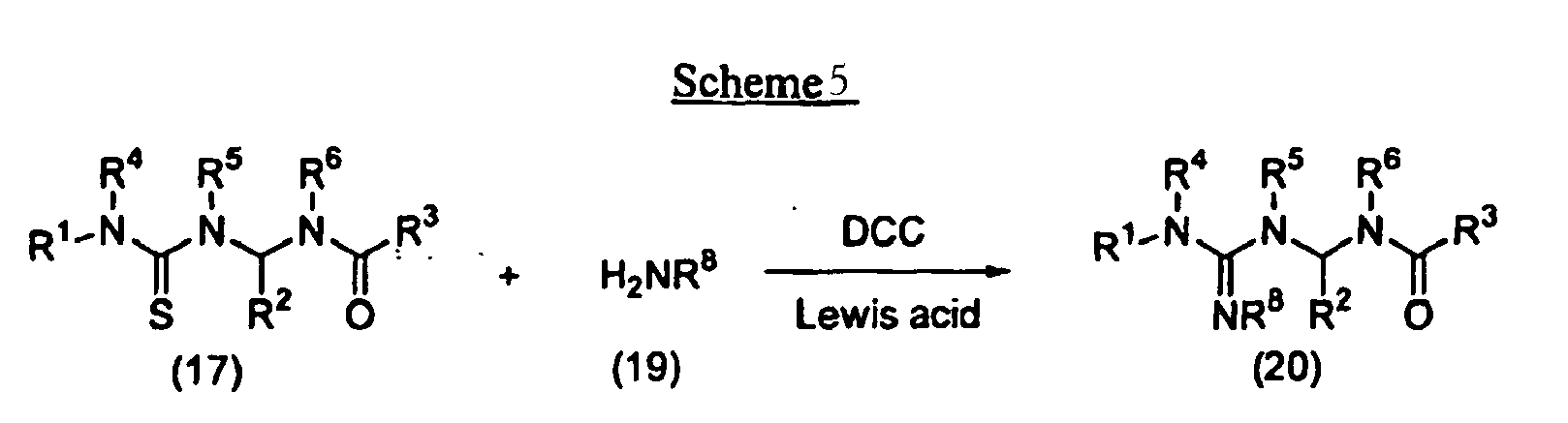
- A general method for preparing guanidine aminals from thiourea aminals is described in Scheme 5. Thiourea aminals of general formula (17) may be treated with a dehydrating agent such as DCC followed by addition of amines of general formula (19), prepared as described in (Scharpenberg; Chem. Ber. (1973), 106, 1881), in the presence of a Lewis acid such as titanium isopropoxide to provide guanidine aminals of general formula (20) wherein R1, R2, R3, R4, R5, R6 and R8 are as defined in formula I.

- As shown in Scheme 6, guanidine aminals of general formula (25), wherein R1, R2, R3, R4, and R8 are as defined in formula I, may be prepared by using the above strategy. Aminoacetamides of general formula (21) may be treated with acid chlorides in the presence of a base such as pyridine or triethylamine to provide the corresponding acylaminoamides of general formula (22). The acylaminoamides (22) may undergo a Hofmann rearrangement as described in (Wallis; Lane; Org. React. (1946), 3, 267-306, and references contained therein) with reagents such as iodosobenzene diacetate as described in (Loudon; Radhakrishna; Almond; Blodgett; Boutin; J. Org. Chem. (1984), 49, 4272); (Loudon; Boutin J. Org. Chem. (1984), 49, 4277); (Chan; Pennington; McParland; Whitehead; Coutts; Synth. Commun. (1988), 53, 5158) to provide aminoamides of general formula (23), which may be typically isolated as their hydrochloride salts. The aminoamides (23) may be treated with thioureas of general formula (24), prepared as described in (Solimar, J.Med.Chem. (1979), 22, 321; and Ulrich; Tetrahedron (1966), 22, 1565) to provide guanidine aminals of general formula (25). An alternate approach for preparation of cyanoguanidine aminals of general formula (25), wherein R8 is cyano, may be used. Aminoamides of general formula (23) may be treated with cyanothioureas of general formula (24), wherein R8 is cyano, in the presence of a base such as diisopropylethylamine and a suitable activating agent such as EDCI to provide cyanoguanidine aminals of general formula (25).

- An alternate route to guanidine aminals of general formula (20), wherein R1, R2, R3, R4, R6 and R8 are as defined in formula I and R5 is H, is shown in Scheme 7. A three-component condensation including benzotriazole, aldehydes of general formula (26), and amides of general formula (1) in the presence of an acid catalyst such as p-toluenesulfonic acid monohydrate as described in (Katritzky; Urogdi; Mayence; J. Org. Chem. (1990), 55, 2206); (Katritzky; Chem. Rev. (1998), 98, 409); (Katritzky; J. Heterocyclic Chem. (1996), 33, 1935) provides benzotriazole adducts of general formula (27). Nucleophilic displacement of the benzotriazole moiety as described in (Katritzky; Urogdi; Mayence; J. Org. Chem. (1990), 55, 2206); (Katritzky; Chem. Rev. (1998), 98, 409); (Katritzky; J. Heterocyclic Chem. (1996), 33,1935) with ammonia in an alcoholic solvent such as methanol provides aminoamides of general formula (10). The aminoamides (10) may be treated with thioureas of general formula (24) in the presence of a base such as diisopropylethylamine and a suitable activating agent such as EDCI to provide guanidine aminals of general formula (20).
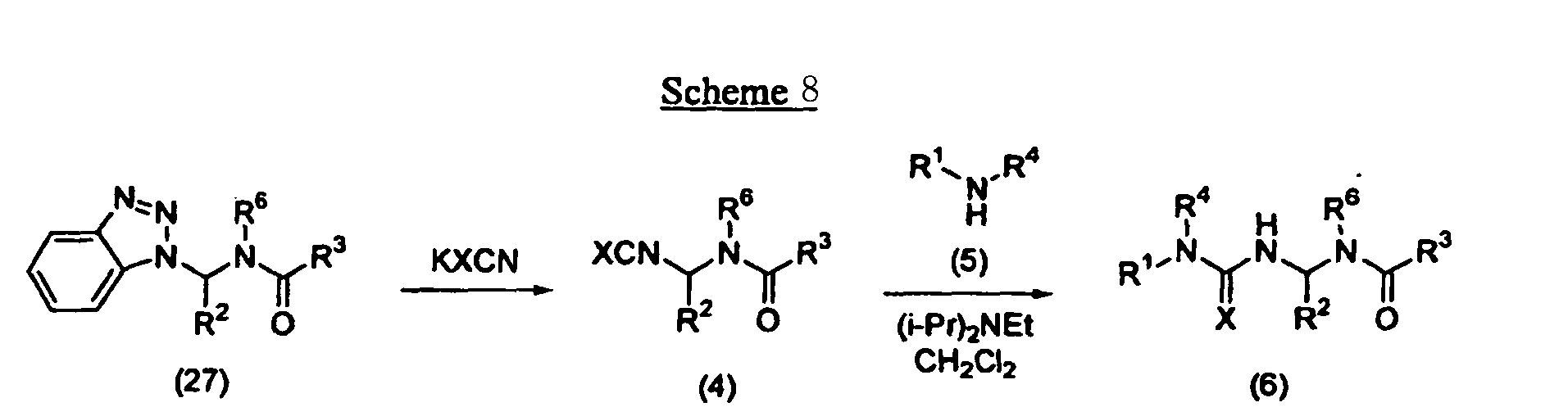
- As shown in Scheme 8, urea and thiourea aminals of general formula (6), wherein R1, R2, R3, R4 and R6 are as defined in formula I and X is O or S, may be prepared by treating benzotriazole adducts of general formula (27) with potassium cyanate or potassium thiocyanate to provide isocyanates or isothiocyantes of general formula (4). Isocyanates or isothiocyanates of general formula (4) may be treated with amines of general formula (5) in the presence of a base such as diisopropylethylamine to provide urea and thiourea aminals of general formula (6).

- As shown in Scheme 9, cyanoguanidine aminals of general formula (29), wherein R1, R2, R3 and R6 are as defined in formula I, may be prepared by using a strategy that employs a two-step sequence. Cyanoguanidines of general formula (28) are first prepared either by Path A or Path B. In path A, amines of general formula (13) are treated with sodium dicyanamide as described in (Tilley; Ramuz; Levitan; Blount; Helv. Chim. Acta. (1980), 63, 841); (Jones; Kuyper; Styles; Caddell; J. Heterocyclic Chem. (1994), 31,1681) to provide cyanoguanidines of general formula (28). In Path B, isothiocyanates of general formula (11) are treated in succession with cyanamide, a sodium base such as sodium hydride, an electrophile such as methyl iodide, and ammonia in a polar aprotic solvent such as methanol as described in (Fairfall; Peak; J. Chem. Soc. (1955), 796) to provide cyanoguanidines of general formula (28). The cyanoguanidines (28) are then treated with benzotriazole adducts of general formula (27) in the presence of a base such as potassium carbonate to provide cyanoguanidine aminals of general formula (29).

- Functionality may be introduced onto the guanidine nitrogen (R5) by the synthetic sequence described in Scheme 10. Thioureas of general formula (24) may be treated with a sodium base such as sodium hydride and then alkylated with electrophiles such as methyl iodide to provide methyl carbamimidothioates of general formula (30). Methyl carbamimidothioates (30) may be treated with amines of general formula (31) to provide guanidines of general formula (32) which are then further reacted with benzotriazole adducts of general formula (27) in the presence of a base such as potassium carbonate to provide guanidine aminals of general formula (20) wherein R1, R2, R3, R4, R5, R6, and R8 are as defined in formula I.

- As shown in Scheme 11, geminally-substituted products of general formula (36) wherein R1, R3, R4, R5, R7, and R8 are as defined in formula I and R2 is the same as R7 or R2 and R7 taken together with the carbon atom to which they are attached, together form a 5 or 6 membered carbocyclic ring, may be prepared using the above strategy and as described in (Steglich; Chem. Ber. (1974), 107, 1488); (Burger; J. Fluorine Chem. (1982), 20, 813). Optionally substituted primary amides may be treated with symmetrical ketones of general formula (34) in the presence of a dehydrating agent such as trifluoroacetic anhydride and a base such as pyridine to provide symmetrical imines of general formula (35). The symmetrical imines (35) may be treated with guanidines of general formula (32) in the presence of a base such as triethylamine to provide geminally-substituted compounds of general formula (36).

- Aminals of general formula (52), wherein R1, R2, R3, R4, and R6 are as defined in formula I and X is selected from NCN, CHNO2, and CHCN, may be prepared as illustrated in Schem 12. Bis(methylthio) compounds of general formula (50) are commercially available when X is NCN or CHNO2 or may be prepared as described in (Hendriksen; Acta Chem. Scand. (1990), 50, 432 and Creemer; Barger; Wagner; Synth. Comm. (1988), 18, 1103) when X is CHCN. Compounds of general formula (50) may be treated with amines of general formula (5) to provide methylthio compounds of general formula (51). Methylthio compounds of general formula (51) may be treated with amines of general formula (10) to provide aminals of general formula (52) wherein X is NCN, CHNO2, or CHCN.

- An alternate method of preparing aminals of general formula (52) wherein R1, R2, R3, R4, and R6 are as defined in formula I and X is selected from NCN, CHNO2, and CHCN, is shown in Scheme 13. Methylthio compounds of general formula (51) may be treated with ammonia in an alcoholic solvent such as methanol to provide compounds of general formula (53). Compounds of general formula (53) may be treated with benzotriazoles of general formula (27) to provide aminals of general formula (52) wherein X is NCN, CHNO2, or CHCN.

- Aminals of general formula (59), wherein R1, R2, R3, R4 and R6 are as defined in formula I, may be prepared as described in Scheme 14. Amines of general formula (5) may be treated with 1,1-bis(methylsulfanyl)-2-nitroethylene in a solvent such as isopropanol to provide nitroethenyl compounds of general formula (57). Nitroethenyl compounds of general formula (57) may be treated with ammonia and methanol to provide nitroethenediamines of general formula (58). Nitroethenediamines of general formula (58) may be treated with benzotriazole adducts of general formula (27) and a base such as potassium carbonate in a solvent such as DMF to provide aminals of general formula (59).

- Aminals of general formula (65), wherein R1, R2, R3 and R6 are as defined in formula I and R is selected from alkyl, aryl, haloalkyl and NR94R95 wherein R94 and R95 are independently selected from hydrogen, alkyl, aryl, and arylalkyl, may be prepared as described in Scheme 15. Isothiocyanates of general formula (61) may be treated with compounds of general formula (62) and sodium hydride followed by treatment with iodomethane in DMF to provide compounds of general formula (63). Compounds of general formula (63) may be treated with ammonia and methanol to provide guanidines of general formula (64). Guanidines of general formula (64) may be treated with benzotriazole adducts of general formula (27) and a base such as potassium carbonate in a solvent such as DMF to provide aminals of general formula (65).
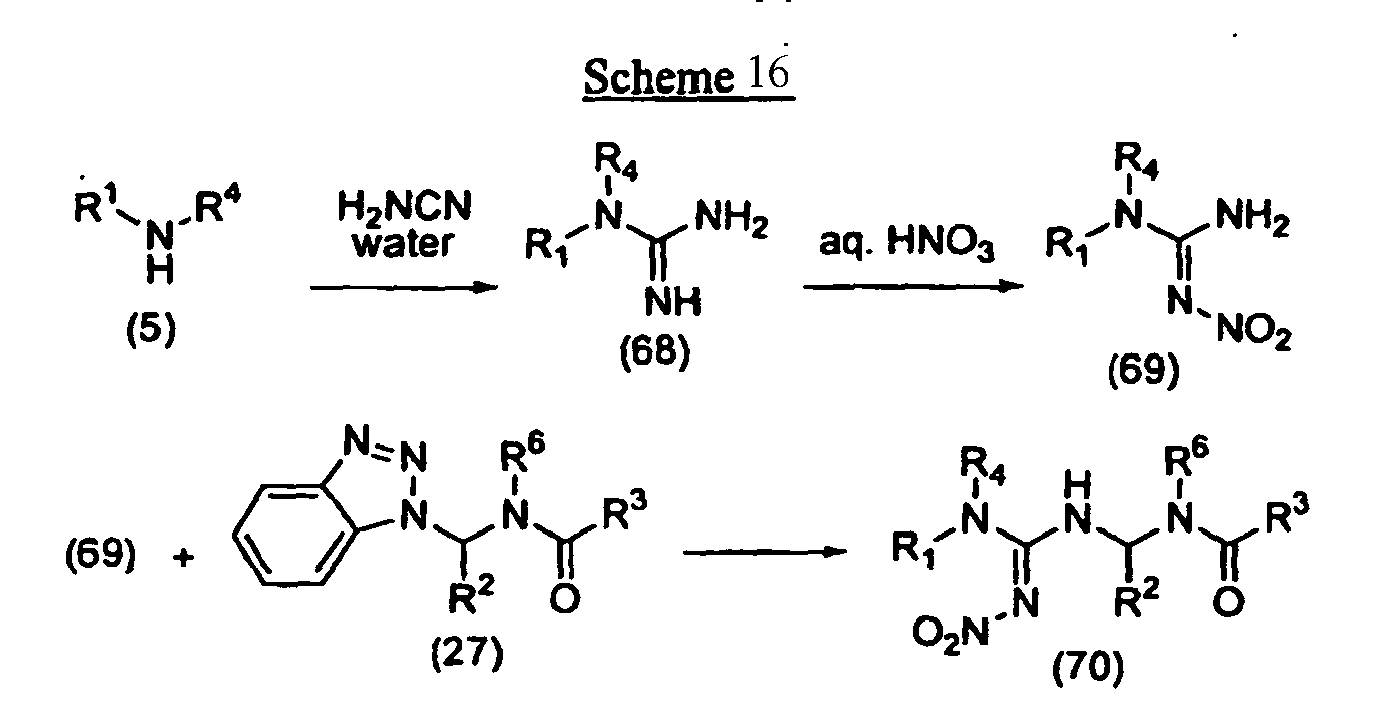
- Aminals of general formula (70), wherein R1, R2, R3, R4 and R6 are as defined in formula I, may be prepared as described in Scheme 16. Amines of general formula (5) may be treated with cyanamide in water to provide guanidines of general formula (68). Guanidines of general formula (68) may be treated with aqueous nitric acid to provide nitroguanidines of general formula (69). Nitroguanidines of general formula (69) may be treated with benzotriazole adducts of general formula (27) and a base such as potassium carbonate in a solvent such as DMF to provide aminals of general formula (70).

- Aminals of general formula (73), wherein R1, R2, R4, R5, R6 and R8 are as defined in formula I and R' is selected from alkoxycarbonyl, aryl, carboxy, heterocycle and - NRARB wherein RA and RB are as defined in formula I, may be prepared as described in Scheme 17. Aminals of general formula (72), wherein R is Br, I or -OS(O)2CF3, may be treated with a palladium catalyst, a trialkyltin reagent and triphenylarsine in a solvent such as N-methylpyrrolidin-2-one to provide aminals of general formula (73). Alternatively, cross-coupling reactions (and carbonylations) may be done using Buchwald, Stille, Suzuki or Heck coupling reactions all of which are well known to those skilled in the art of organic chemistry.
- A 500 mL round-bottom flask was charged with trifluoroacetaldehyde ethyl hemiacetal (12.3 g, 85.0 mmol), p-toluamide (10.0 g, 74.0 mmol), and dioxane (150 mL). The thick white slurry was stirred at ambient temperature for 3 hours, then heated at reflux for 44 hours. The homogeneous solution was cooled and concentrated in vacuo to provide a white solid. The crude material was dissolved in ethyl acetate (50 mL), adsorbed onto silica gel (50 g), and eluted through a medium porosity fritted filter funnel (elution with 25% ethyl acetate/hexanes, then ethyl acetate) to provide 14.1 g of the desired product as a white solid.
MS (APCI+) m/z 215 (M-H2O)+. - A stirred solution of Example 1A (3.48 g, 15.0 mmol) in CH2Cl2 (60 mL) at 0 °C was treated with pyridine (1.20 mL). The reaction mixture was treated dropwise with thionyl chloride (1.10 mL, 15.0 mmol), and the reaction flask was equipped with a calcium chloride drying tube. The reaction mixture was stirred at 0 °C for 4 hours, the cooling bath was removed, and the solution was stirred at ambient temperature for an additional 12 hours. Concentration of the reaction mixture provided a white solid which was triturated with diethyl ether (2x200 mL) to provide 2.40 g of the desired product as a white solid.
MS (APCI+) m/z 252 (M+H)+. - A stirred solution of Example 1B (2.00 g, 8.00 mmol) in acetone (35 mL) at ambient temperature was treated with potassium thiocyanate (1.60 g, 16.0 mmol). The reaction mixture was stirred for 12 hours, concentrated, and the crude residue was purified by flash chromatography (elution with 40% ethyl acetate/hexanes) to provide 1.34 g of the desired product as an off-white solid.
MS (APCI+) m/z 275 (M+H)+. - A solution of 3-aminopyridine (145 mg, 1.54 mmol) in benzene (8 mL) at ambient temperature was treated with a solution of Example 1C (500 mg, 1.54 mmol) in benzene (1.5 mL). The reaction mixture was stirred for 1.5 hours, then concentrated to a nominal volume. The white solids which precipitated from solution were collected by filtration and were washed with diethyl ether. Recrystallization from 25% ethyl acetate/hexanes provided the desired product as a white solid.
mp 185-186 °C;
MS (APCI+) m/z 369 (M+H)+;
1H NMR (DMSO-d6) δ 10.43 (s, 1H), 9.25 (d, 1H, J=8 Hz), 8.61 (dd, 1H, J=3, 1 Hz), 8.39-8.35 (m, 2H), 8.04-8.00 (m, 1H), 7.79 (m, 2H), 7.43-7.38 (m, 1H), 7.35-7.23 (m, 3H), 2.38 (s, 3H);
Anal. calcd for C16H15F3N4OS: C, 52.17; H, 4.10; N, 15.21. Found: C, 52.2; H, 3.96; N, 15.16. - Example 1 C and 2-methylaniline were processed as described in Example 1D to provide the desired product.
mp 210-211 °C;
MS (APCI+) m/z 382 (M+H)+;
1H NMR (DMSO-d6) δ 10.01 (br s, 1H), 9.09-8.96 (m, 1H), 7.74 (d, 2H, J=8 Hz), 7.39-7.22 (m, 7H), 2.37 (s, 3H);
Anal. calcd for C18H18F3N3OS: C, 56.68; H, 4.76; N, 11.02. Found: C, 56.66; H, 4.73; N, 10.84. - Example 1C and 4-fluoroaniline were processed as described in Example I D to provide the desired product.
mp 208-210 °C;
MS (APCI+) m/z 386 (M+H)+;
1H NMR (DMSO-d6) δ 10.30 (s, 1H), 9.19 (d, 1H, J=8 Hz), 8.11 (d, 1H, J=10 Hz), 7.77 (d, 2H, J=8 Hz), 7.47 (m, 2H), 7.34 (d, 2H, J=8 Hz), 7.30-7.19 (m, 3H), 2.37 (s, 3H); Anal. calcd for C17Hl5F4N3OS: C, 52.98; H, 3.92; N, 10.90. Found: C, 53.08; H, 3.92; N, 10.91. - Example 1C and 3-nitroaniline were processed as described in Example 1D to provide the desired product.
mp 185-186 °C;
MS (APCI+) m/z 416 (M+H)+;
1H NMR (DMSO-d6) δ 10.72 (s, 1H), 9.32 (d, 1H, J=9 Hz), 8.69 (s, 1H), 8.48 (m, 1H), 8.04 (m, 1H), 7.90 (d, 1H, J=9 Hz), 7.80 (d, 2H, J=9 Hz), 7.65 (t, 1H, J=9 Hz), 7.35 (d, 2H, J=9 Hz), 7.29-7.17 (m, 1H), 2.38 (s, 3H);
Anal. calcd for C17H15F3N4O3S·0.2 H2O: C, 49.08; H, 3.73; N, 13.47. Found: C, 48.96; H, 3.54; N, 13.38. - Example 1C and 2-fluoro-3-(trifluoromethyl)aniline were processed as described in Example 1D to provide the desired product.
mp 179-181 °C;
MS (APCI+) m/z 454 (M+H)+;
1H NMR (DMSO-d6) δ 10.23 (s, 1H), 9.28 (d, 1H, J=8 Hz), 8.62 (d, 1H, J=8 Hz), 8.05 (t, 1H, J=9 Hz), 7.80 (d, 2H, J=8 Hz), 7.67 (t, 1H, J=7 Hz), 7.42 (t, 1H, J=7 Hz), 7.34 (d, 2H, J= Hz), 7.30-7.18 (m, 1H), 2.38 (s, 3H);
Anal. calcd for C18H14F3N3OS·0.5 C4H8O: C, 49.08; H, 3.71; N, 8.59. Found: C, 49.48; H, 3.75; N, 8.36. - Example 1C and 4-methoxyaniline were processed as described in Example 1 D to provide the desired product.
mp 193-194 °C;
MS (APCI+) m/z 398 (M+H)+;
1H NMR (DMSO-d6) δ 10.19 (s, 1H), 9.12 (br s, 1H), 7.8-7.9 (br s, 1H), 7.75 (d, 2H, J=8 Hz), 7.33 (d, 2H, J=8 Hz), 7.32-7.21 (m, 3H), 6.97 (d, 2H, J=9 Hz), 3.76 (s, 3H), 2.37 (s, 3H);
Anal. calcd for C18H18F3N3O2S: C, 54.40; H, 4.57; N, 10.57. Found: C, 54.47; H, 4.49; N, 10.44. - Example 1C and 5-amino-2-chloropyridine were processed as described in Example I D to provide the desired product.
mp 199-200 °C;
MS (APCI+) m/z 403 (M+H)+;
1H NMR (DMSO-d6) δ 10.51 (s, 1H), 9.29 (d, 1H, J=8 Hz), 8.55-5.46 (m, 2H), 8.12 (dd, 1H, J=9, 3 Hz), 7.78 (d, 2H, J=8 Hz), 7.53 (d, 1H, J=9 Hz), 7.34 (d, 1H, J=8 Hz), 7.29-7.21 (m, 1H), 2.38 (s, 3H);
Anal. calcd for C16H14F3N4OS: C, 47.71; H, 3.50; N, 13.91. Found: C, 47.93; H, 3.53; N, 13.76. - Example 1C and 2-methoxyaniline were processed as described in Example 1D to provide the desired product.
mp 212-214 °C;
MS (APCI+) m/z 396 (M+H)+;
1H NMR (DMSO-d6) δ 9.86 (s, 1H), 9.20-9.12 (m, 1H), 7.76 (d, 2H, J=8 Hz), 7.6 (br s, 1H), 7.33 (d, 2H, J=8 Hz), 7.26-7.20 (m, 1H), 7.09 (d, 1H, J=8 Hz), 6.95 (t, 1H, J=8 Hz), 2.37 (s, 3H);
Anal. calcd for C18H18F3N3O2S: C, 54.40; H, 4.57; N, 10.57. Found: C, 54.49; H, 4.62; N,10.55. - Example 1C and aniline were processed as described in Example 1D to provide the desired product.
mp 205-206 °C;
MS (APCI+) m/z 368 (M+H)+;
1H NMR (DMSO-d6) δ 10.37 (s, 1H), 9.19 (d, 1H, J=8 Hz), 8.12 (d, 1H, J=10 Hz), 7.76 (d, 2H, J=8 Hz), 7.47-7.28 (m, 4H), 7.21 (t, 1H, J=7 Hz), 2.37 (s, 3H);
Anal. calcd for C17H16F3N3OS·0.5 H2O: C, 54.25; H, 4.55; N, 11.16. Found: C, 54.64; H, 4.08; N, 11.14. - Example 1 C and p-toluidine were processed as described in Example 1 D to provide the desired product.
mp 192-193 °C;
MS (APCI+) m/z 382 (M+H)+;
1H NMR (DMSO-d6) δ 10.28 (s, 1H), 9.18-9.12 (m, 1H), 8.10-7.92 (m, 1H), 7.76 (d, 2H, J=8 Hz), 7.34-7.28 (m, 5H), 7.20 (d, 2H, J=8 Hz), 2.37 (s, 3H), 2.30 (s, 3H);
Anal. calcd for C18H18F3N3OS: C, 56.68; H, 4.76; N, 11.02. Found: C, 56.95; H, 4.71; N, 10.87. - Example 1C and 2-fluoroaniline were processed as described in Example 1D to provide the desired product.
mp 197-198 °C;
MS (APCI+) m/z 386 (M+H)+;
1H NMR (DMSO-d6) δ 10.11 (s, 1H), 9.22 (d, 1H, J=8 Hz), 8.34 (d, 1H, J=8 Hz), 7.78 (d, 2H, J=8 Hz), 7.69 (t, 1H, J=8 Hz), 7.19-7.35 (m, 6H), 2.38 (s, 3H);
Anal. calcd for C17H15F4N3OS: C, 52.98; H, 3.92; N, 10.90. Found: C, 52.89; H, 3.92; N, 10.83. - Example 1C and 3-methoxyaniline were processed as described in Example 1D to provide the desired product.
mp 206-208 °C;
MS (APCI+) m/z 396 (M+H)+;
1H NMR (DMSO-d6) δ 10.39 (s, 1H), 9.16 (d, 1H, J=8 Hz), 8.12 (d, 1H, J=9 Hz), 7.76 (d, 2H, J=8 Hz), 7.33-7.21 (m, 4H), 7.14 (br s, 1H), 6.96 (d, 1 H, J=8 Hz), 6.83-6.75 (m, 1H), 2.37 (s, 3H);
Anal. calcd for C18H18F3N3O2S: C, 54.40; H, 4.57; N, 10.57. Found: C, 54.50; H, 4.44; N, 10.55. - Example 1C and 3-fluoroaniline were processed as described in Example 1D to provide the desired product.
mp 205-206 °C;
MS (APCI+) m/z 386 (M+H)+;
1H NMR (DMSO-d6) δ 10.51 (s, 1H), 9.25 (d, 1H, J=8 Hz), 8.31 (d, 1H, J=9 Hz), 7.78 (d, 2H, J=8 Hz), 7.64-7.58 (m, 1H), 7.45-7.22 (m, 6H), 7.06-7.01 (m, 1H), 2.38 (s, 3H); Anal. calcd for C17Hl5F4N3OS: C, 52.98; H, 3.92; N, 10.90. Found: C, 52.86; H, 3.88; N, 10.76. - Example 1C and 2,5-difluoroaniline were processed as described in Example 1D to provide the desired product.
mp 183-185 °C;
MS (APCI+) m/z 404 (M+H)+;
1H NMR (DMSO-d6) δ 10.21 (s, 1H), 9.29 (d, 1H, J=8 Hz), 8.65 (d, 1H, J=8 Hz), 7.89-7.82 (m, 1H), 7.79 (d, 2H, J=8 Hz), 7.40-7.32 (m, 3H), 7.30-7.25 (m, 1H), 7.17-7.12 (m, 1H), 2.38 (s, 3H);
Anal. calcd for C17H14F5N3OS: C, 50.62; H, 3.5; N, 10.42. Found: C, 50.58; H, 3.49; N, 10.25. - Example 1C and 2,4-difluoroaniline were processed as described in Example 1D to provide the desired product.
mp 202-204 °C;
MS (APCI+) m/z 404 (M+H)+;
1H NMR (DMSO-d6) δ 10.02 (s, 1H), 9.20 (br d, 1H, J=8 Hz), 8.40 (br d, 1H, J=8 Hz), 7.78 (d, 2H, J=9 Hz), 7.57-7.51 (m, 1H), 7.43-7.20 (m, 4H), 7.17-7.11 (m, 1H), 2.38 (s, 3H);
Anal. calcd for C17H14F5N3OS: C, 50.62; H, 3.50; N, 10.42. Found: C, 50.74; H, 3.41; N, 10.39. - Example 1C and m-toluidine were processed as described in Example 1D to provide the desired product.
mp 197-198 °C;
MS (APCI+) m/z 382 (M+H)+;
1H NMR (DMSO-d6) δ 10.31 (s, 1H), 9.16 (d, 1H, J=8 Hz), 8.07 (d, 1H, J=8 Hz), 7.76 (d, 2H, J=8 Hz), 7.34 (d, 2H, J=8 Hz), 7.30-7.21 (m, 4H), 7.03 (d, 1H, J=7 Hz), 2.37 (s, 3H), 2.30 (s, 3H);
Anal. calcd for C18H19F3N3OS: C, 56.68; H, 4.76; N, 11.02. Found: C, 56.72; H, 4.64; N, 10.85. - Example 1C and 2,6-difluoroaniline were processed as described in Example 1D to provide the desired product.
mp 185-186°C;
MS (APCI+) m/z 404 (M+H)+;
1H NMR (DMSO-d6) δ 9.84 (s, 1H), 9.22 (br s, 1H), 8.40 (br s, 1H), 7.78 (d, 2H, J=8 Hz), 7.48-7..43 (m, 1H), 7.35 (d, 2H, J=8 Hz), 7.30-7.17 (m, 3H), 2.38 (s, 3H);
Anal. calcd for C17H14F5N3OS: C, 50.62; H, 3.5; N, 10.42. Found: C, 50.85; H, 3.41; N, 10.38. - Example 1C and 2,3-difluoroaniline were processed as described in Example 1D to provide the desired product.
mp 210-211 °C;
MS (APCI+) m/z 404 (M+H)+;
1H NMR (DMSO-d6) δ 10.20 (s, 1H), 9.23 (d, 1H, J=8 Hz), 8.48 (d, 1H, J=9 Hz), 7.79 (d, 2H, J=8 Hz), 7.53-7.49 (m, 1H), 7.46-7.16 (m, 4H), 2.38 (s, 3H);
Anal. calcd for C17H14F5N3OS: C, 50.62; H, 3.50; N, 10.42. Found: C, 50.83; H, 3.44; N, 10.18. - Trifluoroacetaldehyde ethyl hemiacetal and 4-chlorobenzamide were processed as described in Example 1 A to provide the desired product.
MS (APCI+) m/z 237 (M-H2O)+. - Example 19A, thionyl chloride, and pyridine were processed as described in Example 1B to provide the desired product.
MS (APCI+) m/z 271 (M+H)+. - Example 19B and potassium thiocyanate were processed as described in Example 1C to provide the desired product.
MS (APCI+) m/z 294 (M+H)+. - Example 19C and 3-aminopyridine were processed as described in Example 1D to provide the desired product.
mp 147-149 °C;
MS (ESI+) m/z 389 (M+H)+;
1H NMR (DMSO-d6) δ 10.42 (s, 1H), 9.49-9.46 (m, 1H), 8.60 (d, 1H, J=3 Hz), 8.50-8.41 (m, 2H), 8.06-8.01 (m, 1H), 7.92 (d, 2H, J=9 Hz), 7.65 (d, 2H, J=9 Hz), 7.42 (q, 1H, J=3 Hz), 7.29-7.25 (m, 1H);
Anal. calcd for C15H12ClF3N4OS: C, 46.34; H, 3.11; N, 14.41. Found: C, 46.32; H, 3.10; N, 14.50. - Example 19C and aniline were processed as described in Example 1D to provide the desired product.
mp 198-201 °C;
MS (ESI+) m/z 357 (M+H)+;
1H NMR (DMSO-d6) δ 10.37 (br s, 1H), 9.37 (d, 1H, J=8 Hz), 8.15 (d, 1H, J=9 Hz), 7.91-7.86 (m, 2H), 7.63-7.58 (m, 2H), 7.51-7.45 (m, 2H), 7.42-7.26 (m, 3H), 7.22-7.17 (m, 1H);
Anal. calcd for C16H13ClF3N3OS: C, 49.55; H, 3.38; N, 10.84. Found: C, 48.71; H, 3.33; N, 10.86. - Example 19C and 2-fluoroaniline were processed as described in Example 1D to provide the desired product.
mp 197-200 °C;
MS (ESI+) m/z 357 (M+H)+;
1H NMR (DMSO-d6) δ 10.04 (br s, 1H), 9.36 (d, 1H, J=8 Hz), 8.35 (br s, 1H), 7.87-7.82 (m, 2H), 7.59-7.55 (m, 2H), 7.29-7.13 (m, 5H);
Anal. calcd for C16H12ClF4N3OS: C, 47.36; H, 2.98; N, 10.35. Found: C, 47.58; H, 2.86; N, 10.43. - A stirred solution of racemic tert-butylglycine (2.15 g, 16.4 mmol), di-tert-butyl dicarbonate (4.65 g, 21.3 mmol) in dioxane (30 mL), and water (30 mL) at 5 °C was treated with N-methylmorpholine (2.07 mL, 24.6 mmol). The mixture was allowed to slowly warm to ambient temperature and stirred for 16 hours. The reaction mixture was poured into cold aqueous NaHCO3 solution (50 mL) and extracted with ethyl acetate (3x50 mL). The aqueous layer was acidified to pH 1 (2M HCl) and extracted with ethyl acetate (3x30 mL). The organic fractions were combined, dried (MgSO4), and filtered. Removal of solvent provided 2.47 g of the desired product as a white solid.
MS (APCI+) m/z 232 (M+H)+. - A stirred solution of Example 22A (1.81 g, 7.83 mmol) in THF (20 mL) at -40 °C was treated with isobutyl chloroformate (1.01 mL, 7.83 mmol) followed by N-methylmorpholine (0.860 mL, 7.83 mmol). After 15 minutes, the milky white reaction mixture was treated dropwise with ammonium hydroxide (6.0 mL of 30% reagent, 15.0 mmol), the reaction flask was warmed to -15 °C, stirred for 45 minutes, treated with brine (20 mL), and the clear homogeneous mixture was extracted with ethyl acetate (2x40 mL). The organic portions were combined, washed with aqueous KHSO4 solution (15 mL), aqueous NaHCO3 solution (15 mL), and brine (15 mL), and dried (MgSO4). Filtration and removal of solvent provided 1.68 g of the desired product as a white solid.
MS (APCI+) m/z 231 (M+H)+. - Example 22B (1.49 g, 6.47 mmol) was dissolved in CH2Cl2 (20 mL), cooled to 0 °C, treated with trifluoroacetic acid (5 mL), and the reaction was stirred for 3 hours at 0 °C. Solvents were removed under reduced pressure, the residue was taken up in brine (10 mL), and extracted with ethyl acetate (25 mL). The aqueous layer was basified with 2M aqueous K2CO3 solution and extracted with 25% isopropanol/chloroform (3x20 mL). The organic portions were combined and solvents were removed to provide 516 mg of the analytically pure desired product as a white solid.
MS (APCI+) m/z 131 (M+H)+. - A solution of Example 22C (489 mg, 3.76 mmol) and p-toluoyl chloride (0.560 mL, 4.14 mmol) in CH2Cl2 (8 mL) at 0 °C was treated with triethylamine (0.520 mL, 3.76 mmol). After 6 hours, the mixture was diluted with ethyl acetate (25 mL) and washed sequentially with 1M HCl (10 mL), saturated aqueous NaHCO3 solution (10 mL), water (15 mL), and brine (10 mL). The organic portion was dried (Na2SO4), filtered, and concentrated to provide an oily residue which was purified by flash chromatography (elution with 50% ethyl acetate/hexanes) to provide 750 mg of the desired product as a sticky white solid.
MS (APCI+) m/z 249 (M+H)+. - A solution of iodobenzene diacetate (1.50 g, 3.48 mmol) in 50% aqueous CH3CN (6 mL) at ambient temperature was treated with Example 22D (721 mg, 2.90 mmol). After 16 hours, water (50 mL) and concentrated hydrochloric acid (5 mL) were added, and the mixture was extracted with ethyl acetate (2x40 mL). The aqueous layer was lyophilized leaving the hydrochloride salt which was triturated with diethyl ether to provide 422 mg of the desired product as a white solid.
MS (APCI+) m/z 221 (M+H)+. - A solution of Example 22E (152 mg, 0.592 mmol) and 3-pyridyl isothiocyanate (81 mg, 0.58 mmol) in THF (3 mL) at ambient temperature was treated with triethylamine (0.83 mL, 0.59 mmol). The mixture was stirred for 10 hours, diluted with ethyl acetate (20 mL), and washed sequentially with 1M HCl (5 mL), saturated aqueous NaHCO3 solution (5 mL), water (10 mL), and brine (5 mL). The organic portion was dried (MgSO4), filtered, and concentrated to provide an oily residue which was purified by flash chromatography (elution with 2% ethanol/ethyl acetate) to provide 126 mg of the desired product as an off-white solid.
mp 168-169 °C;
MS (APCI+) m/z 357 (M+H)+;
1H NMR (DMSO-d6) δ 10.04 (s, 1H), 8.59 (d, 1H, J=9 Hz), 8.39-8.30 (m, 2H), 8.04 (d, 1H, J=9 Hz), 7.80 (d, 1H, J=9 Hz), 7.73 (d, 2H, J=9 Hz), 7.37 (dd, 1H, J=9, 3 Hz), 7.28 (d, 2H, J=9 Hz), 6.23 (br s, 1H), 2.35 (s, 3H), 1.00 (s, 9H);
Anal. calcd for C19H24N4OS·0.2 C4H8O2: C, 63.57; H, 6.90; N, 14.98. Found: C, 63.21; H, 6.80; N, 14.86. - Optically pure (R)-tert-butylglycine was processed as described in Example 22 to provide the desired product.
mp 168-170 °C;
MS (ESI+) m/z 357 (M+H)+;
1H NMR (DMSO-d6) δ 10.05 (s, 1 H), 8.59 (d, 1H, J=3 Hz), 8.39-8.31 (m, 2H), 8.05 (br d, 1H, J=9 Hz), 7.80 (br d, 1H, J=9 Hz), 7.78 (d, 2H, J=9 Hz), 7.38 (dd, 1H, J=9, 6 Hz), 7.28 (d, 2H, J=9 Hz), 6.25 (br s, 1 H), 2.36 (s, 3H), 1.00 (s, 9H);
Anal. calcd for C19H24N4OS: C, 64.02; H, 6.79; N, 15.72. Found: C, 64.01; H, 6.91; N, 15.55. - Optically pure (S)-tert-butylglycine was processed as described in Example 22 to provide the desired product.
mp 166-168 °C;
MS (ESI+) m/z 357 (M+H)+;
1H NMR (DMSO-d6) δ 10.02 (s, 1H), 8.60 (s, 1H), 8.39-8.31 (m, 2H), 8.05 (br d, 1H, J=9 Hz), 7.82 (d, 1H, J=9 Hz), 7.75 (d, 2H, J=9 Hz), 7.38 (dd, 1H, J=9, 6 Hz), 7.28 (d, 2H, J=9 Hz), 6.25 (br s, 1H), 2.36 (s, 3H), 1.00 (s, 9H);
Anal. calcd for C19H24N4OS: C, 64.02; H, 6.79; N, 15.72. Found: C, 64.09; H, 6.82; N, 15.44. - Example 22E and 3-nitrophenyl isothiocyanate were processed as described in Example 22F to provide the desired product.
mp 181-182 °C;
MS (APCI+) m/z 401 (M+H)+;
1H NMR (DMSO-d6) δ 10.35 (s, 1H); 8.72 (s, 1H), 8.38-8.32 (m, 1H), 7.92 (q, 3H, J=9 Hz), 7.75 (d, 2H, J=9 Hz), 7.62 (t, 1H, J=9 Hz), 7.29 (d, 2H, J=9 Hz), 6.24 (br s, 1H), 2.35 (s, 3H), 1.00 (s, 9H);
Anal. calcd for C20H24N4O3S: C, 59.98; H, 6.04; N, 13.99. Found: C, 59.83; H, 6.10; N, 13.97. - Racemic tert-butylglycine (502 mg, 3.83 mmol) was dissolved in water (10 mL) containing NaOH (153 mg, 3.83 mmol). This solution was cooled to 5 °C and treated with o-toluoyl chloride (0.501 mL, 3.83 mmol) followed by additional NaOH (153 mg, 3.83 mmol). The mixture was warmed to ambient temperature, stirred for 1.5 hours, recooled to 5 °C, and treated with 1M HCl (pH 3). The thick precipitate that formed was collected by filtration and washed with cold water to provide 550 mg of the desired product as a white solid.
MS (APCI+) m/z 250 (M+H)+. - A stirred solution of Example 26A (458 mg, 1.84 mmol) in THF (10 mL) at -15 °C was treated with isobutyl chloroformate (0.240 mL, 1.84 mmol) followed by N-methylmorpholine (0.200 mL, 1.84 mmol). After 15 minutes, the milky white reaction mixture was treated dropwise with ammonium hydroxide (4.2 mL of 30% reagent, 15.0 mmol). The reaction flask was warmed to -15 °C, stirred for 45 minutes, treated with brine (20 mL), and the clear homogeneous mixture was extracted with ethyl acetate (2x40 mL). The organic portions were combined, washed with aqueous KHSO4 solution (15 mL), aqueous NaHCO3 solution (15 mL), and brine (15 mL), and dried (MgSO4). Filtration and removal of solvent provided 232 mg of the desired product a white solid. MS (APCI+) m/z 249 (M+H)+.
- Example 26B and iodobenzene diacetate were processed as described in Example 22E to provide the desired product.
MS (APCI+) m/z 221 (M+H)+. - Example 26C and 3-pyridyl isothiocyanate were processed as described in Example 22F to provide the desired product.
mp 186-187°C;
MS (APCI+) m/z 357 (M+H)+;
1H NMR (DMSO-d6) δ 10.00 (s, 1H), 8.61 (d, 1H, J=3 Hz), 8.39-8.28 (m, 2H), 8.14 (d, 1H, J=9 Hz), 7.77 (d, 1H, J=9 Hz), 7.40-7.18 (m, 5H), 6.07 (br s, 1H), 2.34 (s, 3H), 1.02 (s, 9H);
Anal. calcd for C19H24N4OS: C, 64.02; H, 6.79; N, 15.72. Found: C, 63.83; H, 6.69; N, 15.64. - Racemic tert-butylglycine and 4-chlorobenzoyl chloride were processed as described in Example 26A to provide the desired product.
MS (APCI+) m/z 270 (M+H)+. - Example 27A, isobutyl chloroformate, and ammonium hydroxide were processed as described in Example 26B to provide the desired product.
MS (APCI+) m/z 269 (M+H)+. - Example 27B and iodobenzene diacetate were processed as described in Example 22E to provide the desired product.
MS (APCI+) m/z 241 (M+H)+. - Example 27C and 3-pyridyl isothiocyanate were processed as described in Example 22F to provide the desired product.
mp 164-167 °C;
MS (APCI+) m/z 377 (M+H)+;
1H NMR (DMSO-d6) δ 10.04 (s, 1H), 8.60 (d, 1H, J=3 Hz), 8.49 (d, 1H, J=9 Hz), 8.31 (dd, 1H, J=9, 3 Hz), 8.07 (br d, 1H, J=9 Hz), 7.88-7.76 (m, 3H), 7.55 (d, 1H, J=9 Hz), 7.36 (dd, 2H, J=9, 6 Hz), 6.18 (br s, 1H), 1.00 (s , 9H);
Anal. calcd for C18H21ClN4OS: C, 57.36; H, 5.62; N, 14.87. Found: C, 57.19; H, 5.50; N, 14.73. - Racemic tert-butylglycine and benzoyl chloride were processed as described in Example 26A to provide the desired product.
MS (APCI+) m/z 236 (M+H)+. - Example 28A, isobutyl chloroformate, and ammonium hydroxide were processed as described in Example 26B to provide the desired product.
MS (APCI+) m/z 236 (M+H)+. - Example 28B and iodobenzene diacetate were processed as described in Example 22E to provide the desired product.
MS (APCI+) m/z 207 (M+H)+. - Example 28C and 3-pyridyl isothiocyanate were processed as described in Example 22E to provide the desired product.
mp 193-194 °C;
MS (APCI+) m/z 343 (M+H)+;
1H NMR (DMSO-d6) δ 10.05 (s, 1H), 8.60 (d, 1H, J=3 Hz), 8.41 (d, 1H, J=9 Hz), 8.31 (dd, 1H, J=9, 3 Hz), 8.06 (br d, 1H, J=9 Hz), 7.85-7.78 (m, 3H), 7.57-7.42 (m, 3H), 7.36 (dd, 2H, J=9, 6 Hz), 6.22 (br s, 1H), 1.00 (s, 9H);
Anal. calcd for C18H22N4OS: C, 63.13; H, 6.48; N, 16.36. Found: C, 62.99; H, 6.30; N, 16.24. - Racemic alanine and p-toluoyl chloride were processed as described in Example 26A to provide the desired product.
MS (APCI+) m/z 208 (M+H)+. - Example 29A (511 mg, 2.46 mmol) was suspended in benzyl alcohol (5 mL) at ambient temperature and treated with diisopropylethylamine (0.470 mL, 2.71 mmol). The homogeneous solution was treated with diphenyl phosphorylazide (0.580 mL, 2.71 mmol), stirred at ambient temperature for 30 minutes, then stirred at 90 °C for 12 hours. The reaction was cooled, and benzyl alcohol was removed in vacuo. The resulting residue was dissolved in ethyl acetate (30 mL) and washed sequentially with 10% aqueous citric acid (10 mL), saturated aqueous NaHCO3 (10 mL), water (10 mL), and brine (5 mL). Removal of solvent left an oily residue that was recrystallized from hot ethyl acetate/hexanes to provide a white precipitate which was collected by filtration and washed with hexanes to provide 77 mg of the desired product as a white solid.
MS (APCI+) m/z 313 (M+H)+. - A suspension of Example 29B (66 mg, 0.21 mmol) in methanol (9 mL) at ambient temperature was treated with 10% Pd/C (20 mg) and sufficient 1 M HCl to solubilize the substrate (ca. 0.20 mL). The system was equipped with a hydrogen balloon and stirred for 4 hours at ambient temperature. The reaction mixture was purged with nitrogen, filtered through diatomaceous earth (Celite®), rinsed with methanol and water, and the aqueous filtrate was washed with diethyl ether (2×15 mL). The aqueous layer was lyophilized providing 38 mg of the desired product as a white solid.
MS (APCI+) m/z 179 (M+H)+. - Example 29C and 3-nitrophenyl isothiocyanate were processed as described in Example 22E to provide the desired product.
mp 172-175 °C;
MS (APCI+) m/z 359 (M+H)+;
1H NMR (DMSO-d6) δ 10.32 (s, 1H), 8.75 (s, 1H), 8.31 (br s, 1H), 7.98 (m, 3H), 7.81 (d, 2H, J=9 Hz), 7.62 (t, 1H, J=9 Hz), 7.28 (d, 2H, J=9 Hz), 6.15 (br s, 1H), 2.53 (d, 3H, J=6 Hz), 2.37 (s, 3H);
Anal. calcd for C17H18N4O3S·0.5 CH2Cl2: C, 52.43; H, 4.78; N, 13.98. Found: C, 52.43; H, 4.60; N, 13.85. - Racemic phenylalanine and p-toluoyl chloride were processed as described in Example 26A to provide the desired product.
MS (APCI+) m/z 284 (M+H)+. - Example 30A, isobutyl chloroformate, and ammonium hydroxide were processed as described in Example 26B to provide the desired product.
MS (APCI+) m/z 283 (M+H)+. - Example 30B and iodobenzene diacetate were processed as described in Example 22E to provide the desired product.
MS (APCI+) m/z 255 (M+H)+. - Example 30C and 3-nitrophenyl isothiocyanate were processed as described in Example 22E to provide the desired product.
mp 170-171 °C;
MS (APCI+) m/z 435 (M+H)+;
1H NMR (DMSO-d6) δ 10.16 (s, 1H), 8.75 (s, 1H), 8.40 (br s, 1H), 7.99-7.88 (m, 3H), 7.75 (d, 2H, J=9 Hz), 7.60 (t, 1H, J=9 Hz), 7.42-7.27 (m, 5H), 7.20 (d, 2H, J=9 Hz), 6.20 (br s, 1H), 3.25 (m, 2H), 2.35 (s, 3H);
Anal. calcd for C23H22N4O3S: C, 63.58; H, 5.10; N, 12.89. Found: C, 63.32; H, 5.09; N, 12.74. - A stirred solution of racemic (2S)-2-(((benzyloxy)carbonyl)amino)-3-tert-butoxypropanoic acid (1.01 g, 3.43 mmol) in THF (10 mL) at -15 °C was treated with isobutyl chloroformate (0.440 mL, 3.43 mmol) followed by N-methylmorpholine (0.380 mL, 3.43 mmol). After 15 minutes, the milky white reaction mixture was treated dropwise with ammonium hydroxide (2.8 mL of 30% reagent, 5.0 mmol). The reaction flask was warmed to -15 °C and stirred for 45 minutes. The clear homogeneous mixture was treated with brine (20 mL) and extracted with ethyl acetate (2x40 mL). The organic portions were combined and washed with saturated aqueous NaHCO3 solution (15 mL) and brine (15 mL), and dried (MgSO4). Filtration and removal of solvent provided 928 mg of the desired product a white solid.
MS (APCI+) m/z 295 (M+H)+. - A suspension of Example 31A (784 mg, 2.67 mmol) in methanol (9 mL) at ambient temperature was treated with 10% Pd/C (75 mg) and sufficient 1 M HCl to solubilize the substrate (ca. 0.50 mL). The system was equipped with a hydrogen balloon and stirred for 4 hours at ambient temperature. The reaction mixture was purged with nitrogen, filtered through diatomaceous earth (Celite®), rinsed with methanol and water, and the aqueous filtrate was washed with diethyl ether (2x40 mL). The aqueous layer was lyophilized providing 467 mg of the desired product as a white solid.
MS (APCI+) m/z 161 (M+H)+. - A solution of Example 31C (435 mg, 2.21 mmol) and p-toluoyl chloride (0.320 mL, 2.43 mmol) in CH2Cl2 (12 mL) at 0 °C was treated with triethylamine (0.310 mL, 2.21 mmol). After 3 hours, the mixture was diluted with ethyl acetate (25 mL) and washed sequentially with 1M HCl (10 mL), saturated aqueous NaHCO3 solution (10 mL), water (15 mL), and brine (10 mL). The organic portion was dried (Na2SO4), filtered, and concentrated to provide 606 mg of the desired product as a white solid.
MS (APCI+) m/z 279 (M+H)+. - Example 31C and iodobenzene diacetate were processed as described in Example 22E to provide the desired product.
MS (APCI+) m/z 251 (M+H)+. - Example 31D and 3-nitrophenyl isothiocyanate were processed as described in Example 22F to provide the desired product.
mp 169-171 °C;
MS (APCI+) m/z 431 (M+H)+;
1H NMR (DMSO-d6) δ: 10.32 (s, 1H), 8.75 (s, 1H), 8.15 (br s, 1H), 7.99-7.88 (m, 3H), 7.78 (d, 2H, J=9 Hz), 7.62 (t, 1H, J=9 Hz),), 7.30 (d, 2H, J=9 Hz), 3.70-3.61 (m, 2H), 2.35 (s, 3H), 1.15 (s, 1 H);
Anal. calcd for C21H26N4O4S: C, 58.59; H, 6.09; N, 13.01. Found: C, 58.56; H, 5.99; N, 12.94. - Racemic fluoromethyl glycine and p-toluoyl chloride were processed as described in Example 26A to provide the desired product.
MS (APCI+) m/z 226 (M+H)+. - Example 32B, isobutyl chloroformate, and ammonium hydroxide were processed as described in Example 26B to provide the desired product.
MS (APCI+) m/z 225 (M+H)+. - Example 32B and iodobenzene diacetate were processed as described in Example 22E to provide the desired product.
MS (APCI+) m/z 197 (M+H)+. - Example 32C and 3-nitrophenyl isothiocyanate were processed as described in Example 22F to provide the desired product.
mp 148-155 °C;
MS (APCI+) m/z 377 (M+H)+;
1H NMR (DMSO-d6) δ 10.35 (s, 1H), 9.06 (s, 1H), 8.70 (d, 1H, J=9 Hz), 8.81 (br s, 1H), 7.96 (d, 2H, J=9 Hz), 7.90-7.78 (m, 3H), 7.60 (t, 1H, J=9 Hz),), 7.31 (d, 2H, J=9 Hz), 6.35 (m, 2H), 4.76 (d, 1H, J=7 Hz), 4.60 (d, 1H, J=7 Hz), 2.38 (s, 3H);
Anal. calcd for C17H17FN4O3S: C, 54.25; H, 4.55; N, 14.88. Found: C, 54.36; H, 4.59; N, 14.57. - Racemic phenylglycine and p-toluoyl chloride were processed as described in Example 26A to provide the desired product.
MS (APCI+) m/z 270 (M+H)+. - Example 33A, isobutyl chloroformate, and ammonium hydroxide were processed as described in Example 26B to provide the desired product.
MS (APCI+) m/z 269 (M+H)+. - Example 33B and iodobenzene diacetate were processed as described in Example 22E to provide the desired product.
MS (APCI+) m/z 241 (M+H)+. - Example 33C and 3-nitrophenyl isothiocyanate were processed as described in Example 22F to provide the desired product.
mp 170-172 °C;
MS (APCI+) m/z 421 (M+H)+;
1H NMR (DMSO-d6) δ 10.44 (s, 1H), 9.45 (d, 1H, J= 8 Hz), 8.80 (s, 1H), 8.67 (d, 1H, J=8 Hz), 7.96 (dd, J=8, 4, 1H), 7.90 (dd, J=8, 4, 1H), 7.83 (d, 2H, J=8 Hz), 7.62 (t, 1H, J=8 Hz), 7.48-7.36 (m, 4H), 7.35-7.25 (m, 4H), 2.38 (s, 3H);
Anal. calcd for C22H20N4O3S·0.4 H2O: C, 61.78; H, 4.90; N, 13.10. Found: C, 61.49; H, 4.72; N, 13.21. - Example 33C and 3-pyridyl isothiocyanate were processed as described in Example 22F to provide the desired product.
mp 156-158 °C;
MS (ESI+) m/z 357 (M+H)+;
1H NMR (DMSO-d6) δ 8.04 (m, 2H), 7.84-7.73 (m, 3H), 7.50 (br s, 1H), 7.43-7.39 (m, 1H), 7.29-7.21 (m, 3H), 7.22-7.13 (m, 5H), 7.05 (br s, 1H), 4.63 (t, 1H, J=9 Hz), 2.38 (s, 3H);
Anal. calcd for C21H20N4OS: C, 67.00; H, 5.35; N, 14.88. Found: C, 66.87; H, 5.38; N, 14.81. - Racemic valine and p-toluoyl chloride were processed as described in Example 26A to provide the desired product.
MS (APCI+) m/z 236 (M+H)+. - Example 35A, isobutyl chloroformate, and ammonium hydroxide were processed as described in Example 26B to provide the desired product.
MS (APCI+) m/z 235 (M+H)+. - Example 35B and iodobenzene diacetate were processed as described in Example 22E to provide the desired product.
MS (APCI+) m/z 207 (M+H)+. - Example 35C and 3-pyridyl isothiocyanate were processed as described in Example 22F to provide the desired product.
mp 184-186 °C;
MS (ESI+) m/z 343 (M+H)+;
1H NMR (DMSO-d6) δ 8.05 (m, 2H), 7.86-7.74 (m, 3H), 7.48 (br s, 1H), 7.43-7.36 (m, 1H), 7.30-7.22 (m, 3H), 7.05 (br s, 1H), 4.25 (t, 1H, J=9 Hz), 2.38 (s, 3H), 2.17-2.08 (m, 1H), 1 .04-0.91 (m, 6H);
Anal. calcd for C18H22N4OS: C, 63.13; H, 6.48; N, 16.36. Found: C, 63.35; H, 6.38; N, 16.47. - (L)-Isoleucine and p-toluoyl chloride were processed as described in Example 26A to provide the desired product.
MS (APCI+) m/z 250 (M+H)+. - Example 36B, isobutyl chloroformate, and ammonium hydroxide were processed as described in Example 26B to provide the desired product.
MS (APCI+) m/z 249 (M+H)+. - Example 36B and iodobenzene diacetate were processed as described in Example 22E to provide the desired product.
MS (APCI+) m/z 221 (M+H)+. - Example 36C and 3-pyridyl isothiocyanate were processed as described in Example 22F to provide the desired product.
mp 102-104 °C;
MS (ESI+) m/z 357 (M+H)+;
1H NMR (DMSO-d6) δ 10.05 (s, 1H), 8.62 (s, 1H), 8.30 (d, 1H, J=3 Hz), 8.11-8.07 (m, 2H), 7.88 (br s, 1H), 7.75 (d, 2H, J=9 Hz), 7.38-7.33 (m, 1H), 7.25 (d, 2H, J=9 Hz), 6.10 (br s, 1H), 2.38 (s, 3H), 2.15-2. 10 (m, 1H), 1.55-1.51 (m, 1H), 1.26-1.18 (m, 1H), 0.96-0.89 (m, 6H);
Anal. calcd for C19H24N4OS: C, 64.02; H, 6.79; N, 15.72. Found: C, 64.24; H, 6.74; N, 15.41. - Equimolar quantities (45.7 mmol) of 2-oxazolidinone and 3-fluoroaniline hydrochloride were combined, heated to 165 °C, and stirred for 18 hours. The dark-colored mixture was allowed to cool to ambient temperature and treated with ethanol (125 mL). The suspension was heated to reflux for 1 hour, allowed to cool to ambient temperature, treated with diethyl ether (125 mL), and the suspension was cooled to 0 °C for 2 hours. Filtration provided 5.53 g of the desired product as colorless crystals which were used without further purification.
MS (ESI+) m/z 155 (M+H)+. - A suspension of Example 37A (3.70 g, 19.5 mmol), in CH2Cl2 (50 mL) at ambient temperature was treated with triethylamine (4.5 mL). The reaction was treated with 1,1'-thiocarbonyldiimidazole (3.86 g, 19.5 mmol) and allowed to proceed for 1 hour at ambient temperature. The reaction mixture was poured into 2 N HCl (100mL), and the aqueous phase was extracted with CH2Cl2 (2x25 mL). The combined organic extracts were washed with brine (25 mL), dried over anhydrous Na2SO4, filtered, and the solvent was removed in vacuo. Trituration with ether provided 3.14 g of the pure desired product as colorless crystals.
MS (ESI+) m/z 197 (M+H)+. - A mixture of p-toluamide (11.0 g, 81.3 mmol) and 2,2,2-trichloro-1,1-ethanediol (16.6 g, 100 mmol) in benzene (175 mL) was stirred at reflux in a Soxhlet extraction device charged with molecular sieves (20 g). After 12 hours, the extraction thimble of molecular sieves was replaced with a fresh portion of molecular sieves (20 g), and the reaction was allowed to heat at reflux for an additional 12 hours. Concentration in vacuo provided a heavy syrup which was dissolved in ethyl acetate (15 mL) and diluted with hexanes (175 mL). Refrigeration at 8 °C facilitated precipitation of a white solid that was collected by filtration and washed with hexanes to provide 20.2 g of the desired product. MS (APCI+) m/z 264 (M-H2O)+.
- A stirred solution of Example 37C (20.0 g, 70.8 mmol) in CH2Cl2 (300 mL) at 0 °C was treated with pyridine (10 mL). The reaction mixture was treated dropwise with thionyl chloride (10.4 mL, 141 mmol), and the reaction flask was equipped with a calcium chloride drying tube. The reaction mixture was warmed to ambient temperature and stirred for 4 hours. Concentration of the reaction mixture to a reduced volume and addition of diethyl ether (100 mL) resulted in a precipitate which was filtered off, and the filtrate was concentrated and dried under reduced pressure to provide 19.0 g of the desired product as a white solid.
MS (APCI+) m/z 300 (M+H)+. - A solution of Example 37B (0.460 g, 2.35 mmol) in DMF (10 mL) was treated with solid potassium bis(trimethylsilyl)amide (0.470 g, 2.35 mmol). The reaction was stirred at ambient temperature for 15 minutes, treated with Example 37D (0.710 g, 2.35 mmol), allowed to proceed for 16 hours, diluted with ethyl acetate (30 mL), and poured into 2 N HCl (15 mL). The aqueous phase was extracted with ethyl acetate (2x5 mL), and the combined organic extracts were washed with brine (25 mL), dried (Na2SO4), filtered, and evaporated in vacuo. Purification by flash chromatography (elution with 50% ethyl acetate/hexanes) provided 460 mg of the desired product as a white powder. mp 184-186 °C;
MS (ESI+) m/z 460 (M+H)+;
1H NMR (DMSO-d6) δ 9.30 (d, 1H, J=10 Hz), 7.95 (d, 1H, J=10 Hz), 7.81 (d, 2H, J=8 Hz), 7.64-7.57 (m, 1H), 7.50-7.40 (m, 3H), 7.35 (d, 2H, J=8 Hz), 7.13-7.06 (m, 1H), 4.28-4.01 (m, 4H), 2.39 (s, 3H);
Anal. calcd for C19H17Cl3FN3OS: C, 49.53; H, 3.72; N, 9.12. Found: C, 49.21; H, 3.88; N, 8.97. - Diethyl ether (250 mL) was placed in a 500 mL three-necked round-bottom flask fitted with a gas dispersion tube, dropping funnel, and stirrer. The solvent was cooled to 0 °C, and dry ammonia was passed into the solution for 10 minutes. While the ammonia was allowed to continue to pass through the solution, it was treated dropwise with Example 37D (9.50 g, 31.6 mmol) in diethyl ether (50 mL) for 30 minutes. The white solid that formed was removed by filtration and washed with diethyl ether. The combined filtrates were concentrated to provide 9.18 g of the desired product as a white solid.
MS (APCI+) m/z 281 (M+H)+. - Example 38A (500 mg, 2.79 mmol) and 3-pyridyl isothiocyanate (335 mg, 2.79 mmol) were dissolved in CH2Cl2 (15 mL) and heated at 60 °C for 10 hours. The reaction was cooled and concentrated to provide a residue that was purified by flash chromatography (elution with 20% ethyl acetate/hexanes) to provide 396 mg of the desired product as an off-white solid.
MS (APCI+) m/z 417 (M+H)+. - A solution of Example 38B (250 mg, 0.200 mmol) in glacial acetic acid (4 mL) at ambient temperature was treated slowly with acetic acid (6 mL) containing 30% hydrogen peroxide (4 mL), and the reaction was stirred for 30 minutes. The precipitate which formed was filtered off, washed with water, and crystallized from ethanol. The salt was dissolved in ethyl acetate and neutralized with saturated aqueous sodium carbonate solution. The organic solution was washed with brine (5 mL), dried (Na2SO4), and concentrated to provide a white solid. Recrystallization from ethanol/diethyl ether provided 71 mg of the desired product as a white solid.
mp 162-163 °C;
MS (ESI+) m/z 401 (M)+;
1H NMR (DMSO-d6) δ 9.60 (s, 1H), 9.20 (d, 1H, J=9 Hz), 8.68 (s, 1H), 8.22 (d, 1H, J=6 Hz), 7.98 (d, 1H, J=9 Hz), 7.78 (d, 2H, J=9 Hz), 7.38 (q, 1H, J=3 Hz), 7.32 (d, 2H, J=9 Hz), 7.12 (d, 1H, J=9 Hz), 6.75 (t, 1H, J=9 Hz), 2.38 (s, 3H);
Anal. calcd for C16H15Cl3N4O2: C, 47.84; H, 3.76; N, 13.95. Found: C, 47.81; H, 3.67; N, 13.62. - 2,2,2-Trichloro-1,1-ethanediol and o-toluamide were processed as described in Example 37C to provide the desired product.
MS (APCI+) m/z 263 (M-H2O)+. - Example 39A and thionyl chloride were processed as described in Example 37D to provide the desired product.
MS (APCI+) m/z 300 (M+H)+. - Example 39B and ammonia were processed as described in Example 38A to provide the desired product.
MS (APCI+) m/z 281 (M+H)+. - Example 39C and 3-pyridyl isothiocyanate were processed as described in Example 38B to provide the desired product.
MS (APCI+) m/z 417 (M+H)+. - Example 39D and hydrogen peroxide were processed as described in Example 38C to provide the desired product.
mp 182-184 °C;
MS (APCI+) m/z 402 (M+H)+;
1H NMR (DMSO-d6) δ 9.38 (s, 1H), 8.95 (s, 1H), 8.55 (s, 1H), 8.20 (d, 1H, J=6 Hz), 7.93-7.88 (m, 1H), 7.68 (d, 2H, J=3 Hz), 7.44-7.28 (m, 4H), 6.72 (t, 1H, J=9 Hz), 2.37 (s, 3H);
Anal. calcd for C16H15Cl3N4O2: C, 47.84; H, 3.76; N, 13.95. Found: C, 47.68; H, 3.52; N, 13.59. - 2,2,2-Trichloro-1,1-ethanediol and benzamide were processed as described in Example 37C to provide the desired product.
MS (APCI+) m/z 245 (M-H2O)+. - Example 40A and thionyl chloride were processed as described in Example 37D to provide the desired product.
MS (APCI+) m/z 286 (M+H)+, - Example 40B and ammonia were processed as described in Example 38A to provide the desired product.
MS (APCI+) m/z 267 (M+H)+. - Example 40C and 3-pyridyl isothiocyanate were processed as described in Example 38B to provide the desired product.
MS (APCI+) m/z 403 (M+H)+. - Example 40D and hydrogen peroxide were processed as described in Example 38C to provide the desired product.
mp 214-215 °C;
MS (ESI+) m/z 388 (M+H)+;
1H NMR (DMSO-d6) δ 9.48 (s, 1H), 9.32 (d, 1H, J=9 Hz), 8.55 (d, 1H, J=3 Hz), 8.20 (dd, 1H, J=6, 3 Hz), 7.95-7.89. (m, 1H), 7.85 (d, 2H, J=9 Hz), 7.64-7.59 (m, 1H), 7.52 (t, 2H, J=9 Hz), 7.32 (q, 1H, J=3 Hz), 7.10 (d, 1H, J=9 Hz), 6.75 (t, 1H, J=9 Hz);
Anal. calcd for C15H13Cl3N4O2: C, 46.48; H, 3.38; N, 14.45. Found: C, 46.24; H, 3.41; N, 14.41. - 2,2,2-Trichloro-1,1-ethanediol and 4-chlorobenzamide were processed as described in Example 37C to provide the desired product.
MS (APCI+) m/z 283 (M-H2O)+. - Example 41 A and thionyl chloride were processed as described in Example 37D to provide the desired product.
MS (APCI+) m/z 320 (M+H)+. - Example 41B and ammonia were processed as described in Example 38A to provide the desired product.
MS (APCI+) m/z 301 (M+H)+. - Example 41C and 3-pyridyl isothiocyanate were processed as described in Example 38B to provide the desired product.
MS (APCI+) m/z 437 (M+H)+. - Example 41D and hydrogen peroxide were processed as described in Example 38C to provide the desired product.
mp 166-168 °C;
MS (ESI+) m/z 423 (M+H)+;
1H NMR (DMSO-d6) δ 9.45 (s, 1H), 8.62 (s, 1H), 8.20 (d, 1H, J=6 Hz), 7.98-7.80 (m, 4H), 7.65-7.59 (m, 2H), 7.52 (d, 1H, J=9 Hz), 7.30 (q, 1H, J=3 Hz), 7.10 (d, 1H, J=9 Hz), 6.75 (t, 1H, J=9 Hz);
Anal. calcd for C15H12Cl4N4O2: C, 42.68; H, 2.87; N, 13.27. Found: C, 42.56; H, 2.67; N, 13.25. - A solution of Example 38A (183 mg, 0.650 mmol) and phenyl isocyanate (77 mg, 0.65 mmol) in THF (4 mL) at ambient temperature was treated with triethylamine (0.93 mL, 0.66 mmol). The mixture was stirred for 10 hours, diluted with ethyl acetate (20 mL), and washed with aqueous NH4Cl (10 mL), water (10 mL), and brine (5 mL). The organic portion was dried (MgSO4), filtered, and concentrated to provide an oily residue which was purified by flash chromatography (elution with 5% methanol/CH2Cl2) to provide 151 mg of the desired product as an off-white solid.
mp 230-233 °C;
MS (ESI+) m/z 400 (M)+;
1H NMR(DMSO-d6) δ 9.35 (s, 1H), 9.25 (d, 1H, J=9 Hz), 7.80 (d, 2H, J=9 Hz), 7.45 (d, 2H, J=9 Hz), 7.32 (d, 2H, J=9 Hz), 7.25 (q, 3H, J=7 Hz), 6.95 (t, 1H, J=7 Hz), 6.75 (t, 1 H, J=9 Hz), 2.45 (s, 3H);
Anal. calcd for C17H16Cl3N3O2: C, 50.96; H, 4.02; N, 10.49. Found: C, 50.66; H, 3.99; N, 10.38. - A stirred solution of Example 37D (1.00 g, 3.32.00 mmol) in acetone (20 mL) at ambient temperature was treated with potassium cyanate (1.60 g, 16.0 mmol). The reaction mixture was stirred for 12 hours, concentrated, and the crude residue was purified by flash chromatography (elution with 50% ethyl acetate/hexanes) to provide 620 mg of the desired product as an off-white solid.
MS (APCI+) m/z 307 (M+H)+. - A solution of 2-fluoroaniline (132 mg, 1.40 mmol) in THF (8 mL) at ambient temperature was treated with a solution of Example 43A (386 mg, 1.26 mmol) in THF (1.5 mL). The reaction mixture was stirred for 2 hours and concentrated to a nominal volume. The white solids which precipitated from solution were collected by filtration and washed with diethyl ether. Recrystallization from 25% ethyl acetate/hexanes provided the desired product as a white solid.
mp 257-259 °C;
MS (APCI+) m/z 418 (M+H)+;
1H NMR (DMSO-d6) δ 9.32-9.29 (d, 1H, J=9 Hz), 9.14 (br s, 1H), 8.12-8.06 (t, 1H, J=8 Hz), 7.81 (d, 2H, J=8 Hz), 7.55 (d, 1H, J=10 Hz), 7.30 (d, 2H, J=8 Hz), 7.25-7.18 (m, 1H), 7.11 (t, 1H, J=7 Hz), 7.03-6.96 (m, 1H), 6.78 (t, 1H, J=9 Hz), 2.37 (s, 3H);
Anal. calcd for C17H15Cl3FN3O2: C, 48.77; H, 3.61; N, 10.04. Found: C, 48.76; H, 3.53; N, 9.97. - A solution of cyanamide (352 mg, 8.40 mmol) in THF (20 mL) at 0 °C was treated with sodium hydride (211 mg of 95% reagent, 8.80 mmol). The slurry was stirred for 30 minutes at 0 °C and treated with a solution of 3-pyridyl isothiocyanate (1.12 g, 8.20 mmol) in THF (8 mL). The cooling bath was removed, and the reaction mixture was stirred for 30 minutes. The reaction was quenched with water (15 mL), poured into ethyl acetate (40 mL), and partitioned. The organic phase was washed with brine (10 mL), dried (Na2SO4), filtered, and concentrated. The residue was dissolved in diethyl ether, treated with HCl (2M solution in diethyl ether), and the resulting precipitate was collected providing 1.06 g of the desired product as an off-white solid.
MS (APCI+) m/z 179 (M+H)+. - A solution of Example 44A (200 mg, 0.932 mmol) in DMF (7 mL) at 23 °C was treated with EDCI (250 mg, 1.30 mmol) followed by diisopropyethylamine (0.180 mL, 1.03 mmol). The mixture was stirred for 30 minutes, then treated with a solution of Example 38A (262 mg, 0.932 mmol) as a solution in DMF (2 mL) along with additonal diisopropyethylamine (0.360 mL, 2.06 mmol). The solution was stirred for 10 hours, poured into ethyl acetate (25 mL), and washed with water (25 mL). The aqueous layer was extracted with ethyl acetate (20 mL), and the combined organic portions were washed with water (3x20 mL) and brine (20 mL). The organic portion was dried (Na2SO4), filtered, and concentrated. Purification of the residue by flash chromatography (elution with 5% ethanol/hexanes) provided 146 mg of the desired product as an off-white solid.
mp 165-166°C;
MS (ESI+) m/z 425 (M)+;
1H NMR (DMSO-d6) δ 10.15 (s, 1H), 8.70 (d, 1H, J=9 Hz), 8.52 (d; 1H, J=3 Hz), 8.48-8.43 (m, 1H), 7.72 (d, 1H, J=9 Hz), 7.70-7.66 (m, 1H), 7.50 (q, 1H, J=4 Hz), 7.45 (d, 2H, J=9 Hz), 7.35 (d, 1H, J=9 Hz), 6.90 (t, 1H, J=9 Hz), 2.38 (s, 3H);
Anal. calcd for C17H15N6Cl3O: C, 47.96; H, 3.55; N, 19.74. Found: C, 47.72; H, 3.82; N, 19.71. - A solution of Example 41B (1.91 g, 6.31 mmol) in acetone (30 mL) at ambient temperature was treated with potassium thiocyanate (1.38 g, 14.1 mmol). The mixture was stirred for 6 hours and solids were removed by filtration. The filtrate was concentrated to provide a yellow residue. The residue was treated with diethyl ether, and the suspension was sonicated and filtered. Concentration of the residue and purification by recrystallization (25% ethyl acetate/hexanes) provided 1.85 mg of the desired product as a yellow solid.
MS (APCI+) m/z 343 (M+H)+. - A solution of Example 45A (239mg, 0.695 mmol) and 3-aminopyridine (65 mg, 0.69 mmol) in THF (4 mL) at ambient temperature was treated with triethylamine (1.66 mL, 1.18 mmol). The mixture was stirred for 3 hours, diluted with ethyl acetate (20 mL), and washed with water (2x10 mL) and brine (10 mL). The organic portion was dried (MgSO4), filtered, and concentrated to provide an oily residue which was purified by flash chromatography (elution with 5% ethanol/hexanes) to provide 158 mg of the desired product as an off-white solid.
MS (APCI+) m/z 437 (M+H)+. - A stirred solution of Example 45B (500 mg, 1.14 mmol) and EDCI (656 mg, 3.42 mmol) in CH2Cl2 (10 ml) was heated at reflux for 10 hours. The mixture was cooled and was diluted with ethyl acetate (20 mL). The solution was washed with aqueous NaHCO3 solution (10 mL) and brine (10 mL), dried (MgSO4), filtered, and concentrated. The residue was dissolved in 5% ethanol/ethyl acetate and filtered through a short plug of silica gel. Concentration provided 440 mg of a pale yellow solid that was used without further purification.
- The solid prepared above was dissolved in CH2Cl2 (10 mL), then treated with 2,6-lutidine (0.120 mL, 1.00 mmol), 3A molecular sieves (200 mg), and cyanamide (208 mg, 4.99 mmol). This stirred suspension was treated with titanium isopropoxide (0.300 mL, 1.00 mmol), and the resulting mixture was heated at reflux for 8 hours. The mixture was cooled, diluted with CH2Cl2 (20 mL), and washed with water (10 mL) and brine (10 mL). The solution was dried (Na2SO4), filtered, and concentrated. The resulting residue was purified by flash chromatography (elution with 10% methanol/CH2Cl2) to provide 229 mg of the desired product as a white solid.
mp 126-128°C;
MS (ESI+) m/z 426 (M+H)+;
1H NMR (DMSO-d6) δ 10.12 (s, 1H), 8.72 (d, 1H, J=9 Hz), 8.50 (dd, 1H, J=12, 3 Hz), 7.70-7.67 (m, 1H), 7.51 (q, 1H, J=6 Hz), 7.45-7.38 (m, 1H), 7.30 (d, 1H, J=9 Hz), 6.82 (t, 1H, J=9 Hz), 2.38 (s, 3H);
Anal. calcd for C17H15Cl3N6O: C, 47.96; H, 3.55; N, 19.74. Found: C, 47.62; H, 3.25; N, 19.84. - Example 37D and potassium thiocyanate were processed as described in Example 45A to provide the desired product.
MS (APCI+) m/z 323 (M+H)+. - Example 46A and 3-aminopyridine were processed as described in Example 45B to provide the desired product.
MS (APCI+) m/z 417 (M+H)+. - Example 46B, cyanamide, and titanium isopropoxide were processed as described in Example 45C to provide the desired product.
mp 197-199°C;
MS (ESI+) m/z 424 (M)+;
1H NMR (DMSO-d6) δ 9.86 (s, 1H), 8.77-8.74 (d, 1H, J=8 Hz), 7.72-7.70 (d, 2H, J=8 Hz), 7.49-7.44 (m, 2H), 7.34-7.26 (m, 5H), 6.94-6.88 (t, 1 H, J=9 Hz), 2.36 (s, 3H); Anal. calcd for C18H16Cl3N5O: C, 50.90; H, 3.80; N, 16.49. Found: C, 50.87; H, 3.78; N, 16.51. - Example 46A and 3-fluoroaniline were processed as described in Example 45B to provide the desired product.
MS (APCI+) m/z 434 (M+H)+. - Example 47A, cyanamide, and titanium isopropoxide were processed as described in Example 45C to provide the desired product.
mp 220-222 °C;
MS (APCI+) m/z 442 (M+H)+;
1H NMR (DMSO-d6) δ 9.85 (s, 1H), 8.83 (d, 1H, J=8 Hz), 7.73 (d, 2H, J=8 Hz), 7.25-7.40 (m, 6H), 7.1 (br d, 1H), 6.88 (t, 1H, J=8 Hz), 2.37 (s, 3H);
Anal. calcd for C18H15Cl3FN5O: C, 48.83; H, 3.41; N, 15.81. Found: C, 48.63; H, 3.44; N, 15.77. - Example 46A and 5-aminopyrimidine were processed as described in Example 45B to provide the desired product.
MS (APCI+) m/z 418 (M+H)+. - Example 48A, cyanamide, and titanium isopropoxide were processed as described in Example 45C to provide the desired product.
mp 186-188 °C;
MS (APCI+) m/z 426 (M+H)+;
1H NMR (DMSO-d6) δ 10.22 (s, 1H), 9.08 (s, 1H), 8.77-8.73 (m, 2H), 7.81-7.75 (m, 3H), 7.73-7.68 (m, 1H), 7.38 (d, 2H, J=6 Hz), 6.90 (t, 1H, J=6 Hz), 2.38 (s, 3H);
Anal. calcd for C16H14Cl3N7O: C, 45.03; H, 3.31; N, 22.98. Found: C, 44.66; H, 3.55; N, 22.66. - Example 40B and potassium thiocyanate were processed as described in Example 45A to provide the desired product.
MS (APCI+) m/z 308 (M+H)+. - Example 49A and 3-aminopyridine were processed as described in Example 45B to provide the desired product.
MS (APCI+) m/z 403 (M+H)+. - Example 498, cyanamide, and titanium isopropoxide were processed as described in Example 45C to provide the desired product.
mp 133-135 °C;
MS (ESI+) m/z 412 (M+H)+;
1H NMR (DMSO-d6) δ 10.15 (s, 1H), 8.82 (d, 1H, J=9 Hz), 8.53-8.48 (m, 2H), 7.82 (d, 2H, J=9 Hz), 7.72 (d, 1H, J=6 Hz), 7.62 (d, 1H, J=6 Hz), 7.58-7.51 (m, 3H), 7.45 (d, 1H, J=6 Hz), 6.90 (t, 1 H, J=9 Hz);
Anal. calcd for C16H13Cl3N6O: C, 46.68; H, 3.18; N, 20.41. Found: C, 46.88; H, 3.41; N, 20.43. - Example 39B and potassium thiocyanate were processed as described in Example 45A to provide the desired product.
MS (APCI+) m/z 323 (M+H)+. - Example 50A and 3-aminopyridine were processed as described in Example 45B to provide the desired product.
MS (APCI+) m/z 417 (M+H)+. - Example 50B, cyanamide, and titanium isopropoxide were processed as described in Example 45C to provide the desired product.
mp 126-128 °C;
MS (ESI+) m/z 426 (M+H)+;
1H NMR (DMSO-d6) δ 10.12 (s, 1H), 8.72 (d, 1H, J=9 Hz), 8.50 (dd, 2H, J=3;12 Hz), 7.69-7.65 (m, 1H),), 7.51 (q, 1H, J=6 Hz), 7.43-7.38 (m, 3H), 7.30 (d, 2H, J=9 Hz), 6.82 (t, 1 H, J=9 Hz), 2.3 8 (s, 3H);
Anal. calcd for C17H15Cl3N6O: C, 47.96; H, 3.55; N, 19.74. Found: C, 47.62; H, 3.25; N, 19.84. - Example 44A, Example 22E, and EDCI were processed as described in Example 44B to provide the desired product.
mp 187-188 °C;
MS (APCI+) m/z 365 (M+H)+;
1H NMR (DMSO-d6) δ 9.58 (s, 1H), 8.48 (d, 1H, J=3 Hz), 8.42 (d, 1H, J=3 Hz), 8.25 (d, 1H, J=9 Hz), 7.75 (d, 2H, J=9 Hz), 7.73-7.69 (m, 1H), 7.47-7.43 (m, 1H), 7.30 (d, 2H, J=9 Hz), 6.85 (d, 1H, J=9 Hz), 5.85 (t, 1H, J=9 Hz), 2.37 (s, 3H), 0.97 (s, 9H);
Anal. calcd for C20H24N6O: C, 65.91; H, 6.64; N, 23.06. Found: C, 65.95; H, 6.59; N, 23.20. - Example 22C and 4-chlorobenzoyl chloride were processed as described in Example 22D to provide the desired product.
MS (APCI+) m/z 269 (M+H)+. - Example 52A and iodobenzene diacetate were processed as described in Example 22E to provide the desired product.
MS (APCI+) m/z 241 (M+H)+. - Example 52B, Example 44A, and EDCI were processed as described in Example 44B to provide the desired product.
mp 194-195 °C;
MS (APCI+) m/z 393 (M+H)+;
1H NMR (DMSO-d6) δ 9.55 (s, 1H), 8.48 (d, 1H, J=3 Hz), 8.47-7.38 (m, 2H), 7.85 (d, 2H, J=9 Hz), 7.71-7.68 (m, 1H), 7.58 (d, 2H, J=9 Hz), 7.42 (dd, 1H, J=9, 3 Hz), 6.85 (d, 1H, J=9 Hz), 5.84 (t, 1H, J=9 Hz), 0.97 (s, 9H);
Anal. calcd for C19H21ClN6O: C, 59.29; H, 5.50; N, 21.84. Found: C, 59.16; H, 5.53; N, 21.90. - A suspension of p-toluamide (4.11 g, 30.4 mmol), pivaldehyde (2.62 g, 30.4 mmol), and benzotriazole (3.62 g, 30.4 mmol) in toluene (200 mL) were treated with p-toluenesulfonic acid (286 mg, 1.52 mmol). The solution was heated at reflux under Dean-Stark conditions for 10 hours, cooled gradually to ambient temperature, and further cooled at 5 °C. The white precipitate which formed was collected by filtration and was washed with 50% ether/hexanes (100 mL) to provide 6.67 g of the desired product as a white solid.
MS (DCI/NH3) m/z 323 (M+H)+. - A stirred suspension of Example 53A (13.3 g, 38.8 mmol) in methanol (50 mL) was treated with finely powdered K2CO3 (11.8 g, 85.4 mmol) followed by ammonia (200 mL of a 2M solution in methanol). The mixture was stirred at ambient temperature for 3.5 hours, the solid was removed by filtration, and the filtrate was concentrated. The resulting solid was suspended in diethyl ether (200 mL) and stirred for 45 minutes at ambient temperature. The mixture was again filtered, and the filtrate was concentrated to a volume of 75 mL. This solution was treated with 1N HCl (200 mL of a 1N solution in diethyl ether), and the resulting suspension was sonicated to promote salt formation. The solid was isolated by filtration and washed with ethyl acetate (2x75 mL) to provide 8.88 g of the desired product as a white solid.
MS (DCI/NH3) m/z 220 (M+H)+. - Cyanamide and 3-fluoroaniline were processed as described in Example 44A to provide the desired product.
MS (DCI/NH3) m/z 196 (M+H)+. - Example 53B, Example 53C, and EDCI were processed as described in Example 44B to provide the desired product.
mp 193-194 °C;
MS (FAB+) m/z 382 (M+H)+;
1H NMR (DMSO-d6) δ 9.57 (s, 1H); 8.26 (d, 1H, J=9 Hz); 7.72 (d, 2H, J=8 Hz); 7.41 (dd, 1H, J=8, 4 Hz); 7.29 (d, 2H, J=8 Hz); 7.11 (t, 2H, J=7 Hz); 7.01 (t, 1H, J=8 Hz); 6.85 (d, 1H, J=4); 5.82 (t, 1H, J=5 Hz); 2.36 (s, 3H); 0.98 (s, 9H);
Anal. calcd for C21H24FN5O•0.25 H2O: C, 65.35; H, 6.40; N, 18.15. Found: C, 65.33; H, 6.40; N, 18.20. - Benzotriazole, 4-chlorobenzamide, cyclopropanecarboxaldhehyde, and p-toluenesulfonic acid were processed as described in Example 53A to provide the desired product.
MS (ESI+) m/z 327 (M+H)+. - A suspension of 3-aminopyridine (5.16 g, 54.8 mmol) and dimethyl N-cyanodithioiminocarbonate (8.02 g, 54.8 mmol) in acetonitrile (200 mL) was heated at reflux for 6 days. The solution was cooled and concentrated to a volume of 75 mL where upon a white solid precipitated from solution. The solid was collected by filtration and washed with 50% ether/hexanes (500 mL) to provide 7.79 g of the desired product as a pale yellow solid.
MS (ESI+) m/z 193 (M+H)+. - Example 54B (510 mg, 2.44 mmol) was dissolved in a 2M solution of ammonia in methanol (7 mL) and heated in a sealed tube at 80 °C for 12 hours. The reaction mixture was cooled to ambient temperature and further cooled to -5 °C where upon a white solid precipitated from solution. The solid was filtered and the filter cake washed with cold ethanol to provide 310 mg of the desired product as a white solid.
MS (ESI+) m/z 162 (M+H)+. - A solution of Example 54C (50 mg, 0.27 mmol) and Example 54A (55 mg, 0.18 mmol) in DMF (2 mL) at 23 °C was treated with finely powdered K2CO3 (62 g, 0.45 mmol). The reaction mixture was stirred for 4 hours, then partitioned between ethyl acetate (15 mL) and water (10 mL). The aqueous layer was extracted with ethyl acetate (10 mL), and the combined organics were washed with water (2x5 mL) and brine (5 mL). The organic portions were dried (Na2SO4), filtered, and concentrated. Purification by flash chromatography (elution with 5% methanol/CH2Cl2) provided 21 mg of the desired product as a white solid.
mp 137-139 °C;
MS (ESI+) m/z 369 (M+H)+;
1H NMR (DMSO-d6) δ 9.57 (s, 1H), 9.16 (d, 1H, J=7 Hz), 8.47 (d, 1H, J=3 Hz), 8.31 (dd, 1H, J=4, 1Hz), 7.92 (d, 2H, J=8 Hz), 7.79-7.73 (m, 1H), 7.69 (d, 1H, J=8 Hz), 7.59 (d, 2H, J=8 Hz), 7.37 (dd, 1H, J=8, 5 Hz), 5.16 (dd, 1H, J=16, 8 Hz), 1.56-1.50 (m, 1H), 0.57-0.50 (m, 2H), 0.44-0.38 (m, 1H);
Anal. calcd for C18H17ClN6O: C, 58.62; H, 4.65; N, 22.79. Found: C, 58.41; H, 4.88; N, 22.44. - A solution of thiophosgene (3.21 mL, 42.1 mmol) in chloroform (10 mL) was heated at reflux and treated with a solution of 5-amino-2-chloropyridine (3.61 g, 28.1 mmol) in chloroform (25 mL) for 40 minutes. The solution was heated an additional 2 hours, the reaction mixture was cooled, and the solids formed were removed by filtration. Concentration of the filtrate provided 2.73 g of the desired product as a white solid.
MS (DCI/NH3) m/z 188 (M+NH4)+. - A solution of cyanamide (705 mg, 16.8 mmol) in THF (40 mL) at 0 °C was treated with sodium hydride (422 mg of 95% reagent, 17.6 mmol). The slurry was stirred for 30 minutes at 0 °C, then treated with Example 55A (2.72 g, 16.0 mmol) as a solution in THF (20 mL) for 10 minutes. The cooling bath was removed, the reaction mixture was stirred for 30 minutes, and treated with methyl iodide (2.00 mL, 32.0 mmol). The reaction mixture was stirred for 15 minutes, quenched with water (50 mL), poured into ethyl acetate (150 mL), and partitioned. The organic phase was washed with brine (20 mL), dried (Na2SO4), filtered, and concentrated. The resulting precipitate was collected providing 3.24 g of the desired product as an off-white solid.
MS (DCI/NH3) m/z 227 (M+H)+. - Example 55B (2.08 mg, 9.18 mmol) was dissolved in a 2M solution of ammonia in methanol (45 mL) and heated in a sealed Pyrex vessel at 80 °C for 6 hours. The reaction mixture was cooled to ambient temperature and concentrated to provide an off-white solid. Recrystallization of this material from hot ethanol provided 1.51 g of the desired product as a white solid.
MS (DCI/NH3) m/z 213 (M+NH4)+. - Example 55C and Example 53A were processed as described in Example 54D to provide the desired product.
mp 194-196°C;
MS (DCI/NH3) m/z 399 (M+H)+;
1H NMR (DMSO-d6) δ 9.63 (s, 1H), 8.33 (d, 1H, J=2 Hz), 8.23 (br d, 1H, J=5 Hz), 7.79-7.61 (m, 2H), 7.75 (d, 1H, J=7Hz), 7.56 (d, 1H, J=8 Hz), 7.30 (d, 1H, J=7 Hz), 6.98 (br d, 1H, J=6 Hz), 5.83 (t, 1H, J=6 Hz), 2.37 (s, 3H), 0.97 (s, 9H);
Anal. calcd for C20H23ClN6O: C, 60.22; H, 5.81; N, 21.07. Found: C, 60.82; H, 5.95; N, 20.74. - Benzotriazole, 4-chlorobenzamide, 3-thiophenecarboxaldhehyde, and p-toluenesulfonic acid were processed as described in Example 53A to provide the desired product.
MS (DCI/NH3) m/z 369 (M+H)+. - A solution of thiophosgene and 3-fluoroaniline were processed as described in Example 55A to provide the desired product.
MS (DCI/NH3) m/z 154 (M+H)+; - Example 56B, cyanamide, and methyl iodide were processed as described in Example 55B to provide the desired product.
MS (DCI/NH3) m/z 210 (M+H)+. - Example 56C and ammonia were processed as described in Example 54C to provide the desired product.
MS (DCI/NH3) m/z 196 (M+NH4)+. - Example 56A and Example 56D were processed as described in Example 54D to provide the desired product.
mp 166-168 °C;
MS (ESI+) m/z 428 (M+H)+;
1H NMR (DMSO-d6) δ 9.65 (s, 1H), 9.24 (d, 1H, J=8 Hz), 7.92 (d, 2H, J=7 Hz), 7.82-7.76 (m, 1H), 7.59 (d, 2H, J=7 Hz), 7.59-7.57 (m, 2H), 7.40-7.34 (m, 1H), 7.20-7.18 (m, 1H), 7.15-7.06 (m, 2H), 6.99-6.94 (m, 1H), 6.91 (dd, 1 H, J=8, 7 Hz);
Anal. calcd for C20H15ClFN5O·0.75 H2O: C, 54.42; H, 3.77; N, 15.87. Found: C, 54.41; H, 3.83; N, 15.86. - Example 51 (161 mg) was chromatographed over a Daicel Chiral Technologies Chiralcel OD chiral column (2.0 cmx25 cm) eluting with 5% ethanol/hexanes (flow rate=10 mL/minutes) to provide 51 mg (retention time=15 minutes) of the desired product as the faster enantiomer.
mp 187-188 °C;
[α]D23 -38° (c 0.4, DMSO);
MS (APCI+) m/z 365 (M+H)+;
1H NMR (DMSO-d6) δ 9.58 (s, 1H), 8.48 (d, 1H, J=3 Hz), 8.42 (d, 1H, J=3 Hz), 8.25 (d, 1H, J=9 Hz), 7.75 (d, 2H, J=9 Hz), 7.73-7.69 (m, 1H), 7.47-7.43 (m, 1H), 7.30 (d, 2H, J=9 Hz), 6.85 (d, 1H, J=9 Hz), 5.85 (t, 1H, J=9 Hz), 2.37 (s, 3H), 0.97 (s, 9H);
Anal calcd for C20H24N6O: C, 65.91; H, 6.64; N, 23.06. Found: C, 66.00; H, 6.63; N, 23.15. - Example 51 (161 mg) was chromatographed over a Daicel Chiral Technologies Chiralcel OD chiral column (2.0 cmx25 cm) eluting with 5% ethanol/hexanes (flow rate=10 mL/minutes) to provide 36 mg (retention time=25 minutes) of the desired product as the slower enantiomer.
mp 188-189 °C;
[a]D 23 +51° (c 0.3, DMSO);
MS (APCI+) m/z 365 (M+H)+;
1H NMR (DMSO-d6) 8 9.58 (s, 1H), 8.48 (d, 1H, J=3 Hz), 8.42 (d, 1H, J=3 Hz), 8.25 (d, 1H, J=9 Hz), 7.75 (d, 2H, J=9 Hz), 7.73-7.69 (m, 1H), 7.47-7.43 (m, 1H), 7.30 (d, 2H, J=9 Hz), 6.85 (d, 1H, J=9 Hz), 5.85 (t, 1H, J=9 Hz), 2.37 (s, 3H), 0.97 (s, 9H);
Anal calcd for C20H24N6O: C, 65.91; H, 6.64; N, 23.06. Found: C, 65.99; H, 6.60; N, 23.20. - Benzotriazole, 4-chlorobenzamide, 2-ethylbutanal, and p-toluenesulfonic acid were processed as in Example 53A to provide the desired product.
MS (ESI+) m/z 357 (M+H)+. - Example 54C and Example 59A were processed as in Example 54D to provide the desired product.
mp 185-187 °C;
MS (ESI+) m/z 399 (M+H)+;
1H NMR (DMSO-d6) δ 9.68 (s, 1H), 8.88 (br s, 1H), 8.47 (d, 1H, J=2Hz), 8.33 (dd, 1H, J=5, 1Hz), 7.90 (d, 2H, J=8 Hz), 7.69 (d, 1H, J=8 Hz), 7.45 (br s, 1H), 7.38 (dd, 1H, J=9, 5 Hz), 5.57 (dd, 1H, J=17, 9 Hz), 1.90 (m, 1H), 1.54-1.32 (m, 4H), 0.87 (t, 3H, J=8 Hz), 0.84 (t, 4H, J=8 Hz;
Anal calcd for C20H23ClN6O·0.15 C4H8O2: C, 60.04; H, 5.92; N, 20.39; Cl, 8.61. Found: C, 59.75; H, 5.77; N, 20.22; Cl, 8.93. - Benzotriazole, 4-chlorobenzamide, 3-methylbutanal, and p-toluenesulfonic acid were processed as in Example 53A to provide the desired product.
MS (ESI+) m/z 343 (M+H)+. - Example 54C and Example 60A were processed as in Example 54D to provide the desired product.
mp 193-194°C;
MS (ESI+) m/z 385 (M+H)+;
1H NMR (DMSO-d6) δ 9.77 (br s, 1H), 9.00 (d, 1H, J=6 Hz), 8.49 (s, 1H), 8.31 (d, 1H, J=5 Hz), 7.92 (d, 2H, J=8 Hz), 7.71 (d, 1H, J=8 Hz), 7.64 (d, 1H, J=7 Hz), 7.57 (d, 2H, J=8 Hz), 7.36 (dd, 1H, J=8, 5 Hz), 5.69 (m, 1H), 3.32 (m, 2H), 1.68 (m, 1H), 0.92 (t, 6H, J=6 Hz);
Anal calcd for C19H21ClN6O: C, 59.30; H, 5.50; N, 9.21; Cl, 21.84. Found: C, 59.16; H, 5.50; N, 9.08; Cl, 21.50. - Benzotriazole, 4-chlorobenzamide, cyclohexanecarboxaldehyde, and p-toluenesulfonic acid were processed as in Example 53A to provide the desired product. MS (ESI+) m/z 369 (M+H)+.
- Example 54C and Example 61A were processed as in Example 54D to provide the desired product.
mp 190-192 °C;
MS (ESI+) m/z 411 (M+H)+;
1H NMR (DMSO-d6) δ 9.69 (s, 1H), 8.92 (br s, 1H), 8.49 (s, 1H), 8.31 (d, 1H, J=4 Hz), 7.91 (d, 2H, J=8 Hz), 7.71 (d, 1H, J=7 Hz), 7.57 (d, 2H, J=8 Hz), 7.37 (dd, 1H, J=5, 7.62 Hz), 5.43 (m, 1H), 1.97-1.62 (m, 5H), 1.16-0.97 (m, 6H);
Anal calcd for C21H23ClN6O·0.25 C4H6O2: C, 61.64; H, 5.82; N, 19.41; Cl, 8.19. Found: C, 61.33; H, 6.01; N, 19.17; Cl, 8.14. - Benzotriazole, 4-chlorobenzamide, 3,3-dimethylbutanal, and p-toluenesulfonic acid were processed as in Example 53A to provide the desired product.
MS (ESI+) m/z 357 (M+H)+. - Example 54C and Example 62A were processed as in Example 54D to provide the desired product.
mp 181-183 °C;
MS (ESI+) m/z 399 (M+H)+;
1H NMR (DMSO-d6) δ 9.69 (s, 1H), 9.00 (d, 1H, J=5 Hz), 5.01 (d, 1H, J=3 Hz), 8.33 (dd, 1H, J=5,2 Hz), 7.92 (d, 2H, J=9 Hz), 7.70 (d, 1H, J=8 Hz), 7.58 (d, 2H, J=8 Hz), 7.56 (m, 1H), 7.38 (dd, 1H, J=8, 5 Hz), 5.73 (m, 1H), 1.87 (m, 2H), 0.96 (s, 9H);
Anal calcd for C20H23ClN6O: C, 60.22; H, 5.81; N, 21.07; Cl, 8.89. Found: C, 60.04; H, 6.01; N, 20.75; Cl, 8.74. - Benzotriazole, 4-chlorobenzamide, isobutyraldehyde, and p-toluenesulfonic acid were processed as in Example 53A to provide the desired product.
MS (ESI+) m/z 329 (M+H)+. - Example 54C and Example 63A were processed as in Example 54D to provide the desired product.
mp 182-184 °C;
MS (ESI+) m/z 371 (M+H)+;
1H NMR (DMSO-d6) δ 9.72 (s, 1H), 8.25 (d, 1H, J=6 Hz), 8.50 (d, 1H, J=2 Hz), 8.33 (d, 1H, J=4 Hz), 7.92 (d, 2H, J=9 Hz), 7.72 (d, 1H, J=9 Hz), 7.60 (d, 2H, J=8 Hz), 7.53 (m, 1H), 7.38 (dd, 1H, J=8, 5Hz), 5.42 (q, 1H, J=8 Hz), 2.22 (m, 1H), 1.00 (d, 3H, J=7 Hz), 0.97 (d, 3H, J=7 Hz);
Anal calcd for C18H19ClN6O: C, 58.30; H, 5.16; N, 22.66. Found: C, 58.37; H, 5.02; N, 22.76. - Trifluoroacetaldehyde ethyl hemiacetal and 4-chlorobenzamide were processed as in Example 1A to provide the desired product.
MS (ESI+) m/z 235 (M-H2O)+. - Example 64A and thionyl chloride were processed as in Example 1B to provide the desired product.
MS (ESI+) m/z 272 (M+H)+. - Example 54C and Example 64B were processed as in Example 54D to provide the desired product.
mp 136-138 °C;
MS (ESI+) m/z 397 (M+H)+;
1H NMR (DMSO-d6) δ 9.98 (s, 1H), 9.12 (d, 1H, J=8 Hz), 8.48 (m, 2H), 7.86 (d, 2H, J=8 Hz), 7.65 (m, 1H), 7.63 (d, 2H, J=8 Hz), 7.51 (m, 1H), 7.46 (m, 1H), 6.67 (m, 1H);
Anal calcd for C16H12ClF3N6O·0.6 CHCl3: C, 48.44; H, 3.05; N, 21.18. Found: C, 24.27; H, 3.00; N, 18.08. - Benzotriazole, 4-chlorobenzamide, 4-cyano-2,2-diethylbutanal, and p-toluenesulfonic acid were processed as in Example 53A to provide the desired product. MS (ESI+) m/z 410 (M+H)+.
- Example 54C and Example 65A were processed as in Example 54D to provide the desired product.
mp 187-188 °C;
MS (ESI+) m/z 452 (M+H)+;
1H NMR (DMSO-d6) δ 9.54 (s, 1H), 8.45 (d, 1H, J=2 Hz), 8.40 (d, 1H, J=5 Hz), 8.33 (d, 1H, J=8 Hz), 7.83 (d, 2H, J=8 Hz), 7.65 (d, 1H, J=8 Hz), 7.60 (d, 2H, J=9 Hz), 7.43 (dd, 1H, J=8, 5 Hz), 6.72 (d, 1H, J=9 Hz), 5.94 (t, 1H, J=9 Hz), 2.54 (m, 2H), 1.72 (t, 2H, J=8 Hz), 1.39 (m, 4H), 0.85 (t, 3H, J=7 Hz), 0.84 (t, 3H, J=7 Hz);
Anal calcd for C23H26ClN7O·0.3 H2O: C, 61.12; H, 5.80; N, 21.69; Cl, 7.84. Found: C, 60.41; H, 5.77; N, 21.45; Cl, 7.58. - Benzotriazole, 4-chlorobenzamide, (2,6,6-trimethyl-1-cyclohexenyl)acetaldehyde, and p-toluenesulfonic acid were processed as in Example 53A to provide the desired product.
MS (ESI+) m/z 423 (M+H)+. - Example 54C and Example 66A were processed as in Example 54D to provide the desired product.
mp 199-201 °C;
MS (ESI+) m/z 465 (M+H)+;
1H NMR (DMSO-d6) δ 9.65 (br s, 1H), 8.80 (m, 1H), 8.46 (d, 1H, J=2 Hz), 8.37 (d, 1H, J=5 Hz), 7.86 (d, 2H, J=9 Hz), 7.66 (dt, 1H, J=8, 2 Hz), 7.60 (d, 2H, J=8 Hz), 7.41 (dd, 1H, J=8, 5Hz), 7.12 (m, 1H), 5.85 (m, 1H), 2.60 (m, 2H), 1.87 (m, 2H), 1.63 (s, 3H), 1.53 (m, 2H), 1.38 (m, 2H), 1.02 (d, 3H, J=7 Hz);
Anal calcd for C25H29CIN6O: C, 64.58; H, 6.29; N, 18.07. Found: C, 64.18; H, 6.14; N, 18.04. - Benzotriazole, 4-chlorobenzamide, 2,2-dimethyl-4-pentenal, and p-toluenesulfonic acid were processed as in Example 53A to provide Example 67A.
MS (ESI+) m/z 369 (M+H)+. - Example 54C and Example 67A were processed as in Example 54D to provide the desired product.
mp 174-175 °C;
MS (ESI+) m/z 411 (M+H)+;
1H NMR (DMSO-d6) δ 9.54 (s, 1H), 8.47 (d, 1H, J=3 Hz), 8.39 (m, 2H), 7.84 (d, 2H, J=9 Hz), 7.68 (m, 1H), 7.57 (d, 2H, J=8 Hz), 7.43 (dd, 1H, J=8, 5 Hz), 6.84 (d, 1H, J=9 Hz), 5.91 (m, 1H), 5.84 (t, 1H, J=9 Hz), 5.05 (d, 2H, J=5 Hz), 2.09 (m, 2H), 0.93 (s, 6H); Anal calcd for C21H23ClN6O·0.25 H2O: C, 61.38; H, 5.64; N, 20.45. Found: C, 60.49; H, 5.43; N, 20.39. - 3-Aminopyridine and 1,1-bis(methylthio)-2-nitroethylene were processed as in Example 54B to provide the desired product.
MS (ESI+) m/z 212 (M+H)+. - Example 68A and ammonia were processed as in Example 54C to provide the desired product.
MS (ESI+) m/z 181 (M+H)+. - Example 68B and 59A were processed as in Example 54D to provide the desired product.
mp 192-193 °C;
MS (ESI+) m/z 418 (M+H)+;
1H NMR (DMSO-d6) δ 9.83 (m, 1H), 9.32 (d, 1H, J=7 Hz), 8.50 (d, 1H, J=5 Hz), 8.47 (d, 1H, J=2 Hz), 7.94 (d, 2H, J=8 Hz), 7.71 (d, 1H, J=8 Hz), 7.62 (d, 2H, J=8 Hz), 7.49 (dd, 1H, J=8, 5 Hz), 6.20 (s, 1H), 5.64 (q, 1H, J=8 Hz), 1.96 (m, 1H), 1.63 (m, 1H), 1.49 (m, 3H), 0.93 (t, 3H, J=7 Hz), 0.90 (t, 3H, J=8 Hz);
Anal calcd for C20H24ClN5O3: C, 57.48; H, 5.79; N, 16.76. Found: C, 57.39; H, 5.69; N, 16.82. - Cyanamide and 2-fluorophenyl isothiocyanate were processed as described in Example 44A to provide the desired product which was used without further purification.
- A suspension of 4-chlorobenzamide, pivaldehyde, benzotriazole, and p-toluenesulfonic acid were processed as described in Example 53A to provide the desired product.
MS (DCI/NH3) m/z 343 (M+H)+. - A suspension of Example 69B , K2CO3, and ammonia were processed as described in Example 53B to provide the desired compound.
MS (DCI/NH3) m/z 241 (M+H -HCl)+. - Example 69A, Example 69C, and EDCI were processed as described in Example 44B to provide the desired product.
mp 208-209 °C;
MS (DCl/NH3) m/z 402 (M+H)+;
1H NMR (DMSO-d6) δ 9.37 (s, 1H), 8.47 (d, 1H, J=8.6 Hz), 7.93 (d, 2H, J=8.6 Hz), 7.68 (d, 2H, J=8.5 Hz), 7.45 (m, 3H), 7.35 (m, 1H), 6.69 (d, 1H, J=8.6 Hz), 5.93 (t, 1H, J=8.5 Hz), 1.05 (s, 9H);
Anal. calcd for C20H21ClFN5O 0.2C7H7FN4: C, 59.07; H, 5.19; N, 18.67. Found: C, 59.21; H, 4.91; N, 18.58. - Example 56D and Example 69B were processed as described in Example 54D to provide the desired product.
mp 167-170 °C;
MS (ESI+) m/z 402 (M+H)+;
1H NMR (DMSO-d6) δ 9.53 (br s, 1H), 8.35 (d, 1H, J=8.5 Hz), 7.80 (d, 2H, J=8.6 Hz), 7.53 (d, 2H, J=8.6 Hz), 7.42-7.33 (m, 1H), 7.11-6.93 (m, 3H), 6.84 (br d, 1H, J=9.2 Hz), 5.78 (t, 1H, J =8.8 Hz), 0.95 (s, 9H);
HRMS (FAB) calcd m/z for C20H21ClFN5O (M+): 401.1419. Found 401.1429. - 3-Trifluoromethylaniline (10 g, 62.1 mmol) was dissolved in 6N HCl (10.35 mmol, 62.1 mmol) and 50 ml of water. Sodium dicyanamide (5.53 g, 62.1 mmol) was added and the mixture was stirred for 12 hours at ambient temperature. The mixture was then cooled to 0 °C and stirred for 1 hour resulting in the formation of a precipitate. Filtration provided 12.22 g of the desired product as a white solid. MS (ESI-) m/z 227 (M-H)-.
- Example 71 A and Example 69B were processed as described in Example 54D to provide the desired product.
mp 184-186 °C;
MS (ESI+) m/z 452 (M+H)+;
1H NMR (DMSO-d6) δ 9.65 (s, 1H), 8.39 (d, 1H, J=8.8 Hz), 7.84 (d, 2H, J=8.8 Hz), 7.59 (m, 4H), 7.57 (d, 2H, J=8.8 Hz), 6.96 (d, 1H, J=9.8 Hz), 5.83 (t, 1H, J=8.8 Hz), 0.99 (s, 3H);
Anal. calcd for C21H21ClF3N5O: C, 55.82; H, 4.68; N, 15.50. Found: C, 55.85; H, 4.77; N, 15.40. - 3,5-Difluoroaniline and sodium dicyanamide were procesed as described in Example 71 A to provide the desired compound.
MS (ESI-) m/z 195 (M-H)-. - Example 72A and Example 69B were processed as described in Example 54D to provide the desired product.
mp 196-198 °C;
MS (ESI+) m/z 420 (M+H)+;
1H NMR (DMSO-d6) δ 9.67 (s, 1H), 8.41 (d, 1H, J=9.2 Hz), 7.85 (d, 2H, J=8.5 Hz), 7.57 (d, 2H, J=8.5 Hz), 7.12 (d, 1H, J=9.5 Hz), 6.98 (m, 3H),5.78 (t, 1H, J=9.3 Hz), 1.00 (s, 3H);
Anal. calcd for C20H20ClF2N5O: C, 57.21; H, 4.80; N, 16.68. Found: C, 56.98; H, 4.78; N, 16.78. - 2,5-Difluoroaniline and sodium dicyanamide were procesed as described in Example 71 A to provide the desired compound.
MS (ESI-) m/z 195 (M-H)-. - Example 73A and Example 69B were processed as described in Example 54D to provide the desired product.
mp 196-198 °C;
MS (ESI+) m/z 420 (M+H)+;
1H NMR (DMSO-d6) δ 9.67 (s, 1H), 8.41 (d, 1H, J=9.2 Hz), 7.85 (d, 2H, J=8.5 Hz), 7.57 (d, 2H, J=8.5 Hz), 7.12 (d, 1H, J=9.5 Hz), 6.98 (m, 3H), 5.78 (t, 1H, J=9.3 Hz), 1.00 (s, 3H);
Anal. calcd for C20H20ClF2N5O: C, 57.21; H, 4.80; N, 16.68. Found: C, 56.98; H, 4.78; N, 16.78. - 2,6-Difluoroaniline and sodium dicyanamide were procesed as described in Example 71 A to provide the desired compound.
MS (ESI-) m/z 195 (M-H)-. - Example 74A and Example 69B were processed as described in Example 54D to provide the desired product.
mp 211-213 °C;
MS (ESI+) m/z 420 (M+H)+;
1H NMR (DMSO-d6) δ 9.23 (s, 1H), 8.40 (d, 1H, J=8.5 Hz), 7.84 (d, 2H, J=8.5 Hz), 7.58 (d, 2H, J=8.5 Hz), 7.43 (m, 1H), 7.21 (dd, 2H, J=8.5, 8.0 Hz), 6.89 (m, 1H), 5.80 (t, 1H, J=8.9 Hz), 0.95 (s, 3H);
Anal. calcd for C20H20ClF2N5O: C, 57.20; H, 4.80; N, 16.68. Found: C, 57.05; H, 4.68; N, 16.55. - 3-Chloroaniline and sodium dicyanamide were processed as described in Example 71 A to provide the desired compound.
MS (ESI-) m/z 193 (M-H)-. - Example 75A and Example 69B were processed as described in Example 54D to provide the desired product.
mp 158-160 °C;
MS (ESI+) m/z 418 (M+H)+;
1H NMR (DMSO-d6) δ 9.52 (s, 1H), 8.87 (d, 1H, J=8.5 Hz), 7.84 (d, 2H, J=8.5 Hz), 7.57 (d, 2H, J=8.5 Hz), 7.41 (t, 1H, J=8.1 Hz), 7.32 (m, 1H), 7.23 (m, 2H), 6.84 (d, 1H, J=9.0 Hz), 5.81 (t, 1H, J=8.8Hz), 0.98 (s, 3H);
Anal. calcd for C20H21Cl2N5O 0.9C3H8O: C, 56.32; H, 5.68; N, 17.07. Found: C, 56.07; H, 5.79; N, 17.12. - 3-Methoxyaniline and sodium dicyanamide were procesed as described in Example 71A to provide the desired compound.
MS (ESI-) m/z 191 (M-H)-. - Example 76A and Example 69B were processed as described in Example 54D to provide the desired product.
mp 173-175 °C;
MS (ESI+) m/z 414 (M+H)+;
1H NMR (DMSO-d6) δ 9.39 (s, 1H), 8.37 (d, 1H, J=8.8 Hz), 7.81 (d, 2H, J=8.5 Hz), 7.57 (d, 2H, J=8.5 Hz), 7.32 (t, 1H, J=8.1 Hz), 6.82 (m, 3H), 6.63 (d, 1H, J=9.1 Hz), 5.84 (t, 1H, J=8.8 Hz), 3.74 (s, 3H), 0.95 (s, 3H);
Anal. calcd for C21H24ClN5O2: C, 60.94; H, 5.84; N, 16.92. Found: C, 60.98; H, 5.77; N, 17.03. - 2-Chlorobenzylamine and dimethyl N-cyanodithioiminocarbonate were processed as described in Example 54B to give the desired product.
MS (ESI+) m/z 240 (M+H)+. - Example 77A and ammonia were processed as described in Example 54C to give the desired product.
MS (ESI+) m/z 209 (M+H)+. - Example 77B and Example 69B were processed as described in Example 54D to provide the desired product.
mp 180-182 °C;
MS (DCI/NH3) m/z 432 (M+H)+;
1H NMR (DMSO-d6) δ 8.49 (br d, 1H, J=5.1 Hz), 7.90-7.82 (m, 3H), 7.83 (d, 1H, J=8.5 Hz), 7.67 (d, 1H, J=8.6 Hz), 7.46-7.41 (m, 1H), 7.33-7.25 (m, 3H), 6.44 (d, 1H, J=8.6 Hz), 5.71 (t, 1H, J=8.1 Hz), 4.46-4.38 (m, 2H), 0.97 (s, 9H);
Anal. calcd for C21H23Cl2N5O: C, 58.34; H, 5.36; N, 16.20. Found: C, 58.00; H, 5.20; N, 16.65. - 3-Chlorobenzylamine and dimethyl N-cyanodithioiminocarbonate were processed as described in Example 54B to give the desired product.
MS (ESI+) m/z 240 (M+H)+. - Example 78A and ammonia were processed as described in Example 54C to give the desired product.
MS (ESI+) m/z 209 (M+H)+. - Example 78B and Example 69B were processed as described in Example 54D to provide the desired product.
mp 178-180 °C;
MS (DCI/NH3) m/z 432 (M+H)+;
1H NMR (DMSO-d6) δ 8.33 (br d, 1H, J=5.2 Hz), 7.95-7.85 (m, 2H), 7.83 (d, 1H, J=8.5 Hz), 7.79-7.73 (m, 1H), 7.67 (d, 1H, J=8.5 Hz), 7.46-7.41 (m, 1H), 7.33-7.25 (m, 3H), 6.41 (d, 1H, J=8.7 Hz), 5.66 (t, 1H, J=8.1 Hz), 4.46-4.38 (m, 2H), 0.98 (s, 9H);
Anal. calcd for C21H23Cl2N5O: C, 58.34; H, 5.36; N, 16.20. Found: C, 57.87; H, 5.22; N, 16.02. - 4-Chlorobenzylamine and dimethyl N-cyanodithioiminocarbonate were processed as described in Example 54B to give the desired product.
MS (ESI+) m/z 240 (M+H)+. - Example 79A and ammonia were processed as described in Example 54C to give the desired product.
MS (ESI+) m/z 209 (M+H)+. - Example 79B and Example 69B were processed as described in Example 54D to provide the desired product.
mp 173-175 °C;
MS (DCI/NH3) m/z 432 (M+H)+;
1H NMR (DMSO-d6) δ 8.62 (br d, 1H, J=5.5 Hz), 7.91-7.84 (m, 2H), 7.83 (d, 1H, J=8.6 Hz), 7.83-7.77 (m, 1H), 7.79 (d, 1H, J=8.2 Hz), 7.56-7.50 (m, 1H), 7.39-7.32 (m, 2H), 7.27-7.22 (m, 1H), 6.50 (d, 1H, J=8.4 Hz), 5.70 (t, 1H, J=8.5 Hz), 4.31 (d, 2H, J=6.0 Hz), 0.97 (s, 9H);
Anal. calcd for C21H23Cl2N5O: C, 58.34; H, 5.36; N, 16.20. Found: C, 57.12; H, 5.18; N, 16.04. - 3-(Aminomethyl)pyridine and dimethyl N-cyanodithioiminocarbonate were processed as described in Example 54B to give the desired product.
MS (ESI+) m/z 207 (M+H)+. - Example 80A and ammonia were processed as described in Example 54C to give the desired product.
MS (ESI+) m/z 176 (M+H)+. - Example 80B and Example 69B were processed as described in Example 54D to provide the desired product.
mp 188-189°C;
MS (ESI+) m/z 399 (M+H)+;
1H NMR (DMSO-d6)) δ 8.49 (d, 1H, J=1.8 Hz), 8.45 (dd, 1H, J=5.3, 1.5 Hz), 7.86 (m, 1H), 7.84 (d, 2H, J=8.5 Hz), 7.65 (m, 1H), 7.60 (d, 2H, J=8.5 Hz), 7.33 (dd, 1H, J=10.4, 5.5 Hz), 6.50 (d, 1H, J=9.6 Hz), 6.68 (t, 1H, J=9.2 Hz), 4.41 (m, 2H), 0.90 (s, 3H);
Anal. calcd for C20H23ClN6O 0.15H2O: C, 59.81; H, 5.85; N, 20.93. Found: C, 59.71; H, 5.77; N, 20.66. - 4-(Aminomethyl)pyridine and dimethyl N-cyanodithioiminocarbonate were processed as described in Example 54B to provide the desired product.
MS (ESI+) m/z 207 (M+H)+. - Example 81 A and ammonia were processed as described in Example 54C to give the desired product.
MS (ESI+) m/z 176 (M+H)+. - Example 81B and Example 69B were processed as described in Example 54D to provide the desired product. mp 189-191 °C;
MS (ESI+) m/z 399 (M+H)+;
1H NMR (DMSO-d6) δ 8.62 (d, 1H, J=8.1 Hz), 8.47 (d, 2H, J=6.5 Hz), 8.08 (t, 1H, J=5.9 Hz), 7.87 (d, 2H, J=8.5 Hz), 7.59 (d, 2H, J=8.5 Hz), 7.24 (d, 2H, J=5.9 Hz), 6.50 (d, 1H, J=9.9 Hz), 5.70 (t, 1H, J=8.8 Hz), 4.44 (dd, 1H, J=16.7, 6.3 Hz), 4.36 (dd, 1H, J=16.6, 5.9 Hz), 0.92 (s, 3H);
Anal. calcd for C20H23ClN6O: C, 60.22; H, 5.81; N, 21.07. Found: C, 60.03; H, 6.01; N, 21.23. - 2-(Aminomethyl)pyridine and dimethyl N-cyanodithioiminocarbonate were processed as described in Example 54B to give the desired product.
MS (ESI+) m/z 207 (M+H)+. - Example 82A and ammonia were processed as described in Example 54C to give the desired product.
MS (ESI+) m/z 176 (M+H)+. - Example 82B and Example 69B were processed as described in Example 54D to provide the desired product.
mp 184-185 °C;
MS (ESI+) m/z 399 (M+H)+;
1H NMR (DMSO-d6) δ 8.52 (dd, 1H, J=5.3, 2.2 Hz), 8.45 (d, 1H, J=8.1 Hz), 7.93 (t, 1H, J=5.5 Hz), 7.86 (d, 2H, J=8.8 Hz), 7.82 (m, 1H), 7.58 (d, 2H, J=8.8 Hz), 7.35 (m, 2H), 7.05 (m, 1H), 5.72 (t, 1H, J=9.2 Hz), 4.46 (d, 2H, J=5.9 Hz), 0.90 (s, 9H);
Anal. Calcd for C20H23ClN6O: C, 60.22; H, 5.81; N, 21.07. Found: C, 60.09; H, 5.90; N, 21.29. - 3-Aminoquinoline and dimethyl N-cyanodithioiminocarbonate were processed as described in Example 54B to provide the desired product.
MS (ESI+) m/z 243 (M+H)+. - Example 83A and ammonia were processed as described in Example 54C to provide the desired product.
MS (ESI+) m/z 212 (M+H)+. - Example 83B and Example 69B were processed as described in Example 54D to provide the desired product.
mp 218-219 °C;
MS (DCI/NH3) m/z 435 (M+H)+;
1H NMR (DMSO-d6) δ 9.75 (s, 1H), 8.80 (d, 1H, J=1.9 Hz), 8.35 (d, 1H, J=8.4 Hz), 8.18 (d, 1H, J=3.5 Hz), 8.02 (d, 1H, J=8.6 Hz), 7.94 (dd, 1H, J=8.5, 1.5 Hz), 7.85 (d, 2H, J=8.7 Hz), 7.73 (ddd, 1H, J=8.4, 7.8, 2.3 Hz), 7.62 (ddd, 1H, J=8.4, 7.3, 1.8 Hz), 7.57 (d, 2H, J=8.6 Hz), 6.94 (d, 1H, J=8.8 Hz), 5.88 (t, 1H, J=8.6 Hz), 1.01 (s, 9H);
Anal. calcd for C23H23ClN6O: C, 63.52; H, 5.33; N, 19.32. Found: C, 63.31; H, 5.42; N, 18.98. - A suspension of 4-chlorobenzamide (1.50 g, 9.6 mmol), propionaldehyde diethyl acetal (1.53 g, 11.6 mmol), and benzotriazole (1.15 g, 9.6 mmol) in toluene (35 mL) was treated with p-toluenesulfonic acid (100 mg, 0.53 mmol). The mixture was heated at reflux under Dean-Stark conditions for 16 hours, cooled to ambient temperature, and concentrated to dryness. The crude material was purified by flash chromatography (elution with 40% ethyl acetate/hexanes) to provide 0.860 g of the desired product as a white solid.
MS (DCI/NH3) m/z 315 (M+H)+. - Example 54C and Example 84A were processed as described in Example 54D to provide the desired product.
mp 181-183°C;
MS (DCI/NH3) m/z 357 (M+H)+;
1H NMR (DMSO-d6) δ 9.76 (s, 1H), 8.99 (d, 1H, J=6.9 Hz), 8.50 (d, 1H, J=2.4 Hz), 8.32 (dd, 1H, J=4.5, 2.2 Hz), 7.93 (d, 2H, J=8.6 Hz), 7.37 (dd, 1H, J=7.6, 3.3 Hz), 5.58 (m, 1H), 1.88 (m, 2H), 0.94 (t, 3H, J=7.3 Hz);
Anal. calcd for C17H17ClN6O: C, 57.22; H, 4.80; N, 23.55. Found: C, 56.92; H, 4.99; N, 23.27. - A suspension of 4-chlorobenzamide (2.61 g, 16.8 mmol), paraformaldehyde (0.50 g, 16.8 mmol), benzotriazole (2.00 g, 16.8mmol), and MgSO4 (2.00 g, 16.6 mmol) in toluene (50 mL) was treated with p-toluenesulfonic acid (168 mg, 0.88 mmol). The mixture was heated at reflux for 4 hours, cooled to ambient temperature, filtered, and concentrated to dryness. The crude material was purified by trituration with diethyl ether to provide 2.11 g of the desired product as a white solid.
MS (DCI/NH3) m/z 287 (M+H)+. - Example 54C and Example 85A were processed as described in Example 54D to provide the desired product.
mp 196-197°C;
MS (DCI/NH3) m/z 329 (M+H)+;
1H NMR (DMSO-d6) δ 9.81 (s, 1H), 9.42 (s, 1H), 8.55 (d, 1H, J=1.4 Hz), 8.34 (dd, 1H, J=4.8, 2.2 Hz), 8.09 (s, 1H), 7.95 (d, 2H, J=8.5 Hz), 7.79 (ddd, 1H, J=8.5, 3.1, 2.2 Hz), 7.58 (d, 2H, J=7.6 Hz), 7.38 (dd, 1H, J=7.6, 4.4 Hz), 4.82 (s, 2H);
Anal. calcd for C15H13ClN6O: C, 54.80; H, 3.99; N, 25.56. Found: C, 54.44; H, 4.04; N, 25.29. - Example 65B was chromatographed over a Daicel Chiral Technologies Chiralcel AS chiral column (2.0 cmx25 cm) eluting with 5% ethanol/hexanes (flow rate=10 mL/minutes) to provide the desired product as the levorotatory enantiomer.
[α]D23 = -23° (c 0.5, DMSO);
mp 150-152 °C;
MS (ESI+) m/z 452 (M+H)+;
1H NMR (DMSO-d6) δ 9.56 (s, 1H), 8.45 (d, 1H, J=2.2 Hz), 8.41 (d, 1H, J=4.4 Hz), 8.34 (d, 1H, J=8.8 Hz), 7.83 (d, 2H, J=8.8 Hz), 7.64 (m, 1H), 7.60 (d, 2H, J=8.5 Hz), 7.43 (dd, 1H, J=8.1, 4.8 Hz), 6.75 (m, 1H), 5.95 (dd, 1H, J=8.8, 8.0 Hz), 2.54 (m, 2H), 1.71 (t, 2H, J=8.1 Hz), 1.39 (m, 4H), 0.85 (m, 6H); Anal. calcd for C23H26ClN7O: C, 60.52; H, 5.85; N, 21.48. Found: C, 60.64; H, 5.86; N, 21.57. - Example 65B was chromatographed over a Daicel Chiral Technologies Chiralcel AS chiral column (2.0 cmx25 cm) eluting with 5% ethanol/hexanes (flow rate=10 mL/minutes) to provide the desired product as the dextrorotatory enantiomer.
[α]D 23 = +21° (c 0.48, DMSO);
mp 146-148 °C;
MS (ESI+) m/z 452 (M+H)+;
1H NMR (DMSO-d6) δ 9.55 (s, 1H), 8.45 (d, 1H, J=2.2 Hz), 8.41 (d, 1H, J=4.4 Hz), 8.34 (d, 1H, J=8.8 Hz), 7.83 (d, 2H, J=8.5 Hz), 7.64 (m, 1H), 7.60 (d, 2H, J=8.5 Hz), 7.43 (dd, 1H, J=4.8, 8.1 Hz), 6.75 (m, 1H), 5.94 (dd, 1H, J=8.8, 7.8 Hz), 2.54 (m, 2H), 1.72 (t, 2H, J=8.1 Hz), 1.39 (m, 4H), 0.85 (m, 6H);
Anal. calcd for C23H26ClN7O: C, 60.52; H, 5.85; N, 21.48. Found: C, 60.64; H, 5.84; N, 21.29. - Example 66B was chromatographed over a Daicel Chiral Technologies Chiralcel OJ chiral column (2.0 cmx25 cm) eluting with 5% ethanol/hexanes (flow rate=10 mL/minutes) to provide the desired product as the dextrorotatory enantiomer.
[α]D 23 = +12.2° (c 0.24, DMSO);
mp 95-96 °C;
MS (ESI+) m/z 465 (M+H)+;
1H NMR (DMSO-d6) δ 9.65 (br s, 1H), 8.80 (m, 1H), 8.46 (d, 1H, J=2.4 Hz), 8.37 (d, 1H, J=4.8 Hz), 7.86 (d, 2H, J=8.5 Hz), 7.66 (dt, 1H, J=7.8, 1.5 Hz), 7.60 (d, 2H, J=8.5 Hz), 7.41 (dd, 1H, J=8.5, 4.8 Hz), 7.12 (m, 1H), 5.85 (m, 1H), 2.60 (m, 2H), 1.87 (m, 2H), 1.63 (s, 3H), 1.53 (m, 2H), 1.38 (m, 2H), 1.02 (d, 3H, J=7.5 Hz);
Anal. calcd for C25H29ClN6O 0.2CH2Cl2 0.1C6H14: C, 63.16; H, 6.33; N, 17.13. Found: C, 63.30; H, 6.39; N, 16.92. - Example 66B was chromatographed over a Daicel Chiral Technologies Chiralcel OJ chiral column (2.0 cmx25 cm) eluting with 5% ethanol/hexanes (flow rate=10 mL/minutes) to provide the desired product as the levorotatory enantiomer.
[α]D23 = -13.5° (c 0.25, DMSO);
mp 94-96 °C;
MS (ESI+) m/z 465 (M+H)+;
1H NMR (DMSO-d6) δ 9.65 (brs, 1H), 8.80 (m, 1H), 8.46 (d, 1H, J=2.4 Hz), 8.37 (d, 1H, J=4.8 Hz), 7.86 (d, 2H, J=8.5 Hz), 7.66 (dt, 1H, J=7.8, 1.5 Hz), 7.60 (d, 2H, J=8.5 Hz), 7.41 (dd, 1H, J=8.5, 4.8 Hz), 7.12 (m, 1H), 5.85 (m, 1H), 2.60 (m, 2H), 1.87 (m, 2H), 1.63 (s, 3H), 1.53 (m, 2H), 1.38 (m, 2H), 1.02 (d, 3H, J=7.5 Hz);
Anal. calcd for C25H29ClN6O 0.15CH2Cl2 0.07C6H14: C, 63.48; H, 6.31; N, 17.37. Found: C, 63.74; H, 6.33; N, 17.13. - Example 67B was chromatographed over a Daicel Chiral Technologies Chiralcel AS chiral column (2.0 cmx25 cm) eluting with 5% ethanol/hexanes (flow rate=10 mL/minutes) to provide the desired product as the levorotatory enantiomer.
[α]D 23 = -18.3° (c 0.23, DMSO);
mp 97-98 °C;
MS (ESI+) m/z 411 (M+H)+;
1H NMR (DMSO-d6) δ 9.54 (br s, 1H), 8.47 (d, 1H, J=2.5 Hz), 8.39 (m, 2H), 7.84 (d, 2H, J=8.9 Hz), 7.68 (m, 1H), 7.57 (d, 2H, J=8.5 Hz), 7.43 (dd, 1H, J=8.1, 4.7 Hz), 6.84 (m, 1H), 5.88 (m, 2H), 5.09(s, 1H), 5.05 (m, 1H) 2.09 (m, 2H), 0.94 (s, 3H), 0.92 (s, 3H); Anal. calcd for C21H23ClN6O 0.35H2O: C, 60.46; H, 5.73; N, 20.14. Found: C, 60.20; H, 5.65; N, 20.21. - Example 67B was chromatographed over a Daicel Chiral Technologies Chiralcel AS chiral column (2.0 cmx25 cm) eluting with 5% ethanol/hexanes (flow rate=10 mL/minutes) to provide the desired product as the dextrorotatory enantiomer.
[α]D23 = +17.5° (c 0.24, DMSO);
mp 98-99 °C;
MS (ESI+) m/z 411 (M+H)+;
1H NMR (DMSO-d6) δ 9.54 (br s, 1H), 8.47 (d, 1H, J=2.5 Hz), 8.39 (m, 2H), 7.84 (d, 2H, J=8.9 Hz), 7.68 (m, 1H), 7.57 (d, 2H, J=8.5 Hz), 7.43 (dd, 1H, J=8.1, 4.7 Hz), 6.84 (m, 1H), 5.88 (m, 2H), 5.09 (s, 1H), 5.05 (m, 1H) 2.09 (m, 2H), 0.94 (s, 3H), 0.92 (s, 3H); Anal. calcd for C21H23ClN6O 0.3H2O: C, 60.59; H, 5.71; N, 20.19. Found: C, 60.53; H, 5.71; N, 19.97. - Prepared according to the method of Buchi, et. al. J.Org.Chem. (1983) 48, 5406-5408.
MS (DCl/NH3) 113 (M+H)+. - A suspension of 4-chlorobenzamide (1.32 g, 8.5 mmol), Example 92A (0.96 g, 8.5 mmol), benzotriazole (1.01 g, 8.5 mmol), and MgSO4 (2.00 g, 16.6 mmol) in toluene (50 mL) was treated with p-toluenesulfonic acid (100 mg, 0.53 mmol). The solution was heated at reflux for 48 hours, cooled to ambient temperature, filtered and concentrated to dryness. The crude material was purified by recrystallization from EtOAc/hexanes to provide 1.301 g of the desired product as a white solid.
MS (DCI/NH3) 369 (M+H)+;
1H NMR (DMSO-d6) δ 9.80 (d, 1H, J=8.5 Hz), 8.03 (dd, 2H, J=8.6, 2.7 Hz), 7.88 (d, 2H, J= 8.6 Hz), 7.61-7.54 (m, 3H), 7.43-7.38 (m, 1H), 6.84 (q, 1H, J= 7.4 Hz), 5.75 (dd, 1H, J= 17.3, 10.7 Hz), 4.84-4.75 (m, 2H), 2.65-2.43 (m, 2H), 1.05 (s, 3H), 0.93 (s, 3H) - Example 54C and Example 92B were processed as described in Example 54D to provide the desired product.
mp 171-172°C;
MS (DCI/NH3) m/z 411 (M+H)+;
1H NMR (DMSO-d6) δ 9.73 (s, 1H), 9.00 (s, 1H), 8.49 (d, 1H, J=2.4 Hz), 8.33 (dd, 1H, J=5.3, 1.9 Hz), 7.90 (m, 3H), 7.70 (m, 1H), 7.58 (d, 2H, J=8.6 Hz), 7.40-7.36 (m, 1H), 5.89 (dd, 1H, J=17.2, 11.5 Hz), 5.60 (pentet, 1H, J=7.4 Hz), 4.93-4.86 (m, 2H), 2.00 (d, 2H, J=6.3 Hz), 1.06 (s, 3H), 1.05 (s, 3H);
Anal. calcd for C21H23ClN6O: C, 61.38; H, 5.64; N, 20.45. Found: C, 61.24; H, 5.76; N, 20.33. - Oxalyl chloride (7.8 g, 61.42 mmol) in methylene chloride (60 mL) at -78 °C was treated with dimethylsufoxide (8.4 g, 107.5 mmol). After stirring at -78 °C for 10 minutes, the mixture was treated with 2-cyclohexyl-2-methylpropanol (4.8 g, 36.86 mmol) in 15 ml of methylene chloride. The mixture was allowed to stir at -78 °C for 30 minutes and then treated with triethylamine (15.54 g, 153.6 mmol). The reaction mixture was stirred for 10 minutes and then stirred an additional 5 minutes at 0 °C. The mixture was quenched with saturated aqueous ammonium (10 mL) chloride and extracted with diethyl ether (2 x 50 mL). The organic layer was washed with brine (15 mL), dried over anhydrous sodium sulfate and concentrated under vacuo. The crude product was redissolved in diethyl ether and the resulting precipitate was filtered through a pad of Celite. The solution was concentrated under reduced pressure to provide 4.5 g of 2-cyclohexyl-2-methylpropanal as an oil.
- A suspension of p-chlorobenzamide (5.31 g, 35.10 mmol), 2-cyclohexyl-2-methylpropanal (4.5 g, 35.10 mmol), and benzotriazole (4.18 g, 35.10 mmol) in toluene (100 mL) was treated with p-toluenesulfonic acid (334 mg, 1.76 mmol). The solution was heated at reflux under Dean-Stark conditions for 10 hours, then cooled gradually to ambient temperature. The solvent was removed under reduced pressure and the residue was purified by flash chromatography (elution with 10% EtOAc/hexane) to provide 5.3 g of the desired product as a white solid.
MS (ESI+) m/z 383 (M+H)+. - Example 54C and Example 93A were processed as described in Example 54D to provide the desired compound.
mp 181-183 °C;
MS (ESI+) m/z 453 (M+H)+;
1H NMR (DMSO-d6) δ 9.54 (s, 1H), 8.45 (d, 1H, J=2.2 Hz), 8.39 (d, 1H, J=5.8 Hz), 8.29 (d, 1H, J=8.8 Hz), 7.83 (d, 2H, J=8.8 Hz), 7.62 (m, 1H), 7.58 (d, 2H, J=8.8 Hz), 7.43 (dd, 1H, J=8.5, 4.8 Hz), 6.78 (d, 1H, J=9.1 Hz), 6.02 (t, 1H, J=8.8 Hz), 1.78 (m, 4H), 1.62 (m, 1 H), 1.28-0.96 (m, 6H), 0.87 (s, 3H), 0.83 (s, 3H); Anal. calcd for C24H29ClN6O: C, 66.63; H, 6.45; N, 18.55. Found: C, 63.74; H, 6.39; N, 18.57. - 2,2-Dimethylhexanol was processed as described in Example 93A to provide the desired product.
MS (ESI+) m/z 383 (M+H)+. - Example 54C and Example 94A were processed as described in Example 54D to provide the desired product.
mp 168-170 °C;
MS (ESI+) m/z 427 (M+H)+;
1H NMR (DMSO-d6) δ 9.53 (s, 1H), 8.46 (d, 1H, J=2.4 Hz), 8.38 (d, 1H, J=4.7 Hz), 8.34 (m, 1H), 7.83 (d, 2H, J=8.5 Hz), 7.65 (m, 1H), 7.57 (d, 2H, J=8.5 Hz), 7.43 (dd, 1H, J=4.4, 8.1 Hz), 6.79 (m, 1H), 5.86 (dd, 1H, J=8.9 Hz), 1.28 (m, 6H), 0.94 (s, 3H), 0.92 (s, 3H), 0.87 (t, 3H, J=13 Hz);
Anal. calcd for C22H27ClN6O: C, 61.89; H, 6.37; N, 19.68. Found: C, 62.22; H, 6.37; N, 19.62. - 2-(1-Adamantyl)ethanol was processed as described in Example 93A to provide the desired product.
MS (ESI+) m/z 435 (M+H)+. - Example 54C and Example 95A were processed as described in Example 54D to provide the desired product.
mp 202-203 °C;
MS (ESI+) m/z 477 (M+H)+;
1H NMR (DMSO-d6) δ 9.70 (s, 1H), 9.00 (m, 1H), 8.46 (d, 1H, J=2.2 Hz), 8.33 (dd, 1H, J=4.8, 1.5 Hz), 7.91 (d, 2H, J=8.5 Hz), 7.66 (m, 2H), 7.58 (d, 2H, J=8.5 Hz), 7.38 (dd, 1H, J=8.1, 4.8 Hz), 5.76 (m, 1H), 4.11 (dd, 1H, J=6.6, 5.2 Hz), 3.17 (d, 1H, J=5.2 Hz), 1.91 (m, 3H), 1.82-1.51 (m, 12H);
Anal. calcd for C26H29ClN6O: C, 65.47; H, 6.13; N, 17.62. Found: C, 65.30; H, 6.13; N, 17.69. - 2,2-Bis(allyloxymethyl)-1-butanol was processed as described in Example 93A to provide the desired product.
MS (ESI+) m/z 469 (M+H)+. - Example 54C and Example 96A were processed as described in Example 54D to provide the desired product.
MS (ESI+) m/z 511 (M+H)+;
1H NMR (DMSO-d6) δ 9.63 (s, 1H), 8.88 (m, 1H), 8.54 (d, 1H, J=2.7 Hz), 8.39 (dd, 1H, J=4.5, 1.4 Hz), 7.84 (d, 2H, J=8.5 Hz), 7.80 (m, 1H), 7.60 (d, 2H, J=8.5 Hz), 7.42 (dd, 1H, J=8.1, 4.8 Hz), 5.93-5.74 (m, 3H), 5.27-5.08 (m, 4H), 4.03-3.08 (m, 4H), 3.60 (d, 1H, J=9.5 Hz), 3.47-3.32 (m, 3H), 1.43 (m, 2H), 0.86 (t, 3H, J=7.4 Hz);
Anal. calcd for C26H31ClN6O3 0.35 C3H7NO: C, 60.55; H, 6.28; N, 16.58. Found: C, 60.84; H, 6.08; N, 16.96. - 3-(Dimethylamino)-2,2-dimethyl-1-propanol was processed as described in Example 93A to provide the desired product.
MS (ESI+) m/z 386 (M+H)+. - Example 54C and Example 97A were processed as described in Example 54D to provide the desired product.
mp 101-103 °C;
MS (ESI+) m/z 428 (M+H)+;
1H NMR (DMSO-d6) δ 9.52 (s, 1H), 8.81 (m, 1H), 8.56 (m, 1H), 8.38(m, 1H), 7.81 (d, 2H, J=8.5 Hz), 7.80 (m, 1H), 7.59 (d, 2H, J=8.5 Hz), 7.43 (dd, 1H, J=8.1, 4.1 Hz), 5.57 (t, 1H, J=8.4 Hz), 2.09 (m, 8H), 1.12 (s, 3H), 0.83 (s, 3H);
Anal. calcd for C21H26ClN7O: C, 58.94; H, 6.12; N, 22.91. Found: C, 58.72; H, 5.97; N, 22.76. - 4-Chlorobenzamide, tert-butyl (2R)-formyl-1-pyrrolidinecarboxylate, benzotriazole, and p-toluenesulfonic acid were processed as described in Example 53A to provide the desired product.
MS (ESI+) m/z 456 (M+H)+. - Example 54C and Example 98A were processed as described in Example 54D to provide the desired product.
mp 184-185 °C;
MS (ESI+) m/z 498 (M+H)+;
1H NMR (DMSO-d6) δ 9.61 (s, 1H), 8.78 (m, 1H), 8.45 (d, 1H, J=2.2 Hz), 8.36 (m, 1H), 7.83 (d, 2H, J=8.5 Hz), 7.65 (m, 1H), 7.60 (d, 2H, J=8.5 Hz), 7.38 (m, 1H), 5.65 (m, 1H), 4.21 (m, 1H), 1.90 (m, 6H), 1.31 (s, 9H);
Anal. calcd for C24H28ClN7O3: C, 57.89; H, 5.67; N, 19.69. Found: C, 57.94; H, 5.59; N, 19.72. - 4-Chlorobenzamide, 3-methylthio-1-propanal, benzotriazole, and p-toluenesulfonic acid were processed as described in Example 53A to provide the desired product.
MS (ESI+) m/z 361 (M+H)+. - Example 54C and Example 99A were processed as described in Example 54D to provide the desired product.
mp 104-105 °C;
(ESI+) m/z 403 (M+H)+;
1H NMR (DMSO-d6) δ 9.82 (br s, 1H), 9.09 (m, 1H), 8.49 (d, 1H, J=2.6 Hz), 8.32 (d, 1H, J=4.9 Hz), 7.94 (d, 2H, J=8.5 Hz), 7.85 (m, 1H), 7.70 (m, 1H), 7.59 (d, 2H, J=8.5 Hz), 7.38 (dd, 1H, J=8.3, 4.4 Hz), 5.73 (m, 1H), 2.58 (m, 2H), 2.16 (m, 2H), 2.08 (s, 3H); Anal. calcd for C18H19ClN6OS 0.1CH2Cl2: C, 52.84; H, 4.70; N, 20.43. Found: C, 53.04; H, 4.89; N, 20.08. - 1-Adamantylmethanol was processed as described in Example 93A to provide the desired product.
MS (ESI+) m/z 421 (M+H)+. - Example 54C and Example 100A were processed as described in Example 54D to provide the desired product.
mp 209-210 °C;
MS (ESI+) m/z 463 (M+H)+;
1H NMR (DMSO-d6) δ 9.52 (s, 1H), 8.49 (d, 1H, J=2.6 Hz), 8.38 (m, 2H), 7.84 (d, 2H, J=8.5 Hz), 7.69 (m, 1H), 7.59 (d, 2H, J=8.5 Hz), 7.42 (dd, 1H, J=8.0, 4.8 Hz), 6.82 (m, 1H), 5.69 (t, 1H, J=8.8, 8.8 Hz), 1.72-1.51 (m, 15H);
Anal. calcd for C25H27CIN6O 0.2 CH2Cl2 0.4 C4H8O2: C, 62.48; H, 5.99; N, 16.31. Found: C, 62.68; H, 6.26; N, 16.37. - 5-Ethyl-1,3-dioxan-5-ol was processed as described in Example 93A to provide the desired product.
MS (ESI+) m/z 399 (M+H)+. - Example 54C and Example 101A were processed as described in Example 54D to provide the desired product.
mp 194-195 °C;
MS (ESI+) m/z 443 (M+H)+;
1H NMR (DMSO-d6) δ 9.55 (s, 1H), 8.74 (m, 1H), 8.52 (d, 1H, J=2.2 Hz), 8.40 (d, 1H, J=4.1 Hz), 7.88 (d, 2H, J=8.8 Hz), 7.75 (m, 1H), 7.58 (d, 2H, J=8.8 Hz), 7.42 (dd, 1H, J=8.3, 4.4 Hz), 7.32 (m, 1H), 6.07 (t, 1H, J=8.5 Hz), 4.78 (d, 1H, J=5.9 Hz), 4.70 (d, 1H, J=5.9 Hz), 4.15 (m, 1H), 4.03 (m, 1H), 3.68 (d, 1H, J=12.1 Hz), 3.64 (d, 1H, J=12.1 Hz), 1.35 (m, 2H), 0.85 (t, 3H, J=7.4 Hz);
Anal. calcd for C21H23ClN6O3: C, 56.95; H, 5.23; N, 18.98. Found: C, 56.69; H, 5.20; N, 19.02. - 2,2-Dimethyl-3-phenyl-1-propanol was processed as described in Example 93A to provide the desired product.
MS (ESI+) m/z 419 (M+H)+. - Example 54C and Example 102A were processed as described in Example 54D to provide the desired product.
mp 182-183 °C;
MS (ESI+) m/z 461 (M+H)+;
1H NMR (DMSO-d6) δ 9.59 (s, 1H), 8.50 (d, 1H, J=2.2 Hz), 8.47 (m, 1H), 8.39 (d, 1H, J=4.4 Hz), 7.86 (d, 2H, J=8.5 Hz), 7.70 (m, 1H), 7.59 (d, 2H, J=8.5 Hz), 7.43 (dd, 1H, J=7.7, 4.8 Hz), 7.29 (m, 2H), 7.21 (m, 3H), 6.98 (m, 1H), 5.91 (t, 1H, J=8.8 Hz), 2.72 (d, 1H, J=12.9 Hz), 2.60 (d, 1H, J=12.9 Hz), 0.87 (s, 3H), 0.86 (s, 3H);
Anal. calcd for C25H25ClN6O: C, 65.14; H, 5.47; N, 18.23. Found: C, 65.07; H, 5.48; N, 18.36. - A suspension of 4-iodobenzoic acid (20.0 g, 80.6 mL) in CH2Cl2 (350 mL) at 0 °C was treated with oxalyl chloride (42.3 mL of a 2.0 M solution in CH2Cl2, 84.7 mmol). Dimethylformamide was added (0.5 mL) until a homogeneous solution was achieved and then the cooling bath was removed. The reaction mixture was stirred at ambient temperature for 3 hours and then concentrated to provide crude 4-iodobenzoyl chloride as a waxy oil that was used without further purification.
- Crude 4-iodobenzoyl chloride (11.4 g, 42.7 mmol) in THF (75 mL), prepared above, was treated with ammonium hydroxide (5 mL) followed by water (40 mL) at ambient temperature. The reaction mixture was stirred for 3 hours and then partitioned between EtOAc (50 mL) and brine (50 mL). The phases were separated and the organic phase was washed with 10% aqueous NaHCO3 solution (30 mL) and brine (30 mL), dried over Na2SO4, and filtered. The filtrate volume was reduced until a white solid precipitated from solution. The white solid was collected by filtration and washed with diethyl ether to provide the desired product (10.2 g, 41.4 mmol, 97%).
MS (DCl/NH3) m/z 265 (M+NH4)+. - Example 103A, pivaldehyde, benzotriazole, and p-toluenesulfonic acid were processed as described in Example 53A to provide the desired product.
MS (ESI+) m/z 435 (M+H)+. - Example 54C and Example 103B were processed as described in Example 54D to provide the desired product.
mp 180-183 °C;
MS (ESI+) m/z 477 (M+H)+;
1H NMR (DMSO-d6) δ 9.52 (br s, 1H), 8.48 (d, 1H, J=2.4 Hz), 8.41-8.35 (m, 2H), 7.49 (d, 2H, J=8.5 Hz), 7.68 (br d, 1H, J=8.3 Hz), 7.60 (d, 2H, J=8.5 Hz), 7.42 (dd, 1H, J=8.1, 2.7 Hz), 6.83 (br d, 1H, J=9.2 Hz), 5.83. (t, 1H, J =8.8 Hz), 0.98 (s, 9H);
Anal. calcd for C19H21IN6O: C, 47.91; H, 4.44; N, 17.64. Found: C, 47.80; H, 4.71; N, 17.30. - Example 103C (0.230 g, 0.48 mmol), triphenylarsenine (0.04 g, 0.12 mmol), and 2-(tributylstannyl)furan (0.28 g, 0.77 mmol) in N-methylpyrrolidinone (3.5 mL) were treated with tris(dibenzylidineacetone)dipalladium(0) (0.02 g, 0.02 mmol) and stirred at ambient temperature for 6 hours. The reaction mixture was diluted with 100 mL EtOAc and filtered through a pad of celite and the solvent removed under reduced pressure. The crude material was purified by flash chromatography (elution with 80% ethyl acetate/hexanes) to provide 0.088 g of the desired product as a white solid.
mp 181-182°C;
MS (ESI+) m/z 417 (M+H)+;
1H NMR (DMSO-d6) δ 9.57 (s, 1H), 8.50 (d, 1H, J=8.4 Hz), 8.40 (dd, 1H, J=5.3, 1.2 Hz), 8.36 (d, 1H, J=8.5 Hz), 7.89 (d, 2H, J=8.6 Hz), 7.83 (s, 1H), 7.82 (d, 2H, J=8.6 Hz), 7.71 (d, 1H, J=8.7 Hz), 7.44 (dd, 1H, J=8.7, 5.9 Hz), 7.12 (d, 1H, J=3.6 Hz), 6.87 (d, 1H, J=11.2 Hz), 6.65 (dd, 1H, J=3.6, 1.7 Hz), 5.87 (t, 1H, J=9 Hz), 1.00 (s, 9H);
Anal. calcd for C23H24N6O2·0.2 H2O: C, 65.76; H, 5.85; N, 20.01. Found: C, 65.73; H, 5.76; N, 20.15. - 4-Bromobenzamide, pivaldehyde, benzotriazole, and p-toluenesulfonic acid were processed as described in Example 53A to provide the desired product.
MS (DCI/NH3) m/z 387 (M+H)+. - Example 54C and Example 104A were processed as described in Example 54D to provide the desired product.
mp 180-181 °C;
MS (ESI+) m/z 429 (M+H)+;
1H NMR (DMSO-d6) δ 9.50 (br s, 1H), 8.48 (d, 1H, J=2.4 Hz), 8.42-8.36 (m, 2H), 7.83-7.65 (m, 5H), 7.44 (dd, 1H, J=8.1, 2.8 Hz); 6.84 (br d, 1H, J =9.1 Hz), 5.83 (t, 1H, J =8.8 Hz), 0.98 (s, 9H);
HRMS (FAB) calcd m/z for C19H21N6O (M+): (428.0960). Found: 428.0966. - 4-Chloro-2-fluorobenzamide, pivaldehyde, benzotriazole and p-toluenesulfonic acid were processed as described in Example 53A to provide the desired product.
MS (DCI/NH3) m/z 361 (M+H)+. - Example 54C and Example 106A were processed as described in Example 54D to provide the desired product.
mp 183-184°C;
MS (DCI/NH3) m/z 403 (M+H)+;
1H NMR (DMSO-d6) δ 9.48 (s, 1H), 8.47 (d, 1H, J=2.4 Hz), 8.40 (d, 1H, J=8.4 Hz), 8.37 (dd, 1H, J=5.8, 1.6 Hz), 7.71-7.65 (m, 2H), 7.58 (dd, 1H, J=11.3, 1.8 Hz), 7.43-7.40 (m, 2H), 6.95 (d, 1H, J=8.7 Hz), 5.80 (t, 1H, J=8.6 Hz), 0.98 (s, 9H);
Anal. calcd for C19H20ClFN6O: C, 56.65; H, 5.00; N, 20.86. Found: C, 56.58; H, 5.18; N, 20.86. - 4-Fluorobenzamide, pivaldehyde, benzotriazole and p-toluenesulfonic acid were processed as described in Example 53A to provide the desired product.
MS (ESI+) m/z 327 (M+H)+. - Example 54C and Example 107A were processed as described in Example 54D to provide the desired product.
mp 195-196°C;
MS (ESI+) m/z 369 (M+H)+;
1H NMR (DMSO-d6) δ 9.53 (s, 1H), 8.48 (d, 1H, J=2 Hz), 8.39 (dd, 1H, J=5,1 Hz), 8.34 (d, 1H, J=8 Hz), 7.90 (m, 2H), 7.69 (ddd, 1H, J= 8, 3, 1 Hz), 7.42 (dd, 1H, J=8, 5 Hz), 7.33 (m, 2H), 6.82 (d, 1H, J=9 Hz), 5.83 (t, 1H, J=9 Hz), 0.98 (s, 9H);
Anal. calcd for C19H21FN6O: C, 61.94; H, 5.75; N, 22.81. Found: C, 61.75; H, 5.80; N, 22.78. - meta-Toluamide, pivaldehyde, benzotriazole and p-toluenesulfonic acid were processed as described in Example 53A to provide the desired product.
MS (ESI+) m/z 323 (M+H)+. - Example 54C and Example 108A were processed as described in Example 54D to provide the desired product.
MS (ESI+) m/z 365 (M+H)+;
1H NMR (DMSO-d6) δ 9.67 (s, 1H), 8.85 (br s, 1H), 8.58 (m, 1H), 8.44 (m, 1H), 7.83 (m, 1H), 7.68-7.61(m, 2H), 7.55 (m, 1H), 7.38 (m, 2H), 7.00 (d, 1H), 5.84 (t, 1H), 2.38 (s, 3H), 1.01 (s, 9H). - ortho-Toluamide, pivaldehyde, benzotriazole and p-toluenesulfonic acid were processed as described in Example 53A to provide the desired product.
MS (ESI+) m/z 323 (M+H)+. - Example 54C and Example 109A were processed as described in Example 54D to provide the desired product.
MS (ESI+) m/z 365 (M+H)+;
1H NMR (DMSO-d6) δ 9.68 (s, 1H), 9.02 (br s, 1H), 8.57 (m, 1H), 8.41 (m, 1H), 7.82 (m, 1H), 7.53(m, 1H), 7.39-7.33 (m, 2H), 7.26 (m, 2H), 7.00 (d, 1H), 5.72 (t, 1H), 2.32 (s, 3H), 1.01 (s, 9H). - 3,5-Difluorobenzamide, pivaldehyde, benzotriazole and p-toluenesulfonic acid were processed as described in Example 53A to provide the desired product.
MS (ESI+) m/z 345 (M+H)+. - Example 54C (161 mg, 1.00 mmol), Example 110A (344 mg, 1.00 mmol) and cesium carbonate (757 mg, 2.33 mmol) in anhydrous DMF (5 mL) were stirred at ambient temperature for 12 hours. The reaction mixture was acidified with 10% HCl and extracted with methylene chloride (3 x 20 mL). The organic extracts were combined, dried (sodium sulfate), filtered, and concentrated. The residue was purified by flash column chromatography (elution with 5% MeOH/methylene chloride) to provide the desired product (86 mg, 43%) as a white solid.
MS (ESI+) m/z 387 (M+H)+;
1H NMR (DMSO-d6) δ 9.50 (s, 1H), 8.45 (m, 3H), 7.54 (m, 5H), 6.82 (d, 1H), 5.82 (t, 1H), 0.98 (s, 9H);
Anal. calcd for C19H20F2N6O: C, 59.06; H, 5.22; N, 21.75. Found: C, 58.73; H, 5.40; N, 21.98. - Example 54B and methylamine were processed as described as in Example 54C to give the desired product.
MS (ESI+) m/z 176 (M+H)+. - Example 111A and Example 69B were processed as described in Example 54D to provide the desired product.
mp 127-129 °C;
MS (ESI+) m/z 399 (M+H)+;
1H NMR (DMSO-d6) δ 9.36 (s, 1H), 8.78 (m, 1H), 8.35 (d, 1H, J=2.0 Hz), 8.28 (d, 1H, J=3.7 Hz), 7.92 (d, 2H, J=8.1 Hz), 7.60 (d, 2H, J=8.1 Hz), 7.49 (m, 1H), 7.37 (dd, 1H, J=8.1, 4.4 Hz), 6.04 (m, 1H), 2.97 (s, 3H), 1.08 (s, 3H);
Anal. calcd for C20H23ClN6O: C, 60.22; H, 5.81; N, 21.07. Found: C, 59.88; H, 6.09; N, 21.06. - Example 45C was chromatographed over a Daicel Chiral Technologies Chiralcel AS chiral column (2.0 cmx25 cm) eluting with 5% ethanol/hexanes (flow rate=10 mL/minutes) to provide the desired product as the levorotatory enantiomer.
[α]D 23 = -19.2° (c 0.04, DMSO);
mp 126-128 °C;
MS (ESI+) m/z 426 (M+H)+;
1H NMR (DMSO-d6) δ 10.12 (s, 1H), 8.72 (d, 1H, J=9 Hz), 8.50 (dd, 1H, J=12, 3 Hz), 7.70-7.67 (m, 1H), 7.51 (q, 1H, J=6 Hz), 7.45-7.38 (m, 1H), 7.30 (d, 1H, J=9 Hz), 6.82 (t, 1H, J=9 Hz), 2.38 (s, 3H);
Anal. calcd for C17H15Cl3N6O: C, 47.96; H, 3.55; N, 19.74. Found: C, 47.62; H, 3.25; N, 19.84. - Example 45C was chromatographed over a Daicel Chiral Technologies Chiralcel AS chiral column (2.0 cmx25 cm) eluting with 5% ethanol/hexanes (flow rate=10 mL/minutes) to provide the desired product as the dextrorotatory enantiomer.
[α]D 23 = +14.8° (c 0.03, DMSO);
mp 126-128 °C;
MS (ESI+) m/z 426 (M+H)+;
1H NMR (DMSO-d6) δ 10.12 (s, 1H), 8.72 (d, 1H, J=9 Hz), 8.50 (dd, 1H, J=12, 3 Hz), 7.70-7.67 (m, 1H), 7.51 (q, 1H, J=6 Hz), 7.45-7.38 (m, 1H), 7.30 (d, 1H, J=9 Hz), 6.82 (t, 1H, J=9 Hz), 2.38 (s, 3H);
Anal. calcd for C17H15Cl3N6O: C, 47.96; H, 3.55; N, 19.74. Found: C, 47.73; H, 3.31; N, 19.59. - Example 103A was processed as described in Example 37C to provide the desired compound.
MS (ESI+) m/z 394 (M+H)+. - Example 114A was processed as described in Example 37D to provide the desired compound.
MS (ESI+) m/z 412 (M+H)+. - Example 114B was processed as described in Example 45A to provide the desired compound.
MS (ESI+) m/z 435 (M+H)+. - Example 114C and 3-aminopyridine were processed as described in Example 45B to provide the desired compound.
MS (ESI+) m/z 545 (M+H)+. - Example 114D was processed as described in Example 45C to provide the desired compound.
mp 208-210°C;
MS (DCI/NH3) m/z 553 (M+NH4)+;
1H NMR (DMSO-d6) δ 10.33 (br s, 1H), 9.25 (d, 1H, J=8.20 Hz), 8.62 (d, 1H, J=2.5 Hz), 8.38 (dd, 1H, J=5.4, 1.6 Hz), 8.18 (d, 1H, J=9.5 Hz), 8.04 (dt, 1H, J=8.65, 1.6 Hz), 7.92 (d, 2H, J=8.6 Hz), 7.62 (d, 2H, J=8.6 Hz), 7.48 (t, 1H, J=8.3 Hz), 7.44 (dd, 1H, J=8.8, 5.6 Hz);
Anal. calcd for C16H12Cl3IN6O: C, 35.75; H, 2.40; N, 15.47. Found: C, 35.55; H, 2.40; N, 15.47. - 4-Chlorobenzamide, 2,2-dichloropentanal, benzotriazole, and p-toluenesulfonic acid were processed as described in Example 53A to provide the desired product.
MS (ESI-) m/z 409 (M-H)-. - Example 54C and Example 115A were processed as described in Example 54D to provide the desired product.
mp 192-193 °C;
MS (ESI+) m/z 453 (M+H)+;
1H NMR (DMSO-d6) δ 9.92 (s, 1H), 8.70 (d, 1H, J=8.1 Hz), 8.52 (d, 1H, J=2.0 Hz), 8.46 (d, 1H, J=4.1 Hz), 7.85 (d, 2H, J=8.5 Hz), 7.69 (m, 1H), 7.60 (d, 2H, J=8.5 Hz), 7.48 (dd, 1H, J=8.0, 4.4 Hz), 7.15 (d, 1H, J=8.8 Hz), 6.58 (t, 1H, J=8.6 Hz), 2.12 (m, 2H), 1.72 (m, 2H), 0.96 (t, 3H, J=7.1 Hz);
Anal. calcd for C19H19Cl3N6O: C, 50.29; H, 4.22; N, 18.52. Found: C, 50.54; H, 4.34; N, 18.70. - Chlorine gas was bubbled through dimethylformamide (14.7 g, 0.202 mmol) for 5 minutes. The solution was heated to 45-55 °C and propionaldehyde (11.7, 0.202 mmol) in dimethylformamide (29.5 g, 0.404 mmol) was added slowly, maintaining the reaction temperature at 45-55 °C (a cooling bath was necessary to control the temperature). During the addition, Cl2 was bubbled through the reaction mixture to maintain a yellow color. After complete addition, the reaction mixture was heated at 45-55 °C for 30 minutes. The solution was cooled to 0 °C and diethyl ether (100 mL) was added followed by cold water (100 mL). The phases were separated and the organic phase was washed with aqueous sodium bicarbonate (20 mL), brine (20 mL), dried (sodium sulfate), and concentrated under reduced pressure to provide 21.1 g of crude 2,2-dichloropropionaldehyde as an oil.
- 4-Chlorobenzamide, Example 116A, benzotriazole, and p-toluenesulfonic acid were processed as described in Example 53A to provide the desired product.
MS (ESI-) m/z 381 (M-H)-. - Example 54C and Example 116B were processed as described in Example 110B to provide the desired product.
mp 185-187 °C;
MS (ESI+) m/z 425 (M+H)+;
1H NMR (DMSO-d6) δ 9.95 (s, 1H), 8.75 (d, 1H, J=8.8 Hz), 8.52 (d, 1H, J=2.4 Hz), 8.46 (d, 1H, J=4.8 Hz), 7.85 (d, 2H, J=8.8 Hz), 7.69 (m, 1H), 7.60 (d, 2H, J=8.8 Hz), 7.47 (dd, 1H, J=8.3, 4.8 Hz), 7.16 (d, 1H, J=8:5 Hz), 6.55 (t, 1H, J=8.5 Hz), 2.17 (s, 3H);
Anal. calcd for C17H15Cl3N6O: C, 47.96; H, 3.55; N, 19.74. Found: C, 48.21; H, 3.75; N, 19.81. - Example 116C was chromatographed over a Daicel Chiral Technologies Chiralcel AS chiral column (2.0 cmx25 cm) eluting with 5% ethanol/hexanes (flow rate=10 mL/minutes) to provide the desired product as the levorotatory enantiomer.
[α]D 23 = -22° (c 0.19, DMSO);
mp 188-190°C;
MS (ESI+) m/z 425 (M+H)+;
1H NMR (DMSO-d6) δ 9.93 (s, 1H), 8.75 (d, 1H, J=8.1 Hz), 8.52 (d, 1H, J=2.0 Hz), 8.46 (d, 1H, J=4.4 Hz), 7.85 (d, 2H, J=8.5 Hz), 7.69 (m, 1H), 7.60 (d, 2H, J=8.5 Hz), 7.47 (dd, 1H, J=8.0, 4.4 Hz), 7.16 (d, 1H, J=8.5 Hz), 6.55 (t, 1H, J=8.5 Hz), 2.17 (s, 3H); Anal. calcd for C17H15C13N6O: C, 47.96; H, 3.55; N, 19.74. Found: C, 48.14; H, 3.64; N, 19.47. - Example 116C was chromatographed over a Daicel Chiral Technologies Chiralcel AS chiral column (2.0 cmx25 cm) eluting with 5% ethanol/hexanes (flow rate=10 mL/minutes) to provide the desired product as the dextrorotatory enantiomer.
[α]D 23 =+21° (c 0.19, DMSO);
mp 187-189 °C;
MS (ESI+) m/z 425 (M+H)+;
1H NMR (DMSO-d6) δ 9.93 (s, 1H), 8.75 (d, 1H, J=8.1 Hz), 8.52 (d, 1H, J=2.0 Hz), 8.46 (d, I H, J=4.4 Hz), 7.85 (d, 2H, J=8.5 Hz), 7.69 (m, 1H), 7.60 (d, 2H, J=8.5 Hz), 7.47 (dd, 1H, J=8.0, 4.4 Hz), 7.16 (d, 1H, J=8.5 Hz), 6.55 (t, 1H, J=8.5 Hz), 2.17 (s, 3H);
Anal. calcd for C17H15Cl3N6O: C, 47.96; H, 3.55; N, 19.74. Found: C, 48.12; H, 3.73; N, 19.34. - 3-Chlorobenzamide, Example 116A, benzotriazole, and p-toluenesulfonic acid were processed as described in Example 53A to provide the desired product.
MS (ESI-) m/z 381 (M-H)-. - Example 54C and Example 119A were processed as described in Example 110B to provide the desired product.
mp 142-143 °C;
MS (ESI+) m/z 425 (M+H)+;
1H NMR (DMSO-d6) δ 9.93 (s, 1H), 8.81 (d, 1H, J=8.5 Hz), 8.52 (d, 1H, J=2.4 Hz), 8.46 (d, 1H, J=4.4 Hz), 7.85 (m, 1H), 7.70 (m, 2H), 7.56 (t, 1H, J=8.0 Hz), 7.49 9(dd, I H, J=8.2, 4.8 Hz), 7.14 (d, 1H, J=8.5 Hz), 6.55 (t, 1H, J=8.8 Hz), 2.18 (s, 3H);
Anal. calcd for C17H15Cl3N6O: C, 47.96; H, 3.55; N, 19.74. Found: C, 47.82; H, 3.62; N, 19.76. - 3,5-Difluorobenzamide, Example 116A, benzotriazole, and p-toluenesulfonic acid were processed as described in Example 53A to provide the desired product.
MS (ESI+) m/z 385 (M+H)+. - Example 54C and Example 120A were processed as described in Example 110B to provide the desired product.
mp 191-193 °C;
MS (ESI+) m/z 427 (M+H)+;
1H NMR (DMSO-d6) δ 9.93 (s, 1H), 8.87 (d, 1H, J=8.1 Hz), 8.52 (d, 1H, J=2.0 Hz), 8.46 (dd, 1H, J=4.8, 1.0 Hz), 7.70 (m, 1H), 7.52 (m, 3H), 7.48 (dd, 1H, J=8.1, 4.7 Hz), 7.12 (d, 1H, J=8.5 Hz), 6.53 (t, 1H, J=8.6 Hz), 2.18 (s, 3H);
Anal. calcd for C17H14Cl2F2N6O: C, 47.79; H, 3.30; N, 19.67. Found: C, 47.85; H, 3.38; N, 19.55. - 4-Chlorobenzamide, pentafluoropropanal, benzotriazole, and p-toluenesulfonic acid were processed as described in Example 53A to provide the desired product.
MS (ESI-) m/z 403 (M-H)-. - Example 54C and Example 121 A were processed as described in Example 110B to provide the desired product.
mp 177-178°C;
MS (ESI+) m/z 447 (M+H)+;
1H NMR (DMSO-d6) δ 10.05 (s, 1H), 9.04 (d, 1H, J=8.8 Hz), 8.46 (m, 2H), 7.83 (d, 2H, J=8.5 Hz), 7.66 (m, 1H), 7.64 (d, 2H, J=8.5 Hz), 7.48 (dd, 1H, J=8.0, 4.6 Hz), 7.41 (m, 1H), 6.86 (m, 1H);
Anal. calcd for C17H12ClF5N6O: C, 45.70; H, 2.71; N, 18.81. Found: C, 45.79; H, 2.50; N, 19.05. - 3-Chlorobenzamide, pentafluoropropanal, benzotriazole, and p-toluenesulfonic acid were processed as described in Example 53A to provide the desired product.
MS (ESI-) m/z 403 (M-H)-. - Example 54C and Example 122A were processed as described in Example 110B to provide the desired product.
mp 183-185 °C;
MS (ESI+) m/z 447 (M+H)+;
1H NMR (DMSO-d6) δ 10.05 (br s, 1H), 9.13 (d, 1H, J=8.8 Hz), 8.47 (m, 2H), 7.84 (m, 1H), 7.78 (m, 1H), 7.70 (m, 1H), 7.65 (m, 1H), 7.58 (t, 1H, J=8.1 Hz), 7.48 (m, 2H), 6.86 (m, 1H);
Anal. calcd for C17H12ClF5N6O: C, 45.70; H, 2.71; N, 18.81. Found: C, 45.77; H, 2.83; N, 18.90. - 3-Aminopyridine (38.96 g, 413.96 mmol) and cyanamide (21.40 g, 509.2 mmol) in 12N hydrochloric acid (271 mL) were stirred at 140-150 °C for 4 hours. Concentration under reduced pressure provided a heavy syrup which was purified by recrystalization from 1:1 isopropanol:diethyl ether (500 mL) to provide 60.2 g of the desired product as a white solid.
MS (ESI+) m/z 137 (M+H)+. - Example 123A (20.0 g, 146.0 mmol) was added in small portions to concentrated sulfuric acid (122.8 ml, 2.19 mol) at -10°C. Concentrated nitric acid was added dropwise at 0 °C for a period of 10 minutes. The mixture was stirred at 0 °C for 1 hour and then dripped slowly into 700 g of crushed ice. The resulting precipitate was collected by filtration providing 17.5 g of the desired product as a white solid.
MS (ESI+) m/z 182 (M+H)+. - Example 123B and Example 69B were processed as described in Example 110B to provide the desired product.
mp 203-204°C;
MS (ESI+) m/z 405 (M+H)+;
1H NMR (DMSO-d6) δ 9.81 (s, 9H), 9.50-9.10 (br s, 1H), 8.90 (d, 1H, J=8 Hz), 8.52 (d, 1H, J= 2 Hz), 8.40 (dd, 1H, J=5, 2 Hz), 7.91-7.88 (m, 2H), 7.75 (ddd, 1H J=8, 3, 2 Hz), 7.59 (d, 2H, J=9 Hz), 7.52 (d, 1H, J=8 Hz), 7.43 (dd, 1H, J= 8, 5 Hz), 5.90 (t, 1H, J=9 Hz), 1.08 (s, 9H);
Anal. calcd for C18H21ClN6O3: C, 53:40; H, 5.23; N, 20.76. Found: C, 53.41; H, 5.30; N, 20.76. - Example 62A and Example 123B were processed as described in Example 110B to provide the desired product.
mp 195-197 °C;
MS (ESI+) m/z 419 (M+H)+;
1H NMR (DMSO-d6) δ 9.30 (br s, 1H), 8.51 (d, 1H), 8.39 (d, 1H), 7.94 (d, 2H), 7.73 (d, 2H), 7.62 (d, 2H), 7.42 (dd, 1H), 5.83-5.78 (m, 1H), 2.01 (dd, 1H), 1.87 (dd, 1H), 0.98 (s, 9H);
Anal. calcd for C19H23ClN6O3: C, 54.48; H, 5.53; N, 20.06. Found: C, 54.42; H, 5.54; N, 20.27. - Example 124 was chromatographed over a Daicel Chiral Technologies Chiralcel OJ chiral column (2.0 cmx25 cm) eluting with 5% ethanol/hexanes (flow rate=10 mL/minutes) to provide the desired product as the dextrorotatory enantiomer.
[α]D23 = +64.2° (c 0.308, DMSO);
mp 184-185 °C;
MS (ESI+) m/z 419 (M+H)+;
1H NMR (DMSO-d6) δ 9.30 (br s, 1H), 8.52 (d, 1H, J=2.0 Hz), 8.38 (d, 1H, J=4.8 Hz), 7.93 (d, 2H, J=8.5 Hz), 7.75 (m, 1H), 7.62 (d, 2H, J=8.5 Hz), 7.40 (dd, 1H, J=8.0, 5.1 Hz), 5.80 (m, 1H), 2.03 (dd, 1H, J=14.1, 7.1 Hz), 1.86 (dd, 1H, J=14.1, 5.4 Hz), 0.98 (s, 3H);
Anal. calcd for C19H23ClN6O3: C, 54.48; H, 5.53; N, 20.06. Found: C, 54.69; H, 5.41; N, 20.05. - Example 124 was chromatographed over a Daicel Chiral Technologies Chiralcel OJ chiral column (2.0 cmx25 cm) eluting with 5% ethanol/hexanes (flow rate=10 mL/minutes) to provide the desired product as the levorotatory enantiomer.
[α]D 23 = -58.9° (c, 0.292, DMSO);
mp 185-186 °C;
MS (ESI+) m/z 419 (M+H)+;
1H NMR (DMSO-d6) δ 9.30 (br s, 1H), 8.52 (d, 1H, J=2.0 Hz), 8.38 (d, 1H, J=4.8 Hz), 7.93 (d, 2H, J=8.5 Hz), 7.75 (m, 1H), 7.62 (d, 2H, J=8.5 Hz), 7.40 (dd, 1H, J=8.0, 5.1 Hz), 5.80 (m, 1H), 2.03 (dd, 1H, J=14.1, 7.1 Hz), 1.86 (dd, 1H, J=14.1, 5.4 Hz), 0.98 (s, 3H);
Anal. calcd for C19H23ClN6O3: C, 54.48; H, 5.53; N, 20.06. Found: C, 54.63; H, 5.53; N, 20.18. - Example 123B and Example 67A were processed as described in Example 110B to provide the desired product.
mp 200-203 °C;
MS (ESI+) m/z 431 (M+H)+;
1H NMR (DMSO-d6) δ 9.88 (br s, 1H), 8.95 (br s, 1H), 8.51 (d, 1H, J=2.5 Hz), 8.40 (dd, 1H, J=8.6, 4.7 Hz), 7.90 (d, 2H, J=8.6 Hz), 7.74 (d, 1H, J=4.7 Hz), 7.60 (d, 2H, J=8.6 Hz), 7.43 (dd, 1H, J=4.8, 2.8 Hz), 5.96-5.82 (m, 2H), 5.10 (s, 1H), 5.11-5.08 (dd, J=8.7, 7.6 Hz, 1H), 2.25-2.10 (m, 2H), 1.06 (s, 3H), 1.04 (s, 3H);
Anal. calcd for C20H23ClN6O3: C, 55.75; H, 5.38; N, 19.50. Found: C, 55.84; H, 5.37; N, 19.48. - Example 123B and Example 102A were processed as described in Example 110B to provide the desired product.
mp 205-207 °C;
MS (ESI+) m/z 481 (M+H)+;
1H NMR (DMSO-d6) δ 9.89 (s, 1H); 8.99 (br s, 1H), 8.520 (s, 1H), 8.41 (d, 1H), 7.92 (d, 2H), 7.75 (d, 1H), 7.60 (d, 2H), 7.44 (dd, 2H), 7.30-7.19 (m, 5H), 5.90 (t, 1H), 2.78 (d, 1H), 2.70 (d, 1H), 1.00 (s, 3H), 0.97 (s, 3H);
Anal. calcd for C24H25ClN6O3: C, 59.94; H, 5.24; N, 17.47. Found: C, 60.19; H, 5.24; N, 17.58. - Example 123B and Example 66A were processed as described in Example 110B to provide the desired product.
mp 217-218 °C;
MS (ESI+) m/z 485 (M+H)+;
1H NMR (DMSO-d6) δ 8.50 (d, 1H), 8.41 (d, 1H), 7.91 (d, 2H), 7.73 (d, 1H), 7.63 (d, 2H), 7.44 (dd, 1H), 1.96-1.88 (m, 2H), 1.69 (s, 3H), 1.58-1.48 (m, 2H), 1.57-1.47 (m, 2H), 1.04 (s, 3H), 1.02 (s, 3H);
Anal. calcd for C24H29ClN6O3: C, 59.44; H, 6.03; N, 17.33. Found: C, 59.55; H, 6.07; N, 17.48. - Example 123B and Example 93A were processed as described in Example 110B to provide the desired product.
mp 201-203 °C;
MS (ESI+) m/z 473 (M+H)+;
1H NMR (DMSO-d6) δ 9.85 (br s, 1H), 8.89 (br s, 1H), 8.50 (d, 1H), 8.40 (dd, 1H), 7.88 (d, 2H), 7.73 (d, 1H), 7.59 (d, 2H), 7.43 (dd, 1H), 5.93 (t, 1H), 1.83-1.03 (m, 11H), 0.99 (s, 3H), 0.98 (s, 3H);
Anal. calcd for C23H29ClN6O3: C, 58.41; H, 6.18; N, 17.77. Found: C, 58.19; H, 6.07; N, 17.71. - Example 123B and Example 96A were processed as described in Example 110B to provide the desired product.
mp 175-180°C;
MS (ESI+) m/z 531 (M+H)+;
1H NMR (DMSO-d6) δ 9.87 (br s, 1H), 9.31 (br s, 1H), 8.56 (d, 1H), 8.40 (d, 1H), 7.89 (d, 2H), 7.80 (d, 1H), 7.61 (d, 2H), 7.44 (dd, 2H), 5.94-5.78 (m, 3H), 5.26 (dd, 1H), 5.20 (dd, 1H), 5.15 (dd, 1H), 5.12 (dd, 1H), 4.04-3.86 (m, 4H), 3.70 (d, 1H), 3.59 (d, 1H), 3.48 (d, 1H), 3.39 (d, 1H), 1.49 (q, 2H), 0.88 (t, 3H);
Anal. calcd for C25H31ClN6O5: C, 56.55; H, 5.88; N, 15.83. Found: C, 56.42; H, 5.94; N, 15.55. - Example 123B and Example 65A were processed as described in Example 110B to provide the desired product.
mp 100-110 °C;
MS (ESI+) m/z 472 (M+H)+;
1H NMR (DMSO-d6) δ 9.81 (br s, 1H), 8.86 (br s, 1H), 8.49 (d, 1H), 7.87 (d, 2H), 7.71 (d, 1H), 7.60 (d, 2H), 7.44 (dd, 1H), 5.92 (t, 1H), 2.61-2.54 (m, 2H), 1.82 (t, 2H), 1.51 (q, 4H), 0.89 (t, 3H);
Anal. calcd for C22H26ClN7O3: C, 55.89; H, 5.80; N, 19.33. Found: C, 55.50; H, 5.61; N, 19.55. - Example 123B and Example 92B were processed as described in Example 110B to provide the desired product.
mp 186-186°C;
MS (DCl/NH3) m/z 431 (M+H)+;
1H NMR (DMSO-d6) δ 10.12 (s, 1H), 9.30 (s, 1H), 8.51 (d, 1H, J=3.3 Hz), 8.39 (dd, 1 H, J=5.6, 1.5 Hz), 7.93 (d, 2H, J=8.2 Hz), 7.73 (d, 1H, J=8.3 Hz), 7.61 (d, 2H, J=8.3 Hz), 7.42 (dd, 1H, J=18.1,11.7 Hz), 5.68 (m, 1H), 4.91 (d, 1H, J=18.2 Hz), 4.87 (dd, 1H, J=11.6, 1.5 Hz), 2.07 (AB of ABX, 2H, J=46.4 Hz, 14.0, 7.0 Hz), 1.07 (s, 9H);
Anal. calcd for C20H23CIN6O3: C, 55.75; H, 5.38; N, 19.50. Found: C, 55.71; H, 5.42; N, 19.70. - Example 123B and Example 95A were processed as described in Example 110B to provide the desired product.
mp 219-220 °C;
MS (ESI+) m/z 497 (M+H)+;
1H NMR (DMSO-d6) δ 10.09 (br s, 1H), 9.83 (br s, 1H), 8.39 (d, 1H), 8.52 (d, 1H), 7.93 (d, 2H), 7.74 (d, 1H), 7.62 (d, 2H), 7.42 (dd, 1H), 5.82 (t, 1H), 1.92-1.58 (m, 17H);
Anal. calcd for C25H29ClN6O3: C, 60.42; H, 5.88; N, 16.91. Found: C, 60.44; H, 5.80; N, 16.72. - 4-Phenylbenzamide, pivaldehyde, benzotriazole, and p-toluenesulfonic acid were processed as described in Example 53A to provide the desired product.
MS (ESI+) m/z 385 (M+H)+. - Example 123B and Example 135A were processed as described in Example 110B to provide the desired product.
MS (ESI+) m/z 447 (M+H)+;
1H NMR (DMSO-d6) δ 9.89 (br, s, 1H), 8.92 (br s, 1H), 8.58 (d, 1H), 8.43 (m, 1H), 7.99 (d, 2H), 7.83(m, 3H), 7.73 (d, 2H), 7.51 (m, 4H), 6.98 (m, 1H), 5.92 (t, 1H), 1.06 (s, 9H). - Example 123B and Example 115A were processed as described in Example 110B to provide the desired product.
mp 198-200 °C;
MS (ESI+) m/z 473 (M+H)+;
1H NMR (DMSO-d6) δ 9.16 (br s, 1H), 8.52 (d, 1H, J=1.4 Hz), 8.47 (d, 1H, J=3.4 Hz), 7.87 (d, 2H, J=8.5 Hz), 7.73 (m, 1H), 7.60 (d, 2H, J=8.5 Hz), 7.48 (dd, 1H, J=8.0, 3.7 Hz), 6.69 (t, 1H, J=8.8 Hz), 2.24 (m, 2H), 1.76 (m, 2H), 0.96 (t, 3H, J=7.1 Hz);
Anal. calcd for C18H19Cl3N6O3: C, 45.64; H, 4.04; N, 17.74. Found: C, 45.85; H, 4.07; N, 17.91. - Example 123B and Example 116B were processed as described in Example 110B to provide the desired product.
mp 170-172 °C;
MS (ESI+) m/z 445 (M+H)+;
1H NMR (DMSO-d6) δ 10.30 (m,1H), 9.10 (br s, 1H), 8.53 (d, 1H, J=2.0 Hz), 8.48 (m, 1H), 7.89 (d, 2H, J=8.8 Hz), 7.74 (m, 1H), 7.61 (d, 2H, J=8.8 Hz), 7.47 (m, 1H), 6.68 (t, 1H, J=8.5 Hz), 2.21 (s, 3H);
Anal. calcd for C16H15Cl3N6O3 0.2C4H8O2: C, 43.55; H, 3.61; N, 18.14. Found: C, 43.98; H, 3.50; N, 18.53. - Example 123B and Example 119A were processed as described in Example 110B to provide the desired product.
mp 160-161 °C;
MS (ESI+) m/z 445 (M+H)+;
1H NMR (DMSO-d6) δ 9.18 (m, 1H), 8.53 (d, 1H, J=1.0 Hz), 8.48 (d, 1H, J=4.1 Hz), 7.89 (s, 1H), 7.83 (d, 1H, J=7.5 Hz), 7.68 (m, 2H), 7.57 (dd, 1H, J=8.1, 7.8 Hz), 7.48 (dd, 1H, J=8.1, 4.8 Hz), 6.68 (t, 1H, J=8.8 Hz), 2.23 (s, 3H);
Anal. calcd for C16H15ClN6O3: C, 43.12; H, 3.39; N, 18.86. Found: C, 43.34; H, 3.38; N, 18.99. - Phenylsulfonamide (1.49 g, 10 mmol) in anhydrous DMF (20 mL) at ambient temperature was treated with sodium hydride (400 mg of 60% reagent, 10.0 mmol). After 30 minutes, the reaction mixture was treated with 3-pyridyl isothiocyanate (1.36 g, 10.0 mmol), stirred for an additional 30 minutes, then treated with methyl iodide (1.42 g, 10.0 mmol). The resulting suspension was stirred for 1.5 hours and then water was added until a clear solution was formed. The solution was extracted with methylene chloride (3 x 50 mL) and the extracts were combined, dried (sodium sulfate), filtered, and concentrated to provide a yellow oil that was used without further purification.
- The crude material obtained above was dissolved in methanol (50 mL) and treated with ammonia (150 mL of a 2.0 M solution in methanol). The reaction mixture was then heated at 80 °C in a sealed high-pressure flask for 24 hours. The solvent was removed and the residue was purified by flash chromatography (elution with 5% MeOH/methylene chloride) to provide the desired product (2.10 g) as a white solid.
MS (ESI+) m/z 277 (M+H)+. - Example 139A and Example 69B were processed as described in Example 54D to provide the desired product.
mp 196-197 °C;
MS (DCI/NH3) m/z 500 (M+);
1H NMR (DMSO-d6) δ 9.44 (br s, 1H), 9.03 (br s, 1H), 8.49 (d, 1H, J=2.5 Hz), 8.34 (dd, 1H, J=4.8, 1.1 Hz), 7.92 (s, 1H), 7.90 (d, 2H, J = 8.4Hz), 7.80 (d, 2H, J=7.7Hz), 7.75-7.70 (m, 1H), 7.61-7.49 (m, 5H), 7.39 (dd, 1H, J=8.4, 4.8Hz), 5.67 (t, 1H, J = 8.8Hz), 1.02 (s, 9H);
Anal. calcd for C24H26CIN5O3S: C, 57.65, H, 5.24, N, 14.01. Found: C, 57.34, H, 5.38, N, 14.22. - Example 139A and Example 62A were processed as described in Example 54D to provide the desired product.
mp 199-200°C;
MS (ESI+) m/z 514 (M+H)+;
1H NMR (DMSO-d6) δ 9.68-9.51 (br s, 1H), 9.49-9.20 (br s, 1H), 8.49 (s, 1H), 8.33 (dd, 1H, J=5, 1Hz), 7.92 (d, 2H, J=8 Hz), 7.81 (d, 2H, J=8 Hz), 7.80 (s, 1H overlapped), 7.71 (d, 1H, J=8 Hz), 7.63-7.43 (m, 5H), 7.37 (ddd, 1H, J=8, 5, 1Hz), 5.72 (m, 1H), 1.99 (s, 1H), 1.70 (dd, 1H, J=14, 5 Hz), 0.92 (s, 9H);
Anal. calcd for C25H28ClN5O3S: C, 58.41; H, 5.49; N, 13.62. Found: C, 58.31; H, 5.56; N, 13.65. - Trifluoromethanesulfonamide was processed as described in Example 139A to provide the desired product.
MS (APCI) m/z 269 (M+H)+. - Example 141 A and Example 69B were processed as described in Example 110B to provide the desired product.
MS (ESI+) m/z 492 (M+H)+;
1H NMR (DMSO-d6) δ 10.23 (br s, 1H), 8.90 (br s, 1H), 8.54 (m, 2H), 7.87 (m, 4H), 7.60 (m, 3H), 5.88 (t, 1H), 1.06 (s, 9H);
Anal. calcd for C19H21ClF3N5O3S: C, 46.39; H, 4.30; N, 14.24. Found: C, 46.29; H, 4.56; N, 14.27. - Example 141A and Example 62A were processed as described in Example 110B to provide the desired product.
MS (ESI+) m/z 506 (M+H)+;
1H NMR (DMSO-d6) δ 10.19 (br s, 1H), 9.21 (br s, 1H), 8.49 (m, 2H), 7.92 (m, 3H), 7.71 (d, 1H), 7.61 (d, 2H), 7.44 (m, 1H), 5.83 (m, 1H), 1.88 (m, 2H), 0.97 (s, 9H);
Anal. calcd for C20H23ClF3N5O3S: C, 47.48; H, 4.58; N, 13.84. Found: C, 47.44; H, 4.80; N, 13.56. - Sulfamide was processed as described in Example 139A to provide the desired product.
MS (APCI+) m/z 216 (M+H)+. - Example 143A and Example 69B were processed as described in Example 110B to provide the desired product.
MS (ESI+) m/z 439 (M+H)+.
1H NMR (DMSO-d6) δ 9.25 (s, 1H), 8.99 (s, 1H), 8.67 (s, 1H), 8.29 (d, 1H), 7.90 (d, 3H), 7.77 (br s, 1H), 7.59 (d, 1H), 7.35 (m, 1H), 6.57 (s, 2H), 5.67 (t, 1H), 1.09 (s, 9H). - Example 143A and Example 62A were processed as described in Example 110B to provide the desired product.
MS (ESI+) m/z 453 (M+H)+;
1H NMR (DMSO-d6) δ 9.48 (br s, 2H), 8.68 (s, 1H), 8.28 (m, 1H), 7.94 (m, 3H), 7.64 (d, 3H), 7.36 (m, 1H), 6.57 (s, 2H), 5.70 (m 1H), 2.03 (m, 1H), 1.81 (m, 1H), 0.98 (s, 9H). - Dimethylsulfamoyl chloride (3.70 g) was treated with ammonia (200 mL of a 2 M in solution in methanol) in a sealed high-pressure flask and heated at 60 °C for 12 h. Solvent was removed by rotary evaporation to furnish a white solid. This material was washed with methylene chloride and dried at 50°C under reduced pressure to provide the desired product (3.10 g) as a white solid.
MS (APCI+) m/z 124 (M+H)+. - Example 145A was processed as described in Example 139A to provide the desired product.
MS (ESI+) m/z 244 (M+H)+. - Example 145B and Example 69B were processed as described in Example 110B to provide the desired product.
MS (ESI+) m/z 467 (M+H)+;
1H NMR (DMSO-d6) δ 9.50 (br s, 1H), 9.05 (br s, 1H), 8.75 (d, 1H), 8.41 (dd, 1H), 8.02 (dd, 1H), 7.91 (d, 2H), 7.73 (br s, 1H), 7.59 (m 3H), 5.69 (t, 1H), 2.55 (s, 6H), 1.08 (s, 9H). - Example 145A and Example 62A were processed as described in Example 110B to provide the desired product.
MS (ESI+) m/z 481 (M+H)+;
1HNMR (DMSO-d6) δ 9.69 (br s, 1H), 9.39 (br s, 1H), 8.73 (s, 1H), 8.41 (d, 1H), 8.02 (d, 1H), 7.93 (d, 2H), 7,56 (m, 4H), 5.78 (m, 1H), 2.59 (s, 6H), 1.99 (dd, 1H), 1.79 (dd, 1H), 0.98 (s, 9H). - 3-Pyridyl isocyanate and Example 69C were processed as described in Example 42 to provide the desired product.
mp 229-230 °C;
MS (ESI+) m/z 378 (M+H)+;
1H NMR (DMSO-d6) δ 8.63 (d, 1H, J=2.0 Hz), 8.52 (d, 1H, J=8.5 Hz), 8.12 (dt, 1H, J=8.1, 1.7 Hz), 7.87 (d, 2H, J=8.8 Hz), 7.53 (d, 2H, J=8.8 Hz), 7.17 (m, 1H), 7.06 (m, 2H), 6.91 (m, 1H), 5.62 (t, 1H, J=8.5 Hz), 0.96 (s, 9H);
Anal. Calcd for C19H21ClFN3O2: C, 60.40; H, 5.60; N, 11.12. Found: C, 60.36; H, 5.62; N, 11.08. - Example 114C and 3-aminopyridine were processed as described in Example 45B to provide the desired product.
mp 197-199 °C;
MS (DCI/NH3) m/z 469 (M+H)+;
1H NMR (DMSO-d6) δ 10.57 (s, 1H), 9.23 (d, 1H, J=8.0 Hz), 8.60 (d, 1H, J=2.5 Hz), 8.35 (dd, 1H, J=5.3, 1.7 Hz), 8.27 (d, 1H, J=9.4 Hz), 8.03 (dt, 1H, J=8.5, 1.8 Hz), 7.91 (d, 2H, J=8.5 Hz), 7.63 (d, 2H, J=8.5 Hz), 7.48 (t, 1H, J=8.3 Hz), 7.39 (dd, 1H, J =8.6, 5.1 Hz);
Anal. calcd for C15H12Cl3IN5OS: C, 34.02; H, 2.24; N, 10.81. Found: C, 33.91; H, 2.24; N, 10.81. - 3-Phenylpropionamide was processed as described in Example 37C to provide the desired compound.
MS (ESI+) m/z 296 (M+H)+. - Example 149A was processed as described in Example 37D to provide the desired compound.
MS (ESI+) m/z 314 (M+H)+. - Example 149B was processed as described in Example 45A to provide the desired compound.
MS (ESI+) m/z 337 (M+H)+. - Example 149C and 3-nitroaniline were processed as described in Example 45B to provide the desired compound.
mp 171-173 °C;
MS (ESI+) m/z 477 (M+H)+;
1H NMR (DMSO-d6) δ 10.71 (s, 1H), 8.82 (d, 1H, J=8.2 Hz), 8.72 (t, 1H, J=1.1 Hz), 8.37 (d, 1H, J=8.6 Hz), 7.96 (dd, 1H, J=8.2, 1.2 Hz), 7.87 (dd, 1H, J=8.5, 1.2 Hz), 7.61 (t, 1H, J=8.1 Hz), 7.30-7.09 (m, 8H), 2.81 (t, 2H, J=8.0 Hz);
Anal. calcd for C19H17Cl3N5O: C, 52.13; H, 3.91; N, 16.00. Found: C, 52.42; H, 4.10; N, 15.82. - Example 68B and Example 69B were processed as described in Example 54D to provide the desired product.
mp 195-196 °C;
MS (ESI+) m/z 404 (M+H)+;
1H NMR (DMSO-d6) δ 9.61 (br s, 1H), 9.07 (d, 1H, J=8.8 Hz), 8.49 (dd, 1H, J=4.7, 0.7 Hz), 8.45 (d, 1H, J=2.0 Hz), 7.90 (d, 2H, J=8.8 Hz), 7.67 (m, 1H), 7.59 (d, 2H, J=8.8 Hz), 7.54 (m, 1H), 7.47 (dd, 1H, J=8.3, 4.8 Hz), 6.15 (s, 1H), 5.79 (dd, 1H, J=9.2, 8.8 Hz), 1.1 (s, 3H);
Anal. calcd for C19H22ClN5O3: C, 56.51; H, 5.49; N, 17.34. Found: C, 56.47; H, 5.55; N, 17.53. - Example 68B and Example 115A were processed as described in Example 54D to provide the desired product.
mp 185-186 °C;
MS (ESI+) m/z 472 (M+H)+;
1H NMR (DMSO-d6) δ 9.75 (br s, 1H), 9.58 (m, 1H), 8.48 (m, 1H), 8.44 (m, 1H), 7.92 (d, 2H, J=8.5 Hz), 7.67 (m, 1H), 7.60 (d, 2H, J=8.5 Hz), 7.47 (m, 1H), 6.59 (br s, 1H), 6.19 (m, 1H), 2.27 (m, 2H), 1.24 (m, 1H), 0.97 (t, 3H, J=6.8 Hz);
Anal. calcd for C19H20Cl3N5O3: C, 48.27; H, 4.26; N, 14.81. Found: C, 48.32; H, 4.16; N, 14.76. - 3-Aminopyridine (2.76 g, 29.4 mmol) and 2-[bis(methylsulfanyl)methylene]malononitrile (5.00 g, 29.4 mmol) in isopropanol (50 mL) were heated at reflux for 12 hours. The solution was concentrated to a volume of 15 ml and cooled to 0 °C for 2 hours. The solid was colleted by filtration to provide the desired product (4.40 g) as a yellow solid.
MS (ESI-) m/z 215 (M-H)-. - Example 152A (4.40 g, 20.3 mmol) was dissolved in a 2M solution of ammonia in isopropanol (60 mL) and heated in a sealed tube at 60 °C for 8 hours. The reaction mixture was cooled to ambient temperature and then further cooled to 0 °C, whereupon a solid precipitated from solution. The solid was filtered and the filter cake washed with cold isopropanol to provide the desired product (1.80 g) as a light brown solid.
MS (ESI-) m/z 184 (M-H)-. - Example 152B and Example 69B were processed as described in Example 110B to provide the desired product.
mp 213-214 °C;
MS (ESI+) m/z 409 (M+H)+;
1H NMR (DMSO-d6) δ 9.84 (s, 1H), 8.69 (d, 1H, J=8.1 Hz), 8.35 (d, 1H, J=2.4 Hz), 8.33 (dd, 1H, J=4.8,1.4 Hz), 7.85 (d, 2H, J=8.8 Hz), 7.82 (m, 1H), 7.60 (d, 2H, J=8.8 Hz), 7.51 (m, 1H), 7.40 (dd, 1H, J=8.2, 4.8 Hz), 5.56 (dd, 1H, J=8.6, 8.2 Hz), 1.04 (s , 9H);
Anal. calcd for C21H21ClN6O: C, 61.68; H, 5.17; N, 20.55. Found: C, 61.47; H, 5.33; N, 20.32. - Compounds were evaluated for potassium channel opening activity using primary cultured guinea-pig urinary bladder (GPB) cells.
- For the preparation of urinary bladder smooth muscle cells, urinary bladders were removed from male guinea-pigs (Hartley, Charles River, Wilmington, MA) weighing 300-400 g and placed in ice-cold Ca2+-free Krebs solution (Composition, mM: KCI, 2.7; KH2PO4, 1.5; NaCl, 75; Na2HPO4, 9.6; Na2HPO4·7H2O, 8; MgSO4, 2; glucose, 5; HEPES, 10; pH 7.4). Cells were isolated by enzymatic dissociation as previously described with minor modifications (Klockner, U. and Isenberg, G., Pflugers Arch. (1985), 405, 329-339). The bladder was cut into small sections and incubated in 5 mL of the Kreb's solution containing 1 mg/mL collagenase (Sigma, St. Louis, MO) and 0.2 mg/mL pronase (Calbiochem, La Jolla, CA) with continuous stirring in a cell incubator for 30 minutes. The mixture was then centrifuged at 1300 x g for 5 minutes, and the pellet resuspended in Dulbecco's PBS (GIBCO, Gaithersburg, MD) and recentrifuged to remove residual enzyme. The cell pellet was resuspended in 5 mL growth media (composition: Dulbecco's modified Eagle's medium supplemented with 10% fetal bovine serum, 100 units/mL penicillin, 100 units/mL streptomycin and 0.25 mg/mL amphotericin B) and further dissociated by pipetting the suspension through a flame-polished Pasteur pipette and passing it through a polypropylene mesh membrane (Spectrum, Houston, TX). The cell density was adjusted to 100,000 cells/mL by resuspension in growth media. Cells were plated in clear-bottomed black 96-well plates (Packard) for membrane potential studies at a density of 20,000 cells/well and maintained in a cell incubator with 90% air: 10% CO2 until confluent. Cells were confirmed to be of smooth muscle type by cytoskeletal staining using a monoclonal mouse anti human-α-smooth muscle actin (Biomeda, Foster City, CA).
- Functional activity at potassium channels was measured by evaluating changes in membrane potential using the bis-oxonol dye DiBAC(4)3 (Molecular Probes) in a 96-well cell-based kinetic assay system, Fluorescent Imaging Plate Reader (FLIPR) (K.S. Schroeder et al., J. Biomed. Screen., v. 1 pp. 75-81 (1996)). DiBAC(4)3 is an anionic potentiometric probe which partitions between cells and extracellular solution in a membrane potential-dependent manner. With increasing membrane potential (for example, K+ depolarization), the probe further partitions into the cell; this is measured as an increase in fluorescence due to dye interaction with intracellular lipids and proteins. Conversely, decreasing membrane potential (hyperpolarization by potassium channel openers) evokes a decrease in fluorescence.
- Confluent guinea-pig urinary bladder cells cultured in black clear-bottomed 96-well plates were rinsed twice with 200 mL assay buffer (composition, mM: HEPES, 20; NaCl, 120; KCI, 2; CaCl2, 2; MgCl2, 1; glucose, 5; pH 7.4 at 25 °C) containing 5 µM DiBAC(4)3 and incubated with 180 mL of the buffer in a cell incubator for 30 minutes at 37 °C to ensure dye distribution across the membrane. After recording the baseline fluorescence for 5 minutes, the reference or test compounds, prepared at 10 times the concentration in the assay buffer, were added directly to the wells. Changes in fluorescence were monitored for an additional 25 minutes. Hyperpolarization responses were corrected for any background noise and were normalized to the response observed with 10 µM of the reference compound P1075 (assigned as 100%), a potent opener of smooth muscle KATP channels (Quast et al., Mol. Pharmacol., v. 43 pp. 474-481 (1993)).
- Routinely, five concentrations of P1075 or test compounds (log or half-log dilutions) were evaluated and the maximal steady-state hyperpolarization values (expressed as % relative to P1075) plotted as a function of concentration. The EC50 (concentration that elicites 50% of the maximal response for the test sample) values were calculated by non-linear regression analysis using a four parameter sigmoidal equation. The maximal response of each compound (expressed as % relative to P1075) is reported. Stock solutions of compounds were prepared in 100% DMSO and further dilutions were carried out in the assay buffer and added to a 96-well plate.
Table 1 Membrane Hyperpolarization (MHP) in Guinea-Pig Bladder (GPB) Cells Example # Maximal Response (% P1075) MHP GPB EC50 (µM) 1 116 0.07 3 79 0.89 4 133 0.30 5 106 1.08 6 107 1.55 7 101 0.45 8 10 10 9 104 0.08 10 65 0.70 11 109 0.51 12 4 10 13 91 0.35 14 110 0.30 15 70 0.55 16 65 0.370 17 109 0.09 18 123 0.09 19 117 0.06 20 85 0.09 21 96 0.09 22 100 0.22 23 66 3.96 24 93 0.08 25 103 0.07 26 80 0.99 27 80 0.10 28 77 0.50 29 28 1.0 30 22 3.2 32 15 1.0 33 102 0.22 34 80 0.50 35 40 13.1 36 50 25.5 37 85 0.78 38 100 0.10 39 101 0.46 40 100 0.12 41 98 0.14 42 66 2.14 43 80 1.21 44 103 0.04 45 92 0.04 46 105 0.04 47 98 0.06 48 96 0.20 49 92 0.04 50 92 0.10 51 88 0.57 52 72 0.27 57 80 4.6 58 87 0.65 59 73 0.31 60 62 1.0 61 36 0.33 62 81 0.33 63 73 4.4 64 89 0.40 65 89 0.130 66 79 0.082 68 99 0.43 70 74 0.32 84 69 6 85 <20 >10 86 83 0.086 87 85 0.52 88 87 0.22 89 88 0.1 90 55 0.17 91 68 2.9 92 71 0.25 93 75 0.14 94 82 0.16 95 97 0.84 96 93 0.24 97 74 1.6 98 62 1.1 99 84 3.5 100 87 0.18 101 59 6.1 102 <20 >10 103 103 0.05 105 106 0.053 106 85 0.63 123 90 0.85 124 98 0.11 127 65 1.2 128 116 0.47 129 132 0.12 130 147 0.53 131 53 2 132 124 0.13 133 106 0.039 134 86 2 148 61 0.096 149 129 0.084 - Compounds were evaluated for functional potassium channel opening activity using tissue strips obtained from Landrace pig bladders.
- Landrace pig bladders were obtained from female Landrace pigs of 9-30 kg. Landrace pigs were euthanized with an intraperitoneal injection of pentobarbital solution, Somlethal® , J.A. Webster Inc., Sterling MA. The entire bladder was removed and immediately placed into Krebs Ringer bicarbonate solution (composition, mM: NaCl, 120; NaHCO3, 20; dextrose, 11; KCI, 4.7; CaCl2, 2.5; MgSO4, 1.5; KH2PO4, 1.2; K2EDTA, 0.01, equilibrated with 5% CO2/95% O2 pH 7.4 at 37°C). Propranolol (0.004 mM) was included in all of the assays to block β-adrenoceptors. The trigonal and dome portions were discarded. Strips 3-5 mm wide and 20 mm long were prepared from the remaining tissue cut in a circular fashion. The mucosal layer was removed. One end was fixed to a stationary glass rod and the other to a Grass FT03 transducer at a basal preload of 1.0 gram. Two parallel platinum electrodes were included in the stationary glass rod to provide field stimulation of 0.05 Hz, 0.5 milli-seconds at 20 volts. This low frequency stimulation produced a stable twitch response of 100-500 centigrams. Tissues were allowed to equilibrate for at least 60 minutes and primed with 80 mM KCI. A control concentration response curve (cumulative) was generated for each tissue using the potassium channel opener P1075 as the control agonist. P1075 completely eliminated the stimulated twitch in a dose dependent fashion over a concentration range of 10-9 to 10-5 M dissolved in DMSO using 1/2 log increments. After a 60 minute rinsing period, a concentration response curve (cumulative) was generated for the test agonist in the same fashion as that used for the control agonist P1075. The maximal efficacy of each compound (expressed as % relative to P1075) is reported. The amount of agent necessary to cause 50% of the agent's maximal response (ED50) was calculated using "ALLFIT" (DeLean et al., Am. J. Physiol., 235, E97 (1980)). Agonist potencies were also expressed as an index relative to P1075. The index was calculated by dividing the ED50 for P1075 by the ED50 for the test agonist in a given tissue. Each tissue was used for only one test agonist, and the indices obtained from each tissue were averaged to provide an average index of potency. These data are shown in Table 2.
Table 2 Functional Potassium Channel Opening Activity in Isolated Bladder Strips Landrace Pig Bladder Example # Efficacy (%P1075) ED50 (µM) Index 1 100 9 0.009 3 97 9 0.012 4 89 18 0.015 9 91 17 0.011 11 100 19 0.011 13 95 10 0.022 14 96 14 0.027 15 97 28 0.005 17 100 12 0.006 18 97 8 0.020 20 84 28 0.011 21 86 21 0.014 22 100 5 0.017 23 100 16 0.009 24 100 17 0.007 25 100 1 0.078 27 94 25 0.009 28 100 42 0.004 33 80 12 0.027 34 99 23 0.003 38 98 7 0.015 40 100 15 0.007 44 95 2 0.040 46 84 5 0.015 47 67 36 0.019 49 100 3 0.031 50 90 17 0.007 51 100 17 0.006 52 72 19 0.012 57 85 14 0.007 58 59 12 0.008 86 19 30 0.01 87 67 7.6 0.02 88 36 10 0.074 89 41 3.4 0.120 90 44 0.42 0.420 91 46 0.83 0.360 92 76 1.8 0.047 98 30 33 0.004 103 83 2.4 0.450 106 69 12 0.010 116 94 3.3 0.028 121 89 4.8 0.044 123 63 10 0.028 124 47 9.3 0.012 125 92 9.2 0.030 126 94 3.8 0.096 133 58 8.4 0.038 148 78 1.1 0.082 149 95 2.4 0.076 - As shown by the data in Tables 1 and 2, the compounds of this invention reduce stimulated contractions of the bladder by opening potassium channels and therefore have utility in the treatment of diseases prevented by or ameliorated with potassium channel openers.
- The utility of compounds of the present invention for the treatment of urinary incontinence, bladder overactivity, and bladder instability is illustrated by the ability of compounds of the present invention to inhibit bladder contractions in vivo. The following method is illustrative of the in vivo bladder efficacy of compounds of the present invention.
- In Vivo Bladder Efficacy Protocol (Isovolumetric Contractions Model)
- Male CD rats (400-450 g) were anesthetized with urethane (0.6 g/kg ip + 0.6 g/kg sc). The left femoral vein was cannulated with polyethylene (PE-50) tubing for the administration of test compound. A third polyethylene catheter (PE-60) was inserted 3-4 mm into the apex of the bladder dome and secured using a 5-0 silk purse string suture. The bladder was emptied via this catheter and additionally by applying slight manual pressure on the lower abdomen. The urinary catheter was connected using a Y-tube connector to both a pressure transducer and a syringe pump. The urethra was then ligated using 4-0 silk suture and the bladder was slowly filled using a constant infusion of room temperature saline at the rate of 0.1 mL/min until spontaneous rhythmic contractions were evident (1.0-1.3 mL). After the contractions stabilized to a consistent pattern, bladder pressure was monitored for 20 minutes before and after a dose of the vehicle (equal parts of β-cyclodextrin stock solution (100 g β-cyclodextrin dissolved in 200 mL) and sterile water) alone. Then three doses of a test compound were administered cumulatively intravenous (iv) at 20 minute intervals. Each dosing solution (1 mL/kg) was warmed to body temperature before dosing and was infused over 3 minutes to minimize dosing artifacts on the bladder pressure trace. Data were averaged over the last 10 minutes of each period and presented as percent change from control. Area under the curve of the bladder contractions was determined from the respective waveforms using a Modular Instruments, Inc. computerized data acquisition system and averaged over the last ten minutes of each twenty minute period. The doses required to reduce the area under the curve of the bladder contractions by 30% (AUC ED30%) relative to control were estimated using a customized Excel spreadsheet. Data for representative compounds of the present invention are shown in Table 3.
Table 3 Bladder Pressure Effects in the Rat Isovolumetric Contractions Model Example # AUC EC30 (µmol/kg) 46 0.70 51 0.28 52 0.78 - The data in Table 3 illustrates the ability of compounds of the present invention to inhibit bladder contractions in vivo.
- The term "pharmaceutically acceptable carrier," as used herein, means a non-toxic, inert solid, semi-solid or liquid filler, diluent, encapsulating material or formulation auxiliary of any type. Some examples of materials which can serve as pharmaceutically acceptable carriers are sugars such as lactose, glucose and sucrose; starches such as corn starch and potato starch; cellulose and its derivatives such as sodium carboxymethyl cellulose, ethyl cellulose and cellulose acetate; powdered tragacanth; malt; gelatin; talc; excipients such as cocoa butter and suppository waxes; oils such as peanut oil, cottonseed oil, safflower oil, sesame oil, olive oil, corn oil and soybean oil; glycols; such a propylene glycol; esters such as ethyl oleate and ethyl laurate; agar; buffering agents such as magnesium hydroxide and aluminum hydroxide; alginic acid; pyrogen-free water; isotonic saline; Ringer's solution; ethyl alcohol, and phosphate buffer solutions, as well as other non-toxic compatible lubricants such as sodium lauryl sulfate and magnesium stearate, as well as coloring agents, releasing agents, coating agents, sweetening, flavoring and perfuming agents, preservatives and antioxidants can also be present in the composition, according to the judgment of the formulator.
- The present invention provides pharmaceutical compositions which comprise compounds of the present invention formulated together with one or more non-toxic pharmaceutically acceptable carriers wherein formula I is as defined in Claim 83. The pharmaceutical compositions can be formulated for oral administration in solid or liquid form, for parenteral injection or for rectal administration.
- Further included within the scope of the present invention are pharmaceutical compositions comprising one or more of the compounds of formula I, VI or VII prepared and formulated in combination with one or more non-toxic pharmaceutically acceptable compositions wherein formula I is as defined in Claim 83. The pharmaceutical compositions can be formulated for oral administration in solid or liquid form, for parenteral injection or for rectal administration.
- The pharmaceutical compositions of this invention can be administered to humans and other mammals orally, rectally, parenterally, intracisternally, intravaginally, intraperitoneally, topically (as by powders, ointments or drops), bucally or as an oral or nasal spray. The term "parenterally," as used herein, refers to modes of administration which include intravenous, intramuscular, intraperitoneal, intrasternal, subcutaneous, intraarticular injection and infusion.
- Pharmaceutical compositions of this invention for parenteral injection comprise pharmaceutically acceptable sterile aqueous or nonaqueous solutions, dispersions, suspensions or emulsions and sterile powders for reconstitution into sterile injectable solutions or dispersions. Examples of suitable aqueous and nonaqueous carriers, diluents, solvents or vehicles include water, ethanol, polyols (propylene glycol, polyethylene glycol, glycerol, and the like), suitable mixtures thereof, vegetable oils (such as olive oil) and injectable organic esters such as ethyl oleate. Proper fluidity may be maintained, for example, by the use of a coating such as lecithin, by the maintenance of the required particle size in the case of dispersions, and by the use of surfactants.
- These compositions may also contain adjuvants such as preservative agents, wetting agents, emulsifying agents, and dispersing agents. Prevention of the action of microorganisms may be ensured by various antibacterial and antifungal agents, for example, parabens, chlorobutanol, phenol, sorbic acid, and the like. It may also be desirable to include isotonic agents, for example, sugars and sodium chloride. Prolonged absorption of the injectable pharmaceutical form may be brought about by the use of agents delaying absorption, for example, aluminum monostearate and gelatin.
- In some cases, in order to prolong the effect of a drug, it is often desirable to slow the absorption of the drug from subcutaneous or intramuscular injection. This may be accomplished by the use of a liquid suspension of crystalline or amorphous material with poor water solubility. The rate of absorption of the drug then depends upon its rate of dissolution which, in turn, may depend upon crystal size and crystalline form. Alternatively, delayed absorption of a parenterally administered drug form is accomplished by dissolving or suspending the drug in an oil vehicle.
- Suspensions, in addition to the active compounds, may contain suspending agents, as, for example, ethoxylated isostearyl alcohols, polyoxyethylene sorbitol and sorbitan esters, microcrystalline cellulose, aluminum metahydroxide, bentonite, agar-agar, tragacanth, and mixtures thereof.
- If desired, and for more effective distribution, the compounds of the present invention can be incorporated into slow-release or targeted-delivery systems such as polymer matrices, liposomes, and microspheres. They may be sterilized, for example, by filtration through a bacteria-retaining filter or by incorporation of sterilizing agents in the form of sterile solid compositions, which may be dissolved in sterile water or some other sterile injectable medium immediately before use.
- The active compounds can also be in micro-encapsulated form, if appropriate, with one or more excipients as noted above. The solid dosage forms of tablets, dragees, capsules, pills, and granules can be prepared with coatings and shells such as enteric coatings, release controlling coatings and other coatings well known in the pharmaceutical formulating art. In such solid dosage forms the active compound can be admixed with at least one inert diluent such as sucrose, lactose, or starch. Such dosage forms may also comprise, as is normal practice, additional substances other than inert diluents, e.g., tableting lubricants and other tableting aids such a magnesium stearate and microcrystalline cellulose. In the case of capsules, tablets and pills, the dosage forms may also comprise buffering agents. They may optionally contain opacifying agents and can also be of such composition that they release the active ingredient(s) only, or preferentially, in a certain part of the intestinal tract in a delayed manner. Examples of embedding compositions which can be used include polymeric substances and waxes.
- Injectable depot forms are made by forming microencapsulated matrices of the drug in biodegradable polymers such as polylactide-polyglycolide. Depending upon the ratio of drug to polymer and the nature of the particular polymer employed, the rate of drug release can be controlled. Examples of other biodegradable polymers include poly(orthoesters) and poly(anhydrides) Depot injectable formulations are also prepared by entrapping the drug in liposomes or microemulsions which are compatible with body tissues.
- The injectable formulations can be sterilized, for example, by filtration through a bacterial-retaining filter or by incorporating sterilizing agents in the form of sterile solid compositions which can be dissolved or dispersed in sterile water or other sterile injectable medium just prior to use.
- Injectable preparations, for example, sterile injectable aqueous or oleaginous suspensions may be formulated according to the known art using suitable dispersing or wetting agents and suspending agents. The sterile injectable preparation may also be a sterile injectable solution, suspension or emulsion in a nontoxic, parenterally acceptable diluent or solvent such as a solution in 1,3-butanediol. Among the acceptable vehicles and solvents that may be employed are water, Ringer's solution, U.S.P. and isotonic sodium chloride solution. In addition, sterile, fixed oils are conventionally employed as a solvent or suspending medium. For this purpose any bland fixed oil can be employed including synthetic mono- or diglycerides. In addition, fatty acids such as oleic acid are used in the preparation of injectables.
- Solid dosage forms for oral administration include capsules, tablets, pills, powders, and granules. In such solid dosage forms, the active compound is mixed with at least one inert, pharmaceutically acceptable excipient or carrier such as sodium citrate or dicalcium phosphate and/or a) fillers or extenders such as starches, lactose, sucrose, glucose, mannitol, and silicic acid; b) binders such as carboxymethylcellulose, alginates, gelatin, polyvinylpyrrolidinone, sucrose, and acacia; c) humectants such as glycerol; d) disintegrating agents such as agar-agar, calcium carbonate, potato or tapioca starch, alginic acid, certain silicates, and sodium carbonate; e) solution retarding agents such as paraffin); f) absorption accelerators such as quaternary ammonium compounds; g) wetting agents such as cetyl alcohol and glycerol monostearate;) absorbents such as kaolin and bentonite clay; and i) lubricants such as talc, calcium stearate, magnesium stearate, solid polyethylene glycols, sodium lauryl sulfate, and mixtures thereof. In the case of capsules, tablets and pills, the dosage form may also comprise buffering agents.
- Solid compositions of a similar type may also be employed as fillers in soft and hard-filled gelatin capsules using such excipients as lactose or milk sugar as well as high molecular weight polyethylene glycols.
- The solid dosage forms of tablets, dragees, capsules, pills, and granules can be prepared with coatings and shells such as enteric coatings and other coatings well known in the pharmaceutical formulating art. They may optionally contain opacifying agents and can also be of a composition that they release the active ingredient(s) only, or preferentially, in a certain part of the intestinal tract in a delayed manner. Examples of embedding compositions which can be used include polymeric substances and waxes.
- Compositions for rectal or vaginal administration are preferably suppositories which can be prepared by mixing the compounds of this invention with suitable nonirritating excipients or carriers such as cocoa butter, polyethylene glycol or a suppository wax which are solid at ambient temperature but liquid at body temperature and therefore melt in the rectum or vaginal cavity and release the active compound.
- Liquid dosage forms for oral administration include pharmaceutically acceptable emulsions, microemulsions, solutions, suspensions, syrups and elixirs. In addition to the active compounds, the liquid dosage forms may contain inert diluents commonly used in the art such as, for example, water or other solvents, solubilizing agents and emulsifiers such as ethyl alcohol, isopropyl alcohol, ethyl carbonate, ethyl acetate, benzyl alcohol, benzyl benzoate, propylene glycol, 1,3-butylene glycol, dimethylformamide, oils (in particular, cottonseed, groundnut, corn, germ, olive, castor, and sesame oils), glycerol, tetrahydrofurfuryl alcohol, polyethylene glycols and fatty acid esters of sorbitan, and mixtures thereof. Besides inert diluents, the oral compositions can also include adjuvants such as wetting agents, emulsifying and suspending agents, sweetening, flavoring, and perfuming agents.
- Dosage forms for topical or transdermal administration of a compound of this invention include ointments, pastes, creams, lotions, gels, powders, solutions, sprays, inhalants or patches. The active component is admixed under sterile conditions with a pharmaceutically acceptable carrier and any needed preservatives or buffers as may be required. Ophthalmic formulation, ear drops, eye ointments, powders and solutions are also contemplated as being within the scope of this invention.
- The ointments, pastes, creams and gels may contain, in addition to an active compound of this invention, excipients such as animal and vegetable fats, oils, waxes, paraffins, starch, tragacanth, cellulose derivatives, polyethylene glycols, silicones, bentonites, silicic acid, talc and zinc oxide, or mixtures thereof.
- Powders and sprays can contain, in addition to the compounds of this invention, excipients such as lactose; talc, silicic acid, aluminum hydroxide, calcium silicates and polyamide powder, or mixtures of these substances. Sprays can additionally contain customary propellants such as chlorofluorohydrocarbons.
- Transdermal patches have the added advantage of providing controlled delivery of a compound to the body. Such dosage forms can be made by dissolving or dispensing the compound in the proper medium. Absorption enhancers can also be used to increase the flux of the compound across the skin. The rate can be controlled by either providing a rate controlling membrane or by dispersing the compound in a polymer matrix or gel.
- Compounds of the present invention may also be administered in the form of liposomes. As is known in the art, liposomes are generally derived from phospholipids or other lipid substances. Liposomes are formed by mono- or multi-lamellar hydrated liquid crystals that are dispersed in an aqueous medium. Any non-toxic, physiologically acceptable and metabolizable lipid capable of forming liposomes may be used. The present compositions in liposome form may contain, in addition to the compounds of the present invention, stabilizers, preservatives, excipients, and the like. The preferred lipids are the natural and synthetic phospholipids and phosphatidylcholines (lecithins) used separately or together.
- Methods to form liposomes are known in the art. See, for example, Prescott, Ed., Methods in Cell Biology, Volume XIV, Academic Press, New York, N. Y., (1976), p 33 et seq.
- The term "pharmaceutically acceptable salts," as used herein, refers to carboxylate salts, amino acid addition salts and zwitterions of compounds of formula I, VI and VII which are, within the scope of sound medical judgement, suitable for use in contact with the tissues of humans and lower animals without undue toxicity, irritation, and allergic response, are commensurate with a reasonable benefit/risk ratio, and are effective for their intended use.
- The term "pharmaceutically acceptable salt," as used herein, refers to salts that are well known in the art. For example, S. M Berge et al. describe pharmaceutically acceptable salts in detail in J. Pharmaceutical Sciences, 66:1-19 (1977). Examples of pharmaceutically acceptable, nontoxic acid addition salts are salts of an amino group formed with inorganic acids such as hydrochloric acid, hydrobromic acid, phosphoric acid, sulfuric acid and perchloric acid or with organic acids such as acetic acid, oxalic acid, maleic acid, tartaric acid, citric acid, succinic acid, or malonic acid or by using other methods used in the art such as ion exchange. Other pharmaceutically acceptable salts include nitrate, bisulfate, borate, formate, butyrate, valerate, 3-phenylpropionate, camphorate, adipate, benzoate, oleate, palmitate, stearate, laurate, lactate, fumarate, ascorbate, aspartate, nicotinate, p-toluenesulfonate, camphorsulfonate, methanesulfonate, 2-hydroxyethanesulfonate, gluconate, glucoheptonate, lactobionate, glycerophosphate, pectinate, and lauryl sulfate, metal salts such as sodium, potassium, magnesium or calcium salts or amino salts such as ammonium, triethylamine salts, all of which may be prepared according to conventional methods.
- Dosage forms for topical administration of a compound of this invention include powders, sprays, ointments and inhalants. The active compound is mixed under sterile conditions with a pharmaceutically acceptable carrier and any needed preservatives, buffers or propellants which can be required. Opthalmic formulations, eye ointments, powders and solutions are also contemplated as being within the scope of this invention.
- Actual dosage levels of active ingredients in the pharmaceutical compositions of this invention can be varied so as to obtain an amount of the active compound(s) which is effective to achieve the desired therapeutic response for a particular patient, compositions and mode of administration. The selected dosage level will depend upon the activity of the particular compound, the route of administration, the severity of the condition being treated and the condition and prior medical history of the patient being treated. However, it is within the skill of the art to start doses of the compound at levels lower than required for to achieve the desired therapeutic effect and to gradually increase the dosage until the desired effect is achieved.
- The compounds of the invention possess potassium channel opening activity in mammals (especially humans). As potassium channel openers, the compounds of the present invention may be useful for the treatment and prevention of diseases such as asthma, epilepsy, male sexual dysfunction, female sexual dysfunction, pain, bladder overactivity, stroke, diseases associated with decreased skeletal blood flow such as Raynaud's phenomenon and intermittent claudication, eating disorders, functional bowel disorders, neurodegeneration, benign prostatic hyperplasia (BPH), dysmenorrhea, premature labor, alopecia, cardioprotection, coronary artery disease, angina and ischemia.
- The ability of the compounds of the present invention to treat bladder overactivity, sensations of incontinence urgency, urinary incontinence, pollakiuria, bladder instability, nocturia, bladder hyerreflexia, and enuresis may be demonstrated by (Resnick, The Lancet (1995) 346, 94-99; Hampel, Urology (1997) 50 (Suppl 6A), 4-14; Bosch, BJU International (1999) 83 (Suppl 2), 7-9; Andersson, Urology (1997) 50 (Suppl 6A), 74-84; Lawson, Pharmacol. Ther., (1996) 70, 39-63; Nurse., Br. J. Urol., (1991) 68, 27-31; Howe, J. Pharmacol. Exp. Ther., (1995) 274, 884-890; Gopalakrishnan, Drug Development Research, (1993) 28, 95-127).
- The ability of the compounds of the present invention to treat male sexual dysfunction such as male erectile dysfunction, impotence and premature ejaculation may be demonstrated by (Andersson, Pharmacological Reviews (1993) 45, 253; Lee, Int. J. Impot. Res. (1999) 11(4), 179-188; Andersson, Pharmacological Reviews (1993) 45, 253; Lawson, Pharmacol. Ther., (1996) 70, 39-63, Vick, J. Urol. (2000) 163: 202).
- The ability of the compounds of the present invention to treat female sexual dysfunction such as clitoral erectile insufficiency, vaginismus and vaginal engorgement may be demonstrated by (J.J. Kim, J.W. Yu, J.G. Lee, D.G. Moon, "Effects of topical K-ATP channel opener solution on clitoral blood flow", J. Urol. (2000) 163 (4): 240; I. Goldstein and J.R. Berman., "Vasculogenic female sexual dysfunction: vaginal engorgement and clitoral erectile insufficiency syndromes"., Int. J. Impotence Res. (1998) 10:S84-S90).
- The ability of the compounds of the present invention to treat benign prostatic hyperplasia (BPH) may be demonstrated by (Pandita, The J. of Urology (1999) 162, 943; Andersson; Prostate (1997) 30: 202-215).
- The ability of the compounds of the present invention to treat premature labor and dysmenorrhoea may be demonstrated by (Sanborn, Semin. Perinatol. (1995) 19, 31-40; Morrison, Am. J. Obstet. Gynecol. (1993) 169(5), 1277-85; Kostrzewska, Acta Obstet. Gynecol. Scand. (1996) 75(10), 886-91; Lawson, Pharmacol. Ther., (1996) 70, 39-63).
- The ability of the compounds of the present invention to treat functional bowel disorders such as irritable bowel syndrome may be demonstrated by (Lawson, Pharmacol. Ther., (1996) 70, 39-63).
- The ability of the compounds of the present invention to treat asthma and airways hyperreactivity may be demonstrated by (Lawson, Pharmacol. Ther., (1996) 70, 39-63; Buchheit, Pulmonary Pharmacology & Therapeutics (1999) 12, 103; Gopalakrishnan, Drug Development Research, (1993) 28, 95-127).
- The ability of the compounds of the present invention to treat various pain states including but not limited to migraine and dyspareunia may be demonstrated by (Rodrigues, Br. J. Pharmacol. (2000) 129(1), 110-4; Vergoni, Life Sci. (1992) 50(16), PL135-8; Asano, Anesth. Analg. (2000) 90(5), 1146-51; Lawson, Pharmacol. Ther., (1996) 70, 39-63; Gopalakrishnan, Drug Development Research, (1993) 28, 95-127; Gehlert, Prog. Neuro-Psychopharmacol. & Biol. Psychiat., (1994) 18, 1093-1102).
- The ability of the compounds of the present invention to treat epilepsy may be demonstrated by (Lawson, Pharmacol. Ther., (1996) 70, 39-63; Gopalakrishnan, Drug Development Research, (1993) 28, 95-127; Gehlert, Prog. Neuro-Psychopharmacol & Biol. Psychiat., (1994) 18, 1093-1102).
- The ability of the compounds of the present invention to treat neurodegenerative conditions and diseases such as cerebral ischemia, stroke, Alzheimer's disease and Parkinson's disease may be demonstrated by (Lawson, Pharmacol. Ther., (1996) 70, 39-63; Gopalakrishnan, Drug Development Research, (1993) 28, 95-127; Gehlert, Prog. Neuro-Psychopharmacol. & Biol. Psychiat., (1994) 18, 1093-1102; Freedman, The Neuroscientist (1996) 2, 145).
- The ability of the compounds of the present invention to treat diseases or conditions associated with decreased skeletal muscle blood flow such as Raynaud's syndrome and intermittent claudication may be demonstrated by (Lawson, Pharmacol. Ther., (1996) 70, 39-63; Gopalakrishnan, Drug Development Research, (1993) 28, 95-127; Dompeling Vasa. Supplementum (1992) 3434;
WO9932495 - The ability of the compounds of the present invention to treat eating disorders such as obesity may be demonstrated by (Spanswick, Nature, (1997) 390, 521-25; Freedman, The Neuroscientist (1996) 2, 145).
- The ability of the compounds of the present invention to treat alopecia may be demonstrated by (Lawson, Pharmacol. Ther., (1996) 70, 39-63; Gopalakrishnan, Drug Development Research, (1993) 28, 95-127).
- The ability of the compounds of the present invention to treat myocardial injury during ischemia and reperfusion may be demonstrated by (Garlid, Circ Res (1997) 81(6), 1072-82; Lawson, Pharmacol. Ther., (1996) 70, 39-63; Grover, J. Mol. Cell Cardiol. (2000) 32, 677).
- The ability of the compounds of the present invention to treat coronary artery disease may be demonstrated by (Lawson, Pharmacol. Ther., (1996) 70, 39-63, Gopalakrishnan, Drug Development Research, (1993) 28, 95-127).
- Aqueous liquid compositions of the present invention are particularly useful for the treatment and prevention of asthma, epilepsy, hypertension, Raynaud's syndrome, male sexual dysfunction, female sexual dysfunction, migraine, pain, eating disorders, urinary incontinence, functional bowel disorders, neurodegeneration and stroke.
- When used in the above or other treatments, a therapeutically effective amount of one of the compounds of the present invention can be employed in pure form or, where such forms exist, in pharmaceutically acceptable salt, ester, amide or prodrug form. Alternatively, the compound can be administered as a pharmaceutical composition containing the compound of interest in combination with one or more pharmaceutically acceptable excipients. The phrase "therapeutically effective amount" of the compound of the invention means a sufficient amount of the compound to treat disorders, at a reasonable benefit/risk ratio applicable to any medical treatment. It will be understood, however, that the total daily usage of the compounds and compositions of the present invention will be decided by the attending physician within the scope of sound medical judgement. The specific therapeutically effective dose level for any particular patient will depend upon a variety of factors including the disorder being treated and the severity of the disorder; activity of the specific compound employed; the specific composition employed; the age, body weight, general health, sex and diet of the patient; the time of administration, route of administration, and rate of excretion of the specific compound employed; the duration of the treatment; drugs used in combination or coincidental with the specific compound employed; and like factors well known in the medical arts. For example, it is well within the skill of the art to start doses of the compound at levels lower than required to achieve the desired therapeutic effect and to gradually increase the dosage until the desired effect is achieved.
- The total daily dose of the compounds of this invention administered to a human or lower animal may range from about 0.003 to about 10 mg/kg/day. For purposes of oral administration, more preferable doses can be in the range of from about 0.01 to about 5 mg/kg/day. If desired, the effective daily dose can be divided into multiple doses for purposes of administration; consequently, single dose compositions may contain such amounts or submultiples thereof to make up the daily dose.
Claims (103)
- A compound having formula I:
 X is selected from the group consisting of O, S, CHCN, C(CN)2, CHNO2, and NR8;R8 is selected from the group consisting of hydrogen, alkoxy, alkyl, alkylsulfonyl, arylalkoxy, aryloxy, arylsulfonyl, cyano, haloalkylsulfonyl, heterocyclealkoxy, heterocycleoxy, hydroxy, nitro, and sulfamyl;R1 is selected from the group consisting of aryl, arylalkyl, heterocycle, and heterocyclealkyl;R2 is selected from hydrogen, alkenyl, alkenyloxyalkyl, alkenyloxy (alkenyloxy)alkyl, alkoxyakyl, alkoxycarbonyl, alkoxycarbonylalkyl, alkoxycarbonyl(halo)alkyl, alkoxy(halo)alkyl, alkyl, alkylcarbonyl, alkylcarbonylalkyl, alkylcarbonyl(halo)alkyl, alkylcarbonyloxyalkyl, alkylsulfinylalkyl, alkylsulfonylalkyl, alkylthioalkyl, alkynyl, amido, amidoalkyl, aryl, arylalkoxyalkyl, arylalkoxycarbonyl, arylakoxycarbonylakyl, arylalkyl, arylcarbonyl, arylcarbonylalkyl, arylcarbonyloxyalkyl, aryl(halo)alkyl, aryloxyalkyl, aryloxycarbonyl, aryloxycarbonylalkyl, arylalkylthioalkyl, arylsulfonylalkyl, carboxy, carboxyalkyl, carboxy(halo)alkyl, cyanoalkyl, cyano(halo)alkyl, cycloalkenyl, cycloalkenylakyl, cycloalkyl, cycloalkylalkoxyalkyl, cycloalkylalkyl, cycloalkylcarbonyl, cycloalkyloxyalkyl, cycloalkylalkythioalkyl, formyl, haloalkenyl, haloalkyl, haloalkylcarbonyl, haloalkynyl, heterocycle, heterocyclealkoxyalkyl, heterocyclealkyl, heterocyclecarbonyl, heterocycleoxyalkyl, heterocyclealkylthioalkyl, hydroxyalkyl, mercaptoalkyl, sulfamylalkyl, sulfamyl(halo)alkyl, and (NR9R10)alkyl wherein R9 and R10 are independently selected front hydrogen, alkyl, alkylcarbonyl, aryl, arylalkyl, arylcarbonyl, formyl, and S(O)2R11, wherein R11 is selected from alkyl, aryl, and arylalkyl;R3 is selected from the group consisting of alkyl, aryl, arylalkyl, heterocycle, and heterocyclealkyl;R5 is selected from the group consisting of hydrogen, alkyl and OR12; R12 is selected from the group consisting of hydrogen, alkyl and arylalkyl; andR7 is selected from the group consisting of hydrogen, haloalkyl, and C1-C6 alkyl; orR7 and R2 taken together with the carbon atom to which they are attached, together form a 5 or 6 membered carbocyclic ring wherein the 5 or 6 membered carbocyclic ring is optionally substituted with 1 or 2 substituents independently selected from the group consisting of alkenyl, alkoxy, alkyl, alkynyl, halogen, haloalkoxy, and haloalkyl;wherein unless otherwise specified alkyl by itself or as part of another group contains from one to ten carbon atoms;alkenyl by itself or as part of another group contains from two to ten carbon atoms;alkynyl by itself or as part of another group contains from two to ten carbon atoms;aryl by itself or as part of another group is a monocyclic carbocyclic ring system or a bicyclic carbocyclic fused ring system having one or more aromatic rings,aryl may optionally have 1, 2, 3, 4 or 5 substituents independently selected from the group consisting of alkenyl, alkoxy, alkoxycarbonyl, alkoxycarbonylalkyl, alkyl, alkylcarbonyl, alkylcarbonyloxy, alkylcarbonyloxyalkyl, alkylsulfinyl, alkylsulfonyl, alkynyl, amido, amidoalkyl, phenylalkoxycarbonyl, phenylalkoxycarbonylalkyl, phenylcarbonyloxy, phenylcarbonyloxyalkyl, phenyloxycarbonyl, phenyloxycarbonylalkyl, phenylsulfonyl, cyano, halo, haloalkyl, haloalkoxy, nitro, sulfamyl, sulfamylalkyl, phenyl, furyl, -NRARB and (NRARB)alkyl wherein RA and RB are independently selected from hydrogen, alkyl, alkylcarbonyl and formyl;cycloalkyl is a monocyclic, bicyclic or tricyclic ring system;cycloalkyl may optionally have 1, 2, 3, 4 or 5 substituents independently selected from the group consisting of alkenyl, alkoxy, alkoxycarbonyl, alkoxycarbonylalkyl, alkyl, alkylcarbonylalkyl, alkylcarbonyloxy, alkylcarbonyloxyalkyl, alkylsulfonylalkyl, alkynyl, amido, amidoalkyl, cyanoalkyl, halo, haloalkoxy, haloalkyl, hydroxy, hydroxyalkyl, sulfamylalkyl, -NRARB and (NRARB)alkyl wherein RA and RB are independently selected from hydrogen, alkyl, alkylcarbonyl and formyl;heterocycle by itself or as part of another group is a monocyclic or bicyclic ring system wherein (i) the monocyclic ring system is a 5- or 6-membered ring containing 1, 2, 3 or 4 heteroatoms independently selected from oxygen, nitrogen and sulfur wherein the 5-membered ring has from 0-2 double bonds and the 6-membered ring has from 0-3 double bonds and (ii) the bicyclic ring system is any of the above monocyclic ring systems fused to a monocyclic aryl group as defined above, a monocyclic cycloalkyl group as defined above or a monocyclic heterocyclic ring system as defined above;heterocycle may optionally have 1, 2 or 3 substituents independently selected from the group consisting of alkenyl, alkoxy, alkoxycarbonyl, alkoxycarbonylalkyl, alkyl, alkylcarbonyl, alkylcarbonyloxy, alkylcarbonyloxyalkyl, alkylsulfinyl, alkylsulfonyl, alkynyl, amido, amidoalkyl, phenylalkoxycarbonyl, phenylalkoxycarbonylalkyl, phenylcarbonyloxy, phenylcarbonyloxyalkyl, phenyloxycarbonyl, phenyloxycarbonylalkyl, phenylsulfonyl, cyano, halo, haloalkyl, haloalkoxy, nitro, oxo, sulfamyl, sulfamylalkyl, -NRARB, (NRARB)alkyl wherein RA and RB are independently selected from hydrogen, alkyl, alkylcarbonyl and formyl, and phenyl optionally having 1 or 2 substituents independently selected from alkenyl, alkoxy, alkoxycarbonyl, alkoxycarbonylalkyl, alkyl, alkylcarbonyl, alkylcarbonyloxy, alkylcarbonyloxyalkyl, alkylsulfinyl, alkylsulfonyl, alkynyl, amido, amidoalkyl, phenylalkoxycarbonyl, phenylalkoxycarbonylalkyl, phenylcarbonyloxy, phenylcarbonyloxyalkyl, phenyloxycarbonyl, phenyloxycarbonylalkyl, phenylsulfonyl, cyano, halo, haloalkyl, haloalkoxy, nitro, sulfamyl, sulfamylalkyl, -NRARB, (NRARB)alkyl wherein RA and RB are independently selected from hydrogen, alkyl, alkylcarbonyl and formyl;amido by itself or as part of another group is -C(O)NR9R10 wherein R9 and R10 are independently selected from the group consisting of hydrogen, alkyl, alkylcarbonyl, phenyl, phenylalkyl, phenylcarbonyl, formyl and S(O)2R11 wherein R11 is selected from alkyl, phenyl and phenylalkyl;cycloalkenyl by itself or as part of another group is a cyclic hydrocarbon containing from three to eight carbons and containing at least one carbon-carbon double bond;cycloalkenyl may optionally have 1,2,3,4 or 5 substituents independently selected from alkenyl, alkoxy, alkoxycarbonyl, alkoxycarbonylalkyl, alkyl, alkylcarbonyloxy, alkylcarbonyloxyalkyl, alkynyl, amido, amidoalkyl, halo, haloalkoxy, haloalkyl, hydroxy, hydroxyalkyl, sulfamylalkyl, -NRARB and (NRARB)alkyl wherein RA and RB are independently selected from hydrogen alkyl, alkylcarbonyl and formyl;sulfamyl is a -SO2NR94R95 group wherein R94 and R95 are independently selected from hydrogen, alkyl, aryl and arylalkyl;provided that when X is O; R2 is -CCl3; R3 is alkyl or phenyl; and R5 and R7 are hydrogen; then R1 is other than phenyl;further provided that
N-[[[[(2-methylphenyl)amino]carbonyl]amino]phenylmethyl]-benzamide;
N-[[[[(4-chlorophenyl)amino]carbonyl]amino]phenylmethyl]-benzamide;
N-[2,2-dichloro-1-[[phenylamino)thioxomethyl]amino]ethyl]-benzamide;
N-[2,2-dichloro-1-[[phenylamino)thioxomethyl]amino]ethyl]-4-methyl-benzamide;
N-[2,2-dichloro-1-[[[4-methylphenyl)amino)thioxomethyl]amino]ethyl]-benzamide;
N-[2,2-dichloro-1-[[[4-methylphenyl)amino)thioxomethyl]amino]ethyl]-4-methyl-benzamide;
N-[2,2-dichloro-1-[[[4-chlorophenyl)amino)thioxomethyl]amino]ethyl]-benzamide;
N-[2,2-dichloro-1-[[[4-chlorophenyl)amino)thioxomethyl]amino]ethyl]-4-methyl-benzamide;
N-[[[(phenylamino)carbonyl]amino]methyl]-3-pyridinecarboxamide;
N-[[[[(2-methylphenyl)amino)carbonyl]amino]methyl]-3-pyridinecarboxamide;
N-[[[[(4-methylphenyl)amino)carbonyl]amino]methyl]-3-pyridinecarboxamide;
-N-[[[[(3-ethoxyphenyl)amino)carbonyl]amino]methyl]-3-pyridinecarboxamide;
N-[[[[(4-nitrophenyl)amino)carbonyl]amino]methyl]-3-pyridinecarbyxamide;
N-[[([(3-methylphenyl)amino)carbonyl]amino]methyl]-3-pyridinecarboxamide;
N-[[[(phenylamino)carbonyl]amino]methyl]-benzamide;
N-[[[(phenylamino)thioxomethyl]amino]methyl]-benzamide;
N-[[[(phenylamino)carbonyl]amino]methyl]-4-chlorv-benzamide;
N-[[[(phenylamino)thioxomethyl]amino]methyl]-4-chloro-benzamide; 1-(1-acetamido-2,2,2-trichloroethyl)-3-phenyl-2-thio-urea;
1-phenyl-2-thio-3-(2,2,2-trichloro-1-propionamidoethyl)-urea; and
1-(1-butyramido-2,2,2-trichloroethyl)-3 -phenyl-2-thio-urea are excluded. - A compound according to claim 1 whereinR8 is selected from the group consisting of alkoxy, alkylsulfonyl, arylalkoxy, arylsulfonyl, cyano, haloalkylsulfonyl, hydroxy, and nitro;R2 is selected from the group consisting of hydrogen, alkenyl, alkenyloxyalkyl; alkenyloxy(alkenyloxy)alkyl, alkoxyalkyl, alkoxycarbonylalkyl, alkyl, alkylcarbonyl, alkylsulfonylalkyl, alkylthioalkyl, aryl, arylalkyl, arylsulfonylalkyl, cyanoalkyl, cycloalkenyl, cycloalkenylalkyl, cycloalkyl, cycloalkylalkyl, haloalkyl, haloalkylcarbonyl, heterocycle, heterocyclealkyl, hydroxyalkyl, sulfamylalkyl, and (NR9R10)alkyl;R3 is selected from the group consisting of aryl, arylalkyl, and heterocycle;R5 is selected from the group consisting of hydrogen and alkyl; andR7 is selected from the group consisting of hydrogen, haloalkyl, and C1-C6 alkyl;
orR7 and R2 taken together with the carbon atom to which they are attached, together form a 5 or 6 membered carbocyclic ring wherein the 5 or 6 membered carbocyclic ring is optionally substituted with 1 or 2 substituents independently selected from the group consisting of alkyl, halo, haloalkoxy, and haloalkyl. - A compound according to claim 2 whereinR8 is selected from the group consisting of alkoxy, alkylsulfonyl, haloalkylsulfonyl, cyano, hydroxy, nitro, arylalkoxy wherein the aryl portion of arylalkoxy is phenyl, and arylsulfonyl wherein the aryl portion of arylsulfonyl is phenyl;R1 is pyridine, pyrimidine or quinoline optionally substituted with 1, 2, or 3 substituents independently selected from the group consisting of alkoxy, alkyl, halo, haloalkyl, nitro, phenylsulfonyl and sulfamyl and aryl wherein aryl is phenyl optionally substituted with 1,2, or 3 substituents independently selected from the group consisting of alkoxy, alkyl, halo, haloalkyl, nitro, phenylsulfonyl, and sulfamyl;R2 is selected from the group consisting of hydrogen, alkenyl, alkenyloxyalkyl, alkenyloxy(alkenyloxy)alkyl, alkoxyalkyl, alkoxycarbonylalkyl, alkyl, alkylcarbonyl, alkylsulfonylalkyl, aryl wherein aryl is phenyl, arylalkyl wherein the aryl portion of arylalkyl is phenyl, arylsulfonylalkyl wherein the aryl portion of arylsulfonylalkyl is phenyl, cyanoalkyl, cycloalkenylalkyl, cycloalkyl, haloalkyl, haloalkylcarbonyl, hydroxyalkyl, sulfamylalkyl, (NR9R10)alkyl and heterocycle wherein heterocycle is selected from the group consisting of 1,3-dioxane, pyrrolidine and thiophene; andR3 is selected from the group consisting of aryl wherein aryl is phenyl and arylalkyl wherein the aryl portion of arylalkyl is phenyl.
- A compound according to claim 1 wherein,X is selected from the group consisting of O, S, CHNO2, C(CN)2, and NR8;R8 is selected from the group consisting of arylsulfonyl, cyano, haloalkylsulfonyl, nitro and sulfamyl;R2 is selected from the group consisting of hydrogen, alkenyl, alkenyloxyalkyl, alkenyloxy(alkenyloxy)alkyl, alkoxyalkyl, alkyl, alkylthioalkyl, aryl, arylalkyl, cyanoalkyl, cycloalkenylalkyl, cycloalkyl, cycloalkylalkyl, haloalkyl, heterocycle and (NR9R10)alkyl;R3 is selected from the group consisting of aryl and arylalkyl; R5 is selected from the group consisting of hydrogen and alkyl; andR7 is hydrogen.
- A compound according to claim 1 wherein,X is selected from the group consisting of O, S, CHNO2, C(CN)2, and NR8;R8 is selected from the group consisting of arylsulfonyl wherein the aryl portion of arylsulfonyl is phenyl, cyano, haloalkylsulfonyl, nitro and sulfamyl;R1 is selected from the group consisting of aryl wherein aryl is phenyl, arylalkyl wherein the aryl portion of arylalkyl is phenyl, heterocycle wherein heterocycle is selected from the group consisting of quinoline, pyridine and pyrimidine, and heterocyclalkyl wherein the heterocycle portion of heterocyclealkyl is pyridine;R2 is selected from the group consisting of hydrogen, alkenyl, alkenyloxyalkyl, alkenyloxy(alkenyloxy)alkyl, alkoxyalkyl, alkyl, alkylthioalkyl, aryl wherein aryl is phenyl, arylalkyl wherein the aryl portion of arylalkyl is phenyl, cyanoalkyl, cycloalkenylalkyl, cycloalkyl, cycloalkylalkyl, haloalkyl, (NR9R10)alkyl and heterocycle wherein heterocycle is selected from the group consisting of 1,3-dioxane, pyrrolidine and thiophene;R3 is selected from the group consisting of aryl wherein aryl is phenyl and arylalkyl wherein the aryl portion of arylalkyl is phenyl;R5 is selected from the group consisting of hydrogen and alkyl; andR7 is hydrogen.
- A compound according to claim 1 wherein,X is NR8 ;R8 is cyano;R1 is selected from the group consisting of heterocycle and heterocyclealkyl;R3 is selected from the group consisting of heterocycle and heterocyclealkyl; andR5 is hydrogen.
- A compound according to claim 1 wherein,X is NR8;R8 is cyano;R1 is selected from the group consisting of heterocycle and heterocyclealkyl;R3 is selected from the group consisting of aryl and arylalkyl; andR5 is hydrogen.
- A compound according to claim 7 wherein,R2 is selected from the group consisting of hydrogen, alkenyl, alkenyloxyalkyl, alkenyloxy(alkenyloxy)alkyl, alkoxyalkyl, alkyl, alkylthioalkyl, aryl, arylalkyl, cyanoalkyl, cycloalkenylalkyl, cycloalkyl, cycloalkylalkyl, haloalkyl, heterocycle and (NR9R10)alkyl; andR7 is hydrogen.
- A compound according to claim 1 wherein,X is NR8;R8 is cyano;R1 is heterocyclealkyl wherein the heterocycle portion of heterocyclealkyl is pyridine;R2 is selected from the group consisting of hydrogen, alkenyl, alkenyloxyalkyl, alkenyloxy(alkenyloxy)alkyl, alkoxyalkyl, alkyl, alkylthioalkyl, aryl wherein aryl is phenyl, arylalkyl wherein the aryl portion of arylalkyl is phenyl, cyanoalkyl, cycloalkenylalkyl, cycloalkyl, cycloalkylalkyl, haloalkyl, (NR9R10)alkyl and heterocycle wherein heterocycle is selected from the group consisting of 1,3-dioxane, pyrrolidine and thiophene;R3 is aryl wherein aryl is phenyl; andR5 is hydrogen.
- A compound according to claim 9 selected from the group consisting of4-chloro-N-[1-({(cyanoimino)[(3-pyridinylmethyl)amino]methyl} amino)-2,2-dimethylpropyl]benzamide;4-chloro-N-[1-({(cyanoimino)[(4-pyridinylmethyl)amino]methyl} amino)-2,2-dimethylpropyl]benzamide; and4-chloro-N-[1-({(cyanoimino)[(2-pyridinylmethyl)amino]methyl} amino)-2,2-dimethylpropyl]benzamide.
- A compound according to claim 1 wherein,X is NR8;R8 is cyano;R1 is heterocycle wherein heterocycle is selected from the group consisting of quinoline and pyrimidine;R2 is selected from the group consisting of hydrogen, alkenyl, alkenyloxyalkyl, alkenyloxy(alkenyloxy)alkyl, alkoxyalkyl, alkyl, alkylthioalkyl, aryl wherein aryl is phenyl, arylalkyl wherein the aryl portion of arylalkyl is phenyl, cyanoalkyl, cycloalkenylalkyl, cycloalkyl, cycloalkylalkyl, haloalkyl, (NR9R10)alkyl and heterocycle wherein heterocycle is selected from the group consisting of 1,3-dioxane, pyrrolidine and thiophene;R3 is aryl wherein aryl is phenyl;R5 is hydrogen; andR7 is hydrogen.
- A compound according to claim 11 that is selected from the group consisting of4-methyl-N-(2,2,2-trichloro-1- {[(cyanoimino)(5-pyrimidinylamino) methyl]amino}ethyl)benzamide and4-chloro-N-(1- {[(cyanoimino)(3-quinolinylamino)methyl]amino}-2,2-dimethylpropyl)benzamide.
- A compound according to claim 1 wherein,X is NR8;R8 is cyano;R1 is heterocycle wherein heterocycle is pyridine;R2 is selected from the group consisting of hydrogen, alkenyl, alkenyloxyalkyl, alkenyloxy(alkenyloxy)alkyl, alkoxyalkyl, alkyl, alkylthioalkyl, aryl wherein aryl is phenyl, arylalkyl wherein the aryl portion of arylalkyl is phenyl, cyanoalkyl, cycloalkenylalkyl, cycloalkyl, cycloalkylalkyl, (NR9R10)alkyl and heterocycle wherein heterocycle is selected from the group consisting of 1,3-dioxane, pyrrolidine and thiophene;R3 is aryl wherein aryl is phenyl;R5 is hydrogen; andR7 is hydrogen.
- A compound according to claim 13 selected from the group consisting ofN-(1-{[(cyanoimino)(3-pyridinylamino)methyl]amino}-2,2-dimethylpropyl)-4-methylbenzamide;4-chloro-N- (1-{([(cyanoimino)(3-pyridinylamino)methyl]amino} -2,2-dimethylpropyl)benzamide;4-chloro-N-[{[(cyanoimino)(3-pyridinylamino)methyl]amino} (cyclopropyl)methyl]benzamide;N-(1-{[[(6-chloro-3-pyridinyl)amino](cyanoimino)methyl]amino}-2,2-dimethylpropyl)-4-methylbenzamide;(-)-N-(1-{[(cyanoimino)(3-pyridinylamino)methyl]amino}-2,2-dimethylpropyl)-4-methylbenzamide;(+)-N-(1-{[(cyanoimino)(3-pyridinylamino)methyl]amino}-2,2-dimethylpropyl)-4-methylbenzamide;4-chloro-N-(1-{[(cyanoimino)(3-pyridinylamino)methyl]amino}-2-ethylbutyl)benzamide;4-chloro-N-(1-{[(cyanoimino)(3-pyridinylamino)methyl]amino}-3-methylbutyl)benzamide;4-chloro-N-[{[(cyanoimino)(3-pyridinylamino)methyl]amino} (cyclohexyl)methyl]benzamide;4-chloro-N-(1-{[(cyanoimino)(3-pyridinylamino)methyl]amino}-3,3-dimethylbutyl)benzamide;4-chloro-N-(1-{ [(cyanoimino)(3-pyridinylamino)methyl]amino}-2-methylpropyl)benzamide;4-chloro-N-(4-cyano-1-{[(cyanoimino)(3-pyridinylamino)methyl] amino}-2,2-diethylbutyl)benzamide;4-chloro-N-[1-{[(cyanoimino)(3-pyridinylamino)methyl]amino}-2-(2,6,6-trimethyl-1-cyclohexen-1-yl)ethyl]benzamide;4-chloro-N-(1-{[(cyanoimino)(3-pyridinylamino)methyl]amino}-2,2-dimethyl-4-pentenyl)benzamide;4-chloro-N-(1-{[(cyanoimino)(3-pyridinylamino)methyl]amino} propyl)benzamide;4-chloro-N-({[(cyanoimino)(3-pyridinylamino)methyl]amino}methyl) benzamide;(-) 4-chloro-N-(4-cyano-1-{[(cyanoimino)(3-pyridinylamino)methyl] amino} -2,2-diethylbutyl)benzamide;(+) 4-chloro-N-(4-cyano-1-{[(cyanoimino)(3-pyridinylamino)methyl] amino}-2,2-diethylbutyl)benzamide;(+) 4-chloro-N-[1-{[(cyanoimino)(3-pyridinylamino)methyl]amino}-2-(2,6,6-trimethyl-1-cyclohexen-1-yl)ethyl]benzamide;(-) 4-chloro-N-[1-{[(cyanoimino)(3-pyridinylamino)methyl]amino}-2-(2,6,6-trimethyl-1-cyclohexen-1-yl)ethyl]benzamide;(-) 4-chloro-N-(1-{[(cyanoimino)(3-pyridinylamino)methyl]amino}-2,2-dimethyl-4-pentenyl)benzamide;(+) 4-chloro-N-(1- {[(cyanoimino)(3-pyridinylamino)methyl]amino}-2,2-dimethyl-4-pentenyl)benzamide;4-chloro-N-(1-{ [(cyanoimino)(3-pyridinylamino)methyl]amino}-3,3-dimethyl-4-pentenyl)benzamide;4-chloro-N-(1-{[(cyanoimino)(3-pyridinylamino)methyl]amino}-2-cyclohexyl-2-methylpropyl)benzamide;4-chloro-N-(1-{[(cyanoimino)(3-pyridinylamino)methyl]amino}-2,2-dimethylhexyl)benzamide;N-(2-(1-adamantyl)-1-{[(cyanoimino)(3-pyridinylamino)methyl] amino }ethyl)-4-chlorobenzamide;N-(2,2-bis[(allyloxy)methyl]-1-{[(cyanoimino)(3-pyridinylamino) methyl] amino }butyl)-4-chlorobenzamide;4-chloro-N-[1-{[(cyanoimino)(3-pyridinylamino)methyl]amino}-3-(dimethylamino)-2,2-dimethylpropyl]benzamide;tert-butyl (2R)-2-((R)-[(4-chlorobenzoyl)amino]{[(cyanoimino)(3-pyridinylamino)methyl]amino}methyl)-1-pyrrolidinecarboxylate;4-chloro-N-[1-{[(cyanoimino)(3-pyridinylamino)methyl]amino}-3-(methylsulfanyl)propyl]benzamide;N-(1-adamantyl { [(cyanoimino)(3-pyridinylamino)methyl]amino} methyl)-4-chlorobenzamide;4-chloro-N-[{[(cyanoimino)(3-pyridinylamino)methyl]amino}(5-ethyl-1,3-dioxan-5-yl)methyl]benzamide;4-chloro-N-(1-{[(cyanoimino)(3-pyridinylamino)methyl]amino}-2,2-dimethyl-3-phenylpropyl)benzamide;N-(1-{[(cyanoimino)(3-pyridinylamino)methyl]amino}-2,2-dimethylpropyl)-4-iodobenzamide;N-(1-{[(cyanoimino)(3-pyridinylamino)methyl]amino}-2,2-dimethylpropyl)-4-(2-furyl)benzamide;4-bromo-N-(1-{[(cyanoimino)(3-pyridinylamino)methyl]amino}-2,2-dimethylpropyl)benzamide;4-chloro-N-(1-{[(cyanoimino)(3-pyridinylamino)methyl]amino} -2,2-dimethylpropyl)-2-fluorobenzamide;N-(1-{([(cyanoimino)(3-pyridinylamino)methyl]amino)-2,2-dimethylpropyl)-4-fluorobenzamide;N-(1-{[(cyanoimino)(3-pyridinylamino)methyl]amino}-2,2-dimethylpropyl)-3-methylbenzamide;N-(1-{[(cyanoimino)(3-pyridinylamino)methyl]amino}-2,2-dimethylpropyl)-2-methylbenzamide; andN-(1-{[(cyanoimino)(3-pyridinylamino)methyl]amino}-2,2-dimethylpropyl)-3,5-difluorobenzamide.
- A compound according to claim 1 wherein,X is NR8;R8 is cyano;R1 is heterocycle;R2 is haloalkyl;R3 is aryl;R5 is hydrogen; andR7 is hydrogen.
- A compound according to claim 1 wherein,X is NR8;R8 is cyano;R1 is heterocycle wherein heterocycle is pyridine;R2 is haloalkyl;R3 is aryl wherein aryl is phenyl;R5 is hydrogen; andR7 is hydrogen.
- A compound according to claim 16 selected from the group consisting of4-methyl-N-(2,2,2-trichloro-1- {[(cyanoimino)(3-pyridinylamino) methyl] amino} ethyl)benzamide;4-chloro-N-(2,2,2-trichloro-1- {[(cyanoimino)(3-pyridinylamino) methyl] amino }ethyl)benzamide;N-(2,2,2-trichloro-1- [(cyanoimino)(3-pyridinylamino)methyl] amino} ethyl)benzamide;2-methyl-N-(2,2,2-trichloro-1- {[(cyanoimino)(3-pyridinylamino) methyl]amino} ethyl)benzamide;4-chloro-N-(1- {[(cyanoimino)(3-pyridinylamino)methyl]amino}-2,2,2-trifluoroethyl)benzamide;(-) 4-chloro-N-(2,2,2-trichloro-1-{[(cyanoimino)(3-pyridinylamino) methyl]amino}ethyl)benzamide;(+) 4-chloro-N-(2,2,2-trichloro-1-{[(cyanoimino)(3-pyridinylamino) methyl]amino}ethyl)benzamide;4-iodo-N-(2,2,2-trichloro-1-{[(cyanoimino)(3-pyridinylamino) methyl]amino}ethyl)benzamide;4-chloro-N-(2,2-dichloro-1-{[(cyanoimino)(3-pyridinylamino) methyl]amino}pentyl)benzamide;4-chloro-N-(2,2-dichloro-1-{[(cyanoimino)(3-pyridinylamino) methyl]amino}propyl)benzamide;(-) 4-chloro-N-(2,2-dichloro-1-{[(cyanoimino)(3-pyridinylamino) methyl]amino}propyl)benzamide;(+) 4-chloro-N-(2,2-dichloro-1-{[(cyanoimino)(3-pyridinylamino) methyl]amino}propyl)benzamide;3-chloro-N-(2,2-dichloro-1-{[(cyanoimino)(3-pyridinylamino) methyl]amino }propyl)benzamide;N-(2,2-dichloro-1-{[(cyanoimino)(3-pyridinylamino)methyl]amino} propyl)-3,5-difluorobenzamide;4-chloro-N-(1-{[(cyanoimino)(3-pyridinylamino)methyl]amino}-2,2,3,3,3-pentafluoropropyl)benzamide; and3-chloro-N-(1- {[(cyanoimino)(3-pyridinylamino)methyl]amino}-2,2,3,3,3-pentafluoropropyl)benzamide.
- A compound according to claim 1 wherein,X is NR8;R8 is cyano;R1 is heterocycle wherein heterocycle is selected from the group consisting of quinoline, pyridine and pyrimidine;R2 is selected from the group consisting of hydrogen, alkenyl, alkenyloxyalkyl, alkenyloxy(alkenyloxy)alkyl, alkoxyalkyl, alkyl, alkylthioalkyl, aryl wherein aryl is phenyl, arylalkyl wherein the aryl portion of arylalkyl is phenyl, cyanoalkyl, cycloalkenylalkyl, cycloalkyl, cycloalkylalkyl, haloalkyl, (NR9R10)alkyl and heterocycle wherein heterocycle is selected from the group consisting of 1,3-dioxane, pyrrolidine and thiophene;R3 is aryl wherein aryl is phenyl;R5 is alkyl; andR7 is hydrogen.
- A compound according to claim 18 that is 4-chloro-N-{1-[[(cyanoimino)(3-pyridinylamino)methyl](methyl)amino]-2,2-dimethylpropyl} benzamide.
- A compound according to claim 1 wherein,X is NR8;R8 is cyano;R1 is selected from the group consisting of heterocycle and heterocyclealkyl;R3 is alkyl; andR5 is hydrogen.
- A compound according to claim 1 wherein,X is NR8;R8 is cyano;R1 is selected from the group consisting of aryl and arylalkyl;R3 is selected from the group consisting of heterocycle and heterocyclealkyl; andR5 is hydrogen.
- A compound according to claim 1 wherein,X is NR8;R8 is cyano;R1 is selected from the group consisting of aryl and arylalkyl;R3 is selected from the group consisting of aryl and arylalkyl; andR5 is hydrogen.
- A compound according to claim 22 wherein,R2 is selected from the group consisting of hydrogen, alkenyl, alkenyloxyalkyl, alkenyloxy(alkenyloxy)alkyl, alkoxyalkyl, alkyl, alkylthioalkyl, aryl, arylalkyl, cyanoalkyl, cycloalkenylalkyl, cycloalkyl, cycloalkylalkyl, haloalkyl, heterocycle and (NR9R10)alkyl;andR7 is hydrogen.
- A compound according to claim 1 wherein,X is NR8;R8 is cyano;R1 is arylalkyl wherein the aryl portion of arylalkyl is phenyl;R2 is selected from the group consisting of hydrogen, alkenyl, alkenyloxyalkyl, alkenyloxy(alkenyloxy)alkyl, alkoxyalkyl, alkyl, alkylthioalkyl, aryl wherein aryl is phenyl, arylalkyl wherein the aryl portion of arylalkyl is phenyl, cyanoalkyl, cycloalkenylalkyl, cycloalkyl, cycloalkylalkyl, haloalkyl, (NR9R10)alkyl and heterocycle wherein heterocycle is selected from the group consisting of 1,3-dioxane, pyrrolidine and thiophene;R3 is aryl wherein aryl is phenyl;R5 is hydrogen; andR7 is hydrogen.
- A compound according to claim 24 selected from the group consisting of4-chloro-N-(1 - {[[(2-chlorobenzyl)amino](cyanoimino)methyl] amino}-2,2-dimethylpropyl)benzamide;4-chloro-N-(1-{[[(3-chlorobenzyl)amino](cyanoimino)methyl] amino}-2,2-dimethylpropyl)benzamide; and4-chloro-N-(1-{[[(4-chlorobenzyl)amino](cyanoimino)methyl] amino}-2,2-dimethylpropyl)benzamide.
- A compound according to claim 1 wherein,X is NR8;R8 is cyano;R1 is aryl wherein aryl is phenyl;R2 is selected from the group consisting of hydrogen, alkenyl, alkenyloxyalkyl, alkenyloxy(alkenyloxy)alkyl, alkoxyalkyl, alkyl, alkylthioalkyl, aryl wherein aryl is phenyl, arylalkyl wherein the aryl portion of arylalkyl is phenyl, cyanoalkyl, cycloalkenylalkyl, cycloalkyl, cycloalkylalkyl, haloalkyl, (NR9R10)alkyl and heterocycle wherein heterocycle is selected from the group consisting of 1,3-dioxane, pyrrolidine and thiophene;R3 is aryl wherein aryl is phenyl;R5 is hydrogen; andR7 is hydrogen.
- A compound according to claim 26 that is selected from the group consisting ofN-(1-{[anilino(cyanoimino)methyl]amino}-2,2,2-trichloroethyl)-4-methylbenzamide;4-methyl-N-(2,2,2-trichloro-1-{ [(cyanoimino)(2-fluoroanilino) methyl]amino} ethyl)benzamide;N-(1-{ [(cyanoimino)(3-fluoroanilino)methyl]amino}-2,2-dimethylpropyl)-4-methylbenzamide;4-chloro-N-[{[(cyanoimino)(3 -fluoroanilino)methyl] amino } (3-thienyl)methyl]benzamide;4-chloro-N-(1-{[(cyanoimino)(2-fluoroanilino)methyl]amino -2,2-dimethylpropyl)benzamide;4-chloro-N-(1-{ [(cyanoimino)(3-fluoroanilino)methyl]amino}-2,2-dimethylpropyl)benzamide;4-chloro-N-[ 1-({(cyanoimino)[3-(trifluoromethyl)anilino]methyl} amino)-2,2-dimethylpropyl]benzamide;4-chloro-N-(1-{[(cyanoimino)(3,5-difluoroanilino)methyl]amino}-2,2-dimethylpropyl)benzamide;4-chloro-N-(1-{[(cyanoimino)(2,5-difluoroanilino)methyl]amino}-2,2-dimethylpropyl)benzamide;4-chloro-N-( 1- {[(cyanoimino)(2,6-difluoroanilino)methyl]amino}-2,2-dimethylpropyl)benzamide;4-chloro-N-(1-([(cyanoimino)(3-chloroanilino)methyl]amino)-2,2-dimethylpropyl)benzamide; and4-chloro-N-(1-{ [(cyanoimino)(3-methoxyanilino)methyl]amino}-2,2-dimethylpropyl)benzamide.
- A compound according to claim 1 wherein,X is NR8;R8 is cyano;R1 is selected from the group consisting of aryl and arylalkyl;R3 is alkyl; andR5 is hydrogen.
- A compound according to claim 1 wherein,X is NR8;R8 is selected from the group consisting of hydrogen, alkoxy, alkyl, alkylsulfonyl, arylalkoxy, aryloxy, arylsulfonyl, haloalkylsulfonyl, heterocyclealkoxy, heterocycleoxy, hydroxy, nitro, and sulfamyl; andR5 is hydrogen.
- A compound according to claim 1 wherein,X is NR8;R8 is nitro; andR5 is hydrogen.
- A compound according to claim 1 wherein,X is NR8;R8 is nitro;R1 is heterocycle wherein heterocycle is selected from the group consisting of quinoline, pyridine and pyrimidine;R2 is selected from the group consisting of hydrogen, alkenyl, alkenyloxyalkyl, alkenyloxy(alkenyloxy)alkyl, alkoxyalkyl, alkyl, alkylthioalkyl, aryl wherein aryl is phenyl, arylalkyl wherein the aryl portion of arylalkyl is phenyl, cyanoalkyl, cycloalkenylalkyl, cycloalkyl, cycloalkylalkyl, haloalkyl, (NR9R10)alkyl and heterocycle wherein heterocycle is selected from the group consisting of 1,3-dioxane, pyrrolidine and thiophene;R3 is aryl wherein aryl is phenyl; andR5 is hydrogen.
- A compound according to claim 31 selected from the group consisting of4-chloro-N-(1-{[(nitroimino)(3-pyridinylamino)methyl]amino}-2,2-dimethylpropyl)benzamide;4-chloro-N-(1-{[(nitroimino)(3-pyridinylamino)methyl]amino }-3,3-dimethylbutyl)benzamide;(+) 4-chloro-N-(1-{ [(nitroimino)(3-pyridinylamino)methyl]amino}-3,3-dimethylbutyl)benzamide;(-) 4-chloro-N-(1-{[(nitroimino)(3-pyridinylamino)methyl]amino}-3,3-dimethylbutyl)benzamide;4-chloro-N-(1-{ [(nitroimino)(3-pyridinylamino)methyl]amino -2,2-dimethyl-4-pentenyl)benzamide;4-chloro-N-(1- {[(nitroimino)(3-pyridinylamino)methyl]amino}-2,2-dimethyl-3-phenylpropyl)benzamide;4-chloro-N-[1-{ [(nitroimino)(3-pyridinylamino)methyl]amino }-2-(2,6,6-trimethyl-1-cyclohexen-1-yl)ethyl]benzamide;4-chloro-N-(1-{[(nitroimino)(3-pyridinylamino)methyl]amino}-2-cyclohexyl-2-methylpropyl)benzamide;N-(2,2-bis[(allyloxy)methyl]-1-{[(nitroimino)(3-pyridinylamino) methyl] amino } butyl)-4-chlorobenzamide;4-chloro-N-(4-cyano-1-{[(nitroimino)(3-pyridinylamino)methyl] amino}-2,2-diethylbutyl)benzamide;4-chloro-N-(1-{[(nitroimino)(3-pyridinylamino)methyl]amino}-3,3-dimethyl-4-pentenyl)benzamide;N-(2-(1-adamantyl)-1-{[(nitroimino)(3-pyridinylamino)methyl] amino} ethyl)-4-chlorobenzamide;N-(1-{ [(nitroimino)(3-pyridinylamino)methyl]amino}-2,2-dimethylpropyl)-4-phenylbenzamide;4-chloro-N-(2,2-dichloro-1-{[(nitroimino)(3-pyridinylamino)methyl] amino }pentyl)benzamide;4-chloro-N-(2,2-dichloro-1-{ [(nitroimino)(3-pyridinylamino)methyl] amino }propyl)benzamide; and3-chloro-N-(2,2-dichloro-1-{[(nitroimino)(3-pyridinylamino)methyl] amino} propyl)benzamide.
- A compound according to claim 1 wherein,X is NR8;R8 is selected from the group consisting of arylsulfonyl, haloalkylsulfonyl and sulfamyl; andR5 is hydrogen.
- A compound according to claim 1 wherein,X is NR8;R8 is selected from the group consisting of arylsulfonyl wherein the aryl portion of arylsulfonyl is phenyl, haloalkylsulfonyl and sulfamyl;R1 is heterocycle wherein heterocycle is selected from the group consisting of quinoline, pyridine and pyrimidine;R2 is selected from the group consisting of hydrogen, alkenyl, alkenyloxyalkyl, alkenyloxy(alkenyloxy)alkyl, alkoxyalkyl, alkyl, alkylthioalkyl, aryl wherein aryl is phenyl, arylalkyl wherein the aryl portion of arylalkyl is phenyl, cyanoalkyl, cycloalkenylalkyl, cycloalkyl, cycloalkylalkyl, haloalkyl, (NR9R10)alkyl and heterocycle wherein heterocycle is selected from the group consisting of 1,3-dioxane, pyrrolidine and thiophene;R3 is aryl wherein aryl is phenyl; andR5 is hydrogen.
- A compound according to claim 34 selected from the group consisting of4-chloro-N-(2,2-dimethyl-1-{[[(phenylsulfonyl)imino](3-pyridinylamino)methyl]amino}propyl)benzamide;4-chloro-N-(3,3-dimethyl-1-{[[(phenylsulfonyl)imino](3-pyridinylamino)methyl]amino}butyl)benzamide;4-chloro-N-{2,2-dimethyl-1-[((3-pyridinylamino) {[(trifluoromethyl) sulfonyl]imino}methyl)amino]propyl}benzamide;4-chloro-N- 3,3-dimethyl-1-[((3-pyridinylamino) {[(trifluoromethyl) sulfonyl]imino}methyl)amino]butyl}benzamide;N-(1-{ [[(aminosulfonyl)imino](3-pyridinylamino)methyl]amino}-2,2-dimethylpropyl)-4-chlorobenzamide;N-(1-{[[(aminosulfonyl)imino](3-pyridinylamino)methyl]amino}-3,3-dimethylbutyl)-4-chlorobenzamide;4-chloro-N-(1-{[{[(dimethylamino)sulfonyl]imino}(3-pyridinylamino)methyl]amino}-2,2-dimethylpropyl)benzamide; and4-chloro-N-(1-{[{[(dimethylamino)sulfonyl]imino) (3-pyridinylamino)methyl]amino}-3,3-dimethylbutyl)benzamide.
- A compound according to claim 1 wherein,X is S; andR5 is hydrogen.
- A compound according to claim 1 wherein,X is S;R1 is selected from the group consisting of heterocycle and heterocyclealkyl;R3 is selected from the group consisting of aryl and arylalkyl; andR5 is hydrogen.
- A compound according to claim 37 wherein,R2 is selected from the group consisting of hydrogen, alkenyl, alkenyloxyalkyl, alkenyloxy(alkenyloxy)alkyl, alkoxyalkyl, alkyl, alkylthioalkyl, aryl, arylalkyl, cyanoalkyl, cycloalkenylalkyl, cycloalkyl, cycloalkylalkyl, haloalkyl, heterocycle and (NR9R10)alkyl;andR7 is hydrogen.
- A compound according to claim 1 wherein,X is S;R1 is heterocycle wherein heterocycle is selected from the group consisting of quinoline, pyridine and pyrimidine;R2 is selected from the group consisting of hydrogen, alkenyl, alkenyloxyalkyl, alkenyloxy(alkenyloxy)alkyl, alkoxyalkyl, alkyl, alkylthioalkyl, aryl wherein aryl is phenyl, arylalkyl wherein the aryl portion of arylalkyl is phenyl, cyanoalkyl, cycloalkenylalkyl, cycloalkyl, cycloalkylalkyl, (NR9R10)alkyl and heterocycle wherein heterocycle is selected from the group consisting of 1,3-dioxane, pyrrolidine and thiophene;R3 is aryl wherein aryl is phenyl;R5 is hydrogen; andR7 is hydrogen.
- A compound according to claim 39 that is selected from the group consisting ofN-(2,2-dimethyl-1-{[(3-pyridinylamino)carbothioyl]amino}propyl)-4-methylbenzamide;N-((1R)-2,2-dimethyl-1-{[(3-pyridinylamino)carbothioyl]amino} propyl)-4-methylbenzamide;N-((1S)-2,2-dimethyl-1-{ [(3-pyridinylamino)carbothioyl]amino} propyl)-4-methylbenzamide;N-(2,2-dimethyl-1-{[(3-pyridinylamino)carbothioyl]amino}propyl)-2-methylbenzamide;4-chloro-N-(2,2-dimethyl-1-{[(3-pyridinylamino)carbothioyl]amino} propyl)benzamide;N-(2,2-dimethyl-1-{[(3-pyridinylamino)carbothioyl]amino}propyl) benzamide;4-methyl-N-(phenyl {[(3-pyridinylamino)carbothioyl]amino} methyl) benzamide;4-methyl-N-(2-methyl-1-{[(3-pyridinylamino)carbothioyl]amino} propyl)benzamide; and4-methyl-N-((1R,2S)-2-methyl-1-{[(3-pyridinylamino)carbothioyl] amino}butyl)benzamide.
- A compound according to claim 1 wherein,X is S;R 1 is heterocycle;R2 is haloalkyl;R 3 is aryl;R 1 is hydrogen; andR 7 is hydrogen.
- A compound according to claim 1 wherein,X is S;R1 is heterocycle wherein heterocycle is pyridine;R2 is haloalkyl;R3 is aryl wherein aryl is phenyl;R5 is hydrogen; andR7 is hydrogen.
- A compound according to claim 42 that is selected from the group consisting of4-methyl-N-(2,2,2-trifluoro-1-{[(3-pyridinylamino)carbothioyl] amino}ethyl)benzamide;N-[1-({[(6-chloro-3-pyridinyl)amino]carbothioyl}amino)-2,2,2-trifluoroethyl]-4-methylbenzamide;4-chloro-N-(2,2,2-trifluoro-1-{[(3-pyridinylamino)carbothioyl] amino}ethyl)benzamide; and4-iodo-N-(2,2,2-trichloro-1-{[(3-pyridinylamino)carbothioyl]amino} ethyl)benzamide.
- A compound according to claim 1 wherein,X is S;R1 is selected from the group consisting of aryl and arylalkyl;R3 is selected from the group consisting of aryl and arylalkyl; andR5 is hydrogen.
- A compound according to claim 44 wherein,R2 is selected from the group consisting of hydrogen, alkenyl, alkenyloxyalkyl, alkenyloxy(alkenyloxy)alkyl, alkoxyalkyl, alkyl, alkylthioalkyl, aryl, arylalkyl, cyanoalkyl, cycloalkenylalkyl, cycloalkyl, cycloalkylalkyl, haloalkyl, heterocycle and (NR9R10)alkyl;andR7 is hydrogen.
- A compound according to claim 1 wherein,X is S;R1 is aryl wherein aryl is phenyl;R2 is selected from the group consisting of hydrogen, alkenyl, alkenyloxyalkyl, alkenyloxy(alkenyloxy)alkyl, alkoxyalkyl, alkyl, alkylthioalkyl, aryl wherein aryl is phenyl, arylalkyl wherein the aryl portion of arylalkyl is phenyl, cyanoalkyl, cycloalkenylalkyl, cycloalkyl, cycloalkylalkyl, haloalkyl, (NR9R10)alkyl and heterocycle wherein heterocycle is selected from the group consisting of 1,3-dioxane, pyrrolidine and thiophene;R3 is aryl wherein aryl is phenyl;R5 is hydrogen; andR7 is hydrogen.
- A compound according to claim 46 that is selected from the group consisting of4-methyl-N- {2,2,2-trifluoro-1-[(2-toluidinocarbothioyl)amino]ethyl} benzamide;4-methyl-N-(2,2,2-trifluoro-1-{[(4-fluoroanilino)carbothioyl]amino} ethyl)benzamide;4-methyl-N-(2,2,2-trifluoro-1-{ [(3-nitroanilino)carbothioyl]amino} ethyl)benzamide;4-methyl-N-[2,2,2-trifluoro-1-({[2-fluoro-3-(trifluoromethyl)anilino] carbothioyl}amino)ethyl]benzamide;4-methyl-N-(2,2,2-trifluoro-1- {[(4-methoxyanilino)carbothioyl] amino} ethyl)benzamide;4-methyl-N-(2,2,2-trifluoro-1-{ [(2-methoxyanilino)carbothioyl] amino} ethyl)benzamide;N- {1-[(anilinocarbothioyl)amino] -2,2,2-trifluoroethyl} -4-methylbenzamide;4-methyl-N-{2,2,2-trifluoro-1-[(4-toluidinocarbothioyl)amino]ethyl} benzamide;4-methyl-N-(2,2,2-trifluoro-1-{ ([(2-fluoroanilino)carbothioyl]amino)} ethyl)benzamide;4-methyl-N-(2,2,2-trifluoro-1-{ [(3-methoxyanilino)carbothioyl] amino }ethyl)benzamide;4-methyl-N-(2,2,2-trifluoro-1-{ ([(3-fluoroanilino)carbothioyl]amino} ethyl)benzamide;N-(1-{([(2,5-difluoroanilino)carbothioyl] amino} -2,2,2-trifluoroethyl)-4-methylbenzamide;N-(1-{[(2,4-difluoroanilino)carbothioyl]amino }-2,2,2-trifluoroethyl)-4-methylbenzamide;4-methyl-N-{2,2,2-trifluoro-1-[(3-toluidinocarbothioyl)amino]ethyl} benzamide;N-(1-{[(2,6-difluoroanilino)carbothioyl]amino}-2,2,2-trifluoroethyl)-4-methylbenzamide;N-(1-{[(2,3-difluoroanilino)carbothioyl]amino}-2,2,2-trifluoroethyl)-4-methylbenzamide;N-{1-[(anilinocarbothioyl)amino]-2,2,2-trifluoroethyl}-4-chlorobenzamide;4-chloro-N-(2,2,2-trifluoro-1-{[(2-fluoroanilino)carbothioyl]amino} ethyl)benzamide;N-(2,2-dimethyl-1-{ [(3-nitroanilino)carbothioyl]amino}propyl)-4-methylbenzamide;4-methyl-N-(1- {[(3-nitroanilino)carbothioyl]amino}ethyl)benzamide;4-methyl-N-(1- {[(3-nitroanilino)carbothioyl]amino} -2-phenylethyl) benzamide;N-((1R)-2-(tert-butoxy)-1-{[(3-nitroanilino)carbothioyl]amino} ethyl)-4-methylbenzamide;N-(2-fluoro-1-{([(3-nitroanilino)carbothioyl]amino) ethyl)-4-methylbenzamide;and4-methyl-N-[{[(3-nitroanilino)carbothioyl]amino} (phenyl)methyl] benzamide.
- A compound according to claim 1 wherein,X is S;R1 is aryl wherein aryl is phenyl;R2 is selected from the group consisting of hydrogen, alkenyl, alkenyloxyalkyl, alkenyloxy(alkenyloxy)alkyl, alkoxyalkyl, alkyl, alkylthioalkyl, aryl wherein aryl is phenyl, arylalkyl wherein the aryl portion of arylalkyl is phenyl, cyanoalkyl, cycloalkenylalkyl, cycloalkyl, cycloalkylalkyl, haloalkyl, (NR9R10)alkyl and heterocycle;R3 is aryl wherein aryl is phenyl;R5 is hydrogen; andR7 is hydrogen.
- A compound according to claim 48 that is 3-phenyl-N-(2,2,2-trichloro-1-{([(3-nitroanilino)carbothioyl]amino}ethyl)propanamide.
- A compound according to claim 1 wherein,X is O;R1 is selected from the group consisting of heterocycle and heterocyclealkyl;R3 is selected from the group consisting of aryl and arylalkyl; andR5 is hydrogen.
- A compound according to claim 50 wherein,R2 is selected from the group consisting of hydrogen, alkenyl, alkenyloxyalkyl, alkenyloxy(alkenyloxy)alkyl, alkoxyalkyl, alkyl, alkylthioalkyl, aryl, arylalkyl, cyanoalkyl, cycloalkenylalkyl, cycloalkyl, cycloalkylalkyl, haloalkyl, heterocycle and (NR9R10)alkyl;andR7 is hydrogen.
- A compound according to claim 1 wherein,X is O;R1 is heterocycle wherein heterocycle is selected from the group consisting of quinoline, pyridine and pyrimidine;R2 is selected from the group consisting of hydrogen, alkenyl, alkenyloxyalkyl, alkenyloxy(alkenyloxy)alkyl, alkoxyalkyl, alkyl, alkylthioalkyl, aryl wherein aryl is phenyl, arylalkyl wherein the aryl portion of arylalkyl is phenyl, cyanoalkyl, cycloalkenylalkyl, cycloalkyl, cycloalkylalkyl, (NR9R10)alkyl and heterocycle wherein heterocycle is selected from the group consisting of 1,3-dioxane, pyrrolidine and thiophene;R3 is aryl wherein aryl is phenyl;R5 is hydrogen; andR7 is hydrogen.
- A compound according to claim 1 wherein,X is O;R1 is heterocycle;R2 is haloalkyl;R3 is aryl;R5 is hydrogen; andR7 is hydrogen.
- A compound according to claim 1 wherein,X is O;R1 is heterocycle wherein heterocycle is pyridine;R2 is haloalkyl;R3 is aryl wherein aryl is phenyl;R5 is hydrogen; andR7 is hydrogen.
- A compound according to claim 54 that is selected from the group consisting of4-methyl-N-(2,2,2-trichloro-1-{[(3-pyridinylamino)carbonyl]amino} ethyl)benzamide;2-methyl-N-(2,2,2-trichloro-1-{([(3-pyridinylamino)carbonyl]amino} ethyl)benzamide;N-(2,2,2-trichloro-1-{[(3-pyridinylamino)carbonyl]amino}ethyl) benzamide;and4-chloro-N-(2,2,2-trichloro-1-{[(3-pyridinylamino)carbonyl]amino} ethyl)benzamide.
- A compound according to claim 1 wherein,X is O;R1 is selected from the group consisting of heterocycle and heterocyclealkyl;R3 is selected from the group consisting of heterocycle, and heterocyclealkyl; andR5 is hydrogen.
- A compound according to claim 1 wherein,X is O;R1 is selected from the group consisting of aryl and arylalkyl;R3 is selected from the group consisting of aryl and arylalkyl; andR5 is hydrogen.
- A compound according to claim 57 wherein,R2 is selected from the group consisting of hydrogen, alkenyl, alkenyloxyalkyl, alkenyloxy(alkenyloxy)alkyl, alkoxyalkyl, alkyl, alkylthioalkyl, aryl, arylalkyl, cyanoalkyl, cycloalkenylalkyl, cycloalkyl, cycloalkylalkyl, haloalkyl, heterocycle and (NR9R10)alkyl; andR7 is hydrogen.
- A compound according to claim 1 wherein,X is O;R1 is aryl wherein aryl is phenyl;R2 is selected from the group consisting of hydrogen, alkenyl, alkenyloxyalkyl, alkenyloxy(alkenyloxy)alkyl, alkoxyalkyl, alkyl, alkylthioalkyl, aryl wherein aryl is phenyl, arylalkyl wherein the aryl portion of arylalkyl is phenyl, cyanoalkyl, cycloalkenylalkyl, cycloalkyl, cycloalkylalkyl, haloalkyl, (NR9R10)alkyl and heterocycle wherein heterocycle is selected from the group consisting of 1,3-dioxane, pyrrolidine and thiophene;R3 is aryl wherein aryl is phenyl; andR5 is hydrogen.
- A compound according to claim 59 that is 4-chloro-N-(1-{[(2-fluoroanilino)carbonyl] amino} -2,2-dimethylpropyl)benzamide.
- A compound according to claim 1 wherein,X is selected from the group consisting of CHCN and CHNO2;R1 is selected from the group consisting of heterocycle and heterocyclealkyl;R3 is selected from the group consisting of heterocycle and heterocyclealkyl; andR5 is hydrogen.
- A compound according to claim 1 wherein,X is selected from the group consisting of CHCN and CHNO2;R1 is selected from the group consisting of heterocycle and heterocyclealkyl ;R3 is selected from the group consisting of aryl and arylalkyl; andR5 is hydrogen.
- A compound according to claim 62 wherein,R2 is selected from the group consisting of hydrogen, alkenyl, alkenyloxyalkyl, alkenyloxy(alkenyloxy)alkyl, alkoxyalkyl, alkyl, alkylthioalkyl, aryl, arylalkyl, cyanoalkyl, cycloalkenylalkyl, cycloalkyl, cycloalkylalkyl, haloalkyl, heterocycle and (NR9R10)alkyl;andR7 is hydrogen.
- A compound according to claim 1 wherein,X is selected from the group consisting of CHCN and CHNO2;R1 is heterocycle wherein heterocycle is selected from the group consisting of quinoline, pyridine and pyrimidine;R2 is selected from the group consisting of hydrogen, alkenyl, alkenyloxyalkyl, alkenyloxy(alkenyloxy)alkyl, alkoxyalkyl, alkyl, alkylthioalkyl, aryl wherein aryl is phenyl, arylalkyl wherein the aryl portion of arylalkyl is phenyl, cyanoalkyl, cycloalkenylalkyl, cycloalkyl, cycloalkylalkyl, (NR9R10)alkyl and heterocycle wherein heterocycle is selected from the group consisting of 1,3-dioxane, pyrrolidine and thiophene;R3 is aryl wherein aryl is phenyl;R5 is hydrogen; andR7 is hydrogen.
- A compound according to claim 64 selected from the group consisting of4-chloro-N-(2-ethyl-1- {[2-nitro-1-(3-pyridinylamino)ethenyl]amino} butyl)benzamide; and4-chloro-N-(2,2-dimethyl-1-{[2-nitro-1-(3-pyridinylamino)ethenyl] amino}propyl)benzamide.
- A compound according to claim 1 wherein,X is selected from the group consisting of CHCN and CHNO2;R1 is heterocycle;R2 is haloalkyl;R3 is aryl;R5 is hydrogen; andR7 is hydrogen.
- A compound according to claim 1 wherein,X is selected from the group consisting of CHCN and CHNO2;R1 is heterocycle wherein heterocycle is pyridine;R2 is haloalkyl;R3 is aryl wherein aryl is phenyl;R5 is hydrogen; andR7 is hydrogen.
- A compound according to claim 67 that is 4-chloro-N-(2,2-dichloro-1-{[2-nitro-1-(3-pyridinylamino)ethenyl]amino }pentyl)benzamide.
- A compound according to claim 1 wherein,X is selected from the group consisting of CHCN and CHNO2;R1 is selected from the group consisting of heterocycle and heterocyclealkyl;R3 is alkyl; andR5 is hydrogen.
- A compound according to claim 1 wherein,X is selected from the group consisting of CHCN and CHNO2;R1 is selected from the group consisting of aryl and arylalkyl;R3 is selected from the group consisting of heterocycle and heterocyclealkyl; andR5 is hydrogen.
- A compound according to claim 1 wherein,X is selected from the group consisting of CHCN and CHNO2;R1 is selected from the group consisting of aryl and arylalkyl;R3 is selected from the group consisting of aryl and arylalkyl; andR5 is hydrogen.
- A compound according to claim 1 wherein,X is selected from the group consisting of CHCN and CHNO2;R1 is selected from the group consisting of aryl and arylalkyl;R3 is alkyl; andR5 is hydrogen.
- A compound according to claim 1 wherein,X is C(CN)2;R1 is selected from the group consisting of heterocycle and heterocyclealkyl;R3 is selected from the group consisting of aryl and arylalkyl; andR5 is hydrogen.
- A compound according to claim 1 wherein,X is C(CN)2;R1 is heterocycle wherein heterocycle is selected from the group consisting of quinoline, pyridine and pyrimidine;R2 is selected from the group consisting of hydrogen, alkenyl, alkenyloxyalkyl, alkenyloxy(alkenyloxy)alkyl, alkoxyalkyl, alkyl, alkylthioalkyl, aryl wherein aryl is phenyl, arylalkyl wherein the aryl portion of arylalkyl is phenyl, cyanoalkyl, cycloalkenylalkyl, cycloalkyl, cycloalkylalkyl, haloalkyl, (NR9R10)alkyl and heterocycle wherein heterocycle is selected from the group consisting of 1,3-dioxane, pyrrolidine and thiophene;R 3 is aryl wherein aryl is phenyl; andR 5 is hydrogen.
- A compound according to claim 74 that is 4-chloro-N-(1-{[2,2-dicyano-1-(3-pyridinylamino)vinyl]amino}-2,2-dimethylpropyl)benzamide.
- A compound according to claim 1 of formula VI:

- A compound according to claim 76 wherein,X is NR8; andR8 is cyano.
- A compound according to claim 76 wherein,X is NR8; andR8 is selected from the group consisting of hydrogen, alkoxy, alkyl, alkylsulfonyl, arylalkoxy, aryloxy, arylsulfonyl, haloalkylsulfonyl, heterocyclealkoxy, hydroxy, nitro, and sulfamyl.
- A compound according to claim 76 wherein X is S.
- A compound according to claim 76 wherein X is O.
- A compound according to claim 76 wherein X is selected from the group consisting of CHCN and CHNO2.
- A compound selected from the group consisting of4-chloro-N-(1-{ [(hydroxyimino)(3-pyridinylamino)methyl]amino}-2,2-dimethylpropyl)benzamide;4-chloro-N-(1-{[(methoxyimino)(3-pyridinylamino)methyl]amino}-2,2-dimethylpropyl)benzamide;4-chloro-N-(1-{[{[(4-fluorobenzyl)oxy]imino}(3-pyridinylamino) methyl]amino}-2,2-dimethylpropyl)benzamide;4-chloro-N-(2,2-dimethyl-1-{[[(methylsulfonyl)imino](3-pyridinylamino)methyl]amino}propyl)benzamide;3-(4-chlorophenyl)-N-(1-{[(cyanoimino)(3 -pyridinylamino)methyl] amino}-2,2-dimethylpropyl)propanamide;N-(1-{[(cyanoimino)(3-pyridinylamino)methyl]amino}-2,2-dimethylpropyl)-3-phenylpropanamide;N-(1-{[(cyanoimino)(3-pyridinylamino)methyl]amino}-2,2-dimethylpropyl)-2-phenylacetamide;4-(aminosulfonyl)-N-(1-{[(cyanoimino)(3-pyridinylamino)methyl] amino}-2,2-dimethylpropyl)-2-fluorobenzamide;4-chloro-N-[1-({(cyanoimino)[(4-ethyl-3-pyridinyl)amino]methyl} amino)-2,2-dimethylpropyl]benzamide;N-(1-{[(cyanoimino)(3-pyridinylamino)methyl]amino}-2,2-dimethylpropyl)-4-(trifluoromethoxy)benzamide;4-chloro-N-[1-({(cyanoimino)[(4-ethyl-3-pyridinyl)amino]methyl} amino)-2,2-dimethylpropyl]-2-fluorobenzamide;4-chloro-N-(1-{ [(cyanoimino)(5-pyrimidinylamino)methyl]amino }-2,2-dimethylpropyl)benzamide;4-chloro-N-(1-{ [(cyanoimino)(5-pyrimidinylamino)methyl]amino}-2,2-dimethylpropyl)-2-fluorobenzamide;N-(1-{[[(4-bromo-3-pyridinyl)amino](cyanoimino)methyl]amino}-2,2-dimethylpropyl)-4-chlorobenzamide;4-chloro-2-fluoro-N-[2,2,2-trichloro-1-({(cyanoimino)[(4-ethyl-3-pyridinyl)amino]methyl}amino)ethyl]benzamide;4-chloro-N-(2,2,2-trichloro-1-{[(cyanoimino)(5-pyrimidinylamino) methyl]amino}ethyl)benzamide;4-chloro-2-fluoro-N-(2,2,2-trichloro-1- {[(cyanoimino)(5-pyrimidinylamino)methyl]amino}ethyl)benzamide;N-(1-{[[(4-bromo-3-pyridinyl)amino](cyanoimino)methyl]amino}-2,2,2-trichloroethyl)-4-chlorobenzamide;N-(1-{ [[(2-bromo-3-pyridinyl)amino](cyanoimino)methyl]amino}-2,2-dimethylpropyl)-4-chlorobenzamide;4-chloro-N-[1-({(cyanoimino)[(2-ethyl-3-pyridinyl)amino]methyl} amino)-2,2-dimethylpropyl]benzamide;N-(1-{[[(5-bromo-4-ethyl-3-pyridinyl)amino](cyanoimino)methyl] amino}-2,2-dimethylpropyl)-4-chlorobenzamide;4-chloro-N-[1-({(cyanoimino)[(4,5-dibromo-3-pyridinyl)amino] methyl}amino)-2,2-dimethylpropyl]benzamide;4-chloro-N-(1-{[[(5-chloro-3-pyridinyl)amino](cyanoimino)methyl] amino} -2,2-dimethylpropyl)benzamide;N-(1-{[[(5-bromo-6-chloro-3-pyridinyl)amino](cyanoimino)methyl] amino}-2,2-dimethylpropyl)-4-chlorobenzamide;N-(1-{[[(5-bromo-3-pyridinyl)amino](cyanoimino)methyl]amino}-2,2-dimethylpropyl)-4-chlorobenzamide;N-(1-{[[(6-bromo-3-pyridinyl)amino](cyanoimino)methyl]amino}-2,2-dimethylpropyl)-4-chlorobenzamide;4-chloro-N-(1-{[(cyanoimino)({ {S-[(4-fluorophenyl)sulfonyl]-3-pyridinyl}amino)methyl]amino}-2,2-dimethylpropyI)benzamide;N-(1-{[({5-[(aminoperoxy)sulfanyl]-3-pyridinyl}amino)(cyanoimino) methyl]amino}-2,2-dimethylpropyl)-4-chlorobenzamide;N-(1-{[[(6-bromo-4-fluoro-3-pyridinyl)amino](cyanoimino)methyl] amino}-2,2-dimethylpropyl)-4-chlorobenzamide;4-chloro-N-[1-{[(cyanoimino)(3-pyridinylamino)methyl]amino}-2,2,2-trifluoro-1-(trifluoromethyl)ethyl]benzamide;4-chloro-N-(1-{[(cyanoimino)(3-pyridinylamino)methyl]amino} cyclopentyl)benzamide;4-chloro-N-(1-{[(cyanoimino)(3-pyridinylamino)methyl]amino} cyclohexyl)benzamide;4-chloro-N-[{[(cyanoimino)(3-pyridinylamino)methyl]amino}(2,6-dimethylphenyl)methyl]benzamide;4-chloro-N-[{[(cyanoimino)(3-pyridinylamino)methyl]amino}(3-pyridinyl)methyl]benzamide;4-chloro-N-[{[(cyanoimino)(3-pyridinylamino)methyl]amino}(2-pyridinyl)methyl]benzamide;4-chloro-N-(1-{[(cyanoimino)(3-pyridinylamino)methyl]amino}-2-methyl-2-phenylpropyl)benzamide;4-chloro-N-(1-{[(cyanoimino)(3-pyridinylamino)methyl]amino}-3,3-dimethyl-2-oxobutyl)benzamide;4-chloro-N-(1- {[(cyanoimino)(3-pyridinylamino)methyl]amino}-3,3,3-trifluoro-2-oxopropyl)benzamide;4-chloro-N-[1-{[(cyanoimino)(3-pyridinylamino)methyl]amino}-3,3,3-trifluoro-2-methyl-2-(trifluoromethyl)propyl]benzamide;methyl 4-[(4-chlorobenzoyl)amino]-4-{ [(cyanoimino)(3-pyridinylamino)methyl]amino} -3 ,3-dimethylbutanoate;4-chloro-N-[1- {[(cyanoimino)(3-pyridinylamino)methyl]amino }-4-(dimethylamino)-2,2-dimethylbutyl]benzamide;4-chloro-N-(4-cyano-1-{[(cyanoimino)(3-pyridinylamino)methyl] amino}-2,2-dimethylbutyl)benzamide;4-chloro-N-(1-{[(cyanoimino)(3-pyridinylamino)methyl]amino}-4-methoxy-2,2-dimethylbutyl)benzamide;4-chloro-N-(1-{[(cyanoimino)(3-pyridinylamino)methyl]amino}-4-hydroxy-2,2-dimethylbutyl)benzamide;N-(4-(aminosulfonyl)-1-{[(cyanoimino)(3-pyridinylamino)methyl] amino}-2,2-dimethylbutyl)-4-chlorobenzamide;4-chloro-N-[1-{[(cyanoimino)(3-pyridinylamino)methyl]amino-2,2-dimethyl-4-(phenylsulfonyl)butyl]benzamide;4-chloro-N-(1-{[(cyanoimino)(3-pyridinylamino)methyl]amino} -3-hydroxy-2,2-dimethylpropyl)benzamide;N-(4-(aminosulfonyl)-2,2-dichloro-1-{[(cyanoimino)(3-pyridinylamino)methyl]amino}butyl)-4-chlorobenzamide;4-chloro-N-[4-cyano-1-{[(cyanoimino)(3-pyridinylamino)methyl] amino}-2,2-bis(trifluoromethyl)butyl]benzamide;4-chloro-N-(1-{[(cyanoimino)(3-pyridinylamino)methyl]amino }-2,2-difluoro-4-oxopentyl)benzamide;4-chloro-N-(1- {[2-cyano-1-(3-pyridinylamino)ethenyl]amino -2,2-dimethylpropyl)benzamide;4-chloro-N-{1-[[(cyanoimino)(3-pyridinylamino)methyl](hydroxy) amino]-2,2-dimethylpropyl}benzamide;4-chloro-N-(2,2,2-trichloro-1-{([2-nitro-1-(3-pyridinylamino)ethenyl] amino} ethyl)benzamide; and4-chloro-N-(2,2,2-trichloro-1-{[2-cyano-1-(3-pyridinylamino) ethenyl]amino}ethyl)benzamide.
- A pharmaceutical composition comprising a therapeutically effective amount of a compound having formula I:
 X is selected from the group consisting of O, S, CHCN, C(CN)2, CHNO2, and NR8;R8 is selected from the group consisting of hydrogen, alkoxy, alkyl, alkylsulfonyl, arylalkoxy, aryloxy, arylsulfonyl, cyano, haloalkylsulfonyl, heterocyclealkoxy, heterocycleoxy, hydroxy, nitro, and sulfamyl;R1 is selected from the group consisting of aryl, arylalkyl, heterocycle, and heterocyclealkyl;R2 is selected from hydrogen, alkenyl, alkenyloxyalkyl, alkenyloxy (alkenyloxy)alkyl, alkoxyalkyl, alkoxycarbonyl, alkoxycarbonylalkyl, alkoxycarbonyl(halo)alkyl, alkoxy(halo)alkyl, alkyl, alkylcarbonyl, alkylcarbonylalkyl, alkylcarbonyl(halo)alkyl, alkylcarbonyloxyalkyl, alkylsulfinylalkyl, alkylsulfonylalkyl, alkylthioalkyl, alkynyl, amido, amidoalkyl, aryl, arylalkoxyakyl, arylalkoxycarbonyl, arylalkoxycarbonylalkyl, arylalkyl, arylcarbonyl, arylcarbanylalkyl, arylcarbonyloxyalkyl, aryl(halo)alkyl, aryloxyalkyl, aryloxycarbonyl, aryloxycarbonylalkyl, arylalkylthioalkyl, arylsulfonylalkyl, carboxy, carboxyalkyl, carboxy(halo)alkyl, cyanoalkyl, cyano(halo)alkyl, cycloalkenyl, cycloalkenylalkyl, cycloalkyl, cycloalkylalkoxyalkyl, cycloalkylalkyl, cycloalkylcarbonyl, cycloalkyloxyalkyl, cyclvalkylalltylthioalkyl, formyl, haloalkenyl, haloalkyl, haloalkylcarbonyl, haloalkynyl, heterocycle, heterocyclealkoxyalkyl, heterocyclealkyl, heterocyclecarbonyl, heterocycleoxyalkyl, heterocyclealkylthioalkyl, hydroxyalkyl, mercaptoalkyl, sulfamylalkyl, sulfamyl(halo)alkyl, and (NR9R10)alkyl wherein R9 and R10 are independently selected from hydrogen, alkyl, alkylcarbonyl, aryl, arylalkyl, arylcarbonyl, formyl, and S(O)2R11, wherein R11 is selected from alkyl, aryl, and arylalkyl;R3 is selected from the group consisting of alkyl, aryl, arylalkyl, heterocycle, and heterocyclealkyl;R5 is selected from the group consisting of hydrogen, alkyl and OR12; R12 is selected from the group consisting of hydrogen, alkyl and arylalkyl; andR7 is selected from the group consisting of hydrogen, haloalkyl, and C1-C6 alkyl; orR7 and R2 taken together with the carbon atom to which they are attached, together form a 5 or 6 membered carbocyclic ring wherein the 5 or 6 membered carbocyclic ring is optionally substituted with 1 or 2 substituents independently selected from the group consisting of alkenyl, alkoxy, alkyl, alkynyl, halogen, haloalkoxy, and haloalkyl;wherein unless otherwise specified alkyl by itself or as part of another group contains from one to ten carbon atoms;alkenyl by itself or as part of another group contains from two to ten carbon atoms;alkynyl by itself or as part of another group contains from two to ten carbon atoms;aryl by itself or as part of another group is a monocyclic carbocyclic ring system or a bicyclic carbocyclic fused ring system having one or more aromatic rings,aryl may optionally have 1, 2, 3, 4 or 5 substituents independently selected from the group consisting of alkenyl, alkoxy, alkoxycarbonyl, alkoxycarbonylalkyl, alkyl, alkylcarbonyl, alkylcarbonyloxy, alkylcarbonyloxyalkyl, alkylsulfinyl, alkylsulfonyl, alkynyl, amido, amidoalkyl, phenylalkoxycarbonyl, phenylalkoxycarbonylalkyl, phenylcarbonyloxy, phenylcarbonyloxyalkyl, phenyloxycarbonyl, phenyloxycarbonylalkyl, phenylsulfonyl, cyano, halo, haloalkyl, haloalkoxy, nitro, sulfamyl, sulfamylalkyl, phenyl, furyl, -NRARB and (NRARB)alkyl wherein RA and RB are independently selected from hydrogen, alkyl, alkylcarbonyl and formyl;cycloalkyl is a monocyclic, bicyclic or tricyclic ring system;cycloalkyl may optionally have 1, 2, 3, 4 or 5 substituents independently selected from the group consisting of alkenyl, alkoxy, alkoxycarbonyl, alkoxycarbonylalkyl, alkyl, alkylcarbonylalkyl, alkylcarbonyloxy, alkylcarbonyloxyalkyl, alkylsulfonylalkyl, alkynyl, amido, amidoalkyl, cyanoalkyl, halo, haloalkoxy, haloalkyl, hydroxy, hydroxyalkyl, sulfamylalkyl, -NRARB and (NRARB)alkyl wherein RA and RB are independently selected from hydrogen, alkyl, alkylcarbonyl and formyl;heterocycle by itself or as part of another group is a monocyclic or bicyclic ring system wherein (i) the monocyclic ring system is a 5- or 6-membered ring containing 1, 2, 3 or 4 heteroatoms independently selected from oxygen, nitrogen and sulfur wherein the 5-membered ring has from 0-2 double bonds and the 6-membered ring has from 0-3 double bonds and (ii) the bicyclic ring system is any of the above monocyclic ring systems fused to a monocyclic aryl group as defined above, a monocyclic cycloalkyl group as defined above or a monocyclic heterocyclic ring system as defined above;heterocycle may optionally have 1, 2 or 3 substituents independently selected from the group consisting of alkenyl, alkoxy, alkoxycarbonyl, alkoxycarbonylalkyl, alkyl, alkylcarbonyl, alkylcarbonyloxy, alkylcarbonyloxyalkyl, alkylsulfinyl, alkylsulfonyl, alkynyl, amido, amidoalkyl, phenylalkoxycarbonyl, phenylalkoxycarbonylalkyl, phenylcarbonyloxy, phenylcarbonyloxyalkyl, phenyloxycarbonyl, phenyloxycarbonylalkyl, phenylsulfonyl, cyano, halo, haloalkyl, haloalkoxy, nitro, oxo, sulfamyl, sulfamylalkyl, -NRARB, (NRARB)alkyl wherein RA and RB are independently selected from hydrogen, alkyl, alkylcarbonyl and formyl, and phenyl optionally having 1 or 2 substituents independently selected from alkenyl, alkoxy, alkoxycarbonyl, alkoxycarbonylalkyl, alkyl, alkylcarbonyl, alkylcarbonyloxy, alkylcarbonyloxyalkyl, alkylsulfinyl, alkylsulfonyl, alkynyl, amido, amidoalkyl, phenylalkoxycarbonyl, phenylalkohycarbonylalkyl, phenylcarbonyloxy, phenylcarbonyloxyalkyl, phenyloxycarbonyl, phenyloxycarbonylalkyl, phenylsulfonyl, cyano, halo, haloalkyl, haloalkoxy, nitro, sulfamyl, sulfamylalkyl, -NRARB, (NRARB)alkyl wherein RA and RB are independently selected from hydrogen, alkyl, alkylcarbonyl and formyl;amido by itself or as part of another group is -C(O)NR9R10 wherein R9 and R10 are independently selected from the group consisting of hydrogen, alkyl, alkylcarbonyl, phenyl, phenylalkyl, phenylcarbonyl, formyl and S(O)2R11 wherein R11 is selected from alkyl, phenyl and phenylalkyl;cycloalkenyl by itself or as part of another group is a cyclic hydrocarbon containing from three to eight carbons and containing at least one carbon-carbon double bond;cycloalkenyl may optionally have 1, 2, 3, 4 or 5 substituents independently selected from alkenyl, alkoxy, alkoxycarbonyl, alkoxycarbonylalkyl, alkyl, alkylcarbonyloxy, alkylcarbonyloxyalkyl, alkynyl, amido, amidoalkyl, halo, haloalkoxy, haloalkyl, hydroxy, hydroxyalkyl, sulfamylalkyl, -NRARB and (NRARB)alkyl wherein RA and RB are independently selected from hydrogen, alkyl, alkylcarbonyl and formyl;sulfamyl is a -SO2NR94R95 group wherein R94 and R95 are independently selected from hydrogen, alkyl, aryl and arylalkyl;provided that when X is O; R2 is -CCl3; R3 is alkyl or phenyl; and R5 and R7 are hydrogen; then R1 is other than phenyl;
further provided that
N-[[[(phenylamino)carbonyl]amino]methyl]-3-pyridinecarboxamide;
N-[[[[(2-methylphenyl)amino)carbonyl]amino]methyl]-3-pyridinecarboxamide;
N-[[[[(4-methylphenyl)amino)carbonyl]amino]methyl]-3-pyridinecarboxamide;
N-[[[[(3-ethoxyphenyl)amino)carbonyl]amino]methyl]-3-pyridinecarbohamide;
N-[[[[(4-nitrophenyl)amino)carbonyl]amino]methyl]-3-pyridiner-arboxamide; and
N-[[[[(3-methylphenyl)amino)carbonyl]amino]methyl]-3-pyridinecarboxamide
are excluded. - Use of a compound having formula I:

wherein,X is selected from the group consisting of O, S, CHCN, C(CN)2, CHNO2, and NR8;R8 is selected from the group consisting of hydrogen, alkoxy, alkyl, alkylsulfonyl, arylalkoxy, aryloxy, arylsulfonyl, cyano, haloalkylsulfonyl, heterocyclealkoxy, heterocycleoxy, hydroxy, nitro, and sulfamyl;R1 is selected from the group consisting of aryl, arylalkyl, heterocycle, and heterocyclealkyl;R2 is selected from hydrogen, alkenyl, alkenyloxyalkyl, alkenyloxy (alkenyloxy)alkyl, alkoxyalkyl, alkoxycarbonyl, alkoxycarbonylalkyl, alkoxycarbonyl(halo)alkyl, alkoxy(halo)alkyl, alkyl, alkylcarbonyl, alkylcarbonylalkyl, alkylcarbonyl(halo)alkyl, alkylcarbonyloxyalkyl, alkylsulfinylalkyl, alkylsulfonylalkyl, alkylthioalkyl, alkynyl, amido, amidoalkyl, aryl, arylalkoxyalkyl, arylalkoxycarbonyl, arylalkoxycarbonylalkyl, arylalkyl, arylcarbonyl, arylcarbonylalkyl, arylcarbonyloxyalkyl, aryl(halo)alkyl, aryloxyalkyl, aryloxycarbonyl, aryloxycarbonylalkyl, arylalkylthioalkyl, arylsulfonylalkyl, carboxy, carboxyalkyl, carboxy(halo)alkyl, cyanoalkyl, cyano(halo)alkyl, cycloalkenyl, cycloalkenylalkyl, cycloalkyl, cycloalkylalkoxyalkyl, cycloalkylalkyl, cycloalkylcarbonyl, cycloalkyloxyalkyl, cycloalkylalkylthioalkyl, formyl, haloalkenyl, haloalkyl, haloalkylcarbonyl, haloalkynyl, heterocycle, heterocyclealkoxyalkyl, heterocyclealkyl, hoterocyclecarbonyl, heterocycleoxyalkyl, heterocyclealkylthioalkyl, hydroxyalkyl, mercaptoalkyl, sulfamylalkyl, sulfamyl(halo)allcyl, and (NR9R10)alkyl wherein R9 and R10 are independently selected from hydrogen, alkyl, alkylcarbonyl, aryl, arylalkyl, arylcarbonyl, formyl, and S(O)2R11, wherein R11 is selected from alkyl, aryl, and arylalkyl;R3 is selected from the group consisting of alkyl, aryl, arylalkyl, heterocycle, and heterocyclealkyl;R5 is selected from the group consisting of hydrogen, alkyl and OR12; R12 is selected from the group consisting of hydrogen, alkyl and arylalkyl; andR7 is selected from the group consisting of hydrogen, haloalkyl, and C1-C6 alkyl; orR7 and R2 taken together with the carbon atom to which they are attached, together form a 5 or 6 membered carbocyclic ring wherein the 5 or 6 membered carbocyclic ring is optionally substituted with 1 or 2 substituents independently selected from the group consisting of alkenyl, alkoxy, alkyl, alkynyl, halogen, haloalkoxy, and haloalkyl;wherein unless otherwise specified alkyl by itself or as part of another group contains from one to ten carbon atoms;alkenyl by itself or as part of another group contains from two to ten carbon atoms;alkynyl by itself or as part of another group contains from two to ten carbon atoms;aryl by itself or as part of another group is a monocyclic carbocyclic ring system or a bicyclic carbocyclic fused ring system having one or more aromatic rings,aryl may optionally have 1, 2, 3, 4 or 5 substituents independently selected from the group consisting of alkenyl, alkoxy, alkoxycarbonyl, alkoxycarbonylalkyl, alkyl, alkylcarbonyl, alkylcarbonyloxy, alkylcarbonyloxyalkyl, alkylsulfinyl, alkylsulfonyl, alkynyl, amido, amidoalkyl, phenylalkoxycarbonyl, phenylalkoxycarbonylalkyl, phenylcarbonyloxy, phenylcarbonyloxyalkyl, phenyloxycarbonyl, phenyloxycarbonylalkyl, phenylsulfonyl, cyano, halo, haloalkyl, haloalkoxy, nitro, sulfamyl, sulfamylalkyl, phenyl, furyl, -NRARB and (NRARB)alkyl wherein RA and RB are independently selected from hydrogen, alkyl, alkylcarbonyl and formyl;cycloalkyl is a monocyclic, bicyclic or tricyclic ring system;cycloalkyl may optionally have 1, 2, 3, 4 or 5 substituents independently selected from the group consisting of alkenyl, alkoxy, alkoxycarbonyl, alkoxycarbonylalkyl, alkyl, alkylcarbonylalkyl, alkylcarbonyloxy, alkylcarbonyloxyalkyl, alkylsulfonylalkyl, alkynyl, amido, amidoalkyl, cyanoalkyl, halo, haloalkoxy, haloalkyl, hydroxy, hydroxyalkyl, sulfamylalkyl, -NRARB and (NRARB)alkyl wherein RA and RB are independently selected from hydrogen, alkyl, alkylcarbonyl and formyl;heterocycle by itself or as part of another group is a monocyclic or bicyclic ring system wherein (i) the monocyclic ring system is a 5- or 6-membered ring containing 1, 2, 3 or 4 heteroatoms independently selected from oxygen, nitrogen and sulfur wherein the 5-membered ring has from 0-2 double bonds and the 6-membered ring has from 0-3 double bonds and (ii) the bicyclic ring system is any of the above monocyclic ring systems fused to a monocyclic aryl group as defined above, a monocyclic cycloalkyl group as defined above or a monocyclic heterocyclic ring system as defined above;heterocycle may optionally have 1, 2 or 3 substituents independently selected from the group consisting of alkenyl, alkoxy, alkoxycarbonyl, alkoxycarbonylalkyl, alkyl, alkylcarbonyl, alkylcarbonyloxy, alkylcarbonyloxyalkyl, alkylsulfinyl, alkylsulfonyl, alkynyl, amido, amidoalkyl, phenylalkoxycarbonyl, phenylalkoxycarbonylalkyl, phenylcarbonyloxy, phenylcarbonyloxyalkyl, phenyloxycarbonyl, phenyloxycarbonylalkyl, phenylsulfonyl, cyano, halo, haloalkyl, haloalkoxy, nitro, oxo, sulfamyl, sulfamylalkyl, -NRARB, (NRARB)alkyl wherein RA and RB are independently selected from hydrogen, alkyl, alkylcarbonyl and formyl, and phenyl optionally having 1 or 2 substituents independently selected from alkenyl, alkoxy, alkoxycarbonyl, alkoxycarbonylalkyl, alkyl, alkylcarbonyl, alkylcarbonyloxy, alkylcarbonyloxyalkyl, alkylsulfinyl, alkylsulfonyl, alkynyl, amido, amidoalkyl, phenylalkoxycarbonyl, phenylalkoxycarbonylalkyl, phenylcarbonyloxy, phenylcarbonyloxyalkyl, phenyloxycarbonyl, phenyloxycorbonylalkyl, phenylsulfonyl, cyano, halo, haloalkyl, haloalkoxy, nitro, sulfamyl, sulfamylalkyl, -NRARB, (NRARB)alkyl wherein RA and RB are independently selected from hydrogen, alkyl, alkylcarbonyl and formyl;amido by itself or as part of another group is -C(O)NR9R10 wherein R9 and R10 are independently selected from the group consisting of hydrogen, alkyl, alkylcarbonyl, phenyl, phenylalkyl, phenylcarbonyl, formyl and S(O) 2R11 wherein R11 is selected from alkyl, phenyl and phenylalkyl;cycloalkenyl by itself or as part of another group is a cyclic hydrocarbon containing from three to eight carbons and containing at least one carbon-carbon double bond;cycloalkenyl may optionally have 1, 2, 3, 4 or 5 substituents independently selected from alkenyl, alkoxy, alkoxycarbonyl, alkoxycarbonylalkyl, alkyl, alkylcarbonyloxy, alkylcarbonyloxyalkyl, alkynyl, amido, amidoalkyl, halo, haloalkoxy, haloalkyl, hydroxy, hydroxyalkyl, sulfamylalkyl, -NRARB and (NRARB)alkyl wherein RA and RB are independently selected from hydrogen, alkyl, alkylcarbonyl and formyl;sulfamyl is a -SO2NR94R95 group wherein R94 and R95 are independently selected from hydrogen, alkyl, aryl and arylalkyl;provided that when X is O; R2 is -CCl3; R3 is alkyl or phenyl; and R5 and R7 are hydrogen; then R1 is other than phenyl;further provided that the use of
N-[[[(phenylamino)carbonyl]amino]methyl]-3-pyridinecarboxamide;
N-[[[[(2-methylphenyl)amino)carbonyl]amino]methyl]-3-pyridinecarboxamide;
N-[[[[(4-methylphenyl)amino)carbonyl]amino]methyl]-3 - pyridinecarboxamide;
N-[[[[(3-ethoxyphenyl)amino)carbonyl]amino]methyl]-3-pyridinecarboxamide;
N-[[[[(4-nitrophenyl)amino)carbonyl]amino]methyl]-3-pyridinecarboxamide; or
N-[[[[(3-methylphenyl)amino)carbonyl)amino]methyl]-3-pyridinecarboxamide
for the manufacture of a medicament for the treatment of Parkinson's disease is excluded. - The use of claim 84 wherein the disorder is selected from the group consisting of asthma, epilepsy, Raynaud's syndrome, intermittent claudication, migraine, pain, pollakiuria, bladder instability, nocturia, bladder hyperreflexia, enuresis, alopecia, cardioprotection, ischemia, eating disorders, functional bowel disorders and neurodegeneration.
- The use of claim 84 wherein the disorder is bladder overactivity.
- The use of claim 84 wherein the disorder is benign prostatic hyperplasia.
- The use of claim 84 wherein the disorder is dysmenorrhea.
- The use of claim 84 wherein the disorder is premature labor.
- The use of claim 84 wherein the disorder is urinary incontinence.
- The use of claim 84 wherein the disorder is selected from the group consisting of male erectile dysfunction and premature ejaculation.
- The use of claim 84 wherein the disorder is female sexual dysfunction.
- Use of a compound of formula VII:
 R1 is phenyl;R3 is selected from the group consisting of alkyl and phenyl,for the manufacture of a medicament for treating or preventing disease which is prevented or ameliorated with potassium channel openers in a host mammal in need of such treatment by administration of a therapeutically effective amount.
 - A compound according to claim 93 selected from the group consisting ofN-{1-[(anilinocarbonyl)amino]-2,2,2-trichloroethyl}-4-methylbenzamide and4-methyl-N-(2,2,2-trichloro-1-{[(2-fluoroanilino)carbonyl]amino} ethyl)benzamide.
- The use of claim 93 wherein the disorder is selected from the group consisting of asthma, epilepsy, Raynaud's syndrome, intermittent claudication, migraine, pain, pollakiuria, bladder instability, nocturia, bladder hyperreflexia, enuresis, alopecia, cardioprotection, ischemia, eating disorders, functional bowel disorders, and neurodegeneration.
- The use of claim 93 wherein the disorder is bladder overactivity.
- The use of claim 93 wherein the disorder is benign prostatic hyperplasia.
- The use of claim 93 wherein the disorder is dysmenorrhea.
- The use of claim 93 wherein the disorder is premature labor.
- The use of claim 93 wherein the disorder is urinary incontinence.
- The use of claim 93 wherein the disorder is selected from the group consisting of male erectile dysfunction and premature ejaculation.
- The use of claim 93 wherein the disorder is female sexual dysfunction.
- A compound of any one of claims 1-82 and 94 for use as a therapeutic agent, provided that
N-[[[[(2-methylphenyl)amino]carbonyl]amino]phenylmethyl]-benzamide;
N-[[[[(4-chlorophenyl)amino]carbonyl]amino]phenylmethyl]-benzamide;
N-[2,2-dichloro-1-[[phenylamino)thioxomethyl]amino]ethyl]-benzamide;
N-[2,2-dichloro-1-[[phenylamino)thioxomethyl]amino]ethyl]-4-methyl-benzamide;
N-[2,2-dichloro-1-[[[4-methylphenyl)amino)thioxomethyl]amino]ethyl]-benzamide;
N-[2,2-dichloro-1-[[[4-methylphenyl)amino)thioxomethyl]ammo]ethyl]-4-methyl-benzamide;
N-[2,2-dichloro-1-[[[4-chlorophenyl)amino)thioxomethyl] amino] ethyl]-benzamide;
N-[2,2-dichloro-1-[[[4-chlorophenyl)amino)thioxomethyl]amino]ethyl]-4-methyl-benzamide;
N-[[[(phenylamino)carbonyl]amino]methyl]-benzamide;
N-[[[(phenylamino)thioxomethyl]amino]methyl]-benzamide;
N-[[[(phenylamino)carbonyl]amino]methyl]-4-chloro-benzamide;
N-[[[(phenylamino)thioxomethyl]amino]methyl]-4-chloro-benzamide; 1-(1-acetamido-2,2,2-trichloroethyl)-3-phenyl-2-thio-urea;
1-phenyl-2-thio-3-(2,2,2-trichloro-1-propionamidoethyl)-urea; and 1-(1-butyramido-2,2,2-trichloroethyl)-3-phenyl-2-thio-urea are not excluded.
Applications Claiming Priority (5)
| Application Number | Priority Date | Filing Date | Title |
|---|---|---|---|
| US621154 | 1990-11-30 | ||
| US36477199A | 1999-08-03 | 1999-08-03 | |
| US364771 | 1999-08-03 | ||
| US62115400A | 2000-07-21 | 2000-07-21 | |
| PCT/US2000/021054 WO2001009096A2 (en) | 1999-08-03 | 2000-08-02 | Potassium channel openers |
Publications (2)
| Publication Number | Publication Date |
|---|---|
| EP1198456A2 EP1198456A2 (en) | 2002-04-24 |
| EP1198456B1 true EP1198456B1 (en) | 2007-09-19 |
Family
ID=27002637
Family Applications (1)
| Application Number | Title | Priority Date | Filing Date |
|---|---|---|---|
| EP00955327A Expired - Lifetime EP1198456B1 (en) | 1999-08-03 | 2000-08-02 | Potassium channel openers |
Country Status (8)
| Country | Link |
|---|---|
| EP (1) | EP1198456B1 (en) |
| JP (1) | JP2003506355A (en) |
| AT (1) | ATE373642T1 (en) |
| CA (1) | CA2378936A1 (en) |
| DE (1) | DE60036476T2 (en) |
| ES (1) | ES2292462T3 (en) |
| MX (1) | MXPA02001207A (en) |
| WO (1) | WO2001009096A2 (en) |
Families Citing this family (16)
| Publication number | Priority date | Publication date | Assignee | Title |
|---|---|---|---|---|
| US6645968B2 (en) * | 1999-08-03 | 2003-11-11 | Abbott Laboratories | Potassium channel openers |
| US6946474B2 (en) | 2000-09-14 | 2005-09-20 | Merck & Co., Inc. | Nitrogen-containing compounds and their use as glycine transport inhibitors |
| WO2002062761A1 (en) * | 2001-02-07 | 2002-08-15 | Abbott Laboratories | Aminal diones as potassium channel openers |
| KR20030097897A (en) | 2001-05-24 | 2003-12-31 | 레오 파마 에이/에스 | Novel pyridyl cyanoguanidine compounds |
| US7920906B2 (en) | 2005-03-10 | 2011-04-05 | Dexcom, Inc. | System and methods for processing analyte sensor data for sensor calibration |
| US9247900B2 (en) | 2004-07-13 | 2016-02-02 | Dexcom, Inc. | Analyte sensor |
| US8989833B2 (en) | 2004-07-13 | 2015-03-24 | Dexcom, Inc. | Transcutaneous analyte sensor |
| WO2006066584A1 (en) * | 2004-12-22 | 2006-06-29 | Leo Pharma A/S | Novel cyanoguanidine compounds |
| WO2007022964A2 (en) | 2005-08-24 | 2007-03-01 | Abbott Gmbh & Co. Kg | Hetaryl-substituted guanidine compounds and use thereof as binding partners for 5-ht5-receptors |
| WO2008091555A2 (en) | 2007-01-22 | 2008-07-31 | Gtx, Inc. | Nuclear receptor binding agents |
| US9623021B2 (en) | 2007-01-22 | 2017-04-18 | Gtx, Inc. | Nuclear receptor binding agents |
| US9604931B2 (en) | 2007-01-22 | 2017-03-28 | Gtx, Inc. | Nuclear receptor binding agents |
| JP5752239B2 (en) * | 2010-05-14 | 2015-07-22 | チャイニーズ・ピーエルエイ・ゼネラル・ホスピタル | Urea compounds and their use to inhibit apoptosis |
| KR102440932B1 (en) * | 2017-03-03 | 2022-09-06 | 니폰 가야꾸 가부시끼가이샤 | image display device |
| CN113683535B (en) * | 2020-05-18 | 2022-08-30 | 中国药科大学 | Compound containing cyanoguanidine structure and preparation method and application thereof |
| WO2026025073A1 (en) * | 2024-07-26 | 2026-01-29 | Taugen, Llc | Compounds and uses to treat tauopathy |
Family Cites Families (10)
| Publication number | Priority date | Publication date | Assignee | Title |
|---|---|---|---|---|
| DE1810293A1 (en) * | 1968-11-22 | 1970-06-11 | Bayer Ag | N-fluoroacetylamino-methyl ureas and process for their preparation |
| US4146646A (en) * | 1976-02-12 | 1979-03-27 | Fisons Limited | Bis-amide fungicidal compounds |
| NZ232336A (en) * | 1989-02-03 | 1991-07-26 | Lilly Co Eli | (-)-n"-cyano-n-3-pyridyl-n'-1,2,2 trimethylpropylguandine, salts thereof, pharmaceutical compositions and an intermediate (-)-n-3-pyridyl-n'-(1,2,2 trimethylpropyl)thiourea |
| US5140031A (en) * | 1989-05-31 | 1992-08-18 | E. R. Squibb & Sons, Inc. | Pyranyl cyanoguanidine derivatives |
| JPH05294935A (en) * | 1991-03-15 | 1993-11-09 | Green Cross Corp:The | Aminopyridine compound |
| DK28893D0 (en) * | 1993-03-15 | 1993-03-15 | Neurosearch As | BENZIMIDAZOLE DERIVATIVES, THEIR PREPARATION AND USE |
| GB9407432D0 (en) * | 1994-04-14 | 1994-06-08 | Zeneca Ltd | Heterocyclic derivative |
| US5565483A (en) * | 1995-06-07 | 1996-10-15 | Bristol-Myers Squibb Company | 3-substituted oxindole derivatives as potassium channel modulators |
| US6191140B1 (en) * | 1998-10-28 | 2001-02-20 | Abbott Laboratories | Pyrano, piperidino, and thiopyrano compounds and methods of use |
| BR9915744A (en) * | 1998-12-04 | 2001-08-21 | Bristol Myers Squibb Co | 3-substituted 4-arylquinolin-2-one derivatives as modulators of the potassium channel |
-
2000
- 2000-08-02 AT AT00955327T patent/ATE373642T1/en not_active IP Right Cessation
- 2000-08-02 EP EP00955327A patent/EP1198456B1/en not_active Expired - Lifetime
- 2000-08-02 ES ES00955327T patent/ES2292462T3/en not_active Expired - Lifetime
- 2000-08-02 CA CA002378936A patent/CA2378936A1/en not_active Abandoned
- 2000-08-02 DE DE60036476T patent/DE60036476T2/en not_active Expired - Lifetime
- 2000-08-02 JP JP2001514300A patent/JP2003506355A/en active Pending
- 2000-08-02 MX MXPA02001207A patent/MXPA02001207A/en unknown
- 2000-08-02 WO PCT/US2000/021054 patent/WO2001009096A2/en not_active Ceased
Also Published As
| Publication number | Publication date |
|---|---|
| JP2003506355A (en) | 2003-02-18 |
| ES2292462T3 (en) | 2008-03-16 |
| WO2001009096A2 (en) | 2001-02-08 |
| EP1198456A2 (en) | 2002-04-24 |
| MXPA02001207A (en) | 2002-07-30 |
| CA2378936A1 (en) | 2001-02-08 |
| DE60036476T2 (en) | 2008-06-12 |
| DE60036476D1 (en) | 2007-10-31 |
| WO2001009096A3 (en) | 2001-08-16 |
| ATE373642T1 (en) | 2007-10-15 |
Similar Documents
| Publication | Publication Date | Title |
|---|---|---|
| EP1651613B1 (en) | 4,5-dihydro-imidazole as p2x7 ion channel blockers | |
| EP1487824B1 (en) | Diamino-pyrimidines and their use as angiogenesis inhibitors | |
| EP1521744B1 (en) | Arylsulphonamide derivatives and use thereof as b1 bradykinin receptor antagonists | |
| ES2292462T3 (en) | OPENING AGENTS OF THE POTASSIUM CHANNELS. | |
| EP1626964B1 (en) | New benzimidazole derivatives | |
| EP0475206A2 (en) | Angiotensin II receptor antagonists | |
| EP1966157B1 (en) | Substituted 1h-benzimidazole-4-carboxamides are potent parp inhibitors | |
| JP2000503304A (en) | New cycloalkyl-substituted imidazole | |
| EP1717225A1 (en) | Bicyclic amide derivatives | |
| EP1373194B1 (en) | BENZAMIDE INHIBITORS OF FACTOR Xa | |
| JP2002507994A (en) | New substituted imidazole compounds | |
| EP2274295B1 (en) | 3, 4 - substituted piperidine derivatives as renin inhibitors | |
| CA2670105A1 (en) | Substituted dihydroimidazoles and their use in the treatment of tumors | |
| US20060069110A1 (en) | Substituted heterocyclic compounds and methods of use | |
| EP1392655B1 (en) | Potassium channel openers | |
| EP1339695B1 (en) | Farnesyltransferase inhibitors | |
| EP0344577A2 (en) | Butenoic or propenoic acid derivatives | |
| EP2820010B1 (en) | Benzofuran-2-sulfonamide derivatives as chemokine receptor modulators | |
| EP1358160A1 (en) | Aminal diones as potassium channel openers | |
| EP2970239B1 (en) | Sulfonamide derivatives as chemokine receptor modulators | |
| EP4493546B1 (en) | Imidazole derivatives as potassium channel inhibitors | |
| US6495576B2 (en) | Aminal diones as potassium channel openers | |
| UA80718C2 (en) | 2-thio-substituted imidazole derivatives and their use in pharmaceutics | |
| HK1073659B (en) | Arylsulphonamide derivatives and use thereof as b1 bradykinin receptor antagonists | |
| US20020147230A1 (en) | Aminal Diones as potassium channel openers |
Legal Events
| Date | Code | Title | Description |
|---|---|---|---|
| PUAI | Public reference made under article 153(3) epc to a published international application that has entered the european phase |
Free format text: ORIGINAL CODE: 0009012 |
|
| 17P | Request for examination filed |
Effective date: 20020204 |
|
| AK | Designated contracting states |
Kind code of ref document: A2 Designated state(s): AT BE CH CY DE DK ES FI FR GB GR IE IT LI LU MC NL PT SE |
|
| RIN1 | Information on inventor provided before grant (corrected) |
Inventor name: GOPALAKRISHNAN, MURALI Inventor name: BRIONI, JORGE, D. Inventor name: HUANG, PEGGY, P. Inventor name: CARROLL, WILLIAM, A. Inventor name: GREGG, ROBERT, J. Inventor name: HOLLADAY, MARK, W. Inventor name: BAI, HAO Inventor name: ALTENBACH, ROBERT, J. |
|
| 17Q | First examination report despatched |
Effective date: 20030113 |
|
| RIC1 | Information provided on ipc code assigned before grant |
Ipc: 7C 07D 239/42 B Ipc: 7C 07D 233/42 B Ipc: 7C 07D 401/04 B Ipc: 7C 07C 279/28 B Ipc: 7C 07C 279/30 B Ipc: 7C 07C 335/16 B Ipc: 7C 07D 401/12 B Ipc: 7A 61K 31/155 B Ipc: 7C 07D 235/06 B Ipc: 7C 07D 215/38 B Ipc: 7C 07C 275/30 B Ipc: 7A 61K 31/47 B Ipc: 7A 61K 31/17 B Ipc: 7C 07D 209/08 B Ipc: 7A 61K 31/44 B Ipc: 7C 07D 407/12 B Ipc: 7C 07C 335/18 B Ipc: 7C 07D 213/74 A |
|
| 17Q | First examination report despatched |
Effective date: 20050323 |
|
| GRAP | Despatch of communication of intention to grant a patent |
Free format text: ORIGINAL CODE: EPIDOSNIGR1 |
|
| GRAS | Grant fee paid |
Free format text: ORIGINAL CODE: EPIDOSNIGR3 |
|
| GRAA | (expected) grant |
Free format text: ORIGINAL CODE: 0009210 |
|
| AK | Designated contracting states |
Kind code of ref document: B1 Designated state(s): AT BE CH CY DE DK ES FI FR GB GR IE IT LI LU MC NL PT SE |
|
| REG | Reference to a national code |
Ref country code: GB Ref legal event code: FG4D |
|
| REG | Reference to a national code |
Ref country code: CH Ref legal event code: EP |
|
| REF | Corresponds to: |
Ref document number: 60036476 Country of ref document: DE Date of ref document: 20071031 Kind code of ref document: P |
|
| REG | Reference to a national code |
Ref country code: IE Ref legal event code: FG4D |
|
| PG25 | Lapsed in a contracting state [announced via postgrant information from national office to epo] |
Ref country code: FI Free format text: LAPSE BECAUSE OF FAILURE TO SUBMIT A TRANSLATION OF THE DESCRIPTION OR TO PAY THE FEE WITHIN THE PRESCRIBED TIME-LIMIT Effective date: 20070919 |
|
| ET | Fr: translation filed | ||
| PG25 | Lapsed in a contracting state [announced via postgrant information from national office to epo] |
Ref country code: AT Free format text: LAPSE BECAUSE OF FAILURE TO SUBMIT A TRANSLATION OF THE DESCRIPTION OR TO PAY THE FEE WITHIN THE PRESCRIBED TIME-LIMIT Effective date: 20070919 Ref country code: CH Free format text: LAPSE BECAUSE OF FAILURE TO SUBMIT A TRANSLATION OF THE DESCRIPTION OR TO PAY THE FEE WITHIN THE PRESCRIBED TIME-LIMIT Effective date: 20070919 Ref country code: LI Free format text: LAPSE BECAUSE OF FAILURE TO SUBMIT A TRANSLATION OF THE DESCRIPTION OR TO PAY THE FEE WITHIN THE PRESCRIBED TIME-LIMIT Effective date: 20070919 |
|
| NLV1 | Nl: lapsed or annulled due to failure to fulfill the requirements of art. 29p and 29m of the patents act | ||
| REG | Reference to a national code |
Ref country code: ES Ref legal event code: FG2A Ref document number: 2292462 Country of ref document: ES Kind code of ref document: T3 |
|
| PG25 | Lapsed in a contracting state [announced via postgrant information from national office to epo] |
Ref country code: BE Free format text: LAPSE BECAUSE OF FAILURE TO SUBMIT A TRANSLATION OF THE DESCRIPTION OR TO PAY THE FEE WITHIN THE PRESCRIBED TIME-LIMIT Effective date: 20070919 |
|
| REG | Reference to a national code |
Ref country code: CH Ref legal event code: PL |
|
| PG25 | Lapsed in a contracting state [announced via postgrant information from national office to epo] |
Ref country code: NL Free format text: LAPSE BECAUSE OF FAILURE TO SUBMIT A TRANSLATION OF THE DESCRIPTION OR TO PAY THE FEE WITHIN THE PRESCRIBED TIME-LIMIT Effective date: 20070919 Ref country code: GR Free format text: LAPSE BECAUSE OF FAILURE TO SUBMIT A TRANSLATION OF THE DESCRIPTION OR TO PAY THE FEE WITHIN THE PRESCRIBED TIME-LIMIT Effective date: 20071220 |
|
| PG25 | Lapsed in a contracting state [announced via postgrant information from national office to epo] |
Ref country code: PT Free format text: LAPSE BECAUSE OF FAILURE TO SUBMIT A TRANSLATION OF THE DESCRIPTION OR TO PAY THE FEE WITHIN THE PRESCRIBED TIME-LIMIT Effective date: 20080219 |
|
| PG25 | Lapsed in a contracting state [announced via postgrant information from national office to epo] |
Ref country code: SE Free format text: LAPSE BECAUSE OF FAILURE TO SUBMIT A TRANSLATION OF THE DESCRIPTION OR TO PAY THE FEE WITHIN THE PRESCRIBED TIME-LIMIT Effective date: 20071219 |
|
| PLBE | No opposition filed within time limit |
Free format text: ORIGINAL CODE: 0009261 |
|
| STAA | Information on the status of an ep patent application or granted ep patent |
Free format text: STATUS: NO OPPOSITION FILED WITHIN TIME LIMIT |
|
| PG25 | Lapsed in a contracting state [announced via postgrant information from national office to epo] |
Ref country code: DK Free format text: LAPSE BECAUSE OF FAILURE TO SUBMIT A TRANSLATION OF THE DESCRIPTION OR TO PAY THE FEE WITHIN THE PRESCRIBED TIME-LIMIT Effective date: 20070919 |
|
| 26N | No opposition filed |
Effective date: 20080620 |
|
| PG25 | Lapsed in a contracting state [announced via postgrant information from national office to epo] |
Ref country code: MC Free format text: LAPSE BECAUSE OF NON-PAYMENT OF DUE FEES Effective date: 20080831 |
|
| PG25 | Lapsed in a contracting state [announced via postgrant information from national office to epo] |
Ref country code: IE Free format text: LAPSE BECAUSE OF NON-PAYMENT OF DUE FEES Effective date: 20080804 Ref country code: CY Free format text: LAPSE BECAUSE OF FAILURE TO SUBMIT A TRANSLATION OF THE DESCRIPTION OR TO PAY THE FEE WITHIN THE PRESCRIBED TIME-LIMIT Effective date: 20070919 |
|
| PGFP | Annual fee paid to national office [announced via postgrant information from national office to epo] |
Ref country code: FR Payment date: 20090806 Year of fee payment: 10 Ref country code: ES Payment date: 20090803 Year of fee payment: 10 |
|
| PGFP | Annual fee paid to national office [announced via postgrant information from national office to epo] |
Ref country code: GB Payment date: 20090708 Year of fee payment: 10 Ref country code: DE Payment date: 20090831 Year of fee payment: 10 |
|
| PGFP | Annual fee paid to national office [announced via postgrant information from national office to epo] |
Ref country code: IT Payment date: 20090813 Year of fee payment: 10 |
|
| PG25 | Lapsed in a contracting state [announced via postgrant information from national office to epo] |
Ref country code: LU Free format text: LAPSE BECAUSE OF NON-PAYMENT OF DUE FEES Effective date: 20080802 |
|
| GBPC | Gb: european patent ceased through non-payment of renewal fee |
Effective date: 20100802 |
|
| REG | Reference to a national code |
Ref country code: FR Ref legal event code: ST Effective date: 20110502 |
|
| PG25 | Lapsed in a contracting state [announced via postgrant information from national office to epo] |
Ref country code: IT Free format text: LAPSE BECAUSE OF NON-PAYMENT OF DUE FEES Effective date: 20100802 |
|
| REG | Reference to a national code |
Ref country code: DE Ref legal event code: R119 Ref document number: 60036476 Country of ref document: DE Effective date: 20110301 |
|
| PG25 | Lapsed in a contracting state [announced via postgrant information from national office to epo] |
Ref country code: FR Free format text: LAPSE BECAUSE OF NON-PAYMENT OF DUE FEES Effective date: 20100831 Ref country code: DE Free format text: LAPSE BECAUSE OF NON-PAYMENT OF DUE FEES Effective date: 20110301 |
|
| PG25 | Lapsed in a contracting state [announced via postgrant information from national office to epo] |
Ref country code: GB Free format text: LAPSE BECAUSE OF NON-PAYMENT OF DUE FEES Effective date: 20100802 |
|
| REG | Reference to a national code |
Ref country code: ES Ref legal event code: FD2A Effective date: 20111019 |
|
| PG25 | Lapsed in a contracting state [announced via postgrant information from national office to epo] |
Ref country code: ES Free format text: LAPSE BECAUSE OF NON-PAYMENT OF DUE FEES Effective date: 20100803 |