EP1197656A2 - Engine control method and apparatus - Google Patents
Engine control method and apparatus Download PDFInfo
- Publication number
- EP1197656A2 EP1197656A2 EP01122442A EP01122442A EP1197656A2 EP 1197656 A2 EP1197656 A2 EP 1197656A2 EP 01122442 A EP01122442 A EP 01122442A EP 01122442 A EP01122442 A EP 01122442A EP 1197656 A2 EP1197656 A2 EP 1197656A2
- Authority
- EP
- European Patent Office
- Prior art keywords
- engine system
- internal combustion
- set forth
- combustion engine
- system control
- Prior art date
- Legal status (The legal status is an assumption and is not a legal conclusion. Google has not performed a legal analysis and makes no representation as to the accuracy of the status listed.)
- Granted
Links
- 238000000034 method Methods 0.000 title claims abstract description 64
- 238000002485 combustion reaction Methods 0.000 claims description 72
- 230000006835 compression Effects 0.000 claims description 15
- 238000007906 compression Methods 0.000 claims description 15
- 238000005259 measurement Methods 0.000 claims description 14
- 238000006243 chemical reaction Methods 0.000 claims description 12
- 230000004044 response Effects 0.000 claims description 10
- 239000000446 fuel Substances 0.000 description 9
- 238000001514 detection method Methods 0.000 description 6
- 238000010304 firing Methods 0.000 description 5
- 238000004519 manufacturing process Methods 0.000 description 4
- 230000007423 decrease Effects 0.000 description 3
- 238000010276 construction Methods 0.000 description 2
- 238000010586 diagram Methods 0.000 description 2
- 230000000694 effects Effects 0.000 description 2
- 239000002828 fuel tank Substances 0.000 description 2
- XEEYBQQBJWHFJM-UHFFFAOYSA-N Iron Chemical group [Fe] XEEYBQQBJWHFJM-UHFFFAOYSA-N 0.000 description 1
- 230000005540 biological transmission Effects 0.000 description 1
- 239000003990 capacitor Substances 0.000 description 1
- 239000000567 combustion gas Substances 0.000 description 1
- 230000003247 decreasing effect Effects 0.000 description 1
- 238000006073 displacement reaction Methods 0.000 description 1
- 238000002347 injection Methods 0.000 description 1
- 239000007924 injection Substances 0.000 description 1
- 239000000696 magnetic material Substances 0.000 description 1
- 238000012986 modification Methods 0.000 description 1
- 230000004048 modification Effects 0.000 description 1
- 230000002093 peripheral effect Effects 0.000 description 1
- 239000000725 suspension Substances 0.000 description 1
Images





Classifications
-
- F—MECHANICAL ENGINEERING; LIGHTING; HEATING; WEAPONS; BLASTING
- F02—COMBUSTION ENGINES; HOT-GAS OR COMBUSTION-PRODUCT ENGINE PLANTS
- F02D—CONTROLLING COMBUSTION ENGINES
- F02D13/00—Controlling the engine output power by varying inlet or exhaust valve operating characteristics, e.g. timing
- F02D13/02—Controlling the engine output power by varying inlet or exhaust valve operating characteristics, e.g. timing during engine operation
- F02D13/028—Controlling the engine output power by varying inlet or exhaust valve operating characteristics, e.g. timing during engine operation for two-stroke engines
- F02D13/0284—Variable control of exhaust valves only
-
- F—MECHANICAL ENGINEERING; LIGHTING; HEATING; WEAPONS; BLASTING
- F02—COMBUSTION ENGINES; HOT-GAS OR COMBUSTION-PRODUCT ENGINE PLANTS
- F02D—CONTROLLING COMBUSTION ENGINES
- F02D35/00—Controlling engines, dependent on conditions exterior or interior to engines, not otherwise provided for
- F02D35/02—Controlling engines, dependent on conditions exterior or interior to engines, not otherwise provided for on interior conditions
- F02D35/027—Controlling engines, dependent on conditions exterior or interior to engines, not otherwise provided for on interior conditions using knock sensors
-
- F—MECHANICAL ENGINEERING; LIGHTING; HEATING; WEAPONS; BLASTING
- F02—COMBUSTION ENGINES; HOT-GAS OR COMBUSTION-PRODUCT ENGINE PLANTS
- F02D—CONTROLLING COMBUSTION ENGINES
- F02D37/00—Non-electrical conjoint control of two or more functions of engines, not otherwise provided for
- F02D37/02—Non-electrical conjoint control of two or more functions of engines, not otherwise provided for one of the functions being ignition
-
- F—MECHANICAL ENGINEERING; LIGHTING; HEATING; WEAPONS; BLASTING
- F02—COMBUSTION ENGINES; HOT-GAS OR COMBUSTION-PRODUCT ENGINE PLANTS
- F02D—CONTROLLING COMBUSTION ENGINES
- F02D41/00—Electrical control of supply of combustible mixture or its constituents
- F02D41/0097—Electrical control of supply of combustible mixture or its constituents using means for generating speed signals
-
- F—MECHANICAL ENGINEERING; LIGHTING; HEATING; WEAPONS; BLASTING
- F02—COMBUSTION ENGINES; HOT-GAS OR COMBUSTION-PRODUCT ENGINE PLANTS
- F02D—CONTROLLING COMBUSTION ENGINES
- F02D41/00—Electrical control of supply of combustible mixture or its constituents
- F02D41/02—Circuit arrangements for generating control signals
- F02D41/04—Introducing corrections for particular operating conditions
- F02D41/045—Detection of accelerating or decelerating state
-
- F—MECHANICAL ENGINEERING; LIGHTING; HEATING; WEAPONS; BLASTING
- F02—COMBUSTION ENGINES; HOT-GAS OR COMBUSTION-PRODUCT ENGINE PLANTS
- F02D—CONTROLLING COMBUSTION ENGINES
- F02D41/00—Electrical control of supply of combustible mixture or its constituents
- F02D41/02—Circuit arrangements for generating control signals
- F02D41/14—Introducing closed-loop corrections
- F02D41/1497—With detection of the mechanical response of the engine
- F02D41/1498—With detection of the mechanical response of the engine measuring engine roughness
-
- F—MECHANICAL ENGINEERING; LIGHTING; HEATING; WEAPONS; BLASTING
- F02—COMBUSTION ENGINES; HOT-GAS OR COMBUSTION-PRODUCT ENGINE PLANTS
- F02P—IGNITION, OTHER THAN COMPRESSION IGNITION, FOR INTERNAL-COMBUSTION ENGINES; TESTING OF IGNITION TIMING IN COMPRESSION-IGNITION ENGINES
- F02P5/00—Advancing or retarding ignition; Control therefor
- F02P5/04—Advancing or retarding ignition; Control therefor automatically, as a function of the working conditions of the engine or vehicle or of the atmospheric conditions
- F02P5/145—Advancing or retarding ignition; Control therefor automatically, as a function of the working conditions of the engine or vehicle or of the atmospheric conditions using electrical means
- F02P5/15—Digital data processing
- F02P5/1502—Digital data processing using one central computing unit
-
- F—MECHANICAL ENGINEERING; LIGHTING; HEATING; WEAPONS; BLASTING
- F02—COMBUSTION ENGINES; HOT-GAS OR COMBUSTION-PRODUCT ENGINE PLANTS
- F02P—IGNITION, OTHER THAN COMPRESSION IGNITION, FOR INTERNAL-COMBUSTION ENGINES; TESTING OF IGNITION TIMING IN COMPRESSION-IGNITION ENGINES
- F02P5/00—Advancing or retarding ignition; Control therefor
- F02P5/04—Advancing or retarding ignition; Control therefor automatically, as a function of the working conditions of the engine or vehicle or of the atmospheric conditions
- F02P5/145—Advancing or retarding ignition; Control therefor automatically, as a function of the working conditions of the engine or vehicle or of the atmospheric conditions using electrical means
- F02P5/15—Digital data processing
- F02P5/1502—Digital data processing using one central computing unit
- F02P5/1504—Digital data processing using one central computing unit with particular means during a transient phase, e.g. acceleration, deceleration, gear change
-
- F—MECHANICAL ENGINEERING; LIGHTING; HEATING; WEAPONS; BLASTING
- F02—COMBUSTION ENGINES; HOT-GAS OR COMBUSTION-PRODUCT ENGINE PLANTS
- F02P—IGNITION, OTHER THAN COMPRESSION IGNITION, FOR INTERNAL-COMBUSTION ENGINES; TESTING OF IGNITION TIMING IN COMPRESSION-IGNITION ENGINES
- F02P9/00—Electric spark ignition control, not otherwise provided for
- F02P9/002—Control of spark intensity, intensifying, lengthening, suppression
- F02P9/005—Control of spark intensity, intensifying, lengthening, suppression by weakening or suppression of sparks to limit the engine speed
-
- F—MECHANICAL ENGINEERING; LIGHTING; HEATING; WEAPONS; BLASTING
- F02—COMBUSTION ENGINES; HOT-GAS OR COMBUSTION-PRODUCT ENGINE PLANTS
- F02B—INTERNAL-COMBUSTION PISTON ENGINES; COMBUSTION ENGINES IN GENERAL
- F02B75/00—Other engines
- F02B75/02—Engines characterised by their cycles, e.g. six-stroke
- F02B2075/022—Engines characterised by their cycles, e.g. six-stroke having less than six strokes per cycle
- F02B2075/025—Engines characterised by their cycles, e.g. six-stroke having less than six strokes per cycle two
-
- F—MECHANICAL ENGINEERING; LIGHTING; HEATING; WEAPONS; BLASTING
- F02—COMBUSTION ENGINES; HOT-GAS OR COMBUSTION-PRODUCT ENGINE PLANTS
- F02D—CONTROLLING COMBUSTION ENGINES
- F02D2200/00—Input parameters for engine control
- F02D2200/02—Input parameters for engine control the parameters being related to the engine
- F02D2200/04—Engine intake system parameters
- F02D2200/0404—Throttle position
-
- F—MECHANICAL ENGINEERING; LIGHTING; HEATING; WEAPONS; BLASTING
- F02—COMBUSTION ENGINES; HOT-GAS OR COMBUSTION-PRODUCT ENGINE PLANTS
- F02D—CONTROLLING COMBUSTION ENGINES
- F02D2200/00—Input parameters for engine control
- F02D2200/02—Input parameters for engine control the parameters being related to the engine
- F02D2200/10—Parameters related to the engine output, e.g. engine torque or engine speed
- F02D2200/1012—Engine speed gradient
-
- F—MECHANICAL ENGINEERING; LIGHTING; HEATING; WEAPONS; BLASTING
- F02—COMBUSTION ENGINES; HOT-GAS OR COMBUSTION-PRODUCT ENGINE PLANTS
- F02D—CONTROLLING COMBUSTION ENGINES
- F02D2200/00—Input parameters for engine control
- F02D2200/02—Input parameters for engine control the parameters being related to the engine
- F02D2200/10—Parameters related to the engine output, e.g. engine torque or engine speed
- F02D2200/1015—Engines misfires
-
- F—MECHANICAL ENGINEERING; LIGHTING; HEATING; WEAPONS; BLASTING
- F02—COMBUSTION ENGINES; HOT-GAS OR COMBUSTION-PRODUCT ENGINE PLANTS
- F02D—CONTROLLING COMBUSTION ENGINES
- F02D2400/00—Control systems adapted for specific engine types; Special features of engine control systems not otherwise provided for; Power supply, connectors or cabling for engine control systems
- F02D2400/04—Two-stroke combustion engines with electronic control
-
- F—MECHANICAL ENGINEERING; LIGHTING; HEATING; WEAPONS; BLASTING
- F02—COMBUSTION ENGINES; HOT-GAS OR COMBUSTION-PRODUCT ENGINE PLANTS
- F02D—CONTROLLING COMBUSTION ENGINES
- F02D2400/00—Control systems adapted for specific engine types; Special features of engine control systems not otherwise provided for; Power supply, connectors or cabling for engine control systems
- F02D2400/06—Small engines with electronic control, e.g. for hand held tools
-
- Y—GENERAL TAGGING OF NEW TECHNOLOGICAL DEVELOPMENTS; GENERAL TAGGING OF CROSS-SECTIONAL TECHNOLOGIES SPANNING OVER SEVERAL SECTIONS OF THE IPC; TECHNICAL SUBJECTS COVERED BY FORMER USPC CROSS-REFERENCE ART COLLECTIONS [XRACs] AND DIGESTS
- Y02—TECHNOLOGIES OR APPLICATIONS FOR MITIGATION OR ADAPTATION AGAINST CLIMATE CHANGE
- Y02T—CLIMATE CHANGE MITIGATION TECHNOLOGIES RELATED TO TRANSPORTATION
- Y02T10/00—Road transport of goods or passengers
- Y02T10/10—Internal combustion engine [ICE] based vehicles
- Y02T10/12—Improving ICE efficiencies
-
- Y—GENERAL TAGGING OF NEW TECHNOLOGICAL DEVELOPMENTS; GENERAL TAGGING OF CROSS-SECTIONAL TECHNOLOGIES SPANNING OVER SEVERAL SECTIONS OF THE IPC; TECHNICAL SUBJECTS COVERED BY FORMER USPC CROSS-REFERENCE ART COLLECTIONS [XRACs] AND DIGESTS
- Y02—TECHNOLOGIES OR APPLICATIONS FOR MITIGATION OR ADAPTATION AGAINST CLIMATE CHANGE
- Y02T—CLIMATE CHANGE MITIGATION TECHNOLOGIES RELATED TO TRANSPORTATION
- Y02T10/00—Road transport of goods or passengers
- Y02T10/10—Internal combustion engine [ICE] based vehicles
- Y02T10/40—Engine management systems
Definitions
- This invention relates to an engine control method and apparatus and more particularly to an improved, simplified, highly effective and yet low cost arrangement for such control.
- the spark control for a motorcycle engine is shown schematically.
- the control arrangement is intended to control the firing of a spark plug 21 associated with an internal combustion engine 22 that powers the motorcycle, which is not shown in this figure, but which may be of a construction as generally shown in FIG. 3.
- An amplified spark voltage is applied to the spark plug 21 from an ignition coil 23, which, in turn, is controlled by an ignition timing control arrangement, indicated schematically at 24.
- This timing control arrangement 24 receives the inputs from a number of engine-associated sensors. These include a crankcase rotational speed sensor 25 which may comprise a pulser coil and a throttle position sensor 26, which is coupled to the throttle control mechanism for the engine 22 and inputs a signal to the control 24 indicative of engine load and/or operator demand.
- the ignition control circuit 24 Electrical power is provided to the ignition control circuit 24 from a battery 27 through a main switch 28. This battery power is applied to a power source circuit 29 of the control 24 and specifically to an electronic circuit 31 which may comprise a microprocessor.
- the output from the engine speed sensor 25 is transmitted to a rotational speed detector circuit 32, which counts the number of pulses generated in a time period so as to determine the rotational speed of the crankshaft of the engine 22.
- the throttle position sensor 26 inputs a signal to a throttle position detector circuit 34.
- This detector circuit 34 outputs a signal ato a throttle opening calculating circuit 35. This, in turn, outputs a throttle angle position ⁇ to the ignition timing determination circuit 33.
- the ignition timing determining circuit outputs a signal at a time determined from maps contained in a memory of the circuit 31 to an ignition circuit 36 which may be of the capacitor discharge type so as to output an electrical output "i" to the coil 23 which is stepped up by the coil 23 to a value "I” for firing the spark plug 21 in a well-known manner.
- FIG. 2 is a graph showing one of the maps which may be incorporated in the circuit 31 and shows how the spark timing is varied in response to engine speed for given load as determined by the throttle opening circuit. There may be a family of such curves so as to vary the ignition timing in response to both throttle position and engine speed.
- load may be sensed by intake manifold vacuum. Either method, however, requires added sensors, transducers and circuitry.
- a first feature of this invention is adapted to be embodied in an internal combustion engine control system and a method for operating an engine by controlling a system of the engine.
- the engine has a driven shaft and a sensor arrangement is associated with the driven shaft for sensing the instantaneous rotational speed of the driven shaft during the rotation of the driven shaft for less than a complete rotation and for sensing the rotational speed of the driven shaft for a complete revolution that includes the measured less than complete rotation.
- the engine system is controlled from these measurements.
- Another feature of the invention is adapted to be embodied in a four-cycle internal combustion engine control system for controlling the system of the engine.
- the engine has a driven shaft and a sensor arrangement is associated with the driven shaft for sensing the rotational speed of the driven shaft. The rotational speed of the driven shaft during a revolution containing a compression stroke and during a revolution containing an exhaust stroke are made. The engine is controlled from these measurements.
- Another feature of the invention is adapted to be embodied in a method and apparatus for an internal combustion engine control system for controlling a system of the engine.
- the engine has a driven shaft and sensor is associated with the driven shaft for sensing two rotational conditions of the driven shaft during a first rotation thereof. The same two rotational conditions are sensed during the immediately succeeding rotation of the driven shaft and the engine system is controlled on the third rotation of the driven shaft from these measurements.
- FIG. 1 is a partially schematic view showing a prior art type of engine control system.
- FIG. 2 is a graphical view showing one of the speed and timing maps for a given engine load utilized in the prior art control system.
- FIG. 3 is a side elevational view of the type vehicle which the prior art system can be utilized and also which can utilize the invention.
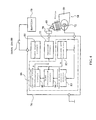
- FIG. 4 is a schematic view, in part similar to FIG. 1. but shows the construction in accordance with an embodiment of the invention.
- FIG. 5 is a view showing the timing sensor associated with the engine shaft for the control system.
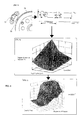
- FIG. 6 is a schematic view showing the method of practicing the invention.
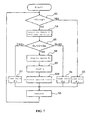
- FIG. 7 is a block diagram showing a control routine, which may be utilized to practice the invention.
- FIG. 8 is an enlarged view of the load determination portion of the diagram of FIG. 6.
- FIG. 9 is a graphical view showing the three-dimensional map utilized to determine the engine timing with respect to engine load and engine speed in FIG. 6.
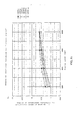
- FIG. 10 is a graphical view showing how the shaft speed varies during the compression stroke with engine speed and load.
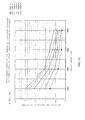
- FIG. 11 shows the same condition but on the exhaust stroke.
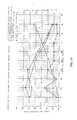
- FIG. 12 is a graphical view showing the difference between the speed variations on the compression and exhaust strokes.
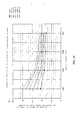
- FIG. 13 is a graphical view showing how the fuel consumption is improved with this method from the conventional prior art method.
- a motorcycle constructed and operated in accordance with the invention is identified generally by the reference numeral 51. It is to be understood that this specific application for the invention is only a typical one with which the invention may be utilized.
- a motorcycle is chosen at the exemplary embodiment because the invention, as should be apparent from the foregoing description, has particular utility in conjunction with relatively small, low production volume engines.
- the simplicity of the invention lends itself to use with other applications such as automotive application due to the improvement in fuel economy and performance without significant cost penalties.
- the motorcycle 51 is comprised of a frame assembly, indicated generally by the reference numeral 52, that dirigibly supports a front wheel 53 on a front fork 54 that is steered by a handle bar assembly 55 in a well-known manner.
- a rear wheel 56 is supported for suspension movement relative to the frame 52 by means that includes a trailing arm assembly 57.
- An engine, indicated generally by the reference numeral 58, and having a combined crankcase transmission assembly 59 is suitably suspended in the frame 52 and drives the rear wheel 56 through a suitable drive arrangement.
- the engine 58 has a carburetor 61 to which fuel is supplied from a fuel tank 62 mounted above the engine 58 on the frame assembly 52.
- a throttle valve is associated with this carburetor 61 and is operated by a twist grip throttle control 63 mounted on the handle bar 55.
- a throttle position sensor 64 is associated with the throttle valve shaft of this throttle valve.
- the engine 58 is provided with one or more spark plugs 65 (FIG. 4) that are fired by the ignition system, which will be described shortly.
- the combustion gases are discharged from the engine exhaust port through an exhaust pipe 66 and muffler 67, which has an atmospheric discharge.
- the engine 58 in accordance with the illustrated embodiment operates on the four stroke principal, but as will become apparent to those skilled in the art, the invention can also be utilized with two cycle engines.
- a seat 68 is positioned on the frame assembly 52 to the rear of the fuel tank 62 for accommodating the rider in a well-known manner.
- the engine 58 has a crankshaft 69 to which a flywheel 71 is affixed for rotation in a known manner.
- a flywheel 71 is affixed for rotation in a known manner.
- the invention is depicted in association with a crankshaft positioned sensor, it may be associated with any other shaft that is driven by the engine in timed relation.
- a pulser type sensor 72 is associated with the flywheel 71 and specifically with a timing mark 73 affixed to its outer peripheral surface.
- the timing mark 73 has a leading edge 74 and a trailing edge 75 which, when passing the sensor 72 will output pulses that can be measured so as to measure the time it takes the timing mark 73 to pass the sensor 72. This constitutes an instantaneous rotational speed for the engine 58 during a portion of a complete rotation.
- the timing mark 73 is considerably wider, in accordance with the invention, than those normally used. Such widening is not necessarily required, but can improve the control.
- the width of the mark 73 be equal to 60°of crankshaft rotation.
- the timing mark is set so that it will first trigger a pulse as the engine begins to approach top dead center (TDC) position and another pulse after the crankshaft is at or near top dead center.
- TDC top dead center
- the specific angles may vary depending upon the particular application.
- the output from the sensor 72 is delivered to an engine system timing control device 76, which contains an ignition circuit 77 which can be basically a conventional ignition circuit of the CDI type, which outputs a signal, "i" to a coil 78 that outputs a pulse "I" for firing the spark plug 65 in a known manner.
- an ignition circuit 77 which can be basically a conventional ignition circuit of the CDI type, which outputs a signal, "i" to a coil 78 that outputs a pulse "I" for firing the spark plug 65 in a known manner.
- This engine timing control system is powered with electrical power from a battery 79 through a main switch 81.
- the output from the sensor 72 is transmitted to a rotational speed detection circuit 82, which outputs a signal N indicative of the rotational speed of the engine during each complete revolution cycle.
- the outputs from the leading and trailing edges 74 and 75 of the timing mark 73 registered on the sensor 72 are transmitted to a degree of rotational variation detector circuit 83.
- This circuit 83 outputs a signal indicative of the speed difference to a load calculation circuit 84.
- the flywheel71 may beformed of a magnetic material, and the sensor or coil72 faces the rotational locus of the timing mark73.
- opposite ends of the timing mark 73 aredetected from changes in magnetic resistance in the magnetic path passing through the iron core of the coil 72.
- the timing mark73 may be formed from permanentmagnets fixed on the flywheel 71 atpositions a given angle away from each other, and the sensor may be a magnetic sensor such as a Hall element for detecting passage of the permanent magnets.
- the mark may be a slit, which may be detected optically with an LED and a ligh iving element.
- the load calculating output circuit operates so as to determine a load factor that is derived from as map shown in FIG. 8. This output is delivered to an ignition timing determination circuit 85 which operates in accordance with the control routine shown in FIGS. 6 and 7 so as to output a signal P to the ignition circuit 77 for firing the spark plug 65 at the appropriate time for the engine speed and engine load.
- the circuit portions 82, 83, 84 and 85 are all located within a CPU 86 of the engine control system 76.
- the basic control method used in connection with the invention is to measure revolution to revolution changes in speed "R". From that difference it is possible to determine engine load. Then by consulting a map of ignition control timing and speed, the appropriate ignition timing can be determined.
- FIG. 6 shows schematically how the output from the rotational sensor, in the specific example the coil 72 outputs its signal to the circuit portions 82 and 83 to determine the degree of rotational variation R.
- a first method to determine the degree of rotational variation R is one in which a ratio of detection time "t" of the projection rotation during a portion of a complete revolution to the period T for a complete rotation including that of the time period t. From these two measurements a ratio is determined and the ratio (t/T) ⁇ R is defined as a degree of rotational variation. This method permits adjustment of the engine control on the very next rotation. This method can be used with both two and four cycle engines.
- TDC Top Dead Center
- values of the rotational variation for every cycle measured during ten periods are averaged to improve the stability of the data.
- the degree-of-rotational variation detection circuit 83 repeats the foregoing calculation in synchronization with the crankshaft rotation.
- the characteristics shown in FIG. 12 are measured on the engine in advance and stored in a memory of a microcomputer. They are stored, for example, as a three-dimensional conversion map shown in FIG. 8.
- the load calculation circuit 84 determines load (load Nm on the rear wheel) from the conversion map in FIG. 8, using the degree of rotational variation D determined by the degree-of-rotational variation detection circuit 83, and engine speed N. This determination is shown in the middle right hand box in FIG. 6.
- the ignition timing determination circuit 85 determines ignition timing ⁇ (Before Top Dead Center "BTDC" in degrees) from the map in FIG. 9, using load L and engine speed N determined by the load calculation circuit 84.
- An ignition signal p corresponding to the ignition timing ⁇ is sent to the ignition circuit 77.
- the ignition circuit 77 causes the spark plug 65 to generatean ignition spark based on the ignition signal p. This is shown in the lower right hand box of FIG. 6 A preferred operation of this embodiment will be described with reference to FIG. 7.
- Step S1 if at the Step S1 it is determined that the engine is running in an idling state,as it will immediately after a warm start up, ignition timing ⁇ is set to a fixed value ⁇ 1 at the step S2. T, and ignition control is performed at the step S3. The program then repeats to the step S1.
- the degree-of-rotational variation detection circuit 83 detects the degree of rotational variation D at the step S4.
- the microcomputer in the electronic circuit 136 determines whether or not the degree of variation D is within a given range of D m to D M at the step S5. If the variation is out of this range, the ignition timing is set to a fixed value ⁇ 2 or ⁇ 3 at either the step S6 or S7.
- the values of the fixed degrees of advance at idle is about 10°before top dead center.
- the values of ⁇ 2 and ⁇ 3 may be in the range of 20°to 30°before top dead center and are set to avoid errors under small deviations in D to avoid the effects of electrical noise .
- the load calculation circuit 84 determines load L using engine speed N determined by the rotational speed detection circuit 82 at the step S8 and looking up the load L from the conversion map of FIG. 8 at the step S9.
- the ignition timing determination circuit 85 determines ignition timing ⁇ at the step S10 using this load L and engine speed N and looking up this value from the conversion map in FIG. 9. The ignition timing determination circuit 85 then sends an ignition signal P corresponding to the read ignition timing ⁇ to the ignition circuit 77, causing the ignition plug 65 to be fired.
- FIG. 13 shows the effect of this embodiment. This figure shows the improvement in fuel consumption from that of a conventional ignition system. It will be seen that fuel consumption is improved by 2-12%.
- An improved method and system for the control of an engine system such as the spark timing.
- the control senses the speed variations either during a portion of a complete cycle and a complete cycle and/or from cycle to cycle in order to determine the load on the engine from preprogrammed maps based upon the engine characteristics. From this load and the speed reading, it is possible to obtain the desired engine control. This not only reduces the costs of the system by reducing the number of sensors, but also permits adjustments to be made more rapidly.
Landscapes
- Engineering & Computer Science (AREA)
- Chemical & Material Sciences (AREA)
- Combustion & Propulsion (AREA)
- Mechanical Engineering (AREA)
- General Engineering & Computer Science (AREA)
- Theoretical Computer Science (AREA)
- Signal Processing (AREA)
- Combined Controls Of Internal Combustion Engines (AREA)
- Electrical Control Of Ignition Timing (AREA)
Abstract
Description
Claims (67)
- An internal combustion engine system control for controlling a system of the engine wherein the engine has a driven shaft, a sensor arrangement associated with said driven shaft for sensing the instantaneous rotational speed of said driven shaft during the rotation of said driven shaft for less than a complete rotation and for sensing the rotational speed of said driven shaft for a complete revolution thereof including the measured less than complete rotation, and controlling said engine system from these measurements.
- An internal combustion engine system control as set forth in claim 1 wherein the sensor arrangement comprises a single sensor.
- An internal combustion engine system control as set forth in claim 2 wherein the control system operated solely in response to the sensed rotational speed condition without any other sensor inputs.
- An internal combustion engine system control as set forth in claim 3 wherein the engine is spark ignited and the engine system controlled comprises at least the spark timing.
- An internal combustion engine system control as set forth in claim 1 wherein the sensor arrangement cooperates with only a single timing mark on the driven shaft.
- An internal combustion engine system control as set forth in claim 5 wherein the single timing mark has a circumferential extent greater than 5 °.
- An internal combustion engine system control as set forth in claim 5 wherein the sensor arrangement comprises a single sensor.
- An internal combustion engine system control as set forth in claim 7 wherein the control system operated solely in response to the sensed rotational speed condition without any other sensor inputs.
- An internal combustion engine system control as set forth in claim 8 wherein the engine is spark ignited and the engine system controlled comprises at least the spark timing.
- An internal combustion engine system control as set forth in claim 1 wherein the control measures the time taken for the less than a complete revolution (t) and the time (T) for the complete revolution to determine the ratio t/T and estimates the engine load therefrom.
- An internal combustion engine system control as set forth in claim 1 wherein the sensor senses the two rotational speeds of said driven shaft during a first rotation of said driven shaft and for sensing same two rotational speeds of said driven shaft during the immediately succeeding rotation of said driven shaft and controls said engine system on the third rotation of said driven shaft from these measurements.
- An internal combustion engine system control as set forth in claim 11 wherein the control measures the time taken for the less than a complete revolution (t) and the time (T) for the complete revolution to determine the ratio t/T during each successive rotation, determines the difference (D) between the two ratios and estimates the engine load therefrom.
- An internal combustion engine system control as set forth in claim 12 wherein the engine is spark ignited and the engine system controlled comprises at least the spark timing
- An internal combustion engine system control as set forth in claim 12 wherein the control sets a fixed value for the engine system if the engine speed is less than a predetermined value.
- An internal combustion engine system control as set forth in claim 14 wherein the predetermined value of the engine speed is a normal idle speed.
- An internal combustion engine system control as set forth in claim 12 wherein the control sets a fixed value for the engine system if the value of D is greater than a predetermined value.
- An internal combustion engine system control as set forth in claim 12 wherein the control sets a fixed value for the engine system if the value of D is less than a predetermined value.
- An internal combustion engine system control as set forth in claim 17 wherein the control sets a different fixed value for the engine system if the engine speed is greater than a predetermined value.
- An internal combustion engine system control as set forth in claim 18 wherein the control sets a still further different fixed value for the engine system if the value of D is less than a predetermined value.
- An internal combustion engine system control as set forth in claim 12 wherein the engine system control is determined using a conversion map for determining engine load based on the value of D and rotational speed of the engine shaft and a conversion map for determining engine control based on engine load and rotational speed of said engine shaft.
- An internal combustion engine system control as set forth in claim 11 wherein the engine operates on a four cycle principle and one of the speed sensings is done on a compression cycle and the other is done on an exhaust cycle.
- An internal combustion engine system control as set forth in claim 21 wherein the engine is spark ignited and the engine system controlled comprises at least the spark timing.
- An internal combustion engine system control as set forth in claim 1 wherein the control system operated solely in response to the sensed rotational speed condition without any other sensor inputs.
- An internal combustion engine system control as set forth in claim 23 wherein the engine is spark ignited and the engine system controlled comprises at least the spark timing.
- An internal combustion engine system control as set forth in claim 1 wherein the engine is spark ignited and the engine system controlled comprises at least the spark timing.
- A four cycle internal combustion engine system control for controlling a system of the engine wherein the engine has a driven shaft, a sensor arrangement associated with said driven shaft for sensing the rotational speed of said driven shaft, said control measuring the rotational speed of said driven shaft during a revolution containing a compression stroke and measuring the rotational speed of said driven shaft during a revolution containing an exhaust stroke and controlling said engine system from these measurements.
- An internal combustion engine system control as set forth in claim 26 wherein the control system operated solely in response to the sensed rotational speed conditions without any other sensor inputs.
- An internal combustion engine system control as set forth in claim 26 wherein the sensor arrangement comprises a single sensor.
- An internal combustion engine system control as set forth in claim 26 wherein the control measures the time taken for the less than a complete revolution (t) and the time (T) for the complete revolution to determine the ratio t/T during each of two successive rotations the engine load therefrom .
- An internal combustion engine system control as set forth in claim 29 wherein the engine system control is determined using a conversion map for determining engine load based on the value of the difference between the two measured ratios and rotational speed of the engine shaft and a conversion map for determining engine control based on engine load and rotational speed of said engine shaft.
- An internal combustion engine system control as set forth in claim 30 wherein the engine is spark ignited and the engine system controlled comprises at least the spark timing.
- An internal combustion engine system control as set forth in claim 26 wherein the engine is spark ignited and the engine system controlled comprises at least the spark timing.
- An internal combustion engine system control for controlling a system of the engine wherein the engine has a driven shaft, a sensor arrangement associated with said driven shaft for sensing two rotational conditions of said driven shaft during a first rotation of said driven shaft and for sensing same two rotational conditions of said driven shaft during the immediately succeeding rotation of said driven shaft and controlling said engine system on the third rotation of said driven shaft from these measurements.
- An internal combustion engine system control as set forth in claim 33 wherein the engine is spark ignited and the engine system controlled comprises at least the spark timing.
- An internal combustion engine system control method for controlling a system of the engine wherein the engine has a driven shaft, a sensor arrangement associated with said driven shaft for sensing rotational speed of said driven shaft, said method comprising the steps of sensing the rotational speed during the rotation of said driven shaft for less than a complete rotation and sensing the rotational speed of said driven shaft for a complete revolution thereof including the measured less than complete rotation, and controlling said engine system from these measurements.
- An internal combustion engine system control method as set forth in claim 35 wherein the sensor arrangement comprises a single sensor.
- An internal combustion engine system control method as set forth in claim 36 wherein the control method is done solely in response to the sensed rotational speed condition without any other sensor inputs.
- An internal combustion engine system control method as set forth in claim 37 wherein the engine is spark ignited and the engine system controlled comprises at least the spark timing.
- An internal combustion engine system control method as set forth in claim 35 wherein the sensor arrangement cooperates with only a single timing mark on the driven shaft.
- An internal combustion engine system control method as set forth in claim 39 wherein the single timing mark has a circumferential extent greater than 5 °.
- An internal combustion engine system control method as set forth in claim 40 wherein the sensor arrangement comprises a single sensor.
- An internal combustion engine system control method as set forth in claim 41 wherein the control method is done solely in response to the sensed rotational speed condition without any other sensor inputs.
- An internal combustion engine system control method as set forth in claim 42 wherein the engine is spark ignited and the engine system controlled comprises at least the spark timing.
- An internal combustion engine system control method as set forth in claim 35 wherein the control measures the time taken for the less than a complete revolution (t) and the time (T) for the complete revolution to determine the ratio t/T and estimates the engine load therefrom.
- An internal combustion engine system control method as set forth in claim 44 wherein the engine is spark ignited and the engine system controlled comprises at least the spark timing.
- An internal combustion engine system control method as set forth in claim 35 wherein two rotational speeds of the driven shaft are measured during a first rotation of said driven shaft and the same two rotational speeds of the driven shaft are measured during the immediately succeeding rotation of the driven shaft and the engine system is controlled on the third rotation of said driven shaft from these measurements.
- An internal combustion engine system control method as set forth in claim 46 wherein the time taken for the less than a complete revolution (t) is measured and the time (T) for the complete revolution is measured to determine the ratio t/T during each successive rotation, determines the difference (D) between the two ratios and estimates the engine load therefrom.
- An internal combustion engine system control method as set forth in claim 77 wherein the engine is spark ignited and the engine system controlled comprises at least the spark timing.
- An internal combustion engine system control method as set forth in claim 47 wherein a fixed value for the engine system is set if the engine speed is less than a predetermined value.
- An internal combustion engine system control method as set forth in claim 49 wherein the predetermined value of the engine speed is a normal idle speed.
- An internal combustion engine system control method as set forth in claim 47 wherein a fixed value for the engine system is set if the value of D is greater than a predetermined value.
- An internal combustion engine system control method as set forth in claim 47 wherein a fixed value for the engine system is set if the value of D is less than a predetermined value.
- An internal combustion engine system control method as set forth in claim 52 wherein a different fixed value for the engine system is set if the engine speed is greater than a predetermined value.
- An internal combustion engine system control method as set forth in claim 53 wherein a still further different fixed value for the engine system is set if the value of D is less than a predetermined value.
- An internal combustion engine system control method as set forth in claim 54 wherein the engine is spark ignited and the engine system controlled comprises at least the spark timing.
- An internal combustion engine system control method as set forth in claim 47 wherein a first conversion map is used for determining engine load based on the value of D and rotational speed of the engine shaft and a second conversion map is used for determining engine control based on engine load and rotational speed of said engine shaft.
- An internal combustion engine system control method as set forth in claim 56 wherein the engine is spark ignited and the engine system controlled comprises at least the spark timing.
- An internal combustion engine system control method as set forth in claim 46 wherein the engine operates on a four cycle principle and one of the speed sensings is done on a compression cycle and the other is done on an exhaust cycle.
- An internal combustion engine system control method as set forth in claim 35 wherein the method is operated solely in response to the sensed rotational speed condition without any other sensor inputs.
- A four cycle internal combustion engine system control method for controlling a system of the engine wherein the engine has a driven shaft, a sensor arrangement associated with said driven shaft for sensing the rotational speed of said driven shaft, said method comprises the steps of measuring the rotational speed of the driven shaft during a revolution containing a compression stroke and measuring the rotational speed of said driven shaft during a revolution containing an exhaust stroke and controlling said engine system from these measurements.
- An internal combustion engine system control method as set forth in claim 60 wherein the method is operated solely in response to the sensed rotational speed conditions without any other sensor inputs.
- An internal combustion engine system control method as set forth in claim 60 wherein the sensor arrangement comprises a single sensor.
- An internal combustion engine system control method as set forth in claim 60 wherein the time taken for the less than a complete revolution (t) is measured and the time (T) for the complete revolution is measured to determine the ratio t/T during each of two successive rotations to determine the engine load therefrom .
- An internal combustion engine system control method as set forth in claim 63 wherein the method uses a first conversion map for determining engine load based on the value of the difference between the two measured ratios and rotational speed of the engine shaft and a second conversion map for determining engine control based on engine load and rotational speed of the engine shaft.
- An internal combustion engine system control method as set forth in claim 64 wherein the engine is spark ignited and the engine system controlled comprises at least the spark timing.
- An internal combustion engine system control method for controlling a system of the engine wherein the engine has a driven shaft, a sensor arrangement associated with said driven shaft, said method comprising sensing two rotational conditions of the driven shaft during a first rotation of the driven shaft and for sensing same two rotational conditions of the driven shaft during the immediately succeeding rotation of said driven shaft and controlling said engine system on the third rotation of the driven shaft from these measurements.
- An internal combustion engine system control method as set forth in claim 66 wherein the engine is spark ignited and the engine system controlled comprises at least the spark timing.
Applications Claiming Priority (4)
| Application Number | Priority Date | Filing Date | Title |
|---|---|---|---|
| JP2000311790 | 2000-10-12 | ||
| JP2000311790A JP4270534B2 (en) | 2000-10-12 | 2000-10-12 | Internal combustion engine load detection method, control method, ignition timing control method, and ignition timing control device |
| US682457 | 2001-09-05 | ||
| US09/682,457 US6626145B2 (en) | 2000-10-12 | 2001-09-05 | Engine control method and apparatus |
Publications (3)
| Publication Number | Publication Date |
|---|---|
| EP1197656A2 true EP1197656A2 (en) | 2002-04-17 |
| EP1197656A3 EP1197656A3 (en) | 2005-12-14 |
| EP1197656B1 EP1197656B1 (en) | 2008-02-20 |
Family
ID=26601961
Family Applications (1)
| Application Number | Title | Priority Date | Filing Date |
|---|---|---|---|
| EP01122442A Expired - Lifetime EP1197656B1 (en) | 2000-10-12 | 2001-09-20 | Engine control method and apparatus |
Country Status (3)
| Country | Link |
|---|---|
| EP (1) | EP1197656B1 (en) |
| CN (1) | CN1349045A (en) |
| TW (1) | TW496928B (en) |
Families Citing this family (1)
| Publication number | Priority date | Publication date | Assignee | Title |
|---|---|---|---|---|
| JP5197528B2 (en) * | 2008-12-25 | 2013-05-15 | 本田技研工業株式会社 | Engine load detection device and engine load detection method |
Family Cites Families (4)
| Publication number | Priority date | Publication date | Assignee | Title |
|---|---|---|---|---|
| FR2374528A1 (en) * | 1976-12-17 | 1978-07-13 | Cii | ELECTRONIC IGNITION SYSTEM AND INTERNAL COMBUSTION ENGINE EQUIPPED WITH SUCH A SYSTEM |
| DE3611262A1 (en) * | 1986-04-04 | 1987-10-08 | Bosch Gmbh Robert | METHOD FOR DETECTING THE WORKING STATE OF A CYLINDER OF AN INTERNAL COMBUSTION ENGINE |
| US5050554A (en) * | 1989-04-26 | 1991-09-24 | Nippondenso Co., Ltd. | Ignition timing control apparatus for engines |
| JP2813239B2 (en) * | 1990-06-29 | 1998-10-22 | ヤマハ発動機株式会社 | Engine control device |
-
2001
- 2001-09-20 EP EP01122442A patent/EP1197656B1/en not_active Expired - Lifetime
- 2001-09-25 TW TW090123608A patent/TW496928B/en not_active IP Right Cessation
- 2001-10-11 CN CN01137978A patent/CN1349045A/en active Pending
Also Published As
| Publication number | Publication date |
|---|---|
| CN1349045A (en) | 2002-05-15 |
| EP1197656A3 (en) | 2005-12-14 |
| TW496928B (en) | 2002-08-01 |
| EP1197656B1 (en) | 2008-02-20 |
Similar Documents
| Publication | Publication Date | Title |
|---|---|---|
| US6626145B2 (en) | Engine control method and apparatus | |
| US4913118A (en) | Fuel injection control system for an automotive engine | |
| US6640777B2 (en) | Method and device for controlling fuel injection in internal combustion engine | |
| US6742502B2 (en) | Engine control method and apparatus | |
| US5325710A (en) | Crank angle detecting system for a two-cycle engine | |
| US7048670B2 (en) | Engine control method and device for a vehicle | |
| JPH0419342A (en) | Operation control method of internal combustion engine and electric controller therefor | |
| EP1197656B1 (en) | Engine control method and apparatus | |
| US6840236B2 (en) | Engine control device | |
| EP1471251A1 (en) | Engine control method and apparatus | |
| EP1283358A2 (en) | Engine control method and device for a vehicle | |
| JP4529306B2 (en) | Engine actual torque calculation device | |
| JP3992957B2 (en) | Ignition timing control method and ignition timing control device for small vehicle | |
| US6895908B2 (en) | Exhaust timing controller for two-stroke engine | |
| JP3882323B2 (en) | Fuel property determination device | |
| JP2580645B2 (en) | Ignition timing control device | |
| JPH06625Y2 (en) | Control device for internal combustion engine | |
| JPH07279739A (en) | Fuel property detection device for internal combustion engine | |
| JPH0710059Y2 (en) | Engine ignition timing control device | |
| JPH06288289A (en) | Fuel property determination device for internal combustion engine | |
| JP2002180868A (en) | Fuel injection control method and device for internal combustion engine | |
| JPH0751929B2 (en) | Ignition timing control device for internal combustion engine | |
| JPH0169154U (en) | ||
| JPS61171851U (en) | ||
| JPH01148047U (en) |
Legal Events
| Date | Code | Title | Description |
|---|---|---|---|
| PUAI | Public reference made under article 153(3) epc to a published international application that has entered the european phase |
Free format text: ORIGINAL CODE: 0009012 |
|
| AK | Designated contracting states |
Kind code of ref document: A2 Designated state(s): AT BE CH CY DE DK ES FI FR GB GR IE IT LI LU MC NL PT SE TR |
|
| AX | Request for extension of the european patent |
Free format text: AL;LT;LV;MK;RO;SI |
|
| PUAL | Search report despatched |
Free format text: ORIGINAL CODE: 0009013 |
|
| AK | Designated contracting states |
Kind code of ref document: A3 Designated state(s): AT BE CH CY DE DK ES FI FR GB GR IE IT LI LU MC NL PT SE TR |
|
| AX | Request for extension of the european patent |
Extension state: AL LT LV MK RO SI |
|
| 17P | Request for examination filed |
Effective date: 20060602 |
|
| AKX | Designation fees paid |
Designated state(s): DE FR GB IT |
|
| 17Q | First examination report despatched |
Effective date: 20060801 |
|
| GRAP | Despatch of communication of intention to grant a patent |
Free format text: ORIGINAL CODE: EPIDOSNIGR1 |
|
| RIC1 | Information provided on ipc code assigned before grant |
Ipc: F02D 37/02 20060101ALI20070824BHEP Ipc: F02P 5/04 20060101ALI20070824BHEP Ipc: F02P 5/06 20060101AFI20070824BHEP |
|
| GRAS | Grant fee paid |
Free format text: ORIGINAL CODE: EPIDOSNIGR3 |
|
| GRAA | (expected) grant |
Free format text: ORIGINAL CODE: 0009210 |
|
| AK | Designated contracting states |
Kind code of ref document: B1 Designated state(s): DE FR GB IT |
|
| REG | Reference to a national code |
Ref country code: GB Ref legal event code: FG4D |
|
| REF | Corresponds to: |
Ref document number: 60132867 Country of ref document: DE Date of ref document: 20080403 Kind code of ref document: P |
|
| EN | Fr: translation not filed | ||
| PLBE | No opposition filed within time limit |
Free format text: ORIGINAL CODE: 0009261 |
|
| STAA | Information on the status of an ep patent application or granted ep patent |
Free format text: STATUS: NO OPPOSITION FILED WITHIN TIME LIMIT |
|
| 26N | No opposition filed |
Effective date: 20081121 |
|
| PG25 | Lapsed in a contracting state [announced via postgrant information from national office to epo] |
Ref country code: FR Free format text: LAPSE BECAUSE OF FAILURE TO SUBMIT A TRANSLATION OF THE DESCRIPTION OR TO PAY THE FEE WITHIN THE PRESCRIBED TIME-LIMIT Effective date: 20081212 |
|
| GBPC | Gb: european patent ceased through non-payment of renewal fee |
Effective date: 20080920 |
|
| PG25 | Lapsed in a contracting state [announced via postgrant information from national office to epo] |
Ref country code: GB Free format text: LAPSE BECAUSE OF NON-PAYMENT OF DUE FEES Effective date: 20080920 |
|
| PGFP | Annual fee paid to national office [announced via postgrant information from national office to epo] |
Ref country code: DE Payment date: 20120921 Year of fee payment: 12 |
|
| REG | Reference to a national code |
Ref country code: DE Ref legal event code: R119 Ref document number: 60132867 Country of ref document: DE Effective date: 20140401 |
|
| PG25 | Lapsed in a contracting state [announced via postgrant information from national office to epo] |
Ref country code: DE Free format text: LAPSE BECAUSE OF NON-PAYMENT OF DUE FEES Effective date: 20140401 |
|
| PGFP | Annual fee paid to national office [announced via postgrant information from national office to epo] |
Ref country code: IT Payment date: 20180925 Year of fee payment: 18 |
|
| PG25 | Lapsed in a contracting state [announced via postgrant information from national office to epo] |
Ref country code: IT Free format text: LAPSE BECAUSE OF NON-PAYMENT OF DUE FEES Effective date: 20190920 |