EP1197538A2 - Aqueous coating composition - Google Patents
Aqueous coating composition Download PDFInfo
- Publication number
- EP1197538A2 EP1197538A2 EP01124034A EP01124034A EP1197538A2 EP 1197538 A2 EP1197538 A2 EP 1197538A2 EP 01124034 A EP01124034 A EP 01124034A EP 01124034 A EP01124034 A EP 01124034A EP 1197538 A2 EP1197538 A2 EP 1197538A2
- Authority
- EP
- European Patent Office
- Prior art keywords
- group
- alkyl group
- carbon atoms
- general formula
- represented
- Prior art date
- Legal status (The legal status is an assumption and is not a legal conclusion. Google has not performed a legal analysis and makes no representation as to the accuracy of the status listed.)
- Granted
Links
Classifications
-
- C—CHEMISTRY; METALLURGY
- C09—DYES; PAINTS; POLISHES; NATURAL RESINS; ADHESIVES; COMPOSITIONS NOT OTHERWISE PROVIDED FOR; APPLICATIONS OF MATERIALS NOT OTHERWISE PROVIDED FOR
- C09D—COATING COMPOSITIONS, e.g. PAINTS, VARNISHES OR LACQUERS; FILLING PASTES; CHEMICAL PAINT OR INK REMOVERS; INKS; CORRECTING FLUIDS; WOODSTAINS; PASTES OR SOLIDS FOR COLOURING OR PRINTING; USE OF MATERIALS THEREFOR
- C09D183/00—Coating compositions based on macromolecular compounds obtained by reactions forming in the main chain of the macromolecule a linkage containing silicon, with or without sulfur, nitrogen, oxygen, or carbon only; Coating compositions based on derivatives of such polymers
- C09D183/04—Polysiloxanes
- C09D183/08—Polysiloxanes containing silicon bound to organic groups containing atoms other than carbon, hydrogen, and oxygen
-
- C—CHEMISTRY; METALLURGY
- C08—ORGANIC MACROMOLECULAR COMPOUNDS; THEIR PREPARATION OR CHEMICAL WORKING-UP; COMPOSITIONS BASED THEREON
- C08K—Use of inorganic or non-macromolecular organic substances as compounding ingredients
- C08K5/00—Use of organic ingredients
- C08K5/04—Oxygen-containing compounds
- C08K5/06—Ethers; Acetals; Ketals; Ortho-esters
-
- Y—GENERAL TAGGING OF NEW TECHNOLOGICAL DEVELOPMENTS; GENERAL TAGGING OF CROSS-SECTIONAL TECHNOLOGIES SPANNING OVER SEVERAL SECTIONS OF THE IPC; TECHNICAL SUBJECTS COVERED BY FORMER USPC CROSS-REFERENCE ART COLLECTIONS [XRACs] AND DIGESTS
- Y10—TECHNICAL SUBJECTS COVERED BY FORMER USPC
- Y10T—TECHNICAL SUBJECTS COVERED BY FORMER US CLASSIFICATION
- Y10T428/00—Stock material or miscellaneous articles
- Y10T428/31504—Composite [nonstructural laminate]
- Y10T428/31652—Of asbestos
- Y10T428/31663—As siloxane, silicone or silane
Definitions
- This invention relates to an aqueous coating composition which contains an amino group-containing organopolysiloxane and a surface-active agent and has superior uniform-coating properties and storage stability.
- Amino group-containing organopolysiloxanes can be made water-soluble even in a high concentration because of the polar effect of amino groups, and are used as primers for metal or metal oxide surfaces, additives of acrylic latex sealants, coupling agents for particle surfaces of inorganic fillers such as silica, and binding agents of aqueous coating materials. They are also used as aqueous materials for the formation of organic glass films in semiconductor device fabrication processes.
- aqueous solutions of amino group-containing organopolysiloxanes have a high surface tension, and hence there has been a problem that the phenomenon of cissing may occur when coated on the surfaces of metals, metal oxides or organic coatings, in particular, on flat-plate surfaces, so that any uniform coatings can not be formed.
- An object of the present invention is to provide an aqueous coating composition which contains an amino group-containing organopolysiloxane and a surface-active agent and has superior uniform-coating properties and storage stability.
- the present invention provides an aqueous coating composition
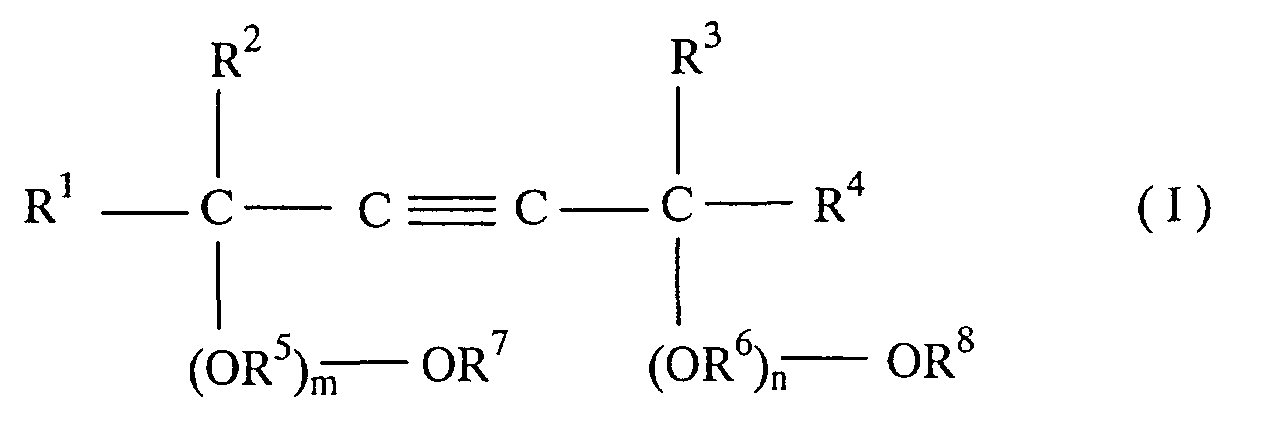
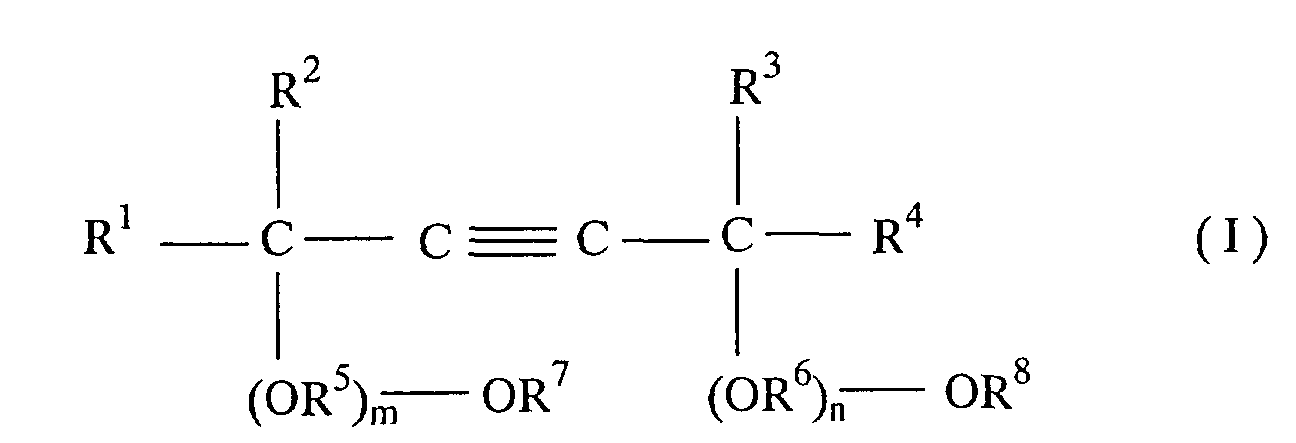
- a surface-active agent represented by the following general formula (I): wherein R 1 to R 4 are each independently an alkyl group having 1 to 8 carbon atoms, R 5 and R 6 are each independently an alkylene group having 1 to 6 carbon atoms, R 7 and R 8 are each independently a member selected from the group consisting of a hydrogen atom, an alkyl group having 1 to 6 carbon atoms and an acyl group having 2 to 6 carbon atoms, and m and n are each an integer of 0 to 40, provided that m and n are not 0 at the same time and that the value of m + n is a number of 1 to 40 on the average; and ii) a nonionic surface-active agent containing a perfluoroalkyl group and an alkylene oxide group; the component (C)
- the aqueous coating composition of the present invention comprises (A) an amino group-containing organopolysiloxane, (B) water and (C) at least one of a specific surface-active agent and a nonionic surface-active agent.
- One of the surface-active agents used in the present invention is an addition product of alkylene oxide to acetylene glycol, represented by the following general formula (I): wherein R 1 to R 4 are each independently an alkyl group having 1 to 8 carbon atoms, R 5 and R 6 are each independently an alkylene group having 1 to 6 carbon atoms, R 7 and R 8 are each independently a group selected from a hydrogen atom, an alkyl group having 1 to 6 carbon atoms and an acyl group having 2 to 6 carbon atoms, and m and n are each an integer of 0 to 40, provided that m and n are not 0 at the same time and that the value of m + n is a number of 1 to 40 on the average.
- general formula (I) wherein R 1 to R 4 are each independently an alkyl group having 1 to 8 carbon atoms, R 5 and R 6 are each independently an alkylene group having 1 to 6 carbon atoms, R 7 and R 8 are each independently a group selected from a
- the alkyl group represented by R 1 to R 4 may be straight-chain or branched, and may include, e.g., a methyl group, an ethyl group, a propyl group, an isopropyl group, a n-butyl group, an isobutyl group, a sec-butyl group, a t-butyl group, a pentyl group, a hexyl group, a heptyl group and an octyl group.
- the alkylene group represented by R 5 and R 6 may include, e.g., a methylene group, an ethylene group, a propylene group and a butylene group.
- the alkyl group represented by R 7 and R 8 may include, e.g., a methyl group, an ethyl group and a propyl group, and the acyl group may include an acetyl group.
- the surface-active agent represented by the general formula (I) may include compounds represented by the following general formula (IV): wherein m and n are each an integer of 0 to 40, provided that m and n are not 0 at the same time and that the value of m + n is a number of 1 to 40 on the average.
- Compound having the general formula (IV) wherein the values of m + n are 1.3, 3.5, 10 and 30 on the average are commercially available from Nissin Chemical Industry Co., Ltd. under trade names of SURFINOL 420, 440, 465 and 485, respectively.
- the other surface-active agent used in the present invention is a nonionic surface-active agent containing a perfluoroalkyl group and an alkylene oxide group.
- this surface-active agent may include alkylene oxide addition products having a polyethylene oxide chain with 10 or 20 ethylene oxide units, and more specifically include MEGAFAC F-142D and F-144D, available from Dainippon Ink & Chemicals, Incorporated, and STARGENT FT-250 and FT-250H, available from NEOS Company Limited.
- any of these surface-active agents may be added in an amount of from 0.01 to 5% by weight, and more preferably from 0.05 to 0.2% by weight, based on the total weight of the components (A) to (C). If it is added in an amount smaller than 0.01% by weight, the surface tension does not well lower and the resultant coatings can not be uniform. Even if it is added in an amount larger than 5% by weight, the effect attributable to its addition may no longer be improved, resulting in an economical disadvantage. Other surface-active agent may also be added as long as the effect of the present invention is not damaged.
- amino group-containing organopolysiloxane used in the present invention, as long as it is water-soluble and capable of forming films.
- the chemical structure and composition may be selected according to its uses, purposes, desired properties and so forth.
- the amino group-containing organopolysiloxane is a hydrolysis condensation product of an amino group-containing alkoxysilane represented by the following general formula (II): R 9 R 10 p Si(OR 11 ) 3-p wherein R 9 is an amino group-substituted alkyl group, R 10 is an alkyl group having 1 to 8 carbon atoms, R 11 is an alkyl group having 1 to 6 carbon atoms, and p is an integer of 0 to 2.
- the amino group-substituted alkyl group represented by R 9 is a group represented by the following general formula (V): R 14 R 15 N-(CH 2 ) y - wherein R 14 is a member selected from the group consisting of a hydrogen atom, a phenyl group, an alkyl group having 1 to 6 carbon atoms and a group represented by the following general formula (VI): R 16 R 17 N-(CH 2 ) x - wherein R 16 and R 17 are each independently a group selected from a hydrogen atom and an alkyl group having 1 to 6 carbon atoms, and x is an integer of 1 to 12; and R 15 is a group selected from a hydrogen atom and an alkyl group having 1 to 6 carbon atoms, and y is an integer of 1 to 12.
- the amino group-substituted alkyl group may include, e.g., a ⁇ -aminopropyl group, an N-( ⁇ -aminoethyl)- ⁇ -aminopropyl group, an N-cyclohexyl- ⁇ -aminopropyl group, and a ⁇ -anilinopropyl group.
- the alkyl group represented by R 10 may include groups exemplified for the above R 1 .
- the alkyl group represented by R 11 may include, e.g., a methyl group, an ethyl group and a propyl group.
- the alkyl group represented by R 14 and R 15 may include, e.g., a methyl group, an ethyl group and a propyl group.
- the alkyl group represented by R 16 and R 17 may include, e.g., a methyl group, an ethyl group and a propyl group.
- the amino group-containing organopolysiloxane may include a co-hydrolysis-condensation product of i) an amino group-containing alkoxysilane represented by the following general formula (II): R 9 R 10 p Si(OR 11 ) 3-p wherein R 9 , R 10 , R 11 and P are as defined above; and ii) an alkoxysilane group represented by the following general formula (III): R 12 4-a Si(OR 13 ) a wherein R 12 is a group selected from an alkyl group having 1 to 6 carbon atoms, a substituted alkyl group, an aryl group and a vinyl group; and R 13 is an alkyl group having 1 to 6 carbon atoms; and a is an integer of 1 to 4.
- R 12 is a group selected from an alkyl group having 1 to 6 carbon atoms, a substituted alkyl group, an aryl group and a vinyl group
- R 13 is an alkyl group having 1 to 6 carbon
- the alkyl group represented by R 12 may include, e.g., a methyl group, an ethyl group and a propyl group
- the substituted alkyl group may include, e.g., a chloromethyl group, a chloropropyl group and a trifluoropropyl group
- the aryl group may include, e.g., a phenyl group.
- the alkyl group represented by R 13 may include, e.g., a methyl group, an ethyl group and a propyl group.
- the amino group-containing organopolysiloxane which may be used in the present invention is obtained by subjecting the amino group-containing alkoxysilane represented by the general formula (II) or a mixture of the amino group-containing alkoxysilane represented by the general formula (II) and the alkoxysilane group represented by the general formula (III), to hydrolysis and condensation reaction in the presence of water.
- the amino group-containing alkoxysilane represented by the general formula (II) and the alkoxysilane group represented by the general formula (III) may suitably be mixed in such a proportion that the latter is from 3 to 100 parts by weight, and preferably from 5 to 50 parts by weight, based on 100 parts by weight of the former. If the latter is in a proportion larger than the above range, the co-hydrolysis-condensation product obtained does not dissolve or disperse stably in the water, resulting in a poor storage stability. If on the other hand the latter is less than the above range, the films obtained may have a poor resistance to water, undesirably.
- the water used in the hydrolysis may suitably be in an quantity which comes to at least 0.5 mole, and preferably at least 1 mole, per mole of a hydrolyzable functional group. If the water is in a quantity smaller than that, the hydrolyzable functional group can not be hydrolyzed in its entire quantity, and an alcohol may be produced on lapse of time after dilution with water.
- an alcohol may be made present together with the water in order to prevent gelation.
- Such an alcohol may include, e.g., methanol, ethanol, propanol, isopropanol and butanol.
- the hydrolysis condensation reaction may preferably be carried out in a process of carrying out the reaction usually at 40 to 80°C, and preferably at 45 to 70°C, for 1 to 5 hours. Processes are by no means limited thereto.
- an alcohol remains in its solution because an alcohol is produced as a result of the hydrolysis condensation reaction described above and because an alcohol may be used as a solvent. Accordingly, the alcohol may be desirably removed by evaporation. Especially when there are problems that any remaining alcohol dissolves substrates or lowers uniform coating properties, a product from which the alcohol has been evaporated off may preferably be used.
- diluting water may be added to an aqueous amino group-containing organopolysiloxane solution obtained as described above from which the alcohol has been removed. It may be so added that the aqueous solution obtained finally be in a solid content of from 5 to 60% by weight, and particularly preferably from 10 to 40% by weight.
- the alcohol contained in the aqueous coating composition is controlled to be in an amount of 10% by weight or less, preferably 3% by weight or less, and particularly preferably 1% by weight or less. If it is in an amount more than 10% by weight, it may cause a problem on environment, may attack coating objects comprised of organic resins or the like by dissolution or swelling, or may lower uniform coating properties.
- the aqueous coating composition of the present invention may be applied or coated on the surfaces of objects by, e.g., brushing, spraying, roll coating, dipping or spin coating, followed by curing at normal temperatures or an elevated temperature, or by baking at a temperature of 300°C or lower to form a cured or hardened coating film.
- the objects to be coated may include various coating objects such as inorganic ceramic substrates, metallic substrates made of stainless steel or aluminum, glass substrates, plastic substrates, metals for semiconductor devices, metal oxides, and organic resin substrates.
- the aqueous coating composition was stored at 50°C for 3 days, and thereafter evaluated in the same manner as the above. The results are shown in Table 1.
- An aqueous coating composition was obtained in the same manner as in Example 1 except that, when the aqueous coating composition was prepared, the surface-active agent SURFINOL 465 [available from Nissin Chemical Industry Co., Ltd.; a surface-active agent represented by the general formula (IV)] was added in an amount changed to 0.147 g. In this composition, the surface-active agent was in a content of 0.05% by weight. Using this composition, evaluation was made in the same manner as in Example 1. The results are shown in Table 1.
- An aqueous coating composition was obtained in the same manner as in Example 1 except that, when the aqueous coating composition was prepared, in place of the surface-active agent SURFINOL 465 (available from Nissin Chemical Industry Co. , Ltd.), MEGAFAC F-144D (available from Dainippon Ink & Chemicals, Incorporated; the nonionic surface-active agent containing a perfluoroalkyl group and an alkylene oxide group) was used. In this composition, the surface-active agent was in a concentration of 0.2% by weight. Using this composition, evaluation was made in the same manner as in Example 1. The results are shown in Table 1.
- An aqueous coating composition was obtained in the same manner as in Example 1 except that, when the aqueous coating composition was prepared, in replace of the surface-active agent SURFINOL 465 (available from Nissin Chemical Industry Co., Ltd.), STARGENT FT-250H (available from NEOS Company Limited; the nonionic surface-active agent containing a perfluoroalkyl group and an alkylene oxide group) was used.
- the surface-active agent was in a concentration of 0.2% by weight.
- evaluation was made in the same manner as in Example 1. The results are shown in Table 1.
- an aqueous coating composition with a solid content of 10% by weight was obtained in the same manner as in Example 1 and was evaluated in the same way.
- the results are shown in Table 1.
- the surface-active agent was in a content of 0.2% by weight, and the alcohol content was 0.6% by weight.
- an aqueous coating composition with a solid content of 10% by weight was obtained in the same manner as in Example 1 and was evaluated in the same way. The results are shown in Table 1.
- the surface-active agent was in a content of 0.2% by weight, and any alcohol content was not detected.
- an aqueous coating composition with a solid content of 10% by weight was obtained in the same manner as in Example 1 and was evaluated in the same way. The results are shown in Table 1.
- the surface-active agent was in a content of 0.2% by weight, and any alcohol content was not detected.
- An aqueous coating composition was obtained in the same manner as in Example 1 except that, when the aqueous coating composition was prepared, the surface-active agent SURFINOL 465 [available from Nissin Chemical Industry Co., Ltd.; a surface-active agent represented by the general formula (IV)] was added in an amount changed to 0.015 g. In this composition, the surface-active agent was in a content of 0.005% by weight. Using this composition, evaluation was made in the same manner as in Example 1. The results are shown in Table 2.
- aqueous coating composition was obtained in the same manner as in Example 1 except that, when the aqueous coating composition was prepared, the surface-active agent SURFINOL 465 (available from Nissin Chemical Industry Co. , Ltd.) was not added. Using this composition, evaluation was made in the same manner as in Example 1. The results are shown in Table 2.
- Aqueous coating compositions were obtained in the same manner as in Example 1 except that, when the aqueous coating composition was prepared, in place of the surface-active agent SURFINOL 465 (available fromNissin Chemical Industry Co. , Ltd.), the following surface-active agents were used. Using these compositions, evaluation was made in the same manner as in Example 1. The results are shown in Tables 2 and 3. In these compositions, the surface-active agent was in a content of 0.2% by weight.
- Aqueous coating compositions were obtained in the same manner as in Example 1 except that, when the aqueous coating composition was prepared, in place of the surface-active agent SURFINOL 465 (available from Nissin Chemical Industry Co., Ltd.), the following surface-active agents were used. In the cases when the following surface-active agents were used, however, the coating compositions obtained were seen to have caused faulty mixing such as milkiness and flotation, and were not evaluated after all.
- SURFINOL 465 available from Nissin Chemical Industry Co., Ltd.
- Example 1 2 3 4 5 6 7 Amino group-containing organopolysiloxane: a a a a b c d Surface-active agent: SURFINOL SURFINOL MEGAFAC F- STARGENT FT- SURFINOL SURFINOL SURFINOL 465 465 144D 250H 465 465 465 Amount of surface-active agent (wt.%): 0.2 0.05 0.2 0.2 0.2 0.2 0.2 0.2 0.2 0.2 0.2 0.2 0.2 0.2 Surface tension (dyne/cm): 31.6 38.2 - - 33.5 31.6 32.2 External External appearance: ⁇ ⁇ ⁇ ⁇ ⁇ ⁇ ⁇ ⁇ Comparative Example 1 2 3 4 5 6 7 8 Amino group-containing organopolysiloxane: a a a a a a a a a a a a a a a a a a a a a a a a
- the aqueous coating composition of the present invention has superior storage stability. Also, especially when coated on flat-plate surfaces, uniform coating films can be formed.
- the present composition can preferably be utilized as a primer paint for metal or metal oxide surfaces or as a material for the formation of organic glass films in semiconductor device fabrication processes.
Landscapes
- Chemical & Material Sciences (AREA)
- Chemical Kinetics & Catalysis (AREA)
- Organic Chemistry (AREA)
- Engineering & Computer Science (AREA)
- Materials Engineering (AREA)
- Wood Science & Technology (AREA)
- Life Sciences & Earth Sciences (AREA)
- Health & Medical Sciences (AREA)
- Medicinal Chemistry (AREA)
- Polymers & Plastics (AREA)
- Paints Or Removers (AREA)
- Silicon Polymers (AREA)
- Compositions Of Macromolecular Compounds (AREA)
Abstract
Description

the component (C) being present in a content of from 0.01% by weight to 5% by weight based on the total weight of the components (A), (B) and (C), and an alcohol being present in the composition in an amount not more than 10% by weight of the total weight of the composition.


R15 is a group selected from a hydrogen atom and an alkyl group having 1 to 6 carbon atoms, and y is an integer of 1 to 12.
ii) an alkoxysilane group represented by the following general formula (III):
| Example | 1 | 2 | 3 | 4 | 5 | 6 | 7 |
| Amino group-containing organopolysiloxane: | a | a | a | a | b | c | d |
| Surface-active agent: | SURFINOL | SURFINOL | MEGAFAC F- | STARGENT FT- | SURFINOL | SURFINOL | SURFINOL |
| 465 | 465 | 144D | 250H | 465 | 465 | 465 | |
| Amount of surface-active agent (wt.%): | 0.2 | 0.05 | 0.2 | 0.2 | 0.2 | 0.2 | 0.2 |
| Surface tension (dyne/cm): | 31.6 | 38.2 | - | - | 33.5 | 31.6 | 32.2 |
| External External appearance: | ○ | ○ | ○ | ○ | ○ | ○ | ○ |
| External appearance: | ○ | ○ | ○ | ○ | ○ | ○ | ○ |
| Comparative Example | 1 | 2 | 3 | 4 | 5 | 6 | 7 | 8 |
| Amino group-containing organopolysiloxane: | a | a | a | a | a | a | a | a |
| Surface-active agent: | SURFINOL 465 | - | A | B | C | D | E | F |
| Amount of surface-active agent (wt.%): | 0.005 | 0 | 0.2 | 0.2 | 0.2 | 0.2 | 0.2 | 0.2 |
| Surface tension (dyne/cm): | 48.0 | 64.4 | - | - | - | - | - | - |
| External appearance: | Δ | × | ○ | ○ | × | × | × | Δ |
| External appearance: | X | × | × | × | × | × | × | Δ |
| Comparative Example | 9 | 10 | 11 | 12 | 13 | 14 | 15 | 27 |
| Amino group-containing organopolysiloxane: | a | a | a | a | a | a | a | e |
| Surface-active agent: | G | H | I | J | K | L | M | SURFINOL 465 |
| Amount of surface-active agent (wt.%): | 0.2 | 0.2 | 0.2 | 0.2 | 0.2 | 0.2 | 0.2 | 0.2 |
| Surface tension (dyne/cm): | - | - | - | - | - | - | - | - |
| External appearance: | Δ | × | × | Δ | × | Δ | Δ | X |
| External appearance: | Δ | × | × | × | × | Δ | Δ | X |
Claims (11)
- An aqueous coating composition comprising (A) an amino group-containing organopolysiloxane, (B) water and (C) at least one of (i) a surface-active agent represented by the following general formula (I):wherein R1 to R4 are each independently an alkyl group having 1 to 8 carbon atoms, R5 and R6 are each independently an alkylene group having 1 to 6 carbon atoms, R7 and R8 are each independently a member selected from the group consisting of a hydrogen atom, an alkyl group having 1 to 6 carbon atoms and an acyl group having 2 to 6 carbon atoms, and m and n are each an integer of 0 to 40, provided that m and n are not 0 at the same time and that the value of m + n is a number of 1 to 40 on the average; and (ii) a nonionic surface-active agent containing a perfluoroalkyl group and an alkylene oxide group;
the component (C) being present in a content of from 0.01% by weight to 5% by weight based on the total weight of the components (A), (B) and (C), and an alcohol being present in the composition in an amount not more than 10% by weight of the total weight of the composition. - The composition according to claim 1, wherein the surface-active agent is represented by the following general formula (IV):wherein m and n are each an integer of 0 to 40, provided that m and n are not 0 at the same time and that the value of m + n is a number of 1 to 40 on the average.

- The composition according to claim 1, wherein the nonionic surface-active agent containing a perfluoroalkyl group and an alkylene oxide group has a polyalkylene oxide chain with 10 to 20 ethylene oxide units.
- The composition according to claim 1, wherein the component (C) is present in an amount of 0.05 to 0.2% by weight based on the total weight of the components (A), (B) and (C).
- The composition according to claim 1, wherein said amino group-containing organopolysiloxane of the component (A) is a hydrolysis-condensation product of an amino group-containing alkoxysilane represented by the following general formula (II):
- The composition according to claim 5, wherein the amino group-substituted alkyl group represented by R9 is a group represented by the following general formula (V):wherein R14 is a member selected from the group consisting of a hydrogen atom, a phenyl group, an alkyl group having 1 to 6 carbon atoms and a group represented by the following general formula (VI):wherein R16 and R17 are each independently a group selected from a hydrogen atom and an alkyl group having 1 to 6 carbon atoms, and x is an integer of 1 to 12; andR15 is a member selected from the group consisting of a hydrogen atom and an alkyl group having 1 to 6 carbon atoms, and y is an integer of 1 to 12.
- The composition according to claim 1, wherein said amino group-containing organopolysiloxane of the component (A) is a co-hydrolysis-condensation product of an amino group-containing alkoxysilane represented by the following general formula (II):wherein R9, R10 and R11 are as defined above; and an alkoxysilane represented by the following general formula (III):wherein R12 is a group selected from an alkyl group having 1 to 6 carbon atoms, a substituted alkyl group, an aryl group and a vinyl group; and R13 is an alkyl group having 1 to 6 carbon atoms; and a is an integer of 1 to 4.
- The composition according to claim 7, wherein the amino group-substituted alkyl group represented by R9 is a group represented by the following general formula (V):wherein R14 is a member selected from the group consisting of a hydrogen atom, a phenyl group, an alkyl group having 1 to 6 carbon atoms and a group represented by the following general formula (VI):wherein R16 and R17 are each independently a group selected from a hydrogen atom and an alkyl group having 1 to 6 carbon atoms, and x is an integer of 1 to 12; andR15 is a member selected from the group consisting of a hydrogen atom and an alkyl group having 1 to 6 carbon atoms, and y is an integer of 1 to 12.
- The composition according to claim 7, wherein said co-hydrolysis-condensation product is produced from the hydrolysis and condensation of the amino group-containing alkoxysilane represented by the general formula (II) in an amount of 100 parts by weight and the alkoxysilane group represented by the general formula (III) in an amount of 3 to 100 parts by weight.
- The composition according to Claim 1, wherein said alcohol is present in an amount not more than 3% by weight of the total weight of the composition.
- A coating film obtained by curing or baking the composition as defined in claim 1 applied on an object.
Applications Claiming Priority (2)
| Application Number | Priority Date | Filing Date | Title |
|---|---|---|---|
| JP2000314034A JP3640380B2 (en) | 2000-10-13 | 2000-10-13 | Aqueous coating composition |
| JP2000314034 | 2000-10-13 |
Publications (3)
| Publication Number | Publication Date |
|---|---|
| EP1197538A2 true EP1197538A2 (en) | 2002-04-17 |
| EP1197538A3 EP1197538A3 (en) | 2003-03-26 |
| EP1197538B1 EP1197538B1 (en) | 2006-11-29 |
Family
ID=18793355
Family Applications (1)
| Application Number | Title | Priority Date | Filing Date |
|---|---|---|---|
| EP01124034A Expired - Lifetime EP1197538B1 (en) | 2000-10-13 | 2001-10-09 | Aqueous coating composition |
Country Status (4)
| Country | Link |
|---|---|
| US (1) | US6656598B2 (en) |
| EP (1) | EP1197538B1 (en) |
| JP (1) | JP3640380B2 (en) |
| DE (1) | DE60124839T2 (en) |
Cited By (1)
| Publication number | Priority date | Publication date | Assignee | Title |
|---|---|---|---|---|
| WO2014209832A1 (en) * | 2013-06-28 | 2014-12-31 | 3M Innovative Properties Company | Article with silanol coating and method of making |
Families Citing this family (5)
| Publication number | Priority date | Publication date | Assignee | Title |
|---|---|---|---|---|
| JP4539815B2 (en) * | 2003-02-19 | 2010-09-08 | 信越化学工業株式会社 | Scratch shielding agent for glass container and glass container |
| US8216673B2 (en) * | 2005-08-03 | 2012-07-10 | Nissin Chemical Industry Co., Ltd. | Glass fiber-treating agent and glass fiber-treating composition |
| JPWO2011049091A1 (en) * | 2009-10-22 | 2013-03-14 | 三菱瓦斯化学株式会社 | Treatment liquid for suppressing pattern collapse of metal microstructure and method for producing metal microstructure using the same |
| JP6406145B2 (en) * | 2015-07-18 | 2018-10-17 | 三菱ケミカル株式会社 | Laminated polyester film |
| CN117881755A (en) | 2021-09-07 | 2024-04-12 | 美国陶氏有机硅公司 | Amino-functional polyorganosiloxane additives for waterborne coating compositions |
Family Cites Families (10)
| Publication number | Priority date | Publication date | Assignee | Title |
|---|---|---|---|---|
| US3905823A (en) * | 1972-10-16 | 1975-09-16 | Sws Silicones Corp | Mold release composition |
| US4299879A (en) * | 1979-09-10 | 1981-11-10 | Sws Silicones Corporation | Process for treating a textile material |
| JPS57139585A (en) * | 1981-02-13 | 1982-08-28 | Kao Corp | Color concentrating agent |
| JPH04193886A (en) * | 1990-11-27 | 1992-07-13 | Shin Etsu Chem Co Ltd | N,n-dialkylaminoalkyl-n',n'-dialkylaminodimethylsilane |
| US5873931A (en) * | 1992-10-06 | 1999-02-23 | Minnesota Mining And Manufacturing Company | Coating composition having anti-reflective and anti-fogging properties |
| WO1996018691A2 (en) * | 1994-12-12 | 1996-06-20 | Minnesota Mining And Manufacturing Company | Coating composition having anti-reflective and anti-fogging properties |
| JP3196621B2 (en) | 1995-04-20 | 2001-08-06 | 信越化学工業株式会社 | Water-soluble surface treatment agent |
| US5807921A (en) * | 1995-12-21 | 1998-09-15 | Dow Corning Corporation | Silicone elastomers from aqueous silicone emulsions having improved adhesion to substrates |
| US5742943A (en) * | 1996-06-28 | 1998-04-28 | Johnson & Johnson Medical, Inc. | Slip-coated elastomeric flexible articles and their method of manufacture |
| US6306514B1 (en) * | 1996-12-31 | 2001-10-23 | Ansell Healthcare Products Inc. | Slip-coated elastomeric flexible articles and their method of manufacture |
-
2000
- 2000-10-13 JP JP2000314034A patent/JP3640380B2/en not_active Expired - Fee Related
-
2001
- 2001-10-09 DE DE60124839T patent/DE60124839T2/en not_active Expired - Fee Related
- 2001-10-09 EP EP01124034A patent/EP1197538B1/en not_active Expired - Lifetime
- 2001-10-11 US US09/973,768 patent/US6656598B2/en not_active Expired - Fee Related
Cited By (1)
| Publication number | Priority date | Publication date | Assignee | Title |
|---|---|---|---|---|
| WO2014209832A1 (en) * | 2013-06-28 | 2014-12-31 | 3M Innovative Properties Company | Article with silanol coating and method of making |
Also Published As
| Publication number | Publication date |
|---|---|
| EP1197538A3 (en) | 2003-03-26 |
| US20020072581A1 (en) | 2002-06-13 |
| JP2002121483A (en) | 2002-04-23 |
| DE60124839D1 (en) | 2007-01-11 |
| JP3640380B2 (en) | 2005-04-20 |
| US6656598B2 (en) | 2003-12-02 |
| DE60124839T2 (en) | 2007-08-09 |
| EP1197538B1 (en) | 2006-11-29 |
Similar Documents
| Publication | Publication Date | Title |
|---|---|---|
| CA2423203C (en) | Emulsion and coated product thereof | |
| US4800122A (en) | Siloxane-based tintable coating | |
| US4555545A (en) | Composition for coating | |
| CA2405277C (en) | Emulsion and water-repellent composition | |
| US5633311A (en) | Method of producing organopolysiloxanes containing hydrolyzable functional groups, and curable resin composition using said organopolysiloxanes | |
| US5489328A (en) | Water repellent agent | |
| US6656598B2 (en) | Aqueous coating composition | |
| JPH08209118A (en) | Water repellent treatment | |
| JPH0959605A (en) | Water repellent treatment | |
| WO1999029636A1 (en) | Fluorocarbon silane hydrolysate-containing aqueous emulsions, and materials coated therewith | |
| JP2000265061A (en) | Composition for epoxy resin/silicon hybrid material, coating agent, and method for surface-coating plastic | |
| JPH09255910A (en) | Coating composition | |
| JP3279015B2 (en) | Composition for coating | |
| EP0338116B1 (en) | Coating composition | |
| JP2003183582A (en) | Aqueous coating composition | |
| JP4600351B2 (en) | Water and oil repellent resin compositions and coated products | |
| JP6863569B2 (en) | Surface conditioner for coating agents | |
| JPH0940910A (en) | Water repellent treatment | |
| JP2805942B2 (en) | Coating materials | |
| JPH059439A (en) | Coating composition | |
| JPH0940907A (en) | Paint composition | |
| JPH09111186A (en) | Coating composition | |
| JPH03182573A (en) | Coating composition | |
| KR100246037B1 (en) | Silicon-based abrasion-resistant composite with excellent substrate adhesion and no moisture sensitivity | |
| US20010012601A1 (en) | Surface treatment agent for resist pattern, and patterning process |
Legal Events
| Date | Code | Title | Description |
|---|---|---|---|
| PUAI | Public reference made under article 153(3) epc to a published international application that has entered the european phase |
Free format text: ORIGINAL CODE: 0009012 |
|
| AK | Designated contracting states |
Kind code of ref document: A2 Designated state(s): AT BE CH CY DE DK ES FI FR GB GR IE IT LI LU MC NL PT SE TR |
|
| AX | Request for extension of the european patent |
Free format text: AL;LT;LV;MK;RO;SI |
|
| PUAL | Search report despatched |
Free format text: ORIGINAL CODE: 0009013 |
|
| AK | Designated contracting states |
Kind code of ref document: A3 Designated state(s): AT BE CH CY DE DK ES FI FR GB GR IE IT LI LU MC NL PT SE TR |
|
| AX | Request for extension of the european patent |
Extension state: AL LT LV MK RO SI |
|
| 17P | Request for examination filed |
Effective date: 20030926 |
|
| AKX | Designation fees paid |
Designated state(s): AT BE CH CY DE DK ES FI FR GB GR IE IT LI LU MC NL PT SE TR |
|
| RBV | Designated contracting states (corrected) |
Designated state(s): DE FR GB |
|
| GRAP | Despatch of communication of intention to grant a patent |
Free format text: ORIGINAL CODE: EPIDOSNIGR1 |
|
| GRAS | Grant fee paid |
Free format text: ORIGINAL CODE: EPIDOSNIGR3 |
|
| RBV | Designated contracting states (corrected) |
Designated state(s): DE FR GB |
|
| GRAA | (expected) grant |
Free format text: ORIGINAL CODE: 0009210 |
|
| AK | Designated contracting states |
Kind code of ref document: B1 Designated state(s): DE FR GB |
|
| REG | Reference to a national code |
Ref country code: GB Ref legal event code: FG4D |
|
| REF | Corresponds to: |
Ref document number: 60124839 Country of ref document: DE Date of ref document: 20070111 Kind code of ref document: P |
|
| ET | Fr: translation filed | ||
| PLBI | Opposition filed |
Free format text: ORIGINAL CODE: 0009260 |
|
| PLAX | Notice of opposition and request to file observation + time limit sent |
Free format text: ORIGINAL CODE: EPIDOSNOBS2 |
|
| 26 | Opposition filed |
Opponent name: AKZO NOBEL COATINGS INTERNATIONAL B.V. Effective date: 20070827 |
|
| PLAF | Information modified related to communication of a notice of opposition and request to file observations + time limit |
Free format text: ORIGINAL CODE: EPIDOSCOBS2 |
|
| PLBB | Reply of patent proprietor to notice(s) of opposition received |
Free format text: ORIGINAL CODE: EPIDOSNOBS3 |
|
| PGFP | Annual fee paid to national office [announced via postgrant information from national office to epo] |
Ref country code: DE Payment date: 20081014 Year of fee payment: 8 |
|
| PGFP | Annual fee paid to national office [announced via postgrant information from national office to epo] |
Ref country code: FR Payment date: 20081014 Year of fee payment: 8 |
|
| PGFP | Annual fee paid to national office [announced via postgrant information from national office to epo] |
Ref country code: GB Payment date: 20081008 Year of fee payment: 8 |
|
| PLAB | Opposition data, opponent's data or that of the opponent's representative modified |
Free format text: ORIGINAL CODE: 0009299OPPO |
|
| PLAY | Examination report in opposition despatched + time limit |
Free format text: ORIGINAL CODE: EPIDOSNORE2 |
|
| PLAY | Examination report in opposition despatched + time limit |
Free format text: ORIGINAL CODE: EPIDOSNORE2 |
|
| REG | Reference to a national code |
Ref country code: FR Ref legal event code: ST Effective date: 20100630 |
|
| PG25 | Lapsed in a contracting state [announced via postgrant information from national office to epo] |
Ref country code: FR Free format text: LAPSE BECAUSE OF NON-PAYMENT OF DUE FEES Effective date: 20091102 Ref country code: DE Free format text: LAPSE BECAUSE OF NON-PAYMENT OF DUE FEES Effective date: 20100501 |
|
| PG25 | Lapsed in a contracting state [announced via postgrant information from national office to epo] |
Ref country code: GB Free format text: LAPSE BECAUSE OF NON-PAYMENT OF DUE FEES Effective date: 20091009 |
|
| PLBD | Termination of opposition procedure: decision despatched |
Free format text: ORIGINAL CODE: EPIDOSNOPC1 |
|
| PLBM | Termination of opposition procedure: date of legal effect published |
Free format text: ORIGINAL CODE: 0009276 |
|
| STAA | Information on the status of an ep patent application or granted ep patent |
Free format text: STATUS: OPPOSITION PROCEDURE CLOSED |
|
| 27C | Opposition proceedings terminated |
Effective date: 20140607 |