EP1197513A2 - Process for preparing composite particles - Google Patents
Process for preparing composite particles Download PDFInfo
- Publication number
- EP1197513A2 EP1197513A2 EP01123372A EP01123372A EP1197513A2 EP 1197513 A2 EP1197513 A2 EP 1197513A2 EP 01123372 A EP01123372 A EP 01123372A EP 01123372 A EP01123372 A EP 01123372A EP 1197513 A2 EP1197513 A2 EP 1197513A2
- Authority
- EP
- European Patent Office
- Prior art keywords
- particles
- carbon dioxide
- organic compound
- group
- vessel
- Prior art date
- Legal status (The legal status is an assumption and is not a legal conclusion. Google has not performed a legal analysis and makes no representation as to the accuracy of the status listed.)
- Granted
Links
- 239000011246 composite particle Substances 0.000 title claims abstract description 80
- 238000004519 manufacturing process Methods 0.000 title claims abstract description 9
- CURLTUGMZLYLDI-UHFFFAOYSA-N Carbon dioxide Chemical compound O=C=O CURLTUGMZLYLDI-UHFFFAOYSA-N 0.000 claims abstract description 220
- 239000002245 particle Substances 0.000 claims abstract description 189
- 239000001569 carbon dioxide Substances 0.000 claims abstract description 110
- 229910002092 carbon dioxide Inorganic materials 0.000 claims abstract description 110
- 150000002894 organic compounds Chemical class 0.000 claims abstract description 48
- 229920000642 polymer Polymers 0.000 claims description 30
- 238000000034 method Methods 0.000 claims description 29
- 230000008569 process Effects 0.000 claims description 23
- 229920001296 polysiloxane Polymers 0.000 claims description 21
- 229910052731 fluorine Inorganic materials 0.000 claims description 20
- 229920001577 copolymer Polymers 0.000 claims description 19
- YCKRFDGAMUMZLT-UHFFFAOYSA-N Fluorine atom Chemical compound [F] YCKRFDGAMUMZLT-UHFFFAOYSA-N 0.000 claims description 17
- 239000011737 fluorine Substances 0.000 claims description 17
- 239000000203 mixture Substances 0.000 claims description 16
- 125000004432 carbon atom Chemical group C* 0.000 claims description 14
- 125000000217 alkyl group Chemical group 0.000 claims description 9
- 150000001875 compounds Chemical class 0.000 claims description 9
- 229920005573 silicon-containing polymer Polymers 0.000 claims description 9
- NIXOWILDQLNWCW-UHFFFAOYSA-M Acrylate Chemical compound [O-]C(=O)C=C NIXOWILDQLNWCW-UHFFFAOYSA-M 0.000 claims description 6
- 125000003709 fluoroalkyl group Chemical group 0.000 claims description 5
- 125000004435 hydrogen atom Chemical group [H]* 0.000 claims description 5
- 125000005010 perfluoroalkyl group Chemical group 0.000 claims description 5
- 125000003118 aryl group Chemical group 0.000 claims description 4
- 229920000058 polyacrylate Polymers 0.000 claims description 4
- 125000001153 fluoro group Chemical group F* 0.000 claims description 3
- 125000003710 aryl alkyl group Chemical group 0.000 claims description 2
- 125000000753 cycloalkyl group Chemical group 0.000 claims description 2
- 150000002500 ions Chemical class 0.000 claims description 2
- 150000003242 quaternary ammonium salts Chemical class 0.000 claims description 2
- XLYOFNOQVPJJNP-UHFFFAOYSA-N water Substances O XLYOFNOQVPJJNP-UHFFFAOYSA-N 0.000 abstract description 21
- 239000006185 dispersion Substances 0.000 abstract description 8
- 230000000694 effects Effects 0.000 abstract description 4
- 230000003287 optical effect Effects 0.000 abstract description 3
- 239000002537 cosmetic Substances 0.000 abstract description 2
- 239000003973 paint Substances 0.000 abstract description 2
- GWEVSGVZZGPLCZ-UHFFFAOYSA-N Titan oxide Chemical compound O=[Ti]=O GWEVSGVZZGPLCZ-UHFFFAOYSA-N 0.000 description 19
- 239000011248 coating agent Substances 0.000 description 16
- 239000000454 talc Substances 0.000 description 16
- 229910052623 talc Inorganic materials 0.000 description 16
- -1 polyethylene Polymers 0.000 description 14
- 238000000576 coating method Methods 0.000 description 13
- 239000000126 substance Substances 0.000 description 13
- 239000010445 mica Substances 0.000 description 12
- 229910052618 mica group Inorganic materials 0.000 description 12
- LFQSCWFLJHTTHZ-UHFFFAOYSA-N Ethanol Chemical compound CCO LFQSCWFLJHTTHZ-UHFFFAOYSA-N 0.000 description 10
- 239000000843 powder Substances 0.000 description 10
- 239000004408 titanium dioxide Substances 0.000 description 9
- 239000006184 cosolvent Substances 0.000 description 7
- 239000002131 composite material Substances 0.000 description 6
- 239000003960 organic solvent Substances 0.000 description 6
- 230000000052 comparative effect Effects 0.000 description 5
- HBZFBSFGXQBQTB-UHFFFAOYSA-N 3,3,4,4,5,5,6,6,7,7,8,8,9,9,10,10,10-heptadecafluorodecyl 2-methylprop-2-enoate Chemical compound CC(=C)C(=O)OCCC(F)(F)C(F)(F)C(F)(F)C(F)(F)C(F)(F)C(F)(F)C(F)(F)C(F)(F)F HBZFBSFGXQBQTB-UHFFFAOYSA-N 0.000 description 4
- 229920000178 Acrylic resin Polymers 0.000 description 4
- 239000004925 Acrylic resin Substances 0.000 description 4
- TZCXTZWJZNENPQ-UHFFFAOYSA-L barium sulfate Chemical compound [Ba+2].[O-]S([O-])(=O)=O TZCXTZWJZNENPQ-UHFFFAOYSA-L 0.000 description 4
- 238000000151 deposition Methods 0.000 description 4
- 238000010438 heat treatment Methods 0.000 description 4
- 238000002360 preparation method Methods 0.000 description 4
- VYPSYNLAJGMNEJ-UHFFFAOYSA-N Silicium dioxide Chemical compound O=[Si]=O VYPSYNLAJGMNEJ-UHFFFAOYSA-N 0.000 description 3
- HMZGPNHSPWNGEP-UHFFFAOYSA-N octadecyl 2-methylprop-2-enoate Chemical compound CCCCCCCCCCCCCCCCCCOC(=O)C(C)=C HMZGPNHSPWNGEP-UHFFFAOYSA-N 0.000 description 3
- 239000003921 oil Substances 0.000 description 3
- BDERNNFJNOPAEC-UHFFFAOYSA-N propan-1-ol Chemical compound CCCO BDERNNFJNOPAEC-UHFFFAOYSA-N 0.000 description 3
- 238000004381 surface treatment Methods 0.000 description 3
- VTYYLEPIZMXCLO-UHFFFAOYSA-L Calcium carbonate Chemical compound [Ca+2].[O-]C([O-])=O VTYYLEPIZMXCLO-UHFFFAOYSA-L 0.000 description 2
- UQSXHKLRYXJYBZ-UHFFFAOYSA-N Iron oxide Chemical compound [Fe]=O UQSXHKLRYXJYBZ-UHFFFAOYSA-N 0.000 description 2
- 239000004698 Polyethylene Substances 0.000 description 2
- 239000004793 Polystyrene Substances 0.000 description 2
- XLOMVQKBTHCTTD-UHFFFAOYSA-N Zinc monoxide Chemical compound [Zn]=O XLOMVQKBTHCTTD-UHFFFAOYSA-N 0.000 description 2
- 230000015572 biosynthetic process Effects 0.000 description 2
- 125000004122 cyclic group Chemical group 0.000 description 2
- 239000004205 dimethyl polysiloxane Substances 0.000 description 2
- 235000013870 dimethyl polysiloxane Nutrition 0.000 description 2
- 238000004090 dissolution Methods 0.000 description 2
- 238000009826 distribution Methods 0.000 description 2
- 239000008187 granular material Substances 0.000 description 2
- 239000010954 inorganic particle Substances 0.000 description 2
- 239000000463 material Substances 0.000 description 2
- 230000007246 mechanism Effects 0.000 description 2
- 231100000252 nontoxic Toxicity 0.000 description 2
- 230000003000 nontoxic effect Effects 0.000 description 2
- 239000011146 organic particle Substances 0.000 description 2
- 239000012860 organic pigment Substances 0.000 description 2
- 229920000620 organic polymer Polymers 0.000 description 2
- 239000002798 polar solvent Substances 0.000 description 2
- 229920000573 polyethylene Polymers 0.000 description 2
- 229920002223 polystyrene Polymers 0.000 description 2
- 238000010298 pulverizing process Methods 0.000 description 2
- 239000003507 refrigerant Substances 0.000 description 2
- 239000011347 resin Substances 0.000 description 2
- 229920005989 resin Polymers 0.000 description 2
- 238000003756 stirring Methods 0.000 description 2
- 239000000725 suspension Substances 0.000 description 2
- GNCOVOVCHIHPHP-UHFFFAOYSA-N 2-[[4-[4-[(1-anilino-1,3-dioxobutan-2-yl)diazenyl]-3-chlorophenyl]-2-chlorophenyl]diazenyl]-3-oxo-n-phenylbutanamide Chemical compound C=1C=CC=CC=1NC(=O)C(C(=O)C)N=NC(C(=C1)Cl)=CC=C1C(C=C1Cl)=CC=C1N=NC(C(C)=O)C(=O)NC1=CC=CC=C1 GNCOVOVCHIHPHP-UHFFFAOYSA-N 0.000 description 1
- 239000005995 Aluminium silicate Substances 0.000 description 1
- 229920001661 Chitosan Polymers 0.000 description 1
- 229920001890 Novodur Polymers 0.000 description 1
- 239000004952 Polyamide Substances 0.000 description 1
- QAOWNCQODCNURD-UHFFFAOYSA-L Sulfate Chemical compound [O-]S([O-])(=O)=O QAOWNCQODCNURD-UHFFFAOYSA-L 0.000 description 1
- RTAQQCXQSZGOHL-UHFFFAOYSA-N Titanium Chemical compound [Ti] RTAQQCXQSZGOHL-UHFFFAOYSA-N 0.000 description 1
- 229910021536 Zeolite Inorganic materials 0.000 description 1
- NIXOWILDQLNWCW-UHFFFAOYSA-N acrylic acid group Chemical group C(C=C)(=O)O NIXOWILDQLNWCW-UHFFFAOYSA-N 0.000 description 1
- 230000002776 aggregation Effects 0.000 description 1
- 238000004220 aggregation Methods 0.000 description 1
- 230000003113 alkalizing effect Effects 0.000 description 1
- 235000012211 aluminium silicate Nutrition 0.000 description 1
- UHHXUPJJDHEMGX-UHFFFAOYSA-K azanium;manganese(3+);phosphonato phosphate Chemical compound [NH4+].[Mn+3].[O-]P([O-])(=O)OP([O-])([O-])=O UHHXUPJJDHEMGX-UHFFFAOYSA-K 0.000 description 1
- 239000011324 bead Substances 0.000 description 1
- QHIWVLPBUQWDMQ-UHFFFAOYSA-N butyl prop-2-enoate;methyl 2-methylprop-2-enoate;prop-2-enoic acid Chemical compound OC(=O)C=C.COC(=O)C(C)=C.CCCCOC(=O)C=C QHIWVLPBUQWDMQ-UHFFFAOYSA-N 0.000 description 1
- 239000006227 byproduct Substances 0.000 description 1
- 229910000019 calcium carbonate Inorganic materials 0.000 description 1
- 239000006229 carbon black Substances 0.000 description 1
- 230000008859 change Effects 0.000 description 1
- 239000003795 chemical substances by application Substances 0.000 description 1
- 239000003086 colorant Substances 0.000 description 1
- 239000007822 coupling agent Substances 0.000 description 1
- 230000007423 decrease Effects 0.000 description 1
- 235000014113 dietary fatty acids Nutrition 0.000 description 1
- 125000000118 dimethyl group Chemical group [H]C([H])([H])* 0.000 description 1
- 230000003292 diminished effect Effects 0.000 description 1
- HNPSIPDUKPIQMN-UHFFFAOYSA-N dioxosilane;oxo(oxoalumanyloxy)alumane Chemical compound O=[Si]=O.O=[Al]O[Al]=O HNPSIPDUKPIQMN-UHFFFAOYSA-N 0.000 description 1
- VPWFPZBFBFHIIL-UHFFFAOYSA-L disodium 4-[(4-methyl-2-sulfophenyl)diazenyl]-3-oxidonaphthalene-2-carboxylate Chemical compound [Na+].[Na+].[O-]S(=O)(=O)C1=CC(C)=CC=C1N=NC1=C(O)C(C([O-])=O)=CC2=CC=CC=C12 VPWFPZBFBFHIIL-UHFFFAOYSA-L 0.000 description 1
- 238000001035 drying Methods 0.000 description 1
- 239000003822 epoxy resin Substances 0.000 description 1
- 239000005007 epoxy-phenolic resin Substances 0.000 description 1
- 125000001495 ethyl group Chemical group [H]C([H])([H])C([H])([H])* 0.000 description 1
- 238000001704 evaporation Methods 0.000 description 1
- 230000008020 evaporation Effects 0.000 description 1
- 239000000194 fatty acid Substances 0.000 description 1
- 229930195729 fatty acid Natural products 0.000 description 1
- 150000004665 fatty acids Chemical class 0.000 description 1
- 239000010419 fine particle Substances 0.000 description 1
- NBVXSUQYWXRMNV-UHFFFAOYSA-N fluoromethane Chemical compound FC NBVXSUQYWXRMNV-UHFFFAOYSA-N 0.000 description 1
- 239000011521 glass Substances 0.000 description 1
- 229910052736 halogen Inorganic materials 0.000 description 1
- LNEPOXFFQSENCJ-UHFFFAOYSA-N haloperidol Chemical compound C1CC(O)(C=2C=CC(Cl)=CC=2)CCN1CCCC(=O)C1=CC=C(F)C=C1 LNEPOXFFQSENCJ-UHFFFAOYSA-N 0.000 description 1
- 229920001519 homopolymer Polymers 0.000 description 1
- 230000001771 impaired effect Effects 0.000 description 1
- 230000006872 improvement Effects 0.000 description 1
- 239000012535 impurity Substances 0.000 description 1
- WTFXARWRTYJXII-UHFFFAOYSA-N iron(2+);iron(3+);oxygen(2-) Chemical compound [O-2].[O-2].[O-2].[O-2].[Fe+2].[Fe+3].[Fe+3] WTFXARWRTYJXII-UHFFFAOYSA-N 0.000 description 1
- SZVJSHCCFOBDDC-UHFFFAOYSA-N iron(II,III) oxide Inorganic materials O=[Fe]O[Fe]O[Fe]=O SZVJSHCCFOBDDC-UHFFFAOYSA-N 0.000 description 1
- YOBAEOGBNPPUQV-UHFFFAOYSA-N iron;trihydrate Chemical compound O.O.O.[Fe].[Fe] YOBAEOGBNPPUQV-UHFFFAOYSA-N 0.000 description 1
- NLYAJNPCOHFWQQ-UHFFFAOYSA-N kaolin Chemical compound O.O.O=[Al]O[Si](=O)O[Si](=O)O[Al]=O NLYAJNPCOHFWQQ-UHFFFAOYSA-N 0.000 description 1
- 238000007561 laser diffraction method Methods 0.000 description 1
- 239000007788 liquid Substances 0.000 description 1
- 239000007791 liquid phase Substances 0.000 description 1
- ZLNQQNXFFQJAID-UHFFFAOYSA-L magnesium carbonate Chemical compound [Mg+2].[O-]C([O-])=O ZLNQQNXFFQJAID-UHFFFAOYSA-L 0.000 description 1
- 239000001095 magnesium carbonate Substances 0.000 description 1
- 229910000021 magnesium carbonate Inorganic materials 0.000 description 1
- HCWCAKKEBCNQJP-UHFFFAOYSA-N magnesium orthosilicate Chemical compound [Mg+2].[Mg+2].[O-][Si]([O-])([O-])[O-] HCWCAKKEBCNQJP-UHFFFAOYSA-N 0.000 description 1
- 239000000395 magnesium oxide Substances 0.000 description 1
- CPLXHLVBOLITMK-UHFFFAOYSA-N magnesium oxide Inorganic materials [Mg]=O CPLXHLVBOLITMK-UHFFFAOYSA-N 0.000 description 1
- 239000000391 magnesium silicate Substances 0.000 description 1
- 229910052919 magnesium silicate Inorganic materials 0.000 description 1
- 235000019792 magnesium silicate Nutrition 0.000 description 1
- AXZKOIWUVFPNLO-UHFFFAOYSA-N magnesium;oxygen(2-) Chemical compound [O-2].[Mg+2] AXZKOIWUVFPNLO-UHFFFAOYSA-N 0.000 description 1
- 125000002496 methyl group Chemical group [H]C([H])([H])* 0.000 description 1
- JZMJDSHXVKJFKW-UHFFFAOYSA-M methyl sulfate(1-) Chemical compound COS([O-])(=O)=O JZMJDSHXVKJFKW-UHFFFAOYSA-M 0.000 description 1
- 238000002156 mixing Methods 0.000 description 1
- 229920001778 nylon Polymers 0.000 description 1
- RVTZCBVAJQQJTK-UHFFFAOYSA-N oxygen(2-);zirconium(4+) Chemical compound [O-2].[O-2].[Zr+4] RVTZCBVAJQQJTK-UHFFFAOYSA-N 0.000 description 1
- 239000010702 perfluoropolyether Chemical group 0.000 description 1
- 229920001568 phenolic resin Polymers 0.000 description 1
- 229920000435 poly(dimethylsiloxane) Polymers 0.000 description 1
- 229920002647 polyamide Polymers 0.000 description 1
- 229920000647 polyepoxide Polymers 0.000 description 1
- 229920000728 polyester Polymers 0.000 description 1
- 229920000098 polyolefin Polymers 0.000 description 1
- 239000000047 product Substances 0.000 description 1
- 238000000790 scattering method Methods 0.000 description 1
- 238000000926 separation method Methods 0.000 description 1
- 238000010008 shearing Methods 0.000 description 1
- 239000000377 silicon dioxide Substances 0.000 description 1
- 229920002050 silicone resin Polymers 0.000 description 1
- 239000007787 solid Substances 0.000 description 1
- 239000002904 solvent Substances 0.000 description 1
- 239000007921 spray Substances 0.000 description 1
- 239000003381 stabilizer Substances 0.000 description 1
- 229920002803 thermoplastic polyurethane Polymers 0.000 description 1
- 229920005992 thermoplastic resin Polymers 0.000 description 1
- 229920001187 thermosetting polymer Polymers 0.000 description 1
- 229910052719 titanium Inorganic materials 0.000 description 1
- 239000010936 titanium Substances 0.000 description 1
- OGIDPMRJRNCKJF-UHFFFAOYSA-N titanium oxide Inorganic materials [Ti]=O OGIDPMRJRNCKJF-UHFFFAOYSA-N 0.000 description 1
- 125000003944 tolyl group Chemical group 0.000 description 1
- 239000012808 vapor phase Substances 0.000 description 1
- 239000010457 zeolite Substances 0.000 description 1
- 239000011787 zinc oxide Substances 0.000 description 1
- 229910001928 zirconium oxide Inorganic materials 0.000 description 1
Images






Classifications
-
- C—CHEMISTRY; METALLURGY
- C08—ORGANIC MACROMOLECULAR COMPOUNDS; THEIR PREPARATION OR CHEMICAL WORKING-UP; COMPOSITIONS BASED THEREON
- C08J—WORKING-UP; GENERAL PROCESSES OF COMPOUNDING; AFTER-TREATMENT NOT COVERED BY SUBCLASSES C08B, C08C, C08F, C08G or C08H
- C08J3/00—Processes of treating or compounding macromolecular substances
- C08J3/005—Processes for mixing polymers
-
- B—PERFORMING OPERATIONS; TRANSPORTING
- B01—PHYSICAL OR CHEMICAL PROCESSES OR APPARATUS IN GENERAL
- B01J—CHEMICAL OR PHYSICAL PROCESSES, e.g. CATALYSIS OR COLLOID CHEMISTRY; THEIR RELEVANT APPARATUS
- B01J2/00—Processes or devices for granulating materials, e.g. fertilisers in general; Rendering particulate materials free flowing in general, e.g. making them hydrophobic
- B01J2/006—Coating of the granules without description of the process or the device by which the granules are obtained
-
- C—CHEMISTRY; METALLURGY
- C08—ORGANIC MACROMOLECULAR COMPOUNDS; THEIR PREPARATION OR CHEMICAL WORKING-UP; COMPOSITIONS BASED THEREON
- C08J—WORKING-UP; GENERAL PROCESSES OF COMPOUNDING; AFTER-TREATMENT NOT COVERED BY SUBCLASSES C08B, C08C, C08F, C08G or C08H
- C08J3/00—Processes of treating or compounding macromolecular substances
- C08J3/20—Compounding polymers with additives, e.g. colouring
- C08J3/205—Compounding polymers with additives, e.g. colouring in the presence of a continuous liquid phase
-
- Y—GENERAL TAGGING OF NEW TECHNOLOGICAL DEVELOPMENTS; GENERAL TAGGING OF CROSS-SECTIONAL TECHNOLOGIES SPANNING OVER SEVERAL SECTIONS OF THE IPC; TECHNICAL SUBJECTS COVERED BY FORMER USPC CROSS-REFERENCE ART COLLECTIONS [XRACs] AND DIGESTS
- Y02—TECHNOLOGIES OR APPLICATIONS FOR MITIGATION OR ADAPTATION AGAINST CLIMATE CHANGE
- Y02P—CLIMATE CHANGE MITIGATION TECHNOLOGIES IN THE PRODUCTION OR PROCESSING OF GOODS
- Y02P20/00—Technologies relating to chemical industry
- Y02P20/50—Improvements relating to the production of bulk chemicals
- Y02P20/54—Improvements relating to the production of bulk chemicals using solvents, e.g. supercritical solvents or ionic liquids
Definitions
- the temperature at which the supercritical carbon dioxide is contacted with the particles and the organic compound is preferably 308 to 373 K, more preferably 313 to 353 K, from the viewpoints of efficiently removing the supercritical carbon dioxide and efficiently reducing the pressure.
- the initiative pressure of the supercritical carbon dioxide is preferably 7.2 to 50 MPa, more preferably 10 to 40 MPa when the reducing of pressure is initiated, from the viewpoint of efficiently reducing the pressure of the supercritical carbon dioxide.
- Example 3 showed water repellency which was not at all exhibited by the talc particles alone. Specifically, the contact angle of the resulting composite particles with water was determined in the same manner as in Example 1. As a result, the composite particles had a contact angle of 115°, showing high water repellency. The average particle diameter of the resulting composite particles was found to be 13 ⁇ m.
- the composite particles were prepared in the same manner as in Example 1, except that 0.36 g of ⁇ -(N-propionylpolyethyleneimino)aminopropyl methyl siloxane / dimethyl siloxane copolymer was used in place of stearyl methacrylate-2-(perfluorooctyl)ethyl methacrylate copolymer, and 6.0 g of talc having an average particle diameter of 10 ⁇ m commercially available from K.K. Yamaguchi Ummo Kogyosho and 1.8 g of titanium dioxide having an average particle diameter of 0.2 ⁇ m, the surface of which was treated with silicone, commercially available from TAYCA CORPORATION were used in place of mica.
Landscapes
- Chemical & Material Sciences (AREA)
- Organic Chemistry (AREA)
- Chemical Kinetics & Catalysis (AREA)
- Health & Medical Sciences (AREA)
- Medicinal Chemistry (AREA)
- Polymers & Plastics (AREA)
- Cosmetics (AREA)
- Pigments, Carbon Blacks, Or Wood Stains (AREA)
Abstract
Description
- The present invention relates to a process for preparing composite particles. More specifically, the present invention relates to a process for preparing composite particles having controlled properties such as water repellency, oil repellency, optical properties, ultraviolet shielding ability, texture, safety, activity, color tone, stability of dispersion and weatherproof, which can be suitably used for paints, ink-jet ink and cosmetics, and the composite particles obtained.
- As a process for carrying out the surface treatment of particles, there has been proposed a process for coating the surface of particles with a coating agent, comprising adding a coupling agent, an alkalizing agent or the like to a suspension of a coating agent, immersing particles to be formed into a core in the suspension, and carrying out the heat treatment of the particles (coating method for wet process). The above process has been generally employed when a silicone compound or a fluorine-containing compound is deposited on the surface of the particles especially for the purpose of imparting water repellency and/or oil repellency to the particles.
- However, the process necessitates a step for removing water or an organic solvent which forms the liquid phase, thereby making the preparation process complicated and its preparation cost high.
- As another process for coating the particles with a polymer, Japanese Patent Laid-Open Nos. Hei 11-47681 and Hei 11-197494 disclose aprocess for coating the particles with a polymer such as an acrylic resin, polyethylene or polystyrene by using supercritical carbon dioxide.
- However, the process requires an organic solvent as a co-solvent because the polymer is not dissolved only by the use of the supercritical carbon dioxide. Therefore, after the mixture is deposited on the particles through a nozzle to give coated particles, the organic solvent remains in the coated particles, so that the processes necessitate a step for removing the remaining organic solvent from the coated particles by drying.
- Also, the process produces particles of a polymer being used as a coating agent, so that heterogeneous particles containing the coated particles and the particles of the polymer may be obtained. When the coated particles have been mixed with the particles of the polymer, the properties of the particles would be changed. For instance, when the shapes and particle diameters of the coated particles are remarkably different from those of the particles of the polymer, properties such as texture, coating ability and lubricity may be impaired in some cases.
- An object of the present invention is to provide a process for preparing homogeneous composite particles not containing particles produced from a coating agent in a vessel in a simple process without using an organic solvent harmful to human bodies and a heat treatment.
- These and other objects of the present invention will be apparent from the following description.
- According to the present invention, there is provided a process for preparing composite particles comprising particles and an organic compound in a vessel, comprising the steps of:
- (a) contacting particles with an organic compound in the presence of supercritical carbon dioxide or liquefied carbon dioxide in the vessel; and
- (b) reducing the internal pressure of the vessel.
-
-
- Figure 1 is a schematic view showing one embodiment of an apparatus used for the process of the present invention;
- Figure 2 is a scanning electron microscopic photograph showing a particle structure of composite particles obtained in Example 1;
- Figure 3 is a scanning electron microscopic photograph showing a particle structure of mica particles used in Example 1;
- Figure 4 is a scanning electron microscopic photograph showing a particle structure of composite particles obtained in Example 2;
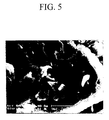
- Figure 5 is a scanning electron microscopic photograph showing a particle structure of talc particles used in Example 2;
- Figure 6 is a scanning electron microscopic photograph showing a particle structure of composite particles obtained in Example 3;
- Figure 7 is a scanning electron microscopic photograph showing a particle structure of a powdery substance obtained in Comparative Example 1;
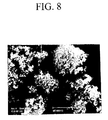
- Figure 8 is a scanning electron microscopic photograph showing a particle structure of titanium dioxide particles used in Example 4;
- Figure 9 is a scanning electron microscopic photograph showing a particle structure of composite particles obtained in Example 4;
- Figure 10 is a scanning electron microscopic photograph showing a particle structure of titanium dioxide particles used in Example 5;
- Figure 11 is a scanning electron microscopic photograph showing a particle structure of composite particles obtained in Example 5; and
- Figure 12 is a scanning electron microscopic photograph showing a particle structure of composite particles obtained in Comparative Example 2.
-
- The "composite particles" as referred to herein are composite particles in which a part or the whole of particles are covered with an organic compound or included in the organic compound, or composite particles in which an organic compound is present in the internal or the surface of aggregated particles.
- The "particles" as referred to herein are particles which do not form a film when the supercritical carbon dioxide or liquefied carbon dioxide is removed from a dispersion of the particles in supercritical carbon dioxide or liquefied carbon dioxide. More specifically, the particles are those not dissolved in supercritical carbon dioxide or liquefied carbon dioxide, and the shapes and forms of the particles are not changed when the supercritical carbon dioxide or liquefied carbon dioxide is removed from the dispersion.
- On the other hand, the term "organic compound" as referred to herein is an organic compound which forms a film when the organic compound is dispersed or dissolved in supercritical carbon dioxide or liquefied carbon dioxide, and thereafter the supercritical carbon dioxide or liquefied carbon dioxide is removed from the dispersion or solution. More specifically, the "organic compound" is an organic compound which changes its shape or form in the supercritical carbon dioxide or liquefied carbon dioxide. The form of the organic compound upon use is not limited to specified ones. The form of the organic compounds includes, for instance, masses, particles, granules, liquid, and the like. Among these forms, the particles and the granules are preferable.
- One of the great features in the present invention resides in the following points.
- Carbon dioxide is generally non-toxic, and its critical temperature is 304.2 K. The supercritical carbon dioxide refers to carbon dioxide having a temperature not less than the critical temperature and a pressure not less than the critical pressure. The supercritical carbon dioxide has a property such that its density is drastically changed by a slight pressure change. Therefore, when the pressure of the supercritical carbon dioxide having a slightly exceeding critical pressure and critical temperature is increased, the density of the vapor phase dramatically increases, so that the solubility of a solute in carbon dioxide dramatically increases within a range of pressures exceeding the critical pressure. To the contrary, when the pressure of the supercritical carbon dioxide is reduced, the solubility of a solute in carbon dioxide dramatically decreases, so that the separation of the solute from the supercritical carbon dioxide can be carried out only by reducing the pressure.
- The temperature at which the supercritical carbon dioxide is contacted with the particles and the organic compound is preferably 308 to 373 K, more preferably 313 to 353 K, from the viewpoints of efficiently removing the supercritical carbon dioxide and efficiently reducing the pressure. In addition, the initiative pressure of the supercritical carbon dioxide is preferably 7.2 to 50 MPa, more preferably 10 to 40 MPa when the reducing of pressure is initiated, from the viewpoint of efficiently reducing the pressure of the supercritical carbon dioxide.
- On the other hand, the temperature at which the liquefied carbon dioxide is contacted with the particles and the organic compound is preferably 233 to 304 K, more preferably 273 to 304 K, from the viewpoints of efficiently removing the liquefied carbon dioxide and efficiently reducing pressure. The initiative pressure of the liquefied carbon dioxide is preferably 1 to 50 MPa, more preferably 3.5 to 40 MPa when the reducing of pressure is initiated, from the viewpoint of efficiently reducing the pressure of the liquefied carbon dioxide.
- The term "reducing pressure" as referred to herein means lowering of the pressure of supercritical carbon dioxide or liquefied carbon dioxide.
- As mentioned above, when the supercritical carbon dioxide or liquefied carbon dioxide is used, there are some advantages such that the procedures can be carried out at low temperatures, so that the procedures can be facilitated, and that the production costs can be reduced since carbon dioxide is non-toxic and inexpensive.
- The supercritical carbon dioxide is preferable, since the supercritical carbon dioxide can increase the solubility of the organic compound higher than the liquefied carbon dioxide.
- Thus, a mixture of the supercritical carbon dioxide or liquefied carbon dioxide with the particles and the organic compound (hereinafter referred to as "mixture C") is obtained. The mixture of the supercritical carbon dioxide or liquefied carbon dioxide with the organic compound may become transparent depending upon conditions such as temperatures and pressures. The mixture which becomes transparent is preferable because the mixture contains little aggregated particles and gives a homogeneous formed coating film of the organic compound.
- Next, the supercritical carbon dioxide or liquefied carbon dioxide is removed from the mixture C.
- After the preparation of the mixture C in a vessel, an exhaust valve of the vessel is opened to reduce the internal pressure of the vessel. As a result, composite particles can be obtained in the vessel.
- The solvent-free composite particles can be obtained in a vessel without a solvent and a heat treatment.
- The time period required for reducing the internal pressure of the vessel to an atmospheric pressure is not limited to specified ones. The time period is preferably 2 seconds to 120 minutes, more preferably 5 seconds to 60 minutes, from the viewpoints of controlling the particle size of the resulting composite particles and the thickness of the film of the organic compound, and suppressing the formation of the organic compound particles.
- The method for reducing the pressure is not limited to specified ones. It is preferable that the reducing of pressure is carried out at a temperature of not lower than the critical temperature (304.2 K) of carbon dioxide, from the viewpoints of preventing the liquefaction of carbon dioxide and suppressing the aggregation, although the temperature would be lowered by the adiabatic expansion during reducing the pressure. The reason why the above method is preferable is that if the reducing of pressure is carried out at a temperature lower than the critical temperature of the carbon dioxide, the organic compound being dissolved or dispersed in the carbon dioxide would be aggregated on and deposited to the surface of particles, and the resulting composite particles would be aggregated by the resulting liquefied carbon dioxide due to capillary phenomenon when the liquefied carbon dioxide is evaporated.
- As the particles, any of inorganic particles and organic particles which are not substantially dissolved in supercritical carbon dioxide or liquefied carbon dioxide can be used.
- The materials used for the inorganic particles include, for instance, titanium oxide, silica, mica, talc, kaolin, sericite, zinc oxide, magnesium oxide, zirconium oxide, calcium carbonate, magnesium carbonate, magnesium silicate, silicic anhydride, barium sulfate, iron red oxide, yellow iron oxide, black iron oxide, carbon black, manganese violet, titanium-coated mica, glass beads, zeolite, composites thereof, and the like. These materials can be used alone or in admixture of not less than two kinds. In addition, the surface of the particles may be subjected to a surface treatment such as silicone treatment or fluorine treatment.
- The organic particles include organic pigments, organic powders made of polymers, and the like.
- The organic pigment includes, for instance, Red 201, Red 202, Red 204, Red 226, Orange 204, Yellow 205, Red 404, Red 405, Orange 401, Yellow 401, Blue 404, and the like. The polymer includes, for instance, particles of an organic polymer selected from the group consisting of thermoplastic resins such as styrenic resins, acrylic resins, polyolefins, nylons, silicone resins, fluorocarbon resins, polyesters and polyamides, and thermosetting resins such as epoxy resins, phenolic resins and urethane resins. These polymers can be used alone or in admixture of not less than two kinds. In addition, the surface of the particles may be subjected to a surface treatment such as silicone treatment or fluorine treatment.
- The average particle diameter of the particles before the formation of composite particles is not limited to specified ones. It is desired that the average particle diameter is 0.01 to 500 µm, preferably 0.02 to 100 µm, more preferably 0.04 to 50 µm. Among them, at least one particle selected from the group consisting of mica, talc and barium sulfate, the average particle diameter of which is 0.01 to 500 µm, is preferable.
- In addition, particles A, particles B having an average particle diameter of 1/5 or less times as large as the average particle diameter of the particles A, and the organic compound are contacted with each other in the presence of supercritical carbon dioxide or liquefied carbon dioxide in the vessel, and the supercritical carbon dioxide or liquefied carbon dioxide is removed therefrom, to form composite particles in which the particles B and the organic compound are deposited on the surface of the particles A.
- Each of the particles A and the particles B can be used alone or in admixture of at least two kinds. The particles having a particle diameter as large as exceeding one-fifth of the largest average particle diameter of all particles are defined as the particles A. The particles having a particle diameter as large as one-fifth or less of the largest average particle diameter of all particles are defined as the particles B.
- In accordance with the uses of the resulting composite particles, desired properties such as water repellency, oil repellency, optical properties, ultraviolet shielding ability, texture, safety, activity, color tone, stability of dispersion and weatherproof can be imparted to the composite particles.
- When the particles comprising the particles A and the particles B are used as the above particles, the average particle diameter of the particles A is not limited to specified ones. The average particle diameter of the particles A is preferably 0.1 to 500 µm, more preferably 0.5 to 200 µm, from the viewpoint of depositing the particles B and the organic compound on the surface of the particles A.
- The average particle diameter of the particles B is not more than 1/5 times, preferably not more than 1/10 times, more preferably not more than 1/20 times, as large as the average particle diameter of the particles A, from the viewpoint of depositing the particles B on the surface of the particles A. Also, the average particle diameter of the particles B is preferably 0.01 to 100 µm, more preferably 0.01 to 40 µm, still more preferably 0.01 to 20 µm, from the viewpoints of depositing the particles B on the surface of the particles A and giving the particles excellent texture.
- The average particle diameter is calculated from the particle diameter distribution determined by a laser diffraction/scattering method.
- The weight ratio of the particles A to the particles B (particles A/particles B) is preferably 1/10 to 200/1, more preferably 1/1 to 10/1, from the viewpoint of depositing the particles B on the surface of the particles A.
- As described above, the organic compound may be those which are dispersible or dissolvable in the supercritical carbon dioxide or liquefied carbon dioxide. Representative examples of the organic compound include silicone compounds, fluorine-containing compounds, chitosan, Nε-lauroyl-L-lysine, and the like. Among them, the silicone compounds and the fluorine-containing compounds are preferable, from the viewpoint of appropriately controlling the surface properties. Among the organic compounds, polymers can be suitably used.
- The polymer may be those which are dissolvable or dispersible in the supercritical carbon dioxide or liquefied carbon dioxide. Among the organic polymers, generally used polymers such as an acrylic resin, polyethylene or polystyrene are undissolvable in the supercritical carbon dioxide or liquefied carbon dioxide. On the other hand, a fluorine-containing polymer and a silicone polymer generally have a low intermolecular force, so that these polymers have properties of being easily dissolvable or dispersible in the supercritical carbon dioxide. Therefore, when at least one of the fluorine-containing polymer and the silicone polymer is used, a co-solvent may not be required at all, or the co-solvent can be used in a small amount. Therefore, the composite particles can be prepared without taking the residue of the co-solvent into consideration.
- Also, there has been reported that an ether-carbonate copolymer or the like is well dissolved in supercritical carbon dioxide.
- The fluorine-containing polymer may be any polymer having a fluorine atom. It is desired that the content of the fluorine atom in the fluorine-containing polymer is 9 to 80% by weight, preferably 20 to 70% by weight, more preferably 40 to 65% by weight. Among the fluorine-containing polymers, a (meth)acrylate polymer having a fluoroalkyl group, a (meth)acrylate polymer having a perfluoroalkyl group, a (meth)acrylate having a fluoroalkyl group-long chain alkyl (meth)acrylate copolymer, and a (meth)acrylate having a perfluoroalkyl group-long chain alkyl (meth)acrylate copolymer are preferable, from the viewpoint of facilitating the dispersion or dissolution of the fluorine-containing polymer in carbon dioxide.
- Furthermore, as the fluorine-containing polymer, homopolymers of (meth)acrylate having a perfluoroalkyl group, a poly-fluoroalkyl group, or a perfluoropolyether group, having not less than 4 carbon atoms; and copolymers of this compound with (meth)acrylate having an alkyl group of 8 to 22 carbon atoms are most preferable, from the viewpoint of easily dispersing or dissolving the fluorine-containing polymer in carbon dioxide.
- The weight-average molecular weight of the fluorine-containing polymer is preferably 3000 to 500000, more preferably 5000 to 300000, from the viewpoints of being easily dispersed or dissolved in carbon dioxide and being solid at 25°C.
- The silicone polymer is not limited to specified ones, and it may be those which are dissolvable or dispersible in supercritical carbon dioxide alone, liquefied carbon dioxide alone, or a mixture of supercritical carbon dioxide or liquefied carbon dioxide with a co-solvent.
- Among the silicone polymers, methyl polysiloxane, dimethyl polysiloxane, cyclic dimethyl polysiloxane, methylphenyl polysiloxane, methylhydrogen polysiloxane, cyclic methylhydrogen polysiloxane, dimethyl siloxane-methyl (polyoxyethylene)siloxane copolymers, dimethyl siloxane-methyl (polyoxypropylene)siloxane copolymers, polyether-modified silicones, methylstyryl-modified silicones, alkyl-modified silicones, fluorine-modified silicones, higher fatty acid ester-modified silicones, higher alkoxy-modified silicones, silicone-modified acrylic resins, and the like are preferable, from the viewpoints of being easily dispersible in carbon dioxide and easily adsorbable to the particles. The silicone polymer is especially preferably a silicone polymer having an organopolysiloxane molecular chain and a poly(N-acylalkyleneimine) molecular chain having a repeating unit represented by the formula (III):wherein R3 is hydrogen atom, an alkyl group having 1 to 22 carbon atoms, a cycloalkyl group having 3 to 8 carbon atoms, an aralkyl group having 7 to 10 carbon atoms or an aryl group having 6 to 10 carbon atoms; and n is 2 or 3, in which the poly(N-acylalkyleneimine) molecular chain is bonded to at least one of the end and the side chain of the organopolysiloxane molecular chain via a group represented by the formula (I):
 wherein each of R1 and R2 is independently hydrogen atom, an alkyl group having 1 to 18 carbon atoms or an aryl group having 6 to 10 carbon atoms; X- is a counter ion of a quaternary ammonium salt, such as a halogen ion such as Cl- or Br-, or a sulfate ion such as CH3SO4 - or CH3CH2SO4 -; or a group represented by the formula (II):
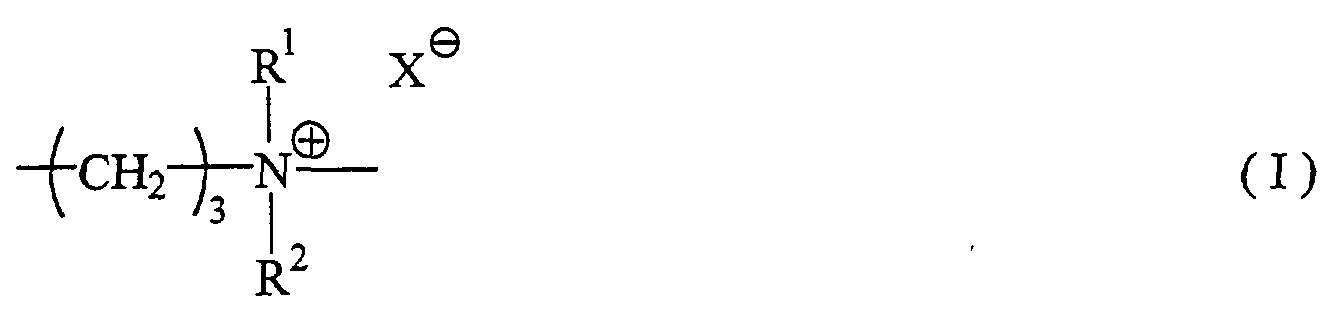 wherein R1, R2 and X- are the same as defined above,
the weight ratio of the poly(N-acylalkyleneimine) molecular chain / the organopolysiloxane molecular chain is 1/50 to 50/1, and the weight-average molecular weight is 500 to 500000, from the viewpoint of facilitating dispersion or dissolution in carbon dioxide. For instance, there can be cited a γ-(N-propionylpolyethyleneimino)aminopropyl methyl siloxane / dimethyl siloxane copolymer, in which each of R1 and R2 is hydrogen atom respectively, and X- is CH3CH2SO4 - in the formula (I), and R3 is CH2CH3, and n is 2 in the formula (III). - The weight-average molecular weight of the silicone polymer is preferably 500 to 500000, more preferably 1000 to 300000, from the viewpoints of being easily dispersed or dissolved in carbon dioxide.
- In the organic compound and the particles being dissolved or dispersed in the supercritical carbon dioxide or liquefied carbon dioxide, the amount of the particles is 0.001 to 1000 parts by weight, preferably 0.005 to 500 parts by weight, more preferably 0.7 to 500 parts by weight, based on 1 part of the organic compound. It is preferable that the organic compound is dissolved in supercritical carbon dioxide or liquefied carbon dioxide, from the viewpoint of homogeneously coating the surface of the particles with the organic compound.
- The content of the particles in the mixture C is not limited to specified ones. It is desired that the content of the particles in the mixture C is 0.01 to 70% by weight, preferably 0.1 to 50% by weight, from the viewpoint of improvement of dispersibility in the mixture.
- When the organic compound is not easily dissolved or dispersed in supercritical carbon dioxide or liquefied carbon dioxide, the organic compound can be dissolved or dispersed in the supercritical carbon dioxide or liquefied carbon dioxide by mixing a co-solvent with the supercritical carbon dioxide or liquefied carbon dioxide.
- As the co-solvent, polar solvents are preferable. Among the polar solvents, alcohol and water which are thought to be almost harmless to human bodies are preferable. As the alcohol, ethanol and 1-propanol are preferable, and ethanol is more preferable.
- As described above, since a heat treatment or the like is not required in the process of the present invention after coating the particles as in conventional wet process, the number of treatment steps can be diminished. Therefore, the process of the present invention is very excellent in operability.
- According to the procedures described above, composite particles of the organic compound and the particles are obtained. The composite particles may contain a third component other than the organic compound and the particles. The third component includes a stabilizer, a colorant and the like other than the coating components of the particles. The third component can be used alone or in admixture of not less than two kinds. The third component can be incorporated into the composite particles by dissolving or dispersing the third component in the supercritical carbon dioxide or liquefied carbon dioxide.
- The average particle diameter of the resulting composite particles cannot be absolutely determined because it differs depending upon the amount of the organic compound and the like. It is desired that the average particle diameter is preferably 0.01 to 1000 µm, more preferably 0.02 to 500 µm, still more preferably 0.04 to 100 µm.
- The vessel used in the present invention is not limited to its shape and size, as long as the vessel is durable to operating temperatures and pressures. As the vessel, anything which has an exhaust mechanism such as a valve for reducing pressure can be employed. In addition, in order to dissolve or disperse the organic compound and the particles in carbon dioxide, a vessel equipped with a stirring mechanism is preferable. Representative examples of the vessel include autoclave, pressure proof cell, and the like.
- Before the particles are introduced into the vessel, the particles may be stirred, or pulverized by applying a shearing stress to the particles. Also, when the particles comprise not less than two kinds of particles, the particles can be introduced into the vessel after the particles are pulverized and mixed with each other.
- When the resulting composite particles are aggregated, the composite particles may be appropriately subjected to pulverization, disintegration, or the like.
- An apparatus shown in Figure 1 was used. The apparatus has been used for a process for preparing composite particles, using reduced-pressure expansion of carbon dioxide.
- An autoclave 8 having a volume of 96 mL, commercially available from Taiatsu Garasu Kogyo K.K. was charged with 1.8 g of a granular stearyl methacrylate-2-(perfluorooctyl)ethyl methacrylate copolymer (weight ratio of stearyl methacrylate : 2-(perfluorooctyl)ethyl methacrylate = 1:9) having a particle diameter of 1 to 5 mm, and 6 g of mica having an average particle diameter of 10 µm commercially available from K.K. Yamaguchi Ummo Kogyosho.
- Thereafter, carbon dioxide was discharged from a
bomb 1, and impurities incorporated in the carbon dioxide were removed by afilter 2. The carbon dioxide was condensed with a condenser 3 through which a refrigerant having a temperature controlled to -5°C was flowing. The refrigerant was provided from a cooler 4. The pressure of the carbon dioxide was increased by a pressure-uppump 5 having a cooled pump head. The pressure of the carbon dioxide was measured by apressure gauge 6. In order to ensure the safety, a safety valve 7 was provided at the bottom portion of thepressure gauge 6. - The carbon dioxide was introduced into an autoclave 8 having a safety valve 11 through a valve V-1. The temperature of the autoclave 8 was controlled by a
cartridge heater 9, and the temperature and the pressure in the autoclave were monitored by athermometer 12 and apressure gauge 10. The temperature and the pressure in the autoclave were controlled to 323.15 K and 20 MPa. - Under the above conditions, a
stirrer 13 was rotated for 0.5 hours to dissolve and disperse the mixture. - An exhaust valve V-2 was gradually opened, and the carbon dioxide was exhausted from an
exhaust line 14 having an inner diameter of 2.5 mm for 2 minutes. Although the temperature inside the autoclave was lowered due to adiabatic expansion under reduced pressure, the pressure was reduced with maintaining the temperature inside the autoclave to a temperature of not less than 313.15 K. - When the vessel pressure inside the autoclave 8 was reduced to an atmospheric pressure, powdery substances were obtained in the autoclave 8. However, no granular substances having a particle diameter of 1 to 5 mm were found therein.
- A scanning electron microscopic photograph of the resulting composite particles is shown in Figure 2 (magnification: 3865). Also, a scanning electron microscopic photograph of the raw mica particles is shown in Figure 3 (magnification: 5000). It can be seen from the results shown in Figure 2 that the surface of the composite particles obtained in Example 1 is almost as smooth as the surface of the mica particles.
- However, it was found that the composite particles obtained in Example 1 showed water repellency which was not at all exhibited by the mica particles alone. Specifically, the composite particles were pelletized, and a contact angle of the composite particles with water was determined with an angle of contact analyzer commercially available from Kyowa Kaimen Kagaku K.K. As a result, the composite particles had a contact angle of 120°, showing high water repellency. The average particle diameter of the resulting composite particles was determined by a laser diffraction/scattering type particle size distribution analyzer commercially available from Horiba, LTD. As a result, the average particle diameter was found to be 12 µm.
- The resulting composite powder was touched with a finger. As a result, the powder had no texture of roughness, and spread well when applied to a skin.
- The particles were coated in the same manner as in Example 1, except that 0.8 g of granular 2-(perfluorooctyl)ethyl methacrylate polymer having a particle diameter of 1 to 5 mm was used in place of stearyl methacrylate-2-(perfluorooctyl)ethyl methacrylate copolymer, and 8.0 g of talc having an average particle diameter of 10 µm commercially available from K.K. Yamaguchi Ummo Kogyosho was used in place of mica.
- However, no granular substances having a particle diameter of 1 to 5 mm were found in the resulting powdery substance.
- A scanning electron microscopic photograph of the resulting composite particles is shown in Figure 4 (magnification: 5000). Also, a scanning electron microscopic photograph of the raw talc particles before coating is shown in Figure 5 (magnification: 5000). It can be seen from the results shown in Figure 4 that the surface of the composite particles obtained in Example 2 is almost as smooth as the surface of the talc particles before coating.
- However, it was found that the composite particles obtained in Example 2 showed water repellency which was not at all exhibited by the talc particles alone. Specifically, the contact angle of the resulting composite particles with water was determined in the same manner as in Example 1. As a result, the composite particles had a contact angle of 115°, showing high water repellency. The average particle diameter of the resulting composite particles was found to be 13 µm.
- The particles were coated in the same manner as in Example 1, except that 0.6 g of massive γ-(N-propionylpolyethyleneimino)aminopropyl methyl siloxane / dimethyl siloxane copolymer was used in place of stearyl methacrylate-2-(perfluorooctyl)ethyl methacrylate copolymer, and 6 g of talc was used in place of mica.
- No granular substances having a particle diameter of 1 to 5 mm were found in the resulting powdery composite particles. A scanning electron microscopic photograph of the composite particles is shown in Figure 6 (magnification: 5000). It can be seen from the results shown in Figure 6 that the surface of the composite particles obtained in Example 3 is almost as smooth as the surface of the talc particles before coating (Figure 5).
- However, it was found that the composite particles obtained in Example 3 showed water repellency which was not at all exhibited by the talc particles alone. Specifically, the contact angle of the resulting composite particles with water was determined in the same manner as in Example 1. As a result, the composite particles had a contact angle of 115°, showing high water repellency. The average particle diameter of the resulting composite particles was found to be 13 µm.
- The same procedures as in Example 1 were carried out up to the step of rotating a
stirrer 13 for 0.5 hours to dissolve and disperse the mixture. Thereafter, an exhaust valve V-2 was opened, and the content of the vessel was discharged from a spray nozzle (not illustrated) having a hole diameter of 0.2 mm of anexhaust line 14 to the outside of the vessel in one second. - The discharged product was a powdery substance. A scanning electron microscopic photograph of the powdery substance is shown in Figure 7 (magnification: 5000). It can be seen from the results shown in Figure 7 that the powdery substance obtained in Comparative Example 1 is a heterogeneous powder containing fine particles presumably composed of stearyl methacrylate-2-(perfluorooctyl)ethyl methacrylate copolymer (weight ratio of stearyl methacrylate : 2-(perfluorooctyl)ethyl methacrylate = 1:9). The powdery substance is shown in white in the photograph, and has a particle diameter of 0.1 to 1 µm. The average particle diameter of the powdery substance was 11 µm. The contact angle of the powdery substance, i.e. composite particles with water was determined in the same manner as in Example 1. As a result, the composite particles had a contact angle of 120°, showing high water repellency.
- The resulting composite powder was touched with a finger. As a result, the composite powder had some texture of roughness and did not spread well when applied to a skin, as compared to the composite particles obtained in Example 1, and the particles of the composite powder were aggregated with each other, so that the coating could not be uniformly carried out.
- The composite particles were prepared in the same manner as in Example 1, except that 0.36 g of γ-(N-propionylpolyethyleneimino)aminopropyl methyl siloxane / dimethyl siloxane copolymer was used in place of stearyl methacrylate-2-(perfluorooctyl)ethyl methacrylate copolymer, and 6.0 g of talc having an average particle diameter of 10 µm commercially available from K.K. Yamaguchi Ummo Kogyosho and 1.8 g of titanium dioxide having an average particle diameter of 0.2 µm, the surface of which was treated with silicone, commercially available from TAYCA CORPORATION were used in place of mica.
- However, no granular substances having a particle diameter of 1 to 5 mm were found in the resulting composite particles.
- A scanning electron microscopic photograph of the resulting composite particles is shown in Figure 8 (magnification: 25000). Also, a scanning electron microscopic photograph of the resulting composite particles is shown in Figure 9 (magnification: 5000).
- It can be seen from the results shown in Figure 9 that the composite particles in which dispersed talc particles and titanium dioxide particles were deposited on the surface of the talc particle. The average particle diameter of the composite particles was found to be 11 µm.
- The contact angle of the resulting composite particles with water was determined in the same manner as in Example 1. As a result, the composite particles had a contact angle of 105°, showing high water repellency.
- The resulting composite powder was touched with a finger. As a result, the powder had no texture of roughness, and spread well when applied to a skin.
- The composite particles were prepared in the same manner as in Example 1, except that the amount of stearyl methacrylate-2-(perfluorooctyl)ethyl methacrylate copolymer (weight ratio of stearyl methacrylate : 2-(perfluorooctyl)ethyl methacrylate = 1:9) was changed to 0.36 g, and 6.0 g of talc having an average particle diameter of 10 µm commercially available from K.K. Yamaguchi Ummo Kogyosho and 1.8 g of titanium dioxide having an average particle diameter of 0.7 µm commercially available from ISHIHARA SANGYO KAISHA, LTD. were used in place of mica.
- No raw organic compounds and no aggregates were found in the resulting composite particles. Scanning electron microscopic photographs of the raw titanium dioxide and the resulting composite particles are shown in Figures 10 and 11, respectively (each magnification: 5000).
- It can be seen from the results shown in Figure 11 that the titanium dioxide particles are existing on the surface of the composite particles obtained in Example 5. The average particle diameter of the composite particles was found to be 12 µm.
- The contact angle of the resulting composite particles with water was determined in the same manner as in Example 1. As a result, the composite particles had a contact angle of 100°, showing high water repellency.
- The resulting composite particles were touched with a finger. As a result, the powder had no texture of roughness and spread well when applied to a skin.
- A 500 mL flask was charged with 0.25 g of γ-(N-propionylpolyethyleneimino)aminopropyl methyl siloxane / dimethyl siloxane copolymer, and thereafter charged with 190 g of ethanol. The resulting mixture was stirred for 25°C to dissolve the γ-(N-propionylpolyethyleneimino)aminopropyl methyl siloxane / dimethyl siloxane copolymer. Thereafter, 7.5 g of talc having an average particle diameter of 10 µm commercially available from K.K. Yamaguchi Ummo Kogyosho, and 2.25 g of titanium dioxide having an average particle diameter of 0.2 µm, the surface of which was treated with silicone, commercially available from TAYCA CORPORATION were added thereto. Subsequently, ethanol was distilled by evaporation with stirring at 55°C under 7 kPa. Many deposits were observed on the inner wall of the flask, and aggregates of composite particles were obtained.
- A scanning electron microscopic photograph of the resulting composite particles are shown in Figure 12 (magnification: 5000). As a result, it was observed that the titanium dioxide particles were aggregated on the surface of the talc particles.
- The particles obtained by pulverizing the composite particles with a coffee mill were touched with a finger. As a result, the particles had slight texture of roughness, and did not spread well when applied to a skin.
- According to the present invention, there is exhibited an effect that composite particles containing no particles of by-products made of the organic compound can be obtained by a simple preparation process without using any organic solvent harmful to human bodies.
Claims (10)
- A process for preparing composite particles comprising particles and an organic compound in a vessel, comprising the steps of:(a) contacting particles with an organic compound in the presence of supercritical carbon dioxide or liquefied carbon dioxide in the vessel; and(b) reducing the internal pressure of the vessel.
- The process according to claim 1, wherein the internal temperature of the vessel is not less than the critical temperature of carbon dioxide, when the internal pressure is reduced after the particles are contacted with the organic compound in the presence of supercritical carbon dioxide in the vessel.
- The process according to claim 1, wherein the organic compound is a polymer.
- The process according to claim 3, wherein the polymer is at least one compound selected from the group consisting of fluorine-containing polymers and silicone polymers.
- The process according to claim 4, wherein the fluorine-containing polymer is at least one compound selected from the group consisting of a (meth)acrylate polymer having a fluoroalkyl group, a (meth)acrylate polymer having a perfluoroalkyl group, a (meth)acrylate having a fluoroalkyl group-long chain alkyl (meth)acrylate copolymer, and a (meth)acrylate having a perfluoroalkyl group-long chain alkyl (meth)acrylate copolymer.
- The process according to claim 4, wherein the content of fluorine atom in the fluorine-containing polymer is 9 to 80% by weight.
- The process according to claim 4, wherein the silicone polymer comprises an organopolysiloxane molecular chain and a poly(N-acylalkyleneimine) molecular chain having a repeating unit represented by the formula (III):wherein R3 is hydrogen atom, an alkyl group having 1 to 22 carbon atoms, a cycloalkyl group having 3 to 8 carbon atoms, an aralkyl group having 7 to 10 carbon atoms or an aryl group having 6 to 10 carbon atoms; and n is 2 or 3, in which the poly(N-acylalkyleneimine) molecular chain is bonded to at least one of the end and the side chain of the organopolysiloxane molecular chain via a group represented by the formula (I):
 wherein each of R1 and R2 is independently hydrogen atom, an alkyl group having 1 to 18 carbon atoms or an aryl group having 6 to 10 carbon atoms; X- is a counter ion of a quaternary ammonium salt; or a group represented by the formula (II):
 wherein R1, R2 and X- are the same as defined above,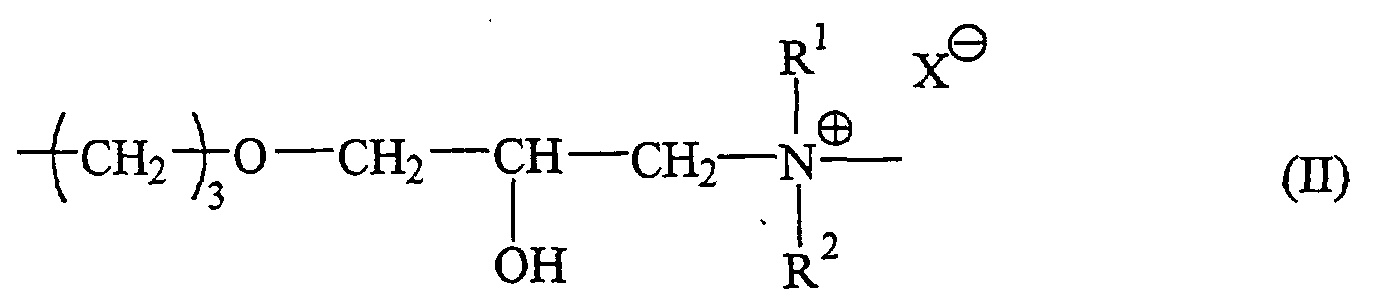
and the weight ratio of the poly(N-acylalkyleneimine) molecular chain / the organopolysiloxane molecular chain is 1/50 to 50/1. - The process according to claim 1, wherein the amount of the particles contained in the composite particles is 0.7 to 500 parts by weight, based on 1 part by weight of the organic compound.
- The process according to claim 1, wherein particles A, at least one of particles B having an average particle diameter of 1/5 or less times as large as the average particle diameter of the particles A, and the organic compound are contacted with each other in the presence of supercritical carbon dioxide or liquefied carbon dioxide in the vessel, and the supercritical carbon dioxide or liquefied carbon dioxide is removed from the resulting mixture to deposit the particles B and the organic compound on the surface of the particles A.
- Composite particles obtained by the process of any one of claims 1 to 9.
Applications Claiming Priority (4)
| Application Number | Priority Date | Filing Date | Title |
|---|---|---|---|
| JP2000309600 | 2000-10-10 | ||
| JP2000309600 | 2000-10-10 | ||
| JP2001243951 | 2001-08-10 | ||
| JP2001243951 | 2001-08-10 |
Publications (3)
| Publication Number | Publication Date |
|---|---|
| EP1197513A2 true EP1197513A2 (en) | 2002-04-17 |
| EP1197513A3 EP1197513A3 (en) | 2002-05-08 |
| EP1197513B1 EP1197513B1 (en) | 2005-03-30 |
Family
ID=26601802
Family Applications (1)
| Application Number | Title | Priority Date | Filing Date |
|---|---|---|---|
| EP01123372A Expired - Lifetime EP1197513B1 (en) | 2000-10-10 | 2001-10-10 | Process for preparing composite particles |
Country Status (3)
| Country | Link |
|---|---|
| US (1) | US20020041927A1 (en) |
| EP (1) | EP1197513B1 (en) |
| DE (1) | DE60109701T2 (en) |
Cited By (1)
| Publication number | Priority date | Publication date | Assignee | Title |
|---|---|---|---|---|
| EP1281421A3 (en) * | 2001-08-02 | 2003-07-23 | INTERCOS ITALIA S.p.A. | Apparatus for producing cosmetic products and relating production process |
Families Citing this family (5)
| Publication number | Priority date | Publication date | Assignee | Title |
|---|---|---|---|---|
| EP1818093B1 (en) * | 2004-10-29 | 2014-03-12 | Nara Machinery Co., Ltd. | Method of granulating fine particles |
| WO2006057374A1 (en) * | 2004-11-29 | 2006-06-01 | Japan Science And Technology Agency | Method for preparing composite fine particles |
| US8187726B2 (en) * | 2005-08-09 | 2012-05-29 | Sony Corporation | Nanoparticle-resin composite material, light emitting device assembly, and filling material for the light-emitting device assembly |
| DE102007030591B3 (en) * | 2007-06-27 | 2008-08-28 | Siemens Ag | Pipe inner wall coating method, involves moving heater as long as layer is formed, removing residual fluid from pipe, and supporting local cooling of pipe according to layer formation by movable cooler |
| CN110201618B (en) * | 2019-03-11 | 2020-01-03 | 南京昊绿生物科技有限公司 | Automatic secondary continuous reaction device and method for hydrogen and deuterium exchange |
Citations (2)
| Publication number | Priority date | Publication date | Assignee | Title |
|---|---|---|---|---|
| EP0784506B1 (en) | 1994-10-06 | 1999-02-17 | Centre De Microencapsulation | Method of coating particles |
| WO2001089481A1 (en) | 2000-05-23 | 2001-11-29 | Mainelab | Prolonged release microspheres for injection delivery and preparation method |
Family Cites Families (6)
| Publication number | Priority date | Publication date | Assignee | Title |
|---|---|---|---|---|
| JPH06183946A (en) * | 1992-12-21 | 1994-07-05 | Kao Corp | Cutaneous agent for external application |
| JP3486052B2 (en) * | 1996-05-10 | 2004-01-13 | 花王株式会社 | Coated powder and cosmetic containing the same |
| US5714299A (en) * | 1996-11-04 | 1998-02-03 | Xerox Corporation | Processes for toner additives with liquid carbon dioxide |
| DE19707051A1 (en) * | 1997-02-21 | 1998-08-27 | Merck Patent Gmbh | Process for the production of powder coatings containing luster pigment |
| WO1998054397A1 (en) * | 1997-05-30 | 1998-12-03 | Micell Technologies | Surface treatment |
| WO1999021662A1 (en) * | 1997-10-25 | 1999-05-06 | Richart Douglas S | Modifying the surfaces of polymeric solids |
-
2001
- 2001-10-10 DE DE60109701T patent/DE60109701T2/en not_active Expired - Lifetime
- 2001-10-10 US US09/972,883 patent/US20020041927A1/en not_active Abandoned
- 2001-10-10 EP EP01123372A patent/EP1197513B1/en not_active Expired - Lifetime
Patent Citations (2)
| Publication number | Priority date | Publication date | Assignee | Title |
|---|---|---|---|---|
| EP0784506B1 (en) | 1994-10-06 | 1999-02-17 | Centre De Microencapsulation | Method of coating particles |
| WO2001089481A1 (en) | 2000-05-23 | 2001-11-29 | Mainelab | Prolonged release microspheres for injection delivery and preparation method |
Non-Patent Citations (1)
| Title |
|---|
| DESIMONE J.M. ET AL: "SYNTHESIS OF FLUOROPOLYMERS IN SUPERCRITICAL CARBON DIOXIDE", SCIENCE, vol. 257, 14 August 1992 (1992-08-14), pages 945 - 947, XP000647726 |
Cited By (1)
| Publication number | Priority date | Publication date | Assignee | Title |
|---|---|---|---|---|
| EP1281421A3 (en) * | 2001-08-02 | 2003-07-23 | INTERCOS ITALIA S.p.A. | Apparatus for producing cosmetic products and relating production process |
Also Published As
| Publication number | Publication date |
|---|---|
| DE60109701T2 (en) | 2006-03-09 |
| US20020041927A1 (en) | 2002-04-11 |
| EP1197513B1 (en) | 2005-03-30 |
| DE60109701D1 (en) | 2005-05-04 |
| EP1197513A3 (en) | 2002-05-08 |
Similar Documents
| Publication | Publication Date | Title |
|---|---|---|
| JP3457655B2 (en) | Manufacturing method of composite particles | |
| KR101770835B1 (en) | Self-dispersible coated metal oxide powder, and process for production and use | |
| DE69330897T2 (en) | Spherical, finely divided colored material, manufacturing process and cosmetic compositions containing the particulate material | |
| JP5634505B2 (en) | Composite nanogranules from polymer / inorganic nanoparticles, their preparation and use | |
| US7758844B2 (en) | Porous titanium oxide powder and method for production thereof | |
| KR102090986B1 (en) | Silica-encapsulated microcapsule resin particles, manufacturing method and use thereof | |
| FR2687658A1 (en) | POROUS AND SPHERICAL SILICA OR SILICATE GRANULES, PROCESS FOR THEIR PRODUCTION, AND APPLICATIONS THEREOF | |
| KR20010034188A (en) | Powder Coating Composition | |
| CN101370862B (en) | Powder composed of inorganic compound-loaded polyamide porous particle | |
| JP3435158B1 (en) | Manufacturing method of composite particles | |
| CN1041116A (en) | Method for producing microcapsule dispersion | |
| KR20110110221A (en) | Composite particles and preparation method thereof, hollow particles, preparation method and uses thereof | |
| EP1197513B1 (en) | Process for preparing composite particles | |
| TW200307006A (en) | Method for the production of coated, fine-particle, inorganic solids and use thereof | |
| WO2016152872A1 (en) | Cosmetic additive and method for producing same | |
| CN101273101A (en) | Method for producing surface-modified nanoparticulate metal oxides, metal hydroxides and/or metal oxide hydroxides | |
| JP3469223B2 (en) | Manufacturing method of composite particles | |
| Goto et al. | Creation of coating surfaces possessing superhydrophobic and superoleophobic characteristics with fluoroalkyl end-capped vinyltrimethoxysilane oligomeric nanocomposites having biphenylene segments | |
| JP4353708B2 (en) | Production method of composite particles | |
| US20030215572A1 (en) | Process for preparing composite particles | |
| KR20210028216A (en) | Organic-inorganic composite particles, manufacturing method and use thereof | |
| JP2018083759A (en) | Cosmetic | |
| US5387489A (en) | Processes for the preparation of developer compositions | |
| CN101048226A (en) | Uses of Random Copolymers | |
| JP3739264B2 (en) | Method for producing spherical resin particles |
Legal Events
| Date | Code | Title | Description |
|---|---|---|---|
| PUAI | Public reference made under article 153(3) epc to a published international application that has entered the european phase |
Free format text: ORIGINAL CODE: 0009012 |
|
| PUAL | Search report despatched |
Free format text: ORIGINAL CODE: 0009013 |
|
| AK | Designated contracting states |
Kind code of ref document: A2 Designated state(s): AT BE CH CY DE DK ES FI FR GB GR IE IT LI LU MC NL PT SE TR |
|
| AX | Request for extension of the european patent |
Free format text: AL;LT;LV;MK;RO;SI |
|
| RIC1 | Information provided on ipc code assigned before grant |
Free format text: 7C 08J 3/205 A, 7C 08J 3/00 B, 7C 08K 9/10 B, 7B 01F 3/12 B |
|
| AK | Designated contracting states |
Kind code of ref document: A3 Designated state(s): AT BE CH CY DE DK ES FI FR GB GR IE IT LI LU MC NL PT SE TR |
|
| AX | Request for extension of the european patent |
Free format text: AL;LT;LV;MK;RO;SI |
|
| 17P | Request for examination filed |
Effective date: 20020902 |
|
| AKX | Designation fees paid |
Designated state(s): DE FR GB |
|
| 17Q | First examination report despatched |
Effective date: 20030128 |
|
| TPAD | Observations filed by third parties |
Free format text: ORIGINAL CODE: EPIDOS TIPA |
|
| GRAP | Despatch of communication of intention to grant a patent |
Free format text: ORIGINAL CODE: EPIDOSNIGR1 |
|
| GRAA | (expected) grant |
Free format text: ORIGINAL CODE: 0009210 |
|
| GRAS | Grant fee paid |
Free format text: ORIGINAL CODE: EPIDOSNIGR3 |
|
| AK | Designated contracting states |
Kind code of ref document: B1 Designated state(s): DE FR GB |
|
| REG | Reference to a national code |
Ref country code: GB Ref legal event code: FG4D |
|
| REF | Corresponds to: |
Ref document number: 60109701 Country of ref document: DE Date of ref document: 20050504 Kind code of ref document: P |
|
| REG | Reference to a national code |
Ref country code: IE Ref legal event code: FG4D |
|
| PLBE | No opposition filed within time limit |
Free format text: ORIGINAL CODE: 0009261 |
|
| STAA | Information on the status of an ep patent application or granted ep patent |
Free format text: STATUS: NO OPPOSITION FILED WITHIN TIME LIMIT |
|
| ET | Fr: translation filed | ||
| 26N | No opposition filed |
Effective date: 20060102 |
|
| REG | Reference to a national code |
Ref country code: FR Ref legal event code: PLFP Year of fee payment: 15 |
|
| PGFP | Annual fee paid to national office [announced via postgrant information from national office to epo] |
Ref country code: FR Payment date: 20150908 Year of fee payment: 15 |
|
| PGFP | Annual fee paid to national office [announced via postgrant information from national office to epo] |
Ref country code: DE Payment date: 20151006 Year of fee payment: 15 Ref country code: GB Payment date: 20151007 Year of fee payment: 15 |
|
| REG | Reference to a national code |
Ref country code: DE Ref legal event code: R119 Ref document number: 60109701 Country of ref document: DE |
|
| GBPC | Gb: european patent ceased through non-payment of renewal fee |
Effective date: 20161010 |
|
| REG | Reference to a national code |
Ref country code: FR Ref legal event code: ST Effective date: 20170630 |
|
| PG25 | Lapsed in a contracting state [announced via postgrant information from national office to epo] |
Ref country code: GB Free format text: LAPSE BECAUSE OF NON-PAYMENT OF DUE FEES Effective date: 20161010 Ref country code: FR Free format text: LAPSE BECAUSE OF NON-PAYMENT OF DUE FEES Effective date: 20161102 Ref country code: DE Free format text: LAPSE BECAUSE OF NON-PAYMENT OF DUE FEES Effective date: 20170503 |