EP1197214A1 - Medicinal compositions for preventing or treating diarrhea - Google Patents
Medicinal compositions for preventing or treating diarrhea Download PDFInfo
- Publication number
- EP1197214A1 EP1197214A1 EP00942374A EP00942374A EP1197214A1 EP 1197214 A1 EP1197214 A1 EP 1197214A1 EP 00942374 A EP00942374 A EP 00942374A EP 00942374 A EP00942374 A EP 00942374A EP 1197214 A1 EP1197214 A1 EP 1197214A1
- Authority
- EP
- European Patent Office
- Prior art keywords
- group
- siastatin
- diarrhea
- derivative
- administration
- Prior art date
- Legal status (The legal status is an assumption and is not a legal conclusion. Google has not performed a legal analysis and makes no representation as to the accuracy of the status listed.)
- Withdrawn
Links
- DQTKLICLJUKNCG-UHFFFAOYSA-N CC(NC(C(C1O)O)NCC1C(O)=O)=O Chemical compound CC(NC(C(C1O)O)NCC1C(O)=O)=O DQTKLICLJUKNCG-UHFFFAOYSA-N 0.000 description 1
- UOPZEWVVILIZJY-UHFFFAOYSA-N OC(C(CNC1NC(C(F)(F)F)=O)C(O)=O)C1O Chemical compound OC(C(CNC1NC(C(F)(F)F)=O)C(O)=O)C1O UOPZEWVVILIZJY-UHFFFAOYSA-N 0.000 description 1
Classifications
-
- A—HUMAN NECESSITIES
- A61—MEDICAL OR VETERINARY SCIENCE; HYGIENE
- A61K—PREPARATIONS FOR MEDICAL, DENTAL OR TOILETRY PURPOSES
- A61K31/00—Medicinal preparations containing organic active ingredients
- A61K31/33—Heterocyclic compounds
- A61K31/395—Heterocyclic compounds having nitrogen as a ring hetero atom, e.g. guanethidine or rifamycins
- A61K31/435—Heterocyclic compounds having nitrogen as a ring hetero atom, e.g. guanethidine or rifamycins having six-membered rings with one nitrogen as the only ring hetero atom
- A61K31/44—Non condensed pyridines; Hydrogenated derivatives thereof
- A61K31/445—Non condensed piperidines, e.g. piperocaine
- A61K31/4465—Non condensed piperidines, e.g. piperocaine only substituted in position 4
-
- C—CHEMISTRY; METALLURGY
- C07—ORGANIC CHEMISTRY
- C07H—SUGARS; DERIVATIVES THEREOF; NUCLEOSIDES; NUCLEOTIDES; NUCLEIC ACIDS
- C07H13/00—Compounds containing saccharide radicals esterified by carbonic acid or derivatives thereof, or by organic acids, e.g. phosphonic acids
- C07H13/12—Compounds containing saccharide radicals esterified by carbonic acid or derivatives thereof, or by organic acids, e.g. phosphonic acids by acids having the group -X-C(=X)-X-, or halides thereof, in which each X means nitrogen, oxygen, sulfur, selenium or tellurium, e.g. carbonic acid, carbamic acid
-
- A—HUMAN NECESSITIES
- A61—MEDICAL OR VETERINARY SCIENCE; HYGIENE
- A61K—PREPARATIONS FOR MEDICAL, DENTAL OR TOILETRY PURPOSES
- A61K31/00—Medicinal preparations containing organic active ingredients
- A61K31/33—Heterocyclic compounds
- A61K31/395—Heterocyclic compounds having nitrogen as a ring hetero atom, e.g. guanethidine or rifamycins
- A61K31/435—Heterocyclic compounds having nitrogen as a ring hetero atom, e.g. guanethidine or rifamycins having six-membered rings with one nitrogen as the only ring hetero atom
- A61K31/44—Non condensed pyridines; Hydrogenated derivatives thereof
- A61K31/445—Non condensed piperidines, e.g. piperocaine
-
- A—HUMAN NECESSITIES
- A61—MEDICAL OR VETERINARY SCIENCE; HYGIENE
- A61K—PREPARATIONS FOR MEDICAL, DENTAL OR TOILETRY PURPOSES
- A61K31/00—Medicinal preparations containing organic active ingredients
- A61K31/33—Heterocyclic compounds
- A61K31/395—Heterocyclic compounds having nitrogen as a ring hetero atom, e.g. guanethidine or rifamycins
- A61K31/435—Heterocyclic compounds having nitrogen as a ring hetero atom, e.g. guanethidine or rifamycins having six-membered rings with one nitrogen as the only ring hetero atom
- A61K31/47—Quinolines; Isoquinolines
-
- A—HUMAN NECESSITIES
- A61—MEDICAL OR VETERINARY SCIENCE; HYGIENE
- A61K—PREPARATIONS FOR MEDICAL, DENTAL OR TOILETRY PURPOSES
- A61K31/00—Medicinal preparations containing organic active ingredients
- A61K31/70—Carbohydrates; Sugars; Derivatives thereof
- A61K31/7012—Compounds having a free or esterified carboxyl group attached, directly or through a carbon chain, to a carbon atom of the saccharide radical, e.g. glucuronic acid, neuraminic acid
-
- A—HUMAN NECESSITIES
- A61—MEDICAL OR VETERINARY SCIENCE; HYGIENE
- A61K—PREPARATIONS FOR MEDICAL, DENTAL OR TOILETRY PURPOSES
- A61K45/00—Medicinal preparations containing active ingredients not provided for in groups A61K31/00 - A61K41/00
- A61K45/06—Mixtures of active ingredients without chemical characterisation, e.g. antiphlogistics and cardiaca
-
- A—HUMAN NECESSITIES
- A61—MEDICAL OR VETERINARY SCIENCE; HYGIENE
- A61P—SPECIFIC THERAPEUTIC ACTIVITY OF CHEMICAL COMPOUNDS OR MEDICINAL PREPARATIONS
- A61P1/00—Drugs for disorders of the alimentary tract or the digestive system
- A61P1/12—Antidiarrhoeals
-
- C—CHEMISTRY; METALLURGY
- C07—ORGANIC CHEMISTRY
- C07H—SUGARS; DERIVATIVES THEREOF; NUCLEOSIDES; NUCLEOTIDES; NUCLEIC ACIDS
- C07H13/00—Compounds containing saccharide radicals esterified by carbonic acid or derivatives thereof, or by organic acids, e.g. phosphonic acids
- C07H13/02—Compounds containing saccharide radicals esterified by carbonic acid or derivatives thereof, or by organic acids, e.g. phosphonic acids by carboxylic acids
- C07H13/04—Compounds containing saccharide radicals esterified by carbonic acid or derivatives thereof, or by organic acids, e.g. phosphonic acids by carboxylic acids having the esterifying carboxyl radicals attached to acyclic carbon atoms
-
- C—CHEMISTRY; METALLURGY
- C07—ORGANIC CHEMISTRY
- C07H—SUGARS; DERIVATIVES THEREOF; NUCLEOSIDES; NUCLEOTIDES; NUCLEIC ACIDS
- C07H7/00—Compounds containing non-saccharide radicals linked to saccharide radicals by a carbon-to-carbon bond
- C07H7/02—Acyclic radicals
Definitions
- This invention relates to a new pharmaceutical composition for preventing or therapeutically treating a diarrhea as induced in a cancer-bearing patient having received a chemotherapy for the cancer.
- This invention relates particularly to a new pharmaceutical composition for preventing or treating a diarrhea disorder which has been induced in a cancer-bearing patient as a side effect that is associated with the administration of an anticancer chemotherapeutic agent.
- This invention further relates to a therapeutic method for preventing or ameliorating a diarrhea as induced in a cancer-bearing patient having received the administration of an anticancer chemotherapeutic agent.
- an anticancer camptothecin derivative one of the anticancer chemotherapeutics agents which act as a topoisomerase I inhibitor is administered, it is frequent that the diarrhea as induced by the side effect of the administered anticancer agent become very much serious.
- a primary object of this invention is to provide a pharmaceutical composition for preventing or therapeutically treating diarrhea, which is capable of ameliorating the disorders such as diarrhea as induced as a side-effect in the cancer-bearing patients when the patients have received the administration of an anticancer chemotherapeutic agent, particularly such diarrhea as induced by the administration of an anticancer camptothecin derivative that acts as a topoisomerase I inhibitor.
- a second object of this invention is to provide a therapeutic method for ameliorating a diarrhea as induced in the cancer-bearing patient by the administration of an anticancer chemotherapeutic agent.
- siastatin B or a derivative of siastatin B which is already known, and which is represented by a general formula (I) given hereinafter and has an inhibitory activity against ⁇ -glucuronidase before the time of the administration of the anticancer camptothecin derivative to the patient, siastatin B and the siastatin B derivative are effective to ameliorate the diarrhea as induced as the side effect by the administration of said camptothecin derivative.
- R 1 is a hydrogen atom or an unsubsti
- Siastatin B itself is a compound of the general formula (I) above, wherein R 1 is acetyl group, R 2 and R 3 each are hydrogen atom and R 4 is -OH group [refer to J. Antibiot., Vol. 27, pp.963-969 (1974)].
- the pharmacologically acceptable salts of siastatin B or the siastatin B derivative, which is usable as the active ingredient may include alkali metal salts, e.g. sodium salt, at the 3-carboxyl group of siastatin B, and alkaline earth metal salts, e.g.
- the salts are not limited thereto.
- the pharmaceutical composition according to the first aspect of this invention for preventing or treating the diarrhea may preferably be administered to such cancer-bearing patients who have the diarrhea as induced as the side effect in association with the administration of the anticancer chemotherapeutic agent.
- the composition of this invention may suitably be administered for the prevention or treatment of a diarrhea which is induced in association with the administration of an anticancer chemotherapeutic agent of such type that a metabolic product of the administered anticancer agent can be converted in vivo into the form of a glucuronide thereof which is then excreted into the bile.
- the pharmaceutical composition according to the first aspect of invention is used to prevent or treat such diarrhea which is induced in the cancer-bearing patients by administration of a topoisomerase I inhibitor acting as the anticancer chemotherapeutic agent.
- the topoisomerase I inhibitor usable as the anticancer chemotherapeutic agent includes camptothecin-related drugs which are namely the anticancer camptothecin derivatives.
- camptothecin-related drugs which are namely the anticancer camptothecin derivatives.
- One example of the anticancer camptothecin derivatives is irinotecan, and further examples thereof are topotecan and others [refer to literature: J. Clin. Oncol., Vol. 10, page 647 (1992)].
- irinotecan, topotecan and the other camptothecin derivatives after their administration to the patient, are metabolized in the liver of the patient so as to convert into the metabolite of the derivatives which is in the form of a glucuronide and which is then excreted in the bile and further transferred into the lower intestinal tracts, i.e. small intestine and large intestine of the patients.
- the mechanism of suppression of the diarrhea by administering siastatin B or the siastatin B derivative of the general formula (I) which has an inhibitory activity against ⁇ -glucuronidase comprises the following mechanism. That is, the camptothecin derivatives can be converted, after the administration thereof, into their metabolites in vivo by the liver, and the resulting metabolites are further converted by the action of UDP-glucuronosyl-transferase (UGT) existing in the liver, to produce glucuronides thereof which are thereafter excreted into the bile.
- UDP-glucuronosyl-transferase UDP-glucuronosyl-transferase
- enterobacteria of the intestinal microflora in the lower intestinal tracts, and some enterobacteria of them have ⁇ -glucuronidase.
- the bacteria having ⁇ -glucuronidase can decompose said metabolites of the camptothecin derivatives which have been converted into the glucuronides, so that the glucuronides are deconjugated into deglucuronyl product and glucuronic acid.
- Siastatin B and the siastatin B derivative of the general formula (I) to be used as the active ingredient in the composition of this invention are known, as explained hereinafter, to have a potent inhibitory activity against ⁇ -glucuronidase.
- This enzyme-inhibitory activity of siastatin B or its derivative can inhibit that the glucuronides are deconjugated by ⁇ -glucuronidase within the intestines and hence that the above-mentioned deglucuronyl product is reproduced. In this way, siastatin B or the siastatin B derivative of the formula (I) can exhibit the inhibitory effect against the diarrhea.
- siastatin B or the siastatin B derivative of the formula (I) having the inhibitory activity against ⁇ -glucuronidase after being orally administered and having arrived at the intestines, is able to inhibit such deconjugation of the said glucuronides which would be caused by the intestinal microflora bacteria having ⁇ -glucuronidase, and that siastatin B or the siastatin B derivative having the inhibitory activity against ⁇ -glucuronidase is thus able to inhibit the reproduction of the deglucuronyl product which would cause the diarrhea, whereby siastatin B or the siastatin B derivative is able to exert the preventive effect against the incidence of diarrhea and also is able to ameliorate the symptom of the diarrhea as caused.
- Siastatin B or the siastatin B derivative of the general formula (I), which is to be used as the active ingredient in the composition of this invention may be those compounds of the general formula (I) where R 1 , R 2 and/or R 3 is or each are an unsubstituted or halogen-substituted, straight or branched acyl group of 1-5 carbon atoms. They may particularly be such siastatin B derivative of the general formula (I) wherein R 1 , R 2 and/or R 3 is or each are a halogen-substituted or unsubstituted, straight or branched (C 1 -C 5 ) alkanoyl group.
- this alkanoyl group may preferably be, for example, formyl group, acetyl group, propionyl group, butyryl group, isobutyryl group, valeryl group, isovaleryl group, 2-methylbutyryl group, 2,2-dimethylpropionyl group, fluoroacetyl group, difluoroacetyl group, trifluoroacetyl group, chloroacetyl group, dichloroacetyl group, trichloroacetyl group, bromoacetyl group, iodoacetyl group, pentafluoropropionyl group, pentachloropropionyl group, heptafluorobutyryl group or heptachloroisobutyryl group
- R 6 , R 7 and/or R 8 present in the group R 5 being an alkyl group of 1-5 carbon atoms
- this (C 1 ⁇ C 5 ) alkyl group may include methyl group, ethyl group, n-propyl group, i-propyl group, n-butyl group, i-butyl group, sec-butyl group, tert-butyl group, n-pentyl group, i-amyl group and tert-amyl group, for example.
- R 4 in the formula (I) is a group -OR 6
- the alkyl group R 6 may be one of those alkyl groups as exemplified above.
- a siastatin B derivative of the formula (I) wherein R 1 is hydrogen atom, acetyl group, trifluoroacetyl group or trichloroacetyl group, or R 1 is amidino group -C( NH)NH 2 ; and R 2 and R 3 each are hydrogen atom; and R 4 is a group -OH.
- R 1a is hydrogen atom or a (C 1 -C 5 ) alkanoyl group
- R 1a is a (C 1 -C 5 ) alkanoyl group which is mono-, di- or trisubstituted with chlorine or
- Siastatin B is one of the compounds of the general formula (I) which may to be used as the active ingredient in the composition of this invention.
- Siastatin B is known to be isolated as a fermentation product of strains of Actinomycetes or other strains from the culture broth thereof [refer, for example, to Japanese Patent Publication KOKAI Sho-55-46714 and "J. Antibiot.” Vol. 27, pp.963-969 (1974)]. Further, siastatin B may be produced either by a total chemical synthesis or by semi-chemical synthesis with starting from sugars [See, for example, Japanese Patent Application First Publication KOKAI Hei-1-294687, "Bull. Chem. Soc. Jpn.” 65 , p.978 (1992) and "J. Am. Chem. Soc.” 110 , p.7249 (1988)].
- the pharmaceutical composition according to the first aspect of this invention contains a pharmaceutically acceptable carrier or carriers, in admixture with the active ingredient, and the composition may be formulated in the form of different preparations which have been conventionally used in the art.
- a pharmaceutically acceptable carrier there may be used a wide variety of solid carriers which have been used conventionally in usual pharmaceutical preparations, for example, starch, saccharose and lactose, as well as a variety of liquid carriers, which may be, for example, water, physiological saline solution, or ethanol and aqueous ethanol.
- the composition of this invention may contain also excipient, binder, disintegrator, lubricant, colorant, flavoring agent, smell improver and/or surfactant in a known manner.
- the forms of the preparation of the composition for administration, into which the composition of this invention is formulated may be any of the usual preparations of the composition for oral administration, injection or suppository, but the preparations for oral administration are more desirable.
- siastatin B or the siastatin B derivatives of the general formula (I) as the active ingredient for this invention may be mixed with a solid carrier or carriers and may further be added, if necessary, with excipient, binder, disintegrator, lubricant, colorant, flavoring agent, smell improver, surfactant and the like, and then the resulting mixture may be formulated into the form of tablets, granules, powder, capsules, pills, etc in a conventional manner.
- Siastatin B or the siastatin B derivatives of the general formula (I) may be incorporated, in the composition or preparation of this invention, in a proportion of 0.1-100 % by weight, preferably 1-90 % by weight.
- the administered dose of the compound of the general formula (I) contained in the composition of this invention may vary dependently upon the age, body weight, sex, symptom of disease, purpose of therapeutic treatment and other factors and is to be decided by judgment of experts.
- preferred dose of the compound of the general formula (I) as active ingredient is 50-500 mg per day for parenteral administrations. While, for oral administrations, a dose of the compound of 100-1000 mg per day is preferred. The administration may be done once a day or in 2-4 portions per day.
- the pharmaceutical composition according to the first aspect of this invention may be administered in such case when the diarrhea to be prevented or treated is the one as induced in association with the administration of an anticancer chemotherapeutic agent, particularly in such a case when the diarrhea to be prevented or treated is the one as induced in association with the administration of the anticancer chemotherapeutic agent of such type that administered anticancer agent is converted in vivo into the glucuronides of the metabolic products and said glucuronides are then excreted into the bile.
- the pharmaceutical composition according to the first aspect of this invention may be administered in such case when the diarrhea to be prevented or treated is the one as induced in association with the administration of a topoisomerase I inhibitor as the anticancer chemotherapeutic agent, and particularly in such case when the diarrhea to be prevented or treated is the one induced in association with an intravenous administration of an anticancer camptothecin derivative, particularly irinotecan or topotecan, which acts as the topoisomerase I inhibitor.
- siastatin B or a siastatin B derivative of the general formula (I) defined hereinbefore or a pharmacologically acceptable salt thereof for the manufacture of a pharmaceutical composition to be used for the prevention or treatment of a diarrhea.
- a therapeutic method for preventing or treating a diarrhea as induced in a cancer-bearing patient which comprises orally administering siastatin B or a siastatin B derivative of the general formula (I) as above, to the cancer-bearing patient having a symptom of the diarrhea or susceptible of causing the diarrhea due to the administration of such an anticancer camptothecin derivative acting as a topoisomerase I inhibitor, with siastatin B or the siastatin B derivative being administered at a dose effective and sufficient to ameliorate the symptom of the diarrhea.
- siastatin B or the siastatin B derivative of general formula (I) may be orally administered to the cancer-bearing patient having a symptom of diarrhea as induced by an intravenous administration of irinotecan or other anticancer camptothecin derivative as an anticancer agent, in such way that the administration of siastatin B or the siastatin B derivative is made prior to each time of intravenous injections of irinotecan or the other anticancer camptothecin derivative at a dose of siastatin B or the siastatin B derivative which is effective to ameliorate the symptom of diarrhea.
- the compound of the general formula (I) may be orally administered to an adult at its dose of 100-1000 mg once per day.
- an anticancer camptothecin derivative particularly irinotecan or topotecan
- a capsule preparation was formulated by filling up a powder composition consisting of a mixture of the under-mentioned ingredients in capsule containers.
- Siastatin B derivative of the formula (Ib) 100 mg Lactose 175 mg
- the inhibitory effect of the siastatin B derivative against a diarrhea as induced by administration of irinotecan was tested by the following procedure.
- mice Relative ratio of body weight First day of the irinotecan administration 2nd Day after the terminal day of the irinotecan administration Group untreated 1.02 ⁇ 0.02 1.03 ⁇ 0.02 Group treated by administration of irinotecan alone 0.89 ⁇ 0.04 0.80 ⁇ 0.06 Group treated by administration of both of irinotecan + the test drug (at dose of 200 mg/kg) 0.93 ⁇ 0.04 0.86 ⁇ 0.02 Group treated by administration of both of irinotecan + the test drug (at dose of 400 mg/kg) 0.96 + 0.05 0.87 ⁇ 0.06
- the siastatin B derivative used as the test drug could significantly reduce the loss of the body weight which would be induced by the administration of irinotecan.
- mice Extent of diarrhea and pathohistological observations of digestive tract Number of mice on tested Observations the extent of diarrhea pathohistological observation of lower small intestine - + ++ +++ Necrosis of mucosa Submucous edema Group untreated 6 6 0 0 0 - - Group treated by administration of irinotecan alone 6 0 1 1 4 +++ +++ Group treated by administration of irinotecan + the test drug (at dose of 200 mg/kg) 6 4 1 1 0 +/++ +/++ Group treated by administration of irinotecan + the test drug (at dose of 400mg/kg) 6 4 2 0 0 +/++ +
- a tumor fragment of human colon cancer strain HT-29 was transplanted to said model mice by the intravenous injection once per four days, totally five times, so that 60 mg/kg of irinitecan was administered at each of the first and second injections and 45 mg/kg of irinitecan was administered at each of the third, fourth and fifth injections.
- test drug 6-deacetamido-6-trifluoroacetamido-siastatin B of the formula (Ib)
- test drug 6-deacetamido-6-trifluoroacetamido-siastatin B of the formula (Ib)
- mice of each group under test were sacrificed under anesthetization, and the tumor masses were removed from the cecum sites. The tumor mass as removed from each of the mice was weighed. The results obtained are shown in Table 4 below. The influence of the tested siastatin B derivative which affected upon the medicinal efficacy of irinotecan was estimated with reference to the change in the weight of tumor mass as an index.
- mice Change in weight of tumor mass of colon cancer HT-29 as transplanted to cecum Number of mice under test Weight of tumor mass(mg) Group untreated 10 70.0 + 21.2 Group administrated with the test drug alone 10 63.0 ⁇ 13.4 Group administrated with irinotecan alone 10 38.3 ⁇ 6.4* Group administrated with irinotecan + the test drug 7 39.0 ⁇ 7.4*
- the asterisk mark * indicates that the data are admitted to have a significant deviation (P ⁇ 0.01) over those of the untreated group.
- the tumor weight in the comparative group of mice as treated by administration of irinotecan alone was substantially equal to the tumor weight in the treated group of mice which were treated by the combined administration of both of irinotecan and the test drug (namely, the treated group of mice as administered with irinotecan + the siastatin B derivative).
- the siastatin B derivative administered as the test drug did not exhibit any inhibitory effect against the anticancer activity of irinotecan itself.
- siastatin B or the siastatin B derivatives of the general formula (I), which is usable as an active ingredient in the pharmaceutical composition of this invention for prevention or treatment of a diarrhea has an inhibitory activity against ⁇ -glucuronidase.
- the composition of this invention which comprises as active ingredient siastatin B or the siastatin B derivative of general formula (I), when orally administered to cancer-bearing patients, is able to well inhibit a diarrhea as induced in association with the administration of an anticancer agent to the patients, and particularly the composition of this invention is able to inhibit such a diarrhea as induced in association with the administration of a camptothecin derivative as anticancer agent.
- the composition of this invention can eliminate a necessity to discontinue the chemotherapy of cancer which would often becomes necessary due to an incurred diarrhea.
- the composition of this invention makes the continuance of such cancer-chemotherapy possible and can also prevent the patients from exhaustion of their physical strength which would be involved due to the diarrhea.
- the composition and method according to this invention can further improve the therapeutic effect which is attainable by the anticancer agents known and used in the prior art.
Landscapes
- Health & Medical Sciences (AREA)
- Chemical & Material Sciences (AREA)
- Life Sciences & Earth Sciences (AREA)
- General Health & Medical Sciences (AREA)
- Organic Chemistry (AREA)
- Medicinal Chemistry (AREA)
- Public Health (AREA)
- Veterinary Medicine (AREA)
- Pharmacology & Pharmacy (AREA)
- Animal Behavior & Ethology (AREA)
- Epidemiology (AREA)
- Engineering & Computer Science (AREA)
- Molecular Biology (AREA)
- Biochemistry (AREA)
- Biotechnology (AREA)
- Genetics & Genomics (AREA)
- Nuclear Medicine, Radiotherapy & Molecular Imaging (AREA)
- General Chemical & Material Sciences (AREA)
- Chemical Kinetics & Catalysis (AREA)
- Bioinformatics & Cheminformatics (AREA)
- Pharmaceuticals Containing Other Organic And Inorganic Compounds (AREA)
- Acyclic And Carbocyclic Compounds In Medicinal Compositions (AREA)
Abstract
Provided is a pharmaceutical composition for the prevention or treatment of a diarrhea, which comprises as an active ingredient, siastatin B or a siastatin B derivative having a beta -glucuronidase inhibitory activity. Siastatin B or the siastatin B derivative is useful as a drug for the prevention or treatment of a diarrhea, which is capable of ameliorating the diarrhea disorders as induced as a side effect when a cancer-bearing patient received the administration of an anticancer chemotherapeutic agent, particularly an anticancer camptothecin derivative acting as a topoisomerase I inhibitor. This composition is effective to prevent or treat such diarrhea as induced by the administration of an anticancer camptothecin derivative to the cancer-bearing patient.
Description
This invention relates to a new pharmaceutical
composition for preventing or therapeutically treating a
diarrhea as induced in a cancer-bearing patient having
received a chemotherapy for the cancer. This invention
relates particularly to a new pharmaceutical composition
for preventing or treating a diarrhea disorder which has
been induced in a cancer-bearing patient as a side effect
that is associated with the administration of an anticancer
chemotherapeutic agent. This invention further relates to
a therapeutic method for preventing or ameliorating a
diarrhea as induced in a cancer-bearing patient having
received the administration of an anticancer chemotherapeutic
agent.
There are often observed diarrheaes which have been
induced in patients due to the side effect of a medicine
which was administered to the patients for the chemotherapy.
In particular, such a diarrhea which has been induced in
cancer-bearing patients due to the side effect of the
administered anticancer chemotherapeutic agent is often
severe. In some cases, such severe diarrhea can result in
a necessity to discontinue the chemotherapeutic treatment
for the cancer of the patients. Besides, such serious
diarrhea as induced by the administration of the anticancer
chemotherapeutic agent can deteriorate physical strength
and nutritive conditions of the patients, which can further
retard patient's recovery from the disordered conditions
that the populations of leukocytes and blood platelets have
been decreased by the administration of the anticancer
chemotherapeutic agent. Particularly, when an anticancer
camptothecin derivative, one of the anticancer chemotherapeutics
agents which act as a topoisomerase I inhibitor is
administered, it is frequent that the diarrhea as induced
by the side effect of the administered anticancer agent
become very much serious.
Generally speaking, many unclarities still remain to
be elucidated for the mechanism of the incidence of
diarrhea. In cases of the diarrhea which can be induced by
the administered anticancer chemotherapeutic agent, however,
it may be deduced that the diarrhea is induced due to the
direct actions of the administered anticancer agent to
disturb the mucous membrane of the gastrointestinal tracts,
involving the biochemical change in the mucous membrane
cells and also involving the change in the intestinal
microflora. There has not yet been established any
effective therapeutical method which can ameliorate such
diarrhea as induced in association with the administration
of the anticancer chemotherapeutic agent. Up to now,
amelioration of the diarrhea has been attended by trying
modification of the administration methods and/or doses of
the anticancer chemotherapeutic agent, and improvement in
the formulation of the anticancer pharmaceutical preparations
as well as chemical modification of compounds to be used as
such anticancer chemotherapeutic agent.
A primary object of this invention is to provide a
pharmaceutical composition for preventing or therapeutically
treating diarrhea, which is capable of ameliorating
the disorders such as diarrhea as induced as a side-effect
in the cancer-bearing patients when the patients have
received the administration of an anticancer chemotherapeutic
agent, particularly such diarrhea as induced by the
administration of an anticancer camptothecin derivative
that acts as a topoisomerase I inhibitor. A second object
of this invention is to provide a therapeutic method for
ameliorating a diarrhea as induced in the cancer-bearing
patient by the administration of an anticancer
chemotherapeutic agent.
We, the inventors of this invention, have eagerly
carried out our investigations in order to achieve the
objects of this invention above-mentioned. As a result,
we have now found that, when there is administered orally
to the cancer-bearing patient siastatin B or a derivative
of siastatin B which is already known, and which is
represented by a general formula (I) given hereinafter and
has an inhibitory activity against β-glucuronidase, before
the time of the administration of the anticancer
camptothecin derivative to the patient, siastatin B and the
siastatin B derivative are effective to ameliorate the
diarrhea as induced as the side effect by the
administration of said camptothecin derivative. This
invention has been completed on the basis of these findings.
According to a first aspect of this invention,
therefore, there is provided a pharmaceutical composition
for preventing or treating a diarrhea, which comprises as
an active ingredient, siastatin B or a siastatin B
derivative that has an inhibitory activity against β-glucuronidase
and that is represented by the following
general formula (I)
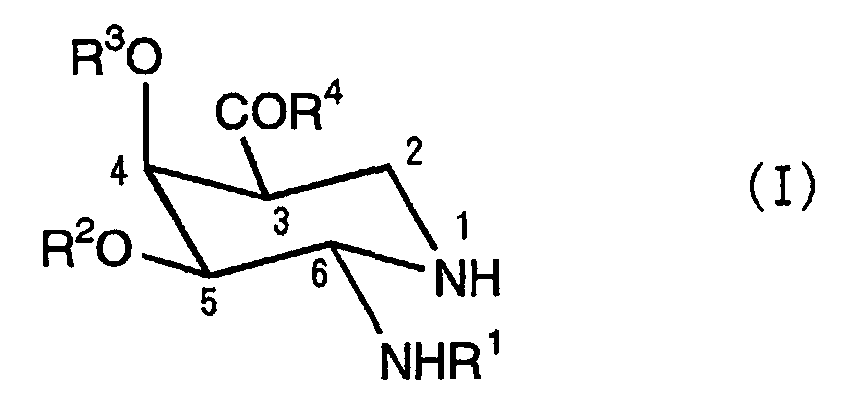 wherein R1 is a hydrogen atom or an unsubstituted or
halogen-substituted, straight or branched acyl group of 1-5
carbon atoms, particularly an alkanoyl group, or R1 is a
group of formula -C(=NH)R5 in which R5 is a group -OR6 or R5
is a group -NR7R8 where R6, R7 and R8 each stand for a
hydrogen-atom or a straight or branched alkyl group of 1-5
carbon atoms; and R2 and R3 may be the same or different
from each other and R2 and R3 each are a hydrogen atom or
an unsubstituted or halogen-substituted, straight or
branched acyl group of 1-5 carbon atoms, particularly an
alkanoyl group; and independently from R5, R4 stands for a
group of formula -OR6 or a group of formula -NR7R8 where R6,
R7 and R8 each stand for a hydrogen atom or a straight or
branched alkyl group of 1-5 carbon atoms, or a pharmacologically
acceptable salt thereof, in combination with a
pharmacologically acceptable carrier or carriers.
wherein R1 is a hydrogen atom or an unsubstituted or
halogen-substituted, straight or branched acyl group of 1-5
carbon atoms, particularly an alkanoyl group, or R1 is a
group of formula -C(=NH)R5 in which R5 is a group -OR6 or R5
is a group -NR7R8 where R6, R7 and R8 each stand for a
hydrogen-atom or a straight or branched alkyl group of 1-5
carbon atoms; and R2 and R3 may be the same or different
from each other and R2 and R3 each are a hydrogen atom or
an unsubstituted or halogen-substituted, straight or
branched acyl group of 1-5 carbon atoms, particularly an
alkanoyl group; and independently from R5, R4 stands for a
group of formula -OR6 or a group of formula -NR7R8 where R6,
R7 and R8 each stand for a hydrogen atom or a straight or
branched alkyl group of 1-5 carbon atoms, or a pharmacologically
acceptable salt thereof, in combination with a
pharmacologically acceptable carrier or carriers.
Siastatin B itself is a compound of the general
formula (I) above, wherein R1 is acetyl group, R2 and R3
each are hydrogen atom and R4 is -OH group [refer to J.
Antibiot., Vol. 27, pp.963-969 (1974)].
In the pharmaceutical composition according to the
first aspect of this invention, the pharmacologically
acceptable salts of siastatin B or the siastatin B
derivative, which is usable as the active ingredient, may
include alkali metal salts, e.g. sodium salt, at the 3-carboxyl
group of siastatin B, and alkaline earth metal
salts, e.g. calcium salt, at said 3-carboxyl group, and
ammonium salt, and so on, as well as acid addition salts at
the imino group of siastatin B or the siastatin B
derivative, with a pharmacologically acceptable inorganic
acid, for example, hydrochloride, sulfate and phosphate,
and with a pharmacologically acceptable organic acid, for
example, acetate and para-toluenesulfonate. However, the
salts are not limited thereto.
The pharmaceutical composition according to the
first aspect of this invention for preventing or treating
the diarrhea may preferably be administered to such cancer-bearing
patients who have the diarrhea as induced as the
side effect in association with the administration of the
anticancer chemotherapeutic agent. In particular, the
composition of this invention may suitably be administered
for the prevention or treatment of a diarrhea which is
induced in association with the administration of an
anticancer chemotherapeutic agent of such type that a
metabolic product of the administered anticancer agent can
be converted in vivo into the form of a glucuronide thereof
which is then excreted into the bile. As a particularly
preferred application, the pharmaceutical composition
according to the first aspect of invention is used to
prevent or treat such diarrhea which is induced in the
cancer-bearing patients by administration of a topoisomerase
I inhibitor acting as the anticancer
chemotherapeutic agent.
It is known that the topoisomerase I inhibitor
usable as the anticancer chemotherapeutic agent includes
camptothecin-related drugs which are namely the anticancer
camptothecin derivatives. One example of the anticancer
camptothecin derivatives is irinotecan, and further
examples thereof are topotecan and others [refer to
literature: J. Clin. Oncol., Vol. 10, page 647 (1992)]. It
is already known that irinotecan, topotecan and the other
camptothecin derivatives, after their administration to the
patient, are metabolized in the liver of the patient so as
to convert into the metabolite of the derivatives which is
in the form of a glucuronide and which is then excreted in
the bile and further transferred into the lower intestinal
tracts, i.e. small intestine and large intestine of the
patients.
According to our investigations, it is presumed that
the mechanism of suppression of the diarrhea by
administering siastatin B or the siastatin B derivative of
the general formula (I) which has an inhibitory activity
against β-glucuronidase comprises the following mechanism.
That is, the camptothecin derivatives can be converted,
after the administration thereof, into their metabolites in
vivo by the liver, and the resulting metabolites are
further converted by the action of UDP-glucuronosyl-transferase
(UGT) existing in the liver, to produce
glucuronides thereof which are thereafter excreted into the
bile. There exist many sorts of enterobacteria of the
intestinal microflora in the lower intestinal tracts, and
some enterobacteria of them have β-glucuronidase. The
bacteria having β-glucuronidase can decompose said
metabolites of the camptothecin derivatives which have been
converted into the glucuronides, so that the glucuronides
are deconjugated into deglucuronyl product and glucuronic
acid. As a result, it is presumed that such deglucuronyl
product which have been regenerated in the intestines
(which product is namely such aglycon-moiety compound as
derived from the original camptothecin derivative) can act
in the intestines so as to cause the diarrhea which is
induced by the resulting cytopathy in the intestines [refer
to Xenobiotica, Vol. 23, pp.5-10 (1993)].
Siastatin B and the siastatin B derivative of the
general formula (I) to be used as the active ingredient in
the composition of this invention are known, as explained
hereinafter, to have a potent inhibitory activity against
β-glucuronidase. This enzyme-inhibitory activity of
siastatin B or its derivative can inhibit that the
glucuronides are deconjugated by β-glucuronidase within the
intestines and hence that the above-mentioned deglucuronyl
product is reproduced. In this way, siastatin B or the
siastatin B derivative of the formula (I) can exhibit the
inhibitory effect against the diarrhea. It is therefore
believed that siastatin B or the siastatin B derivative of
the formula (I) having the inhibitory activity against β-glucuronidase,
after being orally administered and having
arrived at the intestines, is able to inhibit such
deconjugation of the said glucuronides which would be
caused by the intestinal microflora bacteria having β-glucuronidase,
and that siastatin B or the siastatin B
derivative having the inhibitory activity against β-glucuronidase
is thus able to inhibit the reproduction of
the deglucuronyl product which would cause the diarrhea,
whereby siastatin B or the siastatin B derivative is able
to exert the preventive effect against the incidence of
diarrhea and also is able to ameliorate the symptom of the
diarrhea as caused.
Siastatin B or the siastatin B derivative of the
general formula (I), which is to be used as the active
ingredient in the composition of this invention, may be
those compounds of the general formula (I) where R1, R2
and/or R3 is or each are an unsubstituted or halogen-substituted,
straight or branched acyl group of 1-5 carbon
atoms. They may particularly be such siastatin B
derivative of the general formula (I) wherein R1, R2 and/or
R3 is or each are a halogen-substituted or unsubstituted,
straight or branched (C1-C5) alkanoyl group.
In cases where R1, R2 and/or R3 in the general
formula (I) above is an unsubstituted or halogen-substituted,
(C1-C5) alkanoyl group, this alkanoyl group
may preferably be, for example, formyl group, acetyl group,
propionyl group, butyryl group, isobutyryl group, valeryl
group, isovaleryl group, 2-methylbutyryl group, 2,2-dimethylpropionyl
group, fluoroacetyl group, difluoroacetyl
group, trifluoroacetyl group, chloroacetyl group,
dichloroacetyl group, trichloroacetyl group, bromoacetyl
group, iodoacetyl group, pentafluoropropionyl group,
pentachloropropionyl group, heptafluorobutyryl group or
heptachloroisobutyryl group, and the like.
In cases where R1 in the formula (I) is a group
-C(=NH)R5, with R6, R7 and/or R8 present in the group R5
being an alkyl group of 1-5 carbon atoms, this (C1∼C5)
alkyl group may include methyl group, ethyl group, n-propyl
group, i-propyl group, n-butyl group, i-butyl group, sec-butyl
group, tert-butyl group, n-pentyl group, i-amyl group
and tert-amyl group, for example. Further, when R4 in the
formula (I) is a group -OR6, the alkyl group R6 may be one
of those alkyl groups as exemplified above.
Among the compounds of the general formula (I),
particularly preferred examples thereof are such a
siastatin B derivative of the formula (I) wherein R1 is
hydrogen atom, acetyl group, trifluoroacetyl group or
trichloroacetyl group, or R1 is amidino group -C(=NH)NH2;
and R2 and R3 each are hydrogen atom; and R4 is a group -OH.
Siastatin B or the siastatin B derivative of the
general formula (I), which is to be used as the active
ingredient in the composition of this invention, may
preferably be such siastatin B derivative of the following
general formula (I')
 wherein R1a is hydrogen atom or a (C1-C5) alkanoyl group, or
R1a is a (C1-C5) alkanoyl group which is mono-, di- or trisubstituted
with chlorine or fluorine atom, or R1a is
amidino group of formula -C(=NH)NH2; and R6a is hydrogen
atom or a (C1-C5) alkyl group, or a pharmacologically
acceptable salt thereof.
wherein R1a is hydrogen atom or a (C1-C5) alkanoyl group, or
R1a is a (C1-C5) alkanoyl group which is mono-, di- or trisubstituted
with chlorine or fluorine atom, or R1a is
amidino group of formula -C(=NH)NH2; and R6a is hydrogen
atom or a (C1-C5) alkyl group, or a pharmacologically
acceptable salt thereof.
Some specific examples of the compounds to be
preferably used as the active ingredient in the composition
of this invention are listed below.
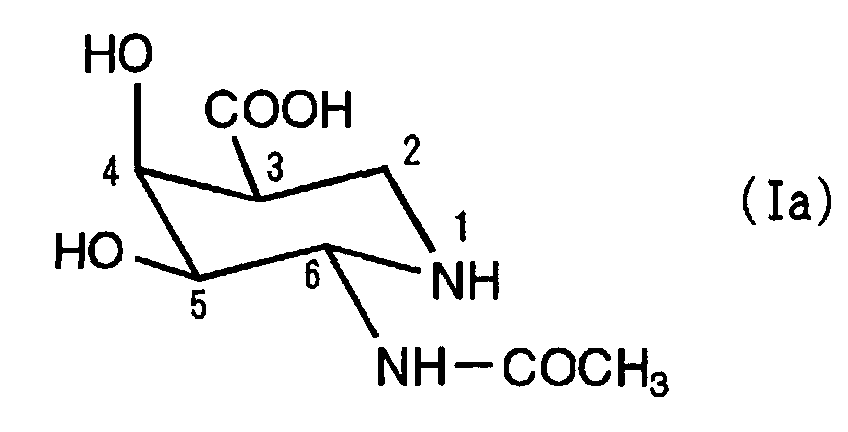


Incidentally, the fact that each of the compounds of
formula (Ia), formula (Ib), formula (Ic) and formula (Id)
as shown above exhibit an inhibitory activity against β-glucuronidase
is described in "J. Antibiotics" Vol. 47,
pp.101-107 (1994) and ibid. Vol. 49, pp.321-325 (1996).
Siastatin B is one of the compounds of the general
formula (I) which may to be used as the active ingredient
in the composition of this invention. Siastatin B is known
to be isolated as a fermentation product of strains of
Actinomycetes or other strains from the culture broth
thereof [refer, for example, to Japanese Patent Publication
KOKAI Sho-55-46714 and "J. Antibiot." Vol. 27, pp.963-969
(1974)]. Further, siastatin B may be produced either by a
total chemical synthesis or by semi-chemical synthesis with
starting from sugars [See, for example, Japanese Patent
Application First Publication KOKAI Hei-1-294687, "Bull.
Chem. Soc. Jpn." 65, p.978 (1992) and "J. Am. Chem. Soc."
110, p.7249 (1988)].
All the siastatin B derivatives of the general
formula (I) to be used as the active ingredient in the
composition of this invention may be produced by known
chemical conversion processes with starting from siastatin
B. Excepting the compound of the general formula (I)
wherein R1 =acetyl group, R2 =R3 =H and R4 =OH, that is,
siastatin B itself, all the siastatin B derivatives of the
general formula (I) may be produced from siastatin B by
known processes, for example, by the process described in
Japanese Patent Application First Publication KOKAI Hei-6-157458
and KOKAI Hei-9-71565, or by a process or processes
comprising some combinations of steps for conventional
protection and de-protection of functional groups of
siastatin B, and steps for acylation or esterification or
amidation reactions and so on. Further, such siastatin B
derivatives of the formula (I) may also be produced
directly by chemical synthetic processes without using
siastatin B.
The pharmaceutical composition according to the
first aspect of this invention contains a pharmaceutically
acceptable carrier or carriers, in admixture with the
active ingredient, and the composition may be formulated in
the form of different preparations which have been
conventionally used in the art. As the pharmaceutically
acceptable carriers, there may be used a wide variety of
solid carriers which have been used conventionally in usual
pharmaceutical preparations, for example, starch,
saccharose and lactose, as well as a variety of liquid
carriers, which may be, for example, water, physiological
saline solution, or ethanol and aqueous ethanol. If desired,
the composition of this invention may contain also
excipient, binder, disintegrator, lubricant, colorant,
flavoring agent, smell improver and/or surfactant in a
known manner.
The forms of the preparation of the composition for
administration, into which the composition of this
invention is formulated, may be any of the usual
preparations of the composition for oral administration,
injection or suppository, but the preparations for oral
administration are more desirable. In formulating the
preparations for oral administration, siastatin B or the
siastatin B derivatives of the general formula (I) as the
active ingredient for this invention may be mixed with a
solid carrier or carriers and may further be added, if
necessary, with excipient, binder, disintegrator, lubricant,
colorant, flavoring agent, smell improver, surfactant and
the like, and then the resulting mixture may be formulated
into the form of tablets, granules, powder, capsules, pills,
etc in a conventional manner. Siastatin B or the siastatin
B derivatives of the general formula (I) may be
incorporated, in the composition or preparation of this
invention, in a proportion of 0.1-100 % by weight,
preferably 1-90 % by weight.
The administered dose of the compound of the general
formula (I) contained in the composition of this invention
may vary dependently upon the age, body weight, sex,
symptom of disease, purpose of therapeutic treatment and
other factors and is to be decided by judgment of experts.
In general, preferred dose of the compound of the general
formula (I) as active ingredient is 50-500 mg per day for
parenteral administrations. While, for oral administrations,
a dose of the compound of 100-1000 mg per day is
preferred. The administration may be done once a day or in
2-4 portions per day.
The pharmaceutical composition according to the
first aspect of this invention may be administered in such
case when the diarrhea to be prevented or treated is the
one as induced in association with the administration of an
anticancer chemotherapeutic agent, particularly in such a
case when the diarrhea to be prevented or treated is the
one as induced in association with the administration of
the anticancer chemotherapeutic agent of such type that
administered anticancer agent is converted in vivo into the
glucuronides of the metabolic products and said glucuronides
are then excreted into the bile.
Further, the pharmaceutical composition according to
the first aspect of this invention may be administered in
such case when the diarrhea to be prevented or treated is
the one as induced in association with the administration
of a topoisomerase I inhibitor as the anticancer chemotherapeutic
agent, and particularly in such case when the
diarrhea to be prevented or treated is the one induced in
association with an intravenous administration of an
anticancer camptothecin derivative, particularly irinotecan
or topotecan, which acts as the topoisomerase I inhibitor.
According to a second aspect of this invention,
there is further provided a use of siastatin B or a
siastatin B derivative of the general formula (I) defined
hereinbefore or a pharmacologically acceptable salt thereof,
for the manufacture of a pharmaceutical composition to be
used for the prevention or treatment of a diarrhea.
According to a third aspect of this invention, there
is also provided a therapeutic method for preventing or
treating a diarrhea as induced in a cancer-bearing patient,
which comprises orally administering siastatin B or a
siastatin B derivative of the general formula (I) as above,
to the cancer-bearing patient having a symptom of the
diarrhea or susceptible of causing the diarrhea due to the
administration of such an anticancer camptothecin
derivative acting as a topoisomerase I inhibitor, with
siastatin B or the siastatin B derivative being
administered at a dose effective and sufficient to
ameliorate the symptom of the diarrhea.
In the method according to the third aspect of this
invention, siastatin B or the siastatin B derivative of
general formula (I) may be orally administered to the
cancer-bearing patient having a symptom of diarrhea as
induced by an intravenous administration of irinotecan or
other anticancer camptothecin derivative as an anticancer
agent, in such way that the administration of siastatin B
or the siastatin B derivative is made prior to each time of
intravenous injections of irinotecan or the other anticancer
camptothecin derivative at a dose of siastatin B or
the siastatin B derivative which is effective to ameliorate
the symptom of diarrhea. As the administered dose for
ameliorating the symptom of diarrhea, the compound of the
general formula (I) may be orally administered to an adult
at its dose of 100-1000 mg once per day. When an
anticancer camptothecin derivative, particularly irinotecan
or topotecan, is injected intravenously to the patient, it
is usually preferred that the compound of the general
formula (I) is administered orally at a time point of 10-30
minutes prior to each time of said intravenous injection.
This invention is now further illustrated with
reference to Examples which show some preparations of the
pharmaceutical composition of this invention, as well as
Test Examples which show some therapeutic treatments of
diarrhea. However, this invention is in no way limited to
these Examples.
A powder preparation of the following composition
was formulated by mixing well the under-mentioned
ingredients in a conventional manner.
| 6-Deacetamido-6-trifluoroacetamido-siastatin B of the formula (Ib) | 100 mg |
| Lactose | 175 mg |
A capsule preparation was formulated by filling up a
powder composition consisting of a mixture of the under-mentioned
ingredients in capsule containers.
| Siastatin B derivative of the formula (Ib) | 100 mg |
| Lactose | 175 mg |
The inhibitory effect of the siastatin B derivative
against a diarrhea as induced by administration of
irinotecan was tested by the following procedure.
To each of male ICR mice of six weeks-aged (six mice
per group), was administered intravenously a solution of
irinotecan (one of the camptothecin derivatives) dissolved
in a physiological salt solution, at a dose of 60 mg/ kg
once per day for the five consecutive days, to produce
model mice having digestive tract disorder with the
diarrhea as induced. Using said model mice, there was
administered orally 6-deacetamido-6-trifluoro-acetamidosiastatin
B of the formula (Ib) defined hereinbefore as the
test drug at a dose of 200 mg/kg or 400 mg/kg once per day
for the five consecutive days, provided that each
administration of the test drug was done at a time point of
15 minutes before each time of the administration of
irinotecan. Change in the body weight of mice in each
group under test was measured, and the test results of the
measurements are given in Table 1 below.
| Groups of experimental mice | Body weight change in each group of mice (6 mice per group)(average body weight:(g)±SD) | ||
| First day of the irinotecan administration | Terminal day of the irinotecan administration | 2nd Day after the terminal day of the irinotecan administration | |
| Group untreated | 30.8 ± 3.0 | 31.2 + 2.6 | 31.6 ± 1.8 |
| Group treated by administration of irinotecan alone | 31.3 ± 4.3 | 27.9 ± 3.3 | 24.8 ± 1.5 |
| Group treated by administration of both of irinotecan + the test drug (at dose of 200 mg/kg) | 30.4 ± 0.5 | 28.3 ± 2.3 | 26.2 ± 3.1 |
| Group treated by administration of both of irinotecan + the test drug (at dose of 400 mg/kg) | 31.3 ± 3.9 | 29.9 ± 2.8 | 27.1 ± 3.7 |
Further, in order to evaluate the extent of the
change in the body weight of mice in each group (6 mice per
group) above-mentioned, the relative ratio of the body
weight was calculated according to a calculation equation.
The calculation equation is as follows.
Relative ratio of body weight = (the body weight as
measured at the day of measurement) ÷ (the body weight as
measured at the first day of the administration of
irinotecan)
The test results so obtained are given in Table 2
below.
| Groups of experimental mice | Relative ratio of body weight | |
| First day of the irinotecan administration | 2nd Day after the terminal day of the irinotecan administration | |
| Group untreated | 1.02 ± 0.02 | 1.03 ± 0.02 |
| Group treated by administration of irinotecan alone | 0.89 ± 0.04 | 0.80 ± 0.06 |
| Group treated by administration of both of irinotecan + the test drug (at dose of 200 mg/kg) | 0.93 ± 0.04 | 0.86 ± 0.02 |
| Group treated by administration of both of irinotecan + the test drug (at dose of 400 mg/kg) | 0.96 + 0.05 | 0.87 ± 0.06 |
As shown in Table 1 and Table 2, the siastatin B
derivative used as the test drug could significantly reduce
the loss of the body weight which would be induced by the
administration of irinotecan.
Further, in order to estimate the extent of the
disorders in the digestive tracts of mice under test which
were induced at the second day after the terminal day of
the administration of irinotecan (that is, just at the
second day after the terminal day of the administration of
6-deacetamido -6-trifluoroacetamido-siastatin B as the test
drug), the observations of the extent of diarrhea as well
as the pathohistological observations of tissues of the
lower small intestine were evaluated. The results of
evaluation so obtained are shown in Table 3 below.
| Group of experimental mice | Extent of diarrhea and pathohistological observations of digestive tract | ||||||
| Number of mice on tested | Observations the extent of diarrhea | pathohistological observation of lower small intestine | |||||
| - | + | ++ | +++ | Necrosis of mucosa | Submucous edema | ||
| Group untreated | 6 | 6 | 0 | 0 | 0 | - | - |
| Group treated by administration of irinotecan alone | 6 | 0 | 1 | 1 | 4 | +++ | +++ |
| Group treated by administration of irinotecan + the test drug (at dose of 200 mg/kg) | 6 | 4 | 1 | 1 | 0 | +/++ | +/++ |
| Group treated by administration of irinotecan + the test drug (at dose of 400mg/kg) | 6 | 4 | 2 | 0 | 0 | +/++ | + |
The observations of the extent of diarrhea was based
upon the following scales.
- : normal, + : slight,
++ : moderate, +++ : severe.
- : normal, + : slight,
++ : moderate, +++ : severe.
As be revealed from Table 3 above, it is clear that
the tests with the combined administration of irinotecan
and the siastatin B derivative as the test drug were able
to lead that the extent of diarrhea as revealed from the
observations of the symptom of diarrhea, as well as the
extent of the disorders of the digestive tract as revealed
from the pathohistological observations of the small
intestine were ameliorated, as compared with those which
were found in the comparative group of mice having received
the administration of irinotecan alone.
The following test was conducted to verify any
influence on the anticancer efficacy of irinotecan, by the
combined administration of the siastatin B derivative as
test drug, with irinotecan.
To the cecum of each of nude mice (female) of KSN
strain and of eight weeks aged (7-10 mice per group), under
anesthetization, was transplanted a tumor fragment of human
colon cancer strain HT-29, thereby to produce model mice
with colon cancer. At the last day of the third week from
the transplantation of the tumor fragment, irinotecan was
administered to said model mice by the intravenous
injection once per four days, totally five times, so that
60 mg/kg of irinitecan was administered at each of the
first and second injections and 45 mg/kg of irinitecan was
administered at each of the third, fourth and fifth
injections. The test drug, 6-deacetamido-6-trifluoroacetamido-siastatin
B of the formula (Ib), was
administered to each of these model mice at a dose of 400
mg/kg, once per four days, totally five times, so that each
administration of the test drug was made at a time point of
15 minutes prior to each of the intravenous administrations
of irinotecan. There was further provided another group of
mice (comparative) to which was administered said test drug
alone at a dose of 400 mg/kg.
Two days after the terminal day of the administration
of the test drug, the mice of each group under test
were sacrificed under anesthetization, and the tumor masses
were removed from the cecum sites. The tumor mass as
removed from each of the mice was weighed. The results
obtained are shown in Table 4 below. The influence of the
tested siastatin B derivative which affected upon the
medicinal efficacy of irinotecan was estimated with
reference to the change in the weight of tumor mass as an
index.
| Group of experimental mice | Change in weight of tumor mass of colon cancer HT-29 as transplanted to cecum | |
| Number of mice under test | Weight of tumor mass(mg) | |
| Group untreated | 10 | 70.0 + 21.2 |
| Group administrated with the test drug alone | 10 | 63.0 ± 13.4 |
| Group administrated with irinotecan alone | 10 | 38.3 ± 6.4* |
| Group administrated with irinotecan + the test drug | 7 | 39.0 ± 7.4* |
| The asterisk mark * indicates that the data are admitted to have a significant deviation (P<0.01) over those of the untreated group. |
As shown in Table 4 above, it is demonstrated that
the tumor weight in the group of mice which were treated by
the administration of irinotecan alone was reduced lower
than the tumor weight in the untreated group (which
received neither of irinotecan and the siastatin B
derivative as the test drug), indicating that irinotecan
could exhibit a significant inhibitory effect against the
growth of the cells of human colon cancer strain HT-29 as
transplanted to the cecum of nude mouse under test.
Further, as shown in Table 4 above, it is clear that
the tumor weight in the comparative group of mice as
treated by administration of irinotecan alone was
substantially equal to the tumor weight in the treated
group of mice which were treated by the combined
administration of both of irinotecan and the test drug
(namely, the treated group of mice as administered with
irinotecan + the siastatin B derivative). In view of this
fact, it is evident that the siastatin B derivative
administered as the test drug did not exhibit any
inhibitory effect against the anticancer activity of
irinotecan itself.
As explained hereinbefore, siastatin B or the
siastatin B derivatives of the general formula (I), which
is usable as an active ingredient in the pharmaceutical
composition of this invention for prevention or treatment
of a diarrhea, has an inhibitory activity against β-glucuronidase.
The composition of this invention, which
comprises as active ingredient siastatin B or the siastatin
B derivative of general formula (I), when orally
administered to cancer-bearing patients, is able to well
inhibit a diarrhea as induced in association with the
administration of an anticancer agent to the patients, and
particularly the composition of this invention is able to
inhibit such a diarrhea as induced in association with the
administration of a camptothecin derivative as anticancer
agent. Therefore, the composition of this invention can
eliminate a necessity to discontinue the chemotherapy of
cancer which would often becomes necessary due to an
incurred diarrhea. Thus, the composition of this invention
makes the continuance of such cancer-chemotherapy possible
and can also prevent the patients from exhaustion of their
physical strength which would be involved due to the
diarrhea. Thus, the composition and method according to
this invention can further improve the therapeutic effect
which is attainable by the anticancer agents known and used
in the prior art.
Claims (13)
- A pharmaceutical composition for preventing or treating a diarrhea, which comprises as an active ingredient, siastatin B or a siastatin B derivative that has an inhibitory activity against β-glucuronidase and that is represented by the following general formula (I)wherein R1 is a hydrogen atom or an unsubstituted or halogen-substituted, straight or branched acyl group of 1-5 carbon atoms, particularly an alkanoyl group, or R1 is a group of formula -C(=NH)R5 in which R5 is a group -OR6 or R5 is a group -NR7 R8 where R6, R7 and R8 each stand for a hydrogen atom or a straight or branched alkyl group of 1-5 carbon atoms; and R2 and R3 may be the same or different from each other and R2 and R3 each are a hydrogen atom or an unsubstituted or halogen-substituted, straight or branched acyl group of 1-5 carbon atoms, particularly an alkanoyl group; and independently from R5, R4 stands for a group of formula -OR6 or a group of formula -NR7 R8 where R6, R7 and R8 each stand for a hydrogen atom or a straight or branched alkyl group of 1-5 carbon atoms, or a pharmacologically acceptable salt thereof, in combination with a pharmacologically acceptable carrier or carriers.

- A composition as claimed in Claim 1, which comprises as the active ingredient, a siastatin B derivative of the general formula (I) where R1, R2 and/or R3 is or each are an unsubstituted or halogen-substituted, straight or branched (C1-C5) alkanoyl group, or a salt thereof.
- A composition as claimed in Claim 2, which comprises as the active ingredient, a siastatin B derivative of the general formula (I) wherein R1, R2 and/or R3 is or each are an unsubstituted or halogen-substituted, straight or branched (C1-C5) alkanoyl group that is chosen from formyl group, acetyl group, propionyl group, butyryl group, isobutyryl group, valeryl group, isovaleryl group, 2-methylbutyryl group, 2,2-dimethylpropionyl group, fluoroacetyl group, difluoroacetyl group, trifluoroacetyl group, chloroacetyl group, dichloroacetyl group, trichloroacetyl group, bromoacetyl group, iodoacetyl group, pentafluoropropionyl group, pentachloropropionyl group, heptafluorobutyryl group and heptachloroisobutyryl group, or a salt thereof.
- A composition as claimed in Claim 1, which comprises as the active ingredient, a compound of the general formula (I) wherein R1 is hydrogen atom, acetyl group, trifluoroacetyl group, trichloroacetyl group or amidino group -C(=NH)NH2; and R2 and R3 each are hydrogen atom; and R4 is a group -OH, or a salt thereof.
- A composition as claimed in Claim 1, in which siastatin B or a siastatin B derivative of the general formula (I) contained therein is a siastatin B derivative of the general formula (I')wherein R1a is hydrogen atom or a (C1-C5) alkanoyl group, or R1a is a (C1-C5) alkanoyl group which is mono-, di- or trisubstituted with chlorine or fluorine atom, or R1a is amidino group of formula -C(=NH)NH2; and R6a is hydrogen atom or a (C1-C5) alkyl group, or a pharmacologically acceptable salt thereof.

- A composition as claimed in Claim 1, which comprises as the active ingredient, siastatin B of the formula (Ia)or 6-deacetamido-6-trifluoroacetamido-siastatin B of the formula (Ib)
 or 6-deacetamido-6-trichloroacetamido-siastatin B of the formula (Ic)
 or 6-deacetamido-6-guanidino-siastatin B of the formula (Id)
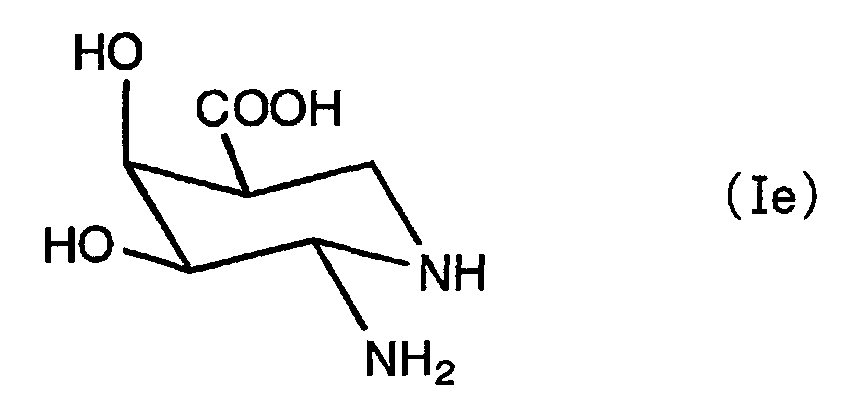
 or 6-deacetamido-6-amino-siastatin B of the formula (Ie)
 or a pharmacologically acceptable salt thereof.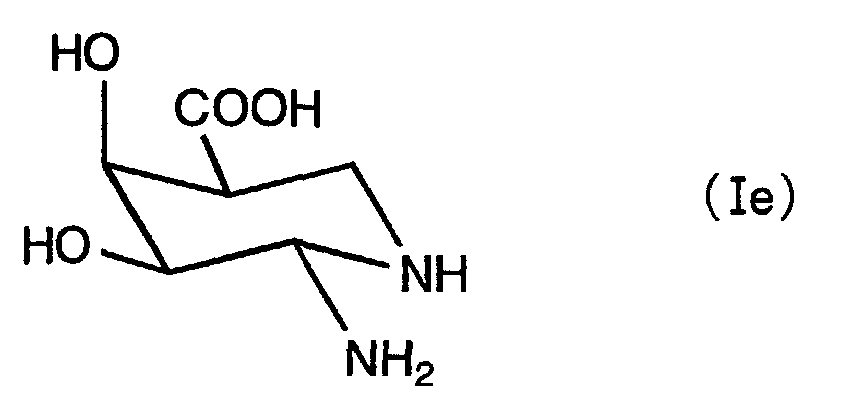
- A composition as claimed in any one of Claims 1-6, which is used so that the diarrhea to be prevented or treated is a diarrhea as induced by the administration of an anticancer chemotherapeutic agent.
- A composition as claimed in any one of Claims 1-7, which is used so that the diarrhea to be prevented or treated is a diarrhea as induced by the administration of an anticancer chemotherapeutic agent of such type that a metabolic product of the administered anticancer agent can be converted into the glucuronide thereof which is then excreted into the bile.
- A composition as claimed in Claim 7 or 8, which is used so that the diarrhea to be prevented or treated is a diarrhea as induced by the administration of a topoisomerase I inhibitor acting as the anticancer chemotherapeutic agent.
- A composition as claimed in Claim 8 or 9, which is used so that the diarrhea to be prevented or treated is a diarrhea as induced by the intravenous administration of an anticancer camptothecin derivative, particularly irinotecan or topotecan, that is a topoisomerase I inhibitors.
- Use of siastatin B or a siastatin B derivative of the general formula (I) or a pharmacologically acceptable salt thereof as defined in Claim 1, for the manufacture of a pharmaceutical composition to be used for the prevention or treatment of a diarrhea.
- A method for the prevention or therapeutic treatment of a diarrhea as induced in a cancer-bearing patient, which comprises administering orally siastatin B or a siastatin B derivative of the general formula (I) as defined in Claim 1, to the patient having a symptom of the diarrhea or susceptible of causing the diarrhea due to the administration of such an anticancer camptothecin derivative acting as a topoisomerase I inhibitor, with siastatin B or the siastatin B derivative being administered at a dose effective and sufficient to ameliorate the symptom of the diarrhea.
- A method as claimed in Claim 12, wherein siastatin B or a siastatin B derivative of the general formula (I) as defined in Claim 1 is orally administered to a cancer-bearing patient having a symptom of diarrhea as induced by intravenous administration of irinotecan or the other anticancer camptothecin derivative as an anticancer agent, in such way that the administration of siastatin B or the siastatin B derivative is made prior to each time of the intravenous administrations of irinotecan or the other anticancer camptothecin derivative, at a dose of siastatin B or the siastatin B derivative effective to ameliorate the symptom of diarrhea.
Applications Claiming Priority (3)
| Application Number | Priority Date | Filing Date | Title |
|---|---|---|---|
| JP18232799 | 1999-06-28 | ||
| JP18232799 | 1999-06-28 | ||
| PCT/JP2000/004264 WO2001000217A1 (en) | 1999-06-28 | 2000-06-28 | Medicinal compositions for preventing or treating diarrhea |
Publications (1)
| Publication Number | Publication Date |
|---|---|
| EP1197214A1 true EP1197214A1 (en) | 2002-04-17 |
Family
ID=16116376
Family Applications (1)
| Application Number | Title | Priority Date | Filing Date |
|---|---|---|---|
| EP00942374A Withdrawn EP1197214A1 (en) | 1999-06-28 | 2000-06-28 | Medicinal compositions for preventing or treating diarrhea |
Country Status (5)
| Country | Link |
|---|---|
| EP (1) | EP1197214A1 (en) |
| KR (1) | KR20020016850A (en) |
| AU (1) | AU5704800A (en) |
| CA (1) | CA2376938A1 (en) |
| WO (1) | WO2001000217A1 (en) |
Cited By (4)
| Publication number | Priority date | Publication date | Assignee | Title |
|---|---|---|---|---|
| EP2509597A4 (en) * | 2009-12-10 | 2013-04-10 | Univ North Carolina | SELECTIVE ETA-GLUCURONIDASE INHIBITORS AS TREATMENT AGAINST THE SIDE EFFECTS OF CAMPTOTHECIN-DERIVED ANINEOPLASTIC AGENTS |
| WO2014062683A1 (en) * | 2012-10-15 | 2014-04-24 | University Of Florida Research Foundation, Inc. | Materials and methods for prevention and treatment of diarrhea and inflammation in the gastrointestinal tract |
| CN107898777A (en) * | 2017-10-30 | 2018-04-13 | 江苏理工学院 | A kind of new application of aspartame |
| CN111419843A (en) * | 2020-05-14 | 2020-07-17 | 浙江工业大学 | Application of cyanoimine thiazolidine furan carboxamide compound in preparation of β -glucuronidase inhibitor |
Families Citing this family (3)
| Publication number | Priority date | Publication date | Assignee | Title |
|---|---|---|---|---|
| WO2004103371A1 (en) * | 2003-05-21 | 2004-12-02 | Pharmacia & Upjohn Company Llc | Use of cftr inhibitors for the treatment of chemotherapy-induced diarrhea |
| US7761134B2 (en) | 2006-10-20 | 2010-07-20 | Given Imaging Ltd. | System and method for modeling a tracking curve of an in vivo device |
| CN117820276B (en) * | 2024-01-02 | 2026-02-10 | 荆楚理工学院 | A Kaempferol Coupling Derivative and Its Use in the Preparation of Antidiarrheal Drugs |
-
2000
- 2000-06-28 WO PCT/JP2000/004264 patent/WO2001000217A1/en not_active Ceased
- 2000-06-28 CA CA002376938A patent/CA2376938A1/en not_active Abandoned
- 2000-06-28 AU AU57048/00A patent/AU5704800A/en not_active Abandoned
- 2000-06-28 EP EP00942374A patent/EP1197214A1/en not_active Withdrawn
- 2000-06-28 KR KR1020017016687A patent/KR20020016850A/en not_active Withdrawn
Non-Patent Citations (1)
| Title |
|---|
| See references of WO0100217A1 * |
Cited By (13)
| Publication number | Priority date | Publication date | Assignee | Title |
|---|---|---|---|---|
| US8557808B2 (en) | 2009-12-10 | 2013-10-15 | North Carolina Central University | Selective beta-glucuronidase inhibitors as a treatment for side effects of camptothecin antineoplastic agents |
| US9334288B2 (en) | 2009-12-10 | 2016-05-10 | The University Of North Carolina At Chapel Hill | Selective β-glucuronidase inhibitors as a treatment for side effects of camptothecin antineoplastic agents |
| EP2509597A4 (en) * | 2009-12-10 | 2013-04-10 | Univ North Carolina | SELECTIVE ETA-GLUCURONIDASE INHIBITORS AS TREATMENT AGAINST THE SIDE EFFECTS OF CAMPTOTHECIN-DERIVED ANINEOPLASTIC AGENTS |
| US10864230B2 (en) | 2012-10-15 | 2020-12-15 | University Of Florida Research Foundation, Inc. | Methods for treatment of diarrhea |
| WO2014062683A1 (en) * | 2012-10-15 | 2014-04-24 | University Of Florida Research Foundation, Inc. | Materials and methods for prevention and treatment of diarrhea and inflammation in the gastrointestinal tract |
| US11986494B2 (en) | 2012-10-15 | 2024-05-21 | University Of Florida Research Foundation, Inc. | Materials and methods for prevention and treatment of diarrhea and inflammation in the gastrointestinal tract |
| US9987306B2 (en) | 2012-10-15 | 2018-06-05 | University Of Florida Research Foundation, Inc. | Materials and methods for prevention and treatment of diarrhea and inflammation in the gastrointestinal tract |
| WO2019085828A1 (en) * | 2017-10-30 | 2019-05-09 | 江苏理工学院 | New uses of aspartame |
| KR20200059210A (en) * | 2017-10-30 | 2020-05-28 | 지앙수 유니버시티 오브 테크놀로지 | New uses of aspartame |
| CN107898777B (en) * | 2017-10-30 | 2020-05-05 | 江苏理工学院 | A new use of aspartame |
| CN107898777A (en) * | 2017-10-30 | 2018-04-13 | 江苏理工学院 | A kind of new application of aspartame |
| CN111419843A (en) * | 2020-05-14 | 2020-07-17 | 浙江工业大学 | Application of cyanoimine thiazolidine furan carboxamide compound in preparation of β -glucuronidase inhibitor |
| CN111419843B (en) * | 2020-05-14 | 2021-07-27 | 浙江工业大学 | Application of cyanoimine thiazolidine furan carboxamides in the preparation of β-glucuronidase inhibitors |
Also Published As
| Publication number | Publication date |
|---|---|
| WO2001000217A1 (en) | 2001-01-04 |
| KR20020016850A (en) | 2002-03-06 |
| AU5704800A (en) | 2001-01-31 |
| CA2376938A1 (en) | 2001-01-04 |
Similar Documents
| Publication | Publication Date | Title |
|---|---|---|
| US4401653A (en) | Combination of rapamycin and picibanil for the treatment of tumors | |
| JP3963976B2 (en) | Chlamydia infection treatment | |
| US4757072A (en) | Carcinostatic agent | |
| IE58314B1 (en) | Pharmaceutical products providing enhanced analgasia | |
| EP0774255B1 (en) | Use of ursolic acid for the manufacture of a medicament for suppressing metastasis | |
| AU2007341218A1 (en) | Isosorbide mononitrate derivatives for the treatment of intestinal disorders | |
| CA2376938A1 (en) | Medicinal compositions for preventing or treating diarrhea | |
| CN101856498B (en) | Anti-septic shock medicine composition and application thereof | |
| US6426369B1 (en) | Oxethazaine as antimicrobial agent | |
| US20060160887A1 (en) | Medicinal composition | |
| US5525605A (en) | Remedy for inflammatory intestinal diseases | |
| US7276532B2 (en) | Remedies for vesical hyperactivity | |
| US5686494A (en) | Pharmaceutical preparations for ameliorating epigastric functional disorders | |
| NL8203983A (en) | PHOSPHORAMIDE DERIVATIVES, PROCESS FOR THE PREPARATION THEREOF, AND MEDICINAL PRODUCTS CONTAINING THEM. | |
| JPWO2001000217A1 (en) | Pharmaceutical composition for preventing or treating diarrhea | |
| JP2545321B2 (en) | Smooth muscle contraction inhibitor | |
| US6362169B1 (en) | Antibacterial compositions with synergistic effect, drugs and remedies for digestive diseases containing the same, process for the production thereof and preparations associated therewith | |
| EP0310259A2 (en) | Eperisone as a hypotensive agent | |
| US3670083A (en) | Germine-diacetate in the treatment of myasthenia gravis | |
| KR920003580B1 (en) | Atherosclerosis prevention and treatment | |
| JP2579486B2 (en) | Central nervous system depressant | |
| JPH0120128B2 (en) | ||
| CN116831985A (en) | Afatinib injection and preparation method thereof | |
| CH652597A5 (en) | PHARMACEUTICAL COMPOSITION, CONTAINING 1- (2-3'-CARBOXYPROPIONYLOXYAETHYL) -2-METHYL-5-NITROIMIDAZOLE. | |
| US20100179324A1 (en) | Anti-tumor agent comprising sulphostin or sulphostin-related compound as the active ingredient |
Legal Events
| Date | Code | Title | Description |
|---|---|---|---|
| PUAI | Public reference made under article 153(3) epc to a published international application that has entered the european phase |
Free format text: ORIGINAL CODE: 0009012 |
|
| 17P | Request for examination filed |
Effective date: 20020124 |
|
| AK | Designated contracting states |
Kind code of ref document: A1 Designated state(s): AT BE CH CY DE DK ES FI FR GB GR IE IT LI LU MC NL PT SE |
|
| AX | Request for extension of the european patent |
Free format text: AL;LT;LV;MK;RO;SI |
|
| STAA | Information on the status of an ep patent application or granted ep patent |
Free format text: STATUS: THE APPLICATION HAS BEEN WITHDRAWN |
|
| 18W | Application withdrawn |
Effective date: 20040216 |