EP1197147A1 - Method of inactivating viral particles in a blood product - Google Patents
Method of inactivating viral particles in a blood product Download PDFInfo
- Publication number
- EP1197147A1 EP1197147A1 EP00203559A EP00203559A EP1197147A1 EP 1197147 A1 EP1197147 A1 EP 1197147A1 EP 00203559 A EP00203559 A EP 00203559A EP 00203559 A EP00203559 A EP 00203559A EP 1197147 A1 EP1197147 A1 EP 1197147A1
- Authority
- EP
- European Patent Office
- Prior art keywords
- substituted
- alkyl
- group
- chosen
- halogen atom
- Prior art date
- Legal status (The legal status is an assumption and is not a legal conclusion. Google has not performed a legal analysis and makes no representation as to the accuracy of the status listed.)
- Withdrawn
Links
- 238000000034 method Methods 0.000 title claims abstract description 21
- 239000010836 blood and blood product Substances 0.000 title claims abstract description 18
- 229940125691 blood product Drugs 0.000 title claims abstract description 18
- 239000002245 particle Substances 0.000 title claims abstract description 8
- 230000003612 virological effect Effects 0.000 title claims abstract description 8
- 230000000415 inactivating effect Effects 0.000 title claims abstract description 7
- 230000003213 activating effect Effects 0.000 claims abstract description 3
- 125000005843 halogen group Chemical group 0.000 claims description 16
- 125000003837 (C1-C20) alkyl group Chemical group 0.000 claims description 14
- 125000002887 hydroxy group Chemical group [H]O* 0.000 claims description 14
- 125000006649 (C2-C20) alkynyl group Chemical group 0.000 claims description 12
- 125000003342 alkenyl group Chemical group 0.000 claims description 12
- 125000003545 alkoxy group Chemical group 0.000 claims description 12
- 229910052757 nitrogen Inorganic materials 0.000 claims description 12
- 125000003118 aryl group Chemical group 0.000 claims description 10
- 150000001875 compounds Chemical class 0.000 claims description 10
- 125000000623 heterocyclic group Chemical group 0.000 claims description 8
- 125000004433 nitrogen atom Chemical group N* 0.000 claims description 7
- 125000002924 primary amino group Chemical group [H]N([H])* 0.000 claims description 6
- 229910052717 sulfur Inorganic materials 0.000 claims description 6
- 125000006736 (C6-C20) aryl group Chemical group 0.000 claims description 4
- IJGRMHOSHXDMSA-UHFFFAOYSA-N Atomic nitrogen Chemical compound N#N IJGRMHOSHXDMSA-UHFFFAOYSA-N 0.000 claims description 4
- 125000000217 alkyl group Chemical group 0.000 claims description 4
- 229910052760 oxygen Inorganic materials 0.000 claims description 4
- 229910052698 phosphorus Inorganic materials 0.000 claims description 4
- -1 nitril Chemical group 0.000 claims description 3
- 125000000027 (C1-C10) alkoxy group Chemical group 0.000 claims description 2
- 125000000008 (C1-C10) alkyl group Chemical group 0.000 claims description 2
- 125000006273 (C1-C3) alkyl group Chemical group 0.000 claims description 2
- 125000004178 (C1-C4) alkyl group Chemical group 0.000 claims description 2
- 125000006374 C2-C10 alkenyl group Chemical group 0.000 claims description 2
- JUJWROOIHBZHMG-UHFFFAOYSA-N Pyridine Chemical group C1=CC=NC=C1 JUJWROOIHBZHMG-UHFFFAOYSA-N 0.000 claims description 2
- 125000002252 acyl group Chemical group 0.000 claims description 2
- 125000004423 acyloxy group Chemical group 0.000 claims description 2
- 125000003277 amino group Chemical group 0.000 claims description 2
- 125000004429 atom Chemical group 0.000 claims description 2
- 229910052739 hydrogen Inorganic materials 0.000 claims description 2
- 239000001257 hydrogen Substances 0.000 claims description 2
- 150000002829 nitrogen Chemical group 0.000 claims description 2
- 125000001424 substituent group Chemical group 0.000 claims description 2
- 125000004435 hydrogen atom Chemical class [H]* 0.000 claims 1
- 210000003743 erythrocyte Anatomy 0.000 abstract description 5
- 210000001772 blood platelet Anatomy 0.000 abstract description 4
- 210000004027 cell Anatomy 0.000 description 8
- 239000003504 photosensitizing agent Substances 0.000 description 6
- 206010018910 Haemolysis Diseases 0.000 description 5
- 108091053398 TRIM/RBCC family Proteins 0.000 description 5
- 102000011408 Tripartite Motif Proteins Human genes 0.000 description 5
- 230000008588 hemolysis Effects 0.000 description 5
- 239000003223 protective agent Substances 0.000 description 5
- 241000700605 Viruses Species 0.000 description 4
- 239000000243 solution Substances 0.000 description 4
- KRKNYBCHXYNGOX-UHFFFAOYSA-N citric acid Chemical compound OC(=O)CC(O)(C(O)=O)CC(O)=O KRKNYBCHXYNGOX-UHFFFAOYSA-N 0.000 description 3
- 238000002474 experimental method Methods 0.000 description 3
- RSGFPIWWSCWCFJ-VAXZQHAWSA-N 2-hydroxypropane-1,2,3-tricarboxylic acid;(2r,3s,4r,5r)-2,3,4,5,6-pentahydroxyhexanal;phosphoric acid Chemical compound OP(O)(O)=O.OC[C@@H](O)[C@@H](O)[C@H](O)[C@@H](O)C=O.OC(=O)CC(O)(C(O)=O)CC(O)=O RSGFPIWWSCWCFJ-VAXZQHAWSA-N 0.000 description 2
- FAPWRFPIFSIZLT-UHFFFAOYSA-M Sodium chloride Chemical compound [Na+].[Cl-] FAPWRFPIFSIZLT-UHFFFAOYSA-M 0.000 description 2
- 241000711975 Vesicular stomatitis virus Species 0.000 description 2
- 210000004369 blood Anatomy 0.000 description 2
- 239000008280 blood Substances 0.000 description 2
- 208000002672 hepatitis B Diseases 0.000 description 2
- 239000000594 mannitol Substances 0.000 description 2
- 244000052613 viral pathogen Species 0.000 description 2
- QTBSBXVTEAMEQO-UHFFFAOYSA-M Acetate Chemical compound CC([O-])=O QTBSBXVTEAMEQO-UHFFFAOYSA-M 0.000 description 1
- 229930024421 Adenine Natural products 0.000 description 1
- GFFGJBXGBJISGV-UHFFFAOYSA-N Adenine Chemical compound NC1=NC=NC2=C1N=CN2 GFFGJBXGBJISGV-UHFFFAOYSA-N 0.000 description 1
- 102000004506 Blood Proteins Human genes 0.000 description 1
- 108010017384 Blood Proteins Proteins 0.000 description 1
- CRXQNDHOIGEPBU-UHFFFAOYSA-N CN1C=CC(C(C(C2=CCN(C)C=C2)=C2C=C(C=C3)N=C3C=C(C=CC3=CC(C=C4)=NC4=C4)N3C3=CC=CC=C3)=C4N2C2=CCN(C)C=C2)=CC1.Cl Chemical compound CN1C=CC(C(C(C2=CCN(C)C=C2)=C2C=C(C=C3)N=C3C=C(C=CC3=CC(C=C4)=NC4=C4)N3C3=CC=CC=C3)=C4N2C2=CCN(C)C=C2)=CC1.Cl CRXQNDHOIGEPBU-UHFFFAOYSA-N 0.000 description 1
- KRKNYBCHXYNGOX-UHFFFAOYSA-K Citrate Chemical compound [O-]C(=O)CC(O)(CC([O-])=O)C([O-])=O KRKNYBCHXYNGOX-UHFFFAOYSA-K 0.000 description 1
- FBPFZTCFMRRESA-KVTDHHQDSA-N D-Mannitol Chemical compound OC[C@@H](O)[C@@H](O)[C@H](O)[C@H](O)CO FBPFZTCFMRRESA-KVTDHHQDSA-N 0.000 description 1
- WQZGKKKJIJFFOK-GASJEMHNSA-N Glucose Natural products OC[C@H]1OC(O)[C@H](O)[C@@H](O)[C@@H]1O WQZGKKKJIJFFOK-GASJEMHNSA-N 0.000 description 1
- HTTJABKRGRZYRN-UHFFFAOYSA-N Heparin Chemical compound OC1C(NC(=O)C)C(O)OC(COS(O)(=O)=O)C1OC1C(OS(O)(=O)=O)C(O)C(OC2C(C(OS(O)(=O)=O)C(OC3C(C(O)C(O)C(O3)C(O)=O)OS(O)(=O)=O)C(CO)O2)NS(O)(=O)=O)C(C(O)=O)O1 HTTJABKRGRZYRN-UHFFFAOYSA-N 0.000 description 1
- 208000005176 Hepatitis C Diseases 0.000 description 1
- UFHFLCQGNIYNRP-UHFFFAOYSA-N Hydrogen Chemical compound [H][H] UFHFLCQGNIYNRP-UHFFFAOYSA-N 0.000 description 1
- 229930195725 Mannitol Natural products 0.000 description 1
- 239000004793 Polystyrene Substances 0.000 description 1
- ZLMJMSJWJFRBEC-UHFFFAOYSA-N Potassium Chemical compound [K] ZLMJMSJWJFRBEC-UHFFFAOYSA-N 0.000 description 1
- GLEVLJDDWXEYCO-UHFFFAOYSA-N Trolox Chemical compound O1C(C)(C(O)=O)CCC2=C1C(C)=C(C)C(O)=C2C GLEVLJDDWXEYCO-UHFFFAOYSA-N 0.000 description 1
- 229960000643 adenine Drugs 0.000 description 1
- XAGFODPZIPBFFR-UHFFFAOYSA-N aluminium Chemical compound [Al] XAGFODPZIPBFFR-UHFFFAOYSA-N 0.000 description 1
- 229910052782 aluminium Inorganic materials 0.000 description 1
- 239000004411 aluminium Substances 0.000 description 1
- 239000003146 anticoagulant agent Substances 0.000 description 1
- 239000007864 aqueous solution Substances 0.000 description 1
- 210000000601 blood cell Anatomy 0.000 description 1
- 210000001124 body fluid Anatomy 0.000 description 1
- 239000010839 body fluid Substances 0.000 description 1
- 210000001185 bone marrow Anatomy 0.000 description 1
- 239000012141 concentrate Substances 0.000 description 1
- IPZJQDSFZGZEOY-UHFFFAOYSA-N dimethylmethylene Chemical group C[C]C IPZJQDSFZGZEOY-UHFFFAOYSA-N 0.000 description 1
- 230000000694 effects Effects 0.000 description 1
- 239000008103 glucose Substances 0.000 description 1
- 229910052736 halogen Inorganic materials 0.000 description 1
- 150000002367 halogens Chemical class 0.000 description 1
- 230000005802 health problem Effects 0.000 description 1
- 238000010438 heat treatment Methods 0.000 description 1
- 238000005534 hematocrit Methods 0.000 description 1
- 229960002897 heparin Drugs 0.000 description 1
- 229920000669 heparin Polymers 0.000 description 1
- 230000002779 inactivation Effects 0.000 description 1
- 210000000265 leukocyte Anatomy 0.000 description 1
- 235000010355 mannitol Nutrition 0.000 description 1
- 239000012528 membrane Substances 0.000 description 1
- 230000001699 photocatalysis Effects 0.000 description 1
- 238000002428 photodynamic therapy Methods 0.000 description 1
- 230000002165 photosensitisation Effects 0.000 description 1
- IEQIEDJGQAUEQZ-UHFFFAOYSA-N phthalocyanine Chemical compound N1C(N=C2C3=CC=CC=C3C(N=C3C4=CC=CC=C4C(=N4)N3)=N2)=C(C=CC=C2)C2=C1N=C1C2=CC=CC=C2C4=N1 IEQIEDJGQAUEQZ-UHFFFAOYSA-N 0.000 description 1
- 229920002223 polystyrene Polymers 0.000 description 1
- 229920000915 polyvinyl chloride Polymers 0.000 description 1
- 239000004800 polyvinyl chloride Substances 0.000 description 1
- 150000004032 porphyrins Chemical class 0.000 description 1
- 229910052700 potassium Inorganic materials 0.000 description 1
- 239000011591 potassium Substances 0.000 description 1
- 239000003755 preservative agent Substances 0.000 description 1
- 230000002335 preservative effect Effects 0.000 description 1
- 150000003839 salts Chemical class 0.000 description 1
- JACPFCQFVIAGDN-UHFFFAOYSA-M sipc iv Chemical compound [OH-].[Si+4].CN(C)CCC[Si](C)(C)[O-].C=1C=CC=C(C(N=C2[N-]C(C3=CC=CC=C32)=N2)=N3)C=1C3=CC([C]1C=CC=CC1=1)=NC=1N=C1[C]3C=CC=CC3=C2[N-]1 JACPFCQFVIAGDN-UHFFFAOYSA-M 0.000 description 1
- 239000011780 sodium chloride Substances 0.000 description 1
- 239000003381 stabilizer Substances 0.000 description 1
- 239000011550 stock solution Substances 0.000 description 1
- 239000000126 substance Substances 0.000 description 1
- 239000000725 suspension Substances 0.000 description 1
- 230000014599 transmission of virus Effects 0.000 description 1
- XLYOFNOQVPJJNP-UHFFFAOYSA-N water Substances O XLYOFNOQVPJJNP-UHFFFAOYSA-N 0.000 description 1
Images

Classifications
-
- A—HUMAN NECESSITIES
- A61—MEDICAL OR VETERINARY SCIENCE; HYGIENE
- A61K—PREPARATIONS FOR MEDICAL, DENTAL OR TOILETRY PURPOSES
- A61K35/00—Medicinal preparations containing materials or reaction products thereof with undetermined constitution
- A61K35/12—Materials from mammals; Compositions comprising non-specified tissues or cells; Compositions comprising non-embryonic stem cells; Genetically modified cells
- A61K35/14—Blood; Artificial blood
-
- A—HUMAN NECESSITIES
- A61—MEDICAL OR VETERINARY SCIENCE; HYGIENE
- A61K—PREPARATIONS FOR MEDICAL, DENTAL OR TOILETRY PURPOSES
- A61K41/00—Medicinal preparations obtained by treating materials with wave energy or particle radiation ; Therapies using these preparations
- A61K41/0023—Aggression treatment or altering
-
- A—HUMAN NECESSITIES
- A61—MEDICAL OR VETERINARY SCIENCE; HYGIENE
- A61P—SPECIFIC THERAPEUTIC ACTIVITY OF CHEMICAL COMPOUNDS OR MEDICINAL PREPARATIONS
- A61P7/00—Drugs for disorders of the blood or the extracellular fluid
- A61P7/06—Antianaemics
-
- A—HUMAN NECESSITIES
- A61—MEDICAL OR VETERINARY SCIENCE; HYGIENE
- A61P—SPECIFIC THERAPEUTIC ACTIVITY OF CHEMICAL COMPOUNDS OR MEDICINAL PREPARATIONS
- A61P7/00—Drugs for disorders of the blood or the extracellular fluid
- A61P7/08—Plasma substitutes; Perfusion solutions; Dialytics or haemodialytics; Drugs for electrolytic or acid-base disorders, e.g. hypovolemic shock
Definitions
- the present invention relates to a method of inactivating viral particles in a blood product comprising the steps of
- viruses HIV, hepatitis B and C
- transfusion with infected blood products presents a serious health problem.
- US 5,360,734 describes a method of inactivating viral pathogens in a body fluid, such as plasma, red cells, platelets, leukocytes and bone marrow.
- the method comprises adding the photosensitiser to the blood product and irradiation with light to activate the photosensitiser, thereby inactivating viral pathogens.
- the method disclosed in US 5,360,734 is in particular aimed at and reducing the influence of plasma proteins in order to increase the stability of the red cells.
- the object of the present invention is to provide a further method of improving the stability of a blood product and in particular red cells and platelets, which method may or may not be used in conjunction with the improvement disclosed in US 5,360,734.
- the present invention relates to a method according to the preamble characterized in that as the photosensitiser a compound is used chosen from the group consisting of compounds with the formula's Ia-d wherein R 1 , R 2 , R 3 and R 4 are independently chosen from the group consisting of
- blood product is to be understood as any solution comprising at least one of i) red blood cells and ii) platelets.
- Other cell types may be present and the solution, while being an aqueous solution, may contain proteinaceous components, salts, stabilizers, anti-coagulation agents such as citric acid or heparin, as is generally recognized in the art.
- photosensitizer is, as well recognized in the art, a substance which absorbs light energy as a result of which the photosensitizer is activated.
- the activated photosensitizer can subsequently react with other compounds. This may result in the photosensitizer being modified or inactivated, but more likely the photosensitizer will return to its original state (before it was activated with light), so as to form a photocatalytic cycle in which the photosensitizer can be used again.
- the light energy absorbed is used for the inactivation of viral particles.
- viral particle is understood to mean any RNA or DNA virus, single- or double-stranded and with a membrane or proteinaceous coat that may occur in a blood product. Examples are HIV and hepatitis B.
- pharmaceutically acceptable counterion is understood to be any inorganic or organic negatively charged counterion such as OH - , Cl - , acetate or citrate. It goes without saying that there are as many counterions X as needed to neutralise the positive charge of the actual active compound I.
- Ben-Hur E. et al disclose in Transfusion 35 (5), pp401-6 (1999) a method of inactivating virus present in a solution comprising red blood cells.
- a protective agent has to be added.
- hemolysis was over 1% after 10 days of storage.
- the method according to the present invention results in 1.5% hemolysis after 5 weeks in the absence of a protecting agent.
- the method according to the present invention still allows for the addition of protective agents, such as disclosed in PCT/NL99/00387.
- At least one of R 1 , R 2 , R 3 and R 4 is a (C 6 -C 20 ) heterocyclic aryl group comprising a nitrogen atom substituted with a group chosen from (C 1 -C 20 )alkyl, (C 2 -C 20 )alkenyl, (C 1 -C 20 )alkoxy, and (C 2 -C 20 )alkynyl, each of which may be linear or branched and each of which may be substituted with one or more groups chosen from hydroxyl, and a halogen atom.
- the heterocyclic aryl group is a pyridinium group, the nitrogen of which is substituted with a (C 1 -C 4 ) alkyl group.
- R 1 , R 2 , R 3 and R 4 is a (C 6 -C 20 ) aryl group substituted with an amino which may be substituted with 1 to 3 groups chosen from (C 1 -C 20 )alkyl, (C 2 -C 20 )alkenyl, (C 1 -C 20 )alkoxy, and (C 2 -C 20 )alkynyl, each of which may be linear or branched and each of which may be substituted with one or more groups chosen from hydroxyl, and a halogen atom.
- the aryl group is a trialkyl aminophenyl group where alkyl is independently (C 1 -C 3 ) alkyl.
- R 1 , R 2 , R 3 and R 4 comprise a quaternary nitrogen atom, and more preferably three of R 1 , R 2 , R 3 and R 4 comprise a quaternary nitrogen atom. Such compounds appear to give the best result.
- RBCC standard blood cell concentrates
- SAG-M contains 150 mM NaCl, 50 mM glucose, 29 mM mannitol and 1.25 mM adenine.
- the number of white cells was 1.8 + 0.9*10 9 cells/l, as determined on an automatic cell counter (Sysmex K1000, TOA Medical Electronics, Kobe, Japan).
- VSV vesicular stomatitis virus
- Sensitizers were added to a final concentration of 5 ⁇ M aluminium phthalocyanine tetrasulfonate (AIPcS 4 , Porphyrin Products, Logan, Utah, USA), 0.45 ⁇ M silicon phthalocyanine, HO-SiPc(CH 3 ) 2 (CH 2 ) 3 N(CH 3 ) 2 , (Pc4, donated by Dr. M.E.
- the dishes (one dish per time point) were illuminated from above with a 300 W halogen lamp (Philips, Eindhoven, the Netherlands). The light passed through a 1-cm water filter, to avoid heating of the samples. A cut-off filter, only transmitting light with wavelengths above 600 nm, was used in all experiments.
- the irradiance at the cell layer was 100 W/m 2 , as measured with an IL1400A photometer equipped with a SEL033 detector (International Light, Newburyport, MA, USA).
- the damage to the red blood cells was established by measuring the degree of hemolysis over a period of 5 weeks.
- the solution was illuminated to achieve a 100,000 fold decrease in viral load. As is shown in Fig. 1, the method according to the present invention achieves a better result after 10 days than the method of Ben-Hur, even in the absence of a protecting agent.
Landscapes
- Health & Medical Sciences (AREA)
- Life Sciences & Earth Sciences (AREA)
- Chemical & Material Sciences (AREA)
- Medicinal Chemistry (AREA)
- Pharmacology & Pharmacy (AREA)
- Animal Behavior & Ethology (AREA)
- General Health & Medical Sciences (AREA)
- Public Health (AREA)
- Veterinary Medicine (AREA)
- Hematology (AREA)
- Epidemiology (AREA)
- Engineering & Computer Science (AREA)
- Chemical Kinetics & Catalysis (AREA)
- Developmental Biology & Embryology (AREA)
- Bioinformatics & Cheminformatics (AREA)
- General Chemical & Material Sciences (AREA)
- Nuclear Medicine, Radiotherapy & Molecular Imaging (AREA)
- Organic Chemistry (AREA)
- Biomedical Technology (AREA)
- Biotechnology (AREA)
- Cell Biology (AREA)
- Diabetes (AREA)
- Immunology (AREA)
- Virology (AREA)
- Zoology (AREA)
- Medicines Containing Material From Animals Or Micro-Organisms (AREA)
- Pharmaceuticals Containing Other Organic And Inorganic Compounds (AREA)
- Nitrogen Condensed Heterocyclic Rings (AREA)
- Medicinal Preparation (AREA)
Abstract
The present invention relates to a method of inactivating
viral particles in a blood product, more in particular
red blood cells and platelets, comprising the steps of
- combining said blood product with a photosensitiser, and
- activating the photosensitiser.
Description
- The present invention relates to a method of inactivating viral particles in a blood product comprising the steps of
- combining said blood product with a photosensitiser, and
- activating the photosensitiser.
- The transmission of viruses (HIV, hepatitis B and C) by transfusion with infected blood products presents a serious health problem.
- US 5,360,734 describes a method of inactivating viral pathogens in a body fluid, such as plasma, red cells, platelets, leukocytes and bone marrow.
- The method comprises adding the photosensitiser to the blood product and irradiation with light to activate the photosensitiser, thereby inactivating viral pathogens. The method disclosed in US 5,360,734 is in particular aimed at and reducing the influence of plasma proteins in order to increase the stability of the red cells.
- The object of the present invention is to provide a further method of improving the stability of a blood product and in particular red cells and platelets, which method may or may not be used in conjunction with the improvement disclosed in US 5,360,734.
- Thus, the present invention relates to a method according to the preamble characterized in that as the photosensitiser a compound is used chosen from the group consisting of compounds with the formula's Ia-d
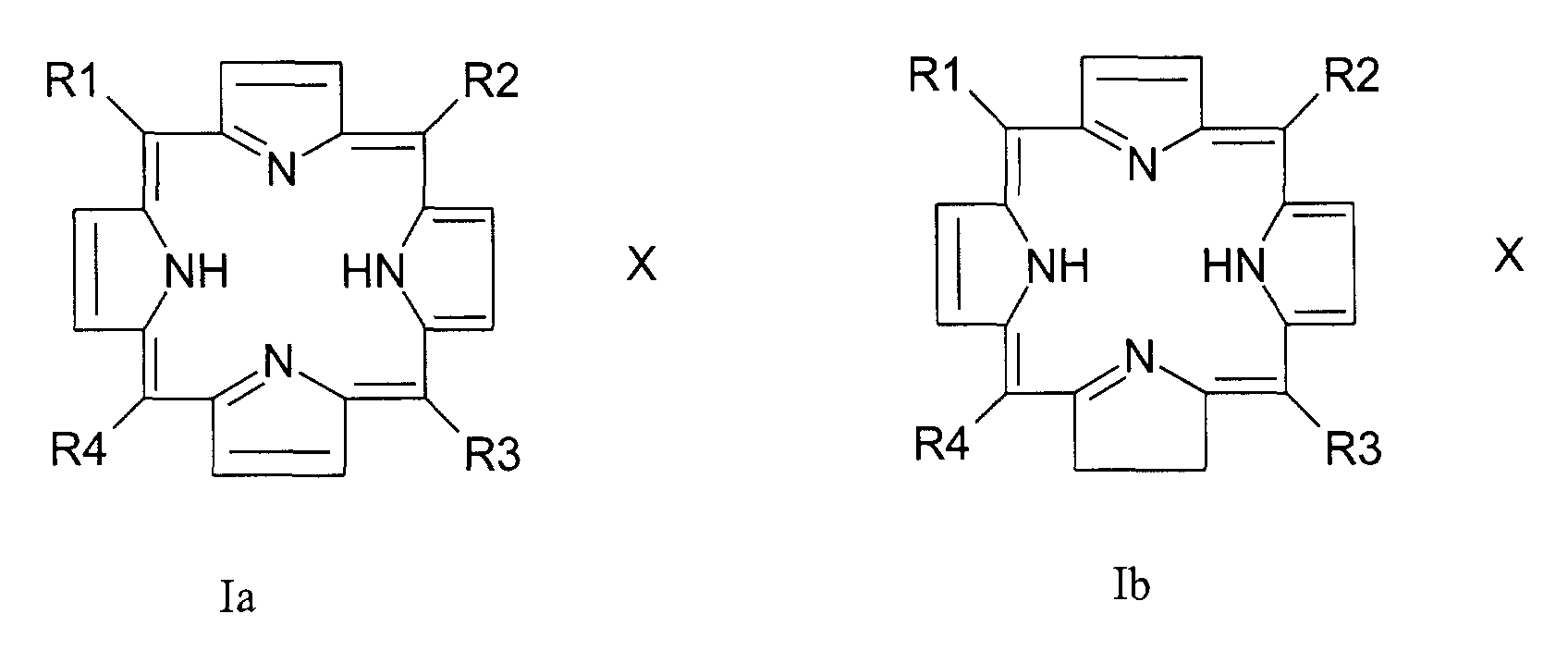 wherein R1, R2, R3 and R4 are independently chosen from the group consisting of
- hydrogen,
- a halogen atom,
- (C1-C20)alkyl, (C1-C20)alkoxy, (C1-C20)acyl, (C1-C20)acyloxy,
(C2-C20)alkenyl, or (C2-C20)alkynyl, each of which may be
linear or branched and each of which may be substituted
with one or more groups chosen from
- hydroxyl,
- amino which may be substituted with 1 to 3 groups chosen from (C1-C20)alkyl, (C2-C20)alkenyl, (C1-C20)alkoxy, (C2-C20)alkynyl, and -(R5-Z)m-R6 where R5 is (CH2)n, Z is O or S, and R6 is (C1-C20)alkyl and m and n are, independently, 1-10, each substituent group of the amino group may be linear or branched and each of these may be substituted with one or more groups chosen from hydroxyl, and a halogen atom,
- nitril, and
- a halogen atom,
- (C6-C20)aryl, and (C6-C20) heterocyclic aryl group each of
which may be substituted with one or more groups chosen
from
- hydroxyl,
- amino which may be substituted with 1 to 3 groups chosen from (C1-C20)alkyl, (C2-C20)alkenyl, (C1-C20)alkoxy, and (C2-C20)alkynyl, each of which may be linear or branched and each of which may be substituted with one or more groups chosen from hydroxyl, and a halogen atom,
- nitril,
- a halogen atom, and
- (C1-C10)alkyl, (C1-C10)alkoxy, (C2-C10)alkenyl,
- Surprisingly, it has been found that by using a photosensitising compound as disclosed above, the damage to the blood product is reduced. This is evident from experiments which are generally recognized as models to determine the extend of damage to a blood product. In particular this was shown in experiments where the hemolysis and potassium leakage are measured.
- In the present invention, the term "blood product" is to be understood as any solution comprising at least one of i) red blood cells and ii) platelets. Other cell types may be present and the solution, while being an aqueous solution, may contain proteinaceous components, salts, stabilizers, anti-coagulation agents such as citric acid or heparin, as is generally recognized in the art.
- The term "photosensitizer" is, as well recognized in the art, a substance which absorbs light energy as a result of which the photosensitizer is activated. The activated photosensitizer can subsequently react with other compounds. This may result in the photosensitizer being modified or inactivated, but more likely the photosensitizer will return to its original state (before it was activated with light), so as to form a photocatalytic cycle in which the photosensitizer can be used again. In effect, the light energy absorbed is used for the inactivation of viral particles.
- The term "viral particle" is understood to mean any RNA or DNA virus, single- or double-stranded and with a membrane or proteinaceous coat that may occur in a blood product. Examples are HIV and hepatitis B.
- The term "pharmaceutically acceptable counterion" is understood to be any inorganic or organic negatively charged counterion such as OH-, Cl-, acetate or citrate. It goes without saying that there are as many counterions X as needed to neutralise the positive charge of the actual active compound I.
- Ben-Hur E. et al disclose in Transfusion 35(5), pp401-6 (1999) a method of inactivating virus present in a solution comprising red blood cells. To protect the red blood cells, a protective agent has to be added. As a result of this, which applicants have not been able to replicate due to the difficulties of dissolving the protecting agent Trolox, hemolysis was over 1% after 10 days of storage. In contrast, the method according to the present invention results in 1.5% hemolysis after 5 weeks in the absence of a protecting agent. Of course, the method according to the present invention still allows for the addition of protective agents, such as disclosed in PCT/NL99/00387.
- According to a first embodiment at least one of R1, R2, R3 and R4 is a (C6-C20) heterocyclic aryl group comprising a nitrogen atom substituted with a group chosen from (C1-C20)alkyl, (C2-C20)alkenyl, (C1-C20)alkoxy, and (C2-C20)alkynyl, each of which may be linear or branched and each of which may be substituted with one or more groups chosen from hydroxyl, and a halogen atom. Preferably, the heterocyclic aryl group is a pyridinium group, the nitrogen of which is substituted with a (C1-C4) alkyl group.
- According to a second embodiment at least one of R1, R2, R3 and R4 is a (C6-C20) aryl group substituted with an amino which may be substituted with 1 to 3 groups chosen from (C1-C20)alkyl, (C2-C20)alkenyl, (C1-C20)alkoxy, and (C2-C20)alkynyl, each of which may be linear or branched and each of which may be substituted with one or more groups chosen from hydroxyl, and a halogen atom. Preferably the aryl group is a trialkyl aminophenyl group where alkyl is independently (C1-C3) alkyl.
- It has been found that quaternary nitrogen atoms in groups as defined above are very suitable for eliminating viral particles while maintaining the integrity of the blood product.
- Preferably at least two of R1, R2, R3 and R4 comprise a quaternary nitrogen atom, and more preferably three of R1, R2, R3 and R4 comprise a quaternary nitrogen atom. Such compounds appear to give the best result.
- The invention will now be elucidated with reference to the exemplary embodiments and the drawing, which shows the degree of hemolysis using a compound in accordance with the present invention (TriP4), and two control compounds.
- The blood product used throughout these studies were standard blood cell concentrates (RBCC) without buffy coat, and were provided by the Sanquin Blood Bank, Leiden-Haaglanden, Leiden, the Netherlands, and obtained from healthy human volunteers. Blood from these donors (500 ± 50 ml) was collected in 73 ml citrate-phosphate-dextrose (CPD) in quadruple polyvinylchloride bags (NPBI, Emmer-Compascuum, the Netherlands). RBCCs were prepared as described before (Novotny, 1992). The hematocrit was adjusted to 56 ± 4 with the preservative saline-adenine-glucose-mannitol (SAG-M). SAG-M contains 150 mM NaCl, 50 mM glucose, 29 mM mannitol and 1.25 mM adenine. The number of white cells was 1.8 + 0.9*109 cells/l, as determined on an automatic cell counter (Sysmex K1000, TOA Medical Electronics, Kobe, Japan).
- Stock solutions of vesicular stomatitis virus (VSV) (San Juan strain, kindly provided by the Department Virology, Leiden University Medical Center) were added to RBCC such that the volume of the spike was <10% of the total volume of RBCC, and the number of virus particles was about 105/ml. Sensitizers were added to a final concentration of 5 µM aluminium phthalocyanine tetrasulfonate (AIPcS4, Porphyrin Products, Logan, Utah, USA), 0.45 µM silicon phthalocyanine, HO-SiPc(CH3)2(CH2)3N(CH3)2, (Pc4, donated by Dr. M.E. Kenney, Case Western Reserve University, Cleveland Ohio, USA), 15 µM dimethylmethylene blue (DMMB, ICN Biomedicals BV, Zoetermeer, the Netherlands), and, in accordance with the invention, 25 µM monophenyl-tri(N-methyl-4pyridyl)porphyrin chloride (TriP(4), Mid-Century, Posen, Illinois, USA). The suspensions were thoroughly mixed and divided into 6-ml aliquots in polystyrene culture dishes with a diameter of 9 cm (Greiner, Alphen a/d Rijn, the Netherlands), and agitated at room temperature on a horizontal reciprocal shaker (60 cycles/min, GFL, Burgwedel, Germany) for 5 min. in the dark. The dishes (one dish per time point) were illuminated from above with a 300 W halogen lamp (Philips, Eindhoven, the Netherlands). The light passed through a 1-cm water filter, to avoid heating of the samples. A cut-off filter, only transmitting light with wavelengths above 600 nm, was used in all experiments. The irradiance at the cell layer was 100 W/m2, as measured with an IL1400A photometer equipped with a SEL033 detector (International Light, Newburyport, MA, USA). The damage to the red blood cells was established by measuring the degree of hemolysis over a period of 5 weeks. To compare the results with those of Ben-Hur (supra), the solution was illuminated to achieve a 100,000 fold decrease in viral load. As is shown in Fig. 1, the method according to the present invention achieves a better result after 10 days than the method of Ben-Hur, even in the absence of a protecting agent.
wherein X is a pharmaceutically acceptable counterion.
Claims (7)
- Method of inactivating viral particles present in a blood product comprising the steps ofcharacterized, in that as the photosensitiser a compound is used chosen from the group consisting of compounds with the formulas Ia-Idcombining said blood product with a photosensitiser, andactivating the photosensitiser,
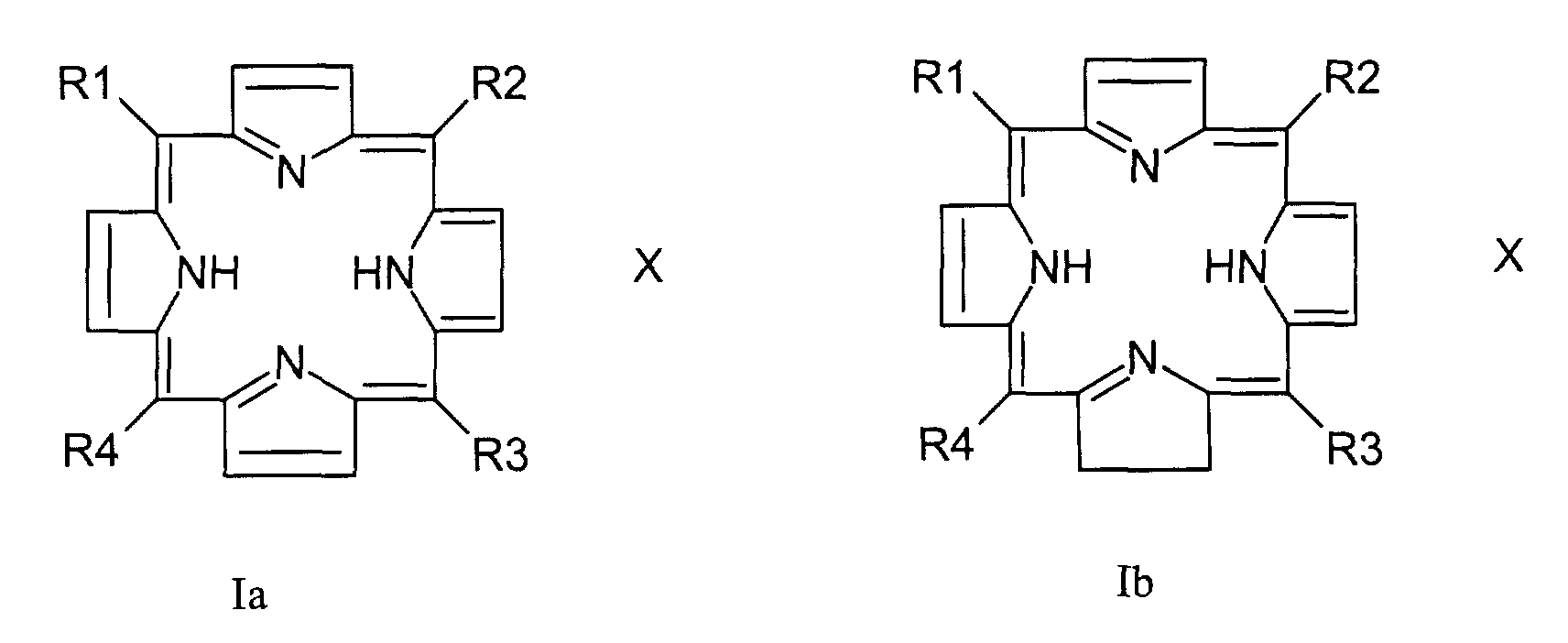 wherein R1, R2, R3 and R4 are independently chosen from the group consisting of
 at least one of the groups R1, R2, R3 and R4 contains a quaternary nitrogen atom, andhydrogen,a halogen atom,(C1-C20)alkyl, (C1-C20)alkoxy, (C1-C20)acyl, (C1-C20)acyloxy, (C2-C20)alkenyl, or (C2-C20)alkynyl, each of which may be linear or branched and each of which may be substituted with one or more groups chosen fromhydroxyl,amino which may be substituted with 1 to 3 groups chosen from (C1-C20)alkyl, (C2-C20)alkenyl, (C1-C20)alkoxy, (C2-C20)alkynyl, and -(R5-Z)m-R6 where R5 is (CH2)n, Z is O or S, and R6 is (C1-C20)alkyl and m and n are, independently, 1-10, each substituent group of the amino group may be linear or branched and each of these may be substituted with one or more groups chosen from hydroxyl, and a halogen atom,nitril, anda halogen atom,(C6-C20)aryl, and (C6-C20) heterocyclic aryl group each of which may be substituted with one or more groups chosen fromthe heterocyclic aryl group containing at least one atom chosen from N, O, P, and S where P, N or S may be substituted with a group chosen from (C1-C20)alkyl, (C2-C20)alkenyl, (C1-C20)alkoxy, and (C2-C20)alkynyl, each of which may be linear or branched and each of which may be substituted with one or more groups chosen from hydroxyl, and a halogen atom,hydroxyl,amino which may be substituted with 1 to 3 groups chosen from (C1-C20)alkyl, (C2-C20)alkenyl, (C1-C20)alkoxy, and (C2-C20)alkynyl, each of which may be linear or branched and each of which may be substituted with one or more groups chosen from hydroxyl, and a halogen atom,nitril,a halogen atom, and(C1-C10)alkyl, (C1-C10)alkoxy, (C2-C10)alkenyl,
wherein X is a pharmaceutically acceptable counterion. - Method according to claim 1, characterized, in that at least one of R1, R2, R3 and R4 is a (C6-C20) heterocyclic aryl group comprising a nitrogen atom substituted with a group chosen from (C1-C20)alkyl, (C2-C20)alkenyl, (C1-C20)alkoxyl, and (C2-C20)alkynyl, each of which may be linear or branched and each of which may be substituted with one or more groups chosen from hydroxyl, and a halogen atom.
- Method according to claim 2, characterized, in that the heterocyclic aryl group is a pyridinium group, the nitrogen of which is substituted with a (C1-C4) alkyl group.
- Method according to claim 1, characterized in that at least one of R1, R2, R3 and R4 is a (C6-C20) aryl group substituted with an amino which may be substituted with 1 to 3 groups chosen from (C1-C20)alkyl, (C2-C20)alkenyl, (C1-C20)alkoxy, and (C2-C20)alkynyl, each of which may be linear or branched and each of which may be substituted with one or more groups chosen from hydroxyl, and a halogen atom.
- Method according to claim 4, characterized in that the aryl group is a trialkyl aminophenyl group where alkyl is independently (C1-C3) alkyl.
- Method according to any of the preceding claims, characterized in that at least two of R1, R2, R3 and R4 comprise a quaternary nitrogen atom.
- Method according to claim 6, characterized in that three of R1, R2, R3 and R4 comprise a quaternary nitrogen atom.
Priority Applications (6)
| Application Number | Priority Date | Filing Date | Title |
|---|---|---|---|
| EP00203559A EP1197147A1 (en) | 2000-10-13 | 2000-10-13 | Method of inactivating viral particles in a blood product |
| PCT/NL2001/000758 WO2002030190A1 (en) | 2000-10-13 | 2001-10-15 | Method of inactivating viral particles in a blood product |
| US10/398,925 US20040034006A1 (en) | 2000-10-13 | 2001-10-15 | Method of inactivating viral particles in a blood product |
| AU2002214392A AU2002214392A1 (en) | 2000-10-13 | 2001-10-15 | Method of inactivating viral particles in a blood product |
| EP01982932A EP1347679A1 (en) | 2000-10-13 | 2001-10-15 | Method of inactivating viral particles in a blood product |
| JP2002533643A JP2004510790A (en) | 2000-10-13 | 2001-10-15 | Method for inactivating virus particles in blood products |
Applications Claiming Priority (1)
| Application Number | Priority Date | Filing Date | Title |
|---|---|---|---|
| EP00203559A EP1197147A1 (en) | 2000-10-13 | 2000-10-13 | Method of inactivating viral particles in a blood product |
Publications (1)
| Publication Number | Publication Date |
|---|---|
| EP1197147A1 true EP1197147A1 (en) | 2002-04-17 |
Family
ID=8172138
Family Applications (2)
| Application Number | Title | Priority Date | Filing Date |
|---|---|---|---|
| EP00203559A Withdrawn EP1197147A1 (en) | 2000-10-13 | 2000-10-13 | Method of inactivating viral particles in a blood product |
| EP01982932A Withdrawn EP1347679A1 (en) | 2000-10-13 | 2001-10-15 | Method of inactivating viral particles in a blood product |
Family Applications After (1)
| Application Number | Title | Priority Date | Filing Date |
|---|---|---|---|
| EP01982932A Withdrawn EP1347679A1 (en) | 2000-10-13 | 2001-10-15 | Method of inactivating viral particles in a blood product |
Country Status (5)
| Country | Link |
|---|---|
| US (1) | US20040034006A1 (en) |
| EP (2) | EP1197147A1 (en) |
| JP (1) | JP2004510790A (en) |
| AU (1) | AU2002214392A1 (en) |
| WO (1) | WO2002030190A1 (en) |
Cited By (2)
| Publication number | Priority date | Publication date | Assignee | Title |
|---|---|---|---|---|
| GB2415372A (en) * | 2004-06-23 | 2005-12-28 | Destiny Pharma Ltd | Non photodynamical or sonodynamical antimicrobial use of porphyrins and azaporphyrins containing at least one cationic-nitrogen-containing substituent |
| US7244841B2 (en) | 2002-12-23 | 2007-07-17 | Destiny Pharma Limited | Porphyrin derivatives and their use in photodynamic therapy |
Citations (2)
| Publication number | Priority date | Publication date | Assignee | Title |
|---|---|---|---|---|
| US5360734A (en) * | 1991-06-21 | 1994-11-01 | Baxter International, Inc. | Method for inactivating pathogens in erythrocytes using photoactive compounds and plasma protein reduction |
| WO1995002324A1 (en) * | 1993-07-13 | 1995-01-26 | Cryopharm Corporation | Method of inactivation of viral and bacterial blood contaminants |
-
2000
- 2000-10-13 EP EP00203559A patent/EP1197147A1/en not_active Withdrawn
-
2001
- 2001-10-15 JP JP2002533643A patent/JP2004510790A/en active Pending
- 2001-10-15 EP EP01982932A patent/EP1347679A1/en not_active Withdrawn
- 2001-10-15 US US10/398,925 patent/US20040034006A1/en not_active Abandoned
- 2001-10-15 WO PCT/NL2001/000758 patent/WO2002030190A1/en not_active Ceased
- 2001-10-15 AU AU2002214392A patent/AU2002214392A1/en not_active Abandoned
Patent Citations (2)
| Publication number | Priority date | Publication date | Assignee | Title |
|---|---|---|---|---|
| US5360734A (en) * | 1991-06-21 | 1994-11-01 | Baxter International, Inc. | Method for inactivating pathogens in erythrocytes using photoactive compounds and plasma protein reduction |
| WO1995002324A1 (en) * | 1993-07-13 | 1995-01-26 | Cryopharm Corporation | Method of inactivation of viral and bacterial blood contaminants |
Non-Patent Citations (7)
| Title |
|---|
| AUBUCHON J.P. ET AL: "Inactivation of microbial contaminants of blood components.", CLINICS IN LABORATORY MEDICINE, (1992) 12/4 (787-803)., XP000943706 * |
| BEN-HUR E ET AL: "Virus inactivation in red cell concentrates by photosensitization with phthalocyanines: protection of red cells but not of vesicular stomatitis virus with a water-soluble analogue of vitamin E", TRANSFUSION,US,AMERICAN ASSOCIATION OF BLOOD BANKS, BETHESDA, MD, vol. 35, no. 5, 1 May 1995 (1995-05-01), pages 401 - 406, XP002095432, ISSN: 0041-1132 * |
| GRANDADAM, MARC ET AL: "Photodynamic inactivation of cell-free HIV strains by a red-absorbing chlorin-type photosensitizer", J. PHOTOCHEM. PHOTOBIOL., B (1995), 31(3), 171-7, XP000943715 * |
| JAMES, B. R. ET AL: "Porphyrins and metalloporphyrins: potential hypoxic agents", MET.-BASED DRUGS (1996), 3(2), 85-89, XP000943636 * |
| KASTURI, CHANDRIKA ET AL: "Inactivation of lambda phage with 658 nm light using a binding porphyrin sensitizer", PHOTOCHEM. PHOTOBIOL. (1992), 56(4), 427-9, XP000943671 * |
| NORTH J. ET AL: "Photodynamic inactivation of retrovirus by benzoporphyr derivative: A feline leukemia virus model.", TRANSFUSION, (1992) 32/2 (121-128)., XP000944360 * |
| SCHAGEN F.H.E. ET AL: "Photodynamic treatment of adenoviral vectors with visible li An easy and convenient method for viral inactivation.", GENE THERAPY, (1999) 6/5 (873-881)., XP000943698 * |
Cited By (4)
| Publication number | Priority date | Publication date | Assignee | Title |
|---|---|---|---|---|
| US7244841B2 (en) | 2002-12-23 | 2007-07-17 | Destiny Pharma Limited | Porphyrin derivatives and their use in photodynamic therapy |
| US8084602B2 (en) | 2002-12-23 | 2011-12-27 | Destiny Pharma Limited | Porphyrin derivatives and their use in photodynamic therapy |
| GB2415372A (en) * | 2004-06-23 | 2005-12-28 | Destiny Pharma Ltd | Non photodynamical or sonodynamical antimicrobial use of porphyrins and azaporphyrins containing at least one cationic-nitrogen-containing substituent |
| US7977474B2 (en) | 2004-06-23 | 2011-07-12 | Destiny Pharma Ltd. | Uses of porphyrin compounds |
Also Published As
| Publication number | Publication date |
|---|---|
| AU2002214392A1 (en) | 2002-04-22 |
| US20040034006A1 (en) | 2004-02-19 |
| JP2004510790A (en) | 2004-04-08 |
| EP1347679A1 (en) | 2003-10-01 |
| WO2002030190A1 (en) | 2002-04-18 |
Similar Documents
| Publication | Publication Date | Title |
|---|---|---|
| JP2831155B2 (en) | Photodynamic inactivation of virus in cell-containing compositions | |
| Rywkin et al. | New phthalocyanines for photodynamic virus inactivation in red blood cell concentrates | |
| AU740547B2 (en) | Intracellular and extracellular decontamination of whole blood and blood components by amphiphilic phenothiazin-5-ium dyes plus light | |
| JP3029048B2 (en) | Vitamin E and its derivatives to prevent damage in erythrocytes sterilized by phthalocyanine and light | |
| CA2089005C (en) | Method for inactivating pathogens in a body fluid | |
| Rywkin et al. | Importance of type I and type II mechanisms in the photodynamic inactivation of viruses in blood with aluminum phthalocyanine derivatives | |
| US5798238A (en) | Method of inactivation of viral and bacterial blood contaminants with quinolines as photosensitizer | |
| DE69434445T2 (en) | PROCESS FOR STERILIZING BIOLOGICAL COMPOSITIONS AND THE PRODUCT OBTAINED THEREFROM | |
| US5955256A (en) | Method of inactivation of viral and bacterial blood contaminants | |
| NZ229246A (en) | Pharmaceutical composition comprising a porphyrin derivative for inhibiting hiv replication | |
| WO1998031219A9 (en) | Intracellular and extracellular decontamination of whole blood and blood components by amphiphilic phenothiazin-5-ium dyes plus light | |
| US5597722A (en) | Method for inactivating pathogens in compositions containing cells and plasma using photoactive compounds and plasma protein reduction | |
| Ben-Hur et al. | The photodecontamination of cellular blood components: mechanisms and use of photosensitization in transfusion medicine | |
| EP1404379A2 (en) | Viral inactivation process using antioxidant | |
| US20010046662A1 (en) | Method of inactivating pathogens in a red blood cell-containing composition | |
| JP2000500137A (en) | Virus inactivation of red blood cells using phthalocyanine and red light | |
| JPH11506029A (en) | Methods for inactivating viral and bacterial blood contaminants | |
| US20040034006A1 (en) | Method of inactivating viral particles in a blood product | |
| EP1197229A1 (en) | Method of inactivating microorganisms | |
| WO2001049328A1 (en) | Photodynamic inactivation of pathogens in blood by phenothiazines and oxygen | |
| Ben-Hura et al. | Pathogen Reduction in Blood for Transfusion Using Photodynamic | |
| AU765893B2 (en) | Method of inactivating viruses | |
| Ben-Hur et al. | Photodynamic decontamination of blood for transfusion | |
| Trannoy | Pathogen inactivation in cellular blood products by photodynamic treatment |
Legal Events
| Date | Code | Title | Description |
|---|---|---|---|
| PUAI | Public reference made under article 153(3) epc to a published international application that has entered the european phase |
Free format text: ORIGINAL CODE: 0009012 |
|
| AK | Designated contracting states |
Kind code of ref document: A1 Designated state(s): AT BE CH CY DE DK ES FI FR GB GR IE IT LI LU MC NL PT SE |
|
| AX | Request for extension of the european patent |
Free format text: AL;LT;LV;MK;RO;SI |
|
| AKX | Designation fees paid |
Free format text: AT BE CH CY DE DK ES FI FR GB GR IE IT LI LU MC NL PT SE |
|
| STAA | Information on the status of an ep patent application or granted ep patent |
Free format text: STATUS: THE APPLICATION IS DEEMED TO BE WITHDRAWN |
|
| 18D | Application deemed to be withdrawn |
Effective date: 20021018 |