EP1195997A2 - Efficient communication with passive devices - Google Patents
Efficient communication with passive devices Download PDFInfo
- Publication number
- EP1195997A2 EP1195997A2 EP01308221A EP01308221A EP1195997A2 EP 1195997 A2 EP1195997 A2 EP 1195997A2 EP 01308221 A EP01308221 A EP 01308221A EP 01308221 A EP01308221 A EP 01308221A EP 1195997 A2 EP1195997 A2 EP 1195997A2
- Authority
- EP
- European Patent Office
- Prior art keywords
- passive device
- data
- passive
- active device
- identity
- Prior art date
- Legal status (The legal status is an assumption and is not a legal conclusion. Google has not performed a legal analysis and makes no representation as to the accuracy of the status listed.)
- Ceased
Links
Images


Classifications
-
- H—ELECTRICITY
- H04—ELECTRIC COMMUNICATION TECHNIQUE
- H04W—WIRELESS COMMUNICATION NETWORKS
- H04W4/00—Services specially adapted for wireless communication networks; Facilities therefor
-
- H—ELECTRICITY
- H04—ELECTRIC COMMUNICATION TECHNIQUE
- H04W—WIRELESS COMMUNICATION NETWORKS
- H04W84/00—Network topologies
- H04W84/02—Hierarchically pre-organised networks, e.g. paging networks, cellular networks, WLAN [Wireless Local Area Network] or WLL [Wireless Local Loop]
- H04W84/022—One-way selective calling networks, e.g. wide area paging
Definitions
- This invention relates to communication of information over a network to a passive device that has a capability only to receive the information and no capability to transmit information via the wireless network.
- the passive device may be a watch, a pager or beeper, a pen and the like that has a receiver, a control and a display.
- the information may be a stock price, the weather, a personal calendar appointment, news, email and the like.
- An active cellular device such as a telephone, a beeper and the like, sends a beacon signal on a periodic basis.
- Local cellular providers that receive the beacon signal can determine the cell location of the active device.
- the cellular provider that receives the signal with the greatest signal strength of power becomes the provider of the cellular service to the active device.
- the cellular provider sends the address of the active cell device to a central database.
- the central database is accessed to find the most recent cell location of the active device.
- a wireless telephone connection is then made to the active device via the local service provider for that cell, provided the active device has not moved or stopped sending beacon signals.
- active cellular devices are locatable, they are capable of receiving and displaying data messages of various content, such as weather, news, sports scores, business data, and the like.
- passive device such as a pen, a watch, a picture frame, a non-cellular telephone, a wallet and the like, that is incapable of being locatable because they lack a transmitter for sending a beacon or other signal by which they could be located. Accordingly, passive devices are not currently used for the communication of data messages. There exists a need to provide a data service of data messages to a passive device, for example a watch, of a subscriber.
- the present invention satisfies this need by associating a user's passive device, such as a watch, with the user's cellular phone.
- a data message for example stock quotes, is formed for transmission to the subscriber's passive device.
- the identity of a local cellular service provider that has control over communications in a cell location in which the user's cellular telephone is currently located is determined.
- the identity of the cellular telephone with which the passive device is associated is determined and used to obtain the identity of the local cellular service provider.
- the data message is then presented to the local cellular service provider for transmission to the passive device.
- the present invention provides in a first aspect a method of providing data to a passive device comprising: (a) identifying a system that has control over communications of an active device associated with the passive device; and (b) transmitting the data to the system for transmission to the passive device.
- the method further comprises(c) identifying the active device with which the passive device is associated, and wherein the identity of the active device is used by step (a).
- a database preferably contains the identity of the active device and a list of passive devices of the subscriber that are associated with the active device, and more preferably the method further comprises (d) identifying the passive device that is to receive the data, and wherein the identity of the passive device is used by step (c).
- the passive device is most suitably a member of the group consisting of: a watch, a pen, a telephone, a frame, a wallet, and a beeper, and preferably the active device is a cellular telephone.
- the invention provides a computer comprising: a processor, a memory and a communication interface; first means for identifying a system that has control over communications of an active device associated with a passive device; and second means for transmitting the data to the system for transmission to the passive device.
- the computer further comprises a third means for identifying the active device with which the passive device is associated, and wherein the identity of the active device is used by the first means.
- a database preferably contains the identity of the active device and a list of passive devices of the subscriber that are associated with the active device, and more preferably the computer further comprises a fourth means for identifying the passive device that is to receive the data, and wherein the identity of the passive device is used by the third means.
- the passive device is most suitable selected from the group consisting of: a watch, a pen, a telephone, a frame, a wallet, and a beeper, and preferably the active device is a cellular telephone.
- a passive device includes a personal article that has a display, a receiver capable of receiving a data message via a wireless transmission and a transmitter capable of transmitting an identity message only a short distance to a cellular device.
- a controller processes the data message for display on the display and transmission of the identity message by the transmitter.
- a preferred short distance for transmission is in a range of about zero foot to about 100 feet.
- the passive device is most suitably one wherein the personal article is selected from the group consisting of: a watch, a pen, a telephone, a frame, a wallet, and a beeper.
- a memory medium for a computer that controls the presentation of a data to a passive device
- the memory medium comprising: first means for controlling the computer to identify a system that has control over communications of an active device associated with the passive device; and second means for controlling the computer to present the data to the system for transmission to the passive device.
- the memory medium further comprises third means for controlling the computer to identify the active device with which the passive device is associated, and wherein the identity of the active device is used by the third means.
- the memory medium further comprises fourth means for controlling the computer to identify the passive device that is to receive the data, and wherein the identity of the passive device is used by the third means.
- the passive device is most suitably selected from the group consisting of: a watch, a pen, a telephone, a frame, a wallet, and a beeper, and the active device is preferably a cellular telephone.
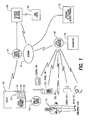
- a data service provider 100 provides data to a subscriber user 110 via a local cellular provider 107.
- the data is any suitable data that subscriber user 100 wants to obtain.
- the data may be stock quotations, weather, news, email and the like.
- the data is transmitted to a passive device, such as a watch 102, a camera 103, a beeper 104, a pen or other suitable device.
- a passive device is passive in the sense that it has a receiver that can receive data sent to it over a network, but has no transmitter that can transmit data to the network.
- the passive device also includes a display and a controller, such as, a microcomputer that processes the received data for presentation to the display.
- a passive device for example watch 102, is registered together with the telephone number of a cellular telephone 106 of subscriber user 110. Since cellular telephone 106 periodically transmits a beacon signal, the wireless network knows its cell location. Accordingly, the process of the present invention establishes a communication of the subscribed data to watch 102 via the local cellular provider for the same cell location as that of cellular telephone 106 of subscriber 110.
- Data service provider 100 includes a computer 120.
- Computer 120 includes a memory 122, a data service procedure 124 and a communication interface 126.
- Computer 120 under the control of data service procedure 124 communicates via communication interface 126 with other devices via a network 101.
- data service provider 100 When data service provider 100 needs to send data, e.g., a stock quotation, to watch 102, it accesses one or more databases to determine the type of passive device (watch in this example), to which the stock quotation is being sent, the telephone number of cellular phone 106 for which the watch is registered and the identity of the local cellular service provider for the current cell location of cellular telephone 106. Thus, data service provider 100 sends an inquiry to a global service provider 111 via network 101. The inquiry identifies subscriber user 110 by name and requests the cell location of cellular phone 106 that is associated with watch 102 and the local service provider for that cell location.
- data service provider 100 When data service provider 100 needs to send data, e.g., a stock quotation, to watch 102, it accesses one or more databases to determine the type of passive device (watch in this example), to which the stock quotation is being sent, the telephone number of cellular phone 106 for which the watch is registered and the identity of the local cellular service provider for the current cell location of cellular telephone
- Global service provider 111 accesses a database 108 of subscribers for a list of passive devices registered for subscriber user 110 and the cellular phone number associated with watch 102 of subscriber user 110.
- Global service provider 111 uses a cell location module 109 to obtain via network 101 from a cell location/cellular service provider database 112 the cell location of and a local cellular service provider 107 for that cell location.
- Global service provider 111 replies to data service provider 100 with all of this data.
- Data service provider 100 then sends the stock quotation data to local service provider 107 that, in turn, transmits such data via an associated transmitter 114 to watch 102.
- Network 101 is global in the sense that it includes all modes of communication services, such as, telephone service (wired or wireless), Internet, World Wide Web, Global Positioning System and other suitable services known currently or in the future.
- communications from local service provider 107 to passive devices 102-105 may be transmitted via a wireless telephone service, while all other communications can be made via telephone service, the Internet, the World Wide Web, Global Positioning System or any combination thereof.
- a sign-up global server 113 serves all data service providers 100.
- Sign-up global service provider 113 contains a registry of subscribers and their passive devices upon which subscribed data is to be received.
- Data service provider 100 determines from sign-up global server provider 113 to which passive device the stock quotation is be sent.
- database 108 includes a data structure 200 that contains for each subscriber user a listing of each cellular registered telephone 203 by telephone number and passive devices assigned to each cellular telephone.
- row 201 shows that a watch, a pen and a beeper are assigned to cellular telephone 1 and that a radio and a camera are assigned to cellular telephone 2.
- global service provider 111 uses module 109 to obtain the cell location and local cellular provider for that cell location from cellular telephone/cellular service database 112.
- Module 109 includes two processes 207 and 208.
- Process 207 establishes a communication via network 101 with cellular telephone database 112.
- Process 208 extracts or obtains from cellular telephone database 112 the cell location of cellular telephone 106 and/or the identity of local cellular provider 107 that has control over wireless communications with devices in that cell location.
- the identity includes an address or telephone number to establish a communication to local cellular provider 107. All of this data is sent to data service provider 100.
- a data structure 300 for sign-up global server 113 includes a table that correlates subscriber names with registered passive devices and services to be supplied to those devices.
- Data service provider 100 uses data structure 300 when forming an inquiry to global service provider 111.
- a column 301 contains the names of subscriber users: user1 user2, etc.
- a column 302 has a description of what kind of passive devices each user has. For example, user1 has a watch, a pen, a camera, a beeper and a frame.
- a column 303 shows what services are provided for each passive device. For example, a watch will receive a stock quotation, a pen will receive urgent messages, a camera will receive e-mail, a beeper will receive messages, and a frame will receive a picture.
- a passive device includes a low power transmitter that is capable of transmitting its identity to a nearby cellular phone, but is incapable of transmitting directly to sign-up global server provider 113.
- a watch 402 includes a transmitter 400, a display 420, a microcomputer 422 and a receiver 424.
- Microcomputer 422 processes messages received by receiver 424 from local cellular provider 107 for presentation on display 420.
- Microcomputer 422 also controls the transmission of the identity message via transmitter 400.
- a pen 405 includes a transmitter 403 and, though not shown, a display, a receiver and a microcomputer.
- Transmitters 400 and 403 are low power transmitters capable of transmitting only short distance.
- the transmission range is from about a foot to about 100 feet.
- the transmitted signals are received by cellular telephone 106.
- the signal from watch 402 identifies that its location is in close proximity to cellular telephone 106.
- Cellular telephone 106 through a transmitter 407 then sends the information to cellular provider 107 that there is a watch in close proximity to cellular telephone 106.
- Local cellular provider 107 then sends this information to database 108. This procedure eliminates a need to register the passive devices with sign-up global service provider 113.
- a procedure 500 begins with step 502 in which data service provider 100 obtains the message (e.g., stock quotation) to be sent to a passive device (e.g., watch 102) of user 110.
- step 504 determines what cellular telephone that user 110 uses from database 108.
- step 506 determines if this passive device is associated with a cellular telephone.
- step 508 determines what local cellular provider currently has control over wireless transmissions to cellular telephone 106. If no, then step 510 sends the stock quotation message to the local cell provider.
- the local cell provider transmits the stock quotation message to watch 102.
Landscapes
- Engineering & Computer Science (AREA)
- Computer Networks & Wireless Communication (AREA)
- Signal Processing (AREA)
- Mobile Radio Communication Systems (AREA)
- Information Transfer Between Computers (AREA)
- Telephonic Communication Services (AREA)
Abstract
Description
There exists a need to provide a data service of data messages to a passive device, for example a watch, of a subscriber.
Claims (10)
- A method of providing data to a passive device comprising:(a) identifying a system that has control over communications of an active device associated with the passive device; and(b) transmitting the data to the system for transmission to the passive device.
- The method of claim 1, further comprising (c) identifying the active device with which the passive device is associated, and wherein the identity of the active device is used by step (a).
- The method as claimed in claim 1 or claim 2, wherein a database contains the identity of the active device and a list of passive devices of the subscriber that are associated with the active device.
- The method as claimed in any one of claims 1 to 3, further comprising (d) identifying the passive device that is to receive the data, and wherein the identity of the passive device is used by step (c).
- A computer comprising:a processor, a memory and a communication interface;first means for identifying a system that has control over communications of an active device associated with a passive device; andsecond means for transmitting the data to the system for transmission to the passive device.
- The computer of claim 5, further comprising third means for identifying the active device with which the passive device is associated, and wherein the identity of the active device is used by the first means.
- A passive device comprising a personal article that has a display, a receiver capable of receiving data via a wireless transmission, a transmitter capable of transmitting an identity message only a short distance to an active device, and a controller for processing the data for display on the display and the transmission of the identity message by the transmitter.
- A memory medium for a computer that controls the presentation of a data to a passive device, the memory medium comprising:first means for controlling the computer to identify a system that has control over communications of an active device associated with the passive device; andsecond means for controlling the computer to present the data to the system for transmission to the passive device.
- The memory medium as claimed in any preceding claim, wherein the passive device is selected from the group consisting of: a watch, a pen, a telephone, a frame, a wallet, and a beeper.
- The memory medium as claimed in any preceding claim, wherein the active device is a cellular telephone.
Applications Claiming Priority (2)
| Application Number | Priority Date | Filing Date | Title |
|---|---|---|---|
| US680711 | 1984-12-12 | ||
| US09/680,711 US6862454B1 (en) | 2000-10-06 | 2000-10-06 | Efficient communication with passive devices |
Publications (2)
| Publication Number | Publication Date |
|---|---|
| EP1195997A2 true EP1195997A2 (en) | 2002-04-10 |
| EP1195997A3 EP1195997A3 (en) | 2003-02-05 |
Family
ID=24732198
Family Applications (1)
| Application Number | Title | Priority Date | Filing Date |
|---|---|---|---|
| EP01308221A Ceased EP1195997A3 (en) | 2000-10-06 | 2001-09-27 | Efficient communication with passive devices |
Country Status (5)
| Country | Link |
|---|---|
| US (2) | US6862454B1 (en) |
| EP (1) | EP1195997A3 (en) |
| KR (1) | KR100458107B1 (en) |
| CN (1) | CN1177460C (en) |
| TW (1) | TWI286898B (en) |
Cited By (1)
| Publication number | Priority date | Publication date | Assignee | Title |
|---|---|---|---|---|
| WO2015093959A1 (en) * | 2013-12-20 | 2015-06-25 | Ubiqu B.V. | Methods, an online object, a web-based message exchange server, a mobile device, a target offline object, a network and a computer program product |
Families Citing this family (23)
| Publication number | Priority date | Publication date | Assignee | Title |
|---|---|---|---|---|
| US7133700B2 (en) * | 2003-04-11 | 2006-11-07 | Lucent Technologies Inc. | Wireless visual alerting method and system |
| US20050283806A1 (en) * | 2004-06-18 | 2005-12-22 | Nokia Corporation | Method and apparatus for displaying user interface embedded applications on a mobile terminal or device |
| US20060073856A1 (en) * | 2004-09-09 | 2006-04-06 | Lundberg Steven W | Remoted vibrating element for a mobile phone |
| WO2006108077A1 (en) * | 2005-04-06 | 2006-10-12 | Omnilink Systems, Inc. | System and method for tracking monitoring, collecting, reporting and communicating with the movement of individuals |
| US9420423B1 (en) | 2005-04-12 | 2016-08-16 | Ehud Mendelson | RF beacon deployment and method of use |
| US10117078B1 (en) * | 2005-04-12 | 2018-10-30 | Ehud Mendelson | Medical information communication method |
| US7899583B2 (en) * | 2005-04-12 | 2011-03-01 | Ehud Mendelson | System and method of detecting and navigating to empty parking spaces |
| WO2006121930A2 (en) * | 2005-05-06 | 2006-11-16 | Omnilink Systems, Inc. | System and method for monitoring alarms and responding to the movement of individuals and assets |
| ES2369039T3 (en) | 2005-05-06 | 2011-11-24 | Omnilink Systems, Inc. | SYSTEM AND METHOD OF MONITORING THE MOVEMENT OF INDIVIDUALS AND PROPERTY. |
| US7509094B2 (en) * | 2005-06-30 | 2009-03-24 | Modu Ltd. | Wireless telecommunication device and uses thereof |
| US8391921B2 (en) | 2007-02-13 | 2013-03-05 | Google Inc. | Modular wireless communicator |
| US7970433B2 (en) | 2007-06-08 | 2011-06-28 | Modu Ltd. | SD switch box in a cellular handset |
| US10027789B2 (en) | 2007-02-13 | 2018-07-17 | Google Llc | Modular wireless communicator |
| US8115621B2 (en) * | 2007-05-01 | 2012-02-14 | Yoganand Rajala | Device for tracking the movement of individuals or objects |
| USD578918S1 (en) | 2007-05-01 | 2008-10-21 | Omnilink Systems, Inc. | Offender monitor |
| US8412226B2 (en) | 2008-06-24 | 2013-04-02 | Google Inc. | Mobile phone locator |
| KR101039383B1 (en) * | 2009-01-09 | 2011-06-07 | 오중산 | Roasting furnace using lump-shaped insulation member |
| US8489113B2 (en) * | 2010-02-09 | 2013-07-16 | Omnilink Systems, Inc. | Method and system for tracking, monitoring and/or charging tracking devices including wireless energy transfer features |
| US20110221607A1 (en) * | 2010-03-15 | 2011-09-15 | Microsoft Corporation | Dynamic Device Adaptation Based on Proximity to Other Devices |
| US9215578B2 (en) | 2012-01-27 | 2015-12-15 | Omnilink Systems, Inc. | Monitoring systems and methods |
| US10375171B2 (en) | 2013-06-27 | 2019-08-06 | International Business Machines Corporation | Iterative learning for reliable sensor sourcing systems |
| KR101469194B1 (en) * | 2013-07-12 | 2014-12-09 | 피에스케이 주식회사 | Apparatus and method for self diagnosis of semiconductor manufacturing equipment |
| CN118828851A (en) * | 2023-11-13 | 2024-10-22 | 中国移动通信有限公司研究院 | Passive tag management method, network function and storage medium |
Family Cites Families (26)
| Publication number | Priority date | Publication date | Assignee | Title |
|---|---|---|---|---|
| IL85558A (en) | 1987-04-30 | 1992-01-15 | Motorola Inc | Personal message receiving device with separate information presentation means |
| WO1990013989A1 (en) | 1989-04-28 | 1990-11-15 | Motorola, Inc. | Printed circuit board having multiple form factors |
| US5247700A (en) * | 1990-11-16 | 1993-09-21 | Universal Cellular, Inc. | Cellular telephone with pager |
| US5950128A (en) * | 1991-04-17 | 1999-09-07 | Telefonaktiebolaget Lm Ericsson | Method and apparatus for increasing the answering probability of calls to mobile radio terminals |
| JP3263772B2 (en) * | 1994-06-09 | 2002-03-11 | 三菱電機株式会社 | Video display device |
| AU3682795A (en) | 1994-09-12 | 1996-03-29 | Seiko Communications Systems, Inc. | Acknowledge back pager using secondary transmission source |
| US5742905A (en) * | 1994-09-19 | 1998-04-21 | Bell Communications Research, Inc. | Personal communications internetworking |
| US6072396A (en) * | 1994-12-30 | 2000-06-06 | Advanced Business Sciences | Apparatus and method for continuous electronic monitoring and tracking of individuals |
| JPH0984141A (en) * | 1995-09-18 | 1997-03-28 | Casio Comput Co Ltd | Incoming call device |
| US5797097A (en) * | 1995-11-02 | 1998-08-18 | Bellsouth Corporation | Method and apparatus for identifying the location of a roaming pager |
| US5737707A (en) * | 1996-01-11 | 1998-04-07 | At&T Corp. | Pager-controlled wireless radiotelephone |
| US5712619A (en) | 1996-04-18 | 1998-01-27 | Simkin; Alan C. | Global positioning system personal alarm |
| US5812930A (en) * | 1996-07-10 | 1998-09-22 | International Business Machines Corp. | Information handling systems with broadband and narrowband communication channels between repository and display systems |
| FI111674B (en) * | 1996-10-31 | 2003-08-29 | Nokia Corp | User Connection |
| US5796338A (en) * | 1997-02-03 | 1998-08-18 | Aris Mardirossian, Inc. | System for preventing loss of cellular phone or the like |
| US6018657A (en) * | 1997-05-05 | 2000-01-25 | Highwaymaster Communications, Inc. | System and method for communicating a message using a cellular telephone network |
| ATE208984T1 (en) | 1997-07-01 | 2001-11-15 | Swisscom Mobile Ag | METHOD FOR FORWARDING NOTIFICATIONS AND APPARATUS ADAPTED |
| KR100277672B1 (en) | 1998-03-24 | 2001-01-15 | 조정남 | Method for providing information using global positioning system and short message service |
| FI108268B (en) * | 1998-11-12 | 2001-12-14 | Nokia Corp | Interface for additional device in a multichannel radio |
| US6577849B1 (en) * | 1999-02-03 | 2003-06-10 | Motorola, Inc. | Method and apparatus for providing additional information about a broadcast |
| GB2350523B (en) * | 1999-05-26 | 2003-11-26 | Nokia Mobile Phones Ltd | Communication device |
| US6359837B1 (en) * | 1999-06-30 | 2002-03-19 | Casio Computer Co., Ltd. | Camera, camera system, information recording system, timepiece, and link system for camera and timepiece |
| US6832116B1 (en) * | 2000-02-16 | 2004-12-14 | Telefonaktiebolaget L M Ericsson (Publ) | Method and system for controlling an electronic utility device using an electronic reading device |
| US6556222B1 (en) * | 2000-06-30 | 2003-04-29 | International Business Machines Corporation | Bezel based input mechanism and user interface for a smart watch |
| US6477117B1 (en) * | 2000-06-30 | 2002-11-05 | International Business Machines Corporation | Alarm interface for a smart watch |
| US6678535B1 (en) * | 2000-06-30 | 2004-01-13 | International Business Machines Corporation | Pervasive dock and router with communication protocol converter |
-
2000
- 2000-10-06 US US09/680,711 patent/US6862454B1/en not_active Expired - Lifetime
-
2001
- 2001-09-27 EP EP01308221A patent/EP1195997A3/en not_active Ceased
- 2001-09-28 CN CNB011409908A patent/CN1177460C/en not_active Expired - Fee Related
- 2001-09-28 KR KR10-2001-0060424A patent/KR100458107B1/en not_active Expired - Fee Related
- 2001-10-02 TW TW090124337A patent/TWI286898B/en not_active IP Right Cessation
-
2004
- 2004-11-29 US US10/998,466 patent/US7233809B2/en not_active Expired - Fee Related
Cited By (3)
| Publication number | Priority date | Publication date | Assignee | Title |
|---|---|---|---|---|
| WO2015093959A1 (en) * | 2013-12-20 | 2015-06-25 | Ubiqu B.V. | Methods, an online object, a web-based message exchange server, a mobile device, a target offline object, a network and a computer program product |
| NL2011999C2 (en) * | 2013-12-20 | 2015-06-26 | Ubiqu B V | Methods, an online object, a web-based message exchange server, a mobile device, a target offline object, a network and a computer program product. |
| US10200441B2 (en) | 2013-12-20 | 2019-02-05 | Ubiqu B.V. | Methods, an online object, a web-based message exchange server, a mobile device, a target offline object, a network and a computer program product |
Also Published As
| Publication number | Publication date |
|---|---|
| EP1195997A3 (en) | 2003-02-05 |
| CN1177460C (en) | 2004-11-24 |
| TWI286898B (en) | 2007-09-11 |
| CN1348300A (en) | 2002-05-08 |
| KR100458107B1 (en) | 2004-11-26 |
| KR20020027187A (en) | 2002-04-13 |
| US7233809B2 (en) | 2007-06-19 |
| US6862454B1 (en) | 2005-03-01 |
| US20050096070A1 (en) | 2005-05-05 |
Similar Documents
| Publication | Publication Date | Title |
|---|---|---|
| US6862454B1 (en) | Efficient communication with passive devices | |
| US7249160B2 (en) | Electronic mail processing system and mail server | |
| US6798358B2 (en) | Location-based content delivery | |
| US7113801B2 (en) | Method for receiving data using SMS and wireless internet and system thereof | |
| US6205126B1 (en) | Method and apparatus for automatically determining an ISP local access number based on device location | |
| US7242948B2 (en) | Providing location based directory numbers for personalized services | |
| US20020098832A1 (en) | Intelligent personalized customer service | |
| US7970384B1 (en) | Active phone book enhancements | |
| JP2000322361A (en) | Method and system for utilizing subscriber status and location in wireless network | |
| KR20040102386A (en) | Club management system using mobile communication system and method thereof | |
| WO2001065807A2 (en) | Method for facilitating electronic communications | |
| CN1631046A (en) | In a wireless system, a method of selecting an application when receiving a dedicated message and a method of locating a user using user location awareness | |
| US20070149210A1 (en) | Location-based services in wireless networks | |
| KR20030026446A (en) | The apparatus and method of mobilephone location based ad contents service | |
| KR20090118460A (en) | Ad message transmission system and method using location information | |
| KR20020027432A (en) | Management system and method for state information using short message | |
| KR100556530B1 (en) | How to Retrieve Wireless Internet Information | |
| US7120424B1 (en) | Method and apparatus for providing enhanced services at a mobile communication device | |
| KR20000006760A (en) | Method to provide portable terminal users with location information using the portable terminals | |
| KR100434647B1 (en) | Method and apparauts for supplying correspondence information in network | |
| KR20060129136A (en) | Wireless Internet Information Retrieval Method and Wireless Internet Information Retrieval Device | |
| KR100420599B1 (en) | Method of searching for information by using cell broadcast technique | |
| KR20020000101A (en) | System and method for providing religious information using wireless internet | |
| KR20020012715A (en) | Method of language learning service using mobile terminal | |
| EP1480393A1 (en) | Communication system providing information on location dependent and/or situation aware services |
Legal Events
| Date | Code | Title | Description |
|---|---|---|---|
| PUAI | Public reference made under article 153(3) epc to a published international application that has entered the european phase |
Free format text: ORIGINAL CODE: 0009012 |
|
| AK | Designated contracting states |
Kind code of ref document: A2 Designated state(s): AT BE CH CY DE DK ES FI FR GB GR IE IT LI LU MC NL PT SE TR |
|
| AX | Request for extension of the european patent |
Free format text: AL;LT;LV;MK;RO;SI |
|
| PUAL | Search report despatched |
Free format text: ORIGINAL CODE: 0009013 |
|
| AK | Designated contracting states |
Designated state(s): AT BE CH CY DE DK ES FI FR GB GR IE IT LI LU MC NL PT SE TR |
|
| AX | Request for extension of the european patent |
Extension state: AL LT LV MK RO SI |
|
| 17P | Request for examination filed |
Effective date: 20030228 |
|
| 17Q | First examination report despatched |
Effective date: 20030402 |
|
| AKX | Designation fees paid |
Designated state(s): AT BE CH CY DE DK ES FI FR GB GR IE IT LI LU MC NL PT SE TR |
|
| RAP1 | Party data changed (applicant data changed or rights of an application transferred) |
Owner name: RIGHT CHANCE INCORPORATED |
|
| STAA | Information on the status of an ep patent application or granted ep patent |
Free format text: STATUS: THE APPLICATION HAS BEEN REFUSED |
|
| 18R | Application refused |
Effective date: 20080526 |