EP1195918A2 - Cell search determination circuit - Google Patents
Cell search determination circuit Download PDFInfo
- Publication number
- EP1195918A2 EP1195918A2 EP01307837A EP01307837A EP1195918A2 EP 1195918 A2 EP1195918 A2 EP 1195918A2 EP 01307837 A EP01307837 A EP 01307837A EP 01307837 A EP01307837 A EP 01307837A EP 1195918 A2 EP1195918 A2 EP 1195918A2
- Authority
- EP
- European Patent Office
- Prior art keywords
- cell search
- output
- power
- threshold
- threshold value
- Prior art date
- Legal status (The legal status is an assumption and is not a legal conclusion. Google has not performed a legal analysis and makes no representation as to the accuracy of the status listed.)
- Withdrawn
Links
Images





Classifications
-
- H—ELECTRICITY
- H04—ELECTRIC COMMUNICATION TECHNIQUE
- H04B—TRANSMISSION
- H04B1/00—Details of transmission systems, not covered by a single one of groups H04B3/00 - H04B13/00; Details of transmission systems not characterised by the medium used for transmission
- H04B1/69—Spread spectrum techniques
- H04B1/707—Spread spectrum techniques using direct sequence modulation
- H04B1/7073—Synchronisation aspects
- H04B1/7075—Synchronisation aspects with code phase acquisition
- H04B1/70755—Setting of lock conditions, e.g. threshold
-
- H—ELECTRICITY
- H04—ELECTRIC COMMUNICATION TECHNIQUE
- H04B—TRANSMISSION
- H04B1/00—Details of transmission systems, not covered by a single one of groups H04B3/00 - H04B13/00; Details of transmission systems not characterised by the medium used for transmission
- H04B1/69—Spread spectrum techniques
- H04B1/707—Spread spectrum techniques using direct sequence modulation
- H04B1/7097—Interference-related aspects
-
- H—ELECTRICITY
- H04—ELECTRIC COMMUNICATION TECHNIQUE
- H04B—TRANSMISSION
- H04B1/00—Details of transmission systems, not covered by a single one of groups H04B3/00 - H04B13/00; Details of transmission systems not characterised by the medium used for transmission
- H04B1/69—Spread spectrum techniques
- H04B1/707—Spread spectrum techniques using direct sequence modulation
- H04B1/7073—Synchronisation aspects
- H04B1/70735—Code identification
-
- H—ELECTRICITY
- H04—ELECTRIC COMMUNICATION TECHNIQUE
- H04B—TRANSMISSION
- H04B1/00—Details of transmission systems, not covered by a single one of groups H04B3/00 - H04B13/00; Details of transmission systems not characterised by the medium used for transmission
- H04B1/69—Spread spectrum techniques
- H04B1/707—Spread spectrum techniques using direct sequence modulation
- H04B1/7073—Synchronisation aspects
- H04B1/7075—Synchronisation aspects with code phase acquisition
- H04B1/7077—Multi-step acquisition, e.g. multi-dwell, coarse-fine or validation
-
- H—ELECTRICITY
- H04—ELECTRIC COMMUNICATION TECHNIQUE
- H04B—TRANSMISSION
- H04B2201/00—Indexing scheme relating to details of transmission systems not covered by a single group of H04B3/00 - H04B13/00
- H04B2201/69—Orthogonal indexing scheme relating to spread spectrum techniques in general
- H04B2201/707—Orthogonal indexing scheme relating to spread spectrum techniques in general relating to direct sequence modulation
- H04B2201/70702—Intercell-related aspects
Definitions
- This invention relates to a cell search determination circuit for a mobile station in W-CDMA (Wideband-Code Division Multiple Access) cellular communications.
- W-CDMA Wideband-Code Division Multiple Access
- Cell search in a W-CDMA system is an initial synchronization acquisition function to identify a scramble code number at a mobile station, wherein receiving timing is detected and a scramble code group is identified in a primary synchronization channel (PSCH) and a secondary synchronization channel (SSCH) for symbols without scramble codes (mask symbols), and then a scramble code number is identified in a common pilot channel (CPICH).
- PSCH primary synchronization channel
- SSCH secondary synchronization channel
- CPICH common pilot channel
- FIG. 7 shows a structure of the PSCH and the SSCH.
- One frame which is a collection of 15 slots, is 10 msec.
- a base station transmits one symbol of the PSCH and the SSCH at the head position of each slot, with a length of 256 chips per symbol at a fixed period.
- FIG. 8 illustrates an example of a table of the SSCH code number arrangement, in which n and m correspond to scramble code group numbers (Group 1 to 64) and slot numbers (#0 to 14) respectively.
- CPICH known pilot patterns are transmitted at 15 kbps.
- FIG. 9 shows a structure of a scramble code.
- 512 primary codes 16 ⁇ 0, 16 ⁇ 1, ..., 16 ⁇ 511 from Set#1 (0 to 15), Set#2 (16 to 31), ..., Set#512 (8176 to 8189) each of which is a collection of 16 kinds of codes are employed.
- the 512 codes are divided into 64 groups with 8 codes per a group.
- Each scramble code group is arranged in the SSCH code pattern as shown in FIG. 8. Therefore, by detecting these codes, a mobile station can identify a scramble code group number and detect the receiving timing (frame timing) of a scramble code.
- FIG. 10 is a flow chart of a known cell search method.
- slot timing is detected using the PSCH (101). STEP I will be now described.
- FIG. 11 is a block diagram showing a structure of STEP I.
- a receiving signal is applied to a matched filter (MF) 801, wherein a correlation operation at each timing is sequentially performed.
- MF matched filter
- diffusion code PSCH codes which are commonly employed in W-CDMA systems, are applied.
- PSCH diffusion code
- FIG. 7 at the PSCH, one symbol exists in a slot, so that the correlation operation of a receiving signal and PSCH codes in plural slot sections is performed, with the result that the self-correlation of the PSCH is outputted at a slot period.
- the output from the MF 801 is averaged at slot intervals in plural slot sections in a power adder 802.
- the average operation means a power addition average.
- Slot timing detector 803 detects slot timing, which is necessary to perform a correlation operation of diffusion code SSCH codes at STEP II based on the average result of the power adder 802.
- FIG. 12 is a block diagram showing a structure of STEP II.
- a receiving signal is applied to a finger 901 having seventeen fingers.
- the PSCH code and all of the sixteen kinds of SSCH codes (1 to 16) are applied.
- Both of the PSCH and SSCH are transmitted from a base station at a slot period, and the finger 901 performs a correlation operation at the slot timing detected in STEP I and outputs the self-correlation results of the PSCH and SSCH.
- the SSCH code number arrangement is determined by scramble code group numbers and slot numbers, so that the self-correlation result of one of the sixteen kinds of SSCH codes is outputted.
- the other SSCH codes are considered as noise components.
- the PSCH is employed for vector adjustment of the SSCH.
- the output from the finger 901 is averaged at each frame in plural slot sections in a voltage adder 902.
- This average operation means a voltage addition average of I, Q phases in a complex I, Q plane.
- a comparator 903 compares the average result generated by the voltage adder 902 with the SSCH code number arrangement table shown in FIG. 8. In an identifier of group number 904, frame timing detection and identification of a scramble code group number, which are necessary for a CPICH correlation operation at STEP III, are performed.
- FIG. 13 is a block diagram showing the configuration of STEP III.
- a receiving signal is applied to a finger 1001 having eight fingers.
- scramble code candidates (0 to 7) including all of the eight kinds of CPICH are applied.
- the finger 1001 performs the CPICH correlation operation at the frame timing detected at STEP II, and outputs a self-correlation result for one of the eight kinds of scramble code candidates.
- the other scramble code candidates are considered as noise components.
- outputs from the finger 1001 are averaged at each frame in plural slot sections in a voltage adder 1002.
- An identifier of scramble code number 1003 identifies the maximum value of the average results generated by the voltage adder 1002 as a scramble code number.
- FIG. 14 is a block diagram showing the configuration of a conventional cell search determination circuit.
- a receiving signal received in an antenna 401 and a CPICH code are applied to a finger 402.
- the finger 402 transmits a self-correlation output of the CPICH to a power adder 403 at a symbol period.
- a comparator 404 output from the power adder 403 is compared with the level of a threshold value. Then, the comparator 404 determines whether the output from the power adder 403 exceeds the threshold value (106).
- the threshold value employed here is a fixed value. If the output from the power adder 403 is below the threshold value (106, NO), identification of a scramble code is considered to be failed at STEP III. Then, the process proceeds to 107, where a determination is made whether continuous identifications of the scramble code number are failed (107), if not so (107, NO), the cell search is resumed from the identification of a scramble code at STEP III (104).
- the threshold value which is employed for level comparing with the output from the power adder 403, is a fixed value in a comparator 404. Therefore, the comparator 404 cannot accommodate output fluctuations, which is generated by phase fluctuations, in the power adder 403, so that misdetection occurs. If the fail rate of confirmation increases, the cell search is performed again, increasing the cell search time. In addition, if misdetection occurs, a mobile station can not connect to a base station, leading to serious problems.
- the present invention is intended to obviate the problems as referred to above, and has for its object to provide a cell search determination circuit capable of reducing misdetections in the identification of a scramble code number and saving search time.
- a cell search determination circuit wherein a mobile station in W-CDMA cellular communications confirms a scramble code identified by cell search, the cell search determination circuit comprising; first correlation means for correlating the scramble code and a receiving signal; second correlation means for correlating a first synchronous channel code and the receiving signal; average operation means for generating a phase vector in which noise components of an output from the first correlation means are suppressed; first power addition means for acquiring a power of the first correlation means using the phase vector and performing integration; second power addition means for acquiring a power of the second correlation means using the phase vector and performing integration; threshold operation means for outputting a threshold value corresponding to an output from the first power addition means; and comparison means for making a threshold determination of an output from the second power addition means using the threshold value.
- the threshold operation means outputs a threshold value based on a transmission level ratio of the first synchronous channel code to the scramble code.
- a cell search determination circuit wherein a mobile station in W-CDMA cellular communications confirms a scramble code identified by cell search, the cell search determination circuit comprising: first correlation means for correlating the scramble code and a receiving signal; second correlation means for correlating a first synchronous channel code and the receiving signal; third correlation means for correlating a second synchronous channel code and the receiving signal; average operation means for generating a phase vector in which noise components of an output from the first correlation means are suppressed; first power addition means for acquiring a power of the first correlation means using the phase vector and performing integration; second power addition means for acquiring a power of the second correlation means using the phase vector and performing integration; third power addition means for acquiring a power of the third correlation means using the phase vector and performing integration; second threshold operation means for outputting a second threshold value corresponding to an output from the second power addition means; first comparison means for making a threshold determination of an output from the third power addition means using the second threshold value; first threshold operation
- a cell search determination circuit wherein a mobile station in W-CDMA cellular communications confirms a scramble code identified by cell search, and wherein a first delay profile using a first synchronous channel code, which is common to all base stations, and a second delay profile using the scramble code identified by the cell search, are employed to reduce the number of times for the cell search by removing paths from the base stations, which have been identified by the cell search and shown in the second delay profile, among paths from all base stations shown in the first delay profile.
- the cell search for the same scramble code components as the identified scramble code can be omitted, so that the number of times for cell search identification is reduced, saving search time.
- the cell search determination circuit includes RAKE receiving means for synthesizing paths from the same base stations, wherein a threshold determination is made based on an output from the RAKE receiving means.
- a threshold determination is performed based on the result of improved receiving sensitivity, so that the confirmation accuracy for scramble code identification is improved and search time is saved.
- FIG. 1 illustrates a flow chart of a cell search method according to a first embodiment of the present invention.
- the same codes as shown in FIG. 10 designate the same or corresponding items, and explanation for them is omitted here.
- confirmation (201) is performed by power comparison using both PSCH and CPICH, instead of confirmation (105) according to a threshold value using CPICH as shown in FIG. 10.
- a cell search determination circuit according to the first embodiment of the present invention will be described below.
- FIG. 2 illustrates a block diagram of a cell search determination circuit according to the first embodiment of the present invention.
- a receiving signal which is received by an antenna 500, is applied to a second finger 501 and a first finger 502.
- a PSCH code which is commonly employed in a W-CDMA system, is applied, and to the first finger 502, a CPICH code is applied.
- the second finger 501 outputs a self-correlation result of PSCH to a second complex multiplier 504 at a symbol period.
- the first finger 502 outputs a self-correlation result of CPICH to an averager 503 and a first complex multiplier 505 at a symbol period.
- the averager 503 performs an average operation for the output of the first finger 502 for a predetermined time.
- the average operation is a voltage addition average of I, Q phases in a complex I, Q plane.
- the output from the averager 503 is a phase vector indicating phase fluctuations, in which noise components are suppressed by the average operation.
- the second complex multiplier 504 performs synchronous detection using the phase vector outputted from the averager 503.
- a third switch 506 transmits the output from the second complex multiplier 504 to a second adder 508 at a slot period.
- the second adder 508 adds the output from a second delay member 510, which contains the output from the second adder 508 for a predetermined time, to the output from the third switch 506, and transmits the result to the second delay member 510 and a fourth switch 512.
- the fourth switch 512 transmits the output from the second adder 508 to a first comparator 515 (PSCH output).
- the first complex multiplier 505 performs synchronous detection using the phase vector outputted from the averager 503.
- a first switch 507 transmits the output from the first complex multiplier 505 to a first adder 509 at a slot period.
- the first adder 509 adds the output from a first delay member 511, which contains the output from the first adder 509 for a predetermined time, to the output from the first switch 507, and transmits the result to the first delay member 511 and a second switch 513.
- the second switch 513 transmits the output from the first adder 509 to a first threshold determination means 514 at a frame period (CPICH output).
- FIG. 6 illustrates a frame structure and switch timing.
- the third switch 506 retrieves the PSCH output at slot period timing as shown in FIG. 6.
- the timing, in which the first switch 507 retrieves the CPICH output may be any slot period timing as shown in FIG. 6.
- the first threshold determination means 514 transforms the CPICH output into a threshold value according to a threshold determination constant, and outputs the result to the first comparator 515.
- the first comparator 515 compares the PSCH output with the output from the first threshold determination means 514. If the PSCH output is equal to or greater than the threshold value (106, YES), the cell search is completed.
- the synchronous detection is performed using the phase vector. Therefore, the transmission level ratio of the PSCH output acquired at a mobile station to the CPICH output becomes a constant value (threshold value) set in a base station independent of phase fluctuations.
- the threshold value follows the phase fluctuations, so that misdetections in a cell-search determination circuit can be reduced in comparison with the prior art wherein the threshold value is a fixed value. As a result, compared with conventional techniques, misconfirmation rate becomes smaller, allowing the number of times for cell search and cell search time to decrease.
- the threshold determination value of the transmission level ratio equal to -3dB is provided to the output from the CPICH, which is used as the threshold value for the PSCH output in the threshold determination means 514 in the first embodiment.
- the threshold value is provided with an allowable range (threshold range).
- the comparator 515 compares the PSCH output with the output from the threshold determination means 514. If the PSCH output is within the threshold value ⁇ the threshold range, the cell search is completed.
- the transmission level ratio of the PSCH to the CPICH can be freely set regardless of -3dB.
- a mobile station in advance recognizes this information, so that the threshold value is varied corresponding to the transmission level ratio.
- the cell search determination circuit in the first embodiment completes the cell search when the threshold value is exceeded. Therefore, even if the PSCH output is slightly below the threshold value, the determination circuit recognizes misdetection and resumes cell search although a mobile station has detected scramble code of a target base station in STEP I to STEP III.
- the threshold value is provided with an allowable range (threshold range) for reducing misdetections. Furthermore, higher detection accuracy can be achieved compared with the cell search determination circuit in the first embodiment.
- FIG. 3 illustrates a block diagram of a cell search determination circuit in the third embodiment.
- the same reference symbols as those shown in FIG. 2 denote like or corresponding elements, and description of them will be omitted.
- a receiving signal received by the antenna 500 is applied to a third finger 602, the second finger 501, and the first finger 502.
- SSCH codes are applied to the third finger 602, SSCH codes are applied.
- the third finger 602 transmits the self-correlation result of SSCH to a third complex multiplier 603 at a symbol period.
- the third complex multiplier 603 performs synchronous detection using the output from the averager 503, and a fifth switch 604 outputs the result to a third adder 605 at a slot period.
- the third adder 605 adds the output from a third delay member 606, which contains the output from the third adder 605 for a predetermined time, to the output from the fifth switch 604, and transmits the result to the third delay member 606 and a sixth switch 607.
- the sixth switch 607 transmits the result from the third adder 605 to a second comparator 608 at a frame period (SSCH output).
- a second threshold determination means 601 is inserted at the output side of the fourth switch 512 in the first embodiment.
- the second threshold determination means 601 transforms the output from the fourth switch 512 (PSCH output) into a threshold value according to a threshold constant value, and outputs the result to the second comparator 608.
- the second comparator 608 compares the output from the second threshold determination means 601 with the SSCH output. If the SSCH output falls within the threshold value ⁇ a threshold value range, the scramble code group identification in STEP II is confirmed to be successful and the SSCH output is transmitted.
- a third comparator 609 compares the output from the first threshold determination means 514 with the SSCH output. If the SSCH output falls within the threshold value ⁇ a threshold value range, the cell search is completed.
- a base station multiplexes the frame structured BCH and CPICH shown in FIG. 6 and other signals, and then transmits it.
- the PSCH and SSCH are diffused by a different method than other signals.
- the multiplexed signals having the same timing as the PSCH and SSCH are deteriorated by signal interference.
- the misdetection due to the deterioration caused by signal interference may occur at the cell search determination circuit in the first embodiment.
- the level comparison using a threshold value can be performed taking into consideration the amount of deterioration. As described above, compared with the cell search determination circuit in the first embodiment, detection accuracy can be increased by reducing misdetections due to signal interference.
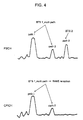
- FIG. 4 illustrates an example of a delay profile result.
- the number of base stations is limited to two, i.e., a main base station 1, which is a cell search target station, and its adjacent base station. However, any number of base stations is possible.
- each path of the base stations 1, 2 (BTS 1, BTS 2) is detected because the PSCH is common to all base stations (base stations 1, 2).
- the delay profile of the CPICH is outputted using the scramble code number detected after STEP III, paths of only the BTS 1 are detected as shown in FIG. 4.
- the delay profiles of the PSCH and CPICH are compared, and then the same scramble code components are specified. Thus, the paths from the same base station detected using the CPICH are removed from the paths detected using the PSCH.
- the cell search determination circuit in the first embodiment can not specify path positions from the same base station, the cell search must be repeated as many times as the number of path positions detected in STEP I.
- the same scramble code components are specified, so that omitting the cell search of the same scramble code components can reduce the number of times for cell search identification. Therefore, compared with the cell search determination circuit in the first embodiment, search time can be reduced.
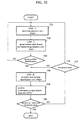
- FIG. 5 illustrates a flow chart of a cell search method according to a fifth embodiment of the present invention.
- the same reference symbols as those shown in FIG. 10 denote like or corresponding elements, and description of them will be omitted.
- the delay profiles of the PSCH and CPICH are compared, and then the same scramble code components are specified to reduce the number of times for identification (301).
- confirmation by power comparison using the PSCH and CPICH is performed according to RAKE reception results (302).
- delay paths at the same base station are synthesized in the cell search determination circuit, and then threshold determination is perform based on the result having increased receiving sensitivity. Therefore, compared with the cell search determination circuit in the fourth embodiment, the confirmation accuracy in scramble code identification is increased, saving search time.
- the cell search determination circuit according to the present invention can decrease misdetections in scramble code number identification and save search time as well.
Landscapes
- Engineering & Computer Science (AREA)
- Computer Networks & Wireless Communication (AREA)
- Signal Processing (AREA)
- Mobile Radio Communication Systems (AREA)
- Synchronisation In Digital Transmission Systems (AREA)
Abstract
Description
Claims (5)
- A cell search determination circuit, wherein a mobile station in W-CDMA cellular communications confirms a scramble code identified by cell search, comprising;first correlation means for correlating the scramble code and a receiving signal;second correlation means for correlating a first synchronous channel code and the receiving signal;average operation means for generating a phase vector in which noise components of an output from the first correlator are suppressed;first power addition means for acquiring a power of the first correlation means using the phase vector and performing integration;second power addition means for acquiring a power of the second correlation means using the phase vector and performing integration;threshold operation means for outputting a threshold value corresponding to an output from the first power addition means; andcomparison means for making a threshold determination of an output from the second power addition means using the threshold value.
- The cell search determination circuit as claimed in claim 1, wherein the threshold operation means outputs a threshold value based on a transmission level ratio of the first synchronous channel code to the scramble code.
- A cell search determination circuit, wherein a mobile station in W-CDMA cellular communications confirms a scramble code identified by cell search, comprising:first correlation means for correlating the scramble code and a receiving signal;second correlation means for correlating a first synchronous channel code and the receiving signal;third correlation means for correlating a second synchronous channel code and the receiving signal;average operation means for generating a phase vector in which noise components of an output from the first correlation means are suppressed;first power addition means for acquiring a power of the first correlation means using the phase vector and performing integration;second power addition means for acquiring a power of the second correlation means using the phase vector and performing integration;third power addition means for acquiring a power of the third correlation means using the phase vector and performing integration;second threshold operation means for outputting a second threshold value corresponding to an output from the second power addition means;first comparison means for making a threshold determination of an output from the third power addition means using the second threshold value;first threshold operation means for outputting a first threshold value corresponding to an output from the first power addition means; andsecond comparison means for making a threshold determination of an output from the first comparator using the first threshold value.
- A cell search determination circuit, wherein a mobile station in W-CDMA cellular communications confirms a scramble code identified by cell search, and wherein a first delay profile using a first synchronous channel code, which is common to all base stations, and a second delay profile using the scramble code identified by the cell search, are employed to reduce the number of times for the cell search by removing paths from the base stations, which have been identified by the cell search and shown in the second delay profile, among paths from all base stations shown in the first delay profile.
- The cell search determination circuit as claimed in claim 4, comprising RAKE receiving means for synthesizing paths from the same base stations, wherein a threshold determination is made based on an output from the RAKE receiving means.
Applications Claiming Priority (2)
| Application Number | Priority Date | Filing Date | Title |
|---|---|---|---|
| JP2000308128 | 2000-10-06 | ||
| JP2000308128A JP2002118496A (en) | 2000-10-06 | 2000-10-06 | Cell-search deciding circuit |
Publications (2)
| Publication Number | Publication Date |
|---|---|
| EP1195918A2 true EP1195918A2 (en) | 2002-04-10 |
| EP1195918A3 EP1195918A3 (en) | 2003-07-09 |
Family
ID=18788493
Family Applications (1)
| Application Number | Title | Priority Date | Filing Date |
|---|---|---|---|
| EP20010307837 Withdrawn EP1195918A3 (en) | 2000-10-06 | 2001-09-14 | Cell search determination circuit |
Country Status (3)
| Country | Link |
|---|---|
| US (1) | US7072318B2 (en) |
| EP (1) | EP1195918A3 (en) |
| JP (1) | JP2002118496A (en) |
Cited By (3)
| Publication number | Priority date | Publication date | Assignee | Title |
|---|---|---|---|---|
| FR2841407A1 (en) * | 2002-06-20 | 2003-12-26 | Nec Technologies Uk Ltd | METHOD FOR OPTIMIZING CELL SEARCH IN A MOBILE TELECOMMUNICATION NETWORK |
| US7110376B2 (en) | 2002-04-10 | 2006-09-19 | Telefonaktiebolaget Lm Ericsson (Publ) | Method and apparatus for improved cell detection |
| CN1323566C (en) * | 2003-05-13 | 2007-06-27 | 明基电通股份有限公司 | Flexible Crosslinking Algorithms for Client Devices to Search for Cells in Code Division Multiple Access Systems |
Families Citing this family (21)
| Publication number | Priority date | Publication date | Assignee | Title |
|---|---|---|---|---|
| JP3473575B2 (en) | 2000-11-29 | 2003-12-08 | 日本電気株式会社 | CDMA mobile communication device and base station detection method used therefor |
| US7826493B2 (en) * | 2001-08-27 | 2010-11-02 | Broadcom Corp. | Frequency offset correction circuit for WCDMA |
| KR100479169B1 (en) * | 2001-10-26 | 2005-03-25 | 삼성전자주식회사 | Apparatus for cell search and method thereof in mobile communication system |
| US7593367B2 (en) * | 2002-06-14 | 2009-09-22 | Qualcomm Incorporated | Frequency scan for CDMA acquisition |
| US7194011B1 (en) * | 2002-08-31 | 2007-03-20 | National Semiconductor Corporation | 3GPP WCDMA receiver using pipelined apparatus and method for performing cell searches |
| JP4066165B2 (en) * | 2002-12-04 | 2008-03-26 | 日本電気株式会社 | Cell search method for mobile radio terminal compatible with multiple mobile telephone systems |
| KR100584337B1 (en) * | 2003-09-16 | 2006-05-26 | 삼성전자주식회사 | Apparatus and Method for Cell Search and Multipath Search in Mobile Communication Systems |
| WO2005032184A1 (en) * | 2003-09-24 | 2005-04-07 | Mitsubishi Denki Kabushiki Kaisha | Mobile station and base station search method |
| CN1839643A (en) * | 2003-09-24 | 2006-09-27 | 三菱电机株式会社 | Mobile station |
| US7336600B2 (en) * | 2003-12-29 | 2008-02-26 | Industrial Technology Research Institute | Cell search method for orthogonal frequency division multiplexing based cellular communication system |
| JP4546342B2 (en) | 2005-07-07 | 2010-09-15 | パナソニック株式会社 | Transmitting apparatus and transmitting method |
| US7620099B2 (en) * | 2005-07-28 | 2009-11-17 | Broadcom Corporation | WCDMA terminal baseband processing module having multi-path scanner module |
| KR100732382B1 (en) * | 2006-04-27 | 2007-06-27 | 주식회사 팬택 | Preamble Acquisition Apparatus and Method for Orthogonal Frequency Division Multiple Access Mobile Communication Terminal |
| US7969964B2 (en) * | 2006-07-25 | 2011-06-28 | Electronics & Telecommunications Research Institute | Cell search method, forward link frame transmission method, apparatus using the same and forward link frame structure |
| US8275082B2 (en) * | 2006-12-01 | 2012-09-25 | Broadcom Corporation | Method and system for delay locked loop for rake receiver |
| KR100965663B1 (en) * | 2007-01-30 | 2010-06-24 | 삼성전자주식회사 | Method and apparatus for transmitting / receiving downlink synchronization channel for wireless communication system |
| JP2010045545A (en) | 2008-08-11 | 2010-02-25 | Ntt Docomo Inc | User device and cell search method |
| JP5348013B2 (en) * | 2009-05-26 | 2013-11-20 | ソニー株式会社 | Wireless communication apparatus, estimation server, wireless communication method, and estimation method |
| US8457078B2 (en) * | 2009-10-19 | 2013-06-04 | Via Technologies, Inc. | Simultaneous use of multiple phone numbers in mobile device by sharing hardware |
| EP2328286B1 (en) * | 2009-11-30 | 2012-10-17 | ST-Ericsson SA | Process for slot synchronization of the p-sch sequence in a umts communication system, and a receiver for the same |
| US8718017B2 (en) | 2012-09-12 | 2014-05-06 | Qualcomm Incorporated | Confirmation of base station identification to improve handover |
Family Cites Families (8)
| Publication number | Priority date | Publication date | Assignee | Title |
|---|---|---|---|---|
| WO1997033400A1 (en) * | 1996-03-05 | 1997-09-12 | Ntt Mobile Communications Network Inc. | Signal transmitting method, transmitter, receiver, and spread-spectrum code synchronizing method for mobile communication system |
| GB2315647B (en) * | 1996-07-23 | 2001-02-21 | Roke Manor Research | Randomised code acquisition |
| US6738411B1 (en) * | 1997-11-19 | 2004-05-18 | Ntt Mobile Communications Network Inc. | Simultaneous plural code series generator and CDMA radio receiver using same |
| US6731673B1 (en) * | 1999-02-19 | 2004-05-04 | Nortel Networks Limited | Synchronization channel with cyclic hierarchical sequences and method for cell site search with low detector complexity |
| EP1035665A1 (en) * | 1999-03-10 | 2000-09-13 | Robert Bosch Gmbh | Method for the initial synchronization of a digital mobile radio system |
| KR100421142B1 (en) * | 1999-04-28 | 2004-03-04 | 삼성전자주식회사 | Apparatus for searching cell and method thereof in asynchronous mobile telecommunication system |
| US6717930B1 (en) * | 2000-05-22 | 2004-04-06 | Interdigital Technology Corporation | Cell search procedure for time division duplex communication systems using code division multiple access |
| US6822999B1 (en) * | 1999-11-13 | 2004-11-23 | Lg Electronics Inc. | High-speed cell searching apparatus and method for communication system |
-
2000
- 2000-10-06 JP JP2000308128A patent/JP2002118496A/en not_active Withdrawn
-
2001
- 2001-09-14 EP EP20010307837 patent/EP1195918A3/en not_active Withdrawn
- 2001-09-27 US US09/963,666 patent/US7072318B2/en not_active Expired - Fee Related
Cited By (3)
| Publication number | Priority date | Publication date | Assignee | Title |
|---|---|---|---|---|
| US7110376B2 (en) | 2002-04-10 | 2006-09-19 | Telefonaktiebolaget Lm Ericsson (Publ) | Method and apparatus for improved cell detection |
| FR2841407A1 (en) * | 2002-06-20 | 2003-12-26 | Nec Technologies Uk Ltd | METHOD FOR OPTIMIZING CELL SEARCH IN A MOBILE TELECOMMUNICATION NETWORK |
| CN1323566C (en) * | 2003-05-13 | 2007-06-27 | 明基电通股份有限公司 | Flexible Crosslinking Algorithms for Client Devices to Search for Cells in Code Division Multiple Access Systems |
Also Published As
| Publication number | Publication date |
|---|---|
| US7072318B2 (en) | 2006-07-04 |
| JP2002118496A (en) | 2002-04-19 |
| US20020041580A1 (en) | 2002-04-11 |
| EP1195918A3 (en) | 2003-07-09 |
Similar Documents
| Publication | Publication Date | Title |
|---|---|---|
| US7072318B2 (en) | Cell search determination circuit | |
| US6894995B2 (en) | Apparatus and method for performing initial cell search in wireless communication systems | |
| EP1048116B1 (en) | PN sequence identifying device in CDMA communication system | |
| EP1374431B1 (en) | Methodand apparatus for fast w-cdma acquisition | |
| US7023831B2 (en) | CDMA mobile communications apparatus and base station detecting method used therefor | |
| EP1727293B1 (en) | Cell search method for radio communication system | |
| EP1215827B1 (en) | Cell search method to substract autocorrelation patterns from a correlation value profile | |
| EP1804392B1 (en) | A mobile terminal used in a code division multiple access mobile communication system | |
| US20020181488A1 (en) | CDMA receiver | |
| EP1035665A1 (en) | Method for the initial synchronization of a digital mobile radio system | |
| JP3590043B2 (en) | Synchronization acquisition device and synchronization acquisition method | |
| KR100311526B1 (en) | fast cell searching method, and receiver for the method | |
| EP1826933A2 (en) | Apparatus and method for performing initial cell search in a wireless communications system |
Legal Events
| Date | Code | Title | Description |
|---|---|---|---|
| PUAI | Public reference made under article 153(3) epc to a published international application that has entered the european phase |
Free format text: ORIGINAL CODE: 0009012 |
|
| AK | Designated contracting states |
Kind code of ref document: A2 Designated state(s): AT BE CH CY DE DK ES FI FR GB GR IE IT LI LU MC NL PT SE TR |
|
| AX | Request for extension of the european patent |
Free format text: AL;LT;LV;MK;RO;SI |
|
| PUAL | Search report despatched |
Free format text: ORIGINAL CODE: 0009013 |
|
| AK | Designated contracting states |
Designated state(s): AT BE CH CY DE DK ES FI FR GB GR IE IT LI LU MC NL PT SE TR |
|
| AX | Request for extension of the european patent |
Extension state: AL LT LV MK RO SI |
|
| AKX | Designation fees paid | ||
| REG | Reference to a national code |
Ref country code: DE Ref legal event code: 8566 |
|
| STAA | Information on the status of an ep patent application or granted ep patent |
Free format text: STATUS: THE APPLICATION IS DEEMED TO BE WITHDRAWN |
|
| 18D | Application deemed to be withdrawn |
Effective date: 20040110 |