EP1195419B1 - Joint for nylon resin moldings - Google Patents
Joint for nylon resin moldings Download PDFInfo
- Publication number
- EP1195419B1 EP1195419B1 EP01123683A EP01123683A EP1195419B1 EP 1195419 B1 EP1195419 B1 EP 1195419B1 EP 01123683 A EP01123683 A EP 01123683A EP 01123683 A EP01123683 A EP 01123683A EP 1195419 B1 EP1195419 B1 EP 1195419B1
- Authority
- EP
- European Patent Office
- Prior art keywords
- nylon
- acid
- copolymerized
- joint
- weight
- Prior art date
- Legal status (The legal status is an assumption and is not a legal conclusion. Google has not performed a legal analysis and makes no representation as to the accuracy of the status listed.)
- Expired - Lifetime
Links
Images
Classifications
-
- C—CHEMISTRY; METALLURGY
- C08—ORGANIC MACROMOLECULAR COMPOUNDS; THEIR PREPARATION OR CHEMICAL WORKING-UP; COMPOSITIONS BASED THEREON
- C08J—WORKING-UP; GENERAL PROCESSES OF COMPOUNDING; AFTER-TREATMENT NOT COVERED BY SUBCLASSES C08B, C08C, C08F, C08G or C08H
- C08J5/00—Manufacture of articles or shaped materials containing macromolecular substances
- C08J5/12—Bonding of a preformed macromolecular material to the same or other solid material such as metal, glass, leather, e.g. using adhesives
- C08J5/122—Bonding of a preformed macromolecular material to the same or other solid material such as metal, glass, leather, e.g. using adhesives using low molecular chemically inert solvents, swelling or softening agents
-
- C—CHEMISTRY; METALLURGY
- C08—ORGANIC MACROMOLECULAR COMPOUNDS; THEIR PREPARATION OR CHEMICAL WORKING-UP; COMPOSITIONS BASED THEREON
- C08J—WORKING-UP; GENERAL PROCESSES OF COMPOUNDING; AFTER-TREATMENT NOT COVERED BY SUBCLASSES C08B, C08C, C08F, C08G or C08H
- C08J5/00—Manufacture of articles or shaped materials containing macromolecular substances
- C08J5/12—Bonding of a preformed macromolecular material to the same or other solid material such as metal, glass, leather, e.g. using adhesives
- C08J5/124—Bonding of a preformed macromolecular material to the same or other solid material such as metal, glass, leather, e.g. using adhesives using adhesives based on a macromolecular component
- C08J5/125—Adhesives in organic diluents
-
- C—CHEMISTRY; METALLURGY
- C09—DYES; PAINTS; POLISHES; NATURAL RESINS; ADHESIVES; COMPOSITIONS NOT OTHERWISE PROVIDED FOR; APPLICATIONS OF MATERIALS NOT OTHERWISE PROVIDED FOR
- C09J—ADHESIVES; NON-MECHANICAL ASPECTS OF ADHESIVE PROCESSES IN GENERAL; ADHESIVE PROCESSES NOT PROVIDED FOR ELSEWHERE; USE OF MATERIALS AS ADHESIVES
- C09J177/00—Adhesives based on polyamides obtained by reactions forming a carboxylic amide link in the main chain; Adhesives based on derivatives of such polymers
-
- C—CHEMISTRY; METALLURGY
- C09—DYES; PAINTS; POLISHES; NATURAL RESINS; ADHESIVES; COMPOSITIONS NOT OTHERWISE PROVIDED FOR; APPLICATIONS OF MATERIALS NOT OTHERWISE PROVIDED FOR
- C09J—ADHESIVES; NON-MECHANICAL ASPECTS OF ADHESIVE PROCESSES IN GENERAL; ADHESIVE PROCESSES NOT PROVIDED FOR ELSEWHERE; USE OF MATERIALS AS ADHESIVES
- C09J177/00—Adhesives based on polyamides obtained by reactions forming a carboxylic amide link in the main chain; Adhesives based on derivatives of such polymers
- C09J177/02—Polyamides derived from omega-amino carboxylic acids or from lactams thereof
-
- C—CHEMISTRY; METALLURGY
- C09—DYES; PAINTS; POLISHES; NATURAL RESINS; ADHESIVES; COMPOSITIONS NOT OTHERWISE PROVIDED FOR; APPLICATIONS OF MATERIALS NOT OTHERWISE PROVIDED FOR
- C09J—ADHESIVES; NON-MECHANICAL ASPECTS OF ADHESIVE PROCESSES IN GENERAL; ADHESIVE PROCESSES NOT PROVIDED FOR ELSEWHERE; USE OF MATERIALS AS ADHESIVES
- C09J177/00—Adhesives based on polyamides obtained by reactions forming a carboxylic amide link in the main chain; Adhesives based on derivatives of such polymers
- C09J177/06—Polyamides derived from polyamines and polycarboxylic acids
-
- C—CHEMISTRY; METALLURGY
- C09—DYES; PAINTS; POLISHES; NATURAL RESINS; ADHESIVES; COMPOSITIONS NOT OTHERWISE PROVIDED FOR; APPLICATIONS OF MATERIALS NOT OTHERWISE PROVIDED FOR
- C09J—ADHESIVES; NON-MECHANICAL ASPECTS OF ADHESIVE PROCESSES IN GENERAL; ADHESIVE PROCESSES NOT PROVIDED FOR ELSEWHERE; USE OF MATERIALS AS ADHESIVES
- C09J5/00—Adhesive processes in general; Adhesive processes not provided for elsewhere, e.g. relating to primers
-
- C—CHEMISTRY; METALLURGY
- C08—ORGANIC MACROMOLECULAR COMPOUNDS; THEIR PREPARATION OR CHEMICAL WORKING-UP; COMPOSITIONS BASED THEREON
- C08J—WORKING-UP; GENERAL PROCESSES OF COMPOUNDING; AFTER-TREATMENT NOT COVERED BY SUBCLASSES C08B, C08C, C08F, C08G or C08H
- C08J2377/00—Characterised by the use of polyamides obtained by reactions forming a carboxylic amide link in the main chain; Derivatives of such polymers
-
- C—CHEMISTRY; METALLURGY
- C08—ORGANIC MACROMOLECULAR COMPOUNDS; THEIR PREPARATION OR CHEMICAL WORKING-UP; COMPOSITIONS BASED THEREON
- C08L—COMPOSITIONS OF MACROMOLECULAR COMPOUNDS
- C08L77/00—Compositions of polyamides obtained by reactions forming a carboxylic amide link in the main chain; Compositions of derivatives of such polymers
-
- C—CHEMISTRY; METALLURGY
- C09—DYES; PAINTS; POLISHES; NATURAL RESINS; ADHESIVES; COMPOSITIONS NOT OTHERWISE PROVIDED FOR; APPLICATIONS OF MATERIALS NOT OTHERWISE PROVIDED FOR
- C09J—ADHESIVES; NON-MECHANICAL ASPECTS OF ADHESIVE PROCESSES IN GENERAL; ADHESIVE PROCESSES NOT PROVIDED FOR ELSEWHERE; USE OF MATERIALS AS ADHESIVES
- C09J2477/00—Presence of polyamide
Definitions
- the present invention relates to the use of specific nylon materials as joint which can provide sufficient adhesion strength when adhered to nylon resin moldings.
- Solvent adhesives are used for adhering nylon resin moldings to each other. Solvents for used in these solvent adhesives are required to dissolve nylon to be adhered. As solvents for the solvent adhesives adapted for nylons, phenolic compounds such as phenol, cresol and chlorophenol or fluoroalcohols are currently used, but all of these are so poisonous or stimulous that they are not preferred from the point of working environment.
- phenolic compounds which have a phenolic hydroxyl group and one or more alkyl groups.
- a combination of carvacrol (2-methyl-5-isopropylphenol) and thymol (5-methyl-2-isopropylphenol) has a comparatively low toxicity and can remain liquid down to a temperature as low as -20°C depending upon composition ratio, thus being usable over a wide range of temperature.
- a solvent adhesive obtained by dissolving nylon in this mixed solvent of carvacrol and thymol is described in Japanese Patent No. 2909203, and is used for adhering a nylon gas pipe to a nylon joint.
- WO 90/05756 discloses an adhesive comprising specific nylon materials.
- JP-A-61-188458 and US-A-5, 414, 051 disclose polyamide compositions.
- An object of the present invention is to provide a joint for nylon resin moldings, which can provide an enough peel strength when adhered to nylon resin moldings using a solvent adhesive.
- Mechanism of adhesion with a solvent adhesive is that, first, materials to be adhered are dissolved in the solvent adhesive at the adhesion portion, and the dissolved polymer molecule chains then mutually invade into the materials to be adhered, and the solvent evaporates or is absorbed by the materials to be adhered to form a dry, solidified adhesion layer at the adhesion interface. Therefore, solvents for the solvent adhesive are required to sufficiently dissolve materials to be adhered.
- the present invention is based on the finding that, by the use of a copolymerized nylon or a composition comprising a copolymerized nylon or a copolymerized nylon blend and at least one of a nucleating agent and a lubricant as a material for a joint to be adhered to nylon resin moldings, solubility of nylon resin in the solvent contained in the solvent adhesive is enhanced to thereby form the adhesion layer more effectively at the adhesion interface, thus adhesion strength being improved and moldability being improved through shortening cooling time upon injection molding.
- the invention relates to the use as defined in claim 1 and the method as defined in claim 11.
- Prefered embodiments are defined in the subclaims.
- the copolymerized nylon to be used as a material for the joint of the invention is a copolymerized nylon comprising two kinds or more units derived from aminocarboxylic acids, lactams or a combination of diamine and dicarboxylic acid. Specifically, there are illustrated those which comprise two or more units derived from lactams containing 6 to 12 carbon atoms, aminocarboxylic acids containing 6 to 12 carbon atoms or a combination of a dicarboxylic acid containing 3 to 22 carbon atoms and a diamine containing 2 to 20 carbon atoms.
- aminocarboxylic acid containing 6 to 12 carbon atoms there may be used 6-aminocaproic acid, 7-aminoheptanoic acid, 8-aminooctanoic acid, 9-aminononanoic acid, 10-aminocapric acid, 11-aminoundecanoic acid, 12-aminododecanoic acid.
- lactam containing 6 to 12 carbon atoms there may be used ⁇ -caprolactam, ⁇ -enantolactam, ⁇ -undecanelactam, ⁇ -dodecalactam.
- linear diamines and linear dicarboxylic acids are used but, for the purpose of decreasing crystallinity, there may be used copolymerized nylons wherein part of starting materials of nylons derived from the linear diamine and the linear dicarboxylic acid may be replaced by a branched diamine and/or a branched dicarboxylic acid.
- linear aliphatic dicarboxylic acid there may be used malonic acid, succinic acid, glutaric acid, adipic acid, pimelic acid, suberic acid, azelaic acid, sebacic acid, undecane dicarboxylic acid, dodecane dicarboxylic acid, tridecane dicarboxylic acid, tetradecane dicarboxylic acid, pentadecane dicarboxylic acid, hexadecane dicarboxylic acid, heptadecane dicarboxylic acid, octadecane dicarboxylic acid, nonadecane dicarboxylic acid, eicosane dicarboxylic acid.
- linear aliphatic diamine there may be used ethylenediamine, 1,3-propanediamine, 1,4-butanediamine, 1,5-pentanediamine, 1,6-hexanediamine, 1,7-heptanecliamine, 1,8-octanediamine, 1,9-nonanediamine, 1,10-decanediamine, 1,11-undecanediamine, 1,12-dodecane-diamine, 1,13-tridecanediamine, 1,14-tetradecanediamine, 1,15-pentadecanediamine, 1,16-hexadecanediamine, 1,17-heptadecanediamine, 1,18-octadecanediamine, 1,19-nonadecanediamine, 1,20-eicosanediamine.
- branched aliphatic diamine there may be used 1-butyl-1,2-ethanediamine, 1,1-dimethyl-1,4-butanediamine, 1-ethyl-1,4-butanediamine, 1,2-dimethyl-1,4-butanediamine, 1,3-dimethyl-1,4-butanediamine, 1,4-dimethyl-1,4-butanediamine, 2,3-dimethyl-1,4-butanediamine, 2-methyl-1,5-pentanecliamine, 3-methyl-1,5-pentanediamine, 2,2-dimethyl-1,6-hexanediamine, 2,5-dimethyl-1,6-hexanediamine, 2,4-dimethyl-1,6-hexanediamine, 3,3-dimethyl-1,6-hexanediamine, 2,2,4-trimethyl-1,6-hexanediamine, 2,4,4-trimethyl-1,6-hexanediamine, 2,4-diethyl-1,6-hexanediamine, 2,2-
- branched dicarboxylic acid there may be used dimethylmalonic acid, 3,3-diethylsuccinic acid, 2,2-dimethylglutaric acid, 2-methyladipic acid, 3-methyladipic acid, trimethyladipic acid, 2-butylsuberic acid (also named 1,6-decane dicarboxylic acid), 2,3-dibutylbutane dioic acid, 8-ethyloctadecane dioic acid, 8,13-dimethyleicosadioic acid, 2-octylundecane dioic acid, 2-nonyldecane dioic acid,
- copolymerized nylon to be used in the invention as a material for the joint, there may be used a binary copolymerized nylon comprising two components derived from the above-described starting materials or a copolymerized nylon comprising three or more components derived from the above-described starting materials.
- the nylon to be used as a material for the joint the copolymerized nylon may independently be used, or may be used as a blend of the copolymerized nylon and a homonylon or a blend of the copolymerized nylon and other copolymerized nylon.
- the copolymerized nylon blend there are illustrated, for example, a blend of the copolymerized nylon and a nylon selected from the group consisting of nylon 6, nylon 11, nylon 12, nylon 6,6, nylon 6,10 and nylon 6,12.
- nylon 6,6 as used herein means a homonylon obtained by polymerizing a diamine containing 6 carbon atoms with a dicarboxylic acid containing 6 carbon atoms.
- nylon resins to be adhered to the joint of the invention there are illustrated aliphatic polyamides such as nylon 6, nylon 6,6, nylon 11 and nylon 12 and semi-aromatic polyamide resins such as polyhexamethylene terephthalamide and polyhexamethylene isophthalamide. These resins may comprise a single copolymer or a mixture of two or more copolymers.
- the nucleating agent to be used in the material for the joint of the invention there may be used inorganic nucleating agents such as talc, wollastnite, calcium carbonate, kaolin, calcined kaolin, silica, zeolite, boron nitride, alumina, magnesia, graphite and mica, and organic nucleating agents such as oxalates, stearates, benzoates, salicylates, tartrates, sulfonates, montan wax salts, montan wax esters, terephthalates, benzoates and carboxylates.
- talc is preferably used.
- the nucleating agent is preferably compounded in an amount ranging from 0.1 to 5 parts by weight per 100 parts by weight of the resin component.
- lubricant to be used in the material for the joint of the invention there are illustrated those which are commonly used in nylons, such as fatty acids, metallic soaps derived from fatty acids, aliphatic alcohols, hydroxyfatty acids, fatty acid amides.
- the lubricant is preferably contained in an amount ranging from 0.05 to 5 parts by weight per 100 parts by weight of the resin component.
- fatty acid there may be used capric acid, n-undecylenic acid, lauric acid, n-tridecylenic acid, myristic acid, n-pentadecylenic acid, palmitic acid, margaric acid, stearic acid, n-nonadecylenic acid, arachidonic acid, n-heneiconic acid, behenic acid, n-tricosanoic acid, lignoceric acid, n-pentacosanoic acid, cerotic acid, n-heptacosanoic acid, montanic acid, n-nonacosanoic acid, melissic acid, n-hentriacontanoic acid, n-dotriacontanoic acid, n-tetratriacontanoic acid, ceroplastic acid, n-hexatriacontanoic acid, n-octatriacon
- aliphatic alcohol there may be used octanol, nonanol, decanol, undecanol, dodecanol, tridecanol, myristyl alcohol, pentadecanol, cetyl aocohol, heptadecanol, stearyl alcohol, nonadecanol, aralkyl alcohol, behenyl alcohol, carnaubyl alcohol, ceryl alcohol, octacosanol, melissyl alcohol, dotriacontanol, pentaerythritol,
- metallic soap there may be used calcium salts, zinc salts and lithium salts derived from capric acid, n-undecylenic acid, lauric acid, n-tridecylenic acid, myristic acid, n-pentadecylenic acid, palmitic acid, stearic acid, behenic acis, montanic acid, oleic acid, erucic acid, hydroxystearic acid and ricinoleic acid.
- fatty acid amide there may be used caproic acid amide, caprylic acid amide, capric acid amide, lauric acid amide, myristic acid amide, palmitic acid amide, stearic acid amide, arachidic acid amide, behenic acid amide, palmitoleic acid amide, oleic acid amide, eicosenoic acid amide, erucic acid amide, elaidic acid amide, trans-11-eicosenoic acid amide, trans-13-docosenoic acid amide, linoleic acid amide, linolenic acid amide, ricinoleic acid amide, N,N'-methylenebiscaproic acid amide, N,N'-methylenebiscaprylic acid amide, N,N'-methylenebiscapric acid amide, N,N'-methylenebislauric acid amide, N,N'-methylenebismyristic acid amide, N,N'--
- the joint used in accordance with the invention may be totally constituted by the aforesaid material for the joint, or may partly be constituted by the aforesaid material at the portion to be in contact with materials to be adhered.
- a dissimilar material molding using different materials such as insert molding or sandwitch molding may be used.
- a dissimilar material molding using different materials such as an insert molding wherein a primary member resin is first molded, and the resulting molding is inserted into a metal mold for a secondary member resin, followed by casting a secondary member resin into necessary portion of the mold to heat-fuse with the primary member resin or a sandwitch molding method wherein a primary member resin is injected into a metal mold, then a secondary member resin is injected so that the primary material resin forms a surface layer (skin layer) and the secondary member resin forms an inner layer (core layer).
- an insert molding wherein a primary member resin is first molded, and the resulting molding is inserted into a metal mold for a secondary member resin, followed by casting a secondary member resin into necessary portion of the mold to heat-fuse with the primary member resin
- a sandwitch molding method wherein a primary member resin is injected into a metal mold, then a secondary member resin is injected so that the primary material resin forms a surface layer (skin layer) and the secondary member resin forms an
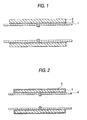
- Fig. 1 is a sectional view of a socket for pipe manufactured by the insert molding method.
- a joint for joining nylon pipes 1 comprises an outer layer 2 and an inner layer 3. Peel strength at the surface adhered to the nylon pipe can effectively be improved by using the aforesaid joint material as the inner layer 3.
- Fig. 2 is a sectional view showing a socket for a pipe manufactured by the sandwitch molding method.
- a joint for joining nylon pipes 4 comprises an outer layer (skin layer) 5 and an inner layer (core layer) 6. Peel strength at the surface adhered to the nylon pipe 4 can effectively be improved by using the aforesaid joint material as the outer layer (skin layer).
- additives such as a heat resistance-imparting agent, a weather resistance-imparting agent, an antioxidant, a UV absorbent, a fire retardant, an impact resistance-imparting agent, an antistatic agent, a plasticizer.
- nylons to be used as a material for the joint employed in the invention may be added, if necessary, reinforcing materials such as glass fibers, inorganic fibers, organic fibers, carbon black,
- copolymerized nylons to be used as a material for the joint employed in the invention may optionally be added colorants such as pigments or dyes.
- a solvent adhesive is used for adhering the joint used in accordance with the invention to nylon resin moldings.
- those adhesives may be used which comprise a solvent capable of dissolving nylon resin moldings and the joint, such as a phenolic compound (e.g., phenol, alkylphenol) or a fluoroalcoholic compound.
- phenolic compounds there are illustrated phenol, o-cresol, m-cresol, p-cresol, o-ethylphenol, methylphenol, p-ethylphenol, o-propylphenol, m-propylphenol, o-isopropylphenol, m-isopropylphenol, p-isopropylphenol, o-n-butylphenol, m-n-butylphenol, p-n-butylphenol, o-sec-butylphenol, m-sec-butylphenol, p-sec-butylphenol, o-tert-butylphenol, m-tert-butylphenol, p-tert-butylphenol, 4-amylphenol, 4-octylphenol, 4-tert-octylphenol, 4-nonylphenol, 4-dodecylphenol, 2,3-dimethylphenol, 2,4-dimethylphenol, 2,5-dimethyl
- fluoroalcoholic compounds there are illustrated 1,1,1,3,3,3-hexafluoroisopropanol, and 1,1,1-trifluoroethanol.
- carvacrol (2-methyl-5-isopropylphenol) and thymol (5-methyl-2-isopropylphenol) is preferred, because it shows a comparatively low toxicity and can remain liquid to below -20°C depending upon the composition ratio, thus permitting to use over a wide range of temperature.
- a solvent adhesive containing a copolymerized nylon is preferred as the solvent adhesive. Incorporation of the copolymerized nylon enables formation of an adhesive layer at the adhesion interface with more effectivity, thus adhesion strength being improved.
- copolymerized nylon there may be used those copolymerized nylons which comprise two kinds or more units derived from a lactam containing 6 to 12 carbon atoms, an aminocarboxylic acid containing 6 to 12 carbon atoms, or a combination of a dicarboxylic acid containing 3 to 22 carbon atoms and a diamine containing 2 to 20 carbon atoms.
- Concentration of the copolymerized nylon contained in the adhesive is preferably 0.5 to 20% by weight based on the total weight of the adhesive. In case where concentration of the copolymerized nylon is less than 0.5% by weight, viscosity of the resulting adhesive becomes too low that it tends to run upon application, thus being difficult to handle. On the other hand, in case where concentration of the copolymerized nylon becomes more than 20% by weight, viscosity becomes so high that it becomes difficult to handle and that it takes long before solidification.
- the adhesion structure of nylon resin wherein the aforesaid joint material and the material comprising other nylon resin are adhered to each other using the solvent adhesive can be applied to various nylon resin products.
- it can be applied to joining of hollow moldings or adhesion for producing multi-layer film.
Landscapes
- Chemical & Material Sciences (AREA)
- Organic Chemistry (AREA)
- Chemical Kinetics & Catalysis (AREA)
- Engineering & Computer Science (AREA)
- Manufacturing & Machinery (AREA)
- Materials Engineering (AREA)
- Health & Medical Sciences (AREA)
- Medicinal Chemistry (AREA)
- Polymers & Plastics (AREA)
- Compositions Of Macromolecular Compounds (AREA)
- Adhesives Or Adhesive Processes (AREA)
- Manufacture Of Macromolecular Shaped Articles (AREA)
Description
- The present invention relates to the use of specific nylon materials as joint which can provide sufficient adhesion strength when adhered to nylon resin moldings.
- Solvent adhesives are used for adhering nylon resin moldings to each other. Solvents for used in these solvent adhesives are required to dissolve nylon to be adhered. As solvents for the solvent adhesives adapted for nylons, phenolic compounds such as phenol, cresol and chlorophenol or fluoroalcohols are currently used, but all of these are so poisonous or stimulous that they are not preferred from the point of working environment.
- Thus, in order to reduce toxicity of the phenolic compounds, those compounds have been used which have a phenolic hydroxyl group and one or more alkyl groups. Of these, a combination of carvacrol (2-methyl-5-isopropylphenol) and thymol (5-methyl-2-isopropylphenol) has a comparatively low toxicity and can remain liquid down to a temperature as low as -20°C depending upon composition ratio, thus being usable over a wide range of temperature. A solvent adhesive obtained by dissolving nylon in this mixed solvent of carvacrol and thymol is described in Japanese Patent No. 2909203, and is used for adhering a nylon gas pipe to a nylon joint.
- However, in cases where an enough peel strength is required at adhesion portions between the pipe and the joint or in other uses, the current adhesion strength is not enough, and use of the adhesives has been limited. WO 90/05756 discloses an adhesive comprising specific nylon materials. JP-A-61-188458 and US-A-5, 414, 051 disclose polyamide compositions.
- An object of the present invention is to provide a joint for nylon resin moldings, which can provide an enough peel strength when adhered to nylon resin moldings using a solvent adhesive.
- Mechanism of adhesion with a solvent adhesive is that, first, materials to be adhered are dissolved in the solvent adhesive at the adhesion portion, and the dissolved polymer molecule chains then mutually invade into the materials to be adhered, and the solvent evaporates or is absorbed by the materials to be adhered to form a dry, solidified adhesion layer at the adhesion interface. Therefore, solvents for the solvent adhesive are required to sufficiently dissolve materials to be adhered.
- The present invention is based on the finding that, by the use of a copolymerized nylon or a composition comprising a copolymerized nylon or a copolymerized nylon blend and at least one of a nucleating agent and a lubricant as a material for a joint to be adhered to nylon resin moldings, solubility of nylon resin in the solvent contained in the solvent adhesive is enhanced to thereby form the adhesion layer more effectively at the adhesion interface, thus adhesion strength being improved and moldability being improved through shortening cooling time upon injection molding.
- That is, the invention relates to the use as defined in claim 1 and the method as defined in claim 11. Prefered embodiments are defined in the subclaims.
-
- Fig. 1 is a sectional view showing a joint for nylon pipes manufactured by insert molding.
- Fig. 2 is a sectional view showing a joint for nylon pipes manufactured by sandwitch molding.
- The invention is described in detail below.
- The copolymerized nylon to be used as a material for the joint of the invention is a copolymerized nylon comprising two kinds or more units derived from aminocarboxylic acids, lactams or a combination of diamine and dicarboxylic acid. Specifically, there are illustrated those which comprise two or more units derived from lactams containing 6 to 12 carbon atoms, aminocarboxylic acids containing 6 to 12 carbon atoms or a combination of a dicarboxylic acid containing 3 to 22 carbon atoms and a diamine containing 2 to 20 carbon atoms.
- As the aminocarboxylic acid containing 6 to 12 carbon atoms, there may be used 6-aminocaproic acid, 7-aminoheptanoic acid, 8-aminooctanoic acid, 9-aminononanoic acid, 10-aminocapric acid, 11-aminoundecanoic acid, 12-aminododecanoic acid.
- As the lactam containing 6 to 12 carbon atoms, there may be used ε-caprolactam, ω-enantolactam, ω-undecanelactam, ω-dodecalactam.
- As the diamine and dicarboxylic acid, linear diamines and linear dicarboxylic acids are used but, for the purpose of decreasing crystallinity, there may be used copolymerized nylons wherein part of starting materials of nylons derived from the linear diamine and the linear dicarboxylic acid may be replaced by a branched diamine and/or a branched dicarboxylic acid.
- As the linear aliphatic dicarboxylic acid, there may be used malonic acid, succinic acid, glutaric acid, adipic acid, pimelic acid, suberic acid, azelaic acid, sebacic acid, undecane dicarboxylic acid, dodecane dicarboxylic acid, tridecane dicarboxylic acid, tetradecane dicarboxylic acid, pentadecane dicarboxylic acid, hexadecane dicarboxylic acid, heptadecane dicarboxylic acid, octadecane dicarboxylic acid, nonadecane dicarboxylic acid, eicosane dicarboxylic acid.
- As the linear aliphatic diamine, there may be used ethylenediamine, 1,3-propanediamine, 1,4-butanediamine, 1,5-pentanediamine, 1,6-hexanediamine, 1,7-heptanecliamine, 1,8-octanediamine, 1,9-nonanediamine, 1,10-decanediamine, 1,11-undecanediamine, 1,12-dodecane-diamine, 1,13-tridecanediamine, 1,14-tetradecanediamine, 1,15-pentadecanediamine, 1,16-hexadecanediamine, 1,17-heptadecanediamine, 1,18-octadecanediamine, 1,19-nonadecanediamine, 1,20-eicosanediamine.
- As the branched aliphatic diamine, there may be used 1-butyl-1,2-ethanediamine, 1,1-dimethyl-1,4-butanediamine, 1-ethyl-1,4-butanediamine, 1,2-dimethyl-1,4-butanediamine, 1,3-dimethyl-1,4-butanediamine, 1,4-dimethyl-1,4-butanediamine, 2,3-dimethyl-1,4-butanediamine, 2-methyl-1,5-pentanecliamine, 3-methyl-1,5-pentanediamine, 2,2-dimethyl-1,6-hexanediamine, 2,5-dimethyl-1,6-hexanediamine, 2,4-dimethyl-1,6-hexanediamine, 3,3-dimethyl-1,6-hexanediamine, 2,2,4-trimethyl-1,6-hexanediamine, 2,4,4-trimethyl-1,6-hexanediamine, 2,4-diethyl-1,6-hexanediamine, 2,2-dimethyl-1,7-heptanediamine, 2,3-dimethyl-1,7-heptanediamine, 2,4-dimethyl-1,7-heptanediamine, 2,5-dimethyl-1,7-peptanediamine, 2-methyl-1,8-octanediamine, 3-methyl-1,8-octanediamine, 4-methyl-1,8-octanediamine, 1,3-dimethyl-1,8-octanediamine, 1,4-dimethyl-1,8-octanediamine, 2,4-dimethyl-1,8-octanediamine, 3,4-dimethyl-1,8-octanediamine, 4,5-dimethyl-1,8-octanediamine, 2,2-dimethyl-1,8-octanediamine, 3,3-dimethyl-1,8-octanediamine, 4,4-dimethyl-1,8-octanediamine, 5-methyl-1,9-nonanediamine.
- As the branched dicarboxylic acid, there may be used dimethylmalonic acid, 3,3-diethylsuccinic acid, 2,2-dimethylglutaric acid, 2-methyladipic acid, 3-methyladipic acid, trimethyladipic acid, 2-butylsuberic acid (also named 1,6-decane dicarboxylic acid), 2,3-dibutylbutane dioic acid, 8-ethyloctadecane dioic acid, 8,13-dimethyleicosadioic acid, 2-octylundecane dioic acid, 2-nonyldecane dioic acid,
- As the copolymerized nylon to be used in the invention as a material for the joint, there may be used a binary copolymerized nylon comprising two components derived from the above-described starting materials or a copolymerized nylon comprising three or more components derived from the above-described starting materials.
- The nylon to be used as a material for the joint, the copolymerized nylon may independently be used, or may be used as a blend of the copolymerized nylon and a homonylon or a blend of the copolymerized nylon and other copolymerized nylon. As the copolymerized nylon blend, there are illustrated, for example, a blend of the copolymerized nylon and a nylon selected from the group consisting of
nylon 6, nylon 11, nylon 12,nylon nylon 6,10 andnylon 6,12. The term "nylon - As specific examples of the nylon resins to be adhered to the joint of the invention, there are illustrated aliphatic polyamides such as
nylon 6,nylon - As the nucleating agent to be used in the material for the joint of the invention, there may be used inorganic nucleating agents such as talc, wollastnite, calcium carbonate, kaolin, calcined kaolin, silica, zeolite, boron nitride, alumina, magnesia, graphite and mica, and organic nucleating agents such as oxalates, stearates, benzoates, salicylates, tartrates, sulfonates, montan wax salts, montan wax esters, terephthalates, benzoates and carboxylates. Of these, talc is preferably used. The nucleating agent is preferably compounded in an amount ranging from 0.1 to 5 parts by weight per 100 parts by weight of the resin component.
- As the lubricant to be used in the material for the joint of the invention, there are illustrated those which are commonly used in nylons, such as fatty acids, metallic soaps derived from fatty acids, aliphatic alcohols, hydroxyfatty acids, fatty acid amides. The lubricant is preferably contained in an amount ranging from 0.05 to 5 parts by weight per 100 parts by weight of the resin component.
- As the fatty acid, there may be used capric acid, n-undecylenic acid, lauric acid, n-tridecylenic acid, myristic acid, n-pentadecylenic acid, palmitic acid, margaric acid, stearic acid, n-nonadecylenic acid, arachidonic acid, n-heneiconic acid, behenic acid, n-tricosanoic acid, lignoceric acid, n-pentacosanoic acid, cerotic acid, n-heptacosanoic acid, montanic acid, n-nonacosanoic acid, melissic acid, n-hentriacontanoic acid, n-dotriacontanoic acid, n-tetratriacontanoic acid, ceroplastic acid, n-hexatriacontanoic acid, n-octatriacontanoic acid, n-hexatetracontanoic acid, oleic acid, erucic acid, hydroxystearic acid, ricinoleic acid.
- As the aliphatic alcohol, there may be used octanol, nonanol, decanol, undecanol, dodecanol, tridecanol, myristyl alcohol, pentadecanol, cetyl aocohol, heptadecanol, stearyl alcohol, nonadecanol, aralkyl alcohol, behenyl alcohol, carnaubyl alcohol, ceryl alcohol, octacosanol, melissyl alcohol, dotriacontanol, pentaerythritol,
- As the metallic soap, there may be used calcium salts, zinc salts and lithium salts derived from capric acid, n-undecylenic acid, lauric acid, n-tridecylenic acid, myristic acid, n-pentadecylenic acid, palmitic acid, stearic acid, behenic acis, montanic acid, oleic acid, erucic acid, hydroxystearic acid and ricinoleic acid.
- As the fatty acid amide, there may be used caproic acid amide, caprylic acid amide, capric acid amide, lauric acid amide, myristic acid amide, palmitic acid amide, stearic acid amide, arachidic acid amide, behenic acid amide, palmitoleic acid amide, oleic acid amide, eicosenoic acid amide, erucic acid amide, elaidic acid amide, trans-11-eicosenoic acid amide, trans-13-docosenoic acid amide, linoleic acid amide, linolenic acid amide, ricinoleic acid amide, N,N'-methylenebiscaproic acid amide, N,N'-methylenebiscaprylic acid amide, N,N'-methylenebiscapric acid amide, N,N'-methylenebislauric acid amide, N,N'-methylenebismyristic acid amide, N,N'-methylenebispalmitic acid amide, N,N'-methylenebisstearic acid amide, N,N'-methylenebisbehenic acid amide, N,N'-methylenebisoleic acid amide, N,N'-methylenebiseicosenoic acid amide, N,N'-methylenebiserucic acid amide, N,N'-methylenebiselaidic acid amide, N,N'-methylenebiserucic acid amide, N,N'-ethylenebiscaproic acid amide, N,N'-ethylenebiscaprylic acid amide, N,N'-ethylenebiscapric acid amide, N,N'-ethylenebislauric acid amide, N,N'-ethylenebismyristic acid amide, N,N'-ethylenebispalmitic acid amide, N,N'-ethylenebisstearic acid amide, N,N'-ethylenebisbehenic acid amide, N,N'-ethylenebisoleic acid amide, N,N'-ethylenebiseicosenoic acid amide, N,N'-ethylenebiserucic acid amide, N,N'-ethylenebiselaidic acid amide, N,N'-ethylenebiserucic acid amide.
- The joint used in accordance with the invention may be totally constituted by the aforesaid material for the joint, or may partly be constituted by the aforesaid material at the portion to be in contact with materials to be adhered.
- As molding methods using the joint material at least at the adhesion portion, a dissimilar material molding using different materials such as insert molding or sandwitch molding may be used.
- For example, there may be employed a dissimilar material molding using different materials, such as an insert molding wherein a primary member resin is first molded, and the resulting molding is inserted into a metal mold for a secondary member resin, followed by casting a secondary member resin into necessary portion of the mold to heat-fuse with the primary member resin or a sandwitch molding method wherein a primary member resin is injected into a metal mold, then a secondary member resin is injected so that the primary material resin forms a surface layer (skin layer) and the secondary member resin forms an inner layer (core layer).
- Fig. 1 is a sectional view of a socket for pipe manufactured by the insert molding method. A joint for joining nylon pipes 1 comprises an
outer layer 2 and an inner layer 3. Peel strength at the surface adhered to the nylon pipe can effectively be improved by using the aforesaid joint material as the inner layer 3. - Fig. 2 is a sectional view showing a socket for a pipe manufactured by the sandwitch molding method. A joint for joining nylon pipes 4 comprises an outer layer (skin layer) 5 and an inner layer (core layer) 6. Peel strength at the surface adhered to the nylon pipe 4 can effectively be improved by using the aforesaid joint material as the outer layer (skin layer).
- To the copolymerized nylons to be used as a material for the joint employed in accordance with the invention may optionally be added additives such as a heat resistance-imparting agent, a weather resistance-imparting agent, an antioxidant, a UV absorbent, a fire retardant, an impact resistance-imparting agent, an antistatic agent, a plasticizer.
- In addition, to the copolymerized nylons to be used as a material for the joint employed in the invention may be added, if necessary, reinforcing materials such as glass fibers, inorganic fibers, organic fibers, carbon black,
- To the copolymerized nylons to be used as a material for the joint employed in the invention may optionally be added colorants such as pigments or dyes.
- A solvent adhesive is used for adhering the joint used in accordance with the invention to nylon resin moldings. As the solvent adhesive, those adhesives may be used which comprise a solvent capable of dissolving nylon resin moldings and the joint, such as a phenolic compound (e.g., phenol, alkylphenol) or a fluoroalcoholic compound.
- As the phenolic compounds, there are illustrated phenol, o-cresol, m-cresol, p-cresol, o-ethylphenol, methylphenol, p-ethylphenol, o-propylphenol, m-propylphenol, o-isopropylphenol, m-isopropylphenol, p-isopropylphenol, o-n-butylphenol, m-n-butylphenol, p-n-butylphenol, o-sec-butylphenol, m-sec-butylphenol, p-sec-butylphenol, o-tert-butylphenol, m-tert-butylphenol, p-tert-butylphenol, 4-amylphenol, 4-octylphenol, 4-tert-octylphenol, 4-nonylphenol, 4-dodecylphenol, 2,3-dimethylphenol, 2,4-dimethylphenol, 2,5-dimethylphenol, 2,6-dimethylphenol, 3,4-dimethylphenol, 3,5-dimethylphenol, 4-isopropyl-3-methylphenol, 5-isopropyl-2-methylphenol (also called carvacrol), 6-isopropyl-3-methylphenol (also called thymol), 2-tert-butyl-4-methylphenol, 6-tert-butyl-3-methylphenol, 6-tert-butyl-2-methylphenol, 6-tert-butyl-2,4-dimethylphenol, 4,6-tert-butyl-3-methylphenol, resorcinol, 2-methylresorcinol, 4-methylresorcinol, 5-methylresorcinol, 2-ethylresorcinol, 4-ethylresorcinol, 5-ethylresorcinol, 2-butylresorcinol, 4-butylresorcinol, 5-butylresorcinol, 2-amylresorcinol, 4-amylresorcinol, 5-amylresorcinol, 2-hexylresorcinol, 4-hexylresorcinol, 5-hexylresorcinol, 2-heptylresorcinol, 4-heptylresorcinol, 5-heptylresorcinol, 2-octylresorcinol, 4-octylresorcinol, 5-octylresorcinol, 2-nonylresorcinol, 4-nonylresorcinol, 5-nonylresorcinol, 2-dodecylresorcinol, 4-dodecylresorcinol, 5-dodecylresorcinol, catechol, 3-methylcatechol, 4-methylcatechol, hydroquinone, 1,2,3-trihydroxybenzene (also called pyrogallol) and 1,3,5-trihydroxybenzene (also called phloroglucinol).
- As the fluoroalcoholic compounds, there are illustrated 1,1,1,3,3,3-hexafluoroisopropanol, and 1,1,1-trifluoroethanol.
- Of these, a combination of carvacrol (2-methyl-5-isopropylphenol) and thymol (5-methyl-2-isopropylphenol) is preferred, because it shows a comparatively low toxicity and can remain liquid to below -20°C depending upon the composition ratio, thus permitting to use over a wide range of temperature.
- In the invention, a solvent adhesive containing a copolymerized nylon is preferred as the solvent adhesive. Incorporation of the copolymerized nylon enables formation of an adhesive layer at the adhesion interface with more effectivity, thus adhesion strength being improved.
- As the copolymerized nylon, there may be used those copolymerized nylons which comprise two kinds or more units derived from a lactam containing 6 to 12 carbon atoms, an aminocarboxylic acid containing 6 to 12 carbon atoms, or a combination of a dicarboxylic acid containing 3 to 22 carbon atoms and a diamine containing 2 to 20 carbon atoms.
- Concentration of the copolymerized nylon contained in the adhesive is preferably 0.5 to 20% by weight based on the total weight of the adhesive. In case where concentration of the copolymerized nylon is less than 0.5% by weight, viscosity of the resulting adhesive becomes too low that it tends to run upon application, thus being difficult to handle. On the other hand, in case where concentration of the copolymerized nylon becomes more than 20% by weight, viscosity becomes so high that it becomes difficult to handle and that it takes long before solidification.
- In addition, in the invention, the adhesion structure of nylon resin wherein the aforesaid joint material and the material comprising other nylon resin are adhered to each other using the solvent adhesive can be applied to various nylon resin products. For example, it can be applied to joining of hollow moldings or adhesion for producing multi-layer film.
Claims (13)
- Use of a material comprising a copolymerized nylon as a joint to be adhered to nylon resin moldings for joining nylon resin moldings using a solvent adhesive.
- The use according to claim 1 in which the material for the joint comprises further at least one of a nucleating agent and a lubricant.
- The use according to claim 2 wherein the copolymerized nylon comprises a copolymerized nylon blend.
- The use as claimed in one of claims 1 to 3, wherein the copolymerized nylon comprises two or more kinds of units derived from lactams containing 6 to 12 carbon atoms, aminocarboxylic acids containing 6 to 12 carbon atoms, and a combination of a dicarboxylic acid containing 3 to 22 carbon atoms and a diamine containing 2 to 20 carbon atoms.
- The use as claimed in claim 3, wherein the copolymerized nylon blend is a blend of a copolymerized nylon and a nylon selected from the group consisting of nylon 6, nylon 11, nylon 12, nylon 6,6, nylon 6,10 and nylon 6,12.
- The use as claimed in claim 2 or 3, wherein the nucleating agent is talc, with its content being 0.1 to 5 parts by weight per 100 parts by weight of the resin component.
- The use as claimed in claim 2 or 3, wherein the lubricant is a metal soap, with its content being 0.05 to 5 parts by weight per 100 parts by weight of the resin component.
- The use as claimed in one of claims 1 to 3, wherein the copolymerized nylon comprises 5 to 95% by weight of nylon-12 component, based on the total weight of the copolymerized nylon.
- The use as claimed in claim 3, wherein the copolymerized nylon blend comprises 50 to 90% by weight of the copolymerized nylon and 50 to 10% by weight of nylon 12, based on the total weight of the copolymerized nylon blend.
- The use as claimed in one of claims 1 to 3, wherein the joint has an insert molding structure or a sandwich molding structure.
- A method for adhering nylon resin moldings, which comprises adhering the nylon resin moldings to a joint comprising (i) a copolymerized nylon or (ii) a composition comprising a copolymerized nylon or a copolymerized nylon blend and at least one of a nucleating agent and a lubricant using a solvent adhesive.
- The method for adhering nylon resin moldings as claimed in claim 11, wherein the solvent adhesive comprises at least one component of a phenolic compound and a fluoroalcoholic compound.
- The method for adhering nylon resin moldings as claimed in claim 11 or 12, wherein the solvent adhesive comprises a copolymerized nylon.
Priority Applications (1)
| Application Number | Priority Date | Filing Date | Title |
|---|---|---|---|
| EP03013065A EP1484376A3 (en) | 2000-10-05 | 2001-10-02 | Solvent adhesive |
Applications Claiming Priority (2)
| Application Number | Priority Date | Filing Date | Title |
|---|---|---|---|
| JP2000306463 | 2000-10-05 | ||
| JP2000306463 | 2000-10-05 |
Related Child Applications (1)
| Application Number | Title | Priority Date | Filing Date |
|---|---|---|---|
| EP03013065A Division EP1484376A3 (en) | 2000-10-05 | 2001-10-02 | Solvent adhesive |
Publications (3)
| Publication Number | Publication Date |
|---|---|
| EP1195419A2 EP1195419A2 (en) | 2002-04-10 |
| EP1195419A3 EP1195419A3 (en) | 2002-07-03 |
| EP1195419B1 true EP1195419B1 (en) | 2006-01-04 |
Family
ID=18787151
Family Applications (2)
| Application Number | Title | Priority Date | Filing Date |
|---|---|---|---|
| EP03013065A Withdrawn EP1484376A3 (en) | 2000-10-05 | 2001-10-02 | Solvent adhesive |
| EP01123683A Expired - Lifetime EP1195419B1 (en) | 2000-10-05 | 2001-10-02 | Joint for nylon resin moldings |
Family Applications Before (1)
| Application Number | Title | Priority Date | Filing Date |
|---|---|---|---|
| EP03013065A Withdrawn EP1484376A3 (en) | 2000-10-05 | 2001-10-02 | Solvent adhesive |
Country Status (4)
| Country | Link |
|---|---|
| US (2) | US20020066526A1 (en) |
| EP (2) | EP1484376A3 (en) |
| AU (1) | AU784419B2 (en) |
| DE (1) | DE60116425T2 (en) |
Families Citing this family (6)
| Publication number | Priority date | Publication date | Assignee | Title |
|---|---|---|---|---|
| JP4024046B2 (en) * | 2002-01-10 | 2007-12-19 | 宇部興産株式会社 | Bonding method of nylon resin pipe and nylon resin joint |
| JP4451200B2 (en) * | 2004-04-26 | 2010-04-14 | 康治 友田 | Polyamide resin integral molded product, method for producing the same, and polyamide resin joining aid |
| DE102007041488A1 (en) * | 2007-08-31 | 2009-03-05 | Evonik Degussa Gmbh | Joining of molded parts made of different polyamide molding compounds |
| US20090127740A1 (en) * | 2007-11-19 | 2009-05-21 | E.I. Du Pont De Nemours And Company | Use of polyamide compositions for making molded articles having improved adhesion, molded articles thereof and methods for adhering such materials |
| CN102286263A (en) * | 2011-06-15 | 2011-12-21 | 蒋德海 | Spindle tape adhesive |
| FR3010090B1 (en) * | 2013-09-05 | 2016-09-02 | Arkema France | FITTINGS FOR TUBES BASED ON A POLYAMIDE COMPOSITION |
Family Cites Families (10)
| Publication number | Priority date | Publication date | Assignee | Title |
|---|---|---|---|---|
| GB1137077A (en) * | 1965-06-14 | 1968-12-18 | Tokyo Shibaura Electric Co | Liquid adhesives |
| JPS53106486A (en) * | 1977-02-28 | 1978-09-16 | Sumitomo Electric Ind Ltd | Self-fused insulating wire and coil obtained from it |
| US4400019A (en) * | 1981-04-22 | 1983-08-23 | Unisert Systems, Inc. | Multilayer pipe joint |
| JPH0655886B2 (en) * | 1985-02-15 | 1994-07-27 | 旭化成工業株式会社 | Nylon 46 resin composition for molding |
| JPS63152637A (en) * | 1986-12-16 | 1988-06-25 | Toray Ind Inc | Preform material for reinforcement of resin |
| NZ231391A (en) * | 1988-11-18 | 1992-04-28 | Australian Gas Light Co | Adhesive composition comprising a dialkyl phenol and a polyamide |
| US5519109A (en) * | 1990-10-17 | 1996-05-21 | Henkel Kommanditgesellschaft Auf Aktien | Moisture-curing polyamides |
| US5414051A (en) * | 1991-02-19 | 1995-05-09 | Alliedsignal Inc. | Nylon compositions featuring improved rates of crystallization and methods for forming the same |
| JP2717027B2 (en) * | 1992-04-14 | 1998-02-18 | アライド−シグナル・インコーポレーテッド | Compatible thermoplastic polymer blend compositions comprising polyamide / amorphous polyamide blends |
| US6121388A (en) * | 1998-05-12 | 2000-09-19 | Toray Industries, Inc. | Polyamide resin composition |
-
2001
- 2001-10-02 EP EP03013065A patent/EP1484376A3/en not_active Withdrawn
- 2001-10-02 EP EP01123683A patent/EP1195419B1/en not_active Expired - Lifetime
- 2001-10-02 DE DE60116425T patent/DE60116425T2/en not_active Expired - Fee Related
- 2001-10-03 AU AU77381/01A patent/AU784419B2/en not_active Ceased
- 2001-10-05 US US09/972,224 patent/US20020066526A1/en not_active Abandoned
-
2003
- 2003-12-22 US US10/743,996 patent/US20040171764A1/en not_active Abandoned
Non-Patent Citations (1)
| Title |
|---|
| KOHAN M.I.: "NYLON PLASTIC HANDBOOK", CARL HANSER VERLAG * |
Also Published As
| Publication number | Publication date |
|---|---|
| EP1195419A2 (en) | 2002-04-10 |
| EP1484376A3 (en) | 2005-11-16 |
| US20040171764A1 (en) | 2004-09-02 |
| EP1484376A2 (en) | 2004-12-08 |
| EP1195419A3 (en) | 2002-07-03 |
| AU784419B2 (en) | 2006-03-30 |
| DE60116425T2 (en) | 2006-07-06 |
| AU7738101A (en) | 2002-04-11 |
| US20020066526A1 (en) | 2002-06-06 |
| DE60116425D1 (en) | 2006-03-30 |
Similar Documents
| Publication | Publication Date | Title |
|---|---|---|
| EP1195419A2 (en) | Joint for nylon resin moldings | |
| WO2009067413A1 (en) | Use of polyamide compositions for making molded articles having improved adhesion, molded articles thereof and methods for adhering such materials | |
| US20140041159A1 (en) | Polyamide composition, cable tie made thereof and its manufacturing method | |
| KR102398824B1 (en) | Tube connectors based on a polyamide composition | |
| EP1327518A2 (en) | Nylon resin multi-layer pipe and method for adhering same | |
| JP4688373B2 (en) | Nylon resin molded joint for bonding and bonding method | |
| JP2003089783A (en) | Adhesive for nylon resin molded products | |
| JP2002188786A (en) | Joint and method for bonding nylon resin molded products | |
| EP0735098B1 (en) | Use of polyamide resin compositions as injection welding material | |
| EP3781272A1 (en) | Dual-molded polyamide-silicone composite article and methods of making | |
| JP4246619B2 (en) | Joining aid for polyamide resin, injection molding joining method using the same, and ultrasonic welding joining method | |
| US5559179A (en) | Molding compound | |
| JP2003089131A (en) | Injection molding method for polyamide resin molded products | |
| JP3239674B2 (en) | Polyphenylene sulfide resin stator | |
| JP4010601B2 (en) | Polyamide resin composition | |
| JPH10219106A (en) | Resin composition for welding molding | |
| JP2002212416A (en) | Polyamide resin composition and method for producing the same | |
| JPH08151517A (en) | Polyamide resin composition for welding | |
| JP2024513177A (en) | Polyamide composition with improved hydrolysis resistance, method for producing the same, uses thereof, and articles produced therefrom | |
| JPH05311036A (en) | Phenolic resin molding material | |
| JP3879839B2 (en) | Fuel parts | |
| JP3324323B2 (en) | Polyphenylene sulfide resin stator | |
| JP3322062B2 (en) | Injection welding material | |
| JP2019038983A (en) | Heat-welded polypropylene molding and method for producing the same | |
| JP2002096348A (en) | Molded article using crystalline resin composition and injection molding method thereof |
Legal Events
| Date | Code | Title | Description |
|---|---|---|---|
| PUAI | Public reference made under article 153(3) epc to a published international application that has entered the european phase |
Free format text: ORIGINAL CODE: 0009012 |
|
| AK | Designated contracting states |
Kind code of ref document: A2 Designated state(s): AT BE CH CY DE DK ES FI FR GB GR IE IT LI LU MC NL PT SE TR |
|
| AX | Request for extension of the european patent |
Free format text: AL;LT;LV;MK;RO;SI |
|
| PUAL | Search report despatched |
Free format text: ORIGINAL CODE: 0009013 |
|
| AK | Designated contracting states |
Kind code of ref document: A3 Designated state(s): AT BE CH CY DE DK ES FI FR GB GR IE IT LI LU MC NL PT SE TR |
|
| AX | Request for extension of the european patent |
Free format text: AL;LT;LV;MK;RO;SI |
|
| 17P | Request for examination filed |
Effective date: 20021017 |
|
| 17Q | First examination report despatched |
Effective date: 20030211 |
|
| AKX | Designation fees paid |
Designated state(s): CH DE FR GB IT LI NL |
|
| RAP1 | Party data changed (applicant data changed or rights of an application transferred) |
Owner name: UBE INDUSTRIES, LTD. Owner name: OSAKA GAS CO., LTD. |
|
| RIN1 | Information on inventor provided before grant (corrected) |
Inventor name: ISOBE, NORIYUKI Inventor name: MATSUDA, SHINYA Inventor name: HIGUCHI, YUJI Inventor name: FUJIMURA, HIDEKI |
|
| RIN1 | Information on inventor provided before grant (corrected) |
Inventor name: HIGUCHI, YUJI Inventor name: FUJIMURA, HIDEKI Inventor name: MATSUDA, SHINYA Inventor name: ISOBE, NORIYUKI |
|
| GRAP | Despatch of communication of intention to grant a patent |
Free format text: ORIGINAL CODE: EPIDOSNIGR1 |
|
| GRAS | Grant fee paid |
Free format text: ORIGINAL CODE: EPIDOSNIGR3 |
|
| GRAA | (expected) grant |
Free format text: ORIGINAL CODE: 0009210 |
|
| AK | Designated contracting states |
Kind code of ref document: B1 Designated state(s): CH DE FR GB IT LI NL |
|
| PG25 | Lapsed in a contracting state [announced via postgrant information from national office to epo] |
Ref country code: IT Free format text: LAPSE BECAUSE OF FAILURE TO SUBMIT A TRANSLATION OF THE DESCRIPTION OR TO PAY THE FEE WITHIN THE PRESCRIBED TIME-LIMIT;WARNING: LAPSES OF ITALIAN PATENTS WITH EFFECTIVE DATE BEFORE 2007 MAY HAVE OCCURRED AT ANY TIME BEFORE 2007. THE CORRECT EFFECTIVE DATE MAY BE DIFFERENT FROM THE ONE RECORDED. Effective date: 20060104 |
|
| REG | Reference to a national code |
Ref country code: GB Ref legal event code: FG4D |
|
| REG | Reference to a national code |
Ref country code: CH Ref legal event code: NV Representative=s name: BOVARD AG PATENTANWAELTE Ref country code: CH Ref legal event code: EP |
|
| REF | Corresponds to: |
Ref document number: 60116425 Country of ref document: DE Date of ref document: 20060330 Kind code of ref document: P |
|
| ET | Fr: translation filed | ||
| PLBI | Opposition filed |
Free format text: ORIGINAL CODE: 0009260 |
|
| PLAX | Notice of opposition and request to file observation + time limit sent |
Free format text: ORIGINAL CODE: EPIDOSNOBS2 |
|
| 26 | Opposition filed |
Opponent name: DEGUSSA AG |
|
| NLR1 | Nl: opposition has been filed with the epo |
Opponent name: DEGUSSA AG |
|
| PLBB | Reply of patent proprietor to notice(s) of opposition received |
Free format text: ORIGINAL CODE: EPIDOSNOBS3 |
|
| PLAB | Opposition data, opponent's data or that of the opponent's representative modified |
Free format text: ORIGINAL CODE: 0009299OPPO |
|
| PLAB | Opposition data, opponent's data or that of the opponent's representative modified |
Free format text: ORIGINAL CODE: 0009299OPPO |
|
| PLBI | Opposition filed |
Free format text: ORIGINAL CODE: 0009260 |
|
| R26 | Opposition filed (corrected) |
Opponent name: DEGUSSA AG |
|
| R26 | Opposition filed (corrected) |
Opponent name: DEGUSSA AG Effective date: 20061004 |
|
| NLR1 | Nl: opposition has been filed with the epo |
Opponent name: DEGUSSA AG |
|
| NLR1 | Nl: opposition has been filed with the epo |
Opponent name: DEGUSSA AG |
|
| PGFP | Annual fee paid to national office [announced via postgrant information from national office to epo] |
Ref country code: CH Payment date: 20070927 Year of fee payment: 7 |
|
| PGFP | Annual fee paid to national office [announced via postgrant information from national office to epo] |
Ref country code: GB Payment date: 20070926 Year of fee payment: 7 |
|
| PGFP | Annual fee paid to national office [announced via postgrant information from national office to epo] |
Ref country code: DE Payment date: 20070927 Year of fee payment: 7 Ref country code: NL Payment date: 20071015 Year of fee payment: 7 |
|
| PGFP | Annual fee paid to national office [announced via postgrant information from national office to epo] |
Ref country code: IT Payment date: 20071026 Year of fee payment: 7 |
|
| PGFP | Annual fee paid to national office [announced via postgrant information from national office to epo] |
Ref country code: FR Payment date: 20071009 Year of fee payment: 7 |
|
| REG | Reference to a national code |
Ref country code: CH Ref legal event code: PL |
|
| GBPC | Gb: european patent ceased through non-payment of renewal fee |
Effective date: 20081002 |
|
| NLV4 | Nl: lapsed or anulled due to non-payment of the annual fee |
Effective date: 20090501 |
|
| REG | Reference to a national code |
Ref country code: FR Ref legal event code: ST Effective date: 20090630 |
|
| PG25 | Lapsed in a contracting state [announced via postgrant information from national office to epo] |
Ref country code: NL Free format text: LAPSE BECAUSE OF NON-PAYMENT OF DUE FEES Effective date: 20090501 |
|
| PG25 | Lapsed in a contracting state [announced via postgrant information from national office to epo] |
Ref country code: IT Free format text: LAPSE BECAUSE OF NON-PAYMENT OF DUE FEES Effective date: 20081002 Ref country code: DE Free format text: LAPSE BECAUSE OF NON-PAYMENT OF DUE FEES Effective date: 20090501 |
|
| PG25 | Lapsed in a contracting state [announced via postgrant information from national office to epo] |
Ref country code: LI Free format text: LAPSE BECAUSE OF NON-PAYMENT OF DUE FEES Effective date: 20081031 Ref country code: FR Free format text: LAPSE BECAUSE OF NON-PAYMENT OF DUE FEES Effective date: 20081031 Ref country code: CH Free format text: LAPSE BECAUSE OF NON-PAYMENT OF DUE FEES Effective date: 20081031 |
|
| PG25 | Lapsed in a contracting state [announced via postgrant information from national office to epo] |
Ref country code: GB Free format text: LAPSE BECAUSE OF NON-PAYMENT OF DUE FEES Effective date: 20081002 |
|
| PLBD | Termination of opposition procedure: decision despatched |
Free format text: ORIGINAL CODE: EPIDOSNOPC1 |
|
| PLBM | Termination of opposition procedure: date of legal effect published |
Free format text: ORIGINAL CODE: 0009276 |
|
| STAA | Information on the status of an ep patent application or granted ep patent |
Free format text: STATUS: OPPOSITION PROCEDURE CLOSED |
|
| 27C | Opposition proceedings terminated |
Effective date: 20100402 |