EP1195368A2 - Process for the catalytic selective oxidation of a hydrocarbon compound in presence of mesoporous zeolite - Google Patents
Process for the catalytic selective oxidation of a hydrocarbon compound in presence of mesoporous zeolite Download PDFInfo
- Publication number
- EP1195368A2 EP1195368A2 EP01121417A EP01121417A EP1195368A2 EP 1195368 A2 EP1195368 A2 EP 1195368A2 EP 01121417 A EP01121417 A EP 01121417A EP 01121417 A EP01121417 A EP 01121417A EP 1195368 A2 EP1195368 A2 EP 1195368A2
- Authority
- EP
- European Patent Office
- Prior art keywords
- mesoporous
- titanium
- hydrocarbon compound
- peroxide
- zeolite catalyst
- Prior art date
- Legal status (The legal status is an assumption and is not a legal conclusion. Google has not performed a legal analysis and makes no representation as to the accuracy of the status listed.)
- Withdrawn
Links
- 239000010457 zeolite Substances 0.000 title claims abstract description 43
- 229910021536 Zeolite Inorganic materials 0.000 title claims abstract description 35
- HNPSIPDUKPIQMN-UHFFFAOYSA-N dioxosilane;oxo(oxoalumanyloxy)alumane Chemical compound O=[Si]=O.O=[Al]O[Al]=O HNPSIPDUKPIQMN-UHFFFAOYSA-N 0.000 title claims abstract description 35
- 238000000034 method Methods 0.000 title claims abstract description 23
- 150000002430 hydrocarbons Chemical class 0.000 title claims abstract description 22
- 230000003647 oxidation Effects 0.000 title claims abstract description 18
- 238000007254 oxidation reaction Methods 0.000 title claims abstract description 18
- 230000003197 catalytic effect Effects 0.000 title description 11
- 239000003054 catalyst Substances 0.000 claims abstract description 28
- 239000010936 titanium Substances 0.000 claims abstract description 23
- RTAQQCXQSZGOHL-UHFFFAOYSA-N Titanium Chemical compound [Ti] RTAQQCXQSZGOHL-UHFFFAOYSA-N 0.000 claims abstract description 22
- 229910052719 titanium Inorganic materials 0.000 claims abstract description 22
- 229930195733 hydrocarbon Natural products 0.000 claims abstract description 12
- 150000002978 peroxides Chemical class 0.000 claims abstract description 9
- MHAJPDPJQMAIIY-UHFFFAOYSA-N Hydrogen peroxide Chemical compound OO MHAJPDPJQMAIIY-UHFFFAOYSA-N 0.000 claims description 17
- 239000013078 crystal Substances 0.000 claims description 13
- OKTJSMMVPCPJKN-UHFFFAOYSA-N Carbon Chemical compound [C] OKTJSMMVPCPJKN-UHFFFAOYSA-N 0.000 claims description 9
- 238000006243 chemical reaction Methods 0.000 claims description 9
- 239000011159 matrix material Substances 0.000 claims description 9
- 229910052799 carbon Inorganic materials 0.000 claims description 8
- 238000000634 powder X-ray diffraction Methods 0.000 claims description 8
- 239000004215 Carbon black (E152) Substances 0.000 claims description 6
- 238000002425 crystallisation Methods 0.000 claims description 6
- 150000001336 alkenes Chemical class 0.000 claims description 5
- 238000002485 combustion reaction Methods 0.000 claims description 4
- 150000001298 alcohols Chemical class 0.000 claims description 3
- 238000001704 evaporation Methods 0.000 claims description 3
- 230000008020 evaporation Effects 0.000 claims description 3
- 238000004090 dissolution Methods 0.000 claims description 2
- 150000001451 organic peroxides Chemical class 0.000 claims description 2
- QGZKDVFQNNGYKY-UHFFFAOYSA-N Ammonia Chemical compound N QGZKDVFQNNGYKY-UHFFFAOYSA-N 0.000 claims 2
- JHIVVAPYMSGYDF-UHFFFAOYSA-N cyclohexanone Chemical compound O=C1CCCCC1 JHIVVAPYMSGYDF-UHFFFAOYSA-N 0.000 claims 2
- 150000001299 aldehydes Chemical class 0.000 claims 1
- 150000001335 aliphatic alkanes Chemical class 0.000 claims 1
- 229910021529 ammonia Inorganic materials 0.000 claims 1
- 150000002576 ketones Chemical class 0.000 claims 1
- 238000006735 epoxidation reaction Methods 0.000 abstract description 11
- KWKAKUADMBZCLK-UHFFFAOYSA-N 1-octene Chemical compound CCCCCCC=C KWKAKUADMBZCLK-UHFFFAOYSA-N 0.000 description 14
- HGCIXCUEYOPUTN-UHFFFAOYSA-N cyclohexene Chemical compound C1CCC=CC1 HGCIXCUEYOPUTN-UHFFFAOYSA-N 0.000 description 10
- 239000000047 product Substances 0.000 description 9
- TVMXDCGIABBOFY-UHFFFAOYSA-N n-Octanol Natural products CCCCCCCC TVMXDCGIABBOFY-UHFFFAOYSA-N 0.000 description 7
- OKKJLVBELUTLKV-UHFFFAOYSA-N Methanol Chemical compound OC OKKJLVBELUTLKV-UHFFFAOYSA-N 0.000 description 6
- IMNFDUFMRHMDMM-UHFFFAOYSA-N N-Heptane Chemical compound CCCCCCC IMNFDUFMRHMDMM-UHFFFAOYSA-N 0.000 description 6
- 239000011164 primary particle Substances 0.000 description 6
- 238000009792 diffusion process Methods 0.000 description 5
- 239000000203 mixture Substances 0.000 description 5
- 239000011148 porous material Substances 0.000 description 5
- XLYOFNOQVPJJNP-UHFFFAOYSA-N water Substances O XLYOFNOQVPJJNP-UHFFFAOYSA-N 0.000 description 5
- LFQSCWFLJHTTHZ-UHFFFAOYSA-N Ethanol Chemical compound CCO LFQSCWFLJHTTHZ-UHFFFAOYSA-N 0.000 description 4
- 239000006229 carbon black Substances 0.000 description 4
- 239000000463 material Substances 0.000 description 4
- VYPSYNLAJGMNEJ-UHFFFAOYSA-N Silicium dioxide Chemical compound O=[Si]=O VYPSYNLAJGMNEJ-UHFFFAOYSA-N 0.000 description 3
- GWEVSGVZZGPLCZ-UHFFFAOYSA-N Titan oxide Chemical compound O=[Ti]=O GWEVSGVZZGPLCZ-UHFFFAOYSA-N 0.000 description 3
- 238000002474 experimental method Methods 0.000 description 3
- 238000001914 filtration Methods 0.000 description 3
- 238000005805 hydroxylation reaction Methods 0.000 description 3
- 239000000126 substance Substances 0.000 description 3
- 238000004458 analytical method Methods 0.000 description 2
- 230000000694 effects Effects 0.000 description 2
- 150000002118 epoxides Chemical class 0.000 description 2
- 230000033444 hydroxylation Effects 0.000 description 2
- 239000002808 molecular sieve Substances 0.000 description 2
- 239000002105 nanoparticle Substances 0.000 description 2
- 150000002894 organic compounds Chemical class 0.000 description 2
- 239000007800 oxidant agent Substances 0.000 description 2
- 239000002245 particle Substances 0.000 description 2
- 238000002360 preparation method Methods 0.000 description 2
- 239000011163 secondary particle Substances 0.000 description 2
- 238000000926 separation method Methods 0.000 description 2
- URGAHOPLAPQHLN-UHFFFAOYSA-N sodium aluminosilicate Chemical compound [Na+].[Al+3].[O-][Si]([O-])=O.[O-][Si]([O-])=O URGAHOPLAPQHLN-UHFFFAOYSA-N 0.000 description 2
- OSBSFAARYOCBHB-UHFFFAOYSA-N tetrapropylammonium Chemical compound CCC[N+](CCC)(CCC)CCC OSBSFAARYOCBHB-UHFFFAOYSA-N 0.000 description 2
- BPQQTUXANYXVAA-UHFFFAOYSA-N Orthosilicate Chemical compound [O-][Si]([O-])([O-])[O-] BPQQTUXANYXVAA-UHFFFAOYSA-N 0.000 description 1
- 238000001069 Raman spectroscopy Methods 0.000 description 1
- NINIDFKCEFEMDL-UHFFFAOYSA-N Sulfur Chemical compound [S] NINIDFKCEFEMDL-UHFFFAOYSA-N 0.000 description 1
- 239000005864 Sulphur Substances 0.000 description 1
- BOTDANWDWHJENH-UHFFFAOYSA-N Tetraethyl orthosilicate Chemical compound CCO[Si](OCC)(OCC)OCC BOTDANWDWHJENH-UHFFFAOYSA-N 0.000 description 1
- 238000002441 X-ray diffraction Methods 0.000 description 1
- GNKTZDSRQHMHLZ-UHFFFAOYSA-N [Si].[Si].[Si].[Ti].[Ti].[Ti].[Ti].[Ti] Chemical compound [Si].[Si].[Si].[Ti].[Ti].[Ti].[Ti].[Ti] GNKTZDSRQHMHLZ-UHFFFAOYSA-N 0.000 description 1
- 238000005054 agglomeration Methods 0.000 description 1
- 230000002776 aggregation Effects 0.000 description 1
- 230000032683 aging Effects 0.000 description 1
- 150000001412 amines Chemical class 0.000 description 1
- 150000003863 ammonium salts Chemical class 0.000 description 1
- 125000003118 aryl group Chemical group 0.000 description 1
- QVGXLLKOCUKJST-UHFFFAOYSA-N atomic oxygen Chemical compound [O] QVGXLLKOCUKJST-UHFFFAOYSA-N 0.000 description 1
- 230000015572 biosynthetic process Effects 0.000 description 1
- 239000006227 byproduct Substances 0.000 description 1
- 238000012512 characterization method Methods 0.000 description 1
- 239000003795 chemical substances by application Substances 0.000 description 1
- 229910052681 coesite Inorganic materials 0.000 description 1
- 230000000052 comparative effect Effects 0.000 description 1
- 238000001816 cooling Methods 0.000 description 1
- 229910052906 cristobalite Inorganic materials 0.000 description 1
- 239000002178 crystalline material Substances 0.000 description 1
- 238000000354 decomposition reaction Methods 0.000 description 1
- 230000003247 decreasing effect Effects 0.000 description 1
- 230000001419 dependent effect Effects 0.000 description 1
- 238000003795 desorption Methods 0.000 description 1
- 150000004985 diamines Chemical class 0.000 description 1
- 230000007613 environmental effect Effects 0.000 description 1
- XGZNHFPFJRZBBT-UHFFFAOYSA-N ethanol;titanium Chemical compound [Ti].CCO.CCO.CCO.CCO XGZNHFPFJRZBBT-UHFFFAOYSA-N 0.000 description 1
- 239000012847 fine chemical Substances 0.000 description 1
- 238000007701 flash-distillation Methods 0.000 description 1
- 238000004817 gas chromatography Methods 0.000 description 1
- 238000007210 heterogeneous catalysis Methods 0.000 description 1
- 238000000024 high-resolution transmission electron micrograph Methods 0.000 description 1
- 238000000703 high-speed centrifugation Methods 0.000 description 1
- XLYOFNOQVPJJNP-UHFFFAOYSA-M hydroxide Chemical compound [OH-] XLYOFNOQVPJJNP-UHFFFAOYSA-M 0.000 description 1
- 238000007689 inspection Methods 0.000 description 1
- 239000007791 liquid phase Substances 0.000 description 1
- 239000013335 mesoporous material Substances 0.000 description 1
- 230000007935 neutral effect Effects 0.000 description 1
- 229910017464 nitrogen compound Inorganic materials 0.000 description 1
- 150000002830 nitrogen compounds Chemical class 0.000 description 1
- JRZJOMJEPLMPRA-UHFFFAOYSA-N olefin Natural products CCCCCCCC=C JRZJOMJEPLMPRA-UHFFFAOYSA-N 0.000 description 1
- 230000001590 oxidative effect Effects 0.000 description 1
- 239000001301 oxygen Substances 0.000 description 1
- 229910052760 oxygen Inorganic materials 0.000 description 1
- 239000000376 reactant Substances 0.000 description 1
- 239000011541 reaction mixture Substances 0.000 description 1
- 238000001055 reflectance spectroscopy Methods 0.000 description 1
- 229920006395 saturated elastomer Polymers 0.000 description 1
- 238000004626 scanning electron microscopy Methods 0.000 description 1
- 239000000377 silicon dioxide Substances 0.000 description 1
- 239000002002 slurry Substances 0.000 description 1
- 239000002904 solvent Substances 0.000 description 1
- 238000002336 sorption--desorption measurement Methods 0.000 description 1
- 229910001220 stainless steel Inorganic materials 0.000 description 1
- 239000010935 stainless steel Substances 0.000 description 1
- 229910052682 stishovite Inorganic materials 0.000 description 1
- 239000000758 substrate Substances 0.000 description 1
- 238000000967 suction filtration Methods 0.000 description 1
- 239000000725 suspension Substances 0.000 description 1
- 238000003786 synthesis reaction Methods 0.000 description 1
- JMXKSZRRTHPKDL-UHFFFAOYSA-N titanium(IV) ethoxide Substances [Ti+4].CC[O-].CC[O-].CC[O-].CC[O-] JMXKSZRRTHPKDL-UHFFFAOYSA-N 0.000 description 1
- 229910052905 tridymite Inorganic materials 0.000 description 1
Images
Classifications
-
- C—CHEMISTRY; METALLURGY
- C07—ORGANIC CHEMISTRY
- C07D—HETEROCYCLIC COMPOUNDS
- C07D301/00—Preparation of oxiranes
- C07D301/02—Synthesis of the oxirane ring
- C07D301/03—Synthesis of the oxirane ring by oxidation of unsaturated compounds, or of mixtures of unsaturated and saturated compounds
- C07D301/12—Synthesis of the oxirane ring by oxidation of unsaturated compounds, or of mixtures of unsaturated and saturated compounds with hydrogen peroxide or inorganic peroxides or peracids
-
- C—CHEMISTRY; METALLURGY
- C07—ORGANIC CHEMISTRY
- C07B—GENERAL METHODS OF ORGANIC CHEMISTRY; APPARATUS THEREFOR
- C07B41/00—Formation or introduction of functional groups containing oxygen
-
- Y—GENERAL TAGGING OF NEW TECHNOLOGICAL DEVELOPMENTS; GENERAL TAGGING OF CROSS-SECTIONAL TECHNOLOGIES SPANNING OVER SEVERAL SECTIONS OF THE IPC; TECHNICAL SUBJECTS COVERED BY FORMER USPC CROSS-REFERENCE ART COLLECTIONS [XRACs] AND DIGESTS
- Y10—TECHNICAL SUBJECTS COVERED BY FORMER USPC
- Y10S—TECHNICAL SUBJECTS COVERED BY FORMER USPC CROSS-REFERENCE ART COLLECTIONS [XRACs] AND DIGESTS
- Y10S977/00—Nanotechnology
- Y10S977/70—Nanostructure
- Y10S977/773—Nanoparticle, i.e. structure having three dimensions of 100 nm or less
- Y10S977/775—Nanosized powder or flake, e.g. nanosized catalyst
-
- Y—GENERAL TAGGING OF NEW TECHNOLOGICAL DEVELOPMENTS; GENERAL TAGGING OF CROSS-SECTIONAL TECHNOLOGIES SPANNING OVER SEVERAL SECTIONS OF THE IPC; TECHNICAL SUBJECTS COVERED BY FORMER USPC CROSS-REFERENCE ART COLLECTIONS [XRACs] AND DIGESTS
- Y10—TECHNICAL SUBJECTS COVERED BY FORMER USPC
- Y10S—TECHNICAL SUBJECTS COVERED BY FORMER USPC CROSS-REFERENCE ART COLLECTIONS [XRACs] AND DIGESTS
- Y10S977/00—Nanotechnology
- Y10S977/70—Nanostructure
- Y10S977/832—Nanostructure having specified property, e.g. lattice-constant, thermal expansion coefficient
- Y10S977/835—Chemical or nuclear reactivity/stability of composition or compound forming nanomaterial
-
- Y—GENERAL TAGGING OF NEW TECHNOLOGICAL DEVELOPMENTS; GENERAL TAGGING OF CROSS-SECTIONAL TECHNOLOGIES SPANNING OVER SEVERAL SECTIONS OF THE IPC; TECHNICAL SUBJECTS COVERED BY FORMER USPC CROSS-REFERENCE ART COLLECTIONS [XRACs] AND DIGESTS
- Y10—TECHNICAL SUBJECTS COVERED BY FORMER USPC
- Y10S—TECHNICAL SUBJECTS COVERED BY FORMER USPC CROSS-REFERENCE ART COLLECTIONS [XRACs] AND DIGESTS
- Y10S977/00—Nanotechnology
- Y10S977/84—Manufacture, treatment, or detection of nanostructure
- Y10S977/88—Manufacture, treatment, or detection of nanostructure with arrangement, process, or apparatus for testing
- Y10S977/881—Microscopy or spectroscopy, e.g. sem, tem
-
- Y—GENERAL TAGGING OF NEW TECHNOLOGICAL DEVELOPMENTS; GENERAL TAGGING OF CROSS-SECTIONAL TECHNOLOGIES SPANNING OVER SEVERAL SECTIONS OF THE IPC; TECHNICAL SUBJECTS COVERED BY FORMER USPC CROSS-REFERENCE ART COLLECTIONS [XRACs] AND DIGESTS
- Y10—TECHNICAL SUBJECTS COVERED BY FORMER USPC
- Y10S—TECHNICAL SUBJECTS COVERED BY FORMER USPC CROSS-REFERENCE ART COLLECTIONS [XRACs] AND DIGESTS
- Y10S977/00—Nanotechnology
- Y10S977/84—Manufacture, treatment, or detection of nanostructure
- Y10S977/895—Manufacture, treatment, or detection of nanostructure having step or means utilizing chemical property
- Y10S977/896—Chemical synthesis, e.g. chemical bonding or breaking
Definitions
- the present invention is directed to selective oxidation of hydrocarbons with hydrogen peroxide by contact with mesoporous titanium-containing zeolite catalyst.
- TS-1 titanium silicalite-1
- TS-1 suffers from intracrystalline diffusion limitations due to the small size of the zeolite micropores. This limitation is most pronounced for low temperature, liquid-phase reactions with bulky reactants and products. This has stimulated research into zeolites with larger pores (e.g. BEA, UTD-1) and amorphous, mesoporous, titanium-containing materials.
- US Patent No. 5,811,599 which is incorporated herein by reference, discloses a process for the oxidation of hydrocarbons with hydrogen peroxide (H 2 O 2 ) using an amorphous titanium-silicate catalyst.
- This catalyst is suitable for oxidation and hydroxylation of different organic substrates of various molecular sizes.
- its amorphous state makes it difficult to handle in practice, and therefore simple processes such as filtration present practical problems.
- TS-1 Mesoporous materials only exhibit high selectivity towards epoxides if organic peroxides are used as oxidants. This reduces the environmental and economic advantages, since management of by-products due to reduced selectivity and decomposition of the organic oxidant becomes an important issue. Comparative studies of TS-1 and Ti-BEA have shown that different catalytic behaviour and lifetime are to be expected, i.e. the excellent catalytic properties of TS-1 might not be observed for Ti-BEA (A. Carati, C. Flego, E. Provide Massara, R. Millini, L. Carluccio, W.O. Parker Jr., G. Bellussi, Microporous Mesporous Mat, 1999, 30, 137). The diffusion properties of TS-1 catalysts can be altered by preparation of nano-sized TS-1, but separation of the finely crystalline catalyst from the product mixture involves costly high-speed centrifugation or flash distillation.
- WO Patent Application No. 96/29297 discloses a method for catalytic peroxide oxidation or hydroxylation reaction of large organic molecules, utilising mesoporous, silicate molecular sieves based on templating agents of neutral amines, diamines or quarternary ammonium salts.
- MCM-41 types of molecular sieves are formed. These materials have a micellar structure, and their X-Ray diffraction patterns do not reveal any reflections at 2 ⁇ angles above 8 degrees, indicating that they are not crystalline zeolites.
- US Patent Application No. 5,974,596 which is incorporated herein by reference, discloses a titanosilicate catalyst with mesopores for oxidation of organic compounds.
- This catalyst comprises spherical, crystalline, primary particles combined with one another to form secondary particles, the combined part of the primary particle being the crystalline substance.
- the mesopores consist of the intercrystalline pores formed between the primary particles. This agglomeration of primary particles to form secondary particles and thus the catalyst is obtained by decreasing the pH of a slurry of primary particles.
- mesoporous TS-1 catalyst is shown to be active in epoxidation of 1-octene and significantly more active in epoxidation of cyclohexene than conventional TS-1.
- This invention describes a process for selective oxidation or epoxidation of hydrocarbon compounds and functionalised hydrocarbons by reaction with hydrogen peroxide in presence of a crystalline, mesoporous titanium-containing zeolite.
- the invention concerns a process for the selective oxidation of a hydrocarbon compound by reaction with peroxide in the presence of a crystalline, mesoporous, titanium-containing zeolite catalyst, characterised in that the zeolite catalyst consists of individual, primary crystals having intra-crystalline mesopores obtained by crystallisation of the zeolite in a carbon matrix, the zeolite catalyst having at least one X-Ray Powder Diffraction (XRPD) reflection in the 2 ⁇ range 8-30 degrees determined by the zeolite type.
- XRPD X-Ray Powder Diffraction
- An object of the invention is to provide a hydrocarbon oxidation process using crystalline, mesoporous titanium-containing zeolite catalysts.
- Another object of the invention is to provide a hydrocarbon oxidation process using crystalline, mesoporous titanium-containing zeolite catalysts having improved thermal and hydrothermal stability.
- Yet another object of the invention is to provide a hydrocarbon oxidation process using a zeolite catalyst consisting of individual, primary crystals having intra-crystalline mesopores obtained by crystallisation of the zeolite in a carbon matrix.
- a further object of the invention is to provide a hydrocarbon oxidation process using a crystalline, mesoporous titanium-containing zeolite catalyst having at least one X-Ray Powder Diffraction (XRPD) reflection in the 2 ⁇ range 8-30 degrees determined by the zeolite type.
- XRPD X-Ray Powder Diffraction
- Functionalised hydrocarbons are hydrocarbon compounds containing groups or atoms being able to react with oxygen, such as organic sulphur and nitrogen compounds, alcohols, olefins and aromatic and aliphatic C-H bonds as further mentioned by M.G. Clerici, in "Heterogeneous Catalysis and Fine Chemicals III", page 21, M. Guisnet et al. (Eds.), Elsevier, 1993.
- the mesoporous zeolites applied in the process of the invention are prepared by crystallisation in a mesoporous, carbon matrix followed by removal of the matrix by combustion, selective dissolution or evaporation.
- the mesopores in the titanium-containing zeolites result from the removal of the matrix.
- the mesopores are situated in close to 100% of the individual zeolite crystals and the mesopore volume is above 0.2 ml/g of titanium-containing zeolite.
- mesoporous or “mesopore” as used herein refers to mesoporous zeolites containing pores within each crystal having a pore-size range according to the IUPAC definition of mesopores of 2 nm ⁇ pore diameter ⁇ 50 nm. Contrary to nano-sized TS-1, separation of mesoporous TS-1 from the product mixture requires solely simple filtration.
- Mesoporous TS-1 was prepared as follows: Carbon Black Pearls 700® (supplied by Carbot Corp.) with an average particle diameter of 18 nm (ASTM D-3249) is impregnated to incipient wetness with a clear solution of tetrapropylammonium (TPA) hydroxide, water and ethanol. After evaporation of the ethanol component of the mixture, the carbon particles are impregnated with 20% excess (relative to incipient wetness) of a mixture of tetraethylorthotitanate and tetraethylorthosilicate.
- TPA tetrapropylammonium
- the composition of the resulting synthesis gel is: 20 TPA 2 O : TiO 2 : 100 SiO 2 : 200 H 2 O and the resulting zeolite concentration is approximately 20 wt%.
- the impregnated carbon black was introduced into a stainless steel autoclave containing sufficient water to produce saturated steam.
- the autoclave was heated slowly (0.5°C/min) to 170°C and kept there for 72 hours. After cooling the autoclave to room temperature, the product was suspended in water and isolated by suction filtration. The product is washed four times by suspension in water and then dried at 110°C for 10 hours. The carbon black was removed in a muffle furnace by controlled combustion in air at 550°C for 8 hours. In this way a white material is obtained, which by chemical analysis is shown to contain less than 0.5 wt%. Conventional, micron-sized TS-1 with similar titanium content was used as a reference.
- Relatively large (approximately 0.3-1.2 ⁇ m) and well-shaped, single crystals are obtained by hydrothermal crystallisation in carbon black. Inspection of high resolution transmission electron micrographs revealed lattice fringes extending through the entire crystal. The significant mesoporosity was observed as bright spots, approximately 20 nm in diameter dispersed throughout the entire crystal.
- This diameter matches that of the diameter of the carbon primary particles (18 nm) that occupy these positions prior to combustion. It was shown by N 2 adsorption/desorption that the mesoporous TS-1 exhibited a porosity similar to that reported previously for ZSM-5 prepared by a similar route (micropore volume 0.09 ml/g and mesopore volume 1.01 ml/g determined by t-plot method and BJH desorption, respectively).
- the two TS-1 samples were tested as catalysts for epoxidation of 1-octene and cyclohexene with aqueous hydrogen peroxide using methanol as solvent and n-heptane as internal standard.
- the reaction was performed at ambient pressure in a magnetically stirred round-bottomed flask fitted with a condenser and placed in a thermostat oil bath.
- Alkene (4.2 ml of 1-octene or 2.7 ml of cyclohexene), 20.0 ml methanol, 0.75 ml n-heptane (internal standard) and 0.18 g of TS-1 catalyst were added to the flask and preheated to reaction temperature (40°C).
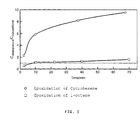
- the kinetic experiment was started when 0.50 ml 35 wt% H 2 O 2 was added. Samples of the reaction mixture were taken at regular intervals. The zeolite catalyst removed by filtration and analysed by Gas Chromatography, GC, cooled the samples. The initial hydrogen peroxide to olefin molar ratio was 0.25 and the molar ratio of H 2 O 2 to titanium was approximately 230. Selectivity towards corresponding epoxides was more than 90% in all tests. Plotting the ratio of product concentrations as a function of time compares the catalytic performance of the two types of TS-1. This is illustrated in Fig. 1 of the attached drawing for the epoxidation of 1-octene and cyclohexene.
- the improved catalytic performance of the mesoporous sample must be due to a better accessibility of the active sites.
- the improved catalytic activity of the mesoporous TS-1 is attributed to its improved diffusion properties compared with conventional micron-sized TS-1.
- mesoporous TS-1 improves the catalytic performance without changing the product distribution, which might be an advantage compared with the alternative of using titanium-containing zeolites with larger pores.
Landscapes
- Chemical & Material Sciences (AREA)
- Organic Chemistry (AREA)
- Inorganic Chemistry (AREA)
- Catalysts (AREA)
- Epoxy Compounds (AREA)
- Low-Molecular Organic Synthesis Reactions Using Catalysts (AREA)
Abstract
Description
Carbon Black Pearls 700® (supplied by Carbot Corp.) with an average particle diameter of 18 nm (ASTM D-3249) is impregnated to incipient wetness with a clear solution of tetrapropylammonium (TPA) hydroxide, water and ethanol. After evaporation of the ethanol component of the mixture, the carbon particles are impregnated with 20% excess (relative to incipient wetness) of a mixture of tetraethylorthotitanate and tetraethylorthosilicate. The composition of the resulting synthesis gel is:
Claims (9)
- Process for the selective oxidation of a hydrocarbon compound by reaction with peroxide in the presence of a crystalline, mesoporous, titanium-containing zeolite catalyst, characterised in that the zeolite catalyst consists of individual, primary crystals having intra-crystalline mesopores obtained by crystallisation of the zeolite in a carbon matrix, the zeolite catalyst having at least one X-Ray Powder Diffraction (XRPD) reflection in the 2 range 8-30 degrees determined by the zeolite type.
- Process of claim 1, wherein the hydrocarbon compound is a functionalised hydrocarbon.
- Process of claim 1, wherein the hydrocarbon compound is an alkene epoxidised by reaction with peroxide in presence of the mesoporous, titanium-containing zeolite catalyst.
- Process of claim 1, wherein the hydrocarbon compound is cyclohexanone ammoxidated by reaction with ammonia and peroxide in presence of the mesoporous, titanium-containing zeolite catalyst.
- Process of claim 1, wherein the hydrocarbon compound comprises alkanes and alcohols being oxidised selectively to alcohols and aldehydes or ketones by reaction with peroxide in presence of the mesoporous, titanium-containing zeolite catalyst.
- Processes of claim 1, wherein the crystalline, mesoporous titanium-containing zeolite catalyst is prepared by crystallisation in a mesoporous, carbon matrix followed by removal of the matrix by combustion, selective dissolution and/or evaporation.
- Process of claim 6, wherein the matrix consists of carbon.
- Processes of claim 1, wherein the peroxide is selected from aqueous hydrogen peroxide and /or organic peroxides.
- Process according to anyone of the preceding claims, wherein the mesoporous volume of the titanium-containing zeolite is at least 0.2 ml/g.
Applications Claiming Priority (2)
| Application Number | Priority Date | Filing Date | Title |
|---|---|---|---|
| DK200001410 | 2000-09-25 | ||
| DKPA200001410 | 2000-09-25 |
Publications (2)
| Publication Number | Publication Date |
|---|---|
| EP1195368A2 true EP1195368A2 (en) | 2002-04-10 |
| EP1195368A3 EP1195368A3 (en) | 2002-05-15 |
Family
ID=8159733
Family Applications (1)
| Application Number | Title | Priority Date | Filing Date |
|---|---|---|---|
| EP01121417A Withdrawn EP1195368A3 (en) | 2000-09-25 | 2001-09-07 | Process for the catalytic selective oxidation of a hydrocarbon compound in presence of mesoporous zeolite |
Country Status (4)
| Country | Link |
|---|---|
| US (1) | US6476275B2 (en) |
| EP (1) | EP1195368A3 (en) |
| JP (1) | JP2002187885A (en) |
| CN (1) | CN1220688C (en) |
Cited By (3)
| Publication number | Priority date | Publication date | Assignee | Title |
|---|---|---|---|---|
| US7211239B2 (en) | 2005-04-22 | 2007-05-01 | Basf Aktiengesellschaft | Process for preparing a nanosized zeolitic material |
| WO2011161276A1 (en) * | 2010-06-25 | 2011-12-29 | University College Cardiff Consultants Limited | Selective oxidation of hydrocarbons using heterogeneous catalysts |
| WO2013001296A3 (en) * | 2011-06-27 | 2013-06-13 | Susan Jones | Zeolites and composites incorporating zeolites |
Families Citing this family (19)
| Publication number | Priority date | Publication date | Assignee | Title |
|---|---|---|---|---|
| US6884743B2 (en) * | 2002-09-16 | 2005-04-26 | Basf Aktiengesellschaft | Catalyst for epoxidation reactions |
| ATE411972T1 (en) * | 2003-05-17 | 2008-11-15 | Haldor Topsoe As | METHOD FOR CONVERTING OXYGEN-CONTAINING HYDROCARBONS INTO HYDROCARBONS AND COMPOSITION FOR USE THEREOF |
| US7485282B2 (en) * | 2004-03-26 | 2009-02-03 | Board Of Trustees Of Michigan State University | Method for the preparation of metal oxides in nanometric particle form |
| US7589041B2 (en) | 2004-04-23 | 2009-09-15 | Massachusetts Institute Of Technology | Mesostructured zeolitic materials, and methods of making and using the same |
| US7786318B2 (en) * | 2005-04-12 | 2010-08-31 | Lyondell Chemical Technology, L.P. | Catalyst preparation |
| ES2319007B1 (en) * | 2006-12-07 | 2010-02-16 | Rive Technology, Inc. | METHODS FOR MANUFACTURING MESOSTRUCTURED ZEOLITICAL MATERIALS. |
| US8206498B2 (en) | 2007-10-25 | 2012-06-26 | Rive Technology, Inc. | Methods of recovery of pore-forming agents for mesostructured materials |
| US8524625B2 (en) | 2009-01-19 | 2013-09-03 | Rive Technology, Inc. | Compositions and methods for improving the hydrothermal stability of mesostructured zeolites by rare earth ion exchange |
| ES2875884T3 (en) | 2009-01-19 | 2021-11-11 | Grace W R & Co | Introduction of mesoporosity in zeolites with low Si / A1 content |
| TW201114729A (en) * | 2009-06-18 | 2011-05-01 | Sumitomo Chemical Co | Process for producing oxime |
| US8685875B2 (en) | 2009-10-20 | 2014-04-01 | Rive Technology, Inc. | Methods for enhancing the mesoporosity of zeolite-containing materials |
| AU2012240093B2 (en) | 2011-04-08 | 2015-06-11 | W. R. Grace & Co.-Conn. | Mesoporous framework-modified zeolites |
| AU2013207736B2 (en) | 2012-01-13 | 2015-04-09 | Rive Technology, Inc. | Introduction of mesoporosity into low silica zeolites |
| US9376324B2 (en) | 2012-01-13 | 2016-06-28 | Rive Technology, Inc. | Introduction of mesoporosity into zeolite materials with sequential acid, surfactant, and base treatment |
| FR2987046B1 (en) | 2012-02-17 | 2014-03-21 | Rhodia Operations | HYDROXYLATION PROCESS FOR AROMATIC COMPOUNDS, HYDROXYLATION CATALYST AND PROCESS FOR PREPARING THE SAME |
| US8765660B1 (en) | 2013-03-08 | 2014-07-01 | Rive Technology, Inc. | Separation of surfactants from polar solids |
| US9662640B2 (en) | 2013-12-27 | 2017-05-30 | Rive Technology, Inc. | Introducing mesoporosity into zeolite materials with a modified acid pre-treatment step |
| WO2016094816A1 (en) | 2014-12-11 | 2016-06-16 | Rive Technology, Inc. | Preparation of mesoporous zeolites with reduced processing |
| US10626019B2 (en) | 2014-12-30 | 2020-04-21 | W. R. Grace & Co.-Conn. | Methods for preparing zeolites with surfactant-templated mesoporosity and tunable aluminum content |
Family Cites Families (14)
| Publication number | Priority date | Publication date | Assignee | Title |
|---|---|---|---|---|
| IT1127311B (en) | 1979-12-21 | 1986-05-21 | Anic Spa | SYNTHETIC, CRYSTALLINE, POROUS MATERIAL CONSTITUTED BY SILICON AND TITANIUM OXIDES, METHOD FOR ITS PREPARATION AND ITS USES |
| IT1152299B (en) * | 1982-07-28 | 1986-12-31 | Anic Spa | PROCEDURE FOR THE EXPOSSIDATION OF HYDRAULIC COMPOUNDS |
| ES2033693T3 (en) | 1986-01-28 | 1993-04-01 | Eniricerche S.P.A. | A PROCEDURE FOR THE EXPOSURE OF OLEPHINE COMPOUNDS. |
| EP0638362B1 (en) | 1993-08-11 | 2001-03-21 | Mitsubishi Gas Chemical Company, Inc. | Titanosilicate catalyst particle |
| US5712402A (en) * | 1994-08-22 | 1998-01-27 | Board Of Trustees Operating Michigan State University | Catalytic applications of mesoporous metallosilicate molecular sieves and methods for their preparation |
| IN190356B (en) * | 1994-12-30 | 2003-07-19 | Council Scient Ind Res | |
| JP2001505184A (en) * | 1996-07-01 | 2001-04-17 | ザ・ダウ・ケミカル・カンパニー | Direct oxidation of olefins to olefin oxides |
| US6054112A (en) | 1996-10-25 | 2000-04-25 | Degussa-Huls Ag | Process for the preparation of titanium containing molecular sieves |
| DE19731627A1 (en) | 1997-07-23 | 1999-01-28 | Degussa | Granules containing titanium silicalite-l |
| IT1293496B1 (en) | 1997-07-29 | 1999-03-01 | Enichem Spa | PHENOL SYNTHESIS PROCEDURE FOR BENZENE |
| KR100429675B1 (en) | 1998-03-26 | 2004-05-03 | 렙솔 퀴미카 에스.에이. | Process for epoxydation of olefinic compounds with hydrogen peroxide |
| US6037484A (en) | 1998-09-22 | 2000-03-14 | Arco Chemical Technology, L.P. | Epoxidation process |
| MXPA02009441A (en) | 2000-03-27 | 2004-07-30 | Marcus E Rajchel | Method of cyanide salt production. |
| ES2181528B1 (en) * | 2000-03-28 | 2004-06-16 | Universitat De Valencia (Estudi General ) | PROCEDURE FOR PREPARATION OF POROUS MIXED OXIDES, MATERIALS SO OBTAINED AND THEIR USES. |
-
2001
- 2001-09-07 EP EP01121417A patent/EP1195368A3/en not_active Withdrawn
- 2001-09-21 US US09/961,019 patent/US6476275B2/en not_active Expired - Lifetime
- 2001-09-25 CN CNB011408987A patent/CN1220688C/en not_active Expired - Fee Related
- 2001-09-25 JP JP2001291134A patent/JP2002187885A/en active Pending
Cited By (4)
| Publication number | Priority date | Publication date | Assignee | Title |
|---|---|---|---|---|
| US7211239B2 (en) | 2005-04-22 | 2007-05-01 | Basf Aktiengesellschaft | Process for preparing a nanosized zeolitic material |
| US7442366B2 (en) | 2005-04-22 | 2008-10-28 | Basf Aktiengesellschaft | Process for preparing a nanosized zeolitic material |
| WO2011161276A1 (en) * | 2010-06-25 | 2011-12-29 | University College Cardiff Consultants Limited | Selective oxidation of hydrocarbons using heterogeneous catalysts |
| WO2013001296A3 (en) * | 2011-06-27 | 2013-06-13 | Susan Jones | Zeolites and composites incorporating zeolites |
Also Published As
| Publication number | Publication date |
|---|---|
| US6476275B2 (en) | 2002-11-05 |
| EP1195368A3 (en) | 2002-05-15 |
| CN1346868A (en) | 2002-05-01 |
| US20020038057A1 (en) | 2002-03-28 |
| CN1220688C (en) | 2005-09-28 |
| JP2002187885A (en) | 2002-07-05 |
Similar Documents
| Publication | Publication Date | Title |
|---|---|---|
| US6476275B2 (en) | Process for the catalytic selective oxidation of a hydrocarbon compound in presence of mesoporous zeolite | |
| Schmidt et al. | Catalytic epoxidation of alkenes with hydrogen peroxide over first mesoporous titanium-containing zeolite | |
| Feng et al. | Simultaneously enhanced stability and selectivity for propene epoxidation with H2 and O2 on Au catalysts supported on nano-crystalline mesoporous TS-1 | |
| Přech | Catalytic performance of advanced titanosilicate selective oxidation catalysts–a review | |
| Gontier et al. | Novel zirconium containing mesoporous silicas for oxidation reactions in the liquid phase | |
| Fang et al. | Mesoporous TS-1: Nanocasting synthesis with CMK-3 as template and its performance in catalytic oxidation of aromatic thiophene | |
| Tuel et al. | Zirconium containing mesoporous silicas: new catalysts for oxidation reactions in the liquid phase | |
| Lin et al. | Direct room-temperature synthesis of methyl-functionalized Ti-MCM-41 nanoparticles and their catalytic performance in epoxidation | |
| EP0655278B1 (en) | Structure material of the zeolite type with ultralarge pores and a lattice comprised of silicone and titanium oxides; its synthesis and utilization for the selective oxidation of organic products | |
| Klein et al. | Microporous mixed oxides—catalysts with tunable surface polarity | |
| Tekla et al. | Effective hierarchization of TS-1 and its catalytic performance in cyclohexene epoxidation | |
| Smeets et al. | Mesoporous SiO2-TiO2 epoxidation catalysts: Tuning surface polarity to improve performance in the presence of water | |
| Bhaumik et al. | Ammoximation of ketones catalyzed by titanium-containing ethane bridged hybrid mesoporous silsesquioxane | |
| Zhang et al. | Synthesis of hierarchically porous zeolite TS-1 with small crystal size and its performance of 1-hexene epoxidation reaction | |
| Liu et al. | Anatase type extra-framework titanium in TS-1: A vital factor influencing the catalytic activity toward styrene epoxidation | |
| Liu et al. | Silylated Pd/Ti-MCM-41 catalyst for the selective production of propylene oxide from the oxidation of propylene with cumene hydroperoxide | |
| Melero et al. | Direct synthesis of titanium-substituted mesostructured materials using non-ionic surfactants and titanocene dichloride | |
| Serrano et al. | Improvement of the hierarchical TS-1 properties by silanization of protozeolitic units in presence of alcohols | |
| Přech et al. | Synthesis and catalytic properties of titanium containing extra-large pore zeolite CIT-5 | |
| Jin et al. | The influences of Al species and Ti species on the catalytic epoxidation over Si/Ti-pillared MCM-36 synthesized from MCM-22 | |
| Yang et al. | Fluoride etching opens access for bulky molecules to active sites in microporous Ti-beta zeolite | |
| Sanz et al. | Hierarchical TS-1 zeolite synthesized from SiO2 TiO2 xerogels imprinted with silanized protozeolitic units | |
| He et al. | Role of pore size and surface properties of Ti-MCM-41 catalysts in the hydroxylation of aromatics in the liquid phase | |
| You et al. | Hierarchical Ti-beta with a three-dimensional ordered mesoporosity for catalytic epoxidation of bulky cyclic olefins | |
| Alvear et al. | Ti-MWW catalysts for propylene oxide production: influence of Si/Ti ratio and calcination conditions |
Legal Events
| Date | Code | Title | Description |
|---|---|---|---|
| PUAI | Public reference made under article 153(3) epc to a published international application that has entered the european phase |
Free format text: ORIGINAL CODE: 0009012 |
|
| PUAL | Search report despatched |
Free format text: ORIGINAL CODE: 0009013 |
|
| AK | Designated contracting states |
Kind code of ref document: A2 Designated state(s): AT BE CH CY DE DK ES FI FR GB GR IE IT LI LU MC NL PT SE TR |
|
| AX | Request for extension of the european patent |
Free format text: AL;LT;LV;MK;RO;SI |
|
| AK | Designated contracting states |
Kind code of ref document: A3 Designated state(s): AT BE CH CY DE DK ES FI FR GB GR IE IT LI LU MC NL PT SE TR |
|
| AX | Request for extension of the european patent |
Free format text: AL;LT;LV;MK;RO;SI |
|
| 17P | Request for examination filed |
Effective date: 20021115 |
|
| AKX | Designation fees paid |
Designated state(s): AT BE CH CY DE DK ES FI FR GB GR IE IT LI LU MC NL PT SE TR |
|
| RIN1 | Information on inventor provided before grant (corrected) |
Inventor name: SCHMIDT, IVER Inventor name: BRORSON, MICHAEL Inventor name: JACOBSEN, CLAUS J.H. |
|
| 17Q | First examination report despatched |
Effective date: 20031023 |
|
| STAA | Information on the status of an ep patent application or granted ep patent |
Free format text: STATUS: THE APPLICATION IS DEEMED TO BE WITHDRAWN |
|
| 18D | Application deemed to be withdrawn |
Effective date: 20060628 |