EP1195328A1 - Glass container for high-frequency heat sealing - Google Patents
Glass container for high-frequency heat sealing Download PDFInfo
- Publication number
- EP1195328A1 EP1195328A1 EP01302928A EP01302928A EP1195328A1 EP 1195328 A1 EP1195328 A1 EP 1195328A1 EP 01302928 A EP01302928 A EP 01302928A EP 01302928 A EP01302928 A EP 01302928A EP 1195328 A1 EP1195328 A1 EP 1195328A1
- Authority
- EP
- European Patent Office
- Prior art keywords
- sealing
- mouth
- glass container
- glass
- frequency
- Prior art date
- Legal status (The legal status is an assumption and is not a legal conclusion. Google has not performed a legal analysis and makes no representation as to the accuracy of the status listed.)
- Granted
Links
- 238000007789 sealing Methods 0.000 title claims abstract description 42
- 239000011521 glass Substances 0.000 title claims abstract description 32
- 239000003566 sealing material Substances 0.000 claims abstract description 15
- KRHYYFGTRYWZRS-UHFFFAOYSA-N Fluorane Chemical compound F KRHYYFGTRYWZRS-UHFFFAOYSA-N 0.000 claims description 8
- 238000010306 acid treatment Methods 0.000 claims description 4
- 238000000034 method Methods 0.000 claims description 4
- 238000000465 moulding Methods 0.000 claims description 3
- 238000005488 sandblasting Methods 0.000 claims description 2
- 230000000694 effects Effects 0.000 abstract description 4
- 230000003247 decreasing effect Effects 0.000 abstract 3
- 230000007423 decrease Effects 0.000 description 4
- 238000005259 measurement Methods 0.000 description 4
- 238000010438 heat treatment Methods 0.000 description 2
- 229920003002 synthetic resin Polymers 0.000 description 2
- 239000000057 synthetic resin Substances 0.000 description 2
- 239000005030 aluminium foil Substances 0.000 description 1
- 230000015572 biosynthetic process Effects 0.000 description 1
- 239000003795 chemical substances by application Substances 0.000 description 1
- 238000004519 manufacturing process Methods 0.000 description 1
Images



Classifications
-
- B—PERFORMING OPERATIONS; TRANSPORTING
- B65—CONVEYING; PACKING; STORING; HANDLING THIN OR FILAMENTARY MATERIAL
- B65D—CONTAINERS FOR STORAGE OR TRANSPORT OF ARTICLES OR MATERIALS, e.g. BAGS, BARRELS, BOTTLES, BOXES, CANS, CARTONS, CRATES, DRUMS, JARS, TANKS, HOPPERS, FORWARDING CONTAINERS; ACCESSORIES, CLOSURES, OR FITTINGS THEREFOR; PACKAGING ELEMENTS; PACKAGES
- B65D1/00—Rigid or semi-rigid containers having bodies formed in one piece, e.g. by casting metallic material, by moulding plastics, by blowing vitreous material, by throwing ceramic material, by moulding pulped fibrous material or by deep-drawing operations performed on sheet material
- B65D1/40—Details of walls
-
- B—PERFORMING OPERATIONS; TRANSPORTING
- B65—CONVEYING; PACKING; STORING; HANDLING THIN OR FILAMENTARY MATERIAL
- B65D—CONTAINERS FOR STORAGE OR TRANSPORT OF ARTICLES OR MATERIALS, e.g. BAGS, BARRELS, BOTTLES, BOXES, CANS, CARTONS, CRATES, DRUMS, JARS, TANKS, HOPPERS, FORWARDING CONTAINERS; ACCESSORIES, CLOSURES, OR FITTINGS THEREFOR; PACKAGING ELEMENTS; PACKAGES
- B65D1/00—Rigid or semi-rigid containers having bodies formed in one piece, e.g. by casting metallic material, by moulding plastics, by blowing vitreous material, by throwing ceramic material, by moulding pulped fibrous material or by deep-drawing operations performed on sheet material
- B65D1/02—Bottles or similar containers with necks or like restricted apertures, designed for pouring contents
- B65D1/0207—Bottles or similar containers with necks or like restricted apertures, designed for pouring contents characterised by material, e.g. composition, physical features
-
- Y—GENERAL TAGGING OF NEW TECHNOLOGICAL DEVELOPMENTS; GENERAL TAGGING OF CROSS-SECTIONAL TECHNOLOGIES SPANNING OVER SEVERAL SECTIONS OF THE IPC; TECHNICAL SUBJECTS COVERED BY FORMER USPC CROSS-REFERENCE ART COLLECTIONS [XRACs] AND DIGESTS
- Y10—TECHNICAL SUBJECTS COVERED BY FORMER USPC
- Y10T—TECHNICAL SUBJECTS COVERED BY FORMER US CLASSIFICATION
- Y10T428/00—Stock material or miscellaneous articles
- Y10T428/13—Hollow or container type article [e.g., tube, vase, etc.]
Definitions
- Glass containers for high-frequency heat sealing are known in which a sealing material (a film formed of a synthetic resin laminated to the undersurface of aluminium foil) is placed on the mouth of a glass bottle and undergoes high-frequency heating in capping condition, so that the film formed of a synthetic resin of a sealing material is welded to an apical part of the mouth of the container.
- a sealing material a film formed of a synthetic resin laminated to the undersurface of aluminium foil
Landscapes
- Engineering & Computer Science (AREA)
- Ceramic Engineering (AREA)
- Mechanical Engineering (AREA)
- Closures For Containers (AREA)
- Surface Treatment Of Glass (AREA)
Abstract
Description
- The present invention relates to glass containers such as bottles and jars having a mouth to which sealing material is to be sealed by high-frequency heat sealing.
- Glass containers for high-frequency heat sealing are known in which a sealing material (a film formed of a synthetic resin laminated to the undersurface of aluminium foil) is placed on the mouth of a glass bottle and undergoes high-frequency heating in capping condition, so that the film formed of a synthetic resin of a sealing material is welded to an apical part of the mouth of the container. The apical parts of the mouths of conventional glass bottles are smooth.
- In the glass bottles sealed by high-frequency heating, any portions low in sealing strength render the seal liable to failure. Since the failure of the seal must be absolutely avoided, the sealing strength must be increased as a whole by increasing the strength of the high frequency act strongly. This results in the production of areas having excessive sealing strength which in turn -causes the problem of making difficult the breaking of the sealing material by the ultimate consumer.
- The object of the invention is therefore to reduce the variation in sealing strength so as to improve the ease of both sealing and unsealing.
- According to the invention there is provided a glass container having a mouth to which sealing material is to be sealed by high-frequency heat sealing characterised in that the container has a rough surface having minute unevenness in the proximity of an apical part of the mouth to be contacted by the sealing material.
- The formation of the rough surface in the proximity of the apical part of the mouth results in the following:
- (1) The contact area between the sealing material and the glass surface decreases, and the amount of heat taken by the glass from the sealing material decreases.
- (2) The bond area increases.
- (3) An anchor effect is generated. Thus the sealing strength increases, and simultaneously the variation in the sealing strength decreases. This needs no excessive increase in the sealing strength making high-frequency act strongly to facilitate the breaking of the sealing material by the end user.
-
- As processes for forming minute unevenness in the proximity of the apical part of the mouth of a glass bottle, a hydrofluoric acid treatment (frost treatment) can be carried out in the proximity of the apical part of the mouth of a glass bottle moulded as usual, or a glass bottle can be moulded by use of a mouth mould having a moulding surface where the minute unevenness is formed by sandblasting. In view of producing problems such as bad sealability, bad release properties from the mould, a large effect of dirt stemming from releasing agents, and the like, it has been a common sense that the apical surface of the mouth of a glass bottle must form a surface as smooth as possible. However, it has been found that these problems do not arise at all in the case of minute unevenness in examples as described later.
- The invention will now be further described by way of example with reference to the accompanying figures, in which:
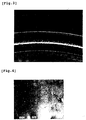
- Fig. 1 is a photograph of the apical surface of the mouth of a glass bottle;
- Fig. 2 is a microscopic photograph of the glass bottle of Fig. 1;
- Fig. 3 is a photograph of an apical surface portion of the mouth of a conventional glass bottle;
- Fig. 4 is a microscopic photograph of a portion of the glass bottle of Fig. 3;
- Fig. 5 is a graph of the sealing strength plotted against the sealing time at a frequency of 80 kHz; and
- Fig. 6 is a graph of the sealing strength plotted against the sealing time at a frequency of 220 kHz. The glass bottle shown in Figs. 1 and 2 has been subjected to hydrofluoric acid treatment (frost treatment) in the region of the apical part of the mouth of the moulded glass bottle to form minute unevenness of about 5 to about 20 µm. Fig. 3 is a photograph of the apical surface of the mouth of a glass bottle which has not undergone hydrofluoric acid treatment. Fig. 4 is a microscopic photograph of the same glass bottle, an almost complete smooth surface being formed in the region of the apical part of the mouth of the non-treated glass bottle.
-
- Four of the frost-treated bottles of the aforesaid examples and four non-treated bottles of conventional examples were subjected to high-frequency heat sealing, and the sealing strength was measured (for areas per bottle). The conditions of the high-frequency sealing are as follows:
Distance between Coil and Cap 12 mm Torque for Clamping Cap 300 to 320 N· cm Sealing Time 5 seconds Frequency 80 kHz High-Frequency Output Voltage 50 V Current 88 A - The results of the measurements are shown in Table 1. The frost-treated bottles of the examples exhibit smaller variations (standard deviation) in sealing strength and higher bonding strengths as compared with the non-treated bottles of the conventional examples.
Results of Measurement of Bonding Strength of Seal at 80 kHz (N/15mm) 1 2 3 4 Average Average Standard Deviation Non-treatment A 8.4 8.0 8.0 8.8 8.3 8.5 2.80 B 5.2 6.5 7.0 8.8 6.9 C 9.0 7.4 13.3 9.2 9.7 D 5.1 5.8 9.4 15.9 9.1 Frost Treatment A 8.8 6.7 9.5 10.7 8.9 11.8 2.61 B 11.4 14.5 9.9 15.6 12.9 C 12.0 13.4 8.0 13.6 11.8 D 13.8 14.8 12.2 13.2 13.5 - About the respective eight of the frost-treated bottles of the examples and the non-treated bottles of conventional examples, the aforesaid high-frequency sealing conditions were changed to measure the sealing strength (four areas per bottle). The conditions of the high-frequency sealing are as follows:
Distance between Coil and Cap 26 mm Torque for Clamping Cap 300 to 320 N· cm Sealing Time 5 seconds Frequency 220 kHz High-Frequency Output Voltage 195 V Current 16 A - The results of the measurements are shown in Table 2. The frost-treated bottles of the examples exhibit smaller variations (standard deviation) in sealing strength and higher bonding strengths as compared with the non-treated bottles of the conventional examples.
Results of Measurement of Bonding Strength of Seal at 220 kHz (N/15mm) 1 2 3 4 Average Range Average Standard Deviation Non-Treatment A1 9.7 10.0 8.2 7.0 8.7 3.0 6.70 2.18 B1 3.4 5.8 7.3 7.3 6.0 3.9 C1 8.9 8.7 8.8 5.2 7.9 3.7 D1 6.5 6.9 6.4 6.5 6.6 0.5 A2 7.0 1.6 5.7 6.1 5.1 5.4 B2 5.2 6.9 7.2 7.2 6.6 2.0 C2 10.1 8.0 8.7 4.8 7.9 5.3 D2 7.4 6.0 0.0 6.0 4.9 7.4 Frost Treatment A1 9.3 7.9 10.6 6.8 8.7 3.8 9.06 1.61 B1 9.3 11.2 9.2 12.2 10.5 3.0 C1 10.6 8.8 10.3 9.0 9.7 1.8 D1 8.0 9.1 6.3 10.4 8.5 4.1 A2 10.5 6.2 10.8 8.8 9.1 4.6 B2 6.0 10.2 9.8 9.5 8.9 4.2 C2 9.2 9.7 10.2 8.4 9.4 1.8 D2 9.6 9.2 5.5 7.4 7.9 4.1 - Furthermore, differences in the sealing strength depending upon sealing times was determined at frequencies of 80 kHz and 220 kHz. Fig. 5 shows that at a frequency of 80 kHz, and Fig. 6 that at a frequency of 220 kHz. In each of the cases, the frost-treated bottles of the examples have low slopes in the lines of the graphs in about 7 N/15mm suitable to the sealing strength as compared with the non-treated bottles of the conventional examples. This means that the frost-treated bottles exhibit smaller changes in sealing strengths depending upon the sealing times. That is, some deviation in the sealing time has little effect on the sealing strength (wide operation range), and therefore the high-frequency heat sealing can be carried out resulting in stable sealing strength.
- Since the glass containers of the invention show a decrease in the variation of sealing strength together with an increase in the sealing strength as compared with conventional glass containers, it is unnecessary to increase excessively the sealing strength by making high-frequency act strongly, thereby facilitating the breaking of the sealing material by the end user. In addition, the wide operation range results in more stable sealing strength.
Claims (6)
- A glass container having a mouth to which sealing material is to be sealed by high-frequency heat sealing characterised in that the container has a rough surface having minute unevenness in the proximity of an apical part of the mouth to be contacted by the sealing material.
- A glass container according to claim 1, wherein the unevenness is in the range 5 to 20 µm.
- A method of forming a glass container according to claim 1, wherein the rough surface having minute unevenness is formed by a hydrofluoric acid treatment.
- A method of forming a glass container according to claim 1 by moulding wherein the rough surface having minute unevenness is formed by a corresponding roughness on a moulding surface of a mouth mould for the container mould.
- A method according to claim 4, wherein the said roughness on the surface of the mould mouth is formed by sandblasting.
- A glass container according to claim 1 or 2 having a closure heat-sealed to the apical portion of the mouth thereof.
Applications Claiming Priority (2)
| Application Number | Priority Date | Filing Date | Title |
|---|---|---|---|
| JP2000252182A JP2002068756A (en) | 2000-08-23 | 2000-08-23 | Glass bottle for high frequency heat sealing |
| JP2000252182 | 2000-08-23 |
Publications (2)
| Publication Number | Publication Date |
|---|---|
| EP1195328A1 true EP1195328A1 (en) | 2002-04-10 |
| EP1195328B1 EP1195328B1 (en) | 2006-05-10 |
Family
ID=18741469
Family Applications (1)
| Application Number | Title | Priority Date | Filing Date |
|---|---|---|---|
| EP01302928A Expired - Lifetime EP1195328B1 (en) | 2000-08-23 | 2001-03-28 | Glass container for high-frequency heat sealing |
Country Status (4)
| Country | Link |
|---|---|
| US (1) | US6428864B1 (en) |
| EP (1) | EP1195328B1 (en) |
| JP (1) | JP2002068756A (en) |
| DE (1) | DE60119466T2 (en) |
Citations (3)
| Publication number | Priority date | Publication date | Assignee | Title |
|---|---|---|---|---|
| JPH05178332A (en) * | 1991-12-27 | 1993-07-20 | Kuwabara Yasunaga | Applying method for heat sealable resin |
| WO1998013267A1 (en) * | 1996-09-24 | 1998-04-02 | Cavazzini, Elisabetta | Ceramic porcelain container |
| US5860461A (en) * | 1995-11-30 | 1999-01-19 | Kettner Gmbh | Container, a container sealing cap, a process and a machine for cold-aseptic filling with beverages |
Family Cites Families (3)
| Publication number | Priority date | Publication date | Assignee | Title |
|---|---|---|---|---|
| JPS5844555B2 (en) | 1979-08-03 | 1983-10-04 | キユーピー株式会社 | Cap and method for sealing the mouth of a container using it |
| US4778698A (en) * | 1987-03-26 | 1988-10-18 | Minnesota Mining And Manufacturing Company | Innerseal for container for use with liquid contents |
| KR100278769B1 (en) * | 1996-04-18 | 2001-02-01 | 모리시타 요이찌 | Cathode ray tube and its manufacturing method |
-
2000
- 2000-08-23 JP JP2000252182A patent/JP2002068756A/en active Pending
-
2001
- 2001-03-28 EP EP01302928A patent/EP1195328B1/en not_active Expired - Lifetime
- 2001-03-28 DE DE60119466T patent/DE60119466T2/en not_active Expired - Fee Related
- 2001-03-29 US US09/820,354 patent/US6428864B1/en not_active Expired - Fee Related
Patent Citations (3)
| Publication number | Priority date | Publication date | Assignee | Title |
|---|---|---|---|---|
| JPH05178332A (en) * | 1991-12-27 | 1993-07-20 | Kuwabara Yasunaga | Applying method for heat sealable resin |
| US5860461A (en) * | 1995-11-30 | 1999-01-19 | Kettner Gmbh | Container, a container sealing cap, a process and a machine for cold-aseptic filling with beverages |
| WO1998013267A1 (en) * | 1996-09-24 | 1998-04-02 | Cavazzini, Elisabetta | Ceramic porcelain container |
Non-Patent Citations (2)
| Title |
|---|
| DATABASE WPI Section Ch Week 199333, Derwent World Patents Index; Class A92, AN 1993-261433 * |
| PATENT ABSTRACTS OF JAPAN vol. 017, no. 598 (M - 1504) 2 November 1993 (1993-11-02) * |
Also Published As
| Publication number | Publication date |
|---|---|
| DE60119466T2 (en) | 2007-04-19 |
| US6428864B1 (en) | 2002-08-06 |
| EP1195328B1 (en) | 2006-05-10 |
| JP2002068756A (en) | 2002-03-08 |
| DE60119466D1 (en) | 2006-06-14 |
| US20020051854A1 (en) | 2002-05-02 |
Similar Documents
| Publication | Publication Date | Title |
|---|---|---|
| US6612466B1 (en) | Thin wall fitment for spouted pouch | |
| US6273307B1 (en) | Fitment for a pouch opening | |
| US5240133A (en) | Clamped-wave lid seal structure | |
| EP0763482B1 (en) | Spout assembly, package with spout assembly and method of attaching a package to a spout assembly | |
| WO1979000774A1 (en) | Plastic vacuum sealing cap | |
| AU2001277274A1 (en) | Fitment for a pouch opening | |
| JPH11500986A (en) | Leak-proof closures for containers with modified designation | |
| CA1171818A (en) | Closure cap with metallic innerseal and sealed package | |
| JP2001213417A (en) | Metal can with screw that can maintain high airtightness | |
| US5160391A (en) | Method for the formation of a clamped wave seal structure | |
| EP1195328B1 (en) | Glass container for high-frequency heat sealing | |
| US7891512B2 (en) | Linerless closure for a container | |
| JPH04201850A (en) | Easily openable lid and method of its manufacture | |
| JPH10114360A (en) | Laminated and separable container | |
| US1696555A (en) | Closure and method of sealing | |
| JPH07237645A (en) | Paper cup lid | |
| JP3742216B2 (en) | Delami bottle | |
| JP2000344254A (en) | Recycle cap | |
| JP2004345300A (en) | Method for producing high-barrier plastic cup-shaped container | |
| JP2000043905A (en) | Liquid packaging container | |
| JPH0223567Y2 (en) | ||
| JPH02167720A (en) | Sealing and molding method of insert member | |
| JP2004196356A (en) | cap | |
| JPH0445337B2 (en) | ||
| AU2013206591B2 (en) | Wine glass, method for packaging wine and wine container |
Legal Events
| Date | Code | Title | Description |
|---|---|---|---|
| PUAI | Public reference made under article 153(3) epc to a published international application that has entered the european phase |
Free format text: ORIGINAL CODE: 0009012 |
|
| AK | Designated contracting states |
Kind code of ref document: A1 Designated state(s): DE FR GB Kind code of ref document: A1 Designated state(s): AT BE CH CY DE DK ES FI FR GB GR IE IT LI LU MC NL PT SE TR |
|
| AX | Request for extension of the european patent |
Free format text: AL;LT;LV;MK;RO;SI |
|
| 17P | Request for examination filed |
Effective date: 20020709 |
|
| AKX | Designation fees paid |
Free format text: DE FR GB |
|
| GRAP | Despatch of communication of intention to grant a patent |
Free format text: ORIGINAL CODE: EPIDOSNIGR1 |
|
| GRAS | Grant fee paid |
Free format text: ORIGINAL CODE: EPIDOSNIGR3 |
|
| GRAA | (expected) grant |
Free format text: ORIGINAL CODE: 0009210 |
|
| AK | Designated contracting states |
Kind code of ref document: B1 Designated state(s): DE FR GB |
|
| REG | Reference to a national code |
Ref country code: GB Ref legal event code: FG4D |
|
| REF | Corresponds to: |
Ref document number: 60119466 Country of ref document: DE Date of ref document: 20060614 Kind code of ref document: P |
|
| ET | Fr: translation filed | ||
| PLBE | No opposition filed within time limit |
Free format text: ORIGINAL CODE: 0009261 |
|
| STAA | Information on the status of an ep patent application or granted ep patent |
Free format text: STATUS: NO OPPOSITION FILED WITHIN TIME LIMIT |
|
| 26N | No opposition filed |
Effective date: 20070213 |
|
| GBPC | Gb: european patent ceased through non-payment of renewal fee |
Effective date: 20070328 |
|
| REG | Reference to a national code |
Ref country code: FR Ref legal event code: ST Effective date: 20071130 |
|
| PG25 | Lapsed in a contracting state [announced via postgrant information from national office to epo] |
Ref country code: DE Free format text: LAPSE BECAUSE OF NON-PAYMENT OF DUE FEES Effective date: 20071002 |
|
| PG25 | Lapsed in a contracting state [announced via postgrant information from national office to epo] |
Ref country code: GB Free format text: LAPSE BECAUSE OF NON-PAYMENT OF DUE FEES Effective date: 20070328 |
|
| PG25 | Lapsed in a contracting state [announced via postgrant information from national office to epo] |
Ref country code: FR Free format text: LAPSE BECAUSE OF NON-PAYMENT OF DUE FEES Effective date: 20070402 |