EP1194429B1 - Potassium channel openers - Google Patents
Potassium channel openers Download PDFInfo
- Publication number
- EP1194429B1 EP1194429B1 EP00941678A EP00941678A EP1194429B1 EP 1194429 B1 EP1194429 B1 EP 1194429B1 EP 00941678 A EP00941678 A EP 00941678A EP 00941678 A EP00941678 A EP 00941678A EP 1194429 B1 EP1194429 B1 EP 1194429B1
- Authority
- EP
- European Patent Office
- Prior art keywords
- dioxide
- hexahydrothieno
- quinolin
- bromo
- phenyl
- Prior art date
- Legal status (The legal status is an assumption and is not a legal conclusion. Google has not performed a legal analysis and makes no representation as to the accuracy of the status listed.)
- Expired - Lifetime
Links
Classifications
-
- C—CHEMISTRY; METALLURGY
- C07—ORGANIC CHEMISTRY
- C07D—HETEROCYCLIC COMPOUNDS
- C07D221/00—Heterocyclic compounds containing six-membered rings having one nitrogen atom as the only ring hetero atom, not provided for by groups C07D211/00 - C07D219/00
- C07D221/02—Heterocyclic compounds containing six-membered rings having one nitrogen atom as the only ring hetero atom, not provided for by groups C07D211/00 - C07D219/00 condensed with carbocyclic rings or ring systems
- C07D221/04—Ortho- or peri-condensed ring systems
-
- A—HUMAN NECESSITIES
- A61—MEDICAL OR VETERINARY SCIENCE; HYGIENE
- A61P—SPECIFIC THERAPEUTIC ACTIVITY OF CHEMICAL COMPOUNDS OR MEDICINAL PREPARATIONS
- A61P1/00—Drugs for disorders of the alimentary tract or the digestive system
- A61P1/14—Prodigestives, e.g. acids, enzymes, appetite stimulants, antidyspeptics, tonics, antiflatulents
-
- A—HUMAN NECESSITIES
- A61—MEDICAL OR VETERINARY SCIENCE; HYGIENE
- A61P—SPECIFIC THERAPEUTIC ACTIVITY OF CHEMICAL COMPOUNDS OR MEDICINAL PREPARATIONS
- A61P11/00—Drugs for disorders of the respiratory system
- A61P11/06—Antiasthmatics
-
- A—HUMAN NECESSITIES
- A61—MEDICAL OR VETERINARY SCIENCE; HYGIENE
- A61P—SPECIFIC THERAPEUTIC ACTIVITY OF CHEMICAL COMPOUNDS OR MEDICINAL PREPARATIONS
- A61P13/00—Drugs for disorders of the urinary system
-
- A—HUMAN NECESSITIES
- A61—MEDICAL OR VETERINARY SCIENCE; HYGIENE
- A61P—SPECIFIC THERAPEUTIC ACTIVITY OF CHEMICAL COMPOUNDS OR MEDICINAL PREPARATIONS
- A61P13/00—Drugs for disorders of the urinary system
- A61P13/02—Drugs for disorders of the urinary system of urine or of the urinary tract, e.g. urine acidifiers
-
- A—HUMAN NECESSITIES
- A61—MEDICAL OR VETERINARY SCIENCE; HYGIENE
- A61P—SPECIFIC THERAPEUTIC ACTIVITY OF CHEMICAL COMPOUNDS OR MEDICINAL PREPARATIONS
- A61P15/00—Drugs for genital or sexual disorders; Contraceptives
-
- A—HUMAN NECESSITIES
- A61—MEDICAL OR VETERINARY SCIENCE; HYGIENE
- A61P—SPECIFIC THERAPEUTIC ACTIVITY OF CHEMICAL COMPOUNDS OR MEDICINAL PREPARATIONS
- A61P15/00—Drugs for genital or sexual disorders; Contraceptives
- A61P15/02—Drugs for genital or sexual disorders; Contraceptives for disorders of the vagina
-
- A—HUMAN NECESSITIES
- A61—MEDICAL OR VETERINARY SCIENCE; HYGIENE
- A61P—SPECIFIC THERAPEUTIC ACTIVITY OF CHEMICAL COMPOUNDS OR MEDICINAL PREPARATIONS
- A61P15/00—Drugs for genital or sexual disorders; Contraceptives
- A61P15/10—Drugs for genital or sexual disorders; Contraceptives for impotence
-
- A—HUMAN NECESSITIES
- A61—MEDICAL OR VETERINARY SCIENCE; HYGIENE
- A61P—SPECIFIC THERAPEUTIC ACTIVITY OF CHEMICAL COMPOUNDS OR MEDICINAL PREPARATIONS
- A61P25/00—Drugs for disorders of the nervous system
-
- A—HUMAN NECESSITIES
- A61—MEDICAL OR VETERINARY SCIENCE; HYGIENE
- A61P—SPECIFIC THERAPEUTIC ACTIVITY OF CHEMICAL COMPOUNDS OR MEDICINAL PREPARATIONS
- A61P25/00—Drugs for disorders of the nervous system
- A61P25/06—Antimigraine agents
-
- A—HUMAN NECESSITIES
- A61—MEDICAL OR VETERINARY SCIENCE; HYGIENE
- A61P—SPECIFIC THERAPEUTIC ACTIVITY OF CHEMICAL COMPOUNDS OR MEDICINAL PREPARATIONS
- A61P25/00—Drugs for disorders of the nervous system
- A61P25/08—Antiepileptics; Anticonvulsants
-
- A—HUMAN NECESSITIES
- A61—MEDICAL OR VETERINARY SCIENCE; HYGIENE
- A61P—SPECIFIC THERAPEUTIC ACTIVITY OF CHEMICAL COMPOUNDS OR MEDICINAL PREPARATIONS
- A61P43/00—Drugs for specific purposes, not provided for in groups A61P1/00-A61P41/00
-
- A—HUMAN NECESSITIES
- A61—MEDICAL OR VETERINARY SCIENCE; HYGIENE
- A61P—SPECIFIC THERAPEUTIC ACTIVITY OF CHEMICAL COMPOUNDS OR MEDICINAL PREPARATIONS
- A61P9/00—Drugs for disorders of the cardiovascular system
- A61P9/08—Vasodilators for multiple indications
-
- A—HUMAN NECESSITIES
- A61—MEDICAL OR VETERINARY SCIENCE; HYGIENE
- A61P—SPECIFIC THERAPEUTIC ACTIVITY OF CHEMICAL COMPOUNDS OR MEDICINAL PREPARATIONS
- A61P9/00—Drugs for disorders of the cardiovascular system
- A61P9/12—Antihypertensives
-
- C—CHEMISTRY; METALLURGY
- C07—ORGANIC CHEMISTRY
- C07C—ACYCLIC OR CARBOCYCLIC COMPOUNDS
- C07C205/00—Compounds containing nitro groups bound to a carbon skeleton
- C07C205/44—Compounds containing nitro groups bound to a carbon skeleton the carbon skeleton being further substituted by —CHO groups
-
- C—CHEMISTRY; METALLURGY
- C07—ORGANIC CHEMISTRY
- C07C—ACYCLIC OR CARBOCYCLIC COMPOUNDS
- C07C45/00—Preparation of compounds having >C = O groups bound only to carbon or hydrogen atoms; Preparation of chelates of such compounds
-
- C—CHEMISTRY; METALLURGY
- C07—ORGANIC CHEMISTRY
- C07C—ACYCLIC OR CARBOCYCLIC COMPOUNDS
- C07C45/00—Preparation of compounds having >C = O groups bound only to carbon or hydrogen atoms; Preparation of chelates of such compounds
- C07C45/27—Preparation of compounds having >C = O groups bound only to carbon or hydrogen atoms; Preparation of chelates of such compounds by oxidation
- C07C45/29—Preparation of compounds having >C = O groups bound only to carbon or hydrogen atoms; Preparation of chelates of such compounds by oxidation of hydroxy groups
- C07C45/298—Preparation of compounds having >C = O groups bound only to carbon or hydrogen atoms; Preparation of chelates of such compounds by oxidation of hydroxy groups with manganese derivatives
-
- C—CHEMISTRY; METALLURGY
- C07—ORGANIC CHEMISTRY
- C07C—ACYCLIC OR CARBOCYCLIC COMPOUNDS
- C07C45/00—Preparation of compounds having >C = O groups bound only to carbon or hydrogen atoms; Preparation of chelates of such compounds
- C07C45/41—Preparation of compounds having >C = O groups bound only to carbon or hydrogen atoms; Preparation of chelates of such compounds by hydrogenolysis or reduction of carboxylic groups or functional derivatives thereof
-
- C—CHEMISTRY; METALLURGY
- C07—ORGANIC CHEMISTRY
- C07C—ACYCLIC OR CARBOCYCLIC COMPOUNDS
- C07C45/00—Preparation of compounds having >C = O groups bound only to carbon or hydrogen atoms; Preparation of chelates of such compounds
- C07C45/61—Preparation of compounds having >C = O groups bound only to carbon or hydrogen atoms; Preparation of chelates of such compounds by reactions not involving the formation of >C = O groups
- C07C45/63—Preparation of compounds having >C = O groups bound only to carbon or hydrogen atoms; Preparation of chelates of such compounds by reactions not involving the formation of >C = O groups by introduction of halogen; by substitution of halogen atoms by other halogen atoms
-
- C—CHEMISTRY; METALLURGY
- C07—ORGANIC CHEMISTRY
- C07C—ACYCLIC OR CARBOCYCLIC COMPOUNDS
- C07C45/00—Preparation of compounds having >C = O groups bound only to carbon or hydrogen atoms; Preparation of chelates of such compounds
- C07C45/61—Preparation of compounds having >C = O groups bound only to carbon or hydrogen atoms; Preparation of chelates of such compounds by reactions not involving the formation of >C = O groups
- C07C45/67—Preparation of compounds having >C = O groups bound only to carbon or hydrogen atoms; Preparation of chelates of such compounds by reactions not involving the formation of >C = O groups by isomerisation; by change of size of the carbon skeleton
- C07C45/68—Preparation of compounds having >C = O groups bound only to carbon or hydrogen atoms; Preparation of chelates of such compounds by reactions not involving the formation of >C = O groups by isomerisation; by change of size of the carbon skeleton by increase in the number of carbon atoms
- C07C45/70—Preparation of compounds having >C = O groups bound only to carbon or hydrogen atoms; Preparation of chelates of such compounds by reactions not involving the formation of >C = O groups by isomerisation; by change of size of the carbon skeleton by increase in the number of carbon atoms by reaction with functional groups containing oxygen only in singly bound form
- C07C45/71—Preparation of compounds having >C = O groups bound only to carbon or hydrogen atoms; Preparation of chelates of such compounds by reactions not involving the formation of >C = O groups by isomerisation; by change of size of the carbon skeleton by increase in the number of carbon atoms by reaction with functional groups containing oxygen only in singly bound form being hydroxy groups
-
- C—CHEMISTRY; METALLURGY
- C07—ORGANIC CHEMISTRY
- C07D—HETEROCYCLIC COMPOUNDS
- C07D215/00—Heterocyclic compounds containing quinoline or hydrogenated quinoline ring systems
- C07D215/02—Heterocyclic compounds containing quinoline or hydrogenated quinoline ring systems having no bond between the ring nitrogen atom and a non-ring member or having only hydrogen atoms or carbon atoms directly attached to the ring nitrogen atom
- C07D215/16—Heterocyclic compounds containing quinoline or hydrogenated quinoline ring systems having no bond between the ring nitrogen atom and a non-ring member or having only hydrogen atoms or carbon atoms directly attached to the ring nitrogen atom with hetero atoms or with carbon atoms having three bonds to hetero atoms with at the most one bond to halogen, e.g. ester or nitrile radicals, directly attached to ring carbon atoms
- C07D215/36—Sulfur atoms
-
- C—CHEMISTRY; METALLURGY
- C07—ORGANIC CHEMISTRY
- C07D—HETEROCYCLIC COMPOUNDS
- C07D495/00—Heterocyclic compounds containing in the condensed system at least one hetero ring having sulfur atoms as the only ring hetero atoms
- C07D495/02—Heterocyclic compounds containing in the condensed system at least one hetero ring having sulfur atoms as the only ring hetero atoms in which the condensed system contains two hetero rings
- C07D495/04—Ortho-condensed systems
-
- C—CHEMISTRY; METALLURGY
- C07—ORGANIC CHEMISTRY
- C07D—HETEROCYCLIC COMPOUNDS
- C07D495/00—Heterocyclic compounds containing in the condensed system at least one hetero ring having sulfur atoms as the only ring hetero atoms
- C07D495/12—Heterocyclic compounds containing in the condensed system at least one hetero ring having sulfur atoms as the only ring hetero atoms in which the condensed system contains three hetero rings
- C07D495/14—Ortho-condensed systems
Definitions
- Novel dihydropyridine compounds and their derivatives can open potassium channels and are useful for treating a variety of medical conditions.
- Potassium channels play an important role in regulating cell membrane excitability. When the potassium channels open, changes in the electrical potential across the cell membrane occur and result in a more polarized state. A number of diseases or conditions can be treated with therapeutic agents that open potassium channels. See K. Lawson, Pharmacol. Ther. , v. 70, pp. 39-63 (1996); D.R. Gehlert et al., Prog. Neuro-Psychopharmacol & Biol. Psychiat. , v. 18, pp. 1093-1102 (1994); M. Gopalakrishnan et al., Drug Development Research, v. 28, pp. 95-127 (1993); J.E. Freedman et al., The Neuroscientist , v.
- Such diseases or conditions include asthma, epilepsy, hypertension, male sexual dysfunction, female sexual dysfunction, migraine, pain, urinary incontinence, stroke, Raynaud's Syndrome, eating disorders, functional bowel disorders, and neurodegeneration.
- Potassium channel openers also act as smooth muscle relaxants. Because urinary incontinence can result from the spontaneous, uncontrolled contractions of the smooth muscle of the bladder, the ability of potassium channel openers to hyperpolarize bladder cells and relax bladder smooth muscle provides a method to ameliorate or prevent urinary incontinence.
- WO 9408966 and EP 0539154 A1 disclose a group of acridinedione and quinolone compounds that are claimed useful in the treatment of urinary incontinence. These compounds belong to the larger general chemical class of dihydropyridines.
- the compounds of the present invention are chemically distinct from those of WO94/08966 and EP 0539154 A 1 since they have at least one sulfonyl group attached to the 3-position of the dihydropyridine ring.
- Dihydropyridines of differing chemical structure may possess a variety of biological activities.
- US 4,879,384 and EP-A-0241281 disclose a group of thiacycloalkeno[3,2-b]pyridines that belong, to the dihydropyridine class and are calcium channel antagonists.
- the compounds of the present invention are chemically distinct from those of US 4,879,384 and EP-A-0241281 since they do not have a carboxylic acid derivative attached to the 3-position of the dihydropyridine ring.
- EP-A-0 462 696 discloses pyrido[2,3-f]thiazepines and pyrido[3,2-b][1,5]benzothiazepines which are useful as calcium channel antagonists. Such compounds have a carboxylic acid derivative attached to the 3-position of the dihydropyridine ring.
- EP-A-0 400 660 discloses 1,4-dihydropyridine derivatives having calcium entry blocking action.
- EP-A-0 145 956 discloses 3-carbamoyl-1,4-dihydropyridine compounds as anti-hypertensive agents.
- EP-A-0 705 830 discloses 2,3-condensed cyclic 1,4-dihydropyridine compounds having a carboxylic acid derivative attached to the 5-position of the dihydropyridine ring, such compounds having calcium channel-modulating activity.
- WO 96/02547 discloses dioxo-thiopyrano-pyridine carboxylic acid derivatives as selective modulators of the calcium-dependent potassium channels of high conductivity.
- DE 26 16 995 discloses anti-hypertensive 1,4-dihydropyridine derivatives having a carboxylic acid derivative in the 3-position of the dihydropyridine ring.
- DE 26 58 804 discloses anti-hypertensive cyano-1,4-dihydropyridine derivatives.
- EP-A-0 189 060 discloses sulfonyl-dihydropyridine compounds as anti-hypertensive agents.
- WO 99/31059 which has a filing date of December 16, 1998 and was published on June 24, 1999 and designates the same Contracting States as the present application, discloses fused 3-ring structures having a dihydropyridine core which are useful as potassium channel openers.
- WO 00/24743 which has priority dates of October 28, 1998 and October 20, 1999 and was published on May 4, 2000 and designates the same Contracting States as the present application, discloses fused 3-ring structures having a dihydropyridine core which are useful as potassium channel openers.
- the compounds of the present invention are chemically distinct from the prior art, hyperpolarize cell membranes, open potassium channels, relax smooth muscle cells, inhibit bladder contractions and are useful for treating diseases that can be ameliorated by opening potassium channels.
- the present invention discloses compounds selected from the group consisting of:
- compositions comprising a therapeutically effective amount of one of the above compounds in combination with a pharmaceutically acceptable carrier.
- Another embodiment of the invention relates to the use of one of the above compounds for manufacturing a medicament for treating male sexual dysfunction including, but not limited, to male erectile dysfunction and premature ejaculation.
- Another embodiment of the invention relates to the use of one of the above compounds for manufacturing a medicament for treating female sexual dysfunction including, but not limited to, female anorgasmia, clitoral erectile insufficiency, vaginal engorgement, dyspareunia, and vaginismus.
- Yet another embodiment of the invention relates to the use of the above compounds for manufacturing a medicament for treating a disease such as asthma, epilepsy, hypertension, Raynaud's syndrome, migraine, pain, eating disorders, urinary incontinence, functional bowel disorders, neurodegeneration and stroke by administration of a therapeutically effective amount to a host mammal in need of such treatment.
- a disease such as asthma, epilepsy, hypertension, Raynaud's syndrome, migraine, pain, eating disorders, urinary incontinence, functional bowel disorders, neurodegeneration and stroke by administration of a therapeutically effective amount to a host mammal in need of such treatment.
- the present invention discloses the compounds listed above or a pharmaceutically acceptable salt thereof.
- the present invention also relates to pharmaceutical compositions which comprise a therapeutically effective amount of one of the above compounds in combination with a pharmaceutically acceptable carrier.
- the present invention also relates to the use of one of the above compounds for manufacturing a medicament for treating a disease in a mammal comprising administering an effective amount of such compound.
- the present invention relates to the use of one of the above compounds for manufacturing a medicament for treating asthma, epilepsy, hypertension, Raynaud's syndrome, migraine, pain, eating disorders, urinary incontinence, functional bowel disorders, neurodegeneration, male erectile dysfunction, premature ejaculation, female anorgasmia, clitoral erectile insufficiency, vaginal engorgement, dyspareunia, vaginismus, and stroke comprising administering an effective amount of such compound.
- prodrugs as used herein represents those prodrugs of the compounds of the present invention which are, within the scope of sound medical judgement, suitable for use in contact with the tissues of humans and lower animals without undue toxicity, irritation, allergic response, and the like, commensurate with a reasonable benefit/risk ratio, and effective for their intended use, as well as the zwitterionic forms, where possible, of the compounds of the invention.
- Pharmaceutically acceptable prodrugs of the compounds of the present invention may be rapidly transformed in vivo to the above compounds of the invention, for example, by hydrolysis in blood.
- T. Higuchi and V. Stella Pro-drugs as Novel Delivery Systems , V. 14 of the A.C.S. Symposium Series, and in Edward B. Roche, ed., Bioreversible Carriers in Drug Design , American Pharmaceutical Association and Pergamon Press (1987).
- Pharmaceutically active metabolites may be formed by in vivo biotransformation of the above compounds.
- pharmaceutically active metabolite refers to a compound formed by the in vivo biotransformation of the above compounds. A thorough discussion of biotransformation is provided in Goodman and Gilman's, The Pharmacological Basis of Therapeutics , seventh edition.
- Stereoisomers include enantiomers and diastereomers, and mixtures of enantiomers or diastereomers.
- Individual stereoisomers of compounds of the present invention may be prepared synthetically from commercially available starting materials which contain asymmetric or chiral centers or by preparation of racemic mixtures followed by resolution well known to those of ordinary skill in the art.
- BINAP for 2,2'-bis(diphenylphosphino)-1,1'-binaphthyl
- Boc for tert-butoxycarbonyl
- Boc 2 O for di-tert-butyl dicarbonyl
- BuLi for butyllithium
- Cs 2 CO 3 for cesium carbonate
- DIBAL for diisobutylaluminum hydride
- DMAP for 4-dimethylaminopyridine
- DMF for N,N-dimethylformamide
- Et 3 N for triethylamine
- K 2 CO 3 for potassium carbonate
- HCl for hydrochloric acid
- LiAlH 4 for lithium aluminum hydride
- LDA for lithium diisopropylamide
- MeCN for acetonitrile
- MeOH for methanol
- MgSO 4 for magnesium sulfate
- MnO 2 for manganese dioxide
- NMO for N-methylmorpholine N-oxide
- Enamines of general formula (42), wherein n is an integer 1-3 and B is absent or can be 2 substituents independently selected from methyl can be prepared according to the general method shown in Scheme 1.
- This method entails reaction of an appropriate cycloalkanedione of general formula (40) with an alcohol such as ethanol or methanol with catalysis by an acid such as sulfuric acid or hydrochloric acid or other similar acid to form an intermediate enol ether of general formula (41).
- the enol ether (41) can be converted to an enamine of general formula (42) by reaction with ammonia typically in a solvent such as methanol, ethanol or tetrahydrofuran. This method is preferred for the preparation of 3-amino-4,4-dimethyl-2-cyclohexen-1-one.
- enamines of general formula (45), wherein n is an integer from 1-3 can be prepared by procedures directly analogous to those described in Scheme 1 wherein the carbonyl compound of general formula (43) is converted to an intermediate enol ether of general formula (44) and thence to the enamine (45).
- a para substituted aldehyde of general formula (46) or the corresponding acetal protected aldehyde of general formula (47), wherein R is selected from alkyl or together with the oxygen atoms to which they are attached form a 5 or 6 membered ring wherein 1,3-dioxolanes are preferred, may by subjected to conditions of an electrophilic aromatic substitution reaction to provide an aldehyde of general formula (49) or a protected aldehyde of general formula (48).
- Preferred protecting groups for compounds of general formula (47) and (48) include dimethyl or diethyl acetals or the 1,3-dioxolanes. These protecting groups can be introduced at the beginning and removed at the end to provide substituted aldehydes of general formula (49) using methods well known to those skilled in the art of organic chemistry.
- a meta substituted aldehyde of general formula (50) or the corresponding acetal protected aldehyde (51), wherein R is selected from alkyl or together with the oxygen atoms to which they are attached form a 5 or 6 membered ring wherein 1,3-dioxolanes are preferred may be subjected to conditions of an electrophilic aromatic substitution reaction to provide an aldehyde of general formula (49) or a protected aldehyde of general formula (48).
- Preferred protecting groups include dimethyl or diethyl acetals or the 1,3-dioxolanes. These groups can be introduced at the beginning and removed at the end to provide substituted aldehydes of general formula (49) using methods well known to those skilled in the art of organic chemistry.
- Aldehydes of general formula (54), wherein R 10 is selected from halo and R 12 is selected from halo, can be prepared by the method shown in Scheme 5.
- a meta substituted phenol (52) is converted to the para substituted salicylaldehyde (53) by reaction with a base such as sodium hydroxide and a reagent such as trichloromethane or tribromomethane. This reaction is known as the Reimer-Tiemann reaction.
- An alternate set of reaction conditions involves reaction with magnesium methoxide and paraformaldehyde (Aldred, J. Chem. Soc. Perkin Trans. 1 (1994), 1823).
- the aldehyde (53) may be subjected to conditions of an electrophilic aromatic substitution reaction to provide the meta, para disubstituted salicylaldehyde of general formula (54).
- An appropriately protected 4-bromo-3-substitutedbenzaldehyde of general formula (56), wherein R is selected from alkyl or together with the oxygen atoms to which they are attached form a 5 or 6 membered ring wherein 1,3-dioxolanes are preferred, can be converted to the 3,4-disubstituted benzaldehyde of general formula (48) by conversion of the bromide to an anion via metal-halogen exchange wherein preferred metals are magnesium (grignards) and lithium (lithium organics), followed by reaction with an appropriate electrophile such as an aldehyde, dialkyldisulfide, a Weinreb amide, dimethylformamide, an alkyl halide or other electrophile followed by deprotection of the acetal to provide benzaldehydes of general formula (49).
- R is selected from alkyl or together with the oxygen atoms to which they are attached form a 5 or 6 membered ring wherein
- 3-Methylsulfonyl-4-substituted benzaldehydes of general formula (66), wherein R 10 is selected from alkyl can be prepared as shown in Scheme 9.
- 3-Methylthio-4-substituted protected benzaldehydes of general formula (65), wherein R is selected from alkyl or together with the oxygen atoms to which they are attached form a 5 or 6 membered ring wherein 1,3-dioxolanes are preferred prepared by the methods described in the preceeding schemes, can be oxidized with a suitable oxidant like meta-chloroperoxybenzoic acid and then deprotected to provide compounds of general formula (66).
- Examples of the present Invention that possess a center of chirality and thus exist in racemic form were separated into the individual enantiomers by the method shown in Scheme 3.
- the racemic compounds were reacted with potassium t-butoxide (1 equivalent) in tetrahydrofuran followed by 8-phenylmenthyl chloroformate to generate a mixture of diastereomeric 8-phenylmenthyl carbamates (i) and (ii).
- the diastereomers (i) and (ii) were separated by column chromatography over silica gel and the 8-phenylmenthol moiety removed by reaction with sodium methoxide in methanol to provide the single enantiomers as shown.
- Example 8 The product from Example 8 (0.50 g) was chromatographed on a 5x25 cm Regis WhelkO 2 chiral column with 280 g of packing, eluting with hexane:methanol:methylene chloride (77.5/15/7.5) as the mobile phase with a flow rate of 117 mL/minute to provide 220 mg of the title compound as the more polar enantiomer.
- Example 15A The product from Example 15A (0.80 g) was chromatographed on a 5x25 cm Regis WhelkO 2 chiral column with 280 g of packing, eluting with hexane:methanol:methylene chloride (70/15/15) as the mobile phase at a flow rate of 117 mL/minute to provide 250 mg of the title compound as the less polar enantiomer.
- Example 17A The product from Example 17A (7.0 g, 50 mmol) in water (100 mL) at 0°C was treated slowly with concentrated sulfuric acid (30 mL) at a rate to maintain the temperature below 10°C, then treated dropwise with an aqueous solution of sodium nitrite (3.45 g, 50 mmol).
- Example 17B The product from Example 17B (6.4 g, 26 mmol) in chloroform (300 mL) was treated with manganese dioxide (4.5 g, 50 mmol), stirred overnight, treated with an additional portion of manganese dioxide (2.25 g), stirred overnight, filtered and solvent evaporated. The material was purified by flash chromatography over silica gel (ethyl acetate/hexane 1:4) to provide 1.9 g of the title compound.
- 1 H NMR (CDCl 3 ) ⁇ 7.23 (t, 1H), 7.89 (m, 1H), 8.32 (dd, 1H), 9.91 (s, 1H).
- This mixture was flash chromatographed over a 6x40 cm column of silica gel, eluting with chloroform:hexane:ether (7:2:1) to provide 664 mg of the less polar diastereomer.
- This material as a slurry in methanol (10 mL) under nitrogen, was treated with catalytic sodium methoxide, stirred at room temperature overnight, treated with glacial acetic acid (2 drops), the solid precipitate collected, washed with ethyl alcohol and dried to provide 295 mg of the title compound as a white solid.
- the crude reaction product was flash chromatographed over silica gel eluting with methanol:methylene chloride (7:93) to provide 92 mg of an intermediate hemiaminal that was heated to reflux in ethanol (6 mL), treated with 1.0 M HCl in ether (0.5 mL), heated for 1 hour, cooled, the solid precipitate collected, washed with ethanol and dried to provide 55 mg of the title compound as a white solid.
- Example 29A To a solution of Example 29A (1.0 g, 4.0 mmol) in 1:1 ethanol-water (50 mL), was added iron-powder (0.6 g) then 6 N hydrochloric acid (1 mL). The reaction mixture was heated to reflux overnight, cooled, neutralized with 1 N sodium hydroxide, filtered, and the filtrate extracted with ethyl acetate (3x). The organic extracts were dried over magnesium sulfate, filtered and solvent evaporated to provide 0.68 g of 5-bromo-4-fluoro-2-aminobenzaldehyde.
- Example 29B (0.14 g, 0.43 mmol), tetrahydrothiophene-3-oxo-1, 1-dioxide (0.058 g, 0.43 mmol), 3-amino-2-cyclohexene-1-one (0.048 g, 0.43 mmol), and triethylamine (0.1 mL) in ethanol (2 mL) were heated at reflux for 48 hours, cooled, and the precipitate collected (0.11 g). The precipitate was suspended in ethanol (5 mL), treated with 1.0 M HCl in ether (1.0 mL) heated to reflux for 2 hours, the solid precipitate collected, washed with ethanol and dried to provide 0.08 g of the title compound.
- Example 39A A solution of Example 39A (306 mg, 1.07 mmol) and meta-chloroperoxybenzoicacid (242 mg of 77%, 1.07 mmol) were stirred in methylene chloride at 0 °C for 1 hour, treated with saturated sodium bicarbonate, and extracted with ethyl acetate. The extract was washed with brine, dried with sodium sulfate, filtered, and concentrated. The residue was purified by flash chromatography on silica gel eluting with methanol:dichloromethane (5:95) to provide 234 mg of the desired compound.
- Example 39B 110 mg, 0.36 mmol
- 3-amino-2-cyclohexen-1-one 61 mg, 0.55 mmol
- the extract was washed with brine, dried with sodium sulfate, filtered, and concentrated.
- the residue was purified by flash chromatography on silica gel eluting with 5%-15% methanol/dichloromethane to provide the diastereomeric dihydropyridines (25 mg, 17%) and (5.0 mg, 3.4%).
- Example 3 The title compound of Example 3 (1.24 g, 3.32 mmol) was processed as in Example 19 to provide 63 mg of the title compound as a white solid.
- Example 8 A solution of Example 8 (1.0 g, 2.4 mmol) and di-tert-butyldicarbonate (1.0 g, 24 mmol) in acetonitrile was treated with 4-dimethylaminopyridine (29 mg, 0.1 mmol), heated to reflux for 1 hour, cooled to room temperature and concentrated. The residue was purified by flash chromatography on silica gel with 50% ethyl acetate/hexanes to provide 900 mg of the title compound.
- Example 43A 200 mg, 0.39 mmol
- tetrakis (triphenylphoshine)-palladium(0) (10 mol%) in dimethylformamide (0.1 M) was treated with vinyl tributylstannane (0.6 mL, 1.85 mmol), heated to 110 °C for 24 hours, cooled to room temperature, treated with saturated potassium fluoride, and extracted with ethyl acetate. The extract was washed with brine, dried with sodium sulfate, filtered, and concentrated.
- Example 78 (108 mg, 0.27 mmol) in ether at 0 °C was treated with hydrochloric acid/ether (1 mL, 1 mmol), stirred for 2 hours, treated with saturated sodium bicarbonate, and extracted with ethyl acetate. The residue was purified by flash chromatography on silica gel eluting with 5% methanol/dichloromethane, followed by recrystallization from ethanol to provide 93 mg of the title compound.
- Example 43A 200 mg, 0.39 mmol and 2-(tributylstannyl)furan were processed as in Example 43 to provide 64 mg of the title compound.
- Example 43A 200 mg, 0.39 mmol and tetraphenyltin were processed as in Example 43 to provide 95 mg of the title compound.
- MS (ESI+) m/z: 410 (M+H) + ; 1 H NMR (DMSO-d 6 ) ⁇ 1.90 (m, 2H), 2.25 (M, 2H), 2.5 (M, 2H), 2.8 (M, 2H), 3.0 (M, 2H), 4.92 (S, 1H), 7.16 (M, 1H), 7.18 (S, 1H), 7.27 (d, 1H, J 6.6 Hz), 7.40 (m, 1H), 7.48 (s, 2H), 7.49 (s, 2H), 9.77 (s, 1H); Anal. calcd for C 23 H 20 FNO 3 S: C, 67.46; H, 4.92; N, 3, 42. Found: C, 64.87; H, 4.76; N, 3.23.
- Example 43A 200 mg, 0.39 mmol
- tributyl(phenylethynyl)tin were processed as in Example 43 to provide 118 mg of the title compound.
- MS (ESI+) m/z: 434 (M+H) + ; 1 H NMR (DMSO-d 6 ) ⁇ 1.86 (m, 2H), 2.22 (m, 2H), 2.5 (m, 2H), 2.85 (m, 2H), 3.0 (m, 2H), 4.86 (s, 1H), 7.25 (m, 2H), 7.35 (d, 1H, J 6.99 Hz), 7.48 (m, 3H), 7.59 (m, 2H); Anal. calcd for C 25 H 20 FNO 3 S: C, 69.27; H, 4.65; N, 3.23. Found: C, 68.72; H, 4.54; N, 3.03.
- Example 43A 200 mg, 0.39 mmol and 2-(tributylstannyl)thiophene were processed as in Example 43 to provide 119 mg of the title compound as a white solid.
- MS (ESI+) m/z: 333 (M + H) + ; 1 H NMR (DMSO-d 6 ) ⁇ 1.9 (m, 2H), 2.22 (m, 2H), 2.52 (m, 2H), 2.86 (m, 2H), 3.00 (m, 2H), 4.90 (s, 1H), 7.08-7.21 (m, 4H), 7.48-7.51 (m, 2H), 7.66 (d, 1H, J 5.15Hz), 9.81 (s, 1H); Anal. calcd for C 21 H 18 FNO 3 S 2 : C, 60.70; H, 4.37; N, 3.09. Found: C, 60.51; H, 4.25; N, 3.09.
- Example 43A 400 mg, 0.78 mmol
- triphenylphosphine 21 mg, 0.08 mmol
- PdCl 2 Ph 3 P
- copper iodide 21 mg, 0.028 mmol
- 2-Methyl-3-butyn-2-ol 98 ⁇ L, 1.014 mmol was then syringed in and this mixture was heated under reflux for 40 minutes, cooled to room temperature, and concentrated.
- Example 43A 200 mg, 0.390 mmol
- zinc cyanide were processed as in Example 43 to provide the desired racemate.
- the racemate (2 x 30 mg) was chromatographed on a 2x25 cm Regis Whelk-O1 column, eluting with hexane:methanol:methylene chloride (60:27:13) as the mobile phase at a flow rate of 10 mL/min to provide 18 mg of the less polar enantiomer of the title compound as a white solid.
- Example 54 The product from Example 54 (2 x 30 mg) was chromatographed on a 2x25 cm Regis Whelk-O1 column, eluting with hexane:methanol:methylene chloride (60:27:13) as the mobile phase at a flow rate of 10 mL/min to provide 24 mg of the more polar enantiomer of the title compound as a white solid.
- Example 17D (110 mg) was chromatographed over a Regis Whelko- 1 2x25 cm chiral column eluting with hexane:methanol:methylene chloride (60:27:13) at a flow rate of 10 mL/minute to provide 45 mg of the less polar enantiomer of the title compound as an off white solid.
- Example 43A 400 mg, 0.78 mmol
- triphenylphosphine 21 mg, 0.08 mmol
- PdCl 2 Ph 3 P
- copper iodide 21 mg, 0.028 mmol
- 2-Methyl-3-butyn-2-ol 98 ul, 1.014 mmol was then syringed in and this mixture was heated under reflux for 40 minutes, cooled to room temperature, and concentrated.
- Example 63A 110.4 mg, 0.2 mmol in n-butanol (48 mg, 0.85 mmol) was added 48 mg of potassium hydroxide, the reaction heated to reflux for 20 minutes, cooled to room temperature, diluted with ethyl acetate, washed with saturated sodium bicarbonate, brine, dried with sodium sulfate, filtered and solvent evaporated. The crude residue was purified by flash chromatography over silica gel eluting with methylene chloride:methanol (19:1) to yield 50 mg of the title compound as a racemic mixture as a white solid.
- the racemic mixture (50 mg) was chromatographed on a Regis Whelk-O1 2x25 cm chiral column with hexane:methanol:methylene chloride (5:2:1) as the mobile phase at a rate of 10 mL/minute to provide 14 mg of the less polar enantiomer of the title compound as a white solid.
- Example 63B The chiral chromatography described in Example 63B also provided the more polar enantiomer as a white solid (15 mg, 30%).
- Example 65A To Example 65A (7.54 g, 55 mmol) in 2 N hydrochloric acid (200 mL) was added dropwise a solution of sodium nitrite (5.67 g, 82 mmol) in water (65 mL), keeping the temperature below 10 °C. After stirring for 2 hours the solution of the diazonium salt was added to a suspension of copper cyanide (9.4 g, 0.1 mole) and sodium cyanide (3.0 g, 61 mmol) in water (75 mL) keeping the temperature below 10 °C. The reaction mixture was allowed to warm to room temperature, stirred overnight, filtered through Celite R and extracted with ethyl acetate (3x).
- Example 65B (1.4 g, 10 mmol) in chloroform (30 mL) was treated with manganese dioxide (3.3 g, 40 mmol). The reaction mixture was stirred at room temperature for 12 hours, filtered, the solvent evaporated and the crude residue purified by flash chromatography over silica gel eluting with ethyl acetate:hexane (5:95) to provide 0.9 g of the title compound.
- 1 H NMR (CDCl 3 ) ⁇ 2.67 (s, 3H), 7.48 (dd, 1H), 8.0 (dd, 1H), 10.0 (s, 1H).
- Example 65C (0.87 g, 6 mmol) was processed according to the method of Example 26 to provide 0.68 g of the title compound.
- Example 65D The racemic compound from Example 65D (0.11 g) was chromatographed over a Regis WhelkO-1 2x25 cm chiral column eluting with hexane:methanol:methylene chloride (70:20:10) at a flow rate of 10 mL/minute to provide 0.030 g of the less polar enantiomer of the title compound.
- Example 43A 200 mg, 0.390 mmol and 3-(tributylstannyl)pyridine were processed as in Example 43 to provide 89 mg of the title compound as a white solid.
- Example 9 (200 mg) was chromatographed over a Regis Whelk O-1 2x25 cm chiral column eluting with hexane:methanol:methylene chloride (50:33:17) at a flow rate of 10 mL/minute to provide 60 mg of the less polar enantiomer of the title compound.
- Example 10 (300 mg) was processed according to the method of Example 15 to provide 95 mg of the title compound as the less polar enantiomer. mp >250 °C; [ ⁇ ] 23 D -32.0 (c 0.53, DMSO); MS (ESI+) m/z: 327 (M+H) + ; 1 H NMR (DMSO-d 6 ) ⁇ 2.30 (t, 2H), 2.63 (m, 2H), 2.88 (dt, 1H), 3.07 (dt, 1H), 3.40 (t, 2H), 4.70 (s, 1H), 7.49 (t, 1H), 7.60 (d, 1H), 7.64 (s, 1H), 7.66 (dd, 1H), 10.38 (s, 1H); Anal. calcd for C 17 H 14 N 2 O 3 S: C, 62.56; H, 4.32; N, 8.58. Found: C, 62.24; H, 4.48; N, 8.41.
- Example 10 (300 mg) was processed according to the method of Example 16 to provide 102 mg of the title compound as the more polar enantiomer. mp >250 °C; [ ⁇ ] 23 D +31.61 (c 0.47, DMSO); MS (ESI+) m/z: 327 (M+H) + ; 1 H NMR (DMSO-d 6 ) ⁇ 2.30 (t, 2H), 2.63 (m, 2H), 2.88 (dt, 1H), 3.07 (dt, 1H), 3.40 (t, 2H), 4.70 (s, 1H), 7.49 (t, 1H), 7.60 (d, 1H), 7.64 (s, 1H), 7.66 (dd, 1H), 10.38 (s, 1H); Anal. calcd for C 17 H 14 N 2 O 3 S ⁇ 0.2 H 2 O: C, 61.88; H, 4.40; N, 8.48. Found: C, 61.63; H, 4.41; N, 8.45.
- Example 45 The racemic furan from Example 45 was chromatographed on a 2x25 cm Regis Whelk-O1 column, eluting with hexane:methanol:methylene chloride (78:14:8) as the mobile phase at a flow rate of 10 mL/min to provide 40 mg of the less polar enantiomer of the title compound as a white solid.
- Example 45 The racemic furan from Example 45 was chromatographed on a 2x25 cm Regis Whelk-O1 column, eluting with hexane:methanol:methylene chloride (78:14:8) as the mobile phase at a flow rate of 10 mL/min to provide 21 mg of the more polar enantiomer of the title compound as a white solid.
- Example 41 The product from Example 41 (150 mg) was chromatographed on a 2x25 cm Regis Whelk-O1 chiral column, eluting with hexane:methanol:methylene chloride (50:33:17) as the mobile phase at a flow rate of 10 mL/min to provide 37 mg of the less polar enantiomer of the title compound as a white solid.
- Example 43A (100 mg, 0.195 mmol) and allyltributyltin were processed as in Example 43 to provide 36.5 mg of the title compound as a white solid.
- Example 43A (100 mg, 0.195 mmol) and tributyl(1-ethoxyvinyl)tin were processed as in Example 43 to provide 54.2 mg of the title compound as a white solid.
- Example 117A 32 mg, 0.06 mmol and tetraethyltin were processed as in Example 117B to provide the title compound as a white solid.
- Example 41 To a stirred solution of Example 41 (1.00 g, 2.50 mmol) in dimethylformamide (10 mL), was added copper cyanide (694 mg, 7.74 mmol), the reaction heated to reflux for 3 hours, cooled to room temperature, then poured into a solution of potassium cyanide (732 mg) in water (10 mL), stirred for 40 minutes and filtered. The resulting solution was extracted with methylene chloride (3x), the combined organic extracts washed with water and brine, dried (MgSO 4 ), filtered, and evaporated. The crude product was purified by flash chromatography over silica gel eluting with methanol:chloroform (3:97) to provide 750 mg of the title compound.
- Example 4 (1.2 g, 3.4 mmol) was processed according to the method of Example 18 to provide 105 mg of the title compound. mp >250 °C; [ ⁇ ] 23 D +34.4 (c 0.63, DMSO); MS (ESI+) m/z: 352 (M+H) + ; 1 H NMR (DMSO-d 6 ) ⁇ 1.88 (m, 2H), 2.25 (m, 2H), 2.55 (m, 2H), 2.82 (m, 1H), 3.02 (m, 1H), 3.35 (m, 2H), 4.85 (s, 1H), 7.03 (m, 1H), 7.15 (m, 1H), 7.28 (m, 1H), 9.82 (s, 1H); Anal. calcd for C 17 H 15 F 2 NO 3 S: C, 58.11; H, 4.30; N, 3.99. Found: C, 58.42; H, 4.11; N, 3.61.
- Example 29A (0.249 g, 1.00 mmol) was processed according to the method of Example 6. The crude product was purified by flash chromatography over silica gel eluting with ethanol/methylene chloride (5:95) to provide 0.17 g of the title compound. MS (ESI+) m/z: 459 (M+H) + ; 1 H NMR (DMSO-d 6 ) ⁇ 2.2 (m, 4H), 2.6 (m, 4H), 3.22 (m, 2H), 5.76 (s, 1H), 7.67 (d, 1H), 7.97 (d, 1H), 10.02 (s, 1H); Anal. calcd for C 17 H 15 N 2 BrFO 5 S: C, 44.54; H, 3.27; N, 6.11. Found: C, 44.84; H, 3.57; N, 5.91.
- Example 4 The product from Example 4 (1.2 g, 3.4 mmol) was processed according to the method of Example 19 to provide 200 mg of the title compound. mp >250; [ ⁇ ] 23 D -34.0 (c 0.70, DMSO); 1 H NMR (DMSO-d 6 ) ⁇ 1.88 (m, 2H), 2.25 (m, 2H), 2.55 (m, 2H), 2.82 (m, 1H), 3.02 (m, 1H), 3.35 (m, 2H), 4.85 (s, 1H), 7.03 (m, 1H), 7.15 (m, 1H), 7.28 (m, 1H), 9.82 (s, 1H); MS (ESI+) m/z 352 (M+H) + ; Anal. Calcd for C 17 H 15 F 2 NO 3 S: C, 58.11; H, 4.30; N, 3.99. Found: C, 58.05; H, 4.32; N, 4.02.
- Example 42 was chromatographed over a 2x25 cm Regis Whelk-O1 chiral column eluting with hexane:methanol:methylene chloride (50:34:16) as the mobile phase at a flow rate of 10 mL/minute to provide the title compound as the less polar enantiomer.
- reaction mixture was evaporated in vacuo and the residue was chromatographed on silica gel, eluting with 10% ethanol/methylene chloride to afford 0.4 g of the intermediate hemiaminal that was suspended in ethanol (10 mL) and heated at reflux for 2 hours with 2 mL of 1M HCl/ether. The reaction mixture was cooled and the precipitate collected to provide 0.31 g of the title compound.
- reaction mixture was evaporated in vacuo and the residue was chromatographed on silica gel, eluting with 10% ethanol/methylene chloride to afford 0.32 g of the intermediate hemiaminal that was suspended in ethanol (10 mL) and heated at reflux for 2 hours with 2 mL of 1M HCl/ether. The reaction mixture was cooled and the precipitate collected to provide 0.24 g of the title compound.
- reaction mixture was evaporated in vacuo and the residue was chromatographed on silica gel, eluting with 10% ethanol/methylene chloride to afford 0.4 g of the intermediate hemiaminal that was suspended in ethanol (10 mL) and heated at reflux for 2 hours with 2 mL of 1M HCl/ether. The reaction mixture was cooled and the precipite collected to provide 0.19 g of the title compound.
- Example 100 The product from Example 100 (600 mg) was chromatographed on a 2x25 cm Regis Whelk-O1 column, eluting with hexane:methanol:methylene chloride (65:24:11) as the mobile phase at a flow rate of 10 mL/min to provide 250 mg of the less polar enantiomer as a white solid.
- Example 100 The product from Example 100 (600 mg) was chromatographed on a 2x25 cm Regis Whelk-O1 column, eluting with hexane:methanol:methylene chloride (65:24:11) as the mobile phase at a flow rate of 10 mL/min to provide 230 mg of the more polar enantiomer as a white solid.
- Example 103C The product from Example 103C (0.77 g, 4.64 mmol) was processed according to the method of Example 29C to provide 0.725 g of the title compound.
- Example 88 The product from Example 88 was chromatographed on a 2x25 cm Regis Whelk-O1 column, eluting with hexane:methanol:methylene chloride (60:27:13) as the mobile phase at a flow rate of 10 mL/min to provide the less polar enantiomer.
- Example 92 The product from Example 92 (1.48 g) was chromatographed on a Regis Whelk-O1 chiral column eluting with hexane:methanol:methylene chloride (20:54:27) to provide 0.64 g of the title compound as the more polar enantiomer.
- Example 92 The product from Example 92 (1.48 g) was chromatographed on a Regis Whelk-O1 chiral column eluting with hexane:methanol:methylene chloride (20:54:27) to provide 0.64 g of the title compound as the less polar enantiomer.
- Example 97 The product from Example 97 (0.16 g) was chromatographed on a Regis Whelk-O1 chiral column eluting with hexane:methanol:methylene chloride (40:40:20) to provide 0.05 g of the title compound as the less polar enantiomer.
- Example 97 The product from Example 97 (0.16 g) was chromatographed on a Regis Whelk-O1 chiral column eluting with hexane:methanol:methylene chloride (40:40:20) to provide 0.06 g of the title compound as the more polar enantiomer.
- Example 91 The product from Example 91 (0.14 g) was chromatographed on a Regis Whelk-O1 chiral column eluting with hexane:methanol:methylene chloride (65:24:11) to provide 0.06 g of the title compound as the less polar enantiomer.
- Example 91 The product from Example 91 (0.14 g) was chromatographed on a Regis Whelk-O1 chiral column eluting with hexane:methanol:methylene chloride (65:24:11) to provide 0.06 g of the title compound as the more polar enantiomer.
- Example 110 The product from Example 110 was chromatographed on a Regis Whelk-O1 chiral column eluting with hexane:methanol:methylene chloride (50:34:16) to provide the title compound as the less polar enantiomer.
- Example 110 The product from Example 110 was chromatographed on a Regis Whelk-O1 chiral column eluting with hexane:methanol:methylene chloride (50:34:16) to provide the title compound as the more polar enantiomer.
- Example 14 A solution of Example 14 (1.0 g, 2.4 mmol) and di-tert-butyldicarbonate (1.0 g, 24 mmol) in acetonitrile was treated with 4-dimethylaminopyridine (29 mg, 0.1 mmol), heated to reflux for I hour, cooled to room temperature, and concentrated. The residue was purified by flash chromatography on silica gel eluting with ethyl acetate:hexane (1:1) to provide 900 mg of the title compound.
- Example 117A 150 mg, 0.29 mmol
- tetrakis (triphenylphoshine)-palladium(0) 10 mol% in dimethylformamide (0.1 M)
- vinyl tributylstannane 0.45 mL, 1.4 mmol
- the extract was washed with brine, dried over sodium sulfate, filtered, and concentrated.
- the A10 cell line was purchased from the American Type Culture Collection (Rockville, MD; Cat # 30-2002). Cells were grown in 96-well clear-bottomed black plates (Packard) in culture media (composition: Dulbecco's modified Eagle's medium supplemented with 20% Fetal Bovine Serum, 100 units/mL penicillin, 100 units/mL streptomycin and 0.25 mg/mL amphotericin B) at 37°C with 5% CO 2 in a humidified chamber to form a confluent monolayer.
- Culture media composition: Dulbecco's modified Eagle's medium supplemented with 20% Fetal Bovine Serum, 100 units/mL penicillin, 100 units/mL streptomycin and 0.25 mg/mL amphotericin B
- urinary bladders were removed from male guinea-pigs (Hartley, Charles River, Wilmington, MA) weighing 300 - 400 g and placed in ice-cold Ca 2+ -free Krebs solution (Composition, mM: KCl, 2.7; KH 2 PO 4 , 1.5; NaCl, 75; Na 2 HPO 4 , 9.6; Na 2 HPO 4 ⁇ 7H 2 O, 8; MgSO 4 , 2; glucose, 5; HEPES, 10; pH 7.4). Cells were isolated by enzymatic dissociation as previously described with minor modifications (Klockner, U. and Isenberg, G., Pflugers Arch. 1985, 405, 329-339).
- the bladder was cut into small sections and incubated in 5 mL of the Kreb's solution containing 1 mg/mL collagenase (Sigma, St. Louis, MO) and 0.2 mg/mL pronase (Calbiochem, La Jolla, CA) with continuous stirring in a cell incubator for 30 minutes. The mixture was then centrifuged at 1300 x g for 5 minutes, and the pellet resuspended in Dulbecco's PBS (GIBCO, Gaithersburg, MD) and recentrifuged to remove residual enzyme.
- Kreb's solution containing 1 mg/mL collagenase (Sigma, St. Louis, MO) and 0.2 mg/mL pronase (Calbiochem, La Jolla, CA) with continuous stirring in a cell incubator for 30 minutes. The mixture was then centrifuged at 1300 x g for 5 minutes, and the pellet resuspended in Dulbecco's PBS (GIBCO, Gaithersburg, MD) and
- the cell pellet was resuspended in 5 mL growth media (composition: Dulbecco's modified Eagle's medium supplemented with 10% fetal bovine serum, 100 units/mL penicillin, 100 units/mL streptomycin and 0.25 mg/mL amphotericin B) and further dissociated by pipetting the suspension through a flame-polished Pasteur pipette and passing it through a polypropylene mesh membrane (Spectrum, Houston, TX). The cell density was adjusted to 100,000 cells/mL by resuspension in growth media.
- growth media composition: Dulbecco's modified Eagle's medium supplemented with 10% fetal bovine serum, 100 units/mL penicillin, 100 units/mL streptomycin and 0.25 mg/mL amphotericin B
- the cell density was adjusted to 100,000 cells/mL by resuspension in growth media.
- Cells were plated in clear-bottomed black 96-well plates (Packard) for membrane potential studies at a density of 20,000 cells/well and maintained in a cell incubator with 90% air: 10% CO 2 until confluent. Cells were confirmed to be of smooth muscle type by cytoskeletal staining using a monoclonal mouse anti human- ⁇ -smooth muscle actin (Biomeda, Foster City, CA).
- DiBAC(4) 3 is an anionic potentiometric probe which partitions between cells and extracellular solution in a membrane potential-dependent manner. With increasing membrane potential (for example, K + depolarization), the probe further partitions into the cell; this is measured as an increase in fluorescence due to dye interaction with intracellular lipids and proteins. Conversely, decreasing membrane potential (hyperpolarization by potassium channel openers) evokes a decrease in fluorescence.
- Confluent smooth muscle A 10 or guinea-pig urinary bladder cells cultured in black clear-bottomed 96-well plates were rinsed twice with 200 mL assay buffer (composition, mM: HEPES, 20; NaCl, 120; KCl, 2; CaCl 2 , 2; MgCl 2 , 1; glucose, 5; pH 7.4 at 25 °C) containing 5 ⁇ M DiBAC(4) 3 and incubated with 180 mL of the buffer in a cell incubator for 30 minutes at 37 °C to ensure dye distribution across the membrane. After recording the baseline fluorescence for 5 minutes, the reference or test compounds, prepared at 10 times the concentration in the assay buffer, were added directly to the wells.
- assay buffer composition, mM: HEPES, 20; NaCl, 120; KCl, 2; CaCl 2 , 2; MgCl 2 , 1; glucose, 5; pH 7.4 at 25 °C
- MHP Membrane Hyperpolarization
- GPB Guinea-Pig Bladder
- EC50( ⁇ M) Maximal Response (%P1075) EC50( ⁇ M) 1 110 0.24 120 0.46 2 91 3.8 97 2.3 3 100 0.64 110 0.44 4 100 3.0 100 2.0 5 97 0.28 110 0.53 6 100 0.15 110 0.20 7 120 1.0 120 0.62 8 111 0.049 9 100 0.28 120 0.15 10 79 4.3 11 103 0.40 12 117 0.076 13 91 0.063 14 95 0.11 15 85 1.1 16 93 0.044 17 79 0.060 18 96 0.11 19 81 0.27 20 92 0.26 21 91 0.41 22 84 3.6 23 102 0.084 24 69 4.9 25 71 0.58 26 88 2.9 27 52 10 28 73 5.9 29 >10 30 92 0.24 31 >10 32 >10 33 >10 34 66
- Landrace pig bladders were obtained from female Landrace pigs of 9-30 kg. Landrace pigs were euthanized with an intraperitoneal injection of pentobarbital solution, Somlethal® , J.A. Webster Inc., Sterling MA. The entire bladder was removed and immediately placed into Krebs Ringer bicarbonate solution (composition, mM: NaCl, 120; NaHCO 3 , 20; dextrose, 11; KCl, 4.7; CaCl 2 , 2.5; MgSO 4 , 1.5; KH 2 PO 4 , 1.2; K 2 EDTA, 0.01, equilibrated with 5% CO 2 /95% O 2 pH 7.4 at 37 °C).
- composition, mM NaCl, 120; NaHCO 3 , 20; dextrose, 11; KCl, 4.7; CaCl 2 , 2.5; MgSO 4 , 1.5; KH 2 PO 4 , 1.2; K 2 EDTA, 0.01, equilibrated with
- Propranolol (0.004 mM) was included in all of the assays to block ⁇ -adrenoceptors. The trigonal and dome portions were discarded. Strips 3-5 mm wide and 20 mm long were prepared from the remaining tissue cut in a circular fashion. The mucosal layer was removed. One end was fixed to a stationary glass rod and the other to a Grass FT03 transducer at a basal preload of 1.0 gram. Two parallel platinum electrodes were included in the stationary glass rod to provide field stimulation of 0.05 Hz, 0.5 milliseconds at 20 volts. This low frequency stimulation produced a stable twitch response of 100-500 centigrams.
- Tissues were allowed to equilibrate for at least 60 minutes and primed with 80 mM KCl.
- a control concentration response curve (cumulative) was generated for each tissue using the potassium channel opener P1075 as the control agonist.
- P1075 completely eliminated the stimulated twitch in a dose dependent fashion over a concentration range of 10 -9 to 10 -5 M using 1/2 log increments.
- a concentration response curve (cumulative) was generated for the test agonist in the same fashion as that used for the control agonist P1075.
- the maximal efficacy of each compound (expressed as % relative to P1075) is reported.
- the amount of agent necessary to cause 50% of the agents's maximal response was calculated using "ALLFIT" (DeLean et al., Am. J. Physiol., 235, E97 (1980)), and agonist potencies were expressed as pD2 (the negative logarithm). Agonist potencies were also expressed as an index relative to P1075. The index was calculated by dividing the ED 50 for P1075 by the ED 50 for the test agonist in a given tissue. Each tissue was used for only one test agonist, and the indices obtained from each tissue were averaged to provide an average index of potency. These data are shown in Table 2.
- the compounds of this invention reduce stimulated contractions of the bladder by opening potassium channels and therefore have utility in the treatment of diseases prevented by or ameliorated with potassium channel openers.
- urethra was then ligated using 4-0 silk suture and the bladder was slowly filled using a constant infusion of room temperature saline at the rate of 0.1 ml/min until spontaneous rhythmic contractions were evident (1.0 -1.3 ml). After the contractions stabilized to a consistent pattern, bladder pressure was monitored for 20 minutes before and after a dose of the vehicle (equal parts of ⁇ -cyclodextrin stock solution (100g ⁇ -cyclodextrin dissolved in 200ml) and sterile water) alone. Then three doses of a test compound were administered cumulatively iv at 20 minute intervals.
- vehicle equal parts of ⁇ -cyclodextrin stock solution (100g ⁇ -cyclodextrin dissolved in 200ml) and sterile water
- Example 16 showed a dose dependent reduction in bladder AUC over the dose range of 0.01, 0.1 and 1 ⁇ mol/kg.
- the AUC ED 30 for Example 16 was determined to be 0.06 ⁇ mol/kg.
- pharmaceutically acceptable carrier means a non-toxic, inert solid, semi-solid or liquid filler, diluent, encapsulating material or formulation auxiliary of any type.
- materials which can serve as pharmaceutically acceptable carriers are sugars such as lactose, glucose and sucrose; starches such as corn starch and potato starch; cellulose and its derivatives such as sodium carboxymethyl cellulose, ethyl cellulose and cellulose acetate; powdered tragacanth; malt; gelatin; talc; excipients such as cocoa butter and suppository waxes; oils such as peanut oil, cottonseed oil, safflower oil, sesame oil, olive oil, corn oil and soybean oil; glycols; such a propylene glycol; esters such as ethyl oleate and ethyl laurate; agar; buffering agents such as magnesium hydroxide and aluminum hydroxide; alginic acid; pyrogen
- the present invention provides pharmaceutical compositions which comprise compounds of the present invention formulated together with one or more non-toxic pharmaceutically acceptable carriers. Further included within the scope of the present invention are pharmaceutical compositions comprising one or more of the compounds of formula I prepared and formulated in combination with one or more non-toxic pharmaceutically acceptable compositions.
- the pharmaceutical compositions can be formulated for oral administration in solid or liquid form, for parenteral injection or for rectal administration.
- compositions of this invention can be administered to humans and other mammals orally, rectally, parenterally, intracisternally, intravaginally, intraperitoneally, topically (as by powders, ointments or drops), bucally or as an oral or nasal spray.
- parenterally refers to modes of administration which include intravenous, intramuscular, intraperitoneal, intrastemal, subcutaneous, intraarticular injection and infusion.
- compositions of this invention for parenteral injection comprise pharmaceutically acceptable sterile aqueous or nonaqueous solutions, dispersions, suspensions or emulsions and sterile powders for reconstitution into sterile injectable solutions or dispersions.
- suitable aqueous and nonaqueous carriers, diluents, solvents or vehicles include water, ethanol, polyols (propylene glycol, polyethylene glycol, glycerol, and the like), suitable mixtures thereof, vegetable oils (such as olive oil) and injectable organic esters such as ethyl oleate.
- Proper fluidity may be maintained, for example, by the use of a coating such as lecithin, by the maintenance of the required particle size in the case of dispersions, and by the use of surfactants.
- compositions may also contain adjuvants such as preservative agents, wetting agents, emulsifying agents, and dispersing agents. Prevention of the action of microorganisms may be ensured by various antibacterial and antifungal agents, for example, parabens, chlorobutanol, phenol, sorbic acid, and the like. It may also be desirable to include isotonic agents, for example, sugars, sodium chloride and the like. Prolonged absorption of the injectable pharmaceutical form may be brought about by the use of agents delaying absorption, for example, aluminum monostearate and gelatin.
- the absorption of the drug in order to prolong the effect of a drug, it is often desirable to slow the absorption of the drug from subcutaneous or intramuscular injection. This may be accomplished by the use of a liquid suspension of crystalline or amorphous material with poor water solubility. The rate of absorption of the drug then depends upon its rate of dissolution which, in turn, may depend upon crystal size and crystalline form. Alternatively, delayed absorption of a parenterally administered drug form is accomplished by dissolving or suspending the drug in an oil vehicle.
- Suspensions in addition to the active compounds, may contain suspending agents, as, for example, ethoxylated isostearyl alcohols, polyoxyethylene sorbitol and sorbitan esters, microcrystalline cellulose, aluminum metahydroxide, bentonite, agar-agar, tragacanth, and mixtures thereof.
- suspending agents as, for example, ethoxylated isostearyl alcohols, polyoxyethylene sorbitol and sorbitan esters, microcrystalline cellulose, aluminum metahydroxide, bentonite, agar-agar, tragacanth, and mixtures thereof.
- the compounds of the present invention can be incorporated into slow-release or targeted-delivery systems such as polymer matrices, liposomes, and microspheres. They may be sterilized, for example, by filtration through a bacteria-retaining filter or by incorporation of sterilizing agents in the form of sterile solid compositions, which may be dissolved in sterile water or some other sterile injectable medium immediately before use.
- the active compounds can also be in micro-encapsulated form, if appropriate, with one or more excipients as noted above.
- the solid dosage forms of tablets, dragees, capsules, pills, and granules can be prepared with coatings and shells such as enteric coatings, release controlling coatings and other coatings well known in the pharmaceutical formulating art.
- the active compound can be admixed with at least one inert diluent such as sucrose, lactose, or starch.
- Such dosage forms may also comprise, as is normal practice, additional substances other than inert diluents, e.g., tableting lubricants and other tableting aids such a magnesium stearate and microcrystalline cellulose.
- the dosage forms may also comprise buffering agents. They may optionally contain opacifying agents and can also be of such composition that they release the active ingredient(s) only, or preferentially, in a certain part of the intestinal tract in a delayed manner.
- buffering agents include polymeric substances and waxes.
- Injectable depot forms are made by forming microencapsulated matrices of the drug in biodegradable polymers such as polylactide-polyglycolide. Depending upon the ratio of drug to polymer and the nature of the particular polymer employed, the rate of drug release can be controlled. Examples of other biodegradable polymers include poly(orthoesters) and poly(anhydrides) Depot injectable formulations are also prepared by entrapping the drug in liposomes or microemulsions which are compatible with body tissues.
- biodegradable polymers such as polylactide-polyglycolide.
- Depot injectable formulations are also prepared by entrapping the drug in liposomes or microemulsions which are compatible with body tissues.
- the injectable formulations can be sterilized, for example, by filtration through a bacterial-retaining filter or by incorporating sterilizing agents in the form of sterile solid compositions which can be dissolved or dispersed in sterile water or other sterile injectable medium just prior to use.
- sterile injectable aqueous or oleaginous suspensions may be formulated according to the known art using suitable dispersing or wetting agents and suspending agents.
- the sterile injectable preparation may also be a sterile injectable solution, suspension or emulsion in a nontoxic, parenterally acceptable diluent or solvent such as a solution in 1,3-butanediol.
- acceptable vehicles and solvents that may be employed are water, Ringer's solution, U.S.P. and isotonic sodium chloride solution.
- sterile, fixed oils are conventionally employed as a solvent or suspending medium.
- any bland fixed oil can be employed including synthetic mono- or diglycerides.
- fatty acids such as oleic acid are used in the preparation of injectables.
- Solid dosage forms for oral administration include capsules, tablets, pills, powders, and granules.
- the active compound is mixed with at least one inert, pharmaceutically acceptable excipient or carrier such as sodium citrate or dicalcium phosphate and/or a) fillers or extenders such as starches, lactose, sucrose, glucose, mannitol, and silicic acid; b) binders such as carboxymethylcellulose, alginates, gelatin, polyvinylpyrrolidinone, sucrose, and acacia; c) humectants such as glycerol; d) disintegrating agents such as agar-agar, calcium carbonate, potato or tapioca starch, alginic acid, certain silicates, and sodium carbonate; e) solution retarding agents such as paraffin; f) absorption accelerators such as quaternary ammonium compounds; g) wetting agents such as cetyl alcohol and glycerol monostearate;
- compositions of a similar type may also be employed as fillers in soft and hard-filled gelatin capsules using such excipients as lactose or milk sugar as well as high molecular weight polyethylene glycols and the like.
- the solid dosage forms of tablets, dragees, capsules, pills, and granules can be prepared with coatings and shells such as enteric coatings and other coatings well known in the pharmaceutical formulating art. They may optionally contain opacifying agents and can also be of a composition that they release the active ingredient(s) only, or preferentially, in a certain part of the intestinal tract in a delayed manner. Examples of embedding compositions which can be used include polymeric substances and waxes.
- compositions for rectal or vaginal administration are preferably suppositories which can be prepared by mixing the compounds of this invention with suitable non-irritating excipients or carriers such as cocoa butter, polyethylene glycol or a suppository wax which are solid at ambient temperature but liquid at body temperature and therefore melt in the rectum or vaginal cavity and release the active compound.
- suitable non-irritating excipients or carriers such as cocoa butter, polyethylene glycol or a suppository wax which are solid at ambient temperature but liquid at body temperature and therefore melt in the rectum or vaginal cavity and release the active compound.
- Liquid dosage forms for oral administration include pharmaceutically acceptable emulsions, microemulsions, solutions, suspensions, syrups and elixirs.
- the liquid dosage forms may contain inert diluents commonly used in the art such as, for example, water or other solvents, solubilizing agents and emulsifiers such as ethyl alcohol, isopropyl alcohol, ethyl carbonate, ethyl acetate, benzyl alcohol, benzyl benzoate, propylene glycol, 1,3-butylene glycol, dimethylformamide, oils (in particular, cottonseed, groundnut, corn, germ, olive, castor, and sesame oils), glycerol, tetrahydrofurfuryl alcohol, polyethylene glycols and fatty acid esters of sorbitan, and mixtures thereof.
- inert diluents commonly used in the art such as, for example, water or other solvents, solubilizing agents and
- the oral compositions can also include adjuvants such as wetting agents, emulsifying and suspending agents, sweetening, flavoring, and perfuming agents.
- adjuvants such as wetting agents, emulsifying and suspending agents, sweetening, flavoring, and perfuming agents.
- Dosage forms for topical or transdermal administration of a compound of this invention include ointments, pastes, creams, lotions, gels, powders, solutions, sprays, inhalants or patches.
- the active component is admixed under sterile conditions with a pharmaceutically acceptable carrier and any needed preservatives or buffers as may be required.
- Ophthalmic formulation, ear drops, eye ointments, powders and solutions are also contemplated as being within the scope of this invention.
- the ointments, pastes, creams and gels may contain, in addition to an active compound of this invention, excipients such as animal and vegetable fats, oils, waxes, paraffins, starch, tragacanth, cellulose derivatives, polyethylene glycols, silicones, bentonites, silicic acid, talc and zinc oxide, or mixtures thereof.
- excipients such as animal and vegetable fats, oils, waxes, paraffins, starch, tragacanth, cellulose derivatives, polyethylene glycols, silicones, bentonites, silicic acid, talc and zinc oxide, or mixtures thereof.
- Powders and sprays can contain, in addition to the compounds of this invention, excipients such as lactose, talc, silicic acid, aluminum hydroxide, calcium silicates and polyamide powder, or mixtures of these substances.
- Sprays can additionally contain customary propellants such as chlorofluorohydrocarbons.
- Transdermal patches have the added advantage of providing controlled delivery of a compound to the body.
- dosage forms can be made by dissolving or dispensing the compound in the proper medium.
- Absorption enhancers can also be used to increase the flux of the compound across the skin.
- the rate can be controlled by either providing a rate controlling membrane or by dispersing the compound in a polymer matrix or gel.
- Liposomes are generally derived from phospholipids or other lipid substances. Liposomes are formed by mono- or multi-lamellar hydrated liquid crystals that are dispersed in an aqueous medium. Any non-toxic, physiologically acceptable and metabolizable lipid capable of forming liposomes may be used.
- the present compositions in liposome form may contain, in addition to the compounds of the present invention, stabilizers, preservatives, excipients, and the like.
- the preferred lipids are the natural and synthetic phospholipids and phosphatidylcholines (lecithins) used separately or together.
- pharmaceutically acceptable salt and prodrug refers to amino acid addition salts, zwitterions, and prodrugs of the compounds of the invention which are within the scope of sound medical judgement, suitable for use in contact with the tissues of humans and lower animals without undue toxicity, irritation, allergic response, and the like, are commensurate with a reasonable benefit/risk ratio, and are effective for their intended use.
- the compounds of the present invention can be used in the form of pharmaceutically acceptable salts derived from inorganic or organic acids.
- pharmaceutically acceptable salt is meant those salts which are, within the scope of sound medical judgement, suitable for use in contact with the tissues of humans and lower animals without undue toxicity, irritation, allergic response and the like and are commensurate with a reasonable benefit/risk ratio.
- Pharmaceutically acceptable salts are well-known in the art. For example, S. M. Berge et al. describe pharmaceutically acceptable salts in detail in J. Pharmaceutical Sciences , 1977, 66: 1 et seq.
- the salts can be prepared in situ during the final isolation and purification of the compounds of the invention or separately by reacting a free base function with a suitable organic acid.
- Representative acid addition salts include, but are not limited to acetate, adipate, alginate, citrate, aspartate, benzoate, benzenesulfonate, bisulfate, butyrate, camphorate, camphorsufonate, digluconate, glycerophosphate, hemisulfate, heptanoate, hexanoate, fumarate, hydrochloride, hydrobromide, hydroiodide, 2-hydroxyethansulfonate (isethionate), lactate, maleate, methanesulfonate, nicotinate, 2-naphthalenesulfonate, oxalate, pamoate, pectinate, persulfate, 3-phenylpropionate, picrate, pivalate, propionate, succinate, tartrate, thiocyanate, phosphate, glutamate, bicarbonate, p-toluenesulfonate and undecanoate.
- the basic nitrogen-containing groups can be quaternized with such agents as lower alkyl halides such as methyl, ethyl, propyl, and butyl chlorides, bromides and iodides; dialkyl sulfates like dimethyl, diethyl, dibutyl and diamyl sulfates; long chain halides such as decyl, lauryl, myristyl and stearyl chlorides, bromides and iodides; arylalkyl halides like benzyl and phenethyl bromides and others. Water or oil-soluble or dispersible products are thereby obtained.
- lower alkyl halides such as methyl, ethyl, propyl, and butyl chlorides, bromides and iodides
- dialkyl sulfates like dimethyl, diethyl, dibutyl and diamyl sulfates
- long chain halides such as decyl
- acids which can be employed to form pharmaceutically acceptable acid addition salts include such inorganic acids as hydrochloric acid, hydrobromic acid, sulphuric acid and phosphoric acid and such organic acids as oxalic acid, maleic acid, succinic acid and citric acid.
- prodrug or "prodrug,”as used herein, represents those prodrugs of the compounds of the present invention which are, within the scope of sound medical judgement, suitable for use in contact with the tissues of humans and lower animals without undue toxicity, irritation, allergic response, and the like, commensurate with a reasonable benefit/risk ratio, and effective for their intended use.
- Prodrugs of the present invention may be rapidly transformed in vivo to the parent compound of the above formula, for example, by hydrolysis in blood.
- a thorough discussion is provided in T. Higuchi and V. Stella, Pro-drugs as Novel Delivery Systems , V. 14 of the A.C.S. Symposium Series, and in Edward B. Roche, ed., Bioreversible Carriers in Drug Design , American Pharmaceutical Association and Pergamon Press (1987).
- the compounds of the invention reduce stimulated contractions of the bladder by opening potassium channels and therefore may have utility in the treatment of diseases prevented by or ameliorated with potassium channel openers.
- potassium channel openers the compounds of the present invention are useful for the treatment and prevention of diseases such as asthma, epilepsy, hypertension, Raynaud's syndrome, migraine, pain, male sexual dysfunction, female sexual dysfunction, eating disorders, urinary incontinence, functional bowel disorders, neurodegeneration and stroke.
- Aqueous liquid compositions of the present invention are particularly useful for the treatment and prevention of asthma, epilepsy, hypertension, Raynaud's syndrome, male sexual dysfunction, female sexual dysfunction, migraine, pain, eating disorders, urinary incontinence, functional bowel disorders, neurodegeneration and stroke.
- a therapeutically effective amount of one of the compounds of the present invention can be employed in pure form or, where such forms exist, in pharmaceutically acceptable salt or prodrug form.
- the compound can be administered as a pharmaceutical composition containing the compound of interest in combination with one or more pharmaceutically acceptable excipients.
- therapeutically effective amount means a sufficient amount of the compound to treat disorders, at a reasonable benefit/risk ratio applicable to any medical treatment. It will be understood, however, that the total daily usage of the compounds and compositions of the present invention will be decided by the attending physician within the scope of sound medical judgement.
- the specific therapeutically effective dose level for any particular patient will depend upon a variety of factors including the disorder being treated and the severity of the disorder; activity of the specific compound employed; the specific composition employed; the age, body weight, general health, sex and diet of the patient; the time of administration, route of administration, and rate of excretion of the specific compound employed; the duration of the treatment; drugs used in combination or coincidental with the specific compound employed; and like factors well known in the medical arts. For example, it is well within the skill of the art to start doses of the compound at levels lower than required to achieve the desired therapeutic effect and to gradually increase the dosage until the desired effect is achieved.
- the total daily dose of the compounds of this invention administered to a human or lower animal may range from about 0.003 to about 10 mg/kg/day.
- more preferable doses can be in the range of from about 0.01 to about 5 mg/kg/day.
- the effective daily dose can be divided into multiple doses for purposes of administration; consequently, single dose compositions may contain such amounts or submultiples thereof to make up the daily dose.
- Actual dosage levels of active ingredients in the pharmaceutical compositions of this invention may be varied so as to obtain an amount of the active compound(s) that is effective to achieve the desired therapeutic response for a particular patient, compositions, and mode of administration.
- the selected dosage level will depend upon the activity of the particular compound, the route of administration, the severity of the condition being treated, and the condition and prior medical history of the patient being treated. However, it is within the skill of the art to start doses of the compound at levels lower than required for to achieve the desired therapeutic effect and to gradually increase the dosage until the desired effect is achieved.
Landscapes
- Chemical & Material Sciences (AREA)
- Organic Chemistry (AREA)
- Health & Medical Sciences (AREA)
- Chemical Kinetics & Catalysis (AREA)
- Bioinformatics & Cheminformatics (AREA)
- Engineering & Computer Science (AREA)
- Veterinary Medicine (AREA)
- General Chemical & Material Sciences (AREA)
- Medicinal Chemistry (AREA)
- Nuclear Medicine, Radiotherapy & Molecular Imaging (AREA)
- Pharmacology & Pharmacy (AREA)
- Life Sciences & Earth Sciences (AREA)
- Animal Behavior & Ethology (AREA)
- General Health & Medical Sciences (AREA)
- Public Health (AREA)
- Endocrinology (AREA)
- Biomedical Technology (AREA)
- Neurosurgery (AREA)
- Neurology (AREA)
- Reproductive Health (AREA)
- Heart & Thoracic Surgery (AREA)
- Urology & Nephrology (AREA)
- Pain & Pain Management (AREA)
- Cardiology (AREA)
- Pulmonology (AREA)
- Gynecology & Obstetrics (AREA)
- Nutrition Science (AREA)
- Heterocyclic Carbon Compounds Containing A Hetero Ring Having Oxygen Or Sulfur (AREA)
- Pharmaceuticals Containing Other Organic And Inorganic Compounds (AREA)
- Plural Heterocyclic Compounds (AREA)
- Other In-Based Heterocyclic Compounds (AREA)
- Quinoline Compounds (AREA)
- Lubricants (AREA)
- Glass Compositions (AREA)
- Crystals, And After-Treatments Of Crystals (AREA)
- Organic Low-Molecular-Weight Compounds And Preparation Thereof (AREA)
Abstract
Description
- Novel dihydropyridine compounds and their derivatives can open potassium channels and are useful for treating a variety of medical conditions.
- Potassium channels play an important role in regulating cell membrane excitability. When the potassium channels open, changes in the electrical potential across the cell membrane occur and result in a more polarized state. A number of diseases or conditions can be treated with therapeutic agents that open potassium channels. See K. Lawson, Pharmacol. Ther., v. 70, pp. 39-63 (1996); D.R. Gehlert et al., Prog. Neuro-Psychopharmacol & Biol. Psychiat., v. 18, pp. 1093-1102 (1994); M. Gopalakrishnan et al., Drug Development Research, v. 28, pp. 95-127 (1993); J.E. Freedman et al., The Neuroscientist, v. 2, pp. 145-152 (1996). Such diseases or conditions include asthma, epilepsy, hypertension, male sexual dysfunction, female sexual dysfunction, migraine, pain, urinary incontinence, stroke, Raynaud's Syndrome, eating disorders, functional bowel disorders, and neurodegeneration.
- Potassium channel openers also act as smooth muscle relaxants. Because urinary incontinence can result from the spontaneous, uncontrolled contractions of the smooth muscle of the bladder, the ability of potassium channel openers to hyperpolarize bladder cells and relax bladder smooth muscle provides a method to ameliorate or prevent urinary incontinence.
- WO 9408966 and EP 0539154 A1 disclose a group of acridinedione and quinolone compounds that are claimed useful in the treatment of urinary incontinence. These compounds belong to the larger general chemical class of dihydropyridines. The compounds of the present invention are chemically distinct from those of WO94/08966 and EP 0539154 A 1 since they have at least one sulfonyl group attached to the 3-position of the dihydropyridine ring.
- Dihydropyridines of differing chemical structure may possess a variety of biological activities. For example, US 4,879,384 and EP-A-0241281 disclose a group of thiacycloalkeno[3,2-b]pyridines that belong, to the dihydropyridine class and are calcium channel antagonists. The compounds of the present invention are chemically distinct from those of US 4,879,384 and EP-A-0241281 since they do not have a carboxylic acid derivative attached to the 3-position of the dihydropyridine ring.
- EP-A-0 462 696 discloses pyrido[2,3-f]thiazepines and pyrido[3,2-b][1,5]benzothiazepines which are useful as calcium channel antagonists. Such compounds have a carboxylic acid derivative attached to the 3-position of the dihydropyridine ring. EP-A-0 400 660 discloses 1,4-dihydropyridine derivatives having calcium entry blocking action. EP-A-0 145 956 discloses 3-carbamoyl-1,4-dihydropyridine compounds as anti-hypertensive agents. EP-A-0 705 830 discloses 2,3-condensed cyclic 1,4-dihydropyridine compounds having a carboxylic acid derivative attached to the 5-position of the dihydropyridine ring, such compounds having calcium channel-modulating activity. WO 96/02547 discloses dioxo-thiopyrano-pyridine carboxylic acid derivatives as selective modulators of the calcium-dependent potassium channels of high conductivity. DE 26 16 995 discloses anti-hypertensive 1,4-dihydropyridine derivatives having a carboxylic acid derivative in the 3-position of the dihydropyridine ring. DE 26 58 804 discloses anti-hypertensive cyano-1,4-dihydropyridine derivatives. EP-A-0 189 060 discloses sulfonyl-dihydropyridine compounds as anti-hypertensive agents. WO 99/31059, which has a filing date of December 16, 1998 and was published on June 24, 1999 and designates the same Contracting States as the present application, discloses fused 3-ring structures having a dihydropyridine core which are useful as potassium channel openers. WO 00/24743, which has priority dates of October 28, 1998 and October 20, 1999 and was published on May 4, 2000 and designates the same Contracting States as the present application, discloses fused 3-ring structures having a dihydropyridine core which are useful as potassium channel openers.
- Thus, the compounds of the present invention are chemically distinct from the prior art, hyperpolarize cell membranes, open potassium channels, relax smooth muscle cells, inhibit bladder contractions and are useful for treating diseases that can be ameliorated by opening potassium channels.
- In its principle embodiment, the present invention discloses compounds selected from the group consisting of:
- 9-(3-bromo-4-fluorophenyl)-7,7-dimethyl-2,3,5,6,7,9-hexahydrothieno[3,2-b]quinolin-8(4H)-one, 1,1-dioxide,
- (+)-9-(3,4-dichlorophenyl)-2,3,5,6,7,9-hexahydrothieno[3,2-b]quinolin-8(4H)-one, 1,1-dioxide,
- (-)-9-(3,4-dichlorophenyl)-2,3,5,6,7,9-hexahydrothieno[3,2-b]quinolin-8(4H)-one, 1,1-dioxide,
- (+)-9-(4-chloro-3-nitrophenyl)-2,3,5,6,7,9-hexahydrothieno[3,2-b]quinolin-8(4H)-one, 1,1-dioxide,
- (-)-9-(4-chloro-3-nitrophenyl)-2,3,5,6,7,9-hexahydrothieno[3,2-b]quinolin-8(4H)-one, 1,1-dioxide,
- 9-(5-bromo-2-hydroxyphenyl)-2,3,5,6,7,9-hexahydrothieno[3,2-b]quinolin-8(4H)-one, 1,1-dioxide,
- 9-(4-fluoro-3-methylphenyl)-2,3,5,6,7,9-hexahydrothieno[3,2-b]quinolin-8(4H)-one,1,1-dioxide,
- (+)-9-(3-cyanophenyl)-2,3,5,6,7,9-hexahydrothieno[3,2-b]quinolin-8(4H)-one, 1,1-dioxide,
- (-)-9-(3-cyanophenyl)-2,3,5,6,7,9-hexahydrothieno[3,2-b]quinolin-8(4H)-one, 1,1-dioxide,
- 9-(5-bromo-4-fluoro-2-iodophenyl)-2,3,5,6,7,9-hexahydrothieno[3,2-b]quinolin-8(4H)-one, 1,1-dioxide,
- 9-(4-fluoro-2-hydroxyphenyl)-2,3,5,6,7,9-hexahydrothieno[3,2-b]quinolin-8(4H)-one, 1,1-dioxide,
- 9-(5-chloro-2-hydroxyphenyl)-2,3,5,6,7,9-hexahydrothieno[3,2-b]quinolin-8(4H)-one, 1,1-dioxide,
- 9-(5-bromo-4-fluoro-2-hydroxyphenyl)-2,3,5,6,7,9-hexahydrothieno[3,2-b]quinolin-8(4H)-one, 1,1-dioxide,
- (+)-9-(4-methyl-3-nitrophenyl)-2,3,5,6,7,9-hexahydro thieno [3, 2-b]quinolin-8(4H)-one, 1,1- dioxide,
- (-)-9-(4-methyl-3-nitrophenyl)-2,3,5,6,7,9-hexahydro thieno [3, 2-b]quinolin-8(4H)-one, 1,1- dioxide,
- 9-(4-fluoro-3-vinylphenyl)-2,3,5,6,7,9-hexahydrothieno[3,2-b]quinolin-8(4H)-one, 1,1-dioxide,
- 9-(3-acetyl-4-fluorophenyl)-2,3,5,6,7,9-hexahydrothieno[3,2-b]quinolin-8(4H)-one, 1,1-dioxide,
- 9-[4-fluoro-3-(2-furyl)phenyl]-2,3,5,6,7,9-hexahydrothieno[3,2-b]quinolin-8(4H)-one, 1,1-dioxide,
- 9-[6-fluoro-(1,1'-biphenyl)-3-yl]-2,3,5,6,7,9-hexahydrothieno[3,2-b]quinolin-8(4H)-one, 1,1-dioxide,
- 9-[4-fluoro-3-(phenylethynyl)phenyl]-2,3,5,6,7,9-hexahydrothieno[3,2-b]quinolin-8(4H)-one, 1,1-dioxide,
- 9-(3,4-dibromophenyl)-2,3,5,6,7,9-hexahydrothieno[3,2-b]quinolin-8(4H)-one, 1,1-dioxide,
- (+)-9-[4-fluoro-3-(trifluoromethyl)phenyl]-2,3,5,6,7,9-hexahydrothieno[3,2-b]quinolin-8(4H)-one, 1,1-dioxide,
- (-)-9-[4-fluoro-3-(trifluoromethyl)phenyl]-2,3,5,6,7,9-hexahydrothieno[3,2-b]quinolin-8(4H)-one, 1,1-dioxide,
- 9-[4-fluoro-3-(2-thienyl)phenyl]-2,3,5,6,7,9-hexahydrothieno[3,2-b]quinolin-8(4H)-one, 1,1-dioxide,
- 9-[4-fluoro-3-(3-hydroxy-3-methyl-1-butynyl)phenyl]-2,3,5,6,7,9-hexahydrothieno[3,2-b]quinolin-8(4H)-one, 1,1-dioxide,
- (+)-9-(3-cyano-4-fluorophenyl)-2,3,5,6,7,9-hexahydrothieno[3,2-b]quinolin-8(4H)-one, 1,1-dioxide,
- (-)-9-(3-cyano-4-fluorophenyl)-2,3,5,6,7,9-hexahydrothieno[3,2-b]quinolin-8(4H)-one, 1,1-dioxide,
- (+)-9-(3,4-dibromophenyl)-2,3,5,6,7,9-hexahydrothieno[3,2-b]quinolin-8(4H)-one,1,1-dioxide,
- (-)-9-(3,4-dibromophenyl)-2,3,5,6,7,9-hexahydrothieno[3,2-b]quinolin-8(4H)-one, 1,1-dioxide,
- (+)-9-(4-fluoro-3-iodophenyl)-2,3,5,6,7,9-hexahydrothieno[3,2-b]quinolin-8(4H)-one, 1,1-dioxide,
- (-)-9-(4-fluoro-3-iodophenyl)-2,3,5,6,7,9-hexahydrothieno[3,2-b]quinolin-8(4H)-one, 1,1-dioxide,
- 9-[4-chloro-3-(trifluoromethyl)phenyl]-2,3,5,6,7,9-hexahydrothieno[3,2-b]quinolin-8(4H)-one, 1,1-dioxide,
- (+)-9-(3-ethynyl-4-fluorophenyl)-2,3,5,6,7,9-hexahydrothieno[3,2-b]quinolin-8(4H)-one, 1,1-dioxide,
- (-)-9-(3-ethynyl-4-fluorophenyl)-2,3,5,6,7,9-hexahydrothieno[3,2-b]quinolin-8(4H)-one, 1,1-dioxide,
- (+)-9-(3-cyano-4-methylphenyl)-2,3,5,6,7,9-hexahydrothieno[3,2-b]quinolin-8(4H)-one, 1,1-dioxide,
- (-)-9-(3-cyano-4-methylphenyl)-2,3,5,6,7,9-hexahydrothieno[3,2-b]quinolin-8(4H)-one, 1,1-dioxide,
- 9-[4-fluoro-3-(3-pyridinyl)phenyl]-2,3,5,6,7,9-hexahydrothieno[3,2-b]quinolin-8(4H)-one, 1,1-dioxide,
- (+)-9-[4-fluoro-3-(2-furyl)phenyl]-2,3,5,6,7,9-hexahydrothieno[3,2-b]quinolin-8(4H)-one, 1,1-dioxide,
- (-)-9-[4-fluoro-3-(2-furyl)phenyl]-2,3,5,6,7,9-hexahydrothieno[3,2-b]quinolin-8(4H)-one, 1,1-dioxide,
- 9-(3-allyl-4-fluorophenyl)-2,3,5,6,7,9-hexahydrothieno[3,2-b]quinolin-8(4H)-one, 1, 1-dioxide,
- 9-[3-(1-ethoxyvinyl)-4-fluorophenyl]-2,3,5,6,7,9-hexahydrothieno[3,2-b]quinolin-8(4H)-one, 1, 1-dioxide,
- (-)-9-[4-chloro-3-(trifluoromethyl)phenyl]-2,3,5,6,7,9-hexahydrothieno[3,2-b]quinolin-8(4H)-one, 1,1-dioxide,
- (+)-9-[4-chloro-3-(trifluoromethyl)phenyl]-2,3,5,6,7,9-hexahydrothieno[3,2-b]quinolin-8(4H)-one, 1,1-dioxide,
- (9S)-9-(3-ethyl-4-fluorophenyl)-2,3,5,6,7,9-hexahydrothieno[3,2-b]quinolin-8(4H)-one, 1,1-dioxide,
- (+)-9-(3,4-difluorophenyl)-2,3,5,6,7,9-hexahydrothieno[3,2-b]quinolin-8(4H)-one, 1,1-dioxide,
- (9S)-9-(3-ethenyl-4-fluorophenyl)-2,3,5,6,7,9-hexahydrothieno[3,2-b]quinolin-8(4H)-one, 1,1-dioxide,
- (-)-9-(3,4-difluorophenyl)-2,3,5,6,7,9-hexahydrothieno[3,2-b]quinolin-8(4H)-one 1,1-dioxide,
- 9-(4-chloro-3-fluorophenyl)-2,3,5,6,7,9-hexahydrothieno[3,2-b]quinolin-8(4H)-one 1,1-dioxide,
- 9-[3-(trifluoromethoxy)phenyl]-2,3,5,6,7,9-hexahydrothieno[3,2-b]quinolin-8(4H)-one 1,1-dioxide,
- 9-[4-(trifluoromethoxy)phenyl]-2,3,5,6,7,9-hexahydrothieno[3,2-b]quinolin-8(4H)-one 1,1-dioxide,
- 9-(4-bromo-3-nitrophenyl)-2,3,5,6,7,9-hexahydrothieno[3,2-b]quinolin-8(4H)-one 1,1-dioxide,
- 9-(4-ethyl-3-nitrophenyl)-2,3,5,6,7,9-hexahydrothieno[3,2-b]quinolin-8(4H)-one 1,1-dioxide,
- 9-[3-nitro-4-(trifluoromethoxy)phenyl]-2,3,5,6,7,9-hexahydrothieno[3,2-b]quinolin-8(4H)-one 1,1-dioxide,
- 9-[4-(difluoromethoxy)phenyl]-2,3,5,6,7,9-hexahydrothieno[3,2-b]quinolin-8(4H)-one 1,1-dioxide,
- 9-(3-methyl-4-nitrophenyl)-2,3,5,6,7,9-hexahydrothieno[3,2-b]quinolin-8(4H)-one 1,1-dioxide,
- 9-[3-nitro-4-(trifluoromethyl)phenyl]-2,3,5,6,7,9-hexahydrothieno[3,2-b]quinolin-8(4H)-one 1,1-dioxide,
- 9-[4-(difluoromethoxy)-3-nitrophenyl]-2,3,5,6,7,9-hexahydrothieno[3,2-b]quinolin-8(4H)-one 1,1-dioxide,
- 9-(4-chloro-3-methylphenyl)-2,3,5,6,7,9-hexahydrothieno[3,2-bjquinolin-8(4H)-one 1,1-dioxide,
- 9-(3-bromo-4-methylphenyl)-2,3,5,6,7,9-hexahydrothieno[3,2-b]quinolin-8(4H)-one 1,1-dioxide,
- (+)-9-(3-bromo-4-methylphenyl)-2,3,5,6,7,9-hexahydrothieno[3,2-b]quinolin-8(4H)-one 1,1-dioxide,
- (-)-9-(3-bromo-4-methylphenyl)-2,3,5,6,7,9-hexahydrothieno[3,2-b]quinolin-8(4H)-one 1,1-dioxide,
- 9-[4-methyl-3-(methylsulfanyl)phenyl]-2,3,5,6,7,9-hexahydrothieno[3,2-b]quinolin-8(4H)-one 1,1-dioxide,
- (-)-9-(4-chloro-3-fluorophenyl)-2,3,5,6,7,9-hexahydrothieno[3,2-b]quinolin-8(4H)-one 1,1-dioxide,
- (+)-9-(4-chloro-3-fluorophenyl)-2,3,5,6,7,9-hexahydrothieno[3,2-b]quinolin-8(4H)-one 1,1-dioxide,
- 9-[4-methyl-3-(methylsulfonyl)phenyl]-2,3,5,6,7,9-hexahydrothieno[3,2-b]quinolin-8(4H)-one 1,1-dioxide,
- (+)-9-(4-bromo-3-nitrophenyl)-2,3,5,6,7,9-hexahydrothieno[3,2-b]quinolin-8(4H)-one 1,1-dioxide,
- ·(-)-9-(4-bromo-3-nitrophenyl)-2,3,5,6,7,9-hexahydrothieno[3,2-b]quinolin-8(4H)-one 1,1-dioxide,
- 9-(3-iodo-4-methylphenyl)-2,3,5,6,7,9-hexahydrothieno[3,2-b]quinolin-8(4H)-one 1,1-dioxide,
- (+)-9-[3-nitro-4-(trifluoromethyl)phenyl]-2,3,5,6,7,9-hexahydrothieno[3,2-b]quinolin-8(4H)-one 1,1-dioxide,
- (-)-9-[3-nitro-4-(trifluoromethyl)phenyl]-2,3,5,6,7,9-hexahydrothieno[3,2-b]quinolin-8(4H)-one 1,1-dioxide,
- (+)-9-(3-iodo-4-methylphenyl)-2,3,5,6,7,9-hexahydrothieno[3,2-b]quinolin-8(4H)-one 1,1-dioxide, and
- (-)-9-(3-iodo-4-methylphenyl)-2,3,5,6,7,9-hexahydrothieno[3,2-b]quinolin-8(4H)-one 1,1-dioxide.
- 9-(3-pyridinyl)-2,3,5,6,7,9-hexahydrothieno[3,2-b]quinolin-8(4H)-one, 1,1-dioxide,
- 9-(4-pyridinyl)-2,3,5,6,7,9-hexahydrothieno[3,2-b]quinolin-8(4H)-one, 1,1,-dioxide,
- 9-(5-bromo-2-thienyl)-2,3,5,6,7,9-hexahydrothieno[3,2-b]quinolin-8(4H)-one, 1,1-dioxide,
- 9-(4-bromo-2-thienyl)-2,3,5,6,7,9-hexahydrothieno[3,2-b]quinolin-8(4H)-one, 1,1-dioxide,
- (+)-9-(5-bromo-2-thienyl)-2,3,5,6,7,9-hexahydrothieno[3,2-b]quinolin-8(4H)-one, 1,1-dioxide,
- (-)-9-(5-bromo-2-thienyl)-2,3,5,6,7,9-hexahydrothieno[3,2-b]quinolin-8(4H)-one, 1,1-dioxide,
- 9-(5-cyano-2-thienyl)-2,3,5,6,7,9-hexahydrothieno[3,2-b]quinolin-8(4H)-one, 1,1-dioxide,
- (+)-9-(4-bromo-2-thienyl)-2,3,5,6,7,9-hexahydrothieno[3,2-b]quinolin-8(4H)-one 1,1-dioxide,
- (-)-9-(4-bromo-2-thienyl)-2,3,5,6,7,9-hexahydrothieno[3,2-b]quinolin-8(4H)-one 1,1-dioxide,
- 9-(2,1,3-benzothiadiazol-5-yl)-2,3,5,6,7,9-hexahydrothieno[3,2-b]quinolin-8(4H)-one 1,1-dioxide.
- (+)-9-(2,1,3-benzothiadiazol-5-yl)-2,3,5,6,7,9-hexahydrothieno[3,2-b]quinolin-8(4H)-one 1,1-dioxide,
- (-)-9-(2,1,3-benzothiadiazol-5-yl)-2,3,5,6,7,9-hexahydrothieno[3,2-b]quinolin-8(4H)-one 1,1-dioxide,
- 9-[3-(trifluoromethoxy)phenyl]-3,4,5,6,7,9-hexahydrocyclopenta[b]thiopyrano[2,3-e]pyridin-8(2H)-one, 1,1-dioxide,
- 9-(5-bromo-2-hydroxyphenyl)-3,4,5,6,7,9-hexahydrocyclopenta[b]thiopyrano[2,3-e]pyridin-8(2H)-one, 1,1-dioxide,
- 9-(5-bromo-4-fluoro-2-nitrophenyl)-3,4,5,6,7,9-hexahydrocyclopenta[b]thiopyrano[2,3-e]pyridin-8(2H)-one, 1,1-dioxide,
- 9-(5-cyano-6-methylthiopyrid-2-yl)-3,4,5,6,7,9-hexahydrocyclopenta[b]thiopyrano[2,3-e]pyridin-8(2H)-one, 1,1-dioxide,
- (+)-8-(3,4-dichlorophenyl)-2,3,4,5,6,8-hexahydrocyclopenta[b]thieno[2,3-e]pyridin-7-one, 1,1-dioxide,
- (-)-8-(3,4-dichlorophenyl)-2,3,4,5,6,8-hexahydrocyclopenta[b]thieno[2,3-e]pyridin-7-one, 1,1-dioxide,
- (+)-8-(4-chloro-3-nitrophenyl)-2,3,4,5,6,8-hexahydrocyclopenta[b]thieno[2,3-e]pyridin-7-one, 1,1-dioxide,
- (-)-8-(4-chloro-3-nitrophenyl)-2,3,4,5,6,8-hexahydrocyclopenta[b]thieno[2,3-e]pyridin-7-one, 1,1-dioxide,
- (-)-8-(3-cyanophenyl)-2,3,4,5,6,8-hexahydrocyclopenta[b]thieno[2,3-e]pyridin-7-one, 1,1-dioxide,
- (+)-8-(3-cyanophenyl)-2,3,4,5,6,8-hexahydrocyclopenta[b]thieno[2,3-e]pyridin-7-one, 1,1-dioxide,
- 2,3,5,6,7,9-hexahydro-9-(4-methyl-3-nitrophenyl)thieno[3,2-b]quinolin-8(4H)-one, 1,1-dioxide,
- 9-(3-nitrophenyl)-2,3,5,6,7,9-hexahydrothieno[3,2-b]quinolin-8(4H)-one, 1,1-dioxide,
- 9-(3-bromo-4-fluorophenyl)-2,3,5,6,7,9-hexahydrothieno[3,2-b]quinolin-8(4H)-one, 1,1-dioxide,
- 8-(4-chloro-3-nitrophenyl)-2,3,4,5,6,8-hexahydro-7H-cyclopenta[b]thieno[2,3-e]pyridin-7-one 1,1-dioxide,
- 8-[4-chloro-3-(trifluoromethyl)phenyl]-2,3,4,5,6,8-hexahydrodithieno[3,2-b:2',3'-e]pyridine-1,1,7,7-tetraoxide,
- 8-(2,1,3-benzoxadiazol-5-yl)-2,3,4,5,6,8-hexahydrodithieno[3,2-b:2',3'-e]pyridine-1,1,7,7-tetraoxide,
- 8-(3,4-dibromophenyl)-2,3,4,5,6,8-hexahydrodithieno[3,2-b:2',3'-e]pyridine-1,1,7,7-tetraoxide,
- 9-(3-bromo-4-fluorophenyl)-2,3,5,6,7,9-hexahydrothieno[3,2-b]quinolin-8(4H)-one, 1-oxide,
- 8-(4-fluoro-3-iodophenyl)-2,3,4,5,6,8-hexahydrodithieno[3,2-b:2'3'-e]pyridine-1,1,7,7-tetraoxide,
- (+)-(9R)-9-(3-bromo-4-fluorophenyl)-2,3,5,6,7,9-hexahydrothieno[3,2-b]quinolin-8(4H)-one, 1,1-dioxide,
- (-)-(9S)-9-(3-bromo-4-fluorophenyl)-2,3,5,6,7,9-hexahydrothieno[3,2-b]quinolin-8(4H)-one, 1,1-dioxide,
- (-)-9-(3-bromo-4-fluorophenyl)-7,7-dimethyl-2,3,5,6,7,9-hexahydrothieno[3,2-b]quinolin-8 (4H)-one, 1,1-dioxide, and
- (+)-9-(3-bromo-4-fluorophenyl)-7,7-dimethyl-2,3,5,6,7,9-hexahydrothieno[3,2-b]quinolin-8(4H)-one, 1,1-dioxide, or a pharmaceutically acceptable salt thereof.
-
- Another embodiment of the present invention relates to pharmaceutical compositions comprising a therapeutically effective amount of one of the above compounds in combination with a pharmaceutically acceptable carrier.
- Another embodiment of the invention relates to the use of one of the above compounds for manufacturing a medicament for treating male sexual dysfunction including, but not limited, to male erectile dysfunction and premature ejaculation.
- Another embodiment of the invention relates to the use of one of the above compounds for manufacturing a medicament for treating female sexual dysfunction including, but not limited to, female anorgasmia, clitoral erectile insufficiency, vaginal engorgement, dyspareunia, and vaginismus.
- Yet another embodiment of the invention relates to the use of the above compounds for manufacturing a medicament for treating a disease such as asthma, epilepsy, hypertension, Raynaud's syndrome, migraine, pain, eating disorders, urinary incontinence, functional bowel disorders, neurodegeneration and stroke by administration of a therapeutically effective amount to a host mammal in need of such treatment.
- In its principle embodiment, the present invention discloses the compounds listed above or a pharmaceutically acceptable salt thereof.
- The present invention also relates to pharmaceutical compositions which comprise a therapeutically effective amount of one of the above compounds in combination with a pharmaceutically acceptable carrier.
- The present invention also relates to the use of one of the above compounds for manufacturing a medicament for treating a disease in a mammal comprising administering an effective amount of such compound.
- In particular, the present invention relates to the use of one of the above compounds for manufacturing a medicament for treating asthma, epilepsy, hypertension, Raynaud's syndrome, migraine, pain, eating disorders, urinary incontinence, functional bowel disorders, neurodegeneration, male erectile dysfunction, premature ejaculation, female anorgasmia, clitoral erectile insufficiency, vaginal engorgement, dyspareunia, vaginismus, and stroke comprising administering an effective amount of such compound.
- The term "pharmaceutically acceptable prodrugs" as used herein represents those prodrugs of the compounds of the present invention which are, within the scope of sound medical judgement, suitable for use in contact with the tissues of humans and lower animals without undue toxicity, irritation, allergic response, and the like, commensurate with a reasonable benefit/risk ratio, and effective for their intended use, as well as the zwitterionic forms, where possible, of the compounds of the invention. Pharmaceutically acceptable prodrugs of the compounds of the present invention may be rapidly transformed in vivo to the above compounds of the invention, for example, by hydrolysis in blood. A thorough discussion is provided in T. Higuchi and V. Stella, Pro-drugs as Novel Delivery Systems, V. 14 of the A.C.S. Symposium Series, and in Edward B. Roche, ed., Bioreversible Carriers in Drug Design, American Pharmaceutical Association and Pergamon Press (1987).
- Pharmaceutically active metabolites may be formed by in vivo biotransformation of the above compounds. The term pharmaceutically active metabolite, as used herein, refers to a compound formed by the in vivo biotransformation of the above compounds. A thorough discussion of biotransformation is provided in Goodman and Gilman's, The Pharmacological Basis of Therapeutics, seventh edition.
- Compounds of the present invention may exist as stereoisomers wherein asymmetric or chiral centers are present. These stereoisomers are "R" or "S" depending on the configuration of substituents around the chiral carbon atom. The present invention contemplates various stereoisomers and mixtures thereof. . Stereoisomers include enantiomers and diastereomers, and mixtures of enantiomers or diastereomers. Individual stereoisomers of compounds of the present invention may be prepared synthetically from commercially available starting materials which contain asymmetric or chiral centers or by preparation of racemic mixtures followed by resolution well known to those of ordinary skill in the art. These methods of resolution are exemplified by (1) attachment of a mixture of enantiomers to a chiral auxiliary, separation of the resulting mixture of diastereomers by recrystallization or chromatography and liberation of the optically pure product from the auxiliary or (2) direct separation of the mixture of optical enantiomers on chiral chromatographic columns.
- Abbreviations which have been used in the descriptions of the schemes and the examples that follow are: BINAP for 2,2'-bis(diphenylphosphino)-1,1'-binaphthyl, Boc for tert-butoxycarbonyl, Boc2O for di-tert-butyl dicarbonyl, BuLi for butyllithium, Cs2CO3 for cesium carbonate, DIBAL for diisobutylaluminum hydride, DMAP for 4-dimethylaminopyridine, DMF for N,N-dimethylformamide, Et3N for triethylamine, K2CO3 for potassium carbonate, HCl for hydrochloric acid, LiAlH4 for lithium aluminum hydride, LDA for lithium diisopropylamide, MeCN for acetonitrile, MeOH for methanol, MgSO4 for magnesium sulfate, MnO2 for manganese dioxide, NMO for N-methylmorpholine N-oxide, PPh3 for triphenylphosphine, pyr for pyridine, Tf for triflate, TFA for trifluoroacetic acid, THF for tetrahydrofuran, and TPAP for tetrapropylammonium perruthenate.
- Many of the starting materials necessary to carry out the methods described herein may be purchased from commercial sources whereas others are known in the chemical literature. Appropriate literature references may be found in the following section or in the Examples section for such known entities. For starting materials not previously described in the literature the following Schemes are intended to illustrate their preparation through a general method. The specific starting materials of relevance to the present invention can be understood from the corresponding groups in the compounds of the invention.

- Enamines of general formula (42), wherein n is an integer 1-3 and B is absent or can be 2 substituents independently selected from methyl, can be prepared according to the general method shown in Scheme 1. This method entails reaction of an appropriate cycloalkanedione of general formula (40) with an alcohol such as ethanol or methanol with catalysis by an acid such as sulfuric acid or hydrochloric acid or other similar acid to form an intermediate enol ether of general formula (41). The enol ether (41) can be converted to an enamine of general formula (42) by reaction with ammonia typically in a solvent such as methanol, ethanol or tetrahydrofuran. This method is preferred for the preparation of 3-amino-4,4-dimethyl-2-cyclohexen-1-one.

- As shown in Scheme 15, enamines of general formula (45), wherein n is an integer from 1-3, can be prepared by procedures directly analogous to those described in Scheme 1 wherein the carbonyl compound of general formula (43) is converted to an intermediate enol ether of general formula (44) and thence to the enamine (45).
- Many of the starting aryl and heteroaryl aldehydes necessary to carry out the methods described in the preceeding and following Schemes may be purchased from commercial sources or may be synthesized by known procedures found in the chemical literature. Appropriate literature references for the preparation of aryl and heteroaryl aldehydes may be found in the following section or in the Examples. For starting materials not previously described in the literature the following Schemes are intended to illustrate their preparation through a general method. The specific starting materials of relevance to the present invention can be understood from the corresponding groups in the compounds of the invention.
- The preparation of aldehydes used to synthesize many preferred compounds of the invention may be found in the following literature references: Pearson, Org. Synth. Coll. Vol V (1973), 117; Nwaukwa, Tetrahedron Lett. (1982), 23, 3131; Badder, J. Indian Chem. Soc. (1976), 53, 1053; Khanna, J. Med. Chem. (1997), 40, 1634; Rinkes, Recl. Trav. Chim. Pays-Bas (1945), 64, 205; van der Lee, Recl. Trav. Chim. Pays-Bas (1926), 45, 687; Widman, Chem. Ber. (1882), 15, 167; Hodgson, J. Chem. Soc. (1927), 2425; Clark, J. Fluorine Chem. (1990), 50, 411; Hodgson, J. Chem. Soc. (1929), 1635; Duff, J. Chem. Soc. (1951), 1512; Crawford, J. Chem. Soc. (1956), 2155; Tanouchi, J. Med. Chem. (1981), 24, 1149; Bergmann, J. Am. Chem. Soc. (1959), 81, 5641; Other: Eistert, Chem. Ber. (1964), 97, 1470; Sekikawa, Bull. Chem. Soc. Jpn. (1959), 32, 551.

- Many meta, para-disubstituted aldehydes of general formula (49), wherein R10 is selected from alkyl, haloalkyl, halo, and haloalkoxy, and R12 is selected from nitro, halo, and alkylcarbonyl, can be prepared according to the method illustrated in Scheme 16. A para substituted aldehyde of general formula (46) or the corresponding acetal protected aldehyde of general formula (47), wherein R is selected from alkyl or together with the oxygen atoms to which they are attached form a 5 or 6 membered ring wherein 1,3-dioxolanes are preferred, may by subjected to conditions of an electrophilic aromatic substitution reaction to provide an aldehyde of general formula (49) or a protected aldehyde of general formula (48). Preferred protecting groups for compounds of general formula (47) and (48) include dimethyl or diethyl acetals or the 1,3-dioxolanes. These protecting groups can be introduced at the beginning and removed at the end to provide substituted aldehydes of general formula (49) using methods well known to those skilled in the art of organic chemistry.

- An alternative method for synthesizing meta, para disubstituted aldehydes of general formula (49), wherein R10 is selected from nitro and halo and R12 is selected from alkyl, haloalkyl, halo, and haloalkoxy, is provided in Scheme 4. In this method a meta substituted aldehyde of general formula (50) or the corresponding acetal protected aldehyde (51), wherein R is selected from alkyl or together with the oxygen atoms to which they are attached form a 5 or 6 membered ring wherein 1,3-dioxolanes are preferred, may be subjected to conditions of an electrophilic aromatic substitution reaction to provide an aldehyde of general formula (49) or a protected aldehyde of general formula (48). Preferred protecting groups include dimethyl or diethyl acetals or the 1,3-dioxolanes. These groups can be introduced at the beginning and removed at the end to provide substituted aldehydes of general formula (49) using methods well known to those skilled in the art of organic chemistry.
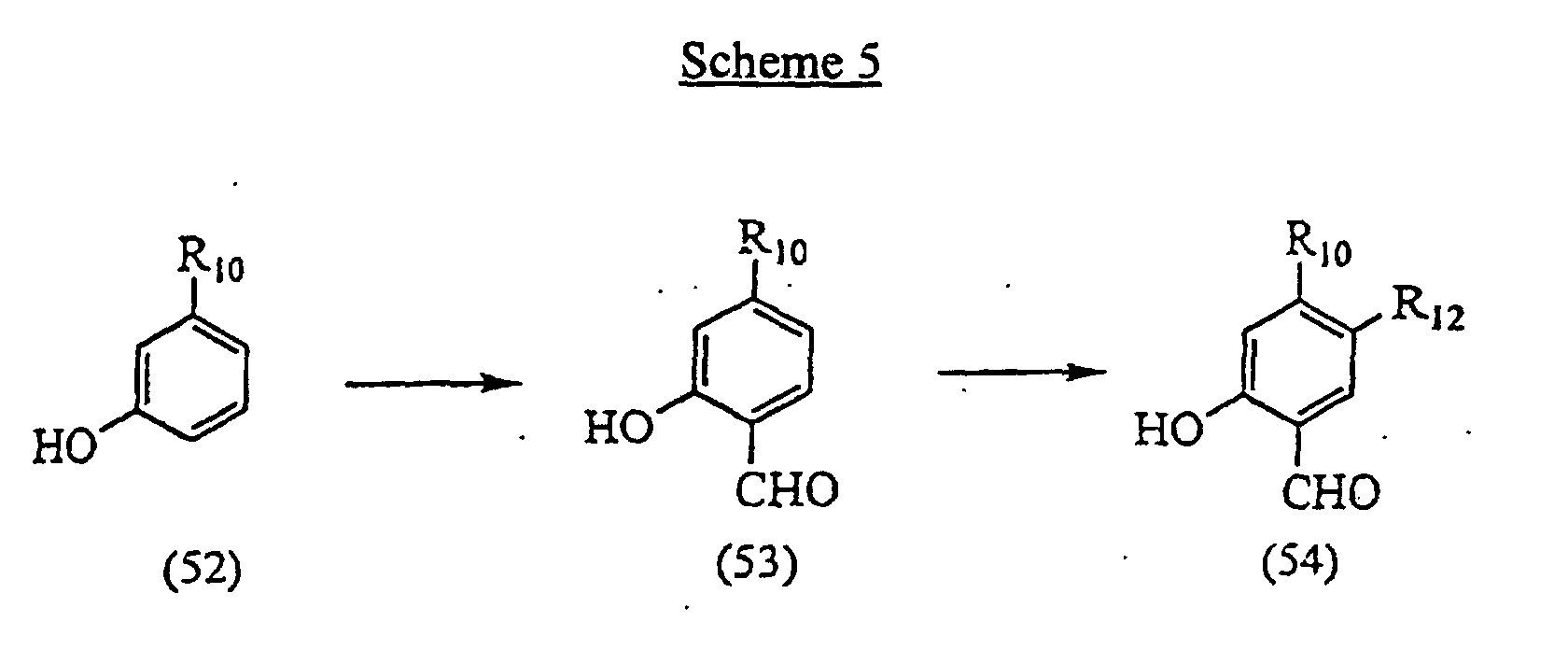
- Aldehydes of general formula (54), wherein R10 is selected from halo and R12 is selected from halo, can be prepared by the method shown in Scheme 5. A meta substituted phenol (52) is converted to the para substituted salicylaldehyde (53) by reaction with a base such as sodium hydroxide and a reagent such as trichloromethane or tribromomethane. This reaction is known as the Reimer-Tiemann reaction. An alternate set of reaction conditions involves reaction with magnesium methoxide and paraformaldehyde (Aldred, J. Chem. Soc. Perkin Trans. 1 (1994), 1823). The aldehyde (53) may be subjected to conditions of an electrophilic aromatic substitution reaction to provide the meta, para disubstituted salicylaldehyde of general formula (54).

- An alternative method of obtaining meta, para disubstituted salicylaldehydes of general formula (54), wherein R10 is selected from halo and R12 is selected from halo, is shown in Scheme 6. A meta, para disubstituted phenol (55) is reacted with a base such as sodium hydroxide and a reagent such as trichloromethane or tribromomethane. This reaction is called the Reimer-Tiemann reaction. An alternate set of reaction conditions involves reaction with magnesium methoxide and paraformaldehyde (Aldred, J. Chem. Soc. Perkin Trans. 1 (1994), 1823).

- Another method for preparing 3,4-disubstituted benzaldehydes of general formula (49), wherein R12 is selected from alkyl, haloalkyl, chlorine, fluorine, haloalkoxy, nitro, and alkylcarbonyl, R10 is selected from alkyl, is shown in Scheme 7. An appropriately protected 4-bromo-3-substitutedbenzaldehyde of general formula (56), wherein R is selected from alkyl or together with the oxygen atoms to which they are attached form a 5 or 6 membered ring wherein 1,3-dioxolanes are preferred, can be converted to the 3,4-disubstituted benzaldehyde of general formula (48) by conversion of the bromide to an anion via metal-halogen exchange wherein preferred metals are magnesium (grignards) and lithium (lithium organics), followed by reaction with an appropriate electrophile such as an aldehyde, dialkyldisulfide, a Weinreb amide, dimethylformamide, an alkyl halide or other electrophile followed by deprotection of the acetal to provide benzaldehydes of general formula (49).
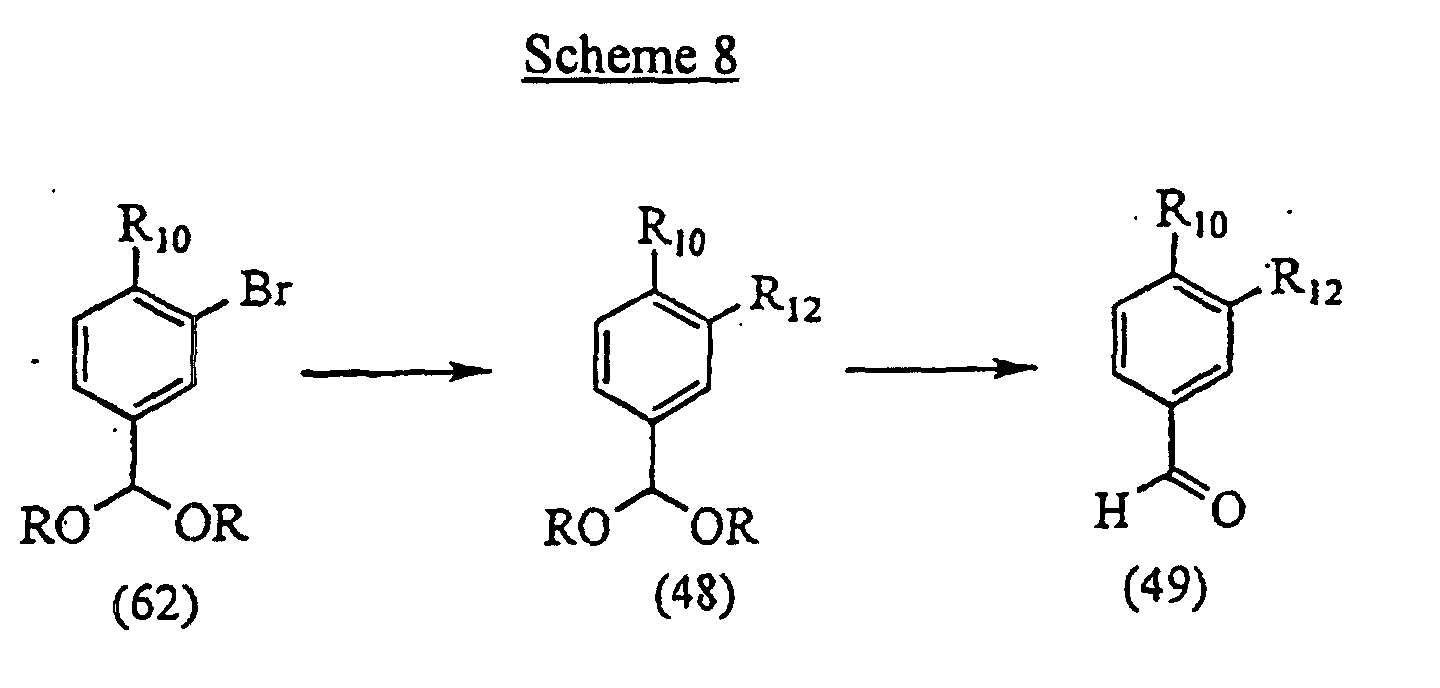
- Another method directly analogous to that described in Scheme 7 may be used to provide 3,4-disubstituted benzaldehydes of general formula (49), wherein R10 is selected from alkyl, haloalkyl, chlorine, and fluorine, R12 is selected from alkyl and alkylcarbonyl, starting from protected benzaldehydes of general formula (62), wherein R is selected from alkyl or together with the oxygen atoms to which they are attached form a 5 or 6 membered ring wherein 1,3-dioxolanes are preferred.
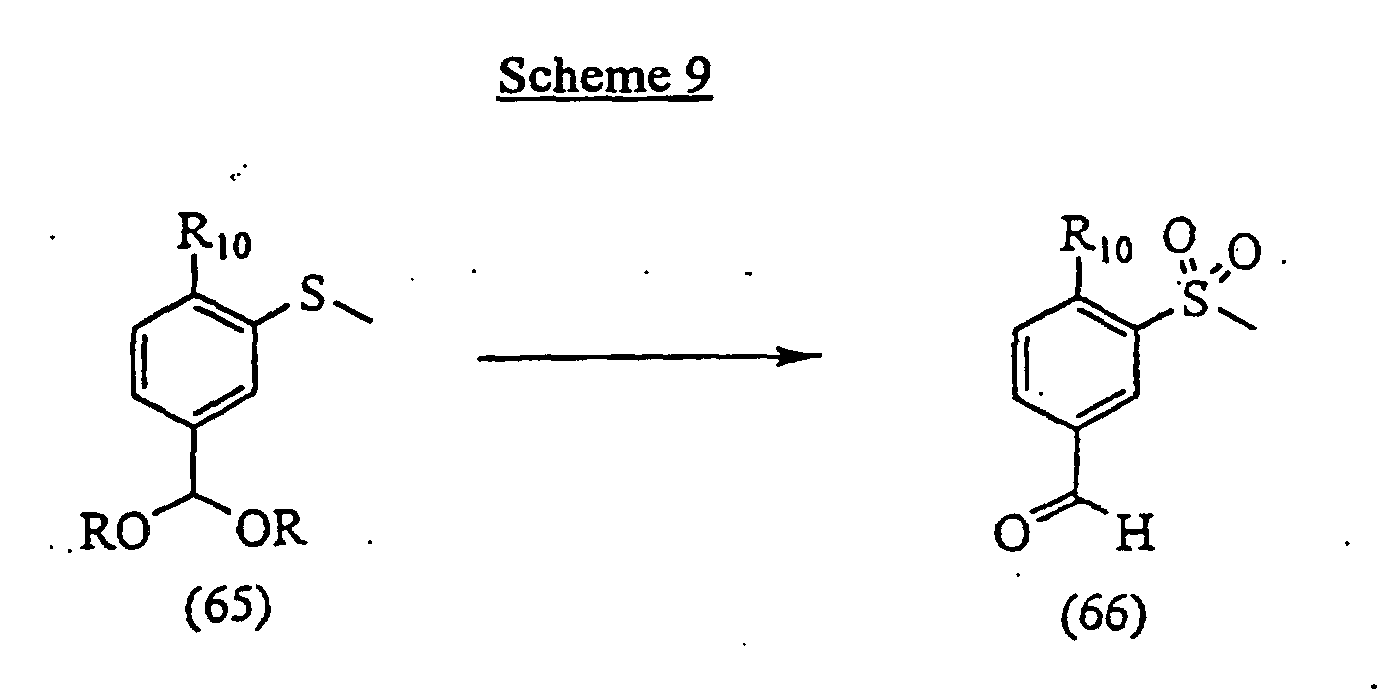
- 3-Methylsulfonyl-4-substituted benzaldehydes of general formula (66), wherein R10 is selected from alkyl, can be prepared as shown in Scheme 9. 3-Methylthio-4-substituted protected benzaldehydes of general formula (65), wherein R is selected from alkyl or together with the oxygen atoms to which they are attached form a 5 or 6 membered ring wherein 1,3-dioxolanes are preferred, prepared by the methods described in the preceeding schemes, can be oxidized with a suitable oxidant like meta-chloroperoxybenzoic acid and then deprotected to provide compounds of general formula (66).

- The preparation of benzaldehydes of general formula (73), wherein R10 is hydrogen, and R13 is haloalkyl, is shown in Scheme 10. A 3-hydroxybenzaldehyde of general formula (72) is reacted with a suitable alkylating reagent in the presence of a base such as potassium carbonate, potassium tert-butoxide or sodium tert-butoxide, to provide benzaldehydes of general formula (73). The synthesis of useful 3-hydroxybenzaldehydes of general formula (72) may be found in the following literature references: J. Chem. Soc. (1923), 2820; J. Med Chem. (1986), 29, 1982; Monatsh. Chem. (1963), 94, 1262; Justus Liebigs Ann. Chem. (1897), 294, 381; J. Chem. Soc. Perkin Trans. 1 (1990), 315; Tetrahedron Lett. (1990), 5495; J. Chem. Soc. Perkin Trans. 1 (1981), 2677.
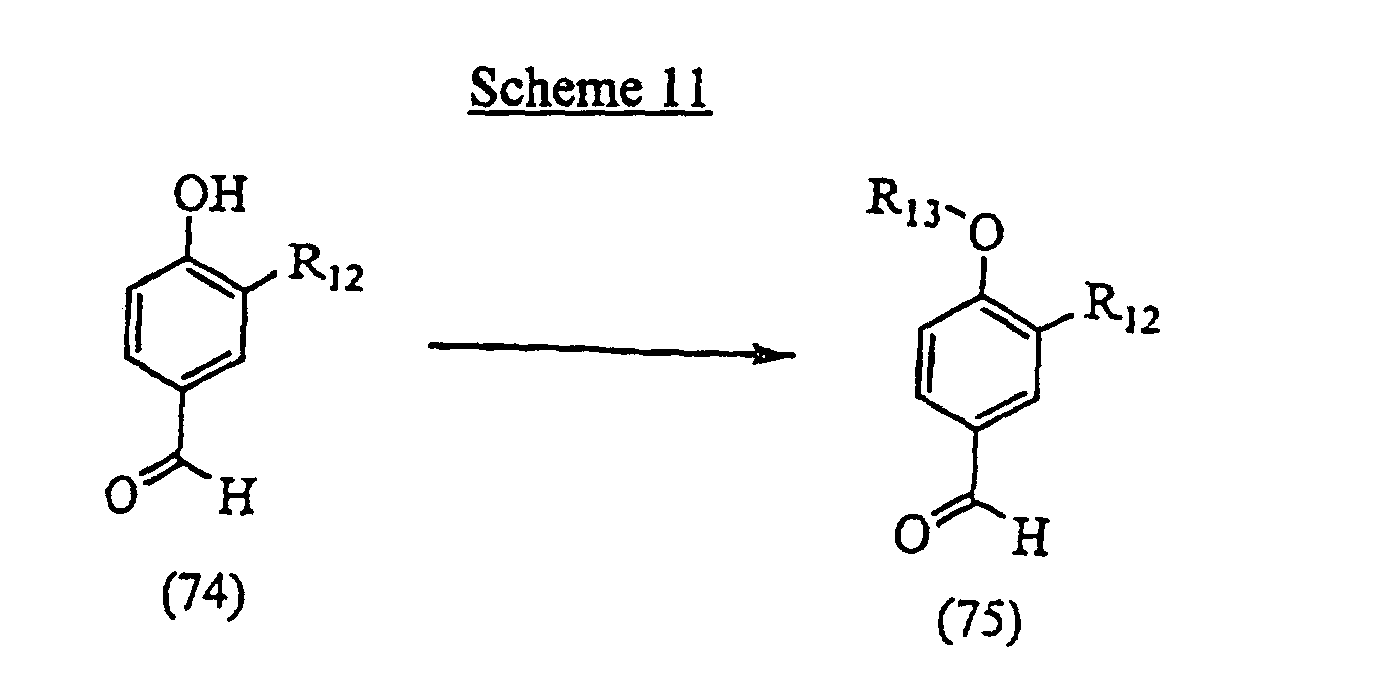
- The preparation of benzaldehydes of general formula (75), wherein R12 is selected from hydrogen and nitro, and R13 is selected from haloalkyl wherein a preferred haloalkyl group is difluoromethyl, is shown in Scheme 11. A 4-hydroxybenzaldehyde of general formula (74) is reacted with a suitable alkylating reagent such as chlorodifluoromethane, in the presence of a base such as potassium carbonate, potassium tert-butoxide or sodium tert-butoxide to provide a benzaldehyde of general formula (75). The synthesis of useful 4-hydroxybenzaldehydes of general formula (74) may be found in the following literature references: Angyal, J. Chem. Soc. (1950), 2141; Ginsburg, J. Am. Chem. Soc. (1951), 73, 702; Claisen, Justus Liebigs Ann. Chem. (1913), 401, 107; Nagao, Tetrahedron Lett. (1980), 21, 4931; Ferguson, J. Am. Chem. Soc. (1950), 72, 4324; Barnes, J. Chem. Soc. (1950), 2824; Villagomez-Ibarra, Tetrahedron (1995), 51, 9285; Komiyama, J. Am. Chem. Soc. (1983), 105, 2018; DE 87255; Hodgson, J. Chem. Soc. (1929), 469; Hodgson, J. Chem. Soc. (1929), 1641.
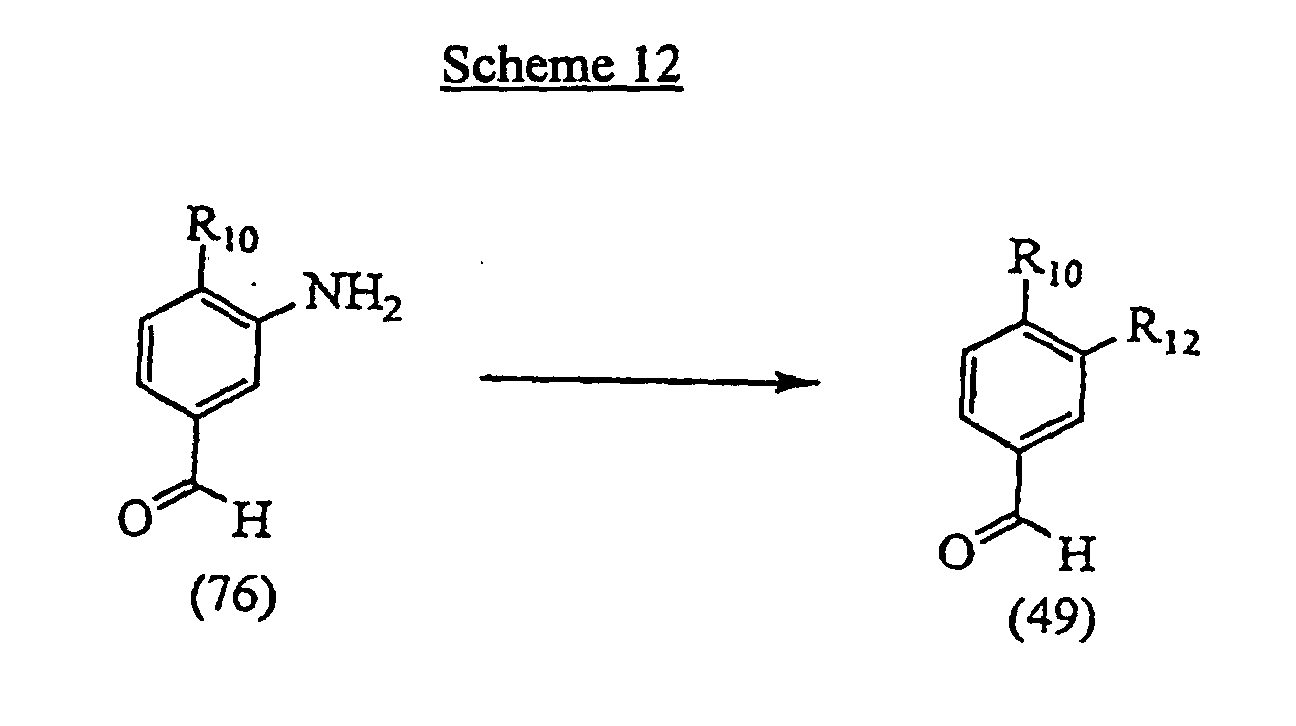
- An alternate method for introduction of substituents at the 3-position of benzaldehydes of general formula (49), wherein R10 is selected from hydrogen, alkyl, halo, and haloalkoxy, is shown in Scheme 12. This method, also known as the Sandmeyer reaction, involves converting 3-amino benzaldehydes of general formula (76) to an intermediate diazonium salt with sodium nitrite that is further reacted with appropriate reagents to give the desired R12 groups. The types of R12 substituents that may be introduced in this fashion include cyano, hydroxy, or halo. The Sandmeyer reaction and conditions for effecting the transformation are well known to those skilled in the art of organic chemistry. In order to successfully carry out this transformation it may in certain circumstances be advantageous to perform the Sandmeyer reaction on a protected aldehyde.
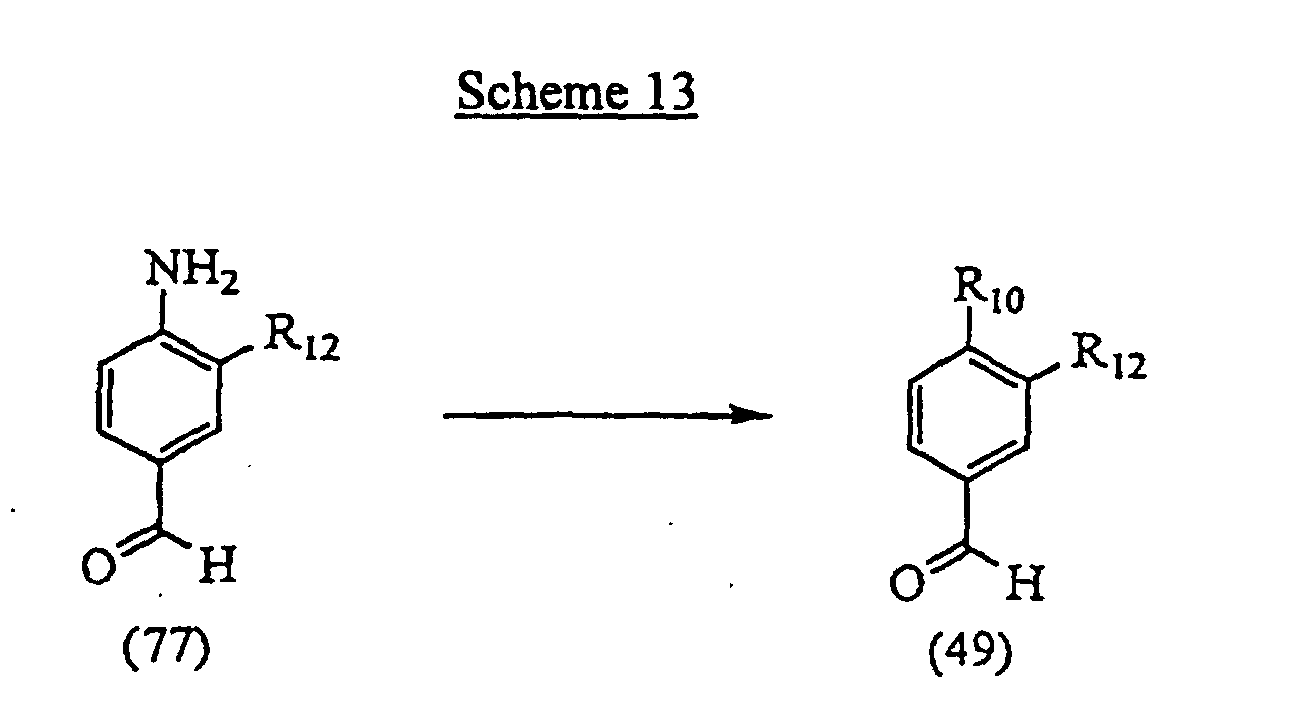
- An alternate method for introduction of substituents at the 4-position of benzaldehydes of general formula (49), wherein R12 is selected from hydrogen, alkyl, alkylsulfonyl, aryl, heteroaryl, cyano, haloalkyl, halo, haloalkoxy, and nitro, is shown in Scheme 13. This method, also known as the Sandmeyer reaction, involves converting 4-amino benzaldehydes of general formula (77) to an intermediate diazonium salt with sodium nitrite that is further reacted with appropriate reagents to give the desired R10 group. The types of R10 substituents that may be introduced in this fashion include hydroxy, or halo. The Sandmeyer reaction and conditions for effecting the transformation are well known to those skilled in the art of organic chemistry. In order to successfully carry out this transformation it may in certain circumstances be advantageous to perform the Sandmeyer reaction on a protected aldehyde.
- Examples of the present Invention that possess a center of chirality and thus exist in racemic form were separated into the individual enantiomers by the method shown in Scheme 3. The racemic compounds were reacted with potassium t-butoxide (1 equivalent) in tetrahydrofuran followed by 8-phenylmenthyl chloroformate to generate a mixture of diastereomeric 8-phenylmenthyl carbamates (i) and (ii). The diastereomers (i) and (ii) were separated by column chromatography over silica gel and the 8-phenylmenthol moiety removed by reaction with sodium methoxide in methanol to provide the single enantiomers as shown.
- In addition to the use of the method illustrated in Scheme 3, individual enantiomers of compounds of the Invention were also separated by chiral chromatography.
- The following examples illustrate the synthesis of compounds of the invention. Although Examples 1,2,4-6,10-12 and 15-17 do not relate to compounds of the invention the procedures used in such examples are used in other examples to synthesize compounds of the invention
- A solution of tetrahydrothiophene-3-oxo-1,1-dioxide (144 mg, 1.07 mmol) prepared according to the method in J. Heterocycl. Chem., v. 27 pp. 1453 (1990), 3,4-dichlorobenzaldehyde (175 mg, 1.00 mmol) and 3-amino-2-cyclohexen-1-one (111 mg, 1.00 mmol) in ethanol (7 mL) was heated to reflux for 24 hours. The precipitate was isolated, heated to reflux in toluene (5 mL) for 24 hours, and cooled. The solid that precipitated was collected, washed with toluene and ethanol and triturated to provide the title compound. MS(APCI) m/e 384 (M+H)+;
1HNMR (DMSO-d6) δ 1.75-2.0 (m, 2H), 2.23 (m, 2H), 2.57 (m, 2H), 2.85 (dt, 1H), 3.03 (dt, 1H), 3.38 (m, 2H), 4.84 (s, 1H), 7.17 (dd, 1H), 7.35 (d, 1H), 7.50 (d, 1H), 9.85 (br s, 1H);
Anal. Calcd for C17H15Cl2NO3S: C, 53.14; H, 3.93; N, 3.64. Found: C, 52.97; H, 3.90; N, 3.56. - 3-Cyanobenzaldehyde (136 mg, 1.04 mmol) was processed as in Example 1 to provide the title compound.
MS(APCI) m/e 341 (M+H)+;
1H NMR (DMSO-d6) δ 1.88 (m, 2H), 2.22 (m, 2H), 2.56 (m, 2H), 2.85 (dtd, 1H), 3.03 (dt, 1H), 3.36 (m, 2H), 4.90 (s, 1H), 7.45 (td, 1H), 7.54 (dd, 1H), 7.56 (d, 1H), 7.61 (dd, 1H), 9.81 (br s, 1H);
Anal. Calcd for C18H16N2O3S: C, 63.51; H, 4.73; N, 8.22. Found: C, 63.31; H, 4.61; N, 8.19. - 4-Methyl-3-nitrobenzaldehyde (165 mg, 1.00 mmol) was processed as in Example 1 to provide the title compound.
MS(APCI) m/e 375 (M+H)+;
1H NMR (DMSO-d6) δ 1.88 (m, 2H), 2.23 (m, 2H), 2.45 (s, 3H), 2.56 (m, 2H), 2.85 (dtd, 1H), 3.03 (dt, 1H), 3.35 (m, 2H), 4.93 (s, 1H), 7.36 (d, 1H), 7.45 (dd, 1H), 7.72 (d, 1H), 9.83 (br s, 1H);
Anal. Calcd for C18H18N2O5S.0.25 H2O: C, 57.06; H, 4.92; N, 7.39. Found: C, 57.24; H, 4.77; N, 7.23. - 3,4-Difluorobenzaldehyde (110 µL, 1.00 mmol) was processed as in Example 1 to provide the title compound.
MS(APCI) m/e 352 (M+H)+;
1H NMR (DMSO-d6) δ 1.90 (m, 2H), 2.23 (m, 2H), 2.55 (m, 2H), 2.82 (dt, 1H), 3.02 (dt, 1H), 3.35 (m, 2H), 4.86 (s, 1H), 7.02 (m, 1H), 7.15 (ddd, 1H), 7.29 (dt, 1H), 9.79 (br s, 1H);
Anal. Calcd for C17H15F2NO3S: C, 58.11; H, 4.30; N, 3.99. Found: C, 57.90; H, 3.96; N, 3.88. - 4-Chloro-3-nitrobenzaldehyde (185 mg, 1.00 mmol) was processed as in Example 1 to provide the title compound.
MS(APCI) m/e 393 (M-H)-, 395 (M-H)-;
1H NMR (DMSO-d6) □ 1.90 (m, 2H), 2.23 (m, 2H), 2.55 (m, 2H), 2.85 (dtd, 1H), 3.01 (dt, 1H), 3.35 (m, 2H), 4.95 (s, 1H), 7.51 (dd, 1H), 7.64 (d, 1H), 7.79 (d, 1H), 9.88 (br s, 1H);
Anal. Calcd for C17H15ClN2O5S: C, 51.71; H, 3.38; N, 7.09. Found: C, 51.46; H, 3.86; N, 6.95. - A solution of tetrahydrothiopyran-3-one-1,1-dioxide (175 mg, 1.20 mmol), 3,4-dichlorobenzaldehyde (175 mg, 1.00 mmol) and 3-amino-2-cyclopenten-1-one, prepared by the method described in Synthesis, p. 176 (1990)(101 mg, 1.05 mmol) in ethanol (5 mL) was heated to reflux for 24 hours, and cooled. The solid that precipitated was collected, washed with ethanol and dried to provide the title compound.
MS(APCI) m/e 384 (M+H)+;
1H NMR (DMSO-d6) δ 2.25 (m, 4H), 2.60 (m, 4H), 3.20 (m, 2H), 4.82 (s, 1H), 7.20 (dd, 1H), 7.36 (d, 1H), 7.52 (d, 1H), 9.98 (br s, 1H);
Anal. Calcd for C17H15Cl2NO3S.0.25 H2O: C, 52.52; H, 4.02; N, 3.60. Found: C, 52.36; H, 3.69; N, 3.63. - 3-Nitrobenzaldehyde (153 mg, 1.01 mmol) was processed as in Example 1 to provide the title compound.
MS(APCI) m/e 359 (M-H)-;
1H NMR (DMSO-d6) δ 1.83 (m, 1H), 1.92 (m, 1H), 2.24 (m, 2H), 2.57 (m, 2H), 2.85 (dtd, 1H), 3.05 (dt, 1H), 3.35 (m, 2H), 4.99 (s, 1H), 7.55 (t, 1H), 7.67 (dt, 1H), 7.98 (t, 1H), 8.03 (ddd, 1H), 9.91 (s, 1H);
Anal. Calcd for C17H16N2O5S: C, 56.65; H, 4.47; N, 7.77. Found: C, 56.67; H, 4.35; N, 7.59. - 3-Bromo-4-fluorobenzaldehyde (201 mg, 0.99 mmol) was processed as in Example 1 and recrystallized from methanol/chloroform to provide the title compound.
MS(APCI); m/e 410 (M-H)-, 412 (M-H)-;
1H NMR (DMSO-d6) δ 1.88 (m, 2H), 2.23 (m, 2H), 2.56 (m, 2H), 2.83 (dtd, 1H), 3.03 (dt, 1H), 3.33 (t, 2H), 4.85 (s, 1H), 7.22 (m, 2H), 7.40 (dd, 1H), 9.78 (br s, 1H);
Anal. Calcd for C17H15BrFNO3S: C, 49.52; H, 3.66; N, 3.39. Found: C, 49.19; H, 3.59; N, 3.24. - A solution of tetrahydrothiophene-3-oxo-1,1-dioxide (171 mg, 1.28 mmol), 4-chloro-3-nitrobenzaldehyde (210 mg, 1.13 mmol) and 3-amino-2-cyclopenten-1-one (110 mg, 1.13 mmol) in ethanol (3 mL) was heated to reflux for 24 hours and cooled. The precipitate was collected, washed with ethanol, dried and recrystallized from methanol/ chloroform to provide the title compound.
MS(APCI); m/e 379 (M-H)-;
1H NMR (DMSO-d6) δ 2.30 (t, 2H), 2.65 (m, 2H), 2.89 (dt, 1H), 3.05 (dt, 1H), 3.40 (t, 2H), 4.87 (s, 1H), 7.58 (dd, 1H), 7.68 (d, 1H), 7.88 (d, 1H), 10.4 (s, 1H);
Anal. Calcd for C16H13ClN2O5S .0.25 CH3OH: C, 50.19; H, 3.62; N, 7.20. Found: C, 49.87; H, 3.26; N, 7.07. - 3-Cyanobenzaldehyde (206 mg, 1.57 mmol), tetrahydrothiophene-3-oxo-1,1-dioxide (212 mg, 1.58 mmol), and 3-amino-2-cyclopenten-1-one (150 mg, 1.55 mmol) were heated in ethanol (4 mL) to 80°C for 3 days in a sealed tube, cooled, the solid precipitate collected and washed with ethanol. The solid was then heated to reflux in ethanol (10 mL) with 1N HCl in ether (0.5 mL) for 2 hours, cooled and the solvent evaporated. The crude oil was triturated with ethyl acetate, and the resultant solid collected, washed with ethyl acetate and dried to provide 252 mg of a tan solid.
mp 156-176 °C;
1H NMR (DMSO-d6) δ 2.30 (t, 2H), 2.63 (m, 2H), 2.88 (dt, 1H), 3.07 (dt, 1H), 3.40 (t, 2H), 4.70 (s, 1H), 7.49 (t, 1H), 7.60 (d, 1H), 7.64 (s, 1H), 7.66 (dd, 1H), 10.38 (s, 1H);
MS(APCI-) m/z 325 (M-H)-;
Anal. Calcd for C17H14N2O3S·0.33 EtOAc 0.75 H2O: C, 59.64; H, 4.95; N, 7.59. Found: C, 59.32; H, 4.77; N, 7.41. - 3-Bromo-4-fluorobenzaldehyde (305 mg, 1.5 mmol), tetrahydrothiophene-3-oxo-1,1-dioxide (402 mg, 3.00 mmol), and 2.0 M NH3 in ethanol (1.1 mL, 2.2 mmol) in ethanol (3 mL) were heated to 80°C for 3 days in a sealed tube, cooled, the solid precipitate collected, and washed with ethanol. The solid was heated to reflux overnight in ethanol with 1.0 M HCl in ether (1 mL), cooled, the solid collected, washed with ethanol and dried to provide 185 mg of the title compound as an off-white solid.
1H NMR (DMSO-d6) δ 2.80 (m, 2H), 3.01 (dt, 2H), 3.35 (m, 4H), 4.97 (s, 1H), 7.30 (m, 2H), 7.53 (dd, 1H), 9.19 (br s, 1H);
MS(APCI-) m/z 432 (M-H)-;
Anal. Calcd for C15H13BrFNO4S2: C, 41.48; H, 3.01; N, 3.22. Found: C, 41.61; H, 2.76; N, 3.14. - 3,4-Dichlorobenzaldehyde (175 mg, 1.0 mmol) was treated according to the procedure described in Example 10 to provide 204 mg of the title compound as a white solid.
mp >260 °C;
1H NMR (DMSO-d6) δ 2.30 (t, 2H), 2.63 (m, 2H), 2.87 (dt, 1H), 3.05 (dt, 1H), 3.40 (t, 2H), 4.72 (s, 1H), 7.22 (dd, 1H), 7.41 (d, 1H), 7.52 (d, 1H), 10.36 (br s, 1H);
MS(APCI-) m/z 368 (M-H)-;
Anal. Calcd for C16H13Cl2NO3S: C, 51.90; H, 3.54; N, 3.78. Found: C, 51.93; H, 3.59; N, 3.53. - The product from Example 8 (0.50 g) was chromatographed on a 5x25 cm Regis WhelkO 2 chiral column with 280 g of packing, eluting with hexane:methanol:methylene chloride (77.5/15/7.5) as the mobile phase with a flow rate of 117 mL/minute to provide 220 mg of the title compound as the more polar enantiomer.
[α]23 D +50.24° (CH3CN);
1H NMR (DMSO-d6) δ 1.72-1.98 (m, 2H), 2.22 (m, 2H), 2.55 (m, 2H), 2.8 (m, 1H), 3.1 (m, 1H), 3.32 (m, 2H), 4.82 (s, 1H), 7.2 (m, 2H), 7.4 (m, 1H), 9.8 (s, 1H);
MS(APCI+) m/z 414 (M+H)+;
Anal. Calcd for C17H15BrFNO3S: C, 49.52; H, 3.66; N, 3.39. Found: C, 49.56; H, 3.86; N, 3.33. - From the chiral chromatography described in Example 13 was obtained 210 mg of the title compound as the less polar enantiomer.
[α]23 D -48.8 (CH3CN);
1H NMR (DMSO-d6) δ 1.72-1.98 (m, 2H), 2.22 (m, 2H), 2.52 (m, 2H), 2.8 (m, 1H), 3.1 (m, 1H), 3.31 (m, 2H), 4.82 (s, 1H), 7.2 (m, 2H), 7.4 (m, 1H), 9.8 (s, 1H);
MS(APCI+) m/z 414 (M+H)+;
Anal. Calcd for C17H15BrFNO3S: C, 49.52; H, 3.66; N, 3.39. Found: C, 49.54; H, 3.76; N, 3.41. - 3-Bromo-4-fluorobenzaldehyde (250 mg, 1.23 mmol) was treated according to the procedure described in Example 9, except that the heating phase was for 3 days and no recrystallization was necessary, to provide 241 mg of the title compound as an off-white solid.
mp >260 °C;
1H NMR (DMSO-d6) δ 2.30 (t, 2H), 2.63 (m, 2H), 2.85 (dt, 1H), 3.06 (dt, 1H), 3.40 (t, 2H), 4.72 (s, 1H), 7.27 (m, 2H), 7.47 (d, 1H), 10.33 (br s, 1H);
MS(APCI-) m/z 396 (M-H)-;
Anal. Calcd for C16H13BrFNO3S: C, 48.25; H, 3.29; N, 3.52. Found: C, 48.26; H, 3.17; N, 3.34. - The product from Example 15A (0.80 g) was chromatographed on a 5x25 cm Regis WhelkO 2 chiral column with 280 g of packing, eluting with hexane:methanol:methylene chloride (70/15/15) as the mobile phase at a flow rate of 117 mL/minute to provide 250 mg of the title compound as the less polar enantiomer.
[α]23 D -4.5° (CH3CN);
1H NMR (DMSO-d6) δ 2.3 (t, 2H), 2.63 (m, 2H), 2.85 (m, 1H), 3.06 (m, 1H), 3.4 (m, 2H), 4.71 (s, 1H), 7.25 (d, 2H), 7.47 (d, 1H) 10.35 (s, 1H);
MS(ESI+) m/z 400 (M+H)+;
Anal. Calcd for C16H13BrFNO3S: C, 48.25; H, 3.29; N, 3.52. Found: C, 48.14; H, 3.42; N, 3.42. - From the chiral chromatography described in Example 15B was obtained 264 mg of the title compound as the more polar enantiomer.
[α]23 D +4.8° (CH3CN);
1H NMR (DMSO-d6) δ 2.3 (m, 2H), 2.62 (m, 2H), 2.85 (m, 1H), 3.05 (m, 1H), 3.4 (m, 2H), 4.72 (s, 1H), 7.25 (m, 2H), 7.48 (d, 1H), 10.35 (s, 1H);
MS(ESI+) m/z 400 (M+H)+;
Anal. Calcd for C16H13BrFNO3S: C, 48.25; H, 3.29; N, 3.52. Found: C, 48.14; H, 3.52; N, 3.42. - 3-Amino-4-fluorobenzoic acid (15 g, 97 mmol) in THF at 0°C was treated with 1.0M BH3·THF (50 mL), stirred overnight at room temperature, treated with an additional 130 mL 1.0 M BH3·THF, stirred 10 hours, quenched by the addition of methanol, stirred 3 hours at room temperature, solvent evaporated, the product partitioned between aqueous sodium bicarbonate/methylene chloride, the organic layer dried (sodium sulfate), filtered and solvent evaporated. The product was purified by flash chromatography over silica gel (ethyl acetate/hexane 1:1) to provide 7.0 g of the title compound.
1HNMR (CDCl3) δ 4.58 (s, 2H), 6.67 (br m, 1H), 6.81 (d, 1H), 6.95 (t, 1H). - The product from Example 17A (7.0 g, 50 mmol) in water (100 mL) at 0°C was treated slowly with concentrated sulfuric acid (30 mL) at a rate to maintain the temperature below 10°C, then treated dropwise with an aqueous solution of sodium nitrite (3.45 g, 50 mmol). This solution was then added to a solution of potassium iodide (8.13 g, 50 mmol) in water (15 mL), heated to 60° C for 2 hours, cooled, extracted with methylene chloride, the organics washed with 10% sodium hydroxide, 1 M sodium thiosulfate, 10% hydrochloric acid, aqueous sodium bicarbonate, dried (sodium sulfate), filtered and solvent evaporated. The material was purified by flash chromatography over silica gel (ethyl acetate/hexane 7:3) to provide 6.4 g of the title compound.
1HNMR (CDCl3) δ 1.69 (t, 1H), 4.66 (d, 2H), 7.05 (t, 1H), 7.60 (d, 1H), 7.78 (dd, 1H). - The product from Example 17B (6.4 g, 26 mmol) in chloroform (300 mL) was treated with manganese dioxide (4.5 g, 50 mmol), stirred overnight, treated with an additional portion of manganese dioxide (2.25 g), stirred overnight, filtered and solvent evaporated. The material was purified by flash chromatography over silica gel (ethyl acetate/hexane 1:4) to provide 1.9 g of the title compound.
1H NMR (CDCl3) δ 7.23 (t, 1H), 7.89 (m, 1H), 8.32 (dd, 1H), 9.91 (s, 1H). - 4-Fluoro-3-iodobenzaldehyde (0.25 g, 1.0 mmol), tetrahydrothiophene-3-oxo-1,1-dioxide (0.13 g, 1.0 mmol), 3-amino-2-cyclohexen-1-one (0.11 g, 1.0 mmol) and triethylamine (0.07 mL) were heated in ethanol (2 mL) to 80 °C in a sealed tube for 96 hours, cooled, solvent evaporated, flash chromatographed on silica gel (10% ethanol/methylene chloride), the product dissolved in ethanol, treated with 1.0M HCl in ether (1 mL), heated to reflux for 2 hours, cooled, the solid precipitate collected, washed with. ethanol and dried to provide 0.20 g of the title compound.
mp >250 °C;
1HNMR (DMSO-d6) δ 1.88 (m, 2H), 2.22 (m, 2H), 2.62 (m, 2H), 2.7 (m, 1H), 3.02 (m, 1H), 3.45 (m, 2H),4.81 (s, 1H), 7.12 (m, 1H), 7.18 (m, 1H), 7.55 (dd, 1H), 9.81 (s, 1H);
MS(ESI+) m/z 460 (M+H)+;
Anal. Calcd for C17H15FINO3S: C, 44.45; H, 3.29; N, 3.04. Found: C, 44.51; H, 3.31; N, 2.97. - The title compound from Example 1 (1.65 g, 4.30 mmol) as a slurry in THF (20 mL) under nitrogen at 5 °C was treated dropwise with a solution of 1.0 M potassium tert-butoxide in THF (3.9 mL), allowed to warm to room temperature over 20 minutes, treated with a solution of (-)-8-phenylmenthylchloroformate (4.3 mmol) in THF (5 mL), stirred at room temperature overnight, quenched in aqueous sodium bicarbonate, extracted with diethyl ether (3x), the organics dried with sodium sulfate, filtered and solvent evaporated to provide a mixture of diastereomeric carbamates. This mixture was flash chromatographed over a 6x40 cm column of silica gel, eluting with chloroform:hexane:ether (7:2:1) to provide 664 mg of the less polar diastereomer. This material, as a slurry in methanol (10 mL) under nitrogen, was treated with catalytic sodium methoxide, stirred at room temperature overnight, treated with glacial acetic acid (2 drops), the solid precipitate collected, washed with ethyl alcohol and dried to provide 295 mg of the title compound as a white solid.
[α]23 D +70.9° (DMSO);
1HNMR (DMSO-d6) δ 1.75-1.95 (m, 2H), 2.23 (m, 2H), 2.54 (m, 2H), 2.83 (dt, 1H), 3.02 (dt, 1H), 3.45 (m, 2H), 4.84 (s, 1H), 7.16 (dd, 1H), 7.34 (d, 1H), 7.49 (d, 1H), 9.82 (br s, 1H);
MS(APCI-) m/z 382 (M-H)-;
Anal. Calcd for C17H15Cl2NO3S: C, 53.14; H, 3.93; N, 3.64. Found: C, 53.38; H, 4.19; N, 3.61. - From the chromatography of the diastereomers described in Example 18 was obtained the impure more polar diastereomer. This material was flash chromatographed over a 6x40 cm column of silica gel, eluting with chloroform:hexane:ether (7:2:1) to provide 628 mg of the more polar diastereomer. This diastereomer, as a slurry in methanol (10 mL) under nitrogen, was treated with catalytic sodium methoxide, stirred at room temperature overnight, treated with glacial acetic acid (2 drops), the solid precipitate collected, washed with ethyl alcohol and dried to provide 228 mg of the title compound as a white solid.
[α]23 D -68.8° (DMSO);
1H NMR (DMSO-d6) δ 1.75-1.95 (m, 2H), 2.23 (m, 2H), 2.55 (m, 2H), 2.73 (dt, 1H), 3.03 (dt, 1H), 3.35 (m, 2H), 4.84 (s, 1H), 7.17 (dd, 1H), 7.35 (d, 1H), 7.50 (d, 1H), 9.85 (br s, 1H);
MS(APCI-) m/z 382 (M-H)-;
Anal. Calcd for C17H15Cl2NO3S: C, 53.14; H, 3.93; N, 3.64. Found: C, 53.11; H, 4.01; N, 3.59. - The product from Example 5 (1.64 g) was processed according to the method described in Example 18 to provide 300 mg of the title compound.
[α]23 D +41.04° (DMSO);
1H NMR (DMSO-d6) δ 1.90 (m, 2H), 2.25 (m, 2H), 2.52 (m, 2H), 2.85 (m, 1H), 3.02 (m, 1H), 3.35 (m, 2H), 4.95 (s, 1H), 7.54 (dd, 1H, J=3 Hz), 7.65 (d, 1H, J=9 Hz), 7.80 (d, 1H, J=3 Hz), 9.90 (s, 1H);
MS(ESI-) m/z 393 (M-H)-;
Anal. Calcd for C17H15ClN2O5S: C, 51.71; H, 3,83; N, 7.10. Found: C, 51.72; H, 3.85; N, 7.10. - The product from Example 5 (1.64 g) was processed using the methods described in Examples 18 and 19 to provide 424 mg of the title compound as a white solid.
[α]23 D -31.74° (DMSO);
1HNMR (DMSO-d6) δ 1.92 (m, 2H), 2.24 (m, 2H), 2.52 (m, 2H), 2.86 (m, 1H), 3.02 (m, 1H), 3.38 (m, 2H), 4.95 (s, 1H), 7.54 (dd, 1H, J=3 Hz), 7.66 (d, 1H, J=9 Hz), 7.79 (d, 1H, J=3 Hz), 9.89 (s, 1H);
MS(ESI-) m/z 393 (M-H)-;
Anal. Calcd for C17H15ClN2O5S: C, 7.10; H, 3.83; N, 7.10. Found: C, 51.70; H, 3.83; N, 7.08. - 3-(Trifluoromethoxy)benzaldehyde (38 mg, 0.2 mmol) was processed according to the method of Example 6 to provide 36 mg of the title compound. MS (APCI-) m/z: 398 (M-H)-;
1H NMR (DMSO-d6) δ 2.22 (m, 4H), 2.55 (m, 4H), 3.20 (m, 2H), 4.87 (s, 1H), 7.10 (m, 2H), 7.20 (d, 1H), 7.37 (m, 1H), 9.94 (br s, 1H);
Anal. calcd for C18H16F3NO4S: C, 54.13; H, 4.04; N, 3.51. Found: C, 54.15; H, 4.13; N, 3.44. - 5-Bromosalicylaldehyde (40 mg, 0.2 mmol) was processed according to the method of Example 6 to provide 33 mg of the title compound.
MS (APCI+) m/z: 410 (M+H)+;
1H NMR (DMSO-d6) δ 2.20 (m, 4H), 2.58 (m, 4H), 3.18 (m, 2H), 5.04 (s, 1H), 6.63 (d, 1H), 7.02 (d, 1H), 7.10 (dd, 1H), 9.60 (br s, 1H), 9.90 (br s, 1H);
Anal. calcd for C17H16BrNO4S: C, 49.77; H, 3.93; N, 3.41. Found: C, 49.75; H, 4.11; N, 3.48. - A solution of 3-amino-2-cyclopenten-1-one (38.8 mg, 0.4 mmol), tetrahydrothiopyrane-3-one-1, 1-dioxide (59.2 mg, 0.40 mmol) and 3-cyano-2-(methylthio)pyridine (71.2 mg, 0.40 mmol) in absolute ethanol (3 mL) was heated at 80 °C for 3 days in a sealed tube. Solvent was evaporated, and the residue purified by preparative TLC to provide 85 mg of the title compound. MS (APCI+) m/z: 388 (M+H)+;
1HNMR (DMSO-d6) δ 2.21 (m, 4H), 2.50 (s, 3H), 2.58 (m, 4H), 3.20 (m, 2H), 4.92 (s, 1H), 7.11 (d, 1H), 8.08 (d, 1H), 10.01 (s, 1H);
Anal. calcd for C18H17N3O3S2: C, 55.79; H, 4.42; N, 10.84; S, 16.55; Found: C, 55.62;H, 4.45; N, 10.81; S, 16.42. - 5-Bromosalicylaldehyde (0.201 g, 1.0 mmol), tetrahydrothiophene-3-oxo-1, 1-dioxide (0.13 g, 1.0 mmol), 3-amino-2-cyclohexen-1-one (0.11 g, 1.0 mmol) and triethylamine (0.85 mL) were heated in ethanol (4 mL) to 80 °C in a sealed tube for 72 hours, cooled, and solvent evaporated. The crude intermediate in ethanol (5 mL) was treated with 1.0 M HCl in ether (1 mL), heated to reflux for 1 hour, cooled, the solid precipitate collected, washed with ethanol and dried to provide 0.13 g of the title compound as an orange-yellow solid.
MS (APCI-) m/z: 408 (M-H)-;
1H NMR (DMSO-d6) δ 1.74-2.0 (m, 2H), 2.23 (m, 2H), 2.56 (m, 2H), 2.78 (dt, 1H), 2.95 (dt, 1H), 3.28 (t, 2H), 5.11 (s, 1H), 6.63 (d, 1H), 6.97 (d, 1H), 7.07 (dd, 1H), 9.70 (s, 1H), 9.73 (s, 1H);
Anal. calcd for C17H16BrNO4S: C, 49.77; H, 3.93; N, 3.41. Found: C, 49.89; H, 4.12; N, 3.31. - 3-Methyl-4-fluorobenzaldehyde (77 mg, 0.56 mmol) (Khanna J. Med Chem. (1997), 40, 1634), tetrahydrothiophene-3-oxo-1,1-dioxide (68 mg, 0.51 mmol), 3-amino-2-cyclohexen-1-one (55 mg, 0.50 mmol) and triethylamine (35 µL) were heated in ethanol (2 mL) to 80 °C in a sealed tube for 48 hours, cooled, and solvent evaporated. The crude reaction product was flash chromatographed over silica gel eluting with methanol:methylene chloride (7:93) to provide 92 mg of an intermediate hemiaminal that was heated to reflux in ethanol (6 mL), treated with 1.0 M HCl in ether (0.5 mL), heated for 1 hour, cooled, the solid precipitate collected, washed with ethanol and dried to provide 55 mg of the title compound as a white solid.
mp >260 °C;
MS (APCI-) m/z: 346 (M-H)-;
1H NMR (DMSO-d6) δ 1.70-1.98 (m, 2H), 2.22 (m, 2H), 2.54 (m, 2H), 2.80 (dt, 1H), 2.99 (dt, 1H), 3.33 (t, 2H), 4.80 (s, 1H), 6.91-7.07 (m, 3H), 9.74 (br s, 1H);
Anal. calcd for C18H18FNO3S: C, 62.23; H, 5.22; N, 4.03. Found: C, 62.29; H, 5.30; N, 3.90. - Example 2 (1.27 g, 3.70 mmol) was processed according to the method of Example 18 to provide 245 mg of the title compound.
mp >250 °C;
[α]23 D +34.38, (c 0.48, DMSO);
MS (ESI+) m/z: 341 (M+H)+;
1H NMR (DMSO-d6) δ 1.85 (m, 2H), 2.20 (m, 2H), 2.60 (m, 2H), 2.85 (m, 1H), 3.05 (m, 1H), 3.35 (m, 2H), 4.90 (s, 1H), 7.45 (t, 1H, J=7.5 Hz), 7.55 (d, 2H, J=9 Hz), 7.62 (d, 1H, J=7.5 Hz), 10.45 (s, 1H);
Anal. calcd for C18H16N2O3S: C, 63.51; H, 4.74; N, 8.23. Found: C, 63.38; H, 4.59; N, 8.26. - Example 2 (1.27 g) was processed according to the method of Example 19 to provide 280 mg of the title compound.
mp >250 °C;
[α]23 D -33.77, (c=0.53, DMSO);
MS (ESI+) m/z: 341 (M+H)+;
1H NMR (DMSO-d6) δ 1.85 (m, 2H), 2.20 (m, mH, J=2 Hz), 2.55 (m, 2H), 2.85 (m, 1H), 3.05 (m, 1H), 3.32 (m, 2H), 4.90 (s, 1H), 7.45 (t, 1H, J=7.5 Hz), 7.55 (d, 2H, J=9 Hz), 7.62 (d, 1H, J=7.5 Hz), 10.45 (s, 1H);
Anal. calcd for C18H16N2O3S: C, 63.51; H, 4.74; N, 8.23. Found: C, 63.59; H, 4.61; N, 8.28. - To a solution of 3-bromo-4-fluorobenzaldehyde (5.00 g, 24.6 mmol) in sulfuric acid (25 mL) at 0 °C was added dropwise fuming nitric acid (3 mL) in sulfuric acid (30 mL), stirred at room temperature overnight, poured onto ice, the precipitate collected, washed with water, and dried. The crude product was purified by flash chromatography over silica gel eluting with ethylacetate/hexane (3:7) to provide 3.9 g of the title compound as yellow crystals.
1H NMR (CDCl3) δ 7.92 (d, 1H), 8.23 (d, 1H), 10.4 (s, 1H). - To a solution of Example 29A (1.0 g, 4.0 mmol) in 1:1 ethanol-water (50 mL), was added iron-powder (0.6 g) then 6 N hydrochloric acid (1 mL). The reaction mixture was heated to reflux overnight, cooled, neutralized with 1 N sodium hydroxide, filtered, and the filtrate extracted with ethyl acetate (3x). The organic extracts were dried over magnesium sulfate, filtered and solvent evaporated to provide 0.68 g of 5-bromo-4-fluoro-2-aminobenzaldehyde. To a solution of 2-amino-5-bromo-4-fluorobenzaldehyde (0.68 g, 3.1 mmol) in water (10 mL) at 0 °C was added sulfuric acid (2 mL) then slowly a solution of sodium nitrite (0.23 g, 3.4 mmol) in water (10 mL) keeping the temperature below 10 °C. After stirring at this temperature for 1 hour this suspension was added to a solution of potassium iodide (0.50 g, 3.1 mmol) in water (20 mL), the reaction mixture stirred at room temperature overnight, extracted with ethyl acetate (3x). The organic extracts were washed with aqueous sodium thiosulfate, 5% sodium bicarbonate solution and water, then dried over magnesium sulfate, filtered and solvent evaporated. The crude residue was purified by flash chromatography over silica gel eluting with ethyl acetate:hexane (1:9) to provide 0.16 g of the title compound as a tan solid.
1H NMR (CDCl3) δ 7.72 (d, 1H), 8.1 (d, 1H), 9.92 (s, 1H) - Example 29B (0.14 g, 0.43 mmol), tetrahydrothiophene-3-oxo-1, 1-dioxide (0.058 g, 0.43 mmol), 3-amino-2-cyclohexene-1-one (0.048 g, 0.43 mmol), and triethylamine (0.1 mL) in ethanol (2 mL) were heated at reflux for 48 hours, cooled, and the precipitate collected (0.11 g). The precipitate was suspended in ethanol (5 mL), treated with 1.0 M HCl in ether (1.0 mL) heated to reflux for 2 hours, the solid precipitate collected, washed with ethanol and dried to provide 0.08 g of the title compound.
MS (ESI-) m/z: 536 (M-H)-;
1H NMR (DMSO-d6) δ 1.9 (m, 2H), 2.2 (m, 2H), 2.58 (m, 2H), 2.7-3.0 (m, 2H), 3.28 (m, 2H), 5.12 (s, 1H), 7.35 (d, 1H), 7.75 (d, 1H), 9.81 (s, 1H);
Anal. calcd for C17H15NBrFIO3S: C, 37.87; H, 2.80; N, 2.60. Found: C, 38.05; H, 2.75; N, 2.53. - A stirred solution of 3-bromo-4-fluorobenzaldehyde (725 mg, 3.57 mmol), 4,4-dimethyl-1,3-cyclohexanedione (500 mg, 3.57 mmol), and tetrahydrothiophene-3-oxo-1, 1-dioxide (479 mg, 3.57 mmol) in ethanol (40 mL) was treated with anhydrous ammonium acetate (330 mg, 4.29 mmol), and the mixture was heated at reflux for 60 hours. The reaction mixture was cooled to ambient temperature, and the white solid that precipitated was isolated by filtration. The solid was triturated sequentially with 10% ethyl acetate/ethanol, diethyl ether, then 25% diethyl ether/ethanol to provide 543 mg of the title compound as a white solid.
mp >270 °C;
MS (DCI/NH3) m/z: 457 (M+NH4)+;
1H NMR (DMSO-d6) δ 0.89 (s, 3H), 0.98 (s, 3H), 1.75 (t, 2H, J=6.1 Hz), 2.50-2.640 (m, 2H), 2.68-3.07 (m, 3H), 3.29-3.41 (m, 1H), 4.80 (s, 1H), 7.13-7.32 (m, 2H), 7.38 (dd, 1H, J=6.7, 2.0 Hz), 9.69 (br s, 1H);
Anal. calcd for C19H19BrFNO3S: C, 51.83; H, 4.35; N, 3.18. Found: C, 51.58; H, 4.09; N, 3.25. - 3-Pyridinecarboxaldehyde (214 mg, 2.00 mmol) was processed according to the method of Example 29C to provide 500 mg of the title compound.
mp >250 °C;
MS (ESI+) m/z: 317 (M+H)+;
1H NMR (DMSO-d6) δ 1.90 (m, 2H), 2.25 (m, 2H), 2.55 (m, 2H), 3.02 (m, 2H), 3.35 (m, 2H), 5.10 (s, 1H), 7.92 (dd, 1H, J=9 Hz), 8.40 (d, 1H, J=9 Hz), 8.70 (d, 1H, J=6 Hz), 8.82 (s, 1H), 10.25 (s, 1H);
Anal. calcd for C16H16N2O3S: C, 60.74; H, 5.10; N, 8.85. Found: C, 60.67; H, 5.19; N, 8.87. - 4-Pyridinecarboxaldehyde (214 mg, 2.00 mol) was processed according to the method of Example 29C to provide 550 mg of the title compound.
mp >250 °C;
MS (ESI+) m/z: 317 (M+H)+;
1H NMR (DMSO-d6) δ 1.90 (m, 2H), 2.25 (m, 2H), 2.55 (m, 2H), 2.95 (m, 1H), 3.05 (m, 1H), 3.35 (m, 2H), 5.08 (s, 1H), 7.85 (d, 2H, J=6 Hz), 8.78 (d, 2H, J=6 Hz), 10.18 (s, 1H);
Anal. calcd for C16H16N2O3S: C, 60.74; H, 5.10; N, 8.85. Found: C, 60.56; H, 5.16; N, 8.61. - To a stirred solution of magnesium methoxide (13 g, 150 mmol, 6% in methanol) in methanol (50 mL) was added 3-fluorophenol (22.4 g, 200 mmol). The solution was heated to reflux, approximately half the methanol distilled off, toluene (300 mL) added, and the reaction heated with azeotropic removal of solvent until the temperature of the distillate reached 95 °C. A slurry of paraformaldehyde powder (22 g, 720 mmol) in toluene (20 mL) was added in small portions over 1 hour to the reaction with concurrent removel of volatile materials by distillation. Stirring was continued at 95 °C for I hour, cooled to 25 °C, the reaction quenched by slow addition to 10% sulfuric acid and stirred at 30-40 °C for 2 hours. The layers were separated and the aqueous portion extracted with toluene (2x50 mL). The combined organic layers were washed with 10% sulfuric acid, water, dried with sodium sulfate, filtered and solvent evaporated. The resulting yellow oil was purified by flash chromatography over silica gel eluting with hexane:ethyl acetate (5:1) to provide 9.7 g of the title compound as a white solid.
1H NMR (CDCl3) δ 6.70 (m, 2H), 7.58 (m, 1H), 9.85 (s, 1H), 11.35 9s, 1H); MS (APCI-) m/z: 139 (M-H)-. - Example 33A (280 mg, 2.00 mmol) was processed according to the method of Example 29C to provide 620 mg of the title compound.
mp >250 °C;
MS (ESI+) m/z: 350 (M+H)+;
1H NMR (DMSO-d6) δ 1.90 (m, 2H), 2.25 (m, 2H), 2.54 (m, 2H), 3.25 (t, 2H, J=7.5 Hz), 5.08 (s, 1H), 6.45 (m, 2H), 6.92 (dd, 1H, J=9 Hz), 9.68 (s, 1H), 9.85 (s, 1H);
Anal. calcd for C17H16FNO4S: C, 58.44; H, 4.62; N, 4.01. Found: C, 58.12; H, 4.77; N, 3.87. - 5-Chloro-2-hydroxybenzaldehyde (940 mg, 6.00 mmol) was processed according to the method of Example 29C to provide 1.7 g of the title compound.
mp >250 °C;
MS (ESI+) m/z: 366 (M+H)+;
1H NMR (DMSO-d6) δ 1.90 (m, 2H), 2.25 (m, 2H), 2.55 (m, 2H), 2.80 (m, 1H), 2.92 (m, 1H), 3.26 (t, 2H, J=7.5 Hz), 5.12 (s, 1H), 6.68 (d, 1H, J=9 Hz), 6.84 (d, 1H, J=3 Hz), 6.95 (dd, 1H, J=3, 9 Hz), 9.66 (s, 1H), 9.70 (s, 1H);
Anal. calcd for C17H16ClNO4S: C, 55.81; H, 4.41; N, 3.83. Found: C, 55.54; H, 4.51; N, 3.77. - Example 33A (2.00 g, 14.3 mmol) in chloroform (10 mL) was treated slowly with a solution of bromine (0.70 mL, 13 mmol) in chloroform (6 mL) at room temperature. After the free bromine had disappeared, the mixture was refluxed with 20% sodium hydroxide (20 mL) for 4 hours, cooled, the chloroform evaporated, the solid dissolved in ethyl acetate, acidified with 1 N hydrochloric acid (pH=5), and the solvents evaporated. The crude product was purified by flash chromatography over silica gel eluting with hexane:ethyl acetate (6:1) to provide 1.95 g of the title compound.
MS (ESI+) m/z: 219 (M+H)+;
1HNMR (CDCl3) δ 6.78 (d, 1H, J=9 Hz), 7.75 (d, 1H, J=9 Hz), 9.80 (s, 1H), 11.25 (s, 1H). - Example 35B (657 mg, 3.00 mmol) was processed according to the method of 29C to provide 1.1 g of the title compound.
mp >250 °C;
MS (ESI+) m/z: 429 (M+H)+;
1H NMR (DMSO-d6) δ 1.90 (m, 2H), 2.25 (m, 2H), 2.55 (m, 2H), 2.80 (m, 1H), 2.92 (m, 1H), 3.26 (t, 2H, J=7.5 Hz), 5.10 (s, 1H), 6.6 (d, 1H, J=12 Hz), 7.05 (d, 1H, J=9 Hz), 9.70 (s, 1H), 10.25 (s, 1H);
Anal. calcd for C17H15BrFNO4S: C, 47.68; H, 3.53; N, 3.27. Found: C, 48.00; H, 3.78; N, 3.24. - 4-Chloro-3-trifluoromethylbenzaldehyde (210 mg, 1.00 mmol) was processed as in Example 11 to provide 185 mg of the title compound as a white solid.
mp >260 °C;
MS (APCI-) m/z: 438 (M-H)-;
1H NMR (DMSO-d6) δ 2.83 (m, 2H), 3.02 (m, 2H), 3.40 (m, 4H), 5.12 (s, 1H), 7.60 (dd, 1H), 7.67 (d, 1H), 7.70 (s, 1H), 10.1 (br s, 1H);
Anal. calcd for C16H13ClF3NO4S2: C, 43.69; H, 2.98; N, 3.18. Found: C, 43.79; H, 3.05; N, 3.04. - 2,1,3-Benzoxadiazole-5-carboxaldehyde (0.148 g, 1.00 mmol) was processed as in Example 11 to provide 175 mg of the title compound as a tan solid.
mp >260 °C;
MS (APCI-) m/z: 378 (M-H)-;
1H NMR (DMSO-d6) δ 2.86 (m, 2H), 3.03 (m, 2H), 3.40 (m, 4H), 5.20 (s, 1H), 7.58 (d, 1H), 7.94 (s, 1H), 8.01 (d, 1H), 10.12 (s, 1H);
Anal. calcd for C15H13N3O5S2: C, 47.49; H, 3.45; N, 11.07. Found: C, 47.57; H, 3.53; N, 10.89. - 3,4-Dibromobenzaldehyde (263 mg, 1.00 mmol) was processed as in Example 11 to provide 150 mg of the title compound as a white solid.
mp >260 °C;
MS (APCI-) m/z: 494 (M-H)-;
1H NMR (DMSO-d6) δ 2.82 (m, 2H), 3.01 (m, 2H), 3.39 (m, 4H), 4.94 (s, 1H), 7.21 (dd, 1H), 7.60 (d, 1H), 7.68 (d, 1H), 10.02 (br s, 1H);
Anal. calcd for C15H13Br2NO4S2: C, 36.38; H, 2.65; N, 2.83. Found: C, 36.55; H, 2.75; N, 2.66. - (Two different diastereomers isolated; see below)
- A solution of 4-(4,5-dihydro-3-thiophenyl)morpholine (2.0 g, 11.6 mmol) (Buiter, Rec. Trav. Chim. (1964), 83, 1160) and 3-bromo-4-fluorobenzaldehyde (2.38 g, 11.6 mmol) were stirred in toluene at room temperature for 5 days, treated with saturated ammonium chloride, and extracted with ethyl acetate. The ethyl acetate extract was washed with brine, dried with sodium sulfate, filtered, and concentrated. The residue was purified by flash chromatography on silica gel eluting with ethyl acetate:hexanes (1:5) to provide 350 mg of the title compound.
MS (DCI/NH3) m/z: 287 (M+H)+;
1H NMR (DMSO-d6) δ 2.81 (t, J=7.0 Hz, 2H), 3.33 (t, J=7.0 Hz, 2H), 7.32 (s, 1H), 7.52 (t, J=8.8 Hz, 1H), 7.73 (ddd, J=8.8, 7.0, 2.2 Hz, 1H), 8.0 (dd, J=7.0, 2.2 Hz, 1H). - A solution of Example 39A (306 mg, 1.07 mmol) and meta-chloroperoxybenzoicacid (242 mg of 77%, 1.07 mmol) were stirred in methylene chloride at 0 °C for 1 hour, treated with saturated sodium bicarbonate, and extracted with ethyl acetate. The extract was washed with brine, dried with sodium sulfate, filtered, and concentrated. The residue was purified by flash chromatography on silica gel eluting with methanol:dichloromethane (5:95) to provide 234 mg of the desired compound.
MS (DCI/NH3) m/z: 320 (M+NH4)+;
1H NMR (DMSO-d6) δ 2.76-2.85 (m, 2 H), 3.10-3.30 (m, 2 H), 7.65 (t, J=8.6 Hz, 1 H), 8.01 (s, 1 H), 8.06 (ddd, J=8.6, 6.6, 2.2 Hz, 1 H), 8.35 (dd, J=6.6, 2.2 Hz, 1 H). - A solution of Example 39B (110 mg, 0.36 mmol) and 3-amino-2-cyclohexen-1-one (61 mg, 0.55 mmol) were stirred in ethanol at 90 °C in a sealed tube for 3 days, cooled to room temperature, treated with saturated sodium bicarbonate, and extracted with ethyl acetate. The extract was washed with brine, dried with sodium sulfate, filtered, and concentrated. The residue was purified by flash chromatography on silica gel eluting with 5%-15% methanol/dichloromethane to provide the diastereomeric dihydropyridines (25 mg, 17%) and (5.0 mg, 3.4%).
- The major diastereomer was eluted off the column as the more polar diastereomer.
MS (DCI+) m/z: 413 (M+NH4)+;
1H NMR (CDCl3) δ 2.02-2.05 (m, 2H), 2.33-2.40 (m, 2H), 2.51 (t, 2H, J=6.6 Hz), 2.81-2.95 (m, 2H), 3.26-3.40 (m, 2H), 5.10 (s, 1H), 6.62 (s, 1H), 7.03 (dd, 1H, J=8.5, 8.3 Hz), 7.26-7.31 (m, 1H), 7.39 (dd, 1H, J=6.6, 2.0 Hz);
Anal. calcd for C17H15BrFNO2S·0.25H2O: C, 50.94; H, 3.89; N, 3.49. Found: C, 50.83; H, 4.01; N, 3.09. - The minor diastereomer was eluted off the column as the less polar diastereomer.
MS (DCI+) m/z: 413 (M+NH4)+;
1H NMR (CDCl3) δ 2.00-2.03 (m, 2 H), 2.30-2.40 (m, 2 H), 2.43-2.49 (m, 2 H), 2.65-2.77 (m, 1 H), 2.83-2.91 (m, 1 H), 3.35-3.56 (m, 2 H), 5.14 (s, 1 H), 6.56 (s, 1 H), 6.99 (t, J=8.5 Hz, 1 H), 7.31 (ddd, J=8.5, 6.8, 2.3 Hz, 1 H), 7.48 (dd, J=6.8, 2.3 Hz, 1 H). - The title compound of Example 3 (1.24 g, 3.32 mmol) was processed as in Example 19 to provide 63 mg of the title compound as a white solid.
MS (APCI-) m/z: 373 (M-H)-;
1H NMR (DMSO-d6) δ 1.82 (m, 1H), 1.90 (m, 1H), 2.23 (m, 2H), 2.45 (s, 3H), 2.54 (m, 2H), 2.84 (dt, 1H), 3.03 (dt, 1H), 3.35 (m, 2H), 4.91 (s, 1H), 7.37 (d, 1H), 7.45 (dd, 1H), 7.71 (d, 1H), 9.87 (br s, 1H);
Anal. calcd for C18H18N2O5S: C, 57.74; H, 4.85; N, 7.48. Found: C, 57.51; H, 4.72; N, 7.29. - 5-Bromo-2-thiophenecarboxaldehyde (1.1 g, 6.0 mmol) was processed according to the method of Example 29C to provide 1.9 g of the title compound.
mp >250 °C;
MS (ESI+) m/z: 401 (M+H)+;
1H NMR (DMSO-d6) δ 1.92 (m, 2H), 2.30 (t, 2H, J=7.5 Hz), 2.55 (m, 2H), 2.85 (m, 1H), 3.00 (m, 1H), 3.42 (m, 2H), 5.08 (s, 1H), 6.65 (d, 1H, J=3 Hz), 6.95 (d, 1H, J=3 Hz), 9.94 (s, 1H);
Anal. calcd for C15H14BrNO3S2: C, 45.01; H, 3.52; N, 3.50. Found: C, 44.78; H, 3.61; N, 3.35. - 4-Bromo-2-thiophenecarboxaldehyde (1.1 g, 6.0 mmol) was processed according to the method of Example 29C to provide 1.85 g of the title compound.
mp >250 °C;
MS (ESI+) m/z: 401 (M+H)+;
1H NMR (DMSO-d6) δ 1.82 (m, 1H), 1.94 (m, 1H), 2.30 (m, 2H), 2.55 (m, 2H), 2.84 (m, 1H), 3.05 (m, 1H), 3.42 (m, 2H), 5.12 (s, 1H), 6.80 (s, 1H), 7.40 (s, 1H), 9.95 (s, 1H);
Anal. calcd for C15H14BrNO3S2: C, 45.01; H, 3.52; N, 3.50. Found: C, 44.80; H, 3.57; N, 3.34. - A solution of Example 8 (1.0 g, 2.4 mmol) and di-tert-butyldicarbonate (1.0 g, 24 mmol) in acetonitrile was treated with 4-dimethylaminopyridine (29 mg, 0.1 mmol), heated to reflux for 1 hour, cooled to room temperature and concentrated. The residue was purified by flash chromatography on silica gel with 50% ethyl acetate/hexanes to provide 900 mg of the title compound.
1H NMR (DMSO-d6) δ 1.57 (s, 9H), 1.90-2.00 (m, 2H), 2.3-2.5 (m, 2H), 3.00 (m, 2H), 3.45 (m, 2H), 3.50 (m, 2H), 4.83 (s, 1H), 7.20 (m, 1H), 7.32 (t, 1H), 7.37 (dd, 1H). - A solution of Example 43A (200 mg, 0.39 mmol) and tetrakis (triphenylphoshine)-palladium(0) (10 mol%) in dimethylformamide (0.1 M) was treated with vinyl tributylstannane (0.6 mL, 1.85 mmol), heated to 110 °C for 24 hours, cooled to room temperature, treated with saturated potassium fluoride, and extracted with ethyl acetate. The extract was washed with brine, dried with sodium sulfate, filtered, and concentrated. The residue was purified by flash chromatography on silica gel eluting with 5% methanol/dichloromethane, followed by recrystallization from ethanol to provide 100 mg of the title compound as an off white solid.
MS (ESI-) m/z: 358 (M-H)-;
1H NMR (DMS4-d6) δ 1.99-1.82 (m, 2H), 2.25-2.20 (m, 2H), 2.5 (m, 2H), 2.79-2.73 (m, 1H), 3.32-3.30 (m, 4H), 3.25-2.81 (m, 1H), 4.86 (s, 1H), 5.40 (dd, 1H, J=11.53, 1.35 Hz), 5.80 (dd, 1H, J=18.0, 1.35 Hz), 6.77 (dd, 1H, J=17.63, 11.20 Hz), 7.08-7.01 (m, 2H), 7.35 (dd, 1H, J=7.46, 2.04 Hz), 9.74 (S, 1H);
Anal. calcd for C19H18FNO3S 0.3 H2O: C, 63.49; H, 5.05; N, 3.90. Found: C, 62.27; H, 5.20; N, 3.56. - Example 78 (108 mg, 0.27 mmol) in ether at 0 °C was treated with hydrochloric acid/ether (1 mL, 1 mmol), stirred for 2 hours, treated with saturated sodium bicarbonate, and extracted with ethyl acetate. The residue was purified by flash chromatography on silica gel eluting with 5% methanol/dichloromethane, followed by recrystallization from ethanol to provide 93 mg of the title compound.
MS (ESI+) m/z: 376 (M+H)+;
1H NMR (DMSO-d6) δ 1.8 (M, 2H), 2.2 (M, 2H), 2.5 (m, 2H), 2.55 (s, 3H), 2.8 (m, 2H), 3.0 (m, 2H), 4.89 (s, 1H), 7.21 (dd, 1H, J=8.5, 2.94 Hz), 7.48 (m, 1H), 7.60 (m, 1H), 9.82 (s, 1H);
Anal. calcd for C19H18FNO4S: C, 60.79; H, 4.83; N, 3.73. Found: C, 60.02; H, 4.92; N, 3.46. - Example 43A (200 mg, 0.39 mmol) and 2-(tributylstannyl)furan were processed as in Example 43 to provide 64 mg of the title compound.
MS (ESI+) m/z: 400 (M+H)+;
1H NMR (DMSO-d6) δ 1.96 (m, 2H), 2.2 (m, 2H), 2.5 (m, 2H), 2.8 (m, 2H), 3.0 (m, 2H), 4.88 (s, 1H), 6.6 (dd, 1H, J=3.31, 1.47 Hz), 6.81 (t, 1H, J=3.68 Hz), 7.15 (m, 2H), 7.58 (dd, 1H, J=7.19, 2.21 Hz), 7.85 (d, 1H, J=1.8 Hz), 9.80 (s, 1H);
Anal. calcd for C21H18FNO4S: C, 63.15; H, 4.54; N, 3.51. Found: C, 61.85; H, 4.78; N, 3.47. - Example 43A (200 mg, 0.39 mmol) and tetraphenyltin were processed as in Example 43 to provide 95 mg of the title compound.
MS (ESI+) m/z: 410 (M+H)+;
1H NMR (DMSO-d6) δ 1.90 (m, 2H), 2.25 (M, 2H), 2.5 (M, 2H), 2.8 (M, 2H), 3.0 (M, 2H), 4.92 (S, 1H), 7.16 (M, 1H), 7.18 (S, 1H), 7.27 (d, 1H, J=6.6 Hz), 7.40 (m, 1H), 7.48 (s, 2H), 7.49 (s, 2H), 9.77 (s, 1H);
Anal. calcd for C23H20FNO3S: C, 67.46; H, 4.92; N, 3, 42. Found: C, 64.87; H, 4.76; N, 3.23. - Example 43A (200 mg, 0.39 mmol) and tributyl(phenylethynyl)tin were processed as in Example 43 to provide 118 mg of the title compound.
MS (ESI+) m/z: 434 (M+H)+;
1H NMR (DMSO-d6) δ 1.86 (m, 2H), 2.22 (m, 2H), 2.5 (m, 2H), 2.85 (m, 2H), 3.0 (m, 2H), 4.86 (s, 1H), 7.25 (m, 2H), 7.35 (d, 1H, J=6.99 Hz), 7.48 (m, 3H), 7.59 (m, 2H);
Anal. calcd for C25H20FNO3S: C, 69.27; H, 4.65; N, 3.23. Found: C, 68.72; H, 4.54; N, 3.03. - 3,4-Dibromobenzaldehyde (1.58 g, 6.00 mmol) was processed according to the method of Example 29C to provide 1.8 g of the title compound.
mp >250 °C;
MS (ESI+) m/z: 474 (M+H)+;
1H NMR (DMSO-d6) δ 1.90 (m, 2H), 2.25 (m, 2H), 2.60 (m, 2H), 2.85 (m, 1H), 3.02 (m, 1H), 3.38 (m, 2H), 4.80 (s, 1H), 7.12 (dd, 1H, J=3, 9 Hz), 7.48 (d, 1H, J=3 Hz), 7.62 (d, 1H, J=9 Hz), 9.85 (s, 1H);
Anal. calcd for C17H15Br2NO3S: C, 43.15; H, 3.20; N, 2.96. Found: C, 43.10; H, 3.29; N, 2.88. - 4-Fluoro-3-trifluoromethylbenzaldehyde (1.9 g, 5.4 mmol) was processed according to the methods of Examples 29C and 18 to provide 300 mg of the title compound.
mp >250 °C;
[□]23 D +48.21, (c=0.59, DMSO)
MS (ESI+) m/z: 402 (M+H)+;
1H NMR (DMSO-d6) δ 1.90 (m, 2H), 2.23 (m, 2H), 2.56 (m, 2H), 2.88 (m, 1H), 3.05 (m, 1H), 3.35 (t, 2H, J=9 Hz), 4.92 (s, 1H), 7.38 (m, 1H), 7.51 (m, 2H), 9.95 (s, 1H);
Anal. calcd for C18H15F4NO3S: C, 53.86; H, 3.77; N, 3.49. Found: C, 53.56; H, 3.67; N, 3.68. - 4-Fluoro-3-trifluoromethylbenzaldehyde (1.9 g, 5.4 mmol) was processed according to the methods of Examples 29C and 19 to provide 312 mg of the title compound.
mp >250 °C;
[α]23 D -50.26 (c=0.59, DMSO);
MS (ESI+) m/z: 402 (M+H)+;
1H NMR (DMSO-d6) δ 1.90 (m, 2H), 2.23 (m, 2H), 2.56 (m, 2H), 2.88 (m, 1H), 3.05 (m, 1H), 3.35 (t, 2H, J=9Hz), 4.92 (s, 1H), 7.38 (m, 1H), 7.51 (m, 2H), 9.95 (s, 1H);
Anal. calcd for C18H15F4NO3S: C, 53.86; H, 3.77; N, 3.49. Found: C, 53.85; H, 3.56; N, 3.50. - Example 43A (200 mg, 0.39 mmol) and 2-(tributylstannyl)thiophene were processed as in Example 43 to provide 119 mg of the title compound as a white solid.
MS (ESI+) m/z: 333 (M + H)+;
1H NMR (DMSO-d6) δ 1.9 (m, 2H), 2.22 (m, 2H), 2.52 (m, 2H), 2.86 (m, 2H), 3.00 (m, 2H), 4.90 (s, 1H), 7.08-7.21 (m, 4H), 7.48-7.51 (m, 2H), 7.66 (d, 1H, J=5.15Hz), 9.81 (s, 1H);
Anal. calcd for C21H18FNO3S2: C, 60.70; H, 4.37; N, 3.09. Found: C, 60.51; H, 4.25; N, 3.09. - To a slurry of Example 43A (400 mg, 0.78 mmol) in 10 mL triethylamine:pyridine (3:7) was added triphenylphosphine (21 mg, 0.08 mmol), PdCl2(Ph3P)2 (5.5 mg, 0.008 mmol) and copper iodide (21 mg, 0.028 mmol). 2-Methyl-3-butyn-2-ol (98 µL, 1.014 mmol) was then syringed in and this mixture was heated under reflux for 40 minutes, cooled to room temperature, and concentrated. The resulting residue was purified by flash chromatography over silica gel eluting with methylene chloride:methanol (19:1) to provide 28 mg of the title compound as an off white solid.
MS (ESI+) m/z: 416 (M+H)+;
1H NMR (DMSO-d6) δ 1.46 (s, 6H), 1.7-1.9 (m, 2H), 2.20 (m, 2H), 2.50 (m, 2H), 2.83 (m, 2H), 3.02 (m, 2H), 4.80 (s, 1H), 5.56 (s, 1H), 7.08-7.21 (m, 3H), 9.81 (s, 1H);
Anal. calcd for C22H22FNO4S: C, 63.60; H, 5.34; N, 3.37. Found: C, 62.83; H, 5.44; N, 3.2. - 4-Fluoro-3-iodobenzaldehyde (250 mg, 1.00 mmol) was processed according to the method of Example 11 to provide 150 mg of the title compound as a white solid.
MS (APCI-) m/z: 480 (M-H)-;
1H NMR (DMSO-d6) δ 2.81 (m, 2H), 3.02 (dt, 2H), 3.48 (m, 4H), 4.93 (s, 1H), 7.18 (t, 1H), 7.29 (ddd, 1H), 7.65 (dd, 1H), 10.0 (br s, 1H);
Anal. calcd for C15H13FINO4S2: C, 37.43; H, 2.72; N, 2.91. Found: C, 37.66; H, 2.96; N, 2.64. - Example 43A (200 mg, 0.390 mmol) and zinc cyanide were processed as in Example 43 to provide the desired racemate. The racemate (2 x 30 mg) was chromatographed on a 2x25 cm Regis Whelk-O1 column, eluting with hexane:methanol:methylene chloride (60:27:13) as the mobile phase at a flow rate of 10 mL/min to provide 18 mg of the less polar enantiomer of the title compound as a white solid.
MS (ESI+) m/z: 3 59 (M+H)+;
1H NMR (DMSO-d6) δ 1.8-2.0 (m, 2H), 2.19-2.30 (m, 2H), 2.51 (m, 2H), 2.85 (m, 2H), 2.9-3.1 (m, 2H), 4.91 (s, 1H), 7.40 (t, 1H, J=8.83 Hz), 7.60-7.76 (m, 2H), 9.98 (s, 1H);
Anal. calcd for C18H15FN2O3S: C, 60.32; H, 4.22; N, 7.82. Found: C, 58.83; H, 4.05; N, 7.46. - The product from Example 54 (2 x 30 mg) was chromatographed on a 2x25 cm Regis Whelk-O1 column, eluting with hexane:methanol:methylene chloride (60:27:13) as the mobile phase at a flow rate of 10 mL/min to provide 24 mg of the more polar enantiomer of the title compound as a white solid.
MS (ESI+) m/z: 359 (M+H)+;
1H NMR (DMSO-d6) δ 1.8-2.0 (m, 2H), 2.19-2.30 (m, 2H), 2.51 (m, 2H), 2.78 (m, 2H), 2.9-3.1 (m, 2H), 4.91 (s, 1H), 7.38 (t, 1H, J=8.83 Hz), 7.60-7.76 (m, 2H), 9.88 (s, 1H);
Anal. calcd for C18H15FN2O3S: C, 60.32; H, 4.22; N, 7.82. Found: C, 58.86; H, 4.15; N, 7.56. - The product from Example 12 (150 mg) was processed according to the method of Example 54 to provide 37 mg of the less polar enantiomer of the title compound.
mp >250 °C;
MS (ESI+) m/z: 371 (M+H)+;
1H NMR (DMSO-d6) δ 2.30 (t, 2H, J=4.5 Hz), 2.63 (m, 2H), 2.87 (m, 1H), 3.06 (m, 1H), 3.42 (t, 2H, J=7.5 Hz), 4.72 (s, 1H), 7.22 (dd, 1H, J=3, 9 Hz), 7.42 (d, 3H), 7.52 (d, 1H, J=12 Hz), 10.35 (s, 1H);
Anal. calcd for C16H13Cl2NO3S.0.2H2O:C, 51.40; H, 3.61; N, 3.75. Found: C, 51.16; H, 3.63; N, 3.37. - The product from Example 12 (150 mg) was processed according to the method of Example 55 to provide the more polar enantiomer of the title compound.
mp >250 °C;
MS (ESI+) m/z: 371 (M+H)+;
1H NMR (DMSO-d6) δ 2.30 (t, 2H, J=4.5 Hz), 2.63 (m, 2H), 2.87 (m, 1H), 3.06 (m, 1H), 3.42 (t, 2H, J=7.5 Hz), 4.72 (s, 1H), 7.22 (dd, 1H, J=3, 9 Hz), 7.42 (d, 3H), 7.52 (d, 1H, J=12 Hz), 10.35 (s, 1H);
Anal. calcd for C16H13Cl2NO3S: C, 51.90; H, 3.54; N, 3.78. Found: C, 51.80; H, 3.42; N, 3.44. - Example 48 (180 mg) was processed according to the method of Example 54 to provide 44 mg of the less polar enantiomer of the title compound.
mp >250 °C;
MS (ESI+) m/z: 474 (M+H)+;
1H NMR (DMSO-d6) δ 1.90 (m, 2H), 2.25 (m, 2H), 2.60 (m, 2H), 2.86 (m, 1H), 3.02 (m, 1H), 3.38 (m, 2H), 4.80 (s, 1H), 7.12 (dd, 1H, J=3, 9 Hz), 7.48 (d, 1H, J=3 Hz), 7.62 (d, 1H, J=9 Hz), 9.85 (br, s, 1H);
Anal. calcd for C17H15Br2NO3S: C, 43.15; H, 3.20; N, 2.96. Found: C, 43.48; H, 3.50; N, 2.71. - Example 48 (180 mg) was processed according to the method of Example 55 to provide 45 mg of the more polar enantiomer of the title compound.
mp > 250 °C;
MS (ESI+) m/z: 474 (M+H)+;
1H NMR (DMSO-d6) δ 1.90 (m, 2H), 2.25 (m, 2H), 2.60 (m, 2H), 2.86 (m, 1H), 3.02 (m, 1H), 3.38 (m, 2H), 4.80 (s, 1H), 7.12 (dd, 1H, J=3, 9 Hz), 7.48 (d, 1H, J=3 Hz), 7.62 (d, 1H, J=9 Hz), 9.85 (br, s, 1H);
Anal. calcd for C17H15Br2NO3S: C, 43.15; H, 3.20; N, 2.96. Found: C, 43.25; H, 3.05; N, 2.75. - Example 17D (110 mg) was chromatographed over a Regis Whelko- 1 2x25 cm chiral column eluting with hexane:methanol:methylene chloride (60:27:13) at a flow rate of 10 mL/minute to provide 45 mg of the less polar enantiomer of the title compound as an off white solid.
MS (ESI+) m/z: 460 (M + H)+; MS (ESI-) m/z: 458 (M-H)-;
1H NMR (DMSO-d6) δ 1.80-1.95 (m, 2H), 2.23 (m, 2H), 2.55 (m, 2H), 2.75-3.08 (m, 2H), 3.30-3.35 (m, 2H), 4.81 (s, 1H), 7.12 (t, 1H), 7.18 (m, 1H), 7.54 (d, 1H), 9.79 (s, 1H);
Anal. calcd for C17H15FINO3S 0.1 C6H14: C, 45.18; H, 3.53; N, 2.99. Found: C, 45.17; H, 3.64; N, 2.93. - From the chiral chromatography of Example 60 was obtained 45 mg of the more polar enantiomer of the title compound as an off white solid.
MS (ESI+) m/z: 460 (M + H)+; MS (ESI-) m/z: 458 (M-H)-;
1H NMR (DMSO-d6) δ 1.80-1.95 (m, 2H), 2.23 (m, 2H), 2.55 (m, 2H), 2.75-3.08 (m, 2H), 3.30-3.35 (m, 2H), 4.81 (s, 1H), 7.12 (t, 1H), 7.18 (m, 1H), 7.54 (d, 1H), 9.82 (s, 1H);
Anal. calcd for C17H15FINO3S: C, 44.46; H, 3.29; N, 3.05. Found: C, 44.63; H, 3.37; N, 2.95. - 4-Chloro-3-trifluoromethylbenzaldehyde (1.16 g, 6.00 mmol) was processed according to the method of Example 29C to provide 1.6 g of the title compound.
mp >250 °C;
MS (ESI+) m/z: 418 (M+H)+;
1H NMR (DMSO-d6) δ 1.82 (m, 1H), 1.94 (m, 1H), 2.25 (t, 1H, J=6 Hz), 2.55 (m, 2H), 2.85 (m, 1H), 3.02 (m, 1H), 3.35 (m, 2H), 4.94 (s, 1H), 7.48 (dd, 1H, J=3 Hz), 7.60 (d, 2H, J=12 Hz), 9.88 (s, 1H);
Anal. calcd for C18H15ClF3NO3S: C, 51.74; H, 3.62; N, 3.35. Found: C, 51.96; H, 3.74; N, 3.36. - To a slurry of Example 43A (400 mg, 0.78 mmol) in 10 mL triethylamine:pyridine (3:7) was added triphenylphosphine (21 mg, 0.08 mmol), PdCl2(Ph3P)2 (5.5 mg, 0.008 mmol) and copper iodide (21 mg, 0.028 mmol). 2-Methyl-3-butyn-2-ol (98 ul, 1.014 mmol) was then syringed in and this mixture was heated under reflux for 40 minutes, cooled to room temperature, and concentrated. The resulting residue was purified by flash chromatography over silica gel eluting with methylene chloride:methanol (19:1) to provide 110 mg of the desird compound as an off white solid.
1H NMR (DMSO-d6) δ 1.45 (s, 6H), 1.57 (s, 9H), 1.90 (m, 2H), 2.35 (m, 2H), 2.60 (m, 2H), 3.0-3.1 (m, 2H), 3.4-3.5 (m, 4H), 4.80 (s, 1H), 5.56 (s, 1H), 7.11 (m, 1H), 7.21 (m, 2H). - To Example 63A (110.4 mg, 0.2 mmol) in n-butanol (48 mg, 0.85 mmol) was added 48 mg of potassium hydroxide, the reaction heated to reflux for 20 minutes, cooled to room temperature, diluted with ethyl acetate, washed with saturated sodium bicarbonate, brine, dried with sodium sulfate, filtered and solvent evaporated. The crude residue was purified by flash chromatography over silica gel eluting with methylene chloride:methanol (19:1) to yield 50 mg of the title compound as a racemic mixture as a white solid. The racemic mixture (50 mg) was chromatographed on a Regis Whelk-O1 2x25 cm chiral column with hexane:methanol:methylene chloride (5:2:1) as the mobile phase at a rate of 10 mL/minute to provide 14 mg of the less polar enantiomer of the title compound as a white solid.
MS (ESI+) m/z: 358 (M+H)+;
1H NMR (DMSO-d6) δ 1.70-1.92 (m, 2H), 2.19-2.30 (m, 2H), 2.51 (m, 2H), 2.8 (m, 2H), 3.01 (m, 2H), 4.48 (s, 1H), 4.83 (s, 1H), 7.10-7.30 (m, 3H), 9.81 (s, 1H);
Anal. calcd for C19H16FNO3S: C, 63.85; H, 4.51; N, 3.92. Found: C, 62.54; H, 4.80; N, 3.65. - The chiral chromatography described in Example 63B also provided the more polar enantiomer as a white solid (15 mg, 30%).
MS (ESI+) m/z: 358 (M+H)+;
1H NMR (DMSO-d6) δ 1.70-1.92 (m, 2H), 2.19-2.30 (m, 2H), 2.51 (m, 2H), 2.8 (m, 2H), 3.01 (m, 2H), 4.48 (s, 1H), 4.82 (s, 1H), 7.10-7.30 (m, 3H), 9.81 (s, 1H);
Anal. calcd for C19H16FNO3S: C, 63.85; H, 4.51; N, 3.92. Found: C, 62.54; H, 4.80; N, 3.65. - 4-Methyl-3-nitro benzylalcohol (9.7 g, 58 mmol) in ethanol (200 mL) was reduced under 4 atmospheres of hydrogen gas for 4 hours in the presence of 10% Pd/C (0.5 g) to yield after a standard workup 7.54 g (93%) of the title compound.
MS (DCI+) m/z: 138 (M+H)+. - To Example 65A (7.54 g, 55 mmol) in 2 N hydrochloric acid (200 mL) was added dropwise a solution of sodium nitrite (5.67 g, 82 mmol) in water (65 mL), keeping the temperature below 10 °C. After stirring for 2 hours the solution of the diazonium salt was added to a suspension of copper cyanide (9.4 g, 0.1 mole) and sodium cyanide (3.0 g, 61 mmol) in water (75 mL) keeping the temperature below 10 °C. The reaction mixture was allowed to warm to room temperature, stirred overnight, filtered through CeliteR and extracted with ethyl acetate (3x). The organic extracts were washed with 1 N hydrochloric acid, brine, 5% sodium bicarbonate, water, dried (MgSO4), filtered and solvent evaporated. The crude residue was purified by flash chromatography over silica gel eluting with ethyl acetate:hexane (3:7) to provide 1.4 g of the title compound.
1H NMR (CDCl3) δ 1.52 (s, 1H), 2.57 (s, 3H), 4.72 (d, 2H), 7.32 (d, 1H), 7.49 (d, 1H), 7.62 (s, 1H). - Example 65B (1.4 g, 10 mmol) in chloroform (30 mL) was treated with manganese dioxide (3.3 g, 40 mmol). The reaction mixture was stirred at room temperature for 12 hours, filtered, the solvent evaporated and the crude residue purified by flash chromatography over silica gel eluting with ethyl acetate:hexane (5:95) to provide 0.9 g of the title compound. 1H NMR (CDCl3) δ 2.67 (s, 3H), 7.48 (dd, 1H), 8.0 (dd, 1H), 10.0 (s, 1H).
- Example 65C (0.87 g, 6 mmol) was processed according to the method of Example 26 to provide 0.68 g of the title compound.
MS (ESI-) m/z: 353 (M-H)-;
1H NMR (DMSO-d6) δ 1.72-1.1.95 (m, 2H), 2.22 (m, 2H), 2.41 (s, 3H), 2.55 (m, 2H), 2.82 (m, 1H), 3.0 (m, 1H), 4.88 (s, 1H), 7.31 (d, 1H), 7.41 (dd, 1H), 7.49 (s, 1H), 9.82 (s, 1H);
Anal. calcd for C19H18N2O3S•0.25H2O: C, 63.58; H, 5.20; N, 7.80. Found: C, 63.57; H, 5.27; N, 7.35. - The racemic compound from Example 65D (0.11 g) was chromatographed over a Regis WhelkO-1 2x25 cm chiral column eluting with hexane:methanol:methylene chloride (70:20:10) at a flow rate of 10 mL/minute to provide 0.030 g of the less polar enantiomer of the title compound.
MS (ESI-) m/z: 353 (M-H)-;
1H NMR (DMSO-d6) δ 1.72-1.1.95 (m, 2H), 2.22 (m, 2H), 2.41 (s, 3H), 2.55 (m, 2H), 2.82 (m, 1H), 3.0 (m, 1H), 4.88 (s, 1H), 7.31 (d, 1H), 7.41 (dd, 1H), 7.49 (s, 1H), 9.82 (s, 1H);
Anal. calcd for C19H18N2O3S: C, 64.39; H, 5.12; N, 7.90. Found: C, 64.20; H, 5.24; N, 7.56. - From the chiral chromatography described in Example 66 was obtained 0.047 g of the more polar enantiomer of the title compound.
MS (ESI-) m/z: 353 (M-H)-;
1H NMR (DMSO-d6) δ 1.72-1.1.95 (m, 2H), 2.22 (m, 2H), 2.41 (s, 3H), 2.55 (m, 2H), 2.82 (m, 1H), 3.0 (m, 1H), 4.88 (s, 1H), 7.31 (d, 1H), 7.41 (dd, 1H), 7.49 (s, 1H), 9.82 (s, 1H);
Anal. calcd for C19H18N2O3S·0.25H2O: C, 63.58; H, 5.20; N, 7.80. Found: C, 63.11; H, 5.20; N, 7.56. - Example 43A (200 mg, 0.390 mmol) and 3-(tributylstannyl)pyridine were processed as in Example 43 to provide 89 mg of the title compound as a white solid.
MS (ESI+) m/z: 411 (M+H)+;
1H NMR (DMSO-d6) δ 1.8-1.95 (m, 2H), 2.20-2.30 (m, 2H), 2.8 (m, 1H), 3.0 (m, 1H), 4.95 (s, 1H), 7.20-7.30 (m, 2H), 7.34 (d, 1H, J=7.5 Hz), 7.52 (d, 1H, J=7.5 Hz), 7.92 (m, 1H), 8.61 (m, 1H), 8.68 (s, 1H), 9.79 (s, 1H);
Anal. calcd for C22H19FN2O3S: C, 64.38; H, 4.67; N, 6.82. Found: C, 62.19; H, 5.10; N, 6.45. - Example 9 (200 mg) was chromatographed over a Regis Whelk O-1 2x25 cm chiral column eluting with hexane:methanol:methylene chloride (50:33:17) at a flow rate of 10 mL/minute to provide 60 mg of the less polar enantiomer of the title compound.
mp >250 °C;
MS (ESI+) m/z: 381 (M+H)+;
1H NMR (DMSO-d6) δ 2.30 (t, 2H, J=4.5 Hz), 2.65 (m, 2H), 2.90 (m, 1H), 3.06 (m, 1H), 3.4 (t, 2H, J=6 Hz), 4.86 (s, 1H), 7.58 (dd, 1H, J=3, 4.5 Hz), 7.68 (d, 1H, J=9 Hz), 7.88 (d, 1H, J=3 Hz), 10.42 (br, s, 1H);
Anal. calcd for C16H13ClN2O5S: C, 50.46; H, 3.44; N, 7.36. Found: C, 50.37; H, 3.67; N, 7.28. - From the chiral chromatography described in Example 69 was obtained 48 mg of the more polar enantiomer of the title compound as an off white solid. mp >250 °C;
MS (ESI+) m/z: 381 (M+H)+;
1H NMR (DMSO-d6) δ 2.30 (t, 2H, J=4.5 Hz), 2.65 (m, 2H), 2.90 (m, 1H), 3.06 (m, 1H), 3.4 (t, 2H, J=6 Hz), 4.86 (s, 1H), 7.58 (dd, 1H, J=3, 4.5 Hz), 7.68 (d, 1H, J=9 Hz), 7.88 (d, 1H, J=3 Hz), 10.42 (br, s, 1H);
Anal. calcd for C16H13ClN2O5S: C, 50.46; H, 3.44; N, 7.36. Found: C, 50.45; H, 3.56; N, 7.30. - Example 10 (300 mg) was processed according to the method of Example 15 to provide 95 mg of the title compound as the less polar enantiomer.
mp >250 °C;
[α]23 D -32.0 (c 0.53, DMSO);
MS (ESI+) m/z: 327 (M+H)+;
1H NMR (DMSO-d6) δ 2.30 (t, 2H), 2.63 (m, 2H), 2.88 (dt, 1H), 3.07 (dt, 1H), 3.40 (t, 2H), 4.70 (s, 1H), 7.49 (t, 1H), 7.60 (d, 1H), 7.64 (s, 1H), 7.66 (dd, 1H), 10.38 (s, 1H);
Anal. calcd for C17H14N2O3S: C, 62.56; H, 4.32; N, 8.58. Found: C, 62.24; H, 4.48; N, 8.41. - Example 10 (300 mg) was processed according to the method of Example 16 to provide 102 mg of the title compound as the more polar enantiomer.
mp >250 °C;
[α]23 D +31.61 (c 0.47, DMSO);
MS (ESI+) m/z: 327 (M+H)+;
1H NMR (DMSO-d6) δ 2.30 (t, 2H), 2.63 (m, 2H), 2.88 (dt, 1H), 3.07 (dt, 1H), 3.40 (t, 2H), 4.70 (s, 1H), 7.49 (t, 1H), 7.60 (d, 1H), 7.64 (s, 1H), 7.66 (dd, 1H), 10.38 (s, 1H);
Anal. calcd for C17H14N2O3S·0.2 H2O: C, 61.88; H, 4.40; N, 8.48. Found: C, 61.63; H, 4.41; N, 8.45. - The racemic furan from Example 45 was chromatographed on a 2x25 cm Regis Whelk-O1 column, eluting with hexane:methanol:methylene chloride (78:14:8) as the mobile phase at a flow rate of 10 mL/min to provide 40 mg of the less polar enantiomer of the title compound as a white solid.
MS (ESI+) m/z: 400 (M+H)+;
1H NMR (DMSO-d6) δ 1.96 (m, 2H), 2.2 (m, 2H), 2.51 (m, 2H), 2.82 (m, 2H), 3.03 (m, 2H), 4.88 (s, 1H), 6.6 (dd, 1H, J=3.31, 1.47 Hz), 6.81 (t, 1H, J=3.68 Hz), 7.15 (m, 2H), 7.58 (dd, 1H, J=7.19, 2.21 Hz), 7.85 (d, 1H, J=1.8 Hz), 9.80 (s, 1H);
Anal. calcd for C21H18FNO4S: C, 63.15; H, 4.54; N, 3.51. Found: C, 61.54; H, 4.73; N, 3.43. - The racemic furan from Example 45 was chromatographed on a 2x25 cm Regis Whelk-O1 column, eluting with hexane:methanol:methylene chloride (78:14:8) as the mobile phase at a flow rate of 10 mL/min to provide 21 mg of the more polar enantiomer of the title compound as a white solid.
MS (ESI+) m/z: 400 (M+H)+;
1H NMR (DMSO-d6) δ 1.96 (m, 2H), 2.2 (m, 2H), 2.51 (m, 2H), 2.82 (m, 2H), 3.03 (m, 2H), 4.88 (s, 1H), 6.6 (dd, 1H, J=3.31, 1.47 Hz), 6.81 (t, 1H, J=3.68 Hz), 7.15 (m, 2H), 7.58 (dd, 1H, J=7.19, 2.21 Hz), 7.85 (d, 1H, J=1.8 Hz), 9.80 (s, 1H);
Anal. calcd for C21H18FNO4S: C, 63.15; H, 4.54; N, 3.51. Found: C, 61.54; H, 4.73; N, 3.43. - The product from Example 41 (150 mg) was chromatographed on a 2x25 cm Regis Whelk-O1 chiral column, eluting with hexane:methanol:methylene chloride (50:33:17) as the mobile phase at a flow rate of 10 mL/min to provide 37 mg of the less polar enantiomer of the title compound as a white solid.
mp >250 °C;
MS (ESI+) m/z: 401 (M+H)+;
1H NMR (DMSO-d6) δ 1.92 (m, 2H), 2.30 (t, 2H, J=7.5 Hz), 2.55 (m, 2H), 2.85 (m, 1H), 3.00 (m, 1H), 3.42 (m, 2H), 5.08 (s, 1H), 6.65 (d, 1H, J=3 Hz), 6.95 (d, 1H, J=3 Hz), 9.94 (s, 1H);
Anal. calcd for C15H14BrNO3S2: C, 45.00; H, 3.53; N, 3.50. Found: C, 44.77; H, 3.20; N, 3.65. - From the chiral chromatography described in Example 75 was obtained 49 mg of the more polar enantiomer of the title compound as a white solid.
mp >250 °C;
MS (ESI+) m/z: 401 (M+H)+;
1H NMR (DMSO-d6) δ 1.92 (m, 2H), 2.30 (t, 2H, J=7.5 Hz), 2.55 (m, 2H), 2.85 (m, 1H), 3.00 (m, 1H), 3.42 (m, 2H), 5.08 (s, 1H), 6.65 (d, 1H, J=3 Hz), 6.95 (d, 1H, J=3 Hz), 9.94 (s, 1H);
Anal. calcd for C15H14BrNO3S2: C, 45.00; H, 3.53; N, 3.50. Found: C, 44.87; H, 3.43; N, 3.45. - Example 43A (100 mg, 0.195 mmol) and allyltributyltin were processed as in Example 43 to provide 36.5 mg of the title compound as a white solid.
MS (ESI+) m/z: 374 (M+H)+;
1H NMR (DMSO-d6) δ 1.72-1.98 (m, 2H), 2.23 (m, 2H), 2.51 (m, 2H), 2.80 (m, 1H), 2.98 (m, 1H), 3.35 (m, 2H), 4.81 (s, 1H), 4.99-5.07 (m, 2H), 5.83-5.96 (m, 1H), 6.91-7.09 (m, 3H), 9.75 (s, 1H);
Anal. calcd for C20H20FNO3S: C, 64.32; H, 5.40; N, 3.75. Found: C, 62.83; H, 5.27; N, 3.34. - Example 43A (100 mg, 0.195 mmol) and tributyl(1-ethoxyvinyl)tin were processed as in Example 43 to provide 54.2 mg of the title compound as a white solid.
MS (ESI+) m/z: 404 (M+H)+;
1H NMR (DMSO-d6) δ 1.10 (m, 2H), 1.32 (t, 3H, J=7.01 Hz), 1.60 (m, 2H), 1.80-1.99 (m, 2H), 2.2 (m, 2H), 2.80 (m, 1H), 3.00 (m, 1H), 3.86 (q, 2H, J=7.01 Hz), 4.48 (d, 1H, J=2.5 Hz), 4.55 (d, 1H, J=2.5 Hz), 4.83 (s, 1H), 7.03-7.20 (m, 2H), 7.41 (dd, 1H, J=7.31, 1.90 Hz), 9.78 (s, 1H);
Anal. calcd for C21H22FNO4S: C, 62.51; H, 5.50; N, 3.47. Found: C, 59.95; H, 5.28; N, 3.13. - Example 62 (200 mg) was processed according to the method of Example 60 to provide 57 mg of the title compound as the less polar enantiomer.
mp >250 °C;
[α]23 D -59.78, (c 0.47, DMSO);
MS (ESI+) m/z: 418 (M+H)+;
1H NMR (DMSO-d6) δ 1.82 (m, 1H), 1.94 (m, 1H), 2.25 (t, 1H, J=6 Hz), 2.85 (m, 1H), 3.02 (m, 1H), 3.35 (m, 2H), 4.94 (s, 1H), 7.48 (d, 1H, J=6 Hz), 7.6 (d, 1H, J=6 Hz);
Anal. calcd for C18H15ClF3NO3S: C, 51.74; H, 3.62; N, 3.35. Found: C, 51.65; H, 3.87; N, 3.23. - From the chiral chromatography described in Example 79 was obtained 76 mg of the title compound as the more polar enantiomer.
mp >250 °C;
[α]23 D +59.58, (c 0.48, DMSO);
MS (ESI+) m/z: 418 (M+H)+;
1H NMR (DMSO-d6) δ 1.82 (m, 1H), 1.94 (m, 1H), 2.25 (t, 1H, J=6 Hz), 2.85 (m, 1H), 3.02 (m, 1H), 3.35 (m, 2H), 4.94 (s, 1H), 7.48 (d, 1H, J=6 Hz), 7.6 (d, 1H, J=6 Hz);
Anal. calcd for C18H15ClF3NO3S: C, 51.74; H, 3.62; N, 3.35. Found: C, 51.61; H, 3.75; N, 3.17. - Example 117A (32 mg, 0.06 mmol) and tetraethyltin were processed as in Example 117B to provide the title compound as a white solid. MS (ESI+) m/z: 362 (M+H)+;
1H NMR (DMSO-d6) δ 1.12 (t, 3H, J=7.36 Hz), 1.70-2.00 (m, 2H), 2.19-2.22 (m, 2H), 2.55 (m, 2H), 2.56 (m, 2H), 2.71-2.85 (m, 1H), 3.02 (m, 1H), 4.82 (s, 1H), 6.90 (m, 2H), 7.06 (d, 1H, J=8.09 Hz), 9.74 (s, 1H);
Anal. calcd for C19H20FNO3S: C, 63.14; H, 5.58; N, 3.88. Found: C, 64.10; H, 5.68; N, 3.70. - To a stirred solution of Example 41 (1.00 g, 2.50 mmol) in dimethylformamide (10 mL), was added copper cyanide (694 mg, 7.74 mmol), the reaction heated to reflux for 3 hours, cooled to room temperature, then poured into a solution of potassium cyanide (732 mg) in water (10 mL), stirred for 40 minutes and filtered. The resulting solution was extracted with methylene chloride (3x), the combined organic extracts washed with water and brine, dried (MgSO4), filtered, and evaporated. The crude product was purified by flash chromatography over silica gel eluting with methanol:chloroform (3:97) to provide 750 mg of the title compound.
mp >250 °C;
MS (ESI+) m/z: 347 (M+H)+;
1H NMR (DMSO-d6) δ 1.90 (m, 2H), 2.30 (t, 2H, J=6 Hz), 2.55 (m, 2H), 2.85 (m, 1H), 3.05 (m, 1H), 3.4 (m, 2H), 5.2 (s, 1H), 7.0 (d, 1H, J=4.5 Hz), 7.74 (d, 1H, J=4.5 Hz), 10.08 (s, 1H);
Anal. calcd for C16H14N2O3S2: C, 55.47; H, 4.07; N, 8.09. Found: C, 55.31; H, 4.12; N, 8.06. - Example 4 (1.2 g, 3.4 mmol) was processed according to the method of Example 18 to provide 105 mg of the title compound.
mp >250 °C;
[α]23 D +34.4 (c 0.63, DMSO);
MS (ESI+) m/z: 352 (M+H)+;
1H NMR (DMSO-d6) δ 1.88 (m, 2H), 2.25 (m, 2H), 2.55 (m, 2H), 2.82 (m, 1H), 3.02 (m, 1H), 3.35 (m, 2H), 4.85 (s, 1H), 7.03 (m, 1H), 7.15 (m, 1H), 7.28 (m, 1H), 9.82 (s, 1H);
Anal. calcd for C17H15F2NO3S: C, 58.11; H, 4.30; N, 3.99. Found: C, 58.42; H, 4.11; N, 3.61. - Example 29A (0.249 g, 1.00 mmol) was processed according to the method of Example 6. The crude product was purified by flash chromatography over silica gel eluting with ethanol/methylene chloride (5:95) to provide 0.17 g of the title compound.
MS (ESI+) m/z: 459 (M+H)+;
1H NMR (DMSO-d6) δ 2.2 (m, 4H), 2.6 (m, 4H), 3.22 (m, 2H), 5.76 (s, 1H), 7.67 (d, 1H), 7.97 (d, 1H), 10.02 (s, 1H);
Anal. calcd for C17H15N2BrFO5S: C, 44.54; H, 3.27; N, 6.11. Found: C, 44.84; H, 3.57; N, 5.91. - The product from Example 4 (1.2 g, 3.4 mmol) was processed according to the method of Example 19 to provide 200 mg of the title compound.
mp >250;
[α]23 D -34.0 (c 0.70, DMSO);
1H NMR (DMSO-d6) δ 1.88 (m, 2H), 2.25 (m, 2H), 2.55 (m, 2H), 2.82 (m, 1H), 3.02 (m, 1H), 3.35 (m, 2H), 4.85 (s, 1H), 7.03 (m, 1H), 7.15 (m, 1H), 7.28 (m, 1H), 9.82 (s, 1H);
MS (ESI+) m/z 352 (M+H)+;
Anal. Calcd for C17H15F2NO3S: C, 58.11; H, 4.30; N, 3.99. Found: C, 58.05; H, 4.32; N, 4.02. - Example 42 was chromatographed over a 2x25 cm Regis Whelk-O1 chiral column eluting with hexane:methanol:methylene chloride (50:34:16) as the mobile phase at a flow rate of 10 mL/minute to provide the title compound as the less polar enantiomer.
mp >250;
1H NMR (DMSO-d6) δ 1.81 (m, 1H), 1.94 (m, 1H), 2.55 (m, 2H), 2.84 (m, 1H), 3.05 (m, 1H), 3.42 (m, 2H), 5.12 (s, 1H), 6.80 (s, 1H), 7.40 (s, 1H), 9.95 (br s, 1H);
MS (ESI+) m/z 400 (M+H)+;
Anal. Calcd for C15H14BrNO3S2: C, 45.01; H, 3.52; N, 3.50. Found: C, 45.05; H, 3.70; N, 3.36. - From the chiral chromatography of the above example was obtained the title compound as the more polar enantiomer.
mp >250;
1H NMR (DMSO-d6) δ 1.81 (m, 1H), 1.94 (m, 1H), 2.55 (m, 2H), 2.84 (m, 1H), 3.05 (m, 1H), 3.42 (m, 2H), 5.12 (s, 1H), 6.80 (s, 1H), 7.40 (s, 1H), 9.95 (br s, 1H);
MS (ESI+) m/z 400 (M+H)+;
Anal. Calcd for C15H14BrNO3S2: C, 45.01; H, 3.52; N, 3.50. Found: C, 45.07; H, 3.38; N, 3.62. - 4-Chloro-3-fluorobenzaldehyde (0.95 g, 6.0 mmol) was processed according to the method of Example 29C to provide the title compound.
mp >250;
1H NMR (DMSO-d6) δ 1.90 (m, 2H), 2.26 (m, 2H), 2.54 (m, 2H), 2.86 (m, 1H), 3.02 (m, 1H), 3.38 (m, 2H), 4.86 (s, 1H), 7.05 (dd, 1H, J=1.5,9.0 Hz), 7.14 (dd, 1H, J=1.5;9.0 Hz), 7.48 (t, 1H, J=9.0 Hz), 9.85 (s, 1H);
MS (ESI+) m/z 368 (M+H)+;
Anal. Calcd for C17H15ClFNO3S: C, 55.51; H, 4.11; N, 3.81. Found: C, 55.28; H, 4.13; N, 3.71. - 3-Trifluoromethoxybenzaldehyde (1.0 g, 4.7 mmol) was processed according to the method of Example 29C to provide 1.32 g of the title compound.
mp >250;
1H NMR (DMSO-d6) δ 1.60-1.97 (m, 2H), 2.17-2.32 (m, 2H), 2.45-2.56 (m, 2H), 2.77-3.06 (m, 2H), 3.26-3.43 (m, 2H), 4.89 (s, 1H), 7.08 (s, 1H), 7.10 (d, 1H, J=5.9 Hz), 7.20 (d, 1H, J=7.72 Hz), 7.36 (t, 1H, J=7.72 Hz), 9.82 (S, 1H);
MS (ESI+) m/z 400 (M+H)+;
Anal. Calcd for C18H16F3NO4S: C, 54.13; H, 4.04; N, 3.51. Found: C, 53.88; H, 4.01; N, 3.21. - 4-Trifluoromethoxybenzaldehyde (1.14 g, 6.00 mmol) was processed according to the method of Example 29C to provide 2.0 g of the title compound.
mp >250;
1H NMR (DMSO-d6) δ 1.90 (m, 2H), 2.26 (m, 2H), 2.54 (m, 2H), 2.86 (m, 1H), 3.02 (m, 1H), 3.38 (m, 2H), 4.86 (s, 1H), 7.20 (m, 2H), 7.30 (m, 2H), 9.85 (s, 1H);
MS (ESI+) m/z 400 (M+H)+;
Anal. Calcd for C18H16F3NO4S: C, 54.13; H, 4.04; N, 3.51. Found: C, 54.02; H, 4.05; N, 3.45. - 5-Methylbenzo-2,1,3-thiadiazole (5.0 g, 33 mmol), N-bromosuccinimide (5.92g, 33.3 mmol) and catalytic 2,2'-azobisisobutyronitrile were heated at reflux for 16 hours in chloroform (75 mL). The reaction mixture was cooled and the resulting precipitate was filtered off and discarded. The filtrate was evaporated and recrystallized from ethanol to provide 4.8 g of the title compound.
1H NMR (CDCl3) 4.65 (s, 2H), 7.65 (dd, 1H), 8.01 (d, 2H). - 5-Bromomethylbenzo-2,1,3-thiadiazole (4.8 g) and calcium carbonate (10 g) were heated at reflux in 1:1 dioxane/water (120 mL) for 3 hours. The solvents were evaporated and the residue was partitioned between 2N hydrochloric acid and methylene chloride. The organic layers were dried (magnesium sulfate), evaporated and chromatographed on silica gel eluting with 1:1 ethyl acetate/hexane to provide 2.66 g of the title compound.
1H NMR (CDCl3) 1.92 (t, 1H), 4.9 (d, 1H), 7.6 (dd, 1H), 8.0 (m, 2H). - 5-Hydroxymethylbenzo-2,1,3-thiadiazole (2.6 g, 16 mmol) and manganese dioxide (6.0 g, 64 mmol) in chloroform (150 mL) were stirred at room temperature overnight. The reaction mixture was filtered off and the filtrate was evaporated to provide 1.9 g of the title compound.
1H NMR (CDCl3) 8.12 (s, 2H), 8.51 (m, 1H), 10. 21 (s, 1H). - 2,1,3-Benzothiadiazole-5-carboxaldehyde (0.33g, 2 mmol), was processed according to the method of Example 29C to provide 0.35 g of the title compound.
1H NMR (DMSO-d6) δ 1.87 (m, 2H), 2.22 (m, 2H), 2.56 (m, 2H), 2.87 (m, 1H), 3.05 (m, 1H), 3.32 (m, 2H), 5.06 (s, 1H), 7.61 (dd, 1H), 7.75 (s, 1H), 7.98 (d, 1H), 9.89 (s, 1H); MS (ESI-) m/z 372 (M-H)-;
Anal. Calcd for C17H15N3O3S2: C, 54.68; H, 4.05; N, 11.25. Found: C, 54.43; H, 4.26; N, 11.08. - 4-Bromobenzaldehyde (5.0 g, 27 mmol) was slowly added to concentrated sulfuric acid (25 mL) at 0 °C followed by dropwise addition of fuming nitric acid (1.7 mL, 40.5 mmol) in concentrated sulfuric acid (8 mL). The reaction mixture was stirred at room temperature overnight, then poured onto ice water to provide 5.7 g of the title compound.
1H NMR (CDCl3) 7.98 (m,2H), 8.33 (s,1H), 10.04 (s,1H). - 4-Bromo-3-nitrobenzaldehyde (5.7 g, 24.6 mmol), was processed according to the method of Example 29C to provide 8.4 g of the title compound.
1H NMR (DMSO-d6) δ 1.87 (m, 2H), 2.21 (m, 2H), 2.53 (m, 2H), 2.85 (m, 1H), 3.02 (m, 1H), 3.35 (m, 2H), 4.92 (s, 1H), 7.42 (dd, 1H), 7.73 (dd, 1H), 7.76 (d, 1H), 9.89 (s, 1H);
MS (ESI-) m/z 439 (M-H)-;
Anal. Calcd for C17H15N2BrO5S: C, 46.48; H, 3.44; N, 6.38. Found: C, 46.50; H, 3.43; N, 6.19. - 4-Ethyl-3-nitrobenzaldehyde (0.165 g, 1 mmol) (Rinkes, Recl. Trav. Chim. Pays-Bas 1945, 64, 205) was processed according to the method of Example 29C to provide 0.145 g of the title compound.
1H NMR (DMSO-d6) δ 1.18 (t,3H),1.88 (m, 2H), 2.25 (m, 2H), 2.53 (m, 2H), 2.75 (q, 2H),2.85 (m, 1H), 3.0 (m, 1H), 4.91 (s, 1H), 7.39 (d, 1H), 7.47 (dd, 1H), 7.62 (d, 1H), 9.84 (s, 1H);
MS (ESI-) m/z 387 (M-H)-;
Anal. Calcd for C19H20N2O5S: C, 58.75; H, 5.19; N, 7.21. Found: C, 58.59; H, 5.32; N, 7.10. - 4-Trifluoromethoxybenzaldehyde (1.9 g, 10 mmol) was dissolved in concentrated sulfuric acid (8 mL) at 0 °C followed by dropwise addition of 70 % nitric acid (1.1 mL). The reaction mixture was stirred at 0 °C for 2 hours, then poured onto ice water and extracted with ethyl acetate. The organic layer was washed with water, aqueous sodium bicarbonate solution, dried (sodium sulfate), filtered and evaporated. The residue was chromatographed on silica gel, eluting with 20 % ethyl acetate/hexane to provide 1.55 g of the title compound.
1H NMR (CDCl3) 7.68 (d, 1H), 8.2 (d, 1H), 8.49 (s, 1H),10.07 (s, 1H). - 3-Nitro-4-trifluoromethoxybenzaldehyde (0.35 g, 1.5 mmol), tetrahydrothiophene-3-oxo-1,1-dioxide (0.2 g, 1.5 mmol) and 3-amino-2-cyclohexene-1-one(0.17 g, 1.5 mmol) in ethanol (2 mL) were heated at reflux for 48 hours with triethylamine (0.1 mL). The reaction mixture was evaporated in vacuo and the residue was chromatographed on silica gel, eluting with 10% ethanol/methylene chloride to afford 0.4 g of the intermediate hemiaminal that was suspended in ethanol (10 mL) and heated at reflux for 2 hours with 2 mL of 1M HCl/ether. The reaction mixture was cooled and the precipitate collected to provide 0.31 g of the title compound.
1H NMR (DMSO-d6) δ 1.88 (m, 2H), 2.25 (m, 2H), 2.53 (m, 2H), 2.87 (m, 1H), 3.0 (m, 1H), 3.38 (m, 2H), 4.99 (s, 1H), 7.62 (dd, 1H), 7.68 (dd, 1H), 7.89 (d, 1H), 9.91 (s, 1H);
MS (ESI-) m/z 443 (M-H)-;
Anal. Calcd for C18H15N2F3O6S: C, 48.65; H, 3.40; N, 6.30. Found: C, 48.45; H, 3.49; N, 6.54. - 4-Difluoromethoxybenzaldehyde (0.50 g, 2.9 mmol) was processed according to the method of Example 29C to provide 0.82 g of the title compound.
mp >250;
1H NMR (DMSO-d6) □ 1.81-1.93 (M, 2H), 2.16-2.46 (M, 2H), 2.50-2.53 (M, 2H), 2.76-3.02 (M, 2H), 3.24-3.46 (M, 2H), 4.85 (S, 1H), 7.01 (d, 1H, J=8.45 Hz), 7.17 (t, 1H, J=73.17 Hz), 7.19 (m, 2H), 9.76 (s, 1H);
MS (ESI+) m/z 382 (M+H)+;
Anal. Calcd for C18H17F2NO4S: C, 56.69; H, 4.49; N, 3.67. Found: C, 56.67; H, 4.5; N, 3.59. - To a solution of 3-methyl-4-nitrobenzyl alcohol (3.0 g, 18 mmol), N-methylmorpholine-N-oxide (3.2 g, 27 mmol), and powdered 4A molecular sieves (8.98 g) in methylene chloride (40 mL) was added in one portion tetrapropylammonium perruthenate (0.315 g, 0.898 mmol), and the reaction stirred at room temperature. The reaction was filtered through silica gel, eluting with methylene chloride, solvent evaporated and the residue purified by flash chromatography to provide 2.2 g of the title compound.
- 3-Methyl-4-nitrobenzaldehyde (0.99 g, 6.0 mmol) was processed according to the method of Example 29C to provide the title compound.
mp >250;
1H NMR (DMSO-d6) δ 1.90 (m, 2H), 2.26 (m, 2H), 2.54 (m, 2H), 2.86 (m, 1H), 3.02 (m, 1H), 3.38 (m, 2H), 4.98 (s, 1H), 7.30 (m, 2H), 7.92 (d, 1H, J=6.0 Hz)), 9.85 (s, 1H);
MS (ESI+) m/z 375 (M+H)+;
Anal. Calcd for C18H18N2O5S·0.2 H2O: C, 57.74; H, 4.85; N, 7.48. Found: C, 56.91; H, 5.07; N, 7.07. - 3-Nitro-4-trifluoromethylbenzaldehyde (0.33 g, 1.5 mmol) (Clark, J. Fluorine Chem. 1990, 50, 411), tetrahydrothiophene-3-oxo-1,1-dioxide (0.2 g, 1.5 mmol) and 3-amino-2-cyclohexene-1-one(0.17 g, 1.5 mmol) in ethanol (2 mL) were heated at reflux for 48 hours with triethylamine (0.1 mL). The reaction mixture was evaporated in vacuo and the residue was chromatographed on silica gel, eluting with 10% ethanol/methylene chloride to afford 0.32 g of the intermediate hemiaminal that was suspended in ethanol (10 mL) and heated at reflux for 2 hours with 2 mL of 1M HCl/ether. The reaction mixture was cooled and the precipitate collected to provide 0.24 g of the title compound.
1H NMR (DMSO-d6) δ 1.88 (m, 2H), 2.24 (m, 2H), 2.55 (m, 2H), 2.87 (m, 1H), 3.02 (m, 1H), 3.4 (m, 2H), 5.03 (s, 1H), 7.73 (d, 1H), 7.88 (d, 1H), 7.91 (t, 1H), 9.95 (s, 1H);
MS (ESI-) m/z 427 (M-H)-;
Anal. Calcd for C18H15N2F3O5S: C, 50.47; H, 3.53; N, 6.54. Found: C, 50.49; H, 3.51; N, 6.25. - 4-Difluoromethoxybenzaldehyde (1.7 g, 10 mmol) was dissolved in concentrated sulfuric acid (8 mL) at 0 °C followed by dropwise addition of 70 % nitric acid (1.1 mL). The reaction mixture was stirred at 0 °C for 2 hours, then poured onto ice water and extracted with ethyl acetate. The organic layer was washed with water, aqueous sodium bicarbonate solution, dried (sodium sulfate), filtered and evaporated. The residue was chromatographed on silica gel, eluting with 25 % ethyl acetate/hexane to provide 1.1 g of the title compound.
1H NMR (CDCl3) 6.71 (t, 1H), 7.59 (d, 1H), 8.15 (dd, 1H), 8.41 (s, 1H), 10.04 (s, 1H). - 4-Difluoromethoxy-3-nitrobenzaldehyde (0.32 g, 1.5 mmol), tetrahydrothiophene-3-oxo-1,1-dioxide (0.2 g, 1.5 mmol) and 3-amino-2-cyclohexene-1-one(0.17 g, 1.5 mmol) in ethanol (2 mL) were heated at reflux for 48 hrs with triethylamine (0.1 mL). The reaction mixture was evaporated in vacuo and the residue was chromatographed on silica gel, eluting with 10% ethanol/methylene chloride to afford 0.4 g of the intermediate hemiaminal that was suspended in ethanol (10 mL) and heated at reflux for 2 hours with 2 mL of 1M HCl/ether. The reaction mixture was cooled and the precipite collected to provide 0.19 g of the title compound.
1H NMR (DMSO-d6) δ 1.89 (m, 2H), 2.23 (m, 2H), 2.53 (m, 2H), 2.85 (m, 1H), 3.02 (m, 1H), 3.37 (m, 2H), 4.96 (s, 1H), 7.32 (t, 1H), 7.39 (d, 1H), 7.59 (dd, 1H), 7.78 (d, 1H), 9.9 (s, 1H);
MS (ESI-) m/z 425 (M-H)-;
Anal. Calcd for C18H16N2F2O6S: C, 50.70; H, 3.75; N, 6.57. Found: C, 50.54; H, 3.74; N, 6.48. - 4-Chloro-3-methylbenzaldehyde (0.93 g, 6.0 mmol) (Khanna J. Med. Chem. 1997, 40, 1634) was processed according to the method of Example 29C to provide the title compound.
mp >250;
1H NMR (DMSO-d6) δ 1.90 (m, 2H), 2.26 (m, 2H), 2.29 (s, 3H), 2.51 (m, 2H), 2.86 (m, 1H), 3.02 (m, 1H), 3.38 (m, 2H), 4.80 (s, 1H), 7.00 (dd, 1H, J=3; 7.5Hz), 7.12 (d, 1H, J=3.0 Hz), 7.26 (d, 1H, J=9Hz), 9.75 (s, 1H);
MS (ESI+) m/z 364 (M+H)+;
Anal. Calcd for C18H18ClNO3S: C, 59.42; H, 4.99; N, 3.85. Found: C, 59.04; H, 5.14; N, 3.71. - 3-Bromo-4-methylbenzaldehyde (0.70 g, 3.5 mmol) (Pearson.; Org. Synth. Coll. Vol. V, 1973, 117), was processed according to the method of Example 29C to provide 0.87 g of the title compound.
1H NMR (DMSO-d6) δ 1.76-1.94 (m, 2H), 2.17-2.24 (m, 2H), 2.26 (s, 3H), 2.49-2.57 (m, 2H), 2.78-2.85 (m, 1H), 2.98-3.04 (m, 1H), 3.25-3.35 (m, 2H), 4.80 (s, 1H), 7.07 (dd, 1H, J=8.0, 1.5 Hz), 7.19 (d, 1H, J=8.0 Hz), 7.30 (d, 1H, J=1.5 Hz);
MS (ESI+) m/z 410, 408 (M+H)+;
Anal. Calcd for C18H18BrNO3S·0.25 H2O: C, 52.37; H, 4.52; N, 3.39. Found: C, 52.29; H, 4.34; N, 3.03. - The product from Example 100 (600 mg) was chromatographed on a 2x25 cm Regis Whelk-O1 column, eluting with hexane:methanol:methylene chloride (65:24:11) as the mobile phase at a flow rate of 10 mL/min to provide 250 mg of the less polar enantiomer as a white solid.
1H NMR (DMSO-d6) δ 1.76-1.94 (m, 2H), 2.17-2.24 (m, 2H), 2.26 (s, 3H), 2.49-2.57 (m, 2H), 2.78-2.85 (m, 1H), 2.98-3.04 (m, 1H), 3.25-3.35 (m, 2H), 4.80 (s, 1H), 7.07 (dd, 1H, J=8.0, 1.5 Hz), 7.19 (d, 1H, J=8.0 Hz), 7.30 (d, 1H, J=1.5 Hz);
MS (ESI+) m/z 410, 408 (M+H)+;
Anal. Calcd for C18H18BrNO3S·0.75 H2O: C, 51.25; H, 4.66; N, 3.32. Found: C, 51.22; H, 4.63; N, 3.29. - The product from Example 100 (600 mg) was chromatographed on a 2x25 cm Regis Whelk-O1 column, eluting with hexane:methanol:methylene chloride (65:24:11) as the mobile phase at a flow rate of 10 mL/min to provide 230 mg of the more polar enantiomer as a white solid.
1H NMR (DMSO-d6) δ 1.76-1.94 (m, 2H), 2.17-2.24 (m, 2H), 2.26 (s, 3H), 2.49-2.57 (m, 2H), 2.78-2.85 (m, 1H), 2.98-3.04 (m, 1H), 3.25-3.35 (m, 2H), 4.80 (s, 1H), 7.07 (dd, 1H, J=8.0, 1.5 Hz), 7.19 (d, 1H, J=8.0 Hz), 7.30 (d, 1H, J=1.5 Hz);
MS (ESI+) m/z 410,408 (M+H)+;
Anal. Calcd for C18H18BrNO3S·0.25 H2O: C, 52.37; H, 4.52; N, 3.39. Found: C, 52.05; H, 4.43; N, 3.03. - To a solution of 3-bromo-4-methylbenzaldehyde (10.0 g, 50.5 mmol) in benzene (100 mL) was added ethylene glycol (10 mL) and p-toluenesulfonic acid (0.05 g). The reaction was heated at reflux for 4 hours and water was removed as an azeotrope with benzene using a Dean-Stark appartus. The reaction was cooled to room temperature, diluted with ethyl acetate (100 mL), and quenched with aqueous sodium bicarbonate. The organic layer was dried (Na2SO4), filtered and concentrated to provide 11.5 g of the title compound as an oil.
1H NMR (DMSO-d6) δ 2.35 (s, 3H), 3.91-4.07 (m, 4H), 5.71 (s, 1H), 7.32-7.39 (m, 2H), 7.60 (d, J=1.5 Hz, 1H). - To a solution of the product from Example 103A (6.95 g, 28.7 mmol) in dry tetrahydrofuran (100 mL) at -78 °C was added n-butyllithium (19.7 mL of 1.6 M, 31.5 mmol) and the reaction stirred for 30 minutes at -78 °C at which point a solution of dimethyldisulfide (4.05 g, 43.0 mmol) in tetrahydrofuran (10 mL) was added dropwise over 10 minutes. The reaction was allowed to stir at -78°C for 30 minutes and then warmed to room temperature, quenched with saturated aqueous sodium bicarbonate, and extracted with ethyl acetate (2 x 50 mL). The organic layer was dried (Na2SO4), filitered and concentrated to provide 5.0 g of the title compound.
1H NMR (DMSO-d6) δ 2.24 (s, 3H), 2.46 (s, 3H), 3.91-4.07 (m, 4H), 5.70 (s, 1H), 7.12 (dd, J=7.8, 1.5 Hz, 1H), 7.20 (d, J=7.8 Hz, 1H), 7.22 (d, J=1.5 Hz, 1H). - To a solution of the product from Example 103B (1.4 g, 6.7 mmol) in acetonitrile (50 mL) was added 2.0M HCl (50 mL) and the reaction mixture was allowed to stir for 2 hours at room temperature. The reaction mixture was poured onto a mixture of ice and saturated aqueous sodium bicarbonate, diluted with ethyl acetate, and the layers were separated. The organic layer was dried (Na2SO4), concentrated, and purified by flash chromatography (hexanes/ethyl acetate 5:1) to provide 1.1 g of the title compound.
1H NMR (DMSO-d6) δ 2.32 (s, 3H), 2.55 (s, 3H), 7.42 (d, J=7.8 Hz, 1H), 7.60 (dd, J=7.8, 1.5 Hz, 1H), 7.70 (d, J=1.5 Hz, 1H), 9.98 (s, 1H). - The product from Example 103C (0.77 g, 4.64 mmol) was processed according to the method of Example 29C to provide 0.725 g of the title compound.
1H NMR (DMSO-d6) δ 1.78-1.96 (m, 2H), 2.13 (s, 3H), 2.19-2.25 (m, 2H), 2.39 (s, 3H), 2.48-2.55 (m, 2H), 2.75-2.85 (m, 1H), 2.94-3.04 (m, 1H), 3.25-3.38 (m, 2H), 4.84 (s, 1H), 6.82 (dd, 1H, J=7.5,2.0 Hz), 7.00 (d, 1H, J=2.0 Hz), 7.01 (d, 1H, J=7.5 Hz), 9.71 (s, 1H);
MS (ESI+) m/z 376 (M+H)+;
Anal. Calcd for C19H21NO3S2·0.2 H2O: C, 60.20; H, 5.69; N, 3.69. Found: C, 59.87; H, 5.79; N, 3.59. - The product from Example 88 was chromatographed on a 2x25 cm Regis Whelk-O1 column, eluting with hexane:methanol:methylene chloride (60:27:13) as the mobile phase at a flow rate of 10 mL/min to provide the less polar enantiomer.
mp >250;
1H NMR (DMSO-d6) δ 1.90 (m, 2H), 2.26 (m, 2H), 2.54 (m, 2H), 2.86 (m, 1H), 3.02 (m, 1H), 3.38 (m, 2H), 4.86 (s, 1H), 7.05 (dd, 1H, J=1.5,9.0 Hz), 7.14 (dd, 1H, J=1.5;9.0 Hz), 7.48 (t, 1H, J=9.0 Hz), 9.85 (s, 1H);
MS (ESI+) m/z 368 (M+H)+;
Anal. Calcd for C17H15ClFNO3S: C, 55.51; H, 4.11; N, 3.81. Found: C, 55.28; H, 4.13; N, 3.71. - To a solution of the product from Example 103B (3.6 g, 17.1 mmol) in methylene chloride (100 mL) at 0 °C was added m-chlorobenzoic acid (11.81 g, 68.4 mmol) and the reaction stirred for 30 minutes at 0 °C. The reaction was quenched with saturated aqueous sodium bicarbonate, and the organic layer was dried (Na2SO4), filtered and concentrated to provide 3.8 g of the sulfone.
- To a solution of the above sulfone (3.8 g, 15.7 mmol) in acetonitrile (50 mL) was added 2.0M HCl (50 mL) and the reaction mixture was allowed to stir for 2 hours at room temperature. The reaction mixture was poured onto a mixture of ice and saturated aqueous sodium bicarbonate, diluted with ethyl acetate, and the layers were separated. The organic layer was dried (Na2SO4), filtered, concentrated, and purified by flash chromatography (hexanes/ethyl acetate 2:1) to provide 2.2 g of the title compound.
1H NMR (DMSO-d6) δ 2.75 (s, 3H), 3.30 (s, 3H), 7.72 (d, J=7.8 Hz, 1H), 8.13 (dd, J=7.8, 1.7 Hz, 1H), 8.41 (d, J=1.7 Hz, 1H), 10.07 (s, 1H). - A solution of the product from Example 105A (0.80 g, 4.04 mmol), was processed according to the method of Example 29C to provide 0.425 g of the title compound as a white solid.
1H NMR (DMSO-d6) δ 1.83-1.99 (m, 2H), 2.16-2.26 (m, 2H), 2.50-2.60 (m, 2H), 2.56 (s, 3H), 2.78-2.88 (m, 1H), 2.94-3.04 (m, 1H), 3.13 (s, 3H), 3.29-3.39 (m, 2H), 4.90 (s, 1H), 7.32 (d, 1H, J=7.8 Hz), 7.39 (dd, 1H, J=7.8, 2.0 Hz), 7.73 (d, 1H, J=2.0 Hz), 9.81 (s, 1H);
MS (ESI+) m/z 408 (M+H)+;
Anal. Calcd for C19H21NO5S2·H2O: C, 53.63; H, 5.45; N, 3.29.,Found: C, 53.45; H, 5.21; N, 3.03. - The product from Example 30 was chromatographed on a (R,R)-Whelk-O1 column (2.1 cm x 25 cm), gradient elution 3% MeOH-CH2Cl2 (2:1)/hexanes to 25% MeOH-CH2Cl2 (2:1)/hexanes, retention time = 41 minutes.
[α]D 23 -21.6° (c 0.5, DMSO);
mp >270 °C;
1H NMR (DMSO-d6) δ 1.30 (s, 3H), 1.34 (s, 3H), 1.83-1.92 (m, 2H), 2.14-2.21 (m, 1H), 2.36-2.45 (m 1H), 2.89-2.97 (m, 1 H), 3.03-3.11 (m, 1 H), 3.29-3.44 (m, 2H), 4.85 (s, 1H), 7.13-7.26 (m, 2H), 7.35-7.39 (m, 1H), 9.40 (br s, 1H); 13C NMR (DMSO-d6) δ 199.2, 157.9, 155.5, 151.4, 144.4, 143.3, 142.2, 132.6, 128.7, 116.2, 113.0, 107.1, 48.8, 33.9, 33.4, 24.7, 24.1, 23.4, 22.8;
MS (DCI/NH3) m/z 457 (M+NH4)+;
Anal. Calcd for C19H19BrFNO3S: C, 51.83; H, 4.35; N, 3.18. Found: C, 51.71; H, 4.20; N, 3.22. - The product from Example 30 was chromatographed on a (R,R)-Whelk-O1 column (2.1 cm x 25 cm), gradient elution 3% MeOH-CH2Cl2 (2:1)/hexanes to 25% MeOH-CH2Cl2 (2:1)/hexanes, retention time = 47 minutes.
[α]D 23 +30.5° (c 0.6, DMSO)
mp >270 C;
1H NMR (DMSO-d6) δ 1.30 (s, 3H), 1.34 (s, 3H), 1.83-1.92 (m, 2H), 2.14-2.21 (m, 1H), 2.36-2.45 (m 1H), 2.89-2.97 (m, 1 H), 3.03-3.11 (m, 1 H), 3.29-3.44 (m, 2H), 4.85 (s, 1H), 7.13-7.26 (m, 2H), 7.35-7.39 (m, 1H), 9.40 (br s, 1H); MS (DCI/NH3) m/z 457 (M+NH4)+;
Anal. Calcd for C19H19BrFNO3S: C, 51.83; H, 4.35; N, 3.18. Found: C, 51.92; H, 4.26; N, 3.30. - The product from Example 92 (1.48 g) was chromatographed on a Regis Whelk-O1 chiral column eluting with hexane:methanol:methylene chloride (20:54:27) to provide 0.64 g of the title compound as the more polar enantiomer.
1H NMR (DMSO-d6) δ 1.89 (m, 2H), 2.22 (m, 2H), 2.53 (m, 2H), 2.85 (m, 1H), 3.0 (m, 1H), 3.35 (m, 2H), 4.92 (s, 1H), 7.42 (dd, 1H), 7.75 (m, 2H), 9.89 (s, 1H);
MS (ESI) m/z 437 (M-H)-;
Anal. Calcd for C17H15N2BrO5S: C, 46.48; H, 3.44; N, 6.38. Found: C, 46.09; H, 3.61; N, 6.18. - The product from Example 92 (1.48 g) was chromatographed on a Regis Whelk-O1 chiral column eluting with hexane:methanol:methylene chloride (20:54:27) to provide 0.64 g of the title compound as the less polar enantiomer. 1H NMR (DMSO-d6) δ 1.89 (m, 2H), 2.22 (m, 2H), 2.53 (m, 2H), 2.85 (m, 1H), 3.0 (m, 1H), 3.35 (m, 2H), 4.92 (s, 1H), 7.42 (dd, 1H), 7.75 (m, 2H), 9.89 (s, 1H);
MS (ESI) m/z 437 (M-H)-;
Anal. Calcd for C17H15N2BrO5S: C, 46.48; H, 3.44; N, 6.38. Found: C, 46.09; H, 3.61; N,6.18. - To a slurry of 3-iodo-4-methylbenzoic acid (1.0g, 3.96 mmol) in 200ml of dry CH2Cl2-THF (1:1) was added oxalyl chloride (1ml, 11.9 mmol) and several drops of DMF. This mixture was heated at 65°C for 30 min, cooled to room temperature, and concentrated to form light yellow solids. The solids were dissolved in 200ml of THF and cooled to -78°C. A solution of lithium tri-tert-butoxyaluminohydride (4.1 ml, 4.1 mmol) was syringed into the reaction mixture. After 30 minutes at -78°C, a solution of saturated Rochelle's salt was added to quench the reaction at -78 °C. The mixture was allowed to warm to ambient temperature and the layers separated. The organic layer was washed with 1N HCl, sat NaHCO3 and brine, dried (Na2SO4), concentrated and the resulting residue was purified by flash chromatography using hexane/EtOAc (4:1) as eluent to yield the title compound as a white solid (300 mg, 18%).
- To a slurry of the product from Example 110 A (300 mg, 1.63 mmol) in 8ml of ethanol was added 3-amino-2-cyclohexen-1-one (199 mg, 1.79 mmol), dihydro-3(2H)-thiophenone 1,1-dioxide (240mg, 1.79 mmol) and a drop of triethylamine. This mixture was heated in an oil bath at 110°C in a sealed high pressure tube over night, cooled to ambient temperature, and concentrated. A solution of ethanol (5 mL) and 1M HCl/Et2O (1 mL) was added and the resulting mixture was heated at 110 °C in a sealed pressure tube for 1 hour, cooled to room temperature, and filtered to provide the title compound as a white solid (314mg, 43%).
1H NMR (DMSO-d6) δ 1.75-1.94 (m, 4H), 2.20-2.24 (m, 2H), 2.28 (s, 3H), 2.83-2.86 (m, 1H), 2.96-3.06 (m, 1H), 3.2-3.5 (m, 2H), 4.76 (s, 1H), 7.08 (dd, 1H, J=7.67,1.47 Hz), 7.17 (d, 7.67H), 7.56 (d, 1.47H), 9.76 (s, 1H);
MS (ESI-) m/z 454 (M-H)-;
Anal. Calcd for C18H18INO3S: C, 47.48; H, 3.98; N, 3.08. Found: C, 47.46; H, 3.90; N, 2.99. - The product from Example 97 (0.16 g) was chromatographed on a Regis Whelk-O1 chiral column eluting with hexane:methanol:methylene chloride (40:40:20) to provide 0.05 g of the title compound as the less polar enantiomer.
1H NMR (DMSO-d6) δ 1.9 (m, 2H), 2.23 (m, 2H), 2.55 (m, 2H), 2.88 (m, 1H), 3.0 (m, 1H), 3.35 (m, 2H), 5.02 (s, 1H), 7.72 (d, 1H), 7.9 (m, 2H), 9.95 (S, 1H); MS (ESI) m/z 427 (M-H)-;
Anal. Calcd for C18H15N2F3O5S: C, 50.47; H, 3.53; N, 6.54. Found: C, 50.81; H, 3.59; N, 6.25. - The product from Example 97 (0.16 g) was chromatographed on a Regis Whelk-O1 chiral column eluting with hexane:methanol:methylene chloride (40:40:20) to provide 0.06 g of the title compound as the more polar enantiomer.
1H NMR (DMSO-d6) δ 1.9 (m, 2H), 2.23 (m, 2H), 2.55 (m, 2H), 2.88 (m, 1H), 3.0 (m, 1H), 3.35 (m, 2H), 5.02 (s, 1H), 7.72 (d, 1H), 7.9 (m, 2H), 9.95 (S, 1H); MS (ESI) m/z 427 (M-H)-;
Anal. Calcd for C18H15N2F3O5S: C, 50.47; H, 3.53; N, 6.54. Found: C, 50.65; H, . 3.45; N, 6.22. - The product from Example 91 (0.14 g) was chromatographed on a Regis Whelk-O1 chiral column eluting with hexane:methanol:methylene chloride (65:24:11) to provide 0.06 g of the title compound as the less polar enantiomer.
1H NMR (DMSO-d6) δ 1.9 (m, 2H), 2.22 (m, 2H), 2.48 (m, 2H), 2.88 (m, 1H), 3.04 (m, 1H), 5.05 (s, 1H), 7.61 (dd, 1H), 7.75 (s, 1H), 7.98 (d, 1H), 9.9 (s, 1H);
MS (ESI) m/z 372 (M-H)-;
Anal. Calcd for C17H15N3O3S2: C, 54.68; H, 4.05; N, 11.25. Found: C, 54.24; H, 3.89; N, 10.81. - The product from Example 91 (0.14 g) was chromatographed on a Regis Whelk-O1 chiral column eluting with hexane:methanol:methylene chloride (65:24:11) to provide 0.06 g of the title compound as the more polar enantiomer.
1H NMR (DMSO-d6) δ 1.9 (m, 2H), 2.22 (m, 2H), 2.48 (m, 2H), 2.88 (m, 1H), 3.04 (m, 1H), 5.05 (s, 1H), 7.61 (dd, 1H), 7.75 (s, 1H), 7.98 (d, 1H), 9.9 (s, 1H);
MS (ESI) m/z 372 (M-H)-;
Anal. Calcd for C17H15N3O3S2: C, 54.68; H, 4.05; N, 11.25. Found: C, 54.24; H, 3.89; N, 11.05. - The product from Example 110 was chromatographed on a Regis Whelk-O1 chiral column eluting with hexane:methanol:methylene chloride (50:34:16) to provide the title compound as the less polar enantiomer.
1H NMR (DMSO-d6) δ 1.75-1.94 (m, 4H), 2.20-2.24 (m, 2H), 2.28 (s, 3H), 2.83-2.86 (m, 1H), 2.96-3.06 (m, 1H), 3.2-3.5 (m, 2H), 4.76 (s, 1H), 7.08 (dd, 1H, J=7.67,1.47 Hz), 7.17 (d, 7.67H), 7.56 (d, 1.47H), 9.76 (s, 1H);
MS (ESI-) m/z 454 (M-H)-;
Anal. Calcd for C18H18INO3S: C, 47.48; H, 3.98; N, 3.08. Found: C, 46.62; H, 4.09; N, 2.79. - The product from Example 110 was chromatographed on a Regis Whelk-O1 chiral column eluting with hexane:methanol:methylene chloride (50:34:16) to provide the title compound as the more polar enantiomer.
1H NMR (DMSO-d6) δ 1.75-1.94 (m, 4H), 2.20-2.24 (m, 2H), 2.28 (s, 3H), 2.83-2.86 (m, 1H), 2.96-3.06 (m, 1H), 3.2-3.5 (m, 2H), 4.76 (s, 1H), 7.08 (dd, 1H, J=7.67,1.47 Hz), 7.17 (d, 7.67H), 7.56 (d, 1.47H), 9.76 (s, 1H);
MS (ESI-) m/z 454 (M-H)-;
Anal. Calcd for C18H18INO3S: C, 47.48; H, 3.98; N, 3.08. Found: C, 46.44; H, 4.14; N, 2.69. - A solution of Example 14 (1.0 g, 2.4 mmol) and di-tert-butyldicarbonate (1.0 g, 24 mmol) in acetonitrile was treated with 4-dimethylaminopyridine (29 mg, 0.1 mmol), heated to reflux for I hour, cooled to room temperature, and concentrated. The residue was purified by flash chromatography on silica gel eluting with ethyl acetate:hexane (1:1) to provide 900 mg of the title compound.
1H NMR (DMSO-d6) δ 1.56 (s, 9H), 1.90-2.02 (m, 2H), 2.3-2.5 (m, 2H), 3.00 (m, 2H), 3.45 (m, 2H), 3.50 (m, 2H), 4.83 (s, 1H), 7.20 (m, 1H), 7.32 (t, 1H), 7.37 (dd, 1H). - A solution of Example 117A (150 mg, 0.29 mmol) and tetrakis (triphenylphoshine)-palladium(0) (10 mol%) in dimethylformamide (0.1 M) was treated with vinyl tributylstannane (0.45 mL, 1.4 mmol), heated to 110 □C for 24 hours, cooled to room temperature, treated with saturated potassium fluoride, and extracted with ethyl acetate. The extract was washed with brine, dried over sodium sulfate, filtered, and concentrated. The residue was purified by flash chromatography on silica gel eluting with methanol:dichloromethane (5:95), followed by recrystallization from ethanol to provide 82 of the title compound as a white solid.
MS (ESI-) m/z: 358 (M-H)-;
1H NMR (DMSO-d6) δ 1.99-1.82 (m, 2H), 2.25-2.20 (m, 2H), 2.5 (m, 2H), 2.79-2.73 (m, 1H), 3.32-3.30 (m, 4H), 3.25-2.81 (m, 1H), 4.86 (s, 1H), 5.40 (dd, 1H, J=11.53, 1.35 Hz), 5.80 (dd, 1H, J=18.0, 1.35 Hz), 6.77 (dd, 1H, J=17.63, 11.20 Hz), 7.08-7.01 (m, 2H), 7.35 (dd, 1H, J=7.46, 2.04 Hz), 9.74 (S, 1H);
Anal. calcd for C19H18FNO3S·0.3 H2O: C, 63.49; H, 5.05; N, 3.90. Found: C, 63.27; H, 5.10; N, 3.66. - Compounds were evaluated for potassium channel opening activity using the rat thoracic aorta smooth muscle A10 cell line or primary cultured guinea-pig urinary bladder (GPB) cells.
- The A10 cell line was purchased from the American Type Culture Collection (Rockville, MD; Cat # 30-2002). Cells were grown in 96-well clear-bottomed black plates (Packard) in culture media (composition: Dulbecco's modified Eagle's medium supplemented with 20% Fetal Bovine Serum, 100 units/mL penicillin, 100 units/mL streptomycin and 0.25 mg/mL amphotericin B) at 37°C with 5% CO2 in a humidified chamber to form a confluent monolayer.
- For the preparation of urinary bladder smooth muscle cells, urinary bladders were removed from male guinea-pigs (Hartley, Charles River, Wilmington, MA) weighing 300 - 400 g and placed in ice-cold Ca2+-free Krebs solution (Composition, mM: KCl, 2.7; KH2PO4, 1.5; NaCl, 75; Na2HPO4, 9.6; Na2HPO4·7H2O, 8; MgSO4, 2; glucose, 5; HEPES, 10; pH 7.4). Cells were isolated by enzymatic dissociation as previously described with minor modifications (Klockner, U. and Isenberg, G., Pflugers Arch. 1985, 405, 329-339). The bladder was cut into small sections and incubated in 5 mL of the Kreb's solution containing 1 mg/mL collagenase (Sigma, St. Louis, MO) and 0.2 mg/mL pronase (Calbiochem, La Jolla, CA) with continuous stirring in a cell incubator for 30 minutes. The mixture was then centrifuged at 1300 x g for 5 minutes, and the pellet resuspended in Dulbecco's PBS (GIBCO, Gaithersburg, MD) and recentrifuged to remove residual enzyme. The cell pellet was resuspended in 5 mL growth media (composition: Dulbecco's modified Eagle's medium supplemented with 10% fetal bovine serum, 100 units/mL penicillin, 100 units/mL streptomycin and 0.25 mg/mL amphotericin B) and further dissociated by pipetting the suspension through a flame-polished Pasteur pipette and passing it through a polypropylene mesh membrane (Spectrum, Houston, TX). The cell density was adjusted to 100,000 cells/mL by resuspension in growth media. Cells were plated in clear-bottomed black 96-well plates (Packard) for membrane potential studies at a density of 20,000 cells/well and maintained in a cell incubator with 90% air: 10% CO2 until confluent. Cells were confirmed to be of smooth muscle type by cytoskeletal staining using a monoclonal mouse anti human-α-smooth muscle actin (Biomeda, Foster City, CA).
- Functional activity at potassium channels was measured by evaluating changes in membrane potential using the bis-oxonol dye DiBAC(4)3 (Molecular Probes) in a 96-well cell-based kinetic assay system, Fluorescent Imaging Plate Reader (FLIPR) (K.S. Schroeder et al., J. Biomed. Screen., v. 1 pp. 75-81 (1996)). DiBAC(4)3 is an anionic potentiometric probe which partitions between cells and extracellular solution in a membrane potential-dependent manner. With increasing membrane potential (for example, K+ depolarization), the probe further partitions into the cell; this is measured as an increase in fluorescence due to dye interaction with intracellular lipids and proteins. Conversely, decreasing membrane potential (hyperpolarization by potassium channel openers) evokes a decrease in fluorescence.
- Confluent smooth muscle A 10 or guinea-pig urinary bladder cells cultured in black clear-bottomed 96-well plates were rinsed twice with 200 mL assay buffer (composition, mM: HEPES, 20; NaCl, 120; KCl, 2; CaCl2, 2; MgCl2, 1; glucose, 5; pH 7.4 at 25 °C) containing 5 µM DiBAC(4)3 and incubated with 180 mL of the buffer in a cell incubator for 30 minutes at 37 °C to ensure dye distribution across the membrane. After recording the baseline fluorescence for 5 minutes, the reference or test compounds, prepared at 10 times the concentration in the assay buffer, were added directly to the wells. Changes in fluorescence were monitored for an additional 25 minutes. Hyperpolarization responses were corrected for any background noise and were normalized to the response observed with 10 µM of the reference compound P1075 (assigned as 100%), a potent opener of smooth muscle KATP channels (Quast et al., Mol. Pharmacol., v. 43 pp. 474-481 (1993)).
- Routinely, five concentrations of P1075 or test compounds (log or half-log dilutions) were evaluated and the maximal steady-state hyperpolarization values (expressed as % relative to P1075) plotted as a function of concentration. The EC50 (concentration that elicites 50% of the maximal response for the test sample) values were calculated by non-linear regression analysis using a four parameter sigmoidal equation. The maximal response of each compound (expressed as % relative to P1075) is reported. Stock solutions of compounds were prepared in 100% DMSO and further dilutions were carried out in the assay buffer and added to a 96-well plate.
Membrane Hyperpolarization (MHP) in A10 and Guinea-Pig Bladder (GPB) Cells MHP in A10 Cells MHP in GPB Cells Examples # Maximal Response (%P1075) EC50(µM) Maximal Response (%P1075) EC50(µM) 1 110 0.24 120 0.46 2 91 3.8 97 2.3 3 100 0.64 110 0.44 4 100 3.0 100 2.0 5 97 0.28 110 0.53 6 100 0.15 110 0.20 7 120 1.0 120 0.62 8 111 0.049 9 100 0.28 120 0.15 10 79 4.3 11 103 0.40 12 117 0.076 13 91 0.063 14 95 0.11 15 85 1.1 16 93 0.044 17 79 0.060 18 96 0.11 19 81 0.27 20 92 0.26 21 91 0.41 22 84 3.6 23 102 0.084 24 69 4.9 25 71 0.58 26 88 2.9 27 52 10 28 73 5.9 29 >10 30 92 0.24 31 >10 32 >10 33 >10 34 66 6.3 35 98 0.21 36 117 0.28 37 96 3.6 38 94 0.24 39 85 0.82 40 86 0.28 41 95 0.22 42 91 0.21 43 99 0.72 44 100 1.0 45 96 0.27 46 45 12 47 >10 48 101 0.044 49 98 0.24 50 96 0.15 51 >10 52 61 6.6 53 92 0.17 54 80 0.47 55 72 0.58 56 80 1.7 57 97 0.038 58 93 0.055 59 85 0.047 60 97 0.028 61 96 0.033 62 74 0.42 63 93 0.35 64 94 0.70 65 82 2.2 66 86 0.20 67 77 3.9 69 109 1.8 70 91 0.099 71 25 21 72 83 2.8 73 92 0.21 74 86 0.69 75 90 0.60 76 91 0.66 77 74 4.2 78 84 0.29 79 93 0.75 80 72 0.42 81 98 2.7 82 91 0.42 83 95 3.2 84 >10 85 89 2.1 86 94 1.4 87 97 0.33 88 95 0.70 89 92 2.5 90 102 2.4 91 92 0.96 92 107 0.18 93 84 2.3 94 88 2.9 95 36 >10 96 97 0.71 97 99 0.71 98 63 7.5 99 99 1.0 100 101 0.061 - Compounds were evaluated for functional potassium channel opening activity using tissue strips obtained from Landrace pig bladders.
- Landrace pig bladders were obtained from female Landrace pigs of 9-30 kg. Landrace pigs were euthanized with an intraperitoneal injection of pentobarbital solution, Somlethal® , J.A. Webster Inc., Sterling MA. The entire bladder was removed and immediately placed into Krebs Ringer bicarbonate solution (composition, mM: NaCl, 120; NaHCO3, 20; dextrose, 11; KCl, 4.7; CaCl2, 2.5; MgSO4, 1.5; KH2PO4, 1.2; K2EDTA, 0.01, equilibrated with 5% CO2/95% O2 pH 7.4 at 37 °C). Propranolol (0.004 mM) was included in all of the assays to block β-adrenoceptors. The trigonal and dome portions were discarded. Strips 3-5 mm wide and 20 mm long were prepared from the remaining tissue cut in a circular fashion. The mucosal layer was removed. One end was fixed to a stationary glass rod and the other to a Grass FT03 transducer at a basal preload of 1.0 gram. Two parallel platinum electrodes were included in the stationary glass rod to provide field stimulation of 0.05 Hz, 0.5 milliseconds at 20 volts. This low frequency stimulation produced a stable twitch response of 100-500 centigrams. Tissues were allowed to equilibrate for at least 60 minutes and primed with 80 mM KCl. A control concentration response curve (cumulative) was generated for each tissue using the potassium channel opener P1075 as the control agonist. P1075 completely eliminated the stimulated twitch in a dose dependent fashion over a concentration range of 10-9 to 10-5 M using 1/2 log increments. After a 60 minute rinsing period, a concentration response curve (cumulative) was generated for the test agonist in the same fashion as that used for the control agonist P1075. The maximal efficacy of each compound (expressed as % relative to P1075) is reported. The amount of agent necessary to cause 50% of the agents's maximal response (ED50) was calculated using "ALLFIT" (DeLean et al., Am. J. Physiol., 235, E97 (1980)), and agonist potencies were expressed as pD2 (the negative logarithm). Agonist potencies were also expressed as an index relative to P1075. The index was calculated by dividing the ED50 for P1075 by the ED50 for the test agonist in a given tissue. Each tissue was used for only one test agonist, and the indices obtained from each tissue were averaged to provide an average index of potency. These data are shown in Table 2.
Functional Potassium Channel Opening Activity in Isolated Bladder Strips Landrace Pig Bladder Example Number Efficacy (%P1075) pD2 Index 5 100 6.8 0.32 2 99 5.5 0.018 9 99 6.2 0.15 8 98 6.6 0.41 10 100 5.6 0.018 11 100 6.6 0.17 12 100 6.9 0.60 13 100 7.0 0.57 14 100 6.8 0.69 15 100 6.5 0.069 16 100 7.5 0.90 18 84 5.6 0.12 19 97 6.5 0.37 20 100 6.2 0.18 21 100 6.4 0.17 25 98 4.7 0.075 28 97 4.9 0.014 30 100 6.3 0.16 35 100 6.2 0.078 36 94 4.8 0.012 37 98 4.5 0.0047 38 99 5.3 0.025 40 99 6.3 0.20 50 100 6.0 0.13 57 100 6.7 0.40 58 99 6.2 0.24 60 80 6.6 1.2 66 98 5.4 0.026 70 96 6.3 0.23 72 94 5.0 0.0071 73 94 5.8 0.035 75 100 5.9 0.062 79 100 6.2 0.12 86 71 5.5 0.036 - As shown by the data in Tables 1 and 2, the compounds of this invention reduce stimulated contractions of the bladder by opening potassium channels and therefore have utility in the treatment of diseases prevented by or ameliorated with potassium channel openers.
- The utility of compounds of the invention for the treatment of urinary incontinence, bladder overactivity and bladder instability is illustrated by the ability of compounds of the invention to affect bladder contractions in-vivo. The following method is illustrative of the in-vivo bladder efficacy of compounds of the invention.
- Male CD rats (400-450 g) were anesthetized with urethane (0.6 g/kg ip + 0.6 g/kg sc). The left femoral vein was cannulated with polyethylene (PE-50) tubing for test compound administration. A second polyethylene catheter (PE-60) was inserted 3-4 mm into the apex of the bladder dome and secured using a 5-0 silk purse-string suture. The bladder was emptied via this catheter and additionally by applying slight manual pressure on the lower abdomen. The urinary catheter was connected using a Y-tube connector to both a pressure transducer and a syringe pump. The urethra was then ligated using 4-0 silk suture and the bladder was slowly filled using a constant infusion of room temperature saline at the rate of 0.1 ml/min until spontaneous rhythmic contractions were evident (1.0 -1.3 ml). After the contractions stabilized to a consistent pattern, bladder pressure was monitored for 20 minutes before and after a dose of the vehicle (equal parts of β-cyclodextrin stock solution (100g β-cyclodextrin dissolved in 200ml) and sterile water) alone. Then three doses of a test compound were administered cumulatively iv at 20 minute intervals. Each dosing solution (1 ml/kg) was warmed to body temperature before dosing and was infused over 3 minutes to minimize dosing artifacts on the bladder pressure trace. Data were averaged over the last 10 minutes of each period and presented as percent change from control. Area under the curve (AUC) of the bladder contractions was determined from the respective waveforms using a Modular Instruments, Inc. computerized data acquisition system and averaged over the last ten minutes of each twenty minute period. The dose required to reduce the area under the curve of the bladder contractions by 30% (AUC ED30%) relative to control was estimated using a customized Excel spreadsheet. Example 16 showed a dose dependent reduction in bladder AUC over the dose range of 0.01, 0.1 and 1 µmol/kg. The AUC ED30 for Example 16 was determined to be 0.06 µmol/kg.
- The term "pharmaceutically acceptable carrier," as used herein, means a non-toxic, inert solid, semi-solid or liquid filler, diluent, encapsulating material or formulation auxiliary of any type. Some examples of materials which can serve as pharmaceutically acceptable carriers are sugars such as lactose, glucose and sucrose; starches such as corn starch and potato starch; cellulose and its derivatives such as sodium carboxymethyl cellulose, ethyl cellulose and cellulose acetate; powdered tragacanth; malt; gelatin; talc; excipients such as cocoa butter and suppository waxes; oils such as peanut oil, cottonseed oil, safflower oil, sesame oil, olive oil, corn oil and soybean oil; glycols; such a propylene glycol; esters such as ethyl oleate and ethyl laurate; agar; buffering agents such as magnesium hydroxide and aluminum hydroxide; alginic acid; pyrogen-free water; isotonic saline; Ringer's solution; ethyl alcohol, and phosphate buffer solutions, as well as other non-toxic compatible lubricants such as sodium lauryl sulfate and magnesium stearate, as well as coloring agents, releasing agents, coating agents, sweetening, flavoring and perfuming agents, preservatives and antioxidants can also be present in the composition, according to the judgment of the formulator. The present invention provides pharmaceutical compositions which comprise compounds of the present invention formulated together with one or more non-toxic pharmaceutically acceptable carriers. Further included within the scope of the present invention are pharmaceutical compositions comprising one or more of the compounds of formula I prepared and formulated in combination with one or more non-toxic pharmaceutically acceptable compositions. The pharmaceutical compositions can be formulated for oral administration in solid or liquid form, for parenteral injection or for rectal administration.
- The pharmaceutical compositions of this invention can be administered to humans and other mammals orally, rectally, parenterally, intracisternally, intravaginally, intraperitoneally, topically (as by powders, ointments or drops), bucally or as an oral or nasal spray. The term "parenterally," as used herein, refers to modes of administration which include intravenous, intramuscular, intraperitoneal, intrastemal, subcutaneous, intraarticular injection and infusion.
- Pharmaceutical compositions of this invention for parenteral injection comprise pharmaceutically acceptable sterile aqueous or nonaqueous solutions, dispersions, suspensions or emulsions and sterile powders for reconstitution into sterile injectable solutions or dispersions. Examples of suitable aqueous and nonaqueous carriers, diluents, solvents or vehicles include water, ethanol, polyols (propylene glycol, polyethylene glycol, glycerol, and the like), suitable mixtures thereof, vegetable oils (such as olive oil) and injectable organic esters such as ethyl oleate. Proper fluidity may be maintained, for example, by the use of a coating such as lecithin, by the maintenance of the required particle size in the case of dispersions, and by the use of surfactants.
- These compositions may also contain adjuvants such as preservative agents, wetting agents, emulsifying agents, and dispersing agents. Prevention of the action of microorganisms may be ensured by various antibacterial and antifungal agents, for example, parabens, chlorobutanol, phenol, sorbic acid, and the like. It may also be desirable to include isotonic agents, for example, sugars, sodium chloride and the like. Prolonged absorption of the injectable pharmaceutical form may be brought about by the use of agents delaying absorption, for example, aluminum monostearate and gelatin.
- In some cases, in order to prolong the effect of a drug, it is often desirable to slow the absorption of the drug from subcutaneous or intramuscular injection. This may be accomplished by the use of a liquid suspension of crystalline or amorphous material with poor water solubility. The rate of absorption of the drug then depends upon its rate of dissolution which, in turn, may depend upon crystal size and crystalline form. Alternatively, delayed absorption of a parenterally administered drug form is accomplished by dissolving or suspending the drug in an oil vehicle.
- Suspensions, in addition to the active compounds, may contain suspending agents, as, for example, ethoxylated isostearyl alcohols, polyoxyethylene sorbitol and sorbitan esters, microcrystalline cellulose, aluminum metahydroxide, bentonite, agar-agar, tragacanth, and mixtures thereof.
- If desired, and for more effective distribution, the compounds of the present invention can be incorporated into slow-release or targeted-delivery systems such as polymer matrices, liposomes, and microspheres. They may be sterilized, for example, by filtration through a bacteria-retaining filter or by incorporation of sterilizing agents in the form of sterile solid compositions, which may be dissolved in sterile water or some other sterile injectable medium immediately before use.
- The active compounds can also be in micro-encapsulated form, if appropriate, with one or more excipients as noted above. The solid dosage forms of tablets, dragees, capsules, pills, and granules can be prepared with coatings and shells such as enteric coatings, release controlling coatings and other coatings well known in the pharmaceutical formulating art. In such solid dosage forms the active compound can be admixed with at least one inert diluent such as sucrose, lactose, or starch. Such dosage forms may also comprise, as is normal practice, additional substances other than inert diluents, e.g., tableting lubricants and other tableting aids such a magnesium stearate and microcrystalline cellulose. In the case of capsules, tablets and pills, the dosage forms may also comprise buffering agents. They may optionally contain opacifying agents and can also be of such composition that they release the active ingredient(s) only, or preferentially, in a certain part of the intestinal tract in a delayed manner. Examples of embedding compositions which can be used include polymeric substances and waxes.
- Injectable depot forms are made by forming microencapsulated matrices of the drug in biodegradable polymers such as polylactide-polyglycolide. Depending upon the ratio of drug to polymer and the nature of the particular polymer employed, the rate of drug release can be controlled. Examples of other biodegradable polymers include poly(orthoesters) and poly(anhydrides) Depot injectable formulations are also prepared by entrapping the drug in liposomes or microemulsions which are compatible with body tissues.
- The injectable formulations can be sterilized, for example, by filtration through a bacterial-retaining filter or by incorporating sterilizing agents in the form of sterile solid compositions which can be dissolved or dispersed in sterile water or other sterile injectable medium just prior to use.
- Injectable preparations, for example, sterile injectable aqueous or oleaginous suspensions may be formulated according to the known art using suitable dispersing or wetting agents and suspending agents. The sterile injectable preparation may also be a sterile injectable solution, suspension or emulsion in a nontoxic, parenterally acceptable diluent or solvent such as a solution in 1,3-butanediol. Among the acceptable vehicles and solvents that may be employed are water, Ringer's solution, U.S.P. and isotonic sodium chloride solution. In addition, sterile, fixed oils are conventionally employed as a solvent or suspending medium. For this purpose any bland fixed oil can be employed including synthetic mono- or diglycerides. In addition, fatty acids such as oleic acid are used in the preparation of injectables.
- Solid dosage forms for oral administration include capsules, tablets, pills, powders, and granules. In such solid dosage forms, the active compound is mixed with at least one inert, pharmaceutically acceptable excipient or carrier such as sodium citrate or dicalcium phosphate and/or a) fillers or extenders such as starches, lactose, sucrose, glucose, mannitol, and silicic acid; b) binders such as carboxymethylcellulose, alginates, gelatin, polyvinylpyrrolidinone, sucrose, and acacia; c) humectants such as glycerol; d) disintegrating agents such as agar-agar, calcium carbonate, potato or tapioca starch, alginic acid, certain silicates, and sodium carbonate; e) solution retarding agents such as paraffin; f) absorption accelerators such as quaternary ammonium compounds; g) wetting agents such as cetyl alcohol and glycerol monostearate; h) absorbents such as kaolin and bentonite clay; and i) lubricants such as talc, calcium stearate, magnesium stearate, solid polyethylene glycols, sodium lauryl sulfate, and mixtures thereof. In the case of capsules, tablets and pills, the dosage form may also comprise buffering agents.
- Solid compositions of a similar type may also be employed as fillers in soft and hard-filled gelatin capsules using such excipients as lactose or milk sugar as well as high molecular weight polyethylene glycols and the like.
- The solid dosage forms of tablets, dragees, capsules, pills, and granules can be prepared with coatings and shells such as enteric coatings and other coatings well known in the pharmaceutical formulating art. They may optionally contain opacifying agents and can also be of a composition that they release the active ingredient(s) only, or preferentially, in a certain part of the intestinal tract in a delayed manner. Examples of embedding compositions which can be used include polymeric substances and waxes.
- Compositions for rectal or vaginal administration are preferably suppositories which can be prepared by mixing the compounds of this invention with suitable non-irritating excipients or carriers such as cocoa butter, polyethylene glycol or a suppository wax which are solid at ambient temperature but liquid at body temperature and therefore melt in the rectum or vaginal cavity and release the active compound.
- Liquid dosage forms for oral administration include pharmaceutically acceptable emulsions, microemulsions, solutions, suspensions, syrups and elixirs. In addition to the active compounds, the liquid dosage forms may contain inert diluents commonly used in the art such as, for example, water or other solvents, solubilizing agents and emulsifiers such as ethyl alcohol, isopropyl alcohol, ethyl carbonate, ethyl acetate, benzyl alcohol, benzyl benzoate, propylene glycol, 1,3-butylene glycol, dimethylformamide, oils (in particular, cottonseed, groundnut, corn, germ, olive, castor, and sesame oils), glycerol, tetrahydrofurfuryl alcohol, polyethylene glycols and fatty acid esters of sorbitan, and mixtures thereof.
- Besides inert diluents, the oral compositions can also include adjuvants such as wetting agents, emulsifying and suspending agents, sweetening, flavoring, and perfuming agents.
- Dosage forms for topical or transdermal administration of a compound of this invention include ointments, pastes, creams, lotions, gels, powders, solutions, sprays, inhalants or patches. The active component is admixed under sterile conditions with a pharmaceutically acceptable carrier and any needed preservatives or buffers as may be required. Ophthalmic formulation, ear drops, eye ointments, powders and solutions are also contemplated as being within the scope of this invention.
- The ointments, pastes, creams and gels may contain, in addition to an active compound of this invention, excipients such as animal and vegetable fats, oils, waxes, paraffins, starch, tragacanth, cellulose derivatives, polyethylene glycols, silicones, bentonites, silicic acid, talc and zinc oxide, or mixtures thereof.
- Powders and sprays can contain, in addition to the compounds of this invention, excipients such as lactose, talc, silicic acid, aluminum hydroxide, calcium silicates and polyamide powder, or mixtures of these substances. Sprays can additionally contain customary propellants such as chlorofluorohydrocarbons.
- Transdermal patches have the added advantage of providing controlled delivery of a compound to the body. Such dosage forms can be made by dissolving or dispensing the compound in the proper medium. Absorption enhancers can also be used to increase the flux of the compound across the skin. The rate can be controlled by either providing a rate controlling membrane or by dispersing the compound in a polymer matrix or gel.
- Compounds of the present invention may also be administered in the form of liposomes. As is known in the art, liposomes are generally derived from phospholipids or other lipid substances. Liposomes are formed by mono- or multi-lamellar hydrated liquid crystals that are dispersed in an aqueous medium. Any non-toxic, physiologically acceptable and metabolizable lipid capable of forming liposomes may be used. The present compositions in liposome form may contain, in addition to the compounds of the present invention, stabilizers, preservatives, excipients, and the like. The preferred lipids are the natural and synthetic phospholipids and phosphatidylcholines (lecithins) used separately or together.
- Methods to form liposomes are known in the art. See, for example, Prescott, Ed., Methods in Cell Biology, Volume XIV, Academic Press, New York, N. Y., (1976), p 33 et seq.
- The term "pharmaceutically acceptable salt and prodrug," as used herein, refers to amino acid addition salts, zwitterions, and prodrugs of the compounds of the invention which are within the scope of sound medical judgement, suitable for use in contact with the tissues of humans and lower animals without undue toxicity, irritation, allergic response, and the like, are commensurate with a reasonable benefit/risk ratio, and are effective for their intended use.
- The compounds of the present invention can be used in the form of pharmaceutically acceptable salts derived from inorganic or organic acids. By "pharmaceutically acceptable salt" is meant those salts which are, within the scope of sound medical judgement, suitable for use in contact with the tissues of humans and lower animals without undue toxicity, irritation, allergic response and the like and are commensurate with a reasonable benefit/risk ratio. Pharmaceutically acceptable salts are well-known in the art. For example, S. M. Berge et al. describe pharmaceutically acceptable salts in detail in J. Pharmaceutical Sciences, 1977, 66: 1 et seq. The salts can be prepared in situ during the final isolation and purification of the compounds of the invention or separately by reacting a free base function with a suitable organic acid. Representative acid addition salts include, but are not limited to acetate, adipate, alginate, citrate, aspartate, benzoate, benzenesulfonate, bisulfate, butyrate, camphorate, camphorsufonate, digluconate, glycerophosphate, hemisulfate, heptanoate, hexanoate, fumarate, hydrochloride, hydrobromide, hydroiodide, 2-hydroxyethansulfonate (isethionate), lactate, maleate, methanesulfonate, nicotinate, 2-naphthalenesulfonate, oxalate, pamoate, pectinate, persulfate, 3-phenylpropionate, picrate, pivalate, propionate, succinate, tartrate, thiocyanate, phosphate, glutamate, bicarbonate, p-toluenesulfonate and undecanoate. Also, the basic nitrogen-containing groups can be quaternized with such agents as lower alkyl halides such as methyl, ethyl, propyl, and butyl chlorides, bromides and iodides; dialkyl sulfates like dimethyl, diethyl, dibutyl and diamyl sulfates; long chain halides such as decyl, lauryl, myristyl and stearyl chlorides, bromides and iodides; arylalkyl halides like benzyl and phenethyl bromides and others. Water or oil-soluble or dispersible products are thereby obtained. Examples of acids which can be employed to form pharmaceutically acceptable acid addition salts include such inorganic acids as hydrochloric acid, hydrobromic acid, sulphuric acid and phosphoric acid and such organic acids as oxalic acid, maleic acid, succinic acid and citric acid.
- The term "pharmaceutically acceptable prodrug" or "prodrug,"as used herein, represents those prodrugs of the compounds of the present invention which are, within the scope of sound medical judgement, suitable for use in contact with the tissues of humans and lower animals without undue toxicity, irritation, allergic response, and the like, commensurate with a reasonable benefit/risk ratio, and effective for their intended use. Prodrugs of the present invention may be rapidly transformed in vivo to the parent compound of the above formula, for example, by hydrolysis in blood. A thorough discussion is provided in T. Higuchi and V. Stella, Pro-drugs as Novel Delivery Systems, V. 14 of the A.C.S. Symposium Series, and in Edward B. Roche, ed., Bioreversible Carriers in Drug Design, American Pharmaceutical Association and Pergamon Press (1987).
- The compounds of the invention reduce stimulated contractions of the bladder by opening potassium channels and therefore may have utility in the treatment of diseases prevented by or ameliorated with potassium channel openers. As potassium channel openers, the compounds of the present invention are useful for the treatment and prevention of diseases such as asthma, epilepsy, hypertension, Raynaud's syndrome, migraine, pain, male sexual dysfunction, female sexual dysfunction, eating disorders, urinary incontinence, functional bowel disorders, neurodegeneration and stroke.
- The ability of the compounds of the invention to treat asthma, epilepsy, hypertension, Raynaud's syndrome, male sexual dysfunction, female sexual dysfunction, migraine, pain, eating disorders, urinary incontinence, functional bowel disorders, neurodegeneration and stroke can be demonstrated according to the methods described (D. E. Nurse et al., Br. J. Urol., v. 68 pp. 27-31 (1991); B. B. Howe et al., J. Pharmacol. Exp. Ther., v. 274 pp. 884-890 (1995); K. Lawson, Pharmacol. Ther., v. 70 pp. 39-63 (1996); D. R. Gehlert, et al., Neuro-Psychopharmacol & Biol. Psychiat., v. 18 pp. 1093-1102 (1994); M. Gopalakrishnan et al., Drug Development Research, v. 28 pp. 95-127 (1993); J.E. Freedman et al., The Neuroscientist, v. 2 pp. 145-152 (1996); D. Spanswick et al., Nature, v. 390 pp. 521-25 (December 4, 1997)).
- Aqueous liquid compositions of the present invention are particularly useful for the treatment and prevention of asthma, epilepsy, hypertension, Raynaud's syndrome, male sexual dysfunction, female sexual dysfunction, migraine, pain, eating disorders, urinary incontinence, functional bowel disorders, neurodegeneration and stroke.
- When used in the above or other treatments, a therapeutically effective amount of one of the compounds of the present invention can be employed in pure form or, where such forms exist, in pharmaceutically acceptable salt or prodrug form. Alternatively, the compound can be administered as a pharmaceutical composition containing the compound of interest in combination with one or more pharmaceutically acceptable excipients. The phrase "therapeutically effective amount" of the compound of the invention means a sufficient amount of the compound to treat disorders, at a reasonable benefit/risk ratio applicable to any medical treatment. It will be understood, however, that the total daily usage of the compounds and compositions of the present invention will be decided by the attending physician within the scope of sound medical judgement. The specific therapeutically effective dose level for any particular patient will depend upon a variety of factors including the disorder being treated and the severity of the disorder; activity of the specific compound employed; the specific composition employed; the age, body weight, general health, sex and diet of the patient; the time of administration, route of administration, and rate of excretion of the specific compound employed; the duration of the treatment; drugs used in combination or coincidental with the specific compound employed; and like factors well known in the medical arts. For example, it is well within the skill of the art to start doses of the compound at levels lower than required to achieve the desired therapeutic effect and to gradually increase the dosage until the desired effect is achieved.
- The total daily dose of the compounds of this invention administered to a human or lower animal may range from about 0.003 to about 10 mg/kg/day. For purposes of oral administration, more preferable doses can be in the range of from about 0.01 to about 5 mg/kg/day. If desired, the effective daily dose can be divided into multiple doses for purposes of administration; consequently, single dose compositions may contain such amounts or submultiples thereof to make up the daily dose.
- Actual dosage levels of active ingredients in the pharmaceutical compositions of this invention may be varied so as to obtain an amount of the active compound(s) that is effective to achieve the desired therapeutic response for a particular patient, compositions, and mode of administration. The selected dosage level will depend upon the activity of the particular compound, the route of administration, the severity of the condition being treated, and the condition and prior medical history of the patient being treated. However, it is within the skill of the art to start doses of the compound at levels lower than required for to achieve the desired therapeutic effect and to gradually increase the dosage until the desired effect is achieved.
Claims (5)
- A compound selected from the group consisting of:or a pharmaceutically acceptable salt thereof.9-(3-bromo-4-fluorophenyl)-7,7-dimethyl-2,3,5,6,7,9-hexahydrothieno[3,2-b]quinolin-8(4H)-one, 1,1-dioxide,(+)-9-(3,4-dichlorophenyl)-2,3,5,6,7,9-hexahydrothieno[3,2-b]quinolin-8(4H)-one, 1,1-dioxide,(-)-9-(3,4-dichlorophenyl)-2,3,5,6,7,9-hexahydrothieno[3,2-b]quinolin-8(4H)-one, 1,1-dioxide,(+)-9-(4-chloro-3-nitrophenyl)-2,3,5,6,7,9-hexahydrothieno[3,2-b]quinolin-8(4H)-one, 1,1-dioxide,(-)-9-(4-chloro-3-nitrophenyl)-2,3,5,6,7,9-hexahydrothieno[3,2-b]quinolin-8(4H)-one, 1,1-dioxide,9-(5-bromo-2-hydroxyphenyl)-2,3,5,6,7,9-hexahydrothieno[3,2-b]quinolin-8(4H)-one,1,1-dioxide,9-(4-fluoro-3-methylphenyl)-2,3,5,6,7,9-hexahydrothieno[3,2-b]quinolin-8(4H)-one, 1,1-dioxide,(+)-9-(3-cyanophenyl)-2,3,5,6,7,9-hexahydrothieno[3,2-b]quinolin-8(4H)-one, 1,1-dioxide,(-)-9-(3-cyanophenyl)-2,3,5,6,7,9-hexahydrothieno[3,2-b]quinolin-8(4H)-one, 1,1-dioxide,9-(5-bromo-4-fluoro-2-iodophenyl)-2,3,5,6,7,9-hexahydrothieno[3,2-b]quinolin-8(4H)-one, 1,1-dioxide,9-(4-fluoro-2-hydroxyphenyl)-2,3,5,6,7,9-hexahydrothieno[3,2-b]quinolin-8(4H)-one, 1,1-dioxide,9-(5-chloro-2-hydroxyphenyl)-2,3,5,6,7,9-hexahydrothieno[3,2-b]quinolin-8(4H)-one, 1,1-dioxide,9-(5-bromo-4-fluoro-2-hydroxyphenyl)-2,3,5,6,7,9-hexahydrothieno[3,2-b]quinolin-8(4H)-one, 1,1-dioxide,(+)-9-(4-methyl-3-nitrophenyl)-2,3,5,6,7,9-hexahydrothieno[3, 2-b]quinolin-8(4H)-one, 1,1-dioxide,(-)-9-(4-methyl-3-nitrophenyl)-2,3,5,6,7,9-hexahydrothieno[3, 2-b]quinolin-8(4H)-one, 1,1-dioxide,9-(4-fluoro-3-vinylphenyl)-2,3,5,6,7,9-hexahydrothieno[3,2-b]quinolin-8(4H)-one, 1,1-dioxide,9-(3-acetyl-4-fluorophenyl)-2,3,5,6,7,9-hexahydrothieno[3,2-b]quinolin-8(4H)-one, 1,1-dioxide,9-[4-fluoro-3-(2-furyl)phenyl]-2,3,5,6,7,9-hexahydrothieno[3,2-b]quinolin-8(4H)-one, 1,1-dioxide,9-[6-fluoro-(1,1'-biphenyl)-3-yl]-2,3,5,6,7,9-hexahydrothieno[3,2-b]quinolin-8(4H)-one, 1,1-dioxide,9-[4-fluoro-3-(phenylethynyl)phenyl]-2,3,5,6,7,9-hexahydrothieno[3,2-b]quinolin-8(4H)-one, 1,1-dioxide,9-(3,4-dibromophenyl)-2,3,5,6,7,9-hexahydrothieno[3,2-b]quinolin-8(4H)-one, 1,1-dioxide,(+)-9-[4-fluoro-3-(trifluoromethyl)phenyl]-2,3,5,6,7,9-hexahydrothieno[3,2-b]quinoli-8 (4H)-one, 1,1-dioxide,(-)-9-[4-fluoro-3-(trifluoromethyl)phenyl]-2,3,5,6,7,9-hexahydrothieno[3,2-b]quinolin-8 (4H)-one, 1,1-dioxide,9-[4-fluoro-3-(2-thienyl)phenyl]-2,3,5,6,7,9-hexahydrothieno[3,2-b]quinolin-8(4H)-one, 1,1-dioxide,9-[4-fluoro-3-(3-hydroxy-3-methyl-1-butynyl)phenyl]-2,3,5,6,7,9-hexahydrothieno[3,2-b] quinolin-8(4H)-one, 1,1-dioxide,(+)-9-(3-cyano-4-fluorophenyl)-2,3,5,6,7,9-hexahydrothieno[3,2-b]quinolin-8(4H)-one, 1,1-dioxide,(-)-9-(3-cyano-4-fluorophenyl)-2,3,5,6,7,9-hexahydrothieno[3,2-b]quinolin-8(4H)-one, 1,1-dioxide,(+)-9-(3,4-dibromophenyl)-2,3,5,6,7,9-hexahydrothieno[3,2-b]quinolin-8(4H)-one,1,1-dioxide,(-)-9-(3,4-dibromophenyl)-2,3,5,6,7,9-hexahydrothieno[3,2-b]quinolin-8(4H)-one, 1,1-dioxide,(+)-9-(4-fluoro-3-iodophenyl)-2,3,5,6,7,9-hexahydrothieno[3,2-b]quinolin-8(4H)-one, 1,1-dioxide,(-)-9-(4-fluoro-3-iodophenyl)-2,3,5,6,7,9-hexahydrothieno[3,2-b]quinolin-8(4H)-one, 1,1-dioxide,9-[4-chloro-3-(trifluoromethyl)phenyl]-2,3,5,6,7,9-hexahydrothieno[3,2-b]quinolin-8(4H)-one, 1,1-dioxide,(+)-9-(3-ethynyl-4-fluorophenyl)-2,3,5,6,7,9-hexahydrothieno[3,2-b]quinolin-8(4H)-one, 1,1-dioxide,(-)-9-(3-ethynyl-4-fluorophenyl)-2,3,5,6,7,9-hexahydrothieno[3,2-b]quinolin-8(4H)-one, 1,1-dioxide,(+)-9-(3-cyano-4-methylphenyl)-2,3,5,6,7,9-hexahydrothieno[3,2-b]quinolin-8(4H)-one, 1,1-dioxide,(-)-9-(3-cyano-4-methylphenyl)-2,3,5,6,7,9-hexahydrothieno[3,2-b]quinolin-8(4H)-one, 1,1-dioxide,9-[4-fluoro-3-(3-pyridinyl)phenyl]-2,3,5,6,7,9-hexahydrothieno[3,2-b]quinolin-8(4H)-one, 1,1-dioxide,(+)-9-[4-fluoro-3-(2-furyl)phenyl]-2,3,5,6,7,9-hexahydrothieno[3,2-b]quinolin-8(4H)-one, 1,1-dioxide,(-)-9-[4-fluoro-3-(2-furyl)phenyl]-2,3,5,6,7,9-hexahydrothieno[3,2-b]quinolin-8(4H)-one, 1,1-dioxide,9-(3-allyl-4-fluorophenyl)-2,3,5,6,7,9-hexahydrothieno[3,2-b]quinolin-8(4H)-one, 1, 1-dioxide,9-[3-(1-ethoxyvinyl)-4-fluorophenyl]-2,3,5,6,7,9-hexahydrothieno[3,2-b]quinolin-8(4H)-one, 1, 1-dioxide,(-)-9-[4-chloro-3-(trifluoromethyl)phenyl]-2,3,5,6,7,9-hexahydrothieno[3,2-b]quinolin-8(4H)-one, 1,1-dioxide,(+)-9-[4-chloro-3-(trifluoromethyl)phenyl]-2,3,5,6,7,9-hexahydrothieno[3,2-b]quinolin-8(4H)-one, 1,1-dioxide,(9S)-9-(3-ethyl-4-fluorophenyl)-2,3,5,6,7,9-hexahydrothieno[3,2-b]quinolin-8(4H)-one, 1,1-dioxide,(+)-9-(3,4-difluorophenyl)-2,3,5,6,7,9-hexahydrothieno[3,2-b]quinolin-8(4H)-one, 1,1-dioxide,(9S)-9-(3-ethenyl-4-fluorophenyl)-2,3,5,6,7,9-hexahydrothieno[3,2-b]quinolin-8(4H)-one, 1,1-dioxide,(-)-9-(3,4-difluorophenyl)-2,3,5,6,7,9-hexahydrothieno[3,2-b]quinolin-8(4H)-one 1,1-dioxide,9-(4-chloro-3-fluorophenyl)-2,3,5,6,7,9-hexahydrothieno[3,2-b]quinolin-8(4H)-one 1,1-dioxide,9-[3-(trifluoromethoxy)phenyl]-2,3,5,6,7,9-hexahydrothieno[3,2-b]quinolin-8(4H)-one 1,1-dioxide,9-[4-(trifluoromethoxy)phenyl]-2,3,5,6,7,9-hexahydrothieno[3,2-b]quinolin-8(4H)-one 1,1-dioxide,9-(4-bromo-3-nitrophenyl)-2,3,5,6,7,9-hexahydrothieno[3,2-b]quinolin-8(4H)-one 1,1-dioxide,9-(4-ethyl-3-nitrophenyl)-2,3,5,6,7,9-hexahydrothieno[3,2-b]quinolin-8(4H)-one 1,1-dioxide,9-[3-nitro-4-(trifluoromethoxy)phenyl]-2,3,5,6,7,9-hexahydrothieno[3,2-b]quinolin-8(4H)-one 1,1-dioxide,9-[4-(difluoromethoxy)phenyl]-2,3,5,6,7,9-hexahydrothieno[3,2-b]quinolin-8(4H)-one 1,1-dioxide,9-(3-methyl-4-nitrophenyl)-2,3,5,6,7,9-hexahydrothieno[3,2-b]quinolin-8(4H)-one 1,1-dioxide,9-[3-nitro-4-(trifluoromethyl)phenyl]-2,3,5,6,7,9-hexahydrothieno[3,2-b]quinolin-8(4H)-one 1,1-dioxide,9-[4-(difluoromethoxy)-3-nitrophenyl]-2,3,5,6,7,9-hexahydrothieno[3,2-b]quinolin-8(4H)-one 1,1-dioxide,9-(4-chloro-3-methylphenyl)-2,3,5,6,7,9-hexahydrothieno[3,2-b]quinolin-8(4H)-one 1,1-dioxide,9-(3-bromo-4-methylphenyl)-2,3,5,6,7,9-hexahydrothieno[3,2-b]quinolin-8(4H)-one 1,1-dioxide,(+)-9-(3-bromo-4-methylphenyl)-2,3,5,6,7,9-hexahydrothieno[3,2-b]quinolin-8(4H)-one 1,1-dioxide,(-)-9-(3-bromo-4-methylphenyl)-2,3,5,6,7,9-hexahydrothieno[3,2-b]quinolin-8(4H)-one 1,1-dioxide,9-[4-methyl-3-(methylaulfanyl)phenyl]-2,3,5,6,7,9-hexahydrothieno[3,2-b]quinolin-8(4H)-one 1,1-dioxide,(-)-9-(4-chloro-3-fluorophenyl)-2,3,5,6,7,9-hexahydrothieno[3,2-b]quinolin-8(4H)-one 1,1-dioxide,(+)-9-(4-chloro-3-fluorophenyl)-2,3,5,6,7,9-hexahydrothieno[3,2-b]quinolin-8(4H)-one 1,1-dioxide,9-[4-methyl-3-(methylsulfonyl)phenyl]-2,3,5,6,7,9-hexahydrothieno[3,2-b]quinolin-8(4H)-one 1,1-dioxide,(+)-9-(4-bromo-3-nitrophenyl)-2,3,5,6,7,9-hexahydrothieno[3,2-b]quinolin-8(4H)-one 1,1-dioxide,(-)-9-(4-bromo-3-nitrophenyl)-2,3,5,6,7,9-hexahydrothieno[3,2-b]quinolin-8(4H)-one 1,1-dioxide,9-(3-iodo-4-methylphenyl)-2,3,5,6,7,9-hexahydrothieno[3,2-b]quinolin-8(4H)-one 1,1-dioxide,(+)-9-[3-nitro-4-(trifluoromethyl)phenyl]-2,3,5,6,7,9-hexahydrothieno[3,2-b]quinolin-8(4H)-one 1,1-dioxide,(-)-9-[3-nitro-4-(trifluoromethyl)phenyl]-2,3,5,6,7,9-hexahydrothieno[3,2-b]quinolin-8(4H)-one 1,1-dioxide,(+)-9-(3-iodo-4-methylphenyl)-2,3,5,6,7,9-hexahydrothieno[3,2-b]quinolin-8(4H)-one 1,1-dioxide, and(-)-9-(3-iodo-4-methylphenyl)-2,3,5,6,7,9-hexahydrothieno[3,2-b]quinolin-8(4H)-one 1,1-dioxide.9-(3-pyridinyl)-2,3,5,6,7,9-hexahydrothieno[3,2-b]quinolin-8(4H)-one, 1,1-dioxide,9-(4-pyridinyl)-2,3,5,6,7,9-hexahydrothieno[3,2-b]quinolin-8(4H)-one, 1,1,-dioxide,9-(5-bromo-2-thienyl)-2,3,5,6,7,9-hexahydrothieno[3,2-b]quinolin-8(4H)-one, 1,1-dioxide,9-(4-bromo-2-thienyl)-2,3,5,6,7,9-hexahydrothieno[3,2-b]quinolin-8(4H)-one, 1,1-dioxide,(+)-9-(5-bromo-2-thienyl)-2,3,5,6,7,9-hexahydrothieno[3,2-b]quinolin-8(4H)-one, 1,1-dioxide,(-)-9-(5-bromo-2-thienyl)-2,3,5,6,7,9-hexahydrothieno[3,2-b]quinolin-8(4H)-one, 1,1-dioxide,9-(5-cyano-2-thienyl)-2,3,5,6,7,9-hexahydrothieno[3,2-b]quinolin-8(4H)-one, 1,1-dioxide,(+)-9-(4-bromo-2-thienyl)-2,3,5,6,7,9-hexahydrothieno[3,2-b]quinolin-8(4H)-one 1,1-dioxide,(-)-9-(4-bromo-2-thienyl)-2,3,5,6,7,9-hexahydrothieno[3,2-b]quinolin-8(4H)-one 1,1-dioxide,9-(2,1,3-benzothiadiazol-5-yl)-2,3,5,6,7,9-hexahydrothieno[3,2-b]quinolin-8(4H)-one 1,1-dioxide.(+)-9-(2,1,3-benzothiadiazol-5-yl)-2,3,5,6,7,9-hexahydrothieno[3,2-b]quinolin-8(4H)-one 1,1-dioxide,(-)-9-(2,1,3-benzothiadiazol-5-yl)-2,3,5,6,7,9-hexahydrothieno[3,2-b]quinolin-8(4H)-one 1,1-dioxide,9-[3-(trifluoromethoxy)phenyl]-3,4,5,6,7,9-hexahydrocyclopenta[b]thiopyrano[2,3-e]pyridin-8(2H)-one, 1,1-dioxide,9-(5-bromo-2-hydroxyphenyl)-3,4,5,6,7,9-hexahydrocyclopenta[b]thiopyrano[2,3-e]pyridin-8(2H)-one, 1,1-dioxide,9-(5-bromo-4-fluoro-2-nitrophenyl)-3,4,5,6,7,9-hexahydrocyclopenta[b]thiopyrano[2,3-e]pyridin-8(2H)-one, 1,1-dioxide,9-(5-cyano-6-methylthiopyrid-2-yl)-3,4,5,6,7,9-hexahydrocyclopenta[b]thiopyrano[2,3-e]pyridin-8(2H)-one, 1,1-dioxide,(+)-8-(3,4-dichlorophenyl)-2,3,4,5,6,8-hexahydrocyclopenta[b]thieno[2,3-e]pyridin-7-one, 1,1-dioxide,(-)-8-(3,4-dichlorophenyl)-2,3,4,5,6,8-hexahydrocyclopenta[b]thieno[2,3-e]pyridin-7-one, 1,1-dioxide,(+)-8-(4-chloro-3-nitrophenyl)-2,3,4,5,6,8-hexahydrocyclopenta[b]thieno[2,3-e] pyridin-7-one, 1,1-dioxide,(-)-8-(4-chloro-3-nitrophenyl)-2,3,4,5,6,8-hexahydrocyclopenta[b]thieno[2,3-e] pyridin-7-one, 1,1-dioxide,(-)-8-(3-cyanophenyl)-2,3,4,5,6,8-hexahydrocyclopenta[b]thieno[2,3-e]pyridin-7-one, 1,1-dioxide,(+)-8-(3-cyanophenyl)-2,3,4,5,6,8-hexahydrocyclopenta[b]thieno[2,3-e]pyridin-7-one, 1,1-dioxide,2,3,5,6,7,9-hexahydro-9-(4-methyl-3-nitrophenyl)thieno[3,2-b]quinolin-8(4H)-one, 1,1-dioxide,9-(3-nitrophenyl)-2,3,5,6,7,9-hexahydrothieno[3,2-b]quinolin-8(4H)-one, 1,1-dioxide,9-(3-bromo-4-fluorophenyl)-2,3,5,6,7,9-hexahydrothieno[3,2-b]quinolin-8(4H)-one, 1,1-dioxide,8-(4-chloro-3-nitrophenyl)-2,3,4,5,6,8-hexahydro-7H-cyclopenta[b]thieno[2,3-e] pyridin-7-one 1,1-dioxide,8-[4-chloro-3-(trifluoromethyl)phenyl]-2,3,4,5,6,8-hexahydrodithieno[3,2-b:2',3'-e] pyridine-1,1,7,7-tetraoxide,8-(2,1,3-benzoxadiazol-5-yl)-2,3,4,5,6,8-hexahydrodithieno[3,2-b:2',3'-e]pyridine-1,1,7,7-tetraoxide,8-(3,4-dibromophenyl)-2,3,4,5,6,8-hexahydrodithieno[3,2-b:2',3'-e]pyridine-1,1,7,7-tetraoxide,9-(3-bromo-4-fluorophenyl)-2,3,5,6,7,9-hexahydrothieno[3,2-b]quinolin-8(4H)-one, 1-oxide,8-(4-fluoro-3-iodophenyl)-2,3,4,5,6,8-hexahydrodithieno[3,2-b:2'3'-e]pyridine-1,1,7,7-tetraoxide,(+)-(9R)-9-(3-bromo-4-fluorophenyl)-2,3,5,6,7,9-hexahydrothieno[3,2-b]quinolin-8(4H)-one, 1,1-dioxide,(-)-(9S)-9-(3-bromo-4-fluorophenyl)-2,3,5,6,7,9-hexahydrothieno[3,2-b]quinolin-8(4H)-one, 1,1-dioxide,(-)-9-(3-bromo-4-fluorophenyl)-7,7-dimethyl-2,3,5,6,7,9-hexahydrothieno[3,2-b]quinolin-8 (4H)-one, 1,1-dioxide, and(+)-9-(3-bromo-4-fluorophenyl)-7,7-dimethyl-2,3,5,6,7,9-hexahydrothieno[3,2-b]quinolin-8(4H)-one, 1,1-dioxide,
- A pharmaceutical composition comprising a therapeutically effective amount of a compound of Claim 1 in combination with a pharmaceutically acceptable carrier.
- Use of a compound of claim 1 for manufacturing a medicament for treating a disease in a host mammal in need of such treatment by administration of a therapeutically effective amount.
- The use of claim 3 wherein the disease is selected from the group consisting of asthma, epilepsy, hypertension, Raynaud's syndrome, male erectile dysfunction, premature ejaculation, female anorgasmia, clitoral erectile insufficiency, vaginal engorgement, dyspareunia, vaginismus, migraine, pain, eating disorders, urinary incontinence, functional bowel disorders, neurodegeneration and stroke.
- A compound of claim 1 for use as a therapeutic agent.
Applications Claiming Priority (3)
| Application Number | Priority Date | Filing Date | Title |
|---|---|---|---|
| US338889 | 1999-06-23 | ||
| US09/338,889 US6593335B1 (en) | 1997-12-18 | 1999-06-23 | Potassium channel openers |
| PCT/US2000/017340 WO2000078768A1 (en) | 1999-06-23 | 2000-06-23 | Potassium channel openers |
Publications (2)
| Publication Number | Publication Date |
|---|---|
| EP1194429A1 EP1194429A1 (en) | 2002-04-10 |
| EP1194429B1 true EP1194429B1 (en) | 2005-03-30 |
Family
ID=23326575
Family Applications (1)
| Application Number | Title | Priority Date | Filing Date |
|---|---|---|---|
| EP00941678A Expired - Lifetime EP1194429B1 (en) | 1999-06-23 | 2000-06-23 | Potassium channel openers |
Country Status (10)
| Country | Link |
|---|---|
| US (1) | US6593335B1 (en) |
| EP (1) | EP1194429B1 (en) |
| JP (1) | JP2003502430A (en) |
| AT (1) | ATE292133T1 (en) |
| CA (1) | CA2375282A1 (en) |
| DE (1) | DE60019121D1 (en) |
| ES (1) | ES2239013T3 (en) |
| HK (1) | HK1047088A1 (en) |
| MX (1) | MXPA01013410A (en) |
| WO (1) | WO2000078768A1 (en) |
Families Citing this family (22)
| Publication number | Priority date | Publication date | Assignee | Title |
|---|---|---|---|---|
| US6191140B1 (en) * | 1998-10-28 | 2001-02-20 | Abbott Laboratories | Pyrano, piperidino, and thiopyrano compounds and methods of use |
| US7799832B2 (en) * | 2003-10-23 | 2010-09-21 | Valeant Pharmaceuticals North America | Combinations of retigabine and sodium channel inhibitors or sodium channel-influencing active compounds for treating pains |
| UA92009C2 (en) * | 2005-05-04 | 2010-09-27 | Н.В. Органон | 4-PHENYL-5-0X0-l,4,5,6,7,8-HEXAHYDR0QЛIN0LINE DERIVATIVES AS MEDICAMENTS FOR THE TREATMENT OF INFERTILITY |
| UA92008C2 (en) * | 2005-05-04 | 2010-09-27 | Н.В. Органон | 4-PHENYL-5-OXO-l,4,5,6,7,8-HEXAHYDROQUINOLINE DERIVATIVES AS MEDICAMENTS FOR THE TREATMENT OF INFERTILITY |
| CN101171234B (en) | 2005-05-04 | 2011-11-16 | 欧加农股份有限公司 | Dihydropyridine derivatives |
| UA92007C2 (en) | 2005-05-04 | 2010-09-27 | Н.В. Органон | 4-phenyl-5-oxo-1,4,5,6,7,8-hexahydroquinoline derivatives the treatment of infertility |
| US7960436B2 (en) * | 2006-06-05 | 2011-06-14 | Valeant Pharmaceuticals International | Substituted arylamino-1,2,3,4-tetrahydro naphthalenes and-2,3-dihydro-1H-indenes as potassium channel modulators |
| US20080045534A1 (en) * | 2006-08-18 | 2008-02-21 | Valeant Pharmaceuticals North America | Derivatives of 1,3-diamino benzene as potassium channel modulators |
| NZ575652A (en) * | 2006-08-23 | 2011-08-26 | Valeant Pharmaceuticals Int | Derivatives of 4-(n-azacycloalkyl) anilides as potassium channel modulators |
| US8993593B2 (en) * | 2006-08-23 | 2015-03-31 | Valeant Pharmaceuticals International | N-(4-(6-fluoro-3,4-dihydroisoquinolin-2(1H)-yl)-2,6-dimethylphenyl)-3,3-dimethylbutanamide as potassium channel modulators |
| US8722929B2 (en) * | 2006-10-10 | 2014-05-13 | Valeant Pharmaceuticals International | N-[2-amino-4-(phenylmethoxy)phenyl] amides and related compounds as potassium channel modulators |
| KR20090083479A (en) * | 2006-11-28 | 2009-08-03 | 밸리언트 파마슈티컬즈 인터내셔널 | 1,4 diamino bicyclic retigabine analog as potassium channel modulator |
| US8367684B2 (en) * | 2007-06-13 | 2013-02-05 | Valeant Pharmaceuticals International | Derivatives of 4-(N-azacycloalkyl) anilides as potassium channel modulators |
| US8563566B2 (en) | 2007-08-01 | 2013-10-22 | Valeant Pharmaceuticals International | Naphthyridine derivatives as potassium channel modulators |
| US7786146B2 (en) * | 2007-08-13 | 2010-08-31 | Valeant Pharmaceuticals International | Derivatives of 5-amino-4,6-disubstituted indole and 5-amino-4,6-disubstituted indoline as potassium channel modulators |
| CA2752603C (en) | 2009-02-18 | 2016-04-05 | Bayer Pharma Aktiengesellschaft | Bi- and tricyclic indazole-substituted 1,4-dihydropyridine derivatives and uses thereof |
| US8147848B2 (en) | 2009-08-26 | 2012-04-03 | Allergan, Inc. | Method for treating premature ejaculation with a botulinum neurotoxin |
| IL291868A (en) * | 2019-10-07 | 2022-06-01 | De Shaw Res Llc | Aryl heterocyclic compounds as kv1.3 potassium shaker channel blockers |
| TWI886158B (en) | 2019-10-10 | 2025-06-11 | 加拿大商再諾製藥公司 | Solid state crystalline forms of a selective potassium channel modulator |
| CA3155812A1 (en) | 2019-11-08 | 2021-05-14 | Cynthia Louise HARDEN | Methods of treating depressive disorders |
| TW202245744A (en) | 2021-02-09 | 2022-12-01 | 加拿大商再諾製藥公司 | Methods and uses for treating anhedonia |
| CN114907234B (en) * | 2022-05-07 | 2024-07-16 | 南京杰运医药科技有限公司 | Preparation method of 2-fluoro-5-formylbenzonitrile |
Family Cites Families (19)
| Publication number | Priority date | Publication date | Assignee | Title |
|---|---|---|---|---|
| DE2616995A1 (en) | 1976-04-17 | 1977-10-27 | Bayer Ag | Sulphur substd. (1,4)-dihydro-pyridine derivs. - with circulatory activity, e.g. vasodilating and hypotensive effects |
| DE2658804A1 (en) | 1976-12-24 | 1978-07-06 | Bayer Ag | Compsn. with circulatory and cardiac activity - contains a 3-cyano-1,2-di:hydro-pyridine deriv. |
| DE2747513A1 (en) | 1977-10-22 | 1979-05-03 | Bayer Ag | DIHYDROPYRIDINE WITH SULFUR-CONTAINING ESTER GROUPS |
| NZ201395A (en) * | 1981-07-30 | 1987-02-20 | Bayer Ag | Pharmaceutical compositions containing 1,4-dihydropyridines and certain of these dihydropyridines |
| EP0145956A1 (en) | 1983-11-16 | 1985-06-26 | Ciba-Geigy Ag | Composés amidés |
| DE3501695A1 (en) | 1985-01-19 | 1986-07-24 | Bayer Ag, 5090 Leverkusen | USE OF SULFONYL DIHYDROPYRIDINE AS A MEDICINAL PRODUCT FOR TREATING ASTHMA |
| US4777167A (en) | 1986-04-09 | 1988-10-11 | Ortho Pharmaceutical Corporation | Pharmaceutically useful substituted thiacycloalkeno [3,2-b]pyridines, compositions and method of use |
| US4879384A (en) | 1988-06-15 | 1989-11-07 | Ortho Pharmaceutical Corporation | Preparation of thiocycloalkno [3,2-b] pyridines |
| JPH032161A (en) | 1989-05-31 | 1991-01-08 | Fujirebio Inc | 1,4-dihydropyridine derivative |
| US5075440A (en) | 1990-05-03 | 1991-12-24 | Ortho Pharmaceutical Corporation | Novel pyrido[2,3-f](1,4)thiazepines and pyrido[3,2-b](1,5)benzothiazepines |
| CN1060467A (en) * | 1990-09-25 | 1992-04-22 | 武田药品工业株式会社 | 1,3-Benzoxazine derivatives, production methods and uses thereof |
| JP3285963B2 (en) | 1991-10-21 | 2002-05-27 | インペリアル・ケミカル・インダストリーズ・ピーエルシー | Therapeutic agent |
| GB9318935D0 (en) | 1992-10-20 | 1993-10-27 | Zeneca Ltd | Heterocyclic derivatives |
| US5455253A (en) * | 1992-10-20 | 1995-10-03 | Zeneca Limited | Heterocyclic derivatives |
| DE4424678A1 (en) | 1994-07-13 | 1996-01-18 | Bayer Ag | Dioxo-thiopyrano-pyridine-carboxylic acid derivatives |
| DE4430092A1 (en) | 1994-08-25 | 1996-02-29 | Bayer Ag | 2,3-Cyclically condensed 1,4-dihydropyridines, process for their preparation and their use as medicaments |
| JP2002508354A (en) | 1997-12-18 | 2002-03-19 | アボット・ラボラトリーズ | Potassium channel opener |
| US6191140B1 (en) | 1998-10-28 | 2001-02-20 | Abbott Laboratories | Pyrano, piperidino, and thiopyrano compounds and methods of use |
| US6518279B2 (en) | 1999-03-04 | 2003-02-11 | Abbott Laboratories | Cyclopentanone dihydropyridine compounds useful as potassium channel openers |
-
1999
- 1999-06-23 US US09/338,889 patent/US6593335B1/en not_active Expired - Fee Related
-
2000
- 2000-06-23 CA CA002375282A patent/CA2375282A1/en not_active Abandoned
- 2000-06-23 WO PCT/US2000/017340 patent/WO2000078768A1/en not_active Ceased
- 2000-06-23 HK HK02107125.1A patent/HK1047088A1/en unknown
- 2000-06-23 ES ES00941678T patent/ES2239013T3/en not_active Expired - Lifetime
- 2000-06-23 MX MXPA01013410A patent/MXPA01013410A/en active IP Right Grant
- 2000-06-23 DE DE60019121T patent/DE60019121D1/en not_active Expired - Lifetime
- 2000-06-23 AT AT00941678T patent/ATE292133T1/en not_active IP Right Cessation
- 2000-06-23 EP EP00941678A patent/EP1194429B1/en not_active Expired - Lifetime
- 2000-06-23 JP JP2001504934A patent/JP2003502430A/en not_active Withdrawn
Also Published As
| Publication number | Publication date |
|---|---|
| ES2239013T3 (en) | 2005-09-16 |
| DE60019121D1 (en) | 2005-05-04 |
| EP1194429A1 (en) | 2002-04-10 |
| MXPA01013410A (en) | 2002-07-22 |
| CA2375282A1 (en) | 2000-12-28 |
| WO2000078768A1 (en) | 2000-12-28 |
| US6593335B1 (en) | 2003-07-15 |
| ATE292133T1 (en) | 2005-04-15 |
| HK1047088A1 (en) | 2003-02-07 |
| JP2003502430A (en) | 2003-01-21 |
Similar Documents
| Publication | Publication Date | Title |
|---|---|---|
| ES2239013T3 (en) | POTASSIUM CHANNEL OPENERS. | |
| US6265417B1 (en) | Potassium channel openers | |
| US6780872B2 (en) | Tricyclic dihydropyrazolone and tricyclic dihydroisoxazolone potassium channel openers | |
| EP1284977A1 (en) | Thienodibenzoazulene compounds as tumor necrosis factor inhibitors | |
| EP1124828B1 (en) | Pyrano, piperidino, and thiopyrano compounds and methods of use | |
| US6518279B2 (en) | Cyclopentanone dihydropyridine compounds useful as potassium channel openers | |
| EP1040097B1 (en) | Potassium channel openers | |
| US20020099070A1 (en) | Dihydronaphthyridine potassium channel openers | |
| CA2385908A1 (en) | Dihydronaphthyridine- and dihydropyrrolopyridine-derivated compounds as potassium channel openers | |
| EP1259510B1 (en) | Tricyclic dihydropyrazolone and tricyclic dihydroisoxazolone potassium channel openers | |
| US6642222B2 (en) | Pyrano, piperidino, and thiopyrano compounds and methods of use | |
| WO2000024741A2 (en) | Dihydropyridine compounds and their use as potassium channel openers | |
| HK1032583B (en) | Potassium channel openers | |
| MXPA02010807A (en) | Dihydropyridine compounds and methods of use. |
Legal Events
| Date | Code | Title | Description |
|---|---|---|---|
| PUAI | Public reference made under article 153(3) epc to a published international application that has entered the european phase |
Free format text: ORIGINAL CODE: 0009012 |
|
| 17P | Request for examination filed |
Effective date: 20020117 |
|
| AK | Designated contracting states |
Kind code of ref document: A1 Designated state(s): AT BE CH CY DE DK ES FI FR GB GR IE IT LI LU MC NL PT SE |
|
| RIN1 | Information on inventor provided before grant (corrected) |
Inventor name: SULLIVAN, JAMES, P. Inventor name: HOLLADAY, MARK, W. Inventor name: CHEN, YIYUAN Inventor name: TANG, RUI Inventor name: KYM, PHILIP, R. Inventor name: YI, LIN Inventor name: CARROLL, WILLIAM, A. Inventor name: KORT, MICHAEL, E. |
|
| RIN1 | Information on inventor provided before grant (corrected) |
Inventor name: CHEN, YIYUAN Inventor name: YI, LIN Inventor name: KYM, PHILIP, R. Inventor name: HOLLADAY, MARK, W. Inventor name: KORT, MICHAEL, E. Inventor name: SULLIVAN, JAMES, P. Inventor name: TANG, RUI Inventor name: CARROLL, WILLIAM, A. |
|
| 17Q | First examination report despatched |
Effective date: 20020729 |
|
| GRAP | Despatch of communication of intention to grant a patent |
Free format text: ORIGINAL CODE: EPIDOSNIGR1 |
|
| GRAS | Grant fee paid |
Free format text: ORIGINAL CODE: EPIDOSNIGR3 |
|
| GRAA | (expected) grant |
Free format text: ORIGINAL CODE: 0009210 |
|
| AK | Designated contracting states |
Kind code of ref document: B1 Designated state(s): AT BE CH CY DE DK ES FI FR GB GR IE IT LI LU MC NL PT SE |
|
| PG25 | Lapsed in a contracting state [announced via postgrant information from national office to epo] |
Ref country code: LI Free format text: LAPSE BECAUSE OF FAILURE TO SUBMIT A TRANSLATION OF THE DESCRIPTION OR TO PAY THE FEE WITHIN THE PRESCRIBED TIME-LIMIT Effective date: 20050330 Ref country code: AT Free format text: LAPSE BECAUSE OF FAILURE TO SUBMIT A TRANSLATION OF THE DESCRIPTION OR TO PAY THE FEE WITHIN THE PRESCRIBED TIME-LIMIT Effective date: 20050330 Ref country code: DK Free format text: LAPSE BECAUSE OF FAILURE TO SUBMIT A TRANSLATION OF THE DESCRIPTION OR TO PAY THE FEE WITHIN THE PRESCRIBED TIME-LIMIT Effective date: 20050330 Ref country code: CH Free format text: LAPSE BECAUSE OF FAILURE TO SUBMIT A TRANSLATION OF THE DESCRIPTION OR TO PAY THE FEE WITHIN THE PRESCRIBED TIME-LIMIT Effective date: 20050330 Ref country code: BE Free format text: LAPSE BECAUSE OF FAILURE TO SUBMIT A TRANSLATION OF THE DESCRIPTION OR TO PAY THE FEE WITHIN THE PRESCRIBED TIME-LIMIT Effective date: 20050330 Ref country code: FI Free format text: LAPSE BECAUSE OF FAILURE TO SUBMIT A TRANSLATION OF THE DESCRIPTION OR TO PAY THE FEE WITHIN THE PRESCRIBED TIME-LIMIT Effective date: 20050330 Ref country code: IT Free format text: LAPSE BECAUSE OF FAILURE TO SUBMIT A TRANSLATION OF THE DESCRIPTION OR TO PAY THE FEE WITHIN THE PRESCRIBED TIME-LIMIT;WARNING: LAPSES OF ITALIAN PATENTS WITH EFFECTIVE DATE BEFORE 2007 MAY HAVE OCCURRED AT ANY TIME BEFORE 2007. THE CORRECT EFFECTIVE DATE MAY BE DIFFERENT FROM THE ONE RECORDED. Effective date: 20050330 |
|
| REG | Reference to a national code |
Ref country code: GB Ref legal event code: FG4D |
|
| REG | Reference to a national code |
Ref country code: CH Ref legal event code: EP |
|
| PGFP | Annual fee paid to national office [announced via postgrant information from national office to epo] |
Ref country code: NL Payment date: 20050407 Year of fee payment: 6 |
|
| PGFP | Annual fee paid to national office [announced via postgrant information from national office to epo] |
Ref country code: LU Payment date: 20050413 Year of fee payment: 6 |
|
| PGFP | Annual fee paid to national office [announced via postgrant information from national office to epo] |
Ref country code: FI Payment date: 20050427 Year of fee payment: 6 Ref country code: GR Payment date: 20050427 Year of fee payment: 6 Ref country code: IE Payment date: 20050427 Year of fee payment: 6 |
|
| PGFP | Annual fee paid to national office [announced via postgrant information from national office to epo] |
Ref country code: BE Payment date: 20050428 Year of fee payment: 6 |
|
| REF | Corresponds to: |
Ref document number: 60019121 Country of ref document: DE Date of ref document: 20050504 Kind code of ref document: P |
|
| REG | Reference to a national code |
Ref country code: IE Ref legal event code: FG4D |
|
| PGFP | Annual fee paid to national office [announced via postgrant information from national office to epo] |
Ref country code: GB Payment date: 20050506 Year of fee payment: 6 |
|
| PGFP | Annual fee paid to national office [announced via postgrant information from national office to epo] |
Ref country code: DK Payment date: 20050510 Year of fee payment: 6 |
|
| PGFP | Annual fee paid to national office [announced via postgrant information from national office to epo] |
Ref country code: CH Payment date: 20050518 Year of fee payment: 6 |
|
| PGFP | Annual fee paid to national office [announced via postgrant information from national office to epo] |
Ref country code: ES Payment date: 20050523 Year of fee payment: 6 |
|
| PGFP | Annual fee paid to national office [announced via postgrant information from national office to epo] |
Ref country code: MC Payment date: 20050530 Year of fee payment: 6 |
|
| PGFP | Annual fee paid to national office [announced via postgrant information from national office to epo] |
Ref country code: DE Payment date: 20050531 Year of fee payment: 6 |
|
| PG25 | Lapsed in a contracting state [announced via postgrant information from national office to epo] |
Ref country code: CY Free format text: LAPSE BECAUSE OF FAILURE TO SUBMIT A TRANSLATION OF THE DESCRIPTION OR TO PAY THE FEE WITHIN THE PRESCRIBED TIME-LIMIT Effective date: 20050623 |
|
| PG25 | Lapsed in a contracting state [announced via postgrant information from national office to epo] |
Ref country code: GR Free format text: LAPSE BECAUSE OF FAILURE TO SUBMIT A TRANSLATION OF THE DESCRIPTION OR TO PAY THE FEE WITHIN THE PRESCRIBED TIME-LIMIT Effective date: 20050630 |
|
| PG25 | Lapsed in a contracting state [announced via postgrant information from national office to epo] |
Ref country code: DE Free format text: LAPSE BECAUSE OF FAILURE TO SUBMIT A TRANSLATION OF THE DESCRIPTION OR TO PAY THE FEE WITHIN THE PRESCRIBED TIME-LIMIT Effective date: 20050701 |
|
| PG25 | Lapsed in a contracting state [announced via postgrant information from national office to epo] |
Ref country code: PT Free format text: LAPSE BECAUSE OF FAILURE TO SUBMIT A TRANSLATION OF THE DESCRIPTION OR TO PAY THE FEE WITHIN THE PRESCRIBED TIME-LIMIT Effective date: 20050907 |
|
| REG | Reference to a national code |
Ref country code: ES Ref legal event code: FG2A Ref document number: 2239013 Country of ref document: ES Kind code of ref document: T3 |
|
| REG | Reference to a national code |
Ref country code: CH Ref legal event code: PL |
|
| PLBE | No opposition filed within time limit |
Free format text: ORIGINAL CODE: 0009261 |
|
| STAA | Information on the status of an ep patent application or granted ep patent |
Free format text: STATUS: NO OPPOSITION FILED WITHIN TIME LIMIT |
|
| 26N | No opposition filed |
Effective date: 20060102 |
|
| EN | Fr: translation not filed | ||
| PG25 | Lapsed in a contracting state [announced via postgrant information from national office to epo] |
Ref country code: GB Free format text: LAPSE BECAUSE OF NON-PAYMENT OF DUE FEES Effective date: 20060623 Ref country code: IE Free format text: LAPSE BECAUSE OF NON-PAYMENT OF DUE FEES Effective date: 20060623 |
|
| PG25 | Lapsed in a contracting state [announced via postgrant information from national office to epo] |
Ref country code: ES Free format text: LAPSE BECAUSE OF NON-PAYMENT OF DUE FEES Effective date: 20060624 |
|
| PG25 | Lapsed in a contracting state [announced via postgrant information from national office to epo] |
Ref country code: MC Free format text: LAPSE BECAUSE OF NON-PAYMENT OF DUE FEES Effective date: 20060630 |
|
| PG25 | Lapsed in a contracting state [announced via postgrant information from national office to epo] |
Ref country code: NL Free format text: LAPSE BECAUSE OF NON-PAYMENT OF DUE FEES Effective date: 20070101 |
|
| GBPC | Gb: european patent ceased through non-payment of renewal fee |
Effective date: 20060623 |
|
| NLV4 | Nl: lapsed or anulled due to non-payment of the annual fee |
Effective date: 20070101 |
|
| REG | Reference to a national code |
Ref country code: IE Ref legal event code: MM4A |
|
| REG | Reference to a national code |
Ref country code: ES Ref legal event code: FD2A Effective date: 20060624 |
|
| PG25 | Lapsed in a contracting state [announced via postgrant information from national office to epo] |
Ref country code: SE Free format text: LAPSE BECAUSE OF FAILURE TO SUBMIT A TRANSLATION OF THE DESCRIPTION OR TO PAY THE FEE WITHIN THE PRESCRIBED TIME-LIMIT Effective date: 20050630 |
|
| PG25 | Lapsed in a contracting state [announced via postgrant information from national office to epo] |
Ref country code: LU Free format text: LAPSE BECAUSE OF NON-PAYMENT OF DUE FEES Effective date: 20060623 |
|
| REG | Reference to a national code |
Ref country code: HK Ref legal event code: WD Ref document number: 1047088 Country of ref document: HK |
|
| PGFP | Annual fee paid to national office [announced via postgrant information from national office to epo] |
Ref country code: FR Payment date: 20070630 Year of fee payment: 8 |
|
| PG25 | Lapsed in a contracting state [announced via postgrant information from national office to epo] |
Ref country code: FR Free format text: LAPSE BECAUSE OF NON-PAYMENT OF DUE FEES Effective date: 20080629 |