EP1193967A2 - Providing quality of service for disks I/O sub-system - Google Patents
Providing quality of service for disks I/O sub-system Download PDFInfo
- Publication number
- EP1193967A2 EP1193967A2 EP01308234A EP01308234A EP1193967A2 EP 1193967 A2 EP1193967 A2 EP 1193967A2 EP 01308234 A EP01308234 A EP 01308234A EP 01308234 A EP01308234 A EP 01308234A EP 1193967 A2 EP1193967 A2 EP 1193967A2
- Authority
- EP
- European Patent Office
- Prior art keywords
- queue
- request
- priority
- deadline
- new request
- Prior art date
- Legal status (The legal status is an assumption and is not a legal conclusion. Google has not performed a legal analysis and makes no representation as to the accuracy of the status listed.)
- Granted
Links
Images


Classifications
-
- H—ELECTRICITY
- H04—ELECTRIC COMMUNICATION TECHNIQUE
- H04N—PICTORIAL COMMUNICATION, e.g. TELEVISION
- H04N21/00—Selective content distribution, e.g. interactive television or video on demand [VOD]
- H04N21/20—Servers specifically adapted for the distribution of content, e.g. VOD servers; Operations thereof
- H04N21/23—Processing of content or additional data; Elementary server operations; Server middleware
- H04N21/232—Content retrieval operation locally within server, e.g. reading video streams from disk arrays
- H04N21/2326—Scheduling disk or memory reading operations
-
- G—PHYSICS
- G06—COMPUTING OR CALCULATING; COUNTING
- G06F—ELECTRIC DIGITAL DATA PROCESSING
- G06F3/00—Input arrangements for transferring data to be processed into a form capable of being handled by the computer; Output arrangements for transferring data from processing unit to output unit, e.g. interface arrangements
- G06F3/06—Digital input from, or digital output to, record carriers, e.g. RAID, emulated record carriers or networked record carriers
- G06F3/0601—Interfaces specially adapted for storage systems
- G06F3/0602—Interfaces specially adapted for storage systems specifically adapted to achieve a particular effect
- G06F3/061—Improving I/O performance
- G06F3/0611—Improving I/O performance in relation to response time
-
- G—PHYSICS
- G06—COMPUTING OR CALCULATING; COUNTING
- G06F—ELECTRIC DIGITAL DATA PROCESSING
- G06F3/00—Input arrangements for transferring data to be processed into a form capable of being handled by the computer; Output arrangements for transferring data from processing unit to output unit, e.g. interface arrangements
- G06F3/06—Digital input from, or digital output to, record carriers, e.g. RAID, emulated record carriers or networked record carriers
- G06F3/0601—Interfaces specially adapted for storage systems
- G06F3/0628—Interfaces specially adapted for storage systems making use of a particular technique
- G06F3/0655—Vertical data movement, i.e. input-output transfer; data movement between one or more hosts and one or more storage devices
- G06F3/0659—Command handling arrangements, e.g. command buffers, queues, command scheduling
-
- G—PHYSICS
- G06—COMPUTING OR CALCULATING; COUNTING
- G06F—ELECTRIC DIGITAL DATA PROCESSING
- G06F3/00—Input arrangements for transferring data to be processed into a form capable of being handled by the computer; Output arrangements for transferring data from processing unit to output unit, e.g. interface arrangements
- G06F3/06—Digital input from, or digital output to, record carriers, e.g. RAID, emulated record carriers or networked record carriers
- G06F3/0601—Interfaces specially adapted for storage systems
- G06F3/0668—Interfaces specially adapted for storage systems adopting a particular infrastructure
- G06F3/0671—In-line storage system
- G06F3/0673—Single storage device
- G06F3/0674—Disk device
- G06F3/0676—Magnetic disk device
Definitions
- the present invention relates generally to disk storage technology. More particularly, the invention relates to a set of improved disk scheduling and disk access algorithms for improving input/output performance.
- the improved algorithms may be used in a variety of disk access applications. They are particularly useful for multimedia servers which must supply video and audio streaming data in real time.
- multimedia servers have been growing rapidly as the public discovers more needs to store and retrieve different types of multimedia objects, e.g., text, images and video.
- server-based technology to store and retrieve the multimedia content being worked on.
- Video on demand delivery systems also use similar server-based technology to deliver video to distribution sites or end user sites.
- server-based technology will be increasingly used to deliver multimedia content over that medium as well. Given adequate bandwidth, this multimedia content can be interactive ⁇ the user will be able to interact with and, to some extent control, what he or she sees.
- the requirements to store and retrieve multimedia objects typically depends on the type of object being stored or retrieved.
- many users require the data to be delivered within a specific deadline, If the server misses the deadline, and thus fails to deliver a particular video frame, that frame is no longer treated as needed.
- losing frames in video play back will result in jitters in the display.
- real time applications such as video playback, specify a performance guarantee, i.e. a data block should be available by a specific time.
- a "best efforts" application such as word processing application, does not typically require any performance guarantees.
- deadline is an important parameter to consider when providing quality of service in a multimedia application; it is not so important in a word processing application.
- Another important parameter for multimedia applications is priority.
- different video clips might be assigned different priorities; and higher priority clips need preferential treatment over the lower priority ones.
- certain critical editing operations may require high quality data feeds, whereas other less critical operations may be able to tolerate lower quality feeds.
- Prior approaches to disk access scheduling fall into two categories, based on whether the algorithm tries to minimize the disk seek time or tries to serve requests with deadline and priority requirements, treating the seek time as negligible compared to transfer time. Ignoring seek time is a valid assumption when we consider applications such as continuous media server, digital library or video editing system where clients make requests for data in large block sizes.
- Cycle-based algorithms partition requests into groups and sort requests in each group according to the physical location of the data on the disk. They typically do not associate a deadline with the request. instead, they break a cycle into slots, with each slot supporting a single display.
- Interactive applications are particularly challenging because users expect prompt response to their interactive input (similar to the response they experience when using other computer applications). Interactive application users notice excessive disk access latency immediately and do not like it. To address this, some have proposed offering higher performance level guarantees for interactive input requests than for more routine periodic requests,
- EDF Earliest Deadline First
- SCAN-EDF SCAN-EDF
- SCAN-RT Traditional deadline driven algorithms, such as Earliest Deadline First (EDF) SCAN-EDF and SCAN-RT, do not consider different priority levels. Instead they provide a soft real time delivery guarantee.
- EDF Earliest Deadline First
- One proposed variation of EDF with multiple queues takes into account of different priority levels. This variation of EDF has separate queues for each priority levels and requests are sorted according to deadlines in each priority queue.
- the algorithm used by this EDF variant will always take a request from the highest priority queue unless it is empty, in which case it will go to the next priority queue and so on.
- One disadvantage of this algorithm is that the low priority requests will suffer from starvation from this algorithm.
- the present invention provides a set of algorithms to solve this starvation problem.
- the set of algorithms are deadline driven, but they also consider different priority levels.
- the algorithms will attempt to service a request with a lower priority and strict deadline only if serving this request is not going to violate the deadline constraints of a higher priority request.
- Two embodiments are illustrated and described.
- One embodiment uses a single queue to hold all the requests regardless of their priority.
- Another embodiment uses multiple queues. Each queue holds only requests with the same priority and the requests in each priority queue are sorted according to deadline.
- the disk scheduling algorithms of the present invention may be used in a variety of different applications. Because multimedia applications present some of the greatest challenges, the invention will be described in the context of a multimedia server application that needs to account for both deadlines and priority. The choice of the multimedia application example should not, however, be viewed a limitation upon the scope of the invention, for the invention has many uses besides multimedia applications.
- Multimedia applications that take into account both deadlines and priority.
- the digital library application may involve both continuous media such as streaming video and audio, and also the more traditional, non-real-time data, such as text, images, ASCII text and scanned documents.
- the continuous media data may need to be delivered within strict deadlines, some of it with high priority as well.
- the non-real-time data may not have deadline requirements and are usually given lower priority than video and audio data,
- a request to access a data block in a digital library application may come with a real time component (with deadline) and a non-real time component (with an infinite or very large deadline) and priority.
- Implementing a disk scheduling algorithm to support this type of application dictates that the algorithm take both of these parameters into account, which in turn will dictates a given quality of service.
- the scheduling algorithm should ensure that low priority or non-real time data does not suffer from starvation.
- Video editing stations and video on demand servers also have the requirements of deadline and priority in providing streaming video clips in real time. Sometimes, it can be necessary to play back multiple video streams simultaneously, and these streams may have different real-time deadline requirements. Also some video frames might have higher priority than others. Video servers also need to provide real time guarantees for continuos media data. Moreover, for a video on demand application different levels of quality of service could be provided based on price.
- the disk scheduling algorithm should favor the high priority requests and try to service them within their deadline.
- the scheduling algorithm for disk requests that store and retrieve video and audio frames in a video server, or a video on demand server should be able to take both of these factors into account while making intelligent decisions to improve the disk I/O performance, and also while providing preferential services to different customers based on prices.
- MPEG encoded video data offers another example where both deadline and priority can be important.
- the MPEG data is stored in an interleaved sequence of Intra, Predictive and Bi-directional (I, P, and B) frames.
- I, P, and B Intra, Predictive and Bi-directional
- the request scheduler should always try to favor I frames, as losing I frames would introduce more jitter in the display than losing P or B frames.
- these different frame types need different deadline and priority treatment.
- the present invention provides a set of scheduling algorithms that are optimized to service requests with real time deadlines and priorities. As will be more fully described, these algorithms make decisions based on the deadlines of each request and ignore the relative position of data on the disk. It might be argued that ignoring relative position could involve significant seek time and rotational latency overhead. However, for multimedia applications, and other target applications, where data is accessed in large chunks, this overhead will be smal compared to the transfer time. Target applications include video servers, video-editing stations, and digital libraries. All of these involve large block size requests typically around one megabyte per block or greater. For such requests the seek time becomes relatively small compared to the transfer time.
- the scheduling algorithms of the invention may be implemented as a set of algorithms. Presently preferred are two algorithms, both of which take deadline and priority into account. The main difference between the two algorithms is that one uses a single queue to hold and schedule the incoming requests, whereas the other uses multiple queues. Both algorithms are deadline-driven with multiple priority levels. As will be illustrated, both try to service requests so that requests with low priority get service as long as they don't violate the deadline constraints of higher priority requests. The algorithms also try to minimize the number of requests missing deadlines. In the single queue embodiment the queue is reorganized after the arrival of each request according to the order requests would be served. In this reordered list there could be requests of lower priority on top of requests with higher prlority as long as the system can service all the requests in the queue.
- the multiple queues embodiment places only requests with the same priority in a given queue and the requests of each priority queue are sorted according to their deadlines.
- Traditional multiple queue algorithms start by taking requests from the highest priority queue and then proceed to a lower priority queue only if higher priority queues are empty.
- the multiple queud embodiment of the present invention uses built-in intelligence, allowing it to take a request from a lower priority queue even if there are requests in the higher priority queues. This decision of serving a lower priority request is only made if it does not violate the deadlines of any requests in the higher priority queue.
- a single queue holds all the requests and this queue is always organized according to scheduling order.
- scheduling order it is meant that the requests are sorted according to the scheduling time they would be expecting to be serviced.
- the scheduler always takes a request to serve from the head of the queue even if the request at the head of the queue has a scheduled time later than the current time.
- the requests are ordered during insertion time.
- the single queue algorithm schedules a request as late as possible keeping slacks at the beginning so that we can insert any new requests with stricter deadlines.
- the algorithm may need to delete some of the lower priority requests. This is permitted.
- There can be requests of lower priority in the queue before the higher priority requests so long as lower priority requests do not violate the deadline constraints of the higher priority requests.
- the preferred embodiment assume a fixed size block where the block size is large (about one megabyte) so that the transfer time is large enough to ignore seek time.
- Each entry in the queue is a tuple of 4 elements (scheduling time, deadline, priority, service time).
- a request always has a deadline and priority associated with it.
- R scheduling time, priority, deadline, service time.
- Scheduled time is the latest schedule time for a request and it can not be served later than that.
- Scheduling time deadline - service Time This scheduling time is the time the request is scheduled initially and as time goes on and the queue gets filled with new requests the scheduling time changes and the queue is always organized according to scheduling time.
- Service time is the time to transfer a fixed size block, typically on the order of one megabyte in a multimedia server.
- the first step of the algorithm is to insert a request into the queue.
- the algorithm scans the request queue to find a proper place to insert it according to scheduling time and priority.
- the algorithm might delete an element from the queue to make room for a higher priority request.
- servicing a request we always take the first element of the queue to serve, as that is the candidate with the strictest deadline.
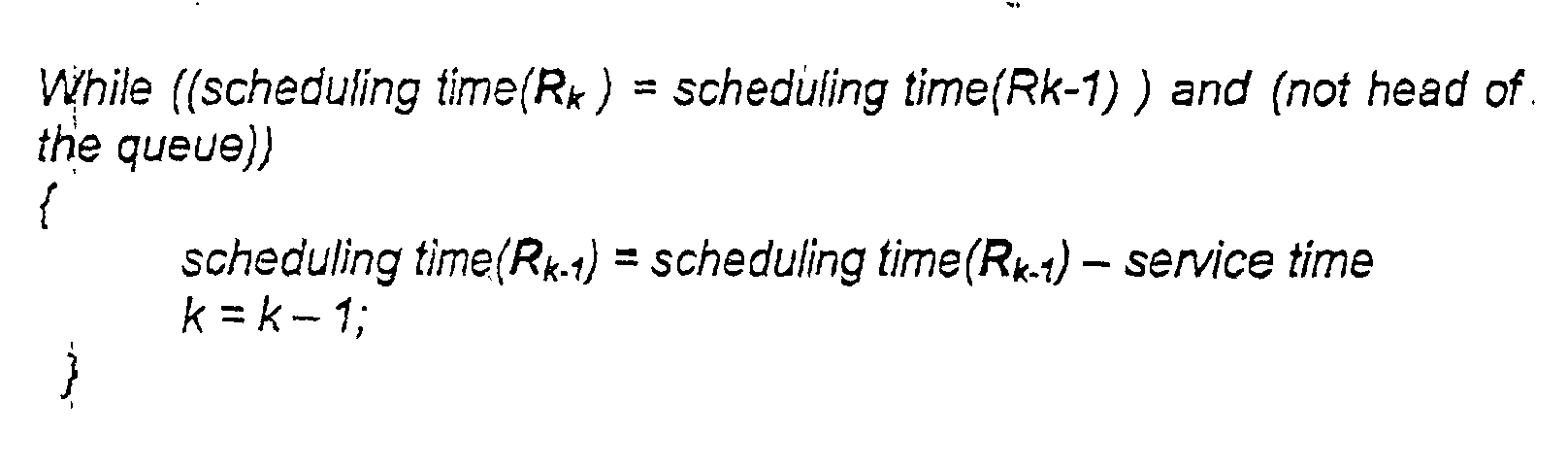
- the queue is always ordered according to the scheduling time. Therefore, let us consider that the new request is denoted as R new
- the algorithm for updating the scheduling time is as follows, where the request the new request is designated R k :
- the queue content is shown in Figure 1a.
- the slot is empty there so we insert this request in this empty slot as shown in Figure 1b.
- the queue content after this insertion is shown in Figure 1d.
- the multiple queue embodiment has a separate queue for each priority level and requests in each priority levels are sorted according to deadline.
- the algorithm tries to serve a request from the lower priority queue as long as serving this lower priority request does not violate the deadline of the higher priority requests.
- This algorithm relies on merging of several queues while making the decision if taking a lower priority request violates the deadline of a higher priority request. The algorithm is outlined below;
- R new be a newly arriving request with priority i.
- R new into Q i according to its deadline and then we do the merging step to determine the new order in which the requests will be serviced.
- the new scheduling order is stored in queue Q.
- the priority queues be Q1, Q2, Q3, Q4, .... Q k Where Q1 is the highest priority queue.
- scheduling order we mean the order by which the requests will be serviced.
- Queue 0 is be highest priority queue and Queue 2 be the lowest priority queue and assume a service time of 5 msec for simplicity.
- Figure 2 illustrates the initial configuration of three exemplary queues (Queue 0, Queue 1 and Queue 2).
- the two presently preferred algorithms described here each have both advantages and disadvantages.
- the decision of which to implement will depend on the goals and objectives of the particular system being designed.
- the single queue embodiment is very easy to implement when block size is fixed, which means service time or transfer time is fixed for all the requests. It requires only O(n) time, where n is the number of requests in the queue.
- the disadvantage of the single queue embodiment is that when the service time is not fixed special attention may need to be given to ensure deadlines of higher priority requests are met. Thus it may be necessary to mark several lower priority requests to allow the system to delete as many entries as necessary in order to meet the deadline of the new higher priority requests.
- the disk model for the simulation environment is the following Table 1: Disk Model Disk Parameters Values Type Quantum XP32150 No of cylinders 3832 Tracks/Cylinder 10 No. of zones 16 Sector size 512 Rotation speed 7200 RPM Disk size 2.1 GBytes Block size 1 Mbytes Transfer speed 4.9 - 8.2 Mbytes/sec Disks/RAID 5 (4 data 1 parity)
Landscapes
- Engineering & Computer Science (AREA)
- Theoretical Computer Science (AREA)
- Human Computer Interaction (AREA)
- Physics & Mathematics (AREA)
- General Engineering & Computer Science (AREA)
- General Physics & Mathematics (AREA)
- Signal Processing (AREA)
- Multimedia (AREA)
- Databases & Information Systems (AREA)
- Television Signal Processing For Recording (AREA)
- Two-Way Televisions, Distribution Of Moving Picture Or The Like (AREA)
- Moving Of Heads (AREA)
- Feeding And Guiding Record Carriers (AREA)
- Paper (AREA)
- Management, Administration, Business Operations System, And Electronic Commerce (AREA)
- Computer And Data Communications (AREA)
- Multi Processors (AREA)
- Information Retrieval, Db Structures And Fs Structures Therefor (AREA)
- Information Transfer Between Computers (AREA)
Abstract
Description
| Request | (priority, deadline) |
| 1. | (0, 10) |
| 2. | (1, 15) |
| 3. | (0, 10) |
| 4. | (0, 20) |
| 5. | (0, 20) |
| 6. | (1, 15) |
| 7. | (2, 25) |
Let the priority queues be Q1, Q2, Q3, Q4, .... Qk
Where Q1 is the highest priority queue.
After arrival of every new request the following steps are followed to build a merged queue that is sorted according to scheduling order. By scheduling order we mean the order by which the requests will be serviced.

- Step 1: Insertion of R1 and R2 into the merged queue.
- Step 2: Insertion of R3
- Step 3: Insertion of R4
- Step 4: Insertion of R5
Note that if we insert R5 then it violates the deadline of the higher priority
requests so delete the request R5 from the
Queue 2. - Step 5: Insertion of R6
| Disk Model | |
| Disk Parameters | Values |
| Type | Quantum XP32150 |
| No of cylinders | 3832 |
| Tracks/ | 10 |
| No. of zones | 16 |
| Sector size | 512 |
| Rotation speed | 7200 RPM |
| Disk size | 2.1 GBytes |
| | 1 Mbytes |
| Transfer speed | 4.9 - 8.2 Mbytes/sec |
| Disks/RAID | 5 (4 |
| Number of Loss for Three Priority Levels | |||||||
| Number of | Priority level | 0 | | Priority level 2 | |||
| P-EDF | Single Q | P-EDF | Single Q | P- | Single Q | ||
| 40 | 0 | 0 | 0 | 0 | 0 | 0 | |
| 41 | 64 | 2 | 0 | 0 | 0 | 0 | |
| 42 | 877 | 723 | 0 | 0 | 0 | 0 | |
| 43 | 1772 | 1568 | 0 | 0 | 0 | 0 | |
| 44 | 2562 | 2331 | 0 | 0 | 0 | 0 | |
| 45 | 3458 | 3200 | 0 | 0 | 0 | 0 | |
| 46 | 4223 | 3994 | 0 | 0 | 0 | 0 | |
| 47 | 5103 | 4836 | 0 | 0 | 0 | 0 | |
| 48 | 5799 | 5578 | 0 | 0 | 0 | 0 | |
| 49 | 6690 | 6447 | 0 | 0 | 0 | 0 | |
| 50 | 7400 | 7215 | 0 | 0 | 0 | 0 |
Claims (10)
- A method of scheduling a new disk access request, comprising:a. maintaining at least one queue of disk access requests, representing each member in said queue by a data structure that records at least deadline priority and scheduling time for each member;b. processing a new request for disk access by determining a scheduling time for said new request based on a deadline associated with said new request;c. scanning said queue to locate an insertion point for said new request by comparing the scheduling time and priority of said new request with the scheduling times and priorities of other members in said queue, said insertion point being selected such that the deadlines of members of higher priority than said new request are not violated;d. while scanning said queue in step c, identifying and marking members of lower priority than said new request;e. inserting said new request into said queue at said insertion point if so doing does not violate the deadline of any member of higher priority than said new request;f. if in step d one marked member was identified and if inserting said new request into said queue at said insertion point violates the deadline of any member of higher priority than said new request, then deleting said marked member and repeating steps e and f;g. if in step d at least no marked member was identified and if inserting said new request into said queue at said insertion point violates the deadline of any member of higher priority than said new request, then discard said new request.
- The method of claim 1 wherein said data structure records a service time for each member corresponding to the transfer time associated with reading said member from the disk.
- The method of claim 1 wherein said step b of determining a scheduling time is performed by obtaining a deadline associated with said new request and subtracting the transfer time associated with reading a member from said disk.
- The method of claim 1 further comprising maintaining separate queues of disk access requests for different priority levels.
- The method of claim 1 further comprising maintaining separate queues of disk access requests for different priority levels and merging said separate queues while making the decision if taking a lower priority request violates the deadline of a higher priority request.
- The method of claim 1 further comprising updating the scheduling times of each member in said queue preceding said step e of inserting said new request if a plurality of members have the same scheduling time.
- The method of claim 6 wherein said updating step is performed by adjusting the scheduling time of one of said plurality by an amount related to the service time involved in reading a member from the disk.
- The method of claim 6 wherein said updating step is performed by first adjusting the scheduling time of one of said plurality by an amount related to the service time involved in reading a member from the disk and by iteratively adjusting the scheduling times of additional members whose scheduling times are caused to overlap as a result of said first adjusting step.
- The method of claim 1 wherein said members correspond to MPEG video frames classified as intra, predictive and bi-directional frames, and wherein said priorities are assigned to said members according to their frame classification.
- The method of claim 1 wherein said queue contains members are each represented as a tuple of at least four elements: scheduling time, priority, deadline and service time.
Applications Claiming Priority (2)
| Application Number | Priority Date | Filing Date | Title |
|---|---|---|---|
| US672916 | 2000-09-28 | ||
| US09/672,916 US6871011B1 (en) | 2000-09-28 | 2000-09-28 | Providing quality of service for disks I/O sub-system with simultaneous deadlines and priority |
Publications (3)
| Publication Number | Publication Date |
|---|---|
| EP1193967A2 true EP1193967A2 (en) | 2002-04-03 |
| EP1193967A3 EP1193967A3 (en) | 2003-11-12 |
| EP1193967B1 EP1193967B1 (en) | 2005-11-16 |
Family
ID=24700551
Family Applications (1)
| Application Number | Title | Priority Date | Filing Date |
|---|---|---|---|
| EP01308234A Expired - Lifetime EP1193967B1 (en) | 2000-09-28 | 2001-09-27 | Providing quality of service for disks I/O sub-system |
Country Status (6)
| Country | Link |
|---|---|
| US (1) | US6871011B1 (en) |
| EP (1) | EP1193967B1 (en) |
| JP (1) | JP2002197046A (en) |
| CN (1) | CN1356639A (en) |
| AT (1) | ATE310357T1 (en) |
| DE (1) | DE60114966D1 (en) |
Cited By (3)
| Publication number | Priority date | Publication date | Assignee | Title |
|---|---|---|---|---|
| US7797484B2 (en) | 2005-11-29 | 2010-09-14 | International Business Machines Corporation | Managing access to disk storage |
| CN101252516B (en) * | 2008-03-27 | 2011-07-13 | 中兴通讯股份有限公司 | Method for realizing high speed downlink grouping traffic |
| US20220342929A1 (en) * | 2020-06-28 | 2022-10-27 | Baidu Online Network Technology (Beijing) Co.,Ltd. | Data processing method and apparatus, device, and storage medium |
Families Citing this family (50)
| Publication number | Priority date | Publication date | Assignee | Title |
|---|---|---|---|---|
| US7849172B2 (en) * | 2002-03-01 | 2010-12-07 | Broadcom Corporation | Method of analyzing non-preemptive DRAM transactions in real-time unified memory architectures |
| WO2004056082A2 (en) * | 2002-11-27 | 2004-07-01 | Rgb Media, Inc. | Method and apparatus for time-multiplexed processing of multiple digital video programs |
| WO2004095825A2 (en) * | 2003-04-21 | 2004-11-04 | Rgb Networks, Inc. | Time-multiplexed multi-program encryption system |
| US20040225707A1 (en) * | 2003-05-09 | 2004-11-11 | Chong Huai-Ter Victor | Systems and methods for combining a slow data stream and a fast data stream into a single fast data stream |
| US20070261082A1 (en) * | 2003-08-22 | 2007-11-08 | Interuniversitair Microelektronica Centrum (Imec) | Method for operating a multi-media wireless system in a multi-user environment |
| US20060114836A1 (en) | 2004-08-20 | 2006-06-01 | Sofie Pollin | Method for operating a combined multimedia -telecom system |
| US8228952B2 (en) * | 2003-08-22 | 2012-07-24 | Imec | Method for operating a telecom system |
| WO2005022796A2 (en) | 2003-08-29 | 2005-03-10 | Rgb Networks, Inc. | Advanced, adaptive video multiplexer system |
| TWI256555B (en) | 2003-12-12 | 2006-06-11 | Via Tech Inc | An apparatus and a method of request priority queue arbitration |
| CN100392627C (en) * | 2003-12-22 | 2008-06-04 | 威盛电子股份有限公司 | Memory access request priority sequence arbitration device and method |
| US7254685B1 (en) | 2004-06-15 | 2007-08-07 | Emc Corporation | Method for maintaining high performance while preserving relative write I/O ordering for a semi-synchronous remote replication solution |
| TWI284810B (en) * | 2004-08-18 | 2007-08-01 | Via Tech Inc | Software communication between MPEG layer and servo layer |
| US7260703B1 (en) * | 2004-08-20 | 2007-08-21 | Sun Microsystems, Inc. | Method and apparatus for I/O scheduling |
| US7386692B1 (en) * | 2004-08-20 | 2008-06-10 | Sun Microsystems, Inc. | Method and apparatus for quantized deadline I/O scheduling |
| US7305537B1 (en) | 2005-03-01 | 2007-12-04 | Sun Microsystems, Inc. | Method and system for I/O scheduler activations |
| US7281086B1 (en) | 2005-06-02 | 2007-10-09 | Emc Corporation | Disk queue management for quality of service |
| US20060288184A1 (en) * | 2005-06-17 | 2006-12-21 | Seagate Technology Llc | Admission control in data storage devices |
| US7636801B1 (en) | 2005-06-20 | 2009-12-22 | Symantec Operating Corporation | Coordination of quality of service in a multi-layer virtualized storage environment |
| US7293136B1 (en) | 2005-08-19 | 2007-11-06 | Emc Corporation | Management of two-queue request structure for quality of service in disk storage systems |
| WO2007035519A2 (en) * | 2005-09-16 | 2007-03-29 | The Research Foundation Of State University Of New York | File system having predictable real-time performance |
| US7478179B2 (en) * | 2005-11-04 | 2009-01-13 | Sun Microsystems, Inc. | Input/output priority inheritance wherein first I/O request is executed based on higher priority |
| US20070106849A1 (en) * | 2005-11-04 | 2007-05-10 | Sun Microsystems, Inc. | Method and system for adaptive intelligent prefetch |
| US7657671B2 (en) * | 2005-11-04 | 2010-02-02 | Sun Microsystems, Inc. | Adaptive resilvering I/O scheduling |
| US7523271B2 (en) * | 2006-01-03 | 2009-04-21 | International Business Machines Corporation | Apparatus, system, and method for regulating the number of write requests in a fixed-size cache |
| JP4622871B2 (en) * | 2006-01-26 | 2011-02-02 | ソニー株式会社 | Data processing system, access control method, apparatus thereof, and program thereof |
| BRPI0621480A2 (en) * | 2006-03-28 | 2011-12-13 | Thomson Licensing | centralized programming for content delivery network |
| US8127294B2 (en) * | 2007-05-22 | 2012-02-28 | Intel Corporation | Disk drive for handling conflicting deadlines and methods thereof |
| US20090094248A1 (en) * | 2007-10-03 | 2009-04-09 | Concert Technology Corporation | System and method of prioritizing the downloading of media items in a media item recommendation network |
| KR100927190B1 (en) * | 2007-10-12 | 2009-11-18 | 한국전자통신연구원 | Disk Scheduling Method and Apparatus |
| US8347302B1 (en) | 2008-10-09 | 2013-01-01 | Amazon Technologies, Inc. | System-aware resource scheduling |
| JP2010108300A (en) | 2008-10-30 | 2010-05-13 | Hitachi Ltd | Information processing system, and method of allocating i/o to path in information processing system |
| KR101644800B1 (en) | 2010-01-07 | 2016-08-02 | 삼성전자주식회사 | Computing system and method |
| US8621176B2 (en) * | 2010-01-20 | 2013-12-31 | Netapp, Inc. | Method and system for allocating data objects for efficient reads in a mass storage subsystem |
| US8732426B2 (en) | 2010-09-15 | 2014-05-20 | Pure Storage, Inc. | Scheduling of reactive I/O operations in a storage environment |
| US12008266B2 (en) | 2010-09-15 | 2024-06-11 | Pure Storage, Inc. | Efficient read by reconstruction |
| US11275509B1 (en) | 2010-09-15 | 2022-03-15 | Pure Storage, Inc. | Intelligently sizing high latency I/O requests in a storage environment |
| US8589655B2 (en) | 2010-09-15 | 2013-11-19 | Pure Storage, Inc. | Scheduling of I/O in an SSD environment |
| US8589625B2 (en) | 2010-09-15 | 2013-11-19 | Pure Storage, Inc. | Scheduling of reconstructive I/O read operations in a storage environment |
| US8468318B2 (en) | 2010-09-15 | 2013-06-18 | Pure Storage Inc. | Scheduling of I/O writes in a storage environment |
| US11614893B2 (en) | 2010-09-15 | 2023-03-28 | Pure Storage, Inc. | Optimizing storage device access based on latency |
| US8868855B2 (en) * | 2011-02-28 | 2014-10-21 | Hewlett-Packard Development Company, L.P. | Request management system and method for dynamically managing prioritized requests |
| CN102457578B (en) * | 2011-12-16 | 2015-10-07 | 中标软件有限公司 | A kind of distributed network monitoring method based on case mechanism |
| US9471524B2 (en) * | 2013-12-09 | 2016-10-18 | Atmel Corporation | System bus transaction queue reallocation |
| CN104991816A (en) * | 2015-06-25 | 2015-10-21 | 浪潮(北京)电子信息产业有限公司 | Process scheduling method and apparatus |
| GB2540809B (en) * | 2015-07-29 | 2017-12-13 | Advanced Risc Mach Ltd | Task scheduling |
| US10356002B2 (en) * | 2017-01-24 | 2019-07-16 | Nokia Solutions And Networks Oy | Processing real-time multipoint-to-point traffic |
| US11354164B1 (en) * | 2018-04-20 | 2022-06-07 | Automation Anywhere, Inc. | Robotic process automation system with quality of service based automation |
| US10908950B1 (en) | 2018-04-20 | 2021-02-02 | Automation Anywhere, Inc. | Robotic process automation system with queue orchestration and task prioritization |
| CN109783028B (en) * | 2019-01-16 | 2022-07-15 | Oppo广东移动通信有限公司 | Optimization method and device for I/O scheduling, storage medium and intelligent terminal |
| CN114489867B (en) * | 2022-04-19 | 2022-09-06 | 浙江大华技术股份有限公司 | Algorithm module scheduling method, algorithm module scheduling device and readable storage medium |
Family Cites Families (9)
| Publication number | Priority date | Publication date | Assignee | Title |
|---|---|---|---|---|
| US5956321A (en) | 1995-03-16 | 1999-09-21 | Kabushiki Kaisha Toshiba | Stream scheduling system for real time stream server |
| US6049332A (en) | 1996-10-07 | 2000-04-11 | Sony Corporation | Method and apparatus for the scheduling and ordering of elements in a multimedia environment |
| US6078998A (en) | 1997-02-11 | 2000-06-20 | Matsushita Electric Industrial Co., Ltd. | Real time scheduling of prioritized disk requests |
| US6370323B1 (en) * | 1997-04-03 | 2002-04-09 | Lsi Logic Corporation | Digital video disc decoder including command buffer and command status pointers |
| US6023720A (en) | 1998-02-09 | 2000-02-08 | Matsushita Electric Industrial Co., Ltd. | Simultaneous processing of read and write requests using optimized storage partitions for read and write request deadlines |
| US6182197B1 (en) | 1998-07-10 | 2001-01-30 | International Business Machines Corporation | Real-time shared disk system for computer clusters |
| CN1161977C (en) * | 1998-12-23 | 2004-08-11 | 皇家菲利浦电子有限公司 | device for receiving programs |
| US6378036B2 (en) | 1999-03-12 | 2002-04-23 | Diva Systems Corporation | Queuing architecture including a plurality of queues and associated method for scheduling disk access requests for video content |
| US6496899B1 (en) * | 2000-02-28 | 2002-12-17 | Sun Microsystems, Inc. | Disk scheduling system with bounded request reordering |
-
2000
- 2000-09-28 US US09/672,916 patent/US6871011B1/en not_active Expired - Fee Related
-
2001
- 2001-09-27 DE DE60114966T patent/DE60114966D1/en not_active Expired - Lifetime
- 2001-09-27 AT AT01308234T patent/ATE310357T1/en not_active IP Right Cessation
- 2001-09-27 EP EP01308234A patent/EP1193967B1/en not_active Expired - Lifetime
- 2001-09-28 JP JP2001302770A patent/JP2002197046A/en active Pending
- 2001-09-28 CN CN01138463.8A patent/CN1356639A/en active Pending
Cited By (4)
| Publication number | Priority date | Publication date | Assignee | Title |
|---|---|---|---|---|
| US7797484B2 (en) | 2005-11-29 | 2010-09-14 | International Business Machines Corporation | Managing access to disk storage |
| CN101252516B (en) * | 2008-03-27 | 2011-07-13 | 中兴通讯股份有限公司 | Method for realizing high speed downlink grouping traffic |
| US20220342929A1 (en) * | 2020-06-28 | 2022-10-27 | Baidu Online Network Technology (Beijing) Co.,Ltd. | Data processing method and apparatus, device, and storage medium |
| US11847161B2 (en) * | 2020-06-28 | 2023-12-19 | Baidu Online Network Technology (Beijing) Co., Ltd. | Data processing method and apparatus, device, and storage medium |
Also Published As
| Publication number | Publication date |
|---|---|
| ATE310357T1 (en) | 2005-12-15 |
| CN1356639A (en) | 2002-07-03 |
| US6871011B1 (en) | 2005-03-22 |
| EP1193967A3 (en) | 2003-11-12 |
| DE60114966D1 (en) | 2005-12-22 |
| EP1193967B1 (en) | 2005-11-16 |
| JP2002197046A (en) | 2002-07-12 |
Similar Documents
| Publication | Publication Date | Title |
|---|---|---|
| EP1193967B1 (en) | Providing quality of service for disks I/O sub-system | |
| US5708796A (en) | Method of retrieving continuous and non-continuous media data from a file system | |
| Yu et al. | Grouped sweeping scheduling for DASD-based multimedia storage management | |
| Vin et al. | A statistical admission control algorithm for multimedia servers | |
| Vin et al. | Algorithms for designing multimedia servers | |
| Freedman et al. | The SPIFFI scalable video-on-demand system | |
| US5926649A (en) | Media server for storage and retrieval of voluminous multimedia data | |
| US5787482A (en) | Deadline driven disk scheduler method and apparatus with thresholded most urgent request queue scan window | |
| EP1262062B1 (en) | A disk scheduling system with reordering of a bounded number of requests | |
| CA2506598A1 (en) | Method and apparatus for time-multiplexed processing of multiple digital video programs | |
| CN1426552A (en) | System for and method of accessing blocks on storage medium | |
| KR20020019597A (en) | Method of and system for reading blocks from a storage medium | |
| Aref et al. | Disk scheduling in video editing systems | |
| Christodoulakis et al. | Research and development issues for large-scale multimedia information systems | |
| Lau et al. | A novel video-on-demand storage architecture for supporting constant frame rate with variable bit rate retrieval | |
| EP0771099A2 (en) | Distributed multimedia service system | |
| CHIUEH et al. | Design and implementation of the stony brook video server | |
| Zhuo et al. | Efficient cache placement scheme for clustered time-shifted TV servers | |
| JPH0981455A (en) | Client device, server device, and storage device control method | |
| Aref et al. | Disk scheduling for displaying and recording video in nonlinear news editing systems | |
| Ma et al. | Efficient real-time data retrieval through scalable multimedia storage | |
| Philip et al. | Look-ahead scheduling to support pause-resume for video-on-demand applications | |
| US20060167959A1 (en) | Storing programs on disk for multiple-user retrieval | |
| Chen et al. | A cost-based admission control algorithm for handling mixed workloads in multimedia server systems | |
| KR100794969B1 (en) | Adaptive Data Retrieval Method for Load Sharing in Clustered Video Servers |
Legal Events
| Date | Code | Title | Description |
|---|---|---|---|
| PUAI | Public reference made under article 153(3) epc to a published international application that has entered the european phase |
Free format text: ORIGINAL CODE: 0009012 |
|
| 17P | Request for examination filed |
Effective date: 20011015 |
|
| AK | Designated contracting states |
Kind code of ref document: A2 Designated state(s): AT BE CH CY DE DK ES FI FR GB GR IE IT LI LU MC NL PT SE TR |
|
| AX | Request for extension of the european patent |
Free format text: AL;LT;LV;MK;RO;SI |
|
| PUAL | Search report despatched |
Free format text: ORIGINAL CODE: 0009013 |
|
| AK | Designated contracting states |
Kind code of ref document: A3 Designated state(s): AT BE CH CY DE DK ES FI FR GB GR IE IT LI LU MC NL PT SE TR |
|
| AX | Request for extension of the european patent |
Extension state: AL LT LV MK RO SI |
|
| AKX | Designation fees paid |
Designated state(s): AT BE CH CY DE DK ES FI FR GB GR IE IT LI LU MC NL PT SE TR |
|
| GRAP | Despatch of communication of intention to grant a patent |
Free format text: ORIGINAL CODE: EPIDOSNIGR1 |
|
| GRAS | Grant fee paid |
Free format text: ORIGINAL CODE: EPIDOSNIGR3 |
|
| GRAA | (expected) grant |
Free format text: ORIGINAL CODE: 0009210 |
|
| AK | Designated contracting states |
Kind code of ref document: B1 Designated state(s): AT BE CH CY DE DK ES FI FR GB GR IE IT LI LU MC NL PT SE TR |
|
| PG25 | Lapsed in a contracting state [announced via postgrant information from national office to epo] |
Ref country code: IT Free format text: LAPSE BECAUSE OF FAILURE TO SUBMIT A TRANSLATION OF THE DESCRIPTION OR TO PAY THE FEE WITHIN THE PRESCRIBED TIME-LIMIT;WARNING: LAPSES OF ITALIAN PATENTS WITH EFFECTIVE DATE BEFORE 2007 MAY HAVE OCCURRED AT ANY TIME BEFORE 2007. THE CORRECT EFFECTIVE DATE MAY BE DIFFERENT FROM THE ONE RECORDED. Effective date: 20051116 Ref country code: CH Free format text: LAPSE BECAUSE OF FAILURE TO SUBMIT A TRANSLATION OF THE DESCRIPTION OR TO PAY THE FEE WITHIN THE PRESCRIBED TIME-LIMIT Effective date: 20051116 Ref country code: FI Free format text: LAPSE BECAUSE OF FAILURE TO SUBMIT A TRANSLATION OF THE DESCRIPTION OR TO PAY THE FEE WITHIN THE PRESCRIBED TIME-LIMIT Effective date: 20051116 Ref country code: BE Free format text: LAPSE BECAUSE OF FAILURE TO SUBMIT A TRANSLATION OF THE DESCRIPTION OR TO PAY THE FEE WITHIN THE PRESCRIBED TIME-LIMIT Effective date: 20051116 Ref country code: LI Free format text: LAPSE BECAUSE OF FAILURE TO SUBMIT A TRANSLATION OF THE DESCRIPTION OR TO PAY THE FEE WITHIN THE PRESCRIBED TIME-LIMIT Effective date: 20051116 Ref country code: AT Free format text: LAPSE BECAUSE OF FAILURE TO SUBMIT A TRANSLATION OF THE DESCRIPTION OR TO PAY THE FEE WITHIN THE PRESCRIBED TIME-LIMIT Effective date: 20051116 Ref country code: NL Free format text: LAPSE BECAUSE OF FAILURE TO SUBMIT A TRANSLATION OF THE DESCRIPTION OR TO PAY THE FEE WITHIN THE PRESCRIBED TIME-LIMIT Effective date: 20051116 |
|
| REG | Reference to a national code |
Ref country code: GB Ref legal event code: FG4D |
|
| REG | Reference to a national code |
Ref country code: CH Ref legal event code: EP |
|
| REG | Reference to a national code |
Ref country code: IE Ref legal event code: FG4D |
|
| REF | Corresponds to: |
Ref document number: 60114966 Country of ref document: DE Date of ref document: 20051222 Kind code of ref document: P |
|
| PG25 | Lapsed in a contracting state [announced via postgrant information from national office to epo] |
Ref country code: DK Free format text: LAPSE BECAUSE OF FAILURE TO SUBMIT A TRANSLATION OF THE DESCRIPTION OR TO PAY THE FEE WITHIN THE PRESCRIBED TIME-LIMIT Effective date: 20060216 Ref country code: GR Free format text: LAPSE BECAUSE OF FAILURE TO SUBMIT A TRANSLATION OF THE DESCRIPTION OR TO PAY THE FEE WITHIN THE PRESCRIBED TIME-LIMIT Effective date: 20060216 Ref country code: SE Free format text: LAPSE BECAUSE OF FAILURE TO SUBMIT A TRANSLATION OF THE DESCRIPTION OR TO PAY THE FEE WITHIN THE PRESCRIBED TIME-LIMIT Effective date: 20060216 |
|
| PG25 | Lapsed in a contracting state [announced via postgrant information from national office to epo] |
Ref country code: DE Free format text: LAPSE BECAUSE OF FAILURE TO SUBMIT A TRANSLATION OF THE DESCRIPTION OR TO PAY THE FEE WITHIN THE PRESCRIBED TIME-LIMIT Effective date: 20060217 |
|
| PG25 | Lapsed in a contracting state [announced via postgrant information from national office to epo] |
Ref country code: ES Free format text: LAPSE BECAUSE OF FAILURE TO SUBMIT A TRANSLATION OF THE DESCRIPTION OR TO PAY THE FEE WITHIN THE PRESCRIBED TIME-LIMIT Effective date: 20060227 |
|
| PG25 | Lapsed in a contracting state [announced via postgrant information from national office to epo] |
Ref country code: PT Free format text: LAPSE BECAUSE OF FAILURE TO SUBMIT A TRANSLATION OF THE DESCRIPTION OR TO PAY THE FEE WITHIN THE PRESCRIBED TIME-LIMIT Effective date: 20060417 |
|
| NLV1 | Nl: lapsed or annulled due to failure to fulfill the requirements of art. 29p and 29m of the patents act | ||
| ET | Fr: translation filed | ||
| REG | Reference to a national code |
Ref country code: CH Ref legal event code: PL |
|
| PLBE | No opposition filed within time limit |
Free format text: ORIGINAL CODE: 0009261 |
|
| STAA | Information on the status of an ep patent application or granted ep patent |
Free format text: STATUS: NO OPPOSITION FILED WITHIN TIME LIMIT |
|
| PG25 | Lapsed in a contracting state [announced via postgrant information from national office to epo] |
Ref country code: IE Free format text: LAPSE BECAUSE OF NON-PAYMENT OF DUE FEES Effective date: 20060927 |
|
| PG25 | Lapsed in a contracting state [announced via postgrant information from national office to epo] |
Ref country code: MC Free format text: LAPSE BECAUSE OF NON-PAYMENT OF DUE FEES Effective date: 20060930 |
|
| 26N | No opposition filed |
Effective date: 20060817 |
|
| REG | Reference to a national code |
Ref country code: IE Ref legal event code: MM4A |
|
| PGFP | Annual fee paid to national office [announced via postgrant information from national office to epo] |
Ref country code: GB Payment date: 20070926 Year of fee payment: 7 |
|
| PGFP | Annual fee paid to national office [announced via postgrant information from national office to epo] |
Ref country code: FR Payment date: 20070914 Year of fee payment: 7 |
|
| PG25 | Lapsed in a contracting state [announced via postgrant information from national office to epo] |
Ref country code: TR Free format text: LAPSE BECAUSE OF FAILURE TO SUBMIT A TRANSLATION OF THE DESCRIPTION OR TO PAY THE FEE WITHIN THE PRESCRIBED TIME-LIMIT Effective date: 20051116 Ref country code: LU Free format text: LAPSE BECAUSE OF NON-PAYMENT OF DUE FEES Effective date: 20060927 |
|
| PG25 | Lapsed in a contracting state [announced via postgrant information from national office to epo] |
Ref country code: CY Free format text: LAPSE BECAUSE OF FAILURE TO SUBMIT A TRANSLATION OF THE DESCRIPTION OR TO PAY THE FEE WITHIN THE PRESCRIBED TIME-LIMIT Effective date: 20051116 |
|
| GBPC | Gb: european patent ceased through non-payment of renewal fee |
Effective date: 20080927 |
|
| REG | Reference to a national code |
Ref country code: FR Ref legal event code: ST Effective date: 20090529 |
|
| PG25 | Lapsed in a contracting state [announced via postgrant information from national office to epo] |
Ref country code: FR Free format text: LAPSE BECAUSE OF NON-PAYMENT OF DUE FEES Effective date: 20080930 |
|
| PG25 | Lapsed in a contracting state [announced via postgrant information from national office to epo] |
Ref country code: GB Free format text: LAPSE BECAUSE OF NON-PAYMENT OF DUE FEES Effective date: 20080927 |