EP1193903A1 - Data transmission system - Google Patents
Data transmission system Download PDFInfo
- Publication number
- EP1193903A1 EP1193903A1 EP00927820A EP00927820A EP1193903A1 EP 1193903 A1 EP1193903 A1 EP 1193903A1 EP 00927820 A EP00927820 A EP 00927820A EP 00927820 A EP00927820 A EP 00927820A EP 1193903 A1 EP1193903 A1 EP 1193903A1
- Authority
- EP
- European Patent Office
- Prior art keywords
- transmission
- frame
- frames
- station
- threshold
- Prior art date
- Legal status (The legal status is an assumption and is not a legal conclusion. Google has not performed a legal analysis and makes no representation as to the accuracy of the status listed.)
- Withdrawn
Links
Images







Classifications
-
- H—ELECTRICITY
- H04—ELECTRIC COMMUNICATION TECHNIQUE
- H04L—TRANSMISSION OF DIGITAL INFORMATION, e.g. TELEGRAPHIC COMMUNICATION
- H04L1/00—Arrangements for detecting or preventing errors in the information received
- H04L1/12—Arrangements for detecting or preventing errors in the information received by using return channel
- H04L1/16—Arrangements for detecting or preventing errors in the information received by using return channel in which the return channel carries supervisory signals, e.g. repetition request signals
- H04L1/18—Automatic repetition systems, e.g. Van Duuren systems
- H04L1/1825—Adaptation of specific ARQ protocol parameters according to transmission conditions
-
- H—ELECTRICITY
- H04—ELECTRIC COMMUNICATION TECHNIQUE
- H04L—TRANSMISSION OF DIGITAL INFORMATION, e.g. TELEGRAPHIC COMMUNICATION
- H04L1/00—Arrangements for detecting or preventing errors in the information received
- H04L1/0001—Systems modifying transmission characteristics according to link quality, e.g. power backoff
- H04L1/0015—Systems modifying transmission characteristics according to link quality, e.g. power backoff characterised by the adaptation strategy
- H04L1/0019—Systems modifying transmission characteristics according to link quality, e.g. power backoff characterised by the adaptation strategy in which mode-switching is based on a statistical approach
- H04L1/0021—Systems modifying transmission characteristics according to link quality, e.g. power backoff characterised by the adaptation strategy in which mode-switching is based on a statistical approach in which the algorithm uses adaptive thresholds
-
- H—ELECTRICITY
- H04—ELECTRIC COMMUNICATION TECHNIQUE
- H04L—TRANSMISSION OF DIGITAL INFORMATION, e.g. TELEGRAPHIC COMMUNICATION
- H04L1/00—Arrangements for detecting or preventing errors in the information received
- H04L1/12—Arrangements for detecting or preventing errors in the information received by using return channel
- H04L1/16—Arrangements for detecting or preventing errors in the information received by using return channel in which the return channel carries supervisory signals, e.g. repetition request signals
- H04L1/18—Automatic repetition systems, e.g. Van Duuren systems
- H04L1/1806—Go-back-N protocols
-
- H—ELECTRICITY
- H04—ELECTRIC COMMUNICATION TECHNIQUE
- H04L—TRANSMISSION OF DIGITAL INFORMATION, e.g. TELEGRAPHIC COMMUNICATION
- H04L1/00—Arrangements for detecting or preventing errors in the information received
- H04L1/12—Arrangements for detecting or preventing errors in the information received by using return channel
- H04L1/16—Arrangements for detecting or preventing errors in the information received by using return channel in which the return channel carries supervisory signals, e.g. repetition request signals
- H04L1/18—Automatic repetition systems, e.g. Van Duuren systems
- H04L1/1809—Selective-repeat protocols
-
- H—ELECTRICITY
- H04—ELECTRIC COMMUNICATION TECHNIQUE
- H04L—TRANSMISSION OF DIGITAL INFORMATION, e.g. TELEGRAPHIC COMMUNICATION
- H04L1/00—Arrangements for detecting or preventing errors in the information received
- H04L1/12—Arrangements for detecting or preventing errors in the information received by using return channel
- H04L1/16—Arrangements for detecting or preventing errors in the information received by using return channel in which the return channel carries supervisory signals, e.g. repetition request signals
- H04L1/18—Automatic repetition systems, e.g. Van Duuren systems
- H04L1/1829—Arrangements specially adapted for the receiver end
-
- H—ELECTRICITY
- H04—ELECTRIC COMMUNICATION TECHNIQUE
- H04L—TRANSMISSION OF DIGITAL INFORMATION, e.g. TELEGRAPHIC COMMUNICATION
- H04L1/00—Arrangements for detecting or preventing errors in the information received
- H04L1/12—Arrangements for detecting or preventing errors in the information received by using return channel
- H04L1/16—Arrangements for detecting or preventing errors in the information received by using return channel in which the return channel carries supervisory signals, e.g. repetition request signals
- H04L1/18—Automatic repetition systems, e.g. Van Duuren systems
- H04L1/1867—Arrangements specially adapted for the transmitter end
- H04L1/1874—Buffer management
-
- H—ELECTRICITY
- H04—ELECTRIC COMMUNICATION TECHNIQUE
- H04L—TRANSMISSION OF DIGITAL INFORMATION, e.g. TELEGRAPHIC COMMUNICATION
- H04L1/00—Arrangements for detecting or preventing errors in the information received
- H04L1/12—Arrangements for detecting or preventing errors in the information received by using return channel
- H04L2001/125—Arrangements for preventing errors in the return channel
-
- H—ELECTRICITY
- H04—ELECTRIC COMMUNICATION TECHNIQUE
- H04L—TRANSMISSION OF DIGITAL INFORMATION, e.g. TELEGRAPHIC COMMUNICATION
- H04L69/00—Network arrangements, protocols or services independent of the application payload and not provided for in the other groups of this subclass
- H04L69/30—Definitions, standards or architectural aspects of layered protocol stacks
- H04L69/32—Architecture of open systems interconnection [OSI] 7-layer type protocol stacks, e.g. the interfaces between the data link level and the physical level
- H04L69/322—Intralayer communication protocols among peer entities or protocol data unit [PDU] definitions
- H04L69/324—Intralayer communication protocols among peer entities or protocol data unit [PDU] definitions in the data link layer [OSI layer 2], e.g. HDLC
Definitions
- the invention relates to a data transmission system having a control mode, in which data involving errors are re-transmitted when errors are generated, and more particularly, to a data transmission system for performing an optimum data transmission by choosing re-transmission processing in a SR mode and re-transmission processing in a GBN mode.
- ARQ Automatic Repeat Request
- Such ARQ mode is roughly classified into two kinds, that is, a SR (Selective Repeat) mode, by which only a frame or frames involving an error are re-transmitted, and a GBN (GO BACK N) mode, by which a frame or frames involving an error and a frame or frames subsequent to the above-mentioned a frame or frames are re-transmitted.
- SR Selective Repeat
- GBN GO BACK N
- the SR mode is superior to the GBN mode in throughput characteristics but needs to store and keep a frame or frames including and succeeding a (m + 1)-th frame having been received normally until a m-th frame involving an error is received normally by re-transmission, so that there is a need of an exceedingly large buffer depending upon a manner, in which an error or errors generate.
- the GBN mode does not need a buffer for storing and keeping a frame or frames including and succeeding a (m + 1)-th frame in order to perform re-transmission of all frames including and succeeding a m-th frame involving an error but is inferior to the SR mode in throughput characteristics because a frame or frames including and succeeding a (m + 1)-th frame having been received normally are re-transmitted.
- Fig. 18 is a timing diagram showing a timing of data transmission in a data transmission system proposed in Japanese Patent Laid-Open No. 108632/1987, in which re-transmission is implemented in the SR method in the case where the number, in which frames involving an error are consecutive, is less than a specified value, and in the GBN mode, in the case where the number, in which frames involving an error are consecutive, is equal to or more than the specified value.
- a transmission station divides data to create frames with transmission numbers, and adds error detection bits to such frames to transmit the same.
- a receiving station performs detection of an error whenever receiving such frames, and checks transmission numbers with respect to only frames free of an error. Judging that frames have disappeared in the case where discontinuity occurs in transmission numbers having been checked, re-transmission is demanded.
- a data transmission system having a less required buffer can be realized by basically acting in the SR mode, which is excellent in throughput characteristics, and changing over to the GBN mode in the case where the number of consecutive error frames becomes equal to or more than a specified value.
- n2 is set so as to meet n2>x
- x re-transmission demand frames to which identifiers of SR are applied, are transmitted.
- the probability of all the x re-transmission demand frames reaching the transmission station becomes very low in a state, in which errors generate in re-transmission demand frames as assumed first and transmission does not reach the transmission station in high probability.
- a round trip delay is a duration elapsed from an initial point, at which a transmission station transmits a certain frame, until a receiving station recognizes an error in the frame to issue a re-transmission demand frame and the transmission station receives the re-transmission demand frame to re-transmit the same frame. It is assumed, for example, a state, in which such round trip delay is great.
- the GBN mode since all frames including and succeeding an error frame are re-transmitted upon request of re-transmission, frames transmitted during such round trip delay are wasted to lower the throughput, and in the case of a great round trip delay, an amount of such lowering becomes very large. At this time, with a specified value set small, GBN is frequently actuated to lower the throughput exceedingly.
- a specified value is set small, for example, 1 in a transmission line, in which consecutive frame errors are dominant, even when GBN is started at all times, times of starting the GBN is small due to consecution of errors in a transmission line, in which consecutive frame errors are dominant, as compared with a transmission line, which has the same rate of frame errors and in which a single frame error is dominant, so that the number of frames being discarded wastefully is reduced to result in less reduction in throughput, as compared with the case where a large specified value is set and action is made in the SR mode.
- the GBN mode is in some cases excellent in throughput characteristics. At such time, there is a need of setting an appropriate specified value in view of a transmission line, but the prior art makes no mention of any method of setting a specified value.
- the invention has been thought of to solve the above-mentioned problems, and has its object to provide a data transmission system, which has functions of the SR mode and the GBN mode, and can realize re-transmission in a more optimum one of the SR mode and the GBN mode according to a status of data transmission when frame errors are detected.
- a second station comprises detection means for detecting error frames among a frame or frames, which cannot be received normally, judgment means for judging whether the number of error frames being consecutive is equal to or more than a threshold, threshold setting means for setting the threshold on the basis of a status of transmission associated with the first station and a second station, and re-transmission demanding means for transmitting to the first station a re-transmission demand frame, which demands re-transmission of all frames numbered subsequent to a specified transmission number, in the case where the number of error frames being consecutive is equal to or more than the threshold, and for transmitting to the first station a re-transmission demand frame, which demands re-transmission of a frame having a specified transmission number, in the case where the number of the error frames being consecutive is less than the threshold.
- the above-mentioned threshold setting means sets a threshold on the basis of the number, in which error frames generated in the past are consecutive.
- the above-mentioned threshold is an average of the number, in which error frames generated in the past are consecutive.
- the above-mentioned threshold setting means sets a threshold in accordance with a rate of errors, which are generated in the past without consecution.
- a second station comprises detection means for detecting error frames among a frame or frames, which are transmitted from a first station and cannot be received normally, judgment means for judging whether the number of error frames being consecutive is equal to or more than a threshold, threshold setting means for setting the threshold on the basis of a status of transmission associated with the first station and the second station, and re-transmission demanding means for transmitting to the first station a re-transmission demand frame, which demands re-transmission of all frames numbered subsequent to a specified transmission number, in the case where the number of error frames being consecutive is equal to or more than the threshold, and for transmitting to the first station a re-transmission demand frame, which demands re-transmission of a frame having a specified transmission number, in the case where the number of the error frames being consecutive is less than the threshold.
- the above-mentioned first station comprises first transmission means for transmitting a transmission-status frame indicative of a status of generation of error frames, which cannot be normally received, among a frame or frames transmitted from a second station, and threshold setting means sets a threshold in accordance with the transmission-status frame.
- the above-mentioned first transmission means transmits a transmission-status frame indicative of failure in the case where the frequency, at which error frames generate, is equal to or more than a specified value as predetermined, and a transmission-status frame indicative of favorableness in the case where the frequency, at which error frames generate, is less than a specified value
- the above-mentioned threshold setting means sets a threshold to be large in the case of receiving a transmission-status frame indicative of favorableness as compared with the case of receiving a transmission-status frame indicative of failure.
- the above-mentioned second station comprises a transmission buffer for temporarily storing frames as divided, and comprises second transmission means for transmitting a frame or frames stored in a transmission buffer, and wherein the above-mentioned threshold setting means sets a threshold in accordance with the number of frames stored in the buffer.
- a second station comprises detection means for detecting error frames among a frame or frames, which cannot be received normally, judgment means for judging from a status of generation of error frames whether a single frame error is dominant or successive frame errors are dominant, threshold setting means for setting a threshold on the basis of the judgment, and re-transmission demanding means for transmitting to a first station a re-transmission demand frame, which demands re-transmission of all frames numbered subsequent to a specified transmission number, in the case where the number of the error frames being consecutive is equal to or more than the threshold, and for transmitting to the first station a re-transmission demand frame, which demands re-transmission of a frame having a specified transmission number, in the case where the number of the error frames being consecutive is less than the threshold.
- the number of consecutive frame errors (referred below to as "GBN start threshold) serving as a reference for selecting the SR mode or the GBN mode in carrying out re-transmission is represented by an average of the number of consecutive frame errors in three times in the past.
- Fig, 1 is a block diagram showing the constitution of a transmission system in the invention.
- the transmission system is composed mainly of a first station 100, a second station 200 and a transmission line 300.
- the first station 100 and the second station 200 are both constructed in the same manner, the first station 100 having a control unit 101, a transmission processing unit 102, and a receiving processing unit 103, and the second station 200 having a control unit 201, a transmission processing unit 202, and a receiving processing unit 203.
- control unit 101 has a standby buffer 101a, the transmission processing unit 102 having a transmission buffer 102a, the receiving processing unit 103 having a receiving buffer 103a, the control unit 201 having a standby buffer 201a, the transmission processing unit 202 having a transmission buffer 202a, and the receiving processing unit 203 having a receiving buffer 203a.
- the respective buffers are dynamically acquired.
- the transmission line 300 has a first transmission line 301, through which data is forwarded to the second station 200 from the first station 100, and a second transmission line 302, through which data is forwarded to the first station 100 from the second station 200.
- a transmission command is first issued from an application program or the like, and data is forwarded to the control unit 101 according to the transmission command.
- the control unit 101 divides the data into predetermined lengths and adds thereto sequential transmission numbers to make frames and accumulate the same in the transmission buffer 102a.
- the transmission processing unit 102 successively reads frames accumulated in the transmission buffer 102a, adds thereto error detection bits such as CRC to forward the same to the second station 200 via the first transmission line 301.
- the second station 200 first accumulates the received frames in the receiving processing unit 203 in the order of reception. Also, the receiving processing unit 203 performs an error check of CRC or the like of frames accumulated in the receiving processing unit 203 to transmit to the control unit 201 only framed free of an error.
- the control unit 201 aligns frames in the order of transmission numbers to generate data to deliver the same to a high-order application program (not shown).
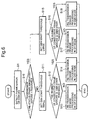
- control unit 201 of the second station 200 receives a frame from the receiving processing unit 203 to check the transmission number of the frame, thus detecting occurrence of a frame error (STEP (referred below to as "S") 1).
- an average value obtained by averaging the number of consecutive error frames of frames errors in the last three times is set as a GBN start threshold (S4).
- GBN start threshold is set in S3 and S4
- it is judged that the number of consecutive error frames this time is equal to or more than the GBN start threshold (S5).
- the re-transmission demand processing in the GBN mode is implemented (S6).
- details of the re-transmission demand processing in the GBN mode are as follows.
- the control unit 201 delivers to the transmission processing unit 202 a re-transmission demand frame, on which the transmission number of a frame involving an error and a identifier of SR are set, and the transmission processing unit 202 adds a error detection bit, such as CRC, to the transmission processing unit to deliver the same to the first station 100.
- a error detection bit such as CRC
- the first station 100 receives the re-transmission demand frame and detecting the identifier of SR added to the re-transmission demand frame, transmits a frame having that transmission number, which is added to re-transmission demand frame to the second station 200.
- the second station 200 implements a series of processings, in which the frame is received and confirmed, every transmission number of a frame involving an error.
- frames not based on those re-transmission demands having been forwarded in the meantime are accumulated and kept to be forwarded to a high-order application program or the like at the point of time when transmission numbers are assembled successively.
- Such action implements the re-transmission demand processing in the SR mode since the number of consecutive error frames at the point of time t 1 in, for example, Fig. 3(b) is (k - 1) and smaller than (k - 1 + k + 1 + k)/3 in the case where the number of consecutive error frames is (k - 1), (k+1) and k in the past three times when a frame error is recognized at the point of time t 1 .
- such action implements the re-transmission demand processing in the GBN mode since the number (k + 1) of consecutive error frames at the point of time t 2 in Fig.
- 3(b) is equal to or more than (k + 1 + k + 1 + k)/3 in the case where the number of consecutive error frames is (k + 1), k and (k - 1) in the past three times when a frame error is recognized at the point of time t 2 .
- the GBN start threshold is not an average of the number of consecutive error frames in the past three times but, for example, a minimum value of the number of consecutive error frames in the past three times, a value of the highest frequency of the number of consecutive error frames in the past, or a value (the number of consecutive error frames) amounting to a cumulative probability X % by counting from the minimum value.
- a GBN start threshold is set every detection of a frame error in Embodiment 1, for example, a GBN start threshold is not an average of the number of consecutive error frames in three times immediately before but may be preset as an average of frame errors in the past three times going back to the past from a particular point of time.
- an action of setting a GBN start threshold and an action of a re-transmission demand processing are implemented independently of each other.
- the control unit 201 set a GBN start threshold to an optimum value predictable prior to the operation of the system (S100).
- the optimum value is determined by quality (error probability, delay or the like) demanded for services, and the moving speed of terminals.
- S101 On standby for a particular period of time (S101), and after the lapse of a particular period of time, it is judged whether frame errors in three times or more in the past have been detected (S102). In the case where it is judged that frame errors in three times or more are not detected in S102, the processing is returned to S101.
- an average of the number of consecutive error frames for frame errors occurred in three times immediately before is set as a GBN start threshold (S103), and the processing is returned to S101.
- control unit 201 of the second station 200 receives a frame from the receiving processing unit 203 and checks its transmission number to detect the occurrence of a frame error (S201).
- the re-transmission demand processing in the SR mode is implemented (S203). Also, in the case where it is judged that the number of consecutive error frames is equal to or more than the GBN start threshold in S202, the re-transmission demand processing in the GBN mode is implemented (S204).
- This comprises calculating an average of the number of consecutive error frames in three times going back to the past from a point of time t o in the case where a point of time on standby for a particular period of time S11 is t 0 in Fig. 3, and making the average a GBN start threshold. And making a comparison between the number of consecutive error frames detected at subsequent points of time t 1 and t 2 and the GBN start threshold, selection is made between a re-transmission demand processing in the SR mode and a re-transmission demand processing in the GBN mode.
- Embodiment 3 in a state, in which the first station 100 and the second station 200 perform both transmission and reception of data, line-status is transmitted regularly to the other party, and selection is made according to the line-status between a re-transmission demand processing in the SR mode and a re-transmission demand processing in the GBN mode.
- this transmission system is the same as that shown in Fig. 1.
- the different points are the control unit 101 forwards a line-status frame, in which information indicative of failure in the second transmission line 302 is set, to the second station 200 in the case where a rate of error frames detected in a period of time is equal to or more than a predetermined value, and forwards a line-status frame, in which information indicative of favorableness in the second transmission line 302 is set, to the second station 200 in the case where the rate is less than the predetermined value.
- control unit 201 forwards a line-status frame, in which information indicative of failure in the first transmission line 301 is set, to the first station 100 in the case where a rate of error frames detected in a period of time is equal to or more than a predetermined value, and forwards a line-status frame, in which information indicative of favorableness in the first transmission line 301 is set, to the first station 100 in the case where the rate is less than the predetermined value.
- control unit 201 of the second station 200 investigates a transmission number of a received frame forwarded from the receiving processing unit 203 to detect a frame error (S1).
- the control unit 201 judges whether information indicative of favorableness is set in line-status received immediately before (S10).
- a GBN start threshold is set to be small (S11). This is because by performing the re-transmission demand processing in GBN if possible, it is desired to reduce the number of re-transmission demand frames being forwarded to the first station 100 from the second station 200, and, for example, the number of re-transmission demand frames may be set by beforehand determining a specified value and multiplying the same by a coefficient 0.5 or so. Subsequently, it is judged whether the number of consecutive error frames is equal to or more than the GBN start threshold (S12).
- the re-transmission demand processing in the SR mode is implemented (S13). Also, in the case where the number of consecutive error frames is equal to or more than the GBN start threshold in S12, the re-transmission demand processing in the GBN mode is implemented (S14).
- a GBN start threshold is set to be large (S15). This is because throughput is desired to take preference, and, for example, setting may be made by beforehand determining a specified value and multiplying the same by a coefficient 1.5 or so. Subsequently, it is judged whether the number of consecutive error frames is equal to or more than the GBN start threshold (S16). In the case where it is judged that the number of consecutive error frames is less than the GBN start threshold in S16, the re-transmission demand processing in the SR mode is implemented (S17). Also, in the case where the number of consecutive error frames is equal to or more than the GBN start threshold in S16, the re-transmission demand processing in the GBN mode is implemented (S18).
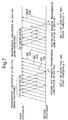
- the occurrence of an error in three frames, of which the transmission number is 202, 203, 204, is detected when a frame of the transmission number 205 is received at the point of time t 2 . Since errors occur frequently in frames transmitted to the first station 100 from the second station 200, however, the first station 100 transmits a transmission line-status frame, in which information indicative of failure is set supposing that the second transmission line 302 is in an unfavorable state, in the same timing as that of transmission of a frame of the transmission number 205. In this case, the second station 200 implements the re-transmission demand processing in the GBN mode because the GBN start threshold is set small, thus 3 here, and the number of consecutive error frames is 3.
- a GBN start threshold is set here by checking whether a line-status is favorable or not, whenever a frame error is detected, the processing of setting the GBN start threshold and the re-transmission demand processing may be made independent of each other.
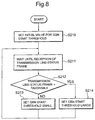
- Fig. 8 is a flowchart showing an action of setting a GBN start threshold.
- an initial value is set for a GBN start threshold at the start of the transmission system (S210). Subsequently, reception of a transmission line-status frame from the first station 100 is waited for (S211).
- reception of a transmission line-status frame from the first station 100 is waited for (S211).
- a GBN start threshold is set small (S213), and on the other hand, in the case where it is judged that information indicative of favorableness is set, a GBN start threshold is set large (S214).
- Embodiment 4 re-transmission demand frames, to which identifiers of GBN are added, are successively transmitted a plurality of times in the re-transmission demand processing in the GBN mode in S14 and S18 in Fig. 6.
- Fig. 9 is a timing diagram in this case, and is different from a timing diagram of Fig. 7 in that re-transmission demand frames, to which identifiers of GBN are added, are successively transmitted two times at the point of time t 2 .
- control unit of the first station 100 and the control unit of the second station 200 must implement the processing of bypassing re-transmission demand frames forwarded later in the case where same re-transmission demand frames are forwarded within a particular period of time.
- a GBN start threshold is set in conformity with an amount of data in transmission in a state, in which the first station 100 and the second station 200 implement both transmission & reception of data.
- this transmission system is the same as that shown in Fig. 1 but is different therefrom in that the control unit 101 and the control unit 201 monitor a data transmission line-status and set a GBN start threshold according to the line-status.
- control unit 201 of the second station 200 investigates a transmission number of a frame received from the receiving processing unit 203 to detect a frame error (S1).
- a state of the transmission buffer 202a is caught (S20).
- This state means an amount of use in the transmission buffer 202a.
- a GBN start threshold is set to be large since frames forwarded to the first station 100 from the second station 200 are scarce and can be estimated to have less influence on frame transmission to the first station 100 from the second station 200 even when the number of re-transmission demand frames is increased to some extent (S22).
- the re-transmission demand processing is implemented in the SR mode (S24). Also, in the case where it is judged that the number of consecutive error frames is equal to or more than the GBN start threshold, the re-transmission demand processing is implemented in the GBN mode (S25).
- a GBN start threshold is set to be small since frames forwarded to the first station 100 from the second station 200 are many and can be estimated to have much influence on frame transmission from the second station 200 (S26). Subsequently, it is judged whether the number of consecutive error frames is equal to or more than the GBN start threshold (S27).
- the re-transmission demand processing is implemented in the SR mode (S28). Also, in the case where it is judged that the number of consecutive error frames is equal to or more than the GBN start threshold, the re-transmission demand processing is implemented in the GBN mode (S29).
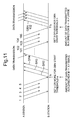
- This comprises detecting the occurrence of an error in three frames, of which the transmission number is 2, 3, 4, when a frame of the transmission number 5 is received at the point of time t 1 in, for example, Fig. 11. Also, since there is almost no frame forwarded to the first station 100 from the second station 200, a GBN start threshold is set 4, and re-transmission demand frames, to which a identifier of SR and the transmission number are added, are transmitted three times because the number of consecutive error frames is 3. Also, the occurrence of an error in three frames, of which the transmission number is 102, 103, 104, is detected when a frame of the transmission number 105 is received at the point of time t 2 .
- a GBN start threshold is set 3
- re-transmission demand frames, to which identifiers of GBN are added is transmitted one time because the number of consecutive error frames is 3.
- a GBN start threshold is set judging from an amount of frames being forwarded, such that a GBN start threshold is set to a small value to decrease the number of re-transmission demand frames in the event of an amount of data transmission being much, the need of transmitting many re-transmission demand frames is prevented from occupying a transmission band in a direction, in which re-transmission demand is to be transmitted, and causing delay due to incapability of implementing an ordinary data transmission. Also, in the case where data transmission is small in amount, a GBN start threshold is set to be large, so that re-transmission can be carried out in the SR method and so throughput is enhanced.
- the processing of setting the GBN start threshold and the re-transmission demand processing may be made independently of each other in such case because services of keeping a constant speed are provided when data are generated.
- Fig. 12 is a flowchart showing an action of setting a GBN start threshold.
- an initial value is set for a GBN start threshold at the start of the transmission system (S210). Subsequently, a predetermined period of time is waited (S220), and then a state of the transmission buffer 202a is caught (S221). Subsequently, it is judged whether an amount of use in the buffer is equal to or more than a specified value (S222).
- a GBN start threshold is set to be large (S223).
- a GBN start threshold is set to be small (S224).
- S223 and S224 is done, it is again returned to S220.
- the round trip delay indicates a time elapsed until a re-transmission demand frame is received due to the occurrence of an error in a frame after a transmitting station transmits the frame, and is dependent upon speeds of transmission & reception in respective stations, a transmission range between two stations, which perform communication, and a status of load in a station.
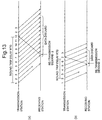
- Fig. 13 is a view showing the relationship between throughput and round slip delay in the GBN mode, Fig. 13(a) showing an example, in which a round trip delay is large, and Fig. 13(b) showing an example, in which a round trip delay is small.
- a GBN start threshold is set small, and in the case of a round trip delay being small, a GBN start threshold is set great.
- this transmission system is the same as that shown in Fig. 1 but is different therefrom in that when receiving a re-transmission demand frame, the control unit 101 and the control unit 201 set in accordance with the re-transmission demand, a round trip delay on a frame being transmitted to transmit the same, and that a GBN start threshold is set in accordance with a round trip delay in the received frame.
- control unit 201 of the second station 200 investigates the transmission number of a frame forwarded from the receiving processing unit 203 to detect a frame error (S1).
- a round trip delay in a frame stored in the control unit 201 and re-transmitted according to a re-transmission demand frame transmitted in the last time is equal to or more than a specified value (S30).
- a GBN start threshold is set to be small (S31).
- the re-transmission demand processing is implemented in the SR mode (S33).
- the re-transmission demand processing is implemented in the GBN mode (S34).
- a GBN start threshold is set to be great (S35). Subsequently, it is judged whether the number of consecutive error frames is equal to or more than the GBN start threshold (S36).
- the re-transmission demand processing is implemented in the SR mode (S37). Also, in the case where it is judged that the number of consecutive error frames is equal to or more than the GBN start threshold, the re-transmission demand processing is implemented in the GBN mode (S38).
- a GBN start threshold is set to be large, and when a round trip delay is small, a GBN start threshold is set to be small, whereby it is possible to prevent great reduction in throughput.
- the processing of setting the GBN start threshold and the re-transmission demand processing may be made independent of each other.
- an initial value is set for a GBN start threshold at the start of the transmission system (S210). Subsequently, a frame based on a re-transmission demand is waited for until it is received (S230), and at the time of reception, it is judged whether a round trip delay in the frame is equal to or more than a specified value (S231).
- a GBN start threshold is set to be small (S232). Also, it is judged that the round trip delay is equal to or more than the specified value, a GBN start threshold is set to be great (S233). In addition, after the processing in S232 and S233 is done, it is again returned to S230.
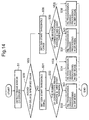
- Fig. 16 is a view showing a comparison between a transmission line, in which a single frame error is dominant and a transmission line, in which successive frame errors are dominant, and the throughput characteristics in the respective lines, in which a GBN start threshold is varied.
- Fig. 16(a) shows a transmission line, in which a single frame error is dominant.
- Fig. 16(b) shows a transmission line, in which successive frame errors are dominant.
- the GBN mode may be actively made use of by setting a small value for a GBN start threshold.
- a receiving station always watches a status, in which frame errors generate.
- a small value is set for a GBN start threshold.
- a large value is set for a GBN start threshold.
- 10 is set.
- the throughput can be maintained highest by setting a GBN start threshold small and actively using the GBN mode in a status of a transmission line, in which consecutive frame errors are dominant.
Landscapes
- Engineering & Computer Science (AREA)
- Computer Networks & Wireless Communication (AREA)
- Signal Processing (AREA)
- Artificial Intelligence (AREA)
- Physics & Mathematics (AREA)
- Probability & Statistics with Applications (AREA)
- Quality & Reliability (AREA)
- Detection And Prevention Of Errors In Transmission (AREA)
Abstract
Description
Claims (10)
- A data transmission system having a first station for dividing data into one or more sections and thereafter adding sequential transmission number thereto to create a frame or frames to transmit the same, and a second station for receiving the frame or frames,
the second station comprising detection means for detecting error frames among the frame or frames, which cannot be received normally, judgment means for judging whether the number of error frames being consecutive is equal to or more than a threshold, threshold setting means for setting the threshold on the basis of a status of transmission associated with the first station and the second station, and re-transmission demanding means for transmitting to the first station a re-transmission demand frame, which demands re-transmission of all frames numbered subsequent to a specified transmission number, in the case where the number of the error frames being consecutive is equal to or more than the threshold, and for transmitting to the first station a re-transmission demand frame, which demands re-transmission of a frame having a specified transmission number, in the case where the number of the error frames being consecutive is less than the threshold. - The data transmission system according to claim 1, wherein the threshold setting means sets a threshold on the basis of the number, in which error frames generated in the past are consecutive.
- The data transmission system according to claim 1, wherein the threshold is an average of the number, in which error frames generated in the past are consecutive.
- The data transmission system according to claim 1, wherein the threshold setting means sets a threshold in accordance with a rate of errors, which are generated in the past without consecution.
- A data transmission system having a first station for receiving a frame or frames and for dividing data into one or more sections and thereafter adding sequential transmission number thereto to create a frame or frames to transmit the same, and a second station for receiving the frame or frames, and for dividing data into one or more sections and thereafter adding sequential transmission number to create a frame or frames to transmit the same,
the second station comprising detection means for detecting error frames among the frame or frames, which are transmitted from the first station and cannot be received normally, judgment means for judging whether the number of error frames being consecutive is equal to or more than a threshold, threshold setting means for setting the threshold on the basis of a status of transmission associated with the first station and the second station, and re-transmission demanding means for transmitting to the first station a re-transmission demand frame, which demands re-transmission of all frames numbered subsequent to a specified transmission number, in the case where the number of the error frames being consecutive is equal to or more than the threshold, and for transmitting to the first station a re-transmission demand frame, which demands re-transmission of a frame having a specified transmission number, in the case where the number of the error frames being consecutive is less than the threshold. - The data transmission system according to claim 5, wherein the first station comprises first transmission means for transmitting a transmission-status frame indicative of a status of generation of error frames, which cannot be normally received, among a frame or frames transmitted from the second station, and the threshold setting means sets a threshold in accordance with the transmission-status frame.
- The data transmission system according to claim 6, wherein the first transmission means transmits a transmission-status frame indicative of failure in the case where the frequency, at which error frames generate, is equal to or more than a specified value as predetermined, and a transmission-status frame indicative of favorableness in the case where the frequency, at which error frames generate, is less than the specified value, and wherein the threshold setting means sets the threshold to be large in the case of receiving a transmission-status frame indicative of favorableness as compared with the case of receiving a transmission-status frame indicative of failure.
- The data transmission system according to claim 5, wherein the second station comprises a transmission buffer for temporarily storing frames as divided, and comprises second transmission means for transmitting a frame or frames stored in the transmission buffer, and wherein the threshold setting means sets a threshold in accordance with the number of frames stored in the buffer.
- The data transmission system according to claim 5, wherein the second station comprises detection means for detecting a round trip delay being a time elapsed until a frame of the transmission number specified is received after transmission of a re-transmission demand frame, of which the transmission number is specified, and wherein the threshold setting means sets a threshold in accordance with the round trip delay.
- A data transmission system having a first station for dividing data into one or more sections and thereafter adding sequential transmission number thereto to create a frame or frames to transmit the same, and a second station for receiving the frame or frames,
the second station comprising detection means for detecting error frames among the frame or frames, which cannot be received normally, judgment means for judging from a status of generation of the error frames whether a single frame error is dominant or successive frame errors are dominant, threshold setting means for setting a threshold on the basis of the judgment, and re-transmission demanding means for transmitting to the first station a re-transmission demand frame, which demands re-transmission of all frames numbered subsequent to a specified transmission number, in the case where the number of the error frames being consecutive is equal to or more than the threshold, and for transmitting to the first station a re-transmission demand frame, which demands re-transmission of a frame having a specified transmission number, in the case where the number of the error frames being consecutive is less than the threshold.
Applications Claiming Priority (1)
| Application Number | Priority Date | Filing Date | Title |
|---|---|---|---|
| PCT/JP2000/003239 WO2001091357A1 (en) | 2000-05-22 | 2000-05-22 | Data transmission system |
Publications (2)
| Publication Number | Publication Date |
|---|---|
| EP1193903A1 true EP1193903A1 (en) | 2002-04-03 |
| EP1193903A4 EP1193903A4 (en) | 2004-08-25 |
Family
ID=11736049
Family Applications (1)
| Application Number | Title | Priority Date | Filing Date |
|---|---|---|---|
| EP00927820A Withdrawn EP1193903A4 (en) | 2000-05-22 | 2000-05-22 | DATA TRANSMISSION SYSTEM |
Country Status (2)
| Country | Link |
|---|---|
| EP (1) | EP1193903A4 (en) |
| WO (1) | WO2001091357A1 (en) |
Cited By (5)
| Publication number | Priority date | Publication date | Assignee | Title |
|---|---|---|---|---|
| WO2007077086A1 (en) * | 2005-12-29 | 2007-07-12 | Endress+Hauser Process Solutions Ag | Method for adapting a communication network used in process automation technology to the quality of the communication link between a transmitter and a receiver |
| CN109697113A (en) * | 2018-12-29 | 2019-04-30 | 广州华多网络科技有限公司 | Request method, apparatus, equipment and the readable storage medium storing program for executing retried |
| EP4002734A1 (en) * | 2020-11-19 | 2022-05-25 | Mellanox Technologies, Ltd. | Selective retransmission of packets |
| CN116132728A (en) * | 2022-12-29 | 2023-05-16 | 深圳创维-Rgb电子有限公司 | Abnormal image frame processing method and related device |
| US11870590B2 (en) | 2020-11-19 | 2024-01-09 | Mellanox Technologies, Ltd. | Selective retransmission of packets |
Families Citing this family (3)
| Publication number | Priority date | Publication date | Assignee | Title |
|---|---|---|---|---|
| US7096027B2 (en) | 2001-10-04 | 2006-08-22 | Mitsubishi Denki Kabushiki Kaisha | Communication method, communication system and communication apparatus |
| KR20050069978A (en) * | 2002-08-13 | 2005-07-05 | 코닌클리즈케 필립스 일렉트로닉스 엔.브이. | Arq system with status and packet acknowledgement |
| JP5052549B2 (en) * | 2009-03-03 | 2012-10-17 | 株式会社東芝 | Wireless communication apparatus and wireless communication method |
Family Cites Families (7)
| Publication number | Priority date | Publication date | Assignee | Title |
|---|---|---|---|---|
| JPS5635550A (en) * | 1979-08-31 | 1981-04-08 | Fujitsu Ltd | Automatic retransmission request system |
| EP0162478A3 (en) * | 1984-05-25 | 1987-03-04 | Ntx Communications Corporation | Method and apparatus for high speed satellite communication |
| JPH0746800B2 (en) * | 1986-03-12 | 1995-05-17 | 株式会社日立製作所 | Data retransmission method |
| JPH0779332B2 (en) * | 1991-02-25 | 1995-08-23 | 日本電信電話株式会社 | Data retransmission transmission method |
| JPH10190635A (en) * | 1996-12-26 | 1998-07-21 | Hitachi Ltd | Communication system performing error retransmission, communication control device thereof, and error retransmission method |
| JPH10247901A (en) * | 1997-03-04 | 1998-09-14 | Matsushita Electric Ind Co Ltd | Retransmission control method |
| US6424625B1 (en) * | 1998-10-28 | 2002-07-23 | Telefonaktiebolaget Lm Ericsson (Publ) | Method and apparatus for discarding packets in a data network having automatic repeat request |
-
2000
- 2000-05-22 EP EP00927820A patent/EP1193903A4/en not_active Withdrawn
- 2000-05-22 WO PCT/JP2000/003239 patent/WO2001091357A1/en not_active Ceased
Cited By (5)
| Publication number | Priority date | Publication date | Assignee | Title |
|---|---|---|---|---|
| WO2007077086A1 (en) * | 2005-12-29 | 2007-07-12 | Endress+Hauser Process Solutions Ag | Method for adapting a communication network used in process automation technology to the quality of the communication link between a transmitter and a receiver |
| CN109697113A (en) * | 2018-12-29 | 2019-04-30 | 广州华多网络科技有限公司 | Request method, apparatus, equipment and the readable storage medium storing program for executing retried |
| EP4002734A1 (en) * | 2020-11-19 | 2022-05-25 | Mellanox Technologies, Ltd. | Selective retransmission of packets |
| US11870590B2 (en) | 2020-11-19 | 2024-01-09 | Mellanox Technologies, Ltd. | Selective retransmission of packets |
| CN116132728A (en) * | 2022-12-29 | 2023-05-16 | 深圳创维-Rgb电子有限公司 | Abnormal image frame processing method and related device |
Also Published As
| Publication number | Publication date |
|---|---|
| WO2001091357A1 (en) | 2001-11-29 |
| EP1193903A4 (en) | 2004-08-25 |
Similar Documents
| Publication | Publication Date | Title |
|---|---|---|
| EP1613018B1 (en) | Update of header compression state in packet communications using bit-stealing | |
| EP1535419B1 (en) | Method and devices for controlling retransmissions in data streaming | |
| EP1371192B1 (en) | Method and device for improving a data throughput | |
| US7924721B2 (en) | Communication apparatus, transmission control method, and transmission control program | |
| EP1193991A2 (en) | Wireless communication apparatus and wireless channel assigment method | |
| US7558279B2 (en) | Apparatus and method for minimizing transmission delay in a data communication system | |
| US8189593B2 (en) | Communication system, communication node, and packet scheduling method | |
| JP2002515686A (en) | Data transmission method | |
| WO2002001743A1 (en) | Method and apparatus for controlling packet transmission in a mobile telecommunication system | |
| US20020105933A1 (en) | Internode synchronizing device and internode synchronizing method | |
| EP1733331B1 (en) | Codec-assisted capacity enhancement of wireless voip | |
| JP2002538672A (en) | Adaptive header compression in packet communication | |
| EP1193903A1 (en) | Data transmission system | |
| RU2340119C2 (en) | Method of adjusting transmit window size on radio channel control level | |
| US7920476B2 (en) | Network congestion control | |
| EP1063864B1 (en) | Bandwidth optimiser dynamically operating in connections relating to radiocommunications, particularly for DECT systems | |
| CN102308646A (en) | Wireless communication device and system | |
| US20060120312A1 (en) | Communications method, communications system, relay apparatus, and recording medium | |
| CN118573936A (en) | Audio and video synchronous transmission optimization method and vehicle-cloud integrated end-to-end audio and video communication system | |
| US20070217333A1 (en) | Apparatus and method for processing reception frame in a wireless terminal | |
| JPWO2001091357A1 (en) | Data Transmission System | |
| JP3636620B2 (en) | Wireless communication device | |
| US20020173954A1 (en) | Adaptive media encoding and decoding equipment | |
| EP2600678B1 (en) | Multiple concurrent heterogenious data link management | |
| JP2002112304A (en) | Handover prediction communication system |
Legal Events
| Date | Code | Title | Description |
|---|---|---|---|
| PUAI | Public reference made under article 153(3) epc to a published international application that has entered the european phase |
Free format text: ORIGINAL CODE: 0009012 |
|
| 17P | Request for examination filed |
Effective date: 20020114 |
|
| AK | Designated contracting states |
Kind code of ref document: A1 Designated state(s): AT BE CH CY DE DK ES FI FR GB GR IE IT LI LU MC NL PT SE |
|
| RBV | Designated contracting states (corrected) |
Designated state(s): DE FR GB |
|
| A4 | Supplementary search report drawn up and despatched |
Effective date: 20040709 |
|
| RIC1 | Information provided on ipc code assigned before grant |
Ipc: 7H 04L 29/08 B Ipc: 7H 04L 1/18 B Ipc: 7H 04L 1/16 A |
|
| 17Q | First examination report despatched |
Effective date: 20040906 |
|
| GRAP | Despatch of communication of intention to grant a patent |
Free format text: ORIGINAL CODE: EPIDOSNIGR1 |
|
| STAA | Information on the status of an ep patent application or granted ep patent |
Free format text: STATUS: THE APPLICATION IS DEEMED TO BE WITHDRAWN |
|
| 18D | Application deemed to be withdrawn |
Effective date: 20050706 |