EP1193645B1 - Method and circuit for calculating and storing the membership degrees of a fuzzy set - Google Patents
Method and circuit for calculating and storing the membership degrees of a fuzzy set Download PDFInfo
- Publication number
- EP1193645B1 EP1193645B1 EP00830647A EP00830647A EP1193645B1 EP 1193645 B1 EP1193645 B1 EP 1193645B1 EP 00830647 A EP00830647 A EP 00830647A EP 00830647 A EP00830647 A EP 00830647A EP 1193645 B1 EP1193645 B1 EP 1193645B1
- Authority
- EP
- European Patent Office
- Prior art keywords
- value
- membership
- input
- membership degree
- pol
- Prior art date
- Legal status (The legal status is an assumption and is not a legal conclusion. Google has not performed a legal analysis and makes no representation as to the accuracy of the status listed.)
- Expired - Lifetime
Links
Images



Classifications
-
- G—PHYSICS
- G06—COMPUTING OR CALCULATING; COUNTING
- G06F—ELECTRIC DIGITAL DATA PROCESSING
- G06F1/00—Details not covered by groups G06F3/00 - G06F13/00 and G06F21/00
- G06F1/02—Digital function generators
- G06F1/03—Digital function generators working, at least partly, by table look-up
- G06F1/035—Reduction of table size
-
- G—PHYSICS
- G06—COMPUTING OR CALCULATING; COUNTING
- G06N—COMPUTING ARRANGEMENTS BASED ON SPECIFIC COMPUTATIONAL MODELS
- G06N7/00—Computing arrangements based on specific mathematical models
- G06N7/02—Computing arrangements based on specific mathematical models using fuzzy logic
- G06N7/04—Physical realisation
Definitions
- This invention relates to a codifying and storing method for fuzzy membership functions, the membership degree, as well as to a corresponding circuit for calculating the membership degree.
- the invention relates to a codifying and storing method for membership functions representing a membership degree of fuzzy variables defined within a universe of discourse which is discretized into a finite number of points.
- the invention also relates to a method for calculating the value of the membership degree of a fuzzy variable defined within a universe of discourse which is discretized into a finite number of points with reference to a membership function thereof.
- the invention further relates to a circuit for calculating the membership degree of a fuzzy variable within a universe of discourse which is discretized into a finite number of points with reference to a membership function thereof.
- MF membership function
- such a function represents the membership degree, MF(x), of a fuzzy variable x, and can be reproduced on a graph having the fuzzy variable x plotted on one axis and the respective membership degree, commonly designated ⁇ , plotted on the other axis.
- the codifying of the membership functions MF has been the subject of extensive investigations, due to the fact that it takes up a considerable amount of memory when the membership functions MF need to be stored, for instance, in a possible calculating structure.
- a necessary simplification is that of discretizing the membership functions MF as integer values of the fuzzy variable x in a so-called "universe of discourse" (U.d.D.).
- Each membership function MF is then defined by 0 to 2 n -1 points, i.e. discretized into n bits.
- a first known storing method uses a table for storing up, point by point, the value of the membership function MF, meaning that, for each discretized value of the fuzzy variable x, a corresponding membership degree ⁇ is stored.
- This first known method has a major advantage in that membership functions MF of any forms can be stored, and that the membership degrees ⁇ can be extracted at a fast rate starting from a given fuzzy variable x.
- the membership degree ⁇ of a membership function MF can be calculated as a function of the fuzzy variable x, thereby saving much memory area.
- this type of an approach requires complicated dedicated hardware for calculating the membership degree ⁇ from a given fuzzy variable x, and takes a long time to calculate the corresponding membership degrees ⁇ .
- the technical problem underlying this invention is to provide a storing method for membership functions MF which would apply to functions of any forms, while occupying but a small amount of memory area, so as to overcome the limitations of known storing methods.
- the resolutive idea to the technical problem is achieved, according to the invention, by splitting the membership functions MF into non-decreasing monotone or non-increasing monotone sections, and storing the membership function MF into a table whose address indicates the membership degree ⁇ .
- stored in the table will be maximum values, as well as minimum values, of a sub-set of fuzzy variables x having for their image the same membership degree ⁇ .
- the codifying and storing method for membership functions MF in accordance with the invention proceeds from the observation that the set of possible values for a fuzzy variable x is generally much larger than the set of possible values of the membership degree ⁇ for a membership function MF as calculated starting from said set of values for the fuzzy variable x.
- the set of values of the fuzzy variable x represents the universe of discourse (U.d.D.) of the fuzzy variable, i.e. in digital notation, a value of 0 to (2 n -1), where n is the number of bits representing the fuzzy variable x.
- the values of the membership degree ⁇ have, in digital notation, a maximum value which is always much smaller than the maximum value of the U.d.D.. Accordingly, the values of the membership degree ⁇ can be represented by few bits.
- the storing method provides for storing the values of the membership degree ⁇ of a membership function MF into a table whose address indicates the membership degree ⁇ . Stored in this table, for each address value, will be a maximum value, as well as a minimum value, of a sub-set of values of fuzzy variables x having for their image the same value of the membership degree ⁇ .
- the membership degree ⁇ e.g. for the non-decreasing monotone part, is used as the address of a table containing the maximum or minimum values of the sub-set which represents all the values of the fuzzy variable x that have for their image this value ⁇ used as a row address.
- the value of the membership degree ⁇ can be calculated starting from the row address ADD of the table.
- any functions can be represented by a succession of functions having only one maximum and/or one minimum.
- a single minimum function can be represented by its mirror image, i.e. a single maximum function, by calculating a negated value of ⁇ .
- the storing method according to the invention has therefore an advantage in that it is a comprehensive method for application to membership functions MF of any forms.
- the universe of discourse U.d.D.
- n bits the universe of discourse, U.d.D.
- p bits the membership degree
- the invention advantageously uses a memory with (2k+1) rows of n bits to represent a membership function MF.
- the membership function MF can be stored using two different methods.
- the membership function MF is split into a first non-decreasing monotone part and a second non-increasing monotone part, as shown schematically in Figure 1. Furthermore, the membership function MF is quantized so as to comprise a series of sub-sets corresponding graphically to horizontal segments each of the same value ⁇ , said sub-set of values for the fuzzy variable x corresponding to the value ⁇ .
- the membership function MF can be codified and stored into a memory MMF of the membership functions MF such that xo will correspond to address 0, xi will correspond to address 1, and so on to x k , corresponding to address k.
- X (k+1) is made to correspond to address k+1
- X (k+2) correspond to k+2
- x 2k (2 n +1), corresponding to address 2k, as shown schematically in Figure 2.
- the first value is here known beforehand because it is coincident with the lowest value of U.d.D., usually 0.
- the storing of this minimum value into the table can also be avoided in order to simplify the calculation algorithm.
- a membership function MF having a single minimum can be dealt with in two ways:
- This technique for codifying and storing the membership functions MF may also be applied to three-dimensional and multi-dimensional functions, on the grounds of the same geometrical and analytical considerations as made hereinabove in connection with two-dimensional functions.
- the first method previously described as representative of the state of the art - i.e. the storing method wherein a table is used to store up, point by point, the value of the membership function MF - exhibits the following features:
- the second method previously described as representing the state of the art and wherein parameters are used for storing up the membership functions MF, exhibits the following features:
- the codifying and storing method described hereinabove exhibits the following features:
- the size of the memory MMF for the membership functions MF is dependent on the size of the universe of discourse, U.d.D., and the maximum possible value of the membership degrees.
- a method for calculating the membership degree ⁇ of a fuzzy variable relative to its membership function MF the membership function MF being coded and stored up, as previously described, into a memory MMF.
- the calculation method according to the invention is of a sequential type and provides for reading sequentially from the memory MMF until a value x m contained in the memory MMF is found which corresponds to the first value equal to or greater than the value of an input fuzzy variable x ing , the location of said value x m in the memory MMF being the value of the membership degree ⁇ sought.
- the calculation circuit 10 will calculate, from the input fuzzy variable x ing , a value ⁇ corresponding to the membership degree of the input fuzzy variable x ing .
- the calculation circuit 10 comprises essentially a counter 1 connected to a table 2 of the memory MMF which contains the membership functions MF stored in accordance with the codifying and storing method 1 of the invention. In particular, storing the maximum values of the ranges ]x i-1 , x i ] will be considered.
- the counter 1 is input a clock signal CLK, a reset signal RST and an end-of-search signal STOP, and outputs a count signal ADD.
- the bits m-1 to 0 of the count signal ADD are delivered to said second input B of the adder block 4, and the m- th bit of the count signal ADD, corresponding to the most significant bit (MSB) of the polarity signal POL, is delivered to the first input A of the adder block 4.
- the MSB of the count signal ADD is also delivered to one input of a XOR logic gate 5 which receives the polarity signal POL on another input and outputs a polarity flag SP, in turn input to a plurality of (m-1) XOR logic gates PLm-1 ,..., PL0 contained in another calculation block 6.
- This calculation block 6 is input a result S from the adder block 4, and issues on an output OUT either the value ⁇ or its negation ⁇ ', according to the value of the polarity flag SP from the XOR gate 5.
- the reset signal RST initiates the step for calculating the value ⁇ or its negation ⁇ ' by starting the counter 1, which will begin to generate and issue the count signal ADD to the table 2 of the memory MMF wherein the maximum values of the ranges ]x i-1 , x i ], corresponding to those sets of the fuzzy variable x which have same value ⁇ , are stored.
- the comparator 3 checks that the value X ing is equal to or greater than the value contained at the address ADD in the memory, i.e. that X ing ⁇ MMF(ADD), and outputs a value 0 to stop the counter 1.
- the value ADD allows the desired information, i.e. the value ⁇ or its negation ⁇ ', to be calculated by the following rule:
- the negated value ⁇ ' can be calculated by simply negating, bit by bit, the value ⁇ , and conversely, the value ⁇ can be calculated by inverting the negated value ⁇ ' bit by bit.
- the adder block 4 then adds together the bits received at the inputs A and B, to directly output the value ⁇ if the MSB of the value ADD is a 0, and the negated value ⁇ ' if the MSB of the value ADD is a 1.
- the input fuzzy variable x ing is in the non-decreasing monotone part of the membership function MF and the sum of the bits received at the inputs A and B of the adder block 4 is indeed the value of the membership degree ⁇ , whereas if the MSB of the count signal ADD is a 1, the input fuzzy variable x ing is in the non-increasing monotone part of MF and the adder block 4 returns the negated value ⁇ ' calculated as (ADD-2 p +1).
- the aforementioned logic combination of signals is simply implemented by means of a XOR gate processing the polarity signal POL and the MSB of the count signal ADD, and by means of the block 6 of (m-1) XOR gates PLm-1,..., PL0 with a NOT function or one-bit inverters driven by the polarity flag SP, according to the following operational logic:
- the calculating time for the membership degree ⁇ according to the calculation method of the invention is directly proportional to the membership degree ⁇ .
- the more the bits needed to represent the membership degree ⁇ the more the memory words are needed to store the membership function MF and the longer becomes the time needed to calculate a membership degree corresponding to an input fuzzy variable.
- the calculation method according to the invention can be readily applied to membership functions MF having a number of maximum and minimum values greater than one. It is a matter of splitting into several sections having just one maximum and one minimum, and relating the calculation of the value ⁇ to each non-increasing or non-decreasing monotone section.
- the calculation circuit 10 shown schematically in Figure 3 is but one of the possible hardware circuits that can implement the calculation method according to the invention.
- a comparator of the A ⁇ B type may be used as the block 3.
- complementary logic blocks may be used or a NOT introduced in the polarity signal POL ahead of the XOR gate 5.
- the codifying and storing method for according to the invention optimizes, in particular minimizes, the memory area required for storing the membership functions MF, while retaining a large number of function types that can be represented, and the calculation method according to the invention is effective to minimize the hardware needed to calculate the membership degree ⁇ corresponding to a given fuzzy variable x.
Landscapes
- Engineering & Computer Science (AREA)
- Theoretical Computer Science (AREA)
- Physics & Mathematics (AREA)
- General Physics & Mathematics (AREA)
- General Engineering & Computer Science (AREA)
- Software Systems (AREA)
- Life Sciences & Earth Sciences (AREA)
- Computational Mathematics (AREA)
- Biomedical Technology (AREA)
- Fuzzy Systems (AREA)
- General Health & Medical Sciences (AREA)
- Molecular Biology (AREA)
- Health & Medical Sciences (AREA)
- Algebra (AREA)
- Artificial Intelligence (AREA)
- Automation & Control Theory (AREA)
- Data Mining & Analysis (AREA)
- Evolutionary Computation (AREA)
- Mathematical Analysis (AREA)
- Mathematical Optimization (AREA)
- Pure & Applied Mathematics (AREA)
- Computing Systems (AREA)
- Mathematical Physics (AREA)
- Feedback Control In General (AREA)
Description
- This invention relates to a codifying and storing method for fuzzy membership functions, the membership degree, as well as to a corresponding circuit for calculating the membership degree.
- Specifically, the invention relates to a codifying and storing method for membership functions representing a membership degree of fuzzy variables defined within a universe of discourse which is discretized into a finite number of points.
- The invention also relates to a method for calculating the value of the membership degree of a fuzzy variable defined within a universe of discourse which is discretized into a finite number of points with reference to a membership function thereof.
- The invention further relates to a circuit for calculating the membership degree of a fuzzy variable within a universe of discourse which is discretized into a finite number of points with reference to a membership function thereof.
- As is well known, a membership function (hereinafter also MF) is a single-variable function which, therefore, can be represented on a two-dimensional graph.
- In particular, such a function represents the membership degree, MF(x), of a fuzzy variable x, and can be reproduced on a graph having the fuzzy variable x plotted on one axis and the respective membership degree, commonly designated α, plotted on the other axis.
- The codifying of the membership functions MF has been the subject of extensive investigations, due to the fact that it takes up a considerable amount of memory when the membership functions MF need to be stored, for instance, in a possible calculating structure.
- In particular, with a digital calculating structure, a necessary simplification is that of discretizing the membership functions MF as integer values of the fuzzy variable x in a so-called "universe of discourse" (U.d.D.). Each membership function MF is then defined by 0 to 2n-1 points, i.e. discretized into n bits.
- Several techniques for storing membership functions MF are known.
- A first known storing method uses a table for storing up, point by point, the value of the membership function MF, meaning that, for each discretized value of the fuzzy variable x, a corresponding membership degree α is stored.
- This first known method has a major advantage in that membership functions MF of any forms can be stored, and that the membership degrees α can be extracted at a fast rate starting from a given fuzzy variable x.
- However, this approach has an important drawback in that the punctual storing of all the membership functions MF takes up a considerable amount of memory.
- Also known is to reduce the set of representable membership functions MF down to a sub-set which contains only certain geometric figures and, within this constraint, to use parameters for storing the membership functions MF. In particular, based on these parameters, the membership degree α of a membership function MF can be calculated as a function of the fuzzy variable x, thereby saving much memory area.
- There is also a dramatic decrease in the membership functions MF that can be represented with any accuracy, that is readily reduced to the allowable sub-set of geometric figures.
- This prior codifying and storing method for membership functions MF is used, for example, in
US Patent No. 5,875,438, filed on February 23, 1999 . - Furthermore, this type of an approach requires complicated dedicated hardware for calculating the membership degree α from a given fuzzy variable x, and takes a long time to calculate the corresponding membership degrees α.
- A known solution of this kind is disclosed for instance in Kiyohiko Uehata et al. : "Fuzzy inference based on families of A-Level sets" IEE, N.Y., Vol. 1, No. 2, May 1993, pages 111-124.
- The technical problem underlying this invention is to provide a storing method for membership functions MF which would apply to functions of any forms, while occupying but a small amount of memory area, so as to overcome the limitations of known storing methods.
- The resolutive idea to the technical problem is achieved, according to the invention, by splitting the membership functions MF into non-decreasing monotone or non-increasing monotone sections, and storing the membership function MF into a table whose address indicates the membership degree α. Thus, stored in the table will be maximum values, as well as minimum values, of a sub-set of fuzzy variables x having for their image the same membership degree α.
- Based on this resolutive idea, the technical problem is solved by a method for calculating the membership degree α of a fuzzy variable with reference to its membership function MF, as previously indicated and defined in the characterizing portion of
Claim 1. - The technical problem is further solved by a circuit for calculating the membership degree of a fuzzy variable, as previously indicated and defined in the characterizing portion of
Claim 3. - The features and advantages of the methods and the circuit according to the invention will be apparent from the following description of embodiments thereof, given by way of examples and not of limitation with reference to the accompanying drawings.
- In the drawings:
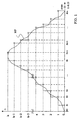
- Figure 1 shows schematically a membership function MF as discretized and quantized for storing according to a first storing method according to the invention;
- Figure 2 shows schematically a memory table for storing the membership function MF of Figure 1;
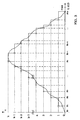
- Figure 3 shows schematically a membership function MF as discretized and quantized for storing according to a second storing method according to the invention;
- Figure 4 shows schematically a memory table for storing the membership function MF of Figure 3;
- Figure 5 shows schematically an architecture implementing the calculation method according to the invention in connection with the first storing method of Figure 1.
- The codifying and storing method for membership functions MF in accordance with the invention proceeds from the observation that the set of possible values for a fuzzy variable x is generally much larger than the set of possible values of the membership degree α for a membership function MF as calculated starting from said set of values for the fuzzy variable x.
- It should be considered in this respect, that the set of values of the fuzzy variable x represents the universe of discourse (U.d.D.) of the fuzzy variable, i.e. in digital notation, a value of 0 to (2n-1), where n is the number of bits representing the fuzzy variable x. Also, the values of the membership degree α have, in digital notation, a maximum value which is always much smaller than the maximum value of the U.d.D.. Accordingly, the values of the membership degree α can be represented by few bits.
- Thus, when the set of values which represent the universe of discourse U.d.D. and consist of the set of possible values for the fuzzy variable x, and the set of possible values of the membership degree for the membership function MF are considered, it can be stated that many of the values in the U.d.D. set have the same projection or α value as the membership degree.
- Based on this consideration, the storing method according to the invention provides for storing the values of the membership degree α of a membership function MF into a table whose address indicates the membership degree α. Stored in this table, for each address value, will be a maximum value, as well as a minimum value, of a sub-set of values of fuzzy variables x having for their image the same value of the membership degree α.
- In particular, let's assume for simplicity that membership functions MF are represented which have only one maximum, i.e. which can be split in two parts, a first part being a non-decreasing monotone part and the second a non-increasing monotone part (or the converse if they have only one minimum). Advantageously according to the invention, the membership degree α, e.g. for the non-decreasing monotone part, is used as the address of a table containing the maximum or minimum values of the sub-set which represents all the values of the fuzzy variable x that have for their image this value α used as a row address. For the non-increasing monotone part, the address value is related to the value α as α=ADD-2p+1, where p is the number of bits used to represent the membership degree α
- Briefly, the membership degree α is given by the following relation:


- Thus, the value of the membership degree α can be calculated starting from the row address ADD of the table.
- The well recognized fact should be emphasized here that any functions can be represented by a succession of functions having only one maximum and/or one minimum. Also, it is well recognized that a single minimum function can be represented by its mirror image, i.e. a single maximum function, by calculating a negated value of α.
- The storing method according to the invention has therefore an advantage in that it is a comprehensive method for application to membership functions MF of any forms.
- For convenience of explanation and based on the above geometrical and mathematical considerations, reference will be made hereinafter to the codifying of membership functions MF having one maximum, the applicability to single minimum functions and more complex functions resulting from combinations of single maximum and single minimum functions being self-evident.
- Furthermore, the universe of discourse, U.d.D., will be represented hereinafter by n bits and the membership degree by p bits. Given k=2p-1, the invention advantageously uses a memory with (2k+1) rows of n bits to represent a membership function MF.
- Advantageously according to the invention, the membership function MF can be stored using two different methods.
- The membership function MF is split into a first non-decreasing monotone part and a second non-increasing monotone part, as shown schematically in Figure 1. Furthermore, the membership function MF is quantized so as to comprise a series of sub-sets corresponding graphically to horizontal segments each of the same value α, said sub-set of values for the fuzzy variable x corresponding to the value α.
- Starting with the first non-decreasing monotone part, i.e. from the 0 point, those sub-sets of values of the fuzzy variable x which give the same value α as a result are identified, and their maximum values considered.
- Let's assume for the first non-decreasing monotone part:
- x0 to be the maximum value of the set of values [0,x0] of the fuzzy variable x whereby α=0;
- x1 to be the maximum value of the set of values ]x0,x1] of x whereby α=1;
- up to xk, which is the maximum value of the set of values ]x(k-1), xk] of x whereby α=k;
- x(k+1) to be the maximum value of the set of values [xk, x(k+1)] of the fuzzy variable x whereby α=(k-1);
- x(k+2) to be the maximum value of the set of values ]x(k+1), x(k+2)] of x whereby α=(k-2);
- up to x2k, which is the maximum value of the set of values ]x(2k-1), x2k] of x whereby F(x)=(k-k)=0.
- The last value, x2k, is always coincident with the maximum value of the universe of discourse, U.d.D., i.e. (2n-1).
- Thus, the universe of discourse, U.d.D., is split into contiguous ranges (]x(i-1), xi]), each having a single value of the membership degree, MF(xi) - where xi is the maximum value of the fuzzy variable x in that range - associated therewith.
- At this stage, the membership function MF can be codified and stored into a memory MMF of the membership functions MF such that xo will correspond to address 0, xi will correspond to address 1, and so on to xk, corresponding to address k.
- Similarly, X(k+1) is made to correspond to address k+1, X(k+2) correspond to k+2, and so on to x2k=(2n+1), corresponding to address 2k, as shown schematically in Figure 2.
- Actually, it can be avoided to store the last value x2k because its value is known beforehand. However, storing this value is useful to calculate it from the value n according to the chosen calculation algorithm.
- This choice stays with the designer of the calculation circuit, and presently of consequence is just the fact that by storing X2k, the sequence of sets of x which have the same image in α can be terminated. However, this may be unnecessary to the calculation algorithm, and X(2k-1) may be taken as the terminating value to save one location in the memory MMF.
- This is similar to
Method 1, except that the minimum value in the set of values of x giving the same value of α is stored into the table instead of the maximum value in the set of values of x giving the same value of α, as shown schematically in Figures 3 and 4. - Whereas known beforehand in
Method 1 is the last value, the first value is here known beforehand because it is coincident with the lowest value of U.d.D., usually 0. The storing of this minimum value into the table can also be avoided in order to simplify the calculation algorithm. - Advantageously according to the invention, a membership function MF having a single minimum can be dealt with in two ways:
- 1) by applying the same technique, i.e. storing either the value of the minimum or the value of the maximum and considering, in the calculation circuit, the non-increasing monotone part first and then the non-decreasing monotone part;
- 2) by taking into consideration the complementary function with respect to the maximum value of the membership degree, i.e. with α being given, negated α is taken so that:

- In addition, the above method forming the subject matter of this patent application can be readily extended to membership functions MF having more than one maximum and one minimum, by just splitting them into several non-decreasing and non-increasing monotone sections, and storing the sections thus found in succession.
- This technique for codifying and storing the membership functions MF may also be applied to three-dimensional and multi-dimensional functions, on the grounds of the same geometrical and analytical considerations as made hereinabove in connection with two-dimensional functions.
- A comparative numerical example will now be given of the codifying and storing method for membership functions MF according to the invention and known methods.
- In this example, p=4 (bits for storing the maximum membership degree) and n=8 (bits for storing the maximum value of the universe of discourse, U.d.D.) will be assumed, i.e. k = 2p-1 = 15 and 2n-1 = 255 as the maximum value of U.d.D..
- The first method, previously described as representative of the state of the art - i.e. the storing method wherein a table is used to store up, point by point, the value of the membership function MF - exhibits the following features:
- it requires a large capacity memory for the membership functions MF, in particular one having 256 rows and a 4-bit word = 256*4 = 1024 bits;
- it requires a short calculation time for the membership degrees, α;
- it enables any membership functions MF to be represented.
- Similarly, the second method, previously described as representing the state of the art and wherein parameters are used for storing up the membership functions MF, exhibits the following features:
- it only enables triangular functions to be stored, the storing being effected using a central apex and the right and left distances;
- it requires a 3*8 = 24 bits memory for the membership functions MF;
- it involves highly complex hardware for computing membership degrees, α - since it would need at least a multiplier, an adder and a divider - and consequently a long calculation time for α.
- Advantageously according to the invention, the codifying and storing method described hereinabove exhibits the following features:
- it requires only 31 8-bit memory rows, i.e. 31*8 = 248 bits (less than one quarter the memory of Method 1);
- it enables membership functions MF of any forms to be stored, although limited to functions having one maximum or one minimum.
- The advantages of the method according to the invention, as above explained, grow in importance with the n/p ratio associated with the parameters to be stored of the values of the membership degrees, α, and the fuzzy variables x.
- Based on the above codifying and storing method, a method for calculating the value of the membership degree, α, will now be described which involves simple circuitry and can be implemented by hardware of a reduced size.
- As stated above, the size of the memory MMF for the membership functions MF is dependent on the size of the universe of discourse, U.d.D., and the maximum possible value of the membership degrees.
- Assume the universe of discourse, U.d.D., to be represented by means of n bits and the membership degree by means of p bits. Given that k = 2p-1, to represent a membership function MF by the codifying and storing method for according to the invention, a (2k+1) rows memory is used, each row having n bits.
- Advantageously according to the invention, it is provided a method for calculating the membership degree α of a fuzzy variable relative to its membership function MF, the membership function MF being coded and stored up, as previously described, into a memory MMF.
- In particular, the calculation method according to the invention is of a sequential type and provides for reading sequentially from the memory MMF until a value xm contained in the memory MMF is found which corresponds to the first value equal to or greater than the value of an input fuzzy variable xing, the location of said value xm in the memory MMF being the value of the membership degree α sought.
- Advantageously according to the invention, the calculation method further comprises calculating a negated value α' of said value α as a function of a polarity signal POL and according to the following scheme:


- Referring in particular to Figure 5, a
calculation circuit 10 implementing the calculation method of the invention will now be described. - In particular, the
calculation circuit 10 will calculate, from the input fuzzy variable xing, a value α corresponding to the membership degree of the input fuzzy variable xing. - The
calculation circuit 10 comprises essentially acounter 1 connected to a table 2 of the memory MMF which contains the membership functions MF stored in accordance with the codifying andstoring method 1 of the invention. In particular, storing the maximum values of the ranges ]xi-1, xi] will be considered. - The
counter 1 is input a clock signal CLK, a reset signal RST and an end-of-search signal STOP, and outputs a count signal ADD. - The
calculation circuit 10 further comprises acomparator 3 which is input the value of the input fuzzy variable xing and a value MF(ADD)=xm contained in the table 2 corresponding to the row ADD, and outputs the end-of-search signal STOP sent to thecounter 1 input. - The count signal ADD is an m-bit signal, where m=p+1, and is sent dividedly to first A and second B inputs of an
adder block 4. In particular, the bits m-1 to 0 of the count signal ADD are delivered to said second input B of theadder block 4, and the m-th bit of the count signal ADD, corresponding to the most significant bit (MSB) of the polarity signal POL, is delivered to the first input A of theadder block 4. - Moreover, in order to implement the above polarity rule, the MSB of the count signal ADD is also delivered to one input of a
XOR logic gate 5 which receives the polarity signal POL on another input and outputs a polarity flag SP, in turn input to a plurality of (m-1) XOR logic gates PLm-1 ,..., PL0 contained in anothercalculation block 6. - This
calculation block 6 is input a result S from theadder block 4, and issues on an output OUT either the value α or its negation α', according to the value of the polarity flag SP from theXOR gate 5. - The operation of the
calculation circuit 10 according to the invention will now be described. The reset signal RST initiates the step for calculating the value α or its negation α' by starting thecounter 1, which will begin to generate and issue the count signal ADD to the table 2 of the memory MMF wherein the maximum values of the ranges ]xi-1, xi], corresponding to those sets of the fuzzy variable x which have same value α, are stored. - The
comparator 3 checks that the value Xing is equal to or greater than the value contained at the address ADD in the memory, i.e. that Xing ≤ MMF(ADD), and outputs avalue 0 to stop thecounter 1. - At this stage, the value ADD allows the desired information, i.e. the value α or its negation α', to be calculated by the following rule:
- if input xing is in the non-decreasing monotone part of the membership function MF, the count signal ADD coincides with the value α;
- if input xing is in the non-increasing monotone part of the membership function MF, the value (ADD-2p+1) coincides with the negated value α'.
- It should be noted that the negated value α' is conceptually defined as the maximum value of the membership degree minus the value α, that is:

- In the instance of the binary notation, and assuming the maximum value of the membership degree to be coincident with the highest value that can be represented with the available bits (a condition which is always used in order to optimize fuzzy systems), the negated value α' can be calculated by simply negating, bit by bit, the value α, and conversely, the value α can be calculated by inverting the negated value α' bit by bit.
- The
adder block 4 then adds together the bits received at the inputs A and B, to directly output the value α if the MSB of the value ADD is a 0, and the negated value α' if the MSB of the value ADD is a 1. - If the MSB of the count signal ADD is a 0, the input fuzzy variable xing is in the non-decreasing monotone part of the membership function MF and the sum of the bits received at the inputs A and B of the
adder block 4 is indeed the value of the membership degree α, whereas if the MSB of the count signal ADD is a 1, the input fuzzy variable xing is in the non-increasing monotone part of MF and theadder block 4 returns the negated value α' calculated as (ADD-2p+1). - It should be noted that, when the polarity signal POL is 0, for example, thereby indicating that the value α is expected at the output of the
calculation circuit 10, thisvalue 0, suitably combined with the MSB of the count signal ADD, is to force the value α at the output OUT, and in a dual fashion, if the polarity signal POL is 1, thereby indicating that the negated value α' is expected at the output of thecalculation circuit 10, thisvalue 1, again suitably combined with the MSB of the count signal ADD, is to force the negated value α' at the output OUT. - Advantageously according to the invention, after a careful analysis of hardware reduction, the aforementioned logic combination of signals is simply implemented by means of a XOR gate processing the polarity signal POL and the MSB of the count signal ADD, and by means of the
block 6 of (m-1) XOR gates PLm-1,..., PL0 with a NOT function or one-bit inverters driven by the polarity flag SP, according to the following operational logic: - 1) POL = 0 and MSB of POL = 0
then,
Output fromXOR gate 5 = 0;
Input to block 6 (as received from adder block 4) = α;
Output OUT fromblock 6 = α as demanded. - 2) POL = 0 and MSB of POL = 1
then,
Output fromXOR gate 5 = 1;
Input to block 6 (as received from adder block 4) = α';
Output OUT fromblock 6 = α as demanded. - 3) POL = 1 and MSB of POL = 0
then,
Output fromXOR gate 5 = 1;
Input to block 6 (as received from adder block 4) = α;
Output OUT fromblock 6 = α' as demanded. - 4) POL = 1 and MSB of POL = 1
then,
Output fromXOR gate 5 = 0;
Input to block 6 (as received from adder block 4) = α';
Output OUT fromblock 6 = α' as demanded. - It should be noted that the calculating time for the membership degree α according to the calculation method of the invention is directly proportional to the membership degree α. In particular, the more the bits needed to represent the membership degree α, the more the memory words are needed to store the membership function MF and the longer becomes the time needed to calculate a membership degree corresponding to an input fuzzy variable.
- In addition, the calculation method according to the invention can be readily applied to membership functions MF having a number of maximum and minimum values greater than one. It is a matter of splitting into several sections having just one maximum and one minimum, and relating the calculation of the value α to each non-increasing or non-decreasing monotone section.
- Finally, it should be noted that the
calculation circuit 10 shown schematically in Figure 3 is but one of the possible hardware circuits that can implement the calculation method according to the invention. For example, by changing the stipulated operation of the end-of-search signal STOP enabling thecounter 1, a comparator of the A<B type may be used as theblock 3. Likewise, by changing the stipulation for the polarity signal POL acting on theXOR gate 5 and, in cascade, on theblock 6, complementary logic blocks may be used or a NOT introduced in the polarity signal POL ahead of theXOR gate 5. - To summarize, the codifying and storing method for according to the invention optimizes, in particular minimizes, the memory area required for storing the membership functions MF, while retaining a large number of function types that can be represented, and the calculation method according to the invention is effective to minimize the hardware needed to calculate the membership degree α corresponding to a given fuzzy variable x.
Claims (11)
- A method for calculating the value of the membership degree (α) of a fuzzy variable defined within a universe of discourse (U.d.D.) discretized into a finite number of points (n) with reference to a membership function (MF) thereof, characterized in that resulting membership functions (MF) are quantized into a finite number of levels (k+1), where k is 2p-1 and p the number of bits corresponding to a finite number of membership degrees, and are stored by means of a characteristic value of each sub-set of values of fuzzy variables (x) having for their image the same value of said membership degree (α) corresponding to one of said levels, and that the calculation method comprises reading sequentially from a memory (MMF) containing data about said membership function (MF) until a value (xm) contained in said memory (MMF) is met which corresponds to the first value equal to or greater than the value of an input fuzzy variable (xing), the location of said value (xm) in the memory (MMF) corresponding to the value of the membership degree (α) sought.
- A calculation method according to Claim 1, characterized in that a polarity signal (POL) is provided to enable calculation of said membership degree (α) or of a negated value (α') of said membership degree (α) according to the following scheme:- if the polarity signal (POL) is nil (POL=0), then calculate the value of the membership degree (α);- if the polarity signal (POL) is a 1 (POL=1), then calculate the value of the negated value of the membership degree (α)
- A circuit (10) for calculating the value of the membership degree (α) of a fuzzy variable (x) within a universe of discourse (U.d.D.) which is discretized into a finite number of points (n) with reference to a membership function (MF) thereof, characterized in that it comprises:- a counter (1) supplying a count signal (ADD);- a table (2) of a memory (MMF) containing characteristic values of each sub-set of values of fuzzy variables (x) having for their image the same value of said membership degree (a), and being connected to an output of said counter (1);- a comparator (3) connected to an input of said counter (1) and connected to an output of said table (2), said comparator supplying an end-of-search signal (STOP) to said counter (1);- an adder block (4) connected to an output of said counter (1) to receive said count signal (ADD), and supplying a result (S); and- a calculation block (6) connected to an output of said adder block (4) and supplying at an output (OUT) a value of said membership degree (α) or a negated value (α') of said membership degree according to a polarity signal (POL) input to said calculation block (6).
- A calculation circuit (10) according to Claim 3, characterized in that it further comprises a logic gate (5) having a first input which receives the m-th bit of said count signal (ADD) corresponding to the most significant bit (MSB) of said polarity signal (POL), and a second input receiving said polarity signal (POL), as well as an output supplying a polarity flag (SP) and which is connected to said calculation block (6).
- A calculation circuit (10) according to Claim 3, characterized in that said logic gate (5) is a XOR gate.
- A calculation circuit (10) according to Claim 3, characterized in that said comparator (3) is input an input fuzzy variable (xing) and a value (MF(xing)) contained in said table (2) at a row having an address same as the count signal (ADD), and outputs the end-of-search signal (STOP) upon the value of said input fuzzy variable (Xing) exceeds the value (MF(xing)) contained in the table (2).
- A calculation circuit (10) according to Claim 3, characterized in that said adder block (4) has a first input terminal (A) receiving the m-th bit of the count signal (ADD), and a second input (B) receiving the remaining m-1 bits of the count signal (ADD).
- A calculation circuit (10) according to Claim 4, characterized in that said calculation block (6) has a plurality of logic gates (PLm-1,...,PLO) being input said polarity flag (SP).
- A calculation circuit (10) according to Claim 8, characterized in that said logic gates (PLm-1,...,PL0) are XOR gates.
- A calculation circuit (10) according to Claim 3, characterized in that said counter (1) is input, additionally to said end-of-search signal (STOP), a clock signal (CLK) and a reset signal (RST).
- A calculation circuit (10) according to Claim 7, characterized in that said adder block (4) adds together the bits received at the inputs (A,B) to directly output the value of the membership degree (α) if the most significant bit (MSB) of the polarity signal (POL) is 0, and the negated value (α') of the membership degree if the most significant bit (MSB) of the polarity signal (POL) is 1.
Priority Applications (3)
| Application Number | Priority Date | Filing Date | Title |
|---|---|---|---|
| DE60037423T DE60037423D1 (en) | 2000-10-02 | 2000-10-02 | Method and circuit for calculating and storing the degree of membership of a fuzzy set |
| EP00830647A EP1193645B1 (en) | 2000-10-02 | 2000-10-02 | Method and circuit for calculating and storing the membership degrees of a fuzzy set |
| US09/969,519 US6842744B2 (en) | 2000-10-02 | 2001-10-01 | Coding and memorizing method for fuzzy logic membership functions and corresponding method and circuit architecture for calculating the membership degree |
Applications Claiming Priority (1)
| Application Number | Priority Date | Filing Date | Title |
|---|---|---|---|
| EP00830647A EP1193645B1 (en) | 2000-10-02 | 2000-10-02 | Method and circuit for calculating and storing the membership degrees of a fuzzy set |
Publications (2)
| Publication Number | Publication Date |
|---|---|
| EP1193645A1 EP1193645A1 (en) | 2002-04-03 |
| EP1193645B1 true EP1193645B1 (en) | 2007-12-12 |
Family
ID=8175495
Family Applications (1)
| Application Number | Title | Priority Date | Filing Date |
|---|---|---|---|
| EP00830647A Expired - Lifetime EP1193645B1 (en) | 2000-10-02 | 2000-10-02 | Method and circuit for calculating and storing the membership degrees of a fuzzy set |
Country Status (3)
| Country | Link |
|---|---|
| US (1) | US6842744B2 (en) |
| EP (1) | EP1193645B1 (en) |
| DE (1) | DE60037423D1 (en) |
Families Citing this family (5)
| Publication number | Priority date | Publication date | Assignee | Title |
|---|---|---|---|---|
| US7219087B2 (en) * | 2003-07-25 | 2007-05-15 | Yamaha Hatsudoki Kabushiki Kaisha | Soft computing optimizer of intelligent control system structures |
| US7251638B2 (en) * | 2004-03-03 | 2007-07-31 | Yamaha Hatsudoki Kabushiki Kaisha | Intelligent robust control system for motorcycle using soft computing optimizer |
| US20060218108A1 (en) * | 2005-03-24 | 2006-09-28 | Sergey Panfilov | System for soft computing simulation |
| US20060224547A1 (en) * | 2005-03-24 | 2006-10-05 | Ulyanov Sergey V | Efficient simulation system of quantum algorithm gates on classical computer based on fast algorithm |
| CN108280576A (en) * | 2018-01-22 | 2018-07-13 | 安徽理工大学 | A kind of press filtration workshop performance appraisal method based on fuzzy mathematics theory |
Family Cites Families (6)
| Publication number | Priority date | Publication date | Assignee | Title |
|---|---|---|---|---|
| JPH0268630A (en) * | 1988-09-02 | 1990-03-08 | Toshiba Corp | Fuzzy inference system |
| JP2616829B2 (en) * | 1990-03-15 | 1997-06-04 | 三菱電機株式会社 | Fuzzy inference device |
| US5390180A (en) * | 1991-10-10 | 1995-02-14 | Nec America, Inc. | SONET DS-N desynchronizer |
| EP0628903B1 (en) * | 1993-06-09 | 1997-09-03 | STMicroelectronics S.r.l. | Memory organization method for a fuzzy logic controller, and corresponding device |
| IT1296006B1 (en) * | 1997-01-13 | 1999-06-04 | Sgs Thomson Microelectronics | PILOTING OF A THREE-PHASE MOTOR WITH FUZZY SLIDING CONTROL |
| US6347153B1 (en) * | 1998-01-21 | 2002-02-12 | Xerox Corporation | Method and system for classifying and processing of pixels of image data |
-
2000
- 2000-10-02 DE DE60037423T patent/DE60037423D1/en not_active Expired - Lifetime
- 2000-10-02 EP EP00830647A patent/EP1193645B1/en not_active Expired - Lifetime
-
2001
- 2001-10-01 US US09/969,519 patent/US6842744B2/en not_active Expired - Lifetime
Also Published As
| Publication number | Publication date |
|---|---|
| EP1193645A1 (en) | 2002-04-03 |
| DE60037423D1 (en) | 2008-01-24 |
| US6842744B2 (en) | 2005-01-11 |
| US20020099673A1 (en) | 2002-07-25 |
Similar Documents
| Publication | Publication Date | Title |
|---|---|---|
| JP3017379B2 (en) | Encoding method, encoding device, decoding method, decoder, data compression device, and transition machine generation method | |
| US20030217084A1 (en) | Method of generating a cycle-efficient bit-reverse index array for a wireless communication system | |
| US6785701B2 (en) | Apparatus and method of performing addition and rounding operation in parallel for floating-point arithmetic logical unit | |
| US5771183A (en) | Apparatus and method for computation of sticky bit in a multi-stage shifter used for floating point arithmetic | |
| US4718032A (en) | Method and apparatus for effecting range transformation in a digital circuitry | |
| EP1193645A1 (en) | Method and circuit for calculating and storing the membership degrees of a fuzzy set | |
| JP2585649B2 (en) | Division circuit | |
| Cassaigne | Constructing infinite words of intermediate complexity | |
| US5113362A (en) | Integrated interpolator and method of operation | |
| JPH06338808A (en) | Addition comparison selector | |
| WO1997021170A1 (en) | Method and system for performing a boolean operation on bit strings using a maximal bit slice | |
| US5379244A (en) | Small-sized, low power consumption multiplication processing device with a rounding recoding circuit for performing high speed iterative multiplication | |
| US5499202A (en) | Residue circuit | |
| US5754458A (en) | Trailing bit anticipator | |
| US5945657A (en) | Constant divider | |
| JPH11184549A (en) | Sine / Cosine Lookup Table | |
| US9762285B1 (en) | Compression using mu-law approximation | |
| US6954743B2 (en) | Optimized method of computing the degree of membership of a fuzzy variable, and a calculator circuit implementing the method | |
| JP4011015B2 (en) | LUT encoding method, LUT encoding apparatus, and LUT cascade logic circuit | |
| JPH07111459A (en) | Data compression method | |
| EP1110325B1 (en) | A method and apparatus for compressing signals in a fixed point format without introducing a bias | |
| EP4310666A1 (en) | Computer-implemented method for transforming a bit stream into a floating point number | |
| US20020150305A1 (en) | Data filtering apparatus and method | |
| JP6961950B2 (en) | Storage method, storage device and storage program | |
| US6360242B1 (en) | Summing circuit with high precision |
Legal Events
| Date | Code | Title | Description |
|---|---|---|---|
| PUAI | Public reference made under article 153(3) epc to a published international application that has entered the european phase |
Free format text: ORIGINAL CODE: 0009012 |
|
| AK | Designated contracting states |
Kind code of ref document: A1 Designated state(s): AT BE CH CY DE DK ES FI FR GB GR IE IT LI LU MC NL PT SE Kind code of ref document: A1 Designated state(s): DE FR GB IT |
|
| AX | Request for extension of the european patent |
Free format text: AL;LT;LV;MK;RO;SI |
|
| 17P | Request for examination filed |
Effective date: 20020619 |
|
| AKX | Designation fees paid |
Free format text: DE FR GB IT |
|
| GRAP | Despatch of communication of intention to grant a patent |
Free format text: ORIGINAL CODE: EPIDOSNIGR1 |
|
| GRAS | Grant fee paid |
Free format text: ORIGINAL CODE: EPIDOSNIGR3 |
|
| GRAA | (expected) grant |
Free format text: ORIGINAL CODE: 0009210 |
|
| AK | Designated contracting states |
Kind code of ref document: B1 Designated state(s): DE FR GB IT |
|
| REG | Reference to a national code |
Ref country code: GB Ref legal event code: FG4D |
|
| REF | Corresponds to: |
Ref document number: 60037423 Country of ref document: DE Date of ref document: 20080124 Kind code of ref document: P |
|
| EN | Fr: translation not filed | ||
| PLBE | No opposition filed within time limit |
Free format text: ORIGINAL CODE: 0009261 |
|
| STAA | Information on the status of an ep patent application or granted ep patent |
Free format text: STATUS: NO OPPOSITION FILED WITHIN TIME LIMIT |
|
| PG25 | Lapsed in a contracting state [announced via postgrant information from national office to epo] |
Ref country code: FR Free format text: LAPSE BECAUSE OF FAILURE TO SUBMIT A TRANSLATION OF THE DESCRIPTION OR TO PAY THE FEE WITHIN THE PRESCRIBED TIME-LIMIT Effective date: 20080926 Ref country code: DE Free format text: LAPSE BECAUSE OF FAILURE TO SUBMIT A TRANSLATION OF THE DESCRIPTION OR TO PAY THE FEE WITHIN THE PRESCRIBED TIME-LIMIT Effective date: 20080313 |
|
| 26N | No opposition filed |
Effective date: 20080915 |
|
| GBPC | Gb: european patent ceased through non-payment of renewal fee |
Effective date: 20081002 |
|
| PG25 | Lapsed in a contracting state [announced via postgrant information from national office to epo] |
Ref country code: IT Free format text: LAPSE BECAUSE OF NON-PAYMENT OF DUE FEES Effective date: 20081002 |
|
| PG25 | Lapsed in a contracting state [announced via postgrant information from national office to epo] |
Ref country code: GB Free format text: LAPSE BECAUSE OF NON-PAYMENT OF DUE FEES Effective date: 20081002 |