EP1193543A2 - Black and white graphic arts film - Google Patents
Black and white graphic arts film Download PDFInfo
- Publication number
- EP1193543A2 EP1193543A2 EP01122844A EP01122844A EP1193543A2 EP 1193543 A2 EP1193543 A2 EP 1193543A2 EP 01122844 A EP01122844 A EP 01122844A EP 01122844 A EP01122844 A EP 01122844A EP 1193543 A2 EP1193543 A2 EP 1193543A2
- Authority
- EP
- European Patent Office
- Prior art keywords
- emulsion
- sme
- tai
- silver halide
- emulsion layer
- Prior art date
- Legal status (The legal status is an assumption and is not a legal conclusion. Google has not performed a legal analysis and makes no representation as to the accuracy of the status listed.)
- Granted
Links
Images


Classifications
-
- G—PHYSICS
- G03—PHOTOGRAPHY; CINEMATOGRAPHY; ANALOGOUS TECHNIQUES USING WAVES OTHER THAN OPTICAL WAVES; ELECTROGRAPHY; HOLOGRAPHY
- G03C—PHOTOSENSITIVE MATERIALS FOR PHOTOGRAPHIC PURPOSES; PHOTOGRAPHIC PROCESSES, e.g. CINE, X-RAY, COLOUR, STEREO-PHOTOGRAPHIC PROCESSES; AUXILIARY PROCESSES IN PHOTOGRAPHY
- G03C1/00—Photosensitive materials
- G03C1/005—Silver halide emulsions; Preparation thereof; Physical treatment thereof; Incorporation of additives therein
- G03C1/06—Silver halide emulsions; Preparation thereof; Physical treatment thereof; Incorporation of additives therein with non-macromolecular additives
- G03C1/08—Sensitivity-increasing substances
- G03C1/28—Sensitivity-increasing substances together with supersensitising substances
-
- G—PHYSICS
- G03—PHOTOGRAPHY; CINEMATOGRAPHY; ANALOGOUS TECHNIQUES USING WAVES OTHER THAN OPTICAL WAVES; ELECTROGRAPHY; HOLOGRAPHY
- G03C—PHOTOSENSITIVE MATERIALS FOR PHOTOGRAPHIC PURPOSES; PHOTOGRAPHIC PROCESSES, e.g. CINE, X-RAY, COLOUR, STEREO-PHOTOGRAPHIC PROCESSES; AUXILIARY PROCESSES IN PHOTOGRAPHY
- G03C1/00—Photosensitive materials
- G03C1/005—Silver halide emulsions; Preparation thereof; Physical treatment thereof; Incorporation of additives therein
- G03C1/06—Silver halide emulsions; Preparation thereof; Physical treatment thereof; Incorporation of additives therein with non-macromolecular additives
- G03C1/08—Sensitivity-increasing substances
- G03C1/10—Organic substances
- G03C1/12—Methine and polymethine dyes
- G03C1/26—Polymethine chain forming part of a heterocyclic ring
-
- G—PHYSICS
- G03—PHOTOGRAPHY; CINEMATOGRAPHY; ANALOGOUS TECHNIQUES USING WAVES OTHER THAN OPTICAL WAVES; ELECTROGRAPHY; HOLOGRAPHY
- G03C—PHOTOSENSITIVE MATERIALS FOR PHOTOGRAPHIC PURPOSES; PHOTOGRAPHIC PROCESSES, e.g. CINE, X-RAY, COLOUR, STEREO-PHOTOGRAPHIC PROCESSES; AUXILIARY PROCESSES IN PHOTOGRAPHY
- G03C1/00—Photosensitive materials
- G03C1/005—Silver halide emulsions; Preparation thereof; Physical treatment thereof; Incorporation of additives therein
- G03C1/06—Silver halide emulsions; Preparation thereof; Physical treatment thereof; Incorporation of additives therein with non-macromolecular additives
- G03C1/34—Fog-inhibitors; Stabilisers; Agents inhibiting latent image regression
- G03C1/346—Organic derivatives of bivalent sulfur, selenium or tellurium
-
- G—PHYSICS
- G03—PHOTOGRAPHY; CINEMATOGRAPHY; ANALOGOUS TECHNIQUES USING WAVES OTHER THAN OPTICAL WAVES; ELECTROGRAPHY; HOLOGRAPHY
- G03C—PHOTOSENSITIVE MATERIALS FOR PHOTOGRAPHIC PURPOSES; PHOTOGRAPHIC PROCESSES, e.g. CINE, X-RAY, COLOUR, STEREO-PHOTOGRAPHIC PROCESSES; AUXILIARY PROCESSES IN PHOTOGRAPHY
- G03C1/00—Photosensitive materials
- G03C1/005—Silver halide emulsions; Preparation thereof; Physical treatment thereof; Incorporation of additives therein
- G03C1/06—Silver halide emulsions; Preparation thereof; Physical treatment thereof; Incorporation of additives therein with non-macromolecular additives
- G03C1/061—Hydrazine compounds
-
- G—PHYSICS
- G03—PHOTOGRAPHY; CINEMATOGRAPHY; ANALOGOUS TECHNIQUES USING WAVES OTHER THAN OPTICAL WAVES; ELECTROGRAPHY; HOLOGRAPHY
- G03C—PHOTOSENSITIVE MATERIALS FOR PHOTOGRAPHIC PURPOSES; PHOTOGRAPHIC PROCESSES, e.g. CINE, X-RAY, COLOUR, STEREO-PHOTOGRAPHIC PROCESSES; AUXILIARY PROCESSES IN PHOTOGRAPHY
- G03C1/00—Photosensitive materials
- G03C1/005—Silver halide emulsions; Preparation thereof; Physical treatment thereof; Incorporation of additives therein
- G03C1/06—Silver halide emulsions; Preparation thereof; Physical treatment thereof; Incorporation of additives therein with non-macromolecular additives
- G03C1/08—Sensitivity-increasing substances
- G03C1/10—Organic substances
- G03C2001/108—Nucleation accelerating compound
-
- G—PHYSICS
- G03—PHOTOGRAPHY; CINEMATOGRAPHY; ANALOGOUS TECHNIQUES USING WAVES OTHER THAN OPTICAL WAVES; ELECTROGRAPHY; HOLOGRAPHY
- G03C—PHOTOSENSITIVE MATERIALS FOR PHOTOGRAPHIC PURPOSES; PHOTOGRAPHIC PROCESSES, e.g. CINE, X-RAY, COLOUR, STEREO-PHOTOGRAPHIC PROCESSES; AUXILIARY PROCESSES IN PHOTOGRAPHY
- G03C1/00—Photosensitive materials
- G03C1/005—Silver halide emulsions; Preparation thereof; Physical treatment thereof; Incorporation of additives therein
- G03C1/06—Silver halide emulsions; Preparation thereof; Physical treatment thereof; Incorporation of additives therein with non-macromolecular additives
- G03C1/34—Fog-inhibitors; Stabilisers; Agents inhibiting latent image regression
- G03C2001/348—Tetrazaindene
-
- G—PHYSICS
- G03—PHOTOGRAPHY; CINEMATOGRAPHY; ANALOGOUS TECHNIQUES USING WAVES OTHER THAN OPTICAL WAVES; ELECTROGRAPHY; HOLOGRAPHY
- G03C—PHOTOSENSITIVE MATERIALS FOR PHOTOGRAPHIC PURPOSES; PHOTOGRAPHIC PROCESSES, e.g. CINE, X-RAY, COLOUR, STEREO-PHOTOGRAPHIC PROCESSES; AUXILIARY PROCESSES IN PHOTOGRAPHY
- G03C2200/00—Details
- G03C2200/16—Black-and-white material
Definitions
- This invention relates to black and white graphic arts films, and to photographic silver halide emulsions therefor.
- Black and white graphic arts films are often used with either a helium-neon (HN) or laser diode (LD) light source.
- HN helium-neon
- LD laser diode
- the wavelength of HN light is 633 nm
- the wavelength of LD light is 670 nm and the installed base of image-setters with the different light sources varies from country to country.
- spectral sensitising dyes are commonly used, the dyes being adsorbed to grains of silver halide in the emulsion layers.
- a sensitising dye induces sensitivity of the silver halide grains to longer wavelengths.
- the spectral region of sensitisation corresponds to the absorption spectrum of the adsorbed dye.
- a particular spectral speed is achieved. The spectral speed is related to the absorptance characteristics of the dye.
- Fogging describes a phenomenon in the photographic process whereby localised areas of silver halide grains become reduced in the developing process, even when they have not been exposed to light.
- Antifoggants are chemicals which may be added to the emulsion layer of photographic film to decrease the rate of development of the photographic image in a selective manner.
- a group of compounds which act as antifoggants are tetraazaindenes. These have been studied extensively (E.J. Birr, Stabilisation of Photographic Silver Halide Emulsions, Focal Press, London, 1974, Chapter IV). In particular, it has been found that 4-hydroxy-6-alkyl-1,3,3 a ,7-tetraazaindenes are useful stabilisers. The 6-methyl compound has been studied most extensively.
- US Patent 5,221,604 describes a silver halide photographic material comprising a support having thereon at least one silver halide emulsion layer.
- the silver halide is chemically sensitised by a chemical sensitiser promoter comprising at least one silver halide solvent and an adsorbable compound.
- the adsorbable compound may be selected from various tetraazaindenes, including 2-methylthio-4-hydroxy-6-methyl-1,3,3 a ,7-tetraazaindene (hereinafter sometimes referred to as "SMe-TAI").
- US Patent 5,370,986 describes a photographic material comprising a silver halide emulsion layer.
- the emulsion layer comprises a water-soluble nonionic polyhydroxyalkyl compound, such as an oligosaccharide, and a co-stabilising agent, such as 2-methylthio-4-hydroxy-6-methyl-1,3,3 a ,7-tetraazaindene (SMe-TAI).
- SMe-TAI 2-methylthio-4-hydroxy-6-methyl-1,3,3 a ,7-tetraazaindene
- the present invention provides a black and white graphic arts film comprising a support having thereon at least one emulsion layer, said emulsion layer comprising:
- the present invention further provides a photographic silver halide emulsion suitable for preparing a black and white graphic arts film comprising (a), (b) and (c).
- the present invention even further provides a photographic silver halide emulsion melt comprising (a), (b) and (c).
- SMe-TAI has a dramatic effect on the absorptance characteristics of a trinuclear merocyanine sensitising dye.
- concentration of SMe-TAI in the emulsion layer has been found to affect the absorptance characteristics of the trinuclear merocyanine dye.
- the concentration of SMe-TAI in the emulsion layer has an effect on the relationship between the HN and LD speeds for a trinuclear merocyanine dye. Hitherto, it was believed that the relationship between the HN and LD speeds is generally consistent for a particular spectral sensitising dye. Previously, the HN and LD speeds could be changed in absolute terms by the use of various antifoggants, but their relative speeds could not be altered. However, in the present invention, it has been found that the relative HN and LD speeds can now be changed. Accordingly, the ability to change the relative HN and LD speeds for the same spectral sensitising dye finds numerous applications.
- a further advantage of the present invention is experienced in the production process.
- the emulsion is held in a melt at approximately 40°C, before it is coated onto a photographic support.
- the emulsion may be held in the melt for up to 12 hours.
- emulsion melt drift This change in melt characteristics is termed "emulsion melt drift".
- spectral speed of the melt increases with time.
- An increase in spectral speed in an emulsion melt is undesirable, since the films produced will have inconsistent speeds, even when they are produced from the same emulsion melt.
- the combination of SMe-TAI and a trinuclear merocyanine dye has an effect in reducing speed increases in the melt.
- the amount of SMe-TAI in the emulsion melt is in the range of 0.05 to 0.2 g/Ag mole. It has been found that this concentration of SMe-TAI in the melt is very effective in controlling emulsion melt drift.
- the trinuclear merocyanine dye is a red sensitising dye.
- Trinuclear merocyanine dyes are known in the art (F. Hamer, The Cyanine Dyes and Related Compounds, Wiley-Interscience, 1964).
- nuclei generally used in merocyanine dyes can be used for the basic heterocyclic nuclei in dyes of the present invention
- the nuclei may be selected from a pyrroline nucleus, an oxazoline nucleus, a thiazoline nucleus, a pyrrole nucleus, an oxazole nucleus, a thiazole nucleus, a selenazole nucleus, an imidazole nucleus, a tetrazole nucleus or a pyridine nucleus; a nucleus in which one of these nuclei is fused with an aliphatic hydrocarbyl ring, or a nucleus in which one of these nuclei is fused with an aromatic hydrocarbyl ring, for example, an indolenine nucleus, a benzindolenine nucleus, an indole nucleus, a benzoxazole nucleus, a naphthox
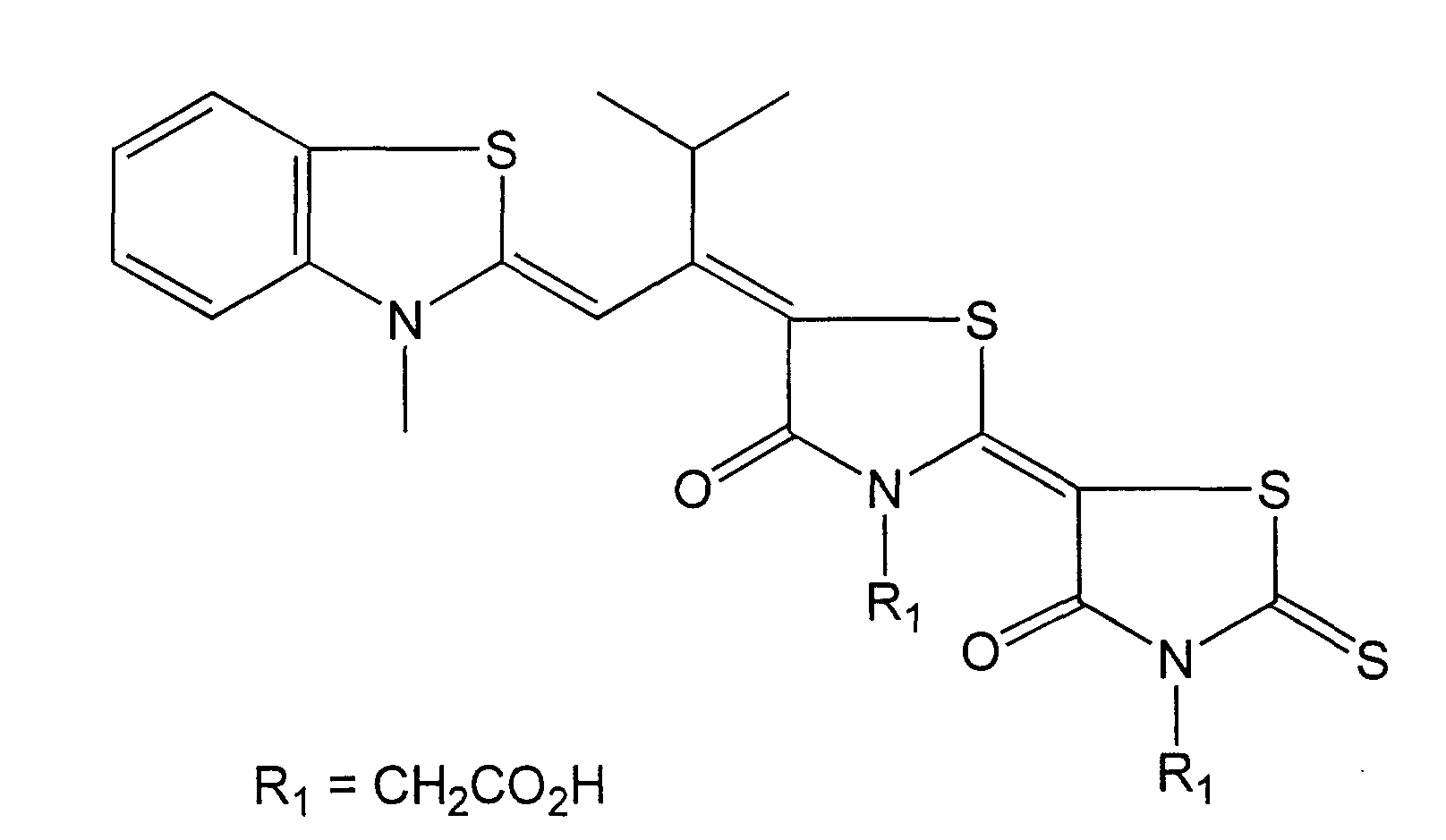
- the trinuclear merocyanine dye is one which does not stain during processing i.e. a dye which washes out and does not leave colour on the film. More preferably, the non-staining trinuclear merocyanine dye is of formula (I):
- the amount of sensitising dye used in the emulsion layer is preferably in the range of 100 to 1000 mg per mole of Ag. More preferably, the amount of dye is in the range of 200 to 600 mg/Ag mole, more preferably 300 to 500 mg/Ag mole. Most preferably the amount of sensitising dye in the emulsion layer is about 400 mg/Ag mole.
- the amount of SMe-TAI in the emulsion layer is in the range of from 0.05 to 1.5 g/Ag mole.
- the amount of SMe-TAI in the emulsion layer is in the range of from 0.1 to 1.2 g/Ag mole, more preferably 0.1 to 0.8 g/Ag mole, and more preferably 0.1 to 0.4 g/Ag mole.
- the types of photosensitive silver halide to which this invention may be applied include silver chloride, silver bromide, silver bromoiodide, silver chlorobromide, silver chloroiodide, silver chlorobromoiodide and mixtures thereof.
- the silver halide crystals may be coarse, medium or fine grains or mixtures thereof.
- the grains may be of different morphologies, e.g., spherical, cubic, cubooctahedral, tabular etc., or mixtures thereof. Grain size distribution may be monodisperse or polydisperse or mixtures thereof.
- the silver halide is silver chlorobromide, more preferably 70:30 chlorobromide.
- the silver halide grains are cubic.
- the silver halide may, optionally, be doped with other metals such as rhodium or iridium.
- the silver halide emulsion is chemically sensitised.
- Methods of chemically sensitising silver halide emulsions will be readily apparent to the person skilled in the art. These include, for example, those methods described in T.H. James, The Theory of the Photographic Process, 4th Ed., 1977, Ch. 5. Suitable methods of chemical sensitisation include, for example, the use of active gelatin, sulfur, selenium, thiocyanate derivatives, thioether compounds, tellurium, gold, platinum, palladium, iridium, osmium, rhenium, phosphorus, or combinations thereof.
- the silver halide emulsions may also be reduction sensitised using, for example, hydrogen, stannous chloride, thiourea dioxide, polyamines or polyboranes.
- the silver halide emulsion is chemically sensitised using sulfur and/or gold compounds.
- the emulsion layer of the black and white graphic arts film comprises at least one antifoggant (or stabiliser).
- antifoggant or stabiliser
- Suitable antifoggant(s) will be known to the person skilled in the art and may be found in, for example, E.J. Birr, Stabilisation of Photographic Silver Halide Emulsions, Focal Press, London, 1974, Chapter IV.
- Suitable antifoggants may be selected from azaindenes (especially tetraazaindenes), tetrazoles, benzotriazoles, imidazoles and benzimidazoles.
- antifoggants include 5-carboxy-2-methylthio-4-hydroxy-6-methyl-1,3,3a,7-tetraazaindene, 1-(3-acetamidophenyl)-5-mercaptotetrazole, 4-hydroxy-6-methyl-1,3,3a,7-tetraazaindene, phenylmercaptotetrazole, 6-nitrobenzimidazole, 2-methylbenzimidazole and benzotriazole.
- the emulsion layer additionally comprises the antifoggants 5-carboxy-2-methylthio-4-hydroxy-6-methyl-1,3,3a,7-tetraazaindene (SMe-carboxy-TAI) and/or 1-(3-acetamidophenyl)-5-mercaptotetrazole (APMT).
- SMe-carboxy-TAI 5-carboxy-2-methylthio-4-hydroxy-6-methyl-1,3,3a,7-tetraazaindene
- APMT 1-(3-acetamidophenyl)-5-mercaptotetrazole
- a black and white graphic arts film comprising a support having thereon at least one emulsion layer, said emulsion layer comprising:
- This invention further provides a photographic silver halide emulsion suitable for preparing a black and white graphic arts film comprising (i), (ii), (iii) and (iv).
- This invention even further provides a photographic silver halide emulsion melt comprising (i), (ii), (iii) and (iv).
- the red spectral sensitising dye is a trinuclear merocyanine dye as hereinbefore described.
- the at least one antifoggant is an antifoggant as hereinbefore described.
- the photosensitive silver halide is a silver halide as hereinbefore described.
- the black and white graphic arts film of the present invention may be either a high-contrast "hard dot” film (hard edges) or a “rapid access” film (softer dots, fuzzy edges).
- the black and white graphic arts film is a hard dot film.
- a nucleator and, preferably, an amine booster are present in the emulsion layer. Suitable nucleators and amine boosters will be readily apparent to the person skilled in the art.
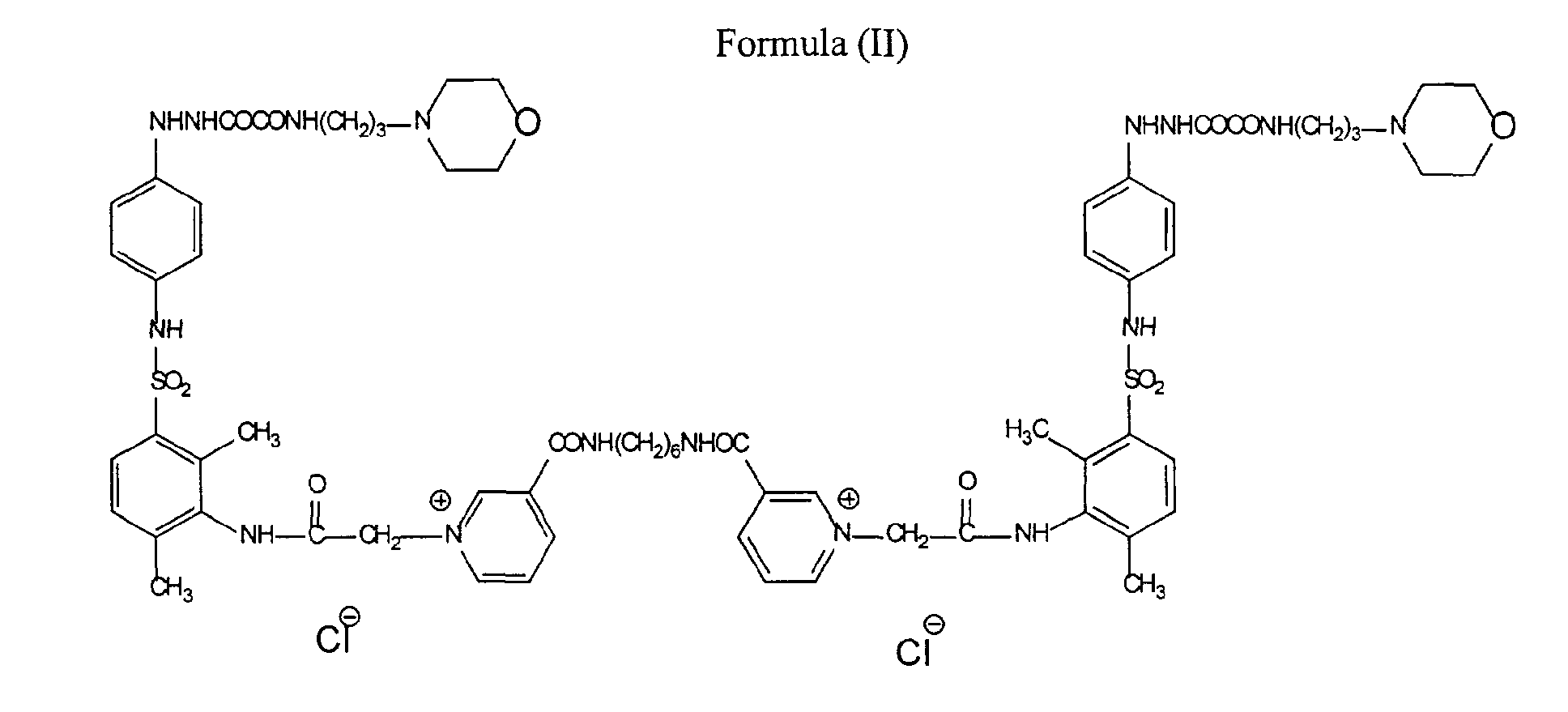
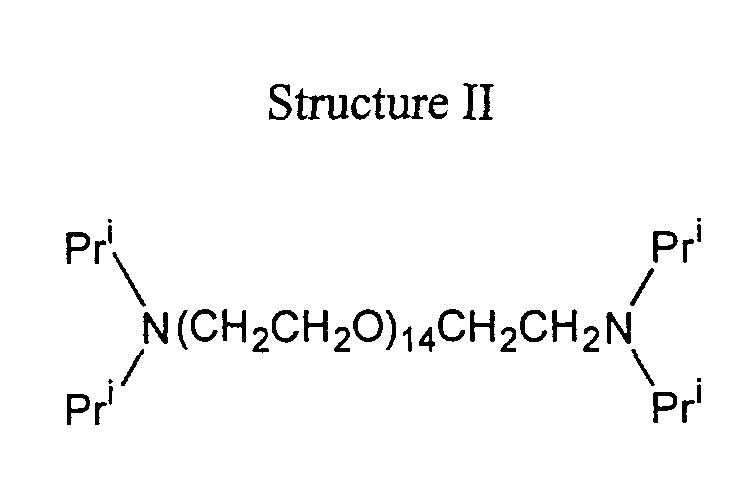
- the hard dot film has a nucleator of formula (II) and an amine booster of formula (III) present in a gel interlayer. A nucleator and booster are not required for "rapid access" film.
- the emulsion layer is coated onto a support, for example, an ESTAR® support, in the black and white graphic arts film of the present invention.
- the emulsion layer may be separated from the support by an antihalation layer.
- the support may have an antihalation layer backing.
- Other layers envisaged in this invention include a gel interlayer and a protective supercoat.
- Silver halide emulsions are well known in the art.
- Silver halide emulsions generally include a vehicle for coating the emulsion as a layer of a photographic element.
- Useful vehicles include both naturally occurring substances such as proteins, protein derivatives, cellulose derivatives (e.g. cellulose esters), gelatin (e.g. alkali-treated gelatin such as cattle bone or hide gelatin, or acid-treated gelatin such as pigskin gelatin), gelatin derivatives (e.g. acetylated gelatin) and phthalated gelatin.
- vehicle or vehicle extenders are hydrophilic water-permeable colloids.
- polystyrene resin examples include synthetic polymeric peptizers, carriers and/or binders such as poly(vinyl alcohol), poly(vinyl lactams), acrylamide polymers, polyvinyl acetals, polymers of alkyl and sulfoalkyl acrylates and methacrylates, hydrolysed polyvinyl acetates, polyamides, polyvinyl pyridine and methacrylamide copolymers.
- synthetic polymeric peptizers such as poly(vinyl alcohol), poly(vinyl lactams), acrylamide polymers, polyvinyl acetals, polymers of alkyl and sulfoalkyl acrylates and methacrylates, hydrolysed polyvinyl acetates, polyamides, polyvinyl pyridine and methacrylamide copolymers.
- the film coating in this Example consisted of an ESTAR® support, an antihalation layer on the back of the support on which was coated a latent image forming emulsion layer, a gel interlayer and a protective supercoat.
- the latent image forming emulsion layer consisted of a 70:30 chlorobromide cubic dispersed emulsion (0.16 ⁇ m edge length) doped with a rhodium salt at 0.132 mg/Ag mole and an iridium salt at 0.29 mg/Ag mole. It was then chemically sensitised with sulphur and gold and spectrally sensitised with 400 mg/Ag mole of sensitising dye of the formula:
- the emulsion was coated at a laydown of 2.8g Ag/m 2 in a vehicle of 1.4 g/m 2 gel and 0.42 g/m 2 latex copolymer of methyl acrylate, the sodium salt of 2-acrylamido-2-methylpropane sulphonic acid and 2-(methacryloyloxy)-ethylacetoacetate (88:5:7 by weight).
- the interlayer was coated at a gel laydown of 0.65 g/m 2 and included 10 mg/m 2 nucleator (structure I) and 60 mg/m 2 amine booster (structure II).
- the supercoat contained matte beads and surfactant, and was coated at a gel laydown of 1 g/m 2 .
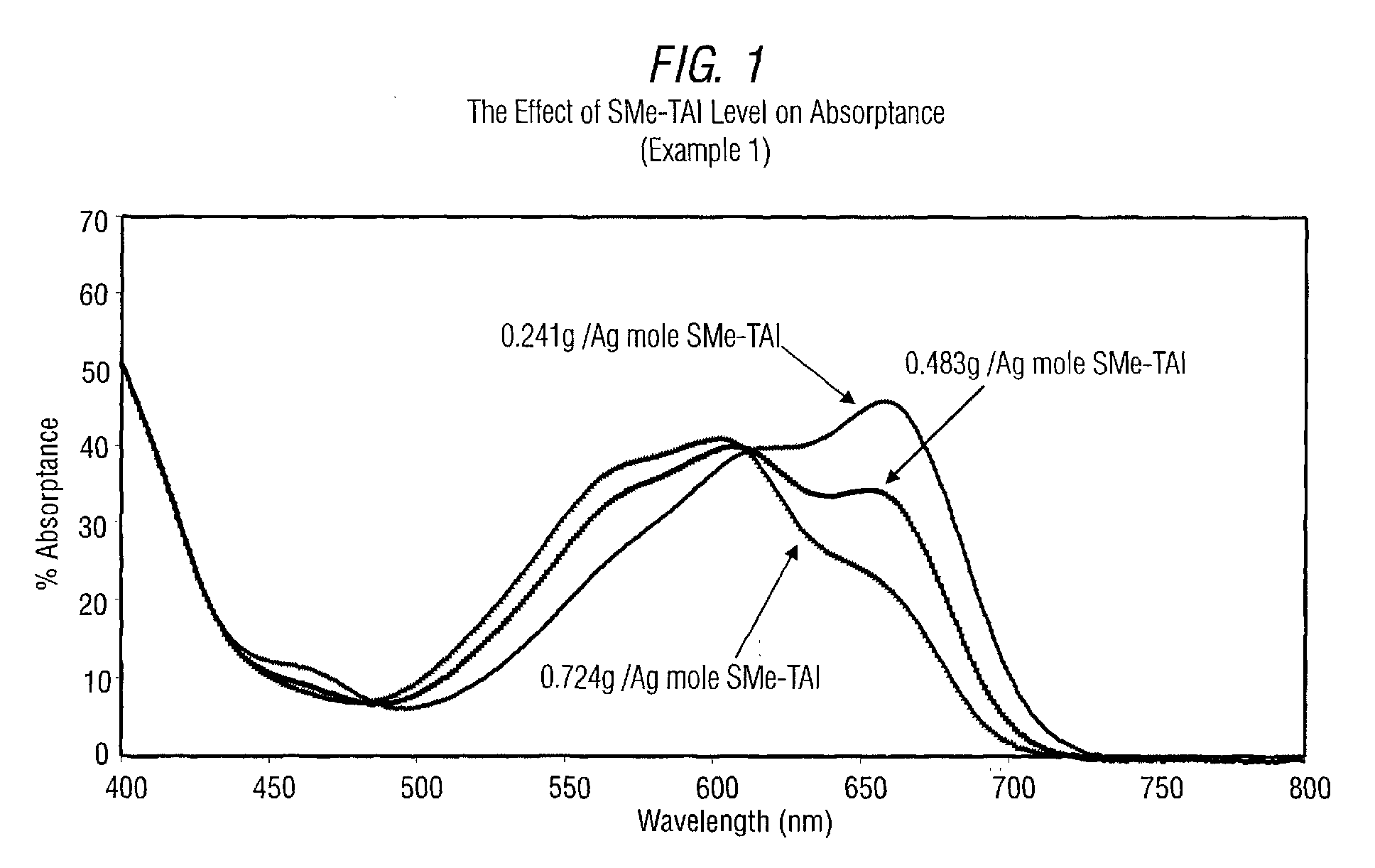
- Table 1 shows the % absorptance at 633 nm and 670 nm.
- HN (633 nm) and LD (670 nm) speeds were also calculated.
- SMe-TAI g/Ag mole
- % Absorptance @633nm HN Sp@0.6 logE
- % Absorptance @ 670nm LD Sp@0.6 LogE 0.241 40.33 0.94 41.24 1.00 0.483 33.88 0.87 27.70 0.90 0.724 27.98 0.63 16.57 0.57
- Table 1 and Figure 1 show that the % absorptance and speed can be changed dramatically by varying the amount of SMe-TAI in the emulsion layer.
- Table 1 and Figure 1 show that the absorptance characteristics of the dye can be changed in such a way that the relationship between HN (633 nm) and LD (670 nm) speed may be chosen to meet the specific needs of the film.
- a film coating was prepared in an identical manner with the exception that SMe-TAI was omitted from the emulsion layer.
- Table 2 shows the % absorptance at 633 nm and 670 nm.
- the HN (633 nm) and LD (670 nm) speeds were also calculated.
- SMe-Carboxy-TAI g/Ag mole
- % Absorptance @633nm HN Sp@0.6 logE
- % Absorptance @ 670nm LD Sp@0.6 LogE 0.241 42.64 0.92 43.63 0.99 0.483 40.29 0.86 39.99 0.94 0.724 38.30 0.81 34.69 0.84
- Table 2 and Figure 2 show that the % absorptance and speed cannot be changed significantly by varying the amount of SMe-carboxy-TAI in the emulsion layer. This is in contrast to Example 1 which uses 2-methylthio-4-hydroxy-6-methyl-1,3,3a,7-tetraazaindene in the emulsion layer.
- Examples 1 and 2 demonstrate that only by varying the amount of SMe-TAI in the emulsion layer can the absorptance characteristics and, hence, the speed of a trinuclear merocyanine dye be modulated.
- the relationship between the HN and LD speeds may be changed by varying the amount of SMe-TAI in the emulsion layer. It will be evident that this method of modulating speed will be advantageous in the production of black and white graphic arts film.
- the amount of SMe-TAI in the emulsion layer may be used to achieve desired HN and LD speeds with the same trinuclear merocyanine dye.
- the latent image forming emulsion layer consisted of a 70:30 chlorobromide cubic dispersed emulsion (0.16 ⁇ m edge length) doped with a rhodium salt at 0.132 mg/Ag mole and an iridium salt at 0.29 mg/Ag mole. It was then chemically sensitised with sulphur and gold, and spectrally sensitised with 400 mg/Ag mole of sensitising dye of the formula:
- the emulsion when coated gave a laydown of 2.8g Ag/m 2 in a vehicle of 1.4 g/m 2 gel and 0.42 g/m 2 latex copolymer of methyl acrylate, the sodium salt of 2-acrylamido-2-methylpropane sulphonic acid and 2-(methacryloyloxy)-ethylacetoacetate (88:5:7 by weight).
- the emulsion melt was held at 40°C for 16 hours and the speed was measured every hour using DAPER (disposable absorbent paper emulsion response) equipment with the following set up: Exposure 0.25 seconds Filters Wr70 + 0 ND Dev Time 20 seconds
- the DAPER speed was measured for emulsion melts having 0.124, 0.248 and 0.373 g/Ag mole of SMe-TAI added prior to coating.
- An emulsion melt was prepared in an identical manner to Example 1, with the exception that SMe-TAI was omitted from the emulsion melt.
- Figure 3 shows that when the antifoggant SMe-carboxy-TAI (Comparative Example 4) is added to the emulsion melt at a level of 0.483 g/Ag mole, the emulsion gains speed over a period of 16 hours at the rate of about 0.005 LogE/h.
- SMe-TAI (Example 3) is added at a level of 0.373 g/Ag mole in addition to the other antifoggants, a speed loss is observed over the same period of time. If the level of SMe-TAI is reduced, the speed loss is reduced, until at a level of 0.124 g/Ag mole, the speed of the emulsion remains constant over a period of 16 hours.
- Examples 3 demonstrates that SMe-TAI may be used to control emulsion melt drift prior to coating.
- emulsion melt drift may be almost eradicated by the addition of an appropriate amount of SMe-TAI.
- This invention is used advantageously in the production of black and white graphic arts films.
- the control of emulsion melt drift allows the production of photographic films having more reliable qualities. This has obvious advantages from the point of view of the cost of manufacturing black and white graphic arts films.
Landscapes
- Physics & Mathematics (AREA)
- Chemical & Material Sciences (AREA)
- Spectroscopy & Molecular Physics (AREA)
- Chemical Kinetics & Catalysis (AREA)
- Engineering & Computer Science (AREA)
- Materials Engineering (AREA)
- General Physics & Mathematics (AREA)
- Silver Salt Photography Or Processing Solution Therefor (AREA)
- Application Of Or Painting With Fluid Materials (AREA)
- Colloid Chemistry (AREA)
Abstract
Description


| SMe-TAI (g/Ag mole) | % Absorptance @633nm | HN Sp@0.6 (LogE) | % Absorptance @ 670nm | LD Sp@0.6 (LogE) |
| 0.241 | 40.33 | 0.94 | 41.24 | 1.00 |
| 0.483 | 33.88 | 0.87 | 27.70 | 0.90 |
| 0.724 | 27.98 | 0.63 | 16.57 | 0.57 |
| SMe-Carboxy-TAI (g/Ag mole) | % Absorptance @633nm | HN Sp@0.6 (LogE) | % Absorptance @ 670nm | LD Sp@0.6 (LogE) |
| 0.241 | 42.64 | 0.92 | 43.63 | 0.99 |
| 0.483 | 40.29 | 0.86 | 39.99 | 0.94 |
| 0.724 | 38.30 | 0.81 | 34.69 | 0.84 |

| Exposure | 0.25 seconds |
| Filters | Wr70 + 0 |
| Dev Time | |
| 20 seconds |
Claims (16)
- A black and white graphic arts film comprising a support having thereon at least one emulsion layer, said emulsion layer comprising:(d) a trinuclear merocyanine spectral sensitising dye;(e) 2-methylthio-4-hydroxy-6-methyl-1,3,3a,7-tetraazaindene (SMe-TAI); and(f) a photosensitive silver halide.
- A film according to Claim 1 wherein the trinuclear merocyanine dye is of formula (I):

- A film according to Claims 1 or 2 wherein the concentration of SMe-TAI is in the range of 0.05 to 1.5 g/mole of silver.
- A film according to any one of the preceding Claims wherein the silver halide is a 70:30 chlorobromide.
- A film according to any one of the preceding Claims wherein the emulsion layer further comprises at least one antifoggant.
- A film according to Claim 5 wherein the antifoggants are 5-carboxy-2-methylthio-4-hydroxy-6-methyl-1,3,3a,7-tetraazaindene and/or 1-(3-acetamidophenyl)-5-mercaptotetrazole.
- A "hard dot" film according to any one of the preceding Claims wherein the emulsion layer further comprises a nucleator.
- A film according to Claim 7 wherein the nucleator is of formula:

- A film according to Claim 7 or Claim 8 wherein the emulsion layer further comprises an amine booster.
- A film according to Claim 9 wherein the amine booster is of formula:
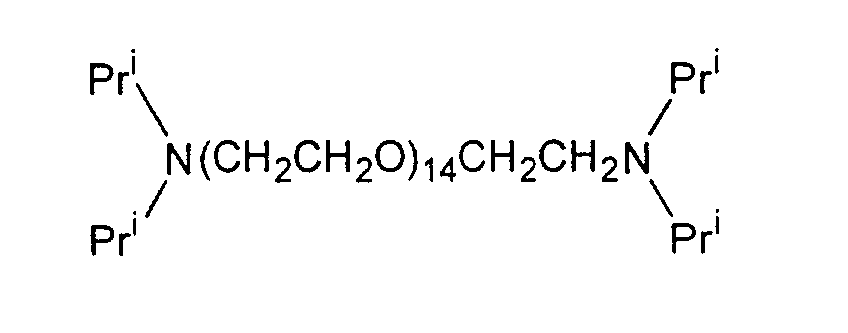
- A photographic silver halide emulsion suitable for preparing a black and white graphic arts film wherein the emulsion is as defined in any one of the preceding Claims.
- A photographic silver halide emulsion melt wherein the emulsion melt is as defined in any of the preceding Claims.
- A photographic silver halide emulsion melt according to Claim 12 wherein the concentration of SMe-TAI in said emulsion melt is in the range of 0.05 to 0.2 g/Ag mole.
- A black and white graphic arts film comprising a support having thereon at least one emulsion layer, said emulsion layer comprising:(i) SMe-TAI;(ii) a red spectral sensitising dye;(v) at least one anti-foggant; and(vi) a photosensitive silver halide.
- A method for modulating the relative HN and LD speeds of a black and white graphic arts photographic film comprising combining SMe-TAI in a concentration of from 0.05 to 1.5 g/Ag mole and a trinuclear merocyanine dye in a concentration of from 0.1 to 1.0 g/Ag mole in a silver halide emulsion layer of said film, the concentration of SMe-TAI in said emulsion layer determining the extent of modulation of the relative HN and LD speeds.
- A method for controlling emulsion melt drift in a photographic silver halide emulsion melt prior to coating said emulsion melt on a support for a photographic film, comprising combining SMe-TAI in a concentration of from 0.05 to 0.5 g/Ag mole and a trinuclear merocyanine dye in a concentration of from 0.1 to 1.0 g/Ag mole in said emulsion melt, the concentration of SMe-TAI in said emulsion melt determining the extent to which the emulsion melt drift is controlled.
Applications Claiming Priority (2)
| Application Number | Priority Date | Filing Date | Title |
|---|---|---|---|
| GB0023979 | 2000-09-30 | ||
| GBGB0023979.8A GB0023979D0 (en) | 2000-09-30 | 2000-09-30 | Black and white graphic arts film |
Publications (3)
| Publication Number | Publication Date |
|---|---|
| EP1193543A2 true EP1193543A2 (en) | 2002-04-03 |
| EP1193543A3 EP1193543A3 (en) | 2002-08-14 |
| EP1193543B1 EP1193543B1 (en) | 2005-05-25 |
Family
ID=9900434
Family Applications (1)
| Application Number | Title | Priority Date | Filing Date |
|---|---|---|---|
| EP01122844A Expired - Lifetime EP1193543B1 (en) | 2000-09-30 | 2001-09-24 | Black and white graphic arts film |
Country Status (5)
| Country | Link |
|---|---|
| US (1) | US6444392B1 (en) |
| EP (1) | EP1193543B1 (en) |
| JP (1) | JP2002107866A (en) |
| DE (1) | DE60110987T2 (en) |
| GB (1) | GB0023979D0 (en) |
Families Citing this family (2)
| Publication number | Priority date | Publication date | Assignee | Title |
|---|---|---|---|---|
| FR2904602B1 (en) * | 2006-08-01 | 2009-04-10 | Airbus France Sas | FRAMING OF DOOR FOR AIRCRAFT |
| JP2010086780A (en) * | 2008-09-30 | 2010-04-15 | Sanyo Electric Co Ltd | Square secondary battery |
Family Cites Families (9)
| Publication number | Priority date | Publication date | Assignee | Title |
|---|---|---|---|---|
| JPS4842974B1 (en) * | 1969-07-21 | 1973-12-15 | ||
| JPS5814664B2 (en) * | 1976-12-30 | 1983-03-22 | 富士写真フイルム株式会社 | Processing method for silver halide photographic materials |
| DE68912780T3 (en) * | 1989-11-14 | 2006-08-03 | Agfa-Gevaert N.V. | Process for the preparation of a silver image |
| US5370986A (en) | 1990-03-05 | 1994-12-06 | Eastman Kodak Company | Stabilization of photographic recording materials |
| JP2649858B2 (en) | 1990-05-22 | 1997-09-03 | 富士写真フイルム株式会社 | Silver halide photographic material |
| JPH07319101A (en) * | 1994-05-24 | 1995-12-08 | Konica Corp | Silver halide photographic sensitive material |
| US5563021A (en) * | 1995-03-31 | 1996-10-08 | Eastman Kodak Company | Photographic elements with tetra-nuclear merocyanine sensitizers |
| JPH09203993A (en) * | 1996-01-29 | 1997-08-05 | Fuji Photo Film Co Ltd | Silver halide photographic sensitive material |
| JP3171135B2 (en) | 1997-03-19 | 2001-05-28 | 松下電器産業株式会社 | Electric water heater |
-
2000
- 2000-09-30 GB GBGB0023979.8A patent/GB0023979D0/en not_active Ceased
-
2001
- 2001-08-10 US US09/928,215 patent/US6444392B1/en not_active Expired - Fee Related
- 2001-09-24 EP EP01122844A patent/EP1193543B1/en not_active Expired - Lifetime
- 2001-09-24 DE DE60110987T patent/DE60110987T2/en not_active Expired - Lifetime
- 2001-09-28 JP JP2001299954A patent/JP2002107866A/en active Pending
Also Published As
| Publication number | Publication date |
|---|---|
| US20020061483A1 (en) | 2002-05-23 |
| US6444392B1 (en) | 2002-09-03 |
| EP1193543A3 (en) | 2002-08-14 |
| DE60110987T2 (en) | 2006-05-18 |
| EP1193543B1 (en) | 2005-05-25 |
| GB0023979D0 (en) | 2000-11-15 |
| DE60110987D1 (en) | 2005-06-30 |
| JP2002107866A (en) | 2002-04-10 |
Similar Documents
| Publication | Publication Date | Title |
|---|---|---|
| JPH08234345A (en) | Radiation-sensitive emulsion and its preparation as well as photographic printing element | |
| JPH0192737A (en) | Silver halide photographic sensitive material | |
| JPS61278844A (en) | Silver halide photographic emulsion | |
| US5164292A (en) | Selenium and iridium doped emulsions with improved properties | |
| EP1193543B1 (en) | Black and white graphic arts film | |
| EP0768568B1 (en) | Silver halide photographic light-sensitive material | |
| JP2683362B2 (en) | Silver halide photographic emulsion | |
| JPH02196236A (en) | Production of silver halide photographic emulsion | |
| JP3455322B2 (en) | Photo elements | |
| US5556742A (en) | Noble metal complexes to sensitize silver halide emulsions | |
| EP0735415B1 (en) | Photographic elements with tetra-nuclear merocyanine sensitizers | |
| US6740482B1 (en) | High chloride emulsion having high sensitivity and low fog | |
| EP1022609B1 (en) | Fragmentable electron donor compounds with broad blue spectral sensitization | |
| JP2597432B2 (en) | Silver halide photographic material | |
| US5780217A (en) | Silver halide photographic emulsion having reduced pressure fogging | |
| JP3189103B2 (en) | Silver halide photographic materials | |
| JP2577595B2 (en) | Silver halide photographic material packaging unit for laser light source | |
| JP2816613B2 (en) | Silver halide emulsion | |
| EP0766130B1 (en) | Photographic material having a red sensitized silver halide emulsion layer with improved heat sensitivity | |
| JPH08278596A (en) | Silver halide photographic material | |
| JPH07234466A (en) | Silver halide photographic light-sensitive material | |
| JP2002099051A (en) | Method of preparing gelatin aqueous solution, colloidal silver dispersion, organic solid fine particle dispersion, oil-in-water dispersion and photographic photosensitive material coating, and method of manufacturing silver halide photographic photosensitive material | |
| JPS6256949A (en) | Production of silver halide photographic emulsion | |
| JPH03168635A (en) | Silver halide photographic sensitive material | |
| JPH08262650A (en) | Processing method of silver halide photographic material |
Legal Events
| Date | Code | Title | Description |
|---|---|---|---|
| PUAI | Public reference made under article 153(3) epc to a published international application that has entered the european phase |
Free format text: ORIGINAL CODE: 0009012 |
|
| AK | Designated contracting states |
Kind code of ref document: A2 Designated state(s): AT BE CH CY DE DK ES FI FR GB GR IE IT LI LU MC NL PT SE TR |
|
| AX | Request for extension of the european patent |
Free format text: AL;LT;LV;MK;RO;SI |
|
| PUAL | Search report despatched |
Free format text: ORIGINAL CODE: 0009013 |
|
| RIC1 | Information provided on ipc code assigned before grant |
Free format text: 7G 03C 1/08 A, 7G 03C 1/26 B, 7G 03C 1/34 B, 7G 03C 1/07 B, 7G 03C 1/28 B |
|
| AK | Designated contracting states |
Kind code of ref document: A3 Designated state(s): AT BE CH CY DE DK ES FI FR GB GR IE IT LI LU MC NL PT SE TR |
|
| AX | Request for extension of the european patent |
Free format text: AL;LT;LV;MK;RO;SI |
|
| 17P | Request for examination filed |
Effective date: 20030124 |
|
| AKX | Designation fees paid |
Designated state(s): DE FR GB |
|
| 17Q | First examination report despatched |
Effective date: 20031030 |
|
| GRAP | Despatch of communication of intention to grant a patent |
Free format text: ORIGINAL CODE: EPIDOSNIGR1 |
|
| GRAS | Grant fee paid |
Free format text: ORIGINAL CODE: EPIDOSNIGR3 |
|
| GRAA | (expected) grant |
Free format text: ORIGINAL CODE: 0009210 |
|
| AK | Designated contracting states |
Kind code of ref document: B1 Designated state(s): DE FR GB |
|
| REG | Reference to a national code |
Ref country code: GB Ref legal event code: FG4D |
|
| REG | Reference to a national code |
Ref country code: IE Ref legal event code: FG4D |
|
| REF | Corresponds to: |
Ref document number: 60110987 Country of ref document: DE Date of ref document: 20050630 Kind code of ref document: P |
|
| PGFP | Annual fee paid to national office [announced via postgrant information from national office to epo] |
Ref country code: GB Payment date: 20050809 Year of fee payment: 5 |
|
| PGFP | Annual fee paid to national office [announced via postgrant information from national office to epo] |
Ref country code: FR Payment date: 20050902 Year of fee payment: 5 |
|
| ET | Fr: translation filed | ||
| PLBE | No opposition filed within time limit |
Free format text: ORIGINAL CODE: 0009261 |
|
| STAA | Information on the status of an ep patent application or granted ep patent |
Free format text: STATUS: NO OPPOSITION FILED WITHIN TIME LIMIT |
|
| 26N | No opposition filed |
Effective date: 20060228 |
|
| GBPC | Gb: european patent ceased through non-payment of renewal fee |
Effective date: 20060924 |
|
| REG | Reference to a national code |
Ref country code: FR Ref legal event code: ST Effective date: 20070531 |
|
| PG25 | Lapsed in a contracting state [announced via postgrant information from national office to epo] |
Ref country code: GB Free format text: LAPSE BECAUSE OF NON-PAYMENT OF DUE FEES Effective date: 20060924 |
|
| PG25 | Lapsed in a contracting state [announced via postgrant information from national office to epo] |
Ref country code: FR Free format text: LAPSE BECAUSE OF NON-PAYMENT OF DUE FEES Effective date: 20061002 |
|
| PGFP | Annual fee paid to national office [announced via postgrant information from national office to epo] |
Ref country code: DE Payment date: 20120928 Year of fee payment: 12 |
|
| REG | Reference to a national code |
Ref country code: DE Ref legal event code: R119 Ref document number: 60110987 Country of ref document: DE Effective date: 20140401 |
|
| PG25 | Lapsed in a contracting state [announced via postgrant information from national office to epo] |
Ref country code: DE Free format text: LAPSE BECAUSE OF NON-PAYMENT OF DUE FEES Effective date: 20140401 |