EP1193275A1 - Process for producing fluoropolymer - Google Patents
Process for producing fluoropolymer Download PDFInfo
- Publication number
- EP1193275A1 EP1193275A1 EP00902896A EP00902896A EP1193275A1 EP 1193275 A1 EP1193275 A1 EP 1193275A1 EP 00902896 A EP00902896 A EP 00902896A EP 00902896 A EP00902896 A EP 00902896A EP 1193275 A1 EP1193275 A1 EP 1193275A1
- Authority
- EP
- European Patent Office
- Prior art keywords
- mixture
- monomers
- monomer
- preparation process
- tetrafluoroethylene
- Prior art date
- Legal status (The legal status is an assumption and is not a legal conclusion. Google has not performed a legal analysis and makes no representation as to the accuracy of the status listed.)
- Withdrawn
Links
Classifications
-
- C—CHEMISTRY; METALLURGY
- C08—ORGANIC MACROMOLECULAR COMPOUNDS; THEIR PREPARATION OR CHEMICAL WORKING-UP; COMPOSITIONS BASED THEREON
- C08F—MACROMOLECULAR COMPOUNDS OBTAINED BY REACTIONS ONLY INVOLVING CARBON-TO-CARBON UNSATURATED BONDS
- C08F214/00—Copolymers of compounds having one or more unsaturated aliphatic radicals, each having only one carbon-to-carbon double bond, and at least one being terminated by a halogen
- C08F214/18—Monomers containing fluorine
- C08F214/28—Hexyfluoropropene
-
- B—PERFORMING OPERATIONS; TRANSPORTING
- B01—PHYSICAL OR CHEMICAL PROCESSES OR APPARATUS IN GENERAL
- B01J—CHEMICAL OR PHYSICAL PROCESSES, e.g. CATALYSIS OR COLLOID CHEMISTRY; THEIR RELEVANT APPARATUS
- B01J3/00—Processes of utilising sub-atmospheric or super-atmospheric pressure to effect chemical or physical change of matter; Apparatus therefor
- B01J3/008—Processes carried out under supercritical conditions
-
- C—CHEMISTRY; METALLURGY
- C08—ORGANIC MACROMOLECULAR COMPOUNDS; THEIR PREPARATION OR CHEMICAL WORKING-UP; COMPOSITIONS BASED THEREON
- C08F—MACROMOLECULAR COMPOUNDS OBTAINED BY REACTIONS ONLY INVOLVING CARBON-TO-CARBON UNSATURATED BONDS
- C08F14/00—Homopolymers and copolymers of compounds having one or more unsaturated aliphatic radicals, each having only one carbon-to-carbon double bond, and at least one being terminated by a halogen
- C08F14/18—Monomers containing fluorine
-
- C—CHEMISTRY; METALLURGY
- C08—ORGANIC MACROMOLECULAR COMPOUNDS; THEIR PREPARATION OR CHEMICAL WORKING-UP; COMPOSITIONS BASED THEREON
- C08F—MACROMOLECULAR COMPOUNDS OBTAINED BY REACTIONS ONLY INVOLVING CARBON-TO-CARBON UNSATURATED BONDS
- C08F2/00—Processes of polymerisation
- C08F2/38—Polymerisation using regulators, e.g. chain terminating agents, e.g. telomerisation
-
- C—CHEMISTRY; METALLURGY
- C08—ORGANIC MACROMOLECULAR COMPOUNDS; THEIR PREPARATION OR CHEMICAL WORKING-UP; COMPOSITIONS BASED THEREON
- C08F—MACROMOLECULAR COMPOUNDS OBTAINED BY REACTIONS ONLY INVOLVING CARBON-TO-CARBON UNSATURATED BONDS
- C08F214/00—Copolymers of compounds having one or more unsaturated aliphatic radicals, each having only one carbon-to-carbon double bond, and at least one being terminated by a halogen
- C08F214/18—Monomers containing fluorine
-
- C—CHEMISTRY; METALLURGY
- C08—ORGANIC MACROMOLECULAR COMPOUNDS; THEIR PREPARATION OR CHEMICAL WORKING-UP; COMPOSITIONS BASED THEREON
- C08K—Use of inorganic or non-macromolecular organic substances as compounding ingredients
- C08K5/00—Use of organic ingredients
- C08K5/04—Oxygen-containing compounds
- C08K5/14—Peroxides
-
- Y—GENERAL TAGGING OF NEW TECHNOLOGICAL DEVELOPMENTS; GENERAL TAGGING OF CROSS-SECTIONAL TECHNOLOGIES SPANNING OVER SEVERAL SECTIONS OF THE IPC; TECHNICAL SUBJECTS COVERED BY FORMER USPC CROSS-REFERENCE ART COLLECTIONS [XRACs] AND DIGESTS
- Y02—TECHNOLOGIES OR APPLICATIONS FOR MITIGATION OR ADAPTATION AGAINST CLIMATE CHANGE
- Y02P—CLIMATE CHANGE MITIGATION TECHNOLOGIES IN THE PRODUCTION OR PROCESSING OF GOODS
- Y02P20/00—Technologies relating to chemical industry
- Y02P20/50—Improvements relating to the production of bulk chemicals
- Y02P20/54—Improvements relating to the production of bulk chemicals using solvents, e.g. supercritical solvents or ionic liquids
Definitions
- the present invention relates to a process for preparing a fluoropolymer by polymerizing in a supercritical state.
- Fluoropolymers have excellent chemical resistance, solvent resistance and heat resistance and therefore are used widely in an industrial field such as automobile industry, semi-conductor industry and chemical industry as a starting material for a sealing member to be used under critical conditions.
- Hitherto preparation of fluoropolymers has been carried out by emulsion polymerization or suspension polymerization of a fluoroolefin in an aqueous medium by using a water soluble radical initiator or an oil soluble radical initiator.
- a polymerization reaction field thereof was substantially in produced polymer particles or in an inactive solvent which hardly affect the polymerization reaction.
- a water soluble initiator is used, and therefore an end group of a produced polymer is ionic.
- an end group thereof reduces a vulcanization reaction rate at vulcanizing and compression set of a final vulcanized article increases.
- the end group has an adverse effect on a molded article, i.e. causing a foaming of the molded article.
- a solid polymer is prepared by agglomerating an aqueous dispersion obtained after the polymerization reaction by using a proper coagulant and then dehydrating and drying, which, however, requires long and complicated steps and cannot be said to be an effective preparation process. Further if a residue of the ionic initiator is mixed to the product, there is a problem when an obtained molded article is used as parts for semi-conductor production apparatuses.
- the supercritical fluid is a fluid having temperature and pressure range higher than the both of critical temperature and critical pressure, and generally the range not so exceeding critical points greatly tends to be used positively from economical point of view.
- the supercritical fluid has properties suitable as a reaction medium because of a good thermal conductivity, a rapid diffusion and a small viscosity.
- Japanese Patent Publication No. 505429/1995 discloses a radical polymerization reaction of fluoroacrylate by using supercritical carbon dioxide as a reaction field.
- USP-5312882 discloses polymerization by using supercritical carbon dioxide as a continuous phase and a monomer as a dispersion phase in the presence of a surfactant which has a moiety having affinity for carbon dioxide.
- USP-5527865 discloses a radical polymerization of tetrafluoroethylene in two separate phases in the presence of a fluorine-containing anionic surfactant by using supercritical carbon dioxide and water simultaneously.
- Japanese Patent Publication No.502691/1998 discloses a reaction by using a liquid being maintained at a pressure higher than atmospheric pressure, supercritical fluid such as carbon dioxide, hydrofluorocarbon, perfluorocarbon, or a mixture thereof.
- supercritical fluid such as carbon dioxide, hydrofluorocarbon, perfluorocarbon, or a mixture thereof.
- a dispersion aid is required as an essential component in the reaction field, which is not preferable from the viewpoint of an increase in a purity of an obtained polymer, and a monomer which is a reactive substance is not used as a supercritical fluid.
- Examples of polymerization reaction of fluoroolefin in a supercritical fluid by using the monomer itself as the supercritical fluid are tetrafluoroethylene/hexafluoropropylene copolymerization described in USP-3062793, tetrafluoroethylene/hexafluoropropylene copolymerization and vinylidene fluoride/hexafluoropropylene copolymerization described in WO96/24624, and the like.
- vinylidene fluoride there is no description as to vinylidene fluoride, and the reaction is carried out under the condition of about 200 MPa or more.
- the reaction is carried out under critical conditions of very high temperature and pressure of from 41 to 690 MPa and from 200° to 400°C, respectively. Therefore there is a disadvantage that installation cost in commercial scale becomes high.
- the inventors of the present invention could solve the above-mentioned problems by forming a supercritical state in the presence of minimum components for polymerization reaction and have completed a process for preparing a fluoropolymer which can reduce an installation cost in commercial scale.
- the present invention relates to the process for preparing a fluoropolymer by polymerizing one or more radically polymerizable monomers comprising at least one fluoroolefin monomer in the presence of a radical polymerization initiator in a reaction field where at least one of the monomers is in a supercritical state.
- the present invention relates to the process for preparing a fluoropolymer by polymerizing one or more radically polymerizable monomers comprising at least one fluoroolefin monomer substantially in the absence of water in the presence of a radical polymerization initiator in a reaction field where the whole pressure in the polymerization system is 40 MPa or less in an absolute pressure and at least one of the monomers is in a supercritical state.
- the present invention relates to the process for preparing a fluoropolymer by polymerizing one or more radically polymerizable monomers comprising at least one fluoroolefin monomer in the presence of a radical polymerization initiator and an inactive fluorocarbon in a reaction field where at least one selected from the group consisting of the monomers and fluorocarbon is in a supercritical state.
- the present invention relates to the process for preparing a fluoropolymer by polymerizing one or more radically polymerizable monomers comprising at least one fluoroolefin monomer substantially in the absence of water in the presence of a radical polymerization initiator and an inactive fluorocarbon in a reaction field where the whole pressure in the polymerization system is 40 MPa or less in an absolute pressure and at least one selected from the group consisting of the monomers and fluorocarbon is in a supercritical state.
- the polymerization may be carried out in a reaction field where a chain transfer agent is present.
- reaction field where at least one of the monomers is in a supercritical state and "a reaction field where at least one selected from the group consisting of the monomers and fluorocarbon is in a supercritical state” mean the following reaction fields.
- reaction field in a range approximate to the above-mentioned lowest critical points (pressure and temperature) is used as those reaction fields in a supercritical state.
- Whether or not the reaction field is in a supercritical state of the present invention can be judged by determining a saturated state of a system to be measured and a relation between a pressure, density and temperature (PVT measurement) in one phase.
- PVT measurement a pressure, density and temperature
- one or more radically polymerizable monomers comprising at least one fluoroolefin monomer are polymerized in a reaction field being in a supercritical state in the presence of a radical polymerization initiator or in the presence of an inactive fluorocarbon and a radical polymerization initiator.
- examples of components forming a reaction field being in a supercritical state are:
- Examples of the usable radically polymerizable monomer are:
- PAVE are perfluoro(methyl vinyl ether) (PMVE), perfluoro(ethyl vinyl ether) (PEVE), perfluoro(propyl vinyl ether) (PPVE), and the like.
- functional group-containing fluoroolefin monomers can be used.
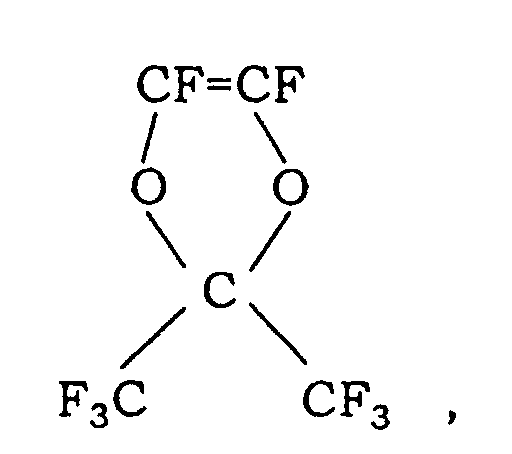
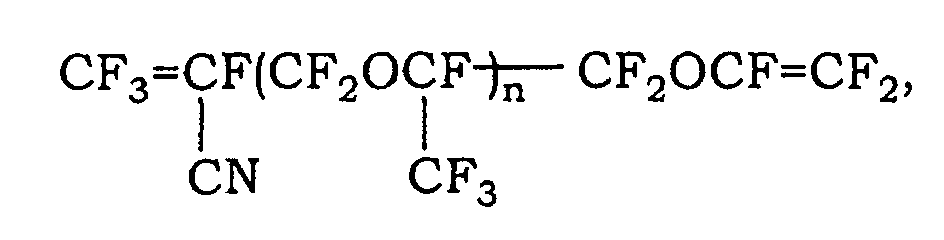
- the functional group-containing fluoroolefin are, for instance, those represented by the formula: wherein Y is -CH 2 OH, -COOH, -SO 2 F, -SO 3 M (M is hydrogen, NH 4 group or alkali metal), carboxylic acid salt, carboxyester group, epoxy group or nitrile group, X and X 1 are the same or different and each is hydrogen atom or fluorine atom, R f is a divalent fluorine-containing alkylene group having 1 to 40 carbon atoms or a divalent fluorine-containing alkylene group having 1 to 40 carbon atoms and ether bond.
- iodine-containing monomers for example, iodinated perfluoro(vinyl ethers) such as perfluoro(6,6-dihydro-6-iodo-3-oxa-1-hexene) and perfluoro(5-iodo-3-oxa-1-pentene) described in JP-B-5-63482 and JP-A-62-12734 can be copolymerized as a non-perfluoroolefin monomer.
- non-fluoroolefin monomer examples include, for instance, ⁇ -olefin monomers having 2 to 10 carbon atoms such as ethylene (ET), propylene, butene and pentene; alkyl vinyl ethers having an alkyl group of 1 to 20 carbon atoms such as methyl vinyl ether, ethyl vinyl ether, propyl vinyl ether, cyclohexyl vinyl ether, hydroxybutyl vinyl ether and butyl vinyl ether; and the like.
- ⁇ -olefin monomers having 2 to 10 carbon atoms such as ethylene (ET), propylene, butene and pentene
- alkyl vinyl ethers having an alkyl group of 1 to 20 carbon atoms such as methyl vinyl ether, ethyl vinyl ether, propyl vinyl ether, cyclohexyl vinyl ether, hydroxybutyl vinyl ether and butyl vinyl ether; and the like.
- the polymerization in a reaction field being in a supercritical state of the present invention can be applied particularly suitably to the following combinations of radically polymerizable monomers:
- a fluorocarbon may be present in the reaction field.
- the fluorocarbon are hydrofluorocarbons such as pentafluoroethane, tetrafluoroethane, trifluoroethane, trifluoromethane and difluoromethane; perfluorocarbons such as perfluoroethane and perfluorocyclobutane; and the like.
- Those fluorocarbons function as a diluting agent for the monomer in the reaction field, help eliminate a reaction heat and adjust a solubility of a produced polymer into a reaction system.
- An amount of the fluorocarbon when used is from 1 to 500 % by weight, preferably 1 to 300 % by weight, particularly preferably 1 to 200 % by weight on the basis of the total amount of the monomers. If the amount is too large, an amount of the fluorocarbon to be recovered after the reaction increases, which is not preferable. From the viewpoint of obtaining a high molecular weight product, it is preferable that the produced polymer does not dissolve in the reaction system completely and is in a dispersed state.
- water may be present in the reaction field. However it is rather preferable to make water absent substantially in order to simplify a post-treatment step.
- a chain transfer agent may be added to adjust a molecular weight of the polymer to a desired weight.
- Examples of the chain transfer agent are hydrocarbons, halogenated hydrocarbons, and in addition, hydrocarbon alcohols, esters, ketones, mercaptans, and the like.
- Examples of the hydrocarbon are those having 4 to 6 carbon atoms such as pentane, butane and hexane.
- Examples of the halogenated hydrocarbon are, for instance, tetrachloromethane, methylene chloride, and the like.
- Examples of the hydrocarbon alcohol are, for instance, methanol, ethanol, isopropanol, and the like.
- hydrocarbon ester examples include methyl acetate, ethyl acetate, butyl acetate, ethyl propionate, ethyl acetoacetate, dimethyl malonate, diethyl malonate, dimethyl succinate, diethyl succinate, and the like.
- hydrocarbon ketone examples include acetone, acetylacetone, cyclohexanone, and the like.
- mercaptan are, for instance, dodecylmercaptan, and the like.
- pentane, butane, diethyl malonate, tetrachloromethane, acetone and dodecylmercaptan are preferable.
- An amount of the chain transfer agent may be optionally determined depending on a desired molecular weight of the polymer.
- the amount thereof is usually from 0.01 to 5 % by weight, particularly preferably 0.1 to 2 % by weight on the basis of the total amount of the monomers.
- the polymerization of radically polymerizable monomer is carried out in the presence of a radical polymerization initiator in a reaction field being in a supercritical state.
- Examples of the method for making the reaction field being in a supercritical state are, for instance, a method of forming the supercritical state by putting a monomer and as case demands, a fluorocarbon into a pressure resistant polymerization reactor and heating up to a critical temperature or more, thereby adjusting to a critical pressure, a method of forming the supercritical state by putting continuously a monomer and as case demands, a fluorocarbon into a pressure resistant reactor adjusted to a critical pressure or more and a critical temperature or more, and the like method.
- the polymerization can be carried out by any of batchwise, semi-batchwise and continuous methods.
- the critical pressure and/or critical temperature decrease or increase as compared with the case of a single component.
- the pressure and temperature may be a minimum critical pressure or more and a minimum critical temperature or more, respectively in an actual reaction field.
- the polymerization conditions depend on conditions for forming a supercritical state and are not limited. However the polymerization conditions near the critical points are preferable.
- a polymerization pressure is from 2 to 40 MPa, preferably 4 to 10 MPa
- a polymerization temperature is from 10° to 200°C, preferably 50° to 150°C.
- a polymerization time is from about 0.1 hour to about 50 hours.
- the polymerization is carried out in the presence of a radical polymerization initiator.
- a radical polymerization initiator examples include, for instance, organic or inorganic peroxide, persulfate, azo compound, and the like.
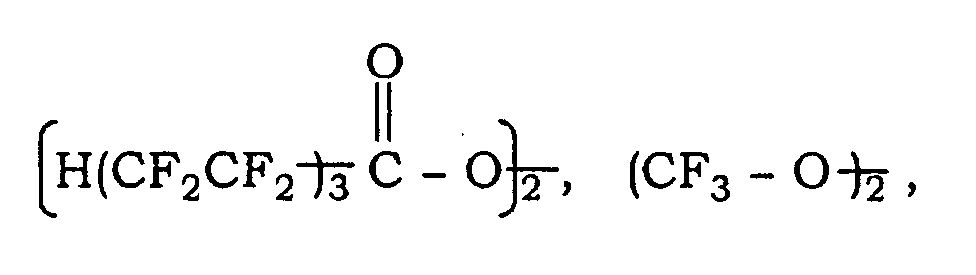
- organic peroxide examples include dialkyl peroxides such as 2,5-dimethyl-2,5-bis(t-butylperoxy)hexane and di-t-butyl peroxide; diacyl peroxides such as isobutyl peroxide, 3,5,5-trimethylhexanoyl peroxide, octanoyl peroxide, lauroyl peroxide, stearoyl peroxide and succinic acid peroxide; peroxy dicarbonates such as dinormalpropyl peroxydicarbonate, diisopropyl peroxydicarbonate, bis(4-t-butylcyclohexyl) peroxydicarbonate, di-2-ethoxyethyl peroxydicarbonate, di-2-ethylhexyl peroxydicarbonate and di-2-methoxybutyl peroxydicarbonate; peroxy esters such as 1,1,3,3-tetramethylbutyl peroxyn
- Example of the inorganic peroxide is, for instance, hydrogen peroxide.
- persulfate examples include ammonium persulfate, sodium persulfate, potassium persulfate, and the like.
- the initiator can be used in combination with a reducing agent.
- azo compounds are, for instance, cyano-2-propyl azoformamide, 1,1'-azobis(cyclohexane-1-carbonitrile), 2,2'-azobis(2-amidinopropane)dihydrochloride, 2,2'-azobis(2-methylbutyronitrile), 2,2'-azobisisobutyronitrile, 2,2'-azobis(2,4-dimethylvaleronitrile), 2,2'-azobis[N-(2-propenyl)-2-methylpropionamide], macro azo compound containing polydimethylsiloxane segment, 2,2'-azobis(2,4,4-trimethylpentane), 2,2'-azobis(4-methoxy-2,4-dimethylvaleronitrile), 4,4'-azobis(4-cyanovalerate), dimethyl 2,2'-azobis(isobutyrate), 2,2'-azobis[2-(2-imidazoline-2-yl)propane]dihydrochloride,
- An amount of the radical polymerization initiator is from 0.005 to 10 % by weight, preferably 0.05 to 2 % by weight on the basis of a total amount of the monomers.
- Examples of the compound represented by the formula (I) are, for instance, 1,3-diiodoperfluoropropane, 1,3-diiodo-2-chloroperfluoropropane, 1,4-diiodoperfluorobutane, 1,5-diiodo-2,4-dichloroperfluoropentane, 1,6-diiodoperfluorohexane, 1,8-diiodoperfluorooctane, 1,12-diiodoperfluorododecane, 1,16-diiodoperfluorohexadecane, diiodomethane, 1,2-diiodoethane, 1,3-diiodo-n-propane, CF 2 Br 2 , BrCF 2 CF 2 Br, CF 3 CFBrCF 2 Br, CFClBr 2 , BrCF 2 CFClBr, CFBrCl
- 1,4-diiodoperfluorobutane and diiodomethane are preferably used.
- additives may be added unless they do not take part in the reaction.
- the additive are a solvent for the radical polymerization initiator (perfluorohexane, 2,2,3,3-tetrafluoropropylene alcohol, or the like), and the like.
- a fluorine-containing homopolymer or copolymer comprising the above-mentioned radically polymerizable monomer as a component unit can be prepared.
- Those fluoropolymers may be a resin or an elastomer.
- Non-restricted examples of the fluoropolymer which can be prepared as a resin are polytetrafluoroethylene (PTFE), polyvinylidene fluoride (PVdF), polychlorotrifluoroethylene (PCTFE), VdF-TFE copolymer, VdF-TFE-CTFE copolymer, TFE-HFP copolymer (FEP, HFP content: 30 % by mole or less), TFE-PAVE copolymer (PFA, PAVE content: 20 % by mole or less), and the like.
- PTFE polytetrafluoroethylene
- PVdF polyvinylidene fluoride
- PCTFE polychlorotrifluoroethylene
- VdF-TFE copolymer VdF-TFE-CTFE copolymer
- TFE-HFP copolymer FEP, HFP content: 30 % by mole or less
- TFE-PAVE copolymer PFA, PAVE
- fluoropolymer as an elastomer examples include VdF-HFP copolymer, VdF-HFP-TFE copolymer, HFP-ET copolymer, HFP-ET-TFE copolymer, HFP-ET-VdF copolymer, HFP-ET-VdF-TFE copolymer, TFE-PAVE copolymer (PAVE content: 21 to 50 % by mole), TFE-HFP copolymer (HFP content: 31 to 50 % by mole), TFE-propylene copolymer, VdF-CTFE copolymer, TFE-VdF-propylene copolymer, and the like.
- components of the elastomer product were VdF/HFP in mole ratio of 70.8/29.2.
- GPC analysis a number average molecular weight and weight average molecular weight based on polystyrene were 11,000 and 22,000, respectively.
- components of the elastomer product were VdF/HFP in mole ratio of 74.7/25.3.
- GPC analysis a number average molecular weight and weight average molecular weight based on polystyrene were 21,000 and 40,000, respectively.
- components of the elastomer product were VdF/HFP in mole ratio of 77.8/22.2.
- GPC analysis a number average molecular weight and weight average molecular weight based on polystyrene were 19,000 and 36,000, respectively.
Landscapes
- Chemical & Material Sciences (AREA)
- Chemical Kinetics & Catalysis (AREA)
- Organic Chemistry (AREA)
- Health & Medical Sciences (AREA)
- Medicinal Chemistry (AREA)
- Polymers & Plastics (AREA)
- Addition Polymer Or Copolymer, Post-Treatments, Or Chemical Modifications (AREA)
Abstract
Description

















| Name of substance | Pc (MPa) | Tc (K) | Reference |
| Monomer | |||
| VdF | 4.430 | 303.30 | 1 |
| HFP | 2.900 | 367.10 | 2 |
| TFE | 3.940 | 306.00 | 3 |
| CTFE | 3.960 | 379.00 | 4 |
| PMVE | 2.803 | 362.33 | 5 |
| PEVE | 2.266 | 394.67 | 5 |
| PPVE | 1.901 | 423.51 | 5 |
| Ethylene | 5.041 | 282.34 | 6 |
| Propylene | 4.600 | 364.90 | 6 |
| Fluorocarbon | |||
| Perfluoromethane | 3.745 | 227.51 | 7 |
| Trifluoromethane | 4.836 | 298.97 | 7 |
| Difluoromethane | 5.830 | 351.55 | 8 |
| Perfluoroethane | 3.043 | 293.03 | 9 |
| 1,1,1,2-tetrafluoroethane | 4.056 | 374.18 | 10 |
| 1,1,1-trifluoroethane | 3.765 | 345.75 | 11 |
| 1,1-difluoroethane | 4.516 | 386.41 | 7 |
| Perfluorocyclobutane | 2.773 | 388.37 | 12 |
"Organic Solvents: Physical Properties and Methods of Purification", 4th Ed., Wiley Interscience, New York (1986).
Claims (15)
- A process for preparing a fluoropolymer by polymerizing one or more radically polymerizable monomers comprising at least one fluoroolefin monomer in the presence of a radical polymerization initiator in a reaction field where at least one of the monomers is in a supercritical state.
- A process for preparing a fluoropolymer by polymerizing one or more radically polymerizable monomers comprising at least one fluoroolefin monomer substantially in the absence of water in the presence of a radical polymerization initiator in a reaction field where the whole pressure in the polymerization system is 40 MPa or less in an absolute pressure and at least one of the monomers is in a supercritical state.
- A process for preparing a fluoropolymer by polymerizing one or more radically polymerizable monomers comprising at least one fluoroolefin monomer in the presence of a radical polymerization initiator and an inactive fluorocarbon in a reaction field where at least one selected from the group consisting of the monomers and fluorocarbon is in a supercritical state.
- A process for preparing a fluoropolymer by polymerizing one or more radically polymerizable monomers comprising at least one fluoroolefin monomer substantially in the absence of water in the presence of a radical polymerization initiator and an inactive fluorocarbon in a reaction field where the whole pressure in the polymerization system is 40 MPa or less in an absolute pressure and at least one selected from the group consisting of the monomers and fluorocarbon is in a supercritical state.
- The preparation process of any of Claims 1 to 4, wherein the polymerization is carried out in the presence of a chain transfer agent.
- The preparation process of Claims 1 to 5, wherein the radically polymerizable monomer is one or more fluoroolefin monomers.
- The preparation process of Claims 1 to 5, wherein the radically polymerizable monomer is a mixture of one or more fluoroolefin monomers and a non-fluoroolefin monomer.
- The preparation process of any of Claims 3 to 7, wherein the inactive fluorocarbon is a hydrofluorocarbon and/or perfluorocarbon.
- The preparation process of any of Claims 1 to 8, wherein the fluoroolefin monomer is at least one selected from the group consisting of vinylidene fluoride, hexafluropropylene, tetrafluoroethylene, perfluoro(alkyl vinyl ether), chlorotrifluoroethylene and vinyl fluoride and the non-fluoroolefin monomer is at least one selected from the group consisting of ethylene and propylene.
- The preparation process of Claim 9, wherein the radically polymerizable monomer comprises vinylidene fluoride.
- The preparation process of Claim 9, wherein the radically polymerizable monomer is a mixture of vinylidene fluoride and hexafluoropropylene, a mixture of vinylidene fluoride, hexafluoropropylene and tetrafluoroethylene, a mixture of hexafluoropropylene and ethylene, a mixture of hexafluoropropylene, ethylene and tetrafluoroethylene, a mixture of tetrafluoroethylene and perfluoro(alkyl vinyl ether), a mixture of tetrafluoroethylene and hexafluoropropylene, a mixture of tetrafluoroethylene and ethylene, a mixture of tetrafluoroethylene and propylene, a mixture of tetrafluoroethylene, propylene and vinylidene fluoride, a mixture of ethylene, hexafluoropropylene and vinylidene fluoride or a mixture of ethylene, hexafluoropropylene, vinylidene fluoride and tetrafluoroethylene.
- The preparation process of Claim 8, wherein the hydrofluorocarbon is pentafluoroethane, tetrafluoroethane, trifluoroethane, trifluoromethane or difluoromethane.
- The preparation process of Claim 8, wherein the perfluorocarbon is perfluoroethane or perfluorocyclobutane.
- The preparation process of any of Claims 1 to 13, wherein the radical polymerization initiator is an organic peroxide which does not contain a metal atom.
- The preparation process of any of Claims 1 to 14, wherein the fluoropolymer is a fluoroelastomer.
Applications Claiming Priority (3)
| Application Number | Priority Date | Filing Date | Title |
|---|---|---|---|
| JP3615299 | 1999-02-15 | ||
| JP3615299 | 1999-02-15 | ||
| PCT/JP2000/000735 WO2000047641A1 (en) | 1999-02-15 | 2000-02-10 | Process for producing fluoropolymer |
Publications (2)
| Publication Number | Publication Date |
|---|---|
| EP1193275A1 true EP1193275A1 (en) | 2002-04-03 |
| EP1193275A4 EP1193275A4 (en) | 2002-06-19 |
Family
ID=12461822
Family Applications (1)
| Application Number | Title | Priority Date | Filing Date |
|---|---|---|---|
| EP00902896A Withdrawn EP1193275A4 (en) | 1999-02-15 | 2000-02-10 | PROCESS FOR PRODUCING FLUOROPOLYMER |
Country Status (4)
| Country | Link |
|---|---|
| US (1) | US6716942B1 (en) |
| EP (1) | EP1193275A4 (en) |
| JP (1) | JP5092184B2 (en) |
| WO (1) | WO2000047641A1 (en) |
Cited By (6)
| Publication number | Priority date | Publication date | Assignee | Title |
|---|---|---|---|---|
| WO2002088207A1 (en) * | 2001-05-02 | 2002-11-07 | 3M Innovative Properties Company | Emulsifier free aqueous emulsion polymerization process for making fluoropolymers |
| GB2381791A (en) * | 2001-09-27 | 2003-05-14 | Asahi Glass Co Ltd | Synthesis of fluoropolymer in supercritical fluoroform |
| WO2006019494A1 (en) * | 2004-07-14 | 2006-02-23 | Exxonmobil Chemical Patents Inc. | Polymer production at supercritical conditions |
| EP1589047A4 (en) * | 2003-01-24 | 2008-11-12 | Daikin Ind Ltd | PROCESS FOR PRODUCING A VULCANIZABLE FLUORINE ELASTOMER |
| US8058371B2 (en) | 2002-09-20 | 2011-11-15 | Exxonmobil Chemical Patents Inc. | Super-solution homogeneous propylene polymerization |
| US8242237B2 (en) | 2006-12-20 | 2012-08-14 | Exxonmobil Chemical Patents Inc. | Phase separator and monomer recycle for supercritical polymerization process |
Families Citing this family (26)
| Publication number | Priority date | Publication date | Assignee | Title |
|---|---|---|---|---|
| US7253240B2 (en) * | 2000-11-30 | 2007-08-07 | 3M Innovative Properties Company | Explosion-free process for the production of polytetrafluoroethylene |
| JP2002194008A (en) * | 2000-12-22 | 2002-07-10 | Daikin Ind Ltd | Method for producing fluoropolymer |
| CN1288172C (en) * | 2001-11-12 | 2006-12-06 | 大金工业株式会社 | Process for producing fluoropolymer |
| JP2003206317A (en) * | 2001-11-12 | 2003-07-22 | Daikin Ind Ltd | Polyvinylidene fluoride |
| US20060122347A1 (en) * | 2002-08-28 | 2006-06-08 | Mitsuo Tsukamoto | Process for production of fluoropolymer |
| US8008412B2 (en) | 2002-09-20 | 2011-08-30 | Exxonmobil Chemical Patents Inc. | Polymer production at supersolution conditions |
| AU2003291646A1 (en) * | 2002-10-31 | 2004-06-07 | 3M Innovative Properties Company | Emulsifier free aqueous emulsion polymerization to produce copolymers of a fluorinated olefin and hydrocarbon olefin |
| ATE471950T1 (en) | 2002-12-20 | 2010-07-15 | Exxonmobil Chem Patents Inc | POLYMERIZATION PROCESS |
| US7425601B2 (en) | 2002-12-20 | 2008-09-16 | Exxonmobil Chemical Patents Inc. | Polymers with new sequence distributions |
| JP4426527B2 (en) | 2002-12-20 | 2010-03-03 | エクソンモービル・ケミカル・パテンツ・インク | Polymerization process |
| CN100345876C (en) * | 2003-01-24 | 2007-10-31 | 大金工业株式会社 | Process for making vulcanizable fluoroelastomers |
| JP2007231298A (en) * | 2003-01-24 | 2007-09-13 | Daikin Ind Ltd | Method for producing vulcanizable fluorine-containing elastomer |
| EP1533325B1 (en) * | 2003-11-17 | 2011-10-19 | 3M Innovative Properties Company | Aqueous dispersions of polytetrafluoroethylene having a low amount of fluorinated surfactant |
| WO2006009942A1 (en) * | 2004-06-21 | 2006-01-26 | Exxonmobil Chemical Patents Inc. | Polymerization process |
| JP4779374B2 (en) * | 2005-02-10 | 2011-09-28 | ダイキン工業株式会社 | Method for producing fluoropolymer and surface treatment |
| US20090053443A1 (en) * | 2005-03-10 | 2009-02-26 | Daikin Industries, Ltd. | Chlorotrifluoroethylene copolymer containing laminate and process for production thereof |
| US20080015304A1 (en) | 2006-07-13 | 2008-01-17 | Klaus Hintzer | Aqueous emulsion polymerization process for producing fluoropolymers |
| SE533410C2 (en) | 2006-07-11 | 2010-09-14 | Vaelinge Innovation Ab | Floor panels with mechanical locking systems with a flexible and slidable tongue as well as heavy therefore |
| US8119750B2 (en) * | 2006-07-13 | 2012-02-21 | 3M Innovative Properties Company | Explosion taming surfactants for the production of perfluoropolymers |
| US8895681B2 (en) * | 2006-12-21 | 2014-11-25 | E I Du Pont De Nemours And Company | Processes for preparing low molecular weight hexafluoropropylene-olefin cotelomers |
| WO2008078738A1 (en) * | 2006-12-26 | 2008-07-03 | Daikin Industries, Ltd. | Process for production of fluorine-containing elastomers and fluorine-containing elastomers produced by the process |
| US8318875B2 (en) | 2008-01-18 | 2012-11-27 | Exxonmobil Chemical Patents Inc. | Super-solution homogeneous propylene polymerization and polypropylenes made therefrom |
| EP2888297B1 (en) * | 2012-08-21 | 2019-12-11 | 3M Innovative Properties Company | Semi-fluorinated thermoplastic resins with low gel content |
| US9834631B2 (en) | 2013-05-27 | 2017-12-05 | Daikin Industries, Ltd. | Fluoropolymer production method |
| EP3014034B1 (en) | 2013-06-27 | 2019-10-02 | Välinge Innovation AB | Building panel with a mechanical locking system |
| WO2016114712A1 (en) | 2015-01-16 | 2016-07-21 | Ceraloc Innovation Ab | Mechanical locking system for floor panels |
Family Cites Families (12)
| Publication number | Priority date | Publication date | Assignee | Title |
|---|---|---|---|---|
| US2968649A (en) * | 1958-12-04 | 1961-01-17 | Du Pont | Elastomeric terpolymers |
| JPS5930167B2 (en) * | 1976-05-04 | 1984-07-25 | 旭硝子株式会社 | Manufacturing method of fluorine-containing elastomer |
| JPS5950162B2 (en) * | 1977-05-20 | 1984-12-06 | 旭硝子株式会社 | Improved ethylene-tetrafluoroethylene copolymer and method for producing the same |
| US4123603A (en) | 1977-05-31 | 1978-10-31 | E. I. Du Pont De Nemours And Company | Fluoroelastomer composition |
| FR2650593B1 (en) * | 1989-08-03 | 1993-01-08 | Atochem | COPOLYMER OF VINYLIDENE AND ETHYLENE FLUORIDE AND PROCESS FOR OBTAINING SAME |
| JP3048292B2 (en) * | 1993-06-11 | 2000-06-05 | 株式会社トクヤマ | Method for producing fluorine-containing copolymer |
| JPH10502690A (en) * | 1994-07-08 | 1998-03-10 | ミネソタ マイニング アンド マニュファクチャリング カンパニー | Hyperbaric reaction |
| CN1290879C (en) | 1995-02-06 | 2006-12-20 | 纳幕尔杜邦公司 | Amorphous tetrafluoroethylene-hexafluoropropylene copolymer, its preparation method and use |
| US6133389A (en) * | 1995-02-06 | 2000-10-17 | E. I. Du Pont De Nemours And Company | Amorphous tetrafluoroethylene-hexafluoropropylene copolymers |
| US5618894A (en) * | 1995-03-10 | 1997-04-08 | The University Of North Carolina | Nonaqueous polymerization of fluoromonomers |
| JPH10110017A (en) * | 1996-10-04 | 1998-04-28 | Daikin Ind Ltd | Polymerization method of fluorinated olefin monomer |
| EP0911347B1 (en) | 1997-10-15 | 2006-08-23 | E.I. Du Pont De Nemours And Company | Copolymers of maleic anhydride or acid and fluorinated olefins |
-
2000
- 2000-02-10 JP JP2000598556A patent/JP5092184B2/en not_active Expired - Fee Related
- 2000-02-10 US US09/913,152 patent/US6716942B1/en not_active Expired - Lifetime
- 2000-02-10 EP EP00902896A patent/EP1193275A4/en not_active Withdrawn
- 2000-02-10 WO PCT/JP2000/000735 patent/WO2000047641A1/en not_active Ceased
Cited By (10)
| Publication number | Priority date | Publication date | Assignee | Title |
|---|---|---|---|---|
| WO2002088207A1 (en) * | 2001-05-02 | 2002-11-07 | 3M Innovative Properties Company | Emulsifier free aqueous emulsion polymerization process for making fluoropolymers |
| US7074862B2 (en) | 2001-05-02 | 2006-07-11 | 3M Innovative Properties Company | Emulsifier free aqueous emulsion polymerization process for making fluoropolymers |
| GB2381791A (en) * | 2001-09-27 | 2003-05-14 | Asahi Glass Co Ltd | Synthesis of fluoropolymer in supercritical fluoroform |
| US6660818B2 (en) | 2001-09-27 | 2003-12-09 | Asahi Glass Company, Limited | Method for producing a fluoropolymer |
| US8058371B2 (en) | 2002-09-20 | 2011-11-15 | Exxonmobil Chemical Patents Inc. | Super-solution homogeneous propylene polymerization |
| EP1589047A4 (en) * | 2003-01-24 | 2008-11-12 | Daikin Ind Ltd | PROCESS FOR PRODUCING A VULCANIZABLE FLUORINE ELASTOMER |
| US8247505B2 (en) | 2003-01-24 | 2012-08-21 | Daikin Industries, Ltd. | Process for preparing vulcanizable fluorine-containing elastomer |
| WO2006019494A1 (en) * | 2004-07-14 | 2006-02-23 | Exxonmobil Chemical Patents Inc. | Polymer production at supercritical conditions |
| US7741420B2 (en) | 2004-07-14 | 2010-06-22 | Exxonmobil Chemical Patents Inc. | Polymer production at supercritical conditions |
| US8242237B2 (en) | 2006-12-20 | 2012-08-14 | Exxonmobil Chemical Patents Inc. | Phase separator and monomer recycle for supercritical polymerization process |
Also Published As
| Publication number | Publication date |
|---|---|
| US6716942B1 (en) | 2004-04-06 |
| WO2000047641A1 (en) | 2000-08-17 |
| EP1193275A4 (en) | 2002-06-19 |
| JP5092184B2 (en) | 2012-12-05 |
Similar Documents
| Publication | Publication Date | Title |
|---|---|---|
| US6716942B1 (en) | Process for producing fluoropolymer | |
| JPWO2000047641A1 (en) | Fluoropolymer manufacturing method | |
| JP4714991B2 (en) | Production method of fluorine-containing polymer | |
| JP3936720B2 (en) | Multiphase polymerization method | |
| JPWO2000001741A1 (en) | Fluorine-containing polymer manufacturing method | |
| JP6225683B2 (en) | Method for producing aqueous fluoropolymer dispersion | |
| US20070100062A1 (en) | Process for the manufacture of fluoroelastomers having bromine or lodine atom cure sites | |
| JP5682653B2 (en) | Method for producing fluorine-containing elastomer | |
| WO2006068923A2 (en) | Fluoroelastomers having low glass transition temperature | |
| JP2022507206A (en) | Process for making fluoropolymer dispersion | |
| JP3960309B2 (en) | Method for producing fluoropolymer | |
| JP2002114824A (en) | Fluorine-containing elastomer | |
| JP4003775B2 (en) | Fluoropolymer production method | |
| JP4363113B2 (en) | Method for producing polytetrafluoroethylene | |
| JP2003206317A (en) | Polyvinylidene fluoride | |
| JP4333514B2 (en) | Method for producing vulcanizable fluorine-containing elastomer | |
| WO2026063536A1 (en) | Method for producing aqueous fluoroelastomer dispersion | |
| JP2005075853A (en) | Fluoropolymer production method | |
| JP2007231298A (en) | Method for producing vulcanizable fluorine-containing elastomer |
Legal Events
| Date | Code | Title | Description |
|---|---|---|---|
| PUAI | Public reference made under article 153(3) epc to a published international application that has entered the european phase |
Free format text: ORIGINAL CODE: 0009012 |
|
| 17P | Request for examination filed |
Effective date: 20010913 |
|
| AK | Designated contracting states |
Kind code of ref document: A1 Designated state(s): AT BE CH CY DE DK ES FI FR GB GR IE IT LI LU MC NL PT SE |
|
| A4 | Supplementary search report drawn up and despatched |
Effective date: 20020507 |
|
| AK | Designated contracting states |
Kind code of ref document: A4 Designated state(s): AT BE CH CY DE DK ES FI FR GB GR IE IT LI LU MC NL PT SE |
|
| 17Q | First examination report despatched |
Effective date: 20060623 |
|
| STAA | Information on the status of an ep patent application or granted ep patent |
Free format text: STATUS: THE APPLICATION IS DEEMED TO BE WITHDRAWN |
|
| 18D | Application deemed to be withdrawn |
Effective date: 20170901 |
|
| RIC1 | Information provided on ipc code assigned before grant |
Ipc: C08F 2/38 20060101ALI20000823BHEP Ipc: C08K 5/14 20060101ALI20000823BHEP Ipc: C08F 14/18 20060101AFI20000823BHEP |