EP1193246A1 - Aminobenzoic acid derivatives - Google Patents
Aminobenzoic acid derivatives Download PDFInfo
- Publication number
- EP1193246A1 EP1193246A1 EP00940927A EP00940927A EP1193246A1 EP 1193246 A1 EP1193246 A1 EP 1193246A1 EP 00940927 A EP00940927 A EP 00940927A EP 00940927 A EP00940927 A EP 00940927A EP 1193246 A1 EP1193246 A1 EP 1193246A1
- Authority
- EP
- European Patent Office
- Prior art keywords
- hydrogen atom
- group
- alkyl group
- formula
- compound
- Prior art date
- Legal status (The legal status is an assumption and is not a legal conclusion. Google has not performed a legal analysis and makes no representation as to the accuracy of the status listed.)
- Withdrawn
Links
- 0 C*[*@](C(NC)O)C(C=CO)=CC=I(N)=C* Chemical compound C*[*@](C(NC)O)C(C=CO)=CC=I(N)=C* 0.000 description 11
- DHHOOXLPZOZXKF-UHFFFAOYSA-N COC(c1cc(N)ccc1SC)=O Chemical compound COC(c1cc(N)ccc1SC)=O DHHOOXLPZOZXKF-UHFFFAOYSA-N 0.000 description 1
Classifications
-
- C—CHEMISTRY; METALLURGY
- C07—ORGANIC CHEMISTRY
- C07D—HETEROCYCLIC COMPOUNDS
- C07D213/00—Heterocyclic compounds containing six-membered rings, not condensed with other rings, with one nitrogen atom as the only ring hetero atom and three or more double bonds between ring members or between ring members and non-ring members
- C07D213/02—Heterocyclic compounds containing six-membered rings, not condensed with other rings, with one nitrogen atom as the only ring hetero atom and three or more double bonds between ring members or between ring members and non-ring members having three double bonds between ring members or between ring members and non-ring members
- C07D213/04—Heterocyclic compounds containing six-membered rings, not condensed with other rings, with one nitrogen atom as the only ring hetero atom and three or more double bonds between ring members or between ring members and non-ring members having three double bonds between ring members or between ring members and non-ring members having no bond between the ring nitrogen atom and a non-ring member or having only hydrogen or carbon atoms directly attached to the ring nitrogen atom
- C07D213/60—Heterocyclic compounds containing six-membered rings, not condensed with other rings, with one nitrogen atom as the only ring hetero atom and three or more double bonds between ring members or between ring members and non-ring members having three double bonds between ring members or between ring members and non-ring members having no bond between the ring nitrogen atom and a non-ring member or having only hydrogen or carbon atoms directly attached to the ring nitrogen atom with hetero atoms or with carbon atoms having three bonds to hetero atoms with at the most one bond to halogen, e.g. ester or nitrile radicals, directly attached to ring carbon atoms
- C07D213/78—Carbon atoms having three bonds to hetero atoms, with at the most one bond to halogen, e.g. ester or nitrile radicals
- C07D213/79—Acids; Esters
- C07D213/80—Acids; Esters in position 3
-
- A—HUMAN NECESSITIES
- A61—MEDICAL OR VETERINARY SCIENCE; HYGIENE
- A61P—SPECIFIC THERAPEUTIC ACTIVITY OF CHEMICAL COMPOUNDS OR MEDICINAL PREPARATIONS
- A61P43/00—Drugs for specific purposes, not provided for in groups A61P1/00-A61P41/00
-
- C—CHEMISTRY; METALLURGY
- C07—ORGANIC CHEMISTRY
- C07C—ACYCLIC OR CARBOCYCLIC COMPOUNDS
- C07C235/00—Carboxylic acid amides, the carbon skeleton of the acid part being further substituted by oxygen atoms
- C07C235/02—Carboxylic acid amides, the carbon skeleton of the acid part being further substituted by oxygen atoms having carbon atoms of carboxamide groups bound to acyclic carbon atoms and singly-bound oxygen atoms bound to the same carbon skeleton
- C07C235/04—Carboxylic acid amides, the carbon skeleton of the acid part being further substituted by oxygen atoms having carbon atoms of carboxamide groups bound to acyclic carbon atoms and singly-bound oxygen atoms bound to the same carbon skeleton the carbon skeleton being acyclic and saturated
- C07C235/18—Carboxylic acid amides, the carbon skeleton of the acid part being further substituted by oxygen atoms having carbon atoms of carboxamide groups bound to acyclic carbon atoms and singly-bound oxygen atoms bound to the same carbon skeleton the carbon skeleton being acyclic and saturated having at least one of the singly-bound oxygen atoms further bound to a carbon atom of a six-membered aromatic ring, e.g. phenoxyacetamides
- C07C235/24—Carboxylic acid amides, the carbon skeleton of the acid part being further substituted by oxygen atoms having carbon atoms of carboxamide groups bound to acyclic carbon atoms and singly-bound oxygen atoms bound to the same carbon skeleton the carbon skeleton being acyclic and saturated having at least one of the singly-bound oxygen atoms further bound to a carbon atom of a six-membered aromatic ring, e.g. phenoxyacetamides having the nitrogen atom of at least one of the carboxamide groups bound to a carbon atom of a six-membered aromatic ring
-
- C—CHEMISTRY; METALLURGY
- C07—ORGANIC CHEMISTRY
- C07C—ACYCLIC OR CARBOCYCLIC COMPOUNDS
- C07C235/00—Carboxylic acid amides, the carbon skeleton of the acid part being further substituted by oxygen atoms
- C07C235/02—Carboxylic acid amides, the carbon skeleton of the acid part being further substituted by oxygen atoms having carbon atoms of carboxamide groups bound to acyclic carbon atoms and singly-bound oxygen atoms bound to the same carbon skeleton
- C07C235/32—Carboxylic acid amides, the carbon skeleton of the acid part being further substituted by oxygen atoms having carbon atoms of carboxamide groups bound to acyclic carbon atoms and singly-bound oxygen atoms bound to the same carbon skeleton the carbon skeleton containing six-membered aromatic rings
- C07C235/38—Carboxylic acid amides, the carbon skeleton of the acid part being further substituted by oxygen atoms having carbon atoms of carboxamide groups bound to acyclic carbon atoms and singly-bound oxygen atoms bound to the same carbon skeleton the carbon skeleton containing six-membered aromatic rings having the nitrogen atom of at least one of the carboxamide groups bound to a carbon atom of a six-membered aromatic ring
-
- C—CHEMISTRY; METALLURGY
- C07—ORGANIC CHEMISTRY
- C07C—ACYCLIC OR CARBOCYCLIC COMPOUNDS
- C07C317/00—Sulfones; Sulfoxides
- C07C317/44—Sulfones; Sulfoxides having sulfone or sulfoxide groups and carboxyl groups bound to the same carbon skeleton
- C07C317/48—Sulfones; Sulfoxides having sulfone or sulfoxide groups and carboxyl groups bound to the same carbon skeleton the carbon skeleton being further substituted by singly-bound nitrogen atoms, not being part of nitro or nitroso groups
- C07C317/50—Sulfones; Sulfoxides having sulfone or sulfoxide groups and carboxyl groups bound to the same carbon skeleton the carbon skeleton being further substituted by singly-bound nitrogen atoms, not being part of nitro or nitroso groups at least one of the nitrogen atoms being part of any of the groups, X being a hetero atom, Y being any atom
-
- C—CHEMISTRY; METALLURGY
- C07—ORGANIC CHEMISTRY
- C07C—ACYCLIC OR CARBOCYCLIC COMPOUNDS
- C07C323/00—Thiols, sulfides, hydropolysulfides or polysulfides substituted by halogen, oxygen or nitrogen atoms, or by sulfur atoms not being part of thio groups
- C07C323/50—Thiols, sulfides, hydropolysulfides or polysulfides substituted by halogen, oxygen or nitrogen atoms, or by sulfur atoms not being part of thio groups containing thio groups and carboxyl groups bound to the same carbon skeleton
- C07C323/62—Thiols, sulfides, hydropolysulfides or polysulfides substituted by halogen, oxygen or nitrogen atoms, or by sulfur atoms not being part of thio groups containing thio groups and carboxyl groups bound to the same carbon skeleton having the sulfur atom of at least one of the thio groups bound to a carbon atom of a six-membered aromatic ring of the carbon skeleton
- C07C323/63—Thiols, sulfides, hydropolysulfides or polysulfides substituted by halogen, oxygen or nitrogen atoms, or by sulfur atoms not being part of thio groups containing thio groups and carboxyl groups bound to the same carbon skeleton having the sulfur atom of at least one of the thio groups bound to a carbon atom of a six-membered aromatic ring of the carbon skeleton the carbon skeleton being further substituted by nitrogen atoms, not being part of nitro or nitroso groups
-
- C—CHEMISTRY; METALLURGY
- C07—ORGANIC CHEMISTRY
- C07C—ACYCLIC OR CARBOCYCLIC COMPOUNDS
- C07C2601/00—Systems containing only non-condensed rings
- C07C2601/02—Systems containing only non-condensed rings with a three-membered ring
Definitions
- the present invention relates to VEGF-receptor antagonists inhibiting VEGF, which corresponds to specific growth factors of vascular endothelial cells, from binding to receptors.
- VEGF vascular endothelial growth factor
- Flt-1 fms-like tyrosine kinase
- KDR kinase insert domain containing receptor
- VEGF and the receptors thereof play main roles not only in physiologic angiogenesis but also in pathologic angiogenesis observed in diseases such as diabetic retinopathy, chronic rheumatism, and solid tumors ( Advances in Cancer Research , vol. 67, pp. 281-316, 1995), and are involved in progress of these diseases.
- VEGF and the receptors thereof are involved not only in angiogenesis but also in vascular hyperpermeability. It is suggested that vascular hyperpermeability due to VEGF is involved in pathologic symptoms such as carcinomatous ascites retention or cerebral edema upon ischemia reperfusion injury ( J. Clin. Invest., vol. 104, pp. 1613-1620, 1999).
- substances which inhibit binding between VEGF and the receptors thereof are considered to be useful in treatment of various diseases in which pathologic angiogenesis due to VEGF is involved, and amelioration of pathologic symptoms in which vascular hyperpermeability due to VEGF is involved.
- An objective of the present invention is to provide compounds for use as a VEGF-receptor antagonist for treating diseases in which angiogenesis induced by VEGF is involved, and for ameliorating pathologic symptoms in which vascular hyperpermeability induced by VEGF is involved.
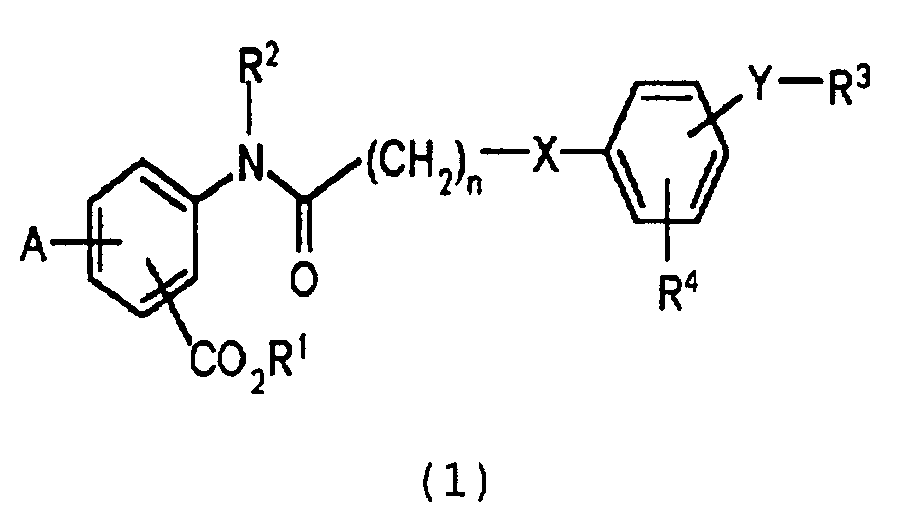
- the compounds according to the present invention correspond to aminobenzoic acid derivatives represented by Formula (1) as follows: ⁇ in Formula (1),
- C 1-6 alkyl group means a straight-chain or branched-chain alkyl group having 1 to 6 carbon atoms.
- C 3-8 cycloalkyl C 1-3 alkyl group means a straight-chain or branched-chain alkyl group having 1 to 3 carbon atoms, substituted with a cycloalkyl group having 3 to 8 carbon atoms.
- C 8-25 alkyl group means a straight-chain or branched-chain alkyl group having 8 to 25 carbon atoms.
- C 1-20 alkyl group means a straight-chain or branched-chain alkyl group having 1 to 20 carbon atoms. As examples thereof, mention may be made of, for example, a methyl group, an ethyl group, a decyl group, a 9-methyldecyl group, a 9,9-dimethyldecyl group, an icosyl group, and the like.
- phenyl C 1-3 alkyl group means a straight-chain or branched-chain alkyl group having 1 to 3 carbon atoms, substituted with a phenyl group.
- a salt with an inorganic acid such as sulfuric acid, hydrochloric acid, or phosphoric acid, or the like
- a salt with an organic acid such as acetic acid, oxalic acid, lactic acid, tartaric acid, fumaric acid, maleic acid, methanesulfonic acid, benzenesulfonic acid, or the like
- a salt with an amine such as trimethylamine, methylamine, or the like
- a salt with a metal ion such as sodium ion, potassium ion, calcium ion, or the like; and the like.
- the compounds according to the present invention exhibit crystal polymorphism.
- the present invention includes any crystal forms thereof.
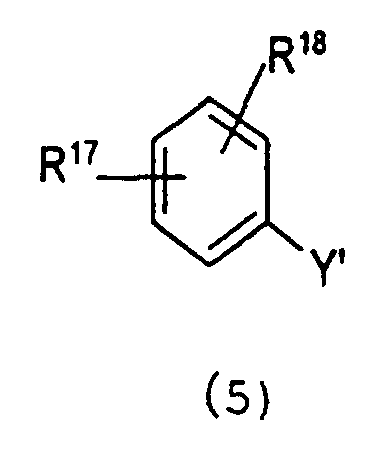
- A represent a group represented by S(O) q R 15 (wherein q and R 15 have the same meanings as described above) or a group represented by Formula (5) as follows: (in the formula, R 17 , R 18 , and Y' have the same meanings as described above), and it is more preferable that A represent a group represented by SR 15 (wherein R 15 has the same meaning as described above) or a group represented by Formula (5) wherein R 17 represents CO 2 R 19 (wherein R 19 has the same meaning as described above) and R 18 represents a hydrogen atom.
- R 17 represents CO 2 R 19
- R 18 represents a hydrogen atom.
- A represent a group represented by SR 15 (wherein R 15 represents a C 1-6 alkyl group) or a group represented by Formula (5) wherein R 17 represents CO 2 H and R 18 represents a hydrogen atom.
- R 2 preferably presents a hydrogen atom or a C 1-6 alkyl group.
- R 3 preferably represents a straight-chain or branched-chain alkyl group having 8 to 25 carbon atoms, and more preferably represents an alkyl group having 14 to 22 carbon atoms, and most preferably represents an alkyl group having 18 carbon atoms.
- R 4 represents a hydrogen atom.
- a CO 2 R 1 group is located at the position as shown in Formula (4) as follows: and it is preferable that A in Formula (4) is located at the position as shown in Formula (6) as follows:
- X represents O or a single bond, and it is more preferable that X represents a single bond.
- Y represents O. It is preferable that n is 1 or 2.
- the preferable compounds in the present invention are selected from those having combinations of the preferable substituents described above.
- the compounds of the present invention can be produced according to the reactions described below.
- A' represents S(O) q R 15 ;
- halo means a halogen atom;
- R represents R 2 excluding a hydrogen atom;
- R' represents a t-butyl group, a p-methoxybenzyl group, or a diphenylmethyl group; and
- R" represents a lower alkyl group.
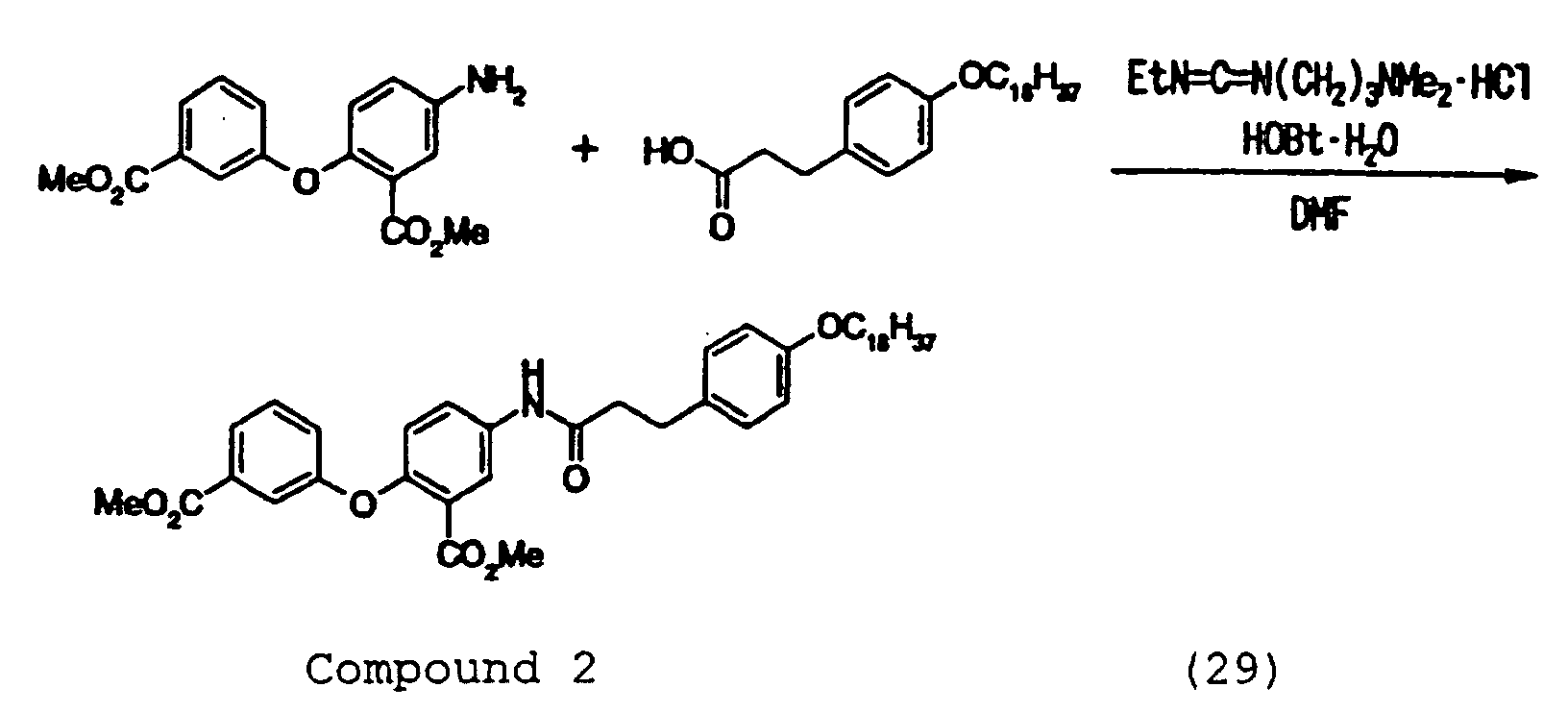
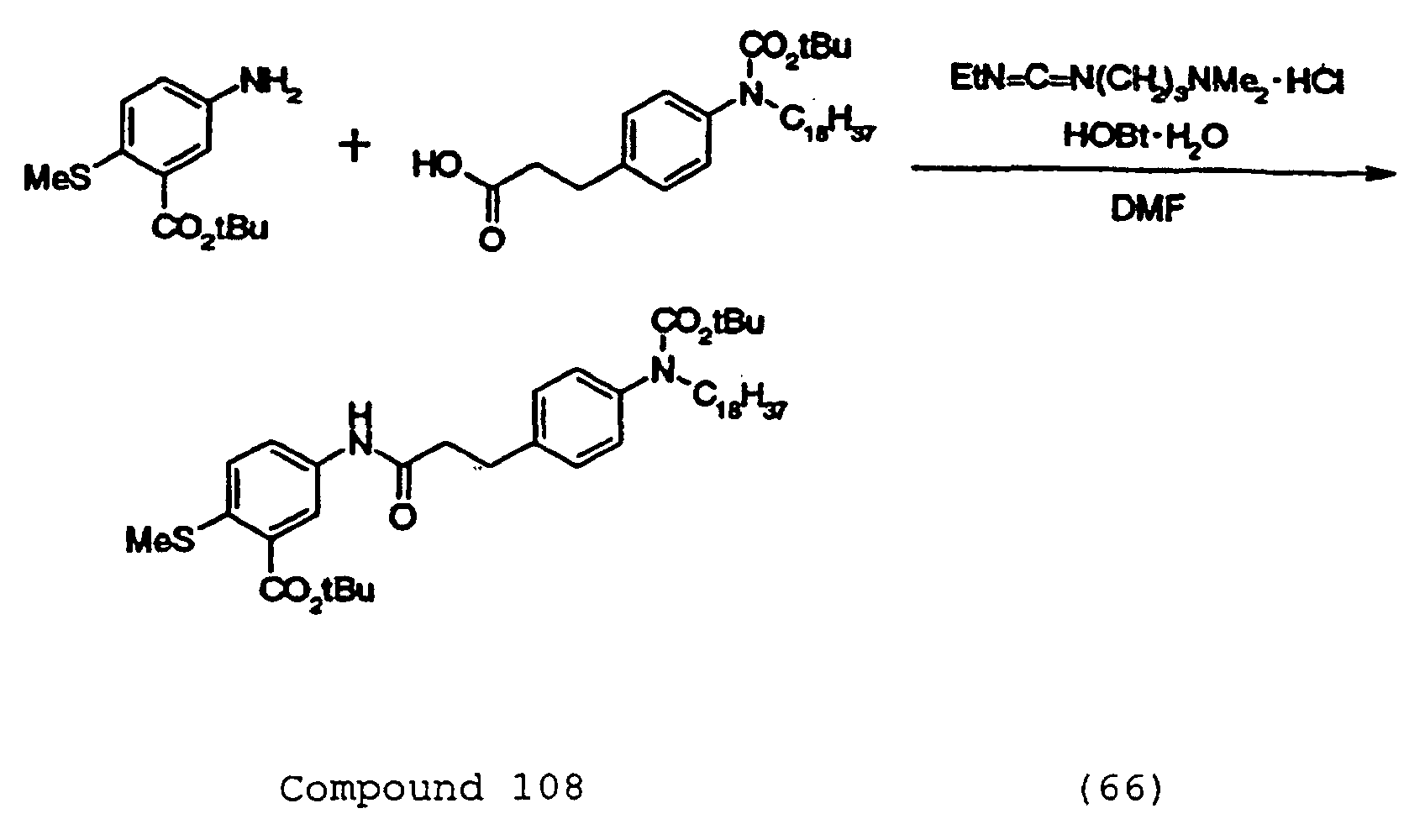
- a compound represented by Formula (9) according to the present invention is prepared by condensation between a compound of Formula (7) and a carboxylic acid compound of Formula (8).
- the condensing agent there can be employed the condensing agents commonly used when amides are produced by amines and carboxylic acids, such as 1-(3-(dimethylamino)propyl)-3-ethylcarbodiimide hydrochloride and 1-hydroxybenzotriazole.
- the solvent inert solvents such as N,N-dimethylformamide and the like can be employed.
- the compound of the present invention of Formula (9) can be also produced by converting the carboxylic acid of Formula (8) into an acid halide or a mixed anhydride according to a common method, followed by a reaction with the compound of Formula (7) in the presence of a base.
- a base pyridine, triethylamine, or the like may be employed.
- the solvent mention may be made of inert solvents such as methylene chloride and the like.
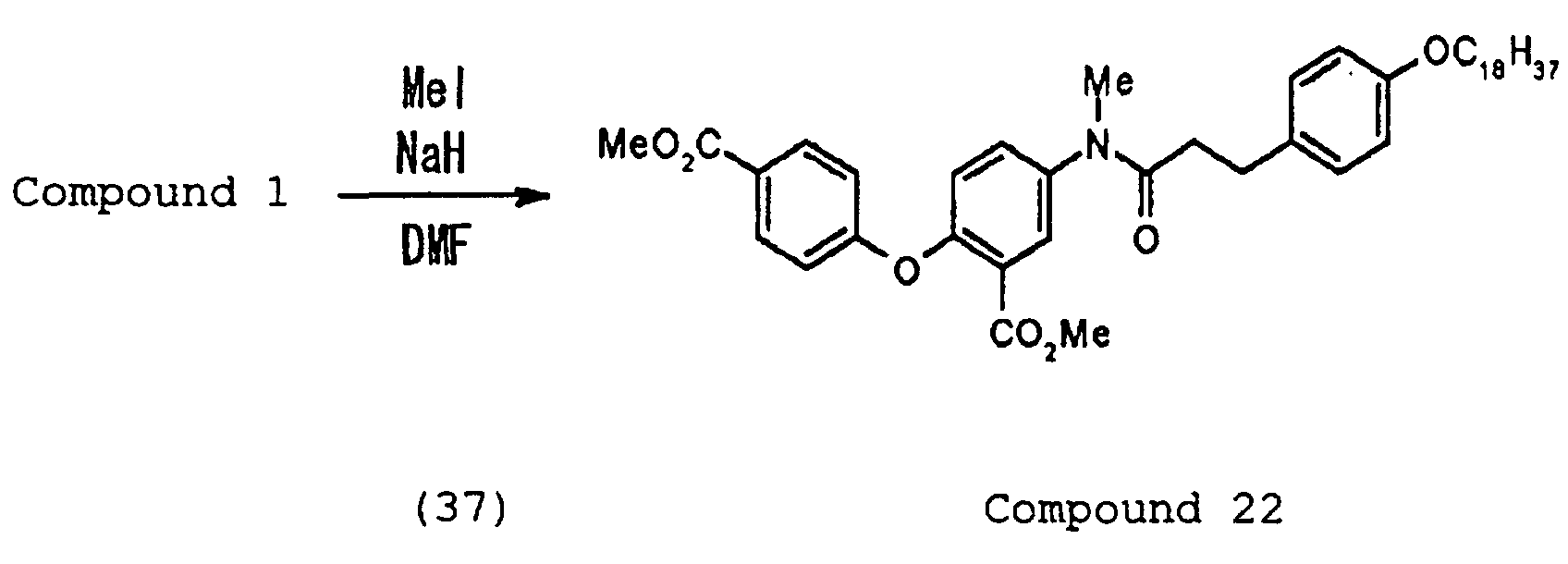
- a compound of Formula (10) according to the present invention in which the nitrogen atom of the amide group is modified (by R) can be produced by carrying out a substitution of the hydrogen atom of the amide group in the compound of Formula (9) in the presence of a strong base.
- a strong base mention may be made of sodium hydride, potassium hydride, calcium hydride, and the like.
- the solvent inert solvents such as N,N-dimethylformamide and the like can be employed.
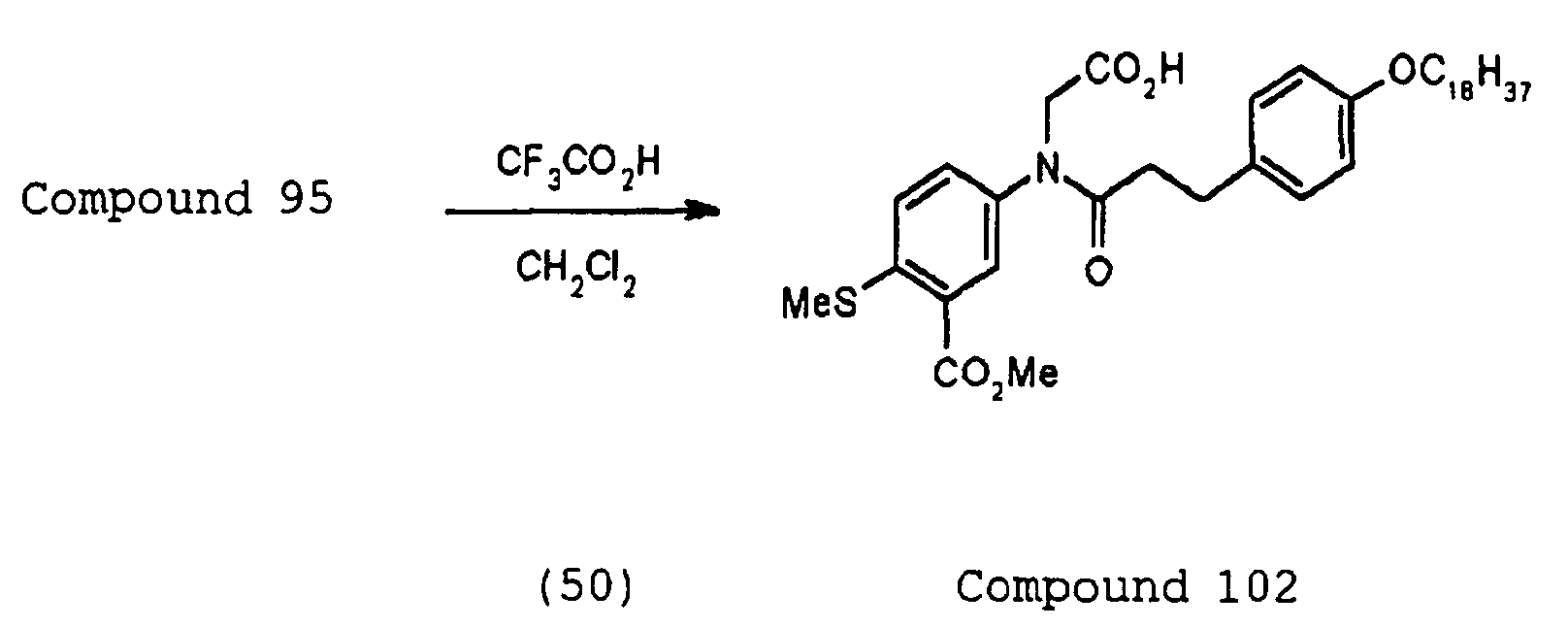
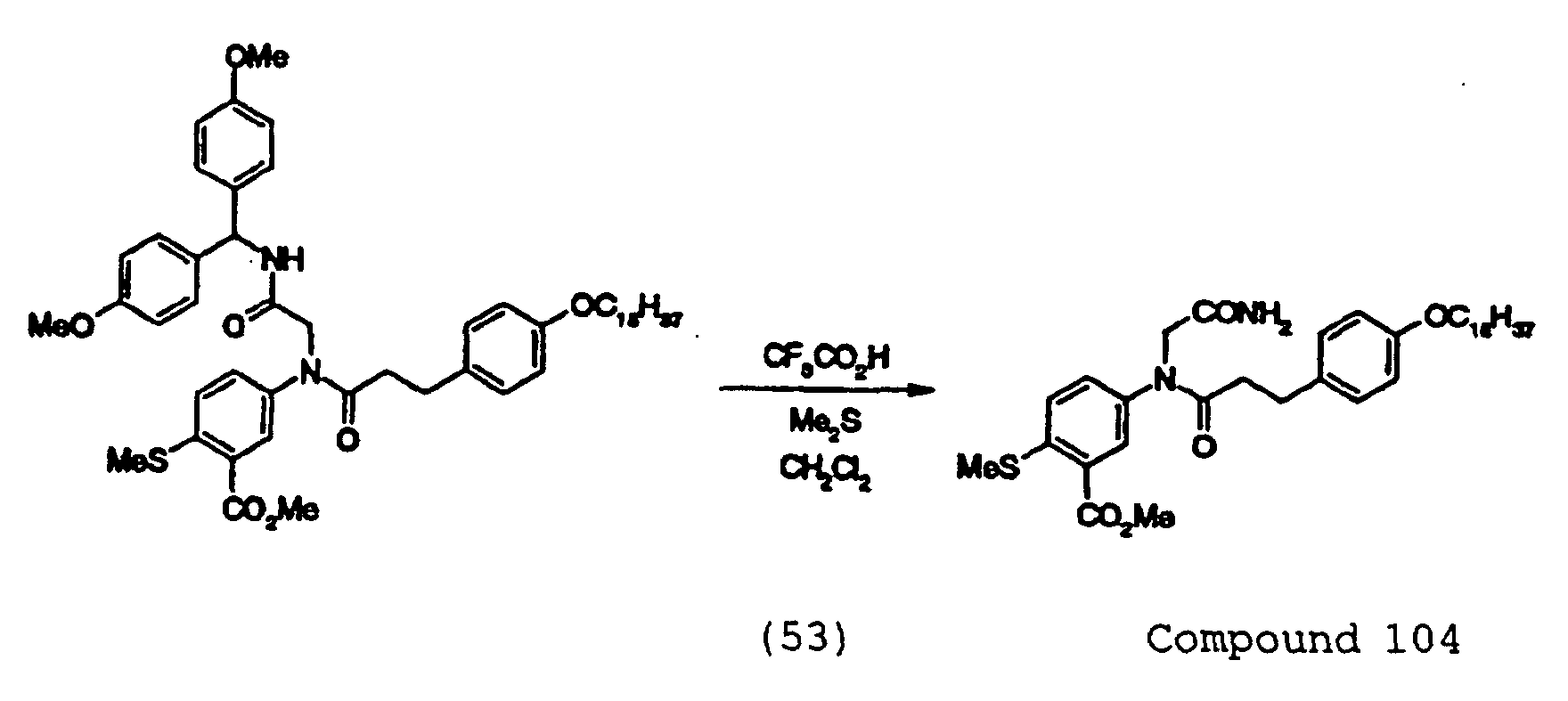
- a compound having CH 2 CO 2 R' as R can be converted into a carboxylic acid compound of Formula (11), by a reaction in the presence of a strong acid such as trifluoroacetic acid or the like in an inert solvent such as methylene chloride or the like.
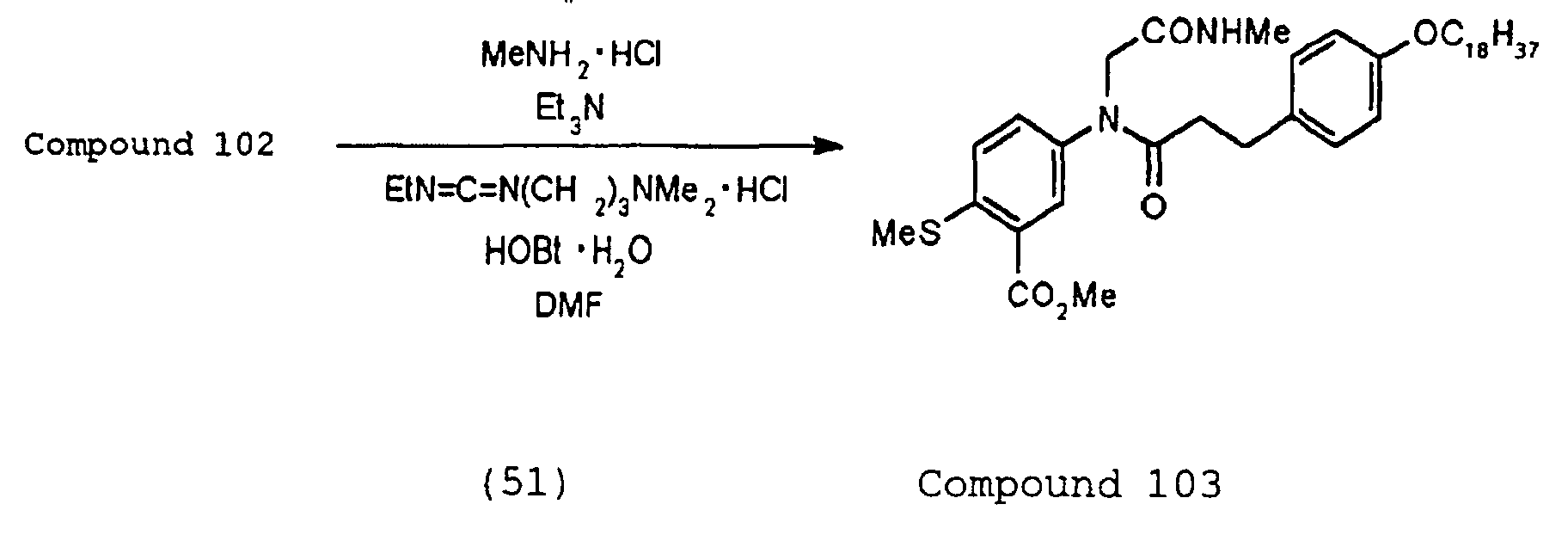
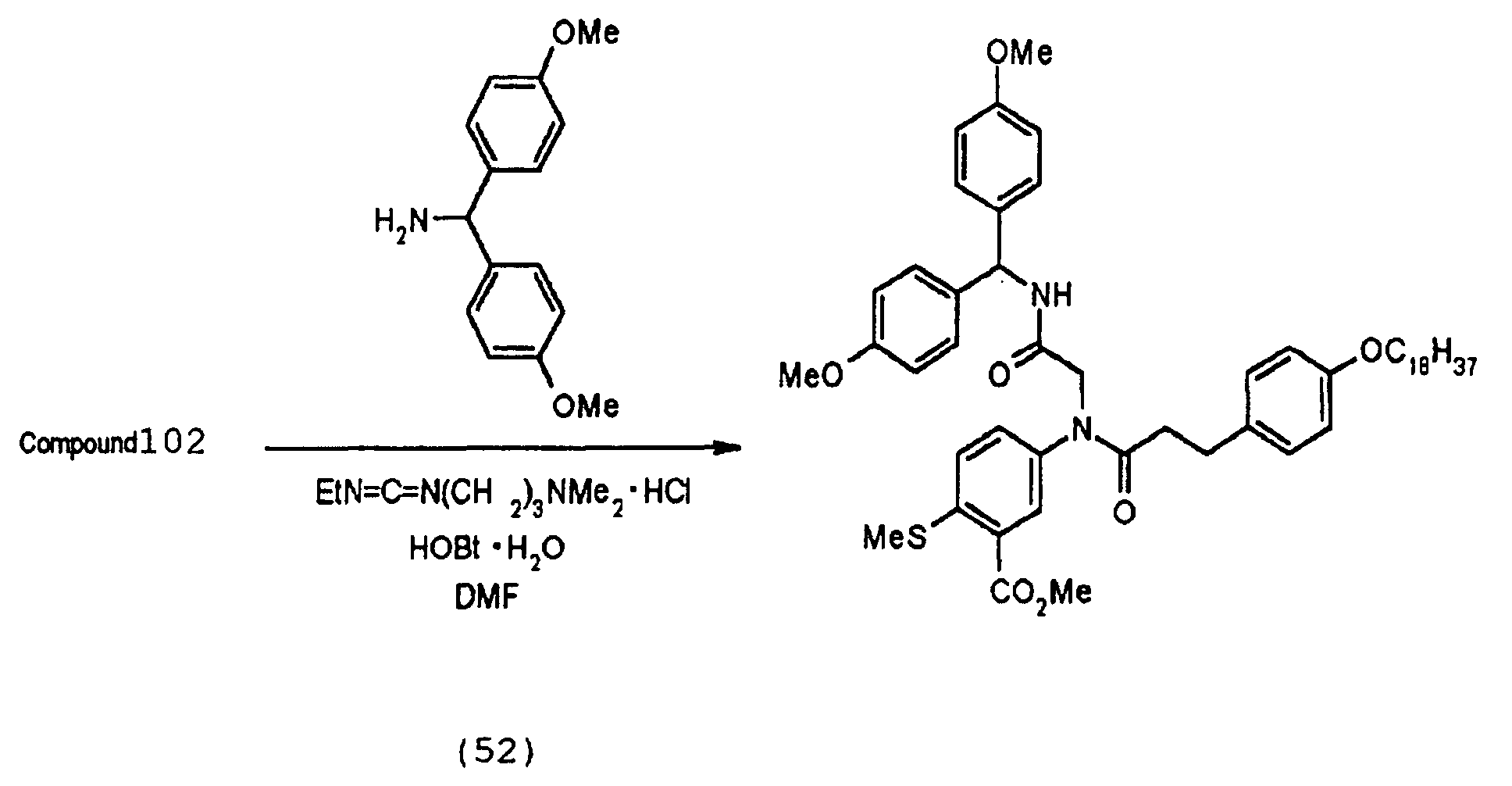
- the carboxylic acid compound of Formula (11) can react with an amine of Formula (12) in the presence of a condensing agent to yield an amide compound of Formula (13).
- a condensing agent there can be employed the condensing agents commonly used when amides are produced by amines and carboxylic acids, such as 1-(3-(dimethylamino)propyl)-3-ethylcarbodiimide hydrochloride and 1-hydroxybenzotriazole.
- the solvent inert solvents such as N,N-dimethylformamide and the like can be employed.
- a compound of Formula (14) can be produced by reacting a compound of Formula (1) in which R 1 represents t-Bu and X represents N(CO 2 Bu-t) in the presence of a strong acid such as trifluoroacetic acid in an inert solvent such as methylene chloride.
- a compound of Formula (15) can be produced by reacting a compound of Formula (1) in which R 1 represents t-Bu and X represents N(CO 2 Bu-t) in the presence of a strong acid such as trifluoroacetic acid in an inert solvent such as methylene chloride.
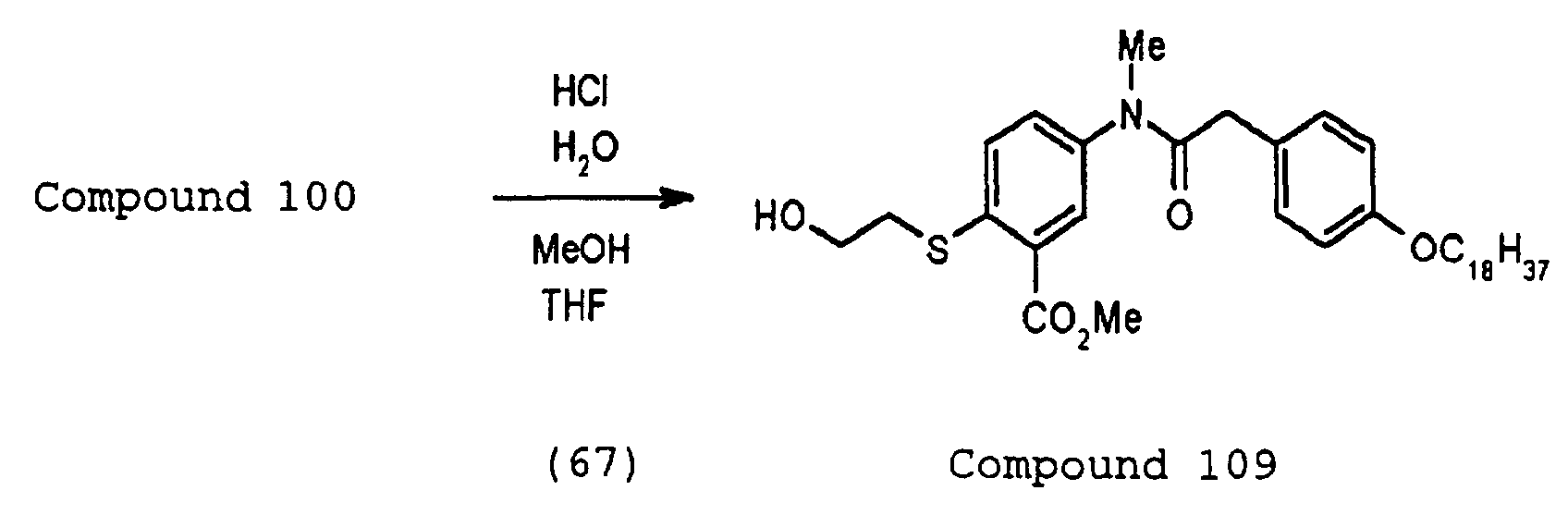
- a compound of Formula (16) can be produced by reacting a compound of Formula (1) in which A' represents S(CH 2 ) m OCH 2 OMe in the presence of an acid such as hydrochloric acid, sulfuric acid, acetic acid, trifluoroacetic acid, or the like in a solvent mixture of a lower alcohol such as methanol and a polar solvent such as tetrahydrofuran.
- an acid such as hydrochloric acid, sulfuric acid, acetic acid, trifluoroacetic acid, or the like
- a solvent mixture of a lower alcohol such as methanol and a polar solvent such as tetrahydrofuran.
- R 1 represents an alkyl group
- R 4 represents an alkoxycarbonyl group
- R 3 represents an alkoxycarbonylalkyl group
- R 1 represents a hydrogen atom
- R 4 represents a carboxyl group
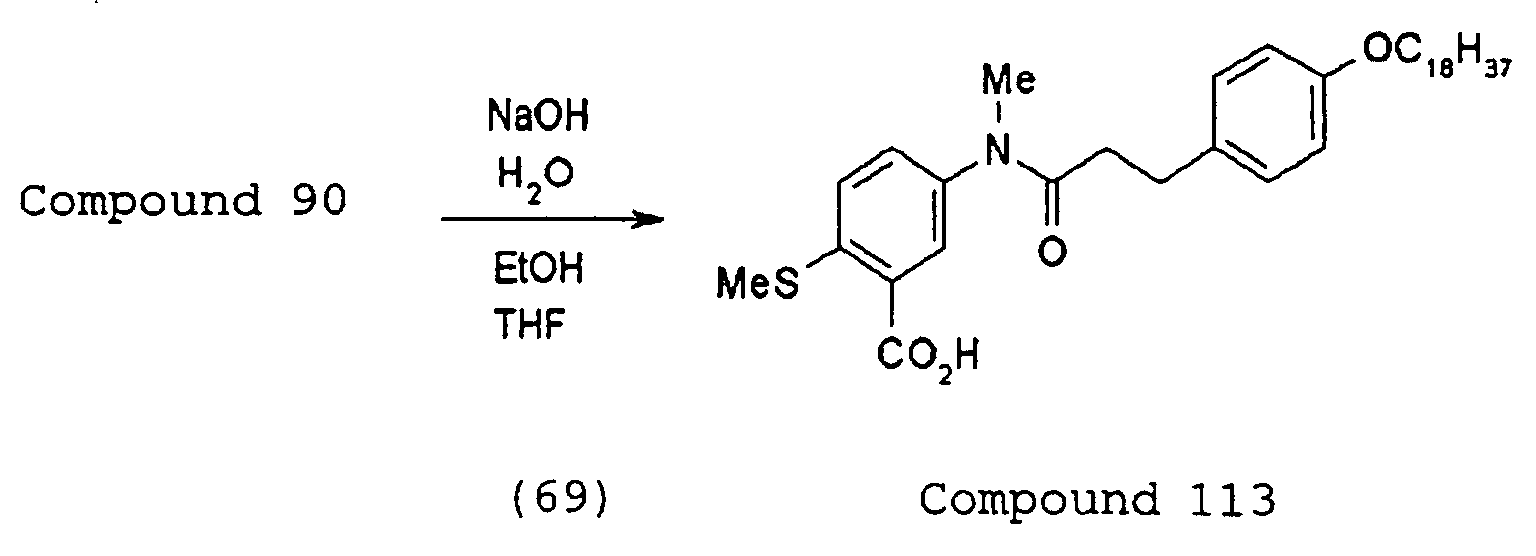
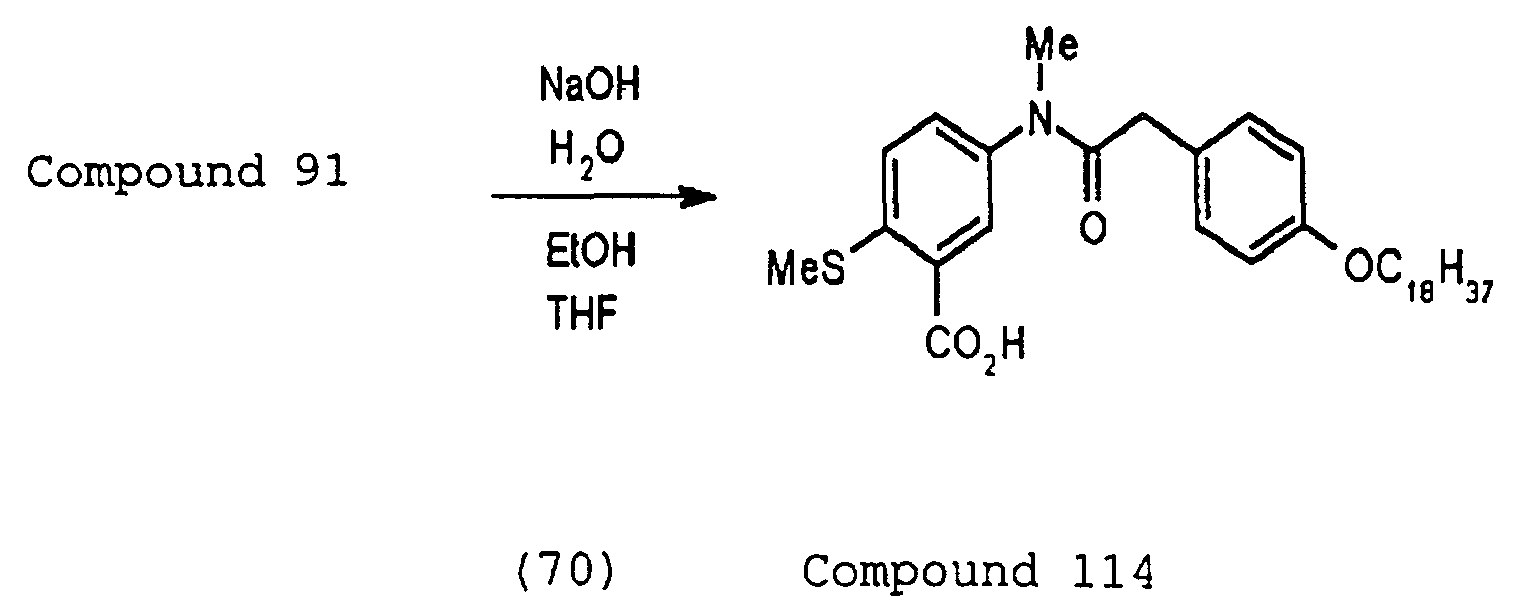
- R 3 represents a carboxyalkyl group, respectively, according to the common methods of hydrolysis in which an ester group is subjected to a hydrolysis.
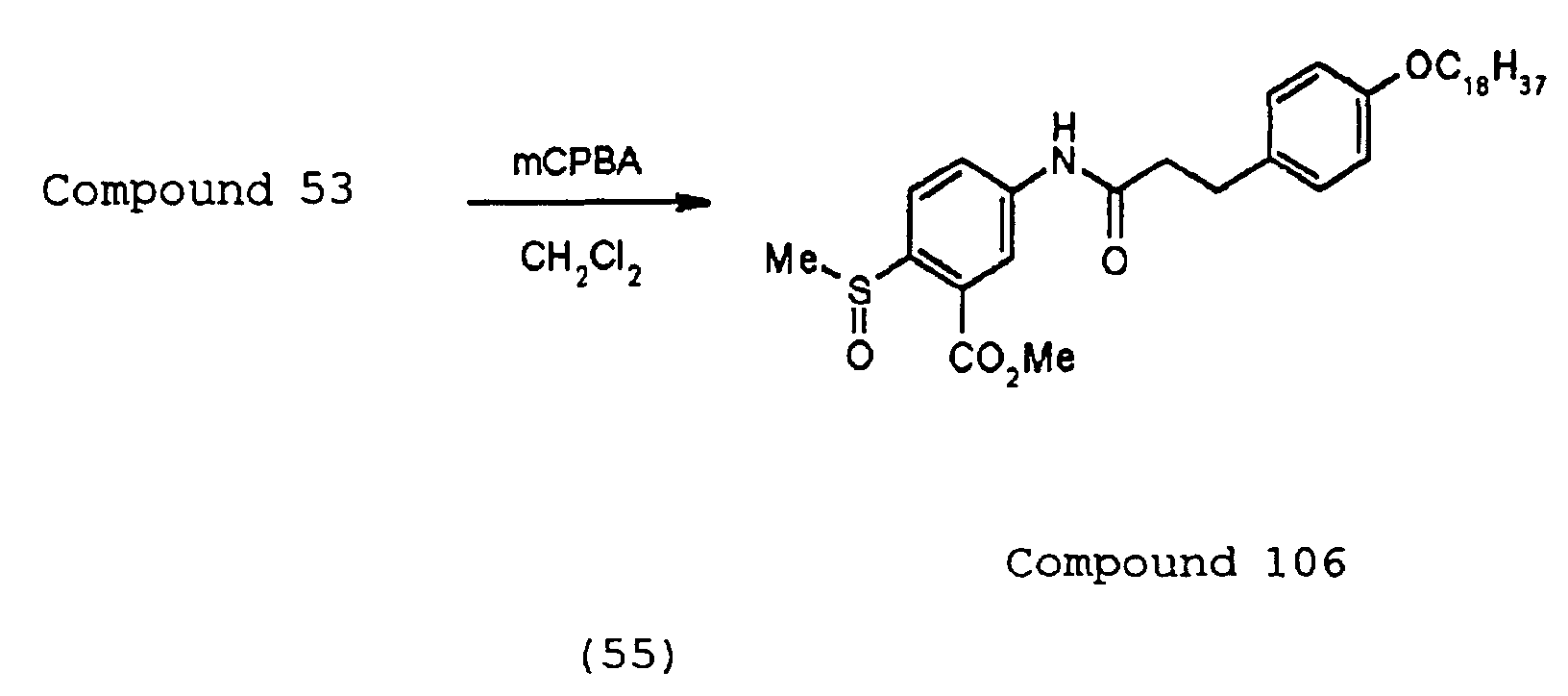
- the compounds of the present invention in which A' represents SR 15 can yield the compounds of the present invention in which A' represents SOR 15 or SO 2 R 15 , by an oxidation with an oxidant such as m-chloroperoxybenzoic acid or the like in an inert solvent such as methylene chloride or the like.
- an oxidant such as m-chloroperoxybenzoic acid or the like in an inert solvent such as methylene chloride or the like.
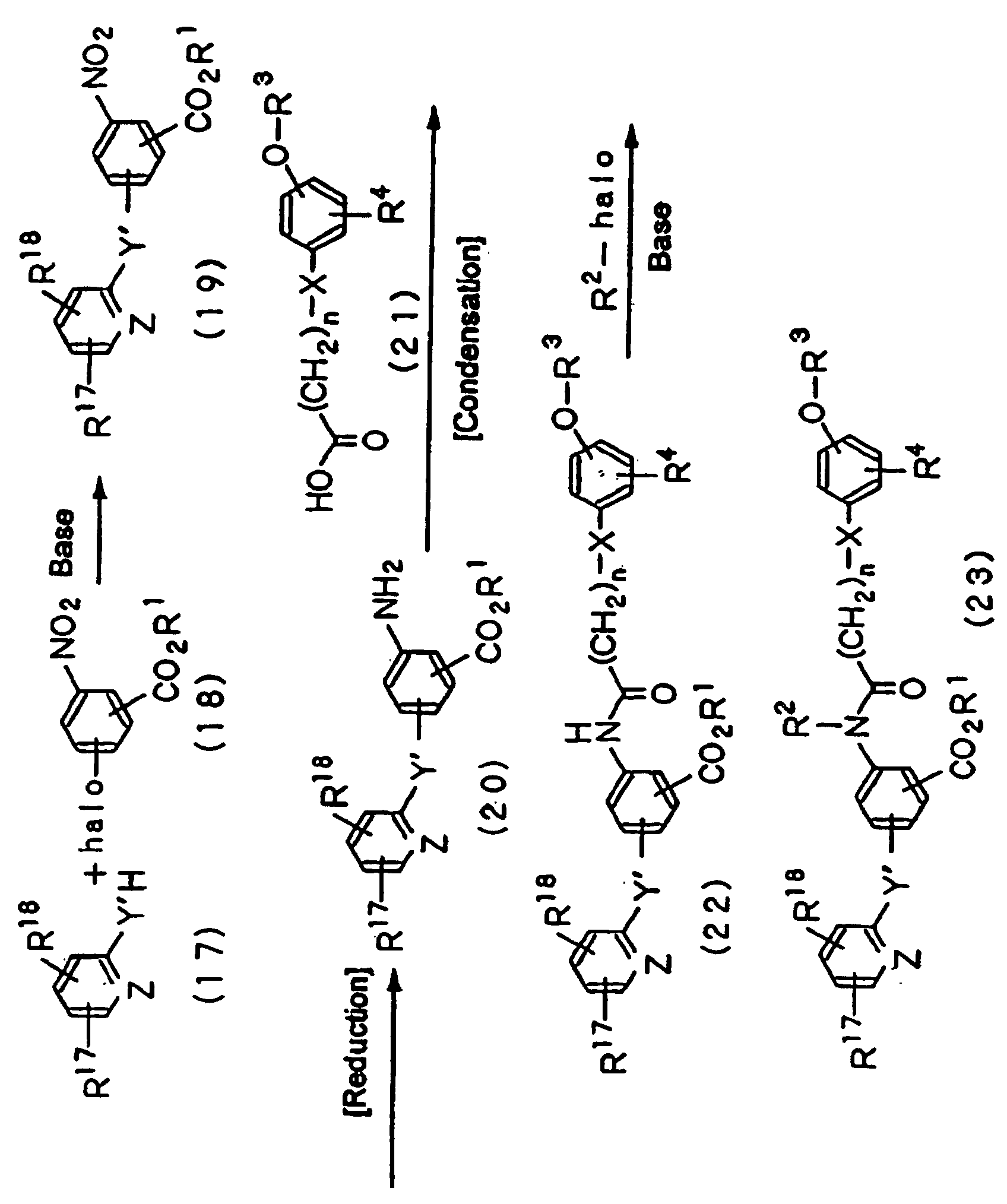
- a compound of Formula (17) and a nitro compound of Formula (18) are stirred in the presence of a base and in the presence or absence of a catalytic amount of copper powders in an appropriate solvent at temperatures of 0°C to 150°C, to yield a compound of Formula (19).
- a base there can be employed inorganic bases such as potassium carbonate, sodium carbonate, sodium hydrogencarbonate, potassium hydrogencarbonate, cesium carbonate, sodium hydride, potassium hydride, and the like; organic bases such as triethylamine, diisopropylethylamine, pyridine, and the like; or the like.
- an inert solvent such as N,N-dimethylformamide or the like can be employed.
- the compound of Formula (19) is stirred with a lower alkyl halide in the presence of a base in an appropriate solvent at temperatures of 0°C to 100°C to yield the compound of Formula (19) in which R 17 represents a hydrogen atom or a group including an alkoxycarbonyl group, R 18 represents a hydrogen atom or an alkoxycarbonyl group, and R 1 represents an alkyl group.
- a base potassium carbonate, sodium carbonate, sodium hydrogencarbonate, potassium hydrogencarbonate, cesium carbonate, or the like can be employed.
- an inert solvent such as N,N-dimethylformamide or the like can be employed.
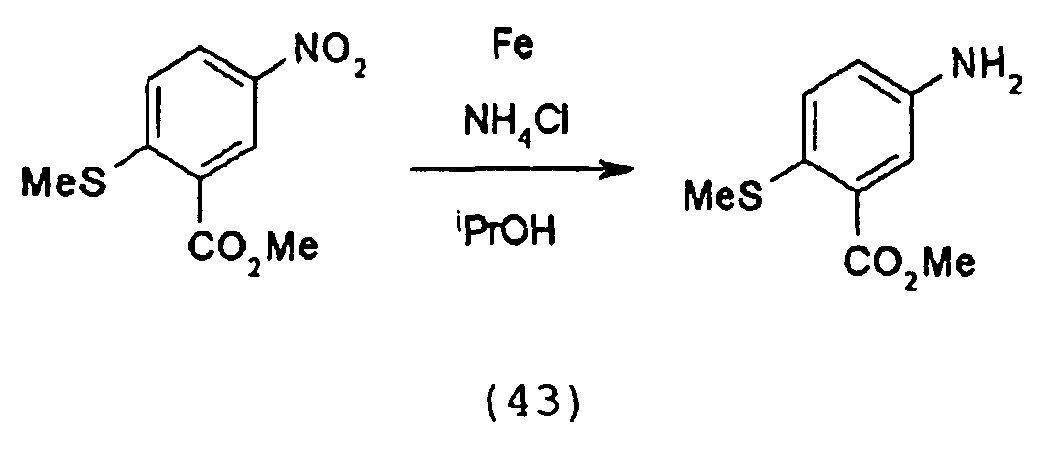
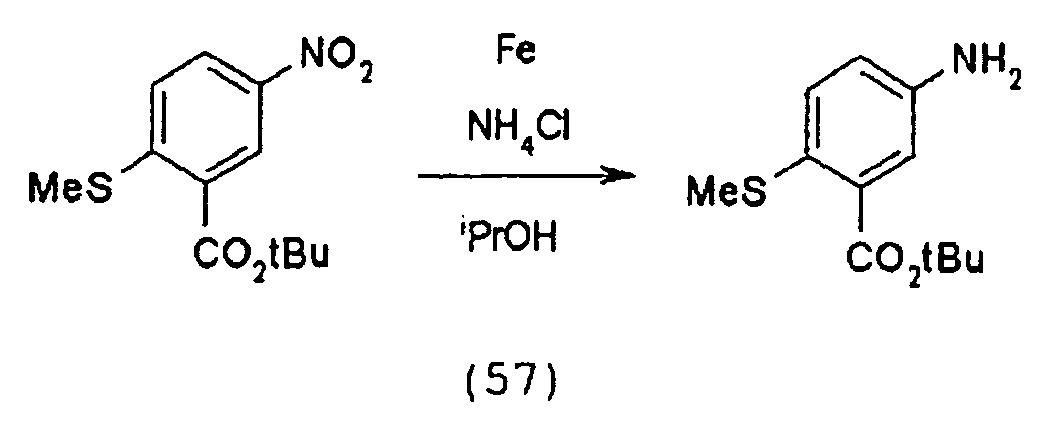
- the nitro group in the compound of Formula (19) which does not include a carboxyl group is reduced to an amino group to yield a compound of Formula (20).
- the reduction method mention may be made of a reduction using a metal such as iron or tin or a metal salt in the presence of an acid such as acetic acid or hydrochloric acid and ammonium chloride; a catalytic hydrogenation using a catalyst such as palladium/carbon, Raney nickel, platinum oxide, or the like; a reduction using ammonium formate in the presence of a palladium/carbon catalyst; or the like.
- the solvent mention may be made of inert solvents such as methanol, ethanol, isopropyl alcohol, and the like.
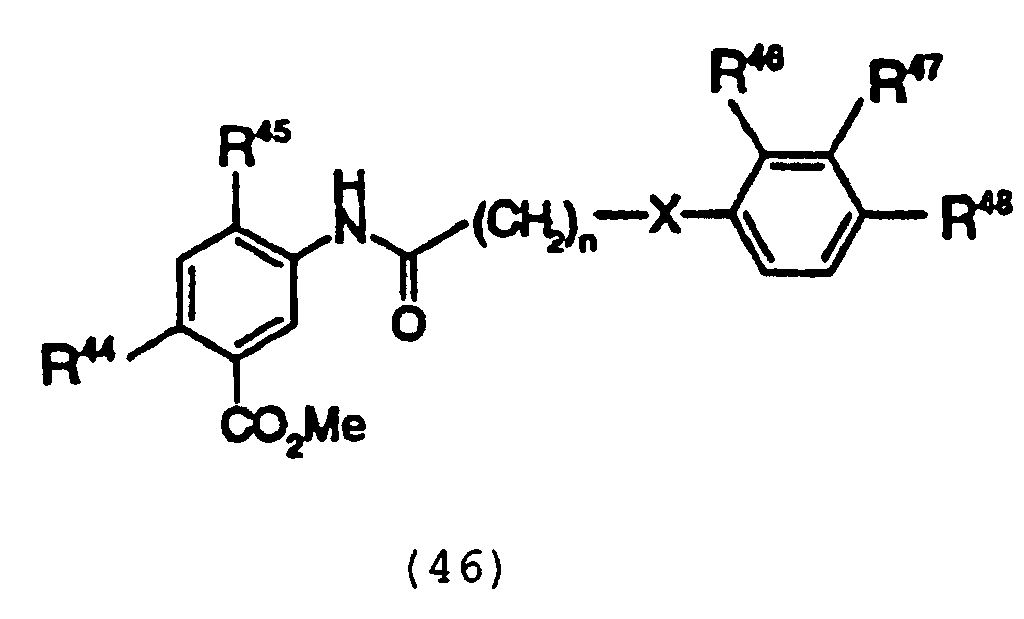
- the compound of Formula (20) obtained herein is condensed with a carboxylic acid of Formula (21) to yield a compound of Formula (22) of the present invention.
- a carboxylic acid of Formula (21) to yield a compound of Formula (22) of the present invention.
- the condensing agent there can be employed the condensing agents commonly used when amides are produced by amines and carboxylic acids, such as 1-(3-(dimethylamino)propyl)-3-ethylcarbodiimide hydrochloride and 1-hydroxybenzotriazole.
- the solvent inert solvents such as N,N-dimethylformamide and the like can be employed.
- the compound of Formula (22) can be prepared by converting the carboxylic acid of Formula (21) into an acid halide or a mixed anhydride according to a common method, followed by a reaction with the compound of Formula (20) in the presence of a base.
- a base pyridine, triethylamine, or the like can be employed.
- the solvent an inert solvent such as methylene chloride or the like may be mentioned.
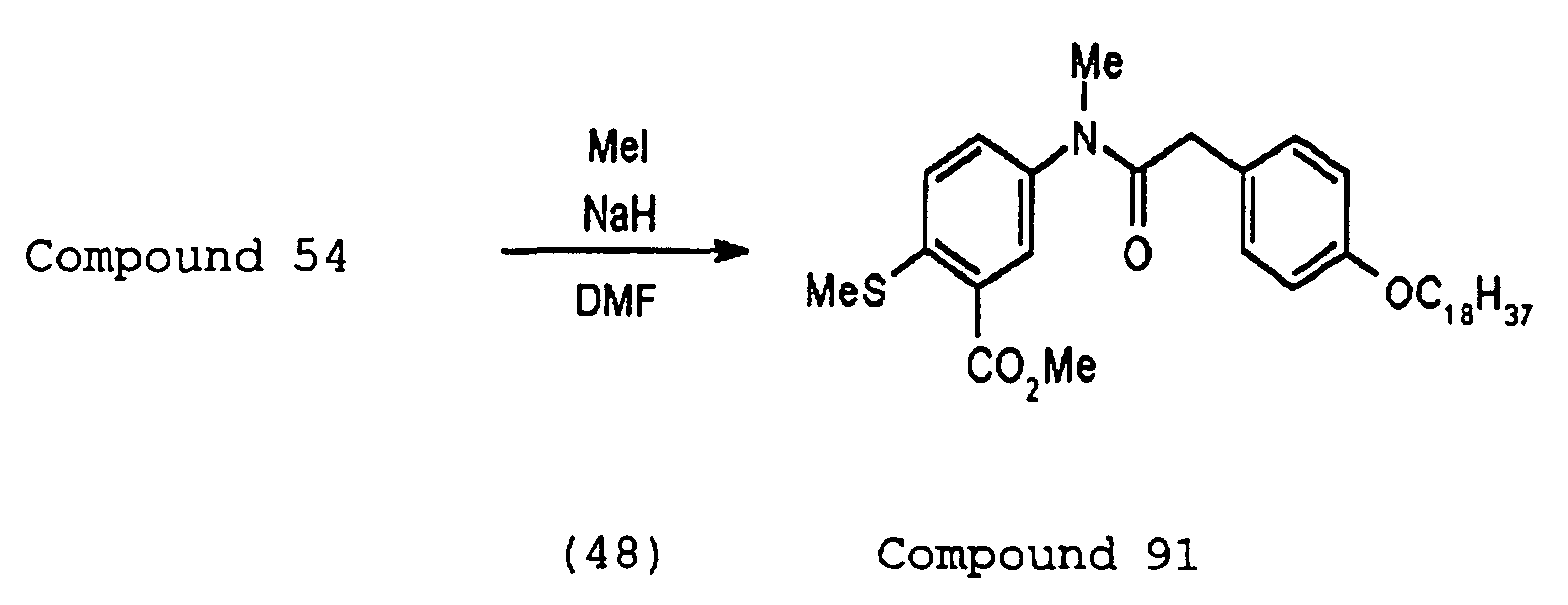
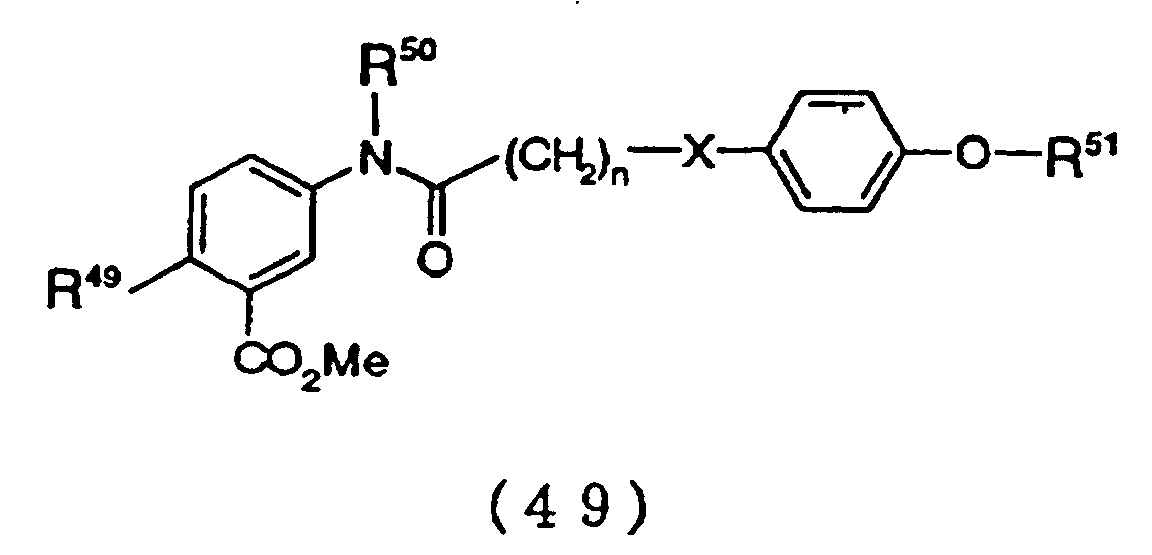
- Alkylation of the compound of Formula (22) is carried out in the presence of a strong base, to yield a compound (23) of the present invention in which the nitrogen atom of the amide is alkylated.
- a strong base in which Y' represents NH
- the compounds of the present invention in which R 2 represents an alkyl group, and Y' represents an N-alkyl group can be yielded.
- the base herein, mention may be made of sodium hydride, potassium hydride, calcium hydride, and the like.
- an inert solvent such as N,N-dimethylformamide or the like can be employed.
- R 1 represents an alkyl group
- R 17 represents a hydrogen atom or a group including an alkoxycarbonyl group
- R 18 represents a hydrogen atom or an alkoxycarbonyl group
- R 1 represents a hydrogen atom
- R 17 represents a hydrogen atom or a group including a carboxyl group
- R 18 represents a hydrogen atom or a carboxyl group, according to the common methods of hydrolysis in which an ester group is subjected to a hydrolysis.
- the compounds represented by Formula (1) or pharmaceutically acceptable salts of the same are employed as the VEGF-receptor antagonists described above, and in particular, as therapeutic agents of the diseases in which VEGF is involved, and are employed in manufacture thereof.
- the VEGF-receptor antagonists of the present invention inhibit proliferation of VEGF-dependent vascular endothelial cells by inhibiting binding between the ligands (VEGF) and the VEGF receptors to inhibit angiogenesis, as well as inhibit vascular hyperpermeability due to VEGF.
- VEGF diseases and pathologic symptoms in which VEGF is involved
- diseases and pathologic symptoms in which VEGF is involved mention may be made of diabetic retinopathy and other retinopathies, chronic rheumatism, solid tumors, ischemia-reperfusion-injury related cerebral edema and damage, psoriasis, atherosclerosis, retrolental fibroplasia, neovascular glaucoma, age-related macular degeneration, thyroid gland hyperplasia (including Graves' disease), chronic inflammation, pneumonia, nephrotic syndrome, tumor immune hypofunction, ascites retention, pericardial effusion (those relating to pericarditis, and the like), retention of pleural effusion, and the like.
- Diabetic retinopathy refers to diseases in which various lesions form in the retina or vitreous body due to abnormalities in retinal blood vessels, caused by exposure under hyperglycaemic conditions for a long period of time. It is known that according to progress of the disease, abnormal angiogenesis and bleeding in the eyeball lead to blindness. In addition, it is reported that there is a positive correlation relationship between increasing in VEGF level in the eyeball and abnormal angiogenesis in the eyeball ( New Engl. J. Med., vol. 331, pp. 1480-1487, 1994).
- VEGF-receptor antagonists are effective on diabetic retinopathy and other retinopathies.
- VEGF plays important roles in angiogenesis in malignant tumors ( Biochem. Biophys. Res. Commun ., vol. 161, pp. 851-858, 1989).
- VEGF vascular endothelial growth factor
- cerebral tumors such as gliomas, malignant lymphomas, pituitary adenomas, meningiomas, and the like
- various solid malignant tumors such as melanomas, colon cancers, ovarian cancers, pancreatic cancers, esophageal cancers, rhabdomyosarcomas, leiomyosarcomas, Kaposi's sarcoma, lung cancers, and the like
- VEGF secreted from tumor cells causes proliferation of vascular endothelial cells by binding to tyrosine-kinase-type receptors which are specifically present in vascular endothelial cells, and are involved in proliferation or metastasis of tumors due to induction of tumor angiogenesis ( Oncogene, vol. 5, pp. 519-524, 1990; Science, vol. 255, pp. 989-991, 1992).
- tumor proliferation can be inhibited by administration of an anti-VEGF monoclonal antibody in an implantation model in the nude mouse of glioblastoma, rhabdomyosarcoma, and leiomyosarcoma ( Nature , vol. 362, pp. 841-844, 1993), and it is suggested that VEGF-receptor antagonists exhibit anti-tumor effects on various solid tumors.
- VEGF vascular hyperpermeability effects thereof
- mFlt(1-3) mouse VEGF-receptor protein
- IgG IgG
- the compounds of the present invention When the compounds of the present invention are employed as VEGF-receptor antagonists or therapeutic agents for the diseases in which VEGF is involved, they can be administered orally or parenterally.
- the dosage forms of the same are tablets, capsules, granules, abstracts, powders, troches, ointments, creams, emulsions, suspensions, suppositories, injections, or the like, each of which may be produced according to the conventional formulation methods (for example, methods defined in the 12 th revised edition of the Japanese Pharmacopeia). These dosage forms may be appropriately selected depending on the conditions and ages of the patients, as well as the purpose of the treatment.
- excipients for example, crystalline cellulose, starch, lactose, mannitol, or the like
- binders for example, hydroxypropylcellulose, polyvinylpyrrolidone, or the like
- lubricants for example, magnesium stearate, talc, or the like
- disintegrants for example, carboxymethylcellulose calcium, or the like
- the doses of the compounds according to the present invention are in the range of 1 to 2000 mg per day in a single dose or divided into several doses, in the case of an adult human subject to be treated.
- the doses may vary appropriately depending on the age, weight, and condition of each individual patient.
- mCPBA m-chloroperoxybenzoic acid
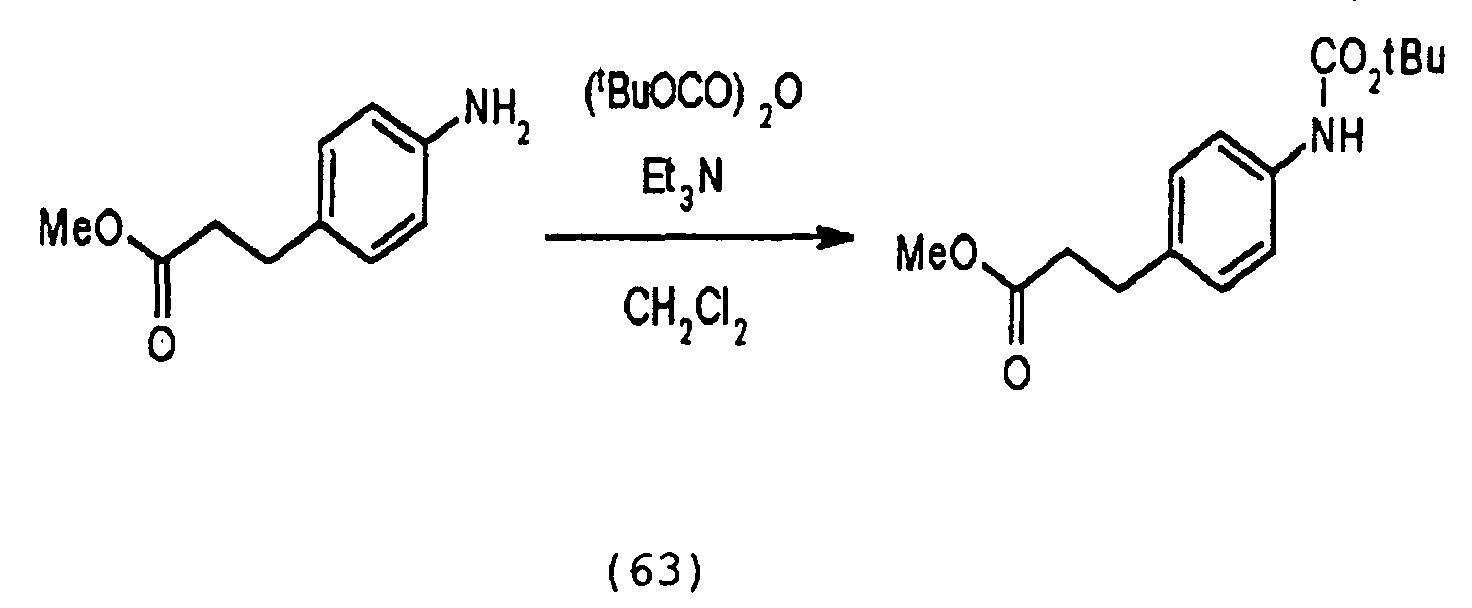
- Methyl 3-(4-(t-butoxycarbonylamino)phenyl)propionate (melting point: 72 - 73.5°C) was prepared using methyl 3-(4-aminophenyl)propionate in the same procedures as described in Reaction Scheme (59) of Example 24 (Reaction Scheme (63) described below).
- NIH3T3 cells in which Flt-1 was forced to be expressed were seeded on a 24-well collagen-coated plate (7 ⁇ 10 4 /well), and were cultured in Dulbecco's modified Eagle's medium (DMEM) including 10% bovine serum and 200 ⁇ g/ml of Geneticin G418, for 24 hours at 37°C under an atmosphere of 5% carbon dioxide gas.
- DMEM Dulbecco's modified Eagle's medium
- the cells were preincubated in Buffer A (including 10 mM HEPES (N-2-hydroxyethylpiperazine-N'-2-ethanesulfonic acid) and 0.1% BSA (bovine serum albumin) in DMEM), for 30 minutes at 4°C.
- Buffer A including 10 mM HEPES (N-2-hydroxyethylpiperazine-N'-2-ethanesulfonic acid) and 0.1% BSA (bovine serum albumin) in DMEM
- Buffer B including 10 mM HEPES and 0.5% BSA in DMEM.
- a test solution prepared by dissolving each of the test compounds shown in Table 19 in dimethylsulfoxide and subsequently diluting the solution into a prescribed concentration with Buffer B, and ( 125 I)-VEGF (the final concentration was set to 25 pM) were added thereto. Binding reaction was carried out for 90 minutes at 4°C. After completion of the reaction, the cells were washed three times with ice-cooled Buffer A. Subsequently, 0.5 ml of 0.5M NaOH were added to each well, and the cells were lysed in 30 minutes at room temperature.
- the radioactivity of the lysed cells in each well was measured by means of a gamma counter, and a total binding quantity of ( 125 I)-VEGF was calculated.
- Nonspecific binding quantity of ( 125 I)-VEGF was measured by competition assay in the presence of 10 nM non-labeled VEGF.
- the specific binding quantity of ( 125 I)-VEGF was calculated from the difference between the total binding quantity of ( 125 I)-VEGF and nonspecific binding quantity of ( 125 I)-VEGF.
- Binding inhibition index (%) (1- Specific binding quantity of ( 125 I)-VEGF of the group with an addition of test compounds Specific binding quantity of ( 125 I)-VEGF of the control group ) ⁇ 100
- the compounds of the present invention inhibit angiogenesis by inhibiting VEGF-dependent proliferation of vascular endothelial cells and suppress vascular hyperpermeability due to VEGF.
- the compounds of the present invention are expected to be therapeutic agents for the diseases in which angiogenesis is involved and which are induced by VEGF, such as diabetic retinopathy, chronic rheumatism, and solid tumors.
- VEGF vascular hyperpermeability induced by VEGF is involved, such as cerebral edema upon ischemia reperfusion injury, are expected.
Landscapes
- Chemical & Material Sciences (AREA)
- Organic Chemistry (AREA)
- Health & Medical Sciences (AREA)
- Chemical Kinetics & Catalysis (AREA)
- Life Sciences & Earth Sciences (AREA)
- General Chemical & Material Sciences (AREA)
- Medicinal Chemistry (AREA)
- Nuclear Medicine, Radiotherapy & Molecular Imaging (AREA)
- Bioinformatics & Cheminformatics (AREA)
- Pharmacology & Pharmacy (AREA)
- Engineering & Computer Science (AREA)
- Animal Behavior & Ethology (AREA)
- General Health & Medical Sciences (AREA)
- Public Health (AREA)
- Veterinary Medicine (AREA)
- Pharmaceuticals Containing Other Organic And Inorganic Compounds (AREA)
- Organic Low-Molecular-Weight Compounds And Preparation Thereof (AREA)
- Acyclic And Carbocyclic Compounds In Medicinal Compositions (AREA)
Abstract

Description

- R25 represents a hydrogen atom or a group represented by CO2R26 (wherein R26 represents a hydrogen atom or a C1-6 alkyl group));
- X represents O, a single bond, CH=CH, or a group represented by NR27 (wherein R27 represents a hydrogen atom or a t-butoxycarbonyl group);
- Y represents O, CONH, NHCO, or a group represented by NR28 (wherein R28 represents a hydrogen atom or a t-butoxycarbonyl group); and
- n is an integer of 0 to 15 (with the proviso that when X does not represent CH=CH, n is not 0)}

























| m | R52 | Melting point (°C) | |
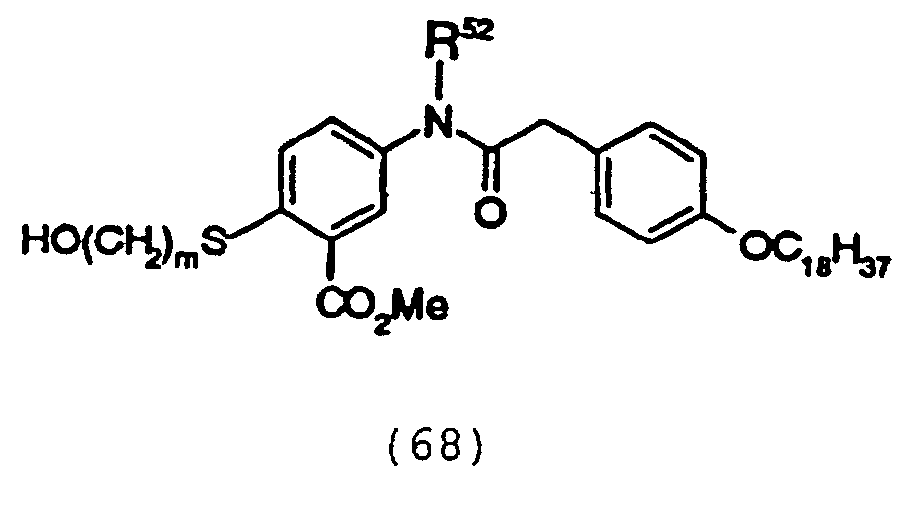
| Compound 110 | 3 | Me | 38.5-40 |
| Compound 111 | 2 | H | 66-70 |
| Compound 112 | 3 | H | 101-110 |
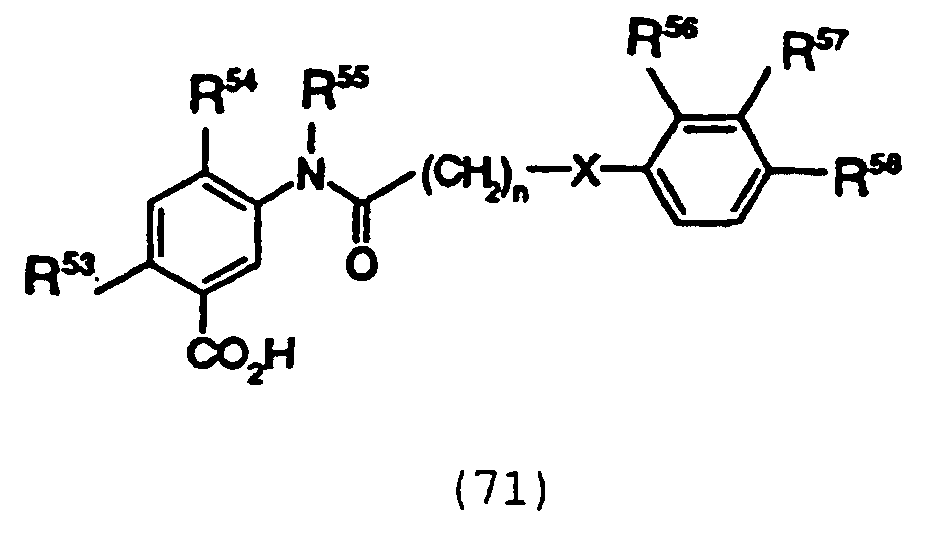


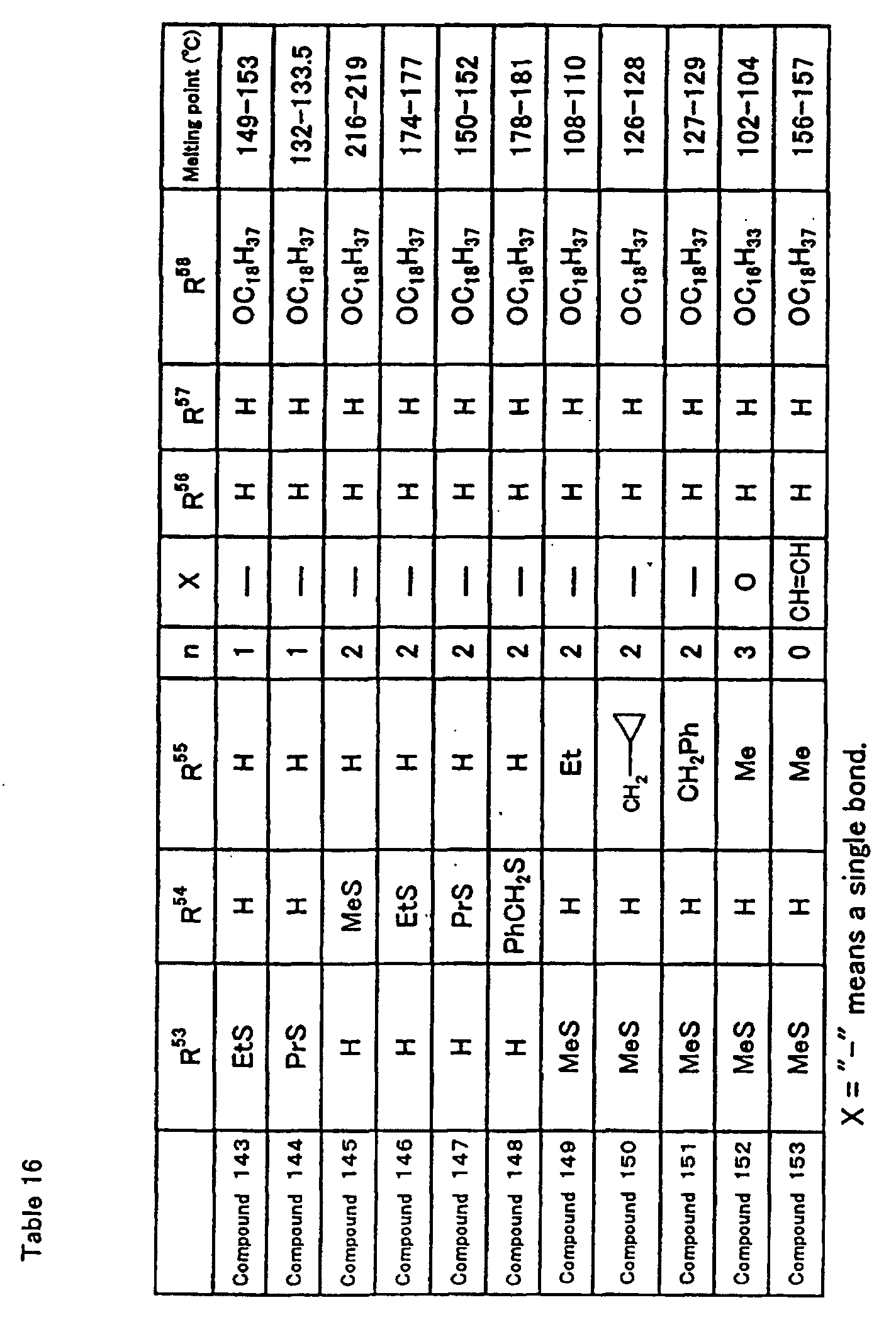


| q | R59 | ESIMS : m/z | Rf value | |
| Compound 165 | 3 | Me | 432 (MH+) 454 (MNa+) 430 ((M-H)-) | 0.35 |
| Compound 166 | 4 | Me | 446 (MH+) 468 (MNa+) 444 ((M-H)-) | 0.35 |
| Compound 167 | 4 | Et | 460 (MH+) 482 (MNa+) 458 ((M-H)-) | 0.35 |
| Compound 168 | 6 | Me | 488 (MH+) 510 (MNa+) 486 ((M-H)-) | 0.35 |
| IC50(µM) | |
| Compound 27 | 0.68 |
| Compound 28 | 0.71 |
| Compound 113 | 0.28 |
| Compound 114 | 0.42 |
| IC50 (µM) | |
| Compound 27 | 0.51 |
| Compound 28 | 0.42 |
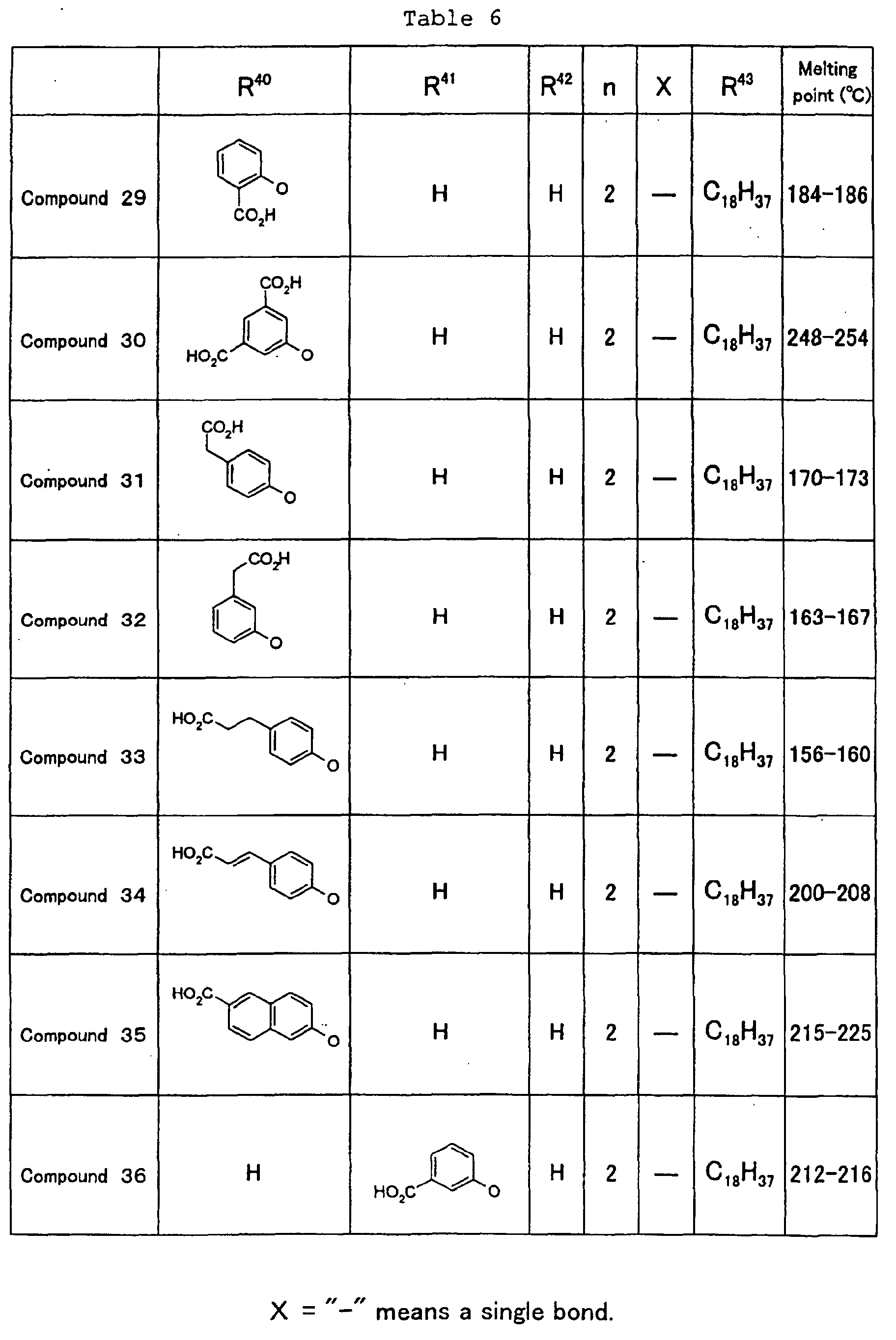
| Compound 29 | 1.19 |
| Compound 31 | 1.23 |
| Compound 32 | 0.93 |
| Compound 33 | 0.26 |
| Compound 34 | 0.34 |
| Compound 35 | 0.20 |
| Compound 36 | 1.27 |
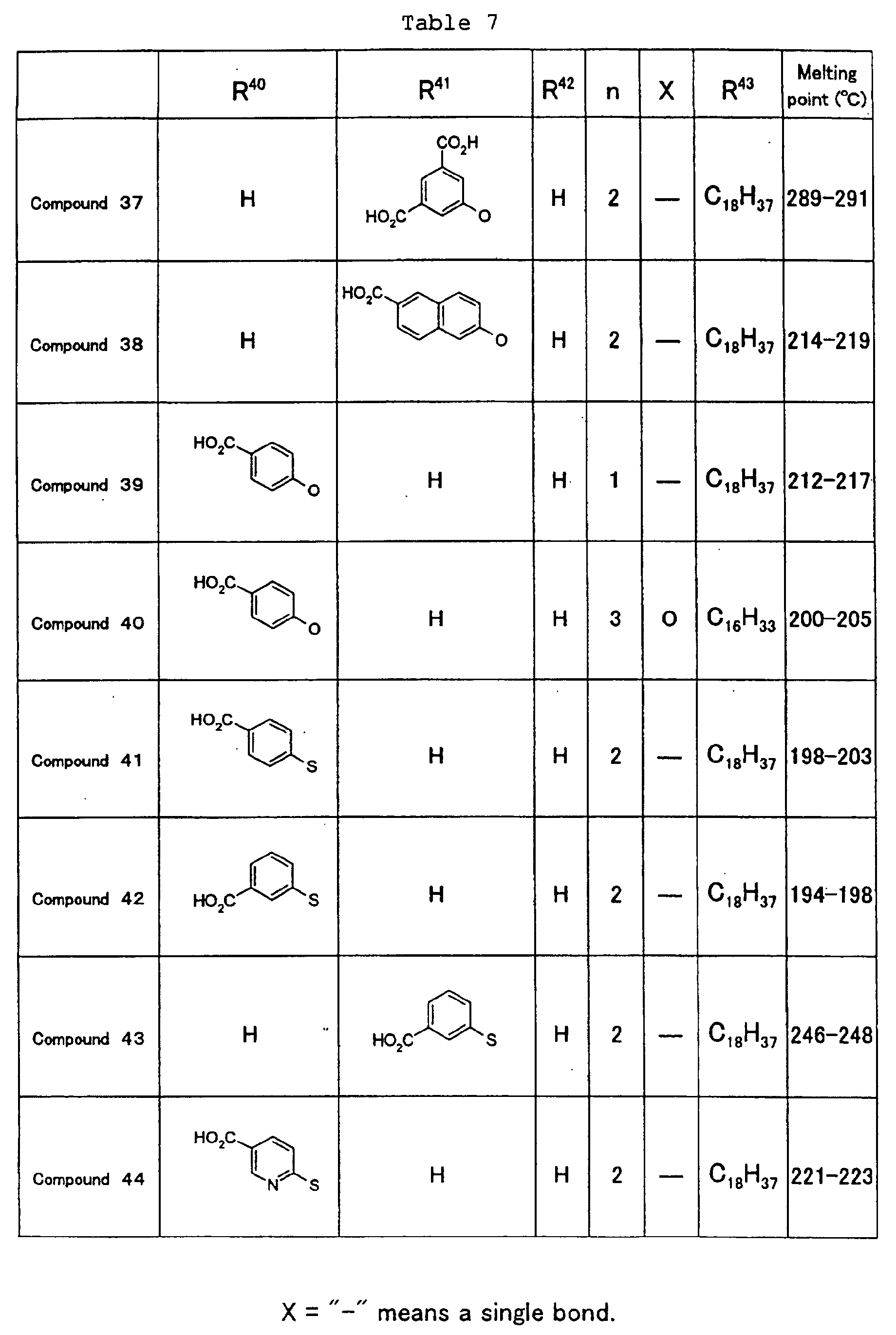
| Compound 38 | 0.71 |
| Compound 41 | 0.37 |
| Compound 42 | 0.45 |
| Compound 43 | 0.66 |
| Compound 44 | 0.91 |
| Compound 45 | 0.76 |
| Compound 46 | 0.40 |
| Compound 47 | 0.94 |

Claims (13)
- An aminobenzoic acid derivative represented by Formula (1) as follows:{in Formula (1),
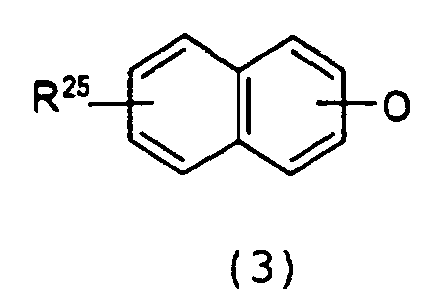
 (in the formula, R17 represents a hydrogen atom or a group represented by CO2R19, CH2CO2R20, CH2CH2CO2R21, or CH=CHCO2R22 (wherein R19, R20, R21, and R22 independently represent a hydrogen atom or a C1-6 alkyl group), R18 represents a hydrogen atom or a group represented by CO2R23 (wherein R23 represents a hydrogen atom or a C1-6 alkyl group), Y' represents O, S, or NR24 (wherein R24 represents a hydrogen atom or a C1-6 alkyl group), and Z represents CH or N), or a group represented by Formula (3) as follows:R1 represents a hydrogen atom or a C1-6 alkyl group;R2 represents a hydrogen atom, a C1-6 alkyl group, a C3-8 cycloalkyl C1-3 alkyl group, a phenyl C1-3 alkyl group, a group represented by CH2CO2R5 (wherein R5 represents a hydrogen atom or a C1-6 alkyl group), or a group represented by CH2CON(R6)R7 (wherein R6 and R7 independently represent a hydrogen atom or a C1-6 alkyl group) ;R3 represents a C8-25 alkyl group, a group represented by (CH2)pCO2R11 (wherein p is an integer of 1 to 20, and R11 represents a hydrogen atom or a C1-6 alkyl group), or a group represented by (CH2)3CONHCH(R12)CONHR13 (wherein R12 represents a hydrogen atom or a group represented by CH2CO2R14 group (wherein R14 represents a hydrogen atom or a C1-6 alkyl group), and R13 represents a C1-20 alkyl group) ;R4 represents a hydrogen atom or a group represented by OR9 or CO2R10 (wherein R9 and R10 independently represent a hydrogen atom or a C1-6 alkyl group),A represents a group represented by S(O)qR15 (wherein q is 0, 1, or 2, R15 represents a C1-6 alkyl group, a phenyl C1-3 alkyl group, or a group represented by (CH2)mOR16 (wherein m is 2 or 3, and R16 represents a hydrogen atom or a methoxymethyl group)), a group represented by Formula (2) as follows:
 (in the formula,
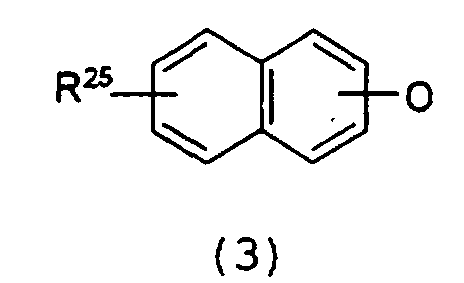 or a pharmaceutically acceptable salt of the same.R25 represents a hydrogen atom or a group represented by CO2R26 (wherein R26 represents a hydrogen atom or a C1-6 alkyl group));X represents O, a single bond, CH=CH, or a group represented by NR27 (wherein R27 represents a hydrogen atom or a t-butoxycarbonyl group);Y represents O, CONH, NHCO, or a group represented by NR28 (wherein R28 represents a hydrogen atom or a t-butoxycarbonyl group); andn is an integer of 0 to 15 (with the proviso that when X does not represent CH=CH, n is not 0)}
 - The aminobenzoic acid derivative or pharmaceutically acceptable salt of the same, according to Claim 1, wherein in Formula (1), A represents a group represented by Formula (2) (in the formula, R17, R18, Y', and Z have the same meanings as described above), or a group represented by Formula (3) (in the formula, R25 has the same meaning as described above); and Y represents O, CONH, or a group represented by NR28 (wherein R28 has the same meaning as described above).
- The aminobenzoic acid derivative or pharmaceutically acceptable salt of the same, according to Claim 2, wherein the Formula (1) described above is represented by Formula (4) as follows:in Formula (4), R1 represents a hydrogen atom or a C1-6 alkyl group; R2 represents a hydrogen atom or a C1-6 alkyl group; R3 represents a C8-25 alkyl group; R4 represents a hydrogen atom; A represents a group represented by Formula (2) (in the formula, R17, R18, Y', and Z have the same meanings as described above), or a group represented by Formula (3) (in the formula, R25 has the same meaning as described above); and

X represents O or a single bond; Y represents O; and n is an integer of 1 to 11. - The aminobenzoic acid derivative or pharmaceutically acceptable salt of the same, according to Claim 3, wherein in Formula (4), A represents a group represented by Formula (5) as follows:(in the formula, R17, R18, and Y' have the same meanings as described above).
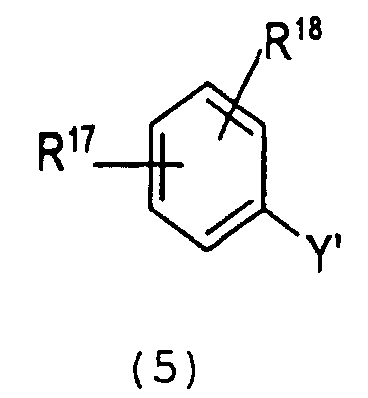
- The aminobenzoic acid derivative or pharmaceutically acceptable salt of the same, according to Claim 4, wherein in Formula (5), R17 represents a group represented by CO2R19, (wherein R19 represents a hydrogen atom or a C1-6 alkyl group) and R18 represents a hydrogen atom.
- The aminobenzoic acid derivative or pharmaceutically acceptable salt of the same, according to Claim 5, wherein in Formula (4), R3 represents a C14-22 alkyl group.
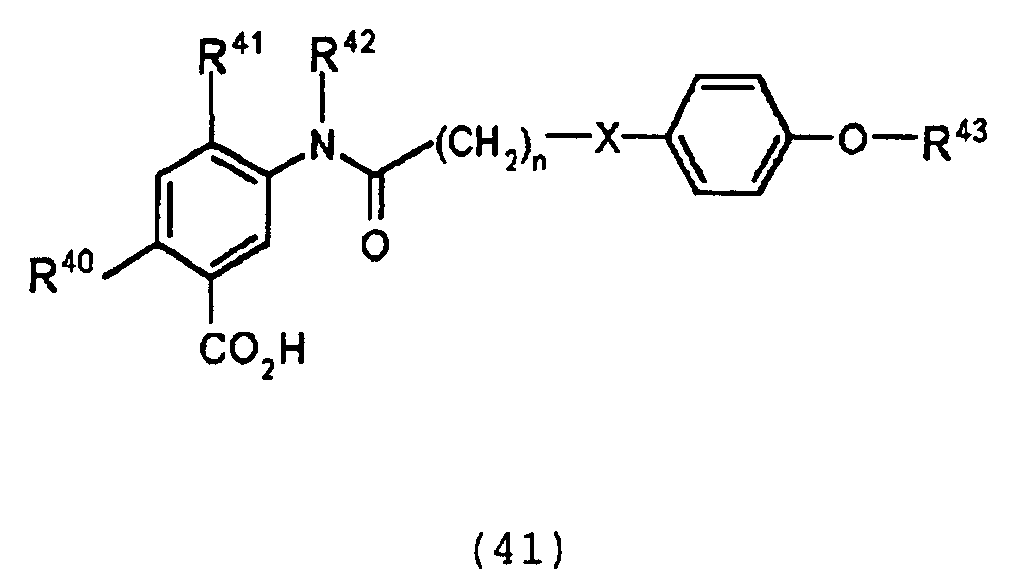
- The aminobenzoic acid derivative or pharmaceutically acceptable salt of the same, according to Claim 3, wherein Formula (4) is represented by Formula (6) as follows:in Formula (6), R1 represents a hydrogen atom or a C1-6 alkyl group; R2 represents a hydrogen atom or a C1-6 alkyl group; R3 represents a C18 alkyl group; R4 represents a hydrogen atom; A represents a group represented by Formula (5) as follows:
 (in the formula, R17 represents a group represented by CO2R19 (wherein R19 represents a hydrogen atom or a C1-6 alkyl group), R18 represents a hydrogen atom, Y' represents O, S, or NR24 (wherein R24 represents a hydrogen atom or a C1-6 alkyl group)), X represents O or a single bond; Y represents O; and n is an integer of 1 to 11.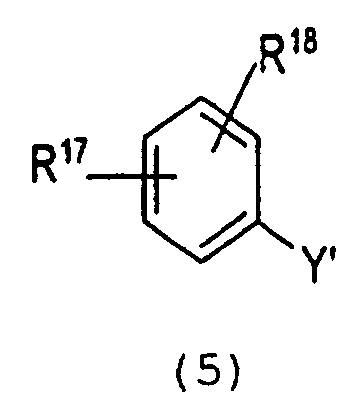
- The aminobenzoic acid derivative or pharmaceutically acceptable salt of the same, according to Claim 7, wherein in Formula (6), X represents a single bond and n is 2.
- The aminobenzoic acid derivative or pharmaceutically acceptable salt of the same, according to Claim 1, wherein in Formula (1), A represents a group represented by S(O)qR15 (wherein q and R15 have the same meanings as described above).
- The aminobenzoic acid derivative or pharmaceutically acceptable salt of the same, according to Claim 9, wherein Formula (1) is represented by Formula (4) as follows:in Formula (4),
 R1 represents a hydrogen atom or a C1-6 alkyl group; R2 represents a hydrogen atom, a C1-6 alkyl group, a C3- 8 cycloalkyl C1-3 alkyl group, a phenyl C1-3 alkyl group, a group represented by CH2CO2R5 (wherein R5 represents a hydrogen atom or a C1-6 alkyl group), or a group represented by CH2CON(R6)R7 (wherein R6 and R7 independently represent a hydrogen atom or a C1-6 alkyl group);R3 represents a C8-25 alkyl group, a group represented by (CH2)pCO2R11 (wherein p is an integer of 1 to 20, and R11 represents a hydrogen atom or a C1-6 alkyl group), or a group represented by (CH2)3CONHCH(R12)CONHR13 (wherein R12 represents a hydrogen atom or a group represented by CH2CO2R14 group (wherein R14 represents a hydrogen atom or a C1-6 alkyl group), and R13 represents a C1-20 alkyl group);R4 represents a hydrogen atom or a group represented by OR9 or CO2R10 (wherein R9 and R10 independently represent a hydrogen atom or a C1-6 alkyl group);A represents a group represented by SR15 (wherein R15 represents a C1-6 alkyl group);X represents O, a single bond, CH=CH, or a group represented by NR27 (wherein R27 represents a hydrogen atom or a t-butoxycarbonyl group);Y represents O, CONH, NHCO, or a group represented by NR28 (wherein R28 represents a hydrogen atom or a t-butoxycarbonyl group); andn is an integer of 0 to 15 (with the proviso that when X does not represent CH=CH, n is not 0).
 - The aminobenzoic acid derivative or pharmaceutically acceptable salt of the same, according to Claim 10, wherein in Formula (4), R3 represents a C14-22 alkyl group.
- The aminobenzoic acid derivative or pharmaceutically acceptable salt of the same, according to Claim 9, wherein Formula (4) is represented by Formula (6) as follows:in Formula (6),
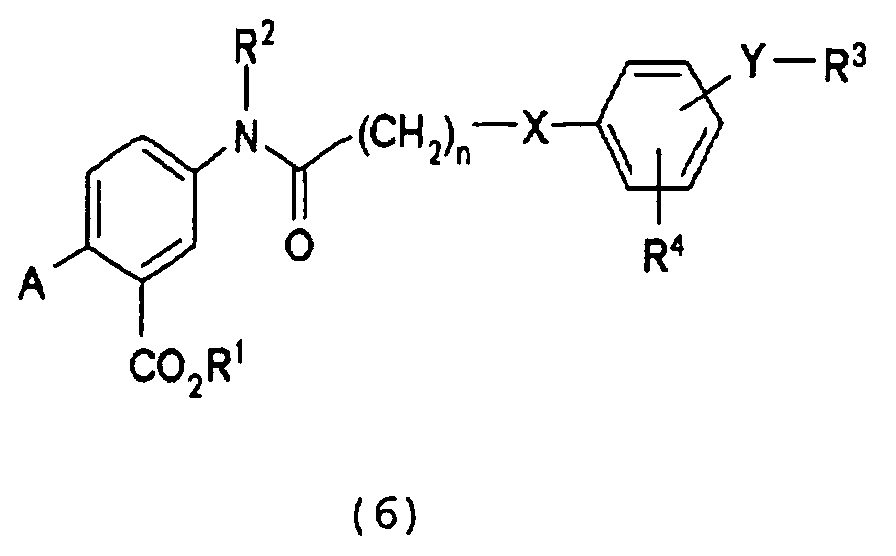 R1 represents a hydrogen atom or a C1-6 alkyl group; R2 represents a hydrogen atom, a C1-6 alkyl group, a C3- 8 cycloalkyl C1-3 alkyl group, a phenyl C1-3 alkyl group, a group represented by CH2CO2R5 (wherein R5 represents a hydrogen atom or a C1-6 alkyl group), or a group represented by CH2CON(R6)R7 (wherein R6 and R7 independently represent a hydrogen atom or a C1-6 alkyl group);R3 represents a C18 alkyl group;R4 represents a hydrogen atom or a group represented by OR9 or CO2R10 (wherein R9 and R10 independently represent a hydrogen atom or a C1-6 alkyl group);A represents a group represented by SR15 (wherein R15 represents a C1-6 alkyl group);X represents O, a single bond, CH=CH, or a group represented by NR27 (wherein R27 represents a hydrogen atom or a t-butoxycarbonyl group);Y represents O, CONH, NHCO, or a group represented by NR28 (wherein R28 represents a hydrogen atom or a t-butoxycarbonyl group); andn is an integer of 0 to 15 (with the proviso that when X does not represent CH=CH, n is not 0).
 - The aminobenzoic acid derivative or pharmaceutically acceptable salt of the same, according to Claim 12, wherein in Formula (6), R2 represents a hydrogen atom or a C1-6 alkyl group; R4 represents a hydrogen atom; X represents a single bond; Y represents O; and n is 1 or 2.
Applications Claiming Priority (5)
| Application Number | Priority Date | Filing Date | Title |
|---|---|---|---|
| JP18827199 | 1999-07-01 | ||
| JP18827299 | 1999-07-01 | ||
| JP18827299 | 1999-07-01 | ||
| JP18827199 | 1999-07-01 | ||
| PCT/JP2000/004406 WO2001002344A1 (en) | 1999-07-01 | 2000-07-03 | Aminobenzoic acid derivatives |
Publications (2)
| Publication Number | Publication Date |
|---|---|
| EP1193246A1 true EP1193246A1 (en) | 2002-04-03 |
| EP1193246A4 EP1193246A4 (en) | 2003-05-14 |
Family
ID=26504826
Family Applications (1)
| Application Number | Title | Priority Date | Filing Date |
|---|---|---|---|
| EP00940927A Withdrawn EP1193246A4 (en) | 1999-07-01 | 2000-07-03 | AMINOBENZOIC ACID DERIVATIVES |
Country Status (8)
| Country | Link |
|---|---|
| US (1) | US6720424B1 (en) |
| EP (1) | EP1193246A4 (en) |
| KR (1) | KR20020013942A (en) |
| CN (1) | CN1371357A (en) |
| AU (1) | AU757680B2 (en) |
| CA (1) | CA2376553A1 (en) |
| HK (1) | HK1047274A1 (en) |
| WO (1) | WO2001002344A1 (en) |
Cited By (4)
| Publication number | Priority date | Publication date | Assignee | Title |
|---|---|---|---|---|
| WO2004096795A3 (en) * | 2003-04-25 | 2005-03-10 | Dimensional Pharm Inc | C-fms kinase inhibitors |
| DE102004036213A1 (en) * | 2004-07-26 | 2006-03-23 | Johannes-Gutenberg-Universität Mainz | Non-glycosidic and non-peptide selectin inhibitors and their use |
| US7427683B2 (en) | 2003-04-25 | 2008-09-23 | Ortho-Mcneil Pharmaceutical, Inc. | c-fms kinase inhibitors |
| US7790724B2 (en) | 2003-04-25 | 2010-09-07 | Janssen Pharmaceutica N.V. | c-fms kinase inhibitors |
Families Citing this family (10)
| Publication number | Priority date | Publication date | Assignee | Title |
|---|---|---|---|---|
| PL371468A1 (en) * | 2001-12-27 | 2005-06-13 | Taisho Pharmaceutical Co, Ltd. | Carboxylic acid derivative |
| EP1541657B2 (en) * | 2002-07-19 | 2014-03-05 | Idemitsu Kosan Co., Ltd. | Organic electroluminescent devices and organic luminescent medium |
| US7351719B2 (en) | 2002-10-31 | 2008-04-01 | Boehringer Ingelheim Pharma Gmbh & Co. Kg | Amide compounds having MCH-antagonistic activity and medicaments comprising these compounds |
| GB0314488D0 (en) * | 2003-06-20 | 2003-07-23 | Glaxo Group Ltd | Therapeutically useful compounds |
| DE10360745A1 (en) * | 2003-12-23 | 2005-07-28 | Boehringer Ingelheim Pharma Gmbh & Co. Kg | New amide compounds having MCH antagonist activity and medicaments containing these compounds |
| US7592373B2 (en) | 2003-12-23 | 2009-09-22 | Boehringer Ingelheim International Gmbh | Amide compounds with MCH antagonistic activity and medicaments comprising these compounds |
| DE102004017934A1 (en) | 2004-04-14 | 2005-11-03 | Boehringer Ingelheim Pharma Gmbh & Co. Kg | New alkyne compounds having MCH antagonist activity and medicaments containing these compounds |
| US7524862B2 (en) | 2004-04-14 | 2009-04-28 | Boehringer Ingelheim International Gmbh | Alkyne compounds with MCH antagonistic activity and medicaments comprising these compounds |
| KR20110036101A (en) | 2008-06-30 | 2011-04-06 | 안지오블라스트 시스템스 인코퍼레이티드 | Treatment of Ocular Diseases and Excessive Angiogenesis with Combination Therapy |
| CA3012718A1 (en) | 2016-02-08 | 2017-08-17 | Vitrisa Therapeutics, Inc. | Compositions with improved intravitreal half-life and uses thereof |
Family Cites Families (9)
| Publication number | Priority date | Publication date | Assignee | Title |
|---|---|---|---|---|
| DE3734955A1 (en) | 1987-10-15 | 1989-04-27 | Rexroth Mannesmann Gmbh | ELECTRICAL MEASUREMENT PROCESSING FOR A CONTROL VALVE |
| GB9523946D0 (en) * | 1995-11-23 | 1996-01-24 | Bayer Ag | Leukotriene antagonistic benzoic acid derivatives |
| WO1997029744A1 (en) | 1996-02-15 | 1997-08-21 | Kissei Pharmaceutical Co., Ltd. | Neovascularization inhibitor |
| JPH10259176A (en) | 1997-03-17 | 1998-09-29 | Japan Tobacco Inc | New amide derivative having vascularization inhibiting action and its use |
| JP2933056B2 (en) * | 1997-04-30 | 1999-08-09 | 日本電気株式会社 | Magnetoresistive element, magnetoresistive sensor using the same, magnetoresistive detection system and magnetic storage system |
| JPH1140038A (en) | 1997-07-14 | 1999-02-12 | Nitto Kogyo Co Ltd | Breaker |
| JPH11140038A (en) * | 1997-11-04 | 1999-05-25 | Kanebo Ltd | Carboxylic acid derivative |
| DE19817461A1 (en) * | 1998-04-20 | 1999-10-21 | Basf Ag | New benzamide derivatives useful as cysteine protease inhibitors for treating neurodegenerative diseases, neuronal damage, stroke, cranial trauma, Alzheimer's disease, etc. |
| US6534513B1 (en) * | 1999-09-29 | 2003-03-18 | Celltech R&D Limited | Phenylalkanoic acid derivatives |
-
2000
- 2000-07-03 AU AU55726/00A patent/AU757680B2/en not_active Ceased
- 2000-07-03 KR KR1020017016956A patent/KR20020013942A/en not_active Withdrawn
- 2000-07-03 CA CA002376553A patent/CA2376553A1/en not_active Abandoned
- 2000-07-03 CN CN00811970A patent/CN1371357A/en active Pending
- 2000-07-03 US US10/019,525 patent/US6720424B1/en not_active Expired - Fee Related
- 2000-07-03 HK HK02108930.4A patent/HK1047274A1/en unknown
- 2000-07-03 EP EP00940927A patent/EP1193246A4/en not_active Withdrawn
- 2000-07-03 WO PCT/JP2000/004406 patent/WO2001002344A1/en not_active Ceased
Cited By (6)
| Publication number | Priority date | Publication date | Assignee | Title |
|---|---|---|---|---|
| WO2004096795A3 (en) * | 2003-04-25 | 2005-03-10 | Dimensional Pharm Inc | C-fms kinase inhibitors |
| US7427683B2 (en) | 2003-04-25 | 2008-09-23 | Ortho-Mcneil Pharmaceutical, Inc. | c-fms kinase inhibitors |
| US7429603B2 (en) | 2003-04-25 | 2008-09-30 | 3-Dimensional Pharmaceuticals, Inc. | C-fms kinase inhibitors |
| US7790724B2 (en) | 2003-04-25 | 2010-09-07 | Janssen Pharmaceutica N.V. | c-fms kinase inhibitors |
| DE102004036213A1 (en) * | 2004-07-26 | 2006-03-23 | Johannes-Gutenberg-Universität Mainz | Non-glycosidic and non-peptide selectin inhibitors and their use |
| DE102004036213B4 (en) * | 2004-07-26 | 2011-02-24 | Johannes-Gutenberg-Universität Mainz | Non-glycosidic and non-peptide selectin inhibitors, their preparation and pharmaceutical compositions |
Also Published As
| Publication number | Publication date |
|---|---|
| AU5572600A (en) | 2001-01-22 |
| WO2001002344A1 (en) | 2001-01-11 |
| CA2376553A1 (en) | 2001-01-11 |
| US6720424B1 (en) | 2004-04-13 |
| CN1371357A (en) | 2002-09-25 |
| HK1047274A1 (en) | 2003-02-14 |
| KR20020013942A (en) | 2002-02-21 |
| AU757680B2 (en) | 2003-02-27 |
| EP1193246A4 (en) | 2003-05-14 |
Similar Documents
| Publication | Publication Date | Title |
|---|---|---|
| KR101820645B1 (en) | Substituted 6-amino-nicotinamides as kcnq2/3 modulators | |
| US6720424B1 (en) | Aminobenzoic acid derivatives | |
| CA2493660A1 (en) | Process for preparing quinolin antibiotic intermediates | |
| SK66798A3 (en) | Quinoline derivative, preparation method thereof, pharmaceutical composition containing the same and its use | |
| TW200911245A (en) | Pyridone derivatives | |
| EP2172447A1 (en) | Amide compound | |
| EA001771B1 (en) | Quinoline-4-carboxamide derivatives, their preparation and their use as neurokinin-3 (-k-3) and neurokinin-2 (-k-2) receptor antagonists | |
| HU219224B (en) | Sulphonamido and sulphonamido-carbonyl-pyridine-2-carboxylic acid amides, pharmaceutical preparatives containing them and process for producing them | |
| EP2134703A1 (en) | Amide derivatives as calcium channel blockers | |
| US6846830B2 (en) | Naphtalene derivatives and their pharmaceutical use | |
| HU220226B (en) | Amidino-phenoxy-alkoxy-benzamides, process for their preparation and pharmaceutical compositions containing them | |
| AU2020318697B2 (en) | N-methyl, N-(6-(methoxy)pyridazin-3-yl) amine derivatives as autotaxin (ATX) modulators for the treatment of inflammatory airway or fibrotic diseases | |
| JP2019031449A (en) | Sulfonamide derivative and pharmaceutical composition containing the same | |
| KR101279689B1 (en) | 4-amino-5-cyanopyrimidine derivatives | |
| JP2002193800A (en) | VEGF receptor antagonist | |
| JP2001072653A (en) | Aminobenzoic acid derivative | |
| EA021627B1 (en) | 4-(methylaminophenoxy)pyridin-3-yl-benzamide derivatives for treating cancer | |
| JP4794200B2 (en) | 4-amino-5-cyanopyrimidine derivatives | |
| CA2807886A1 (en) | Substituted 1-oxo-dihydroisoquinoline-3-carboxamides as kcnq2/3 modulators | |
| CA2603030C (en) | Benzyloxypropylamine derivative | |
| KR20080023758A (en) | Novel amino acid derivatives for the treatment of obesity and related diseases | |
| WO2019120198A1 (en) | Quinoline derivatives | |
| EP1466891A1 (en) | Carboxylic acid derivative | |
| JP2001072587A (en) | VEGF receptor antagonist | |
| WO2016019849A1 (en) | Dabigatran carboalkoxy derivative, preparation method therefor, and pharmaceutical use thereof |
Legal Events
| Date | Code | Title | Description |
|---|---|---|---|
| PUAI | Public reference made under article 153(3) epc to a published international application that has entered the european phase |
Free format text: ORIGINAL CODE: 0009012 |
|
| 17P | Request for examination filed |
Effective date: 20011231 |
|
| AK | Designated contracting states |
Kind code of ref document: A1 Designated state(s): AT BE CH CY DE DK ES FI FR GB GR IE IT LI LU MC NL PT SE |
|
| A4 | Supplementary search report drawn up and despatched |
Effective date: 20030401 |
|
| RIC1 | Information provided on ipc code assigned before grant |
Ipc: 7C 07D 213/80 B Ipc: 7A 61K 31/196 J Ipc: 7A 61K 31/196 B Ipc: 7A 61K 31:44 J Ipc: 7A 61P 43:00 J Ipc: 7C 07C 235/38 B Ipc: 7C 07C 235/24 A Ipc: 7C 07C 317/50 B Ipc: 7C 07C 323/63 B Ipc: 7A 61K 31:216 J |
|
| GRAP | Despatch of communication of intention to grant a patent |
Free format text: ORIGINAL CODE: EPIDOSNIGR1 |
|
| STAA | Information on the status of an ep patent application or granted ep patent |
Free format text: STATUS: THE APPLICATION IS DEEMED TO BE WITHDRAWN |
|
| 18D | Application deemed to be withdrawn |
Effective date: 20050524 |