EP1192963A1 - Adsorbents for high mobility group proteins and column for purifying body fluid - Google Patents
Adsorbents for high mobility group proteins and column for purifying body fluid Download PDFInfo
- Publication number
- EP1192963A1 EP1192963A1 EP01917826A EP01917826A EP1192963A1 EP 1192963 A1 EP1192963 A1 EP 1192963A1 EP 01917826 A EP01917826 A EP 01917826A EP 01917826 A EP01917826 A EP 01917826A EP 1192963 A1 EP1192963 A1 EP 1192963A1
- Authority
- EP
- European Patent Office
- Prior art keywords
- group
- adsorbent
- body fluid
- functional group
- adsorbent according
- Prior art date
- Legal status (The legal status is an assumption and is not a legal conclusion. Google has not performed a legal analysis and makes no representation as to the accuracy of the status listed.)
- Ceased
Links
Classifications
-
- B—PERFORMING OPERATIONS; TRANSPORTING
- B01—PHYSICAL OR CHEMICAL PROCESSES OR APPARATUS IN GENERAL
- B01J—CHEMICAL OR PHYSICAL PROCESSES, e.g. CATALYSIS OR COLLOID CHEMISTRY; THEIR RELEVANT APPARATUS
- B01J20/00—Solid sorbent compositions or filter aid compositions; Sorbents for chromatography; Processes for preparing, regenerating or reactivating thereof
- B01J20/22—Solid sorbent compositions or filter aid compositions; Sorbents for chromatography; Processes for preparing, regenerating or reactivating thereof comprising organic material
- B01J20/26—Synthetic macromolecular compounds
-
- B—PERFORMING OPERATIONS; TRANSPORTING
- B01—PHYSICAL OR CHEMICAL PROCESSES OR APPARATUS IN GENERAL
- B01J—CHEMICAL OR PHYSICAL PROCESSES, e.g. CATALYSIS OR COLLOID CHEMISTRY; THEIR RELEVANT APPARATUS
- B01J20/00—Solid sorbent compositions or filter aid compositions; Sorbents for chromatography; Processes for preparing, regenerating or reactivating thereof
- B01J20/22—Solid sorbent compositions or filter aid compositions; Sorbents for chromatography; Processes for preparing, regenerating or reactivating thereof comprising organic material
- B01J20/26—Synthetic macromolecular compounds
- B01J20/261—Synthetic macromolecular compounds obtained by reactions only involving carbon to carbon unsaturated bonds
-
- B—PERFORMING OPERATIONS; TRANSPORTING
- B01—PHYSICAL OR CHEMICAL PROCESSES OR APPARATUS IN GENERAL
- B01J—CHEMICAL OR PHYSICAL PROCESSES, e.g. CATALYSIS OR COLLOID CHEMISTRY; THEIR RELEVANT APPARATUS
- B01J20/00—Solid sorbent compositions or filter aid compositions; Sorbents for chromatography; Processes for preparing, regenerating or reactivating thereof
- B01J20/22—Solid sorbent compositions or filter aid compositions; Sorbents for chromatography; Processes for preparing, regenerating or reactivating thereof comprising organic material
- B01J20/26—Synthetic macromolecular compounds
- B01J20/262—Synthetic macromolecular compounds obtained otherwise than by reactions only involving carbon to carbon unsaturated bonds, e.g. obtained by polycondensation
-
- B—PERFORMING OPERATIONS; TRANSPORTING
- B01—PHYSICAL OR CHEMICAL PROCESSES OR APPARATUS IN GENERAL
- B01J—CHEMICAL OR PHYSICAL PROCESSES, e.g. CATALYSIS OR COLLOID CHEMISTRY; THEIR RELEVANT APPARATUS
- B01J20/00—Solid sorbent compositions or filter aid compositions; Sorbents for chromatography; Processes for preparing, regenerating or reactivating thereof
- B01J20/22—Solid sorbent compositions or filter aid compositions; Sorbents for chromatography; Processes for preparing, regenerating or reactivating thereof comprising organic material
- B01J20/26—Synthetic macromolecular compounds
- B01J20/265—Synthetic macromolecular compounds modified or post-treated polymers
- B01J20/267—Cross-linked polymers
-
- B—PERFORMING OPERATIONS; TRANSPORTING
- B01—PHYSICAL OR CHEMICAL PROCESSES OR APPARATUS IN GENERAL
- B01J—CHEMICAL OR PHYSICAL PROCESSES, e.g. CATALYSIS OR COLLOID CHEMISTRY; THEIR RELEVANT APPARATUS
- B01J20/00—Solid sorbent compositions or filter aid compositions; Sorbents for chromatography; Processes for preparing, regenerating or reactivating thereof
- B01J20/28—Solid sorbent compositions or filter aid compositions; Sorbents for chromatography; Processes for preparing, regenerating or reactivating thereof characterised by their form or physical properties
- B01J20/28014—Solid sorbent compositions or filter aid compositions; Sorbents for chromatography; Processes for preparing, regenerating or reactivating thereof characterised by their form or physical properties characterised by their form
- B01J20/28016—Particle form
-
- B—PERFORMING OPERATIONS; TRANSPORTING
- B01—PHYSICAL OR CHEMICAL PROCESSES OR APPARATUS IN GENERAL
- B01J—CHEMICAL OR PHYSICAL PROCESSES, e.g. CATALYSIS OR COLLOID CHEMISTRY; THEIR RELEVANT APPARATUS
- B01J20/00—Solid sorbent compositions or filter aid compositions; Sorbents for chromatography; Processes for preparing, regenerating or reactivating thereof
- B01J20/28—Solid sorbent compositions or filter aid compositions; Sorbents for chromatography; Processes for preparing, regenerating or reactivating thereof characterised by their form or physical properties
- B01J20/28014—Solid sorbent compositions or filter aid compositions; Sorbents for chromatography; Processes for preparing, regenerating or reactivating thereof characterised by their form or physical properties characterised by their form
- B01J20/28023—Fibres or filaments
-
- B—PERFORMING OPERATIONS; TRANSPORTING
- B01—PHYSICAL OR CHEMICAL PROCESSES OR APPARATUS IN GENERAL
- B01J—CHEMICAL OR PHYSICAL PROCESSES, e.g. CATALYSIS OR COLLOID CHEMISTRY; THEIR RELEVANT APPARATUS
- B01J20/00—Solid sorbent compositions or filter aid compositions; Sorbents for chromatography; Processes for preparing, regenerating or reactivating thereof
- B01J20/30—Processes for preparing, regenerating, or reactivating
- B01J20/32—Impregnating or coating ; Solid sorbent compositions obtained from processes involving impregnating or coating
- B01J20/3202—Impregnating or coating ; Solid sorbent compositions obtained from processes involving impregnating or coating characterised by the carrier, support or substrate used for impregnation or coating
- B01J20/3206—Organic carriers, supports or substrates
- B01J20/3208—Polymeric carriers, supports or substrates
- B01J20/321—Polymeric carriers, supports or substrates consisting of a polymer obtained by reactions involving only carbon to carbon unsaturated bonds
-
- B—PERFORMING OPERATIONS; TRANSPORTING
- B01—PHYSICAL OR CHEMICAL PROCESSES OR APPARATUS IN GENERAL
- B01J—CHEMICAL OR PHYSICAL PROCESSES, e.g. CATALYSIS OR COLLOID CHEMISTRY; THEIR RELEVANT APPARATUS
- B01J20/00—Solid sorbent compositions or filter aid compositions; Sorbents for chromatography; Processes for preparing, regenerating or reactivating thereof
- B01J20/30—Processes for preparing, regenerating, or reactivating
- B01J20/32—Impregnating or coating ; Solid sorbent compositions obtained from processes involving impregnating or coating
- B01J20/3202—Impregnating or coating ; Solid sorbent compositions obtained from processes involving impregnating or coating characterised by the carrier, support or substrate used for impregnation or coating
- B01J20/3206—Organic carriers, supports or substrates
- B01J20/3208—Polymeric carriers, supports or substrates
- B01J20/3212—Polymeric carriers, supports or substrates consisting of a polymer obtained by reactions otherwise than involving only carbon to carbon unsaturated bonds
-
- B—PERFORMING OPERATIONS; TRANSPORTING
- B01—PHYSICAL OR CHEMICAL PROCESSES OR APPARATUS IN GENERAL
- B01J—CHEMICAL OR PHYSICAL PROCESSES, e.g. CATALYSIS OR COLLOID CHEMISTRY; THEIR RELEVANT APPARATUS
- B01J20/00—Solid sorbent compositions or filter aid compositions; Sorbents for chromatography; Processes for preparing, regenerating or reactivating thereof
- B01J20/30—Processes for preparing, regenerating, or reactivating
- B01J20/32—Impregnating or coating ; Solid sorbent compositions obtained from processes involving impregnating or coating
- B01J20/3214—Impregnating or coating ; Solid sorbent compositions obtained from processes involving impregnating or coating characterised by the method for obtaining this coating or impregnating
- B01J20/3217—Resulting in a chemical bond between the coating or impregnating layer and the carrier, support or substrate, e.g. a covalent bond
-
- B—PERFORMING OPERATIONS; TRANSPORTING
- B01—PHYSICAL OR CHEMICAL PROCESSES OR APPARATUS IN GENERAL
- B01J—CHEMICAL OR PHYSICAL PROCESSES, e.g. CATALYSIS OR COLLOID CHEMISTRY; THEIR RELEVANT APPARATUS
- B01J20/00—Solid sorbent compositions or filter aid compositions; Sorbents for chromatography; Processes for preparing, regenerating or reactivating thereof
- B01J20/30—Processes for preparing, regenerating, or reactivating
- B01J20/32—Impregnating or coating ; Solid sorbent compositions obtained from processes involving impregnating or coating
- B01J20/3214—Impregnating or coating ; Solid sorbent compositions obtained from processes involving impregnating or coating characterised by the method for obtaining this coating or impregnating
- B01J20/3217—Resulting in a chemical bond between the coating or impregnating layer and the carrier, support or substrate, e.g. a covalent bond
- B01J20/3219—Resulting in a chemical bond between the coating or impregnating layer and the carrier, support or substrate, e.g. a covalent bond involving a particular spacer or linking group, e.g. for attaching an active group
-
- B—PERFORMING OPERATIONS; TRANSPORTING
- B01—PHYSICAL OR CHEMICAL PROCESSES OR APPARATUS IN GENERAL
- B01J—CHEMICAL OR PHYSICAL PROCESSES, e.g. CATALYSIS OR COLLOID CHEMISTRY; THEIR RELEVANT APPARATUS
- B01J20/00—Solid sorbent compositions or filter aid compositions; Sorbents for chromatography; Processes for preparing, regenerating or reactivating thereof
- B01J20/30—Processes for preparing, regenerating, or reactivating
- B01J20/32—Impregnating or coating ; Solid sorbent compositions obtained from processes involving impregnating or coating
- B01J20/3214—Impregnating or coating ; Solid sorbent compositions obtained from processes involving impregnating or coating characterised by the method for obtaining this coating or impregnating
- B01J20/3225—Impregnating or coating ; Solid sorbent compositions obtained from processes involving impregnating or coating characterised by the method for obtaining this coating or impregnating involving a post-treatment of the coated or impregnated product
-
- B—PERFORMING OPERATIONS; TRANSPORTING
- B01—PHYSICAL OR CHEMICAL PROCESSES OR APPARATUS IN GENERAL
- B01J—CHEMICAL OR PHYSICAL PROCESSES, e.g. CATALYSIS OR COLLOID CHEMISTRY; THEIR RELEVANT APPARATUS
- B01J20/00—Solid sorbent compositions or filter aid compositions; Sorbents for chromatography; Processes for preparing, regenerating or reactivating thereof
- B01J20/30—Processes for preparing, regenerating, or reactivating
- B01J20/32—Impregnating or coating ; Solid sorbent compositions obtained from processes involving impregnating or coating
- B01J20/3231—Impregnating or coating ; Solid sorbent compositions obtained from processes involving impregnating or coating characterised by the coating or impregnating layer
- B01J20/3242—Layers with a functional group, e.g. an affinity material, a ligand, a reactant or a complexing group
- B01J20/3244—Non-macromolecular compounds
- B01J20/3246—Non-macromolecular compounds having a well defined chemical structure
-
- B—PERFORMING OPERATIONS; TRANSPORTING
- B01—PHYSICAL OR CHEMICAL PROCESSES OR APPARATUS IN GENERAL
- B01J—CHEMICAL OR PHYSICAL PROCESSES, e.g. CATALYSIS OR COLLOID CHEMISTRY; THEIR RELEVANT APPARATUS
- B01J20/00—Solid sorbent compositions or filter aid compositions; Sorbents for chromatography; Processes for preparing, regenerating or reactivating thereof
- B01J20/30—Processes for preparing, regenerating, or reactivating
- B01J20/32—Impregnating or coating ; Solid sorbent compositions obtained from processes involving impregnating or coating
- B01J20/3231—Impregnating or coating ; Solid sorbent compositions obtained from processes involving impregnating or coating characterised by the coating or impregnating layer
- B01J20/3242—Layers with a functional group, e.g. an affinity material, a ligand, a reactant or a complexing group
- B01J20/3244—Non-macromolecular compounds
- B01J20/3246—Non-macromolecular compounds having a well defined chemical structure
- B01J20/3248—Non-macromolecular compounds having a well defined chemical structure the functional group or the linking, spacer or anchoring group as a whole comprising at least one type of heteroatom selected from a nitrogen, oxygen or sulfur, these atoms not being part of the carrier as such
-
- B—PERFORMING OPERATIONS; TRANSPORTING
- B01—PHYSICAL OR CHEMICAL PROCESSES OR APPARATUS IN GENERAL
- B01J—CHEMICAL OR PHYSICAL PROCESSES, e.g. CATALYSIS OR COLLOID CHEMISTRY; THEIR RELEVANT APPARATUS
- B01J20/00—Solid sorbent compositions or filter aid compositions; Sorbents for chromatography; Processes for preparing, regenerating or reactivating thereof
- B01J20/30—Processes for preparing, regenerating, or reactivating
- B01J20/32—Impregnating or coating ; Solid sorbent compositions obtained from processes involving impregnating or coating
- B01J20/3231—Impregnating or coating ; Solid sorbent compositions obtained from processes involving impregnating or coating characterised by the coating or impregnating layer
- B01J20/3242—Layers with a functional group, e.g. an affinity material, a ligand, a reactant or a complexing group
- B01J20/3244—Non-macromolecular compounds
- B01J20/3246—Non-macromolecular compounds having a well defined chemical structure
- B01J20/3248—Non-macromolecular compounds having a well defined chemical structure the functional group or the linking, spacer or anchoring group as a whole comprising at least one type of heteroatom selected from a nitrogen, oxygen or sulfur, these atoms not being part of the carrier as such
- B01J20/3251—Non-macromolecular compounds having a well defined chemical structure the functional group or the linking, spacer or anchoring group as a whole comprising at least one type of heteroatom selected from a nitrogen, oxygen or sulfur, these atoms not being part of the carrier as such comprising at least two different types of heteroatoms selected from nitrogen, oxygen or sulphur
-
- B—PERFORMING OPERATIONS; TRANSPORTING
- B01—PHYSICAL OR CHEMICAL PROCESSES OR APPARATUS IN GENERAL
- B01J—CHEMICAL OR PHYSICAL PROCESSES, e.g. CATALYSIS OR COLLOID CHEMISTRY; THEIR RELEVANT APPARATUS
- B01J20/00—Solid sorbent compositions or filter aid compositions; Sorbents for chromatography; Processes for preparing, regenerating or reactivating thereof
- B01J20/30—Processes for preparing, regenerating, or reactivating
- B01J20/32—Impregnating or coating ; Solid sorbent compositions obtained from processes involving impregnating or coating
- B01J20/3231—Impregnating or coating ; Solid sorbent compositions obtained from processes involving impregnating or coating characterised by the coating or impregnating layer
- B01J20/3242—Layers with a functional group, e.g. an affinity material, a ligand, a reactant or a complexing group
- B01J20/3268—Macromolecular compounds
- B01J20/3272—Polymers obtained by reactions otherwise than involving only carbon to carbon unsaturated bonds
- B01J20/3274—Proteins, nucleic acids, polysaccharides, antibodies or antigens
-
- B—PERFORMING OPERATIONS; TRANSPORTING
- B01—PHYSICAL OR CHEMICAL PROCESSES OR APPARATUS IN GENERAL
- B01J—CHEMICAL OR PHYSICAL PROCESSES, e.g. CATALYSIS OR COLLOID CHEMISTRY; THEIR RELEVANT APPARATUS
- B01J39/00—Cation exchange; Use of material as cation exchangers; Treatment of material for improving the cation exchange properties
- B01J39/08—Use of material as cation exchangers; Treatment of material for improving the cation exchange properties
- B01J39/16—Organic material
- B01J39/17—Organic material containing also inorganic materials, e.g. inert material coated with an ion-exchange resin
-
- B—PERFORMING OPERATIONS; TRANSPORTING
- B01—PHYSICAL OR CHEMICAL PROCESSES OR APPARATUS IN GENERAL
- B01J—CHEMICAL OR PHYSICAL PROCESSES, e.g. CATALYSIS OR COLLOID CHEMISTRY; THEIR RELEVANT APPARATUS
- B01J39/00—Cation exchange; Use of material as cation exchangers; Treatment of material for improving the cation exchange properties
- B01J39/08—Use of material as cation exchangers; Treatment of material for improving the cation exchange properties
- B01J39/16—Organic material
- B01J39/18—Macromolecular compounds
-
- B—PERFORMING OPERATIONS; TRANSPORTING
- B01—PHYSICAL OR CHEMICAL PROCESSES OR APPARATUS IN GENERAL
- B01J—CHEMICAL OR PHYSICAL PROCESSES, e.g. CATALYSIS OR COLLOID CHEMISTRY; THEIR RELEVANT APPARATUS
- B01J41/00—Anion exchange; Use of material as anion exchangers; Treatment of material for improving the anion exchange properties
- B01J41/08—Use of material as anion exchangers; Treatment of material for improving the anion exchange properties
- B01J41/10—Inorganic material
-
- B—PERFORMING OPERATIONS; TRANSPORTING
- B01—PHYSICAL OR CHEMICAL PROCESSES OR APPARATUS IN GENERAL
- B01J—CHEMICAL OR PHYSICAL PROCESSES, e.g. CATALYSIS OR COLLOID CHEMISTRY; THEIR RELEVANT APPARATUS
- B01J41/00—Anion exchange; Use of material as anion exchangers; Treatment of material for improving the anion exchange properties
- B01J41/08—Use of material as anion exchangers; Treatment of material for improving the anion exchange properties
- B01J41/12—Macromolecular compounds
-
- A—HUMAN NECESSITIES
- A61—MEDICAL OR VETERINARY SCIENCE; HYGIENE
- A61M—DEVICES FOR INTRODUCING MEDIA INTO, OR ONTO, THE BODY; DEVICES FOR TRANSDUCING BODY MEDIA OR FOR TAKING MEDIA FROM THE BODY; DEVICES FOR PRODUCING OR ENDING SLEEP OR STUPOR
- A61M1/00—Suction or pumping devices for medical purposes; Devices for carrying-off, for treatment of, or for carrying-over, body-liquids; Drainage systems
- A61M1/36—Other treatment of blood in a by-pass of the natural circulatory system, e.g. temperature adaptation, irradiation ; Extra-corporeal blood circuits
- A61M1/3679—Other treatment of blood in a by-pass of the natural circulatory system, e.g. temperature adaptation, irradiation ; Extra-corporeal blood circuits by absorption
-
- B—PERFORMING OPERATIONS; TRANSPORTING
- B01—PHYSICAL OR CHEMICAL PROCESSES OR APPARATUS IN GENERAL
- B01J—CHEMICAL OR PHYSICAL PROCESSES, e.g. CATALYSIS OR COLLOID CHEMISTRY; THEIR RELEVANT APPARATUS
- B01J2220/00—Aspects relating to sorbent materials
- B01J2220/50—Aspects relating to the use of sorbent or filter aid materials
- B01J2220/58—Use in a single column
Definitions
- the present invention relates to an adsorbent for adsorbing high-mobility-group proteins (hereinafter also referred to as "HMG proteins" for short).
- HMG proteins high-mobility-group proteins
- the present invention is suitably used for improving the state of sepsis by removing HMG proteins in human blood.
- HMG proteins are a group of non-histone DNA-binding proteins, and HMG-1, HMG-2, HMG14, HMG17, HMG-I(Y) and the like are known. HMG have been thought to participate in acceleration of transcription and growth of cells by binding to DNA in the cells. It was proved that amphoterin discovered as a factor which exists on the surface of nerve cells and extends dendrite is HMG-1 that is one of HMG proteins, so that it is suggested that HMG proteins exhibit a wide variety of actions.
- HMG-1 is secreted to the outside of the cells and acts as a strong mediator of systemic inflammation reaction and septic shock (Wang et al., (1999), Science vol. 285, p248). That is, if lipopolysaccharide (LPS) is administered to a mouse, HMG-1 level in the serum is drastically increased at 8 to 24 hours after administration and the mouse dies. In case of administering purified HMG-1 together with LPS, these synergistically act and show lethal activity, and the lethal action by LPS is inhibited by administering an anti-HMG-1 antibody, so that it was shown that HMG-1 is an important mediator of endotoxin shock.
- LPS lipopolysaccharide
- HMG-1 level is drastically increased, especially where the patient dies. HMG-1 level in blood is also increased in hemorrhagic shock (Ombrellino et al., (1999), Lancet vol.354, p1446). Further, it has been reported that production of HMG-I(Y) belonging to HMG-1 is induced by stimulation with LPS.
- HMG proteins participate in these inflammatory diseases (Sobajima et al., (1997), Clin. Exp. Immunol. vol. 107, p135). Further, it has been reported that HMG proteins participate in growth of cancers (Taguchi et al., (2000), Nature vol.405, p354).
- HMG proteins have functions which are necessary to the body, in diseases such as sepsis, they are secreted in excess to the outside of the cells to make the disease worse and to make the body die.
- a candidate of the method for improving the state of the diseases caused by HMG proteins is to administer a drug such as an antibody, which binds to HMG and inhibits its action.
- a drug inhibiting HMG activity may cause a serious side effects.
- an object of the present invention is to provide an adsorbent of HMG proteins which can effectively remove HMG proteins in body fluid.
- the present inventors intensively studied to discover that by immobilizing a substance having a particular functional group, the HMG proteins in body fluid can be effectively removed, thereby completing the present invention.
- the present invention provides an adsorbent of high-mobility-group proteins comprising a water-insoluble carrier on which (a) substance(s) having (a) hydrogen-bondable functional group(s) and/or (a) hydrophobic functional group(s) is(are) immobilized.
- the present invention also provides a body fluid-purification column for removing high-mobility-group proteins, comprising a column, and the adsorbent according to the present invention.
- the present invention further provides a method for adsorbing high-mobility-group proteins in body fluid, comprising contacting the adsorbent according to the present invention with body fluid so as to adsorb the high-mobility-group proteins in the body fluid to the adsorbent.
- the present invention further provides a use of the adsorbent according to the present invention for production of adsorbent material for adsorbing high-mobility-group proteins in body fluid.
- the HMG proteins in the body fluid are effectively adsorbed by the adsorbent so as to eliminate HMG proteins from the body fluid, so that the extracellular HMG proteins which are undesirable to the body may be removed.
- the adsorbent of HMG proteins according to the present invention comprises an adsorbent of high-mobility-group proteins comprising a water-insoluble carrier on which (a) substance(s) having (a) hydrogen-bondable functional group(s) and/or (a) hydrophobic functional group(s) is(are) immobilized.
- hydrogen-bondable functional group examples include cationic functional groups such as primary amino group, secondary amino group, tertiary amino group, imino group and quaternary ammonium group; anionic functional groups such as carboxyl group, sulfate groups, sulfonic acid group and phosphate group; and functional groups and structures having large polarity such as hydroxyl group, thiol group, aldehyde group, carbonyl group, urea bond and thiourea bond.
- cationic functional groups such as primary amino group, secondary amino group, tertiary amino group, imino group and quaternary ammonium group
- anionic functional groups such as carboxyl group, sulfate groups, sulfonic acid group and phosphate group
- functional groups and structures having large polarity such as hydroxyl group, thiol group, aldehyde group, carbonyl group, urea bond and thiourea bond.
- cationic functional groups and anionic functional groups are preferred.
- amino groups and quaternary ammonium group are especially preferred.
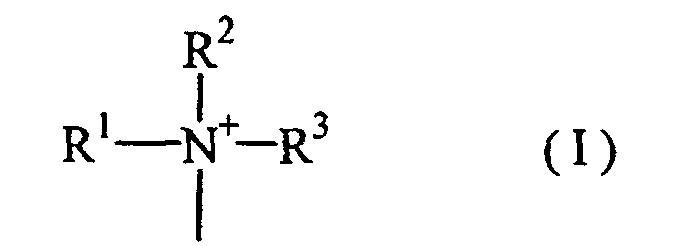
- examples of the especially preferred amino groups and quaternary ammonium group include those represented by the following Formula (I): (wherein R 1 , R 2 and R 3 independently represent hydrogen atom or a C 1 -C 5 alkyl group, respectively)
- alkyl group includes both linear and branched alkyl groups.
- R 1 , R 2 and R 3 independently represent hydrogen atom or a C 1 -C 2 alkyl group, respectively, are more preferred, and those wherein all of R 1 , R 2 and R 3 represent methyl group are still more preferred.
- the functional groups may be employed individually or in combination.
- anionic functional groups among those described above, carboxyl group, sulfate groups and sulfonic acid group are especially preferred. These functional groups may be employed individually or in combination.
- alkyl groups having not less than 6 carbon atoms, and aromatic groups are preferred. Although there is no specific upper limit of the number of carbon atoms in the alkyl group, it is usually about 30.
- aromatic groups include phenyl group, naphthyl group, and arylalkyl group and aralkyl group in which phenyl group or naphthyl group is substituted with one or more alkyl groups (preferably the number of carbon atoms in each alkyl group is 1 to 30). These functional groups may be employed individually or in combination.
- the substance which is to be immobilized on the water-insoluble carrier is not restricted as long as the substance has one or more of the above-mentioned functional groups.
- the substance include low molecular synthetic compounds; synthetic polymers; naturally occurring low molecular compounds such as amino acids and sugars; saccharides such as oligo saccharides and polysaccharides, and derivatives thereof; peptides, proteins and modified products thereof; nucleic acids such as DNAs and RNAs, and derivatives thereof; and other physiologically active substances, biopolymers and compounds originated from microorganisms.
- those having molecular weights of not more than 20,000 are preferred, and those having molecular weights of not more than 5000 are more preferred. Especially, those having molecular weights of about 50 to 500 are preferred.
- Preferred examples of the above-mentioned substances having cationic functional groups include amino acids such as lysine and arginine, and peptides consisting of, or containing a large amount of (preferably not less than 30 mol%) these amino acids, for example, polylysine.
- Examples of the substances having anionic functional groups include heparin and dextran sulfate which are sulfated polysaccharides containing a number of sulfate groups, as well as derivatives thereof. Since what is necessary is the sulfate group, the term "derivative" includes any derivatives which retain the sulfate groups of the heparin or dextran sulfate.
- Examples of the preferred substances having carboxyl group or sulfonic acid group include amino acids such as aspartic acid and glutamic acid, and peptides consisting of, or containing a large amount of (preferably not less than 30 mol%) these amino acids.
- Preferred examples of the substances having hydrophobic functional groups include hydrophobic amino acids such as phenylalanine and tryptophan, and peptides consisting of, or containing a large amount of (preferably not less than 30 mol%) these amino acids.
- the density of the above-mentioned functional groups is not restricted, the number of the above-mentioned functional groups (in cases where a plurality of kinds of functional groups are contained, the total thereof) per 1 g dry weight of the water-insoluble carrier on which the functional groups are immobilized is preferably about 1 ⁇ mol to 1 mmol, more preferably about 10 ⁇ mol to 1 mmol.
- a material comprising a water-insoluble carrier and (an) antibody(ies) to HMG protein may also be used as the adsorbent of the HMG protein.
- the materials which may suitably be used as the water-insoluble carrier used in the present invention include synthetic polymers such as polyamides, polyimides, poly(aromatic vinyl compounds), polyesters, polymethylmethacrylates, polysulfones, polyethylenes, polyvinylalcohols and polytetrafluoroethylenes; and naturally occurring polymers such as cellulose, collagen, chitin, chitosan and dextran, as well as derivatives thereof.
- inorganic materials such as metals, ceramics and glass, of which surfaces are covered with an appropriate polymer, and of which surfaces are directly modified may also be suitably employed.
- the material used in the present invention may be in the form of fibers, hollow fibers, beads, flat membrane, or powder.
- porous materials having large contacting area are preferred.
- the beads since those giving small pressure loss when being packed in a column, and since those having large surface area are preferred, those having particle sizes of 50 to 1000 ⁇ m, especially 200 to 700 ⁇ m, are preferred.
- the adsorbent according to the present invention may preferably be one which selectively adsorb HMG protein such that, when the above-mentioned adsorbent of the present invention is subjected to adsorption treatment of HGM-containing serum, the rate of adsorption of the HMG protein is not less than 50%, preferably not less than 80%, still more preferably not less than 90%, still more preferably not less than 95%, and the rate of adsorption of albumin in serum is not more than 20%, preferably not more than 15%, and still more preferably not more than 10%.
- Such an adsorbent which selectively adsorb HMG protein may be obtained by immobilizing the above-mentioned preferred functional groups on the water-insoluble carrier at the above-mentioned preferred density, and a plurality of concrete examples are described in the Examples below.
- rate of adsorption of HMG protein or albumin means what percent of bovine HMG-1 protein in the sample solution is adsorbed, or what percent of serum albumin in the sample solution is adsorbed, when 50 ⁇ l of the adsorbent is added to 0.4 ml of sample solution prepared by adding bovine HMG-1 protein to normal human serum to a concentration of 600 ng/ml, and then shaking the resulting mixture at 37°C for 2 hours.
- Immobilization of the substance having the above-mentioned functional groups on the water-insoluble carrier via covalent bond may be accomplished by known methods such as reaction with the carrier activated with cyanogen bromide, polycondensation by carbodiimide, crosslinkage by a divalent reagent which reacts with amino group or thiol group, and crosslinkage by glutaraldehyde.
- reaction with the carrier activated with cyanogen bromide polycondensation by carbodiimide
- crosslinkage by a divalent reagent which reacts with amino group or thiol group and crosslinkage by glutaraldehyde.
- those wherein the substance containing the above-mentioned functional group(s) is bound to the water-insoluble carrier via covalent bond is also included in "water-insoluble carrier on which the substance is immobilized”.
- those wherein the above-mentioned functional groups are introduced or included from the step of synthesizing the water-insoluble carrier is also included in "water-
- the adsorbent By packing the adsorbent according to the present invention in a column, a body fluid-purification column for removing high-mobility-group proteins is obtained.
- the adsorbent may be packed into the column by making the fibers into woven fabric, knit or non-woven fabric, and by stacking and packing the resulting fabric into the column, or by winding the fabric around a hollow core pipe having pores, and passing the solution from the inside to the outside.
- the adsorbent according to the present invention By packing the adsorbent according to the present invention into a column and by making a body fluid containing HMG proteins such as blood or plasma of a patient pass through the column by extracorporeal circulation, therapy of diseases such as sepsis may be carried out.
- a body fluid containing HMG proteins such as blood or plasma of a patient pass through the column by extracorporeal circulation
- therapy of diseases such as sepsis may be carried out.
- the column according to the present invention together with a body fluid-purification column for adsorbing bacterial components, especially high therapeutic effect against sepsis is expected to be obtained.
- the adsorbent of the present invention may also be suitably used for the therapy of diseases such as cancers and autoimmune diseases.
- Rate of Adsorption (%) ⁇ 1 - concentration after adsorption (ng/ml)/concentration before adsorption (ng/ml) ⁇ x 100
- Serum albumin levels before and after the reaction were measured by using an automatic blood biochemistry analyzing apparatus (Fuji Drychem 5500 commercially available from Fuji Photo Film Co., Ltd), and the rate of adsorption of albumin was calculated in the same manner as in the calculation of rate of adsorption of HMG-1.
- bovine HMG-1 protein was added to a concentration of 600 ng/ml.
- 50 ⁇ l of crosslinked agarose beads containing one of the following types of functional groups were added, and each of the resulting solution was shaken at 37°C for 2 hours.
- Adsorbent (1) -N + (CH 3 ) 3 , (2)-N + (C 2 H 5 ) 2 H, (3)-SO 3 -, (4)-COO-, (5)-(CH 2 ) 7 -CH 3 , (6)-C 6 H 5
- the adsorption experiments of HMG-1 in normal human serum were carried out in the same manner as in Example 1.
- the HMG-1 in the serum was adsorbed and removed with high efficiency by (2) heparin, (4) polyL-lysine, (5) dextran sulfate or (7) histamine, and adsorption of albumin which is necessary to the body was small.
- Each adsorbent was prepared as follows: One gram of crosslinked agarose beads activated with cyanogen bromide were mixed with 10 ml of each physiologically active substance solution with a concentration of 5 mg/ml in 0.1 M aqueous sodium hydrogen carbonate solution containing 0.5 M sodium chloride, and the resulting mixture was allowed to react at 4°C for 24 hours. Then ethanolamine was added to 0.1 M and the resulting mixture was allowed to react at room temperature for 2 hours, thereby blocking the non-reacted active groups. The obtained beads were washed with distilled water and used in the experiments.
- Adsorbent Adsorbent Rate of Adsorption of HMG-1 (%) Rate of Adsorption of Albumin (%) Control 0 0
- DNA-agarose 39 13 (2) Heparin-agarose 98 17
- Polymixin B-agarose 30 17 (4) Poly-L-lysine-agarose 97 17 (5) Dextran sulfate 91 13 (6) Histamine-agarose 72 10
- Each adsorbent was prepared as follows: One gram of crosslinked agarose beads activated with cyanogen bromide were mixed with 10 ml of each amino acid solution with a concentration of 5 mg/ml in 0.1 M aqueous sodium hydrogen carbonate solution containing 0.5 M sodium chloride, and the resulting mixture was allowed to react at 4°C for 24 hours. Then ethanolamine was added to 0.1 M and the resulting mixture was allowed to react at room temperature for 2 hours, thereby blocking the non-reacted active groups. The obtained beads were washed with distilled water and used in the experiments.
- Sea-island type composite fibers (thickness: 2.6 denier, number of islands: 16) described in U.S. Patent No. 4,661,260 consisting of 50 parts by weight of sea component (a mixture of 46 parts by weight of polystyrene and 4 parts by weight of polypropylene) and 50 parts by weight of island component (polypropylene) were mixed with 50 g ofN-methyrol-a-chloroacetamide, 400 g of nitrobenzene, 400 g of 98% sulfuric acid and 0.85 g of paraformaldehyde, and the resulting mixture was allowed to react at 20°C for 1 hour. The fibers were then washed with nitrobenzene and placed in water to stop the reaction. Thereafter, the fibers were again washed with methanol and warm water to obtain chloroacetamide-methylated crosslinked polystyrene fibers (hereinafter referred to as "AMPSt fibers" for short).
- AMPSt fibers chloroacetamide
- Adsorbent A 1% v/v ethylenediamine solution in 0.1 M sodium hydrogen carbonate solution was added and the mixture was allowed to react at 37°C for 3 hours, thereby introducing amino groups to the fibers.
- the obtained fibers will be hereinafter referred to as "Adsorbent A".
- AMPSt fibers On the other hand, to 300 mg of AMPSt fibers, 8 ml of 1 mg/ml heparin-albumin conjugate preparation (SIGMA) solution in 0.1 M sodium hydrogen carbonate solution (pH 9.6) was added and the mixture was allowed to react at 37°C for 16 hours. Then the fibers were reacted with Tris-HCl having a final concentration of 0.1 M so as to block the non-reacted active groups to obtain heparin-albumin-bound fibers. The obtained fibers will be hereinafter referred to as "Adsorbent B".
- SIGMA heparin-albumin conjugate preparation
Landscapes
- Chemical & Material Sciences (AREA)
- Organic Chemistry (AREA)
- Chemical Kinetics & Catalysis (AREA)
- Analytical Chemistry (AREA)
- Inorganic Chemistry (AREA)
- Health & Medical Sciences (AREA)
- Life Sciences & Earth Sciences (AREA)
- Biochemistry (AREA)
- General Health & Medical Sciences (AREA)
- Molecular Biology (AREA)
- External Artificial Organs (AREA)
- Solid-Sorbent Or Filter-Aiding Compositions (AREA)
Abstract
Description
As is apparent from the above description, those wherein the substance containing the above-mentioned functional group(s) is bound to the water-insoluble carrier via covalent bond is also included in "water-insoluble carrier on which the substance is immobilized". Further, those wherein the above-mentioned functional groups are introduced or included from the step of synthesizing the water-insoluble carrier is also included in "water-insoluble carrier on which the substance is immobilized".
| Adsorbent | Rate of Adsorption of HMG-1(%) | Rate of Adsorption of Albumin (%) |
| Control | 0 | 0 |
| (1)-N+(CH3)3 | 99 | 7 |
| (2)-N+(C2H5)2H | 97 | 17 |
| (3)-SO3 - | 97 | 10 |
| (4)-COO- | 88 | 7 |
| (5)-(CH2)7-CH3 | 51 | 15 |
| (6)-C6H5 | 69 | 17 |
| Adsorbent Adsorbent | Rate of Adsorption of HMG-1 (%) | Rate of Adsorption of Albumin (%) |
| Control | 0 | 0 |
| (1) DNA-agarose | 39 | 13 |
| (2) Heparin-agarose | 98 | 17 |
| (3) Polymixin B-agarose | 30 | 17 |
| (4) Poly-L-lysine-agarose | 97 | 17 |
| (5) Dextran sulfate | 91 | 13 |
| (6) Histamine-agarose | 72 | 10 |
| Adsorbent | Rate of Adsorption of HMG-1 (%) | Rate of Adsorption of Albumin (%) |
| Control | 0 | 0 |
| (1) L-lysine-agarose | 52 | 10 |
| (2) L-arginine-agarose | 83 | 13 |
| (3) L-phenylalanine-agarose | 31 | 13 |
| (4) L-tryptophan-agarose | 57 | 10 |
| Adsorbent | Rate of Adsorption of HMG-1 (%) | Rate of Adsorption of Albumin (%) |
| Control | 0 | 0 |
| (1) Adsorbent A | 61 | 15 |
| (2) Adsorbent B | 89 | 10 |
Claims (30)

Applications Claiming Priority (3)
| Application Number | Priority Date | Filing Date | Title |
|---|---|---|---|
| JP2000103328 | 2000-04-05 | ||
| JP2000103328 | 2000-04-05 | ||
| PCT/JP2001/002936 WO2001074420A1 (en) | 2000-04-05 | 2001-04-05 | Adsorbents for high mobility group proteins and column for purifying body fluid |
Publications (2)
| Publication Number | Publication Date |
|---|---|
| EP1192963A1 true EP1192963A1 (en) | 2002-04-03 |
| EP1192963A4 EP1192963A4 (en) | 2004-08-25 |
Family
ID=18617064
Family Applications (1)
| Application Number | Title | Priority Date | Filing Date |
|---|---|---|---|
| EP01917826A Ceased EP1192963A4 (en) | 2000-04-05 | 2001-04-05 | Adsorbents for high mobility group proteins and column for purifying body fluid |
Country Status (5)
| Country | Link |
|---|---|
| US (2) | US20020164644A1 (en) |
| EP (1) | EP1192963A4 (en) |
| JP (1) | JP4945876B2 (en) |
| AU (1) | AU783457B2 (en) |
| WO (1) | WO2001074420A1 (en) |
Cited By (2)
| Publication number | Priority date | Publication date | Assignee | Title |
|---|---|---|---|---|
| EP1532993A4 (en) * | 2002-05-30 | 2010-09-29 | Toray Industries | Immunosuppressive substance adsorbent, extracorporeal circulation column and method of treating cancer |
| EP1818066A4 (en) * | 2004-11-05 | 2011-08-31 | Kaneka Corp | Method of modifying blood contact material and blood contact material inhibited from activating granulocyte |
Families Citing this family (18)
| Publication number | Priority date | Publication date | Assignee | Title |
|---|---|---|---|---|
| CA2489996A1 (en) * | 2003-05-08 | 2004-11-18 | Kaneka Corporation | Low density lipoprotein/fibrinogen adsorbent and adsorption apparatus capable of whole blood treatment |
| JP2007537200A (en) * | 2004-05-14 | 2007-12-20 | ハンス−ディートリヒ・ポラシェグ | Taurolidine formulation and administration: therapeutic treatment and antibacterial protection against bacterial microfilm formation |
| JP2007029511A (en) * | 2005-07-28 | 2007-02-08 | Kaneka Corp | Adsorbent, adsorption method and adsorber of high mobility group protein |
| WO2007069983A1 (en) | 2005-12-13 | 2007-06-21 | Exthera Ab | Method for extracorporeal removal of a pathogenic microbe, an inflammatory cell or an inflammatory protein from blood |
| WO2008155683A1 (en) | 2007-06-18 | 2008-12-24 | Firmenich Sa | Malodor counteracting compositions and method for their use |
| JP5374064B2 (en) * | 2008-03-31 | 2013-12-25 | 株式会社カネカ | Method for modifying blood contact material, and blood contact material in which complement activation is suppressed |
| JP5925693B2 (en) | 2009-12-01 | 2016-05-25 | エクステラ・メディカル・コーポレーション | Method for removing cytokines from blood using surface-immobilized polysaccharides |
| JP5824873B2 (en) * | 2010-05-28 | 2015-12-02 | 東レ株式会社 | High mobility group protein adsorption carrier |
| WO2012112724A1 (en) | 2011-02-15 | 2012-08-23 | Exthera Medical, Llc | Device and method for removal of blood-borne pathogens, toxins and inflammatory cytokines |
| ES2647577T3 (en) | 2012-06-13 | 2017-12-22 | Exthera Medical Corporation | Use of heparin and carbohydrates to treat cancer |
| CN105339067A (en) | 2013-06-24 | 2016-02-17 | 艾克塞拉医疗公司 | Blood filtration system containing a mannose-coated matrix |
| EP3065796B1 (en) | 2013-11-08 | 2020-04-15 | ExThera Medical Corporation | Methods for diagnosing infectious diseases using adsorption media |
| JP2017513636A (en) | 2014-04-24 | 2017-06-01 | エクスセラ メディカル コーポレイション | Method for removing bacteria from blood using high flow rate |
| CA2959975A1 (en) | 2014-09-22 | 2016-03-31 | Exthera Medical Corporation | Wearable hemoperfusion device |
| WO2017151797A1 (en) | 2016-03-02 | 2017-09-08 | Exthera Medical Corporation | Method for treating drug intoxication |
| US11911551B2 (en) | 2016-03-02 | 2024-02-27 | Exthera Medical Corporation | Method for treating drug intoxication |
| JP7230478B2 (en) * | 2018-12-13 | 2023-03-01 | 東レ株式会社 | blood purification column |
| CN113825517A (en) | 2019-05-16 | 2021-12-21 | 艾克塞拉医疗公司 | Methods of modulating endothelial glycocalyx structure |
Family Cites Families (23)
| Publication number | Priority date | Publication date | Assignee | Title |
|---|---|---|---|---|
| US4430496A (en) * | 1980-01-17 | 1984-02-07 | Varian Associates, Inc. | Strong anion exchange composition and methods |
| US4415665A (en) * | 1980-12-12 | 1983-11-15 | Pharmacia Fine Chemicals Ab | Method of covalently binding biologically active organic substances to polymeric substances |
| JPH0738880B2 (en) | 1983-06-24 | 1995-05-01 | 東レ株式会社 | Endotoxemia treatment |
| DE3609021A1 (en) * | 1985-03-25 | 1986-09-25 | Bio-Rad Laboratories, Inc., Richmond, Calif. | CHROMATOGRAPHIC SEPARATION MEDIUM FOR FAST ANALYSIS OF SMALL SAMPLES |
| DE3519011A1 (en) * | 1985-05-25 | 1986-11-27 | Behringwerke Ag, 3550 Marburg | METHOD FOR PRODUCING A MATERIAL FOR AFFINITY CHROMATOGRAPHY |
| JPS62166897A (en) * | 1986-01-20 | 1987-07-23 | Toyo Soda Mfg Co Ltd | Monoclonal antibody against intranuclear nonhistone protein |
| JPH0622632B2 (en) * | 1987-09-08 | 1994-03-30 | 鐘淵化学工業株式会社 | Adsorbent and removal device |
| CA1327963C (en) * | 1987-09-08 | 1994-03-22 | Ryuichi Yokohari | Autoantibody adsorbent and apparatus for removing autoantibodies using the same |
| DE3880647T2 (en) * | 1987-11-20 | 1993-11-18 | Kanegafuchi Chemical Ind | Sorbent for serum amyloid proteins. |
| US5594113A (en) * | 1988-06-23 | 1997-01-14 | Associates Of Cape Cod, Inc. | Endotoxin binding and neutralizing protein and uses thereof |
| WO1991004086A1 (en) * | 1989-09-18 | 1991-04-04 | Cuno, Incorporated | Filter media and use for pyrogen removal |
| US5382570A (en) * | 1990-04-23 | 1995-01-17 | Akzo, N.V. | Sulfated glycosaminoglycanoid derivatives of the dermatan sulfate and chondroitin sulfate type |
| US5202029A (en) * | 1991-03-13 | 1993-04-13 | Caron Kabushiki Kaisha | Process for purification of hmg-coa reductase inhibitors |
| LT3300B (en) * | 1992-12-23 | 1995-06-26 | Schering Corp | Combination of a cholesterol biosynhtesis inhibitor and a beta- lactam cholesterol absorbtion inhibitor |
| JP2643823B2 (en) * | 1993-03-25 | 1997-08-20 | 有限会社 エンゼル総合研究所 | Adsorption material and method for producing the same |
| JP3901216B2 (en) * | 1995-02-16 | 2007-04-04 | 株式会社カネカ | Tumor necrosis factor-α adsorbent, adsorption removal method, and adsorber using the adsorbent |
| JP3018313B2 (en) * | 1996-02-23 | 2000-03-13 | 雪印乳業株式会社 | Bone formation promotion and bone resorption inhibitor |
| IT1299583B1 (en) * | 1998-05-19 | 2000-03-16 | Vander Way Limited | USE OF HMG-I PROTEIN FOR THE PREPARATION OF MEDICATIONS WITH CYTOTOXIC ACTIVITY |
| EP1057529A4 (en) * | 1998-12-22 | 2004-08-25 | Toray Industries | Materials for removing bacterial components |
| IL127851A0 (en) * | 1998-12-30 | 1999-10-28 | Applied Research Systems | Inhibition of TNF activity |
| ES2325304T3 (en) * | 1999-04-28 | 2009-09-01 | Toray Industries, Inc. | MATERIALS TO ELIMINATE CANABINOIDS AND COLUMNS FOR THE ELIMINATION OF CANABINOIDS WITH THE SAME USE. |
| EP1219639A4 (en) * | 1999-09-08 | 2009-03-25 | Toray Industries | Materials for extracorporeal circulation, adsorbents for diabetic complication factors, containers for eliminating diabetic complication factors and method of eliminating diabetic complication factors |
| US6774102B1 (en) * | 1999-09-29 | 2004-08-10 | Gambro Dialysatoren Gmbh & Co. Kg | Extracorporeal endotoxin removal method |
-
2001
- 2001-04-05 EP EP01917826A patent/EP1192963A4/en not_active Ceased
- 2001-04-05 JP JP2001572160A patent/JP4945876B2/en not_active Expired - Fee Related
- 2001-04-05 AU AU44725/01A patent/AU783457B2/en not_active Expired
- 2001-04-05 WO PCT/JP2001/002936 patent/WO2001074420A1/en not_active Ceased
- 2001-04-05 US US09/980,624 patent/US20020164644A1/en not_active Abandoned
-
2006
- 2006-07-21 US US11/490,095 patent/US7408045B2/en not_active Expired - Lifetime
Cited By (3)
| Publication number | Priority date | Publication date | Assignee | Title |
|---|---|---|---|---|
| EP1532993A4 (en) * | 2002-05-30 | 2010-09-29 | Toray Industries | Immunosuppressive substance adsorbent, extracorporeal circulation column and method of treating cancer |
| US8932590B2 (en) | 2002-05-30 | 2015-01-13 | Toray Industries, Inc. | Method of adsorbing transforming growth factor β |
| EP1818066A4 (en) * | 2004-11-05 | 2011-08-31 | Kaneka Corp | Method of modifying blood contact material and blood contact material inhibited from activating granulocyte |
Also Published As
| Publication number | Publication date |
|---|---|
| AU4472501A (en) | 2001-10-15 |
| JP4945876B2 (en) | 2012-06-06 |
| US7408045B2 (en) | 2008-08-05 |
| WO2001074420A1 (en) | 2001-10-11 |
| EP1192963A4 (en) | 2004-08-25 |
| US20020164644A1 (en) | 2002-11-07 |
| AU783457B2 (en) | 2005-10-27 |
| US20060258853A1 (en) | 2006-11-16 |
Similar Documents
| Publication | Publication Date | Title |
|---|---|---|
| US7408045B2 (en) | Adsorbent of high-mobility-group protein and body fluid-purification column | |
| US6774102B1 (en) | Extracorporeal endotoxin removal method | |
| JPWO2001074420A1 (en) | High mobility group protein adsorbents and body fluid purification columns | |
| KR101036995B1 (en) | Polymer Affinity Substrates and Methods of Making and Uses thereof | |
| KR930000269B1 (en) | Membrane and Separation Method | |
| EP1886704B1 (en) | Adsorbent and column for extracorporeal circulation | |
| RU2167705C2 (en) | Patient-specific immunoadsorbent for extracorporeal apheresis and method of preparation thereof | |
| JPH03238004A (en) | Separation method and separation agent | |
| JP3897985B2 (en) | Manufacture of an adsorption device using an adsorbent for reducing the concentration of fibrinogen and / or fibrin | |
| JP3926573B2 (en) | Adsorbent manufacturing method for reducing the concentration of fibrinogen and / or fibrin, adsorbent and use of the adsorbent for the manufacture of an adsorber | |
| EP1507563B1 (en) | Endotoxin-binding ligands and their use | |
| JPH0518625B2 (en) | ||
| RU2641924C1 (en) | Sorption material, method of its production and method of its application | |
| MX2007014077A (en) | Stabilizer molecule-enriched albumin solution. | |
| JPH0977790A (en) | Adsorbent for antibody to glycolipid | |
| AU2005200745A1 (en) | Adsorbent of high-mobility-group protein and body fluid-purification column | |
| JPS6087854A (en) | Adsorbent for purifying blood | |
| JPH01181875A (en) | Adsorptive body of immune complex and removing device for immune complex with it | |
| JP4848573B2 (en) | Methods for removing or detoxifying free lipoteichoic acid from liquids | |
| JPH0771632B2 (en) | Adsorbent and removal device using the same | |
| JPS5917356A (en) | Adsorbing material and apparatus for purifying body liquid having anti-thrombotic property | |
| Ayhan et al. | Protein A immobilized poly (methylmethacrylate-co-hydroxyethylmethacrylate) microbeads for IgG adsorption | |
| JPS5861752A (en) | Material and apparatus for adsorbing malodorous substance | |
| JP2011139806A (en) | Basic biological substance and body fluid purification device utilizing the derivative thereof | |
| JPS62244442A (en) | Low specific gravity lipoprotein adsorbing material and its preparation |
Legal Events
| Date | Code | Title | Description |
|---|---|---|---|
| PUAI | Public reference made under article 153(3) epc to a published international application that has entered the european phase |
Free format text: ORIGINAL CODE: 0009012 |
|
| 17P | Request for examination filed |
Effective date: 20011227 |
|
| AK | Designated contracting states |
Kind code of ref document: A1 Designated state(s): AT BE CH CY DE DK ES FI FR GB GR IE IT LI LU MC NL PT SE TR |
|
| A4 | Supplementary search report drawn up and despatched |
Effective date: 20040709 |
|
| RIC1 | Information provided on ipc code assigned before grant |
Ipc: 7B 01J 20/32 B Ipc: 7B 01J 41/10 B Ipc: 7B 01J 20/26 B Ipc: 7A 61M 1/36 A Ipc: 7B 01J 39/18 B Ipc: 7B 01J 39/16 B Ipc: 7B 01J 41/12 B |
|
| 17Q | First examination report despatched |
Effective date: 20100423 |
|
| REG | Reference to a national code |
Ref country code: DE Ref legal event code: R003 |
|
| STAA | Information on the status of an ep patent application or granted ep patent |
Free format text: STATUS: THE APPLICATION HAS BEEN REFUSED |
|
| 18R | Application refused |
Effective date: 20151127 |